<?xml version="1.0" encoding="UTF-8"?>
<!DOCTYPE article PUBLIC "-//NLM//DTD Journal Publishing DTD v2.3 20070202//EN" "journalpublishing.dtd">
<article xmlns:mml="http://www.w3.org/1998/Math/MathML" xmlns:xlink="http://www.w3.org/1999/xlink" xml:lang="en" article-type="research-article">
  <front>
    <journal-meta>
      <journal-id journal-id-type="publisher-id">animals</journal-id>
      <journal-title>Animals</journal-title>
      <abbrev-journal-title abbrev-type="publisher">Animals</abbrev-journal-title>
      <abbrev-journal-title abbrev-type="pubmed">Animals</abbrev-journal-title>
      <issn pub-type="epub">2076-2615</issn>
      <publisher>
        <publisher-name>MDPI</publisher-name>
      </publisher>
    </journal-meta>
    <article-meta>
      <article-id pub-id-type="doi">10.3390/ani2040611</article-id>
      <article-id pub-id-type="publisher-id">animals-02-00611</article-id>
      <article-categories>
        <subj-group>
          <subject>Article</subject>
        </subj-group>
      </article-categories>
      <title-group>
        <article-title>Semi-Ownership and Sterilisation of Cats and Dogs in Thailand</article-title>
      </title-group>
      <contrib-group>
        <contrib contrib-type="author">
          <name>
            <surname>Toukhsati</surname>
            <given-names>Samia R.</given-names>
          </name>
          <xref rid="af1-animals-02-00611" ref-type="aff">1</xref>
          <xref rid="c1-animals-02-00611" ref-type="corresp">*</xref>
        </contrib>
        <contrib contrib-type="author">
          <name>
            <surname>Phillips</surname>
            <given-names>Clive J. C.</given-names>
          </name>
          <xref rid="af2-animals-02-00611" ref-type="aff">2</xref>
        </contrib>
        <contrib contrib-type="author">
          <name>
            <surname>Podberscek</surname>
            <given-names>Anthony L.</given-names>
          </name>
          <xref rid="af3-animals-02-00611" ref-type="aff">3</xref>
        </contrib>
        <contrib contrib-type="author">
          <name>
            <surname>Coleman</surname>
            <given-names>Grahame J.</given-names>
          </name>
          <xref rid="af1-animals-02-00611" ref-type="aff">1</xref>
        </contrib>
      </contrib-group>
      <aff id="af1-animals-02-00611"><label>1 </label>Animal Welfare Science Center, School of Psychology and Psychiatry, Monash University, Clayton VIC 3800, Australia; Email: <email>grahame.coleman@monash.edu</email></aff>
      <aff id="af2-animals-02-00611"><label>2 </label>Centre for Animal Welfare and Ethics, School of Veterinary Science, University of Queensland, Gatton Campus, Gatton QLD 4343, Australia; Email: <email>c.phillips@uq.edu.au</email></aff>
      <aff id="af3-animals-02-00611"><label>3 </label>Centre for Animal Welfare and Anthrozoology, Department of Veterinary Medicine, University of Cambridge, Cambridge CB3 0ES, UK; Email: <email>alp18@cam.ac.uk</email></aff>
      <author-notes>
        <corresp id="c1-animals-02-00611"><label>*</label> Author to whom correspondence should be addressed; Email: <email>samia.toukhsati@monash.edu</email>; Tel.: +61-3-9496-3209.</corresp>
      </author-notes>
      <pub-date pub-type="epub">
        <day>06</day>
        <month>11</month>
        <year>2012</year>
      </pub-date>
      <pub-date pub-type="collection">
        <month>12</month>
        <year>2012</year>
      </pub-date>
      <volume>2</volume>
      <issue>4</issue>
      <fpage>611</fpage>
      <lpage>627</lpage>
      <history>
        <date date-type="received">
          <day>13</day>
          <month>09</month>
          <year>2012</year>
        </date>
        <date date-type="rev-recd">
          <day>24</day>
          <month>10</month>
          <year>2012</year>
        </date>
        <date date-type="accepted">
          <day>25</day>
          <month>10</month>
          <year>2012</year>
        </date>
      </history>
      <permissions>
        <copyright-statement>© 2012 by the authors; licensee MDPI, Basel, Switzerland.</copyright-statement>
        <copyright-year>2012</copyright-year>
        <license xmlns:xlink="http://www.w3.org/1999/xlink" license-type="open-access" xlink:href="http://creativecommons.org/licenses/by/3.0/">
          <p>This article is an open-access article distributed under the terms and conditions of the Creative Commons Attribution license (http://creativecommons.org/licenses/by/3.0/).</p>
        </license>
      </permissions>
	  <abstract>
        <sec>
        <title>Simple Summary</title>
      <p>This study found that less than 15% of Thai nationals engaged in semi-ownership practices, such as feeding, but that few of these stray cats and dogs had been sterilised. Intentions to sterilise in the future were predicted by religious beliefs, attitudes towards sterilisation, perceived pressure from others, and beliefs about personal capacity to sterilise (such as affordability). Community awareness campaigns that approach the issue of sterilisation in a way that is consistent with cultural and religious traditions using Thai role models, such as veterinarians, may go some way in reducing stray animal population growth.</p>
        </sec>
        <sec>
        <title>Abstract</title>
        <p>The aim of this study was to identify the prevalence of cat and dog semi-ownership in Thailand and factors that predict sterilisation. Semi-ownership was defined as interacting/caring for a companion animal that the respondent does not own, such as a stray cat or dog. A randomised telephone survey recruited 494 Thai nationals residing in Thailand. The findings revealed that 14% of respondents (n = 71) engaged in dog semi-ownership and only 17% of these dogs had been sterilised. Similarly, 11% of respondents (n = 55) engaged in cat semi-ownership and only 7% were known to be sterilised. Using Hierarchical Multiple Regression, the findings showed that 62% and 75% of the variance in intentions to sterilise semi-owned dogs and cats, respectively, was predicted by religious beliefs, and psychosocial factors such as attitudes, perceived pressure from others, and perceived behavioural control. Community awareness campaigns that approach the issue of sterilisation in a way that is consistent with cultural and religious traditions using Thai role models, such as veterinarians, may go some way in reducing stray animal population growth.</p>
        </sec>
      </abstract>
      <kwd-group>
        <kwd>sterilise</kwd>
        <kwd>stray companion animal</kwd>
        <kwd>semi-ownership</kwd>
        <kwd>attitudes</kwd>
        <kwd>beliefs</kwd>
        <kwd>religion</kwd>
        <kwd>culture</kwd>
        <kwd>Thailand</kwd>
      </kwd-group>
    </article-meta>
  </front>
  <body>
    <sec sec-type="intro">
      <title>1. Introduction</title>
      <p>Accurate population estimates of stray companion animals in Thailand are not available; however, sources suggest that these number in the millions for cats and dogs [<xref ref-type="bibr" rid="B1-animals-02-00611">1</xref>]. Large, free-roaming populations of stray cats and dogs present substantial risks to the environment [<xref ref-type="bibr" rid="B2-animals-02-00611">2</xref>] and human health, such as the potential for children to be exposed to rabies from dog bites [<xref ref-type="bibr" rid="B3-animals-02-00611">3</xref>]. Stray animals tend to be at least partly dependent on humans for their survival (such as for the provision of food) and people who interact with or care for these animals, but profess not to own them, are termed “semi-owners” [<xref ref-type="bibr" rid="B4-animals-02-00611">4</xref>]. Although communities may benefit from semi-ownership (such as through opportunities for companionship and protection from vermin), semi-owned animals have a high risk of suffering and mortality through inadequate resource provision, untreated illness/disease or injury. Moreover, when semi-ownership comprises feeding, but not sterilising animals, it contributes to the growth of stray populations [<xref ref-type="bibr" rid="B4-animals-02-00611">4</xref>,<xref ref-type="bibr" rid="B5-animals-02-00611">5</xref>] because animals that are sufficiently well fed tend to be able to breed. In Thailand, as in other largely Buddhist nations, the offer of food to stray animals is perceived as a selfless act of kindness and generosity, in keeping with the religious observance of “making merit”. Consideration of cultural and religious traditions will need to feature in community programs that seek to reduce stray animal population growth.</p>
      <p>Euthanasia is one of several strategies used to manage populations of unwanted animals in developed nations. In the USA alone, of the six to eight million cats and dogs estimated to enter the shelter system annually, approximately half are euthanized and the remainder rehomed [<xref ref-type="bibr" rid="B6-animals-02-00611">6</xref>]. The efficacy and ethics of this practice to manage stray/feral populations remains the subject of ongoing debate among stakeholders, including wildlife environmentalists, animal advocates, and civil society [<xref ref-type="bibr" rid="B7-animals-02-00611">7</xref>,<xref ref-type="bibr" rid="B8-animals-02-00611">8</xref>,<xref ref-type="bibr" rid="B9-animals-02-00611">9</xref>,<xref ref-type="bibr" rid="B10-animals-02-00611">10</xref>]. Moreover, many cultures are philosophically opposed to this practice. For instance, in keeping with the principle of <italic>ahimsa </italic>(non-injury of all animals) [<xref ref-type="bibr" rid="B11-animals-02-00611">11</xref>], euthanasia does not tend to be practised in Thailand as it contravenes the prevailing Buddhist religion, which requires that humans abstain from destroying living things [<xref ref-type="bibr" rid="B1-animals-02-00611">1</xref>,<xref ref-type="bibr" rid="B12-animals-02-00611">12</xref>]. Alternative methods of humane population management that are culturally acceptable are therefore needed. </p>
      <p>Contraceptives present one such option [<xref ref-type="bibr" rid="B10-animals-02-00611">10</xref>], with single-shot immuno-contraceptives offering a long-lasting method of fertility control in some mammals, including cats [<xref ref-type="bibr" rid="B13-animals-02-00611">13</xref>]. While these hold substantial promise, contraceptives presently in use in Thailand (e.g., medroxyprogesterone acetate), may be associated with serious side-effects, such as pyometra (a dangerous uterine infection), when used long-term [<xref ref-type="bibr" rid="B14-animals-02-00611">14</xref>,<xref ref-type="bibr" rid="B15-animals-02-00611">15</xref>]. Another non-lethal method of managing stray cats and dogs is through Capture-Neuter-Vaccinate-Return (CNVR) programs [<xref ref-type="bibr" rid="B10-animals-02-00611">10</xref>,<xref ref-type="bibr" rid="B16-animals-02-00611">16</xref>,<xref ref-type="bibr" rid="B17-animals-02-00611">17</xref>], although this method also has detractors (see [<xref ref-type="bibr" rid="B18-animals-02-00611">18</xref>] for a summary of the main issues). While there are reports of success [<xref ref-type="bibr" rid="B19-animals-02-00611">19</xref>,<xref ref-type="bibr" rid="B20-animals-02-00611">20</xref>], the capacity for CNVR to reduce, and ultimately eliminate, stray/feral populations remains largely theoretical [<xref ref-type="bibr" rid="B21-animals-02-00611">21</xref>], requires a “long-term commitment of resources” [<xref ref-type="bibr" rid="B20-animals-02-00611">20</xref>] (p. 1361), and may not be appropriate in all situations, particularly those requiring urgent environmental intervention (e.g., when the survival of an indigenous species is threatened by predation from cats). Nonetheless, at the least, sterilisation offers a more ethically palatable alternative to euthanasia and is unlikely to be associated with significant adverse welfare outcomes. </p>
      <sec>
        <title>1.1. Animal Population Control in Thailand</title>
        <p>Research on community attitudes towards animal population control (APC) interventions in developing nations is scarce. However, this may be particularly pertinent in nations in which (1) large stray companion animal populations are a tolerated feature of community life and (2) cultural/religious traditions discourage interference with natural biological processes, such as breeding. To this end, concerns about sterilisation have previously been raised by Muslim and Buddhist Thais [<xref ref-type="bibr" rid="B22-animals-02-00611">22</xref>,<xref ref-type="bibr" rid="B23-animals-02-00611">23</xref>]. For instance, a Thai interview respondent reported that “If you take them (cats) to a Buddhist vet, they may not even do the desexed thing. I didn’t know that before” [<xref ref-type="bibr" rid="B23-animals-02-00611">23</xref>]. Moreover, we found that most Thai companion animal owners had not sterilised their cat or dog and, of those that had, most believed that sterilisation had not been consistent with their religious beliefs [<xref ref-type="bibr" rid="B24-animals-02-00611">24</xref>]. Other research undertaken in Thailand also confirms low sterilisation rates amongst Thai dog owners [<xref ref-type="bibr" rid="B25-animals-02-00611">25</xref>]. Taken together, these, albeit limited, findings suggest the need for ongoing exploration to determine Thai beliefs, values and attitudes towards sterilisation to achieve APC. </p>
      </sec>
      <sec>
        <title>1.2. Psychosocial Determinants of Sterilisation</title>
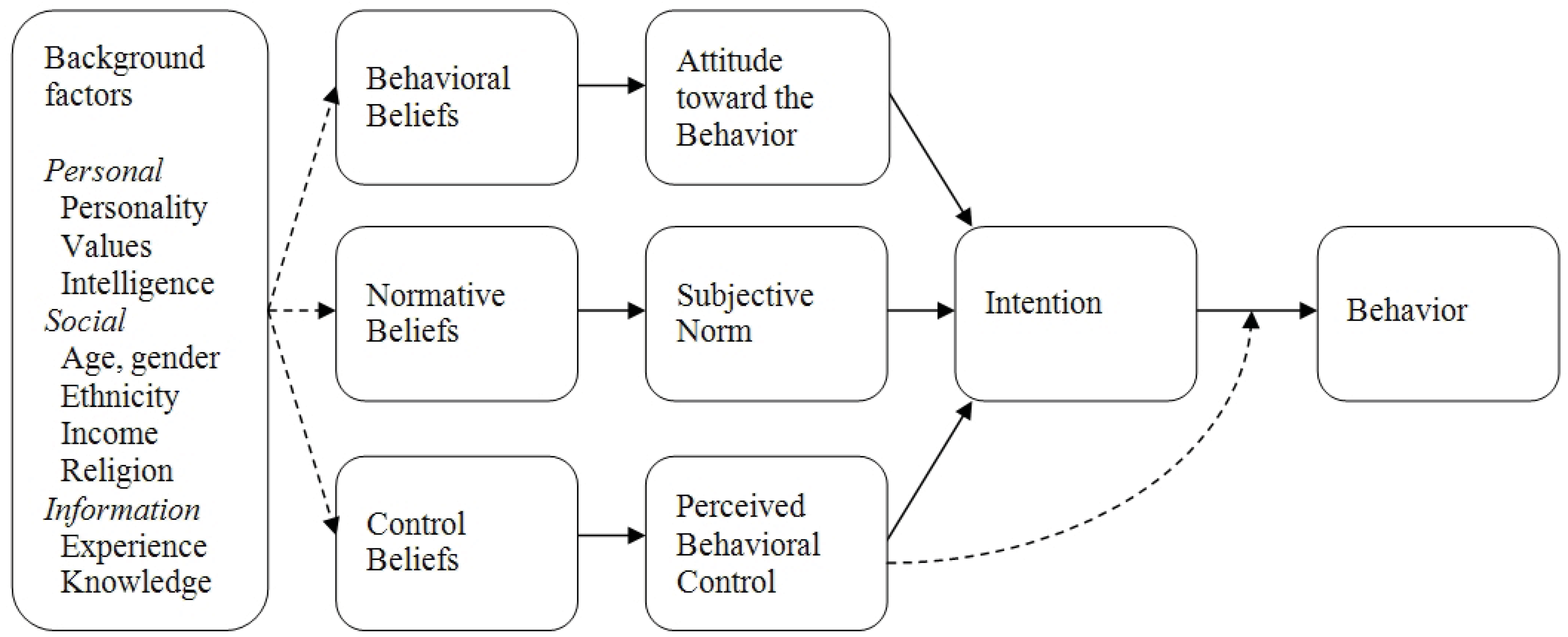
        <p>Stray cats and dogs are said to exist as a function of human attitudes and behaviours, such as semi-ownership practices, however these are poorly understood [<xref ref-type="bibr" rid="B26-animals-02-00611">26</xref>]. Nonetheless, it is generally accepted that attitudes towards a particular behaviour, such as sterilisation, are a key determinant in predicting the enactment of that behaviour. These principles are outlined in the Theory of Planned Behaviour (TPB) which suggests that background demographic and psychosocial factors (such as knowledge, beliefs, and values), influence the formation of attitudes, perceived social norms and perceived personal agency and that these, in turn, influence behaviour (see <xref ref-type="fig" rid="animals-02-00611-f001">Figure 1</xref>) [<xref ref-type="bibr" rid="B27-animals-02-00611">27</xref>]. For instance, some research has linked personality attributes, such as agreeableness, to attitudes towards animal welfare and their use [<xref ref-type="bibr" rid="B28-animals-02-00611">28</xref>]. Moreover, gender and animal empathy have both been associated with attitudes towards sterilisation practices [<xref ref-type="bibr" rid="B29-animals-02-00611">29</xref>,<xref ref-type="bibr" rid="B30-animals-02-00611">30</xref>,<xref ref-type="bibr" rid="B31-animals-02-00611">31</xref>]. As has been demonstrated previously [<xref ref-type="bibr" rid="B32-animals-02-00611">32</xref>,<xref ref-type="bibr" rid="B33-animals-02-00611">33</xref>], the TPB model offers a means of developing our understanding of attitudes towards companion animal ownership and population control management, such as sterilisation, in non-western cultures. </p>
        <p>Humane APC management is a global challenge that continues to present opportunities for improvement through innovation, partnership and community engagement. While NGOs will no doubt play an integral role in the future of APC management in emerging economies, enhanced community engagement and ownership of such programs is essential for their ongoing sustainability and effectiveness [<xref ref-type="bibr" rid="B34-animals-02-00611">34</xref>]. Greater understanding of local attitudes towards pet ownership practices and APC management is an important way forward in this regard. </p>
        <fig id="animals-02-00611-f001" position="anchor">
          <label>Figure 1</label>
          <caption>
            <p>Theory of Planned Behaviour model; Attitudes, personality and behaviour [<xref ref-type="bibr" rid="B27-animals-02-00611">27</xref>].</p>
          </caption>
          <graphic xmlns:xlink="http://www.w3.org/1999/xlink" xlink:href="animals-02-00611-g001.tif"/>
        </fig>
      </sec>
      <sec>
        <title>1.3. Study Aims</title>
        <p>Given that stray populations are at least partly maintained via semi-ownership practices [<xref ref-type="bibr" rid="B5-animals-02-00611">5</xref>], the first aim of this study was to determine the prevalence of semi-ownership of cats and dogs in Thailand. Second, using the TPB, we aimed to identify psychosocial factors that predict intentions to sterilise in semi-owners. </p>
      </sec>
    </sec>
    <sec>
      <title>2. Method</title>
      <sec sec-type="subjects">
        <title>2.1. Participants and Procedure</title>
        <p>A random telephone interview was undertaken between the 11th and 18th March 2011 by Foresight Research Co., Ltd. to recruit 500 Thai nationals aged 18 years or older. The stratified sample comprised equal representation from provinces within Bangkok, Central, Northern, North Eastern and Southern Thailand. Participants were contacted via landline telephone, which are in use by 21.40% of Thai households overall and 50% of households in Bangkok [<xref ref-type="bibr" rid="B35-animals-02-00611">35</xref>]. Potential participants were recruited via stratified, simple random sampling and one attempt was made to contact every 15th or 20th individual listed in the telephone directory. In total, contact was attempted with 5,727 potential participants: no contact was able to be made with 1,683 individuals; 3,544 declined to participate; and 500 agreed. This constituted a 12% recruitment success rate. Six respondents were excluded as non-Thai nationals. The final sample comprised 494 adults (Male = 146, Female = 348), with a mean age of 37.69 years (SD = 12.61), residing throughout rural and non-rural regions in Thailand. Of these, 102 respondents (20.65%) indicated that they regularly interact with and care for a cat and/or dog that they do not claim to own and were thus deemed “semi-owners”. This sub-sample (n = 102) comprised 67 females and 35 males with a mean age of 38.11 years (SD = 13.21). Most were technically/tertiary educated (66.7%), employed full time (61.8%), Buddhist (96.1%), and married (57.8%) with an average monthly income of 13000THB (approximately equivalent to $410USD). The subsample of semi-owners (n = 102) was similar to the larger sample of non-semi-owners (n = 392) in terms of age, gender distribution, region of residence, education, employment, religion, relationship status and monthly income, with no significant differences between groups identified (<italic>p</italic> &gt; 0.05). Moreover, these characteristics are broadly in keeping with national Thai statistics [<xref ref-type="bibr" rid="B35-animals-02-00611">35</xref>], with the exception that this cohort were somewhat more highly educated and had greater access to landline telephones (as was the also case for the total sample, N = 494). </p>
      </sec>
      <sec>
        <title>2.2. Materials</title>
        <p>The Thai version of the Culture and Human-Animal Interactions (CHAI) survey was used to interview respondents in relation to: </p>
        <list list-type="simple">
          <list-item>
            <p>(1) Demographic characteristics: gender, age, highest education attained (e.g., Primary, Secondary, Tertiary), residency (e.g., Urban, Suburban, Rural), employment status (e.g., Full Time, Part Time), relationship status (e.g., Single, Married, Divorced/Widowed), religion (e.g., Buddhist, Muslim), spoken language, income, pet keeping and sterilisation practices.</p>
          </list-item>
          <list-item>
            <p>(2) Psychosocial (TPB) factors: knowledge (e.g., “Female cats and dogs need to have one litter before being desexed”), beliefs (e.g., “De-sexing this cat is consistent with my religious beliefs” and “Sterilization makes cats overweight”), subjective norms (e.g., “People who are important to me think that I should de-sex this cat”), perceived behavioural control (e.g., “Financial constraints prevent me from de-sexing this cat”) and intentions (e.g., “I intend to de-sex this cat in the near future”) regarding sterilisation. Items were answered using a five point Likert-type scale, anchored by 1 = strongly disagree and 5 = strongly agree. Attitudes towards sterilisation were indexed using opposing attitudinal descriptors (e.g., harmful <italic>vs.</italic> beneficial) [<xref ref-type="bibr" rid="B36-animals-02-00611">36</xref>]; higher scores represent more positive attitudes towards sterilisation.</p>
          </list-item>
          <list-item>
            <p>(3) Animal Empathy Scale [<xref ref-type="bibr" rid="B37-animals-02-00611">37</xref>]: eight positively and eight negatively phrased empathy items indexed using a five point Likert-type scale (1 = strongly disagree and 5 = strongly agree). Total scores could range from 16 to 80 and high scores indicated higher animal empathy.</p>
          </list-item>
          <list-item>
            <p>(4) The Ten Item Personality Inventory [<xref ref-type="bibr" rid="B38-animals-02-00611">38</xref>]: provided an index of personality characteristics using a 5 point, Likert-type scale, where 1 = strongly disagree and 5 = strongly agree. Five personality dimensions were examined including extraversion, agreeableness, conscientiousness, emotional stability and openness to new experiences. High scores indicate a tendency towards the specified trait.</p>
          </list-item>
        </list>
      </sec>
      <sec>
        <title>2.3. Statistics</title>
        <p>Principle Components Analyses was used to identify constructs drawn from multiple items; subscales with acceptable internal consistency (Cronbach’s alpha ≥ 0.7) were used in subsequent analyses. Correlations and Hierarchical Multiple Regression (HMR) models were used to examine demographic and psychosocial factors that predict intentions to sterilise semi-owned cats and dogs in the near future (1 = strongly disagree and 5 = strongly agree). Cook’s distance (&lt;1) confirmed the normality of the residuals. The structure of the HMR Model can be seen in <xref ref-type="table" rid="animals-02-00611-t001">Table 1</xref> (categorical demographic variables were dummy coded). Alpha was set at <italic>p</italic> ≤ 0.05.</p>
        <table-wrap id="animals-02-00611-t001" position="float">
          <object-id pub-id-type="pii">animals-02-00611-t001_Table 1</object-id>
          <label>Table 1</label>
          <caption>
            <p>Variables in the Hierarchical Multiple Regression Model.</p>
          </caption>
          <table rules="rows">
            <thead>
              <tr>
                <th align="left" valign="top">Step</th>
                <th align="left" valign="top">Variable Type</th>
                <th align="left" valign="top">
                  <italic>Variables</italic>
                </th>
              </tr>
            </thead>
            <tbody>
              <tr>
                <td rowspan="9" align="left" valign="top">
                  <bold>1</bold>
                </td>
                <td rowspan="9" align="left" valign="top">
                  <bold>Demographics</bold>
                </td>
                <td align="left" valign="top">
                  <italic>Region in Thailand</italic>
                </td>
              </tr>
              <tr>
                <td align="left" valign="top">
                  <italic>Gender</italic>
                </td>
              </tr>
              <tr>
                <td align="left" valign="top">
                  <italic>Age</italic>
                </td>
              </tr>
              <tr>
                <td align="left" valign="top">
                  <italic>Education</italic>
                </td>
              </tr>
              <tr>
                <td align="left" valign="top">
                  <italic>Employment status</italic>
                </td>
              </tr>
              <tr>
                <td align="left" valign="top">
                  <italic>Religion</italic>
                </td>
              </tr>
              <tr>
                <td align="left" valign="top">
                  <italic>Relationship status</italic>
                </td>
              </tr>
              <tr>
                <td align="left" valign="top">
                  <italic>Residential location</italic>
                </td>
              </tr>
              <tr>
                <td align="left" valign="top">
                  <italic>Monthly income</italic>
                </td>
              </tr>
              <tr>
                <td rowspan="5" align="left" valign="top">
                  <bold>2</bold>
                </td>
                <td rowspan="5" align="left" valign="top">
                  <bold>Personality</bold>
                </td>
                <td align="left" valign="top">
                  <italic>Extraversion</italic>
                </td>
              </tr>
              <tr>
                <td align="left" valign="top">
                  <italic>Agreeableness</italic>
                </td>
              </tr>
              <tr>
                <td align="left" valign="top">
                  <italic>Conscientiousness</italic>
                </td>
              </tr>
              <tr>
                <td align="left" valign="top">
                  <italic>Emotional Stability</italic>
                </td>
              </tr>
              <tr>
                <td align="left" valign="top">
                  <italic>Openness</italic>
                </td>
              </tr>
              <tr>
                <td align="left" valign="top">
                  <bold>3</bold>
                </td>
                <td align="left" valign="top">
                  <bold>Empathy</bold>
                </td>
                <td align="left" valign="top">
                  <italic>Animal Empathy</italic>
                </td>
              </tr>
              <tr>
                <td rowspan="2" align="left" valign="top">
                  <bold>4</bold>
                </td>
                <td rowspan="2" align="left" valign="top">
                  <bold>Beliefs</bold>
                </td>
                <td align="left" valign="top">
                  <italic>Cats and dogs are independent</italic>
                </td>
              </tr>
              <tr>
                <td align="left" valign="top">
                  <italic>Education about cat and dog interactions is important</italic>
                </td>
              </tr>
              <tr>
                <td align="left" valign="top">
                  <bold>3</bold>
                </td>
                <td align="left" valign="top">
                  <bold>Desexing outcome beliefs</bold>
                </td>
                <td align="left" valign="top">
                  <italic>Negative sterilisation outcomes </italic>
                </td>
              </tr>
              <tr>
                <td rowspan="8" align="left" valign="top">
                  <bold>4</bold>
                </td>
                <td rowspan="8" align="left" valign="top">
                  <bold>Theory of Planned Behaviour </bold>
                </td>
                <td align="left" valign="top">
                  <italic>Attitudes towards desexing</italic>
                </td>
              </tr>
              <tr>
                <td align="left" valign="top">
                  <italic>Norms—Desexing is endorsed by important others</italic>
                </td>
              </tr>
              <tr>
                <td align="left" valign="top">
                  <italic>Religion—Desexing is consistent with my religious beliefs</italic>
                </td>
              </tr>
              <tr>
                <td align="left" valign="top">
                  <italic>PBC <sup>1</sup>—Agency (Desexing was/is entirely my decision)</italic>
                </td>
              </tr>
              <tr>
                <td align="left" valign="top">
                  <italic>PBC—Arrange (I could arrange desexing if I wanted to) </italic>
                </td>
              </tr>
              <tr>
                <td align="left" valign="top">
                  <italic>PBC—Access (Limited access to veterinarians near my home prevents me from desexing) </italic>
                </td>
              </tr>
              <tr>
                <td align="left" valign="top">
                  <italic>PBC—Finances (Financial constraints prevent me from de-sexing this dog/cat )</italic>
                </td>
              </tr>
              <tr>
                <td align="left" valign="top">
                  <italic>PBC—Commitments (My commitments prevent me from desexing )</italic>
                </td>
              </tr>
            </tbody>
          </table>
		  <table-wrap-foot>
			<fn>
        <p><sup>1</sup> PBC = Perceived Behavioural Control</p>
			</fn>
			</table-wrap-foot>
        </table-wrap>
      </sec>
    </sec>
    <sec sec-type="results">
      <title>3. Results</title>
      <sec>
        <title>3.1. Cat Semi-Ownership and Sterilisation</title>
        <p>Of the entire sample (N = 494), 55 respondents (11.13%), comprising 18 males (32.7%) and 37 females (67.3%), indicated that they regularly interact with and care for a cat they do not own. Of these semi-owned cats, there were somewhat more females relative to males (52.7% <italic>vs.</italic> 47.3% respectively) and 36.4% wore collars. Most cat semi-owners did not think that they were the main person who looked after the cat (76.4%). In relation to ownership, 45.5% believed the cat was owned by someone, 30.9% believed the cat was unowned, and 23.6% were unsure. Only 7.3% the cats were known to be desexed (n = 4), with 60% known to be intact and 32.7% of semi-owners were unsure. </p>
      </sec>
      <sec>
        <title>3.2. Dog Semi-Ownership and Sterilisation</title>
        <p>In relation to semi-owned dogs, 71 respondents, comprising 23 males (32.4%) and 48 females (67.6%), indicated that they interact with and care for a dog they do not own; this represented 14.37% of the entire sample (N = 494). Most of the semi-owned dogs were male (59.2%) and did not wear collars (74.6%). Almost half of the dog semi-owners (49.3%) believed the dog was owned by someone else, 33.8% thought the dog was unowned and 16.9% were unsure. Most dog semi-owners did not believe that they were the main person looking after the dog (76.1%). Only 16.9% of semi-owners thought the dog had been desexed (n = 12), 66.2% indicated that the dog was intact and a further 16.9% were unsure. </p>
        <p>Of the sample of semi-owners (n = 102), most (n = 73, 71.6%) also indicated ownership of a cat and/or a dog.</p>
      </sec>
      <sec>
        <title>3.3. Religion and Sterilisation</title>
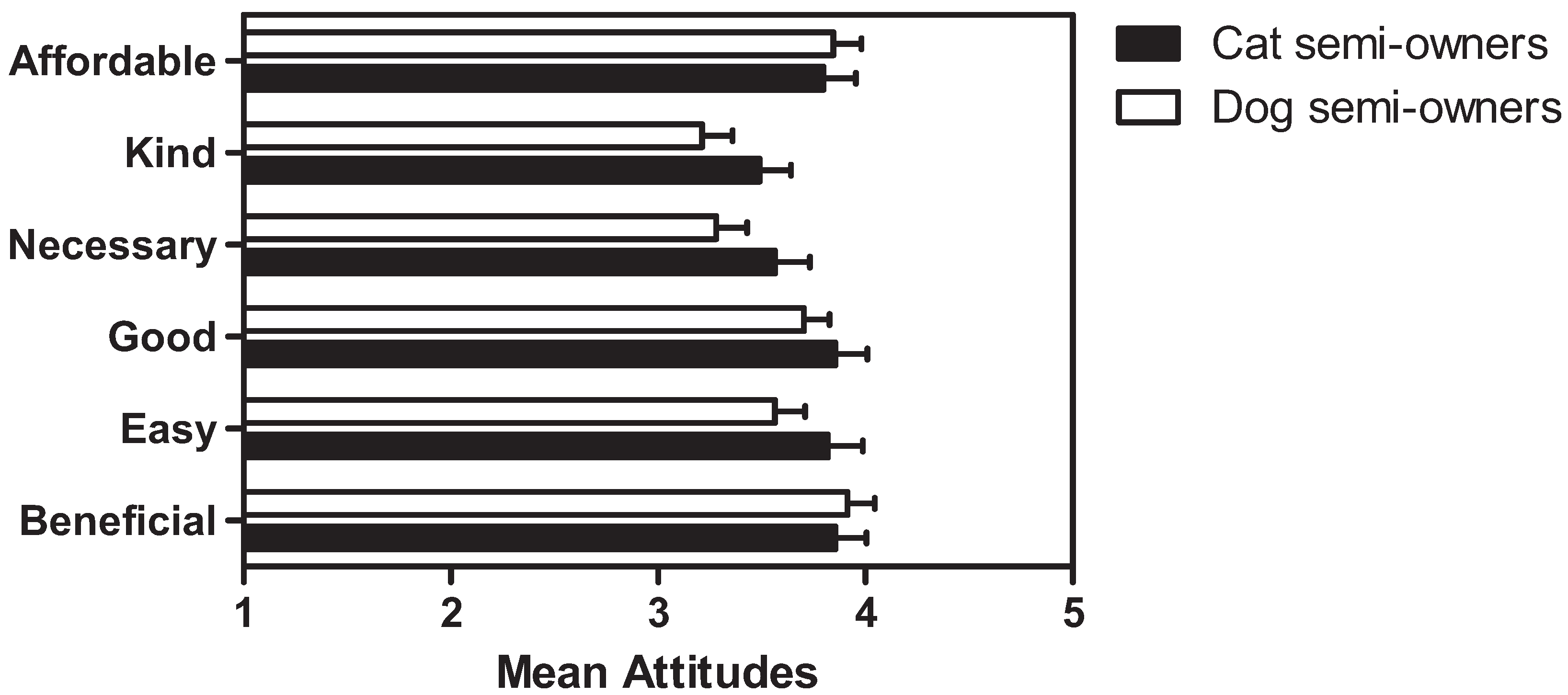
        <p>Mean agreement that sterilisation had been consistent with respondents’ religious beliefs was low for dog semi-owners (n = 12, Mean = 2.00, SD = 0.95) and cat semi-owners (n = 4, Mean = 1.75, SD = 0.50). Similar findings were observed for semi-owners of intact animals, with most indicating disagreement that the decision to sterilise their intact semi-owned cat (n = 51, Mean = 1.86, SD = 0.87) or dog (n = 59, Mean = 1.61, SD = 0.77) would be consistent with their religious beliefs (see <xref ref-type="fig" rid="animals-02-00611-f002">Figure 2</xref>). </p>
        <fig id="animals-02-00611-f002" position="anchor">
          <label>Figure 2</label>
          <caption>
            <p>Percentage agreement that sterilisation was/is consistent with religious beliefs in semi-owners of intact or sterilised cats and dogs.</p>
          </caption>
          <graphic xmlns:xlink="http://www.w3.org/1999/xlink" xlink:href="animals-02-00611-g002.tif"/>
        </fig>
      </sec>
      <sec>
        <title>3.4. Attitudes towards Sterilisation</title>
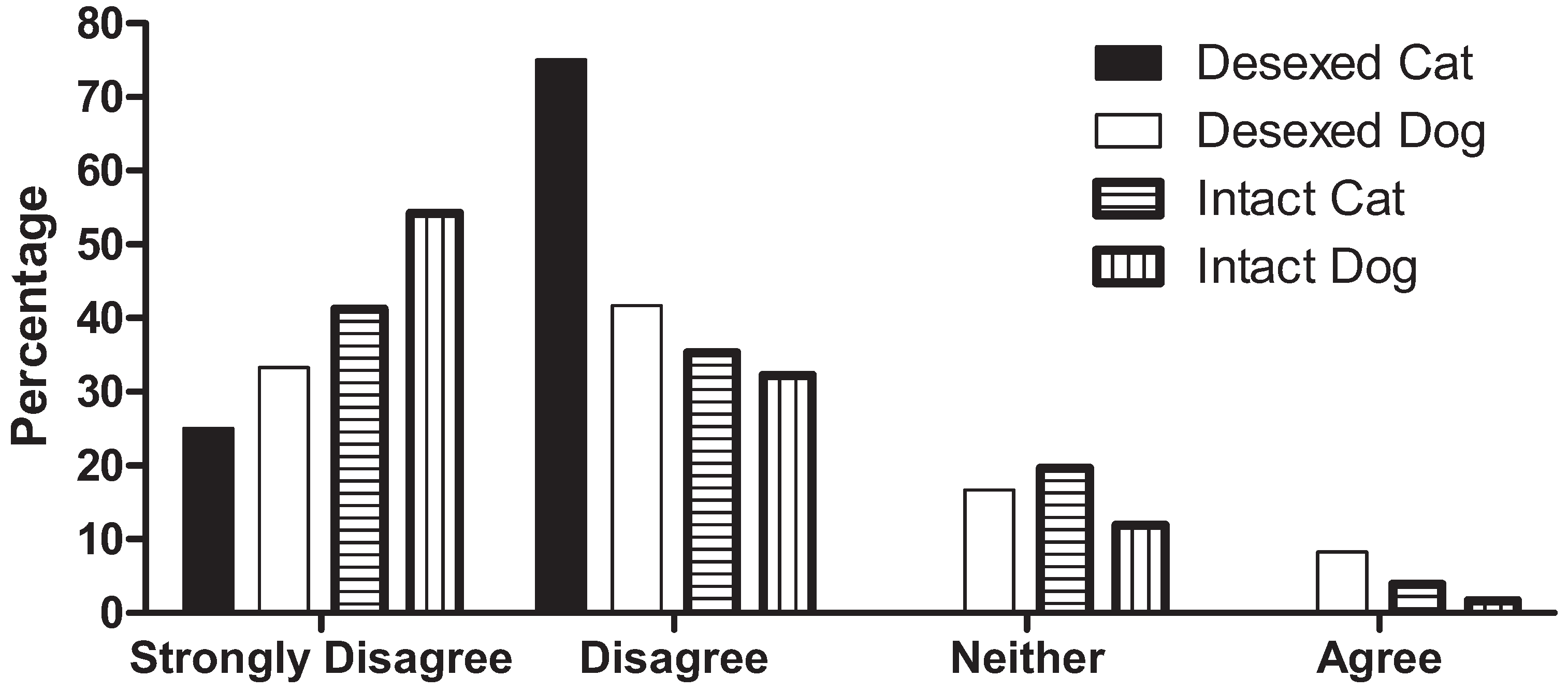
        <p>Semi-owners of cats (n = 55) and dogs (n = 71) were asked to indicate their attitudes towards sterilisation. As can be seen in <xref ref-type="fig" rid="animals-02-00611-f003">Figure 3</xref>, attitudes towards sterilisation among cat and dog semi-owners were moderately positive and no significant differences were observed between groups. In addition, no significant differences in attitudes towards sterilisation as a function of semi-owner gender emerged. </p>
        <fig id="animals-02-00611-f003" position="anchor">
          <label>Figure 3</label>
          <caption>
            <p>Mean attitudes (±SEM) towards sterilisation in cat and dog semi-owners (1 = strongly disagree, 5 = strongly agree).</p>
          </caption>
          <graphic xmlns:xlink="http://www.w3.org/1999/xlink" xlink:href="animals-02-00611-g003.tif"/>
        </fig>
      </sec>
      <sec>
        <title>3.5. Beliefs Regarding Health and Behavioural Outcomes of Sterilisation</title>
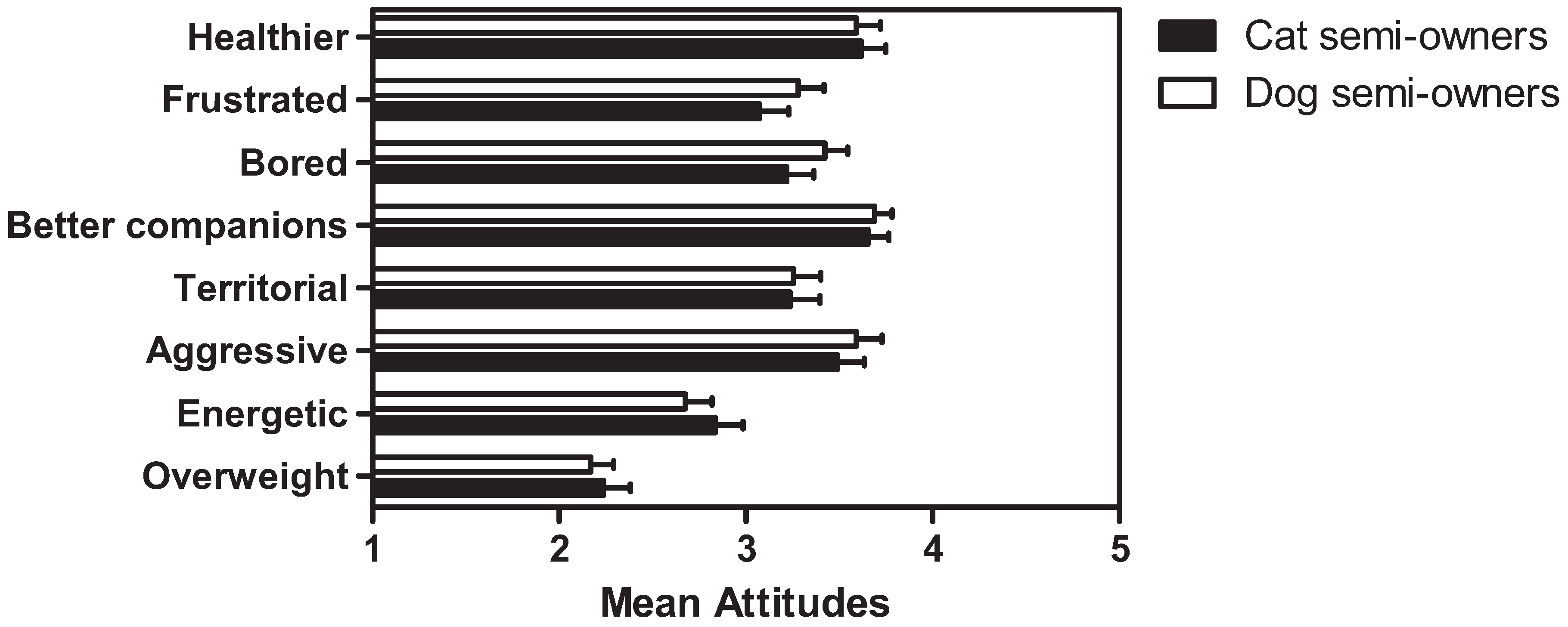
        <p>Cat (n = 55) and dog (n = 71) semi-owners were asked their beliefs about the health and behavioural outcomes of sterilisation for cats and dogs. As shown in <xref ref-type="fig" rid="animals-02-00611-f004">Figure 4</xref>, the findings indicated some positive (<italic>i.e.</italic>, health, companionship) and some negative (<italic>i.e.</italic>, frustrated, bored, territorial, aggressive) beliefs about sterilisation outcomes. Semi-owners believed that sterilised animals become less energetic, but not overweight. There were no significant differences between cat and dog semi-owners.</p>
        <fig id="animals-02-00611-f004" position="anchor">
          <label>Figure 4</label>
          <caption>
            <p>Mean beliefs (± SEM) regarding the outcomes of sterilisation in cat (n = 55) and dog (n = 71) semi-owners (1 = strongly disagree, 5 = strongly agree).</p>
          </caption>
          <graphic xmlns:xlink="http://www.w3.org/1999/xlink" xlink:href="animals-02-00611-g004.tif"/>
        </fig>
      </sec>
      <sec>
        <title>3.6. Knowledge and Beliefs about Pet Care Practices</title>
        <p>In general, semi-owners (n = 102) and non-semi-owners (n = 392) demonstrated moderate knowledge regarding pet care practices. Few significant differences between these groups emerged (see <xref ref-type="table" rid="animals-02-00611-t002">Table 2</xref>). </p>
        <table-wrap id="animals-02-00611-t002" position="float">
          <object-id pub-id-type="pii">animals-02-00611-t002_Table 2</object-id>
          <label>Table 2</label>
          <caption>
            <p>Mean agreement with knowledge and belief statements regarding companion animal issues by semi-ownership category (1 = strongly disagree, 5 = strongly agree).</p>
          </caption>
          <table rules="rows">
            <thead>
              <tr>
                <th rowspan="2" align="left" valign="middle">Knowledge and Belief Items</th>
                <th colspan="2" align="center" valign="middle" style="background: #F2F2F2">Semi- Owner (n = 102)</th>
                <th colspan="2" align="center" valign="middle">Non- Semi-Owner (n = 392)</th>
                <th rowspan="2" align="center" valign="middle">
                  <italic>p</italic>
                </th>
              </tr>
              <tr>
                <th valign="middle" style="background: #F2F2F2">Mean</th>
                <th valign="middle" style="background: #F2F2F2">SD</th>
                <th valign="middle">Mean</th>
                <th valign="middle">SD</th>
              </tr>
            </thead>
            <tbody>
              <tr>
                <td align="left" valign="middle">Female cats and dogs need to have one litter before being desexed</td>
                <td align="center" valign="middle" style="background: #F2F2F2">2.87</td>
                <td align="center" valign="middle" style="background: #F2F2F2">1.35</td>
                <td align="center" valign="middle">2.69</td>
                <td align="center" valign="middle">1.13</td>
                <td align="center" valign="middle"><italic>p</italic> &gt; 0.05</td>
              </tr>
              <tr>
                <td align="left" valign="middle">Food prepared for humans is suitable for cats and dogs</td>
                <td align="center" valign="middle" style="background: #F2F2F2">2.88</td>
                <td align="center" valign="middle" style="background: #F2F2F2">1.25</td>
                <td align="center" valign="middle">2.65</td>
                <td align="center" valign="middle">1.10</td>
                <td align="center" valign="middle"><italic>p</italic> &gt; 0.05</td>
              </tr>
              <tr>
                <td align="left" valign="middle">The needs of cats and dogs in Asia are different from those in the West</td>
                <td align="center" valign="middle" style="background: #F2F2F2">2.37</td>
                <td align="center" valign="middle" style="background: #F2F2F2">0.98</td>
                <td align="center" valign="middle">2.51</td>
                <td align="center" valign="middle">0.93</td>
                <td align="center" valign="middle"><italic>p</italic> &gt; 0.05</td>
              </tr>
              <tr>
                <td align="left" valign="middle">Dog bites are a serious problem in the community</td>
                <td align="center" valign="middle" style="background: #F2F2F2">4.25</td>
                <td align="center" valign="middle" style="background: #F2F2F2">0.92</td>
                <td align="center" valign="middle">4.18</td>
                <td align="center" valign="middle">0.78</td>
                <td align="center" valign="middle"><italic>p</italic> &gt; 0.05</td>
              </tr>
              <tr>
                <td align="left" valign="middle">Desexing male cats and dogs feminises them</td>
                <td align="center" valign="middle" style="background: #F2F2F2">3.19</td>
                <td align="center" valign="middle" style="background: #F2F2F2">1.08</td>
                <td align="center" valign="middle">3.05</td>
                <td align="center" valign="middle">0.95</td>
                <td align="center" valign="middle"><italic>p</italic> &gt; 0.05</td>
              </tr>
              <tr>
                <td align="left" valign="middle">It is not a waste of money to pay for cat desexing</td>
                <td align="center" valign="middle" style="background: #F2F2F2">3.67</td>
                <td align="center" valign="middle" style="background: #F2F2F2">1.18</td>
                <td align="center" valign="middle">3.62</td>
                <td align="center" valign="middle">0.87</td>
                <td align="center" valign="middle"><italic>p</italic> &gt; 0.05</td>
              </tr>
              <tr>
                <td align="left" valign="middle">Desexing deprives cats and dogs of the right to sexual activity</td>
                <td align="center" valign="middle" style="background: #F2F2F2">3.49</td>
                <td align="center" valign="middle" style="background: #F2F2F2">1.15</td>
                <td align="center" valign="middle">3.45</td>
                <td align="center" valign="middle">0.94</td>
                <td align="center" valign="middle"><italic>p</italic> &gt; 0.05</td>
              </tr>
              <tr>
                <td align="left" valign="middle">Cats are lovable family members</td>
                <td align="center" valign="middle" style="background: #F2F2F2">3.98</td>
                <td align="center" valign="middle" style="background: #F2F2F2">0.95</td>
                <td align="center" valign="middle">3.86</td>
                <td align="center" valign="middle">0.85</td>
                <td align="center" valign="middle"><italic>p</italic> &gt; 0.05</td>
              </tr>
              <tr>
                <td align="left" valign="middle">Dogs are lovable family members</td>
                <td align="center" valign="middle" style="background: #F2F2F2">4.35</td>
                <td align="center" valign="middle" style="background: #F2F2F2">0.61</td>
                <td align="center" valign="middle">4.20</td>
                <td align="center" valign="middle">0.58</td>
                <td align="center" valign="middle">
                  <bold>
                    <italic>p</italic>
                  </bold>
                  <bold> &lt; 0.05</bold>
                </td>
              </tr>
              <tr>
                <td align="left" valign="middle">Cats can take care of themselves</td>
                <td align="center" valign="middle" style="background: #F2F2F2">3.70</td>
                <td align="center" valign="middle" style="background: #F2F2F2">1.18</td>
                <td align="center" valign="middle">3.64</td>
                <td align="center" valign="middle">0.97</td>
                <td align="center" valign="middle"><italic>p</italic> &gt; 0.05</td>
              </tr>
              <tr>
                <td align="left" valign="middle">Dogs can take care of themselves</td>
                <td align="center" valign="middle" style="background: #F2F2F2">3.50</td>
                <td align="center" valign="middle" style="background: #F2F2F2">1.17</td>
                <td align="center" valign="middle">3.39</td>
                <td align="center" valign="middle">1.07</td>
                <td align="center" valign="middle"><italic>p</italic> &gt; 0.05</td>
              </tr>
              <tr>
                <td align="left" valign="middle">Children should learn how to interact with cats</td>
                <td align="center" valign="middle" style="background: #F2F2F2">4.18</td>
                <td align="center" valign="middle" style="background: #F2F2F2">0.70</td>
                <td align="center" valign="middle">4.00</td>
                <td align="center" valign="middle">0.85</td>
                <td align="center" valign="middle">
                  <bold>
                    <italic>p</italic>
                  </bold>
                  <bold> &lt; 0.05</bold>
                </td>
              </tr>
              <tr>
                <td align="left" valign="middle">Children should learn how to interact with dogs</td>
                <td align="center" valign="middle" style="background: #F2F2F2">4.25</td>
                <td align="center" valign="middle" style="background: #F2F2F2">0.66</td>
                <td align="center" valign="middle">4. 06</td>
                <td align="center" valign="middle">0.75</td>
                <td align="center" valign="middle">
                  <bold>
                    <italic>p</italic>
                  </bold>
                  <bold> &lt; 0.05</bold>
                </td>
              </tr>
              <tr>
                <td align="left" valign="middle">Dogs can scavenge adequate food for themselves</td>
                <td align="center" valign="middle" style="background: #F2F2F2">2.79</td>
                <td align="center" valign="middle" style="background: #F2F2F2">1.15</td>
                <td align="center" valign="middle">3.08</td>
                <td align="center" valign="middle">1.07</td>
                <td align="center" valign="middle">
                  <bold>
                    <italic>p</italic>
                  </bold>
                  <bold> &lt; 0.05</bold>
                </td>
              </tr>
              <tr>
                <td align="left" valign="middle">Cats can scavenge adequate food for themselves</td>
                <td align="center" valign="middle" style="background: #F2F2F2">3.28</td>
                <td align="center" valign="middle" style="background: #F2F2F2">1.13</td>
                <td align="center" valign="middle">3.19</td>
                <td align="center" valign="middle">1.09</td>
                <td align="center" valign="middle"><italic>p</italic> &gt; 0.05</td>
              </tr>
            </tbody>
          </table>
        </table-wrap>
      </sec>
      <sec>
        <title>3.7. Agency, Norms and Sterilisation</title>
        <p>Mean agreement regarding normative pressure and perceived agency to sterilise was examined in cat and dog semi-owners. In general, all respondent groups indicated low to moderate agreement that important others would support sterilisation or that the decision to sterilise had been entirely up to them (see <xref ref-type="table" rid="animals-02-00611-t003">Table 3</xref>). Semi-owners of intact semi-owned cats and dogs further indicated low to moderate agreement that perceived obstacles prevented sterilisation (<xref ref-type="table" rid="animals-02-00611-t004">Table 4</xref>). </p>
        <table-wrap id="animals-02-00611-t003" position="float">
          <object-id pub-id-type="pii">animals-02-00611-t003_Table 3</object-id>
          <label>Table 3</label>
          <caption>
            <p>Mean agreement with agency and norm statements by semi-ownership category (1 = strongly disagree, 5 = strongly agree).</p>
          </caption>
          <table>
            <thead>
              <tr>
                <th rowspan="2" align="left" valign="middle">Agency, Norms</th>
                <th colspan="2" align="center" valign="middle" style="background: #F2F2F2">Semi-owner of sterilised cat (n = 4)</th>
                <th colspan="2" align="center" valign="middle">Semi-owner of sterilised dog (n = 12)</th>
                <th colspan="2" align="center" valign="middle" style="background: #F2F2F2">Semi-owner of intact cat (n = 51)</th>
                <th colspan="2" align="center" valign="middle">Semi-owner of intact dog (n = 59)</th>
              </tr>
              <tr style="border-top: solid thin">
                <th valign="middle" style="background: #F2F2F2">Mean</th>
                <th valign="middle" style="background: #F2F2F2">SD</th>
                <th valign="middle">Mean</th>
                <th valign="middle">SD</th>
                <th valign="middle" style="background: #F2F2F2">Mean</th>
                <th valign="middle" style="background: #F2F2F2">SD</th>
                <th valign="middle">Mean</th>
                <th valign="middle">SD</th>
              </tr>
            </thead>
            <tbody>
              <tr>
                <td align="left" valign="middle">The decision to sterilise was/is entirely up to me</td>
                <td align="center" valign="middle" style="background: #F2F2F2">1.75</td>
                <td align="center" valign="middle" style="background: #F2F2F2">0.50</td>
                <td align="center" valign="middle">2.75</td>
                <td align="center" valign="middle">1.48</td>
                <td align="center" valign="middle" style="background: #F2F2F2">2.22</td>
                <td align="center" valign="middle" style="background: #F2F2F2">1.21</td>
                <td align="center" valign="middle">2.10</td>
                <td align="center" valign="middle">1.18</td>
              </tr>
              <tr>
                <td align="left" valign="middle">People who are important to me think that I should sterilise</td>
                <td align="center" valign="middle" style="background: #F2F2F2">2.25</td>
                <td align="center" valign="middle" style="background: #F2F2F2">0.96</td>
                <td align="center" valign="middle">2.67</td>
                <td align="center" valign="middle">1.56</td>
                <td align="center" valign="middle" style="background: #F2F2F2">2.27</td>
                <td align="center" valign="middle" style="background: #F2F2F2">1.04</td>
                <td align="center" valign="middle">2.17</td>
                <td align="center" valign="middle">1.10</td>
              </tr>
            </tbody>
          </table>
        </table-wrap>
        <table-wrap id="animals-02-00611-t004" position="float">
          <object-id pub-id-type="pii">animals-02-00611-t004_Table 4</object-id>
          <label>Table 4</label>
          <caption>
            <p>Mean agreement with perceived behavioural control statements by semi-owners of intact cats and dogs (1 = strongly disagree, 5 = strongly agree).</p>
          </caption>
          <table rules="rows">
            <thead>
              <tr>
                <th rowspan="2" align="left" valign="middle">Perceived Behavioural Control</th>
                <th colspan="2" align="center" valign="middle" style="background: #F2F2F2">Semi-owner of intact cat (n = 51)</th>
                <th colspan="2" align="center" valign="middle">Semi-owner of intact dog (n = 59)</th>
              </tr>
              <tr>
                <th valign="middle" style="background: #F2F2F2">Mean</th>
                <th valign="middle" style="background: #F2F2F2">SD</th>
                <th valign="middle">Mean</th>
                <th valign="middle">SD</th>
              </tr>
            </thead>
            <tbody>
              <tr>
                <td align="left" valign="middle">Limited access to veterinarians near my home prevents me from sterilising</td>
                <td align="center" valign="middle" style="background: #F2F2F2">2.25</td>
                <td align="center" valign="middle" style="background: #F2F2F2">1.00</td>
                <td align="center" valign="middle">2.00</td>
                <td align="center" valign="middle">0.95</td>
              </tr>
              <tr>
                <td align="left" valign="middle">Financial constraints prevent me from sterilising</td>
                <td align="center" valign="middle" style="background: #F2F2F2">2.25</td>
                <td align="center" valign="middle" style="background: #F2F2F2">1.18</td>
                <td align="center" valign="middle">2.08</td>
                <td align="center" valign="middle">1.16</td>
              </tr>
              <tr>
                <td align="left" valign="middle">My commitments prevent me from sterilising</td>
                <td align="center" valign="middle" style="background: #F2F2F2">2.16</td>
                <td align="center" valign="middle" style="background: #F2F2F2">1.05</td>
                <td align="center" valign="middle">2.14</td>
                <td align="center" valign="middle">1.18</td>
              </tr>
              <tr>
                <td align="left" valign="middle">I could arrange to have this cat/dog sterilised if I wanted to</td>
                <td align="center" valign="middle" style="background: #F2F2F2">2.69</td>
                <td align="center" valign="middle" style="background: #F2F2F2">1.24</td>
                <td align="center" valign="middle">2.44</td>
                <td align="center" valign="middle">1.30</td>
              </tr>
            </tbody>
          </table>
        </table-wrap>
      </sec>
      <sec>
        <title>3.8. Animal Empathy Scale</title>
        <p>Total mean animal empathy scores in semi-owners (n = 102) ranged from 45 to 76.9, with a mean of 58.13 (SD = 8.05), indicating a tendency towards animal empathy. Animal empathy was significantly higher in semi-owners compared with non-semi-owners (n = 392, M = 54.53, SD = 5.87), <italic>t</italic>(492) = 5.07, <italic>p</italic> &lt; 0.001. Within the sample of semi-owners (n = 102), cat semi-owners (n = 31, M = 55.03, SD = 6.62) had less empathy towards animals than dog semi-owners (n = 47, M = 59.27, SD = 7.87) or cat/dog semi-owners (n = 24, M = 59.87, SD = 9.20), F(2,101) = 3.50, <italic>p</italic> &lt; 0.05.</p>
      </sec>
      <sec>
        <title>3.9. Personality, Attitudes and Empathy</title>
        <p>The TIPI was used to examine personality characteristics in semi-owner (n = 102) <italic>vs.</italic> non-semi-owner (n = 392) groups. Mean scores for both groups were around the midway point of the 5-point scale for each of the personality domains (extraverted, agreeable, conscientious, emotional stability and openness). The results showed that semi-owners were significantly more open to experience than non-semi-owners, <italic>t</italic>(492) = 3.46, <italic>p</italic> &lt; 0.001. Pearsons correlation coefficients were used to identify associations between personality, attitudes and empathy in semi-owners (n = 102) (see <xref ref-type="table" rid="animals-02-00611-t005">Table 5</xref>). With the exception of extraversion, all personality domains were associated with attitudes towards desexing and animal empathy. </p>
        <table-wrap id="animals-02-00611-t005" position="float">
          <object-id pub-id-type="pii">animals-02-00611-t005_Table 5</object-id>
          <label>Table 5</label>
          <caption>
            <p>Pearson’s Correlation Coefficient between personality, attitudes and empathy in semi-owners (n = 102).</p>
          </caption>
          <table rules="rows">
            <thead>
              <tr>
                <th align="left" valign="middle"> </th>
                <th align="center" valign="middle">Extravert</th>
                <th align="center" valign="middle">Agreeable</th>
                <th align="center" valign="middle">Conscientious</th>
                <th align="center" valign="middle">Emotional Stability</th>
                <th align="center" valign="middle">Openness</th>
              </tr>
            </thead>
            <tbody>
              <tr>
                <td align="left" valign="middle">Attitudes towards desexing dogs</td>
                <td align="center" valign="middle">0.07</td>
                <td align="center" valign="middle">0.12 *</td>
                <td align="center" valign="middle">0.15 **</td>
                <td align="center" valign="middle">0.06</td>
                <td align="center" valign="middle">0.12 **</td>
              </tr>
              <tr>
                <td align="left" valign="middle">Attitudes towards desexing cats</td>
                <td align="center" valign="middle">0.01</td>
                <td align="center" valign="middle">0.12 **</td>
                <td align="center" valign="middle">0.13 **</td>
                <td align="center" valign="middle">0.11 *</td>
                <td align="center" valign="middle">0.12 **</td>
              </tr>
              <tr>
                <td align="left" valign="middle">Animal empathy</td>
                <td align="center" valign="middle">−0.08</td>
                <td align="center" valign="middle">0.17 **</td>
                <td align="center" valign="middle">0.13 **</td>
                <td align="center" valign="middle">−0.11 *</td>
                <td align="center" valign="middle">0.17 **</td>
              </tr>
            </tbody>
          </table>
		  <table-wrap-foot>
			<fn>
        <p>*<italic>p </italic>&lt; 0.05; ** <italic>p</italic> &lt; 0.001 </p>
			</fn>
			</table-wrap-foot>
        </table-wrap>
      </sec>
      <sec>
        <title>3.10. Intentions to Desex Semi-Owned Cats and Dogs in the Future</title>
        <p>The findings revealed low intentions for cat (Mean = 2.12, SD = 1.14) and dog (Mean = 1.17, SD = 0.99) semi-owners to sterilise in the near future; differences between groups were not significant. In total, 66.7% of cat semi-owners and 79.7% of dog semi-owners strongly disagreed or disagreed with the statement “I intend to desex this cat/dog in the near future”. </p>
        <p>Point biserial correlations failed to identify any associations between demographic factors and intentions to sterilise semi-owned cats and dogs in the near future (<italic>p</italic> &gt; 0.05). There was an inverse association between intentions to desex semi-owned dogs and agreeableness (<italic>r</italic> = −0.37, <italic>n</italic> = 59, <italic>p</italic> &lt; 0.01) and conscientiousness (<italic>r</italic> = −0.26, <italic>n</italic> = 59, <italic>p</italic> &lt; 0.05), but apart from these, personality and animal empathy were not associated with intentions to sterilise semi-owned animals in the future (<xref ref-type="table" rid="animals-02-00611-t006">Table 6</xref>). In general, intentions to sterilise semi-owned cats and dogs were associated with TPB variables including attitudes, religious beliefs, norms and perceived behavioural control variables (e.g., agency, financial constraints, access to veterinarians, commitments). </p>
        <table-wrap id="animals-02-00611-t006" position="float">
          <object-id pub-id-type="pii">animals-02-00611-t006_Table 6</object-id>
          <label>Table 6</label>
          <caption>
            <p>Point Biserial Correlation Coefficient between intentions to sterilise and psychosocial factors.</p>
          </caption>
          <table rules="rows">
            <thead>
              <tr>
                <th rowspan="2" colspan="2" align="left" valign="middle">Factor</th>
                <th colspan="2" align="left" valign="middle">Intentions to sterilise</th>
              </tr>
              <tr>
                <th align="left" valign="middle">Semi-owned Dog (n = 59)</th>
                <th align="left" valign="middle">Semi-owned Cat (n = 51)</th>
              </tr>
            </thead>
            <tbody>
              <tr>
                <td rowspan="5" align="left" valign="top">
                  <bold>Personality</bold>
                </td>
                <td align="left" valign="top">Extraversion</td>
                <td align="left" valign="top">0.13</td>
                <td align="left" valign="top">−0.20</td>
              </tr>
              <tr>
                <td align="left" valign="top">Agreeable</td>
                <td align="left" valign="top">−0.37 **</td>
                <td align="left" valign="top">−0.11</td>
              </tr>
              <tr>
                <td align="left" valign="top">Conscientious</td>
                <td align="left" valign="top">−0.26 *</td>
                <td align="left" valign="top">−0.03</td>
              </tr>
              <tr>
                <td align="left" valign="top">Emotional Stability</td>
                <td align="left" valign="top">−0.17</td>
                <td align="left" valign="top">0.09</td>
              </tr>
              <tr>
                <td align="left" valign="top">Openness</td>
                <td align="left" valign="top">−0.10</td>
                <td align="left" valign="top">−0.11</td>
              </tr>
              <tr>
                <td colspan="2" align="left" valign="top">
                  <bold>Animal empathy</bold>
                </td>
                <td align="left" valign="top">−0.02</td>
                <td align="left" valign="top">−0.19</td>
              </tr>
              <tr>
                <td rowspan="2" align="left" valign="top">
                  <bold>Beliefs</bold>
                </td>
                <td align="left" valign="top">Independent</td>
                <td align="left" valign="top">−0.13</td>
                <td align="left" valign="top">−0.29 *</td>
              </tr>
              <tr>
                <td align="left" valign="top">Education</td>
                <td align="left" valign="top">−0.21</td>
                <td align="left" valign="top">−0.04</td>
              </tr>
              <tr>
                <td colspan="2" align="left" valign="top">
                  <bold>Desexing outcome beliefs</bold>
                </td>
                <td align="left" valign="top">0.08</td>
                <td align="left" valign="top">−0.02</td>
              </tr>
              <tr>
                <td rowspan="8" align="left" valign="top">
                  <bold>Theory of Planned Behaviour</bold>
                </td>
                <td align="left" valign="top">Attitude: positive </td>
                <td align="left" valign="top">0.30 *</td>
                <td align="left" valign="top">0.22</td>
              </tr>
              <tr>
                <td align="left" valign="top">Norms</td>
                <td align="left" valign="top">0.66 **</td>
                <td align="left" valign="top">0.43 **</td>
              </tr>
              <tr>
                <td align="left" valign="top">Religion </td>
                <td align="left" valign="top">0.55 **</td>
                <td align="left" valign="top">0.54 **</td>
              </tr>
              <tr>
                <td align="left" valign="top">PBC <sup>1</sup> – agency</td>
                <td align="left" valign="top">0.54 **</td>
                <td align="left" valign="top">0.61 **</td>
              </tr>
              <tr>
                <td align="left" valign="top">PBC – access</td>
                <td align="left" valign="top">0.53 **</td>
                <td align="left" valign="top">0.50 **</td>
              </tr>
              <tr>
                <td align="left" valign="top">PBC – finances</td>
                <td align="left" valign="top">0.36 **</td>
                <td align="left" valign="top">0.36 **</td>
              </tr>
              <tr>
                <td align="left" valign="top">PBC – commitments </td>
                <td align="left" valign="top">0.44 **</td>
                <td align="left" valign="top">0.50 **</td>
              </tr>
              <tr>
                <td align="left" valign="top">PBC – arrange</td>
                <td align="left" valign="top">0.49 **</td>
                <td align="left" valign="top">0.37 **</td>
              </tr>
            </tbody>
          </table>
		  <table-wrap-foot>
			<fn>
        <p><sup>1 </sup>PBC = Perceived Behavioural Control; * <italic>p</italic> &lt; 0.05; ** <italic>p</italic> &lt; 0.001</p>
			</fn>
			</table-wrap-foot>
        </table-wrap>
        <p>The HMR model for intentions to sterilise semi-owned dogs in the future was highly significant F(9, 48) = 11.45, <italic>p</italic> &lt; 0.001. Respondents living in Southern Thailand (<italic>β</italic> = −0.31) and those that were agreeable (<italic>β</italic> = −0.26) were less likely to hold intentions to sterilise semi-owned dogs in the future. Conversely, respondents who perceived normative pressure to sterilise (<italic>β</italic> = 0.46), perceived sterilizing to be consistent with his/her religion (<italic>β</italic> = 0.40), considered the decision to sterilise entirely theirs to make (<italic>β</italic> = 0.42), believed that sterilisation was affordable (<italic>β</italic> = 0.21), but that financial constraints prevented them from sterilising (<italic>β</italic> = 0.27) and did not believe that they could make arrangements to sterilise if they wanted to (<italic>β</italic> = −0.48), were more likely to hold intentions to sterilise. These factors accounted for 62.3% of the variance in intentions to sterilise semi-owned dogs in the future (see <xref ref-type="table" rid="animals-02-00611-t007">Table 7</xref>). </p>
        <p>A significant HRM model was also achieved for intentions to sterilise semi-owned cats in the future, F(7, 42) = 21.59, <italic>p</italic> &lt; 0.001. Respondents who had only attained a Primary school level of education (<italic>β</italic> = −0.32) and that held the belief that they could not arrange to have the cat desexed if they wanted to (<italic>β</italic> = −0.26) were less likely to intend to sterilise semi-owned cats in the near future. Conversely, respondents who perceived normative pressure to sterilise (<italic>β</italic> = 0.28), believed that the behaviour was consistent with their religious beliefs (<italic>β</italic> = 0.20), believed that the decision to desex was entirely theirs to make (<italic>β</italic> = 0.62), and that personal commitments prevent desexing (<italic>β</italic> = 0.36) were more likely to intend to sterilise semi-owned cats in the future. These factors explained 74.6% of the variance in intentions to sterilise semi-owned cats in the near future (<xref ref-type="table" rid="animals-02-00611-t007">Table 7</xref>). </p>
        <table-wrap id="animals-02-00611-t007" position="float">
          <object-id pub-id-type="pii">animals-02-00611-t007_Table 7</object-id>
          <label>Table 7</label>
          <caption>
            <p>Hierarchical Multiple Regression Model for factors predicting intentions to sterilize in cat and dog owners and semi-owners.</p>
          </caption>
          <table rules="rows">
            <thead>
              <tr>
                <th align="left" valign="middle"> </th>
                <th align="center" valign="middle">Predictors</th>
                <th align="center" valign="middle">b</th>
                <th align="center" valign="middle">SE</th>
                <th align="center" valign="middle">
                  <italic>β</italic>
                </th>
                <th align="center" valign="middle">
                  <italic>t</italic>
                </th>
                <th align="center" valign="middle">
                  <italic>Adjusted R<sup>2</sup></italic>
                </th>
              </tr>
            </thead>
            <tbody>
              <tr>
                <td rowspan="8" align="left" valign="middle">
                  <bold>Semi-owned dog</bold>
                </td>
                <td align="left" valign="middle">South</td>
                <td align="center" valign="middle">−0.94</td>
                <td align="center" valign="middle">0.29</td>
                <td align="center" valign="middle">−0.31 **</td>
                <td align="center" valign="middle">−3.21</td>
                <td rowspan="8" align="center" valign="middle">0.62</td>
              </tr>
              <tr>
                <td align="left" valign="middle">Agreeable</td>
                <td align="center" valign="middle">−0.33</td>
                <td align="center" valign="middle">0.13</td>
                <td align="center" valign="middle">−0.26 *</td>
                <td align="center" valign="middle">−2.65</td>
              </tr>
              <tr>
                <td align="left" valign="middle">Norms</td>
                <td align="center" valign="middle">0.44</td>
                <td align="center" valign="middle">0.14</td>
                <td align="center" valign="middle">0.46 **</td>
                <td align="center" valign="middle">3.04</td>
              </tr>
              <tr>
                <td align="left" valign="middle">Religion</td>
                <td align="center" valign="middle">0.51</td>
                <td align="center" valign="middle">0.16</td>
                <td align="center" valign="middle">0.40 **</td>
                <td align="center" valign="middle">3.12</td>
              </tr>
              <tr>
                <td align="left" valign="middle">PBC <sup>1</sup> -decision</td>
                <td align="center" valign="middle">0.35</td>
                <td align="center" valign="middle">0.11</td>
                <td align="center" valign="middle">0.42 **</td>
                <td align="center" valign="middle">3.14</td>
              </tr>
              <tr>
                <td align="left" valign="middle">PBC-finances</td>
                <td align="center" valign="middle">0.23</td>
                <td align="center" valign="middle">0.10</td>
                <td align="center" valign="middle">0.27 *</td>
                <td align="center" valign="middle">2.41</td>
              </tr>
              <tr>
                <td align="left" valign="middle">PBC-arrange</td>
                <td align="center" valign="middle">−0.37</td>
                <td align="center" valign="middle">0.14</td>
                <td align="center" valign="middle">−0.48 *</td>
                <td align="center" valign="middle">2.67</td>
              </tr>
              <tr>
                <td align="left" valign="middle">Attitude-affordable</td>
                <td align="center" valign="middle">0.17</td>
                <td align="center" valign="middle">0.08</td>
                <td align="center" valign="middle">0.21 *</td>
                <td align="center" valign="middle">2.08</td>
              </tr>
              <tr>
                <td rowspan="6" align="left" valign="middle">
                  <bold>Semi-owned cat</bold>
                </td>
                <td align="left" valign="middle">Education-Primary</td>
                <td align="center" valign="middle">−0.92</td>
                <td align="center" valign="middle">0.23</td>
                <td align="center" valign="middle">−0.32 **</td>
                <td align="center" valign="middle">−3.93</td>
                <td rowspan="6" align="center" valign="middle">0.75</td>
              </tr>
              <tr>
                <td align="left" valign="middle">Norms</td>
                <td align="center" valign="middle">0.30</td>
                <td align="center" valign="middle">0.11</td>
                <td align="center" valign="middle">0.28 *</td>
                <td align="center" valign="middle">2.90</td>
              </tr>
              <tr>
                <td align="left" valign="middle">Religion</td>
                <td align="center" valign="middle">0.26</td>
                <td align="center" valign="middle">0.12</td>
                <td align="center" valign="middle">0.20 *</td>
                <td align="center" valign="middle">2.31</td>
              </tr>
              <tr>
                <td align="left" valign="middle">PBC-decision</td>
                <td align="center" valign="middle">0.59</td>
                <td align="center" valign="middle">0.10</td>
                <td align="center" valign="middle">0.62 **</td>
                <td align="center" valign="middle">5.92</td>
              </tr>
              <tr>
                <td align="left" valign="middle">PBC-commitments</td>
                <td align="center" valign="middle">0.40</td>
                <td align="center" valign="middle">0.09</td>
                <td align="center" valign="middle">0.36 **</td>
                <td align="center" valign="middle">4.42</td>
              </tr>
              <tr>
                <td align="left" valign="middle">PBC-arrange</td>
                <td align="center" valign="middle">−0.24</td>
                <td align="center" valign="middle">0.10</td>
                <td align="center" valign="middle">−0.26 *</td>
                <td align="center" valign="middle">−2.32</td>
              </tr>
            </tbody>
          </table>
		  <table-wrap-foot>
			<fn>
        <p><sup>1 </sup>PBC = Perceived Behavioural Control; * <italic>p</italic> &lt; 0.05; ** <italic>p</italic> &lt; 0.001</p>
			</fn>
			</table-wrap-foot>
        </table-wrap>
      </sec>
    </sec>
    <sec sec-type="discussion">
      <title>4. Discussion</title>
      <p>This study sought to determine the prevalence of, and attitudes toward, cat and dog semi-ownership and sterilisation behaviours in Thailand. The small proportion of the total sample (N = 494) that indicated semi-ownership of a dog (14%) and/or a cat (11%) appears lower than that observed in Australia, where it has been reported that 22% of Victorians engaged in cat semi-ownership behaviours [<xref ref-type="bibr" rid="B4-animals-02-00611">4</xref>]. Of the 102 semi-owners, most (n = 73) combined cat and/or dog ownership with semi-ownership, which has also been reported in Australia [<xref ref-type="bibr" rid="B4-animals-02-00611">4</xref>]. The comparatively low level of semi-ownership in Thailand may reflect some difficulty in meeting the financial burden of caring for “unowned” animals in addition to those already owned. Research that explores community perceptions of, and attitudes towards, a broader suite of behaviours involved in pet ownership, and semi-ownership, is needed to understand this further; qualitative research is presently underway in Thailand to this effect. </p>
      <p>The rates of sterilisation of semi-owned cats and dogs were low (7.3% and 16.9% respectively) and semi-owners of intact animals indicated low intentions to sterilise, with most cat and dog semi-owners (66.7% and 79.7% respectively) strongly disagreeing or disagreeing that this was something they intended to do in the near future. Given a cultural context in which the tradition of “making merit” through feeding those less fortunate is well entrenched, it is likely that this population of semi-owned cats and dogs are sufficiently well nourished to breed. Further research that specifies semi-owner feeding behaviours, knowledge of breeding habits among semi-owned animals, and beliefs regarding the practice of making merit through feeding will provide greater clarity in this regard.</p>
      <sec>
        <title>4.1. Psychosocial Factors and Intentions to Sterilise in The Future</title>
        <p>In keeping with the TPB [<xref ref-type="bibr" rid="B27-animals-02-00611">27</xref>], we sought to explore the extent to which background (<italic>i.e.</italic>, demographic, personality, religious and knowledge factors) and psychosocial (such as attitudes and perceived norms) factors predicted intentions to sterilise semi-owned cats and dogs in the future. The results revealed strong support for the TPB model, such that 62% and 70% of the variance in intentions to sterilise cats and dogs in the near future, respectively, was explained by attitudes, perceived norms and perceived behavioural control variables. Unlike some past research [<xref ref-type="bibr" rid="B30-animals-02-00611">30</xref>] gender was generally unrelated to attitudes towards sterilisation practices. The findings generally suggest that positive attitudes towards sterilisation and the perception that important others would endorse this practice predicted a greater likelihood of sterilizing in the future; community awareness programs that promote the benefits of sterilizing and normalize it through endorsement by Thai opinion leaders may encourage future engagement in this practice. Towards this end, qualitative research with Thai veterinarians is underway to understand their role in shaping community pet keeping behaviours. </p>
        <p>Several PBC factors were also related to sterilisation intentions in semi-owners. Perceived personal agency with regard to the decision to sterilise was among the most influential predictors; community awareness programs that encourage responsible ownership, in keeping with Thailand’s merit-making traditions, may go some way towards resolving this issue. Additional PBC factors, such as the perceived capacity to make arrangements to sterilise, access to veterinarians, and personal and financial commitments, also predicted intentions to sterilise in the future. Taken together, these findings suggest several perceived barriers to desexing, which may explain why those intending to sterilise have not already done so. The prominence of financial and access obstacles suggests the potential utility of mobile, low cost sterilisation programs that have proven successful elsewhere [<xref ref-type="bibr" rid="B39-animals-02-00611">39</xref>]. </p>
        <p>Our findings further revealed that religious beliefs negatively intersected sterilisation intentions such that 75% or more semi-owners believed that this practice would not be consistent with their religious beliefs. Moreover, of the small number of semi-owners who had already sterilised their animals, the majority (≥75%) did not believe that this had been consistent with their religious beliefs. It can be speculated that, in a largely Buddhist nation, animal population control strategies that demonstrate their alignment with religious traditions may be more successful, for example, by “preventing the future suffering of cats that are without homes and being destroyed by the authorities” [<xref ref-type="bibr" rid="B40-animals-02-00611">40</xref>]. Community consultation is needed in this regard to develop strategies that optimise this approach. </p>
      </sec>
      <sec>
        <title>4.2. Limitations</title>
        <p>In light of the low recruitment success rate, it is possible that the findings presented here may not be representative of Thai nationals in general. The extent to which a response bias (e.g., such as affluence) and/or an under-coverage bias (e.g., the use of landline telephones for recruitment) may impact knowledge of, and capacity/motivation to engage with, APC strategies remains unknown. Future research that includes affluence in stratification and that uses randomly generated mobile phone numbers may go some way towards addressing these issues.</p>
      </sec>
    </sec>
    <sec sec-type="conclusions">
      <title>5. Conclusions</title>
      <p>In the absence of effective partnerships between government and non-government organizations [<xref ref-type="bibr" rid="B3-animals-02-00611">3</xref>], the long-term sustainability of APC programs dictates even greater need for community initiation, co-operation, and engagement [<xref ref-type="bibr" rid="B34-animals-02-00611">34</xref>]. However, community engagement in such programs is often minimal [<xref ref-type="bibr" rid="B22-animals-02-00611">22</xref>]. While situational factors account for some of the low participation rates, our research has shown that psychosocial factors are an important component of intentions to engage in sterilisation practices. </p>
      <p>Our research provides new insights regarding the knowledge base, attitudes, perceived barriers and sterilisation practices of Thai semi-owners that may be used to guide non-government APC initiatives. In this regard, responsible ownership education programs that emphasise their alignment with cultural/religious beliefs and values (<italic>i.e.</italic>, concern for the well-being of animals) may better engage communities. The development of any such programs should engage communities through consultation to engender inclusive and sustainable methods that address the needs of all stakeholders. Community development APC strategies that emphasise their alignment with cultural/religious traditions and that promote personal agency, access, and affordability using Thai role models are likely to have greater, long-lasting success. </p>
    </sec>
  </body>
  <back>
    <ack>
      <title>Acknowledgments</title>
      <p>We are grateful for the financial support of the School of Psychology &amp; Psychiatry, Monash University. We also extend our thanks to Khun Busaba Tananukul and Khun Chutima Phawangkarat from Foresight Research Co. Ltd. and the many volunteers who were integral to the development and completion of this project. </p>
    </ack>
    <notes>
      <title>Conflict of Interest</title>
      <p>The authors declare no conflict of interest. </p>
    </notes>
    <ref-list>
      <title>References</title>
      <ref id="B1-animals-02-00611">
        <label>1.</label>
        <citation citation-type="web">
          <person-group person-group-type="author">
            <name>
              <surname>Hood</surname>
              <given-names>J.</given-names>
            </name>
          </person-group>
          <article-title>Pet Ownership and Asian Multiculturalism</article-title>
          <access-date>(accessed on 16 June 2011)</access-date>
          <comment>Available online:<ext-link xmlns:xlink="http://www.w3.org/1999/xlink" xlink:href="http://www.ccac.net.au/files/Pet_ownership_Asian_multi_UAM98Hood.pdf" ext-link-type="uri">http://www.ccac.net.au/files/Pet_ownership_Asian_multi_UAM98Hood.pdf</ext-link></comment>
        </citation>
      </ref>
      <ref id="B2-animals-02-00611">
        <label>2.</label>
        <citation citation-type="journal">
          <person-group person-group-type="author">
            <name>
              <surname>Dabritz</surname>
              <given-names>H.A.</given-names>
            </name>
            <name>
              <surname>Atwill</surname>
              <given-names>E.R.</given-names>
            </name>
            <name>
              <surname>Gardner</surname>
              <given-names>I.A.</given-names>
            </name>
            <name>
              <surname>Miller</surname>
              <given-names>M.A.</given-names>
            </name>
            <name>
              <surname>Conrad</surname>
              <given-names>P.A.</given-names>
            </name>
          </person-group>
          <article-title>Outdoor fecal deposition by free-roaming cats and attitudes of cats owners and nonowners toward stray pets, wildlife, and water pollution</article-title>
          <source>J. Am. Vet. Medassoc.</source>
          <year>2006</year>
          <volume>229</volume>
          <fpage>74</fpage>
          <lpage>81</lpage>
          <pub-id pub-id-type="doi">10.2460/javma.229.1.74</pub-id>
        </citation>
      </ref>
      <ref id="B3-animals-02-00611">
        <label>3.</label>
        <citation citation-type="journal">
          <person-group person-group-type="author">
            <name>
              <surname>Kunchonsab</surname>
              <given-names>S.</given-names>
            </name>
            <name>
              <surname>Chantachon</surname>
              <given-names>S.</given-names>
            </name>
            <name>
              <surname>Tidpad</surname>
              <given-names>P.</given-names>
            </name>
          </person-group>
          <article-title>Developing a Buddhist model of stray dog management for building dog keeping culture in urban community of Prachuab Khiri Khan Province</article-title>
          <source>Eur J. Soc. Sci.</source>
          <year>2011</year>
          <volume>25</volume>
          <fpage>166</fpage>
          <lpage>170</lpage>
        </citation>
      </ref>
      <ref id="B4-animals-02-00611">
        <label>4.</label>
        <citation citation-type="journal">
          <person-group person-group-type="author">
            <name>
              <surname>Toukhsati</surname>
              <given-names>S.R.</given-names>
            </name>
            <name>
              <surname>Bennett</surname>
              <given-names>P.C.</given-names>
            </name>
            <name>
              <surname>Coleman</surname>
              <given-names>G.J.</given-names>
            </name>
          </person-group>
          <article-title>Behaviours and attitudes towards semi-owned cats</article-title>
          <source>Anthrozoos</source>
          <year>2007</year>
          <volume>20</volume>
          <fpage>131</fpage>
          <lpage>142</lpage>
          <pub-id pub-id-type="doi">10.2752/175303707X207927</pub-id>
        </citation>
      </ref>
      <ref id="B5-animals-02-00611">
        <label>5.</label>
        <citation citation-type="web">
          <person-group person-group-type="author">
            <name>
              <surname>Webb</surname>
              <given-names>C.</given-names>
            </name>
          </person-group>
          <article-title>Management of Unowned Cat Colonie</article-title>
          <access-date>(accessed on 18 August 2012)</access-date>
          <comment>Available online:<ext-link xmlns:xlink="http://www.w3.org/1999/xlink" xlink:href="http://www.aiam.com.au/resources/files/proceedings/melbourne1995/PUB_Pro95_CaroleWebb.pdf" ext-link-type="uri">http://www.aiam.com.au/resources/files/proceedings/melbourne1995/PUB_Pro95_CaroleWebb.pdf</ext-link></comment>
        </citation>
      </ref>
      <ref id="B6-animals-02-00611">
        <label>6.</label>
        <citation citation-type="web">
          <article-title>HSUS Pet Overpopulation Estimates</article-title>
          <access-date>(accessed on 9 October 2012)</access-date>
          <comment>Available online:<ext-link xmlns:xlink="http://www.w3.org/1999/xlink" xlink:href="http://www.humanesociety.org/issues/pet_overpopulation/facts/overpopulation_estimates.html" ext-link-type="uri">http://www.humanesociety.org/issues/pet_overpopulation/facts/overpopulation_estimates.html</ext-link></comment>
        </citation>
      </ref>
      <ref id="B7-animals-02-00611">
        <label>7.</label>
        <citation citation-type="journal">
          <person-group person-group-type="author">
            <name>
              <surname>Farnworth</surname>
              <given-names>M.J.</given-names>
            </name>
            <name>
              <surname>Dye</surname>
              <given-names>N.G.</given-names>
            </name>
            <name>
              <surname>Keown</surname>
              <given-names>N.</given-names>
            </name>
          </person-group>
          <article-title>The legal status of cats in New Zealand: A perspective on the welfare of companion, stray, and feral domestic cats (Felis catus)</article-title>
          <source>J. Appl. Anim. Welf. Sci.</source>
          <year>2010</year>
          <volume>13</volume>
          <fpage>180</fpage>
          <lpage>188</lpage>
          <pub-id pub-id-type="doi">10.1080/10888700903584846</pub-id>
        </citation>
      </ref>
      <ref id="B8-animals-02-00611">
        <label>8.</label>
        <citation citation-type="journal">
          <person-group person-group-type="author">
            <name>
              <surname>Longcore</surname>
              <given-names>T.</given-names>
            </name>
            <name>
              <surname>Rich</surname>
              <given-names>C.</given-names>
            </name>
            <name>
              <surname>Sullivan</surname>
              <given-names>L.M.</given-names>
            </name>
          </person-group>
          <article-title>Critical assessment of claims regarding management of feral cats by trap-neuter-return</article-title>
          <source>Conserv. Biol.</source>
          <year>2009</year>
          <volume>23</volume>
          <fpage>887</fpage>
          <lpage>894</lpage>
          <pub-id pub-id-type="doi">10.1111/j.1523-1739.2009.01174.x</pub-id>
        </citation>
      </ref>
      <ref id="B9-animals-02-00611">
        <label>9.</label>
        <citation citation-type="web">
          <person-group person-group-type="author">
            <name>
              <surname>Loyd</surname>
              <given-names>K.A.</given-names>
            </name>
            <name>
              <surname>DeVore</surname>
              <given-names>J.L.</given-names>
            </name>
          </person-group>
          <article-title>An evaluation of feral cat management options using a decision analysis network</article-title>
          <source>Ecol. Soc.</source>
          <year>2010</year>
          <volume>15</volume>
          <access-date>(accessed on 5 November 2012)</access-date>
          <comment>Available online:<ext-link xmlns:xlink="http://www.w3.org/1999/xlink" xlink:href="http://www.ecologyandsociety.org/vol15/iss4/art10/" ext-link-type="uri">http://www.ecologyandsociety.org/vol15/iss4/art10/</ext-link></comment>
        </citation>
      </ref>
      <ref id="B10-animals-02-00611">
        <label>10.</label>
        <citation citation-type="journal">
          <person-group person-group-type="author">
            <name>
              <surname>Robertson</surname>
              <given-names>S.A.</given-names>
            </name>
          </person-group>
          <article-title>A review of feral cat control</article-title>
          <source>J. Feline Med. Surg.</source>
          <year>2008</year>
          <volume>10</volume>
          <fpage>366</fpage>
          <lpage>375</lpage>
          <pub-id pub-id-type="doi">10.1016/j.jfms.2007.08.003</pub-id>
        </citation>
      </ref>
      <ref id="B11-animals-02-00611">
        <label>11.</label>
        <citation citation-type="book">
          <person-group person-group-type="author">
            <name>
              <surname>Serpell</surname>
              <given-names>J.A.</given-names>
            </name>
          </person-group>
          <article-title>Animals and religion: Towards a unifying theory</article-title>
          <source>The Human-Animal Relationship</source>
          <person-group person-group-type="editor">
            <name>
              <surname>de Jong</surname>
              <given-names>F.</given-names>
            </name>
            <name>
              <surname>Bos</surname>
              <given-names>R.</given-names>
            </name>
          </person-group>
          <publisher-name>Royal Van Gorcum</publisher-name>
          <publisher-loc>Assen, The Netherlands</publisher-loc>
          <year>2005</year>
          <fpage>9</fpage>
          <lpage>22</lpage>
        </citation>
      </ref>
      <ref id="B12-animals-02-00611">
        <label>12.</label>
        <citation citation-type="web">
          <person-group person-group-type="author">
            <name>
              <surname>Santivasa</surname>
              <given-names>S.</given-names>
            </name>
          </person-group>
          <article-title>Legal aspect of euthanasia in Thailand: Problems and prospects</article-title>
          <access-date>(accessed 30 March 2011)</access-date>
          <comment>Available online:<ext-link xmlns:xlink="http://www.w3.org/1999/xlink" xlink:href="http://www.stc.arts.chula.ac.th/Publications/index.html" ext-link-type="uri">http://www.stc.arts.chula.ac.th/Publications/index.html</ext-link></comment>
        </citation>
      </ref>
      <ref id="B13-animals-02-00611">
        <label>13.</label>
        <citation citation-type="journal">
          <person-group person-group-type="author">
            <name>
              <surname>Fagerstone</surname>
              <given-names>K.A.</given-names>
            </name>
            <name>
              <surname>Miller</surname>
              <given-names>L.A.</given-names>
            </name>
            <name>
              <surname>Killian</surname>
              <given-names>G.</given-names>
            </name>
            <name>
              <surname>Yoder</surname>
              <given-names>C.A.</given-names>
            </name>
          </person-group>
          <article-title>Review of issues concerning the use of reproductive inhibitors, with particular emphasis on resolving human-wildlife conflicts in North America</article-title>
          <source>Integr. Zoo</source>
          <year>2010</year>
          <volume>1</volume>
          <fpage>15</fpage>
          <lpage>30</lpage>
        </citation>
      </ref>
      <ref id="B14-animals-02-00611">
        <label>14.</label>
        <citation citation-type="journal">
          <person-group person-group-type="author">
            <name>
              <surname>Keskin</surname>
              <given-names>A.</given-names>
            </name>
            <name>
              <surname>Yilmazbas</surname>
              <given-names>G.</given-names>
            </name>
            <name>
              <surname>Yilmaz</surname>
              <given-names>R.</given-names>
            </name>
            <name>
              <surname>Ozyigit</surname>
              <given-names>M.O.</given-names>
            </name>
            <name>
              <surname>Gumen</surname>
              <given-names>A.</given-names>
            </name>
          </person-group>
          <article-title>Pathological abnormalities after long-term administration of medroxyprogesterone acetate in a queen</article-title>
          <source>J. Feline Med. Surg.</source>
          <year>2009</year>
          <volume>11</volume>
          <fpage>518</fpage>
          <lpage>521</lpage>
          <pub-id pub-id-type="doi">10.1016/j.jfms.2008.10.006</pub-id>
        </citation>
      </ref>
      <ref id="B15-animals-02-00611">
        <label>15.</label>
        <citation citation-type="journal">
          <person-group person-group-type="author">
            <name>
              <surname>Munson</surname>
              <given-names>L.</given-names>
            </name>
          </person-group>
          <article-title>Contraception in felids</article-title>
          <source>Theriogenology</source>
          <year>2006</year>
          <volume>66</volume>
          <fpage>126</fpage>
          <lpage>134</lpage>
          <pub-id pub-id-type="doi">10.1016/j.theriogenology.2006.03.016</pub-id>
        </citation>
      </ref>
      <ref id="B16-animals-02-00611">
        <label>16.</label>
        <citation citation-type="journal">
          <person-group person-group-type="author">
            <name>
              <surname>Ash</surname>
              <given-names>S.J.</given-names>
            </name>
            <name>
              <surname>Adams</surname>
              <given-names>C.E.</given-names>
            </name>
          </person-group>
          <article-title>Public preferences for free-ranging domestic cat (<italic>felis catus</italic>) management options</article-title>
          <source>Wildlife Soc. B</source>
          <year>2003</year>
          <volume>31</volume>
          <fpage>334</fpage>
          <lpage>339</lpage>
        </citation>
      </ref>
      <ref id="B17-animals-02-00611">
        <label>17.</label>
        <citation citation-type="journal">
          <person-group person-group-type="author">
            <name>
              <surname>Centonze</surname>
              <given-names>L.A.</given-names>
            </name>
            <name>
              <surname>Levy</surname>
              <given-names>J.K.</given-names>
            </name>
          </person-group>
          <article-title>Characteristics of free-roaming cats and their caretakers</article-title>
          <source>J. Am. Vet. Medassoc.</source>
          <year>2002</year>
          <volume>220</volume>
          <fpage>1627</fpage>
          <lpage>1633</lpage>
          <pub-id pub-id-type="doi">10.2460/javma.2002.220.1627</pub-id>
        </citation>
      </ref>
      <ref id="B18-animals-02-00611">
        <label>18.</label>
        <citation citation-type="web">
          <collab>AVMA</collab>
          <article-title>Collection Statement: Feral Cats</article-title>
          <access-date>(accessed 4 April 2011)</access-date>
          <comment>Available online:<ext-link xmlns:xlink="http://www.w3.org/1999/xlink" xlink:href="http://www.avma.org/avmacollections/feral_cats/summary.asp" ext-link-type="uri">http://www.avma.org/avmacollections/feral_cats/summary.asp</ext-link></comment>
        </citation>
      </ref>
      <ref id="B19-animals-02-00611">
        <label>19.</label>
        <citation citation-type="journal">
          <person-group person-group-type="author">
            <name>
              <surname>Levy</surname>
              <given-names>J.K.</given-names>
            </name>
            <name>
              <surname>Gale</surname>
              <given-names>D.W.</given-names>
            </name>
            <name>
              <surname>Gale</surname>
              <given-names>L.A.</given-names>
            </name>
          </person-group>
          <article-title>Evaluation of the effect of a long-term trap-neuter-return and adoption program on a free-roaming cat population</article-title>
          <source>J. Am. Vet. Medassoc.</source>
          <year>2003</year>
          <volume>222</volume>
          <fpage>42</fpage>
          <lpage>46</lpage>
          <pub-id pub-id-type="doi">10.2460/javma.2003.222.42</pub-id>
        </citation>
      </ref>
      <ref id="B20-animals-02-00611">
        <label>20.</label>
        <citation citation-type="journal">
          <person-group person-group-type="author">
            <name>
              <surname>Stoskopf</surname>
              <given-names>M.K.</given-names>
            </name>
            <name>
              <surname>Nutter</surname>
              <given-names>F.B.</given-names>
            </name>
          </person-group>
          <article-title>Analyzing approaches to feral cat management—One size does not fit all</article-title>
          <source>J. Am. Vet. Medassoc.</source>
          <year>2004</year>
          <volume>225</volume>
          <fpage>1361</fpage>
          <lpage>1364</lpage>
          <pub-id pub-id-type="doi">10.2460/javma.2004.225.1361</pub-id>
        </citation>
      </ref>
      <ref id="B21-animals-02-00611">
        <label>21.</label>
        <citation citation-type="journal">
          <person-group person-group-type="author">
            <name>
              <surname>Foley</surname>
              <given-names>P.</given-names>
            </name>
            <name>
              <surname>Foley</surname>
              <given-names>J.E.</given-names>
            </name>
            <name>
              <surname>Levy</surname>
              <given-names>J.K.</given-names>
            </name>
            <name>
              <surname>Paik</surname>
              <given-names>T.</given-names>
            </name>
          </person-group>
          <article-title>Analysis of the impact of trap-neuter-return programs on populations of feral cats</article-title>
          <source>J. Am. Vet. Medassoc.</source>
          <year>2005</year>
          <volume>227</volume>
          <fpage>1775</fpage>
          <lpage>1781</lpage>
          <pub-id pub-id-type="doi">10.2460/javma.2005.227.1775</pub-id>
        </citation>
      </ref>
      <ref id="B22-animals-02-00611">
        <label>22.</label>
        <citation citation-type="confproc">
          <person-group person-group-type="author">
            <name>
              <surname>Toukhsati</surname>
              <given-names>S.R.</given-names>
            </name>
            <name>
              <surname>Coleman</surname>
              <given-names>G.J.</given-names>
            </name>
            <name>
              <surname>Dalley</surname>
              <given-names>J.</given-names>
            </name>
          </person-group>
          <article-title>Optimising awareness of local factors that relate to the implementation of CNR programmes in Thailand; The influence of cultural factors on behaviours relating to stray animal management strategies in Asia</article-title>
          <source>Proceedings of the Asia for Animals Conference</source>
          <conf-loc>Singapore</conf-loc>
          <conf-date>15–18 January 2010</conf-date>
        </citation>
      </ref>
      <ref id="B23-animals-02-00611">
        <label>23.</label>
        <citation citation-type="confproc">
          <person-group person-group-type="author">
            <name>
              <surname>Toukhsati</surname>
              <given-names>S.R.</given-names>
            </name>
            <name>
              <surname>Coleman</surname>
              <given-names>G.J.</given-names>
            </name>
            <name>
              <surname>Podberscek</surname>
              <given-names>A.L.</given-names>
            </name>
            <name>
              <surname>Phillips</surname>
              <given-names>C.</given-names>
            </name>
            <name>
              <surname>Cargill</surname>
              <given-names>C.F.</given-names>
            </name>
          </person-group>
          <article-title>Attitudes and behaviours towards companion animals in Thailand: Results from interviews</article-title>
          <source>Proceedings of the 19th Annual Conference of the International Society of Anthrozoology</source>
          <conf-loc>Stockholm, Sweden</conf-loc>
          <conf-date>30 June 2010</conf-date>
          <fpage>16</fpage>
        </citation>
      </ref>
      <ref id="B24-animals-02-00611">
        <label>24.</label>
        <citation citation-type="journal">
          <person-group person-group-type="author">
            <name>
              <surname>Toukhsati</surname>
              <given-names>S.R.</given-names>
            </name>
            <name>
              <surname>Phillips</surname>
              <given-names>J.C.</given-names>
            </name>
            <name>
              <surname>Podberscek</surname>
              <given-names>A.L.</given-names>
            </name>
            <name>
              <surname>Coleman</surname>
              <given-names>G.J.</given-names>
            </name>
          </person-group>
          <article-title>Companion animal ownership in Thailand: Human factors that predict sterilization of cats and dogs</article-title>
          <source>Soc. Anim.</source>
          <year>2012</year>
          <comment>submitted</comment>
        </citation>
      </ref>
      <ref id="B25-animals-02-00611">
        <label>25.</label>
        <citation citation-type="web">
          <person-group person-group-type="author">
            <name>
              <surname>Lee</surname>
              <given-names>N.</given-names>
            </name>
          </person-group>
          <article-title>Case Study: Dog population management on Koh Tao, Thailand</article-title>
          <access-date>(accessed on 5 March 2011)</access-date>
          <comment>Available online:<ext-link xmlns:xlink="http://www.w3.org/1999/xlink" xlink:href="http://www.fao.org/ag/againfo/themes/animal-welfare/awdocum/miscellaneous/detail/es/item/46339/icode/2/" ext-link-type="uri">http://www.fao.org/ag/againfo/themes/animal-welfare/awdocum/miscellaneous/detail/es/item/46339/icode/2/</ext-link></comment>
        </citation>
      </ref>
      <ref id="B26-animals-02-00611">
        <label>26.</label>
        <citation citation-type="journal">
          <person-group person-group-type="author">
            <name>
              <surname>Hsu</surname>
              <given-names>Y.</given-names>
            </name>
            <name>
              <surname>Severinghaus</surname>
              <given-names>L.L.</given-names>
            </name>
            <name>
              <surname>Serpell</surname>
              <given-names>J.A.</given-names>
            </name>
          </person-group>
          <article-title>Dog keeping in Taiwan: Its contribution to the problem of free-roaming dogs</article-title>
          <source>J. Appl. Anim. Welf. Sci.</source>
          <year>2003</year>
          <volume>6</volume>
          <fpage>1</fpage>
          <lpage>23</lpage>
          <pub-id pub-id-type="doi">10.1207/S15327604JAWS0601_01</pub-id>
        </citation>
      </ref>
      <ref id="B27-animals-02-00611">
        <label>27.</label>
        <citation citation-type="book">
          <person-group person-group-type="author">
            <name>
              <surname>Azjen</surname>
              <given-names>I.</given-names>
            </name>
          </person-group>
          <source>Attitudes, Personality and Behaviour</source>
          <publisher-name>Open University Press</publisher-name>
          <publisher-loc>Maidenhead, UK</publisher-loc>
          <year>2005</year>
        </citation>
      </ref>
      <ref id="B28-animals-02-00611">
        <label>28.</label>
        <citation citation-type="journal">
          <person-group person-group-type="author">
            <name>
              <surname>Erlanger</surname>
              <given-names>A.C.E.</given-names>
            </name>
            <name>
              <surname>Tsytsarev</surname>
              <given-names>S.V.</given-names>
            </name>
          </person-group>
          <article-title>The relationship between empathy and personality in undergraduate students’ attitudes toward nonhuman animals</article-title>
          <source>Soc. Anim.</source>
          <year>2012</year>
          <volume>20</volume>
          <fpage>21</fpage>
          <lpage>38</lpage>
          <pub-id pub-id-type="doi">10.1163/156853012X614341</pub-id>
        </citation>
      </ref>
      <ref id="B29-animals-02-00611">
        <label>29.</label>
        <citation citation-type="journal">
          <person-group person-group-type="author">
            <name>
              <surname>Blackshaw</surname>
              <given-names>J.K.</given-names>
            </name>
            <name>
              <surname>Day</surname>
              <given-names>C.</given-names>
            </name>
          </person-group>
          <article-title>Attitudes of dog owners to neutering pets: Demographic data and effects of owner attitudes</article-title>
          <source>Aust. Vet. J.</source>
          <year>1994</year>
          <volume>71</volume>
          <fpage>113</fpage>
          <lpage>116</lpage>
          <pub-id pub-id-type="doi">10.1111/j.1751-0813.1994.tb03351.x</pub-id>
        </citation>
      </ref>
      <ref id="B30-animals-02-00611">
        <label>30.</label>
        <citation citation-type="journal">
          <person-group person-group-type="author">
            <name>
              <surname>Cocia</surname>
              <given-names>R.I.</given-names>
            </name>
            <name>
              <surname>Rusu</surname>
              <given-names>A.S.</given-names>
            </name>
          </person-group>
          <article-title>Attitudes of Romanian pet caretakers towards sterilization of their animals: Gender conflict over male, but not female, companion animals</article-title>
          <source>Anthrozoos</source>
          <year>2010</year>
          <volume>23</volume>
          <fpage>185</fpage>
          <lpage>191</lpage>
          <pub-id pub-id-type="doi">10.2752/175303710X12682332910097</pub-id>
        </citation>
      </ref>
      <ref id="B31-animals-02-00611">
        <label>31.</label>
        <citation citation-type="web">
          <person-group person-group-type="author">
            <name>
              <surname>Powell</surname>
              <given-names>G.M.</given-names>
            </name>
          </person-group>
          <article-title>The role of individual differences and involvement of attitudes towards animal welfare</article-title>
          <access-date>(accessed on 10 October 2012)</access-date>
          <comment>Available online:<ext-link xmlns:xlink="http://www.w3.org/1999/xlink" xlink:href="http://krex.k-state.edu/dspace/bitstream/handle/2097/4235/GwendolenPowell2010.pdf?sequence=3" ext-link-type="uri">http://krex.k-state.edu/dspace/bitstream/handle/2097/4235/GwendolenPowell2010.pdf?sequence=3</ext-link></comment>
        </citation>
      </ref>
      <ref id="B32-animals-02-00611">
        <label>32.</label>
        <citation citation-type="journal">
          <person-group person-group-type="author">
            <name>
              <surname>Gunaseelan</surname>
              <given-names>S.</given-names>
            </name>
            <name>
              <surname>Coleman</surname>
              <given-names>G.J.</given-names>
            </name>
            <name>
              <surname>Toukhsati</surname>
              <given-names>S.R.</given-names>
            </name>
          </person-group>
          <article-title>Attitudes towards responsible pet ownership behaviors in Singaporean cat owners</article-title>
          <source>Anthrozoos</source>
          <year>2012</year>
          <comment>in press</comment>
        </citation>
      </ref>
      <ref id="B33-animals-02-00611">
        <label>33.</label>
        <citation citation-type="journal">
          <person-group person-group-type="author">
            <name>
              <surname>Rohlf</surname>
              <given-names>V.I.</given-names>
            </name>
            <name>
              <surname>Bennett</surname>
              <given-names>P.C.</given-names>
            </name>
            <name>
              <surname>Toukhsati</surname>
              <given-names>S.</given-names>
            </name>
            <name>
              <surname>Coleman</surname>
              <given-names>G.</given-names>
            </name>
          </person-group>
          <article-title>Why do even committed dog owners fail to comply with some responsible ownership practices?</article-title>
          <source>Anthrozoos</source>
          <year>2010</year>
          <volume>23</volume>
          <fpage>143</fpage>
          <lpage>155</lpage>
          <pub-id pub-id-type="doi">10.2752/175303710X12682332909972</pub-id>
        </citation>
      </ref>
      <ref id="B34-animals-02-00611">
        <label>34.</label>
        <citation citation-type="web">
          <person-group person-group-type="author">
            <name>
              <surname>Irving</surname>
              <given-names>R.</given-names>
            </name>
          </person-group>
          <article-title>Central Australian Aboriginal Communities—Dog Health Problems</article-title>
          <access-date>(accessed on 16 June 2011)</access-date>
          <comment>Available online:<ext-link xmlns:xlink="http://www.w3.org/1999/xlink" xlink:href="http://www.ccac.net.au/files/Central_Australian_Aboriginal UAM02 Irving.pdf" ext-link-type="uri">http://www.ccac.net.au/files/Central_Australian_Aboriginal UAM02 Irving.pdf</ext-link></comment>
        </citation>
      </ref>
      <ref id="B35-animals-02-00611">
        <label>35.</label>
        <citation citation-type="web">
          <collab>National Statistical Office Thailand</collab>
          <access-date>(accessed on 11 July 2012)</access-date>
          <comment>Available online:<ext-link xmlns:xlink="http://www.w3.org/1999/xlink" xlink:href="http://web.nso.go.th/en/stat.htm" ext-link-type="uri">http://web.nso.go.th/en/stat.htm</ext-link></comment>
        </citation>
      </ref>
      <ref id="B36-animals-02-00611">
        <label>36.</label>
        <citation citation-type="web">
          <person-group person-group-type="author">
            <name>
              <surname>Francis</surname>
              <given-names>J.J.</given-names>
            </name>
            <name>
              <surname>Eccles</surname>
              <given-names>M.P.</given-names>
            </name>
            <name>
              <surname>Johnston</surname>
              <given-names>M.</given-names>
            </name>
            <name>
              <surname>Walker</surname>
              <given-names>A.</given-names>
            </name>
            <name>
              <surname>Grimshaw</surname>
              <given-names>J.</given-names>
            </name>
            <name>
              <surname>Foy</surname>
              <given-names>R.</given-names>
            </name>
            <name>
              <surname>Kaner</surname>
              <given-names>E.F.S.</given-names>
            </name>
            <name>
              <surname>Smith</surname>
              <given-names>L.</given-names>
            </name>
            <name>
              <surname>Bonetti</surname>
              <given-names>D.</given-names>
            </name>
          </person-group>
          <source>Constructing Questionnaires Based on the Theory of Planned Behaviour</source>
          <publisher-name>Centre for Health Services Research</publisher-name>
          <publisher-loc>Newcastle Upon Tyne, UK</publisher-loc>
          <year>2004</year>
          <access-date>(accessed on 10 October 2012)</access-date>
          <comment>Available online:<ext-link xmlns:xlink="http://www.w3.org/1999/xlink" xlink:href="http://www.rebeqi.org/ViewFile.aspx?itemID=212" ext-link-type="uri">http://www.rebeqi.org/ViewFile.aspx?itemID=212</ext-link></comment>
        </citation>
      </ref>
      <ref id="B37-animals-02-00611">
        <label>37.</label>
        <citation citation-type="journal">
          <person-group person-group-type="author">
            <name>
              <surname>Paul</surname>
              <given-names>E.S.</given-names>
            </name>
          </person-group>
          <article-title>Empathy with animals and with humans: Are they linked?</article-title>
          <source>Anthrozoos</source>
          <year>2000</year>
          <volume>13</volume>
          <fpage>194</fpage>
          <lpage>202</lpage>
          <pub-id pub-id-type="doi">10.2752/089279300786999699</pub-id>
        </citation>
      </ref>
      <ref id="B38-animals-02-00611">
        <label>38.</label>
        <citation citation-type="journal">
          <person-group person-group-type="author">
            <name>
              <surname>Gosling</surname>
              <given-names>S.D.</given-names>
            </name>
            <name>
              <surname>Rentfrow</surname>
              <given-names>P.J.</given-names>
            </name>
            <name>
              <surname>Swann</surname>
              <given-names>W.B.</given-names>
              <suffix>Jr.</suffix>
            </name>
          </person-group>
          <article-title>A very brief measure of the big five personality domains</article-title>
          <source>J. Res. Pers.</source>
          <year>2003</year>
          <volume>37</volume>
          <fpage>504</fpage>
          <lpage>528</lpage>
          <pub-id pub-id-type="doi">10.1016/S0092-6566(03)00046-1</pub-id>
        </citation>
      </ref>
      <ref id="B39-animals-02-00611">
        <label>39.</label>
        <citation citation-type="web">
          <collab>Animal People</collab>
          <article-title>Who needs low-cost neutering?</article-title>
          <access-date>(accessed on 12 July 2012)</access-date>
          <comment>Available online:<ext-link xmlns:xlink="http://www.w3.org/1999/xlink" xlink:href="http://www.animalpeoplenews.org/Low-costNeut.html" ext-link-type="uri">http://www.animalpeoplenews.org/Low-costNeut.html</ext-link></comment>
        </citation>
      </ref>
      <ref id="B40-animals-02-00611">
        <label>40.</label>
        <citation citation-type="web">
          <collab>Buddhism Society of Western Australia</collab>
          <article-title>What Some Religions Say about Sterilisation</article-title>
          <access-date>(accessed on 21 April 2011)</access-date>
          <comment>Available online:<ext-link xmlns:xlink="http://www.w3.org/1999/xlink" xlink:href="http://www.catwelfare.org/faq/8" ext-link-type="uri">http://www.catwelfare.org/faq/8</ext-link></comment>
        </citation>
      </ref>
    </ref-list>
  </back>
</article>