<?xml version="1.0" encoding="UTF-8"?>
<!DOCTYPE article PUBLIC "-//NLM//DTD Journal Publishing DTD v2.3 20070202//EN" "journalpublishing.dtd">
<article xmlns:mml="http://www.w3.org/1998/Math/MathML" xmlns:xlink="http://www.w3.org/1999/xlink" xml:lang="en" article-type="research-article">
  <front>
    <journal-meta>
      <journal-id journal-id-type="publisher-id">animals</journal-id>
      <journal-title>Animals</journal-title>
      <abbrev-journal-title abbrev-type="publisher">Animals</abbrev-journal-title>
      <abbrev-journal-title abbrev-type="pubmed">Animals</abbrev-journal-title>
      <issn pub-type="epub">2076-2615</issn>
      <publisher>
        <publisher-name>MDPI</publisher-name>
      </publisher>
    </journal-meta>
    <article-meta>
      <article-id pub-id-type="doi">10.3390/ani2020108</article-id>
      <article-id pub-id-type="publisher-id">animals-02-00108</article-id>
      <article-categories>
        <subj-group>
          <subject>Article</subject>
        </subj-group>
      </article-categories>
      <title-group>
        <article-title>Carbon Footprints for Food of Animal Origin: What are the Most Preferable Criteria to Measure Animal Yields?</article-title>
      </title-group>
      
      <contrib-group>
        <contrib contrib-type="author">
          <name>
            <surname>Flachowsky</surname>
            <given-names>Gerhard</given-names>
          </name>
          <xref rid="af1-animals-02-00108" ref-type="aff">1</xref>
          <xref rid="c1-animals-02-00108" ref-type="corresp">*</xref>
        </contrib>
        <contrib contrib-type="author">
          <name>
            <surname>Kamphues</surname>
            <given-names>Josef</given-names>
          </name>
          <xref rid="af2-animals-02-00108" ref-type="aff">2</xref>
        </contrib>
      </contrib-group>
	  <aff id="af1-animals-02-00108">
	  <label>1 </label>Institute of Animal Nutrition, Friedrich-Loeffler-Institute (FLI), Federal Research Institute for Animal Health, Bundesallee 50, 38116 Braunschweig, Germany</aff>
      <aff id="af2-animals-02-00108">
	  <label>2 </label>Institute of Animal Nutrition, University of Veterinary Medicine Hannover, Foundation, Bischofsholer Damm 15, 30173 Hannover, Germany; Email: <email>Josef.Kamphues@tiho-hannover.de</email></aff>
      <author-notes>
        <corresp id="c1-animals-02-00108"><label>*</label> Author  to whom correspondence should be addressed; Email: <email>gerhard.flachowsky@t-online.de</email>; Tel.: +49-531-514-112; Fax: +49-531-596-3299.</corresp>
      </author-notes>
      <pub-date pub-type="epub">
        <day>27</day>
        <month>03</month>
        <year>2012</year>
      </pub-date>
      <pub-date pub-type="collection">
        <month>06</month>
		<year>2012</year>
      </pub-date>
      <volume>2</volume>
      <issue>2</issue>
      <fpage>108</fpage>
      <lpage>126</lpage>
      <history>
        <date date-type="received">
          <day>21</day>
          <month>01</month>
          <year>2012</year>
        </date>
        <date date-type="rev-recd">
          <day>05</day>
          <month>03</month>
          <year>2012</year>
        </date>
        <date date-type="accepted">
          <day>13</day>
          <month>03</month>
          <year>2012</year>
        </date>
      </history>
      <permissions>
        <copyright-statement>© 2012 by the authors; licensee MDPI, Basel, Switzerland.</copyright-statement>
        <copyright-year>2012</copyright-year>
        <license xmlns:xlink="http://www.w3.org/1999/xlink" license-type="open-access" xlink:href="http://creativecommons.org/licenses/by/3.0/">
          <p>This article is an open-access article distributed under the terms and conditions of the Creative Commons Attribution license (http://creativecommons.org/licenses/by/3.0/).</p>
        </license>
      </permissions>
      <abstract>
	  <sec> 
		<title>Simple Summary</title>
		<p>Greenhouse gas emissions from animal production are substantial contributors to global emissions. Therefore Carbon Footprints (CF) were introduced to compare emissions from various foods of animal origin. The CF for food of animal origin depends on a number of influencing factors such as animal species, type of production, feeding of animals, level of animal performance, system boundaries and output/endpoints of production. Milk and egg yields are more clearly defined animal outputs of production than food from slaughtered animals. Body weight gain, carcass weight gain, meat, edible fractions of carcass or edible protein are measurable outputs of slaughtered animals. The pros and contras of various outcomes under special consideration of edible protein are discussed in this paper.</p>
	</sec>
	<sec> 
		<title>Abstract</title>
        <p>There are increasing efforts to determine the origin of greenhouse gas emissions caused by human activities (including food consumption) and to identify, apply and exploit reduction potentials. Low emissions are generally the result of increased efficiency in resource utilization. Considering climate related factors, the emissions of carbon dioxide, methane and laughing gas are summarized to so-called carbon footprints (CF). The CF for food of animal origin such as milk, eggs, meat and fish depend on a number of influencing factors such as animal species, type of production, feeding of animals, animal performance, system boundaries and outputs of production. Milk and egg yields are more clearly defined animal yields or outcomes of production than food from the carcasses of animals. Possible endpoints of growing/slaughter animals are body weight gain, carcass weight gain (warm or cold), meat, edible fractions or edible protein. The production of edible protein of animal origin may be considered as one of the main objectives of animal husbandry in many countries. On the other hand, the efficiency of various lines of production and the CF per product can also be easily compared on the basis of edible protein. The pros and contras of various outputs of animal production under special consideration of edible protein are discussed in the paper.</p>
		</sec>
      </abstract>
      <kwd-group>
        <kwd>food of animal origin</kwd>
        <kwd>carbon footprints</kwd>
        <kwd>system boundaries</kwd>
        <kwd>milk</kwd>
        <kwd>eggs</kwd>
        <kwd>carcass</kwd>
        <kwd>meat</kwd>
        <kwd>edible protein</kwd>
      </kwd-group>
    </article-meta>
  </front>
  <body>
    
    <sec sec-type="intro">
      <title>1. Introduction</title>
      <p>The current world situation is characterized by a growing population and a higher need for feed and food. These facts are, in turn, associated with a growing demand for limited natural resources such as fuel, land area, water, <italic>etc.</italic>, and with elevated emissions with greenhouse gas (GHG) potential. Such gases can include, e.g., carbon dioxide (CO<sub>2</sub>), methane (CH<sub>4</sub>), laughing gas (N<sub>2</sub>O) and other substances (e.g., N, P, trace elements, <italic>etc.</italic>; (e.g., [<xref ref-type="bibr" rid="B1-animals-02-00108">1</xref>,<xref ref-type="bibr" rid="B2-animals-02-00108">2</xref>,<xref ref-type="bibr" rid="B3-animals-02-00108">3</xref>,<xref ref-type="bibr" rid="B4-animals-02-00108">4</xref>,<xref ref-type="bibr" rid="B5-animals-02-00108">5</xref>]). During the last few years special attention has been devoted to various gases because of their greenhouse gas potential. This increase is discussed in the context of global warming and possible climate change [<xref ref-type="bibr" rid="B2-animals-02-00108">2</xref>].</p>
      <p>Agriculture and especially animal husbandry are considered as important greenhouse gas sources because of the high greenhouse potential of their emissions (e.g., CO<sub>2</sub> × 1; CH<sub>4</sub> × 23 and N<sub>2</sub>O × 296; [<xref ref-type="bibr" rid="B2-animals-02-00108">2</xref>]). So-called Carbon Footprints (CF; Life cycle assessments (LCA), Eco-Balances) consider the greenhouse gas potential of climate relevant gases and are expressed relative to one gram or kilogram of CO<sub>2</sub> equivalent (CO<sub>2eq</sub>) per product unit. </p>
      <p>Various authors calculated such CF for agriculture in general, but also for separate segments. For example, according to Steinfeld <italic>et al.</italic> [<xref ref-type="bibr" rid="B1-animals-02-00108">1</xref>] livestock production contributes about 18% to the global anthropogenic GHG emissions. O`Mara [<xref ref-type="bibr" rid="B6-animals-02-00108">6</xref>] has reported that animal agriculture is responsible for 8–10.8% of the global GHG emissions. After Lesschen <italic>et al.</italic> [<xref ref-type="bibr" rid="B7-animals-02-00108">7</xref>] livestock farming contributes to global warming with about 10% of total GHG emissions from the EU-27. FAO [<xref ref-type="bibr" rid="B4-animals-02-00108">4</xref>] asserts that the global dairy sector contributes with 3.0 to 5.1% to total anthropogenic greenhouse gases, but Sevenster and Jones [<xref ref-type="bibr" rid="B8-animals-02-00108">8</xref>] calculated only 1.2% from dairy livestock to the global greenhouse gas emissions. The highest variation of global GHG emissions from livestock is mentioned by Herrero <italic>et al.</italic> [<xref ref-type="bibr" rid="B9-animals-02-00108">9</xref>] with a range from 8 to 51%. Detailed information about the GHG emission in the EU is given by Leip <italic>et al.</italic> [<xref ref-type="bibr" rid="B10-animals-02-00108">10</xref>]. From a total of about 660 million tonnes CO<sub>2eq</sub> per year from livestock, about 65% come from ruminants (production of milk, beef, sheep and goats [<xref ref-type="bibr" rid="B10-animals-02-00108">10</xref>]). Methodical and regional differences make it difficult to compare such values, to make conclusions or to give data based advice to policy makers. The objectives of CF are to sensitize producers and consumers for an efficient use of fossil carbon sources and to reduce greenhouse gas emissions per unit of product.</p>
      <p>During the last 10 years many studies dealt with calculations of CF for almost all products resulting from human activities, including production of food of animal origin (e.g., [<xref ref-type="bibr" rid="B4-animals-02-00108">4</xref>,<xref ref-type="bibr" rid="B5-animals-02-00108">5</xref>,<xref ref-type="bibr" rid="B7-animals-02-00108">7</xref>,<xref ref-type="bibr" rid="B10-animals-02-00108">10</xref>,<xref ref-type="bibr" rid="B11-animals-02-00108">11</xref>,<xref ref-type="bibr" rid="B12-animals-02-00108">12</xref>,<xref ref-type="bibr" rid="B13-animals-02-00108">13</xref>,<xref ref-type="bibr" rid="B14-animals-02-00108">14</xref>,<xref ref-type="bibr" rid="B15-animals-02-00108">15</xref>,<xref ref-type="bibr" rid="B16-animals-02-00108">16</xref>,<xref ref-type="bibr" rid="B17-animals-02-00108">17</xref>]). The large range in CF when comparing results of various authors depends on many influencing factors as exemplary shown in <xref ref-type="table" rid="animals-02-00108-t001">Table 1</xref> and <xref ref-type="table" rid="animals-02-00108-t002">Table 2</xref> for milk and beef. The CF for milk varies between 0.4 and 1.5 kg CO<sub>2eq</sub>/kg milk, taking different world regions into account, between 1.3 (Europe and North America) and 7.5 kg CO<sub>2eq</sub>/kg in sub-Saharan Africa [<xref ref-type="bibr" rid="B4-animals-02-00108">4</xref>] (see <xref ref-type="table" rid="animals-02-00108-t001">Table 1</xref>). Furthermore, most authors considered only the emissions during the production, but sometimes processing, transport and trade are also included in the calculation.</p>
      <table-wrap id="animals-02-00108-t001" position="anchor">
        <object-id pub-id-type="pii">animals-02-00108-t001_Table 1</object-id>
        <label>Table 1</label>
        <caption>
          <p>Examples of Carbon Footprints (CF) (kg CO<sub>2eq</sub>/kg milk) depending on the type of production.</p>
        </caption>
        <table>
          <thead>
            <tr>
              <th colspan="3" align="left" valign="middle">Type of production/farming</th>
              <th rowspan="2" align="center" valign="middle">References</th>
            </tr>
            <tr style="border-top:solid thin">
              <th align="left" valign="middle">Country</th>
              <th align="left" valign="middle">Conventional</th>
              <th align="left" valign="middle">Organic</th>
            </tr>
          </thead>
          <tbody>
            <tr>
              <td align="left" valign="middle">Germany</td>
              <td align="left" valign="middle">0.83</td>
              <td align="left" valign="middle">0.84</td>
              <td align="center" valign="middle">[<xref ref-type="bibr" rid="B18-animals-02-00108">18</xref>]</td>
            </tr>
            <tr>
              <td align="left" valign="middle">Germany</td>
              <td align="left" valign="middle">0.85</td>
              <td align="left" valign="middle">0.78</td>
              <td align="center" valign="middle">[<xref ref-type="bibr" rid="B14-animals-02-00108">14</xref>]</td>
            </tr>
            <tr>
              <td align="left" valign="middle">Sweden</td>
              <td align="left" valign="middle">0.90</td>
              <td align="left" valign="middle">0.94</td>
              <td align="center" valign="middle">[<xref ref-type="bibr" rid="B19-animals-02-00108">19</xref>]</td>
            </tr>
            <tr>
              <td align="left" valign="middle">Germany</td>
              <td align="left" valign="middle">0.94</td>
              <td align="left" valign="middle">0.88</td>
              <td align="center" valign="middle">[<xref ref-type="bibr" rid="B13-animals-02-00108">13</xref>]</td>
            </tr>
            <tr>
              <td align="left" valign="middle">The NL</td>
              <td align="left" valign="middle">0.97</td>
              <td align="left" valign="middle">1.13</td>
              <td align="center" valign="middle">[<xref ref-type="bibr" rid="B20-animals-02-00108">20</xref>]</td>
            </tr>
            <tr>
              <td align="left" valign="middle">Germany</td>
              <td align="left" valign="middle">0.98</td>
              <td align="left" valign="middle">0.92</td>
              <td align="center" valign="middle">[<xref ref-type="bibr" rid="B21-animals-02-00108">21</xref>]</td>
            </tr>
            <tr>
              <td align="left" valign="middle">Sweden</td>
              <td align="left" valign="middle">0.99</td>
              <td align="left" valign="middle">0.94</td>
              <td align="center" valign="middle">[<xref ref-type="bibr" rid="B22-animals-02-00108">22</xref>]</td>
            </tr>
            <tr>
              <td align="left" valign="middle">UK</td>
              <td align="left" valign="middle">1.06</td>
              <td align="left" valign="middle">1.23</td>
              <td align="center" valign="middle">[<xref ref-type="bibr" rid="B12-animals-02-00108">12</xref>]</td>
            </tr>
            <tr>
              <td align="left" valign="middle">Austria</td>
              <td align="left" valign="middle">1.20</td>
              <td align="left" valign="middle">1.00</td>
              <td align="center" valign="middle">[<xref ref-type="bibr" rid="B23-animals-02-00108">23</xref>]</td>
            </tr>
            <tr>
              <td align="left" valign="middle">UK</td>
              <td align="left" valign="middle">1.20</td>
              <td align="left" valign="middle">1.30</td>
              <td align="center" valign="middle">[<xref ref-type="bibr" rid="B24-animals-02-00108">24</xref>]</td>
            </tr>
            <tr>
              <td align="left" valign="middle">Germany</td>
              <td align="left" valign="middle">1.30</td>
              <td align="left" valign="middle">1.30</td>
              <td align="center" valign="middle">[<xref ref-type="bibr" rid="B25-animals-02-00108">25</xref>]</td>
            </tr>
            <tr>
              <td align="left" valign="middle">The NL</td>
              <td align="left" valign="middle">1.40</td>
              <td align="left" valign="middle">1.50</td>
              <td align="center" valign="middle">[<xref ref-type="bibr" rid="B26-animals-02-00108">26</xref>]</td>
            </tr>
            <tr>
              <td align="left" valign="middle">UK</td>
              <td align="left" valign="middle">1.6 (1.0–3.2)</td>
              <td align="left" valign="middle">1.3 (0.9–2.4)</td>
              <td align="center" valign="middle">[<xref ref-type="bibr" rid="B27-animals-02-00108">27</xref>]</td>
            </tr>
            <tr style="border-top:solid thin">
              <td colspan="4" align="left" valign="middle"><bold>Without differentiation in conventional/organic</bold></td>
            </tr>
            <tr style="border-top:solid thin">
              <td align="left" valign="middle">Germany</td>
              <td colspan="2" align="left" valign="middle">0.40 (40 kg milk/day)</td>
              <td align="center" valign="middle">[<xref ref-type="bibr" rid="B28-animals-02-00108">28</xref>]</td>
            </tr>
            <tr>
              <td rowspan="2" align="left" valign="middle">(model calculation)</td>
              <td colspan="2" align="left" valign="middle">0.55 (20 kg milk/day)</td>
              <td align="center" valign="middle">[<xref ref-type="bibr" rid="B28-animals-02-00108">28</xref>]</td>
            </tr>
            <tr>
              <td colspan="2" align="left" valign="middle">1.00 (10 kg milk/day)</td>
              <td align="center" valign="middle">[<xref ref-type="bibr" rid="B28-animals-02-00108">28</xref>]</td>
            </tr>
            <tr>
              <td align="left" valign="middle">Germany</td>
              <td colspan="2" align="left" valign="middle">0.65</td>
              <td align="center" valign="middle">[<xref ref-type="bibr" rid="B29-animals-02-00108">29</xref>]</td>
            </tr>
            <tr>
              <td align="left" valign="middle">New Zealand</td>
              <td colspan="2" align="left" valign="middle">0.65–0.75</td>
              <td align="center" valign="middle">[<xref ref-type="bibr" rid="B30-animals-02-00108">30</xref>]</td>
            </tr>
            <tr>
              <td rowspan="2" align="left" valign="middle">Literature review</td>
              <td colspan="2" align="left" valign="middle">0.8–1.4 (on farm)</td>
              <td rowspan="2" align="center" valign="middle">[<xref ref-type="bibr" rid="B8-animals-02-00108">8</xref>]</td>
            </tr>
            <tr>
              <td colspan="2" align="left" valign="middle">0.9–1.8 (on farm + post farm emissions)</td>
            </tr>
            <tr>
              <td align="left" valign="middle">New Zealand</td>
              <td colspan="2" align="left" valign="middle">0.86</td>
              <td align="center" valign="middle">[<xref ref-type="bibr" rid="B31-animals-02-00108">31</xref>]</td>
            </tr>
            <tr>
              <td align="left" valign="middle">Germany</td>
              <td colspan="2" align="left" valign="middle">0.98 (10,000)–1.35 (6,000 kg milk/year; see <xref ref-type="table" rid="animals-02-00108-t003">Table 3</xref>)</td>
              <td align="center" valign="middle">[<xref ref-type="bibr" rid="B32-animals-02-00108">32</xref>]</td>
            </tr>
            <tr>
              <td align="left" valign="middle">Sweden</td>
              <td colspan="2" align="left" valign="middle">1.00</td>
              <td align="center" valign="middle">[<xref ref-type="bibr" rid="B33-animals-02-00108">33</xref>]</td>
            </tr>
            <tr>
              <td align="left" valign="middle">Canada</td>
              <td colspan="2" align="left" valign="middle">1.00</td>
              <td align="center" valign="middle">[<xref ref-type="bibr" rid="B34-animals-02-00108">34</xref>]</td>
            </tr>
            <tr>
              <td align="left" valign="middle">UK</td>
              <td colspan="2" align="left" valign="middle">1.06</td>
              <td align="center" valign="middle">[<xref ref-type="bibr" rid="B12-animals-02-00108">12</xref>]</td>
            </tr>
            <tr>
              <td align="left" valign="middle">USA</td>
              <td colspan="2" align="left" valign="middle">1.09</td>
              <td align="center" valign="middle">[<xref ref-type="bibr" rid="B35-animals-02-00108">35</xref>]</td>
            </tr>
            <tr>
              <td align="left" valign="middle">EU-27</td>
              <td colspan="2" align="left" valign="middle">1.3 (1.0–2.3)</td>
              <td align="center" valign="middle">[<xref ref-type="bibr" rid="B7-animals-02-00108">7</xref>]</td>
            </tr>
            <tr>
              <td align="left" valign="middle">Ireland</td>
              <td colspan="2" align="left" valign="middle">1.3–1.5</td>
              <td align="center" valign="middle">[<xref ref-type="bibr" rid="B36-animals-02-00108">36</xref>]</td>
            </tr>
            <tr>
              <td align="left" valign="middle">Global</td>
              <td colspan="2" align="left" valign="middle">2.4 (1.3–7.5)</td>
              <td align="center" valign="middle">[<xref ref-type="bibr" rid="B4-animals-02-00108">4</xref>]</td>
            </tr>
          </tbody>
        </table>
		</table-wrap>
      <p>Still higher variations of CF are described for beef (see <xref ref-type="table" rid="animals-02-00108-t002">Table 2</xref>). The values are influenced by body weight gain, feeding, production system and system limits. There are many ways for CF calculation of the yield of growing animals such as body weight gain, hot standard carcass weight, empty body weight, meat, meat plus edible organs or edible protein. In dependence on the calculation basis, the authors found a high variation in CF for beef. The highest values are given for beef cows (<xref ref-type="table" rid="animals-02-00108-t002">Table 2</xref>). In general all the results indicate (e.g., [<xref ref-type="bibr" rid="B6-animals-02-00108">6</xref>,<xref ref-type="bibr" rid="B37-animals-02-00108">37</xref>,<xref ref-type="bibr" rid="B38-animals-02-00108">38</xref>]) that activities which are targeted at improvements in productivity and efficiency of resource use will result in a lower GHG emission or lower CF per unit of product.</p>
      <table-wrap id="animals-02-00108-t002" position="anchor">
        <object-id pub-id-type="pii">animals-02-00108-t002_Table 2</object-id>
        <label>Table 2</label>
        <caption>
          <p>Examples for CF (kg CO<sub>2eq</sub>/kg carcass weight gain) of beef cattle depending on type of production.</p>
        </caption>
        <table>
          <thead>
            <tr>
              <th colspan="3" align="left" valign="middle">Type of production/farming</th>
              <th align="center" valign="middle">References</th>
            </tr>
            <tr style="border-top:solid thin">
              <th align="left" valign="middle">Country</th>
              <th align="left" valign="middle">Conventional</th>
              <th align="left" valign="middle">Organic</th>
              <th align="center" valign="middle"> </th>
            </tr>
          </thead>
          <tbody>
            <tr>
              <td align="left" valign="middle">Germany</td>
              <td align="left" valign="middle">8.5</td>
              <td align="left" valign="middle">29.0 (beef cow)</td>
              <td align="center" valign="middle">[<xref ref-type="bibr" rid="B39-animals-02-00108">39</xref>]</td>
            </tr>
            <tr>
              <td align="left" valign="middle">Germany</td>
              <td align="left" valign="middle">8.7/10.1</td>
              <td align="left" valign="middle">10.2</td>
              <td align="center" valign="middle">[<xref ref-type="bibr" rid="B18-animals-02-00108">18</xref>]</td>
            </tr>
            <tr>
              <td align="left" valign="middle">Australia</td>
              <td align="left" valign="middle">9.9(grain finished)</td>
              <td align="left" valign="middle">12.0(grass finished)</td>
              <td align="center" valign="middle">[<xref ref-type="bibr" rid="B37-animals-02-00108">37</xref>]</td>
            </tr>
            <tr>
              <td rowspan="2" align="left" valign="middle">Global</td>
              <td align="left" valign="middle">10</td>
              <td align="left" valign="middle">32–40</td>
              <td rowspan="2" align="center" valign="middle">[<xref ref-type="bibr" rid="B24-animals-02-00108">24</xref>]</td>
            </tr>
            <tr>
              <td align="left" valign="middle">(intensive–dairy beef)</td>
              <td align="left" valign="middle">(organic–suckler beef)</td>
            </tr>
            <tr>
              <td align="left" valign="middle">Germany</td>
              <td align="left" valign="middle">13.3</td>
              <td align="left" valign="middle">11.4</td>
              <td align="center" valign="middle">[<xref ref-type="bibr" rid="B13-animals-02-00108">13</xref>]</td>
            </tr>
            <tr>
              <td align="left" valign="middle">Germany</td>
              <td align="left" valign="middle">15.2</td>
              <td align="left" valign="middle">17.5</td>
              <td align="center" valign="middle">[<xref ref-type="bibr" rid="B40-animals-02-00108">40</xref>]</td>
            </tr>
            <tr>
              <td align="left" valign="middle">UK</td>
              <td align="left" valign="middle">15.8</td>
              <td align="left" valign="middle">18.2</td>
              <td align="center" valign="middle">[<xref ref-type="bibr" rid="B12-animals-02-00108">12</xref>]</td>
            </tr>
            <tr>
              <td align="left" valign="middle">Ireland</td>
              <td align="left" valign="middle">23.6</td>
              <td align="left" valign="middle">20.2</td>
              <td align="center" valign="middle">[<xref ref-type="bibr" rid="B41-animals-02-00108">41</xref>]</td>
            </tr>
            <tr>
              <td align="left" valign="middle">Global</td>
              <td align="left" valign="middle">24.5</td>
              <td align="left" valign="middle">20.9</td>
              <td align="center" valign="middle">[<xref ref-type="bibr" rid="B42-animals-02-00108">42</xref>]</td>
            </tr>
            <tr style="border-top:solid thin">
              <td colspan="4" align="left" valign="middle"><bold>Without differentiation in conventional/organic</bold></td>
            </tr>
            <tr style="border-top:solid thin">
              <td align="left" valign="middle">Germany</td>
              <td colspan="2" align="left" valign="middle">5.6 (6,000)–14.6 (10,000 kg milk per cow per year, see <xref ref-type="table" rid="animals-02-00108-t003">Table 3</xref>)</td>
              <td align="center" valign="middle">[<xref ref-type="bibr" rid="B32-animals-02-00108">32</xref>]</td>
            </tr>
            <tr>
              <td align="left" valign="middle">Canada</td>
              <td colspan="2" align="left" valign="middle">5.9–10.4</td>
              <td align="center" valign="middle">[<xref ref-type="bibr" rid="B34-animals-02-00108">34</xref>]</td>
            </tr>
            <tr>
              <td align="left" valign="middle">Germany</td>
              <td colspan="2" align="left" valign="middle">7.0–23.0</td>
              <td align="center" valign="middle">[<xref ref-type="bibr" rid="B28-animals-02-00108">28</xref>]</td>
            </tr>
            <tr>
              <td rowspan="2" align="left" valign="middle">Germany</td>
              <td colspan="2" align="left" valign="middle">8.4 (fattening of calves from dairy cows)</td>
              <td rowspan="2" align="center" valign="middle">[<xref ref-type="bibr" rid="B14-animals-02-00108">14</xref>]</td>
            </tr>
            <tr>
              <td colspan="2" align="left" valign="middle">16.8 (fattening of calves from beef cows)</td>
            </tr>
            <tr>
              <td align="left" valign="middle">Sweden</td>
              <td colspan="2" align="left" valign="middle">10.1</td>
              <td align="center" valign="middle">[<xref ref-type="bibr" rid="B43-animals-02-00108">43</xref>]</td>
            </tr>
            <tr>
              <td align="left" valign="middle">Ireland</td>
              <td colspan="2" align="left" valign="middle">13.0 (11.3–15.6)</td>
              <td align="center" valign="middle">[<xref ref-type="bibr" rid="B41-animals-02-00108">41</xref>,<xref ref-type="bibr" rid="B44-animals-02-00108">44</xref>]</td>
            </tr>
            <tr>
              <td rowspan="2" align="left" valign="middle">Global</td>
              <td colspan="2" align="left" valign="middle">15.6 (fattening of calves from dairy cows)</td>
              <td rowspan="2" align="center" valign="middle">[<xref ref-type="bibr" rid="B4-animals-02-00108">4</xref>]</td>
            </tr>
            <tr>
              <td colspan="2" align="left" valign="middle">20.2 (fattening of calves from beef cows)</td>
            </tr>
            <tr>
              <td rowspan="2" align="left" valign="middle">EU</td>
              <td colspan="2" align="left" valign="middle">16.9–19.9 (fattening of calves from dairy cows)</td>
              <td rowspan="2" align="center" valign="middle">[<xref ref-type="bibr" rid="B45-animals-02-00108">45</xref>]</td>
            </tr>
            <tr>
              <td colspan="2" align="left" valign="middle">27.3 (fattening of calves from beef cows)</td>
            </tr>
            <tr>
              <td align="left" valign="middle">Japan</td>
              <td colspan="2" align="left" valign="middle">19.6</td>
              <td align="center" valign="middle">
			  [<xref ref-type="bibr" rid="B46-animals-02-00108">46</xref>]</td>
            </tr>
            <tr>
              <td align="left" valign="middle">Japan</td>
              <td colspan="2" align="left" valign="middle">36.4 (beef cows, fattening bulls; 40% meat yield)</td>
              <td align="center" valign="middle">
			  [<xref ref-type="bibr" rid="B47-animals-02-00108">47</xref>]</td>
            </tr>
          </tbody>
        </table>
		</table-wrap>
      <p>Apart from the factors mentioned above, the allocation of animal products (e.g., [<xref ref-type="bibr" rid="B15-animals-02-00108">15</xref>,<xref ref-type="bibr" rid="B26-animals-02-00108">26</xref>,<xref ref-type="bibr" rid="B32-animals-02-00108">32</xref>,<xref ref-type="bibr" rid="B43-animals-02-00108">43</xref>,<xref ref-type="bibr" rid="B48-animals-02-00108">48</xref>]) may be used whenever systems under study generate more than one saleable output (e.g., milk and meat) or various co-products. Such studies also influence the results of LCA (e.g., [<xref ref-type="bibr" rid="B32-animals-02-00108">32</xref>,<xref ref-type="bibr" rid="B37-animals-02-00108">37</xref>,<xref ref-type="bibr" rid="B48-animals-02-00108">48</xref>]). Mass-based and economic-based allocations were applied. For example Zehetmeier <italic>et al.</italic> [<xref ref-type="bibr" rid="B32-animals-02-00108">32</xref>,<xref ref-type="bibr" rid="B38-animals-02-00108">38</xref>] calculated CF of 1.35 and 0.98 kg CO<sub>2eq</sub> per kg milk of cows producing 6,000 and 10,000 kg milk per year, respectively. In the case of lower milk yield, beef was produced by calves of dairy cows with a CF of 5.58 kg; in the case of higher milk yields, beef cows are needed to produce sufficient beef and the CF increased to 14.62 kg CO<sub>2eq</sub> per kg beef. Under consideration of economic aspects (prices for milk and beef; economic allocation), the CF for milk decreased, those of beef increased. </p>
      <p>Under consideration of all aspects mentioned above, it is extremely difficult to compare results of LCA from different authors. This variability caused confusion between scientists, among policy makers and in the public. A methodical agreement generated by internationally recognized scientific panels with expertise across a range of disciplines and clear science based orientation (e.g., [<xref ref-type="bibr" rid="B9-animals-02-00108">9</xref>,<xref ref-type="bibr" rid="B16-animals-02-00108">16</xref>,<xref ref-type="bibr" rid="B24-animals-02-00108">24</xref>]) seems to be urgently necessary. </p>
      <p>Based on these, the objective of the present review is to characterize the most important influencing factors along the food chain for calculation of CF for food of animal origin. The next section deals with the whole food chain and its system boundaries followed by a critical assessment of the different kinds of animal yields or specific outputs of animal production under special consideration of edible protein and methods of their measurement/assessment.</p>
    </sec>
    <sec>
      <title>2. Setting the Boundaries of a Production System and Further Influencing Factors Along the Food Chain</title>
      <sec>
        <title>2.1. Emissions Along the Food Chain</title>
        <p>The IPCC [<xref ref-type="bibr" rid="B2-animals-02-00108">2</xref>] recommended GHG factors for CO<sub>2</sub> (1), CH<sub>4</sub> (23) and N<sub>2</sub>O (296) to calculate CF for various processes. Recently there was some discussion about the factors and the IPCC [<xref ref-type="bibr" rid="B49-animals-02-00108">49</xref>] revised the global warming potential of methane (CH<sub>4</sub>) from 23 to 25 because of indirect effects of CH<sub>4</sub> on ozone and stratospheric water vapour [<xref ref-type="bibr" rid="B9-animals-02-00108">9</xref>]. On the other hand, the Worldwatch Institute [<xref ref-type="bibr" rid="B50-animals-02-00108">50</xref>] suggests a Global Warming Potential for CH<sub>4</sub> of 72. Methane is a very important gas for CF calculation, especially for food derived from ruminants. Between 50 and 80% of the total GHG emissions of food of ruminant origin are due to methane [<xref ref-type="bibr" rid="B37-animals-02-00108">37</xref>,<xref ref-type="bibr" rid="B38-animals-02-00108">38</xref>]. </p>
        <p>The N<sub>2</sub>O-factor is given with around 300 (296 [<xref ref-type="bibr" rid="B2-animals-02-00108">2</xref>]; 298 [<xref ref-type="bibr" rid="B49-animals-02-00108">49</xref>]). From a global view the agricultural N<sub>2</sub>O-emissions (from manure and soil; given in billion tonnes of CO<sub>2eq</sub>/y) are larger than calculated methane emissions (2.5 <italic>versus</italic> 2.15 billion t CO<sub>2eq</sub>/y, [<xref ref-type="bibr" rid="B6-animals-02-00108">6</xref>]). Analogue tendencies are reported from agriculture in the USA (222 million t CO<sub>2eq</sub>/y from N<sub>2</sub>O; 197 million t CO<sub>2eq</sub>/y from CH<sub>4</sub>; [<xref ref-type="bibr" rid="B51-animals-02-00108">51</xref>]). From the view of science and policy, further research is required to considering a time horizon of the GHG emissions [<xref ref-type="bibr" rid="B9-animals-02-00108">9</xref>,<xref ref-type="bibr" rid="B52-animals-02-00108">52</xref>].</p>
        <p>In addition to GHG factors a possible exact measuring of climate relevant gases in all links along the food chain is an essential prerequisite to calculate CF.</p>
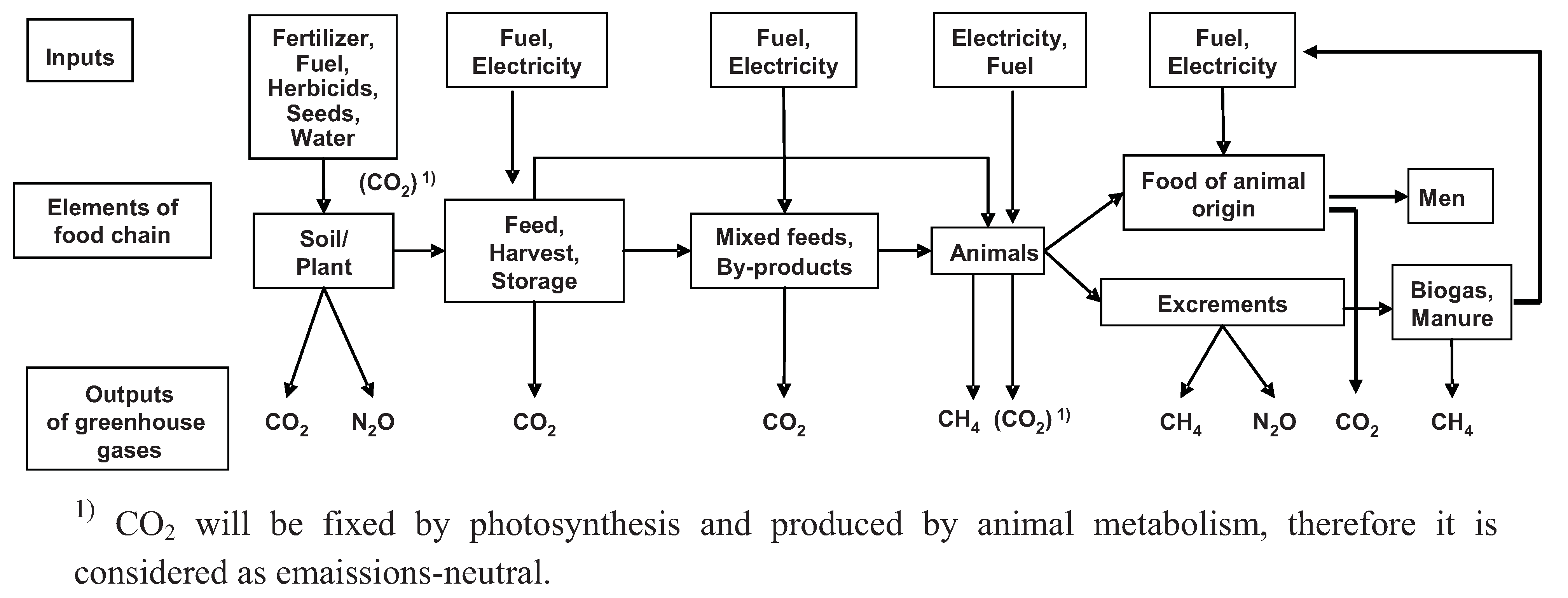
        <p>There is general agreement that carbon dioxide emissions from livestock metabolism are not considered as a CO<sub>2</sub>-source in CF ([<xref ref-type="bibr" rid="B2-animals-02-00108">2</xref>,<xref ref-type="bibr" rid="B9-animals-02-00108">9</xref>], see <xref ref-type="fig" rid="animals-02-00108-f001">Figure 1</xref>). CO<sub>2</sub> has been fixed by photosynthesis in phytogenic biomass and the C consumed in feed and emitted as CO<sub>2</sub> by animals is considered as equivalent or as emission neutral. On the other hand, CO<sub>2</sub> from technical processes associated with animal husbandry should be considered in CF calculations (for details see [<xref ref-type="bibr" rid="B7-animals-02-00108">7</xref>,<xref ref-type="bibr" rid="B10-animals-02-00108">10</xref>,<xref ref-type="bibr" rid="B11-animals-02-00108">11</xref>]). </p>
        <p>Methane can be considered as an unavoidable by-product of anaerobic microbial fermentation, especially in the rumen of ruminants, but also in the hindgut of all species and during anaerobic manure management. Since energy losses via methane in the rumen are well known [<xref ref-type="bibr" rid="B53-animals-02-00108">53</xref>], animal nutritionists have been trying to reduce the gastrointestinal methane emission from ruminants and in the hindgut of further species for a long time. In 2005 around 90 million tonnes CH<sub>4</sub> (about 1.9 billion t CO<sub>2</sub>eq/y) were emitted from gastrointestinal fermentation of ruminants [<xref ref-type="bibr" rid="B6-animals-02-00108">6</xref>]. These emissions are projected to grow by over 30% from 2000 to 2020 [<xref ref-type="bibr" rid="B6-animals-02-00108">6</xref>]. Enteric methane emissions (e.g., [<xref ref-type="bibr" rid="B54-animals-02-00108">54</xref>,<xref ref-type="bibr" rid="B55-animals-02-00108">55</xref>,<xref ref-type="bibr" rid="B56-animals-02-00108">56</xref>,<xref ref-type="bibr" rid="B57-animals-02-00108">57</xref>]), methods of measurements (e.g., [<xref ref-type="bibr" rid="B58-animals-02-00108">58</xref>,<xref ref-type="bibr" rid="B59-animals-02-00108">59</xref>,<xref ref-type="bibr" rid="B60-animals-02-00108">60</xref>,<xref ref-type="bibr" rid="B61-animals-02-00108">61</xref>]) and reduction potentials (e.g., [<xref ref-type="bibr" rid="B62-animals-02-00108">62</xref>,<xref ref-type="bibr" rid="B63-animals-02-00108">63</xref>,<xref ref-type="bibr" rid="B64-animals-02-00108">64</xref>,<xref ref-type="bibr" rid="B65-animals-02-00108">65</xref>]) should not be further considered here. Furthermore there are special issues of the journals “<italic>Animal Feed Science and Technology</italic>” 145 (2008), pp. 209–419 and 166–167 (2011), pp. 1–782 and in the “<italic>Australian Journal of Experimental Agriculture</italic>” 48, No. 1 and 2 (2008), dealing with the topics mentioned above.</p>
		<fig id="animals-02-00108-f001" position="anchor">
          <label>Figure 1</label>
          <caption>
            <p>Substantial elements of the chain to produce food of animal origin, as well as selected inputs of resources and outputs of greenhouse gases (basic concept for system boundaries [<xref ref-type="bibr" rid="B17-animals-02-00108">17</xref>]). </p>
          </caption>
          <graphic xmlns:xlink="http://www.w3.org/1999/xlink" xlink:href="animals-02-00108-g001.tif"/>
        </fig>
        
        <p>Laughing gas (N<sub>2</sub>0) has the highest GHG potential from the most relevant GHG [<xref ref-type="bibr" rid="B2-animals-02-00108">2</xref>]. It is not directly excreted by animals; it depends on microbial conditions during manure management and in the soil. Lower N-excretion by animals [<xref ref-type="bibr" rid="B66-animals-02-00108">66</xref>,<xref ref-type="bibr" rid="B67-animals-02-00108">67</xref>,<xref ref-type="bibr" rid="B68-animals-02-00108">68</xref>] and improved N-management (e.g., storing of manure, adequate amounts of manure and fertilizer) may contribute to lower N-emissions from manure and soil (e.g., [<xref ref-type="bibr" rid="B69-animals-02-00108">69</xref>,<xref ref-type="bibr" rid="B70-animals-02-00108">70</xref>,<xref ref-type="bibr" rid="B71-animals-02-00108">71</xref>,<xref ref-type="bibr" rid="B72-animals-02-00108">72</xref>]). More representative results from N<sub>2</sub>O measurements (also for grazing animals) may substantially contribute to more reliable data for calculation of CF along the food chain. In some cases specific emissions were excluded from calculations of CF due to data uncertainty (e.g., N<sub>2</sub>O from leguminous pastures [<xref ref-type="bibr" rid="B37-animals-02-00108">37</xref>]). Such special situations should be mentioned in the study report to assess the results.</p>
      </sec>
      <sec>
        <title>2.2. Setting the System Boundaries</title>
        <p>Definition of system boundaries along the food chain (see <xref ref-type="fig" rid="animals-02-00108-f001">Figure 1</xref> and [<xref ref-type="bibr" rid="B24-animals-02-00108">24</xref>]) is the starting point for GHG measurements, for the calculation of CF of livestock products and for comparing results from various studies [<xref ref-type="bibr" rid="B4-animals-02-00108">4</xref>,<xref ref-type="bibr" rid="B10-animals-02-00108">10</xref>]. There are some open questions which need to be answered and it should be clearly defined whether they are or are not considered in the calculation, such as:</p>
        <list list-type="simple">
          <list-item>
            <p>− Consideration of emissions from land use and land use change [<xref ref-type="bibr" rid="B1-animals-02-00108">1</xref>]</p>
          </list-item>
          <list-item>
            <p>− Emissions from basic equipment (e.g., houses, machinery <italic>etc.</italic>; [<xref ref-type="bibr" rid="B38-animals-02-00108">38</xref>,<xref ref-type="bibr" rid="B73-animals-02-00108">73</xref>])</p>
          </list-item>
          <list-item>
            <p>− Transport, processing, trade of products of animal origin [<xref ref-type="bibr" rid="B38-animals-02-00108">38</xref>]</p>
          </list-item>
          <list-item>
            <p>− Emissions during preparing food from animal products in the kitchen/food processing</p>
          </list-item>
          <list-item>
            <p>− Use of an allocation of various animal products (see above)</p>
          </list-item>
        </list>
        <p>For example under Australian conditions Peters <italic>et al.</italic> [<xref ref-type="bibr" rid="B37-animals-02-00108">37</xref>] defined the system boundary in the case of beef for all on-site and upstream processes at the farm, feedlot, and whole processing plant, including transport between these sites. </p>
        <p><xref ref-type="table" rid="animals-02-00108-t003">Table 3</xref> shows exemplary CF for milk under consideration of various boundaries. A clear definition of the system boundaries and the comprehensibility are important prerequisites to follow the calculations and to make the results comparable (e.g., [<xref ref-type="bibr" rid="B37-animals-02-00108">37</xref>,<xref ref-type="bibr" rid="B41-animals-02-00108">41</xref>,<xref ref-type="bibr" rid="B44-animals-02-00108">44</xref>]). Scientists working in this field should come to agreements concerning system boundaries and GHG factors of climate relevant gases.</p>
        <table-wrap id="animals-02-00108-t003" position="anchor">
          <object-id pub-id-type="pii">animals-02-00108-t003_Table 3</object-id>
          <label>Table 3</label>
          <caption>
            <p>Model calculation to demonstrate the effects of setting different boundaries for CF of milk (g CO<sub>2eq</sub> per kg milk; 30 kg milk per day; diet on DM-base: 60% roughage, 40% concentrate; 4% milk fat, 3.4% protein; 305 days of lactation; 60 days dry period, 3 years lactation; 30 months calf and heifer period [<xref ref-type="bibr" rid="B38-animals-02-00108">38</xref>]). </p>
          </caption>
          <table>
          <thead>
              <tr>
                <th align="center" valign="middle">System</th>
                <th align="left" valign="middle">System boundaries</th>
                <th align="center" valign="middle">CF (g CO<sub>2eq</sub>/kg milk)</th>
              </tr>
          </thead>
          <tbody>
              <tr>
                <td align="center" valign="middle">1</td>
                <td align="left" valign="middle">Dairy cow emissions during lactation</td>
                <td align="center" valign="middle">280</td>
              </tr>
              <tr>
                <td align="center" valign="middle">2</td>
                <td align="left" valign="middle">1. + Emissions of feed production</td>
                <td align="center" valign="middle">430</td>
              </tr>
              <tr>
                <td align="center" valign="middle">3</td>
                <td align="left" valign="middle">2. + Dry period</td>
                <td align="center" valign="middle">500</td>
              </tr>
              <tr>
                <td align="center" valign="middle">4</td>
                <td align="left" valign="middle">3. + Heifer period</td>
                <td align="center" valign="middle">730</td>
              </tr>
              <tr>
                <td align="center" valign="middle">5</td>
                <td align="left" valign="middle">4. + Animal housing and milking</td>
                <td align="center" valign="middle">760</td>
              </tr>
              <tr>
                <td align="center" valign="middle">6</td>
                <td align="left" valign="middle">5. + Manure management</td>
                <td align="center" valign="middle">820</td>
              </tr>
              <tr>
                <td align="center" valign="middle">7</td>
                <td align="left" valign="middle">6. + Processing, transportation and trade of milk</td>
                <td align="center" valign="middle">1,100</td>
              </tr>
          </tbody>
          </table></table-wrap>
      </sec>
    </sec>
    <sec>
      <title>3. Outcome of Animal Production</title>
      <p>There is no essential need for food of animal origin for human beings, but the consumption of milk, eggs, meat and fish may substantially contribute to a more balanced and palatable human diet. Therefore one of the main goals of animal husbandry is the production of food of animal origin. Such food contributes substantially to meeting the human requirements in essential amino acids (e.g., [<xref ref-type="bibr" rid="B74-animals-02-00108">74</xref>,<xref ref-type="bibr" rid="B75-animals-02-00108">75</xref>,<xref ref-type="bibr" rid="B76-animals-02-00108">76</xref>]) because of the high content in essential amino acids (such as lysine, methionine and cysteine, threonine, leucine, <italic>etc.</italic>; see [<xref ref-type="bibr" rid="B77-animals-02-00108">77</xref>]). Furthermore, such food contains important minor nutrients like major and trace minerals (such as Ca, P, Cu, Fe, I, Se, Zn) and vitamins (e.g., A, E, some B-vitamins, especially B<sub>12</sub>) and has a considerable enjoyment value [<xref ref-type="bibr" rid="B78-animals-02-00108">78</xref>]. Human nutritionists [<xref ref-type="bibr" rid="B79-animals-02-00108">79</xref>,<xref ref-type="bibr" rid="B80-animals-02-00108">80</xref>] recommend that about one third of the daily protein requirement (0.66–1 g per kg body weight and day; [<xref ref-type="bibr" rid="B75-animals-02-00108">75</xref>,<xref ref-type="bibr" rid="B80-animals-02-00108">80</xref>,<xref ref-type="bibr" rid="B81-animals-02-00108">81</xref>]) should originate from protein of animal origin to guarantee a more balanced diet, especially for “risk groups” such as pregnant and lactating women, infants and children. Therefore, one endpoint, or the outcome of specific animal yields could be edible protein or essential amino acids and should be clearly defined. Otherwise there will be discrepancies in calculations and variations in the results between various working groups as shown in <xref ref-type="table" rid="animals-02-00108-t001">Table 1</xref> and <xref ref-type="table" rid="animals-02-00108-t002">Table 2</xref>.</p>
      <sec>
        <title>3.1. Milk and Eggs</title>
        <p>Milk and eggs are clearly defined as food of animal origin. The yield can be measured as weight (kg, <italic>etc.</italic>) or on the basis of standardized products (e.g., standardized protein, fat, dry matter or energy). Therefore it is relatively easy to measure the animal yield for further calculations. But nevertheless, there is a certain range between CF for milk (see <xref ref-type="table" rid="animals-02-00108-t001">Table 1</xref>).</p>
        <p>The composition of milk and eggs is well defined (see <xref ref-type="table" rid="animals-02-00108-t006">Table 6</xref>), but it may vary between various sources and depending on animal breed, feeding and other influencing factors. Therefore the analysis of milk and egg composition (protein; fat, lactose) may contribute to being more specific in measuring the animal yield incl. the energy yield. Milk and eggs may be used entirely as food (except small amounts of colostrum and egg shells; see <xref ref-type="table" rid="animals-02-00108-t007">Table 7</xref>).</p>
        </sec>
      <sec>
        <title>3.2. Food from Slaughtered Animals</title>
        <p>It is much more difficult to quantify and characterize the yield from the animal body after slaughtering and processing. The GHG balance per kilogram body weight gain can only be calculated on the farm level. Mialon <italic>et al.</italic> [<xref ref-type="bibr" rid="B82-animals-02-00108">82</xref>] carried out a feeding study with Blond d’Àquitaine bulls in the finishing phase (400–650 kg body weight) including various feeding systems and weight gains between 1,494 and 1,862 g/d and Doreau <italic>et al.</italic> [<xref ref-type="bibr" rid="B83-animals-02-00108">83</xref>] calculated a CF between 3.6 and 4.7 kg CO<sub>2eq</sub> per kg body weight gain. Those values are similar to high daily weight gains as shown in <xref ref-type="table" rid="animals-02-00108-t005">Table 5</xref>, but much lower than for lower weight gains. Normally, the GHG emissions for the whole beef system include also emissions of cows, calves and heifers, needed to produce beef. They are much higher than in the system dairy cow—growing/fattening bulls for beef (see allocation).</p>
        <p>Mostly the term “meat” is used, but it is not clearly described, what it means (real meat or meat plus bones). Peters <italic>et al.</italic> [<xref ref-type="bibr" rid="B37-animals-02-00108">37</xref>] introduced the term “hot standard carcass weight” (HSCW) as the weight at the exit gate of the meat processing plant. It varies between 50–62% of the live weight of the cattle to be slaughtered, but it may vary between 50% in the case of sheep and up to 80% for fattening turkeys (e.g., [<xref ref-type="bibr" rid="B12-animals-02-00108">12</xref>,<xref ref-type="bibr" rid="B37-animals-02-00108">37</xref>,<xref ref-type="bibr" rid="B83-animals-02-00108">83</xref>]).</p>
        <p>In the case of animals for meat/fish production the following endpoints can be measured:</p>
        <list list-type="simple">
          <list-item>
            <p>− Weight gain of the animal (per day or per growing period) during the whole life span</p>
          </list-item>
          <list-item>
            <p>− Weight gain of animal without gastro-intestinal tract</p>
          </list-item>
          <list-item>
            <p>− Empty body weight (or carcass weight; meat and bones; warm as HSCW or cold)</p>
          </list-item>
          <list-item>
            <p>− Meat (empty body minus bones)</p>
          </list-item>
          <list-item>
            <p>− Edible fraction (meat plus edible organs and tissues)</p>
          </list-item>
          <list-item>
            <p>− Edible protein (edible fractions of the carcass multiplied with their specific protein content).</p>
          </list-item>
        </list>
        <p>Therefore it is really difficult to find an adequate CF for meat or edible products from slaughtered animals. Various authors used different bases to calculate CF for products from slaughtered animals. Williams <italic>et al.</italic> [<xref ref-type="bibr" rid="B12-animals-02-00108">12</xref>] estimated the killing out percentages for beef and poultry with 55 and 70% and 72, 75 and 77% for pigs with live weights of 76, 87 and 109 kg, respectively. Lesschen <italic>et al.</italic> [<xref ref-type="bibr" rid="B7-animals-02-00108">7</xref>] used fixed values to calculate the carcass fraction from the final body weight of animals (e.g., 58% for beef; 75% for pork and 71% for poultry). Most authors used a fixed fraction of 0.9 for all animal species for conversion of carcass weight to edible “meat”. De Vries and de Boer [<xref ref-type="bibr" rid="B5-animals-02-00108">5</xref>] used calculation factors to determine the amount of edible product per kg live weight by 0.43; 0.53 and 0.56 for beef, pork and poultry. <xref ref-type="table" rid="animals-02-00108-t004">Table 4</xref> shows potential outputs for growing/fattening cattle under consideration of various endpoints as mentioned above.</p>
        <p>Calculation of CF may base on various outputs. For practical reasons carcass weight or weight gain (warm or cold) would be the most important endpoint to measure the yield of slaughtered animals because this weight is measurable in the abattoir [<xref ref-type="bibr" rid="B37-animals-02-00108">37</xref>] and can be used for further calculations. Based on the values derived from <xref ref-type="table" rid="animals-02-00108-t004">Table 4</xref>, CF is calculated for various endpoints under consideration of differences in feeding and greenhouse gas emissions and is shown in <xref ref-type="table" rid="animals-02-00108-t005">Table 5</xref>.</p>
		<table-wrap id="animals-02-00108-t004" position="anchor">
          <object-id pub-id-type="pii">animals-02-00108-t004_Table 4</object-id>
          <label>Table 4</label>
          <caption>
            <p>Model calculation to show various endpoints for growing/fattening bulls (150-550 kg body weight; calculation based on data collected by [<xref ref-type="bibr" rid="B84-animals-02-00108">84</xref>]). </p>
          </caption>
         <table>
          <thead>
              <tr>
                <th align="center" valign="middle">Gross weight gain (g/day)</th>
                <th align="center" valign="middle">Weight gain without content of intestinal tract (g/day)</th>
                <th align="center" valign="middle">Carcass weight (warm; % of weight gain)</th>
                <th align="center" valign="middle">Carcass weight gain (warm; g/day)</th>
                <th align="center" valign="middle">Meat gain (% of weight gain)</th>
                <th align="center" valign="middle">Meat gain (g/day)</th>
                <th align="center" valign="middle">Edible fraction gain <sup>1</sup> (g/day)</th>
                <th align="center" valign="middle">Edible protein (g/day; 19% protein in edible fraction)</th>
              </tr>
          </thead>
          <tbody>
              <tr>
                <td align="center" valign="middle">500</td>
                <td align="center" valign="middle">438</td>
                <td align="center" valign="middle">50</td>
                <td align="center" valign="middle">250</td>
                <td align="center" valign="middle">40</td>
                <td align="center" valign="middle">200</td>
                <td align="center" valign="middle">250</td>
                <td align="center" valign="middle">48</td>
              </tr>
              <tr>
                <td align="center" valign="middle">1,000</td>
                <td align="center" valign="middle">900</td>
                <td align="center" valign="middle">53</td>
                <td align="center" valign="middle">530</td>
                <td align="center" valign="middle">44</td>
                <td align="center" valign="middle">440</td>
                <td align="center" valign="middle">490</td>
                <td align="center" valign="middle">93</td>
              </tr>
              <tr>
                <td align="center" valign="middle">1,500</td>
                <td align="center" valign="middle">1,385</td>
                <td align="center" valign="middle">56</td>
                <td align="center" valign="middle">840</td>
                <td align="center" valign="middle">48</td>
                <td align="center" valign="middle">720</td>
                <td align="center" valign="middle">770</td>
                <td align="center" valign="middle">146</td>
              </tr>
          </tbody>
          </table><table-wrap-foot>
		<fn>
	<p><sup>1</sup> Meat plus other edible tissues.</p>
		</fn>
		</table-wrap-foot>
		</table-wrap>
        
        <table-wrap id="animals-02-00108-t005" position="anchor">
          <object-id pub-id-type="pii">animals-02-00108-t005_Table 5</object-id>
          <label>Table 5</label>
          <caption>
            <p>Model calculations for CF of beef (150-550 kg body weight <sup>1</sup>) depending on feeding, weight gain, methane- and N<sub>2</sub>O-emissions and N-excretion [<xref ref-type="bibr" rid="B28-animals-02-00108">28</xref>]</p>
          </caption>
          <table rules="all" style="border:solid thin">
        <thead>
              <tr>
                <th rowspan="2" align="center" valign="middle">Weight gain (g/day)</th>
                <th rowspan="2" align="center" valign="middle">Feed intake (kg DM/ (animal x day)</th>
                <th rowspan="2" align="center" valign="middle">Portion concentrate (% of DM-intake) <sup>1,2</sup></th>
                <th rowspan="2" align="center" valign="middle">Methane emissions (g/kg DM)</th>
                <th rowspan="2" align="center" valign="middle">N-excretion (g/day)</th>
                <th rowspan="2" align="center" valign="middle">N<sub>2</sub>O-synthesis (% of N-excretion)</th>
                <th colspan="4" align="center" valign="middle">Carbon footprints (kg CO<sub>2eq</sub>/kg)</th>
              </tr>
              <tr>
                <th valign="middle">Weight gain</th>
                <th valign="middle">Empty carcass weight gain</th>
                <th valign="middle">Edible fraction gain</th>
                <th valign="middle">Edible Protein</th>
              </tr>
            </thead>
            <tbody>
              <tr>
                <td align="left" valign="middle">500 (Pasture, no concentrate)</td>
                <td align="center" valign="middle">6.5</td>
                <td align="center" valign="middle">0</td>
                <td align="center" valign="middle">26</td>
                <td align="center" valign="middle">110</td>
                <td align="center" valign="middle">2</td>
                <td align="center" valign="middle">11.5</td>
                <td align="center" valign="middle">23.0</td>
                <td align="center" valign="middle">28.0</td>
                <td align="center" valign="middle">110</td>
              </tr>
              <tr>
                <td align="left" valign="middle">1,000 (Indoor, grass silage, some concentrate)</td>
                <td align="center" valign="middle">7.0</td>
                <td align="center" valign="middle">15</td>
                <td align="center" valign="middle">24</td>
                <td align="center" valign="middle">130</td>
                <td align="center" valign="middle">1</td>
                <td align="center" valign="middle">5.5</td>
                <td align="center" valign="middle">11.0</td>
                <td align="center" valign="middle">13.8</td>
                <td align="center" valign="middle">55</td>
              </tr>
              <tr>
                <td align="left" valign="middle">1,500 (Indoor, corn silage, concentrate)</td>
                <td align="center" valign="middle">7.5</td>
                <td align="center" valign="middle">30</td>
                <td align="center" valign="middle">22</td>
                <td align="center" valign="middle">150</td>
                <td align="center" valign="middle">0.5</td>
                <td align="center" valign="middle">3.5</td>
                <td align="center" valign="middle">7.0</td>
                <td align="center" valign="middle">9.0</td>
                <td align="center" valign="middle">35</td>
              </tr>
            </tbody>
          </table><table-wrap-foot>
		<fn>
		<p><sup>1</sup> Production of calf up to 150 kg BW is not considered; <sup>2</sup> CO<sub>2</sub>-Emission: 120 g/kg roughage-DM; 220 g/kg concentrate-DM. </p>
		</fn>
		</table-wrap-foot>
		</table-wrap>
        
        
      </sec>
      <sec>
        <title>3.3. Edible Protein as Most Important Objective of Animal Husbandry</title>
        <p>The production of protein of animal origin is one of the most important goals of animal husbandry [<xref ref-type="bibr" rid="B5-animals-02-00108">5</xref>]. On the other hand, the efficiency and the emissions of animal products can be also compared on the basis of edible protein. The N or protein content of various foods of animal origin may vary from values used for calculations in <xref ref-type="table" rid="animals-02-00108-t006">Table 6</xref> (data by [<xref ref-type="bibr" rid="B84-animals-02-00108">84</xref>] on the basis of own studies). Our data agrees with values used by Lesschen <italic>et al.</italic> [<xref ref-type="bibr" rid="B7-animals-02-00108">7</xref>], and it does not substantially disagree with values from human food tables (see <xref ref-type="table" rid="animals-02-00108-t006">Table 6</xref>). De Vries and de Boer [<xref ref-type="bibr" rid="B5-animals-02-00108">5</xref>] used for their calculations 190 g protein/kg edible beef, pork and poultry meat; 30 g per kg milk products and 130 g per kg eggs.</p>
        <p>Considering various influencing factors such as animal yields, feeding, edible fractions and protein content in the edible fractions, the yield of edible protein per day and per kg body weight of animals is given in <xref ref-type="table" rid="animals-02-00108-t007">Table 7</xref>. </p>
		<table-wrap id="animals-02-00108-t006" position="anchor">
          <object-id pub-id-type="pii">animals-02-00108-t006_Table 6</object-id>
          <label>Table 6</label>
          <caption>
            <p>Published data regarding the protein content of some edible animal products (in g per kg edible product).</p>
          </caption>
          <table>
        <thead>
              <tr>
                <th align="center" valign="middle">Product</th>
                <th colspan="7" align="center" valign="middle">References</th>
              </tr>
            </thead>
            <tbody>
              <tr>
                <td align="center" valign="middle"> </td>
                <td colspan="2" align="center" valign="middle">[<xref ref-type="bibr" rid="B7-animals-02-00108">7</xref>] <sup>1</sup></td>
                <td colspan="2" align="center" valign="middle">[<xref ref-type="bibr" rid="B77-animals-02-00108">77</xref>]</td>
                <td align="center" valign="middle">[<xref ref-type="bibr" rid="B84-animals-02-00108">84</xref>]</td>
                <td align="center" valign="middle">[<xref ref-type="bibr" rid="B85-animals-02-00108">85</xref>]</td>
                <td align="center" valign="middle">[<xref ref-type="bibr" rid="B86-animals-02-00108">86</xref>,<xref ref-type="bibr" rid="B87-animals-02-00108">87</xref>,<xref ref-type="bibr" rid="B88-animals-02-00108">88</xref>,<xref ref-type="bibr" rid="B89-animals-02-00108">89</xref>]</td>
              </tr>
              <tr>
                <td align="center" valign="middle">Cows milk</td>
                <td colspan="2" align="center" valign="middle">34.4</td>
                <td colspan="2" align="center" valign="middle">33.3 (30.8-37.0)</td>
                <td align="center" valign="middle">32</td>
                <td align="center" valign="middle">34</td>
                <td align="center" valign="middle">34</td>
              </tr>
              <tr>
                <td align="center" valign="middle">Beef</td>
                <td colspan="2" align="center" valign="middle">206</td>
                <td colspan="2" align="center" valign="middle">220 <sup>2</sup> (206-227)</td>
                <td align="center" valign="middle">190</td>
                <td align="center" valign="middle">206-212</td>
                <td align="center" valign="middle">170-200</td>
              </tr>
              <tr>
                <td align="center" valign="middle">Pork</td>
                <td colspan="2" align="center" valign="middle">156</td>
                <td colspan="2" align="center" valign="middle">220 <sup>2</sup> (195-240)</td>
                <td align="center" valign="middle">150</td>
                <td align="center" valign="middle">183-216</td>
                <td align="center" valign="middle">157 (129-178)</td>
              </tr>
              <tr>
                <td align="center" valign="middle">Broiler</td>
                <td colspan="2" align="center" valign="middle">206</td>
                <td colspan="2" align="center" valign="middle">199</td>
                <td align="center" valign="middle">200</td>
                <td align="center" valign="middle">182-242</td>
                <td align="center" valign="middle">n.d.</td>
              </tr>
              <tr>
                <td align="center" valign="middle">Eggs</td>
                <td colspan="2" align="center" valign="middle">119</td>
                <td colspan="2" align="center" valign="middle">125</td>
                <td align="center" valign="middle">120</td>
                <td align="center" valign="middle">125</td>
                <td align="center" valign="middle">121 (110-124)</td>
              </tr>
            </tbody>
          </table><table-wrap-foot>
		<fn>
		<p><sup>1</sup> N-content × 6.25; <sup>2</sup> Muscles only; n.d.: no data.</p>
		</fn>
		</table-wrap-foot>
		</table-wrap>


        <p>The feeding may influence CF of food of animal origin. In the case of ruminants, higher amounts of concentrate are required for higher animal yields. The proportion of by-products [<xref ref-type="bibr" rid="B90-animals-02-00108">90</xref>,<xref ref-type="bibr" rid="B91-animals-02-00108">91</xref>] used in animal feeding does not only have nutritional implications, but it also affects the results of calculations on land use [<xref ref-type="bibr" rid="B92-animals-02-00108">92</xref>]. There are large differences in protein yield per animal per day or per kg body weight and day depending on animal species and category as well as their performances and the fractions considered as edible (see <xref ref-type="table" rid="animals-02-00108-t007">Table 7</xref>).</p>
		
		<table-wrap id="animals-02-00108-t007" position="anchor">
          <object-id pub-id-type="pii">animals-02-00108-t007_Table 7</object-id>
          <label>Table 7</label>
          <caption>
            <p>Influence of animal species, categories and performances on yield of edible protein [<xref ref-type="bibr" rid="B84-animals-02-00108">84</xref>]. </p>
          </caption>
          <table>
<thead>
              <tr>
                <th align="center" valign="middle">Protein source (Body weight)</th>
                <th align="center" valign="middle">Performance per day</th>
                <th align="center" valign="middle">Dry matter intake (kg per day)</th>
                <th align="center" valign="middle">Roughage to concentrate ratio (on DM base, %)</th>
                <th align="center" valign="middle">Edible fraction (% of product or body mass)</th>
                <th align="center" valign="middle">Protein in edible fraction (g per kg fresh matter)</th>
                <th align="center" valign="middle">Edible protein (g per day)</th>
                <th align="center" valign="middle">Edible protein (g per kg body weight and day)</th>
</tr>
            </thead>
            <tbody>
              <tr>
                <td rowspan="3" align="left" valign="middle">Dairy cow (650 kg)</td>
                <td align="center">10 kg milk</td>
                <td align="center">12</td>
                <td align="center">90/10</td>
                <td rowspan="3" align="center">95</td>
                <td rowspan="3" align="center">34</td>
                <td align="center">323</td>
                <td align="center">0.5</td>
              </tr>
              <tr>
                <td align="center">20 kg milk</td>
                <td align="center">16</td>
                <td align="center">75/25</td>
                <td align="center">646</td>
                <td align="center">1.0</td>
              </tr>
              <tr>
                <td align="center">40 kg milk</td>
                <td align="center">25</td>
                <td align="center">50/50</td>
                <td align="center">1292</td>
                <td align="center">2.0</td>
              </tr>
              <tr>
                <td rowspan="2" align="left" valign="middle">Dairy goat (60 kg)</td>
                <td align="center">2 kg milk</td>
                <td align="center">2</td>
                <td align="center">80/20</td>
                <td rowspan="2" align="center">95</td>
                <td rowspan="2" align="center">36</td>
                <td align="center">68</td>
                <td align="center">1.1</td>
              </tr>
              <tr>
                <td align="center">5 kg milk</td>
                <td align="center">2.5</td>
                <td align="center">50/50</td>
                <td align="center">170</td>
                <td align="center">2.8</td>
              </tr>
              <tr>
                <td rowspan="3" align="left" valign="middle">Beef cattle (350 kg)</td>
                <td align="center">500 g <sup>1</sup></td>
                <td align="center">6.5</td>
                <td align="center">95/5</td>
                <td rowspan="3" align="center">50</td>
                <td rowspan="3" align="center">190</td>
                <td align="center">48</td>
                <td align="center">0.14</td>
              </tr>
              <tr>
                <td align="center">1,000 g <sup>1</sup></td>
                <td align="center">7.0</td>
                <td align="center">85/15</td>
                <td align="center">95</td>
                <td align="center">0.27</td>
              </tr>
              <tr>
                <td align="center">1,500 g <sup>1</sup></td>
                <td align="center">7.5</td>
                <td align="center">70/30</td>
                <td align="center">143</td>
                <td align="center">0.41</td>
              </tr>
              <tr>
                <td rowspan="3" align="left" valign="middle">Growing/fattening pig (80 kg)</td>
                <td align="center">500 g <sup>1</sup></td>
                <td align="center">1.8</td>
                <td align="center">20/80</td>
                <td rowspan="3" align="center">60</td>
                <td rowspan="3" align="center">150</td>
                <td align="center">45</td>
                <td align="center">0.56</td>
              </tr>
              <tr>
                <td align="center">700 g <sup>1</sup></td>
                <td align="center">2</td>
                <td align="center">10/90</td>
                <td align="center">63</td>
                <td align="center">0.8</td>
              </tr>
              <tr>
                <td align="center">1,000 g <sup>1</sup></td>
                <td align="center">2.2</td>
                <td align="center">0/100</td>
                <td align="center">81</td>
                <td align="center">1.0</td>
              </tr>
              <tr>
                <td rowspan="2" align="left" valign="middle">Broiler (1.5 kg)</td>
                <td align="center">40 g <sup>1</sup></td>
                <td align="center">0.07</td>
                <td align="center">10/90</td>
                <td rowspan="2" align="center">60</td>
                <td rowspan="2" align="center">200</td>
                <td align="center">4.8</td>
                <td align="center">3.2</td>
              </tr>
              <tr>
                <td align="center">60 g <sup>1</sup></td>
                <td align="center">0.08</td>
                <td align="center">0/100</td>
                <td align="center">7.2</td>
                <td align="center">4.8</td>
              </tr>
              <tr>
                <td rowspan="3" align="left" valign="middle">Laying hen (1.8 kg)</td>
                <td align="center">50% <sup>2</sup></td>
                <td align="center">0.10</td>
                <td align="center">20/80</td>
                <td rowspan="3" align="center">95</td>
                <td rowspan="3" align="center">120</td>
                <td align="center">3.4</td>
                <td align="center">1.9</td>
              </tr>
              <tr>
                <td align="center">70% <sup>2</sup></td>
                <td align="center">0.11</td>
                <td align="center">10/90</td>
                <td align="center">4.8</td>
                <td align="center">2.7</td>
              </tr>
              <tr>
                <td align="center">90% <sup>2</sup></td>
                <td align="center">0.12</td>
                <td align="center">0/100</td>
                <td align="center">6.2</td>
                <td align="center">3.4</td>
              </tr>
            </tbody>
          </table><table-wrap-foot>
		<fn>
		<p><sup>1</sup> Daily weight gain, <sup>2</sup> Laying performance.</p>
		</fn>
      </table-wrap-foot>
	  </table-wrap>
        
        <p><xref ref-type="table" rid="animals-02-00108-t007">Table 7</xref> shows the highest protein yields per kg body weight for growing broilers as well as for laying and lactating animals and the lowest values for growing/fattening ruminants. Based on those values, emissions per kg edible protein are given in <xref ref-type="table" rid="animals-02-00108-t008">Table 8</xref>. Higher proportions of edible fractions or higher protein content (e.g., 50 g protein per kg camel milk, [<xref ref-type="bibr" rid="B77-animals-02-00108">77</xref>]) as shown in <xref ref-type="table" rid="animals-02-00108-t006">Table 6</xref> and <xref ref-type="table" rid="animals-02-00108-t007">Table 7</xref> may increase the protein yield and reduce the CF per unit of product.</p>
        <p>Apart from protein food of animal origin also contains fat and some carbohydrates which contribute to human nutrition and which may replace energy of plant origin in human diets. </p>
        <p>At high levels of performance there are remarkable differences in CO<sub>2</sub> emissions due to human consumption of 1 g protein from food of animal origin (eggs and meat from broiler &lt; pork &lt; milk &lt; beef, see <xref ref-type="table" rid="animals-02-00108-t007">Table 7</xref>). But here it has to be emphasized that this protein intake is accompanied—willingly or not—by an energy intake from the protein itself, but also from further nutrients like lactose and fat in milk or from fat in meat or eggs. Therefore, it should be avoided to attribute the CO<sub>2</sub> burden to the protein fraction (“edible protein”) exclusively. To prevent that this fact is neglected, there are different alternatives:</p>
        <p>In a first simple method, the CO<sub>2</sub> emission due to 1 kg edible protein could be used as CO<sub>2</sub> burden of consumed energy (for example: 1 kg edible protein of eggs corresponds to about 8 kg egg corresponding to 51.6 MJ energy (calculated by [<xref ref-type="bibr" rid="B77-animals-02-00108">77</xref>]); these combined intakes are related to 3 kg CO<sub>2</sub>).</p>
        <p>One alternative could be a “nutritional allocation” (as described before for economic allocation), meaning that the CO<sub>2</sub> emissions are attributed to different functions of the food (source of protein/source of energy/source of further essential nutrients). </p>
		
		<table-wrap id="animals-02-00108-t008" position="anchor">
          <object-id pub-id-type="pii">animals-02-00108-t008_Table 8</object-id>
          <label>Table 8</label>
          <caption>
            <p>Influence of animal species, categories and performances on emissions (per kg edible protein, own calculations).</p>
          </caption>
           <table>
        <thead>
              <tr>
                <th rowspan="2" align="left" valign="middle">Protein source (Body weight)</th>
                <th rowspan="2" align="left" valign="middle">Performance per animal per day</th>
                <th rowspan="2" align="center" valign="middle">N-excretion (% of intake)</th>
                <th rowspan="2" align="center" valign="middle">Methane emission (g per day) <sup>3</sup></th>
                <th colspan="4" align="center" valign="middle">Emissions in kg per kg protein</th>
              </tr>
              <tr style="border-top:solid thin">
                <th valign="middle">P</th>
                <th valign="middle">N</th>
                <th valign="middle">CH<sub>4</sub><sup>3</sup></th>
                <th valign="middle">CO<sub>2eq</sub></th>
              </tr>
            </thead>
            <tbody>
              <tr>
                <td rowspan="3" align="left" valign="middle">Dairy cow (650 kg)</td>
                <td align="left" valign="middle">10 kg milk</td>
                <td align="center" valign="middle">75</td>
                <td align="center" valign="middle">310</td>
                <td align="center" valign="middle">0.10</td>
                <td align="center" valign="middle">0.65</td>
                <td align="center" valign="middle">1.0</td>
                <td align="center" valign="middle">30</td>
              </tr>
              <tr>
                <td align="left" valign="middle">20 kg milk</td>
                <td align="center" valign="middle">70</td>
                <td align="center" valign="middle">380</td>
                <td align="center" valign="middle">0.06</td>
                <td align="center" valign="middle">0.44</td>
                <td align="center" valign="middle">0.6</td>
                <td align="center" valign="middle">16</td>
              </tr>
              <tr>
                <td align="left" valign="middle">40 kg milk</td>
                <td align="center" valign="middle">65</td>
                <td align="center" valign="middle">520</td>
                <td align="center" valign="middle">0.04</td>
                <td align="center" valign="middle">0.24</td>
                <td align="center" valign="middle">0.4</td>
                <td align="center" valign="middle">12</td>
              </tr>
              <tr>
                <td rowspan="2" align="left" valign="middle">Dairy goat (60 kg)</td>
                <td align="left" valign="middle">2 kg milk</td>
                <td align="center" valign="middle">75</td>
                <td align="center" valign="middle">50</td>
                <td align="center" valign="middle">0.08</td>
                <td align="center" valign="middle">0.5</td>
                <td align="center" valign="middle">0.8</td>
                <td align="center" valign="middle">20</td>
              </tr>
              <tr>
                <td align="left" valign="middle">5 kg milk</td>
                <td align="center" valign="middle">65</td>
                <td align="center" valign="middle">60</td>
                <td align="center" valign="middle">0.04</td>
                <td align="center" valign="middle">0.2</td>
                <td align="center" valign="middle">0.4</td>
                <td align="center" valign="middle">10</td>
              </tr>
              <tr>
                <td rowspan="3" align="left" valign="middle">Beef cattle (350 kg)</td>
                <td align="left" valign="middle">500 g <sup>1</sup></td>
                <td align="center" valign="middle">90</td>
                <td align="center" valign="middle">170</td>
                <td align="center" valign="middle">0.30</td>
                <td align="center" valign="middle">2.3</td>
                <td align="center" valign="middle">3.5</td>
                <td align="center" valign="middle">110</td>
              </tr>
              <tr>
                <td align="left" valign="middle">1,000 g <sup>1</sup></td>
                <td align="center" valign="middle">84</td>
                <td align="center" valign="middle">175</td>
                <td align="center" valign="middle">0.18</td>
                <td align="center" valign="middle">1.3</td>
                <td align="center" valign="middle">1.7</td>
                <td align="center" valign="middle">55</td>
              </tr>
              <tr>
                <td align="left" valign="middle">1,500 g <sup>1</sup></td>
                <td align="center" valign="middle">80</td>
                <td align="center" valign="middle">180</td>
                <td align="center" valign="middle">0.14</td>
                <td align="center" valign="middle">1.0</td>
                <td align="center" valign="middle">1.2</td>
                <td align="center" valign="middle">35</td>
              </tr>
              <tr>
                <td rowspan="3" align="left" valign="middle">Growing/fattening pig (80 kg)</td>
                <td align="left" valign="middle">500 g <sup>1</sup></td>
                <td align="center" valign="middle">85</td>
                <td align="center" valign="middle">5</td>
                <td align="center" valign="middle">0.20</td>
                <td align="center" valign="middle">1.0</td>
                <td align="center" valign="middle">0.12</td>
                <td align="center" valign="middle">16</td>
              </tr>
              <tr>
                <td align="left" valign="middle">700 g <sup>1</sup></td>
                <td align="center" valign="middle">80</td>
                <td align="center" valign="middle">5</td>
                <td align="center" valign="middle">0.12</td>
                <td align="center" valign="middle">0.7</td>
                <td align="center" valign="middle">0.08</td>
                <td align="center" valign="middle">12</td>
              </tr>
              <tr>
                <td align="left" valign="middle">900 g <sup>1</sup></td>
                <td align="center" valign="middle">75</td>
                <td align="center" valign="middle">5</td>
                <td align="center" valign="middle">0.09</td>
                <td align="center" valign="middle">0.55</td>
                <td align="center" valign="middle">0.05</td>
                <td align="center" valign="middle">10</td>
              </tr>
              <tr>
                <td rowspan="2" align="left" valign="middle">Broilers (1.5 kg)</td>
                <td align="left" valign="middle">40 g <sup>1</sup></td>
                <td align="center" valign="middle">70</td>
                <td rowspan="2" align="center" valign="middle">Traces</td>
                <td align="center" valign="middle">0.04</td>
                <td align="center" valign="middle">0.35</td>
                <td align="center" valign="middle">0.01</td>
                <td align="center" valign="middle">4</td>
              </tr>
              <tr>
                <td align="left" valign="middle">60 g <sup>1</sup></td>
                <td align="center" valign="middle">60</td>
                <td align="center" valign="middle">0.03</td>
                <td align="center" valign="middle">0.25</td>
                <td align="center" valign="middle">0.01</td>
                <td align="center" valign="middle">3</td>
              </tr>
              <tr>
                <td rowspan="3" align="left" valign="middle">Laying hen (1.8 kg)</td>
                <td align="left" valign="middle">50% <sup>2</sup></td>
                <td align="center" valign="middle">80</td>
                <td rowspan="3" align="center" valign="middle">Traces</td>
                <td align="center" valign="middle">0.12</td>
                <td align="center" valign="middle">0.6</td>
                <td align="center" valign="middle">0.03</td>
                <td align="center" valign="middle">7</td>
              </tr>
              <tr>
                <td align="left" valign="middle">70% <sup>2</sup></td>
                <td align="center" valign="middle">65</td>
                <td align="center" valign="middle">0.07</td>
                <td align="center" valign="middle">0.4</td>
                <td align="center" valign="middle">0.02</td>
                <td align="center" valign="middle">5</td>
              </tr>
              <tr>
                <td align="left" valign="middle">90% <sup>2</sup></td>
                <td align="center" valign="middle">55</td>
                <td align="center" valign="middle">0.05</td>
                <td align="center" valign="middle">0.3</td>
                <td align="center" valign="middle">0.02</td>
                <td align="center" valign="middle">3</td>
              </tr>
            </tbody>
          </table>
		  <table-wrap-foot>
		 <fn>
		 <p><sup>1</sup> Daily weight gain <sup>2</sup> Laying performance <sup>3</sup> CH<sub>4</sub>-emission varies with composition of diet.</p>
		 </fn>
        </table-wrap-foot>
		</table-wrap>
		
        
        <p>In a first simple step it is recommended to diminish the CO<sub>2</sub> emission per 1 kg edible protein (<xref ref-type="table" rid="animals-02-00108-t008">Table 8</xref>) by the CO<sub>2</sub> amounts that would occur at an identical energy intake from food of plants (energy from carbohydrates and fat). It means that an intake of 1 kg protein from eggs (corresponds to 8 kg eggs; see <xref ref-type="table" rid="animals-02-00108-t007">Table 7</xref>; and corresponding to 51.6 MJ energy) saves high amounts of other food (and their CO<sub>2</sub> burden). A more sophisticated way of an “allocation” within the foods could be to differentiate between “protein derived energy” and “non-protein derived energy”. In milk and eggs more than 50% of the total energy content is related to the non-protein-fraction (lactose/fat), therefore, it is questionable whether the entire CO<sub>2</sub> emission should be attributed only to the protein intake. Due to the very low CO<sub>2</sub> emission caused by energy intake of carbohydrates and fat from plants/seeds [<xref ref-type="bibr" rid="B12-animals-02-00108">12</xref>,<xref ref-type="bibr" rid="B15-animals-02-00108">15</xref>,<xref ref-type="bibr" rid="B17-animals-02-00108">17</xref>] it would avoid/save high amounts of CO<sub>2</sub> emissions, if the production of food of animal origin focussed on “edible protein” and not on energy of non-proteinaceous fractions.</p>
        <p>Furthermore animal products are not only used as food or respectively, as protein/amino acids, and energy sources; they also offer some other important side-products such as skins or hides, fish meal or meat and bone meal, <italic>etc.</italic> A kind of combined “nutritional/further purposes allocation” may contribute to a more scientific assessment of CF for nutrient and energy supply as well as further uses.</p>
        <p>Advantages and weaknesses of endpoints (outputs) of various types of animal production are summarized in <xref ref-type="table" rid="animals-02-00108-t009">Table 9</xref>. All endpoints are characterized by some advantages and disadvantages. From nutritional and scientific points of view the edible protein seems to be the most favourable measurement, but its measurement is not easy and requires some analytical work (see <xref ref-type="table" rid="animals-02-00108-t009">Table 9</xref>). Land requirements (e.g., arable land and/or grassland) as well types and intensities of food production may be calculated on the basis of various protein sources for human nutrition. Such calculations can contribute for better understanding of various conflicting aims in the field of food production, human nutrition, use of unlimited and limited resources and resource efficiency, emissions and further points in public discussion.</p>
        <table-wrap id="animals-02-00108-t009" position="anchor">
          <object-id pub-id-type="pii">animals-02-00108-t009_Table 9</object-id>
          <label>Table 9</label>
          <caption>
            <p>Advantages and disadvantages of various outputs/endpoints of animal yields.</p>
          </caption>
          <table>
            <thead>
              <tr>
                <th align="left" valign="middle">Animal yields</th>
                <th align="left" valign="middle">Advantages</th>
                <th align="left" valign="middle">Disadvantages</th>
              </tr>
            </thead>
            <tbody>
              <tr>
                <td align="left" valign="middle">Milk, Eggs</td>
                <td align="left" valign="middle">Easily measurable, almost complete edible</td>
                <td align="left" valign="middle">Variation in protein, fat and energy yield, analyses may be useful</td>
              </tr>
              <tr>
                <td align="left" valign="middle">Body weight gain</td>
                <td align="left" valign="middle">Easily measurable</td>
                <td align="left" valign="middle">High portion of non edible fractions in the gains</td>
              </tr>
              <tr>
                <td align="left" valign="middle">Carcass weight</td>
                <td align="left" valign="middle">Easily measurable</td>
                <td align="left" valign="middle">Contains still fractions which are not edible (e.g., bones)</td>
              </tr>
              <tr>
                <td align="left" valign="middle">Meat, edible fraction</td>
                <td align="left" valign="middle">Completely edible</td>
                <td align="left" valign="middle">Categorization and separation not easy</td>
              </tr>
              <tr>
                <td align="left" valign="middle">Edible protein</td>
                <td align="left" valign="middle">Most important objective of animal production; comparison of various methods and sources to produce protein of animal origin</td>
                <td align="left" valign="middle">Categorization of various fractions as edible and difficulties to measure; additional analytical work; variation in N/protein content</td>
              </tr>
            </tbody>
          </table>
        </table-wrap>
      </sec>
    </sec>
    <sec sec-type="conclusions">
      <title>4. Conclusions</title>
      <p>Ranking of food of animal origin on the basis of CF may be indicative for some products, but may also lead to wrong conclusions because of incompleteness of measuring animal yields and data bases, system boundaries and other weaknesses. The data bases for GHG emissions should be improved and the animal yields should be made comparable. Edible protein (or rather, essential amino acids and some minor nutrients) of animal origin, being the most important objective of animal husbandry, is proposed as a standard to compare various types and intensities of animal husbandry. Furthermore we have to look at the whole food chain (see <xref ref-type="fig" rid="animals-02-00108-f001">Figure 1</xref>) in order to decide whether a practice is sustainable or not in the long term (e.g., [<xref ref-type="bibr" rid="B93-animals-02-00108">93</xref>,<xref ref-type="bibr" rid="B94-animals-02-00108">94</xref>]). In order to do this, however, further research is needed for more reliable and resilient data.</p>
    </sec>
    
    
  </body>
  <back>
  
     <ack>
      <title>Acknowledgments</title>
      <p>The authors would like to thank to Manfred Grün for critical comments; Anne Mösseler for some calculations; and Saara Sander and Sigrid Herweg for technical assistance. </p>
    </ack>
	<notes>
      <title>Conflict of Interest</title>
      <p>The authors declare no conflict of interest.</p>
    </notes>
    <ref-list>
      <title>References</title>
      <ref id="B1-animals-02-00108">
        <label>1.</label>
        <citation citation-type="book">
          <person-group person-group-type="author">
            <name>
              <surname>Steinfeld</surname>
              <given-names>D.</given-names>
            </name>
            <name>
              <surname>Gerber</surname>
              <given-names>P.</given-names>
            </name>
            <name>
              <surname>Wassenaar</surname>
              <given-names>T.</given-names>
            </name>
            <name>
              <surname>Castel</surname>
              <given-names>V.</given-names>
            </name>
            <name>
              <surname>Rosales</surname>
              <given-names>M.</given-names>
            </name>
            <name>
              <surname>de Haan</surname>
              <given-names>C.</given-names>
            </name>
          </person-group>
          <source>Livestock’s Long Shadow. Environmental Issues and Options</source>
          <publisher-name>FAO</publisher-name>
          <publisher-loc>Rome, Italy</publisher-loc>
          <year>2006</year>
        </citation>
      </ref>
      <ref id="B2-animals-02-00108">
        <label>2.</label>
        <citation citation-type="book">
          <source>IPCC Guidelines for National Greenhouse Gas Inventories. Agriculture, Forestry and Other Land Use</source>
          <publisher-name>Intergovernmental Panel on Climate Change</publisher-name>
          <publisher-loc>Cambridge, UK</publisher-loc>
          <year>2006</year>
          <volume>Volume 4</volume>
        </citation>
      </ref>
      <ref id="B3-animals-02-00108">
        <label>3.</label>
        <citation citation-type="book">
          <source>The State of Food and Agriculture—Livestock in the Balance</source>
          <publisher-name>FAO</publisher-name>
          <publisher-loc>Rome, Italy</publisher-loc>
          <year>2009</year>
        </citation>
      </ref>
      <ref id="B4-animals-02-00108">
        <label>4.</label>
        <citation citation-type="book">
          <source>Greenhouse Gas Emissions from the Dairy Sector. A Life Cycle Assessment</source>
          <publisher-name>FAO</publisher-name>
          <publisher-loc>Rome, Italy</publisher-loc>
          <year>2010</year>
        </citation>
      </ref>
      <ref id="B5-animals-02-00108">
        <label>5.</label>
        <citation citation-type="journal">
          <person-group person-group-type="author">
            <name>
              <surname>De Vries</surname>
              <given-names>M.</given-names>
            </name>
            <name>
              <surname>de Boer</surname>
              <given-names>I.J.M.</given-names>
            </name>
          </person-group>
          <article-title>Comparing environmental impacts for livestock products: A review of life cycle assessments</article-title>
          <source>Livest. Sci.</source>
          <year>2010</year>
          <volume>128</volume>
          <fpage>1</fpage>
          <lpage>11</lpage>
          <pub-id pub-id-type="doi">10.1016/j.livsci.2009.11.007</pub-id>
        </citation>
      </ref>
      <ref id="B6-animals-02-00108">
        <label>6.</label>
        <citation citation-type="journal">
          <person-group person-group-type="author">
            <name>
              <surname>O’Mara</surname>
              <given-names>F.P.</given-names>
            </name>
          </person-group>
          <article-title>The significance of livestock as a contributor to global greenhouse gas emissions today and in near future</article-title>
          <source>Anim. Feed Sci. Technol.</source>
          <year>2011</year>
          <volume>166–167</volume>
          <fpage>7</fpage>
          <lpage>15</lpage>
        </citation>
      </ref>
      <ref id="B7-animals-02-00108">
        <label>7.</label>
        <citation citation-type="journal">
          <person-group person-group-type="author">
            <name>
              <surname>Lesschen</surname>
              <given-names>J.P.</given-names>
            </name>
            <name>
              <surname>van den Berg</surname>
              <given-names>M.</given-names>
            </name>
            <name>
              <surname>Westhoek</surname>
              <given-names>H.J.</given-names>
            </name>
            <name>
              <surname>Witzke</surname>
              <given-names>H.P.</given-names>
            </name>
            <name>
              <surname>Oenema</surname>
              <given-names>O.</given-names>
            </name>
          </person-group>
          <article-title>Greenhouse gas emission profiles of European livestock sectors</article-title>
          <source>Anim. Feed Sci. Technol.</source>
          <year>2011</year>
          <volume>166–167</volume>
          <fpage>16</fpage>
          <lpage>28</lpage>
        </citation>
      </ref>
      <ref id="B8-animals-02-00108">
        <label>8.</label>
        <citation citation-type="book">
          <person-group person-group-type="author">
            <name>
              <surname>Sevenster</surname>
              <given-names>M.</given-names>
            </name>
            <name>
              <surname>de Jong</surname>
              <given-names>F.</given-names>
            </name>
          </person-group>
          <source>A Sustainable Dairy Sector—Global, Regional and Live Cycle Facts and Figures on Greenhouse-Gas Emissions; Technical Report; Publication No.: 08.7789</source>
          <publisher-name>CE Delft</publisher-name>
          <publisher-loc>Delft, The Netherlands</publisher-loc>
          <year>2008</year>
        </citation>
      </ref>
      <ref id="B9-animals-02-00108">
        <label>9.</label>
        <citation citation-type="journal">
          <person-group person-group-type="author">
            <name>
              <surname>Herrero</surname>
              <given-names>M.</given-names>
            </name>
            <name>
              <surname>Gerber</surname>
              <given-names>P.</given-names>
            </name>
            <name>
              <surname>Vellinga</surname>
              <given-names>T.</given-names>
            </name>
            <name>
              <surname>Garnett</surname>
              <given-names>T.</given-names>
            </name>
            <name>
              <surname>Leip</surname>
              <given-names>A.</given-names>
            </name>
            <name>
              <surname>Opio</surname>
              <given-names>C.</given-names>
            </name>
            <name>
              <surname>Westhoek</surname>
              <given-names>H.J.</given-names>
            </name>
            <name>
              <surname> Thornton</surname>
              <given-names>P.K.</given-names>
            </name>
            <name>
              <surname>Olesen</surname>
              <given-names>J.</given-names>
            </name>
            <name>
              <surname>Hutchings</surname>
              <given-names>N.</given-names>
            </name>
			<etal/>
          </person-group>
          <article-title>Livestock and greenhouse gas emissions: The importance of getting the numbers right</article-title>
          <source>Anim. Feed Sci. Technol.</source>
          <year>2011</year>
          <volume>166–167</volume>
          <fpage>779</fpage>
          <lpage>782</lpage>
        </citation>
      </ref>
      <ref id="B10-animals-02-00108">
        <label>10.</label>
        <citation citation-type="book">
          <person-group person-group-type="author">
            <name>
              <surname>Leip</surname>
              <given-names>A.</given-names>
            </name>
            <name>
              <surname>Weiss</surname>
              <given-names>F.</given-names>
            </name>
            <name>
              <surname>Wasenaar</surname>
              <given-names>T.</given-names>
            </name>
            <name>
              <surname>Perez</surname>
              <given-names>I.</given-names>
            </name>
            <name>
              <surname>Fellmann</surname>
              <given-names>T.</given-names>
            </name>
            <name>
              <surname>Loudjami</surname>
              <given-names>P.</given-names>
            </name>
            <name>
              <surname>Tuiello</surname>
              <given-names>F.</given-names>
            </name>
            <name>
              <surname>Grandgirard</surname>
              <given-names>D.</given-names>
            </name>
            <name>
              <surname>Monni</surname>
              <given-names>S.</given-names>
            </name>
            <name>
              <surname>Biala</surname>
              <given-names>K.</given-names>
            </name>
          </person-group>
          <source>Evaluation of the Livestock Sector’s Contribution to the EU Greenhouse Gas Emissions (GGELS); Final Report</source>
          <publisher-name>European Commission, Joint Research Centre</publisher-name>
          <publisher-loc>Ispra, Italy</publisher-loc>
          <year>2010</year>
        </citation>
      </ref>
      <ref id="B11-animals-02-00108">
        <label>11.</label>
        <citation citation-type="journal">
          <person-group person-group-type="author">
            <name>
              <surname>Bockisch</surname>
              <given-names>F.J.</given-names>
            </name>
            <name>
              <surname>Ahlgrimm</surname>
              <given-names>H.J.</given-names>
            </name>
            <name>
              <surname>Böhme</surname>
              <given-names>H.</given-names>
            </name>
            <name>
              <surname>Bramm</surname>
              <given-names>A.</given-names>
            </name>
            <name>
              <surname>Dämmgen</surname>
              <given-names>U.</given-names>
            </name>
            <name>
              <surname>Flachowsky</surname>
              <given-names>G.</given-names>
            </name>
            <name>
              <surname>Heinemeyer</surname>
              <given-names>O.</given-names>
            </name>
            <name>
              <surname>Höppner</surname>
              <given-names>F.</given-names>
            </name>
            <name>
              <surname>Murphy</surname>
              <given-names>D.P.L.</given-names>
            </name>
            <name>
              <surname>Rogasik</surname>
              <given-names>J.</given-names>
            </name>
			<etal/>
            </person-group>
          <article-title>Assessment of types of organic and conventional farming under consideration of energy use and emissions (in German)</article-title>
          <source>Landbauf. Völkenrode</source>
          <year>2000</year>
          <volume>SH 211</volume>
          <fpage>206</fpage>
        </citation>
      </ref>
      <ref id="B12-animals-02-00108">
        <label>12.</label>
        <citation citation-type="book">
          <person-group person-group-type="author">
            <name>
              <surname>Williams</surname>
              <given-names>A.G.</given-names>
            </name>
            <name>
              <surname>Audsley</surname>
              <given-names>E.</given-names>
            </name>
            <name>
              <surname>Sanders</surname>
              <given-names>D.L.</given-names>
            </name>
          </person-group>
          <source>Determining the Environmental Burdens and Resource Use in the Production of Agricultural and Horticultural Commodities; Main Report; Defra Research Project IS0205</source>
          <publisher-name>Defra, Cranfield University</publisher-name>
          <publisher-loc>Bedford, UK</publisher-loc>
          <year>2006</year>
        </citation>
      </ref>
      <ref id="B13-animals-02-00108">
        <label>13.</label>
        <citation citation-type="book">
          <person-group person-group-type="author">
            <name>
              <surname>Fritsche</surname>
              <given-names>R.</given-names>
            </name>
            <name>
              <surname>Eberle</surname>
              <given-names>U.</given-names>
            </name>
          </person-group>
          <source>Greenhouse Gas Emissions During Production and Processing of Food (in German); Working Document</source>
          <publisher-name>Öko-Institut e.V.</publisher-name>
          <publisher-loc>Darmstadt, Germany</publisher-loc>
          <year>2007</year>
        </citation>
      </ref>
      <ref id="B14-animals-02-00108">
        <label>14.</label>
        <citation citation-type="book">
          <person-group person-group-type="author">
            <name>
              <surname>Hirschfeld</surname>
              <given-names>J.</given-names>
            </name>
            <name>
              <surname>Weiß</surname>
              <given-names>J.</given-names>
            </name>
            <name>
              <surname>Precht</surname>
              <given-names>M.</given-names>
            </name>
            <name>
              <surname>Korbun</surname>
              <given-names>T.</given-names>
            </name>
          </person-group>
          <source>Climate Effects of Agriculture in Germany (in German)</source>
          <publisher-name>Schriftenreihe des IÖW 186/08</publisher-name>
          <publisher-loc>Berlin, Germnay</publisher-loc>
          <year>2008</year>
        </citation>
      </ref>
      <ref id="B15-animals-02-00108">
        <label>15.</label>
        <citation citation-type="journal">
          <person-group person-group-type="author">
            <name>
              <surname>Grünberg</surname>
              <given-names>J.</given-names>
            </name>
            <name>
              <surname>Nieberg</surname>
              <given-names>H.</given-names>
            </name>
            <name>
              <surname>Schmidt</surname>
              <given-names>T.</given-names>
            </name>
          </person-group>
          <article-title>Carbon Footprints of Food; A Critical Reflection (in German)</article-title>
          <source>Landbauforsch. vTI Agric. For. Res.</source>
          <year>2010</year>
          <volume>60</volume>
          <fpage>53</fpage>
          <lpage>72</lpage>
        </citation>
      </ref>
      <ref id="B16-animals-02-00108">
        <label>16.</label>
        <citation citation-type="journal">
          <collab>IDF (International Dairy Federation)</collab>
          <article-title>A common carbon footprint approach for dairy—The IDF guide to standard lifecycle assessment methodology for the dairy sector</article-title>
          <source>Bull. Int. Dairy Fed.</source>
          <year>2010</year>
          <volume>445</volume>
          <comment>IDF No. 445/2010</comment>
        </citation>
      </ref>
      <ref id="B17-animals-02-00108">
        <label>17.</label>
        <citation citation-type="journal">
          <person-group person-group-type="author">
            <name>
              <surname>Flachowsky</surname>
              <given-names>G.</given-names>
            </name>
          </person-group>
          <article-title>Carbon-footprints for food of animal origin, reduction potentials and research need</article-title>
          <source>J. Appl. Anim. Res.</source>
          <year>2011</year>
          <volume>39</volume>
          <fpage>2</fpage>
          <lpage>14</lpage>
          <pub-id pub-id-type="doi">10.1080/09712119.2011.570047</pub-id>
        </citation>
      </ref>
      <ref id="B18-animals-02-00108">
        <label>18.</label>
        <citation citation-type="thesis">
          <person-group person-group-type="author">
            <name>
              <surname>Woitowicz</surname>
              <given-names>A.</given-names>
            </name>
          </person-group>
          <article-title>Consequences of Reduction of Consumption of Food of Animal Origin on Selected Indicators of Sustainability—Demonstrated by Conventional and Organic Farming (in German)</article-title>
          <source>Ph.D. Thesis</source>
          <publisher-name>TU München</publisher-name>
          <publisher-loc>München, Germany</publisher-loc>
          <year>2007</year>
        </citation>
      </ref>
      <ref id="B19-animals-02-00108">
        <label>19.</label>
        <citation citation-type="book">
          <person-group person-group-type="author">
            <name>
              <surname>Cederberg</surname>
              <given-names>C.</given-names>
            </name>
            <name>
              <surname>Flysjö</surname>
              <given-names>A.</given-names>
            </name>
          </person-group>
          <source>Life Cycle Inventory of 23 Dairy Farms in South-Western Sweden; SIK Rapport 728</source>
          <publisher-name>SIK</publisher-name>
          <publisher-loc>Goeteborg, Sweden</publisher-loc>
          <year>2004</year>
        </citation>
      </ref>
      <ref id="B20-animals-02-00108">
        <label>20.</label>
        <citation citation-type="thesis">
          <person-group person-group-type="author">
            <name>
              <surname>Van der Zijpp</surname>
              <given-names>I.A.J.</given-names>
            </name>
          </person-group>
          <article-title>Animal Production Systems: On Integration and Diversity</article-title>
          <source>Habilitation Thesis</source>
          <publisher-name>University of Wageningen</publisher-name>
          <publisher-loc>Wageningen, The Netherlands</publisher-loc>
          <year>2001</year>
        </citation>
      </ref>
      <ref id="B21-animals-02-00108">
        <label>21.</label>
        <citation citation-type="web">
          <collab>GEMIS</collab>
          <source>Global Emissions-Model of Integrated Systems (in German); Version 4.7</source>
          <year>2010</year>
          <access-date>(accessed on 14 February 2012)</access-date>
          <comment>Available online:<ext-link xmlns:xlink="http://www.w3.org/1999/xlink" xlink:href="http://www.oeko.de/service/gemis" ext-link-type="uri">http://www.oeko.de/service/gemis</ext-link></comment>
        </citation>
      </ref>
      <ref id="B22-animals-02-00108">
        <label>22.</label>
        <citation citation-type="journal">
          <person-group person-group-type="author">
            <name>
              <surname>Cederberg</surname>
              <given-names>C.</given-names>
            </name>
            <name>
              <surname>Mattsson</surname>
              <given-names>B.</given-names>
            </name>
          </person-group>
          <article-title>Life cycle assessment of milk production—A comparison of conventional and organic farming</article-title>
          <source>J. Clean. Prod.</source>
          <year>2000</year>
          <volume>8</volume>
          <fpage>250</fpage>
          <lpage>260</lpage>
        </citation>
      </ref>
      <ref id="B23-animals-02-00108">
        <label>23.</label>
        <citation citation-type="journal">
          <person-group person-group-type="author">
            <name>
              <surname>Lindenthal</surname>
              <given-names>T.</given-names>
            </name>
            <name>
              <surname>Markut</surname>
              <given-names>T.</given-names>
            </name>
            <name>
              <surname>Hörtenhuber</surname>
              <given-names>S.</given-names>
            </name>
            <name>
              <surname>Rudolph</surname>
              <given-names>G.</given-names>
            </name>
            <name>
              <surname>Hanz</surname>
              <given-names>K.</given-names>
            </name>
          </person-group>
          <article-title>Climate advantages once more demonstrated: Climate balance of organic products (in German)</article-title>
          <source>Ökologischer Landbau</source>
          <year>2010</year>
          <volume>153</volume>
          <fpage>51</fpage>
          <lpage>53</lpage>
        </citation>
      </ref>
      <ref id="B24-animals-02-00108">
        <label>24.</label>
        <citation citation-type="book">
          <collab>PAS (Publicly Available Specification) 2050</collab>
          <source>Scenario Building to Test and Inform the Development of a BSI Method for Assessing Greenhouse Gas Emissions from Food; ADAS Report; Project No: YAW3408</source>
          <publisher-name>Defra, Cranfield University</publisher-name>
          <publisher-loc>Bedford, UK</publisher-loc>
          <year>2011</year>
        </citation>
      </ref>
      <ref id="B25-animals-02-00108">
        <label>25.</label>
        <citation citation-type="journal">
          <person-group person-group-type="author">
            <name>
              <surname>Haas</surname>
              <given-names>G.</given-names>
            </name>
            <name>
              <surname>Wetterich</surname>
              <given-names>F.</given-names>
            </name>
            <name>
              <surname>Köpke</surname>
              <given-names>U.</given-names>
            </name>
          </person-group>
          <article-title>Comparing intensive, extensified and organic grassland farming in Southern Germany by process life cycle assessment</article-title>
          <source>Agric. Ecosyst. Environ.</source>
          <year>2001</year>
          <volume>83</volume>
          <fpage>43</fpage>
          <lpage>53</lpage>
          <pub-id pub-id-type="doi">10.1016/S0167-8809(00)00160-2</pub-id>
        </citation>
      </ref>
      <ref id="B26-animals-02-00108">
        <label>26.</label>
        <citation citation-type="journal">
          <person-group person-group-type="author">
            <name>
              <surname>Thomassen</surname>
              <given-names>M.A.</given-names>
            </name>
            <name>
              <surname>van Calker</surname>
              <given-names>K.J.</given-names>
            </name>
            <name>
              <surname>Smits</surname>
              <given-names>M.C.J.</given-names>
            </name>
            <name>
              <surname>Iepema</surname>
              <given-names>G.L.</given-names>
            </name>
            <name>
              <surname>de Boer</surname>
              <given-names>I.J.M.</given-names>
            </name>
          </person-group>
          <article-title>Life cycle assessment of conventional and organic milk production in the Netherlands</article-title>
          <source>Agric. Syst.</source>
          <year>2007</year>
          <volume>93</volume>
          <fpage>95</fpage>
          <lpage>107</lpage>
        </citation>
      </ref>
      <ref id="B27-animals-02-00108">
        <label>27.</label>
        <citation citation-type="book">
          <person-group person-group-type="author">
            <name>
              <surname>Plassmann</surname>
              <given-names>K.</given-names>
            </name>
            <name>
              <surname>Edwards-Jones</surname>
              <given-names>G.</given-names>
            </name>
          </person-group>
          <source>Where does the Carbon Footprint Fall? Development a Carbon Map of Food Production; Sustainable Markets Discussion</source>
          <publisher-name>International Institute for Environment and Development</publisher-name>
          <publisher-loc>London, UK</publisher-loc>
          <year>2009</year>
        </citation>
      </ref>
      <ref id="B28-animals-02-00108">
        <label>28.</label>
        <citation citation-type="journal">
          <person-group person-group-type="author">
            <name>
              <surname>Flachowsky</surname>
              <given-names>G.</given-names>
            </name>
          </person-group>
          <article-title>Greenhouse gases and resource efficiency. Aspects of production of food of animal origin (in German)</article-title>
          <source>Ernährungsumschau</source>
          <year>2008</year>
          <volume>55</volume>
          <fpage>414</fpage>
          <lpage>419</lpage>
        </citation>
      </ref>
      <ref id="B29-animals-02-00108">
        <label>29.</label>
        <citation citation-type="journal">
          <person-group person-group-type="author">
            <name>
              <surname>Daemmgen</surname>
              <given-names>U.</given-names>
            </name>
            <name>
              <surname>Haenel</surname>
              <given-names>H.D.</given-names>
            </name>
          </person-group>
          <article-title>Emissions of greenhouse gases and gaseous air pollutants—A challenge for animal nutrition</article-title>
          <source>Proc. Soc. Nutr. Physiol.</source>
          <year>2008</year>
          <volume>17</volume>
          <fpage>163</fpage>
          <lpage>167</lpage>
        </citation>
      </ref>
      <ref id="B30-animals-02-00108">
        <label>30.</label>
        <citation citation-type="journal">
          <person-group person-group-type="author">
            <name>
              <surname>Basset-Mens</surname>
              <given-names>C.</given-names>
            </name>
            <name>
              <surname>Ledgard</surname>
              <given-names>S.</given-names>
            </name>
            <name>
              <surname>Boyes</surname>
              <given-names>M.</given-names>
            </name>
          </person-group>
          <article-title>Eco-efficiency of intensification scenarios for milk production in New Zealand</article-title>
          <source>Ecol. Econ.</source>
          <year>2009</year>
          <volume>68</volume>
          <fpage>1615</fpage>
          <lpage>1625</lpage>
          <pub-id pub-id-type="doi">10.1016/j.ecolecon.2007.11.017</pub-id>
        </citation>
      </ref>
      <ref id="B31-animals-02-00108">
        <label>31.</label>
        <citation citation-type="confproc">
          <person-group person-group-type="author">
            <name>
              <surname>Ledgard</surname>
              <given-names>S.</given-names>
            </name>
            <name>
              <surname>Finalyson</surname>
              <given-names>J.</given-names>
            </name>
            <name>
              <surname>Patterson</surname>
              <given-names>M.</given-names>
            </name>
            <name>
              <surname>Carran</surname>
              <given-names>R.</given-names>
            </name>
            <name>
              <surname>Wedderburn</surname>
              <given-names>M</given-names>
            </name>
          </person-group>
          <article-title>Effects of Intensification of Dairy Farming System in New Zealand on Whole-System Resource Use Efficiency and Environmental Emissions</article-title>
          <source>In Life Cycle Assessment in the Agri-Food Sector; DIAS Report; In Proceedings from the 4th International Conference</source>
          <conf-loc>Bygholm, Denmark</conf-loc>
          <conf-date>6–8 October 2003</conf-date>
          <fpage>226</fpage>
          <lpage>229</lpage>
        </citation>
      </ref>
      <ref id="B32-animals-02-00108">
        <label>32.</label>
        <citation citation-type="journal">
          <person-group person-group-type="author">
            <name>
              <surname>Zehetmeier</surname>
              <given-names>M.</given-names>
            </name>
            <name>
              <surname>Bandracco</surname>
              <given-names>J.</given-names>
            </name>
            <name>
              <surname>Hoffmann</surname>
              <given-names>H.</given-names>
            </name>
            <name>
              <surname>Heißenhuber</surname>
              <given-names>A.</given-names>
            </name>
          </person-group>
          <article-title>Does increasing milk yield per cow reduce greenhouse gas emissions? A system approach</article-title>
          <source>Animal</source>
          <year>2011</year>
          <volume>6</volume>
          <fpage>154</fpage>
          <lpage>166</lpage>
        </citation>
      </ref>
      <ref id="B33-animals-02-00108">
        <label>33.</label>
        <citation citation-type="book">
          <person-group person-group-type="author">
            <name>
              <surname>Cederberg</surname>
              <given-names>C.</given-names>
            </name>
            <name>
              <surname>Sonesson</surname>
              <given-names>U.</given-names>
            </name>
            <name>
              <surname>Henriksson</surname>
              <given-names>M.</given-names>
            </name>
            <name>
              <surname>Sund</surname>
              <given-names>V.</given-names>
            </name>
            <name>
              <surname>Davis</surname>
              <given-names>J.</given-names>
            </name>
          </person-group>
          <source>Greenhouse Gas Emissions from Swedish Production of Meat, Milk and Eggs 1990 and 2005</source>
          <publisher-name>The Swedish Institute for Food and Biotechnology</publisher-name>
          <publisher-loc>Gothenburg, Sweden</publisher-loc>
          <year>2009</year>
        </citation>
      </ref>
      <ref id="B34-animals-02-00108">
        <label>34.</label>
        <citation citation-type="journal">
          <person-group person-group-type="author">
            <name>
              <surname>Verge</surname>
              <given-names>X.P.C.</given-names>
            </name>
            <name>
              <surname>Dyer</surname>
              <given-names>J.A.</given-names>
            </name>
            <name>
              <surname>Desjardidins</surname>
              <given-names>R.L.</given-names>
            </name>
            <name>
              <surname>Worth</surname>
              <given-names>D.</given-names>
            </name>
          </person-group>
          <article-title>Greenhouse-gas emissions from the Canadian dairy industry in 2001</article-title>
          <source>Agric. Syst.</source>
          <year>2007</year>
          <volume>94</volume>
          <fpage>683</fpage>
          <lpage>693</lpage>
          <pub-id pub-id-type="doi">10.1016/j.agsy.2007.02.008</pub-id>
        </citation>
      </ref>
      <ref id="B35-animals-02-00108">
        <label>35.</label>
        <citation citation-type="journal">
          <person-group person-group-type="author">
            <name>
              <surname>Phetteplace</surname>
              <given-names>H.</given-names>
            </name>
            <name>
              <surname>Johnson</surname>
              <given-names>D.</given-names>
            </name>
            <name>
              <surname>Seidl</surname>
              <given-names>A.</given-names>
            </name>
          </person-group>
          <article-title>Greenhouse-gas emissions from simulated beef and dairy livestock systems in the United States</article-title>
          <source>Nutr. Cycl. Agroecosystems</source>
          <year>2001</year>
          <volume>60</volume>
          <fpage>99</fpage>
          <lpage>102</lpage>
          <pub-id pub-id-type="doi">10.1023/A:1012657230589</pub-id>
        </citation>
      </ref>
      <ref id="B36-animals-02-00108">
        <label>36.</label>
        <citation citation-type="journal">
          <person-group person-group-type="author">
            <name>
              <surname>Casey</surname>
              <given-names>J.W.</given-names>
            </name>
            <name>
              <surname>Holden</surname>
              <given-names>N.M.</given-names>
            </name>
          </person-group>
          <article-title>Analysis of greenhouse gas emissions from the average Irish milk production system</article-title>
          <source>Agric. Syst.</source>
          <year>2005</year>
          <volume>86</volume>
          <fpage>97</fpage>
          <lpage>114</lpage>
          <pub-id pub-id-type="doi">10.1016/j.agsy.2004.09.006</pub-id>
        </citation>
      </ref>
      <ref id="B37-animals-02-00108">
        <label>37.</label>
        <citation citation-type="journal">
          <person-group person-group-type="author">
            <name>
              <surname>Peters</surname>
              <given-names>G.M.</given-names>
            </name>
            <name>
              <surname>Rowley</surname>
              <given-names>H.S.</given-names>
            </name>
            <name>
              <surname>Wiedemann</surname>
              <given-names>S.</given-names>
            </name>
            <name>
              <surname>Tucker</surname>
              <given-names>R.</given-names>
            </name>
            <name>
              <surname>Short</surname>
              <given-names>M.D.</given-names>
            </name>
            <name>
              <surname>Schulz</surname>
              <given-names>M.</given-names>
            </name>
          </person-group>
          <article-title>Red meat production in Australia: Life cycle assessment and comparisons with overseas studies</article-title>
          <source>Environ. Sci. Technol.</source>
          <year>2010</year>
          <volume>44</volume>
          <fpage>1327</fpage>
          <lpage>1332</lpage>
        <pub-id pub-id-type="doi">10.1021/es901131e</pub-id><pub-id pub-id-type="pmid">20067280</pub-id></citation>
      </ref>
      <ref id="B38-animals-02-00108">
        <label>38.</label>
        <citation citation-type="journal">
          <person-group person-group-type="author">
            <name>
              <surname>Flachowsky</surname>
              <given-names>G.</given-names>
            </name>
            <name>
              <surname>Brade</surname>
              <given-names>W.</given-names>
            </name>
            <name>
              <surname>Feil</surname>
              <given-names>A.</given-names>
            </name>
            <name>
              <surname>Kamphues</surname>
              <given-names>J.</given-names>
            </name>
            <name>
              <surname>Meyer</surname>
              <given-names>U.</given-names>
            </name>
            <name>
              <surname>Zehetmeier</surname>
              <given-names>M.</given-names>
            </name>
          </person-group>
          <article-title>Carbon (CO<sub>2</sub>)-footprints of producing food of animal origin—Data basis and reduction potentials (in German)</article-title>
          <source>Übers. Tierernährg.</source>
          <year>2011</year>
          <volume>39</volume>
          <fpage>1</fpage>
          <lpage>45</lpage>
        </citation>
      </ref>
      <ref id="B39-animals-02-00108">
        <label>39.</label>
        <citation citation-type="journal">
          <person-group person-group-type="author">
            <name>
              <surname>Reitmayr</surname>
              <given-names>T.</given-names>
            </name>
          </person-group>
          <article-title>Development of a computerized data system for economical and ecological assessment of agricultural systems (in German)</article-title>
          <source>Agrarwirtsch. Frankfurt/Main</source>
          <year>1995</year>
          <fpage>SH 147</fpage>
        </citation>
      </ref>
      <ref id="B40-animals-02-00108">
        <label>40.</label>
        <citation citation-type="journal">
          <person-group person-group-type="author">
            <name>
              <surname>Schlich</surname>
              <given-names>E.H.</given-names>
            </name>
            <name>
              <surname>Fleissner</surname>
              <given-names>U.</given-names>
            </name>
          </person-group>
          <article-title>The ecology of scale: Assessment of regional energy turnover and comparison with global food</article-title>
          <source>Int. J. Life Cycle Assess.</source>
          <year>2005</year>
          <volume>10</volume>
          <fpage>219</fpage>
          <lpage>223</lpage>
          <pub-id pub-id-type="doi">10.1065/lca2004.09.180.9</pub-id>
        </citation>
      </ref>
      <ref id="B41-animals-02-00108">
        <label>41.</label>
        <citation citation-type="journal">
          <person-group person-group-type="author">
            <name>
              <surname>Casey</surname>
              <given-names>J.W.</given-names>
            </name>
            <name>
              <surname>Holden</surname>
              <given-names>N.M.</given-names>
            </name>
          </person-group>
          <article-title>Greenhouse gas emission from conventional, agri-environmental scheme and organic Irish Suckler—Beef units</article-title>
          <source>J. Environ.Qual.</source>
          <year>2006</year>
          <volume>35</volume>
          <fpage>231</fpage>
          <lpage>239</lpage>
          <pub-id pub-id-type="doi">10.2134/jeq2005.0121</pub-id>
        </citation>
      </ref>
      <ref id="B42-animals-02-00108">
        <label>42.</label>
        <citation citation-type="journal">
          <person-group person-group-type="author">
            <name>
              <surname>Subak</surname>
              <given-names>S.</given-names>
            </name>
          </person-group>
          <article-title>Global environmental cost of beef production</article-title>
          <source>Environ. Econ.</source>
          <year>1999</year>
          <volume>30</volume>
          <fpage>79</fpage>
          <lpage>91</lpage>
        </citation>
      </ref>
      <ref id="B43-animals-02-00108">
        <label>43.</label>
        <citation citation-type="journal">
          <person-group person-group-type="author">
            <name>
              <surname>Cederberg</surname>
              <given-names>C.</given-names>
            </name>
            <name>
              <surname>Stadig</surname>
              <given-names>M.</given-names>
            </name>
          </person-group>
          <article-title>System expansion and allocation in life cycle assessment of milk and beef production</article-title>
          <source>Int. J. Life Cycle Assess.</source>
          <year>2003</year>
          <volume>8</volume>
          <fpage>360</fpage>
          <lpage>356</lpage>
        </citation>
      </ref>
      <ref id="B44-animals-02-00108">
        <label>44.</label>
        <citation citation-type="journal">
          <person-group person-group-type="author">
            <name>
              <surname>Casey</surname>
              <given-names>J.W.</given-names>
            </name>
            <name>
              <surname>Holden</surname>
              <given-names>N.M.</given-names>
            </name>
          </person-group>
          <article-title>Quantification of GHG emissions from suckler-beef production in Ireland Agric</article-title>
          <source>Syst.</source>
		  <year>2006a</year>
          <volume>90</volume>
          <fpage>79</fpage>
          <lpage>98</lpage>
          </citation>
      </ref>
      <ref id="B45-animals-02-00108">
        <label>45.</label>
        <citation citation-type="journal">
          <person-group person-group-type="author">
            <name>
              <surname>Nguyen</surname>
              <given-names>T.L.T.</given-names>
            </name>
            <name>
              <surname>Hermansen</surname>
              <given-names>J.E.</given-names>
            </name>
            <name>
              <surname>Mogensen</surname>
              <given-names>L.</given-names>
            </name>
          </person-group>
          <article-title>Environmental consequences of different beef production systems in the EU</article-title>
          <source>J. Cleaner Prod.</source>
          <year>2010</year>
          <volume>18</volume>
          <fpage>756</fpage>
          <lpage>766</lpage>
          <pub-id pub-id-type="doi">10.1016/j.jclepro.2009.12.023</pub-id>
        </citation>
      </ref>
      <ref id="B46-animals-02-00108">
        <label>46.</label>
        <citation citation-type="journal">
          <person-group person-group-type="author">
            <name>
              <surname>Ogino</surname>
              <given-names>A.</given-names>
            </name>
            <name>
              <surname>Kaku</surname>
              <given-names>K.</given-names>
            </name>
            <name>
              <surname>Osada</surname>
              <given-names>T.</given-names>
            </name>
            <name>
              <surname>Shimada</surname>
              <given-names>K.</given-names>
            </name>
          </person-group>
          <article-title>Environmental of the Japanese beef-fattening system with different lengths as evaluated by a life-cycle assessment method</article-title>
          <source>J. Anim. Sci.</source>
          <year>2004</year>
          <volume>72</volume>
          <fpage>2115</fpage>
          <lpage>2122</lpage>
        </citation>
      </ref>
      <ref id="B47-animals-02-00108">
        <label>47.</label>
        <citation citation-type="journal">
          <person-group person-group-type="author">
            <name>
              <surname>Ogino</surname>
              <given-names>A.</given-names>
            </name>
            <name>
              <surname>Orito</surname>
              <given-names>H.</given-names>
            </name>
            <name>
              <surname>Shimada</surname>
              <given-names>K.</given-names>
            </name>
            <name>
              <surname>Hirooka</surname>
              <given-names>H.</given-names>
            </name>
          </person-group>
          <article-title>Evaluating environmental impacts of the Japanese beef cow-calf system by the life cycle assessment method</article-title>
          <source>J. Anim. Sci.</source>
          <year>2007</year>
          <volume>78</volume>
          <fpage>424</fpage>
          <lpage>432</lpage>
          <pub-id pub-id-type="doi">10.1111/j.1740-0929.2007.00457.x</pub-id>
        </citation>
      </ref>
      <ref id="B48-animals-02-00108">
        <label>48.</label>
        <citation citation-type="journal">
          <person-group person-group-type="author">
            <name>
              <surname>Flysjö</surname>
              <given-names>A.</given-names>
            </name>
            <name>
              <surname>Cederberg</surname>
              <given-names>C.</given-names>
            </name>
            <name>
              <surname>Henriksson</surname>
              <given-names>M.</given-names>
            </name>
            <name>
              <surname>Ledgard</surname>
              <given-names>S.</given-names>
            </name>
          </person-group>
          <article-title>How does co-product handling affect the carbon footprint of milk? Case study of milk production in New Zealand and Sweden</article-title>
          <source>Int. J. Life Cycle Assess.</source>
          <year>2011</year>
          <volume>16</volume>
          <fpage>420</fpage>
          <lpage>430</lpage>
          <pub-id pub-id-type="doi">10.1007/s11367-011-0283-9</pub-id>
        </citation>
      </ref>
      <ref id="B49-animals-02-00108">
        <label>49.</label>
        <citation citation-type="book">
          <source>Climate Change 2007: Synthesis Report; Contribution of Working Groups I, II and III to the Forth Assessment Report of the Intergovernmental Panel on Climate Change, Core Writing Team</source>
          <person-group person-group-type="editor">
            <name>
              <surname>Pachauri</surname>
              <given-names>R.K.</given-names>
            </name>
            <name>
              <surname>Reisinger</surname>
              <given-names>A.</given-names>
            </name>
          </person-group>
          <publisher-name>IPCC</publisher-name>
          <publisher-loc>Geneva, Switzerland</publisher-loc>
          <year>2007</year>
        </citation>
      </ref>
      <ref id="B50-animals-02-00108">
        <label>50.</label>
        <citation citation-type="book">
          <person-group person-group-type="author">
            <name>
              <surname>Goodland</surname>
              <given-names>R.</given-names>
            </name>
            <name>
              <surname>Anhang</surname>
              <given-names>J.</given-names>
            </name>
          </person-group>
          <source>Livestock and Climate Change. What if the Key Actors in Climate Change Were Pigs, Chickens and Cows?; Worldwatch Nov./Dec. 2009</source>
          <publisher-name>Worldwatch Institute</publisher-name>
          <publisher-loc>Washington, DC, USA</publisher-loc>
          <year>2009</year>
          <fpage>10</fpage>
          <lpage>19</lpage>
        </citation>
      </ref>
      <ref id="B51-animals-02-00108">
        <label>51.</label>
        <citation citation-type="web">
          <collab>U.S.</collab>
          <source>Greenhouse Gas Inventory Report: 1990–2009</source>
          <publisher-name>US Environment Protection Agency</publisher-name>
          <publisher-loc>Washington, DC, USA</publisher-loc>
          <year>2011</year>
          <access-date>(accessed on 5 August 2011)</access-date>
          <comment>Available online:<ext-link xmlns:xlink="http://www.w3.org/1999/xlink" xlink:href="http://www.epa.gov/climatechange/emissions/usinventoryreport.html/" ext-link-type="uri">http://www.epa.gov/climatechange/emissions/usinventoryreport.html/</ext-link></comment>
        </citation>
      </ref>
      <ref id="B52-animals-02-00108">
        <label>52.</label>
        <citation citation-type="book">
          <person-group person-group-type="author">
            <name>
              <surname>Plattner</surname>
              <given-names>G.K.</given-names>
            </name>
            <name>
              <surname>Stocker</surname>
              <given-names>T.</given-names>
            </name>
            <name>
              <surname>Midgley</surname>
              <given-names>P.</given-names>
            </name>
            <name>
              <surname>Tignor</surname>
              <given-names>M.</given-names>
            </name>
          </person-group>
          <source>IPCC Expert Meeting on the Science of Alternative Metrics: Meeting Report</source>
          <publisher-name>IPCC Working Group</publisher-name>
          <publisher-loc>Bern, Switzerland</publisher-loc>
          <year>2009</year>
        </citation>
      </ref>
      <ref id="B53-animals-02-00108">
        <label>53.</label>
        <citation citation-type="book">
          <person-group person-group-type="author">
            <name>
              <surname>Tappeiner</surname>
              <given-names>H.</given-names>
            </name>
          </person-group>
          <source>The Nutrition of Domestic Animals (in German)</source>
          <edition>7th</edition>
          <publisher-name>Verlagsbuchhandlung Paul Parey</publisher-name>
          <publisher-loc>Berlin, Germany</publisher-loc>
          <year>1916</year>
          <fpage>93</fpage>
        </citation>
      </ref>
      <ref id="B54-animals-02-00108">
        <label>54.</label>
        <citation citation-type="journal">
          <person-group person-group-type="author">
            <name>
              <surname>Kebreab</surname>
              <given-names>E.</given-names>
            </name>
            <name>
              <surname>Johnson</surname>
              <given-names>K.A.</given-names>
            </name>
            <name>
              <surname>Archibeque</surname>
              <given-names>S.L.</given-names>
            </name>
            <name>
              <surname>Pape</surname>
              <given-names>D.</given-names>
            </name>
            <name>
              <surname>Wirth</surname>
              <given-names>T.</given-names>
            </name>
          </person-group>
          <article-title>Model for estimating enteric methane emissions from United States dairy and feedlot cattle</article-title>
          <source>J. Anim. Sci.</source>
          <year>2008</year>
          <volume>86</volume>
          <fpage>2738</fpage>
          <lpage>2748</lpage>
          <pub-id pub-id-type="doi">10.2527/jas.2008-0960</pub-id>
        </citation>
      </ref>
      <ref id="B55-animals-02-00108">
        <label>55.</label>
        <citation citation-type="journal">
          <person-group person-group-type="author">
            <name>
              <surname>Janssen</surname>
              <given-names>P.H.</given-names>
            </name>
          </person-group>
          <article-title>Influence of hydrogen on rumen methane formation and fermentation balances through microbial growth kinetics and fermentation thermodynamics</article-title>
          <source>Anim. Feed Sci. Technol.</source>
          <year>2010</year>
          <volume>160</volume>
          <fpage>1</fpage>
          <lpage>22</lpage>
          <pub-id pub-id-type="doi">10.1016/j.anifeedsci.2010.07.002</pub-id>
        </citation>
      </ref>
      <ref id="B56-animals-02-00108">
        <label>56.</label>
        <citation citation-type="journal">
          <person-group person-group-type="author">
            <name>
              <surname>Martin</surname>
              <given-names>C.</given-names>
            </name>
            <name>
              <surname>Morgavi</surname>
              <given-names>D.P.</given-names>
            </name>
            <name>
              <surname>Doreau</surname>
              <given-names>M.</given-names>
            </name>
          </person-group>
          <article-title>Methane mitigation in ruminants: From microbe to the farm scale</article-title>
          <source>Animal</source>
          <year>2010</year>
          <volume>4</volume>
          <fpage>351</fpage>
          <lpage>365</lpage>
          <pub-id pub-id-type="doi">10.1017/S1751731109990620</pub-id>
        </citation>
      </ref>
      <ref id="B57-animals-02-00108">
        <label>57.</label>
        <citation citation-type="journal">
          <person-group person-group-type="author">
            <name>
              <surname>Bannink</surname>
              <given-names>A.</given-names>
            </name>
            <name>
              <surname>van Schijdel</surname>
              <given-names>M.W.</given-names>
            </name>
            <name>
              <surname>Dijkstra</surname>
              <given-names>J.</given-names>
            </name>
          </person-group>
          <article-title>A model of enteric fermentation in dairy cows to estimate methane emissions for the Dutch National Inventory Report using the IPCC Tier 3 approach</article-title>
          <source>Anim. Feed Sci. Technol.</source>
          <year>2011</year>
          <volume>166–167</volume>
          <fpage>603</fpage>
          <lpage>618</lpage>
        </citation>
      </ref>
      <ref id="B58-animals-02-00108">
        <label>58.</label>
        <citation citation-type="journal">
          <person-group person-group-type="author">
            <name>
              <surname>Johnson</surname>
              <given-names>K.A.</given-names>
            </name>
            <name>
              <surname>Huyker</surname>
              <given-names>M.</given-names>
            </name>
            <name>
              <surname>Westberg</surname>
              <given-names>H.</given-names>
            </name>
            <name>
              <surname>Lamb</surname>
              <given-names>B.</given-names>
            </name>
            <name>
              <surname>Zimmerman</surname>
              <given-names>P.</given-names>
            </name>
          </person-group>
          <article-title>Measurement of methane emissions from ruminant livestock using a SF6 tracer technique</article-title>
          <source>Environ. Sci. Technol.</source>
          <year>1994</year>
          <volume>28</volume>
          <fpage>359</fpage>
          <lpage>362</lpage>
        <pub-id pub-id-type="doi">10.1021/es00051a025</pub-id><pub-id pub-id-type="pmid">22176184</pub-id></citation>
      </ref>
      <ref id="B59-animals-02-00108">
        <label>59.</label>
        <citation citation-type="book">
          <person-group person-group-type="author">
            <name>
              <surname>Makkar</surname>
              <given-names>H.P.S.</given-names>
            </name>
            <name>
              <surname>Vercoe</surname>
              <given-names>P.E.</given-names>
            </name>
          </person-group>
          <source>Measuring Methane Production from Ruminants</source>
          <publisher-name>Springer</publisher-name>
          <publisher-loc>Dordrecht, The Netherlands</publisher-loc>
          <year>2007</year>
        </citation>
      </ref>
      <ref id="B60-animals-02-00108">
        <label>60.</label>
        <citation citation-type="journal">
          <person-group person-group-type="author">
            <name>
              <surname>Pinares-Patino</surname>
              <given-names>C.S.</given-names>
            </name>
            <name>
              <surname>Clark</surname>
              <given-names>H.</given-names>
            </name>
          </person-group>
          <article-title>Reliability of the sulphur hexafluoride tracer technique for methane emission measurements from individual animals: An overview</article-title>
          <source>Aust.J. Exp. Agric.</source>
          <year>2008</year>
          <volume>48</volume>
          <fpage>223</fpage>
          <lpage>229</lpage>
          <pub-id pub-id-type="doi">10.1071/EA07297</pub-id>
        </citation>
      </ref>
      <ref id="B61-animals-02-00108">
        <label>61.</label>
        <citation citation-type="journal">
          <person-group person-group-type="author">
            <name>
              <surname>Place</surname>
              <given-names>S.E.</given-names>
            </name>
            <name>
              <surname>Pan</surname>
              <given-names>Y.</given-names>
            </name>
            <name>
              <surname>Zhao</surname>
              <given-names>Y.</given-names>
            </name>
            <name>
              <surname>Mitloehner</surname>
              <given-names>F.M.</given-names>
            </name>
          </person-group>
          <article-title>Construction and operation of a ventilated hood system for measuring greenhouse gas and volatile organic compound emissions from cattle</article-title>
          <source>Animals</source>
          <year>2011</year>
          <volume>1</volume>
          <fpage>433</fpage>
          <lpage>446</lpage>
          <pub-id pub-id-type="doi">10.3390/ani1040433</pub-id>
        </citation>
      </ref>
      <ref id="B62-animals-02-00108">
        <label>62.</label>
        <citation citation-type="journal">
          <person-group person-group-type="author">
            <name>
              <surname>Flachowsky</surname>
              <given-names>G.</given-names>
            </name>
            <name>
              <surname>Brade</surname>
              <given-names>W.</given-names>
            </name>
          </person-group>
          <article-title>Potentials of reduction of methane emissions in ruminants (in German)</article-title>
          <source>Züchtungskunde</source>
          <year>2007</year>
          <volume>79</volume>
          <fpage>417</fpage>
          <lpage>465</lpage>
        </citation>
      </ref>
      <ref id="B63-animals-02-00108">
        <label>63.</label>
        <citation citation-type="book">
          <person-group person-group-type="author">
            <name>
              <surname>Tamminga</surname>
              <given-names>S.</given-names>
            </name>
            <name>
              <surname>Bannink</surname>
              <given-names>A.</given-names>
            </name>
            <name>
              <surname>Dijkstra</surname>
              <given-names>J.</given-names>
            </name>
            <name>
              <surname>Zom</surname>
              <given-names>R.</given-names>
            </name>
          </person-group>
          <source>Feeding Strategies to Reduce Methane Losses in Cattle</source>
          <publisher-name>Animal Science Group, Wageningen UR</publisher-name>
          <publisher-loc>Wageningen, The Netherlands</publisher-loc>
          <year>2007</year>
        </citation>
      </ref>
      <ref id="B64-animals-02-00108">
        <label>64.</label>
        <citation citation-type="journal">
          <person-group person-group-type="author">
            <name>
              <surname>Place</surname>
              <given-names>S.E.</given-names>
            </name>
            <name>
              <surname>Mitloehner</surname>
              <given-names>F.M.</given-names>
            </name>
          </person-group>
          <article-title>Invited review: Contemporary environments issues: A review of the dairy industry’s role in the climate change and air quality and the potential of mitigation through improved production efficiency</article-title>
          <source>J. Dairy Sci.</source>
          <year>2010</year>
          <volume>93</volume>
          <fpage>3407</fpage>
          <lpage>3416</lpage>
          <pub-id pub-id-type="doi">10.3168/jds.2009-2719</pub-id>
        </citation>
      </ref>
      <ref id="B65-animals-02-00108">
        <label>65.</label>
        <citation citation-type="journal">
          <person-group person-group-type="author">
            <name>
              <surname>Cooprider</surname>
              <given-names>K.L.</given-names>
            </name>
            <name>
              <surname>Mitloehner</surname>
              <given-names>F.M.</given-names>
            </name>
            <name>
              <surname>Famula</surname>
              <given-names>T.R.</given-names>
            </name>
            <name>
              <surname>Kebreab</surname>
              <given-names>E.</given-names>
            </name>
            <name>
              <surname>Zhao</surname>
              <given-names>Y.</given-names>
            </name>
            <name>
              <surname>van Eenennaam</surname>
              <given-names>A.J.</given-names>
            </name>
          </person-group>
          <article-title>Feedlot efficiency implications on greenhouse gas emissions and sustainability</article-title>
          <source>J. Anim. Sci.</source>
          <year>2011</year>
          <volume>89</volume>
          <fpage>2643</fpage>
          <lpage>2656</lpage>
          <pub-id pub-id-type="doi">10.2527/jas.2010-3539</pub-id>
        </citation>
      </ref>
      <ref id="B66-animals-02-00108">
        <label>66.</label>
        <citation citation-type="journal">
          <person-group person-group-type="author">
            <name>
              <surname>Flachowsky</surname>
              <given-names>G.</given-names>
            </name>
            <name>
              <surname>Lebzien</surname>
              <given-names>P.</given-names>
            </name>
          </person-group>
          <article-title>Possibilities for reduction of Nitrogen (N) excretion from ruminants and the need for further research—A review</article-title>
          <source>Landbauf. Völkenrode</source>
          <year>2006</year>
          <volume>56</volume>
          <fpage>19</fpage>
          <lpage>30</lpage>
        </citation>
      </ref>
      <ref id="B67-animals-02-00108">
        <label>67.</label>
        <citation citation-type="journal">
          <person-group person-group-type="author">
            <name>
              <surname>Arriaga</surname>
              <given-names>H.</given-names>
            </name>
            <name>
              <surname>Salcedo</surname>
              <given-names>G.</given-names>
            </name>
            <name>
              <surname>Martinez-Suller</surname>
              <given-names>S.</given-names>
            </name>
            <name>
              <surname>Calsamiglia</surname>
              <given-names>S.</given-names>
            </name>
            <name>
              <surname>Merino</surname>
              <given-names>P.</given-names>
            </name>
          </person-group>
          <article-title>Effect of dietary crude protein modification on ammonia and nitrous oxide concentration on a tie-stall dairy barn floor</article-title>
          <source>J. Dairy Sci.</source>
          <year>2010</year>
          <volume>93</volume>
          <fpage>3158</fpage>
          <lpage>3165</lpage>
          <pub-id pub-id-type="doi">10.3168/jds.2009-2906</pub-id>
        </citation>
      </ref>
      <ref id="B68-animals-02-00108">
        <label>68.</label>
        <citation citation-type="journal">
          <person-group person-group-type="author">
            <name>
              <surname>Calsamiglia</surname>
              <given-names>S.</given-names>
            </name>
            <name>
              <surname>Ferret</surname>
              <given-names>A.</given-names>
            </name>
            <name>
              <surname>Reynolds</surname>
              <given-names>C.K.</given-names>
            </name>
            <name>
              <surname>Kristensen</surname>
              <given-names>N.B.</given-names>
            </name>
            <name>
              <surname>van Vuuren</surname>
              <given-names>A.M.</given-names>
            </name>
          </person-group>
          <article-title>Strategies for optimizing nitrogen use by ruminants</article-title>
          <source>Animal</source>
          <year>2010</year>
          <volume>4</volume>
          <fpage>1184</fpage>
          <lpage>1196</lpage>
          <pub-id pub-id-type="doi">10.1017/S1751731110000911</pub-id>
        </citation>
      </ref>
      <ref id="B69-animals-02-00108">
        <label>69.</label>
        <citation citation-type="journal">
          <person-group person-group-type="author">
            <name>
              <surname>Schils</surname>
              <given-names>R.L.M.</given-names>
            </name>
            <name>
              <surname>Verhagen</surname>
              <given-names>A.</given-names>
            </name>
            <name>
              <surname>Aarts</surname>
              <given-names>H.F.M.</given-names>
            </name>
            <name>
              <surname>Kuikman</surname>
              <given-names>P.J.</given-names>
            </name>
            <name>
              <surname>Sebek</surname>
              <given-names>L.B.J.</given-names>
            </name>
          </person-group>
          <article-title>Effect of improved nitrogen management on greenhouse gas emissions from intensive dairy systems in the Netherlands</article-title>
          <source>Glob. Change Biol.</source>
          <year>2006</year>
          <volume>12</volume>
          <fpage>382</fpage>
          <lpage>391</lpage>
          <pub-id pub-id-type="doi">10.1111/j.1365-2486.2005.01090.x</pub-id>
        </citation>
      </ref>
      <ref id="B70-animals-02-00108">
        <label>70.</label>
        <citation citation-type="journal">
          <person-group person-group-type="author">
            <name>
              <surname>Flechard</surname>
              <given-names>C.R.</given-names>
            </name>
            <name>
              <surname>Ambus</surname>
              <given-names>P.</given-names>
            </name>
            <name>
              <surname>Skiba</surname>
              <given-names>U.</given-names>
            </name>
            <name>
              <surname>Rees</surname>
              <given-names>R.M.</given-names>
            </name>
            <name>
              <surname>Hensen</surname>
              <given-names>A.</given-names>
            </name>
            <name>
              <surname>van Amstel</surname>
              <given-names>A.</given-names>
            </name>
            <name>
              <surname>Pol-van Dasselaar</surname>
              <given-names>A.V.</given-names>
            </name>
            <name>
              <surname>Soussana</surname>
              <given-names>J.F.</given-names>
            </name>
            <name>
              <surname>Jones</surname>
              <given-names>M.</given-names>
            </name>
            <name>
              <surname>Clifton-Brown</surname>
              <given-names>J.</given-names>
            </name>
            <etal/>
          </person-group>
          <article-title>Effects of climate and management intensity on nitrous oxide emissions in grassland systems across Europe</article-title>
          <source>Agric. Ecosyst. Environ.</source>
          <year>2007</year>
          <volume>121</volume>
          <fpage>135</fpage>
          <lpage>152</lpage>
          <pub-id pub-id-type="doi">10.1016/j.agee.2006.12.024</pub-id>
        </citation>
      </ref>
      <ref id="B71-animals-02-00108">
        <label>71.</label>
        <citation citation-type="journal">
          <person-group person-group-type="author">
            <name>
              <surname>Reidy</surname>
              <given-names>B.</given-names>
            </name>
            <name>
              <surname>Webb</surname>
              <given-names>J.</given-names>
            </name>
            <name>
              <surname>Misselbrook</surname>
              <given-names>T.H.</given-names>
            </name>
            <name>
              <surname>Menzi</surname>
              <given-names>H.</given-names>
            </name>
            <name>
              <surname>Luesink</surname>
              <given-names>H.H.</given-names>
            </name>
            <name>
              <surname>Hutchings</surname>
              <given-names>N.J.</given-names>
            </name>
            <name>
              <surname>Eurich-Menden</surname>
              <given-names>B.</given-names>
            </name>
            <name>
              <surname>Döhler</surname>
              <given-names>H.</given-names>
            </name>
            <name>
              <surname>Daemmgen</surname>
              <given-names>U.</given-names>
            </name>
          </person-group>
          <article-title>Comparison of models used for national agricultural emission inventories in Europe: Litter based manure systems</article-title>
          <source>Atmos. Environ.</source>
          <year>2009</year>
          <volume>43</volume>
          <fpage>1632</fpage>
          <lpage>1640</lpage>
          <pub-id pub-id-type="doi">10.1016/j.atmosenv.2008.12.015</pub-id>
        </citation>
      </ref>
      <ref id="B72-animals-02-00108">
        <label>72.</label>
        <citation citation-type="journal">
          <person-group person-group-type="author">
            <name>
              <surname>Daemmgen</surname>
              <given-names>U.</given-names>
            </name>
            <name>
              <surname>Haenel</surname>
              <given-names>H.-D.</given-names>
            </name>
            <name>
              <surname>Roesemann</surname>
              <given-names>C.</given-names>
            </name>
            <name>
              <surname>Brade</surname>
              <given-names>W.</given-names>
            </name>
            <name>
              <surname>Kueller-Lindenlauf</surname>
              <given-names>M.</given-names>
            </name>
            <name>
              <surname>Eurich-Menden</surname>
              <given-names>B.</given-names>
            </name>
            <name>
              <surname>Döhler</surname>
              <given-names>H.</given-names>
            </name>
            <name>
              <surname>Hutchings</surname>
              <given-names>N.J.</given-names>
            </name>
          </person-group>
          <article-title>An improved data base for the description of dairy cows in the German agricultural emission model GAS-EM</article-title>
          <source>Landbauforsc. vTI Agric. For. Res.</source>
          <year>2010</year>
          <volume>60</volume>
          <fpage>87</fpage>
          <lpage>100</lpage>
        </citation>
      </ref>
      <ref id="B73-animals-02-00108">
        <label>73.</label>
        <citation citation-type="journal">
          <person-group person-group-type="author">
            <name>
              <surname>Brunsch</surname>
              <given-names>R.</given-names>
            </name>
            <name>
              <surname>Kraatz</surname>
              <given-names>S.</given-names>
            </name>
            <name>
              <surname>Berg</surname>
              <given-names>W.</given-names>
            </name>
            <name>
              <surname>Rus</surname>
              <given-names>C.</given-names>
            </name>
          </person-group>
          <article-title>Calculation of energy efficiency in animal husbandry on the base of energy balances (in German)</article-title>
          <source>KTBL Schrift</source>
          <year>2008</year>
          <volume>463</volume>
          <fpage>115</fpage>
          <lpage>125</lpage>
        </citation>
      </ref>
      <ref id="B74-animals-02-00108">
        <label>74.</label>
        <citation citation-type="journal">
          <person-group person-group-type="author">
            <name>
              <surname>Young</surname>
              <given-names>V.R.</given-names>
            </name>
            <name>
              <surname>Bier</surname>
              <given-names>D.M.</given-names>
            </name>
            <name>
              <surname>Pellett</surname>
              <given-names>P.L.</given-names>
            </name>
          </person-group>
          <article-title>A theoretical basis for increasing current estimates of the amino acid requirements in adult man, with experimental support</article-title>
          <source>Am. J. Clin. Nutr.</source>
          <year>1989</year>
          <volume>50</volume>
          <fpage>80</fpage>
          <lpage>92</lpage>
        <pub-id pub-id-type="pmid">2750699</pub-id></citation>
      </ref>
      <ref id="B75-animals-02-00108">
        <label>75.</label>
        <citation citation-type="gov">
          <person-group person-group-type="author">
            <name>
              <surname>WHO</surname>
              <given-names>FAO and UNU</given-names>
            </name>
          </person-group>
          <source>Protein and Amino Acid Requirements in Human Nutrition; Report of a Joint WHO/FAO/UNU Expert Consultation; World Health Organization Technical Report Series</source>
          <publisher-name>WHO</publisher-name>
          <publisher-loc>Geneva, Switzerland</publisher-loc>
          <year>2007</year>
          <volume>Volume 935</volume>
          <fpage>1</fpage>
          <lpage>265</lpage>
        </citation>
      </ref>
      <ref id="B76-animals-02-00108">
        <label>76.</label>
        <citation citation-type="book">
          <person-group person-group-type="author">
            <name>
              <surname>Pillai</surname>
              <given-names>R.R.</given-names>
            </name>
            <name>
              <surname>Kurpad</surname>
              <given-names>A.V.</given-names>
            </name>
          </person-group>
          <article-title>Amino Acid Requirements: Quantitative Estimates</article-title>
          <source>Amino Acids in Human Nutrition and Health</source>
          <person-group person-group-type="editor">
            <name>
              <surname>D’Mello</surname>
              <given-names>J.P.F.</given-names>
            </name>
          </person-group>
          <publisher-name>CAB International</publisher-name>
          <publisher-loc>Wallingford, CT, USA, and Cambridge, MA, USA</publisher-loc>
          <year>2011</year>
          <fpage>267</fpage>
          <lpage>290</lpage>
        </citation>
      </ref>
      <ref id="B77-animals-02-00108">
        <label>77.</label>
        <citation citation-type="book">
          <person-group person-group-type="author">
            <name>
              <surname>Souci</surname>
              <given-names>S.W.</given-names>
            </name>
            <name>
              <surname>Fachmann</surname>
              <given-names>W.</given-names>
            </name>
            <name>
              <surname>Kraut</surname>
              <given-names>H.</given-names>
            </name>
          </person-group>
          <source>Food Composition and Nutrition Tables</source>
          <edition>7th</edition>
          <publisher-name>Medpharm</publisher-name>
          <publisher-loc>Alexandria, VA, USA</publisher-loc>
          <year>2008</year>
        </citation>
      </ref>
      <ref id="B78-animals-02-00108">
        <label>78.</label>
        <citation citation-type="journal">
          <person-group person-group-type="author">
            <name>
              <surname>Keyzer</surname>
              <given-names>M.A.</given-names>
            </name>
            <name>
              <surname>Merbis</surname>
              <given-names>M.D.</given-names>
            </name>
            <name>
              <surname>Pavel</surname>
              <given-names>I.F.P.W.</given-names>
            </name>
            <name>
              <surname>van Wesenbeeck</surname>
              <given-names>C.F.A.</given-names>
            </name>
          </person-group>
          <article-title>Diet shifts towards meat and the effects on cereal use: Can we feed the animals in 2030?</article-title>
          <source>Ecol. Econ.</source>
          <year>2005</year>
          <volume>55</volume>
          <fpage>187</fpage>
          <lpage>202</lpage>
          <pub-id pub-id-type="doi">10.1016/j.ecolecon.2004.12.002</pub-id>
        </citation>
      </ref>
      <ref id="B79-animals-02-00108">
        <label>79.</label>
        <citation citation-type="journal">
          <person-group person-group-type="author">
            <name>
              <surname>Waterlow</surname>
              <given-names>J.R.</given-names>
            </name>
          </person-group>
          <article-title>The mysteries of nitrogen balance</article-title>
          <source>Nutr. Res. Rev.</source>
          <year>1999</year>
          <volume>12</volume>
          <fpage>25</fpage>
          <lpage>54</lpage>
          <pub-id pub-id-type="doi">10.1079/095442299108728857</pub-id>
        </citation>
      </ref>
      <ref id="B80-animals-02-00108">
        <label>80.</label>
        <citation citation-type="book">
          <person-group person-group-type="author">
            <name>
              <surname>Jackson</surname>
              <given-names>A.A.</given-names>
            </name>
          </person-group>
          <article-title>Protein</article-title>
          <source>Essentials in Human Nutrition</source>
          <edition>3rd</edition>
          <person-group person-group-type="editor">
            <name>
              <surname>Mann</surname>
              <given-names>J.</given-names>
            </name>
            <name>
              <surname>Truswell</surname>
              <given-names>S.</given-names>
            </name>
          </person-group>
          <publisher-name>Oxford University Press</publisher-name>
          <publisher-loc>Oxford, UK</publisher-loc>
          <year>2007</year>
          <fpage>53</fpage>
          <lpage>72</lpage>
        </citation>
      </ref>
      <ref id="B81-animals-02-00108">
        <label>81.</label>
        <citation citation-type="journal">
          <person-group person-group-type="author">
            <name>
              <surname>Rand</surname>
              <given-names>W.M.</given-names>
            </name>
            <name>
              <surname>Pellett</surname>
              <given-names>P.L.</given-names>
            </name>
            <name>
              <surname>Young</surname>
              <given-names>V.R.</given-names>
            </name>
          </person-group>
          <article-title>Meta-analysis of nitrogen balance studies for estimating protein requirements in healthy adults</article-title>
          <source>Am. J. Clin. Nutr.</source>
          <year>2003</year>
          <volume>77</volume>
          <fpage>109</fpage>
          <lpage>127</lpage>
        <pub-id pub-id-type="pmid">12499330</pub-id></citation>
      </ref>
      <ref id="B82-animals-02-00108">
        <label>82.</label>
        <citation citation-type="journal">
          <person-group person-group-type="author">
            <name>
              <surname>Mialon</surname>
              <given-names>M.M.</given-names>
            </name>
            <name>
              <surname>Martin</surname>
              <given-names>C.</given-names>
            </name>
            <name>
              <surname>Garcia</surname>
              <given-names>F.</given-names>
            </name>
            <name>
              <surname>Menassol</surname>
              <given-names>J.B.</given-names>
            </name>
            <name>
              <surname>Dubroeucq</surname>
              <given-names>H.</given-names>
            </name>
            <name>
              <surname>Veissier</surname>
              <given-names>I.</given-names>
            </name>
            <name>
              <surname>Micol</surname>
              <given-names>D.</given-names>
            </name>
          </person-group>
          <article-title>Effects of the forage-to-concentrate ratio in the diet on feeding behaviour in young Blond d’Aquitaine bulls</article-title>
          <source>Animal</source>
          <year>2008</year>
          <volume>2</volume>
          <fpage>1682</fpage>
          <lpage>1691</lpage>
          <pub-id pub-id-type="doi">10.1017/S1751731108002905</pub-id>
        </citation>
      </ref>
      <ref id="B83-animals-02-00108">
        <label>83.</label>
        <citation citation-type="journal">
          <person-group person-group-type="author">
            <name>
              <surname>Doreau</surname>
              <given-names>M.</given-names>
            </name>
            <name>
              <surname>van der Werf</surname>
              <given-names>H.M.G.</given-names>
            </name>
            <name>
              <surname>Micol</surname>
              <given-names>D.</given-names>
            </name>
            <name>
              <surname>Dubroeucq</surname>
              <given-names>H.</given-names>
            </name>
            <name>
              <surname>Agabriel</surname>
              <given-names>J.</given-names>
            </name>
            <name>
              <surname>Rochette</surname>
              <given-names>Y.</given-names>
            </name>
            <name>
              <surname>Martin</surname>
              <given-names>C.</given-names>
            </name>
          </person-group>
          <article-title>Enteric methane production and greenhouse gases balance of diets differing in concentrate in the fattening phase of a beef cattle production system</article-title>
          <source>J. Anim. Sci.</source>
          <year>2011</year>
          <volume>89</volume>
          <fpage>2518</fpage>
          <lpage>2528</lpage>
          <pub-id pub-id-type="doi">10.2527/jas.2010-3140</pub-id>
        </citation>
      </ref>
      <ref id="B84-animals-02-00108">
        <label>84.</label>
        <citation citation-type="journal">
          <person-group person-group-type="author">
            <name>
              <surname>Flachowsky</surname>
              <given-names>G.</given-names>
            </name>
          </person-group>
          <article-title>Efficiency of energy and nutrient use in the production of edible protein of animal origin</article-title>
          <source>J. Appl. Anim. Res.</source>
          <year>2002</year>
          <volume>22</volume>
          <fpage>1</fpage>
          <lpage>24</lpage>
          <pub-id pub-id-type="doi">10.1080/09712119.2002.9706374</pub-id>
        </citation>
      </ref>
      <ref id="B85-animals-02-00108">
        <label>85.</label>
        <citation citation-type="book">
          <person-group person-group-type="author">
            <name>
              <surname>Souci</surname>
              <given-names>S.W.</given-names>
            </name>
            <name>
              <surname>Fachmann</surname>
              <given-names>W.</given-names>
            </name>
            <name>
              <surname>Kraut</surname>
              <given-names>H.</given-names>
            </name>
          </person-group>
          <article-title>Food Table for the Practise</article-title>
          <source>The Little Souci-Fachmann-Kraut (in German)</source>
          <edition>5th</edition>
          <publisher-name>Deutsche Forschungsanstalt für Lebensmittelchemie, Freising, Wissenschaftliche Verlagsgesellschaft mbH</publisher-name>
          <publisher-loc>Stuttgart, Germany</publisher-loc>
          <year>2011</year>
        </citation>
      </ref>
      <ref id="B86-animals-02-00108">
        <label>86.</label>
        <citation citation-type="book">
          <collab>GfE (Gesellschaft für Ernährungsphysiologie)</collab>
          <source>Energy and Nutrient Requirements of Domestic Animals. No. 6. Recommendations for Energy and Nutrient Requirements of Beef Cattle (in German)</source>
          <publisher-name>DLG-Verlags-GmbH</publisher-name>
          <publisher-loc>Frankfurt, Germany</publisher-loc>
          <year>1995</year>
        </citation>
      </ref>
      <ref id="B87-animals-02-00108">
        <label>87.</label>
        <citation citation-type="book">
          <collab>GfE (Gesellschaft für Ernährungsphysiologie)</collab>
          <source>Recommendations for Energy and Nutrient Requirements of Laying Hens and Broilers (in German)</source>
          <publisher-name>DLG-Verlags GmbH</publisher-name>
          <publisher-loc>Frankfurt, Germany</publisher-loc>
          <year>1999</year>
          <volume>Volume 7</volume>
        </citation>
      </ref>
      <ref id="B88-animals-02-00108">
        <label>88.</label>
        <citation citation-type="book">
          <collab>GfE (Gesellschaft für Ernährungsphysiologie)</collab>
          <source>Recommendations for Energy and Nutrient Requirements of Dairy Cattle and Heifers (in German)</source>
          <publisher-name>DLG-Verlags GmbH</publisher-name>
          <publisher-loc>Frankfurt, Germany</publisher-loc>
          <year>2001</year>
          <volume>Volume 8</volume>
        </citation>
      </ref>
      <ref id="B89-animals-02-00108">
        <label>89.</label>
        <citation citation-type="book">
          <collab>GfE (Gesellschaft für Ernährungsphysiologie)</collab>
          <source>Recommendations for Energy and Nutrient Requirements of Pigs (in German)</source>
          <publisher-name>DLG-Verlags GmbH</publisher-name>
		  <publisher-loc>Frankfurt, Germany</publisher-loc>
          <year>2006</year>
          <volume>Volume 10</volume>
        </citation>
      </ref>
      <ref id="B90-animals-02-00108">
        <label>90.</label>
        <citation citation-type="confproc">
          <person-group person-group-type="author">
            <name>
              <surname>Flachowsky</surname>
              <given-names>G.</given-names>
            </name>
            <name>
              <surname>Kamphues</surname>
              <given-names>J.</given-names>
            </name>
          </person-group>
          <article-title>Non-conventional feedstuffs (in German)</article-title>
          <source>Proceedings of the Workshop on Unkonventionelle Futtermittel</source>
          <conf-loc>Braunschweig, Germany</conf-loc>
          <conf-date>10–11 April 1996</conf-date>
        </citation>
      </ref>
      <ref id="B91-animals-02-00108">
        <label>91.</label>
        <citation citation-type="confproc">
          <person-group person-group-type="author">
            <name>
              <surname>Kamphues</surname>
              <given-names>J.</given-names>
            </name>
            <name>
              <surname>Flachowsky</surname>
              <given-names>G.</given-names>
            </name>
          </person-group>
          <article-title>Animal nutrition—Resources and new challenges (in German)</article-title>
          <source>Procceedings of the Workshop on Tierernährung—Ressourcen and neue Aufgaben</source>
          <conf-loc>Braunschweig, Germany</conf-loc>
          <conf-date>15–16 June 2000</conf-date>
        </citation>
      </ref>
      <ref id="B92-animals-02-00108">
        <label>92.</label>
        <citation citation-type="journal">
          <person-group person-group-type="author">
            <name>
              <surname>Vandehaar</surname>
              <given-names>M.J.</given-names>
            </name>
          </person-group>
          <article-title>Efficiency of nutrient use and relationship to profitability on dairy farms</article-title>
          <source>J. Dairy Sci.</source>
          <year>1998</year>
          <volume>81</volume>
          <fpage>272</fpage>
          <lpage>282</lpage>
          <pub-id pub-id-type="doi">10.3168/jds.S0022-0302(98)75576-6</pub-id>
        </citation>
      </ref>
      <ref id="B93-animals-02-00108">
        <label>93.</label>
        <citation citation-type="journal">
          <person-group person-group-type="author">
            <name>
              <surname>Flachowsky</surname>
              <given-names>G.</given-names>
            </name>
            <name>
              <surname>Hachenberg</surname>
              <given-names>S.</given-names>
            </name>
          </person-group>
          <article-title>CO<sub>2</sub>-footprints for food of animal origin—Present stage and open questions</article-title>
          <source>J. Cons. Protect. Food Saf.</source>
          <year>2009</year>
          <volume>4</volume>
          <fpage>190</fpage>
          <lpage>198</lpage>
        </citation>
      </ref>
      <ref id="B94-animals-02-00108">
        <label>94.</label>
        <citation citation-type="journal">
          <person-group person-group-type="author">
            <name>
              <surname>Janzen</surname>
              <given-names>H.H.</given-names>
            </name>
          </person-group>
          <article-title>What place for livestock on a re-greening earth?</article-title>
          <source>Anim. Feed Sci. Technol.</source>
          <year>2011</year>
          <volume>166–167</volume>
          <fpage>783</fpage>
          <lpage>796</lpage>
          <pub-id pub-id-type="doi">10.1016/j.anifeedsci.2011.04.055</pub-id>
        </citation>
      </ref>
    </ref-list>
  </back>
</article>