
Alone in the Void: Getting Real about the Tenuous and Fragile Nature of Modern Civilization

1
Department of Geography, University of Denver, Denver 80208, CO, USA
2
Barbara Hardy Institute, School of the Natural and Built Environments, University of South Australia, GPO Box 2471, Adelaide 5001, SA, Australia
Humanities 2012, 1(3), 178-191; https://doi.org/10.3390/h1030178
Submission received: 23 October 2012
/
Revised: 12 November 2012
/
Accepted: 19 November 2012
/
Published: 28 November 2012
(This article belongs to the Special Issue Humanity’s Future)
Abstract
:It is estimated that roughly seventy billion human beings have lived out their lives on planet earth. It is very unlikely that any of the seven billion currently enjoying this planet will be living out the rest of their life any place else. Nonetheless, many of our movies and much of our literature envisions easy space travel that is scientifically unrealistic. On July 24th, 2012 Adam Frank, a professor of physics and astronomy, wrote an op-ed piece in the New York Times titled: Alone in the Void. This article posited that humanity (Homo sapiens) lives on a planet that is, for all intents and purposes, alone in a vast empty space. Reader comments to this editorial ranged from people who were very confident we were destined to colonize other galaxies to people who had little faith that humanity would even exist on the earth one hundred years from now. The reader’s responses mirror dominant and minority world views of economic theory. The dominant neo-classical economic paradigm is optimistic and growth oriented with faith in technological solutions to pressing social and environmental problems; whereas, the minority paradigm of ecological economics posits a need to move toward a steady state economy governed by the laws of thermodynamics as the preferred path for human progress. I side with ecological economics regarding what collective choices will result in a better future for humanity.
1. Introduction
We live on a “Small Blue Planet”. This idea was poignantly reinforced into humanity’s collective consciousness by the famous “Earthrise” photograph taken by Apollo 8 astronauts in 1968 [1]. This photograph, in and of itself, is an ironic juxtaposition of our nascent capacity for space travel with the humbling fact that we are truly “alone in the void”. On July 24th, 2012 Adam Frank, a professor of physics and astronomy, wrote an op-ed piece in the New York Times with that very title: Alone in the Void [2]. This op-ed piece attracted over 150 thoughtful comments from readers of the New York Times that represented a significant dichotomy of opinion as to the likely destiny of humanity. The article posited that humanity (Homo sapiens) lives on a planet that is, for all intents and purposes, alone in a vast empty space. Whilst Dr. Frank dreamed that humanity’s future “would be played out in the theatre of the stars” he ruefully concluded that if we are ever going to reach the stars we will first have to learn to live with one another on this planet in increasingly larger numbers with increasingly difficult challenges for the foreseeable future. The reader responses to this editorial were almost bipolar in nature ranging from this:
to this:“We had the scientific miracle of Einstein’s physics. We developed flight from a bike shop to intercontinental jets, and made travel by ship obsolete. We have had the scientific miracle of computers and all their progeny of devices. Combining these things we have things like GPS so nobody need be lost again. We have had scientific miracles. We will have more.”(Mark Thomason)
“Human beings are very good at destroying things: other species, each other, and the world around us. If we ever do figure out how to leave our solar system, I hope it is long after we have learned how to get along with each other, coexist with other living things, and that we have had many centuries of practice living in peace before we do.”(Bill Appledorf)
While the range of comments were bipolar in nature, the majority of them were pessimistic and argued that humanity better figure out how to live here on earth before we colonized space. One poignant comment quoted Robert Browning: “Ah, but a man’s reach should exceed his grasp, or what’s a heaven for?” And many commenters hoped we would chart a near term path toward sustainability with the hope that once we matured as a civilization we might extend our grasp beyond planet earth. However, these commenters often noted that our current and past behaviours did not suggest we would be successful.
The bifurcated nature of these reader’s responses is mirrored in the dominant and minority world views of economic theory. The dominant neo-classical economic paradigm is optimistic regarding the future, with faith in technological solutions to pressing environmental problems and continuous economic growth the result. Alternatively, the minority paradigm of ecological economics asserts that we need to move toward a steady state economy governed by the laws of thermodynamics. Ecological economics is referred to as both a trans disciplinary and interdisciplinary field of academic research that aims to address the interdependence and coevolution of human economies and natural ecosystems over time and space [3]. It is interesting to note that the majority opinions of the commenters to this New York Times article are in opposition to the policy prescriptions of the dominant neo-classical economic paradigm. I am convinced the paradigm of ecological economics holds the greatest promise regarding what collective choices are more likely to result in a better future for humanity.
Ecological Economics addresses the relationships between ecosystems and economic systems [4]. Distinguishing Themes of Ecological Economics includes Sustainability, Broader notions of value, Intergenerational Equity, Uncertainty, Methodological Pluralism, and a Land Ethic [5]. Some economists are coming to recognize that the study of human activities on a finite planet, in the long-run, requires a different set of concepts to those useful for the economic analysis of households, firms, and nation states in the short- and medium-run. In a complementary way, ecologists, and other natural scientists, are increasingly recognizing that economic activity is here to stay; human activities are coming to dominate the global ecosystem, and ecosystem analysis which does not explicitly include economic activities makes less and less sense. The stage seems to be set for a coming together of these two disciplines so that problems of resource use and pollution in the global ecosystem can be discussed and assessed in a conceptual framework worthy of these problems [6].
A brief discussion of the idea of a “collective” choice is warranted here. The very idea that the future is not pre-determined and that the future has different potential outcomes that will necessarily result from choices that we make both individually and collectively is not universally held [7]. Many eminent scholars such as Stephen Pinker, Richard Dawkins, and Edward O. Wilson hold to ideas that many would call a deterministic world view; and, to the idea that “Free Will” (as most of us understand it) is merely an evolutionarily adaptive illusion. Many scholars who ally themselves with the perspective of ecological economics bridle at the ideas of determinist thinking entering into policy discussions regarding sustainable development and normative suggestions as to appropriate paths to human progress [8,9]. This discussion of “The Future of Humanity” is premised on the assumption that human beings will make individual and collective choices that will make a difference as to what will be taking place on this planet tomorrow, next year, a hundred years from now, and ten thousand years from now.
2. The Dark Side of the Earth
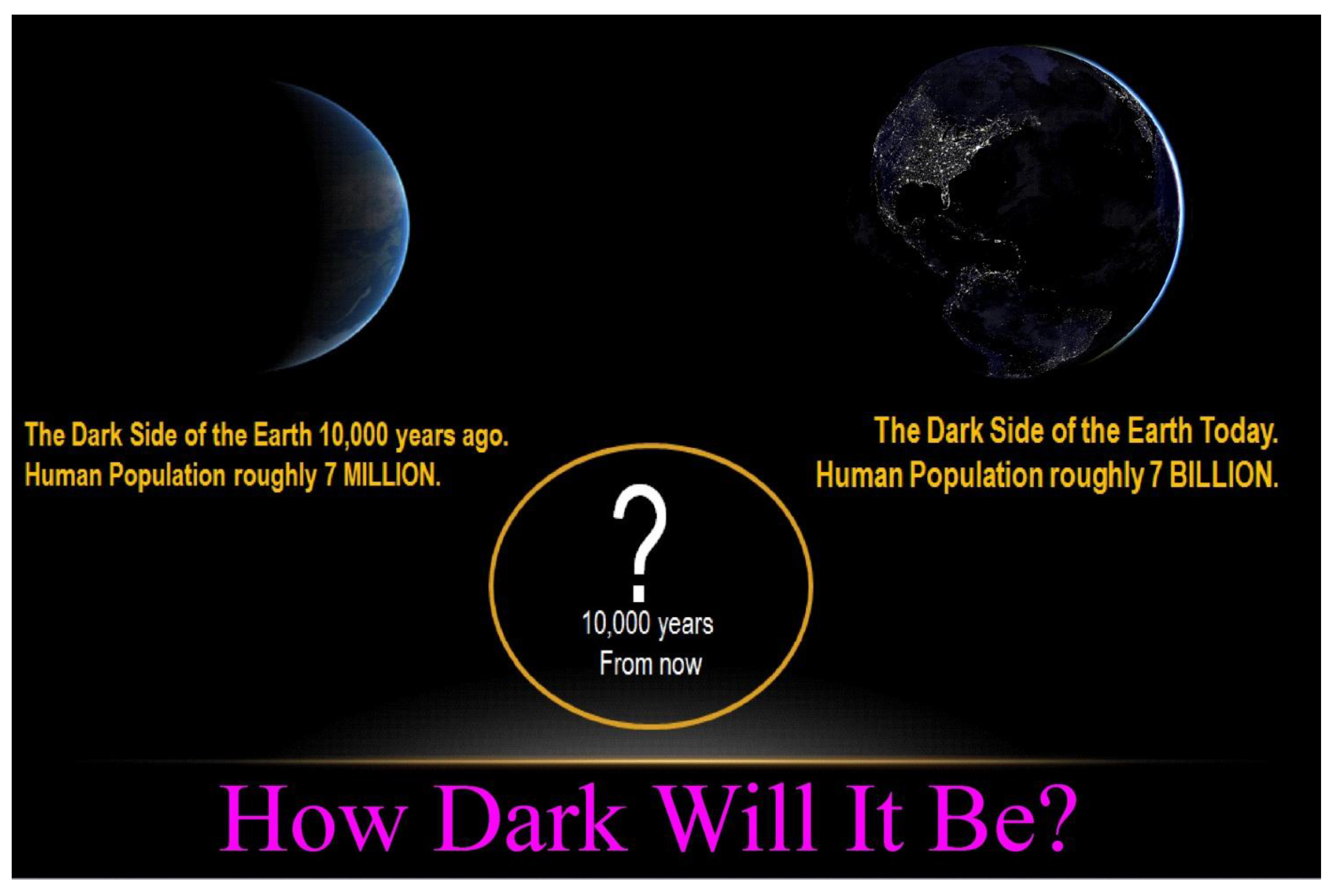
Since the dawn of agriculture roughly 10,000 years ago, the dark side of the earth has lit up with city lights at an accelerating pace. Images of the earth at night derived from nighttime satellite imagery are an iconic representation of both human presence and technology at this point in time (Figure 1). Today, more than half of humanity lives in these lit areas of the earth’s surface; and, the growth in human numbers and energy consumption that has produced these patterns of light will eventually stop. Cosmologists speculate that the reason we have not found the civilizations of other intelligent life that evolved in the universe is because the lights go out on the dark side of their planet for some catastrophic reason. It is hard to imagine what the dark side of the earth will look like in 10,000 years. If we want to see light on the dark side of the Earth 10,000 years from now humanity will have to develop an international attitude of cooperative stewardship of our commonwealth—this small blue planet. Sadly, we are not making great progress in this respect.
Figure 1.
The “Dark Side of the Earth” past, present, and future.
3. The State of the World
Countless academics, non-governmental organizations, and government agencies have gone to great effort to measure, map, document, and report on “The State of the World” from various perspectives of environmental sustainability. Lester Brown, founder of the Worldwatch Institute and president of the Earth Policy Institute has written seminal books on the subject: The State of the World, and Plan B: Mobilizing to Save Civilization [10,11]. Brown has made dire warnings regarding many concerns including but not limited to: human population growth, global warming, soil erosion, deforestation, water resource degradation and depletion, melting glaciers, peak oil, and the great pacific garbage gyre to name a few. Whilst Brown and his ilk have numerous critics from a variety of intellectual paradigms, there are a particularly vocal set of them who are neo-liberals (aka neoclassical economists) who see historical examples of economic growth and technological progress as eternally valid refutations to almost every “limits to growth” argument [12]. These neo-liberal critics of those positing a more strong sustainability perspective often blithely ignore significant criticism that has been levelled at neo-classical economics by established economists. Amartya Sen, Nobel Laureate in Economics no less, has made significant challenges to fundamental assumptions of economics such as the idea that human beings behave in ways that are limited to selfish rationality [13]. And, even when selfishly rational actors act in their own self-interest their behaviours can result in outcomes that refute Adam Smith’s idea of “The Invisible Hand” [14]. This is most famously presented by Hardin in his 1968 paper: The Tragedy of the Commons [15]. Despite the panoply of critics, there are numerous consensus reports from panels of experts that sound the same alarms as Lester Brown including the Millennium Ecosystem Assessment (compiled by over 1,000 of the world’s leading biological scientists) [16], The Millennium Development Goals (produced by the United Nations Development Program) [17], the intergovernmental panel on climate change (IPCC), and the United Nations Environment Program’s (UNEP) Global Environmental Outlook 5 (GEO 5) [18]. The most recent findings forebode a very unpleasant future regarding the state of the world.
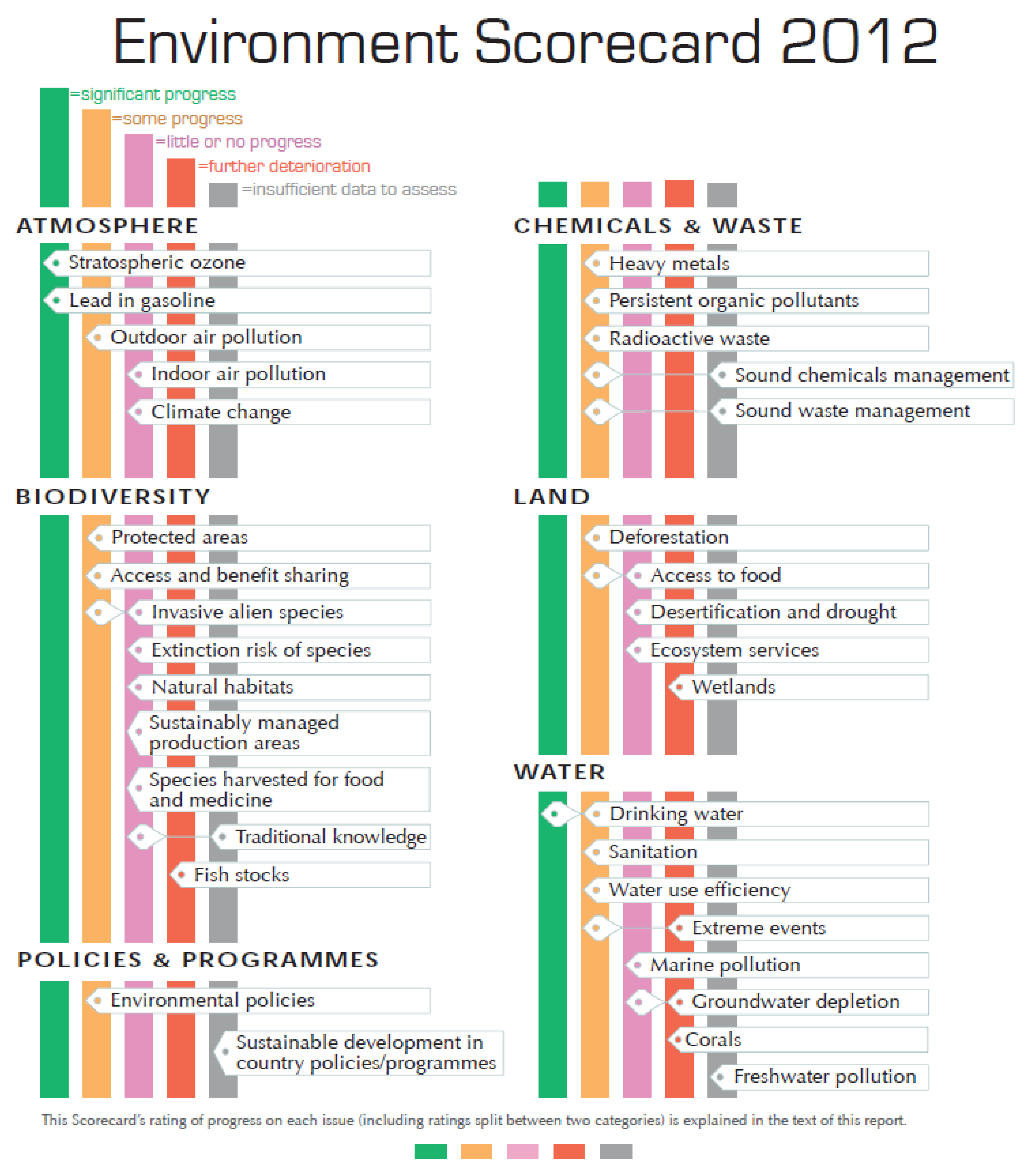
The 5th Global Environment Outlook (GEO-5) report was prepared in June of 2012 by the UNEP Division of Early Warning and Assessment. This report notes that most of the aims and goals of the environmental treaties and agreements (N > 500) made since 1972 have not been met. The global “we” have tended to have more success with specific goals such as getting lead out of gasoline and chlorofluorocarbons out of the stratosphere; however, larger goals such as preserving coral reefs and wetlands have not been achieved. In fact, some of the big broad and important goals such as preserving coral reefs, fish stocks, and wetlands are all categorized as experiencing “Further Deterioration”. Similar discussions are taking place in the scientific community in the world’s premier scientific journals, see “A safe operating space for humanity [19] and “Earth system science for global sustainability: grand challenges [20]. The findings of GEO-5 are stated in surprisingly strong language for a UN document and are quite startling when one considers that they represent what was distilled from, and survived passage through, numerous scientific panels and government agency approvals. The Environment Scorecard (Figure 2) of the Geo-5 report provides a summary of “The State of the World” with respect to these consensually acknowledged environmental threats. This “Report Card” for the planet shows “Little or no Progress” or worse for more than 50% of the Environmental Challenges they assessed (19 out of 34). In many respects the document suggests we are better at policy writing than we are at policy implementation and enforcement.
The specifics of the Geo-5 report are sobering: “Little or no progress” on climate change, extinction of species, natural habitat preservation, actual trends in invasive alien species, sustainable agriculture, preservation of genetic diversity of important food and medicine species, access to food, desertification and drought, ecosystem service monitoring and preservation, and marine pollution. Even worse, the report cited that the following challenges were experiencing “Further Deterioration”: coral reefs, groundwater depletion, wetlands conservation, and fish stocks. The report warns that one fifth of all vertebrates are threatened with extinction and that some marine ecosystems have collapsed due to pollution and overfishing. In addition there are over 150 “coastal dead zones”. The planetary idiot lights are flashing and buzzing yet the world moves forward with business as usual. “Business as usual” is a world in which policy priorities are almost exclusively driven and governed by the neo-classical economic paradigmatic view of the world.
It would be easy to write a much longer list of detailed and depressing facts about the state of the world. Yet I don’t think it serves any purpose. Most people know enough facts to believe deep down that something is going to have to give. If you remain unconvinced I suggest you just explore one of these facts in detail, for example, start with the “Great Pacific Garbage Gyre” that has been described as an accumulation of plastic debris floating just below the surface of an area of the Pacific Ocean that is larger than the state of Texas [21]. The GEO-5 report was very clear in stating: “if humanity does not urgently change its ways, several critical thresholds may be exceeded, beyond which abrupt and generally irreversible changes to the life-support functions of the planet could occur.”
Figure 2.
Environment Scorecard from GEO-5 Report.
4. Food For Thought
Another way to ponder the sustainability problematic is to think about energy and food. A simple cocktail napkin calculation on this matter reveals a very frightening reality about how we obtain our global food supply. Global annual energy consumption is roughly 474 exajoules (474 × 1018 joules). Food production consumes 30% of the world’s annual energy consumption and roughly one third of the food we produce is wasted [22]. Assuming a 2,000 calorie per day diet (8,340 kilojoules) and seven billion people, the energy cost of producing a joule of food is roughly 5 joules. In other words it takes 5 joules of energy (most of which is fossil fuel based) to produce 1 joule of food energy. We are using millions of years of stored sunshine (in the form of fossil fuels) to produce the food for billions of people. The modern industrial economy is on an energy consuming binge that is unprecedented. Every year we consume 400 years of ancient sunlight stored as fossil fuel [23]. This is unsustainable. Not surprisingly, the developed world uses more than four times as much energy per person to grow food. This is one very fundamental way in which the developed world is more vulnerable than the developing world with respect to the sustainability challenge.
The food-energy problematic is one of the most compelling arguments from those who warn about the challenges we will face as we pass through “Peak Oil”. Many find it surprising that agriculture only accounts for small fractions of GDP in the developed world (~ 3% in the European Union). This is indicative of how much our economy (including agricultural activity) is fundamentally dependent on cheap energy. Consider the fact that one gallon of gasoline in an engine will produce the equivalent of 97 hours of manpower [24]. Ninety seven hours of human labour at minimum wage in the United States works out to over $700. Five dollars a gallon seems like really cheap energy in light of these energy equivalents.
5. We Can’t Grow on Like This
The food, energy, and environmental challenges that humanity is facing right now are regarded as very serious by the vast majority of scientific experts. Nonetheless, traditional economists dominate the policy arena and prescribe economic growth as the solution to many world problems and encourage continued increases in material and energy throughput in the global economy. The oft used catch phrase “A rising tide lifts all boats” has been used with some rhetorical effect in this way. Yet, as Paul Ehrlich said many years ago: “Perpetual growth is the creed of the cancer cell”. The urban growth patterns we can see from night-time satellite imagery have been likened to the growth of cancer cells [25]. Richard Heinberg argues that the very industrial civilization that built the satellites that enables us to observe the earth at night from space is based on a capitalistic system that fundamentally needs to grow forever in order to function; and, that this expansionary trajectory is on a collision path with non-negotiable laws of nature [26]. The United Nations report titled “Resilient People, Resilient Planet” called for a significant departure from traditional economic measures of progress in light of these global challenges [27]:
“Without clear metrics for measuring progress towards sustainable development, achieving internationally agreed goals will remain elusive. In bringing sustainability to the core of decision-making, rethinking the way economic development and human well-being are currently measured and monitored becomes crucial. This requires a broader set of indicators for measuring economic, social and environmental dimensions of sustainable development that go beyond GDP, the most used indicator of development.”
The perpetual growth paradigm of neo-classical economics is even being criticized by its own Nobel laureates. Paul Krugman writes about the role of economics and economists in the global financial crisis for a piece titled “Economics in the Crisis” in the New York Times [28]:
“And the inadequacy of policy is something that should bother economists greatly—indeed, it should make them ashamed of their profession, which is certainly how I feel. For times of crisis are when economists are most needed. If they cannot get their advice accepted in the clinch—or, worse yet, if they have no useful advice to offer—the whole enterprise of economic scholarship has failed in its most essential duty. And that is, of course, what has just happened.”
But it is not as if we were not taking advice from these neo-classical economists. Tim Geithner is a classically trained economist appointed to be U.S. Secretary of the Treasury. Hank Paulsen got his MBA from Harvard and rotated from CEO of Goldman Sachs to U.S. Secretary of the Treasury. These economists are in governmental positions of power and authority that are orders of magnitude more influential than any scientist despite the fact that the earth’s ecosystem services are more valuable than the entire world’s annual gross domestic product [29]. We need appropriate environmental experts/advocates in positions of authority within the government that have commensurate political and economic power to these stewards of the economy. Stewards of our economy (e.g., Secretary of the Treasury Timothy Geithner and the Chairman of the Federal Reserve Ben Bernanke) have the power to print billions if not trillions of dollars to “save the economy”. There are no people in any country with anything remotely approaching that sort of power to “save the environment”. Yet the environment we depend on for our very survival is in great peril despite the fact that it is clearly more valuable than any market economy we participate in. Economics is described as the science/art concerned with the allocation of scarce resources. The ecosystem services provisioned by the global environment have not been considered a scarce resource for the first two centuries of economic management.
6. Failure is an Option
Civilizations have collapsed many times throughout human history. Joseph Tainter describes 24 civilizations that have collapsed. Tainter argues that as these societies became more complex they invested more and more of their diminishing resources into expanding systems of complexity. These systems of complexity can be things like pyramids, churches, Easter Island statues, investment banks, cell phone networks, power grids, municipal water systems, and suites of GPS satellites. When these civilizations collapse their societies move backward from these developments because they lack the resources to sustain them [30]. It is perhaps easy to imagine how difficult it would be for a Roman senator to foresee the fall of Rome or why a passenger on the Titanic might imagine the ship to be invincible. Today, the technology instantiated in our communications, transportation, and built environment can perhaps instil a similar but false sense of invincibility.
Holding an i-pad in my hand and watching an old movie on Netflix using wireless internet access as I fly across the United States in a passenger jet gives me the sense that anything is possible. With i-pad in hand it is easy for me to imagine that I possess a more highly evolved intelligence than any one of my Cro-Magnon ancestors from tens of thousands of years ago. But I am not significantly more intelligent than my Cro-Magnon ancestors. If a Cro-Magnon infant were time-warped into a modern crib in suburban Chicago in 1985 he or she would likely be savvier with their i-pad than I am now. Our collective cultural and technological achievements are evolving more rapidly than our biology. Human civilization as we know it is perhaps a very fragile house of cards that is incredible in its complexity yet potentially vulnerable to sinking like the Titanic. We need to incorporate more awareness of our dependencies and a sense of humility into our educational practices. My e-mail signature file tries to express this with the following sequence of quotes:
“Civilization advances by extending the number of important operations which we can perform without thinking about them.”Alfred North Whitehead
“We are always only one failed generational transfer of knowledge away from darkest ignorance.”Herman Daly
“I don”t know how world war III will be fought, but I know how World War IV will, with sticks and stones.”Albert Einstein
7. Humanity’s Future and the Future of the Humanities
I initially interpreted the invitation to write this paper to be on the topic of “The Future of the Humanities” rather than the “The Future of Humanity”. This was a concern because I regard myself as a scientist who has very little to say about the future of the humanities. However, in the sense that the humanities are the “arts” that science is not, I have to say the humanities are for me what make life most inspiring, wonderful, and enjoyable. Consequently, I am happy to write this polemic on the future of humanity in the hope that it will encourage both greater awareness about pressing matters of economic and environmental sustainability; and, to foster individual and collective decisions that secure a promising future for modern civilization.
The apocryphal quote attributed to Ralph Waldo Emerson: “All my best thoughts were stolen by the ancients” is true regarding many of the ideas in this paper. Carl Sagan expressed many of these ideas more eloquently and succinctly in his musings on the “Pale Blue Dot” as seen by the Voyager 1 space craft. The image of the earth was taken from 6 billion kilometres away in 1990 [31]. Sagan’s thoughts on the “Pale Blue Dot”:
“From this distant vantage point, the Earth might not seem of any particular interest. But for us, it’s different. Look again at that dot. That’s here. That’s home. That’s us. On it everyone you love, everyone you know, everyone you ever heard of, every human being who ever was, lived out their lives. The aggregate of our joy and suffering, thousands of confident religions, ideologies, and economic doctrines, every hunter and forager, every hero and coward, every creator and destroyer of civilization, every king and peasant, every young couple in love, every mother and father, hopeful child, inventor and explorer, every teacher of morals, every corrupt politician, every "superstar," every "supreme leader," every saint and sinner in the history of our species lived there - on a mote of dust suspended in a sunbeam. The Earth is a very small stage in a vast cosmic arena. Think of the rivers of blood spilled by all those generals and emperors, so that, in glory and triumph, they could become the momentary masters of a fraction of a dot. Think of the endless cruelties visited by the inhabitants of one corner of this pixel on the scarcely distinguishable inhabitants of some other corner, how frequent their misunderstandings, how eager they are to kill one another, how fervent their hatreds. Our posturings, our imagined self-importance, the delusion that we have some privileged position in the Universe, are challenged by this point of pale light. Our planet is a lonely speck in the great enveloping cosmic dark. In our obscurity, in all this vastness, there is no hint that help will come from elsewhere to save us from ourselves. The Earth is the only world known so far to harbor life. There is nowhere else, at least in the near future, to which our species could migrate. Visit yes. Settle, not yet. Like it or not, for the moment the Earth is where we make our stand. It has been said that astronomy is a humbling and character building experience. There is perhaps no better demonstration of the folly of human conceits than this distant image of our tiny world. To me, it underscores our responsibility to deal more kindly with one another, and to preserve and cherish the pale blue dot, the only home we’ve ever known.”
This quote wonderfully summarizes the precarious nature of human existence and makes very reasonable suggestions to improve the likelihood of a vibrant human civilization into the more distant future. Waxing eloquent to the public at large about matters like this may not have been the greatest career move for Carl Sagan. It is hypothesized that Sagan was denied admission to the National Academy of Sciences because he was perceived as a populariser of science. Many scientists who dare enter into the world of politics and policy have been scorned. Many scientists who enter into the domain of economics pay a price also.
Consider Frederick Soddy, a seminal thinker in the development of ecological economics. Soddy was the winner of the 1921 Nobel Prize in chemistry yet is often described as an eccentric who argued for a fundamental restructuring of the economic system including changing the nature of international monetary policy. Soddy’s wacky ideas included things like: (1) Abandoning the gold standard, (2) letting international exchange rates float, (3) using government surpluses and deficits as Keynesian economic tools, (4) establishing national bureaus of economic statistics that measured economic activity including statistics akin to a consumer price index. All of these ideas are now regarded as the standard operating procedure of mature governments regarding economic policy.
There is a great old quote from Arthur Schopenhauer: “All truth passes through three stages. First it is ridiculed. Second it is violently opposed. Third, it is accepted as being self-evident.” Many of Soddy’s iconoclastic proposals have passed through these three phases. Some of his ideas are still in the first stage. This includes the idea that the fractional reserve banking system causes debt to grow exponentially while the real economy is fundamentally based on exhaustible fossil fuels. The critique of current neo-classical economic theory inherent in this idea remains violently opposed. Nonetheless, I do believe that one day it will be regarded as self-evident.
We take our scientists and engineers for granted and we love the technology they both produce. However, when scientists and engineers start saying things that are uncomfortable, like the warnings about the dangers of global warming and climate change courageously put forth by the late Stephen Schneider, they are often ridiculed and violently opposed. Much of this ridicule comes from the classically trained economists. Paul Ehrlich has been so reviled that he felt it necessary to write a book titled: The Betrayal of Science and Reason [32]. Ask yourself this question: “What do you think will be regarded as “self-evident” in 50 to 100 years regarding peak oil, global warming, and human population growth?”
Frankly, I am more comfortable driving over the bridge designed by a civil engineer, using the cell phone built by a team of engineers, and trusting the medical diagnosis of a scientifically trained doctor than I am with the credit default swaps of any professional in investment banking or the financial recommendations of anyone in financial planning. I am increasingly of the opinion that the future of modern civilization and perhaps even human existence will begin when we choose to stop listening to the economists, start listening to the scientists, and re-learn what is really important from the humanities.
8. Living in the Solution for a Shot at Being Here 10,000 Years from Now
The problems we face are often perceived as overwhelming. Hopelessness, helplessness, despair, and apathy are common reactions of those who learn of the myriad challenges we face. It helps to look on many bright sides of the current global situation. One bright side is this: we will eventually run out of fossil fuel that is dumping CO2 into the atmosphere [33]. As this takes place we can hope that our collective awareness and behaviour will change in ways that mitigate or cease the myriad ways we are destroying our natural environment including loss of habitat and biodiversity, loss of ecosystem functioning, and pollution of our air and water. If we cooperate and plan our future we will live healthier lives, be less hypermobile, eat more locally grown food, have stronger communities, spend more time with family and friends, breathe cleaner air, grow some of our own food, spend more time creating and less time consuming, participate more fully in our local and national governance, and have more leisure time.
The hypermobile, eternally growing, entropy accelerating ways of modern civilization that are championed by many of the economists of the world will come to an end regardless of the choices we make. I endorse choices that will support smoother transitions with less human suffering. These choices will create communities that are more connected and cooperative than the increasingly individualistic paths that many people and nations have chosen in the recent past. Perhaps instead of shrugging, Atlas will rise. There are numerous local, regional, and global efforts to foster and support a suite of choices to enable a smoother transition that minimizes human suffering. Nobody knows exactly what the transition will look like but realist scientists who think about this do not see more economic growth as the answer.
People often ask what they can personally do to contribute to a sustainable future. We have to think and act locally and globally. Reduce, reuse, and recycle is still true. Knowledge is power is still true. Get informed about what is happening and what people are thinking needs to happen. Participate in making it happen. Your vote counts. Support candidates, policies, institutions, and governments that take these problems seriously. Civilization needs you [34]. What you do, what we do, today, tomorrow and for the rest of this generation, will profoundly influence what the dark of the earth will look like in 10,000 years.
9. Conclusions
Modern civilization has been subsidized by fossil fuel to an extent that few people truly understand. The rapid consumption of this ancient energy has supported massive increases in food production to support an exponentially growing human population that now stands in excess of 7 billion people. A significant fraction of the people alive today use inordinate quantities of energy to enable consumption and hypermobility that is unprecedented in the history of the human race. The fossil fuel energy that sustains modern civilization will run out. Fossil fuels like petroleum may run out much more quickly because there are now additional billions of people interested in consuming it. The achievements of modern civilization in the arts, science, and technology are simultaneously incredibly valuable and incredibly vulnerable. Preserving those aspects of modern civilization that support continued development in the arts and sciences will require collective choices that steer our aggregate behaviour onto the path of sustainability. There are stark differences between traditional neo-classical economics and ecological economics as to what those collective decisions are. The majority of scientists who understand these circumstances would endorse those choices that are consistent with the laws of thermodynamics. Nonetheless, neoclassical economists dominate the policy arena and prescribe eternal growth as the solution to our problems. Physical science is not consistent with the policy prescriptions of the dominant economic world view. The perspective of ecological economics is fundamentally rooted in the laws of thermodynamics and recognizes that “Nature Bats Last”. Given recent global developments it seems to be quite inevitable that the dark side of the earth in the future will look like the one 10,000 years ago. However, the question is how humanity will experience this transition and how fast it will happen. If we further stay on this business as usual track, we will learn the hard way with increasing catastrophes. The dark side of the earth will be black sooner than later, perhaps as soon at the 22nd century [35]. Thus, making the transition to a non-growth and sustainable society as smoothly as possible needs to be a primary objective for humanity. This priority must be established to minimize human suffering in the coming century and we have to take action now. This vision for the future of civilization could result in a dark side of the earth in 10,000 years that looks very similar to what it looks like now, but based on a sustainable, renewable resource-based non-growth economy. This is a vision for the future of humanity that work, not wishes, will make real.
Acknowledgments
I would like to thank Tom Cova and Sharolyn Anderson and the anonymous peer reviewers for their insightful comments on early drafts of this manuscript. I would also like to thank Robert Costanza for his tireless work contributing to the development of scholars in the area of ecological economics. Lastly, I want to thank Chris Elvidge for his visionary work making satellite imagery of the earth from space at night a compelling cultural icon representing human presence and impact on the planet.
References and Notes
- Frank Borman, Jim Lovell, and William Anders. “Earthrise. NASA image of the day gallery. ” Available online: http://www.nasa.gov/multimedia/imagegallery/image_feature_102.html (accessed on 14 August 2009).
- Adam Frank. “Alone in the Void.” Available online: http://www.nytimes.com/2012/07/25/opinion/alone-in-the-void.html?_r=0 (accessed on 18 October 2012).
- Xepapadeas Anastasios. “Ecological economics.” In The New Palgrave Dictionary of Economics, 2nd ed. Gordonsville, VA: Palgrave MacMillan, 2008. [Google Scholar]
- Robert Costanza. “What is ecological economics? ” Ecological Economics 1 (1989): 1–7. [Google Scholar] [CrossRef]
- David Bengston. “Reply: What is Ecological Economics? ” Available online: http://www.metla.fi/archive/forest/1993/09/msg00004.html (accessed on 7 November 2012).
- John L.R. Proops. “Ecological economics: Rationale and problem areas.” Ecological Economics 1 (1989): 59–76. [Google Scholar] [CrossRef]
- Sam Harris. Free Will. New York: Free Press, 2012. [Google Scholar]
- Paul Ehrlich. Human Natures: Genes, Cultures, and the Human Prospect. Washington, DC: Island Press, 2000. [Google Scholar]
- Wendell Berry. Life is a Miracle: An Essay against Modern Superstition. Washington, DC: Counterpoint press, 2000. [Google Scholar]
- Lester Brown. The State of the World 2000. New York: W.W. Norton and Company Inc, 2000. [Google Scholar]
- Lester Brown. Plan B 3.0: Mobilizing to Save Civilization. Washington, DC: Earth Policy Institute, 2008. [Google Scholar]
- Bailey Ronald. “Never Right, But Never in Doubt Famine-monger Lester Brown still Gets it Wrong after All These Years.” Available online: http://reason.com/archives/2009/05/05/never-right-but-never-in-doubt (accessed on 12 October 2012).
- Sen Amartya. “Rational Fools: A Critique of the Behavioural Foundations of Economic Theory.” Philosophy and Public Affairs 6 (1977): 317–332. [Google Scholar]
- Adam Smith. An Inquiry into the Nature and Causes of the Wealth of Nations. London: W. Strahan and T. Cadell, 1777. [Google Scholar]
- Garrett Hardin. “Tragedy of commons.” Science 162 (1968): 1243–48. [Google Scholar] [CrossRef] [PubMed]
- Johan A. Rockstrom. “A safe operating space for humanity.” Nature 461 (2009): 472–75. [Google Scholar] [CrossRef] [PubMed]
- Walter.V. Reid, D. Chen, L. Goldfarb, Heide Hackmann, Yei T. Lee, Khotso Mokhele, Elinor Ostrom, Kari Raivio, Johan Rockstrom, and Hans Joachim Schellnbuber. “Earth systems science for global sustainability: grand challenges.” Science 330 (2010): 916–17. [Google Scholar] [CrossRef] [PubMed]
- Millennium Ecosystem Assessment (MEA). Ecosystems and human well-being: synthesis; Washington, DC: Island Press. Available online: http://www.millenniumassessment.org/documents/document.356.aspx.pdf (accessed on 17 August 2009).
- United Nations. The millennium development goals report; New York The Millennium Development Goals Report 2008.pdf. : United Nations. Available online: http://www.un.org/millenniumgoals/pdf/ (accessed on 14 August 2009).
- United Nations. Measuring Progress: Environmental Goals & Gaps. Nairobi: United Nations Environment Programme, 2012. [Google Scholar]
- NOAA. “The Great Pacific Garbage Gyre. ” Available online: http://marinedebris.noaa.gov/info/patch.html#6 (accessed on 5 October 2012).
- FAO. “United Nations Report.” In Energy-Smart Food for people and climate. Rome: Food and Agriculture Organization of the United Nations, 2011. [Google Scholar]
- Thom Hartmann. Last Hours of Ancient Sunlight. New York: Three Rivers Press, 2004. [Google Scholar]
- David Pimentel, Alan F. Warneke, Wayne S. Teel, Kimberly A. Schwab, Nancy J. Simcox, Daniel M. Ebert, Kim D. Daenisch, and Marni R. Aaron. Food, Energy, and Society, 3rd ed. Edited by David Pimentel and Marcia Pimentel. Boca Raton: CRC Press, 2007. [Google Scholar]
- Alan Gregg. “A Medical Aspect of the Population Problem.” Science 121 (1955): 681–82. [Google Scholar] [CrossRef] [PubMed]
- Richard Heinberg. The End of Growth. New York: New Society Publishers, 2011. [Google Scholar]
- United Nations. Resilient People, Resilient Planet: A Future Worth Choosing. Report of the United Nations Secretary-General’s High-Level Panel on Global Sustainability. New York: United Nations, 2012. [Google Scholar]
- Paul Krugman. “Economics in the Crisis.” Available online: http://krugman.blogs.nytimes.com/2012/03/05/economics-in-the-crisis/ (accessed on 13 October 2012).
- R. Costanza, R. d’Arge, R. de Groot, S. Farber, M. Grasso, B. Hannon, S. Naeem, K. Limburg, J. Paruelo, R. O’Neill, and et al. “The Value of the World’s Ecosystem Services and Natural Capital.” Nature 387 (1997): 15. [Google Scholar] [CrossRef]
- Joseph Tainter. The Collapse of Complex Societies. Cambridge: Cambridge University Press, 1988. [Google Scholar]
- Carl Sagan. Pale Blue Dot: A Vision of the Human Future in Space, 1st ed. New York: Random House, 1994. [Google Scholar]
- Paul Ehrlich, and Anne Ehrlich. Betrayal of Science and Reason: How Anti-Environmental Rhetoric Threatens Our Future. Washington, DC: Island Press, 1996. [Google Scholar]
- James D. Ward, Steve H. Mohr, Myers R. Baden, and Nel P. Willem. “High estimates of supply constrained emissions scenarios for long-term climate risk assessment.” Energy Policy 51 (2012): 598–604. [Google Scholar] [CrossRef]
- Greg Ederer. (author of “The Liberal Elite Battalion”), in discussion with the author; June 2006.
- Alexa Danner. “Earth 2100: Is this the final century of our civilization? ” ABC News. 29 May 2009. http://abcnews.go.com/Technology/Earth2100/.
© 2012 by the author; licensee MDPI, Basel, Switzerland. This article is an open access article distributed under the terms and conditions of the Creative Commons Attribution license (http://creativecommons.org/licenses/by/3.0/).
Share and Cite
MDPI and ACS Style
Sutton, P.C. Alone in the Void: Getting Real about the Tenuous and Fragile Nature of Modern Civilization. Humanities 2012, 1, 178-191. https://doi.org/10.3390/h1030178
AMA Style
Sutton PC. Alone in the Void: Getting Real about the Tenuous and Fragile Nature of Modern Civilization. Humanities. 2012; 1(3):178-191. https://doi.org/10.3390/h1030178
Chicago/Turabian StyleSutton, Paul C. 2012. "Alone in the Void: Getting Real about the Tenuous and Fragile Nature of Modern Civilization" Humanities 1, no. 3: 178-191. https://doi.org/10.3390/h1030178