Climate Change Mitigation through Energy Benchmarking in the GCC Green Buildings Codes
Abstract
1. Background
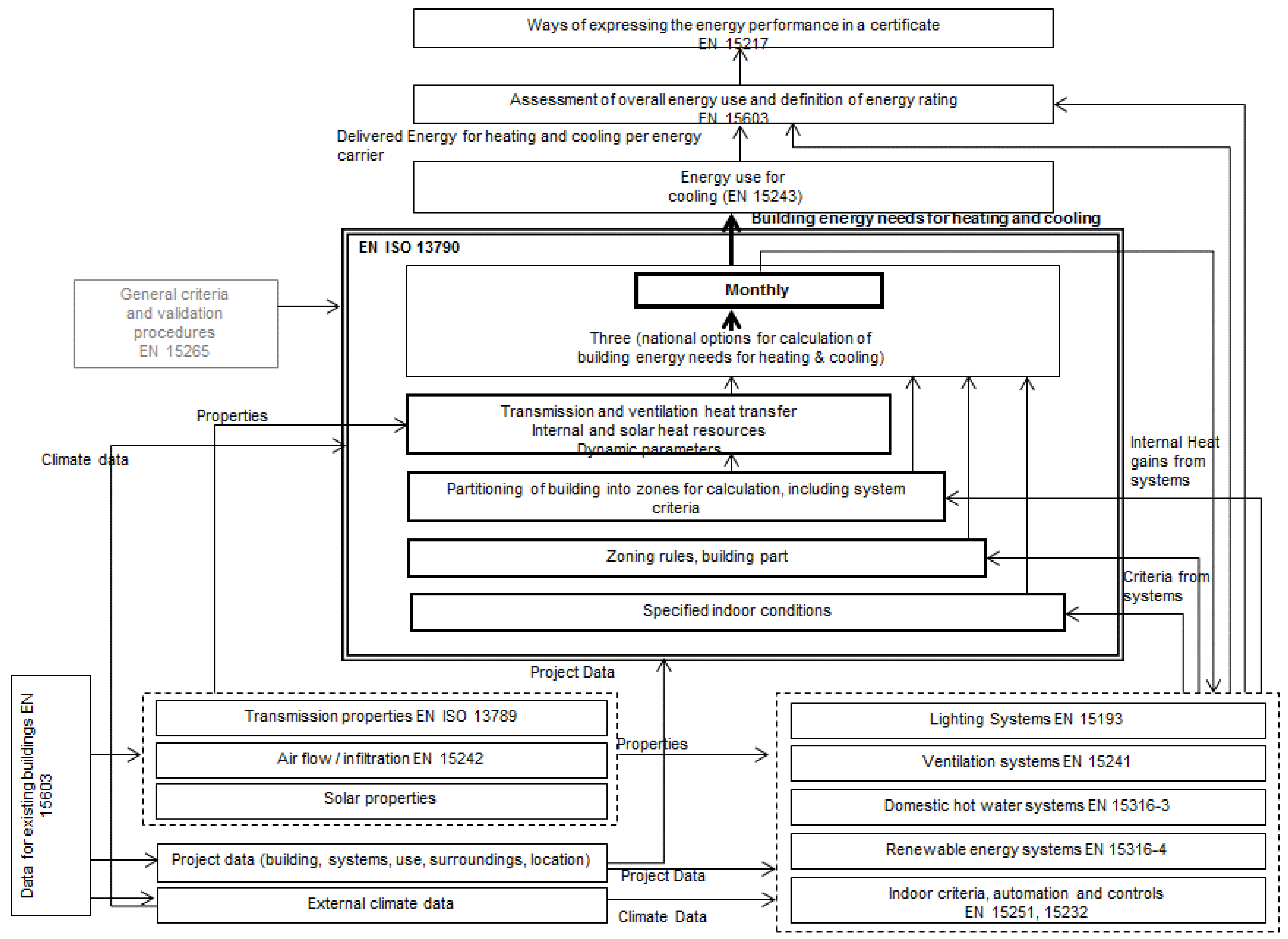
2. Energy Consumption and Carbon Emissions Modelling Procedure
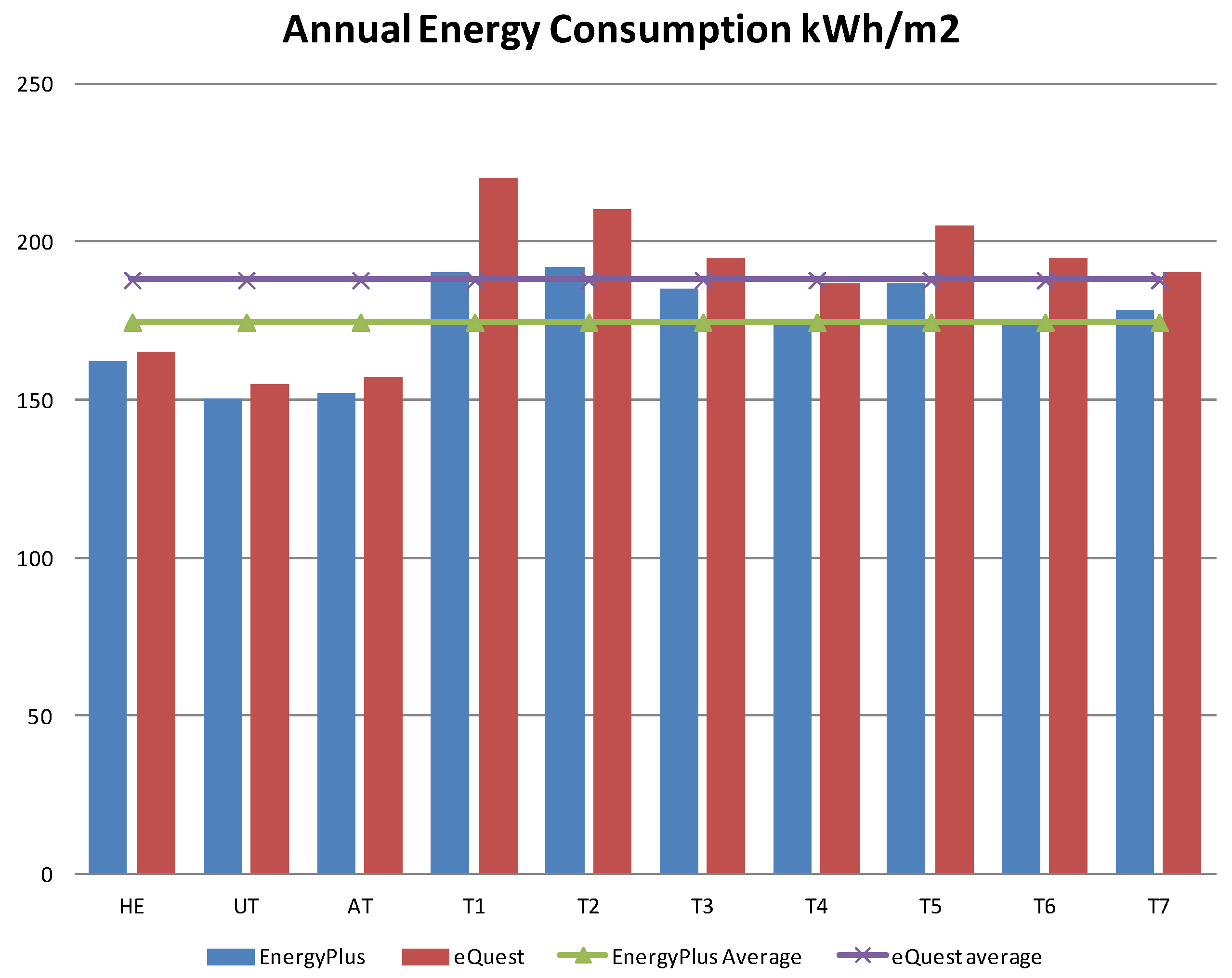
3. Establishing Energy Consumption Baseline and Benchmarks for Building Typologies
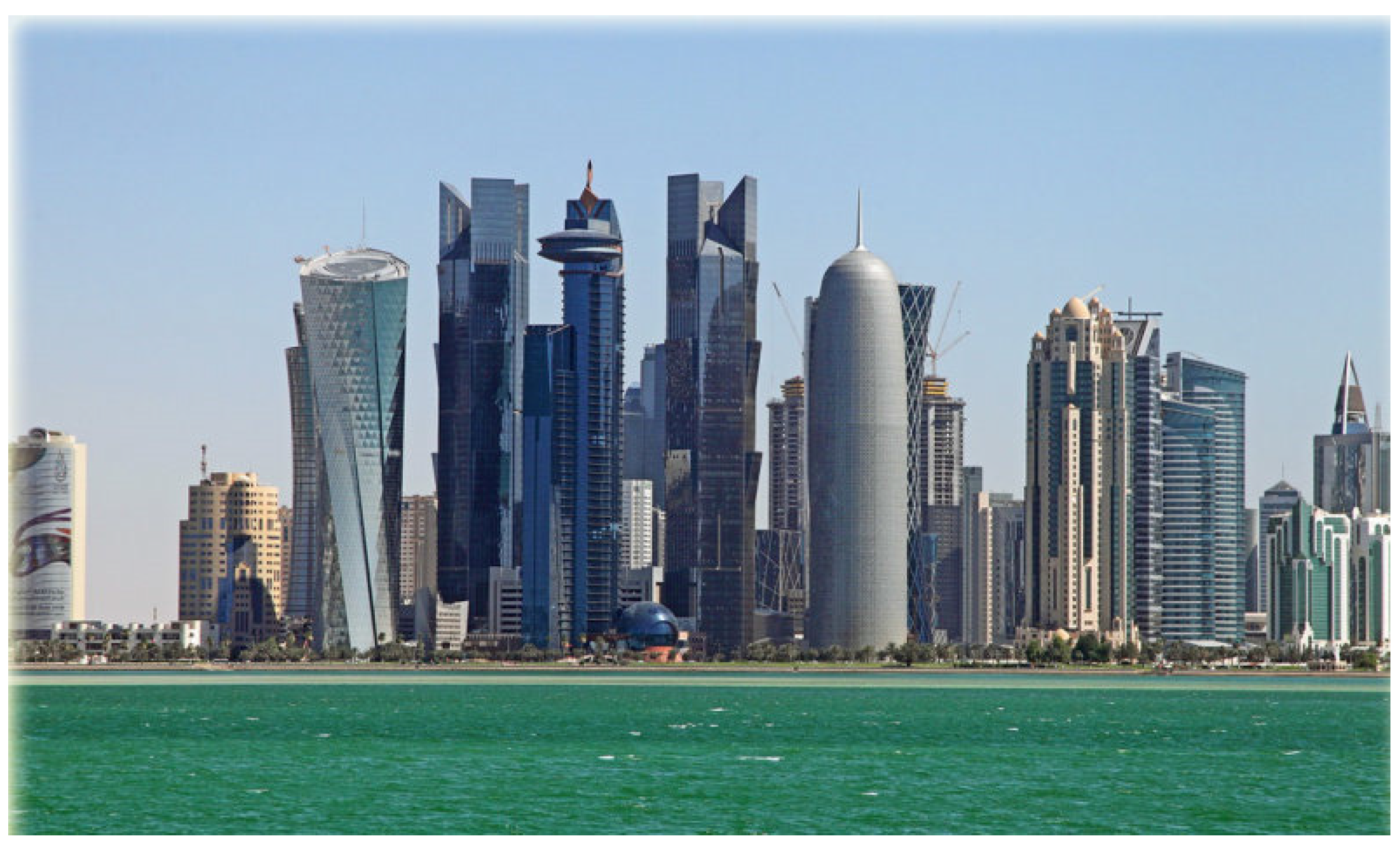

| No | Name | Picture | Profile |
|---|---|---|---|
| 1 | HE |  | H.E. Ahmed Abdulla Al Mahmoud |
| Location: West Bay, Doha | |||
| Floors: B + G + 19 | |||
| Size: 14,747 m2 | |||
| 2 | UT |  | United Tower |
| Location: Al Sadd, Doha | |||
| Floors: B + G + 7 | |||
| Size: 10,711 m2 | |||
| 3 | AT |  | Attiyah Tower |
| Status: Under Construction | |||
| Location: West Bay, Doha | |||
| Floors: B + G + 23 | |||
| Size: 45,175 m2 | |||
| 4 | T1 |  | Barwa Financial District, Tower 1 |
| Location: West Bay, Doha | |||
| Floors: 3B + 3G + ME + 13 + ME | |||
| Size: 16,918 m2 | |||
| 5 | T2 |  In the same district with the above building | Barwa Financial District, Tower 2 |
| Location: West Bay, Doha | |||
| Floors: 3B + 3G + ME + 16 + ME | |||
| Size: 20,223 m2 | |||
| 6 | T3 | In the same district with the above building | Barwa Financial District, Tower 3 |
| Location: West Bay, Doha | |||
| Floors: 3B + 2G + ME + 19 + ME | |||
| Size: 26,036 m2 | |||
| 7 | T4 | In the same district with the above building | Barwa Financial District, Tower 4 |
| Location: West Bay, Doha | |||
| Floors: 3B + 2G + ME + 22 + ME | |||
| Size: 31,584 m2 | |||
| 8 | T5 | In the same district with the above building | Barwa Financial District, Tower 5 |
| Location: West Bay, Doha | |||
| Floors: 3B + 2G + ME + 26 + ME | |||
| Size: 30,536 m2 | |||
| 9 | T6 | In the same district with the above building | Barwa Financial District, Tower 6 |
| Location: West Bay, Doha | |||
| Floors: 3B + 2G + ME + 28 + ME | |||
| Size: 38,400 m2 | |||
| 10 | T7 |  In the same district with the above building | Barwa Financial District, Tower 7 |
| Location: West Bay, Doha | |||
| Floors: 3B + 2G + ME + 44 + 2ME | |||
| Size: 63,233 m2 |
| Building Name | Design Data |
|---|---|
| Wall: U value 0.56 W/m2K; Window: U value 2.4 W/m2K; Shading Coefficient 0.56 |
| System: Air cooled chillers with constant volume air handling units; Lighting: 15 W/m2 | |
| Ventilation: 8 l/s/person; Equipment: 2 W/m2 | |
| Wall U value 0.56 W/m2K; Window type-1: U value 1.8 W/m2K, Shading Coefficient 0.6 |
| Window type-2: U value 1.6 W/m2K, Shading Coefficient 0.42; System: Air cooled chillers with constant volume air handling units; Lighting: 15 W/m2; Ventilation: 8 l/s/person; Equipment: 2 W/m2 | |
| Wall U value 0.56 W/m2K; Window U value 1.8 W/m2K, Shading Coefficient 0.6; System: Air cooled chillers with constant volume air handling units; Lighting: 15 W/m2; Ventilation: 8 l/s/person; Equipment: 2 W/m2 |
| Wall U value 0.56 W/m2K; Window type-1: U value 1.8 W/m2K, Shading Coefficient 0.6 |
| Window type-2: U value 1.6 W/m2K, Shading Coefficient 0.42; System: Purchased district cooling with variable volume air handling units; Lighting: 15 W/m2; Ventilation: 8 l/s/person | |
| Equipment: 2 W/m2 | |
| Wall U value 0.56 W/m2K; Window type-1: U value 1.8 W/m2K, Shading Coefficient 0.6 |
| Window type-2: U value 1.6 W/m2K, Shading Coefficient 0.42; System: Purchased district cooling with variable volume air handling units; Lighting: 15 W/m2; Ventilation: 8 l/s/person | |
| Equipment: 2 W/m2 | |
| Wall U value 0.56 W/m2K; Window type-1: U value 1.8 W/m2K, Shading Coefficient 0.6 |
| Window type-2: U value 1.6 W/m2K, Shading Coefficient 0.42; System: Purchased district cooling with variable volume air handling units; Lighting: 15 W/m2; Ventilation: 8 l/s/person | |
| Equipment: 2 W/m2 | |
| Wall U value 0.56 W/m2K; Window type-1: U value 1.8 W/m2K, Shading Coefficient 0.6 |
| Window type-2: U value 1.6 W/m2K, Shading Coefficient 0.42; System: Purchased district cooling with variable volume air handling units; Lighting: 15 W/m2; Ventilation: 8 l/s/person | |
| Equipment: 2 W/m2 | |
| Wall U value 0.56 W/m2K; Window type-1: U value 1.8 W/m2K, Shading Coefficient 0.6 |
| Window type-2: U value 1.6 W/m2K, Shading Coefficient 0.42; System: Purchased district cooling with variable volume air handling units; Lighting: 15 W/m2; Ventilation: 8 l/s/person | |
| Equipment: 2 W/m2 | |
| Wall U value 0.56 W /m2K; Window type-1: U value 1.8W /m2K, Shading Coefficient 0.6 |
| Window type-2: U value 1.6 W/m2K, Shading Coefficient 0.42; System: Purchased district cooling with variable volume air handling units; Lighting: 15 W/m2; Ventilation: 8 l/s/person | |
| Equipment: 2 W/m2 | |
| Wall U value 0.56 W/m2K; Window type-1: U value 1.8 W/m2K, Shading Coefficient 0.6 |
| Window type-2: U value 1.6 W/m2K, Shading Coefficient 0.42; System: Purchased district cooling with variable volume air handling units; Lighting: 15 W/m2; Ventilation: 8 l/s/person | |
| Equipment: 2 W/m2 |
| Operation Time | 7 a.m. to 5 p.m. (10 h) |
|---|---|
| Occupancy | 10 m2/person |
| Occupied set point Temp | 23 °C |
| Unoccupied Set point Temp | 28 °C |

4. Conclusions
Acknowledgment
Author Contributions
Conflicts of Interest
References
- Wiedmann, T. Carbon footprint and input-output analysis: An introduction. Econ. Syst. Res. 2009, 21, 175–186. [Google Scholar] [CrossRef]
- Moss, J.; Lambert, C.G.; Rennie, A.E.W. SME application of LCA-based carbon footprints. Int. J. Sustain. Eng. 2008, 1, 132–141. [Google Scholar] [CrossRef]
- International Energy Agency. Mapping the Energy Future: Energy Modelling and Climate Change Policy; International Energy Agency: Paris, France, 1998. [Google Scholar]
- Buildings and Climate Change: Status, Challenges and Opportunities. Available online: http://www.unep.org/sbci/pdfs/BuildingsandClimateChange.pdf (accessed on 3 June 2015).
- Hernandez, P.; Burke, K.; Lewis, J.O. Development of energy performance benchmarks and building energy ratings for non-domestic buildings: An example for Irish primary schools. Energy Build. 2008, 40, 249–254. [Google Scholar] [CrossRef]
- Chan, W. Energy benchmarking in support of low carbon hotels: Developments, challenges, and approaches in China. Int. J. Hosp. Manag. 2012, 31, 1130–1142. [Google Scholar] [CrossRef]
- Hong, S.; Paterson, G.; Burman, E.; Steadman, P.; Mumovic, D. A comparative study of benchmarking approaches for non-domestic buildings: Part 1—Top-down approach. Int. J. Sustain. Built Environ. 2013, 2, 119–130. [Google Scholar] [CrossRef]
- Martin, C. Generating low-cost national energy benchmarks: A case study in commercial buildings in Cape Town, South Africa. Energy Build. 2013, 64, 26–31. [Google Scholar] [CrossRef]
- Ays, E.T.; Soofia, T.E.O.; Ursula, E. Energy benchmarking for residential buildings. Energy Build. 2013, 60, 92–99. [Google Scholar]
- Burman, E.; Hong, S.; Paterson, G.; Kimpian, J.; Mumovic, D. A comparative study of benchmarking approaches for non-domestic buildings: Part 2—Bottom-up approach. Int. J. Sustain. Built Environ. 2014, 3, 247–261. [Google Scholar] [CrossRef]
- Chung, W. Using the fuzzy linear regression method to benchmark the energy efficiency of commercial buildings. Appl. Energy 2012, 95, 45–49. [Google Scholar] [CrossRef]
- Kavgic, M.; Mavrogianni, A.; Mumovic, D.; Summerfield, A.; Stevanovic, Z.; Djurovic Petrovic, M. Review of bottom-up building stock models for energy consumption in the residential sector. Build. Environ. 2010, 45, 1683–1697. [Google Scholar] [CrossRef]
- Mihalakakou, G.; Santamouris, M.; Tsangrassoulis, A. On the energy consumption in residential buildings. Energy Build. 2002, 34, 727–736. [Google Scholar] [CrossRef]
- Swan, L.G.; Ugursal, V.I.; Beausoleil-Morrison, I. A New Hybrid End-Use Energy and Emissions Model of the Canadian Housing Stock. In Proceedings of the COBEE Conference, Dalian, China, 13–16 July 2008.
- Wheelock, J.; Oughton, E. The Household as a Focus for Comparative Research; University of Newcastle, Centre for Rural Economy: Newcastle, UK, 1994. [Google Scholar]
- RAND-Qatar Policy Institute. Recommended Research Priorities for the Qatar Foundation’s Environment and Energy Research Institute; ISBN 978-0-8330-5820-1. RAND Cooperation: Santa Monica, CA, USA, 2011. [Google Scholar]
- IPCC. Contribution of Working Group III to the Fourth Assessment Report of the Intergovernmental Panel on Climate Change. In Climate Change 2007: Mitigation; Metz, B., Davidson, O., Bosch, P., Dave, R., Meyer, L., Eds.; Cambridge University Press: Cambridge, UK; New York, NY, USA, 2007. [Google Scholar]
- Ercin, A.E.; Hoekstra, A.Y. Carbon and Water Footprints Concepts, Methodologies and Policy Responses; ISBN 978-92-3-001095-9; UNESCO: Paris, France, 2012. [Google Scholar]
- United Nations Framework Convention on Climate Change. 2012. Available online: http://unfccc.int/documentation/decisions/items/3597.php#beg (accessed on 3 June 2015).
- General Secretariat for Development Planning, 2008. Qatar National Vision 2030. Available online: http://www.gsdp.gov.qa/www1_docs/QNV2030_English_v2.pdf (accessed on 3 June 2015).
- General Secretariat for Development Planning, 2010. Qatar National Development Strategy 2011–2016. Available online: http://www.gsdp.gov.qa/gsdp_vision/docs/NDS_EN.pdf (accessed on 3 June 2015).
- Elsarrag, E.; Alhorr, Y. Modelling the thermal energy demand of a passive-house in the Gulf region: The impact of thermal insulation. Int. J. Sustain. Built Environ. 2012, 1, 1–15. [Google Scholar] [CrossRef]
- Alhorr, Y.; Eliskandarani, E.; Elsarrag, E. Approaches to reducing carbon dioxide emissions in the built environment: Low carbon cities. Int. J. Sustain. Built Environ. 2014, 3, 167–272. [Google Scholar] [CrossRef]
- The Ministry of Environment: Qatar Construction Specifications (QCS) 2014—Section 7 Green Construction. MoE 2015. Available online: http://www.moe.gov.qa (accessed on 3 June 2015).
- Keirstead, J. Evaluating the applicability of integrated domestic energy consumption frameworks in the UK. Energy Policy 2006, 34, 3065–3077. [Google Scholar] [CrossRef]
- Natarajan, S.; Padget, J.; Elliott, L. Modelling UK domestic energy and carbon emissions: An agent-based approach. Energy Build. 2011, 43, 2602–2612. [Google Scholar] [CrossRef]
- Hitchcock, G. An integrated framework for energy use and behaviour in the domestic sector. Energy Build. 1993, 20, 151–157. [Google Scholar] [CrossRef]
- Kelly, S. Do Homes that Are More Energy Efficient Consume Less Energy? A Structural Equation Model for England’s Residential Sector; EPRG Working Paper; Electricity Policy Research Group, University of Cambridge: Cambridge, UK, 2011. [Google Scholar]
- Johnston, D. A Physically Based Energy and Carbon Dioxide Emission Model of the UK Housing Stock. Ph.D. Thesis, Leeds Metropolitan University, Leeds, UK, 2003. [Google Scholar]
- Massachusetts Institute of Technology (MIT) Energy Laboratory. Energy Technology Availability: Review of Longer Term Scenarios for Development and Deployment of Climate-Friendly Technologies; MIT Energy Laboratory: Cambridge, MA, USA, 1997. [Google Scholar]
- Hirst, E.; Lin, W.; Cope, J. A residential energy use model sensitive to demographic, economic, and technological factors. Q. Rev. Econ. Financ. 1977, 17, 7–22. [Google Scholar]
- Haas, R.; Schipper, L. Residential energy demand in OECD-countries and the role of irreversible efficiency improvements. Energy Econ. 1998, 20, 421–442. [Google Scholar] [CrossRef]
- FitzGerald, J.; Hore, J. A Model for Forecasting Energy Demand and Greenhouse Gas Emissions in Ireland; Working Paper No 146; the Economic and Social Research Institute: Dublin, Ireland, 2002. [Google Scholar]
- Summerfield, A.J.; Lowe, R.J.; Oreszczyn, T. Two models for benchmarking UK domestic delivered energy. Build. Res. Inf. 2010, 38, 12–24. [Google Scholar] [CrossRef]
- Lee, T.; Yao, R. Incorporating technology buying behaviour into UK-based long term domestic stock energy models to provide improved policy analysis. Energy Policy 2013, 52, 363–372. [Google Scholar] [CrossRef]
- Swan, L.G.; Ugursal, V.I. Modelling of end-use energy consumption in the residential sector: A review of modelling techniques. Renew. Sustain. Energy Rev. 2009, 13, 1819–1835. [Google Scholar] [CrossRef]
- Mhalas, A.; Kassem, M.; Crosbie, T.; Dawood, N. A visual energy performance assessment and decision support tool for dwellings. Vis. Eng. 2013. [Google Scholar] [CrossRef]
- Hoogwijk, M.; van Vuuren, D.P.; Scrieciu, S. Sectoral Emission Mitigation Potentials: Comparing Bottom up and Top down Approaches. Available online: http://www.env.go.jp/press/files/jp/12478.pdf (accessed on 18 November 2014).
- Shorrock, L.D.; Dunster, J.E. The physically-based model BREHOMES and its use in deriving scenarios for the energy use and carbon dioxide emissions of the UK housing stock. Energy Policy 1997, 25, 1027–1037. [Google Scholar] [CrossRef]
- Explanation of the general relationship between various European standards and the Energy Performance of Buildings Directive (EPBD)—Umbrella document. Available online: http://www.buildup.eu/sites/default/files/umbrella_p2353.pdf (accessed on 3 June 2015).
- International Organization for Standardization. Energy Performance of Buildings—Calculation of Energy Use for Space Heating and Cooling; EN-ISO 13790; ISO: Geneva, Switzerland, 2008. [Google Scholar]
- IPCC Guidelines for National Greenhouse Gas Inventories; Eggleston, H.S.; Buendia, L.; Miwa, K.; Ngara, T.; Tanabe, K. (Eds.) Institute for Global Environmental Strategies (IGES): Hayama, Japan, 2006.
- World Resources Institute (WRI). The Greenhouse Gas Protocol; ISBN 1-56973-568-9; WRI: Washington, DC, USA; World Business Council for Sustainable Development: Geneva, Switzerland, 2004. [Google Scholar]
- Specification for the assessment of the life cycle greenhouse gas emissions of goods and services. Available online: http://shop.bsigroup.com/upload/shop/download/pas/pas2050.pdf (accessed on 3 June 2015).
- Specification for the assessment of greenhouse gas emissions of a city. Available online: http://shop.bsigroup.com/upload/PASs/Free-Download/PAS-2070-2013.pdf (accessed on 3 June 2015).
- American Society of Heating, Refrigerating and Air-Conditioning Engineers, Inc. Energy Standard for Buildings except Low-Rise Residential Buildings; ASHRAE Standard 90.1; ASHRAE: Atlanta, GA, USA, 2007. [Google Scholar]
- UNEP Year Book: Emerging Issues in Our Global Environment. Available online: http://www.unep.org/pdf/uyb_2013.pdf (accessed on 3 June 2015).
- Wilson, D.; Swisher, J. Exploring the gap: Top-down versus bottom-up analyses of the cost of mitigating global warming. Energy Policy 1993, 21, 249–263. [Google Scholar] [CrossRef]
© 2015 by the authors; licensee MDPI, Basel, Switzerland. This article is an open access article distributed under the terms and conditions of the Creative Commons Attribution license (http://creativecommons.org/licenses/by/4.0/).
Share and Cite
Alhorr, Y.; Elsarrag, E. Climate Change Mitigation through Energy Benchmarking in the GCC Green Buildings Codes. Buildings 2015, 5, 700-714. https://doi.org/10.3390/buildings5020700
Alhorr Y, Elsarrag E. Climate Change Mitigation through Energy Benchmarking in the GCC Green Buildings Codes. Buildings. 2015; 5(2):700-714. https://doi.org/10.3390/buildings5020700
Chicago/Turabian StyleAlhorr, Yousef, and Esam Elsarrag. 2015. "Climate Change Mitigation through Energy Benchmarking in the GCC Green Buildings Codes" Buildings 5, no. 2: 700-714. https://doi.org/10.3390/buildings5020700
APA StyleAlhorr, Y., & Elsarrag, E. (2015). Climate Change Mitigation through Energy Benchmarking in the GCC Green Buildings Codes. Buildings, 5(2), 700-714. https://doi.org/10.3390/buildings5020700