

A Comparative Study of the Brazilian Energy Labelling System and the Passivhaus Standard for Housing




Abstract
1. Introduction
2. The Brazilian Regulations and Standards
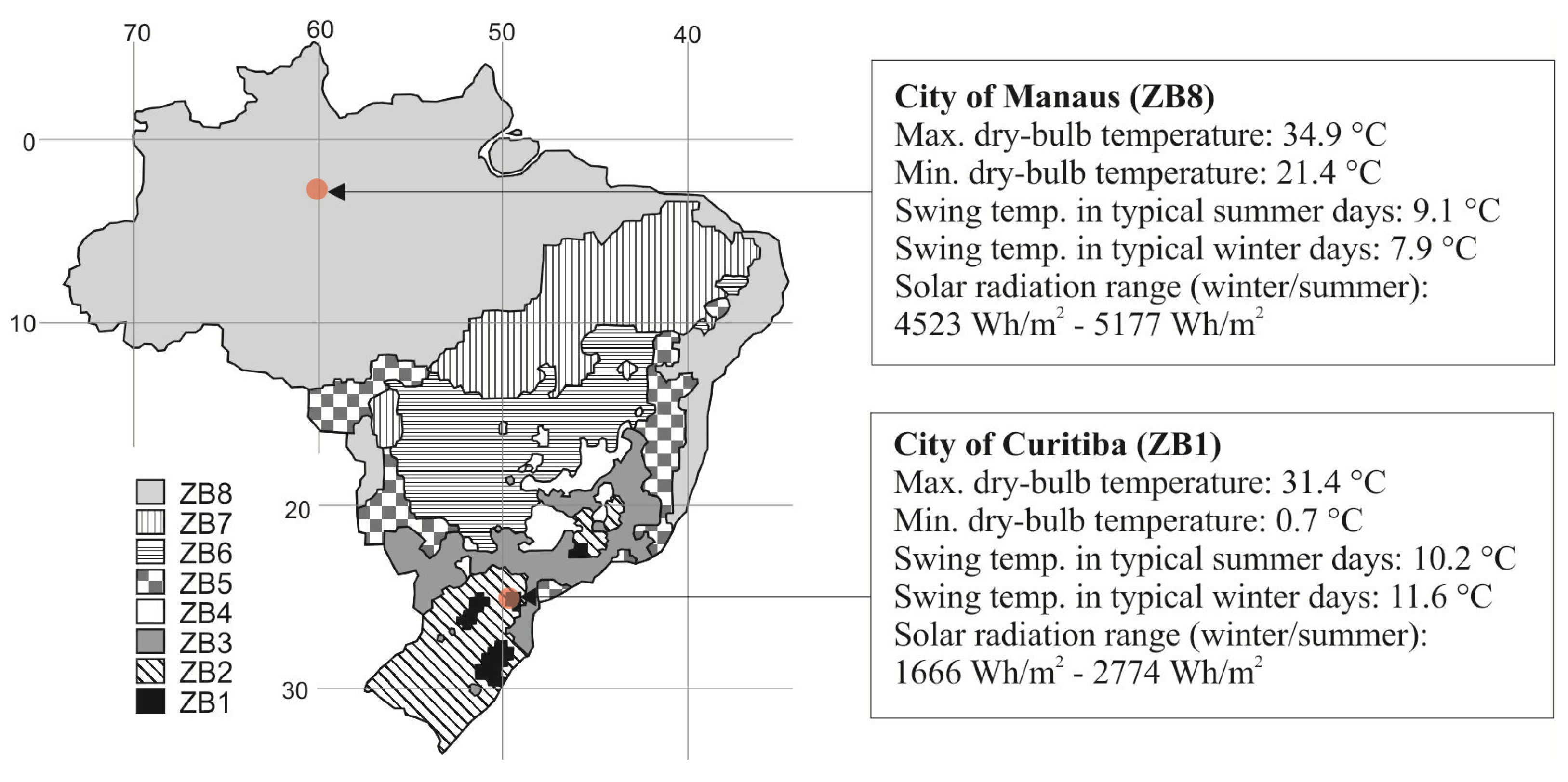
3. The Passivhaus Standard
4. The Comparison Methodology
5. The RTQ-R Label vs. the Passivhaus Standard
5.1. Primary Energy Demand
5.2. Space Heating or Cooling Demand and Heating or Cooling Load
5.3. Insulation—Glazing Areas and Opaque Elements
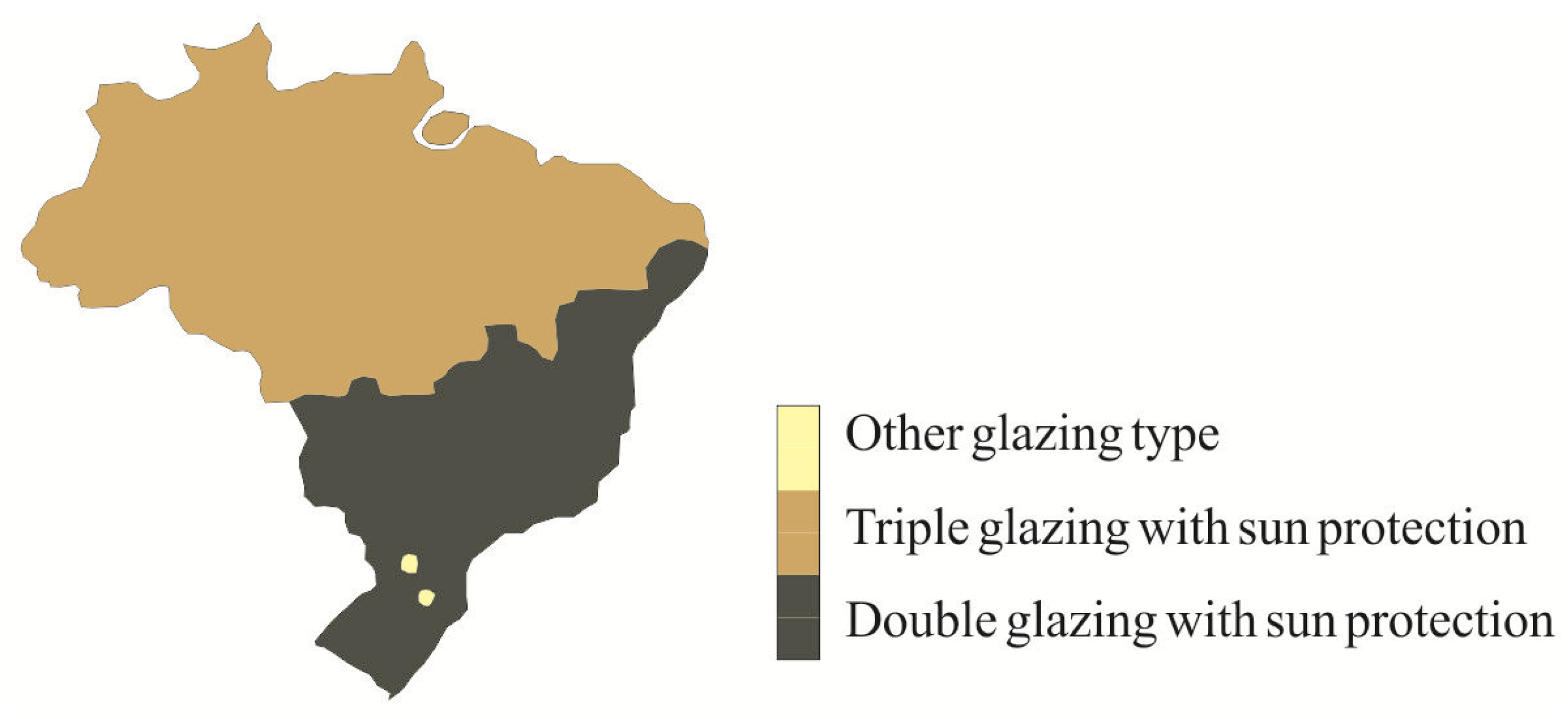
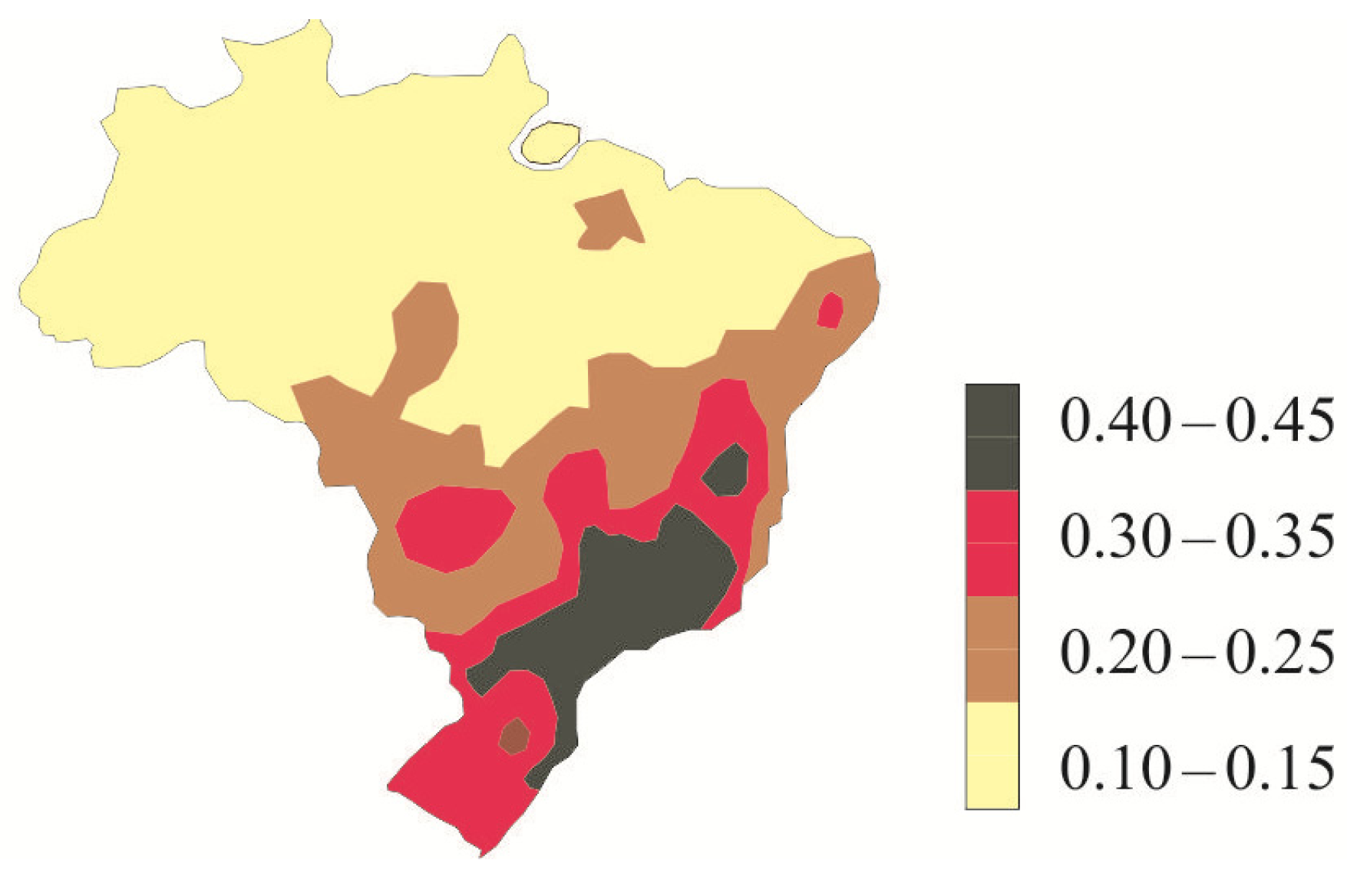

| Requirement | Passivhaus Standard | RTQ-R label |
|---|---|---|
| Nature of standard | Indoor thermal comfort with minimum energy input | Building Energy saving |
| Primary energy demand | ≤120 kW·h/m2·a | There are no requirements because the standard encourages bioclimatic strategies. |
| Heating or Cooling demand | ≤15 kW·h/m2·a | |
| Heating or Cooling load | ≤ 10W/m2 | |
| Airtightness | ≤0.6 air changes at 50 Pa | There is no requirement because it adopts natural ventilation. |
| U-value wall | ≤0.15 W/m2·K | ≤2.5 W/m2·K for ZB1-ZB2; ≤3.7 W/m2·K when absorptance (α) ≤ 0.6 or ≤ 2.5 W/m2·K when α > 0.6 for ZB3-ZB8 |
| U-value roof | ≤0.15 W/m2·K | ≤2.3 W/m2·K for ZB1-ZB2; ≤2.3 W/m2·K when α ≤ 0.6 or ≤ 1.5 W/m2·K when >0.6 for ZB3-ZB6; ≤2.3 W/m2·K when α ≤ 0.4 or ≤ 1.5 W/m2·K when >0.4 for ZB7-ZB8 |
| U-value glazing | ≤0.80 W/m2·K | There is no requirement. |
| Ventilation system | Mechanical ventilation system | Natural ventilation |
| Windows | Glazing area: 20% of floor area south-oriented and 5% of floor north-oriented for energy balance | Opening area: ≥5% of floor area for ZB7, ≥8% of floor area for ZB1-ZB6; ≥10% of floor area for ZB8 |
| Method of analysis | Energy balance method | Simulation or prescriptive method |
| Software | Passivhaus Planning Package (PHPP); it is based on steady state calculations. | It has to comply with ASHARE Standard 140 (2007); it is based on dynamic building simulations. |
| Comfort temperature | 20 °C for winter; 25 °C for summer and 26 °C ≤60% RH for summer | 26 °C for summer |
5.4. Airtightness and Ventilation
5.5. Simulation Software and Comfort Criterion
6. Conclusions
Acknowledgments
Author Contributions
Conflicts of Interest
References
- Empresa de Pesquisa Energética. Nota técnica DEA 28/13: Projeção da demanda de energia elétrica para os próximos 10 anos (2014–2023). In Estudos Da Demanda; (In Portuguese). EPE: Rio de Janeiro, Brazil, 2013. [Google Scholar]
- Empresa de Pesquisa Energética. Brazilian Energy Balance 2013 Year 2012; EPE: Rio de Janeiro, Brazil, 2013. [Google Scholar]
- Pfeiffer, M.O. Passos para cumprir uma agenda verde. Valor Setorial: Construção Civil; Valor Econômico: São Paulo, Brazil, 2011; pp. 8–14. Available online: http://www.revistavalor.com.br/home.aspx?pub=57&edicao=2 (accessed on 16 May 2014). (In Portuguese)
- Empresa de Pesquisa Energética. Brazilian Energy Balance 2012 Year 2011; EPE: Rio de Janeiro, Brazil, 2012. [Google Scholar]
- Centrais Elétricas Brasileiras S. A. (ELETROBRAS); Programa Nacional de Conservação de Energia Elétrica (PROCEL). Avaliação do Mercado de Eficiência Energética no Brasil: Pesquisa de Posse de Equipamentos e Hábitos de Uso-Ano Base 2005; (In Portuguese). ELETROBRAS, PROCEL: Rio de Janeiro, Brazil, 2007. [Google Scholar]
- Ghisi, E.; Gosch, S.; Lamberts, R. Electricity End-Uses in the Residential Sector of Brazil. Energy Policy 2007, 35, 4107–4120. [Google Scholar] [CrossRef]
- Instituto Brasileiro de Geografia e Estatística. Pesquisa Anual da Indústria da Construção; (In Portuguese). IBGE: Rio de Janeiro, Brazil, 2011; pp. 1–98. [Google Scholar]
- Carbon Trust. Brazil the 200 Billion Low Carbon Opportunity; Carbon Trust: London, UK, 2012. [Google Scholar]
- Associação Brasileira de Normas Técnicas. NBR 15220–1: Desempenho Térmico de Edificações-Parte 1: Definições, Símbolos e Unidades; (In Portuguese). ABNT: Rio de Janeiro, Brazil, 2005. [Google Scholar]
- Associação Brasileira de Normas Técnicas. NBR 15220–2: Desempenho Térmico de Edificações-Parte 2: Métodos de Cálculo da Transmitância Térmica, da Capacidade Térmica, do Atraso Térmico e do Fator Solar de Elementos e Componentes de Edificações; (In Portuguese). ABNT: Rio de Janeiro, Brazil, 2005. [Google Scholar]
- Associação Brasileira de Normas Técnicas. NBR 15220–3: Desempenho Térmico de Edificações-Parte 3: Zoneamento Bioclimático Brasileiro e Diretrizes Construtivas Para Habitações Unifamiliares de Interesse Social; (In Portuguese). ABNT: Rio de Janeiro, Brazil, 2005. [Google Scholar]
- Associação Brasileira de Normas Técnicas. NBR 15220–4: Desempenho Térmico de Edificações-Parte 4: Medição da Resistência Térmica e da Condutividade Térmica Pelo Princípio da Placa Quente Protegida; (In Portuguese). ABNT: Rio de Janeiro, Brazil, 2005. [Google Scholar]
- Associação Brasileira de Normas Técnicas. NBR 15220–5: Desempenho Térmico de Edificações-Parte 5: Medição da Resistência Térmica e da Condutividade Térmica Pelo Método Fluximétrico; (In Portuguese). ABNT: Rio de Janeiro, Brazil, 2005. [Google Scholar]
- Associação Brasileira de Normas Técnicas. NBR 15575–1: Edificações Habitacionais-Desempenho-Parte 1: Requisitos Gerais; (In Portuguese). ABNT: Rio de Janeiro, Brazil, 2013. [Google Scholar]
- Associação Brasileira de Normas Técnicas. NBR 15575–2: Edificações Habitacionais-Desempenho-Parte 2: Requisitos Para os Sistemas Estruturais; (In Portuguese). ABNT: Rio de Janeiro, Brazil, 2013. [Google Scholar]
- Associação Brasileira de Normas Técnicas. NBR 15575–3: Edificações Habitacionais-Desempenho-Parte 3: Requisitos Para os Sistemas de Pisos; (In Portuguese). ABNT: Rio de Janeiro, Brazil, 2013. [Google Scholar]
- Associação Brasileira de Normas Técnicas. NBR 15575–4: Edificações Habitacionais-Desempenho-Parte 4: Requisitos Para os Sistemas de Vedações Verticais Internas e Externas-SVVIE; (In Portuguese). ABNT: Rio de Janeiro, Brazil, 2013. [Google Scholar]
- Associação Brasileira de Normas Técnicas. NBR 15575–5: Edificações Habitacionais-Desempenho-Parte 5: Requisitos Para os Sistemas de Coberturas; (In Portuguese). ABNT: Rio de Janeiro, Brazil, 2013. [Google Scholar]
- Instituto Nacional de Metrologia, Normalizaçao e Qualidade Industrial. Regulamento Técnico da Qualidade Para o Nível de Eficiência Energética Edificações Residenciais (RTQ-R). Portaria n. 18, de 16 de janeiro de 2012; (In Portuguese). INMETRO: Rio de Janeiro, Brazil, 2012. [Google Scholar]
- Scalco, V.A.; Fossatia, M.; de Souza Versagea, R.; Sorgatoa, M.J.; Lambertsa, R.; Morishitaa, C. Innovations in the Brazilian regulations for energy efficiency of residential buildings. Arch. Sci. Rev. 2012, 55, 71–81. [Google Scholar] [CrossRef]
- Zero Carbon Hub and NHBC Foundation. Mechanical Ventilation with Heat Recovery in New Homes—Interim Report—Ventilation and Indoor Air Quality Task Group; Zero Carbon Hub: Milton Keynes, UK, 2012. [Google Scholar]
- Sands, P.; Galizzi, P. Directive 2002/91/EU of the European parliament and of the council of 16 December 2002 on the energy performance of buildings. In Documents in European Community Environmental Law; Cambridge University Press: Cambridge, UK, 2002. [Google Scholar]
- Directive 2010/31/EU of the European Parliament and of the Council of 19 May 2010 on the energy performance of buildings (recast). Available online: http://eur-lex.europa.eu/LexUriServ/LexUriServ.do?uri=OJ:L:2010:153:0013:0035:EN:PDF (accessed on 18 June 2010).
- Szokolay, S. Introduction to Architectural Science: The Basis of Sustainable Design; Architectural Press: London, UK, 2008. [Google Scholar]
- Department for Communities and Local Government. 2012 Consultation on Changes to the Building Regulations in England: Section Two-Part L (Conservation of Fuel and Power)—Proposed Changes to Technical Guidance; Department for Communities and Local Government: London, UK, 2012. [Google Scholar]
- Cotterel, J.; Dadeby, A. The Passivhaus Handbook: A Practical Guide to Constructing and Retrofitting for Ultra-Low Energy Performance; Green Books: Devon, UK, 2012. [Google Scholar]
- Decreto Lei 80/2006. Decreto Lei 80/2006 de 4 de Abril—Regulamento das Características de Comportamento Térmico dos Edifícios (RCCTE); Diário da República: Portugal, 2006; pp. 2468–2513. Available online: http://www.dre.pt/pdf1s%5C2006%5C04%5C067A00%5C24682513.pdf (accessed on 16 May 2014). (In Portuguese)
- Passive House Institute. Passive House Planning Package: Energy Balance and Passive House Design Tool-for Quality Approved Passive Houses and EnerPHit Retrofits; Passive House Institute: Darmstadt, Germany, 2012. [Google Scholar]
- Ford, B.; Schiano-Phan, R.; Zhong, D. The Passivhaus Standard in European Warm Climates: Design Guidelines for Comfortable Low Energy Homes. Part 1: A Review of Comfortable Low Energy Homes; Passive-On IEE Project: Nottingham, UK, 2007. [Google Scholar]
- Ford, B.; Schiano-Phan, R.; Zhong, D. The Passivhaus Standard in European Warm Climates: Design Guidelines for Comfortable Low Energy Homes. Part 3: Comfort, Climate and Passive Strategies; Passive-On IEE Project: Nottingham, UK, 2007. [Google Scholar]
- Schnieders, J.; Feist, W.; Schulz, T.; Krick, B.; Rongen, L.; Wirtz, R. Passive House for Different Climate Zones; Wolfgand Feist, Passivhaus Institut and University of Innsbruck: Darmstadt, Germany, 2012. [Google Scholar]
- Hatt, T.; Saelzer, G.; Hempel, R.; Gerber, A. Alto confort interior con mínimo consumo energético a partir de la implementación del estándar Passivhaus en Chile. Rev. Constr. 2012, 11, 123–134. (In Spanish) [Google Scholar]
- Pacheco, M.; Lamberts, R. Assessment of technical and economical viability for large-scale conversion of single family residential buildings into zero energy building in Brazil: Climatic and cultural considerations. Energy Policy 2013, 63, 716–725. [Google Scholar]
- Schnieders, J.; Hermelink, A. CEPHEUS results: Measurements and occupants’ satisfaction provide evidence for Passive Houses being an option for sustainable building. Energy Policy 2006, 34, 151–171. [Google Scholar] [CrossRef]
- Lamberts, R. Trends in Brazilian Building Ventilation Market and Drivers for Change. Ventilation Information Paper; Air Infiltration and Ventilation Center (AIVC): Brussels, Belgium, 2008. [Google Scholar]
- ANSI/ASHRAE Standard 140. In Standard Method of Test for the Evaluation of Building Energy Analysis Computer Programs; American Society of Heating, Refrigerating and Air Conditioning Engineers: Atlanta, GA, USA, 2011.
© 2014 by the authors; licensee MDPI, Basel, Switzerland. This article is an open access article distributed under the terms and conditions of the Creative Commons Attribution license (http://creativecommons.org/licenses/by/3.0/).
Share and Cite
Tubelo, R.C.S.; Rodrigues, L.T.; Gillott, M. A Comparative Study of the Brazilian Energy Labelling System and the Passivhaus Standard for Housing. Buildings 2014, 4, 207-221. https://doi.org/10.3390/buildings4020207
Tubelo RCS, Rodrigues LT, Gillott M. A Comparative Study of the Brazilian Energy Labelling System and the Passivhaus Standard for Housing. Buildings. 2014; 4(2):207-221. https://doi.org/10.3390/buildings4020207
Chicago/Turabian StyleTubelo, Renata C. S., Lucelia T. Rodrigues, and Mark Gillott. 2014. "A Comparative Study of the Brazilian Energy Labelling System and the Passivhaus Standard for Housing" Buildings 4, no. 2: 207-221. https://doi.org/10.3390/buildings4020207
APA StyleTubelo, R. C. S., Rodrigues, L. T., & Gillott, M. (2014). A Comparative Study of the Brazilian Energy Labelling System and the Passivhaus Standard for Housing. Buildings, 4(2), 207-221. https://doi.org/10.3390/buildings4020207

