<?xml version="1.0" encoding="UTF-8"?>
<!DOCTYPE article PUBLIC "-//NLM//DTD Journal Publishing DTD v2.3 20070202//EN" "journalpublishing.dtd">
<article xmlns:mml="http://www.w3.org/1998/Math/MathML" xmlns:xlink="http://www.w3.org/1999/xlink" xml:lang="en" article-type="research-article">
  <front>
    <journal-meta>
      <journal-id journal-id-type="publisher-id">buildings</journal-id>
      <journal-title>Buildings</journal-title>
      <abbrev-journal-title abbrev-type="publisher">Buildings</abbrev-journal-title>
      <abbrev-journal-title abbrev-type="pubmed">Buildings</abbrev-journal-title>
      <issn pub-type="epub">2075-5309</issn>
      <publisher>
        <publisher-name>MDPI</publisher-name>
      </publisher>
    </journal-meta>
    <article-meta>
      <article-id pub-id-type="doi">10.3390/buildings2040542</article-id>
      <article-id pub-id-type="publisher-id">buildings-02-00542</article-id>
      <article-categories>
        <subj-group>
          <subject>Article</subject>
        </subj-group>
      </article-categories>
      <title-group>
        <article-title>Carbon Footprint <italic>versus</italic> Performance of Aluminum, Plastic, and Wood Window Frames from Cradle to Gate</article-title>
      </title-group>
      
      <contrib-group>
        <contrib contrib-type="author">
          <name>
            <surname>Sinha</surname>
            <given-names>Arijit</given-names>
          </name>
          <xref rid="af1-buildings-02-00542" ref-type="aff">1</xref>
        </contrib>
        <contrib contrib-type="author">
          <name>
            <surname>Kutnar</surname>
            <given-names>Andreja</given-names>
          </name>
          <xref rid="af2-buildings-02-00542" ref-type="aff">2</xref>
          <xref rid="c1-buildings-02-00542" ref-type="corresp">*</xref>
        </contrib>
      </contrib-group>
      <aff id="af1-buildings-02-00542"><label>1 </label>Department of Wood Science and Engineering, Oregon State University, Richardson Hall 234, Corvallis, OR 97331, USA; E-Mail: <email>arijit.sinha@oregonstate.edu</email> </aff>
      <aff id="af2-buildings-02-00542"><label>2 </label>Andrej Marušič Institute, University of Primorska, Muzejski trg 2, 6000 Koper, Slovenia and ILTRA d.o.o., Celovška cesta 238, 1000 Ljubljana, Slovenia </aff>
      <author-notes>
        <corresp id="c1-buildings-02-00542"><label>*</label> Author to whom correspondence should be addressed; E-Mail: <email>andreja.kutnar@upr.si</email>; Tel.: +386-31-240-121; Fax: +386-56-117-592. </corresp>
      </author-notes>
      <pub-date pub-type="epub">
        <day>12</day>
        <month>12</month>
        <year>2012</year>
      </pub-date>
      <pub-date pub-type="collection"><month>12</month>
        <year>2012</year>
      </pub-date>
      <volume>2</volume>
      <issue>4</issue>
      <fpage>542</fpage>
      <lpage>553</lpage>
      <history>
        <date date-type="received">
          <day>15</day>
          <month>10</month>
          <year>2012</year>
        </date>
        <date date-type="rev-recd">
          <day>22</day>
          <month>11</month>
          <year>2012</year>
        </date>
        <date date-type="accepted">
          <day>05</day>
          <month>12</month>
          <year>2012</year>
        </date>
      </history>
      <permissions>
        <copyright-statement>©  2012 by the authors; licensee MDPI, Basel, Switzerland.</copyright-statement>
        <copyright-year>2012</copyright-year>
        <license xmlns:xlink="http://www.w3.org/1999/xlink" license-type="open-access" xlink:href="http://creativecommons.org/licenses/by/3.0/">
          <p>This article is an open-access article distributed under the terms and conditions of the Creative Commons Attribution license (http://creativecommons.org/licenses/by/3.0/).</p>
        </license>
      </permissions>
      <abstract>
        <p>Window frame material has significant impact on the thermal performance of the window. Moreover, with sustainable design becoming a necessity, window frame materials need to have higher levels of environmental performance to be considered sustainable. As a result, a holistic performance metric is needed to assess window frame material. Three similar frames were considered, manufactured from aluminum, polyvinyl chloride (PVC), and wood. First their thermal performance was evaluated and compared using a heat transfer model. Then, carbon footprints of the three materials were considered for 1m<sup>2</sup> of window area with a similar thermal performance. It was found that the thermal, as well as the environmental, performance of the wooden window frame was superior to those of aluminum and PVC. On the other hand aluminum frames had high environmental impacts and comparatively lower thermal performance. This study provides a holistic viewpoint on window frames by considering both environmental and thermal performance.</p>
      </abstract>
      <kwd-group>
        <kwd>life-cycle analysis</kwd>
        <kwd>window frames</kwd>
        <kwd>thermal performance</kwd>
      </kwd-group>
    </article-meta>
  </front>
  <body>
    <sec sec-type="intro">
      <title>1. Introduction</title>
      <p>The widespread popularity and acceptance of the green building rating system is testament to the increased energy awareness and environmental consciousness on the part of the stakeholders. The energy consumption of buildings accounts for 40% of total energy consumed in the developed world [<xref ref-type="bibr" rid="B1-buildings-02-00542">1</xref>]. The green building rating systems (e.g., Leadership in Energy and Environmental Design—LEED) and green codes around the world, such as International Green Construction Code (IGCC) [<xref ref-type="bibr" rid="B2-buildings-02-00542">2</xref>], Energy Performance of Building Directive (EPBD) [<xref ref-type="bibr" rid="B3-buildings-02-00542">3</xref>], <italic>etc</italic>., introduces stringent requirements for reduction of energy use in buildings. Windows are typically responsible for a large fraction of heat loss in a building. This is because the combination of glass and frame in windows generally has a higher degree of heat transmission, <italic>i.e.</italic>, higher U value than the other components of a building.</p>
      <p>Development of technology has led to a considerable reduction in heat loss through windows. Some examples are glazing of the glass [<xref ref-type="bibr" rid="B4-buildings-02-00542">4</xref>], which helps in reducing the heat loss and also contributes to solar heating of the building. Other technologies, such as lazer glazing [<xref ref-type="bibr" rid="B5-buildings-02-00542">5</xref>], low emissivity coatings, electrochromic materials, and thermochromic materials [<xref ref-type="bibr" rid="B6-buildings-02-00542">6</xref>] used in windows, have demonstrated technological evolution and reduced the loss of heat. Most technological developments, however, have focused on window panes, while overlooking the frames. A major component of a window is the window frame, which can cover 20%–30% of the area of a window and has a negative impact on energy performance [<xref ref-type="bibr" rid="B7-buildings-02-00542">7</xref>]. The most common window frames used presently are either materials with high conductivity such as aluminum for office buildings, or materials with low conductivity like wood and polyvinylchloride. Some argue that frames made of low conductivity material usually have low strength requiring wide frame profiles that reduces the total transmittance of the window [<xref ref-type="bibr" rid="B8-buildings-02-00542">8</xref>]. While these claims have not been validated, it remains true that window frame impacts the energy performance of the buildings significantly. </p>
      <p>With sustainable design being a necessity, it is important to not only consider the energy performance of a window frame, but also consider other performance metrics to gain a holistic appreciation. These performance metrics are embodied energy over the product lifecycle, thermal performance, and structural performance. Sustainability forces us to consider holistic approaches, which have previously not been addressed comprehensively [<xref ref-type="bibr" rid="B9-buildings-02-00542">9</xref>]. A window frame that performs better than another from an energy standpoint, might have significantly higher embodied energy over its lifecycle—raw material extraction, processing, manufacturing, transportation, and installation. This would therefore make it a bad choice from an environmental standpoint. One of the most important choices that faces anyone installing or replacing windows will be the materials used in the frames. While the shape, size and operation of a window is aesthetically significant, the material from which a frame is constructed is crucial when considering cost and energy efficiency. While the panes themselves are typically constructed of glass, there are three most common types of window frame materials, wood, aluminum, and un-plasticized Polyvinyl Chloride (uPVC). All these materials have their advantages and relative shortcomings. Different homeowners make their decisions based on features and factors that are particular to their lifestyle, tastes, and preferences. The material from which a window frame is constructed can greatly affect overall installation cost and energy efficiency. </p>
      <p>With sustainability being the driving force in the creation of a building, environmental impact of selected materials should be included in planning, considering the life cycle and embodied energy of the materials used. Therefore, the Life Cycle Assessment (LCA) methodology should be used to reveal the environmental and energy performances of the used materials, as well as the developed products through the whole life cycle. Since the 1980s, when LCA analysis was developed, until today, numerous methodologies to classify, characterize, and normalize environmental effects were developed. The most common, for example CML 2 (2000), IPCC Greenhouse gas emissions, Ecopoints 97 and Eco-indicator 99 [<xref ref-type="bibr" rid="B10-buildings-02-00542">10</xref>], focus on the following indicators: acidification, eutrophication, thinning the ozone layer, various types of ecotoxicity, air contaminations, usage of resources and greenhouse gas emissions. At first, LCA analysis was mostly focused on environmental effects like acidification and eutrophication, while in the past years mostly on greenhouse gas emissions, which are also called carbon footprint. The carbon footprint is expressed in terms of the amount of emitted carbon dioxide or its equivalent of other greenhouse gases. In Europe, carbon footprint is gaining immense importance and expected to be mandated to accompany products and services. As solutions are sought to reduce the impacts of buildings, LCA is seen as an objective measure for comparing building designs. Very few studies have analyzed window frames form a sustainability standpoint using LCA. Lawson [<xref ref-type="bibr" rid="B11-buildings-02-00542">11</xref>] and Asif <italic>et al</italic>. [<xref ref-type="bibr" rid="B9-buildings-02-00542">9</xref>] performed LCA on various window frames and observed that aluminum frames had the highest environmental impacts.</p>
      <p>In sustainable design, “durability” is also increasingly being included on priority lists under the assumption that designing for longevity is an environmental imperative. However, this is unsupported in the absence of LCA and accurate lifespan predictions. In the worst case, designing for longevity can lead to design choices that are well-intentioned but, in fact, yield poor environmental results. Rather than attempt to predict the future and design permanent structures with an infinite lifespan, design for easy adaptation and material recovery should be acknowledged. </p>
      <p>This study aims to provide a holistic performance metrics for window frames by comparing three widely available window frame materials, wooden, PVC, and aluminum. First a window was designed having the same volume of material, spacer, and glazing system. Subsequently, their U values and thermal performances were calculated and compared. Furthermore, carbon footprint of the three window frames was calculated, focusing only on initial embodied energy, non-renewable energy consumed in the process from the acquisition of raw materials to the construction of the building. Finally, carbon footprints and performances were compared to identify the best holistically performing window frame material for a given U value. </p>
    </sec>
    <sec>
      <title>2. Experimental Section</title>
      <sec>
        <title>2.1. Window Frames</title>
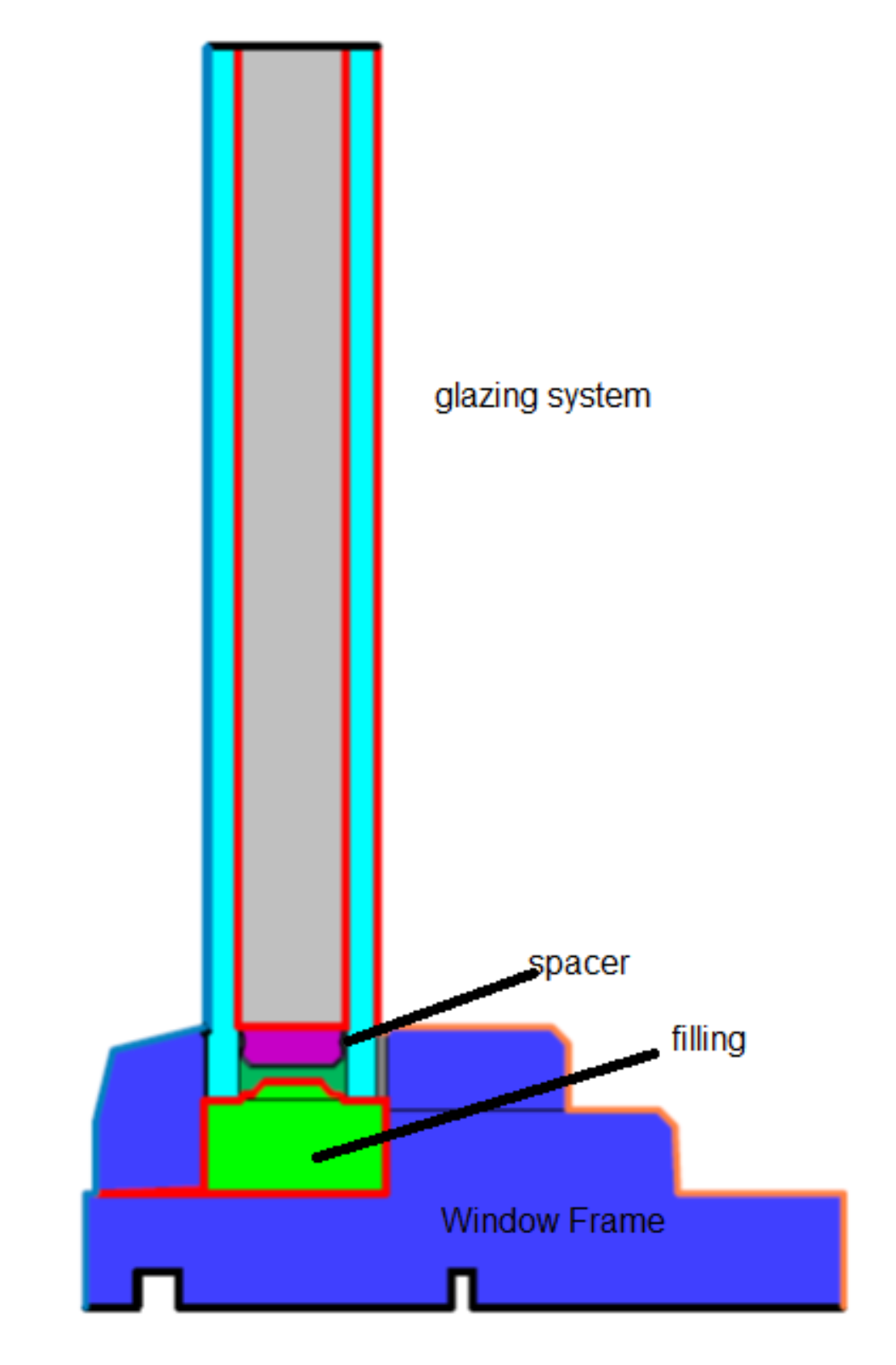
        <p>Three different window frames having the same layout (<xref ref-type="fig" rid="buildings-02-00542-f001">Figure 1</xref>), design, and thickness but different framing materials were designed. The window system comprised of a two-glass glazing system, an air gap, and a filler material (<xref ref-type="fig" rid="buildings-02-00542-f001">Figure 1</xref>). A frame must provide high thermal insulation and maintain the structural strength and rigidity necessary to support an evacuated glazing over its serviceable life. The material used for window frame and casement (shown in dark blue in <xref ref-type="fig" rid="buildings-02-00542-f001">Figure 1</xref>) were wood, aluminum, and unplasticized polyvinyl chloride (uPVC), respectively for three different window types. Subsequently, another combination of materials was modeled, where the window frame is made out of wood, while the casement is constructed out of aluminum, uPVC, and wood. The material used and their respective conductivities are listed in <xref ref-type="table" rid="buildings-02-00542-t001">Table 1</xref>. The glazing system used was a double layer glass system with low emissivity layer on inside of the exterior glass. Thickness of the glasses was 4.7 mm each and the air cavity had a thickness of 16.5 mm. </p>
        <table-wrap id="buildings-02-00542-t001" position="float">
          <object-id pub-id-type="pii">buildings-02-00542-t001_Table 1</object-id>
          <label>Table 1</label>
          <caption>
            <p>Materials used for window frames, casement, and glazing systems and their conductivities. </p>
          </caption>
          <table>
            <thead>
              <tr>
                <th align="center" valign="middle">Material</th>
                <th align="center" valign="middle">Conductivity (W m<sup>−1</sup> k<sup>−1</sup>) </th>
               </tr>
            </thead>
            <tbody>
              <tr>
                <td align="center" valign="middle">Softwood</td>
                <td align="center" valign="middle">0.11</td>
              </tr>
              <tr>
                <td align="center" valign="middle">Glass</td>
                <td align="center" valign="middle">1</td>
              </tr>
              <tr>
                <td align="center" valign="middle">Aluminum </td>
                <td align="center" valign="middle">237</td>
              </tr>
              <tr>
                <td align="center" valign="middle">PVC</td>
                <td align="center" valign="middle">0.14</td>
              </tr>
              <tr>
                <td align="center" valign="middle">Glazing System</td>
                <td align="center" valign="middle">0.049</td>
              </tr>
              <tr>
                <td align="center" valign="middle">Silica Gel</td>
                <td align="center" valign="middle">0.03</td>
              </tr>
              <tr>
                <td align="center" valign="middle">Butyl Rubber</td>
                <td align="center" valign="middle">0.24</td>
              </tr>
              <tr>
                <td align="center" valign="middle">Cavity</td>
                <td align="center" valign="middle">0.029</td>
              </tr>
              <tr>
                <td align="center" valign="middle">Spacer</td>
                <td align="center" valign="middle">0.1264</td>
              </tr>
            </tbody>
          </table>
        </table-wrap>
        
      </sec>
      <sec>
        <title>2.2. Thermal Performance of Window Frames</title>
        <p>After designing the window frame and the glazing systems, a performance evaluation of the window frames and window system was conducted. Calculation of thermal properties and energy performance was used to evaluate and compare each window type. First, the stand alone U values of the window frames were calculated. The U value of all frames was calculated as per EN ISO 10077-2 [<xref ref-type="bibr" rid="B12-buildings-02-00542">12</xref>] with the simulation program Therm [<xref ref-type="bibr" rid="B13-buildings-02-00542">13</xref>], which uses heat transfer coefficients prescribed by ISO 15099 [<xref ref-type="bibr" rid="B14-buildings-02-00542">14</xref>] to solve for conductive heat transfer. The geometry of the profile (<xref ref-type="fig" rid="buildings-02-00542-f001">Figure 1</xref>) was drawn using computer aided design software and used as an underlay in Therm. Subsequently, the U value of the whole window system for the three different window types was calculated. Therm is based on the equations provided in the standard to calculate total U value for the window.</p>
        <fig id="buildings-02-00542-f001" position="anchor">
          <label>Figure 1</label>
          <caption>
            <p>Schematic of the designed window frame with double glazing system.</p>
          </caption>
          <graphic xmlns:xlink="http://www.w3.org/1999/xlink" xlink:href="buildings-02-00542-g001.tif"/>
        </fig>
      </sec>
      <sec sec-type="methods">
        <title>2.3. Methodology of Carbon Footprint Calculation</title>
        <p>Following the common LCA methodology [<xref ref-type="bibr" rid="B15-buildings-02-00542">15</xref>,<xref ref-type="bibr" rid="B16-buildings-02-00542">16</xref>] the scope and goal of the study was to compare the environmental impact of three most common windows frames. Environmental impact of window frames was analyzed with the “Cradle-to-gate” variant, an assessment of a partial product life cycle from manufacture (“cradle”) to the factory gate (<italic>i.e.</italic>, before it is transported to the consumer). The use phase and disposal phase of the product were omitted. The environmental burdens associated with each window frame were considered from raw materials acquisition, through the manufacture/processing stages, accounting for the production and use of fuels, electricity, and heat, as well as taking into account transportation/distribution impacts at all points along the product supply chain. Functional unit for the calculation was determined to be 1 m<sup>2</sup> of a window frame with the U value of 1.6 W/m<sup>2</sup>K. Based on the determined goal and scope of the study the life cycle inventory of input/output data for the LCA calculations was compiled. Data of energy inputs, raw materials, products, co-products, waste, and releases to air, water and soil and the upstream life cycle impacts of input materials were not analyzed specifically for this project. Instead, sound secondary life cycle data were sourced from Ecoinvent database 2.0. [<xref ref-type="bibr" rid="B17-buildings-02-00542">17</xref>]. The data collected were modeled in Simapro [<xref ref-type="bibr" rid="B18-buildings-02-00542">18</xref>].</p>
        <p>The dataset included highly automated technology processes in window frame manufacturing, in Switzerland and Germany. For the wood window frame all the processes and material inputs needed to produce a wood window weighing 80.2 kg were included. Processes that were included were timber sawing, varnishing (primer, solvents, paint), selection bar rolling for steel fittings, joining, fitting, all the road transport at different production phases and the disposal of the paint remains. The PVC window frames weighed 94.5 kg, included the following processes: injection molding and extrusion of PVC, section bar rolling for steel fittings, section bar extrusion for aluminum parts, all the road transport at different production phases and the process heat waste. For the aluminum window frames the weight was 50.7 kg, included the following processes: section bar rolling for steel parts and fittings, section bar extrusion for aluminum parts, extrusion of HDPE plastic, surface treatment (powder coating), all the road transport at different production phases, the heat waste and the disposal of the plastic cuttings. </p>
        <p>The data collected were modeled in Simapro [<xref ref-type="bibr" rid="B18-buildings-02-00542">18</xref>]. Emissions and consumptions were translated into environmental effects, which were grouped and weighed. Carbon footprint was calculated with methodology IPCC 2001 GWP 100a V1.02 [<xref ref-type="bibr" rid="B19-buildings-02-00542">19</xref>]. IPCC 2001 [<xref ref-type="bibr" rid="B19-buildings-02-00542">19</xref>] contains the climate change factors of IPCC with a timeframe of 100 years. Emissions, which take place in the future, 100 years after the start of the process, were taken into account. IPCC characterization factors for the direct (except CH<sub>4</sub>) global warming potential of air emissions were used. They do not include indirect formation of dinitrogen monoxide from nitrogen emissions, do not account for radiative forcing due to emissions of NOx, water, sulphate, <italic>etc</italic>. In the lower stratosphere as well as upper troposphere, do not consider the range of indirect effects given by IPCC [<xref ref-type="bibr" rid="B19-buildings-02-00542">19</xref>], and do not include indirect effects of CO emissions.</p>
      </sec>
    </sec>
    <sec sec-type="results">
      <title>3. Results and Discussion</title>
      <sec>
        <title>3.1. Thermal and Mechanical Performance</title>
        <p>The U values of the frames and the corresponding U values of the window systems are presented in <xref ref-type="table" rid="buildings-02-00542-t002">Table 2</xref>. Moreover, the U values for just the frame alone (U<sub>f</sub>) is also presented in <xref ref-type="table" rid="buildings-02-00542-t002">Table 2</xref>. Considering the U values of the frames alone, the best insulated frame was the wooden frame followed by uPVC, and then aluminum. A high U value of aluminum frame was expected because it is a metal and has high conductivity. However, if only the casement is made out of aluminum with a wooden window frame, then the corresponding U value of the frame reduces significantly, from 11.86 to 3.51 W/m<sup>2</sup>-K. The impact on the U value of the window system, however, is minimal. Comparing these values to literature Appelfield <italic>et al</italic>. [<xref ref-type="bibr" rid="B8-buildings-02-00542">8</xref>], it is found that window frame design for wood in this study has comparable thermal performance. Appelfield <italic>et al</italic>. [<xref ref-type="bibr" rid="B8-buildings-02-00542">8</xref>] modeled a window with wooden frame and aluminum casement that performed almost identically to the one in this study. The window U values as expected are lower than the frame U values, which is in accordance to the literature. As the glazing systems were similar in all three types of windows, the window with wooden frame performed the best, followed by the uPVC frame.</p>
        <table-wrap id="buildings-02-00542-t002" position="float">
          <object-id pub-id-type="pii">buildings-02-00542-t002_Table 2</object-id>
          <label>Table 2</label>
          <caption>
            <p>Thermal performance of windows and frames using Therm (U’ refers to values when the frame was wooden but the casement materials varied).</p>
          </caption>
          <table>
            <thead>
              <tr>
                <th rowspan="2" align="center" valign="middle">Material</th>
                <th colspan="4" align="center" valign="middle">U (W m<sup>−2</sup>K<sup>−1</sup>)</th>
              </tr>
              <tr style="border-top: solid thin">
                <th align="center" valign="middle">U<sub>f</sub></th>
                <th align="center" valign="middle">U <sub>window</sub></th>
                <th align="center" valign="middle">U'<sub>f</sub></th>
                <th align="center" valign="middle">U' <sub>window</sub></th>
              </tr>
            </thead>
            <tbody>
              <tr style="border-top: solid thin">
                <td align="center" valign="middle">Wood</td>
                <td align="center" valign="middle">1.85</td>
                <td align="center" valign="middle">1.04</td>
                <td align="center" valign="middle">1.85</td>
                <td align="center" valign="middle">1.04</td>
              </tr>
              <tr>
                <td align="center" valign="middle">Aluminum </td>
                <td align="center" valign="middle">11.86</td>
                <td align="center" valign="middle">2.68</td>
                <td align="center" valign="middle">3.51</td>
                <td align="center" valign="middle">2.40</td>
              </tr>
              <tr>
                <td align="center" valign="middle">uPVC</td>
                <td align="center" valign="middle">2.11</td>
                <td align="center" valign="middle">2.02</td>
                <td align="center" valign="middle">1.97</td>
                <td align="center" valign="middle">1.68</td>
              </tr>
            </tbody>
          </table>
        </table-wrap>
      </sec>
      <sec>
        <title>3.2. Carbon Footprint</title>
        <p>Carbon footprint calculates the amount of greenhouse gas (GHG) emissions caused by a particular activity or entity, commonly also referred to as global warming potential (GWP). It is measured in tonnes (or kilograms) of carbon dioxide equivalent (CO<sub>2</sub>eq.). In this study carbon footprint of different window frames were calculated (<xref ref-type="table" rid="buildings-02-00542-t003">Table 3</xref>, <xref ref-type="table" rid="buildings-02-00542-t004">Table 4</xref> and <xref ref-type="table" rid="buildings-02-00542-t005">Table 5</xref>). The carbon footprint of the analyzed aluminum window frame was 486.0 kg CO<sub>2</sub>e, while the carbon footprint of plastic window frame and   wood window frames were 258 and 130 kg CO<sub>2</sub>e, respectively. </p>
        <p>Carbon footprint calculates the amount of greenhouse gas (GHG) emissions caused by a particular activity or entity, commonly also referred to as global warming potential (GWP). It is measured in tonnes (or kilograms) of carbon dioxide equivalent (CO<sub>2</sub>eq.). In this study carbon footprint of different window frames were calculated (<xref ref-type="table" rid="buildings-02-00542-t003">Table 3</xref>, <xref ref-type="table" rid="buildings-02-00542-t005">Table 4</xref> and <xref ref-type="table" rid="buildings-02-00542-t005">Table 5</xref>). The carbon footprint of the analyzed aluminum window frame was 486.0 kg CO<sub>2</sub>e, while the carbon footprint of plastic window frame and   wood window frames were 258 and 130 kg CO<sub>2</sub>e, respectively. </p>
        <table-wrap id="buildings-02-00542-t003" position="float">
          <object-id pub-id-type="pii">buildings-02-00542-t003_Table 3</object-id>
          <label>Table 3</label>
          <caption>
            <p>Carbon footprint of aluminum window frame.</p>
          </caption>
          <table>
            <thead>
              <tr>
                <th align="left" valign="middle">Carbon footprint [kg CO<sub>2</sub>e]</th>
                <th rowspan="2" colspan="2" align="left" valign="middle">Quantity</th>
                <th rowspan="2" align="left" valign="middle">Unit</th>
                <th rowspan="2" align="left" valign="middle">Emission coefficient</th>
              </tr>
              <tr style="border-top: solid thin">
                <th align="left" valign="middle">Emission source</th>
              </tr>
            </thead>
            <tbody>
              <tr style="border-top: solid thin">
                <td align="left" valign="middle">Acrylonitrile-butadiene-styrene copolymer, ABS, at plant/RER U</td>
                <td align="left" valign="middle">1.760</td>
                <td align="left" valign="middle">0.400</td>
                <td align="left" valign="middle">kg</td>
                <td align="left" valign="middle">4.40</td>
              </tr>
              <tr>
                <td align="left" valign="middle">Adhesive for metals, at plant/DE U</td>
                <td align="left" valign="middle">1.310</td>
                <td align="left" valign="middle">0.290</td>
                <td align="left" valign="middle">kg</td>
                <td align="left" valign="middle">4.52</td>
              </tr>
              <tr>
                <td align="left" valign="middle">Aluminium, production mix, at plant/RER U</td>
                <td align="left" valign="middle">339.000</td>
                <td align="left" valign="middle">39.700</td>
                <td align="left" valign="middle">m<sup>2</sup></td>
                <td align="left" valign="middle">8.54</td>
              </tr>
              <tr>
                <td align="left" valign="middle">Chromium steel 18/8, at plant/RER U</td>
                <td align="left" valign="middle">2.060</td>
                <td align="left" valign="middle">0.457</td>
                <td align="left" valign="middle">kg</td>
                <td align="left" valign="middle">4.51</td>
              </tr>
              <tr>
                <td align="left" valign="middle">Disposal, building, polyethylene/polypropylene products, to final disposal/CH U</td>
                <td align="left" valign="middle">0.737</td>
                <td align="left" valign="middle">0.246</td>
                <td align="left" valign="middle">kg</td>
                <td align="left" valign="middle">3.00</td>
              </tr>
              <tr>
                <td align="left" valign="middle">Disposal, plastics, mixture, 15.3% water, to municipal incineration/CH U</td>
                <td align="left" valign="middle">0.239</td>
                <td align="left" valign="middle">0.102</td>
                <td align="left" valign="middle">kg</td>
                <td align="left" valign="middle">2.34</td>
              </tr>
              <tr>
                <td align="left" valign="middle">Electricity, medium voltage, production UCTE, at grid/UCTE U</td>
                <td align="left" valign="middle">0.670</td>
                <td align="left" valign="middle">1.270</td>
                <td align="left" valign="middle">kWh</td>
                <td align="left" valign="middle">0.53</td>
              </tr>
              <tr>
                <td align="left" valign="middle">Extrusion, plastic film/RER U</td>
                <td align="left" valign="middle">0.129</td>
                <td align="left" valign="middle">0.246</td>
                <td align="left" valign="middle">kg</td>
                <td align="left" valign="middle">0.52</td>
              </tr>
              <tr>
                <td align="left" valign="middle">Glass fibre reinforced plastic, polyamide, injection moulding, at plant/RER U</td>
                <td align="left" valign="middle">46.400</td>
                <td align="left" valign="middle">5.270</td>
                <td align="left" valign="middle">kg</td>
                <td align="left" valign="middle">8.80</td>
              </tr>
              <tr>
                <td align="left" valign="middle">Isopropanol, at plant/RER U</td>
                <td align="left" valign="middle">0.038</td>
                <td align="left" valign="middle">0.021</td>
                <td align="left" valign="middle">-</td>
                <td align="left" valign="middle">1.85</td>
              </tr>
              <tr>
                <td align="left" valign="middle">Metal working factory/RER/I U</td>
                <td align="left" valign="middle">2.360</td>
                <td align="left" valign="middle">2.32 × 10<sup>−8</sup></td>
                <td align="left" valign="middle">p</td>
                <td align="left" valign="middle">101724137.93</td>
              </tr>
              <tr>
                <td align="left" valign="middle">Nylon 6, at plant/RER U</td>
                <td align="left" valign="middle">0.135</td>
                <td align="left" valign="middle">0.015</td>
                <td align="left" valign="middle">kg</td>
                <td align="left" valign="middle">9.25</td>
              </tr>
              <tr>
                <td align="left" valign="middle">Polyethylene, HDPE, granulate, at plant/RER U</td>
                <td align="left" valign="middle">0.475</td>
                <td align="left" valign="middle">0.246</td>
                <td align="left" valign="middle">kg</td>
                <td align="left" valign="middle">1.93</td>
              </tr>
              <tr>
                <td align="left" valign="middle">Powder coating, aluminium sheet/RER U</td>
                <td align="left" valign="middle">37.100</td>
                <td align="left" valign="middle">9.800</td>
                <td align="left" valign="middle">m<sup>2</sup></td>
                <td align="left" valign="middle">3.79</td>
              </tr>
              <tr>
                <td align="left" valign="middle">Reinforcing steel, at plant/RER U</td>
                <td align="left" valign="middle">0.742</td>
                <td align="left" valign="middle">0.516</td>
                <td align="left" valign="middle">kg</td>
                <td align="left" valign="middle">1.44</td>
              </tr>
              <tr>
                <td align="left" valign="middle">Section bar extrusion, aluminium/RER U</td>
                <td align="left" valign="middle">39.100</td>
                <td align="left" valign="middle">38.000</td>
                <td align="left" valign="middle">kg</td>
                <td align="left" valign="middle">1.03</td>
              </tr>
              <tr>
                <td align="left" valign="middle">Section bar rolling, steel/RER U</td>
                <td align="left" valign="middle">0.194</td>
                <td align="left" valign="middle">0.975</td>
                <td align="left" valign="middle">kg</td>
                <td align="left" valign="middle">0.20</td>
              </tr>
              <tr>
                <td align="left" valign="middle">Synthetic rubber, at plant/RER U</td>
                <td align="left" valign="middle">12.900</td>
                <td align="left" valign="middle">4.870</td>
                <td align="left" valign="middle">kg</td>
                <td align="left" valign="middle">2.65</td>
              </tr>
              <tr>
                <td align="left" valign="middle">Transport, lorry &gt; 16 t, fleet average/RER U</td>
                <td align="left" valign="middle">0.571</td>
                <td align="left" valign="middle">4.570</td>
                <td align="left" valign="middle">tkm</td>
                <td align="left" valign="middle">0.12</td>
              </tr>
              <tr style="border-top: solid thin">
                <td align="left" valign="middle">Total</td>
                <td align="left" valign="middle">486</td>
                <td align="left" valign="middle">-</td>
                <td align="left" valign="middle">-</td>
                <td align="left" valign="middle">-</td>
              </tr>
            </tbody>
          </table>
        </table-wrap>
        <p>In the aluminum window frame the biggest emission source was aluminum (69.8%), which was followed by glass fiber reinforced plastic (9.5%), section bar extrusion (8.0%), and powder coating, aluminum sheet (7.6%). All other emission sources together contributed 5.1% to carbon footprint. In the plastic window frame the biggest emission source was polyvinylchloride (45.4%), which was followed by steel (25.2%), extrusion of plastic pipes (8.0%), aluminum (3.6%), and zinc coating (3.6%). Among other emission source of plastic window frames contribution to the total carbon footprint above 2.0% was that of electricity (2.8%) and transport (2.3%). In wood window frame the highest contribution to carbon footprint had electricity (23.4%), which was followed by aluminum (20.1%), sawn timber (16.9%), alkyd paint (11.5%), steel (6.8%), and transport (3.8%). </p>
        <table-wrap id="buildings-02-00542-t004" position="float">
          <object-id pub-id-type="pii">buildings-02-00542-t004_Table 4</object-id>
          <label>Table 4</label>
          <caption>
            <p>Carbon footprint of plastic (PVC) window frame.</p>
          </caption>
          <table>
            <thead>
              <tr>
                <th align="left" valign="middle">Carbon footprint [kg CO<sub>2</sub>e]</th>
                <th rowspan="2" colspan="2" align="left" valign="middle">Quantity</th>
                <th rowspan="2" align="left" valign="middle">Unit</th>
                <th rowspan="2" align="left" valign="middle">Emission coefficient</th>
              </tr>
              <tr style="border-top: solid thin"> 
                <th align="left" valign="middle">Emission source </th>
              </tr>
            </thead>
            <tbody>
              <tr style="border-top: solid thin">
                <td align="left" valign="middle">Aluminium, production mix, cast alloy, at plant/RER U</td>
                <td align="left" valign="middle">0.054</td>
                <td align="left" valign="middle">0.017</td>
                <td align="left" valign="middle">kg</td>
                <td align="left" valign="middle">3.098</td>
              </tr>
              <tr>
                <td align="left" valign="middle">Chemicals organic, at plant/GLO U</td>
                <td align="left" valign="middle">0.054</td>
                <td align="left" valign="middle">0.029</td>
                <td align="left" valign="middle">kg</td>
                <td align="left" valign="middle">1.895</td>
              </tr>
              <tr>
                <td align="left" valign="middle">Copper, at regional storage/RER U</td>
                <td align="left" valign="middle">0.013</td>
                <td align="left" valign="middle">0.007</td>
                <td align="left" valign="middle">kg</td>
                <td align="left" valign="middle">1.877</td>
              </tr>
              <tr>
                <td align="left" valign="middle">Electricity, medium voltage, production UCTE, at grid/UCTE U</td>
                <td align="left" valign="middle">7.280</td>
                <td align="left" valign="middle">13.800</td>
                <td align="left" valign="middle">kWh</td>
                <td align="left" valign="middle">0.528</td>
              </tr>
              <tr>
                <td align="left" valign="middle">Extrusion, plastic pipes/RER U</td>
                <td align="left" valign="middle">20.500</td>
                <td align="left" valign="middle">54.300</td>
                <td align="left" valign="middle">kg</td>
                <td align="left" valign="middle">0.378</td>
              </tr>
              <tr>
                <td align="left" valign="middle">Injection moulding/RER U</td>
                <td align="left" valign="middle">2.550</td>
                <td align="left" valign="middle">1.900</td>
                <td align="left" valign="middle">kg</td>
                <td align="left" valign="middle">1.342</td>
              </tr>
              <tr>
                <td align="left" valign="middle">Metal working factory/RER/I U</td>
                <td align="left" valign="middle">4.390</td>
                <td align="left" valign="middle">4.32 × 10<sup>−8</sup></td>
                <td align="left" valign="middle">p</td>
                <td align="left" valign="middle">101620370.37</td>
              </tr>
              <tr>
                <td align="left" valign="middle">Polyethylene, LDPE, granulate, at plant/RER U</td>
                <td align="left" valign="middle">0.012</td>
                <td align="left" valign="middle">0.006</td>
                <td align="left" valign="middle">kg</td>
                <td align="left" valign="middle">2.093</td>
              </tr>
              <tr>
                <td align="left" valign="middle">Polypropylene, granulate, at plant/RER U</td>
                <td align="left" valign="middle">0.432</td>
                <td align="left" valign="middle">0.219</td>
                <td align="left" valign="middle">kg</td>
                <td align="left" valign="middle">1.973</td>
              </tr>
              <tr>
                <td align="left" valign="middle">Polystyrene foam slab, at plant/RER U</td>
                <td align="left" valign="middle">0.774</td>
                <td align="left" valign="middle">0.184</td>
                <td align="left" valign="middle">kg</td>
                <td align="left" valign="middle">4.207</td>
              </tr>
              <tr>
                <td align="left" valign="middle">Polystyrene, high impact, HIPS, at plant/RER U</td>
                <td align="left" valign="middle">0.727</td>
                <td align="left" valign="middle">0.208</td>
                <td align="left" valign="middle">kg</td>
                <td align="left" valign="middle">3.495</td>
              </tr>
              <tr>
                <td align="left" valign="middle">Polyvinylchloride, at regional storage/RER U</td>
                <td align="left" valign="middle">117.000</td>
                <td align="left" valign="middle">58.400</td>
                <td align="left" valign="middle">kg</td>
                <td align="left" valign="middle">2.003</td>
              </tr>
              <tr>
                <td align="left" valign="middle">Section bar extrusion, aluminium/RER U</td>
                <td align="left" valign="middle">1.130</td>
                <td align="left" valign="middle">1.100</td>
                <td align="left" valign="middle">kg</td>
                <td align="left" valign="middle">1.027</td>
              </tr>
              <tr>
                <td align="left" valign="middle">Section bar rolling, steel/RER U</td>
                <td align="left" valign="middle">7.550</td>
                <td align="left" valign="middle">37.900</td>
                <td align="left" valign="middle">kg</td>
                <td align="left" valign="middle">0.199</td>
              </tr>
              <tr>
                <td align="left" valign="middle">Steel, low-alloyed, at plant/RER U</td>
                <td align="left" valign="middle">65.100</td>
                <td align="left" valign="middle">38.000</td>
                <td align="left" valign="middle">kg</td>
                <td align="left" valign="middle">1.713</td>
              </tr>
              <tr>
                <td align="left" valign="middle">Synthetic rubber, at plant/RER U</td>
                <td align="left" valign="middle">2.110</td>
                <td align="left" valign="middle">0.798</td>
                <td align="left" valign="middle">kg</td>
                <td align="left" valign="middle">2.644</td>
              </tr>
              <tr>
                <td align="left" valign="middle">Transport, lorry 20–28 t, fleet average/CH U</td>
                <td align="left" valign="middle">5.820</td>
                <td align="left" valign="middle">30.500</td>
                <td align="left" valign="middle">tkm</td>
                <td align="left" valign="middle">0.191</td>
              </tr>
              <tr>
                <td align="left" valign="middle">Zinc coating, coils/RER U</td>
                <td align="left" valign="middle">9.360</td>
                <td align="left" valign="middle">2.110</td>
                <td align="left" valign="middle">m<sup>2</sup></td>
                <td align="left" valign="middle">4.436</td>
              </tr>
              <tr>
                <td align="left" valign="middle">Zinc coating, pieces/RER U</td>
                <td align="left" valign="middle">2.870</td>
                <td align="left" valign="middle">0.463</td>
                <td align="left" valign="middle">m<sup>2</sup></td>
                <td align="left" valign="middle">6.199</td>
              </tr>
              <tr>
                <td align="left" valign="middle">Zinc, primary, at regional storage/RER U</td>
                <td align="left" valign="middle">1.090</td>
                <td align="left" valign="middle">0.325</td>
                <td align="left" valign="middle">kg</td>
                <td align="left" valign="middle">3.354</td>
              </tr>
              <tr style="border-top: solid thin">
                <td align="left" valign="middle">Total</td>
                <td align="left" valign="middle">258</td>
                <td align="left" valign="middle">-</td>
                <td align="left" valign="middle">-</td>
                <td align="left" valign="middle">-</td>
              </tr>
            </tbody>
          </table>
        </table-wrap>
        <p>The results were summarized in <xref ref-type="table" rid="buildings-02-00542-t006">Table 6</xref>, which provides a side by side comparison of energy performance and carbon footprint of a window design alternative. Results showed that from environmental aspect wood window frames are the best choice among the analyzed window frames (<xref ref-type="table" rid="buildings-02-00542-t006">Table 6</xref>). Furthermore, the embodied emissions analyzed do not include any offset for the carbon stored in the wood frame. Approximately 50% of dry timber is elemental carbon; thus, 1 kg of wood contains approximately 0.5 kg of carbon, which equates to 1.83 kg of CO<sub>2</sub>e [<xref ref-type="bibr" rid="B20-buildings-02-00542">20</xref>]. When calculating a carbon footprint, whether to include this stored carbon in wood (and, to a far lesser extent, small amounts of stored carbon in other materials) is a much debated issue [<xref ref-type="bibr" rid="B1-buildings-02-00542">1</xref>]. If the carbon storage (sequestration) in the window frames would be included and so called NET carbon footprint calculated, the wood window frames would have even lower CO<sub>2</sub> emissions. </p>
        <table-wrap id="buildings-02-00542-t005" position="float">
          <object-id pub-id-type="pii">buildings-02-00542-t005_Table 5</object-id>
          <label>Table 5</label>
          <caption>
            <p>Carbon footprint of wooden window frame</p>
          </caption>
          <table>
            <thead>
              <tr>
                <th align="left" valign="middle">Carbon footprint [kg CO<sub>2</sub>e]</th>
                <th rowspan="2" colspan="2" align="left" valign="middle">Quantity</th>
                <th rowspan="2" align="left" valign="middle">Unit</th>
                <th rowspan="2" align="left" valign="middle">Emission coefficient</th>
              </tr>
              <tr style="border-top: solid thin">
                <th align="left" valign="middle">Emission source </th>
              </tr>
            </thead>
            <tbody>
              <tr style="border-top: solid thin">
                <td align="left" valign="middle">Acetone, liquid, at plant/RER U</td>
                <td align="left" valign="middle">0.039</td>
                <td align="left" valign="middle">0.017</td>
                <td align="left" valign="middle">kg</td>
                <td align="left" valign="middle">2.23</td>
              </tr>
              <tr>
                <td align="left" valign="middle">Alkyd paint, white, 60% in H2O, at plant/RER U</td>
                <td align="left" valign="middle">15.000</td>
                <td align="left" valign="middle">5.490</td>
                <td align="left" valign="middle">kg</td>
                <td align="left" valign="middle">2.73</td>
              </tr>
              <tr>
                <td align="left" valign="middle">Alkyd resin, long oil, 70% in white spirit, at plant/RER U</td>
                <td align="left" valign="middle">0.087</td>
                <td align="left" valign="middle">0.024</td>
                <td align="left" valign="middle">kg</td>
                <td align="left" valign="middle">3.56</td>
              </tr>
              <tr>
                <td align="left" valign="middle">Aluminium, production mix, at plant/RER U</td>
                <td align="left" valign="middle">26.100</td>
                <td align="left" valign="middle">3.060</td>
                <td align="left" valign="middle">kg</td>
                <td align="left" valign="middle">8.53</td>
              </tr>
              <tr>
                <td align="left" valign="middle">Aluminium, production mix, cast alloy, at plant/RER U</td>
                <td align="left" valign="middle">0.048</td>
                <td align="left" valign="middle">0.016</td>
                <td align="left" valign="middle">kg</td>
                <td align="left" valign="middle">3.10</td>
              </tr>
              <tr>
                <td align="left" valign="middle">Anodising, aluminium sheet/RER U</td>
                <td align="left" valign="middle">3.290</td>
                <td align="left" valign="middle">0.810</td>
                <td align="left" valign="middle">m<sup>2</sup></td>
                <td align="left" valign="middle">4.06</td>
              </tr>
              <tr>
                <td align="left" valign="middle">Benzimidazole-compounds, at regional storehouse/RER U</td>
                <td align="left" valign="middle">0.052</td>
                <td align="left" valign="middle">0.004</td>
                <td align="left" valign="middle">kg</td>
                <td align="left" valign="middle">13.21</td>
              </tr>
              <tr>
                <td align="left" valign="middle">Butanol, 1-, at plant/RER U</td>
                <td align="left" valign="middle">0.036</td>
                <td align="left" valign="middle">0.020</td>
                <td align="left" valign="middle">kg</td>
                <td align="left" valign="middle">1.83</td>
              </tr>
              <tr>
                <td align="left" valign="middle">Copper, at regional storage/RER U</td>
                <td align="left" valign="middle">0.012</td>
                <td align="left" valign="middle">0.006</td>
                <td align="left" valign="middle">kg</td>
                <td align="left" valign="middle">1.88</td>
              </tr>
              <tr>
                <td align="left" valign="middle">Disposal, paint, 0% water, to municipal incineration/CH U</td>
                <td align="left" valign="middle">0.681</td>
                <td align="left" valign="middle">0.286</td>
                <td align="left" valign="middle">kg</td>
                <td align="left" valign="middle">2.38</td>
              </tr>
              <tr>
                <td align="left" valign="middle">Electricity, medium voltage, production UCTE, at grid/UCTE U</td>
                <td align="left" valign="middle">30.400</td>
                <td align="left" valign="middle">57.700</td>
                <td align="left" valign="middle">kWh</td>
                <td align="left" valign="middle">0.53</td>
              </tr>
              <tr>
                <td align="left" valign="middle">Isopropanol, at plant/RER U</td>
                <td align="left" valign="middle">0.001</td>
                <td align="left" valign="middle">0.000</td>
                <td align="left" valign="middle">kg</td>
                <td align="left" valign="middle">1.84</td>
              </tr>
              <tr>
                <td align="left" valign="middle">Melamine formaldehyde resin, at plant/RER U</td>
                <td align="left" valign="middle">0.337</td>
                <td align="left" valign="middle">0.073</td>
                <td align="left" valign="middle">kg</td>
                <td align="left" valign="middle">4.60</td>
              </tr>
              <tr>
                <td align="left" valign="middle">Metal working factory/RER/I U</td>
                <td align="left" valign="middle">3.730</td>
                <td align="left" valign="middle">3.67 × 10<sup>−8 </sup></td>
                <td align="left" valign="middle">p</td>
                <td align="left" valign="middle">101634877.38</td>
              </tr>
              <tr>
                <td align="left" valign="middle">Methyl ethyl ketone, at plant/RER U</td>
                <td align="left" valign="middle">0.000</td>
                <td align="left" valign="middle">0.000</td>
                <td align="left" valign="middle">kg</td>
                <td align="left" valign="middle">1.76</td>
              </tr>
              <tr>
                <td align="left" valign="middle">Nylon 66, glass-filled, at plant/RER U</td>
                <td align="left" valign="middle">2.460</td>
                <td align="left" valign="middle">0.349</td>
                <td align="left" valign="middle">kg</td>
                <td align="left" valign="middle">7.05</td>
              </tr>
              <tr>
                <td align="left" valign="middle">Pellets, mixed, burned in furnace 50 kW/CH U</td>
                <td align="left" valign="middle">0.634</td>
                <td align="left" valign="middle">54.000</td>
                <td align="left" valign="middle">MJ</td>
                <td align="left" valign="middle">0.01</td>
              </tr>
              <tr>
                <td align="left" valign="middle">Polyethylene, LDPE, granulate, at plant/RER U</td>
                <td align="left" valign="middle">0.049</td>
                <td align="left" valign="middle">0.023</td>
                <td align="left" valign="middle">kg</td>
                <td align="left" valign="middle">2.10</td>
              </tr>
              <tr>
                <td align="left" valign="middle">Polypropylene, granulate, at plant/RER U</td>
                <td align="left" valign="middle">0.046</td>
                <td align="left" valign="middle">0.023</td>
                <td align="left" valign="middle">kg</td>
                <td align="left" valign="middle">1.97</td>
              </tr>
              <tr>
                <td align="left" valign="middle">Polyvinylchloride, at regional storage/RER U</td>
                <td align="left" valign="middle">0.271</td>
                <td align="left" valign="middle">0.136</td>
                <td align="left" valign="middle">kg</td>
                <td align="left" valign="middle">1.99</td>
              </tr>
              <tr>
                <td align="left" valign="middle">Propylene glycol, liquid, at plant/RER U</td>
                <td align="left" valign="middle">0.001</td>
                <td align="left" valign="middle">0.000</td>
                <td align="left" valign="middle">kg</td>
                <td align="left" valign="middle">4.06</td>
              </tr>
              <tr>
                <td align="left" valign="middle">Sawn timber, hardwood, planed, kiln dried, u = 10%, at plant/RER U</td>
                <td align="left" valign="middle">0.189</td>
                <td align="left" valign="middle">0.002</td>
                <td align="left" valign="middle">m<sup>3</sup></td>
                <td align="left" valign="middle">110.53</td>
              </tr>
              <tr>
                <td align="left" valign="middle">Sawn timber, softwood, planed, kiln dried, at plant/RER U</td>
                <td align="left" valign="middle">22.000</td>
                <td align="left" valign="middle">0.211</td>
                <td align="left" valign="middle">m<sup>3</sup></td>
                <td align="left" valign="middle">104.27</td>
              </tr>
              <tr>
                <td align="left" valign="middle">Section bar extrusion, aluminium/RER U</td>
                <td align="left" valign="middle">3.150</td>
                <td align="left" valign="middle">3.060</td>
                <td align="left" valign="middle">kg</td>
                <td align="left" valign="middle">1.03</td>
              </tr>
              <tr>
                <td align="left" valign="middle">Section bar rolling, steel/RER U</td>
                <td align="left" valign="middle">1.030</td>
                <td align="left" valign="middle">5.180</td>
                <td align="left" valign="middle">kg</td>
                <td align="left" valign="middle">0.20</td>
              </tr>
              <tr>
                <td align="left" valign="middle">Steel, low-alloyed, at plant/RER U</td>
                <td align="left" valign="middle">8.880</td>
                <td align="left" valign="middle">5.180</td>
                <td align="left" valign="middle">kg</td>
                <td align="left" valign="middle">1.71</td>
              </tr>
              <tr>
                <td align="left" valign="middle">Synthetic rubber, at plant/RER U</td>
                <td align="left" valign="middle">3.010</td>
                <td align="left" valign="middle">1.140</td>
                <td align="left" valign="middle">kg</td>
                <td align="left" valign="middle">2.64</td>
              </tr>
              <tr>
                <td align="left" valign="middle">Titanium dioxide, production mix, at plant/RER U</td>
                <td align="left" valign="middle">0.003</td>
                <td align="left" valign="middle">0.001</td>
                <td align="left" valign="middle">kg</td>
                <td align="left" valign="middle">4.55</td>
              </tr>
              <tr>
                <td align="left" valign="middle">Toluene, liquid, at plant/RER U</td>
                <td align="left" valign="middle">0.047</td>
                <td align="left" valign="middle">0.031</td>
                <td align="left" valign="middle">kg</td>
                <td align="left" valign="middle">1.50</td>
              </tr>
              <tr>
                <td align="left" valign="middle">Transport, lorry &gt; 16 t, fleet average/RER U</td>
                <td align="left" valign="middle">4.780</td>
                <td align="left" valign="middle">38.200</td>
                <td align="left" valign="middle">tkm</td>
                <td align="left" valign="middle">0.13</td>
              </tr>
              <tr>
                <td align="left" valign="middle">Transport, lorry 20–28 t, fleet average/CH U</td>
                <td align="left" valign="middle">0.200</td>
                <td align="left" valign="middle">1.050</td>
                <td align="left" valign="middle">tkm</td>
                <td align="left" valign="middle">0.19</td>
              </tr>
              <tr>
                <td align="left" valign="middle">Water, completely softened, at plant/RER U</td>
                <td align="left" valign="middle">0.000</td>
                <td align="left" valign="middle">0.377</td>
                <td align="left" valign="middle">kg</td>
                <td align="left" valign="middle">0.00</td>
              </tr>
              <tr>
                <td align="left" valign="middle">White spirit, at plant/RER U</td>
                <td align="left" valign="middle">0.007</td>
                <td align="left" valign="middle">0.007</td>
                <td align="left" valign="middle">kg</td>
                <td align="left" valign="middle">0.93</td>
              </tr>
              <tr>
                <td align="left" valign="middle">Wood pellets, u = 10%, at storehouse/RER U</td>
                <td align="left" valign="middle">−0.458</td>
                <td align="left" valign="middle">−0.004</td>
                <td align="left" valign="middle">m<sup>3</sup></td>
                <td align="left" valign="middle">103.15</td>
              </tr>
              <tr>
                <td align="left" valign="middle">Zinc coating, pieces/RER U</td>
                <td align="left" valign="middle">3.050</td>
                <td align="left" valign="middle">0.493</td>
                <td align="left" valign="middle">m<sup>2</sup></td>
                <td align="left" valign="middle">6.19</td>
              </tr>
              <tr>
                <td align="left" valign="middle">Zinc, primary, at regional storage/RER U</td>
                <td align="left" valign="middle">0.977</td>
                <td align="left" valign="middle">0.290</td>
                <td align="left" valign="middle">kg</td>
                <td align="left" valign="middle">3.37</td>
              </tr>
              <tr style="border-top: solid thin">
                <td align="left" valign="middle">Total</td>
                <td align="left" valign="middle">130</td>
                <td align="left" valign="middle">-</td>
                <td align="left" valign="middle">-</td>
                <td align="left" valign="middle">-</td>
              </tr>
            </tbody>
          </table>
        </table-wrap>
        
        
        <table-wrap id="buildings-02-00542-t006" position="float">
          <object-id pub-id-type="pii">buildings-02-00542-t006_Table 6</object-id>
          <label>Table 6</label>
          <caption>
            <p>Thermal performance and carbon footprint of aluminum, uPVC, and wood window frame with 1 m<sup>2</sup> glazing area.</p>
          </caption>
          <table>
            <thead>
              <tr>
                <th rowspan="2" align="center" valign="middle">Window frame material</th>
                <th align="center" valign="middle">Thermal performance</th>
                <th align="center" valign="middle">Carbon footprint</th>
              </tr>
              <tr style="border-top: solid thin">
                <th align="center" valign="middle">W m<sup>−2</sup>K<sup>−1</sup></th>
                <th align="center" valign="middle">Kg</th>
              </tr>
            </thead>
            <tbody>
              <tr>
                <td align="center" valign="middle">Aluminum</td>
                <td align="center" valign="middle">11.86</td>
                <td align="center" valign="middle">486</td>
              </tr>
              <tr>
                <td align="center" valign="middle">uPVC</td>
                <td align="center" valign="middle">2.11</td>
                <td align="center" valign="middle">258</td>
              </tr>
              <tr>
                <td align="center" valign="middle">Wood</td>
                <td align="center" valign="middle">1.85</td>
                <td align="center" valign="middle">130</td>
              </tr>
            </tbody>
          </table>
        </table-wrap>
        <p>Among the frames studied for a similar thermal performance, aluminum has the highest environmental impacts. This is due to the energy extensive production processes and the pollutants resulting of the processes. Wood window frames performed the best environmentally as expected because processing and production of wooden frames is not as energy intensive as other materials. The results also concur with Asif <italic>et al</italic>. [<xref ref-type="bibr" rid="B9-buildings-02-00542">9</xref>], who concluded that aluminum had the highest environmental impacts, while wooden windows have the lowest impacts. Citherlet [<xref ref-type="bibr" rid="B21-buildings-02-00542">21</xref>] also confirmed these trends and showed similar results to the current study. The global warming potential, a sustainability metric, of wood: PVC: aluminum window frames is 1:11:26, respectively [<xref ref-type="bibr" rid="B11-buildings-02-00542">11</xref>]. The corresponding carbon footprint ratio for wood: uPVC: aluminum frames as calculated is 1:2:3.74, respectively. Higher environmental performance of wooden frames coupled with the fact that the thermal performance of wooden window frame exceeds the performance of aluminum and uPVC, makes wooden frame a sustainable choice, holistically. This study performed a cradle to gate analysis. A recommendation for future studies will be to analyze the use phase as well as the end of life in order to provide longer-term implication of the choice of window frames. </p>
        <p>Considering the carbon footprint and thermal performance of windows together and not in isolation will help make better design choices. Whole building energy simulations reveal that a drop of 31% in U value for window results in an energy saving of 6.5 kWh m<sup>−2</sup> for a building per year [<xref ref-type="bibr" rid="B8-buildings-02-00542">8</xref>]. This will not only lead to energy costs reduction, but also reduce the energy production footprint. Incorporating LCA in the design process also leads to more environmentally conscious decisions. For example, a building component with low embodied environmental effects, such as wooden frames, can be replaced many times before totaling the high embodied effects of a material such as aluminum. If the aluminum ends up in landfill after 40 years of use, it was a poor choice from an environmental standpoint. The operational benefits coupled with the fact that carbon footprint of the material was considered in design process will have a significant impact in the sustainability performance of the building. </p>
      </sec>
    </sec>
    <sec sec-type="conclusions">
      <title>4. Conclusions</title>
      <p>Thermal performance and carbon footprints of three common window frames, wooden, PVC, and aluminum, were evaluated to provide a holistic performance metric for a window frame. From the conceptual design and numerical analysis, it was found that the wood window frame performed better than uPVC and aluminum frames, thermally as well as environmentally. The carbon footprint of aluminum window frame is almost four times higher than that of the wooden window frame. Also the PVC window frame is double that of the wooden window frame. Furthermore, the thermal performance of wooden windows was superior. An overall better performance of wooden window frame makes it the preferred material of choice for window frame holistically. The study proved that wooden window frames should be chosen in sustainable design, where energy performance as well as from the point of view of other performance metrics, such as embodied energy over the product lifecycle, thermal performance, and structural performance. A cradle to gate analysis was performed in this study. Altering the system boundaries would yield different results; for example, if the impact during building operation had been taken into consideration, the results would have been different. Similarly, results would have been modified if the carbon footprint calculation accounted for carbon sequestration of wood, the use of recycled aluminum and other similar issues pertinent to LCA.</p>
    </sec>
  </body>
  <back>
    <ref-list>
      <title>References</title>
      <ref id="B1-buildings-02-00542">
        <label>1.</label>
        <citation citation-type="journal">
          <person-group person-group-type="author">
            <name>
              <surname>Sinha</surname>
              <given-names>A.</given-names>
            </name>
            <name>
              <surname>Gupta</surname>
              <given-names>R.</given-names>
            </name>
            <name>
              <surname>Kutnar</surname>
              <given-names>A.</given-names>
            </name>
          </person-group>
          <article-title>Green buildings and sustainable development</article-title>
          <source>Drv. Ind.</source>
          <year>2012</year>
          <comment>in press.</comment>
        </citation>
      </ref>
      <ref id="B2-buildings-02-00542">
        <label>2.</label>
        <citation citation-type="book">
		<collab>International Code Council (ICC)</collab>
          
          <source>International Green Construction Code</source>
          <publisher-name>International Code Council</publisher-name>
          <publisher-loc>Washington, DC, USA</publisher-loc>
          <year>2012</year>
        </citation>
      </ref>
      <ref id="B3-buildings-02-00542">
        <label>3.</label>
        <citation citation-type="web">
		<collab>Directive on the Energy Performance of Buildings (EPBD)</collab>
           
          <article-title>Directive 2002/91/EC of the European parliament and of the council of 16 December 2002 on Energy Performance of Buildings</article-title>
          
          <comment>Available online:<ext-link xmlns:xlink="http://www.w3.org/1999/xlink" xlink:href="http://eur-lex.europa.eu/smartapi/cgi/sga_doc?smartapi!celexplus!prod!CELEXnumdoc&amp;numdoc=32002L0091&amp;lg=EN" ext-link-type="uri">http://eur-lex.europa.eu/smartapi/cgi/sga_doc?smartapi!celexplus!prod!CELEXnumdoc&amp;numdoc=32002L0091&amp;lg=EN</ext-link></comment>
		  <access-date>(accessed on 6 December)</access-date>
        </citation>
      </ref>
      <ref id="B4-buildings-02-00542">
        <label>4.</label>
        <citation citation-type="journal">
          <person-group person-group-type="author">
            <name>
              <surname>Nielsen</surname>
              <given-names>T.R.</given-names>
            </name>
            <name>
              <surname>Duer</surname>
              <given-names>K.</given-names>
            </name>
            <name>
              <surname>Svendsen</surname>
              <given-names>S.</given-names>
            </name>
          </person-group>
          <article-title>Energy performance of glazing and windows</article-title>
          <source>Sol. Energy</source>
          <year>2000</year>
          <volume>69</volume>
          <fpage>137</fpage>
          <lpage>143</lpage>
        </citation>
      </ref>
      <ref id="B5-buildings-02-00542">
        <label>5.</label>
        <citation citation-type="journal">
          <person-group person-group-type="author">
            <name>
              <surname>Arasteh</surname>
              <given-names>D.</given-names>
            </name>
            <name>
              <surname>Curcija</surname>
              <given-names>A.</given-names>
            </name>
            <name>
              <surname>Gustavsen</surname>
              <given-names>A.</given-names>
            </name>
            <name>
              <surname>Jelle</surname>
              <given-names>B.P.</given-names>
            </name>
            <name>
              <surname>Kohler</surname>
              <given-names>C.</given-names>
            </name>
          </person-group>
          <article-title>Developing low-conductance window frames: Capabilities and limitations of current window heat transfer design tools—State-of-the-art review</article-title>
          <source>J. Build. Phys.</source>
          <year>2008</year>
          <volume>32</volume>
          <fpage>131</fpage>
          <lpage>153</lpage>
          <pub-id pub-id-type="doi">10.1177/1744259108097672</pub-id>
        </citation>
      </ref>
      <ref id="B6-buildings-02-00542">
        <label>6.</label>
        <citation citation-type="journal">
          <person-group person-group-type="author">
            <name>
              <surname>Baetens</surname>
              <given-names>R.</given-names>
            </name>
            <name>
              <surname>Jelle</surname>
              <given-names>B.P.</given-names>
            </name>
            <name>
              <surname>Gustavsen</surname>
              <given-names>A.</given-names>
            </name>
          </person-group>
          <article-title>Properties, requirements and possibilities of smart windows for dynamic daylight and solar energy control in buildings: A state-of-the-art review</article-title>
          <source>Sol. Energy Mater. Sol.Cells</source>
          <year>2010</year>
          <volume>94</volume>
          <fpage>87</fpage>
          <lpage>105</lpage>
          <pub-id pub-id-type="doi">10.1016/j.solmat.2009.08.021</pub-id>
        </citation>
      </ref>
      <ref id="B7-buildings-02-00542">
        <label>7.</label>
        <citation citation-type="journal">
          <person-group person-group-type="author">
            <name>
              <surname>Byars</surname>
              <given-names>N.</given-names>
            </name>
            <name>
              <surname>Arasteh</surname>
              <given-names>D.</given-names>
            </name>
          </person-group>
          <article-title>Design options for low-conductivity window frames</article-title>
          <source>Sol. Energy Mater. Sol.Cells</source>
          <year>1992</year>
          <volume>25</volume>
          <fpage>143</fpage>
          <lpage>148</lpage>
          <pub-id pub-id-type="doi">10.1016/0927-0248(92)90023-I</pub-id>
        </citation>
      </ref>
      <ref id="B8-buildings-02-00542">
        <label>8.</label>
        <citation citation-type="journal">
          <person-group person-group-type="author">
            <name>
              <surname>Appelfield</surname>
              <given-names>D.</given-names>
            </name>
            <name>
              <surname>Hansen</surname>
              <given-names>C.S.</given-names>
            </name>
            <name>
              <surname>Svendsen</surname>
              <given-names>S.</given-names>
            </name>
          </person-group>
          <article-title>Development of a slim window frame made of glass fibre reinforced polyester</article-title>
          <source>Energy Build.</source>
          <year>2010</year>
          <volume>42</volume>
          <fpage>1918</fpage>
          <lpage>1925</lpage>
          <pub-id pub-id-type="doi">10.1016/j.enbuild.2010.05.028</pub-id>
        </citation>
      </ref>
      <ref id="B9-buildings-02-00542">
        <label>9.</label>
        <citation citation-type="journal">
          <person-group person-group-type="author">
            <name>
              <surname>Asif</surname>
              <given-names>M.</given-names>
            </name>
            <name>
              <surname>Muneer</surname>
              <given-names>T.</given-names>
            </name>
            <name>
              <surname>Kubie</surname>
              <given-names>J.</given-names>
            </name>
          </person-group>
          <article-title>Suatainability analysis of window frames, building</article-title>
          <source>Serv. Eng. Res. Technol.</source>
          <year>2005</year>
          <volume>26</volume>
          <fpage>71</fpage>
          <lpage>87</lpage>
          <pub-id pub-id-type="doi">10.1191/0143624405bt118tn</pub-id>
        </citation>
      </ref>
      <ref id="B10-buildings-02-00542">
        <label>10.</label>
        <citation citation-type="web">
          <article-title>PRé Consultants, Impact assessment methods</article-title>
          
          <comment>Available online:<ext-link xmlns:xlink="http://www.w3.org/1999/xlink" xlink:href="http://www.pre.nl/simapro/impact_assessment_methods.htm#EP97" ext-link-type="uri">http://www.pre.nl/simapro/impact_assessment_methods.htm#EP97</ext-link></comment>
		  <access-date>(accessed on 5 December)</access-date>
        </citation>
      </ref>
      <ref id="B11-buildings-02-00542">
        <label>11.</label>
        <citation citation-type="confproc">
          <person-group person-group-type="author">
            <name>
              <surname>Lawson</surname>
              <given-names>W.R.</given-names>
            </name>
          </person-group>
          <article-title>Life-cycle analysis of windows</article-title>
          <source>Proceeding of Windows Innovation</source>
          <conf-loc>Toronto, ON, Canada</conf-loc>
          <conf-date>5–6 June 1995</conf-date>
        </citation>
      </ref>
      <ref id="B12-buildings-02-00542">
        <label>12.</label>
        <citation citation-type="book">
		<collab>European Committee of Standardization</collab>
          
          <source>EN ISO 10077-2, Thermal Performance of Windows, Doors And Shutters—Calculation of Thermal Transmitttance, Part 2: Numerical Methods for Frames</source>
          <publisher-name>European Committee of Standardization</publisher-name>
          <publisher-loc>Brussels, Belgium</publisher-loc>
          <year>2003</year>
        </citation>
      </ref>
      <ref id="B13-buildings-02-00542">
        <label>13.</label>
        <citation citation-type="book">
		<collab>Lawrence Berkeley National Lab (LBNL)</collab>
           
          <source>Therm 7.0., Two Dimensional Building Heat Transfer Modeling</source>
          <publisher-name>LBNL</publisher-name>
          <publisher-loc>Berkeley, California, USA</publisher-loc>
          <year>2011</year>
        </citation>
      </ref>
      <ref id="B14-buildings-02-00542">
        <label>14.</label>
        <citation citation-type="book">
		<collab>International Organization for Standardization (ISO)</collab>
           
          <article-title>ISO 15099</article-title>
          <source>Thermal Performance of Windows Doors and Shading Devices—Detailed Calculation</source>
          <publisher-name>ISO</publisher-name>
          <publisher-loc>Geneva, Switzerland</publisher-loc>
          <year>2003</year>
        </citation>
      </ref>
      <ref id="B15-buildings-02-00542">
        <label>15.</label>
        <citation citation-type="book">
		<collab>ISO</collab>
          
          <source>ISO 14044, Environmental Management—Life Cycle Assessment—Requirements and Guidelines</source>
          <publisher-name>ISO</publisher-name>
          <publisher-loc>Geneva, Switzerland</publisher-loc>
          <year>2006</year>
        </citation>
      </ref>
      <ref id="B16-buildings-02-00542">
        <label>16.</label>
        <citation citation-type="book">
		<collab>PAS</collab>
           
          <source>PAS 2050, Specification for the Assessment of the Life Cycle Greenhouse Gas Emissions of Goods and Services</source>
          <publisher-name>PAS</publisher-name>
          <publisher-loc>Washington, DC, USA</publisher-loc>
          <year>2011</year>
        </citation>
      </ref>
      <ref id="B17-buildings-02-00542">
        <label>17.</label>
        <citation citation-type="book">
		<collab>Ecoinvent</collab>
          
          <source>Ecoinvent 2.0, Swiss Centre for Life Cycle Inventories</source>
          <publisher-name>Ecoinvent</publisher-name>
          <publisher-loc>Dübendorf, Switzerland</publisher-loc>
          <year>2010</year>
        </citation>
      </ref>
      <ref id="B18-buildings-02-00542">
        <label>18.</label>
        <citation citation-type="web">
          <article-title>Simapro, SimaPro Analyst Indefinite</article-title>
          
          <comment>Available online:<ext-link xmlns:xlink="http://www.w3.org/1999/xlink" xlink:href="www.pre.nl/default.htm" ext-link-type="uri">www.pre.nl/default.htm</ext-link></comment>
		  <access-date>(accessed on 6 December 2012)</access-date>
        </citation>
      </ref>
      <ref id="B19-buildings-02-00542">
        <label>19.</label>
        <citation citation-type="web">
		<collab>IPCC</collab>
           
          <source>The Scientific Basis; Climate Change, IPCC Third Assessment Report</source>
          <publisher-name>IPCC</publisher-name>
          <publisher-loc>Geneva, Switzerland</publisher-loc>
          <year>2001</year>
          
          <comment>Available online:<ext-link xmlns:xlink="http://www.w3.org/1999/xlink" xlink:href="http://www.grida.no/climate/ipcc_tar/" ext-link-type="uri">http://www.grida.no/climate/ipcc_tar/</ext-link></comment>
		  <access-date>(accessed on 5 March 2010)</access-date>
        </citation>
      </ref>
      <ref id="B20-buildings-02-00542">
        <label>20.</label>
        <citation citation-type="confproc">
          <person-group person-group-type="author">
            <name>
              <surname>Buchanan</surname>
              <given-names>A.H. </given-names>
            </name>
          </person-group>
          <article-title>Can timber buildings help reduce global CO<sub>2</sub> emissions?</article-title>
          <source>Proceedings of the World Conference on Timber Engineering</source>
          <conf-loc>Portland, OR, USA</conf-loc>
          <conf-date>6–10 August 2006</conf-date>
        </citation>
      </ref>
      <ref id="B21-buildings-02-00542">
        <label>21.</label>
        <citation citation-type="journal">
          <person-group person-group-type="author">
            <name>
              <surname>Citherlet</surname>
              <given-names>S.</given-names>
            </name>
            <name>
              <surname>Guglielmo</surname>
              <given-names>F.</given-names>
            </name>
            <name>
              <surname>Gay</surname>
              <given-names>J.</given-names>
            </name>
          </person-group>
          <article-title>Window and advanced glazing system life cycle assessment</article-title>
          <source>Energy Build.</source>
          <year>2000</year>
          <volume>32</volume>
          <fpage>225</fpage>
          <lpage>234</lpage>
          <pub-id pub-id-type="doi">10.1016/S0378-7788(98)00073-5</pub-id>
        </citation>
      </ref>
    </ref-list>
  </back>
</article>