<?xml version="1.0" encoding="UTF-8"?>
<!DOCTYPE article PUBLIC "-//NLM//DTD Journal Publishing DTD v2.3 20070202//EN" "journalpublishing.dtd">
<article xmlns:mml="http://www.w3.org/1998/Math/MathML" xmlns:xlink="http://www.w3.org/1999/xlink" xml:lang="en" article-type="research-article">
  <front>
    <journal-meta>
      <journal-id journal-id-type="publisher-id">metals</journal-id>
      <journal-title>Metals</journal-title>
      <abbrev-journal-title abbrev-type="publisher">Metals</abbrev-journal-title>
      <abbrev-journal-title abbrev-type="pubmed">Metals</abbrev-journal-title>
      <issn pub-type="epub">2075-4701</issn>
      <publisher>
        <publisher-name>MDPI</publisher-name>
      </publisher>
    </journal-meta>
    <article-meta>
      <article-id pub-id-type="doi">10.3390/met2020113</article-id>
      <article-id pub-id-type="publisher-id">metals-02-00113</article-id>
      <article-categories>
        <subj-group>
          <subject>Article</subject>
        </subj-group>
      </article-categories>
      <title-group>
        <article-title>Thermal Conductivity Computations of Sintered Hollow Sphere Structures</article-title>
      </title-group>
      
      <contrib-group>
        <contrib contrib-type="author">
          <name>
            <surname>Veyhl</surname>
            <given-names>Christoph</given-names>
          </name>
          <xref rid="af1-metals-02-00113" ref-type="aff">1</xref>
          <xref rid="c1-metals-02-00113" ref-type="corresp">*</xref>
        </contrib>
        <contrib contrib-type="author">
          <name>
            <surname>Fiedler</surname>
            <given-names>Thomas</given-names>
          </name>
          <xref rid="af1-metals-02-00113" ref-type="aff">1</xref>
        </contrib>
        <contrib contrib-type="author">
          <name>
            <surname>Herzig</surname>
            <given-names>Tobias</given-names>
          </name>
          <xref rid="af2-metals-02-00113" ref-type="aff">2</xref>
        </contrib>
        <contrib contrib-type="author">
          <name>
            <surname>Öchsner</surname>
            <given-names>Andreas</given-names>
          </name>
          <xref rid="af1-metals-02-00113" ref-type="aff">1</xref>
          <xref rid="af3-metals-02-00113" ref-type="aff">3</xref>
        </contrib>
        <contrib contrib-type="author">
          <name>
            <surname>Bernthaler</surname>
            <given-names>Timo</given-names>
          </name>
          <xref rid="af2-metals-02-00113" ref-type="aff">2</xref>
        </contrib>
        <contrib contrib-type="author">
          <name>
            <surname>Belova</surname>
            <given-names>Irina V.</given-names>
          </name>
          <xref rid="af1-metals-02-00113" ref-type="aff">1</xref>
        </contrib>
        <contrib contrib-type="author">
          <name>
            <surname>Murch</surname>
            <given-names>Graeme E.</given-names>
          </name>
          <xref rid="af1-metals-02-00113" ref-type="aff">1</xref>
        </contrib>
      </contrib-group>
      <aff id="af1-metals-02-00113"><label>1 </label>Centre for Mass and Thermal Transport in Engineering Materials, School of Engineering, The University of Newcastle, Callaghan, NSW 2308, Australia; Email: <email>thomas.fiedler@newcastle.edu.au</email> (T.F.); <email>irina.belova@newcastle.edu.au</email> (I.V.B.); <email>graeme.murch@newcastle.edu.au</email> (G.E.M.)</aff>
      <aff id="af2-metals-02-00113"><label>2 </label>Department of Surface Engineering and Materials Science, Faculty of Mechanical and Materials Engineering, University of Applied Sciences Aalen, Aalen 73430, Germany; Email: <email>tobias.herzig@web.de</email> (T.H.); <email>timo.bernthaler@htw-aalen.de</email> (T.B.)</aff>
      <aff id="af3-metals-02-00113"><label>3 </label>Department of Solid Mechanics and Design, Faculty of Mechanical Engineering, Technical University of Malaysia, UTM Skudai, Johor 81310, Malaysia; Email: <email>andreas.oechsner@gmail.com</email></aff>
      <author-notes>
        <corresp id="c1-metals-02-00113"><label>*</label> Author to whom correspondence should be addressed; Email: <email>christoph.veyhl@uon.edu.au</email>; Tel.: +61-249-216-804; Fax: +61-249-216-946.</corresp>
      </author-notes>
      <pub-date pub-type="epub">
        <day>30</day>
        <month>05</month>
        <year>2012</year>
      </pub-date>
      <pub-date pub-type="collection"><month>06</month>
        <year>2012</year>
      </pub-date>
      <volume>2</volume>
      <issue>2</issue>
      <fpage>113</fpage>
      <lpage>121</lpage>
      <history>
        <date date-type="received">
          <day>17</day>
          <month>04</month>
          <year>2012</year>
        </date>
        <date date-type="rev-recd">
          <day>10</day>
          <month>05</month>
          <year>2012</year>
        </date>
        <date date-type="accepted">
          <day>14</day>
          <month>05</month>
          <year>2012</year>
        </date>
      </history>
      <permissions>
        <copyright-statement>©  2012 by the authors; licensee MDPI, Basel, Switzerland.</copyright-statement>
        <copyright-year>2012</copyright-year>
        <license xmlns:xlink="http://www.w3.org/1999/xlink" license-type="open-access" xlink:href="http://creativecommons.org/licenses/by/3.0/">
          <p>This article is an open-access article distributed under the terms and conditions of the Creative Commons Attribution license (http://creativecommons.org/licenses/by/3.0/).</p>
        </license>
      </permissions>
      <abstract>
        <p>The thermal conductivity of sintered hollow sphere structures (HSS) is investigated within the scope of this paper. For this purpose, finite element analyses based on micro-computed tomography images are performed on HSS structures. The complex geometry of the real sintered HSS sample is accurately captured with this new hybrid method. The numerical computations are investigated in three perpendicular directions (<italic>i.e.</italic>, <italic>x</italic>, <italic>y</italic> and <italic>z</italic>) in order to examine the anisotropic material behaviour. The results indicate that sintered HSS reveals quasi-isotropic behaviour in terms of effective thermal conductivity. For the first time, the influence of the sphere wall thickness of real HSS is investigated. To this end, the computed tomography data is carefully manipulated by changing the thickness of the hollow sphere wall. The variation of the wall thickness alters the relative density and has a significant influence on the thermal conductivity. The influence of the relative density on the thermal conductivity reveals a linear dependency.</p>
      </abstract>
      <kwd-group>
        <kwd>hollow sphere structure</kwd>
        <kwd>cellular material</kwd>
        <kwd>micro-computed tomography</kwd>
        <kwd>finite element analysis</kwd>
        <kwd>thermal conductivity</kwd>
      </kwd-group>
    </article-meta>
  </front>
  <body>
    <sec sec-type="intro">
      <title>1. Introduction</title>
      <p>Cellular materials are frequently represented in nature e.g., wood, cork, coral, trabecular bone [<xref ref-type="bibr" rid="B1-metals-02-00113">1</xref>,<xref ref-type="bibr" rid="B2-metals-02-00113">2</xref>], <italic>etc</italic>. Due to their superior specific properties such as lightweight, energy absorption, damping behaviour, large surface area, sound absorption and low thermal conductivity compared to the properties of the solid material [<xref ref-type="bibr" rid="B3-metals-02-00113">3</xref>,<xref ref-type="bibr" rid="B4-metals-02-00113">4</xref>], cellular structures are mimicked in industrial applications. Cellular materials can be distinguished by cell topology (<italic>i.e.</italic>, open-cell-, closed-cell, regular cell- and irregular cell-structure), morphology (<italic>i.e.</italic>, cell size, cell shape and cell orientation) and relative density (<italic>i.e.</italic>, ratio between solid volume fraction of the cellular material divided by the volume of the cellular material) [<xref ref-type="bibr" rid="B3-metals-02-00113">3</xref>]. </p>
      <p>Recently a new type of cellular material made of hollow spheres become available. Hollow spheres are commercially manufactured by the company hollomet GmbH, Dresden, Germany. The manufacturing process was developed by Fraunhofer Institute IFAM, Dresden, Germany [<xref ref-type="bibr" rid="B4-metals-02-00113">4</xref>,<xref ref-type="bibr" rid="B5-metals-02-00113">5</xref>,<xref ref-type="bibr" rid="B6-metals-02-00113">6</xref>] in collaboration with hollomet GmbH. At the beginning, organic spheres (<italic>i.e.</italic>, Styrofoam<sup>TM</sup> spheres) are coated with metal powder-binder suspension in a turbulence device. The produced green bodies can either be sintered as single spheres or sintered in bulk in order to form an interdependent structure with randomly distributed hollow spheres. In this study, sintered hollow sphere structure (HSS) with randomly distributed hollow spheres is considered. In the case of single spheres, an ordered structure can be generated with the help of a robot and the so-called “High Precision Pick and Place System” [<xref ref-type="bibr" rid="B7-metals-02-00113">7</xref>]. Alternatively, the single spheres can be used in randomly distributed structures and different joining technologies can be applied such as soldering, adhering and sintering. The adhering process allows the usage of two different methods, namely syntactic HSS where hollow spheres are embedded in a matrix (<italic>i.e.</italic>, epoxy resin or metal) or partial HSS (similar to sintered structures) where the hollow spheres are only glued in proximity to contact points [<xref ref-type="bibr" rid="B4-metals-02-00113">4</xref>]. </p>
      <p>In general, the hollow sphere structure can be influenced by following parameters: base material of the sphere wall, sphere diameter (<italic>i.e.</italic>, 0.5 mm–10 mm) [<xref ref-type="bibr" rid="B5-metals-02-00113">5</xref>], cell wall thickness (<italic>i.e.</italic>, 20 <italic>µ</italic>m–1,000 <italic>µ</italic>m) [<xref ref-type="bibr" rid="B5-metals-02-00113">5</xref>], micro-porosities in the sphere wall due to the sintering process [<xref ref-type="bibr" rid="B5-metals-02-00113">5</xref>], carbon content in the sphere wall caused by incineration of the Styrofoam<sup>TM</sup> sphere templates [<xref ref-type="bibr" rid="B8-metals-02-00113">8</xref>], structure (<italic>i.e.</italic>, ordered or randomly distributed), joining technology (<italic>i.e.</italic>, sintered, soldered, syntactically or partially adhered).</p>
      <p>The sintered HSS is characterised by its homogeneous material behaviour due to less variation of pore geometries (<italic>i.e.</italic>, sphere shape, sphere wall thickness and sphere size). In contrast, closed-cell foam such as Alporas<sup>®</sup> or open-cell sponge m-pore<sup>®</sup> represent heterogeneous material properties in consequence of the different pore sizes, pore shapes and pore orientations [<xref ref-type="bibr" rid="B4-metals-02-00113">4</xref>,<xref ref-type="bibr" rid="B9-metals-02-00113">9</xref>].</p>
      <p>Hollow sphere structures are multifunctional materials which possess interesting mechanical, thermal and acoustical properties [<xref ref-type="bibr" rid="B10-metals-02-00113">10</xref>]. Interesting industrial applications often make use of this multi-functionality, <italic>i.e.</italic>, a thermal insulator that simultaneously acts as a structural component [<xref ref-type="bibr" rid="B11-metals-02-00113">11</xref>]. The current paper is focused on the thermal properties of sintered HSS. Different approaches can be used in order to determine the thermal conductivity: experiments, analytical models and numerical methods. The transient plane source (TPS) method is an experimental method for the determination of the thermal conductivity. Thermal conductivity of sintered HSS with randomly distributed spheres, partial HSS and syntactic HSS were investigated with the TPS method [<xref ref-type="bibr" rid="B12-metals-02-00113">12</xref>,<xref ref-type="bibr" rid="B13-metals-02-00113">13</xref>]. Another approach to characterise the thermal conductivity is analytical modelling. Solorzano [<xref ref-type="bibr" rid="B12-metals-02-00113">12</xref>] used the scaling law in order to describe random sphere arrangements of sintered HSS. Fiedler [<xref ref-type="bibr" rid="B13-metals-02-00113">13</xref>] used the Misnar model to describe the thermal conductivity of primitive cubic arrangement of partial and syntactic HSS. Another possibility for the thermal conductivity determination is the numerical computation. These calculations can be performed with the Finite Element Method (FEM) or Lattice Monte Carlo method (LMC). The model for the calculation can either be simplified [<xref ref-type="bibr" rid="B13-metals-02-00113">13</xref>,<xref ref-type="bibr" rid="B14-metals-02-00113">14</xref>] or based on real geometry [<xref ref-type="bibr" rid="B15-metals-02-00113">15</xref>,<xref ref-type="bibr" rid="B16-metals-02-00113">16</xref>,<xref ref-type="bibr" rid="B17-metals-02-00113">17</xref>,<xref ref-type="bibr" rid="B18-metals-02-00113">18</xref>] with the help of micro-computed tomography images. Fiedler <italic>et al.</italic> [<xref ref-type="bibr" rid="B19-metals-02-00113">19</xref>,<xref ref-type="bibr" rid="B20-metals-02-00113">20</xref>] investigated the influence of the HSS wall thickness of simplified primitive cubic models. Two different hollow sphere structures were investigated namely partial HSS and syntactic HSS. Vesenjak <italic>et al.</italic> [<xref ref-type="bibr" rid="B21-metals-02-00113">21</xref>,<xref ref-type="bibr" rid="B22-metals-02-00113">22</xref>] investigated the heat transfer in closed-cell cellular material and honeycomb structure with different gaseous pore filler and performed transient computational simulations.</p>
      <p>This study takes the research an important step further. The real geometry of sintered hollow sphere material is analysed and different models with varying sphere wall thicknesses are considered. In addition, the study considers the micro-porosity of the sphere wall that is introduced by the sintering process. This is accomplished with the usage of a Maxwell–type expression. </p>
    </sec>
    <sec sec-type="methods">
      <title>2. Methodology and Material</title>
      <sec>
        <title>2.1. Numerical Modeling</title>
        <p>Numerical modelling consists of the following steps: micro-computed tomography data acquisition, generation of a three-dimensional model, triangulated surface mesh generation, volume mesh generation and FE-analysis. A detailed description of this process is given in [<xref ref-type="bibr" rid="B23-metals-02-00113">23</xref>].</p>
        <fig id="metals-02-00113-f001" position="anchor">
          <label>Figure 1</label>
          <caption>
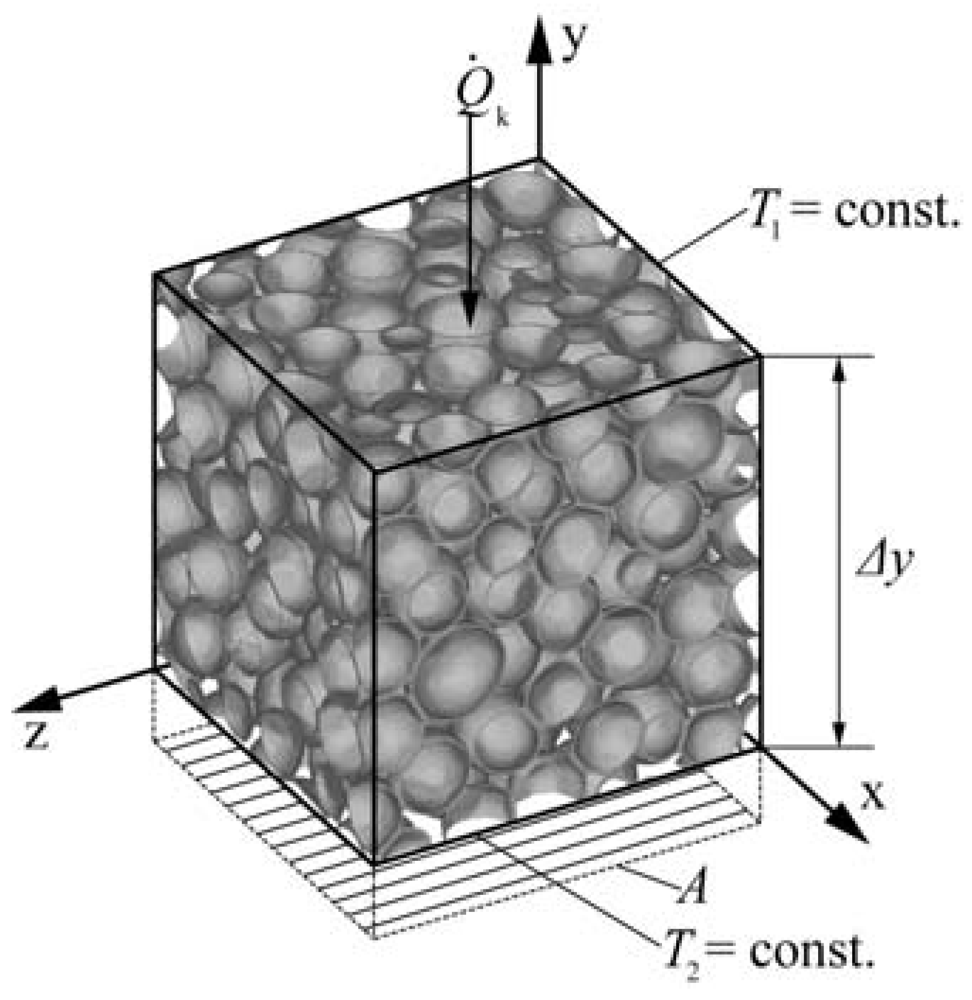
            <p>3D-object of the micro-computed tomography record with applied boundary conditions.</p>
          </caption>
          <graphic xmlns:xlink="http://www.w3.org/1999/xlink" xlink:href="metals-02-00113-g001.tif"/>
        </fig>
        <p><xref ref-type="fig" rid="metals-02-00113-f001">Figure 1</xref> shows the boundary conditions of the finite element model for thermal conductivity calculations in <italic>y</italic>-direction. The thermal conductivity can be determined in three perpendicular directions (<italic>i.e.</italic>, <italic>x</italic>, <italic>y</italic> and <italic>z</italic>) by changing the constant temperature planes. All calculations are performed under steady state conditions and the four lateral surfaces are adiabatic where no thermal energy exchange occurs with the surrounding. The nodal heat reaction flux <inline-graphic xmlns:xlink="http://www.w3.org/1999/xlink" xlink:href="metals-02-00113-i006.tif"/> perpendicular to the surfaces with the constant temperature is calculated by the finite element analysis. The total heat flux <inline-graphic xmlns:xlink="http://www.w3.org/1999/xlink" xlink:href="metals-02-00113-i002.tif"/> is the sum of the single nodal heat fluxes <inline-graphic xmlns:xlink="http://www.w3.org/1999/xlink" xlink:href="metals-02-00113-i006.tif"/> through one of the boundary surfaces. Within this study, the thermal radiation effect on heat transfer is neglected since its contribution is very low for the relevant temperature range which is below 700 K [<xref ref-type="bibr" rid="B24-metals-02-00113">24</xref>]. The influence of thermal convection is also disregarded because sintered HSS represents mainly a closed-cell structure with a low volume fraction of interconnected porosity [<xref ref-type="bibr" rid="B2-metals-02-00113">2</xref>]. In this study, pores are assumed to be filled with air. Due to the low thermal conductivity of the gas mixture, conductive heat transfer inside the pore space is negligible. These assumptions simplify the mathematical description of the heat transfer and the effective thermal conductivity can be calculated according to Equation (1) with Fourier’s law. </p>

        
        <p><inline-graphic xmlns:xlink="http://www.w3.org/1999/xlink" xlink:href="metals-02-00113-i001.tif"/></p>
        <p>The parameters of Fourier’s law are given in this paragraph: <inline-graphic xmlns:xlink="http://www.w3.org/1999/xlink" xlink:href="metals-02-00113-i007.tif"/> = heat flux, <italic>Δy</italic> = spatial distance between two opposing boundary surfaces, <italic>A</italic> = projected area, <italic>T</italic><sub>1</sub> = temperature on the top, <italic>T</italic><sub>2</sub> = temperature on the bottom. The geometry shown in <xref ref-type="fig" rid="metals-02-00113-f001">Figure 1</xref> consists of approximately 5 cells per edge length and consequently possesses about 5<sup>3</sup> = 125 cells in total. This number exceeds the approximately 100 cells required for a representative volume [<xref ref-type="bibr" rid="B15-metals-02-00113">15</xref>]. The model size is 18 × 18 × 18 mm and is represented by 400<sup>3</sup> voxels resulting in a resolution of 0.045 mm/voxel. The FE-model consists of roughly five million elements (<italic>i.e.</italic>, hexahedral-, tetrahedral- and pentahedral elements).</p>
      </sec>
      <sec>
        <title>2.2. Material</title>
        <p>Every sinterable material can be used in order to manufacture HSS with the powder based processing technique. Some thermal conductivities are given in the following text where the thermal conductivity is shown in brackets: titanium (6.9 W/m K), stainless steel (12.8 W/m K), high carbon steel (50 W/m K), pure molybdenum (138 W/m K) and aluminium (180 W/m K) [<xref ref-type="bibr" rid="B12-metals-02-00113">12</xref>]. Micro pores appear in the sphere wall due to the powder based manufacturing method and decrease thermal conductivity. Optical microscopy images are analysed of sintered HSS made of high carbon steel and a micro-porosity of <italic>p</italic> = 3.8% was detected. Based on this value, a correction factor <italic>C</italic><sub>1</sub> is calculated with the Maxwell-type expression [<xref ref-type="bibr" rid="B15-metals-02-00113">15</xref>,<xref ref-type="bibr" rid="B25-metals-02-00113">25</xref>] in order to account for the decrease in conductivity due to micro-porosity. This model assumes that all micro-pores are of similar size and homogeneously distributed in the sphere wall.</p>
        <p><inline-graphic xmlns:xlink="http://www.w3.org/1999/xlink" xlink:href="metals-02-00113-i003.tif"/></p>
        <p>The second influence on the effective thermal conductivity is the meso-structure which is denoted as <italic>C</italic><sub>2</sub>. Finally, the effective thermal conductivity can be calculated with Equation (3), which incorporates the thermal conductivity <italic>λ</italic><sub>B</sub> of the base material, the micro-porosity <italic>C</italic><sub>1</sub> and meso-structure <italic>C</italic><sub>2</sub>.</p>
        <p><inline-graphic xmlns:xlink="http://www.w3.org/1999/xlink" xlink:href="metals-02-00113-i004.tif"/></p>
      </sec>
    </sec>
    <sec>
      <title>3. Numerical Results</title>
      <sec>
        <title>3.1. Convergence Analysis</title>
        <p>The convergence analysis for the sintered HSS is performed on a smaller fraction of the calculation model (<italic>i.e.</italic>, side length 7.5 mm) in order to reduce calculation time. The convergence analysis can be distinguished between geometrical convergence and numerical convergence. The geometric convergence requires a sufficient number of elements in order to accurately capture the complex geometry by using primitive geometric element shapes (<italic>i.e.</italic>, tetrahedrons, pentahedrons and hexahedrons). Numerical convergence is achieved by an adequate number of nodes for the mathematical description of the temperature field. The results of the convergence analysis are shown in <xref ref-type="table" rid="metals-02-00113-t001">Table 1</xref> along with the mesh density, which is the number of elements divided by the solid volume fraction of the model. The absolute volume deviation |<italic>ΔV</italic>| is used to quantify geometric convergence shown in Equation (4). </p>
        
        <p><inline-graphic xmlns:xlink="http://www.w3.org/1999/xlink" xlink:href="metals-02-00113-i005.tif"/></p>
        <p>Variable <italic>V</italic><sub>3D</sub> is the solid volume of the micro-computed tomography data set and <italic>V</italic><sub>FE</sub> is the solid volume of the discretised calculation model. For perfect geometry the accuracy of the absolute volume deviation |<italic>ΔV</italic>| becomes zero. Numerical convergence is ensured for models with mesh densities of 0.88 or higher, <italic>i.e.</italic>, the conductivity does not significantly change. Accordingly, the mesh density of 0.88 is chosen for all following computational models.</p>
        <table-wrap id="metals-02-00113-t001" position="anchor">
          <object-id pub-id-type="pii">metals-02-00113-t001_Table 1</object-id>
          <label>Table 1</label>
          <caption>
            <p>Convergence analysis of the sintered hollow sphere structure (HSS) models.</p>
          </caption>
          <table>
            <thead>
              <tr>
                <th align="center" valign="middle">Elements</th>
                <th align="center" valign="middle">Nodes</th>
                <th align="center" valign="middle">Mesh density</th>
                <th align="center" valign="middle">
                  <italic>V</italic><sub>3D</sub>
                </th>
                <th align="center" valign="middle">
                  <italic>V</italic><sub>FE</sub>
                </th>
                <th align="center" valign="middle">|<italic>ΔV</italic>|</th>
                <th align="center" valign="middle"><italic>λ</italic>
                </th>
              </tr>
            </thead>
            <tbody>
              <tr>
                <td align="center" valign="middle">[−]</td>
                <td align="center" valign="middle">[−]</td>
                <td align="center" valign="middle">[Elements/<italic>V</italic><sub>voxels</sub>]</td>
                <td align="center" valign="middle">[−]</td>
                <td align="center" valign="middle">[−]</td>
                <td align="center" valign="middle">[−]</td>
                <td align="center" valign="middle">[%]</td>
              </tr>
              <tr>
                <td align="center" valign="middle">212941</td>
                <td align="center" valign="middle">90151</td>
                <td align="center" valign="middle">0.30</td>
                <td align="center" valign="middle">0.149</td>
                <td align="center" valign="middle">0.15</td>
                <td align="center" valign="middle">0.00671</td>
                <td align="center" valign="middle">9.15</td>
              </tr>
              <tr>
                <td align="center" valign="middle">343344</td>
                <td align="center" valign="middle">154412</td>
                <td align="center" valign="middle">0.49</td>
                <td align="center" valign="middle">0.149</td>
                <td align="center" valign="middle">0.15</td>
                <td align="center" valign="middle">0.00671</td>
                <td align="center" valign="middle">9.14</td>
              </tr>
              <tr>
                <td align="center" valign="middle">622385</td>
                <td align="center" valign="middle">311255</td>
                <td align="center" valign="middle">0.88</td>
                <td align="center" valign="middle">0.149</td>
                <td align="center" valign="middle">0.149</td>
                <td align="center" valign="middle">0</td>
                <td align="center" valign="middle">9.05</td>
              </tr>
              <tr>
                <td align="center" valign="middle">1489933</td>
                <td align="center" valign="middle">790252</td>
                <td align="center" valign="middle">2.13</td>
                <td align="center" valign="middle">0.149</td>
                <td align="center" valign="middle">0.149</td>
                <td align="center" valign="middle">0</td>
                <td align="center" valign="middle">9.05</td>
              </tr>
              <tr>
                <td align="center" valign="middle">2509508</td>
                <td align="center" valign="middle">1424344</td>
                <td align="center" valign="middle">3.57</td>
                <td align="center" valign="middle">0.149</td>
                <td align="center" valign="middle">0.149</td>
                <td align="center" valign="middle">0</td>
                <td align="center" valign="middle">9.03</td>
              </tr>
              <tr>
                <td align="center" valign="middle">5114321</td>
                <td align="center" valign="middle">3136257</td>
                <td align="center" valign="middle">7.14</td>
                <td align="center" valign="middle">0.149</td>
                <td align="center" valign="middle">0.149</td>
                <td align="center" valign="middle">0</td>
                <td align="center" valign="middle">9.03</td>
              </tr>
            </tbody>
          </table>
        </table-wrap>
      </sec>
      <sec>
        <title>3.2. Results and Discussion</title>
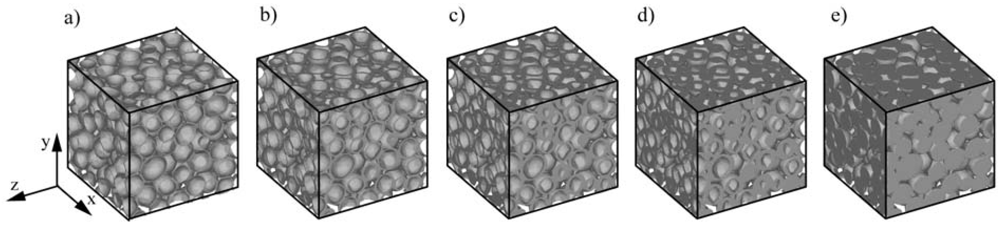
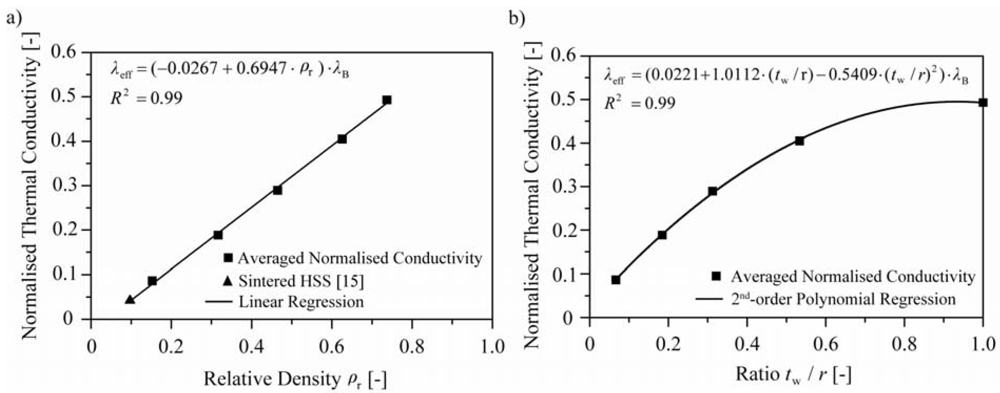
        <p><xref ref-type="fig" rid="metals-02-00113-f002">Figure 2</xref> shows the five investigated geometries. All models exhibit different relative densities or wall thickness to radius ratios <italic>t</italic><sub>w</sub>/<italic>r</italic>. The radius and wall thickness are averaged measurement values based on evaluated computed tomography cross sectional images. <xref ref-type="fig" rid="metals-02-00113-f002">Figure 2</xref>a shows the original geometry obtained by <italic>µ</italic>CT images of a real HSS sample and <xref ref-type="fig" rid="metals-02-00113-f002">Figure 2</xref>e the modified geometry with completely filled spheres. The intermediate modifications to the sphere wall thickness are shown in <xref ref-type="fig" rid="metals-02-00113-f002">Figure 2</xref>(b–d) where the sphere wall thickness is progressively increased towards the inside of the spheres. This task was carried out by altering the wall thickness on each recorded micro-computed tomography image. Note, that the volume deviation (<italic>i.e.</italic>, Equation (4)) between the 3D-object and the discretised finite element model is less than 0.7% for all models. This means that, the geometry is captured very well with the discretised numerical models. The difference between the thermal conductivities in three perpendicular directions (<italic>i.e.</italic>, <italic>x</italic>, <italic>y</italic> and <italic>z</italic>) and their arithmetical mean is less than 2% in all cases. Therefore, the sintered HSS exhibit quasi-isotropic material behaviour in terms of the thermal conductivity. In contrast, other cellular materials such as m-pore<sup>®</sup> and Alporas<sup>®</sup> reveal anisotropic material behaviour [<xref ref-type="bibr" rid="B18-metals-02-00113">18</xref>]. <xref ref-type="fig" rid="metals-02-00113-f004">Figure 4</xref>a shows the arithmetical mean (<italic>i.e.</italic>, <italic>x</italic>, <italic>y</italic> and <italic>z</italic>) of the normalised thermal conductivity plotted as a function of the relative density <italic>ρ</italic><sub>r</sub>. It can be seen that the numerical data points follow very well a linear regression line. This is also shown with the coefficient of determination <italic>R</italic><sup>2</sup> = 0.99 [<xref ref-type="bibr" rid="B9-metals-02-00113">9</xref>]. In addition, the results are in good agreement with a linear function by Fiedler <italic>et al.</italic> [<xref ref-type="bibr" rid="B16-metals-02-00113">16</xref>] formulated to predict the normalised conductivity for thin-walled structures. Finally, good agreement is obtained with a previous thermal analysis of sintered HSS based on micro-computed tomography [<xref ref-type="bibr" rid="B15-metals-02-00113">15</xref>] (see triangular marker in <xref ref-type="fig" rid="metals-02-00113-f004">Figure 4</xref>a). <xref ref-type="fig" rid="metals-02-00113-f004">Figure 4</xref>b shows the arithmetical mean (<italic>i.e.</italic>, <italic>x</italic>, <italic>y</italic> and <italic>z</italic>) of the normalised thermal conductivity as a function of the ratio of wall thickness <italic>t</italic><sub>w</sub> to radius <italic>r</italic>. Numerical results are shown by filled squares and can be described very well with a 2nd order polynomial regression. The good agreement between numerical data points and polynomial regression is shown with the <italic>R</italic><sup>2</sup> value of 0.99. </p>
        <fig id="metals-02-00113-f002" position="anchor">
          <label>Figure 2</label>
          <caption>
            <p>Evolution of sintered HSS models. (<bold>a</bold>) <italic>t</italic><sub>w</sub>/<italic>r</italic> = 0.066, <italic>ρ</italic><sub>r</sub> = 0.15; (<bold>b</bold>) <italic>t</italic><sub>w</sub>/<italic>r</italic> = 0.18, <italic>ρ</italic><sub>r</sub> = 0.32; (<bold>c</bold>) <italic>t</italic><sub>w</sub>/<italic>r</italic> = 0.31, <italic>ρ</italic><sub>r</sub> = 0.46; (<bold>d</bold>) <italic>t</italic><sub>w</sub>/<italic>r</italic> = 0.53, <italic>ρ</italic><sub>r</sub> = 0.63; (<bold>e</bold>) <italic>t</italic><sub>w</sub>/<italic>r</italic> = 1.0 <italic>ρ</italic><sub>r</sub> = 0.744.</p>
          </caption>
          <graphic xmlns:xlink="http://www.w3.org/1999/xlink" xlink:href="metals-02-00113-g002.tif"/>
        </fig>
        
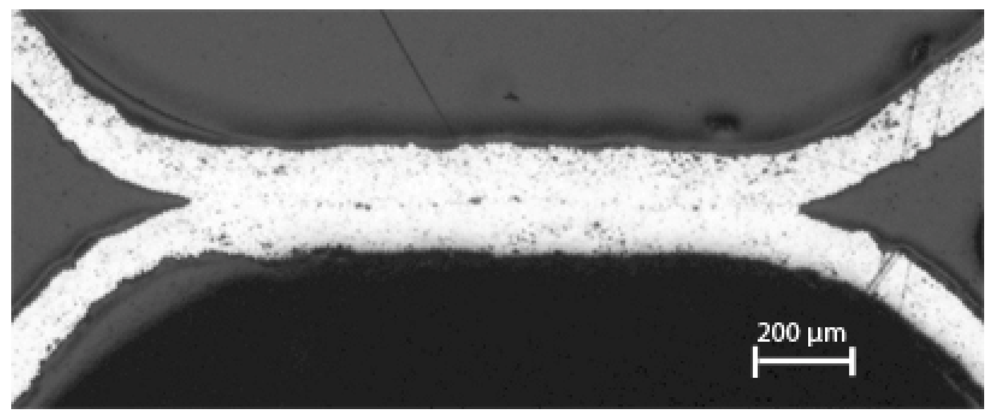
        <p>It must be mentioned that the packing density <italic>ϕ</italic> (<italic>i.e.</italic>, the fraction of the volume occupied by the filled spheres) is <italic>ϕ</italic> = 0.744. It is interesting to compare this value with the maximum possible packing density <italic>ϕ</italic><sub>max</sub> ≈ 0.74 of spherical particles and typical packing densities of spherical packed beds <italic>ϕ</italic> = 0.64 [<xref ref-type="bibr" rid="B26-metals-02-00113">26</xref>]. The high value <italic>ϕ</italic> = 0.744 of the investigated geometry is slightly more than the theoretical maximum which can be explained by plastic deformation during the manufacturing process. The spheres are flattened on the diffusion bonded contact area (see <xref ref-type="fig" rid="metals-02-00113-f003">Figure 3</xref>) between the hollow spheres resulting in good thermal contact of neighbouring spheres (as opposed to point contact). The current study aims to model the change of conductivity with increasing radius ratio <italic>t</italic><sub>w</sub>/<italic>r</italic>. However, the manufacturing of sintered HSS with thicker sphere walls is likely to yield less plastic deformation due to the rapidly increasing strength of the spheres. This results in smaller contact areas between neighbouring spheres. As a consequence, the numerical results of the current study are strictly valid for the considered model structures but may slightly overestimate the conductivities of real structures.</p>
        <fig id="metals-02-00113-f003" position="anchor">
          <label>Figure 3</label>
          <caption>
            <p>Optical microscopy image of the diffusion bonded contact between two adjacent hollow spheres.</p>
          </caption>
          <graphic xmlns:xlink="http://www.w3.org/1999/xlink" xlink:href="metals-02-00113-g003.tif"/>
        </fig>
        <fig id="metals-02-00113-f004" position="anchor">
          <label>Figure 4</label>
          <caption>
            <p>(<bold>a</bold>) Normalised thermal conductivity vs. relative density; (<bold>b</bold>) Normalised thermal conductivity vs. ratio wall thickness to radius.</p>
          </caption>
          <graphic xmlns:xlink="http://www.w3.org/1999/xlink" xlink:href="metals-02-00113-g004.tif"/>
          
        </fig>
      </sec>
    </sec>
    <sec sec-type="conclusions">
      <title>4. Conclusions</title>
      <p>In this paper, the averaged normalised thermal conductivity of sintered HSS has been investigated. Calculations were performed with the finite element method based on micro-computed tomography images. Sphere wall thickness was modified in order to obtain different relative densities and wall thickness to radius ratios. Quasi-isotropic material behaviour is observed with less than 2% deviation of directional conductivities and this is in agreement with results by Fiedler <italic>et al.</italic> [<xref ref-type="bibr" rid="B15-metals-02-00113">15</xref>]. Based on the finite element results, the change of the thermal conductivity with respect to the relative density can be accurately described with a linear regression line. Alternatively, a 2nd order polynomial regression can be used to model the functional dependence of the normalised thermal conductivity on the sphere wall to radius ratio <italic>t</italic><sub>w</sub>/<italic>r</italic>.</p>
    </sec>
    <sec>
      <title>Acknowledgments</title>
      <p>Research support from the Australian Research Council is gratefully acknowledged. Christoph Veyhl gratefully acknowledges the University of Newcastle, Centre for Mass and Thermal Transport in Engineering Materials for its funding support. The authors would like to thank the hollomet GmbH, Dresden, Germany for supporting the work with providing hollow sphere samples.</p>
    </sec>
  </body>
  <back>
    <ref-list>
      <title>References</title>
      <ref id="B1-metals-02-00113">
        <label>1.</label>
        <citation citation-type="book">
          <person-group person-group-type="author">
            <name>
              <surname>Gibson</surname>
              <given-names>L.J.</given-names>
            </name>
            <name>
              <surname>Ashby</surname>
              <given-names>M.F.</given-names>
            </name>
            <name>
              <surname>Harley</surname>
              <given-names>A.B.</given-names>
            </name>
          </person-group>
          <source>Cellular Materials in Nature and Medicine</source>
          <publisher-name>Cambridge University Press</publisher-name>
          <publisher-loc>New York, NY, USA</publisher-loc>
          <year>2010</year>
        </citation>
      </ref>
      <ref id="B2-metals-02-00113">
        <label>2.</label>
        <citation citation-type="book">
          <person-group person-group-type="author">
            <name>
              <surname>Gibson</surname>
              <given-names>L.J.</given-names>
            </name>
            <name>
              <surname>Ashby</surname>
              <given-names>M.F.</given-names>
            </name>
          </person-group>
          <source>Cellular Solids-Structure and Properties</source>
          <edition>2nd</edition>
          <publisher-name>Cambridge University Press</publisher-name>
          <publisher-loc>New York, NY, USA</publisher-loc>
          <year>2001</year>
        </citation>
      </ref>
      <ref id="B3-metals-02-00113">
        <label>3.</label>
        <citation citation-type="book">
          <person-group person-group-type="author">
            <name>
              <surname>Ashby</surname>
              <given-names>M.F.</given-names>
            </name>
            <name>
              <surname>Evans</surname>
              <given-names>A.</given-names>
            </name>
            <name>
              <surname>Fleck</surname>
              <given-names>N.A.</given-names>
            </name>
            <name>
              <surname>Gibson</surname>
              <given-names>L.J.</given-names>
            </name>
            <name>
              <surname>Hutchinson</surname>
              <given-names>J.W.</given-names>
            </name>
            <name>
              <surname>Wadley</surname>
              <given-names>H.N.G.</given-names>
            </name>
          </person-group>
          <source>Metal Foams: A Design Guide</source>
          <publisher-name>Butterworth-Heinemann</publisher-name>
          <publisher-loc>Oxford, UK</publisher-loc>
          <year>2000</year>
        </citation>
      </ref>
      <ref id="B4-metals-02-00113">
        <label>4.</label>
        <citation citation-type="book">
          <person-group person-group-type="author">
            <name>
              <surname>Fiedler</surname>
              <given-names>T.</given-names>
            </name>
          </person-group>
          <source>Numerical and Experimental Investigation of Hollow Sphere Structures in Sandwich Panels</source>
          <publisher-name>Trans Tech Publications</publisher-name>
          <publisher-loc>Stafa, Zurich</publisher-loc>
          <year>2008</year>
        </citation>
      </ref>
      <ref id="B5-metals-02-00113">
        <label>5.</label>
        <citation citation-type="confproc">
          <person-group person-group-type="author">
            <name>
              <surname>Stephani</surname>
              <given-names>G.</given-names>
            </name>
            <name>
              <surname>Quadbeck</surname>
              <given-names>P.</given-names>
            </name>
            <name>
              <surname>Andersen</surname>
              <given-names>O.</given-names>
            </name>
          </person-group>
          <article-title>New multifunctional lightweight materials based on cellular metals-manufacturing, properties and applications</article-title>
          <source>Proceedings of the International Conference on Advanced Structural and Functional Materials Design</source>
          <conf-loc>Osaka, Japan</conf-loc>
          <conf-date>10–12 November 2008</conf-date>
        </citation>
      </ref>
      <ref id="B6-metals-02-00113">
        <label>6.</label>
        <citation citation-type="journal">
          <person-group person-group-type="author">
            <name>
              <surname>Banhart</surname>
              <given-names>J.</given-names>
            </name>
          </person-group>
          <article-title>Manufacture, characterisation and application of cellular metals and metal foams</article-title>
          <source>Prog. Mater. Sci.</source>
          <year>2001</year>
          <volume>46</volume>
          <fpage>559</fpage>
          <lpage>632</lpage>
        <pub-id pub-id-type="doi">10.1016/S0079-6425(00)00002-5</pub-id></citation>
      </ref>
      <ref id="B7-metals-02-00113">
        <label>7.</label>
        <citation citation-type="web">
          <source>Lösch Cellular Engineering Ziviltechniker GesmbH Home Page</source>
          <access-date>(accessed on 15 May 2012)</access-date>
          <comment>Available online:<ext-link xmlns:xlink="http://www.w3.org/1999/xlink" xlink:href="http://lce.co.at" ext-link-type="uri">http://lce.co.at</ext-link></comment>
        </citation>
      </ref>
      <ref id="B8-metals-02-00113">
        <label>8.</label>
        <citation citation-type="confproc">
          <person-group person-group-type="author">
            <name>
              <surname>Studnitzky</surname>
              <given-names>T.</given-names>
            </name>
            <name>
              <surname>Andersen</surname>
              <given-names>O.</given-names>
            </name>
          </person-group>
          <article-title>Control of the carbon content in metal hollow sphere structures by variation of the debindering condtions</article-title>
          <source>Proceedings of the Symposium on Cellular Metals and Polymers</source>
          <conf-loc>Fürth, Germany</conf-loc>
          <conf-date>12–14 October 2004</conf-date>
        </citation>
      </ref>
      <ref id="B9-metals-02-00113">
        <label>9.</label>
        <citation citation-type="journal">
          <person-group person-group-type="author">
            <name>
              <surname>Veyhl</surname>
              <given-names>C.</given-names>
            </name>
            <name>
              <surname>Belova</surname>
              <given-names>I.V.</given-names>
            </name>
            <name>
              <surname>Murch</surname>
              <given-names>G.E.</given-names>
            </name>
            <name>
              <surname>Fiedler</surname>
              <given-names>T.</given-names>
            </name>
          </person-group>
          <article-title>Finite element analysis of the mechanical properties of cellular aluminium based on micro-computed tomography</article-title>
          <source>Mater. Sci. Eng. A</source>
          <year>2011</year>
          <volume>528</volume>
          <fpage>4550</fpage>
          <lpage>4555</lpage>
          <pub-id pub-id-type="doi">10.1016/j.msea.2011.02.031</pub-id>
        </citation>
      </ref>
      <ref id="B10-metals-02-00113">
        <label>10.</label>
        <citation citation-type="book">
          <person-group person-group-type="author">
            <name>
              <surname>Öchsner</surname>
              <given-names>A.</given-names>
            </name>
            <name>
              <surname>Augustin</surname>
              <given-names>C.</given-names>
            </name>
          </person-group>
          <source>Multifunctional Metallic Hollow Sphere Structures</source>
          <publisher-name>Springer</publisher-name>
          <publisher-loc>Berlin, Germany</publisher-loc>
          <year>2009</year>
        </citation>
      </ref>
      <ref id="B11-metals-02-00113">
        <label>11.</label>
        <citation citation-type="journal">
          <person-group person-group-type="author">
            <name>
              <surname>Evans</surname>
              <given-names>A.G.</given-names>
            </name>
            <name>
              <surname>Hutchinson</surname>
              <given-names>J.W.</given-names>
            </name>
            <name>
              <surname>Ashby</surname>
              <given-names>M.F.</given-names>
            </name>
          </person-group>
          <article-title>Cellular metals</article-title>
          <source>Curr. Opin. Solid State Mater. Sci.</source>
          <year>1998</year>
          <volume>3</volume>
          <fpage>288</fpage>
          <lpage>303</lpage>
          <pub-id pub-id-type="doi">10.1016/S1359-0286(98)80105-8</pub-id>
        </citation>
      </ref>
      <ref id="B12-metals-02-00113">
        <label>12.</label>
        <citation citation-type="journal">
          <person-group person-group-type="author">
            <name>
              <surname>Solórzano</surname>
              <given-names>E.</given-names>
            </name>
            <name>
              <surname>Rodríguez-Perez</surname>
              <given-names>M.A.</given-names>
            </name>
            <name>
              <surname>de Saja</surname>
              <given-names>J.A.</given-names>
            </name>
          </person-group>
          <article-title>Thermal conductivity of metallic hollow sphere structures: An experimental, analytical and comparative study</article-title>
          <source>Mater. Lett.</source>
          <year>2009</year>
          <volume>63</volume>
          <fpage>1128</fpage>
          <lpage>1130</lpage>
          <pub-id pub-id-type="doi">10.1016/j.matlet.2008.11.051</pub-id>
        </citation>
      </ref>
      <ref id="B13-metals-02-00113">
        <label>13.</label>
        <citation citation-type="journal">
          <person-group person-group-type="author">
            <name>
              <surname>Fiedler</surname>
              <given-names>T.</given-names>
            </name>
            <name>
              <surname>Solórzano</surname>
              <given-names>E.</given-names>
            </name>
            <name>
              <surname>Öchsner</surname>
              <given-names>A.</given-names>
            </name>
          </person-group>
          <article-title>Numerical and experimental analysis of the thermal conductivity of metallic hollow sphere structures</article-title>
          <source>Mater. Lett.</source>
          <year>2008</year>
          <volume>62</volume>
          <fpage>1204</fpage>
          <lpage>1207</lpage>
          <pub-id pub-id-type="doi">10.1016/j.matlet.2007.08.050</pub-id>
        </citation>
      </ref>
      <ref id="B14-metals-02-00113">
        <label>14.</label>
        <citation citation-type="journal">
          <person-group person-group-type="author">
            <name>
              <surname>Öchsner</surname>
              <given-names>A.</given-names>
            </name>
            <name>
              <surname>Tane</surname>
              <given-names>M.</given-names>
            </name>
            <name>
              <surname>Nakajima</surname>
              <given-names>H.</given-names>
            </name>
          </person-group>
          <article-title>Prediction of the thermal properties of lotus-type and quasi-isotropic porous metals: Numerical and analytical methods</article-title>
          <source>Mater. Lett.</source>
          <year>2006</year>
          <volume>60</volume>
          <fpage>2690</fpage>
          <lpage>2694</lpage>
          <pub-id pub-id-type="doi">10.1016/j.matlet.2006.01.067</pub-id>
        </citation>
      </ref>
      <ref id="B15-metals-02-00113">
        <label>15.</label>
        <citation citation-type="journal">
          <person-group person-group-type="author">
            <name>
              <surname>Fiedler</surname>
              <given-names>T.</given-names>
            </name>
            <name>
              <surname>Löffler</surname>
              <given-names>R.</given-names>
            </name>
            <name>
              <surname>Bernthaler</surname>
              <given-names>T.</given-names>
            </name>
            <name>
              <surname>Winkler</surname>
              <given-names>R.</given-names>
            </name>
            <name>
              <surname>Belova</surname>
              <given-names>I.V.</given-names>
            </name>
            <name>
              <surname>Murch</surname>
              <given-names>G.E.</given-names>
            </name>
            <name>
              <surname>Öchsner</surname>
              <given-names>A.</given-names>
            </name>
          </person-group>
          <article-title>Numerical analyses of the thermal conductivity of random hollow sphere structures</article-title>
          <source>Mater. Lett.</source>
          <year>2009</year>
          <volume>63</volume>
          <fpage>1125</fpage>
          <lpage>1127</lpage>
        <pub-id pub-id-type="doi">10.1016/j.matlet.2008.10.030</pub-id></citation>
      </ref>
      <ref id="B16-metals-02-00113">
        <label>16.</label>
        <citation citation-type="journal">
          <person-group person-group-type="author">
            <name>
              <surname>Fiedler</surname>
              <given-names>T.</given-names>
            </name>
            <name>
              <surname>Belova</surname>
              <given-names>I.V.</given-names>
            </name>
            <name>
              <surname>Murch</surname>
              <given-names>G.E.</given-names>
            </name>
          </person-group>
          <article-title>Theoretical and Lattice Monte Carlo analyses on thermal conduction in cellular metals</article-title>
          <source>Comput. Mater. Sci.</source>
          <year>2010</year>
          <volume>50</volume>
          <fpage>503</fpage>
          <lpage>509</lpage>
          <pub-id pub-id-type="doi">10.1016/j.commatsci.2010.09.011</pub-id>
        </citation>
      </ref>
      <ref id="B17-metals-02-00113">
        <label>17.</label>
        <citation citation-type="journal">
          <person-group person-group-type="author">
            <name>
              <surname>Fiedler</surname>
              <given-names>T.</given-names>
            </name>
            <name>
              <surname>Solórzano</surname>
              <given-names>E.</given-names>
            </name>
            <name>
              <surname>Garcia-Moreno</surname>
              <given-names>F.</given-names>
            </name>
            <name>
              <surname>Öchsner</surname>
              <given-names>A.</given-names>
            </name>
            <name>
              <surname>Belova</surname>
              <given-names>I.V.</given-names>
            </name>
            <name>
              <surname>Murch</surname>
              <given-names>G.E.</given-names>
            </name>
          </person-group>
          <article-title>Computed tomography based finite element analysis of the thermal properties of cellular aluminium</article-title>
          <source>Mater. Sci. Eng. Technol.</source>
          <year>2009</year>
          <volume>40</volume>
          <fpage>139</fpage>
          <lpage>143</lpage>
        </citation>
      </ref>
      <ref id="B18-metals-02-00113">
        <label>18.</label>
        <citation citation-type="journal">
          <person-group person-group-type="author">
            <name>
              <surname>Veyhl</surname>
              <given-names>C.</given-names>
            </name>
            <name>
              <surname>Belova</surname>
              <given-names>I.V.</given-names>
            </name>
            <name>
              <surname>Murch</surname>
              <given-names>G.E.</given-names>
            </name>
            <name>
              <surname>Öchsner</surname>
              <given-names>A.</given-names>
            </name>
            <name>
              <surname>Fiedler</surname>
              <given-names>T.</given-names>
            </name>
          </person-group>
          <article-title>Thermal analysis of aluminium foam based on micro-computed tomography</article-title>
          <source>Mater. Sci. Eng. Technol.</source>
          <year>2011</year>
          <volume>42</volume>
          <fpage>350</fpage>
          <lpage>355</lpage>
        </citation>
      </ref>
      <ref id="B19-metals-02-00113">
        <label>19.</label>
        <citation citation-type="journal">
          <person-group person-group-type="author">
            <name>
              <surname>Fiedler</surname>
              <given-names>T.</given-names>
            </name>
            <name>
              <surname>Öchsner</surname>
              <given-names>A.</given-names>
            </name>
          </person-group>
          <article-title>Influence of the morphology of joining on the heat transfer properties of periodic metal hollow sphere structures</article-title>
          <source>Mater. Sci. Forum</source>
          <year>2007</year>
          <volume>553</volume>
          <fpage>45</fpage>
          <lpage>50</lpage>
          <pub-id pub-id-type="doi">10.4028/www.scientific.net/MSF.553.45</pub-id>
        </citation>
      </ref>
      <ref id="B20-metals-02-00113">
        <label>20.</label>
        <citation citation-type="journal">
          <person-group person-group-type="author">
            <name>
              <surname>Fiedler</surname>
              <given-names>T.</given-names>
            </name>
            <name>
              <surname>Öchsner</surname>
              <given-names>A.</given-names>
            </name>
          </person-group>
          <article-title>On the thermal conductivity of adhesivley bonded and sintered hollow sphere structures (HSS)</article-title>
          <source>Mater. Sci. Forum</source>
          <year>2007</year>
          <volume>553</volume>
          <fpage>39</fpage>
          <lpage>44</lpage>
          <pub-id pub-id-type="doi">10.4028/www.scientific.net/MSF.553.39</pub-id>
        </citation>
      </ref>
      <ref id="B21-metals-02-00113">
        <label>21.</label>
        <citation citation-type="journal">
          <person-group person-group-type="author">
            <name>
              <surname>Vesenjak</surname>
              <given-names>M.</given-names>
            </name>
            <name>
              <surname>Žunič</surname>
              <given-names>Z.</given-names>
            </name>
            <name>
              <surname>Öchsner</surname>
              <given-names>A.</given-names>
            </name>
            <name>
              <surname>Hribersek</surname>
              <given-names>M.</given-names>
            </name>
            <name>
              <surname>Ren</surname>
              <given-names>Z.</given-names>
            </name>
          </person-group>
          <article-title>Heat conduction in closed-cell cellular metals</article-title>
          <source>Mater. Sci. Eng. Technol.</source>
          <year>2005</year>
          <volume>36</volume>
          <fpage>608</fpage>
          <lpage>612</lpage>
        </citation>
      </ref>
      <ref id="B22-metals-02-00113">
        <label>22.</label>
        <citation citation-type="journal">
          <person-group person-group-type="author">
            <name>
              <surname>Vesenjak</surname>
              <given-names>M.</given-names>
            </name>
            <name>
              <surname>Žunič</surname>
              <given-names>Z.</given-names>
            </name>
            <name>
              <surname>Ren</surname>
              <given-names>Z.</given-names>
            </name>
            <name>
              <surname>Öchsner</surname>
              <given-names>A.</given-names>
            </name>
          </person-group>
          <article-title>Computational study of heat transfer in honeycomb structures accounting for gaseous pore filler</article-title>
          <source>Defect Diffus. Forum</source>
          <year>2008</year>
          <volume>273–276</volume>
          <fpage>699</fpage>
          <lpage>706</lpage>
          <pub-id pub-id-type="doi">10.4028/www.scientific.net/DDF.273-276.699</pub-id>
        </citation>
      </ref>
      <ref id="B23-metals-02-00113">
        <label>23.</label>
        <citation citation-type="journal">
          <person-group person-group-type="author">
            <name>
              <surname>Veyhl</surname>
              <given-names>C.</given-names>
            </name>
            <name>
              <surname>Belova</surname>
              <given-names>I.V.</given-names>
            </name>
            <name>
              <surname>Murch</surname>
              <given-names>G.E.</given-names>
            </name>
            <name>
              <surname>Öchsner</surname>
              <given-names>A.</given-names>
            </name>
            <name>
              <surname>Fiedler</surname>
              <given-names>T.</given-names>
            </name>
          </person-group>
          <article-title>On the mesh dependence of non-linear mechanical finite element analysis</article-title>
          <source>Finite Elem. Anal. Des.</source>
          <year>2010</year>
          <volume>46</volume>
          <fpage>371</fpage>
          <lpage>378</lpage>
          <pub-id pub-id-type="doi">10.1016/j.finel.2009.12.003</pub-id>
        </citation>
      </ref>
      <ref id="B24-metals-02-00113">
        <label>24.</label>
        <citation citation-type="journal">
          <person-group person-group-type="author">
            <name>
              <surname>Lu</surname>
              <given-names>T.J.</given-names>
            </name>
            <name>
              <surname>Chen</surname>
              <given-names>C.</given-names>
            </name>
          </person-group>
          <article-title>Thermal transport and fire retardance properties of cellular aluminium alloys</article-title>
          <source>Acta Mater.</source>
          <year>1999</year>
          <volume>47</volume>
          <fpage>1469</fpage>
          <lpage>1485</lpage>
          <pub-id pub-id-type="doi">10.1016/S1359-6454(99)00037-3</pub-id>
        </citation>
      </ref>
      <ref id="B25-metals-02-00113">
        <label>25.</label>
        <citation citation-type="book">
          <person-group person-group-type="author">
            <name>
              <surname>Maxwell</surname>
              <given-names>J.C.</given-names>
            </name>
          </person-group>
          <source>A Treatise on Electricity and Magnetism</source>
          <publisher-name>Clarendon Press</publisher-name>
          <publisher-loc>Calfornia, CA, USA</publisher-loc>
          <fpage>1892</fpage>
        </citation>
      </ref>
      <ref id="B26-metals-02-00113">
        <label>26.</label>
        <citation citation-type="journal">
          <person-group person-group-type="author">
            <name>
              <surname>Jaeger</surname>
              <given-names>H.M.</given-names>
            </name>
            <name>
              <surname>Nagel</surname>
              <given-names>S.R.</given-names>
            </name>
          </person-group>
          <article-title>Physics of granular state</article-title>
          <source>Science</source>
          <year>1992</year>
          <volume>255</volume>
          <fpage>1523</fpage>
          <lpage>1531</lpage>
        <pub-id pub-id-type="doi">10.1126/science.255.5051.1523</pub-id><pub-id pub-id-type="pmid">17820163</pub-id></citation>
      </ref>
    </ref-list>
  </back>
</article>