
<?xml version="1.0" encoding="UTF-8"?>
<!DOCTYPE article PUBLIC "-//NLM//DTD Journal Publishing DTD v2.3 20070202//EN" "journalpublishing.dtd">
<article xmlns:mml="http://www.w3.org/1998/Math/MathML" xmlns:xlink="http://www.w3.org/1999/xlink" xml:lang="en" article-type="research-article">
  <front>
    <journal-meta>
      <journal-id journal-id-type="publisher-id">metals</journal-id>
      <journal-title>Metals</journal-title>
      <abbrev-journal-title abbrev-type="publisher">Metals</abbrev-journal-title>
      <abbrev-journal-title abbrev-type="pubmed">Metals</abbrev-journal-title>
      <issn pub-type="epub">2075-4701</issn>
      <publisher>
        <publisher-name>MDPI</publisher-name>
      </publisher>
    </journal-meta>
    <article-meta>
      <article-id pub-id-type="doi">10.3390/met2010001</article-id>
      <article-id pub-id-type="publisher-id">metals-02-00001</article-id>
      <article-categories>
        <subj-group>
          <subject>Article</subject>
        </subj-group>
      </article-categories>
      <title-group>
        <article-title>Method of Preventing Shrinkage of Aluminum Foam Using Carbonates</article-title>
      </title-group>
      <contrib-group>
        <contrib contrib-type="author">
          <name>
            <surname>Koizumi</surname>
            <given-names>Takuya</given-names>
          </name>
          <xref rid="af1-metals-02-00001" ref-type="aff"> 1</xref>
          <xref rid="c1-metals-02-00001" ref-type="corresp">*</xref>
        </contrib>
        <contrib contrib-type="author">
          <name>
            <surname>Kido</surname>
            <given-names>Kota</given-names>
          </name>
          <xref rid="af1-metals-02-00001" ref-type="aff"> 1</xref>
        </contrib>
        <contrib contrib-type="author">
          <name>
            <surname>Kita</surname>
            <given-names> Kazuhiko</given-names>
          </name>
          <xref rid="af1-metals-02-00001" ref-type="aff"> 1</xref>
        </contrib>
        <contrib contrib-type="author">
          <name>
            <surname>Mikado</surname>
            <given-names>Koichi</given-names>
          </name>
          <xref rid="af2-metals-02-00001" ref-type="aff"> 2</xref>
        </contrib>
        <contrib contrib-type="author">
          <name>
            <surname>Gnyloskurenko</surname>
            <given-names>Svyatoslav</given-names>
          </name>
          <xref rid="af3-metals-02-00001" ref-type="aff"> 3</xref>
          <xref rid="af4-metals-02-00001" ref-type="aff">4</xref>
        </contrib>
        <contrib contrib-type="author">
          <name>
            <surname>Nakamura</surname>
            <given-names>Takashi</given-names>
          </name>
          <xref rid="af3-metals-02-00001" ref-type="aff"> 3</xref>
        </contrib>
      </contrib-group>
      <aff id="af1-metals-02-00001"><label>1 </label>Machinery and Engineering Group, YKK Corporation, Yoshida Kurobe City, Toyama 938-8601, Japan; Email: <email>k-kido@ykk.co.jp</email> (K.K.); <email>k-kita@ykk.co.jp</email> (K.K.)</aff>
      <aff id="af2-metals-02-00001"><label>2 </label>Fastening Products Group, YKK Corporation, Yoshida Kurobe City, Toyama 938-8601, Japan; Email: <email>k-mikado@ykk.co.jp</email></aff>
      <aff id="af3-metals-02-00001"><label>3 </label>Institute of Multidisciplinary Research for Advanced Materials, Tohoku University, Sendai 980-8577, Japan; Email: <email>slavgn@yahoo.com</email> (S.G.); <email>ntakashi@sda.att.ne.jp</email> (T.N.)</aff>
      <aff id="af4-metals-02-00001"><label>4 </label>Physical-Technological Institute of Metals and Alloys, The National Academy of Sciences of Ukraine, Kiev 04004, Ukraine</aff>
      <author-notes>
        <corresp id="c1-metals-02-00001"><label>*</label> Author to whom correspondence should be addressed; Email: <email>t-koizumi@ykk.co.jp</email>; Tel.: + 81-765-54-8345; Fax: + 81-765-84-8818.</corresp>
      </author-notes>
      <pub-date pub-type="epub">
        <day>23</day>
        <month>12</month>
        <year>2011</year>
      </pub-date>
      <pub-date pub-type="collection"><month>12</month>
        <year>2011</year>
      </pub-date>
      <volume>2</volume>
      <issue>1</issue>
      <fpage>1</fpage>
      <lpage>9</lpage>
      <history>
        <date date-type="received">
          <day>23</day>
          <month>09</month>
          <year>2011</year>
        </date>
        <date date-type="rev-recd">
          <day>07</day>
          <month>12</month>
          <year>2011</year>
        </date>
        <date date-type="accepted">
          <day>15</day>
          <month>12</month>
          <year>2011</year>
        </date>
      </history>
      <permissions>
        <copyright-statement>© 2012 by the authors; licensee MDPI, Basel, Switzerland.</copyright-statement>
        <copyright-year>2012</copyright-year>
        <license xmlns:xlink="http://www.w3.org/1999/xlink" license-type="open-access" xlink:href="http://creativecommons.org/licenses/by/3.0/">
          <p>This article is an open-access article distributed under the terms and conditions of the Creative Commons Attribution license (http://creativecommons.org/licenses/by/3.0/).</p>
        </license>
      </permissions>
      <abstract>
        <p> Metallic foams are commonly produced using titanium hydride as a foaming agent. Carbonates produce aluminum foam with a fine and homogenous cell structure. However, foams produced using carbonates show marked shrinkage, which is clearly different from those produced using titanium hydride. It is essential for practical applications to clarify foam shrinkage and establish a method of preventing it. In this research, cell structures were observed to study the shrinkage of aluminum foam produced using carbonates. The cells of foam produced using dolomite as a foaming agent connected to each other with maximum expansion. It was estimated that foaming gas was released through connected cells to the outside. It was assumed that cell formation at different sites is effective in preventing shrinkage induced by cell connection. The multiple additions of dolomite and magnesium carbonate, which have different decomposition temperatures, were applied. The foam in the case with multiple additions maintained a density of 0.66 up to 973 K, at which the foam produced using dolomite shrank. It was verified that the multiple additions of carbonates are effective in preventing shrinkage. </p>
      </abstract>
      <kwd-group>
        <kwd>aluminum foam</kwd>
        <kwd>carbonates</kwd>
        <kwd>shrinkage</kwd>
      </kwd-group>
    </article-meta>
  </front>
  <body>
    <sec sec-type="intro">
      <title>1. Introduction</title>
      <p>Metallic foams have unique properties, such as low density, good energy-absorbing capability, and low thermal conductivity. One of the manufacturing methods for metallic foams is the Fraunhofer method. This method uses a typical powder metallurgy (PM) route [<xref ref-type="bibr" rid="B1-metals-02-00001">1</xref>] that entails the hot extrusion of an aluminum matrix powder and a TiH<sub>2</sub> to make precursor, the resulting product of which is then heated in a closed die to produce foam for near-net shaping. TiH<sub>2</sub> is a popular foaming agent because of its decomposition temperature, which is close to the melting temperature of aluminum alloys. However, TiH<sub>2</sub> is expensive. </p>
      <p>One of the authors presented carbonates as alternatives to TiH<sub>2</sub> [<xref ref-type="bibr" rid="B2-metals-02-00001">2</xref>], because they are inexpensive. Calcium carbonate gives a finer cell structure than TiH<sub>2</sub> in the melt route. It also induces CO<sub>2</sub> gas, which oxidizes and stabilizes the aluminum cell surface. Thus, aluminum foam produced using carbonates has a finer cell structure than that produced using TiH<sub>2</sub>. The effect of oxide layer on foam stabilization has been reported from other researchers [<xref ref-type="bibr" rid="B3-metals-02-00001">3</xref>,<xref ref-type="bibr" rid="B4-metals-02-00001">4</xref>,<xref ref-type="bibr" rid="B5-metals-02-00001">5</xref>]. On the other hand, foam by TiH<sub>2</sub> are stabilized by solid particles, like SiO<sub>2</sub> [<xref ref-type="bibr" rid="B6-metals-02-00001">6</xref>]. </p>
      <p>In the PM route, some carbonates are used as foaming agents, and their resulting foams show fine cell structure and better mechanical properties [<xref ref-type="bibr" rid="B7-metals-02-00001">7</xref>,<xref ref-type="bibr" rid="B8-metals-02-00001">8</xref>]. Still, foaming by carbonates in the PM route remains to be elucidated.</p>
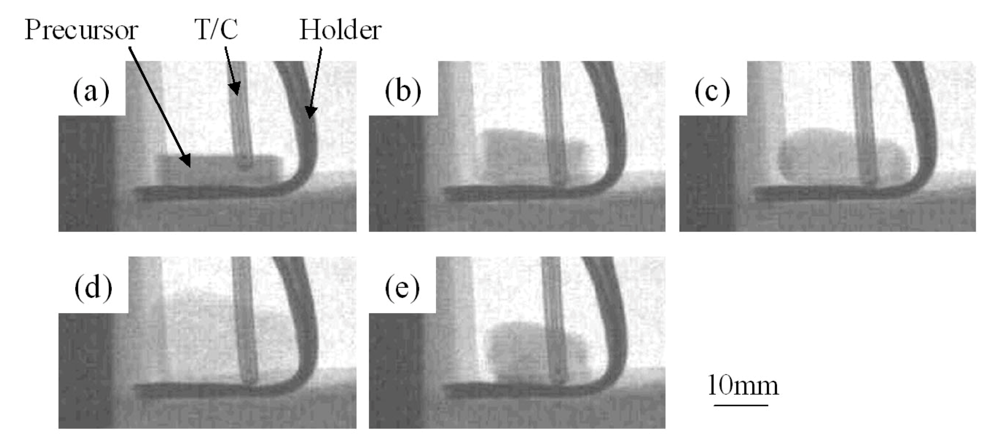
      <p>We have studied the principle of foaming by carbonates, and found that dolomite and magnesium carbonate are suitable foaming agents for AlSiCu alloy. The foams produced using dolomite and magnesium carbonate have a fine and homogenous cell structure [<xref ref-type="bibr" rid="B9-metals-02-00001">9</xref>,<xref ref-type="bibr" rid="B10-metals-02-00001">10</xref>,<xref ref-type="bibr" rid="B11-metals-02-00001">11</xref>]. The foam produced using TiH<sub>2</sub> shows the coalescence of cells, before rupture by gravity [<xref ref-type="bibr" rid="B12-metals-02-00001">12</xref>,<xref ref-type="bibr" rid="B13-metals-02-00001">13</xref>]. On the other hand, the foam produced using carbonates shows marked shrinkage, which is clearly different from that of TiH<sub>2</sub>. The transmission images of 1.2 mass% dolomite foam, which were obtained at specific temperatures using transmission X-ray system, are shown in <xref ref-type="fig" rid="metals-02-00001-f001">Figure 1</xref> [<xref ref-type="bibr" rid="B11-metals-02-00001">11</xref>]. The foam markedly shrank at 1003 K after maximum expansion at 973 K. Such marked shrinkage adversely affects the near-net shaping in the PM route. Accordingly, it is essential for practical applications to clarify foam shrinkage and establish a method of preventing it.</p>
      <p>In the present study, the cell structures during foam shrinkage and a method of preventing such shrinkage were investigated.</p>
    </sec>
    <sec sec-type="results">
      <title>2. Results and Discussion</title>
      <sec>
        <title>2.1. Observations of Shrinkage</title>
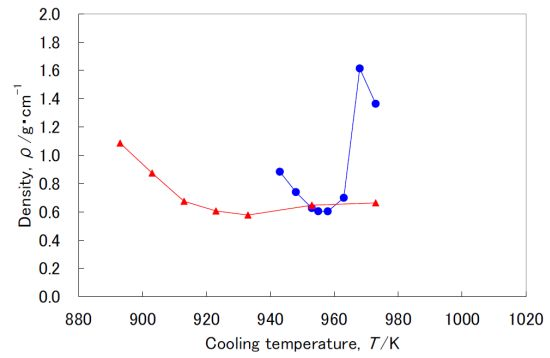
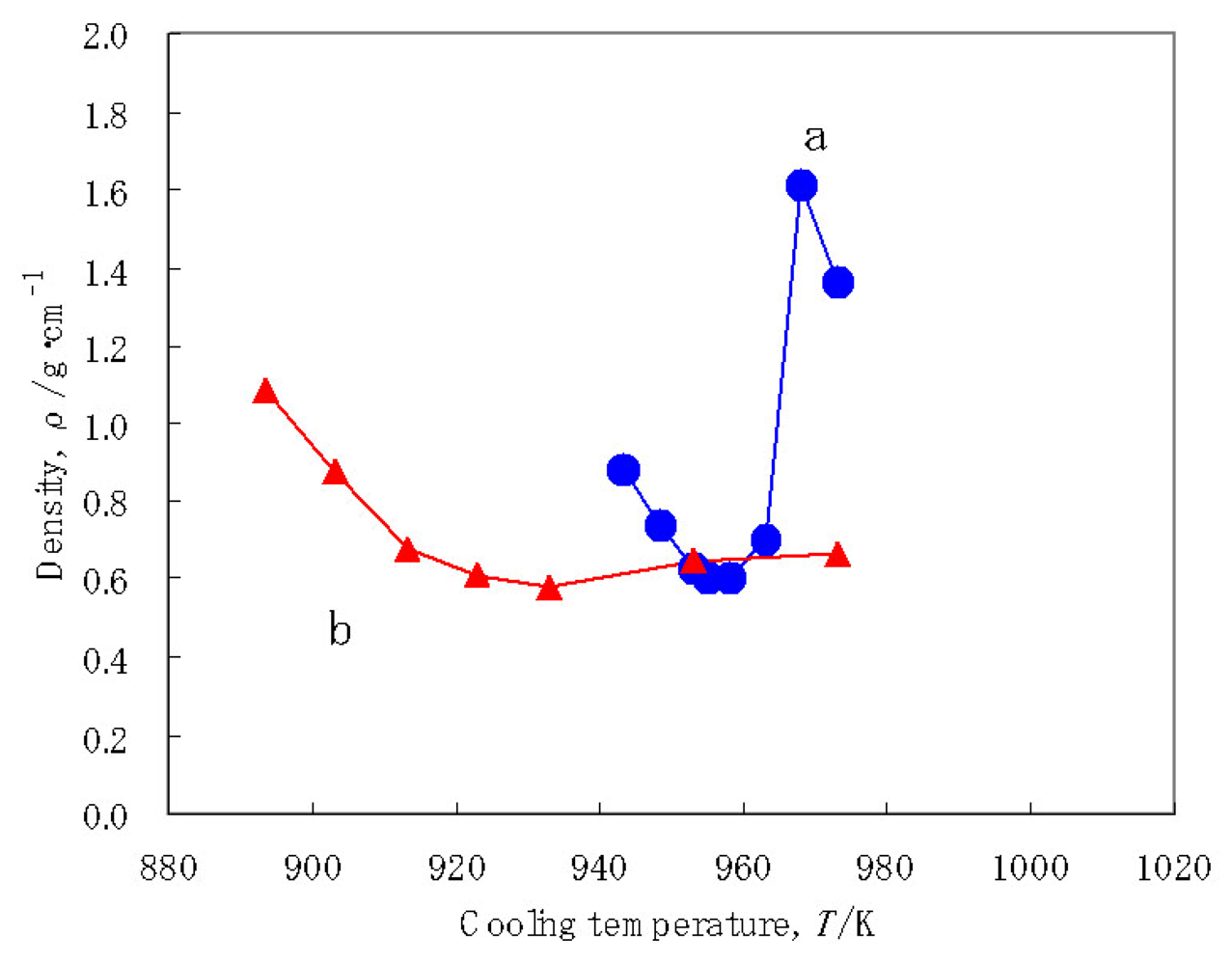
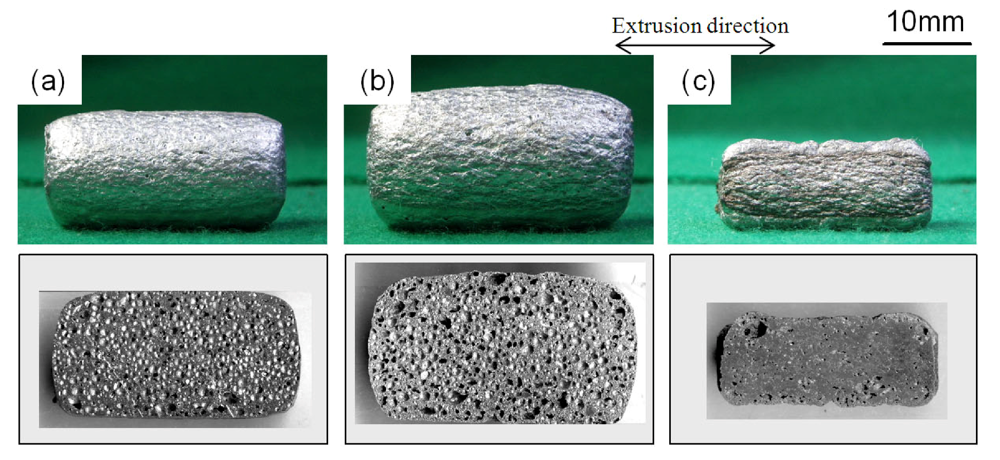
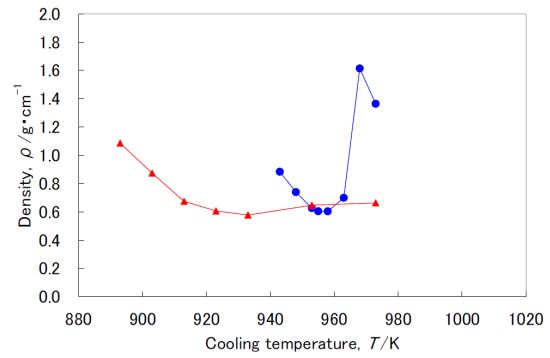
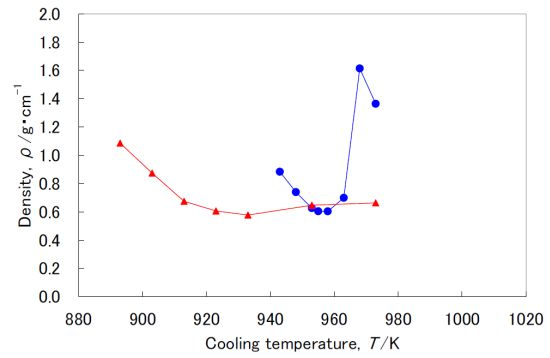
        <p>The cell structures of the foam produced using dolomite were observed to clarify foam shrinkage induced by carbonate-foaming agents. The cooling temperatures and densities of the foams produced using 2.0 mass% dolomite are shown in <xref ref-type="fig" rid="metals-02-00001-f002">Figure 2</xref>(a). The foam expanded to a density of 0.88 at 943 K. Then, it showed maximum expansion at a density of 0.60 at 958 K. After that, it shrank to show a density of 1.61 at 968 K. The foams and their cross-sectional views are shown in <xref ref-type="fig" rid="metals-02-00001-f003">Figure 3</xref>. The foams at 943 and 958 K had spherical cell structures. The foam at 963 K shrank and its number of cells decreased.</p>
        <fig id="metals-02-00001-f001" position="anchor">
        <label>Figure 1</label>
        <caption>
          <p>Foams produced using1.2 mass% dolomiteobserved with transmission X-ray system: (<bold>a</bold>) start; (<bold>b</bold>) 863 K; (<bold>c</bold>) 873 K; (<bold>d</bold>) 973 K and (<bold>e</bold>) 1003 K [<xref ref-type="bibr" rid="B11-metals-02-00001">11</xref>].</p>
        </caption>
        <graphic xmlns:xlink="http://www.w3.org/1999/xlink" xlink:href="metals-02-00001-g001.tif"/>
      </fig>
      <fig id="metals-02-00001-f002" position="anchor">
          <label>Figure 2</label>
          <caption>
            <p>Densities of foams: (<bold>a</bold>) 2.0 mass% dolomite and (<bold>b</bold>) 2.0 mass% dolomite and 1.0 mass% MgCO<sub>3</sub>. </p>
          </caption>
          <graphic xmlns:xlink="http://www.w3.org/1999/xlink" xlink:href="metals-02-00001-g002.tif"/>
        </fig>
        <fig id="metals-02-00001-f003" position="anchor">
          <label>Figure 3</label>
          <caption>
            <p>Foams produced using 2.0 mass% dolomite and their cross sectional views: (<bold>a</bold>) at 943 K, ρ:0.88 g/cm<sup>3</sup>, (<bold>b</bold>) at 958 K, ρ:0.60 g/cm<sup>3</sup>, and (<bold>c</bold>) at 968 K, ρ:1.61 g/cm<sup>3</sup>. </p>
          </caption>
          <graphic xmlns:xlink="http://www.w3.org/1999/xlink" xlink:href="metals-02-00001-g003.tif"/>
        </fig>
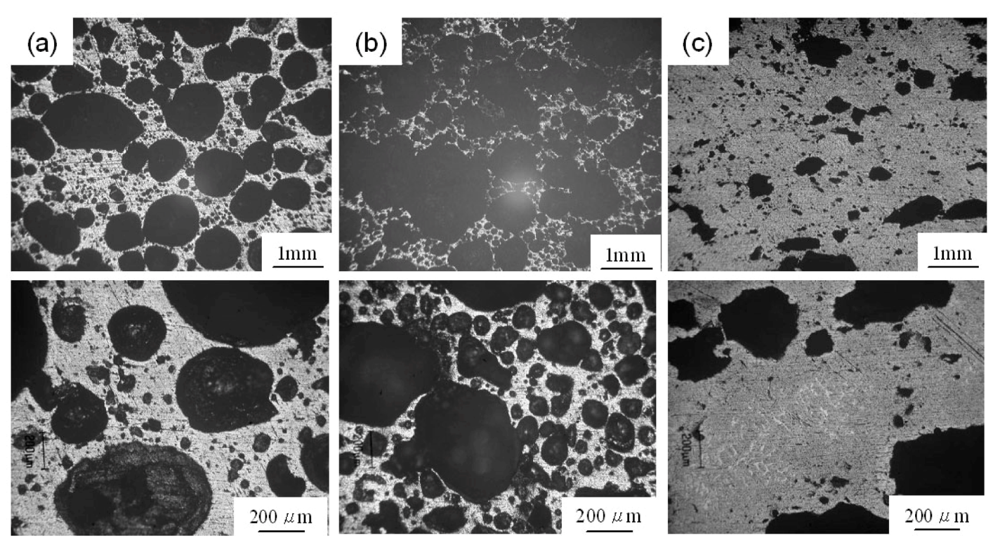
        <p>The cell structures of the foams were observed by optical microscopy, the results of which are shown in <xref ref-type="fig" rid="metals-02-00001-f004">Figure 4</xref>. Two cells of different sizes were observed in the foams at 943 and 958 K. Coarse cells about 1 mm in size were induced by the water vapor absorbed onto the AlSiCu powder surface during the melting of the matrix, and fine cells of about 50–70 μm in size were induced by dolomite decomposition [<xref ref-type="bibr" rid="B11-metals-02-00001">11</xref>]. At 943 K, coarse cells were mainly observed. At 958 K, the number of fine cells increased markedly. The coarse cells connected to each other through fine cells. The cells maintained their shape as an open cell structure. Foam by carbonates has the stable oxidized cell walls [<xref ref-type="bibr" rid="B2-metals-02-00001">2</xref>,<xref ref-type="bibr" rid="B3-metals-02-00001">3</xref>,<xref ref-type="bibr" rid="B4-metals-02-00001">4</xref>,<xref ref-type="bibr" rid="B5-metals-02-00001">5</xref>], which should prevent cell coalesces. At 968 K, most of the cells disappeared.</p>
        <fig id="metals-02-00001-f004" position="anchor">
          <label>Figure 4</label>
          <caption>
            <p>Microstructures of foams produced using 2.0 mass% dolomite, lower pictures are magnified images of upper row: (<bold>a</bold>) at 943 K, ρ: 0.88 g/cm<sup>3</sup>; (<bold>b</bold>) at 958 K, ρ: 0.60 g/cm<sup>3</sup> and (<bold>c</bold>) at 968 K, ρ: 1.61 g/cm<sup>3</sup>. </p>
          </caption>
          <graphic xmlns:xlink="http://www.w3.org/1999/xlink" xlink:href="metals-02-00001-g004.tif"/>
        </fig>
        <p>It is assumed that the shrinkage by the carbonate-foaming agent is induced by gas release through connected cells because of the change in cell structure from foaming to shrinkage. As shown in <xref ref-type="fig" rid="metals-02-00001-f004">Figure 4</xref>(b), when most of the cells are connected to each other, gas can be released rapidly to the outside, namely, it can induce marked shrinkage.</p>
      </sec>
      <sec>
        <title>2.2. Method of Preventing Shrinkage</title>
        <p>A method of preventing shrinkage was studied on the basis of the hypothesis, that the stability of the oxidized cell wall is the reason for both the fine cell structure and the cell connection. It is difficult to prevent cell connection. It was assumed that cell formation at different sites is effective in preventing shrinkage, even if cell connections are formed.</p>
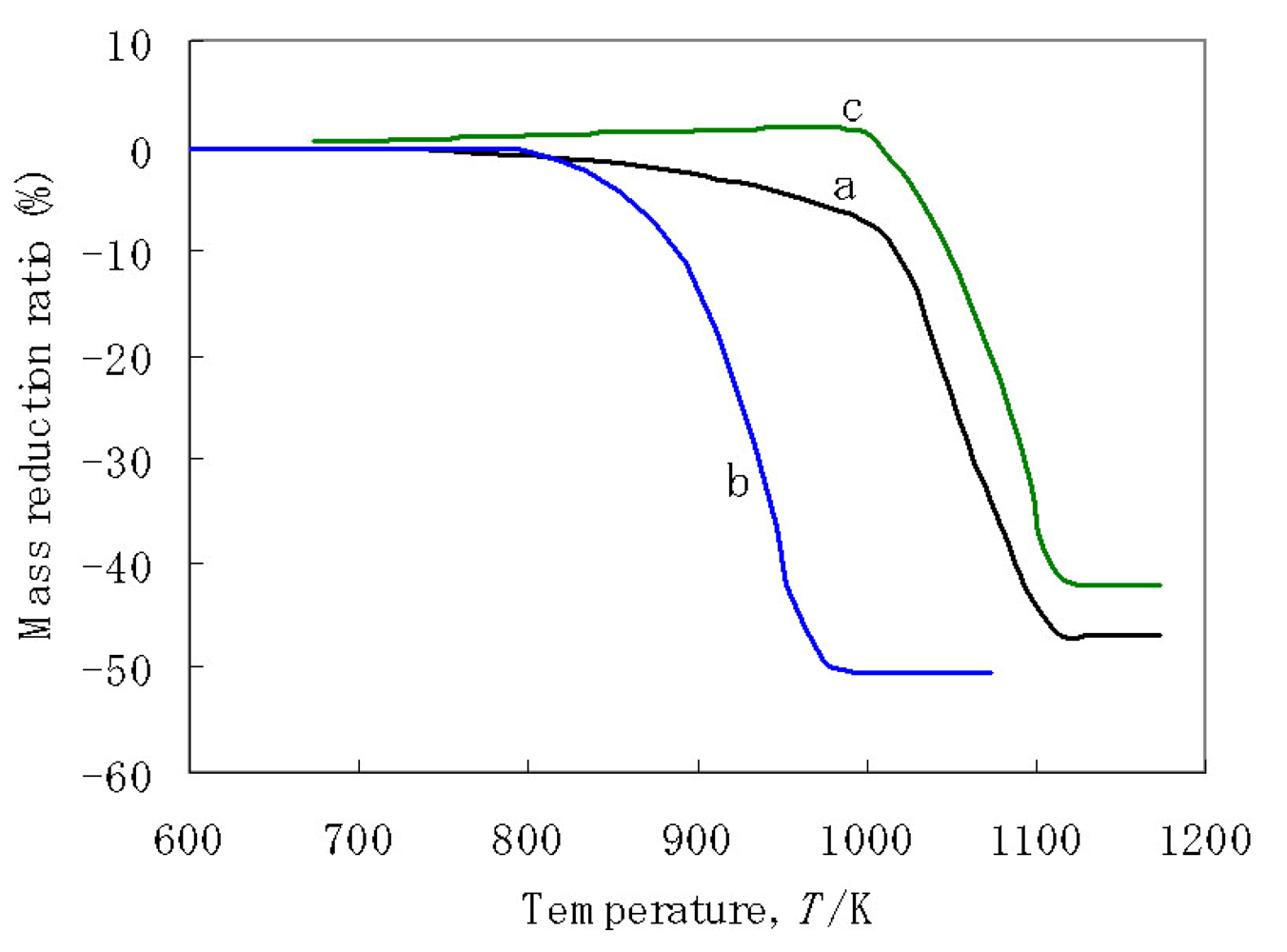
        <p>Gas could be generated at new sites by adding another foaming agent that has a different decomposition temperature. The mass reduction rates of dolomite, magnesium carbonate, and calcium carbonate obtained by thermogravimetric analysis-differential thermal analysis (TG-DTA) are shown in <xref ref-type="fig" rid="metals-02-00001-f005">Figure 5</xref> [<xref ref-type="bibr" rid="B9-metals-02-00001">9</xref>]. Dolomite started to decompose at 773 K and rapidly decomposed above 1013 K. In contrast, magnesium carbonate decomposed from 793 to 993 K and calcium carbonate from 993 to 1113 K. Calcium carbonate is ineffective for multiple additions, because it does not decompose at 968 K, at which foam produced using dolomite shrinks. In the case of multiple additions of dolomite and magnesium carbonate, the latter decomposes first, followed by the former. This creates new cell sites, which are expected to prevent shrinkage.</p>
        <fig id="metals-02-00001-f005" position="anchor">
          <label>Figure 5</label>
          <caption>
            <p>thermogravimetric (TG) curves of foaming agents: (<bold>a</bold>) dolomite; (<bold>b</bold>) MgCO<sub>3</sub> and (<bold>c</bold>) CaCO<sub>3</sub> [<xref ref-type="bibr" rid="B9-metals-02-00001">9</xref>]. </p>
          </caption>
          <graphic xmlns:xlink="http://www.w3.org/1999/xlink" xlink:href="metals-02-00001-g005.tif"/>
        </fig>
      </sec>
      <sec>
        <title>2.3. Foaming by Multiple Additions</title>
        <p>Precursors with multiple additions of 2.0 mass% dolomite and 1.0 mass% magnesium carbonate were prepared. The cooling temperatures and densities of the foams produced with multiple additions are shown in <xref ref-type="fig" rid="metals-02-00001-f002">Figure 2</xref>(b). The foam expanded to a density of 0.87 at 903 K, then showed maximum expansion at a density of 0.58 at 933 K. The foaming temperature for multiple additions was lower than that for dolomite, because magnesium carbonate has a lower decomposition temperature than dolomite. A density of 0.66 was maintained at 973 K, at which the foam produced using dolomite shrank markedly. It was verified that multiple additions are effective in preventing foam shrinkage.</p>
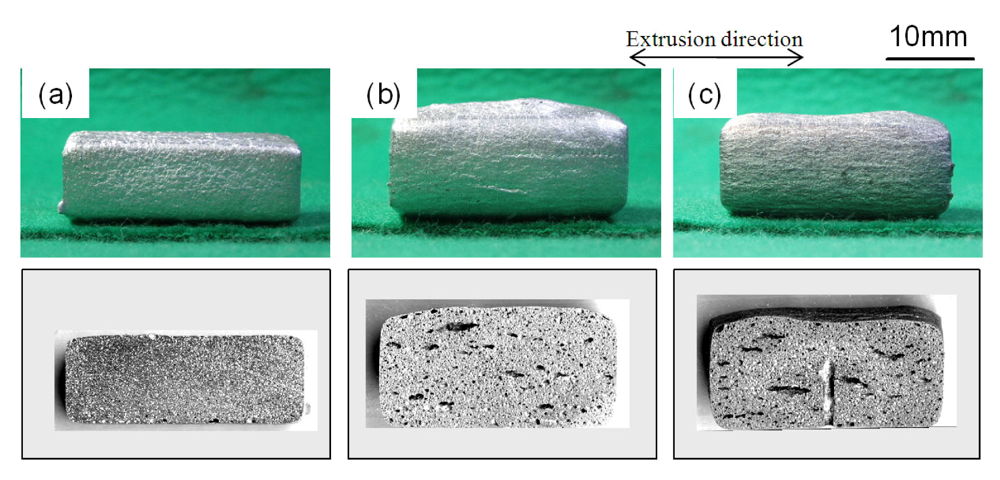
        <p>The foams produced using multiple additions and their cross-sectional views are shown in <xref ref-type="fig" rid="metals-02-00001-f006">Figure 6</xref>. At 903 K, they maintained a fine cell structure. At 933 K, cracks along with extrusion direction were observed. At 973 K, the foam showed the same shape and cell structure as that at 933 K. Multiple additions are effective for preventing shrinkage, but have problem to keep homogenous cell structure. </p>
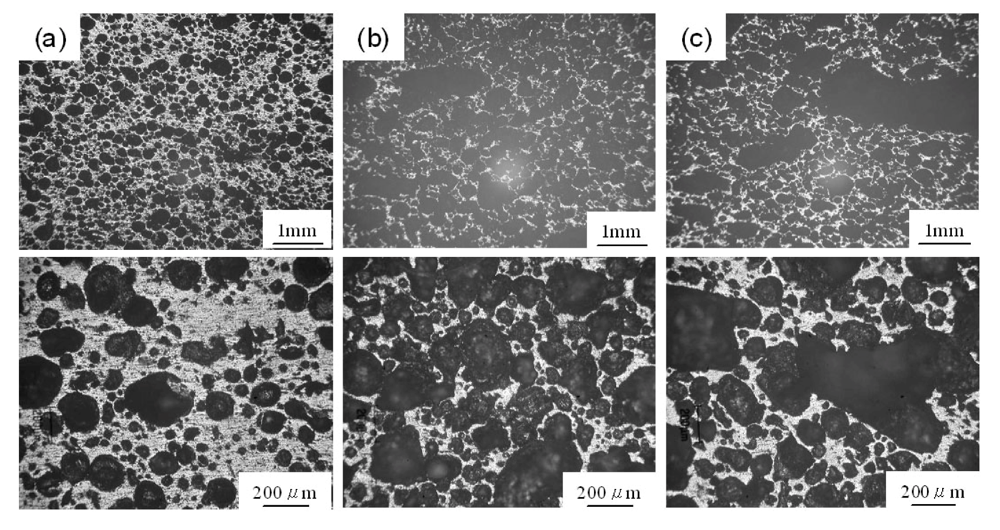
        <p>The cell structures of the foams were observed by optical microscopy, the results of which are shown in <xref ref-type="fig" rid="metals-02-00001-f007">Figure 7</xref>. Most of the cells were below 200 μm in size, because the increased amount of foaming agents inhibits cell coarsening by water absorption. At 933 and 973 K, two cells connected to each other showed similar structures. It is presumed that dolomite created new cells while the cells produced by magnesium carbonate connected.</p>
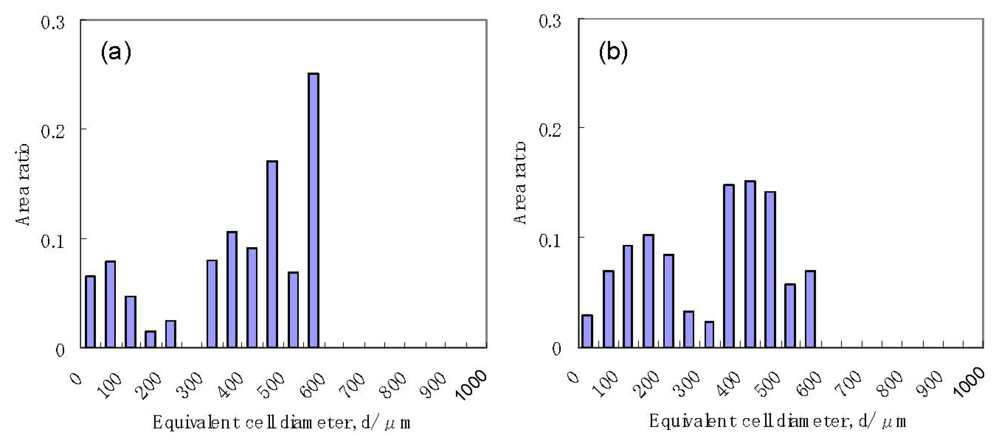
        <p>Cell size distributions of foams were evaluated by image processing software, which is shown in <xref ref-type="fig" rid="metals-02-00001-f008">Figure 8</xref>. In this analysis, area ratios of each cell size are shown for each foam. Foam by dolomite has bimodal cell size distribution, which peaks are 100 μm and 600 μm. Foam by multiple additions has also bimodal cell size distribution but those peaks become closer in 200 μm and 450 μm. Foam by multiple additions is finer and more homogenous cell structure than that by dolomite at this density.</p>
        <fig id="metals-02-00001-f006" position="anchor">
          <label>Figure 6</label>
          <caption>
            <p>Foams produced using 2.0 mass% dolomite and 1.0 mass% MgCO<sub>3</sub>, and their cross sectional views: (<bold>a</bold>) at 903 K, ρ: 0.87 g/cm<sup>3</sup>, (<bold>b</bold>) at 933 K, ρ: 0.58 g/cm<sup>3</sup>, and (<bold>c</bold>) at 973 K, ρ: 0.66 g/cm<sup>3</sup>. </p>
          </caption>
          <graphic xmlns:xlink="http://www.w3.org/1999/xlink" xlink:href="metals-02-00001-g006.tif"/>
        </fig>
        <fig id="metals-02-00001-f007" position="anchor">
          <label>Figure 7</label>
          <caption>
            <p>Microstructures of foams produced using 2.0 mass% dolomite and 1.0 mass% MgCO<sub>3</sub>, lower pictures are magnified images of upper row: (<bold>a</bold>) at 903 K, ρ: 0.87 g/cm<sup>3</sup>; (<bold>b</bold>) at 933 K, ρ: 0.58 g/cm<sup>3</sup>, and (<bold>c</bold>) at 973 K, ρ: 0.66 g/cm<sup>3</sup>.</p>
          </caption>
          <graphic xmlns:xlink="http://www.w3.org/1999/xlink" xlink:href="metals-02-00001-g007.tif"/>
        </fig>
        <fig id="metals-02-00001-f008" position="anchor">
          <label>Figure 8</label>
          <caption>
            <p>Cell size distributions of foam: (<bold>a</bold>) foam by dolomite, at 943 K, ρ: 0.88 g/cm<sup>3</sup>; and (<bold>b</bold>) foam by multiple additions, at 903 K, ρ: 0.87 g/cm<sup>3</sup>. </p>
          </caption>
          <graphic xmlns:xlink="http://www.w3.org/1999/xlink" xlink:href="metals-02-00001-g008.tif"/>
        </fig>
      </sec>
    </sec>
    <sec sec-type="methods">
      <title>3. Experimental</title>
      <sec>
        <title>3.1. Precursor</title>
        <p>Air-atomized AlSiCu powder containing mass fractions of Si (10.8%) and Cu (2.4%) was used to prepare the precursor. The powder was sieved through a 150 μm mesh before use. The dolomite [CaMg(CO<sub>3</sub>)<sub>2</sub>] used was obtained from Murakashi Lime Industry Co., Ltd. and had an average particle size of 3.5 μm. The magnesium carbonate (MgCO<sub>3</sub>) used had an average particle size of 9 μm. </p>
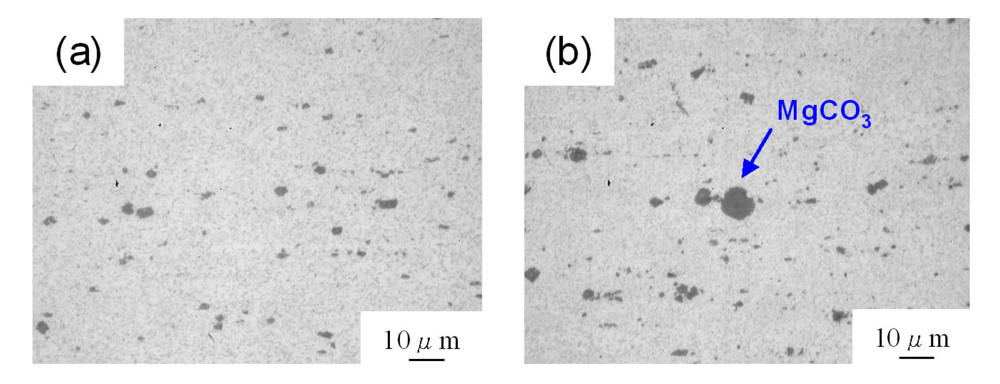
        <p>AlSiCu powder was mixed with the carbonates of the following amounts: (a) 2.0 mass% dolomite, (b) 2.0 mass% dolomite and 1.0 mass% magnesium carbonate. The powder mixtures were compacted at ambient temperature using a uniaxial press at 350 MPa to obtain a relative density of more than 90%. The precursors were extruded at 623 K using the green compact. The extrusion ratio was 29, and the cross section of each precursor was 5.8 mm high and 38 mm wide. The cross-sectional views of precursors are shown in <xref ref-type="fig" rid="metals-02-00001-f009">Figure 9</xref>. No agglomeration was observed in both precursors. Larger particle in <xref ref-type="fig" rid="metals-02-00001-f009">Figure 9</xref>(b) is MgCO<sub>3</sub>.</p>
        <fig id="metals-02-00001-f009" position="anchor">
          <label>Figure 9</label>
          <caption>
            <p>Cross-sectional views of precursors: (<bold>a</bold>) 2.0 mass% dolomite, ρ: 2.69 g/cm<sup>3</sup> and (<bold>b</bold>) 2.0 mass% dolomite and 1.0 mass% MgCO<sub>3</sub>, ρ: 2.70 g/cm<sup>3</sup>.</p>
          </caption>
          <graphic xmlns:xlink="http://www.w3.org/1999/xlink" xlink:href="metals-02-00001-g009.tif"/>
        </fig>
      </sec>
      <sec>
        <title>3.2. Foaming Experiment</title>
        <p>The precursors were cut to a length of 30 mm and a width of 10 mm measured with a type K thermocouple, which is a diameter of 1.6 mm. They were then heated to specific temperatures in a furnace kept at 1098 K. The formed aluminum foams were cooled in air.</p>
        <p>The density of each foam was measured using the Archimedes principle, and the cell structure of each foam was observed by optical microscopy.</p>
      </sec>
    </sec>
    <sec sec-type="conclusions">
      <title>4. Conclusions</title>
      <p>In this study, the shrinkage of foams by carbonate and a method of preventing it were discussed.</p>
      <p>From the observations of cell structures, it was assumed that cell formation at different sites is effective in preventing shrinkage induced by cell connections.</p>
      <p>It was verified that multiple additions of 2.0 mass% dolomite and 1.0 mass% magnesium carbonate are effective in preventing shrinkage. Foam by multiple additions has finer cell structure at a density of 0.87 than that by single dolomite, but has problems maintaining the homogenous cell structure at a lower density. </p>
    </sec>
  </body>
  <back>
    <ref-list>
      <title>References</title>
      <ref id="B1-metals-02-00001">
        <label>1.</label>
        <citation citation-type="patent">
          <person-group person-group-type="author">
            <name>
              <surname>Baumeister</surname>
              <given-names>J.</given-names>
            </name>
          </person-group>
          <article-title>Verfahren zur Herstellung Poroser Meallkorper</article-title>
          <patent>DE4018360</patent>
          <day>8</day>
          <month>6</month>
          <year>1990</year>
        </citation>
      </ref>
      <ref id="B2-metals-02-00001">
        <label>2.</label>
        <citation citation-type="journal">
          <person-group person-group-type="author">
            <name>
              <surname>Nakamura</surname>
              <given-names>T.</given-names>
            </name>
            <name>
              <surname>Gnyloskurenko</surname>
              <given-names>S.V.</given-names>
            </name>
            <name>
              <surname>Sakamoto</surname>
              <given-names>K.</given-names>
            </name>
            <name>
              <surname>Byakova</surname>
              <given-names>A.V.</given-names>
            </name>
            <name>
              <surname>Ishikawa</surname>
              <given-names>R.</given-names>
            </name>
          </person-group>
          <article-title>Development of new foaming agent for metal foam</article-title>
          <source>Mater. Trans.</source>
          <year>2002</year>
          <volume>43</volume>
          <fpage>1191</fpage>
          <lpage>1196</lpage>
        <pub-id pub-id-type="doi">10.2320/matertrans.43.1191</pub-id></citation>
      </ref>
      <ref id="B3-metals-02-00001">
        <label>3.</label>
        <citation citation-type="journal">
          <person-group person-group-type="author">
            <name>
              <surname>Gergely</surname>
              <given-names>V.</given-names>
            </name>
            <name>
              <surname>Curran</surname>
              <given-names>D.C.</given-names>
            </name>
            <name>
              <surname>Clyne</surname>
              <given-names>T.W.</given-names>
            </name>
          </person-group>
          <article-title>The foamcarp process: Foaming of aluminium MMCs by the chalk-aluminium reaction in precursors</article-title>
          <source>Compos. Sci. Technol.</source>
          <year>2003</year>
          <volume>63</volume>
          <fpage>2301</fpage>
          <lpage>2310</lpage>
          <pub-id pub-id-type="doi">10.1016/S0266-3538(03)00263-X</pub-id>
        </citation>
      </ref>
      <ref id="B4-metals-02-00001">
        <label>4.</label>
        <citation citation-type="journal">
          <person-group person-group-type="author">
            <name>
              <surname>Papadopoulos</surname>
              <given-names>D.P.</given-names>
            </name>
            <name>
              <surname>Omar</surname>
              <given-names>H.</given-names>
            </name>
            <name>
              <surname>Stergioudi</surname>
              <given-names>F.</given-names>
            </name>
            <name>
              <surname>Tsipas</surname>
              <given-names>S.A.</given-names>
            </name>
            <name>
              <surname>Lefakis</surname>
              <given-names>H.</given-names>
            </name>
            <name>
              <surname>Michailidis</surname>
              <given-names>N.J.</given-names>
            </name>
          </person-group>
          <article-title>A novel method for producing Al-foams and evaluation of their compression behavior</article-title>
          <source>J. Porous Mater.</source>
          <year>2010</year>
          <volume>17</volume>
          <fpage>773</fpage>
          <lpage>777</lpage>
          <pub-id pub-id-type="doi">10.1007/s10934-009-9349-5</pub-id>
        </citation>
      </ref>
      <ref id="B5-metals-02-00001">
        <label>5.</label>
        <citation citation-type="journal">
          <person-group person-group-type="author">
            <name>
              <surname>Papadopoulos</surname>
              <given-names>D.P.</given-names>
            </name>
            <name>
              <surname>Omar</surname>
              <given-names>H.</given-names>
            </name>
            <name>
              <surname>Stergioudi</surname>
              <given-names>F.</given-names>
            </name>
            <name>
              <surname>Tsipas</surname>
              <given-names>S.A.</given-names>
            </name>
            <name>
              <surname>Michailidis</surname>
              <given-names>N.</given-names>
            </name>
          </person-group>
          <article-title>The use of dolomite as foaming agent and its effect on the microstructure of aluminium metal foams-comparison to titanium hydride</article-title>
          <source>Colloids Surf. A</source>
          <year>2011</year>
          <volume>382</volume>
          <fpage>118</fpage>
          <lpage>123</lpage>
        <pub-id pub-id-type="doi">10.1016/j.colsurfa.2010.12.005</pub-id></citation>
      </ref>
      <ref id="B6-metals-02-00001">
        <label>6.</label>
        <citation citation-type="journal">
          <person-group person-group-type="author">
            <name>
              <surname>Ip</surname>
              <given-names>S.W.</given-names>
            </name>
            <name>
              <surname>Wang</surname>
              <given-names>Y.</given-names>
            </name>
            <name>
              <surname>Toguri</surname>
              <given-names>J.</given-names>
            </name>
          </person-group>
          <article-title>Aluminum foam stabilization by solid particles</article-title>
          <source>Can. Metall. Quart.</source>
          <year>1999</year>
          <volume>38</volume>
          <fpage>81</fpage>
          <lpage>92</lpage>
          <pub-id pub-id-type="doi">10.1016/S0008-4433(98)00024-X</pub-id>
        </citation>
      </ref>
      <ref id="B7-metals-02-00001">
        <label>7.</label>
        <citation citation-type="journal">
          <person-group person-group-type="author">
            <name>
              <surname>Cambronero</surname>
              <given-names>L.E.G.</given-names>
            </name>
            <name>
              <surname>Ruiz-Roman</surname>
              <given-names>J.M.</given-names>
            </name>
            <name>
              <surname>Corpas</surname>
              <given-names>F.A.</given-names>
            </name>
            <name>
              <surname>Ruiz Prieto</surname>
              <given-names>J.M.</given-names>
            </name>
          </person-group>
          <article-title>Manufacturing of Al-Mg-Si alloy foam using calcium carbonate as foaming agent</article-title>
          <source>J. Mater. Process. Technol.</source>
          <year>2009</year>
          <volume>209</volume>
          <fpage>1803</fpage>
          <lpage>1809</lpage>
        <pub-id pub-id-type="doi">10.1016/j.jmatprotec.2008.04.032</pub-id></citation>
      </ref>
      <ref id="B8-metals-02-00001">
        <label>8.</label>
        <citation citation-type="journal">
          <person-group person-group-type="author">
            <name>
              <surname>Haesche</surname>
              <given-names>M.</given-names>
            </name>
            <name>
              <surname>Lehmhus</surname>
              <given-names>D.</given-names>
            </name>
            <name>
              <surname>Weise</surname>
              <given-names>J.</given-names>
            </name>
            <name>
              <surname>Wichmann</surname>
              <given-names>M.</given-names>
            </name>
            <name>
              <surname>Mocellin</surname>
              <given-names>I.C.M.</given-names>
            </name>
          </person-group>
          <article-title>Carbonates as foaming agent in chip-based aluminium foam precursor</article-title>
          <source>J. Mater. Sci. Technol.</source>
          <year>2010</year>
          <volume>26</volume>
          <fpage>845</fpage>
          <lpage>850</lpage>
          <pub-id pub-id-type="doi">10.1016/S1005-0302(10)60135-1</pub-id>
        </citation>
      </ref>
      <ref id="B9-metals-02-00001">
        <label>9.</label>
        <citation citation-type="journal">
          <person-group person-group-type="author">
            <name>
              <surname>Koizumi</surname>
              <given-names>T.</given-names>
            </name>
            <name>
              <surname>Kido</surname>
              <given-names>K.</given-names>
            </name>
            <name>
              <surname>Kita</surname>
              <given-names>K.</given-names>
            </name>
            <name>
              <surname>Mikado</surname>
              <given-names>K.</given-names>
            </name>
            <name>
              <surname>Gnyloskurenko</surname>
              <given-names>S.V.</given-names>
            </name>
            <name>
              <surname>Nakamura</surname>
              <given-names>T.</given-names>
            </name>
          </person-group>
          <article-title>Foaming agents for powder metallurgy production of aluminum foam</article-title>
          <source>Mater. Trans.</source>
          <year>2011</year>
          <volume>52</volume>
          <fpage>728</fpage>
          <lpage>733</lpage>
          <pub-id pub-id-type="doi">10.2320/matertrans.M2010401</pub-id>
        </citation>
      </ref>
      <ref id="B10-metals-02-00001">
        <label>10.</label>
        <citation citation-type="journal">
          <person-group person-group-type="author">
            <name>
              <surname>Koizumi</surname>
              <given-names>T.</given-names>
            </name>
            <name>
              <surname>Kido</surname>
              <given-names>K.</given-names>
            </name>
            <name>
              <surname>Kita</surname>
              <given-names>K.</given-names>
            </name>
            <name>
              <surname>Mikado</surname>
              <given-names>K.</given-names>
            </name>
            <name>
              <surname>Gnyloskurenko</surname>
              <given-names>S.V.</given-names>
            </name>
            <name>
              <surname>Nakamura</surname>
              <given-names>T.</given-names>
            </name>
          </person-group>
          <article-title>The improvement of mechanical properties of metallic foams by carbonates as a foaming agent</article-title>
          <source>J. Jpn. Inst. Metals</source>
          <year>2011</year>
          <volume>75</volume>
          <fpage>355</fpage>
          <lpage>360</lpage>
          <pub-id pub-id-type="doi">10.2320/jinstmet.75.355</pub-id>
        </citation>
      </ref>
      <ref id="B11-metals-02-00001">
        <label>11.</label>
        <citation citation-type="journal">
          <person-group person-group-type="author">
            <name>
              <surname>Koizumi</surname>
              <given-names>T.</given-names>
            </name>
            <name>
              <surname>Kido</surname>
              <given-names>K.</given-names>
            </name>
            <name>
              <surname>Kita</surname>
              <given-names>K.</given-names>
            </name>
            <name>
              <surname>Mikado</surname>
              <given-names>K.</given-names>
            </name>
            <name>
              <surname>Gnyloskurenko</surname>
              <given-names>S.V.</given-names>
            </name>
            <name>
              <surname>Nakamura</surname>
              <given-names>T.</given-names>
            </name>
          </person-group>
          <article-title>Effect of mass fraction of dolomite on the foaming behavior of Al foam by PM route</article-title>
          <source>Metallur. Trans. A</source>
          <year>2011</year>
          <comment>submitted for publication</comment>
        </citation>
      </ref>
      <ref id="B12-metals-02-00001">
        <label>12.</label>
        <citation citation-type="journal">
          <person-group person-group-type="author">
            <name>
              <surname>Duarte</surname>
              <given-names>I.</given-names>
            </name>
            <name>
              <surname>Banhart</surname>
              <given-names>J.</given-names>
            </name>
          </person-group>
          <article-title>A study of aluminium foam formation-kinetics and microstructure</article-title>
          <source>Acta Mater.</source>
          <year>2000</year>
          <volume>48</volume>
          <fpage>2349</fpage>
          <lpage>2362</lpage>
          <pub-id pub-id-type="doi">10.1016/S1359-6454(00)00020-3</pub-id>
        </citation>
      </ref>
      <ref id="B13-metals-02-00001">
        <label>13.</label>
        <citation citation-type="journal">
          <person-group person-group-type="author">
            <name>
              <surname>Banhart</surname>
              <given-names>J.</given-names>
            </name>
          </person-group>
          <article-title>Metal foams: Production and stability</article-title>
          <source>Adv. Eng. Mater.</source>
          <year>2006</year>
          <volume>8</volume>
          <fpage>781</fpage>
          <lpage>794</lpage>
          <pub-id pub-id-type="doi">10.1002/adem.200600071</pub-id>
        </citation>
      </ref>
    </ref-list>
  </back>
</article>