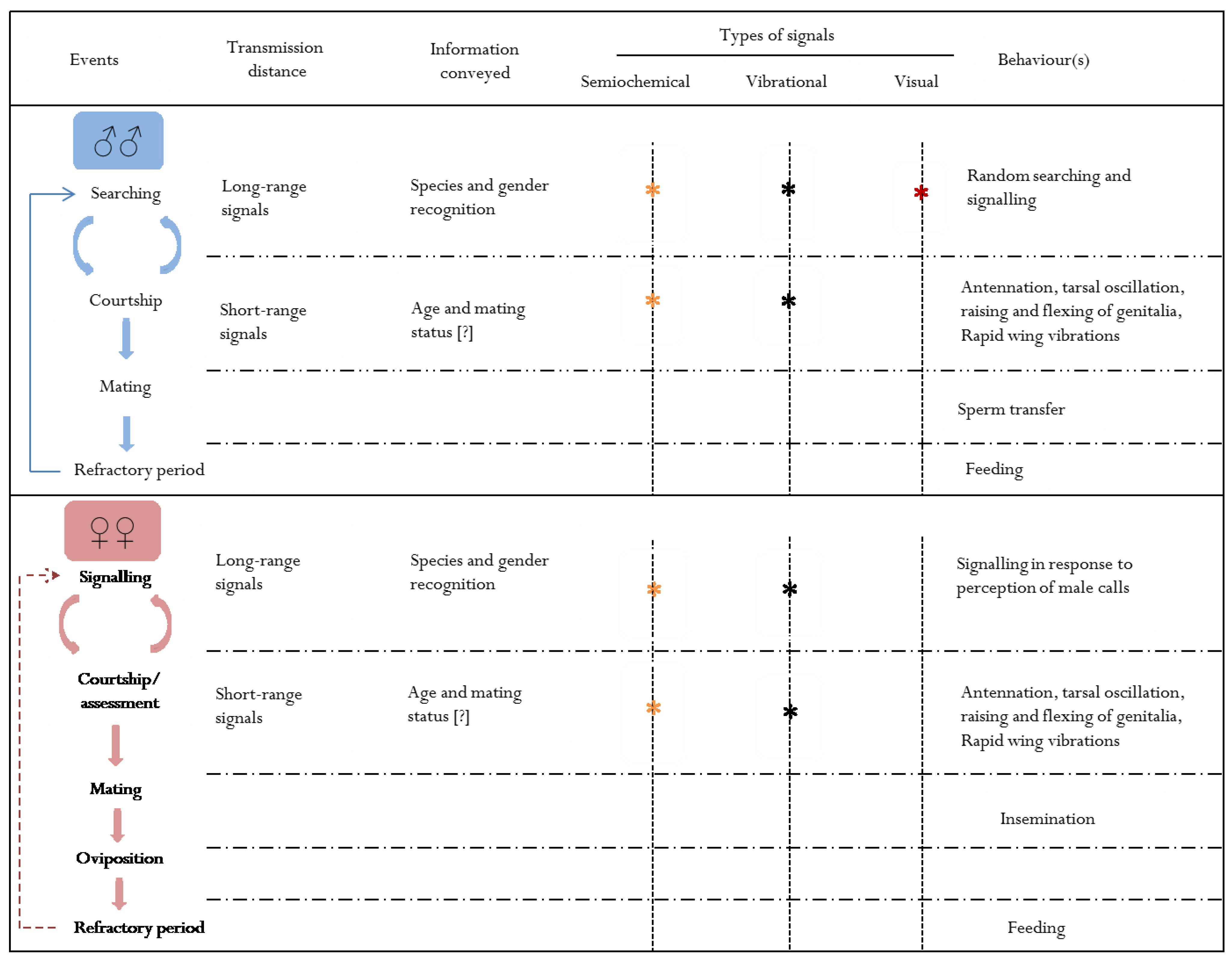

Semiochemical and Vibrational Cues and Signals Mediating Mate Finding and Courtship in Psylloidea (Hemiptera): A Synthesis

Abstract
1. Signals and Strategies of Insect Sexual Selection
2. Introduction to the Psylloidea
3. Psyllid Reproductive Biology and Mating Systems
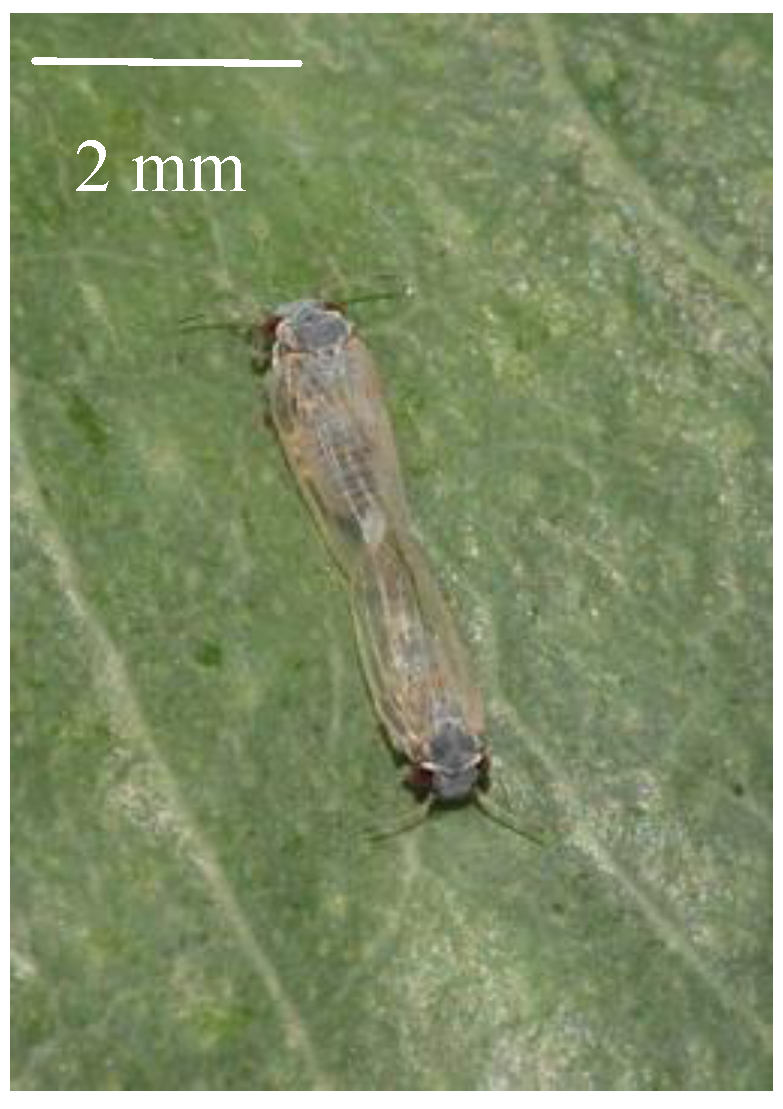
4. Male Mating Strategies

5. Semiochemical Signalling in Psyllids

| Family | Species | Semiochemical (s) | Vibrational Signal | Nature of Vibrational Signal | Mechanism of Vibrational Signal Production | Ref. | |
|---|---|---|---|---|---|---|---|
| Substrate Borne Vibrations | Air Borne Vibrations | ||||||
| Aphalaridae | Anoeconeossa sp. Anoeconeossa unicornuta | ● | ■ | RWV, TO [?] | [96,97,98] | ||
| Aphalara affinis, Aphalara polygoni | ● | ■ | RWV | [60,96] | |||
| Australopsylla sp. | ● | ■ | RWV/TO [?] | [96,97,98] | |||
| Blastopsylla sp. | ●? | TO [?] | [97] | ||||
| Cardiaspina albitextura, C. retator, C. tenuitela, C. densitexta | ● | ■ | Faint whirring sound | RWV | [67,98] | ||
| Cardiaspina maniformis, C. fiscella | ● | ■ | RWV | [96,99] | |||
| Craspedolepta gloriosa, C. campestrella, C. nervosa, C. flavipennis, C. nebulosa | ● | ■ | RWV | [60] | |||
| Creiis spp. | ● | High pitched buzzing calls | RWV | [76,98] | |||
| Ctenarytaina sp. | ●? | TO [?] | [97] | ||||
| Glycaspis spp. G. brimblecombei, G. johnsoni, G. neureta | ● | ■ | RWV/TO [?] | [97,98] | |||
| Lasiopsylla rotundipennis | ● | ■ | RWV | [96,98] | |||
| Spondyliaspis sp. | ● | ■ | RWV | [96,98] | |||
| Phellopsylla sp. | ● | ■ | RWV | [96,98] | |||
| Carsidaridae | Protyora sterculiae | ●? | TO [?] | [97] | |||
| Liviidae | Diaphorina citri | ▲ (A) | ● | ■ | RWV | [78,92,100] | |
| Eremopsylloides amirabilis | ● | RWV | [63] | ||||
| Livia juncorum | ● | Short buzzing sounds | RWV | [60,101] | |||
| Pachypsylloides citreus | ● | ■ | RWV | [63] | |||
| Psyllidae | Cacopsylla bidens | ▲ | ? | [82] | |||
| Cacopylla pyri | ● | ■ | RWV | [77] | |||
| Cacopsylla pyricola | ▲ (B) | RWV | [88,91,94] | ||||
| Colposcenia aliena | ● | ■ | RWV | [63] | |||
| Livilla ulicis | ● | ■ | RWV | [60,96] | |||
| Triozidae | Aacanthocnema dobsoni | ● | ■ | RWV | [59] | ||
| Bactericera cockerelli | ▲ | ? | [90] | ||||
| Bactericera perrisii, B. kratochvili, B. calcarata, Eryngiofaga deserta | ● | ■ | RWV | [63] | |||
| Schedotrioza apicobystra, S. cornuta, S. distorta, S. marginata, S. multitudinea, Schedotrioza sp. | ● | ■ | RWV | [59] | |||
| Trioza tricornuta, T. percyae | ● | RWV | [59] | ||||
| Trioza spp. Trioza acutipennis, T. nigricornis, Trioza urticae | ● | ■ | Short buzzing sounds | RWV | [59,63,101] | ||
6. Vibrational Signalling in Psyllids
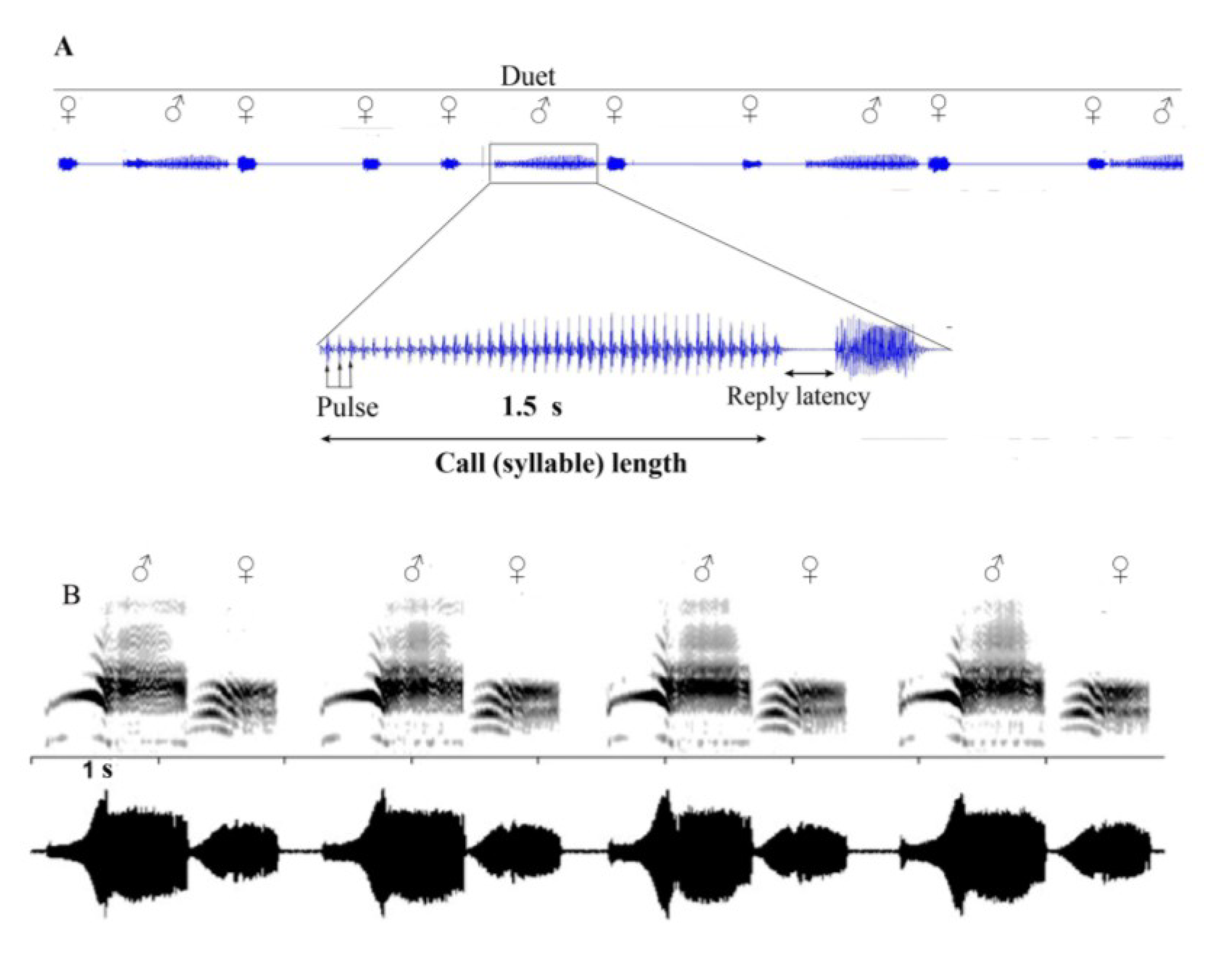
7. Multimodal Signalling
8. Future Directions
Acknowledgments
Author Contributions
Conflicts of Interest
References
- Bradbury, J.W.; Vehrencamp, S.L. Mate attraction and courtship. In Principles of Animal Communication, 2nd ed.; Sinauer Associate Inc.: Massacusets, MA, USA, 1998; Volume 12. [Google Scholar]
- Thornhill, R. Male and female sexual selection and the evolution of mating strategies in insects. In Sexual Selection and Reproductive Competition in Insects; Academic Press: New York, NY, USA, 1979; pp. 81–121. [Google Scholar]
- Parker, G.A. Sperm competition and the evolution of animal mating strategies. In Sperm Competition and the Evolution of Animal Mating Systems; Academic Press: New York, NY, USA, 1984; pp. 1–60. [Google Scholar]
- Johansson, B.G.; Jones, T.M. The role of chemical communication in mate choice. Biol. Rev. 2007, 82, 265–289. [Google Scholar] [CrossRef]
- Chapman, T.; Arnqvist, G.; Bangham, J.; Rowe, L. Sexual conflict. Trends Ecol. Evol. 2003, 18, 41–47. [Google Scholar] [CrossRef]
- Schärer, L.; Rowe, L.; Arnqvist, G. Anisogamy, chance and the evolution of sex roles. Trends Ecol. Evol. 2012, 27, 260–264. [Google Scholar] [CrossRef]
- Pashler, H.; Mozer, M.; Harris, C.R. Mating strategies in a Darwinian microworld: Simulating the consequences of female reproductive refractoriness. Adapt. Behav. 2001, 9, 5–15. [Google Scholar] [CrossRef]
- Kaitala, A.; Wiklund, C. Female mate choice and mating costs in the polyandrous butterfly Pieris napi (Lepidoptera: Pieridae). J. Insect Behav. 1994, 8, 355–363. [Google Scholar] [CrossRef]
- Karlström, A. Female mate choice and modulation of oviposition preference in the moth Spodoptera littoralis. BSc. Thesis, Swedish University of Agricultural Sciences, Uppsala, Sweden, 2013. [Google Scholar]
- Crean, C.S.; Dunn, D.W.; Day, T.H.; Gilburn, A.S. Female mate choice for large males in several species of seaweed fly (Diptera: Coelopidae). Anim. Behav. 2000, 59, 121–126. [Google Scholar] [CrossRef]
- Bonduriansky, R. The evolution of male mate choice in insects: A synthesis of ideas and evidence. Biol. Rev. 2001, 76, 305–339. [Google Scholar] [CrossRef]
- Rutowski, R.L. Courtship solicitation by females of the checkered white butterfly, Pieris protodice. Behav. Ecol. Sociobiol. 1980, 7, 113–117. [Google Scholar] [CrossRef]
- Gwynne, D.T.; Jamieson, I. Sexual selection and sexual dimorphism in a harem-polygynous insect, the Alpine weta Hemideina maori (Orthoptera Stenopelmatidae). Ethol. Ecol. Evol. 1998, 10, 393–402. [Google Scholar] [CrossRef]
- Helinski, M.E.H.; Valerio, L.; Facchinelli, L.; Scott, T.W.; Ramsey, J.; Harrington, L.C. Evidence of polyandry for Aedes aegypti in semifield enclosures. Am. J. Trop. Med. Hyg. 2012, 86, 635–641. [Google Scholar] [CrossRef]
- Franco, K.; Jauset, A.; Castañé, C. Monogamy and polygamy in two species of mirid bugs: A functional-based approach. J. Insect Physiol. 2011, 57, 307–315. [Google Scholar] [CrossRef]
- Thornhill, R.; Alcock, J. The Evolution of Insect Mating Systems; Harvard University Press: Cambridge, MA, USA, 1983. [Google Scholar]
- Emlen, S.T.; Oring, L.W. Ecology, sexual selection, and the evolution of mating systems. Science 1977, 197, 215–223. [Google Scholar]
- Shuster, S.M.; Wade, M.J. Mating Systems and Strategies; Princeton University Press: Princeton, NJ, USA, 2003; pp. 262–443. [Google Scholar]
- Greenfield, M.D. Signalers and receivers. In Mechanisms and Evolution of Arthropod Communication; Oxford University Press: New York, NY, USA, 2002; p. 414. [Google Scholar]
- Jacobson, M. Occurrence of sex pheromones in the female. In Insect Sex Pheromones; Academic Press, Inc.: New York, NY, USA, 2012; pp. 5–27. [Google Scholar]
- KonDo, Y.; Naka, H.; Tsuchida, K. Pheromones and body coloration affect mate recognition in the Japanese nine-spotted moth Amata fortunei (Lepidoptera: Arctiidae). J. Ethol. 2012, 30, 301–308. [Google Scholar] [CrossRef]
- Benelli, G.; Giunti, G.; Messing, R.H.; Wright, M.G. Visual and olfactory female-borne cues evoke male courtship in the aphid parasitoid Aphidius colemani Viereck (Hymenoptera: Braconidae). J. Insect Behav. 2013, 26, 695–707. [Google Scholar] [CrossRef]
- Itadani, H.; Ueno, T. Chemically mediated mate finding of the polyphagous politary parasitoid Itoplectis naranyae (Hymenoptera: Ichneumonidae). Ann. Entomol. Soc. Am. 2014, 107, 288–294. [Google Scholar] [CrossRef]
- Cooley, J.R. Long-range acoustical signals, phonotaxis, and risk in the sexual pair-forming behaviors of Okanagana canadensis and O. rimosa (Hemiptera: Cicadidae). Ann. Entomol. Soc. Am. 2001, 94, 755–760. [Google Scholar] [CrossRef]
- Virant-Doberlet, M.; Cokl, A. Vibrational communication in insects. Neotrop. Entomol. 2004, 33, 121–134. [Google Scholar] [CrossRef]
- Čokl, A.; Virant-Doberlet, M. Communication with substrate-borne signals in small plant-dwelling insects 1. Annu. Rev. Entomol. 2003, 48, 29–50. [Google Scholar] [CrossRef]
- Hansson, B.S.; Stensmyr, M.C. Evolution of insect olfaction. Neuron 2011, 72, 698–711. [Google Scholar] [CrossRef]
- Bennet-Clark, H.C. Songs and the physics of sound production. Cricket Behav. Neurobiol. 1989, 227, 261. [Google Scholar]
- Young, D.; Bennet-Clark, H.C. The role of the tymbal in cicada sound production. J. Exp. Biol. 1995, 198, 1001–1020. [Google Scholar]
- Martin, J.P.; Beyerlein, A.; Dacks, A.M.; Reisenman, C.E.; Riffell, J.A.; Lei, H.; Hildebrand, J.G. The neurobiology of insect olfaction: Sensory processing in a comparative context. Prog. Neurobiol. 2011, 95, 427–447. [Google Scholar] [CrossRef]
- Ringo, J. Sexual receptivity in insects. Annu. Rev. Entomol. 1996, 41, 473–494. [Google Scholar] [CrossRef]
- Singer, T.L. Roles of hydrocarbons in the recognition systems of insects. Am. Zool. 1998, 38, 394–405. [Google Scholar]
- Martin, S.; Drijfhout, F. A review of ant cuticular hydrocarbons. J. Chem. Ecol. 2009, 35, 1151–1161. [Google Scholar] [CrossRef]
- Cocroft, R.B.; Rodríguez, R.L. The behavioral ecology of insect vibrational communication. Bioscience 2005, 55, 323–334. [Google Scholar] [CrossRef]
- Higham, J.P.; Hebets, E.A. An introduction to multimodal communication. Behav. Ecol. Sociobiol. 2013, 67, 1381–1388. [Google Scholar] [CrossRef]
- Miklas, N.; Čokl, A.; Renou, M.; Virant-Doberlet, M. Variability of vibratory signals and mate choice selectivity in the southern green stink bug. Behav. Process. 2003, 61, 131–142. [Google Scholar] [CrossRef]
- Miklas, N.; Lasnier, T.; Renou, M. Male bugs modulate pheromone emission in response to vibratory signals from conspecifics. J. Chem. Ecol. 2003, 29, 561–574. [Google Scholar] [CrossRef]
- Paterson, H.E.H. The recognition concept of species. In Species and Speciation; Transvaal Museum: Pretoria, South Africa, 1985; pp. 21–29. [Google Scholar]
- Wagner, W.E.; Reiser, M.G. The importance of calling song and courtship song in female mate choice in the variable field cricket. Anim. Behav. 2000, 59, 1219–1226. [Google Scholar] [CrossRef]
- Fonseca, P.J. Cicada acoustic communication. In Insect Hearing and Acoustic Communication; Hedwig, B., Ed.; Berlin Heidelberg, Springer: Berlin, Heidelberg, Germany, 2014; pp. 101–121. [Google Scholar]
- Austin, A.D.; Yeates, D.K.; Cassis, G.; Fletcher, M.J.; La Salle, J.; Lawrence, J.F.; McQuillan, P.B.; Mound, L.A.; Bickel, D.J.; Gullan, P.J.; et al. Insects “Down Under”—Diversity, endemism and evolution of the Australian insect fauna: Examples from select orders. Aust. J. Entomol. 2004, 43, 216–234. [Google Scholar] [CrossRef]
- Ouvrard, D. Psyl’list. The World Psylloidea Database. Available online: http://www.hemiptera-databases.com/psyllist (accessed on 5 July 2014).
- Woodburn, T.L.; Lewis, E.E. A comparative histological study of the effects of feeding by nymphs of four psyllid species on the leaves of eucalypts. Aust. J. Entomol. 1973, 12, 134–138. [Google Scholar] [CrossRef]
- Hodkinson, I.D. The biology of the Psylloidea (Homoptera): A review. Bull. Entomol. Res. 1974, 64, 325–338. [Google Scholar] [CrossRef]
- Munyaneza, J.E.; Crosslin, J.M.; Upton, J.E. Association of Bactericera cockerelli (Homoptera: Psyllidae) with “zebra chip,” a new potato disease in southwestern United States and Mexico. J. Econ. Entomol. 2007, 100, 656–663. [Google Scholar] [CrossRef]
- Munyaneza, J.E.; Goolsby, J.A.; Crosslin, J.M.; Upton, J.E. Further evidence that zebra chip potato disease in the lower Rio Grande Valley of Texas is associated with Bactericera cockerelli. Subtrop. Plant Sci. 2007, 59, 30–37. [Google Scholar]
- Hung, T.H.; Hung, S.C.; Chen, C.N.; Hsu, M.H.; Su, H.J. Detection by PCR of Candidatus Liberibacter asiaticus, the bacterium causing citrus huanglongbing in vector psyllids: Application to the study of vector-pathogen relationships. Plant Pathol. 2004, 53, 96–102. [Google Scholar] [CrossRef]
- Halbert, S.E.; Manjunath, K.L. Asian citrus psyllids (Sternorrhyncha: Psyllidae) and greening disease of citrus: A literature review and assessment of risk in Florida. Fla. Entomol. 2004, 87, 330–353. [Google Scholar] [CrossRef]
- Mayer, C.J.; Vilcinskas, A.; Gross, J. Phytopathogen lures its insect vector by altering host plant odor. J. Chem. Ecol. 2008, 34, 1045–1049. [Google Scholar] [CrossRef]
- Mayer, C.J.; Vilcinskas, A.; Gross, J. Chemically mediated multitrophic interactions in a plant—insect vector-phytoplasma system compared with a partially nonvector species. Agric. For. Entomol. 2011, 13, 25–35. [Google Scholar] [CrossRef]
- Burckhardt, D.; Ouvrard, D.; Queiroz, D.; Percy, D. Psyllid host-plants (Hemiptera: Psylloidea): Resolving a semantic problem. Fla. Entomol. 2014, 97, 242–246. [Google Scholar]
- Yang, M.-M.; Raman, A. Diversity, richness, and patterns of radiation among gall-inducing psyllids (Hemiptera: Psylloidea) in the Orient and Eastern Palearctic. Oriental Insects. 2007, 41, 55–65. [Google Scholar] [CrossRef]
- Prophetou-Athanasiadou, D.A.; Tzanakakis, M.E. Diapause termination in the olive psyllid Euphyllura phillyreae, in the field and in the laboratory. Entomol. Exp. Appl. 1986, 40, 263–272. [Google Scholar] [CrossRef]
- Krysan, J.L.; Higbee, B.S. Seasonality of mating and ovarian development overwintering Cacopsylla pyricola (Homoptera: Psyllidae). Environ. Entomol. 1990, 19, 544–550. [Google Scholar]
- Purvis, G.; Chauzar, M.P.; Segonds. Pichon, A.; Dunne, R. Life history and phenology of the eucalyptus psyllid, Ctenarytaina eucalypti in Ireland. Ann. Appl. Biol. 2002, 141, 283–292. [Google Scholar] [CrossRef]
- Wenninger, E.J.; Hall, D.G. Daily timing of mating and age at reproductive maturity in Diaphorina citri (Hemiptera: Psyllidae). Fla. Entomol. 2007, 90, 715–722. [Google Scholar] [CrossRef]
- Guédot, C.; Horton, D.R.; Landolt, P.J. Age at reproductive maturity and effect of age and time of day on sex attraction in the potato psyllid Bactericera cockerelli. Insect Sci. 2012, 19, 585–594. [Google Scholar] [CrossRef]
- Van den Berg, M.A.; Deacon, V.E.; Thomas, C.D. Ecology of the citrus psylla, Trioza erytreae (Hemiptera: Triozidae). 3. Mating, fertility and oviposition. Phytophylactica 1991, 23, 195–200. [Google Scholar]
- Percy, D.M.; Taylor, G.S.; Kennedy, M. Psyllid communication: Acoustic diversity, mate recognition and phylogenetic signal. Invertebr. Syst. 2006, 20, 431–445. [Google Scholar] [CrossRef]
- Tishechkin, D.Y.; Drosopoulos, S.; Claridge, M.F. Vibratory communication in Psylloidea (Hemiptera). In Insect Sounds and Communication; Drosopoulos, S., Claridge, M.F., Eds.; CRS Press: New York, NY, USA, 2005; pp. 357–363. [Google Scholar]
- Wenninger, E.J.; Hall, D.G. Importance of multiple mating to female reproductive output in Diaphorina citri. Physiol. Entomol. 2008, 33, 316–321. [Google Scholar] [CrossRef]
- Burts, E.C.; Fischer, W.R. Mating behavior, egg production, and egg fertility in the Pear psylla. J. Econ. Entomol. 1967, 60, 1297–1300. [Google Scholar]
- Tishechkin, D.Y. New data on vibratory communication in jumping plant lice of the families Aphalaridae and Triozidae (Homoptera, Psyllinea). Entomol. Rev. 2007, 87, 394–400. [Google Scholar] [CrossRef]
- Guédot, C.; Horton, D.R.; Landolt, P.J.; Munyaneza, J.E. Effect of mating on sex attraction in Bactericera cockerelli with evidence of refractoriness. Entomol. Exp. Appl. 2013, 149, 27–35. [Google Scholar] [CrossRef]
- Horton, D.R.; Lewis, T.M. Interplant movement by pear psylla (Homoptera: Psyllidae): Effects of sex ratio and reproductive status. J. Insect Behav. 1995, 8, 687–700. [Google Scholar] [CrossRef]
- Andersson, J.; Borg-Karlson, A.-K.; Wiklund, C. Sexual cooperation and conflict in butterflies: A male-transferred anti-aphrodisiac reduces harassment of recently mated females. Proc. R. Soc. Lond. Ser. B Biol. Sci. 2000, 267, 1271–1275. [Google Scholar] [CrossRef]
- White, T.C.R. Some aspects of the life history, host selection, dispersal and ovipostion of adult Cardiaspina densitexta (Homoptera: Psyllidae). Aust. J. Zool. 1970, 18, 105–117. [Google Scholar] [CrossRef]
- Krysan, J.L. Laboratory study of mating behavior as related to diapause in overwintering Cacopsylla pyricola (Homoptera: Psyllidae). Environ. Entomol. 1990, 19, 551–557. [Google Scholar]
- Cook, P.P. Mating behaviour of Psylla pyricola Forster (Hom. Psyllidae). Pan-Pac. Entomol. 1963, 39, 175. [Google Scholar]
- Brown., R.L. Chemical and Behavioral Ecology of the Pear Psylla, Cacopsylla pyricola Förster (Hemiptera: Psyllidae). M.Sc. Thesis, Washington State University, Washington, DC, USA, 2008. [Google Scholar]
- Kozlowski, M.W.; Aoxiang, S. Ritual behaviors associated with spermatophore transfer in Deuterosminthurus bicinctus (Collembola: Bourletiellidae). J. Ethol. 2006, 24, 103–109. [Google Scholar] [CrossRef]
- Kessel, E.L. The mating activities of balloon flies. Syst. Biol. 1955, 4, 97–104. [Google Scholar]
- Nelson, C.M.; Nolen, T.G. Courtship song, male agonistic encounters, and female mate choice in the house cricket, Acheta domesticus (Orthoptera: Gryllidae). J. Insect Behav. 1997, 10, 557–570. [Google Scholar] [CrossRef]
- Knowlton, G.F.; Janes, M.J. Studies on the biology of Paratrioza cockerelli (Sulc). Ann. Entomol. Soc. Am. 1931, 24, 283–292. [Google Scholar]
- Yang, M.M.; Yang, C.T.; Chao, J.T. Reproductive isolation and taxonomy of two Taiwanese Paurocephala species (Homoptera: Psylloidea). Monogr. Taiwan Musuem 1986, 6, 177–203. [Google Scholar]
- Taylor, K.L. A possible stridulatory organ in some Psylloidea (Homoptera). Aust. J. Entomol. 1985, 24, 77–80. [Google Scholar] [CrossRef]
- Eben, A.; Mühlethaler, R.; Gross, J.; Hoch, H. First evidence of acoustic communication in the pear psyllid Cacopsylla pyri L. (Hemiptera: Psyllidae). J. Pest Sci. 2014, in press. [Google Scholar]
- Wenninger, E.J.; Hall, D.G.; Mankin, R.W. Vibrational communication between the sexes in Diaphorina citri (Hemiptera: Psyllidae). Ann. Entomol. Soc. Am. 2009, 102, 547–555. [Google Scholar] [CrossRef]
- Kristoffersen, L.; Hallberg, E.; Wallén, R.; Anderbrant, O. Sparse sensillar array on Trioza apicalis (Homoptera, Triozidae) antennae-an adaptation to high stimulus levels? Arthropod Struct. Dev. 2006, 35, 85–92. [Google Scholar] [CrossRef]
- Onagbola, E.O.; Meyer, W.L.; Boina, D.R.; Stelinski, L.L. Morphological characterization of the antennal sensilla of the Asian citrus psyllid, Diaphorina citri Kuwayama (Hemiptera: Psyllidae), with reference to their probable functions. Micron 2008, 39, 1184–1191. [Google Scholar] [CrossRef]
- Arras, J.; Hunter, W.; Bextine, B. Comparative analysis of antennae sensory arrays in asian citrus psyllid, Diaphorina citri, and potato psyllid, Bactericera cockerelli (Hemiptera). Southwest. Entomol. 2012, 37, 1–12. [Google Scholar] [CrossRef]
- Soroker, V.; Talebaev, S.; Harari, A.R.; Wesley, S.D. The role of chemical cues in host and mate location in the pear psylla Cacopsylla bidens (Homoptera: Psyllidae). J. Insect Behav. 2004, 17, 613–626. [Google Scholar] [CrossRef]
- Moran, V.C.; Brown, R.P. The antennae, host plant chemoreception and probing activity of the citrus psylla, Trioza erytreae (Del Guercio) (Homoptera: Psyllidae). J. Entomol. Soc. South. Afr. 1973, 36, 191–202. [Google Scholar]
- Valterová, I.; Nehlin, G.; Borg-Karlson, A.-K. Host plant chemistry and preferences in egg-laying Trioza apicalis (Homoptera, Psylloidea). Biochem. Syst. Ecol. 1997, 25, 477–491. [Google Scholar] [CrossRef]
- Horton, D.R.; Krysan, J.L. Host acceptance behavior of pear psylla (Homoptera: Psyllidae) affected by plant species, host deprivation, habituation, and eggload. Ann. Entomol. Soc. Am. 1991, 84, 612–627. [Google Scholar]
- Horton, D.R.; Landolt, P.J. Attraction of male pear psylla, Cacopsylla pyricola, to female infested pear shoots. Entomol. Exp. Appl. 2007, 123, 177–183. [Google Scholar] [CrossRef]
- Horton, D.R.; Guédot, C.; Landolt, P.J. Attraction of male summerform pear psylla to volatiles from female pear psylla: Effects of female age, mating status, and presence of host plant. Can. Entomol. 2008, 140, 184–191. [Google Scholar] [CrossRef]
- Guédot, C.; Horton, D.R.; Landolt, P.J. Attraction of male winterform pear psylla to female produced volatiles and to female extracts and evidence of male-male repellency. Entomol. Exp. Appl. 2009, 130, 191–197. [Google Scholar] [CrossRef]
- Brown, R.L.; Landolt, P.J.; Horton, D.R.; Zack, R.S. Attraction of Cacopsylla pyricola (Hemiptera: Psyllidae) to female psylla in pear orchards. Environ. Entomol. 2009, 38, 815–822. [Google Scholar] [CrossRef]
- Guédot, C.; Horton, D.R.; Landolt, P.J. Sex Attraction in Bactericera cockerelli (Hemiptera: Triozidae). Environ. Entomol. 2010, 39, 1302–1308. [Google Scholar] [CrossRef]
- Guédot, C.; Horton, D.R.; Landolt, P.J. Response of summerform pear psylla (Hemiptera: Psyllidae) to male-and female-produced odors. Can. Entomol. 2011, 143, 245. [Google Scholar] [CrossRef]
- Mann, R.S.; Rouseff, R.L.; Smoot, J.; Rao, N.; Meyer, W.L.; Lapointe, S.L.; Robbins, P.S.; Cha, D.; Linn, C.E.; Webster, F.X. Chemical and behavioral analysis of the cuticular hydrocarbons from Asian citrus psyllid, Diaphorina citri. Insect Sci. 2012, 20, 367–378. [Google Scholar]
- Horton, D.R.; Guédot, C.; Landolt, P.J. Diapause status of females affects attraction of male pear psylla, Cacopsylla pyricola, to volatiles from female infested pear shoots. Entomol. Exp. Appl. 2007, 123, 185–192. [Google Scholar] [CrossRef]
- Guédot, C.; Millar, J.G.; Horton, D.R.; Landolt, P.J. Identification of a sex attractant pheromone for male winterform pear psylla, Cacopsylla pyricola. J. Chem. Ecol. 2009, 35, 1437–1447. [Google Scholar] [CrossRef]
- Bradbury, J.W.; Vehrencamp, S.L. Chemical signals. In Principles of Animal Communication, 2nd ed.; Sinauer Associate Inc.: Massacusets, MA, USA, 1998; Volume 12, pp. 193–228. [Google Scholar]
- Taylor, K.L. The Australian Genera Cardiaspina Crawford and Hyalinaspis Taylor, (Homoptera: Psyllidae). Aust. J. Zool. 1962, 10, 307–348. [Google Scholar] [CrossRef]
- Carver, M. Distinctive motory behaviour in some adult psyllids (Homoptera: Psylloidea). Aust. J. Entomol. 1987, 26, 369–372. [Google Scholar] [CrossRef]
- Percy, D.M. Psyllid communication. Available online: http://www.psyllids.org/ (accessed on 5 July 2014).
- Campbell, K.G. Sound production by Psyllidae (Hemiptera). Aust. J. Entomol. 1964, 1, 3–4. [Google Scholar]
- Wenninger, E.J.; Stelinski, L.L.; Hall, D.G. Behavioral evidence for a female-produced sex attractant in Diaphorina citri. Entomol. Exp. Appl. 2008, 128, 450–459. [Google Scholar] [CrossRef]
- Ossiannilsson, F. Sound production in psyllids (Hem. Hom.). Opusc. Entomol. 1950, 15, 202. [Google Scholar]
- Niño, E.L.; Malka, O.; Hefetz, A.; Tarpy, D.R.; Grozinger, C.M. Chemical profiles of two pheromone glands are differentially regulated by distinct mating factors in honey bee queens (Apis mellifera L.). PLoS One 2013, 8, e78637. [Google Scholar]
- Ginzel, M.D.; Blomquist, G.J.; Millar, J.G.; Hanks, L.M. Role of contact pheromones in mate recognition in Xylotrechus colonus. J. Chem. Ecol. 2003, 29, 533–545. [Google Scholar] [CrossRef]
- Lockey, K.H. Insect cuticular hydrocarbons. Comp. Biochem. Physiol. 1980, 65, 457–462. [Google Scholar]
- Everaerts, C.; Farine, J.-P.; Cobb, M.; Ferveur, J.-F. Drosophila cuticular hydrocarbons revisited: Mating status alters cuticular profiles. PLoS One. 2010, 5, e9607. [Google Scholar]
- Monnin, T. Chemical recognition of reproductive status in social insects. Ann. Zool. Fenn. 2006, 43, 515–530. [Google Scholar]
- Kuo, T.-H.; Yew, J.Y.; Fedina, T.Y.; Dreisewerd, K.; Dierick, H.A.; Pletcher, S.D. Aging modulates cuticular hydrocarbons and sexual attractiveness in Drosophila melanogaster. J. Exp. Biol. 2012, 215, 814–821. [Google Scholar] [CrossRef]
- Heslop-Harrison, G. Sound production in the Homoptera with special reference to sound producing mechanisms in the Psyllidae. Ann. Mag. Nat. Hist. 1960, 3, 633–640. [Google Scholar] [CrossRef]
- Bailey, W.J. Insect duets: Underlying mechanisms and their evolution. Physiol. Entomol. 2003, 28, 157–174. [Google Scholar] [CrossRef]
- Claridge, M.F. Acoustic recognition signals: Barriers to hybridization in Homoptera Auchenorrhyncha. Can. J. Zool. 1990, 68, 1741–1746. [Google Scholar] [CrossRef]
- Webb, J.C.; Sivinski, J.; Litzkow, C. Acoustical behavior and sexual success in the Caribbean fruit fly, Anastrepha suspensa (Loew) (Diptera: Tephritidae). Environ. Entomol. 1984, 13, 650–656. [Google Scholar]
- Choe, D.-H.; Ramírez, S.R.; Tsutsui, N.D. A silica gel based method for extracting insect surface hydrocarbons. J. Chem. Ecol. 2012, 38, 176–187. [Google Scholar] [CrossRef]
- Ruther, J.; Döring, M.; Steiner, S. Cuticular hydrocarbons as contact sex pheromone in the parasitoid Dibrachys cavus. Entomol. Exp. Appl. 2011, 140, 59–68. [Google Scholar] [CrossRef]
- Olaniran, O.A.; Sudhakar, A.V.S.; Drijfhout, F.P.; Dublon, I.A.N.; Hall, D.R.; Hamilton, J.G.C.; Kirk, W.D.J. A male-predominant cuticular hydrocarbon, 7-methyltricosane, is used as a contact pheromone in the western flower thrips Frankliniella occidentalis. J. Chem. Ecol. 2013, 39, 559–568. [Google Scholar] [CrossRef]
- Guarino, S.; de Paswuale, C.; Peri, E.; Alonzo, G.; Colazza, S. Role of volatile and contact pheromones in the mating behaviour of Bagrada hilaris (Heteroptera: Pentatomidae). Eur. J. Entomol. 2008, 105, 613–617. [Google Scholar] [CrossRef]
- Taylor, G.S.; Austin, A.D.; Jennings, J.T.; Purcell, M.F.; Wheeler, G.S. Casuarinicola, a new genus of jumping plant lice (Hemiptera: Triozidae) from Casuarina (Casuarinaceae). Zootaxa 2010, 2601, 1–27. [Google Scholar]
© 2014 by the authors; licensee MDPI, Basel, Switzerland. This article is an open access article distributed under the terms and conditions of the Creative Commons Attribution license (http://creativecommons.org/licenses/by/3.0/).
Share and Cite
Lubanga, U.K.; Guédot, C.; Percy, D.M.; Steinbauer, M.J. Semiochemical and Vibrational Cues and Signals Mediating Mate Finding and Courtship in Psylloidea (Hemiptera): A Synthesis. Insects 2014, 5, 577-595. https://doi.org/10.3390/insects5030577
Lubanga UK, Guédot C, Percy DM, Steinbauer MJ. Semiochemical and Vibrational Cues and Signals Mediating Mate Finding and Courtship in Psylloidea (Hemiptera): A Synthesis. Insects. 2014; 5(3):577-595. https://doi.org/10.3390/insects5030577
Chicago/Turabian StyleLubanga, Umar K., Christelle Guédot, Diana M. Percy, and Martin J. Steinbauer. 2014. "Semiochemical and Vibrational Cues and Signals Mediating Mate Finding and Courtship in Psylloidea (Hemiptera): A Synthesis" Insects 5, no. 3: 577-595. https://doi.org/10.3390/insects5030577
APA StyleLubanga, U. K., Guédot, C., Percy, D. M., & Steinbauer, M. J. (2014). Semiochemical and Vibrational Cues and Signals Mediating Mate Finding and Courtship in Psylloidea (Hemiptera): A Synthesis. Insects, 5(3), 577-595. https://doi.org/10.3390/insects5030577