<?xml version="1.0" encoding="UTF-8"?>
<!DOCTYPE article PUBLIC "-//NLM//DTD Journal Publishing DTD v2.3 20070202//EN" "journalpublishing.dtd">
<article xmlns:mml="http://www.w3.org/1998/Math/MathML" xmlns:xlink="http://www.w3.org/1999/xlink" xml:lang="en" article-type="review-article">
  <front>
    <journal-meta>
      <journal-id journal-id-type="publisher-id">life</journal-id>
      <journal-title>Life</journal-title>
      <abbrev-journal-title abbrev-type="publisher">Life</abbrev-journal-title>
      <abbrev-journal-title abbrev-type="pubmed">Life</abbrev-journal-title>
      <issn pub-type="epub">2075-1729</issn>
      <publisher>
        <publisher-name>MDPI</publisher-name>
      </publisher>
    </journal-meta>
    <article-meta>
      <article-id pub-id-type="doi">10.3390/life3010052</article-id>
      <article-id pub-id-type="publisher-id">life-03-00052</article-id>
      <article-categories>
        <subj-group>
          <subject>Review</subject>
        </subj-group>
      </article-categories>
      <title-group>
        <article-title>Biohydrogen Production by the Thermophilic Bacterium <italic>Caldicellulosiruptor saccharolyticus</italic>: Current Status and Perspectives</article-title>
      </title-group>
	  <contrib-group>
        <contrib contrib-type="author">
          <name>
            <surname>Bielen</surname>
            <given-names>Abraham A. M.</given-names>
          </name>
          <xref rid="c1-life-03-00052" ref-type="corresp">*</xref>
        </contrib>
        <contrib contrib-type="author">
          <name>
            <surname>Verhaart</surname>
            <given-names>Marcel R. A.</given-names>
          </name>
        </contrib>
        <contrib contrib-type="author">
          <name>
            <surname>van der Oost</surname>
            <given-names>John</given-names>
          </name>
        </contrib>
        <contrib contrib-type="author">
          <name>
            <surname>Kengen</surname>
            <given-names>Servé W. M.</given-names>
          </name>
        </contrib>
      </contrib-group>
      
      <aff id="af1-life-03-00052">Laboratory of Microbiology, Wageningen University, Dreijenplein 10, 6703 HB Wageningen, The Netherlands; E-Mails: <email>verhaart@biogast.nl</email> (M.R.A.V.); <email>john.vanderoost@wur.nl</email> (J.O.); <email>serve.kengen@wur.nl</email> (S.W.M.K.)</aff>
      <author-notes>
        <corresp id="c1-life-03-00052"><label>*</label> Author to whom correspondence should be addressed; E-Mail: <email>bram.bielen@wur.nl</email>; Tel.: +31-317-482-105; Fax: +31-317-483-829.</corresp>
      </author-notes>
      <pub-date pub-type="epub">
        <day>17</day>
        <month>01</month>
        <year>2013</year>
      </pub-date>
      <pub-date pub-type="collection">
	  <month>03</month>
        <year>2013</year>
      </pub-date>
      <volume>3</volume>
      <issue>1</issue>
      <fpage>52</fpage>
      <lpage>85</lpage>
      <history>
        <date date-type="received">
          <day>05</day>
          <month>12</month>
          <year>2012</year>
        </date>
        <date date-type="rev-recd">
          <day>06</day>
          <month>01</month>
          <year>2013</year>
        </date>
        <date date-type="accepted">
          <day>07</day>
          <month>01</month>
          <year>2013</year>
        </date>
      </history>
      <permissions>
        <copyright-statement>© 2013 by the authors; licensee MDPI, Basel, Switzerland.</copyright-statement>
        <copyright-year>2013</copyright-year>
        <license xmlns:xlink="http://www.w3.org/1999/xlink" license-type="open-access" xlink:href="http://creativecommons.org/licenses/by/3.0/">
          <p>This article is an open-access article distributed under the terms and conditions of the Creative Commons Attribution license (<uri>http://creativecommons.org/licenses/by/3.0/</uri>).</p>
        </license>
      </permissions>
      <abstract>
        <p><italic>Caldicellulosiruptor saccharolyticus</italic> is one of the most thermophilic cellulolytic organisms known to date. This Gram-positive anaerobic bacterium ferments a broad spectrum of mono-, di- and polysaccharides to mainly acetate, CO<sub>2</sub> and hydrogen. With hydrogen yields approaching the theoretical limit for dark fermentation of 4 mol hydrogen per mol hexose, this organism has proven itself to be an excellent candidate for biological hydrogen production. This review provides an overview of the research on <italic>C. saccharolyticus</italic> with respect to the hydrolytic capability, sugar metabolism, hydrogen formation, mechanisms involved in hydrogen inhibition, and the regulation of the redox and carbon metabolism. Analysis of currently available fermentation data reveal decreased hydrogen yields under non-ideal cultivation conditions, which are mainly associated with the accumulation of hydrogen in the liquid phase. Thermodynamic considerations concerning the reactions involved in hydrogen formation are discussed with respect to the dissolved hydrogen concentration. Novel cultivation data demonstrate the sensitivity of <italic>C. saccharolyticus</italic> to increased hydrogen levels regarding substrate load and nitrogen limitation. In addition, special attention is given to the rhamnose metabolism, which represents an unusual type of redox balancing. Finally, several approaches are suggested to improve biohydrogen production by <italic>C. saccharolyticus</italic>.</p>
      </abstract>
      <kwd-group>
        <kwd><italic>Caldicellulosiruptor saccharolyticus</italic></kwd>
        <kwd>biohydrogen</kwd>
        <kwd>dark fermentation</kwd>
        <kwd>cellulolytic thermophile</kwd>
        <kwd>thermodynamics</kwd>
        <kwd>rhamnose metabolism</kwd>
        <kwd>pyrophosphate</kwd>
        <kwd>redox balance</kwd>
        <kwd>hydrogen inhibition</kwd>
        <kwd>regulation</kwd>
      </kwd-group>
    </article-meta>
  </front>
  <body>
    <sec sec-type="intro">
      <title>1. Introduction</title>
      <p>The use of renewable plant biomass for the production of biofuels, chemicals or other biocommodities can provide a realistic alternative for fossil fuel based processes [<xref ref-type="bibr" rid="B1-life-03-00052">1</xref>,<xref ref-type="bibr" rid="B2-life-03-00052">2</xref>]. The implementation of lignocellulosic biomass for biofuel production requires the degradation of recalcitrant substrates like cellulose, hemicellulose or lignin. Lignin is either removed or modified [<xref ref-type="bibr" rid="B3-life-03-00052">3</xref>], while cellulose and hemicellulose are converted into more readily fermentable mono-, di- and oligo-saccharides. Although this can be achieved by different (thermo)chemical or enzymatic pre-treatments, a more desirable process combines both substrate hydrolysis and fermentation of complex plant biomass. Such a “consolidated bioprocess” (CBP) circumvents the negative environmental impact inherent to (thermo)chemical pre-treatment and might limit overall process costs [<xref ref-type="bibr" rid="B1-life-03-00052">1</xref>,<xref ref-type="bibr" rid="B4-life-03-00052">4</xref>].</p>
      <p>Hydrogen gas (H<sub>2</sub>) is considered an alternative for the non-renewable fossil fuels and can be produced in a carbon neutral process. The controlled biological production of H<sub>2</sub> would allow for capturing the CO<sub>2</sub> released during the process, preventing it to dissipate into the environment. In addition, compared to carbon based (bio)fuel types, H<sub>2</sub> has the advantage that (i) during its oxidation only H<sub>2</sub>O is released and (ii) that H<sub>2</sub> fuel cells can be used, which are more energy efficient than the presently used combustion engines [<xref ref-type="bibr" rid="B5-life-03-00052">5</xref>]. Biohydrogen can be produced from renewable feedstocks in an anaerobic fermentation process, which is often referred to as dark fermentation to distinguish it from photofermentative hydrogen production.</p>
      <p>Both plant biomass degradation and biological H<sub>2</sub> formation appear advantageous under thermophilic conditions. Moreover, thermophiles display an extensive glycoside hydrolase inventory aiding in the lignocellulosic biomass breakdown [<xref ref-type="bibr" rid="B6-life-03-00052">6</xref>,<xref ref-type="bibr" rid="B7-life-03-00052">7</xref>,<xref ref-type="bibr" rid="B8-life-03-00052">8</xref>]. Based on thermodynamic considerations H<sub>2</sub> formation is more feasible at elevated temperatures [<xref ref-type="bibr" rid="B9-life-03-00052">9</xref>,<xref ref-type="bibr" rid="B10-life-03-00052">10</xref>]. Correspondingly, H<sub>2</sub> yields are in general higher for (hyper)thermophiles, reaching the theoretical limit of 4 mol H<sub>2</sub> per mol of hexose, compared to the mesophilic hydrogen producers [<xref ref-type="bibr" rid="B9-life-03-00052">9</xref>,<xref ref-type="bibr" rid="B11-life-03-00052">11</xref>,<xref ref-type="bibr" rid="B12-life-03-00052">12</xref>].</p>
      <p>Since its isolation in the mid-eighties it has become clear that the thermophilic anaerobic bacterium <italic>Caldicellulosiruptor saccharolyticus</italic> [<xref ref-type="bibr" rid="B13-life-03-00052">13</xref>] displays both the desirable polysaccharide degrading capabilities (including cellulose) and H<sub>2</sub> producing characteristics, making it an outstanding source for thermostable glycoside hydrolases and an excellent candidate for biohydrogen production from renewable biomass.</p>
      <p>This review will discuss the available scientific data on <italic>C. saccharolyticus</italic> regarding its lignocellulolytic capability, substrate specificity, catabolism and H<sub>2</sub> producing capacity, which has made <italic>C. saccharolyticus</italic> to become a model organism for the study of fermentative hydrogen formation at elevated temperatures.</p>
    </sec>
    <sec>
      <title>2. Isolation and Initial Characterization</title>
      <p>The foreseen commercial value of thermostable cellulolytic enzymes in biotechnological applications triggered the investigation of new sources of these types of enzymes. In the search for novel thermophilic cellulolytic micro-organisms, several anaerobic bacteria have been isolated from natural enrichment sites from the Rotorua-Taupo thermal area in New Zealand [<xref ref-type="bibr" rid="B14-life-03-00052">14</xref>]. One of the isolated strains, TP8.T 6331 [<xref ref-type="bibr" rid="B14-life-03-00052">14</xref>] also referred to as TP8 [<xref ref-type="bibr" rid="B15-life-03-00052">15</xref>] or “<italic>Caldocellum saccharolyticum</italic>” [<xref ref-type="bibr" rid="B16-life-03-00052">16</xref>], revealed thermostable cellulase activity up to 85 °C [<xref ref-type="bibr" rid="B14-life-03-00052">14</xref>,<xref ref-type="bibr" rid="B15-life-03-00052">15</xref>] but also lignocellulolytic biomass decomposition capabilities [<xref ref-type="bibr" rid="B16-life-03-00052">16</xref>]. Strain TP8.T 6331 was assigned to a new genus <italic>Caldicellulosiruptor</italic> as <italic>Caldicellulosiruptor saccharolyticus</italic> and was characterized as a Gram-positive, asporogenous, extremely thermophilic and strictly anaerobic bacterium capable of sustaining growth at a temperature range of 45–80 °C (T<sub>opt</sub> =70 °C) and pH range of 5.5–8.0 (pH<sub>opt</sub> = 7) [<xref ref-type="bibr" rid="B13-life-03-00052">13</xref>]. Acid production could be detected for a broad substrate range including different pentoses and hexoses, di-saccharides and polysaccharides like cellulose and xylan [<xref ref-type="bibr" rid="B13-life-03-00052">13</xref>,<xref ref-type="bibr" rid="B14-life-03-00052">14</xref>,<xref ref-type="bibr" rid="B15-life-03-00052">15</xref>,<xref ref-type="bibr" rid="B16-life-03-00052">16</xref>]. In particular, the capacity to use cellulose at high temperatures was exceptional.</p>
      <p>Ever since, several cellulolytic and weakly cellulolytic <italic>Caldicellulosiruptor</italic> species have been identified, all of which are isolated from terrestrial geothermal regions. [<xref ref-type="bibr" rid="B13-life-03-00052">13</xref>,<xref ref-type="bibr" rid="B14-life-03-00052">14</xref>,<xref ref-type="bibr" rid="B17-life-03-00052">17</xref>,<xref ref-type="bibr" rid="B18-life-03-00052">18</xref>,<xref ref-type="bibr" rid="B19-life-03-00052">19</xref>,<xref ref-type="bibr" rid="B20-life-03-00052">20</xref>,<xref ref-type="bibr" rid="B21-life-03-00052">21</xref>,<xref ref-type="bibr" rid="B22-life-03-00052">22</xref>,<xref ref-type="bibr" rid="B23-life-03-00052">23</xref>,<xref ref-type="bibr" rid="B24-life-03-00052">24</xref>,<xref ref-type="bibr" rid="B25-life-03-00052">25</xref>,<xref ref-type="bibr" rid="B26-life-03-00052">26</xref>,<xref ref-type="bibr" rid="B27-life-03-00052">27</xref>,<xref ref-type="bibr" rid="B28-life-03-00052">28</xref>]. The availability of the fully sequenced genomes of 8 of these <italic>Caldicellulosiruptor</italic> species allows the investigation of the possible differences in their cellulolytic traits and the analysis of other remarkable features of this genus [<xref ref-type="bibr" rid="B29-life-03-00052">29</xref>,<xref ref-type="bibr" rid="B30-life-03-00052">30</xref>,<xref ref-type="bibr" rid="B31-life-03-00052">31</xref>,<xref ref-type="bibr" rid="B32-life-03-00052">32</xref>,<xref ref-type="bibr" rid="B33-life-03-00052">33</xref>].</p>
    </sec>
    <sec>
      <title>3. Hydrolytic Capacity and Complex Biomass Decomposition</title>
      <p>For the decomposition of recalcitrant plant polysaccharides <italic>C. saccharolyticus</italic> does not employ cellulosome-like structures, as described for some <italic>Clostridium</italic> species [<xref ref-type="bibr" rid="B34-life-03-00052">34</xref>], but wields a variety of free-acting endo- and exo-glycoside hydrolases (GH) capable of hydrolyzing the glycosidic bonds of α- and β-glucans like starch, pullulan and cellulose, but also xylan and hetero-polysaccharides like hemicelluloses and pectin [<xref ref-type="bibr" rid="B8-life-03-00052">8</xref>,<xref ref-type="bibr" rid="B13-life-03-00052">13</xref>,<xref ref-type="bibr" rid="B33-life-03-00052">33</xref>,<xref ref-type="bibr" rid="B35-life-03-00052">35</xref>,<xref ref-type="bibr" rid="B36-life-03-00052">36</xref>]. Actually, <italic>Caldicellulosiruptor</italic> species, together with <italic>Thermoanaerobacter</italic> species, are one of the most thermophilic crystalline cellulose-degrading organisms known to date that use free-acting primary cellulases [<xref ref-type="bibr" rid="B7-life-03-00052">7</xref>]. <italic>C. saccharolyticus</italic> contains 59 open reading frames (ORFs) that include GH catalytic domains [<xref ref-type="bibr" rid="B29-life-03-00052">29</xref>]. Some of these ORFs code for multifunctional, multi-domain proteins that contain glycoside hydrolase domains, belonging to different GH families, and multiple carbon binding modules [<xref ref-type="bibr" rid="B6-life-03-00052">6</xref>,<xref ref-type="bibr" rid="B29-life-03-00052">29</xref>,<xref ref-type="bibr" rid="B36-life-03-00052">36</xref>]. The catalytic properties and structural organization of some of the glycoside hydrolases from <italic>C. saccharolyticus</italic>, have been extensively investigated.</p>
      <p>A β-glucosidase (BglA) [<xref ref-type="bibr" rid="B37-life-03-00052">37</xref>,<xref ref-type="bibr" rid="B38-life-03-00052">38</xref>], β-xylosidase [<xref ref-type="bibr" rid="B39-life-03-00052">39</xref>], β-1,4-xylanase [<xref ref-type="bibr" rid="B40-life-03-00052">40</xref>] and a type I pullulanase [<xref ref-type="bibr" rid="B41-life-03-00052">41</xref>] from <italic>C. saccharolyticus</italic> have been cloned into <italic>E. coli</italic> and characterized. The majority of the genes encoding xylan degradation associated enzymes appear to be clustered on the genome (<italic>xynB-xynF</italic>, Csac_2404-2411) [<xref ref-type="bibr" rid="B6-life-03-00052">6</xref>,<xref ref-type="bibr" rid="B36-life-03-00052">36</xref>]. Both XynA and XynE exhibit endoxylanase and xylosidase activity [<xref ref-type="bibr" rid="B36-life-03-00052">36</xref>,<xref ref-type="bibr" rid="B42-life-03-00052">42</xref>], while XynB only acts as a β-<sc>D</sc>-xylosidase [<xref ref-type="bibr" rid="B43-life-03-00052">43</xref>]. XynC does not contain a GH domain and was shown to be an acetyl esterase [<xref ref-type="bibr" rid="B44-life-03-00052">44</xref>], XynD showed to be active on xylan [<xref ref-type="bibr" rid="B36-life-03-00052">36</xref>] and although the cloning and expression of intact multi-domain XynF could not be achieved, its <italic>N</italic>- and <italic>C</italic>-terminal parts revealed catalytic activity on arabinoxylan. Hence XynF was proposed to be involved in the degradation of the arabinoxylan component of hemicellulose [<xref ref-type="bibr" rid="B36-life-03-00052">36</xref>]. A second locus covers several genes coding for multidomain proteins involved in glucan and mannan hydrolysis (<italic>celA-manB</italic>, Csac_1076-1080) [<xref ref-type="bibr" rid="B6-life-03-00052">6</xref>,<xref ref-type="bibr" rid="B36-life-03-00052">36</xref>]. <italic>CelA</italic> is coding for a multidomain cellulase [<xref ref-type="bibr" rid="B45-life-03-00052">45</xref>], the bifunctional cellulase CelB exhibited both endo-β-1,4-glucanase and exo-β-1,4-glucanase activity [<xref ref-type="bibr" rid="B36-life-03-00052">36</xref>,<xref ref-type="bibr" rid="B46-life-03-00052">46</xref>,<xref ref-type="bibr" rid="B47-life-03-00052">47</xref>] and CelC was characterized as an endo-1,4-β-D-glucanase [<xref ref-type="bibr" rid="B48-life-03-00052">48</xref>]. ManA was characterized as a β-mannanase [<xref ref-type="bibr" rid="B49-life-03-00052">49</xref>], but <italic>ManB</italic> codes for an inactive mannase, which after correcting for a frame shift in the nucleotide sequence, exhibited β-mannanase activity [<xref ref-type="bibr" rid="B48-life-03-00052">48</xref>]. Several ORFs of the described <italic>celA-manB</italic> and <italic>xynB-xynF</italic> loci were differentially transcribed on pretreated poplar and switch grass compared to the monosaccharides glucose and xylose, showing their involvement in the decomposition of complex carbohydrates [<xref ref-type="bibr" rid="B36-life-03-00052">36</xref>].</p>
      <p>While some of the GH proteins act intracellularly, others are excreted, allowing the decomposition of non-soluble substrates to smaller oligo- or mono-saccharides. Early findings by Reynolds <italic>et al</italic>. already indicated that a significant percentage of the cellulolytic activity was found to be associated with insoluble substrate [<xref ref-type="bibr" rid="B15-life-03-00052">15</xref>]. These interactions, between GH and substrate, are facilitated by carbon binding modules (CBM). CBMs allow the positioning of the GH catalytic domains in the vicinity of the substrate, thus increasing the rate of catalysis. Interestingly, most multi-domain GHs identified in <italic>C. saccharolyticus</italic>, containing one or more CBMs, possess a signal peptide, which mark them for excretion [<xref ref-type="bibr" rid="B36-life-03-00052">36</xref>]. A relative higher amount of GH related proteins could be observed in the substrate bound protein fraction, from <italic>Caldicellulosiruptor</italic> species grown on Avicel, with respect to the whole cell proteome [<xref ref-type="bibr" rid="B29-life-03-00052">29</xref>]. Additionally, these proteome studies allowed the identification of specific GHs which interact with crystalline cellulose. CelA, a multi-domain GH consisting of two GH domains (GH9 and GH48) and three CBM3 modules, was found to be the most abundant substrate bound protein for strong cellulolytic <italic>Caldicellulosiruptor</italic> species [<xref ref-type="bibr" rid="B29-life-03-00052">29</xref>]. The sequenced genomes of <italic>Caldicellulosiruptor</italic> species reveal differences in glycoside hydrolytic capacity, which reflects their difference in biomass degrading capabilities [<xref ref-type="bibr" rid="B29-life-03-00052">29</xref>,<xref ref-type="bibr" rid="B35-life-03-00052">35</xref>]. The secretome of <italic>C. saccharolyticus</italic> grown on glucose contains several carbohydrate-degrading enzymes including CelA, ManA, CelB and CelC (protein sequence ID A4XIF5/6/7/8 respectively), which indicates that these GH are constitutively expressed even under non-cellulose degrading conditions [<xref ref-type="bibr" rid="B50-life-03-00052">50</xref>].</p>
      <p>In addition to the interactions between substrate and glycoside hydrolases, interactions between whole cells and a substrate have also been observed for <italic>C. saccharolyticus.</italic> These interactionsappeared to be substrate specific. For instance, a higher degree of cell-to-substrate attachment was observed for cells grown on switch grass, compared to poplar [<xref ref-type="bibr" rid="B36-life-03-00052">36</xref>]. Several S-layer homology (SLH) domain containing proteins, which have been identified in <italic>Caldicellulosiruptor</italic> species, are proposed to have a role in such cell substrate interactions. These SLH domain proteins contain both glycoside hydrolases domains and non-catalytic carbohydrate binding domains, which are utilized in lignocellulose degradation by both recruiting and degrading complex biomass via cell substrate interactions [<xref ref-type="bibr" rid="B51-life-03-00052">51</xref>]. In addition, cell immobilization on a support matrix, like pine wood shavings, supports cell survival and improves the H<sub>2</sub> evolving capacity of <italic>C. saccharolyticus</italic> [<xref ref-type="bibr" rid="B52-life-03-00052">52</xref>].</p>
    </sec>
    <sec>
      <title>4. Sugar Catabolism and Pathway Regulation</title>
      <sec>
        <title>4.1. Sugar Uptake and Fermentation</title>
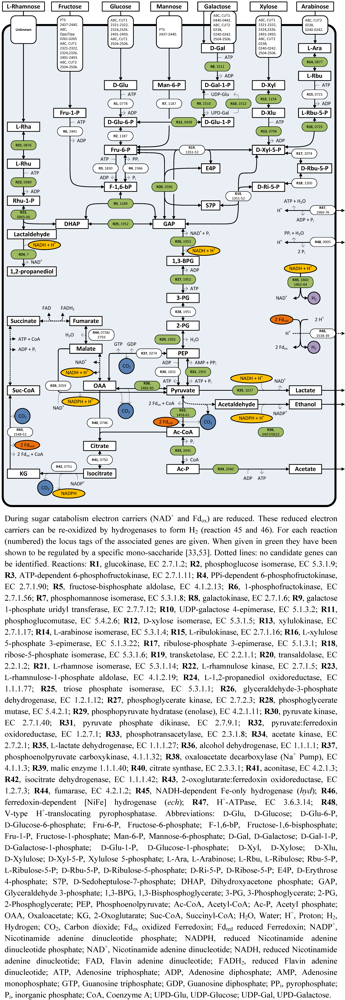
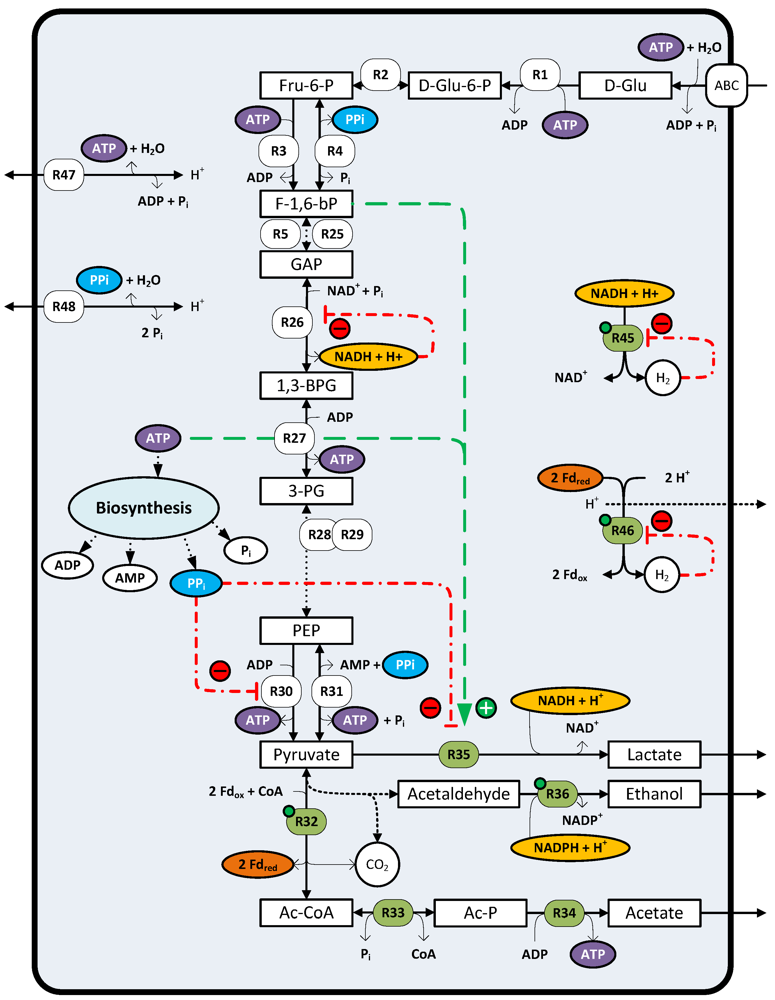
        <p>Soluble sugar substrates can enter <italic>C. saccharolyticus</italic> cells either as mono-, di- or oligo-saccharides via several ABC-transporters, which facilitate substrate transport across the membrane at the expense of ATP. In addition, <italic>C. saccharolyticus</italic> contains one fructose specific phosphotransferase system (PTS). During PTS-mediated transport the substrate is both transported and phosphorylated at the expense of phosphoenolpyruvate (PEP). The substrate specificity of the 24 sugar ABC transport systems, identified in <italic>C. saccharolyticus</italic>, has been assigned based on bioinformatic analysis and functional genomics [<xref ref-type="bibr" rid="B53-life-03-00052">53</xref>]. Most of the identified ABC transporters have a broad predicted substrate specificity and for some transporters the annotated substrate specificity was confirmed by transcriptional data obtained from cells grown on different mono-saccharides [<xref ref-type="bibr" rid="B53-life-03-00052">53</xref>]. Some substrates can be transported by multiple transporter systems (<xref ref-type="fig" rid="life-03-00052-f001">Figure 1</xref>).</p>
        <p>The growth of <italic>C. saccharolyticus</italic> on sugar mixtures revealed the co-utilization of hexoses and pentoses, without any signs of carbon catabolite repression (CCR) [<xref ref-type="bibr" rid="B33-life-03-00052">33</xref>,<xref ref-type="bibr" rid="B53-life-03-00052">53</xref>]. The absence of CCR is in principle a very advantageous characteristic of <italic>C. saccharolyticus</italic>, as it enables the simultaneous fermentation of hexoses and pentoses [<xref ref-type="bibr" rid="B33-life-03-00052">33</xref>]. Substrate co-utilization has also been confirmed for biomass derived hydrolysates [<xref ref-type="bibr" rid="B54-life-03-00052">54</xref>,<xref ref-type="bibr" rid="B55-life-03-00052">55</xref>]. Despite the absence of CCR, a somewhat higher preference for the pentose sugars (xylose and arabinose) with respect to the hexose sugars (glucose, mannose and galactose) was demonstrated, but the highest preference was observed for the PTS-transported hexose fructose [<xref ref-type="bibr" rid="B53-life-03-00052">53</xref>].</p>
        <p>Once inside the cell, the sugar substrates are converted into a glycolytic intermediate. NMR analysis of the fermentation end-products of <italic>C. saccharolyticus</italic> grown on <sup>13</sup>C-labeled glucose showed that the Embden-Meyerhof pathway is the main route for glycolysis [<xref ref-type="bibr" rid="B56-life-03-00052">56</xref>]. All genes encoding components of the Embden-Meyerhof and non-oxidative pentose phosphate pathway have been identified in the genome. There is no evidence for the presence of the oxidative branch of the pentose phosphate pathway or the Entner-Doudoroff pathway [<xref ref-type="bibr" rid="B33-life-03-00052">33</xref>] (<xref ref-type="fig" rid="life-03-00052-f001">Figure 1</xref>).</p>
        <p>Each sugar substrate, with the exception of rhamnose is completely catabolized to glyceraldehyde 3-phosphate (GAP) (rhamnose catabolism will be discussed separately in more detail below). The subsequent conversion of GAP to pyruvate, via the C-3 part of glycolysis, results in the formation of the reduced electron carrier NADH. Pyruvate can be further oxidized to acetyl-CoA by pyruvate: ferredoxin oxidoreductase (POR), which is coupled to the generation of reduced ferredoxin (Fd<sub>red</sub>). Finally, acetyl-CoA can be converted to the fermentation end-product acetate (<xref ref-type="fig" rid="life-03-00052-f001">Figure 1</xref>).</p>
        <p>Both types of reduced electron carriers (NADH and Fd<sub>red</sub>) can be used by hydrogenases for proton reduction, thus forming H<sub>2</sub>. The genome of <italic>C. saccharolyticus</italic> contains a gene cluster coding for an NADH-dependent cytosolic hetero-tetrameric Fe-only hydrogenase (<italic>hyd</italic>) and a cluster encoding a membrane bound multimeric [NiFe] hydrogenase (<italic>ech</italic>), which presumably couples the oxidation of Fd<sub>red</sub> to H<sub>2</sub> production [<xref ref-type="bibr" rid="B33-life-03-00052">33</xref>]. Under optimal cultivation conditions, when all reductants are used for H<sub>2</sub> formation, the complete oxidation of glucose yields 4 mol of H<sub>2</sub> per mol of glucose consumed (Equation 1).</p>
		<fig id="life-03-00052-f001" position="float">
          <label>Figure 1</label>
          <caption>
            <p>Overview of the central carbon metabolism of <italic>Caldicellulosiruptor saccharolyticus</italic>.</p>
          </caption>
          <graphic xmlns:xlink="http://www.w3.org/1999/xlink" xlink:href="life-03-00052-g001.tif"/>
        </fig>
        
        <disp-formula>glucose + 4·H<sub>2</sub>O → 2 acetate<sup>−</sup> + 2·HCO<sub>3</sub><sup>−</sup> + 4·H<sup>+</sup> + 4·H<sub>2</sub><label>(1)</label></disp-formula>
        <disp-formula>glucose + 2·H<sub>2</sub>O → 2 ethanol + 2·HCO<sub>3</sub><sup>-</sup> + 2·H<sup>+</sup><label>(2)</label></disp-formula>
        <disp-formula>glucose → 2 lactate<sup>-</sup> + 2·H<sup>+</sup><label>(3)</label></disp-formula>
        <p>However, suboptimal growth conditions lead to a mixed acid fermentation with ethanol (Equation 2) and lactate (Equation 3) as end products in addition to acetate and H<sub>2</sub>. Lactate is produced from pyruvate, using NADH as electron donor and catalyzed by lactate dehydrogenase (LDH). The corresponding <italic>ldh</italic> gene could be easily identified in the genome [<xref ref-type="bibr" rid="B33-life-03-00052">33</xref>,<xref ref-type="bibr" rid="B57-life-03-00052">57</xref>]. However, the identity of the enzymes and genes involved in ethanol formation, are less clear. Two alcohol dehydrogenase (ADH) genes have been identified in the genome which, based on transcriptional data, can both be involved in ethanol formation from acetaldehyde. The way acetaldehyde is produced, is however, not known. Acetaldehyde can be produced from pyruvate by a pyruvate decarboxylase, as described for yeast, or from acetyl-CoA by an acetaldehyde dehydrogenase, as is commonly seen in fermentative bacteria. In several thermophilic ethanol-producing bacteria, acetaldehyde is produced by a bifunctional acetaldehyde/ethanol dehydrogenase [<xref ref-type="bibr" rid="B58-life-03-00052">58</xref>,<xref ref-type="bibr" rid="B59-life-03-00052">59</xref>]. However, no candidate gene could be identified for any of these alternatives [<xref ref-type="bibr" rid="B33-life-03-00052">33</xref>,<xref ref-type="bibr" rid="B60-life-03-00052">60</xref>]. A third option might be that acetaldehyde is formed from pyruvate in a CoA-dependent side reaction of the pyruvate:ferredoxin oxidoreductase as described for <italic>Pyrococcus furiosus</italic> [<xref ref-type="bibr" rid="B61-life-03-00052">61</xref>]. There is no experimental evidence for such a side reaction in <italic>C. saccharolyticus</italic>, but the absence of a dedicated enzymatic acetaldehyde-forming step might explain the low ethanologenic capacity of <italic>C. saccharolyticus</italic>. The difference in the observed lower ethanol to acetate ratio for <italic>C. saccharolyticus</italic> with respect to <italic>Clostridium thermocellum</italic> [<xref ref-type="bibr" rid="B16-life-03-00052">16</xref>] can be explained by the fact that the <italic>C. saccharolyticus</italic> genome does not have a similar pathway for ethanol formation as identified in <italic>C. thermocellum</italic> [<xref ref-type="bibr" rid="B58-life-03-00052">58</xref>]. Similar to other high yield ethanol-producing thermophiles, like <italic>Thermoanaerobacter ethanolicus</italic> [<xref ref-type="bibr" rid="B62-life-03-00052">62</xref>] or <italic>Thermoanaerobacterium saccharolyticum</italic> [<xref ref-type="bibr" rid="B63-life-03-00052">63</xref>], <italic>Clostridium thermocellum</italic> has a bifunctional acetaldehyde-CoA/alcohol dehydrogenase, which catalyzes ethanol formation from acetyl-coA [<xref ref-type="bibr" rid="B58-life-03-00052">58</xref>,<xref ref-type="bibr" rid="B59-life-03-00052">59</xref>]. Such a pathway is absent in low level ethanol-producing thermophiles like <italic>C. saccharolyticus</italic> [<xref ref-type="bibr" rid="B33-life-03-00052">33</xref>], <italic>Thermoanaerobacter tengcongensis</italic> [<xref ref-type="bibr" rid="B64-life-03-00052">64</xref>] and <italic>Pyrococcus furiosus</italic> [<xref ref-type="bibr" rid="B65-life-03-00052">65</xref>]. Although <italic>C. saccharolyticus</italic> is able to produce some ethanol, the flux through the ethanol-forming pathway is apparently limited resulting in the lower ethanol to acetate ratio.</p>
        <p>NADPH is assumed to be the preferred substrate for the ethanol-forming ADH reaction [<xref ref-type="bibr" rid="B33-life-03-00052">33</xref>,<xref ref-type="bibr" rid="B57-life-03-00052">57</xref>]. A potential source of NAPDH could be the isocitrate dehydrogenase in the oxidative branch of the incomplete TCA cycle (<xref ref-type="fig" rid="life-03-00052-f001">Figure 1</xref>). Alternatively, NADPH can be produced from NADH, but so far no candidate genes coding for such transhydrogenase have been identified in <italic>C. saccharolyticus</italic> [<xref ref-type="bibr" rid="B33-life-03-00052">33</xref>,<xref ref-type="bibr" rid="B60-life-03-00052">60</xref>]. With respect to H<sub>2</sub> production, it is important to realize that only the production of acetate is coupled to H<sub>2</sub> formation since no net reducing power remains for H<sub>2</sub> formation when ethanol or lactate is produced.</p>
      </sec>
      <sec>
        <title>4.2. Rhamnose Fermentation</title>
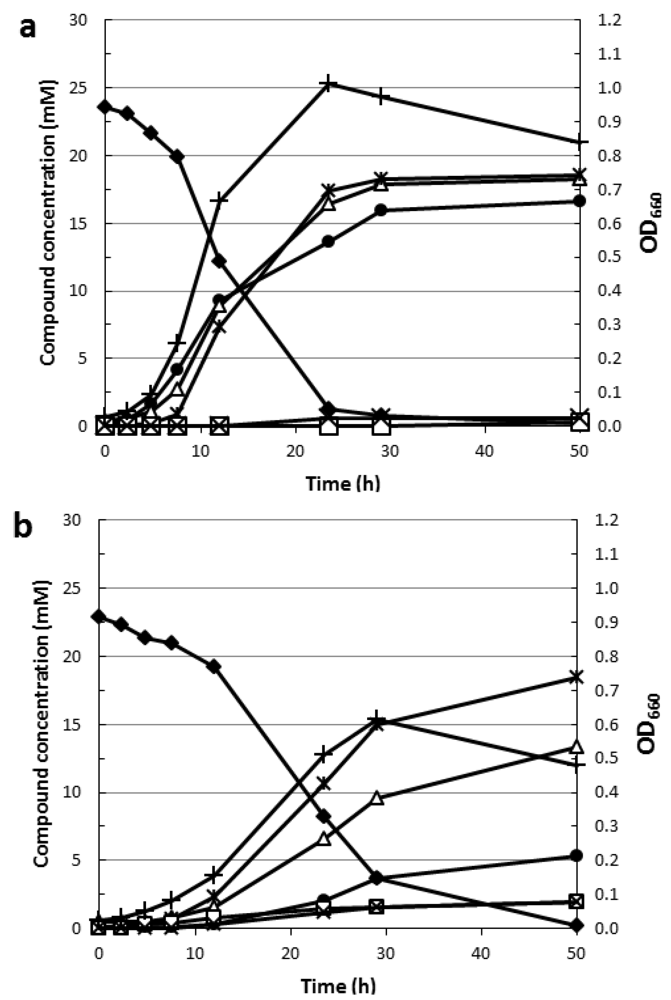
        <p>Compared to glucose, fermentative growth on the deoxy sugar rhamnose is associated with a different carbon and electron metabolism. The proposed pathway for rhamnose degradation (<xref ref-type="fig" rid="life-03-00052-f001">Figure 1</xref>) implies that during rhamnose catabolism half of the generated reduced electron-carriers is used for the reduction of lactaldehyde to 1,2-propanediol, while the other half can be recycled through H<sub>2</sub> formation [<xref ref-type="bibr" rid="B33-life-03-00052">33</xref>]. Indeed, fermentation of rhamnose by <italic>C. saccharolyticus</italic> results in the production of 1,2-propanediol, acetate, H<sub>2</sub> and CO<sub>2</sub> in a 1:1:1:1 ratio ([<xref ref-type="bibr" rid="B66-life-03-00052">66</xref>], <xref ref-type="fig" rid="life-03-00052-f002">Figure 2</xref>a). This ratio suggests that all NADH is used for 1,2-propanediol formation and that all Fd<sub>red</sub> is used for H<sub>2</sub> formation. However, when <italic>C. saccharolyticus</italic> is grown on rhamnose under a headspace of carbon monoxide (CO), which is an established competitive inhibitor of both NiFe- [<xref ref-type="bibr" rid="B67-life-03-00052">67</xref>] and Fe-only [<xref ref-type="bibr" rid="B68-life-03-00052">68</xref>] hydrogenases, H<sub>2</sub> evolution is significantly inhibited ([<xref ref-type="bibr" rid="B66-life-03-00052">66</xref>], <xref ref-type="fig" rid="life-03-00052-f002">Figure 2</xref>b). The CO cultivation condition does not affect 1,2-propanediol formation, but less H<sub>2</sub> is produced and the remaining reduced electron-carriers are now recycled by the formation of lactate and ethanol, consequently leading to a decrease in the acetate level. These findings suggest that, based on the substrate specificity of the lactate dehydrogenase (NADH, [<xref ref-type="bibr" rid="B57-life-03-00052">57</xref>]) and the ethanol dehydrogenase(s) (NADPH, [<xref ref-type="bibr" rid="B57-life-03-00052">57</xref>]), electron exchange between the Fd<sub>red</sub> and NAD(P)<sup>+</sup> is required. However, no genes have been identified in <italic>C. saccharolyticus</italic> coding for an enzyme capable of catalyzing such a reaction [<xref ref-type="bibr" rid="B33-life-03-00052">33</xref>,<xref ref-type="bibr" rid="B60-life-03-00052">60</xref>]. Transcript levels of the genes from the gene cluster containing both the L-rhamnose isomerase and L-rhamnulose-1-phosphate aldolase are highly upregulated during growth on rhamnose (<xref ref-type="fig" rid="life-03-00052-f003">Figure 3</xref>) [<xref ref-type="bibr" rid="B33-life-03-00052">33</xref>]. Although the function of the other genes in the cluster with respect to rhamnose catabolism remains unclear, the absence of such gene cluster and the rhamnose kinase gene from the genome of other <italic>Caldicellulosiruptor</italic> species, strongly correlates with their inability of rhamnose degradation (<xref ref-type="table" rid="life-03-00052-t001">Table 1</xref>). This difference in rhamnose degrading capability between <italic>Caldicellulosiruptor</italic> species reflects the open nature of the <italic>Caldicellulosiruptor</italic> pan genome [<xref ref-type="bibr" rid="B29-life-03-00052">29</xref>].</p>
        <fig id="life-03-00052-f002" position="float">
          <label>Figure 2</label>
          <caption>
            <p>Fermentation profile of <italic>C. saccharolyticus</italic> grown on rhamnose batch cultivation: (<bold>a</bold>) without CO in the headspace (<bold>b</bold>) with a 100% CO headspace. Rhamnose (diamonds), acetate (open triangles), 1,2 propanediol (asterisks), lactate (open squares), ethanol (crosses), H<sub>2</sub> (circles) and OD<sub>660</sub> (plus sign).</p>
          </caption>
          <graphic xmlns:xlink="http://www.w3.org/1999/xlink" xlink:href="life-03-00052-g002.tif"/>
        </fig>
        <fig id="life-03-00052-f003" position="float">
          <label>Figure 3</label>
          <caption>
            <p>Schematic representation of two rhamnose associated gene clusters from <italic>C. saccharolyticus</italic> (Csac_0865-Csac_0876 and Csac_0989-Csac_0990). For each member of the cluster (grey arrows) the proposed function (text box) and locus tag number (four digit number) is given. Presented log2 values represent the ratio between transcription levels of the specific gene during growth on rhamnose with respect to growth on glucose; (+) upregulated, (−) downregulated on rhamnose versus glucose [<xref ref-type="bibr" rid="B33-life-03-00052">33</xref>].</p>
          </caption>
          <graphic xmlns:xlink="http://www.w3.org/1999/xlink" xlink:href="life-03-00052-g003.tif"/>
        </fig>
		<table-wrap id="life-03-00052-t001" position="float">
          <object-id pub-id-type="pii">life-03-00052-t001_Table 1</object-id>
          <label>Table 1</label>
          <caption>
            <p>Overview of <italic>Caldicellulosiruptor</italic> species which are able to grow on rhamnose. There is a correlation between the ability to grow on rhamnose and the presence of gene clusters orthologous to the rhamnose associated gene clusters identified in <italic>C. saccharolyticus</italic> (<xref ref-type="fig" rid="life-03-00052-f003">Figure 3</xref>). nt, not tested for growth on rhamnose. (+), able to grow of rhamnose/gene cluster is present in genome. (−), no growth observed on rhamnose/gene cluster is not present in genome. ns, not sequenced.</p>
          </caption>
          <table>
  <thead>
              <tr>
                <th align="center" valign="middle">Strain</th>
                <th align="center" valign="middle">Growth on Rhamnose</th>
                <th align="center" valign="middle">Gene cluster Csac_0865-76</th>
                <th align="center" valign="middle">Gene cluster Csac_0989-90</th>
                <th align="center" valign="middle">Reference</th>
              </tr>
            </thead>
            <tbody>
              <tr>
                <td align="center" valign="middle">
                  <italic>C. saccharolyticus</italic>
                </td>
                <td align="center" valign="middle">+</td>
                <td align="center" valign="middle">+</td>
                <td align="center" valign="middle">+</td>
                <td align="center" valign="middle">[<xref ref-type="bibr" rid="B13-life-03-00052">13</xref>]</td>
              </tr>
              <tr>
                <td align="center" valign="middle">
                  <italic>C. bescii</italic>
                </td>
                <td align="center" valign="middle">+</td>
                <td align="center" valign="middle">+</td>
                <td align="center" valign="middle">+</td>
                <td align="center" valign="middle">[<xref ref-type="bibr" rid="B28-life-03-00052">28</xref>]</td>
              </tr>
              <tr>
                <td align="center" valign="middle">
                  <italic>C. owensensis</italic>
                </td>
                <td align="center" valign="middle">+</td>
                <td align="center" valign="middle">+</td>
                <td align="center" valign="middle">+</td>
                <td align="center" valign="middle">[<xref ref-type="bibr" rid="B21-life-03-00052">21</xref>]</td>
              </tr>
              <tr>
                <td align="center" valign="middle">
                  <italic>C. obsidiansis</italic> 
                </td>
                <td align="center" valign="middle">nt</td>
                <td align="center" valign="middle">+</td>
                <td align="center" valign="middle">+</td>
                <td align="center" valign="middle">[<xref ref-type="bibr" rid="B20-life-03-00052">20</xref>]</td>
              </tr>
              <tr>
                <td align="center" valign="middle">
                  <italic>C. kronotskyensis</italic>
                </td>
                <td align="center" valign="middle">nt</td>
                <td align="center" valign="middle">+</td>
                <td align="center" valign="middle">+</td>
                <td align="center" valign="middle">[<xref ref-type="bibr" rid="B22-life-03-00052">22</xref>]</td>
              </tr>
              <tr>
                <td align="center" valign="middle">
                  <italic>C. hydrothermalis</italic>
                </td>
                <td align="center" valign="middle">nt</td>
                <td align="center" valign="middle">+</td>
                <td align="center" valign="middle">+</td>
                <td align="center" valign="middle">[<xref ref-type="bibr" rid="B22-life-03-00052">22</xref>]</td>
              </tr>
              <tr>
                <td align="center" valign="middle">
                  <italic>C. kristjanssonii</italic>
                </td>
                <td align="center" valign="middle">−</td>
                <td align="center" valign="middle">−</td>
                <td align="center" valign="middle">−</td>
                <td align="center" valign="middle">[<xref ref-type="bibr" rid="B17-life-03-00052">17</xref>]</td>
              </tr>
              <tr>
                <td align="center" valign="middle">
                  <italic>C. lactoaceticus</italic>
                </td>
                <td align="center" valign="middle">−</td>
                <td align="center" valign="middle">−</td>
                <td align="center" valign="middle">−</td>
                <td align="center" valign="middle">[<xref ref-type="bibr" rid="B23-life-03-00052">23</xref>]</td>
              </tr>
              <tr>
                <td align="center" valign="middle">
                  <italic>C. acetigenus</italic>
                </td>
                <td align="center" valign="middle">nt</td>
                <td align="center" valign="middle">ns</td>
                <td align="center" valign="middle">ns</td>
                <td align="center" valign="middle">[<xref ref-type="bibr" rid="B26-life-03-00052">26</xref>]</td>
              </tr>
            </tbody>
          </table>
        </table-wrap>
        
      </sec>
      <sec>
        <title>4.3. Involvement of Pyrophosphate in the Energy Metabolism</title>
        <p>From a bioenergetics point of view, glucose fermentation is optimal when acetate is the only end product, because an additional ATP is generated during the final acetate-forming step (<xref ref-type="fig" rid="life-03-00052-f001">Figure 1</xref>). When it is assumed that the ABC-transporter mediated substrate uptake requires 1 ATP, overall ATP yields become 1.5 ATP per acetate versus only 0.5 ATP per lactate or ethanol. However, ATP yields might even be higher when the involvement of pyrophosphate (PP<sub>i</sub>) as an energy carrier is considered.</p>
        <p>PP<sub>i</sub> is a by-product of biosynthesis reactions like DNA and RNA synthesis or is generated when the amino acids are coupled to their tRNAs during protein synthesis [<xref ref-type="bibr" rid="B69-life-03-00052">69</xref>]. Since these reactions are close to equilibrium accumulation of PP<sub>i</sub> is believed to have an inhibitory effect on growth, and only the effective removal of PP<sub>i</sub> drives these biosynthetic reactions forward [<xref ref-type="bibr" rid="B70-life-03-00052">70</xref>]. When PP<sub>i</sub> is hydrolysed to P<sub>i</sub>by a cytosolic inorganic pyrophosphatase (PPase), the free energy just dissipates as heat. <italic>C. saccharolyticus</italic> does not contain a cytosolic PPase but possesses a membrane bound H<sup>+</sup>-translocating PPase [<xref ref-type="bibr" rid="B71-life-03-00052">71</xref>], which allows the free energy released upon PP<sub>i</sub> hydrolysis to be preserved as a proton motive force. The high-energy phosphate bond of PP<sub>i</sub> can also be used for the phosphorylation of fructose 6-phosphate, catalyzed by a PP<sub>i</sub>-dependent phosphofructokinase (<xref ref-type="fig" rid="life-03-00052-f001">Figure 1</xref>).</p>
        <p>Furthermore, PP<sub>i</sub> is consumed during the catabolic conversion of phosphoenolpyruvate to pyruvate, catalyzed by pyruvate phosphate dikinase (PPDK). Such a catabolic role for PPDK was proposed based on the increase in transcript level of the <italic>ppdk</italic> gene under increased glycolytic fluxes [<xref ref-type="bibr" rid="B33-life-03-00052">33</xref>,<xref ref-type="bibr" rid="B71-life-03-00052">71</xref>]. Altogether, the use of PP<sub>i</sub> as an energy donor could be a way for the organism to deal with the relative low ATP yields which are usually associated with fermentation [<xref ref-type="bibr" rid="B72-life-03-00052">72</xref>].</p>
      </sec>
      <sec id="sec4dot4-life-03-00052">
        <title>4.4. Mechanism Involved in Mixed Acid Fermentation</title>
        <p>H<sub>2</sub> has been reported as a growth inhibitor for <italic>C. saccharolyticus</italic> [<xref ref-type="bibr" rid="B16-life-03-00052">16</xref>,<xref ref-type="bibr" rid="B73-life-03-00052">73</xref>] and a critical dissolved H<sub>2</sub> concentration, which leads to the complete inhibition of growth, of 2.2 mmol/L has been determined for controlled batch cultivations [<xref ref-type="bibr" rid="B74-life-03-00052">74</xref>]. In addition, an elevated P<sub>H2</sub> has been shown to cause a switch in the fermentation profile, leading to increased formation of ethanol and lactate, in both controlled batch and chemostat cultivations [<xref ref-type="bibr" rid="B12-life-03-00052">12</xref>,<xref ref-type="bibr" rid="B60-life-03-00052">60</xref>,<xref ref-type="bibr" rid="B74-life-03-00052">74</xref>,<xref ref-type="bibr" rid="B75-life-03-00052">75</xref>]. Willquist <italic>et al.</italic> reported that in controlled batch fermentations the initiation of lactate formation coincided with an increment in both the internal NADH/NAD<sup>+</sup> ratio and the P<sub>H2</sub> of the system [<xref ref-type="bibr" rid="B57-life-03-00052">57</xref>,<xref ref-type="bibr" rid="B75-life-03-00052">75</xref>].</p>
        <p>An increase of the overall carbon flux through glycolysis results in a higher NADH production rate. To maintain a constant NADH/NAD<sup>+</sup> ratio a subsequently higher H<sub>2</sub> formation rate is required. However, when the H<sub>2</sub> formation rate (volumetric H<sub>2</sub> production rate) exceeds the H<sub>2</sub> liquid to gas mass transfer rate, H<sub>2</sub> will accumulate in the liquid phase. In some cases this can even lead to super saturation of the liquid, meaning that the dissolved H<sub>2</sub> concentration exceeds the maximal theoretical H<sub>2</sub> solubility [<xref ref-type="bibr" rid="B74-life-03-00052">74</xref>,<xref ref-type="bibr" rid="B76-life-03-00052">76</xref>]. Such high dissolved H<sub>2</sub> levels inhibit H<sub>2</sub> formation and presumably cause an increase in the NADH/NAD<sup>+</sup> ratio. An increased NADH/NAD<sup>+</sup> ratio has been shown to have an inhibitory effect on GAPDH activity thus limiting the glycolytic flux [<xref ref-type="bibr" rid="B75-life-03-00052">75</xref>] and consequently leads to a decrease in substrate consumption and growth rate. A switch to lactate formation alleviates the inhibitory effect of an increased NADH/NAD<sup>+</sup> ratio by causing a decrease of the NADH/NAD<sup>+</sup> ratio through the reduction of pyruvate.</p>
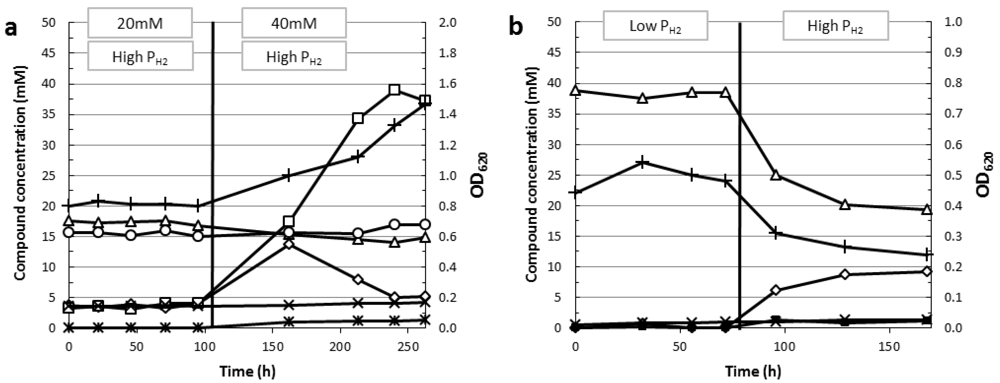
        <p>A clear switch to lactate formation caused by an increase in glycolytic flux can be observed for <italic>C. saccharolyticus</italic> grown in a chemostat under high P<sub>H2</sub> ([<xref ref-type="bibr" rid="B77-life-03-00052">77</xref>], <xref ref-type="fig" rid="life-03-00052-f004">Figure 4</xref>a). When the glucose load is increased from 20 mM to 40 mM, end-product formation is switched from mainly acetate to mainly lactate, respectively. After the switch to 40 mM glucose some adaptation time is required before a new steady state is achieved. During this adaptation period substantially higher amounts of glucose were detected in the culture effluent, probably indicating an inhibition of the glycolytic flux at the level of GAPDH. When a new steady state was achieved, residual glucose was only slightly higher with respect to the 20 mM condition. As a consequence of the increase in glycolytic flux, the lactate concentration dramatically increased while the acetate concentration hardly changed, indicating that during both substrate loads a similar volumetric H<sub>2</sub> productivity was maintained. These data indicate that under these conditions the organism is not capable of dealing with the increased glycolytic flux by increasing its H<sub>2</sub> productivity, but requires a switch to lactate formation. Although oxaloacetate formation was discernible under a 20 mM glucose load, significantly higher and therefore quantifiable levels of oxaloacetate were detected under the 40 mM glucose load condition. This observation together with the increased flux towards lactate suggests that in the newly achieved steady state, a bottleneck exists at the level of pyruvate.</p>
        <p>Ethanol formation can also serve as reductant sink in <italic>C. saccharolyticus</italic>. For some chemostat cultivation conditions a decrease in H<sub>2</sub> yield is only associated with ethanol formation and not with lactate formation [<xref ref-type="bibr" rid="B56-life-03-00052">56</xref>,<xref ref-type="bibr" rid="B60-life-03-00052">60</xref>,<xref ref-type="bibr" rid="B75-life-03-00052">75</xref>]. These conditions concern low substrate loads, and the observed increase in ethanol formation was triggered by an increase of the dilution rate [<xref ref-type="bibr" rid="B56-life-03-00052">56</xref>,<xref ref-type="bibr" rid="B75-life-03-00052">75</xref>] or a change in mode of gas flushing [<xref ref-type="bibr" rid="B60-life-03-00052">60</xref>], both potentially generating a moderate increase in the H<sub>2</sub> level of the system.</p>
		<fig id="life-03-00052-f004" position="float">
          <label>Figure 4</label>
          <caption>
            <p>Fermentation profile of <italic>C. saccharolyticus</italic> (<bold>a</bold>) grown in a chemostat under high H<sub>2</sub> partial pressure at two different glucose concentrations (see <xref ref-type="sec" rid="sec4dot4-life-03-00052">Section 4.4</xref>), (<bold>b</bold>) grown in a chemostat without NH<sub>4</sub><sup>+</sup> in the medium under low and high H<sub>2</sub> partial pressure (see <xref ref-type="sec" rid="sec6dot4-life-03-00052">Section 6.4</xref>). The switch from 20 mM to 40 mM glucose containing-medium and the switch from low to high H<sub>2</sub> partial pressure cultivation condition is indicated by a vertical line. Acetate (open triangles), lactate (open squares), ethanol (crosses), CO<sub>2</sub> (open circles), oxaloacetate (asterisks), glucose out (open diamonds) and CDW (plus sign). Chemostat cultivation parameters (3 L reactor, 1 L working volume, pH = 7.0 (NaOH), temp 70 °C, D = 0.1 h<sup>−1</sup>, low P<sub>H2</sub> [sparging (4 L/h) with N<sub>2</sub> gas and stirring speed = 250 rpm]), high P<sub>H2</sub> [headspace flushing (4 L/h) with H<sub>2</sub> gas and stirring speed = 50 rpm]).</p>
          </caption>
          <graphic xmlns:xlink="http://www.w3.org/1999/xlink" xlink:href="life-03-00052-g004.tif"/>
        </fig>
        
      </sec>
      <sec>
        <title>4.5. Regulation of Reductant Disposal Pathways</title>
        <p>Hydrogen, ethanol and lactate formation are the main routes for reductant disposal in <italic>C. saccharolyticus</italic>. The gene expression of the hydrogenases and both alcohol dehydrogenases involved in ethanol formation are proposed to be under the control of the NADH/NAD<sup>+</sup> sensitive transcriptional regulator Rex [<xref ref-type="bibr" rid="B60-life-03-00052">60</xref>] (<xref ref-type="fig" rid="life-03-00052-f005">Figure 5</xref>). Cultivation of <italic>C. saccharolyticus</italic> under high P<sub>H2</sub> conditions was shown to lead to an upregulation of both the hydrogenases and alcohol dehydrogenases [<xref ref-type="bibr" rid="B60-life-03-00052">60</xref>]. In addition, the <italic>ldh</italic> transcript level is also upregulated under high P<sub>H2</sub> conditions, but in silico analysis of the <italic>ldh</italic> promoter region did not reveal a likely Rex operator binding sequence [<xref ref-type="bibr" rid="B60-life-03-00052">60</xref>]. Thus, the exact regulatory mechanism triggering <italic>ldh</italic> transcription remains therefore unclear. Nonetheless, lactate dehydrogenase activity has been shown to be regulated at the enzyme level, with fructose 1,6-bisphosphate and ATP acting as allosteric activators and both NAD<sup>+</sup> and PP<sub>i</sub> as competitive inhibitors [<xref ref-type="bibr" rid="B57-life-03-00052">57</xref>]. Under high P<sub>H2</sub> cultivation conditions, enzyme activity assays revealed increased LDH activity with respect to low P<sub>H2</sub> conditions [<xref ref-type="bibr" rid="B57-life-03-00052">57</xref>,<xref ref-type="bibr" rid="B75-life-03-00052">75</xref>]. A hampered glycolytic flux at the level of GAPDH, potentially triggered by NADH build-up, might lead to the accumulation of fructose 1,6-bisphosphate. In turn, the accumulated level of fructose 1,6-bisphosphate could stimulate lactate formation (<xref ref-type="fig" rid="life-03-00052-f005">Figure 5</xref>), explaining the switch to lactate under high P<sub>H2</sub> at the enzyme level.</p>
        <fig id="life-03-00052-f005" position="float">
          <label>Figure 5</label>
          <caption>
            <p>Overview of the regulatory mechanisms involved in the central metabolism of <italic>Caldicellulosiruptor saccharolyticus</italic>. The abbreviations of the compounds and reactions (circled numbers) are given in the legend of <xref ref-type="fig" rid="life-03-00052-f001">Figure 1</xref>. For the enzyme reactions given in green (circled numbers, green) the encoding genes are upregulated under increased P<sub>H2</sub> [<xref ref-type="bibr" rid="B60-life-03-00052">60</xref>]. Those which are under the control of the REX transcriptional regulator are marked with a green dot. H<sub>2</sub> inhibits its own formation (<bold>R45</bold>, <bold>R46</bold>) and accumulation of NADH inhibits glyceraldehyde-3-phosphate dehydrogenase (<bold>R26</bold>). PP<sub>i</sub>, a by-product of biosynthesis, acts as an inhibitor of both pyruvate kinase (<bold>R30</bold>) and lactate dehydrogenase (<bold>R35</bold>) activity. Both ATP and F-1,6-bP are activators of lactate dehydrogenase (<bold>R35</bold>) activity.</p>
          </caption>
          <graphic xmlns:xlink="http://www.w3.org/1999/xlink" xlink:href="life-03-00052-g005.tif"/>
        </fig>
        <p>Interestingly, LDH enzyme activity can also be measured under non-lactate producing conditions, which suggest that additional factors control lactate formation [<xref ref-type="bibr" rid="B57-life-03-00052">57</xref>,<xref ref-type="bibr" rid="B75-life-03-00052">75</xref>]. Low levels of lactate formation can be observed at the end of growth during the transition to stationary phase for cultures grown in controlled batch systems [<xref ref-type="bibr" rid="B55-life-03-00052">55</xref>,<xref ref-type="bibr" rid="B57-life-03-00052">57</xref>,<xref ref-type="bibr" rid="B75-life-03-00052">75</xref>,<xref ref-type="bibr" rid="B78-life-03-00052">78</xref>,<xref ref-type="bibr" rid="B79-life-03-00052">79</xref>]. This initiation of the lactate formation coincided with a relative increase in ATP levels and a relative decrease in PP<sub>i</sub> levels [<xref ref-type="bibr" rid="B57-life-03-00052">57</xref>,<xref ref-type="bibr" rid="B71-life-03-00052">71</xref>]. These observed changes in ATP and PP<sub>i</sub> levels could release the inhibitory effect of PP<sub>i</sub> and stimulate LDH activity [<xref ref-type="bibr" rid="B57-life-03-00052">57</xref>] (<xref ref-type="fig" rid="life-03-00052-f005">Figure 5</xref>). For this latter mode of LDH activity regulation, the lactate formation is proposed to be coupled to the energy metabolism. Accordingly, lactate formation is prevented during exponential growth, which is associated with a high anabolic activity and high PP<sub>i</sub> levels. Whereas, during the transition to stationary phase, which is associated with low anabolic activity and relative low PP<sub>i</sub> levels, lactate formation inhibition is alleviated [<xref ref-type="bibr" rid="B12-life-03-00052">12</xref>,<xref ref-type="bibr" rid="B57-life-03-00052">57</xref>].</p>
      </sec>
    </sec>
    <sec>
      <title>5. Thermodynamic Considerations of Glucose Conversion and H<sub>2</sub> Formation</title>
      <p>For <italic>C. saccharolyticus</italic> an elevated hydrogen concentration has been shown to affect fermentation performance, leading to a mixed acid fermentation [<xref ref-type="bibr" rid="B60-life-03-00052">60</xref>,<xref ref-type="bibr" rid="B73-life-03-00052">73</xref>,<xref ref-type="bibr" rid="B74-life-03-00052">74</xref>,<xref ref-type="bibr" rid="B75-life-03-00052">75</xref>]. These observed changes in the fermentation profile as a function of the H<sub>2</sub> concentration can be conceptually explained by considering the thermodynamics of the reactions leading to H<sub>2</sub> formation [<xref ref-type="bibr" rid="B9-life-03-00052">9</xref>,<xref ref-type="bibr" rid="B10-life-03-00052">10</xref>]. The Gibbs energy (ΔG') for a specific reaction can be calculated from the standard Gibbs energy (ΔG<sup>0</sup>') and the reactant concentrations by the following relation:
      <disp-formula>ΔG' = ΔG<sup>0</sup>' + RT ln([C]<sup>c</sup>[D]<sup>d</sup>/[A]<sup>a</sup>[B]<sup>b</sup>)<label>(4)</label></disp-formula>
      where ΔG<sup>0</sup>' is the standard Gibbs energy (J/mol, 1 mol concentration of all reactants, at a neutral pH and at a specific temperature), R is the gas constant (J/mol*K); T is the temperature (K), A and B are the substrate concentrations with respective stoichiometric reaction coefficients a, b; and C and D are the reaction products with respective stoichiometric reaction coefficients c, d.</p>
      <p>When H<sub>2</sub> formation occurs in the aqueous phase H<sub>2</sub> supersaturation can occur. For instance, over-saturation of 12 to 34 times the equilibrium concentration has been reported for <italic>C. saccharolyticus</italic> cultivations [<xref ref-type="bibr" rid="B74-life-03-00052">74</xref>]. This indicates that estimating the dissolved H<sub>2</sub> concentration from the measured H<sub>2</sub> partial pressure by using the equilibrium constant does not always give an accurate representation of the state of the system. So H<sub>2</sub>(aq), instead of the H<sub>2</sub> partial pressure (P<sub>H2</sub>), should be used as a parameter when investigating the effect of H<sub>2</sub> on the metabolism. Therefore, all Gibbs energy calculations discussed herein were performed using the Δ<sub>f</sub>G<sup>0</sup> of the dissolved H<sub>2</sub> concentration (H<sub>2</sub>(aq)).</p>
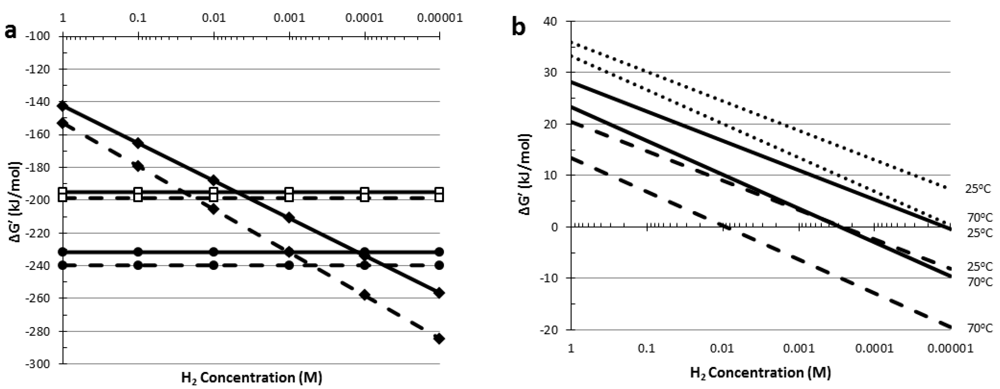
      <p>Under standard conditions (25 °C), acetate formation (Equation 1, ΔG<sup>0</sup>' = −142.6 kJ/reaction) is energetically less favorable then lactate (Equation 3, ΔG<sup>0</sup>' = −195.0 kJ/reaction) and ethanol (Equation 2, ΔG<sup>0</sup>' = −231.8 kJ/reaction) formation. The Gibbs energy (ΔG') for the complete conversion of glucose to acetate depends, however, on the H<sub>2</sub> concentration (Equation 1), whereas the ΔG' for both ethanol and lactate formation from glucose is independent of the H<sub>2</sub> concentration (Equations 2 and 3, respectively). This means that the complete oxidation of glucose to acetate becomes energetically more favorable when the dissolved H<sub>2</sub> concentration is lowered. For example, acetate formation becomes energetically favorable compared to lactate or ethanol formation when the dissolved H<sub>2</sub> concentration drops below 5.0 or 0.12 mM, respectively (<xref ref-type="fig" rid="life-03-00052-f006">Figure 6</xref>a, <xref ref-type="supplementary-material" rid="life-03-00052-s001">supplementary data S1</xref>).</p>
      <fig id="life-03-00052-f006" position="float">
        <label>Figure 6</label>
        <caption>
          <p>Effect of the H<sub>2</sub> concentration on the Gibbs energy change of reactions involved in H<sub>2</sub> formation: (<bold>a</bold>) ΔG' of the complete oxidation of 1 mol of glucose to acetate (closed diamonds), lactate (open squares) and ethanol (closed circles) at 25 °C (solid lines) and 70 °C (dashed lines); (<bold>b</bold>) ΔG' of H<sub>2</sub> formation from NADH (dotted line), reduced ferredoxin (dashed line) and via the bifurcating system (50% NADH and 50% Fd<sub>red</sub>) (solid line) at 25 °C and 70 °C. Values were calculated from data presented in ([<xref ref-type="bibr" rid="B80-life-03-00052">80</xref>,<xref ref-type="bibr" rid="B81-life-03-00052">81</xref>,<xref ref-type="bibr" rid="B82-life-03-00052">82</xref>,<xref ref-type="bibr" rid="B83-life-03-00052">83</xref>,<xref ref-type="bibr" rid="B84-life-03-00052">84</xref>]).</p>
        </caption>
        <graphic xmlns:xlink="http://www.w3.org/1999/xlink" xlink:href="life-03-00052-g006.tif"/>
      </fig>
      <p>However, considering the Gibbs energies of the overall conversions can be misleading, as the thermodynamics of the involved partial reactions can be less favorable. Acetate formation is inevitably linked to H<sub>2</sub> formation and the ΔG<sup>0</sup>' of the redox reaction coupling the reoxidation of the reduced electron carriers NADH or Fd<sub>red</sub> to proton reduction are endergonic under standard conditions (<xref ref-type="fig" rid="life-03-00052-f006">Figure 6</xref>b, <xref ref-type="supplementary-material" rid="life-03-00052-s002">supplementary data S2</xref>). Decreasing the dissolved H<sub>2</sub> concentration will lower the ΔG' of these H<sub>2</sub> forming reactions, but an extremely low H<sub>2</sub> concentration is required before H<sub>2</sub> formation from NADH becomes exergonic (0.5 µM) (Fd<sub>red</sub>, 0.2 mM) (<xref ref-type="fig" rid="life-03-00052-f006">Figure 6</xref>b). Therefore, at elevated H<sub>2</sub> concentrations this partial reaction raises a thermodynamic barrier. NADH dependent pyruvate reduction to lactate, on the other hand, has a negative Gibbs energy (ΔG<sup>0</sup>' = −25.0 kJ/reaction) and is independent of the dissolved H<sub>2</sub> concentration. This means that under certain conditions lactate formation is more feasible, despite the more negative ΔG' for acetate formation compared to lactate formation (Equations 1 and 3), simply because H<sub>2</sub> formation from NADH is energetically unfavorable.</p>
      <p>As explained, the thermodynamic barrier associated with H<sub>2</sub> formation from NADH can be lowered by decreasing the dissolved H<sub>2</sub> concentrations, moreover this barrier may also be tackled by an additional input of energy. The latter can be achieved by reverse electron transport catalyzed by an NADH: ferredoxin oxidoreductase, where the transfer of electrons from NADH to Fd<sub>red</sub> is coupled to a proton or ion gradient [<xref ref-type="bibr" rid="B85-life-03-00052">85</xref>]. Produced Fd<sub>red</sub> can subsequently be used for H<sub>2</sub> formation. Alternatively, the energetically more favourable oxidation of Fd<sub>red</sub> can be used to push the less favourable formation of H<sub>2</sub> from NADH in a bifurcating system (<xref ref-type="fig" rid="life-03-00052-f006">Figure 6</xref>b). Such a bifurcating function has been identified for <italic>T. maritima</italic> and was, based on protein sequences, also attributed to the Fe-only hydrogenase (<italic>hyd</italic>) of <italic>C. saccharolyticus</italic> [<xref ref-type="bibr" rid="B86-life-03-00052">86</xref>]. However, the gene-arrangement of the Fe-only hydrogenase (<italic>hyd</italic>) in <italic>C. saccharolyticus</italic> is identical to that of <italic>Thermoanaerobacter tengcongensis</italic> [<xref ref-type="bibr" rid="B33-life-03-00052">33</xref>], for which a NADH-dependent hydrogenase activity has been demonstrated [<xref ref-type="bibr" rid="B64-life-03-00052">64</xref>], thus arguing against a bifurcating systems in <italic>C. saccharolyticus</italic>.</p>
      <p>In general, H<sub>2</sub> formation is thermodynamically more favorable at elevated temperatures because (i) ΔG<sup>0</sup>' values of the involved reactions are lower at increased temperature, and (ii) the RT coefficient in Equation 4 is temperature dependent, thus enhancing the effect of a decreased H<sub>2</sub> concentration (<xref ref-type="fig" rid="life-03-00052-f006">Figure 6</xref>a,b). Overall, thermophilic organisms have been shown to be able to produce H<sub>2</sub> at higher yields compared to mesophilic organisms. For thermophiles yields approaching the theoretical limit of 4 H<sub>2</sub> per hexose [<xref ref-type="bibr" rid="B83-life-03-00052">83</xref>] have been reported, while for mesophiles H<sub>2</sub> yields generally do not exceed 2 H<sub>2</sub> per hexose [<xref ref-type="bibr" rid="B9-life-03-00052">9</xref>,<xref ref-type="bibr" rid="B11-life-03-00052">11</xref>,<xref ref-type="bibr" rid="B12-life-03-00052">12</xref>]. These higher yields reflect the indicated thermodynamic advantage but also the lower diversity of fermentation end products observed for those thermophiles. For a specific organism the diversity of available electron acceptors, and formed end products, depends on the metabolic capabilities of the organism. Whether a specific pathway is operational depends on the regulation of that pathway at the transcription or translation level, but also depends on the kinetic properties and regulation of the enzyme activities of the specific enzymatic steps of that pathway.</p>
    </sec>
    <sec>
      <title>6. Factors Limiting H<sub>2</sub> Formation</title>
      <p>With an eye to the potential use of complex biomass for H<sub>2</sub> production a multitude of fermentability studies have been performed using <italic>C. saccharolyticus</italic>. An overview of the literature related to fermentability studies on either crop-based feedstock or industrial waste stream derived biomass is given in <xref ref-type="table" rid="life-03-00052-t002">Table 2</xref>. Those investigations mainly focus on the fermentability of various complex substrates, associated H<sub>2</sub> formation and the effect of pretreatment on substrate accessibility and growth, overall demonstrating the bacterium’s broad hydrolytic capacity.</p>
      <table-wrap id="life-03-00052-t002" position="float">
        <object-id pub-id-type="pii">life-03-00052-t002_Table 2</object-id>
        <label>Table 2</label>
        <caption>
          <p>Literature overview of fermentability studies on <italic>C. saccharolyticus</italic> using crop-based feedstock or industrial waste stream derived biomass. * Extraction methods and mechanical pre-treatments were excluded in this overview, biological pre-treatment indicated pre-treatment by pre-incubation with <italic>Bacillus amyloliquefaciens</italic>; ** Multiple, different pre-treatments used; B, batch cultivation; CB, controlled batch cultivation; <sup>$</sup> Minimal and maximal reported H<sub>2</sub> yields are given.</p>
        </caption>
        <table>
<thead>
            <tr>
              <th align="center" valign="middle">Reference</th>
              <th align="center" valign="middle">Substrate </th>
              <th align="center" valign="middle">Pre-treatment *</th>
              <th align="center" valign="middle">Cultivation method</th>
              <th align="center" valign="middle">H<sub>2</sub> yields <sup>$</sup>/Remarks</th>
            </tr>
          </thead>
          <tbody>
            <tr>
              <td align="center" valign="middle">[<xref ref-type="bibr" rid="B87-life-03-00052">87</xref>]</td>
              <td align="center" valign="middle">Wheat grains</td>
              <td align="center" valign="middle">Enzymatic</td>
              <td align="center" valign="middle">B</td>
              <td align="center" valign="middle"> </td>
            </tr>
            <tr>
              <td align="center" valign="middle"> </td>
              <td align="center" valign="middle">Wheat straw</td>
              <td align="center" valign="middle">Acid/Enzymatic</td>
              <td align="center" valign="middle">B</td>
              <td align="center" valign="middle"> </td>
            </tr>
            <tr>
              <td align="center" valign="middle">[<xref ref-type="bibr" rid="B88-life-03-00052">88</xref>]</td>
              <td align="center" valign="middle">Barley straw</td>
              <td align="center" valign="middle">Acid/Enzymatic **</td>
              <td align="center" valign="middle">B</td>
              <td align="center" valign="middle"> </td>
            </tr>
            <tr>
              <td align="center" valign="middle">[<xref ref-type="bibr" rid="B29-life-03-00052">29</xref>]</td>
              <td align="center" valign="middle">Crystalline cellulose</td>
              <td align="center" valign="middle">-</td>
              <td align="center" valign="middle">B</td>
              <td align="center" valign="middle">Proteome data</td>
            </tr>
            <tr>
              <td align="center" valign="middle"> </td>
              <td align="center" valign="middle">Birchwood xylan</td>
              <td align="center" valign="middle">-</td>
              <td align="center" valign="middle">B</td>
              <td align="center" valign="middle"> </td>
            </tr>
            <tr>
              <td align="center" valign="middle"> </td>
              <td align="center" valign="middle">Switchgrass</td>
              <td align="center" valign="middle">Acid</td>
              <td align="center" valign="middle">B</td>
              <td align="center" valign="middle"> </td>
            </tr>
            <tr>
              <td align="center" valign="middle"> </td>
              <td align="center" valign="middle">Whatman no. 1 filterpaper</td>
              <td align="center" valign="middle">-</td>
              <td align="center" valign="middle">B</td>
              <td align="center" valign="middle"> </td>
            </tr>
            <tr>
              <td align="center" valign="middle">[<xref ref-type="bibr" rid="B89-life-03-00052">89</xref>]</td>
              <td align="center" valign="middle">Wheat straw</td>
              <td align="center" valign="middle">Acid/Enzymatic</td>
              <td align="center" valign="middle">B</td>
              <td align="center" valign="middle"> </td>
            </tr>
            <tr>
              <td align="center" valign="middle"> </td>
              <td align="center" valign="middle">Barley straw</td>
              <td align="center" valign="middle">Acid/Enzymatic</td>
              <td align="center" valign="middle">B</td>
              <td align="center" valign="middle"> </td>
            </tr>
            <tr>
              <td align="center" valign="middle"> </td>
              <td align="center" valign="middle">Corn stalk</td>
              <td align="center" valign="middle">Acid/Enzymatic</td>
              <td align="center" valign="middle">B</td>
              <td align="center" valign="middle"> </td>
            </tr>
            <tr>
              <td align="center" valign="middle"> </td>
              <td align="center" valign="middle">Corn cob</td>
              <td align="center" valign="middle">Acid/Enzymatic</td>
              <td align="center" valign="middle">B</td>
              <td align="center" valign="middle"> </td>
            </tr>
            <tr>
              <td align="center" valign="middle">[<xref ref-type="bibr" rid="B36-life-03-00052">36</xref>]</td>
              <td align="center" valign="middle">Poplar</td>
              <td align="center" valign="middle">-</td>
              <td align="center" valign="middle">B</td>
              <td align="center" valign="middle">Microarray data</td>
            </tr>
            <tr>
              <td align="center" valign="middle"> </td>
              <td align="center" valign="middle">Switchgrass</td>
              <td align="center" valign="middle">Acid</td>
              <td align="center" valign="middle">B</td>
              <td align="center" valign="middle">Microarray data</td>
            </tr>
            <tr>
              <td align="center" valign="middle">[<xref ref-type="bibr" rid="B90-life-03-00052">90</xref>]</td>
              <td align="center" valign="middle">Beet Molasses</td>
              <td align="center" valign="middle">-</td>
              <td align="center" valign="middle">CB</td>
              <td align="center" valign="middle">0.9–4.2</td>
            </tr>
            <tr>
              <td align="center" valign="middle">[<xref ref-type="bibr" rid="B91-life-03-00052">91</xref>]</td>
              <td align="center" valign="middle">Potato steam peels </td>
              <td align="center" valign="middle">Enzymatic</td>
              <td align="center" valign="middle">CB</td>
              <td align="center" valign="middle">1.7–3.4</td>
            </tr>
            <tr>
              <td align="center" valign="middle"> </td>
              <td align="center" valign="middle">Potato steam peels </td>
              <td align="center" valign="middle">-</td>
              <td align="center" valign="middle">CB</td>
              <td align="center" valign="middle">1.1–3.5</td>
            </tr>
            <tr>
              <td align="center" valign="middle">[<xref ref-type="bibr" rid="B92-life-03-00052">92</xref>]</td>
              <td align="center" valign="middle">Filter paper</td>
              <td align="center" valign="middle">-</td>
              <td align="center" valign="middle">B</td>
              <td align="center" valign="middle"> </td>
            </tr>
            <tr>
              <td align="center" valign="middle"> </td>
              <td align="center" valign="middle">Wheat straw</td>
              <td align="center" valign="middle">Biological</td>
              <td align="center" valign="middle">B</td>
              <td align="center" valign="middle"> </td>
            </tr>
            <tr>
              <td align="center" valign="middle"> </td>
              <td align="center" valign="middle"><italic>Silphium perfoliatum</italic> leaves</td>
              <td align="center" valign="middle">Biological</td>
              <td align="center" valign="middle">B</td>
              <td align="center" valign="middle"> </td>
            </tr>
            <tr>
              <td align="center" valign="middle"> </td>
              <td align="center" valign="middle"><italic>Maize</italic> leaves</td>
              <td align="center" valign="middle">Biological</td>
              <td align="center" valign="middle">B</td>
              <td align="center" valign="middle"> </td>
            </tr>
            <tr>
              <td align="center" valign="middle"> </td>
              <td align="center" valign="middle">Sugar cane bagasse</td>
              <td align="center" valign="middle">Biological</td>
              <td align="center" valign="middle">B</td>
              <td align="center" valign="middle"> </td>
            </tr>
            <tr>
              <td align="center" valign="middle"> </td>
              <td align="center" valign="middle">Sweet sorghum whole plant</td>
              <td align="center" valign="middle">Biological</td>
              <td align="center" valign="middle">B</td>
              <td align="center" valign="middle"> </td>
            </tr>
            <tr>
              <td align="center" valign="middle">[<xref ref-type="bibr" rid="B93-life-03-00052">93</xref>]</td>
              <td align="center" valign="middle">Sugar beet</td>
              <td align="center" valign="middle">-</td>
              <td align="center" valign="middle">CB</td>
              <td align="center" valign="middle">3.0</td>
            </tr>
            <tr>
              <td align="center" valign="middle">[<xref ref-type="bibr" rid="B94-life-03-00052">94</xref>]</td>
              <td align="center" valign="middle">Sweet sorghum bagasse</td>
              <td align="center" valign="middle">Alkaline/Enzymatic **</td>
              <td align="center" valign="middle">B/CB</td>
              <td align="center" valign="middle">1.3–2.6</td>
            </tr>
            <tr>
              <td align="center" valign="middle">[<xref ref-type="bibr" rid="B55-life-03-00052">55</xref>]</td>
              <td align="center" valign="middle">Carrot pulp</td>
              <td align="center" valign="middle">Enzymatic</td>
              <td align="center" valign="middle">CB</td>
              <td align="center" valign="middle">1.3–2.8</td>
            </tr>
            <tr>
              <td align="center" valign="middle"> </td>
              <td align="center" valign="middle">Carrot pulp </td>
              <td align="center" valign="middle">-</td>
              <td align="center" valign="middle">CB</td>
              <td align="center" valign="middle"> </td>
            </tr>
            <tr>
              <td align="center" valign="middle">[<xref ref-type="bibr" rid="B35-life-03-00052">35</xref>]</td>
              <td align="center" valign="middle">Crystalline cellulose</td>
              <td align="center" valign="middle">-</td>
              <td align="center" valign="middle">B</td>
              <td align="center" valign="middle">Proteome data</td>
            </tr>
            <tr>
              <td align="center" valign="middle"> </td>
              <td align="center" valign="middle">Cellobiose</td>
              <td align="center" valign="middle">-</td>
              <td align="center" valign="middle">B</td>
              <td align="center" valign="middle">Microarray data</td>
            </tr>
            <tr>
              <td align="center" valign="middle">[<xref ref-type="bibr" rid="B95-life-03-00052">95</xref>]</td>
              <td align="center" valign="middle">Switchgrass</td>
              <td align="center" valign="middle">-</td>
              <td align="center" valign="middle">B</td>
              <td align="center" valign="middle"> </td>
            </tr>
            <tr>
              <td align="center" valign="middle"> </td>
              <td align="center" valign="middle">Poplar</td>
              <td align="center" valign="middle">-</td>
              <td align="center" valign="middle">B</td>
              <td align="center" valign="middle"> </td>
            </tr>
            <tr>
              <td align="center" valign="middle">[<xref ref-type="bibr" rid="B53-life-03-00052">53</xref>]</td>
              <td align="center" valign="middle">Xylan</td>
              <td align="center" valign="middle">-</td>
              <td align="center" valign="middle">B</td>
              <td align="center" valign="middle">Microarray data</td>
            </tr>
            <tr>
              <td align="center" valign="middle"> </td>
              <td align="center" valign="middle">Xyloglucan</td>
              <td align="center" valign="middle">-</td>
              <td align="center" valign="middle">B</td>
              <td align="center" valign="middle">Microarray data</td>
            </tr>
            <tr>
              <td align="center" valign="middle"> </td>
              <td align="center" valign="middle">Xyloglucan-oligosaccharides</td>
              <td align="center" valign="middle">-</td>
              <td align="center" valign="middle">B</td>
              <td align="center" valign="middle">Microarray data</td>
            </tr>
            <tr>
              <td align="center" valign="middle">[<xref ref-type="bibr" rid="B96-life-03-00052">96</xref>]</td>
              <td align="center" valign="middle">Barley straw</td>
              <td align="center" valign="middle">Acid/Enzymatic</td>
              <td align="center" valign="middle">B</td>
              <td align="center" valign="middle"> </td>
            </tr>
            <tr>
              <td align="center" valign="middle"> </td>
              <td align="center" valign="middle">Corn stalk</td>
              <td align="center" valign="middle">Acid/Enzymatic</td>
              <td align="center" valign="middle">B</td>
              <td align="center" valign="middle"> </td>
            </tr>
            <tr>
              <td align="center" valign="middle"> </td>
              <td align="center" valign="middle">Barley grain</td>
              <td align="center" valign="middle">Enzymatic</td>
              <td align="center" valign="middle">B</td>
              <td align="center" valign="middle"> </td>
            </tr>
            <tr>
              <td align="center" valign="middle"> </td>
              <td align="center" valign="middle">Corn grain</td>
              <td align="center" valign="middle">Enzymatic</td>
              <td align="center" valign="middle">B</td>
              <td align="center" valign="middle"> </td>
            </tr>
            <tr>
              <td align="center" valign="middle"> </td>
              <td align="center" valign="middle">Sugar beet</td>
              <td align="center" valign="middle">-</td>
              <td align="center" valign="middle">B</td>
              <td align="center" valign="middle"> </td>
            </tr>
            <tr>
              <td align="center" valign="middle">[<xref ref-type="bibr" rid="B97-life-03-00052">97</xref>]</td>
              <td align="center" valign="middle">Sweet sorghum plant</td>
              <td align="center" valign="middle">-</td>
              <td align="center" valign="middle">B</td>
              <td align="center" valign="middle"> </td>
            </tr>
            <tr>
              <td align="center" valign="middle"> </td>
              <td align="center" valign="middle">Sweet sorghum juice</td>
              <td align="center" valign="middle">-</td>
              <td align="center" valign="middle">B</td>
              <td align="center" valign="middle"> </td>
            </tr>
            <tr>
              <td align="center" valign="middle"> </td>
              <td align="center" valign="middle">Dry sugarcane bagasse</td>
              <td align="center" valign="middle">-</td>
              <td align="center" valign="middle">B</td>
              <td align="center" valign="middle"> </td>
            </tr>
            <tr>
              <td align="center" valign="middle"> </td>
              <td align="center" valign="middle">Wheat straw</td>
              <td align="center" valign="middle">-</td>
              <td align="center" valign="middle">B</td>
              <td align="center" valign="middle"> </td>
            </tr>
            <tr>
              <td align="center" valign="middle"> </td>
              <td align="center" valign="middle"><italic>Maize</italic> leaves</td>
              <td align="center" valign="middle">-</td>
              <td align="center" valign="middle">B</td>
              <td align="center" valign="middle"> </td>
            </tr>
            <tr>
              <td align="center" valign="middle"> </td>
              <td align="center" valign="middle"><italic>Maize</italic> leaves</td>
              <td align="center" valign="middle">Biological</td>
              <td align="center" valign="middle">B</td>
              <td align="center" valign="middle"> </td>
            </tr>
            <tr>
              <td align="center" valign="middle"> </td>
              <td align="center" valign="middle"><italic>Silphium trifoliatum</italic> leaves</td>
              <td align="center" valign="middle">-</td>
              <td align="center" valign="middle">B</td>
              <td align="center" valign="middle"> </td>
            </tr>
            <tr>
              <td align="center" valign="middle">[<xref ref-type="bibr" rid="B54-life-03-00052">54</xref>]</td>
              <td align="center" valign="middle">
                <italic>Miscanthus giganteus</italic>
              </td>
              <td align="center" valign="middle">Alkaline/Enzymatic</td>
              <td align="center" valign="middle">B/CB</td>
              <td align="center" valign="middle">2.4–3.4</td>
            </tr>
            <tr>
              <td align="center" valign="middle">[<xref ref-type="bibr" rid="B52-life-03-00052">52</xref>]</td>
              <td align="center" valign="middle">Agarose</td>
              <td align="center" valign="middle">-</td>
              <td align="center" valign="middle">B</td>
              <td rowspan="3" align="center" valign="middle">With different support matrixes</td>
            </tr>
            <tr>
              <td align="center" valign="middle"> </td>
              <td align="center" valign="middle">Alginic acid</td>
              <td align="center" valign="middle">-</td>
              <td align="center" valign="middle">B</td>
            </tr>
            <tr>
              <td align="center" valign="middle"> </td>
              <td align="center" valign="middle">Pine wood shavings</td>
              <td align="center" valign="middle">-</td>
              <td align="center" valign="middle">B</td>
            </tr>
            <tr>
              <td align="center" valign="middle">[<xref ref-type="bibr" rid="B98-life-03-00052">98</xref>]</td>
              <td align="center" valign="middle">Jerusalem artichoke </td>
              <td align="center" valign="middle">-</td>
              <td align="center" valign="middle">B</td>
              <td rowspan="3" align="center" valign="middle">Co-fermentation with natural biogas-producing consortia</td>
            </tr>
            <tr>
              <td align="center" valign="middle"> </td>
              <td align="center" valign="middle">Fresh waste water sludge</td>
              <td align="center" valign="middle">-</td>
              <td align="center" valign="middle">B</td>
            </tr>
            <tr>
              <td align="center" valign="middle"> </td>
              <td align="center" valign="middle">Pig manure slurry </td>
              <td align="center" valign="middle">-</td>
              <td align="center" valign="middle">B</td>
            </tr>
            <tr>
              <td align="center" valign="middle">[<xref ref-type="bibr" rid="B78-life-03-00052">78</xref>]</td>
              <td align="center" valign="middle">Paper sludge</td>
              <td align="center" valign="middle">Acid/Enzymatic</td>
              <td align="center" valign="middle">CB</td>
              <td align="center" valign="middle"> </td>
            </tr>
            <tr>
              <td align="center" valign="middle">[<xref ref-type="bibr" rid="B99-life-03-00052">99</xref>]</td>
              <td align="center" valign="middle">Paper sludge</td>
              <td align="center" valign="middle">Acid/Enzymatic</td>
              <td align="center" valign="middle">B</td>
              <td align="center" valign="middle"> </td>
            </tr>
          </tbody>
        </table>
      </table-wrap>
      <p>On the other hand, growth experiments on pure sugar substrates can be used to investigate the specific response associated with a certain substrate or to examine specific pathways involved in the metabolism of a substrate. <xref ref-type="table" rid="life-03-00052-t003">Table 3</xref> gives an overview of the literature related to growth experiments on pure sugars and pure sugar mixes, including the determined H<sub>2</sub> yields and H<sub>2</sub> productivities. The currently available fermentation data are discussed here to highlight the different factors limiting H<sub>2</sub> formation during the fermentative H<sub>2</sub> production by <italic>C. saccharolyticus</italic>.</p>
      <table-wrap id="life-03-00052-t003" position="float">
        <object-id pub-id-type="pii">life-03-00052-t003_Table 3</object-id>
        <label>Table 3</label>
        <caption>
          <p>Literature overview of fermentation studies on <italic>C. saccharolyticus</italic> grown on pure sugar substrates. * Yields in mol H<sub>2</sub>/mol hexose; nd, not determined; ** For batch cultivations the maximal productivity is given; nd, not determined; B, batch cultivation; and CB, controlled batch cultivation; Chem, chemostat cultivations.</p>
        </caption>
        <table>
<thead>
            <tr>
              <th rowspan="2" align="center" valign="middle">Reference</th>
              <th rowspan="2" align="center" valign="middle">Substrate </th>
              <th align="center" valign="middle">Substrate</th>
              <th rowspan="2" align="center" valign="middle">H<sub>2</sub> Yield *</th>
              <th align="center" valign="middle">Productivity **</th>
              <th rowspan="2" align="center" valign="middle">Cultivation method</th>
              <th rowspan="2" align="center" valign="middle">Dilution rate (h<sup>−1</sup>)</th>
              <th rowspan="2" align="center" valign="middle">Remarks</th>
            </tr>
            <tr>
              <th align="center" valign="middle">load (g/L)</th>
              <th align="center" valign="middle">(mmol/(L*h))</th>
            </tr>
          </thead>
          <tbody>
            <tr>
              <td align="center" valign="middle">[<xref ref-type="bibr" rid="B100-life-03-00052">100</xref>]</td>
              <td align="center" valign="middle">Glucose</td>
              <td align="center" valign="middle">10</td>
              <td align="center" valign="middle">3.0</td>
              <td align="center" valign="middle">20.0 mol/(g*h)</td>
              <td align="center" valign="middle">CB</td>
              <td align="center" valign="middle"> </td>
              <td align="center" valign="middle"> </td>
            </tr>
            <tr>
              <td align="center" valign="middle"> </td>
              <td align="center" valign="middle"> </td>
              <td align="center" valign="middle">10</td>
              <td align="center" valign="middle">3.4</td>
              <td align="center" valign="middle">23.6 mol/(g*h)</td>
              <td align="center" valign="middle">CB</td>
              <td align="center" valign="middle"> </td>
              <td align="center" valign="middle">No YE in medium</td>
            </tr>
            <tr>
              <td align="center" valign="middle"> </td>
              <td align="center" valign="middle"> </td>
              <td align="center" valign="middle">4</td>
              <td align="center" valign="middle">3.5</td>
              <td align="center" valign="middle">10.1 mol/(g*h)</td>
              <td align="center" valign="middle">Chem</td>
              <td align="center" valign="middle">0.05</td>
              <td align="center" valign="middle"> </td>
            </tr>
            <tr>
              <td align="center" valign="middle"> </td>
              <td align="center" valign="middle"> </td>
              <td align="center" valign="middle">4</td>
              <td align="center" valign="middle">3.5</td>
              <td align="center" valign="middle">10.4 mol/(g*h)</td>
              <td align="center" valign="middle">Chem</td>
              <td align="center" valign="middle">0.05</td>
              <td align="center" valign="middle">No YE in medium</td>
            </tr>
            <tr>
              <td align="center" valign="middle">[<xref ref-type="bibr" rid="B75-life-03-00052">75</xref>]</td>
              <td align="center" valign="middle">Glucose</td>
              <td align="center" valign="middle">5</td>
              <td align="center" valign="middle">3.5</td>
              <td align="center" valign="middle">5.2</td>
              <td align="center" valign="middle">Chem</td>
              <td align="center" valign="middle">0.05</td>
              <td align="center" valign="middle"> </td>
            </tr>
            <tr>
              <td align="center" valign="middle"> </td>
              <td align="center" valign="middle"> </td>
              <td align="center" valign="middle">5</td>
              <td align="center" valign="middle">2.9</td>
              <td align="center" valign="middle">11.0</td>
              <td align="center" valign="middle">Chem</td>
              <td align="center" valign="middle">0.15</td>
              <td align="center" valign="middle">Residual glucose (3 mM)</td>
            </tr>
            <tr>
              <td align="center" valign="middle"> </td>
              <td align="center" valign="middle"> </td>
              <td align="center" valign="middle">5</td>
              <td align="center" valign="middle">1.8</td>
              <td align="center" valign="middle">2.5</td>
              <td align="center" valign="middle">Chem</td>
              <td align="center" valign="middle">0.05</td>
              <td align="center" valign="middle">no sparging, open gas outlet</td>
            </tr>
            <tr>
              <td align="center" valign="middle"> </td>
              <td align="center" valign="middle"> </td>
              <td align="center" valign="middle">5</td>
              <td align="center" valign="middle">wash out</td>
              <td align="center" valign="middle">wash out</td>
              <td align="center" valign="middle">Chem</td>
              <td align="center" valign="middle">0.15</td>
              <td align="center" valign="middle">no sparging, open gas outlet</td>
            </tr>
            <tr>
              <td align="center" valign="middle">[<xref ref-type="bibr" rid="B101-life-03-00052">101</xref>]</td>
              <td align="center" valign="middle">Glucose</td>
              <td align="center" valign="middle">5</td>
              <td align="center" valign="middle">nd</td>
              <td align="center" valign="middle">nd</td>
              <td align="center" valign="middle">B</td>
              <td align="center" valign="middle"> </td>
              <td align="center" valign="middle">Extracellular proteome</td>
            </tr>
            <tr>
              <td align="center" valign="middle">[<xref ref-type="bibr" rid="B91-life-03-00052">91</xref>]</td>
              <td align="center" valign="middle">Glucose</td>
              <td align="center" valign="middle">10</td>
              <td align="center" valign="middle">3.4</td>
              <td align="center" valign="middle">12.0</td>
              <td align="center" valign="middle">CB</td>
              <td align="center" valign="middle"> </td>
              <td align="center" valign="middle"> </td>
            </tr>
            <tr>
              <td align="center" valign="middle"> </td>
              <td align="center" valign="middle"> </td>
              <td align="center" valign="middle">31</td>
              <td align="center" valign="middle">2.8</td>
              <td align="center" valign="middle">12.9</td>
              <td align="center" valign="middle">CB</td>
              <td align="center" valign="middle"> </td>
              <td align="center" valign="middle">Residual glucose </td>
            </tr>
            <tr>
              <td align="center" valign="middle">[<xref ref-type="bibr" rid="B93-life-03-00052">93</xref>]</td>
              <td align="center" valign="middle">Sucrose</td>
              <td align="center" valign="middle">10</td>
              <td align="center" valign="middle">2.9</td>
              <td align="center" valign="middle">7.1</td>
              <td align="center" valign="middle">CB</td>
              <td align="center" valign="middle"> </td>
              <td align="center" valign="middle"> </td>
            </tr>
            <tr>
              <td align="center" valign="middle">[<xref ref-type="bibr" rid="B94-life-03-00052">94</xref>]</td>
              <td align="center" valign="middle">Glucose/Xylose/Sucrose</td>
              <td align="center" valign="middle">10</td>
              <td align="center" valign="middle">3.2</td>
              <td align="center" valign="middle">10.7</td>
              <td align="center" valign="middle">CB</td>
              <td align="center" valign="middle"> </td>
              <td align="center" valign="middle">Sugar mix</td>
            </tr>
            <tr>
              <td align="center" valign="middle"> </td>
              <td align="center" valign="middle">(6:2.5:1.5, w/w/w)</td>
              <td align="center" valign="middle">20</td>
              <td align="center" valign="middle">2.8</td>
              <td align="center" valign="middle">9.4</td>
              <td align="center" valign="middle">CB</td>
              <td align="center" valign="middle"> </td>
              <td align="center" valign="middle">Sugar mix</td>
            </tr>
            <tr>
              <td align="center" valign="middle">[<xref ref-type="bibr" rid="B55-life-03-00052">55</xref>]</td>
              <td align="center" valign="middle">Glucose</td>
              <td align="center" valign="middle">10</td>
              <td align="center" valign="middle">3.2</td>
              <td align="center" valign="middle">11.2</td>
              <td align="center" valign="middle">CB</td>
              <td align="center" valign="middle"> </td>
              <td align="center" valign="middle"> </td>
            </tr>
            <tr>
              <td align="center" valign="middle"> </td>
              <td align="center" valign="middle"> </td>
              <td align="center" valign="middle">20</td>
              <td align="center" valign="middle">3.4</td>
              <td align="center" valign="middle">12.2</td>
              <td align="center" valign="middle">CB</td>
              <td align="center" valign="middle"> </td>
              <td align="center" valign="middle"> </td>
            </tr>
            <tr>
              <td align="center" valign="middle"> </td>
              <td align="center" valign="middle">Fructose </td>
              <td align="center" valign="middle">10</td>
              <td align="center" valign="middle">2.6</td>
              <td align="center" valign="middle">13.2</td>
              <td align="center" valign="middle">CB</td>
              <td align="center" valign="middle"> </td>
              <td align="center" valign="middle"> </td>
            </tr>
            <tr>
              <td align="center" valign="middle"> </td>
              <td align="center" valign="middle"> </td>
              <td align="center" valign="middle">20</td>
              <td align="center" valign="middle">2.4</td>
              <td align="center" valign="middle">13.4</td>
              <td align="center" valign="middle">CB</td>
              <td align="center" valign="middle"> </td>
              <td align="center" valign="middle"> </td>
            </tr>
            <tr>
              <td align="center" valign="middle"> </td>
              <td align="center" valign="middle">Glucose/Fructose</td>
              <td align="center" valign="middle">10</td>
              <td align="center" valign="middle">3.0</td>
              <td align="center" valign="middle">13.2</td>
              <td align="center" valign="middle">CB</td>
              <td align="center" valign="middle"> </td>
              <td align="center" valign="middle">Sugar mix</td>
            </tr>
            <tr>
              <td align="center" valign="middle"> </td>
              <td align="center" valign="middle">(7:3, w/w)</td>
              <td align="center" valign="middle">20</td>
              <td align="center" valign="middle">2.6</td>
              <td align="center" valign="middle">12.2</td>
              <td align="center" valign="middle">CB</td>
              <td align="center" valign="middle"> </td>
              <td align="center" valign="middle">Sugar mix</td>
            </tr>
            <tr>
              <td align="center" valign="middle">[<xref ref-type="bibr" rid="B35-life-03-00052">35</xref>]</td>
              <td align="center" valign="middle">Xylose</td>
              <td align="center" valign="middle">5</td>
              <td align="center" valign="middle">nd</td>
              <td align="center" valign="middle">nd</td>
              <td align="center" valign="middle">B</td>
              <td align="center" valign="middle"> </td>
              <td align="center" valign="middle">Proteome data</td>
            </tr>
            <tr>
              <td align="center" valign="middle"> </td>
              <td align="center" valign="middle">Glucose</td>
              <td align="center" valign="middle">5</td>
              <td align="center" valign="middle">nd</td>
              <td align="center" valign="middle">nd</td>
              <td align="center" valign="middle">B</td>
              <td align="center" valign="middle"> </td>
              <td align="center" valign="middle">Proteome data</td>
            </tr>
            <tr>
              <td align="center" valign="middle">[<xref ref-type="bibr" rid="B50-life-03-00052">50</xref>]</td>
              <td align="center" valign="middle">Glucose</td>
              <td align="center" valign="middle">5</td>
              <td align="center" valign="middle">nd</td>
              <td align="center" valign="middle">nd</td>
              <td align="center" valign="middle">B</td>
              <td align="center" valign="middle"> </td>
              <td align="center" valign="middle">Extracellular proteome</td>
            </tr>
            <tr>
              <td align="center" valign="middle">[<xref ref-type="bibr" rid="B79-life-03-00052">79</xref>]</td>
              <td align="center" valign="middle">Sucrose</td>
              <td align="center" valign="middle">4</td>
              <td align="center" valign="middle">2.7</td>
              <td align="center" valign="middle">23.0</td>
              <td align="center" valign="middle">CB</td>
              <td align="center" valign="middle"> </td>
              <td align="center" valign="middle"> </td>
            </tr>
            <tr>
              <td align="center" valign="middle"> </td>
              <td align="center" valign="middle"> </td>
              <td align="center" valign="middle">4</td>
              <td align="center" valign="middle">3.1</td>
              <td align="center" valign="middle">11.8</td>
              <td align="center" valign="middle">CB</td>
              <td align="center" valign="middle"> </td>
              <td align="center" valign="middle">CO<sub>2</sub> sparging</td>
            </tr>
            <tr>
              <td align="center" valign="middle"> </td>
              <td align="center" valign="middle">Glucose</td>
              <td align="center" valign="middle">4</td>
              <td align="center" valign="middle">3.0</td>
              <td align="center" valign="middle">20.0</td>
              <td align="center" valign="middle">CB</td>
              <td align="center" valign="middle"> </td>
              <td align="center" valign="middle"> </td>
            </tr>
            <tr>
              <td align="center" valign="middle"> </td>
              <td align="center" valign="middle"> </td>
              <td align="center" valign="middle">4</td>
              <td align="center" valign="middle">2.7</td>
              <td align="center" valign="middle">12.0</td>
              <td align="center" valign="middle">CB</td>
              <td align="center" valign="middle"> </td>
              <td align="center" valign="middle">CO<sub>2</sub> sparging</td>
            </tr>
            <tr>
              <td align="center" valign="middle">[<xref ref-type="bibr" rid="B53-life-03-00052">53</xref>]</td>
              <td align="center" valign="middle">Glucose</td>
              <td align="center" valign="middle">0.5</td>
              <td align="center" valign="middle">nd</td>
              <td align="center" valign="middle">nd</td>
              <td align="center" valign="middle">B</td>
              <td align="center" valign="middle"> </td>
              <td align="center" valign="middle">Microarray data</td>
            </tr>
            <tr>
              <td align="center" valign="middle"> </td>
              <td align="center" valign="middle">Mannose</td>
              <td align="center" valign="middle">0.5</td>
              <td align="center" valign="middle">nd</td>
              <td align="center" valign="middle">nd</td>
              <td align="center" valign="middle">B</td>
              <td align="center" valign="middle"> </td>
              <td align="center" valign="middle">Microarray data</td>
            </tr>
            <tr>
              <td align="center" valign="middle"> </td>
              <td align="center" valign="middle">Arabinose</td>
              <td align="center" valign="middle">0.5</td>
              <td align="center" valign="middle">nd</td>
              <td align="center" valign="middle">nd</td>
              <td align="center" valign="middle">B</td>
              <td align="center" valign="middle"> </td>
              <td align="center" valign="middle">Microarray data</td>
            </tr>
            <tr>
              <td align="center" valign="middle"> </td>
              <td align="center" valign="middle">Xylose</td>
              <td align="center" valign="middle">0.5</td>
              <td align="center" valign="middle">nd</td>
              <td align="center" valign="middle">nd</td>
              <td align="center" valign="middle">B</td>
              <td align="center" valign="middle"> </td>
              <td align="center" valign="middle">Microarray data</td>
            </tr>
            <tr>
              <td align="center" valign="middle"> </td>
              <td align="center" valign="middle">Fructose </td>
              <td align="center" valign="middle">0.5</td>
              <td align="center" valign="middle">nd</td>
              <td align="center" valign="middle">nd</td>
              <td align="center" valign="middle">B</td>
              <td align="center" valign="middle"> </td>
              <td align="center" valign="middle">Microarray data</td>
            </tr>
            <tr>
              <td align="center" valign="middle"> </td>
              <td align="center" valign="middle">Galactose</td>
              <td align="center" valign="middle">0.5</td>
              <td align="center" valign="middle">nd</td>
              <td align="center" valign="middle">nd</td>
              <td align="center" valign="middle">B</td>
              <td align="center" valign="middle"> </td>
              <td align="center" valign="middle">Microarray data</td>
            </tr>
            <tr>
              <td align="center" valign="middle"> </td>
              <td align="center" valign="middle">mix (0.5 g/L each)</td>
              <td align="center" valign="middle">3</td>
              <td align="center" valign="middle">nd</td>
              <td align="center" valign="middle">nd</td>
              <td align="center" valign="middle">B</td>
              <td align="center" valign="middle"> </td>
              <td align="center" valign="middle">Microarray data, Sugar mix</td>
            </tr>
            <tr>
              <td align="center" valign="middle">[<xref ref-type="bibr" rid="B54-life-03-00052">54</xref>]</td>
              <td align="center" valign="middle">Glucose/Xylose</td>
              <td align="center" valign="middle">10</td>
              <td align="center" valign="middle">3.4</td>
              <td align="center" valign="middle">12.0</td>
              <td align="center" valign="middle">CB</td>
              <td align="center" valign="middle"> </td>
              <td align="center" valign="middle">Sugar mix</td>
            </tr>
            <tr>
              <td align="center" valign="middle"> </td>
              <td align="center" valign="middle">(7:3 w/w)</td>
              <td align="center" valign="middle">14</td>
              <td align="center" valign="middle">3.3</td>
              <td align="center" valign="middle">10.1</td>
              <td align="center" valign="middle">CB</td>
              <td align="center" valign="middle"> </td>
              <td align="center" valign="middle">Sugar mix</td>
            </tr>
            <tr>
              <td align="center" valign="middle"> </td>
              <td align="center" valign="middle"> </td>
              <td align="center" valign="middle">28</td>
              <td align="center" valign="middle">2.4</td>
              <td align="center" valign="middle">9.7</td>
              <td align="center" valign="middle">CB</td>
              <td align="center" valign="middle"> </td>
              <td align="center" valign="middle">Sugar mix</td>
            </tr>
            <tr>
              <td align="center" valign="middle">[<xref ref-type="bibr" rid="B102-life-03-00052">102</xref>]</td>
              <td align="center" valign="middle">Sucrose</td>
              <td align="center" valign="middle">10.3</td>
              <td align="center" valign="middle">2.8</td>
              <td align="center" valign="middle">22.0</td>
              <td align="center" valign="middle">Trickle bed</td>
              <td align="center" valign="middle">0.2–0.3</td>
              <td align="center" valign="middle">400 L, non-axenic fermentation</td>
            </tr>
            <tr>
              <td align="center" valign="middle">[<xref ref-type="bibr" rid="B33-life-03-00052">33</xref>]</td>
              <td align="center" valign="middle">Glucose </td>
              <td align="center" valign="middle">4</td>
              <td align="center" valign="middle">nd</td>
              <td align="center" valign="middle">nd</td>
              <td align="center" valign="middle">CB</td>
              <td align="center" valign="middle"> </td>
              <td align="center" valign="middle">Microarray data</td>
            </tr>
            <tr>
              <td align="center" valign="middle"> </td>
              <td align="center" valign="middle">Xylose </td>
              <td align="center" valign="middle">4</td>
              <td align="center" valign="middle">nd</td>
              <td align="center" valign="middle">nd</td>
              <td align="center" valign="middle">CB</td>
              <td align="center" valign="middle"> </td>
              <td align="center" valign="middle">Microarray data</td>
            </tr>
            <tr>
              <td align="center" valign="middle"> </td>
              <td align="center" valign="middle">Rhamnose </td>
              <td align="center" valign="middle">4</td>
              <td align="center" valign="middle">nd</td>
              <td align="center" valign="middle">nd</td>
              <td align="center" valign="middle">CB</td>
              <td align="center" valign="middle"> </td>
              <td align="center" valign="middle">Microarray data</td>
            </tr>
            <tr>
              <td align="center" valign="middle"> </td>
              <td align="center" valign="middle">Glucose/Xylose (1:1, w/w)</td>
              <td align="center" valign="middle">4</td>
              <td align="center" valign="middle">nd</td>
              <td align="center" valign="middle">nd</td>
              <td align="center" valign="middle">CB</td>
              <td align="center" valign="middle"> </td>
              <td align="center" valign="middle">Microarray data</td>
            </tr>
            <tr>
              <td align="center" valign="middle">[<xref ref-type="bibr" rid="B56-life-03-00052">56</xref>]</td>
              <td align="center" valign="middle">Glucose </td>
              <td align="center" valign="middle">4.4</td>
              <td align="center" valign="middle">3.3</td>
              <td align="center" valign="middle">4.2</td>
              <td align="center" valign="middle">Chem</td>
              <td align="center" valign="middle">0.05</td>
              <td align="center" valign="middle"> </td>
            </tr>
            <tr>
              <td align="center" valign="middle"> </td>
              <td align="center" valign="middle"> </td>
              <td align="center" valign="middle">4.4</td>
              <td align="center" valign="middle">3.6</td>
              <td align="center" valign="middle">8.9</td>
              <td align="center" valign="middle">Chem</td>
              <td align="center" valign="middle">0.10</td>
              <td align="center" valign="middle"> </td>
            </tr>
            <tr>
              <td align="center" valign="middle"> </td>
              <td align="center" valign="middle"> </td>
              <td align="center" valign="middle">4.4</td>
              <td align="center" valign="middle">2.9</td>
              <td align="center" valign="middle">9.5</td>
              <td align="center" valign="middle">Chem</td>
              <td align="center" valign="middle">0.15</td>
              <td align="center" valign="middle">Residual glucose (3.3 mM)</td>
            </tr>
            <tr>
              <td align="center" valign="middle"> </td>
              <td align="center" valign="middle"> </td>
              <td align="center" valign="middle">4.4</td>
              <td align="center" valign="middle">2.9</td>
              <td align="center" valign="middle">9.1</td>
              <td align="center" valign="middle">Chem</td>
              <td align="center" valign="middle">0.20</td>
              <td align="center" valign="middle">Residual glucose (8.9 mM)</td>
            </tr>
            <tr>
              <td align="center" valign="middle"> </td>
              <td align="center" valign="middle"> </td>
              <td align="center" valign="middle">4.4</td>
              <td align="center" valign="middle">3.1</td>
              <td align="center" valign="middle">11.0</td>
              <td align="center" valign="middle">Chem</td>
              <td align="center" valign="middle">0.30</td>
              <td align="center" valign="middle">Residual glucose (12.4 mM)</td>
            </tr>
            <tr>
              <td align="center" valign="middle"> </td>
              <td align="center" valign="middle"> </td>
              <td align="center" valign="middle">4.4</td>
              <td align="center" valign="middle">3.0</td>
              <td align="center" valign="middle">12.4</td>
              <td align="center" valign="middle">Chem</td>
              <td align="center" valign="middle">0.35</td>
              <td align="center" valign="middle">Residual glucose (12.7 mM)</td>
            </tr>
            <tr>
              <td align="center" valign="middle"> </td>
              <td align="center" valign="middle"> </td>
              <td align="center" valign="middle">1.9</td>
              <td align="center" valign="middle">4.0</td>
              <td align="center" valign="middle">4.0</td>
              <td align="center" valign="middle">Chem</td>
              <td align="center" valign="middle">0.09</td>
              <td align="center" valign="middle"> </td>
            </tr>
            <tr>
              <td align="center" valign="middle"> </td>
              <td align="center" valign="middle"> </td>
              <td align="center" valign="middle">1.9</td>
              <td align="center" valign="middle">3.3</td>
              <td align="center" valign="middle">9.9</td>
              <td align="center" valign="middle">Chem</td>
              <td align="center" valign="middle">0.30</td>
              <td align="center" valign="middle">Residual glucose (0.6 mM)</td>
            </tr>
            <tr>
              <td align="center" valign="middle"> </td>
              <td align="center" valign="middle"> </td>
              <td align="center" valign="middle">4.1</td>
              <td align="center" valign="middle">3.5</td>
              <td align="center" valign="middle">7.7</td>
              <td align="center" valign="middle">Chem</td>
              <td align="center" valign="middle">0.09</td>
              <td align="center" valign="middle"> </td>
            </tr>
            <tr>
              <td align="center" valign="middle"> </td>
              <td align="center" valign="middle"> </td>
              <td align="center" valign="middle">4.1</td>
              <td align="center" valign="middle">3.1</td>
              <td align="center" valign="middle">11.6</td>
              <td align="center" valign="middle">Chem</td>
              <td align="center" valign="middle">0.30</td>
              <td align="center" valign="middle">Residual glucose (11.9 mM)</td>
            </tr>
            <tr>
              <td align="center" valign="middle">[<xref ref-type="bibr" rid="B78-life-03-00052">78</xref>]</td>
              <td align="center" valign="middle">Glucose </td>
              <td align="center" valign="middle">10</td>
              <td align="center" valign="middle">2.5</td>
              <td align="center" valign="middle">10.7</td>
              <td align="center" valign="middle">CB</td>
              <td align="center" valign="middle"> </td>
              <td align="center" valign="middle"> </td>
            </tr>
            <tr>
              <td align="center" valign="middle"> </td>
              <td align="center" valign="middle">Xylose</td>
              <td align="center" valign="middle">10</td>
              <td align="center" valign="middle">2.7</td>
              <td align="center" valign="middle">11.3</td>
              <td align="center" valign="middle">CB</td>
              <td align="center" valign="middle"> </td>
              <td align="center" valign="middle"> </td>
            </tr>
            <tr>
              <td align="center" valign="middle"> </td>
              <td align="center" valign="middle">Glucose/Xylose (11:3, w/w)</td>
              <td align="center" valign="middle">8.4</td>
              <td align="center" valign="middle">2.4</td>
              <td align="center" valign="middle">9.2</td>
              <td align="center" valign="middle">CB</td>
              <td align="center" valign="middle"> </td>
              <td align="center" valign="middle">Sugar mix</td>
            </tr>
            <tr>
              <td align="center" valign="middle">[<xref ref-type="bibr" rid="B103-life-03-00052">103</xref>]</td>
              <td align="center" valign="middle">Sucrose</td>
              <td align="center" valign="middle">10</td>
              <td align="center" valign="middle">3.3</td>
              <td align="center" valign="middle">8.4</td>
              <td align="center" valign="middle">CB</td>
              <td align="center" valign="middle"> </td>
              <td align="center" valign="middle"> </td>
            </tr>
          </tbody>
        </table>
      </table-wrap>
      <sec>
        <title>6.1. Comparison between Hydrolysates and Pure Sugar Mixtures</title>
        <p>Studies on biomass hydrolysates and mono-saccharide mixtures, mimicking the biomass hydrolysates, showed that, while at low substrate loads fermentation performances were comparable, at higher substrate loads H<sub>2</sub> yields were higher on the mixed mono-saccharides compared to the biomass hydrolysates. The difference in yields was caused by a shift to lactate formation during the growth on high substrate load hydrolysates. Interestingly, for the higher substrate concentrations, the total sugar consumption was higher during growth on hydrolysates compared to growth on sugar mixtures [<xref ref-type="bibr" rid="B55-life-03-00052">55</xref>,<xref ref-type="bibr" rid="B91-life-03-00052">91</xref>]. For <italic>C. saccharolyticus</italic>, grown on carrot pulp hydrolysate (20 g/L), a lower cumulative H<sub>2</sub> production was found, compared to growth on a glucose/fructose mixture (20 g/L), while a relatively higher maximal H<sub>2</sub> productivity was observed for the hydrolysate compared to the sugar mixture. During the growth on carrot pulp hydrolysates the relative higher H<sub>2</sub> productivity preceded the switch to lactate formation [<xref ref-type="bibr" rid="B55-life-03-00052">55</xref>]. These results demonstrate the relation between high H<sub>2</sub> productivity, lactate formation and an overall low H<sub>2</sub> yield. However, these described phenomena were not observed for fermentations on <italic>Miscanthus</italic> hydrolysates. For each tested substrate load (10, 14 and 28 g/L) fermentation performance during growth on the <italic>Miscanthus</italic> hydrolysate was similar to the glucose/xylose sugar mix and only moderate levels of lactate were formed even at high substrate loads [<xref ref-type="bibr" rid="B54-life-03-00052">54</xref>]. The differences in H<sub>2</sub> production characteristics between the discussed hydrolysates might be related to the difference in sugar composition of the hydrolysates or the differences in pretreatment applied prior to hydrolysis.</p>
        <p>In general, biomass derived hydrolysates might contain substances which negatively affect growth or fermentation performance. For example, the dilute-acid pretreatment of lignocellulosic biomass releases undesirable inhibiting compounds like 5-hydroxymethylfurural (HMF), furfural, phenolic compounds and acetate [<xref ref-type="bibr" rid="B89-life-03-00052">89</xref>] and a growth inhibition of 50% was reported for <italic>C. saccharolyticus</italic> in the presence of 1–2 g/L HMF or furfural [<xref ref-type="bibr" rid="B54-life-03-00052">54</xref>].</p>
      </sec>
      <sec>
        <title>6.2. Incomplete Substrate Conversion</title>
        <p>For chemostat cultivation on glucose (4.4 and 5 g/L) it was shown that a dilution rate (D) exceeding 0.1 h<sup>−1</sup> gave rise to an incomplete substrate conversion but also to a lower H<sub>2</sub> yield. The concomitant decrease in both biomass level and H<sub>2</sub> yield caused the volumetric H<sub>2</sub> productivity (mmol/L*h) to level off at higher dilution rates [<xref ref-type="bibr" rid="B56-life-03-00052">56</xref>,<xref ref-type="bibr" rid="B75-life-03-00052">75</xref>]. The observed lower H<sub>2</sub> yield reflects the shift in end product formation, from mainly acetate at a low dilution rate of 0.05 h<sup>−1</sup> to a mix of acetate and ethanol at a D = 0.15 h<sup>−1</sup> [<xref ref-type="bibr" rid="B75-life-03-00052">75</xref>]. Interestingly, no lactate was produced during these chemostat cultivations [<xref ref-type="bibr" rid="B56-life-03-00052">56</xref>,<xref ref-type="bibr" rid="B75-life-03-00052">75</xref>]. The observed incomplete substrate conversion indicated that another factor was limiting under those conditions. Indeed, increasing the yeast extract to glucose ratio, from 0.25 to 1 g/g, resulted in the almost complete consumption of glucose and also a doubling of cell density (D = 0.3 h<sup>−1</sup>), which led to an increase in volumetric H<sub>2</sub> productivity (20 mmol/L*h). The H<sub>2</sub> yield was, however, not affected [<xref ref-type="bibr" rid="B56-life-03-00052">56</xref>]. This finding indicated that these observed changes in H<sub>2</sub> yields were a function of the growth rate and did not depend on the substrate conversion efficiency.</p>
      </sec>
      <sec>
        <title>6.3. End Product Inhibition and Osmotolerance</title>
        <p>Incomplete substrate conversions can also be observed in controlled batch fermentations with high initial substrate levels. Growth on 10 g/L of both glucose and fructose resulted in complete substrate consumption, while higher initial substrate levels of glucose (20 and 31 g/L) and fructose (20 g/L) resulted in incomplete conversions [<xref ref-type="bibr" rid="B55-life-03-00052">55</xref>,<xref ref-type="bibr" rid="B91-life-03-00052">91</xref>]. Similar observations were done for different sugar mixtures [<xref ref-type="bibr" rid="B54-life-03-00052">54</xref>,<xref ref-type="bibr" rid="B55-life-03-00052">55</xref>,<xref ref-type="bibr" rid="B94-life-03-00052">94</xref>]. These incomplete conversions were attributed to the inhibitory effect of accumulating organic acids like acetate or lactate. Inhibition experiments showed that an acetate concentration of 200 mM and higher prevented acid production by <italic>C. saccharolyticus</italic> grown on glucose (10 g/L) in batch [<xref ref-type="bibr" rid="B91-life-03-00052">91</xref>], which is in line with the earlier findings of van Niel <italic>et al</italic>., who observed critical sodium acetate and potassium acetate concentrations of 192 mM and 206 mM, respectively, for batch growth on sucrose [<xref ref-type="bibr" rid="B73-life-03-00052">73</xref>]. However, similar inhibitory effects were observed for NaCl and KCl, with critical concentration of 216 mM and 250 mM respectively [<xref ref-type="bibr" rid="B73-life-03-00052">73</xref>], suggesting that increased osmolarity is the cause of inhibition and not the end products per se. This relative low osmotolerance in comparison to marine organisms, like <italic>Thermotoga neapolitana</italic> [<xref ref-type="bibr" rid="B91-life-03-00052">91</xref>], probably reflects the terrestrial origin of <italic>C. saccharolyticus</italic>. Ljunggren <italic>et al</italic>. designed a kinetic model for the growth of <italic>C. saccharolyticus</italic> incorporating the inhibitory effect of a high osmolarity and determined a critical osmolarity (no growth) in the range of 270 to 290 mM. They also showed that osmolarity is of minor influence on fermentations with low initial glucose levels [<xref ref-type="bibr" rid="B74-life-03-00052">74</xref>]. This low tolerance to osmotic pressure also prevents the application of CO<sub>2</sub> as a cheaper and more convenient stripping gas than N<sub>2</sub>. The use of CO<sub>2</sub> as stripping gas during <italic>C. saccharolyticus</italic> cultivations negatively affects growth rate and hydrogen productivity. CO<sub>2</sub> sparging led to a higher dissolved CO<sub>2</sub> concentration, which required addition of extra base to maintain a constant pH, overall leading to an increase in osmotic pressure [<xref ref-type="bibr" rid="B79-life-03-00052">79</xref>].</p>
      </sec>
      <sec id="sec6dot4-life-03-00052">
        <title>6.4. Medium Requirements</title>
        <p>Controlled batch cultivations were used to investigate the influence of NH<sub>4</sub><sup>+</sup> on the performance of <italic>C. saccharolyticus</italic> grown on molasses. These experiments revealed that the omission of NH<sub>4</sub><sup>+</sup> gave rise to a higher H<sub>2</sub> yield and maximal H<sub>2</sub> productivity [<xref ref-type="bibr" rid="B90-life-03-00052">90</xref>]. Although <italic>C. saccharolyticus</italic> is able to grow on a medium without NH<sub>4</sub><sup>+</sup>, containing only YE as a nitrogen source, it becomes very sensitive to changes in P<sub>H2</sub> ([<xref ref-type="bibr" rid="B77-life-03-00052">77</xref>], <xref ref-type="fig" rid="life-03-00052-f004">Figure 4</xref>b). Chemostat cultivations showed complete glucose (20.7 mM) consumption and high acetate yields (1.87 ± 0.02 mol/mol) under low P<sub>H2</sub>. However, when the cultivation condition changed to a high P<sub>H2</sub> a new steady state could be achieved, but substrate consumption was incomplete (55%) and acetate yields decreased (1.68 ± 0.01 mol/mol).</p>
        <p>Omission of yeast extract (YE) during growth of <italic>C. saccharolyticus</italic> on molasses did not affect the H<sub>2</sub> yield but led to a lower volumetric H<sub>2</sub> productivity [<xref ref-type="bibr" rid="B90-life-03-00052">90</xref>]. Similar observations were made for controlled batch fermentations on glucose, where the absence of YE did not affect the H<sub>2</sub> and biomass yields [<xref ref-type="bibr" rid="B100-life-03-00052">100</xref>]. Contrary to the molasses study the volumetric productivity was not affected [<xref ref-type="bibr" rid="B100-life-03-00052">100</xref>] but this might be due to the lower substrate load used. <italic>C. saccharolyticus</italic> is able to grow on a defined minimal medium with additional vitamins, but without additional amino acids [<xref ref-type="bibr" rid="B100-life-03-00052">100</xref>]. Growth in the absence of YE helps to reduce the production costs. However, increased biomass levels and especially growth on high substrate loads might augment medium requirements. So fine-tuning of the medium composition with respect to the specific substrate and substrate load is required.</p>
      </sec>
    </sec>
    <sec>
      <title>7. Future Prospects for Improving Biohydrogen Production</title>
      <sec>
        <title>7.1. Improving H<sub>2</sub> Yields and H<sub>2</sub> Productivity</title>
        <p><italic>C. saccharolyticus</italic> has many properties that make it an excellent candidate for biohydrogen production via dark fermentation. However, for biohydrogen production to become economically feasible major improvements should be made with respect to the H<sub>2</sub> productivity [<xref ref-type="bibr" rid="B104-life-03-00052">104</xref>,<xref ref-type="bibr" rid="B105-life-03-00052">105</xref>,<xref ref-type="bibr" rid="B106-life-03-00052">106</xref>]. Productivity is maximized by improving the substrate consumption rate but also the H<sub>2</sub> yield.</p>
        <p><italic>C. saccharolyticus</italic> is able to produce H<sub>2</sub> close to the theoretical maximum of 4 H<sub>2</sub> per hexose. In this respect, it is important to realize that the theoretical yield refers to the pure catabolic component of glucose conversion. The glucose used for anabolism should not be incorporated. Generally, this distinction is not considered in literature, and reported experimental data therefore reveal H<sub>2</sub> yields lower than 4. For example, a yield of 3.5 H<sub>2</sub> per consumed glucose has been reported by de Vrije <italic>et al.</italic> (chemostat cultivation with a 23.0 mM glucose load and a dilution rate of 0.1 h<sup>−1</sup>) [<xref ref-type="bibr" rid="B56-life-03-00052">56</xref>]. According to their data 16% of the consumed glucose is used only for biomass formation indicating that only ~19.4 mM glucose was available for ATP generation. Given the reported H<sub>2</sub> production this results in a theoretical conversion efficiency of 4.15 mol H<sub>2</sub> per mol glucose, which approximates the theoretical maximum of 4 H<sub>2</sub> per hexose as indicated by Thauer <italic>et al</italic>. [<xref ref-type="bibr" rid="B83-life-03-00052">83</xref>]. These high yields are only achievable when the organism ferments the substrate solely to acetate. However, non-ideal growth conditions lead to a mixed fermentation profile (acetate, lactate and ethanol), and a consequently lower H<sub>2</sub> yield. From the organism’s perspective switching to lactate or ethanol is profitable since it allows the organism to continue to grow under elevated P<sub>H2</sub> conditions, albeit with a lower growth rate because ATP yields are lower under lactate and ethanol forming conditions. Obviously, the lower H<sub>2</sub> yield under a mixed end-product fermentation, is not desirable from a biotechnological point of view. To maximize the H<sub>2</sub> yield and productivity, the dissolved H<sub>2</sub> concentration should be kept as low as possible, which requires an optimization of the liquid to mass transfer rate [<xref ref-type="bibr" rid="B74-life-03-00052">74</xref>,<xref ref-type="bibr" rid="B76-life-03-00052">76</xref>], which is mainly a matter of reactor design. In continuous stirred-tank reactor systems low dissolved H<sub>2</sub> concentrations could be achieved by increasing the sparging rate [<xref ref-type="bibr" rid="B107-life-03-00052">107</xref>,<xref ref-type="bibr" rid="B108-life-03-00052">108</xref>] or the stirring speed [<xref ref-type="bibr" rid="B109-life-03-00052">109</xref>,<xref ref-type="bibr" rid="B110-life-03-00052">110</xref>]. In addition, reduction of internal reactor pressure [<xref ref-type="bibr" rid="B111-life-03-00052">111</xref>,<xref ref-type="bibr" rid="B112-life-03-00052">112</xref>,<xref ref-type="bibr" rid="B113-life-03-00052">113</xref>] and enforced bubble formation [<xref ref-type="bibr" rid="B113-life-03-00052">113</xref>,<xref ref-type="bibr" rid="B114-life-03-00052">114</xref>] could potentially lead to a lower dissolved H<sub>2</sub> concentration. Addition of zeolite particles, which enhances bubble formation, allowed a reduction of the N<sub>2</sub> stripping rate from 5 L/(h*L) to 1 L/(h*L), without affecting the H<sub>2</sub> productivity and H<sub>2</sub> yield of <italic>C. saccharolyticus</italic>. N<sub>2</sub> stripping could even be completely omitted when an internal reactor pressure of 0.3 bar was used, which sustained a similar fermentation performance compared to cultivation at atmospheric pressure (1 bar) using a N<sub>2</sub> gas stripping rate of 5 L/(h*L) [<xref ref-type="bibr" rid="B113-life-03-00052">113</xref>]. </p>
        <p>Most research on <italic>C. saccharolyticus</italic> has been performed in serum bottles and suspended continuous stirred-tank reactor systems, where only relatively low cell biomass levels can be achieved. Higher cell biomass levels would cause an increase in substrate consumption rates leading to an increase in H<sub>2</sub> productivity when H<sub>2</sub> yields are maintained. To realize higher biomass levels a deeper insight into growth limiting medium compounds should be acquired. Additionally, other reactor types, like a trickle bed reactor or a fluidized bed system might allow cell biomass accumulation. <italic>C. saccharolyticus</italic> could be cultivated in a non-axenic 400 L trickle bed reactor [<xref ref-type="bibr" rid="B102-life-03-00052">102</xref>] out-competing other organisms, with H<sub>2</sub> yields around 2.8 mol H<sub>2</sub>/mol hexose and a productivity of 22 mmol H<sub>2</sub>/L*h. These results showed that <italic>C. saccharolyticus</italic> can be used in a large scale non-sterile industrial setting.</p>
        <p>Combining different organisms in a co-cultivation setup allows the exploitation of the hydrolytic capability of each individual species and could enhance the overall range of useable substrates. Batch co-cultivations of <italic>C. saccharolyticus</italic> with either <italic>C. owensensis</italic>, <italic>C. kristjanssonii</italic> or an enriched compost microflora were performed on a glucose-xylose mixture [<xref ref-type="bibr" rid="B115-life-03-00052">115</xref>]. The co-cultivation with the enriched compost microflora resulted in a fast, simultaneous consumption of both glucose and xylose with a relatively high specific hydrogen production rate, but with a lower H<sub>2</sub> yield [<xref ref-type="bibr" rid="B115-life-03-00052">115</xref>]. A stable co-culture consisting of two closely related <italic>Caldicellulosiruptor</italic> species, <italic>C. saccharolyticus</italic> and <italic>C. kristjanssonii</italic>, could be established in a continuous cultivation system [<xref ref-type="bibr" rid="B116-life-03-00052">116</xref>]. These findings demonstrate the possibility to create co-cultures for H<sub>2</sub> formation and reveal an apparent synergistic effect of the strains, which lead to improved fermentation performances.</p>
        <p>Overall H<sub>2</sub> yields from biomass derived substrates can be increased when the dark fermentation is coupled to a second stage like electrohydrogenesis or photofermentation [<xref ref-type="bibr" rid="B117-life-03-00052">117</xref>,<xref ref-type="bibr" rid="B118-life-03-00052">118</xref>]. The former system uses a microbial electrolysis cell (MEC), in which electricity is used to convert acetate or other organic acids to hydrogen. In the latter case the main end product of the dark fermentation, acetate, is further converted by an anaerobic non-sulfur purple photosynthetic bacterium, forming a maximum of 4 mol H<sub>2</sub> per mol acetate, giving an overall H<sub>2</sub> yield of 12 mol H<sub>2</sub> per mol glucose. The effluent of <italic>C. saccharolyticus</italic> has been successfully used as a feed for photofermentative growth and H<sub>2</sub> production [<xref ref-type="bibr" rid="B90-life-03-00052">90</xref>,<xref ref-type="bibr" rid="B119-life-03-00052">119</xref>,<xref ref-type="bibr" rid="B120-life-03-00052">120</xref>]. Alternatively, dark fermentation end-products H<sub>2</sub> and acetate could serve as substrates for hydrogenothropic methanogens in a biogas generating system. The addition of <italic>C. saccharolyticus</italic> to natural biogas-producing consortia led to an improvement of biogas production and a stable co-cultivation could be maintained for several months [<xref ref-type="bibr" rid="B98-life-03-00052">98</xref>].</p>
      </sec>
      <sec>
        <title>7.2. Genetic Engineering of Caldicellulosiruptor Species</title>
        <p>The first steps in the development of a genetic system for <italic>Caldicellulosiruptor</italic> species have been made. Chung <italic>et al.</italic> have shown that methylation with an endogenous unique α-class N4-Cytosine methyltransferase is required for transformation of DNA isolated from <italic>E. coli</italic> into <italic>Caldicellulosiruptor bescii</italic> [<xref ref-type="bibr" rid="B121-life-03-00052">121</xref>]. Furthermore, an uracil auxotrophic <italic>C. bescii</italic> mutant strain was generated by a spontaneous deletion in the <italic>pyrBCF</italic> locus [<xref ref-type="bibr" rid="B121-life-03-00052">121</xref>]. This nutritional deficiency was exploited as a selection marker of <italic>C. bescii</italic> transformants [<xref ref-type="bibr" rid="B121-life-03-00052">121</xref>]. A similar strategy might be applied to develop a genetic system for the other members of this genus.</p>
        <p>To improve the H<sub>2</sub> producing capabilities of <italic>C. saccharolyticus</italic> or other <italic>Caldicellulosiruptor</italic> species metabolic engineering strategies could focus on improving the H<sub>2</sub> yields. Additionally it could be aimed at altering intrinsic properties of <italic>Caldicellulosiruptor</italic> species limiting H<sub>2</sub> productivity like the enhancement of their H<sub>2</sub> tolerance or osmotolerance. For example, for industrial applications increased substrate concentrations are favored since it reduces the fresh water demand, thus reducing the overall costs and the environmental impact of the process. However, for <italic>C. saccharolyticus</italic> the maximum substrate load is limited by its sensitivity to osmotic stress [<xref ref-type="bibr" rid="B12-life-03-00052">12</xref>,<xref ref-type="bibr" rid="B73-life-03-00052">73</xref>,<xref ref-type="bibr" rid="B74-life-03-00052">74</xref>].</p>
        <p>With respect to the mixed acid fermentation, both lactate and ethanol formations lead to a lowered H<sub>2</sub> yield. Because ethanol formation is not the major reductant sink under redox stress and in general is only produced at low levels, knocking out the alcohol dehydrogenase responsible for ethanol formation will probably not significantly alter the fermentation performance of <italic>C. saccharolyticus</italic>. However, lactate formation can be seen as the main mechanism to alleviate redox stress. Targeting the lactate formation pathway for complete knockout will probably make <italic>C. saccharolyticus</italic> less resilient to fluctuations in dissolved H<sub>2</sub> concentration and is inadvisable.</p>
        <p>Alternatively, one could alter glycolysis in such a way that substrate conversion is less energy efficient. So to generate the same amount of ATP, essential for biosynthesis and maintenance, a higher glycolytic flux to acetate is required. This would result in a higher H<sub>2</sub> yield because the glycolytic flux to acetate is increased with respect to the carbon flux to biomass. A less energy efficient glycolysis can be achieved by eliminating some ATP generating steps from the central metabolic pathway. For example, exchanging the NADH-dependent GAPDH in <italic>C. saccharolyticus</italic> with the ferredoxin-dependent GAPOR, would decrease the overall ATP yield of glycolysis. In addition, since the H<sub>2</sub> formation from the generated Fd<sub>red</sub> is energetically more favourable than H<sub>2</sub> formation from NADH, the organism would become less sensitive to increased H<sub>2</sub> levels [<xref ref-type="bibr" rid="B9-life-03-00052">9</xref>,<xref ref-type="bibr" rid="B12-life-03-00052">12</xref>].</p>
        <p>H<sub>2</sub> yields on rhamnose and fucose could be increased if the carbon flux from the intermediate lactaldehyde is redirected via methylglyoxal to pyruvate, by the insertion of a lactaldehyde dehydrogenase and a methylglyoxal dehydrogenase. When rhamnose is completely oxidized to acetate, via this pathway, the H<sub>2</sub> yield increases from 1 to 5 H<sub>2</sub> per rhamnose. With respect to alternative substrates, glycerol could serve as a good substrate for H<sub>2</sub> production because of the relative high reduced state of its carbon atoms. A maximum H<sub>2</sub> yield of 3 mol/mol glycerol is achieved if glycerol is completely oxidized to acetate. So far, growth or co-consumption on/of glycerol has, however, not been observed for <italic>C. saccharolyticus</italic> [<xref ref-type="bibr" rid="B122-life-03-00052">122</xref>].</p>
      </sec>
    </sec>
    <sec sec-type="conclusions">
      <title>8. Conclusions</title>
      <p>The bacterium <italic>Caldicellulosiruptor saccharolyticus</italic> possesses several features that make it an excellent candidate for biological hydrogen production. With an optimal growth temperature of 70 °C <italic>C. saccharolyticus</italic> is one of the most thermophilic cellulose degrading organisms known to date. The organisms diverse inventory of endo- and exo-glycoside hydrolases allow it to degrade and grow on a variety of cellulose- and hemicellulose-containing biomass substrates. Some of these glycosidases are multi-domain proteins that contain both glycoside hydrolase domains and carbon binding modules, which facilitate the efficient degradation of recalcitrant plant polysaccharides into mono-, di- or oligo-saccharides. The high diversity of transport systems present in the genome confirm the broad substrate preferences of <italic>C. saccharolyticus</italic> and its ability to co-utilization hexoses and pentoses, without any signs of carbon catabolite repression, is a desirable trait for any consolidated bioprocess.</p>
      <p>For <italic>C. saccharolyticus</italic> sugar substrates are primarily fermented to acetate, CO<sub>2</sub> and H<sub>2</sub>, via the Embden-Meyerhof pathway. Typically, the fermentation of hexose and pentose lead to the generation of the reduced electron carriers NADH and Fd<sub>red</sub> in a 1:1 ratio. These reduced electron carriers can be reoxidized during two distinct H<sub>2</sub> generating steps, respectively catalyzed by an NADH-dependent cytosolic Fe-only hydrogenase (<italic>hyd</italic>) and the Fd<sub>red</sub>-dependent membrane-bound [NiFe] hydrogenase (<italic>ech</italic>). Alternatively, rhamnose catabolism is coupled to a different type of redox balancing, where the generated NADH is used for 1,2-propanediol formation and only the Fd<sub>red</sub> is available for H<sub>2</sub> formation.</p>
      <p>Fermentation data reveal that <italic>C. saccharolyticus</italic> is capable of producing H<sub>2</sub> with yields close to the theoretical limit of 4 H<sub>2</sub> per hexose. However, under non-ideal conditions both ethanol and lactate formation act as alternative redox sinks, thus reducing H<sub>2</sub> yields. All possible redox sinks, including the hydrogenases, are upregulated during cultivation under an increased partial hydrogen pressure. The mechanism underlying transcription of the lactate dehydrogenase gene remains elusive, but the transcription of the genes coding for both hydrogenases and the alcohol dehydrogenases, potentially involved in ethanol formation, seem to be under the control of an NADH/NAD<sup>+</sup>-sensing transcriptional regulator REX.</p>
      <p>An increased intracellular NADH/NAD<sup>+</sup> ratio, putatively caused by the inhibition of hydrogenase activity at elevated H<sub>2</sub> levels, can hinder glycolysis at the level of glyceraldehyde-3-phosphate dehydrogenase, resulting in the inhibition of growth. Lactate formation serves as an alternative redox sink, alleviating redox stress. Lactate dehydrogenase activity is enhanced by the glycolytic intermediate fructose-1,6-bisphosphate but also modulated by the energy carriers ATP and pyrophosphate. The latter mechanism couples lactate formation to the energy metabolism, where lactate formation is inhibited during exponential growth and inhibition is alleviated during the transition to the stationary phase.</p>
      <p>Overall, maintaining low dissolved H<sub>2</sub> levels in the system appeared to be one of the most important factors for optimizing H<sub>2</sub> production. In addition, improvements should be made with respect to the H<sub>2</sub>productivity and osmotolerance of the organism to allow biohydrogen production by <italic>C. saccharolyticus</italic> to become economically feasible.</p>
    </sec>
    
  </body>
  <back><ack>
      <title>Acknowledgments</title>
      <p>This research was supported by the IPOP program of Wageningen University and a grant from the 6th EU Framework Programme, Priority 6.1: Sustainable Energy Systems, contract 019825 (HYVOLUTION).</p>
    </ack>
    <app-group>
    <app>
        <title>Supplementary Files</title>
        <supplementary-material xmlns:xlink="http://www.w3.org/1999/xlink" id="life-03-00052-s001" xlink:href="life-03-00052-s001.xlsx">
        <label>Supplementary File 1</label>
            <caption>
                <p>Supplementary Table 1 (XLSX, 19 KB)</p>
            </caption>
        </supplementary-material>
        <supplementary-material xmlns:xlink="http://www.w3.org/1999/xlink" id="life-03-00052-s002" xlink:href="life-03-00052-s002.xlsx">
        <label>Supplementary File 2</label>
            <caption>
                <p>Supplementary Table 2 (XLSX, 24 KB) </p>
            </caption>
        </supplementary-material>
    </app>
</app-group>
    <ref-list>
      <title>References and Notes</title>
      <ref id="B1-life-03-00052">
        <label>1.</label>
        <citation citation-type="journal">
          <person-group person-group-type="author">
            <name>
              <surname>Lynd</surname>
              <given-names>L.R.</given-names>
            </name>
            <name>
              <surname>Wyman</surname>
              <given-names>C.E.</given-names>
            </name>
            <name>
              <surname>Gerngross</surname>
              <given-names>T.U.</given-names>
            </name>
          </person-group>
          <article-title>Biocommodity engineering</article-title>
          <source>Biotechnol. Prog.</source>
          <year>1999</year>
          <volume>15</volume>
          <fpage>777</fpage>
          <lpage>793</lpage>
          <pub-id pub-id-type="doi">10.1021/bp990109e</pub-id>
        </citation>
      </ref>
      <ref id="B2-life-03-00052">
        <label>2.</label>
        <citation citation-type="journal">
          <person-group person-group-type="author">
            <name>
              <surname>Lynd</surname>
              <given-names>L.R.</given-names>
            </name>
            <name>
              <surname>Zyl</surname>
              <given-names>W.H.V.</given-names>
            </name>
            <name>
              <surname>McBride</surname>
              <given-names>J.E.</given-names>
            </name>
            <name>
              <surname>Laser</surname>
              <given-names>M.</given-names>
            </name>
          </person-group>
          <article-title>Consolidated bioprocessing of cellulosic biomass: An update</article-title>
          <source>Curr. Opin. Biotechnol.</source>
          <year>2005</year>
          <volume>16</volume>
          <fpage>577</fpage>
          <lpage>583</lpage>
          <pub-id pub-id-type="doi">10.1016/j.copbio.2005.08.009</pub-id>
        </citation>
      </ref>
      <ref id="B3-life-03-00052">
        <label>3.</label>
        <citation citation-type="journal">
          <person-group person-group-type="author">
            <name>
              <surname>Agbor</surname>
              <given-names>V.B.</given-names>
            </name>
            <name>
              <surname>Cicek</surname>
              <given-names>N.</given-names>
            </name>
            <name>
              <surname>Sparling</surname>
              <given-names>R.</given-names>
            </name>
            <name>
              <surname>Berlin</surname>
              <given-names>A.</given-names>
            </name>
            <name>
              <surname>Levin</surname>
              <given-names>D.B.</given-names>
            </name>
          </person-group>
          <article-title>Biomass pretreatment: Fundamentals toward application</article-title>
          <source>Biotechnol. Adv.</source>
          <year>2011</year>
          <volume>29</volume>
          <fpage>675</fpage>
          <lpage>685</lpage>
          <pub-id pub-id-type="doi">10.1016/j.biotechadv.2011.05.005</pub-id>
        </citation>
      </ref>
      <ref id="B4-life-03-00052">
        <label>4.</label>
        <citation citation-type="journal">
          <person-group person-group-type="author">
            <name>
              <surname>Olson</surname>
              <given-names>D.G.</given-names>
            </name>
            <name>
              <surname>McBride</surname>
              <given-names>J.E.</given-names>
            </name>
            <name>
              <surname>Shaw</surname>
              <given-names>A.J.</given-names>
            </name>
            <name>
              <surname>Lynd</surname>
              <given-names>L.R.</given-names>
            </name>
          </person-group>
          <article-title>Recent progress in consolidated bioprocessing</article-title>
          <source>Curr. Opin. Biotechnol.</source>
          <year>2012</year>
          <volume>23</volume>
          <fpage>396</fpage>
          <lpage>405</lpage>
        <pub-id pub-id-type="doi">10.1016/j.copbio.2011.11.026</pub-id><pub-id pub-id-type="pmid">22176748</pub-id></citation>
      </ref>
      <ref id="B5-life-03-00052">
        <label>5.</label>
        <citation citation-type="journal">
          <person-group person-group-type="author">
            <name>
              <surname>Hallenbeck</surname>
              <given-names>P.C.</given-names>
            </name>
          </person-group>
          <article-title>Fermentative hydrogen production: Principles, progress, and prognosis</article-title>
          <source>Int. J. Hydrogen Energy</source>
          <year>2009</year>
          <volume>34</volume>
          <fpage>7379</fpage>
          <lpage>7389</lpage>
          <pub-id pub-id-type="doi">10.1016/j.ijhydene.2008.12.080</pub-id>
        </citation>
      </ref>
      <ref id="B6-life-03-00052">
        <label>6.</label>
        <citation citation-type="journal">
          <person-group person-group-type="author">
            <name>
              <surname>Bergquist</surname>
              <given-names>P.L.</given-names>
            </name>
            <name>
              <surname>Gibbs</surname>
              <given-names>M.D.</given-names>
            </name>
            <name>
              <surname>Morris</surname>
              <given-names>D.D.</given-names>
            </name>
            <name>
              <surname>Te'o</surname>
              <given-names>V.S.</given-names>
            </name>
            <name>
              <surname>Saul</surname>
              <given-names>D.J.</given-names>
            </name>
            <name>
              <surname>Moran</surname>
              <given-names>H.W.</given-names>
            </name>
          </person-group>
          <article-title>Molecular diversity of thermophilic cellulolytic and hemicellulolytic bacteria</article-title>
          <source>FEMS Microbiol. Ecol.</source>
          <year>1999</year>
          <volume>28</volume>
          <fpage>99</fpage>
          <lpage>110</lpage>
          <pub-id pub-id-type="doi">10.1111/j.1574-6941.1999.tb00565.x</pub-id>
        </citation>
      </ref>
      <ref id="B7-life-03-00052">
        <label>7.</label>
        <citation citation-type="journal">
          <person-group person-group-type="author">
            <name>
              <surname>Blumer-Schuette</surname>
              <given-names>S.E.</given-names>
            </name>
            <name>
              <surname>Kataeva</surname>
              <given-names>I.</given-names>
            </name>
            <name>
              <surname>Westpheling</surname>
              <given-names>J.</given-names>
            </name>
            <name>
              <surname>Adams</surname>
              <given-names>M.W.W.</given-names>
            </name>
            <name>
              <surname>Kelly</surname>
              <given-names>R.M.</given-names>
            </name>
          </person-group>
          <article-title>Extremely thermophilic microorganisms for biomass conversion: Status and prospects</article-title>
          <source>Curr. Opin. Biotechnol.</source>
          <year>2008</year>
          <volume>19</volume>
          <fpage>210</fpage>
          <lpage>217</lpage>
          <pub-id pub-id-type="doi">10.1016/j.copbio.2008.04.007</pub-id>
        </citation>
      </ref>
      <ref id="B8-life-03-00052">
        <label>8.</label>
        <citation citation-type="journal">
          <person-group person-group-type="author">
            <name>
              <surname>VanFossen</surname>
              <given-names>A.L.</given-names>
            </name>
            <name>
              <surname>Lewis</surname>
              <given-names>D.L.</given-names>
            </name>
            <name>
              <surname>Nichols</surname>
              <given-names>J.D.</given-names>
            </name>
            <name>
              <surname>Kelly</surname>
              <given-names>R.M.</given-names>
            </name>
          </person-group>
          <article-title>Polysaccharide degradation and synthesis by extremely thermophilic anaerobes</article-title>
          <source>Incredible Anaerobes Physiol. Genomics Fuels</source>
          <year>2008</year>
          <volume>1125</volume>
          <fpage>322</fpage>
          <lpage>337</lpage>
        </citation>
      </ref>
      <ref id="B9-life-03-00052">
        <label>9.</label>
        <citation citation-type="book">
          <person-group person-group-type="author">
            <name>
              <surname>Kengen</surname>
              <given-names>S.W.M.</given-names>
            </name>
            <name>
              <surname>Goorissen</surname>
              <given-names>H.P.</given-names>
            </name>
            <name>
              <surname>Verhaart</surname>
              <given-names>M.R.A.</given-names>
            </name>
            <name>
              <surname>Stams</surname>
              <given-names>A.J.M.</given-names>
            </name>
            <name>
              <surname>van Niel</surname>
              <given-names>E.W.J.</given-names>
            </name>
            <name>
              <surname>Claassen</surname>
              <given-names>P.A.M.</given-names>
            </name>
          </person-group>
          <article-title>Biological hydrogen production by anaerobic microorganisms</article-title>
          <source>Biofuels</source>
          <person-group person-group-type="editor">
            <name>
              <surname>Soetaert</surname>
              <given-names>W.</given-names>
            </name>
            <name>
              <surname>Verdamme</surname>
              <given-names>E.J.</given-names>
            </name>
          </person-group>
          <publisher-name>John Wiley &amp; Sons</publisher-name>
          <publisher-loc>Chichester, UK</publisher-loc>
          <year>2009</year>
          <fpage>197</fpage>
          <lpage>221</lpage>
        </citation>
      </ref>
      <ref id="B10-life-03-00052">
        <label>10.</label>
        <citation citation-type="journal">
          <person-group person-group-type="author">
            <name>
              <surname>Verhaart</surname>
              <given-names>M.R.A.</given-names>
            </name>
            <name>
              <surname>Bielen</surname>
              <given-names>A.A.M.</given-names>
            </name>
            <name>
              <surname>van der Oost</surname>
              <given-names>J.</given-names>
            </name>
            <name>
              <surname>Stams</surname>
              <given-names>A.J.M.</given-names>
            </name>
            <name>
              <surname>Kengen</surname>
              <given-names>S.W.M.</given-names>
            </name>
          </person-group>
          <article-title>Hydrogen production by hyperthermophilic and extremely thermophilic bacteria and archaea: Mechanisms for reductant disposal</article-title>
          <source>Environ. Technol.</source>
          <year>2010</year>
          <volume>31</volume>
          <fpage>993</fpage>
          <lpage>1003</lpage>
        <pub-id pub-id-type="doi">10.1080/09593331003710244</pub-id><pub-id pub-id-type="pmid">20662387</pub-id></citation>
      </ref>
      <ref id="B11-life-03-00052">
        <label>11.</label>
        <citation citation-type="book">
          <person-group person-group-type="author">
            <name>
              <surname>De Vrije</surname>
              <given-names>T.</given-names>
            </name>
            <name>
              <surname>Claasen</surname>
              <given-names>P.A.M.</given-names>
            </name>
          </person-group>
          <article-title>Dark hydrogen fermentations</article-title>
          <source>Bio-methane &amp; Bio-hydrogen</source>
          <person-group person-group-type="editor">
            <name>
              <surname>Reith</surname>
              <given-names>J.H.</given-names>
            </name>
            <name>
              <surname>Wijffels</surname>
              <given-names>R.H.</given-names>
            </name>
            <name>
              <surname>Barten</surname>
              <given-names>H.</given-names>
            </name>
          </person-group>
          <publisher-name>Smiet Offset</publisher-name>
          <publisher-loc>The Hague, The Netherlands</publisher-loc>
          <year>2003</year>
          <fpage>103</fpage>
          <lpage>123</lpage>
        </citation>
      </ref>
      <ref id="B12-life-03-00052">
        <label>12.</label>
        <citation citation-type="journal">
          <person-group person-group-type="author">
            <name>
              <surname>Willquist</surname>
              <given-names>K.</given-names>
            </name>
            <name>
              <surname>Zeidan</surname>
              <given-names>A.A.</given-names>
            </name>
            <name>
              <surname>van Niel</surname>
              <given-names>E.W.</given-names>
            </name>
          </person-group>
          <article-title>Physiological characteristics of the extreme thermophile <italic>Caldicellulosiruptor saccharolyticus</italic>: An efficient hydrogen cell factory</article-title>
          <source>Microb. Cell Fact.</source>
          <year>2010</year>
          <volume>9</volume>
          <fpage>89</fpage>
          <pub-id pub-id-type="doi">10.1186/1475-2859-9-89</pub-id>
        </citation>
      </ref>
      <ref id="B13-life-03-00052">
        <label>13.</label>
        <citation citation-type="journal">
          <person-group person-group-type="author">
            <name>
              <surname>Rainey</surname>
              <given-names>F.A.</given-names>
            </name>
            <name>
              <surname>Donnison</surname>
              <given-names>A.M.</given-names>
            </name>
            <name>
              <surname>Janssen</surname>
              <given-names>P.H.</given-names>
            </name>
            <name>
              <surname>Saul</surname>
              <given-names>D.</given-names>
            </name>
            <name>
              <surname>Rodrigo</surname>
              <given-names>A.</given-names>
            </name>
            <name>
              <surname>Bergquist</surname>
              <given-names>P.L.</given-names>
            </name>
            <name>
              <surname>Daniel</surname>
              <given-names>R.M.</given-names>
            </name>
            <name>
              <surname>Stackebrandt</surname>
              <given-names>E.</given-names>
            </name>
            <name>
              <surname>Morgan</surname>
              <given-names>H.W.</given-names>
            </name>
          </person-group>
          <article-title>Description of <italic>Caldicellulosiruptor saccharolyticus</italic> gen. nov., sp. nov: An obligately anaerobic, extremely thermophilic, cellulolytic bacterium</article-title>
          <source>FEMS Microbiol. Lett.</source>
          <year>1994</year>
          <volume>120</volume>
          <fpage>263</fpage>
          <lpage>266</lpage>
          <pub-id pub-id-type="doi">10.1111/j.1574-6968.1994.tb07043.x</pub-id>
        </citation>
      </ref>
      <ref id="B14-life-03-00052">
        <label>14.</label>
        <citation citation-type="journal">
          <person-group person-group-type="author">
            <name>
              <surname>Sissons</surname>
              <given-names>C.H.</given-names>
            </name>
            <name>
              <surname>Sharrock</surname>
              <given-names>K.R.</given-names>
            </name>
            <name>
              <surname>Daniel</surname>
              <given-names>R.M.</given-names>
            </name>
            <name>
              <surname>Morgan</surname>
              <given-names>H.W.</given-names>
            </name>
          </person-group>
          <article-title>Isolation of cellulolytic anaerobic extreme thermophiles from New Zealand thermal sites</article-title>
          <source>Appl. Environ. Microbiol.</source>
          <year>1987</year>
          <volume>53</volume>
          <fpage>832</fpage>
          <lpage>838</lpage>
        <pub-id pub-id-type="pmid">16347327</pub-id></citation>
      </ref>
      <ref id="B15-life-03-00052">
        <label>15.</label>
        <citation citation-type="journal">
          <person-group person-group-type="author">
            <name>
              <surname>Reynolds</surname>
              <given-names>P.H.S.</given-names>
            </name>
            <name>
              <surname>Sissons</surname>
              <given-names>C.H.</given-names>
            </name>
            <name>
              <surname>Daniel</surname>
              <given-names>R.M.</given-names>
            </name>
            <name>
              <surname>Morgan</surname>
              <given-names>H.W.</given-names>
            </name>
          </person-group>
          <article-title>Comparison of cellulolytic activities in <italic>Clostridium thermocellum</italic> and three thermophilic, cellulolytic anaerobes</article-title>
          <source>Appl. Environ. Microbiol.</source>
          <year>1986</year>
          <volume>51</volume>
          <fpage>12</fpage>
          <lpage>17</lpage>
        <pub-id pub-id-type="pmid">16346961</pub-id></citation>
      </ref>
      <ref id="B16-life-03-00052">
        <label>16.</label>
        <citation citation-type="journal">
          <person-group person-group-type="author">
            <name>
              <surname>Donnison</surname>
              <given-names>A.M.</given-names>
            </name>
            <name>
              <surname>Brockelsby</surname>
              <given-names>C.M.</given-names>
            </name>
            <name>
              <surname>Morgan</surname>
              <given-names>H.W.</given-names>
            </name>
            <name>
              <surname>Daniel</surname>
              <given-names>R.M.</given-names>
            </name>
          </person-group>
          <article-title>The degradation of lignocellulosics by extremely thermophilic microorganisms</article-title>
          <source>Biotechnol. Bioeng.</source>
          <year>1989</year>
          <volume>33</volume>
          <fpage>1495</fpage>
          <lpage>1499</lpage>
          <pub-id pub-id-type="doi">10.1002/bit.260331118</pub-id>
        </citation>
      </ref>
      <ref id="B17-life-03-00052">
        <label>17.</label>
        <citation citation-type="journal">
          <person-group person-group-type="author">
            <name>
              <surname>Bredholt</surname>
              <given-names>S.</given-names>
            </name>
            <name>
              <surname>Sonne-Hansen</surname>
              <given-names>J.</given-names>
            </name>
            <name>
              <surname>Nielsen</surname>
              <given-names>P.</given-names>
            </name>
            <name>
              <surname>Mathrani</surname>
              <given-names>I.M.</given-names>
            </name>
            <name>
              <surname>Ahring</surname>
              <given-names>B.K. </given-names>
            </name>
          </person-group>
          <article-title><italic>Caldicellulosiruptor kristjanssonii</italic> sp. nov., a cellulolytic extremely thermophilic, anaerobic bacterium</article-title>
          <source>Int. J. Syst. Bacteriol.</source>
          <year>1999</year>
          <volume>49</volume>
          <fpage>991</fpage>
          <lpage>996</lpage>
          <pub-id pub-id-type="doi">10.1099/00207713-49-3-991</pub-id>
        </citation>
      </ref>
      <ref id="B18-life-03-00052">
        <label>18.</label>
        <citation citation-type="journal">
          <person-group person-group-type="author">
            <name>
              <surname>Dwivedi</surname>
              <given-names>P.P.</given-names>
            </name>
            <name>
              <surname>Gibbs</surname>
              <given-names>M.D.</given-names>
            </name>
            <name>
              <surname>Saul</surname>
              <given-names>D.J.</given-names>
            </name>
            <name>
              <surname>Bergquist</surname>
              <given-names>P.L.</given-names>
            </name>
          </person-group>
          <article-title>Cloning, sequencing and overexpression in <italic>Escherichia coli</italic> of a xylanase gene, xynA from the thermophilic bacterium Rt8.4 genus <italic>Caldicellulosiruptor</italic></article-title>
          <source>Appl. Microbiol. Biotechnol.</source>
          <year>1996</year>
          <volume>45</volume>
          <fpage>86</fpage>
          <lpage>93</lpage>
          <pub-id pub-id-type="doi">10.1007/s002530050653</pub-id>
        </citation>
      </ref>
      <ref id="B19-life-03-00052">
        <label>19.</label>
        <citation citation-type="journal">
          <person-group person-group-type="author">
            <name>
              <surname>Gibbs</surname>
              <given-names>M.D.</given-names>
            </name>
            <name>
              <surname>Reeves</surname>
              <given-names>R.A.</given-names>
            </name>
            <name>
              <surname>Farrington</surname>
              <given-names>G.K.</given-names>
            </name>
            <name>
              <surname>Anderson</surname>
              <given-names>P.</given-names>
            </name>
            <name>
              <surname>Williams</surname>
              <given-names>D.P.</given-names>
            </name>
            <name>
              <surname>Bergquist</surname>
              <given-names>P.L.</given-names>
            </name>
          </person-group>
          <article-title>Multidomain and multifunctional glycosyl hydrolases from the extreme thermophile <italic>Caldicellulosiruptor</italic> isolate Tok7B.1</article-title>
          <source>Curr. Microbiol.</source>
          <year>2000</year>
          <volume>40</volume>
          <fpage>333</fpage>
          <lpage>340</lpage>
          <pub-id pub-id-type="doi">10.1007/s002849910066</pub-id>
        </citation>
      </ref>
      <ref id="B20-life-03-00052">
        <label>20.</label>
        <citation citation-type="journal">
          <person-group person-group-type="author">
            <name>
              <surname>Hamilton-Brehm</surname>
              <given-names>S.D.</given-names>
            </name>
            <name>
              <surname>Mosher</surname>
              <given-names>J.J.</given-names>
            </name>
            <name>
              <surname>Vishnivetskaya</surname>
              <given-names>T.</given-names>
            </name>
            <name>
              <surname>Podar</surname>
              <given-names>M.</given-names>
            </name>
            <name>
              <surname>Carroll</surname>
              <given-names>S.</given-names>
            </name>
            <name>
              <surname>Allman</surname>
              <given-names>S.</given-names>
            </name>
            <name>
              <surname>Phelps</surname>
              <given-names>T.J.</given-names>
            </name>
            <name>
              <surname>Keller</surname>
              <given-names>M.</given-names>
            </name>
            <name>
              <surname>Elkins</surname>
              <given-names>J.G.</given-names>
            </name>
          </person-group>
          <article-title><italic>Caldicellulosiruptor obsidiansis</italic> sp. nov., an anaerobic, extremely thermophilic, cellulolytic bacterium isolated from Obsidian pool, Yellowstone national park</article-title>
          <source>Appl. Environ. Microbiol.</source>
          <year>2010</year>
          <volume>76</volume>
          <fpage>1014</fpage>
          <lpage>1020</lpage>
        <pub-id pub-id-type="doi">10.1128/AEM.01903-09</pub-id><pub-id pub-id-type="pmid">20023107</pub-id></citation>
      </ref>
      <ref id="B21-life-03-00052">
        <label>21.</label>
        <citation citation-type="journal">
          <person-group person-group-type="author">
            <name>
              <surname>Huang</surname>
              <given-names>C.Y.</given-names>
            </name>
            <name>
              <surname>Patel</surname>
              <given-names>B.K.</given-names>
            </name>
            <name>
              <surname>Mah</surname>
              <given-names>R.A.</given-names>
            </name>
            <name>
              <surname>Baresi</surname>
              <given-names>L.</given-names>
            </name>
          </person-group>
          <article-title><italic>Caldicellulosiruptor owensensis</italic> sp. nov., an anaerobic, extremely thermophilic, xylanolytic bacterium</article-title>
          <source>Int. J. Syst. Bacteriol.</source>
          <year>1998</year>
          <volume>48</volume>
          <fpage>91</fpage>
          <lpage>97</lpage>
          <pub-id pub-id-type="doi">10.1099/00207713-48-1-91</pub-id>
        </citation>
      </ref>
      <ref id="B22-life-03-00052">
        <label>22.</label>
        <citation citation-type="journal">
          <person-group person-group-type="author">
            <name>
              <surname>Miroshnichenko</surname>
              <given-names>M.L.</given-names>
            </name>
            <name>
              <surname>Kublanov</surname>
              <given-names>I.V.</given-names>
            </name>
            <name>
              <surname>Kostrikina</surname>
              <given-names>N.A.</given-names>
            </name>
            <name>
              <surname>Tourova</surname>
              <given-names>T.P.</given-names>
            </name>
            <name>
              <surname>Kolganova</surname>
              <given-names>T.V.</given-names>
            </name>
            <name>
              <surname>Birkeland</surname>
              <given-names>N.K.</given-names>
            </name>
            <name>
              <surname>Bonch-Osmolovskaya</surname>
              <given-names>E.A.</given-names>
            </name>
          </person-group>
          <article-title><italic>Caldicellulosiruptor kronotskyensis</italic> sp. nov. and <italic>Caldicellulosiruptor hydrothermalis</italic> sp. nov., two extremely thermophilic, cellulolytic, anaerobic bacteria from Kamchatka thermal springs</article-title>
          <source>Int. J. Syst. Evol. Microbiol.</source>
          <year>2008</year>
          <volume>58</volume>
          <fpage>1492</fpage>
          <lpage>1496</lpage>
          <pub-id pub-id-type="doi">10.1099/ijs.0.65236-0</pub-id>
        </citation>
      </ref>
      <ref id="B23-life-03-00052">
        <label>23.</label>
        <citation citation-type="journal">
          <person-group person-group-type="author">
            <name>
              <surname>Mladenovska</surname>
              <given-names>Z.</given-names>
            </name>
            <name>
              <surname>Mathrani</surname>
              <given-names>I.M.</given-names>
            </name>
            <name>
              <surname>Ahring</surname>
              <given-names>B.K.</given-names>
            </name>
          </person-group>
          <article-title>Isolation and characterization of <italic>Caldicellulosiruptor lactoaceticus</italic> sp. nov., an extremely thermophilic, cellulolytic, anaerobic bacterium</article-title>
          <source>Arch. Microbiol.</source>
          <year>1995</year>
          <volume>163</volume>
          <fpage>223</fpage>
          <lpage>230</lpage>
          <pub-id pub-id-type="doi">10.1007/BF00305357</pub-id>
        </citation>
      </ref>
      <ref id="B24-life-03-00052">
        <label>24.</label>
        <citation citation-type="journal">
          <person-group person-group-type="author">
            <name>
              <surname>Morris</surname>
              <given-names>D.D.</given-names>
            </name>
            <name>
              <surname>Gibbs</surname>
              <given-names>M.D.</given-names>
            </name>
            <name>
              <surname>Ford</surname>
              <given-names>M.</given-names>
            </name>
            <name>
              <surname>Thomas</surname>
              <given-names>J.</given-names>
            </name>
            <name>
              <surname>Bergquist</surname>
              <given-names>P.L.</given-names>
            </name>
          </person-group>
          <article-title>Family 10 and 11 xylanase genes from <italic>Caldicellulosiruptor</italic> sp. strain Rt69B.1</article-title>
          <source>Extremophiles</source>
          <year>1999</year>
          <volume>3</volume>
          <fpage>103</fpage>
          <lpage>111</lpage>
          <pub-id pub-id-type="doi">10.1007/s007920050105</pub-id>
        </citation>
      </ref>
      <ref id="B25-life-03-00052">
        <label>25.</label>
        <citation citation-type="journal">
          <person-group person-group-type="author">
            <name>
              <surname>Nielsen</surname>
              <given-names>P.</given-names>
            </name>
            <name>
              <surname>Mathrani</surname>
              <given-names>I.M.</given-names>
            </name>
            <name>
              <surname>Ahring</surname>
              <given-names>B.K.</given-names>
            </name>
          </person-group>
          <article-title><italic>Thermoanaerobium acetigenum</italic> spec. nov., a new anaerobic, extremely thermophilic, xylanolytic non-spore-forming bacterium isolated from an Icelandic hot spring</article-title>
          <source>Arch. Microbiol.</source>
          <year>1993</year>
          <volume>159</volume>
          <fpage>460</fpage>
          <lpage>464</lpage>
          <pub-id pub-id-type="doi">10.1007/BF00288594</pub-id>
        </citation>
      </ref>
      <ref id="B26-life-03-00052">
        <label>26.</label>
        <citation citation-type="journal">
          <person-group person-group-type="author">
            <name>
              <surname>Onyenwoke</surname>
              <given-names>R.U.</given-names>
            </name>
            <name>
              <surname>Lee</surname>
              <given-names>Y.J.</given-names>
            </name>
            <name>
              <surname>Dabrowski</surname>
              <given-names>S.</given-names>
            </name>
            <name>
              <surname>Ahring</surname>
              <given-names>B.K.</given-names>
            </name>
            <name>
              <surname>Wiegel</surname>
              <given-names>J.</given-names>
            </name>
          </person-group>
          <article-title>Reclassification of “<italic>Thermoanaerobium acetigenum</italic>” as <italic>Caldicellulosiruptor acetigenus</italic> comb. nov and emendation of the genus description</article-title>
          <source>Int. J. Syst. Evol. Microbiol.</source>
          <year>2006</year>
          <volume>56</volume>
          <fpage>1391</fpage>
          <lpage>1395</lpage>
          <pub-id pub-id-type="doi">10.1099/ijs.0.63723-0</pub-id>
        </citation>
      </ref>
      <ref id="B27-life-03-00052">
        <label>27.</label>
        <citation citation-type="journal">
          <person-group person-group-type="author">
            <name>
              <surname>Svetlichnyi</surname>
              <given-names>V.A.</given-names>
            </name>
            <name>
              <surname>Svetlichnaya</surname>
              <given-names>T.P.</given-names>
            </name>
            <name>
              <surname>Chernykh</surname>
              <given-names>N.A.</given-names>
            </name>
            <name>
              <surname>Zavarzin</surname>
              <given-names>G.A.</given-names>
            </name>
          </person-group>
          <article-title><italic>Anaerocellum thermophilum</italic> gen. nov. sp. nov.: An extremely thermophilic cellulolytic eubacterium isolated from hot-springs in the Valley of Geysers</article-title>
          <source>Microbiology</source>
          <year>1990</year>
          <volume>59</volume>
          <fpage>598</fpage>
          <lpage>604</lpage>
        </citation>
      </ref>
      <ref id="B28-life-03-00052">
        <label>28.</label>
        <citation citation-type="journal">
          <person-group person-group-type="author">
            <name>
              <surname>Yang</surname>
              <given-names>S.J.</given-names>
            </name>
            <name>
              <surname>Kataeva</surname>
              <given-names>I.</given-names>
            </name>
            <name>
              <surname>Wiegel</surname>
              <given-names>J.</given-names>
            </name>
            <name>
              <surname>Yin</surname>
              <given-names>Y.</given-names>
            </name>
            <name>
              <surname>Dam</surname>
              <given-names>P.</given-names>
            </name>
            <name>
              <surname>Xu</surname>
              <given-names>Y.</given-names>
            </name>
            <name>
              <surname>Westpheling</surname>
              <given-names>J.</given-names>
            </name>
            <name>
              <surname>Adams</surname>
              <given-names>M.W.</given-names>
            </name>
          </person-group>
          <article-title>Reclassification of “<italic>Anaerocellum thermophilum</italic>” as <italic>Caldicellulosiruptor bescii</italic> strain DSM 6725T sp. nov</article-title>
          <source>Int. J. Syst. Evol. Microbiol.</source>
          <year>2009</year>
          <volume>60</volume>
          <fpage>2011</fpage>
          <lpage>2015</lpage>
        <pub-id pub-id-type="pmid">19801388</pub-id></citation>
      </ref>
      <ref id="B29-life-03-00052">
        <label>29.</label>
        <citation citation-type="journal">
          <person-group person-group-type="author">
            <name>
              <surname>Blumer-Schuette</surname>
              <given-names>S.E.</given-names>
            </name>
            <name>
              <surname>Giannone</surname>
              <given-names>R.J.</given-names>
            </name>
            <name>
              <surname>Zurawski</surname>
              <given-names>J.V.</given-names>
            </name>
            <name>
              <surname>Ozdemir</surname>
              <given-names>I.</given-names>
            </name>
            <name>
              <surname>Ma</surname>
              <given-names>Q.</given-names>
            </name>
            <name>
              <surname>Yin</surname>
              <given-names>Y.B.</given-names>
            </name>
            <name>
              <surname>Xu</surname>
              <given-names>Y.</given-names>
            </name>
            <name>
              <surname>Kataeva</surname>
              <given-names>I.</given-names>
            </name>
            <name>
              <surname>Poole</surname>
              <given-names>F.L.</given-names>
            </name>
            <name>
              <surname>Adams</surname>
              <given-names>M.W.W.</given-names>
            </name>
            <etal/>
          </person-group>
          <article-title><italic>Caldicellulosiruptor</italic> core and pangenomes reveal determinants for noncellulosomal thermophilic deconstruction of plant biomass</article-title>
          <source>J. Bacteriol.</source>
          <year>2012</year>
          <volume>194</volume>
          <fpage>4015</fpage>
          <lpage>4028</lpage>
        <pub-id pub-id-type="doi">10.1128/JB.00266-12</pub-id><pub-id pub-id-type="pmid">22636774</pub-id></citation>
      </ref>
      <ref id="B30-life-03-00052">
        <label>30.</label>
        <citation citation-type="journal">
          <person-group person-group-type="author">
            <name>
              <surname>Blumer-Schuette</surname>
              <given-names>S.E.</given-names>
            </name>
            <name>
              <surname>Ozdemir</surname>
              <given-names>I.</given-names>
            </name>
            <name>
              <surname>Mistry</surname>
              <given-names>D.</given-names>
            </name>
            <name>
              <surname>Lucas</surname>
              <given-names>S.</given-names>
            </name>
            <name>
              <surname>Lapidus</surname>
              <given-names>A.</given-names>
            </name>
            <name>
              <surname>Cheng</surname>
              <given-names>J.F.</given-names>
            </name>
            <name>
              <surname>Goodwin</surname>
              <given-names>L.A.</given-names>
            </name>
            <name>
              <surname>Pitluck</surname>
              <given-names>S.</given-names>
            </name>
            <name>
              <surname>Land</surname>
              <given-names>M.L.</given-names>
            </name>
            <name>
              <surname>Hauser</surname>
              <given-names>L.J.</given-names>
            </name>
            <etal/>
          </person-group>
          <article-title>Complete genome sequences for the anaerobic, extremely thermophilic plant biomass-degrading bacteria <italic>Caldicellulosiruptor hydrothermalis</italic>, <italic>Caldicellulosiruptor kristjanssonii</italic>, <italic>Caldicellulosiruptor kronotskyensis</italic>, <italic>Caldicellulosiruptor owensensis</italic>, and <italic>Caldicellulosiruptor lactoaceticus</italic></article-title>
          <source>J. Bacteriol.</source>
          <year>2011</year>
          <volume>193</volume>
          <fpage>1483</fpage>
          <lpage>1484</lpage>
          <pub-id pub-id-type="doi">10.1128/JB.01515-10</pub-id>
        </citation>
      </ref>
      <ref id="B31-life-03-00052">
        <label>31.</label>
        <citation citation-type="journal">
          <person-group person-group-type="author">
            <name>
              <surname>Elkins</surname>
              <given-names>J.G.</given-names>
            </name>
            <name>
              <surname>Lochner</surname>
              <given-names>A.</given-names>
            </name>
            <name>
              <surname>Hamilton-Brehm</surname>
              <given-names>S.D.</given-names>
            </name>
            <name>
              <surname>Davenport</surname>
              <given-names>K.W.</given-names>
            </name>
            <name>
              <surname>Podar</surname>
              <given-names>M.</given-names>
            </name>
            <name>
              <surname>Brown</surname>
              <given-names>S.D.</given-names>
            </name>
            <name>
              <surname>Land</surname>
              <given-names>M.L.</given-names>
            </name>
            <name>
              <surname>Hauser</surname>
              <given-names>L.J.</given-names>
            </name>
            <name>
              <surname>Klingeman</surname>
              <given-names>D.M.</given-names>
            </name>
            <name>
              <surname>Raman</surname>
              <given-names>B.</given-names>
            </name>
            <etal/>
          </person-group>
          <article-title>Complete genome sequence of the cellulolytic thermophile <italic>Caldicellulosiruptor obsidiansis</italic> OB47T</article-title>
          <source>J. Bacteriol.</source>
          <year>2010</year>
          <volume>192</volume>
          <fpage>6099</fpage>
          <lpage>6100</lpage>
          <pub-id pub-id-type="doi">10.1128/JB.00950-10</pub-id>
        </citation>
      </ref>
      <ref id="B32-life-03-00052">
        <label>32.</label>
        <citation citation-type="journal">
          <person-group person-group-type="author">
            <name>
              <surname>Kataeva</surname>
              <given-names>I.A.</given-names>
            </name>
            <name>
              <surname>Yang</surname>
              <given-names>S.J.</given-names>
            </name>
            <name>
              <surname>Dam</surname>
              <given-names>P.</given-names>
            </name>
            <name>
              <surname>Poole</surname>
              <given-names>F.L.</given-names>
            </name>
            <name>
              <surname>Yin</surname>
              <given-names>Y.</given-names>
            </name>
            <name>
              <surname>Zhou</surname>
              <given-names>F.F.</given-names>
            </name>
            <name>
              <surname>Chou</surname>
              <given-names>W.C.</given-names>
            </name>
            <name>
              <surname>Xu</surname>
              <given-names>Y.</given-names>
            </name>
            <name>
              <surname>Goodwin</surname>
              <given-names>L.</given-names>
            </name>
            <name>
              <surname>Sims</surname>
              <given-names>D.R.</given-names>
            </name>
            <etal/>
          </person-group>
          <article-title>Genome sequence of the anaerobic, thermophilic, and cellulolytic bacterium “<italic>Anaerocellum thermophilum</italic>” DSM 6725</article-title>
          <source>J. Bacteriol.</source>
          <year>2009</year>
          <volume>191</volume>
          <fpage>3760</fpage>
          <lpage>3761</lpage>
          <pub-id pub-id-type="doi">10.1128/JB.00256-09</pub-id>
        </citation>
      </ref>
      <ref id="B33-life-03-00052">
        <label>33.</label>
        <citation citation-type="journal">
          <person-group person-group-type="author">
            <name>
              <surname>Van de Werken</surname>
              <given-names>H.J.G.</given-names>
            </name>
            <name>
              <surname>Verhaart</surname>
              <given-names>M.R.A.</given-names>
            </name>
            <name>
              <surname>VanFossen</surname>
              <given-names>A.L.</given-names>
            </name>
            <name>
              <surname>Willquist</surname>
              <given-names>K.</given-names>
            </name>
            <name>
              <surname>Lewis</surname>
              <given-names>D.L.</given-names>
            </name>
            <name>
              <surname>Nichols</surname>
              <given-names>J.D.</given-names>
            </name>
            <name>
              <surname>Goorissen</surname>
              <given-names>H.P.</given-names>
            </name>
            <name>
              <surname>Mongodin</surname>
              <given-names>E.F.</given-names>
            </name>
            <name>
              <surname>Nelson</surname>
              <given-names>K.E.</given-names>
            </name>
            <name>
              <surname>van Niel</surname>
              <given-names>E.W.J.</given-names>
            </name>
            <etal/>
          </person-group>
          <article-title>Hydrogenomics of the extremely thermophilic bacterium <italic>Caldicellulosiruptor saccharolyticus</italic></article-title>
          <source>Appl. Environ. Microbiol.</source>
          <year>2008</year>
          <volume>74</volume>
          <fpage>6720</fpage>
          <lpage>6729</lpage>
        <pub-id pub-id-type="doi">10.1128/AEM.00968-08</pub-id><pub-id pub-id-type="pmid">18776029</pub-id></citation>
      </ref>
      <ref id="B34-life-03-00052">
        <label>34.</label>
        <citation citation-type="journal">
          <person-group person-group-type="author">
            <name>
              <surname>Lamed</surname>
              <given-names>R.</given-names>
            </name>
            <name>
              <surname>Bayer</surname>
              <given-names>E.A.</given-names>
            </name>
          </person-group>
          <article-title>The cellulosome of <italic>Clostridium thermocellum</italic></article-title>
          <source>Adv. Appl. Microbiol.</source>
          <year>1988</year>
          <volume>33</volume>
          <fpage>1</fpage>
          <lpage>46</lpage>
          <pub-id pub-id-type="doi">10.1016/S0065-2164(08)70203-X</pub-id>
        </citation>
      </ref>
      <ref id="B35-life-03-00052">
        <label>35.</label>
        <citation citation-type="journal">
          <person-group person-group-type="author">
            <name>
              <surname>Blumer-Schuette</surname>
              <given-names>S.E.</given-names>
            </name>
            <name>
              <surname>Lewis</surname>
              <given-names>D.L.</given-names>
            </name>
            <name>
              <surname>Kelly</surname>
              <given-names>R.M.</given-names>
            </name>
          </person-group>
          <article-title>Phylogenetic, microbiological, and glycoside hydrolase diversities within the extremely thermophilic, plant biomass-degrading genus <italic>Caldicellulosirupt</italic></article-title>
          <source>Appl. Environ. Microbiol.</source>
          <year>2010</year>
          <volume>76</volume>
          <fpage>8084</fpage>
          <lpage>8092</lpage>
          <pub-id pub-id-type="doi">10.1128/AEM.01400-10</pub-id>
        </citation>
      </ref>
      <ref id="B36-life-03-00052">
        <label>36.</label>
        <citation citation-type="journal">
          <person-group person-group-type="author">
            <name>
              <surname>VanFossen</surname>
              <given-names>A.L.</given-names>
            </name>
            <name>
              <surname>Ozdemir</surname>
              <given-names>I.</given-names>
            </name>
            <name>
              <surname>Zelin</surname>
              <given-names>S.L.</given-names>
            </name>
            <name>
              <surname>Kelly</surname>
              <given-names>R.M.</given-names>
            </name>
          </person-group>
          <article-title>Glycoside hydrolase inventory drives plant polysaccharide deconstruction by the extremely thermophilic bacterium <italic>Caldicellulosiruptor saccharolyticus</italic></article-title>
          <source>Biotechnol. Bioeng.</source>
          <year>2011</year>
          <volume>108</volume>
          <fpage>1559</fpage>
          <lpage>1569</lpage>
          <pub-id pub-id-type="doi">10.1002/bit.23093</pub-id>
        </citation>
      </ref>
      <ref id="B37-life-03-00052">
        <label>37.</label>
        <citation citation-type="journal">
          <person-group person-group-type="author">
            <name>
              <surname>Bergquist</surname>
              <given-names>P.L.</given-names>
            </name>
            <name>
              <surname>Love</surname>
              <given-names>D.R.</given-names>
            </name>
            <name>
              <surname>Croft</surname>
              <given-names>J.E.</given-names>
            </name>
            <name>
              <surname>Streiff</surname>
              <given-names>M.B.</given-names>
            </name>
            <name>
              <surname>Daniel</surname>
              <given-names>R.M.</given-names>
            </name>
            <name>
              <surname>Morgan</surname>
              <given-names>W.H.</given-names>
            </name>
          </person-group>
          <article-title>Genetics and potential biotechnological applications of thermophilic and extremely thermophilic microorganisms</article-title>
          <source>Biotechnol. Genet. Eng. Rev.</source>
          <year>1987</year>
          <volume>5</volume>
          <fpage>199</fpage>
          <lpage>244</lpage>
        <pub-id pub-id-type="pmid">3314899</pub-id></citation>
      </ref>
      <ref id="B38-life-03-00052">
        <label>38.</label>
        <citation citation-type="journal">
          <person-group person-group-type="author">
            <name>
              <surname>Love</surname>
              <given-names>D.R.</given-names>
            </name>
            <name>
              <surname>Streiff</surname>
              <given-names>M.B.</given-names>
            </name>
          </person-group>
          <article-title>Molecular cloning of a beta-glucosidase gene from an extremely thermophilic anaerobe in <italic>Escherichia coli</italic> and <italic>Bacillus subtilis</italic></article-title>
          <source>BioTechnology</source>
          <year>1987</year>
          <volume>5</volume>
          <fpage>384</fpage>
          <lpage>387</lpage>
          <pub-id pub-id-type="doi">10.1038/nbt0487-384</pub-id>
        </citation>
      </ref>
      <ref id="B39-life-03-00052">
        <label>39.</label>
        <citation citation-type="journal">
          <person-group person-group-type="author">
            <name>
              <surname>Hudson</surname>
              <given-names>R.C.</given-names>
            </name>
            <name>
              <surname>Schofield</surname>
              <given-names>L.R.</given-names>
            </name>
            <name>
              <surname>Coolbear</surname>
              <given-names>T.</given-names>
            </name>
            <name>
              <surname>Daniel</surname>
              <given-names>R.M.</given-names>
            </name>
            <name>
              <surname>Morgan</surname>
              <given-names>H.W.</given-names>
            </name>
          </person-group>
          <article-title>Purification and properties of an aryl beta-xylosidase from a cellulolytic extreme thermophile expressed in <italic>Escherichia coli</italic></article-title>
          <source>Biochem. J.</source>
          <year>1991</year>
          <volume>273</volume>
          <fpage>645</fpage>
          <lpage>650</lpage>
        <pub-id pub-id-type="pmid">1847618</pub-id></citation>
      </ref>
      <ref id="B40-life-03-00052">
        <label>40.</label>
        <citation citation-type="journal">
          <person-group person-group-type="author">
            <name>
              <surname>Schofield</surname>
              <given-names>L.R.</given-names>
            </name>
            <name>
              <surname>Daniel</surname>
              <given-names>R.M.</given-names>
            </name>
          </person-group>
          <article-title>Purification and properties of a beta-1,4-xylanase from a cellulolytic extreme thermophile expressed in <italic>Escherichia coli</italic></article-title>
          <source>Int. J. Biochem.</source>
          <year>1993</year>
          <volume>25</volume>
          <fpage>609</fpage>
          <lpage>617</lpage>
          <pub-id pub-id-type="doi">10.1016/0020-711X(93)90670-A</pub-id>
        </citation>
      </ref>
      <ref id="B41-life-03-00052">
        <label>41.</label>
        <citation citation-type="journal">
          <person-group person-group-type="author">
            <name>
              <surname>Albertson</surname>
              <given-names>G.D.</given-names>
            </name>
            <name>
              <surname>McHale</surname>
              <given-names>R.H.</given-names>
            </name>
            <name>
              <surname>Gibbs</surname>
              <given-names>M.D.</given-names>
            </name>
            <name>
              <surname>Bergquist</surname>
              <given-names>P.L.</given-names>
            </name>
          </person-group>
          <article-title>Cloning and sequence of a type I pullulanase from an extremely thermophilic anaerobic bacterium, <italic>Caldicellulosiruptor saccharolyticus</italic></article-title>
          <source>Biochimica Et Biophysica Acta-Gene Structure and Expression</source>
          <year>1997</year>
          <volume>1354</volume>
          <fpage>35</fpage>
          <lpage>39</lpage>
          <pub-id pub-id-type="doi">10.1016/S0167-4781(97)00123-1</pub-id>
        </citation>
      </ref>
      <ref id="B42-life-03-00052">
        <label>42.</label>
        <citation citation-type="journal">
          <person-group person-group-type="author">
            <name>
              <surname>Luthi</surname>
              <given-names>E.</given-names>
            </name>
            <name>
              <surname>Jasmat</surname>
              <given-names>N.B.</given-names>
            </name>
            <name>
              <surname>Bergquist</surname>
              <given-names>P.L.</given-names>
            </name>
          </person-group>
          <article-title>Xylanase from the extremely thermophilic bacterium “<italic>Caldocellum saccharolyticum</italic>”: Overexpression of the gene in <italic>Escherichia coli</italic> and characterization of the gene product</article-title>
          <source>Appl. Environ. Microbiol.</source>
          <year>1990</year>
          <volume>56</volume>
          <fpage>2677</fpage>
          <lpage>2683</lpage>
        <pub-id pub-id-type="pmid">2275529</pub-id></citation>
      </ref>
      <ref id="B43-life-03-00052">
        <label>43.</label>
        <citation citation-type="journal">
          <person-group person-group-type="author">
            <name>
              <surname>Luthi</surname>
              <given-names>E.</given-names>
            </name>
            <name>
              <surname>Bergquist</surname>
              <given-names>P.L.</given-names>
            </name>
          </person-group>
          <article-title>A beta-<sc>D</sc>-xylosidase from the thermophile “<italic>Caldocellum saccharolyticum</italic>” expressed in <italic>Escherichia coli</italic></article-title>
          <source>FEMS Microbiol. Lett.</source>
          <year>1990</year>
          <volume>67</volume>
          <fpage>291</fpage>
          <lpage>294</lpage>
        </citation>
      </ref>
      <ref id="B44-life-03-00052">
        <label>44.</label>
        <citation citation-type="journal">
          <person-group person-group-type="author">
            <name>
              <surname>Luthi</surname>
              <given-names>E.</given-names>
            </name>
            <name>
              <surname>Jasmat</surname>
              <given-names>N.B.</given-names>
            </name>
            <name>
              <surname>Bergquist</surname>
              <given-names>P.L.</given-names>
            </name>
          </person-group>
          <article-title>Overproduction of an acetylxylan esterase from the extreme thermophile “<italic>Caldocellum saccharolyticum</italic>” in <italic>Escherichia coli</italic></article-title>
          <source>Appl. Microbiol. Biotechnol.</source>
          <year>1990</year>
          <volume>34</volume>
          <fpage>214</fpage>
          <lpage>219</lpage>
          <pub-id pub-id-type="doi">10.1007/BF00166783</pub-id>
        </citation>
      </ref>
      <ref id="B45-life-03-00052">
        <label>45.</label>
        <citation citation-type="journal">
          <person-group person-group-type="author">
            <name>
              <surname>Te'o</surname>
              <given-names>V.S.J.</given-names>
            </name>
            <name>
              <surname>Saul</surname>
              <given-names>D.J.</given-names>
            </name>
            <name>
              <surname>Bergquist</surname>
              <given-names>P.L.</given-names>
            </name>
          </person-group>
          <article-title>Cela, another gene coding for a multidomain cellulase from the extreme thermophile “<italic>Caldocellum saccharolyticum</italic>”</article-title>
          <source>Appl. Microbiol. Biotechnol.</source>
          <year>1995</year>
          <volume>43</volume>
          <fpage>291</fpage>
          <lpage>296</lpage>
          <pub-id pub-id-type="doi">10.1007/BF00172827</pub-id>
        </citation>
      </ref>
      <ref id="B46-life-03-00052">
        <label>46.</label>
        <citation citation-type="journal">
          <person-group person-group-type="author">
            <name>
              <surname>Park</surname>
              <given-names>C.S.</given-names>
            </name>
            <name>
              <surname>Kim</surname>
              <given-names>J.E.</given-names>
            </name>
            <name>
              <surname>Choi</surname>
              <given-names>J.G.</given-names>
            </name>
            <name>
              <surname>Oh</surname>
              <given-names>D.K.</given-names>
            </name>
          </person-group>
          <article-title>Characterization of a recombinant cellobiose 2-epimerase from <italic>Caldicellulosiruptor saccharolyticus</italic> and its application in the production of mannose from glucose</article-title>
          <source>Appl. Microbiol. Biotechnol.</source>
          <year>2011</year>
          <volume>92</volume>
          <fpage>1187</fpage>
          <lpage>1196</lpage>
          <pub-id pub-id-type="doi">10.1007/s00253-011-3403-3</pub-id>
        </citation>
      </ref>
      <ref id="B47-life-03-00052">
        <label>47.</label>
        <citation citation-type="journal">
          <person-group person-group-type="author">
            <name>
              <surname>Saul</surname>
              <given-names>D.J.</given-names>
            </name>
            <name>
              <surname>Williams</surname>
              <given-names>L.C.</given-names>
            </name>
            <name>
              <surname>Grayling</surname>
              <given-names>R.A.</given-names>
            </name>
            <name>
              <surname>Chamley</surname>
              <given-names>L.W.</given-names>
            </name>
            <name>
              <surname>Love</surname>
              <given-names>D.R.</given-names>
            </name>
            <name>
              <surname>Bergquist</surname>
              <given-names>P.L.</given-names>
            </name>
          </person-group>
          <article-title>Celb, a gene coding for a bifunctional cellulase from the extreme thermophile “<italic>Caldocellum saccharolyticum</italic>”</article-title>
          <source>Appl. Environ. Microbiol.</source>
          <year>1990</year>
          <volume>56</volume>
          <fpage>3117</fpage>
          <lpage>3124</lpage>
        <pub-id pub-id-type="pmid">2126700</pub-id></citation>
      </ref>
      <ref id="B48-life-03-00052">
        <label>48.</label>
        <citation citation-type="journal">
          <person-group person-group-type="author">
            <name>
              <surname>Morris</surname>
              <given-names>D.D.</given-names>
            </name>
            <name>
              <surname>Reeves</surname>
              <given-names>R.A.</given-names>
            </name>
            <name>
              <surname>Gibbs</surname>
              <given-names>M.D.</given-names>
            </name>
            <name>
              <surname>Saul</surname>
              <given-names>D.J.</given-names>
            </name>
            <name>
              <surname>Bergquist</surname>
              <given-names>P.L.</given-names>
            </name>
          </person-group>
          <article-title>Correction of the beta-mannanase domain of the <italic>Celc</italic> pseudogene from <italic>Caldocellulosiruptor saccharolyticus</italic> and activity of the gene product on Kraft pulp</article-title>
          <source>Appl. Environ. Microbiol.</source>
          <year>1995</year>
          <volume>61</volume>
          <fpage>2262</fpage>
          <lpage>2269</lpage>
        <pub-id pub-id-type="pmid">7793947</pub-id></citation>
      </ref>
      <ref id="B49-life-03-00052">
        <label>49.</label>
        <citation citation-type="journal">
          <person-group person-group-type="author">
            <name>
              <surname>Luthi</surname>
              <given-names>E.</given-names>
            </name>
            <name>
              <surname>Jasmat</surname>
              <given-names>N.B.</given-names>
            </name>
            <name>
              <surname>Grayling</surname>
              <given-names>R.A.</given-names>
            </name>
            <name>
              <surname>Love</surname>
              <given-names>D.R.</given-names>
            </name>
            <name>
              <surname>Bergquist</surname>
              <given-names>P.L.</given-names>
            </name>
          </person-group>
          <article-title>Cloning, sequence analysis, and expression in <italic>Escherichia coli</italic> of a gene coding for a beta-mannanase from the extremely thermophilic bacterium “<italic>Caldocellum saccharolyticum</italic>”</article-title>
          <source>Appl. Environ. Microbiol.</source>
          <year>1991</year>
          <volume>57</volume>
          <fpage>694</fpage>
          <lpage>700</lpage>
        <pub-id pub-id-type="pmid">2039230</pub-id></citation>
      </ref>
      <ref id="B50-life-03-00052">
        <label>50.</label>
        <citation citation-type="journal">
          <person-group person-group-type="author">
            <name>
              <surname>Andrews</surname>
              <given-names>G.</given-names>
            </name>
            <name>
              <surname>Lewis</surname>
              <given-names>D.</given-names>
            </name>
            <name>
              <surname>Notey</surname>
              <given-names>J.</given-names>
            </name>
            <name>
              <surname>Kelly</surname>
              <given-names>R.</given-names>
            </name>
            <name>
              <surname>Muddiman</surname>
              <given-names>D.</given-names>
            </name>
          </person-group>
          <article-title>Part I: Characterization of the extracellular proteome of the extreme thermophile <italic>Caldicellulosiruptor saccharolyticus</italic> by GeLC-MS2 (vol 398, pg 377, 2010)</article-title>
          <source>Anal. Bioanal. Chem.</source>
          <year>2010</year>
          <volume>398</volume>
          <fpage>1837</fpage>
          <lpage>1837</lpage>
          <pub-id pub-id-type="doi">10.1007/s00216-010-4102-0</pub-id>
        </citation>
      </ref>
      <ref id="B51-life-03-00052">
        <label>51.</label>
        <citation citation-type="journal">
          <person-group person-group-type="author">
            <name>
              <surname>Ozdemir</surname>
              <given-names>I.</given-names>
            </name>
            <name>
              <surname>Blumer-Schuette</surname>
              <given-names>S.E.</given-names>
            </name>
            <name>
              <surname>Kelly</surname>
              <given-names>R.M.</given-names>
            </name>
          </person-group>
          <article-title>S-Layer homology domain proteins Csac_0678 and Csac_2722 are implicated in plant polysaccharide deconstruction by the extremely thermophilic bacterium <italic>Caldicellulosiruptor saccharolyticus</italic></article-title>
          <source>Appl. Environ. Microbiol.</source>
          <year>2012</year>
          <volume>78</volume>
          <fpage>768</fpage>
          <lpage>777</lpage>
          <pub-id pub-id-type="doi">10.1128/AEM.07031-11</pub-id>
        </citation>
      </ref>
      <ref id="B52-life-03-00052">
        <label>52.</label>
        <citation citation-type="journal">
          <person-group person-group-type="author">
            <name>
              <surname>Ivanova</surname>
              <given-names>G.</given-names>
            </name>
            <name>
              <surname>Rakhely</surname>
              <given-names>G.</given-names>
            </name>
            <name>
              <surname>Kovacs</surname>
              <given-names>K.L.</given-names>
            </name>
          </person-group>
          <article-title>Hydrogen production from biopolymers by <italic>Caldicellulosiruptor saccharolyticus</italic> and stabilization of the system by immobilization</article-title>
          <source>Int.l J. Hydrogen Energy</source>
          <year>2008</year>
          <volume>33</volume>
          <fpage>6953</fpage>
          <lpage>6961</lpage>
          <pub-id pub-id-type="doi">10.1016/j.ijhydene.2008.08.058</pub-id>
        </citation>
      </ref>
      <ref id="B53-life-03-00052">
        <label>53.</label>
        <citation citation-type="journal">
          <person-group person-group-type="author">
            <name>
              <surname>VanFossen</surname>
              <given-names>A.L.</given-names>
            </name>
            <name>
              <surname>Verhaart</surname>
              <given-names>M.R.A.</given-names>
            </name>
            <name>
              <surname>Kengen</surname>
              <given-names>S.M.W.</given-names>
            </name>
            <name>
              <surname>Kelly</surname>
              <given-names>R.M.</given-names>
            </name>
          </person-group>
          <article-title>Carbohydrate utilization patterns for the extremely thermophilic bacterium <italic>Caldicellulosiruptor saccharolyticus</italic> reveal broad growth substrate preferences</article-title>
          <source>Appl. Environ. Microbiol.</source>
          <year>2009</year>
          <volume>75</volume>
          <fpage>7718</fpage>
          <lpage>7724</lpage>
          <pub-id pub-id-type="doi">10.1128/AEM.01959-09</pub-id>
        </citation>
      </ref>
      <ref id="B54-life-03-00052">
        <label>54.</label>
        <citation citation-type="journal">
          <person-group person-group-type="author">
            <name>
              <surname>De Vrije</surname>
              <given-names>T.</given-names>
            </name>
            <name>
              <surname>Bakker</surname>
              <given-names>R.R.</given-names>
            </name>
            <name>
              <surname>Budde</surname>
              <given-names>M.A.</given-names>
            </name>
            <name>
              <surname>Lai</surname>
              <given-names>M.H.</given-names>
            </name>
            <name>
              <surname>Mars</surname>
              <given-names>A.E.</given-names>
            </name>
            <name>
              <surname>Claassen</surname>
              <given-names>P.A.</given-names>
            </name>
          </person-group>
          <article-title>Efficient hydrogen production from the lignocellulosic energy crop <italic>Miscanthus</italic> by the extreme thermophilic bacteria <italic>Caldicellulosiruptor saccharolyticus</italic> and <italic>Thermotoga neapolitana</italic></article-title>
          <source>Biotechnol. Biofuels</source>
          <year>2009</year>
          <volume>2</volume>
          <fpage>12</fpage>
          <pub-id pub-id-type="doi">10.1186/1754-6834-2-12</pub-id>
        </citation>
      </ref>
      <ref id="B55-life-03-00052">
        <label>55.</label>
        <citation citation-type="journal">
          <person-group person-group-type="author">
            <name>
              <surname>De Vrije</surname>
              <given-names>T.</given-names>
            </name>
            <name>
              <surname>Budde</surname>
              <given-names>M.A.W.</given-names>
            </name>
            <name>
              <surname>Lips</surname>
              <given-names>S.J.</given-names>
            </name>
            <name>
              <surname>Bakker</surname>
              <given-names>R.R.</given-names>
            </name>
            <name>
              <surname>Mars</surname>
              <given-names>A.E.</given-names>
            </name>
            <name>
              <surname>Claassen</surname>
              <given-names>P.A.M.</given-names>
            </name>
          </person-group>
          <article-title>Hydrogen production from carrot pulp by the extreme thermophiles <italic>Caldicellulosiruptor saccharolyticus</italic> and <italic>Thermotoga neapolitana</italic></article-title>
          <source>Int. J. Hydrogen Energy</source>
          <year>2010</year>
          <volume>35</volume>
          <fpage>13206</fpage>
          <lpage>13213</lpage>
          <pub-id pub-id-type="doi">10.1016/j.ijhydene.2010.09.014</pub-id>
        </citation>
      </ref>
      <ref id="B56-life-03-00052">
        <label>56.</label>
        <citation citation-type="journal">
          <person-group person-group-type="author">
            <name>
              <surname>De Vrije</surname>
              <given-names>T.</given-names>
            </name>
            <name>
              <surname>Mars</surname>
              <given-names>A.E.</given-names>
            </name>
            <name>
              <surname>Budde</surname>
              <given-names>M.A.W.</given-names>
            </name>
            <name>
              <surname>Lai</surname>
              <given-names>M.H.</given-names>
            </name>
            <name>
              <surname>Dijkema</surname>
              <given-names>C.</given-names>
            </name>
            <name>
              <surname>de Waard</surname>
              <given-names>P.</given-names>
            </name>
            <name>
              <surname>Claassen</surname>
              <given-names>P.A.M.</given-names>
            </name>
          </person-group>
          <article-title>Glycolytic pathway and hydrogen yield studies of the extreme thermophile <italic>Caldicellulosiruptor saccharolyticus</italic></article-title>
          <source>Appl. Microbiol. Biotechnol.</source>
          <year>2007</year>
          <volume>74</volume>
          <fpage>1358</fpage>
          <lpage>1367</lpage>
          <pub-id pub-id-type="doi">10.1007/s00253-006-0783-x</pub-id>
        </citation>
      </ref>
      <ref id="B57-life-03-00052">
        <label>57.</label>
        <citation citation-type="journal">
          <person-group person-group-type="author">
            <name>
              <surname>Willquist</surname>
              <given-names>K.</given-names>
            </name>
            <name>
              <surname>van Niel</surname>
              <given-names>E.W.J.</given-names>
            </name>
          </person-group>
          <article-title>Lactate formation in <italic>Caldicellulosiruptor saccharolyticus</italic> is regulated by the energy carriers pyrophosphate and ATP</article-title>
          <source>Metab. Eng.</source>
          <year>2010</year>
          <volume>12</volume>
          <fpage>282</fpage>
          <lpage>290</lpage>
          <pub-id pub-id-type="doi">10.1016/j.ymben.2010.01.001</pub-id>
        </citation>
      </ref>
      <ref id="B58-life-03-00052">
        <label>58.</label>
        <citation citation-type="journal">
          <person-group person-group-type="author">
            <name>
              <surname>Brown</surname>
              <given-names>S.D.</given-names>
            </name>
            <name>
              <surname>Guss</surname>
              <given-names>A.M.</given-names>
            </name>
            <name>
              <surname>Karpinets</surname>
              <given-names>T.V.</given-names>
            </name>
            <name>
              <surname>Parks</surname>
              <given-names>J.M.</given-names>
            </name>
            <name>
              <surname>Smolin</surname>
              <given-names>N.</given-names>
            </name>
            <name>
              <surname>Yang</surname>
              <given-names>S.H.</given-names>
            </name>
            <name>
              <surname>Land</surname>
              <given-names>M.L.</given-names>
            </name>
            <name>
              <surname>Klingeman</surname>
              <given-names>D.M.</given-names>
            </name>
            <name>
              <surname>Bhandiwad</surname>
              <given-names>A.</given-names>
            </name>
            <name>
              <surname>Rodriguez</surname>
              <given-names>M.</given-names>
            </name>
            <etal/>
          </person-group>
          <article-title>Mutant alcohol dehydrogenase leads to improved ethanol tolerance in <italic>Clostridium thermocellum</italic></article-title>
          <source>Proc. Natl. Acad. Sci. USA</source>
          <year>2011</year>
          <volume>108</volume>
          <fpage>13752</fpage>
          <lpage>13757</lpage>
        <pub-id pub-id-type="doi">10.1073/pnas.1102444108</pub-id><pub-id pub-id-type="pmid">21825121</pub-id></citation>
      </ref>
      <ref id="B59-life-03-00052">
        <label>59.</label>
        <citation citation-type="journal">
          <person-group person-group-type="author">
            <name>
              <surname>Peng</surname>
              <given-names>H.</given-names>
            </name>
            <name>
              <surname>Wu</surname>
              <given-names>G.G.</given-names>
            </name>
            <name>
              <surname>Shao</surname>
              <given-names>W.L.</given-names>
            </name>
          </person-group>
          <article-title>The aldehyde/alcohol dehydrogenase (AdhE) in relation to the ethanol formation in <italic>Thermoanaerobacter ethanolicus</italic> JW200</article-title>
          <source>Anaerobe</source>
          <year>2008</year>
          <volume>14</volume>
          <fpage>125</fpage>
          <lpage>127</lpage>
          <pub-id pub-id-type="doi">10.1016/j.anaerobe.2007.09.004</pub-id>
        </citation>
      </ref>
      <ref id="B60-life-03-00052">
        <label>60.</label>
        <citation citation-type="journal">
          <person-group person-group-type="author">
            <name>
              <surname>Bielen</surname>
              <given-names>A.A.M.</given-names>
            </name>
            <name>
              <surname>Verhaart</surname>
              <given-names>M.R.A.</given-names>
            </name>
            <name>
              <surname>VanFossen</surname>
              <given-names>A.L.</given-names>
            </name>
            <name>
              <surname>Blumer-Schuette</surname>
              <given-names>S.E.</given-names>
            </name>
            <name>
              <surname>Stams</surname>
              <given-names>A.J.M.</given-names>
            </name>
            <name>
              <surname>van der Oost</surname>
              <given-names>J.</given-names>
            </name>
            <name>
              <surname>Kelly</surname>
              <given-names>R.M.</given-names>
            </name>
            <name>
              <surname>Kengen</surname>
              <given-names>S.M.W.</given-names>
            </name>
          </person-group>
          <article-title>A thermophile under pressure:Transcriptional analysis of the response of <italic>Caldicellulosiruptor saccharolyticus</italic> to different H<sub>2</sub> partial pressures</article-title>
          <source>Int. J. Hydrogen Energy</source>
          <year>2012</year>
          <comment>in press</comment>
        </citation>
      </ref>
      <ref id="B61-life-03-00052">
        <label>61.</label>
        <citation citation-type="journal">
          <person-group person-group-type="author">
            <name>
              <surname>Ma</surname>
              <given-names>K.</given-names>
            </name>
            <name>
              <surname>Hutchins</surname>
              <given-names>A.</given-names>
            </name>
            <name>
              <surname>Sung</surname>
              <given-names>S.J.S.</given-names>
            </name>
            <name>
              <surname>Adams</surname>
              <given-names>M.W.W.</given-names>
            </name>
          </person-group>
          <article-title>Pyruvate ferredoxin oxidoreductase from the hyperthermophilic archaeon, <italic>Pyrococcus furiosus</italic>, functions as a CoA-dependent pyruvate decarboxylase</article-title>
          <source>Proc. Natl. Acad. Sci. USA</source>
          <year>1997</year>
          <volume>94</volume>
          <fpage>9608</fpage>
          <lpage>9613</lpage>
          <pub-id pub-id-type="doi">10.1073/pnas.94.18.9608</pub-id>
        </citation>
      </ref>
      <ref id="B62-life-03-00052">
        <label>62.</label>
        <citation citation-type="journal">
          <person-group person-group-type="author">
            <name>
              <surname>Kannan</surname>
              <given-names>V.</given-names>
            </name>
            <name>
              <surname>Mutharasan</surname>
              <given-names>R.</given-names>
            </name>
          </person-group>
          <article-title>Ethanol fermentation characteristics of <italic>Thermoanaerobacter ethanolicus</italic></article-title>
          <source>Enzyme. Microb. Technol.</source>
          <year>1985</year>
          <volume>7</volume>
          <fpage>87</fpage>
          <lpage>89</lpage>
          <pub-id pub-id-type="doi">10.1016/0141-0229(85)90019-5</pub-id>
        </citation>
      </ref>
      <ref id="B63-life-03-00052">
        <label>63.</label>
        <citation citation-type="journal">
          <person-group person-group-type="author">
            <name>
              <surname>Desai</surname>
              <given-names>S.G.</given-names>
            </name>
            <name>
              <surname>Guerinot</surname>
              <given-names>M.L.</given-names>
            </name>
            <name>
              <surname>Lynd</surname>
              <given-names>L.R.</given-names>
            </name>
          </person-group>
          <article-title>Cloning of L-lactate dehydrogenase and elimination of lactic acid production via gene knockout in <italic>Thermoanaerobacterium saccharolyticum</italic> JW/SL-YS485</article-title>
          <source>Appl. Microbiol. Biotechnol.</source>
          <year>2004</year>
          <volume>65</volume>
          <fpage>600</fpage>
          <lpage>605</lpage>
        <pub-id pub-id-type="pmid">15007569</pub-id></citation>
      </ref>
      <ref id="B64-life-03-00052">
        <label>64.</label>
        <citation citation-type="journal">
          <person-group person-group-type="author">
            <name>
              <surname>Soboh</surname>
              <given-names>B.</given-names>
            </name>
            <name>
              <surname>Linder</surname>
              <given-names>D.</given-names>
            </name>
            <name>
              <surname>Hedderich</surname>
              <given-names>R.</given-names>
            </name>
          </person-group>
          <article-title>A multisubunit membrane-bound [NiFe] hydrogenase and an NADH-dependent Fe-only hydrogenase in the fermenting bacterium <italic>Thermoanaerobacter tengcongensis</italic></article-title>
          <source>Microbiology</source>
          <year>2004</year>
          <volume>150</volume>
          <fpage>2451</fpage>
          <lpage>2463</lpage>
          <pub-id pub-id-type="doi">10.1099/mic.0.27159-0</pub-id>
        </citation>
      </ref>
      <ref id="B65-life-03-00052">
        <label>65.</label>
        <citation citation-type="journal">
          <person-group person-group-type="author">
            <name>
              <surname>Ma</surname>
              <given-names>K.S.</given-names>
            </name>
            <name>
              <surname>Adams</surname>
              <given-names>M.W.W.</given-names>
            </name>
          </person-group>
          <article-title>An unusual oxygen-sensitive, iron- and zinc-containing alcohol dehydrogenase from the hyperthermophilic archaeon <italic>Pyrococcus furiosus</italic></article-title>
          <source>J. Bacteriol.</source>
          <year>1999</year>
          <volume>181</volume>
          <fpage>1163</fpage>
          <lpage>1170</lpage>
        <pub-id pub-id-type="pmid">9973342</pub-id></citation>
      </ref>
      <ref id="B66-life-03-00052">
        <label>66.</label>
        <citation citation-type="other">
          <person-group person-group-type="author">
            <name>
              <surname>Verhaart</surname>
              <given-names>M.R.A.</given-names>
            </name>
          </person-group>
          <publisher-name>Wageningen University</publisher-name>
          <publisher-loc>Wageningen, The Netherlands</publisher-loc>
          <year>2010</year>
          <comment>Unpublished work</comment>
        </citation>
      </ref>
      <ref id="B67-life-03-00052">
        <label>67.</label>
        <citation citation-type="journal">
          <person-group person-group-type="author">
            <name>
              <surname>DeLacey</surname>
              <given-names>A.L.</given-names>
            </name>
            <name>
              <surname>Stadler</surname>
              <given-names>C.</given-names>
            </name>
            <name>
              <surname>Fernandez</surname>
              <given-names>V.M.</given-names>
            </name>
            <name>
              <surname>Hatchikian</surname>
              <given-names>E.C.</given-names>
            </name>
            <name>
              <surname>Fan</surname>
              <given-names>H.J.</given-names>
            </name>
            <name>
              <surname>Li</surname>
              <given-names>S.H.</given-names>
            </name>
            <name>
              <surname>Hall</surname>
              <given-names>M.B.</given-names>
            </name>
          </person-group>
          <article-title>IR spectroelectrochemical study of the binding of carbon monoxide to the active site of <italic>Desulfovibrio fructosovorans</italic> Ni-Fe hydrogenase</article-title>
          <source>J. Biol. Inorg. Chem.</source>
          <year>2002</year>
          <volume>7</volume>
          <fpage>318</fpage>
          <lpage>326</lpage>
          <pub-id pub-id-type="doi">10.1007/s00775-001-0301-7</pub-id>
        </citation>
      </ref>
      <ref id="B68-life-03-00052">
        <label>68.</label>
        <citation citation-type="journal">
          <person-group person-group-type="author">
            <name>
              <surname>Lemon</surname>
              <given-names>B.J.</given-names>
            </name>
            <name>
              <surname>Peters</surname>
              <given-names>J.W.</given-names>
            </name>
          </person-group>
          <article-title>Binding of exogenously added carbon monoxide at the active site of the iron-only hydrogenase (CpI) from <italic>Clostridium pasteurianum</italic></article-title>
          <source>Biochemistry</source>
          <year>1999</year>
          <volume>38</volume>
          <fpage>12969</fpage>
          <lpage>12973</lpage>
          <pub-id pub-id-type="doi">10.1021/bi9913193</pub-id>
        </citation>
      </ref>
      <ref id="B69-life-03-00052">
        <label>69.</label>
        <citation citation-type="book">
          <person-group person-group-type="author">
            <name>
              <surname>Heinonen</surname>
              <given-names>J.K.</given-names>
            </name>
          </person-group>
          <article-title>Biological production of PPi</article-title>
          <source>Biological Role of Inorganic Pyrophosphate</source>
          <person-group person-group-type="editor">
            <name>
              <surname>Heinonen</surname>
              <given-names>J.K.</given-names>
            </name>
          </person-group>
          <publisher-name>Kluwer Academic Publishers</publisher-name>
          <publisher-loc>Boston, MA, USA, Dordrecht, The Netherlands, London, UK</publisher-loc>
          <year>2001</year>
          <fpage>264</fpage>
        </citation>
      </ref>
      <ref id="B70-life-03-00052">
        <label>70.</label>
        <citation citation-type="journal">
          <person-group person-group-type="author">
            <name>
              <surname>Chen</surname>
              <given-names>J.</given-names>
            </name>
            <name>
              <surname>Brevet</surname>
              <given-names>A.</given-names>
            </name>
            <name>
              <surname>Fromant</surname>
              <given-names>M.</given-names>
            </name>
            <name>
              <surname>Leveque</surname>
              <given-names>F.</given-names>
            </name>
            <name>
              <surname>Schmitter</surname>
              <given-names>J.M.</given-names>
            </name>
            <name>
              <surname>Blanquet</surname>
              <given-names>S.</given-names>
            </name>
            <name>
              <surname>Plateau</surname>
              <given-names>P.</given-names>
            </name>
          </person-group>
          <article-title>Pyrophosphatase is essential for growth of <italic>Escherichia coli</italic></article-title>
          <source>J. Bacteriol.</source>
          <year>1990</year>
          <volume>172</volume>
          <fpage>5686</fpage>
          <lpage>5689</lpage>
        <pub-id pub-id-type="pmid">2170325</pub-id></citation>
      </ref>
      <ref id="B71-life-03-00052">
        <label>71.</label>
        <citation citation-type="journal">
          <person-group person-group-type="author">
            <name>
              <surname>Bielen</surname>
              <given-names>A.A.M.</given-names>
            </name>
            <name>
              <surname>Willquist</surname>
              <given-names>K.</given-names>
            </name>
            <name>
              <surname>Engman</surname>
              <given-names>J.</given-names>
            </name>
            <name>
              <surname>van der Oost</surname>
              <given-names>J.</given-names>
            </name>
            <name>
              <surname>van Niel</surname>
              <given-names>E.W.J.</given-names>
            </name>
            <name>
              <surname>Kengen</surname>
              <given-names>S.W.M.</given-names>
            </name>
          </person-group>
          <article-title>Pyrophosphate as a central energy carrier in the hydrogen-producing extremely thermophilic <italic>Caldicellulosiruptor saccharolyticus</italic></article-title>
          <source>FEMS Microbiol. Lett.</source>
          <year>2010</year>
          <volume>307</volume>
          <fpage>48</fpage>
          <lpage>54</lpage>
          <pub-id pub-id-type="doi">10.1111/j.1574-6968.2010.01957.x</pub-id>
        </citation>
      </ref>
      <ref id="B72-life-03-00052">
        <label>72.</label>
        <citation citation-type="journal">
          <person-group person-group-type="author">
            <name>
              <surname>Mertens</surname>
              <given-names>E.</given-names>
            </name>
          </person-group>
          <article-title>Pyrophosphate-dependent phosphofructokinase, an anaerobic glycolytic enzyme?</article-title>
          <source>FEBS Lett.</source>
          <year>1991</year>
          <volume>285</volume>
          <fpage>1</fpage>
          <lpage>5</lpage>
          <pub-id pub-id-type="doi">10.1016/0014-5793(91)80711-B</pub-id>
        </citation>
      </ref>
      <ref id="B73-life-03-00052">
        <label>73.</label>
        <citation citation-type="journal">
          <person-group person-group-type="author">
            <name>
              <surname>Van Niel</surname>
              <given-names>E.W.J.</given-names>
            </name>
            <name>
              <surname>Claassen</surname>
              <given-names>P.A.M.</given-names>
            </name>
            <name>
              <surname>Stams</surname>
              <given-names>A.J.M.</given-names>
            </name>
          </person-group>
          <article-title>Substrate and product inhibition of hydrogen production by the extreme thermophile, <italic>Caldicellulosiruptor saccharolyticus</italic></article-title>
          <source>Biotechnol. Bioeng.</source>
          <year>2003</year>
          <volume>81</volume>
          <fpage>255</fpage>
          <lpage>262</lpage>
          <pub-id pub-id-type="doi">10.1002/bit.10463</pub-id>
        </citation>
      </ref>
      <ref id="B74-life-03-00052">
        <label>74.</label>
        <citation citation-type="journal">
          <person-group person-group-type="author">
            <name>
              <surname>Ljunggren</surname>
              <given-names>M.</given-names>
            </name>
            <name>
              <surname>Willquist</surname>
              <given-names>K.</given-names>
            </name>
            <name>
              <surname>Zacchi</surname>
              <given-names>G.</given-names>
            </name>
            <name>
              <surname>van Niel</surname>
              <given-names>E.W.J.</given-names>
            </name>
          </person-group>
          <article-title>A kinetic model for quantitative evaluation of the effect of hydrogen and osmolarity on hydrogen production by <italic>Caldicellulosiruptor saccharolyticus</italic></article-title>
          <source>Biotechnol. Biofuels</source>
          <year>2011</year>
          <volume>4</volume>
          <fpage>31</fpage>
          <pub-id pub-id-type="doi">10.1186/1754-6834-4-31</pub-id>
        </citation>
      </ref>
      <ref id="B75-life-03-00052">
        <label>75.</label>
        <citation citation-type="journal">
          <person-group person-group-type="author">
            <name>
              <surname>Willquist</surname>
              <given-names>K.</given-names>
            </name>
            <name>
              <surname>Pawar</surname>
              <given-names>S.S.</given-names>
            </name>
            <name>
              <surname>van Niel</surname>
              <given-names>E.W.J.</given-names>
            </name>
          </person-group>
          <article-title>Reassessment of hydrogen tolerance in <italic>Caldicellulosiruptor saccharolyticus</italic></article-title>
          <source>Microb. Cell Fact.</source>
          <year>2011</year>
          <volume>10</volume>
          <fpage>111</fpage>
          <pub-id pub-id-type="doi">10.1186/1475-2859-10-111</pub-id>
        </citation>
      </ref>
      <ref id="B76-life-03-00052">
        <label>76.</label>
        <citation citation-type="journal">
          <person-group person-group-type="author">
            <name>
              <surname>Kraemer</surname>
              <given-names>J.T.</given-names>
            </name>
            <name>
              <surname>Bagley</surname>
              <given-names>D.M.</given-names>
            </name>
          </person-group>
          <article-title>Supersaturation of dissolved H<sub>2</sub> and CO<sub>2</sub> during fermentative hydrogen production with N<sub>2</sub> sparging</article-title>
          <source>Biotechnol. Lett.</source>
          <year>2006</year>
          <volume>28</volume>
          <fpage>1485</fpage>
          <lpage>1491</lpage>
          <pub-id pub-id-type="doi">10.1007/s10529-006-9114-7</pub-id>
        </citation>
      </ref>
      <ref id="B77-life-03-00052">
        <label>77.</label>
        <citation citation-type="other">
          <person-group person-group-type="author">
            <name>
              <surname>Bielen</surname>
              <given-names>A.A.M.</given-names>
            </name>
          </person-group>
          <publisher-name>Wageningen University</publisher-name>
          <publisher-loc>Wageningen, The Netherlands</publisher-loc>
          <year>2012</year>
          <comment>Unpublished work</comment>
        </citation>
      </ref>
      <ref id="B78-life-03-00052">
        <label>78.</label>
        <citation citation-type="journal">
          <person-group person-group-type="author">
            <name>
              <surname>Kadar</surname>
              <given-names>Z.</given-names>
            </name>
            <name>
              <surname>de Vrijek</surname>
              <given-names>T.</given-names>
            </name>
            <name>
              <surname>van Noorden</surname>
              <given-names>G.E.</given-names>
            </name>
            <name>
              <surname>Budde</surname>
              <given-names>M.A.W.</given-names>
            </name>
            <name>
              <surname>Szengyel</surname>
              <given-names>Z.</given-names>
            </name>
            <name>
              <surname>Reczey</surname>
              <given-names>K.</given-names>
            </name>
            <name>
              <surname>Claassen</surname>
              <given-names>P.A.M.</given-names>
            </name>
          </person-group>
          <article-title>Yields from glucose, xylose, and paper sludge hydrolysate during hydrogen production by the extreme thermophile <italic>Caldicellulosiruptor saccharolyticus</italic></article-title>
          <source>Appl. Biochem. Biotechnol.</source>
          <year>2004</year>
          <volume>113-116</volume>
          <fpage>497</fpage>
          <lpage>508</lpage>
        <pub-id pub-id-type="pmid">15054273</pub-id></citation>
      </ref>
      <ref id="B79-life-03-00052">
        <label>79.</label>
        <citation citation-type="journal">
          <person-group person-group-type="author">
            <name>
              <surname>Willquist</surname>
              <given-names>K.</given-names>
            </name>
            <name>
              <surname>Claassen</surname>
              <given-names>P.A.M.</given-names>
            </name>
            <name>
              <surname>van Niel</surname>
              <given-names>E.W.J.</given-names>
            </name>
          </person-group>
          <article-title>Evaluation of the influence of CO<sub>2</sub> on hydrogen production by <italic>Caldicellulosiruptor saccharolyticus</italic></article-title>
          <source>Int. J. Hydrogen Energy</source>
          <year>2009</year>
          <volume>34</volume>
          <fpage>4718</fpage>
          <lpage>4726</lpage>
          <pub-id pub-id-type="doi">10.1016/j.ijhydene.2009.03.056</pub-id>
        </citation>
      </ref>
      <ref id="B80-life-03-00052">
        <label>80.</label>
        <citation citation-type="journal">
          <person-group person-group-type="author">
            <name>
              <surname>Amend</surname>
              <given-names>J.P.</given-names>
            </name>
            <name>
              <surname>Plyasunov</surname>
              <given-names>A.V.</given-names>
            </name>
          </person-group>
          <article-title>Carbohydrates in thermophile metabolism: Calculation of the standard molal thermodynamic properties of aqueous pentoses and hexoses at elevated temperatures and pressures</article-title>
          <source>Geochim. Cosmochim. Acta</source>
          <year>2001</year>
          <volume>65</volume>
          <fpage>3901</fpage>
          <lpage>3917</lpage>
          <pub-id pub-id-type="doi">10.1016/S0016-7037(01)00707-4</pub-id>
        </citation>
      </ref>
      <ref id="B81-life-03-00052">
        <label>81.</label>
        <citation citation-type="journal">
          <person-group person-group-type="author">
            <name>
              <surname>Amend</surname>
              <given-names>J.P.</given-names>
            </name>
            <name>
              <surname>Shock</surname>
              <given-names>E.L.</given-names>
            </name>
          </person-group>
          <article-title>Energetics of overall metabolic reactions of thermophilic and hyperthermophilic Archaea and Bacteria</article-title>
          <source>FEMS Microbiol. Rev.</source>
          <year>2001</year>
          <volume>25</volume>
          <fpage>175</fpage>
          <lpage>243</lpage>
          <pub-id pub-id-type="doi">10.1111/j.1574-6976.2001.tb00576.x</pub-id>
        </citation>
      </ref>
      <ref id="B82-life-03-00052">
        <label>82.</label>
        <citation citation-type="journal">
          <person-group person-group-type="author">
            <name>
              <surname>Burton</surname>
              <given-names>K.</given-names>
            </name>
          </person-group>
          <article-title>Enthalpy change for reduction of nicotinamide-adenine dinucleotide</article-title>
          <source>Biochem. J.</source>
          <year>1974</year>
          <volume>143</volume>
          <fpage>365</fpage>
          <lpage>368</lpage>
        <pub-id pub-id-type="pmid">4156827</pub-id></citation>
      </ref>
      <ref id="B83-life-03-00052">
        <label>83.</label>
        <citation citation-type="journal">
          <person-group person-group-type="author">
            <name>
              <surname>Thauer</surname>
              <given-names>R.K.</given-names>
            </name>
            <name>
              <surname>Jungermann</surname>
              <given-names>K.</given-names>
            </name>
            <name>
              <surname>Decker</surname>
              <given-names>K.</given-names>
            </name>
          </person-group>
          <article-title>Energy-conservation in chemotropic anaerobic bacteria</article-title>
          <source>Bacteriol. Rev.</source>
          <year>1977</year>
          <volume>41</volume>
          <fpage>100</fpage>
          <lpage>180</lpage>
        <pub-id pub-id-type="pmid">860983</pub-id></citation>
      </ref>
      <ref id="B84-life-03-00052">
        <label>84.</label>
        <citation citation-type="journal">
          <person-group person-group-type="author">
            <name>
              <surname>Watt</surname>
              <given-names>G.D.</given-names>
            </name>
            <name>
              <surname>Burns</surname>
              <given-names>A.</given-names>
            </name>
          </person-group>
          <article-title>Thermochemical characterization of sodium dithionite, flavin mononucleotide, flavin-adenine dinucleotide and methyl and benzyl viologens as low-potential reductants for biological-systems</article-title>
          <source>Biochem. J.</source>
          <year>1975</year>
          <volume>152</volume>
          <fpage>33</fpage>
          <lpage>37</lpage>
        <pub-id pub-id-type="pmid">1212225</pub-id></citation>
      </ref>
      <ref id="B85-life-03-00052">
        <label>85.</label>
        <citation citation-type="journal">
          <person-group person-group-type="author">
            <name>
              <surname>Biegel</surname>
              <given-names>E.</given-names>
            </name>
            <name>
              <surname>Schmidt</surname>
              <given-names>S.</given-names>
            </name>
            <name>
              <surname>Gonzalez</surname>
              <given-names>J.M.</given-names>
            </name>
            <name>
              <surname>Muller</surname>
              <given-names>V.</given-names>
            </name>
          </person-group>
          <article-title>Biochemistry, evolution and physiological function of the Rnf complex, a novel ion-motive electron transport complex in prokaryotes</article-title>
          <source>Cell. Mol. Life Sci.</source>
          <year>2011</year>
          <volume>68</volume>
          <fpage>613</fpage>
          <lpage>634</lpage>
          <pub-id pub-id-type="doi">10.1007/s00018-010-0555-8</pub-id>
        </citation>
      </ref>
      <ref id="B86-life-03-00052">
        <label>86.</label>
        <citation citation-type="journal">
          <person-group person-group-type="author">
            <name>
              <surname>Schut</surname>
              <given-names>G.J.</given-names>
            </name>
            <name>
              <surname>Adams</surname>
              <given-names>M.W.W.</given-names>
            </name>
          </person-group>
          <article-title>The iron-hydrogenase of <italic>Thermotoga maritima</italic> utilizes ferredoxin and NADH synergistically: A new perspective on anaerobic hydrogen production</article-title>
          <source>J. Bacteriol.</source>
          <year>2009</year>
          <volume>191</volume>
          <fpage>4451</fpage>
          <lpage>4457</lpage>
          <pub-id pub-id-type="doi">10.1128/JB.01582-08</pub-id>
        </citation>
      </ref>
      <ref id="B87-life-03-00052">
        <label>87.</label>
        <citation citation-type="journal">
          <person-group person-group-type="author">
            <name>
              <surname>Panagiotopoulos</surname>
              <given-names>I.A.</given-names>
            </name>
            <name>
              <surname>Bakker</surname>
              <given-names>R.R.</given-names>
            </name>
            <name>
              <surname>de Vrije</surname>
              <given-names>T.</given-names>
            </name>
            <name>
              <surname>Claassen</surname>
              <given-names>P.A.M.</given-names>
            </name>
            <name>
              <surname>Koukios</surname>
              <given-names>E.G.</given-names>
            </name>
          </person-group>
          <article-title>Integration of first and second generation biofuels: Fermentative hydrogen production from wheat grain and straw</article-title>
          <source>Bioresour. Technol.</source>
          <year>2013</year>
          <volume>128</volume>
          <fpage>345</fpage>
          <lpage>350</lpage>
          <pub-id pub-id-type="doi">10.1016/j.biortech.2012.09.083</pub-id>
        </citation>
      </ref>
      <ref id="B88-life-03-00052">
        <label>88.</label>
        <citation citation-type="journal">
          <person-group person-group-type="author">
            <name>
              <surname>Panagiotopoulos</surname>
              <given-names>I.A.</given-names>
            </name>
            <name>
              <surname>Bakker</surname>
              <given-names>R.R.</given-names>
            </name>
            <name>
              <surname>de Vrije</surname>
              <given-names>T.</given-names>
            </name>
            <name>
              <surname>Claassen</surname>
              <given-names>P.A.M.</given-names>
            </name>
            <name>
              <surname>Koukios</surname>
              <given-names>E.G.</given-names>
            </name>
          </person-group>
          <article-title>Dilute-acid pretreatment of barley straw for biological hydrogen production using Caldicellulosiruptor saccharolyticus</article-title>
          <source>Int. J. Hydrogen Energy</source>
          <year>2012</year>
          <volume>37</volume>
          <fpage>11727</fpage>
          <lpage>11734</lpage>
        <pub-id pub-id-type="doi">10.1016/j.ijhydene.2012.05.124</pub-id></citation>
      </ref>
      <ref id="B89-life-03-00052">
        <label>89.</label>
        <citation citation-type="journal">
          <person-group person-group-type="author">
            <name>
              <surname>Panagiotopoulos</surname>
              <given-names>I.</given-names>
            </name>
            <name>
              <surname>Barker</surname>
              <given-names>R.</given-names>
            </name>
            <name>
              <surname>de Vrije</surname>
              <given-names>T.</given-names>
            </name>
            <name>
              <surname>Niel</surname>
              <given-names>E.V.</given-names>
            </name>
            <name>
              <surname>Koukios</surname>
              <given-names>E.</given-names>
            </name>
            <name>
              <surname>Claassen</surname>
              <given-names>P.</given-names>
            </name>
          </person-group>
          <article-title>Exploring critical factors for fermentative hydrogen production from various types of lignocellulosic biomass</article-title>
          <source>J. Jpn. Inst. Energy</source>
          <year>2011</year>
          <volume>90</volume>
          <fpage>363</fpage>
          <lpage>368</lpage>
          <pub-id pub-id-type="doi">10.3775/jie.90.363</pub-id>
        </citation>
      </ref>
      <ref id="B90-life-03-00052">
        <label>90.</label>
        <citation citation-type="journal">
          <person-group person-group-type="author">
            <name>
              <surname>Özgür</surname>
              <given-names>E.</given-names>
            </name>
            <name>
              <surname>Mars</surname>
              <given-names>A.E.</given-names>
            </name>
            <name>
              <surname>Peksel</surname>
              <given-names>B.</given-names>
            </name>
            <name>
              <surname>Louwerse</surname>
              <given-names>A.</given-names>
            </name>
            <name>
              <surname>Yücel</surname>
              <given-names>M.</given-names>
            </name>
            <name>
              <surname>Gündüz</surname>
              <given-names>U.</given-names>
            </name>
            <name>
              <surname>Claassen</surname>
              <given-names>P.A.M.</given-names>
            </name>
            <name>
              <surname>Eroğlu</surname>
              <given-names>I.</given-names>
            </name>
          </person-group>
          <article-title>Biohydrogen production from beet molasses by sequential dark and photofermentation</article-title>
          <source>Int. J. Hydrogen Energy</source>
          <year>2010</year>
          <volume>35</volume>
          <fpage>511</fpage>
          <lpage>517</lpage>
          <pub-id pub-id-type="doi">10.1016/j.ijhydene.2009.10.094</pub-id>
        </citation>
      </ref>
      <ref id="B91-life-03-00052">
        <label>91.</label>
        <citation citation-type="journal">
          <person-group person-group-type="author">
            <name>
              <surname>Mars</surname>
              <given-names>A.E.</given-names>
            </name>
            <name>
              <surname>Veuskens</surname>
              <given-names>T.</given-names>
            </name>
            <name>
              <surname>Budde</surname>
              <given-names>M.A.W.</given-names>
            </name>
            <name>
              <surname>van Doeveren</surname>
              <given-names>P.</given-names>
            </name>
            <name>
              <surname>Lips</surname>
              <given-names>S.J.</given-names>
            </name>
            <name>
              <surname>Bakker</surname>
              <given-names>R.R.</given-names>
            </name>
            <name>
              <surname>de Vrije</surname>
              <given-names>T.</given-names>
            </name>
            <name>
              <surname>Claassen</surname>
              <given-names>P.A.M.</given-names>
            </name>
          </person-group>
          <article-title>Biohydrogen production from untreated and hydrolyzed potato steam peels by the extreme thermophiles <italic>Caldicellulosiruptor saccharolyticus</italic> and <italic>Thermotoga neapolitana</italic></article-title>
          <source>Int. J. Hydrogen Energy</source>
          <year>2010</year>
          <volume>35</volume>
          <fpage>7730</fpage>
          <lpage>7737</lpage>
        <pub-id pub-id-type="doi">10.1016/j.ijhydene.2010.05.063</pub-id></citation>
      </ref>
      <ref id="B92-life-03-00052">
        <label>92.</label>
        <citation citation-type="journal">
          <person-group person-group-type="author">
            <name>
              <surname>Herbel</surname>
              <given-names>Z.</given-names>
            </name>
            <name>
              <surname>Rakhely</surname>
              <given-names>G.</given-names>
            </name>
            <name>
              <surname>Bagi</surname>
              <given-names>Z.</given-names>
            </name>
            <name>
              <surname>Ivanova</surname>
              <given-names>G.</given-names>
            </name>
            <name>
              <surname>Acs</surname>
              <given-names>N.</given-names>
            </name>
            <name>
              <surname>Kovacs</surname>
              <given-names>E.</given-names>
            </name>
            <name>
              <surname>Kovacs</surname>
              <given-names>K.L.</given-names>
            </name>
          </person-group>
          <article-title>Exploitation of the extremely thermophilic <italic>Caldicellulosiruptor saccharolyticus</italic> in hydrogen and biogas production from biomasses</article-title>
          <source>Environ. Technol.</source>
          <year>2010</year>
          <volume>31</volume>
          <fpage>1017</fpage>
          <lpage>1024</lpage>
          <pub-id pub-id-type="doi">10.1080/09593330.2010.484075</pub-id>
        </citation>
      </ref>
      <ref id="B93-life-03-00052">
        <label>93.</label>
        <citation citation-type="journal">
          <person-group person-group-type="author">
            <name>
              <surname>Panagiotopoulos</surname>
              <given-names>J.A.</given-names>
            </name>
            <name>
              <surname>Bakker</surname>
              <given-names>R.R.</given-names>
            </name>
            <name>
              <surname>de Vrije</surname>
              <given-names>T.</given-names>
            </name>
            <name>
              <surname>Urbaniec</surname>
              <given-names>K.</given-names>
            </name>
            <name>
              <surname>Koukios</surname>
              <given-names>E.G.</given-names>
            </name>
            <name>
              <surname>Claassen</surname>
              <given-names>P.A.M.</given-names>
            </name>
          </person-group>
          <article-title>Prospects of utilization of sugar beet carbohydrates for biological hydrogen production in the EU</article-title>
          <source>J. Cleaner Prod.</source>
          <year>2010</year>
          <volume>18</volume>
          <fpage>S9</fpage>
          <lpage>S14</lpage>
          <pub-id pub-id-type="doi">10.1016/j.jclepro.2010.02.025</pub-id>
        </citation>
      </ref>
      <ref id="B94-life-03-00052">
        <label>94.</label>
        <citation citation-type="journal">
          <person-group person-group-type="author">
            <name>
              <surname>Panagiotopoulos</surname>
              <given-names>I.A.</given-names>
            </name>
            <name>
              <surname>Bakker</surname>
              <given-names>R.R.</given-names>
            </name>
            <name>
              <surname>de Vrije</surname>
              <given-names>T.</given-names>
            </name>
            <name>
              <surname>Koukios</surname>
              <given-names>E.G.</given-names>
            </name>
            <name>
              <surname>Claassen</surname>
              <given-names>P.A.M.</given-names>
            </name>
          </person-group>
          <article-title>Pretreatment of sweet sorghum bagasse for hydrogen production by <italic>Caldicellulosiruptor saccharolyticus</italic></article-title>
          <source>Int. J. Hydrogen Energy</source>
          <year>2010</year>
          <volume>35</volume>
          <fpage>7738</fpage>
          <lpage>7747</lpage>
          <pub-id pub-id-type="doi">10.1016/j.ijhydene.2010.05.075</pub-id>
        </citation>
      </ref>
      <ref id="B95-life-03-00052">
        <label>95.</label>
        <citation citation-type="journal">
          <person-group person-group-type="author">
            <name>
              <surname>Yang</surname>
              <given-names>S.J.</given-names>
            </name>
            <name>
              <surname>Kataeva</surname>
              <given-names>I.</given-names>
            </name>
            <name>
              <surname>Hamilton-Brehm</surname>
              <given-names>S.D.</given-names>
            </name>
            <name>
              <surname>Engle</surname>
              <given-names>N.L.</given-names>
            </name>
            <name>
              <surname>Tschaplinski</surname>
              <given-names>T.J.</given-names>
            </name>
            <name>
              <surname>Doeppke</surname>
              <given-names>C.</given-names>
            </name>
            <name>
              <surname>Davis</surname>
              <given-names>M.</given-names>
            </name>
            <name>
              <surname>Westpheling</surname>
              <given-names>J.</given-names>
            </name>
            <name>
              <surname>Adams</surname>
              <given-names>M.W.W.</given-names>
            </name>
          </person-group>
          <article-title>Efficient degradation of lignocellulosic plant biomass, without pretreatment, by the thermophilic anaerobe “<italic>Anaerocellum thermophilum</italic>” DSM 6725</article-title>
          <source>Appl. Environ. Microbiol.</source>
          <year>2009</year>
          <volume>75</volume>
          <fpage>4762</fpage>
          <lpage>4769</lpage>
          <pub-id pub-id-type="doi">10.1128/AEM.00236-09</pub-id>
        </citation>
      </ref>
      <ref id="B96-life-03-00052">
        <label>96.</label>
        <citation citation-type="journal">
          <person-group person-group-type="author">
            <name>
              <surname>Panagiotopoulos</surname>
              <given-names>I.A.</given-names>
            </name>
            <name>
              <surname>Bakker</surname>
              <given-names>R.R.</given-names>
            </name>
            <name>
              <surname>Budde</surname>
              <given-names>M.A.W.</given-names>
            </name>
            <name>
              <surname>de Vrije</surname>
              <given-names>T.</given-names>
            </name>
            <name>
              <surname>Claassen</surname>
              <given-names>P.A.M.</given-names>
            </name>
            <name>
              <surname>Koukios</surname>
              <given-names>E.G.</given-names>
            </name>
          </person-group>
          <article-title>Fermentative hydrogen production from pretreated biomass: A comparative study</article-title>
          <source>Bioresour. Technol.</source>
          <year>2009</year>
          <volume>100</volume>
          <fpage>6331</fpage>
          <lpage>6338</lpage>
          <pub-id pub-id-type="doi">10.1016/j.biortech.2009.07.011</pub-id>
        </citation>
      </ref>
      <ref id="B97-life-03-00052">
        <label>97.</label>
        <citation citation-type="journal">
          <person-group person-group-type="author">
            <name>
              <surname>Ivanova</surname>
              <given-names>G.</given-names>
            </name>
            <name>
              <surname>Rakhely</surname>
              <given-names>G.</given-names>
            </name>
            <name>
              <surname>Kovacs</surname>
              <given-names>K.L.</given-names>
            </name>
          </person-group>
          <article-title>Thermophilic biohydrogen production from energy plants by <italic>Caldicellulosiruptor saccharolyticus</italic> and comparison with related studies</article-title>
          <source>Int. J. Hydrogen Energy</source>
          <year>2009</year>
          <volume>34</volume>
          <fpage>3659</fpage>
          <lpage>3670</lpage>
          <pub-id pub-id-type="doi">10.1016/j.ijhydene.2009.02.082</pub-id>
        </citation>
      </ref>
      <ref id="B98-life-03-00052">
        <label>98.</label>
        <citation citation-type="journal">
          <person-group person-group-type="author">
            <name>
              <surname>Bagi</surname>
              <given-names>Z.</given-names>
            </name>
            <name>
              <surname>Acs</surname>
              <given-names>N.</given-names>
            </name>
            <name>
              <surname>Balint</surname>
              <given-names>B.</given-names>
            </name>
            <name>
              <surname>Horvath</surname>
              <given-names>L.</given-names>
            </name>
            <name>
              <surname>Dobo</surname>
              <given-names>K.</given-names>
            </name>
            <name>
              <surname>Perei</surname>
              <given-names>K.R.</given-names>
            </name>
            <name>
              <surname>Rakhely</surname>
              <given-names>G.</given-names>
            </name>
            <name>
              <surname>Kovacs</surname>
              <given-names>K.L.</given-names>
            </name>
          </person-group>
          <article-title>Biotechnological intensification of biogas production</article-title>
          <source>Appl. Microbiol. Biotechnol.</source>
          <year>2007</year>
          <volume>76</volume>
          <fpage>473</fpage>
          <lpage>482</lpage>
          <pub-id pub-id-type="doi">10.1007/s00253-007-1009-6</pub-id>
        </citation>
      </ref>
      <ref id="B99-life-03-00052">
        <label>99.</label>
        <citation citation-type="journal">
          <person-group person-group-type="author">
            <name>
              <surname>Kadar</surname>
              <given-names>Z.</given-names>
            </name>
            <name>
              <surname>de Vrije</surname>
              <given-names>T.</given-names>
            </name>
            <name>
              <surname>Budde</surname>
              <given-names>M.A.</given-names>
            </name>
            <name>
              <surname>Szengyel</surname>
              <given-names>Z.</given-names>
            </name>
            <name>
              <surname>Reczey</surname>
              <given-names>K.</given-names>
            </name>
            <name>
              <surname>Claassen</surname>
              <given-names>P.A.</given-names>
            </name>
          </person-group>
          <article-title>Hydrogen production from paper sludge hydrolysate</article-title>
          <source>Appl. Biochem. Biotechnol.</source>
          <year>2003</year>
          <volume>105-108</volume>
          <fpage>557</fpage>
          <lpage>566</lpage>
        <pub-id pub-id-type="pmid">12721435</pub-id></citation>
      </ref>
      <ref id="B100-life-03-00052">
        <label>100.</label>
        <citation citation-type="journal">
          <person-group person-group-type="author">
            <name>
              <surname>Willquist</surname>
              <given-names>K.</given-names>
            </name>
            <name>
              <surname>van Niel</surname>
              <given-names>E.W.J.</given-names>
            </name>
          </person-group>
          <article-title>Growth and hydrogen production characteristics of <italic>Caldicellulosiruptor saccharolyticus</italic> on chemically defined minimal media</article-title>
          <source>Int. J. Hydrogen Energy</source>
          <year>2012</year>
          <volume>37</volume>
          <fpage>4925</fpage>
          <lpage>4929</lpage>
          <pub-id pub-id-type="doi">10.1016/j.ijhydene.2011.12.055</pub-id>
        </citation>
      </ref>
      <ref id="B101-life-03-00052">
        <label>101.</label>
        <citation citation-type="journal">
          <person-group person-group-type="author">
            <name>
              <surname>Muddiman</surname>
              <given-names>D.</given-names>
            </name>
            <name>
              <surname>Andrews</surname>
              <given-names>G.</given-names>
            </name>
            <name>
              <surname>Lewis</surname>
              <given-names>D.</given-names>
            </name>
            <name>
              <surname>Notey</surname>
              <given-names>J.</given-names>
            </name>
            <name>
              <surname>Kelly</surname>
              <given-names>R.</given-names>
            </name>
          </person-group>
          <article-title>Part II: Defining and quantifying individual and co-cultured intracellular proteomes of two thermophilic microorganisms by GeLC-MS(2) and spectral counting</article-title>
          <source>Anal. Bioanal. Chem.</source>
          <year>2010</year>
          <volume>398</volume>
          <fpage>391</fpage>
          <lpage>404</lpage>
          <pub-id pub-id-type="doi">10.1007/s00216-010-3929-8</pub-id>
        </citation>
      </ref>
      <ref id="B102-life-03-00052">
        <label>102.</label>
        <citation citation-type="journal">
          <person-group person-group-type="author">
            <name>
              <surname>Van Groenestijn</surname>
              <given-names>J.W.</given-names>
            </name>
            <name>
              <surname>Geelhoed</surname>
              <given-names>J.S.</given-names>
            </name>
            <name>
              <surname>Goorissen</surname>
              <given-names>H.P.</given-names>
            </name>
            <name>
              <surname>Meesters</surname>
              <given-names>K.P.</given-names>
            </name>
            <name>
              <surname>Stams</surname>
              <given-names>A.J.</given-names>
            </name>
            <name>
              <surname>Claassen</surname>
              <given-names>P.A.</given-names>
            </name>
          </person-group>
          <article-title>Performance and population analysis of a non-sterile trickle bed reactor inoculated with <italic>Caldicellulosiruptor saccharolyticus</italic>, a thermophilic hydrogen producer</article-title>
          <source>Biotechnol. Bioeng.</source>
          <year>2009</year>
          <volume>102</volume>
          <fpage>1361</fpage>
          <lpage>1367</lpage>
          <pub-id pub-id-type="doi">10.1002/bit.22185</pub-id>
        </citation>
      </ref>
      <ref id="B103-life-03-00052">
        <label>103.</label>
        <citation citation-type="journal">
          <person-group person-group-type="author">
            <name>
              <surname>Van Niel</surname>
              <given-names>E.W.J.</given-names>
            </name>
            <name>
              <surname>Budde</surname>
              <given-names>M.A.W.</given-names>
            </name>
            <name>
              <surname>de Haas</surname>
              <given-names>G.G.</given-names>
            </name>
            <name>
              <surname>van der Wal</surname>
              <given-names>F.J.</given-names>
            </name>
            <name>
              <surname>Claasen</surname>
              <given-names>P.A.M.</given-names>
            </name>
            <name>
              <surname>Stams</surname>
              <given-names>A.J.M.</given-names>
            </name>
          </person-group>
          <article-title>Distinctive properties of high hydrogen producing extreme thermophiles, <italic>Caldicellulosiruptor saccharolyticus</italic> and <italic>Thermotoga elfii</italic></article-title>
          <source>Int. J. Hydrogen Energy</source>
          <year>2002</year>
          <volume>27</volume>
          <fpage>1391</fpage>
          <lpage>1398</lpage>
          <pub-id pub-id-type="doi">10.1016/S0360-3199(02)00115-5</pub-id>
        </citation>
      </ref>
      <ref id="B104-life-03-00052">
        <label>104.</label>
        <citation citation-type="journal">
          <person-group person-group-type="author">
            <name>
              <surname>Ljunggren</surname>
              <given-names>M.</given-names>
            </name>
            <name>
              <surname>Wallberg</surname>
              <given-names>O.</given-names>
            </name>
            <name>
              <surname>Zacchi</surname>
              <given-names>G.</given-names>
            </name>
          </person-group>
          <article-title>Techno-economic comparison of a biological hydrogen process and a 2nd generation ethanol process using barley straw as feedstock</article-title>
          <source>Bioresour. Technol.</source>
          <year>2011</year>
          <volume>102</volume>
          <fpage>9524</fpage>
          <lpage>9531</lpage>
          <pub-id pub-id-type="doi">10.1016/j.biortech.2011.06.096</pub-id>
        </citation>
      </ref>
      <ref id="B105-life-03-00052">
        <label>105.</label>
        <citation citation-type="journal">
          <person-group person-group-type="author">
            <name>
              <surname>Ljunggren</surname>
              <given-names>M.</given-names>
            </name>
            <name>
              <surname>Zacchi</surname>
              <given-names>G.</given-names>
            </name>
          </person-group>
          <article-title>Techno-economic evaluation of a two-step biological process for hydrogen production</article-title>
          <source>Biotechnol. Prog.</source>
          <year>2010</year>
          <volume>26</volume>
          <fpage>496</fpage>
          <lpage>504</lpage>
        <pub-id pub-id-type="pmid">20039381</pub-id></citation>
      </ref>
      <ref id="B106-life-03-00052">
        <label>106.</label>
        <citation citation-type="journal">
          <person-group person-group-type="author">
            <name>
              <surname>Nath</surname>
              <given-names>K.</given-names>
            </name>
            <name>
              <surname>Das</surname>
              <given-names>D.</given-names>
            </name>
          </person-group>
          <article-title>Improvement of fermentative hydrogen production: Various approaches</article-title>
          <source>Appl. Microbiol. Biotechnol.</source>
          <year>2004</year>
          <volume>65</volume>
          <fpage>520</fpage>
          <lpage>529</lpage>
        <pub-id pub-id-type="pmid">15378294</pub-id></citation>
      </ref>
      <ref id="B107-life-03-00052">
        <label>107.</label>
        <citation citation-type="journal">
          <person-group person-group-type="author">
            <name>
              <surname>Kim</surname>
              <given-names>D.H.</given-names>
            </name>
            <name>
              <surname>Han</surname>
              <given-names>S.K.</given-names>
            </name>
            <name>
              <surname>Kim</surname>
              <given-names>S.H.</given-names>
            </name>
            <name>
              <surname>Shin</surname>
              <given-names>H.S.</given-names>
            </name>
          </person-group>
          <article-title>Effect of gas sparging on continuous fermentative hydrogen production</article-title>
          <source>Int. J. Hydrogen Energy</source>
          <year>2006</year>
          <volume>31</volume>
          <fpage>2158</fpage>
          <lpage>2169</lpage>
          <pub-id pub-id-type="doi">10.1016/j.ijhydene.2006.02.012</pub-id>
        </citation>
      </ref>
      <ref id="B108-life-03-00052">
        <label>108.</label>
        <citation citation-type="journal">
          <person-group person-group-type="author">
            <name>
              <surname>Kraemer</surname>
              <given-names>J.T.</given-names>
            </name>
            <name>
              <surname>Bagley</surname>
              <given-names>D.M.</given-names>
            </name>
          </person-group>
          <article-title>Optimisation and design of nitrogen-sparged fermentative hydrogen production bioreactors</article-title>
          <source>Int. J. Hydrogen Energy</source>
          <year>2008</year>
          <volume>33</volume>
          <fpage>6558</fpage>
          <lpage>6565</lpage>
          <pub-id pub-id-type="doi">10.1016/j.ijhydene.2008.08.033</pub-id>
        </citation>
      </ref>
      <ref id="B109-life-03-00052">
        <label>109.</label>
        <citation citation-type="journal">
          <person-group person-group-type="author">
            <name>
              <surname>Clark</surname>
              <given-names>I.C.</given-names>
            </name>
            <name>
              <surname>Zhang</surname>
              <given-names>R.H.H.</given-names>
            </name>
            <name>
              <surname>Upadhyaya</surname>
              <given-names>S.K.</given-names>
            </name>
          </person-group>
          <article-title>The effect of low pressure and mixing on biological hydrogen production via anaerobic fermentation</article-title>
          <source>Int. J. Hydrogen Energy</source>
          <year>2012</year>
          <volume>37</volume>
          <fpage>11504</fpage>
          <lpage>11513</lpage>
          <pub-id pub-id-type="doi">10.1016/j.ijhydene.2012.03.154</pub-id>
        </citation>
      </ref>
      <ref id="B110-life-03-00052">
        <label>110.</label>
        <citation citation-type="journal">
          <person-group person-group-type="author">
            <name>
              <surname>Lamed</surname>
              <given-names>R.J.</given-names>
            </name>
            <name>
              <surname>Lobos</surname>
              <given-names>J.H.</given-names>
            </name>
            <name>
              <surname>Su</surname>
              <given-names>T.M.</given-names>
            </name>
          </person-group>
          <article-title>Effects of stirring and hydrogen on fermentation products of <italic>Clostridium thermocellum</italic></article-title>
          <source>Appl. Environ. Microbiol.</source>
          <year>1988</year>
          <volume>54</volume>
          <fpage>1216</fpage>
          <lpage>1221</lpage>
        <pub-id pub-id-type="pmid">16347632</pub-id></citation>
      </ref>
      <ref id="B111-life-03-00052">
        <label>111.</label>
        <citation citation-type="journal">
          <person-group person-group-type="author">
            <name>
              <surname>Junghare</surname>
              <given-names>M.</given-names>
            </name>
            <name>
              <surname>Subudhi</surname>
              <given-names>S.</given-names>
            </name>
            <name>
              <surname>Lal</surname>
              <given-names>B.</given-names>
            </name>
          </person-group>
          <article-title>Improvement of hydrogen production under decreased partial pressure by newly isolated alkaline tolerant anaerobe, <italic>Clostridium butyricum</italic> TM-9A: Optimization of process parameters</article-title>
          <source>Int. J. Hydrogen Energy</source>
          <year>2012</year>
          <volume>37</volume>
          <fpage>3160</fpage>
          <lpage>3168</lpage>
          <pub-id pub-id-type="doi">10.1016/j.ijhydene.2011.11.043</pub-id>
        </citation>
      </ref>
      <ref id="B112-life-03-00052">
        <label>112.</label>
        <citation citation-type="journal">
          <person-group person-group-type="author">
            <name>
              <surname>Mandal</surname>
              <given-names>B.</given-names>
            </name>
            <name>
              <surname>Nath</surname>
              <given-names>K.</given-names>
            </name>
            <name>
              <surname>Das</surname>
              <given-names>D.</given-names>
            </name>
          </person-group>
          <article-title>Improvement of biohydrogen production under decreased partial pressure of H<sub>2</sub> by <italic>Enterobacter cloacae</italic></article-title>
          <source>Biotechnol. Lett.</source>
          <year>2006</year>
          <volume>28</volume>
          <fpage>831</fpage>
          <lpage>835</lpage>
          <pub-id pub-id-type="doi">10.1007/s10529-006-9008-8</pub-id>
        </citation>
      </ref>
      <ref id="B113-life-03-00052">
        <label>113.</label>
        <citation citation-type="journal">
          <person-group person-group-type="author">
            <name>
              <surname>Sonnleitner</surname>
              <given-names>A.</given-names>
            </name>
            <name>
              <surname>Peintner</surname>
              <given-names>C.</given-names>
            </name>
            <name>
              <surname>Wukovits</surname>
              <given-names>W.</given-names>
            </name>
            <name>
              <surname>Friedl</surname>
              <given-names>A.</given-names>
            </name>
            <name>
              <surname>Schnitzhofer</surname>
              <given-names>W.</given-names>
            </name>
          </person-group>
          <article-title>Process investigations of extreme thermophilic fermentations for hydrogen production: Effect of bubble induction and reduced pressure</article-title>
          <source>Bioresour. Technol.</source>
          <year>2012</year>
          <volume>118</volume>
          <fpage>170</fpage>
          <lpage>176</lpage>
          <pub-id pub-id-type="doi">10.1016/j.biortech.2012.05.046</pub-id>
        </citation>
      </ref>
      <ref id="B114-life-03-00052">
        <label>114.</label>
        <citation citation-type="journal">
          <person-group person-group-type="author">
            <name>
              <surname>Fritsch</surname>
              <given-names>M.</given-names>
            </name>
            <name>
              <surname>Hartmeier</surname>
              <given-names>W.</given-names>
            </name>
            <name>
              <surname>Chang</surname>
              <given-names>J.S.</given-names>
            </name>
          </person-group>
          <article-title>Enhancing hydrogen production of <italic>Clostridium butyricum</italic> using a column reactor with square-structured ceramic fittings</article-title>
          <source>Int. J. Hydrogen Energy</source>
          <year>2008</year>
          <volume>33</volume>
          <fpage>6549</fpage>
          <lpage>6557</lpage>
          <pub-id pub-id-type="doi">10.1016/j.ijhydene.2008.07.070</pub-id>
        </citation>
      </ref>
      <ref id="B115-life-03-00052">
        <label>115.</label>
        <citation citation-type="journal">
          <person-group person-group-type="author">
            <name>
              <surname>Zeidan</surname>
              <given-names>A.A.</given-names>
            </name>
            <name>
              <surname>van Niel</surname>
              <given-names>E.W.J.</given-names>
            </name>
          </person-group>
          <article-title>Developing a thermophilic hydrogen-producing co-culture for efficient utilization of mixed sugars</article-title>
          <source>Int. J. Hydrogen Energy</source>
          <year>2009</year>
          <volume>34</volume>
          <fpage>4524</fpage>
          <lpage>4528</lpage>
          <pub-id pub-id-type="doi">10.1016/j.ijhydene.2008.07.092</pub-id>
        </citation>
      </ref>
      <ref id="B116-life-03-00052">
        <label>116.</label>
        <citation citation-type="journal">
          <person-group person-group-type="author">
            <name>
              <surname>Zeidan</surname>
              <given-names>A.A.</given-names>
            </name>
            <name>
              <surname>van Niel</surname>
              <given-names>E.W.J.</given-names>
            </name>
          </person-group>
          <article-title>A quantitative analysis of hydrogen production efficiency of the extreme thermophile <italic>Caldicellulosiruptor owensensis</italic> OL(T)</article-title>
          <source>Int. J. Hydrogen Energy</source>
          <year>2010</year>
          <volume>35</volume>
          <fpage>1128</fpage>
          <lpage>1137</lpage>
          <pub-id pub-id-type="doi">10.1016/j.ijhydene.2009.11.082</pub-id>
        </citation>
      </ref>
      <ref id="B117-life-03-00052">
        <label>117.</label>
        <citation citation-type="journal">
          <person-group person-group-type="author">
            <name>
              <surname>Claassen</surname>
              <given-names>P.A.M.</given-names>
            </name>
            <name>
              <surname>de Vrije</surname>
              <given-names>T.</given-names>
            </name>
          </person-group>
          <article-title>Non-thermal production of pure hydrogen from biomass: HYVOLUTION</article-title>
          <source>Int. J. Hydrogen Energy</source>
          <year>2006</year>
          <volume>31</volume>
          <fpage>1416</fpage>
          <lpage>1423</lpage>
          <pub-id pub-id-type="doi">10.1016/j.ijhydene.2006.06.006</pub-id>
        </citation>
      </ref>
      <ref id="B118-life-03-00052">
        <label>118.</label>
        <citation citation-type="journal">
          <person-group person-group-type="author">
            <name>
              <surname>Liu</surname>
              <given-names>H.</given-names>
            </name>
            <name>
              <surname>Grot</surname>
              <given-names>S.</given-names>
            </name>
            <name>
              <surname>Logan</surname>
              <given-names>B.E.</given-names>
            </name>
          </person-group>
          <article-title>Electrochemically assisted microbial production of hydrogen from acetate</article-title>
          <source>Environ. Sci. Technol.</source>
          <year>2005</year>
          <volume>39</volume>
          <fpage>4317</fpage>
          <lpage>4320</lpage>
          <pub-id pub-id-type="doi">10.1021/es050244p</pub-id>
        </citation>
      </ref>
      <ref id="B119-life-03-00052">
        <label>119.</label>
        <citation citation-type="journal">
          <person-group person-group-type="author">
            <name>
              <surname>Özkan</surname>
              <given-names>E.</given-names>
            </name>
            <name>
              <surname>Uyar</surname>
              <given-names>B.</given-names>
            </name>
            <name>
              <surname>Özgür</surname>
              <given-names>E.</given-names>
            </name>
            <name>
              <surname>Yücel</surname>
              <given-names>M.</given-names>
            </name>
            <name>
              <surname>Eroğlu</surname>
              <given-names>I.</given-names>
            </name>
            <name>
              <surname>Gündüz</surname>
              <given-names>U.</given-names>
            </name>
          </person-group>
          <article-title>Photofermentative hydrogen production using dark fermentation effluent of sugar beet thick juice in outdoor conditions</article-title>
          <source>Int. J. Hydrogen Energy</source>
          <year>2012</year>
          <volume>37</volume>
          <fpage>2044</fpage>
          <lpage>2049</lpage>
          <pub-id pub-id-type="doi">10.1016/j.ijhydene.2011.06.035</pub-id>
        </citation>
      </ref>
      <ref id="B120-life-03-00052">
        <label>120.</label>
        <citation citation-type="journal">
          <person-group person-group-type="author">
            <name>
              <surname>Özgür</surname>
              <given-names>E.</given-names>
            </name>
            <name>
              <surname>Afsar</surname>
              <given-names>N.</given-names>
            </name>
            <name>
              <surname>de Vrije</surname>
              <given-names>T.</given-names>
            </name>
            <name>
              <surname>Yücel</surname>
              <given-names>M.</given-names>
            </name>
            <name>
              <surname>Gündüz</surname>
              <given-names>U.</given-names>
            </name>
            <name>
              <surname>Claassen</surname>
              <given-names>P.A.M.</given-names>
            </name>
            <name>
              <surname>Eroğlu</surname>
              <given-names>I.</given-names>
            </name>
          </person-group>
          <article-title>Potential use of thermophilic dark fermentation effluents in photofermentative hydrogen production by <italic>Rhodobacter capsulatus</italic></article-title>
          <source>J. Cleaner Prod.</source>
          <year>2010</year>
          <volume>18</volume>
          <fpage>S23</fpage>
          <lpage>S28</lpage>
          <pub-id pub-id-type="doi">10.1016/j.jclepro.2010.02.020</pub-id>
        </citation>
      </ref>
      <ref id="B121-life-03-00052">
        <label>121.</label>
        <citation citation-type="journal">
          <person-group person-group-type="author">
            <name>
              <surname>Chung</surname>
              <given-names>D.</given-names>
            </name>
            <name>
              <surname>Farkas</surname>
              <given-names>J.</given-names>
            </name>
            <name>
              <surname>Huddleston</surname>
              <given-names>J.R.</given-names>
            </name>
            <name>
              <surname>Olivar</surname>
              <given-names>E.</given-names>
            </name>
            <name>
              <surname>Westpheling</surname>
              <given-names>J.</given-names>
            </name>
          </person-group>
          <article-title>Methylation by a unique α-class N4-Cytosine methyltransferase is required for DNA transformation of <italic>Caldicellulosiruptor bescii</italic> DSM6725</article-title>
          <source>PLoS One</source>
          <year>2012</year>
          <volume>7</volume>
          <fpage>e43844</fpage>
        <pub-id pub-id-type="doi">10.1371/journal.pone.0043844</pub-id><pub-id pub-id-type="pmid">22928042</pub-id></citation>
      </ref>
      <ref id="B122-life-03-00052">
        <label>122.</label>
        <citation citation-type="other">
          <person-group person-group-type="author">
            <name>
              <surname>Bielen</surname>
              <given-names>A.A.M.</given-names>
            </name>
          </person-group>
          <publisher-name>Wageningen University</publisher-name>
          <publisher-loc>Wageningen, The Netherlands</publisher-loc>
          <year>2009</year>
          <comment>Unpublished work</comment>
        </citation>
      </ref>
    </ref-list>
  </back>
</article>