<?xml version="1.0" encoding="UTF-8"?>
<!DOCTYPE article PUBLIC "-//NLM//DTD Journal Publishing DTD v2.3 20070202//EN" "journalpublishing.dtd">
<article xmlns:mml="http://www.w3.org/1998/Math/MathML" xmlns:xlink="http://www.w3.org/1999/xlink" xml:lang="en" article-type="review-article">
  <front>
    <journal-meta>
      <journal-id journal-id-type="publisher-id">minerals</journal-id>
      <journal-title>Minerals</journal-title>
      <abbrev-journal-title abbrev-type="publisher">Minerals</abbrev-journal-title>
      <abbrev-journal-title abbrev-type="pubmed">Minerals</abbrev-journal-title>
      <issn pub-type="epub">2075-163X</issn>
      <publisher>
        <publisher-name>MDPI</publisher-name>
      </publisher>
    </journal-meta>
    <article-meta>
      <article-id pub-id-type="doi">10.3390/min2040338</article-id>
      <article-id pub-id-type="publisher-id">minerals-02-00338</article-id>
      <article-categories>
        <subj-group>
          <subject>Review</subject>
        </subj-group>
      </article-categories>
      <title-group>
        <article-title>Cyanobacteria as Biocatalysts for Carbonate Mineralization </article-title>

      </title-group>
      <contrib-group>
        <contrib contrib-type="author">
          <name>
            <surname>Kamennaya</surname>
            <given-names>Nina A.</given-names>
          </name>
        </contrib>
        <contrib contrib-type="author">
          <name>
            <surname>Ajo-Franklin</surname>
            <given-names>Caroline M.</given-names>
          </name>
        </contrib>
        <contrib contrib-type="author">
          <name>
            <surname>Northen</surname>
            <given-names>Trent</given-names>
          </name>
        </contrib>
        <contrib contrib-type="author">
          <name>
            <surname>Jansson</surname>
            <given-names>Christer</given-names>
          </name>
          <xref rid="c1-minerals-02-00338" ref-type="corresp">*</xref>
        </contrib>
      </contrib-group>
      <aff id="af1-minerals-02-00338">Lawrence Berkeley National Laboratory, 1 Cyclotron Rd, Berkeley, CA 94720, USA; Email: <email>NKamennaya@lbl.gov</email> (N.A.K.); <email>CAjo-Franklin@lbl.gov</email> (C.M.A.-F.); <email>TRNorthen@lbl.gov</email> (T.N.) </aff>
      <author-notes>
        <corresp id="c1-minerals-02-00338"><label>*</label> Author  to whom correspondence should be addressed; Email: <email>CGJansson@lbl.gov</email>; Tel.: +1-510-486-7541; Fax: +1-510-486-7152.</corresp>
      </author-notes>
      <pub-date pub-type="epub">
        <day>29</day>
        <month>10</month>
        <year>2012</year>
      </pub-date>
      <pub-date pub-type="collection"><month>12</month>
        <year>2012</year>
      </pub-date>
      <volume>2</volume>
      <issue>4</issue>
      <fpage>338</fpage>
      <lpage>364</lpage>
      <history>
        <date date-type="received">
          <day>20</day>
          <month>03</month>
          <year>2012</year>
        </date>
        <date date-type="rev-recd">
          <day>05</day>
          <month>09</month>
          <year>2012</year>
        </date>
        <date date-type="accepted">
          <day>26</day>
          <month>09</month>
          <year>2012</year>
        </date>
      </history>
      <permissions>
        <copyright-statement>©  2012 by the authors; licensee MDPI, Basel, Switzerland.</copyright-statement>
        <copyright-year>2012</copyright-year>
        <license xmlns:xlink="http://www.w3.org/1999/xlink" license-type="open-access" xlink:href="http://creativecommons.org/licenses/by/3.0/">
          <p>This article is an open-access article distributed under the terms and conditions of the Creative Commons Attribution license (http://creativecommons.org/licenses/by/3.0/).</p>
        </license>
      </permissions>
      <abstract>
        <p>Microbial carbonate mineralization is widespread in nature and among microorganisms, and of vast ecological and geological importance. However, our understanding of the mechanisms that trigger and control processes such as calcification, <italic>i.e</italic>., mineralization of CO<sub>2</sub> to calcium carbonate (CaCO<sub>3</sub>), is limited and literature on cyanobacterial calcification is oftentimes bewildering and occasionally controversial. In cyanobacteria, calcification may be intimately associated with the carbon dioxide-(CO<sub>2</sub>) concentrating mechanism (CCM), a biochemical system that allows the cells to raise the concentration of CO<sub>2</sub> at the site of the carboxylating enzyme ribulose 1,5-bisphosphate carboxylase/oxygenase (Rubisco) up to 1000-fold over that in the surrounding medium. A comprehensive understanding of biologically induced carbonate mineralization is important for our ability to assess its role in past, present, and future carbon cycling, interpret paleontological data, and for evaluating the process as a means for biological carbon capture and storage (CCS). In this review we summarize and discuss the metabolic, physiological and structural features of cyanobacteria that may be involved in the reactions leading to mineral formation and precipitation, present a conceptual model of cyanobacterial calcification, and, finally, suggest practical applications for cyanobacterial carbonate mineralization.</p>
      </abstract>
      <kwd-group>
        <kwd>calcification</kwd>
        <kwd>calcium carbonate</kwd>
        <kwd>carbon sequestration</kwd>
        <kwd>cyanobacteria</kwd>
      </kwd-group>
    </article-meta>
  </front>
  <body>
    <sec sec-type="intro">
      <title>1. Introduction</title>
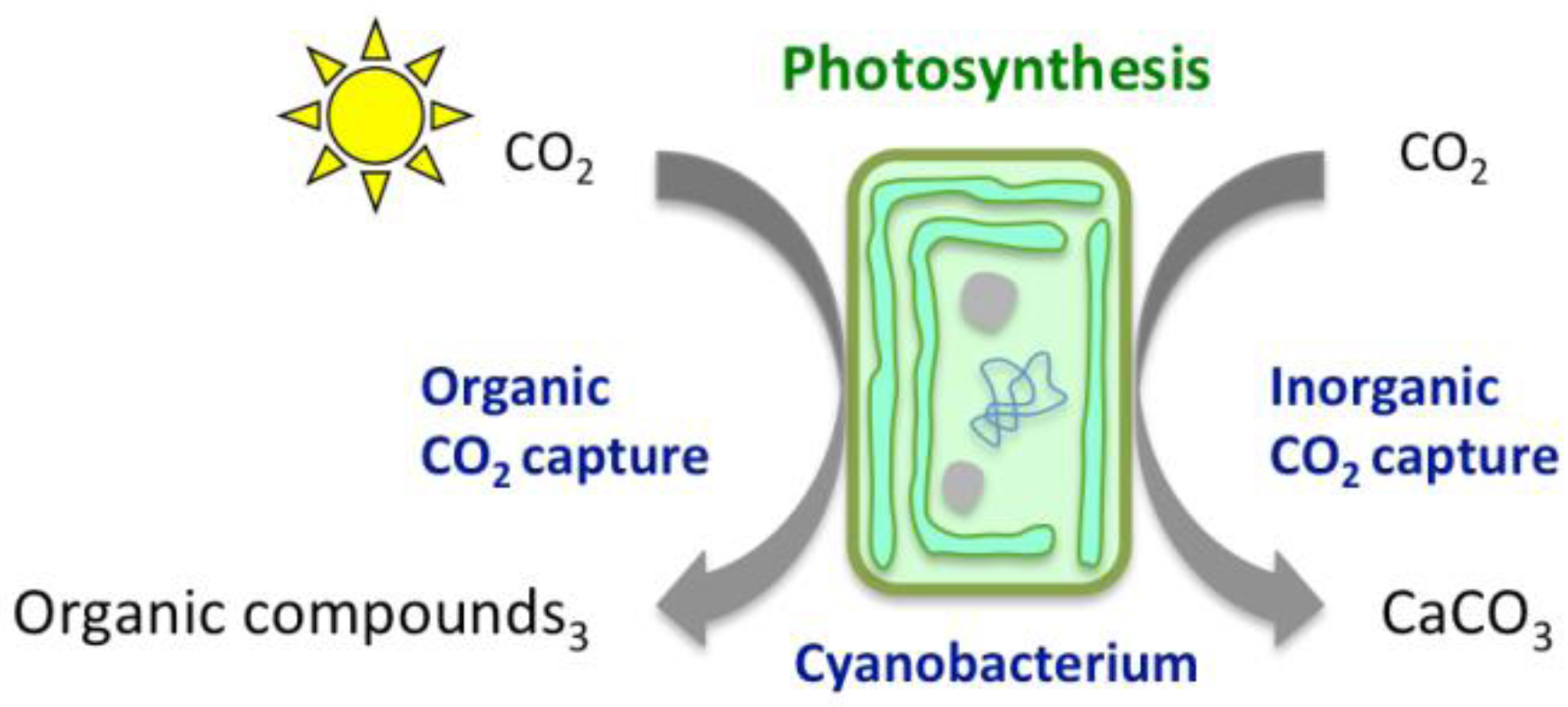
      <p>In addition to reducing CO<sub>2</sub> to organic compounds via photosynthesis, many cyanobacteria mineralize CO<sub>2 </sub>to recalcitrant carbonates, such as CaCO<sub>3</sub>. Thus cyanobacteria present two different modes of CO<sub>2</sub> capture, one via photosynthesis and the Calvin-Benson-Bassham (CBB) cycle where CO<sub>2</sub> is captured and converted to organic compounds, and another via carbonate mineralization, e.g., calcification, where CO<sub>2</sub> is converted to carbonate minerals (<xref ref-type="fig" rid="minerals-02-00338-f001">Figure 1</xref>). The ratio of organic to inorganic carbon production (<italic>R</italic><sub>OI</sub>), differs between species of cyanobacteria and environmental conditions. Although the phenomenon of microbial calcification has long been recognized, its physiological function is unknown. Calcification is a prominent feature of many cyanobacterial species [<xref ref-type="bibr" rid="B1-minerals-02-00338">1</xref>,<xref ref-type="bibr" rid="B2-minerals-02-00338">2</xref>,<xref ref-type="bibr" rid="B3-minerals-02-00338">3</xref>,<xref ref-type="bibr" rid="B4-minerals-02-00338">4</xref>,<xref ref-type="bibr" rid="B5-minerals-02-00338">5</xref>,<xref ref-type="bibr" rid="B6-minerals-02-00338">6</xref>] and cyanobacterial calcification is of vast biogeochemical and ecological significance [<xref ref-type="bibr" rid="B2-minerals-02-00338">2</xref>,<xref ref-type="bibr" rid="B4-minerals-02-00338">4</xref>,<xref ref-type="bibr" rid="B5-minerals-02-00338">5</xref>,<xref ref-type="bibr" rid="B7-minerals-02-00338">7</xref>,<xref ref-type="bibr" rid="B8-minerals-02-00338">8</xref>,<xref ref-type="bibr" rid="B9-minerals-02-00338">9</xref>,<xref ref-type="bibr" rid="B10-minerals-02-00338">10</xref>,<xref ref-type="bibr" rid="B11-minerals-02-00338">11</xref>,<xref ref-type="bibr" rid="B12-minerals-02-00338">12</xref>,<xref ref-type="bibr" rid="B13-minerals-02-00338">13</xref>]; magnificent illustrations of cyanobacterial calcification are stromatolites [<xref ref-type="bibr" rid="B14-minerals-02-00338">14</xref>,<xref ref-type="bibr" rid="B15-minerals-02-00338">15</xref>,<xref ref-type="bibr" rid="B16-minerals-02-00338">16</xref>] and whiting events, very fast, large-scale precipitations of fine-grained CaCO<sub>3</sub> together with organic compounds that can turn entire water bodies such as Lake Michigan into a milky state [<xref ref-type="bibr" rid="B17-minerals-02-00338">17</xref>,<xref ref-type="bibr" rid="B18-minerals-02-00338">18</xref>,<xref ref-type="bibr" rid="B19-minerals-02-00338">19</xref>,<xref ref-type="bibr" rid="B20-minerals-02-00338">20</xref>]. A comprehensive understanding of carbonate mineralization is necessary for us to fully appreciate and employ this process in efforts to model and predict carbon cycling and budgets, to elucidate paleoenvironments, and apply it in biological CCS. In this review, we discuss carbonate mineralization in cyanobacteria, with focus on calcification and, in so doing, provide some details about methodology currently applied in the field, and consider the significance of the process in a wider perspective.</p>
      <fig id="minerals-02-00338-f001" position="anchor">
        <label>Figure 1</label>
        <caption>
          <p>Two modes of CO<sub>2</sub> fixation in cyanobacteria.</p>
        </caption>
        <graphic xmlns:xlink="http://www.w3.org/1999/xlink" xlink:href="minerals-02-00338-g001.tif"/>
      </fig>
    </sec>
    <sec>
      <title>2. Chemical Reactions Governing CO2 Conversion into Carbonate Minerals</title>
      <p>The solubility of carbon dioxide (CO<sub>2</sub>) in water is higher than that of the other three most abundant gases in the Earth atmosphere (N<sub>2</sub>, O<sub>2</sub>, and Ar). However, its equilibria are somewhat complicated. The dissolved CO<sub>2</sub> reacts with water to form carbonic acid:
      <disp-formula>CO<sub>2 (aq)</sub> + H<sub>2</sub>O ⇆ H<sub>2</sub>CO<sub>3</sub> <label>(1)</label></disp-formula></p>
      <p>Subsequently, the carbonic acid dissociates to form bicarbonate (HCO<sub>3</sub><sup>−</sup>), releasing H<sup>+</sup> into the solution. A fraction of HCO<sub>3</sub><sup>−</sup> further dissociates to form carbonate (CO<sub>3</sub><sup>2−</sup>):
      <disp-formula>H<sub>2</sub>CO<sub>3</sub> ⇆ HCO<sub>3</sub><sup>−</sup> + H<sup>+</sup> <label>(2)</label></disp-formula>
      <disp-formula>HCO<sub>3</sub><sup>-</sup> ⇆ CO<sub>3</sub><sup>2−</sup> + H<sup>+</sup> <label>(3)</label></disp-formula></p>
      <p>The concentration of H<sub>2</sub>CO<sub>3</sub> at circumneutral pH is small, and the dissolved CO<sub>2</sub> from Reactions (2) and (3) occurs predominantly as HCO<sub>3</sub><sup>−</sup>. If the solution is natural water, e.g., lake or seawater, carbonate anions can interact with the cations present in the solution to form insoluble carbonates. For example, if Ca<sup>2+</sup> is present, CaCO<sub>3</sub> can be formed. Precipitation of CaCO<sub>3</sub> can be described with the following Reactions:
      <disp-formula>Ca<sup>2+</sup> + 2HCO<sub>3</sub><sup>−</sup> ⇆ CaCO<sub>3</sub> + CO<sub>2</sub> + H<sub>2</sub>O <label>(4)</label></disp-formula>
      <disp-formula>Ca<sup>2+</sup> + CO<sub>3</sub><sup>2−</sup> ⇆ CaCO<sub>3</sub> <label>(5)</label></disp-formula>
      with Reaction (5) dominating in seawater [<xref ref-type="bibr" rid="B21-minerals-02-00338">21</xref>]. In both cases, two moles of alkalinity are consumed per formation of one mole of CaCO<sub>3</sub>. Precipitation of CaCO<sub>3</sub> from the solution lowers its pH. Because of this, and since a greater fraction of dissolved inorganic carbon (DIC) is present as CO<sub>2 (aq)</sub> at low pH, the formation of CaCO<sub>3</sub> in seawater stimulates an increase in the concentration of CO<sub>2 (aq)</sub> and promotes its outgassing [<xref ref-type="bibr" rid="B22-minerals-02-00338">22</xref>]. This is opposed to the photosynthetic conversion of CO<sub>2</sub> into organic matter [<xref ref-type="bibr" rid="B23-minerals-02-00338">23</xref>], which serves as a transient carbon sink:
      <disp-formula>CO<sub>2 (aq)</sub> + H<sub>2</sub>O ⇆ CH<sub>2</sub>O + O<sub>2</sub> <label>(6)</label></disp-formula></p>
      <p>It is important to note that formation of both insoluble carbonates and organic matter pulls the equilibria of the carbonate species to the right to replace the removed (bi) carbonate ions in the solution. </p>
      <p>Three crystalline polymorphs of anhydrous CaCO<sub>3</sub> are known to occur in nature, calcite, aragonite, and vaterite. The first two are by far the most abundant forms of biologically produced CaCO<sub>3</sub> [<xref ref-type="bibr" rid="B24-minerals-02-00338">24</xref>]. The crystal structure of calcite is rhombohedral, whereas that of aragonite is orthorhombic. The different structures of the mineral polymorphs lead to a difference in their physical and chemical properties [<xref ref-type="bibr" rid="B25-minerals-02-00338">25</xref>], of which the solubility is of major importance for the mineralization process. The solubility product for each carbonate mineral is defined as:
      <disp-formula>K<sub>sp mineral</sub> = [Ca<sup>2+</sup>] × [CO<sub>3</sub><sup>2−</sup>] <label>(7)</label></disp-formula>
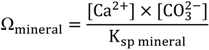
      where [Ca<sup>2+</sup>] and [CO<sub>3</sub><sup>2−</sup>] refers to, respectively, the calcium and carbonate ion activities in a solution saturated with respect to the mineral, at a given temperature, salinity, and pressure. Calcite is the most stable polymorph while vaterite is the most soluble, <italic>i.e.</italic>, K<sub>sp calcite</sub> &lt; K<sub>sp aragonite</sub> &lt; K<sub>sp vaterite</sub>. The CaCO<sub>3</sub> saturation state of the solution, Ω, is expressed as: 
      <disp-formula><inline-graphic xmlns:xlink="http://www.w3.org/1999/xlink" xlink:href="minerals-02-00338-i001.tif"/><label>(8)</label></disp-formula></p>
      <p>At Ω &gt;1 the solution is supersaturated and at Ω &lt; 1 it is undersaturated with respect to the CaCO<sub>3</sub> mineral [<xref ref-type="bibr" rid="B25-minerals-02-00338">25</xref>]. As mentioned above, the Ω is linked to temperature, pressure, and salinity through the dissociation constant. Contrary to the typical increase of solubility with increasing temperature observed for most minerals, the solubility of calcite decreases with increasing temperature, as does the solubility of CO<sub>2</sub> gas in water. Changes in pressure affect the partial pressure of CO<sub>2</sub> (<italic>p</italic>CO<sub>2</sub>) and thus the amount of gas dissolving in the solution. Increase in ionic strength of the solution leads to decrease of ion activity, affecting solubility of carbonates. Presence of particular ions e.g., Mg<sup>2+</sup> and PO<sub>4</sub><sup>2−</sup> is known to specifically inhibit CaCO<sub>3</sub> precipitation [<xref ref-type="bibr" rid="B26-minerals-02-00338">26</xref>,<xref ref-type="bibr" rid="B27-minerals-02-00338">27</xref>]. Magnesium calcites (Mg<sub>x</sub>Ca<sub>1−x</sub>(CO<sub>3</sub>)) are an important subgroup of the CaCO<sub>3</sub> minerals, frequently produced in natural environments. With up to 30 mol % MgCO<sub>3</sub> in the case of some biogenic calcites, solubility of the magnesium calcites is strongly influenced by their magnesium content. Properties and a mode of formation of dolomite (CaMg(CO<sub>3</sub>)<sub>2</sub>), one of the most abundant sedimentary minerals, are known in less details than for most other carbonates. Though marine and many other natural waters generally are greatly supersaturated with respect to both magnesite (MgCO<sub>3</sub>) and dolomite, these cannot form directly from aqueous solutions under near Earth surface conditions [<xref ref-type="bibr" rid="B28-minerals-02-00338">28</xref>] due to a high energy of hydration of the Mg<sup>2+</sup> ion and a kinetic barrier hindering formation of complex and well-ordered structure of the minerals. Instead, a variety of magnesium carbonate hydrates (e.g., nesquehonite, MgCO<sub>2</sub>·3H<sub>2</sub>O) and hydroxyhydrates (e.g., hydromagnesite, Mg<sub>5</sub>(CO<sub>3</sub>)<sub>4</sub>(OH)<sub>2</sub>·4H<sub>2</sub>O and dypingite, Mg<sub>5</sub>(CO<sub>3</sub>)<sub>4</sub>(OH)<sub>2</sub>·5H<sub>2</sub>O) form from solution [<xref ref-type="bibr" rid="B29-minerals-02-00338">29</xref>].</p>
      <p>CaCO<sub>3</sub> precipitation in solutions without a nucleation surface (homogeneous nucleation) is often impeded by kinetic barriers, as seen in systems supersaturated with Ca<sup>2+</sup> and CO<sub>3</sub><sup>2</sup><sup>−</sup> such as the oceans [<xref ref-type="bibr" rid="B29-minerals-02-00338">29</xref>]. Such kinetic barriers include the high energy of hydration of the calcium ions, the low concentration and activity of the carbonate ions, and the presence of high concentrations of sulfate and magnesium ions [<xref ref-type="bibr" rid="B29-minerals-02-00338">29</xref>,<xref ref-type="bibr" rid="B30-minerals-02-00338">30</xref>]. The addition of a surface on which the crystal can nucleate (heterogeneous nucleation) can dramatically reduce kinetic barriers in the calcification. There is increasing evidence that many processes traditionally considered as purely physico-chemical, such as carbonate mud production during whiting events [<xref ref-type="bibr" rid="B31-minerals-02-00338">31</xref>,<xref ref-type="bibr" rid="B32-minerals-02-00338">32</xref>], particle formation such as ooids and peloids [<xref ref-type="bibr" rid="B33-minerals-02-00338">33</xref>,<xref ref-type="bibr" rid="B34-minerals-02-00338">34</xref>,<xref ref-type="bibr" rid="B35-minerals-02-00338">35</xref>], and carbonate cycling in terrestrial environments [<xref ref-type="bibr" rid="B36-minerals-02-00338">36</xref>,<xref ref-type="bibr" rid="B37-minerals-02-00338">37</xref>,<xref ref-type="bibr" rid="B38-minerals-02-00338">38</xref>], have an organic and/or biological origin. Relative abundance of stable isotopes in the precipitate can bear witness to the nature of its origin [<xref ref-type="bibr" rid="B39-minerals-02-00338">39</xref>]. Thus enrichment of carbonate minerals with <sup>12</sup>C indicates that the carbon was derived from the degradation of the organic carbon e.g., by sulfate reducing bacteria, while enrichment with <sup>13</sup>C co-localizes carbonate precipitation with photosynthesis, actively depleting the <sup>12</sup>C pool [<xref ref-type="bibr" rid="B40-minerals-02-00338">40</xref>,<xref ref-type="bibr" rid="B41-minerals-02-00338">41</xref>]. </p>
      <p>Mineralization by microbial calcification (Reactions (4) or (5)) is generally considered to be biologically induced, as opposed to biologically controlled. While biologically controlled mineralization is an organized process where cells exert a high degree of control over nucleation and crystallization, and that usually results in specialized structures such as shells, biologically induced mineralization is a more diffuse phenomenon that depends on various metabolic activities that result in an alkaline (micro) environment and cell surface properties such as nucleation sites for mineralization [<xref ref-type="bibr" rid="B24-minerals-02-00338">24</xref>,<xref ref-type="bibr" rid="B42-minerals-02-00338">42</xref>,<xref ref-type="bibr" rid="B43-minerals-02-00338">43</xref>]. </p>
    </sec>
    <sec>
      <title>3. Cyanobacteria</title>
      <p>Cyanobacteria are Gram-negative bacteria that carry out oxygenic photosynthesis and are thought to be the origin of chloroplasts of plants and eukaryotic algae via endosymbiotic events in mid-Proterozoic [<xref ref-type="bibr" rid="B44-minerals-02-00338">44</xref>]. Through their photosynthetic capacity cyanobacteria have been tremendously important in shaping the course of evolution and ecological change throughout Earth’s history [<xref ref-type="bibr" rid="B45-minerals-02-00338">45</xref>], and they continue to contribute to a large share of the total photosynthetic harnessing of solar energy and assimilation of CO<sub>2</sub> to organic compounds. It is estimated that half of global photosynthesis is carried out by phytoplankton [<xref ref-type="bibr" rid="B46-minerals-02-00338">46</xref>], with cyanobacteria being, at times, the dominant contributors to CO<sub>2</sub> fixation [<xref ref-type="bibr" rid="B47-minerals-02-00338">47</xref>]. Indeed, &gt;25% of current global photosynthesis can be accounted for by the two genera of marine cyanobacteria, <italic>Synechococcus</italic> and <italic>Prochlorococcus</italic> [<xref ref-type="bibr" rid="B48-minerals-02-00338">48</xref>]. </p>
      <p>Cyanobacteria thrive in the majority of ecosystem habitats on Earth; they successfully populate freshwater and marine environments, hot springs, and cold dry valleys, coping with extremes in salinity, light quality and availability, UV radiation, pH, dryness, desiccation, temperature, and pressure. Similarly, they exhibit an unusually wide range of morphologies, from submicron-size unicellular free-living cells to complex well-structured mat communities comprising several cyanobacterial lineages and intra- and inter-lineage functional differentiation [<xref ref-type="bibr" rid="B47-minerals-02-00338">47</xref>]. Many cyanobacteria are diazotrophs and can assimilate not only CO<sub>2</sub> but also fix atmospheric nitrogen (N<sub>2</sub>) and convert it to organic matter [<xref ref-type="bibr" rid="B49-minerals-02-00338">49</xref>]. There are three major ecological groups of cyanobacteria in the aquatic environment: (i) mat-forming species, composing biofilms over rocks, sediments, and submerged plants; (ii) bloom-formers, most common in nutrient-rich water bodies, e.g., coastal ocean zones, eutrophic streams and lakes; and (iii) picocyanobacteria (&lt; 2 mm in diameter) that are often abundant in open oceans and clear water lakes. The mat-forming cyanobacteria have a particularly long history. Some of these organisms form laminated, lithified structures called stromatolites. Those formations exhibit a striking resemblance to the fossil stromatolites [<xref ref-type="bibr" rid="B15-minerals-02-00338">15</xref>,<xref ref-type="bibr" rid="B50-minerals-02-00338">50</xref>] found all the way back to the Precambrian. The stromatolite communities, thought to have been the main primary producers on Earth for more than 1 billion years throughout the Proterozoic, are much less abundant today [<xref ref-type="bibr" rid="B51-minerals-02-00338">51</xref>]. Another group of aquatic cyanobacteria worth mentioning comprises colonial non-bloom-formers, which are common in a variety of aquatic habitats, including mesotrophic lakes, wetlands, and saline waters [<xref ref-type="bibr" rid="B52-minerals-02-00338">52</xref>]. Many cyanobacteria, especially those forming colonies or biofilms, excrete organic polymeric substances to form extracellular formations e.g., sheaths or capsules [<xref ref-type="bibr" rid="B53-minerals-02-00338">53</xref>,<xref ref-type="bibr" rid="B54-minerals-02-00338">54</xref>]. The function of these exopolymeric substances (EPS) may be to allow association of cells, facilitate gliding, support uptake of micronutrients, and absorb heavy metals from the solution. The EPS can serve as a nucleation surface for mineralization and therefore is also a critical component of the carbonate mineralization process in many cyanobacteria and other bacteria (see further discussion in <xref ref-type="sec" rid="sec3dot2-minerals-02-00338">Section 3.2</xref>).</p>
      <sec>
        <title>3.1. The CO<sub>2</sub>-concentrating Mechanism</title>
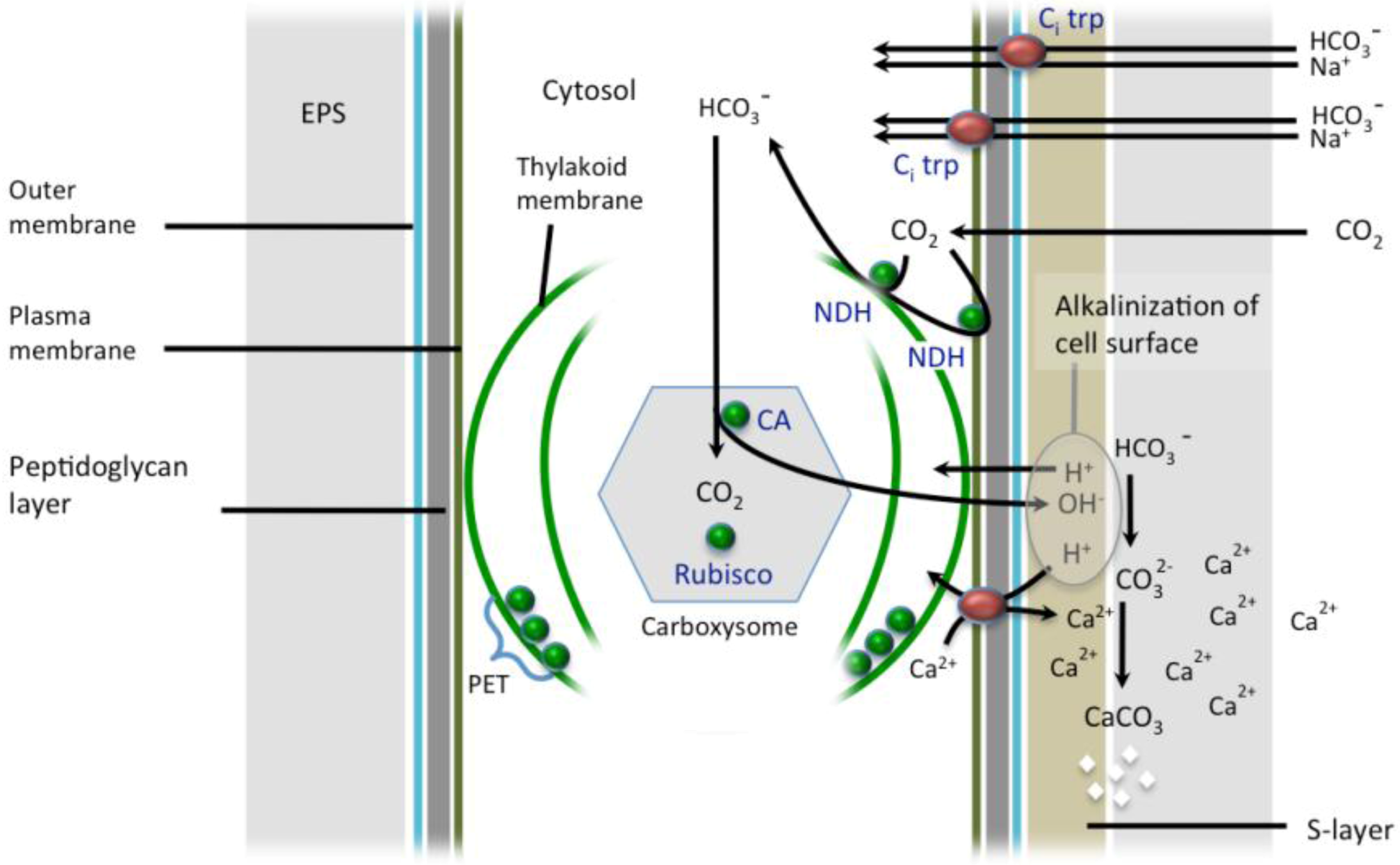
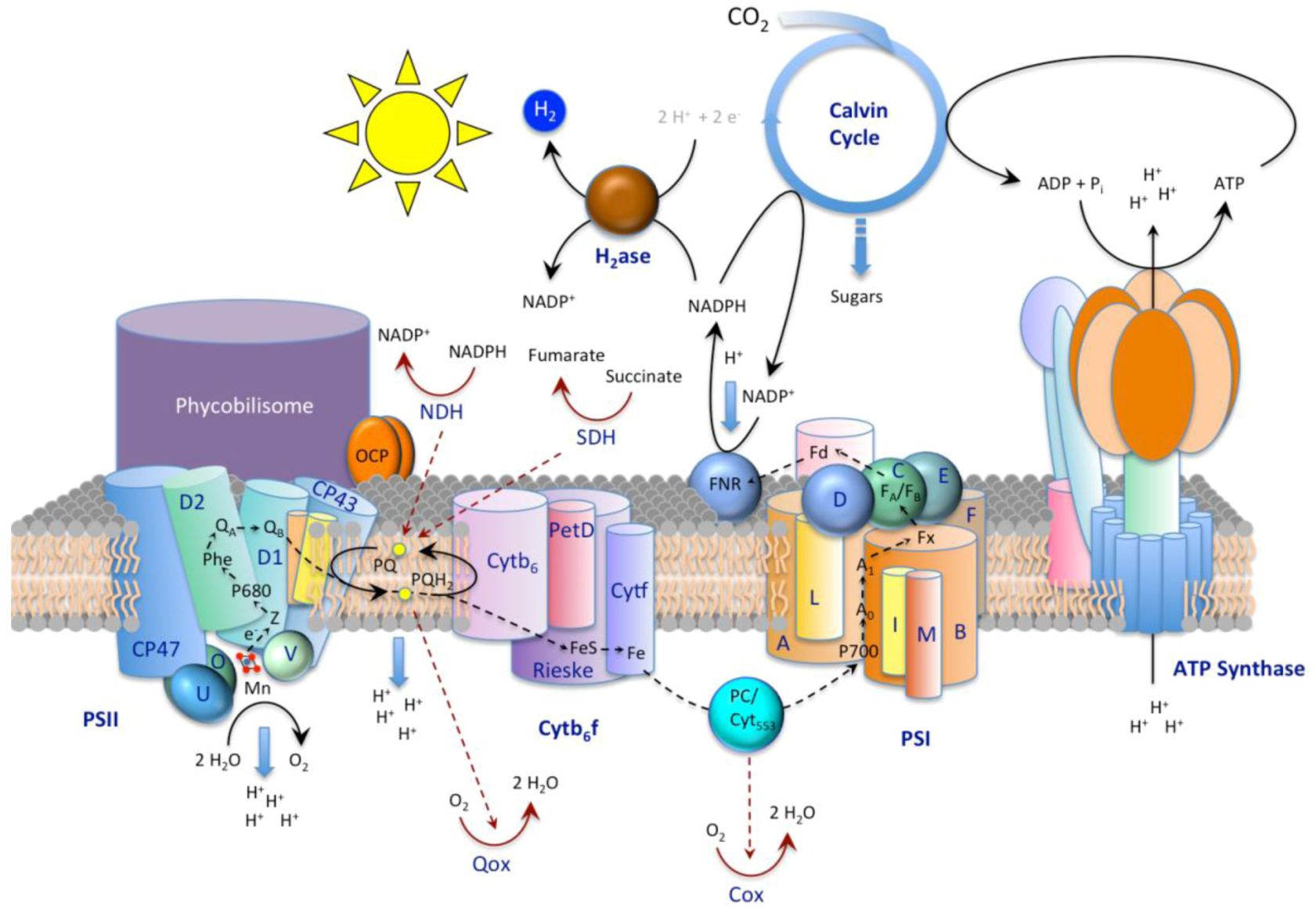
        <p>CCMs seem ubiquitous in cyanobacteria [<xref ref-type="bibr" rid="B55-minerals-02-00338">55</xref>], although their presence has not been confirmed in all of the around 1500 described cyanobacterial species [<xref ref-type="bibr" rid="B56-minerals-02-00338">56</xref>]. A CCM may provide a means for enhanced carbonate mineralization by elevating pH at the immediate cell exterior, and thus increasing the supersaturation level of the microenvironment in respect to a mineral. During oxygenic photosynthesis (<xref ref-type="fig" rid="minerals-02-00338-f002">Figure 2</xref>), CO<sub>2 </sub>is converted to organic compounds via the CBB cycle, utilizing ATP and NAD(P)H as energy and reducing equivalents, respectively (<xref ref-type="fig" rid="minerals-02-00338-f002">Figure 2</xref>). Light energy is harvested by the two photosystems, Photosystem II (PSII) and Photosystem I (PSI), associated with the light-harvesting phycobilisome complex. Light energy in PSII and PSI excites electrons, supporting an electron transport from water to NADP<sup>+</sup> through an electron transport chain involving a large number of redox components, including the two photosystems, Plastoquinones (PQ), the Cytochrome b/f complex, plastocyanin (PC), and Ferredoxin-NADPH oxido-reductase (FNR). The electron transport in the thylakoid membrane generates a H<sup>+</sup> gradient, which is the driving force for ATP synthesis by the ATP synthase. ATP and NADPH produced by photosphosphorylation are used to fuel the Calvin cycle in the carboxysome/cytosol, whereby atmospheric CO<sub>2</sub> is reduced to organic compounds by Ribulose-1,5 bisphosphate carboxylase/oxygenase (Rubisco; EC 4.1.1.39) and other enzymes. Rubisco is encumbered with the ability to use not only CO<sub>2</sub> but also O<sub>2</sub> as substrate, a property that, together with its slow turnover number, severely impairs Rubisco’s carboxylation efficiency. For aquatic cyanobacteria and algae, the situation is exacerbated by the poor availability of CO<sub>2</sub> in water, with a diffusion rate 10<sup>4</sup> times slower than in air [<xref ref-type="bibr" rid="B57-minerals-02-00338">57</xref>]. Consequently, many microorganisms including cyanobacteria have evolved inducible mechanisms that allow the cells to raise the concentration of CO<sub>2</sub> at the carboxylation site of Rubisco up to 1000-fold over that in the surrounding medium [<xref ref-type="bibr" rid="B58-minerals-02-00338">58</xref>,<xref ref-type="bibr" rid="B59-minerals-02-00338">59</xref>,<xref ref-type="bibr" rid="B60-minerals-02-00338">60</xref>]. Details of the CCM differ between cyanobacteria but the salient features include a series of bicarbonate (HCO<sub>3</sub><sup>−</sup>) and CO<sub>2</sub> transporters and the carboxysome, a protein-enclosed micro-compartment that houses (most of) the Rubisco population and also contains the enzyme carbonic anhydrase (CA; EC 4.2.1.1) [<xref ref-type="bibr" rid="B61-minerals-02-00338">61</xref>] (<xref ref-type="fig" rid="minerals-02-00338-f003">Figure 3</xref>). CO<sub>2</sub> enters the cells mainly via HCO<sub>3</sub><sup>−</sup>/Na<sup>+</sup> symports but also through diffusion of CO<sub>2</sub>, which is converted to HCO<sub>3</sub><sup>-</sup> during the uptake through membrane-associated CA activities. Cytosolic HCO<sub>3</sub><sup>−</sup> is subsequently imported to the carboxysome and converted to CO<sub>2</sub> by carboxysomal CA. The ensuing H<sup>+</sup> consumption (Reaction (9)) is transmitted as a pH increase to the cell exterior, contributing to the cell surface alkalization that is established by H<sup>+</sup> consumption by the photosynthetic electron transport. Alkalization, combined with accumulation of Ca<sup>2+</sup> ions transported to cell surface by Ca<sup>2+</sup>/H<sup>+</sup> antiporter and/or attracted by negatively charged residues in the cell wall, increases the CaCO<sub>3</sub> saturation state in a solution layer surrounding the cell, presumably leading to CaCO<sub>3</sub> precipitation. Under conditions of low inorganic C (C<sub>i</sub>), e.g., in alkaline environments, when CO<sub>3</sub><sup>2−</sup> species dominate over CO<sub>2</sub> and HCO<sub>3</sub><sup>−</sup>, the CCM is induced and activated, supporting active transport of HCO<sub>3</sub><sup>−</sup> across the outer and plasma membranes into the cytosol. The transport is facilitated through HCO<sub>3</sub><sup>−</sup>/Na<sup>+</sup> symports or ATP-driven uniports [<xref ref-type="bibr" rid="B60-minerals-02-00338">60</xref>]. Capture of CO<sub>2</sub> via diffusion is facilitated by CA-harboring NADPH dehydrogenase (NDH) complexes on the thylakoid and plasma membranes that convert the incoming CO<sub>2</sub> to HCO<sub>3</sub><sup>−</sup>:
        <disp-formula>CO<sub>2</sub> + H<sub>2</sub>O ⇆ H<sup>+</sup> + HCO<sub>3</sub><sup>−</sup> <label>(9)</label></disp-formula></p>
        <fig id="minerals-02-00338-f002" position="anchor">
          <label>Figure 2</label>
          <caption>
            <p>The photosynthetic machinery in cyanobacteria. Photosynthetic electron transport and ATP synthesis in thylakoid membranes. Modified from Jansson <italic>et al.</italic> [<xref ref-type="bibr" rid="B23-minerals-02-00338">23</xref>]. </p>
          </caption>
          <graphic xmlns:xlink="http://www.w3.org/1999/xlink" xlink:href="minerals-02-00338-g002.tif"/>
        </fig>
        <fig id="minerals-02-00338-f003" position="anchor">
          <label>Figure 3</label>
          <caption>
            <p>Model of the CO<sub>2</sub>-concentrating mechanism (CCM) and calcification in a cyanobacterial cell. Modified from Riding, 2006 [<xref ref-type="bibr" rid="B5-minerals-02-00338">5</xref>]. </p>
          </caption>
          <graphic xmlns:xlink="http://www.w3.org/1999/xlink" xlink:href="minerals-02-00338-g003.tif"/>
        </fig>
        <p>Under these conditions, HCO<sub>3</sub><sup>−</sup> is the predominant C<sub>i</sub> species taken up by the cells. The cytosolic HCO<sub>3</sub><sup>−</sup> subsequently enters the carboxysome where it is converted by CA to CO<sub>2</sub> (Reaction (9)) for the Rubisco reaction, consuming H<sup>+</sup> that subsequently contributes to increasing pH of the solution. At non-limiting C<sub>i</sub> concentrations, e.g., in a neutral environment or under high CO<sub>2</sub> partial pressure, the CCM recedes to a basic, constitutive level, characterized by mainly CO<sub>2</sub> uptake [<xref ref-type="bibr" rid="B60-minerals-02-00338">60</xref>].</p>
        <p>Since most, if not all, cyanobacteria are equipped with a CCM [<xref ref-type="bibr" rid="B55-minerals-02-00338">55</xref>] but not all of those exhibit calcifying abilities, particularly in marine environments [<xref ref-type="bibr" rid="B62-minerals-02-00338">62</xref>], it is clear that the CCM and calcification are not necessarily linked. This is also illustrated by reports demonstrating cyanobacterial calcification in the absence of photosynthesis (see further <xref ref-type="sec" rid="sec4-minerals-02-00338">Section 4</xref> below).</p>
      </sec>
      <sec id="sec3dot2-minerals-02-00338">
        <title>3.2. Exopolymeric Substances</title>
        <p>Exopolymeric substances are important nucleation surfaces for mineralization in many cyanobacteria. Indeed, a large number of bacteria are able to synthesize and secrete extracellular EPS [<xref ref-type="bibr" rid="B53-minerals-02-00338">53</xref>]. Such EPS are chiefly of polysaccharidic nature that can either remain covalently linked or loosely attached to the cell surface, or be released into the surrounding environment. The latter is referred to as released polysaccharide substances (RPS) or released EPS (r-EPS) [<xref ref-type="bibr" rid="B63-minerals-02-00338">63</xref>,<xref ref-type="bibr" rid="B64-minerals-02-00338">64</xref>]. The exopolysaccharides can be classified into two groups, homopolysaccharides (HOPOs) and heteropolysaccharides (HEPOs). The HOPOs are composed of one single type of monosaccharide, and are synthesized from sucrose in a reaction catalyzed by sucrases [<xref ref-type="bibr" rid="B65-minerals-02-00338">65</xref>,<xref ref-type="bibr" rid="B66-minerals-02-00338">66</xref>]. The HEPOs represent a variety of high-molecular-mass hydrated molecules containing different sugar residues. They are synthesized by the combined activity of various glycosyltransferases (GTs) [<xref ref-type="bibr" rid="B66-minerals-02-00338">66</xref>]. HEPOs can also contain acylated amino sugars and noncarbohydrate components such as glycerol, acetate, and lactate. The composition of bacterial EPS varies with the type of microorganism, growth phase, and environmental conditions. </p>
        <p>Production of EPS is widespread in cyanobacteria [<xref ref-type="bibr" rid="B54-minerals-02-00338">54</xref>]: more than a hundred cyanobacterial strains, belonging to 22 different genera, are known to produce EPS [<xref ref-type="bibr" rid="B67-minerals-02-00338">67</xref>]. Many cyanobacteria invest a considerable amount of their energy in EPS biosynthesis, and the EPS can constitute a substantial proportion of their biomass production (&gt;60% dry weigh) [<xref ref-type="bibr" rid="B68-minerals-02-00338">68</xref>]. The cyanobacterial EPS (cyano-EPS) can be divided in two groups, the ones associated with the cell surface, and the RPS. The cell surface-linked EPS is referred to as sheaths (thin, dense film loosely surrounding cells or cell clusters), capsules (thick layer intimately associated with the cell surface), or slimes (mucilaginous material dispersed around the cell) [<xref ref-type="bibr" rid="B69-minerals-02-00338">69</xref>,<xref ref-type="bibr" rid="B70-minerals-02-00338">70</xref>,<xref ref-type="bibr" rid="B71-minerals-02-00338">71</xref>]. The RPS are soluble portions of polysaccharide material released into the environment. The composition of cyano-EPS exhibits some unusual features compared to EPS from other bacteria [<xref ref-type="bibr" rid="B66-minerals-02-00338">66</xref>]: (i) the presence of sulfate groups and uronic acids, which both contribute to the anionic nature of the cyano-EPS, confers a negative charge and a “sticky” behavior. The number and distribution of charged groups are responsible for the ability of the cyano-EPS to chelate cations, notably metal ions; (ii) many cyano-EPS also contain ester-linked acetyl groups, peptides, and deoxysugars like fucose and rhamnose. These groups render the EPS hydrophobic and provide emulsifying properties; (iii) in contrast to EPS synthesized by other bacteria, cyano-EPS are complex HEPO structures, most of them containing six or more different kinds of monosaccharides. This high number of different monosaccharides generates a wide range of linkage types, and is the reason for the high number of possible structures and architectures, and the presence of complex repeating units in the cyano-EPS. Cyano-EPS can also contain polypeptides enriched in different amino acid residues, e.g., Glu- and Asp-rich small proteins.</p>
        <p>The physiological roles for cyano-EPS are likely to be numerous. Although little experimental evidence exists for particular functions, it is known that the EPS in a variety of bacteria provide protection against dehydration, phage-induced lysis, phagocytosis, and antibody recognition. The ecological roles of cyano-EPS may include protection against desiccation, salinity, UV-irradiation, oxidative stress, and predation; increase the availability of light, nutrient uptake, N<sub>2</sub> fixation (prevent entry of oxygen in heterocysts), and movement (gliding), and in establishing symbiotic association with other organisms [<xref ref-type="bibr" rid="B15-minerals-02-00338">15</xref>,<xref ref-type="bibr" rid="B71-minerals-02-00338">71</xref>,<xref ref-type="bibr" rid="B72-minerals-02-00338">72</xref>]. While cyano-EPS play an important role in binding and sequestration of necessary trace elements, at the other end of the spectrum, by the same token EPS are crucial for protecting cells against toxic metals. Cyanobacteria are well-known for their capacity to chelate and sequester many metal cations, <italic>i.e.</italic>, Cr<sup>6+</sup>, Cu<sup>2+</sup>, Pb<sup>2+</sup>, and Cd<sup>2+</sup> in their EPS [<xref ref-type="bibr" rid="B69-minerals-02-00338">69</xref>,<xref ref-type="bibr" rid="B73-minerals-02-00338">73</xref>,<xref ref-type="bibr" rid="B74-minerals-02-00338">74</xref>,<xref ref-type="bibr" rid="B75-minerals-02-00338">75</xref>,<xref ref-type="bibr" rid="B76-minerals-02-00338">76</xref>,<xref ref-type="bibr" rid="B77-minerals-02-00338">77</xref>,<xref ref-type="bibr" rid="B78-minerals-02-00338">78</xref>,<xref ref-type="bibr" rid="B79-minerals-02-00338">79</xref>,<xref ref-type="bibr" rid="B80-minerals-02-00338">80</xref>,<xref ref-type="bibr" rid="B81-minerals-02-00338">81</xref>,<xref ref-type="bibr" rid="B82-minerals-02-00338">82</xref>,<xref ref-type="bibr" rid="B83-minerals-02-00338">83</xref>]. The affinity of cyano-EPS for different metals is strain-dependent, and it differs between EPS and RPS [<xref ref-type="bibr" rid="B77-minerals-02-00338">77</xref>]. </p>
        <p>EPS can play a key role in influencing carbonate precipitation through multiple mechanisms (e.g., [<xref ref-type="bibr" rid="B84-minerals-02-00338">84</xref>,<xref ref-type="bibr" rid="B85-minerals-02-00338">85</xref>,<xref ref-type="bibr" rid="B86-minerals-02-00338">86</xref>]). For example, negatively charged groups in the EPS can recruit cations such as Ca<sup>2+</sup> and Mg<sup>2+</sup>, thereby facilitating carbonate formation. On the other hand, by tightly binding bivalent cations the EPS can inhibit carbonate formations. Also, EPS can favor carbonate precipitation by forming heterogeneous microdomains that support different types of microbial metabolism, and by serving as an energy and carbon source for heterotrophic bacteria [<xref ref-type="bibr" rid="B87-minerals-02-00338">87</xref>]. The properties of the EPS also influence the mineralogy of the precipitated CaCO<sub>3</sub> crystals [<xref ref-type="bibr" rid="B88-minerals-02-00338">88</xref>].</p>
      </sec>
      <sec>
        <title>3.3. S-layers</title>
        <p>Nucleation of CaCO<sub>3 </sub>formation by cyanobacteria often occurs on the external surface layer (S-layer) of bacterial cell wall. First demonstrated in 1953 in <italic>Spirillum</italic> species [<xref ref-type="bibr" rid="B89-minerals-02-00338">89</xref>], S-layer was subsequently found in hundreds of different species belonging to all major phylogenetic groups of bacteria and archaea [<xref ref-type="bibr" rid="B90-minerals-02-00338">90</xref>,<xref ref-type="bibr" rid="B91-minerals-02-00338">91</xref>]. This “two-dimensional array of proteinaceous subunits” covering the entire surface of the cell with highly porous lattice is commonly composed of a single homogeneous protein or glycoprotein species. The protomers, ranging from 25 to 200 kDa [<xref ref-type="bibr" rid="B92-minerals-02-00338">92</xref>], are translocated mainly as precursors containing an N-terminal signal peptide [<xref ref-type="bibr" rid="B91-minerals-02-00338">91</xref>]. Mature proteins undergo self-assembly on the cell surface, forming 5–20 nm thick lattice with a rather smooth outer and a more corrugated inner surface. The subunits are held together and onto the supporting envelope layer mainly by non-covalent forces including hydrophobic interactions and hydrogen bonds, as well as ionic bonds involving divalent cations or direct interaction of polar groups [<xref ref-type="bibr" rid="B91-minerals-02-00338">91</xref>]. <italic>In vitro</italic> self-assembly studies indicated that the information required for this assembly is entirely contained within the individual S-layer subunit [<xref ref-type="bibr" rid="B93-minerals-02-00338">93</xref>,<xref ref-type="bibr" rid="B94-minerals-02-00338">94</xref>]. However, there is little overall identity for either the primary or secondary structure of the protomers, at least in most bacteria [<xref ref-type="bibr" rid="B90-minerals-02-00338">90</xref>]. The S-layer subunits are arranged in oblique (<italic>p</italic>1, <italic>p</italic>2), square (<italic>p</italic>4), or hexagonal (<italic>p</italic>3, <italic>p</italic>6) symmetry with center-to-center spacings of the morphological units varying between 2.5 and 35 nm [<xref ref-type="bibr" rid="B95-minerals-02-00338">95</xref>,<xref ref-type="bibr" rid="B96-minerals-02-00338">96</xref>]. Well-defined pores with a diameter of 2–8 nm occupy between 30% and 70% of the surface area [<xref ref-type="bibr" rid="B95-minerals-02-00338">95</xref>]. With rare exceptions, the isoelectric points (pIs) of S-layer proteins, typically containing a high content of acidic and hydrophobic amino acids, are in the weakly acidic pH range [<xref ref-type="bibr" rid="B94-minerals-02-00338">94</xref>,<xref ref-type="bibr" rid="B97-minerals-02-00338">97</xref>]. Glycine- and aspartate-rich regions frequent in S-layer proteins are thought to function in calcium ion bridging to the outer membrane [<xref ref-type="bibr" rid="B98-minerals-02-00338">98</xref>,<xref ref-type="bibr" rid="B99-minerals-02-00338">99</xref>]. </p>
        <p>The regulatory mechanisms involved in biosynthesis of S-layers are not yet clear. Thus in most organisms studied, the rate of synthesis of S-layer subunits appears to be strictly controlled since only minor amounts of S-layer proteins can be detected in the growth medium. Along with this, a few organisms were reported to produce and shed a considerable excess of these proteins into the surrounding medium [<xref ref-type="bibr" rid="B100-minerals-02-00338">100</xref>]. If present, S-layer proteins can comprise up to approximately 15% of the cellular protein [<xref ref-type="bibr" rid="B90-minerals-02-00338">90</xref>]. Efficient production and maintenance of S-layers require a considerable amount of resources, attesting to the physiological and evolutionary importance of S-layers in microorganisms. Although no function has yet been defined for all the characterized S-layers, there is a list of functions proposed or determined for specific species examined. This includes determining and maintaining cell shape, cell envelope integrity, cell adhesion and surface recognition, and affecting an efficiency of phagocytosis in Gram-positive bacteria [<xref ref-type="bibr" rid="B101-minerals-02-00338">101</xref>,<xref ref-type="bibr" rid="B102-minerals-02-00338">102</xref>]. In <italic>Bacillaceae</italic>, S-layers could delineate the periplasmic space and, consequently, delay or control the release of exoenzymes [<xref ref-type="bibr" rid="B103-minerals-02-00338">103</xref>,<xref ref-type="bibr" rid="B104-minerals-02-00338">104</xref>]. </p>
        <p>No S-layer is present in the Gram-negative <italic>E.coli</italic>—the most extensively studied bacterial model organism. However, S-layer structures and S-layer-encoding genes were identified in many other Gram-negative bacteria, including species of <italic>Aeromonas</italic>, <italic>Campylobacter</italic>, <italic>Caulobacter</italic>, <italic>Fusobacterium</italic>, <italic>Thermus etc.</italic> [<xref ref-type="bibr" rid="B105-minerals-02-00338">105</xref>,<xref ref-type="bibr" rid="B106-minerals-02-00338">106</xref>]. Also, more than 60 cultivated strains of cyanobacteria are known to possess an S-layer [<xref ref-type="bibr" rid="B98-minerals-02-00338">98</xref>], most of which are of <italic>p</italic>6 lattice symmetry [<xref ref-type="bibr" rid="B107-minerals-02-00338">107</xref>]. In the marine <italic>Synechococcus</italic> sp. WH8102, inactivation of the <italic>swmA</italic> gene, encoding the S-layer protein, impacts cell motility [<xref ref-type="bibr" rid="B98-minerals-02-00338">98</xref>,<xref ref-type="bibr" rid="B108-minerals-02-00338">108</xref>]. However, absence of SwmA had no significant effect on the susceptibility of cells to grazing by the heterotrophic cosmopolitan dinoﬂagellate <italic>Oxyrrhis marina</italic> [<xref ref-type="bibr" rid="B109-minerals-02-00338">109</xref>]. In <italic>Synechococcus</italic> sp. strain GL24, the hexagonal S-layer units were reported to function as discrete crystallization nuclei for fine grain mineral formation [<xref ref-type="bibr" rid="B110-minerals-02-00338">110</xref>,<xref ref-type="bibr" rid="B111-minerals-02-00338">111</xref>].</p>
      </sec>
    </sec>
    <sec id="sec4-minerals-02-00338">
      <title>4. Cyanobacterial Carbonate Mineralization</title>
      <p>As stated in the Introduction, carbonate mineralization by cyanobacteria is of major ecological and geological significance, and it has been the subject of a vast number of laboratory and field investigations. A representative list of published experimental studies is shown in <xref ref-type="table" rid="minerals-02-00338-t001">Table 1</xref>. Cyanobacteria may catalyze the carbonate mineralization reaction(s) by increasing the saturation state of the environment intimately associated with the cell, with respect to the mineral. This can be done by one or both of two means [<xref ref-type="bibr" rid="B61-minerals-02-00338">61</xref>]: metabolic activity altering a pH of the environment and passive and/or active ion concentration. The photosynthetic electron transport in the thylakoids and the CA activity in the carboxysome (Reaction (8)) both consume cytosolic H<sup>+</sup>, resulting in a net increase of OH<sup>−</sup> in the cytosol. Neutralization of this imbalance, e.g., by the activity of a Ca<sup>2+</sup>/H<sup>+</sup> antiport, generates an alkaline microenvironment on the outer cell surface. The alkaline pH shifts the equilibria of the bicarbonate buffer system (Reactions (2) and (3)) to the right and generates localized regions of increased CO<sub>3</sub><sup>2−</sup> concentrations at the cell exterior (<xref ref-type="fig" rid="minerals-02-00338-f003">Figure 3</xref>). Recruitment of Ca<sup>2+</sup> to the cell surface occurs from the surrounding medium and also via the export of Ca<sup>2+</sup> through the Ca<sup>2+</sup>/H<sup>+</sup> translocator. A second mechanism by which cyanobacteria can catalyze carbonate precipitation is by the presence of ordered Ca<sup>2+</sup>/Mg<sup>2+</sup>-binding groups on the cell surface [<xref ref-type="bibr" rid="B6-minerals-02-00338">6</xref>,<xref ref-type="bibr" rid="B12-minerals-02-00338">12</xref>], e.g., glutamate and aspartate residues, or carboxylates and sulfonates. Those groups serve as nucleation sites for initiation of the CaCO<sub>3</sub> precipitation. </p>
      <table-wrap id="minerals-02-00338-t001" position="float">
        <object-id pub-id-type="pii">minerals-02-00338-t001_Table 1</object-id>
        <label>Table 1</label>
        <caption>
          <p>Examples of experimental laboratory- and field-based studies analyzing carbonate precipitation mediated by cyanobacterial cultures and communities. Abbreviations: Ara, aragonite (CaCO<sub>3</sub>); ACC, amorphous CaCO<sub>3</sub>; Cc, calcite (CaCO<sub>3</sub>), Dol, dolomite (CaMg(CO<sub>3</sub>)<sub>2</sub>); Dyp, Dypingite (Mg<sub>5</sub>(CO<sub>3</sub>)<sub>4</sub>(OH)<sub>2</sub>·5H<sub>2</sub>O); hMag, Hydromagnesite (Mg<sub>5</sub>(CO<sub>3</sub>)<sub>4</sub>(OH)<sub>2</sub>·4H<sub>2</sub>O); Mg-Cal (Mg<sub>x</sub>Ca<sub>1−x</sub>CO<sub>3</sub>), magnesium calcite; ND, not determined. </p>
        </caption>
        <table>
          <tbody>
            <tr>
              <td align="center" valign="middle"><bold>Species</bold></td>
              <td align="center" valign="middle"><bold>Culture conditions</bold></td>
              <td align="center" valign="middle"><bold>Mineral</bold></td>
              <td align="center" valign="middle"><bold>Ref.</bold></td>
            </tr>

          
            <tr style="border-top: solid thin">
              <td align="left" valign="middle"><italic>Synechococcus</italic> PCC 8806, <italic>Synechococcus</italic> PCC 8807</td>
              <td align="left" valign="middle">Artificial seawater (ASNIII)</td>
              <td align="left" valign="middle">ND</td>
              <td align="left" valign="middle">[<xref ref-type="bibr" rid="B112-minerals-02-00338">112</xref>]</td>
            </tr>
            <tr>
              <td align="left" valign="middle"><italic>Synechococcus</italic>, <italic>Planktothrix</italic></td>
              <td align="left" valign="middle">Freshwater medium (BG11)</td>
              <td align="left" valign="middle">Cc</td>
              <td align="left" valign="middle">[<xref ref-type="bibr" rid="B113-minerals-02-00338">113</xref>]</td>
            </tr>
            <tr>
              <td align="left" valign="middle"><italic>Synechococcus</italic> PCC 7942</td>
              <td align="left" valign="middle">NaHCO<sub>3</sub> + CaCl<sub>2</sub> solutions </td>
              <td align="left" valign="middle">Cc</td>
              <td align="left" valign="middle">[<xref ref-type="bibr" rid="B114-minerals-02-00338">114</xref>]</td>
            </tr>
            <tr>
              <td align="left" valign="middle"><italic>Synechococcus</italic> PCC 7942</td>
              <td align="left" valign="middle">Freshwater medium (Z/10)</td>
              <td align="left" valign="middle">ACC, Ara, Cc</td>
              <td align="left" valign="middle">[<xref ref-type="bibr" rid="B115-minerals-02-00338">115</xref>,<xref ref-type="bibr" rid="B116-minerals-02-00338">116</xref>,<xref ref-type="bibr" rid="B117-minerals-02-00338">117</xref>]</td>
            </tr>
            <tr>
              <td align="left" valign="middle"><italic>Trichodesmium erythraeum</italic> IMS101</td>
              <td align="left" valign="middle">Artificial YBCII based seawater</td>
              <td align="left" valign="middle">Ara</td>
              <td align="left" valign="middle">[<xref ref-type="bibr" rid="B118-minerals-02-00338">118</xref>]</td>
            </tr>
            <tr>
              <td align="left" valign="middle">Artificial cyanobacterial mat incl. <italic>Calothrix, Phormidium,</italic> and <italic>Pseudanabaena</italic> spp.</td>
              <td align="left" valign="middle">Seawater</td>
              <td align="left" valign="middle">Mg-Cc, Ara</td>
              <td align="left" valign="middle">[<xref ref-type="bibr" rid="B119-minerals-02-00338">119</xref>,<xref ref-type="bibr" rid="B120-minerals-02-00338">120</xref>]</td>
            </tr>
            <tr style="border-top: solid thin">
              <td align="center" valign="middle">
                <bold>Major species</bold>
              </td>
              <td align="center" valign="middle">
                <bold>Environmental conditions</bold>
              </td>
              <td align="center" valign="middle">
                <bold>Mineral</bold>
              </td>
              <td align="center" valign="middle">
                <bold>Ref</bold>
                <bold>.</bold>
              </td>
            </tr>
            <tr style="border-top: solid thin">
              <td align="left" valign="middle"><italic>Synechococcus</italic> GL24</td>
              <td align="left" valign="middle">Meromictic lake</td>
              <td align="left" valign="middle">Ara</td>
              <td align="left" valign="middle">[<xref ref-type="bibr" rid="B121-minerals-02-00338">121</xref>]</td>
            </tr>
            <tr>
              <td align="left" valign="middle"><italic>Pleurocapsa</italic> group</td>
              <td align="left" valign="middle">Soda lake </td>
              <td align="left" valign="middle">Ara</td>
              <td align="left" valign="middle">[<xref ref-type="bibr" rid="B122-minerals-02-00338">122</xref>]</td>
            </tr>
            <tr>
              <td align="left" valign="middle"><italic>Phormidium</italic> spp.</td>
              <td align="left" valign="middle">Seawater lakes</td>
              <td align="left" valign="middle">Mg-Cc</td>
              <td align="left" valign="middle">[<xref ref-type="bibr" rid="B123-minerals-02-00338">123</xref>]</td>
            </tr>
            <tr>
              <td align="left" valign="middle"><italic>Phormidium </italic>cf. <italic>crosbyanum, Phormidium </italic>sp. TK1,<italic>Schizothrix </italic>sp.</td>
              <td align="left" valign="middle">Seawater</td>
              <td align="left" valign="middle">ND</td>
              <td align="left" valign="middle">[<xref ref-type="bibr" rid="B124-minerals-02-00338">124</xref>]</td>
            </tr>
            <tr>
              <td align="left" valign="middle">Coccoid and filamentous cyanobacteria incl. <italic>Rivularia</italic> type</td>
              <td align="left" valign="middle">Fossil and active tufa formations associated with freshwater springs, waterfall, and wet areas</td>
              <td align="left" valign="middle">Cc, Ara</td>
              <td align="left" valign="middle">[<xref ref-type="bibr" rid="B125-minerals-02-00338">125</xref>]</td>
            </tr>
            <tr>
              <td align="left" valign="middle"><italic>Dichothrix</italic> spp.</td>
              <td align="left" valign="middle">Seawater</td>
              <td align="left" valign="middle">Cc, Ara</td>
              <td align="left" valign="middle">[<xref ref-type="bibr" rid="B9-minerals-02-00338">9</xref>]</td>
            </tr>
            <tr>
              <td align="left" valign="middle">Rivularia haematites</td>
              <td align="left" valign="middle">Calcareous streams and freshwater lake</td>
              <td align="left" valign="middle">ND</td>
              <td align="left" valign="middle">[<xref ref-type="bibr" rid="B126-minerals-02-00338">126</xref>]</td>
            </tr>
            <tr>
              <td align="left" valign="middle">
                <italic>Homoeothrix crustacean</italic>
              </td>
              <td align="left" valign="middle">Calcareous stream</td>
              <td align="left" valign="middle">Cc</td>
              <td align="left" valign="middle">[<xref ref-type="bibr" rid="B127-minerals-02-00338">127</xref>]</td>
            </tr>
            <tr>
              <td align="left" valign="middle">
                <italic>Lyngbya sp.</italic>
              </td>
              <td align="left" valign="middle">Alkaline wetland</td>
              <td align="left" valign="middle">Dyp, Ara</td>
              <td align="left" valign="middle">[<xref ref-type="bibr" rid="B13-minerals-02-00338">13</xref>]</td>
            </tr>
            <tr>
              <td align="left" valign="middle">
                <italic>Coccoid and filamentous cyanobacteria incl. Nostocales, Chroococcales, Oscillatoriales, and Pleurocapsales spp.</italic>
              </td>
              <td align="left" valign="middle">Alkaline brackish caldera lake</td>
              <td align="left" valign="middle">hMag, Ara</td>
              <td align="left" valign="middle">[<xref ref-type="bibr" rid="B128-minerals-02-00338">128</xref>]</td>
            </tr>
            <tr>
              <td align="left" valign="middle">
                <italic>Diatoms and filamentoud cyanobacteria incl. Lyngbya and Gloeocapsa spp.</italic>
              </td>
              <td align="left" valign="middle">Alkaline lake</td>
              <td align="left" valign="middle">hMag</td>
              <td align="left" valign="middle">[<xref ref-type="bibr" rid="B129-minerals-02-00338">129</xref>,<xref ref-type="bibr" rid="B130-minerals-02-00338">130</xref>]</td>
            </tr>
          </tbody>
        </table>

      </table-wrap>
      <p>Thus EPS, possessing both the highly hydrated nature facilitating ion accumulation and concentration [<xref ref-type="bibr" rid="B131-minerals-02-00338">131</xref>] and the negatively charged residues [<xref ref-type="bibr" rid="B121-minerals-02-00338">121</xref>], is frequently found to be linked to the mineralization processes [<xref ref-type="bibr" rid="B8-minerals-02-00338">8</xref>,<xref ref-type="bibr" rid="B84-minerals-02-00338">84</xref>,<xref ref-type="bibr" rid="B116-minerals-02-00338">116</xref>,<xref ref-type="bibr" rid="B132-minerals-02-00338">132</xref>]. Cyanobacterial S-layers, providing ordered ion-binding groups and frequently being the outermost defining layer of the cell, was also shown to undergo mineralization [<xref ref-type="bibr" rid="B110-minerals-02-00338">110</xref>,<xref ref-type="bibr" rid="B111-minerals-02-00338">111</xref>]. Furthermore, the encrusted patches of S-layer were reported to be shed by cyanobacteria, probably in attempt to prevent total encasement in mineral and subsequent death of the cell [<xref ref-type="bibr" rid="B18-minerals-02-00338">18</xref>,<xref ref-type="bibr" rid="B121-minerals-02-00338">121</xref>]. With calcium carbonates comprising the major array of minerals associated with cyanobacteria, relatively few studies reported precipitation of magnesium carbonates (<xref ref-type="table" rid="minerals-02-00338-t001">Table 1</xref>). In most cases, biologically-induced formation of magnesium carbonates was confined to Mg-rich alkaline environments. Hydromagnesite (Mg<sub>5</sub>(CO<sub>3</sub>)<sub>4</sub>(OH)<sub>2</sub>·4H<sub>2</sub>O) was detected in stromatolite-like formations of the Lake Salda, Turkey, and the deposition mineral was mediated by a microflora of diatoms and cyanobacteria [<xref ref-type="bibr" rid="B129-minerals-02-00338">129</xref>,<xref ref-type="bibr" rid="B130-minerals-02-00338">130</xref>]. Dypingite (Mg<sub>5</sub>(CO<sub>3</sub>)<sub>4</sub>(OH)<sub>2</sub>·5H<sub>2</sub>O) was reported to be produced in mats of cyanobacteria enriched from alkaline wetland near Atlin, British Colombia [<xref ref-type="bibr" rid="B13-minerals-02-00338">13</xref>]. Precipitation of dolomite, one of the most abundant sedimentary carbonate minerals, was shown to be mainly facilitated by metabolic activities of methanogens and sulfur reducing bacteria actively increasing alkalinity and/or pH of the environment (e.g., [<xref ref-type="bibr" rid="B133-minerals-02-00338">133</xref>,<xref ref-type="bibr" rid="B134-minerals-02-00338">134</xref>,<xref ref-type="bibr" rid="B135-minerals-02-00338">135</xref>,<xref ref-type="bibr" rid="B136-minerals-02-00338">136</xref>,<xref ref-type="bibr" rid="B137-minerals-02-00338">137</xref>,<xref ref-type="bibr" rid="B138-minerals-02-00338">138</xref>]). The capability of cyanobacteria to induce dolomite formation remains to be clarified.</p>
      <p>We don’t yet know the physiological or biochemical function(s) (if any) of calcification in cyanobacteria, although some possibilities have been suggested [<xref ref-type="bibr" rid="B61-minerals-02-00338">61</xref>]. Calcification may provide a means to buffer the pH rise generated by the CCM machinery [<xref ref-type="bibr" rid="B139-minerals-02-00338">139</xref>]. Also, since calcification will remove Ca<sup>2+</sup> from chemical equilibria and may offer a means to sustain an active efflux of Ca<sup>2+</sup> via the Ca<sup>2+</sup>/H<sup>+</sup> translocator, it generates a H<sup>+</sup> gradient that may enhance nutrient and HCO<sub>3</sub><sup>−</sup> uptake [<xref ref-type="bibr" rid="B140-minerals-02-00338">140</xref>,<xref ref-type="bibr" rid="B141-minerals-02-00338">141</xref>]. Another benefit of carbonate precipitation may be to prevent inhibition of the HCO<sub>3</sub><sup>−</sup> transporters by CO<sub>3</sub><sup>2</sup><sup>−</sup> ions [<xref ref-type="bibr" rid="B141-minerals-02-00338">141</xref>,<xref ref-type="bibr" rid="B142-minerals-02-00338">142</xref>], or to provide cyanobacteria with a calcerous shell as a protective layer against excessive light exposure [<xref ref-type="bibr" rid="B143-minerals-02-00338">143</xref>]. In a Ca<sup>2+</sup>-rich environment, calcification may also serve as a process to remove toxic levels of Ca<sup>2+</sup> ions [<xref ref-type="bibr" rid="B144-minerals-02-00338">144</xref>]. Finally, it should be noted that microbial calcification in aquatic environments results in release of CO<sub>2</sub> (Reaction (4); however, see <xref ref-type="sec" rid="sec5-minerals-02-00338">Section 5</xref> below), so it also is possible that cyanobacteria benefit from calcification by an increase in availability of CO<sub>2</sub> for Rubisco. In this context it is pertinent to consider the suggestion by Martinez <italic>et al.</italic> [<xref ref-type="bibr" rid="B113-minerals-02-00338">113</xref>] that cyanobacteria need a protective mechanism against carbonate precipitation on the cell exterior. They argued that precipitation of carbonate minerals on the cell surface would prevent photosynthesis by interfering with HCO<sub>3</sub><sup>−</sup> uptake. Such a view can be taken to mean that cyanobacterial carbonate mineralization is simply a consequence of the environment. Although this may be true, the notion that a calcified cyanobacterial cell surface is detrimental to photosynthesis or cell survival is not substantiated. For example, a layer of calcified EPS may fully or partly detach from the cell, and for the freshwater cyanobacterium <italic>Synechococcus</italic> sp. GL24, which contains an S-layer, it was proposed that the calcified S-layer is shed, followed by synthesis of a nascent S-layer [<xref ref-type="bibr" rid="B18-minerals-02-00338">18</xref>,<xref ref-type="bibr" rid="B121-minerals-02-00338">121</xref>]. The protective mechanism invoked by Martinez <italic>et al.</italic> hinges on a positive cell surface charge at alkaline pH, as determined by Zeta-potential (z-potential) measurements, thereby impeding recruitment of Ca<sup>2+</sup> ions to the cell surface [<xref ref-type="bibr" rid="B113-minerals-02-00338">113</xref>]. These findings differ from z-potential measurements of cyanobacteria such as the marine <italic>Synechococcus</italic> sp. PCC 8806 (Kamennaya, N.A. <italic>et al</italic>. unpublished [<xref ref-type="bibr" rid="B145-minerals-02-00338">145</xref>] and the freshwater strain <italic>S. leopoliensis</italic> [<xref ref-type="bibr" rid="B117-minerals-02-00338">117</xref>], which showed negative surface charge at circumneutral or alkaline pH and a shift toward less negative charge upon binding of Ca<sup>2+</sup>. Similar results were obtained by Dittrich and Sibler for freshwater <italic>Synechococcus</italic> sp. [<xref ref-type="bibr" rid="B146-minerals-02-00338">146</xref>] .The strains used by Martinez and coworkers are only identified as <italic>Synechococcus</italic> sp. and <italic>Planktothrix</italic> sp., and we don’t know details about their cell surface properties, or to what extent they are representative of other cyanobacteria. </p>
      <p>It is clear from the above that the process of cyanobacterial calcification differs between different environmental conditions. Moreover, the onset and mechanistic details of calcification are also subject to taxonomic control. As an example, carbonate minerals produced by coccoid cyanobacteria are often found in the EPS between cells, whereas in filamentous strains mineralization results in the formation of a tube surrounding the trichome (filament) [<xref ref-type="bibr" rid="B1-minerals-02-00338">1</xref>]. Another example is the recent finding of a cyanobacterial strain that produces intracellular carbonate minerals [<xref ref-type="bibr" rid="B147-minerals-02-00338">147</xref>] (see also <xref ref-type="sec" rid="sec5-minerals-02-00338">Section 5</xref> below).</p>
      <p>Since no enzymatic process is directly involved in carbonate mineralization, the conventional biochemistry tool kit remains inapplicable to studies of calcification in cyanobacteria. Dynamics of CaCO<sub>3</sub> precipitation in cultures of cyanobacteria can be deduced from temporal shifts in (i) Ca<sup>2+</sup> concentrations, using inductively coupled plasma atomic/optical emission spectroscopy (ICP-A/OES) [<xref ref-type="bibr" rid="B13-minerals-02-00338">13</xref>,<xref ref-type="bibr" rid="B83-minerals-02-00338">83</xref>,<xref ref-type="bibr" rid="B110-minerals-02-00338">110</xref>,<xref ref-type="bibr" rid="B112-minerals-02-00338">112</xref>] atomic absorption spectroscopy [<xref ref-type="bibr" rid="B16-minerals-02-00338">16</xref>,<xref ref-type="bibr" rid="B129-minerals-02-00338">129</xref>,<xref ref-type="bibr" rid="B148-minerals-02-00338">148</xref>,<xref ref-type="bibr" rid="B149-minerals-02-00338">149</xref>], or Ca<sup>2+</sup> ion-specific electrodes [<xref ref-type="bibr" rid="B16-minerals-02-00338">16</xref>,<xref ref-type="bibr" rid="B132-minerals-02-00338">132</xref>] and (ii) carbonate chemistry of the solution. Speciation and concentrations of carbonate species in equilibrium from any two of the species measured (pH, total DIC, and total alkalinity) can be calculated with computer programs, e.g., CO<sub>2</sub>calc [<xref ref-type="bibr" rid="B150-minerals-02-00338">150</xref>], CO<sub>2</sub>Sys [<xref ref-type="bibr" rid="B151-minerals-02-00338">151</xref>], PHREEQE [<xref ref-type="bibr" rid="B152-minerals-02-00338">152</xref>] and others. The presence of micrometer-scale crystals can be directly detected with bright-field [<xref ref-type="bibr" rid="B87-minerals-02-00338">87</xref>] and cross-polarized microscopy [<xref ref-type="bibr" rid="B84-minerals-02-00338">84</xref>]. Autofluorescence from cyanobacteria coupled with biorefringence from crystals reveals space relations between cells and crystals. Furthermore, epifluorescent microscopy can be used to detect Ca<sup>2+</sup>-chelating fluorophores, e.g., calcein and tetracycline [<xref ref-type="bibr" rid="B36-minerals-02-00338">36</xref>]. Electron microscopy, e.g., scanning (SEM) [<xref ref-type="bibr" rid="B13-minerals-02-00338">13</xref>,<xref ref-type="bibr" rid="B31-minerals-02-00338">31</xref>,<xref ref-type="bibr" rid="B36-minerals-02-00338">36</xref>,<xref ref-type="bibr" rid="B38-minerals-02-00338">38</xref>,<xref ref-type="bibr" rid="B87-minerals-02-00338">87</xref>,<xref ref-type="bibr" rid="B88-minerals-02-00338">88</xref>,<xref ref-type="bibr" rid="B129-minerals-02-00338">129</xref>] and transmission (TEM) [<xref ref-type="bibr" rid="B31-minerals-02-00338">31</xref>,<xref ref-type="bibr" rid="B110-minerals-02-00338">110</xref>,<xref ref-type="bibr" rid="B111-minerals-02-00338">111</xref>,<xref ref-type="bibr" rid="B116-minerals-02-00338">116</xref>] electron microscopies, provides details about the morphology, thickness and localization of the precipitates. Electron microscopy-coupled Energy Dispersive Spectrometry (EDS) [<xref ref-type="bibr" rid="B36-minerals-02-00338">36</xref>,<xref ref-type="bibr" rid="B87-minerals-02-00338">87</xref>,<xref ref-type="bibr" rid="B88-minerals-02-00338">88</xref>,<xref ref-type="bibr" rid="B110-minerals-02-00338">110</xref>,<xref ref-type="bibr" rid="B111-minerals-02-00338">111</xref>,<xref ref-type="bibr" rid="B144-minerals-02-00338">144</xref>] gives information about elemental composition of the precipitate and links structural characteristics of the crystalline matter to its chemical composition. X-ray Diffraction (XRD) [<xref ref-type="bibr" rid="B13-minerals-02-00338">13</xref>,<xref ref-type="bibr" rid="B87-minerals-02-00338">87</xref>,<xref ref-type="bibr" rid="B116-minerals-02-00338">116</xref>,<xref ref-type="bibr" rid="B129-minerals-02-00338">129</xref>,<xref ref-type="bibr" rid="B139-minerals-02-00338">139</xref>,<xref ref-type="bibr" rid="B144-minerals-02-00338">144</xref>] and Raman microscopy reveal the type of non-amorphous crystalline polymorphs in the precipitate based on the crystal symmetry, e.g., distinguishing between rhombohedral calcite and orthorhombic aragonite. Relative abundance of stable isotopes (e.g., C, O) in carbonate precipitates is detected with mass spectrometry [<xref ref-type="bibr" rid="B9-minerals-02-00338">9</xref>,<xref ref-type="bibr" rid="B13-minerals-02-00338">13</xref>,<xref ref-type="bibr" rid="B62-minerals-02-00338">62</xref>,<xref ref-type="bibr" rid="B129-minerals-02-00338">129</xref>]. Two synchrotron based methods—Near Edge X-ray Absorption Fine Structure (NEXAFS) [<xref ref-type="bibr" rid="B116-minerals-02-00338">116</xref>] and Fourier Transform Infrared (FTIR) [<xref ref-type="bibr" rid="B83-minerals-02-00338">83</xref>,<xref ref-type="bibr" rid="B88-minerals-02-00338">88</xref>] spectroscopy, can detect unique absorptions indicative of different forms of carbonates. Finally, Time-of-Flight Secondary Mass Spectrometry (ToF-SIMS), a sensitive surface method, can be applied to detect calcification in its early stages (Kamennaya, N.A. <italic>et al</italic>., unpublished [<xref ref-type="bibr" rid="B145-minerals-02-00338">145</xref>]). </p>
    </sec>
    <sec id="sec5-minerals-02-00338">
      <title>5. Practical Implications of Cyanobacterial Carbonate Mineralization</title>
      <p>The dual capture of CO<sub>2</sub> in cyanobacteria, into one organic form as biomass, and one inorganic form, with formation and precipitation of carbonate minerals (<xref ref-type="fig" rid="minerals-02-00338-f001">Figure 1</xref>), leads to several aspects of potential practical importance for a wide range of research areas, including paleontology, geology, ecology, and climate change.</p>
      <p>(1) As a general phenomenon, microbial calcification in a natural setting, such as the oceans, is considered a net source for atmospheric CO<sub>2</sub>. However, whether oceanic cyanobacterial communities provide a net source or sink for CO<sub>2</sub> depends on the <italic>R</italic><sub>OI</sub> (see Introduction); at values &gt;0.6, the system incorporates enough CO<sub>2 </sub>into biomass for it to function as a net sink, whereas a value &lt;0.6 indicates that the system is a net source [<xref ref-type="bibr" rid="B153-minerals-02-00338">153</xref>]. Additionally, field and laboratory measurements of systems with cyanobacteria or other calcifying organisms showed released CO<sub>2</sub>/precipitated carbonates ratios (Y) of 0.1–0.006, which starkly deviate from the theoretically calculated Y of 0.6 in seawater (no relation to the threshold value for <italic>R</italic><sub>OI</sub>) and close to 1.0 in freshwater [<xref ref-type="bibr" rid="B154-minerals-02-00338">154</xref>]. Further, laboratory and field investigations of microalgal blooms indicated that microbial calcification can act as a CO<sub>2</sub> sink [<xref ref-type="bibr" rid="B139-minerals-02-00338">139</xref>,<xref ref-type="bibr" rid="B155-minerals-02-00338">155</xref>]. It was suggested that possible explanations for this apparent discrepancy between theoretical and experimental results were (i) recapture of the released CO<sub>2</sub> by photosynthesis and (ii) enhanced sedimentation of both organic and inorganic carbon. A thorough understanding of the organic and inorganic carbon fluxes in different cyanobacterial communities, the carbonate mineralization process, the interplay between calcification and photosynthesis, and how this interaction may be influenced by climate change is critical for correct calculations of the global carbon budget under present and predicted climatic regimes.</p>
      <p>(2) Carbonate mineralization by cyanobacteria and other microorganisms can also be biogeochemically coupled to weathering of silicate minerals. Biologically accelerated weathering (BAW) of silicates occurs both chemically and mechanically via production by microorganisms of extracellular enzymes, chelates, simple and complex organic acids, alcohols, and EPS [<xref ref-type="bibr" rid="B156-minerals-02-00338">156</xref>,<xref ref-type="bibr" rid="B157-minerals-02-00338">157</xref>,<xref ref-type="bibr" rid="B158-minerals-02-00338">158</xref>,<xref ref-type="bibr" rid="B159-minerals-02-00338">159</xref>,<xref ref-type="bibr" rid="B160-minerals-02-00338">160</xref>,<xref ref-type="bibr" rid="B161-minerals-02-00338">161</xref>]. The combined cyanobacterial activities of accelerated silicate weathering and carbonate mineralization may therefore provide an important sink for atmospheric CO<sub>2</sub> in terrestrial systems [<xref ref-type="bibr" rid="B162-minerals-02-00338">162</xref>] (see bullet 5 below). </p>
      <p>(3) Detailed knowledge about the mechanisms and environmental requirements (e.g., optimal nutrient and light availability, maximal allowable concentration of mineralization inhibitors, saturation state of the solution with respect to the minerals precipitated) for cyanobacterial calcification is crucial for our ability to reconstruct paleoenvironements. For example, the question arises as to what extent CO<sub>2</sub> concentrations during Earth’s history, with a range from present atmospheric level (PAL) to 30 times PAL in the Phanerozoic [<xref ref-type="bibr" rid="B6-minerals-02-00338">6</xref>] and up to 80–600 times PAL in the Precambrian [<xref ref-type="bibr" rid="B163-minerals-02-00338">163</xref>,<xref ref-type="bibr" rid="B164-minerals-02-00338">164</xref>], have been permissible with cyanobacterial calcification. Similarly, as we learn more about cyanobacterial carbonate mineralization under high CO<sub>2</sub> conditions, we may be able to complement and/or modify interpretations that explain the presence of fossil records for calcareous cyanobacteria from the early Phanerozoic (Cambrian) [<xref ref-type="bibr" rid="B5-minerals-02-00338">5</xref>,<xref ref-type="bibr" rid="B19-minerals-02-00338">19</xref>], or for aragonite structures from the Precambrian [<xref ref-type="bibr" rid="B165-minerals-02-00338">165</xref>]. </p>
      <p>The recent isolation of cyanobacteria that form intracellular carbonates [<xref ref-type="bibr" rid="B147-minerals-02-00338">147</xref>], morphologically and chemically resembling those of a long-known but uncultured giant sulfur bacterium, <italic>Achromatium oxaliferum</italic> [<xref ref-type="bibr" rid="B166-minerals-02-00338">166</xref>], opens the door to a new direction in studies on carbonate mineralization in cyanobacteria, and presents a fascinating, although challenging, task for those involved in patching up our paleontological landscape [<xref ref-type="bibr" rid="B147-minerals-02-00338">147</xref>,<xref ref-type="bibr" rid="B167-minerals-02-00338">167</xref>]. </p>
      <p>(4) The capacity of cyanobacteria to thrive in high CO<sub>2</sub> concentrations makes them an attractive system for beneficial recycling of CO<sub>2</sub> from point sources such as coal-fired power plants via biofuel synthesis [<xref ref-type="bibr" rid="B168-minerals-02-00338">168</xref>]. In this regard, it becomes important to further our understanding of the interactions between the two modes of CO<sub>2</sub> utilization. For example, for cyanobacteria-based biofuel production, it is desirable to funnel as much of the captured CO<sub>2</sub> as possible to biofuel synthesis at the expense of carbonate formations. However, at the same time, we may want to consider the possibility that the carbonate mineralization process confers metabolic benefits, e.g., by providing extra CO<sub>2</sub> for photosynthesis, or by generating H<sup>+ </sup>to facilitate nutrient uptake [<xref ref-type="bibr" rid="B61-minerals-02-00338">61</xref>,<xref ref-type="bibr" rid="B141-minerals-02-00338">141</xref>].</p>
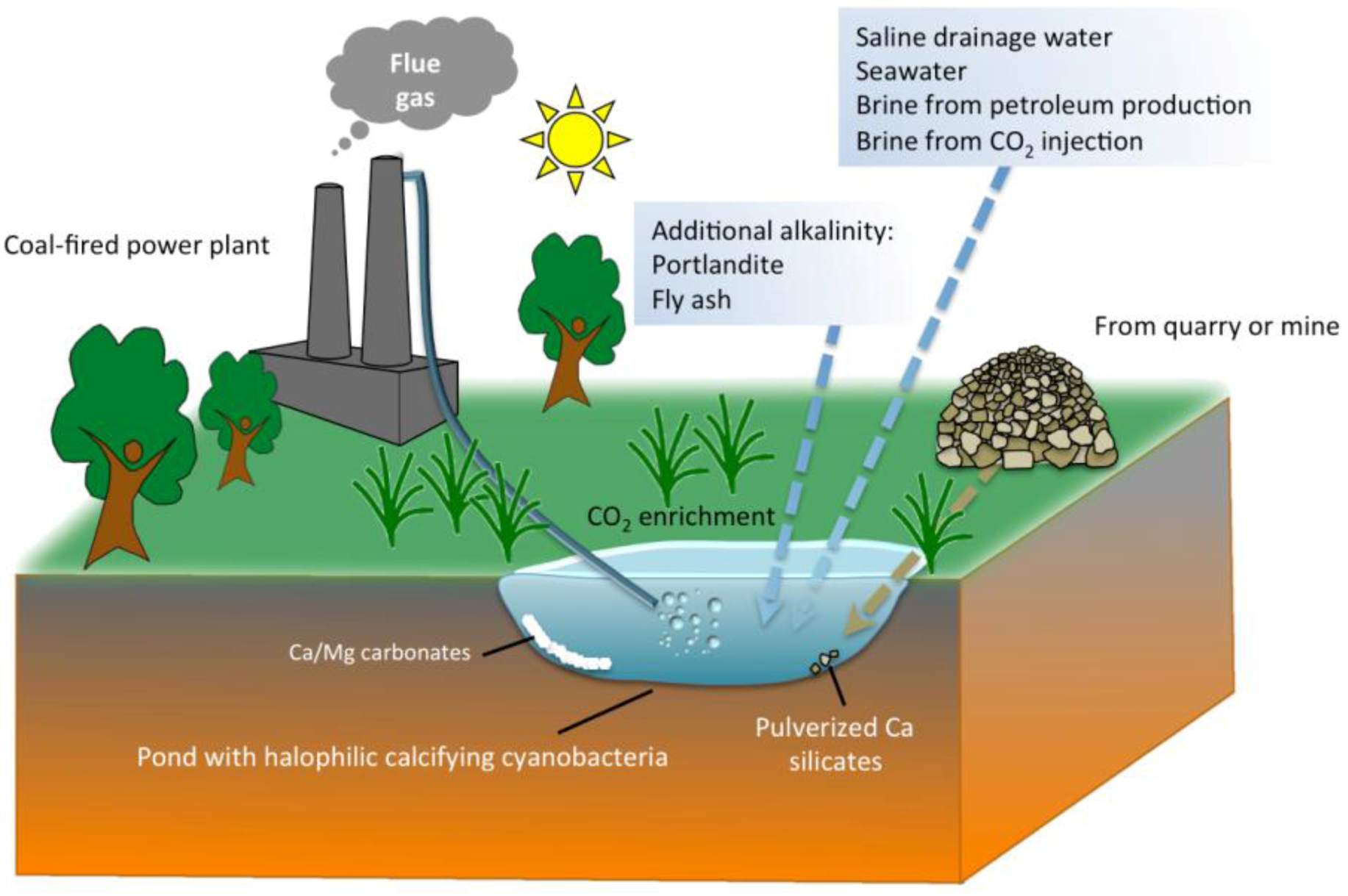
      <p>(5) Finally, exploitation of biologically induced carbonate mineralization may offer the potential to engineer systems whereby cyanobacteria could act as solar-powered catalysts in biological CCS, e.g., by capturing CO<sub>2</sub> in flue gas from coal-fired power plants and converting it to carbonate salts for storage, once a suitable source of alkalinity is present. This concept is not novel. Calculations by Lee and colleagues [<xref ref-type="bibr" rid="B112-minerals-02-00338">112</xref>,<xref ref-type="bibr" rid="B169-minerals-02-00338">169</xref>], based on whiting events and microcosm experiments, suggested that calcification by the marine cyanobacterium <italic>Synechococcus</italic> sp. PCC 8806 over an area of 70 km<sup>2</sup> could account for around 2.5 MT CaCO<sub>3</sub> per year, which translates to half of the CO<sub>2</sub> produced by a 500 MW power plant. From laboratory experiments, Yates and Robbins [<xref ref-type="bibr" rid="B139-minerals-02-00338">139</xref>] concluded that a single bloom (3.2 × 10<sup>9</sup> L) of the eukaryotic microalga <italic>Nannochloris attomus</italic> could precipitate 1.6 × 10<sup>3</sup> T of CaCO<sub>3</sub> in 12 h. The same authors also studied marine whiting events on the Bahama Bank and concluded that blooms of cyanobacteria and green algae could sequester close to 5700 T·C·yr<sup>−1</sup> as CaCO<sub>3</sub> [<xref ref-type="bibr" rid="B170-minerals-02-00338">170</xref>]. The potential role of cyanobacteria in carbon sequestration by carbonate mineralization linked to BAW has been discussed by Ferris <italic>et al. </italic> [<xref ref-type="bibr" rid="B162-minerals-02-00338">162</xref>] and was also proposed at a 2003 National Academy of Sciences workshop [<xref ref-type="bibr" rid="B171-minerals-02-00338">171</xref>]. A similar approach using coccolithophorid algae was evaluated in a DOE-funded project [<xref ref-type="bibr" rid="B172-minerals-02-00338">172</xref>]. The possibility of using consortia of cyanobacteria, microalgae and heterotrophic bacteria for simultaneous biomass production and CCS via carbonate mineralization and BAW of tailings was demonstrated by Power and colleagues for CO<sub>2</sub> emissions from the Diavik Diamond Mine, Canada and the Mt Keith Nickel Mine, Western Australia. [<xref ref-type="bibr" rid="B173-minerals-02-00338">173</xref>] and from an asbestos mine in Canada [<xref ref-type="bibr" rid="B174-minerals-02-00338">174</xref>]. They concluded that ponds with the microbial community would be able to produce carbonates in the range of 23 to 841 T·yr<sup>−1</sup> for the Diavik site, and 6520 to 52,700 T·yr<sup>−1</sup> for Mt Keith, requiring 2 and 11 GL of water, respectively, for the two mines. </p>
      <p>Several issues need to be addressed to seriously evaluate the possibility for biological CCS via cyanobacterial carbonate mineralization: (i) First and foremost, it is not clear if the alkalinity generated by cyanobacterial metabolism suffices to drive the reaction toward a net CO<sub>2</sub> consumption, particularly at CO<sub>2</sub> levels such as those in flue gas (~5%–15%) when the CCM would be suppressed. If not, additional alkalinity can be provided, e.g., as the mineral portlandite (Ca(OH)<sub>2</sub>) or as fly ash, <italic>i.e.</italic>, silicate-containing residues from chimneys of coal-fired power plants with a strong pH buffering capacity. Alternatively, and as all added to above, hydrolysis of silicate minerals by microbially accelerated weathering may be used to drive the pH up, simultaneously releasing cations for carbonate mineral precipitation. Silicate minerals offer an abundant supply of calcium;  calcium and magnesium silicates are plentiful in the Earth’s crust and, hence, as mentioned above, the potential capacity for sequestration of anthropogenic CO<sub>2</sub> as stable carbonates by accelerated weathering linked to carbonate mineralization is exceptionally large. Important calcium silicates include wollastonite (CaSiO<sub>3</sub>) and plagioclase feldspars ((Na,Ca)(Si,Al)<sub>4</sub>O<sub>8</sub> and CaAl<sub>2</sub>Si<sub>2</sub>O<sub>8</sub>), which is abundant in mafic and ultramafic rocks. To what extent the cost and logistics of such arrangements would be economically viable is an open question; (ii) an obvious question is what will happen during the course of diurnal light-dark cycles; will formed CaCO<sub>3</sub> dissolve, or can the system be constructed such that the CaCO<sub>3</sub> is continuously withdrawn for storage; (iii) seawater, saline drainage water, waste brines from desalination or other industrial processes can all serve as ample Ca<sup>2+</sup> sources. However, if needed, Ca<sup>2+</sup> can also be supplied as porlandite, fly ash, which may contain up to 20% CaO, gypsum (CaSO<sub>4</sub>·2 H<sub>2</sub>O), or silicate minerals. Again, cost and logistics need to be considered; (iv) To be of industrial relevance, the scale of any CCS operation with ponds of calcifying cyanobacteria is likely to command a large area. Whether such a demand can be satisfied by marginal land or other non-arable areas remains to be found out. The results presented by Lee <italic>et al</italic>., Yates and Robbins, and Power <italic>et al</italic>. [<xref ref-type="bibr" rid="B112-minerals-02-00338">112</xref>,<xref ref-type="bibr" rid="B139-minerals-02-00338">139</xref>,<xref ref-type="bibr" rid="B169-minerals-02-00338">169</xref>,<xref ref-type="bibr" rid="B173-minerals-02-00338">173</xref>] discussed above give some indications on the ecological footprint required. As more data become available, it will be possible to make and refine models where different inputs, such as cyanobacterial species or consortia, sources of alkalinity, Ca<sup>2+</sup> and water, and pond size, are entered.</p>
      <p>Despite these many outstanding questions, we finish with a futuristic scenario describing carbonate mineralization by halophilic cyanobacteria as a means for biological CCS (<xref ref-type="fig" rid="minerals-02-00338-f004">Figure 4</xref>): Many cyanobacteria are halophilic and thrive in saline and hypersaline waters. Such waters include seawater, saline drainage water, waste brines from desalination or other industrial processes, and water produced from the oil and gas industry, or from geological CCS. Apart from delivering the water volumes for cyanobacterial cultivation, saline waters also provide calcium for the calcification process. The levels of Ca<sup>2+</sup> in saline drainage water or waste brines are usually very high. Other Ca<sup>2+</sup> sources include gypsum, portlandite and fly ash. The ability of using diverse water and calcium sources for cyanobacterial calcification improves the likelihood of co-locating power plants and calcification sites. Portlandite or fly ash can also be added to boost alkalinity. Alternatively, hydrolysis of silicate minerals may be used to drive the pH up, simultaneously releasing cations for carbonate mineral precipitation.</p>
      <fig id="minerals-02-00338-f004" position="anchor">
        <label>Figure 4</label>
        <caption>
          <p>Pictorial rendition of utilizing halophilic calcifying cyanobacteria for biological CCS of point-source CO<sub>2</sub>. </p>
        </caption>
        <graphic xmlns:xlink="http://www.w3.org/1999/xlink" xlink:href="minerals-02-00338-g004.tif"/>
      </fig>
    </sec>
    <sec sec-type="conclusions">
      <title>6. Conclusions</title>
      <p>In this review we have described our current understanding of cyanobacterial carbonate mineralization. We have discussed the metabolic, physiological and structural features of cyanobacteria that may be involved in the reactions leading to mineral formation and precipitation, presented a model of cyanobacterial calcification, and, finally, considered some practical applications pointing to the importance of cyanobacterial carbonate mineralization. As should be obvious from the presentation, much further research is needed to provide us with the necessary insight in cyanobacterial carbonate mineralization to fully appreciate its role in the global carbon cycling, to predict how this role will be affected by climate change, to improve our interpretation of paleontological data, and to exploit cyanobacterial carbonate mineralization for biological CCS. For example, we need to find out if, how, and to what extent calcification benefits cyanobacterial cells or communities, and the biotic and abiotic processes that promote carbonate mineralization in cyanobacterial populations. Moreover, to exploit carbonate mineralization, e.g., for biological CCS, it becomes important to carry out laboratory experiments and scaled-up trials to select suitable strains and environmental conditions, e.g., to provide required alkalinity. The possibility to genetically engineer cyanobacteria for improved calcification and formation of magnesium-rich carbonates should also be considered. Finally, it is worth noting that the information we gain from understanding the processes involved in cyanobacterial carbonate mineralization could be used to develop and implement biomimetic systems for CCS. </p>
      <p>Although this is a review about cyanobacterial carbonate mineralization, it is worth repeating that calcification is a widespread phenomenon among microorganisms. Thus much of what is discussed in <xref ref-type="sec" rid="sec5-minerals-02-00338">Section 5</xref> is applicable also to eukaryotic microalgae, <italic>Bacillus</italic>, <italic>Pseudomonas</italic>, and <italic>Vibrio</italic> spp., and sulfate-reducing bacteria. However, cyanobacteria occupy a distinctive position in the context of carbonate mineralization by virtue of their early and extensive fossil records, their photoautotrophic lifestyle, their importance in shaping the course of evolution and ecological change throughout Earth's history, their tolerance to high CO<sub>2</sub> levels, and their enormous (and unexplored) diversity.</p>
    </sec>
  </body>
  <back>
    <ack>
      <title>Acknowledgements</title>
      <p>This work was supported by LDRD project “Biological Carbon Sequestration: Fundamental Research on Biological Carbon Capture and Soil Carbon Stabilization” and in part by U.S. Department of Energy Contract DE-AC02-05CH11231 with Lawrence Berkeley National Laboratory. </p>
    </ack>
    <ref-list>
      <title>References</title>
      <ref id="B1-minerals-02-00338">
        <label>1.</label>
        <citation citation-type="book">
          <person-group person-group-type="author">
            <name>
              <surname>Merz-Preiss</surname>
              <given-names>M.</given-names>
            </name>
          </person-group>
          <article-title>Calcification in cyanobacteria</article-title>
          <source>Microbial Sediments</source>
          <person-group person-group-type="editor">
            <name>
              <surname>Riding</surname>
              <given-names>R.E.</given-names>
            </name>
            <name>
              <surname>Awramik</surname>
              <given-names>S.M.</given-names>
            </name>
          </person-group>
          <publisher-name>Springer-Verlag</publisher-name>
          <publisher-loc>Berlin, Germany</publisher-loc>
          <year>2000</year>
          <fpage>50</fpage>
          <lpage>56</lpage>
        </citation>
      </ref>
      <ref id="B2-minerals-02-00338">
        <label>2.</label>
        <citation citation-type="book">
          <person-group person-group-type="author">
            <name>
              <surname>Konhauser</surname>
              <given-names>K.</given-names>
            </name>
          </person-group>
          <source>Introduction to Geomicrobiology</source>
          <publisher-name>Blackwell Publishing</publisher-name>
          <publisher-loc>Malden, MA, USA</publisher-loc>
          <year>2007</year>
          <fpage>160</fpage>
          <lpage>166</lpage>
        </citation>
      </ref>
      <ref id="B3-minerals-02-00338">
        <label>3.</label>
        <citation citation-type="journal">
          <person-group person-group-type="author">
            <name>
              <surname>Riding</surname>
              <given-names>R.</given-names>
            </name>
          </person-group>
          <article-title>Cyanophyte calcification and changes in ocean chemistry</article-title>
          <source>Nature</source>
          <year>1982</year>
          <volume>299</volume>
          <fpage>814</fpage>
          <lpage>815</lpage>
          <pub-id pub-id-type="doi">10.1038/299814a0</pub-id>
        </citation>
      </ref>
      <ref id="B4-minerals-02-00338">
        <label>4.</label>
        <citation citation-type="journal">
          <person-group person-group-type="author">
            <name>
              <surname>Riding</surname>
              <given-names>R.</given-names>
            </name>
          </person-group>
          <article-title>Microbial carbonates: The geological record of calcified bacterial-algal mats and biofilms</article-title>
          <source>Sedimentology</source>
          <year>2000</year>
          <volume>47</volume>
          <fpage>179</fpage>
          <lpage>214</lpage>
          <pub-id pub-id-type="doi">10.1046/j.1365-3091.2000.00003.x</pub-id>
        </citation>
      </ref>
      <ref id="B5-minerals-02-00338">
        <label>5.</label>
        <citation citation-type="journal">
          <person-group person-group-type="author">
            <name>
              <surname>Riding</surname>
              <given-names>R.</given-names>
            </name>
          </person-group>
          <article-title>Cyanobacterial calcification, carbon dioxide concentrating mechanisms, and Proterozoic-Cambrian changes in atmospheric compositio</article-title>
          <source>Geobiology</source>
          <year>2006</year>
          <volume>4</volume>
          <fpage>299</fpage>
          <lpage>316</lpage>
          <pub-id pub-id-type="doi">10.1111/j.1472-4669.2006.00087.x</pub-id>
        </citation>
      </ref>
      <ref id="B6-minerals-02-00338">
        <label>6.</label>
        <citation citation-type="journal">
          <person-group person-group-type="author">
            <name>
              <surname>Riding</surname>
              <given-names>R.</given-names>
            </name>
          </person-group>
          <article-title>An atmospheric stimulus for cyanobacterial-bioinduced calcification ca. 350 million years ago?</article-title>
          <source>Palaios</source>
          <year>2009</year>
          <volume>24</volume>
          <fpage>685</fpage>
          <lpage>696</lpage>
          <pub-id pub-id-type="doi">10.2110/palo.2009.p09-033r</pub-id>
        </citation>
      </ref>
      <ref id="B7-minerals-02-00338">
        <label>7.</label>
        <citation citation-type="journal">
          <person-group person-group-type="author">
            <name>
              <surname>Aloisi</surname>
              <given-names>G.</given-names>
            </name>
          </person-group>
          <article-title>The calcium carbonate saturation state in cyanobacterial mats throughout Earth’s history</article-title>
          <source>Geochim. Cosmochim. Acta</source>
          <year>2008</year>
          <volume>72</volume>
          <fpage>6037</fpage>
          <lpage>6060</lpage>
          <pub-id pub-id-type="doi">10.1016/j.gca.2008.10.007</pub-id>
        </citation>
      </ref>
      <ref id="B8-minerals-02-00338">
        <label>8.</label>
        <citation citation-type="journal">
          <person-group person-group-type="author">
            <name>
              <surname>Altermann</surname>
              <given-names>W.</given-names>
            </name>
            <name>
              <surname>Kazmierczak</surname>
              <given-names>J.</given-names>
            </name>
            <name>
              <surname>Oren</surname>
              <given-names>A.</given-names>
            </name>
            <name>
              <surname>Wright</surname>
              <given-names>D.T.</given-names>
            </name>
          </person-group>
          <article-title>Cyanobacterial calcification and its rock-building potential during 3.5 billion years of Earth history</article-title>
          <source>Geobiology</source>
          <year>2006</year>
          <volume>4</volume>
          <fpage>147</fpage>
          <lpage>166</lpage>
        <pub-id pub-id-type="doi">10.1111/j.1472-4669.2006.00076.x</pub-id></citation>
      </ref>
      <ref id="B9-minerals-02-00338">
        <label>9.</label>
        <citation citation-type="journal">
          <person-group person-group-type="author">
            <name>
              <surname>Planavsky</surname>
              <given-names>N.</given-names>
            </name>
            <name>
              <surname>Reid</surname>
              <given-names>R.P.</given-names>
            </name>
            <name>
              <surname>Lyons</surname>
              <given-names>T.W.</given-names>
            </name>
            <name>
              <surname>Myshrall</surname>
              <given-names>K.L.</given-names>
            </name>
            <name>
              <surname>Visscher</surname>
              <given-names>P.T.</given-names>
            </name>
          </person-group>
          <article-title>Formation and diagenesis of modern marine calcified cyanobacteria</article-title>
          <source>Geobiology</source>
          <year>2009</year>
          <volume>7</volume>
          <fpage>1</fpage>
          <lpage>11</lpage>
          <pub-id pub-id-type="doi">10.1111/j.1472-4669.2009.00188.x</pub-id>
        </citation>
      </ref>
      <ref id="B10-minerals-02-00338">
        <label>10.</label>
        <citation citation-type="journal">
          <person-group person-group-type="author">
            <name>
              <surname>Pentecost</surname>
              <given-names>A.</given-names>
            </name>
          </person-group>
          <article-title>Cyanobacteria associated with hot spring travertines</article-title>
          <source>Can. J. Earth Sci.</source>
          <year>2003</year>
          <volume>40</volume>
          <fpage>1447</fpage>
          <lpage>1457</lpage>
          <pub-id pub-id-type="doi">10.1139/e03-075</pub-id>
        </citation>
      </ref>
      <ref id="B11-minerals-02-00338">
        <label>11.</label>
        <citation citation-type="journal">
          <person-group person-group-type="author">
            <name>
              <surname>Kremer</surname>
              <given-names>B.</given-names>
            </name>
            <name>
              <surname>Kazmierczak</surname>
              <given-names>J.</given-names>
            </name>
            <name>
              <surname>Stal</surname>
              <given-names>L.J.</given-names>
            </name>
          </person-group>
          <article-title>Calcium carbonate precipitation in cyanobacterial mats from sandy tidal flats of the North Sea</article-title>
          <source>Geobiology</source>
          <year>2008</year>
          <volume>6</volume>
          <fpage>46</fpage>
          <lpage>56</lpage>
        <pub-id pub-id-type="pmid">18380885</pub-id></citation>
      </ref>
      <ref id="B12-minerals-02-00338">
        <label>12.</label>
        <citation citation-type="journal">
          <person-group person-group-type="author">
            <name>
              <surname>Arp</surname>
              <given-names>G.</given-names>
            </name>
            <name>
              <surname>Reimer</surname>
              <given-names>A.</given-names>
            </name>
            <name>
              <surname>Reitner</surname>
              <given-names>J.</given-names>
            </name>
          </person-group>
          <article-title>Photosynthesis-induced biofilm calcification and calcium concentrations in Phanerozoic oceans</article-title>
          <source>Science</source>
          <year>2001</year>
          <volume>292</volume>
          <fpage>1701</fpage>
          <lpage>1704</lpage>
        <pub-id pub-id-type="doi">10.1126/science.1057204</pub-id><pub-id pub-id-type="pmid">11387471</pub-id></citation>
      </ref>
      <ref id="B13-minerals-02-00338">
        <label>13.</label>
        <citation citation-type="journal">
          <person-group person-group-type="author">
            <name>
              <surname>Power</surname>
              <given-names>I.M.</given-names>
            </name>
            <name>
              <surname>Wilson</surname>
              <given-names>S.A.</given-names>
            </name>
            <name>
              <surname>Thom</surname>
              <given-names>J.M.</given-names>
            </name>
            <name>
              <surname>Dipple</surname>
              <given-names>G.M.</given-names>
            </name>
            <name>
              <surname>Southam</surname>
              <given-names>G.</given-names>
            </name>
          </person-group>
          <article-title>Biologically induced mineralization of dypingite by cyanobacteria from an alkaline wetland near Atlin, British Columbia, Canada</article-title>
          <source>Geochem. Trans.</source>
          <year>2007</year>
          <volume>8</volume>
          <pub-id pub-id-type="doi">10.1186/1467-4866-8-13</pub-id>
        </citation>
      </ref>
      <ref id="B14-minerals-02-00338">
        <label>14.</label>
        <citation citation-type="journal">
          <person-group person-group-type="author">
            <name>
              <surname>Gautret</surname>
              <given-names>P.</given-names>
            </name>
            <name>
              <surname>Trichet</surname>
              <given-names>J.</given-names>
            </name>
          </person-group>
          <article-title>Automicrites in modern cyanobacterial stromatolitic deposits of Rangiroa, Tuamotu Archipelago, French Polynesia: Biochemical parameters underlaying their formation</article-title>
          <source>Sediment. Geol.</source>
          <year>2005</year>
          <volume>178</volume>
          <fpage>55</fpage>
          <lpage>73</lpage>
          <pub-id pub-id-type="doi">10.1016/j.sedgeo.2005.03.012</pub-id>
        </citation>
      </ref>
      <ref id="B15-minerals-02-00338">
        <label>15.</label>
        <citation citation-type="journal">
          <person-group person-group-type="author">
            <name>
              <surname>Foster</surname>
              <given-names>J.S.</given-names>
            </name>
            <name>
              <surname>Green</surname>
              <given-names>S.J.</given-names>
            </name>
            <name>
              <surname>Ahrendt</surname>
              <given-names>S.R.</given-names>
            </name>
            <name>
              <surname>Golubic</surname>
              <given-names>S.</given-names>
            </name>
            <name>
              <surname>Reid</surname>
              <given-names>R.P.</given-names>
            </name>
            <name>
              <surname>Hetherington</surname>
              <given-names>K.L.</given-names>
            </name>
            <name>
              <surname>Bebout</surname>
              <given-names>L.</given-names>
            </name>
          </person-group>
          <article-title>Molecular and morphological characterization of cyanobacterial diversity in the stromatolites of Highborne Cay, Bahamas</article-title>
          <source>ISME J.</source>
          <year>2009</year>
          <volume>3</volume>
          <fpage>573</fpage>
          <lpage>587</lpage>
          <pub-id pub-id-type="doi">10.1038/ismej.2008.129</pub-id>
        </citation>
      </ref>
      <ref id="B16-minerals-02-00338">
        <label>16.</label>
        <citation citation-type="journal">
          <person-group person-group-type="author">
            <name>
              <surname>Ludwig</surname>
              <given-names>R.</given-names>
            </name>
            <name>
              <surname>Al-Horani</surname>
              <given-names>F.A.</given-names>
            </name>
            <name>
              <surname>de Beer</surname>
              <given-names>D.</given-names>
            </name>
            <name>
              <surname>Jonkers</surname>
              <given-names>H.M.</given-names>
            </name>
          </person-group>
          <article-title>Photosynthesis-controlled calcification in a hypersaline microbial mat</article-title>
          <source>Limnol. Oceanogr.</source>
          <year>2005</year>
          <volume>50</volume>
          <fpage>1836</fpage>
          <lpage>1843</lpage>
          <pub-id pub-id-type="doi">10.4319/lo.2005.50.6.1836</pub-id>
        </citation>
      </ref>
      <ref id="B17-minerals-02-00338">
        <label>17.</label>
        <citation citation-type="journal">
          <person-group person-group-type="author">
            <name>
              <surname>Strong</surname>
              <given-names>A.E.</given-names>
            </name>
            <name>
              <surname>Eadie</surname>
              <given-names>B.J.</given-names>
            </name>
          </person-group>
          <article-title>Satellite observations of calcium carbonate precipitations in the Great Lakes</article-title>
          <source>Limnol. Oceanogr.</source>
          <year>1978</year>
          <volume>23</volume>
          <fpage>877</fpage>
          <lpage>887</lpage>
          <pub-id pub-id-type="doi">10.4319/lo.1978.23.5.0877</pub-id>
        </citation>
      </ref>
      <ref id="B18-minerals-02-00338">
        <label>18.</label>
        <citation citation-type="journal">
          <person-group person-group-type="author">
            <name>
              <surname>Thompson</surname>
              <given-names>J.B.</given-names>
            </name>
            <name>
              <surname>Schultze-Lam</surname>
              <given-names>S.</given-names>
            </name>
            <name>
              <surname>Beveridge</surname>
              <given-names>T.J.</given-names>
            </name>
            <name>
              <surname>DesMarais</surname>
              <given-names>D.J.</given-names>
            </name>
          </person-group>
          <article-title>Whiting events: Biogenic origin due to the photosynthetic activity of cyanobacterial picoplankton</article-title>
          <source>Limnol. Oceanogr.</source>
          <year>1997</year>
          <volume>42</volume>
          <fpage>133</fpage>
          <lpage>141</lpage>
          <pub-id pub-id-type="doi">10.4319/lo.1997.42.1.0133</pub-id>
        </citation>
      </ref>
      <ref id="B19-minerals-02-00338">
        <label>19.</label>
        <citation citation-type="book">
          <person-group person-group-type="author">
            <name>
              <surname>Yates</surname>
              <given-names>K.K.</given-names>
            </name>
            <name>
              <surname>Robbins</surname>
              <given-names>L.L.</given-names>
            </name>
          </person-group>
          <article-title>Microbial lime-mud production and its relation to climate change</article-title>
          <source>Geological Perspectives of Global Climate Change</source>
          <person-group person-group-type="editor">
            <name>
              <surname>Lee</surname>
              <given-names>D.G.</given-names>
            </name>
            <name>
              <surname>Harrison</surname>
              <given-names>W.E.</given-names>
            </name>
            <name>
              <surname>Hanson</surname>
              <given-names>B.M.</given-names>
            </name>
          </person-group>
          <publisher-name>AAPG Division of Environmental Geosciences</publisher-name>
          <publisher-loc>Tulsa, OK, USA</publisher-loc>
          <year>2001</year>
          <fpage>267</fpage>
          <lpage>283</lpage>
        </citation>
      </ref>
      <ref id="B20-minerals-02-00338">
        <label>20.</label>
        <citation citation-type="journal">
          <person-group person-group-type="author">
            <name>
              <surname>Dittrich</surname>
              <given-names>M.</given-names>
            </name>
            <name>
              <surname>Obst</surname>
              <given-names>M.</given-names>
            </name>
          </person-group>
          <article-title>Are picoplankton responsible for calcite precipitation in lakes?</article-title>
          <source>AMBIO</source>
          <year>2004</year>
          <volume>33</volume>
          <fpage>559</fpage>
          <lpage>564</lpage>
        <pub-id pub-id-type="pmid">15666689</pub-id></citation>
      </ref>
      <ref id="B21-minerals-02-00338">
        <label>21.</label>
        <citation citation-type="journal">
          <person-group person-group-type="author">
            <name>
              <surname>Zuddas</surname>
              <given-names>P.</given-names>
            </name>
            <name>
              <surname>Mucci</surname>
              <given-names>A.</given-names>
            </name>
          </person-group>
          <article-title>Kinetics of calcite precipitation from seawater: II. The influence of the ionic strength</article-title>
          <source>Geochim. Cosmochim. Acta</source>
          <year>1998</year>
          <volume>62</volume>
          <fpage>757</fpage>
          <lpage>766</lpage>
          <pub-id pub-id-type="doi">10.1016/S0016-7037(98)00026-X</pub-id>
        </citation>
      </ref>
      <ref id="B22-minerals-02-00338">
        <label>22.</label>
        <citation citation-type="book">
          <person-group person-group-type="author">
            <name>
              <surname>Frankignoulle</surname>
              <given-names>M.</given-names>
            </name>
            <name>
              <surname>Gattuso</surname>
              <given-names>J.-P.</given-names>
            </name>
          </person-group>
          <article-title>Air-sea CO<sub>2</sub> exchange in coastal ecosystems</article-title>
          <source>Interactions of C, N, P, and S Biogeochemical Cycles and Global Change</source>
          <person-group person-group-type="editor">
            <name>
              <surname>Wollast</surname>
              <given-names>R.</given-names>
            </name>
            <name>
              <surname>Mackenzie</surname>
              <given-names>F.T.</given-names>
            </name>
          </person-group>
          <publisher-name>Springer</publisher-name>
          <publisher-loc>Berlin, Germany</publisher-loc>
          <year>1993</year>
          <fpage>233</fpage>
          <lpage>248</lpage>
        </citation>
      </ref>
      <ref id="B23-minerals-02-00338">
        <label>23.</label>
        <citation citation-type="journal">
          <person-group person-group-type="author">
            <name>
              <surname>Jansson</surname>
              <given-names>C.</given-names>
            </name>
            <name>
              <surname>Wullschleger</surname>
              <given-names>S.D.</given-names>
            </name>
            <name>
              <surname>Udaya</surname>
              <given-names>C.K.</given-names>
            </name>
            <name>
              <surname>Tuskan</surname>
              <given-names>G.A.</given-names>
            </name>
          </person-group>
          <article-title>Phytosequestration: Carbon biosequestration by plants and the prospects of genetic engineering</article-title>
          <source>BioScience</source>
          <year>2010</year>
          <volume>60</volume>
          <fpage>685</fpage>
          <lpage>696</lpage>
          <pub-id pub-id-type="doi">10.1525/bio.2010.60.9.6</pub-id>
        </citation>
      </ref>
      <ref id="B24-minerals-02-00338">
        <label>24.</label>
        <citation citation-type="book">
          <person-group person-group-type="author">
            <name>
              <surname>Lowenstam</surname>
              <given-names>H.A.</given-names>
            </name>
            <name>
              <surname>Weiner</surname>
              <given-names>S.</given-names>
            </name>
          </person-group>
          <source>On Biomineralization</source>
          <publisher-name>Oxford University Press</publisher-name>
          <publisher-loc>New York, NY, USA</publisher-loc>
          <year>1989</year>
        </citation>
      </ref>
      <ref id="B25-minerals-02-00338">
        <label>25.</label>
        <citation citation-type="book">
          <person-group person-group-type="author">
            <name>
              <surname>Zeebe</surname>
              <given-names>R.E.</given-names>
            </name>
            <name>
              <surname>Wolf-Gladrow</surname>
              <given-names>D.</given-names>
            </name>
          </person-group>
          <source>CO<sub>2</sub> in Seawater: Equilibrium, Kinetics, Isotopes</source>
          <publisher-name>Elsevier</publisher-name>
          <publisher-loc>Amsterdam, The Netherlands</publisher-loc>
          <year>2001</year>
        </citation>
      </ref>
      <ref id="B26-minerals-02-00338">
        <label>26.</label>
        <citation citation-type="journal">
          <person-group person-group-type="author">
            <name>
              <surname>Dove</surname>
              <given-names>P.M.</given-names>
            </name>
            <name>
              <surname>Hochella</surname>
              <given-names>F.</given-names>
              <suffix>Jr.</suffix>
            </name>
          </person-group>
          <article-title>Calcite precipitation mechanisms and inhibition by orthophosphate: <italic>In situ</italic> observations by Scanning Force Microscopy</article-title>
          <source>Geochim. Cosmochim. Acta</source>
          <year>1993</year>
          <volume>57</volume>
          <fpage>705</fpage>
          <lpage>714</lpage>
          <pub-id pub-id-type="doi">10.1016/0016-7037(93)90381-6</pub-id>
        </citation>
      </ref>
      <ref id="B27-minerals-02-00338">
        <label>27.</label>
        <citation citation-type="journal">
          <person-group person-group-type="author">
            <name>
              <surname>Chen</surname>
              <given-names>T.</given-names>
            </name>
            <name>
              <surname>Neville</surname>
              <given-names>A.</given-names>
            </name>
            <name>
              <surname>Yuan</surname>
              <given-names>M.</given-names>
            </name>
          </person-group>
          <article-title>Assessing the effect of Mg<sup>2+</sup> on CaCO<sub>3</sub> scale formation-bulk precipitation and surface deposition</article-title>
          <source>J Crystal Growth</source>
          <year>2005</year>
          <volume>275</volume>
          <fpage>e1341</fpage>
          <lpage>e1347</lpage>
          <pub-id pub-id-type="doi">10.1016/j.jcrysgro.2004.11.169</pub-id>
        </citation>
      </ref>
      <ref id="B28-minerals-02-00338">
        <label>28.</label>
        <citation citation-type="journal">
          <person-group person-group-type="author">
            <name>
              <surname>Land</surname>
              <given-names>L.S.</given-names>
            </name>
          </person-group>
          <article-title>Failure to precipitate dolomite at 25 °C from dilute solution sespite 1000-fold oversaturation after 32 years</article-title>
          <source>Aquat. Geochem.</source>
          <year>1998</year>
          <volume>4</volume>
          <fpage>361</fpage>
          <lpage>368</lpage>
          <pub-id pub-id-type="doi">10.1023/A:1009688315854</pub-id>
        </citation>
      </ref>
      <ref id="B29-minerals-02-00338">
        <label>29.</label>
        <citation citation-type="book">
          <person-group person-group-type="author">
            <name>
              <surname>Morse</surname>
              <given-names>J.W.</given-names>
            </name>
            <name>
              <surname>Mackenzie</surname>
              <given-names>F.T.</given-names>
            </name>
          </person-group>
          <source>Geochemistry of Sedimentary Carbonates</source>
          <publisher-name>Elsevier</publisher-name>
          <publisher-loc>New York, NY, USA</publisher-loc>
          <year>1990</year>
        </citation>
      </ref>
      <ref id="B30-minerals-02-00338">
        <label>30.</label>
        <citation citation-type="journal">
          <person-group person-group-type="author">
            <name>
              <surname>Kastner</surname>
              <given-names>M.</given-names>
            </name>
          </person-group>
          <article-title>Control of dolomite formation</article-title>
          <source>Nature</source>
          <year>1984</year>
          <fpage>410</fpage>
          <lpage>411</lpage>
          <pub-id pub-id-type="doi">10.1038/311410b0</pub-id>
        </citation>
      </ref>
      <ref id="B31-minerals-02-00338">
        <label>31.</label>
        <citation citation-type="journal">
          <person-group person-group-type="author">
            <name>
              <surname>Robbins</surname>
              <given-names>L.L.</given-names>
            </name>
            <name>
              <surname>Blackwelder</surname>
              <given-names>P.L.</given-names>
            </name>
          </person-group>
          <article-title>Biochemical and ultrastructural evidence for the origin of whitings: A biologically induced calcium carbonate precipitation mechanism</article-title>
          <source>Geology</source>
          <year>1992</year>
          <volume>20</volume>
          <fpage>464</fpage>
          <lpage>468</lpage>
          <pub-id pub-id-type="doi">10.1130/0091-7613(1992)020&lt;0464:BAUEFT&gt;2.3.CO;2</pub-id>
        </citation>
      </ref>
      <ref id="B32-minerals-02-00338">
        <label>32.</label>
        <citation citation-type="journal">
          <person-group person-group-type="author">
            <name>
              <surname>Wright</surname>
              <given-names>D.</given-names>
            </name>
            <name>
              <surname>Oren</surname>
              <given-names>A.</given-names>
            </name>
          </person-group>
          <article-title>Nonphotosynthetic bacteria and the formation of carbonates and evaporites through time</article-title>
          <source>Geomicrobiol. J.</source>
          <year>2005</year>
          <volume>22</volume>
          <fpage>27</fpage>
          <lpage>53</lpage>
          <pub-id pub-id-type="doi">10.1080/01490450590922532</pub-id>
        </citation>
      </ref>
      <ref id="B33-minerals-02-00338">
        <label>33.</label>
        <citation citation-type="journal">
          <person-group person-group-type="author">
            <name>
              <surname>Chafetz</surname>
              <given-names>H.S.</given-names>
            </name>
          </person-group>
          <article-title>Marine peloids-A product of bacterially induced precipitation of calcite</article-title>
          <source>J. Sediment. Pet.</source>
          <year>1986</year>
          <volume>56</volume>
          <fpage>812</fpage>
          <lpage>817</lpage>
        </citation>
      </ref>
      <ref id="B34-minerals-02-00338">
        <label>34.</label>
        <citation citation-type="journal">
          <person-group person-group-type="author">
            <name>
              <surname>Castanier</surname>
              <given-names>S.</given-names>
            </name>
            <name>
              <surname>Maurin</surname>
              <given-names>A.</given-names>
            </name>
            <name>
              <surname>Perthuisot</surname>
              <given-names>J.P.</given-names>
            </name>
          </person-group>
          <article-title>Experimental bacterial production of spheroidal, fibro-radial carbonate bodies-Discussions about the definition of ooids</article-title>
          <source>Bull. Soc. Geol. Fr.</source>
          <year>1989</year>
          <volume>5</volume>
          <fpage>589</fpage>
          <lpage>595</lpage>
        </citation>
      </ref>
      <ref id="B35-minerals-02-00338">
        <label>35.</label>
        <citation citation-type="journal">
          <person-group person-group-type="author">
            <name>
              <surname>Reitner</surname>
              <given-names>J.</given-names>
            </name>
            <name>
              <surname>Arp</surname>
              <given-names>G.</given-names>
            </name>
            <name>
              <surname>Thiel</surname>
              <given-names>V.</given-names>
            </name>
            <name>
              <surname>Gautret</surname>
              <given-names>P.</given-names>
            </name>
            <name>
              <surname>Galling</surname>
              <given-names>U.</given-names>
            </name>
            <name>
              <surname>Michaelis</surname>
              <given-names>W.</given-names>
            </name>
          </person-group>
          <article-title>Organic matter in Great Salt Lake ooids (Utah, USA)-First approach to a formation via organic matrices</article-title>
          <source>Facies</source>
          <year>1997</year>
          <volume>36</volume>
          <fpage>210</fpage>
          <lpage>219</lpage>
        </citation>
      </ref>
      <ref id="B36-minerals-02-00338">
        <label>36.</label>
        <citation citation-type="journal">
          <person-group person-group-type="author">
            <name>
              <surname>Verrecchia</surname>
              <given-names>E.P.</given-names>
            </name>
            <name>
              <surname>Freytet</surname>
              <given-names>P.</given-names>
            </name>
            <name>
              <surname>Verrecchia</surname>
              <given-names>K.E.</given-names>
            </name>
            <name>
              <surname>Dumont</surname>
              <given-names>J.L.</given-names>
            </name>
          </person-group>
          <article-title>Spherulites incalcrete laminar crusts: Biogenic CaCO<sub>3</sub> precipitation as a major contributor to crust formation</article-title>
          <source>J. Sediment. Res. Sec. A Sediment. Pet. Process.</source>
          <year>1995</year>
          <volume>65</volume>
          <fpage>690</fpage>
          <lpage>700</lpage>
        </citation>
      </ref>
      <ref id="B37-minerals-02-00338">
        <label>37.</label>
        <citation citation-type="journal">
          <person-group person-group-type="author">
            <name>
              <surname>Freytet</surname>
              <given-names>P.</given-names>
            </name>
            <name>
              <surname>Verrecchia</surname>
              <given-names>E.P.</given-names>
            </name>
          </person-group>
          <article-title>Freshwater organisms that build stromatolites: A synopsis of biocrystallization by prokaryotic and eukaryotic algae</article-title>
          <source>Sedimentology</source>
          <year>1998</year>
          <volume>45</volume>
          <fpage>535</fpage>
          <lpage>563</lpage>
          <pub-id pub-id-type="doi">10.1046/j.1365-3091.1998.00155.x</pub-id>
        </citation>
      </ref>
      <ref id="B38-minerals-02-00338">
        <label>38.</label>
        <citation citation-type="journal">
          <person-group person-group-type="author">
            <name>
              <surname>Freytet</surname>
              <given-names>P.</given-names>
            </name>
            <name>
              <surname>Verrecchia</surname>
              <given-names>E.P.</given-names>
            </name>
          </person-group>
          <article-title>Lacustrine and palustrine carbonate petrography: An overview</article-title>
          <source>J. Paleolimnol.</source>
          <year>2002</year>
          <volume>27</volume>
          <fpage>221</fpage>
          <lpage>237</lpage>
          <pub-id pub-id-type="doi">10.1023/A:1014263722766</pub-id>
        </citation>
      </ref>
      <ref id="B39-minerals-02-00338">
        <label>39.</label>
        <citation citation-type="journal">
          <person-group person-group-type="author">
            <name>
              <surname>McConnaughey</surname>
              <given-names>T.</given-names>
            </name>
          </person-group>
          <article-title><sup>13</sup>C and <sup>18</sup>O isotopic disequilibrium in biological carbonates: I. Patterns</article-title>
          <source>Geochim. Cosmochim. Acta</source>
          <year>1989</year>
          <volume>53</volume>
          <fpage>151</fpage>
          <lpage>162</lpage>
          <pub-id pub-id-type="doi">10.1016/0016-7037(89)90282-2</pub-id>
        </citation>
      </ref>
      <ref id="B40-minerals-02-00338">
        <label>40.</label>
        <citation citation-type="journal">
          <person-group person-group-type="author">
            <name>
              <surname>Craig</surname>
              <given-names>H.</given-names>
            </name>
          </person-group>
          <article-title>The geochemistry of the stable carbon isotopes</article-title>
          <source>Geochim. Cosmochim. Acta</source>
          <year>1953</year>
          <volume>3</volume>
          <fpage>53</fpage>
          <lpage>92</lpage>
          <pub-id pub-id-type="doi">10.1016/0016-7037(53)90001-5</pub-id>
        </citation>
      </ref>
      <ref id="B41-minerals-02-00338">
        <label>41.</label>
        <citation citation-type="journal">
          <person-group person-group-type="author">
            <name>
              <surname>Christeller</surname>
              <given-names>J.T.</given-names>
            </name>
            <name>
              <surname>Laing</surname>
              <given-names>W.A.</given-names>
            </name>
            <name>
              <surname>Troughton</surname>
              <given-names>J.H.</given-names>
            </name>
          </person-group>
          <article-title>Isotope discrimination by Ribulose 1,5-Diphosphate Carboxylase</article-title>
          <source>Plant Physiol.</source>
          <year>1976</year>
          <volume>57</volume>
          <fpage>580</fpage>
          <lpage>582</lpage>
          <pub-id pub-id-type="doi">10.1104/pp.57.4.580</pub-id>
        </citation>
      </ref>
      <ref id="B42-minerals-02-00338">
        <label>42.</label>
        <citation citation-type="book">
          <person-group person-group-type="author">
            <name>
              <surname>Dove</surname>
              <given-names>P.M.</given-names>
            </name>
            <name>
              <surname>de Yoreo</surname>
              <given-names>J.J.</given-names>
            </name>
            <name>
              <surname>Weiner</surname>
              <given-names>S.</given-names>
            </name>
          </person-group>
          <source>Biomineralization</source>
          <publisher-name>Mineralogical Society of America</publisher-name>
          <publisher-loc>Washington, DC, USA</publisher-loc>
          <year>2003</year>
        </citation>
      </ref>
      <ref id="B43-minerals-02-00338">
        <label>43.</label>
        <citation citation-type="journal">
          <person-group person-group-type="author">
            <name>
              <surname>Dupraz</surname>
              <given-names>C.</given-names>
            </name>
            <name>
              <surname>Reid</surname>
              <given-names>R.P.</given-names>
            </name>
            <name>
              <surname>Braissant</surname>
              <given-names>O.</given-names>
            </name>
            <name>
              <surname>Decho</surname>
              <given-names>A.W.</given-names>
            </name>
            <name>
              <surname>Norman</surname>
              <given-names>R.S.</given-names>
            </name>
            <name>
              <surname>Visscher</surname>
              <given-names>P.T.</given-names>
            </name>
          </person-group>
          <article-title>Processes of carbonate precipitation in modern microbial mats</article-title>
          <source>Earth Sci. Rev.</source>
          <year>2009</year>
          <volume>96</volume>
          <fpage>141</fpage>
          <lpage>162</lpage>
          <pub-id pub-id-type="doi">10.1016/j.earscirev.2008.10.005</pub-id>
        </citation>
      </ref>
      <ref id="B44-minerals-02-00338">
        <label>44.</label>
        <citation citation-type="journal">
          <person-group person-group-type="author">
            <name>
              <surname>Falcon</surname>
              <given-names>L.I.</given-names>
            </name>
            <name>
              <surname>Magallon</surname>
              <given-names>S.</given-names>
            </name>
            <name>
              <surname>Castillo</surname>
              <given-names>A.</given-names>
            </name>
          </person-group>
          <article-title>Dating the cyanobacterial ancestor of the chloroplast</article-title>
          <source>ISME J.</source>
          <year>2010</year>
          <volume>4</volume>
          <fpage>777</fpage>
          <lpage>783</lpage>
          <pub-id pub-id-type="doi">10.1038/ismej.2010.2</pub-id>
        </citation>
      </ref>
      <ref id="B45-minerals-02-00338">
        <label>45.</label>
        <citation citation-type="book">
          <person-group person-group-type="author">
            <name>
              <surname>Walker</surname>
              <given-names>J.C.G.</given-names>
            </name>
            <name>
              <surname>Klein</surname>
              <given-names>J.</given-names>
            </name>
            <name>
              <surname>Schopf</surname>
              <given-names>J.W.</given-names>
            </name>
            <name>
              <surname>Stevenson</surname>
              <given-names>D.J.</given-names>
            </name>
            <name>
              <surname>Walker</surname>
              <given-names>M.R.</given-names>
            </name>
          </person-group>
          <article-title>Environmental evolution of the Archean-Early Proterozoic Earth</article-title>
          <source>Earth’s Earliest Biosphere: Its Origin and Evolution</source>
          <person-group person-group-type="editor">
            <name>
              <surname>Schopf</surname>
              <given-names>J.W.</given-names>
            </name>
          </person-group>
          <publisher-name>Princeton Univesity Press</publisher-name>
          <publisher-loc>Princeton, NJ, USA</publisher-loc>
          <year>1983</year>
          <fpage>260</fpage>
          <lpage>290</lpage>
        </citation>
      </ref>
      <ref id="B46-minerals-02-00338">
        <label>46.</label>
        <citation citation-type="journal">
          <person-group person-group-type="author">
            <name>
              <surname>Whitman</surname>
              <given-names>W.B.</given-names>
            </name>
            <name>
              <surname>Coleman</surname>
              <given-names>D.C.</given-names>
            </name>
            <name>
              <surname>Wiebe</surname>
              <given-names>W.J.</given-names>
            </name>
          </person-group>
          <article-title>Prokaryotes: The unseen majority</article-title>
          <source>Proc. Natl. Acad. Sci. USA</source>
          <year>1998</year>
          <volume>95</volume>
          <fpage>6578</fpage>
          <lpage>6583</lpage>
          <pub-id pub-id-type="doi">10.1073/pnas.95.12.6578</pub-id>
        </citation>
      </ref>
      <ref id="B47-minerals-02-00338">
        <label>47.</label>
        <citation citation-type="book">
          <person-group person-group-type="author">
            <name>
              <surname>Whitton</surname>
              <given-names>B.A.</given-names>
            </name>
            <name>
              <surname>Potts</surname>
              <given-names>M.</given-names>
            </name>
          </person-group>
          <source>The Ecology of Cyanobacteria: their Diversity in Time and Space</source>
          <publisher-name>Kluwer Academic</publisher-name>
          <publisher-loc>Norwell, MA, USA</publisher-loc>
          <year>2000</year>
        </citation>
      </ref>
      <ref id="B48-minerals-02-00338">
        <label>48.</label>
        <citation citation-type="journal">
          <person-group person-group-type="author">
            <name>
              <surname>Partensky</surname>
              <given-names>F.</given-names>
            </name>
            <name>
              <surname>Hess</surname>
              <given-names>W.R.</given-names>
            </name>
            <name>
              <surname>Vaulot</surname>
              <given-names>D.</given-names>
            </name>
          </person-group>
          <article-title><italic>Prochlorococcus</italic>, a marine photosynthetic prokaryote of global significance</article-title>
          <source>Microb. Mol. Biol. Rev.</source>
          <year>1999</year>
          <volume>63</volume>
          <fpage>106</fpage>
          <lpage>127</lpage>
        </citation>
      </ref>
      <ref id="B49-minerals-02-00338">
        <label>49.</label>
        <citation citation-type="journal">
          <person-group person-group-type="author">
            <name>
              <surname>Kleiner</surname>
              <given-names>D.</given-names>
            </name>
          </person-group>
          <article-title>Fixation of atmospheric nitrogen by microorganisms</article-title>
          <source>Angew. Chem. Int. Ed. Engl.</source>
          <year>1975</year>
          <volume>14</volume>
          <fpage>80</fpage>
          <lpage>86</lpage>
          <pub-id pub-id-type="doi">10.1002/anie.197500801</pub-id>
        </citation>
      </ref>
      <ref id="B50-minerals-02-00338">
        <label>50.</label>
        <citation citation-type="book">
          <person-group person-group-type="author">
            <name>
              <surname>Stal</surname>
              <given-names>L.J.</given-names>
            </name>
          </person-group>
          <article-title>Cyanobacterial mats and stromatolites</article-title>
          <source>The Ecology of Cyanobacteria: Their Diversity in Time and Space</source>
          <person-group person-group-type="editor">
            <name>
              <surname>Whitton</surname>
              <given-names>B.A.</given-names>
            </name>
            <name>
              <surname>Potts</surname>
              <given-names>M.</given-names>
            </name>
          </person-group>
          <publisher-name>Kluwer Academic Publishers</publisher-name>
          <publisher-loc>Dordrecht, The Netherlands</publisher-loc>
          <year>2000</year>
          <fpage>61</fpage>
          <lpage>120</lpage>
        </citation>
      </ref>
      <ref id="B51-minerals-02-00338">
        <label>51.</label>
        <citation citation-type="journal">
          <person-group person-group-type="author">
            <name>
              <surname>Awramik</surname>
              <given-names>S.M.</given-names>
            </name>
          </person-group>
          <article-title>Precambrian columnar stromatolite diversity: Reflection of metazoan appearance</article-title>
          <source>Science</source>
          <year>1971</year>
          <volume>174</volume>
          <fpage>825</fpage>
          <lpage>827</lpage>
        <pub-id pub-id-type="doi">10.1126/science.174.4011.825</pub-id><pub-id pub-id-type="pmid">17759393</pub-id></citation>
      </ref>
      <ref id="B52-minerals-02-00338">
        <label>52.</label>
        <citation citation-type="book">
          <person-group person-group-type="author">
            <name>
              <surname>Vincent</surname>
              <given-names>W.F.</given-names>
            </name>
          </person-group>
          <article-title>Effects of climate change on lakes</article-title>
          <source>Encyclopedia of Inland Waters</source>
          <person-group person-group-type="editor">
            <name>
              <surname>Likens</surname>
              <given-names>G.E.</given-names>
            </name>
          </person-group>
          <publisher-name>Elsevier</publisher-name>
          <publisher-loc>Oxford, UK</publisher-loc>
          <year>2009</year>
          <volume>3</volume>
          <fpage>55</fpage>
          <lpage>60</lpage>
        </citation>
      </ref>
      <ref id="B53-minerals-02-00338">
        <label>53.</label>
        <citation citation-type="journal">
          <person-group person-group-type="author">
            <name>
              <surname>Sutherland</surname>
              <given-names>I.W.</given-names>
            </name>
          </person-group>
          <article-title>Exopolysaccharides in biofilms, flocs and related structures</article-title>
          <source>Water Sci. Technol.</source>
          <year>2001</year>
          <volume>43</volume>
          <fpage>77</fpage>
          <lpage>86</lpage>
        <pub-id pub-id-type="pmid">11464773</pub-id></citation>
      </ref>
      <ref id="B54-minerals-02-00338">
        <label>54.</label>
        <citation citation-type="journal">
          <person-group person-group-type="author">
            <name>
              <surname>Nicolaus</surname>
              <given-names>B.</given-names>
            </name>
            <name>
              <surname>Panico</surname>
              <given-names>A.</given-names>
            </name>
            <name>
              <surname>Lama</surname>
              <given-names>L.</given-names>
            </name>
            <name>
              <surname>Romano</surname>
              <given-names>I.</given-names>
            </name>
            <name>
              <surname>Manca</surname>
              <given-names>M.C.</given-names>
            </name>
            <name>
              <surname>de Giulio</surname>
              <given-names>A.</given-names>
            </name>
            <name>
              <surname>Gambacorta</surname>
              <given-names>A.</given-names>
            </name>
          </person-group>
          <article-title>Chemical composition and production of exopolysaccharides from representative members of heterocystous and non-heterocystous cyanobacteria</article-title>
          <source>Phytochemistry</source>
          <year>1999</year>
          <volume>52</volume>
          <fpage>639</fpage>
          <lpage>647</lpage>
          <pub-id pub-id-type="doi">10.1016/S0031-9422(99)00202-2</pub-id>
        </citation>
      </ref>
      <ref id="B55-minerals-02-00338">
        <label>55.</label>
        <citation citation-type="journal">
          <person-group person-group-type="author">
            <name>
              <surname>Raven</surname>
              <given-names>J.A.</given-names>
            </name>
            <name>
              <surname>Giordano</surname>
              <given-names>M.</given-names>
            </name>
            <name>
              <surname>Beardall</surname>
              <given-names>J.</given-names>
            </name>
            <name>
              <surname>Maberly</surname>
              <given-names>S.C.</given-names>
            </name>
          </person-group>
          <article-title>Algal evolution in relation to atmospheric CO<sub>2</sub>: Carboxylases, carbon-concentrating mechanisms and carbon oxidation cycles</article-title>
          <source>Philos. Trans. B</source>
          <year>2012</year>
          <volume>367</volume>
          <fpage>493</fpage>
          <lpage>507</lpage>
          <pub-id pub-id-type="doi">10.1098/rstb.2011.0212</pub-id>
        </citation>
      </ref>
      <ref id="B56-minerals-02-00338">
        <label>56.</label>
        <citation citation-type="journal">
          <person-group person-group-type="author">
            <name>
              <surname>Giordano</surname>
              <given-names>M.</given-names>
            </name>
            <name>
              <surname>Beardall</surname>
              <given-names>J.</given-names>
            </name>
            <name>
              <surname>Raven</surname>
              <given-names>J.A.</given-names>
            </name>
          </person-group>
          <article-title>CO<sub>2</sub> concentrating mechanisms in algae: Mechanisms, environmental modulation, and evolution</article-title>
          <source>Annu. Rev. Plant Biol.</source>
          <year>2005</year>
          <volume>56</volume>
          <fpage>99</fpage>
          <lpage>131</lpage>
          <pub-id pub-id-type="doi">10.1146/annurev.arplant.56.032604.144052</pub-id>
        </citation>
      </ref>
      <ref id="B57-minerals-02-00338">
        <label>57.</label>
        <citation citation-type="journal">
          <person-group person-group-type="author">
            <name>
              <surname>Price</surname>
              <given-names>G.D.</given-names>
            </name>
            <name>
              <surname>Howitt</surname>
              <given-names>S.M.</given-names>
            </name>
          </person-group>
          <article-title>The cyanobacterial bicarbonate transporter BicA: Its physiological role and the implications of structural similarities with human SLC26 transporters</article-title>
          <source>Biochem. Cell Biol.</source>
          <year>2011</year>
          <volume>89</volume>
          <fpage>178</fpage>
          <lpage>188</lpage>
          <pub-id pub-id-type="doi">10.1139/O10-136</pub-id>
        </citation>
      </ref>
      <ref id="B58-minerals-02-00338">
        <label>58.</label>
        <citation citation-type="journal">
          <person-group person-group-type="author">
            <name>
              <surname>Kaplan</surname>
              <given-names>A.</given-names>
            </name>
            <name>
              <surname>Reinhold</surname>
              <given-names>L.</given-names>
            </name>
          </person-group>
          <article-title>CO<sub>2</sub> concentrating mechanisms in photosynthetic microorganisms</article-title>
          <source>Annu. Rev. Plant Phys.</source>
          <year>1999</year>
          <volume>50</volume>
          <fpage>539</fpage>
          <lpage>570</lpage>
          <pub-id pub-id-type="doi">10.1146/annurev.arplant.50.1.539</pub-id>
        </citation>
      </ref>
      <ref id="B59-minerals-02-00338">
        <label>59.</label>
        <citation citation-type="journal">
          <person-group person-group-type="author">
            <name>
              <surname>Badger</surname>
              <given-names>M.R.</given-names>
            </name>
            <name>
              <surname>Price</surname>
              <given-names>G.D.</given-names>
            </name>
          </person-group>
          <article-title>CO<sub>2</sub> concentrating mechanisms in cyanobacteria: Molecular components, their diversity and evolution</article-title>
          <source>J. Exp. Bot.</source>
          <year>2003</year>
          <volume>54</volume>
          <fpage>609</fpage>
          <lpage>622</lpage>
          <pub-id pub-id-type="doi">10.1093/jxb/erg076</pub-id>
        </citation>
      </ref>
      <ref id="B60-minerals-02-00338">
        <label>60.</label>
        <citation citation-type="journal">
          <person-group person-group-type="author">
            <name>
              <surname>Price</surname>
              <given-names>G.D.</given-names>
            </name>
            <name>
              <surname>Badger</surname>
              <given-names>M.R.</given-names>
            </name>
            <name>
              <surname>Woodger</surname>
              <given-names>F.J.</given-names>
            </name>
            <name>
              <surname>Long</surname>
              <given-names>B.M.</given-names>
            </name>
          </person-group>
          <article-title>Advances in understanding the cyanobacterial CO<sub>2</sub>-concentrating-mechanism (CCM): Functional components, C<sub>i</sub> transporters, diversity, genetic regulation and prospects for engineering into plans</article-title>
          <source>J. Exp. Bot.</source>
          <year>2008</year>
          <volume>59</volume>
          <fpage>1441</fpage>
          <lpage>1461</lpage>
        <pub-id pub-id-type="pmid">18972622</pub-id></citation>
      </ref>
      <ref id="B61-minerals-02-00338">
        <label>61.</label>
        <citation citation-type="journal">
          <person-group person-group-type="author">
            <name>
              <surname>Jansson</surname>
              <given-names>C.</given-names>
            </name>
            <name>
              <surname>Northen</surname>
              <given-names>T.</given-names>
            </name>
          </person-group>
          <article-title>Calcifying cyanobacteria-The potential of biomineralization for carbon capture and storage</article-title>
          <source>Curr. Opin. Biotechnol.</source>
          <year>2010</year>
          <volume>21</volume>
          <fpage>365</fpage>
          <lpage>371</lpage>
          <pub-id pub-id-type="doi">10.1016/j.copbio.2010.03.017</pub-id>
        </citation>
      </ref>
      <ref id="B62-minerals-02-00338">
        <label>62.</label>
        <citation citation-type="journal">
          <person-group person-group-type="author">
            <name>
              <surname>Merz</surname>
              <given-names>M.</given-names>
            </name>
          </person-group>
          <article-title>The biology of carbonate precipitation by cyanobacteria</article-title>
          <source>Facies</source>
          <year>1992</year>
          <volume>26</volume>
          <fpage>81</fpage>
          <lpage>101</lpage>
          <pub-id pub-id-type="doi">10.1007/BF02539795</pub-id>
        </citation>
      </ref>
      <ref id="B63-minerals-02-00338">
        <label>63.</label>
        <citation citation-type="journal">
          <person-group person-group-type="author">
            <name>
              <surname>Kim</surname>
              <given-names>Y.</given-names>
            </name>
            <name>
              <surname>Oh</surname>
              <given-names>S.</given-names>
            </name>
            <name>
              <surname>Kim</surname>
              <given-names>S.H.</given-names>
            </name>
          </person-group>
          <article-title>Released exopolysaccharide (r-EPS) produced from probiotic bacteria reduce biofilm formation of enterohemorrhagic Escherichia coli O157:H7</article-title>
          <source>Biochem. Biophys. Res. Commun.</source>
          <year>2009</year>
          <volume>379</volume>
          <fpage>324</fpage>
          <lpage>329</lpage>
        <pub-id pub-id-type="doi">10.1016/j.bbrc.2008.12.053</pub-id><pub-id pub-id-type="pmid">19103165</pub-id></citation>
      </ref>
      <ref id="B64-minerals-02-00338">
        <label>64.</label>
        <citation citation-type="journal">
          <person-group person-group-type="author">
            <name>
              <surname>Richert</surname>
              <given-names>L.</given-names>
            </name>
            <name>
              <surname>Golubic</surname>
              <given-names>S.</given-names>
            </name>
            <name>
              <surname>Le Guedes</surname>
              <given-names>R.</given-names>
            </name>
            <name>
              <surname>Ratiskol</surname>
              <given-names>J.</given-names>
            </name>
            <name>
              <surname>Payri</surname>
              <given-names>C.</given-names>
            </name>
            <name>
              <surname>Guezennec</surname>
              <given-names>J.</given-names>
            </name>
          </person-group>
          <article-title>Characterization of exopolysaccharides produced by cyanobacteria isolated from polynesian microbial mats</article-title>
          <source>Curr. Microbiol.</source>
          <year>2005</year>
          <volume>51</volume>
          <fpage>379</fpage>
          <lpage>384</lpage>
        <pub-id pub-id-type="doi">10.1007/s00284-005-0069-z</pub-id><pub-id pub-id-type="pmid">16252130</pub-id></citation>
      </ref>
      <ref id="B65-minerals-02-00338">
        <label>65.</label>
        <citation citation-type="journal">
          <person-group person-group-type="author">
            <name>
              <surname>Monsan</surname>
              <given-names>P.</given-names>
            </name>
            <name>
              <surname>Bozonnet</surname>
              <given-names>S.</given-names>
            </name>
            <name>
              <surname>Albenne</surname>
              <given-names>C.</given-names>
            </name>
            <name>
              <surname>Joucla</surname>
              <given-names>G.</given-names>
            </name>
            <name>
              <surname>Willemot</surname>
              <given-names>R.M.</given-names>
            </name>
            <name>
              <surname>Remaud-Simeon</surname>
              <given-names>M.</given-names>
            </name>
          </person-group>
          <article-title>Homopolysaccharides from lactic acid bacteria</article-title>
          <source>Int. Dairy J.</source>
          <year>2001</year>
          <volume>11</volume>
          <fpage>675</fpage>
          <lpage>685</lpage>
          <pub-id pub-id-type="doi">10.1016/S0958-6946(01)00113-3</pub-id>
        </citation>
      </ref>
      <ref id="B66-minerals-02-00338">
        <label>66.</label>
        <citation citation-type="journal">
          <person-group person-group-type="author">
            <name>
              <surname>Pereira</surname>
              <given-names>S.</given-names>
            </name>
            <name>
              <surname>Zille</surname>
              <given-names>A.</given-names>
            </name>
            <name>
              <surname>Micheletti</surname>
              <given-names>E.</given-names>
            </name>
            <name>
              <surname>Moradas-Ferreira</surname>
              <given-names>P.</given-names>
            </name>
            <name>
              <surname>de Philippis</surname>
              <given-names>R.</given-names>
            </name>
            <name>
              <surname>Tamagnini</surname>
              <given-names>P.</given-names>
            </name>
          </person-group>
          <article-title>Complexity of cyanobacterial exopolysaccharides: Composition, structures, inducing factors and putative genes involved in their biosynthesis and assembly</article-title>
          <source>FEMS Microbiol. Rev.</source>
          <year>2009</year>
          <volume>33</volume>
          <fpage>917</fpage>
          <lpage>941</lpage>
          <pub-id pub-id-type="doi">10.1111/j.1574-6976.2009.00183.x</pub-id>
        </citation>
      </ref>
      <ref id="B67-minerals-02-00338">
        <label>67.</label>
        <citation citation-type="journal">
          <person-group person-group-type="author">
            <name>
              <surname>De Philippis</surname>
              <given-names>R.</given-names>
            </name>
            <name>
              <surname>Sili</surname>
              <given-names>C.</given-names>
            </name>
            <name>
              <surname>Paperi</surname>
              <given-names>R.</given-names>
            </name>
            <name>
              <surname>Vincenzini</surname>
              <given-names>M.</given-names>
            </name>
          </person-group>
          <article-title>Exopolysaccharide-producing cyanobacteria and their possible exploitation: A review</article-title>
          <source>J. Appl. Phycol.</source>
          <year>2001</year>
          <volume>13</volume>
          <fpage>293</fpage>
          <lpage>299</lpage>
          <pub-id pub-id-type="doi">10.1023/A:1017590425924</pub-id>
        </citation>
      </ref>
      <ref id="B68-minerals-02-00338">
        <label>68.</label>
        <citation citation-type="journal">
          <person-group person-group-type="author">
            <name>
              <surname>Tamaru</surname>
              <given-names>Y.</given-names>
            </name>
            <name>
              <surname>Takani</surname>
              <given-names>Y.</given-names>
            </name>
            <name>
              <surname>Yoshida</surname>
              <given-names>T.</given-names>
            </name>
            <name>
              <surname>Sakamoto</surname>
              <given-names>T.</given-names>
            </name>
          </person-group>
          <article-title>Crucial role of extracellular polysaccharides in desiccation and freezing tolerance in the terrestrial cyanobacterium Nostoc commune</article-title>
          <source>Appl. Environ. Microb.</source>
          <year>2005</year>
          <volume>71</volume>
          <fpage>7327</fpage>
          <lpage>7333</lpage>
        <pub-id pub-id-type="doi">10.1128/AEM.71.11.7327-7333.2005</pub-id></citation>
      </ref>
      <ref id="B69-minerals-02-00338">
        <label>69.</label>
        <citation citation-type="journal">
          <person-group person-group-type="author">
            <name>
              <surname>De Philippis</surname>
              <given-names>R.</given-names>
            </name>
            <name>
              <surname>Faraloni</surname>
              <given-names>C.</given-names>
            </name>
            <name>
              <surname>Sili</surname>
              <given-names>C.</given-names>
            </name>
            <name>
              <surname>Vincenzini</surname>
              <given-names>M.</given-names>
            </name>
          </person-group>
          <article-title>Algal biocenosis in the benthic mucilaginous aggregates of the Tyrrhenian sea, with emphasis on the exopolysaccharide-producing microalgal community</article-title>
          <source>Arch. Hydrobiol. Suppl.</source>
          <year>2003</year>
          <volume>148</volume>
          <fpage>487</fpage>
          <lpage>498</lpage>
        </citation>
      </ref>
      <ref id="B70-minerals-02-00338">
        <label>70.</label>
        <citation citation-type="journal">
          <person-group person-group-type="author">
            <name>
              <surname>De Philippis</surname>
              <given-names>R.</given-names>
            </name>
            <name>
              <surname>Vincenzini</surname>
              <given-names>M.</given-names>
            </name>
          </person-group>
          <article-title>Exocellular polysaccharides from cyanobacteria and their possible applications</article-title>
          <source>Fems. Microbiol. Rev.</source>
          <year>1998</year>
          <volume>22</volume>
          <fpage>151</fpage>
          <lpage>175</lpage>
          <pub-id pub-id-type="doi">10.1016/S0168-6445(98)00012-6</pub-id>
        </citation>
      </ref>
      <ref id="B71-minerals-02-00338">
        <label>71.</label>
        <citation citation-type="journal">
          <person-group person-group-type="author">
            <name>
              <surname>Sharma</surname>
              <given-names>N.</given-names>
            </name>
            <name>
              <surname>Tiwari</surname>
              <given-names>S.P.</given-names>
            </name>
            <name>
              <surname>Tripathi</surname>
              <given-names>K.</given-names>
            </name>
            <name>
              <surname>Rai</surname>
              <given-names>A.</given-names>
            </name>
          </person-group>
          <article-title>Sustainability and cyanobacteria (blue-green algae): Facts and challenges</article-title>
          <source>J. Appl. Phycol.</source>
          <year>2011</year>
          <volume>23</volume>
          <fpage>1059</fpage>
          <lpage>1087</lpage>
          <pub-id pub-id-type="doi">10.1007/s10811-010-9626-3</pub-id>
        </citation>
      </ref>
      <ref id="B72-minerals-02-00338">
        <label>72.</label>
        <citation citation-type="journal">
          <person-group person-group-type="author">
            <name>
              <surname>Li</surname>
              <given-names>J.Y.</given-names>
            </name>
            <name>
              <surname>Luan</surname>
              <given-names>Z.K.</given-names>
            </name>
            <name>
              <surname>Zhu</surname>
              <given-names>B.X.</given-names>
            </name>
            <name>
              <surname>Gong</surname>
              <given-names>X.Y.</given-names>
            </name>
            <name>
              <surname>Peng</surname>
              <given-names>D.C.</given-names>
            </name>
          </person-group>
          <article-title>Effects of colloidal organic matter on nitrification and composition of extracellular polymeric substances in biofilms</article-title>
          <source>J. Chem. Technol. Biotechnol.</source>
          <year>2002</year>
          <volume>77</volume>
          <fpage>1333</fpage>
          <lpage>1339</lpage>
          <pub-id pub-id-type="doi">10.1002/jctb.723</pub-id>
        </citation>
      </ref>
      <ref id="B73-minerals-02-00338">
        <label>73.</label>
        <citation citation-type="journal">
          <person-group person-group-type="author">
            <name>
              <surname>Baptista</surname>
              <given-names>M.S.</given-names>
            </name>
            <name>
              <surname>Vasconcelos</surname>
              <given-names>M.T.</given-names>
            </name>
          </person-group>
          <article-title>Cyanobacteria metal interactions: Requirements, toxicity, and ecological implication</article-title>
          <source>Crit. Rev. Microbiol.</source>
          <year>2006</year>
          <volume>32</volume>
          <fpage>127</fpage>
          <lpage>137</lpage>
          <pub-id pub-id-type="doi">10.1080/10408410600822934</pub-id>
        </citation>
      </ref>
      <ref id="B74-minerals-02-00338">
        <label>74.</label>
        <citation citation-type="journal">
          <person-group person-group-type="author">
            <name>
              <surname>Colica</surname>
              <given-names>G.</given-names>
            </name>
            <name>
              <surname>Mecarozzi</surname>
              <given-names>P.C.</given-names>
            </name>
            <name>
              <surname>de Philippis</surname>
              <given-names>R.</given-names>
            </name>
          </person-group>
          <article-title>Treatment of Cr(VI)-containing wastewaters with exopolysaccharide-producing cyanobacteria in pilot flow through and batch systems</article-title>
          <source>Appl. Microbiol. Biotechnol.</source>
          <year>2010</year>
          <volume>87</volume>
          <fpage>1953</fpage>
          <lpage>1961</lpage>
          <pub-id pub-id-type="doi">10.1007/s00253-010-2665-5</pub-id>
        </citation>
      </ref>
      <ref id="B75-minerals-02-00338">
        <label>75.</label>
        <citation citation-type="journal">
          <person-group person-group-type="author">
            <name>
              <surname>Sharma</surname>
              <given-names>M.</given-names>
            </name>
            <name>
              <surname>Kaushik</surname>
              <given-names>A.</given-names>
            </name>
            <name>
              <surname>Somvir</surname>
            </name>
            <name>
              <surname>Bala</surname>
              <given-names>K.</given-names>
            </name>
            <name>
              <surname>Kamra</surname>
              <given-names>A.</given-names>
            </name>
          </person-group>
          <article-title>Sequestration of chromium by exopolysaccharides of Nostoc and Gloeocapsa from dilute aqueous solutions</article-title>
          <source>J. Hazard. Mater.</source>
          <year>2008</year>
          <volume>157</volume>
          <fpage>315</fpage>
          <lpage>318</lpage>
          <pub-id pub-id-type="doi">10.1016/j.jhazmat.2007.12.100</pub-id>
        </citation>
      </ref>
      <ref id="B76-minerals-02-00338">
        <label>76.</label>
        <citation citation-type="journal">
          <person-group person-group-type="author">
            <name>
              <surname>Kiran</surname>
              <given-names>B.</given-names>
            </name>
            <name>
              <surname>Kaushik</surname>
              <given-names>A.</given-names>
            </name>
          </person-group>
          <article-title>Chromium binding capacity of <italic>Lyngbya putealis</italic> exopolysaccharides</article-title>
          <source>Biochem. Eng. J.</source>
          <year>2008</year>
          <volume>38</volume>
          <fpage>47</fpage>
          <lpage>54</lpage>
          <pub-id pub-id-type="doi">10.1016/j.bej.2007.06.007</pub-id>
        </citation>
      </ref>
      <ref id="B77-minerals-02-00338">
        <label>77.</label>
        <citation citation-type="journal">
          <person-group person-group-type="author">
            <name>
              <surname>Micheletti</surname>
              <given-names>E.</given-names>
            </name>
            <name>
              <surname>Colica</surname>
              <given-names>G.</given-names>
            </name>
            <name>
              <surname>Viti</surname>
              <given-names>C.</given-names>
            </name>
            <name>
              <surname>Tamagnini</surname>
              <given-names>P.</given-names>
            </name>
            <name>
              <surname>de Philippis</surname>
              <given-names>R.</given-names>
            </name>
          </person-group>
          <article-title>Selectivity in the heavy metal removal by exopolysaccharide-producing cyanobacteria</article-title>
          <source>J. Appl. Microbiol.</source>
          <year>2008</year>
          <volume>105</volume>
          <fpage>88</fpage>
          <lpage>94</lpage>
          <pub-id pub-id-type="doi">10.1111/j.1365-2672.2008.03728.x</pub-id>
        </citation>
      </ref>
      <ref id="B78-minerals-02-00338">
        <label>78.</label>
        <citation citation-type="journal">
          <person-group person-group-type="author">
            <name>
              <surname>Ozturk</surname>
              <given-names>S.</given-names>
            </name>
            <name>
              <surname>Aslim</surname>
              <given-names>B.</given-names>
            </name>
          </person-group>
          <article-title>Relationship between chromium (VI) resistance and extracellular polymeric substances (EPS) concentration by some cyanobacterial isolates</article-title>
          <source>Environ. Sci. Pollut. Res.</source>
          <year>2008</year>
          <volume>15</volume>
          <fpage>478</fpage>
          <lpage>480</lpage>
          <pub-id pub-id-type="doi">10.1007/s11356-008-0027-y</pub-id>
        </citation>
      </ref>
      <ref id="B79-minerals-02-00338">
        <label>79.</label>
        <citation citation-type="journal">
          <person-group person-group-type="author">
            <name>
              <surname>Ozturk</surname>
              <given-names>S.</given-names>
            </name>
            <name>
              <surname>Aslim</surname>
              <given-names>B.</given-names>
            </name>
            <name>
              <surname>Suludere</surname>
              <given-names>Z.</given-names>
            </name>
          </person-group>
          <article-title>Evaluation of chromium (VI) removal behaviour by two isolates of <italic>Synechocystis </italic>sp. in terms of exopolysaccharide (EPS) production and monomer composition</article-title>
          <source>Bioresour. Technol.</source>
          <year>2009</year>
          <volume>100</volume>
          <fpage>5588</fpage>
          <lpage>5593</lpage>
          <pub-id pub-id-type="doi">10.1016/j.biortech.2009.06.001</pub-id>
        </citation>
      </ref>
      <ref id="B80-minerals-02-00338">
        <label>80.</label>
        <citation citation-type="journal">
          <person-group person-group-type="author">
            <name>
              <surname>Ozturk</surname>
              <given-names>S.</given-names>
            </name>
            <name>
              <surname>Aslim</surname>
              <given-names>B.</given-names>
            </name>
            <name>
              <surname>Suludere</surname>
              <given-names>Z.</given-names>
            </name>
          </person-group>
          <article-title>Cadmium (II) sequestration characteristics by two isolates of <italic>Synechocystis</italic> sp. in terms of exopolysaccharide (EPS) production and monomer composition</article-title>
          <source>Bioresour. Technol.</source>
          <year>2010</year>
          <volume>101</volume>
          <fpage>9742</fpage>
          <lpage>9748</lpage>
          <pub-id pub-id-type="doi">10.1016/j.biortech.2010.07.105</pub-id>
        </citation>
      </ref>
      <ref id="B81-minerals-02-00338">
        <label>81.</label>
        <citation citation-type="journal">
          <person-group person-group-type="author">
            <name>
              <surname>Pereira</surname>
              <given-names>S.</given-names>
            </name>
            <name>
              <surname>Micheletti</surname>
              <given-names>E.</given-names>
            </name>
            <name>
              <surname>Zille</surname>
              <given-names>A.</given-names>
            </name>
            <name>
              <surname>Santos</surname>
              <given-names>A.</given-names>
            </name>
            <name>
              <surname>Moradas-Ferreira</surname>
              <given-names>P.</given-names>
            </name>
            <name>
              <surname>Tamagnini</surname>
              <given-names>P.</given-names>
            </name>
            <name>
              <surname>de Philippis</surname>
              <given-names>R.</given-names>
            </name>
          </person-group>
          <article-title>Using extracellular polymeric substances (EPS)-producing cyanobacteria for the bioremediation of heavy metals: Do cations compete for the EPS functional groups and also accumulate inside the cell?</article-title>
          <source>Microbiology</source>
          <year>2011</year>
          <volume>157</volume>
          <fpage>451</fpage>
          <lpage>458</lpage>
          <pub-id pub-id-type="doi">10.1099/mic.0.041038-0</pub-id>
        </citation>
      </ref>
      <ref id="B82-minerals-02-00338">
        <label>82.</label>
        <citation citation-type="journal">
          <person-group person-group-type="author">
            <name>
              <surname>Ruangsomboon</surname>
              <given-names>S.</given-names>
            </name>
            <name>
              <surname>Chidthaisong</surname>
              <given-names>A.</given-names>
            </name>
            <name>
              <surname>Bunnag</surname>
              <given-names>B.</given-names>
            </name>
            <name>
              <surname>Inthorn</surname>
              <given-names>D.</given-names>
            </name>
            <name>
              <surname>Harvey</surname>
              <given-names>N.W.</given-names>
            </name>
          </person-group>
          <article-title>Lead (Pb<sup>2+</sup>) adsorption characteristics and sugar composition of capsular polysaccharides of cyanobacterium <italic>Calothrix marchica</italic></article-title>
          <source>Songklanakarin J. Sci. Technol.</source>
          <year>2007</year>
          <volume>29</volume>
          <fpage>529</fpage>
          <lpage>541</lpage>
        </citation>
      </ref>
      <ref id="B83-minerals-02-00338">
        <label>83.</label>
        <citation citation-type="journal">
          <person-group person-group-type="author">
            <name>
              <surname>Yee</surname>
              <given-names>N.</given-names>
            </name>
            <name>
              <surname>Benning</surname>
              <given-names>L.G.</given-names>
            </name>
            <name>
              <surname>Phoenix</surname>
              <given-names>V.R.</given-names>
            </name>
            <name>
              <surname>Ferris</surname>
              <given-names>F.G.</given-names>
            </name>
          </person-group>
          <article-title>Characterization of metal-cyanobacteria sorption reactions: A combined macroscopic and infrared spectroscopic investigation</article-title>
          <source>Environ. Sci. Technol.</source>
          <year>2004</year>
          <volume>38</volume>
          <fpage>775</fpage>
          <lpage>782</lpage>
        <pub-id pub-id-type="doi">10.1021/es0346680</pub-id><pub-id pub-id-type="pmid">14968864</pub-id></citation>
      </ref>
      <ref id="B84-minerals-02-00338">
        <label>84.</label>
        <citation citation-type="journal">
          <person-group person-group-type="author">
            <name>
              <surname>Arp</surname>
              <given-names>G.</given-names>
            </name>
            <name>
              <surname>Reimer</surname>
              <given-names>A.</given-names>
            </name>
            <name>
              <surname>Reitner</surname>
              <given-names>J.</given-names>
            </name>
          </person-group>
          <article-title>Calcification in cyanobacterial biofilms of alkaline salt lakes</article-title>
          <source>Eur. J. Phycol.</source>
          <year>1999</year>
          <volume>34</volume>
          <fpage>393</fpage>
          <lpage>403</lpage>
          <pub-id pub-id-type="doi">10.1080/09670269910001736452</pub-id>
        </citation>
      </ref>
      <ref id="B85-minerals-02-00338">
        <label>85.</label>
        <citation citation-type="book">
          <person-group person-group-type="author">
            <name>
              <surname>Défarge</surname>
              <given-names>C.</given-names>
            </name>
          </person-group>
          <article-title>Organomineralization</article-title>
          <source>Encyclopedia of Geobiology</source>
          <edition>1st</edition>
          <person-group person-group-type="editor">
            <name>
              <surname>Reitner</surname>
              <given-names>J.</given-names>
            </name>
            <name>
              <surname>Thiel</surname>
              <given-names>V.</given-names>
            </name>
          </person-group>
          <publisher-name>Springer</publisher-name>
          <publisher-loc>Dordrecht, The Netherlands</publisher-loc>
          <year>2011</year>
          <fpage>697</fpage>
          <lpage>701</lpage>
        </citation>
      </ref>
      <ref id="B86-minerals-02-00338">
        <label>86.</label>
        <citation citation-type="journal">
          <person-group person-group-type="author">
            <name>
              <surname>Trichet</surname>
              <given-names>J.</given-names>
            </name>
            <name>
              <surname>Défarge</surname>
              <given-names>C.</given-names>
            </name>
          </person-group>
          <article-title>Non-biologically supported organomineralization</article-title>
          <source>Inst. Oceanogr. Bull.</source>
          <year>1995</year>
          <volume>14</volume>
          <fpage>203</fpage>
          <lpage>236</lpage>
        </citation>
      </ref>
      <ref id="B87-minerals-02-00338">
        <label>87.</label>
        <citation citation-type="journal">
          <person-group person-group-type="author">
            <name>
              <surname>Dupraz</surname>
              <given-names>C.</given-names>
            </name>
            <name>
              <surname>Visscher</surname>
              <given-names>P.T.</given-names>
            </name>
            <name>
              <surname>Baumgartner</surname>
              <given-names>L.K.</given-names>
            </name>
            <name>
              <surname>Reid</surname>
              <given-names>R.P.</given-names>
            </name>
          </person-group>
          <article-title>Microbe-mineral interactions: Early carbonate precipitation in a hypersaline lake (Eleuthera Island, Bahamas)</article-title>
          <source>Sedimentology</source>
          <year>2004</year>
          <volume>51</volume>
          <fpage>745</fpage>
          <lpage>765</lpage>
          <pub-id pub-id-type="doi">10.1111/j.1365-3091.2004.00649.x</pub-id>
        </citation>
      </ref>
      <ref id="B88-minerals-02-00338">
        <label>88.</label>
        <citation citation-type="journal">
          <person-group person-group-type="author">
            <name>
              <surname>Kawaguchi</surname>
              <given-names>T.</given-names>
            </name>
            <name>
              <surname>Decho</surname>
              <given-names>A.W.</given-names>
            </name>
          </person-group>
          <article-title>A laboratory investigation of cyanobacterial extracellular polymeric secretions (EPS) in influencing CaCO<sub>3</sub> polymorphism</article-title>
          <source>J. Cryst. Growth</source>
          <year>2002</year>
          <volume>240</volume>
          <fpage>230</fpage>
          <lpage>235</lpage>
          <pub-id pub-id-type="doi">10.1016/S0022-0248(02)00918-1</pub-id>
        </citation>
      </ref>
      <ref id="B89-minerals-02-00338">
        <label>89.</label>
        <citation citation-type="journal">
          <person-group person-group-type="author">
            <name>
              <surname>Houwink</surname>
              <given-names>A.L.</given-names>
            </name>
          </person-group>
          <article-title>A macromolecular mono-layer in the cell wall of <italic>Spirillum</italic> spec</article-title>
          <source>Biochim. Biophys. Acta</source>
          <year>1953</year>
          <volume>10</volume>
          <fpage>360</fpage>
          <lpage>366</lpage>
          <pub-id pub-id-type="doi">10.1016/0006-3002(53)90266-2</pub-id>
        </citation>
      </ref>
      <ref id="B90-minerals-02-00338">
        <label>90.</label>
        <citation citation-type="journal">
          <person-group person-group-type="author">
            <name>
              <surname>Sleytr</surname>
              <given-names>U.B.</given-names>
            </name>
            <name>
              <surname>Messner</surname>
              <given-names>P.</given-names>
            </name>
            <name>
              <surname>Pum</surname>
              <given-names>D.</given-names>
            </name>
            <name>
              <surname>Sára</surname>
              <given-names>M.</given-names>
            </name>
          </person-group>
          <article-title>Crystalline bacterial cell surface layers</article-title>
          <source>Mol. Microbiol.</source>
          <year>1993</year>
          <volume>10</volume>
          <fpage>911</fpage>
          <lpage>916</lpage>
          <pub-id pub-id-type="doi">10.1111/j.1365-2958.1993.tb00962.x</pub-id>
        </citation>
      </ref>
      <ref id="B91-minerals-02-00338">
        <label>91.</label>
        <citation citation-type="book">
          <person-group person-group-type="author">
            <name>
              <surname>Messner</surname>
              <given-names>P.</given-names>
            </name>
            <name>
              <surname>Sleytr</surname>
              <given-names>U.B.</given-names>
            </name>
          </person-group>
          <article-title>Crystalline bacterial cell-surface layers</article-title>
          <source>Advances in Microbial Physiology</source>
          <publisher-name>Academic Press</publisher-name>
          <publisher-loc>San Diego, CA, USA</publisher-loc>
          <year>1992</year>
        </citation>
      </ref>
      <ref id="B92-minerals-02-00338">
        <label>92.</label>
        <citation citation-type="journal">
          <person-group person-group-type="author">
            <name>
              <surname>Pavkov-Keller</surname>
              <given-names>T.</given-names>
            </name>
            <name>
              <surname>Howorka</surname>
              <given-names>S.</given-names>
            </name>
            <name>
              <surname>Keller</surname>
              <given-names>W.</given-names>
            </name>
          </person-group>
          <article-title>The structure of bacterial S-layer proteins</article-title>
          <source>Prog. Mol. Biol. Transl. Sci.</source>
          <year>2011</year>
          <volume>103</volume>
          <fpage>73</fpage>
          <lpage>130</lpage>
          <pub-id pub-id-type="doi">10.1016/B978-0-12-415906-8.00004-2</pub-id>
        </citation>
      </ref>
      <ref id="B93-minerals-02-00338">
        <label>93.</label>
        <citation citation-type="journal">
          <person-group person-group-type="author">
            <name>
              <surname>Sleytr</surname>
              <given-names>U.B.</given-names>
            </name>
          </person-group>
          <article-title>Heterologous reattachment of regular arrays of glycoproteins on bacterial surfaces</article-title>
          <source>Nature</source>
          <year>1975</year>
          <volume>257</volume>
          <fpage>400</fpage>
          <lpage>402</lpage>
          <pub-id pub-id-type="doi">10.1038/257400a0</pub-id>
        </citation>
      </ref>
      <ref id="B94-minerals-02-00338">
        <label>94.</label>
        <citation citation-type="book">
          <person-group person-group-type="author">
            <name>
              <surname>Sleytr</surname>
              <given-names>U.B.</given-names>
            </name>
            <name>
              <surname>Plohberger</surname>
              <given-names>R.</given-names>
            </name>
          </person-group>
          <article-title>The dynamic process of assembly of two-dimentional arrays of macromolecules on bacterial cell walls</article-title>
          <source>Electron Microscopy at Molecular Dimensions</source>
          <person-group person-group-type="editor">
            <name>
              <surname>Baumeister</surname>
              <given-names>W.</given-names>
            </name>
            <name>
              <surname>Vogell</surname>
              <given-names>W.</given-names>
            </name>
          </person-group>
          <publisher-name>Springer-Verlag</publisher-name>
          <publisher-loc>Berlin, Germany</publisher-loc>
          <year>1980</year>
          <fpage>36</fpage>
          <lpage>47</lpage>
        </citation>
      </ref>
      <ref id="B95-minerals-02-00338">
        <label>95.</label>
        <citation citation-type="journal">
          <person-group person-group-type="author">
            <name>
              <surname>Sleytr</surname>
              <given-names>U.B.</given-names>
            </name>
            <name>
              <surname>Messner</surname>
              <given-names>P.</given-names>
            </name>
            <name>
              <surname>Pum</surname>
              <given-names>D.</given-names>
            </name>
            <name>
              <surname>Sára</surname>
              <given-names>M.</given-names>
            </name>
          </person-group>
          <article-title>Crystalline bacterial cell surface layers (S layers): From supramolecular cell structure to biomimetics and nanotechnology</article-title>
          <source>Angew. Chem. Int. Ed.</source>
          <year>1999</year>
          <volume>38</volume>
          <fpage>1034</fpage>
          <lpage>1054</lpage>
          <pub-id pub-id-type="doi">10.1002/(SICI)1521-3773(19990419)38:8&lt;1034::AID-ANIE1034&gt;3.0.CO;2-#</pub-id>
        </citation>
      </ref>
      <ref id="B96-minerals-02-00338">
        <label>96.</label>
        <citation citation-type="journal">
          <person-group person-group-type="author">
            <name>
              <surname>Sára</surname>
              <given-names>M.</given-names>
            </name>
            <name>
              <surname>Sleytr</surname>
              <given-names>U.B.</given-names>
            </name>
          </person-group>
          <article-title>S-layer proteins</article-title>
          <source>J. Bacteriol.</source>
          <year>2000</year>
          <volume>182</volume>
          <fpage>859</fpage>
          <lpage>868</lpage>
          <pub-id pub-id-type="doi">10.1128/JB.182.4.859-868.2000</pub-id>
        </citation>
      </ref>
      <ref id="B97-minerals-02-00338">
        <label>97.</label>
        <citation citation-type="book">
          <person-group person-group-type="author">
            <name>
              <surname>Messner</surname>
              <given-names>P.</given-names>
            </name>
          </person-group>
          <article-title>Chemical composition and biosynthesis of S-layers</article-title>
          <source>Crystalline Bacterial Cell Surface Layer Proteins (S-layers)</source>
          <person-group person-group-type="editor">
            <name>
              <surname>Sleytr</surname>
              <given-names>U.B.</given-names>
            </name>
            <name>
              <surname>Messner</surname>
              <given-names>P.</given-names>
            </name>
            <name>
              <surname>Pum</surname>
              <given-names>D.</given-names>
            </name>
            <name>
              <surname>Sára</surname>
              <given-names>M.</given-names>
            </name>
          </person-group>
          <publisher-name>Academic Press</publisher-name>
          <publisher-loc>Austin, TX, USA</publisher-loc>
          <year>1996</year>
          <fpage>35</fpage>
          <lpage>76</lpage>
        </citation>
      </ref>
      <ref id="B98-minerals-02-00338">
        <label>98.</label>
        <citation citation-type="journal">
          <person-group person-group-type="author">
            <name>
              <surname>Brahamsha</surname>
              <given-names>B.</given-names>
            </name>
          </person-group>
          <article-title>An abundant cell-surface polypeptide is required for swimming by the nonflagellated marine cyanobacterium <italic>Synechococcus</italic></article-title>
          <source>Proc. Natl. Acad. Sci.</source>
          <year>1996</year>
          <volume>93</volume>
          <fpage>6504</fpage>
          <lpage>6509</lpage>
          <pub-id pub-id-type="doi">10.1073/pnas.93.13.6504</pub-id>
        </citation>
      </ref>
      <ref id="B99-minerals-02-00338">
        <label>99.</label>
        <citation citation-type="journal">
          <person-group person-group-type="author">
            <name>
              <surname>Gilchrist</surname>
              <given-names>A.</given-names>
            </name>
            <name>
              <surname>Fisher</surname>
              <given-names>J.A.</given-names>
            </name>
            <name>
              <surname>Smit</surname>
              <given-names>J.</given-names>
            </name>
          </person-group>
          <article-title>Nucleotide sequence analysis of the gene encoding the <italic>Caulobacter crescentus </italic>paracrystalline surface layer protein</article-title>
          <source>Can. J. Microbiol.</source>
          <year>1992</year>
          <volume>38</volume>
          <fpage>193</fpage>
          <lpage>202</lpage>
          <pub-id pub-id-type="doi">10.1139/m92-033</pub-id>
        </citation>
      </ref>
      <ref id="B100-minerals-02-00338">
        <label>100.</label>
        <citation citation-type="journal">
          <person-group person-group-type="author">
            <name>
              <surname>Tsukagoshi</surname>
              <given-names>N.</given-names>
            </name>
            <name>
              <surname>Tabata</surname>
              <given-names>R.</given-names>
            </name>
            <name>
              <surname>Takemura</surname>
              <given-names>T.</given-names>
            </name>
            <name>
              <surname>Yamagata</surname>
              <given-names>H.</given-names>
            </name>
            <name>
              <surname>Udaka</surname>
              <given-names>S.</given-names>
            </name>
          </person-group>
          <article-title>Molecular cloning of a major cell wall protein gene from protein-producing <italic>Bacillus brevis</italic> 47 and its expression in <italic>Escherichia coli</italic> and <italic>Bacillus subtilis</italic></article-title>
          <source>J. Bacteriol.</source>
          <year>1984</year>
          <volume>158</volume>
          <fpage>1054</fpage>
          <lpage>1060</lpage>
        <pub-id pub-id-type="pmid">6327624</pub-id></citation>
      </ref>
      <ref id="B101-minerals-02-00338">
        <label>101.</label>
        <citation citation-type="journal">
          <person-group person-group-type="author">
            <name>
              <surname>Beveridge</surname>
              <given-names>T.J.</given-names>
            </name>
            <name>
              <surname>Pouwels</surname>
              <given-names>P.H.</given-names>
            </name>
            <name>
              <surname>Sara</surname>
              <given-names>M.</given-names>
            </name>
            <name>
              <surname>Kotiranta</surname>
              <given-names>A.</given-names>
            </name>
            <name>
              <surname>Lounatmaa</surname>
              <given-names>K.</given-names>
            </name>
            <name>
              <surname>Kari</surname>
              <given-names>K.</given-names>
            </name>
            <name>
              <surname>Kerosuo</surname>
              <given-names>E.</given-names>
            </name>
            <name>
              <surname>Haapasalo</surname>
              <given-names>M.</given-names>
            </name>
            <name>
              <surname>Egelseer</surname>
              <given-names>E.M.</given-names>
            </name>
            <name>
              <surname>Schocher</surname>
              <given-names>I.</given-names>
            </name>
            <etal/>
          </person-group>
          <article-title>Functions of S-layers</article-title>
          <source>FEMS Microbiol. Rev.</source>
          <year>1997</year>
          <volume>20</volume>
          <fpage>99</fpage>
          <lpage>149</lpage>
          <pub-id pub-id-type="doi">10.1016/S0168-6445(97)00043-0</pub-id>
        </citation>
      </ref>
      <ref id="B102-minerals-02-00338">
        <label>102.</label>
        <citation citation-type="journal">
          <person-group person-group-type="author">
            <name>
              <surname>Claus</surname>
              <given-names>H.</given-names>
            </name>
            <name>
              <surname>Akca</surname>
              <given-names>E.</given-names>
            </name>
            <name>
              <surname>Debaerdemaeker</surname>
              <given-names>T.</given-names>
            </name>
            <name>
              <surname>Evrard</surname>
              <given-names>C.</given-names>
            </name>
            <name>
              <surname>Declercq</surname>
              <given-names>J.P.</given-names>
            </name>
            <name>
              <surname>Harris</surname>
              <given-names>J.R.</given-names>
            </name>
            <name>
              <surname>Schlott</surname>
              <given-names>B.</given-names>
            </name>
            <name>
              <surname>Konig</surname>
              <given-names>H.</given-names>
            </name>
          </person-group>
          <article-title>Molecular organization of selected prokaryotic S-layer proteins</article-title>
          <source>Can. J. Microbiol.</source>
          <year>2005</year>
          <volume>51</volume>
          <fpage>731</fpage>
          <lpage>743</lpage>
          <pub-id pub-id-type="doi">10.1139/w05-093</pub-id>
        </citation>
      </ref>
      <ref id="B103-minerals-02-00338">
        <label>103.</label>
        <citation citation-type="journal">
          <person-group person-group-type="author">
            <name>
              <surname>Breitwieser</surname>
              <given-names>A.</given-names>
            </name>
            <name>
              <surname>Gruber</surname>
              <given-names>K.</given-names>
            </name>
            <name>
              <surname>Sleytr</surname>
              <given-names>U.B.</given-names>
            </name>
          </person-group>
          <article-title>Evidence for an S-layer protein pool in the peptidoglycan of <italic>Bacillus stearothermophilus</italic></article-title>
          <source>J. Bacteriol.</source>
          <year>1992</year>
          <volume>174</volume>
          <fpage>8008</fpage>
          <lpage>8015</lpage>
        <pub-id pub-id-type="pmid">1459950</pub-id></citation>
      </ref>
      <ref id="B104-minerals-02-00338">
        <label>104.</label>
        <citation citation-type="book">
          <person-group person-group-type="author">
            <name>
              <surname>Sturm</surname>
              <given-names>E.</given-names>
            </name>
            <name>
              <surname>Egelseer</surname>
              <given-names>E.</given-names>
            </name>
            <name>
              <surname>Sára</surname>
              <given-names>M.</given-names>
            </name>
            <name>
              <surname>Sleytr</surname>
              <given-names>U.B.</given-names>
            </name>
          </person-group>
          <article-title>Can S-layers of <italic>Bacillaceae </italic>control the release of their own exoproteins?</article-title>
          <source>Advances in Bacterial Paracrystalline Surface Layers</source>
          <person-group person-group-type="editor">
            <name>
              <surname>Beveridge</surname>
              <given-names>T.J.</given-names>
            </name>
            <name>
              <surname>Koval</surname>
              <given-names>S.F.</given-names>
            </name>
          </person-group>
          <publisher-name>Plenum</publisher-name>
          <publisher-loc>New York, NY, USA</publisher-loc>
          <year>1993</year>
          <fpage>297</fpage>
          <lpage>302</lpage>
        </citation>
      </ref>
      <ref id="B105-minerals-02-00338">
        <label>105.</label>
        <citation citation-type="journal">
          <person-group person-group-type="author">
            <name>
              <surname>Beveridge</surname>
              <given-names>T.J.</given-names>
            </name>
          </person-group>
          <article-title>Bacterial S-layers</article-title>
          <source>Curr. Opin. Struc. Biol.</source>
          <year>1994</year>
          <volume>4</volume>
          <fpage>204</fpage>
          <lpage>212</lpage>
          <pub-id pub-id-type="doi">10.1016/S0959-440X(94)90309-3</pub-id>
        </citation>
      </ref>
      <ref id="B106-minerals-02-00338">
        <label>106.</label>
        <citation citation-type="journal">
          <person-group person-group-type="author">
            <name>
              <surname>Bahl</surname>
              <given-names>H.</given-names>
            </name>
            <name>
              <surname>Scholz</surname>
              <given-names>H.</given-names>
            </name>
            <name>
              <surname>Bayan</surname>
              <given-names>N.</given-names>
            </name>
            <name>
              <surname>Chami</surname>
              <given-names>M.</given-names>
            </name>
            <name>
              <surname>Leblon</surname>
              <given-names>G.</given-names>
            </name>
            <name>
              <surname>Gulik-Krzywicki</surname>
              <given-names>T.</given-names>
            </name>
            <name>
              <surname>Shechter</surname>
              <given-names>E.</given-names>
            </name>
            <name>
              <surname>Fouet</surname>
              <given-names>A.</given-names>
            </name>
            <name>
              <surname>Mesnage</surname>
              <given-names>S.</given-names>
            </name>
            <name>
              <surname>Tosi-Couture</surname>
              <given-names>E.</given-names>
            </name>
            <etal/>
          </person-group>
          <article-title>Molecular biology of S-layers</article-title>
          <source>FEMS Microbiol. Rev.</source>
          <year>1997</year>
          <volume>20</volume>
          <fpage>47</fpage>
          <lpage>98</lpage>
        <pub-id pub-id-type="doi">10.1016/S0168-6445(97)00050-8</pub-id><pub-id pub-id-type="pmid">9276928</pub-id></citation>
      </ref>
      <ref id="B107-minerals-02-00338">
        <label>107.</label>
        <citation citation-type="journal">
          <person-group person-group-type="author">
            <name>
              <surname>Smarda</surname>
              <given-names>J.</given-names>
            </name>
            <name>
              <surname>Smajs</surname>
              <given-names>D.</given-names>
            </name>
            <name>
              <surname>Komrska</surname>
              <given-names>J.</given-names>
            </name>
            <name>
              <surname>Krzyzanek</surname>
              <given-names>V.</given-names>
            </name>
          </person-group>
          <article-title>S-layers on cell walls of cyanobacteria</article-title>
          <source>Micron</source>
          <year>2002</year>
          <volume>33</volume>
          <fpage>257</fpage>
          <lpage>277</lpage>
          <pub-id pub-id-type="doi">10.1016/S0968-4328(01)00031-2</pub-id>
        </citation>
      </ref>
      <ref id="B108-minerals-02-00338">
        <label>108.</label>
        <citation citation-type="journal">
          <person-group person-group-type="author">
            <name>
              <surname>McCarren</surname>
              <given-names>J.</given-names>
            </name>
            <name>
              <surname>Heuser</surname>
              <given-names>J.</given-names>
            </name>
            <name>
              <surname>Roth</surname>
              <given-names>R.</given-names>
            </name>
            <name>
              <surname>Yamada</surname>
              <given-names>N.</given-names>
            </name>
            <name>
              <surname>Martone</surname>
              <given-names>M.</given-names>
            </name>
            <name>
              <surname>Brahamsha</surname>
              <given-names>B.</given-names>
            </name>
          </person-group>
          <article-title>Inactivation of <italic>swmA</italic> results in the loss of an outer cell layer in a swimming <italic>Synechococcus</italic> strain</article-title>
          <source>J. Bacteriol.</source>
          <year>2005</year>
          <volume>187</volume>
          <fpage>224</fpage>
          <lpage>230</lpage>
        <pub-id pub-id-type="doi">10.1128/JB.187.1.224-230.2005</pub-id><pub-id pub-id-type="pmid">15601706</pub-id></citation>
      </ref>
      <ref id="B109-minerals-02-00338">
        <label>109.</label>
        <citation citation-type="journal">
          <person-group person-group-type="author">
            <name>
              <surname>Strom</surname>
              <given-names>S.L.</given-names>
            </name>
            <name>
              <surname>Brahamsha</surname>
              <given-names>B.</given-names>
            </name>
            <name>
              <surname>Fredrickson</surname>
              <given-names>K.A.</given-names>
            </name>
            <name>
              <surname>Apple</surname>
              <given-names>J.K.</given-names>
            </name>
            <name>
              <surname>Rodríguez</surname>
              <given-names>A.G.</given-names>
            </name>
          </person-group>
          <article-title>A giant cell surface protein in <italic>Synechococcus</italic> WH8102 inhibits feeding by a dinoflagellate predator</article-title>
          <source>Environ. Microbiol.</source>
          <year>2011</year>
          <volume>18</volume>
          <fpage>807</fpage>
          <lpage>816</lpage>
        </citation>
      </ref>
      <ref id="B110-minerals-02-00338">
        <label>110.</label>
        <citation citation-type="journal">
          <person-group person-group-type="author">
            <name>
              <surname>Schultze-Lam</surname>
              <given-names>S.</given-names>
            </name>
            <name>
              <surname>Beveridge</surname>
              <given-names>T.J.</given-names>
            </name>
          </person-group>
          <article-title>Nucleation of celestite and strontianite on a cyanobacterial S-layer</article-title>
          <source>Appl. Environ. Microb.</source>
          <year>1994</year>
          <volume>60</volume>
          <fpage>447</fpage>
          <lpage>453</lpage>
        </citation>
      </ref>
      <ref id="B111-minerals-02-00338">
        <label>111.</label>
        <citation citation-type="journal">
          <person-group person-group-type="author">
            <name>
              <surname>Schultze-Lam</surname>
              <given-names>S.</given-names>
            </name>
            <name>
              <surname>Harauz</surname>
              <given-names>G.</given-names>
            </name>
            <name>
              <surname>Beveridge</surname>
              <given-names>T.J.</given-names>
            </name>
          </person-group>
          <article-title>Participation of a cyanobacterial S layer in fine-grain mineral formation</article-title>
          <source>J. Bacteriol.</source>
          <year>1992</year>
          <volume>174</volume>
          <fpage>7971</fpage>
          <lpage>7981</lpage>
        <pub-id pub-id-type="pmid">1459945</pub-id></citation>
      </ref>
      <ref id="B112-minerals-02-00338">
        <label>112.</label>
        <citation citation-type="journal">
          <person-group person-group-type="author">
            <name>
              <surname>Lee</surname>
              <given-names>B.D.</given-names>
            </name>
            <name>
              <surname>Apel</surname>
              <given-names>W.A.</given-names>
            </name>
            <name>
              <surname>Walton</surname>
              <given-names>M.R.</given-names>
            </name>
          </person-group>
          <article-title>Screening of cyanobacterial species for calcification</article-title>
          <source>Biotechnol. Progr.</source>
          <year>2004</year>
          <volume>20</volume>
          <fpage>1345</fpage>
          <lpage>1351</lpage>
          <pub-id pub-id-type="doi">10.1021/bp0343561</pub-id>
        </citation>
      </ref>
      <ref id="B113-minerals-02-00338">
        <label>113.</label>
        <citation citation-type="journal">
          <person-group person-group-type="author">
            <name>
              <surname>Martinez</surname>
              <given-names>R.E.</given-names>
            </name>
            <name>
              <surname>Gardés</surname>
              <given-names>E.</given-names>
            </name>
            <name>
              <surname>Pokrovsky</surname>
              <given-names>O.S.</given-names>
            </name>
            <name>
              <surname>Schott</surname>
              <given-names>J.</given-names>
            </name>
            <name>
              <surname>Oelkers</surname>
              <given-names>E.H.</given-names>
            </name>
          </person-group>
          <article-title>Do photosynthetic bacteria have a protective mechanism against carbonate precipitation at their surfaces? Geochim</article-title>
          <source>Cosmochim. Acta</source>
          <year>2010</year>
          <volume>74</volume>
          <fpage>1329</fpage>
          <lpage>1337</lpage>
          <pub-id pub-id-type="doi">10.1016/j.gca.2009.11.025</pub-id>
        </citation>
      </ref>
      <ref id="B114-minerals-02-00338">
        <label>114.</label>
        <citation citation-type="journal">
          <person-group person-group-type="author">
            <name>
              <surname>Dittrich</surname>
              <given-names>M.</given-names>
            </name>
            <name>
              <surname>Müller</surname>
              <given-names>B.</given-names>
            </name>
            <name>
              <surname>Mavrocordatos</surname>
              <given-names>D.</given-names>
            </name>
            <name>
              <surname>Wehrli</surname>
              <given-names>B.</given-names>
            </name>
          </person-group>
          <article-title>Induced calcite precipitation by cyanobacterium <italic>Synechococcus</italic></article-title>
          <source>Acta Hydrochim. Hydrobiol.</source>
          <year>2003</year>
          <volume>31</volume>
          <fpage>162</fpage>
          <lpage>169</lpage>
          <pub-id pub-id-type="doi">10.1002/aheh.200300486</pub-id>
        </citation>
      </ref>
      <ref id="B115-minerals-02-00338">
        <label>115.</label>
        <citation citation-type="journal">
          <person-group person-group-type="author">
            <name>
              <surname>Obst</surname>
              <given-names>M.</given-names>
            </name>
            <name>
              <surname>Wehrli</surname>
              <given-names>B.</given-names>
            </name>
            <name>
              <surname>Dittrich</surname>
              <given-names>M.</given-names>
            </name>
          </person-group>
          <article-title>CaCO<sub>3</sub> nucleation by cyanobacteria: laboratory evidence for a passive, surface-induced mechanism</article-title>
          <source>Geobiology</source>
          <year>2009</year>
          <volume>7</volume>
          <fpage>324</fpage>
          <lpage>347</lpage>
          <pub-id pub-id-type="doi">10.1111/j.1472-4669.2009.00200.x</pub-id>
        </citation>
      </ref>
      <ref id="B116-minerals-02-00338">
        <label>116.</label>
        <citation citation-type="journal">
          <person-group person-group-type="author">
            <name>
              <surname>Obst</surname>
              <given-names>M.</given-names>
            </name>
            <name>
              <surname>Dynes</surname>
              <given-names>J.J.</given-names>
            </name>
            <name>
              <surname>Lawrence</surname>
              <given-names>J.R.</given-names>
            </name>
            <name>
              <surname>Swerhone</surname>
              <given-names>G.D.W.</given-names>
            </name>
            <name>
              <surname>Benzerara</surname>
              <given-names>K.</given-names>
            </name>
            <name>
              <surname>Karunakaran</surname>
              <given-names>C.</given-names>
            </name>
            <name>
              <surname>Kaznatcheev</surname>
              <given-names>K.</given-names>
            </name>
            <name>
              <surname>Tyliszczak</surname>
              <given-names>T.</given-names>
            </name>
            <name>
              <surname>Hitchcock</surname>
              <given-names>A.P.</given-names>
            </name>
          </person-group>
          <article-title>Precipitation of amorphous CaCO<sub>3</sub> (aragonite-like) by cyanobacteria: A STXM study of the influence of EPS on the nucleation process</article-title>
          <source>Geochim. Cosmochim. Acta</source>
          <year>2009</year>
          <volume>73</volume>
          <fpage>4180</fpage>
          <lpage>4198</lpage>
        <pub-id pub-id-type="doi">10.1016/j.gca.2009.04.013</pub-id></citation>
      </ref>
      <ref id="B117-minerals-02-00338">
        <label>117.</label>
        <citation citation-type="journal">
          <person-group person-group-type="author">
            <name>
              <surname>Obst</surname>
              <given-names>M.</given-names>
            </name>
            <name>
              <surname>Dittrich</surname>
              <given-names>M.</given-names>
            </name>
            <name>
              <surname>Kuehn</surname>
              <given-names>H.</given-names>
            </name>
          </person-group>
          <article-title>Calcium adsorption and changes of the surface microtopography of cyanobacteria studied by AFM, CFM, and TEM with respect to biogenic calcite nucleation</article-title>
          <source>Geochem. Geophy. Geosyst.</source>
          <year>2006</year>
          <volume>7</volume>
          <pub-id pub-id-type="doi">10.1029/2005GC001172</pub-id>
        </citation>
      </ref>
      <ref id="B118-minerals-02-00338">
        <label>118.</label>
        <citation citation-type="journal">
          <person-group person-group-type="author">
            <name>
              <surname>Kranz</surname>
              <given-names>S.A.</given-names>
            </name>
            <name>
              <surname>Wolf-Gladrow</surname>
              <given-names>D.</given-names>
            </name>
            <name>
              <surname>Nehrke</surname>
              <given-names>G.</given-names>
            </name>
            <name>
              <surname>Langer</surname>
              <given-names>G.</given-names>
            </name>
            <name>
              <surname>Rost</surname>
              <given-names>B.</given-names>
            </name>
          </person-group>
          <article-title>Calcium carbonate precipitation induced by the growth of the marine cyanobacteria <italic>Trichodesmium</italic></article-title>
          <source>Limnol. Oceanogr.</source>
          <year>2010</year>
          <volume>55</volume>
          <fpage>2563</fpage>
          <lpage>2569</lpage>
          <pub-id pub-id-type="doi">10.4319/lo.2010.55.6.2563</pub-id>
        </citation>
      </ref>
      <ref id="B119-minerals-02-00338">
        <label>119.</label>
        <citation citation-type="journal">
          <person-group person-group-type="author">
            <name>
              <surname>Fenchel</surname>
              <given-names>T.</given-names>
            </name>
            <name>
              <surname>Kühl</surname>
              <given-names>M.</given-names>
            </name>
          </person-group>
          <article-title>Artificial cyanobacterial mats: Growth, structure, and vertical zonation patterns</article-title>
          <source>Microbial. Ecol.</source>
          <year>2000</year>
          <volume>40</volume>
          <fpage>85</fpage>
          <lpage>93</lpage>
        </citation>
      </ref>
      <ref id="B120-minerals-02-00338">
        <label>120.</label>
        <citation citation-type="book">
          <person-group person-group-type="author">
            <name>
              <surname>Kühl</surname>
              <given-names>M.</given-names>
            </name>
            <name>
              <surname>Fenchel</surname>
              <given-names>T.</given-names>
            </name>
            <name>
              <surname>Kazmierczak</surname>
              <given-names>J.</given-names>
            </name>
          </person-group>
          <article-title>Growth, structure and calcification potential of an artificial cyanobacterial mat</article-title>
          <source>Fossil and Recent Biofilms: A Natural History of Life on Earth</source>
          <person-group person-group-type="editor">
            <name>
              <surname>Krumbein</surname>
              <given-names>W.</given-names>
            </name>
            <name>
              <surname>Paterson</surname>
              <given-names>D.M.</given-names>
            </name>
            <name>
              <surname>Zavarzin</surname>
              <given-names>G.A.</given-names>
            </name>
          </person-group>
          <publisher-name>Kluwer Academic Publisher</publisher-name>
          <publisher-loc>Dordrecht, The Netherlands</publisher-loc>
          <year>2003</year>
          <fpage>77</fpage>
          <lpage>102</lpage>
        </citation>
      </ref>
      <ref id="B121-minerals-02-00338">
        <label>121.</label>
        <citation citation-type="journal">
          <person-group person-group-type="author">
            <name>
              <surname>Douglas</surname>
              <given-names>S.</given-names>
            </name>
            <name>
              <surname>Beveridge</surname>
              <given-names>T.J.</given-names>
            </name>
          </person-group>
          <article-title>Mineral formation by bacteria in natural microbial communities</article-title>
          <source>Fems. Microbiol. Ecol.</source>
          <year>1998</year>
          <volume>26</volume>
          <fpage>79</fpage>
          <lpage>88</lpage>
          <pub-id pub-id-type="doi">10.1111/j.1574-6941.1998.tb00494.x</pub-id>
        </citation>
      </ref>
      <ref id="B122-minerals-02-00338">
        <label>122.</label>
        <citation citation-type="journal">
          <person-group person-group-type="author">
            <name>
              <surname>Kempe</surname>
              <given-names>S.</given-names>
            </name>
            <name>
              <surname>Kazmierczak</surname>
              <given-names>J.</given-names>
            </name>
            <name>
              <surname>Landmann</surname>
              <given-names>G.</given-names>
            </name>
            <name>
              <surname>Konuk</surname>
              <given-names>T.</given-names>
            </name>
            <name>
              <surname>Reimer</surname>
              <given-names>A.</given-names>
            </name>
            <name>
              <surname>Lipp</surname>
              <given-names>A.</given-names>
            </name>
          </person-group>
          <article-title>Largest known microbialites discovered in Lake Van, Turkey</article-title>
          <source>Nature</source>
          <year>1991</year>
          <volume>349</volume>
          <fpage>605</fpage>
          <lpage>608</lpage>
        <pub-id pub-id-type="doi">10.1038/349605a0</pub-id></citation>
      </ref>
      <ref id="B123-minerals-02-00338">
        <label>123.</label>
        <citation citation-type="confproc">
          <person-group person-group-type="author">
            <name>
              <surname>Défarge</surname>
              <given-names>C.</given-names>
            </name>
            <name>
              <surname>Trichet</surname>
              <given-names>J.</given-names>
            </name>
          </person-group>
          <article-title>From biominerals to ‘organominerals’: The example of the modern lacustrine calcareous stromatolites from polynesian atolls</article-title>
          <source>Procceedings of 7th International Symposium on Biomineralization</source>
          <conf-loc>MC, Monaco</conf-loc>
          <conf-date>17-20 November 1993</conf-date>
        </citation>
      </ref>
      <ref id="B124-minerals-02-00338">
        <label>124.</label>
        <citation citation-type="journal">
          <person-group person-group-type="author">
            <name>
              <surname>Gautret</surname>
              <given-names>P.</given-names>
            </name>
            <name>
              <surname>Camoin</surname>
              <given-names>G.</given-names>
            </name>
            <name>
              <surname>Golubic</surname>
              <given-names>S.</given-names>
            </name>
            <name>
              <surname>Sprachta</surname>
              <given-names>S.</given-names>
            </name>
          </person-group>
          <article-title>Biochemical control of calcium carbonate precipitation in modern lagoonal microbialites, Tikehau Atoll, French Polynesia</article-title>
          <source>J. Sediment. Res.</source>
          <year>2004</year>
          <volume>74</volume>
          <fpage>462</fpage>
          <lpage>478</lpage>
          <pub-id pub-id-type="doi">10.1306/012304740462</pub-id>
        </citation>
      </ref>
      <ref id="B125-minerals-02-00338">
        <label>125.</label>
        <citation citation-type="journal">
          <person-group person-group-type="author">
            <name>
              <surname>Sanders</surname>
              <given-names>D.</given-names>
            </name>
            <name>
              <surname>Unterwurzacher</surname>
              <given-names>M.</given-names>
            </name>
            <name>
              <surname>Rüf</surname>
              <given-names>B.</given-names>
            </name>
          </person-group>
          <article-title>Microbially induced calcium carbonate in tufas of the western Eastern Alps: A first overview</article-title>
          <source>Geogr. Alps</source>
          <year>2006</year>
          <volume>3</volume>
          <fpage>167</fpage>
          <lpage>189</lpage>
        </citation>
      </ref>
      <ref id="B126-minerals-02-00338">
        <label>126.</label>
        <citation citation-type="journal">
          <person-group person-group-type="author">
            <name>
              <surname>Pentecost</surname>
              <given-names>A.</given-names>
            </name>
          </person-group>
          <article-title>Growth and calcification of the freshwater cyanobacterium <italic>Rivularia haematites</italic></article-title>
          <source>Proc. R. Soc. London Ser. B Biol. Sci.</source>
          <year>1987</year>
          <volume>232</volume>
          <fpage>125</fpage>
          <lpage>136</lpage>
          <pub-id pub-id-type="doi">10.1098/rspb.1987.0064</pub-id>
        </citation>
      </ref>
      <ref id="B127-minerals-02-00338">
        <label>127.</label>
        <citation citation-type="journal">
          <person-group person-group-type="author">
            <name>
              <surname>Pentecost</surname>
              <given-names>A.</given-names>
            </name>
          </person-group>
          <article-title>Growth and calcification of the cyanobacterium <italic>Homoeothrix crustacea</italic></article-title>
          <source>J. Gen. Microbiol.</source>
          <year>1988</year>
          <volume>134</volume>
          <fpage>2665</fpage>
          <lpage>2671</lpage>
        </citation>
      </ref>
      <ref id="B128-minerals-02-00338">
        <label>128.</label>
        <citation citation-type="journal">
          <person-group person-group-type="author">
            <name>
              <surname>Kazmierczak</surname>
              <given-names>J.</given-names>
            </name>
            <name>
              <surname>Kempe</surname>
              <given-names>S.</given-names>
            </name>
            <name>
              <surname>Kremer</surname>
              <given-names>B.</given-names>
            </name>
            <name>
              <surname>Lopez-Garcia</surname>
              <given-names>P.</given-names>
            </name>
            <name>
              <surname>Moreira</surname>
              <given-names>D.</given-names>
            </name>
            <name>
              <surname>Tavera</surname>
              <given-names>R.</given-names>
            </name>
          </person-group>
          <article-title>Hydrochemistry and microbialites of the alkaline crater lake Alchichica, Mexico</article-title>
          <source>Facies</source>
          <year>2011</year>
          <volume>57</volume>
          <fpage>543</fpage>
          <lpage>570</lpage>
          <pub-id pub-id-type="doi">10.1007/s10347-010-0255-8</pub-id>
        </citation>
      </ref>
      <ref id="B129-minerals-02-00338">
        <label>129.</label>
        <citation citation-type="journal">
          <person-group person-group-type="author">
            <name>
              <surname>Braithwaite</surname>
              <given-names>C.J.R.</given-names>
            </name>
            <name>
              <surname>Zedef</surname>
              <given-names>V.</given-names>
            </name>
          </person-group>
          <article-title>Hydromagnesite stromatolites and sediments in an alkaline lake, Salda Golu, Turkey</article-title>
          <source>J. Sediment. Res.</source>
          <year>1996</year>
          <volume>66</volume>
          <fpage>991</fpage>
          <lpage>1002</lpage>
        </citation>
      </ref>
      <ref id="B130-minerals-02-00338">
        <label>130.</label>
        <citation citation-type="journal">
          <person-group person-group-type="author">
            <name>
              <surname>Braithwaite</surname>
              <given-names>C.J.R.</given-names>
            </name>
            <name>
              <surname>Zedef</surname>
              <given-names>V.</given-names>
            </name>
          </person-group>
          <article-title>Living hydromagnesite stromatolites from Turkey</article-title>
          <source>Sediment. Geol.</source>
          <year>1994</year>
          <volume>92</volume>
          <fpage>1</fpage>
          <lpage>5</lpage>
          <pub-id pub-id-type="doi">10.1016/0037-0738(94)90051-5</pub-id>
        </citation>
      </ref>
      <ref id="B131-minerals-02-00338">
        <label>131.</label>
        <citation citation-type="journal">
          <person-group person-group-type="author">
            <name>
              <surname>Sutherland</surname>
              <given-names>I.W.</given-names>
            </name>
          </person-group>
          <article-title>The biofilm matrix-An immobilized but dynamic microbial environment</article-title>
          <source>Trends Microbiol.</source>
          <year>2001</year>
          <volume>9</volume>
          <fpage>222</fpage>
          <lpage>227</lpage>
          <pub-id pub-id-type="doi">10.1016/S0966-842X(01)02012-1</pub-id>
        </citation>
      </ref>
      <ref id="B132-minerals-02-00338">
        <label>132.</label>
        <citation citation-type="journal">
          <person-group person-group-type="author">
            <name>
              <surname>Shiraishi</surname>
              <given-names>F.</given-names>
            </name>
            <name>
              <surname>Bissett</surname>
              <given-names>A.</given-names>
            </name>
            <name>
              <surname>de Beer</surname>
              <given-names>D.</given-names>
            </name>
            <name>
              <surname>Reimer</surname>
              <given-names>A.</given-names>
            </name>
            <name>
              <surname>Arp</surname>
              <given-names>G.</given-names>
            </name>
          </person-group>
          <article-title>Photosynthesis, respiration and exopolymer calcium-binding in biofilm calcification (Westerhfer and deinschwanger creek, germany)</article-title>
          <source>Geomicrobiol. J.</source>
          <year>2008</year>
          <volume>25</volume>
          <fpage>83</fpage>
          <lpage>94</lpage>
          <pub-id pub-id-type="doi">10.1080/01490450801934888</pub-id>
        </citation>
      </ref>
      <ref id="B133-minerals-02-00338">
        <label>133.</label>
        <citation citation-type="journal">
          <person-group person-group-type="author">
            <name>
              <surname>Roberts</surname>
              <given-names>J.A.</given-names>
            </name>
            <name>
              <surname>Bennett</surname>
              <given-names>P.C.</given-names>
            </name>
            <name>
              <surname>Gonzalez</surname>
              <given-names>L.A.</given-names>
            </name>
            <name>
              <surname>Macpherson</surname>
              <given-names>G.L.</given-names>
            </name>
            <name>
              <surname>Milliken</surname>
              <given-names>K.L.</given-names>
            </name>
          </person-group>
          <article-title>Microbial precipitation of dolomite in methanogenic groundwater</article-title>
          <source>Geology</source>
          <year>2004</year>
          <volume>32</volume>
          <fpage>277</fpage>
          <lpage>280</lpage>
          <pub-id pub-id-type="doi">10.1130/G20246.2</pub-id>
        </citation>
      </ref>
      <ref id="B134-minerals-02-00338">
        <label>134.</label>
        <citation citation-type="journal">
          <person-group person-group-type="author">
            <name>
              <surname>Rogers</surname>
              <given-names>J.R.</given-names>
            </name>
            <name>
              <surname>Bennett</surname>
              <given-names>P.C.</given-names>
            </name>
            <name>
              <surname>Macpherson</surname>
              <given-names>G.L.</given-names>
            </name>
          </person-group>
          <article-title>Microbial precipitation of dolomite in groundwater</article-title>
          <source>Geochim. Cosmochim. Acta</source>
          <year>2003</year>
          <volume>67</volume>
          <fpage>A400</fpage>
        </citation>
      </ref>
      <ref id="B135-minerals-02-00338">
        <label>135.</label>
        <citation citation-type="journal">
          <person-group person-group-type="author">
            <name>
              <surname>Van Lith</surname>
              <given-names>Y.</given-names>
            </name>
            <name>
              <surname>Vasconcelos</surname>
              <given-names>C.</given-names>
            </name>
            <name>
              <surname>Warthmann</surname>
              <given-names>R.</given-names>
            </name>
            <name>
              <surname>Martins</surname>
              <given-names>J.C.F.</given-names>
            </name>
            <name>
              <surname>McKenzie</surname>
              <given-names>J.A.</given-names>
            </name>
          </person-group>
          <article-title>Bacterial sulfate reduction and salinity: Two controls on dolomite precipitation in Lagoa Vermelha and Brejo do Espinho (Brazil)</article-title>
          <source>Hydrobiologia</source>
          <year>2002</year>
          <volume>485</volume>
          <fpage>35</fpage>
          <lpage>49</lpage>
          <pub-id pub-id-type="doi">10.1023/A:1021323425591</pub-id>
        </citation>
      </ref>
      <ref id="B136-minerals-02-00338">
        <label>136.</label>
        <citation citation-type="journal">
          <person-group person-group-type="author">
            <name>
              <surname>Warthmann</surname>
              <given-names>R.</given-names>
            </name>
            <name>
              <surname>van Lith</surname>
              <given-names>Y.</given-names>
            </name>
            <name>
              <surname>Vasconcelos</surname>
              <given-names>C.</given-names>
            </name>
            <name>
              <surname>McKenzie</surname>
              <given-names>J.A.</given-names>
            </name>
            <name>
              <surname>Karpoff</surname>
              <given-names>A.M.</given-names>
            </name>
          </person-group>
          <article-title>Bacterially induced dolomite precipitation in anoxic culture experiments</article-title>
          <source>Geology</source>
          <year>2000</year>
          <volume>28</volume>
          <fpage>1091</fpage>
          <lpage>1094</lpage>
          <pub-id pub-id-type="doi">10.1130/0091-7613(2000)28&lt;1091:BIDPIA&gt;2.0.CO;2</pub-id>
        </citation>
      </ref>
      <ref id="B137-minerals-02-00338">
        <label>137.</label>
        <citation citation-type="journal">
          <person-group person-group-type="author">
            <name>
              <surname>Wright</surname>
              <given-names>D.T.</given-names>
            </name>
          </person-group>
          <article-title>The role of sulphate-reducing bacteria and cyanobacteria in dolomite formation in distal ephemeral lakes of the Coorong region, South Australia</article-title>
          <source>Sediment. Geol.</source>
          <year>1999</year>
          <volume>126</volume>
          <fpage>147</fpage>
          <lpage>157</lpage>
          <pub-id pub-id-type="doi">10.1016/S0037-0738(99)00037-8</pub-id>
        </citation>
      </ref>
      <ref id="B138-minerals-02-00338">
        <label>138.</label>
        <citation citation-type="journal">
          <person-group person-group-type="author">
            <name>
              <surname>Wright</surname>
              <given-names>D.T.</given-names>
            </name>
            <name>
              <surname>Wacey</surname>
              <given-names>D.</given-names>
            </name>
          </person-group>
          <article-title>Precipitation of dolomite using sulphate-reducing bacteria from the Coorong Region, South Australia: Significance and implications</article-title>
          <source>Sedimentology</source>
          <year>2005</year>
          <volume>52</volume>
          <fpage>987</fpage>
          <lpage>1008</lpage>
          <pub-id pub-id-type="doi">10.1111/j.1365-3091.2005.00732.x</pub-id>
        </citation>
      </ref>
      <ref id="B139-minerals-02-00338">
        <label>139.</label>
        <citation citation-type="journal">
          <person-group person-group-type="author">
            <name>
              <surname>Yates</surname>
              <given-names>K.K.</given-names>
            </name>
            <name>
              <surname>Robbins</surname>
              <given-names>L.L.</given-names>
            </name>
          </person-group>
          <article-title>Production of carbonate sediments by a unicellular green alga</article-title>
          <source>Am. Mineral</source>
          <year>1998</year>
          <volume>83</volume>
          <fpage>1503</fpage>
          <lpage>1509</lpage>
        </citation>
      </ref>
      <ref id="B140-minerals-02-00338">
        <label>140.</label>
        <citation citation-type="journal">
          <person-group person-group-type="author">
            <name>
              <surname>McConnaughey</surname>
              <given-names>T.A.</given-names>
            </name>
            <name>
              <surname>Falk</surname>
              <given-names>R.H.</given-names>
            </name>
          </person-group>
          <article-title>Calcium-proton exchange during algal calcification</article-title>
          <source>Biol. Bull.</source>
          <year>1991</year>
          <volume>180</volume>
          <fpage>185</fpage>
          <lpage>195</lpage>
          <pub-id pub-id-type="doi">10.2307/1542440</pub-id>
        </citation>
      </ref>
      <ref id="B141-minerals-02-00338">
        <label>141.</label>
        <citation citation-type="journal">
          <person-group person-group-type="author">
            <name>
              <surname>McConnaughey</surname>
              <given-names>T.A.</given-names>
            </name>
            <name>
              <surname>Whelan</surname>
              <given-names>J.F.</given-names>
            </name>
          </person-group>
          <article-title>Calcification generates protons for nutrient and bicarbonate uptake</article-title>
          <source>EarthSci. Rev.</source>
          <year>1997</year>
          <volume>42</volume>
          <fpage>95</fpage>
          <lpage>117</lpage>
          <pub-id pub-id-type="doi">10.1016/S0012-8252(96)00036-0</pub-id>
        </citation>
      </ref>
      <ref id="B142-minerals-02-00338">
        <label>142.</label>
        <citation citation-type="journal">
          <person-group person-group-type="author">
            <name>
              <surname>Lucas</surname>
              <given-names>W.J.</given-names>
            </name>
            <name>
              <surname>Keifer</surname>
              <given-names>D.W.</given-names>
            </name>
            <name>
              <surname>Sanders</surname>
              <given-names>D.</given-names>
            </name>
          </person-group>
          <article-title>Bicarbonate transport in <italic>Chara corallina</italic>: Evidence for co-transport of HCO<sub>3</sub><sup>−</sup> with H<sup>+</sup></article-title>
          <source>J. Membr. Biol.</source>
          <year>1983</year>
          <volume>73</volume>
          <fpage>263</fpage>
          <lpage>274</lpage>
          <pub-id pub-id-type="doi">10.1007/BF01870541</pub-id>
        </citation>
      </ref>
      <ref id="B143-minerals-02-00338">
        <label>143.</label>
        <citation citation-type="journal">
          <person-group person-group-type="author">
            <name>
              <surname>Rowland</surname>
              <given-names>S.M.</given-names>
            </name>
            <name>
              <surname>Gangloff</surname>
              <given-names>R.A.</given-names>
            </name>
          </person-group>
          <article-title>Structureand paleoecology of lower cambrian reefs</article-title>
          <source>Palaios</source>
          <year>1988</year>
          <volume>3</volume>
          <fpage>111</fpage>
          <lpage>135</lpage>
          <pub-id pub-id-type="doi">10.2307/3514525</pub-id>
        </citation>
      </ref>
      <ref id="B144-minerals-02-00338">
        <label>144.</label>
        <citation citation-type="journal">
          <person-group person-group-type="author">
            <name>
              <surname>Banks</surname>
              <given-names>E.D.</given-names>
            </name>
            <name>
              <surname>Barton</surname>
              <given-names>H.A.</given-names>
            </name>
            <name>
              <surname>Taylor</surname>
              <given-names>N.M.</given-names>
            </name>
            <name>
              <surname>Gulley</surname>
              <given-names>J.</given-names>
            </name>
            <name>
              <surname>Lubbers</surname>
              <given-names>B.R.</given-names>
            </name>
            <name>
              <surname>Giarrizo</surname>
              <given-names>J.G.</given-names>
            </name>
            <name>
              <surname>Bullen</surname>
              <given-names>H.A.</given-names>
            </name>
            <name>
              <surname>Hoehler</surname>
              <given-names>T.M.</given-names>
            </name>
          </person-group>
          <article-title>Bacterial calcium carbonate precipitation in cave environments: A function of calcium homeostasis</article-title>
          <source>Geomicrobiol. J.</source>
          <year>2010</year>
          <volume>27</volume>
          <fpage>444</fpage>
          <lpage>454</lpage>
          <pub-id pub-id-type="doi">10.1080/01490450903485136</pub-id>
        </citation>
      </ref>
      <ref id="B145-minerals-02-00338">
        <label>145.</label>
        <citation citation-type="other">
          <person-group person-group-type="author">
            <name>
              <surname>Kamennaya</surname>
              <given-names>N.A.</given-names>
            </name>
            <name>
              <surname>Holman</surname>
              <given-names>E.A.</given-names>
            </name>
            <name>
              <surname>Mahoney</surname>
              <given-names>L.</given-names>
            </name>
            <name>
              <surname>Zemla</surname>
              <given-names>M.</given-names>
            </name>
            <name>
              <surname>Cappuccio</surname>
              <given-names>J.</given-names>
            </name>
            <name>
              <surname>Chavarría</surname>
              <given-names>L.A.</given-names>
            </name>
            <name>
              <surname>Swarbreck</surname>
              <given-names>S.M.</given-names>
            </name>
            <name>
              <surname>Ajo-Franklin</surname>
              <given-names>C.</given-names>
            </name>
            <name>
              <surname>Auer</surname>
              <given-names>M.</given-names>
            </name>
            <name>
              <surname>Northen</surname>
              <given-names>T.</given-names>
            </name>
            <name>
              <surname>Holman</surname>
              <given-names>H.-Y.</given-names>
            </name>
            <name>
              <surname>Jansson</surname>
              <given-names>C.</given-names>
            </name>
          </person-group>
          <source>Unpublished Work</source>
          <publisher-name>Lawrence Berkeley National Laboratory</publisher-name>
          <publisher-loc>Berkeley, CA, USA</publisher-loc>
          <year>2012</year>
        </citation>
      </ref>
      <ref id="B146-minerals-02-00338">
        <label>146.</label>
        <citation citation-type="journal">
          <person-group person-group-type="author">
            <name>
              <surname>Dittrich</surname>
              <given-names>M.</given-names>
            </name>
            <name>
              <surname>Sibler</surname>
              <given-names>S.</given-names>
            </name>
          </person-group>
          <article-title>Cell surface groups of two picocyanobacteria strains studied by zeta potential investigations, potentiometric titration, and infrared spectroscopy</article-title>
          <source>J. Colloid Interface Sci.</source>
          <year>2005</year>
          <volume>286</volume>
          <fpage>487</fpage>
          <lpage>495</lpage>
          <pub-id pub-id-type="doi">10.1016/j.jcis.2005.01.029</pub-id>
        </citation>
      </ref>
      <ref id="B147-minerals-02-00338">
        <label>147.</label>
        <citation citation-type="journal">
          <person-group person-group-type="author">
            <name>
              <surname>Couradeau</surname>
              <given-names>E.</given-names>
            </name>
            <name>
              <surname>Benzerara</surname>
              <given-names>K.</given-names>
            </name>
            <name>
              <surname>Gerard</surname>
              <given-names>E.</given-names>
            </name>
            <name>
              <surname>Moreira</surname>
              <given-names>D.</given-names>
            </name>
            <name>
              <surname>Bernard</surname>
              <given-names>S.</given-names>
            </name>
            <name>
              <surname>Brown</surname>
              <given-names>G.E.</given-names>
            </name>
            <name>
              <surname>Lopez-Garcia</surname>
              <given-names>P.</given-names>
            </name>
          </person-group>
          <article-title>An early-branching microbialite cyanobacterium forms intracellular carbonates</article-title>
          <source>Science</source>
          <year>2012</year>
          <volume>336</volume>
          <fpage>459</fpage>
          <lpage>462</lpage>
        <pub-id pub-id-type="doi">10.1126/science.1216171</pub-id><pub-id pub-id-type="pmid">22539718</pub-id></citation>
      </ref>
      <ref id="B148-minerals-02-00338">
        <label>148.</label>
        <citation citation-type="journal">
          <person-group person-group-type="author">
            <name>
              <surname>Kazmierczak</surname>
              <given-names>J.</given-names>
            </name>
            <name>
              <surname>Kempe</surname>
              <given-names>S.</given-names>
            </name>
          </person-group>
          <article-title>Genuine modern analogues of Precambrian stromatolites from caldera lakes of Niuafo’ou Island, Tonga</article-title>
          <source>Naturwissenschaften</source>
          <year>2006</year>
          <volume>93</volume>
          <fpage>119</fpage>
          <lpage>126</lpage>
          <pub-id pub-id-type="doi">10.1007/s00114-005-0066-x</pub-id>
        </citation>
      </ref>
      <ref id="B149-minerals-02-00338">
        <label>149.</label>
        <citation citation-type="journal">
          <person-group person-group-type="author">
            <name>
              <surname>Lyons</surname>
              <given-names>W.B.</given-names>
            </name>
            <name>
              <surname>Long</surname>
              <given-names>D.T.</given-names>
            </name>
            <name>
              <surname>Hines</surname>
              <given-names>M.E.</given-names>
            </name>
            <name>
              <surname>Gaudette</surname>
              <given-names>H.E.</given-names>
            </name>
            <name>
              <surname>Armstrong</surname>
              <given-names>P.B.</given-names>
            </name>
          </person-group>
          <article-title>Calcification of cyanobacterial mats in Solar Lake, Sinai</article-title>
          <source>Geology</source>
          <year>1984</year>
          <volume>12</volume>
          <fpage>623</fpage>
          <lpage>626</lpage>
          <pub-id pub-id-type="doi">10.1130/0091-7613(1984)12&lt;623:COCMIS&gt;2.0.CO;2</pub-id>
        </citation>
      </ref>
      <ref id="B150-minerals-02-00338">
        <label>150.</label>
        <citation citation-type="book">
          <person-group person-group-type="author">
            <name>
              <surname>Robbins</surname>
              <given-names>L.L.</given-names>
            </name>
            <name>
              <surname>Hansen</surname>
              <given-names>M.E.</given-names>
            </name>
            <name>
              <surname>Kleypas</surname>
              <given-names>J.A.</given-names>
            </name>
            <name>
              <surname>Meylan</surname>
              <given-names>S.C.</given-names>
            </name>
          </person-group>
          <source>CO<sub>2</sub>calc: A User-friendly Seawater Carbon Calculator for Windows, Max OS X, and iOS (iPhone); U.S. Geological Survey  Open-File Report 2010–1280</source>
          <publisher-name>U.S. Department of the Interior, U.S. Geological Survey</publisher-name>
          <publisher-loc>Reston, VA, USA</publisher-loc>
          <year>2010</year>
        </citation>
      </ref>
      <ref id="B151-minerals-02-00338">
        <label>151.</label>
        <citation citation-type="book">
          <person-group person-group-type="author">
            <name>
              <surname>Lewis</surname>
              <given-names>E.</given-names>
            </name>
            <name>
              <surname>Wallace</surname>
              <given-names>D.W.R.</given-names>
            </name>
          </person-group>
          <source>Program Developed for CO<sub>2</sub> System Calculations</source>
          <publisher-name>Carbona Dioxide Information Analysis Center, Oak Ridge National Laboratory, US Departments of Energy</publisher-name>
          <publisher-loc>Oak Ridge, TN, USA</publisher-loc>
          <year>1998</year>
        </citation>
      </ref>
      <ref id="B152-minerals-02-00338">
        <label>152.</label>
        <citation citation-type="book">
          <person-group person-group-type="author">
            <name>
              <surname>Parkhurst</surname>
              <given-names>D.L.</given-names>
            </name>
            <name>
              <surname>Thorstenson</surname>
              <given-names>D.C.</given-names>
            </name>
            <name>
              <surname>Plummer</surname>
              <given-names>L.N.</given-names>
            </name>
            <name>
              <surname>Geological</surname>
              <given-names>S.</given-names>
            </name>
          </person-group>
          <source>PHREEQE: A Computer Program for Geochemical Calculations</source>
          <publisher-name>U.S. Geological Survey</publisher-name>
          <publisher-loc>Reston, VA, USA</publisher-loc>
          <year>1990</year>
        </citation>
      </ref>
      <ref id="B153-minerals-02-00338">
        <label>153.</label>
        <citation citation-type="journal">
          <person-group person-group-type="author">
            <name>
              <surname>Suzuki</surname>
              <given-names>A.</given-names>
            </name>
          </person-group>
          <article-title>Combined effects of photosynthesis and calcification on the partial pressure of carbon dioxide in seawater</article-title>
          <source>J. Oceanogr.</source>
          <year>1998</year>
          <volume>53</volume>
          <fpage>1</fpage>
          <lpage>7</lpage>
          <pub-id pub-id-type="doi">10.1007/BF02744376</pub-id>
        </citation>
      </ref>
      <ref id="B154-minerals-02-00338">
        <label>154.</label>
        <citation citation-type="journal">
          <person-group person-group-type="author">
            <name>
              <surname>Frankignoulle</surname>
              <given-names>M.</given-names>
            </name>
            <name>
              <surname>Canon</surname>
              <given-names>C.</given-names>
            </name>
          </person-group>
          <article-title>Marine calcification as a source of carbon-dioxide: Positive feedback of increasing atmospheric CO<sub>2</sub></article-title>
          <source>Limnol. Oceanogr.</source>
          <year>1994</year>
          <volume>39</volume>
          <fpage>458</fpage>
          <lpage>462</lpage>
          <pub-id pub-id-type="doi">10.4319/lo.1994.39.2.0458</pub-id>
        </citation>
      </ref>
      <ref id="B155-minerals-02-00338">
        <label>155.</label>
        <citation citation-type="journal">
          <person-group person-group-type="author">
            <name>
              <surname>Buitenhuis</surname>
              <given-names>E.</given-names>
            </name>
            <name>
              <surname>vanBleijswijk</surname>
              <given-names>J.</given-names>
            </name>
            <name>
              <surname>Bakker</surname>
              <given-names>D.</given-names>
            </name>
            <name>
              <surname>Veldhuis</surname>
              <given-names>M.</given-names>
            </name>
          </person-group>
          <article-title>Trends in inorganic and organic carbon in a bloom of <italic>Emiliania huxleyi</italic> in the North Sea</article-title>
          <source>Mar. Ecol. Prog. Ser.</source>
          <year>1996</year>
          <volume>143</volume>
          <fpage>271</fpage>
          <lpage>282</lpage>
          <pub-id pub-id-type="doi">10.3354/meps143271</pub-id>
        </citation>
      </ref>
      <ref id="B156-minerals-02-00338">
        <label>156.</label>
        <citation citation-type="journal">
          <person-group person-group-type="author">
            <name>
              <surname>Bennett</surname>
              <given-names>P.C.</given-names>
            </name>
            <name>
              <surname>Rogers</surname>
              <given-names>J.R.</given-names>
            </name>
            <name>
              <surname>Choi</surname>
              <given-names>W.J.</given-names>
            </name>
          </person-group>
          <article-title>Silicates, silicate weathering, and microbial ecology</article-title>
          <source>Geomicrobiol. J.</source>
          <year>2001</year>
          <volume>18</volume>
          <fpage>3</fpage>
          <lpage>19</lpage>
          <pub-id pub-id-type="doi">10.1080/01490450151079734</pub-id>
        </citation>
      </ref>
      <ref id="B157-minerals-02-00338">
        <label>157.</label>
        <citation citation-type="journal">
          <person-group person-group-type="author">
            <name>
              <surname>Buss</surname>
              <given-names>H.L.</given-names>
            </name>
            <name>
              <surname>Luttge</surname>
              <given-names>A.</given-names>
            </name>
            <name>
              <surname>Brantley</surname>
              <given-names>S.L.</given-names>
            </name>
          </person-group>
          <article-title>Etch pit formation on iron silicate surfaces during siderophore-promoted dissolution</article-title>
          <source>Chem. Geol.</source>
          <year>2007</year>
          <volume>240</volume>
          <fpage>326</fpage>
          <lpage>342</lpage>
          <pub-id pub-id-type="doi">10.1016/j.chemgeo.2007.03.003</pub-id>
        </citation>
      </ref>
      <ref id="B158-minerals-02-00338">
        <label>158.</label>
        <citation citation-type="journal">
          <person-group person-group-type="author">
            <name>
              <surname>Barker</surname>
              <given-names>W.W.</given-names>
            </name>
            <name>
              <surname>Banfield</surname>
              <given-names>J.F.</given-names>
            </name>
          </person-group>
          <article-title>Zones of chemical and physical interaction at interfaces between microbial communities and minerals: A model</article-title>
          <source>Geomicrobiol. J.</source>
          <year>1998</year>
          <volume>15</volume>
          <fpage>223</fpage>
          <lpage>244</lpage>
          <pub-id pub-id-type="doi">10.1080/01490459809378078</pub-id>
        </citation>
      </ref>
      <ref id="B159-minerals-02-00338">
        <label>159.</label>
        <citation citation-type="journal">
          <person-group person-group-type="author">
            <name>
              <surname>Barker</surname>
              <given-names>W.W.</given-names>
            </name>
            <name>
              <surname>Welch</surname>
              <given-names>S.A.</given-names>
            </name>
            <name>
              <surname>Banfield</surname>
              <given-names>J.F.</given-names>
            </name>
          </person-group>
          <article-title>Biogeochemical weathering of silicate minerals</article-title>
          <source>Rev. Mineral.</source>
          <year>1997</year>
          <volume>35</volume>
          <fpage>391</fpage>
          <lpage>428</lpage>
        </citation>
      </ref>
      <ref id="B160-minerals-02-00338">
        <label>160.</label>
        <citation citation-type="journal">
          <person-group person-group-type="author">
            <name>
              <surname>Chan</surname>
              <given-names>C.S.</given-names>
            </name>
            <name>
              <surname>Fakra</surname>
              <given-names>S.C.</given-names>
            </name>
            <name>
              <surname>Edwards</surname>
              <given-names>D.C.</given-names>
            </name>
            <name>
              <surname>Emerson</surname>
              <given-names>D.</given-names>
            </name>
            <name>
              <surname>Banfield</surname>
              <given-names>J.F.</given-names>
            </name>
          </person-group>
          <article-title>Iron oxyhydroxide mineralization on microbial extracellular polysaccharides</article-title>
          <source>Geochim. Cosmochim. Acta</source>
          <year>2009</year>
          <volume>73</volume>
          <fpage>3807</fpage>
          <lpage>3818</lpage>
        <pub-id pub-id-type="doi">10.1016/j.gca.2009.02.036</pub-id></citation>
      </ref>
      <ref id="B161-minerals-02-00338">
        <label>161.</label>
        <citation citation-type="journal">
          <person-group person-group-type="author">
            <name>
              <surname>Santelli</surname>
              <given-names>C.M.</given-names>
            </name>
            <name>
              <surname>Welch</surname>
              <given-names>S.A.</given-names>
            </name>
            <name>
              <surname>Westrich</surname>
              <given-names>H.R.</given-names>
            </name>
            <name>
              <surname>Banfield</surname>
              <given-names>J.F.</given-names>
            </name>
          </person-group>
          <article-title>The effect of Fe-oxidizing bacteria on Fe-silicate mineral dissolution</article-title>
          <source>Chem. Geol.</source>
          <year>2001</year>
          <volume>180</volume>
          <fpage>99</fpage>
          <lpage>115</lpage>
          <pub-id pub-id-type="doi">10.1016/S0009-2541(01)00308-4</pub-id>
        </citation>
      </ref>
      <ref id="B162-minerals-02-00338">
        <label>162.</label>
        <citation citation-type="journal">
          <person-group person-group-type="author">
            <name>
              <surname>Ferris</surname>
              <given-names>F.G.</given-names>
            </name>
            <name>
              <surname>Wiese</surname>
              <given-names>R.G.</given-names>
            </name>
            <name>
              <surname>Fyfe</surname>
              <given-names>W.S.</given-names>
            </name>
          </person-group>
          <article-title>Precipitation of carbonate minerals by microorganisms: Implications for silicate weathering and the global carbon-dioxide budget</article-title>
          <source>Geomicrobiol. J.</source>
          <year>1994</year>
          <volume>12</volume>
          <fpage>1</fpage>
          <lpage>13</lpage>
          <pub-id pub-id-type="doi">10.1080/01490459409377966</pub-id>
        </citation>
      </ref>
      <ref id="B163-minerals-02-00338">
        <label>163.</label>
        <citation citation-type="journal">
          <person-group person-group-type="author">
            <name>
              <surname>Kasting</surname>
              <given-names>J.F.</given-names>
            </name>
          </person-group>
          <article-title>Earths early atmosphere</article-title>
          <source>Science</source>
          <year>1993</year>
          <volume>259</volume>
          <fpage>920</fpage>
          <lpage>926</lpage>
        <pub-id pub-id-type="doi">10.1126/science.11536547</pub-id><pub-id pub-id-type="pmid">11536547</pub-id></citation>
      </ref>
      <ref id="B164-minerals-02-00338">
        <label>164.</label>
        <citation citation-type="journal">
          <person-group person-group-type="author">
            <name>
              <surname>Sarmiento</surname>
              <given-names>J.L.</given-names>
            </name>
            <name>
              <surname>Bender</surname>
              <given-names>M.</given-names>
            </name>
          </person-group>
          <article-title>Carbon biogeochemistry and climate change</article-title>
          <source>Photosynth. Res.</source>
          <year>1994</year>
          <volume>39</volume>
          <fpage>209</fpage>
          <lpage>234</lpage>
          <pub-id pub-id-type="doi">10.1007/BF00014585</pub-id>
        </citation>
      </ref>
      <ref id="B165-minerals-02-00338">
        <label>165.</label>
        <citation citation-type="book">
          <person-group person-group-type="author">
            <name>
              <surname>Sandberg</surname>
              <given-names>P.A.</given-names>
            </name>
          </person-group>
          <article-title>Nonskeletal aragonite and pCO<sub>2</sub> in the Phanerozoic and Proterozoic</article-title>
          <source>The Carbon Cycle and Atmospheric CO<sub>2</sub>: Natural Variations Archean to Present, Geophysical Monograph Series</source>
          <person-group person-group-type="editor">
            <name>
              <surname>Sundquist</surname>
              <given-names>E.T.</given-names>
            </name>
            <name>
              <surname>Brocker</surname>
              <given-names>W.S.</given-names>
            </name>
          </person-group>
          <publisher-name>AGU</publisher-name>
          <publisher-loc>Washington, DC, USA</publisher-loc>
          <year>1985</year>
          <volume>32</volume>
          <fpage>585</fpage>
          <lpage>594</lpage>
        </citation>
      </ref>
      <ref id="B166-minerals-02-00338">
        <label>166.</label>
        <citation citation-type="book">
          <person-group person-group-type="author">
            <name>
              <surname>Schewiakoff</surname>
              <given-names>W.</given-names>
            </name>
          </person-group>
          <source>Über einen neuen bakterienähnlichen Organismus des Süßwassers. Habilitationsschrift</source>
          <publisher-name>University of Heidelberg</publisher-name>
          <publisher-loc>Heidelberg, Baden, Germany</publisher-loc>
          <year>1893</year>
        </citation>
      </ref>
      <ref id="B167-minerals-02-00338">
        <label>167.</label>
        <citation citation-type="journal">
          <person-group person-group-type="author">
            <name>
              <surname>Riding</surname>
              <given-names>R.</given-names>
            </name>
          </person-group>
          <article-title>A hard life for cyanobacteria</article-title>
          <source>Science</source>
          <year>2012</year>
          <volume>336</volume>
          <fpage>427</fpage>
          <lpage>428</lpage>
          <pub-id pub-id-type="doi">10.1126/science.1221055</pub-id>
        </citation>
      </ref>
      <ref id="B168-minerals-02-00338">
        <label>168.</label>
        <citation citation-type="journal">
          <person-group person-group-type="author">
            <name>
              <surname>Jansson</surname>
              <given-names>C.</given-names>
            </name>
          </person-group>
          <article-title>Metabolic engineering of cyanobacteria for direct conversion of CO<sub>2</sub> to hydrocarbon biofuels</article-title>
          <source>Prog. Bot.</source>
          <year>2012</year>
          <volume>73</volume>
          <fpage>81</fpage>
          <lpage>93</lpage>
          <pub-id pub-id-type="doi">10.1007/978-3-642-22746-2_3</pub-id>
        </citation>
      </ref>
      <ref id="B169-minerals-02-00338">
        <label>169.</label>
        <citation citation-type="book">
          <person-group person-group-type="author">
            <name>
              <surname>Lee</surname>
              <given-names>B.D.</given-names>
            </name>
            <name>
              <surname>Apel</surname>
              <given-names>W.A.</given-names>
            </name>
            <name>
              <surname>Walton</surname>
              <given-names>M.R.</given-names>
            </name>
          </person-group>
          <source>Whitings as a Potential Mechanism for Controlling Atmospheric Carbon Dioxide Concentrations; Final Project Report INL/EXT-06-01351</source>
          <publisher-loc>Idaho Falls, ID, USA</publisher-loc>
          <year>2006</year>
        </citation>
      </ref>
      <ref id="B170-minerals-02-00338">
        <label>170.</label>
        <citation citation-type="book">
          <person-group person-group-type="author">
            <name>
              <surname>Robbins</surname>
              <given-names>L.L.</given-names>
            </name>
            <name>
              <surname>Yates</surname>
              <given-names>K.K.</given-names>
            </name>
          </person-group>
          <source>Direct Measurements of CO<sub>2</sub> Fluxes in Marine Whitings</source>
          <publisher-name>US Geological Survey</publisher-name>
          <publisher-loc>St Petersburg, FL, USA</publisher-loc>
          <year>2001</year>
        </citation>
      </ref>
      <ref id="B171-minerals-02-00338">
        <label>171.</label>
        <citation citation-type="gov">
		<collab>National Research Council of the National Academies</collab>
          <source>Novel Approaches to Carbon Management:Separation, Capture, Sequestration, and Conversion to Useful Products-Workshop Report</source>
          <publisher-name>The National Academies Press</publisher-name>
          <publisher-loc>Washington, DC, USA</publisher-loc>
          <year>2003</year>
        </citation>
      </ref>
      <ref id="B172-minerals-02-00338">
        <label>172.</label>
        <citation citation-type="book">
          <person-group person-group-type="author">
            <name>
              <surname>Fabry</surname>
              <given-names>V.J.</given-names>
            </name>
          </person-group>
          <source>Calcium Carbonate Production by Coccolithophorid Algae in Long Term, Carbon Dioxide Sequestration; Quarterly Progress Report</source>
          <publisher-name>California State University</publisher-name>
          <publisher-loc>San Marcos, CA, USA</publisher-loc>
          <year>2004</year>
        </citation>
      </ref>
      <ref id="B173-minerals-02-00338">
        <label>173.</label>
        <citation citation-type="journal">
          <person-group person-group-type="author">
            <name>
              <surname>Power</surname>
              <given-names>I.M.</given-names>
            </name>
            <name>
              <surname>Wilson</surname>
              <given-names>S.A.</given-names>
            </name>
            <name>
              <surname>Small</surname>
              <given-names>D.P.</given-names>
            </name>
            <name>
              <surname>Dipple</surname>
              <given-names>G.M.</given-names>
            </name>
            <name>
              <surname>Wan</surname>
              <given-names>W.K.</given-names>
            </name>
            <name>
              <surname>Southam</surname>
              <given-names>G.</given-names>
            </name>
          </person-group>
          <article-title>Microbially mediated mineral carbonation: Roles of phototrophy and heterotrophy</article-title>
          <source>Environ. Sci. Technol.</source>
          <year>2011</year>
          <volume>45</volume>
          <fpage>9061</fpage>
          <lpage>9068</lpage>
        <pub-id pub-id-type="doi">10.1021/es201648g</pub-id><pub-id pub-id-type="pmid">21879741</pub-id></citation>
      </ref>
      <ref id="B174-minerals-02-00338">
        <label>174.</label>
        <citation citation-type="journal">
          <person-group person-group-type="author">
            <name>
              <surname>Power</surname>
              <given-names>I.M.</given-names>
            </name>
            <name>
              <surname>Dipple</surname>
              <given-names>G.M.</given-names>
            </name>
            <name>
              <surname>Southam</surname>
              <given-names>G.</given-names>
            </name>
          </person-group>
          <article-title>Bioleaching of ultramafic tailings by acidithiobacillus spp. for CO<sub>2</sub> sequestration</article-title>
          <source>Environ. Sci. Technol.</source>
          <year>2010</year>
          <volume>44</volume>
          <fpage>456</fpage>
          <lpage>462</lpage>
          <pub-id pub-id-type="doi">10.1021/es900986n</pub-id>
        </citation>
      </ref>
    </ref-list>
  </back>
</article>