1. Motivation
The most striking feature of the modern quantum theory is probably the following. On one hand, this theory describes many experimental data with an unprecedented accuracy. On the other hand, the mathematical substantiation of the theory is rather poor. As a consequence, the issue of infinities is probably the most challenging problem in standard formulation of quantum theory. As noted by Weinberg [
1],
“Disappointingly this problem appeared with even greater severity in the early days of quantum theory, and although greatly ameliorated by subsequent improvements in the theory, it remains with us to the present day”. While in QED and other renormalizable theories infinities can be somehow circumvented, in quantum gravity this is not possible even in lowest orders of perturbation theory. A recent Weinberg’s paper [
2] is entitled “Living with Infinities”.
Mathematical problems of quantum theory are discussed in a wide literature. For example, in the well known textbook [
3] it is explained in details that interacting quantized fields can be treated only as operatorial distributions and hence their product at the same point is not well defined. One of ideas of the string theory is that if a point (a zero-dimensional object) is replaced by a string (a one-dimensional object) then there is a hope that infinities will be less singular.
There exists a wide literature aiming to solve the difficulties of the theory by replacing the field of complex numbers by quaternions, p-adic numbers or other constructions. For example, a detailed description of a quaternionic theory is given in a book [
4] and a modern state-of-the-art of the p-adic theory can be found, for example, in Reference [
5]. At present it is not clear how to overcome all the difficulties but at least from the point of view of the problem of infinities a natural approach is to consider a quantum theory over Galois fields (GFQT). Since any Galois field is finite, the problem of infinities in GFQT does not exist in principle and all operators are well defined. The idea of using finite fields in quantum theory has been discussed by several authors (see e.g., References [
6,
7,
8,
9,
10,
11,
12]). As stated in Reference [
12], a fundamental theory can be based either on p-adic numbers or finite fields. In that case, a correspondence with standard theory will take place if the number
p in the p-adic theory or as a characteristic of a finite field is rather large.
The authors of Reference [
12] and many other papers argue that fundamental quantum theory cannot be based on mathematics using standard geometrical objects (such as strings, branes,
etc.), at Planck distances. We believe it is rather obvious that the notions of continuity, differentiability, smooth manifolds,
etc., are based on our macroscopic experience. For example, the water in the ocean can be described by equations of hydrodynamics but we know that this is only an approximation since matter is discrete. Therefore continuous geometry probably does not describe physics even at distances much greater than the Planck length (also see the discussion below).
In our opinion an approach based on finite fields is very attractive for solving problems in quantum theory as well as for philosophical and aesthetical reasons. Below we describe some arguments in favor of this opinion.
The key ingredient of standard mathematics is the notions of infinitely small and infinitely large numbers. The notion of infinitely small numbers is based on our everyday experience that any macroscopic object can be divided by two, three and even a million parts. But is it possible to divide by two or three the electron or neutrino? It is obvious that if elementary particles exist, then division has only a limited meaning. Indeed, consider, for example, the gram-molecule of water having the mass 18 grams. It contains the Avogadro number of molecules . We can divide this gram-molecule by ten, million, etc., but when we begin to divide by numbers greater than the Avogadro one, the division operation loses its sense. The conclusion is that if we accept the existence of elementary particles, we should acknowledge that our experience based on standard mathematics is not universal.
The notion of infinitely large numbers is based on the belief that in principle we can operate with any large numbers. In standard mathematics this belief is formalized in terms of axioms (accepted without proof) about infinite sets (e.g., Zorn’s lemma or Zermelo’s axiom of choice). At the same time, in the spirit of quantum theory, there should be no statements accepted without proof since only those statements have physical significance, which can be experimentally verified, at least in principle.
For example, we cannot verify that for any numbers a and b. Suppose we wish to verify that 100 + 200 = 200 + 100. In the spirit of quantum theory, it is insufficient to say that 100 + 200 = 300 and 200 + 100 = 300. To check these relationships, we should describe an experiment where they can be verified. In particular, we should specify whether we have enough resources to represent the numbers 100, 200 and 300. We believe the following observation is very important: Although standard mathematics is a part of our everyday life, people typically do not realize that standard mathematics is implicitly based on the assumption that one can have any desirable amount of resources.
A well known example in standard mathematics is that the interval has the same cardinality as . Another example is that the function gives a one-to-one relation between the intervals and . Therefore one can say that a part has the same number of elements as a whole. One might think that this contradicts common sense but in standard mathematics the above facts are not treated as contradicting. Self-consistency of standard mathematics has been discussed by numerous authors. For example, the famous Goedel’s incompleteness theorems are interpreted as showing that Hilbert’s program to find a complete and consistent set of axioms for all of mathematics is impossible.
Suppose now that our Universe is finite and contains only a finite number of elementary particles. This implies that the amount of resources cannot be infinite and the rules of arithmetic such as for any numbers a and b, cannot be verified in principle. In this case it is natural to assume that there exists a number p such that all calculations can be performed only modulo p. Note that for any system with a finite amount of resources, the only way of performing self-consistent calculations is to perform them modulo some number. One might consider a quantum theory over a Galois field with the characteristic p. Since any Galois field is finite, the fact that arithmetic in this field is correct can be verified, at least in principle, by using a finite amount of resources. Note that the proofs of the Goedel incompleteness theorems are based on the fact that standard arithmetic is infinite but in our case no inconsistencies arise.
The example with division might be an indication that, in the spirit of Reference [
13], the ultimate quantum theory will be based even not on a Galois field but on a finite ring (this observation was pointed out to me by Metod Saniga). However, in the present paper we will consider a case of Galois fields.
If one accepts the idea to replace complex numbers by a Galois field, the problem arises what formulation of standard quantum theory is most convenient for that purpose. A well known historical fact is that originally quantum theory has been proposed in two formalisms which seemed essentially different: The Schroedinger wave formalism and the Heisenberg operator (matrix) formalism. It has been shown later by Born, von Neumann and others that both formalisms are equivalent and, in addition, the path integral formalism has been developed.
In the spirit of the wave or path integral approach one might try to replace classical spacetime by a finite lattice which may even not be a field. In that case the problem arises what the natural “quantum of spacetime” is and some of physical quantities should necessarily have the field structure. A detailed discussion can be found in Reference [
6,
7,
8,
9,
10,
11] and references therein. In contrast to these approaches, we propose to generalize the standard operator formulation, where quantum systems are described by elements of a projective complex Hilbert spaces and physical quantities are represented by self-adjoint operators in such spaces.
From the point of view of quantum theory, any physical quantity can be discussed only in conjunction with the operator defining this quantity. However, in textbooks on quantum mechanics it is usually not indicated explicitly that the quantity
t is a parameter, which has the meaning of time only in the classical limit since there is no operator corresponding to this quantity. The problem of how time should be defined on quantum level is very difficult and is discussed in a vast literature (see e.g., References [
16,
17,
18] and references therein). Since the 1930’s it has been well known [
19] that, when quantum mechanics is combined with relativity, there is no operator satisfying all the properties of the spatial position operator. In other words, the coordinate cannot be exactly measured even in situations when exact measurement is allowed by the non-relativistic uncertainty principle. In the introductory section of the well-known textbook [
20] simple arguments are given that for a particle with mass
m, the coordinate cannot be measured with the accuracy better than the Compton wave length
. Hence, the exact measurement is possible only either in the non-relativistic limit (when
) or classical limit (when
. From the point of view of quantum theory, one can discuss if the
coordinates of particles can be measured with a sufficient accuracy, while the notion of empty spacetime background fully contradicts basic principles of this theory. Indeed, the coordinates of points, which exist only in our imagination are not measurable and this problem has been discussed in a wide literature (see e.g., References [
16,
17,
18,
21]). In particular, the quantity
x in the Lagrangian density
is not measurable. Note that Lagrangian is only an auxiliary tool for constructing Hilbert spaces and operators and this is all we need to have the maximum possible information in quantum theory. After this construction has been done, one can safely forget about Lagrangian and concentrate his or her efforts on calculating different observables. As stated in Reference [
20], local quantum fields and Lagrangians are rudimentary notion, which will disappear in the ultimate quantum theory. Analogous ideas were the basis of the Heisenberg S-matrix program.
In view of the above discussion, we define GFQT as a theory where
As noted in Reference [
5] and references therein, in the p-adic theory a problem arises what number fields are preferable and there should be quantum fluctuations not only of metrics and geometry but also of the number field. Volovich [
12] proposed the following number field invariance principle: Fundamental physical laws should be invariant under the change of the number field. Analogous questions can be posed in GFQT.
It is well known (see, e.g., standard textbooks [
22,
23,
24]) that any Galois field can contain only
elements where
p is prime and
n is natural. Moreover, the numbers
p and
n define the Galois field up to isomorphism. It is natural to require that there should exist a correspondence between any new theory and the old one,
i.e., at some conditions both theories should give close predictions. In particular, there should exist a large number of quantum states for which the probabilistic interpretation is valid. Then, as shown in our papers [
25,
26,
27], in agreement with References [
6,
7,
8,
9,
10,
11,
12], the number
p should be very large. Hence, we have to understand whether there exist deep reasons for choosing a particular value of
p or it is simply an accident that our Universe has been created with this value. Since we don’t know the answer, we accept a simplest version of GFQT, where there exists only one Galois field with the characteristic
p, which is a universal constant for our Universe. Then the problem arises what the value of
n is. Since there should exist a correspondence between GFQT and the complex version of standard quantum theory, a natural idea is to accept that the principal number field in GFQT is the Galois field analog of complex numbers which is constructed below.
Let be a residue field modulo p and be a set of elements where and i is a formal element such that . The question arises whether is a field, i.e., one can define all the arithmetic operations except division by zero. The definition of addition, subtraction and multiplication in is obvious and, by analogy with the field of complex numbers, one could define division as if a and b are not equal to zero simultaneously. This definition can be meaningful only if in . If a and b are not simultaneously equal to zero, this condition can obviously be reformulated such that should not be a square in (or in terminology of number theory it should not be a quadratic residue). We will not consider the case and then p is necessarily odd. Then we have two possibilities: The value of is either 1 or 3. The well known result of number theory is that is a quadratic residue only in the former case and a quadratic non-residue in the latter one, which implies that the above construction of the field is correct only if .
The main idea of establishing the correspondence between GFQT and standard theory is as follows (see References [
25,
26,
27] for a detailed discussion). The first step is to notice that the elements of
can be written not only as
but also as
. Such elements of
are called minimal residues [
22,
23,
24]. Since the field
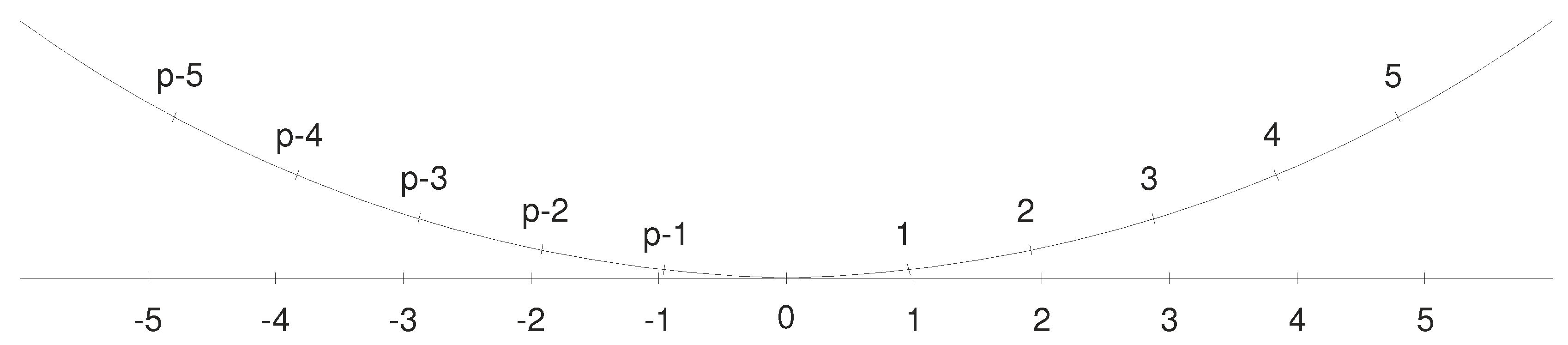
is cyclic, it is convenient to visually depict its elements by the points of a circumference of the radius
on the plane
such that the distance between neighboring elements of the field is equal to unity and the elements 0, 1, 2,..., are situated on the circumference counterclockwise. At the same time we depict the elements of
Z as usual, such that each element
is depicted by a point with the coordinates
. In
Figure 1 a part of the circumference near the origin is depicted.
Let f be a map from to Z such that has the same notation in Z as its minimal residue in . Then for elements such that , addition, subtraction and multiplication in and Z are the same, i.e., and .
The second step is to establish a correspondence between Hilbert spaces in standard theory and spaces over a Galois field in GFQT. We first note that the Hilbert space H contains a big redundancy of elements and we do not need to know all of them. Since a set of finite linear combinations of basis elements with rational coefficients is dense in H, with any desired accuracy we can approximate each element from H by a finite linear combination where are rational complex numbers. In turn, the set of such elements is redundant too. We can use the fact that Hilbert spaces in quantum theory are projective: and represent the same physical state, which reflects the fact that not the probability itself but the relative probabilities of different measurement outcomes have a physical meaning. Therefore we can multiply both parts of the above equality by a common denominator of the numbers . As a result, we can always assume that where and are integers.
Consider now a space over and let be a decomposition of a state x over a basis in this space. We can formally define a scalar product such that . Then the correspondence between the states x and can be defined such that , and . If the numbers in question are much less than p then the standard description and that based on GFQT give close experimental predictions. At the same time, in GFQT a probabilistic interpretation is not universal and is valid only when the numbers in question are much less than p.
The above discussion has a well known historical analogy. For many years people believed that our Earth was flat and infinite, and only after a long period of time they realized that it was finite and had a curvature. It is difficult to notice the curvature when we deal only with distances much less than the radius of the curvature R. Analogously one might think that the set of numbers describing physics has a curvature defined by a very large number p but we do not notice it when we deal only with numbers much less than p.
Since we treat GFQT as a more general theory than standard one, it is desirable not to postulate that GFQT is based on
(with
) because standard theory is based on complex numbers but vice versa, explain the fact that standard theory is based on complex numbers since GFQT is based on
. Hence, one should find a motivation for the choice of
in GFQT. A possible motivation is discussed in References [
27,
28] and in
Section 10 of the present paper.
In standard approach to symmetries in quantum theory, the symmetry group is a group of motions of a classical spacetime background. As noted above, in quantum theory the spacetime background does not have a physical meaning. So a question arises whether there exists an alternative for such an approach. As already noted, in standard approach, the spacetime background and Lagrangian are only auxiliary tools for constructing Hilbert spaces and operators. For calculating observables one needs not representation operators of the symmetry group but representation operators of its Lie algebra, e.g., the Hamiltonian. The representation operators of the group are needed only if it is necessary to calculate macroscopic transformations, e.g., spacetime transformations. In the approximation when classical time and space are good approximate parameters, the Hamiltonian and momentum operators can be interpreted as ones associated with the corresponding translations, but nothing guarantees that this interpretation is always valid (e.g., at the very early stage of the Universe). One might think that this observation is not very significant, since typically symmetry groups are Lie groups and for them in many cases there exits a one-to-one correspondence between representations of the Lie group and its Lie algebra. However, in Galois fields there is no notion of infinitesimal transformations and hence there is no notion of Lie group over a Galois field associated with a given Lie algebra over a Galois field.
Each system is described by a set of independent operators and they somehow commute with each other. By definition, the rules how they commute define a Lie algebra which is treated as a symmetry algebra. Such a definition of symmetry on quantum level is in the spirit of Dirac’s paper [
29]. We believe that for understanding this Dirac’s idea the following example might be useful. If we define how the energy should be measured (e.g., the energy of bound states, kinetic energy,
etc.,) we have a full knowledge about the Hamiltonian of our system. In particular, we know how the Hamiltonian should commute with other operators. In standard theory the Hamiltonian is also interpreted as an operator responsible for evolution in time, which is considered as a classical macroscopic parameter. According to principles of quantum theory, self-adjoint operators in Hilbert spaces represent observables but there is no requirement that parameters defining a family of unitary transformations generated by a self-adjoint operator are eigenvalues of another self-adjoint operator. A well known example from standard quantum mechanics is that if
is the
x component of the momentum operator then the family of unitary transformations generated by
is
where
and such parameters can be identified with the spectrum of the position operator. At the same time, the family of unitary transformations generated by the Hamiltonian
H is
where
and those parameters cannot be identified with a spectrum of a self-adjoint operator on the Hilbert space of our system. In the relativistic case the parameters
x can be formally identified with the spectrum of the Newton-Wigner position operator [
19] but it is well known that this operator does not have all the required properties for the position operator. So, although the operators
and
are well defined in standard theory, their physical interpretation as translations in space and time is not always valid.
Let us now discuss how one should define the notion of elementary particles. Although particles are observables and fields are not, in the spirit of quantum field theory (QFT), fields are more fundamental than particles, and a possible definition is as follows [
30]:
It is simply a particle whose field appears in the Lagrangian. It does not matter if it’s stable, unstable, heavy, light—if its field appears in the Lagrangian then it’s elementary, otherwise it’s composite. Another approach has been developed by Wigner in his investigations of unitary irreducible representations (IRs) of the Poincare group [
31]. In view of this approach, one might postulate that a particle is elementary if the set of its wave functions is the space of a unitary IR of the symmetry group or Lie algebra in the given theory. In standard theory the Lie algebras are usually real and one considers their representations in complex Hilbert spaces.
In view of the above remarks, and by analogy with standard quantum theory one might define the elementary particle in GFQT as follows. Let
be a Lie algebra over
which is treated as a symmetry algebra. A particle is elementary if the set of its states forms an IR of
in
. Representations of Lie algebras in spaces with nonzero characteristic are called modular representations. There exists a well developed theory of such representations. One of the well known results is the Zassenhaus theorem [
32] that any modular IR is finite dimensional. In
Section 6 we propose another definition of elementary particle.
As argued in References [
25,
26,
27], standard theories based on de Sitter (dS) algebra so(1,4) or anti de Sitter (AdS) algebra so(2,3) can be generalized to theories based on a Galois field while there are problems with the generalization of the theory based on Poincare algebra. The reasons are the following. It is clear that in theories based on Galois fields there can be no dimensional quantities and all physical quantities are discrete. In standard dS or AdS invariant theories all physical quantities are dimensionless and discrete in units
while in Poincare invariant theory the energy and momentum necessarily have a continuous spectrum. From the formal point of view, the representation operators of the Poincare algebra can also be chosen dimensionless, e.g., in Planck units. In Poincare invariant theories over a Galois field one has to choose a quantum of length. If this quantum is the Planck distance then the quantum of mass will be the Planck mass, which is much greater than the masses of elementary particles.
The existing astronomical data (see, e.g., Reference [
33,
34]) indicate that the cosmological constant is small and positive. This is an argument in favor of so(1,4)
vs. so(2,3). On the other hand, in QFT and its generalizations (string theory, M-theory,
etc.,) a theory based on so(1,4) encounters serious difficulties and the choice of so(2,3) is preferable (see e.g., Reference [
35]). IRs of the so(2,3) algebra have much in common with IRs of Poincare algebra. In particular, in IRs of the so(2,3) algebra the AdS Hamiltonian is either strictly positive or strictly negative and a supersymmetric generalization is possible. In standard theory, representations of the so(2,3) and so(1,4) algebras differ only in a way how Hermiticity conditions are imposed. Since in GFQT the notions of probability and Hermiticity are only approximate, modular representations of those algebras differ only in a way how we establish a correspondence with standard theory when
p is large. For these reasons in the present paper for illustration of what happens when complex numbers are replaced by a Galois field we assume that
is the modular analog of the algebra so(2,3).
It is well known [
22,
23,
24] that the field
has
nontrivial automorphisms. Therefore, if
n is arbitrary, a formal scalar product and Hermiticity can be defined in different ways. We do not assume from the beginning that
and
. Our results do not depend on the explicit choice of the scalar product and
is used to denote an element obtained from
by an automorphism compatible with the scalar product in question.
The paper is organized as follows. In
Section 2,
Section 3 and
Section 4 we construct modular IRs describing elementary particles in GFQT, their quantization and physical meaning are discussed in
Section 5,
Section 6,
Section 7,
Section 8 and
Section 9, the spin-statistics theorem is discussed in
Section 10 and a supersymmetric generalization is discussed in
Section 11. Although some results require extensive calculations, they involve only finite sums in Galois fields. For this reason all the results can be reproduced even by readers who previously did not have practice in calculations with Galois fields. A more detailed description of calculations can be found in Reference [
27].
3. Modular IRs of the so(2,3) Algebra
Standard IRs of the so(2,3) algebra relevant for describing elementary particles have been considered by several authors. The description in this section is a combination of two elegant ones given in Reference [
36] for standard IRs and Reference [
37] for modular IRs. In standard theory, the commutation relations between the representation operators in units
are given by
where
take the values 0,1,2,3,5 and the operators
are antisymmetric. The diagonal metric tensor has the components
. In these units the spin of fermions is odd, and the spin of bosons is even. If
s is the particle spin then the corresponding IR of the su(2) algebra has the dimension
.
Note that our definition of the AdS symmetry on quantum level does not involve the cosmological constant at all. It appears only if one is interested in interpreting results in terms of the AdS spacetime or in the Poincare limit. Since all the operators
are dimensionless in units
, the de Sitter invariant quantum theories can be formulated only in terms of dimensionless variables. As noted in
Section 1, this is a necessary requirement for a theory, which is supposed to have a physical generalization to the case of Galois fields. At the same time, since Poincare invariant theories do not have such generalizations, one might expect that quantities which are dimensionful in units
are not fundamental. This is in the spirit of Mirmovich’s hypothesis [
38] that only quantities having the dimension of the angular momentum can be fundamental.
If a modular IR is considered in a linear space over
with
then Equation (
7) is also valid. However, as noted in
Section 1, we consider modular IRs in linear spaces over
where
k is arbitrary. In this case it is convenient to work with another set of ten operators. Let
be two independent sets of operators satisfying the commutation relations for the sp(2) algebra
The sets are independent in the sense that for different
j they mutually commute with each other. We denote additional four operators as
. The operators
satisfy the commutation relations of the su(2) algebra
while the other commutation relations are as follows
At first glance these relations might seem rather chaotic but in fact they are very natural in the Weyl basis of the so(2,3) algebra.
In spaces over
with
the relation between the above sets of ten operators is
and therefore the sets are equivalent. However, the relations (
8–
10) are more general since they can be used when the representation space is a space over
with an arbitrary
k.
We use the basis in which the operators
are diagonal. Here
is the Casimir operator (
2) for algebra
. For constructing IRs we need operators relating different representations of the sp(2)×sp(2) algebra. By analogy with References [
36,
37], one of the possible choices is as follows
We consider the action of these operators only on the space of minimal sp(2) × sp(2) vectors,
i.e., such vectors
x that
for
, and
x is the eigenvector of the operators
. If
x is a minimal vector such that
then
is the minimal eigenvector of the operators
with the eigenvalues
,
- with the eigenvalues
,
- with the eigenvalues
, and
- with the eigenvalues
.
By analogy with References [
36,
37], we require the existence of the vector
satisfying the conditions
where
,
for
and
. It is well known (see e.g., Reference [
27]) that
is the AdS analog of the energy operator. As follows from Equations (
8) and (
10), the operators
reduce the AdS energy by two units. Therefore
is an analog the state with the minimum energy which can be called the rest state, and the spin in our units is equal to the maximum value of the operator
in that state. For these reasons we use
s to denote
and
m to denote
. In standard classification [
36], the massive case is characterized by the condition
and the massless one—by the condition
. There also exist two exceptional IRs discovered by Dirac [
39] (Dirac singletons). They are characterized by the conditions
and
. In this section we will consider the massive case while the singleton and massless cases will be considered in the next section.
As follows from the above remarks, the elements
represent the minimal sp(2) × sp(2) vectors with the eigenvalues of the operators
and
equal to
and
, respectively. It can be shown by a direct calculation that
As follows from these expressions, in the massive case
k can assume only the values
and in standard theory
. However, in the modular case
where
is the first number for which the r.h.s. of Equation (
15) becomes zero in
. Therefore
.
The full basis of the representation space can be chosen in the form
In standard theory
and
can be any natural numbers. However, as follows from the results of the preceding section, Equation (
8) and the properties of the
A operators,
As a consequence, the representation is finite dimensional in agreement with the Zassenhaus theorem [
32] (moreover, it is finite since any Galois field is finite).
Let us assume additionally that the representation space is supplied by a scalar product (see
Section 1). The element
can always be chosen such that
. Suppose that the representation operators satisfy the Hermiticity conditions
,
,
and
. Then, as follows from Equation (
11), in a special case when the representation space is a space over
with
, the operators
are Hermitian as it should be. By using Equations (
8–
16), one can show by a direct calculation that the elements
are mutually orthogonal while the quantity
can be represented as
where
In standard Poincare and AdS theories there also exist IRs with negative energies. They can be constructed by analogy with positive energy IRs. Instead of Equation (
13) one can require the existence of the vector
such that
where the quantities
are the same as for positive energy IRs. It is obvious that positive and negative energy IRs are fully independent since the spectrum of the operator
for such IRs is positive and negative, respectively. However,
the modular analog of a positive energy IR characterized by in Equation (13), and the modular analog of a negative energy IR characterized by the same values of in Equation (22) represent the same modular IR. This is the crucial difference between standard quantum theory and GFQT, and a proof is given below.
Let
be a vector satisfying Equation (
13). Denote
and
. Our goal is to prove that the vector
satisfies the conditions (
22),
i.e.,
x can be identified with
.
As follows from the definition of
, the vector
x is the eigenvector of the operators
and
with the eigenvalues
and
, respectively, and, in addition, it satisfies the conditions
. Let us prove that
. Since
commutes with the
, we can write
in the form
As follows from Equations (
10) and (
13),
and
is the eigenvector of the operator
with the eigenvalue
. Therefore,
is the minimal vector of the sp(2) IR which has the dimension
. Therefore
and
.
The next stage of the proof is to show that
. As follows from Equation (
10) and the definition of
x,
We have already shown that
, and therefore it is sufficient to prove that the first term in the r.h.s. of Equation (
24) is equal to zero. As follows from Equations (
10) and (
13),
, and
is the eigenvector of the operator
with the eigenvalue
. Therefore
and the proof is completed.
Let us assume for a moment that the eigenvalues of the operators and should be treated not as elements of but as integers. Then, as follows from the consideration in the preceding section, if (j = 1,2) then one modular IR of the so(2,3) algebra corresponds to a standard positive energy IR in the region where the energy is positive and much less than p. At the same time, it corresponds to an IR with the negative energy in the region where the AdS energy is close to but less than .
4. Massless Particles and Dirac Singletons
Those cases can be considered by analogy with the massive one. The case of Dirac singletons is especially simple. As follows from Equations (
15) and (
16), if
then the only possible value of
k is
and the only possible values of
n are
while if
then the only possible values of
k are
and the only possible value of
n is
. This result does not depend on the value of
p and therefore it is valid in both, standard theory and GFQT. In this case the only difference between standard and modular cases is that in the former
while in the latter the quantities
are in the range defined by Equation (
20).
The singleton IRs are indeed exceptional since the value of
n in them does not exceed 1 and therefore the impression is that singletons are two-dimensional objects, not three-dimensional ones as usual particles. However, the singleton IRs have been obtained in the so(2,3) theory without reducing the algebra. Dirac has entitled his paper [
39] "A Remarkable Representation of the 3 + 2 de Sitter Group". Below we argue that in GFQT the singleton IRs are even more remarkable than in standard theory.
If
then
. In GFQT these relations should be treated as
. Analogously, if
then
and in GFQT
. Therefore when the values of
and
are small, the values of
and
are extremely large since they are of order of
. As follows from the results of
Section 2 and
Section 3. those values are much less than
p only when
and
are of order
. This might be an indication why singletons are not observable: Because there is no region when all the quantum numbers are much less than
p. At the end of this section we will discuss relations between singleton and massless IRs.
Consider now the massless case. We will follow our derivation in Reference [
40]. When
, it is more convenient to deal not with the
A-operators defined in Equation (
12) but with the
B-operators defined as
If
is defined as in Equation (
13), then by, analogy with the massive case, we can define the vectors
as
but a problem arises how to define the action of the operators
and
on
which is the eigenvector of the operator
with the eigenvalue
. A possible way to resolve ambiguities 0/0 in matrix elements is to write
in the form
and take the limit
at the final stage of computations. This confirms a well known fact that analytical methods can be very useful in problems involving only integers. It is also possible to justify the results by using only integers (or rather elements of the Galois field in question), but we will not dwell on this.
By using the above prescription, we require that
if
(and thus
), and
if
. One can directly verify that, as follows from Equations (
8–
10)
and, in addition, as follows from Equation (
13)
where
As follows from these expressions, the elements
form a basis in the space of minimal sp(2) × sp(2) vectors, and our next goal is to determine the range of the numbers
n and
k.
Consider first the quantity and let be the maximum value of k. For consistency we should require that if then is the greatest value of k such that for . We conclude that k can take only the values of .
Let now
be the maximum value of
n at a given
k. For consistency we should require that if
then
is the greatest value of
n such that
for
. As follows from Equation (
31),
for
if such values of
k exist (
i.e., when
), and
if
or
. We conclude that at
, the quantity
n can take only the value
while at
or
, the possible values of
n are
where
. Recall that in the preceding section we have obtained
for the massive case. Since
and
in the massive case, we conclude that the values of
in the massive and massless cases are given by different formulas.
According to Standard Model, only massless Weyl particles can be fundamental elementary particles in Poincare invariant theory. Therefore a problem arises whether the above results can be treated as analogs of Weyl particles in standard and modular versions of AdS invariant theory. Several authors investigated dS and AdS analogs of Weyl particles proceeding from covariant equations on the dS and AdS spaces, respectively. For example, the authors of Reference [
41] have shown that Weyl particles arise only when the dS or AdS symmetries are broken to the Lorentz symmetry. The results of Reference [
36] and the above results in the modular case make it possible to treat AdS Weyl particles from the point of view of IRs.
It is well known that Poincare invariant theory is a special case of AdS one obtained as follows. We introduce the AdS radius
R and define
. Then in the approximation when
R is very large, the operators
are very large but their ratio is finite, we obtain Poincare invariant theory where
are the four-momentum operators. This procedure is called contraction and for the first time it has been discussed in Reference [
42]. Since the mass is the lowest value of the energy in both, Poincare and AdS invariant theories, the mass
m in the AdS case and the standard Poincare mass
are related as
. The AdS mass is dimensionless while the Poincare mass has the dimension
. Since the Poincare symmetry is a special case of the AdS one, this fact is in agreement with the observation in
Section 1 that dimensionful quantities cannot be fundamental. Let
be the Compton wave length for the particle with the mass
. Then one might think that, in view of the relation
, the AdS mass shows how many Compton wave lengths are contained in the interval
. However, such an interpretation of the AdS mass means that we wish to interpret a fundamental quantity
m in terms of our experience based on Poincare invariant theory. As already noted, the value of
m does not depend on any quantities having the dimension
or
and it is the Poincare mass which implicitly depends on
R. Let us assume for estimations that the value of
R is
. Then even the AdS mass of the electron is of order
and this might be an indication that the electron is not a true elementary particle. Moreover, the present upper level for the photon mass is
which seems to be an extremely tiny quantity. However, the corresponding AdS mass is of order
and so even the mass which is treated as extremely small in Poincare invariant theory might be very large in AdS invariant theory.
Since , the corresponding Poincare mass will be zero when not only when but when is any finite number. So a question arises why only the case is treated as massless. In Poincare invariant theory, Weyl particles are characterized not only by the condition that their mass is zero but also by the condition that they have a definite helicity. In standard case the minimum value of the AdS energy for massless IRs with positive energy is when . In contrast with the situation in Poincare invariant theory, where massless particles cannot be in the rest state, the massless particles in the AdS theory do have rest states and, as shown above, the value of the z projection of the spin in such states can be as usual. However, we have shown that for any value of energy greater than , when , the spin state is characterized only by helicity, which can take the values either s when or when , i.e., we have the same result as in Poincare invariant theory. Note that in contrast with IRs of the Poincare and dS algebras, standard IRs describing particles in AdS invariant theory belong to the discrete series of IRs and the energy spectrum in them is discrete: . Therefore, strictly speaking, rest states do not have measure zero as in Poincare and dS invariant theories. Nevertheless, the probability that the energy is exactly is extremely small and therefore the above results show that the case indeed describes AdS analogs of Weyl particles.
By analogy with the massive case, one can show that the full basis of the representation space also can be described by Equation (
17) and that one massless modular IR is a modular analog of both, standard massless positive and negative energy IRs. For singleton IRs it is also possible to prove that if a vector
is defined by the same formulas as in
Section 3, it satisfies Equation (
22). However, singleton IRs obviously cannot be treated as modular analogs of standard positive and negative energy IRs.
In Reference [
43] entitled "One Massless Particle Equals Two Dirac Singletons", it is shown that the tensor product of two singleton IRs is a massless IR. This follows from the following facts. If we take two singleton IRs then the tensor product of the corresponding vectors
(see Equation (
13)) satisfies Equation (
13) and is characterized by
,
i.e., precisely by the condition defining a massless IR. The value of spin in this IR equals 0 for the tensor product of two singletons with
, 1 (
i.e., 1/2 in standard units) for the tensor product of two singleton IRs with
and
and 2 (
i.e., 1 in standard units) for the tensor product of two singletons with
. Therefore the tensor product of two singleton IRs indeed contains a massless IR and, as a consequence of a special nature of singleton IRs, it does not contain other IRs. This might be an indication that fundamental particles are even not Weyl ones but Dirac singletons. We believe that in GFQT the singleton IRs are even more remarkable than in standard theory for the following reasons. If we accept that Weyl particles are composite states of Dirac singletons then a question arises why Weyl particles are stable and singletons have not been observed yet although in standard theory they are characterized by small values of all quantum numbers. However, in GFQT at least two singleton quantum numbers are of order
p,
i.e., extremely large and this might be an explanation why they are not observable in situations where all energies in question are much less than
p. We believe this is an interesting observation that when the values of
and
are of order
, their sum is small since it is calculated modulo
p. In standard theory, if an additive quantity for a two-particle system is not equal to a sum of the corresponding single-particle quantities, it is said that the particles interact. Therefore the fact that a sum of two values of order
is not of order
p but much less than
p can be treated as a very strong interaction although from the formal point of view no interaction between the singletons has been introduced.
6. Quantization and AB Symmetry
Let us first recall how the Fock space is defined in standard theory. Let
be the operator of particle annihilation in the state described by the vector
. Then the adjoint operator
has the meaning of particle creation in that state. Since we do not normalize the states
to one, we require that the operators
and
should satisfy either the anticommutation relations
or the commutation relations
In standard theory the representation describing a particle and its antiparticle are fully independent and therefore quantization of antiparticles should be described by other operators. If
and
are operators of the antiparticle annihilation and creation in the state
then by analogy with Equations (
40) and (
41)
for anticommutation or commutation relations, respectively. In this case it is assumed that in the case of anticommutation relations all the operators
anticommute with all the operators
while in the case of commutation relations they commute with each other. It is also assumed that the Fock space contains the vacuum vector
such that
The Fock space in standard theory can now be defined as a linear combination of all elements obtained by the action of the operators
on the vacuum vector, and the problem of second quantization of representation operators can be formulated as follows. Let
be representation operators describing IR of the AdS algebra. One should replace them by operators acting in the Fock space such that the commutation relations between their images in the Fock space are the same as for original operators (in other words, we should have a homomorphism of Lie algebras of operators acting in the space of IR and in the Fock space). We can also require that our map should be compatible with the Hermitian conjugation in both spaces. It is easy to verify that a possible solution satisfying all the requirements is as follows. Taking into account the fact that the matrix elements satisfy the proper commutation relations, the operators
in the quantized form
satisfy the commutation relations (
8–
10). We will not use special notations for operators in the Fock space since in each case it will be clear whether the operator in question acts in the space of IR or in the Fock space.
A well known problem in standard theory is that the quantization procedure does not define the order of the annihilation and creation operators uniquely. For example, another possible solution is
for anticommutation and commutation relations, respectively. The solutions (
45) and (
46) are different since the energy operators
in these expressions differ by an infinite constant. In standard theory the solution (
45) is selected by imposing an additional requirement that all operators should be written in the normal form where annihilation operators precede creation ones. Then the vacuum has zero energy and Equation (
46) should be rejected. Such a requirement does not follow from the theory. Ideally there should be a procedure which correctly defines the order of operators from first principles.
In standard theory there also exist neutral particles. In that case there is no need to have two independent sets of operators
and
, and Equation (
45) should be written without the
operators. The problem of neutral particles in GFQT is discussed in
Section 10.
We now proceed to quantization in the modular case. The results of
Section 3 show that one modular IR corresponds to two standard IRs with the positive and negative energies, respectively. This indicates to a possibility that one modular IR describes a particle and its antiparticle simultaneously. However, we don’t know yet what should be treated as a particle and its antiparticle in the modular case. We have a description of an object such that
is the full set of its quantum numbers which take the values described in the preceding section.
We now assume that
in GFQT is the operator describing annihilation of the object with the quantum numbers
regardless of whether the numbers are physical or nonphysical. Analogously
describes creation of the object with the quantum numbers
. If these operators anticommute then they satisfy Equation (
40) while if they commute then they satisfy Equation (
41). Then, by analogy with standard case, the operators
satisfy the commutation relations (
8–
10). In this expression the sum is taken over all possible values of the quantum numbers in the modular case.
In the modular case the solution can be taken not only as in Equation (
47) but also as
for the cases of anticommutators and commutators, respectively. However, as follows from Equations (
39–
41), the solutions (
47) and (
48) are the same. Therefore in the modular case there is no need to impose an artificial requirement that all operators should be written in the normal form.
The problem with the treatment of the operators is as follows. When the values of are much less than p, the modular IR corresponds to standard positive energy IR and therefore the operator can be treated as those describing the particle annihilation and creation, respectively. However, when the AdS energy is negative, the operators and become unphysical since they describe annihilation and creation, respectively, in the unphysical region of negative energies.
Let us recall that at any fixed values of
n and
k, the quantities
and
can take only the values described in Equation (
18) and the eigenvalues of the operators
and
are given by
and
, respectively. As follows from the results of
Section 3, the first IR of the sp(2) algebra has the dimension
and the second IR has the dimension
. If
then it follows from Equation (
18) that the first eigenvalue is equal to
in
, and if
then the second eigenvalue is equal to
in
. We use
to denote
and
to denote
. Then it follows from Equation (
18) that
is the eigenvector of the operator
with the eigenvalue
and the eigenvector of the operator
with the eigenvalue
.
Standard theory implicitly involves the idea that creation of the antiparticle with positive energy can be treated as annihilation of the corresponding particle with negative energy and annihilation of the antiparticle with positive energy can be treated as creation of the corresponding particle with negative energy. In GFQT we can implement this idea explicitly. Namely, we can define the operators and in such a way that they will replace the operators if the quantum numbers are unphysical. In addition, if the values of are much less than p, the operators and should be interpreted as physical operators describing annihilation and creation of antiparticles, respectively.
In GFQT the operators cannot be independent of the operators since the latter are defined for all possible quantum numbers. Therefore the operators should be expressed in terms of the ones. We can implement the above idea if the operator is defined in such a way that it is proportional to and hence is proportional to .
Since Equation (
21) should now be considered in
, it follows from the well known Wilson theorem
in
(see e.g., [
22,
23,
24]) that
We now define the
b-operators as
where
is some function. As a consequence,
Equations (
50) and (
51) define a relation between the sets
and
. Although our motivation was to replace the
operators by the
ones only for the nonphysical values of the quantum numbers, we can consider this definition for all the values of
. The transformation described by Equations (
50) and (
51) can also be treated as a special case of the Bogolubov transformation discussed in a wide literature on many-body theory (see e.g., Chapter 10 in Reference [
44] and references therein).
We have not discussed yet what exact definition of the physical and nonphysical quantum numbers should be. This problem will be discussed in
Section 7. However, one might accept
Physical-nonphysical states assumption: Each set of quantum numbers is either physical or unphysical. If it is physical then the set is unphysical and vice versa.
With this assumption we can conclude from Equations (
50) and (
51) that if some operator
a is physical then the corresponding operator
is unphysical and vice versa while if some operator
is physical then the corresponding operator
b is unphysical and vice versa.
We have no ground to think that the set of the
operators is more fundamental than the set of the
operators and vice versa. Therefore the question arises whether the
operators satisfy the relations (
41) or (
42) in the case of anticommutation or commutation relations, respectively and whether the operators
(see Equation (
47)) have the same form in terms of the
and
operators. In other words, if the
operators in Equation (
47) are expressed in terms of the
ones then the problem arises whether
is valid. It is natural to accept the following
Definition of the AB symmetry: If the operators satisfy Equation (42) in the case of anticommutators or Equation (43) in the case of commutators and all the representation operators (47) in terms of the operators have the form (52) then it is said that the AB symmetry is satisfied. To prove the AB symmetry we will first investigate whether Equations (
42) and (
43) follow from Equations (
40) and (
41), respectively. As follows from Equations (
49–
51), Equation (
42) follows from Equation (
40) if
while Equation (
43) follows from Equation (
41) if
We now represent
in the form
where
should satisfy the condition
Then
should be such that
where the plus sign refers to anticommutators and the minus sign to commutators, respectively. If the normal spin-statistics connection is valid,
i.e., we have anticommutators for odd values of
s and commutators for even ones then the r.h.s. of Equation (
57) equals -1 while in the opposite case it equals 1. In
Section 10, Equation (
57) is discussed in detail and for now we assume that solutions of this relation exist.
A direct calculation using the explicit expressions (
33–
38) for the matrix elements shows that if
is given by Equation (
55) and
then the AB symmetry is valid regardless of whether the normal spin-statistics connection is valid or not (the details of calculations can be found in Reference [
27]).
As noted in
Section 1, elementary particle can be defined either in the spirit of QFT or in terms of IRs. We now can give another definition: A particle is elementary if its operators
(or
) are used for describing our system in the Fock space. A difference between this definition and that in terms of IRs is clear in the case of massless particles: They are described by IRs but are treated as elementary or not depending on whether the description in the Fock space involves the
operators for the massless particles or singletons.
10. Neutral Particles and Spin-Statistics Theorem
In this section we will discuss the relation between the
and
operators only for all quantum numbers (
i.e., in the spirit of the AB-symmetry) and therefore the results are valid regardless of whether the separation of states into
and
can be justified or not (see the discussion in
Section 8).
The nonexistence of neutral elementary particles in GFQT is one of the most striking differences between GFQT and standard theory. One could give the following definition of neutral particle:
In standard theory only i) is meaningful since neutral particles are described by real (not complex) fields and this condition is required by Hermiticity. One might think that the definition ii) is only academic since if a particle and its antiparticle have the same properties then they are indistinguishable and can be treated as the same. However, the cases i) and ii) are essentially different from the operator point of view. In the case i) only the
operators are sufficient for describing the operators (
45) in standard theory. This is the reflection of the fact that the real field has the number of degrees of freedom twice as less as the complex field. On the other hand, in the case ii) both
and
operators are required,
i.e., in standard theory such a situation is described by a complex field. Nevertheless, the case ii) seems to be rather odd: It implies that there exists a quantum number distinguishing a particle from its antiparticle but this number is not manifested experimentally. We now consider whether the conditions i) or ii) can be implemented in GFQT.
Since each operator
a is proportional to some operator
and vice versa (see Equations (
50) and (
51)), it is clear that if the particles described by the operators
have a nonzero charge then the particles described by the operators
have the opposite charge and the number of operators cannot be reduced. However, if all possible charges are zero, one could try to implement i) by requiring that each
should be proportional to
and then
will be proportional to
. In this case the operators
will not be needed at all.
Suppose, for example, that the operators
satisfy the commutation relations (
41). In that case the operators
and
should commute if the sets
and
are not the same. In particular, one should have
if either
or
. On the other hand, if
is proportional to
, it follows from Equation (
41) that the commutator cannot be zero. Analogously one can consider the case of anticommutators.
The fact that the number of operators cannot be reduced is also clear from the observation that the or operators describe an irreducible representation in which the number of states (by definition) cannot be reduced. Our conclusion is that in GFQT the definition of neutral particle according to i) is fully unacceptable.
Consider now whether it is possible to implement the definition ii) in GFQT. Recall that we started from the operators
and defined the operators
by means of Equation (
50). Then the latter satisfy the same commutation or anticommutation relations as the former and the AB symmetry is valid. Does it mean that the particles described by the operators
are the same as the ones described by the operators
? If one starts from the operators
then, by analogy with Equation (
50), the operators
can be defined as
where
is some function. By analogy with the consideration in
Section 6 one can show that
where the minus sign refers to the normal spin-statistics connection and the plus to the broken one.
As follows from Equations (
50), (
53–
56), (
74), (
75) and the definition of the quantities
and
in
Section 6, the relation between the quantities
and
is
. Therefore, as follows from Equation (
75), there exist only two possibilities,
, depending on whether the normal spin-statistics connection is valid or not. We conclude that the broken spin-statistics connection implies that
and
while the normal spin-statistics connection implies that
and
. Since in the first case there exist solutions such that
(e.g.,
), the particle and its antiparticle can be treated as neutral in the sense of the definition ii). Since such a situation is clearly unphysical, one might treat the spin-statistics theorem as a requirement excluding neutral particles in the sense ii).
We now consider another possible treatment of the spin-statistics theorem, which seems to be much more interesting. In the case of normal spin-statistics connection we have that
and the problem arises whether solutions of this relation exist. Such a relation is obviously impossible in standard theory.
As noted in
Section 1,
is a quadratic residue in
if
and a quadratic non-residue in
if
. For example,
is a quadratic residue in
since
but in
there is no element
a such that
. We conclude that if
then Equation (
76) has solutions in
and in that case the theory can be constructed without any extension of
.
Consider now the case
. Then Equation (
76) has no solutions in
and it is necessary to consider this equation in an extension of
(
i.e., there is no “real” version of GFQT). The minimum extension is obviously
and therefore the problem arises whether Equation (
76) has solutions in
.
It is well known [
22,
23,
24] that any Galois field without its zero element is a cyclic multiplicative group. Let
r be a primitive root,
i.e., the element such that any nonzero element of
can be represented as
. It is also well known that the only nontrivial automorphism of
is
. Therefore if
then
. On the other hand, since
,
. Therefore there exists at least a solution with
.
Our conclusion is that if then the spin-statistics theorem implies that the field should necessarily be extended and the minimum possible extension is . Therefore the spin-statistics theorem can be treated as a requirement that GFQT should be based on and standard theory should be based on complex numbers.
Let us now discuss a different approach to the AB symmetry. A desire to have operators which can be interpreted as those relating separately to particles and antiparticles is natural in view of our experience in standard approach. However, one might think that in the spirit of GFQT there is no need to have separate operators for particles and antiparticles since they are different states of the same object. We can therefore reformulate the AB symmetry in terms of only
operators as follows. Instead of Equations (
50) and (
51), we consider a
transformation defined as
Then the AB symmetry can be formulated as a requirement that physical results should be invariant under this transformation.
Let us now apply the AB transformation twice. Then, by analogy with the derivation of Equation (
57), we get
for the normal and broken spin-statistic connections, respectively. Therefore, as a consequence of the spin-statistics theorem, any particle (with the integer or half-integer spin) has the AB
parity equal to
. Therefore in GFQT any interaction can involve only an even number of creation and annihilation operators. In particular, this is additional demonstration of the fact that in GFQT the existence of neutral elementary particles is incompatible with the spin-statistics theorem.
11. Modular IRs of the osp(1,4) Superalgebra
If one accepts supersymmetry then the results on modular IRs of the so(2,3) algebra can be generalized by considering modular IRs of the osp(1,4) superalgebra. Representations of the osp(1,4) superalgebra have several interesting distinctions from representations of the Poincare superalgebra. For this reason we first briefly mention some well known facts about the latter representations (see e.g Reference [
45] for details).
Representations of the Poincare superalgebra are described by 14 operators. Ten of them are the well known representation operators of the Poincare algebra—four momentum operators and six representation operators of the Lorentz algebra, which satisfy the well known commutation relations. In addition, there also exist four fermionic operators. The anticommutators of the fermionic operators are linear combinations of the momentum operators, and the commutators of the fermionic operators with the Lorentz algebra operators are linear combinations of the fermionic operators. In addition, the fermionic operators commute with the momentum operators.
From the formal point of view, representations of the osp(1,4) superalgebra are also described by 14 operators — ten representation operators of the so(2,3) algebra and four fermionic operators. There are three types of relations: The operators of the so(2,3) algebra commute with each other as usual (see
Section 3), anticommutators of the fermionic operators are linear combinations of the so(2,3) operators and commutators of the latter with the fermionic operators are their linear combinations. However, in fact representations of the osp(1,4) superalgebra can be described exclusively in terms of the fermionic operators. The matter is as follows. In the general case the anticommutators of four operators form ten independent linear combinations. Therefore, ten bosonic operators can be expressed in terms of fermionic ones. This is not the case for the Poincare superalgebra since the Poincare algebra operators are obtained from the so(2,3) ones by contraction. One can say that the representations of the osp(1,4) superalgebra is an implementation of the idea that supersymmetry is the extraction of the square root from the usual symmetry (by analogy with the well known treatment of the Dirac equation as a square root from the Klein-Gordon one).
We denote the fermionic operators of the osp(1,4) superalgebra as
where the
means the Hermitian conjugation as usual. They should satisfy the following relations. If
are any fermionic operators, [...,...] is used to denote a commutator and
to denote an anticommutator then
where the form
is skew symmetric,
and the other independent values of
are equal to zero. The fact that the representation of the osp(1,4) superalgebra is fully defined by Equation (
79) and the properties of the form
, shows that osp(1,4) is a special case of the superalgebra.
We can now
define the so(2,3) generators as follows:
Then by using Equation (
79) and the properties of the form
, one can show by direct calculations that so defined operators satisfy the commutation relations (
8–
10). This result can be treated as a fact that the operators of the so(2,3) algebra are not fundamental, only the fermionic operators are.
By analogy with the construction of IRs of the osp(1,4) superalgebra in standard theory [
46], we require the existence of the cyclic vector
satisfying the conditions (compare with Equation (
13)):
The full representation space can be obtained by successively acting by the fermionic operators on
and taking all possible linear combinations of such vectors.
We use
E to denote an arbitrary linear combination of the vectors
. Our next goal is to prove a statement analogous to that in Reference [
46]:
Statement 1: Any vector from the representation space can be represented as a linear combination of the elements where and is an operator of the so(2,3) algebra.
The first step is to prove a simple
Lemma: If D is any fermionic operator then DE is a linear combination of elements E and where O is an operator of the so(2,3) algebra.
The proof is by a straightforward check using Equations (
79–
81). For example,
To prove Statement 1 we define the height of a linear combination of the elements as the maximum sum of powers of the fermionic operator in this element. For example, since every operator of the so(2,3) algebra is composed of two fermionic operator, the height of the element equals if E contains , equals if E does not contain but contains either or and equals if E contains only .
We can now prove Statement 1 by induction. The elements with the heights 0,1 and 2 obviously have the required form since, as follows from Equation (
80),
. Let us assume that Statement 1 is correct for all elements with the heights
. Every element with the height
can be represented as
where
x is an element with the height
N. If
then by using Equation (
79) we can represent
as
where the height of the element
y is equal to
. As follows from the induction assumption,
y has the required form, and, as follows from Lemma,
is a linear combination of the elements
E and
. Therefore Statement 1 is proved.
As follows from Equations (
79) and (
80),
It follows from these expressions that if
x is such that
then
is the eigenvector of the operators
with the eigenvalues
,
- with the eigenvalues
,
- with the eigenvalues
, and
- with the eigenvalues
.
Let us assume that
and
. We again use
m to denote
and
s to denote
. Statement 1 obviously remains valid if we now assume that
E contains linear combinations of
where
We assume for simplicity that
. Then it can be shown by direct calculations using Equations (
79–
81) that
As follows from Equations (
79–
82),
satisfies Equation (
13) and
satisfies the same condition with
replaced by
. We see that the representation of the osp(1,4) superalgebra defined by Equation (
81) necessarily contains at least two IRs of the so(2,3) algebra characterized by the values of the mass and spin
and
, and the cyclic vectors
and
, respectively.
As follows from Equations (
79–
82), the vectors
and
satisfy the conditions
and therefore (see Equation (
13)) they are candidates for being cyclic vectors of IRs of the so(2,3) algebra if their norm is not equal to zero. As follows from Equation (
84),
if
and
. Therefore, if these conditions are satisfied,
is the cyclic vector of IR of the so(2,3) algebra characterized by the values of the mass and spin
. Analogously, if
then
is the cyclic vector of IR of the so(2,3) algebra characterized by the values of the mass and spin
.
As already mentioned, our considerations are similar to those in Reference [
46]. Therefore modular IRs of the osp(1,4) superalgebra can be characterized in the same way as conventional IRs [
46,
47]:
If and (massive IRs), the osp(1,4) supermultiplets contain four IRs of the so(2,3) algebra characterized by the values of the mass and spin
If and (collapsed massive IRs), the osp(1,4) supermultiplets contain three IRs of the so(2,3) algebra characterized by the values of the mass and spin
If (massless IRs) the osp(1,4) supermultiplets contains two IRs of the so(2,3) algebra characterized by the values of the mass and spin
Dirac supermultiplet containing two Dirac singletons (see
Section 4).
The first three cases have well known analogs of IRs of the super-Poincare algebra (see e.g., Reference [
45]) while there is no super-Poincare analog of the Dirac supermultiplet.
Since the space of IR of the superalgebra osp(1,4) is a direct sum of spaces of IRs of the so(2,3) algebra, for modular IRs of the osp(1,4) superalgebra one can prove results analogous to those discussed in the preceding sections. In particular, one modular IR of the osp(1,4) algebra is a modular analog of both standard IRs of the osp(1,4) superalgebra with positive and negative energies. This implies that one modular IR of the osp(1,4) superalgebra contains both, a superparticle and its anti-superparticle. It is possible to prove a superanalog of the AB symmetry and show that the AB symmetries of particles in the supermultiplet should satisfy certain relations which impose a restriction on the form of interaction in supersymmetric theory (see Reference [
48]). It is also possible to show that a separation of states into superparticles and anti-superparticles encounters the same problems as in the so(2,3) case. The details of calculations can be found in Reference [
48].
12. Discussion
In the present paper we discuss a quantum theory based on a Galois field (GFQT). As noted in
Section 1, GFQT does not contain infinities at all and all operators are automatically well defined. In my discussions with physicists, some of them commented this fact as follows. This is an approach where a cutoff (the characteristic
p of the Galois field) is introduced from the beginning and for this reason there is nothing strange in the fact that the theory does not have infinities. It has a large number
p instead and this number can be practically treated as infinite.
However, the difference between Galois fields and usual numbers is not only that the former are finite and the latter are infinite. If the set of usual numbers is visualized as a straight line from
to
then the simplest Galois field can be visualized not as a segment of this line but as a circumference (see
Figure 1 in
Section 1). This reflects the fact that in Galois fields the rules of arithmetic are different and, as a result, GFQT has many unusual features which have no analogs in standard theory.
The Dirac vacuum energy problem discussed in
Section 9 is a good illustration of this point. Indeed, in standard theory the vacuum energy is infinite and, if GFQT is treated simply as a theory with a cutoff
p, one would expect the vacuum energy to be of order
p. However, since the rules of arithmetic in Galois fields are different from standard ones, the result of exact (
i.e., non-perturbative) calculation of the vacuum energy is precisely zero.
The original motivation for investigating GFQT was as follows. Let us take standard QED in dS or AdS space, write the Hamiltonian and other operators in angular momentum basis and replace standard irreducible representations (IRs) for the electron, positron and photon by corresponding modular IRs. One might treat this motivation as an attempt to substantiate standard momentum regularizations (e.g., the Pauli-Villars regularization) at momenta (where R is the radius of the Universe). In other terms this might be treated as introducing fundamental length of order . We now discuss reasons explaining why this naive attempt fails.
The main result of the present paper is that
in GFQT the existence of antiparticles follows from the fact that any Galois field is finite. Moreover, the very existence of antiparticles might be an indication that nature is described rather by a finite field or ring than by complex numbers. We believe that this result is not only very important but also extremely simple and beautiful. A mathematical consideration of modular IRs is given in
Section 2,
Section 3 and
Section 4 while a simple explanation of the above result is as follows.
In standard theory a particle is described by a positive energy IR where the energy has the spectrum in the range
. At the same time, the corresponding antiparticle is associated with a negative energy IR where the energy has the spectrum in the range
. Consider now the construction of modular IR for some particle. We again start from the rest state (where energy = mass) and gradually construct states with higher and higher energies. However, in such a way we are moving not along a straight line but along the circumference in
Figure 1. Then sooner or later we will arrive at the point where energy = –mass.
In QFT the fact that a particle and its antiparticle have the same masses and spins but opposite charges follows from the CPT theorem, which is a consequence of locality. A question arises what happens if locality is only an approximation: In that case the equality of masses, spins, etc., is exact or approximate? Consider a simple model when electromagnetic and weak interactions are absent. Then the fact that the proton and the neutron have the same masses and spins has nothing to do with locality; it is only a consequence of the fact that the proton and the neutron belong to the same isotopic multiplet. In other words, they are simply different states of the same object —- the nucleon. We see, that in GFQT the situation is analogous. The fact that a particle and its antiparticle have the same masses and spins but opposite charges has nothing to do with locality or non-locality and is simply a consequence of the fact that they are different states of the same object since they belong to the same IR.
In standard theory, a particle and its antiparticle are combined together by a local covariant equation (e.g., the Dirac equation). We see that in GFQT the idea of the Dirac equation is implemented without assuming locality but already at the level of IRs. This automatically explains the existence of antiparticles, shows that a particle cannot exist by itself without its antiparticle and that a particle and its antiparticle are necessarily different states of the same object. In particular, there are no elementary particles which in standard theory are called neutral.
If a particle is characterized by some additive quantum numbers (e.g., the electric, baryon or lepton charges) then, as follows from our construction (see Equations (
50) and (
51)), the corresponding antiparticle is characterized by the same quantum numbers but with the opposite sign. In standard theory such quantum numbers are conserved because IRs describing a particle and its antiparticle are fully independent. However, since in GFQT a particle and its antiparticle belong to the same IR, the problem arises whether these quantum numbers are exactly conserved. Let us discuss this problem in greater details.
In quantum theory there is a superselection rule (SSR) prohibiting states which are superpositions of states with different electric, baryon or lepton charges. In general, if states
and
are such that there are no physical operators
A such that
then the SSR says that the state
is prohibited. The meaning of the SSR is now widely discussed (see e.g., Reference [
49] and references therein). Since the SSR implies that the superposition principle, which is a key principle of quantum theory, is not universal, several authors argue that the SSR should not be present in quantum theory. Other authors argue that the SSR is only a dynamical principle since, as a result of decoherence, the state
will quickly disappear and so it cannot be observable.
In our construction, one IR describes an object characterized by quantum numbers
(see
Section 3). We have discussed an interpretation that a half of the numbers are related to a particle and the another half to the corresponding antiparticle. However, since those numbers describe the same IR, there are operators mixing the particle and antiparticle states. Therefore the very notions of particle and antiparticles are approximate, the conservation of electric, baryon and lepton charges is also approximate and superpositions of particle and antiparticle states are not strictly prohibited. These notions and conservation laws are valid only in the approximation when one considers only transformations not mixing particle and antiparticle states. In
Section 8 we discussed a possibility that one IR can be split into independent IRs for a particle and its antiparticle. It has been shown that such a possibility can be implemented but only at the expense of breaking the exact AdS symmetry. Since we accept that symmetry is the most important criterion, we conclude that
the very notions of particle and antiparticles are approximate and the electric, baryon and lepton charges are only approximately conserved quantities. The non-conservation of the baryon and lepton quantum numbers has been already considered in models of Grand Unification but the electric charge has been always believed to be a strictly conserved quantum number. The non-conservation of these quantum numbers also completely changes the status of the problem known as “baryon asymmetry of the Universe" since at early stages of the Universe energies were much greater than now and therefore transitions between particles and antiparticles had a much greater probability.
We have also shown in
Section 10 that in GFQT there can be no neutral elementary particles. As explained in this section, the spin-statistics theorem can be treated as a requirement that standard quantum theory should be based on complex numbers. This requirement excludes the existence of neutral elementary particles. One might conclude that since in GFQT the photon cannot be elementary, this theory cannot be realistic and does not deserve attention. We believe however, that the nonexistence of neutral elementary particles in GFQT shows that the photon (and the graviton and the Higgs boson if they exist) should be considered on a deeper level. In
Section 4 we argued that in GFQT a possibility that massless particles are composite states of Dirac singletons is even more attractive than in standard theory.
An important problem is what GFQT can say about supersymmetry. There is no doubt that supersymmetry is a beautiful idea. On the other hand, one might say that there is no reason for nature to have both, elementary fermions and elementary bosons since the latter can be constructed from the former. A well know historical analogy is that the simplest covariant equation is not the Klein-Gordon equation for spinless fields but the Dirac and Weyl equations for the spin 1/2 fields since the former is the equation of the second order while the latter are the equations of the first order. In
Section 11 we have described results for modular IRs of the osp(1,4) superalgebra and noted that supersymmetry does not impose strong restrictions on the structure of modular IRs. Therefore the problem of supersymmetry remains open.
Consider now the following very important question. If we accept that the cosmological constant
is positive then in the framework of standard theory based on complex numbers we have to draw a conclusion that the dS algebra so(1,4) is a more relevant symmetry algebra than the Poincare and AdS algebras. Therefore elementary particles should be described by IRs of the so(1,4) algebra rather than IRs of the other two algebras. As shown in Reference [
50], the only possible interpretation of IRs of the so(1,4) algebra is that they describe a particle and its antiparticle simultaneously. Therefore the very notions of particles and antiparticles are only approximate and the electric, baryon and lepton charges can be only approximately conserved quantities. In addition, only fermions can be elementary (since in standard theory only
is possible while Equation (
76) is not) and there are no neutral elementary particles. In view of these remarks, a question arises whether the consideration of modular IRs of the so(2,3) algebra is compatible with the fact that
. In standard theory a difference between IRs of the so(2,3) and so(1,4) algebras is that an IR of the so(2,3) algebra where the operators
(
) are Hermitian can be treated as IRs of the so(1,4) algebra where these operators are anti-Hermitian and vice versa. As noted in
Section 1, in GFQT a probabilistic interpretation is only approximate. Therefore one cannot exclude a possibility that elementary particles can be described by modular IRs discussed in this paper while modular representations describing symmetry of macroscopic bodies at cosmological distances are modular analogs of standard representations of the so(1,4) algebra.