

The Effectiveness of Conservation Reserves: Land Tenure Impacts upon Biodiversity across Extensive Natural Landscapes in the Tropical Savannahs of the Northern Territory, Australia


Abstract
1. Introduction
2. Methods
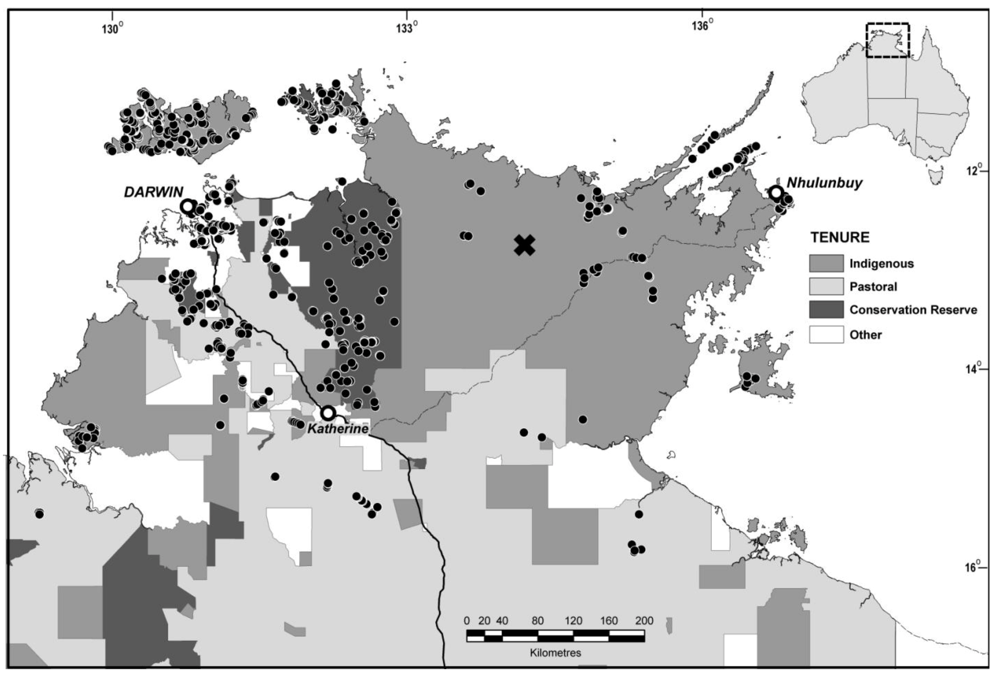
2.1. Sampling
2.2. Analysis



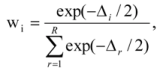

 is the model averaged estimate for a set of R models [48]. We conducted the Poisson regression, model averaging and predictions (except those previously mentioned) in program R [49].
3. Results: Impacts of Land Tenure and Other Variables
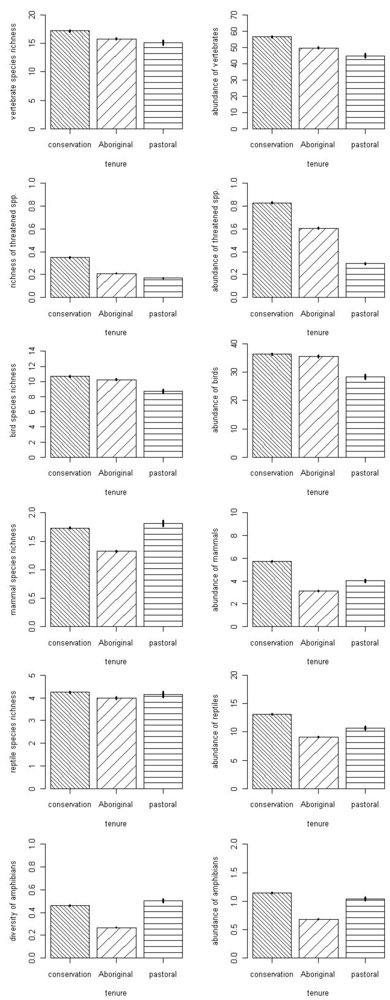
3.1. Fauna

| Fauna Group Attribute | Model | Deviance | AICc | Delta | Weight |
|---|---|---|---|---|---|
| Vertebrate richness | full | 2,616.0 | 6,982.4 | 0 | 0.98 |
| rock, tenure, year | 2,626.3 | 6,990.7 | 8.3 | 0.02 | |
| Vertebrate abundance | full | 2,0531 | 2,594.8 | 0 | 1 |
| rock, rainfall, tenure | 2,0619 | 2,603.5 | 86.2 | 0 | |
| Amphibian richness | full | 1,238.7 | 1,952.1 | 0 | 0.79 |
| rainfall, tenure, year | 1,243.5 | 1,954.8 | 2.7 | 0.21 | |
| Amphibian abundance | full | 4,887.5 | 5,796.7 | 0 | 1 |
| rainfall, tenure, year | 4,930.6 | 5,837.8 | 41.1 | 0 | |
| Reptile richness | rock, tenure | 1,056.5 | 4,039.0 | 0 | 0.23 |
| tenure | 1,059.7 | 4,040.1 | 1.12 | 0.13 | |
| rock, tenure, year | 1,055.8 | 4,040.2 | 1.24 | 0.12 | |
| rainfall, rock, tenure | 1,056.5 | 4,040.9 | 1.96 | 0.08 | |
| rock | 1,063.0 | 4,041.4 | 2.40 | 0.07 | |
| Reptile abundance | full | 5,785.4 | 9,525.2 | 0 | 0.74 |
| rainfall, tenure, year | 5,789.4 | 9,527.3 | 2.1 | 0.26 | |
| Bird richness | full | 2,876.7 | 6,877.5 | 0 | 1 |
| rainfall, rock, year | 2,913.4 | 6,910.1 | 32.6 | 0 | |
| Bird abundance | full | 23,250.9 | 28,366.0 | 0 | 1 |
| rainfall, rock, tenure | 23,320.5 | 28,433.3 | 67.4 | 0 | |
| Mammal richness | full | 1,248.2 | 3,091.4 | 0 | 0.99 |
| rainfall, tenure, year | 1,260.3 | 3,101.6 | 10.1 | 0.01 | |
| Mammal abundance | full | 5,387.1 | 7,677.3 | 0 | 1 |
| rainfall, tenure, year | 5,453.1 | 7,741.2 | 63.9 | 0 | |
| Threatened species richness | rainfall, tenure, year | 760.8 | 1,433.9 | 0 | 0.70 |
| full | 760.6 | 1,435.7 | 1.79 | 0.29 | |
| Threatened species abundance | full | 2,120.9 | 2,953.7 | 0 | 0.66 |
| rainfall, tenure, year | 2,124.2 | 2,955.0 | 1.35 | 0.34 |
3.2. Threats
| Variable | Conservation Reserves | Pastoral | Aboriginal Lands | H |
|---|---|---|---|---|
| Fire impact | 1.75 | 1.64 | 1.58 | 5.9 ns |
| Weed impact | 0.15 | 0.85 | 0.02 | 120.2 *** |
| Cattle impact | 0.41 | 0.70 | 0.41 | 10.6 ** |
| Pig impact | 0.42 | 0.19 | 0.14 | 41.7 *** |
4. Interpretation and Discussion
5. Conclusions
Acknowledgments
References
- Jackson, S.F.; Gaston, K.J. Land use change and the dependence of national priority species on protected areas. Glob. Change Biol. 2008, 14, 2132–2138. [Google Scholar] [CrossRef]
- Parrish, J.D.; Braun, D.P.; Unnasch, R.S. Are we conserving what we say we are? Measuring ecological integrity within protected areas. BioScience 2003, 53, 851–860. [Google Scholar] [CrossRef]
- Chape, S.; Harrison, J.; Spalding, M.; Lysenko, I. Measuring the extent and effectiveness of protected areas as an indicator for meeting global biodiversity targets. Phil. Trans. R. Soc. Lond. B Biol. Sci. 2005, 360, 443–455. [Google Scholar] [CrossRef]
- Devictor, V.; Godet, L.; Julliard, R.; Couvet, D.; Jiguet, F. Can common species benefit from protected areas? Biol. Conserv. 2007, 139, 29–36. [Google Scholar] [CrossRef]
- Gaston, K.J.; Charman, K.; Jackson, S.F.; Armsworth, P.R.; Bonn, A.; Briers, R.A.; Callaghan, C.S.Q.; Catchpole, R.; Hopkins, J.; Kunin, W.E.; et al. The ecological effectiveness of protected areas: the United Kingdom. Biol. Conserv. 2006, 132, 76–87. [Google Scholar] [CrossRef]
- Rannestad, O.T.; Danielsen, T.; Moe, S.R.; Stokke, S. Adjacent pastoral areas support higher densities of wild ungulates during the wet season than the Lake Mburo National Park in Uganda. J. Trop. Ecol. 2006, 22, 675–683. [Google Scholar] [CrossRef]
- Woinarski, J.; Mackey, B.; Nix, H.; Traill, B. The Nature of Northern Australia: Natural Values, Ecological Processes and Future Prospects; ANU E-Press: Canberra, ACT, Australia, 2007. [Google Scholar]
- Garnett, S.T.; Woinarski, J.C.Z.; Crowley, G.M.; Kutt, A.S. Biodiversity conservation in Australian tropical rangelands. In Wild Rangelands: Conserving Wildlife While Maintaining Livestock in Semi-Arid Ecosystems; du Toit, J., Kock, R., Deutsch, J., Eds.; Wiley-Blackwell: Chichester, UK, 2010; pp. 191–234. [Google Scholar]
- Yibarbuk, D.; Whitehead, P.J.; Russell-Smith, J.; Jackson, D.; Godjuwa, C.; Fisher, A.; Cooke, P.; Choquenot, D.; Bowman, D.M.J.S. Fire ecology and Aboriginal land management in central Arnhem Land, northern Australia: a tradition of ecosystem management. J. Biogeogr. 2001, 28, 325–343. [Google Scholar]
- Altman, J.C.; Whitehead, P.J. Caring for Country and Sustainable Indigenous Development: Opportunities, Constraints and Innovation; Australian National University Centre for Aboriginal Economic Policy Research Working Paper No. 20/2003; ANU: Canberra, ACT, Australia, 2003. [Google Scholar]
- Luckert, M.K.; Campbell, B.M.; Gorman, J.T.; Garnett, S.T. Investing in Indigenous Natural Resource Management; Charles Darwin University: Darwin, NT, Australia, 2007. [Google Scholar]
- Whitehead, P.J.; Bowman, D.M.J.S.; Preece, N.; Fraser, F.; Cooke, P. Customary use of fire by Indigenous peoples in northern Australia: its contemporary role in savannah management. Int. J. Wildland Fire 2003, 12, 415–425. [Google Scholar] [CrossRef]
- Altman, J.C.; Buchanan, G.J.; Larsen, L. The Environmental Significance of the Indigenous Estate: Natural Resource Management as Economic Development in Remote Australia; CAEPR Discussion Paper 286/2007; ANU College of Arts & Social Sciences: Canberra, ACT, Australia, 2007. [Google Scholar]
- Gilligan, B. The Indigenous Protected Area Programme; Department of the Environment and Heritage: Canberra, ACT, Australia, 2006. [Google Scholar]
- Director of National Parks. In Kakadu National Park. Management Plan 2007–2014; Australian Government Director of National Parks: Canberra, ACT, Australia, 2007.
- Franklin, D.C.; Petty, A.M.; Williamson, G.J.; Brook, B.W.; Bowman, D.M.J.S. Monitoring contrasting land management in the savannah landscapes of northern Australia. Environ. Manage. 2008, 41, 501–515. [Google Scholar] [CrossRef]
- Caro, T.M. Species richness and abundance of small mammals inside and outside and African national park. Biol. Conserv. 2001, 98, 251–257. [Google Scholar] [CrossRef]
- Woinarski, J.C.Z.; Ash, A.J. Responses of vertebrates to pastoralism, military land use and landscape position in an Australian tropical savannah. Austral. Ecol. 2002, 27, 311–323. [Google Scholar] [CrossRef]
- Woinarski, J.C.Z.; Andersen, A.N.; Churchill, T.; Ash, A.J. Response of ant and terrestrial spider assemblages to pastoral and military land use and to landscape position, in a tropical savannah woodland in northern Australia. Austral. Ecol. 2002, 27, 324–333. [Google Scholar] [CrossRef]
- Kutt, A.S.; Gordon, I.J. Variation in terrestrial mammal abundance on pastoral and conservation land tenures in north-eastern Australian tropical savannas. Anim. Conserv. 2012, 15, 416–425. [Google Scholar] [CrossRef]
- Woinarski, J.C.Z.; Risler, J.; Kean, L. The response of vegetation and vertebrate fauna to 23 years of fire exclusion in a tropical Eucalyptus open forest, Northern Territory, Australia. Austral. Ecol. 2004, 29, 156–176. [Google Scholar] [CrossRef]
- Legge, S.; Kennedy, M.S.; Lloyd, R.; Murphy, S.A.; Fisher, A. Rapid recovery of mammal fauna in the central Kimberley, northern Australia, following the removal of introduced herbivores. Austral. Ecol. 2011, 36, 791–799. [Google Scholar] [CrossRef]
- Kutt, A.S.; Vanderduys, E.P.; Perry, J.J.; Perkins, G.C.; Kemp, J.E.; Bateman, B.L.; Kanowski, J.; Jensen, R. Signals of change in tropical savannah woodland vertebrate fauna 5 years after cessation of livestock grazing. Wildlife Res. 2012, 39, 386–396. [Google Scholar]
- Edwards, A.; Kennett, R.; Price, O.; Russell-Smith, J.; Spiers, G.; Woinarski, J. Monitoring the impacts of fire regimes on biodiversity in northern Australia: an example from Kakadu National Park. Int. J. Wildland Fire 2003, 12, 427–440. [Google Scholar]
- Russell-Smith, J.; Edwards, A.C.; Woinarski, J.C.Z.; McCartney, J.; Kerin, S.; Winderlich, S.; Murphy, B.P.; Watt, F. The First Ten Years of the ‘Three Parks’ (Kakadu, Litchfield, Nitmiluk) Fire Regime and Biodiversity Monitoring Program. In Culture, Ecology and Economy of Fire Management in Northern Australia: Rekindling the Wurrk Tradition; Russell-Smith, J., Whitehead, P.J., Cooke, P., Eds.; CSIRO Publications: Melbourne, VIC, Australia, 2009; pp. 257–286. [Google Scholar]
- Woinarski, J.C.Z.; Russell-Smith, J.; Andersen, A.; Brennan, K. Fire management and biodiversity of the western Arnhem Land plateau. In Culture, Ecology and Economy of Fire Management in Northern Australia: Rekindling the Wurrk Tradition; Russell-Smith, J., Whitehead, P.J., Cooke, P., Eds.; CSIRO Publications: Melbourne, VIC, Australia, 2009; pp. 201–228. [Google Scholar]
- Woinarski, J.C.Z.; Armstrong, M.; Brennan, K.; Fisher, A.; Griffiths, A.D.; Hill, B.; Milne, D.J.; Palmer, C.; Ward, S.; Watson, M.; et al. Monitoring indicates rapid and severe decline of native small mammals in Kakadu National Park, northern Australia. Wildlife Res. 2010, 37, 116–126. [Google Scholar] [CrossRef]
- Bowman, D.M.J.S.; Panton, W.J. Decline of Callitris intratropica R.T. Baker & H.G. Smith in the Northern Territory: implications for pre- and post-European colonization ire regimes. J. Biogeogr. 1993, 20, 373–381. [Google Scholar] [CrossRef]
- Bowman, D.M.J.S.; Prior, L.D. Impact of Aboriginal landscape burning on woody vegetation in Eucalyptus tetrodonta savannah in Arnhem Land, northern Australia. J. Biogeogr. 2004, 31, 807–817. [Google Scholar] [CrossRef]
- Bowman, D.M.J.S.; Price, O.; Whitehead, P.J.; Walsh, A. The ‘wilderness effect’ and the decline of Callitris intratropica on the Arnhem Land Plateau, northern Australia. Aust. J. Bot. 2001, 49, 665–672. [Google Scholar] [CrossRef]
- Bowman, D.M.J.S.; Walsh, A.; Prior, L.D. Landscape analysis of Aboriginal fire management in central Arnhem Land, north Australia. J. Biogeogr. 2004, 31, 207–223. [Google Scholar] [CrossRef]
- Price, O.; Bowman, D.M.J.S. Fire-stick forestry: a matrix model in support of skilful fire management of Callitris intratropica R.T. Baker by north Australian Aborigines. J. Biogeogr. 1994, 21, 573–580. [Google Scholar] [CrossRef]
- Prior, L.D.; Bowman, D.M.J.S.; Brook, B.W. Growth and survival of two north Australian relictual tree species, Allosyncarpia ternata (Myrtaceae) and Callitris intratropica (Cupressaceae). Ecol. Res. 2007, 22, 228–236. [Google Scholar] [CrossRef]
- Russell-Smith, J. Recruitment dynamics of the long-lived obligate seeders Callitris intratropica (Cupressaceae) and Petraeomyrtus punicea (Myrtaceae). Aust. J. Bot. 2006, 54, 479–485. [Google Scholar] [CrossRef]
- Russell-Smith, J.; Lucas, D.; Gapindi, M.; Gunbunuka, B.; Kapirigi, N.; Namingum, G.; Lucas, K.; Giuliani, P.; Chaloupka, G. Aboriginal resource utilization and fire management practice in western Arnhem Land, monsoonal northern Australia: Notes for prehistory, lessons for the future. Hum. Ecol. 1997, 25, 159–195. [Google Scholar] [CrossRef]
- Russell-Smith, J.; Ryan, P.G.; Klessa, D.; Waight, G.; Harwood, R. Fire regimes, fire-sensitive vegetation and fire management of the sandstone Arnhem Plateau, monsoonal northern Australia. J. Appl. Ecol. 1998, 35, 829–846. [Google Scholar]
- Russell-Smith, J.; Ryan, P.G.; Cheal, D.C. Fire regimes and the conservation of sandstone heath in monsoonal northern Australia: frequency, interval, patchiness. Biol. Conserv. 2002, 104, 91–106. [Google Scholar] [CrossRef]
- Woinarski, J.C.Z.; Armstrong, M.; Price, O.; McCartney, J.; Griffiths, T.; Fisher, A. The terrestrial vertebrate fauna of Litchfield National Park, Northern Territory: monitoring over a 6-year period and response to fire history. Wildlife Res. 2004, 31, 1–10. [Google Scholar] [CrossRef]
- Woinarski, J.C.Z.; Rankmore, B.; Hill, B.; Griffiths, A.D.; Stewart, A.; Grace, B. Fauna assemblages in regrowth vegetation in tropical open forests of the Northern Territory, Australia. Wildlife Res. 2010, 36, 675–690. [Google Scholar]
- Houlder, D.J. ANUCLIM (Version 5.1); Centre for Resource and Environmental Studies, Australian National University: Canberra, ACT, Australia, 2000. [Google Scholar]
- Firth, R.S.C.; Woinarski, J.C.Z.; Brennan, K.G.; Hempel, C. Environmental relationships of the brush-tailed rabbit-rat Conilurus penicillatus and other small mammals on the Tiwi Islands, northern Australia. J. Biogeogr. 2006, 33, 1820–1837. [Google Scholar] [CrossRef]
- Woinarski, J.C.Z.; Gambold, N. Gradient analysis of a tropical herpetofauna: distribution patterns of terrestrial reptiles and amphibians in Stage III of Kakadu National Park, Australia. Wildlife Res. 1992, 19, 105–127. [Google Scholar] [CrossRef]
- Woinarski, J.C.Z.; Braithwaite, R.W.; Menkhorst, K.A.; Griffin, S.; Fisher, A.; Preece, N. Gradient analysis of the distribution of mammals in Stage III of Kakadu National Park, with a review of the distribution patterns of mammals across north-western Australia. Wildlife Res. 1992, 19, 233–262. [Google Scholar] [CrossRef]
- Woinarski, J.C.Z.; Fisher, A.; Milne, D. Distribution patterns of vertebrates in relation to an extensive rainfall gradient and soil variation in the tropical savannas of the Northern Territory, Australia. J. Trop. Ecol. 1999, 15, 381–398. [Google Scholar] [CrossRef]
- Woinarski, J.C.Z.; Legge, S.; Fitzsimons, J.A.; Traill, B.J.; Burbidge, A.A.; Fisher, A.; Firth, R.S.C.; Gordon, I.J.; Griffiths, A.D.; Johnson, C.N.; et al. The disappearing mammal fauna of northern Australia: context, cause and response. Conserv. Lett. 2011, 4, 192–201. [Google Scholar] [CrossRef]
- Woinarski, J.; Pavey, C.; Kerrigan, R.; Cowie, I.; Ward, S. Lost from Our Landscape: Threatened Species of the Northern Territory; NT Government Printer: Darwin, NT, Australia, 2007. [Google Scholar]
- Dobson, A.J. An Introduction to Generalized Linear Models; Chapman and Hall: London, UK, 1990. [Google Scholar]
- Burnham, K.P.; Anderson, D.R. Model Selection and Multimodel Inference: A Practical Information-Theoretic Approach; Springer: New York, NY, USA, 2002. [Google Scholar]
- R Development Core Team, R: A Language and Environment for Statistical Computing, Reference Index Version 2.9.2; R Foundation for Statistical Computing: Vienna, Austria, 2009.
- Parr, C.L.; Woinarski, J.C.Z.; Pienaar, D.J. Cornerstones of biodiversity conservation? Comparing the management effectiveness of Kruger and Kakadu National Parks, two key savannah reserves. Biodivers. Conserv. 2009, 18, 3643–3662. [Google Scholar] [CrossRef]
- Woinarski, J.C.Z. A Difficult and Destructive Metamorphosis: Conservation and Land Management in the Northern Territory in the 1950s. In Modern Frontier: Aspects of the 1950s in Australia’s Northern Territory; Wells, J.T., Dewar, M., Parry, S., Eds.; Charles Darwin University Press: Darwin, NT, Australia, 2005; pp. 33–55. [Google Scholar]
- Russell-Smith, J.; Bowman, D.M.J.S. Conservation of monsoon rainforest isolates in the Northern Territory, Australia. Biol. Conserv. 1992, 59, 51–63. [Google Scholar] [CrossRef]
- Preece, N.; Harvey, K.; Hempel, C.; Woinarski, J.C.Z. Uneven distribution of weeds along extensive transects in Australia's Northern Territory points to management solutions. Ecol. Manag. Restor. 2010, 11, 127–134. [Google Scholar] [CrossRef]
- Garnett, S.T.; Sithole, B.; Whitehead, P.J.; Burgess, C.P.; Johnston, F.H.; Lea, T. Healthy Country, Healthy People: policy implications of links between Indigenous human heath and environmental condition in tropical Australia. Aust. J. Publ. Admin. 2009, 68, 53–66. [Google Scholar] [CrossRef]
- Johnston, F.H.; Burgess, P.; Bowman, D.M.J.S. A Case for Indigenous Natural Resource Management and Health. In Investing in Indigenous Natural Resource Management; Luckert, M.K., Campbell, B.M., Gorman, J.T., Garnett, S.T., Eds.; Charles Darwin University Press: Darwin, NT, Australia, 2007; pp. 91–95. [Google Scholar]
- Hill, R.; Harding, E.K.; Edwards, D.; O’Dempsey, J.; Hill, D.; Martin, A.; McIntyre-Tamwoy, S. A Cultural and Conservation Economy for Northern Australia; Australian Conservation Foundation: Melbourne, ACT, Australia, 2007. [Google Scholar]
- Fitzsimons, J.; Russell-Smith, J.; James, G.; Vigilante, T.; Lipsett-Moore, G.; Morrison, J.; Looker, M. Insights into the biodiversity and social benchmarking components of the Northern Australian fire management and carbon abatement programmes. Ecol. Manag. Restor. 2012, 13, 51–57. [Google Scholar] [CrossRef]
- Preuss, K.; Dixon, M. ‘Looking after country two-ways’: insights into Indigenous community-based conservation form the Southern Tanami. Ecol. Manag. Restor. 2012, 13, 2–15. [Google Scholar] [CrossRef]
- Wiens, J. The dangers of black-and-white conservation. Conserv. Biol. 2007, 21, 1371–1372. [Google Scholar] [CrossRef]
- Hansen, A.J.; Rotella, J.J. Biophysical factors, land use and species viability in and around Nature Reserves. Conserv. Biol. 2002, 16, 1112–1122. [Google Scholar] [CrossRef]
- Berger, J. Is it acceptable to let a species go extinct in a National Park? Conserv. Biol. 2003, 17, 1451–1454. [Google Scholar] [CrossRef]
- Struhsaker, T.T.; Struhsaker, P.J.; Siex, K.S. Conserving Africa’s rain forests: Problems in protected areas and possible solutions. Biol. Conserv. 2005, 123, 45–54. [Google Scholar]
© 2013 by the authors; licensee MDPI, Basel, Switzerland. This article is an open-access article distributed under the terms and conditions of the Creative Commons Attribution license (http://creativecommons.org/licenses/by/3.0/).
Share and Cite
Woinarski, J.C.Z.; Green, J.; Fisher, A.; Ensbey, M.; Mackey, B. The Effectiveness of Conservation Reserves: Land Tenure Impacts upon Biodiversity across Extensive Natural Landscapes in the Tropical Savannahs of the Northern Territory, Australia. Land 2013, 2, 20-36. https://doi.org/10.3390/land2010020
Woinarski JCZ, Green J, Fisher A, Ensbey M, Mackey B. The Effectiveness of Conservation Reserves: Land Tenure Impacts upon Biodiversity across Extensive Natural Landscapes in the Tropical Savannahs of the Northern Territory, Australia. Land. 2013; 2(1):20-36. https://doi.org/10.3390/land2010020
Chicago/Turabian StyleWoinarski, John C.Z., Jon Green, Alaric Fisher, Michelle Ensbey, and Brendan Mackey. 2013. "The Effectiveness of Conservation Reserves: Land Tenure Impacts upon Biodiversity across Extensive Natural Landscapes in the Tropical Savannahs of the Northern Territory, Australia" Land 2, no. 1: 20-36. https://doi.org/10.3390/land2010020
APA StyleWoinarski, J. C. Z., Green, J., Fisher, A., Ensbey, M., & Mackey, B. (2013). The Effectiveness of Conservation Reserves: Land Tenure Impacts upon Biodiversity across Extensive Natural Landscapes in the Tropical Savannahs of the Northern Territory, Australia. Land, 2(1), 20-36. https://doi.org/10.3390/land2010020

