<?xml version="1.0" encoding="UTF-8"?>
<!DOCTYPE article PUBLIC "-//NLM//DTD Journal Publishing DTD v2.3 20070202//EN" "journalpublishing.dtd">
<article xmlns:mml="http://www.w3.org/1998/Math/MathML" xmlns:xlink="http://www.w3.org/1999/xlink" xml:lang="en" article-type="rapid-communication">
  <front>
    <journal-meta>
      <journal-id journal-id-type="publisher-id">genes</journal-id>
      <journal-title>Genes</journal-title>
      <abbrev-journal-title abbrev-type="publisher">Genes</abbrev-journal-title>
      <abbrev-journal-title abbrev-type="pubmed">Genes</abbrev-journal-title>
      <issn pub-type="epub">2073-4425</issn>
      <publisher>
        <publisher-name>MDPI</publisher-name>
      </publisher>
    </journal-meta>
    <article-meta>
      <article-id pub-id-type="doi">10.3390/genes3030361</article-id>
      <article-id pub-id-type="publisher-id">genes-03-00361</article-id>
      <article-categories>
        <subj-group>
          <subject>Communication</subject>
        </subj-group>
      </article-categories>
      <title-group>
        <article-title>Genome-Wide Sequencing Reveals Two Major Sub-Lineages in the Genetically Monomorphic Pathogen <italic>Xanthomonas Campestris</italic> Pathovar <italic>Musacearum</italic></article-title>
      </title-group>
      <contrib-group>
        <contrib contrib-type="author">
          <name>
            <surname>Wasukira</surname>
            <given-names>Arthur</given-names>
          </name>
          <xref rid="af1-genes-03-00361" ref-type="aff">1</xref>
          <xref rid="af2-genes-03-00361" ref-type="aff">2</xref>
        </contrib>
        <contrib contrib-type="author">
          <name>
            <surname>Tayebwa</surname>
            <given-names>Johnbosco</given-names>
          </name>
          <xref rid="af1-genes-03-00361" ref-type="aff">1</xref>
          <xref rid="af2-genes-03-00361" ref-type="aff">2</xref>
        </contrib>
        <contrib contrib-type="author">
          <name>
            <surname>Thwaites</surname>
            <given-names>Richard</given-names>
          </name>
          <xref rid="af3-genes-03-00361" ref-type="aff">3</xref>
        </contrib>
        <contrib contrib-type="author">
          <name>
            <surname>Paszkiewicz</surname>
            <given-names>Konrad</given-names>
          </name>
          <xref rid="af1-genes-03-00361" ref-type="aff">1</xref>
        </contrib>
        <contrib contrib-type="author">
          <name>
            <surname>Aritua</surname>
            <given-names>Valente</given-names>
          </name>
          <xref rid="af2-genes-03-00361" ref-type="aff">2</xref>
          <xref rid="af3-genes-03-00361" ref-type="aff">3</xref>
          <xref rid="fn1-genes-03-00361" ref-type="fn">†</xref>
        </contrib>
        <contrib contrib-type="author">
          <name>
            <surname>Kubiriba</surname>
            <given-names>Jerome</given-names>
          </name>
          <xref rid="af2-genes-03-00361" ref-type="aff">2</xref>
        </contrib>
        <contrib contrib-type="author">
          <name>
            <surname>Smith</surname>
            <given-names>Julian</given-names>
          </name>
          <xref rid="af3-genes-03-00361" ref-type="aff">3</xref>
        </contrib>
        <contrib contrib-type="author">
          <name>
            <surname>Grant</surname>
            <given-names>Murray</given-names>
          </name>
          <xref rid="af1-genes-03-00361" ref-type="aff">1</xref>
        </contrib>
        <contrib contrib-type="author">
          <name>
            <surname>Studholme</surname>
            <given-names>David J.</given-names>
          </name>
          <xref rid="af1-genes-03-00361" ref-type="aff">1</xref>
          <xref rid="c1-genes-03-00361" ref-type="corresp">*</xref>
        </contrib>
      </contrib-group>
      <aff id="af1-genes-03-00361"><label>1</label> Biosciences, University of Exeter, Geoffrey Pope Building, Stocker Road, Exeter EX4 4QD, UK; Email: <email>awasukira@gmail.com</email> (A.W.); <email>tayebwajb@gmail.com</email> (J.T.); <email>k.h.paszkiewicz@exeter.ac.uk</email> (K.P.); <email>m.r.grant@exeter.ac.uk</email> (M.G.)</aff>
      <aff id="af2-genes-03-00361"><label>2</label> National Crops Resources Research Institute (NaCRRI), Kampala 7084, Uganda; Email: <email>arituavalentine@yahoo.com</email> (V.A.); <email>jkubiriba@kari.go.ug</email> (J.K.)</aff>
      <aff id="af3-genes-03-00361"><label>3</label> The Food and Environment Research Agency, Sand Hutton, York YO41 1LZ, UK; Email: <email>richard.thwaites@fera.gsi.gov.uk</email> (R.T.); <email>julian.smith@fera.gsi.gov.uk</email> (J.S.)</aff>
      <author-notes>
        <fn id="fn1-genes-03-00361">
          <label>† </label>
          <p>Present address: International Centre for Tropical Agriculture (CIAT), Kawanda Agricultural Research Institute, Kampala 6247, Uganda.</p>
        </fn>
        <corresp id="c1-genes-03-00361"><label>*</label> Author to whom correspondence should be addressed; Email: <email>d.j.studholme@exeter.ac.uk</email>.</corresp>
      </author-notes>
      <pub-date pub-type="epub">
        <day>04</day>
        <month>07</month>
        <year>2012</year>
      </pub-date>
      <pub-date pub-type="collection"><month>09</month>
        <year>2012</year>
      </pub-date>
      <volume>3</volume>
      <issue>3</issue>
      <fpage>361</fpage>
      <lpage>377</lpage>
      <history>
        <date date-type="received">
          <day>10</day>
          <month>06</month>
          <year>2012</year>
        </date>
        <date date-type="rev-recd">
          <day>24</day>
          <month>06</month>
          <year>2012</year>
        </date>
        <date date-type="accepted">
          <day>26</day>
          <month>06</month>
          <year>2012</year>
        </date>
      </history>
      <permissions>
        <copyright-statement>©  2012 by the authors; licensee MDPI, Basel, Switzerland.</copyright-statement>
        <copyright-year>2012</copyright-year>
        <license xmlns:xlink="http://www.w3.org/1999/xlink" license-type="open-access" xlink:href="http://creativecommons.org/licenses/by/3.0/">
          <p>This article is an open-access article distributed under the terms and conditions of the Creative Commons Attribution license (http://creativecommons.org/licenses/by/3.0/).</p>
        </license>
      </permissions>
      <abstract>
        <p>The bacterium <italic>Xanthomonas campestris</italic> pathovar <italic>musacearum</italic> (<italic>Xcm</italic>) is the causal agent of banana <italic>Xanthomonas</italic> wilt (BXW). This disease has devastated economies based on banana and plantain crops (<italic>Musa</italic> species) in East Africa. Here we use genome-wide sequencing to discover a set of single-nucleotide polymorphisms (SNPs) among East African isolates of <italic>Xcm</italic>. These SNPs have potential as molecular markers for phylogeographic studies of the epidemiology and spread of the pathogen. Our analysis reveals two major sub-lineages of the pathogen, suggesting that the current outbreaks of BXW on <italic>Musa</italic> species in the region may have more than one introductory event, perhaps from Ethiopia. Also, based on comparisons of genome-wide sequence data from multiple isolates of <italic>Xcm</italic> and multiple strains of <italic>X. vasicola</italic> pathovar <italic>vasculorum</italic>, we identify genes specific to <italic>Xcm</italic> that could be used to specifically detect <italic>Xcm</italic> by PCR-based methods.</p>
      </abstract>
      <kwd-group>
        <kwd>banana <italic>Xanthomonas</italic> wilt</kwd>
        <kwd>whole-genome sequencing</kwd>
        <kwd>SNP</kwd>
        <kwd>molecular markers</kwd>
        <kwd>
          <italic>Ensete ventricosum</italic>
        </kwd>
        <kwd>
          <italic>Xanthomonas vasicola</italic>
        </kwd>
      </kwd-group>
    </article-meta>
  </front>
  <body>
    <sec sec-type="intro">
      <title>1. Introduction</title>
      <p>The bacterium <italic>Xanthomonas campestris</italic> pathovar <italic>musacearum</italic> (<italic>Xcm</italic>) is the causal agent of banana <italic>Xanthomonas</italic> wilt (BXW). This disease has devastated economies based on banana and plantain crops (<italic>Musa</italic> species) in East Africa [<xref ref-type="bibr" rid="B1-genes-03-00361">1</xref>]. <italic>Xcm</italic> was first described as a wilt-causing pathogen on enset (<italic>Ensente ventricosum</italic>), a plant closely related to banana that is a staple crop in the highlands of Ethiopia [<xref ref-type="bibr" rid="B2-genes-03-00361">2</xref>]. In 1974 Yirgou and Bradbury [<xref ref-type="bibr" rid="B3-genes-03-00361">3</xref>] wrote that “<italic>Great care should be taken to see that enset wilt does not escape and establish itself on banana in other parts of the world where it could pose a serious problem on this crop</italic>”. Ominously, one and a half decades later, a major epidemic of this disease was reported in Uganda [<xref ref-type="bibr" rid="B4-genes-03-00361">4</xref>]. Subsequently it has spread into many banana-growing regions around the Great Lakes in Uganda, Kenya, Tanzania, Democratic Republic of Congo, Rwanda and Burundi [<xref ref-type="bibr" rid="B4-genes-03-00361">4</xref>,<xref ref-type="bibr" rid="B5-genes-03-00361">5</xref>,<xref ref-type="bibr" rid="B6-genes-03-00361">6</xref>,<xref ref-type="bibr" rid="B7-genes-03-00361">7</xref>]. Efforts are underway to tackle this pathogen by a number of different measures including cultural practices [<xref ref-type="bibr" rid="B8-genes-03-00361">8</xref>] and genetic modification of the crop [<xref ref-type="bibr" rid="B9-genes-03-00361">9</xref>,<xref ref-type="bibr" rid="B10-genes-03-00361">10</xref>].</p>
      <p>Although currently classified as a member of the species <italic>Xanthomonas campestris</italic>, we recently showed that <italic>Xcm</italic> is more likely to be a strain of the species <italic>Xanthomonas vasicola</italic> [<xref ref-type="bibr" rid="B11-genes-03-00361">11</xref>]. We previously [<xref ref-type="bibr" rid="B12-genes-03-00361">12</xref>] generated complete genome sequences for a single isolate of <italic>Xcm</italic> from banana in Uganda (NCPPB4381) and for a single isolate of <italic>X. vasicola</italic> pathovar <italic>vasculorum</italic> (<italic>Xvv</italic>) that is non-pathogenic on banana and was isolated from sugarcane in Zimbabwe (NCPPB702). These two isolates share identical gyrase B DNA sequences, consistent with their very close evolutionary relationship [<xref ref-type="bibr" rid="B11-genes-03-00361">11</xref>,<xref ref-type="bibr" rid="B13-genes-03-00361">13</xref>].</p>
      <p>Differences between these two genome sequences revealed several candidate genes that might play a role in adaptation to the banana host. These may also be useful tools in identifying genes for deployment of disease resistance. Specifically, these included homologues of effectors secreted and translocated by the type III secretion system (T3SS). T3SS effectors have previously been shown to contribute to host-specificity acting as virulence and/or avirulence factors [<xref ref-type="bibr" rid="B14-genes-03-00361">14</xref>]. In common with most previously sequenced <italic>Xanthomonas</italic> genomes, <italic>Xcm</italic> encodes homologues of the effectors AvrBs2, AvrGf1, XopF, XopK, XopL, XopN, XopP, XopQ, XopR, XopX and XopZ as well as homologues of XopA, XopB, XopG, XopH, XopI, XopY, XopAA, XopAD, XopAE and XopAK, which are found in some other <italic>Xanthomonas</italic> species [<xref ref-type="bibr" rid="B12-genes-03-00361">12</xref>,<xref ref-type="bibr" rid="B14-genes-03-00361">14</xref>]. <italic>Xcm</italic> also encodes homologues of <italic>P. syringae</italic> effectors HopW1 and HopAF1 and <italic>Ralstonia solanacearum</italic> putative effector RipT [<xref ref-type="bibr" rid="B12-genes-03-00361">12</xref>]. <italic>Xcm</italic> encodes two predicted YopJ-like C55 cysteine proteases (RefSeq accessions ZP_06491730 and ZP_06492219) that are absent from <italic>Xvv</italic> 702. On the other hand, <italic>Xvv</italic> 702 encodes a close homologue (ZP_06483517) of XopAF (also known as AvrXv3), which is absent from <italic>Xcm</italic> [<xref ref-type="bibr" rid="B12-genes-03-00361">12</xref>].</p>
      <p>Previous work showed that <italic>Xcm</italic> is a highly monomorphic pathogen and no specific genetic differences have yet been detected among different isolates using traditional typing and diagnostic methods [<xref ref-type="bibr" rid="B13-genes-03-00361">13</xref>,<xref ref-type="bibr" rid="B15-genes-03-00361">15</xref>]. Affordable complete genome sequencing now makes it feasible to identify cryptic genetic diversity among isolates of a genetically monomorphic pathogen [<xref ref-type="bibr" rid="B16-genes-03-00361">16</xref>], though this approach is only just starting to be applied to monomorphic phytopathogens [<xref ref-type="bibr" rid="B17-genes-03-00361">17</xref>].</p>
      <p>Here we use genome-wide sequencing to discover a set of single-nucleotide polymorphisms (SNPs) among East African isolates of <italic>Xcm</italic>. These SNPs have potential as molecular markers for phylogeographic studies of the epidemiology and spread of the pathogen. Our analysis reveals the presence of at least two major sub-lineages of the pathogen; <italic>Xcm</italic> isolates from Uganda, Kenya, Tanzania and Burundi are genetically distinct from isolates collected in Ethiopia, DR Congo and Rwanda, suggesting that the current outbreaks of BXW on <italic>Musa</italic> species in the region may have more than one introduction.</p>
    </sec>
    <sec sec-type="results">
      <title>2. Results and Discussion</title>
      <sec>
        <title>2.1. Genome Sequencing</title>
        <p>We used the Illumina GA2x sequencing platform to generate genome-wide sequence data for 13 isolates of <italic>Xcm</italic> available from the National Collection of Plant Pathogenic Bacteria (NCPPB). We also sequenced a further three African isolates of <italic>Xvv</italic>, a pathovar that is very closely related to <italic>Xcm</italic> but non-pathogenic on banana. We also included in our analyses the genome sequence data from <italic>Xcm</italic> NCPPB4381 and <italic>Xvv</italic> NCPPB702 that we published previously [<xref ref-type="bibr" rid="B12-genes-03-00361">12</xref>]. <xref ref-type="table" rid="genes-03-00361-t001">Table 1</xref> lists the sequenced isolates and the depth to which each was sequenced. We submitted all raw sequence data to the Sequence Read Archive [<xref ref-type="bibr" rid="B18-genes-03-00361">18</xref>]. Note that another isolate from Tanzania, NCPPB4393, is described in the NCPPB’s catalogue as <italic>Xcm</italic>, but we previously sequenced its genome and showed that it is actually <italic>Xanthomonas sacchari</italic> [<xref ref-type="bibr" rid="B19-genes-03-00361">19</xref>]. We generated genome assemblies <italic>de novo</italic> for NCPPB2005, NCPPB4379, NCPPB4380, NCPPB4384, NCPPB4392, NCPPB4394, NCPPB1326, NCPPB1381 and NCPPB206 using Velvet 1.1.04 [<xref ref-type="bibr" rid="B20-genes-03-00361">20</xref>]. These have been submitted to GenBank [<xref ref-type="bibr" rid="B21-genes-03-00361">21</xref>] with accession numbers AKBE00000000, AKBF00000000, AKBG00000000, AKBH00000000, AKBI00000000, </p>
        <table-wrap id="genes-03-00361-t001" position="anchor">
          <object-id pub-id-type="pii">genes-03-00361-t001_Table 1</object-id>
          <label>Table 1</label>
          <caption>
            <p>Isolates of <italic>X. campestr</italic> is pv. <italic>musacearum</italic> (<italic>Xcm)</italic> and <italic>X. vasicola</italic> pv. <italic>vasculorum</italic> (<italic>Xvv) </italic>subjected to genome-wide sequencing. All <italic>Xcm</italic> isolates were originally collected from diseased banana plants except for NCPPB2005, which was isolated from <italic>Ensete ventricosum</italic>. All <italic>Xvv</italic> isolates were originally collected from sugarcane, except for NCPPB206, which was isolated from maize.</p>
          </caption>
          <table rules="rows">
          <thead>
              <tr>
                <th align="center" valign="middle">Isolate</th>
                <th colspan="2" align="center" valign="middle">Source and Date of Isolation</th>
                <th align="center" valign="middle">Coverage</th>
                <th align="center" valign="middle">SRA Accession</th>
              </tr>
          </thead>
          <tbody>
              <tr>
                <td align="left" valign="middle"><italic>Xcm</italic> NCPPB2005</td>
                <td colspan="2" align="left" valign="middle">Ethiopia 1967</td>
                <td align="center" valign="middle">72×</td>
                <td align="left" valign="middle">SRR489154.7</td>
              </tr>
              <tr>
                <td align="left" valign="middle"><italic>Xcm</italic> NCPPB2251</td>
                <td colspan="2" align="left" valign="middle">Ethiopia 1969</td>
                <td align="center" valign="middle">13×</td>
                <td align="left" valign="middle">SRR494492.2</td>
              </tr>
              <tr>
                <td align="left" valign="middle"><italic>Xcm</italic> NCPPB4379</td>
                <td colspan="2" align="left" valign="middle">Uganda (Kayunga) 2007</td>
                <td align="center" valign="middle">102×</td>
                <td align="left" valign="middle">SRR494484.2</td>
              </tr>
              <tr>
                <td align="left" valign="middle"><italic>Xcm</italic> NCPPB4380</td>
                <td colspan="2" align="left" valign="middle">Uganda (Kiboga) 2007</td>
                <td align="center" valign="middle">113×</td>
                <td align="left" valign="middle">SRR494485.2</td>
              </tr>
              <tr>
                <td align="left" valign="middle"><italic>Xcm</italic> NCPPB4381</td>
                <td colspan="2" align="left" valign="middle">Uganda (Luwero) 2007</td>
                <td align="center" valign="middle">56×</td>
                <td align="left" valign="middle">SRR020203.3</td>
              </tr>
              <tr>
                <td align="left" valign="middle"><italic>Xcm</italic> NCPPB4383</td>
                <td colspan="2" align="left" valign="middle">Uganda (Wakiso) 2007</td>
                <td align="center" valign="middle">11×</td>
                <td align="left" valign="middle">SRR494493.2</td>
              </tr>
              <tr>
                <td align="left" valign="middle"><italic>Xcm</italic> NCPPB4384</td>
                <td colspan="2" align="left" valign="middle">Uganda (Nakaongola) 2007</td>
                <td align="center" valign="middle">55×</td>
                <td align="left" valign="middle">SRR494488.2</td>
              </tr>
              <tr>
                <td align="left" valign="middle"><italic>Xcm</italic> NCPPB4387</td>
                <td colspan="2" align="left" valign="middle">D. R. Congo (Kivu province) 2007</td>
                <td align="center" valign="middle">13×</td>
                <td align="left" valign="middle">SRR494494.1</td>
              </tr>
              <tr>
                <td align="left" valign="middle"><italic>Xcm</italic> NCPPB4389</td>
                <td colspan="2" align="left" valign="middle">Rwanda (Gisenyi province) 2007</td>
                <td align="center" valign="middle">16×</td>
                <td align="left" valign="middle">SRR494495.2</td>
              </tr>
              <tr>
                <td align="left" valign="middle"><italic>Xcm</italic> NCPPB4392</td>
                <td colspan="2" align="left" valign="middle">Tanzania (Muleba district, Kagera region) 2007</td>
                <td align="center" valign="middle">72×</td>
                <td align="left" valign="middle">SRR494498.3</td>
              </tr>
              <tr>
                <td align="left" valign="middle"><italic>Xcm</italic> NCPPB4394</td>
                <td colspan="2" align="left" valign="middle">Tanzania (Muleba district, Kagera region) 2007</td>
                <td align="center" valign="middle">92×</td>
                <td align="left" valign="middle">SRR494489.1</td>
              </tr>
              <tr>
                <td align="left" valign="middle"><italic>Xcm</italic> NCPPB4395</td>
                <td colspan="2" align="left" valign="middle">Tanzania (Muleba district, Kagera region) 2007 </td>
                <td align="center" valign="middle">117×</td>
                <td align="left" valign="middle">SRR494490.2</td>
              </tr>
              <tr>
                <td align="left" valign="middle"><italic>Xcm</italic> NCPPB4433</td>
                <td colspan="2" align="left" valign="middle">Burundi 2008</td>
                <td align="center" valign="middle">13×</td>
                <td align="left" valign="middle">SRR494496.1</td>
              </tr>
              <tr>
                <td colspan="2" align="left" valign="middle"><italic>Xcm</italic> NCPPB4434</td>
                <td align="left" valign="middle">Kenya (Teso district) 2008</td>
                <td align="center" valign="middle">15×</td>
                <td align="left" valign="middle">SRR494497.1</td>
              </tr>
              <tr>
                <td colspan="2" align="left" valign="middle"><italic>Xvv</italic> NCPPB206</td>
                <td align="left" valign="middle">South Africa 1948</td>
                <td align="center" valign="middle">70×</td>
                <td align="left" valign="middle">SRR494500.3</td>
              </tr>
              <tr>
                <td colspan="2" align="left" valign="middle"><italic>Xvv</italic> NCPPB702</td>
                <td align="left" valign="middle">Zimbabwe 1959</td>
                <td align="center" valign="middle">35×</td>
                <td align="left" valign="middle">SRR020202.3</td>
              </tr>
              <tr>
                <td colspan="2" align="left" valign="middle"><italic>Xvv</italic> NCPPB1326</td>
                <td align="left" valign="middle">Zimbabwe 1962</td>
                <td align="center" valign="middle">63×</td>
                <td align="left" valign="middle">SRR494491.5</td>
              </tr>
              <tr>
                <td colspan="2" align="left" valign="middle"><italic>Xvv</italic> NCPPB1381</td>
                <td align="left" valign="middle">Zimbabwe 1962</td>
                <td align="center" valign="middle">66×</td>
                <td align="left" valign="middle">SRR494499.3</td>
              </tr>
          </tbody>
          </table>
        </table-wrap>
        <p>AKBJ00000000, AKBK00000000, AKBL00000000 and AKBM00000000. The most contiguous of these assemblies was for NCPPB4384. This consisted of 84 scaffolds, of which the 12 longest scaffolds were each at least 154 Kb long and accounted for more than 2.5 Mb; that is the N<sub>50</sub> length was 154 Kb for NCPPB4384. The N<sub>50</sub> lengths for the other <italic>Xcm</italic> assemblies were 56 Kb (NCPPB2005), 146 Kb (NCPPB4379), 147 Kb (NCPPB4380), 87 Kb (NCPPB4392) and 151 Kb (NCPPB4394).</p>
      </sec>
      <sec>
        <title>2.2. Distinguishing <italic>Xcm</italic> from <italic>Xvv</italic></title>
        <p>The currently used method for identifying BXW is by isolation of bacteria from the infected plant and performing fatty acid and metabolic analyses [<xref ref-type="bibr" rid="B4-genes-03-00361">4</xref>]. However, this approach is only appropriate once symptoms become visible, by which time it may be too late to control or eradicate the pathogen. An alternative approach, amenable to the rapid detection and identification of bacterial plant pathogens is the use of the polymerase chain reaction (PCR). A specific assay for detecting <italic>Xcm</italic> has recently been proposed based on PCR amplification of the <italic>hrpB</italic> gene [<xref ref-type="bibr" rid="B22-genes-03-00361">22</xref>]. However, this gene is also conserved in <italic>Xvv</italic> and this assay was unable to distinguish between <italic>Xcm</italic> and non-banana-pathogenic isolates <italic>Xvv</italic> NCPPB702 and NCPPB1326 [<xref ref-type="bibr" rid="B22-genes-03-00361">22</xref>]. Another study [<xref ref-type="bibr" rid="B23-genes-03-00361">23</xref>] generated several PCR primer pairs that were highly specific for <italic>Xcm</italic> but this study did not utilize <italic>Xcm</italic> or <italic>Xvv</italic> genomic sequence but rather used sequences from a range of other xanthomonads and so the candidate primers had to be tested for specificity by trial and error. Another recent study [<xref ref-type="bibr" rid="B24-genes-03-00361">24</xref>] exploited our previous [<xref ref-type="bibr" rid="B12-genes-03-00361">12</xref>] <italic>Xcm</italic> and <italic>Xvv</italic> draft genome sequence data to rationally design primers specific for <italic>Xcm</italic>. However, this was based on genome sequence from a single isolate of <italic>Xvv</italic> and a single isolate of <italic>Xcm</italic>. Until now, little was known about sequence diversity among isolates. Therefore, we identified a set of genes that are conserved in all of the sequenced isolates of <italic>Xcm</italic> but are absent from all the sequenced isolates of <italic>Xvv</italic> and are therefore candidates for use in an <italic>Xcm</italic>-specific PCR assay. Examples of these genes are listed in <xref ref-type="table" rid="genes-03-00361-t002">Table 2</xref>. Note that this list of genes was not generated by aligning assembled genome sequences. We aligned raw unassembled sequence reads against the previously published <italic>Xcm</italic> NCPPB4381 reference genome sequence [<xref ref-type="bibr" rid="B12-genes-03-00361">12</xref>] using the Burrows-Wheeler Aligner BWA [<xref ref-type="bibr" rid="B25-genes-03-00361">25</xref>]. This approach has the advantage of avoiding assembly artifacts and problems arising from incomplete assemblies. In our BWA alignments of raw Illumina sequence reads <italic>versus</italic> the reference genome sequence, the full length of each gene was covered by reads (depth of one or greater) from all our <italic>Xcm</italic> Illumina sequence datasets. Each of these genes has no matches (<italic>i.e.</italic>, zero depth of) to any sequence reads in our <italic>Xvv</italic> Illumina datatsets (as judged from the BWA alignments).</p>
        <table-wrap id="genes-03-00361-t002" position="anchor">
          <object-id pub-id-type="pii">genes-03-00361-t002_Table 2</object-id>
          <label>Table 2</label>
          <caption>
            <p>Candidate genes for development of an <italic>Xcm</italic>-specific PCR-based assay. The listed genes conserved in all of the sequenced <italic>Xcm</italic> isolates but absent from all of the sequenced <italic>Xvv</italic> isolates. Presence or absence of each gene was assessed based on alignment of Illumina sequence reads from each isolate against the <italic>Xcm</italic> NCPPB4381 reference genome sequence (RefSeq: ACHT00000000) using BWA [<xref ref-type="bibr" rid="B25-genes-03-00361">25</xref>].</p>
          </caption>
          <table rules="rows">
            <thead>
              <tr>
                <th align="left" valign="middle">RefSeq Locus tag</th>
                <th align="left" valign="middle">Predicted Gene Product</th>
              </tr>
            </thead>
            <tbody>
              <tr>
                <td align="left" valign="middle">XcampmN_010100002667 </td>
                <td align="left" valign="middle">hypothetical protein</td>
              </tr>
              <tr>
                <td align="left" valign="middle">XcampmN_010100009057 </td>
                <td align="left" valign="middle">general secretion pathway protein D</td>
              </tr>
              <tr>
                <td align="left" valign="middle">XcampmN_010100016989 </td>
                <td align="left" valign="middle">transposase</td>
              </tr>
              <tr>
                <td align="left" valign="middle">XcampmN_010100016984 </td>
                <td align="left" valign="middle">phage-related integrase</td>
              </tr>
              <tr>
                <td align="left" valign="middle">XcampmN_010100014552 </td>
                <td align="left" valign="middle">hypothetical protein</td>
              </tr>
              <tr>
                <td align="left" valign="middle">XcampmN_010100013878 </td>
                <td align="left" valign="middle">DNA-cytosine methyltransferase</td>
              </tr>
              <tr>
                <td align="left" valign="middle">XcampmN_010100013483 </td>
                <td align="left" valign="middle">hypothetical protein</td>
              </tr>
              <tr>
                <td align="left" valign="middle">XcampmN_010100011643 </td>
                <td align="left" valign="middle">conjugal transfer relaxosome component TraJ</td>
              </tr>
              <tr>
                <td align="left" valign="middle">XcampmN_010100011578 </td>
                <td align="left" valign="middle">hypothetical protein</td>
              </tr>
              <tr>
                <td align="left" valign="middle">XcampmN_010100011573 </td>
                <td align="left" valign="middle">Fis family transcriptional regulator</td>
              </tr>
              <tr>
                <td align="left" valign="middle">XcampmN_010100011558 </td>
                <td align="left" valign="middle">hypothetical protein</td>
              </tr>
              <tr>
                <td align="left" valign="middle">XcampmN_010100011553 </td>
                <td align="left" valign="middle">hypothetical protein</td>
              </tr>
              <tr>
                <td align="left" valign="middle">XcampmN_010100010854 </td>
                <td align="left" valign="middle">hypothetical protein</td>
              </tr>
              <tr>
                <td align="left" valign="middle">XcampmN_010100010849 </td>
                <td align="left" valign="middle">XRE family transcriptional regulator</td>
              </tr>
              <tr>
                <td align="left" valign="middle">XcampmN_010100006985 </td>
                <td align="left" valign="middle">hypothetical protein</td>
              </tr>
              <tr>
                <td align="left" valign="middle">XcampmN_010100004971 </td>
                <td align="left" valign="middle">exported protein</td>
              </tr>
              <tr>
                <td align="left" valign="middle">XcampmN_010100004961 </td>
                <td align="left" valign="middle">virulence regulator</td>
              </tr>
              <tr>
                <td align="left" valign="middle">XcampmN_010100004956 </td>
                <td align="left" valign="middle">hypothetical protein</td>
              </tr>
              <tr>
                <td align="left" valign="middle">XcampmN_010100004736 </td>
                <td align="left" valign="middle">hypothetical protein</td>
              </tr>
              <tr>
                <td align="left" valign="middle">XcampmN_010100001342 </td>
                <td align="left" valign="middle">ISXo2 putative transposase</td>
              </tr>
              <tr>
                <td align="left" valign="middle">XcampmN_010100001332 </td>
                <td align="left" valign="middle">ABC-type antimicrobial peptide transport system ATPase component</td>
              </tr>
              <tr>
                <td align="left" valign="middle">XcampmN_010100001327 </td>
                <td align="left" valign="middle">RND family efflux transporter MFP subunit</td>
              </tr>
              <tr>
                <td align="left" valign="middle">XcampmN_010100013888 </td>
                <td align="left" valign="middle">ISxac1 transposase</td>
              </tr>
              <tr>
                <td align="left" valign="middle">XcampmN_010100011563 </td>
                <td align="left" valign="middle">putative DNA methylase</td>
              </tr>
              <tr>
                <td align="left" valign="middle">XcampmN_010100004966 </td>
                <td align="left" valign="middle">integrase</td>
              </tr>
              <tr>
                <td align="left" valign="middle">XcampmN_010100001337 </td>
                <td align="left" valign="middle">peptide ABC transporter permease</td>
              </tr>
              <tr>
                <td align="left" valign="middle">XcampmN_010100013883 </td>
                <td align="left" valign="middle">restriction endonuclease-like protein</td>
              </tr>
              <tr>
                <td align="left" valign="middle">XcampmN_010100000225 </td>
                <td align="left" valign="middle">putative secreted protein</td>
              </tr>
              <tr>
                <td align="left" valign="middle">XcampmN_010100000622 </td>
                <td align="left" valign="middle">fimbrillin</td>
              </tr>
              <tr>
                <td align="left" valign="middle">XcampmN_010100015677 </td>
                <td align="left" valign="middle">methyltransferase</td>
              </tr>
              <tr>
                <td align="left" valign="middle">XcampmN_010100016677 </td>
                <td align="left" valign="middle">Putative acetylhydrolase</td>
              </tr>
            </tbody>
          </table>
        </table-wrap>
      </sec>
      <sec>
        <title>2.3. The Sequenced <italic>Xcm</italic> Isolates Comprise a Single Monophyletic Clade</title>
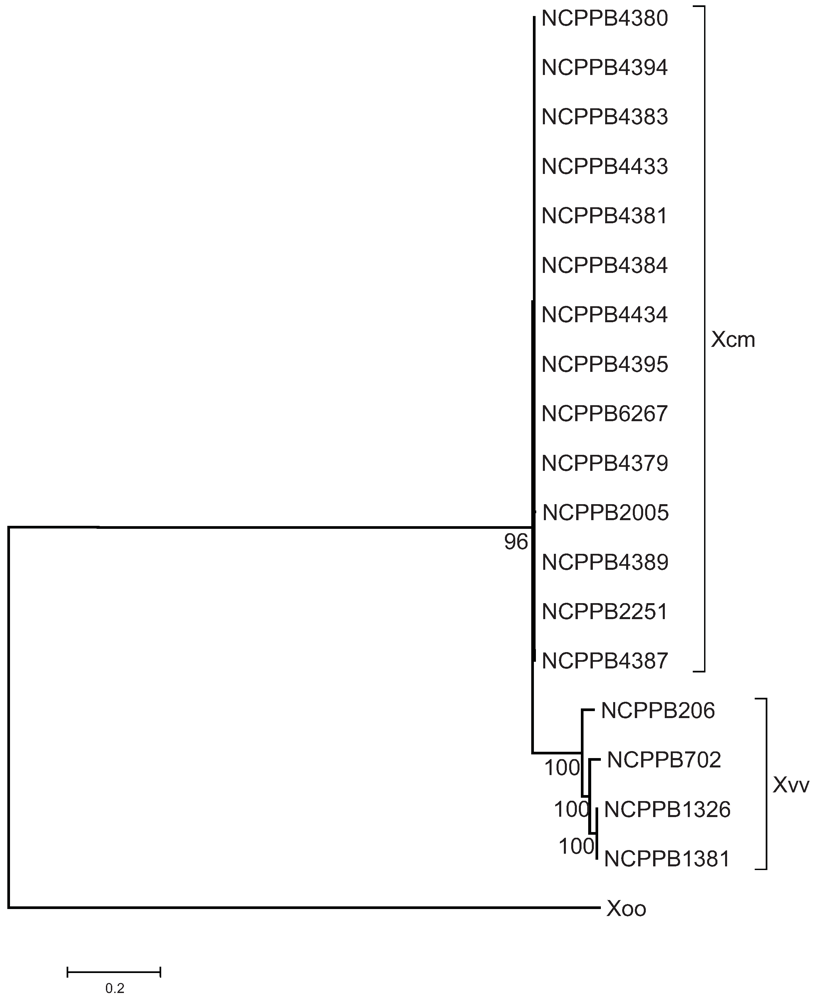
        <p>We identified SNPs among the <italic>Xcm</italic> and <italic>Xvv</italic> isolates based on BWA [<xref ref-type="bibr" rid="B25-genes-03-00361">25</xref>] alignments of our Illumina sequence data against the <italic>X. oryzae</italic> pv. <italic>oryzae</italic> MAFF 311018 reference genome sequence (RefSeq: NC_007705). Based on nucleotides found at 21,525 polymorphic positions we generated the maximum likelihood phylogenetic tree shown in <xref ref-type="fig" rid="genes-03-00361-f001">Figure 1</xref>. This clearly groups all of the sequenced <italic>Xcm</italic> isolates into a single distinct clade that is closely related to but distinct from the sequenced <italic>Xvv</italic> isolates.</p>
        <fig id="genes-03-00361-f001" position="anchor">
          <label>Figure 1</label>
          <caption>
            <p>East African isolates of <italic>Xanthomonas campestris</italic> pv. <italic>musacearum</italic> (<italic>Xcm</italic>) from banana and enset comprise a monophletic clade closely related to <italic>Xanthomonas vasicola</italic>. A maximum likelihood phylogenetic tree was generated as described in the Experimental Section. The tree was rooted with <italic>X. oryzae </italic>pv. <italic>oryzae</italic> MAFF 311018 (“Xoo”) as the outgroup. The tree is based on 21,525 SNPs in 19 taxa. Branch lengths are drawn to scale and measured in the number of substitutions per site. Bootstrap values are given as percentages from 500 bootstrap trials.</p>
          </caption>
          <graphic xmlns:xlink="http://www.w3.org/1999/xlink" xlink:href="genes-03-00361-g001.tif"/>
        </fig>
      </sec>
      <sec>
        <title>2.4. <italic>Xcm</italic> Isolates from Uganda, Kenya, Tanzania and Burundi are Genetically Distinct from Isolates from Ethiopia, DR Congo and Rwanda</title>
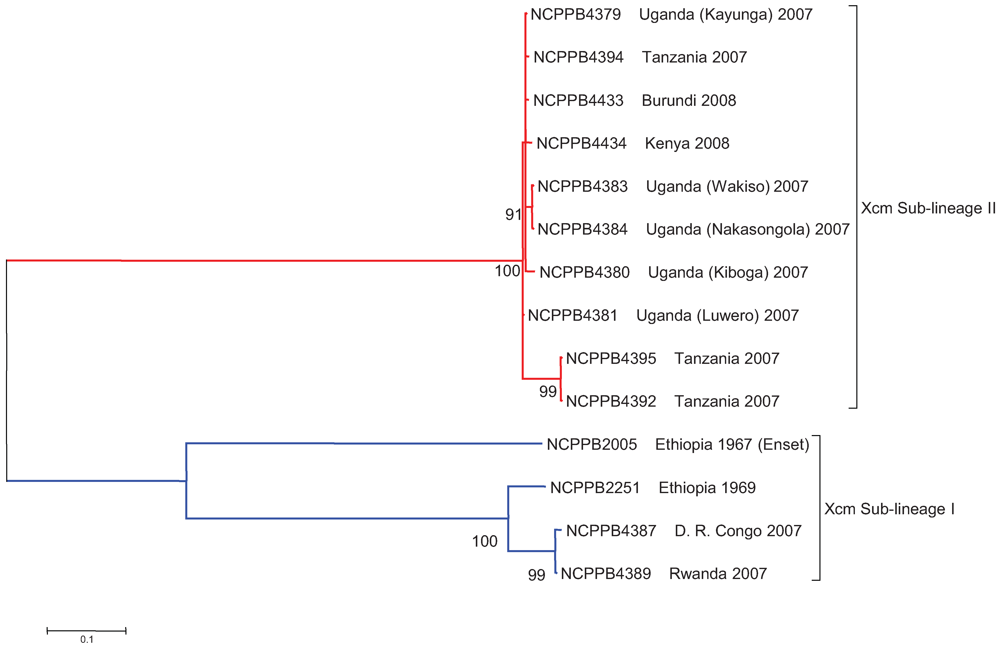
        <p>We next identified SNPs among the <italic>Xcm</italic> and <italic>Xvv</italic> isolates based on BWA [<xref ref-type="bibr" rid="B25-genes-03-00361">25</xref>] alignments of our Illumina sequence data against the <italic>Xcm</italic> NCPPB4381 reference genome sequence (RefSeq: ACHT00000000). Out of 2,908,042 nt over which there was no ambiguity, 2,907,999 were invariant across all isolates; that is the <italic>Xcm</italic> genomes shared at least 99.9985% identity. Based on nucleotides found at 243 polymorphic positions we generated the maximum likelihood phylogenetic tree shown in <xref ref-type="fig" rid="genes-03-00361-f002">Figure 2</xref>. This clearly delineates the <italic>Xcm</italic> clade into two distinct sub-lineages, I and II. Sub-lineage I include isolates from Ethiopia, DR Congo and Rwanda whilst Sub-lineage II includes isolates from Uganda, Tanzania, Burundi and Kenya. The two sub-lineages are distinguishable from each other by 86 polymorphic positions. These are listed in full in the Supplementary Material and in part in <xref ref-type="table" rid="genes-03-00361-t003">Table 3</xref>.</p>
        <fig id="genes-03-00361-f002" position="anchor">
          <label>Figure 2</label>
          <caption>
            <p>Isolates of <italic>Xcm</italic> from Burundi, Kenya, Tanzania and Uganda comprise a separate sub-lineage that is distinct from isolates from and D. R. Congo, Ethiopia and Rwanda. A maximum likelihood phylogenetic tree was generated as described in the Experimental Section. The position of the root was inferred from the phylogeny presented in <xref ref-type="fig" rid="genes-03-00361-f001">Figure 1</xref>. The tree is based on 272 SNPs in 14 taxa. Branch lengths are drawn to scale and measured in the number of substitutions per site. Bootstrap values are given as percentages from 500 bootstrap trials.</p>
          </caption>
          <graphic xmlns:xlink="http://www.w3.org/1999/xlink" xlink:href="genes-03-00361-g002.tif"/>
        </fig>
        <table-wrap id="genes-03-00361-t003" position="anchor">
          <object-id pub-id-type="pii">genes-03-00361-t003_Table 3</object-id>
          <label>Table 3</label>
          <caption>
            <p>Examples of non-silent single-nucleotide polymorphisms that distinguish <italic>Xcm</italic> sub-lineages I (Ethiopia, DR Congo and Rwanda) and II (Uganda, Kenya, Tanzania, Burundi).</p>
          </caption>
          <table rules="rows">
<thead>
              <tr>
                <th align="center" valign="middle">RefSeq Accession</th>
                <th align="center" valign="middle">Position</th>
                <th align="center" valign="middle">I</th>
                <th align="center" valign="middle">II</th>
                <th align="left" valign="middle">Locus Tag and Predicted Gene Product</th>
          </tr>
            </thead>
            <tbody>
              <tr>
                <td align="left" valign="middle">NZ_ACHT01000013</td>
                <td align="center" valign="middle">861</td>
                <td align="center" valign="middle">g</td>
                <td align="center" valign="middle">c</td>
                <td align="left" valign="middle">XcampmN_010100000120 putative ISXo8 transposase</td>
              </tr>
              <tr>
                <td align="left" valign="middle">NZ_ACHT01000014</td>
                <td align="center" valign="middle">6000</td>
                <td align="center" valign="middle">a</td>
                <td align="center" valign="middle">g</td>
                <td align="left" valign="middle">XcampmN_010100000165 putative monovalent cation/H+ antiporter subunit A</td>
              </tr>
              <tr>
                <td align="left" valign="middle">NZ_ACHT01000034</td>
                <td align="center" valign="middle">8898</td>
                <td align="center" valign="middle">t</td>
                <td align="center" valign="middle">c</td>
                <td align="left" valign="middle">XcampmN_010100000807 putative integrase protein</td>
              </tr>
              <tr>
                <td align="left" valign="middle">NZ_ACHT01000045</td>
                <td align="center" valign="middle">1261</td>
                <td align="center" valign="middle">a</td>
                <td align="center" valign="middle">g</td>
                <td align="left" valign="middle">XcampmN_010100001162 bifunctional aspartate kinase/diaminopimelate decarboxylase protein</td>
              </tr>
              <tr>
                <td align="left" valign="middle">NZ_ACHT01000045</td>
                <td align="center" valign="middle">45,548</td>
                <td align="center" valign="middle">a</td>
                <td align="center" valign="middle">c</td>
                <td align="left" valign="middle">XcampmN_010100001377 chemotaxis protein</td>
              </tr>
              <tr>
                <td align="left" valign="middle">NZ_ACHT01000059</td>
                <td align="center" valign="middle">1907</td>
                <td align="center" valign="middle">c</td>
                <td align="center" valign="middle">t</td>
                <td align="left" valign="middle">XcampmN_010100001687 putative sugar transporter component</td>
              </tr>
              <tr>
                <td align="left" valign="middle">NZ_ACHT01000101</td>
                <td align="center" valign="middle">995</td>
                <td align="center" valign="middle">g</td>
                <td align="center" valign="middle">t</td>
                <td align="left" valign="middle">XcampmN_010100003517 soluble lytic murein transglycosylase</td>
              </tr>
              <tr>
                <td align="left" valign="middle">NZ_ACHT01000104</td>
                <td align="center" valign="middle">13,081</td>
                <td align="center" valign="middle">t</td>
                <td align="center" valign="middle">g</td>
                <td align="left" valign="middle">XcampmN_010100003612 GTP-dependent nucleic acid-binding protein EngD</td>
              </tr>
              <tr>
                <td align="left" valign="middle">NZ_ACHT01000113</td>
                <td align="center" valign="middle">10,410</td>
                <td align="center" valign="middle">t</td>
                <td align="center" valign="middle">g</td>
                <td align="left" valign="middle">XcampmN_010100004062 acetyltransferase (GNAT) family protein </td>
              </tr>
              <tr>
                <td align="left" valign="middle">NZ_ACHT01000236</td>
                <td align="center" valign="middle">10,652</td>
                <td align="center" valign="middle">t</td>
                <td align="center" valign="middle">c</td>
                <td align="left" valign="middle">XcampmN_010100007340 metallopeptidase</td>
              </tr>
              <tr>
                <td align="left" valign="middle">NZ_ACHT01000242</td>
                <td align="center" valign="middle">10,465</td>
                <td align="center" valign="middle">a</td>
                <td align="center" valign="middle">c</td>
                <td align="left" valign="middle">XcampmN_010100007585 dihydrolipoamide acetyltransferase</td>
              </tr>
              <tr>
                <td align="left" valign="middle">NZ_ACHT01000294</td>
                <td align="center" valign="middle">2184</td>
                <td align="center" valign="middle">g</td>
                <td align="center" valign="middle">t</td>
                <td align="left" valign="middle">XcampmN_010100009424 xanthan biosynthesis glucuronosyltransferase GumK</td>
              </tr>
              <tr>
                <td align="left" valign="middle">NZ_ACHT01000345</td>
                <td align="center" valign="middle">1576</td>
                <td align="center" valign="middle">t</td>
                <td align="center" valign="middle">c</td>
                <td align="left" valign="middle">XcampmN_010100010814 cytochrome C peroxidase</td>
              </tr>
              <tr>
                <td align="left" valign="middle">NZ_ACHT01000402</td>
                <td align="center" valign="middle">4858</td>
                <td align="center" valign="middle">t</td>
                <td align="center" valign="middle">c</td>
                <td align="left" valign="middle">XcampmN_010100012145 heavy metal transporter</td>
              </tr>
              <tr>
                <td align="left" valign="middle">NZ_ACHT01000404</td>
                <td align="center" valign="middle">632</td>
                <td align="center" valign="middle">g</td>
                <td align="center" valign="middle">a</td>
                <td align="left" valign="middle">XcampmN_010100012200 tryptophan halogenase</td>
              </tr>
              <tr>
                <td align="left" valign="middle">NZ_ACHT01000500</td>
                <td align="center" valign="middle">23,584</td>
                <td align="center" valign="middle">a</td>
                <td align="center" valign="middle">g</td>
                <td align="left" valign="middle">XcampmN_010100016057 putative polysaccharide deacetylase</td>
              </tr>
              <tr>
                <td align="left" valign="middle">NZ_ACHT01000520</td>
                <td align="center" valign="middle">5360</td>
                <td align="center" valign="middle">a</td>
                <td align="center" valign="middle">g</td>
                <td align="left" valign="middle">XcampmN_010100016692 5-methyltetrahydrofolate-homocysteine methyl transferase</td>
              </tr>
              <tr>
                <td align="left" valign="middle">NZ_ACHT01000549</td>
                <td align="center" valign="middle">7371</td>
                <td align="center" valign="middle">a</td>
                <td align="center" valign="middle">c</td>
                <td align="left" valign="middle">XcampmN_010100018271 two-component system sensor protein</td>
              </tr>
              <tr>
                <td align="left" valign="middle">NZ_ACHT01000560</td>
                <td align="center" valign="middle">4001</td>
                <td align="center" valign="middle">t</td>
                <td align="center" valign="middle">c</td>
                <td align="left" valign="middle">XcampmN_010100018673 exodeoxyribonuclease III</td>
              </tr>
              <tr>
                <td align="left" valign="middle">NZ_ACHT01000590</td>
                <td align="center" valign="middle">927</td>
                <td align="center" valign="middle">c</td>
                <td align="center" valign="middle">t</td>
                <td align="left" valign="middle">XcampmN_010100019303 RNA polymerase sigma factor</td>
              </tr>
              <tr>
                <td align="left" valign="middle">NZ_ACHT01000626</td>
                <td align="center" valign="middle">10,220</td>
                <td align="center" valign="middle">t</td>
                <td align="center" valign="middle">c</td>
                <td align="left" valign="middle">XcampmN_010100019733 putative glutathionylspermidine synthase</td>
              </tr>
              <tr>
                <td align="left" valign="middle">NZ_ACHT01000634</td>
                <td align="center" valign="middle">2345</td>
                <td align="center" valign="middle">t</td>
                <td align="center" valign="middle">c</td>
                <td align="left" valign="middle">XcampmN_010100019848 beta-mannosidase precursor</td>
              </tr>
              <tr>
                <td align="left" valign="middle">NZ_ACHT01000644</td>
                <td align="center" valign="middle">2590</td>
                <td align="center" valign="middle">g</td>
                <td align="center" valign="middle">a</td>
                <td align="left" valign="middle">XcampmN_010100020168 two-component system sensor protein</td>
              </tr>
              <tr>
                <td align="left" valign="middle">NZ_ACHT01000694</td>
                <td align="center" valign="middle">10,665</td>
                <td align="center" valign="middle">a</td>
                <td align="center" valign="middle">t</td>
                <td align="left" valign="middle">XcampmN_010100022153 peptide-acetyl-coenzyme A transporter family protein </td>
              </tr>
              <tr>
                <td align="left" valign="middle">NZ_ACHT01000720</td>
                <td align="center" valign="middle">19,485</td>
                <td align="center" valign="middle">t</td>
                <td align="center" valign="middle">c</td>
                <td align="left" valign="middle">XcampmN_010100023003 drug:proton antiporter (19121–20371)</td>
              </tr>
            </tbody>
          </table>
        </table-wrap>
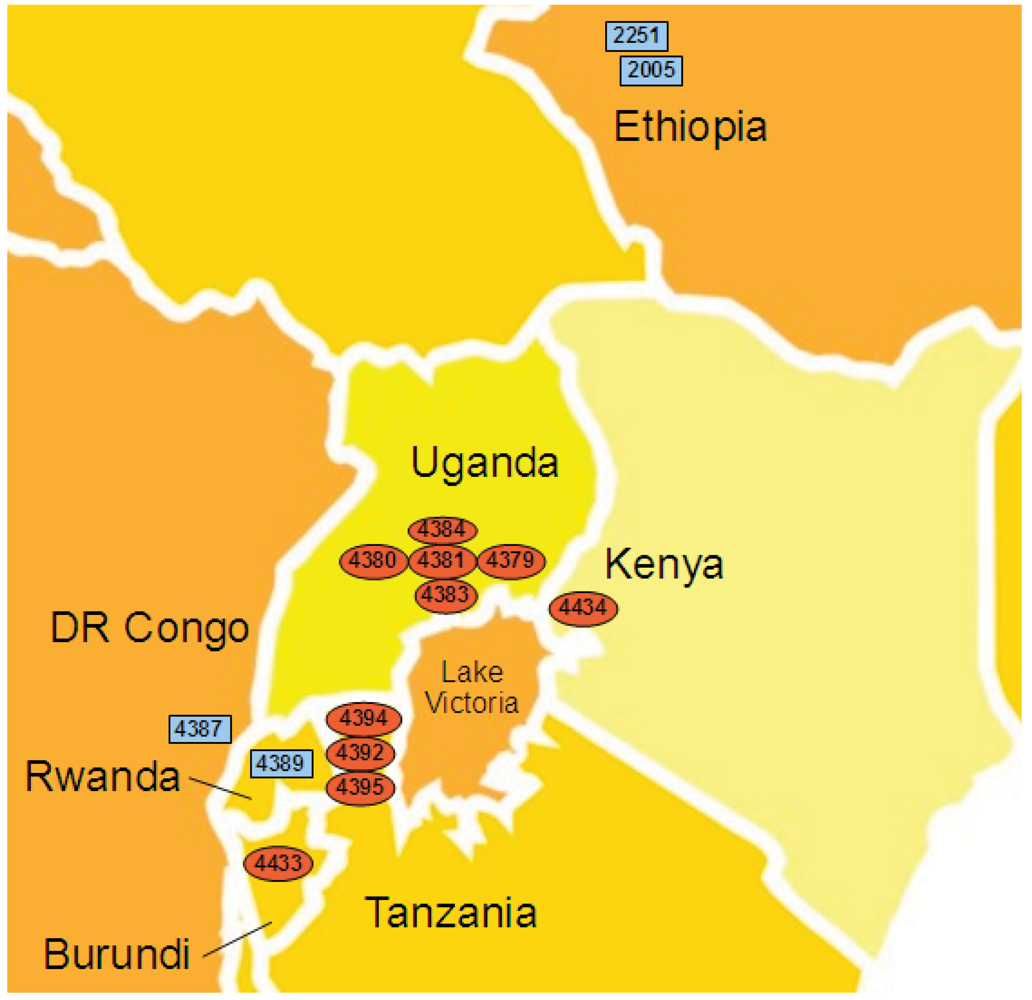
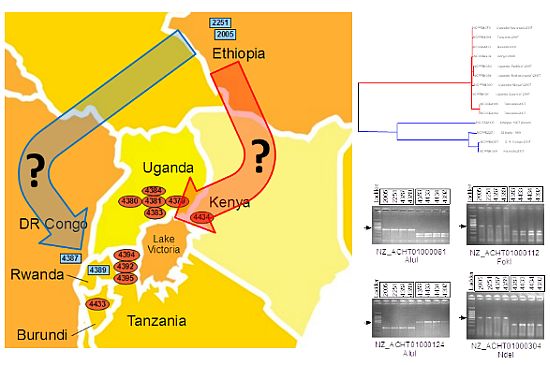
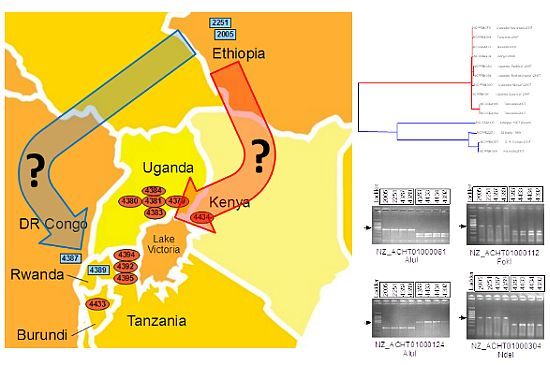
        <p>The geographic locations of the sequenced <italic>Xcm</italic> isolates are shown in <xref ref-type="fig" rid="genes-03-00361-f003">Figure 3</xref>. It has been widely assumed that the outbreaks in Uganda, and subsequent outbreaks in neighboring countries, ultimately originated in Ethiopia, with the pathogen perhaps being inadvertently transmitted via international trade. Consistent with this model, the <italic>Xcm</italic> isolates from DR Congo and Rwanda do indeed show extremely high levels of genetic similarity to Ethiopian isolate NCPPB2251. However, the isolates from Uganda, Kenya, Tanzania and Burundi show a distinct genotype, characterized by the 86 consistent SNP differences. This is not consistent with a single introduction from Ethiopia into East Africa.</p>
        <p>Our data do not exclude the possibility that the current outbreaks can ultimately be traced back to Ethiopia; it is possible that both lineages I and II are endemic there and it is simply by chance that the two available isolates happen to belong to the DR Congo/Rwanda sub-lineage I. There is an urgent need to collect a range of isolates from Ethiopia and survey their genotypes to ascertain the level of genetic diversity in this pathogen’s presumed centre of origin. Genotyping new isolates should be possible and will be expedited by developing these newly discovered SNPs into PCR based molecular markers. Similarly, there is a pressing need to survey genotypes of a much larger collection of isolates from outbreaks in all the banana growing areas to uncover the routes of geographical spread at a much higher degree of resolution. Ideally a survey of genotypes should be conducted on isolates for which precise details are available on the date and the geographic location at which they are collected.</p>
        <fig id="genes-03-00361-f003" position="anchor">
          <label>Figure 3</label>
          <caption>
            <p>Geographical distribution of the two major sub-lineages of <italic>Xcm</italic>. The approximate geographical locations are indicated for each of the fully sequenced <italic>Xcm</italic> isolates from Ethiopia (NCPPB2005 and NCPPB2251), Uganda (NCPPB4379, NCPPB4380, NCPPB4381, NCPPB4383 and NCPPB4384), Kenya (NCPPB4434), Tanzania (NCPPB4392, NCPPB4394 and NCPPB4395), DR Congo (NCPPB4387), Rwanda (NCPPB4389) and Burundi (NCPPB4433). Blue rectangles indicate locations of isolates belonging to sub-lineage I and red ovals indicate those of sub-lineage II. </p>
          </caption>
          <graphic xmlns:xlink="http://www.w3.org/1999/xlink" xlink:href="genes-03-00361-g003.tif"/>
        </fig>
        <p>It should also be noted that although we have categorized the isolates according to the country in which they were collected, paths of transmission may be more influenced by geographical boundaries rather than by political ones. For example, although Rwanda shares two of its borders with Uganda and Tanzania it is somewhat isolated from them by lake and forest.</p>
        <p>All of the available isolates from Uganda were collected in 2007 from sites in the central region geographically close to Mukono where the disease was first reported and probably all represent the same single outbreak. It would be interesting to compare these with isolates from outbreaks in Kabale (near Rwanda) or Kasese (near DR Congo). </p>
        <p>All of the available isolates from Tanzania also belonged to sub-lineage II along with those from Uganda. The disease was reported in Tanzania shortly after it was discovered in Uganda and there has been unconfirmed speculation that it may have been inadvertently carried to Tanzania by banana alcohol traders from the Buganda region, close to where the sequenced Ugandan isolates were collected. Our molecular sequence data are consistent with this but do not provide definitive proof.</p>
        <p>Although BXW was reported in DR Congo after it was reported in Uganda, the field pictures first sent to Uganda from DR Congo, showed greater devastation. It is not clear where banana <italic>Xanthomonas</italic> wilt occurred first: DR Congo or Uganda. There is a lot of movement of people and bananas from Congo to Rwanda and back, conflicts notwithstanding, and so it is perhaps not surprising that we observe isolates from these two countries belonging to the same sub-lineage I. However, the close relationship between an Ethiopian isolate and those in Rwanda and DRC is not so easily explained unless it is by sampling bias or by one-off international travel; if disease spread was primarily determined by movement of local people and bananas between countries, then we would instead expect isolates from Rwanda, Uganda and DR Congo to cluster together.</p>
      </sec>
      <sec>
        <title>2.5. Comparison of <italic>Xcm</italic> Isolated from Enset Versus <italic>Xcm</italic> Isolated from Banana</title>
        <p>Most of the available isolates of <italic>Xcm</italic> were originally isolated from banana. The exception is NCPPB2005, which was isolated from <italic>Ensete ventricosum</italic> in Ethiopia in 1967. This isolate clearly falls within <italic>Xcm</italic> sub-lineage I (<xref ref-type="fig" rid="genes-03-00361-f002">Figure 2</xref>). This enset-associated isolate differs from the banana-associated isolates NCPPB2251, NCPPB4387 and NCPPB4389 at 67 SNP positions listed in the Supplementary Material. Some examples of these differences are listed in <xref ref-type="table" rid="genes-03-00361-t004">Table 4</xref> and include non-silent polymorphisms in several potential virulence genes (e.g., homologues of <italic>hrpF</italic> and a gene encoding a HopW1 T3SS effector). However, since <italic>Xcm</italic> is able to infect both banana and enset [<xref ref-type="bibr" rid="B2-genes-03-00361">2</xref>,<xref ref-type="bibr" rid="B3-genes-03-00361">3</xref>] it is not clear whether these differences have any biological significance. It would be interesting to survey a much larger sample of isolates from both banana and enset to search for any significant associations between genotype and host species that might reveal adaptation.</p>
        <table-wrap id="genes-03-00361-t004" position="anchor">
          <object-id pub-id-type="pii">genes-03-00361-t004_Table 4</object-id>
          <label>Table 4</label>
          <caption>
            <p>Examples of non-silent single-nucleotide polymorphisms that distinguish NCPPB2251 from banana <italic>versus</italic> NCPPB2005 from enset.</p>
          </caption>
          <table rules="rows">
<thead>
              <tr align="center">
                <th valign="top">Refseq Accession</th>
                <th valign="top">Position</th>
                <th valign="top">NCPPB 2005 (enset)</th>
                <th valign="top">NCPPB 2251 (Banana)</th>
                <th valign="top">NCPPB 4389 (Banana)</th>
                <th valign="top">Locus Tag and Predicted Gene Product</th>
      </tr>
            </thead>
            <tbody>
              <tr>
                <td align="left" valign="top">NZ_ACHT01000041</td>
                <td align="center" valign="top">15,615</td>
                <td align="center" valign="top">c</td>
                <td align="center" valign="top">t</td>
                <td align="center" valign="top">t</td>
              <td align="left" valign="top">XcampmN_010100000977 hemolysin III</td>
              </tr>
              <tr>
                <td align="left" valign="top">NZ_ACHT01000072</td>
                <td align="center" valign="top">4507</td>
                <td align="center" valign="top">a</td>
                <td align="center" valign="top">c</td>
                <td align="center" valign="top">c</td>
              <td align="left" valign="top">XcampmN_010100002109 VirB3 protein</td>
              </tr>
              <tr>
                <td align="left" valign="top">NZ_ACHT01000140</td>
                <td align="center" valign="top">1116</td>
                <td align="center" valign="top">c</td>
                <td align="center" valign="top">t</td>
                <td align="center" valign="top">t</td>
              <td align="left" valign="top">XcampmN_010100004536 LacI family transcription regulator</td>
              </tr>
              <tr>
                <td align="left" valign="top">NZ_ACHT01000199</td>
                <td align="center" valign="top">8012</td>
                <td align="center" valign="top">g</td>
                <td align="center" valign="top">t</td>
                <td align="center" valign="top">g</td>
              <td align="left" valign="top">XcampmN_010100006143 type III secreted effector HopW1</td>
              </tr>
              <tr>
                <td align="left" valign="top">NZ_ACHT01000215</td>
                <td align="center" valign="top">3229</td>
                <td align="center" valign="top">c</td>
                <td align="center" valign="top">t</td>
                <td align="center" valign="top">c</td>
              <td align="left" valign="top">XcampmN_010100006660 HrpF protein</td>
              </tr>
              <tr>
                <td align="left" valign="top">NZ_ACHT01000236</td>
                <td align="center" valign="top">9512</td>
                <td align="center" valign="top">c</td>
                <td align="center" valign="top">t</td>
                <td align="center" valign="top">t</td>
              <td align="left" valign="top">XcampmN_010100007340 metallopeptidase</td>
              </tr>
              <tr>
                <td align="left" valign="top">NZ_ACHT01000294</td>
                <td align="center" valign="top">31,553</td>
                <td align="center" valign="top">g</td>
                <td align="center" valign="top">a</td>
                <td align="center" valign="top">a</td>
              <td align="left" valign="top">XcampmN_010100009559 MFS transporter</td>
              </tr>
              <tr>
                <td align="left" valign="top">NZ_ACHT01000303</td>
                <td align="center" valign="top">7530</td>
                <td align="center" valign="top">a</td>
                <td align="center" valign="top">c</td>
                <td align="center" valign="top">c</td>
              <td align="left" valign="top">XcampmN_010100009850 histidine kinase/response regulator hybrid protein</td>
              </tr>
              <tr>
                <td align="left" valign="top">NZ_ACHT01000332</td>
                <td align="center" valign="top">2191</td>
                <td align="center" valign="top">a</td>
                <td align="center" valign="top">g</td>
                <td align="center" valign="top">g</td>
              <td align="left" valign="top">XcampmN_010100010574 putative filamentous hemagglutinin-like protein</td>
              </tr>
              <tr>
                <td align="left" valign="top">NZ_ACHT01000360</td>
                <td align="center" valign="top">1961</td>
                <td align="center" valign="top">a</td>
                <td align="center" valign="top">g</td>
                <td align="center" valign="top">g</td>
              <td align="left" valign="top">XcampmN_010100011266 two-component system sensor protein</td>
              </tr>
              <tr>
                <td align="left" valign="top">NZ_ACHT01000374</td>
                <td align="center" valign="top">12,027</td>
                <td align="center" valign="top">t</td>
                <td align="center" valign="top">c</td>
                <td align="center" valign="top">c</td>
              <td align="left" valign="top">XcampmN_010100011573 Fis family transcriptional regulator</td>
              </tr>
              <tr>
                <td align="left" valign="top">NZ_ACHT01000388</td>
                <td align="center" valign="top">5277</td>
                <td align="center" valign="top">t</td>
                <td align="center" valign="top">g</td>
                <td align="center" valign="top">g</td>
              <td align="left" valign="top">XcampmN_010100011860 AraC family transcriptional regulator</td>
              </tr>
              <tr>
                <td align="left" valign="top">NZ_ACHT01000396</td>
                <td align="center" valign="top">3578</td>
                <td align="center" valign="top">c</td>
                <td align="center" valign="top">g</td>
                <td align="center" valign="top">g</td>
              <td align="left" valign="top">XcampmN_010100011920 catalase</td>
              </tr>
              <tr>
                <td align="left" valign="top">NZ_ACHT01000439</td>
                <td align="center" valign="top">5166</td>
                <td align="center" valign="top">c</td>
                <td align="center" valign="top">g</td>
                <td align="center" valign="top">g</td>
              <td align="left" valign="top">XcampmN_010100013743 ECF subfamily RNA polymerase sigma factor</td>
              </tr>
              <tr>
                <td align="left" valign="top">NZ_ACHT01000532</td>
                <td align="center" valign="top">743</td>
                <td align="center" valign="top">c</td>
                <td align="center" valign="top">t</td>
                <td align="center" valign="top">t</td>
                <td colspan="2" align="left" valign="top">XcampmN_010100017284 beta-glucosidase</td>
              </tr>
              <tr>
                <td align="left" valign="top">NZ_ACHT01000560</td>
                <td align="center" valign="top">2783</td>
                <td align="center" valign="top">c</td>
                <td align="center" valign="top">t</td>
                <td align="center" valign="top">t</td>
                <td colspan="2" align="left" valign="top">XcampmN_010100018663 molybdopterin biosynthesis</td>
              </tr>
              <tr>
                <td align="left" valign="top">NZ_ACHT01000668</td>
                <td align="center" valign="top">1036</td>
                <td align="center" valign="top">c</td>
                <td align="center" valign="top">a</td>
                <td align="center" valign="top">a</td>
                <td colspan="2" align="left" valign="top">XcampmN_010100021383 ABC transporter permease </td>
              </tr>
              <tr>
                <td align="left" valign="top">NZ_ACHT01000690</td>
                <td align="center" valign="top">6284</td>
                <td align="center" valign="top">t</td>
                <td align="center" valign="top">g</td>
                <td align="center" valign="top">g</td>
                <td colspan="2" align="left" valign="top">XcampmN_010100022008 isocitrate dehydrogenase</td>
              </tr>
            </tbody>
          </table>
        </table-wrap>
      </sec>
      <sec>
        <title>2.6. Loss of Phage-Associated Genes in Some <italic>Xcm</italic> Isolates</title>
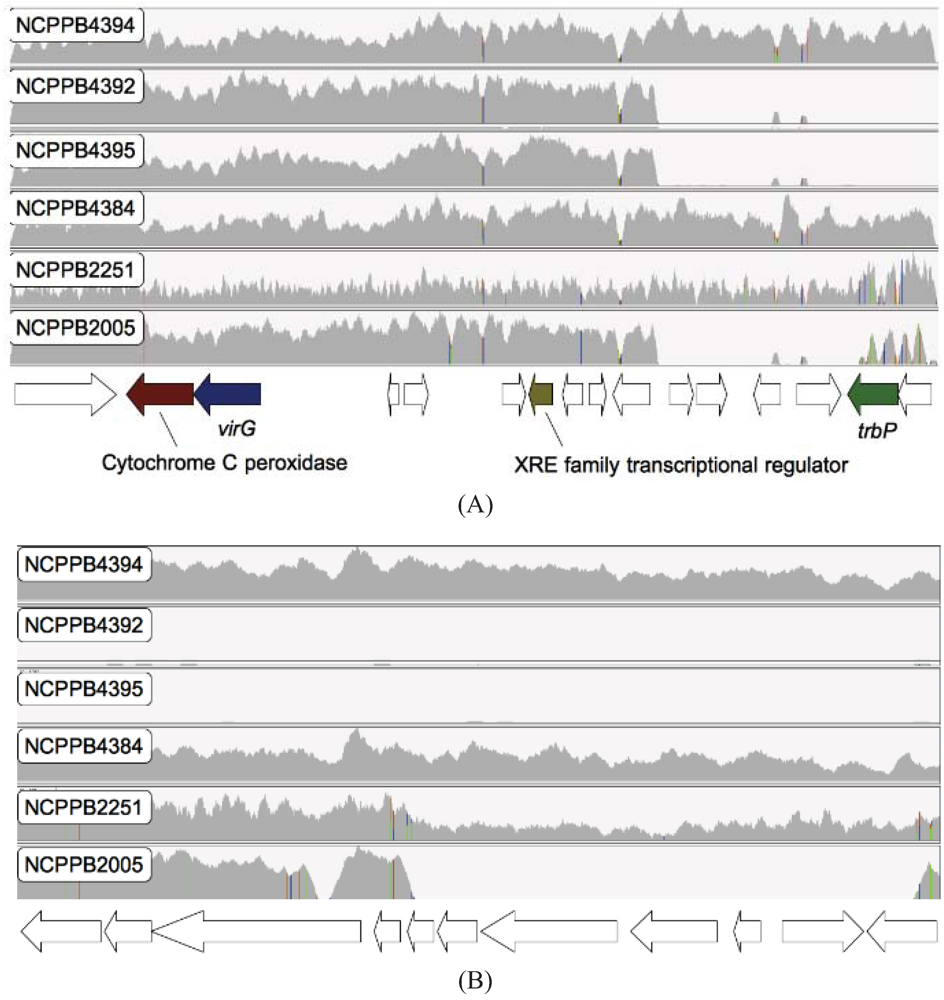
        <p>In addition to surveying SNPs, we also searched for loss or gain of genes. By aligning sequence reads against the previously published NCPPB4381 genome assembly and systematically comparing gene-coverage in each of the alignments, we were able to identify a genomic region (GenBank: GG699410.1) that showed differential coverage among different isolates of <italic>Xcm </italic> (<xref ref-type="fig" rid="genes-03-00361-f004">Figure 4</xref>). This region shows significant similarity at the amino acid and nucleotide sequence levels to two previously sequenced phage: <italic>Xanthomonas</italic> phage Cfc1 (RefSeq: NC_001396.1) [<xref ref-type="bibr" rid="B26-genes-03-00361">26</xref>] and <italic>Stenotrophomonas</italic> phage phiSHP2 (GenBank: HM150760.1). Specifically, two Tanzanian isolates (NCPPB4392 and NCPPB4395) appear to have completely lost at least 17 genes from this region, while Ethiopian isolate NCPPB2005 has lost 11 of the same genes. Interestingly, another isolate from the same area of Tanzania (NCPPB4394) appears to have these genes intact as do all the Ugandan, Kenyan, Rwandan and Burundi isolates. Furthermore, there is a high concentration of SNPs in this genomic region. Therefore, it seems likely that this genomic region represents the relic of a phage or similar mobile element that is in the process of degenerating, convergently, in some members of both sub-lineages.</p>
      </sec>
      <sec>
        <title>2.7. Experimental Validation of Genetic Polymorphisms</title>
        <p>One of the major motivations for comparing these genome sequences is to provide a resource for generating molecular markers that can be used epidemiological and biogeographical studies on a much larger panel of isolates without the need for whole-genome sequencing using, for example, the polymerase chain reaction (PCR). Therefore, we used the results of our genome comparisons to design pairs of PCR primers that can be used to distinguish between the two sub-lineages of <italic>Xcm</italic> (<xref ref-type="table" rid="genes-03-00361-t005">Table 5</xref>). A similar approach could also be taken to assay other classes of SNPs identified from the genome sequence data.</p>
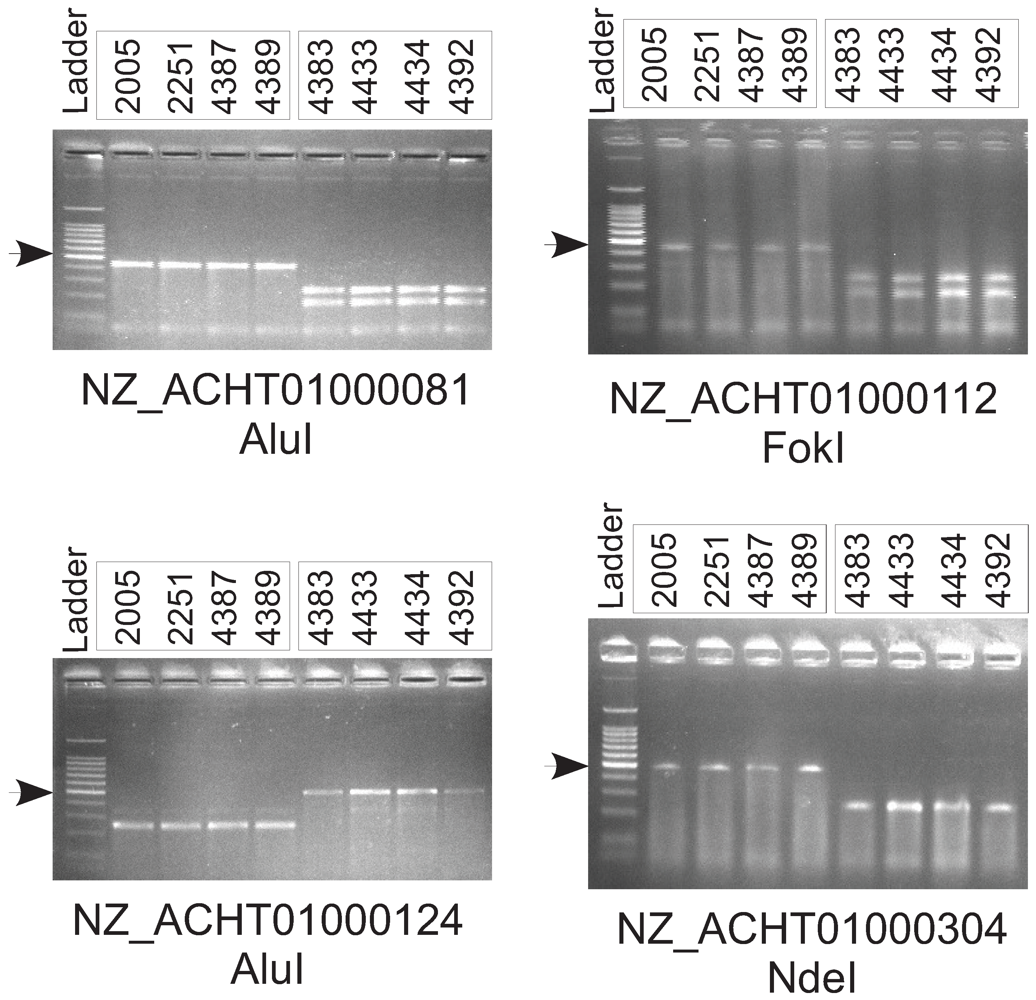
        <p>To experimentally validate SNPs, we used an approach based on digestion of PCR products with restriction enzymes. Many of the SNPs that we identified are predicted to fall within restriction sites. For example, position 6150 in RefSeq accession NZ_ACHT0100081 is a G that falls within an AluI restriction site (<bold>AG</bold>↓CT). However, in NCPPB2005 and the other members of sub-lineage I, this G is substituted for an A abolishing the recognition sequence for the AluI restriction enzyme (see Supplementary Files for a figure illustrating this SNP and several others). There are no other AluI sites in the vicinity of this SNP. We generated a pair of primers flanking approximately 250 bp either side of the SNP and amplified this 500 bp sequence by PCR. The two alleles could then be readily distinguished by digestion with AluI (see <xref ref-type="fig" rid="genes-03-00361-f005">Figure 5</xref>). We used the same approach to design assays for three other SNPs (see <xref ref-type="table" rid="genes-03-00361-t005">Table 5</xref> and <xref ref-type="fig" rid="genes-03-00361-f005">Figure 5</xref>).</p>
        <fig id="genes-03-00361-f004" position="anchor">
          <label>Figure 4</label>
          <caption>
            <p>Loss of phage-related genes in two Tanzanian isolates and one Ethiopian isolate of <italic>Xcm</italic>. The figure shows alignments of genomic sequence reads from six <italic>Xcm</italic> isolates <italic>versus</italic> two contigs from the previously published NCPPB4381 genome assembly [<xref ref-type="bibr" rid="B12-genes-03-00361">12</xref>] as viewed in IGV. (<bold>Panel A</bold>): contig_scf_7264_3425_27 (GenBank: ACHT01000345.1); (<bold>Panel B</bold>): contig_scf_7264_3425_29 (GenBank: ACHT01000346.1). Both contigs are contained within genomic scaffold scf_7264_3425 (GenBank: GG699410.1). The vertical axes are the depth of coverage by aligned sequence reads. Coloured vertical bars indicate discrepancies with the NCPPB4381 reference sequence, including SNPs. The horizontal axis is the position on the contig. Positions of predicted genes are indicated below the horizontal axis. Hypothetical genes of unknown function are indicated by white arrows while homologues of characterized genes are indicated by coloured arrows.</p>
          </caption>
          <graphic xmlns:xlink="http://www.w3.org/1999/xlink" xlink:href="genes-03-00361-g004.tif"/>
        </fig>
        <fig id="genes-03-00361-f005" position="anchor">
          <label>Figure 5</label>
          <caption>
            <p>Experimental validation of single-nucleotide polymorphisms (SNPs) between the two sub-lineages of <italic>Xanthomonas campestris</italic> pathovar <italic>musacearum</italic> (<italic>Xcm</italic>). We amplified specific sequence fragments of approximately 500 bp flanking single-nucleotide polymorphisms that we had identified from whole-genome sequencing. Polymerase chain reaction (PCR) was performed on genomic DNA from four isolates from sub-lineage I (NCPPB2005, NCPPB2251, NCPPB4387 and NCPPB4389) and from four isolates of sub-lineage II (NCPPB4383, NCPPB4433, NCPPB4434 and NCPPB4392). The sequences of the PCR primers are given in <xref ref-type="table" rid="genes-03-00361-t005">Table 5</xref>. We digested each of the PCR products with a restriction enzyme (AluI, EcoRI, FokI, NdeI or RsaI). We ran the digested PCR products on a 2% agarose gel alongside a 100 bp ladder (Promega G210A) in which the brightest band, marked with a black arrow, indicates 500 bp.</p>
          </caption>
          <graphic xmlns:xlink="http://www.w3.org/1999/xlink" xlink:href="genes-03-00361-g005.tif"/>
        </fig>
        <table-wrap id="genes-03-00361-t005" position="anchor">
          <object-id pub-id-type="pii">genes-03-00361-t005_Table 5</object-id>
          <label>Table 5</label>
          <caption>
            <p>Polymerase chain reaction (PCR) primers used for distinguishing the two sub-lineages by restriction fragment length polymorphisms.</p>
          </caption>
          <table rules="rows">
    <thead>
              <tr>
                <th align="left" valign="top">Primer Sequences</th>
                <th align="center" valign="top">Target Sequence RefSeq Accession Number and Coordinates</th>
                <th align="center" valign="top">Restriction Enzyme</th>
          </tr>
            </thead>
            <tbody>
              <tr>
                <td align="left" valign="top">GAGCTCCTGCGCCGATGCGTGAGCGT<break/>
                AAAGGCGGCTATTCTA</td>
                <td align="center" valign="top">NZ_ACHT01000081: 5900–6398</td>
                <td align="center" valign="top">AluI</td>
              </tr>
              <tr>
                <td align="left" valign="top">CGGCGTGGTTTTGCCTTTGCCGTACGG<break/>
                CCTGGCGGTGAT</td>
                <td align="center" valign="top">NZ_ACHT01000112: 10863–11347</td>
                <td align="center" valign="top">FokI</td>
              </tr>
              <tr>
                <td align="left" valign="top">TCACCTGTTCGATGCGGCCGCTACTGG<break/>
                CTGTCGCGGC</td>
                <td align="center" valign="top">NZ_ACHT01000124: 5385–5873</td>
                <td align="center" valign="top">AluI</td>
              </tr>
              <tr>
                <td align="left" valign="top">ATGTTTGCCGATACCTGGATGCGCATG<break/>
                CTTGCCGGTTTCGACGA</td>
                <td align="center" valign="top">NZ_ACHT01000304: 10080–10567</td>
                <td align="center" valign="top">NdeI</td>
              </tr>
            </tbody>
          </table>
        </table-wrap>
      </sec>
    </sec>
    <sec>
      <title>3. Experimental Section</title>
      <p>Bacterial strains were obtained from the National Collection of Plant Pathogenic Bacteria (NCPPB) at FERA. DNA library preparation and genome sequencing using the Illumina GA2x were performed using standard Illumina protocols as previously described [<xref ref-type="bibr" rid="B12-genes-03-00361">12</xref>].</p>
      <p>For DNA preparation, bacterial strains were grown overnight at 28 °C in 10 mL King Broth shaken at 200 rpm. Cells were harvested by centrifugation and re-suspended in TE buffer (50 mM Tris-HCl, 40 mM EDTA, pH 8.0). Bacterial cells cultured overnight in Kings Broth were pelleted, lysed with 12 µL of 20 mg/mL lysozyme and RNase at 10 mg/mL and incubated at 25 °C for 10 min. Further lysis was done with 17 µL 10% sodium dodecyl sulfate and incubated on ice for 5min. Proteins were dissolved with 170 µL of 8M ammonium acetate, vortexed vigorously for 30 s centrifuged at 4 °C at maximum speed for 15 min. DNA was precipitated with isopropanol and re-dissolved in 100 μL of 10 mM Tris, pH 8.0, and 1 mM Na2EDTA.</p>
      <p>DNA amplification was performed in 30 µL reaction volumes containing 3 µL 10X PCR buffer, 1.2 µL of 50mM MgCl2, 2.4 µL of 2.5 mM dNTP, 1.5 µL of 10 µM each primer, 2ng DNA and 1 U recombinant Taq DNA polymerase. Amplification was performed using a thermocycler with initial denaturation (95 °C, 5 min), followed by 35 cycles of denaturation (95 °C, 0.5 min), annealing (60 °C, 0.5 min) and extension (72 °C, 0.5 min), with a final extension (72 °C, 10 min). The amplified products were electrophoretically separated in 4% (w/v) agarose gel at 80 V for 1 h in TAE buffer and visualized with UV light after staining in ethidium bromide (0.5 µg mL).</p>
      <p>Amplified DNA fragments were digested with restriction endonucleases (AluI, Fok or NdeI). The restriction analysis was performed with 2.5 U of the endonuclease using the buffer and temperature recommended by the manufacturers (New England Biolabs). Restriction fragments were separated in a 8% (w/v) agarose gel with 100 bp ladder (Promega, G210A) at 100 V for 1 h in TAE buffer and visualized with UV light after staining in ethidium bromide (0.5 µg mL).</p>
      <p>We used BWA [<xref ref-type="bibr" rid="B25-genes-03-00361">25</xref>] to align Illumina sequence reads against a reference genome sequence and used IGV [<xref ref-type="bibr" rid="B27-genes-03-00361">27</xref>] to visualize the alignments (see <xref ref-type="fig" rid="genes-03-00361-f004">Figure 4</xref>). We used MEGA5 for phylogenetic analyses. <italic>De novo</italic> assembly of Illumina sequence reads was performed using Velvet 1.1.04 [<xref ref-type="bibr" rid="B20-genes-03-00361">20</xref>]. We discarded any sequence reads that contained one or more ‘N’ prior to assembly. </p>
      <p>We used a very conservative approach to infer SNPs from alignments of Illumina reads against the previously published <italic>Xcm</italic> NCPPB4381 reference draft genome assembly. To avoid false positives and false negatives, we only used those regions of the <italic>Xcm</italic> genome with a coverage depth of five or more for every sequenced <italic>Xcm</italic> genome and where there was at least 95% consensus among the sequence reads within each isolate. Just over 60% of the length (2,908,042 out of 4,782,144 nt) of the <italic>Xcm</italic> NCPPB4381 genome fulfilled these two criteria. In other words, for 60% of the <italic>Xcm</italic> genome, there was sufficient quantity and consistency in our data to be almost certain of the sequence in all of the fourteen isolates; for the remaining 40% of the genome, there was some degree of ambiguity in the data for at least one of the isolates. </p>
      <p>Phylogenetic relationships were inferred using a maximum likelihood method based on the Tamura-Nei model [<xref ref-type="bibr" rid="B28-genes-03-00361">28</xref>] conducted using the MEGA5 [<xref ref-type="bibr" rid="B29-genes-03-00361">29</xref>] software package. Bootstrap consensus trees inferred from 500 replicates were taken to represent the evolutionary history of the taxa analyzed. Branches corresponding to partitions reproduced in fewer than 50% bootstrap replicates were collapsed. Initial tree(s) for the heuristic search were obtained automatically as follows. When the number of common sites was &lt;100 or fewer than one quarter of the total number of sites, the maximum parsimony method was used; otherwise the BIONJ method with MCL distance matrix was used. The trees are drawn to scale, with branch lengths measured in the number of substitutions per site. All positions containing gaps and missing data were eliminated. </p>
    </sec>
    <sec sec-type="conclusions">
      <title>4. Conclusions</title>
      <p>We have deployed high-throughput whole-genome sequencing to explore genetic diversity among isolates of <italic>Xcm</italic>, the bacterial pathogen responsible for BXW, which is devastating banana and plantain crops in East Africa and threatens the food security of millions. To understand the evolution and geographical spread of this newly emerging pathogen, we need molecular markers such as SNPs. Given the high degree of genome sequence identity among isolates (99.9985 %), genome-wide sequencing is the only tractable way of discovering sequence polymorphisms and is beginning to be applied to bacterial phytopathogens [<xref ref-type="bibr" rid="B17-genes-03-00361">17</xref>]. </p>
      <p>The high degree of sequence similarity among isolates indicates a very recent origin of the pathogen. The molecular markers discovered here enabled us to reconstruct the phylogenetic relationships between <italic>Xcm</italic> isolates from diverse geographical locations within the known range of the pathogen in Africa. Interestingly, the isolates fell into two major sub-lineages. This may indicate that there have been at least two separate introductions of <italic>Xcm</italic> into the banana-growing regions around Lake Victoria. This contrasts with the widely held working assumption that <italic>Xcm</italic> spread from Ethiopia to Uganda and thence subsequently into neighboring countries. This view is largely based on the fact that <italic>Xcm</italic> was reported in Ethiopia in the late 1960s, then Uganda in 2001 and only later in other African countries (2004: D. R. Congo, 2005: Rwanda and Tanzania, 2006: Kenya and Burundi). However, it is possible that the disease has existed for some time before being officially reported, especially given the armed conflicts in D. R. Congo and Rwanda at the time. An alternative hypothesis is that all outbreaks in the region can be traced back to a single introduction of inoculum that contained some genetic diversity and that some genetic diversity is maintained within the population. Under that scenario, our results could be explained by stochastic effects of sampling error given such a small number of isolates. Therefore, there is a pressing need to collect and genotype many more isolates, including multiple isolates from within single outbreaks. On the other hand, where we have sequenced multiple isolates from a single geographical area (the five isolates from central Uganda and the three isolates from North Western Tanzania), only a single sub-lineage was observed. This would be an unlikely outcome if both sub-lineages were approximately equally abundant at these sites. Therefore, we currently favour the multiple-introduction model until further isolates and genetic data are available.</p>
    </sec>
  </body>
  <back>
    <ack>
      <title>Acknowledgments</title>
      <p>This study was supported by the National Agriculture Research Organisation, Uganda under the MSI/WorldBank grant 2009. The authors wish to thank Karen Moore and Alex Moorhouse for their invaluable technical assistance with sequencing and Marta De Torres Zabala for expert guidance to A.W. in the laboratory.</p>
    </ack>
    <ref-list>
      <title>References</title>
      <ref id="B1-genes-03-00361">
        <label>1.</label>
        <citation citation-type="journal">
          <person-group person-group-type="author">
            <name>
              <surname>Biruma</surname>
              <given-names>M.</given-names>
            </name>
            <name>
              <surname>Pillay</surname>
              <given-names>M.</given-names>
            </name>
            <name>
              <surname>Tripathi</surname>
              <given-names>L.</given-names>
            </name>
            <name>
              <surname>Blomme</surname>
              <given-names>G.</given-names>
            </name>
            <name>
              <surname>Abele</surname>
              <given-names>S.</given-names>
            </name>
            <name>
              <surname>Mwangi</surname>
              <given-names>M.</given-names>
            </name>
            <name>
              <surname>Bandyopadhyay</surname>
              <given-names>R.</given-names>
            </name>
            <name>
              <surname>Muchunguzi</surname>
              <given-names>P.</given-names>
            </name>
            <name>
              <surname>Kassim</surname>
              <given-names>S.</given-names>
            </name>
            <name>
              <surname>Nyine</surname>
              <given-names>M.</given-names>
            </name>
          </person-group>
          <article-title>Banana <italic>Xanthomonas</italic> wilt: A review of the disease, management strategies and future research directions</article-title>
          <source>Afr. J. Biotechnol.</source>
          <year>2007</year>
          <volume>6</volume>
          <fpage>953</fpage>
          <lpage>962</lpage>
        </citation>
      </ref>
      <ref id="B2-genes-03-00361">
        <label>2.</label>
        <citation citation-type="journal">
          <person-group person-group-type="author">
            <name>
              <surname>Yirgou</surname>
              <given-names>D.</given-names>
            </name>
            <name>
              <surname>Bradbury</surname>
              <given-names>J.F.</given-names>
            </name>
          </person-group>
          <article-title>Bacterial wilt of Enset (<italic>Ensete ventricosum</italic>) incited by <italic>Xanthomonas musacearum</italic> <italic>sp. n .</italic></article-title>
          <source>Phytopathology</source>
          <year>1968</year>
          <volume>58</volume>
          <fpage>111</fpage>
          <lpage>112</lpage>
        </citation>
      </ref>
      <ref id="B3-genes-03-00361">
        <label>3.</label>
        <citation citation-type="journal">
          <person-group person-group-type="author">
            <name>
              <surname>Yirgou</surname>
              <given-names>D.</given-names>
            </name>
            <name>
              <surname>Bradbury</surname>
              <given-names>J.F.</given-names>
            </name>
          </person-group>
          <article-title>A note on wilt of banana caused by the enset wilt organism <italic>Xanthomonas musacearum</italic></article-title>
          <source>East Afr. Agric. Forestry J.</source>
          <year>1974</year>
          <volume>40</volume>
          <fpage>111</fpage>
          <lpage>114</lpage>
        </citation>
      </ref>
      <ref id="B4-genes-03-00361">
        <label>4.</label>
        <citation citation-type="journal">
          <person-group person-group-type="author">
            <name>
              <surname>Tushemereirwe</surname>
              <given-names>W.</given-names>
            </name>
            <name>
              <surname>Kangire</surname>
              <given-names>A.</given-names>
            </name>
            <name>
              <surname>Ssekiwoko</surname>
              <given-names>F.</given-names>
            </name>
            <name>
              <surname>Offord</surname>
              <given-names>L.C.</given-names>
            </name>
            <name>
              <surname>Crozier</surname>
              <given-names>J.</given-names>
            </name>
            <name>
              <surname>Boa</surname>
              <given-names>E.</given-names>
            </name>
            <name>
              <surname>Rutherford</surname>
              <given-names>M.</given-names>
            </name>
            <name>
              <surname>Smith</surname>
              <given-names>J.J.</given-names>
            </name>
          </person-group>
          <article-title>First report of <italic>Xanthomonas</italic> <italic>campestris</italic> pv. <italic>musacearum</italic> on banana in Uganda</article-title>
          <source>Plant Pathol.</source>
          <year>2004</year>
          <volume>53</volume>
          <fpage>802</fpage>
          <pub-id pub-id-type="doi">10.1111/j.1365-3059.2004.01090.x</pub-id>
        </citation>
      </ref>
      <ref id="B5-genes-03-00361">
        <label>5.</label>
        <citation citation-type="journal">
          <person-group person-group-type="author">
            <name>
              <surname>Ndungo</surname>
              <given-names>V.</given-names>
            </name>
            <name>
              <surname>Eden-Green</surname>
              <given-names>S.</given-names>
            </name>
            <name>
              <surname>Blomme</surname>
              <given-names>G.</given-names>
            </name>
            <name>
              <surname>Crozier</surname>
              <given-names>J.</given-names>
            </name>
            <name>
              <surname>Smith</surname>
              <given-names>J.J.</given-names>
            </name>
          </person-group>
          <article-title>Presence of banana <italic>Xanthomonas wilt</italic> (<italic>Xanthomonas campestris</italic> pv. <italic>musacearum</italic>) in the Democratic Republic of Congo (DRC)</article-title>
          <source>Plant Pathol.</source>
          <year>2006</year>
          <volume>55</volume>
          <fpage>294</fpage>
        </citation>
      </ref>
      <ref id="B6-genes-03-00361">
        <label>6.</label>
        <citation citation-type="journal">
          <person-group person-group-type="author">
            <name>
              <surname>Reeder</surname>
              <given-names>R.H.</given-names>
            </name>
            <name>
              <surname>Muhinyuza</surname>
              <given-names>J.B.</given-names>
            </name>
            <name>
              <surname>Opolot</surname>
              <given-names>O.</given-names>
            </name>
            <name>
              <surname>Aritua</surname>
              <given-names>V.</given-names>
            </name>
            <name>
              <surname>Crozier</surname>
              <given-names>J.</given-names>
            </name>
            <name>
              <surname>Smith</surname>
              <given-names>J.</given-names>
            </name>
          </person-group>
          <article-title>Presence of banana bacterial wilt (<italic>Xanthomonas campestris</italic> pv. <italic>musacearum</italic>) in Rwanda</article-title>
          <source>Plant Pathol.</source>
          <year>2007</year>
          <volume>56</volume>
          <fpage>1038</fpage>
        </citation>
      </ref>
      <ref id="B7-genes-03-00361">
        <label>7.</label>
        <citation citation-type="other">
          <person-group person-group-type="author">
            <name>
              <surname>7.	Carter</surname>
              <given-names>B.A.</given-names>
            </name>
            <name>
              <surname>Reeder</surname>
              <given-names>R.</given-names>
            </name>
            <name>
              <surname>Mgenzi</surname>
              <given-names>S.R.</given-names>
            </name>
            <name>
              <surname>Kinyua</surname>
              <given-names>M.</given-names>
            </name>
            <name>
              <surname>Mbaka</surname>
              <given-names>J.N.</given-names>
            </name>
            <name>
              <surname>Doyle</surname>
              <given-names>K.</given-names>
            </name>
            <name>
              <surname>Nakato</surname>
              <given-names>V.</given-names>
            </name>
            <name>
              <surname>Mwangi</surname>
              <given-names>M.</given-names>
            </name>
            <name>
              <surname>Beed</surname>
              <given-names>F.</given-names>
            </name>
            <name>
              <surname>Aritua</surname>
              <given-names>V.</given-names>
            </name>
            <etal/>
          </person-group>
          <article-title>Identification of <italic>Xanthomonas</italic> <italic>vasicola</italic> (formerly <italic>X.</italic> <italic>campestris</italic> pv. <italic>musacearum</italic>), causative organism of banana <italic>Xanthomonas</italic> wilt, in Tanzania, Kenya and Burundi</article-title>
          <year>2010</year>
        </citation>
      </ref>
      <ref id="B8-genes-03-00361">
        <label>8.</label>
        <citation citation-type="journal">
          <person-group person-group-type="author">
            <name>
              <surname>Kubiriba</surname>
              <given-names>J.</given-names>
            </name>
            <name>
              <surname>Karamura</surname>
              <given-names>E.B.</given-names>
            </name>
            <name>
              <surname>Jogo</surname>
              <given-names>W.</given-names>
            </name>
            <name>
              <surname>Tushemereirwe</surname>
              <given-names>W.K.</given-names>
            </name>
            <name>
              <surname>Tinzaara</surname>
              <given-names>W.</given-names>
            </name>
          </person-group>
          <article-title>Community mobilization: A key to effective control of banana <italic>Xanthomonas</italic> wilt</article-title>
          <source>J. Dev. Agric. Econ.</source>
          <year>2012</year>
          <volume>4</volume>
          <fpage>125</fpage>
          <lpage>131</lpage>
        </citation>
      </ref>
      <ref id="B9-genes-03-00361">
        <label>9.</label>
        <citation citation-type="journal">
          <person-group person-group-type="author">
            <name>
              <surname>Namukwaya</surname>
              <given-names>B.</given-names>
            </name>
            <name>
              <surname>Tripathi</surname>
              <given-names>L.</given-names>
            </name>
            <name>
              <surname>Tripathi</surname>
              <given-names>J.N.</given-names>
            </name>
            <name>
              <surname>Arinaitwe</surname>
              <given-names>G.</given-names>
            </name>
            <name>
              <surname>Mukasa</surname>
              <given-names>S.B.</given-names>
            </name>
            <name>
              <surname>Tushemereirwe</surname>
              <given-names>W.K.</given-names>
            </name>
          </person-group>
          <article-title>Transgenic banana expressing Pflp gene confers enhanced resistance to <italic>Xanthomonas</italic> wilt disease</article-title>
          <source>Transgenic. Res.</source>
          <year>2011</year>
          <pub-id pub-id-type="doi">10.1007/s11248-011-9574-y</pub-id>
        </citation>
      </ref>
      <ref id="B10-genes-03-00361">
        <label>10.</label>
        <citation citation-type="journal">
          <person-group person-group-type="author">
            <name>
              <surname>Tripathi</surname>
              <given-names>L.</given-names>
            </name>
            <name>
              <surname>Mwaka</surname>
              <given-names>H.</given-names>
            </name>
            <name>
              <surname>Tripathi</surname>
              <given-names>J.N.</given-names>
            </name>
            <name>
              <surname>Tushemereirwe</surname>
              <given-names>W.K.</given-names>
            </name>
          </person-group>
          <article-title>Expression of sweet pepper Hrap gene in banana enhances resistance to <italic>Xanthomonas campestris</italic> pv. <italic>musacearum</italic></article-title>
          <source>Mol. Plant Pathol.</source>
          <year>2010</year>
          <volume>11</volume>
          <fpage>721</fpage>
          <lpage>731</lpage>
        <pub-id pub-id-type="pmid">21029318</pub-id></citation>
      </ref>
      <ref id="B11-genes-03-00361">
        <label>11.</label>
        <citation citation-type="journal">
          <person-group person-group-type="author">
            <name>
              <surname>Aritua</surname>
              <given-names>V.</given-names>
            </name>
            <name>
              <surname>Parkinson</surname>
              <given-names>N.</given-names>
            </name>
            <name>
              <surname>Thwaites</surname>
              <given-names>R.</given-names>
            </name>
            <name>
              <surname>Heeney</surname>
              <given-names>J.V.</given-names>
            </name>
            <name>
              <surname>Jones</surname>
              <given-names>D.R.</given-names>
            </name>
            <name>
              <surname>Tushemereirwe</surname>
              <given-names>W.</given-names>
            </name>
            <name>
              <surname>Crozier</surname>
              <given-names>J.</given-names>
            </name>
            <name>
              <surname>Reeder</surname>
              <given-names>R.</given-names>
            </name>
            <name>
              <surname>Stead</surname>
              <given-names>D.E.</given-names>
            </name>
            <name>
              <surname>Smith</surname>
              <given-names>J.</given-names>
            </name>
          </person-group>
          <article-title>Characterization of the <italic>Xanthomonas</italic> sp. causing wilt of enset and banana and its proposed reclassification as a strain of <italic>X. vasicola</italic></article-title>
          <source>Plant Pathol.</source>
          <year>2008</year>
          <volume>57</volume>
          <fpage>170</fpage>
          <lpage>177</lpage>
        </citation>
      </ref>
      <ref id="B12-genes-03-00361">
        <label>12.</label>
        <citation citation-type="journal">
          <person-group person-group-type="author">
            <name>
              <surname>Studholme</surname>
              <given-names>D.J.</given-names>
            </name>
            <name>
              <surname>Kemen</surname>
              <given-names>E.</given-names>
            </name>
            <name>
              <surname>MacLean</surname>
              <given-names>D.</given-names>
            </name>
            <name>
              <surname>Schornack</surname>
              <given-names>S.</given-names>
            </name>
            <name>
              <surname>Aritua</surname>
              <given-names>V.</given-names>
            </name>
            <name>
              <surname>Thwaites</surname>
              <given-names>R.</given-names>
            </name>
            <name>
              <surname>Grant</surname>
              <given-names>M.</given-names>
            </name>
            <name>
              <surname>Smith</surname>
              <given-names>J.</given-names>
            </name>
            <name>
              <surname>Jones</surname>
              <given-names>J.D.</given-names>
            </name>
          </person-group>
          <article-title>Genome-wide sequencing data reveals virulence factors implicated in banana <italic>Xanthomonas </italic>wilt</article-title>
          <source>FEMS Microbiol. Lett.</source>
          <year>2010</year>
          <volume>310</volume>
          <fpage>182</fpage>
          <lpage>192</lpage>
          <pub-id pub-id-type="doi">10.1111/j.1574-6968.2010.02065.x</pub-id>
        </citation>
      </ref>
      <ref id="B13-genes-03-00361">
        <label>13.</label>
        <citation citation-type="journal">
          <person-group person-group-type="author">
            <name>
              <surname>Aritua</surname>
              <given-names>V.</given-names>
            </name>
            <name>
              <surname>Parkinson</surname>
              <given-names>N.</given-names>
            </name>
            <name>
              <surname>Thwaites</surname>
              <given-names>R.</given-names>
            </name>
            <name>
              <surname>Jones</surname>
              <given-names>D.R.</given-names>
            </name>
            <name>
              <surname>Tushemereirwe</surname>
              <given-names>W.</given-names>
            </name>
            <name>
              <surname>Smith</surname>
              <given-names>J.J.</given-names>
            </name>
          </person-group>
          <article-title>Molecular epidemiology of <italic>Xanthomonas campestris</italic> pv. <italic>musacearum</italic>, the causal agent of xanthomonas wilt of banana and enset</article-title>
          <source>Acta Hort. (ISHS)</source>
          <year>2009</year>
          <volume>828</volume>
          <fpage>219</fpage>
          <lpage>226</lpage>
        </citation>
      </ref>
      <ref id="B14-genes-03-00361">
        <label>14.</label>
        <citation citation-type="journal">
          <person-group person-group-type="author">
            <name>
              <surname>Ryan</surname>
              <given-names>R.P.</given-names>
            </name>
            <name>
              <surname>Vorhölter</surname>
              <given-names>F.J.</given-names>
            </name>
            <name>
              <surname>Potnis</surname>
              <given-names>N.</given-names>
            </name>
            <name>
              <surname>Jones</surname>
              <given-names>J.B.</given-names>
            </name>
            <name>
              <surname>van Sluys</surname>
              <given-names>M.A.</given-names>
            </name>
            <name>
              <surname>Bogdanove</surname>
              <given-names>A.J.</given-names>
            </name>
            <name>
              <surname>Dow</surname>
              <given-names>J.M.</given-names>
            </name>
          </person-group>
          <article-title>Pathogenomics of <italic>Xanthomonas</italic>: Understanding bacterium-plant interactions</article-title>
          <source>Nat. Rev. Microbiol.</source>
          <year>2011</year>
          <volume>9</volume>
          <fpage>344</fpage>
          <lpage>355</lpage>
          <pub-id pub-id-type="doi">10.1038/nrmicro2558</pub-id>
        </citation>
      </ref>
      <ref id="B15-genes-03-00361">
        <label>15.</label>
        <citation citation-type="journal">
          <person-group person-group-type="author">
            <name>
              <surname>Aritua</surname>
              <given-names>V.</given-names>
            </name>
            <name>
              <surname>Nanyonjo</surname>
              <given-names>A.</given-names>
            </name>
            <name>
              <surname>Kumakech</surname>
              <given-names>F.</given-names>
            </name>
            <name>
              <surname>Tushemereirwe</surname>
              <given-names>W.</given-names>
            </name>
          </person-group>
          <article-title>Rep-PCR reveals a high genetic homogeneity among Ugandan isolates of <italic>Xanthomonas campestris</italic> pv <italic>musacearum</italic></article-title>
          <source>Afr. J. Biotechnol.</source>
          <year>2007</year>
          <volume>6</volume>
          <fpage>179</fpage>
          <lpage>183</lpage>
        </citation>
      </ref>
      <ref id="B16-genes-03-00361">
        <label>16.</label>
        <citation citation-type="journal">
          <person-group person-group-type="author">
            <name>
              <surname>Achtman</surname>
              <given-names>M.</given-names>
            </name>
          </person-group>
          <article-title>Insights from genomic comparisons of genetically monomorphic bacterial pathogens</article-title>
          <source>Philos. Trans. R. Soc. Lond. B. Biol. Sci.</source>
          <year>2012</year>
          <volume>367</volume>
          <fpage>860</fpage>
          <lpage>867</lpage>
          <pub-id pub-id-type="doi">10.1098/rstb.2011.0303</pub-id>
        </citation>
      </ref>
      <ref id="B17-genes-03-00361">
        <label>17.</label>
        <citation citation-type="journal">
          <person-group person-group-type="author">
            <name>
              <surname>Cai</surname>
              <given-names>R.</given-names>
            </name>
            <name>
              <surname>Lewis</surname>
              <given-names>J.</given-names>
            </name>
            <name>
              <surname>Yanm</surname>
              <given-names>S.</given-names>
            </name>
            <name>
              <surname>Lium</surname>
              <given-names>H.</given-names>
            </name>
            <name>
              <surname>Clarkem</surname>
              <given-names>C.R.</given-names>
            </name>
            <name>
              <surname>Campanile</surname>
              <given-names>F.</given-names>
            </name>
            <name>
              <surname>Almeida</surname>
              <given-names>N.F.</given-names>
            </name>
            <name>
              <surname>Studholme</surname>
              <given-names>D.J.</given-names>
            </name>
            <name>
              <surname>Lindeberg</surname>
              <given-names>M.</given-names>
            </name>
            <name>
              <surname>Schneider</surname>
              <given-names>D.</given-names>
            </name>
            <name>
              <surname>Zaccardelli</surname>
              <given-names>M.</given-names>
            </name>
            <etal/>
          </person-group>
          <article-title>The plant pathogen <italic>Pseudomonas</italic> <italic>syringae</italic> pv. <italic>tomato</italic> is genetically monomorphic and under strong selection to evade tomato immunity</article-title>
          <source>PLoS Pathog.</source>
          <year>2011</year>
          <volume>7</volume>
          <fpage>e1002130</fpage>
        <pub-id pub-id-type="doi">10.1371/journal.ppat.1002130</pub-id><pub-id pub-id-type="pmid">21901088</pub-id></citation>
      </ref>
      <ref id="B18-genes-03-00361">
        <label>18.</label>
        <citation citation-type="journal">
          <person-group person-group-type="author">
            <name>
              <surname>Kodama</surname>
              <given-names>Y.</given-names>
            </name>
            <name>
              <surname>Shumway</surname>
              <given-names>M.</given-names>
            </name>
            <name>
              <surname>Leinonen</surname>
              <given-names>R.</given-names>
            </name>
          </person-group>
          <article-title>International nucleotide sequence database collaboration. The sequence read archive: Explosive growth of sequencing data</article-title>
          <source>Nucleic Acids Res.</source>
          <year>2012</year>
          <volume>40</volume>
          <fpage>D54</fpage>
          <lpage>D56</lpage>
          <pub-id pub-id-type="doi">10.1093/nar/gkr854</pub-id>
        </citation>
      </ref>
      <ref id="B19-genes-03-00361">
        <label>19.</label>
        <citation citation-type="journal">
          <person-group person-group-type="author">
            <name>
              <surname>Studholme</surname>
              <given-names>D.J.</given-names>
            </name>
            <name>
              <surname>Wasukira</surname>
              <given-names>A.</given-names>
            </name>
            <name>
              <surname>Paszkiewicz</surname>
              <given-names>K.</given-names>
            </name>
            <name>
              <surname>Aritua</surname>
              <given-names>V.</given-names>
            </name>
            <name>
              <surname>Thwaites</surname>
              <given-names>R.</given-names>
            </name>
            <name>
              <surname>Smith</surname>
              <given-names>J.</given-names>
            </name>
            <name>
              <surname>Grant</surname>
              <given-names>M.</given-names>
            </name>
          </person-group>
          <article-title>Draft Genome sequences of <italic>Xanthomonas sacchari</italic> and two banana-associated <italic>Xanthomonads</italic> reveal insights into the <italic>Xanthomonas</italic> Group 1 Clade</article-title>
          <source>Genes</source>
          <year>2011</year>
          <volume>2</volume>
          <fpage>1050</fpage>
          <lpage>1065</lpage>
          <pub-id pub-id-type="doi">10.3390/genes2041050</pub-id>
        </citation>
      </ref>
      <ref id="B20-genes-03-00361">
        <label>20.</label>
        <citation citation-type="journal">
          <person-group person-group-type="author">
            <name>
              <surname>Zerbino</surname>
              <given-names>D.R.</given-names>
            </name>
            <name>
              <surname>Birney</surname>
              <given-names>E.</given-names>
            </name>
          </person-group>
          <article-title>Velvet: Algorithms for <italic>de novo</italic> short read assembly using de Bruijn graphs</article-title>
          <source>Genome Res.</source>
          <year>2008</year>
          <volume>18</volume>
          <fpage>821</fpage>
          <lpage>829</lpage>
          <pub-id pub-id-type="doi">10.1101/gr.074492.107</pub-id>
        </citation>
      </ref>
      <ref id="B21-genes-03-00361">
        <label>21.</label>
        <citation citation-type="journal">
          <person-group person-group-type="author">
            <name>
              <surname>21.	Benson</surname>
              <given-names>D.A.</given-names>
            </name>
            <name>
              <surname>Karsch-Mizrachi</surname>
              <given-names>I.</given-names>
            </name>
            <name>
              <surname>Clark</surname>
              <given-names>K.</given-names>
            </name>
            <name>
              <surname>Lipman</surname>
              <given-names>D.J.</given-names>
            </name>
            <name>
              <surname>Ostell</surname>
              <given-names>J.</given-names>
            </name>
            <name>
              <surname>Sayers</surname>
              <given-names>E.W.</given-names>
            </name>
          </person-group>
          <article-title>GenBank</article-title>
          <source>Nucleic Acids Res.</source>
          <year>2012</year>
          <volume>40</volume>
          <fpage>D48</fpage>
          <lpage>D53</lpage>
        <pub-id pub-id-type="doi">10.1093/nar/gkr1202</pub-id><pub-id pub-id-type="pmid">22144687</pub-id></citation>
      </ref>
      <ref id="B22-genes-03-00361">
        <label>22.</label>
        <citation citation-type="journal">
          <person-group person-group-type="author">
            <name>
              <surname>Lewis Ivey</surname>
              <given-names>M.L.</given-names>
            </name>
            <name>
              <surname>Tusiime</surname>
              <given-names>G.</given-names>
            </name>
            <name>
              <surname>Miller</surname>
              <given-names>S.A.</given-names>
            </name>
          </person-group>
          <article-title>A PCR assay for the detection of <italic>Xanthomonas campestris</italic> pv. <italic>musacearum</italic> in bananas</article-title>
          <source>Plant Dis.</source>
          <year>2010</year>
          <volume>94</volume>
          <fpage>109</fpage>
          <lpage>114</lpage>
          <pub-id pub-id-type="doi">10.1094/PDIS-94-1-0109</pub-id>
        </citation>
      </ref>
      <ref id="B23-genes-03-00361">
        <label>23.</label>
        <citation citation-type="journal">
          <person-group person-group-type="author">
            <name>
              <surname>Adikini</surname>
              <given-names>S.</given-names>
            </name>
            <name>
              <surname>Tripathi</surname>
              <given-names>L.</given-names>
            </name>
            <name>
              <surname>Beeda</surname>
              <given-names>F.</given-names>
            </name>
            <name>
              <surname>Tusiime</surname>
              <given-names>G.</given-names>
            </name>
            <name>
              <surname>Magembe</surname>
              <given-names>E.M.</given-names>
            </name>
            <name>
              <surname>Kim</surname>
              <given-names>D.J.</given-names>
            </name>
          </person-group>
          <article-title>Development of a specific molecular tool for detecting <italic>Xanthomonas campestris</italic> pv. <italic>musacearum</italic></article-title>
          <source>Plant Pathol.</source>
          <year>2011</year>
          <volume>60</volume>
          <fpage>443</fpage>
          <lpage>452</lpage>
          <pub-id pub-id-type="doi">10.1111/j.1365-3059.2010.02419.x</pub-id>
        </citation>
      </ref>
      <ref id="B24-genes-03-00361">
        <label>24.</label>
        <citation citation-type="journal">
          <person-group person-group-type="author">
            <name>
              <surname>Adriko</surname>
              <given-names>J.</given-names>
            </name>
            <name>
              <surname>Aritua</surname>
              <given-names>V.</given-names>
            </name>
            <name>
              <surname>Mortensen</surname>
              <given-names>C.N.</given-names>
            </name>
            <name>
              <surname>Tushemereirwe</surname>
              <given-names>W.K.</given-names>
            </name>
            <name>
              <surname>Kubiriba</surname>
              <given-names>J.</given-names>
            </name>
            <name>
              <surname>Lund</surname>
              <given-names>O.S.</given-names>
            </name>
          </person-group>
          <article-title>Multiplex PCR for specific and robust detection of <italic>Xanthomonas campestris</italic> pv. <italic>musacearum</italic> in pure culture and infected plant material</article-title>
          <source>Plant Pathol.</source>
          <year>2012</year>
          <volume>61</volume>
          <fpage>489</fpage>
          <lpage>497</lpage>
          <pub-id pub-id-type="doi">10.1111/j.1365-3059.2011.02534.x</pub-id>
        </citation>
      </ref>
      <ref id="B25-genes-03-00361">
        <label>25.</label>
        <citation citation-type="journal">
          <person-group person-group-type="author">
            <name>
              <surname>Li</surname>
              <given-names>H.</given-names>
            </name>
            <name>
              <surname>Durbin</surname>
              <given-names>R.</given-names>
            </name>
          </person-group>
          <article-title>Fast and accurate short read alignment with Burrows-Wheeler transform</article-title>
          <source>Bioinformatics</source>
          <year>2009</year>
          <volume>25</volume>
          <fpage>1754</fpage>
          <lpage>1760</lpage>
          <pub-id pub-id-type="doi">10.1093/bioinformatics/btp324</pub-id>
        </citation>
      </ref>
      <ref id="B26-genes-03-00361">
        <label>26.</label>
        <citation citation-type="journal">
          <person-group person-group-type="author">
            <name>
              <surname>Kuo</surname>
              <given-names>T.T.</given-names>
            </name>
            <name>
              <surname>Tan</surname>
              <given-names>M.S.</given-names>
            </name>
            <name>
              <surname>Su</surname>
              <given-names>M.T.</given-names>
            </name>
            <name>
              <surname>Yang</surname>
              <given-names>M.K.</given-names>
            </name>
          </person-group>
          <article-title>Complete nucleotide sequence of filamentous phage Cf1c from <italic>Xanthomonas campestris</italic> pv. <italic>citri</italic></article-title>
          <source>Nucleic Acids Res.</source>
          <year>1991</year>
          <volume>19</volume>
          <fpage>2498</fpage>
        <pub-id pub-id-type="doi">10.1093/nar/19.9.2498</pub-id><pub-id pub-id-type="pmid">1840658</pub-id></citation>
      </ref>
      <ref id="B27-genes-03-00361">
        <label>27.</label>
        <citation citation-type="journal">
          <person-group person-group-type="author">
            <name>
              <surname>Robinson</surname>
              <given-names>J.Y</given-names>
            </name>
            <name>
              <surname>Thorvaldsdóttir</surname>
              <given-names>H.</given-names>
            </name>
            <name>
              <surname>Winckler</surname>
              <given-names>W.</given-names>
            </name>
            <name>
              <surname>Guttman</surname>
              <given-names>M.</given-names>
            </name>
            <name>
              <surname>Lander</surname>
              <given-names>E.S.</given-names>
            </name>
            <name>
              <surname>Getz</surname>
              <given-names>G.</given-names>
            </name>
            <name>
              <surname>Mesirov</surname>
              <given-names>J.P.</given-names>
            </name>
          </person-group>
          <article-title>Integrative Genomics Viewer</article-title>
          <source>Nat. Biotechnol.</source>
          <year>2011</year>
          <volume>29</volume>
          <fpage>24</fpage>
          <lpage>26</lpage>
        <pub-id pub-id-type="doi">10.1038/nbt.1754</pub-id><pub-id pub-id-type="pmid">21221095</pub-id></citation>
      </ref>
      <ref id="B28-genes-03-00361">
        <label>28.</label>
        <citation citation-type="journal">
          <person-group person-group-type="author">
            <name>
              <surname>Tamura</surname>
              <given-names>K.</given-names>
            </name>
            <name>
              <surname>Nei</surname>
              <given-names>M.</given-names>
            </name>
          </person-group>
          <article-title>Estimation of the number of nucleotide substitutions in the control region of mitochondrial DNA in humans and chimpanzees</article-title>
          <source>Mol. Biol. Evol.</source>
          <year>1993</year>
          <volume>10</volume>
          <fpage>512</fpage>
          <lpage>526</lpage>
        <pub-id pub-id-type="pmid">8336541</pub-id></citation>
      </ref>
      <ref id="B29-genes-03-00361">
        <label>29.</label>
        <citation citation-type="journal">
          <person-group person-group-type="author">
            <name>
              <surname>Tamura</surname>
              <given-names>K.</given-names>
            </name>
            <name>
              <surname>Peterson</surname>
              <given-names>D.</given-names>
            </name>
            <name>
              <surname>Peterson</surname>
              <given-names>N.</given-names>
            </name>
            <name>
              <surname>Stecher</surname>
              <given-names>G.</given-names>
            </name>
            <name>
              <surname>Nei</surname>
              <given-names>M.</given-names>
            </name>
            <name>
              <surname>Kumar</surname>
              <given-names>S.</given-names>
            </name>
          </person-group>
          <article-title>MEGA5: Molecular evolutionary genetics analysis using maximum likelihood, evolutionary distance, and maximum parsimony methods</article-title>
          <source>Mol. Biol. Evol.</source>
          <year>2011</year>
          <volume>28</volume>
          <fpage>2731</fpage>
          <lpage>2739</lpage>
          <pub-id pub-id-type="doi">10.1093/molbev/msr121</pub-id>
        </citation>
      </ref>
    </ref-list>
  </back>
</article>