


Abstract
The functional repertoire of a cell is largely embodied in its proteome, the collection of proteins encoded in the genome of an organism. The molecular functions of proteins are the direct consequence of their structure and structure can be inferred from sequence using hidden Markov models of structural recognition. Here we analyze the functional annotation of protein domain structures in almost a thousand sequenced genomes, exploring the functional and structural diversity of proteomes. We find there is a remarkable conservation in the distribution of domains with respect to the molecular functions they perform in the three superkingdoms of life. In general, most of the protein repertoire is spent in functions related to metabolic processes but there are significant differences in the usage of domains for regulatory and extra-cellular processes both within and between superkingdoms. Our results support the hypotheses that the proteomes of superkingdom Eukarya evolved via genome expansion mechanisms that were directed towards innovating new domain architectures for regulatory and extra/intracellular process functions needed for example to maintain the integrity of multicellular structure or to interact with environmental biotic and abiotic factors (e.g., cell signaling and adhesion, immune responses, and toxin production). Proteomes of microbial superkingdoms Archaea and Bacteria retained fewer numbers of domains and maintained simple and smaller protein repertoires. Viruses appear to play an important role in the evolution of superkingdoms. We finally identify few genomic outliers that deviate significantly from the conserved functional design. These include Nanoarchaeum equitans, proteobacterial symbionts of insects with extremely reduced genomes, Tenericutes and Guillardia theta. These organisms spend most of their domains on information functions, including translation and transcription, rather than on metabolism and harbor a domain repertoire characteristic of parasitic organisms. In contrast, the functional repertoire of the proteomes of the Planctomycetes-Verrucomicrobia-Chlamydiae superphylum was no different than the rest of bacteria, failing to support claims of them representing a separate superkingdom. In turn, Protista and Bacteria shared similar functional distribution patterns suggesting an ancestral evolutionary link between these groups.1. Introduction
Proteins are active components of molecular machinery that perform vital functions for cellular and organismal life [1,2]. Information in the DNA is copied into messenger RNA that is generally translated into proteins by the ribosome. Nascent polypeptide chains are unfolded random coils but quickly undergo conformational changes to produce characteristic and functional folds. These folds are three-dimensional (3D) structures that define the native state of proteins [3,4]. Biologically active proteins are made up of well-packed structural and functional units referred to as domains. Domains appear either singly or in combination with other domains in a protein and act as modules by engaging in combinatorial interplays that enhance the functional repertoires of cells [5]. While molecular interactions between domains in mutidomain proteins play important roles in the evolution of protein repertoires [6], it is the domain structure that is maintained in proteins for long periods of evolutionary time [7–9]. This is in sharp contrast to amino acid sequence, which is highly variable. For this reason, protein domains are also considered evolutionary units [7,10–12].
1.1. Classification of Domains
Domains that are evolutionarily related can be grouped together in hierarchical classifications [1,10,13]. One scheme of classifying protein domains is the well-established “Structural Classification of Proteins” (SCOP). The SCOP database groups domains that have sequence conservation (generally with >30% pairwise amino acid residue identities) into fold families (FFs), FFs with structural and functional evidence of common ancestry into fold superfamilies (FSFs), FSFs with common 3D structural topologies into folds (Fs), and Fs sharing a same general architecture into protein classes [10,14]. SCOP identifies protein domains using concise classification strings (css) (e.g., c.26.1.2, where c represents the protein class, 26 the F, 1 the FSF and 2 the FF). The 97,178 domains indexed in SCOP 1.73 (corresponding to 34,494 PDB entries) are classified into 1,086 F, 1,777 FSFs, and 3,464 FFs. Compared to the number of protein entries in UniProt (531,473 total entries as of July 27, 2011) the number of domain structural designs at these different levels of structural abstraction is quite limited. Their relatively small number suggests that fold space is finite and is evolutionarily highly conserved [1,7,15].
1.2. Assigning FSF Structures to Proteomes
Genome-encoded proteins can be scanned against advanced linear hidden Markov models (HMMs) of structural recognition in SUPERFAMILY [16,17]. HMM libraries are generated using the iterative Sequence Alignment and Modeling (SAM) method. SAM is considered one of the most powerful algorithms for detecting remote homologies [18]. The SUPERFAMILY database currently provides FSF structural assignments for a total of 1,245 model organisms including 96 Archaea, 861 Bacteria and 288 Eukarya.
1.3. Assigning Functional Categories to Protein Domains
Assigning molecular functions to FSFs is a difficult task since approximately 80% of the FSFs defined in SCOP are multi-functional and highly diverse [19]. For example, most of the ancient FSFs, such as the P-loop-containing NTP hydrolase FSF (c.37.1), are highly abundant in nature and include many FFs (20 in case of c.37.1). Each of those families may have functions that impinge on multiple and distinct pathways or networks. The functional annotation scheme introduced by Vogel and Chothia in SUPERFAMILY is a one-to-one mapping scheme that is based on information from various resources, including the Cluster of Orthologus Groups (COG) and Gene Ontology (GO) databases and manual surveys [20–23]. When a FSF is involved in multiple functions, the most predominant function is assigned to that multi-functional FSF under the assumption that the most dominant function is the most ancient and predominantly present in all proteomes. The error rate in assignments is estimated to be <10% for large FSFs and <20% for all FSFs [23].
The SUPERFAMILY functional classification maps seven general functional categories to 50 detailed functional categories in a two-tier hierarchy (Table 1). The seven general categories include Metabolism, Information, Intracellular processes (ICP), Extracellular processes (ECP), Regulation, General, and Other (we will refer to them as “categories” and “functional repertoires” interchangeably). In this study, we take advantage of this coarse-grained functional annotation scheme to assign individual functional categories to FSFs. We are aware that this one-to-one mapping may not provide a complete profile for multi-functional domains [19]. Dissection of such detailed functions and their comparison across organisms is a difficult problem that we will not address in this study. In contrast, we focus on domains defined at FSF level and use the coarse-grained functional annotation scheme to explore the functional diversity of the proteomes encoded in genomes that have been completely sequenced. Our results yield a global picture of the functional organization of proteomes that is only possible with this classification scheme. Results suggest that the functional structure of proteomes is remarkably conserved across all organisms, ranging from small bacteria to complex eukaryotes. There is also evidence for the existence of few outliers that deviate from global trends. Here we explore what makes these proteomes distinct.
2. Results and Discussion
2.1. General Patterns in the Distribution of FSF Domain Functions
We studied the molecular functions of 1,646 domains defined at the FSF level of structural abstraction (SCOP 1.73) that are present in the proteomes of a total of 965 organisms spanning the three superkingdoms. A total of 135 FSFs that could not be annotated were excluded from analysis. For these FSFs, the functional annotation is not available. Out of the 1,646 FSFs studied, approximately one-third (32.38%) performs molecular functions related to Metabolism. Categories Other (16.58%), ICP (12.63%), Regulation (12.45%), and Information (12.21%) are uniformly distributed within proteomes. In contrast, General (7.96%) and ECP (5.77%) are significantly underrepresented compared to the rest (Figure 1(A)). The total number of FSFs in each category exhibits the following decreasing trend: Metabolism > Other > ICP > Regulation > Information > General > ECP. These patterns of FSF number and relative proteome content are for the most part maintained when studying the functional annotation of FSFs belonging to each superkingdom (Figure 1(B)). However, the number of FSFs in each superkingdom varies considerably and increases in the order Archaea, Bacteria and Eukarya, as we have shown in earlier studies [7].
The significantly higher number of FSFs devoted to Metabolism is an anticipated result given the central importance of metabolic networks. However, the much larger number of FSFs corresponding to Other is quite unexpected. The 273 FSFs belonging to this category include 200 and 73 FSFs in sub-categories unknown functions and viral proteins, respectively. The sub-category unknown function includes FSFs for which the functions are either unknown or are unclassifiable. Viruses are defined as simple biological entities that are considered to be “gene poor” relatives of cellular organisms [24]. However, the number of domains belonging to viral proteins that are present in cellular organisms makes a noteworthy contribution to the total pool of FSFs (4.43%). Thus, viruses have a much more rich and diverse repertoire of domain structures than previously thought and their association with cellular life has contributed considerable structural diversity to the proteomic make up (A. Nasir, K.M. Kim and G. Caetano-Anollés, ms. in preparation).
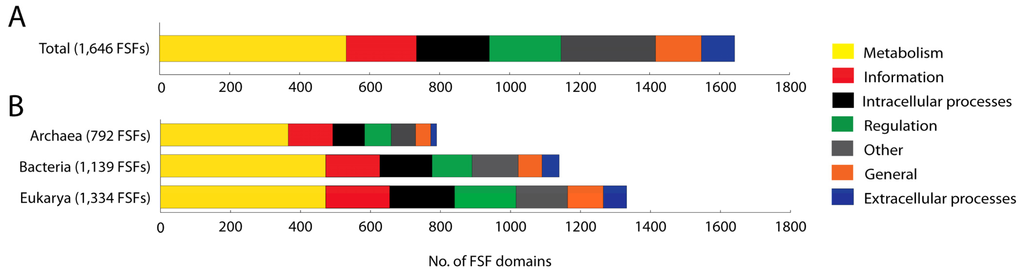
The numbers of FSFs belonging to categories Regulation, Information, and ICP are uniformly distributed in proteomes. However, the ECP category is the least represented, perhaps because this category is the last to appear in evolution [7,15]. Extra cellular processes are more important to multicellular organisms (mainly eukaryotes) than to unicellular organisms. Multicellular organisms need efficient communication, such as signaling and cell adhesion. They also trigger immune responses and produce toxins when defending from parasites and pathogens. These ECP processes, which are depicted in the minor categories of cell adhesion, immune response, blood clotting and toxins/defense, are needed when interacting with environmental biotic and abiotic factors and for maintaining the integrity of multicellular structure. These categories are also present in the microbial superkingdoms but their functional role may be different than in Eukarya.
We note that current genomic research is highly shifted towards the sequencing of microbial genomes, especially those that hold parasitic lifestyles and are of bacterial origin. In fact, 67% of proteomes in our dataset belong to Bacteria. This bias can affect conclusions drawn from global trends such as those in Figure 1(A), including the under-representation of ECP FFs, because of their decreased representation in microbial proteomes.
2.2. Distribution of FSF Domain Functions in the Three Superkingdoms of Life
In order to explore whether the overall distribution of general functional categories differs in organisms belonging to the three superkingdoms, we analyzed proteomes at the species level and calculated both the percentage and actual number of FSFs corresponding to different functional repertoires (Figure 2).
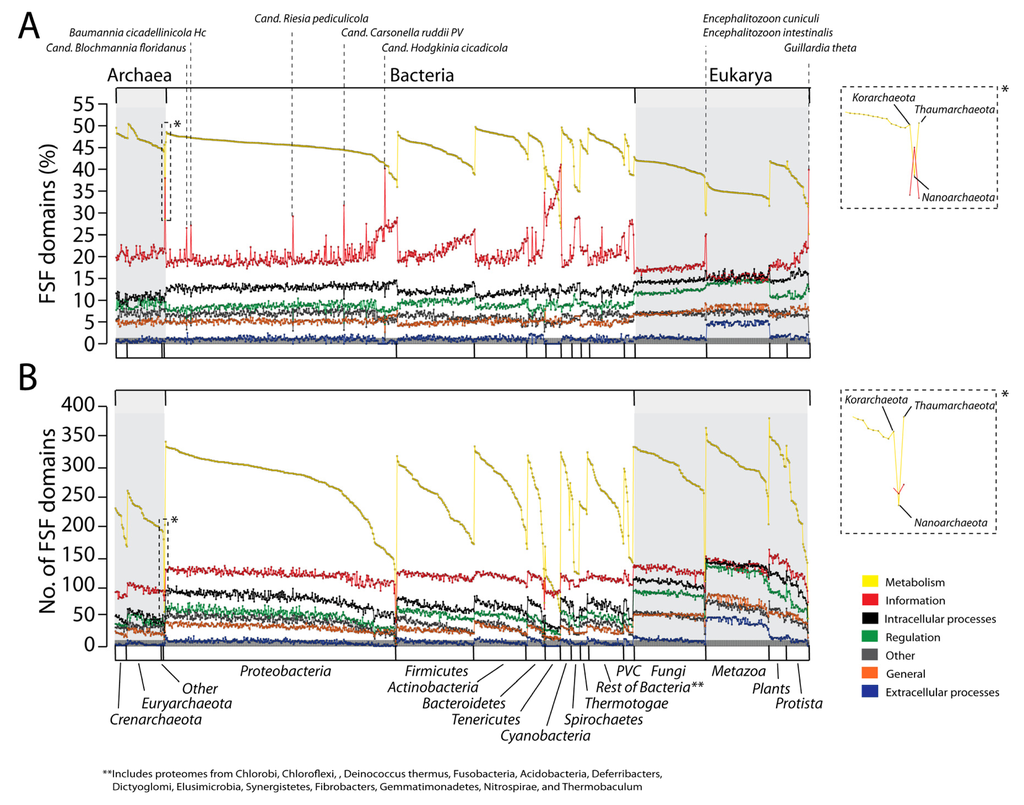
FSF domains follow the following decreasing trend in both the percentage and actual counts of FSFs, and do so consistently for the three superkingdoms: Metabolism > Information > ICP > Regulation > Other > General > ECP. Note that trend lines across proteomes seldom overlap and cross in Figure 2. It is noteworthy however that this trend differs from the decreasing total numbers of FSFs we described above (Figure 1). Thus, no correlation should be expected between the numbers of FSFs for individual proteomes and the total set for each category. This suggests that variation in functional assignments across proteomes of superkingdoms may not necessarily match overall functional patterns.
Proteomes in microbial superkingdoms Archaea and Bacteria exhibit remarkably similar functional distributions of FSFs (Figure 2(A)). The only exception appears to be the slight overrepresentation of Regulation FSFs (green trend lines) and underrepresentation of ICP (black trend lines) in Archaea compared to Bacteria (especially Proteobacteria). These distributions are clearly distinct from those in Eukarya. Proteomic representations of FSFs corresponding to Metabolism and Information are decreased while those of all other five functional categories are significantly and consistently increased (Figure 2(A)). There is also more variation evident in Eukarya; large groups of proteomes exhibit different patterns of functional use (clearly evident in Information; red trend lines in Figure 2(A)).
On the whole, the relative functional make up of the proteomes of individual superkingdoms appear highly conserved (Figure 2(A)). There is however considerable variation in the metabolic functional repertoire of organisms, especially in Bacteria, where Metabolism ranges 30–50% of proteomic content (100–350 FSFs, Table S1 and Table S2). This variation is not present in other functional repertoires.
Consequently, tendencies of reduction in the metabolic repertoire are generally offset by small increases in the representation of the other six repertoires, with the notable exception of Information. In this particular case, when Metabolism goes down Information goes up. For example, bacterial proteomes with metabolic FSF repertoires of <45% offset their decrease by a corresponding increase in Information FSFs (generally from ∼20% to ∼35%, Figure 2(A)). In all superkingdoms, we identify groups of proteomes or few outliers that deviate from the global trends (vertical dotted lines in Figure 2(A)). As we will discuss below this is generally a consequence of reductive evolution imposed by the lifestyle of organisms (discussed in detail below). Outliers are particularly evident in Bacteria and harbor sharp increases in Information repertoires, not always with corresponding decreases in Metabolism. In Archaea, decreases of Metabolism are generally offset by increases of the Regulation category, with an exception in Nanoarchaeum equitans (see below). In Eukarya, decreases in Metabolism go in hand with decreases in Information, and are correspondingly offset mostly by increases in Regulation and ECP. Apparently, the advantages of regulatory control (e.g., signal transduction and transcriptional and posttranscriptional regulation) and multicellularity counteract the interplay of Metabolism and Information in eukaryotes.
When we look at the actual number of FSFs within each functional repertoire (Figure 2(B)), we observe a clear trend in domain use that matches the total trend for superkingdoms described above (Figure 1). In most cases, the functional repertoires of Archaea are smaller than those of Bacteria, and bacterial repertoires are generally smaller than those of Eukarya (Figure 2(B)). This holds true for all functional categories. However, the numbers of metabolic FSFs vary 1.5–4 fold in proteomes of superkingdoms, the change being maximal in Bacteria. While both proteomes in Eukarya and Bacteria show similar ranges of metabolic FSFs, the repertoire of Archaea is more constrained. Furthermore, FSFs belonging to categories Other and ECP are significantly higher in Eukarya than in the microbial superkingdoms. These remarkable observations suggest high conservation in the make up of proteomes of superkingdoms and at the same time considerable levels of flexibility in the metabolic make-up of organisms. Results also support the evolution of the protein complements of Archaea and Bacteria via reductive evolutionary processes and Eukarya by genome expansion mechanisms [7,25]. Reductive tendencies in microbial superkingdoms do not show bias in favor of any functional category. Furthermore, enrichment of eukaryal proteomes with viral proteins supports theories, which state that viruses have played an important role in the evolution of Eukarya [26].
2.3. Distribution of FSF Domain Functions in Individual Phyla/Kingdoms
Figure 2 also describes the functional distribution of FSFs at the phyla/kingdom level for each superkingdom. Plots describing the percentages (Figure 2(A)) and actual number of FSFs in proteomes (Figure 2(B)) highlight the existence of “outliers” (vertical dotted lines in Figure 2(A)) that deviate from the global functional trends that are typical of each superkingdom.
In Archaea, the functional repertoires of the proteomes of Euryarachaeota, Crenarchaeota, Korarcheota and Thaumarchaeota were remarkably conserved and consistent with each other. Only N. equitans could be considered an outlier (insets of Figure 2). Its proteome deviates from the global archaeal signature by reducing its proteomic make up (it has only 200 distinct FSFs) and by exchanging Information for metabolic FSFs. N. equitans is an obligate intracellular parasite [27] that is part of a new phylum of Archaea, the Nanoarchaeota [28]. N. equitans has many atypical features, including the almost complete absence of operons and presence of split genes [29], tRNA genes that code for only half of the tRNA molecule [30], and the complete absence of the nucleic acid processing enzyme RNAse P [31]. Some of these features were used to propose that N. equitans is a living fossil [32], represents the root of superkingdom Archaea and the tree of life [33], and is part of a very ancient and yet to be described superkingdom (M. Di Giulio, personal communication). Phylogenomic analyses of domain structures in proteomes suggest Archaea is the most ancient superkingdom [19,34] and has placed N. equitans at the base of the tree of life together with other archaeal species. Its ancestral nature is therefore in line with the evolutionary and functional uniqueness of N. equitans and the very distinct functional repertoire we here report.
In Bacteria, the functional repertoires of bacterial phyla were also remarkably conserved. Only Information and Metabolism showed significantly distinct patterns and considerable variation in the use of FSFs. Again, decreases in representation of metabolic FSFs were generally offset by increases in informational FSFs (Figure 2(A)). Notable outliers include the Tenericutes and the Spirochetes. As groups, they have the highest relative usage of Information FSFs, which are clearly offset by a decrease in metabolic FSFs. The Tenericutes is a phylum of bacteria that includes class Mollicutes. Members of the Mollicutes are typical obligate parasites of animals and plants (some of medical significance such as Mycoplasma) that lack cell walls and have gliding motility. These organisms are characterized by small genome sizes [35] considered to have evolved via reductive evolutionary processes [36]. Because of its unique properties and history, mycoplasmas have been used recently to produce a completely synthetic genome [37]. There were also clear outliers in the Proteobacteria. These included Candidatus Blochmannia floridanus (symbiont of ants), Baumannia cicadellinicola (symbiont of sharpshooter insect), Candidatus Riesia pediculicola, Candidatus Carsonella ruddii (symbiont of sap-feeding insects) and Candidatus Hodgkinia cicadicola (symbiont of cicadas). These bacteria are generally endosymbionts of insects (e.g., ants, sharpshooters, psyllids, cicadas) that have undergone irreversible specialization to an intracellular lifestyle. Candidatus Carsonella ruddii has the smallest genome of any bacteria [38]. There were also bacterial proteome groups that were expected to be outliers but were no different than the rest. Bacteria belonging to the superphylum Planctomycetes-Verrucomicrobia-Chlamydiae (PVC) are different from other bacterial phyla because they have an “eukaryotic touch” [39]. Indeed, PVC bacteria display genetic and cellular features that are characteristics of Eukarya and Archaea, including the presence of Histone H1, condensed DNA surrounded by membrane, α-helical repeat domains and β-propeller folds that make up eukaryotic-like membrane coats, reproduction by budding, ether lipids and lack of cell walls [40–42]. Due to the unique nature of the PVC superphylum, it was proposed that these organisms be identified as a separate superkingdom that contributed to the evolution of Eukarya and Archaea [40]. However, trees of life generated from domain structures in hundreds of proteomes did not dissect the PVC superphylum into a separate group [7,19,34]. Functional distributions of FSFs now show PVC proteomes appear no different from bacteria (Figure 2). These results do not support PVC-inspired theories that explain the diversification of the three cellular superkingdoms of life.
In contrast to the functional repertoires of bacterial and archaeal phyla, proteomes belonging to individual kingdoms in Eukarya had functional signatures that were highly conserved (Figure 2(A)). However, these signatures differed between groups. Plants and fungi had functional representations that were very similar and showed little diversity. In contrast, Metazoa functional distributions increased the representation of ECP and Regulation FSFs in exchange of FSFs in Metabolism and Information. Protista had patterns that resemble those of Plants and Fungi but had widely varying metabolic repertoires, very much like Bacteria. This possible link between basal eukaryotes and bacteria revealed by our comparative analysis is consistent with the existence of an ancestor of Bacteria and Eukarya and the early rise of Archaea [34]. Only few outliers belonging to kingdoms Fungi (Encephalitozoon cuniculi and Encephalitozoon intestinalis) and Protista (Guillardia theta) were identified. E. cuniculi and E. intestinalis are eukaryotic parasites with highly reduced genomes [43,44]. Similarly, Guillardia theta is a nucleomorph that has a highly compact and reduced genome with loss of nearly all metabolic genes [45].
When we look at the actual number of FSFs in proteomes of phyla and kingdoms (Figure 2(B)) we observe that while the overall patterns match those of FSF representation (Figure 2(A)), FSF number revealed considerable variation in the metabolic repertoire of Protista and Bacteria. FSFs in these groups typically ranged 130–340, with PVC and Spirochetes exhibiting the smallest range (130–300 FSFs). In contrast, metabolic repertoires of Archaea and the other eukaryotic kingdoms typically ranged 200–260 FSFs and 270–350 FSFs, respectively. This observation is significant. It provides comparative information to support a unique evolutionary link of phyla within superkingdoms Eukarya and Bacteria. Plots of FSF number also clarified functional patterns in outliers, revealing they did not have more numbers of FSFs in Information but rather have reduced metabolic repertoires. This shows that parasitic outliers get rid of metabolic domains and become more and more dependent on host cells.
2.4. Effect of Organism Lifestyle
The analysis thus far revealed the existence of a small group of outliers within each superkingdom. Manual inspection of lifestyles of these organisms showed that all of these organisms are united by a parasitic or symbiotic lifestyle. For example, N. equitans is the smallest archaeal genome ever sequenced and represents a new phylum, the Nanoarchaeaota [28]. This organism interacts with Ignicoccus hospitalis, establishing the only known parasite/symbiont relationship of Archaea, and harbors a highly reduced genome [29]. Parasitic/symbiotic relationships with various plants and animals can be found in Tenericutes and in the endosymbionts of insects that belong to Proteobacteria. Similarly, the Encephalitozoon species are eukaryotic parasites that lack mitochondria and have highly reduced genomes [43,44]. E. cunniculi has even a chromosomal dispersion of its ribosomal genes, very much like N. equitans, and the rRNA of the large ribosomal subunit reduced to its universal core [46]. Similarly, Guillardia theta is a nucleomorph that has a highly compact and reduced genome with loss of nearly all metabolic genes [45]. Thus, all outliers exhibit extreme or unique cases of genome reduction.
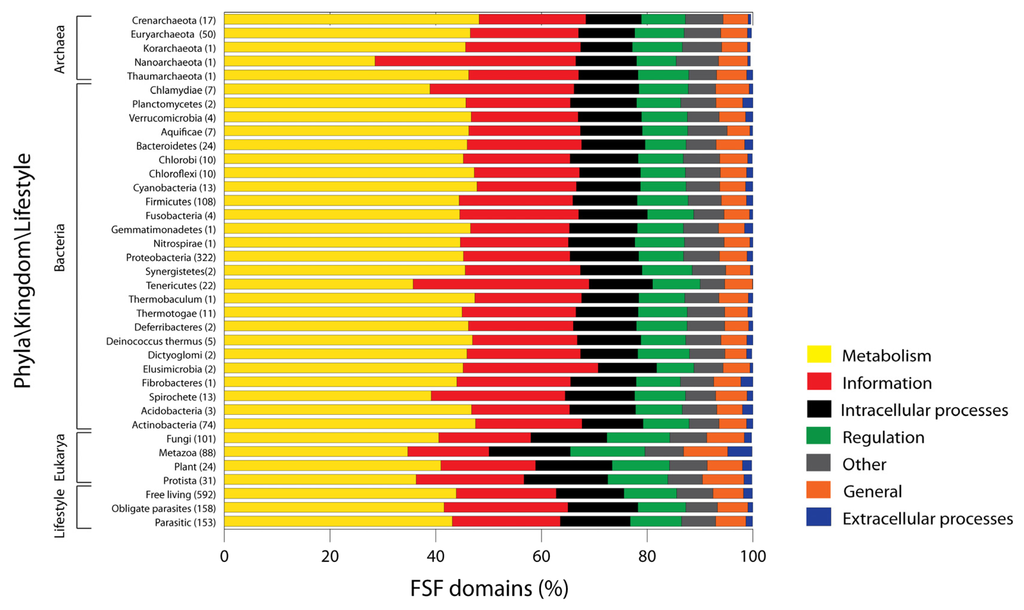
In order to explore whether organisms that engage in parasitic or symbiotic interactions have general tendencies that resemble those of the outliers, we classified organisms into three different lifestyles: free living (FL) (592 proteomes), facultative parasitic (P) (153 proteomes), and obligate parasitic (OP) (158 proteomes). Functional distributions for the seven general functional categories for these proteomic sets explained the role of parasitic life on proteomic constitution (Figure 3). Plots of percentages (Figure 3(A)) and actual number of FSFs in proteomes (Figure 3(B)) showed FSF distribution in FL organisms were remarkably homogenous and that the vast majority of variability within superkingdoms was ascribed to the P and OP lifestyles. This variability was for the most part explained by a sharp decline in the number of metabolic FSFs that are assigned to the Metabolism general category (Figure 3(B)). Plots also support the hypothesis that parasitic organisms have gone the route of massive genome reduction in a tendency to loose all of their metabolic genes. This tendency makes them more and more dependent on host cells for metabolic functions and survival [47,48].
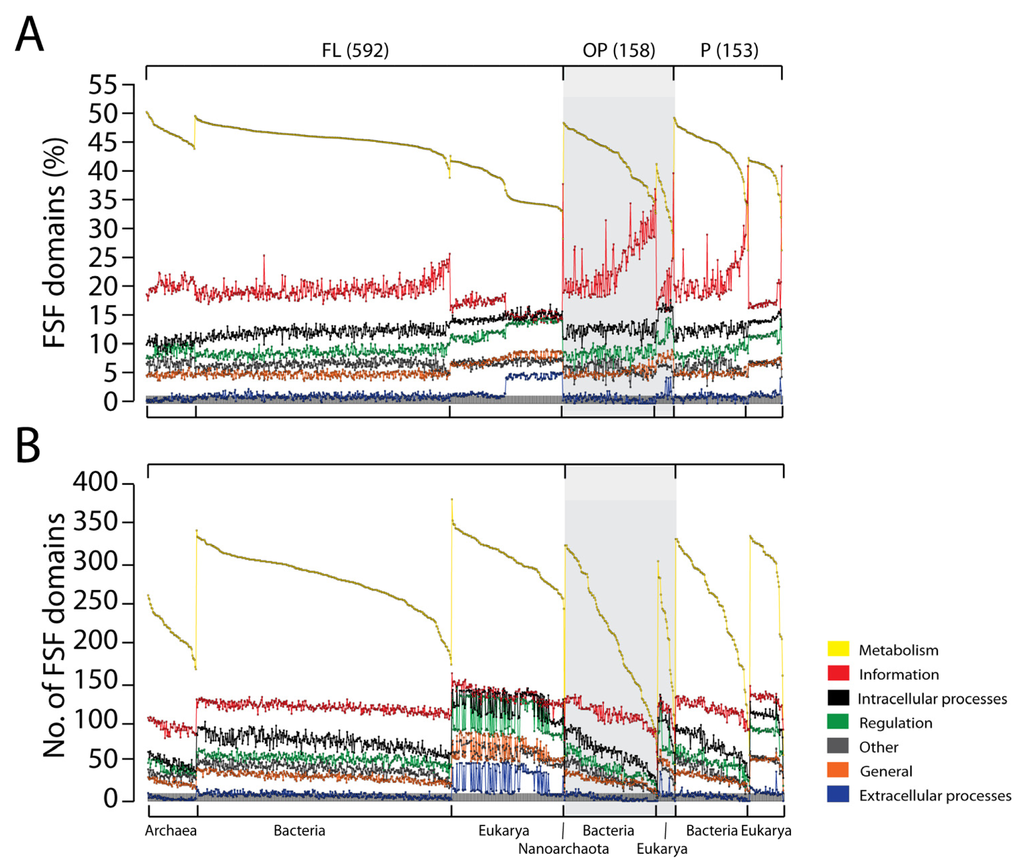
The number of domains corresponding to each general functional category in the proteomes of FL organisms increases in the order Archaea, Bacteria and Eukarya (Table S3). When compared to the total proteomic set (Figure 2), Metabolism remains the predominant functional category and a large number of domains in all the proteomes perform metabolic functions. Again, the proteomes of Eukarya have the richest FSF repertoires, and those of Archaea the most simple. Since maximum variability lies within the proteome repertoires of parasitic/symbiotic organisms (Figure 3) and parasitism/symbiosis in these organisms is the result of secondary adaptations, the analysis of proteomic diversity in FL organisms allows us to test if the functional repertoires of superkingdoms are indeed statistically significant. Analysis of variance showed that the number of FSFs for each functional repertoire was consistently different between superkingdoms (p < 0.0001; Table S3). This supports the conclusions drawn from earlier analyses that the microbial superkingdoms followed a genome reduction path while Eukarya expanded their genomic repertoires [7,25].
2.5. Analysis of Minor Functional Categories
The seven general categories of molecular functions map to 50 minor categories (Table 1). We explored the distribution of FSFs corresponding to each minor category in superkingdoms (Figure 4). Only category “not annotated” (NONA) was excluded from analysis. In terms of percentage (Figure 4(A)), the overall functional signature is split into two components: prokaryotic and eukaryotic. Prokaryotes spend most of their domain repertoire on Metabolism and Information whereas Eukarya stand out in ECP (particularly cell adhesion, immune response), Regulation (DNA binding, signal transduction), and all the minor functional categories corresponding to ICP and General.
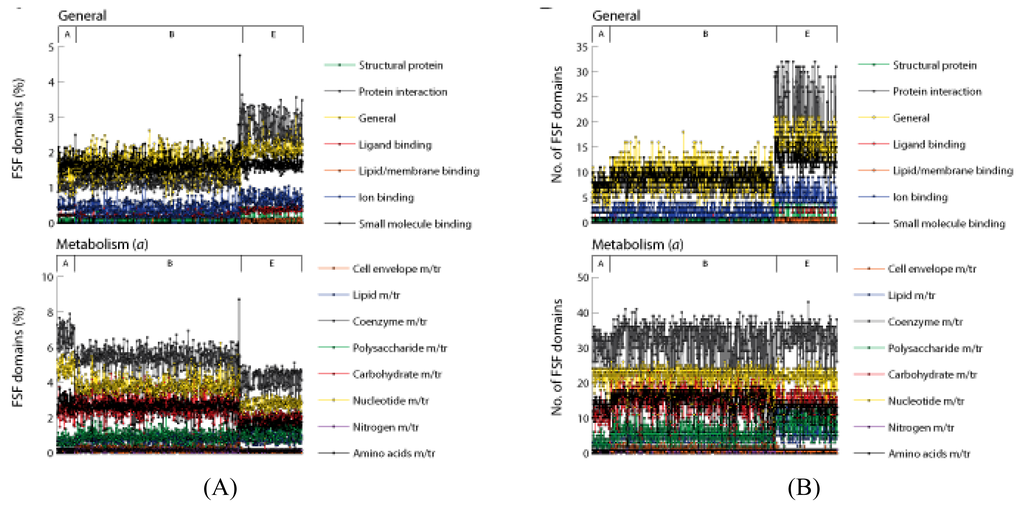
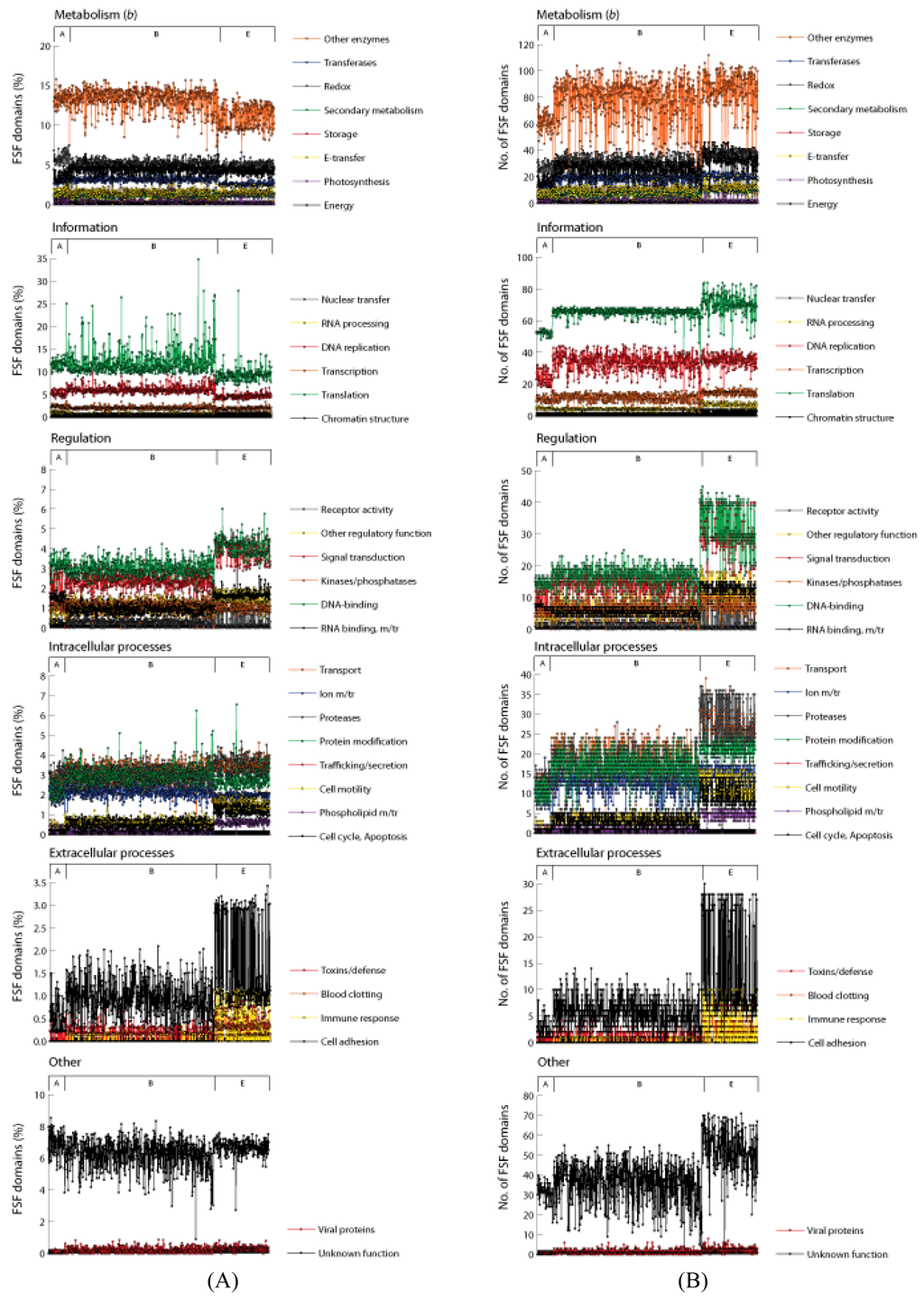
In terms of domain counts (Figure 4(B)), proteomes of Eukarya have the richest functional repertoires with a significantly large number of FSFs devoted for each minor functional category. Bacteria and Archaea work with small number of domains. However, the number of FSFs in Bacteria is significantly higher compared to Archaea (supporting results of Figure 1, Figure 2 and Table S3). These results are consistent with the evolutionary trends in proteomes described previously [7,19,25]. Our results support the complex nature of the Last Universal Common Ancestor (LUCA) [19] and are consistent with the evolution of microbial superkingdoms via reductive evolutionary processes and the evolution of eukaryal proteomes by genome expansion [7,25]. It appears that Archaea went on the route of genome reduction very early in evolution and was followed by Bacteria and finally Eukarya. Late in evolution, the eukaryal superkingdom increased the representation of FSFs and developed a rich proteome. This can explain the relatively huge and diverse nature of eukaryal proteomes compared to prokaryotic proteomes. Finally, there appears to be no significant difference in the distributions of FSFs corresponding to Metabolism and Information between Bacteria and Eukarya except for minor category “Translation” (green trend lines in Figure 4(B, Information)) that is significantly higher in Eukarya compared to Bacteria. This shows that Bacteria exhibit incredible metabolic and informational diversity despite their reduced genomic complements. We conclude that the genome expansion in Eukarya occurred primarily for functions related to ECP, ICP, Regulation and General.
2.6. Reliability of Functional Annotations and Conclusions of this Study
Our analysis depends upon the accuracy of assigning structures to protein sequences and the SCOP protein classification and SUPERFAMILY functional annotation schemes. Databases such as SCOP and SUPERFAMILY are continuously updated with more and more genomes and new assignments. We therefore ask the reader to focus on the general trends in the data as opposed to the specifics such as the exact percentage or numbers of FSFs in each functional repertoire. Trends related to the number of domains in Archaea relative to Bacteria and Eukarya and the reduction of metabolic repertoires in parasitic organisms should be considered robust since these have been reliably observed in previous studies with more limited datasets [1,7,15,19,34]. Biases in sampling of proteomes in the three superkingdoms is not expected to over or underestimate the remarkably conserved nature of the functional makeup. We show that the conservation of molecular functions in proteomes is only broken in genomic outliers that are united by parasitic lifestyles. Thus equal sampling will not significantly alter the global trends described for individual superkingdoms. In light of our results, organism lifestyle is the only factor affecting the conserved nature of proteomes. Finally, we propose that lower or higher than expected numbers of FSFs in any category (subcategory) can be explained either by possible limitations of the scheme used to annotate molecular functions of FSFs or the simple nature of the functional repertoire. For example, the number of FSFs in subcategory structural proteins (main category General) is 7 (Table 1) despite the importance of structural proteins in cellular organization. Table S4 lists the description of these FSFs and shows that indeed these FSF domains play important structural roles. Their limited number indicates that the structural and functional organization is quite limited and very few folds play important structural roles. Another possibility is the “hidden” overlap between FSFs and molecular functions due to the one-to-one mapping limitations of the SUPERFAMILY functional annotation scheme. Most of the large FSFs include many FFs and participate in multiple pathways; for few FSFs a complete functional profile may not be intuitively obvious. This may be one of the shortcomings of using this functional annotation scheme but dissection of such detailed functions and pathways is a difficult task and is not described in this study. In summary, we do not believe that the classification or annotation schemes, despite their limitations, would undergo serious revisions or weaken our findings.
3. Experimental Section
3.1. Data Retrieval
We downloaded the protein architecture assignments for a total of 965 organisms including 70 Archaea, 651 Bacteria and 244 Eukarya (Table S5) from SUPERFAMILY ver. 1.73 MySQL [16,17] at an E-value cutoff of 10−4. This cutoff is considered a stringent threshold to eliminate the rate of false positives in HMM assignments [19]. Classification of organisms according to their lifestyles was done manually and resulted in 592 FL, 153 P, and 158 OP organisms.
3.2. Assigning Functional Categories to Protein Domains
The most recent domain functional annotation file for SCOP 1.73 was downloaded from the SUPERFAMILY webserver [23]. For each genome we extracted the set of unique FSFs present and then mapped them to the 7 general and 50 detailed functional categories. We calculated both the percentage and actual number of domains using programming implementations in Python 3.1 ( http://www.python.org/download/).
3.3. Statistical Analysis
The statistical significance between the numbers of functional FSFs in FL organisms of superkingdoms was evaluated by Welch's ANOVA in SAS ( http://www.sas.com/software/sas9), which is the appropriate test to detect differences between means for groups having unequal variances [49]. We excluded organisms with P and OP lifestyles in order to remove noise from the data. Additionally, in order to meet asymptotic normality, we used the Log10 transformation and rescaled the data to 0–7 using the following formula,
4. Conclusions
Our analysis revealed a remarkable conservation in the functional distribution of protein domains in superkingdoms for proteomes for which we have structural assignments. Figure S1 showcases average distribution of FSFs in phyla, kingdoms, and superkingdoms. The biggest proportion of each proteome is devoted in all cases to functions related to Metabolism. Phylogenomic analysis has shown that Metabolism appeared earlier than other functional groups and their structures were the first to spread in life [1,50]. This would explain the relative large representation of Metabolism in the functional toolkit of cells. Usage of domains related to ECP and Regulation is significantly higher in Metazoa compared to the rest. This showcases the importance of regulation signal transduction mechanisms for eukaryotic organisms [51,52]. Our results support the view that prokaryotes evolved via reductive evolutionary processes whereas genome expansion was the route taken by eukaryotic organisms. Genome expansion in Eukarya seems to be directed towards innovation of FSF architectures, especially those linked to Regulation, ECP and General. Finally, viral structures make up a substantial proportion of cellular proteomes and appear to have played an important role in the evolution of cellular life.
Organisms with parasitic lifestyles have simple and reduced proteomes and rely on host cells for metabolic functions. Tenericutes are unique in this regard. They spend most of their proteomic resources in functions linked to Information (e.g., translation, replication). Remarkably, we find that the conservation of molecular functions in proteomes is only broken in “outliers” with parasitic lifestyles that do not obey the global trends. We conclude that organism lifestyle is a crucial factor in shaping the nature of proteomes.

Acknowledgments
This study began as a class project in CPSC 567, a course in bioinformatics and systems biology taught by G.C.-A. at the University of Illinois in spring 2011. We thank Kyung Mo Kim and Liudmila Yafremava for information about lifestyles. A.N., A.Na., M.J.K. and H.D.L.-N. conceived the experiments and analyzed the data. G.C.-A. supervised the project and edited the manuscript. Research was supported by the National Science Foundation (MCB-0749836), CREES-USDA and the Soybean Disease Biotechnology Center (to G.C.-A.). Any opinions, findings, and conclusions and recommendations expressed in this material are those of the authors and do not necessarily reflect the views of the funding agencies.
Supplementary Materials
References
- Caetano-Anolles, D.; Kim, K.M.; Mittenthal, J.E.; Caetano-Anolles, G. Proteome evolution and the metabolic origins of translation and cellular life. J. Mol. Evol. 2011, 72, 14–33. [Google Scholar]
- Lesk, A.M. Introduction to Protein Architecture; Oxford University Press: New York, NY, USA, 2001. [Google Scholar]
- Cordes, M.H.; Davidson, A.R.; Sauer, R.T. Sequence space, folding and protein design. Curr. Opin. Struct. Biol. 1996, 6, 3–10. [Google Scholar]
- Linderstrom-Lang, K.U.; Schellman, J.A. The Enzymes; Academic Press: New York, NY, USA, 1959; pp. 443–510. [Google Scholar]
- Wang, M.; Caetano-Anolles, G. The evolutionary mechanics of domain organization in proteomes and the rise of modularity in the protein world. Structure 2009, 17, 66–78. [Google Scholar]
- Vogel, C.; Bashton, M.; Kerrison, N.D.; Chothia, C.; Teichmann, S.A. Structure, function and evolution of multidomain proteins. Curr. Opin. Struct. Biol. 2004, 14, 208–216. [Google Scholar]
- Wang, M.; Yafremava, L.S.; Caetano-Anolles, D.; Mittenthal, J.E.; Caetano-Anolles, G. Reductive evolution of architectural repertoires in proteomes and the birth of the tripartite world. Genome Res. 2007, 17, 1572–1585. [Google Scholar]
- Gerstein, M.; Hegyi, H. Comparing genomes in terms of protein structure: Surveys of a finite parts list. FEMS Microbiol. Rev. 1998, 22, 277–304. [Google Scholar]
- Chothia, C.; Gough, J.; Vogel, C.; Teichmann, S.A. Evolution of the protein repertoire. Science 2003, 300, 1701–1703. [Google Scholar]
- Murzin, A.G.; Brenner, S.E.; Hubbard, T.; Chothia, C. Scop: A structural classification of proteins database for the investigation of sequences and structures. J. Mol. Biol. 1995, 247, 536–540. [Google Scholar]
- Orengo, C.A.; Michie, A.D.; Jones, S.; Jones, D.T.; Swindells, M.B.; Thornton, J.M. Cath—A hierarchic classification of protein domain structures. Structure 1997, 5, 1093–1108. [Google Scholar]
- Riley, M.; Labedan, B. Protein evolution viewed through escherichia coli protein sequences: Introducing the notion of a structural segment of homology, the module. J. Mol. Biol. 1997, 268, 857–868. [Google Scholar]
- Ponting, C.P.; Russell, R.R. The natural history of protein domains. Annu. Rev. Biophys. Biomol. Struct. 2002, 31, 45–71. [Google Scholar]
- Andreeva, A.; Howorth, D.; Chandonia, J.M.; Brenner, S.E.; Hubbard, T.J.; Chothia, C.; Murzin, A.G. Data growth and its impact on the scop database: New developments. Nucleic Acids Res. 2008, 36, D419–D425. [Google Scholar]
- Caetano-Anolles, G.; Wang, M.; Caetano-Anolles, D.; Mittenthal, J.E. The origin, evolution and structure of the protein world. Biochem. J. 2009, 417, 621–637. [Google Scholar]
- Gough, J.; Karplus, K.; Hughey, R.; Chothia, C. Assignment of homology to genome sequences using a library of hidden markov models that represent all proteins of known structure. J. Mol. Biol. 2001, 313, 903–919. [Google Scholar]
- Wilson, D.; Madera, M.; Vogel, C.; Chothia, C.; Gough, J. The superfamily database in 2007: Families and functions. Nucleic Acids Res. 2007, 35, D308–D313. [Google Scholar]
- Karplus, K. Sam-t08, hmm-based protein structure prediction. Nucleic Acids Res. 2009, 37, W492–W497. [Google Scholar]
- Kim, K.M.; Caetano-Anolles, G. The proteomic complexity and rise of the primordial ancestor of diversified life. BMC Evol. Biol. 2011, 11, 140:1–140:24. [Google Scholar]
- Vogel, C.; Berzuini, C.; Bashton, M.; Gough, J.; Teichmann, S.A. Supra-domains: Evolutionary units larger than single protein domains. J. Mol. Biol. 2004, 336, 809–823. [Google Scholar]
- Vogel, C.; Teichmann, S.A.; Pereira-Leal, J. The relationship between domain duplication and recombination. J. Mol. Biol. 2005, 346, 355–365. [Google Scholar]
- Vogel, C.; Chothia, C. Protein family expansions and biological complexity. PLoS Comput. Biol. 2006, 2, e48:0370–e48:0382. [Google Scholar]
- Vogel, C. Function annotation of SCOP domain superfamilies 1.73. Superfamily-HMM library and genome assignments server, Available online: http://supfam.cs.bris.ac.uk/SUPERFAMILY/function.html (accessed on 28 October 2011).
- Moreira, D.; Lopez-Garcia, P. Ten reasons to exclude viruses from the tree of life. Nat. Rev. Microbiol. 2009, 7, 306–311. [Google Scholar]
- Wang, M.; Kurland, C.G.; Caetano-Anolles, G. Reductive evolution of proteomes and protein structures. Proc. Natl. Acad. Sci. USA 2011, 108, 11954–11958. [Google Scholar]
- Koonin, E.V.; Wolf, Y.I.; Nagasaki, K.; Dolja, V.V. The big bang of picorna-like virus evolution antedates the radiation of eukaryotic supergroups. Nat. Rev. Microbiol. 2008, 6, 925–939. [Google Scholar]
- Das, S.; Paul, S.; Bag, S.K.; Dutta, C. Analysis of nanoarchaeum equitans genome and proteome composition: Indications for hyperthermophilic and parasitic adaptation. BMC Genomics 2006, 7, 186:1–186:16. [Google Scholar]
- Huber, H.; Hohn, M.J.; Rachel, R.; Fuchs, T.; Wimmer, V.C.; Stetter, K.O. A new phylum of archaea represented by a nanosized hyperthermophilic symbiont. Nature 2002, 417, 63–67. [Google Scholar]
- Waters, E.; Hohn, M.J.; Ahel, I.; Graham, D.E.; Adams, M.D.; Barnstead, M.; Beeson, K.Y.; Bibbs, L.; Bolanos, R.; Keller, M.; Kretz, K.; Lin, X.; Mathur, E.; Ni, J.; Podar, M.; Richardson, T.; Sutton, G.G.; Simon, M.; Soll, D.; Stetter, K.O.; Short, J.M.; Noordewier, M. The genome of Nanoarchaeum equitans: Insights into early archaeal evolution and derived parasitism. Proc. Natl. Acad. Sci. USA 2003, 100, 12984–12988. [Google Scholar]
- Randau, L.; Munch, R.; Hohn, M.J.; Jahn, D.; Soll, D. Nanoarchaeum equitans creates functional trnas from separate genes for their 5′- and 3′-halves. Nature 2005, 433, 537–541. [Google Scholar]
- Randau, L.; Schroder, I.; Soll, D. Life without rnase p. Nature 2008, 453, 120–123. [Google Scholar]
- Di Giulio, M. Nanoarchaeum equitans is a living fossil. J. Theor. Biol. 2006, 242, 257–260. [Google Scholar]
- Di Giulio, M. The tree of life might be rooted in the branch leading to nanoarchaeota. Gene 2007, 401, 108–113. [Google Scholar]
- Kim, K.M.; Caetano-Anolles, G. The evolutionary history of protein fold families and proteomes confirms Archaea is the most ancient superkingdom. Ms. submitted.
- Woese, C.R.; Maniloff, J.; Zablen, L.B. Phylogenetic analysis of the mycoplasmas. Proc. Natl. Acad. Sci. USA 1980, 77, 494–498. [Google Scholar]
- Chambaud, I.; Heilig, R.; Ferris, S.; Barbe, V.; Samson, D.; Galisson, F.; Moszer, I.; Dybvig, K.; Wróblewski, H.; Viari, A.; Rocha, E.P.; Blanchard, A. The complete genome sequence of the murine respiratory pathogen Mycoplasma pulmonis. Nucleic Acids Res. 2001, 29, 2145–2153. [Google Scholar]
- Gibson, D.G.; Smith, H.O.; Hutchison, C.A., III; Venter, J.C.; Merryman, C. Chemical synthesis of the mouse mitochondrial genome. Nat. Methods 2010, 7, 901–903. [Google Scholar]
- Nakabachi, A.; Yamashita, A.; Toh, H.; Ishikawa, H.; Dunbar, H.E.; Moran, N.A.; Hattori, M. The 160-kilobase genome of the bacterial endosymbiont carsonella. Science 2006, 314, 267. [Google Scholar]
- Forterre, P.; Gribaldo, S. Bacteria with a eukaryotic touch: A glimpse of ancient evolution? Proc. Natl. Acad. Sci. USA 2010, 107, 12739–12740. [Google Scholar]
- Santarella-Mellwig, R.; Franke, J.; Jaedicke, A.; Gorjanacz, M.; Bauer, U.; Budd, A.; Mattaj, I.W.; Devos, D.P. The compartmentalized bacteria of the planctomycetes-verrucomicrobia-chlamydiae superphylum have membrane coat-like proteins. PLoS Biol. 2010, 8, e1000281:1–e1000281:11. [Google Scholar]
- Kamneva, O.K.; Liberles, D.A.; Ward, N.L. Genome-wide influence of indel substitutions on evolution of bacteria of the PVC superphylum, revealed using a novel computational method. Genome Biol. Evol. 2010, 2, 870–886. [Google Scholar]
- Devos, D.P.; Reynaud, E.G. Evolution. Intermediate steps. Science 2010, 330, 1187–1188. [Google Scholar]
- Katinka, M.D.; Duprat, S.; Cornillot, E.; Méténier, G.; Thomarat, F.; Prensier, G.; Barbe, V.; Peyretaillade, E.; Brottier, P.; Wincker, P.; Delbac, F.; El Alaoui, H.; Peyret, P.; Saurin, W.; Gouy, M.; Weissenbach, J.; Vivares, C. P, Genome sequence and gene compaction of the eukaryote parasite Encephalitozoon cuniculi. Nature 2001, 414, 450–453. [Google Scholar]
- Corradi, N.; Pombert, J.F.; Farinelli, L.; Didier, E.S.; Keeling, P.J. The complete sequence of the smallest known nuclear genome from the microsporidian Encephalitozoon intestinalis. Nat. Commun. 2010, 1, 77. [Google Scholar] [CrossRef]
- Douglas, S.; Zauner, S.; Fraunholz, M.; Beaton, M.; Penny, S.; Deng, L.T.; Wu, X.; Reith, M.; Cavalier-Smith, T.; Maier, U.G. The highly reduced genome of an enslaved algal nucleus. Nature 2001, 410, 1091–1096. [Google Scholar]
- Peyretaillade, E.; Biderre, C.; Peyret, P.; Duffieux, F.; Metenier, G.; Gouy, M.; Michot, B.; Vivares, C.P. Microsporidian encephalitozoon cuniculi, a unicellular eukaryote with an unusual chromosomal dispersion of ribosomal genes and a lsu rrna reduced to the universal core. Nucleic Acids Res. 1998, 26, 3513–3520. [Google Scholar]
- Martin, W.; Herrmann, R.G. Gene transfer from organelles to the nucleus: How much, what happens, and why? Plant Physiol. 1998, 118, 9–17. [Google Scholar]
- Keeling, P.J.; Slamovits, C.H. Causes and effects of nuclear genome reduction. Curr. Opin. Genet. Dev. 2005, 15, 601–608. [Google Scholar]
- Welch, B.L. The significance of the difference between two means when the population variances are unequal. Biometrika 1938, 29, 350–362. [Google Scholar]
- Caetano-Anolles, G.; Kim, H.S.; Mittenthal, J.E. The origin of modern metabolic networks inferred from phylogenomic analysis of protein architecture. Proc. Natl. Acad. Sci. USA 2007, 104, 9358–9363. [Google Scholar]
- Ingham, P.W.; Nokano, Y.; Seger, C. Mechanisms and functions of Hedgehog signalling across the metazoa. Nat. Rev. Genet. 2011, 12, 393–406. [Google Scholar]
- Bürglin, T.R. Evolution of hedgehog and hedgehog-related genes, their origin from Hog proteins in ancestral eukaryotes and discovery of a novel Hint motif. BMC Genomics 2008, 9, 127:1–127:28. [Google Scholar]
© 2011 by the authors; licensee MDPI, Basel, Switzerland. This article is an open access article distributed under the terms and conditions of the Creative Commons Attribution license (http://creativecommons.org/licenses/by/3.0/).