<?xml version="1.0" encoding="UTF-8"?>
<!DOCTYPE article PUBLIC "-//NLM//DTD Journal Publishing DTD v2.3 20070202//EN" "journalpublishing.dtd">
<article xmlns:xlink="http://www.w3.org/1999/xlink" xml:lang="en" article-type="review-article">
<front>
<journal-meta>
<journal-id journal-id-type="publisher-id">genes</journal-id>
<journal-title>genes</journal-title>
<issn pub-type="epub">2073-4425</issn>
<publisher>
<publisher-name>Molecular Diversity Preservation International (MDPI)</publisher-name></publisher></journal-meta>
<article-meta>
<article-id pub-id-type="doi">10.3390/genes2010131</article-id>
<article-id pub-id-type="publisher-id">genes-02-00131</article-id>
<article-categories>
<subj-group>
<subject>Review</subject></subj-group></article-categories>
<title-group>
<article-title>Gene Duplication and Ectopic Gene Conversion in <italic>Drosophila</italic></article-title></title-group>
<contrib-group>
<contrib contrib-type="author">
<name><surname>Arguello</surname><given-names>J. Roman</given-names></name><xref ref-type="corresp" rid="c1-genes-02-00131"><sup>*</sup></xref></contrib>
<contrib contrib-type="author">
<name><surname>Connallon</surname><given-names>Tim</given-names></name></contrib>
<aff id="af1-genes-02-00131">Department of Molecular Biology and Genetics, Cornell University, 107 Biotechnology Building, Ithaca, NY 14853, USA; E-Mail: <email>tmc233@cornell.edu</email></aff></contrib-group>
<author-notes>
<corresp id="c1-genes-02-00131">
<label>*</label> Author to whom correspondence should be addressed; E-Mail: <email>jra89@cornell.edu</email>; Tel.: +1-607-255-1707.</corresp></author-notes>
<pub-date pub-type="collection">
<year>2011</year></pub-date>
<pub-date pub-type="epub">
<day>11</day>
<month>02</month>
<year>2011</year></pub-date>
<volume>2</volume>
<issue>1</issue>
<fpage>131</fpage>
<lpage>151</lpage>
<history>
<date date-type="received">
<day>24</day>
<month>12</month>
<year>2010</year></date>
<date date-type="rev-recd">
<day>26</day>
<month>01</month>
<year>2011</year></date>
<date date-type="accepted">
<day>27</day>
<month>02</month>
<year>2011</year></date></history>
<permissions>
<copyright-statement>© 2011 by the authors; licensee MDPI, Basel, Switzerland.</copyright-statement>
<copyright-year>2011</copyright-year>
<license>
<p>This article is an open access article distributed under the terms and conditions of the Creative Commons Attribution license (http://creativecommons.org/licenses/by/3.0/).</p></license></permissions>
<abstract>
<p>The evolutionary impact of gene duplication events has been a theme of <italic>Drosophila</italic> genetics dating back to the Morgan School. While considerable attention has been placed on the genetic novelties that duplicates are capable of introducing, and the role that positive selection plays in their early stages of duplicate evolution, much less attention has been given to the potential consequences of ectopic (non-allelic) gene conversion on these evolutionary processes. In this paper we consider the historical origins of ectopic gene conversion models and present a synthesis of the current <italic>Drosophila</italic> data in light of several primary questions in the field.</p></abstract>
<kwd-group>
<kwd>ectopic gene conversion</kwd>
<kwd>gene conversion</kwd>
<kwd>non-allelic conversion</kwd>
<kwd>gene duplication</kwd>
<kwd><italic>Drosophila</italic></kwd>
<kwd>selection</kwd></kwd-group></article-meta></front>
<body>
<sec sec-type="intro">
<label>1.</label>
<title>Introduction</title>
<p>Gene duplication is a central theme in evolutionary genetics due in large part to each duplicate's potential for introducing genetic novelty. Gene family expansions have jointly contributed to genome size [<xref ref-type="bibr" rid="b1-genes-02-00131">1</xref>], and to the diversification of molecular functions, including those influencing morphology [<xref ref-type="bibr" rid="b2-genes-02-00131">2</xref>], digestion [<xref ref-type="bibr" rid="b3-genes-02-00131">3</xref>–<xref ref-type="bibr" rid="b5-genes-02-00131">5</xref>], immune defense [<xref ref-type="bibr" rid="b6-genes-02-00131">6</xref>], and possibly reproductive isolation between species [<xref ref-type="bibr" rid="b7-genes-02-00131">7</xref>–<xref ref-type="bibr" rid="b9-genes-02-00131">9</xref>]. While there is evidence for adaptive differentiation between duplicates [<xref ref-type="bibr" rid="b10-genes-02-00131">10</xref>–<xref ref-type="bibr" rid="b12-genes-02-00131">12</xref>], duplication events can also have deleterious consequences, by generating chromosomal instability and dosage abnormalities [<xref ref-type="bibr" rid="b13-genes-02-00131">13</xref>–<xref ref-type="bibr" rid="b16-genes-02-00131">16</xref>]. As a result, research on gene duplication is of both evolutionary and medical interest.</p>
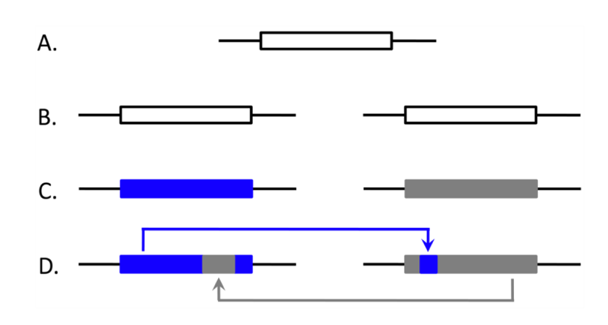
<p>Though most duplicate alleles will eventually be lost from a population, a complex interaction between genetic drift, mutation and selection can occasionally lead to duplicate fixation and preservation [<xref ref-type="bibr" rid="b17-genes-02-00131">17</xref>]. Unlike single-copy genes, paralogous (or “non-allelic”) genomic regions can interact via ectopic (non-allelic) gene conversion (EGC). Gene conversion refers to a double-strand break (DSB) induced form of homologous recombination, with EGC occurring between paralogous regions with high sequence identity. The mechanism results in the transfer of a chromosomal region from the intact sequence to the region that contains the DSB, and can occur between homologous or nonhomologous chromosomes. From an evolutionary or population genetic perspective, this is often modeled as a “copy and paste” process of nonreciprocal exchange ([<xref ref-type="bibr" rid="b18-genes-02-00131">18</xref>]; <xref ref-type="fig" rid="f1-genes-02-00131">Figure 1</xref>), which introduces genetic interdependence between duplicates and partially governs their evolutionary fates [<xref ref-type="bibr" rid="b19-genes-02-00131">19</xref>]. Despite its name, EGC does not occur exclusively within genes (it can occur in noncoding sequences).</p>
<p>A large body of theoretical work illustrates that EGC can greatly influence the evolutionary dynamics of duplicates [<xref ref-type="bibr" rid="b17-genes-02-00131">17</xref>,<xref ref-type="bibr" rid="b19-genes-02-00131">19</xref>], yet empirical support of the theory, including its effect on the process of adaptation and gene family evolution, is less clear. In this article, we present a review and synthesis of the empirical literature on EGC as it pertains to <italic>Drosophila</italic>. After summarizing commonly used methods for detecting EGC, the paper is structured into two main sections. In the first, we briefly outline the historical context in which EGC came to be studied in <italic>Drosophila</italic>, and describe how EGC research emerged from a more general analysis of repetitive DNA and concerted evolution. The second section provides an up-to-date analysis of the Drosophila empirical literature concerning duplication and EGC. We anchor the synthesis around several broad and unresolved questions:
<list list-type="bullet">
<list-item>
<p>What is the relative contribution of EGC to patterns of concerted evolution?</p></list-item>
<list-item>
<p>How does genomic context (e.g., nucleotide base composition; linkage relationships between duplicates) affect EGC?</p></list-item>
<list-item>
<p>How do selection and EGC interact to influence adaptation?</p></list-item>
<list-item>
<p>Does gene conversion between duplicates bias estimates of the gene duplication rate and the tempo of paralog differentiation?</p></list-item></list></p>
<p>Our general conclusion is that EGC, at minimum, plays a consequential role during the early evolution of physically linked <italic>Drosophila</italic> duplications. However, the empirical limitations of jointly testing for interactions between conversion, selection, linkage, and gene family size preclude a strong conclusion about the temporal duration of conversion between duplicates, or its role in promoting or constraining adaptation. We describe future analyses that may shed light on these unresolved issues.</p></sec>
<sec>
<label>2.</label>
<title>Detecting Ectopic Gene Conversion</title>
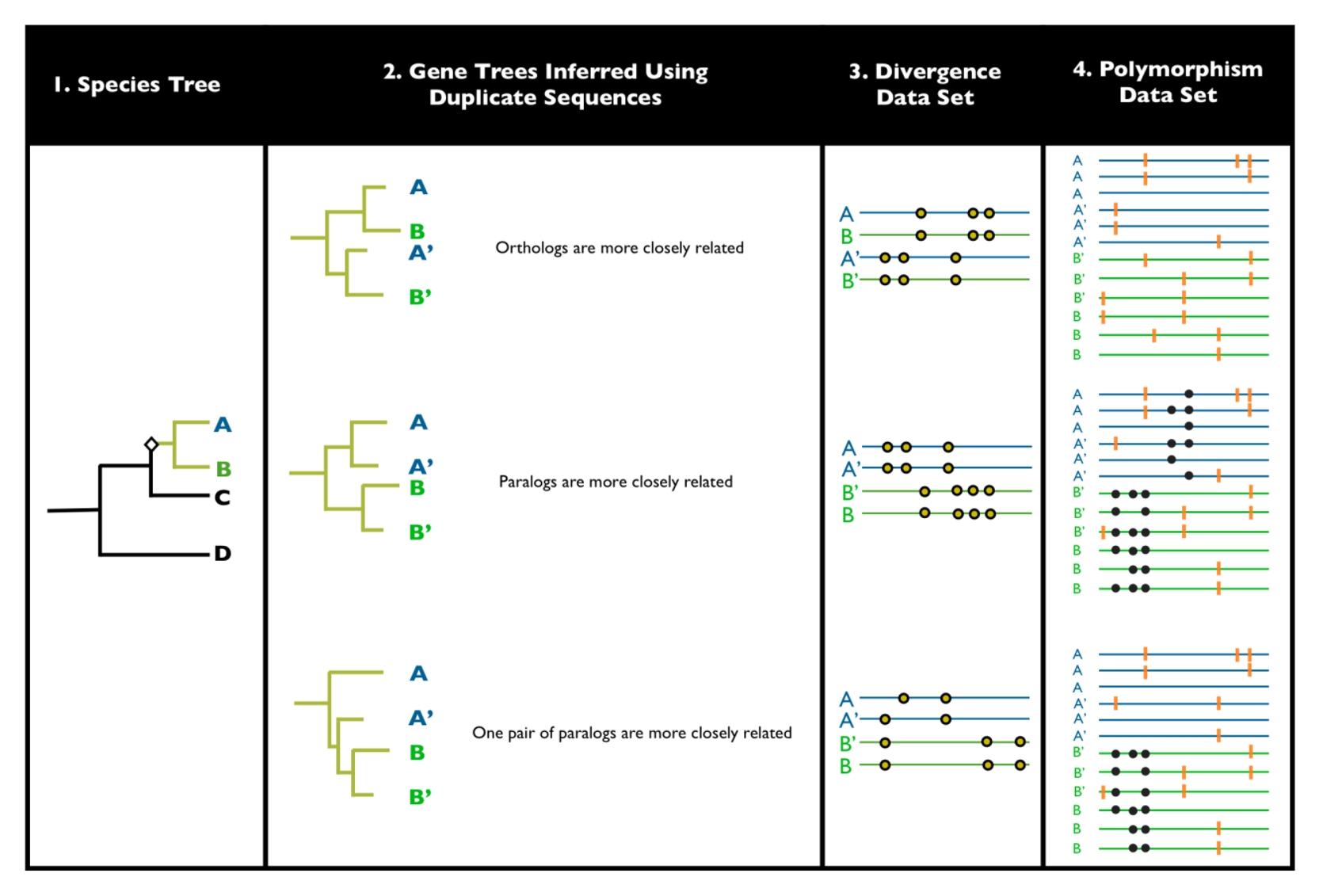
<p>Methods for detecting EGC have been developed for both divergence- (multi-species alignments of singly-sampled paralogs) and polymorphism-based sequence data sets (multiple alignments, per paralog, per population). Though the scope of this review does not include a detailed discussion of the methods used, it is helpful to introduce and highlight the most commonly used approaches for detecting EGC (<xref ref-type="fig" rid="f2-genes-02-00131">Figure 2</xref>). Throughout the paper, we also highlight some of their limitations, when these are directly applicable to interpreting the data.</p>
<p>Within the <italic>Drosophila</italic> literature, the two most cited divergence-based approaches utilize the GENCONV software package [<xref ref-type="bibr" rid="b20-genes-02-00131">20</xref>] or test for incongruities between a given species phylogeny and a gene tree that has been estimated from paralogous and orthologous DNA sequences from one or more of the same species represented in the phylogeny. GENCONV was originally designed to detect allelic conversion, but has subsequently been used to detect EGC. The software searches for stretches of sequence identity between duplicates (tracts) that extend further than would be expected by chance, given a model of independent evolution between the loci. Permutation tests are used to establish statistical significance [<xref ref-type="bibr" rid="b20-genes-02-00131">20</xref>].</p>
<p>Tests of incongruity between species trees and gene trees are based on the following logic. If phylogenetic information suggests that a given duplication event preceded speciation between two or more species, but DNA sequence data for paralogs within species demonstrate greater sequence identity than orthologs between species, then the datasets are identified as “irreconcilable”. In these cases, EGC can be invoked to explain the disagreement between phylogenetic dating of duplication events and the relative sequence identity between paralogs and orthologs (e.g., [<xref ref-type="bibr" rid="b21-genes-02-00131">21</xref>]). Such reasoning can be extended to gene trees constructed from different sub-regions of a duplicate sequence, where variation between sub-regions can be used to identify conversion tracts (e.g., [<xref ref-type="bibr" rid="b22-genes-02-00131">22</xref>]). Such tests between gene trees and species trees will subsequently be referred to as “reconciliation” methods.</p>
<p>A third divergence-based method is based on analysis of two types of nucleotide substitutions between paralogous and orthologous sequence alignments: 1) substitutions between orthologs that are shared between paralogs; and 2) substitutions between paralogs that are shared between orthologs. The former pattern supports a conversion model, while the latter is indicative of evolutionary independence between paralogs [<xref ref-type="bibr" rid="b22-genes-02-00131">22</xref>]. Through parsimony-based arguments, one can test a hypothesis of EGC by calculating the probability of observing the data for each substitution type, given a null model that permits multiple mutations but no conversion. We refer to this as the “site-specific” method.</p>
<p>The least widely used (but most powerful) method relies on polymorphism data within a species. Alignments of the set of paralogs can be used to identify shared polymorphism. Given a low point mutation rate (as expected), parallel mutations and shared polymorphism will be rare without EGC. The actual amount of shared polymorphism between paralogs can be used to identify recent conversion events, and to estimate the rate of conversion between the paralogs [<xref ref-type="bibr" rid="b23-genes-02-00131">23</xref>]. We refer to this approach as the “shared polymorphism” method.</p></sec>
<sec>
<label>3.</label>
<title>Historical Background to Ectopic Gene Conversion</title>
<sec>
<label>3.1.</label>
<title>Repetitive DNA and the Origin of Genome Size Variation</title>
<p>Current debates about EGC can be traced to earlier ones over concerted evolution from the mid 1960s to the 1970s. These debates, in turn, were intertwined with emerging interest in the evolution of genome size and the underlying importance of repetitive DNA.</p>
<p>The first empirical evidence for genome size plasticity traces back to the <italic>Bar</italic> locus duplication, discovered by members of the Morgan lab [<xref ref-type="bibr" rid="b24-genes-02-00131">24</xref>–<xref ref-type="bibr" rid="b25-genes-02-00131">25</xref>]. During the interval between the discovery of the <italic>Bar</italic> duplication and the first evidence of concerted evolution in 1972 [<xref ref-type="bibr" rid="b26-genes-02-00131">26</xref>], advances in microscopy, chromosomal labeling, and DNA and RNA hybridization and denaturation methods, revealed striking variability in genome size [<xref ref-type="bibr" rid="b27-genes-02-00131">27</xref>–<xref ref-type="bibr" rid="b28-genes-02-00131">28</xref>]. Along with these observations came speculation over the mutational and evolutionary mechanisms driving genome size differences. Modern models of unequal crossing over and replication error were hypothesized as the primary mechanisms generating genome content differences [<xref ref-type="bibr" rid="b24-genes-02-00131">24</xref>,<xref ref-type="bibr" rid="b29-genes-02-00131">29</xref>–<xref ref-type="bibr" rid="b32-genes-02-00131">32</xref>], while subsequently discredited models, such as variability in the number of strands comprising chromosomes, were also considered at the time [<xref ref-type="bibr" rid="b31-genes-02-00131">31</xref>,<xref ref-type="bibr" rid="b33-genes-02-00131">33</xref>]. In addition to uncertainty surrounding duplication mechanisms, cytogeneticists found that the existence of multiple gene copies presented a significant challenge to the way chromosomes were conceptualized [<xref ref-type="bibr" rid="b32-genes-02-00131">32</xref>].</p>
<p>From this earlier research on genomic content, the model most relevant to ectopic conversion is the master-slave model [<xref ref-type="bibr" rid="b31-genes-02-00131">31</xref>,<xref ref-type="bibr" rid="b34-genes-02-00131">34</xref>]. Working with the giant lampbrush chromosomes of female newts, Callan and Lloyd [<xref ref-type="bibr" rid="b34-genes-02-00131">34</xref>] measured chromosome loop sizes within and between two subspecies. They argued that recombination took place within them, and that the loop morphologies were genetically determined and followed Mendelian segregation. They reasoned that the content of each loop was comprised of a series of identical, repetitive DNA units [<xref ref-type="bibr" rid="b31-genes-02-00131">31</xref>]. Such an observation was relevant to genome size differences, as variability in repeat copy number could contribute to the variation [<xref ref-type="bibr" rid="b34-genes-02-00131">34</xref>]. That a large number of functionally important repetitive units represented a large mutational target did not go unnoticed, and the master-slave model was introduced to explain how sequence identity between repeats could be maintained in the face of mutation [<xref ref-type="bibr" rid="b31-genes-02-00131">31</xref>,<xref ref-type="bibr" rid="b34-genes-02-00131">34</xref>]. As a predecessor to current models of (biased) EGC, this early model invoked a single “master” and a series of “slave” copies within each repeat family. Following meiotic recombination, each slave copy would pair with the master and become homogenized exclusively in the master-to-slave direction. Thus, all mutations accumulating in slave copies would be “rectified” to their ancestral state (master copies were assumed to be largely protected from mutation accumulation).</p>
<p>Later modifications to the “rectifying” model attest to its appeal during this time. For example, the original master–slave model assumed that each master gene was separated by intervals comprised of repetitive slave copies, yet subsequent data indicated that unique genes (rather than copies) were likely to be physically linked [<xref ref-type="bibr" rid="b32-genes-02-00131">32</xref>]. Thus, the “Cycloid Model” (in response to the emerging linkage data) proposed that a loop of slave genes became detached from the main chromatid prior to a cross over, and these genes were subsequently reinserted following homogenization with the master (for additional master–slave based physical models see [<xref ref-type="bibr" rid="b35-genes-02-00131">35</xref>]). Around the same time, Edelman and Gally [<xref ref-type="bibr" rid="b36-genes-02-00131">36</xref>–<xref ref-type="bibr" rid="b37-genes-02-00131">37</xref>] proposed a “democratic” gene conversion model, which invoked symmetrical exchanges (non-biased, as in the master–slave) between repeated genes. The democratic model forwarded arguments that selection could act more efficiently when a beneficial mutation arising on any gene copy was free to spread throughout the gene family.</p>
<p>By the start of the 1970s, much emphasis had been placed on understanding the origins and implications of repetitive DNA, which raised questions about the evolutionary maintenance of repeats, conversion biases, interactions between selection and conversion, and the importance of chromosomal context in mediating concerted evolution. These questions remain important today.</p></sec>
<sec>
<label>3.2.</label>
<title>Concerted Evolution, rDNA, and Drosophila</title>
<p>To improve understanding of the evolutionary dynamics of repetitive DNA, the pre-molecular biology world needed a more tractable model system. rDNA was well suited for this role [<xref ref-type="bibr" rid="b38-genes-02-00131">38</xref>,<xref ref-type="bibr" rid="b39-genes-02-00131">39</xref>], and served as an early model for duplication and conversion in <italic>Drosophila</italic>.</p>
<p>The abundant transcriptional products of rDNA loci, together with hybridization and denaturation methods of the time, provided an opportunity to estimate copy number differences and sequence divergence of repetitive units within and between species. Detailed evolutionary studies of rDNA arrays across diverse taxa gained momentum starting in the mid 1960s [<xref ref-type="bibr" rid="b28-genes-02-00131">28</xref>]. Most notable is that of Brown <italic>et al.</italic> [<xref ref-type="bibr" rid="b26-genes-02-00131">26</xref>], which provided the first example of concerted evolution, using closely related <italic>Xenopus</italic> species. They showed that individual rDNA array units exhibited very high sequence identity within compared to between species. This suggested that a “correction mechanism” between repeats resulted in “horizontal evolution” within species. Though Brown <italic>et al.</italic> [<xref ref-type="bibr" rid="b26-genes-02-00131">26</xref>] did not initially refer to this observation as “concerted evolution”, the pattern has subsequently been referred to as such.</p>
<p>With evolutionary models for repetitive DNA already developed, the field was situated to integrate empirical patterns of concerted evolution. One explanation for the pattern invoked the already popular model of unequal crossing over. High rates of unequal crossing over could permit the stochastic spread of identical copies throughout a given array, leading to a pattern of high sequence identity between individual copies. The alternative explanation harkened back to models of homogenization between duplicates, such as the master–slave model. Though not conclusive, initial support for unequal crossing over was provided by <italic>Xenopus</italic> DNA data [<xref ref-type="bibr" rid="b26-genes-02-00131">26</xref>,<xref ref-type="bibr" rid="b40-genes-02-00131">40</xref>], and was reinforced by mathematical theory [<xref ref-type="bibr" rid="b41-genes-02-00131">41</xref>,<xref ref-type="bibr" rid="b42-genes-02-00131">42</xref>].</p>
<p>It had already been established that <italic>Drosophila</italic> had large rDNA arrays on both the X and Y chromosome. A role for unequal crossing over during the evolution of these arrays had been suggested from studies of the <italic>bobbed</italic> mutant, which was associated with deficiencies of X-linked rDNA genes [<xref ref-type="bibr" rid="b43-genes-02-00131">43</xref>]. Subsequent genetic analysis of the <italic>bobbed</italic> phenotype led to the discovery of “DNA magnification”, where male germlines deficient for both X- and Y-linked rDNA could revert to the wild-type rDNA gene number [<xref ref-type="bibr" rid="b39-genes-02-00131">39</xref>,<xref ref-type="bibr" rid="b44-genes-02-00131">44</xref>–<xref ref-type="bibr" rid="b46-genes-02-00131">46</xref>]. Though Ritossa [<xref ref-type="bibr" rid="b44-genes-02-00131">44</xref>] argued against the role of unequal crossing over in DNA magnification, subsequent work provided evidence that it occurred through unequal crossing over between sister chromatids during meiosis [<xref ref-type="bibr" rid="b47-genes-02-00131">47</xref>]. In addition to strain-specific (or germline) gains and losses of rDNA genes, signals of concerted evolution were also uncovered in rDNA arrays. This was first documented through comparative studies within the <italic>D. melanogaster</italic> species subgroup and <italic>D. hydei</italic> [<xref ref-type="bibr" rid="b48-genes-02-00131">48</xref>,<xref ref-type="bibr" rid="b49-genes-02-00131">49</xref>]. These studies provided two important insights. First, repeat units on nonhomologous chromosomes were shown to be capable of concerted evolution. Second, and in contrast to <italic>Xenopus</italic>, high sequence identity between repeats was found for the nontranscribed regions (it was later shown that homogenization of nontranscribed regions did not persist between distantly related <italic>D. hydei</italic> and <italic>D. melanogaster</italic>; [<xref ref-type="bibr" rid="b49-genes-02-00131">49</xref>]).</p>
<p>Following these early rDNA studies, patterns of concerted evolution have consistently been reported for this gene family [<xref ref-type="bibr" rid="b50-genes-02-00131">50</xref>]. While unequal crossing over and purifying selection were both thought to contribute to the homogenization of array units [<xref ref-type="bibr" rid="b51-genes-02-00131">51</xref>–<xref ref-type="bibr" rid="b53-genes-02-00131">53</xref>], there is currently less convincing evidence regarding a role for EGC [<xref ref-type="bibr" rid="b53-genes-02-00131">53</xref>].</p></sec></sec>
<sec>
<label>4.</label>
<title>Distinguishing Ectopic Gene Conversion and Gene Turnover as Drivers of Concerted Evolution in <italic>Drosophila</italic></title>
<p>Debates over the role of EGC in generating patterns of concerted evolution in <italic>Drosophila</italic> have persisted to the present. The current form of the debate is strikingly similar to what one finds in the early concerted evolution literature, where competing hypotheses included homogenizing and “expansion-contraction” processes. Today, the debate is often framed as a contrast between EGC and “birth-and-death” models [<xref ref-type="bibr" rid="b54-genes-02-00131">54</xref>,<xref ref-type="bibr" rid="b55-genes-02-00131">55</xref>]. The birth-and-death model invokes the continuous generation of duplicate genes, with the rate of origin balanced by a steady rate of gene loss by pseudogenization or deletion. Assuming that duplicates rarely evolve novel functions (for which individual gene copies might be maintained by selection), then gene copy turnover will cause young duplicates to gradually replace older copies, in a process analogous to the neutral theory of molecular evolution (e.g., steady, clock-like replacement of older alleles with younger, neutral substitutions). Birth-and-death is expected to be most common in multigene families with members exhibiting variable degrees of divergence, relatively high sequence identity within gene families, and pseudogenes [<xref ref-type="bibr" rid="b55-genes-02-00131">55</xref>]. Though the name of the model is relatively recent, it is conceptually similar to concepts developed during the 1960s and 1970s (see above).</p>
<sec>
<label>4.1.</label>
<title>Ectopic Conversion from a Case Studies Perspective</title>
<p>There is little doubt that gene turnover and EGC both occur in <italic>Drosophila</italic>, and their relative contributions to patterns of concerted evolution are expected to vary on a case-by-case basis, as we describe below. Because of their idiosyncrasies, case studies have limited ability to address genome-wide frequencies of EGC and gene turnover. As such, we consider specific properties of gene families that make them susceptible to processes of EGC and turnover, and outline some experiments that will be necessary to better resolve the issue.</p>
<sec>
<title>Heat Shock Proteins (HSP)</title>
<p>As an ancient and evolutionarily conserved gene family, HSPs are good <italic>a priori</italic> candidates for sustained EGC over relatively long timescales (paralogs are expected to have high sequence similarity due to concordant purifying selection). In the <italic>D. melanogaster</italic> species group, there are two pairs of HSP genes (<italic>Hsp70Aa/Hsp70Ab</italic> and <italic>Hsp70Ba/Hsp70Bb</italic>), with each pair tightly linked in a “palindromic” (<italic>i.e.</italic>, mirror image) orientation on the Muller E chromosome (chromosome 3R <italic>of D. melanogaster</italic>). This type of orientation has an interesting property with respect to ectopic recombination. A double-strand break in one of the paralogs can become resolved by gene conversion (resulting in sequence homogenization; e.g., <xref ref-type="fig" rid="f1-genes-02-00131">Figure 1</xref>), or by crossing over, which can generate deleterious chromosomal abnormalities (inversions, and large-scale duplications and deletions [<xref ref-type="bibr" rid="b16-genes-02-00131">16</xref>]). Deleterious haplotypes caused by ectopic crossovers should contribute marginally to evolution, whereas conversion resolution of double-strand breaks will contribute to concerted evolution [<xref ref-type="bibr" rid="b16-genes-02-00131">16</xref>]. Thus, a palindromic orientation may minimize the generation of copy number polymorphism and evolution under a birth/death process. Two lines of evidence support ongoing conversion within each paralog cluster of HSPs. First, despite the relatively ancient origin of duplicate pairs (each precedes species divergence), paralogs within each species have higher sequence identity than ortholog pairs between species, consistent with ongoing EGC within the Drosophila lineages [<xref ref-type="bibr" rid="b21-genes-02-00131">21</xref>]. Second, paralogs share silent polymorphisms, indicating recent conversion events [<xref ref-type="bibr" rid="b56-genes-02-00131">56</xref>]. Recent work [<xref ref-type="bibr" rid="b57-genes-02-00131">57</xref>] also reports concerted evolution between a young set of rapidly evolving Hsp70 cofactor paralogs: <italic>Hsc/Hsp70-interacting protein</italic> (<italic>HIP</italic>). <italic>HIP</italic>/<italic>HIP-R</italic> genes are X-linked, non-inverted duplicates that are confined to the <italic>D. melanogaster</italic> lineage. Like HSP genes, extensive shared polymorphisms indicate that these cofactor duplicates are undergoing conversion.</p></sec>
<sec>
<title>Amylase</title>
<p>Another classic study system for <italic>Drosophila</italic> EGC is the amylase gene clusters. The <italic>D. melanogaster</italic> species group includes a conserved set of linked paralogs (<italic>Amy-p</italic> and <italic>Amy-d</italic>) in palindromic orientation (similar to <italic>Hsp70</italic> genes). Early work based on restriction site analysis [<xref ref-type="bibr" rid="b58-genes-02-00131">58</xref>] showed the widespread sharing of substitutions between paralogs. Inference of EGC was reinforced by subsequent, sequence-based analysis, which showed high intraspecific sequence identity between paralogs relative to divergence between orthologs [<xref ref-type="bibr" rid="b59-genes-02-00131">59</xref>,<xref ref-type="bibr" rid="b60-genes-02-00131">60</xref>], with the pattern of concerted evolution confined to coding sequence (flanking regions appear to evolve independently; [<xref ref-type="bibr" rid="b61-genes-02-00131">61</xref>,<xref ref-type="bibr" rid="b62-genes-02-00131">62</xref>]).</p>
<p>Subsequent work was extended to species outside of the melanogaster group, which carried an amylase cluster orthologous to <italic>D. melanogaster</italic>, and one or more additional clusters [<xref ref-type="bibr" rid="b63-genes-02-00131">63</xref>]. Concerted evolution between amylase paralogs within <italic>D. pseudoobscura</italic> inversion karyotypes were once again limited to coding regions [<xref ref-type="bibr" rid="b64-genes-02-00131">64</xref>,<xref ref-type="bibr" rid="b65-genes-02-00131">65</xref>]. <italic>Drosophila kikkawai</italic> and close relatives have two highly-divergent clusters of linked, palindromic amylase genes (<italic>Amy1</italic>/<italic>Amy2</italic> and <italic>Amy3</italic>/<italic>Amy4</italic>), with each cluster showing high sequence identity [<xref ref-type="bibr" rid="b66-genes-02-00131">66</xref>]. Homogeneous coding and noncoding sequence between <italic>Amy3</italic>/<italic>Amy4</italic> may indicate EGC or a duplication event. The <italic>Amy1</italic>/<italic>Amy2</italic> pair, which appears to be orthologous to the <italic>melanogaster</italic> cluster, shows evidence of coding (but no noncoding) concerted evolution, which supports a model of continuous EGC [<xref ref-type="bibr" rid="b67-genes-02-00131">67</xref>,<xref ref-type="bibr" rid="b68-genes-02-00131">68</xref>].</p>
<p>In many ways, these classical studies are representative of the case study approach to concerted evolution. Evidence for EGC is typically associated with the analysis of small gene families that are physically linked and/or evolving under purifying selection (e.g., larval cuticle protein cluster genes [<xref ref-type="bibr" rid="b69-genes-02-00131">69</xref>]; <italic>Idgf</italic> genes [<xref ref-type="bibr" rid="b70-genes-02-00131">70</xref>]; esterases [<xref ref-type="bibr" rid="b71-genes-02-00131">71</xref>,<xref ref-type="bibr" rid="b72-genes-02-00131">72</xref>]; histones [<xref ref-type="bibr" rid="b73-genes-02-00131">73</xref>]; HSP and amylase genes (see above)). High sequence similarity due to recent origin or sustained purifying selection, and tight linkage between paralogs, is expected to maximize opportunities for EGC. While neutral divergence at synonymous sites is certainly possible, purifying selection across a majority of coding sequence (nonsynonymous sites), coupled with relatively moderate levels of EGC can easily overwhelm divergence by genetic drift. It may therefore be unsurprising that these case studies provide the best evidence for ongoing EGC.</p>
<p>This is not to suggest that these criteria are necessary for EGC. Immunity and reproductive-related genes are expected to have elevated opportunities for diversification (their sequences often exhibit modest to low constraint; [<xref ref-type="bibr" rid="b6-genes-02-00131">6</xref>]), yet these types of genes exhibit clear patterns of EGC [<xref ref-type="bibr" rid="b74-genes-02-00131">74</xref>,<xref ref-type="bibr" rid="b75-genes-02-00131">75</xref>]. While analysis of linked <italic>versus</italic> dispersed loci supports the prediction that EGC rates are negatively correlated with the physical distance between paralogs [<xref ref-type="bibr" rid="b76-genes-02-00131">76</xref>–<xref ref-type="bibr" rid="b78-genes-02-00131">78</xref>], polymorphism-based data suggests that inter-chromosome interactions can persist between paralogs despite their distance and in the face of differential positive selection between paralogs [<xref ref-type="bibr" rid="b79-genes-02-00131">79</xref>].</p>
<p>On the other hand, a focus on small gene families will likely minimize the effect of gene turnover. Larger gene families are expected to be more permissive to the fixation of duplicates relative to smaller gene families because their sensitivity to deleterious dosage effects might be relatively low and their rate of copy number mutations might be relatively high. Consequently, the importance of birth/death gene turnover will likely be greatest for large gene families. Though EGC is expected to occur in such cases, disentangling EGC and gene turnover requires information about the age of individual members of a gene family, and polymorphism data to estimate the rate of EGC. Such data sets are difficult to obtain for large, repetitive gene clusters where individual copies cannot easily be distinguished [<xref ref-type="bibr" rid="b80-genes-02-00131">80</xref>,<xref ref-type="bibr" rid="b81-genes-02-00131">81</xref>].</p></sec></sec>
<sec>
<label>4.2.</label>
<title>Ectopic Gene Conversion from a Genome-Wide Perspective</title>
<p>It is currently unclear how prevalent EGC is at a genomic scale. To date, there have only been three genome-wide studies that directly addressed this question in <italic>Drosophila</italic>. These studies utilize different methodologies, yield different results, and emphasize EGC between gene families of different ages and degrees of sequence divergence. The perspectives of these studies seemingly reflect different evolutionary questions regarding the interplay between duplication and EGC. One perspective is geared towards understanding how EGC might govern the evolutionary fates of young duplicates. The other emphasizes broad patterns of EGC and is less concerned with the relative age or size of the gene families. Despite their differences, these studies utilize partially overlapping distributions of gene family ages, and it is within this region of overlap where some of the more puzzling differences emerge.</p>
<p>Analysis of the long-term effects of EGC was carried out by Hahn <italic>et al.</italic> [<xref ref-type="bibr" rid="b82-genes-02-00131">82</xref>] and Casola <italic>et al.</italic> [<xref ref-type="bibr" rid="b83-genes-02-00131">83</xref>], using genomic sequence from multiple <italic>Drosophila</italic> species ([<xref ref-type="bibr" rid="b84-genes-02-00131">84</xref>]; Hahn <italic>et al.</italic> analyzed gene families from 12 species' genomes; Casola <italic>et al.</italic> analyzed previously defined paralog pairs from 9 of 12 genomes). Hahn <italic>et al.</italic> applied maximum likelihood methods to infer rates of gene gain and loss along each branch of the species tree and then compared these results with those from a gene-tree/species-tree reconciliation analysis. If EGC has played a major role genome-wide, they expected that their reconciliation methods would infer multiple, parallel duplications across lineage. They estimated that approximately 17 genes were gained or lost every million years, with few signatures of EGC inferred by reconciliation analysis. The authors concluded that EGC leaves, at most, a minor genomic signature.</p>
<p>Casola <italic>et al.</italic> used GENCONV to estimate the proportion of genes in each species with evidence for EGC, and to assess whether different species exhibited different EGC rates. Relatively low estimates of EGC were inferred, with the proportion of converted paralog pairs ranging between 7.47% (in <italic>D. melanogaster</italic>) and 14.15% (in <italic>D. grimshawi</italic>). Peak conversion activity was observed for paralogs with silent divergence between d<italic>S</italic> = 0.1 and d<italic>S</italic> = 0.3. Phylogenetic reconciliation methods were also consistent with low amounts of EGC, with 1% to 3% of gene trees within the <italic>D. melanogster</italic> subgroup, and up to 15% of gene trees within deeper branches of the <italic>Drosophila</italic> tree, showing signs of EGC. The authors concluded that EGC was relevant for relatively young duplicates having silent divergence ranging between 0.1 and 0.3. Casola <italic>et al.</italic> also reapplied the likelihood-reconciliation methods used by Hahn <italic>et al.</italic> [<xref ref-type="bibr" rid="b84-genes-02-00131">84</xref>], and again found little support for EGC.</p>
<p>Osada and Innan [<xref ref-type="bibr" rid="b22-genes-02-00131">22</xref>] focused on the potential role of EGC during early duplicate evolution, and found widespread evidence for it. They restricted their analysis to duplication blocks within the sequenced genomes of <italic>D. melanogaster</italic>, <italic>D. simulans</italic>, <italic>D. sechellia</italic>, <italic>D. yakuba</italic>, and <italic>D. erecta</italic>, to identify duplication events immediately prior to or following divergence between <italic>D. melanogaster</italic>, <italic>D. simulans</italic>, and <italic>D. sechellia</italic>. The motivation of this approach was based on the expectation that EGC should be more active and more easily estimated in young gene families. EGC was estimated with reconciliation (tree-based) methods (carried out using entire duplicated regions and also using a sliding window analysis to test for variation across the sequence), and site-specific tests (see above). Of 28 post-speciation blocks available for the tree-based analysis, 24 provided evidence of EGC in the <italic>D. melanogaster</italic> lineage, the <italic>D. simulans</italic> lineage, or in both. The sliding window approach identified at least one signature of EGC in every block. Likewise, the site-based test identified a signal of EGC in 29/30 pre-speciation blocks.</p>
<p>Discordant estimates of EGC between these studies are likely to stem from multiple causes. In addition to their different criteria of duplicate selection, Casola <italic>et al.</italic> note that additional differences might result from the failure of Osada and Innan to account for parallel duplications between species (rapid birth-and-death rate), which potentially generate gene trees mimicking those predicted under a conversion model. They highlight estimates of high copy number variation (CNVs; [<xref ref-type="bibr" rid="b85-genes-02-00131">85</xref>]) as supporting this possibility. Additional methodological differences between the studies might also account for their results. A recent simulation-based study examined the performance of four commonly used methods for identifying EGC: reconciliation methods using paralog and otholog gene trees, sliding-window gene tree contrasts along duplicate sequences, GENCONV, and tests based on shared polymorphism [<xref ref-type="bibr" rid="b86-genes-02-00131">86</xref>]. The authors observed that the statistical power of reconciliation and shared polymorphism methods were positively correlated with the true rate of EGC, while the other two methods decreased in power with increased EGC rate. The detection range for GENCONV was limited to intermediate levels of divergence, likely leading to a net underestimate of EGC among Casola <italic>et al.</italic>' entire set of paralogs. The implementation of reconciliation methods also varied between studies, and while the performance of the approach taken by Osada and Innan was examined by Mansi and Innan [<xref ref-type="bibr" rid="b86-genes-02-00131">86</xref>], no comparison has been made between it and the particular approach of Casola <italic>et al.</italic></p>
<p>Recent genome-wide estimates of CNV show that they are pervasive ([<xref ref-type="bibr" rid="b85-genes-02-00131">85</xref>,<xref ref-type="bibr" rid="b87-genes-02-00131">87</xref>,<xref ref-type="bibr" rid="b88-genes-02-00131">88</xref>]; in agreement with inferences based on comparative genomic studies: e.g., [<xref ref-type="bibr" rid="b89-genes-02-00131">89</xref>,<xref ref-type="bibr" rid="b90-genes-02-00131">90</xref>]). As Casola <italic>et al.</italic> note, these data suggest a high copy number mutation rate, which may drive a high rate of birth-and-death evolution. Because studies of concerted evolution deal primarily with intact full-length genes, the number of complete-gene CNVs is of particular interest. Emerson <italic>et al.</italic> ([<xref ref-type="bibr" rid="b85-genes-02-00131">85</xref>]; after correcting for false positive and false negative rates) discovered 73 polymorphic duplications and 10 deletions encompassing complete genes. While this represents a minority of their dataset, it can potentially contribute to an overestimate of the rate of EGC for some gene families. Arguing against this, the paralogous alignments in Osada and Innan exhibit degrees of nucleotide divergence (often in the flanking edges) that is too high to be consistent with segregating CNVs. In addition, only two of Osada and Innan's post-speciation duplicates were found to be CNVs in Emerson <italic>et al.</italic>' data set [<xref ref-type="bibr" rid="b22-genes-02-00131">22</xref>]. For pre-speciation CNVs, a birth-and-death interpretation would require parallel duplications between species that share the same (or very similar) breakpoints. Currently available CNV data in flies is insufficient to examine this possibility. However if parallel duplications have occurred between closely related species (evolutionarily young parallel duplicates), shared breakpoints should be detectable. To our knowledge, no such examples have been reported. Nevertheless, the amount of parallel duplications required to account for the disparate results of Osada and Innan [<xref ref-type="bibr" rid="b22-genes-02-00131">22</xref>] and Casola <italic>et al.</italic> [<xref ref-type="bibr" rid="b83-genes-02-00131">83</xref>] would likely have to be substantial.</p></sec></sec>
<sec>
<label>5.</label>
<title>The Genomic Context of Duplication and Ectopic Gene Conversion</title>
<p>A complete appreciation of EGC will require a deeper understanding of the genomic context in which it is most and least likely to occur, including simple factors such as DNA base composition (e.g., GC content) as well as complex factors, such as the three-dimensional conformation of chromosomes [<xref ref-type="bibr" rid="b91-genes-02-00131">91</xref>]. While there has been some effort to elucidate genomic features affecting EGC in <italic>Drosophila</italic>, there are currently <italic>more</italic> unresolved questions than answers.</p>
<p>The growing availability of genomic data has shed some light on features correlated with EGC. One tractable question is how the physical distance between duplicates correlates with EGC. Several studies indicate a negative correlation between physical distance and conversion between paralogs (data are based on case studies from <italic>D. melanogaster</italic> and more distantly related species: e.g., [<xref ref-type="bibr" rid="b75-genes-02-00131">75</xref>,<xref ref-type="bibr" rid="b78-genes-02-00131">78</xref>,<xref ref-type="bibr" rid="b92-genes-02-00131">92</xref>]). This pattern appears to hold for gene families dispersed across chromosomes, with paralog pairs on the same chromosome arm exhibiting stronger signals of conversion than pairs between chromosome arms [<xref ref-type="bibr" rid="b83-genes-02-00131">83</xref>]. This relationship between physical distance and EGC makes intuitive sense given the double-strand break model of gene conversion: following DSB in one duplicate copy, the initiation of a nonhomologous DNA repair pathway via the other paralog is more likely if the pair is in close proximity. Nevertheless, it is unclear whether the physical location in terms of a linear chromosomal map corresponds to actual “conversion proximity” in the context of a three-dimensional nucleus. Available analyses support the idea that chromosomal proximity facilitates EGC. However, this conclusion is tentative, given the typically conservative methods used to detect EGC (e.g., based on inter-paralog divergence data rather than more powerful polymorphism-based estimates) and the heterogeneous set of paralogs used in these studies (e.g., case studies and/or collections of duplicates of variable age).</p>
<p>Another question is whether EGC is biased. To date, there is no compelling evidence for this, yet the subject warrants future study. GC-biased conversion is often observed in cases of allelic (non-ectopic) conversion in mammals [<xref ref-type="bibr" rid="b93-genes-02-00131">93</xref>]. GC content in <italic>Drosophila</italic> duplicates is generally higher within conversion tracts relative to sequences that flank each tract, which suggests that the underlying conditions favoring conversion biases may commonly be present in paralogs [<xref ref-type="bibr" rid="b83-genes-02-00131">83</xref>]. Interestingly, when converted paralogs were compared with noncoverted paralogs belonging to the same family, GC content was not higher within converted relative to uncoverted regions. These patterns suggest that nucleotide composition might promote EGC rather than biasing the direction of conversion toward GC nucleotides [<xref ref-type="bibr" rid="b83-genes-02-00131">83</xref>].</p></sec>
<sec>
<label>6.</label>
<title>Interaction between Selection, Ectopic Gene Conversion and Evolutionary Divergence between Paralogs</title>
<p>The interaction between EGC and natural selection is central to interpretations of concerted evolution patterns, as well as inferences about the rate of ongoing EGC. The likelihood of conversion between non-allelic sequences is, in part, a function of their degree of sequence identity. For gene family members evolving under strong purifying selection, relatively high sequence identity is expected in the absence of EGC. EGC will further reduce divergence between paralogs by homogenizing (putatively) neutrally evolving synonymous sites, introns and intergenic DNA, and by promoting parallel adaptation in functionally relevant sites (e.g., nonsynonymous or regulatory DNA). For example, the interaction between EGC and natural selection may prevent the accumulation of deleterious mutations [<xref ref-type="bibr" rid="b81-genes-02-00131">81</xref>,<xref ref-type="bibr" rid="b94-genes-02-00131">94</xref>–<xref ref-type="bibr" rid="b96-genes-02-00131">96</xref>], or facilitate the spread of new beneficial alleles among gene family members [<xref ref-type="bibr" rid="b97-genes-02-00131">97</xref>].</p>
<p>While EGC can promote adaptation among functionally redundant genes, it may also constrain adaptive differentiation between paralogs—a process that might impact the evolution of new gene functions [<xref ref-type="bibr" rid="b17-genes-02-00131">17</xref>,<xref ref-type="bibr" rid="b98-genes-02-00131">98</xref>–<xref ref-type="bibr" rid="b100-genes-02-00131">100</xref>]. The homogenizing effect of EGC is expected to limit opportunities for “neo-functionalization”—the evolution of novel functions among young duplicates [<xref ref-type="bibr" rid="b18-genes-02-00131">18</xref>,<xref ref-type="bibr" rid="b23-genes-02-00131">23</xref>,<xref ref-type="bibr" rid="b101-genes-02-00131">101</xref>–<xref ref-type="bibr" rid="b103-genes-02-00131">103</xref>].</p>
<p>Some evidence from <italic>Drosophila</italic> supports both reinforcing and antagonistic interactions between selection and EGC. Positive selection between paralogs has been observed in several general contexts [<xref ref-type="bibr" rid="b76-genes-02-00131">76</xref>,<xref ref-type="bibr" rid="b104-genes-02-00131">104</xref>,<xref ref-type="bibr" rid="b105-genes-02-00131">105</xref>]. Some instances of positive selection also apply to gene families that are simultaneously experiencing EGC [<xref ref-type="bibr" rid="b22-genes-02-00131">22</xref>,<xref ref-type="bibr" rid="b75-genes-02-00131">75</xref>,<xref ref-type="bibr" rid="b79-genes-02-00131">79</xref>]. These latter studies suggest that EGC and selection occasionally come into conflict with one another. For example, if EGC and selection occurred simultaneously, the observed molecular signatures of adaptation indicate that selection was strong enough to counteract the process of homogenization. On the other hand, evidence that EGC overwhelms disruptive selection is unlikely to be detected on a case-by-case basis, because paralog homogeneity will be consistent with both strong EGC relative to selection, or with a lack of disruptive selection.</p>
<p>Conflict between EGC and disruptive selection might potentially be examined by comparing patterns of divergence between paralog pairs experiencing markedly different rates of EGC. For example, if paralogs on different chromosomes experience reduced EGC compared to closely linked paralogs (as appears likely in <italic>Drosophila:</italic> e.g., [<xref ref-type="bibr" rid="b78-genes-02-00131">78</xref>,<xref ref-type="bibr" rid="b83-genes-02-00131">83</xref>,<xref ref-type="bibr" rid="b92-genes-02-00131">92</xref>,<xref ref-type="bibr" rid="b105-genes-02-00131">105</xref>]; but see [<xref ref-type="bibr" rid="b79-genes-02-00131">79</xref>]), one might systematically test for signatures of positive selection between duplicates within <italic>versus</italic> between chromosomes. Thornton &amp; Long [<xref ref-type="bibr" rid="b104-genes-02-00131">104</xref>] compared inter- and intra-chromosomal paralog divergence throughout the <italic>D. melanogaster</italic> genome, and found a pattern of increased divergence (Ka/Ks) when both duplicates resided on the X chromosome, but otherwise no consistent effect of intra- <italic>vs.</italic> inter-chromosome paralog orientation. To the extent that amino acid divergence has been driven by positive selection, the pattern does not indicate any constraint imposed by EGC.</p>
<p>There are two important caveats associated with such contrasts between linked and unlinked duplicates. First, any constraint imposed by EGC is expected to primarily occur during the early evolutionary divergence of paralogs, yet most duplicate genes are relatively ancient. Even if EGC provided constraint during the early evolution of duplicates, its signature will often be erased by sequence divergence subsequent to the cessation of EGC. Furthermore, retention of ancient duplicate genes might imply that they have evolved an important biological function, for which they are maintained. Ancient duplicates may therefore be enriched for genes that have “overcome” the effect of EGC to evolve non-redundant functions (e.g., neo- or sub-functionalization); these ancient duplication events may represent a filtered (and therefore biased) set of duplicates. Osada and Innan [<xref ref-type="bibr" rid="b22-genes-02-00131">22</xref>] have emphasized the utility of using young gene duplicates to study the relative roles of EGC and selection during the early, “fate-determining” stage of paralog evolution. In their dataset of young duplication events, they observed widespread signatures of EGC, including an apparent case of adaptive paralog differentiation in the face of concerted evolution. Analysis of young duplications represents a powerful means to address the potential conflict between selection and EGC. Deep resequencing efforts that are currently underway in <italic>D. melanogaster</italic> should enhance statistical power to identify and estimate the rate of EGC, particularly in small gene families or other low-copy repeat sequences. Polymorphism data will also permit discrimination between evolutionary models of genetic drift and positive selection (this latter goal may require an extension of MK-based statistical tests of positive selection, which currently apply to independently evolving orthologs [<xref ref-type="bibr" rid="b106-genes-02-00131">106</xref>,<xref ref-type="bibr" rid="b107-genes-02-00131">107</xref>], rather than gene families undergoing some degree of EGC).</p>
<p>The second caveat concerns the potential relationship between selection and degree of dispersion between duplicates. While a negative relationship between EGC rate and distance is expected (see above), it is also possible that disruptive selection between duplicates might also covary with distance. If, for example, unlinked paralogs are exposed to different local chromatin states, or are influenced by distinct local promoter sequences, then the opportunity for disruptive selection might increase with greater dispersion between paralogs. Creative statistical and bioinformatic approaches will be required to control for possible spurious correlations between distance and adaptive differentiation.</p></sec>
<sec>
<label>7.</label>
<title>Temporal Dynamics of Duplication and Paralog Divergence</title>
<p>EGC can influence both the temporal patterns of duplicate gene evolution, and interpretations of these patterns within the context of evolutionary theory. The inference of selection and genetic drift from empirical properties of duplicate genes (<italic>i.e.</italic>, their ages and the distribution of inter-paralog divergence) will critically depend on whether or not EGC occurs between paralogs, as well as the long-term covariance between selection, EGC, and paralog divergence. Our understanding of the actual dynamics of EGC can have a major impact on our interpretation of: (1) the rates of duplicate birth and death, and the age distribution of duplicate genes and (2) the temporal patterns of selection during the course of duplicate evolution.</p>
<p>The inferred rate of gene duplication is sensitive to assumptions about the degree of evolutionary independence between paralogs. Without EGC, neutral sequence divergence between duplications (e.g., the number of synonymous site differences, or d<italic>S</italic>, between them) should be clock-like, and proportional to the relative age of the duplication event. EGC will downwardly bias the distribution of d<italic>S</italic>, and lead to an overestimation of the duplicate “birth” and “death” rates (high rates of origin and loss will also skew the age distribution toward young duplicates). However, since birth-and-death and EGC rates are largely unknown, the distribution of d<italic>S</italic> is insufficient for inferring the evolutionary rate and maintenance of gene duplicates. Exploiting genome sequence data from closely related species can circumvent this methodological limitation. Osada and Innan's [<xref ref-type="bibr" rid="b22-genes-02-00131">22</xref>] identification of 31 young duplications since the <italic>D. melanogaster/D. simulans</italic> last common ancestor (about 2.3 million years ago) suggests a duplication rate of approximately 10<sup>−9</sup>, per gene, per year, which is approximately ten-fold lower than earlier estimates based entirely on d<italic>S</italic>. Given the relatively short time interval separating these species (and small number of duplication events), this estimate may differ from the true duplication rate in Drosophila, yet it should characterize the rate to an order of magnitude.</p>
<p>Another common observation is a negative relationship between the ratio of nonsynonymous to synonymous divergence between paralogs (<italic>i.e.</italic>, d<italic>N</italic>/d<italic>S</italic>) and the silent substitution rate (d<italic>S;</italic> [<xref ref-type="bibr" rid="b108-genes-02-00131">108</xref>]). d<italic>N</italic>/d<italic>S</italic> is often used as a metric of evolutionary constraint, with values close to zero associated with strong purifying selection at nonsynonymous sites, and larger values associated with some combination of neutral and adaptive divergence. Assuming there is no conversion between young paralogs, the negative relationship between d<italic>N</italic>/d<italic>S</italic> and d<italic>S</italic> suggests that evolutionary constraint is (on average) stronger for ancient relative to young duplicates (with data based on multiple taxa, including <italic>Drosophila</italic>; [<xref ref-type="bibr" rid="b108-genes-02-00131">108</xref>,<xref ref-type="bibr" rid="b109-genes-02-00131">109</xref>]): young duplicates either experience relaxed purifying selection or enhanced opportunities for adaptive differentiation. This relationship can be exacerbated when “young” duplicates (those with high sequence identity) experience higher rates of EGC than ancient duplicates. EGC is generally expected to reduce d<italic>S</italic> between paralogs, and will similarly reduce d<italic>N</italic> if nonsynonymous substitutions are also evolving neutrally. If nonsynonymous substitutions are being driven by differential positive selection between paralogs, then EGC is expected to more strongly depress d<italic>S</italic> relative to d<italic>N</italic> (and upwardly bias d<italic>N</italic>/d<italic>S</italic>), and the correlation between d<italic>N</italic>/d<italic>S</italic> and d<italic>S</italic> may become more strongly negative.</p></sec>
<sec sec-type="conclusions">
<label>8.</label>
<title>Conclusions</title>
<p>EGC can profoundly influence the evolutionary fates of young duplicates, as well as the patterns of concerted evolution within gene families of varying size and age. In <italic>Drosophila</italic>, evidence for EGC is particularly strong in small gene families (e.g., of size two) with high sequence identity between paralogs (on a case-by-case basis, this might be due to strong evolutionary conservation of duplicates, or to their recent origin). For larger gene families, and/or ancient paralog pairs, evidence for EGC is weaker, and is often difficult to distinguish from birth-and-death models.</p>
<p>Methodological limitations preclude a precise estimate for the rate of EGC, and are expected to cause a statistical bias towards type II error (by failing to detect EGC, even though it is occurring). The growing feasibility of collecting and analyzing whole-genome polymorphism datasets (already underway within Drosophila; [<xref ref-type="bibr" rid="b110-genes-02-00131">110</xref>]) will soon help to remedy this issue. Polymorphism-based methods greatly increase the power to detect EGC, and polymorphism-oriented statistical methods have already been developed for estimating rates of EGC.</p>
<p>The confluence of three sources of data—improved EGC estimates, rapidly accumulating CNV data that can be used to infer mutational processes for duplicates, and multispecies phylogenies (e.g., the 12 <italic>Drosophila</italic> genomes and beyond) for calculating the ages of gene family members—should soon favor an increasingly sophisticated analysis and interpretation of the evolutionary consequences of EGC, including its interaction with mutation, selection, and linkage.</p></sec></body>
<back>
<sec sec-type="display-objects">
<title>Figures</title>
<fig id="f1-genes-02-00131" position="float">
<label>Figure 1.</label>
<caption>
<p>A graphical model of gene duplication and paralog evolution with EGC. An ancestral single-copy gene (<bold>A</bold>) becomes duplicated, leading to initially identical paralogs (<bold>B</bold>). Independent accumulation of substitutions will lead to paralog divergence from the ancestral sequence and differentiation between paralogs ((<bold>C</bold>) with white, blue and gray representing divergent sequences). EGC events re-homogenize the sequences ((<bold>D</bold>) with two conversion tracts shown), with substitutions from one duplicate being shared by the other.</p></caption>
<graphic xlink:href="genes-02-00131f1.gif"/></fig>
<fig id="f2-genes-02-00131" position="float">
<label>Figure 2.</label>
<caption>
<p>Schematic illustration of data that can be used to detect EGC. <italic>Panel 1</italic>: A species tree for 4 arbitrary species with a single gene duplication event noted by the black diamond. Green tree tips indicate that the branches leading to species A and B carry the gene duplication. Species A and B are considered in the following panels, while C and D are ignored. <italic>Panel 2</italic>: Three examples of gene trees inferred from the paralog sequences. The duplicate copy is noted by the apostrophe. The top gene tree is expected if there is no EGC, while the bottom two trees may arise if there is gene conversion between one (bottom tree) or both paralog pairs (middle tree). <italic>Panel 3</italic>: Hypothetical divergence data sets associated with the gene trees from panel 2. Circles refer to molecular markers (e.g., nucleotide substitutions or restriction sites) that are fixed between orthologs or paralogs. Markers that align vertically are shared between sequences. <italic>Panel 4</italic>: Hypothetical polymorphism data sets associated with the gene trees from panel 2. Black circles indicate shared polymorphisms between paralogs and orange lines indicate unshared (“private”) polymorphisms between paralogs. See the text for additional information.</p></caption>
<graphic xlink:href="genes-02-00131f2.gif"/></fig></sec>
<ack>
<p>We thank A.G. Clark, M. Cardoso-Moreira, R. Meisel, M. Long, and two anonymous reviewers for comments on the manuscript. J.R.A is funded by grants from Cornell's Center for Comparative and Population Genomics and by NIH grant MH084695 to A.G. Clark. T.C. is funded by NIH grant GM64590 to A.G. Clark and A.B. Carvalho.</p></ack>
<ref-list>
<title>References</title>
<ref id="b1-genes-02-00131"><label>1.</label><citation citation-type="book"><person-group person-group-type="author"><name><surname>Lynch</surname><given-names>M.</given-names></name></person-group><source>The Origins of Genome Architecture</source><publisher-name>Sinauer Associates</publisher-name><publisher-loc>Sunderland, MA, USA</publisher-loc><year>2007</year></citation></ref>
<ref id="b2-genes-02-00131"><label>2.</label><citation citation-type="journal"><person-group person-group-type="author"><name><surname>Xiao</surname><given-names>H.</given-names></name><name><surname>Jiang</surname><given-names>N.</given-names></name><name><surname>Schaffner</surname><given-names>E.</given-names></name><name><surname>Stockinger</surname><given-names>E.J.</given-names></name><name><surname>van der Knaap</surname><given-names>E.A.</given-names></name></person-group><article-title>Retrotransposon-mediated gene duplication underlies morphological variation of tomato fruit</article-title><source>Science</source><year>2008</year><volume>14</volume><fpage>1527</fpage><lpage>1530</lpage></citation></ref>
<ref id="b3-genes-02-00131"><label>3.</label><citation citation-type="journal"><person-group person-group-type="author"><name><surname>Pronk</surname><given-names>J.C.</given-names></name><name><surname>Frants</surname><given-names>R.R.</given-names></name><name><surname>Jansen</surname><given-names>W.</given-names></name><name><surname>Eriksson</surname><given-names>A.W.</given-names></name><name><surname>Tonino</surname><given-names>G.J.M.</given-names></name></person-group><article-title>Evidence for duplication of the human salivary amylase gene</article-title><source>Hum. Genet.</source><year>1982</year><volume>60</volume><fpage>32</fpage><lpage>35</lpage><pub-id pub-id-type="doi">10.1007/BF00281260</pub-id><pub-id pub-id-type="pmid">6176528</pub-id></citation></ref>
<ref id="b4-genes-02-00131"><label>4.</label><citation citation-type="journal"><person-group person-group-type="author"><name><surname>Zhang</surname><given-names>J.Z.</given-names></name><name><surname>Zhang</surname><given-names>Y.</given-names></name><name><surname>Rosenberg</surname><given-names>H.F.</given-names></name></person-group><article-title>Adaptive evolution of a dupicated pancreatic ribonuclease gene in a leaf-eating monkey</article-title><source>Nat. Genet.</source><year>2002</year><volume>30</volume><fpage>411</fpage><lpage>415</lpage><pub-id pub-id-type="doi">10.1038/ng852</pub-id><pub-id pub-id-type="pmid">11925567</pub-id></citation></ref>
<ref id="b5-genes-02-00131"><label>5.</label><citation citation-type="journal"><person-group person-group-type="author"><name><surname>Perry</surname><given-names>G.H.</given-names></name><name><surname>Dominy</surname><given-names>N.J.</given-names></name><name><surname>Claw</surname><given-names>K.G.</given-names></name><name><surname>Lee</surname><given-names>A.S.</given-names></name><name><surname>Fiegler</surname><given-names>H.</given-names></name><name><surname>Redon</surname><given-names>R.</given-names></name><name><surname>Werner</surname><given-names>J.</given-names></name><name><surname>Villanea</surname><given-names>F.A.</given-names></name><name><surname>Mountain</surname><given-names>J.L.</given-names></name><name><surname>Misra</surname><given-names>R.</given-names></name><name><surname>Carter</surname><given-names>N.P.</given-names></name><name><surname>Lee</surname><given-names>C.</given-names></name><name><surname>Stone</surname><given-names>A.C.</given-names></name></person-group><article-title>Diet and the evolution of human amylase gene copy number variation</article-title><source>Nat. Genet.</source><year>2007</year><volume>39</volume><fpage>1256</fpage><lpage>1260</lpage><pub-id pub-id-type="doi">10.1038/ng2123</pub-id><pub-id pub-id-type="pmid">17828263</pub-id></citation></ref>
<ref id="b6-genes-02-00131"><label>6.</label><citation citation-type="journal"><person-group person-group-type="author"><name><surname>Sackton</surname><given-names>T.B.</given-names></name><name><surname>Lazzaro</surname><given-names>B.P.</given-names></name><name><surname>Schlenke</surname><given-names>T.A.</given-names></name><name><surname>Evans</surname><given-names>J.D.</given-names></name><name><surname>Hultmark</surname><given-names>D.</given-names></name><name><surname>Clark</surname><given-names>A.G.</given-names></name></person-group><article-title>Dynamic evolution of the innate immune system in Drosophila</article-title><source>Nat. Genet.</source><year>2007</year><volume>39</volume><fpage>1461</fpage><lpage>1468</lpage><pub-id pub-id-type="doi">10.1038/ng.2007.60</pub-id><pub-id pub-id-type="pmid">17987029</pub-id></citation></ref>
<ref id="b7-genes-02-00131"><label>7.</label><citation citation-type="journal"><person-group person-group-type="author"><name><surname>Lynch</surname><given-names>M.</given-names></name><name><surname>Force</surname><given-names>A.G.</given-names></name></person-group><article-title>The origin of interspecific genomic incompatibility via gene duplication</article-title><source>Am. Nat.</source><year>2007</year><volume>156</volume><fpage>590</fpage><lpage>605</lpage></citation></ref>
<ref id="b8-genes-02-00131"><label>8.</label><citation citation-type="journal"><person-group person-group-type="author"><name><surname>Ting</surname><given-names>C.-T.</given-names></name><name><surname>Tsaur</surname><given-names>S.C.</given-names></name><name><surname>Sun</surname><given-names>S.</given-names></name><name><surname>Browne</surname><given-names>W.E.</given-names></name><name><surname>Chen</surname><given-names>Y.-C.</given-names></name><name><surname>Patel</surname><given-names>N.H.</given-names></name><name><surname>Wu</surname><given-names>C.-I.</given-names></name></person-group><article-title>Gene duplication and speciation in Drosophila: Evidence from the Odysseus locus</article-title><source>Proc. Natl. Acad. Sci. USA</source><year>2004</year><volume>101</volume><fpage>12232</fpage><lpage>12235</lpage><pub-id pub-id-type="doi">10.1073/pnas.0401975101</pub-id><pub-id pub-id-type="pmid">15304653</pub-id></citation></ref>
<ref id="b9-genes-02-00131"><label>9.</label><citation citation-type="journal"><person-group person-group-type="author"><name><surname>Moyle</surname><given-names>L.C.</given-names></name><name><surname>Muir</surname><given-names>C.D.</given-names></name><name><surname>Han</surname><given-names>M.V.</given-names></name><name><surname>Hahn</surname><given-names>M.W.</given-names></name></person-group><article-title>The contribution of gene movement to the “two rules of speciation”</article-title><source>Evolution</source><year>2010</year><volume>64</volume><fpage>1541</fpage><lpage>1557</lpage><pub-id pub-id-type="doi">10.1111/j.1558-5646.2010.00990.x</pub-id><pub-id pub-id-type="pmid">20298429</pub-id></citation></ref>
<ref id="b10-genes-02-00131"><label>10.</label><citation citation-type="journal"><person-group person-group-type="author"><name><surname>Zhang</surname><given-names>J.</given-names></name><name><surname>Dean</surname><given-names>A.M.</given-names></name><name><surname>Brunet</surname><given-names>F.</given-names></name><name><surname>Long</surname><given-names>M.</given-names></name></person-group><article-title>Evolving protein functional diversity in new genes of Drosophila</article-title><source>Proc. Natl. Acad. Sci. USA</source><year>2004</year><volume>101</volume><fpage>16246</fpage><lpage>16250</lpage><pub-id pub-id-type="doi">10.1073/pnas.0407066101</pub-id><pub-id pub-id-type="pmid">15534206</pub-id></citation></ref>
<ref id="b11-genes-02-00131"><label>11.</label><citation citation-type="journal"><person-group person-group-type="author"><name><surname>Burki</surname><given-names>F.</given-names></name><name><surname>Kaessmann</surname><given-names>K.</given-names></name></person-group><article-title>Birth and adaptive evolution of a hominoid gene that supports high neurotransmitter flux</article-title><source>Nat. Genet.</source><year>2004</year><volume>36</volume><fpage>1061</fpage><lpage>1063</lpage><pub-id pub-id-type="doi">10.1038/ng1431</pub-id><pub-id pub-id-type="pmid">15378063</pub-id></citation></ref>
<ref id="b12-genes-02-00131"><label>12.</label><citation citation-type="journal"><person-group person-group-type="author"><name><surname>Zhang</surname><given-names>J.Z.</given-names></name></person-group><article-title>Evolution by gene duplication</article-title><source>Trends Ecol. Evol.</source><year>2003</year><volume>18</volume><fpage>292</fpage><lpage>298</lpage><pub-id pub-id-type="doi">10.1016/S0169-5347(03)00033-8</pub-id></citation></ref>
<ref id="b13-genes-02-00131"><label>13.</label><citation citation-type="journal"><person-group person-group-type="author"><name><surname>Lupski</surname><given-names>J.R.</given-names></name></person-group><article-title>Genomic Disorders: Recombination-based disease resulting from Genome architecture</article-title><source>Am. J. Hum. Genet.</source><year>2003</year><volume>72</volume><fpage>246</fpage><lpage>252</lpage><pub-id pub-id-type="doi">10.1086/346217</pub-id><pub-id pub-id-type="pmid">12596790</pub-id></citation></ref>
<ref id="b14-genes-02-00131"><label>14.</label><citation citation-type="journal"><person-group person-group-type="author"><name><surname>Chen</surname><given-names>J.M.</given-names></name><name><surname>Cooper</surname><given-names>D.N.</given-names></name><name><surname>Chuzhanova</surname><given-names>N.</given-names></name><name><surname>Férec</surname><given-names>C.</given-names></name><name><surname>Patrinos</surname><given-names>G.P.</given-names></name></person-group><article-title>Gene conversion; mechanisms, evolution, and human disease</article-title><source>Nat. Rev. Genet.</source><year>2007</year><volume>8</volume><fpage>762</fpage><lpage>775</lpage><pub-id pub-id-type="pmid">17846636</pub-id></citation></ref>
<ref id="b15-genes-02-00131"><label>15.</label><citation citation-type="journal"><person-group person-group-type="author"><name><surname>Conrad</surname><given-names>B.</given-names></name><name><surname>Antonarakis</surname><given-names>S.E.</given-names></name></person-group><article-title>Gene duplication: A drive for phenotypic diversity and cause of human disease</article-title><source>Annu. Rev. Genom. Hum. Genet.</source><year>2007</year><volume>8</volume><fpage>17</fpage><lpage>35</lpage><pub-id pub-id-type="doi">10.1146/annurev.genom.8.021307.110233</pub-id></citation></ref>
<ref id="b16-genes-02-00131"><label>16.</label><citation citation-type="journal"><person-group person-group-type="author"><name><surname>Lange</surname><given-names>J.</given-names></name><name><surname>Skaletsky</surname><given-names>H.</given-names></name><name><surname>van Daalen</surname><given-names>S.K.M.</given-names></name><name><surname>Embry</surname><given-names>S.L.</given-names></name><name><surname>Korver</surname><given-names>C.M.</given-names></name><name><surname>Brown</surname><given-names>L.G.</given-names></name><name><surname>Oate</surname><given-names>R.D.</given-names></name><name><surname>Silder</surname><given-names>S.</given-names></name><name><surname>Repping</surname><given-names>S.</given-names></name><name><surname>David</surname><given-names>C.</given-names></name><etal/></person-group><article-title>Isodicentric Y chromosomes and sex disorders as byproducts of homologous recombination that maintains palindromes</article-title><source>Cell</source><year>2009</year><volume>138</volume><fpage>855</fpage><lpage>869</lpage><pub-id pub-id-type="doi">10.1016/j.cell.2009.07.042</pub-id><pub-id pub-id-type="pmid">19737515</pub-id></citation></ref>
<ref id="b17-genes-02-00131"><label>17.</label><citation citation-type="journal"><person-group person-group-type="author"><name><surname>Innan</surname><given-names>H.</given-names></name><name><surname>Kondrashov</surname><given-names>F.</given-names></name></person-group><article-title>The evolution of gene duplications: Classifying and distinguishing between models</article-title><source>Nat. Rev. Genet.</source><year>2010</year><volume>11</volume><fpage>97</fpage><lpage>108</lpage><pub-id pub-id-type="pmid">20051986</pub-id></citation></ref>
<ref id="b18-genes-02-00131"><label>18.</label><citation citation-type="journal"><person-group person-group-type="author"><name><surname>Teshima</surname><given-names>K.M.</given-names></name><name><surname>Innan</surname><given-names>H.</given-names></name></person-group><article-title>The effect of gene conversion on the divergence between duplicated genes</article-title><source>Genetics</source><year>2004</year><volume>166</volume><fpage>1553</fpage><lpage>1560</lpage><pub-id pub-id-type="doi">10.1534/genetics.166.3.1553</pub-id><pub-id pub-id-type="pmid">15082568</pub-id></citation></ref>
<ref id="b19-genes-02-00131"><label>19.</label><citation citation-type="journal"><person-group person-group-type="author"><name><surname>Innan</surname><given-names>H.</given-names></name></person-group><article-title>Population genetic models of duplicated genes</article-title><source>Genetica</source><year>2009</year><volume>137</volume><fpage>19</fpage><lpage>37</lpage><pub-id pub-id-type="doi">10.1007/s10709-009-9355-1</pub-id><pub-id pub-id-type="pmid">19266289</pub-id></citation></ref>
<ref id="b20-genes-02-00131"><label>20.</label><citation citation-type="journal"><person-group person-group-type="author"><name><surname>Sawyer</surname><given-names>S.</given-names></name></person-group><article-title>Statistical tests for detecting gene conversion</article-title><source>J. Mol. Evol.</source><year>1989</year><volume>6</volume><fpage>526</fpage><lpage>538</lpage></citation></ref>
<ref id="b21-genes-02-00131"><label>21.</label><citation citation-type="journal"><person-group person-group-type="author"><name><surname>Leigh</surname><given-names>B.A.J.</given-names></name><name><surname>Ish-Horowicz</surname><given-names>D.</given-names></name></person-group><article-title>Evolution of the 87A and 87C heat-shock loci in Drosophila</article-title><source>Nature</source><year>1981</year><volume>290</volume><fpage>677</fpage><lpage>682</lpage><pub-id pub-id-type="doi">10.1038/290677a0</pub-id><pub-id pub-id-type="pmid">6261150</pub-id></citation></ref>
<ref id="b22-genes-02-00131"><label>22.</label><citation citation-type="journal"><person-group person-group-type="author"><name><surname>Osada</surname><given-names>N.</given-names></name><name><surname>Innan</surname><given-names>H.</given-names></name></person-group><article-title>Duplication and gene conversion in the Drosophila melanogaster genome</article-title><source>PLoS Genet.</source><year>2008</year><volume>4</volume><fpage>e1000305</fpage><pub-id pub-id-type="doi">10.1371/journal.pgen.1000305</pub-id><pub-id pub-id-type="pmid">19079581</pub-id></citation></ref>
<ref id="b23-genes-02-00131"><label>23.</label><citation citation-type="journal"><person-group person-group-type="author"><name><surname>Innan</surname><given-names>H.</given-names></name></person-group><article-title>A two-locus gene conversion model with selection and its application to the human RHCE and RHD genes</article-title><source>Proc. Natl. Acad. Sci. USA</source><year>2003</year><volume>100</volume><fpage>8793</fpage><lpage>8798</lpage><pub-id pub-id-type="doi">10.1073/pnas.1031592100</pub-id><pub-id pub-id-type="pmid">12857961</pub-id></citation></ref>
<ref id="b24-genes-02-00131"><label>24.</label><citation citation-type="journal"><person-group person-group-type="author"><name><surname>Sturtevant</surname><given-names>A.H.</given-names></name></person-group><article-title>The effects of unequal crossing over at the Bar locus in Drosophila</article-title><source>Genetics</source><year>1925</year><volume>10</volume><fpage>117</fpage><lpage>147</lpage><pub-id pub-id-type="pmid">17246266</pub-id></citation></ref>
<ref id="b25-genes-02-00131"><label>25.</label><citation citation-type="journal"><person-group person-group-type="author"><name><surname>Bridges</surname><given-names>C.B.</given-names></name></person-group><article-title>The Bar “gene” a duplication</article-title><source>Science</source><year>1936</year><volume>83</volume><fpage>210</fpage><lpage>211</lpage><pub-id pub-id-type="doi">10.1126/science.83.2148.210</pub-id><pub-id pub-id-type="pmid">17796454</pub-id></citation></ref>
<ref id="b26-genes-02-00131"><label>26.</label><citation citation-type="journal"><person-group person-group-type="author"><name><surname>Brown</surname><given-names>D.D.</given-names></name><name><surname>Wensink</surname><given-names>P.C.</given-names></name><name><surname>Jordan</surname><given-names>E.</given-names></name></person-group><article-title>A comparison of the Ribosomal DNA's of <italic>Xenopus mulleri</italic>: The Evoluiton of Tandem Genes</article-title><source>J. Mol. Biol.</source><year>1972</year><volume>63</volume><fpage>57</fpage><lpage>73</lpage><pub-id pub-id-type="doi">10.1016/0022-2836(72)90521-9</pub-id><pub-id pub-id-type="pmid">5016971</pub-id></citation></ref>
<ref id="b27-genes-02-00131"><label>27.</label><citation citation-type="journal"><person-group person-group-type="author"><name><surname>Mirsky</surname><given-names>A.E.</given-names></name><name><surname>Ris</surname><given-names>H.</given-names></name></person-group><article-title>The deoxyribonucleic acid content of animal cells and its evolutionary significance</article-title><source>J. Gen. Phys.</source><year>1951</year><volume>34</volume><fpage>451</fpage><pub-id pub-id-type="doi">10.1085/jgp.34.4.451</pub-id></citation></ref>
<ref id="b28-genes-02-00131"><label>28.</label><citation citation-type="journal"><person-group person-group-type="author"><name><surname>Britten</surname><given-names>R.J.</given-names></name><name><surname>Kohne</surname><given-names>D.E.</given-names></name></person-group><article-title>Repeated Sequences in DNA</article-title><source>Science</source><year>1968</year><volume>161</volume><fpage>529</fpage><lpage>540</lpage><pub-id pub-id-type="doi">10.1126/science.161.3841.529</pub-id><pub-id pub-id-type="pmid">4874239</pub-id></citation></ref>
<ref id="b29-genes-02-00131"><label>29.</label><citation citation-type="journal"><person-group person-group-type="author"><name><surname>Muller</surname><given-names>H.J.</given-names></name><name><surname>Prokofyeva-Belgovskaya</surname><given-names>A.A.</given-names></name><name><surname>Kossikov</surname><given-names>K.V.</given-names></name></person-group><article-title>Unequal crossing-over in the Bar mutant as a result of duplication of a minute chromosome section</article-title><source>CR Acad. Sci. U.S.S.R.</source><year>1936</year><volume>1</volume><fpage>87</fpage><lpage>88</lpage></citation></ref>
<ref id="b30-genes-02-00131"><label>30.</label><citation citation-type="journal"><article-title>Keyl H.-G. A demonstrable local and geometric increase in the chromosomal DNA of <italic>Chironomus</italic></article-title><source>Experientia</source><year>1965</year><volume>21</volume><fpage>191</fpage><lpage>193</lpage><pub-id pub-id-type="doi">10.1007/BF02141878</pub-id><pub-id pub-id-type="pmid">5844173</pub-id></citation></ref>
<ref id="b31-genes-02-00131"><label>31.</label><citation citation-type="journal"><person-group person-group-type="author"><name><surname>Callan</surname><given-names>H.G.</given-names></name></person-group><article-title>The organization of genetic units in chromosomes</article-title><source>J. Cell Sci.</source><year>1967</year><volume>2</volume><fpage>1</fpage><lpage>7</lpage><pub-id pub-id-type="pmid">6031004</pub-id></citation></ref>
<ref id="b32-genes-02-00131"><label>32.</label><citation citation-type="journal"><person-group person-group-type="author"><name><surname>Whitehouse</surname><given-names>H.L.K.</given-names></name></person-group><article-title>A cycloid model for the chromosome</article-title><source>J. Cell Sci.</source><year>1967</year><volume>2</volume><fpage>9</fpage><lpage>22</lpage><pub-id pub-id-type="pmid">6031011</pub-id></citation></ref>
<ref id="b33-genes-02-00131"><label>33.</label><citation citation-type="journal"><person-group person-group-type="author"><name><surname>Straus</surname><given-names>N.A.</given-names></name></person-group><article-title>Comparative DNA renaturation kinetics in amphibians</article-title><source>Proc. Nat. Acad. Sci. USA</source><year>1971</year><volume>68</volume><fpage>799</fpage><lpage>802</lpage><pub-id pub-id-type="doi">10.1073/pnas.68.4.799</pub-id><pub-id pub-id-type="pmid">5279521</pub-id></citation></ref>
<ref id="b34-genes-02-00131"><label>34.</label><citation citation-type="journal"><person-group person-group-type="author"><name><surname>Callan</surname><given-names>H.G.</given-names></name><name><surname>Lloyd</surname><given-names>L.</given-names></name></person-group><article-title>Lampbrush chromosomes of crested newts <italic>Triturus cristatus</italic> (Laurenti)</article-title><source>Phil. Trans. R. Soc. B</source><year>1960</year><volume>243</volume><fpage>135</fpage><lpage>219</lpage><pub-id pub-id-type="doi">10.1098/rstb.1960.0007</pub-id></citation></ref>
<ref id="b35-genes-02-00131"><label>35.</label><citation citation-type="book"><person-group person-group-type="author"><name><surname>Thomas</surname><given-names>C.A.</given-names><suffix>Jr.</suffix></name></person-group><article-title>The Theory of the Master Gene</article-title><source>The Neurosciences: Evolution of Eukaryotic Genes</source><person-group person-group-type="editor"><name><surname>Schmitt</surname><given-names>F.O.</given-names></name></person-group><publisher-name>Rockefeller University Press</publisher-name><publisher-loc>New York, NY, USA</publisher-loc><year>1970</year><fpage>973</fpage></citation></ref>
<ref id="b36-genes-02-00131"><label>36.</label><citation citation-type="journal"><person-group person-group-type="author"><name><surname>Edelman</surname><given-names>G.M.</given-names></name><name><surname>Gally</surname><given-names>J.A.</given-names></name></person-group><article-title>Somatic recombination of duplicated genes—A hypothesis on origin of antibody diversity</article-title><source>Proc. Natl. Acad. Sci. USA</source><year>1967</year><volume>57</volume><fpage>353</fpage><lpage>358</lpage><pub-id pub-id-type="doi">10.1073/pnas.57.2.353</pub-id><pub-id pub-id-type="pmid">16591477</pub-id></citation></ref>
<ref id="b37-genes-02-00131"><label>37.</label><citation citation-type="book"><person-group person-group-type="author"><name><surname>Edelman</surname><given-names>G.M.</given-names></name><name><surname>Gally</surname><given-names>J.A.</given-names></name></person-group><article-title>Arrangement and evolution of eukaryotic genes</article-title><source>The Neurosciences: Evolution of Eukaryotic Genes</source><person-group person-group-type="editor"><name><surname>Schmitt</surname><given-names>F.O.</given-names></name></person-group><publisher-name>Rockefeller University Press</publisher-name><publisher-loc>New York, NY, USA</publisher-loc><year>1970</year><fpage>962</fpage></citation></ref>
<ref id="b38-genes-02-00131"><label>38.</label><citation citation-type="journal"><person-group person-group-type="author"><name><surname>Long</surname><given-names>E.O.</given-names></name><name><surname>Dawid</surname><given-names>I.B.</given-names></name></person-group><article-title>Repeated genes in eukaryotes</article-title><source>Ann. Rev. Biochem.</source><year>1980</year><volume>49</volume><fpage>727</fpage><lpage>764</lpage><pub-id pub-id-type="doi">10.1146/annurev.bi.49.070180.003455</pub-id><pub-id pub-id-type="pmid">6996571</pub-id></citation></ref>
<ref id="b39-genes-02-00131"><label>39.</label><citation citation-type="journal"><person-group person-group-type="author"><name><surname>Eickbush</surname><given-names>T.H.</given-names></name><name><surname>Eickbush</surname><given-names>D.G.</given-names></name></person-group><article-title>Finely orchestrated movements: Evolution of the ribosomal RNA genes</article-title><source>Genetics</source><year>2007</year><volume>175</volume><fpage>447</fpage><lpage>485</lpage></citation></ref>
<ref id="b40-genes-02-00131"><label>40.</label><citation citation-type="journal"><person-group person-group-type="author"><name><surname>Brown</surname><given-names>D.D.</given-names></name><name><surname>Sugimoto</surname><given-names>K.</given-names></name></person-group><article-title>5 S DNAs of <italic>Xenopus laevis</italic> and <italic>Xenopus mulleri</italic>: Evolution of a gene family</article-title><source>J. Mol. Biol.</source><year>1973</year><volume>78</volume><fpage>397</fpage><lpage>415</lpage><pub-id pub-id-type="doi">10.1016/0022-2836(73)90464-6</pub-id><pub-id pub-id-type="pmid">4754843</pub-id></citation></ref>
<ref id="b41-genes-02-00131"><label>41.</label><citation citation-type="journal"><person-group person-group-type="author"><name><surname>Smith</surname><given-names>G.P.</given-names></name></person-group><article-title>Unequal crossover and the evolution of multigene Families</article-title><source>Cold Spring Harbor Symp. Quant. Biol.</source><year>1974</year><volume>38</volume><fpage>507</fpage><lpage>513</lpage><pub-id pub-id-type="doi">10.1101/SQB.1974.038.01.055</pub-id><pub-id pub-id-type="pmid">4524771</pub-id></citation></ref>
<ref id="b42-genes-02-00131"><label>42.</label><citation citation-type="journal"><person-group person-group-type="author"><name><surname>Dover</surname><given-names>G.A.</given-names></name></person-group><article-title>Molecular drive: a cohesive mode of species evolution</article-title><source>Nature</source><year>1982</year><volume>199</volume><fpage>111</fpage><lpage>117</lpage></citation></ref>
<ref id="b43-genes-02-00131"><label>43.</label><citation citation-type="journal"><person-group person-group-type="author"><name><surname>Ritossa</surname><given-names>F.M.</given-names></name><name><surname>Atwood</surname><given-names>K.C.</given-names></name><name><surname>Lindsley</surname><given-names>D.L.</given-names></name><name><surname>Spiegelman</surname><given-names>S.</given-names></name></person-group><article-title>On the chromosomal distribution of DNA complementary to ribosomal and soluble RNA</article-title><source>Nat. Cancer Inst. Monogr.</source><year>1966</year><volume>23</volume><fpage>449</fpage><pub-id pub-id-type="pmid">5963988</pub-id></citation></ref>
<ref id="b44-genes-02-00131"><label>44.</label><citation citation-type="journal"><person-group person-group-type="author"><name><surname>Ritossa</surname><given-names>F.M.</given-names></name></person-group><article-title>Unstable redundancy of genes for ribosomal RNA</article-title><source>Proc. Nat. Acad. Sci. USA</source><year>1968</year><volume>60</volume><fpage>509</fpage><lpage>516</lpage><pub-id pub-id-type="doi">10.1073/pnas.60.2.509</pub-id><pub-id pub-id-type="pmid">5248808</pub-id></citation></ref>
<ref id="b45-genes-02-00131"><label>45.</label><citation citation-type="journal"><person-group person-group-type="author"><name><surname>Tartoff</surname><given-names>K.D.</given-names></name></person-group><article-title>Unequal crossing over then and now</article-title><source>Genetics</source><year>1988</year><volume>120</volume><fpage>1</fpage><lpage>6</lpage><pub-id pub-id-type="pmid">3065137</pub-id></citation></ref>
<ref id="b46-genes-02-00131"><label>46.</label><citation citation-type="journal"><person-group person-group-type="author"><name><surname>Hawley</surname><given-names>R.S.</given-names></name><name><surname>Marcus</surname><given-names>C.H.</given-names></name></person-group><article-title>Recombinational controls of rDNA redundancy in Drosophila</article-title><source>Annu. Rev. Mol. Cell Biol.</source><year>1989</year><volume>4</volume><fpage>641</fpage><lpage>649</lpage></citation></ref>
<ref id="b47-genes-02-00131"><label>47.</label><citation citation-type="journal"><person-group person-group-type="author"><name><surname>Tartoff</surname><given-names>K.D.</given-names></name></person-group><article-title>Unequal mitotic sister chromatid exchange and disproportionate replication as mechanisms regulating ribosomal RNA gene redundancy</article-title><source>Proc. Nat. Acad. Sci. USA</source><year>1974</year><volume>71</volume><fpage>1272</fpage><lpage>1276</lpage><pub-id pub-id-type="doi">10.1073/pnas.71.4.1272</pub-id><pub-id pub-id-type="pmid">4208547</pub-id></citation></ref>
<ref id="b48-genes-02-00131"><label>48.</label><citation citation-type="journal"><person-group person-group-type="author"><name><surname>Tartoff</surname><given-names>K.D.</given-names></name></person-group><article-title>Evolution of transcribed and spacer sequences in the ribosomal RNA genes of drosophila</article-title><source>Cell</source><year>1979</year><volume>3</volume><fpage>607</fpage><lpage>614</lpage></citation></ref>
<ref id="b49-genes-02-00131"><label>49.</label><citation citation-type="journal"><person-group person-group-type="author"><name><surname>Renkawitz-Pohl</surname><given-names>R.</given-names></name><name><surname>Glätzer</surname><given-names>K.H.</given-names></name><name><surname>Kunz</surname><given-names>W.</given-names></name></person-group><article-title>Characterization of cloned ribosomal DNA from wheat and barley</article-title><source>Nucleic Acid. Res.</source><year>1980</year><volume>8</volume><fpage>4593</fpage><lpage>4611</lpage><pub-id pub-id-type="doi">10.1093/nar/8.20.4593</pub-id><pub-id pub-id-type="pmid">6255425</pub-id></citation></ref>
<ref id="b50-genes-02-00131"><label>50.</label><citation citation-type="journal"><person-group person-group-type="author"><name><surname>Schlötterer</surname><given-names>C.</given-names></name><name><surname>Tautz</surname><given-names>D.</given-names></name></person-group><article-title>Chromosomal homogeneity of Drosophila ribosomal DNA arrays suggests intrachromosomal exchanges drive concerted evolution</article-title><source>Curr. Biol.</source><year>1994</year><volume>4</volume><fpage>777</fpage><lpage>783</lpage><pub-id pub-id-type="doi">10.1016/S0960-9822(00)00175-5</pub-id><pub-id pub-id-type="pmid">7820547</pub-id></citation></ref>
<ref id="b51-genes-02-00131"><label>51.</label><citation citation-type="journal"><person-group person-group-type="author"><name><surname>Lyckegaard</surname><given-names>E.M.S.</given-names></name><name><surname>Clark</surname><given-names>A.G.</given-names></name></person-group><article-title>Evolution of ribosomal RNA gene copy number on the sex chromosomes of <italic>Drosophila melanogaster</italic></article-title><source>Mol. Biol. Evol.</source><year>1991</year><volume>8</volume><fpage>458</fpage><lpage>474</lpage><pub-id pub-id-type="pmid">1921706</pub-id></citation></ref>
<ref id="b52-genes-02-00131"><label>52.</label><citation citation-type="journal"><person-group person-group-type="author"><name><surname>Zhang</surname><given-names>X.</given-names></name><name><surname>Eickbush</surname><given-names>T.H.</given-names></name></person-group><article-title>Characterization of active R2 retrotransposition in the rDNA locus of Drosophila simulans</article-title><source>Genetics</source><year>2005</year><volume>170</volume><fpage>195</fpage><lpage>205</lpage><pub-id pub-id-type="doi">10.1534/genetics.104.038703</pub-id><pub-id pub-id-type="pmid">15781697</pub-id></citation></ref>
<ref id="b53-genes-02-00131"><label>53.</label><citation citation-type="journal"><person-group person-group-type="author"><name><surname>Stage</surname><given-names>D.E.</given-names></name><name><surname>Eickbush</surname><given-names>T.H.</given-names></name></person-group><article-title>Sequence variation within the rRNA gene loci of 12 Drosophila species</article-title><source>Genome Res.</source><year>2007</year><volume>17</volume><fpage>1888</fpage><lpage>1897</lpage><pub-id pub-id-type="doi">10.1101/gr.6376807</pub-id><pub-id pub-id-type="pmid">17989256</pub-id></citation></ref>
<ref id="b54-genes-02-00131"><label>54.</label><citation citation-type="journal"><person-group person-group-type="author"><name><surname>Nei</surname><given-names>M.</given-names></name><name><surname>Gu</surname><given-names>X.</given-names></name><name><surname>Sitnikova</surname><given-names>T.</given-names></name></person-group><article-title>Evolution by the birth-and-death process in multigene families of the vertebrate immune system</article-title><source>Proc. Nat. Acad. Sci. USA</source><year>1997</year><volume>94</volume><fpage>7799</fpage><lpage>7806</lpage><pub-id pub-id-type="doi">10.1073/pnas.94.15.7799</pub-id><pub-id pub-id-type="pmid">9223266</pub-id></citation></ref>
<ref id="b55-genes-02-00131"><label>55.</label><citation citation-type="journal"><person-group person-group-type="author"><name><surname>Nei</surname><given-names>M.</given-names></name><name><surname>Rooney</surname><given-names>A.P.</given-names></name></person-group><article-title>Concerted and birth-and-death evolution of multigene families</article-title><source>Annu. Rev. Genet.</source><year>2005</year><volume>39</volume><fpage>121</fpage><lpage>152</lpage><pub-id pub-id-type="doi">10.1146/annurev.genet.39.073003.112240</pub-id><pub-id pub-id-type="pmid">16285855</pub-id></citation></ref>
<ref id="b56-genes-02-00131"><label>56.</label><citation citation-type="journal"><person-group person-group-type="author"><name><surname>Bettencourt</surname><given-names>B.R.</given-names></name><name><surname>Feder</surname><given-names>M.E.</given-names></name></person-group><article-title>Rapid concerted evolution via gene conversion at the Drosophila hsp70 genes</article-title><source>J. Mol. Evol.</source><year>2002</year><volume>54</volume><fpage>569</fpage><lpage>586</lpage><pub-id pub-id-type="doi">10.1007/s00239-001-0044-7</pub-id><pub-id pub-id-type="pmid">11965431</pub-id></citation></ref>
<ref id="b57-genes-02-00131"><label>57.</label><citation citation-type="journal"><person-group person-group-type="author"><name><surname>Hogan</surname><given-names>C.C.</given-names></name><name><surname>Bettencourt</surname><given-names>B.R.</given-names></name></person-group><article-title>Duplicate gene evolution toward multiple fates at the <italic>Drosophila melanogaster HIP/HIP-Replacement</italic> locus</article-title><source>J. Mol. Evol.</source><year>2009</year><volume>68</volume><fpage>337</fpage><lpage>350</lpage><pub-id pub-id-type="doi">10.1007/s00239-009-9213-x</pub-id><pub-id pub-id-type="pmid">19333534</pub-id></citation></ref>
<ref id="b58-genes-02-00131"><label>58.</label><citation citation-type="journal"><person-group person-group-type="author"><name><surname>Payant</surname><given-names>V.</given-names></name><name><surname>Abukashawa</surname><given-names>S.</given-names></name><name><surname>Sasseville</surname><given-names>M.</given-names></name><name><surname>Benkel</surname><given-names>B.F.</given-names></name><name><surname>Hickey</surname><given-names>D.A.</given-names></name><name><surname>David</surname><given-names>J.</given-names></name></person-group><article-title>Evolutionary conservation of the chromosomal configuration and regulation of amylase genes among eight species of the <italic>Drosophila melanogaster</italic> species subgroup</article-title><source>Mol. Biol. Evol.</source><year>1988</year><volume>5</volume><fpage>560</fpage><lpage>567</lpage><pub-id pub-id-type="pmid">2461506</pub-id></citation></ref>
<ref id="b59-genes-02-00131"><label>59.</label><citation citation-type="journal"><person-group person-group-type="author"><name><surname>Bally-Cuif</surname><given-names>L.</given-names></name><name><surname>Payant</surname><given-names>V.</given-names></name><name><surname>Abukashawa</surname><given-names>S.</given-names></name><name><surname>Benkel</surname><given-names>B.F.</given-names></name><name><surname>Hickey</surname><given-names>D.A.</given-names></name></person-group><article-title>Molecular cloning and partial sequence characterization of the duplicated amylase genes from <italic>Drosophila erecta</italic></article-title><source>Genet. Sci. Evol.</source><year>1990</year><volume>22</volume><fpage>57</fpage><lpage>64</lpage><pub-id pub-id-type="doi">10.1186/1297-9686-22-1-57</pub-id></citation></ref>
<ref id="b60-genes-02-00131"><label>60.</label><citation citation-type="journal"><person-group person-group-type="author"><name><surname>Hickey</surname><given-names>D.A.</given-names></name><name><surname>Bally-Cuif</surname><given-names>L.</given-names></name><name><surname>Abukashawa</surname><given-names>S.</given-names></name><name><surname>Payant</surname><given-names>V.</given-names></name><name><surname>Benkel</surname><given-names>B.F.</given-names></name></person-group><article-title>Concerted evolution of duplicated protein-coding genes in Drosophila</article-title><source>Proc. Natl. Acad. Sci. USA</source><year>1991</year><volume>88</volume><fpage>1611</fpage><lpage>1615</lpage><pub-id pub-id-type="doi">10.1073/pnas.88.5.1611</pub-id><pub-id pub-id-type="pmid">1900365</pub-id></citation></ref>
<ref id="b61-genes-02-00131"><label>61.</label><citation citation-type="journal"><person-group person-group-type="author"><name><surname>Shibata</surname><given-names>H.</given-names></name><name><surname>Yamazaki</surname><given-names>T.</given-names></name></person-group><article-title>Molecular evolution of the duplicated Amy locus in the <italic>Drosophila melanogaster</italic> species subgroup: Concerted evolution only in the coding region and an excess of nonsynonymous substitutions in speciation</article-title><source>Genetics</source><year>1995</year><volume>141</volume><fpage>223</fpage><lpage>236</lpage><pub-id pub-id-type="pmid">8536970</pub-id></citation></ref>
<ref id="b62-genes-02-00131"><label>62.</label><citation citation-type="journal"><person-group person-group-type="author"><name><surname>Okuyama</surname><given-names>E.</given-names></name><name><surname>Shibata</surname><given-names>H.</given-names></name><name><surname>Tachida</surname><given-names>H.</given-names></name><name><surname>Yamazaki</surname><given-names>T.</given-names></name></person-group><article-title>Molecular evolution of the 5′-flanking regions of the duplicated <italic>Amy</italic> genes in <italic>Drosophila melanogaster</italic> species subgroup</article-title><source>Mol. Biol. Evol.</source><year>1996</year><volume>13</volume><fpage>574</fpage><lpage>583</lpage><pub-id pub-id-type="doi">10.1093/oxfordjournals.molbev.a025617</pub-id><pub-id pub-id-type="pmid">8882500</pub-id></citation></ref>
<ref id="b63-genes-02-00131"><label>63.</label><citation citation-type="journal"><person-group person-group-type="author"><name><surname>Zhang</surname><given-names>Z.</given-names></name><name><surname>Inomata</surname><given-names>N.</given-names></name><name><surname>Yamazaki</surname><given-names>T.</given-names></name><name><surname>Kishino</surname><given-names>H.</given-names></name></person-group><article-title>Evolutionary history and mode of the <italic>amylase</italic> multigene family in Drosophila</article-title><source>J. Mol. Evol.</source><year>2003</year><volume>57</volume><fpage>702</fpage><lpage>709</lpage><pub-id pub-id-type="doi">10.1007/s00239-003-2521-7</pub-id><pub-id pub-id-type="pmid">14745539</pub-id></citation></ref>
<ref id="b64-genes-02-00131"><label>64.</label><citation citation-type="journal"><person-group person-group-type="author"><name><surname>Brown</surname><given-names>C.J.</given-names></name><name><surname>Aquadro</surname><given-names>C.F.</given-names></name><name><surname>Anderson</surname><given-names>W.W.</given-names></name></person-group><article-title>DNA sequence evolution of the amylase multigene family in <italic>Drosophila pseudoobscura</italic></article-title><source>Genetics</source><year>1990</year><volume>126</volume><fpage>131</fpage><lpage>138</lpage><pub-id pub-id-type="pmid">1699840</pub-id></citation></ref>
<ref id="b65-genes-02-00131"><label>65.</label><citation citation-type="journal"><person-group person-group-type="author"><name><surname>Popadić</surname><given-names>A.</given-names></name><name><surname>Anderson</surname><given-names>W.W.</given-names></name></person-group><article-title>Evidence for gene conversion in the amylase multigene family of <italic>Drosophila pseudoobscura</italic></article-title><source>Mol. Biol. Evol.</source><year>1995</year><volume>12</volume><fpage>564</fpage><lpage>572</lpage><pub-id pub-id-type="pmid">7659012</pub-id></citation></ref>
<ref id="b66-genes-02-00131"><label>66.</label><citation citation-type="journal"><person-group person-group-type="author"><name><surname>Inomata</surname><given-names>N.</given-names></name><name><surname>Yamazaki</surname><given-names>T.</given-names></name></person-group><article-title>Evolution of nucleotide substitutions and gene regulation in the amylase multigenes in <italic>Drosophila kikkawai</italic> and its sibling species</article-title><source>Mol. Biol. Evol.</source><year>2000</year><volume>17</volume><fpage>601</fpage><lpage>615</lpage><pub-id pub-id-type="doi">10.1093/oxfordjournals.molbev.a026339</pub-id><pub-id pub-id-type="pmid">10742051</pub-id></citation></ref>
<ref id="b67-genes-02-00131"><label>67.</label><citation citation-type="journal"><person-group person-group-type="author"><name><surname>Araki</surname><given-names>H.</given-names></name><name><surname>Inomata</surname><given-names>N.</given-names></name><name><surname>Yamazaki</surname><given-names>T.</given-names></name></person-group><article-title>Molecular evolution of duplicated amylase gene regions in <italic>Drosophila melanogaster</italic>: Evidence of positive selection in the coding regions and selective constraints in the cis-regulatory regions</article-title><source>Genetics</source><year>2001</year><volume>157</volume><fpage>667</fpage><lpage>677</lpage><pub-id pub-id-type="pmid">11156987</pub-id></citation></ref>
<ref id="b68-genes-02-00131"><label>68.</label><citation citation-type="journal"><person-group person-group-type="author"><name><surname>Inomata</surname><given-names>N.</given-names></name><name><surname>Yamazaki</surname><given-names>T.</given-names></name></person-group><article-title>Nucleotide variation of the duplicated <italic>Amylase</italic> genes in <italic>Drosophila kikkawai</italic></article-title><source>Mol. Biol. Evol.</source><year>2002</year><volume>19</volume><fpage>678</fpage><lpage>688</lpage><pub-id pub-id-type="doi">10.1093/oxfordjournals.molbev.a004126</pub-id><pub-id pub-id-type="pmid">11961101</pub-id></citation></ref>
<ref id="b69-genes-02-00131"><label>69.</label><citation citation-type="journal"><person-group person-group-type="author"><name><surname>Charles</surname><given-names>J.P.</given-names></name><name><surname>Chihara</surname><given-names>C.</given-names></name><name><surname>Nejad</surname><given-names>S.</given-names></name><name><surname>Riddiford</surname><given-names>L.M.</given-names></name></person-group><article-title>A cluster of cuticle protein genes of <italic>Drosophila melanogaster</italic> at 65A: Sequence, structure and evolution</article-title><source>Genetics</source><year>1997</year><volume>147</volume><fpage>1213</fpage><lpage>1224</lpage><pub-id pub-id-type="pmid">9383064</pub-id></citation></ref>
<ref id="b70-genes-02-00131"><label>70.</label><citation citation-type="journal"><person-group person-group-type="author"><name><surname>Žurovcová</surname><given-names>M.</given-names></name><name><surname>Ayala</surname><given-names>F.J.</given-names></name></person-group><article-title>Polymorphism patterns in two tightly linked developmental genes, <italic>Idgf1</italic> and <italic>Idgf3</italic>, of <italic>Drosophila melanogaster</italic></article-title><source>Genetics</source><year>2002</year><volume>162</volume><fpage>177</fpage><lpage>188</lpage><pub-id pub-id-type="pmid">12242232</pub-id></citation></ref>
<ref id="b71-genes-02-00131"><label>71.</label><citation citation-type="journal"><person-group person-group-type="author"><name><surname>King</surname><given-names>L.M.</given-names></name></person-group><article-title>The role of gene conversion in determining sequence variation and divergence in the Est-5 gene family in <italic>Drosophila pseudoobscura</italic></article-title><source>Genetics</source><year>1998</year><volume>148</volume><fpage>305</fpage><lpage>315</lpage><pub-id pub-id-type="pmid">9475741</pub-id></citation></ref>
<ref id="b72-genes-02-00131"><label>72.</label><citation citation-type="journal"><person-group person-group-type="author"><name><surname>Balakirev</surname><given-names>E.S.</given-names></name><name><surname>Ayala</surname><given-names>F.J.</given-names></name></person-group><article-title>Molecular population genetics of the <italic>beta-esterase</italic> gene cluster of <italic>Drosophila melanogaster</italic></article-title><source>J. Genet.</source><year>2003</year><volume>82</volume><fpage>115</fpage><lpage>131</lpage><pub-id pub-id-type="doi">10.1007/BF02715813</pub-id><pub-id pub-id-type="pmid">15133190</pub-id></citation></ref>
<ref id="b73-genes-02-00131"><label>73.</label><citation citation-type="journal"><person-group person-group-type="author"><name><surname>Matsuo</surname><given-names>Y.</given-names></name><name><surname>Yamazaki</surname><given-names>T.</given-names></name></person-group><article-title>Nucleotide variation and divergence in the histone multigene family in <italic>Drosophila melanogaster</italic></article-title><source>Genetics</source><year>1989</year><volume>122</volume><fpage>87</fpage><lpage>97</lpage><pub-id pub-id-type="pmid">2499516</pub-id></citation></ref>
<ref id="b74-genes-02-00131"><label>74.</label><citation citation-type="journal"><person-group person-group-type="author"><name><surname>Lazarro</surname><given-names>B.P.</given-names></name><name><surname>Clark</surname><given-names>A.G.</given-names></name></person-group><article-title>Evidence for recurrent paralogous gene conversion and exceptional allelic divergence in the <italic>Attacin</italic> genes of <italic>Drosophila melanogaster</italic></article-title><source>Genetics</source><year>2001</year><volume>159</volume><fpage>659</fpage><lpage>671</lpage><pub-id pub-id-type="pmid">11606542</pub-id></citation></ref>
<ref id="b75-genes-02-00131"><label>75.</label><citation citation-type="journal"><person-group person-group-type="author"><name><surname>Kelleher</surname><given-names>E.S.</given-names></name><name><surname>Markow</surname><given-names>T.A.</given-names></name></person-group><article-title>Duplication, selection and gene conversion in a <italic>Drosophila mojavensis</italic> female reproductive protein family</article-title><source>Genetics</source><year>2009</year><volume>181</volume><fpage>1451</fpage><lpage>1465</lpage><pub-id pub-id-type="doi">10.1534/genetics.108.099044</pub-id><pub-id pub-id-type="pmid">19204376</pub-id></citation></ref>
<ref id="b76-genes-02-00131"><label>76.</label><citation citation-type="journal"><person-group person-group-type="author"><name><surname>Thornton</surname><given-names>K.</given-names></name><name><surname>Long</surname><given-names>M.</given-names></name></person-group><article-title>Excess of amino acid substitutions relative to polymorphism between X-linked duplications in Drosophila</article-title><source>Mol. Biol. Evol.</source><year>2005</year><volume>22</volume><fpage>273</fpage><lpage>284</lpage><pub-id pub-id-type="pmid">15483321</pub-id></citation></ref>
<ref id="b77-genes-02-00131"><label>77.</label><citation citation-type="journal"><person-group person-group-type="author"><name><surname>Clement</surname><given-names>Y.</given-names></name><name><surname>Tavares</surname><given-names>R.</given-names></name><name><surname>Marais</surname><given-names>G.A.B.</given-names></name></person-group><article-title>Does lack of recombination enhance asymmetric evolution among duplicate genes? Insights from the <italic>Drosophila melanogaster</italic> genome</article-title><source>Gene</source><year>2006</year><volume>385</volume><fpage>89</fpage><lpage>95</lpage><pub-id pub-id-type="doi">10.1016/j.gene.2006.05.032</pub-id><pub-id pub-id-type="pmid">17049187</pub-id></citation></ref>
<ref id="b78-genes-02-00131"><label>78.</label><citation citation-type="journal"><person-group person-group-type="author"><name><surname>Meisel</surname><given-names>M.P.</given-names></name></person-group><article-title>Evolutionary dynamics of recently duplicated genes: Selective constraints on diverging paralogs in the <italic>Drosophila pseudoobscura</italic> genome</article-title><source>J. Mol. Evol.</source><year>2009</year><volume>69</volume><fpage>81</fpage><lpage>93</lpage><pub-id pub-id-type="doi">10.1007/s00239-009-9254-1</pub-id><pub-id pub-id-type="pmid">19536449</pub-id></citation></ref>
<ref id="b79-genes-02-00131"><label>79.</label><citation citation-type="journal"><person-group person-group-type="author"><name><surname>Arguello</surname><given-names>J.R.</given-names></name><name><surname>Chen</surname><given-names>Y.</given-names></name><name><surname>Yang</surname><given-names>S.</given-names></name><name><surname>Wang</surname><given-names>W.</given-names></name><name><surname>Long</surname><given-names>M.</given-names></name></person-group><article-title>Origination of an X-linked testes chimeric gene by illegitimate recombination in Drosophila</article-title><source>PLoS Genet.</source><year>2006</year><volume>2</volume><fpage>e77</fpage><pub-id pub-id-type="doi">10.1371/journal.pgen.0020077</pub-id><pub-id pub-id-type="pmid">16715176</pub-id></citation></ref>
<ref id="b80-genes-02-00131"><label>80.</label><citation citation-type="journal"><person-group person-group-type="author"><name><surname>Skaletsky</surname><given-names>H.</given-names></name><name><surname>Kuroda-Kawaguchi</surname><given-names>T.</given-names></name><name><surname>Minx</surname><given-names>P.J.</given-names></name><name><surname>Cordum</surname><given-names>H.S.</given-names></name><name><surname>Hillier</surname><given-names>L.D.</given-names></name><name><surname>Brown1</surname><given-names>L.G.</given-names></name><name><surname>Repping</surname><given-names>S.</given-names></name><name><surname>Pyntikova</surname><given-names>T.</given-names></name><name><surname>Ali</surname><given-names>J.</given-names></name><name><surname>Bieri</surname><given-names>T.</given-names></name></person-group><article-title>The male-specific region of the human Y chromosome is a mosaic of discrete sequence classes</article-title><source>Nature</source><year>2003</year><volume>423</volume><fpage>825</fpage><lpage>837</lpage><pub-id pub-id-type="doi">10.1038/nature01722</pub-id><pub-id pub-id-type="pmid">12815422</pub-id></citation></ref>
<ref id="b81-genes-02-00131"><label>81.</label><citation citation-type="journal"><person-group person-group-type="author"><name><surname>Rozen</surname><given-names>S.</given-names></name><name><surname>Skaletsky</surname><given-names>H.</given-names></name><name><surname>Marszalek</surname><given-names>J.D.</given-names></name><name><surname>Minx</surname><given-names>P.J.</given-names></name><name><surname>Cordum</surname><given-names>H.S.</given-names></name><name><surname>Waterston</surname><given-names>R.H.</given-names></name><name><surname>Wilson</surname><given-names>R.K.</given-names></name><name><surname>Page</surname><given-names>D.C.</given-names></name></person-group><article-title>Abundant gene conversion between arms of palindromes in human and ape Y chromosomes</article-title><source>Nature</source><year>2003</year><volume>423</volume><fpage>873</fpage><lpage>876</lpage><pub-id pub-id-type="doi">10.1038/nature01723</pub-id><pub-id pub-id-type="pmid">12815433</pub-id></citation></ref>
<ref id="b82-genes-02-00131"><label>82.</label><citation citation-type="journal"><person-group person-group-type="author"><name><surname>Hahn</surname><given-names>H.W.</given-names></name><name><surname>Han</surname><given-names>M.</given-names></name><name><surname>Han</surname><given-names>S.G.</given-names></name></person-group><article-title>Gene family evolution across 12 <italic>Drosophila</italic> genomes</article-title><source>PLoS Genet.</source><year>2007</year><volume>3</volume><fpage>e197</fpage><pub-id pub-id-type="doi">10.1371/journal.pgen.0030197</pub-id><pub-id pub-id-type="pmid">17997610</pub-id></citation></ref>
<ref id="b83-genes-02-00131"><label>83.</label><citation citation-type="journal"><person-group person-group-type="author"><name><surname>Casola</surname><given-names>G.</given-names></name><name><surname>Ganote</surname><given-names>C.L.</given-names></name><name><surname>Hahn</surname><given-names>M.W.</given-names></name></person-group><article-title>Nonallelic gene conversion in the genus Drosophila</article-title><source>Genetics</source><year>2010</year><volume>185</volume><fpage>95</fpage><lpage>103</lpage><pub-id pub-id-type="doi">10.1534/genetics.110.115444</pub-id><pub-id pub-id-type="pmid">20215470</pub-id></citation></ref>
<ref id="b84-genes-02-00131"><label>84.</label><citation citation-type="journal"><person-group person-group-type="author"><collab><italic>Drosophila</italic> 12 Genomes Consortium</collab></person-group><article-title>Evolution of genes and genomes on the Drosophila phylogeny</article-title><source>Nature</source><year>2007</year><volume>450</volume><fpage>203</fpage><lpage>218</lpage><pub-id pub-id-type="doi">10.1038/nature06341</pub-id><pub-id pub-id-type="pmid">17994087</pub-id></citation></ref>
<ref id="b85-genes-02-00131"><label>85.</label><citation citation-type="journal"><person-group person-group-type="author"><name><surname>Emerson</surname><given-names>J.J.</given-names></name><name><surname>Cardoso-Moreira</surname><given-names>M.</given-names></name><name><surname>Borevitz</surname><given-names>J.O.</given-names></name><name><surname>Long</surname><given-names>M.</given-names></name></person-group><article-title>Natural selection shapes genome wide patterns of copy number polymorphism in <italic>D. melanogaster</italic></article-title><source>Science</source><year>2008</year><volume>320</volume><fpage>1629</fpage><lpage>1631</lpage><pub-id pub-id-type="doi">10.1126/science.1158078</pub-id><pub-id pub-id-type="pmid">18535209</pub-id></citation></ref>
<ref id="b86-genes-02-00131"><label>86.</label><citation citation-type="journal"><person-group person-group-type="author"><name><surname>Mansai</surname><given-names>S.P.</given-names></name><name><surname>Innan</surname><given-names>H.</given-names></name></person-group><article-title>The power of the methods for detecting interlocus gene conversion</article-title><source>Genetics</source><year>2010</year><volume>184</volume><fpage>517</fpage><lpage>527</lpage><pub-id pub-id-type="doi">10.1534/genetics.109.111161</pub-id><pub-id pub-id-type="pmid">19948889</pub-id></citation></ref>
<ref id="b87-genes-02-00131"><label>87.</label><citation citation-type="journal"><person-group person-group-type="author"><name><surname>Dopman</surname><given-names>E.B.</given-names></name><name><surname>Hartl</surname><given-names>D.L.</given-names></name></person-group><article-title>A portrait of copy-number polymorphism in Drosophila melanogaster</article-title><source>Proc. Nat. Acad. Sci. USA</source><year>2007</year><volume>104</volume><fpage>19920</fpage><lpage>19925</lpage><pub-id pub-id-type="doi">10.1073/pnas.0709888104</pub-id><pub-id pub-id-type="pmid">18056801</pub-id></citation></ref>
<ref id="b88-genes-02-00131"><label>88.</label><citation citation-type="journal"><person-group person-group-type="author"><name><surname>Cridland</surname><given-names>J.M.</given-names></name><name><surname>Thornton</surname><given-names>K.R.</given-names></name></person-group><article-title>Validation of rearrangement breakpoints identified by paired-end sequencing in natural populations of <italic>Drosophila melanogaster</italic></article-title><source>Genome Biol. Evol.</source><year>2010</year><volume>2</volume><fpage>83</fpage><lpage>101</lpage><pub-id pub-id-type="doi">10.1093/gbe/evq001</pub-id><pub-id pub-id-type="pmid">20333226</pub-id></citation></ref>
<ref id="b89-genes-02-00131"><label>89.</label><citation citation-type="journal"><person-group person-group-type="author"><name><surname>Heger</surname><given-names>A.</given-names></name><name><surname>Ponting</surname><given-names>C.P.</given-names></name></person-group><article-title>Evolutionary rate analyses of orthologs and paralogs from 12 Drosophila genomes</article-title><source>Genome Res.</source><year>2007</year><volume>17</volume><fpage>1837</fpage><lpage>1849</lpage><pub-id pub-id-type="doi">10.1101/gr.6249707</pub-id><pub-id pub-id-type="pmid">17989258</pub-id></citation></ref>
<ref id="b90-genes-02-00131"><label>90.</label><citation citation-type="journal"><person-group person-group-type="author"><name><surname>Zhou</surname><given-names>Q.</given-names></name><name><surname>Zhang</surname><given-names>G.</given-names></name><name><surname>Zhang</surname><given-names>Y.</given-names></name><name><surname>Xu</surname><given-names>S.</given-names></name><name><surname>Zhao</surname><given-names>R.</given-names></name><name><surname>Zhan</surname><given-names>Z.</given-names></name><name><surname>Li</surname><given-names>X.</given-names></name><name><surname>Ding</surname><given-names>Y.</given-names></name><name><surname>Yang</surname><given-names>S.</given-names></name><name><surname>Wang</surname><given-names>W.</given-names></name></person-group><article-title>On the origin of new genes in Drosophila</article-title><source>Genome Res.</source><year>2008</year><volume>18</volume><fpage>1446</fpage><lpage>1455</lpage><pub-id pub-id-type="doi">10.1101/gr.076588.108</pub-id><pub-id pub-id-type="pmid">18550802</pub-id></citation></ref>
<ref id="b91-genes-02-00131"><label>91.</label><citation citation-type="journal"><person-group person-group-type="author"><name><surname>Lieberman-Aiden</surname><given-names>E.</given-names></name><name><surname>van Berkum</surname><given-names>N.L.</given-names></name><name><surname>Williams</surname><given-names>L.</given-names></name><name><surname>Imakaev</surname><given-names>M.</given-names></name><name><surname>Ragoczy</surname><given-names>T.</given-names></name><name><surname>Telling</surname><given-names>A.</given-names></name><name><surname>Amit</surname><given-names>I.</given-names></name><name><surname>Lajoie</surname><given-names>B.R.</given-names></name><name><surname>Sabo</surname><given-names>P.J.</given-names></name><name><surname>Dorschner</surname><given-names>M.O.</given-names></name><etal/></person-group><article-title>Comprehensive mapping of long-range interactions reveals folding principles of the human genome</article-title><source>Science</source><year>2009</year><volume>326</volume><fpage>289</fpage><lpage>293</lpage><pub-id pub-id-type="doi">10.1126/science.1181369</pub-id><pub-id pub-id-type="pmid">19815776</pub-id></citation></ref>
<ref id="b92-genes-02-00131"><label>92.</label><citation citation-type="journal"><person-group person-group-type="author"><name><surname>Engels</surname><given-names>W.R.</given-names></name><name><surname>Preston</surname><given-names>C.R.</given-names></name><name><surname>Johnson-Schlitz</surname><given-names>D.M.</given-names></name></person-group><article-title>Long-range cis preference in DNA homology search over the length of a Drosophila chromosome</article-title><source>Science</source><year>1994</year><volume>263</volume><fpage>1623</fpage><lpage>1625</lpage><pub-id pub-id-type="doi">10.1126/science.8128250</pub-id><pub-id pub-id-type="pmid">8128250</pub-id></citation></ref>
<ref id="b93-genes-02-00131"><label>93.</label><citation citation-type="journal"><person-group person-group-type="author"><name><surname>Galtier</surname><given-names>N.</given-names></name><name><surname>Piganeau</surname><given-names>G.</given-names></name><name><surname>Mouchiroud</surname><given-names>D.</given-names></name><name><surname>Duret</surname><given-names>L.</given-names></name></person-group><article-title>G-C content evolution in mammalian genomes: The biased gene conversion hypothesis</article-title><source>Genetics</source><year>2001</year><volume>159</volume><fpage>907</fpage><lpage>911</lpage><pub-id pub-id-type="pmid">11693127</pub-id></citation></ref>
<ref id="b94-genes-02-00131"><label>94.</label><citation citation-type="journal"><person-group person-group-type="author"><name><surname>Ohta</surname><given-names>T.</given-names></name></person-group><article-title>The mutational load of a multigene family with uniform members</article-title><source>Genet. Res.</source><year>1989</year><volume>53</volume><fpage>141</fpage><lpage>145</lpage><pub-id pub-id-type="doi">10.1017/S0016672300028020</pub-id><pub-id pub-id-type="pmid">2744453</pub-id></citation></ref>
<ref id="b95-genes-02-00131"><label>95.</label><citation citation-type="journal"><person-group person-group-type="author"><name><surname>Sugino</surname><given-names>R.P.</given-names></name><name><surname>Innan</surname><given-names>H.</given-names></name></person-group><article-title>Selection for more of the same product as a force to enhance concerted evolution of duplicated genes</article-title><source>Trends Genet.</source><year>2006</year><volume>22</volume><fpage>642</fpage><lpage>644</lpage><pub-id pub-id-type="doi">10.1016/j.tig.2006.09.014</pub-id><pub-id pub-id-type="pmid">17045359</pub-id></citation></ref>
<ref id="b96-genes-02-00131"><label>96.</label><citation citation-type="journal"><person-group person-group-type="author"><name><surname>Connallon</surname><given-names>T.</given-names></name><name><surname>Clark</surname><given-names>A.G.</given-names></name></person-group><article-title>Gene duplication, gene conversion and the evolution of the Y chromosome</article-title><source>Genetics</source><year>2010</year><volume>186</volume><fpage>277</fpage><lpage>286</lpage><pub-id pub-id-type="doi">10.1534/genetics.110.116756</pub-id><pub-id pub-id-type="pmid">20551442</pub-id></citation></ref>
<ref id="b97-genes-02-00131"><label>97.</label><citation citation-type="journal"><person-group person-group-type="author"><name><surname>Mano</surname><given-names>S.</given-names></name><name><surname>Innan</surname><given-names>H.</given-names></name></person-group><article-title>The evolutionary rate of duplicated genes under concerted evolution</article-title><source>Genetics</source><year>2008</year><volume>180</volume><fpage>493</fpage><lpage>505</lpage><pub-id pub-id-type="doi">10.1534/genetics.108.087676</pub-id><pub-id pub-id-type="pmid">18757936</pub-id></citation></ref>
<ref id="b98-genes-02-00131"><label>98.</label><citation citation-type="book"><person-group person-group-type="author"><name><surname>Ohno</surname><given-names>S.</given-names></name></person-group><source>Evolution by Gene Duplication</source><publisher-name>Springer-Verlag</publisher-name><publisher-loc>Berlin, Germany</publisher-loc><year>1970</year></citation></ref>
<ref id="b99-genes-02-00131"><label>99.</label><citation citation-type="journal"><person-group person-group-type="author"><name><surname>Walsh</surname><given-names>J.B.</given-names></name></person-group><article-title>How often do duplicated genes evolve new functions?</article-title><source>Genetics</source><year>1995</year><volume>139</volume><fpage>421</fpage><lpage>428</lpage><pub-id pub-id-type="pmid">7705642</pub-id></citation></ref>
<ref id="b100-genes-02-00131"><label>100.</label><citation citation-type="journal"><person-group person-group-type="author"><name><surname>Walsh</surname><given-names>B.</given-names></name></person-group><article-title>Population genetic models of the fates of duplicate genes</article-title><source>Genetica</source><year>2003</year><volume>118</volume><fpage>279</fpage><lpage>294</lpage><pub-id pub-id-type="doi">10.1023/A:1024194802441</pub-id><pub-id pub-id-type="pmid">12868616</pub-id></citation></ref>
<ref id="b101-genes-02-00131"><label>101.</label><citation citation-type="journal"><person-group person-group-type="author"><name><surname>Walsh</surname><given-names>J.B.</given-names></name></person-group><article-title>Sequence-dependent gene conversion: can duplicated genes diverge fast enough to escape conversion?</article-title><source>Genetics</source><year>1987</year><volume>117</volume><fpage>543</fpage><lpage>557</lpage><pub-id pub-id-type="pmid">3692140</pub-id></citation></ref>
<ref id="b102-genes-02-00131"><label>102.</label><citation citation-type="journal"><person-group person-group-type="author"><name><surname>Teshima</surname><given-names>K.M.</given-names></name><name><surname>Innan</surname><given-names>H.</given-names></name></person-group><article-title>Neofunctionalization of duplicated genes under the pressure of gene conversion</article-title><source>Genetics</source><year>2008</year><volume>178</volume><fpage>1385</fpage><lpage>1398</lpage><pub-id pub-id-type="doi">10.1534/genetics.107.082933</pub-id><pub-id pub-id-type="pmid">18245342</pub-id></citation></ref>
<ref id="b103-genes-02-00131"><label>103.</label><citation citation-type="journal"><person-group person-group-type="author"><name><surname>Hansen</surname><given-names>T.F.</given-names></name><name><surname>Carter</surname><given-names>A.J.R.</given-names></name><name><surname>Chiu</surname><given-names>C.H.</given-names></name></person-group><article-title>Gene conversion may aid adaptive peak shifts</article-title><source>J. Theor. Biol.</source><year>2000</year><volume>207</volume><fpage>495</fpage><lpage>511</lpage><pub-id pub-id-type="doi">10.1006/jtbi.2000.2189</pub-id><pub-id pub-id-type="pmid">11093835</pub-id></citation></ref>
<ref id="b104-genes-02-00131"><label>104.</label><citation citation-type="journal"><person-group person-group-type="author"><name><surname>Thornton</surname><given-names>K.</given-names></name><name><surname>Long</surname><given-names>M.</given-names></name></person-group><article-title>Rapid divergence of gene duplicates on the <italic>Drosophila melanogaster</italic> X chromosome</article-title><source>Mol. Biol. Evol.</source><year>2002</year><volume>19</volume><fpage>918</fpage><lpage>925</lpage><pub-id pub-id-type="doi">10.1093/oxfordjournals.molbev.a004149</pub-id><pub-id pub-id-type="pmid">12032248</pub-id></citation></ref>
<ref id="b105-genes-02-00131"><label>105.</label><citation citation-type="journal"><person-group person-group-type="author"><name><surname>Meisel</surname><given-names>R.P.</given-names></name><name><surname>Hilldorfer</surname><given-names>B.B.</given-names></name><name><surname>Koch</surname><given-names>J.L.</given-names></name><name><surname>Lockton</surname><given-names>S.</given-names></name><name><surname>Schaeffer</surname><given-names>S.W.</given-names></name></person-group><article-title>Adaptive evolution of genes duplicated from the <italic>Drosophila pseudoobscura</italic> neo-X chromosome</article-title><source>Mol. Biol. Evol.</source><year>2010</year><volume>27</volume><fpage>1963</fpage><lpage>1978</lpage><pub-id pub-id-type="doi">10.1093/molbev/msq085</pub-id><pub-id pub-id-type="pmid">20351054</pub-id></citation></ref>
<ref id="b106-genes-02-00131"><label>106.</label><citation citation-type="journal"><person-group person-group-type="author"><name><surname>Smith</surname><given-names>N.G.C.</given-names></name><name><surname>Eyre-Walker</surname><given-names>A.</given-names></name></person-group><article-title>Adaptive protein evolution in Drosophila</article-title><source>Nature</source><year>2002</year><volume>415</volume><fpage>1022</fpage><lpage>1024</lpage><pub-id pub-id-type="doi">10.1038/4151022a</pub-id><pub-id pub-id-type="pmid">11875568</pub-id></citation></ref>
<ref id="b107-genes-02-00131"><label>107.</label><citation citation-type="journal"><person-group person-group-type="author"><name><surname>Bierne</surname><given-names>N.</given-names></name><name><surname>Eyre-Walker</surname><given-names>A.</given-names></name></person-group><article-title>The genomic rate of adaptive amino acid substitution in Drosophila</article-title><source>Mol. Biol. Evol.</source><year>2004</year><volume>21</volume><fpage>1350</fpage><lpage>1360</lpage><pub-id pub-id-type="doi">10.1093/molbev/msh134</pub-id><pub-id pub-id-type="pmid">15044594</pub-id></citation></ref>
<ref id="b108-genes-02-00131"><label>108.</label><citation citation-type="journal"><person-group person-group-type="author"><name><surname>Lynch</surname><given-names>M.</given-names></name><name><surname>Conery</surname><given-names>J.S.</given-names></name></person-group><article-title>The evolutionary fate and consequences of duplicate genes</article-title><source>Science</source><year>2000</year><volume>290</volume><fpage>1151</fpage><lpage>1155</lpage><pub-id pub-id-type="doi">10.1126/science.290.5494.1151</pub-id><pub-id pub-id-type="pmid">11073452</pub-id></citation></ref>
<ref id="b109-genes-02-00131"><label>109.</label><citation citation-type="journal"><person-group person-group-type="author"><name><surname>Jordan</surname><given-names>I.K.</given-names></name><name><surname>Wolf</surname><given-names>Y.I.</given-names></name><name><surname>Koonin</surname><given-names>E.V.</given-names></name></person-group><article-title>Duplicated genes evolve slower than singletons despite the initial rate increase</article-title><source>BMC Evol. Biol.</source><year>2004</year><volume>4</volume><fpage>22</fpage><pub-id pub-id-type="doi">10.1186/1471-2148-4-22</pub-id><pub-id pub-id-type="pmid">15238160</pub-id></citation></ref>
<ref id="b110-genes-02-00131"><label>110.</label><citation citation-type="journal"><person-group person-group-type="author"><name><surname>Begun</surname><given-names>D.J.</given-names></name><name><surname>Holloway</surname><given-names>A.K.</given-names></name><name><surname>Stevens</surname><given-names>K.</given-names></name><name><surname>Hillier</surname><given-names>L.W.</given-names></name><name><surname>Poh</surname><given-names>Y.P.</given-names></name><name><surname>Hahn</surname><given-names>M.W.</given-names></name><name><surname>Nista</surname><given-names>P.M.</given-names></name><name><surname>Jones</surname><given-names>C.D.</given-names></name><name><surname>Kern</surname><given-names>A.D.</given-names></name><name><surname>Dewey</surname><given-names>C.N.</given-names></name><name><surname>Pachter</surname><given-names>L.</given-names></name><name><surname>Myers</surname><given-names>E.</given-names></name><name><surname>Langley</surname><given-names>C.H.</given-names></name></person-group><article-title>Population genomics: Whole-genome analysis of polymorphism and divergence in Drosophila simulans</article-title><source>PLoS Biol.</source><year>2007</year><volume>5</volume><fpage>2534</fpage><lpage>2559</lpage></citation></ref></ref-list></back></article>