
Evaluation of Post-Harvest Organic Carbon Amendments as a Strategy to Minimize Nitrogen Losses in Cole Crop Production

Abstract
:Abbreviations
| OCA | organic carbon amendments |
| SMN | soil mineral N |
| CR-control | broccoli crop residue incorporation |
| CRN-control | broccoli crop residue incorporation with spring applied N fertilizer |
| CR-removal | broccoli crop residue removal |
| CC-oat | oat cover crop |
| OCA-straw | wheat straw amendment |
| OCA-yard | yard waste amendment |
| OCA-oil | used cooking oil amendment |
1. Introduction
2. Materials and Methods

| Characteristics (soil sample depth 15 cm) | 2009 | 2010 |
|---|---|---|
| pH | 6.1 | 5.6 |
| Soil texture | Loam | Sandy Clay Loam |
| Sand:Silt:Clay (%) | 46:28:26 | 58:18:24 |
| OM (Mg ha−1) | 55 | 80 |
| CEC (cmol kg−1) | 15 | 23 |
| Bulk density (g·cm−3) | 1.4 | 1.4 |
| Pre-plant nutrients (mg·kg−1) | ||
| N | 5 | 41 |
| P | 34 | 37 |
| K | 108 | 87 |
| Mg | 153 | 149 |
| Ca | 2433 | 2430 |
| Total precipitation (mm) | Mean temperature (°C) | |||||||
|---|---|---|---|---|---|---|---|---|
| 2009 | 2010 | 2011 | 30 yr mean | 2009 | 2010 | 2011 | 30 yr mean | |
| January | 147 | 227 | 61 | 61 | −10.1 | −5.5 | −7.5 | −3.7 |
| February | 106 | 98 | 137 | 54 | −3.8 | −4.8 | −6.1 | −2.4 |
| March | 106 | 67 | 88 | 60 | 1.1 | 3.4 | −0.3 | 2 |
| April | 152 | 63 | 134 | 78 | 7.8 | 9.8 | 6.6 | 8.3 |
| May | 49 | 114 | 153 | 75 | 13.0 | 14.4 | 14.0 | 14.8 |
| June | 65 | 97 | 75 | 83 | 17.3 | 19.3 | 18.8 | 20.2 |
| July | 31 | 121 | 70 | 86 | 18.5 | 22.6 | 23.5 | 22.5 |
| August | 92 | 19 | 70 | 86 | 19.6 | 21.2 | 20.5 | 21.4 |
| September | 36 | 80 | 135 | 93 | 16.1 | 16.2 | 16.5 | 17.6 |
| October | 70 | 78 | 79 | 69 | 8.6 | 10.8 | 10.4 | 11.2 |
| November | 30 | 92 | 140 | 75 | 6.2 | 4.2 | 6.9 | 4.8 |
| December | 138 | 45 | 86 | 67 | −2.5 | −4.8 | 1.6 | −1.2 |
| Total | 1022 | 1101 | 1228 | 887 | ||||
2.1. Nitrogen Measurements
2.2. Economic Analysis
2.3. Statistical Analysis
3. Results and Discussion
3.1. Broccoli Harvest
3.2. Soil Mineral Nitrogen in Autumn
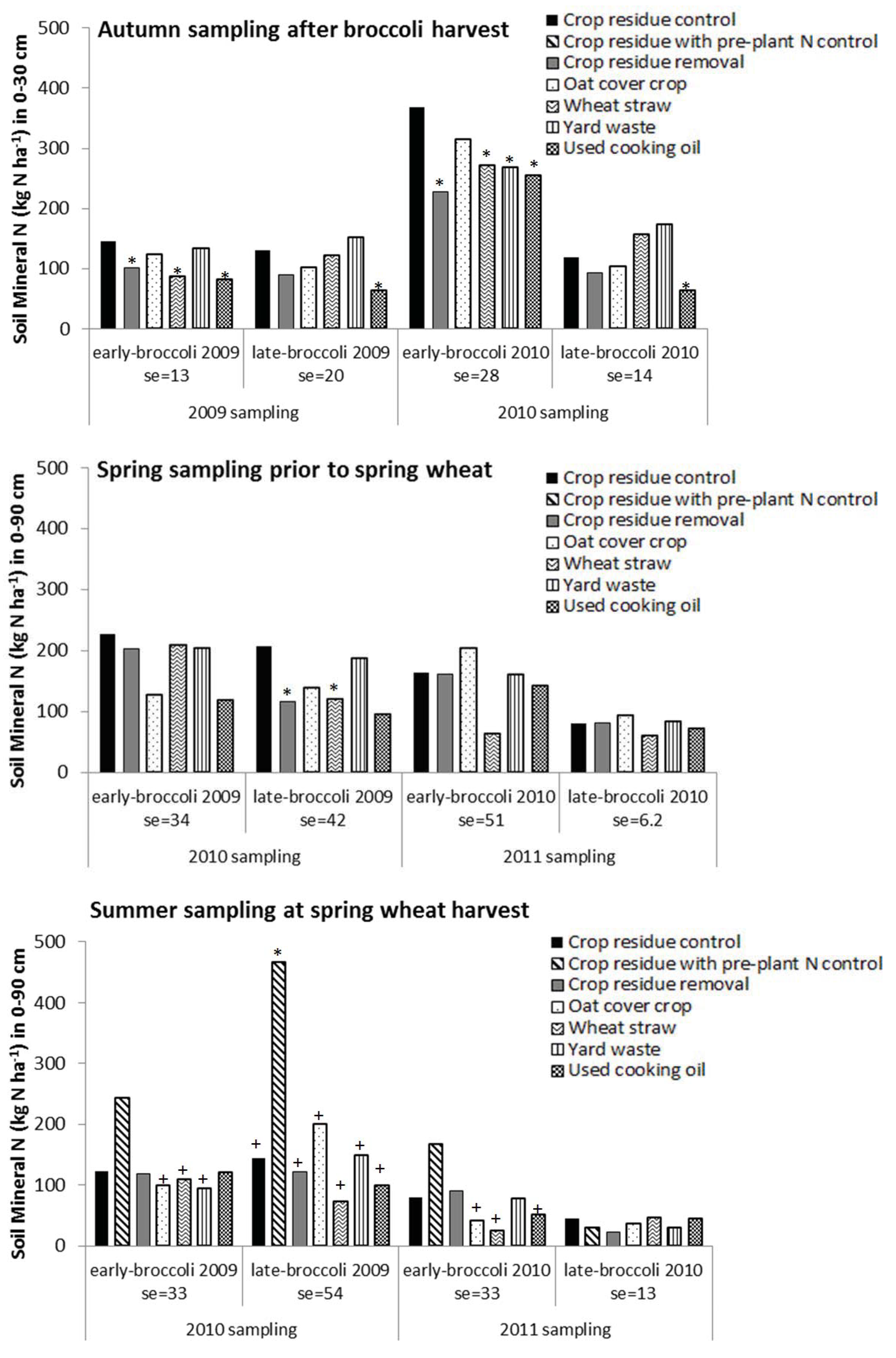
3.3. Soil Mineral Nitrogen in the Subsequent Spring and Summer
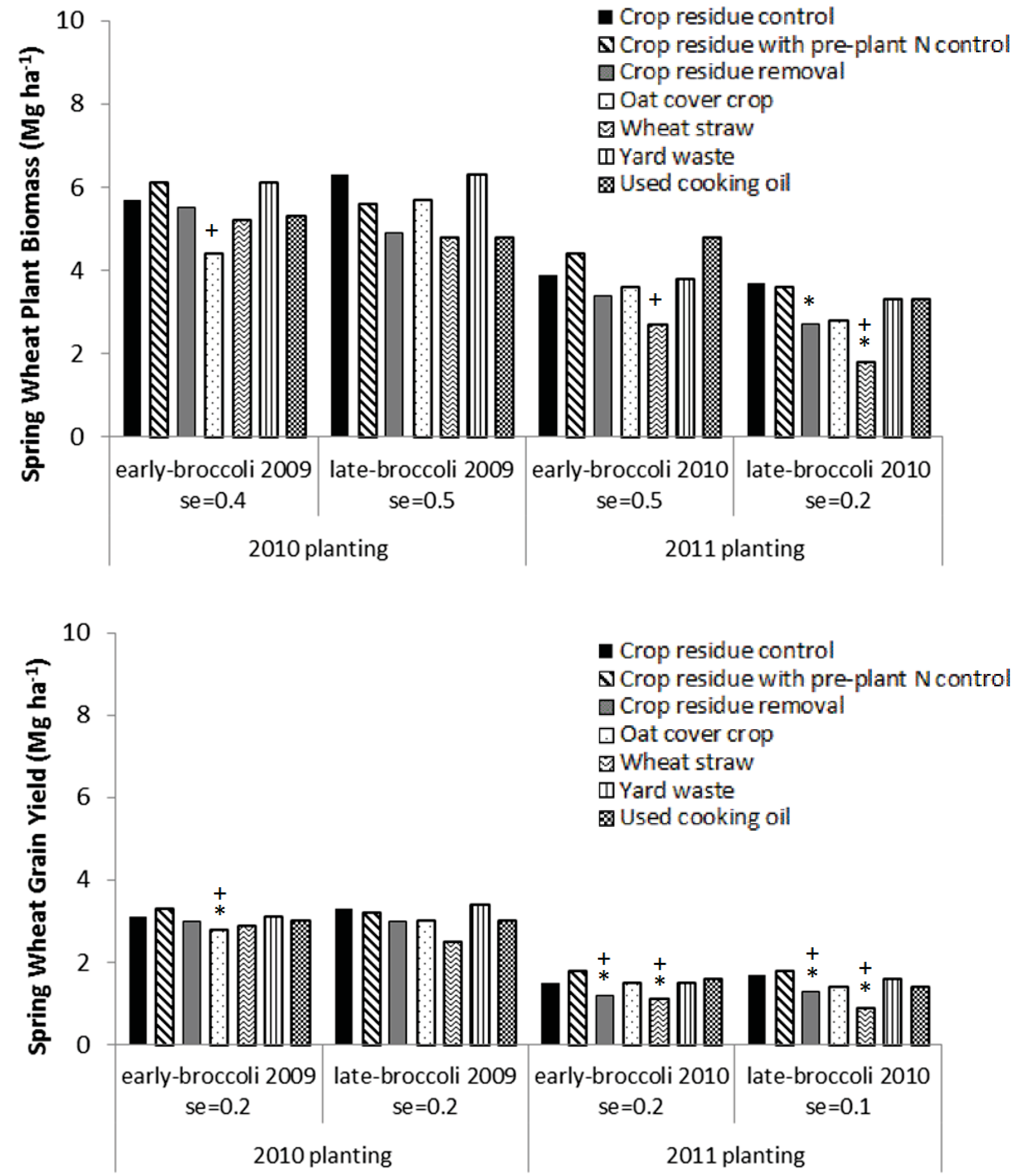
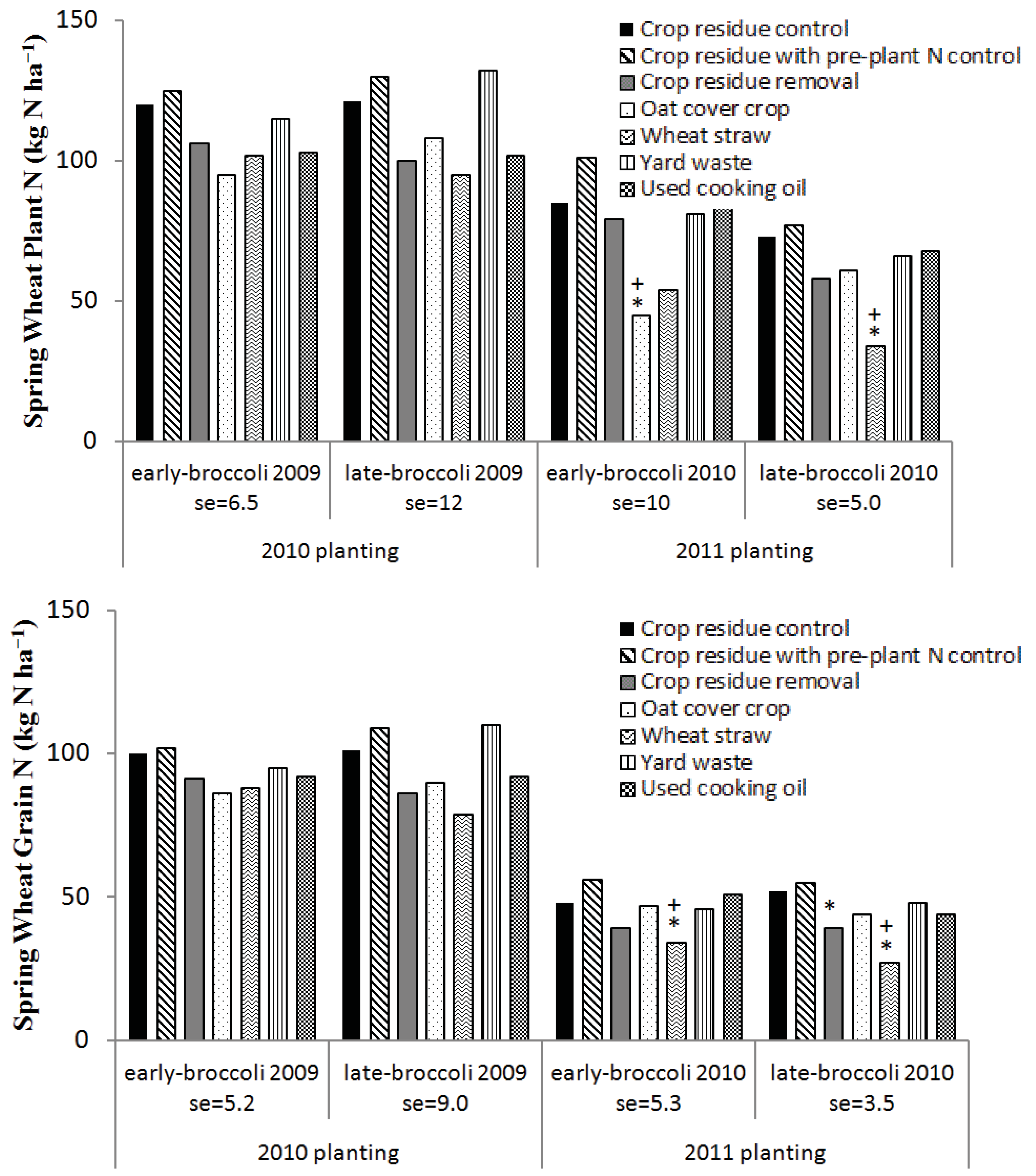
3.4. Spring Wheat Production

3.5. Economic Analysis
| Post-broccoli-harvest treatment | Broccoli production system | |||
|---|---|---|---|---|
| 2009 | 2010 | |||
| early-broccoli | late-broccoli | early-broccoli | late-broccoli | |
| Spring wheat profit margins ($ ha−1) | ||||
| 2010 | 2011 | |||
| Crop residue control | 586 | 617 | 263 | 306 |
| Crop residue with pre-plant N control | 527 | 511 | 228 | 229 |
| Crop residue removal | 429 *,+ | 422 * | 75 *,+ | 84 *,+ |
| Oat cover crop | 394 *,+ | 440 * | 144 *,+ | 131 *,+ |
| Wheat straw | 434 *,+ | 352 *,+ | 70 *,+ | 24 *,+ |
| Yard waste | 515 | 579 | 205 | 228 |
| Used cooking oil | 508 * | 506 | 235 | 197 * |
| Standard error of mean (se) | 31.7 | 39.5 | 34.2 | 25.1 |
4. Conclusions
Acknowledgements
References
- Bakker, C.J.; Swanton, C.J.; McKeown, A.W. Broccoli growth in response to increasing rates of pre-plant nitrogen. II. Dry matter and nitrogen accumulation. Can. J. Plant Sci. 2009, 89, 539–548. [Google Scholar] [CrossRef]
- Thompson, T.L.; Doerge, T.A.; Godin, R.E. Subsurface drip irrigation and fertigation of broccoli: I. Yield, quality, and nitrogen uptake. Soil Sci. Soc. Am. J. 2002, 66, 186–192. [Google Scholar] [CrossRef]
- De Neve, S.; Hofman, G. N mineralization and nitrate leaching from vegetable crop residues under field conditions: A model evaluation. Soil Biol. Biochem. 1998, 30, 2067–2075. [Google Scholar] [CrossRef]
- Everaarts, A.; de Willigen, P. The effect of the rate and method of nitrogen application on nitrogen uptake and utilization by broccoli (Brassica oleracea var. italica). Neth. J. Agric. Sci. 1999, 47, 201–214. [Google Scholar]
- Fallow, D.J.; Brown, D.M.; Parkin, G.W.; Lauzon, J.D.; Wagner-Riddle, C. Identification of Critical Regions for Water Quality Monitoring with Respect to Seasonal and Annual Water Surplus; Land Resource Science Technical Report 2003-1 for Ministry of Agriculture and Food, Ontario Agricultural College Department of Land Resource Science, University of Guelph: Guelph, ON, Canada, 2003. [Google Scholar]
- Zebarth, B.J.; Bowen, P.A.; Toivonen, P.M.A. Influence of nitrogen fertilization on broccoli yield, nitrogen accumulation and apparent fertilizer-nitrogen recovery. Can. J. Plant Sci. 1995, 75, 717–725. [Google Scholar] [CrossRef]
- Everaarts, A.; de Willigen, P. The effect of nitrogen and the method of application on yield and quality of broccoli. Neth. J. Agric. Sci. 1999, 47, 123–133. [Google Scholar]
- Yoldas, F.; Ceylan, S.; Yagmur, B.; Mordogan, N. Effects of nitrogen fertilizer on yield quality and nutrient content in broccoli. J. Plant Nutr. 2008, 31, 1333–1343. [Google Scholar] [CrossRef]
- Bakker, C.J.; Swanton, C.J.; McKeown, A.W. Broccoli growth in response to increasing rates of pre-plant nitrogen. I. Yield and quality. Can. J. Plant Sci. 2009, 89, 527–537. [Google Scholar] [CrossRef]
- De Neve, S.; Pannier, J.; Hofman, G. Temperature effects on C- and N-mineralization from vegetable crop residues. Plant Soil 1996, 181, 25–30. [Google Scholar] [CrossRef]
- Congreves, K.A.; Voroney, R.P.; O’Halloran, I.P.; Van Eerd, L.L. Broccoli residue-derived nitrogen immobilization following amendments of organic carbon: An incubation study. Can. J. Soil Sci. 2013, 93, 23–31. [Google Scholar]
- Chaves, B.; de Neve, S.; Boeckx, P.; van Cleemput, O.; Hofman, G. Manipulating nitrogen release from nitrogen-rich crop residues using organic wastes under field conditions. Soil Sci. Soc. Am. J. 2007, 71, 1240–1250. [Google Scholar] [CrossRef]
- Oo, A. Availability for Bio-processing in Ontario, 2012; Technical Report for Ontario Federation of Agriculture: Guelph, Canada, 2012. Available online: http://www.ofa.on.ca/uploads/userfiles/files/biomass_crop_residues_availability_for_bioprocessing_final_oct_2_2012.pdf (accessed on 1 October 2012).
- Field Crops: Area and Production Estimates. Ministry of Agriculture, Food and Rural Affairs Web site. 2010. Available online: http://www.omafra.gov.on.ca/english/stats/crops/ctywwheat10.htm (accessed on 1 October 2012).
- Van der Werf, P. State of Organic Waste Diversion in Ontario; Technical Report for Ontario Waste Management Association: Brampton, Canada, 2009. Available online: http://www.2cg.ca/pdffiles/State%20of%20Composting%20in%20Ontario%200509-1.pdf (accessed on 1 October 2012).
- Rashid, M.T.; Voroney, R.P. Land application of oily food waste and corn production on amended soils. Agron. J. 2004, 96, 997–1004. [Google Scholar] [CrossRef]
- Organic Resource Management Incorporation (ORMI) Web site. Available online: http://www.ormi.com/ormi/ (accessed on 4 February 2013).
- Horticultural Crops: Area, Production, Value and Sales by Crop. Ministry of Agriculture, Food and Rural Affairs Web site. 2011. Available online: http://www.omafra.gov.on.ca/english/stats/hort/veg_all10-11English.pdf (accessed on 1 October 2012).
- Jawson, M.; Elliott, L. Carbon and nitrogen transformations during wheat straw and root decomposition. Soil Biol. Biochem. 1986, 18, 15–22. [Google Scholar] [CrossRef]
- Mary, B.; Recous, S.; Darwis, D.; Robin, D. Interactions between decomposition of plant residues and nitrogen cycling in soil. Plant Soil 1996, 181, 71–82. [Google Scholar] [CrossRef]
- Bending, G.D.; Turner, M.K. Interaction of biochemical quality and particle size of crop residues and its effect on the microbial biomass and nitrogen dynamics following incorporation into soil. Biol. Fertil. Soils 1999, 29, 319–327. [Google Scholar] [CrossRef]
- Hartz, T.; Giannini, C. Duration of composting of yard wastes affects both physical and chemical characteristics of compost and plant growth. HortScience 1998, 33, 1192–1196. [Google Scholar]
- Amlinger, F.; Götz, B.; Dreher, P.; Geszti, J.; Weissteiner, C. Nitrogen in biowaste and yard waste compost: dynamics of mobilisation and availability—A review. Eur. J. Soil Biol. 2003, 39, 107–116. [Google Scholar] [CrossRef]
- Claassen, V.; Carey, J. Regeneration of nitrogen fertility in disturbed soils using composts. Compost Sci. Util. 2004, 12, 145–152. [Google Scholar]
- Plante, A.F.; Voroney, R.P. Decomposition of land applied oily food waste and associated changes in soil aggregate stability. J. Environ. Qual. 1998, 27, 395–402. [Google Scholar] [CrossRef]
- Rashid, M.T.; Voroney, R.P. Recycling soil nitrate nitrogen by amending agricultural lands with oily food waste. J. Environ. Qual. 2003, 32, 1881–1886. [Google Scholar] [CrossRef]
- Cassman, K.G.; Bryant, D.C.; Fulton, A.E.; Jackson, L.F. Nitrogen supply effects on partitioning of dry matter and nitrogen to grain of irrigated wheat. Crop Sci. 1992, 32, 1251–1258. [Google Scholar] [CrossRef]
- Saleh, A.; Osei, E.; Jaynes, D.B.; Du, B.; Arnold, J.G. Economic and environmental impacts of LSNT and cover crops for nitrate-nitrogen reduction in Walnut Creek watershed, Iowa, using FEM and enhanced SWAT models. Trans. ASABE 2007, 50, 1251–1259. [Google Scholar]
- Thompson, T.L.; Doerge, T.A.; Godin, R.E. Nitrogen and water interactions in subsurface drip-irrigated cauliflower: II. Agronomic, economic, and environmental outcomes. Soil Sci. Soc. Am. J. 2000, 64, 412–418. [Google Scholar]
- Pier, J.W.; Doerge, T.A. Concurrent evaluation of agronomic, economic, and environmental aspects of trickle irrigated watermelon production. J. Environ. Qual. 1995, 24, 79–86. [Google Scholar] [CrossRef]
- Thompson, T.L.; Doerge, T.A. Nitrogen and water interactions in subsurface trickle-irrigated leaf lettuce: II. Agronomic, economic, and environmental outcomes. Soil Sci. Soc. Am. J. 1996, 60, 168–173. [Google Scholar]
- Carter, M.R.; Gregorich, E.G. Soil Sampling and Methods of Analysis, 2nd ed; CRC: Boca Ratan, FL, USA, 2008. [Google Scholar]
- OMAFRA, Agronomy Guide for Field Crops; Queen’s Printer for Ontario: Toronto, Canada, 2009.
- Rutherford, P.M.; McGill, W.B.; Arocena, J.M.; Figueiredo, C.T. Total Nitrogen. In Soil Sampling and Methods of Analysis; Carter, M.R., Gregorich, E.G., Eds.; CRC: Boca Ratan, FL, USA, 2008; pp. 239–250. [Google Scholar]
- Maynard, D.G.; Kalra, Y.P.; Crumbaugh, J.A. Nitrate and Exchangeable Ammonium Nitrogen. In Soil Sampling and Methods of Analysis; Carter, M.R., Gregorich, E.G., Eds.; CRC: Boca Ratan, FL, USA, 2008; pp. 71–80. [Google Scholar]
- Field Crop Prices, by Crop Year, 1981–2010. Ontario Ministry of Agriculture, Food and Rural Affairs Web site. 2010. Available online: http://www.omafra.gov.on.ca/english/stats/crops/price_swheat.htm (accessed on 20 June 2012).
- Survey of Custom Framework Rates Charged in 2009. Ontario Ministry of Agriculture, Food and Rural Affairs Web site. 2009. Available online: http://www.omafra.gov.on.ca/english/busdev/facts/10-049a1.htm (accessed on 20 June 2012).
- Ontario Farm Input Monitoring Project, Survey No. 1, 2009, 2010, 2011; Technical Report for Economics and Business Group, University of Guelph: Ridgetown, Canada, 2011.
- Gutezeit, B. Yield and nitrogen balance of broccoli at different soil moisture levels. Irrig. Sci. 2004, 23, 21–27. [Google Scholar] [CrossRef]
- Bowen, P.; Zebarth, B.; Toivonen, P. Dynamics of nitrogen and dry-matter partitioning and accumulation in broccoli (Brassica oleracea var. italica) in relation to extractable soil inorganic nitrogen. Can. J. Plant Sci. 1999, 79, 277–286. [Google Scholar] [CrossRef]
- O’Reilly, K.A.; Lauzon, J.D.; Vyn, R.J.; Van Eerd, L.L. Nitrogen cycling, profit margins and sweet corn yield under fall cover crop systems. Can. J. Soil Sci. 2012, 92, 353–365. [Google Scholar]
- Cabrera, M.L.; Kissel, D.E.; Vigil, M.F. Nitrogen mineralization from organic residues: Research opportunities. J. Environ. Qual. 2005, 34, 75–79. [Google Scholar] [CrossRef]
- Nicolardot, B.; Fauvet, G.; Cheneby, D. Carbon and nitrogen cycling through soil microbial biomass at various temperatures. Soil Biol. Biochem. 1994, 26, 253–261. [Google Scholar] [CrossRef]
- Chaves, B.; de Neve, S.; Piulats, L.; Boeckx, P.; van Cleemput, O.; Hofman, G. Manipulating the N release from N-rich crop residues by using organic wastes on soils with different textures. Soil Use Manag. 2007, 23, 212–219. [Google Scholar] [CrossRef]
- Garnier, P.; Néel, C.; Aita, C.; Recous, S.; Lafolie, F.; Mary, B. Modelling carbon and nitrogen dynamics in a bare soil with and without straw incorporation. Eur. J. Soil Sci. 2003, 54, 555–568. [Google Scholar]
- Estimated Area, Yield, Production and Farm Value of Specified Field Crops, Ontario, 2001–2012. Ontario Ministry of Agriculture, Food and Rural Affairs Web site. 2012. Available online: http://www.omafra.gov.on.ca/english/stats/crops/estimate_metric.htm (accessed on 2 August 2012).
- Wu, H.; Pratley, J.; Lemerle, D.; Haig, T. Allelopathy in wheat (Triticum aestivum). Ann. Appl. Biol. 2001, 139, 1–9. [Google Scholar] [CrossRef]
- Ontario Farm Input Monitoring Project, Survey No. 1–4, 1996–1997; Technical Report for Economics and Business Group, University of Guelph: Ridgetown, Canada, 1997.
© 2013 by the authors; licensee MDPI, Basel, Switzerland. This article is an open access article distributed under the terms and conditions of the Creative Commons Attribution license (http://creativecommons.org/licenses/by/3.0/).
Share and Cite
Congreves, K.A.; Vyn, R.J.; Van Eerd, L.L. Evaluation of Post-Harvest Organic Carbon Amendments as a Strategy to Minimize Nitrogen Losses in Cole Crop Production. Agronomy 2013, 3, 181-199. https://doi.org/10.3390/agronomy3010181
Congreves KA, Vyn RJ, Van Eerd LL. Evaluation of Post-Harvest Organic Carbon Amendments as a Strategy to Minimize Nitrogen Losses in Cole Crop Production. Agronomy. 2013; 3(1):181-199. https://doi.org/10.3390/agronomy3010181
Chicago/Turabian StyleCongreves, Katelyn A., Richard J. Vyn, and Laura L. Van Eerd. 2013. "Evaluation of Post-Harvest Organic Carbon Amendments as a Strategy to Minimize Nitrogen Losses in Cole Crop Production" Agronomy 3, no. 1: 181-199. https://doi.org/10.3390/agronomy3010181