<?xml version="1.0" encoding="UTF-8"?>
<!DOCTYPE article PUBLIC "-//NLM//DTD Journal Publishing DTD v2.3 20070202//EN" "journalpublishing.dtd">
<article xmlns:mml="http://www.w3.org/1998/Math/MathML" xmlns:xlink="http://www.w3.org/1999/xlink" xml:lang="en" article-type="review-article">
  <front>
    <journal-meta>
      <journal-id journal-id-type="publisher-id">agronomy</journal-id>
      <journal-title>Agronomy</journal-title>
      <abbrev-journal-title abbrev-type="publisher">Agronomy</abbrev-journal-title>
      <abbrev-journal-title abbrev-type="pubmed">Agronomy</abbrev-journal-title>
      <issn pub-type="epub">2073-4395</issn>
      <publisher>
        <publisher-name>MDPI</publisher-name>
      </publisher>
    </journal-meta>
    <article-meta>
      <article-id pub-id-type="doi">10.3390/agronomy2040240</article-id>
      <article-id pub-id-type="publisher-id">agronomy-02-00240</article-id>
      <article-categories>
        <subj-group>
          <subject>Review</subject>
        </subj-group>
      </article-categories>
      <title-group>
        <article-title>Increasing Food Production in Africa by Boosting the Productivity of Understudied Crops</article-title>
      </title-group>
     
      <contrib-group>
        <contrib contrib-type="author">
          <name>
            <surname>Tadele</surname>
            <given-names>Zerihun</given-names>
          </name>
          <xref rid="af1-agronomy-02-00240" ref-type="aff">1</xref>
          <xref rid="c1-agronomy-02-00240" ref-type="corresp">*</xref>
        </contrib>
        <contrib contrib-type="author">
          <name>
            <surname>Assefa</surname>
            <given-names>Kebebew</given-names>
          </name>
          <xref rid="af2-agronomy-02-00240" ref-type="aff">2</xref>
        </contrib>
      </contrib-group>
       <aff id="af1-agronomy-02-00240"><label>1 </label>Institute of Plant Sciences, University of Bern, Altenbergrain 21, CH-3013 Bern, Switzerland</aff>
      <aff id="af2-agronomy-02-00240"><label>2 </label>Debre Zeit Agricultural Research Center, P.O. Box 32, Debre Zeit, Ethiopia; Email: <email>kebebew.assefa@yahoo.com</email></aff>
      <author-notes>
        <corresp id="c1-agronomy-02-00240"><label>*</label> Author  to whom correspondence should be addressed; Email: <email>zerihun.tadele@ips.unibe.ch</email>; Tel.: +41-31-631-4956; Fax: +41-31-631-4942.</corresp>
      </author-notes>
      <pub-date pub-type="epub">
        <day>16</day>
        <month>10</month>
        <year>2012</year>
      </pub-date>
      <pub-date pub-type="collection"><month>12</month>
        <year>2012</year>
      </pub-date>
      <volume>2</volume>
      <issue>4</issue>
      <fpage>240</fpage>
      <lpage>283</lpage>
      <history>
        <date date-type="received">
          <day>28</day>
          <month>07</month>
          <year>2012</year>
        </date>
        <date date-type="rev-recd">
          <day>10</day>
          <month>09</month>
          <year>2012</year>
        </date>
        <date date-type="accepted">
          <day>18</day>
          <month>09</month>
          <year>2012</year>
        </date>
      </history>
      <permissions>
        <copyright-statement>©  2012 by the authors; licensee MDPI, Basel, Switzerland.</copyright-statement>
        <copyright-year>2012</copyright-year>
        <license xmlns:xlink="http://www.w3.org/1999/xlink" license-type="open-access" xlink:href="http://creativecommons.org/licenses/by/3.0/">
          <p>This article is an open-access article distributed under the terms and conditions of the Creative Commons Attribution license (http://creativecommons.org/licenses/by/3.0/).</p>
        </license>
      </permissions>
      <abstract>
        <p>The Green Revolution has enabled Asian countries to boost their crop production enormously. However, Africa has not benefitted from this agricultural revolution since it did not consider local, but important crops grown in the continent. In addition to their versatile adaptation to extreme environmental conditions, African indigenous crops provide income for subsistence farmers and serve as staple food for the vast majority of low-income consumers. These crops, which are composed of cereals, legumes, vegetables and root crops, are commonly known as underutilized or orphan crops. Recently, some of these under-researched crops have received the attention of the national and international research community, and modern improvement techniques including diverse genetic and genomic tools have been applied in order to boost their productivity. The major bottlenecks affecting the productivity of these crops are unimproved genetic traits such as low yield and poor nutritional status and environmental factors such as drought, weeds and pests. Hence, an agricultural revolution is needed to increase food production of these under-researched crops in order to feed the ever-increasing population in Africa. Here, we present both the benefits and drawbacks of major African crops, the efforts being made to improve them, and suggestions for some future directions.</p>
      </abstract>
      <kwd-group>
        <kwd>African crops</kwd>
        <kwd>orphan crops</kwd>
        <kwd>understudied crops</kwd>
        <kwd>crop improvement</kwd>
        <kwd>breeding techniques</kwd>
      </kwd-group>
    </article-meta>
  </front>
  <body>
    <sec>
      <title>Abbreviations and Acronyms</title>
      <def-list>
      <def-item><term id="G1">AATF</term><def><p>African Agricultural Technology Foundation</p></def></def-item>
      <def-item><term id="G2">ABNETA</term><def><p>Agricultural Biotechnology Network in Africa</p></def></def-item>
      <def-item><term id="G3">ABSPII</term><def><p>Agricultural Biotechnology Support Project II</p></def></def-item>
      <def-item><term id="G4">AFLP</term><def><p>Amplified Fragment Length Polymorphisms</p></def></def-item>
      <def-item><term id="G5">AGRA</term><def><p>Alliance for a Green Revolution in Africa</p></def></def-item>
      <def-item><term id="G6">ASARECA</term><def><p>Association for Strengthening Agricultural Research in Eastern and Central Africa</p></def></def-item>
      <def-item><term id="G7">BecA</term><def><p>Biosciences eastern and central Africa</p></def></def-item>
      <def-item><term id="G8">BioInnovate</term><def><p>Bio-resource Innovations Network for Eastern Africa Development</p></def></def-item>
      <def-item><term id="G9">CAADP</term><def><p>Comprehensive Africa Agriculture Development Program</p></def></def-item>
      <def-item><term id="G10">CGA</term><def><p>Candidate Gene Approach</p></def></def-item>
      <def-item><term id="G11">CGIAR</term><def><p>Consultative Group on International Agricultural Research</p></def></def-item>
      <def-item><term id="G12">CIAT</term><def><p>International Center for Tropical Agriculture</p></def></def-item>
      <def-item><term id="G13">CIMMYT</term><def><p>International Maize and Wheat Improvement Center</p></def></def-item>
      <def-item><term id="G14">CIP</term><def><p>International Potato Center</p></def></def-item>
      <def-item><term id="G15">CIRAD</term><def><p>Agricultural Research Centre for International Development</p></def></def-item>
      <def-item><term id="G16">CORAF/WECARD</term><def><p>West and Central African Council for Agric. Research and Development</p></def></def-item>
      <def-item><term id="G17">CTA</term><def><p>Technical Centre for Agricultural and Rural Cooperation</p></def></def-item>
      <def-item><term id="G18">DZARC</term><def><p>Debre Zeit Agricultural Research Center</p></def></def-item>
      <def-item><term id="G19">EIAR</term><def><p>Ethiopian Institute of Agricultural Research</p></def></def-item>
      <def-item><term id="G20">FAO</term><def><p>Food and Agriculture Organization of the United Nations</p></def></def-item>
      <def-item><term id="G21">FAOSTAT</term><def><p>FAO statistical database</p></def></def-item>
      <def-item><term id="G22">FARA</term><def><p>Forum for Agricultural Research in Africa</p></def></def-item>
      <def-item><term id="G23">GA</term><def><p>Gibberellic acid</p></def></def-item>
      <def-item><term id="G24">GBS</term><def><p>Genotyping-by-sequencing</p></def></def-item>
      <def-item><term id="G25">GCP</term><def><p>Generation Challenge Programme</p></def></def-item>
      <def-item><term id="G26">GFAR</term><def><p>Global Forum on Agricultural Research</p></def></def-item>
      <def-item><term id="G27">GFU</term><def><p>Global Facilitation Unit for Underutilized Species</p></def></def-item>
      <def-item><term id="G28">IAA</term><def><p>indole acetic acid</p></def></def-item>
      <def-item><term id="G29">IAEA</term><def><p>International Atomic Energy Agency</p></def></def-item>
      <def-item><term id="G30">IARCs</term><def><p>International agricultural research centers</p></def></def-item>
      <def-item><term id="G31">ICARDA</term><def><p>International Center for Agricultural Research in the Dry Areas</p></def></def-item>
      <def-item><term id="G32">ICRISAT</term><def><p>International Crops Research Institute for the Semi-Arid Tropics</p></def></def-item>
      <def-item><term id="G33">ICUC</term><def><p>International Centre for Underutilized-Crops</p></def></def-item>
      <def-item><term id="G34">IFAD</term><def><p>International Fund for Agricultural Development</p></def></def-item>
      <def-item><term id="G35">IFPRI</term><def><p>International Food Policy Research Institute</p></def></def-item>
      <def-item><term id="G36">IITA</term><def><p>International Institute of Tropical Agriculture</p></def></def-item>
      <def-item><term id="G37">ILRI</term><def><p>International Livestock Research Institute</p></def></def-item>
      <def-item><term id="G38">INDEL</term><def><p>Insertions and Deletions</p></def></def-item>
      <def-item><term id="G39">IPBO</term><def><p>Institute of Plant Biotechnology for developing Countries</p></def></def-item>
      <def-item><term id="G40">IRD</term><def><p>Institut de recherche pour le développement</p></def></def-item>
      <def-item><term id="G41">ISAAA</term><def><p>International Service for the Acquisition of Agri-biotech Applications</p></def></def-item>
      <def-item><term id="G42">MAS</term><def><p>marker-assisted selection</p></def></def-item>
      <def-item><term id="G43">MoA</term><def><p>Ministry of Agriculture</p></def></def-item>
      <def-item><term id="G44">NARS</term><def><p>National Agricultural Research Systems</p></def></def-item>
      <def-item><term id="G45">NEPAD</term><def><p>New Partnership for Africa’s Development</p></def></def-item>
      <def-item><term id="G46">NERICA</term><def><p>New Rice for Africa</p></def></def-item>
      <def-item><term id="G47">NGO</term><def><p>non-governmental organization</p></def></def-item>
      <def-item><term id="G48">NUE</term><def><p>nitrogen use efficiency</p></def></def-item>
      <def-item><term id="G49">ODAP</term><def><p>β-<italic>N</italic>-Oxalyl-L-α, β-diaminopropanoic acid</p></def></def-item>
      <def-item><term id="G50">PAEPARD</term><def><p>Platform for African–European Partnerships on Agric. Research for Development</p></def></def-item>
      <def-item><term id="G51">PPB</term><def><p>participatory plant breeding</p></def></def-item>
      <def-item><term id="G52">PVS</term><def><p>participatory variety selection</p></def></def-item>
      <def-item><term id="G53">QTL</term><def><p>quantitative trait locus; RIL: recombinant inbred line</p></def></def-item>
      <def-item><term id="G54">RAD</term><def><p>Restriction-site Associated DNA</p></def></def-item>
      <def-item><term id="G55">SADC/FANR</term><def><p>Southern African Development Community/Food, Agric. and Natural Resources</p></def></def-item>
      <def-item><term id="G56">SNP</term><def><p>Single Nucleotide Polymorphisms</p></def></def-item>
      <def-item><term id="G57">SSR</term><def><p>Simple Sequence Repeats, also known as microsatellites</p></def></def-item>
      <def-item><term id="G58">TALEN</term><def><p>Transcription Activator-like Effector Nuclease</p></def></def-item>
      <def-item><term id="G59">TILLING</term><def><p>Targeting Induced Local Lesion IN Genomes</p></def></def-item>
      <def-item><term id="G60">TIP</term><def><p>Tef Improvement Project</p></def></def-item>
      </def-list>
      
    </sec>
    <sec>
      <title>1. Types and Significance of African Indigenous Crops</title>
      <p>African indigenous crops are also known as orphan crops [<xref ref-type="bibr" rid="B1-agronomy-02-00240">1</xref>], underutilized crops [<xref ref-type="bibr" rid="B2-agronomy-02-00240">2</xref>], lost crops [<xref ref-type="bibr" rid="B3-agronomy-02-00240">3</xref>,<xref ref-type="bibr" rid="B4-agronomy-02-00240">4</xref>,<xref ref-type="bibr" rid="B5-agronomy-02-00240">5</xref>], neglected crops [<xref ref-type="bibr" rid="B6-agronomy-02-00240">6</xref>] or crops for the future [<xref ref-type="bibr" rid="B7-agronomy-02-00240">7</xref>]. According to Naylor <italic>et al.</italic> [<xref ref-type="bibr" rid="B1-agronomy-02-00240">1</xref>] twenty-seven orphan crops within developing countries are annually grown on about 250 million hectares of land. These crops belong to the major groups of crops including cereals, legumes, and root crops. In general, these crops play a key role in the livelihood of the resource-poor farmers and consumers in Africa because they perform better than the major world crops under extreme soil and climate conditions prevalent in the continent. <xref ref-type="table" rid="agronomy-02-00240-t001">Table 1</xref> shows the list of some of these crops and their desirable and undesirable traits. Brief descriptions are provided below for the most important cereals, legumes and root crops.</p>
      <table-wrap id="agronomy-02-00240-t001" position="float">
        <object-id pub-id-type="pii">agronomy-02-00240-t001_Table 1</object-id>
        <label>Table 1</label>
        <caption>
          <p>Major understudied crops of Africa and their desirable and undesirable traits.</p>
        </caption>
                     <table>
          <thead>
            <tr valign="top">
              <th align="center">Type of crop</th>
              <th align="center">Common Name</th>
              <th align="center">Botanical name</th>
              <th align="center">Desirable property</th>
              <th align="center">Undesirable property</th>
              <th align="center">Reference</th>
            </tr>
          </thead>
          <tbody>
            <tr>
              <td rowspan="5" align="center" valign="middle">Cereals</td>
              <td align="center" valign="top">Finger millet</td>
              <td align="center" valign="top">
                <italic>Eleusine coracana</italic>
              </td>
              <td align="center" valign="top">High in iron &amp; protein, low in glycemic index</td>
              <td align="center" valign="top">Low productivity</td>
              <td align="center" valign="top">[<xref ref-type="bibr" rid="B2-agronomy-02-00240">2</xref>,<xref ref-type="bibr" rid="B8-agronomy-02-00240">8</xref>]</td>
            </tr>
            <tr>
              <td align="center">Fonio</td>
              <td align="center">
                <italic>Digitaria exilis</italic>
              </td>
              <td align="center">Fast maturing</td>
              <td align="center">Low productivity</td>
              <td align="center">[<xref ref-type="bibr" rid="B5-agronomy-02-00240">5</xref>,<xref ref-type="bibr" rid="B8-agronomy-02-00240">8</xref>]</td>
            </tr>
            <tr>
              <td align="center">African rice</td>
              <td align="center">
                <italic>Oryza glaberrima</italic>
              </td>
              <td align="center">Resistance to diseases &amp; pests</td>
              <td align="center">Lodging &amp; shattering of seed</td>
              <td align="center">[<xref ref-type="bibr" rid="B5-agronomy-02-00240">5</xref>,<xref ref-type="bibr" rid="B9-agronomy-02-00240">9</xref>]</td>
            </tr>
            <tr>
              <td align="center">Pearl millet</td>
              <td align="center">
                <italic>Pennisetum glaucum</italic>
              </td>
              <td align="center">Drought &amp; heat tolerance</td>
              <td align="center">Insect pests &amp; diseases</td>
              <td align="center">[<xref ref-type="bibr" rid="B10-agronomy-02-00240">10</xref>]</td>
            </tr>
            <tr>
              <td align="center">Tef</td>
              <td align="center">
                <italic>Eragrostis tef</italic>
              </td>
              <td align="center">Abiotic stress tolerance, free of gluten</td>
              <td align="center">Low productivity &amp; lodging</td>
              <td align="center">[<xref ref-type="bibr" rid="B11-agronomy-02-00240">11</xref>,<xref ref-type="bibr" rid="B12-agronomy-02-00240">12</xref>]</td>
            </tr>
            <tr>
              <td rowspan="3" align="center" valign="middle">Leguminous crops</td>
              <td align="center" valign="top">Bambara groundnut</td>
              <td align="center" valign="top">
                <italic>Vigna subterranea</italic>
              </td>
              <td align="center" valign="top">Nutritious &amp; drought tolerance</td>
              <td align="center" valign="top">Late maturing</td>
              <td align="center" valign="top">[<xref ref-type="bibr" rid="B3-agronomy-02-00240">3</xref>]</td>
            </tr>
            <tr>
              <td align="center">Cowpea</td>
              <td align="center">
                <italic>Vigna unguiculata</italic>
              </td>
              <td align="center">Drought tolerance &amp; nutritious</td>
              <td align="center">Low productivity &amp; insects</td>
              <td align="center">[<xref ref-type="bibr" rid="B3-agronomy-02-00240">3</xref>]</td>
            </tr>
            <tr>
              <td align="center">Grass pea</td>
              <td align="center">
                <italic>Lathyrus sativus</italic>
              </td>
              <td align="center">Extreme drought tolerance &amp; nutritious</td>
              <td align="center">Toxic seeds</td>
              <td align="center">[<xref ref-type="bibr" rid="B13-agronomy-02-00240">13</xref>]</td>
            </tr>
            <tr>
              <td rowspan="4" align="center" valign="middle">Vegetables</td>
              <td align="center" valign="top">Amaranth</td>
              <td align="center" valign="top"><italic>Amaranthus </italic>spp.</td>
              <td align="center" valign="top">Fast growing &amp; nutritious</td>
              <td align="center" valign="top">Insect pests &amp; diseases</td>
              <td align="center" valign="top">[<xref ref-type="bibr" rid="B3-agronomy-02-00240">3</xref>]</td>
            </tr>
            <tr>
              <td align="center">Celosia</td>
              <td align="center">
                <italic>Celosia argentea</italic>
              </td>
              <td align="center">High productivity</td>
              <td align="center">Sensitivity to nematodes &amp; water-logging</td>
              <td align="center">[<xref ref-type="bibr" rid="B3-agronomy-02-00240">3</xref>,<xref ref-type="bibr" rid="B8-agronomy-02-00240">8</xref>]</td>
            </tr>
            <tr>
              <td align="center">Dika</td>
              <td align="center">
                <italic>Irvingia gabonensis, I. wombolu</italic>
              </td>
              <td align="center">Rich in oil</td>
              <td align="center">Difficulty of kernel removal</td>
              <td align="center">[<xref ref-type="bibr" rid="B3-agronomy-02-00240">3</xref>]</td>
            </tr>
            <tr>
              <td align="center">Okra</td>
              <td align="center">
                <italic>Abelmoschus esculentus</italic>
              </td>
              <td align="center">Tolerance to biotic stresses, fast growing &amp; nutritious</td>
              <td align="center">Short shelf-life</td>
              <td align="center">[<xref ref-type="bibr" rid="B14-agronomy-02-00240">14</xref>]</td>
            </tr>
            <tr>
              <td rowspan="4" align="center" valign="middle">Oil seeds</td>
              <td align="center" valign="top">Ethiopian Mustard</td>
              <td align="center" valign="top">
                <italic>Brassica carinata</italic>
              </td>
              <td align="center" valign="top">Drought tolerance &amp; resistance to insect pests</td>
              <td align="center" valign="top">Poor quality oil</td>
              <td align="center" valign="top">[<xref ref-type="bibr" rid="B15-agronomy-02-00240">15</xref>]</td>
            </tr>
            <tr>
              <td align="center">Noug</td>
              <td align="center">
                <italic>Guizotia abyssinica</italic>
              </td>
              <td align="center">High oil content</td>
              <td align="center">Low productivity, insect pests</td>
              <td align="center">[<xref ref-type="bibr" rid="B16-agronomy-02-00240">16</xref>]</td>
            </tr>
            <tr>
              <td align="center">Sesame</td>
              <td align="center">
                <italic>Sesamum indicum</italic>
              </td>
              <td align="center">Oxidatively stable oil</td>
              <td align="center">Low productivity &amp; shattering</td>
              <td align="center">[<xref ref-type="bibr" rid="B2-agronomy-02-00240">2</xref>]</td>
            </tr>
            <tr>
              <td align="center">Vernonia</td>
              <td align="center">
                <italic>Vernonia galamensis</italic>
              </td>
              <td align="center">High in industrial oil</td>
              <td align="center"> </td>
              <td align="center">[<xref ref-type="bibr" rid="B8-agronomy-02-00240">8</xref>,<xref ref-type="bibr" rid="B17-agronomy-02-00240">17</xref>]</td>
            </tr>
            <tr>
              <td rowspan="5" align="center" valign="middle">Root crops</td>
              <td align="center" valign="top">Cassava</td>
              <td align="center" valign="top">
                <italic>Manihot esculentum</italic>
              </td>
              <td align="center" valign="top">Drought tolerance</td>
              <td align="center" valign="top">Toxic, less nutritious &amp; diseases</td>
              <td align="center" valign="top">[<xref ref-type="bibr" rid="B18-agronomy-02-00240">18</xref>]</td>
            </tr>
            <tr>
              <td align="center">African yam bean</td>
              <td align="center">
                <italic>Sphenostylis stenocarpa</italic>
              </td>
              <td align="center">High protein content</td>
              <td align="center">Late maturing</td>
              <td align="center">[<xref ref-type="bibr" rid="B3-agronomy-02-00240">3</xref>]</td>
            </tr>
            <tr>
              <td align="center">Enset</td>
              <td align="center">
                <italic>Ensete ventricosum</italic>
              </td>
              <td align="center">Drought tolerance</td>
              <td align="center">Less nutritious</td>
              <td align="center">[<xref ref-type="bibr" rid="B19-agronomy-02-00240">19</xref>]</td>
            </tr>
            <tr>
              <td align="center">Yam</td>
              <td align="center"><italic>Dioscorea </italic>spp</td>
              <td align="center">Drought tolerance</td>
              <td align="center">Less nutritious</td>
              <td align="center">[<xref ref-type="bibr" rid="B8-agronomy-02-00240">8</xref>]</td>
            </tr>
            <tr>
              <td align="center">Sweet potato</td>
              <td align="center">
                <italic>Ipomoea batatas</italic>
              </td>
              <td align="center">Rich in riboflavin &amp; calcium</td>
              <td align="center">Diseases &amp; insect pests</td>
              <td align="center">[<xref ref-type="bibr" rid="B2-agronomy-02-00240">2</xref>]</td>
            </tr>
            <tr>
              <td rowspan="2" align="center" valign="middle">Fruits</td>
              <td align="center" valign="top">Banana</td>
              <td align="center" valign="top"><italic>Musa</italic> spp.</td>
              <td align="center" valign="top">Healthy &amp; nutritious</td>
              <td align="center" valign="top">Pests &amp; diseases</td>
              <td align="center" valign="top">[<xref ref-type="bibr" rid="B20-agronomy-02-00240">20</xref>]</td>
            </tr>
            <tr>
              <td align="center">Plantain</td>
              <td align="center"><italic>Musa </italic>spp.</td>
              <td align="center">Healthy &amp; nutritious</td>
              <td align="center">Pests &amp; diseases</td>
              <td align="center">[<xref ref-type="bibr" rid="B20-agronomy-02-00240">20</xref>]</td>
            </tr>
          </tbody>
        </table>
        
      </table-wrap>
      <sec>
        <title>1.1. Cereals</title>
        <p>Cereals are rich sources of nutrients for both humans and animals. African cereals, particularly millets, have got high amounts of vitamins, calcium, iron, potassium, magnesium and zinc [<xref ref-type="bibr" rid="B21-agronomy-02-00240">21</xref>]. The straws and crop residues of cereals are also the main sources of livestock feed for farmers in developing countries. Crops such as finger and pearl millets were recently shown to have an anti-proliferative property, and might have a potential in the prevention of cancer initiation [<xref ref-type="bibr" rid="B22-agronomy-02-00240">22</xref>]. This anti-proliferative property is associated with the presence and content of phenolic extracts.</p>
        <p>Pearl millet [<italic>Pennisetum glaucum </italic>(L.) R. Br.] is dominantly cultivated as a food crop in the semi-arid areas of Asia and Africa due to its extreme tolerance to moisture deficit [<xref ref-type="bibr" rid="B10-agronomy-02-00240">10</xref>]. It is annually cultivated on about 16 million ha in Africa alone [<xref ref-type="bibr" rid="B23-agronomy-02-00240">23</xref>]. Finger millet (<italic>Eleusine coracana </italic>Gaertn.) is one of the important food crops in the semi-arid regions of Asia and Africa due to its adaptation to unfavorable climatic and soil conditions especially drought [<xref ref-type="bibr" rid="B2-agronomy-02-00240">2</xref>,<xref ref-type="bibr" rid="B8-agronomy-02-00240">8</xref>]. The seeds of finger millet contain valuable amino acids especially methionine [<xref ref-type="bibr" rid="B5-agronomy-02-00240">5</xref>], which is lacking in the diets of hundreds of millions of the poor who live on starchy staples such as cassava. Finger millet is also a popular food among diabetic patients because of its low glycemic index and slow digestion [<xref ref-type="bibr" rid="B24-agronomy-02-00240">24</xref>]. Tef [<italic>Eragrostis tef</italic> (Zucc.) Trotter] is a cereal crop mainly grown in the Horn of Africa, and its annual cultivation in Ethiopia alone accounts for over 2.8 million ha of land [<xref ref-type="bibr" rid="B25-agronomy-02-00240">25</xref>]. The crop is tolerant towards abiotic stresses, especially to poorly drained soils where other crops such as maize and wheat do not withstand [<xref ref-type="bibr" rid="B11-agronomy-02-00240">11</xref>]. In addition, tef is considered a healthy food since the seeds do not contain gluten [<xref ref-type="bibr" rid="B12-agronomy-02-00240">12</xref>,<xref ref-type="bibr" rid="B26-agronomy-02-00240">26</xref>], the cause for celiac disease. Fonio (<italic>acha</italic>) [<italic>Digitaria exilis</italic> (Kippist) Stapf. and <italic>D. iburua</italic> Stapf] is widely cultivated for human food in the semi-arid regions of West Africa. Fonio is not only drought-tolerant but also a very fast-maturing crop [<xref ref-type="bibr" rid="B5-agronomy-02-00240">5</xref>,<xref ref-type="bibr" rid="B8-agronomy-02-00240">8</xref>]. The seeds of fonio are nutritious, especially in methionine and cysteine, the two amino acids essential for human health, but deficient in major cereals such as wheat, rice and maize [<xref ref-type="bibr" rid="B27-agronomy-02-00240">27</xref>]. African rice (<italic>Oryza glaberrima</italic> Steudel) is mostly cultivated in West Africa especially in drought-prone areas and on impoverished soils [<xref ref-type="bibr" rid="B5-agronomy-02-00240">5</xref>,<xref ref-type="bibr" rid="B9-agronomy-02-00240">9</xref>]. Due to its early maturing property, African rice is the source of food during food shortage particularly just before other crops are harvested.</p>
      </sec>
      <sec>
        <title>1.2. Leguminous Crops</title>
        <p>Legumes are the major source of protein for consumers. Due to their ability to fix atmospheric nitrogen and convert it to the available form for plants, legumes contribute towards improving the soil. Bambara groundnut [<italic>Vigna subterranean </italic>(L.) Verdc.] is grown for human consumption and is the third most important grain legume in Africa after cowpea and groundnut [<xref ref-type="bibr" rid="B28-agronomy-02-00240">28</xref>]. The seeds of bambara groundnut are known as a complete food because they contain adequate quantities of protein (19%), carbohydrate (63%), and fat (6.5%) [<xref ref-type="bibr" rid="B3-agronomy-02-00240">3</xref>]. Cowpea [<italic>Vigna unguiculata</italic> (L.) Walp.] is grown on about 10 million hectares of land in the world, mainly in Africa. The crop is tolerant towards drought and heat, and it also performs better than many other crops on sandy soils with low levels of organic matter and phosphorus [<xref ref-type="bibr" rid="B29-agronomy-02-00240">29</xref>]. Since cowpea has got a quick growth bringing about rapid ground cover, it is a useful crop in controlling erosion [<xref ref-type="bibr" rid="B30-agronomy-02-00240">30</xref>]. Grass pea (<italic>Lathyrus sativus </italic>L.) is grown for human and livestock consumption in Asia, Africa and Europe. In Africa, it is cultivated in Egypt, Ethiopia, Morocco and Algeria [<xref ref-type="bibr" rid="B13-agronomy-02-00240">13</xref>]. The plant is extremely tolerant towards drought and is considered as an insurance crop since it produces reliable yields when all other crops fail. Like other grain legumes, grass pea is a source of protein particularly for resource-poor farmers and consumers.</p>
      </sec>
      <sec>
        <title>1.3. Vegetables</title>
        <p>There are many indigenous or locally important vegetables in Africa. Among these, the following have benefits in some agronomic and/or nutritional traits: amaranthus (<italic>Amaranthus caudatus </italic>L.) matures fast and is nutritious [<xref ref-type="bibr" rid="B3-agronomy-02-00240">3</xref>]; dika [<italic>Irvingia gabonensis </italic>(Aubry-Lecomte ex O’Rorke) Baill] is rich in oil [<xref ref-type="bibr" rid="B3-agronomy-02-00240">3</xref>]; okra [<italic>Abelmoschus esculentus </italic>(L.) Moench] is fast maturing and nutritious [<xref ref-type="bibr" rid="B14-agronomy-02-00240">14</xref>]; and the Ethiopian mustard (<italic>Brassica carinata </italic>A. Braun), which is used both as a leafy vegetable and an oil crop, is tolerant towards drought and insect pests [<xref ref-type="bibr" rid="B15-agronomy-02-00240">15</xref>].</p>
      </sec>
      <sec>
        <title>1.4. Oil Seeds</title>
        <p>Among locally grown oil crops, the oil from noug [<italic>Guizotia abyssinica</italic> (L.f.) Cass.] and sesame (<italic>Sesamum indicum </italic>L) are used for human consumption while the one from vernonia [<italic>Vernonia galamensis </italic>(Cass.) Less.] is used in industry.</p>
      </sec>
      <sec>
        <title>1.5. Root Crops</title>
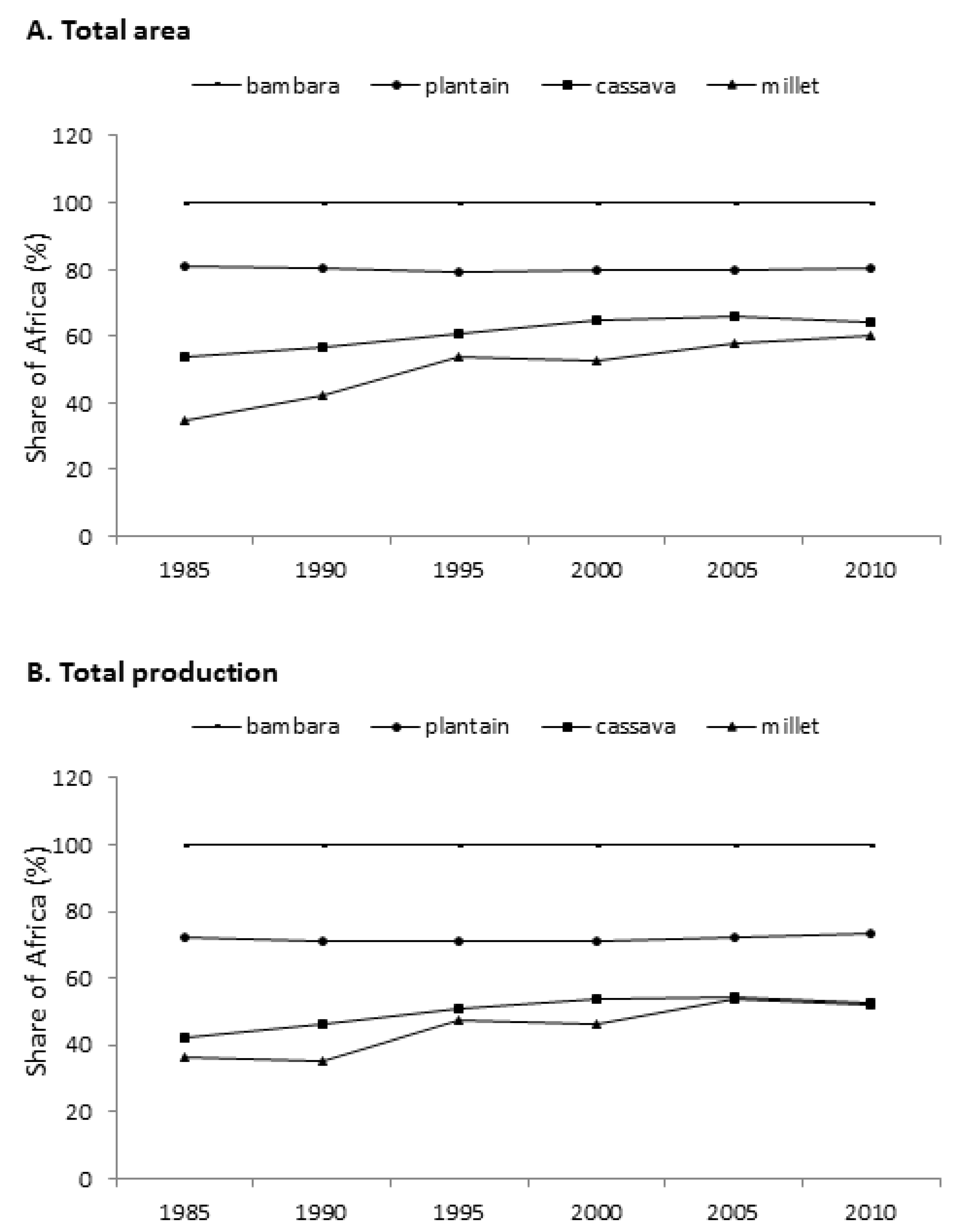
        <p>Among the root crops grown in Africa, cassava, yam, sweet potato and enset are the source of food for a large number of populations. Cassava (manioc; <italic>Manihot esculenta </italic>Crantz<italic>)</italic> is staple food for about 600 million people worldwide and for more than 200 million people in Sub-Saharan Africa [<xref ref-type="bibr" rid="B31-agronomy-02-00240">31</xref>]. In Africa, although it was cultivated on 64% of the global area in 2010, it accounted for only 53% of the total world production (<xref ref-type="fig" rid="agronomy-02-00240-f001">Figure 1</xref>) [<xref ref-type="bibr" rid="B32-agronomy-02-00240">32</xref>]. This shows that the productivity of cassava is lower in Africa than in other parts of the world. Cassava is tolerant towards drought, and also performs better than other crops on soils with poor nutrients. Yam (<italic>Dioscorea </italic>sp) represents at least two species of the genus <italic>Dioscorea</italic>. In 2010, it was grown on about 4.8 million hectares of land worldwide, and of this 95% was in Africa [<xref ref-type="bibr" rid="B32-agronomy-02-00240">32</xref>]. The edible part of yam is similar to that of sweet potato [<italic>Ipomoea batatas </italic>(L.) Lam.], although they are not taxonomically related. Enset [<italic>Ensete ventricosum </italic>(Welw.) Cheeseman] is commonly known as ‘false banana’ for its close resemblance to the domesticated banana plant. Unlike banana where the fruit is consumed, in enset the pseudo-stem and the underground corm are the edible parts. Enset is the major food for over 10 million people in the densely populated regions of Ethiopia. It is considered as an extremely drought-tolerant crop that adapts to different soil types [<xref ref-type="bibr" rid="B19-agronomy-02-00240">19</xref>].</p>
        <fig id="agronomy-02-00240-f001" position="anchor">
          <label>Figure 1</label>
          <caption>
            <p>Share of Africa in the global crop area (A), and production (B) for selected orphan crops from 1985 to 2010. Adapted from FAOSTAT [<xref ref-type="bibr" rid="B32-agronomy-02-00240">32</xref>]. </p>
          </caption>
          <graphic xmlns:xlink="http://www.w3.org/1999/xlink" xlink:href="agronomy-02-00240-g001.tif"/>
        </fig>
      </sec>
      <sec>
        <title>1.6. Fruits</title>
        <p>Banana and plantain (<italic>Musa </italic>spp.) are among the major fruit crops grown in Africa. In the year 2010, about 13 million tons of banana and 27 million tons of plantain were produced in the continent [<xref ref-type="bibr" rid="B32-agronomy-02-00240">32</xref>]. According to Fungo [<xref ref-type="bibr" rid="B33-agronomy-02-00240">33</xref>], banana, especially the orange pulped type with high carotenoid and iron content, could reduce Iron Deficiency Anemia (IDA) by over 50% and also Vitamin A Deficiency (VAD) in East Africa, where both IDA and VAD affect a large number of people. Plantain is the staple food in central Africa, and it is mostly considered more as a vegetable than as a fruit since the fruit is used for cooking. In general, both banana and plantain are considered as a healthy food, and they are also rich in essential nutrients for humans. </p>
      </sec>
    </sec>
    <sec>
      <title>2. Need for Improving African Crops</title>
      <sec>
        <title>2.1. Africa is Largely Food Insecure</title>
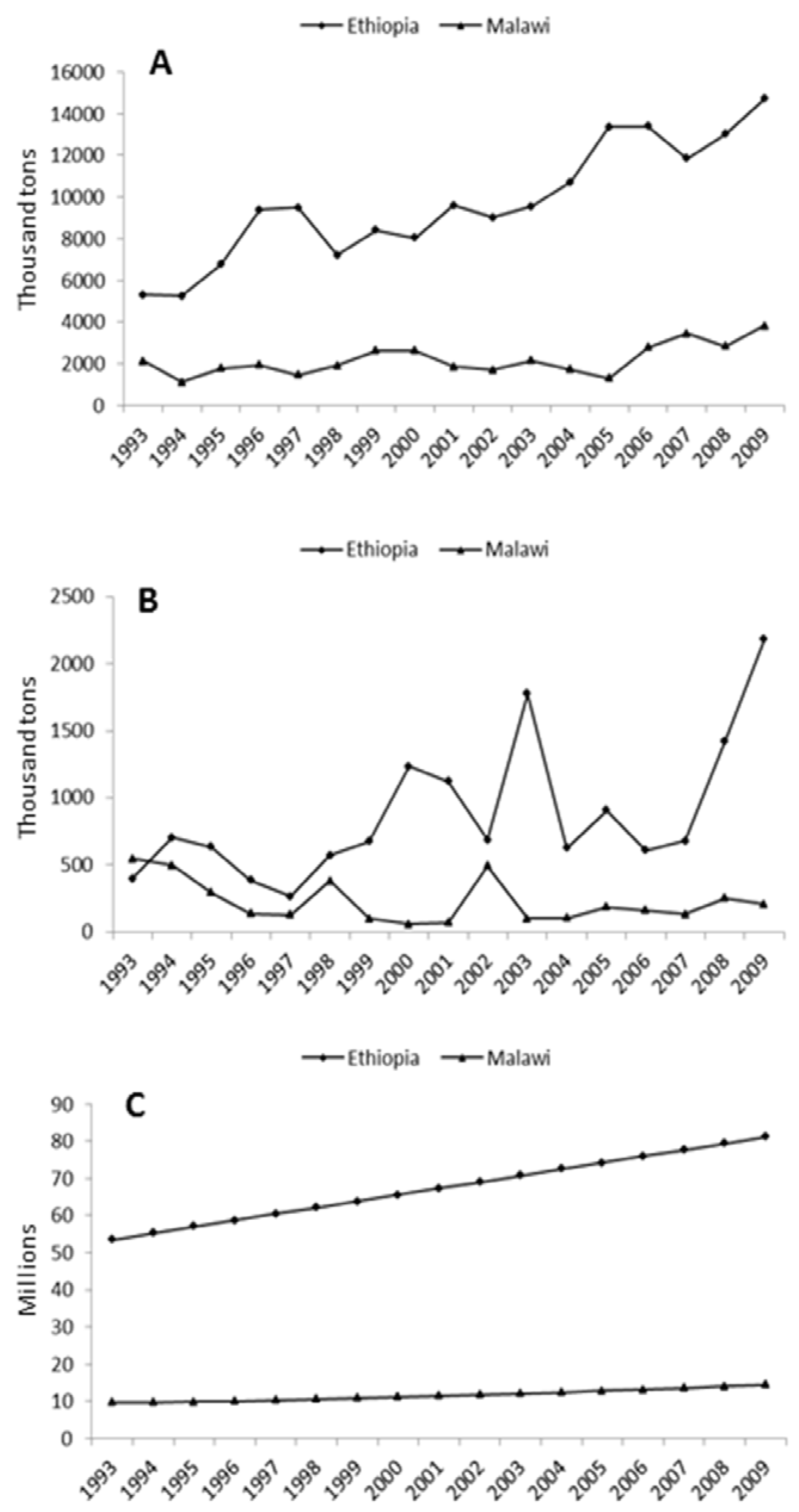
        <p>Food security is defined as the state in which people at all times have physical, social and economic access to sufficient food that meets their dietary needs for a healthy and active life [<xref ref-type="bibr" rid="B34-agronomy-02-00240">34</xref>]. Due to the high population increase in Africa, the demand for food is increasing over time. <xref ref-type="fig" rid="agronomy-02-00240-f002">Figure 2</xref> shows the total production and import of cereal crops from the early 1990s to late 2010 for Ethiopia and Malawi. Despite some years of crop failures due to drought, crop production was significantly increasing year to year (<xref ref-type="fig" rid="agronomy-02-00240-f002">Figure 2</xref>A) [<xref ref-type="bibr" rid="B32-agronomy-02-00240">32</xref>]. However, the import of grains was also in an increasing trend, especially for Ethiopia (<xref ref-type="fig" rid="agronomy-02-00240-f002">Figure 2</xref>B) [<xref ref-type="bibr" rid="B35-agronomy-02-00240">35</xref>]. This high demand for grain might be due to the huge population growth in the country. During the same period, the population of Ethiopia increased by 53%, <italic>i.e.</italic>, from 53 million in 1993 to 81 million in 2009 (<xref ref-type="fig" rid="agronomy-02-00240-f002">Figure 2</xref>C) [<xref ref-type="bibr" rid="B36-agronomy-02-00240">36</xref>]. In order to achieve agricultural sustainability, the increase in food production should be at least proportional to the rate of population growth. It is, however, expected that with the current level of crop productivity, it might be difficult to feed the population in the developing world, especially in Africa, where the population is growing at an alarming rate. According to Tilman <italic>et al.</italic> [<xref ref-type="bibr" rid="B37-agronomy-02-00240">37</xref>], the demand for global food is rising rapidly with about 100%–110% increase in crop demand expected from 2005 to 2050. In general, there is big gap between increase in population and crop production.</p>
        
      </sec>
      <sec>
        <title>2.2. Africa Missed Green Revolution</title>
        <p>The major achievement of the Green Revolution in the 1960s and 70s was the development and introduction of semi-dwarf varieties of wheat and rice along with optimum levels of input. These broadly adapted semi-dwarf cultivars responded to fertilizer application and led to a tremendous increase in productivity. According to the International Food Policy Research Institute [<xref ref-type="bibr" rid="B38-agronomy-02-00240">38</xref>], the Green Revolution represented the successful adaptation and transfer of scientific revolution in agriculture. However, this agricultural revolution, which boosted crop production in Asia and Latin America, did not occur in Africa. This is mainly due to the fact that the Green Revolution was implemented on rice and wheat, but not on African crops such as sorghum and millets [<xref ref-type="bibr" rid="B39-agronomy-02-00240">39</xref>,<xref ref-type="bibr" rid="B40-agronomy-02-00240">40</xref>].</p>
        <fig id="agronomy-02-00240-f002" position="anchor">
          <label>Figure 2</label>
          <caption>
            <p>The total production and import of cereal crops and population growth in Ethiopia and Malawi from 1993 to 2009; (<bold>A</bold>) the total cereal production, which mainly constitutes tef, maize, wheat, and barley in Ethiopia and maize, paddy rice and wheat in Malawi (adapted from [<xref ref-type="bibr" rid="B32-agronomy-02-00240">32</xref>]); (<bold>B</bold>) the total cereal import for the two countries (adapted from [<xref ref-type="bibr" rid="B35-agronomy-02-00240">35</xref>]); (<bold>C</bold>) the total human population during the same period (adapted from [<xref ref-type="bibr" rid="B36-agronomy-02-00240">36</xref>]).</p>
          </caption>
          <graphic xmlns:xlink="http://www.w3.org/1999/xlink" xlink:href="agronomy-02-00240-g002.tif"/>
        </fig>
      </sec>
      <sec>
        <title>2.3. African Crops Fit the Agro-Ecology and Socio-Economic Conditions</title>
        <p>As indicated above, most understudied or orphan crops perform better under adverse climatic and soil conditions than the exotic crops. In addition, orphan crops are compatible with the agro-ecology and socio-economic conditions of the continent. However, when these crops were replaced by other crops new to the locality, some problems were reported. The best example is from a study made in northwestern Ethiopia where the incidence of malaria increased when exotic crops, specifically maize, substituted large areas previously occupied by indigenous crops such as tef [<xref ref-type="bibr" rid="B41-agronomy-02-00240">41</xref>,<xref ref-type="bibr" rid="B42-agronomy-02-00240">42</xref>,<xref ref-type="bibr" rid="B43-agronomy-02-00240">43</xref>]. Tef is the staple food crop for about 50 million people in Ethiopia. Malaria is a major health problem in the world, particularly in Africa. In 2010, it caused an estimated 655,000 deaths mostly among Africans [<xref ref-type="bibr" rid="B44-agronomy-02-00240">44</xref>]. The pollen from maize facilitates optimum conditions for the anopheles mosquitoes, which carry <italic>Plasmodium</italic> parasites that cause malaria. Larvae of the mosquito had a survival rate of 93 percent when it fed on maize pollen, as opposed to a survival rate of only about 13 percent when it fed on other possible food sources. As a result, the cumulative incidence of malaria in high maize cultivation areas was 9.5 times higher than in areas with less maize [<xref ref-type="bibr" rid="B41-agronomy-02-00240">41</xref>]. This shows that the introduction of new crops to the local community might bring some adverse effects on the health of the population.</p>
      </sec>
      <sec>
        <title>2.4. African Crops Are Poor in Productivity</title>
        <p>African crops, despite their huge importance, have generally received little attention by the global scientific community. Due to a lack of genetic improvement, these crops produce inferior yields in terms of both quality and quantity. For instance, the seed yields of tef and millets are extremely low. The main cause for poor productivity of tef is its susceptibility to lodging [<xref ref-type="bibr" rid="B45-agronomy-02-00240">45</xref>]. Tef plants possess tall and tender stems, which are susceptible to lodging by wind and rain, and, therefore, lodging (the permanent displacement of the stem from the up-right position) inflicts significant loss in production. Some of the negative features associated with African rice (<italic>Oryza glaberrima </italic>Steud.), unlike Asian rice (<italic>O. sativa </italic>L.), are rapid shattering of the seeds, difficulty of milling the grain, and lower seed yield [<xref ref-type="bibr" rid="B9-agronomy-02-00240">9</xref>].</p>
      </sec>
      <sec>
        <title>2.5. Efficient Tools and Inputs Are Not Applied in African Agriculture</title>
        <p>Poor crop productivity in Africa is also due to the use of inefficient agricultural practices starting from land preparation, sowing, weeding, harvesting and finally to threshing. Post-harvest losses also account for over 10% yield losses in Africa [<xref ref-type="bibr" rid="B46-agronomy-02-00240">46</xref>]. In addition, sub-optimal use of inputs such as fertilizers, herbicides and pesticides are also responsible for the low productivity of crops in the continent [<xref ref-type="bibr" rid="B47-agronomy-02-00240">47</xref>,<xref ref-type="bibr" rid="B48-agronomy-02-00240">48</xref>].</p>
      </sec>
      <sec>
        <title>2.6. Some African Crops Are Poor in Nutrition</title>
        <p>Root and tuber crops such as cassava and enset produce high yields, however; the products are largely starchy materials that are deficient in other essential nutrients, particularly protein. Recent studies showed that children in Kenya and Nigeria who consumed cassava as a staple food were at greater risk of inadequate dietary protein [<xref ref-type="bibr" rid="B49-agronomy-02-00240">49</xref>], zinc, iron, and vitamin A [<xref ref-type="bibr" rid="B50-agronomy-02-00240">50</xref>] intake than those children who consume less cassava in their staple diet. Although these crops are staple food crops for a large number of Africans, supplementation with other nutrients, especially proteins and vitamins, is required.</p>
      </sec>
      <sec>
        <title>2.7. Several African Crops Produce Toxic Substances</title>
        <p>Some widely cultivated crops produce a variety of toxic substances that affect human health. The roots of cassava contain poisonous compounds called cyanogenic glycosides (CG), which liberate cyanide [<xref ref-type="bibr" rid="B18-agronomy-02-00240">18</xref>]. Konzo is a paralytic disease associated with consumption of insufficiently processed cassava. The pods and seeds of the hyacinth bean [<italic>Lablab purpureus </italic>(L.) Sweet] are poisonous due to high concentrations of cyanogenic glycosides, and they can only be eaten after prolonged boiling [<xref ref-type="bibr" rid="B2-agronomy-02-00240">2</xref>]. The seeds of the African yam bean [<italic>Sphenostylis stenocarpa </italic>(Hochst. ex A.Rich.) Harms] contain anti-nutritional factors such as cyanogenic glycosides and trypsin inhibitors. Cooking is required to reduce the toxins to safe levels, although prolonged cooking also decreases the level of nutrients in the seed [<xref ref-type="bibr" rid="B2-agronomy-02-00240">2</xref>]. The seeds of the grass pea contain a neuron-toxic substance called ODAP [β-<italic>N</italic>-Oxalyl-L-α, β-diaminopropanoic acid] [<xref ref-type="bibr" rid="B51-agronomy-02-00240">51</xref>]. ODAP is the cause of the disease known as neuro-lathyrism, a neuro-degenerative disease that causes paralysis of the lower body. Serious neuro-lathyrism epidemics have been reported during famines when grass pea was the only food source [<xref ref-type="bibr" rid="B52-agronomy-02-00240">52</xref>].</p>
      </sec>
      <sec>
        <title>2.8. Prevalence of Large-Scale Biotic and Abiotic Stresses</title>
        <p>Since most fertile lands are used to grow crops other than African indigenous crops, the productivity of the African native crops under the less fertile and moisture-deficit soils is extremely low. In addition, crop productivity is affected by a variety of abiotic and biotic stresses. Major abiotic stresses are drought, soil salinity and soil acidity. There is some evidence that, in recent decades, agricultural land has been lost to desertification, salinization, soil erosion and other consequences of unsustainable land use [<xref ref-type="bibr" rid="B40-agronomy-02-00240">40</xref>]. From the total global arable area, a third is affected by salinity and 40% by acidity [<xref ref-type="bibr" rid="B53-agronomy-02-00240">53</xref>]. Biotic factors such as diseases, insects and weeds also reduce crop production tremendously. Their adverse effects on crop productivity are more obvious in the tropical regions due to their presence in high density and diversity.</p>
      </sec>
      <sec>
        <title>2.9. Climate Change Adversely Affects Crop Production</title>
        <p>There is some evidence that the current changes in climate affect crop productivity in Africa. According to Müller <italic>et al.</italic> [<xref ref-type="bibr" rid="B54-agronomy-02-00240">54</xref>], climate change poses a significant threat to the present African production systems, infrastructures, and markets. The yield of rice declines by 10% for every 1 °C increase in temperature during the growing season [<xref ref-type="bibr" rid="B55-agronomy-02-00240">55</xref>]. The study by Funk <italic>et al.</italic> [<xref ref-type="bibr" rid="B56-agronomy-02-00240">56</xref>] using <italic>in situ</italic> station data and satellite observations indicated that the rainfall decreased by about 15% in the main growing-season in food-insecure countries in Eastern and Southern Africa. The authors predicted that due to the warming in the central Indian Ocean, the continental rainfall in Africa will decrease, and this will create a drought, which, as a consequence, will increase the number of undernourished people by 50% by 2030. Fauchereau <italic>et al.</italic> [<xref ref-type="bibr" rid="B57-agronomy-02-00240">57</xref>] indicated that due to the long-term variability and changes of rainfall in Southern Africa, droughts have become more intense and widespread. The probable changes in precipitation were also estimated for Southern and East Africa based on global climate models [<xref ref-type="bibr" rid="B58-agronomy-02-00240">58</xref>,<xref ref-type="bibr" rid="B59-agronomy-02-00240">59</xref>]. While a delay in the onset of the rainy season is the cause for the shortening of the rainy season in almost the entire region of Southern Africa [<xref ref-type="bibr" rid="B58-agronomy-02-00240">58</xref>], in East Africa, a wetter climate with more intense wet seasons and less severe droughts is expected [<xref ref-type="bibr" rid="B59-agronomy-02-00240">59</xref>]. The prediction in West Africa also indicates a decrease in rainfall and an increase in temperature in the Sahel coastline [<xref ref-type="bibr" rid="B60-agronomy-02-00240">60</xref>]. According to Sarr [<xref ref-type="bibr" rid="B60-agronomy-02-00240">60</xref>], the most drastic effect of climate change on agriculture will be from the late onset and early cessation of rainfall, and reduction of the length of the growing period.</p>
      </sec>
    </sec>
    <sec>
      <title>3. Tools for Crop Improvement</title>
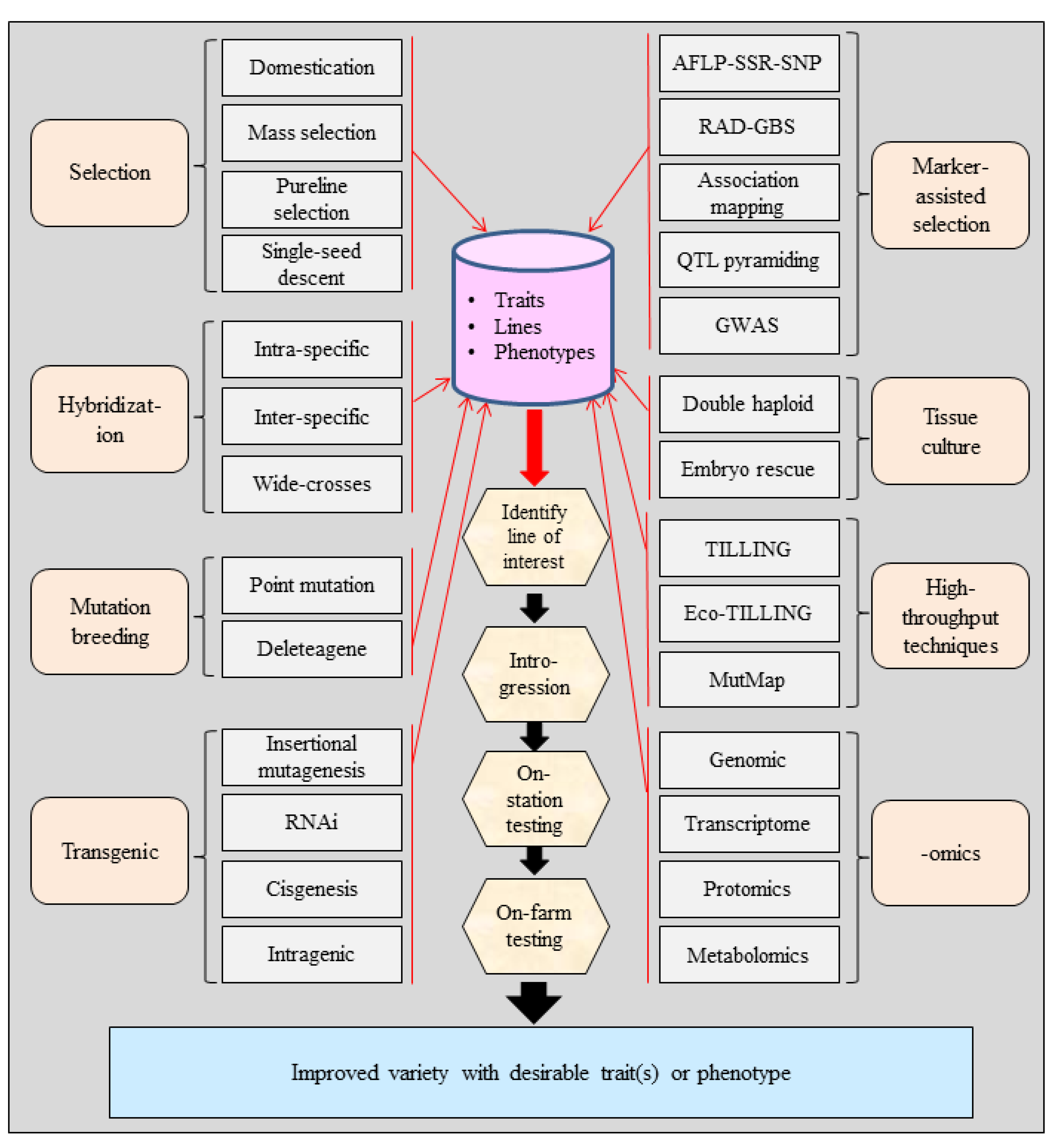
      <p>Improvement of existing crop varieties and cultivation needs integrative research strategies. Crop improvement techniques are broadly grouped into; i) <italic>conventional  approaches</italic> that include various types of selection methods, introgression (or hybridization), and mutation breeding; and ii) <italic>biotechnological or molecular approaches</italic> that include transgenic and non-transgenic methods such as marker-assisted selection (MAS) and TILLING (<underline>T</underline>argeting <underline>I</underline>nduced <underline>L</underline>ocal <underline>L</underline>esion <underline>IN</underline> <underline>G</underline>enomes). The major techniques implemented in crop improvement (<xref ref-type="fig" rid="agronomy-02-00240-f003">Figure 3</xref>) are briefly described below. </p>
      
      <sec>
        <title>3.1. Domestication and Selection</title>
        <p>Crop domestication is the earliest improvement method in which humans selected for valuable traits such as non-shattering of grains, big grain or useable part size and loss of seed dormancy. The current important cereal crops including maize, rice and wheat were domesticated around 7000 to 10,000 years ago [<xref ref-type="bibr" rid="B61-agronomy-02-00240">61</xref>]. Advances made in understanding some domestication traits or genes were reported for these crops [<xref ref-type="bibr" rid="B61-agronomy-02-00240">61</xref>]. Methods applied in crop domestication and perceptions regarding the timing and spatial patterning of crop domestication have recently been reviewed by Gross and Olsen [<xref ref-type="bibr" rid="B62-agronomy-02-00240">62</xref>].</p>
        <p>Selection is an ancient breeding method that is still implemented on a large-scale to improve crop plants. The technique relies mainly on the selection of plants according to their phenotype and performance. Diverse types of selection techniques have been developed for a variety of crops depending on the pollination behavior and other factors. For example, mass selection is applied to a certain level in self-fertilizing plants and is an effective method for improving landraces, especially for transferring highly heritable traits [<xref ref-type="bibr" rid="B63-agronomy-02-00240">63</xref>]. Mass selection refers to the technique whereby individual plants are selected based on their phenotypic performance, and bulk seeds from selection are used to produce the next generation.</p>
      </sec>
      <sec>
        <title>3.2. Hybridization</title>
        <p>Artificial hybridization or introgression refers to crossing closely related species in order to create genetic variation, which can be utilized for improving traits of choice. According to Baenzinger <italic>et al</italic>. [<xref ref-type="bibr" rid="B64-agronomy-02-00240">64</xref>] the success in hybridization depends mainly on the selection of parents. Hybridization can be broadly grouped into intra-specific (crossing within the species) or inter-specific (crossing between different species). Successes in intra-specific crosses resulted in semi-dwarf cultivars of wheat and rice, which boosted the productivity of both crops during and after the Green Revolution [<xref ref-type="bibr" rid="B65-agronomy-02-00240">65</xref>]. Intra-specific hybridization also increases phenotypic properties including important agronomic traits especially in cross-pollinated crops such as maize. This phenotypic superiority over the parents, which is exhibited only in the first generation of the cross, is known as heterosis or hybrid vigor. Although farmers need to buy F<sub>1</sub> seeds at every planting, the use of hybrid crop outweighs the use of open-pollinated crops. Genes responsible for these robust effects on yield or architecture of the plants are studied using diverse genomics tools [<xref ref-type="bibr" rid="B66-agronomy-02-00240">66</xref>].</p>
        <fig id="agronomy-02-00240-f003" position="anchor">
        <label>Figure 3</label>
        <caption>
          <p>Diverse types of tools implemented in crop improvement. <italic>Rounded rectangle</italic>: general grouping of improvement methods; <italic>rectangle</italic>: specialized or specific improvement technique; <italic>can:</italic> types of products obtained from preliminary screening or breeding; <italic>rectangular pentagon:</italic> further procedures to be followed before releasing new cultivar(s) to the farming community, which include introgression to locally adapted and/or high-yielding cultivars and multi-location testing at on-station and on-farm sites.</p>
        </caption>
        <graphic xmlns:xlink="http://www.w3.org/1999/xlink" xlink:href="agronomy-02-00240-g003.tif"/>
      </fig>
        <p>The crosses between individuals from either different species or different genera (also known as wide crosses) are useful in transferring valuable traits from wild species to crop plants. The major breakthrough from the inter-specific crossing was the development of an artificial cereal called Triticale. Triticale is a cross between wheat and rye, and it proved to be tolerant towards abiotic stresses such as soil acidity [<xref ref-type="bibr" rid="B67-agronomy-02-00240">67</xref>]. According to Sharma [<xref ref-type="bibr" rid="B68-agronomy-02-00240">68</xref>], successful wide hybrids with wheat were obtained when species with lower chromosome numbers were used as female parents.</p>
      </sec>
      <sec>
        <title>3.3. Mutation Breeding</title>
        <p>Mutation breeding relies on the implementation of either physical or chemical agents in order to create variability in the population of interest. While mutagens such as EMS (ethyl methane sulfonate) mainly create a point mutation in which a single nucleotide is altered, fast neutron removes pieces of DNA, which could be detected using a Deleteagene technique [<xref ref-type="bibr" rid="B69-agronomy-02-00240">69</xref>]. Mutations created by these mutagens were the base to develop and release more than 2000 crop varieties in the last seventy years [<xref ref-type="bibr" rid="B70-agronomy-02-00240">70</xref>]. Most mutation breeding programs aimed at altering traits such as plant height and disease resistance in well-adapted plant varieties of rice, barley and wheat.</p>
      </sec>
      <sec>
        <title>3.4. Plant Cell and Tissue Culture</title>
        <p>Plant tissue culture is the aseptic <italic>in vitro</italic> culture of cells, tissues, organs, and their components under defined physical and chemical conditions [<xref ref-type="bibr" rid="B71-agronomy-02-00240">71</xref>]. Developing an efficient regeneration system requires optimization for various types of explants and media components. Hormones and growth regulators play a key role in determining the conversion of somatic cells to embryogenic tissues [<xref ref-type="bibr" rid="B72-agronomy-02-00240">72</xref>]. The tissue culture techniques have been successfully implemented in diverse types of plants including cereals [<xref ref-type="bibr" rid="B73-agronomy-02-00240">73</xref>,<xref ref-type="bibr" rid="B74-agronomy-02-00240">74</xref>], legumes [<xref ref-type="bibr" rid="B75-agronomy-02-00240">75</xref>], vegetables [<xref ref-type="bibr" rid="B76-agronomy-02-00240">76</xref>,<xref ref-type="bibr" rid="B77-agronomy-02-00240">77</xref>], oil plants [<xref ref-type="bibr" rid="B78-agronomy-02-00240">78</xref>], fruits [<xref ref-type="bibr" rid="B79-agronomy-02-00240">79</xref>], trees [<xref ref-type="bibr" rid="B80-agronomy-02-00240">80</xref>], and forestry [<xref ref-type="bibr" rid="B81-agronomy-02-00240">81</xref>]. Tissue culture also enables to rescue and utilize desirable properties of endangered plant species [<xref ref-type="bibr" rid="B79-agronomy-02-00240">79</xref>,<xref ref-type="bibr" rid="B82-agronomy-02-00240">82</xref>]. Among diverse tissue culture techniques, the doubled haploids are becoming a popular method in crop improvement [<xref ref-type="bibr" rid="B83-agronomy-02-00240">83</xref>]. Uma and colleagues [<xref ref-type="bibr" rid="B79-agronomy-02-00240">79</xref>] developed an efficient regeneration method for wild banana, <italic>Pisang Jajee</italic> (AA), in which zygotic embryos were excised and cultured on 6-benzyl adenine (BA) and indole acetic acid (IAA) containing media followed by callus or plantlet formation. While fully matured embryos of wild banana regenerated directly into plantlets without producing callus, immature embryos required a medium supplemented with plant growth regulators (PGRs) for successful regeneration [<xref ref-type="bibr" rid="B79-agronomy-02-00240">79</xref>].</p>
        <p>Successful embryo rescues were reported for diverse crop plants crossed with wild relatives. By applying the rescue technique developed for the inter-specific cross between cassava and <italic>Manihot esculenta</italic> ssp <italic>flabellifolia</italic>, almost 100% of the plantlets transplanted were established [<xref ref-type="bibr" rid="B84-agronomy-02-00240">84</xref>]. This shows that by applying appropriate tissue culture technique, cassava breeding could be enhanced. Although inter-specific crosses between chickpea (<italic>Cicer arietinum</italic> L.) and its wild relatives were not successful due to post-zygotic barriers, which result in abortion of the immature embryo, appropriate rescue time overcomes the problem. In this particular case, rescuing applied at the early globular stage of embryogenesis for chickpea × <italic>C. bijugum</italic> crosses and at the heart-shaped or torpedo stages for chickpea × <italic>C. pinnatifidum</italic> was found to be optimum [<xref ref-type="bibr" rid="B85-agronomy-02-00240">85</xref>]. The presence of strong reproductive barriers between sorghum (<italic>Sorghum bicolor</italic>) and its wild relative <italic>S. macrospermum</italic> negatively affects the formation of a zygote, but a viable hybrid was developed using embryo rescue [<xref ref-type="bibr" rid="B86-agronomy-02-00240">86</xref>].</p>
      </sec>
      <sec>
        <title>3.5. Marker-Assisted Selection</title>
        <p>Marker-assisted selection (MAS) is the utilization of molecular markers located near genes, which can be traced, to breed for traits that are difficult to observe. Tester and Langridge [<xref ref-type="bibr" rid="B87-agronomy-02-00240">87</xref>] indicated the benefits of applying new technologies and molecular markers in crop improvement. These molecular markers are utilized to effectively assemble favorable alleles in phenotypic selection [<xref ref-type="bibr" rid="B88-agronomy-02-00240">88</xref>]. According to Collard and Mackill [<xref ref-type="bibr" rid="B89-agronomy-02-00240">89</xref>] the following factors should be considered before selecting the type of marker to apply: reliability, quantity and quality of DNA required; technical procedure for marker assay; level of polymorphism; and cost. The most common markers in use are SSRs (Simple Sequence Repeats, or microsatellites), SNPs (Single Nucleotide Polymorphisms) and INDELs (Insertions and Deletions). SSRs refer to a repeat of two to six nucleotides in the DNA sequences, and they are highly polymorphic and abundant in the genomes of organisms. SNP is a type of polymorphism, in which a considerable amount of differences in a single nucleotide is present among genotypes. INDELs refer to small sequences, which are either inserted in one genome or deleted from another genome. Commonly applied marker-assisted techniques are briefly described below.</p>
        <p><bold>AFLP (Amplified Fragment Length Polymorphisms)</bold>: This is a genetic mapping method for detecting DNA polymorphism following restriction enzyme digestion of DNA and selective amplification of the resulting DNA fragments. The technique has been widely implemented in diverse crops especially in creating genetic maps for new species, determining relatedness among cultivars, establishing linkage groups in crosses, and studying genetic diversity and molecular phylogeny [<xref ref-type="bibr" rid="B90-agronomy-02-00240">90</xref>].</p>
        <p><bold>Association Mapping</bold>: This is a method of mapping quantitative trait loci (QTLs), and it involves the correlation of phenotypes to genotypes in unrelated individuals and is relatively more rapid and cost-effective than the traditional linkage mapping [<xref ref-type="bibr" rid="B43-agronomy-02-00240">43</xref>]. However, the major drawbacks of association mapping are the need for a large number of plants for screening, and the need for specific and accurate high-throughput phenotyping [<xref ref-type="bibr" rid="B91-agronomy-02-00240">91</xref>]. So far, the technique has been successfully implemented in identifying plant resistance to insects [<xref ref-type="bibr" rid="B91-agronomy-02-00240">91</xref>], wheat resistance to stripe rust [<xref ref-type="bibr" rid="B92-agronomy-02-00240">92</xref>], wheat resistance to <italic>Fusarium</italic> head blight [<xref ref-type="bibr" rid="B93-agronomy-02-00240">93</xref>], and dwarfing genes in sorghum [<xref ref-type="bibr" rid="B94-agronomy-02-00240">94</xref>].</p>
        <p><bold>QTL Pyramiding</bold>: This has also been implemented in several crops in order to come closer to the target trait. It enabled the breeders to dissect genes responsible for stripe rust of barley [<xref ref-type="bibr" rid="B95-agronomy-02-00240">95</xref>], crown rot of wheat [<xref ref-type="bibr" rid="B96-agronomy-02-00240">96</xref>], and blast resistance in rice [<xref ref-type="bibr" rid="B97-agronomy-02-00240">97</xref>]. In the latter case, the Jin 23B rice cultivar with extreme susceptibility to blast was introgressed to either one or more lines with blast resistance. According to the results, the level of resistance to blast improved by increasing the number of resistance genes, indicating the presence of a strong dosage effect on the resistance to blast [<xref ref-type="bibr" rid="B97-agronomy-02-00240">97</xref>].</p>
        <p><bold>GBS  (Genotyping-by-sequencing)</bold>: This is a recently discovered marker-related technique considered to be simple, extremely specific and highly reproducible in high diversity species [<xref ref-type="bibr" rid="B98-agronomy-02-00240">98</xref>]. Since the technique uses restriction enzymes to construct the library by using methylation-sensitive restriction enzymes, repetitive regions of genomes can be avoided and lower copy regions are targeted, which ultimately increases the efficiency [<xref ref-type="bibr" rid="B98-agronomy-02-00240">98</xref>].</p>
        <p><bold>RAD Tags</bold>: SSR and SNP markers could also be discovered in plants using a recently developed RAD (Restriction-site Associated DNA) tag method, which also involves high-throughput sequencing using the Illumina platform. The technique enabled the discovery of a large number of DNA markers in eggplant (<italic>Solanum melongena </italic>L.) in which about 10,000 SNPs, 1000 indels, and 2000 SSRs were obtained [<xref ref-type="bibr" rid="B99-agronomy-02-00240">99</xref>]. RAD tags were also used to identify three quantitative trait <italic>loci</italic> (QTL) for resistance to stem rust caused by <italic>Puccinia graminis</italic> subsp. <italic>graminicola</italic> in perennial ryegrass (<italic>Lolium perenne </italic>L.) from crosses between a susceptible and a resistant plant [<xref ref-type="bibr" rid="B100-agronomy-02-00240">100</xref>].</p>
        <p><bold>GWAS (Genome Wide Association Studies)</bold>: This is a method of scanning the whole genome of the organism in order to analyze genetic differences, particularly SNPs, between genotypes of interest. The major benefit of GWAS is that it provides higher resolution mapping that is mostly at the gene level [<xref ref-type="bibr" rid="B48-agronomy-02-00240">48</xref>]. The technique was recently applied in Chinese maize inbred lines to identify candidate genes that affect plant height [<xref ref-type="bibr" rid="B101-agronomy-02-00240">101</xref>]. GWAS has also successfully identified multiple loci for aluminum resistance in wheat (<italic>Triticum aestivum</italic> L.) germplasm [<xref ref-type="bibr" rid="B102-agronomy-02-00240">102</xref>].</p>
      </sec>
      <sec>
        <title>3.6. Candidate Gene Approach (CGA)</title>
        <p>CGA is based on the hypothesis that genes with a known function in other species (<italic>i.e.</italic>, functional genes) or genes that are in close proximity to <italic>loci</italic> controlling the trait (positional genes) could control a similar function or trait in a target crop of interest [<xref ref-type="bibr" rid="B103-agronomy-02-00240">103</xref>]. Hence, research on understudied crops of Africa could benefit from this approach based on already known genes and knowledge in other well-studied crops.</p>
      </sec>
      <sec>
        <title>3.7. High-Throughput Mutation Detection</title>
        <p><bold>TILLING (Targeting Induced Local lesions IN Genomes)</bold>: This is a non-transgenic and a reverse genetics method, which uses traditional mutagenesis followed by high-throughput screening in order to identify single base pair changes in a target gene [<xref ref-type="bibr" rid="B104-agronomy-02-00240">104</xref>,<xref ref-type="bibr" rid="B105-agronomy-02-00240">105</xref>]. Some of the benefits of TILLING are: (i) It produces a spectrum of allelic mutations that are useful for genetic analysis; (ii) mutations difficult to know by forward genetics could be revealed since it can focus on a particular gene of interest; and (iii) it is a non-transgenic method, hence the product is readily accepted by all sectors of society. TILLING has been successfully implemented in maize [<xref ref-type="bibr" rid="B106-agronomy-02-00240">106</xref>], wheat [<xref ref-type="bibr" rid="B107-agronomy-02-00240">107</xref>,<xref ref-type="bibr" rid="B108-agronomy-02-00240">108</xref>], rice [<xref ref-type="bibr" rid="B109-agronomy-02-00240">109</xref>,<xref ref-type="bibr" rid="B110-agronomy-02-00240">110</xref>], barley [<xref ref-type="bibr" rid="B111-agronomy-02-00240">111</xref>,<xref ref-type="bibr" rid="B112-agronomy-02-00240">112</xref>], sorghum [<xref ref-type="bibr" rid="B113-agronomy-02-00240">113</xref>], and orphan crops such as tef [<xref ref-type="bibr" rid="B114-agronomy-02-00240">114</xref>].</p>
        <p><bold>Eco-TILLING</bold>: This is the modified form of TILLING, and in this case polymorphisms are detected in a natural population without the use of mutagenesis [<xref ref-type="bibr" rid="B115-agronomy-02-00240">115</xref>]. In general, TILLING and Eco-TILLING are useful in rapidly detectable point mutations in populations irrespective of genome size, reproductive system and generation time.</p>
      </sec>
      <sec>
        <title>3.8. Genetic Engineering or Transgenics</title>
        <p>Transgenic technology is proved to improve the productivity of crops. The technique enables molecular biologists to transfer a single or multiple gene(s) of interest to the plant of choice. As a result, plants, which are tolerant towards a multitude of environmental stresses or those with improved nutritional qualities, are obtained [<xref ref-type="bibr" rid="B116-agronomy-02-00240">116</xref>]. Due to the high adoption rate of the technology, the global area under transgenic crops has increased tremendously from just 1.7 million ha in 1996 to about 160 million ha in 2011 [<xref ref-type="bibr" rid="B35-agronomy-02-00240">35</xref>].</p>
        <p><bold>RNAi (RNA Interference)</bold>: This technique is more and more widely applied in plant biotechnology, both as a useful tool for discovering or validating gene functions and as a quick way of engineering specific reductions in the expression of chosen genes [<xref ref-type="bibr" rid="B117-agronomy-02-00240">117</xref>]. The technique relies on the suppression of some biological activities in plants thereby resulting in plants with expected phenotypes [<xref ref-type="bibr" rid="B118-agronomy-02-00240">118</xref>]. Hence, RNAi has an enormous application in crop improvement. The application of RNAi in improving the nutritional value of plants, especially metabolomics, has recently been reviewed [<xref ref-type="bibr" rid="B119-agronomy-02-00240">119</xref>]. RNAi had also enabled the development of plants resistant to nematodes, herbivorous insects, parasitic weeds and fungi [<xref ref-type="bibr" rid="B120-agronomy-02-00240">120</xref>,<xref ref-type="bibr" rid="B121-agronomy-02-00240">121</xref>].</p>
        <p><bold>Marker-free Transgenics</bold>: Although transgenic technology has shown significant impact in increasing crop productivity, its expansion to other crops and geographical regions is restricted due to extensive regulatory procedures and negative public perception [<xref ref-type="bibr" rid="B87-agronomy-02-00240">87</xref>]. Some of the recent investigations on transgenics dealt with solving the major concerns affecting the acceptance by the public. Among the concerns, the presence of antibiotic- or herbicide-resistance markers and non-plant promoters are the major ones. Hence, it would be desirable to remove these markers or foreign genes in order to increase the acceptance of transgenic products. Mentewab and Stewart [<xref ref-type="bibr" rid="B122-agronomy-02-00240">122</xref>] enabled the substitution of antibiotic resistance markers with those without any adverse effects. Bhatnagar <italic>et al.</italic> [<xref ref-type="bibr" rid="B123-agronomy-02-00240">123</xref>] also recently developed a transgenic peanut without any selectable marker by using marker-free binary vectors harboring either the phytoene synthase gene from maize or the chitinase gene from rice inserted into the plant, and that can be identified by PCR. Advances in increasing the efficiency of gene targeting as demonstrated by Shukla <italic>et al.</italic> [<xref ref-type="bibr" rid="B124-agronomy-02-00240">124</xref>] and Townsend <italic>et al.</italic> [<xref ref-type="bibr" rid="B125-agronomy-02-00240">125</xref>] using zinc-finger proteins will also promote specific or targeted gene transfer and avoid unwanted or unnecessary pieces of DNA movement to the crop of interest.</p>
        <p><bold>Cisgenesis</bold>: This refers to a method recently developed by the group at Wageningen University, in which plant-specific promoters are used to drive the gene of interest instead of foreign promoters from bacteria or other organisms [<xref ref-type="bibr" rid="B126-agronomy-02-00240">126</xref>]. According to the inventors, materials developed through cisgenesis should be exempted from a stringent regulations set for genetically modified organisms [<xref ref-type="bibr" rid="B127-agronomy-02-00240">127</xref>].</p>
        <p><bold>Intragenesis</bold>: This is a technique, in which genetically modified plants are created that contain elements only from within the sexual compatibility group, as it excludes unknown or foreign DNA [<xref ref-type="bibr" rid="B128-agronomy-02-00240">128</xref>]. It is also claimed that as the technique mimics traditional plant breeding, that the products from intra-genics are as safe as those from traditional breeding [<xref ref-type="bibr" rid="B128-agronomy-02-00240">128</xref>,<xref ref-type="bibr" rid="B129-agronomy-02-00240">129</xref>].</p>
        <p><bold>TALEN (Transcription Activator-like Effector Nuclease)</bold>: In this method, targeted expression of a gene of interest is made using sequence-specific nuclease [<xref ref-type="bibr" rid="B130-agronomy-02-00240">130</xref>]. The method was recently implemented in developing disease-resistant rice [<xref ref-type="bibr" rid="B131-agronomy-02-00240">131</xref>].</p>
      </sec>
      <sec>
        <title>3.9. Application of Genome and Transcriptome Sequencing</title>
        <p>Due to their high capacity sequencing, next generation sequencing (NGS) platforms such as 454, Illumina and Solid, provide large amounts of sequence information, which have direct application in other crop improvement techniques. Some improvement techniques, which rely on genome and transcriptome sequencing, are TILLING and Eco-TILLING, SSRs and SNPs, and markers linked to genes and QTLs [<xref ref-type="bibr" rid="B132-agronomy-02-00240">132</xref>].</p>
        <p><bold>RNASeq</bold>: This was used to obtain the reference transcriptome for sugar beet (<italic>Beta vulgaris </italic>sp. <italic>vulgaris</italic>) and to investigate global transcriptional responses to vernalization and GA treatment [<xref ref-type="bibr" rid="B133-agronomy-02-00240">133</xref>]. The expression profiles due to vernalization and GA treatment suggest that RAV1-like AP2/B3 domain protein is involved in vernalization and efflux transporters in the GA response [<xref ref-type="bibr" rid="B133-agronomy-02-00240">133</xref>].</p>
        <p><bold>MutMap</bold>: This is a recently discovered method, which successfully identified the unique genomic position harboring mutations in semi-dwarfism in rice [<xref ref-type="bibr" rid="B134-agronomy-02-00240">134</xref>]. The technique was applied to an EMS (ethyl methane sulfonate) mutagenized population. MutMap is based on whole-genome re-sequencing of pooled DNA from a segregating population of plants that show a useful phenotype [<xref ref-type="bibr" rid="B134-agronomy-02-00240">134</xref>]. Selected mutant lines are first introgressed to the original non-mutagenized line and then self-pollinated in order to obtain F<sub>2</sub> progenies for SNPs discovery.</p>
      </sec>
    </sec>
    <sec>
      <title>4. Agriculturally Important Traits</title>
      <p>A partial list of valuable traits which contribute towards increasing crop productivity and those which enhance resistance against a variety of environmental stresses is indicated in <xref ref-type="table" rid="agronomy-02-00240-t002">Table 2</xref>.</p>
      <sec>
        <title>4.1. Yield Components</title>
        <p>The primary goals of many crop-breeding programs are to improve the productivity of crops, especially the edible and/or economically important parts. Since yield is affected by multiple traits, breeding programs focus mainly on improving individual traits known as yield components or yield-related traits such as panicle yield, number of tillers, seed weight, and others.</p>
      <table-wrap id="agronomy-02-00240-t002" position="float">
        <object-id pub-id-type="pii">agronomy-02-00240-t002_Table 2</object-id>
        <label>Table 2</label>
        <caption>
          <p>Partial list of agriculturally important traits and method of isolation in major crops.</p>
        </caption>
                 <table>
          <thead>
            <tr>
              <th colspan="2" align="center" valign="middle">Traits</th>
              <th colspan="3" align="center" valign="middle">Gene or locus identified</th>
              <th rowspan="2" align="center" valign="middle">Reference</th>
            </tr>
            <tr>
              <th align="center" valign="middle">General</th>
              <th align="center" valign="middle">Specific</th>
              <th align="center" valign="middle">Name</th>
              <th align="center" valign="middle">Crop</th>
              <th align="center" valign="middle">Cloning method</th>
            </tr>
          </thead>
          <tbody>
            <tr>
              <td rowspan="14" align="center" valign="middle">Plant architecture</td>
              <td rowspan="8" align="center" valign="middle">Semi-dwarfism</td>
              <td align="center" valign="top">Sd-1</td>
              <td align="center" valign="top">rice</td>
              <td align="center" valign="top">Map-based</td>
              <td align="center" valign="top">[<xref ref-type="bibr" rid="B135-agronomy-02-00240">135</xref>]</td>
            </tr>
            <tr>
              <td align="center">Rht-1</td>
              <td align="center">wheat</td>
              <td align="center">Candidate gene</td>
              <td align="center">[<xref ref-type="bibr" rid="B136-agronomy-02-00240">136</xref>,<xref ref-type="bibr" rid="B137-agronomy-02-00240">137</xref>]</td>
            </tr>
            <tr>
              <td align="center">D8</td>
              <td align="center">maize</td>
              <td align="center">Candidate gene</td>
              <td align="center">[<xref ref-type="bibr" rid="B136-agronomy-02-00240">136</xref>]</td>
            </tr>
            <tr>
              <td align="center">D1</td>
              <td align="center">rice</td>
              <td align="center">Map-based</td>
              <td align="center">[<xref ref-type="bibr" rid="B138-agronomy-02-00240">138</xref>]</td>
            </tr>
            <tr>
              <td align="center">D2</td>
              <td align="center">rice</td>
              <td align="center">Map-based</td>
              <td align="center">[<xref ref-type="bibr" rid="B139-agronomy-02-00240">139</xref>]</td>
            </tr>
            <tr>
              <td align="center">D11</td>
              <td align="center">rice</td>
              <td align="center">Map-based</td>
              <td align="center">[<xref ref-type="bibr" rid="B140-agronomy-02-00240">140</xref>]</td>
            </tr>
            <tr>
              <td align="center">D35</td>
              <td align="center">rice</td>
              <td align="center">Map-based</td>
              <td align="center">[<xref ref-type="bibr" rid="B141-agronomy-02-00240">141</xref>]</td>
            </tr>
            <tr>
              <td align="center">Unnamed </td>
              <td align="center">rice</td>
              <td align="center">Mutmap</td>
              <td align="center">[<xref ref-type="bibr" rid="B134-agronomy-02-00240">134</xref>]</td>
            </tr>
            <tr>
              <td rowspan="3" align="center" valign="middle">Tillering</td>
              <td align="center" valign="top">MOC1</td>
              <td align="center" valign="top">rice</td>
              <td align="center" valign="top">Map-based</td>
              <td align="center" valign="top">[<xref ref-type="bibr" rid="B142-agronomy-02-00240">142</xref>]</td>
            </tr>
            <tr>
              <td align="center">TAC1</td>
              <td align="center">rice</td>
              <td align="center">Map-based</td>
              <td align="center">[<xref ref-type="bibr" rid="B143-agronomy-02-00240">143</xref>]</td>
            </tr>
            <tr>
              <td align="center">HTD1</td>
              <td align="center">rice</td>
              <td align="center">Map-based &amp; Candidate Gene</td>
              <td align="center">[<xref ref-type="bibr" rid="B144-agronomy-02-00240">144</xref>]</td>
            </tr>
            <tr>
              <td align="center" valign="middle">Culm strength</td>
              <td align="center" valign="top">FC1</td>
              <td align="center" valign="top">rice</td>
              <td align="center" valign="top">T-DNA</td>
              <td align="center" valign="top">[<xref ref-type="bibr" rid="B145-agronomy-02-00240">145</xref>]</td>
            </tr>
            <tr>
              <td align="center" valign="middle">Lateral root</td>
              <td align="center" valign="top">ZmHO-1 </td>
              <td align="center" valign="top">maize</td>
              <td align="center" valign="top">T-DNA</td>
              <td align="center" valign="top">[<xref ref-type="bibr" rid="B146-agronomy-02-00240">146</xref>,<xref ref-type="bibr" rid="B147-agronomy-02-00240">147</xref>]</td>
            </tr>
            <tr>
              <td align="center" valign="middle">Fruit size</td>
              <td align="center" valign="top">Fw2.2</td>
              <td align="center" valign="top">tomato</td>
              <td align="center" valign="top">Map-based</td>
              <td align="center" valign="top">[<xref ref-type="bibr" rid="B148-agronomy-02-00240">148</xref>]</td>
            </tr>
            <tr>
              <td rowspan="4" align="center" valign="middle">Abiotic tolerance</td>
              <td align="center" valign="middle">Drought tolerance</td>
              <td align="center" valign="top">Stg1</td>
              <td align="center" valign="top">sorghum</td>
              <td align="center" valign="top">Map-based</td>
              <td align="center" valign="top">[<xref ref-type="bibr" rid="B149-agronomy-02-00240">149</xref>]</td>
              
            </tr>
            <tr>
              <td align="center" valign="middle">Submergence tolerance</td>
              <td align="center" valign="top">Sub1</td>
              <td align="center" valign="top">rice</td>
              <td align="center" valign="top">Map-based</td>
              <td align="center" valign="top">[<xref ref-type="bibr" rid="B150-agronomy-02-00240">150</xref>]</td>
              
            </tr>
            <tr>
              <td align="center" valign="middle">Aluminum tolerance</td>
              <td align="center" valign="top">MATE</td>
              <td align="center" valign="top">sorghum</td>
              <td align="center" valign="top">Map-based</td>
              <td align="center" valign="top">[<xref ref-type="bibr" rid="B151-agronomy-02-00240">151</xref>]</td>
              
            </tr>
            <tr>
              <td align="center" valign="middle">Salt tolerance</td>
              <td align="center" valign="top">SKC1</td>
              <td align="center" valign="top">rice</td>
              <td align="center" valign="top">Map-based</td>
              <td align="center" valign="top">[<xref ref-type="bibr" rid="B152-agronomy-02-00240">152</xref>]</td>
              
            </tr>
            <tr>
              <td rowspan="2" align="center" valign="middle">Biotic tolerance</td>
              <td align="center" valign="middle">Bacterial resistance</td>
              <td align="center" valign="top">Xa21</td>
              <td align="center" valign="top">rice</td>
              <td align="center" valign="top">Map-based</td>
              <td align="center" valign="top">[<xref ref-type="bibr" rid="B153-agronomy-02-00240">153</xref>]</td>
              
            </tr>
            <tr>
              <td align="center" valign="middle">Fungal resistance</td>
              <td align="center" valign="top">Pi9</td>
              <td align="center" valign="top">rice</td>
              <td align="center" valign="top">Map-based</td>
              <td align="center" valign="top">[<xref ref-type="bibr" rid="B154-agronomy-02-00240">154</xref>]</td>
              
            </tr>
            <tr>
              <td align="center" valign="middle">Nutritional quality</td>
              <td align="center" valign="middle">Starch</td>
              <td align="center" valign="top">Waxy </td>
              <td align="center" valign="top">rice</td>
              <td align="center" valign="top">Sequencing</td>
              <td align="center" valign="top">[<xref ref-type="bibr" rid="B155-agronomy-02-00240">155</xref>]</td>
              
            </tr>
            <tr>
              <td rowspan="2" align="center" valign="middle">Consumer preference</td>
              <td align="center" valign="middle">Eating &amp; cooking quality</td>
              <td align="center" valign="top">Several genes</td>
              <td align="center" valign="top">rice</td>
              <td align="center" valign="top">Sequencing</td>
              <td align="center" valign="top">[<xref ref-type="bibr" rid="B156-agronomy-02-00240">156</xref>]</td>
              
            </tr>
            <tr>
              <td align="center" valign="middle">Color of grain</td>
              <td align="center" valign="top">R</td>
              <td align="center" valign="top">wheat</td>
              <td align="center" valign="top">Candidate gene</td>
              <td align="center" valign="top">[<xref ref-type="bibr" rid="B157-agronomy-02-00240">157</xref>]</td>
              
            </tr>
            <tr>
              <td rowspan="7" align="center" valign="middle">Multiple traits</td>
              <td align="center" valign="middle">Leaf angle &amp; grain yield</td>
              <td align="center" valign="top">DWARF4</td>
              <td align="center" valign="top">rice</td>
              <td align="center" valign="top">Tos17 Retrotransposon </td>
              <td align="center" valign="top">[<xref ref-type="bibr" rid="B158-agronomy-02-00240">158</xref>]</td>
              
            </tr>
            <tr>
              <td align="center" valign="middle">Shoot branching &amp; grain yield</td>
              <td align="center" valign="top">SPL14</td>
              <td align="center" valign="top">rice</td>
              <td align="center" valign="top">Map-based</td>
              <td align="center" valign="top">[<xref ref-type="bibr" rid="B159-agronomy-02-00240">159</xref>]</td>
              
            </tr>
            <tr>
              <td align="center" valign="middle">Branching pattern &amp; grain yield</td>
              <td align="center" valign="top">CKX2</td>
              <td align="center" valign="top">rice</td>
              <td align="center" valign="top">Map-based</td>
              <td align="center" valign="top">[<xref ref-type="bibr" rid="B160-agronomy-02-00240">160</xref>]</td>
              
            </tr>
            <tr>
              <td align="center" valign="middle">Grain size &amp; seed yield</td>
              <td align="center" valign="top">qSW5</td>
              <td align="center" valign="top">rice</td>
              <td align="center" valign="top">Map-based</td>
              <td align="center" valign="top">[<xref ref-type="bibr" rid="B161-agronomy-02-00240">161</xref>]</td>
              
            </tr>
            <tr>
              <td align="center" valign="middle">Grain filling &amp; seed yield</td>
              <td align="center" valign="top">GIF1</td>
              <td align="center" valign="top">rice</td>
              <td align="center" valign="top">Map-based</td>
              <td align="center" valign="top">[<xref ref-type="bibr" rid="B162-agronomy-02-00240">162</xref>]</td>
              
            </tr>
            <tr>
              <td align="center" valign="middle">Panicle &amp; grain yield</td>
              <td align="center" valign="top">DEP1</td>
              <td align="center" valign="top">rice</td>
              <td align="center" valign="top">Map-based</td>
              <td align="center" valign="top">[<xref ref-type="bibr" rid="B163-agronomy-02-00240">163</xref>]</td>
              
            </tr>
            <tr>
              <td align="center" valign="middle">Heading date &amp; seed yield</td>
              <td align="center" valign="top">Ghd7</td>
              <td align="center" valign="top">rice</td>
              <td align="center" valign="top">Map-based</td>
              <td align="center" valign="top">[<xref ref-type="bibr" rid="B164-agronomy-02-00240">164</xref>]</td>
              
            </tr>
          </tbody>
        </table>

      </table-wrap>
      
      </sec>
      <sec>
        <title>4.2. Stress Tolerance</title>
        <p>Due to the presence of extreme climatic and soil conditions, which adversely affect crop productivity, many breeding programs are geared towards developing crops, which are resistant to some of these environmental calamities. Breeding for effective use of water (EUW) is considered the best strategy towards mitigating the effects of moisture scarcity and to develop drought-tolerant crops [<xref ref-type="bibr" rid="B165-agronomy-02-00240">165</xref>]. Several tools have also been developed to create crops tolerance towards or resistance against a variety of weeds, diseases and insect pests.</p>
      </sec>
      <sec>
        <title>4.3. Plant Architecture</title>
        <p>Among traits that contributed to higher crop productivity in the last century, those, which alter the architecture of the plant, rank first. Architectural changes include alterations in branching pattern and reduction in plant height. Semi-dwarf wheat and rice varieties developed during the Green Revolution elevated the productivity of these crops tremendously. Plants with an erect leaf phenotype or narrow leaf angle were also efficient in capturing light, which also contributes towards increasing productivity.</p>
      </sec>
      <sec>
        <title>4.4. Nutritional Quality</title>
        <p>Traits, which improve the nutritional level of food crops, are also important, as edible parts of some staple crops such as cassava are deficient in protein, fat, and vitamins. In addition, traits related to consumer preference (e.g., cooking and eating quality, color of grain, <italic>etc.</italic>) are also useful to incorporate in the breeding program.</p>
      </sec>
    </sec>
    <sec>
      <title>5. Institutions Involved in African Crops Research and Development</title>
      <p>The list of some institutions involved in the research and development of African crops is given in <xref ref-type="table" rid="agronomy-02-00240-t003">Table 3</xref>. Brief descriptions are presented below for some of them.</p>
      <sec>
        <title>5.1. National Agricultural Research Systems (NARS)</title>
        <p>The Forum for Agricultural Research in Africa (FARA) website offers information about organizations, projects and experts in the agricultural research system in Africa [<xref ref-type="bibr" rid="B166-agronomy-02-00240">166</xref>]. The search tool gives options to obtain information on the thematic groups such as plant production, animal production, socioeconomics, farming systems, and others for each country's or regional organizations. Information about organizations and projects present in each African country is also available. According to the website, the total number of national institutes in the continent are 867, while countries with over 50 institutes are only South Africa (71), Uganda (57), Kenya (54), and Egypt (53) [<xref ref-type="bibr" rid="B167-agronomy-02-00240">167</xref>].</p>
      <table-wrap id="agronomy-02-00240-t003" position="float">
        <object-id pub-id-type="pii">agronomy-02-00240-t003_Table 3</object-id>
        <label>Table 3</label>
        <caption>
          <p>Partial list of institutions involved in research and development of African crops. The list does not include national institutes. Information about national institutes involved in agricultural research and development is available on the Forum for Agricultural Research in Africa (FARA) website [<xref ref-type="bibr" rid="B166-agronomy-02-00240">166</xref>].</p>
        </caption>
        <table>
          <thead>
            <tr>
              <th align="left" valign="middle">Major institute</th>
              <th align="left" valign="middle">Subsidiary institute/program</th>
              <th align="left" valign="middle">Role/involvement</th>
              <th align="left" valign="middle">Relevance to African crops</th>
              <th align="left" valign="middle">HQ or regional office</th>
              <th align="left" valign="middle">Reference</th>
            </tr>
          </thead>
          <tbody>
            <tr>
              <td rowspan="3" align="left" valign="middle">FARA</td>
              <td align="left" valign="middle">ASARECA</td>
              <td align="left" valign="middle">Strengthen NARS activity</td>
              <td align="left" valign="middle">Staple and non-staple crops</td>
              <td align="left" valign="middle">Entebbe, Uganda</td>
              <td align="left" valign="middle">[<xref ref-type="bibr" rid="B168-agronomy-02-00240">168</xref>]</td>
            </tr>
            <tr>
              <td align="left" valign="middle">CORAF/</td>
              <td align="left" valign="middle">Research coordination</td>
              <td align="left" valign="middle">Staple and non-staple crops</td>
              <td align="left" valign="middle">Dakar, Senegal</td>
              <td align="left" valign="middle">[<xref ref-type="bibr" rid="B169-agronomy-02-00240">169</xref>]</td>
            </tr>
            <tr>
              <td align="left" valign="middle">SADC/FANR</td>
              <td align="left" valign="middle">Research &amp; Development</td>
              <td align="left" valign="middle">Not specified</td>
              <td align="left" valign="middle">Gaborone, Botswana</td>
              <td align="left" valign="middle">[<xref ref-type="bibr" rid="B170-agronomy-02-00240">170</xref>]</td>
            </tr>
            <tr>
              <td rowspan="7" align="left" valign="middle">Other African institutes</td>
              <td align="left" valign="middle">AATF</td>
              <td align="left" valign="middle">Technology transfer</td>
              <td align="left" valign="middle">Cassava, banana &amp; cowpea</td>
              <td align="left" valign="middle">Kenya</td>
              <td align="left" valign="middle">[<xref ref-type="bibr" rid="B171-agronomy-02-00240">171</xref>]</td>
            </tr>
            <tr>
              <td align="left" valign="middle">Africa Harvest</td>
              <td align="left" valign="middle">Technology transfer</td>
              <td align="left" valign="middle">Banana &amp; sorghum</td>
              <td align="left" valign="middle">Nairobi, Kenya</td>
              <td align="left" valign="middle">[<xref ref-type="bibr" rid="B172-agronomy-02-00240">172</xref>]</td>
            </tr>
            <tr>
              <td align="left" valign="middle">ABNETA</td>
              <td align="left" valign="middle">Information provision</td>
              <td align="left" valign="middle">Not specified</td>
              <td align="left" valign="middle">Nairobi, Kenya</td>
              <td align="left" valign="middle">[<xref ref-type="bibr" rid="B173-agronomy-02-00240">173</xref>]</td>
            </tr>
            <tr>
              <td align="left" valign="middle">AGRA</td>
              <td align="left" valign="middle">Capacity building</td>
              <td align="left" valign="middle">African crops</td>
              <td align="left" valign="middle">Nairobi, Kenya</td>
              <td align="left" valign="middle">[<xref ref-type="bibr" rid="B174-agronomy-02-00240">174</xref>]</td>
            </tr>
            <tr>
              <td align="left" valign="middle">BeCA Hub</td>
              <td align="left" valign="middle">Research, training</td>
              <td align="left" valign="middle">Not specified</td>
              <td align="left" valign="middle">Nairobi, Kenya,</td>
              <td align="left" valign="middle">[<xref ref-type="bibr" rid="B175-agronomy-02-00240">175</xref>]</td>
            </tr>
            <tr>
              <td align="left" valign="middle">BioInnovate Africa</td>
              <td align="left" valign="middle">bio-resource-based innovation systems</td>
              <td align="left" valign="middle">Millet, bean, cassava, sweet potato</td>
              <td align="left" valign="middle">Nairobi, Kenya</td>
              <td align="left" valign="middle">[<xref ref-type="bibr" rid="B176-agronomy-02-00240">176</xref>]</td>
            </tr>
            <tr>
              <td align="left" valign="middle">CAADP</td>
              <td align="left" valign="middle">Research &amp; development</td>
              <td align="left" valign="middle">Not specified</td>
              <td align="left" valign="middle">South Africa</td>
              <td align="left" valign="middle">[<xref ref-type="bibr" rid="B177-agronomy-02-00240">177</xref>]</td>
            </tr>
            <tr>
              <td rowspan="10" align="left" valign="middle">CGIAR centers</td>
              <td align="left" valign="middle">Africa Rice Center</td>
              <td align="left" valign="middle">Research &amp; development</td>
              <td align="left" valign="middle">African rice</td>
              <td align="left" valign="middle">Contonou, Benin</td>
              <td align="left" valign="middle">[<xref ref-type="bibr" rid="B178-agronomy-02-00240">178</xref>]</td>
            </tr>
            <tr>
              <td align="left" valign="middle">Bioversity International</td>
              <td align="left" valign="middle">Research</td>
              <td align="left" valign="middle">Banana, plantain</td>
              <td align="left" valign="middle">Rome, Italy</td>
              <td align="left" valign="middle">[<xref ref-type="bibr" rid="B179-agronomy-02-00240">179</xref>]</td>
            </tr>
            <tr>
              <td align="left" valign="middle">CIAT</td>
              <td align="left" valign="middle">Research</td>
              <td align="left" valign="middle">Beans, cassava</td>
              <td align="left" valign="middle">Cali, Colombia</td>
              <td align="left" valign="middle">[<xref ref-type="bibr" rid="B180-agronomy-02-00240">180</xref>]</td>
            </tr>
            <tr>
              <td align="left" valign="middle">CIMMYT</td>
              <td align="left" valign="middle">Research</td>
              <td align="left" valign="middle">Wheat and maize</td>
              <td align="left" valign="middle">Mexico</td>
              <td align="left" valign="middle">[<xref ref-type="bibr" rid="B181-agronomy-02-00240">181</xref>]</td>
            </tr>
            <tr>
              <td align="left" valign="middle">CIP</td>
              <td align="left" valign="middle">Research</td>
              <td align="left" valign="middle">Potato &amp; sweet potato</td>
              <td align="left" valign="middle">Lima, Peru</td>
              <td align="left" valign="middle">[<xref ref-type="bibr" rid="B182-agronomy-02-00240">182</xref>]</td>
            </tr>
            <tr>
              <td align="left" valign="middle">ICARDA</td>
              <td align="left" valign="middle">Research and training</td>
              <td align="left" valign="middle">lentil, barley and faba bean</td>
              <td align="left" valign="middle">Aleppo, Syria</td>
              <td align="left" valign="middle">[<xref ref-type="bibr" rid="B183-agronomy-02-00240">183</xref>]</td>
            </tr>
            <tr>
              <td align="left" valign="middle">ICRISAT</td>
              <td align="left" valign="middle">Research</td>
              <td align="left" valign="middle">Pearl millet, Pigeonpea, chickpea, small millets</td>
              <td align="left" valign="middle">Patancheru, India</td>
              <td align="left" valign="middle">[<xref ref-type="bibr" rid="B184-agronomy-02-00240">184</xref>]</td>
            </tr>
            <tr>
              <td align="left" valign="middle">GCP</td>
              <td align="left" valign="middle">Research &amp; capacity building</td>
              <td align="left" valign="middle">Tropical legumes</td>
              <td align="left" valign="middle">Mexico</td>
              <td align="left" valign="middle">[<xref ref-type="bibr" rid="B185-agronomy-02-00240">185</xref>]</td>
            </tr>
            <tr>
              <td align="left" valign="middle">IFPRI</td>
              <td align="left" valign="middle">Policy research</td>
              <td align="left" valign="middle">Not specified</td>
              <td align="left" valign="middle">Washington D.C.</td>
              <td align="left" valign="middle">[<xref ref-type="bibr" rid="B186-agronomy-02-00240">186</xref>]</td>
            </tr>
            <tr>
              <td align="left" valign="middle">IITA</td>
              <td align="left" valign="middle">Research &amp; capacity building</td>
              <td align="left" valign="middle">Cassava, yam, cowpea, banana, plantain</td>
              <td align="left" valign="middle">Ibadan, Nigeria</td>
              <td align="left" valign="middle">[<xref ref-type="bibr" rid="B187-agronomy-02-00240">187</xref>]</td>
            </tr>
            <tr>
              <td rowspan="16" align="left" valign="middle">Other organizations</td>
              <td align="left" valign="middle">ABSPII</td>
              <td align="left" valign="middle">Promote agricultural biotechnology</td>
              <td align="left" valign="middle">Banana</td>
              <td align="left" valign="middle">Cornell Univ. Ithaca, USA</td>
              <td align="left" valign="middle">[<xref ref-type="bibr" rid="B188-agronomy-02-00240">188</xref>]</td>
            </tr>
            <tr>
              <td align="left" valign="middle">CIRAD</td>
              <td align="left" valign="middle">Research &amp; training</td>
              <td align="left" valign="middle">Banana, plantain, tree crops</td>
              <td align="left" valign="middle">Montpellier, France</td>
              <td align="left" valign="middle">[<xref ref-type="bibr" rid="B189-agronomy-02-00240">189</xref>]</td>
            </tr>
            <tr>
              <td align="left" valign="middle">Crops for the Future</td>
              <td align="left" valign="middle">Training &amp; policy issues</td>
              <td align="left" valign="middle">underutilized crops</td>
              <td align="left" valign="middle">Serdang, Malaysia</td>
              <td align="left" valign="middle">[<xref ref-type="bibr" rid="B190-agronomy-02-00240">190</xref>]</td>
            </tr>
            <tr>
              <td align="left" valign="middle">CTA</td>
              <td align="left" valign="middle">Information &amp; communication</td>
              <td align="left" valign="middle">Not specified</td>
              <td align="left" valign="middle">Wageningen, Netherlands</td>
              <td align="left" valign="middle">[<xref ref-type="bibr" rid="B191-agronomy-02-00240">191</xref>]</td>
            </tr>
            <tr>
              <td align="left" valign="middle">ETH Zurich</td>
              <td align="left" valign="middle">Research &amp; training</td>
              <td align="left" valign="middle">cassava</td>
              <td align="left" valign="middle">Zurich, Switzerland</td>
              <td align="left" valign="middle">[<xref ref-type="bibr" rid="B192-agronomy-02-00240">192</xref>]</td>
            </tr>
            <tr>
              <td align="left" valign="middle">FAO</td>
              <td align="left" valign="middle">Development, Information systems</td>
              <td align="left" valign="middle">Not specified</td>
              <td align="left" valign="middle">Rome, Italy</td>
              <td align="left" valign="middle">[<xref ref-type="bibr" rid="B193-agronomy-02-00240">193</xref>]</td>
            </tr>
            <tr>
              <td align="left" valign="middle">GFAR</td>
              <td align="left" valign="middle">Discussion forum</td>
              <td align="left" valign="middle">Not specified</td>
              <td align="left" valign="middle">Rome, Italy</td>
              <td align="left" valign="middle">[<xref ref-type="bibr" rid="B194-agronomy-02-00240">194</xref>]</td>
            </tr>
            <tr>
              <td align="left" valign="middle">HarvestPlus</td>
              <td align="left" valign="middle">Research on biofortification</td>
              <td align="left" valign="middle">beans, cassava, maize, millet, rice, sweet potato</td>
              <td align="left" valign="middle">Washington DC, USA</td>
              <td align="left" valign="middle">[<xref ref-type="bibr" rid="B195-agronomy-02-00240">195</xref>]</td>
            </tr>
            <tr>
              <td align="left" valign="middle">IFAD</td>
              <td align="left" valign="middle">Development</td>
              <td align="left" valign="middle">Not specified</td>
              <td align="left" valign="middle">Rome, Italy</td>
              <td align="left" valign="middle">[<xref ref-type="bibr" rid="B196-agronomy-02-00240">196</xref>]</td>
            </tr>
            <tr>
              <td align="left" valign="middle">IPBO</td>
              <td align="left" valign="middle">Training and research</td>
              <td align="left" valign="middle">Banana, cassava, grass pea, sweet potato</td>
              <td align="left" valign="middle">Gent, Belgium</td>
              <td align="left" valign="middle">[<xref ref-type="bibr" rid="B197-agronomy-02-00240">197</xref>]</td>
            </tr>
            <tr>
              <td align="left" valign="middle">IRD</td>
              <td align="left" valign="middle">Research &amp; training</td>
              <td align="left" valign="middle">Not specified </td>
              <td align="left" valign="middle">Montpellier, France</td>
              <td align="left" valign="middle">[<xref ref-type="bibr" rid="B198-agronomy-02-00240">198</xref>]</td>
            </tr>
            <tr>
              <td align="left" valign="middle">ISAAA AfriCenter</td>
              <td align="left" valign="middle">Development, &amp; information provision</td>
              <td align="left" valign="middle">Banana</td>
              <td align="left" valign="middle">Nairobi, Kenya</td>
              <td align="left" valign="middle">[<xref ref-type="bibr" rid="B199-agronomy-02-00240">199</xref>]</td>
            </tr>
            <tr>
              <td align="left" valign="middle">Joint FAO/IAEA Programme</td>
              <td align="left" valign="middle">Training, research &amp; service provision</td>
              <td align="left" valign="middle">Not specified</td>
              <td align="left" valign="middle">Vienna, Austria</td>
              <td align="left" valign="middle">[<xref ref-type="bibr" rid="B200-agronomy-02-00240">200</xref>]</td>
            </tr>
            <tr>
              <td align="left" valign="middle">Lab. Trop. Crop Improv.</td>
              <td align="left" valign="middle">Research and training</td>
              <td align="left" valign="middle">Banana and plantain</td>
              <td align="left" valign="middle">K.U. Leuven, Belgium</td>
              <td align="left" valign="middle">[<xref ref-type="bibr" rid="B201-agronomy-02-00240">201</xref>]</td>
            </tr>
            <tr>
              <td align="left" valign="middle">PAEPARD</td>
              <td align="left" valign="middle">knowledge sharing</td>
              <td align="left" valign="middle">Not specified</td>
              <td align="left" valign="middle">Brussels, Belgium</td>
              <td align="left" valign="middle">[<xref ref-type="bibr" rid="B202-agronomy-02-00240">202</xref>]</td>
            </tr>
            <tr>
              <td align="left" valign="middle">University of Bern</td>
              <td align="left" valign="middle">Research and training</td>
              <td align="left" valign="middle">Tef</td>
              <td align="left" valign="middle">Bern, Switzerland</td>
              <td align="left" valign="middle">[<xref ref-type="bibr" rid="B203-agronomy-02-00240">203</xref>]</td>
            </tr>
          </tbody>
        </table>
      </table-wrap>
      
      </sec>
      <sec>
        <title>5.2. Consultative Group on International Agricultural Research (CGIAR) Centers</title>
        <p>The CGIAR is a global network of 15 international research centers with a strategy to tackle the major global problems in agricultural development. In their research and development programs, the CGIAR centers give particular emphasis to Africa. The recently revised CGIAR programs focus on improving: i) yields and profits of crops, fish, and livestock; (ii) sustainability and environmental integrity, and adaptation to and mitigation of climate change; (iii) productivity, profitability, sustainability, and resilience of entire farming systems; (iv) policies and markets; and v) nutrition and diets [<xref ref-type="bibr" rid="B204-agronomy-02-00240">204</xref>]. According to Renkow and Byerlee [<xref ref-type="bibr" rid="B205-agronomy-02-00240">205</xref>], the contributions of CGIAR to crop genetic improvement, pest management, natural resources management, and policy research gave strongly positive impacts relative to the investment, while crop genetic improvement research resulted in the most profound positive impacts.</p>
      </sec>
      <sec>
        <title>5.3. African Institutions</title>
        <sec>
          <title>5.3.1. Comprehensive Africa Agriculture Development Program (CAADP)</title>
          <p>CAADP is the agricultural program of the New Partnership for Africa’s Development (NEPAD) established in 2003 with the objective of eliminating hunger and reducing poverty through agricultural development. It works with four pillars, namely: land and water management; market access; food supply and hunger; and agricultural research [<xref ref-type="bibr" rid="B206-agronomy-02-00240">206</xref>]. The agreements made by African governments to increase their public investment in agriculture by a minimum of 10 per cent of their national budgets and to raise agricultural productivity by at least six per cent is also regulated by CAADP.</p>
        </sec>
        <sec>
          <title>5.3.2. Forum for Agricultural Research in Africa (FARA)</title>
          <p>The major goal of FARA is to sustainably reduce food insecurity and poverty and enhance environmental conditions by bringing together and forming coalitions of major stakeholders in agricultural research and development in Africa [<xref ref-type="bibr" rid="B167-agronomy-02-00240">167</xref>]. It also plays a key role in advocacy and coordination of agricultural research for development. African Sub-Regional Organizations that closely collaborate with FARA are ASARECA, CORAF/WECARD, SADC/FANR, and North Africa SRO [<xref ref-type="bibr" rid="B166-agronomy-02-00240">166</xref>]. These are briefly described below.</p>
          <p><bold><italic>ASARECA</italic></bold> (Association for Strengthening Agricultural Research in Eastern and Central Africa) focuses on enhancing sustainable productivity, value-addition and competitiveness in 11 countries in the region: Burundi, Democratic Republic of Congo, Eritrea, Ethiopia, Kenya, Madagascar, Rwanda, South Sudan, Sudan, Tanzania, and Uganda [<xref ref-type="bibr" rid="B168-agronomy-02-00240">168</xref>].</p>
          <p><bold><italic>CORAF/WECARD</italic></bold> (West and Central African Council for Agricultural Research and Development) focuses on improving the efficiency and effectiveness of small-scale producers and promote the agribusiness sector in 22 countries: Benin, Burkina Faso, Cameroon, Cape-Verde, Central African Republic, Chad, Congo, Côte d'Ivoire, the Democratic Republic of Congo, Gabon, The Gambia, Ghana, Guinea, Guinea-Bissau, Liberia, Mali, Mauritania, Niger, Nigeria, Senegal, Sierra-Leone and Togo [<xref ref-type="bibr" rid="B169-agronomy-02-00240">169</xref>].</p>
          <p><bold><italic>SADC/FANR</italic> </bold>(Southern African Development Community/Food, Agriculture and Natural Resources) focuses on ensuring food availability, access, safety and nutritional value; disaster preparedness for food security; equitable and sustainable use of the environment and natural resources; and strengthening institutional framework and capacity building for 14 countries: Angola, Botswana, DRC, Lesotho, Malawi, Mauritius, Mozambique, Namibia, Seychelles, South Africa, Swaziland, Tanzania, Zambia and Zimbabwe [<xref ref-type="bibr" rid="B170-agronomy-02-00240">170</xref>].</p>
          <p><bold><italic>North Africa SRO</italic></bold> (Sub-regional Office) is a recently established one and is mandated for Algeria, Egypt, Libya, Mauritania, Morocco, Sudan and Tunisia [<xref ref-type="bibr" rid="B207-agronomy-02-00240">207</xref>].</p>
        </sec>
        <sec>
          <title>5.3.3. AGRA (Alliance for a Green Revolution in Africa)</title>
          <p>AGRA was established in 2006 by the Rockefeller Foundation and the Bill and Melinda Gates Foundation in order to increase the productivity, profitability, and sustainability of African farms [<xref ref-type="bibr" rid="B208-agronomy-02-00240">208</xref>]. Currently, AGRA focuses on seed system, soil health, access to market, and training.</p>
        </sec>
        <sec>
          <title>5.3.4. BecA (Biosciences Eastern and Central Africa) Hub</title>
          <p>BecA was established in 2005 to provide a common bioscience research platform, research-related services and capacity building for 17 countries in the region, namely: Burundi, Cameroon, Central Africa Republic, Congo Brazzaville, Democratic Republic of Congo, Equatorial Guinea, Eritrea, Ethiopia, Gabon, Kenya, Madagascar, Rwanda, Sao Tome and Principe, Somalia, Sudan, Tanzania, Uganda [<xref ref-type="bibr" rid="B175-agronomy-02-00240">175</xref>]. The Hub is based at the International Livestock Research Institute (ILRI) in Nairobi (Kenya), while the five nodes are located in Cameroon, Ethiopia, Tanzania, Uganda and Rwanda.</p>
        </sec>
        <sec>
          <title>5.3.5. AATF (African Agricultural Technology Foundation)</title>
          <p>AATF is a not-for-profit organization that facilitates and promotes public-private partnerships for the access and delivery of appropriate proprietary agricultural technologies for use by resource-poor smallholder farmers in Sub-Saharan Africa. The current AATF projects are <italic>Striga</italic> control, cowpea improvement, and Water Efficient Maize for Africa (WEMA) [<xref ref-type="bibr" rid="B171-agronomy-02-00240">171</xref>].</p>
        </sec>
      </sec>
    </sec>
    <sec>
      <title>6. Successes in Improving African Crops: Case Examples</title>
      <sec>
        <title>6.1. NERICA (New Rice for Africa): High Yielding and Stress Tolerant Rice</title>
        <p>Improved cultivars of NERICA were developed in early 2000 by the Africa Rice Center (ex-WARDA: West Africa Rice Development Association) through crossing the high yielding Asian rice (<italic>Oryza sativa </italic>L.) with the locally adapted African rice (<italic>O. glaberrima </italic>Steud.). Some of the desirable properties of NERICA rice are high grain yield, high protein content, early-maturity, resistance to diseases and insects, and good taste. On-farm studies in Uganda indicated that a higher yield of NERICA was obtained by farmers who had rice-growing experience than by those who had no previous experience [<xref ref-type="bibr" rid="B209-agronomy-02-00240">209</xref>]. This suggests the need for improving the training and extension along the promotion of NERICA. A three-year study in Western Kenya using four NERICA and one local variety showed that NERICA 1 gave superior yield over the other varieties [<xref ref-type="bibr" rid="B210-agronomy-02-00240">210</xref>]. The adoption study with 600 rice farmers in Gambia indicated that significantly higher seed yield and income were obtained by NERICA adopters than by the non-adopters [<xref ref-type="bibr" rid="B211-agronomy-02-00240">211</xref>]. Another study involving 1500 farmers in Côte d’Ivoire showed that, although the potential adoption rate for NERICA was 27% in the year 2000, the actual adoption was only 4%, indicating a potential for high adoption through successful NERICA dissemination [<xref ref-type="bibr" rid="B212-agronomy-02-00240">212</xref>].</p>
      </sec>
      <sec>
        <title>6.2. Quncho: A Popular Tef for Both Farmers and Consumers</title>
        <p>Although tef is a staple food for about 50 million people in Ethiopia alone, it suffers from low productivity. Over 30 improved tef varieties were released to the farming community in the last several decades, however; the recently released <italic>Quncho</italic> variety received a nation-wide popularity. <italic>Quncho</italic> was developed from the cross between improved varieties <italic>Magna</italic> (DZ-01-196), a variety with consumer-preferred white grain color but with low productivity, and <italic>Dukem</italic> (DZ-01-974), a high yielding variety but with low market price due to the pale white grain color. Hence, a targeted cross was made between the two varieties with the objective of selecting lines combining the high yield of <italic>Dukem</italic> and the seed quality trait of <italic>Magna</italic>. <italic>Quncho</italic> was developed as a recombinant inbred line (RIL) through an F<sub>2</sub>-derived single-seed descent method followed by a series of multi-environment yield tests in various major tef-growing regions of the country [<xref ref-type="bibr" rid="B213-agronomy-02-00240">213</xref>].</p>
        <p>In order to speed up the supply of quality seeds of the <italic>Quncho</italic> to ultimate users, an intensified seed multiplication scheme was followed by involving research centers, seed enterprises, farmers, and private seed growers. Through the use of on-farm seed production, efforts were made towards exploitation of the indigenous knowledge in tef seed production and maintenance [<xref ref-type="bibr" rid="B214-agronomy-02-00240">214</xref>]. An effective innovative approach was adopted in the demonstration, popularization and dissemination of the <italic>Quncho</italic> tef technology. The major features of this approach were; (i) dissemination of technology as a package; (ii) use of large farmers’ fields for on-farm demonstrations and scaling-up of the technology; (iii) coordinated multi-stakeholders’ partnership extension approach; (iv) distribution of improved seed on ‘revolving seed loan’ basis; (v) provision of regular training on the technologies for farmers, development agents and extension personnel; (vi) regular follow-up and supervision of the scaling-up activities by a team of researchers and extension agents; and (vii) provision of inputs and marketing options through farmers’ cooperatives and cooperatives’ unions. Due to the implementation of the above extension system, over 31,000 tef-producing farmers’ households with an area of more than 10,000 ha directly participated in the scaling-up activities of <italic>Quncho</italic>. This activity was carried out by the collaborating research centers and the National Crop Technology Scaling-up Program and enabled the distribution of about 306 tons of seeds, and the average yield obtained by the farmers ranged from 2.0 to 2.3 t ha<sup>−1</sup>.</p>
        <p><bold><italic>The Tef Improvement Project (TIP)</italic></bold>: This is based at the Institute of Plant Sciences in University of Bern, Switzerland, with the goal of boosting the productivity of tef by tackling major production constraints. Priority is given to developing semi-dwarf and lodging tolerant tef cultivar(s). Tef has a tall and tender stem that is susceptible to damage by wind and rain. As a consequence, the yield from the crop is severely reduced in terms of total yield and quality of both the grain and straw. The project applies the following strategies: (i) implementing TILLING on a population of about 6000 mutagenized families in order to identify mutations important for the traits of interest; (ii) phenotypic screening of the mutagenized population for traits such as drought tolerance; (iii) sequencing and analyzing the genome and transcriptome of tef; and iv) collaborating with the Ethiopian agricultural research system in the area of new variety development and training. Several semi-dwarf and lodging tolerant candidate lines obtained from the mutagenized population have been introgressed to high yielding tef cultivars and are currently being evaluated in the field in Ethiopia. The project also focuses on developing drought-tolerant tef lines, in which two drought-tolerant candidate lines are under field-testing in Ethiopia. Although products from TIP have not yet reached farmers, the performance of several lines at the on-station testing is encouraging.</p>
      </sec>
    </sec>
    <sec>
      <title>7. Suggestions for Future Research and Development</title>
      <p>It is difficult to provide the same recommendation for the whole of Africa, as the continent is divergent in the types of crops, cropping systems and agro-ecology. Hence, we forward some general suggestions, which we think are applicable to at least the majority of regions.</p>
      <sec>
        <title>7.1. Invest in Agricultural Research and Development</title>
        <p>About a decade ago, African countries agreed to allocate at least 10% of their national budgetary resources to agriculture and rural development policy implementation. However, among 24 countries, only six countries achieved the target by 2005 [<xref ref-type="bibr" rid="B215-agronomy-02-00240">215</xref>]. African governments also need to implement policies, which support agricultural development. These include conducive policies on land, marketing, and credits, which favor productivity. Commitment to invest in African research also comes from the private sector. Syngenta has recently announced to invest a total of $500 million over 10 years to transform African agriculture with shared knowledge, tools, technologies and services by focusing on seven countries, namely: Ethiopia, Ghana, Ivory Coast, Kenya, Mozambique, Nigeria and Tanzania [<xref ref-type="bibr" rid="B216-agronomy-02-00240">216</xref>].</p>
      </sec>
      <sec>
        <title>7.2. Germplasm Collection and Utilization</title>
        <p>The germplasms of many understudied crops have not been properly collected and utilized by researchers. Hence, collections of these germplasms need to be done from diverse agro-ecologies. In order to harness the genetic diversity among the landraces, the germplasm also need to be available to researchers from both developed and developing countries.</p>
      </sec>
      <sec>
        <title>7.3. Identify the Right Breeding Tools</title>
        <p>Among diverse types of tools developed for major crops of the world, those, which are efficient, cost-effective and easily applicable to the present conditions and institutions of each country should be selected and implemented. Some of the major tools currently applied in crop improvement (as shown in <xref ref-type="fig" rid="agronomy-02-00240-f002">Figure 2</xref>) have already been discussed in earlier sections.</p>
      </sec>
      <sec>
        <title>7.4. Define Ideotypes for Each Crop and Environment</title>
        <p>Ideotype breeding refers to theoretically defining the most efficient plant type for a particular crop and environment, and then breed towards this goal. The ideotype approach has been used in global rice breeding programs where ‘super’ hybrid cultivars with high yield potential were developed [<xref ref-type="bibr" rid="B217-agronomy-02-00240">217</xref>]. In this case, emphasis was given to obtain rice plants with large panicle size, reduced tillering capacity, and improved lodging resistance. Ideotype breeding was mostly done to determine the morphology or architecture of the plant, which include the height of the stem, branching pattern and the angle and size of leaf. Sarlikioti <italic>et al.</italic> [<xref ref-type="bibr" rid="B218-agronomy-02-00240">218</xref>] indicated that a new tomato ideotype with more spacious canopy architecture due to long internodes and long and narrow leaves led to a 10% increase in crop photosynthesis.</p>
        <p>Berry <italic>et al.</italic> [<xref ref-type="bibr" rid="B219-agronomy-02-00240">219</xref>] indicated that the best ideotype of wheat plant would be one with the yield potential of 8 t ha<sup>−1</sup>. Key parameters required to develop this type of wheat are shorter plant height, wider root plate, and appropriate stem strength especially at the bottom internode [<xref ref-type="bibr" rid="B219-agronomy-02-00240">219</xref>]. Breeding tools such as marker-assisted selection were efficient to create the ideotype of choice. For instance, a rice line with submergence tolerance and best cooking quality (also called ideotype 1, ID1) was developed using this method [<xref ref-type="bibr" rid="B220-agronomy-02-00240">220</xref>]. In addition to being tolerant to waterlogging and having jasmine-like cooking quality, ID1 lines exhibited a low-amylose content, a fragrance and a high alkali spreading value. According to Mi and colleagues [<xref ref-type="bibr" rid="B221-agronomy-02-00240">221</xref>], in order to efficiently utilize nitrogen, maize plants need to have the following three root ideotypes: (i) deeper roots with high activity that are able to uptake nitrate before it moves downward into deep soil; (ii) vigorous lateral root growth in order to increase N availability in the soil; and (iii) strong response of lateral root growth to localized nitrogen supply so as to utilize unevenly distributed nitrate, especially under limited N conditions.</p>
      </sec>
      <sec>
        <title>7.5. Focus on Both Boosting Crop Productivity and Improving Ecosystem</title>
        <p>Food security is becoming the major concern especially due to the high level of population growth. According to Parry and Hawkesford [<xref ref-type="bibr" rid="B222-agronomy-02-00240">222</xref>], integrated and sustainable crop production approaches should be urgently implemented in order to achieve the projected doubling of food production by 2050. Misselhorn <italic>et al.</italic> [<xref ref-type="bibr" rid="B223-agronomy-02-00240">223</xref>] also suggested strong interaction between diverse actors and sectors ranging from primary producers to retailers and consumers, and the use of frontier technologies in order to obtain global food security. Hence, due to the diversity in the agricultural conditions, the goals of breeding programs and the tools applied also vary.</p>
        <p>Narrowing the yield gap is crucial to provide food for every citizen of the world. Based on the study in Yaqui Valley in Mexico, Ahrens <italic>et al.</italic> [<xref ref-type="bibr" rid="B224-agronomy-02-00240">224</xref>] indicated that the yield gap in wheat could be minimized by improving nitrogen use efficiency (NUE). According to them, split applications of N fertilizer significantly increased seed yield and profit, and reduced N pollution. Based on earlier studies, Lobell <italic>et al.</italic> [<xref ref-type="bibr" rid="B225-agronomy-02-00240">225</xref>] estimated the yield potential for several cereal crops in irrigated and rain-fed systems. Although up to 80% of the yield potential was achieved for irrigated wheat, rice, and maize, a maximum of only 50% of the yield potential was obtained for rain-fed conditions, indicating that large increases in crop production is expected from the latter system [<xref ref-type="bibr" rid="B225-agronomy-02-00240">225</xref>]. Studies on the yield potential and gap for several understudied crops such as cassava and tef showed that crop productivity could be increased several-fold for these orphan crops using improved genotype and/or management (<xref ref-type="table" rid="agronomy-02-00240-t004">Table 4</xref>). Since studies also indicated that agricultural production increased in Africa through optimum use of input such as fertilizers, herbicides and pesticides [<xref ref-type="bibr" rid="B47-agronomy-02-00240">47</xref>,<xref ref-type="bibr" rid="B48-agronomy-02-00240">48</xref>], this sector should also be given priority.</p>
        <table-wrap id="agronomy-02-00240-t004" position="float">
          <object-id pub-id-type="pii">agronomy-02-00240-t004_Table 4</object-id>
          <label>Table 4</label>
          <caption>
            <p>Potential yield and yield gap for some understudied crops in Africa. The average farmers’ yields for millet and tef were based on: millet in Mali [<xref ref-type="bibr" rid="B23-agronomy-02-00240">23</xref>], tef in Ethiopia [<xref ref-type="bibr" rid="B25-agronomy-02-00240">25</xref>].</p>
          </caption>
                       <table>
          <thead>
              <tr>
                <th rowspan="2" align="left" valign="middle">Crop</th>
                <th align="center" valign="middle">Average farmers’ yield</th>
                <th align="center" valign="middle">Yield potential</th>
                <th align="center" valign="middle">Yield gap</th>
                <th rowspan="2" align="left" valign="middle">Improved system</th>
                <th rowspan="2" align="left" valign="middle">Location/country</th>
                <th rowspan="2" align="center" valign="middle">References</th>
              </tr>
              <tr>
                <th colspan="3" valign="middle">(kg ha<sup>−1)</sup></th>
              </tr>
          </thead>
          <tbody>
              <tr>
                <td align="left" valign="middle">Banana</td>
                <td align="right" valign="middle">6,080</td>
                <td align="right" valign="middle">27,400</td>
                <td align="right" valign="middle">21,320</td>
                <td align="center" valign="middle">Genotypes and management</td>
                <td align="center" valign="middle">West Africa</td>
                <td align="center" valign="middle">[<xref ref-type="bibr" rid="B226-agronomy-02-00240">226</xref>]</td>
              </tr>
              <tr>
                <td rowspan="3" align="left" valign="middle">Cassava</td>
                <td align="right" valign="middle">6,800</td>
                <td align="right" valign="middle">19,680</td>
                <td align="right" valign="middle">12,880</td>
                <td align="center" valign="middle">Management, genotypes &amp; fertilizer</td>
                <td align="center" valign="middle">Kenya</td>
                <td align="center" valign="middle">[<xref ref-type="bibr" rid="B227-agronomy-02-00240">227</xref>]</td>
              </tr>
              <tr>
                <td align="right" valign="middle">10,300</td>
                <td align="right" valign="middle">23,333</td>
                <td align="right" valign="middle">13,033</td>
                <td align="center" valign="middle">Management, genotypes &amp; fertilizer</td>
                <td align="center" valign="middle">Uganda</td>
                <td align="center" valign="middle">[<xref ref-type="bibr" rid="B227-agronomy-02-00240">227</xref>]</td>
              </tr>
              <tr>
                <td align="right" valign="middle">9,150</td>
                <td align="right" valign="middle">14,000</td>
                <td align="right" valign="middle">4,850</td>
                <td align="center" valign="middle">Genotypes and management</td>
                <td align="center" valign="middle">West Africa</td>
                <td align="center" valign="middle">[<xref ref-type="bibr" rid="B226-agronomy-02-00240">226</xref>]</td>
              </tr>
              <tr>
                <td align="left" valign="middle">Millet</td>
                <td align="right" valign="middle">720</td>
                <td align="right" valign="middle">2,430</td>
                <td align="right" valign="middle">1,710</td>
                <td align="center" valign="middle">Genotypes and management</td>
                <td align="center" valign="middle">West Africa</td>
                <td align="center" valign="middle">[<xref ref-type="bibr" rid="B226-agronomy-02-00240">226</xref>]</td>
              </tr>
              <tr>
                <td rowspan="2" align="left" valign="middle">Pearl millet</td>
                <td align="right" valign="middle">1,610</td>
                <td align="right" valign="middle">4,200</td>
                <td align="right" valign="middle">2,590</td>
                <td align="center" valign="middle">Genotype (dwarf type)</td>
                <td align="center" valign="middle">Samanko, Mali</td>
                <td align="center" valign="middle">[<xref ref-type="bibr" rid="B228-agronomy-02-00240">228</xref>]</td>
              </tr>
              <tr>
                <td align="right" valign="middle">1,610</td>
                <td align="right" valign="middle">4,500</td>
                <td align="right" valign="middle">2,890</td>
                <td align="center" valign="middle">Genotype (early maturing)</td>
                <td align="center" valign="middle">Cinzana, Mali</td>
                <td align="center" valign="middle">[<xref ref-type="bibr" rid="B228-agronomy-02-00240">228</xref>]</td>
              </tr>
              <tr>
                <td align="left" valign="middle">Tef </td>
                <td align="right" valign="middle">1,200</td>
                <td align="right" valign="middle">4,599</td>
                <td align="right" valign="middle">3,399</td>
                <td align="center" valign="middle">Genotype (Dukem cultivar)</td>
                <td align="center" valign="middle">Debre Zeit, Ethiopia</td>
                <td align="center" valign="middle">[<xref ref-type="bibr" rid="B229-agronomy-02-00240">229</xref>]</td>
              </tr>
          </tbody>
          </table>
        </table-wrap>
      </sec>
      <sec>
        <title>7.6. Select the Right Type of Strategy</title>
        <p>The main reason for poor productivity of African crops is related to little investment in research and development of these crops. African crops were not represented in the famous Green Revolution, which doubled or tripled productivity of major crops. According to Ejeta [<xref ref-type="bibr" rid="B39-agronomy-02-00240">39</xref>], in order to achieve a Green Revolution in Africa, locally appropriate technologies need to be developed in addition to human and institutional capacity building as well as forming conducive policies. Due to the large diversity in agricultural systems and crops cultivated in Africa, some institutions or individuals suggest “rainbow evolutions” that differ in nature and extent among the many systems from a single “Green Revolution” type that occurred in Asia [<xref ref-type="bibr" rid="B230-agronomy-02-00240">230</xref>]. According to Horlings and Marsden [<xref ref-type="bibr" rid="B231-agronomy-02-00240">231</xref>], the real green revolution will be realized in Africa by implementing an ecological modernization process, which includes social, cultural, spatial and political aspects. In this approach, also known as “agri-food eco-economy”, the collaboration of many stakeholders including farmers, consumers and those in the marketing is important [<xref ref-type="bibr" rid="B231-agronomy-02-00240">231</xref>].</p>
      </sec>
      <sec>
        <title>7.7. Develop Crops That Adapt to Changing Climate</title>
        <p>Since abiotic stresses such as drought, salinity and heat as well as the changing of climate substantially affect the productivity of crops and food security, future research should also focus on developing resistance or tolerance against these environmental calamities. Ahuja <italic>et al.</italic> [<xref ref-type="bibr" rid="B232-agronomy-02-00240">232</xref>] enumerated some physiological and molecular mechanisms involved in plant stress adaptation especially on how genes, proteins and metabolites change after individual and multiple environmental stresses. In order to identify adaptation priorities, Lobell <italic>et al.</italic> [<xref ref-type="bibr" rid="B233-agronomy-02-00240">233</xref>] analyzed climate risks for crops in 12 food-insecure regions in Asia and Africa. According to them, due to extreme predictions for negative impact of climate change, priorities for adaptation should be given to sorghum (<italic>Sorghum bicolor </italic>L. Moench) in the Sahel region, and maize in Southern Africa [<xref ref-type="bibr" rid="B233-agronomy-02-00240">233</xref>].</p>
      </sec>
      <sec>
        <title>7.8. Invest in Innovation Agriculture</title>
        <p>Stakeholders involved in African agricultural research and development need to invest in agricultural innovation, as it contributes towards improving the production, marketing or distribution system. A study in Cameroon on plantain banana (<italic>Musa paradisiaca </italic>L.) indicated that both institutional and organizational innovations play key roles in increasing crop productivity and income in rural areas, and also in the production of human and social capital and the protection of forest resources [<xref ref-type="bibr" rid="B234-agronomy-02-00240">234</xref>].</p>
        <p>Among agricultural innovations made in Africa, the Push-Pull system [<xref ref-type="bibr" rid="B235-agronomy-02-00240">235</xref>], which was developed by the International Centre of Insect Physiology and Ecology (ICIPE) in Kenya, is remarkable. The system is effective in protecting maize from dangerous stem borer and a parasitic weed called <italic>Striga</italic>. In this system, maize is intercropped with <italic>Desmodium </italic>whereas Napier grass is planted around the field. While <italic>Desmodium </italic>produces a smell that drives away stem borer adults and also a chemical that prevents <italic>Striga </italic>from attaching to maize roots, the Napier grass attracts stem borer adults towards it. The adult insects lay their eggs on the Napier grass and when the eggs hatch, the grass produces a sticky substance that kills the larvae or young stem borers. The system is also useful in reducing the amount of pesticide application [<xref ref-type="bibr" rid="B236-agronomy-02-00240">236</xref>]. The uptake and dissemination of the ‘Push-Pull’ technology was studied in Western Kenya using randomly selected 112 farmer teachers and 560 follower farmers who had adopted the technology [<xref ref-type="bibr" rid="B237-agronomy-02-00240">237</xref>]. In addition to improving the productivity of maize through controlling insect pests and parasitic weed, the Push-Pull technology also provides forage for the livestock, releases essential plant nutrients to the soil and reduces soil erosion [<xref ref-type="bibr" rid="B238-agronomy-02-00240">238</xref>]. In order to further investigate the adoption of the Push-Pull technology, a four-year on-farm study was made in 14 districts of Western Kenya involving twenty randomly selected farmers who had adopted the technology from each district [<xref ref-type="bibr" rid="B239-agronomy-02-00240">239</xref>]. According to the interviewed farmers, the ‘Push-Pull’ technology is outstanding in reducing stem borers and <italic>Striga</italic> infestation and in increasing soil fertility and maize grain yield. African agricultural researchers could also learn from innovations implemented in developing and successfully disseminating technologies of NERICA rice and <italic>Quncho</italic> tef (both technologies are described above).</p>
      </sec>
      <sec>
        <title>7.9. Focus on Sustainable Agriculture</title>
        <p>African countries also need to focus on achieving sustainability in their agricultural research and development. A recent study showed that 40 projects from 20 African countries benefited over 10 million farmers and their families [<xref ref-type="bibr" rid="B240-agronomy-02-00240">240</xref>]. According to Pretty <italic>et al.</italic> [<xref ref-type="bibr" rid="B240-agronomy-02-00240">240</xref>], the outputs from sustainable intensification are two-fold: multiplicative (boosting yield per unit area) and additive (diversification through introducing new crops or other food items).</p>
      </sec>
      <sec>
        <title>7.10. Create Robust Extension System</title>
        <p>Success in agricultural development is not achieved without the adoption of improved technologies by a vast number of farmers. This calls for the establishment of a strong extension system, which links the research community to the farming community. The transfer of new technologies to farmers is facilitated if the studies are made towards solving the major constraints and also by involving farmers from an early stage of technology development as it enhances the ultimate acceptance of the technology. Since farmer-to-farmer extension is more efficient in expanding the new technologies than the formal system, involving farmers in seed production and distribution is important as it has been witnessed in the dissemination of <italic>Quncho</italic> technology (also indicated above) [<xref ref-type="bibr" rid="B214-agronomy-02-00240">214</xref>].</p>
      </sec>
      <sec>
        <title>7.11. Establish Partnership with Relevant Stakeholders</title>
        <p>Establishing a genuine partnership with national, regional and international institutions is important for the success of any intended project. Nowadays, public-private partnership (PPP) is considered as an effective system to bring together the public and the private sectors towards enhancing agricultural sustainability in the developing world. Ferroni and Castle [<xref ref-type="bibr" rid="B241-agronomy-02-00240">241</xref>] presented several promising PPPs in which the Syngenta Foundation for Sustainable Agriculture has been actively involved over the last decade. These partnership projects in Africa include a lodging tolerant and semi-dwarf tef [<xref ref-type="bibr" rid="B242-agronomy-02-00240">242</xref>], rust-resistant wheat, and biofortification of sweet potato. Spielman <italic>et al.</italic> [<xref ref-type="bibr" rid="B243-agronomy-02-00240">243</xref>] also investigated 75 PPP projects carried out by the International Agricultural Research Centers considering three criteria: (i) the contribution towards reducing the cost of research; (ii) added value to research by facilitating innovation; and (iii) impact of research on smallholders and other marginalized groups in developing country agriculture.</p>
      </sec>
    </sec>
    <sec sec-type="conclusions">
      <title>8. Conclusions</title>
      <p>African crops provide food and income for resource-poor farmers and consumers. They also grow under extreme environmental conditions, many of which are poorly suited to major crops of the world. A number of these indigenous crops are extensively grown in Africa. For instance, all global production of bambara groundnut, fonio and yam comes from Africa [<xref ref-type="bibr" rid="B32-agronomy-02-00240">32</xref>]. Africa also devotes large areas of land to the cultivation of cassava, millet, plantain and taro. Dio <italic>et al.</italic> [<xref ref-type="bibr" rid="B244-agronomy-02-00240">244</xref>] predicted a rapid growth in staple food production in Africa with an expected impact in lowering food prices by 20%–40% for consumers and 10%–20% for producers, which also contributes to a significant increase in farm income and an about 6.5% or higher increase in annual agricultural growth.</p>
      <p>However, the proportion of area devoted to the crops and production volume in Africa are not comparable to those in other parts of the world. For example, in 2010, Africa accounted for 64% of the global cassava area but only for 53% of the global production (<xref ref-type="fig" rid="agronomy-02-00240-f001">Figure 1</xref>) [<xref ref-type="bibr" rid="B32-agronomy-02-00240">32</xref>]. This might be due to the use of unimproved planting materials and poor management. The major bottlenecks affecting the productivity of African crops are genetic traits such as low yield (e.g., in tef, millet), poor nutritional status in some aspects (cassava, enset), and production of toxic substances (cassava, grass pea). Environmental factors such as drought, soil acidity and salinity, pests, diseases and weeds also contribute to large losses in quality and quantity of the yield.</p>
      <p>Crop production could be increased by either expanding the arable area or by intensification, <italic>i.e.</italic>, using improved seeds, fertilizer, fungicides, herbicides, irrigation, and the likes. According to the Food and Agriculture Organization (FAO), agricultural intensification represents about 80% of future increases in crop production in developing countries [<xref ref-type="bibr" rid="B245-agronomy-02-00240">245</xref>]. Based on this goal, crop breeders and scientists are focusing on achieving improved cultivars that produce higher yields and at the same time tolerate the sub-optimal soil and climatic conditions prevailing in the target areas.</p>
      <p>Since the Green Revolution did not occur in Africa, the continent did not benefit from the positive effects of this agricultural revolution that boosted the productivity of food crops in other parts of the world. However, due to the lack of genetic improvement, orphan crops produce inferior yields in terms of both quality and quantity. Modern improvement techniques are not yet employed in African crops. Breeders of these crops are mostly dependent on conventional techniques such as selection and hybridization. Only limited numbers of breeders implement modern techniques such as marker-assisted breeding, transgenics, and other non-transgenic genomics tools. Yield potential studies on these understudied crops of Africa have indicated that the productivity of these crops could be increased several fold by using improved genotypes and/or management practices [<xref ref-type="bibr" rid="B226-agronomy-02-00240">226</xref>,<xref ref-type="bibr" rid="B227-agronomy-02-00240">227</xref>,<xref ref-type="bibr" rid="B228-agronomy-02-00240">228</xref>,<xref ref-type="bibr" rid="B229-agronomy-02-00240">229</xref>].</p>
      <p>Hence, an agricultural revolution is required to increase food production for under-researched crops in order to feed the ever-increasing population of Africa. The next Green Revolution for Africa needs to also include these locally adapted crops that are mostly known as orphan or understudied crops. Although these crops are largely unimproved, the implementation of modern improvement techniques on these crops has many advantages. There is an increasing interest both from private and public institutions in developed countries to support African agriculture. Hence, African institutions need to devise strategies and approaches, which also focus on establishing partnerships that have to be implemented to tackle the challenges, especially in the face of climate change.</p>
    </sec>
   
  </body>
  <back>
   <ack>
      <title>Acknowledgments</title>
      <p>Zerihun Tadele thanks Syngenta Foundation for Sustainable Agriculture and University of Bern for their support to the Tef Improvement Project. Kebebew Assefa is grateful to the McKnight Foundation’s Collaborative Crop Research Program (MF-CCRP) for its sustainable support to the National Tef Improvement Project in Ethiopia. </p>
    </ack>
    <ref-list>
      <title>References and Notes</title>
      <ref id="B1-agronomy-02-00240">
        <label>1.</label>
        <citation citation-type="journal">
          <person-group person-group-type="author">
            <name>
              <surname>Naylor</surname>
              <given-names>R.L.</given-names>
            </name>
            <name>
              <surname>Falcon</surname>
              <given-names>W.P.</given-names>
            </name>
            <name>
              <surname>Goodman</surname>
              <given-names>R.M.</given-names>
            </name>
            <name>
              <surname>Jahn</surname>
              <given-names>M.M.</given-names>
            </name>
            <name>
              <surname>Sengooba</surname>
              <given-names>T.</given-names>
            </name>
            <name>
              <surname>Tefera</surname>
              <given-names>H.</given-names>
            </name>
            <name>
              <surname>Nelson</surname>
              <given-names>R.J.</given-names>
            </name>
          </person-group>
          <article-title>Biotechnology in the developing world: A case for increased investments in orphan crops</article-title>
          <source>Food Policy</source>
          <year>2004</year>
          <volume>29</volume>
          <fpage>15</fpage>
          <lpage>44</lpage>
          <pub-id pub-id-type="doi">10.1016/j.foodpol.2004.01.002</pub-id>
        </citation>
      </ref>
      <ref id="B2-agronomy-02-00240">
        <label>2.</label>
        <citation citation-type="book">
          <person-group person-group-type="author">
            <name>
              <surname>Dawson</surname>
              <given-names>I.</given-names>
            </name>
            <name>
              <surname>Jaenicke</surname>
              <given-names>H.</given-names>
            </name>
          </person-group>
          <source>Underutilised Plant Species: The Role of Biotechnology</source>
          <publisher-name>The International Centre for Underutilised Crops (ICUC)</publisher-name>
          <publisher-loc>Colombo, Sri Lanka</publisher-loc>
          <year>2006</year>
          <fpage>27</fpage>
        </citation>
      </ref>
      <ref id="B3-agronomy-02-00240">
        <label>3.</label>
        <citation citation-type="book">
          <source>Lost Crops of Africa</source>
          <publisher-name>National Academies Press</publisher-name>
          <publisher-loc>Washington, DC, USA</publisher-loc>
          <year>2006</year>
          <volume>ii</volume>
          <comment>Vegetables.</comment>
        </citation>
      </ref>
      <ref id="B4-agronomy-02-00240">
        <label>4.</label>
        <citation citation-type="book">
          <source>Lost Crops of Africa</source>
          <publisher-name>National Academies Press</publisher-name>
          <publisher-loc>Washington, DC, USA</publisher-loc>
          <year>2008</year>
          <volume>iii</volume>
          <comment>Fruits.</comment>
        </citation>
      </ref>
      <ref id="B5-agronomy-02-00240">
        <label>5.</label>
        <citation citation-type="book">
          <source>Lost Crops of Africa</source>
          <publisher-name>National Academy Press</publisher-name>
          <publisher-loc>Washington, DC, USA</publisher-loc>
          <year>1996</year>
          <volume>i</volume>
          <comment>Grains.</comment>
        </citation>
      </ref>
      <ref id="B6-agronomy-02-00240">
        <label>6.</label>
        <citation citation-type="book">
          <person-group person-group-type="author">
            <name>
              <surname>Bermejo</surname>
              <given-names>J.E.H.</given-names>
            </name>
            <name>
              <surname>León</surname>
              <given-names>J.</given-names>
            </name>
          </person-group>
          <source>Neglected Crops: 1492 from a Different Perspective</source>
          <publisher-name>FAO</publisher-name>
          <publisher-loc>Rome, Italy</publisher-loc>
          <year>1994</year>
        </citation>
      </ref>
      <ref id="B7-agronomy-02-00240">
        <label>7.</label>
        <citation citation-type="web">
        <collab>CFF Crops for the future</collab>
          
          <access-date>(accessed on 10 October 2012)</access-date>
          <comment>Available online:<ext-link xmlns:xlink="http://www.w3.org/1999/xlink" xlink:href="http://www.Cropsforthefuture.Org/" ext-link-type="uri">http://www.Cropsforthefuture.Org/</ext-link></comment>
        </citation>
      </ref>
      <ref id="B8-agronomy-02-00240">
        <label>8.</label>
        <citation citation-type="book">
          <person-group person-group-type="author">
            <name>
              <surname>Williams</surname>
              <given-names>J.T.</given-names>
            </name>
            <name>
              <surname>Haq</surname>
              <given-names>N.</given-names>
            </name>
          </person-group>
          <source>Global Research on Underutilised Crops: An. Assessment of Current Activities and Proposals for Enhanced Cooperation</source>
          <publisher-name>International Centre for Underutilised Crops (ICUC)</publisher-name>
          <publisher-loc>Southampton, UK</publisher-loc>
          <year>2000</year>
          <fpage>50</fpage>
        </citation>
      </ref>
      <ref id="B9-agronomy-02-00240">
        <label>9.</label>
        <citation citation-type="journal">
          <person-group person-group-type="author">
            <name>
              <surname>Linares</surname>
              <given-names>O.F.</given-names>
            </name>
          </person-group>
          <article-title>African rice (<italic>Oryza glaberrima</italic>): History and future potential</article-title>
          <source>Proc. Natl. Acad. Sci. USA</source>
          <year>2002</year>
          <volume>99</volume>
          <fpage>16360</fpage>
          <lpage>16365</lpage>
          <pub-id pub-id-type="doi">10.1073/pnas.252604599</pub-id>
        </citation>
      </ref>
      <ref id="B10-agronomy-02-00240">
        <label>10.</label>
        <citation citation-type="web">
        <collab>Wikipedia Pearl millet</collab>
          
          <access-date>(accessed on 9 July 2012)</access-date>
          <comment>Available online:<ext-link xmlns:xlink="http://www.w3.org/1999/xlink" xlink:href="http://en.wikipedia.org/wiki/Pearl_millet" ext-link-type="uri">http://en.wikipedia.org/wiki/Pearl_millet</ext-link></comment>
        </citation>
      </ref>
      <ref id="B11-agronomy-02-00240">
        <label>11.</label>
        <citation citation-type="book">
          <person-group person-group-type="author">
            <name>
              <surname>Ketema</surname>
              <given-names>S.</given-names>
            </name>
          </person-group>
          <source>Tef, Eragrostis tef (Zucc.) Trotter</source>
          <publisher-name>Institute of Plant Genetics and Crop Plant Research, Gatersleben/International Plant Genetic Resources Institute</publisher-name>
          <publisher-loc>Rome, Italy</publisher-loc>
          <year>1997</year>
          <fpage>52</fpage>
        </citation>
      </ref>
      <ref id="B12-agronomy-02-00240">
        <label>12.</label>
        <citation citation-type="journal">
          <person-group person-group-type="author">
            <name>
              <surname>Spaenij-Dekking</surname>
              <given-names>L.</given-names>
            </name>
            <name>
              <surname>Kooy-Winkelaar</surname>
              <given-names>Y.</given-names>
            </name>
            <name>
              <surname>Koning</surname>
              <given-names>F.</given-names>
            </name>
          </person-group>
          <article-title>The Ethiopian cereal tef in celiac disease</article-title>
          <source>N. Engl. J. Med.</source>
          <year>2005</year>
          <volume>353</volume>
          <fpage>1748</fpage>
          <lpage>1749</lpage>
          <pub-id pub-id-type="doi">10.1056/NEJMc051492</pub-id>
        </citation>
      </ref>
      <ref id="B13-agronomy-02-00240">
        <label>13.</label>
        <citation citation-type="book">
          <person-group person-group-type="author">
            <name>
              <surname>Campell</surname>
              <given-names>C.G.</given-names>
            </name>
          </person-group>
          <source>Grass pea (Lathyrus sativusL.)</source>
          <publisher-name>International Plant Genetic Resources Institute</publisher-name>
          <publisher-loc>Rome, Italy</publisher-loc>
          <year>1997</year>
        </citation>
      </ref>
      <ref id="B14-agronomy-02-00240">
        <label>14.</label>
        <citation citation-type="web">
        <collab>Wikipedia Okra</collab>
         
          <access-date>(accessed on 9 July 2012)</access-date>
          <comment>Available online:<ext-link xmlns:xlink="http://www.w3.org/1999/xlink" xlink:href="http://en.wikipedia.org/wiki/Okra" ext-link-type="uri">http://en.wikipedia.org/wiki/Okra</ext-link></comment>
        </citation>
      </ref>
      <ref id="B15-agronomy-02-00240">
        <label>15.</label>
        <citation citation-type="journal">
          <person-group person-group-type="author">
            <name>
              <surname>Getinet</surname>
              <given-names>A.</given-names>
            </name>
            <name>
              <surname>Rakow</surname>
              <given-names>G.</given-names>
            </name>
            <name>
              <surname>Downey</surname>
              <given-names>R.K.</given-names>
            </name>
          </person-group>
          <article-title>Agronomic performance and seed quality of Ethiopian mustard in Saskatchewan</article-title>
          <source>Can. J. Plant Sci.</source>
          <year>1996</year>
          <volume>76</volume>
          <fpage>387</fpage>
          <lpage>392</lpage>
        <pub-id pub-id-type="doi">10.4141/cjps96-069</pub-id></citation>
      </ref>
      <ref id="B16-agronomy-02-00240">
        <label>16.</label>
        <citation citation-type="book">
          <person-group person-group-type="author">
            <name>
              <surname>Getinet</surname>
              <given-names>A.</given-names>
            </name>
            <name>
              <surname>Sharma</surname>
              <given-names>S.M.</given-names>
            </name>
          </person-group>
          <source>Niger. Guizotia abyssinica (L. F.) Cass</source>
          <publisher-name>Institute of Plant Genetics and Crop Plant Research, Gatersleben/International Plant Genetic Resources Institute</publisher-name>
          <publisher-loc>Rome, Italy</publisher-loc>
          <year>1996</year>
        </citation>
      </ref>
      <ref id="B17-agronomy-02-00240">
        <label>17.</label>
        <citation citation-type="journal">
          <person-group person-group-type="author">
            <name>
              <surname>Arraiano</surname>
              <given-names>L.S.</given-names>
            </name>
            <name>
              <surname>Brading</surname>
              <given-names>P.A.</given-names>
            </name>
            <name>
              <surname>Dedryver</surname>
              <given-names>F.</given-names>
            </name>
            <name>
              <surname>Brown</surname>
              <given-names>J.K.M.</given-names>
            </name>
          </person-group>
          <article-title>Resistance of wheat to septoria tritici blotch (<italic>Mycosphaerella graminicola</italic>) and associations with plant ideotype and the 1BL-1RS translocation</article-title>
          <source>Plant. Pathol.</source>
          <year>2006</year>
          <volume>55</volume>
          <fpage>54</fpage>
          <lpage>61</lpage>
          <pub-id pub-id-type="doi">10.1111/j.1365-3059.2005.01319.x</pub-id>
        </citation>
      </ref>
      <ref id="B18-agronomy-02-00240">
        <label>18.</label>
        <citation citation-type="journal">
          <person-group person-group-type="author">
            <name>
              <surname>Ceballos</surname>
              <given-names>H.</given-names>
            </name>
            <name>
              <surname>Iglesias</surname>
              <given-names>C.A.</given-names>
            </name>
            <name>
              <surname>Perez</surname>
              <given-names>J.C.</given-names>
            </name>
            <name>
              <surname>Dixon</surname>
              <given-names>A.G.O.</given-names>
            </name>
          </person-group>
          <article-title>Cassava breeding: Opportunities and challenges</article-title>
          <source>Plant. Mol. Biol.</source>
          <year>2004</year>
          <volume>56</volume>
          <fpage>503</fpage>
          <lpage>516</lpage>
          <pub-id pub-id-type="doi">10.1007/s11103-004-5010-5</pub-id>
        </citation>
      </ref>
      <ref id="B19-agronomy-02-00240">
        <label>19.</label>
        <citation citation-type="book">
          <person-group person-group-type="author">
            <name>
              <surname>Brandt</surname>
              <given-names>S.A.</given-names>
            </name>
          </person-group>
          <source>The "Tree Against Hunger": Enset-Based Agricultural System in Ethiopia</source>
          <publisher-name>American Association for the Advancement of Science</publisher-name>
          <publisher-loc>Washington, DC, USA</publisher-loc>
          <year>1997</year>
        </citation>
      </ref>
      <ref id="B20-agronomy-02-00240">
        <label>20.</label>
        <citation citation-type="journal">
          <person-group person-group-type="author">
            <name>
              <surname>Heslop-Harrison</surname>
              <given-names>J.S.</given-names>
            </name>
            <name>
              <surname>Schwarzacher</surname>
              <given-names>T.</given-names>
            </name>
          </person-group>
          <article-title>Domestication, genomics and the future for banana</article-title>
          <source>Ann. Bot. Lond.</source>
          <year>2007</year>
          <volume>100</volume>
          <fpage>1073</fpage>
          <lpage>1084</lpage>
        <pub-id pub-id-type="doi">10.1093/aob/mcm191</pub-id></citation>
      </ref>
      <ref id="B21-agronomy-02-00240">
        <label>21.</label>
        <citation citation-type="book">
          <person-group person-group-type="author">
            <name>
              <surname>Léder</surname>
              <given-names>I.</given-names>
            </name>
          </person-group>
          <source>Sorghum and Millets</source>
          <publisher-name>UNESCO, Eolss Publishers</publisher-name>
          <publisher-loc>Oxford, UK</publisher-loc>
          <year>2004</year>
        </citation>
      </ref>
      <ref id="B22-agronomy-02-00240">
        <label>22.</label>
        <citation citation-type="journal">
          <person-group person-group-type="author">
            <name>
              <surname>Chandrasekara</surname>
              <given-names>A.</given-names>
            </name>
            <name>
              <surname>Shahidi</surname>
              <given-names>F.</given-names>
            </name>
          </person-group>
          <article-title>Antiproliferative potential and DNA scission inhibitory activity of phenolics from whole millet grains</article-title>
          <source>J. Funct. Foods</source>
          <year>2011</year>
          <volume>3</volume>
          <fpage>159</fpage>
          <lpage>170</lpage>
        <pub-id pub-id-type="doi">10.1016/j.jff.2011.03.008</pub-id></citation>
      </ref>
      <ref id="B23-agronomy-02-00240">
        <label>23.</label>
        <citation citation-type="web">
          <article-title>ICRISAT Pearl millet [<italic>Pennisetum glaucum</italic> (L.) r. Br.]</article-title>
          <access-date>(accessed on 17 July 2012)</access-date>
          <comment>Available online:<ext-link xmlns:xlink="http://www.w3.org/1999/xlink" xlink:href="http://www.icrisat.org/crop-pearlmillet.htm" ext-link-type="uri">http://www.icrisat.org/crop-pearlmillet.htm</ext-link></comment>
        </citation>
      </ref>
      <ref id="B24-agronomy-02-00240">
        <label>24.</label>
        <citation citation-type="journal">
          <person-group person-group-type="author">
            <name>
              <surname>Chandrashekar</surname>
              <given-names>A.</given-names>
            </name>
          </person-group>
          <article-title>Finger millet <italic>Eleusine coracana</italic></article-title>
          <source>Adv. Food Nutr. Res.</source>
          <year>2010</year>
          <volume>59</volume>
          <fpage>215</fpage>
          <lpage>262</lpage>
          <pub-id pub-id-type="doi">10.1016/S1043-4526(10)59006-5</pub-id>
        </citation>
      </ref>
      <ref id="B25-agronomy-02-00240">
        <label>25.</label>
        <citation citation-type="book">
        <collab>CSA</collab>
           
          <source>Agricultural Sample Survey 2010/11</source>
          <publisher-name>Central Statistical Agency</publisher-name>
          <publisher-loc>Addis Ababa, Ethiopia</publisher-loc>
          <year>2011</year>
        </citation>
      </ref>
      <ref id="B26-agronomy-02-00240">
        <label>26.</label>
        <citation citation-type="journal">
          <person-group person-group-type="author">
            <name>
              <surname>Hopman</surname>
              <given-names>E.</given-names>
            </name>
            <name>
              <surname>Dekking</surname>
              <given-names>L.</given-names>
            </name>
            <name>
              <surname>Blokland</surname>
              <given-names>M.L.</given-names>
            </name>
            <name>
              <surname>Wuisman</surname>
              <given-names>M.</given-names>
            </name>
            <name>
              <surname>Zuijderduin</surname>
              <given-names>W.</given-names>
            </name>
            <name>
              <surname>Koning</surname>
              <given-names>F.</given-names>
            </name>
            <name>
              <surname>Schweizer</surname>
              <given-names>J.</given-names>
            </name>
          </person-group>
          <article-title>Tef in the diet of celiac patients in the Netherlands</article-title>
          <source>Scand. J. Gastroenterol.</source>
          <year>2008</year>
          <volume>43</volume>
          <fpage>277</fpage>
          <lpage>282</lpage>
        <pub-id pub-id-type="pmid">18266174</pub-id></citation>
      </ref>
      <ref id="B27-agronomy-02-00240">
        <label>27.</label>
        <citation citation-type="book">
        <collab>IPGRI</collab>
        
          <source>Promoting Fonio Production in West and Central Africa through Germplasm Management and Improvement of Post Harvest Technology</source>
          <publisher-name>International Plant Genetic Resources Institute</publisher-name>
          <publisher-loc>Cotonou, Benin</publisher-loc>
          <year>2004</year>
          <fpage>18</fpage>
        </citation>
      </ref>
      <ref id="B28-agronomy-02-00240">
        <label>28.</label>
        <citation citation-type="book">
          <person-group person-group-type="author">
            <name>
              <surname>Asiwe</surname>
              <given-names>J.A.N.</given-names>
            </name>
          </person-group>
          <source>Field Evaluation of Bambara Groundnut</source>
          <publisher-name>University of Bern, Stampfli</publisher-name>
          <publisher-loc>Bern, Switzerland</publisher-loc>
          <year>2009</year>
          <fpage>93</fpage>
          <lpage>98</lpage>
        </citation>
      </ref>
      <ref id="B29-agronomy-02-00240">
        <label>29.</label>
        <citation citation-type="journal">
          <person-group person-group-type="author">
            <name>
              <surname>Sanginga</surname>
              <given-names>N.</given-names>
            </name>
            <name>
              <surname>Lyasse</surname>
              <given-names>O.</given-names>
            </name>
            <name>
              <surname>Singh</surname>
              <given-names>B.B.</given-names>
            </name>
          </person-group>
          <article-title>Phosphorus use efficiency and nitrogen balance of cowpea breeding lines in a low P soil of the derived savanna zone in West Africa</article-title>
          <source>Plant. Soil</source>
          <year>2000</year>
          <volume>220</volume>
          <fpage>119</fpage>
          <lpage>128</lpage>
          <pub-id pub-id-type="doi">10.1023/A:1004785720047</pub-id>
        </citation>
      </ref>
      <ref id="B30-agronomy-02-00240">
        <label>30.</label>
        <citation citation-type="book">
          <person-group person-group-type="author">
            <name>
              <surname>Valenzuela</surname>
              <given-names>H.</given-names>
            </name>
            <name>
              <surname>Smith</surname>
              <given-names>J.</given-names>
            </name>
          </person-group>
          <source>Cowpea</source>
          <publisher-name>University of Hawaii,  College of Tropical Agriculture and Human Resources</publisher-name>
          <publisher-loc>Manoa, HI, USA</publisher-loc>
          <year>2002</year>
          <fpage>3</fpage>
        </citation>
      </ref>
      <ref id="B31-agronomy-02-00240">
        <label>31.</label>
        <citation citation-type="journal">
          <person-group person-group-type="author">
            <name>
              <surname>Sautter</surname>
              <given-names>C.</given-names>
            </name>
            <name>
              <surname>Poletti</surname>
              <given-names>S.</given-names>
            </name>
            <name>
              <surname>Zhang</surname>
              <given-names>P.</given-names>
            </name>
            <name>
              <surname>Gruissem</surname>
              <given-names>W.</given-names>
            </name>
          </person-group>
          <article-title>Biofortification of essential nutritional compounds and trace elements in rice and cassava</article-title>
          <source>P. Nutr. Soc.</source>
          <year>2006</year>
          <volume>65</volume>
          <fpage>153</fpage>
          <lpage>159</lpage>
        <pub-id pub-id-type="doi">10.1079/PNS2006488</pub-id></citation>
      </ref>
      <ref id="B32-agronomy-02-00240">
        <label>32.</label>
        <citation citation-type="web">
        <collab>FAOSTAT Crop production</collab>
         
          <access-date>(accessed on 9 July 2012)</access-date>
          <comment>Available online:<ext-link xmlns:xlink="http://www.w3.org/1999/xlink" xlink:href="http://faostat.fao.org/site/567/DesktopDefault.aspx?PageID=567#ancor" ext-link-type="uri">http://faostat.fao.org/site/567/DesktopDefault.aspx?PageID=567#ancor</ext-link></comment>
        </citation>
      </ref>
      <ref id="B33-agronomy-02-00240">
        <label>33.</label>
        <citation citation-type="confproc">
          <person-group person-group-type="author">
            <name>
              <surname>Fungo</surname>
              <given-names>R.</given-names>
            </name>
          </person-group>
          <article-title>Potential of bananas in alleviating micronutrient eficiencies in the Great Lakes Region of East Africa</article-title>
          <source>African Crop Science Conference Proceedings</source>
          <publisher-name>African Crop Science Society</publisher-name>
          <publisher-loc>Kampala, Uganda</publisher-loc>
          <year>2009</year>
          <volume>9</volume>
          <fpage>8</fpage>
        </citation>
      </ref>
      <ref id="B34-agronomy-02-00240">
        <label>34.</label>
        <citation citation-type="web">
        <collab>GFS The global food security (GFS) initiative</collab>
         
          <access-date>(accessed on 6 Septemeber 2012)</access-date>
          <comment>Available online:<ext-link xmlns:xlink="http://www.w3.org/1999/xlink" xlink:href="http://www.globalfoodsec.net/modules/fast_facts" ext-link-type="uri">http://www.globalfoodsec.net/modules/fast_facts</ext-link></comment>
        </citation>
      </ref>
      <ref id="B35-agronomy-02-00240">
        <label>35.</label>
        <citation citation-type="web">
        <collab>FAOSTAT Trade</collab>
       
          <access-date>(accessed on 6 September 2012)</access-date>
          <comment>Available online:<ext-link xmlns:xlink="http://www.w3.org/1999/xlink" xlink:href="http://faostat.fao.org/site/342/default.aspx" ext-link-type="uri">http://faostat.fao.org/site/342/default.aspx</ext-link></comment>
        </citation>
      </ref>
      <ref id="B36-agronomy-02-00240">
        <label>36.</label>
        <citation citation-type="web">
       <collab>Worldbank Population</collab>
          <access-date>(accessed on 6 September 2012)</access-date>
          <comment>Available online:<ext-link xmlns:xlink="http://www.w3.org/1999/xlink" xlink:href="http://data.worldbank.org/indicator/SP.POP.TOTL" ext-link-type="uri">http://data.worldbank.org/indicator/SP.POP.TOTL</ext-link></comment>
        </citation>
      </ref>
      <ref id="B37-agronomy-02-00240">
        <label>37.</label>
        <citation citation-type="journal">
          <person-group person-group-type="author">
            <name>
              <surname>Tilman</surname>
              <given-names>D.</given-names>
            </name>
            <name>
              <surname>Balzer</surname>
              <given-names>C.</given-names>
            </name>
            <name>
              <surname>Hill</surname>
              <given-names>J.</given-names>
            </name>
            <name>
              <surname>Befort</surname>
              <given-names>B.L.</given-names>
            </name>
          </person-group>
          <article-title>Global food demand and the sustainable intensification of agriculture</article-title>
          <source>Proc. Natl. Acad. Sci. USA</source>
          <year>2011</year>
          <volume>108</volume>
          <fpage>20260</fpage>
          <lpage>20264</lpage>
        <pub-id pub-id-type="doi">10.1073/pnas.1116437108</pub-id><pub-id pub-id-type="pmid">22106295</pub-id></citation>
      </ref>
      <ref id="B38-agronomy-02-00240">
        <label>38.</label>
        <citation citation-type="book">
          <collab>IFPRI</collab>
          <source>Green Revolution: Curse or Blessing?</source>
          <publisher-name>International Food Policy Research Institute</publisher-name>
          <publisher-loc>Washington, DC, USA</publisher-loc>
          <year>2002</year>
          <fpage>4</fpage>
        </citation>
      </ref>
      <ref id="B39-agronomy-02-00240">
        <label>39.</label>
        <citation citation-type="journal">
          <person-group person-group-type="author">
            <name>
              <surname>Ejeta</surname>
              <given-names>G.</given-names>
            </name>
          </person-group>
          <article-title>African green revolution needn’t be a mirage</article-title>
          <source>Science</source>
          <year>2010</year>
          <volume>327</volume>
          <fpage>831</fpage>
          <lpage>832</lpage>
        <pub-id pub-id-type="doi">10.1126/science.1187152</pub-id><pub-id pub-id-type="pmid">20150493</pub-id></citation>
      </ref>
      <ref id="B40-agronomy-02-00240">
        <label>40.</label>
        <citation citation-type="journal">
          <person-group person-group-type="author">
            <name>
              <surname>Godfray</surname>
              <given-names>H.C.</given-names>
            </name>
            <name>
              <surname>Beddington</surname>
              <given-names>J.R.</given-names>
            </name>
            <name>
              <surname>Crute</surname>
              <given-names>I.R.</given-names>
            </name>
            <name>
              <surname>Haddad</surname>
              <given-names>L.</given-names>
            </name>
            <name>
              <surname>Lawrence</surname>
              <given-names>D.</given-names>
            </name>
            <name>
              <surname>Muir</surname>
              <given-names>J.F.</given-names>
            </name>
            <name>
              <surname>Pretty</surname>
              <given-names>J.</given-names>
            </name>
            <name>
              <surname>Robinson</surname>
              <given-names>S.</given-names>
            </name>
            <name>
              <surname>Thomas</surname>
              <given-names>S.M.</given-names>
            </name>
            <name>
              <surname>Toulmin</surname>
              <given-names>C.</given-names>
            </name>
          </person-group>
          <article-title>Food security: The challenge of feeding 9 billion people</article-title>
          <source>Science</source>
          <year>2010</year>
          <volume>327</volume>
          <fpage>812</fpage>
          <lpage>818</lpage>
        <pub-id pub-id-type="doi">10.1126/science.1185383</pub-id><pub-id pub-id-type="pmid">20110467</pub-id></citation>
      </ref>
      <ref id="B41-agronomy-02-00240">
        <label>41.</label>
        <citation citation-type="journal">
          <person-group person-group-type="author">
            <name>
              <surname>Kebede</surname>
              <given-names>A.</given-names>
            </name>
            <name>
              <surname>McCann</surname>
              <given-names>J.C.</given-names>
            </name>
            <name>
              <surname>Kiszewski</surname>
              <given-names>A.E.</given-names>
            </name>
            <name>
              <surname>Ye-Ebiyo</surname>
              <given-names>Y.</given-names>
            </name>
          </person-group>
          <article-title>New evidence of the effects of agro-ecologic change on malaria transmission</article-title>
          <source>Am. J. Trop. Med. Hyg.</source>
          <year>2005</year>
          <volume>73</volume>
          <fpage>676</fpage>
          <lpage>680</lpage>
        <pub-id pub-id-type="pmid">16222008</pub-id></citation>
      </ref>
      <ref id="B42-agronomy-02-00240">
        <label>42.</label>
        <citation citation-type="journal">
          <person-group person-group-type="author">
            <name>
              <surname>Ye-Ebiyo</surname>
              <given-names>Y.</given-names>
            </name>
            <name>
              <surname>Pollack</surname>
              <given-names>R.J.</given-names>
            </name>
            <name>
              <surname>Spielman</surname>
              <given-names>A.</given-names>
            </name>
          </person-group>
          <article-title>Enhanced development in nature of larval <italic>Anopheles arabiensis</italic> mosquitoes feeding on maize pollen</article-title>
          <source>Am. J. Trop. Med. Hyg.</source>
          <year>2000</year>
          <volume>63</volume>
          <fpage>90</fpage>
          <lpage>93</lpage>
        <pub-id pub-id-type="pmid">11358003</pub-id></citation>
      </ref>
      <ref id="B43-agronomy-02-00240">
        <label>43.</label>
        <citation citation-type="journal">
          <person-group person-group-type="author">
            <name>
              <surname>Pollack</surname>
              <given-names>R.J.</given-names>
            </name>
            <name>
              <surname>Robich</surname>
              <given-names>R.M.</given-names>
            </name>
            <name>
              <surname>Kiszewski</surname>
              <given-names>A.E.</given-names>
            </name>
            <name>
              <surname>Kebede</surname>
              <given-names>A.</given-names>
            </name>
            <name>
              <surname>Ye-Ebiyo</surname>
              <given-names>Y.</given-names>
            </name>
            <name>
              <surname>Hailemariam</surname>
              <given-names>A.T.</given-names>
            </name>
            <name>
              <surname>Diblasi</surname>
              <given-names>M.</given-names>
            </name>
            <name>
              <surname>McCann</surname>
              <given-names>J.</given-names>
            </name>
            <name>
              <surname>Spielman</surname>
              <given-names>A.</given-names>
            </name>
          </person-group>
          <article-title>Influence of maize pollen on anopheles productivity and malaria transmission dynamics</article-title>
          <source>Am. J. Trop. Med. Hyg.</source>
          <year>2007</year>
          <volume>77</volume>
          <fpage>254</fpage>
          <lpage>255</lpage>
        </citation>
      </ref>
      <ref id="B44-agronomy-02-00240">
        <label>44.</label>
        <citation citation-type="gov">
         <collab>WHO</collab>
          <source>Malaria. Fact. Sheet N°94</source>
          <publisher-name>World Health Organization</publisher-name>
          <publisher-loc>Geneva, Switzerland</publisher-loc>
          <year>2012</year>
        </citation>
      </ref>
      <ref id="B45-agronomy-02-00240">
        <label>45.</label>
        <citation citation-type="journal">
          <person-group person-group-type="author">
            <name>
              <surname>Assefa</surname>
              <given-names>K.</given-names>
            </name>
            <name>
              <surname>Yu</surname>
              <given-names>J.K.</given-names>
            </name>
            <name>
              <surname>Zeid</surname>
              <given-names>M.</given-names>
            </name>
            <name>
              <surname>Belay</surname>
              <given-names>G.</given-names>
            </name>
            <name>
              <surname>Tefera</surname>
              <given-names>H.</given-names>
            </name>
            <name>
              <surname>Sorrells</surname>
              <given-names>M.E.</given-names>
            </name>
          </person-group>
          <article-title>Breeding tef [<italic>Eragrostis tef</italic> (Zucc.) Trotter]: Conventional and molecular approaches</article-title>
          <source>Plant Breed.</source>
          <year>2011</year>
          <volume>130</volume>
          <fpage>1</fpage>
          <lpage>9</lpage>
          <pub-id pub-id-type="doi">10.1111/j.1439-0523.2010.01782.x</pub-id>
        </citation>
      </ref>
      <ref id="B46-agronomy-02-00240">
        <label>46.</label>
        <citation citation-type="web">
          <collab>Post harvest losses information system</collab>
          <access-date>(accessed on 7 September 2012)</access-date>
          <comment>Available online:<ext-link xmlns:xlink="http://www.w3.org/1999/xlink" xlink:href="http://www.aphlis.net/index.php?form=home" ext-link-type="uri">http://www.aphlis.net/index.php?form=home</ext-link></comment>
        </citation>
      </ref>
      <ref id="B47-agronomy-02-00240">
        <label>47.</label>
        <citation citation-type="web">
          <article-title>ECA Agricultural input business development in Africa: Opportunities, issues and challenges</article-title>
          <access-date>(accessed on 7 September 2012)</access-date>
          <comment>Available online:<ext-link xmlns:xlink="http://www.w3.org/1999/xlink" xlink:href="http://www.uneca.org/sa/publications/SRO-SA-AGRI-IPUTS-BUSINESS-OPPORTUNITIES.pdf" ext-link-type="uri">http://www.uneca.org/sa/publications/SRO-SA-AGRI-IPUTS-BUSINESS-OPPORTUNITIES.pdf</ext-link></comment>
        </citation>
      </ref>
      <ref id="B48-agronomy-02-00240">
        <label>48.</label>
        <citation citation-type="journal">
          <person-group person-group-type="author">
            <name>
              <surname>Denning</surname>
              <given-names>G.</given-names>
            </name>
            <name>
              <surname>Kabambe</surname>
              <given-names>P.</given-names>
            </name>
            <name>
              <surname>Sanchez</surname>
              <given-names>P.</given-names>
            </name>
            <name>
              <surname>Malik</surname>
              <given-names>A.</given-names>
            </name>
            <name>
              <surname>Flor</surname>
              <given-names>R.</given-names>
            </name>
            <name>
              <surname>Harawa</surname>
              <given-names>R.</given-names>
            </name>
            <name>
              <surname>Nkhoma</surname>
              <given-names>P.</given-names>
            </name>
            <name>
              <surname>Zamba</surname>
              <given-names>C.</given-names>
            </name>
            <name>
              <surname>Banda</surname>
              <given-names>C.</given-names>
            </name>
            <name>
              <surname>Magombo</surname>
              <given-names>C.</given-names>
            </name>
            <name>
              <surname>Keating</surname>
              <given-names>M.</given-names>
            </name>
            <name>
              <surname>Wangila</surname>
              <given-names>J.</given-names>
            </name>
            <name>
              <surname>Sachs</surname>
              <given-names>J.</given-names>
            </name>
          </person-group>
          <article-title>Input subsidies to improve smallholder maize productivity in Malawi: Toward an African green revolution</article-title>
          <source>PLoS Biol.</source>
          <year>2009</year>
          <volume>7</volume>
          <fpage>2</fpage>
          <lpage>10</lpage>
        </citation>
      </ref>
      <ref id="B49-agronomy-02-00240">
        <label>49.</label>
        <citation citation-type="journal">
          <person-group person-group-type="author">
            <name>
              <surname>Stephenson</surname>
              <given-names>K.</given-names>
            </name>
            <name>
              <surname>Amthor</surname>
              <given-names>R.</given-names>
            </name>
            <name>
              <surname>Mallowa</surname>
              <given-names>S.</given-names>
            </name>
            <name>
              <surname>Nungo</surname>
              <given-names>R.</given-names>
            </name>
            <name>
              <surname>Maziya-Dixon</surname>
              <given-names>B.</given-names>
            </name>
            <name>
              <surname>Gichuki</surname>
              <given-names>S.</given-names>
            </name>
            <name>
              <surname>Mbanaso</surname>
              <given-names>A.</given-names>
            </name>
            <name>
              <surname>Manary</surname>
              <given-names>M.</given-names>
            </name>
          </person-group>
          <article-title>Consuming cassava as a staple food places children 2–5 years old at risk for inadequate protein intake, an observational study in Kenya and Nigeria</article-title>
          <source>Nutr. J.</source>
          <year>2010</year>
          <volume>9</volume>
          <fpage>9</fpage>
        <pub-id pub-id-type="doi">10.1186/1475-2891-9-9</pub-id><pub-id pub-id-type="pmid">20187960</pub-id></citation>
      </ref>
      <ref id="B50-agronomy-02-00240">
        <label>50.</label>
        <citation citation-type="journal">
          <person-group person-group-type="author">
            <name>
              <surname>Gegios</surname>
              <given-names>A.</given-names>
            </name>
            <name>
              <surname>Amthor</surname>
              <given-names>R.</given-names>
            </name>
            <name>
              <surname>Maziya-Dixon</surname>
              <given-names>B.</given-names>
            </name>
            <name>
              <surname>Egesi</surname>
              <given-names>C.</given-names>
            </name>
            <name>
              <surname>Mallowa</surname>
              <given-names>S.</given-names>
            </name>
            <name>
              <surname>Nungo</surname>
              <given-names>R.</given-names>
            </name>
            <name>
              <surname>Gichuki</surname>
              <given-names>S.</given-names>
            </name>
            <name>
              <surname>Mbanaso</surname>
              <given-names>A.</given-names>
            </name>
            <name>
              <surname>Manary</surname>
              <given-names>M.J.</given-names>
            </name>
          </person-group>
          <article-title>Children consuming cassava as a staple food are at risk for inadequate zinc, iron, and vitamin a intake</article-title>
          <source>Plant. Food Hum. Nutr.</source>
          <year>2010</year>
          <volume>65</volume>
          <fpage>64</fpage>
          <lpage>70</lpage>
          <pub-id pub-id-type="doi">10.1007/s11130-010-0157-5</pub-id>
        </citation>
      </ref>
      <ref id="B51-agronomy-02-00240">
        <label>51.</label>
        <citation citation-type="journal">
          <person-group person-group-type="author">
            <name>
              <surname>Yan</surname>
              <given-names>Z.Y.</given-names>
            </name>
            <name>
              <surname>Spencer</surname>
              <given-names>P.S.</given-names>
            </name>
            <name>
              <surname>Li</surname>
              <given-names>Z.X.</given-names>
            </name>
            <name>
              <surname>Liang</surname>
              <given-names>Y.M.</given-names>
            </name>
            <name>
              <surname>Wang</surname>
              <given-names>Y.F.</given-names>
            </name>
            <name>
              <surname>Wang</surname>
              <given-names>C.Y.</given-names>
            </name>
            <name>
              <surname>Li</surname>
              <given-names>F.M.</given-names>
            </name>
          </person-group>
          <article-title><italic>Lathyrus sativus</italic> (grass pea) and its neurotoxin ODAP</article-title>
          <source>Phytochemistry</source>
          <year>2006</year>
          <volume>67</volume>
          <fpage>107</fpage>
          <lpage>121</lpage>
        <pub-id pub-id-type="pmid">16332380</pub-id><pub-id pub-id-type="doi">10.1016/j.phytochem.2005.10.022</pub-id></citation>
      </ref>
      <ref id="B52-agronomy-02-00240">
        <label>52.</label>
        <citation citation-type="journal">
          <person-group person-group-type="author">
            <name>
              <surname>Getahun</surname>
              <given-names>H.</given-names>
            </name>
            <name>
              <surname>Lambein</surname>
              <given-names>F.</given-names>
            </name>
            <name>
              <surname>Vanhoorne</surname>
              <given-names>M.</given-names>
            </name>
            <name>
              <surname>Van der Stuyft</surname>
              <given-names>P.</given-names>
            </name>
          </person-group>
          <article-title>Food-aid cereals to reduce neurolathyrism related to grass-pea preparations during famine</article-title>
          <source>Lancet</source>
          <year>2003</year>
          <volume>362</volume>
          <fpage>1808</fpage>
          <lpage>1810</lpage>
        <pub-id pub-id-type="doi">10.1016/S0140-6736(03)14902-1</pub-id><pub-id pub-id-type="pmid">14654321</pub-id></citation>
      </ref>
      <ref id="B53-agronomy-02-00240">
        <label>53.</label>
        <citation citation-type="book">
          <person-group person-group-type="author">
            <name>
              <surname>Gale</surname>
              <given-names>M.</given-names>
            </name>
          </person-group>
          <source>Applications of Molecular Biology and Genomics to Genetic Enhancement of Crop Tolerance to Abiotic Stress: A Discussion Document</source>
          <publisher-name>Food and Agriculture Organization of the United Nations</publisher-name>
          <publisher-loc>Rome, Italy</publisher-loc>
          <year>2002</year>
          <fpage>56</fpage>
        </citation>
      </ref>
      <ref id="B54-agronomy-02-00240">
        <label>54.</label>
        <citation citation-type="journal">
          <person-group person-group-type="author">
            <name>
              <surname>Muller</surname>
              <given-names>C.</given-names>
            </name>
            <name>
              <surname>Cramer</surname>
              <given-names>W.</given-names>
            </name>
            <name>
              <surname>Hare</surname>
              <given-names>W.L.</given-names>
            </name>
            <name>
              <surname>Lotze-Campen</surname>
              <given-names>H.</given-names>
            </name>
          </person-group>
          <article-title>Climate change risks for African agriculture</article-title>
          <source>Proc. Natl. Acad. Sci. USA</source>
          <year>2011</year>
          <volume>108</volume>
          <fpage>4313</fpage>
          <lpage>4315</lpage>
        <pub-id pub-id-type="doi">10.1073/pnas.1015078108</pub-id><pub-id pub-id-type="pmid">21368199</pub-id></citation>
      </ref>
      <ref id="B55-agronomy-02-00240">
        <label>55.</label>
        <citation citation-type="journal">
          <person-group person-group-type="author">
            <name>
              <surname>Peng</surname>
              <given-names>S.B.</given-names>
            </name>
            <name>
              <surname>Huang</surname>
              <given-names>J.L.</given-names>
            </name>
            <name>
              <surname>Sheehy</surname>
              <given-names>J.E.</given-names>
            </name>
            <name>
              <surname>Laza</surname>
              <given-names>R.C.</given-names>
            </name>
            <name>
              <surname>Visperas</surname>
              <given-names>R.M.</given-names>
            </name>
            <name>
              <surname>Zhong</surname>
              <given-names>X.H.</given-names>
            </name>
            <name>
              <surname>Centeno</surname>
              <given-names>G.S.</given-names>
            </name>
            <name>
              <surname>Khush</surname>
              <given-names>G.S.</given-names>
            </name>
            <name>
              <surname>Cassman</surname>
              <given-names>K.G.</given-names>
            </name>
          </person-group>
          <article-title>Rice yields decline with higher night temperature from global warming</article-title>
          <source>Proc. Natl. Acad. Sci. USA</source>
          <year>2004</year>
          <volume>101</volume>
          <fpage>9971</fpage>
          <lpage>9975</lpage>
        <pub-id pub-id-type="doi">10.1073/pnas.0403720101</pub-id><pub-id pub-id-type="pmid">15226500</pub-id></citation>
      </ref>
      <ref id="B56-agronomy-02-00240">
        <label>56.</label>
        <citation citation-type="journal">
          <person-group person-group-type="author">
            <name>
              <surname>Funk</surname>
              <given-names>C.</given-names>
            </name>
            <name>
              <surname>Dettinger</surname>
              <given-names>M.D.</given-names>
            </name>
            <name>
              <surname>Michaelsen</surname>
              <given-names>J.C.</given-names>
            </name>
            <name>
              <surname>Verdin</surname>
              <given-names>J.P.</given-names>
            </name>
            <name>
              <surname>Brown</surname>
              <given-names>M.E.</given-names>
            </name>
            <name>
              <surname>Barlow</surname>
              <given-names>M.</given-names>
            </name>
            <name>
              <surname>Hoell</surname>
              <given-names>A.</given-names>
            </name>
          </person-group>
          <article-title>Warming of the indian ocean threatens eastern and southern African food security but could be mitigated by agricultural development</article-title>
          <source>Proc. Natl. Acad. Sci. USA</source>
          <year>2008</year>
          <volume>105</volume>
          <fpage>11081</fpage>
          <lpage>11086</lpage>
        <pub-id pub-id-type="doi">10.1073/pnas.0708196105</pub-id><pub-id pub-id-type="pmid">18685101</pub-id></citation>
      </ref>
      <ref id="B57-agronomy-02-00240">
        <label>57.</label>
        <citation citation-type="journal">
          <person-group person-group-type="author">
            <name>
              <surname>Fauchereau</surname>
              <given-names>N.</given-names>
            </name>
            <name>
              <surname>Trzaska</surname>
              <given-names>S.</given-names>
            </name>
            <name>
              <surname>Rouault</surname>
              <given-names>M.</given-names>
            </name>
            <name>
              <surname>Richard</surname>
              <given-names>Y.</given-names>
            </name>
          </person-group>
          <article-title>Rainfall variability and changes in southern Africa during the 20th century in the global warming context</article-title>
          <source>Nat. Hazards</source>
          <year>2003</year>
          <volume>29</volume>
          <fpage>139</fpage>
          <lpage>154</lpage>
        <pub-id pub-id-type="doi">10.1023/A:1023630924100</pub-id></citation>
      </ref>
      <ref id="B58-agronomy-02-00240">
        <label>58.</label>
        <citation citation-type="journal">
          <person-group person-group-type="author">
            <name>
              <surname>Shongwe</surname>
              <given-names>M.E.</given-names>
            </name>
            <name>
              <surname>van Oldenborgh</surname>
              <given-names>G.J.</given-names>
            </name>
            <name>
              <surname>van den Hurk</surname>
              <given-names>B.J.J.M.</given-names>
            </name>
            <name>
              <surname>de Boer</surname>
              <given-names>B.</given-names>
            </name>
            <name>
              <surname>Coelho</surname>
              <given-names>C.A.S.</given-names>
            </name>
            <name>
              <surname>van Aalst</surname>
              <given-names>M.K.</given-names>
            </name>
          </person-group>
          <article-title>Projected changes in mean and extreme precipitation in Africa under global warming. Part i: Southern Africa</article-title>
          <source>J. Climate</source>
          <year>2009</year>
          <volume>22</volume>
          <fpage>3819</fpage>
          <lpage>3837</lpage>
          <pub-id pub-id-type="doi">10.1175/2009JCLI2317.1</pub-id>
        </citation>
      </ref>
      <ref id="B59-agronomy-02-00240">
        <label>59.</label>
        <citation citation-type="journal">
          <person-group person-group-type="author">
            <name>
              <surname>Shongwe</surname>
              <given-names>M.E.</given-names>
            </name>
            <name>
              <surname>van Oldenborgh</surname>
              <given-names>G.J.</given-names>
            </name>
            <name>
              <surname>van den Hurk</surname>
              <given-names>B.</given-names>
            </name>
            <name>
              <surname>van Aalst</surname>
              <given-names>M.</given-names>
            </name>
          </person-group>
          <article-title>Projected changes in mean and extreme precipitation in Africa under global warming. Part ii: East Africa</article-title>
          <source>J. Climate</source>
          <year>2011</year>
          <volume>24</volume>
          <fpage>3718</fpage>
          <lpage>3733</lpage>
          <pub-id pub-id-type="doi">10.1175/2010JCLI2883.1</pub-id>
        </citation>
      </ref>
      <ref id="B60-agronomy-02-00240">
        <label>60.</label>
        <citation citation-type="journal">
          <person-group person-group-type="author">
            <name>
              <surname>Sarr</surname>
              <given-names>B.</given-names>
            </name>
          </person-group>
          <article-title>Present and future climate change in the semi-arid region of West Africa: A crucial input for practical adaptation in agriculture</article-title>
          <source>Atmos. Sci. Lett.</source>
          <year>2012</year>
          <volume>13</volume>
          <fpage>108</fpage>
          <lpage>112</lpage>
          <pub-id pub-id-type="doi">10.1002/asl.368</pub-id>
        </citation>
      </ref>
      <ref id="B61-agronomy-02-00240">
        <label>61.</label>
        <citation citation-type="journal">
          <person-group person-group-type="author">
            <name>
              <surname>Sang</surname>
              <given-names>T.</given-names>
            </name>
          </person-group>
          <article-title>Genes and mutations underlying domestication transitions in grasses</article-title>
          <source>Plant. Physiol.</source>
          <year>2009</year>
          <volume>149</volume>
          <fpage>63</fpage>
          <lpage>70</lpage>
        <pub-id pub-id-type="doi">10.1104/pp.108.128827</pub-id><pub-id pub-id-type="pmid">19126696</pub-id></citation>
      </ref>
      <ref id="B62-agronomy-02-00240">
        <label>62.</label>
        <citation citation-type="journal">
          <person-group person-group-type="author">
            <name>
              <surname>Gross</surname>
              <given-names>B.L.</given-names>
            </name>
            <name>
              <surname>Olsen</surname>
              <given-names>K.M.</given-names>
            </name>
          </person-group>
          <article-title>Genetic perspectives on crop domestication</article-title>
          <source>Trends Plant. Sci.</source>
          <year>2010</year>
          <volume>15</volume>
          <fpage>529</fpage>
          <lpage>537</lpage>
        <pub-id pub-id-type="doi">10.1016/j.tplants.2010.05.008</pub-id><pub-id pub-id-type="pmid">20541451</pub-id></citation>
      </ref>
      <ref id="B63-agronomy-02-00240">
        <label>63.</label>
        <citation citation-type="web">
          <person-group person-group-type="author">
            <name>
              <surname>Ghosh</surname>
              <given-names>A.K.</given-names>
            </name>
          </person-group>
          <article-title>Modern methods for selection of plants with better characterisitcs</article-title>
          <access-date>(accessed on 6 July 2012)</access-date>
          <comment>Available online:<ext-link xmlns:xlink="http://www.w3.org/1999/xlink" xlink:href="http://www.biotecharticles.com/Agriculture-Article/Modern-Methods-For-Selection-of-Plants-With-Better-Characterisitcs-860.html" ext-link-type="uri">http://www.biotecharticles.com/Agriculture-Article/Modern-Methods-For-Selection-of-Plants-With-Better-Characterisitcs-860.html</ext-link></comment>
        </citation>
      </ref>
      <ref id="B64-agronomy-02-00240">
        <label>64.</label>
        <citation citation-type="journal">
          <person-group person-group-type="author">
            <name>
              <surname>Baenziger</surname>
              <given-names>P.S.</given-names>
            </name>
            <name>
              <surname>Russell</surname>
              <given-names>W.K.</given-names>
            </name>
            <name>
              <surname>Graef</surname>
              <given-names>G.L.</given-names>
            </name>
            <name>
              <surname>Campbell</surname>
              <given-names>B.T.</given-names>
            </name>
          </person-group>

          <article-title>Improving lives: 50 years of crop breeding, genetics, and cytology (c-1)</article-title>
          <source>Crop. Sci.</source>
          <year>2006</year>
          <volume>46</volume>
          <fpage>2230</fpage>
          <lpage>2244</lpage>
          <pub-id pub-id-type="doi">10.2135/cropsci2005.11.0404gas</pub-id>
        </citation>
      </ref>
      <ref id="B65-agronomy-02-00240">
        <label>65.</label>
        <citation citation-type="journal">
          <person-group person-group-type="author">
            <name>
              <surname>Borlaug</surname>
              <given-names>N.E.</given-names>
            </name>
          </person-group>
          <article-title>Sixty-two years of fighting hunger: Personal recollections</article-title>
          <source>Euphytica</source>
          <year>2007</year>
          <volume>157</volume>
          <fpage>287</fpage>
          <lpage>297</lpage>
        <pub-id pub-id-type="doi">10.1007/s10681-007-9480-9</pub-id></citation>
      </ref>
      <ref id="B66-agronomy-02-00240">
        <label>66.</label>
        <citation citation-type="journal">
          <person-group person-group-type="author">
            <name>
              <surname>Lippman</surname>
              <given-names>Z.B.</given-names>
            </name>
            <name>
              <surname>Zamir</surname>
              <given-names>D.</given-names>
            </name>
          </person-group>
          <article-title>Heterosis: Revisiting the magic</article-title>
          <source>Trends Genet.</source>
          <year>2007</year>
          <volume>23</volume>
          <fpage>60</fpage>
          <lpage>66</lpage>
        <pub-id pub-id-type="doi">10.1016/j.tig.2006.12.006</pub-id><pub-id pub-id-type="pmid">17188398</pub-id></citation>
      </ref>
      <ref id="B67-agronomy-02-00240">
        <label>67.</label>
        <citation citation-type="journal">
          <person-group person-group-type="author">
            <name>
              <surname>Kim</surname>
              <given-names>B.Y.</given-names>
            </name>
            <name>
              <surname>Baier</surname>
              <given-names>A.C.</given-names>
            </name>
            <name>
              <surname>Somers</surname>
              <given-names>D.J.</given-names>
            </name>
            <name>
              <surname>Gustafson</surname>
              <given-names>J.P.</given-names>
            </name>
          </person-group>
          <article-title>Aluminum tolerance in triticale, wheat, and rye</article-title>
          <source>Euphytica</source>
          <year>2001</year>
          <volume>120</volume>
          <fpage>329</fpage>
          <lpage>337</lpage>
          <pub-id pub-id-type="doi">10.1023/A:1017598219054</pub-id>
        </citation>
      </ref>
      <ref id="B68-agronomy-02-00240">
        <label>68.</label>
        <citation citation-type="journal">
          <person-group person-group-type="author">
            <name>
              <surname>Sharma</surname>
              <given-names>H.C.</given-names>
            </name>
          </person-group>
          <article-title>How wide can a wide cross be</article-title>
          <source>Euphytica</source>
          <year>1995</year>
          <volume>82</volume>
          <fpage>43</fpage>
          <lpage>64</lpage>
        <pub-id pub-id-type="doi">10.1007/BF00028709</pub-id></citation>
      </ref>
      <ref id="B69-agronomy-02-00240">
        <label>69.</label>
        <citation citation-type="journal">
          <person-group person-group-type="author">
            <name>
              <surname>Li</surname>
              <given-names>X.</given-names>
            </name>
            <name>
              <surname>Lassner</surname>
              <given-names>M.</given-names>
            </name>
            <name>
              <surname>Zhang</surname>
              <given-names>Y.L.</given-names>
            </name>
          </person-group>
          <article-title>Deleteagene: A fast neutron deletion mutagenesis-based gene knockout system for plants</article-title>
          <source>Comp. Funct. Genomics</source>
          <year>2002</year>
          <volume>3</volume>
          <fpage>158</fpage>
          <lpage>160</lpage>
        <pub-id pub-id-type="pmid">18628888</pub-id><pub-id pub-id-type="doi">10.1002/cfg.148</pub-id></citation>
      </ref>
      <ref id="B70-agronomy-02-00240">
        <label>70.</label>
        <citation citation-type="journal">
          <person-group person-group-type="author">
            <name>
              <surname>Ahloowalia</surname>
              <given-names>B.S.</given-names>
            </name>
            <name>
              <surname>Maluszynski</surname>
              <given-names>M.</given-names>
            </name>
            <name>
              <surname>Nichterlein</surname>
              <given-names>K.</given-names>
            </name>
          </person-group>
          <article-title>Global impact of mutation-derived varieties</article-title>
          <source>Euphytica</source>
          <year>2004</year>
          <volume>135</volume>
          <fpage>187</fpage>
          <lpage>204</lpage>
        <pub-id pub-id-type="doi">10.1023/B:EUPH.0000014914.85465.4f</pub-id></citation>
      </ref>
      <ref id="B71-agronomy-02-00240">
        <label>71.</label>
        <citation citation-type="journal">
          <person-group person-group-type="author">
            <name>
              <surname>Thorpe</surname>
              <given-names>T.A.</given-names>
            </name>
          </person-group>
          <article-title>History of plant tissue culture</article-title>
          <source>Mol. Biotechnol.</source>
          <year>2007</year>
          <volume>37</volume>
          <fpage>169</fpage>
          <lpage>180</lpage>
        <pub-id pub-id-type="doi">10.1007/s12033-007-0031-3</pub-id><pub-id pub-id-type="pmid">17914178</pub-id></citation>
      </ref>
      <ref id="B72-agronomy-02-00240">
        <label>72.</label>
        <citation citation-type="journal">
          <person-group person-group-type="author">
            <name>
              <surname>Jimenez</surname>
              <given-names>V.M.</given-names>
            </name>
          </person-group>
          <article-title>Involvement of plant hormones and plant growth regulators on <italic>in vitro</italic> somatic embryogenesis</article-title>
          <source>Plant Growth Regul.</source>
          <year>2005</year>
          <volume>47</volume>
          <fpage>91</fpage>
          <lpage>110</lpage>
          <pub-id pub-id-type="doi">10.1007/s10725-005-3478-x</pub-id>
        </citation>
      </ref>
      <ref id="B73-agronomy-02-00240">
        <label>73.</label>
        <citation citation-type="journal">
          <person-group person-group-type="author">
            <name>
              <surname>Maqbool</surname>
              <given-names>S.B.</given-names>
            </name>
            <name>
              <surname>Devi</surname>
              <given-names>P.</given-names>
            </name>
            <name>
              <surname>Sticklen</surname>
              <given-names>M.B.</given-names>
            </name>
          </person-group>
          <article-title>Biotechnology: Genetic improvement of sorghum (<italic>Sorghum bicolor</italic> (L.) Moench)</article-title>
          <source>In Vitro Cell. Dev. Biol. Plant</source>
          <year>2001</year>
          <volume>37</volume>
          <fpage>504</fpage>
          <lpage>515</lpage>
          <pub-id pub-id-type="doi">10.1007/s11627-001-0089-8</pub-id>
        </citation>
      </ref>
      <ref id="B74-agronomy-02-00240">
        <label>74.</label>
        <citation citation-type="journal">
          <person-group person-group-type="author">
            <name>
              <surname>Vasil</surname>
              <given-names>I.K.</given-names>
            </name>
          </person-group>
          <article-title>Plant-tissue culture and molecular-biology as tools in understanding plant development and in plant improvement</article-title>
          <source>Curr. Opin. Biotechnol.</source>
          <year>1991</year>
          <volume>2</volume>
          <fpage>158</fpage>
          <lpage>163</lpage>
        <pub-id pub-id-type="doi">10.1016/0958-1669(91)90004-O</pub-id></citation>
      </ref>
      <ref id="B75-agronomy-02-00240">
        <label>75.</label>
        <citation citation-type="journal">
          <person-group person-group-type="author">
            <name>
              <surname>Lakshmanan</surname>
              <given-names>P.</given-names>
            </name>
            <name>
              <surname>Taji</surname>
              <given-names>A.</given-names>
            </name>
          </person-group>
          <article-title>Somatic embryogenesis in leguminous plants</article-title>
          <source>Plant Biol.</source>
          <year>2000</year>
          <volume>2</volume>
          <fpage>136</fpage>
          <lpage>148</lpage>
        <pub-id pub-id-type="doi">10.1055/s-2000-9159</pub-id></citation>
      </ref>
      <ref id="B76-agronomy-02-00240">
        <label>76.</label>
        <citation citation-type="journal">
          <person-group person-group-type="author">
            <name>
              <surname>Bal</surname>
              <given-names>U.</given-names>
            </name>
            <name>
              <surname>Abak</surname>
              <given-names>K.</given-names>
            </name>
          </person-group>
          <article-title>Haploidy in tomato (<italic>Lycopersicon esculentum</italic> mill.): A critical review</article-title>
          <source>Euphytica</source>
          <year>2007</year>
          <volume>158</volume>
          <fpage>1</fpage>
          <lpage>9</lpage>
          <pub-id pub-id-type="doi">10.1007/s10681-007-9427-1</pub-id>
        </citation>
      </ref>
      <ref id="B77-agronomy-02-00240">
        <label>77.</label>
        <citation citation-type="journal">
          <person-group person-group-type="author">
            <name>
              <surname>Ochoa-Alejo</surname>
              <given-names>N.</given-names>
            </name>
            <name>
              <surname>Ramirez-Malagon</surname>
              <given-names>R.</given-names>
            </name>
          </person-group>
          <article-title>Invited review: <italic>In vitro</italic> chili pepper biotechnology</article-title>
          <source>In Vitro Cell. Dev. Biol. Plant</source>
          <year>2001</year>
          <volume>37</volume>
          <fpage>701</fpage>
          <lpage>729</lpage>
          <pub-id pub-id-type="doi">10.1007/s11627-001-0121-z</pub-id>
        </citation>
      </ref>
      <ref id="B78-agronomy-02-00240">
        <label>78.</label>
        <citation citation-type="journal">
          <person-group person-group-type="author">
            <name>
              <surname>Wahid</surname>
              <given-names>M.B.</given-names>
            </name>
            <name>
              <surname>Abdullah</surname>
              <given-names>S.N.A.</given-names>
            </name>
            <name>
              <surname>Henson</surname>
              <given-names>I.E.</given-names>
            </name>
          </person-group>
          <article-title>Oil palm—Achievements and potential</article-title>
          <source>Plant. Prod. Sci.</source>
          <year>2005</year>
          <volume>8</volume>
          <fpage>288</fpage>
          <lpage>297</lpage>
          <pub-id pub-id-type="doi">10.1626/pps.8.288</pub-id>
        </citation>
      </ref>
      <ref id="B79-agronomy-02-00240">
        <label>79.</label>
        <citation citation-type="journal">
          <person-group person-group-type="author">
            <name>
              <surname>Uma</surname>
              <given-names>S.</given-names>
            </name>
            <name>
              <surname>Lakshmi</surname>
              <given-names>S.</given-names>
            </name>
            <name>
              <surname>Saraswathi</surname>
              <given-names>M.S.</given-names>
            </name>
            <name>
              <surname>Akbar</surname>
              <given-names>A.</given-names>
            </name>
            <name>
              <surname>Mustaffa</surname>
              <given-names>M.M.</given-names>

            </name>
          </person-group>
          <article-title>Embryo rescue and plant regeneration in banana (<italic>Musa</italic> spp.)</article-title>
          <source>Plant Cell. Tiss. Org.</source>
          <year>2011</year>
          <volume>105</volume>
          <fpage>105</fpage>
          <lpage>111</lpage>
          <pub-id pub-id-type="doi">10.1007/s11240-010-9847-9</pub-id>
        </citation>
      </ref>
      <ref id="B80-agronomy-02-00240">
        <label>80.</label>
        <citation citation-type="journal">
          <person-group person-group-type="author">
            <name>
              <surname>Giri</surname>
              <given-names>C.C.</given-names>
            </name>
            <name>
              <surname>Shyamkumar</surname>
              <given-names>B.</given-names>
            </name>
            <name>
              <surname>Anjaneyulu</surname>
              <given-names>C.</given-names>
            </name>
          </person-group>
          <article-title>Progress in tissue culture, genetic transformation and applications of biotechnology to trees: An overview</article-title>
          <source>Trees Struct. Funct.</source>
          <year>2004</year>
          <volume>18</volume>
          <fpage>115</fpage>
          <lpage>135</lpage>
          <pub-id pub-id-type="doi">10.1007/s00468-003-0287-6</pub-id>
        </citation>
      </ref>
      <ref id="B81-agronomy-02-00240">
        <label>81.</label>
        <citation citation-type="journal">
          <person-group person-group-type="author">
            <name>
              <surname>Golle</surname>
              <given-names>D.P.</given-names>
            </name>
            <name>
              <surname>Reiniger</surname>
              <given-names>L.R.S.</given-names>
            </name>
            <name>
              <surname>Curti</surname>
              <given-names>A.R.</given-names>
            </name>
            <name>
              <surname>Bevilacqua</surname>
              <given-names>C.B.</given-names>
            </name>
          </person-group>
          <article-title>Forestry improvement: Emphasis on biotechnology application</article-title>
          <source>Cienc. Rural.</source>
          <year>2009</year>
          <volume>39</volume>
          <fpage>1606</fpage>
          <lpage>1613</lpage>
        </citation>
      </ref>
      <ref id="B82-agronomy-02-00240">
        <label>82.</label>
        <citation citation-type="journal">
          <person-group person-group-type="author">
            <name>
              <surname>Bapat</surname>
              <given-names>V.A.</given-names>
            </name>
            <name>
              <surname>Yadav</surname>
              <given-names>S.R.</given-names>
            </name>
            <name>
              <surname>Dixit</surname>
              <given-names>G.B.</given-names>
            </name>
          </person-group>
          <article-title>Rescue of endangered plants through biotechnological applications</article-title>
          <source>Natl. Acad. Sci. Lett.</source>
          <year>2008</year>
          <volume>31</volume>
          <fpage>201</fpage>
          <lpage>210</lpage>
        </citation>
      </ref>
      <ref id="B83-agronomy-02-00240">
        <label>83.</label>
        <citation citation-type="journal">
          <person-group person-group-type="author">
            <name>
              <surname>Germana</surname>
              <given-names>M.A.</given-names>
            </name>
          </person-group>
          <article-title>Gametic embryogenesis and haploid technology as valuable support to plant breeding</article-title>
          <source>Plant. Cell. Rep.</source>
          <year>2011</year>
          <volume>30</volume>
          <fpage>839</fpage>
          <lpage>857</lpage>
          <pub-id pub-id-type="doi">10.1007/s00299-011-1061-7</pub-id>
        </citation>
      </ref>
      <ref id="B84-agronomy-02-00240">
        <label>84.</label>
        <citation citation-type="journal">
          <person-group person-group-type="author">
            <name>
              <surname>Akinbo</surname>
              <given-names>O.</given-names>
            </name>
            <name>
              <surname>Labuschagne</surname>
              <given-names>M.</given-names>
            </name>
            <name>
              <surname>Fregene</surname>
              <given-names>M.</given-names>
            </name>
          </person-group>
          <article-title>Embryo rescue as a method to develop and multiply a backcross population of cassava (<italic>Manihot esculenta</italic> Crantz) from an interspecific cross of <italic>Manihot esculenta</italic> ssp. flabellifolia</article-title>
          <source>Afr. J. Biotechnol.</source>
          <year>2010</year>
          <volume>9</volume>
          <fpage>7058</fpage>
          <lpage>7062</lpage>
        </citation>
      </ref>
      <ref id="B85-agronomy-02-00240">
        <label>85.</label>
        <citation citation-type="journal">
          <person-group person-group-type="author">
            <name>
              <surname>Clarke</surname>
              <given-names>H.J.</given-names>
            </name>
            <name>
              <surname>Wilson</surname>
              <given-names>J.G.</given-names>
            </name>
            <name>
              <surname>Kuo</surname>
              <given-names>I.</given-names>
            </name>
            <name>
              <surname>Lulsdorf</surname>
              <given-names>M.M.</given-names>
            </name>
            <name>
              <surname>Mallikarjuna</surname>
              <given-names>N.</given-names>
            </name>
            <name>
              <surname>Kuo</surname>
              <given-names>J.</given-names>
            </name>
            <name>
              <surname>Siddique</surname>
              <given-names>K.H.M.</given-names>
            </name>
          </person-group>
          <article-title>Embryo rescue and plant regeneration <italic>in vitro</italic> of selfed chickpea (<italic>Cicer arietinum</italic> L.) and its wild annual relatives</article-title>
          <source>Plant Cell. Tiss. Org.</source>
          <year>2006</year>
          <volume>85</volume>
          <fpage>197</fpage>
          <lpage>204</lpage>
          <pub-id pub-id-type="doi">10.1007/s11240-005-9071-1</pub-id>
        </citation>
      </ref>
      <ref id="B86-agronomy-02-00240">
        <label>86.</label>
        <citation citation-type="journal">
          <person-group person-group-type="author">
            <name>
              <surname>Price</surname>
              <given-names>H.J.</given-names>
            </name>
            <name>
              <surname>Hodnett</surname>
              <given-names>G.L.</given-names>
            </name>
            <name>
              <surname>Burson</surname>
              <given-names>B.L.</given-names>
            </name>
            <name>
              <surname>Dillon</surname>
              <given-names>S.L.</given-names>
            </name>
            <name>
              <surname>Rooney</surname>
              <given-names>W.L.</given-names>
            </name>
          </person-group>
          <article-title>A <italic>Sorghum bicolor</italic> × <italic>S</italic>. <italic>macrospermum</italic> hybrid recovered by embryo rescue and culture</article-title>
          <source>Aust. J. Bot.</source>
          <year>2005</year>
          <volume>53</volume>
          <fpage>579</fpage>
          <lpage>582</lpage>
          <pub-id pub-id-type="doi">10.1071/BT04213</pub-id>
        </citation>
      </ref>
      <ref id="B87-agronomy-02-00240">
        <label>87.</label>
        <citation citation-type="journal">
          <person-group person-group-type="author">
            <name>
              <surname>Tester</surname>
              <given-names>M.</given-names>
            </name>
            <name>
              <surname>Langridge</surname>
              <given-names>P.</given-names>
            </name>
          </person-group>
          <article-title>Breeding technologies to increase crop production in a changing world</article-title>
          <source>Science</source>
          <year>2010</year>
          <volume>327</volume>
          <fpage>818</fpage>
          <lpage>822</lpage>
        <pub-id pub-id-type="doi">10.1126/science.1183700</pub-id><pub-id pub-id-type="pmid">20150489</pub-id></citation>
      </ref>
      <ref id="B88-agronomy-02-00240">
        <label>88.</label>
        <citation citation-type="journal">
          <person-group person-group-type="author">
            <name>
              <surname>Charcosset</surname>
              <given-names>A.</given-names>
            </name>
            <name>
              <surname>Moreau</surname>
              <given-names>L.</given-names>
            </name>
          </person-group>
          <article-title>Use of molecular markers for the development of new cultivars and the evaluation of genetic diversity</article-title>
          <source>Euphytica</source>
          <year>2004</year>
          <volume>137</volume>
          <fpage>81</fpage>
          <lpage>94</lpage>
        <pub-id pub-id-type="doi">10.1023/B:EUPH.0000040505.65040.75</pub-id></citation>
      </ref>
      <ref id="B89-agronomy-02-00240">
        <label>89.</label>
        <citation citation-type="journal">
          <person-group person-group-type="author">
            <name>
              <surname>Collard</surname>
              <given-names>B.C.Y.</given-names>
            </name>
            <name>
              <surname>Mackill</surname>
              <given-names>D.J.</given-names>
            </name>
          </person-group>
          <article-title>Marker-assisted selection: An approach for precision plant breeding in the twenty-first century</article-title>
          <source>Philos. Trans. R. Soc. B</source>
          <year>2008</year>
          <volume>363</volume>
          <fpage>557</fpage>
          <lpage>572</lpage>
        <pub-id pub-id-type="doi">10.1098/rstb.2007.2170</pub-id></citation>
      </ref>
      <ref id="B90-agronomy-02-00240">
        <label>90.</label>
        <citation citation-type="book">
          <collab>Anonymous</collab>
          <source>Amplified Fragment Length Polymorphism (AFLP<sup>®</sup>) Analysis on Applied Biosystems Capillary Electrophoresis Systems</source>
          <publisher-name>Applied Biosystems</publisher-name>
          <publisher-loc>San Francisco, CA, USA</publisher-loc>
          <year>2005</year>
        </citation>
      </ref>
      <ref id="B91-agronomy-02-00240">
        <label>91.</label>
        <citation citation-type="journal">
          <person-group person-group-type="author">
            <name>
              <surname>Kloth</surname>
              <given-names>K.J.</given-names>
            </name>
            <name>
              <surname>Thoen</surname>
              <given-names>M.P.M.</given-names>
            </name>
            <name>
              <surname>Bouwmeester</surname>
              <given-names>H.J.</given-names>
            </name>
            <name>
              <surname>Jongsma</surname>
              <given-names>M.A.</given-names>
            </name>
            <name>
              <surname>Dicke</surname>
              <given-names>M.</given-names>
            </name>
          </person-group>
          <article-title>Association mapping of plant resistance to insects</article-title>
          <source>Trends Plant Sci.</source>
          <year>2012</year>
          <volume>17</volume>
          <fpage>311</fpage>
          <lpage>319</lpage>
        <pub-id pub-id-type="doi">10.1016/j.tplants.2012.01.002</pub-id><pub-id pub-id-type="pmid">22322003</pub-id></citation>
      </ref>
      <ref id="B92-agronomy-02-00240">
        <label>92.</label>
        <citation citation-type="journal">
          <person-group person-group-type="author">
            <name>
              <surname>Santra</surname>
              <given-names>D.K.</given-names>
            </name>
            <name>
              <surname>Chen</surname>
              <given-names>X.M.</given-names>
            </name>
            <name>
              <surname>Santra</surname>
              <given-names>M.</given-names>
            </name>
            <name>
              <surname>Campbell</surname>
              <given-names>K.G.</given-names>
            </name>
            <name>
              <surname>Kidwell</surname>
              <given-names>K.K.</given-names>
            </name>
          </person-group>
          <article-title>Identification and mapping QTL for high-temperature adult-plant resistance to stripe rust in winter wheat (<italic>Triticum aestivum</italic> L.) cultivar 'Stephens'</article-title>
          <source>Theor. Appl. Genet.</source>
          <year>2008</year>
          <volume>117</volume>
          <fpage>793</fpage>
          <lpage>802</lpage>
          <pub-id pub-id-type="doi">10.1007/s00122-008-0820-5</pub-id>
        </citation>
      </ref>
      <ref id="B93-agronomy-02-00240">
        <label>93.</label>
        <citation citation-type="journal">
          <person-group person-group-type="author">
            <name>
              <surname>Buerstmayr</surname>
              <given-names>M.</given-names>
            </name>
            <name>
              <surname>Lemmens</surname>
              <given-names>M.</given-names>
            </name>
            <name>
              <surname>Steiner</surname>
              <given-names>B.</given-names>
            </name>
            <name>
              <surname>Buerstmayr</surname>
              <given-names>H.</given-names>
            </name>
          </person-group>
          <article-title>Advanced backcross QTL mapping of resistance to Fusarium head blight and plant morphological traits in a <italic>Triticum macha</italic> × <italic>T. aestivum</italic> population</article-title>
          <source>Theor. Appl. Genet.</source>
          <year>2011</year>
          <volume>123</volume>
          <fpage>293</fpage>
          <lpage>306</lpage>
          <pub-id pub-id-type="doi">10.1007/s00122-011-1584-x</pub-id>
        </citation>
      </ref>
      <ref id="B94-agronomy-02-00240">
        <label>94.</label>
        <citation citation-type="journal">
          <person-group person-group-type="author">
            <name>
              <surname>Brown</surname>
              <given-names>P.J.</given-names>
            </name>
            <name>
              <surname>Rooney</surname>
              <given-names>W.L.</given-names>
            </name>
            <name>
              <surname>Franks</surname>
              <given-names>C.</given-names>
            </name>
            <name>
              <surname>Kresovich</surname>
              <given-names>S.</given-names>
            </name>
          </person-group>
          <article-title>Efficient mapping of plant height quantitative trait loci in a sorghum association population with introgressed dwarfing genes</article-title>
          <source>Genetics</source>
          <year>2008</year>
          <volume>180</volume>
          <fpage>629</fpage>
          <lpage>637</lpage>
        <pub-id pub-id-type="doi">10.1534/genetics.108.092239</pub-id><pub-id pub-id-type="pmid">18757942</pub-id></citation>
      </ref>
      <ref id="B95-agronomy-02-00240">
        <label>95.</label>
        <citation citation-type="journal">
          <person-group person-group-type="author">
            <name>
              <surname>Richardson</surname>
              <given-names>K.L.</given-names>
            </name>
            <name>
              <surname>Vales</surname>
              <given-names>M.I.</given-names>
            </name>
            <name>
              <surname>Kling</surname>
              <given-names>J.G.</given-names>
            </name>
            <name>
              <surname>Mundt</surname>
              <given-names>C.C.</given-names>
            </name>
            <name>
              <surname>Hayes</surname>
              <given-names>P.M.</given-names>
            </name>
          </person-group>
          <article-title>Pyramiding and dissecting disease resistance QTL to barley stripe rust</article-title>
          <source>Theor. Appl. Genet.</source>
          <year>2006</year>
          <volume>113</volume>
          <fpage>485</fpage>
          <lpage>495</lpage>
        <pub-id pub-id-type="doi">10.1007/s00122-006-0314-2</pub-id><pub-id pub-id-type="pmid">16736138</pub-id></citation>
      </ref>
      <ref id="B96-agronomy-02-00240">
        <label>96.</label>
        <citation citation-type="journal">
          <person-group person-group-type="author">
            <name>
              <surname>Bovill</surname>
              <given-names>W.D.</given-names>
            </name>
            <name>
              <surname>Horne</surname>
              <given-names>M.</given-names>
            </name>
            <name>
              <surname>Herde</surname>
              <given-names>D.</given-names>
            </name>
            <name>
              <surname>Davis</surname>
              <given-names>M.</given-names>
            </name>
            <name>
              <surname>Wildermuth</surname>
              <given-names>G.B.</given-names>
            </name>
            <name>
              <surname>Sutherland</surname>
              <given-names>M.W.</given-names>
            </name>
          </person-group>
          <article-title>Pyramiding QTL increases seedling resistance to crown rot (<italic>Fusarium pseudograminearum</italic>) of wheat (<italic>Triticum aestivum</italic>)</article-title>
          <source>Theor. Appl. Genet.</source>
          <year>2010</year>
          <volume>121</volume>
          <fpage>127</fpage>
          <lpage>136</lpage>
          <pub-id pub-id-type="doi">10.1007/s00122-010-1296-7</pub-id>
        </citation>
      </ref>
      <ref id="B97-agronomy-02-00240">
        <label>97.</label>
        <citation citation-type="journal">
          <person-group person-group-type="author">
            <name>
              <surname>Fungo</surname>
              <given-names>R.</given-names>
            </name>
            <name>
              <surname>Pillay</surname>
              <given-names>M.</given-names>
            </name>
          </person-group>
          <article-title>Beta-carotene content of selected banana genotypes from uganda</article-title>
          <source>Afr. J. Biotechnol.</source>
          <year>2011</year>
          <volume>10</volume>
          <fpage>5423</fpage>
          <lpage>5430</lpage>
        </citation>
      </ref>
      <ref id="B98-agronomy-02-00240">
        <label>98.</label>
        <citation citation-type="journal">
          <person-group person-group-type="author">
            <name>
              <surname>Elshire</surname>
              <given-names>R.J.</given-names>
            </name>
            <name>
              <surname>Glaubitz</surname>
              <given-names>J.C.</given-names>
            </name>
            <name>
              <surname>Sun</surname>
              <given-names>Q.</given-names>
            </name>
            <name>
              <surname>Poland</surname>
              <given-names>J.A.</given-names>
            </name>
            <name>
              <surname>Kawamoto</surname>
              <given-names>K.</given-names>
            </name>
            <name>
              <surname>Buckler</surname>
              <given-names>E.S.</given-names>
            </name>
            <name>
              <surname>Mitchell</surname>
              <given-names>S.E.</given-names>
            </name>
          </person-group>
          <article-title>A robust, simple genotyping-by-sequencing (GBS) approach for high diversity species</article-title>
          <source>PLoS One</source>
          <year>2011</year>
          <volume>6</volume>
          <fpage>e19379</fpage>
        <pub-id pub-id-type="doi">10.1371/journal.pone.0019379</pub-id><pub-id pub-id-type="pmid">21573248</pub-id></citation>
      </ref>
      <ref id="B99-agronomy-02-00240">
        <label>99.</label>
        <citation citation-type="journal">
          <person-group person-group-type="author">
            <name>
              <surname>Barchi</surname>
              <given-names>L.</given-names>
            </name>
            <name>
              <surname>Lanteri</surname>
              <given-names>S.</given-names>
            </name>
            <name>
              <surname>Portis</surname>
              <given-names>E.</given-names>
            </name>
            <name>
              <surname>Acquadro</surname>
              <given-names>A.</given-names>
            </name>
            <name>
              <surname>Vale</surname>
              <given-names>G.</given-names>
            </name>
            <name>
              <surname>Toppino</surname>
              <given-names>L.</given-names>
            </name>
            <name>
              <surname>Rotino</surname>
              <given-names>G.L.</given-names>
            </name>
          </person-group>
          <article-title>Identification of SNP and SSR markers in eggplant using RAD tag sequencing</article-title>
          <source>BMC Genomics</source>
          <year>2011</year>
          <volume>12</volume>
          <fpage>304</fpage>
        <pub-id pub-id-type="pmid">21663628</pub-id><pub-id pub-id-type="doi">10.1186/1471-2164-12-304</pub-id></citation>
      </ref>
      <ref id="B100-agronomy-02-00240">
        <label>100.</label>
        <citation citation-type="journal">
          <person-group person-group-type="author">
            <name>
              <surname>Pfender</surname>
              <given-names>W.F.</given-names>
            </name>
            <name>
              <surname>Saha</surname>
              <given-names>M.C.</given-names>
            </name>
            <name>
              <surname>Johnson</surname>
              <given-names>E.A.</given-names>
            </name>
            <name>
              <surname>Slabaugh</surname>
              <given-names>M.B.</given-names>
            </name>
          </person-group>
          <article-title>Mapping with rad (restriction-site associated DNA) markers to rapidly identify QTL for stem rust resistance in <italic>Lolium perenne</italic></article-title>
          <source>Theor. Appl. Genet.</source>
          <year>2011</year>
          <volume>122</volume>
          <fpage>1467</fpage>
          <lpage>1480</lpage>
          <pub-id pub-id-type="doi">10.1007/s00122-011-1546-3</pub-id>
        </citation>
      </ref>
      <ref id="B101-agronomy-02-00240">
        <label>101.</label>
        <citation citation-type="journal">
          <person-group person-group-type="author">
            <name>
              <surname>Weng</surname>
              <given-names>J.F.</given-names>
            </name>
            <name>
              <surname>Xie</surname>
              <given-names>C.X.</given-names>
            </name>
            <name>
              <surname>Hao</surname>
              <given-names>Z.F.</given-names>
            </name>
            <name>
              <surname>Wang</surname>
              <given-names>J.J.</given-names>
            </name>
            <name>
              <surname>Liu</surname>
              <given-names>C.L.</given-names>
            </name>
            <name>
              <surname>Li</surname>
              <given-names>M.S.</given-names>
            </name>
            <name>
              <surname>Zhang</surname>
              <given-names>D.G.</given-names>
            </name>
            <name>
              <surname>Bai</surname>
              <given-names>L.</given-names>
            </name>
            <name>
              <surname>Zhang</surname>
              <given-names>S.H.</given-names>
            </name>
            <name>
              <surname>Li</surname>
              <given-names>X.H.</given-names>
            </name>
          </person-group>
          <article-title>Genome-wide association study identifies candidate genes that affect plant height in chinese elite maize (<italic>Zea mays</italic> L.) inbred lines</article-title>
          <source>PLoS One</source>
          <year>2011</year>
          <volume>6</volume>
          <fpage>e29229</fpage>
        <pub-id pub-id-type="doi">10.1371/journal.pone.0029229</pub-id><pub-id pub-id-type="pmid">22216221</pub-id></citation>
      </ref>
      <ref id="B102-agronomy-02-00240">
        <label>102.</label>
        <citation citation-type="journal">
          <person-group person-group-type="author">
            <name>
              <surname>Raman</surname>
              <given-names>H.</given-names>
            </name>
            <name>
              <surname>Stodart</surname>
              <given-names>B.</given-names>
            </name>
            <name>
              <surname>Ryan</surname>
              <given-names>P.R.</given-names>
            </name>
            <name>
              <surname>Delhaize</surname>
              <given-names>E.</given-names>
            </name>
            <name>
              <surname>Emebiri</surname>
              <given-names>L.</given-names>
            </name>
            <name>
              <surname>Raman</surname>
              <given-names>R.</given-names>
            </name>
            <name>
              <surname>Coombes</surname>
              <given-names>N.</given-names>
            </name>
            <name>
              <surname>Milgate</surname>
              <given-names>A.</given-names>
            </name>
          </person-group>
          <article-title>Genome-wide association analyses of common wheat (<italic>Triticum aestivum</italic> L.) germplasm identifies multiple loci for aluminium resistance</article-title>
          <source>Genome</source>
          <year>2010</year>
          <volume>53</volume>
          <fpage>957</fpage>
          <lpage>966</lpage>
          <pub-id pub-id-type="doi">10.1139/G10-058</pub-id>
        </citation>
      </ref>
      <ref id="B103-agronomy-02-00240">
        <label>103.</label>
        <citation citation-type="journal">
          <person-group person-group-type="author">
            <name>
              <surname>Pflieger</surname>
              <given-names>S.</given-names>
            </name>
            <name>
              <surname>Lefebvre</surname>
              <given-names>V.</given-names>
            </name>
            <name>
              <surname>Causse</surname>
              <given-names>M.</given-names>
            </name>
          </person-group>
          <article-title>The candidate gene approach in plant genetics: A review</article-title>
          <source>Mol. Breed.</source>
          <year>2001</year>
          <volume>7</volume>
          <fpage>275</fpage>
          <lpage>291</lpage>
          <pub-id pub-id-type="doi">10.1023/A:1011605013259</pub-id>
        </citation>
      </ref>
      <ref id="B104-agronomy-02-00240">
        <label>104.</label>
        <citation citation-type="journal">
          <person-group person-group-type="author">
            <name>
              <surname>McCallum</surname>
              <given-names>C.M.</given-names>
            </name>
            <name>
              <surname>Comai</surname>
              <given-names>L.</given-names>
            </name>
            <name>
              <surname>Greene</surname>
              <given-names>E.A.</given-names>
            </name>
            <name>
              <surname>Henikoff</surname>
              <given-names>S.</given-names>
            </name>
          </person-group>
          <article-title>Targeted screening for induced mutations</article-title>
          <source>Nat. Biotechnol.</source>
          <year>2000</year>
          <volume>18</volume>
          <fpage>455</fpage>
          <lpage>457</lpage>
          <pub-id pub-id-type="doi">10.1038/74542</pub-id>
        </citation>
      </ref>
      <ref id="B105-agronomy-02-00240">
        <label>105.</label>
        <citation citation-type="journal">
          <person-group person-group-type="author">
            <name>
              <surname>Till</surname>
              <given-names>B.J.</given-names>
            </name>
            <name>
              <surname>Reynolds</surname>
              <given-names>S.H.</given-names>
            </name>
            <name>
              <surname>Greene</surname>
              <given-names>E.A.</given-names>
            </name>
            <name>
              <surname>Codomo</surname>
              <given-names>C.A.</given-names>
            </name>
            <name>
              <surname>Enns</surname>
              <given-names>L.C.</given-names>
            </name>
            <name>
              <surname>Johnson</surname>
              <given-names>J.E.</given-names>
            </name>
            <name>
              <surname>Burtner</surname>
              <given-names>C.</given-names>
            </name>
            <name>
              <surname>Odden</surname>
              <given-names>A.R.</given-names>
            </name>
            <name>
              <surname>Young</surname>
              <given-names>K.</given-names>
            </name>
            <name>
              <surname>Taylor</surname>
              <given-names>N.E.</given-names>
            </name>
            <name>
              <surname>Henikoff</surname>
              <given-names>J.G.</given-names>
            </name>
            <name>
              <surname>Comai</surname>
              <given-names>L.</given-names>
            </name>
            <name>
              <surname>Henikoff</surname>
              <given-names>S.</given-names>
            </name>
          </person-group>
          <article-title>Large-scale discovery of induced point mutations with high-throughput TILLING</article-title>
          <source>Genome Res.</source>
          <year>2003</year>
          <volume>13</volume>
          <fpage>524</fpage>
          <lpage>530</lpage>
          <pub-id pub-id-type="doi">10.1101/gr.977903</pub-id>
        </citation>
      </ref>
      <ref id="B106-agronomy-02-00240">
        <label>106.</label>
        <citation citation-type="journal">
          <person-group person-group-type="author">
            <name>
              <surname>Till</surname>
              <given-names>B.J.</given-names>
            </name>
            <name>
              <surname>Reynolds</surname>
              <given-names>S.H.</given-names>
            </name>
            <name>
              <surname>Weil</surname>
              <given-names>C.</given-names>
            </name>
            <name>
              <surname>Springer</surname>
              <given-names>N.</given-names>
            </name>
            <name>
              <surname>Burtner</surname>
              <given-names>C.</given-names>
            </name>
            <name>
              <surname>Young</surname>
              <given-names>K.</given-names>
            </name>
            <name>
              <surname>Bowers</surname>
              <given-names>E.</given-names>
            </name>
            <name>
              <surname>Codomo</surname>
              <given-names>C.A.</given-names>
            </name>
            <name>
              <surname>Enns</surname>
              <given-names>L.C.</given-names>
            </name>
            <name>
              <surname>Odden</surname>
              <given-names>A.R.</given-names>
            </name>
            <name>
              <surname>Greene</surname>
              <given-names>E.A.</given-names>
            </name>
            <name>
              <surname>Comai</surname>
              <given-names>L.</given-names>
            </name>
            <name>
              <surname>Henikoff</surname>
              <given-names>S.</given-names>
            </name>
          </person-group>
          <article-title>Discovery of induced point mutations in maize genes by TILLING</article-title>
          <source>BMC Plant Biol.</source>
          <year>2004</year>
          <volume>4</volume>
          <fpage>12</fpage>
          <pub-id pub-id-type="doi">10.1186/1471-2229-4-12</pub-id>
        </citation>
      </ref>
      <ref id="B107-agronomy-02-00240">
        <label>107.</label>
        <citation citation-type="journal">
          <person-group person-group-type="author">
            <name>
              <surname>Slade</surname>
              <given-names>A.J.</given-names>
            </name>
            <name>
              <surname>Fuerstenberg</surname>
              <given-names>S.I.</given-names>
            </name>
            <name>
              <surname>Loeffler</surname>
              <given-names>D.</given-names>
            </name>
            <name>
              <surname>Steine</surname>
              <given-names>M.N.</given-names>
            </name>
            <name>
              <surname>Facciotti</surname>
              <given-names>D.</given-names>
            </name>
          </person-group>
          <article-title>A reverse genetic, nontransgenic approach to wheat crop improvement by TILLING</article-title>
          <source>Nat. Biotechnol.</source>
          <year>2005</year>
          <volume>23</volume>
          <fpage>75</fpage>
          <lpage>81</lpage>
        <pub-id pub-id-type="pmid">15580263</pub-id><pub-id pub-id-type="doi">10.1038/nbt1043</pub-id></citation>
      </ref>
      <ref id="B108-agronomy-02-00240">
        <label>108.</label>
        <citation citation-type="journal">
          <person-group person-group-type="author">
            <name>
              <surname>Uauy</surname>
              <given-names>C.</given-names>
            </name>
            <name>
              <surname>Paraiso</surname>
              <given-names>F.</given-names>
            </name>
            <name>
              <surname>Colasuonno</surname>
              <given-names>P.</given-names>
            </name>
            <name>
              <surname>Tran</surname>
              <given-names>R.K.</given-names>
            </name>
            <name>
              <surname>Tsai</surname>
              <given-names>H.</given-names>
            </name>
            <name>
              <surname>Berardi</surname>
              <given-names>S.</given-names>
            </name>
            <name>
              <surname>Comai</surname>
              <given-names>L.</given-names>
            </name>
            <name>
              <surname>Dubcovsky</surname>
              <given-names>J.</given-names>
            </name>
          </person-group>
          <article-title>A modified TILLING approach to detect induced mutations in tetraploid and hexaploid wheat</article-title>
          <source>BMC Plant Biol.</source>
          <year>2009</year>
          <volume>9</volume>
          <fpage>115</fpage>
        <pub-id pub-id-type="doi">10.1186/1471-2229-9-115</pub-id><pub-id pub-id-type="pmid">19712486</pub-id></citation>
      </ref>
      <ref id="B109-agronomy-02-00240">
        <label>109.</label>
        <citation citation-type="journal">
          <person-group person-group-type="author">
            <name>
              <surname>Till</surname>
              <given-names>B.J.</given-names>
            </name>
            <name>
              <surname>Cooper</surname>
              <given-names>J.</given-names>
            </name>
            <name>
              <surname>Tai</surname>
              <given-names>T.H.</given-names>
            </name>
            <name>
              <surname>Colowit</surname>
              <given-names>P.</given-names>
            </name>
            <name>
              <surname>Greene</surname>
              <given-names>E.A.</given-names>
            </name>
            <name>
              <surname>Henikoff</surname>
              <given-names>S.</given-names>
            </name>
            <name>
              <surname>Comai</surname>
              <given-names>L.</given-names>
            </name>
          </person-group>
          <article-title>Discovery of chemically induced mutations in rice by TILLING</article-title>
          <source>BMC Plant Biol.</source>
          <year>2007</year>
          <volume>7</volume>
          <fpage>19</fpage>
        <pub-id pub-id-type="doi">10.1186/1471-2229-7-19</pub-id><pub-id pub-id-type="pmid">17428339</pub-id></citation>
      </ref>
      <ref id="B110-agronomy-02-00240">
        <label>110.</label>
        <citation citation-type="journal">
          <person-group person-group-type="author">
            <name>
              <surname>Suzuki</surname>
              <given-names>T.</given-names>
            </name>
            <name>
              <surname>Eiguchi</surname>
              <given-names>M.</given-names>
            </name>
            <name>
              <surname>Kumamaru</surname>
              <given-names>T.</given-names>
            </name>
            <name>
              <surname>Satoh</surname>
              <given-names>H.</given-names>
            </name>
            <name>
              <surname>Matsusaka</surname>
              <given-names>H.</given-names>
            </name>
            <name>
              <surname>Moriguchi</surname>
              <given-names>K.</given-names>
            </name>
            <name>
              <surname>Nagato</surname>
              <given-names>Y.</given-names>
            </name>
            <name>
              <surname>Kurata</surname>
              <given-names>N.</given-names>
            </name>
          </person-group>
          <article-title>Mnu-induced mutant pools and high performance TILLING enable finding of any gene mutation in rice</article-title>
          <source>Mol. Genet. Genomics</source>
          <year>2008</year>
          <volume>279</volume>
          <fpage>213</fpage>
          <lpage>223</lpage>
        <pub-id pub-id-type="doi">10.1007/s00438-007-0293-2</pub-id><pub-id pub-id-type="pmid">17952471</pub-id></citation>
      </ref>
      <ref id="B111-agronomy-02-00240">
        <label>111.</label>
        <citation citation-type="journal">
          <person-group person-group-type="author">
            <name>
              <surname>Caldwell</surname>
              <given-names>D.G.</given-names>
            </name>
            <name>
              <surname>McCallum</surname>
              <given-names>N.</given-names>
            </name>
            <name>
              <surname>Shaw</surname>
              <given-names>P.</given-names>
            </name>
            <name>
              <surname>Muehlbauer</surname>
              <given-names>G.J.</given-names>
            </name>
            <name>
              <surname>Marshall</surname>
              <given-names>D.F.</given-names>
            </name>
            <name>
              <surname>Waugh</surname>
              <given-names>R.</given-names>
            </name>
          </person-group>
          <article-title>A structured mutant population for forward and reverse genetics in barley (<italic>Hordeum vulgare</italic> L.)</article-title>
          <source>Plant J. Cell Mol. Biol.</source>
          <year>2004</year>
          <volume>40</volume>
          <fpage>143</fpage>
          <lpage>150</lpage>
          <pub-id pub-id-type="doi">10.1111/j.1365-313X.2004.02190.x</pub-id>
        </citation>
      </ref>
      <ref id="B112-agronomy-02-00240">
        <label>112.</label>
        <citation citation-type="journal">
          <person-group person-group-type="author">
            <name>
              <surname>Lababidi</surname>
              <given-names>S.</given-names>
            </name>
            <name>
              <surname>Mejlhede</surname>
              <given-names>N.</given-names>
            </name>
            <name>
              <surname>Rasmussen</surname>
              <given-names>S.K.</given-names>
            </name>
            <name>
              <surname>Backes</surname>
              <given-names>G.</given-names>
            </name>
            <name>
              <surname>Al-Said</surname>
              <given-names>W.</given-names>
            </name>
            <name>
              <surname>Baum</surname>
              <given-names>M.</given-names>
            </name>
            <name>
              <surname>Jahoor</surname>
              <given-names>A.</given-names>
            </name>
          </person-group>
          <article-title>Identification of barley mutants in the cultivar ‘Lux’ at the <italic>Dhn</italic> loci through TILLING</article-title>
          <source>Plant Breed.</source>
          <year>2009</year>
          <volume>128</volume>
          <fpage>332</fpage>
          <lpage>336</lpage>
        <pub-id pub-id-type="doi">10.1111/j.1439-0523.2009.01640.x</pub-id></citation>
      </ref>
      <ref id="B113-agronomy-02-00240">
        <label>113.</label>
        <citation citation-type="journal">
          <person-group person-group-type="author">
            <name>
              <surname>Xin</surname>
              <given-names>Z.G.</given-names>
            </name>
            <name>
              <surname>Wang</surname>
              <given-names>M.L.</given-names>
            </name>
            <name>
              <surname>Barkley</surname>
              <given-names>N.A.</given-names>
            </name>
            <name>
              <surname>Burow</surname>
              <given-names>G.</given-names>
            </name>
            <name>
              <surname>Franks</surname>
              <given-names>C.</given-names>
            </name>
            <name>
              <surname>Pederson</surname>
              <given-names>G.</given-names>
            </name>
            <name>
              <surname>Burke</surname>
              <given-names>J.</given-names>
            </name>
          </person-group>
          <article-title>Applying genotyping (TILLING) and phenotyping analyses to elucidate gene function in a chemically induced sorghum mutant population</article-title>
          <source>BMC Plant Biol.</source>
          <year>2008</year>
          <volume>8</volume>
          <fpage>103</fpage>
          <pub-id pub-id-type="doi">10.1186/1471-2229-8-103</pub-id>
        </citation>
      </ref>
      <ref id="B114-agronomy-02-00240">
        <label>114.</label>
        <citation citation-type="book">
          <person-group person-group-type="author">
            <name>
              <surname>Tadele</surname>
              <given-names>Z.</given-names>
            </name>
            <name>
              <surname>Mba</surname>
              <given-names>C.</given-names>
            </name>
            <name>
              <surname>Till</surname>
              <given-names>B.J.</given-names>
            </name>
          </person-group>
          <article-title>TILLING for Mutations in Model Plants and Crops</article-title>
          <source>Molecular Techniques in Crop Improvement</source>
          <edition>2nd</edition>
          <person-group person-group-type="editor">
            <name>
              <surname>Jain</surname>
              <given-names>S.M.</given-names>
            </name>
            <name>
              <surname>Brar</surname>
              <given-names>S.D.</given-names>
            </name>
          </person-group>
          <publisher-name>Springer</publisher-name>
          <publisher-loc>Dordrecht, the Netherlands</publisher-loc>
          <year>2010</year>
          <fpage>307</fpage>
          <lpage>332</lpage>
        </citation>
      </ref>
      <ref id="B115-agronomy-02-00240">
        <label>115.</label>
        <citation citation-type="journal">
          <person-group person-group-type="author">
            <name>
              <surname>Comai</surname>
              <given-names>L.</given-names>
            </name>
            <name>
              <surname>Young</surname>
              <given-names>K.</given-names>
            </name>
            <name>
              <surname>Till</surname>
              <given-names>B.J.</given-names>
            </name>
            <name>
              <surname>Reynolds</surname>
              <given-names>S.H.</given-names>
            </name>
            <name>
              <surname>Greene</surname>
              <given-names>E.A.</given-names>
            </name>
            <name>
              <surname>Codomo</surname>
              <given-names>C.A.</given-names>
            </name>
            <name>
              <surname>Enns</surname>
              <given-names>L.C.</given-names>
            </name>
            <name>
              <surname>Johnson</surname>
              <given-names>J.E.</given-names>
            </name>
            <name>
              <surname>Burtner</surname>
              <given-names>C.</given-names>
            </name>
            <name>
              <surname>Odden</surname>
              <given-names>A.R.</given-names>
            </name>
            <name>
              <surname>Henikoff</surname>
              <given-names>S.</given-names>
            </name>
          </person-group>
          <article-title>Efficient discovery of DNA polymorphisms in natural populations by Ecotilling</article-title>
          <source>Plant J.</source>
          <year>2004</year>
          <volume>37</volume>
          <fpage>778</fpage>
          <lpage>786</lpage>
          <pub-id pub-id-type="doi">10.1111/j.0960-7412.2003.01999.x</pub-id>
        </citation>
      </ref>
      <ref id="B116-agronomy-02-00240">
        <label>116.</label>
        <citation citation-type="journal">
          <person-group person-group-type="author">
            <name>
              <surname>Bhatnagar-Mathur</surname>
              <given-names>P.</given-names>
            </name>
            <name>
              <surname>Vadez</surname>
              <given-names>V.</given-names>
            </name>
            <name>
              <surname>Sharma</surname>
              <given-names>K.K.</given-names>
            </name>
          </person-group>
          <article-title>Transgenic approaches for abiotic stress tolerance in plants: Retrospect and prospects</article-title>
          <source>Plant Cell. Rep.</source>
          <year>2008</year>
          <volume>27</volume>
          <fpage>411</fpage>
          <lpage>424</lpage>
        <pub-id pub-id-type="doi">10.1007/s00299-007-0474-9</pub-id><pub-id pub-id-type="pmid">18026957</pub-id></citation>
      </ref>
      <ref id="B117-agronomy-02-00240">
        <label>117.</label>
        <citation citation-type="journal">
          <person-group person-group-type="author">
            <name>
              <surname>Small</surname>
              <given-names>I.</given-names>
            </name>
          </person-group>
          <article-title>RNAi for revealing and engineering plant gene functions</article-title>
          <source>Curr. Opin. Biotechnol.</source>
          <year>2007</year>
          <volume>18</volume>
          <fpage>148</fpage>
          <lpage>153</lpage>
        <pub-id pub-id-type="pmid">17287115</pub-id><pub-id pub-id-type="doi">10.1016/j.copbio.2007.01.012</pub-id></citation>
      </ref>
      <ref id="B118-agronomy-02-00240">
        <label>118.</label>
        <citation citation-type="journal">
          <person-group person-group-type="author">
            <name>
              <surname>Watanabe</surname>
              <given-names>Y.</given-names>
            </name>
          </person-group>
          <article-title>Overview of plant rnai</article-title>
          <source>Methods Mol. Biol.</source>
          <year>2011</year>
          <volume>744</volume>
          <fpage>1</fpage>
          <lpage>11</lpage>
        <pub-id pub-id-type="pmid">21533682</pub-id></citation>
      </ref>
      <ref id="B119-agronomy-02-00240">
        <label>119.</label>
        <citation citation-type="journal">
          <person-group person-group-type="author">
            <name>
              <surname>Tang</surname>
              <given-names>G.L.</given-names>
            </name>
            <name>
              <surname>Galili</surname>
              <given-names>G.</given-names>
            </name>
            <name>
              <surname>Zhuang</surname>
              <given-names>X.</given-names>
            </name>
          </person-group>
          <article-title>RNAi and microRNA: Breakthrough technologies for the improvement of plant nutritional value and metabolic engineering</article-title>
          <source>Metabolomics</source>
          <year>2007</year>
          <volume>3</volume>
          <fpage>357</fpage>
          <lpage>369</lpage>
        <pub-id pub-id-type="doi">10.1007/s11306-007-0073-3</pub-id></citation>
      </ref>
      <ref id="B120-agronomy-02-00240">
        <label>120.</label>
        <citation citation-type="journal">
          <person-group person-group-type="author">
            <name>
              <surname>Rosso</surname>
              <given-names>M.N.</given-names>
            </name>
            <name>
              <surname>Jones</surname>
              <given-names>J.T.</given-names>
            </name>
            <name>
              <surname>Abad</surname>
              <given-names>P.</given-names>
            </name>
          </person-group>
          <article-title>RNAi and functional genomics in plant parasitic nematodes</article-title>
          <source>Annu. Rev. Phytopathol.</source>
          <year>2009</year>
          <volume>47</volume>
          <fpage>207</fpage>
          <lpage>232</lpage>
        <pub-id pub-id-type="doi">10.1146/annurev.phyto.112408.132605</pub-id><pub-id pub-id-type="pmid">19400649</pub-id></citation>
      </ref>
      <ref id="B121-agronomy-02-00240">
        <label>121.</label>
        <citation citation-type="journal">
          <person-group person-group-type="author">
            <name>
              <surname>Niu</surname>
              <given-names>J.H.</given-names>
            </name>
            <name>
              <surname>Jian</surname>
              <given-names>H.</given-names>
            </name>
            <name>
              <surname>Xu</surname>
              <given-names>J.M.</given-names>
            </name>
            <name>
              <surname>Guo</surname>
              <given-names>Y.D.</given-names>
            </name>
            <name>
              <surname>Liu</surname>
              <given-names>Q.A.</given-names>
            </name>
          </person-group>
          <article-title>RNAi technology extends its reach: Engineering plant resistance against harmful eukaryotes</article-title>
          <source>Afr. J. Biotechnol.</source>
          <year>2010</year>
          <volume>9</volume>
          <fpage>7573</fpage>
          <lpage>7582</lpage>
        </citation>
      </ref>
      <ref id="B122-agronomy-02-00240">
        <label>122.</label>
        <citation citation-type="journal">
          <person-group person-group-type="author">
            <name>
              <surname>Mentewab</surname>
              <given-names>A.</given-names>
            </name>
            <name>
              <surname>Stewart</surname>
              <given-names>C.N.</given-names>
              <suffix>Jr.</suffix>
            </name>
          </person-group>
          <article-title>Overexpression of an <italic>Arabidopsis thaliana</italic> ABC transporter confers kanamycin resistance to transgenic plants</article-title>
          <source>Nat. Biotechnol.</source>
          <year>2005</year>
          <volume>23</volume>
          <fpage>1177</fpage>
          <lpage>1180</lpage>
          <pub-id pub-id-type="doi">10.1038/nbt1134</pub-id>
        </citation>
      </ref>
      <ref id="B123-agronomy-02-00240">
        <label>123.</label>
        <citation citation-type="journal">
          <person-group person-group-type="author">
            <name>
              <surname>Bhatnagar</surname>
              <given-names>M.</given-names>
            </name>
            <name>
              <surname>Prasad</surname>
              <given-names>K.</given-names>
            </name>
            <name>
              <surname>Bhatnagar-Mathur</surname>
              <given-names>P.</given-names>
            </name>
            <name>
              <surname>Narasu</surname>
              <given-names>M.L.</given-names>
            </name>
            <name>
              <surname>Waliyar</surname>
              <given-names>F.</given-names>
            </name>
            <name>
              <surname>Sharma</surname>
              <given-names>K.K.</given-names>
            </name>
          </person-group>
          <article-title>An efficient method for the production of marker-free transgenic plants of peanut (<italic>Arachis hypogaea</italic> L.)</article-title>
          <source>Plant Cell. Rep.</source>
          <year>2010</year>
          <volume>29</volume>
          <fpage>495</fpage>
          <lpage>502</lpage>
          <pub-id pub-id-type="doi">10.1007/s00299-010-0838-4</pub-id>
        </citation>
      </ref>
      <ref id="B124-agronomy-02-00240">
        <label>124.</label>
        <citation citation-type="journal">
          <person-group person-group-type="author">
            <name>
              <surname>Shukla</surname>
              <given-names>V.K.</given-names>
            </name>
            <name>
              <surname>Doyon</surname>
              <given-names>Y.</given-names>
            </name>
            <name>
              <surname>Miller</surname>
              <given-names>J.C.</given-names>
            </name>
            <name>
              <surname>DeKelver</surname>
              <given-names>R.C.</given-names>
            </name>
            <name>
              <surname>Moehle</surname>
              <given-names>E.A.</given-names>
            </name>
            <name>
              <surname>Worden</surname>
              <given-names>S.E.</given-names>
            </name>
            <name>
              <surname>Mitchell</surname>
              <given-names>J.C.</given-names>
            </name>
            <name>
              <surname>Arnold</surname>
              <given-names>N.L.</given-names>
            </name>
            <name>
              <surname>Gopalan</surname>
              <given-names>S.</given-names>
            </name>
            <name>
              <surname>Meng</surname>
              <given-names>X.</given-names>
            </name>
            <name>
              <surname>Choi</surname>
              <given-names>V.M.</given-names>
            </name>
            <name>
              <surname>Rock</surname>
              <given-names>J.M.</given-names>
            </name>
            <name>
              <surname>Wu</surname>
              <given-names>Y.Y.</given-names>
            </name>
            <name>
              <surname>Katibah</surname>
              <given-names>G.E.</given-names>
            </name>
            <name>
              <surname>Zhifang</surname>
              <given-names>G.</given-names>
            </name>
            <name>
              <surname>McCaskill</surname>
              <given-names>D.</given-names>
            </name>
            <name>
              <surname>Simpson</surname>
              <given-names>M.A.</given-names>
            </name>
            <name>
              <surname>Blakeslee</surname>
              <given-names>B.</given-names>
            </name>
            <name>
              <surname>Greenwalt</surname>
              <given-names>S.A.</given-names>
            </name>
            <name>
              <surname>Butler</surname>
              <given-names>H.J.</given-names>
            </name>
            <name>
              <surname>Hinkley</surname>
              <given-names>S.J.</given-names>
            </name>
            <name>
              <surname>Zhang</surname>
              <given-names>L.</given-names>
            </name>
            <name>
              <surname>Rebar</surname>
              <given-names>E.J.</given-names>
            </name>
            <name>
              <surname>Gregory</surname>
              <given-names>P.D.</given-names>
            </name>
            <name>
              <surname>Urnov</surname>
              <given-names>F.D.</given-names>
            </name>
          </person-group>
          <article-title>Precise genome modification in the crop species <italic>Zea mays</italic> using zinc-finger nucleases</article-title>
          <source>Nature</source>
          <year>2009</year>
          <volume>459</volume>
          <fpage>437</fpage>
          <lpage>441</lpage>
        <pub-id pub-id-type="pmid">19404259</pub-id><pub-id pub-id-type="doi">10.1038/nature07992</pub-id></citation>
      </ref>
      <ref id="B125-agronomy-02-00240">

        <label>125.</label>
        <citation citation-type="journal">
          <person-group person-group-type="author">
            <name>
              <surname>Townsend</surname>
              <given-names>J.A.</given-names>
            </name>
            <name>
              <surname>Wright</surname>
              <given-names>D.A.</given-names>
            </name>
            <name>
              <surname>Winfrey</surname>
              <given-names>R.J.</given-names>
            </name>
            <name>
              <surname>Fu</surname>
              <given-names>F.</given-names>
            </name>
            <name>
              <surname>Maeder</surname>
              <given-names>M.L.</given-names>
            </name>
            <name>
              <surname>Joung</surname>
              <given-names>J.K.</given-names>
            </name>
            <name>
              <surname>Voytas</surname>
              <given-names>D.F.</given-names>
            </name>
          </person-group>
          <article-title>High-frequency modification of plant genes using engineered zinc-finger nucleases</article-title>
          <source>Nature</source>
          <year>2009</year>
          <volume>459</volume>
          <fpage>442</fpage>
          <lpage>445</lpage>
          <pub-id pub-id-type="doi">10.1038/nature07845</pub-id>
        </citation>
      </ref>
      <ref id="B126-agronomy-02-00240">
        <label>126.</label>
        <citation citation-type="journal">
          <person-group person-group-type="author">
            <name>
              <surname>Jacobsen</surname>
              <given-names>E.</given-names>
            </name>
            <name>
              <surname>Schouten</surname>
              <given-names>H.J.</given-names>
            </name>
          </person-group>
          <article-title>Cisgenesis strongly improves introgression breeding and induced translocation breeding of plants</article-title>
          <source>Trends Biotechnol.</source>
          <year>2007</year>
          <volume>25</volume>
          <fpage>219</fpage>
          <lpage>223</lpage>
          <pub-id pub-id-type="doi">10.1016/j.tibtech.2007.03.008</pub-id>
        </citation>
      </ref>
      <ref id="B127-agronomy-02-00240">
        <label>127.</label>
        <citation citation-type="journal">
          <person-group person-group-type="author">
            <name>
              <surname>Schouten</surname>
              <given-names>H.J.</given-names>
            </name>
            <name>
              <surname>Krens</surname>
              <given-names>F.A.</given-names>
            </name>
            <name>
              <surname>Jacobsen</surname>
              <given-names>E.</given-names>
            </name>
          </person-group>
          <article-title>Cisgenic plants are similar to traditionally bred plants: International regulations for genetically modified organisms should be altered to exempt cisgenesis</article-title>
          <source>EMBO Rep.</source>
          <year>2006</year>
          <volume>7</volume>
          <fpage>750</fpage>
          <lpage>753</lpage>
        <pub-id pub-id-type="doi">10.1038/sj.embor.7400769</pub-id><pub-id pub-id-type="pmid">16880817</pub-id></citation>
      </ref>
      <ref id="B128-agronomy-02-00240">
        <label>128.</label>
        <citation citation-type="journal">
          <person-group person-group-type="author">
            <name>
              <surname>Rommens</surname>
              <given-names>C.M.</given-names>
            </name>
          </person-group>
          <article-title>Intragenic crop improvement: Combining the benefits of traditional breeding and genetic engineering</article-title>
          <source>J. Agric. Food Chem.</source>
          <year>2007</year>
          <volume>55</volume>
          <fpage>4281</fpage>
          <lpage>4288</lpage>
          <pub-id pub-id-type="doi">10.1021/jf0706631</pub-id>
        </citation>
      </ref>
      <ref id="B129-agronomy-02-00240">
        <label>129.</label>
        <citation citation-type="journal">
          <person-group person-group-type="author">
            <name>
              <surname>Rommens</surname>
              <given-names>C.M.</given-names>
            </name>
            <name>
              <surname>Haring</surname>
              <given-names>M.A.</given-names>
            </name>
            <name>
              <surname>Swords</surname>
              <given-names>K.</given-names>
            </name>
            <name>
              <surname>Davies</surname>
              <given-names>H.V.</given-names>
            </name>
            <name>
              <surname>Belknap</surname>
              <given-names>W.R.</given-names>
            </name>
          </person-group>
          <article-title>The intragenic approach as a new extension to traditional plant breeding</article-title>
          <source>Trends Plant Sci.</source>
          <year>2007</year>
          <volume>12</volume>
          <fpage>397</fpage>
          <lpage>403</lpage>
        <pub-id pub-id-type="doi">10.1016/j.tplants.2007.08.001</pub-id><pub-id pub-id-type="pmid">17692557</pub-id></citation>
      </ref>
      <ref id="B130-agronomy-02-00240">
        <label>130.</label>
        <citation citation-type="journal">
          <person-group person-group-type="author">
            <name>
              <surname>Cermak</surname>
              <given-names>T.</given-names>
            </name>
            <name>
              <surname>Doyle</surname>
              <given-names>E.L.</given-names>
            </name>
            <name>
              <surname>Christian</surname>
              <given-names>M.</given-names>
            </name>
            <name>
              <surname>Wang</surname>
              <given-names>L.</given-names>
            </name>
            <name>
              <surname>Zhang</surname>
              <given-names>Y.</given-names>
            </name>
            <name>
              <surname>Schmidt</surname>
              <given-names>C.</given-names>
            </name>
            <name>
              <surname>Baller</surname>
              <given-names>J.A.</given-names>
            </name>
            <name>
              <surname>Somia</surname>
              <given-names>N.V.</given-names>
            </name>
            <name>
              <surname>Bogdanove</surname>
              <given-names>A.J.</given-names>
            </name>
            <name>
              <surname>Voytas</surname>
              <given-names>D.F.</given-names>
            </name>
          </person-group>
          <article-title>Efficient design and assembly of custom TALEN and other TAL effector-based constructs for DNA targeting</article-title>
          <source>Nucleic Acids Res.</source>
          <year>2011</year>
          <volume>39</volume>
          <fpage>7879</fpage>
          <lpage>7879</lpage>
          <pub-id pub-id-type="doi">10.1093/nar/gkr739</pub-id>
        </citation>
      </ref>
      <ref id="B131-agronomy-02-00240">
        <label>131.</label>
        <citation citation-type="journal">
          <person-group person-group-type="author">
            <name>
              <surname>Li</surname>
              <given-names>T.</given-names>
            </name>
            <name>
              <surname>Liu</surname>
              <given-names>B.</given-names>
            </name>
            <name>
              <surname>Spalding</surname>
              <given-names>M.H.</given-names>
            </name>
            <name>
              <surname>Weeks</surname>
              <given-names>D.P.</given-names>
            </name>
            <name>
              <surname>Yang</surname>
              <given-names>B.</given-names>
            </name>
          </person-group>
          <article-title>High-efficiency talen-based gene editing produces disease-resistant rice</article-title>
          <source>Nat. Biotechnol.</source>
          <year>2012</year>
          <volume>30</volume>
          <fpage>390</fpage>
          <lpage>392</lpage>
          <pub-id pub-id-type="doi">10.1038/nbt.2199</pub-id>
        </citation>
      </ref>
      <ref id="B132-agronomy-02-00240">
        <label>132.</label>
        <citation citation-type="journal">
          <person-group person-group-type="author">
            <name>
              <surname>Perez-de-Castro</surname>
              <given-names>A.M.</given-names>
            </name>
            <name>
              <surname>Vilanova</surname>
              <given-names>S.</given-names>
            </name>
            <name>
              <surname>Canizares</surname>
              <given-names>J.</given-names>
            </name>
            <name>
              <surname>Pascual</surname>
              <given-names>L.</given-names>
            </name>
            <name>
              <surname>Blanca</surname>
              <given-names>J.M.</given-names>
            </name>
            <name>
              <surname>Diez</surname>
              <given-names>M.J.</given-names>
            </name>
            <name>
              <surname>Prohens</surname>
              <given-names>J.</given-names>
            </name>
            <name>
              <surname>Pico</surname>
              <given-names>B.</given-names>
            </name>
          </person-group>
          <article-title>Application of genomic tools in plant breeding</article-title>
          <source>Curr. Genomics</source>
          <year>2012</year>
          <volume>13</volume>
          <fpage>179</fpage>
          <lpage>195</lpage>
        <pub-id pub-id-type="pmid">23115520</pub-id><pub-id pub-id-type="doi">10.2174/138920212800543084</pub-id></citation>
      </ref>
      <ref id="B133-agronomy-02-00240">
        <label>133.</label>
        <citation citation-type="journal">
          <person-group person-group-type="author">
            <name>
              <surname>Mutasa-Gottgens</surname>
              <given-names>E.S.</given-names>
            </name>
            <name>
              <surname>Joshi</surname>
              <given-names>A.</given-names>
            </name>
            <name>
              <surname>Holmes</surname>
              <given-names>H.F.</given-names>
            </name>
            <name>
              <surname>Hedden</surname>
              <given-names>P.</given-names>
            </name>
            <name>
              <surname>Gottgens</surname>
              <given-names>B.</given-names>
            </name>
          </person-group>
          <article-title>A new rnaseq-based reference transcriptome for sugar beet and its application in transcriptome-scale analysis of vernalization and gibberellin responses</article-title>
          <source>BMC Genomics</source>
          <year>2012</year>
          <volume>13</volume>
          <fpage>99</fpage>
        <pub-id pub-id-type="pmid">22429863</pub-id><pub-id pub-id-type="doi">10.1186/1471-2164-13-99</pub-id></citation>
      </ref>
      <ref id="B134-agronomy-02-00240">
        <label>134.</label>
        <citation citation-type="journal">
          <person-group person-group-type="author">
            <name>
              <surname>Abe</surname>
              <given-names>A.</given-names>
            </name>
            <name>
              <surname>Kosugi</surname>
              <given-names>S.</given-names>
            </name>
            <name>
              <surname>Yoshida</surname>
              <given-names>K.</given-names>
            </name>
            <name>
              <surname>Natsume</surname>
              <given-names>S.</given-names>
            </name>
            <name>
              <surname>Takagi</surname>
              <given-names>H.</given-names>
            </name>
            <name>
              <surname>Kanzaki</surname>
              <given-names>H.</given-names>
            </name>
            <name>
              <surname>Matsumura</surname>
              <given-names>H.</given-names>
            </name>
            <name>
              <surname>Mitsuoka</surname>
              <given-names>C.</given-names>
            </name>
            <name>
              <surname>Tamiru</surname>
              <given-names>M.</given-names>
            </name>
            <name>
              <surname>Innan</surname>
              <given-names>H.</given-names>
            </name>
            <name>
              <surname>Cano</surname>
              <given-names>L.</given-names>
            </name>
            <name>
              <surname>Kamoun</surname>
              <given-names>S.</given-names>
            </name>
            <name>
              <surname>Terauchi</surname>
              <given-names>R.</given-names>
            </name>
          </person-group>
          <article-title>Genome sequencing reveals agronomically important loci in rice using MutMap</article-title>
          <source>Nat. Biotechnol.</source>
          <year>2012</year>
          <volume>30</volume>
          <fpage>174</fpage>
          <lpage>178</lpage>
          <pub-id pub-id-type="doi">10.1038/nbt.2095</pub-id>
        </citation>
      </ref>
      <ref id="B135-agronomy-02-00240">
        <label>135.</label>
        <citation citation-type="journal">
          <person-group person-group-type="author">
            <name>
              <surname>Spielmeyer</surname>
              <given-names>W.</given-names>
            </name>
            <name>
              <surname>Ellis</surname>
              <given-names>M.H.</given-names>
            </name>
            <name>
              <surname>Chandler</surname>
              <given-names>P.M.</given-names>
            </name>
          </person-group>
          <article-title>Semidwarf (<italic>sd-1</italic>), “green revolution” rice, contains a defective gibberellin 20-oxidase gene</article-title>
          <source>Proc. Natl. Acad. Sci. USA</source>
          <year>2002</year>
          <volume>99</volume>
          <fpage>9043</fpage>
          <lpage>9048</lpage>
          <pub-id pub-id-type="doi">10.1073/pnas.132266399</pub-id>
        </citation>
      </ref>
      <ref id="B136-agronomy-02-00240">
        <label>136.</label>
        <citation citation-type="journal">
          <person-group person-group-type="author">
            <name>
              <surname>Peng</surname>
              <given-names>J.R.</given-names>
            </name>
            <name>
              <surname>Richards</surname>
              <given-names>D.E.</given-names>
            </name>
            <name>
              <surname>Hartley</surname>
              <given-names>N.M.</given-names>
            </name>
            <name>
              <surname>Murphy</surname>
              <given-names>G.P.</given-names>
            </name>
            <name>
              <surname>Devos</surname>
              <given-names>K.M.</given-names>
            </name>
            <name>
              <surname>Flintham</surname>
              <given-names>J.E.</given-names>
            </name>
            <name>
              <surname>Beales</surname>
              <given-names>J.</given-names>
            </name>
            <name>
              <surname>Fish</surname>
              <given-names>L.J.</given-names>
            </name>
            <name>
              <surname>Worland</surname>
              <given-names>A.J.</given-names>
            </name>
            <name>
              <surname>Pelica</surname>
              <given-names>F.</given-names>
            </name>
            <name>
              <surname>Sudhakar</surname>
              <given-names>D.</given-names>
            </name>
            <name>
              <surname>Christou</surname>
              <given-names>P.</given-names>
            </name>
            <name>
              <surname>Snape</surname>
              <given-names>J.W.</given-names>
            </name>
            <name>
              <surname>Gale</surname>
              <given-names>M.D.</given-names>
            </name>
            <name>
              <surname>Harberd</surname>
              <given-names>N.P.</given-names>
            </name>
          </person-group>
          <article-title>Green revolution’ genes encode mutant gibberellin response modulators</article-title>
          <source>Nature</source>
          <year>1999</year>
          <volume>400</volume>
          <fpage>256</fpage>
          <lpage>261</lpage>
        <pub-id pub-id-type="doi">10.1038/22307</pub-id><pub-id pub-id-type="pmid">10421366</pub-id></citation>
      </ref>
      <ref id="B137-agronomy-02-00240">
        <label>137.</label>
        <citation citation-type="journal">
          <person-group person-group-type="author">
            <name>
              <surname>Pearce</surname>
              <given-names>S.</given-names>
            </name>
            <name>
              <surname>Saville</surname>
              <given-names>R.</given-names>
            </name>
            <name>
              <surname>Vaughan</surname>
              <given-names>S.P.</given-names>
            </name>
            <name>
              <surname>Chandler</surname>
              <given-names>P.M.</given-names>
            </name>
            <name>
              <surname>Wilhelm</surname>
              <given-names>E.P.</given-names>
            </name>
            <name>
              <surname>Sparks</surname>
              <given-names>C.A.</given-names>
            </name>
            <name>
              <surname>Al-Kaff</surname>
              <given-names>N.</given-names>
            </name>
            <name>
              <surname>Korolev</surname>
              <given-names>A.</given-names>
            </name>
            <name>
              <surname>Boulton</surname>
              <given-names>M.I.</given-names>
            </name>
            <name>
              <surname>Phillips</surname>
              <given-names>A.L.</given-names>
            </name>
            <name>
              <surname>Hedden</surname>
              <given-names>P.</given-names>
            </name>
            <name>
              <surname>Nicholson</surname>
              <given-names>P.</given-names>
            </name>
            <name>
              <surname>Thomas</surname>
              <given-names>S.G.</given-names>
            </name>
          </person-group>
          <article-title>Molecular characterization of <italic>Rht-1</italic> dwarfing genes in hexaploid wheat</article-title>
          <source>Plant Physiol.</source>
          <year>2011</year>
          <volume>157</volume>
          <fpage>1820</fpage>
          <lpage>1831</lpage>
          <pub-id pub-id-type="doi">10.1104/pp.111.183657</pub-id>
        </citation>
      </ref>
      <ref id="B138-agronomy-02-00240">
        <label>138.</label>
        <citation citation-type="journal">
          <person-group person-group-type="author">
            <name>
              <surname>Ashikari</surname>
              <given-names>M.</given-names>
            </name>
            <name>
              <surname>Wu</surname>
              <given-names>J.</given-names>
            </name>
            <name>
              <surname>Yano</surname>
              <given-names>M.</given-names>
            </name>
            <name>
              <surname>Sasaki</surname>
              <given-names>T.</given-names>
            </name>
            <name>
              <surname>Yoshimura</surname>
              <given-names>A.</given-names>
            </name>
          </person-group>
          <article-title>Rice gibberellin-insensitive dwarf mutant gene <italic>Dwarf 1</italic> encodes the α-subunit of GTP-binding protein</article-title>
          <source>Proc. Natl. Acad. Sci. USA</source>
          <year>1999</year>
          <volume>96</volume>
          <fpage>10284</fpage>
          <lpage>10289</lpage>
        <pub-id pub-id-type="doi">10.1073/pnas.96.18.10284</pub-id><pub-id pub-id-type="pmid">10468600</pub-id></citation>
      </ref>
      <ref id="B139-agronomy-02-00240">
        <label>139.</label>
        <citation citation-type="journal">
          <person-group person-group-type="author">
            <name>
              <surname>Hong</surname>
              <given-names>Z.</given-names>
            </name>
            <name>
              <surname>Ueguchi-Tanaka</surname>
              <given-names>M.</given-names>
            </name>
            <name>
              <surname>Umemura</surname>
              <given-names>K.</given-names>
            </name>
            <name>
              <surname>Uozu</surname>
              <given-names>S.</given-names>
            </name>
            <name>
              <surname>Fujioka</surname>
              <given-names>S.</given-names>
            </name>
            <name>
              <surname>Takatsuto</surname>
              <given-names>S.</given-names>
            </name>
            <name>
              <surname>Yoshida</surname>
              <given-names>S.</given-names>
            </name>
            <name>
              <surname>Ashikari</surname>
              <given-names>M.</given-names>
            </name>
            <name>
              <surname>Kitano</surname>
              <given-names>H.</given-names>
            </name>
            <name>
              <surname>Matsuoka</surname>
              <given-names>M.</given-names>
            </name>
          </person-group>
          <article-title>A rice brassinosteroid-deficient mutant, <italic>ebisu dwarf (d2)</italic>, is caused by a loss of function of a new member of cytochrome p450</article-title>
          <source>Plant cell</source>
          <year>2003</year>
          <volume>15</volume>
          <fpage>2900</fpage>
          <lpage>2910</lpage>
          <pub-id pub-id-type="doi">10.1105/tpc.014712</pub-id>
        </citation>
      </ref>
      <ref id="B140-agronomy-02-00240">
        <label>140.</label>
        <citation citation-type="journal">
          <person-group person-group-type="author">
            <name>
              <surname>Yamamuro</surname>
              <given-names>C.</given-names>
            </name>
            <name>
              <surname>Ihara</surname>
              <given-names>Y.</given-names>
            </name>
            <name>
              <surname>Wu</surname>
              <given-names>X.</given-names>
            </name>
            <name>
              <surname>Noguchi</surname>
              <given-names>T.</given-names>
            </name>
            <name>
              <surname>Fujioka</surname>
              <given-names>S.</given-names>
            </name>
            <name>
              <surname>Takatsuto</surname>
              <given-names>S.</given-names>
            </name>
            <name>
              <surname>Ashikari</surname>
              <given-names>M.</given-names>
            </name>
            <name>
              <surname>Kitano</surname>
              <given-names>H.</given-names>
            </name>
            <name>
              <surname>Matsuoka</surname>
              <given-names>M.</given-names>
            </name>
          </person-group>
          <article-title>Loss of function of a rice brassinosteroid insensitive1 homolog prevents internode elongation and bending of the lamina joint</article-title>
          <source>Plant cell</source>
          <year>2000</year>
          <volume>12</volume>
          <fpage>1591</fpage>
          <lpage>1606</lpage>
        <pub-id pub-id-type="pmid">11006334</pub-id></citation>
      </ref>
      <ref id="B141-agronomy-02-00240">
        <label>141.</label>
        <citation citation-type="journal">
          <person-group person-group-type="author">
            <name>
              <surname>Itoh</surname>
              <given-names>H.</given-names>
            </name>
            <name>
              <surname>Tatsumi</surname>
              <given-names>T.</given-names>
            </name>
            <name>
              <surname>Sakamoto</surname>
              <given-names>T.</given-names>
            </name>
            <name>
              <surname>Otomo</surname>
              <given-names>K.</given-names>
            </name>
            <name>
              <surname>Toyomasu</surname>
              <given-names>T.</given-names>
            </name>
            <name>
              <surname>Kitano</surname>
              <given-names>H.</given-names>
            </name>
            <name>
              <surname>Ashikari</surname>
              <given-names>M.</given-names>
            </name>
            <name>
              <surname>Ichihara</surname>
              <given-names>S.</given-names>
            </name>
            <name>
              <surname>Matsuoka</surname>
              <given-names>M.</given-names>
            </name>
          </person-group>
          <article-title>A rice semi-dwarf gene, <italic>Tan-Ginbozu (d35)</italic>, encodes the gibberellin biosynthesis enzyme, <italic>ent</italic>-kaurene oxidase</article-title>
          <source>Plant. Mol. Biol.</source>
          <year>2004</year>
          <volume>54</volume>
          <fpage>533</fpage>
          <lpage>547</lpage>
          <pub-id pub-id-type="doi">10.1023/B:PLAN.0000038261.21060.47</pub-id>
        </citation>
      </ref>
      <ref id="B142-agronomy-02-00240">
        <label>142.</label>
        <citation citation-type="journal">
          <person-group person-group-type="author">
            <name>
              <surname>Li</surname>
              <given-names>X.</given-names>
            </name>
            <name>
              <surname>Qian</surname>
              <given-names>Q.</given-names>
            </name>
            <name>
              <surname>Fu</surname>
              <given-names>Z.</given-names>
            </name>
            <name>
              <surname>Wang</surname>
              <given-names>Y.</given-names>
            </name>
            <name>
              <surname>Xiong</surname>
              <given-names>G.</given-names>
            </name>
            <name>
              <surname>Zeng</surname>
              <given-names>D.</given-names>
            </name>
            <name>
              <surname>Wang</surname>
              <given-names>X.</given-names>
            </name>
            <name>
              <surname>Liu</surname>
              <given-names>X.</given-names>
            </name>
            <name>
              <surname>Teng</surname>
              <given-names>S.</given-names>
            </name>
            <name>
              <surname>Hiroshi</surname>
              <given-names>F.</given-names>
            </name>
            <name>
              <surname>Yuan</surname>
              <given-names>M.</given-names>
            </name>
            <name>
              <surname>Luo</surname>
              <given-names>D.</given-names>
            </name>
            <name>
              <surname>Han</surname>
              <given-names>B.</given-names>
            </name>
            <name>
              <surname>Li</surname>
              <given-names>J.</given-names>
            </name>
          </person-group>
          <article-title>Control of tillering in rice</article-title>
          <source>Nature</source>
          <year>2003</year>
          <volume>422</volume>
          <fpage>618</fpage>
          <lpage>621</lpage>
        <pub-id pub-id-type="doi">10.1038/nature01518</pub-id><pub-id pub-id-type="pmid">12687001</pub-id></citation>
      </ref>
      <ref id="B143-agronomy-02-00240">
        <label>143.</label>
        <citation citation-type="journal">
          <person-group person-group-type="author">
            <name>
              <surname>Yu</surname>
              <given-names>B.</given-names>
            </name>
            <name>
              <surname>Lin</surname>
              <given-names>Z.</given-names>
            </name>
            <name>
              <surname>Li</surname>
              <given-names>H.</given-names>
            </name>
            <name>
              <surname>Li</surname>
              <given-names>X.</given-names>
            </name>
            <name>
              <surname>Li</surname>
              <given-names>J.</given-names>
            </name>
            <name>
              <surname>Wang</surname>
              <given-names>Y.</given-names>
            </name>
            <name>
              <surname>Zhang</surname>
              <given-names>X.</given-names>
            </name>
            <name>
              <surname>Zhu</surname>
              <given-names>Z.</given-names>
            </name>
            <name>
              <surname>Zhai</surname>
              <given-names>W.</given-names>
            </name>
            <name>
              <surname>Wang</surname>
              <given-names>X.</given-names>
            </name>
            <name>
              <surname>Xie</surname>
              <given-names>D.</given-names>
            </name>
            <name>
              <surname>Sun</surname>
              <given-names>C.</given-names>
            </name>
          </person-group>
          <article-title><italic>TAC1</italic>, a major quantitative trait locus controlling tiller angle in rice</article-title>
          <source>Plant J. Cell Mol. Biol.</source>
          <year>2007</year>
          <volume>52</volume>
          <fpage>891</fpage>
          <lpage>898</lpage>
          <pub-id pub-id-type="doi">10.1111/j.1365-313X.2007.03284.x</pub-id>
        </citation>
      </ref>
      <ref id="B144-agronomy-02-00240">
        <label>144.</label>
        <citation citation-type="journal">
          <person-group person-group-type="author">
            <name>
              <surname>Zou</surname>
              <given-names>J.H.</given-names>
            </name>
            <name>
              <surname>Zhang</surname>
              <given-names>S.Y.</given-names>
            </name>
            <name>
              <surname>Zhang</surname>
              <given-names>W.P.</given-names>
            </name>
            <name>
              <surname>Li</surname>
              <given-names>G.</given-names>
            </name>
            <name>
              <surname>Chen</surname>
              <given-names>Z.X.</given-names>
            </name>
            <name>
              <surname>Zhai</surname>
              <given-names>W.X.</given-names>
            </name>
            <name>
              <surname>Zhao</surname>
              <given-names>X.F.</given-names>
            </name>
            <name>
              <surname>Pan</surname>
              <given-names>X.B.</given-names>
            </name>
            <name>
              <surname>Xie</surname>
              <given-names>Q.</given-names>
            </name>
            <name>
              <surname>Zhu</surname>
              <given-names>L.H.</given-names>
            </name>
          </person-group>
          <article-title>The rice <italic>HIGH-TILLERING DWARF1</italic> encoding an ortholog of <italic>Arabidopsis</italic> MAX3 is required for negative regulation of the outgrowth of axillary buds</article-title>
          <source>Plant J.</source>
          <year>2006</year>
          <volume>48</volume>
          <fpage>687</fpage>
          <lpage>696</lpage>
          <pub-id pub-id-type="doi">10.1111/j.1365-313X.2006.02916.x</pub-id>
        </citation>
      </ref>
      <ref id="B145-agronomy-02-00240">
        <label>145.</label>
        <citation citation-type="journal">
          <person-group person-group-type="author">
            <name>
              <surname>Li</surname>
              <given-names>X.J.</given-names>
            </name>
            <name>
              <surname>Yang</surname>
              <given-names>Y.</given-names>
            </name>
            <name>
              <surname>Yao</surname>
              <given-names>J.L.</given-names>
            </name>
            <name>
              <surname>Chen</surname>
              <given-names>G.X.</given-names>
            </name>
            <name>
              <surname>Li</surname>
              <given-names>X.H.</given-names>
            </name>
            <name>
              <surname>Zhang</surname>
              <given-names>Q.F.</given-names>
            </name>
            <name>
              <surname>Wu</surname>
              <given-names>C.Y.</given-names>
            </name>
          </person-group>
          <article-title><italic>FLEXIBLE CULM 1</italic> encoding a cinnamyl-alcohol dehydrogenase controls culm mechanical strength in rice</article-title>
          <source>Plant Mol. Biol.</source>
          <year>2009</year>
          <volume>69</volume>
          <fpage>685</fpage>
          <lpage>697</lpage>
        <pub-id pub-id-type="doi">10.1007/s11103-008-9448-8</pub-id><pub-id pub-id-type="pmid">19116760</pub-id></citation>
      </ref>
      <ref id="B146-agronomy-02-00240">
        <label>146.</label>
        <citation citation-type="journal">
          <person-group person-group-type="author">
            <name>
              <surname>Han</surname>
              <given-names>B.</given-names>
            </name>
            <name>
              <surname>Xu</surname>
              <given-names>S.</given-names>
            </name>
            <name>
              <surname>Xie</surname>
              <given-names>Y.J.</given-names>
            </name>
            <name>
              <surname>Huang</surname>
              <given-names>J.J.</given-names>
            </name>
            <name>
              <surname>Wang</surname>
              <given-names>L.J.</given-names>
            </name>
            <name>
              <surname>Yang</surname>
              <given-names>Z.</given-names>
            </name>
            <name>
              <surname>Zhang</surname>
              <given-names>C.H.</given-names>
            </name>
            <name>
              <surname>Sun</surname>
              <given-names>Y.</given-names>
            </name>
            <name>
              <surname>Shen</surname>
              <given-names>W.B.</given-names>
            </name>
            <name>
              <surname>Xie</surname>
              <given-names>G.S.</given-names>
            </name>
          </person-group>
          <article-title><italic>ZmHO-1</italic>, a maize haem oxygenase-1 gene, plays a role in determining lateral root development</article-title>
          <source>Plant Sci.</source>
          <year>2012</year>
          <volume>184</volume>
          <fpage>63</fpage>
          <lpage>74</lpage>
        <pub-id pub-id-type="doi">10.1016/j.plantsci.2011.12.012</pub-id><pub-id pub-id-type="pmid">22284711</pub-id></citation>
      </ref>
      <ref id="B147-agronomy-02-00240">
        <label>147.</label>
        <citation citation-type="journal">
          <person-group person-group-type="author">
            <name>
              <surname>Brady</surname>
              <given-names>S.M.</given-names>
            </name>
            <name>
              <surname>Sarkar</surname>
              <given-names>S.F.</given-names>
            </name>
            <name>
              <surname>Bonetta</surname>
              <given-names>D.</given-names>
            </name>
            <name>
              <surname>McCourt</surname>
              <given-names>P.</given-names>
            </name>
          </person-group>
          <article-title>The <italic>ABSCISIC ACID INSENSITIVE 3</italic> (<italic>ABI3</italic>) gene is modulated by farnesylation and is involved in auxin signaling and lateral root development in <italic>Arabidopsis</italic></article-title>
          <source>Plant. J.</source>
          <year>2003</year>
          <volume>34</volume>
          <fpage>67</fpage>
          <lpage>75</lpage>
          <pub-id pub-id-type="doi">10.1046/j.1365-313X.2003.01707.x</pub-id>
        </citation>
      </ref>
      <ref id="B148-agronomy-02-00240">
        <label>148.</label>
        <citation citation-type="journal">
          <person-group person-group-type="author">
            <name>
              <surname>Frary</surname>
              <given-names>A.</given-names>
            </name>
            <name>
              <surname>Nesbitt</surname>
              <given-names>T.C.</given-names>
            </name>
            <name>
              <surname>Frary</surname>
              <given-names>A.</given-names>
            </name>
            <name>
              <surname>Grandillo</surname>
              <given-names>S.</given-names>
            </name>
            <name>
              <surname>van der Knaap</surname>
              <given-names>E.</given-names>
            </name>
            <name>
              <surname>Cong</surname>
              <given-names>B.</given-names>
            </name>
            <name>
              <surname>Liu</surname>
              <given-names>J.P.</given-names>
            </name>
            <name>
              <surname>Meller</surname>
              <given-names>J.</given-names>
            </name>
            <name>
              <surname>Elber</surname>
              <given-names>R.</given-names>
            </name>
            <name>
              <surname>Alpert</surname>
              <given-names>K.B.</given-names>
            </name>
            <name>
              <surname>Tanksley</surname>
              <given-names>S.D.</given-names>
            </name>
          </person-group>
          <article-title><italic>fw2.2</italic>: A quantitative trait locus key to the evolution of tomato fruit size</article-title>
          <source>Science</source>
          <year>2000</year>
          <volume>289</volume>
          <fpage>85</fpage>
          <lpage>88</lpage>
        <pub-id pub-id-type="doi">10.1126/science.289.5476.85</pub-id><pub-id pub-id-type="pmid">10884229</pub-id></citation>
      </ref>
      <ref id="B149-agronomy-02-00240">
        <label>149.</label>
        <citation citation-type="journal">
          <person-group person-group-type="author">
            <name>
              <surname>Sajjanar</surname>
              <given-names>G.M.</given-names>
            </name>
            <name>
              <surname>Biradar</surname>
              <given-names>B.D.</given-names>
            </name>
            <name>
              <surname>Kuruvinashetty</surname>
              <given-names>M.S.</given-names>
            </name>
            <name>
              <surname>Biradar</surname>
              <given-names>D.P.</given-names>
            </name>
            <name>
              <surname>Yashoda</surname>
              <given-names>M.H.</given-names>
            </name>
            <name>
              <surname>Biradar</surname>
              <given-names>S.S.</given-names>
            </name>
          </person-group>
          <article-title>Marker assisted introgression of terminal drought resistance (stay-green) QTLS in Sorghum</article-title>
          <source>Res. J. Biotechnol.</source>
          <year>2008</year>
          <fpage>340</fpage>
          <lpage>344</lpage>
        </citation>
      </ref>
      <ref id="B150-agronomy-02-00240">
        <label>150.</label>
        <citation citation-type="journal">
          <person-group person-group-type="author">
            <name>
              <surname>Xu</surname>
              <given-names>K.</given-names>
            </name>
            <name>
              <surname>Xu</surname>
              <given-names>X.</given-names>
            </name>
            <name>
              <surname>Fukao</surname>
              <given-names>T.</given-names>
            </name>
            <name>
              <surname>Canlas</surname>
              <given-names>P.</given-names>
            </name>
            <name>
              <surname>Maghirang-Rodriguez</surname>
              <given-names>R.</given-names>
            </name>
            <name>
              <surname>Heuer</surname>
              <given-names>S.</given-names>
            </name>
            <name>
              <surname>Ismail</surname>
              <given-names>A.M.</given-names>
            </name>
            <name>
              <surname>Bailey-Serres</surname>
              <given-names>J.</given-names>
            </name>
            <name>
              <surname>Ronald</surname>
              <given-names>P.C.</given-names>
            </name>
            <name>
              <surname>Mackill</surname>
              <given-names>D.J.</given-names>
            </name>
          </person-group>
          <article-title><italic>Sub1A</italic> is an ethylene-response-factor-like gene that confers submergence tolerance to rice</article-title>
          <source>Nature</source>
          <year>2006</year>
          <volume>442</volume>
          <fpage>705</fpage>
          <lpage>708</lpage>
          <pub-id pub-id-type="doi">10.1038/nature04920</pub-id>
        </citation>
      </ref>
      <ref id="B151-agronomy-02-00240">
        <label>151.</label>
        <citation citation-type="journal">
          <person-group person-group-type="author">
            <name>
              <surname>Magalhaes</surname>
              <given-names>J.V.</given-names>
            </name>
            <name>
              <surname>Liu</surname>
              <given-names>J.</given-names>
            </name>
            <name>
              <surname>Guimaraes</surname>
              <given-names>C.T.</given-names>
            </name>
            <name>
              <surname>Lana</surname>
              <given-names>U.G.P.</given-names>
            </name>
            <name>
              <surname>Alves</surname>
              <given-names>V.M.C.</given-names>
            </name>
            <name>
              <surname>Wang</surname>
              <given-names>Y.H.</given-names>
            </name>
            <name>
              <surname>Schaffert</surname>
              <given-names>R.E.</given-names>
            </name>
            <name>
              <surname>Hoekenga</surname>
              <given-names>O.A.</given-names>
            </name>
            <name>
              <surname>Pineros</surname>
              <given-names>M.A.</given-names>
            </name>
            <name>
              <surname>Shaff</surname>
              <given-names>J.E.</given-names>
            </name>
            <name>
              <surname>Klein</surname>
              <given-names>P.E.</given-names>
            </name>
            <name>
              <surname>Carneiro</surname>
              <given-names>N.P.</given-names>
            </name>
            <name>
              <surname>Coelho</surname>
              <given-names>C.M.</given-names>
            </name>
            <name>
              <surname>Trick</surname>
              <given-names>H.N.</given-names>
            </name>
            <name>
              <surname>Kochian</surname>
              <given-names>L.V.</given-names>
            </name>
          </person-group>
          <article-title>A gene in the multidrug and toxic compound extrusion (MATE) family confers aluminum tolerance in sorghum</article-title>
          <source>Nat. Genet.</source>
          <year>2007</year>
          <volume>39</volume>
          <fpage>1156</fpage>
          <lpage>1161</lpage>
        <pub-id pub-id-type="pmid">17721535</pub-id><pub-id pub-id-type="doi">10.1038/ng2074</pub-id></citation>
      </ref>
      <ref id="B152-agronomy-02-00240">
        <label>152.</label>
        <citation citation-type="journal">
          <person-group person-group-type="author">
            <name>
              <surname>Ren</surname>
              <given-names>Z.H.</given-names>
            </name>
            <name>
              <surname>Gao</surname>
              <given-names>J.P.</given-names>
            </name>
            <name>
              <surname>Li</surname>
              <given-names>L.G.</given-names>
            </name>
            <name>
              <surname>Cai</surname>
              <given-names>X.L.</given-names>
            </name>
            <name>
              <surname>Huang</surname>
              <given-names>W.</given-names>
            </name>
            <name>
              <surname>Chao</surname>
              <given-names>D.Y.</given-names>
            </name>
            <name>
              <surname>Zhu</surname>
              <given-names>M.Z.</given-names>
            </name>
            <name>
              <surname>Wang</surname>
              <given-names>Z.Y.</given-names>
            </name>
            <name>
              <surname>Luan</surname>
              <given-names>S.</given-names>
            </name>
            <name>
              <surname>Lin</surname>
              <given-names>H.X.</given-names>
            </name>
          </person-group>
          <article-title>A rice quantitative trait locus for salt tolerance encodes a sodium transporter</article-title>
          <source>Nat. Genet.</source>
          <year>2005</year>
          <volume>37</volume>
          <fpage>1141</fpage>
          <lpage>1146</lpage>
        <pub-id pub-id-type="pmid">16155566</pub-id><pub-id pub-id-type="doi">10.1038/ng1643</pub-id></citation>
      </ref>
      <ref id="B153-agronomy-02-00240">
        <label>153.</label>
        <citation citation-type="journal">
          <person-group person-group-type="author">
            <name>
              <surname>Song</surname>
              <given-names>W.Y.</given-names>
            </name>
            <name>
              <surname>Wang</surname>
              <given-names>G.L.</given-names>
            </name>
            <name>
              <surname>Chen</surname>
              <given-names>L.L.</given-names>
            </name>
            <name>
              <surname>Kim</surname>
              <given-names>H.S.</given-names>
            </name>
            <name>
              <surname>Pi</surname>
              <given-names>L.Y.</given-names>
            </name>
            <name>
              <surname>Holsten</surname>
              <given-names>T.</given-names>
            </name>
            <name>
              <surname>Gardner</surname>
              <given-names>J.</given-names>
            </name>
            <name>
              <surname>Wang</surname>
              <given-names>B.</given-names>
            </name>
            <name>
              <surname>Zhai</surname>
              <given-names>W.X.</given-names>
            </name>
            <name>
              <surname>Zhu</surname>
              <given-names>L.H.</given-names>
            </name>
            <name>
              <surname>Fauquet</surname>
              <given-names>C.</given-names>
            </name>
            <name>
              <surname>Ronald</surname>
              <given-names>P.</given-names>
            </name>
          </person-group>
          <article-title>A receptor kinase-like protein encoded by the rice disease resistance gene, <italic>Xa21</italic></article-title>
          <source>Science</source>
          <year>1995</year>
          <volume>270</volume>
          <fpage>1804</fpage>
          <lpage>1806</lpage>
        <pub-id pub-id-type="doi">10.1126/science.270.5243.1804</pub-id><pub-id pub-id-type="pmid">8525370</pub-id></citation>
      </ref>
      <ref id="B154-agronomy-02-00240">
        <label>154.</label>
        <citation citation-type="journal">
          <person-group person-group-type="author">
            <name>
              <surname>Qu</surname>
              <given-names>S.H.</given-names>
            </name>
            <name>
              <surname>Liu</surname>
              <given-names>G.F.</given-names>
            </name>
            <name>
              <surname>Zhou</surname>
              <given-names>B.</given-names>
            </name>
            <name>
              <surname>Bellizzi</surname>
              <given-names>M.</given-names>
            </name>
            <name>
              <surname>Zeng</surname>
              <given-names>L.R.</given-names>
            </name>
            <name>
              <surname>Dai</surname>
              <given-names>L.Y.</given-names>
            </name>
            <name>
              <surname>Han</surname>
              <given-names>B.</given-names>
            </name>
            <name>
              <surname>Wang</surname>
              <given-names>G.L.</given-names>
            </name>
          </person-group>
          <article-title>The broad-spectrum blast resistance gene <italic>Pi9</italic> encodes a nucleotide-binding site-leucine-rich repeat protein and is a member of a multigene family in rice</article-title>
          <source>Genetics</source>
          <year>2006</year>
          <volume>172</volume>
          <fpage>1901</fpage>
          <lpage>1914</lpage>
        <pub-id pub-id-type="pmid">16387888</pub-id></citation>
      </ref>
      <ref id="B155-agronomy-02-00240">
        <label>155.</label>
        <citation citation-type="journal">
          <person-group person-group-type="author">
            <name>
              <surname>Olsen</surname>
              <given-names>K.M.</given-names>
            </name>
            <name>
              <surname>Purugganan</surname>
              <given-names>M.D.</given-names>
            </name>
          </person-group>
          <article-title>Molecular evidence on the origin and evolution of glutinous rice</article-title>
          <source>Genetics</source>
          <year>2002</year>
          <volume>162</volume>
          <fpage>941</fpage>
          <lpage>950</lpage>
        <pub-id pub-id-type="pmid">12399401</pub-id></citation>
      </ref>
      <ref id="B156-agronomy-02-00240">
        <label>156.</label>
        <citation citation-type="journal">
          <person-group person-group-type="author">
            <name>
              <surname>Tian</surname>
              <given-names>Z.X.</given-names>
            </name>
            <name>
              <surname>Qian</surname>
              <given-names>Q.</given-names>
            </name>
            <name>
              <surname>Liu</surname>
              <given-names>Q.Q.</given-names>
            </name>
            <name>
              <surname>Yan</surname>
              <given-names>M.X.</given-names>
            </name>
            <name>
              <surname>Liu</surname>
              <given-names>X.F.</given-names>
            </name>
            <name>
              <surname>Yan</surname>
              <given-names>C.J.</given-names>
            </name>
            <name>
              <surname>Liu</surname>
              <given-names>G.F.</given-names>
            </name>
            <name>
              <surname>Gao</surname>
              <given-names>Z.Y.</given-names>
            </name>
            <name>
              <surname>Tang</surname>
              <given-names>S.Z.</given-names>
            </name>
            <name>
              <surname>Zeng</surname>
              <given-names>D.L.</given-names>
            </name>
            <name>
              <surname>Wang</surname>
              <given-names>Y.H.</given-names>
            </name>
            <name>
              <surname>Yu</surname>
              <given-names>J.M.</given-names>
            </name>
            <name>
              <surname>Gu</surname>
              <given-names>M.H.</given-names>
            </name>
            <name>
              <surname>Li</surname>
              <given-names>J.Y.</given-names>
            </name>
          </person-group>
          <article-title>Allelic diversities in rice starch biosynthesis lead to a diverse array of rice eating and cooking qualities</article-title>
          <source>Proc. Natl. Acad. Sci. USA</source>
          <year>2009</year>
          <volume>106</volume>
          <fpage>21760</fpage>
          <lpage>21765</lpage>
        <pub-id pub-id-type="doi">10.1073/pnas.0912396106</pub-id><pub-id pub-id-type="pmid">20018713</pub-id></citation>
      </ref>
      <ref id="B157-agronomy-02-00240">
        <label>157.</label>
        <citation citation-type="journal">
          <person-group person-group-type="author">
            <name>
              <surname>Himi</surname>
              <given-names>E.</given-names>
            </name>
            <name>
              <surname>Noda</surname>
              <given-names>K.</given-names>
            </name>
          </person-group>
          <article-title>Red grain colour gene (R) of wheat is a Myb-type transcription factor</article-title>
          <source>Euphytica</source>
          <year>2005</year>
          <volume>143</volume>
          <fpage>239</fpage>
          <lpage>242</lpage>
        <pub-id pub-id-type="doi">10.1007/s10681-005-7854-4</pub-id></citation>
      </ref>
      <ref id="B158-agronomy-02-00240">
        <label>158.</label>
        <citation citation-type="journal">
          <person-group person-group-type="author">
            <name>
              <surname>Sakamoto</surname>
              <given-names>T.</given-names>
            </name>
            <name>
              <surname>Morinaka</surname>
              <given-names>Y.</given-names>
            </name>
            <name>
              <surname>Ohnishi</surname>
              <given-names>T.</given-names>
            </name>
            <name>
              <surname>Sunohara</surname>
              <given-names>H.</given-names>
            </name>
            <name>
              <surname>Fujioka</surname>
              <given-names>S.</given-names>
            </name>
            <name>
              <surname>Ueguchi-Tanaka</surname>
              <given-names>M.</given-names>
            </name>
            <name>
              <surname>Mizutani</surname>
              <given-names>M.</given-names>
            </name>
            <name>
              <surname>Sakata</surname>
              <given-names>K.</given-names>
            </name>
            <name>
              <surname>Takatsuto</surname>
              <given-names>S.</given-names>
            </name>
            <name>
              <surname>Yoshida</surname>
              <given-names>S.</given-names>
            </name>
            <name>
              <surname>Tanaka</surname>
              <given-names>H.</given-names>
            </name>
            <name>
              <surname>Kitano</surname>
              <given-names>H.</given-names>
            </name>
            <name>
              <surname>Matsuoka</surname>
              <given-names>M.</given-names>
            </name>
          </person-group>
          <article-title>Erect leaves caused by brassinosteroid deficiency increase biomass production and grain yield in rice</article-title>
          <source>Nat. Biotechnol.</source>
          <year>2006</year>
          <volume>24</volume>
          <fpage>105</fpage>
          <lpage>109</lpage>
        <pub-id pub-id-type="pmid">16369540</pub-id><pub-id pub-id-type="doi">10.1038/nbt1173</pub-id></citation>
      </ref>
      <ref id="B159-agronomy-02-00240">
        <label>159.</label>
        <citation citation-type="journal">
          <person-group person-group-type="author">
            <name>
              <surname>Miura</surname>
              <given-names>K.</given-names>
            </name>
            <name>
              <surname>Ikeda</surname>
              <given-names>M.</given-names>
            </name>
            <name>
              <surname>Matsubara</surname>
              <given-names>A.</given-names>
            </name>
            <name>
              <surname>Song</surname>
              <given-names>X.J.</given-names>
            </name>
            <name>
              <surname>Ito</surname>
              <given-names>M.</given-names>
            </name>
            <name>
              <surname>Asano</surname>
              <given-names>K.</given-names>
            </name>
            <name>
              <surname>Matsuoka</surname>
              <given-names>M.</given-names>
            </name>
            <name>
              <surname>Kitano</surname>
              <given-names>H.</given-names>
            </name>
            <name>
              <surname>Ashikari</surname>
              <given-names>M.</given-names>
            </name>
          </person-group>
          <article-title><italic>OsSPL14</italic> promotes panicle branching and higher grain productivity in rice</article-title>
          <source>Nat. Genet.</source>
          <year>2010</year>
          <volume>42</volume>
          <fpage>545</fpage>
          <lpage>549</lpage>
          <pub-id pub-id-type="doi">10.1038/ng.592</pub-id>
        </citation>
      </ref>
      <ref id="B160-agronomy-02-00240">
        <label>160.</label>
        <citation citation-type="journal">
          <person-group person-group-type="author">
            <name>
              <surname>Ashikari</surname>
              <given-names>M.</given-names>
            </name>
            <name>
              <surname>Sakakibara</surname>
              <given-names>H.</given-names>
            </name>
            <name>
              <surname>Lin</surname>
              <given-names>S.Y.</given-names>
            </name>
            <name>
              <surname>Yamamoto</surname>
              <given-names>T.</given-names>
            </name>
            <name>
              <surname>Takashi</surname>
              <given-names>T.</given-names>
            </name>
            <name>
              <surname>Nishimura</surname>
              <given-names>A.</given-names>
            </name>
            <name>
              <surname>Angeles</surname>
              <given-names>E.R.</given-names>
            </name>
            <name>
              <surname>Qian</surname>
              <given-names>Q.</given-names>
            </name>
            <name>
              <surname>Kitano</surname>
              <given-names>H.</given-names>
            </name>
            <name>
              <surname>Matsuoka</surname>
              <given-names>M.</given-names>
            </name>
          </person-group>
          <article-title>Cytokinin oxidase regulates rice grain production</article-title>
          <source>Science</source>
          <year>2005</year>
          <volume>309</volume>
          <fpage>741</fpage>
          <lpage>745</lpage>
          <pub-id pub-id-type="doi">10.1126/science.1113373</pub-id>
        </citation>
      </ref>
      <ref id="B161-agronomy-02-00240">
        <label>161.</label>
        <citation citation-type="journal">
          <person-group person-group-type="author">
            <name>
              <surname>Shomura</surname>
              <given-names>A.</given-names>
            </name>
            <name>
              <surname>Izawa</surname>
              <given-names>T.</given-names>
            </name>
            <name>
              <surname>Ebana</surname>
              <given-names>K.</given-names>
            </name>
            <name>
              <surname>Ebitani</surname>
              <given-names>T.</given-names>
            </name>
            <name>
              <surname>Kanegae</surname>
              <given-names>H.</given-names>
            </name>
            <name>
              <surname>Konishi</surname>
              <given-names>S.</given-names>
            </name>
            <name>
              <surname>Yano</surname>
              <given-names>M.</given-names>
            </name>
          </person-group>
          <article-title>Deletion in a gene associated with grain size increased yields during rice domestication</article-title>
          <source>Nat. Genet.</source>
          <year>2008</year>
          <volume>40</volume>
          <fpage>1023</fpage>
          <lpage>1028</lpage>
        <pub-id pub-id-type="pmid">18604208</pub-id><pub-id pub-id-type="doi">10.1038/ng.169</pub-id></citation>
      </ref>
      <ref id="B162-agronomy-02-00240">
        <label>162.</label>
        <citation citation-type="journal">
          <person-group person-group-type="author">
            <name>
              <surname>Wang</surname>
              <given-names>E.</given-names>
            </name>
            <name>
              <surname>Wang</surname>
              <given-names>J.</given-names>
            </name>
            <name>
              <surname>Zhu</surname>
              <given-names>X.D.</given-names>
            </name>
            <name>
              <surname>Hao</surname>
              <given-names>W.</given-names>
            </name>
            <name>
              <surname>Wang</surname>
              <given-names>L.Y.</given-names>
            </name>
            <name>
              <surname>Li</surname>
              <given-names>Q.</given-names>
            </name>
            <name>
              <surname>Zhang</surname>
              <given-names>L.X.</given-names>
            </name>
            <name>
              <surname>He</surname>
              <given-names>W.</given-names>
            </name>
            <name>
              <surname>Lu</surname>
              <given-names>B.R.</given-names>
            </name>
            <name>
              <surname>Lin</surname>
              <given-names>H.X.</given-names>
            </name>
            <name>
              <surname>Ma</surname>
              <given-names>H.</given-names>
            </name>
            <name>
              <surname>Zhang</surname>
              <given-names>G.Q.</given-names>
            </name>
            <name>
              <surname>He</surname>
              <given-names>Z.H.</given-names>
            </name>
          </person-group>
          <article-title>Control of rice grain-filling and yield by a gene with a potential signature of domestication</article-title>
          <source>Nat. Genet.</source>
          <year>2008</year>
          <volume>40</volume>
          <fpage>1370</fpage>
          <lpage>1374</lpage>
        <pub-id pub-id-type="pmid">18820698</pub-id><pub-id pub-id-type="doi">10.1038/ng.220</pub-id></citation>
      </ref>
      <ref id="B163-agronomy-02-00240">
        <label>163.</label>
        <citation citation-type="journal">
          <person-group person-group-type="author">
            <name>
              <surname>Huang</surname>
              <given-names>X.Z.</given-names>
            </name>
            <name>
              <surname>Qian</surname>
              <given-names>Q.</given-names>
            </name>
            <name>
              <surname>Liu</surname>
              <given-names>Z.B.</given-names>
            </name>
            <name>
              <surname>Sun</surname>
              <given-names>H.Y.</given-names>
            </name>
            <name>
              <surname>He</surname>
              <given-names>S.Y.</given-names>
            </name>
            <name>
              <surname>Luo</surname>
              <given-names>D.</given-names>
            </name>
            <name>
              <surname>Xia</surname>
              <given-names>G.M.</given-names>
            </name>
            <name>
              <surname>Chu</surname>
              <given-names>C.C.</given-names>
            </name>
            <name>
              <surname>Li</surname>
              <given-names>J.Y.</given-names>
            </name>
            <name>
              <surname>Fu</surname>
              <given-names>X.D.</given-names>
            </name>
          </person-group>
          <article-title>Natural variation at the<italic> Dep1</italic> locus enhances grain yield in rice</article-title>
          <source>Nat. Genet.</source>
          <year>2009</year>
          <volume>41</volume>
          <fpage>494</fpage>
          <lpage>497</lpage>
          <pub-id pub-id-type="doi">10.1038/ng.352</pub-id>
        </citation>
      </ref>
      <ref id="B164-agronomy-02-00240">
        <label>164.</label>
        <citation citation-type="journal">
          <person-group person-group-type="author">
            <name>
              <surname>Xue</surname>
              <given-names>W.Y.</given-names>
            </name>
            <name>
              <surname>Xing</surname>
              <given-names>Y.Z.</given-names>
            </name>
            <name>
              <surname>Weng</surname>
              <given-names>X.Y.</given-names>
            </name>
            <name>
              <surname>Zhao</surname>
              <given-names>Y.</given-names>
            </name>
            <name>
              <surname>Tang</surname>
              <given-names>W.J.</given-names>
            </name>
            <name>
              <surname>Wang</surname>
              <given-names>L.</given-names>
            </name>
            <name>
              <surname>Zhou</surname>
              <given-names>H.J.</given-names>
            </name>
            <name>
              <surname>Yu</surname>
              <given-names>S.B.</given-names>
            </name>
            <name>
              <surname>Xu</surname>

              <given-names>C.G.</given-names>
            </name>
            <name>
              <surname>Li</surname>
              <given-names>X.H.</given-names>
            </name>
            <name>
              <surname>Zhang</surname>
              <given-names>Q.F.</given-names>
            </name>
          </person-group>
          <article-title>Natural variation in <italic>Ghd7</italic> is an important regulator of heading date and yield potential in rice</article-title>
          <source>Nat. Genet.</source>
          <year>2008</year>
          <volume>40</volume>
          <fpage>761</fpage>
          <lpage>767</lpage>
        <pub-id pub-id-type="pmid">18454147</pub-id><pub-id pub-id-type="doi">10.1038/ng.143</pub-id></citation>
      </ref>
      <ref id="B165-agronomy-02-00240">
        <label>165.</label>
        <citation citation-type="journal">
          <person-group person-group-type="author">
            <name>
              <surname>Blum</surname>
              <given-names>A.</given-names>
            </name>
          </person-group>
          <article-title>Effective use of water (EUW) and not water-use efficiency (WUE) is the target of crop yield improvement under drought stress</article-title>
          <source>Field Crop. Res.</source>
          <year>2009</year>
          <volume>112</volume>
          <fpage>119</fpage>
          <lpage>123</lpage>
          <pub-id pub-id-type="doi">10.1016/j.fcr.2009.03.009</pub-id>
        </citation>
      </ref>
      <ref id="B166-agronomy-02-00240">
        <label>166.</label>
        <citation citation-type="web">
          <article-title>FARA Fara offers information on organisations, projects and experts in Africa</article-title>
          <access-date>(accessed on 18 September 2012)</access-date>
          <comment>Available online:<ext-link xmlns:xlink="http://www.w3.org/1999/xlink" xlink:href="http://fara.infosysplus.org/" ext-link-type="uri">http://fara.infosysplus.org/</ext-link></comment>
        </citation>
      </ref>
      <ref id="B167-agronomy-02-00240">
        <label>167.</label>
        <citation citation-type="journal">
          <person-group person-group-type="author">
            <name>
              <surname>Ye-Ebiyo</surname>
              <given-names>Y.</given-names>
            </name>
            <name>
              <surname>Pollack</surname>
              <given-names>R.J.</given-names>
            </name>
            <name>
              <surname>Kiszewski</surname>
              <given-names>A.</given-names>
            </name>
            <name>
              <surname>Spielman</surname>
              <given-names>A.</given-names>
            </name>
          </person-group>
          <article-title>A component of maize pollen that stimulates <italic>Larval mosquitoes</italic> (Diptera: Culicidae) to feed and increases toxicity of microbial larvicides</article-title>
          <source>J. Med. Entomol</source>
          <year>2003</year>
          <volume>40</volume>
          <fpage>860</fpage>
          <lpage>864</lpage>
          <pub-id pub-id-type="doi">10.1603/0022-2585-40.6.860</pub-id>
        </citation>
      </ref>
      <ref id="B168-agronomy-02-00240">
        <label>168.</label>
        <citation citation-type="web">
          <collab>ASARECA Association for strengthening agricultural research in eastern and central Africa</collab>
          <access-date>(accessed on 18 September 2012)</access-date>
          <comment>Available online:<ext-link xmlns:xlink="http://www.w3.org/1999/xlink" xlink:href="http://www.asareca.org/" ext-link-type="uri">http://www.asareca.org/</ext-link></comment>
        </citation>
      </ref>
      <ref id="B169-agronomy-02-00240">
        <label>169.</label>
        <citation citation-type="web">
          <collab>CORAF</collab>
          <access-date>(accessed on 18 September 2012)</access-date>
          <comment>Available online:<ext-link xmlns:xlink="http://www.w3.org/1999/xlink" xlink:href="http://www.coraf.org/English/English.html" ext-link-type="uri">http://www.coraf.org/English/English.html</ext-link></comment>
        </citation>
      </ref>
      <ref id="B170-agronomy-02-00240">
        <label>170.</label>
        <citation citation-type="web">
          <collab>FANR</collab>
          <access-date>(accessed on 18 September 2012)</access-date>
          <comment>Available online:<ext-link xmlns:xlink="http://www.w3.org/1999/xlink" xlink:href="http://www.sadc.int/fanr/index.php" ext-link-type="uri">http://www.sadc.int/fanr/index.php</ext-link></comment>
        </citation>
      </ref>
      <ref id="B171-agronomy-02-00240">
        <label>171.</label>
        <citation citation-type="web">
          <collab>AATF</collab>
          <access-date>(accessed on 18 September 2012)</access-date>
          <comment>Available online:<ext-link xmlns:xlink="http://www.w3.org/1999/xlink" xlink:href="http://www.aatf-Africa.org/" ext-link-type="uri">http://www.aatf-Africa.org/</ext-link></comment>
        </citation>
      </ref>
      <ref id="B172-agronomy-02-00240">
        <label>172.</label>
        <citation citation-type="web">
          <collab>AfricaHarvest</collab>
          <access-date>(accessed on 18 September 2012)</access-date>
          <comment>Available online:<ext-link xmlns:xlink="http://www.w3.org/1999/xlink" xlink:href="http://Africaharvest.org/" ext-link-type="uri">http://Africaharvest.org/</ext-link></comment>
        </citation>
      </ref>
      <ref id="B173-agronomy-02-00240">
        <label>173.</label>
        <citation citation-type="web">
          <collab>ABNETA Agricultural biotechnology network in Africa</collab>
          <access-date>(accessed on 18 September 2012)</access-date>
          <comment>Available online:<ext-link xmlns:xlink="http://www.w3.org/1999/xlink" xlink:href="http://www.abneta.org/" ext-link-type="uri">http://www.abneta.org/</ext-link></comment>
        </citation>
      </ref>
      <ref id="B174-agronomy-02-00240">
        <label>174.</label>
        <citation citation-type="web">
          <collab>AGRA</collab>
          <access-date>(accessed on 18 September 2012)</access-date>
          <comment>Available online:<ext-link xmlns:xlink="http://www.w3.org/1999/xlink" xlink:href="http://www.agra-alliance.org/" ext-link-type="uri">http://www.agra-alliance.org/</ext-link></comment>
        </citation>
      </ref>
      <ref id="B175-agronomy-02-00240">
        <label>175.</label>
        <citation citation-type="web">
          <collab>BecA Biosciences eastern and central Africa (BecA) Hub</collab>
          <access-date>(accessed on 18 September 2012)</access-date>
          <comment>Available online:<ext-link xmlns:xlink="http://www.w3.org/1999/xlink" xlink:href="http://hub.Africabiosciences.org/" ext-link-type="uri">http://hub.Africabiosciences.org/</ext-link></comment>
        </citation>
      </ref>
      <ref id="B176-agronomy-02-00240">
        <label>176.</label>
        <citation citation-type="web">
          <collab>Bioinnovate</collab>
          <access-date>(accessed on 18 September 2012)</access-date>
          <comment>Available online:<ext-link xmlns:xlink="http://www.w3.org/1999/xlink" xlink:href="http://bioinnovate-Africa.org/" ext-link-type="uri">http://bioinnovate-Africa.org/</ext-link></comment>
        </citation>
      </ref>
      <ref id="B177-agronomy-02-00240">
        <label>177.</label>
        <citation citation-type="web">
          <collab>CAADP</collab>
          <access-date>(accessed on 18 September 2012)</access-date>
          <comment>Available online:<ext-link xmlns:xlink="http://www.w3.org/1999/xlink" xlink:href="http://www.nepad-caadp.net" ext-link-type="uri">http://www.nepad-caadp.net</ext-link></comment>
        </citation>
      </ref>
      <ref id="B178-agronomy-02-00240">
        <label>178.</label>
        <citation citation-type="web">
          <collab>AfricaRice</collab>
          <access-date>(accessed on 18 September 2012)</access-date>
          <comment>Available online:<ext-link xmlns:xlink="http://www.w3.org/1999/xlink" xlink:href="http://www.Africarice.org" ext-link-type="uri">http://www.Africarice.org</ext-link></comment>
        </citation>
      </ref>
      <ref id="B179-agronomy-02-00240">
        <label>179.</label>
        <citation citation-type="web">
          <collab>Bioversity Bioversity international</collab>
          <access-date>(accessed on 18 September 2012)</access-date>
          <comment>Available online:<ext-link xmlns:xlink="http://www.w3.org/1999/xlink" xlink:href="http://www.bioversityinternational.org/" ext-link-type="uri">http://www.bioversityinternational.org/</ext-link></comment>
        </citation>
      </ref>
      <ref id="B180-agronomy-02-00240">
        <label>180.</label>
        <citation citation-type="web">
          <collab>CIAT</collab>
          <access-date>(accessed on 18 September 2012)</access-date>
          <comment>Available online:<ext-link xmlns:xlink="http://www.w3.org/1999/xlink" xlink:href="www.ciat.cgiar.org" ext-link-type="uri">www.ciat.cgiar.org</ext-link></comment>
        </citation>
      </ref>
      <ref id="B181-agronomy-02-00240">
        <label>181.</label>
        <citation citation-type="web">
         <collab>CIMMYT</collab>
          <access-date>(accessed on 18 September 2012)</access-date>
          <comment>Available online:<ext-link xmlns:xlink="http://www.w3.org/1999/xlink" xlink:href="http://www.cimmyt.org/" ext-link-type="uri">http://www.cimmyt.org/</ext-link></comment>
        </citation>
      </ref>
      <ref id="B182-agronomy-02-00240">
        <label>182.</label>
        <citation citation-type="web">
          <collab>CIP</collab>
          <access-date>(accessed on 18 September 2012)</access-date>
          <comment>Available online:<ext-link xmlns:xlink="http://www.w3.org/1999/xlink" xlink:href="http://www.cipotato.org/" ext-link-type="uri">http://www.cipotato.org/</ext-link></comment>
        </citation>
      </ref>
      <ref id="B183-agronomy-02-00240">
        <label>183.</label>
        <citation citation-type="web">
          <collab>ICARDA</collab>
          <access-date>(accessed on 18 September 2012)</access-date>
          <comment>Available online:<ext-link xmlns:xlink="http://www.w3.org/1999/xlink" xlink:href="http://www.icarda.org/" ext-link-type="uri">http://www.icarda.org/</ext-link></comment>
        </citation>
      </ref>
      <ref id="B184-agronomy-02-00240">
        <label>184.</label>
        <citation citation-type="web">
          <collab>ICRISAT</collab>
          <access-date>(accessed on 18 September 2012)</access-date>
          <comment>Available online:<ext-link xmlns:xlink="http://www.w3.org/1999/xlink" xlink:href="http://www.icrisat.org/index.htm" ext-link-type="uri">http://www.icrisat.org/index.htm</ext-link></comment>
        </citation>
      </ref>
      <ref id="B185-agronomy-02-00240">
        <label>185.</label>
        <citation citation-type="web">
          <collab>GCP</collab>
          <access-date>(accessed on 18 September 2012)</access-date>
          <comment>Available online:<ext-link xmlns:xlink="http://www.w3.org/1999/xlink" xlink:href="http://www.generationcp.org/index.php" ext-link-type="uri">http://www.generationcp.org/index.php</ext-link></comment>
        </citation>
      </ref>
      <ref id="B186-agronomy-02-00240">
        <label>186.</label>
        <citation citation-type="web">
          <collab>IFPRI</collab>
          <access-date>(accessed on 18 September 2012)</access-date>
          <comment>Available online:<ext-link xmlns:xlink="http://www.w3.org/1999/xlink" xlink:href="http://www.ifpri.org" ext-link-type="uri">http://www.ifpri.org</ext-link></comment>
        </citation>
      </ref>
      <ref id="B187-agronomy-02-00240">
        <label>187.</label>
        <citation citation-type="web">
          <collab>IITA</collab>
          <access-date>(accessed on 18 September 2012)</access-date>
          <comment>Available online:<ext-link xmlns:xlink="http://www.w3.org/1999/xlink" xlink:href="http://www.iita.org/" ext-link-type="uri">http://www.iita.org/</ext-link></comment>
        </citation>
      </ref>
      <ref id="B188-agronomy-02-00240">
        <label>188.</label>
        <citation citation-type="web">
          <collab>ABSPII</collab>
          <access-date>(accessed on 18 September 2012)</access-date>
          <comment>Available online:<ext-link xmlns:xlink="http://www.w3.org/1999/xlink" xlink:href="http://www.absp2.cornell.edu/" ext-link-type="uri">http://www.absp2.cornell.edu/</ext-link></comment>
        </citation>
      </ref>
      <ref id="B189-agronomy-02-00240">
        <label>189.</label>
        <citation citation-type="web">
          <collab>CIRAD</collab>
          <access-date>(accessed on 18 September 2012)</access-date>
          <comment>Available online:<ext-link xmlns:xlink="http://www.w3.org/1999/xlink" xlink:href="http://www.cirad.fr/en" ext-link-type="uri">http://www.cirad.fr/en</ext-link></comment>
        </citation>
      </ref>
      <ref id="B190-agronomy-02-00240">
        <label>190.</label>
        <citation citation-type="web">
          <collab>Crops-for-future</collab>
          <access-date>(accessed on 18 September 2012)</access-date>
          <comment>Available online:<ext-link xmlns:xlink="http://www.w3.org/1999/xlink" xlink:href="http://www.cropsforthefuture.org/" ext-link-type="uri">http://www.cropsforthefuture.org/</ext-link></comment>
        </citation>
      </ref>
      <ref id="B191-agronomy-02-00240">
        <label>191.</label>
        <citation citation-type="web">
          <collab>CTA</collab>
          <access-date>(accessed on 18 September 2012)</access-date>
          <comment>Available online:<ext-link xmlns:xlink="http://www.w3.org/1999/xlink" xlink:href="http://knowledge.cta.int/" ext-link-type="uri">http://knowledge.cta.int/</ext-link></comment>
        </citation>
      </ref>
      <ref id="B192-agronomy-02-00240">
        <label>192.</label>
        <citation citation-type="web">
          <collab>ETH-Zurich</collab>
          <access-date>(accessed on 18 September 2012)</access-date>
          <comment>Available online:<ext-link xmlns:xlink="http://www.w3.org/1999/xlink" xlink:href="http://www.pb.ethz.ch/research/cassava" ext-link-type="uri">http://www.pb.ethz.ch/research/cassava</ext-link></comment>
        </citation>
      </ref>
      <ref id="B193-agronomy-02-00240">
        <label>193.</label>
        <citation citation-type="web">
          <collab>FAO</collab>
          <access-date>(accessed on 18 September 2012)</access-date>
          <comment>Available online:<ext-link xmlns:xlink="http://www.w3.org/1999/xlink" xlink:href="http://www.fao.org/" ext-link-type="uri">http://www.fao.org/</ext-link></comment>
        </citation>
      </ref>
      <ref id="B194-agronomy-02-00240">
        <label>194.</label>
        <citation citation-type="web">
         <collab>GFAR</collab>
          <access-date>(accessed on 18 September 2012)</access-date>
          <comment>Available online:<ext-link xmlns:xlink="http://www.w3.org/1999/xlink" xlink:href="http://www.egfar.org/egfar/website?contentId=-1&amp;" ext-link-type="uri">http://www.egfar.org/egfar/website?contentId=-1&amp;</ext-link></comment>
        </citation>
      </ref>
      <ref id="B195-agronomy-02-00240">
        <label>195.</label>
        <citation citation-type="web">
         <collab>HarvestPlus</collab>
          <access-date>(accessed on 18 September 2012)</access-date>
          <comment>Available online:<ext-link xmlns:xlink="http://www.w3.org/1999/xlink" xlink:href="http://www.harvestplus.org/" ext-link-type="uri">http://www.harvestplus.org/</ext-link></comment>
        </citation>
      </ref>
      <ref id="B196-agronomy-02-00240">
        <label>196.</label>
        <citation citation-type="web">
          <collab>IFAD</collab>
          <access-date>(accessed on 18 September 2012)</access-date>
          <comment>Available online:<ext-link xmlns:xlink="http://www.w3.org/1999/xlink" xlink:href="http://www.ifad.org/" ext-link-type="uri">http://www.ifad.org/</ext-link></comment>
        </citation>
      </ref>
      <ref id="B197-agronomy-02-00240">
        <label>197.</label>
        <citation citation-type="web">
          <collab>IPBO</collab>
          <access-date>(accessed on 18 September 2012)</access-date>
          <comment>Available online:<ext-link xmlns:xlink="http://www.w3.org/1999/xlink" xlink:href="http://www.ugent.be/we/genetics/ipbo/en" ext-link-type="uri">http://www.ugent.be/we/genetics/ipbo/en</ext-link></comment>
        </citation>
      </ref>
      <ref id="B198-agronomy-02-00240">
        <label>198.</label>
        <citation citation-type="web">
          <collab>IRD</collab>
          <access-date>(accessed on 18 September 2012)</access-date>
          <comment>Available online:<ext-link xmlns:xlink="http://www.w3.org/1999/xlink" xlink:href="http://www.ird.fr" ext-link-type="uri">http://www.ird.fr</ext-link></comment>
        </citation>
      </ref>
      <ref id="B199-agronomy-02-00240">
        <label>199.</label>
        <citation citation-type="web">
          <collab>ISAAA</collab>
          <access-date>(accessed on 18 September 2012)</access-date>
          <comment>Available online:<ext-link xmlns:xlink="http://www.w3.org/1999/xlink" xlink:href="http://www.isaaa.org/inbrief/regionalcenters/africenter/default.asp" ext-link-type="uri">http://www.isaaa.org/inbrief/regionalcenters/africenter/default.asp</ext-link></comment>
        </citation>
      </ref>
      <ref id="B200-agronomy-02-00240">
        <label>200.</label>
        <citation citation-type="web">
          <collab>FAO-IAEA</collab>
          <access-date>(accessed on 18 September 2012)</access-date>
          <comment>Available online:<ext-link xmlns:xlink="http://www.w3.org/1999/xlink" xlink:href="http://www-naweb.iaea.org/nafa/index.html" ext-link-type="uri">http://www-naweb.iaea.org/nafa/index.html</ext-link></comment>
        </citation>
      </ref>
      <ref id="B201-agronomy-02-00240">
        <label>201.</label>
        <citation citation-type="web">
          <collab>KU-Leuven</collab>
          <access-date>(accessed on 18 September 2012)</access-date>
          <comment>Available online:<ext-link xmlns:xlink="http://www.w3.org/1999/xlink" xlink:href="http://www.biw.kuleuven.be/DTP/TRO/_data/home.htm" ext-link-type="uri">http://www.biw.kuleuven.be/DTP/TRO/_data/home.htm</ext-link></comment>
        </citation>
      </ref>
      <ref id="B202-agronomy-02-00240">
        <label>202.</label>
        <citation citation-type="web">
          <collab>PAEPARD</collab>
          <access-date>(accessed on 18 September 2012)</access-date>
          <comment>Available online:<ext-link xmlns:xlink="http://www.w3.org/1999/xlink" xlink:href="http://paepard.blogspot.com/2010/02/first-paepard-ii-consortium-meeting.html" ext-link-type="uri">http://paepard.blogspot.com/2010/02/first-paepard-ii-consortium-meeting.html</ext-link></comment>
        </citation>
      </ref>
      <ref id="B203-agronomy-02-00240">
        <label>203.</label>
        <citation citation-type="web">
          <collab>IPS-unibe</collab>
          <access-date>(accessed on 18 September 2012)</access-date>
          <comment>Available online:<ext-link xmlns:xlink="http://www.w3.org/1999/xlink" xlink:href="http://www.biology.unibe.ch/botany/content/deve/tef/index_eng.html" ext-link-type="uri">http://www.biology.unibe.ch/botany/content/deve/tef/index_eng.html</ext-link></comment>
        </citation>
      </ref>
      <ref id="B204-agronomy-02-00240">
        <label>204.</label>
        <citation citation-type="web">
          <collab>CGIAR Cgiar research programs</collab>
          <access-date>(accessed on 18 September 2012)</access-date>
          <comment>Available online:<ext-link xmlns:xlink="http://www.w3.org/1999/xlink" xlink:href="http://www.cgiar.org/our-research/cgiar-research-programs" ext-link-type="uri">http://www.cgiar.org/our-research/cgiar-research-programs</ext-link></comment>
        </citation>
      </ref>
      <ref id="B205-agronomy-02-00240">
        <label>205.</label>
        <citation citation-type="journal">
          <person-group person-group-type="author">
            <name>
              <surname>Renkow</surname>
              <given-names>M.</given-names>
            </name>
            <name>
              <surname>Byerlee</surname>
              <given-names>D.</given-names>
            </name>
          </person-group>
          <article-title>The impacts of CGIAR research: A review of recent evidence</article-title>
          <source>Food Policy</source>
          <year>2010</year>
          <volume>35</volume>
          <fpage>391</fpage>
          <lpage>402</lpage>
          <pub-id pub-id-type="doi">10.1016/j.foodpol.2010.04.006</pub-id>
        </citation>
      </ref>
      <ref id="B206-agronomy-02-00240">
        <label>206.</label>
        <citation citation-type="journal">
          <person-group person-group-type="author">
            <name>
              <surname>Ye-Ebiyo</surname>
              <given-names>Y.</given-names>
            </name>
            <name>
              <surname>Pollack</surname>
              <given-names>R.J.</given-names>
            </name>
            <name>
              <surname>Kiszewski</surname>
              <given-names>A.</given-names>
            </name>
            <name>
              <surname>Spielman</surname>
              <given-names>A.</given-names>
            </name>
          </person-group>
          <article-title>Enhancement of development of larval <italic>Anopheles arabiensis</italic> by proximity to flowering maize (<italic>Zea mays</italic>) in turbid water and when crowded</article-title>
          <source>Am. J. Tropical Med. Hyg.</source>
          <year>2003</year>
          <volume>68</volume>
          <fpage>748</fpage>
          <lpage>752</lpage>
        </citation>
      </ref>
      <ref id="B207-agronomy-02-00240">
        <label>207.</label>
        <citation citation-type="web">
          <collab>SRO</collab>
          <access-date>(accessed on 18 September 2012)</access-date>
          <comment>Available online:<ext-link xmlns:xlink="http://www.w3.org/1999/xlink" xlink:href="http://na.infosysplus.org/" ext-link-type="uri">http://na.infosysplus.org/</ext-link></comment>
        </citation>
      </ref>
      <ref id="B208-agronomy-02-00240">
        <label>208.</label>
        <citation citation-type="journal">
          <person-group person-group-type="author">
            <name>
              <surname>Toenniessen</surname>
              <given-names>G.</given-names>
            </name>
            <name>
              <surname>Adesina</surname>
              <given-names>A.</given-names>
            </name>
            <name>
              <surname>DeVries</surname>
              <given-names>J.</given-names>
            </name>
          </person-group>
          <article-title>Building an alliance for a green revolution in Africa</article-title>
          <source>Ann. N. Y. Acad. Sci.</source>
          <year>2008</year>
          <volume>1136</volume>
          <fpage>233</fpage>
          <lpage>242</lpage>
          <pub-id pub-id-type="doi">10.1196/annals.1425.028</pub-id>
        </citation>
      </ref>
      <ref id="B209-agronomy-02-00240">
        <label>209.</label>
        <citation citation-type="journal">
          <person-group person-group-type="author">
            <name>
              <surname>Kijima</surname>
              <given-names>Y.</given-names>
            </name>
            <name>
              <surname>Sserunkuuma</surname>
              <given-names>D.</given-names>
            </name>
            <name>
              <surname>Otsuka</surname>
              <given-names>K.</given-names>
            </name>
          </person-group>
          <article-title>How revolutionary is the "NERICA revolution"? Evidence from Uganda</article-title>
          <source>Dev. Econ.</source>
          <year>2006</year>
          <volume>44</volume>
          <fpage>252</fpage>
          <lpage>267</lpage>
        <pub-id pub-id-type="doi">10.1111/j.1746-1049.2006.00016.x</pub-id></citation>
      </ref>
      <ref id="B210-agronomy-02-00240">
        <label>210.</label>
        <citation citation-type="journal">
          <person-group person-group-type="author">
            <name>
              <surname>Atera</surname>
              <given-names>E.A.</given-names>
            </name>
            <name>
              <surname>Onyango</surname>
              <given-names>J.C.</given-names>
            </name>
            <name>
              <surname>Azuma</surname>
              <given-names>T.</given-names>
            </name>
            <name>
              <surname>Asanuma</surname>
              <given-names>S.</given-names>
            </name>
            <name>
              <surname>Itoh</surname>
              <given-names>K.</given-names>
            </name>
          </person-group>
          <article-title>Field evaluation of selected NERICA rice cultivars in Western Kenya</article-title>
          <source>Afr. J. Agric. Res.</source>
          <year>2011</year>
          <volume>6</volume>
          <fpage>60</fpage>
          <lpage>66</lpage>
        </citation>
      </ref>
      <ref id="B211-agronomy-02-00240">
        <label>211.</label>
        <citation citation-type="journal">
          <person-group person-group-type="author">
            <name>
              <surname>Dibba</surname>
              <given-names>L.</given-names>
            </name>
            <name>
              <surname>Fialor</surname>
              <given-names>S.C.</given-names>
            </name>
            <name>
              <surname>Diagne</surname>
              <given-names>A.</given-names>
            </name>
            <name>
              <surname>Nimoh</surname>
              <given-names>F.</given-names>
            </name>
          </person-group>
          <article-title>The impact of NERICA adoption on productivity and poverty of the small-scale rice farmers in the Gambia</article-title>
          <source>Food Secur.</source>
          <year>2012</year>
          <volume>4</volume>
          <fpage>253</fpage>
          <lpage>265</lpage>
        <pub-id pub-id-type="doi">10.1007/s12571-012-0180-5</pub-id></citation>
      </ref>
      <ref id="B212-agronomy-02-00240">
        <label>212.</label>
        <citation citation-type="journal">
          <person-group person-group-type="author">
            <name>
              <surname>Diagne</surname>
              <given-names>A.</given-names>
            </name>
          </person-group>
          <article-title>Diffusion and adoption of NERICA rice varieties in cote d'ivoire</article-title>
          <source>Dev. Econ.</source>
          <year>2006</year>
          <volume>44</volume>
          <fpage>208</fpage>
          <lpage>231</lpage>
        <pub-id pub-id-type="doi">10.1111/j.1746-1049.2006.00014.x</pub-id></citation>
      </ref>
      <ref id="B213-agronomy-02-00240">
        <label>213.</label>
        <citation citation-type="book">
          <collab>MoA</collab>
          <source>Crop Variety Register Issue No. 13</source>
          <publisher-name>Ministry of Agriculture</publisher-name>
          <publisher-loc>Addis Ababa, Ethiopia</publisher-loc>
          <year>2010</year>
          <fpage>227</fpage>
        </citation>
      </ref>
      <ref id="B214-agronomy-02-00240">
        <label>214.</label>
        <citation citation-type="journal">
          <person-group person-group-type="author">
            <name>
              <surname>Assefa</surname>
              <given-names>K.</given-names>
            </name>
            <name>
              <surname>Aliye</surname>
              <given-names>S.</given-names>
            </name>
            <name>
              <surname>Belay</surname>
              <given-names>G.</given-names>
            </name>
            <name>
              <surname>Metaferia</surname>
              <given-names>G.</given-names>
            </name>
            <name>
              <surname>Tefera</surname>
              <given-names>H.</given-names>
            </name>
            <name>
              <surname>Sorrells</surname>
              <given-names>M.E.</given-names>
            </name>
          </person-group>
          <article-title><italic>Quncho</italic>: The first popular tef variety in Ethiopia</article-title>
          <source>Int. J. Agric. Sustain.</source>
          <year>2011</year>
          <volume>9</volume>
          <fpage>25</fpage>
          <lpage>34</lpage>
          <pub-id pub-id-type="doi">10.3763/ijas.2010.0545</pub-id>
        </citation>
      </ref>
      <ref id="B215-agronomy-02-00240">
        <label>215.</label>
        <citation citation-type="web">
          <article-title>AU 10 percent national budget allocation to agriculture development: Maputo declaration on agriculture and food security</article-title>
          <access-date>(accessed on 17 July 2012)</access-date>
          <comment>Available online:<ext-link xmlns:xlink="http://www.w3.org/1999/xlink" xlink:href="http://www.Africa-union.org/root/ua/Conferences/2008/avril/REA/01avr/Pamphlet_rev6.pdf" ext-link-type="uri">http://www.Africa-union.org/root/ua/Conferences/2008/avril/REA/01avr/Pamphlet_rev6.pdf</ext-link></comment>
        </citation>
      </ref>
      <ref id="B216-agronomy-02-00240">
        <label>216.</label>
        <citation citation-type="journal">
          <person-group person-group-type="author">
            <name>
              <surname>Mack</surname>
              <given-names>M.</given-names>
            </name>
          </person-group>
          <article-title>The ‘African Century’ Can be Real</article-title>
          <source>The Wall Street Journal</source>
          <year>2012</year>
		  <month>May</month>
		  <day>22</day> 
        </citation>
      </ref>
      <ref id="B217-agronomy-02-00240">
        <label>217.</label>
        <citation citation-type="journal">
          <person-group person-group-type="author">
            <name>
              <surname>Peng</surname>
              <given-names>S.B.</given-names>
            </name>
            <name>
              <surname>Khush</surname>
              <given-names>G.S.</given-names>
            </name>
            <name>
              <surname>Virk</surname>
              <given-names>P.</given-names>
            </name>
            <name>
              <surname>Tang</surname>
              <given-names>Q.Y.</given-names>
            </name>
            <name>
              <surname>Zou</surname>
              <given-names>Y.B.</given-names>
            </name>
          </person-group>
          <article-title>Progress in ideotype breeding to increase rice yield potential</article-title>
          <source>Field Crop Res.</source>
          <year>2008</year>
          <volume>108</volume>
          <fpage>32</fpage>
          <lpage>38</lpage>
        <pub-id pub-id-type="doi">10.1016/j.fcr.2008.04.001</pub-id></citation>
      </ref>
      <ref id="B218-agronomy-02-00240">
        <label>218.</label>
        <citation citation-type="journal">
          <person-group person-group-type="author">
            <name>
              <surname>Sarlikioti</surname>
              <given-names>V.</given-names>
            </name>
            <name>
              <surname>de Visser</surname>
              <given-names>P.H.B.</given-names>
            </name>
            <name>
              <surname>Buck-Sorlin</surname>
              <given-names>G.H.</given-names>
            </name>
            <name>
              <surname>Marcelis</surname>
              <given-names>L.F.M.</given-names>
            </name>
          </person-group>
          <article-title>How plant architecture affects light absorption and photosynthesis in tomato: Towards an ideotype for plant architecture using a functional-structural plant model</article-title>
          <source>Ann. Bot. Lond.</source>
          <year>2011</year>
          <volume>108</volume>
          <fpage>1065</fpage>
          <lpage>1073</lpage>
        <pub-id pub-id-type="doi">10.1093/aob/mcr221</pub-id></citation>
      </ref>
      <ref id="B219-agronomy-02-00240">
        <label>219.</label>
        <citation citation-type="journal">
          <person-group person-group-type="author">
            <name>
              <surname>Berry</surname>
              <given-names>P.M.</given-names>
            </name>
            <name>
              <surname>Sylvester-Bradley</surname>
              <given-names>R.</given-names>
            </name>
            <name>
              <surname>Berry</surname>
              <given-names>S.</given-names>
            </name>
          </person-group>
          <article-title>Ideotype design for lodging-resistant wheat</article-title>
          <source>Euphytica</source>
          <year>2007</year>
          <volume>154</volume>
          <fpage>165</fpage>
          <lpage>179</lpage>
          <pub-id pub-id-type="doi">10.1007/s10681-006-9284-3</pub-id>
        </citation>
      </ref>
      <ref id="B220-agronomy-02-00240">
        <label>220.</label>
        <citation citation-type="journal">
          <person-group person-group-type="author">
            <name>
              <surname>Jantaboon</surname>
              <given-names>J.</given-names>
            </name>
            <name>
              <surname>Siangliw</surname>
              <given-names>M.</given-names>
            </name>
            <name>
              <surname>Im-mark</surname>
              <given-names>S.</given-names>
            </name>
            <name>
              <surname>Jamboonsri</surname>
              <given-names>W.</given-names>
            </name>
            <name>
              <surname>Vanavichit</surname>
              <given-names>A.</given-names>
            </name>
            <name>
              <surname>Toojinda</surname>
              <given-names>T.</given-names>
            </name>
          </person-group>
          <article-title>Ideotype breeding for submergence tolerance and cooking quality by marker-assisted selection in rice</article-title>
          <source>Field Crop Res.</source>
          <year>2011</year>
          <volume>123</volume>
          <fpage>206</fpage>
          <lpage>213</lpage>
        <pub-id pub-id-type="doi">10.1016/j.fcr.2011.05.001</pub-id></citation>
      </ref>
      <ref id="B221-agronomy-02-00240">
        <label>221.</label>
        <citation citation-type="journal">
          <person-group person-group-type="author">
            <name>
              <surname>Mi</surname>
              <given-names>G.H.</given-names>
            </name>
            <name>
              <surname>Chen</surname>
              <given-names>F.J.</given-names>
            </name>
            <name>
              <surname>Wu</surname>
              <given-names>Q.P.</given-names>
            </name>
            <name>
              <surname>Lai</surname>
              <given-names>N.W.</given-names>
            </name>
            <name>
              <surname>Yuan</surname>
              <given-names>L.X.</given-names>
            </name>
            <name>
              <surname>Zhang</surname>
              <given-names>F.S.</given-names>
            </name>
          </person-group>
          <article-title>Ideotype root architecture for efficient nitrogen acquisition by maize in intensive cropping systems</article-title>
          <source>Sci. China Life Sci.</source>
          <year>2010</year>
          <volume>53</volume>
          <fpage>1369</fpage>
          <lpage>1373</lpage>
          <pub-id pub-id-type="doi">10.1007/s11427-010-4097-y</pub-id>
        </citation>
      </ref>
      <ref id="B222-agronomy-02-00240">
        <label>222.</label>
        <citation citation-type="journal">
          <person-group person-group-type="author">
            <name>
              <surname>Parry</surname>
              <given-names>M.A.J.</given-names>
            </name>
            <name>
              <surname>Hawkesford</surname>
              <given-names>M.J.</given-names>
            </name>
          </person-group>
          <article-title>Food security: Increasing yield and improving resource use efficiency</article-title>
          <source>P. Nutr. Soc.</source>
          <year>2010</year>
          <volume>69</volume>
          <fpage>592</fpage>
          <lpage>600</lpage>
          <pub-id pub-id-type="doi">10.1017/S0029665110003836</pub-id>
        </citation>
      </ref>
      <ref id="B223-agronomy-02-00240">
        <label>223.</label>
        <citation citation-type="journal">
          <person-group person-group-type="author">
            <name>
              <surname>Misselhorn</surname>
              <given-names>A.</given-names>
            </name>
            <name>
              <surname>Aggarwal</surname>
              <given-names>P.</given-names>
            </name>
            <name>
              <surname>Ericksen</surname>
              <given-names>P.</given-names>
            </name>
            <name>
              <surname>Gregory</surname>
              <given-names>P.</given-names>
            </name>
            <name>
              <surname>Horn-Phathanothai</surname>
              <given-names>L.</given-names>
            </name>
            <name>
              <surname>Ingram</surname>
              <given-names>J.</given-names>
            </name>
            <name>
              <surname>Wiebe</surname>
              <given-names>K.</given-names>
            </name>
          </person-group>
          <article-title>A vision for attaining food security</article-title>
          <source>Curr. Opin. Envion. Sust.</source>
          <year>2012</year>
          <volume>4</volume>
          <fpage>7</fpage>
          <lpage>17</lpage>
          <pub-id pub-id-type="doi">10.1016/j.cosust.2012.01.008</pub-id>
        </citation>
      </ref>
      <ref id="B224-agronomy-02-00240">
        <label>224.</label>
        <citation citation-type="journal">
          <person-group person-group-type="author">
            <name>
              <surname>Ahrens</surname>
              <given-names>T.D.</given-names>
            </name>
            <name>
              <surname>Lobell</surname>
              <given-names>D.B.</given-names>
            </name>
            <name>
              <surname>Ortiz-Monasterio</surname>
              <given-names>J.I.</given-names>
            </name>
            <name>
              <surname>Li</surname>
              <given-names>Y.</given-names>
            </name>
            <name>
              <surname>Matson</surname>
              <given-names>P.A.</given-names>
            </name>
          </person-group>
          <article-title>Narrowing the agronomic yield gap with improved nitrogen use efficiency: A modeling approach</article-title>
          <source>Ecol. Appl.</source>
          <year>2010</year>
          <volume>20</volume>
          <fpage>91</fpage>
          <lpage>100</lpage>
          <pub-id pub-id-type="doi">10.1890/08-0611.1</pub-id>
        </citation>
      </ref>
      <ref id="B225-agronomy-02-00240">
        <label>225.</label>
        <citation citation-type="journal">
          <person-group person-group-type="author">
            <name>
              <surname>Lobell</surname>
              <given-names>D.B.</given-names>
            </name>
            <name>
              <surname>Cassman</surname>
              <given-names>K.G.</given-names>
            </name>
            <name>
              <surname>Field</surname>
              <given-names>C.B.</given-names>
            </name>
          </person-group>
          <article-title>Crop yield gaps: Their importance, magnitudes, and causes</article-title>
          <source>Annu. Rev. Envion. Resour.</source>
          <year>2009</year>
          <volume>34</volume>
          <fpage>179</fpage>
          <lpage>204</lpage>
          <pub-id pub-id-type="doi">10.1146/annurev.environ.041008.093740</pub-id>
        </citation>
      </ref>
      <ref id="B226-agronomy-02-00240">
        <label>226.</label>
        <citation citation-type="book">
          <person-group person-group-type="author">
            <name>
              <surname>Nin-Pratt</surname>
              <given-names>A.</given-names>
            </name>
            <name>
              <surname>Johnson</surname>
              <given-names>M.</given-names>
            </name>
            <name>
              <surname>Magalhaes</surname>
              <given-names>E.</given-names>
            </name>
            <name>
              <surname>You</surname>
              <given-names>L.</given-names>
            </name>
            <name>
              <surname>Diao</surname>
              <given-names>X.</given-names>
            </name>
            <name>
              <surname>Chamberlin</surname>
              <given-names>J.</given-names>
            </name>
          </person-group>
          <source>Yield Gaps and Potential Agricultural Growth in West and Central Africa</source>
          <publisher-name>International Food Policy Research Institute, Research Monograph</publisher-name>
          <publisher-loc>Washington, DC, USA</publisher-loc>
          <year>2011</year>
          <fpage>158</fpage>
        </citation>
      </ref>
      <ref id="B227-agronomy-02-00240">
        <label>227.</label>
        <citation citation-type="journal">
          <person-group person-group-type="author">
            <name>
              <surname>Fermont</surname>
              <given-names>A.M.</given-names>
            </name>
            <name>
              <surname>van Asten</surname>
              <given-names>P.J.A.</given-names>
            </name>
            <name>
              <surname>Tittonell</surname>
              <given-names>P.</given-names>
            </name>
            <name>
              <surname>van Wijk</surname>
              <given-names>M.T.</given-names>
            </name>
            <name>
              <surname>Giller</surname>
              <given-names>K.E.</given-names>
            </name>
          </person-group>
          <article-title>Closing the cassava yield gap: An analysis from smallholder farms in East Africa</article-title>
          <source>Field Crop. Res.</source>
          <year>2009</year>
          <volume>112</volume>
          <fpage>24</fpage>
          <lpage>36</lpage>
          <pub-id pub-id-type="doi">10.1016/j.fcr.2009.01.009</pub-id>
        </citation>
      </ref>
      <ref id="B228-agronomy-02-00240">
        <label>228.</label>
        <citation citation-type="web">
          <article-title>PROMISO Pearl millet and sorghum yield potential in west Africa</article-title>
          <access-date>(accessed on 7 September 2012)</access-date>
          <comment>Available online:<ext-link xmlns:xlink="http://www.w3.org/1999/xlink" xlink:href="http://www.fidafrique.net/IMG/pdf/Pearl_millet_and_sorghum_yield_potential_in_West_Africa.pdf" ext-link-type="uri">http://www.fidafrique.net/IMG/pdf/Pearl_millet_and_sorghum_yield_potential_in_West_Africa.pdf</ext-link></comment>
        </citation>
      </ref>
      <ref id="B229-agronomy-02-00240">
        <label>229.</label>
        <citation citation-type="journal">
          <person-group person-group-type="author">
            <name>
              <surname>Teklu</surname>
              <given-names>Y.</given-names>
            </name>
            <name>
              <surname>Tefera</surname>
              <given-names>H.</given-names>
            </name>
          </person-group>
          <article-title>Genetic improvement in grain yield potential and associated agronomic traits of tef (<italic>Eragrostis tef</italic>)</article-title>
          <source>Euphytica</source>
          <year>2005</year>
          <volume>141</volume>
          <fpage>247</fpage>
          <lpage>254</lpage>
          <pub-id pub-id-type="doi">10.1007/s10681-005-7094-7</pub-id>
        </citation>
      </ref>
      <ref id="B230-agronomy-02-00240">
        <label>230.</label>
        <citation citation-type="web">
          <person-group person-group-type="author">
            <name>
              <surname>Thompson</surname>
              <given-names>C.</given-names>
            </name>
          </person-group>
          <source>Africa: Green Revolution or Rainbow Evolution?</source>
          <publisher-name>Foreign Policy In Focus</publisher-name>
          <publisher-loc>Washington, DC, USA</publisher-loc>
          <year>2007</year>
          <access-date>(accessed on 20 September 2012)</access-date>
          <comment>Available online:<ext-link xmlns:xlink="http://www.w3.org/1999/xlink" xlink:href="http://www.fpif.org/articles/Africa_green_revolution_or_rainbow_evolution" ext-link-type="uri">http://www.fpif.org/articles/Africa_green_revolution_or_rainbow_evolution</ext-link></comment>
        </citation>
      </ref>
      <ref id="B231-agronomy-02-00240">
        <label>231.</label>
        <citation citation-type="journal">
          <person-group person-group-type="author">
            <name>
              <surname>Horlings</surname>
              <given-names>L.G.</given-names>
            </name>
            <name>
              <surname>Marsden</surname>
              <given-names>T.K.</given-names>
            </name>
          </person-group>
          <article-title>Towards the real green revolution? Exploring the conceptual dimensions of a new ecological modernisation of agriculture that could ‘feed the world’</article-title>
          <source>Glob. Environ. Chang.</source>
          <year>2011</year>
          <volume>21</volume>
          <fpage>441</fpage>
          <lpage>452</lpage>
          <pub-id pub-id-type="doi">10.1016/j.gloenvcha.2011.01.004</pub-id>
        </citation>
      </ref>
      <ref id="B232-agronomy-02-00240">
        <label>232.</label>
        <citation citation-type="journal">
          <person-group person-group-type="author">
            <name>
              <surname>Ahuja</surname>
              <given-names>I.</given-names>
            </name>
            <name>
              <surname>de Vos</surname>
              <given-names>R.C.H.</given-names>
            </name>
            <name>
              <surname>Bones</surname>
              <given-names>A.M.</given-names>
            </name>
            <name>
              <surname>Hall</surname>
              <given-names>R.D.</given-names>
            </name>
          </person-group>
          <article-title>Plant molecular stress responses face climate change</article-title>
          <source>Trends Plant. Sci.</source>
          <year>2010</year>
          <volume>15</volume>
          <fpage>664</fpage>
          <lpage>674</lpage>
          <pub-id pub-id-type="doi">10.1016/j.tplants.2010.08.002</pub-id>
        </citation>
      </ref>
      <ref id="B233-agronomy-02-00240">
        <label>233.</label>
        <citation citation-type="journal">
          <person-group person-group-type="author">
            <name>
              <surname>Lobell</surname>
              <given-names>D.B.</given-names>
            </name>
            <name>
              <surname>Burke</surname>
              <given-names>M.B.</given-names>
            </name>
            <name>
              <surname>Tebaldi</surname>
              <given-names>C.</given-names>
            </name>
            <name>
              <surname>Mastrandrea</surname>
              <given-names>M.D.</given-names>
            </name>
            <name>
              <surname>Falcon</surname>
              <given-names>W.P.</given-names>
            </name>
            <name>
              <surname>Naylor</surname>
              <given-names>R.L.</given-names>
            </name>
          </person-group>
          <article-title>Prioritizing climate change adaptation needs for food security in 2030</article-title>
          <source>Science</source>
          <year>2008</year>
          <volume>319</volume>
          <fpage>607</fpage>
          <lpage>610</lpage>
          <pub-id pub-id-type="doi">10.1126/science.1152339</pub-id>
        </citation>
      </ref>
      <ref id="B234-agronomy-02-00240">
        <label>234.</label>
        <citation citation-type="journal">
          <person-group person-group-type="author">
            <name>
              <surname>Temple</surname>
              <given-names>L.</given-names>
            </name>
            <name>
              <surname>Kwa</surname>
              <given-names>M.</given-names>
            </name>
            <name>
              <surname>Tetang</surname>
              <given-names>J.</given-names>
            </name>
            <name>
              <surname>Bikoi</surname>
              <given-names>A.</given-names>
            </name>
          </person-group>
          <article-title>Organizational determinant of technological innovation in food agriculture and impacts on sustainable development</article-title>
          <source>Agron. Sustain. Dev.</source>
          <year>2011</year>
          <volume>31</volume>
          <fpage>745</fpage>
          <lpage>755</lpage>
          <pub-id pub-id-type="doi">10.1007/s13593-011-0017-1</pub-id>
        </citation>
      </ref>
      <ref id="B235-agronomy-02-00240">
        <label>235.</label>
        <citation citation-type="journal">
          <person-group person-group-type="author">
            <name>
              <surname>Fungo</surname>
              <given-names>R.</given-names>
            </name>
          </person-group>
          <article-title>Opportunties for banana (<italic>Musa</italic>) in alleviating micronutrient deficiency in the great lakes region of East Africa</article-title>
          <source>Ann. Nutr. Metab.</source>
          <year>2009</year>
          <volume>55</volume>
          <fpage>243</fpage>
          <lpage>243</lpage>
        </citation>
      </ref>
      <ref id="B236-agronomy-02-00240">
        <label>236.</label>
        <citation citation-type="journal">
          <person-group person-group-type="author">
            <name>
              <surname>Cook</surname>
              <given-names>S.M.</given-names>
            </name>
            <name>
              <surname>Khan</surname>
              <given-names>Z.R.</given-names>
            </name>
            <name>
              <surname>Pickett</surname>
              <given-names>J.A.</given-names>
            </name>
          </person-group>
          <article-title>The use of push-pull strategies in integrated pest management</article-title>
          <source>Annu. Rev. Entomol.</source>
          <year>2007</year>
          <volume>52</volume>
          <fpage>375</fpage>
          <lpage>400</lpage>
          <pub-id pub-id-type="doi">10.1146/annurev.ento.52.110405.091407</pub-id>
        </citation>
      </ref>
      <ref id="B237-agronomy-02-00240">
        <label>237.</label>
        <citation citation-type="journal">
          <person-group person-group-type="author">
            <name>
              <surname>Amudavi</surname>
              <given-names>D.M.</given-names>
            </name>
            <name>
              <surname>Khan</surname>
              <given-names>Z.R.</given-names>
            </name>
            <name>
              <surname>Wanyama</surname>
              <given-names>J.M.</given-names>
            </name>
            <name>
              <surname>Midega</surname>
              <given-names>C.A.O.</given-names>
            </name>
            <name>
              <surname>Pittchar</surname>
              <given-names>J.</given-names>
            </name>
            <name>
              <surname>Nyangau</surname>
              <given-names>I.M.</given-names>
            </name>
            <name>
              <surname>Hassanali</surname>
              <given-names>A.</given-names>
            </name>
            <name>
              <surname>Pickett</surname>
              <given-names>J.A.</given-names>
            </name>
          </person-group>
          <article-title>Assessment of technical efficiency of farmer teachers in the uptake and dissemination of push-pull technology in Western Kenya</article-title>
          <source>Crop. Prot.</source>
          <year>2009</year>
          <volume>28</volume>
          <fpage>987</fpage>
          <lpage>996</lpage>
          <pub-id pub-id-type="doi">10.1016/j.cropro.2009.04.010</pub-id>
        </citation>
      </ref>
      <ref id="B238-agronomy-02-00240">
        <label>238.</label>
        <citation citation-type="journal">
          <person-group person-group-type="author">
            <name>
              <surname>Hassanali</surname>
              <given-names>A.</given-names>
            </name>
            <name>
              <surname>Herren</surname>
              <given-names>H.</given-names>
            </name>
            <name>
              <surname>Khan</surname>
              <given-names>Z.R.</given-names>
            </name>
            <name>
              <surname>Pickett</surname>
              <given-names>J.A.</given-names>
            </name>
            <name>
              <surname>Woodcock</surname>
              <given-names>C.M.</given-names>
            </name>
          </person-group>
          <article-title>Integrated pest management: The push-pull approach for controlling insect pests and weeds of cereals, and its potential for other agricultural systems including animal husbandry</article-title>
          <source>Philos. Trans. R. Soc. B</source>
          <year>2008</year>
          <volume>363</volume>
          <fpage>611</fpage>
          <lpage>621</lpage>
          <pub-id pub-id-type="doi">10.1098/rstb.2007.2173</pub-id>
        </citation>
      </ref>
      <ref id="B239-agronomy-02-00240">
        <label>239.</label>
        <citation citation-type="journal">
          <person-group person-group-type="author">
            <name>
              <surname>Khan</surname>
              <given-names>Z.R.</given-names>
            </name>
            <name>
              <surname>Midega</surname>
              <given-names>C.A.O.</given-names>
            </name>
            <name>
              <surname>Amudavi</surname>
              <given-names>D.M.</given-names>
            </name>
            <name>
              <surname>Hassanali</surname>
              <given-names>A.</given-names>
            </name>
            <name>
              <surname>Pickett</surname>
              <given-names>J.A.</given-names>
            </name>
          </person-group>
          <article-title>On-farm evaluation of the ‘push-pull’ technology for the control of stemborers and striga weed on maize in Western Kenya</article-title>
          <source>Field Crop. Res.</source>
          <year>2008</year>
          <volume>106</volume>
          <fpage>224</fpage>
          <lpage>233</lpage>
          <pub-id pub-id-type="doi">10.1016/j.fcr.2007.12.002</pub-id>
        </citation>
      </ref>
      <ref id="B240-agronomy-02-00240">
        <label>240.</label>
        <citation citation-type="journal">
          <person-group person-group-type="author">
            <name>
              <surname>Pretty</surname>
              <given-names>J.</given-names>
            </name>
            <name>
              <surname>Toulmin</surname>
              <given-names>C.</given-names>
            </name>
            <name>
              <surname>Williams</surname>
              <given-names>S.</given-names>
            </name>
          </person-group>
          <article-title>Sustainable intensification in African agriculture</article-title>
          <source>Int. J. Agric. Sustain.</source>
          <year>2011</year>
          <volume>9</volume>
          <fpage>5</fpage>
          <lpage>24</lpage>
          <pub-id pub-id-type="doi">10.3763/ijas.2010.0583</pub-id>
        </citation>
      </ref>
      <ref id="B241-agronomy-02-00240">
        <label>241.</label>
        <citation citation-type="journal">
          <person-group person-group-type="author">
            <name>
              <surname>Ferroni</surname>
              <given-names>M.</given-names>
            </name>
            <name>
              <surname>Castle</surname>
              <given-names>P.</given-names>
            </name>
          </person-group>
          <article-title>Public-private partnerships and sustainable agricultural development</article-title>
          <source>Sustainability</source>
          <year>2011</year>
          <volume>3</volume>
          <fpage>1064</fpage>
          <lpage>1073</lpage>
          <pub-id pub-id-type="doi">10.3390/su3071064</pub-id>
        </citation>
      </ref>
      <ref id="B242-agronomy-02-00240">
        <label>242.</label>
        <citation citation-type="book">
          <collab>Partnering to improve tef</collab>
          <source>New Agriculturist</source>
          <publisher-name>WRENmedia</publisher-name>
          <publisher-loc>Suffolk, UK</publisher-loc>
          <year>2010</year>
        </citation>
      </ref>
      <ref id="B243-agronomy-02-00240">
        <label>243.</label>
        <citation citation-type="book">
          <person-group person-group-type="author">
            <name>
              <surname>Blum</surname>
              <given-names>A.</given-names>
            </name>
          </person-group>
          <article-title>Plant breeding for water-limited environments epilogue</article-title>
          <source>Plant Breeding for Water-Limited Environments</source>
          <publisher-name>Springer</publisher-name>
          <publisher-loc>City, Country</publisher-loc>
          <year>2011</year>
          <fpage>245</fpage>
          <lpage>247</lpage>
        </citation>
      </ref>
      <ref id="B244-agronomy-02-00240">
        <label>244.</label>
        <citation citation-type="journal">
          <person-group person-group-type="author">
            <name>
              <surname>Diao</surname>
              <given-names>X.S.</given-names>
            </name>
            <name>
              <surname>Headey</surname>
              <given-names>D.</given-names>
            </name>
            <name>
              <surname>Johnson</surname>
              <given-names>M.</given-names>
            </name>
          </person-group>
          <article-title>Toward a green revolution in Africa: What would it achieve, and what would it require?</article-title>
          <source>Agric. Econ. Blackwell</source>
          <year>2008</year>
          <volume>39</volume>
          <fpage>539</fpage>
          <lpage>550</lpage>
        <pub-id pub-id-type="doi">10.1111/j.1574-0862.2008.00358.x</pub-id></citation>
      </ref>
      <ref id="B245-agronomy-02-00240">
        <label>245.</label>
        <citation citation-type="book">
          <source>World Agriculture Towards 2015/2030: An FAO Perspective</source>
          <person-group person-group-type="editor">
            <name>
              <surname>Bruinsma</surname>
              <given-names>J.</given-names>
            </name>
          </person-group>
          <publisher-name>FAO</publisher-name>
          <publisher-loc>Rome, Italy</publisher-loc>
          <year>2003</year>
          <fpage>444</fpage>
        </citation>
      </ref>
    </ref-list>
  </back>
</article>