
<?xml version="1.0" encoding="UTF-8"?>
<!DOCTYPE article PUBLIC "-//NLM//DTD Journal Publishing DTD v2.3 20070202//EN" "journalpublishing.dtd">
<article xmlns:mml="http://www.w3.org/1998/Math/MathML" xmlns:xlink="http://www.w3.org/1999/xlink" xml:lang="en" article-type="review-article">
  <front>
    <journal-meta>
      <journal-id journal-id-type="publisher-id">polymers</journal-id>
      <journal-title>Polymers</journal-title>
      <abbrev-journal-title abbrev-type="publisher">Polymers</abbrev-journal-title>
      <abbrev-journal-title abbrev-type="pubmed">polymers</abbrev-journal-title>
      <issn pub-type="epub">2073-4360</issn>
      <publisher>
        <publisher-name>MDPI</publisher-name>
      </publisher>
    </journal-meta>
    <article-meta>
      <article-id pub-id-type="doi">10.3390/polym4010001</article-id>
      <article-id pub-id-type="publisher-id">polymers-04-00001</article-id>
      <article-categories>
        <subj-group>
          <subject>Review</subject>
        </subj-group>
      </article-categories>
      <title-group>
        <article-title>Polymer-Nanocrystal Hybrid Materials for Light Conversion Applications</article-title>
      </title-group>
      
      <contrib-group>
        <contrib contrib-type="author">
          <name>
            <surname>Yuan</surname>
            <given-names>Ying</given-names>
          </name>
          <xref rid="af1-polymers-04-00001" ref-type="aff">1</xref>
          <xref rid="af2-polymers-04-00001" ref-type="aff">2</xref>
        </contrib>
        <contrib contrib-type="author">
          <name>
            <surname>Krüger</surname>
            <given-names>Michael</given-names>
          </name>
          <xref rid="af1-polymers-04-00001" ref-type="aff">1</xref>
          <xref rid="af2-polymers-04-00001" ref-type="aff">2</xref>
          <xref rid="c1-polymers-04-00001" ref-type="corresp">*</xref>
        </contrib>
      </contrib-group>
      <aff id="af1-polymers-04-00001"><label>1 </label>Freiburg Materials Research Centre (FMF), University of Freiburg, Stefan-Meier-Str. 21, Freiburg D-79104, Germany; Email: <email>ying.yuan@fmf.uni-freiburg.de</email> </aff>
      <aff id="af2-polymers-04-00001"><label>2 </label>Department of Microsystems Engineering (IMTEK), Georg Köhler Allee 103, University of Freiburg, Freiburg D-79110, Germany</aff>
      <author-notes>
        <corresp id="c1-polymers-04-00001"><label>*</label> Author  to whom correspondence should be addressed; Email: <email>michael.krueger@fmf.uni-freiburg.de</email>; Tel.: +49-761-203-4755; Fax: +49-761-203-4701.</corresp>
      </author-notes>
      <pub-date pub-type="epub">
        <day>27</day>
        <month>12</month>
        <year>2011</year>
      </pub-date>
      <pub-date pub-type="collection"><month>03</month>
        <year>2012</year>
      </pub-date>
      <volume>4</volume>
      <issue>1</issue>
      <fpage>1</fpage>
      <lpage>19</lpage>
      <history>
        <date date-type="received">
          <day>31</day>
          <month>10</month>
          <year>2011</year>
        </date>
        <date date-type="rev-recd">
          <day>13</day>
          <month>12</month>
          <year>2011</year>
        </date>
        <date date-type="accepted">
          <day>21</day>
          <month>12</month>
          <year>2011</year>
        </date>
      </history>
      <permissions>
        <copyright-statement>©  2012 by the authors; licensee MDPI, Basel, Switzerland.</copyright-statement>
        <copyright-year>2012</copyright-year>
        <license xmlns:xlink="http://www.w3.org/1999/xlink" license-type="open-access" xlink:href="http://creativecommons.org/licenses/by/3.0/">
          <p>This article is an open-access article distributed under the terms and conditions of the Creative Commons Attribution license (http://creativecommons.org/licenses/by/3.0/).</p>
        </license>
      </permissions>
      <abstract>
        <p>In this mini-review we report on current developments of hybrid materials based on semiconductor nanocrystals integrated into polymer matrices for direct light conversion, their present limitations, as well as their high potential for future applications.</p>
      </abstract>
      <kwd-group>
        <kwd>semiconductor nanocrystals</kwd>
        <kwd>polymer nanocrystal hybrid materials</kwd>
        <kwd>light conversion</kwd>
        <kwd>white light generation</kwd>
      </kwd-group>
    </article-meta>
  </front>
  <body>
    <sec>
      <title>1. General Introduction</title>
      <sec>
        <title>1.1. Semiconductor Nanocrystals</title>
        <p>Semiconductor nanocrystals (NCs) with sizes ranging between 2 and 10 nm present unique size-dependent optical properties based on the quantum size effect [<xref ref-type="bibr" rid="B1-polymers-04-00001">1</xref>,<xref ref-type="bibr" rid="B2-polymers-04-00001">2</xref>] opening new doors for application in photovoltaics (PV) [<xref ref-type="bibr" rid="B3-polymers-04-00001">3</xref>,<xref ref-type="bibr" rid="B4-polymers-04-00001">4</xref>], lasing [<xref ref-type="bibr" rid="B5-polymers-04-00001">5</xref>,<xref ref-type="bibr" rid="B6-polymers-04-00001">6</xref>], light emitting diodes (LEDs) [<xref ref-type="bibr" rid="B7-polymers-04-00001">7</xref>] and other opto-electronic devices [<xref ref-type="bibr" rid="B8-polymers-04-00001">8</xref>,<xref ref-type="bibr" rid="B9-polymers-04-00001">9</xref>], thermoelectric applications [<xref ref-type="bibr" rid="B10-polymers-04-00001">10</xref>], memory devices [<xref ref-type="bibr" rid="B11-polymers-04-00001">11</xref>] and fluorescence biological labeling [<xref ref-type="bibr" rid="B12-polymers-04-00001">12</xref>,<xref ref-type="bibr" rid="B13-polymers-04-00001">13</xref>,<xref ref-type="bibr" rid="B14-polymers-04-00001">14</xref>]. </p>
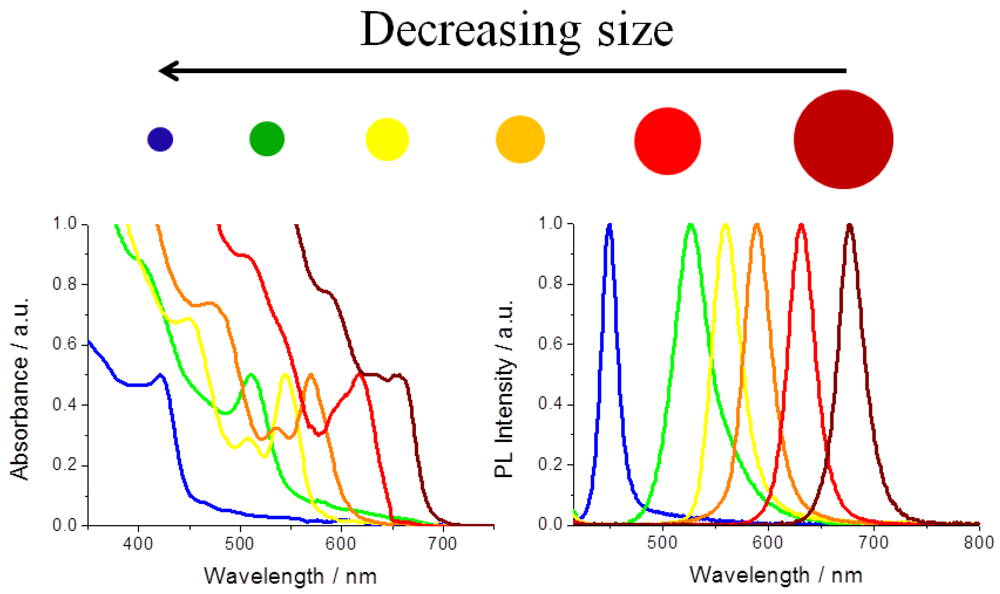
        <p>Tailoring the properties of these materials can be achieved by simply tuning the particle size without introducing any changes in the chemical composition, or by changing the material composition. Various shapes starting from spherical NCs, also called Quantum dots (QDs), rods, wires and tetrapods are available by adjusting the synthesis reaction parameters [<xref ref-type="bibr" rid="B15-polymers-04-00001">15</xref>]. By reducing the semiconductor size down to the NC regime, a characteristic blue shift of the band gap appears, and a widening of the band gap with a discrete level structure develops as a result of “quantum size effect” in these structures [<xref ref-type="bibr" rid="B2-polymers-04-00001">2</xref>]. In <xref ref-type="fig" rid="polymers-04-00001-f001">Figure 1</xref> the absorption and photoluminescence spectra of CdSe QDs of different sizes are shown demonstrating this effect. </p>
        <fig id="polymers-04-00001-f001" position="anchor">
          <label>Figure 1</label>
          <caption>
            <p>Left, absorption spectra of differently sized CdSe NCs. Right, corresponding PL spectra representing deeper red, red, orange, yellow, green and blue (from right to left) emitting CdSe cluster [<xref ref-type="bibr" rid="B16-polymers-04-00001">16</xref>] and NCs [<xref ref-type="bibr" rid="B17-polymers-04-00001">17</xref>,<xref ref-type="bibr" rid="B18-polymers-04-00001">18</xref>] under UV excitation at 380 nm. </p>
          </caption>
          <graphic xmlns:xlink="http://www.w3.org/1999/xlink" xlink:href="polymers-04-00001-g001.tif"/>
        </fig>
        <fig id="polymers-04-00001-f002" position="anchor">
          <label>Figure 2</label>
          <caption>
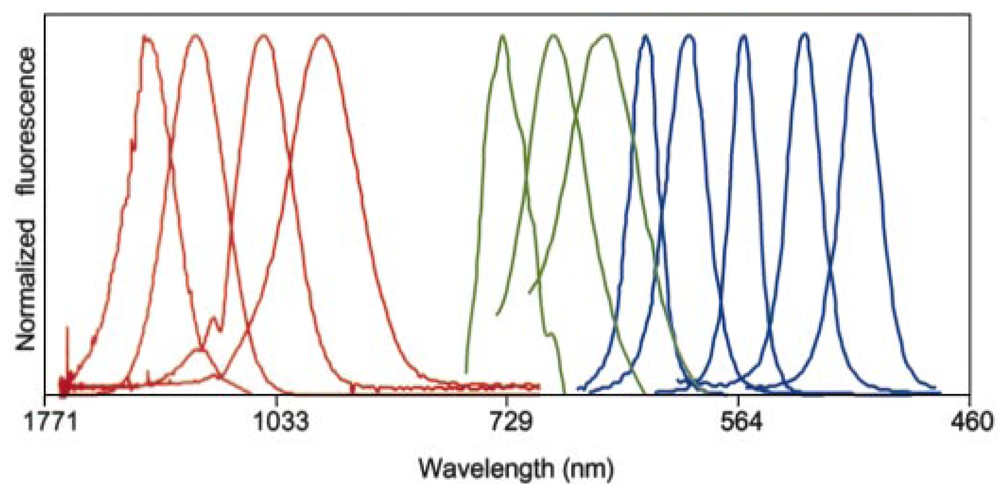
            <p>Size- and material-dependent emission spectra of several colloidal semiconductor NCs in a variety of sizes. The blue spectra represent different sizes of CdSe NCs with diameters of 2.1, 2.4, 3.1, 3.6, and 4.6 nm (from right to left). The green spectra represent InP nanocrystals with diameters of 3.0, 3.5, and 4.6 nm. The red spectra are related to InAs NCs with diameters of 2.8, 3.6, 4.6, and 6.0 nm (The image is reproduced from [<xref ref-type="bibr" rid="B12-polymers-04-00001">12</xref>] with permission).</p>
          </caption>
          <graphic xmlns:xlink="http://www.w3.org/1999/xlink" xlink:href="polymers-04-00001-g002.tif"/>
        </fig>
        <p>By changing the material composition as well as the size of the individual NCs the range for PL emission can be tuned covering the entire optical spectrum starting from UV to the NIR (<xref ref-type="fig" rid="polymers-04-00001-f002">Figure 2</xref>). The high quantum yield (QY), extraordinary photostability, pure color and the PL emission tunabilty of semiconductor NCs make them an obvious target of investigation for applications of white light generation. Examples for light emitting NCs are ZnO, CdS, CdSe, CdTe and CdSe core, core-shell or core-multishell structures which absorb UV or blue light and convert it into light of longer wavelengths.</p>
        
      </sec>
      <sec>
        <title>1.2. Semiconductor NCs/Polymer Nanocomposites</title>
        <p>Colloidal semiconductor NCs can form various hybrid materials by e.g., being integrated into different host materials including polymers. The incorporation of NCs into solid matrices from their growth solution is of interest for technologically useful applications as well as for fundamental studies of NC-matrix interactions. Polymers offer opportunities for flexible, lightweight, and mechanically stable NC nanocomposites [<xref ref-type="bibr" rid="B19-polymers-04-00001">19</xref>]. Semiconductor NC-polymer composites combine the advantages of both components and have been realized for light emitting displays [<xref ref-type="bibr" rid="B7-polymers-04-00001">7</xref>], light conversion layer [<xref ref-type="bibr" rid="B20-polymers-04-00001">20</xref>] such as LED covers or in solar concentrators [<xref ref-type="bibr" rid="B21-polymers-04-00001">21</xref>], optical bar coding [<xref ref-type="bibr" rid="B22-polymers-04-00001">22</xref>], photocatalyst [<xref ref-type="bibr" rid="B23-polymers-04-00001">23</xref>] and photovoltaics [<xref ref-type="bibr" rid="B4-polymers-04-00001">4</xref>]. The main challenge in the preparation of NC-polymer composites is preventing a macroscopic phase separation and the aggregation of NCs in the hybrid material which would lead to film inhomogeneities and fluorescent quenching effects limiting the respective optical device performance.</p>
        <p>Colvin <italic>et al.</italic> reported on the first hybrid NC-polymer light emitting diodes (LEDs) in 1994 [<xref ref-type="bibr" rid="B7-polymers-04-00001">7</xref>]. A thin layer of CdSe NCs was deposited on a conductive support, and combined with a 100 nm thick soluble poly(p-phenylenevinylene) PPV derivative layer. Since then, a lot of progress has been achieved for optimizing all parameters of NC-polymer hybrid LEDs. The introduction of CdSe@CdS core-shell NCs made a significant improvement for the NCs-polymer hybrid LED [<xref ref-type="bibr" rid="B24-polymers-04-00001">24</xref>]. The efficiency was increased twenty times by increasing the efficiency of the radiative recombination and device internal quantum efficiency, while the lifetime was increased as well by a factor of hundred. Other potential application for NC-polymer based LEDs are offering large area lighting systems and backlighting for flat panel displays. Such applications require LEDs emitting multi-color light or white light. Recently, Wood <italic>et al.</italic> fabricated a full color AC-driven display based on inject-printed NCs/polymer composites [<xref ref-type="bibr" rid="B25-polymers-04-00001">25</xref>]. Semiconductor colloidal NCs integrated in solvent based polymers have a potential to compete with other technologies such as OLEDs and full-color quantum dot displays [<xref ref-type="bibr" rid="B26-polymers-04-00001">26</xref>]. The lifetime of hybrid organic-NC based LED devices is still limited to some extend by the instability of the metal contacts and degradation of organic components under high current operation conditions [<xref ref-type="bibr" rid="B11-polymers-04-00001">11</xref>]. In order to avoid such limitations, some non-conductive polymers are combined with semiconductor NCs forming a photoluminescent conversion layer for commercially available e.g., blue LEDs [<xref ref-type="bibr" rid="B20-polymers-04-00001">20</xref>,<xref ref-type="bibr" rid="B27-polymers-04-00001">27</xref>]. In the following we concentrate on the description of NC-polymer hybrid materials based on non photoactive polymers for light conversion applications.</p>
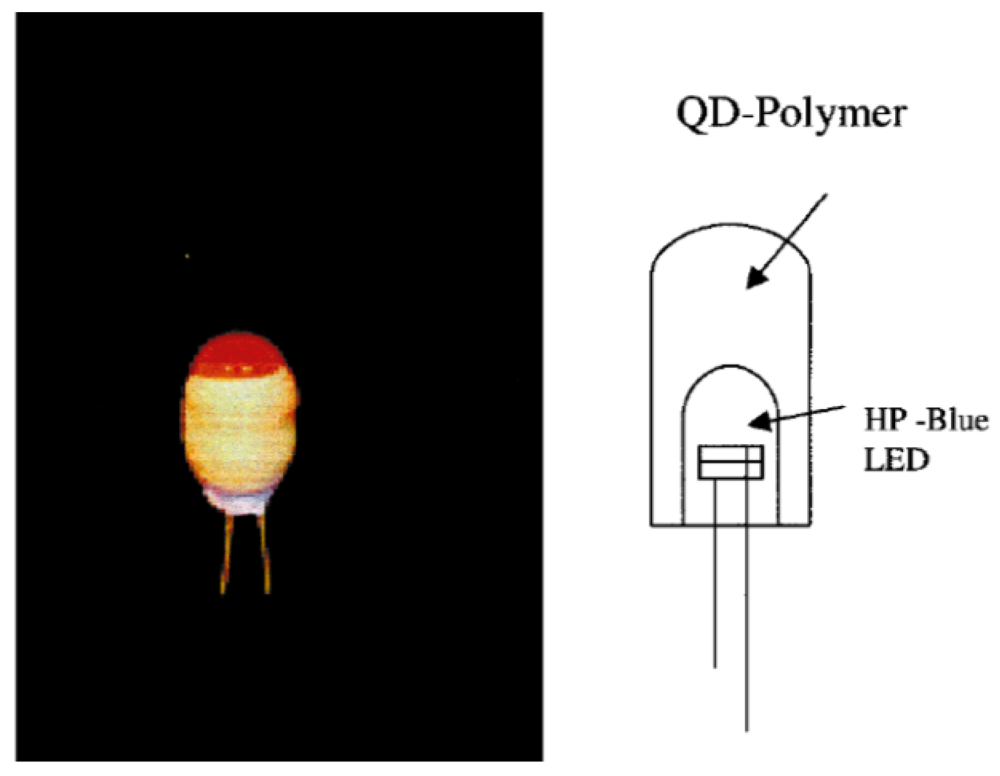
        <p>The first down-conversion LED was achieved by coating a transparent CdSe@ZnS core-shell polylaurylmethacrylate (PLMA) hybrid composite on the surface of a GaN light-emitting diode. Saturated-color light with different wavelengths has been generated by tuning the size of NCs (<xref ref-type="fig" rid="polymers-04-00001-f003">Figure 3</xref>). </p>
        <fig id="polymers-04-00001-f003" position="anchor">
          <label>Figure 3</label>
          <caption>
            <p>GaN LED emitting blue light originally at 425 nm covered with a NC-polymer hybrid film. Due to the light conversion layer the emission is changed to ~590 nm (the images are reproduced from [<xref ref-type="bibr" rid="B20-polymers-04-00001">20</xref>] with permission).</p>
          </caption>
          <graphic xmlns:xlink="http://www.w3.org/1999/xlink" xlink:href="polymers-04-00001-g003.tif"/>
        </fig>
      </sec>
    </sec>
    <sec>
      <title>2. Semiconductor NC Polymer Hybrid Materials Based on Non-Photoactive Polymers</title>
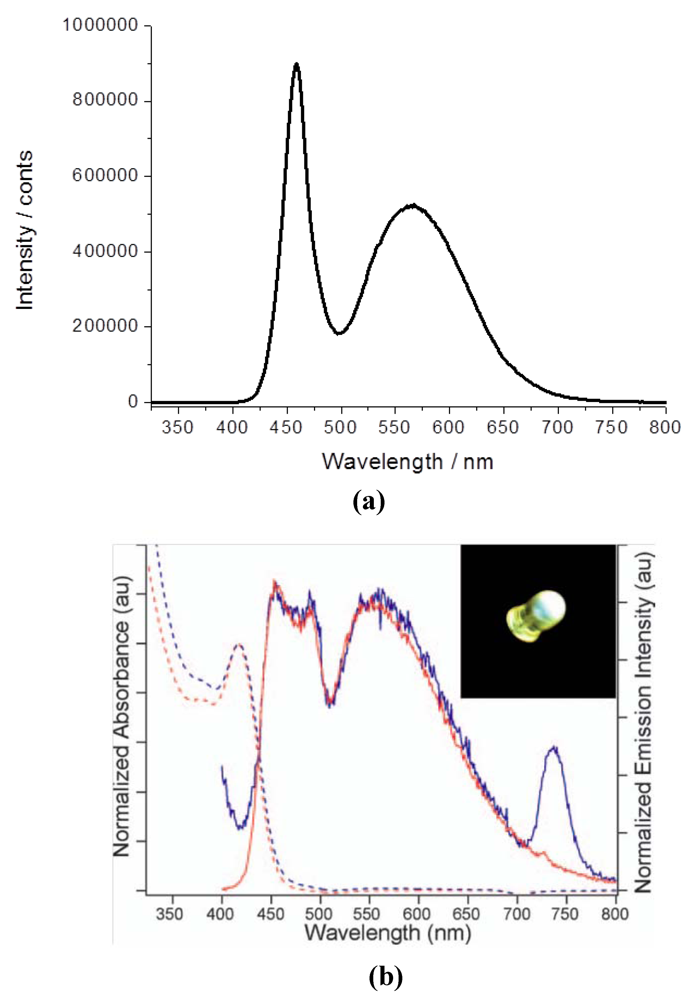
      <p>The development of blue and UV emitting diodes based on GaInN or GaN led to a new revolution in lightning. In combination with different materials as phosphors full color displays and white light emitting devices could be achieved [<xref ref-type="bibr" rid="B27-polymers-04-00001">27</xref>,<xref ref-type="bibr" rid="B28-polymers-04-00001">28</xref>]. These days LEDs are the most promising candidates for replacing traditional energy-inefficient incandescent bulbs and halogen lamps. With new generations of more energy-efficient RGB LEDs or white LED illumination systems, around 90% of the energy could be saved compared if conventional light bulbs are used [<xref ref-type="bibr" rid="B29-polymers-04-00001">29</xref>]. There is an alternative approach to generate white light emission, based on the combination of blue, green and red emitting LEDs. Multichip LEDs offer a good color rendering index and high energy efficiency [<xref ref-type="bibr" rid="B27-polymers-04-00001">27</xref>]. Hoverer, it demands very high production costs and requires a complicated lighting and electronic system to adjust the light intensity. Therefore, the phosphor conversion LED is the most promising approach for achieving a simple and low cost white light emission. Because of this, most common commercial white LEDs are based on blue-GaInN LEDs together with yellow emitting Ce activated yttrium aluminum phosphor (YAG:Ce). YAG:Ce phosphors absorb a significant part of the blue light from the GaInN chip and convert it into yellow light. The mixing of blue and yellow light generates white light. However, the broad and red-deficient emission spectrum of the YAG:Ce phosphor and the color purity varies with the input power limiting the color rending index (CRI) to ~80. The correlated color temperature (CCT) of such YAG:Ce phosphor based LEDs are limited to 4,000–8,000 K, which corresponds to the emission of neutral- and cool-white light [<xref ref-type="bibr" rid="B30-polymers-04-00001">30</xref>]. Especially, the illumination efficiency of the device is currently limited by the efficiency of the converting phosphor and the thermal instability. To overcome these problems, various phosphors have been examined in white LED applications. NC based phosphors are a new and emerging alternative for the existing YAG:Ce based phosphors. The NCs minimize light scattering and can be uniformly dispersed into many kinds of polymers for easy packaging and handling. The shortcomings of thermal quenching and reabsorption could be overcome by using transparent polymer hosts and the realization of multilayers where each layer contains one light emitting NC components. For example, white light emission with CRI over 90 was achieved by a novel CdSe NCs biphenylperfluorocylcobutyl (BP-PFCB) polymer hybrid layer [<xref ref-type="bibr" rid="B31-polymers-04-00001">31</xref>]. <xref ref-type="fig" rid="polymers-04-00001-f004">Figure 4</xref> shows the typical emission spectrum of a commercially available white light emitting converter LED in comparison with a commercial UV LED covered by an NC-polymer hybrid film leading to white light emission with a CRI value of 93.</p>
      <fig id="polymers-04-00001-f004" position="anchor">
        <label>Figure 4</label>
        <caption>
          <p>(<bold>a</bold>) Emission spectrum of a commercially available white light emitting LED from Osram AG (PARATHOM PAR16, CRI is 72.7, CCT is around 6,200 K). (<bold>b</bold>) Absorption and emission spectra of CdSe based white-light emitting NC mixtures (CRI is 93). The dashed lines represent the absorbance spectra, while the continuous lines show the emission spectra of the CdSe NCs. The red spectra are NCs solvated in toluene; the blue spectra are 12% w/w NCs in BP-PFCB. The feature at 400 nm (blue solid line) is an artifact due to the tail of the excitation source’s emission, and the emission feature at 730 nm is a 2nd order diffraction peak introduced by the detection setup. The inset is a true color photograph of a 365 nm LED coated with a CdSe NC-BP-PFCB hybrid film (<xref ref-type="fig" rid="polymers-04-00001-f004">Figure 4</xref>(b) is reproduced from [<xref ref-type="bibr" rid="B31-polymers-04-00001">31</xref>] with permission).</p>
        </caption>
        <graphic xmlns:xlink="http://www.w3.org/1999/xlink" xlink:href="polymers-04-00001-g004.tif"/>
      </fig>
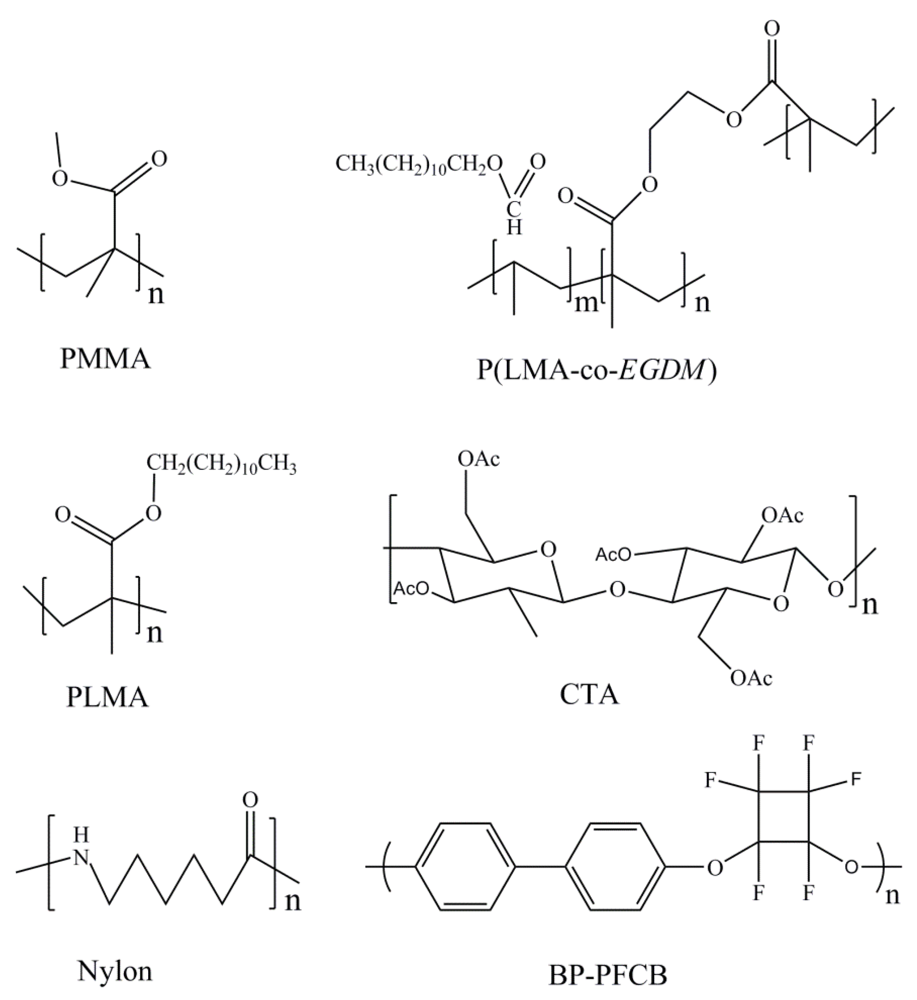
      <p>The chemical structure of various polymers utilized as polymeric hosts for luminescent semiconductor NCs are shown in <xref ref-type="fig" rid="polymers-04-00001-f005">Figure 5</xref>.</p>
      <fig id="polymers-04-00001-f005" position="anchor">
        <label>Figure 5</label>
        <caption>
          <p>Chemical structures of suitable polymer hosts for the integration of semiconductor NCs. Poly(methyl methacrylate) (PMMA), PLMA, Nylon, Poly(lauryl methacrylate-<italic>co</italic>-ethylene glycol dimethacrylate) (P(LMA-<italic>co</italic>-EGDM), Cellulose triacetate (CTA), and BP-PFCB.</p>
        </caption>
        <graphic xmlns:xlink="http://www.w3.org/1999/xlink" xlink:href="polymers-04-00001-g005.tif"/>
      </fig>
    </sec>
    <sec>
      <title>3. Synthesis Approaches for NC Polymer Based Hybrid Materials</title>
      <p>There are in principle three distinguishable approaches for obtaining polymer NC hybrid materials.</p>
      <sec>
        <title>3.1. Integration of as Synthesized Semiconductor NCs into Polymers by Physical Mixing</title>
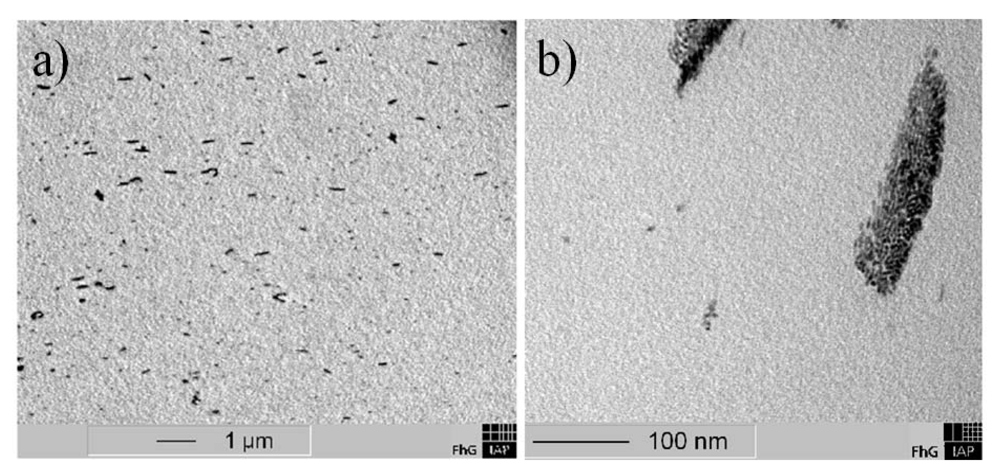
        <p>Physical mixing of NC solutions and polymer solutions is a first obvious approach for obtaining NC-polymer hybrid materials, especially for thin films. Even when serious chemical attacks to the NC surface are avoided during the solution mixing, PL QY is often reduced by the agglomeration of NCs due to phase segregation processes. An example is shown in <xref ref-type="fig" rid="polymers-04-00001-f006">Figure 6</xref>. Physical mixing is often used with organic soluble polymers, such as PMMA [<xref ref-type="bibr" rid="B29-polymers-04-00001">29</xref>,<xref ref-type="bibr" rid="B31-polymers-04-00001">31</xref>], cellulose [<xref ref-type="bibr" rid="B23-polymers-04-00001">23</xref>,<xref ref-type="bibr" rid="B32-polymers-04-00001">32</xref>] and so on. In order to maintain or even increase the PL QY, additional protective shells e.g., out of CdS [<xref ref-type="bibr" rid="B32-polymers-04-00001">32</xref>], ZnS [<xref ref-type="bibr" rid="B20-polymers-04-00001">20</xref>] and/or silica [<xref ref-type="bibr" rid="B33-polymers-04-00001">33</xref>] are utilized for covering the core NCs. Bomm <italic>et al.</italic> [<xref ref-type="bibr" rid="B32-polymers-04-00001">32</xref>] prepared CdSe@CdS NCs and cellulose triacetate (CTA) nanocomposites with a PL OY of 52% by using this physical mixing method. CdSe@CdS core@shell nanorods (NRs) were dispersed in a mixture of CH<sub>2</sub>Cl<sub>2</sub>/CHCl<sub>3</sub> (1:1) containing 2.5 wt % CTA by ultrasound treatment. The nanorod/polymer-solution was drop-casted on a 3 mm thick glass-substrate. The 9–15 μm thin CTA nanocomposite layers containing were obtained directly on glass. <xref ref-type="fig" rid="polymers-04-00001-f006">Figure 6</xref> shows TEM images of such a CdSe@CdS NRs/CTA nanocomposite film.</p>
        <fig id="polymers-04-00001-f006" position="anchor">
          <label>Figure 6</label>
          <caption>
            <p>(<bold>a</bold>) TEM image of a cellulose triacetate (CTA) nanocomposite layer containing 2 wt % CdSe@CdS core@shell nanorods (NRs) (<bold>b</bold>) TEM image of (a) at higher magnification showing the agglomeration of NRs in the polymer film (The figures are reproduced from [<xref ref-type="bibr" rid="B32-polymers-04-00001">32</xref>] with permission). </p>
          </caption>
          <graphic xmlns:xlink="http://www.w3.org/1999/xlink" xlink:href="polymers-04-00001-g006.tif"/>
        </fig>
      </sec>
      <sec>
        <title>3.2. <italic>In-Situ</italic> Synthesis of Semiconductor NCs in the Presence of Polymers</title>
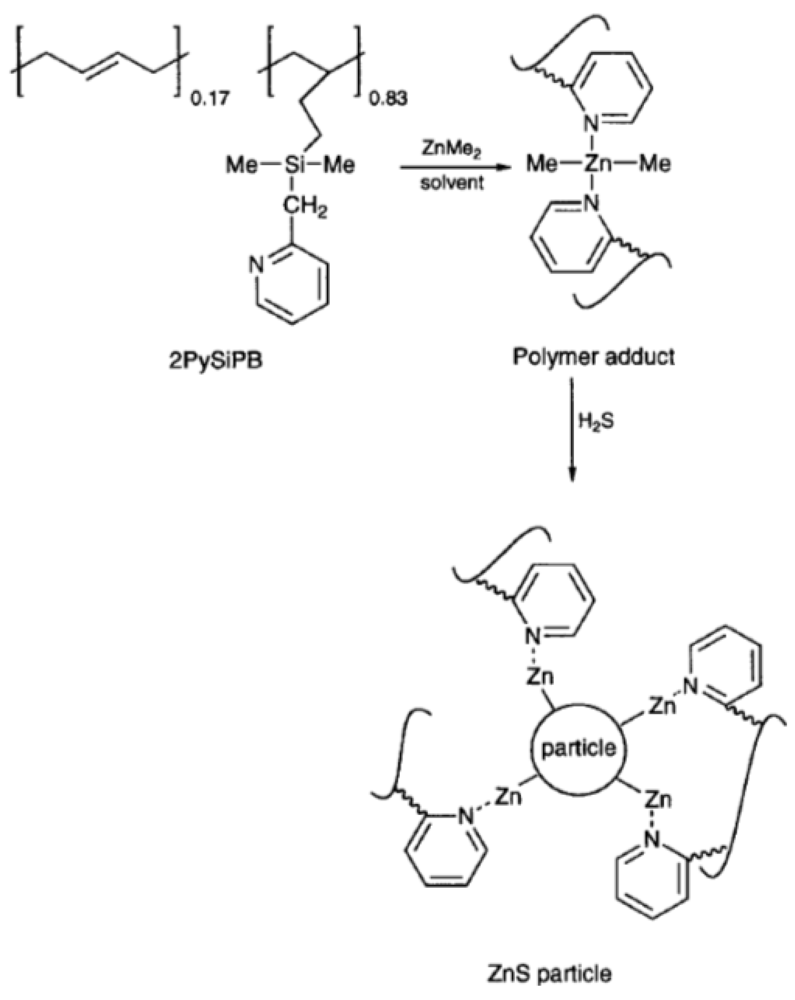
        <p>Typically, here the preparation procedure is divided into two steps. In a first step, organometallic precursors for NCs are introduced into polymer matrices by simple mixing the precursors and the polymer together in a common solvent. In a second step, the mixtures of NC precursors and polymer are exposed to gas or chalcogenide solution [<xref ref-type="bibr" rid="B34-polymers-04-00001">34</xref>] and/or simply heated up. Since the infinite crystal growth are limited by the polymer matrices, only nanometer-sized semiconductors crystals are obtained and remain in the polymer composite. Haggata<italic> et al.</italic> report on a method for the preparation od CdS, ZnS, CdSe and ZnSe NCs in a polymer matrix [<xref ref-type="bibr" rid="B35-polymers-04-00001">35</xref>,<xref ref-type="bibr" rid="B36-polymers-04-00001">36</xref>,<xref ref-type="bibr" rid="B37-polymers-04-00001">37</xref>]. A carefully controlled reaction temperature and suitable choice of solvent was found to have a dramatic effect on the size of the resulting particles. CdS, CdSe, ZnS or ZnSe NCs for example can be formed after ZnMe<sub>2</sub> was introduced in a soluble pyridyl polymer adduct (a polymer that contains nitrogen and dimethylcadmium or dimethylzinc) and after reacting with H<sub>2</sub>Se or H<sub>2</sub>S ZnS and ZnSe NCs were formed respectively. The formation of the resulting NCs-polymer hybrid materials are shown schematically in <xref ref-type="fig" rid="polymers-04-00001-f007">Figure 7</xref>.</p>
        <p>Within this <italic>in-situ</italic> synthesis method a control over the size and shape of semiconductor NCs within the polymer matrices was not achieved, and the photoluminescence QY of the NCs was quite low. For example the photoluminescence QY of CdSe NCs obtained by this method was less than 10%, containing a high degree of defect states visible by an additional broad red-shifted luminescence signal in the PL spectrum. </p>
        <fig id="polymers-04-00001-f007" position="anchor">
          <label>Figure 7</label>
          <caption>
            <p>Formation of the 2PySiPB adduct and the reaction of the polymer adduct with hydrogen sulfide. In a 1st step, organometallic precursors of (ZnMe<sub>2</sub>) and a 2-methylpyridyl derivative were mixed together in the solvent. In a 2nd step, the formed polymer adduct was exposed to H<sub>2</sub>S. The reaction of ZnMe<sub>2</sub> and H<sub>2</sub>S had been carried out in the presence of polymer and yielded to ZnS NCs (The figure is reproduced from [<xref ref-type="bibr" rid="B35-polymers-04-00001">35</xref>] with permission).</p>
          </caption>
          <graphic xmlns:xlink="http://www.w3.org/1999/xlink" xlink:href="polymers-04-00001-g007.tif"/>
        </fig>
        
      </sec>
      <sec>
        <title>3.3. Polymerization Reaction in the Presence of Semiconductor NCs</title>
        <p>Here, the direct polymerization of organic monomers in the presence of NCs is performed to form the NC-polymer hybrid material <italic>in-situ</italic>. The chemical attack from e.g., radicals during polymerization reactions and the aggregation of NCs within the polymer are the main causes for the photoluminescence quenching of semiconductor NCs in this hybrid material. Often the NCs are synthesized with an additional protective shell out of a higher bandgap material [<xref ref-type="bibr" rid="B20-polymers-04-00001">20</xref>,<xref ref-type="bibr" rid="B32-polymers-04-00001">32</xref>] or out of silica [<xref ref-type="bibr" rid="B33-polymers-04-00001">33</xref>]. An optically transparent polymer is also required for utilizing the hybrid materials for light conversion. Bawendi <italic>et al.</italic> have succeeded in fabricating transparent polymer composites out of CdSe@ZnS NCs and PLMA by radical polymerization of monomers. In their case the long alkyl side branches of PLMA could efficiently avoid the aggregation and phase separation of NCs [<xref ref-type="bibr" rid="B34-polymers-04-00001">34</xref>]. Additionally the protecting trioctylphosphine (TOP) ligand was also used to prevent the agglomeration and chemical attack on CdSe/ZnS QDs. Woelfle <italic>et al.</italic> introduced a poly(methyl methacrylate) (PMMA) compatible ionic liquid to protect the CdSe/ZnS QDs [<xref ref-type="bibr" rid="B38-polymers-04-00001">38</xref>]. However, the chemical attack during the thermal polymerization process could not be completely avoided. In both cases the resulting nanocomposites exhibited photoluminescence QYs of less than 40%. </p>
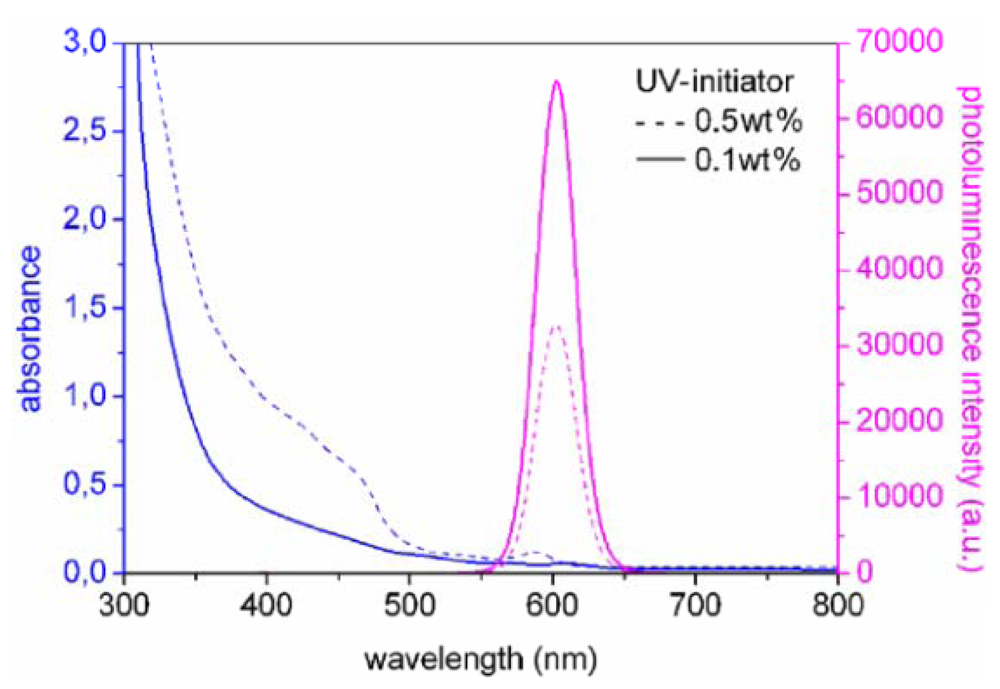
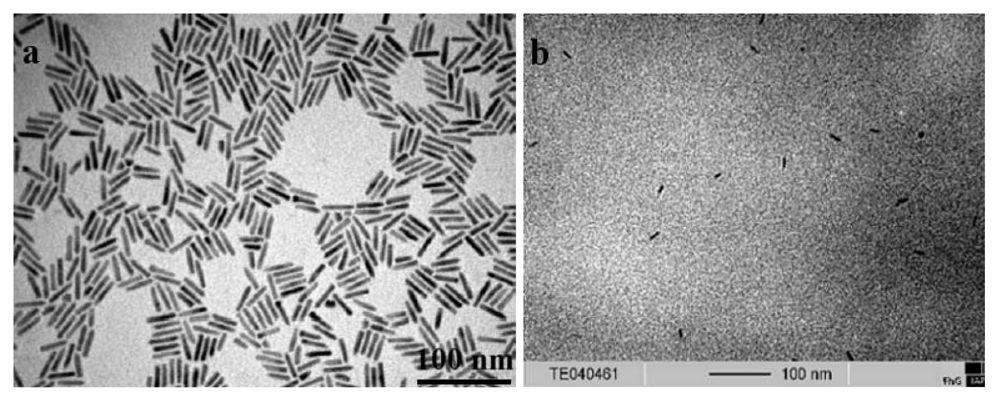
        <p>Recently, Bomm <italic>et al.</italic> reported a new method to incorporate CdSe@CdS core @shell nanorods into P(LMA-<italic>co</italic>-EGDM) by UV-polymerization lauryl methacrylate (LMA) monomers with the cross-linking agent ethylene glycol dimethacrylate (EGDM) monomers in the presence of the CdS@CdS NRs [<xref ref-type="bibr" rid="B32-polymers-04-00001">32</xref>]. They found that a high concentration of a liquid UV-initiator led to a significant decrease of PL QY. 70% PL QY was observed for this hybrid material by using only 0.1 wt % of a UV-initiator. <xref ref-type="fig" rid="polymers-04-00001-f008">Figure 8</xref> shows the effect of the concentration of the UV-initiator on the PL behavior of the nanocomposites. A decrease in PL QY is observed for high UV-initiator concentration. After incorporation of NCs into polymer, to maintain the optical properties of NCs in the hybrid materials is of outermost importance for light conversion application. As we mentioned before, the NCs phase separation and agglomeration, which could significantly reduce the transparency and PL QY of the NCs/polymer hybrid, should be avoided. NCs should be homogenously distributed in the polymer matrix without forming agglomerates. TEM investigation were carried out on this CdSe@CdS NR/P(LMA-<italic>co</italic>-EGDM) nanocomposites confirming the absence of agglomerates within the hybrid material (<xref ref-type="fig" rid="polymers-04-00001-f009">Figure 9</xref>).</p>
        <fig id="polymers-04-00001-f008" position="anchor">
          <label>Figure 8</label>
          <caption>
            <p>Absorption and PL spectra of CdSe@CdS NR/P(LMA-<italic>co</italic>-EGDM) composites containing 0.05 wt % NRs (aspect ratio 6:1) with low (0.1 wt %, solid line) and high (0.5 wt %, dotted line) concentrations of the UV-initiator. (The figure is reproduced from [<xref ref-type="bibr" rid="B32-polymers-04-00001">32</xref>] with permission).</p>
          </caption>
          <graphic xmlns:xlink="http://www.w3.org/1999/xlink" xlink:href="polymers-04-00001-g008.tif"/>
        </fig>
        <fig id="polymers-04-00001-f009" position="anchor">
          <label>Figure 9</label>
          <caption>
            <p>(<bold>a</bold>) TEM image of CdSe/CdS nanorods (aspect ratio 6) after synthesis. (<bold>b</bold>) TEM image of a CdSe/CdS NR/P(LMA-<italic>co</italic>-EGDM) composite film. (The images are reproduced from [<xref ref-type="bibr" rid="B32-polymers-04-00001">32</xref>] with permission). </p>
          </caption>
          <graphic xmlns:xlink="http://www.w3.org/1999/xlink" xlink:href="polymers-04-00001-g009.tif"/>
        </fig>
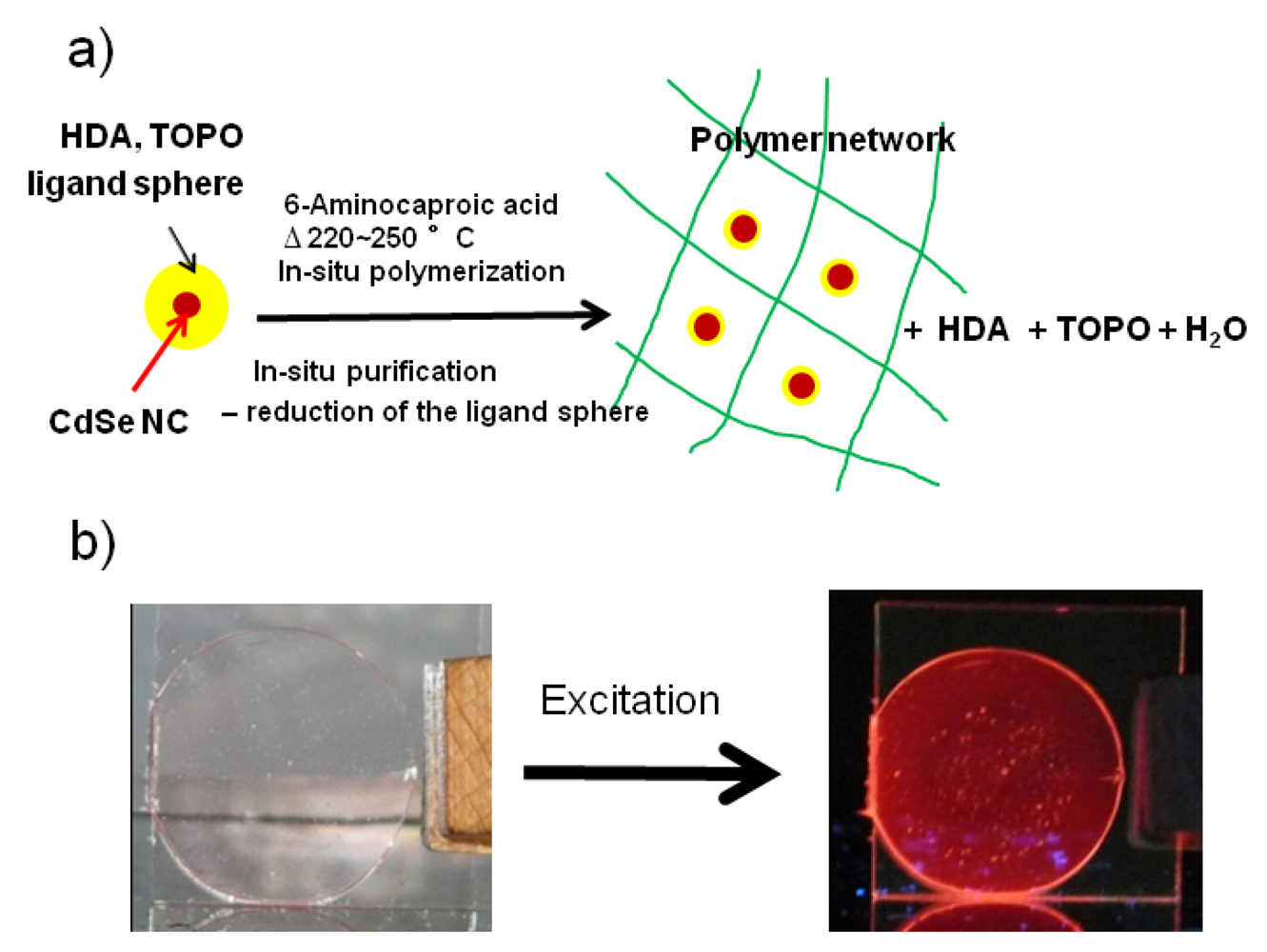
        <p>Without an additional protecting shell for the CdSe core material, the QY of CdSe-PMMA or CdSe-BP-PFCB hybrid materials is rather limited. Very recently, we developed a simple reproducible and up-scalable one pot approach for the incorporation of crude CdSe core QDs into nylon without the need of further purification steps. 60% PL QY was reached by this CdSe core NCs nylon composite [<xref ref-type="bibr" rid="B18-polymers-04-00001">18</xref>]. No significant loss in PL intensity was observed for the hybrid material compared to NC solutions and no additional protective shell was needed for the NCs which makes the process easy and up-scalable and. In <xref ref-type="fig" rid="polymers-04-00001-f010">Figure 10</xref>(a) the principle of the <italic>in-situ</italic> polymerization process of nylon in the presence of CdSe QDs is shown. The resulting hybrid material is moldable in any shape, transparent and highly luminescent (<xref ref-type="fig" rid="polymers-04-00001-f010">Figure 10</xref>(b)). As it is depicted in <xref ref-type="fig" rid="polymers-04-00001-f010">Figure 10</xref>(a), the polymerization of 6-aminocaproic acid monomers was performed at 220–250 °C in the presence of as-prepared unpurified TOPO and HDA capped core CdSe QDs using a straight forward process under nitrogen atmosphere [<xref ref-type="bibr" rid="B18-polymers-04-00001">18</xref>]. The excess ligand molecules are separated during solidification due to phase separation between the QD-nylon phase and the ligand phase and can be easily removed. Therefore even unpurified crude QDs can be used directly after synthesis without applying any extra purification step. Differently sized QDs can be incorporated into the nylon polymer resulting in different color emitting hybrid materials and laser scanning microscopical (LSM) investigation of the hybrid films revealed a homogenious PL emission at the microscopic level [<xref ref-type="bibr" rid="B18-polymers-04-00001">18</xref>]. The transparency of the resulting product can be increased by fast cooling of the liquid phase. The QD hybrid materials can be processed while kept in liquid phase above 150 °C and different forms and shapes are available. After incorporation of the QDs into the polymer matrix, no significant loss of PL QY was observed.</p>
        
        <p>Another successful approach for obtaining functional NC-polymer hybrid films is the attachment of polymerizable capping ligands directly onto the NC surface, which can lead to a strong binding of NCs to the resulting polymer matrices. Zhang <italic>et al.</italic> capped octadecyl-p-vinyl-benzyl dimethylammonium chloride (OVDAC) on CdTe NCs in aqueous solution via electrostatic interactions [<xref ref-type="bibr" rid="B39-polymers-04-00001">39</xref>]. CdTe NC-polymer bulk composites were obtained after the radical polymerization reaction was induced by azobis-isobutyronitrile (AIBN) as initiator. The phase separation and agglomeration of the NCs from the polymer host was avoided by the strong attachment of CdTe NCs to the polymer matrix during polymerization. This approach can be used for a wide range of monomers, such as styrene and methyl methacrylate based ones.</p>
        <fig id="polymers-04-00001-f010" position="anchor">
          <label>Figure 10</label>
          <caption>
            <p>(<bold>a</bold>) Schematic illustration of the <italic>in-situ</italic> polymerization reaction of 6-aminocaproic acid in the presence of as synthesized CdSe QDs leading to the CdSe QD-nylon hybridmaterial, (<bold>b</bold>) A photograph of a thin transparent QD-nylon hybridfilm with and without UV excitation at 312 nm is displayed.</p>
          </caption>
          <graphic xmlns:xlink="http://www.w3.org/1999/xlink" xlink:href="polymers-04-00001-g010.tif"/>
        </fig>
      </sec>
    </sec>
    <sec>
      <title>4. Applications of Luminescent NC-Polymer Hybrid Materials</title>
      <sec>
        <title>4.1. White Light Generation</title>
        <p>Nowadays, 20% of the electricity is globally consumed for lighting [<xref ref-type="bibr" rid="B30-polymers-04-00001">30</xref>]. Especially, for indoor applications in homes, office, <italic>etc.</italic>, the lighting is responsible for half of total electricity consumption [<xref ref-type="bibr" rid="B30-polymers-04-00001">30</xref>]. The widespread use of solid state based lighting is predicted to save 50% of the energy consumption for lighting [<xref ref-type="bibr" rid="B30-polymers-04-00001">30</xref>]. Theoretically, the white LED could reach a high CRI value around 90 and a luminous efficiency higher than 350 lm/W. However, CRI of the commercial white LEDs are limited up to 80 for now [<xref ref-type="bibr" rid="B40-polymers-04-00001">40</xref>,<xref ref-type="bibr" rid="B41-polymers-04-00001">41</xref>]. A warm white LED with a CRI of 89 and a luminous efficiency of 274 lm/W<sub>opt</sub> at a CCT of 3,100 K has been obtain by using nitride-based Eu<sup>2+</sup> phosphors in combination with a blue LED [<xref ref-type="bibr" rid="B40-polymers-04-00001">40</xref>] which is the best result achieved so far. Nizamoglu <italic>et al.</italic> reported a photometric model and proposed a new design for white light LEDs [<xref ref-type="bibr" rid="B30-polymers-04-00001">30</xref>,<xref ref-type="bibr" rid="B42-polymers-04-00001">42</xref>]. They experimentally demonstrated warm-white LEDs combined with nanophosphors based on CdSe@ZnS core-shell NCs on a LED chip to achieve luminous efficiency higher than 350 lm/W<sub>opt</sub> with a CRI of 89.2 at a CCT &lt; 3,000 K. This result demonstrates that semiconductor NCs have a promising high capability for the generation of warm white light. During the last decade, lots of efforts were devoted for optimizing the white light emission by NC-/hybrid materials. Current research focuses on two directions, one is to increase the quality of the emission color (CRI and CCT), and another is to obtain higher luminescence efficiency.</p>
        <p>For obtaining a good emission color, the most common approach is mixing different emitting NCs in the polymer. Chung <italic>et al.</italic> reported a white emission by using mixtures of differently sized CdSe core NCs incorporated in PMMA as a phosphor [<xref ref-type="bibr" rid="B27-polymers-04-00001">27</xref>]. The white LED was fabricated by covering a 460 nm emitting blue LED with a CdSe NC-PMMA nanocomposite layer. Two white light emitting realizations were presented, the first one was based on a single phosphor film containing CdSe NCs emitting at 580 nm and the second one was based on a dual phosphor film containing CdSe NCs emitting at 555 and 625 nm respectively. In the single phosphor realization the CRI is with 15.7 very low. The CRI value was increased to 61.1 after choosing the dual phosphor realization. In order to avoid the reabsorption effect by mixing differently emitting NCs together in one polymer layer, a double layer approach was introduced where the longer emission wavelength NC-polymer layer was coated on top of the shorter emission wavelength NC-polymer layer. However, limited by the low PL QY of CdSe NCs, the luminous efficiency of white LEDs were lower than 6 lm/W at an operating current for the blue LED of 20 mA. The design of NCs with a broad emission signal is an alternative approach for achieving white light spectra. Schreuder <italic>et al</italic>, examined thirteen dissimilar polymers as potential encapsulates for special designed broad emitting (white-light emitting) NCs [<xref ref-type="bibr" rid="B31-polymers-04-00001">31</xref>]. They found that encapsulates based on cyclosiloxane or bisphenol-A type epoxy structures caused extensive aggregation of the NCs even at low loading levels (less than 0.5% w/w) due to the solubility difference between the polymers and the NCs. Biphenylperfluorocyclobutyl (BP-PFCM) exhibited the most robust, color stable, and homogenous encapsulation properties enabling a high loading of NCs as well. White-light emitting CdSe NCs encapsulated in the BP-PFCB polymer were coated on various UV-LEDs creating a white light source with chromaticity coordinates of (0.324, 0.322) and a high color-rendering index of 93 with a luminescence efficiency below 1 lm/W since the original PL QY of such white-light emitting CdSe NCs is already very low. The luminescence efficiency of such CdSe NCs-BP-BFCB nanocomposite covered LEDs increased up to 5.3 lm/W by optimizing the thickness of the hybrid films and the utilization of different types of UV LEDs [<xref ref-type="bibr" rid="B43-polymers-04-00001">43</xref>]. A lot of researchers also choose the CCT which is a criterion for the quality for warm white light as overall quality parameter for optimizations. Chandramohan <italic>et al.</italic> demonstrated a warm white light (CCT of 3,436 to 4,500 K) emitting LED with a CRI of 87.4 using green-light-emitting CdSe NC-PMMA hybrid materials covering a InGaN/GaN based blue emitting LED [<xref ref-type="bibr" rid="B44-polymers-04-00001">44</xref>]. Very recently, Chung <italic>et al.</italic> fabricated a warm (CCT of 3,237.4 K) white light emitting LED with a CRI of 83.8 and a luminescence efficiency of 4.14 lm/W by combining blue LED emitting at 430 nm with a nanocomposite film based on (Poly[(9,9-dioctyl-2,7-divinylenefluorenylene)-alto-<italic>co</italic>-(2-methoxy-5-(2-ethylhexyloxy)-1,4-phenylene)] (PFPV) and CuInS<sub>2</sub>-ZnS nanoparticles [<xref ref-type="bibr" rid="B45-polymers-04-00001">45</xref>].</p>
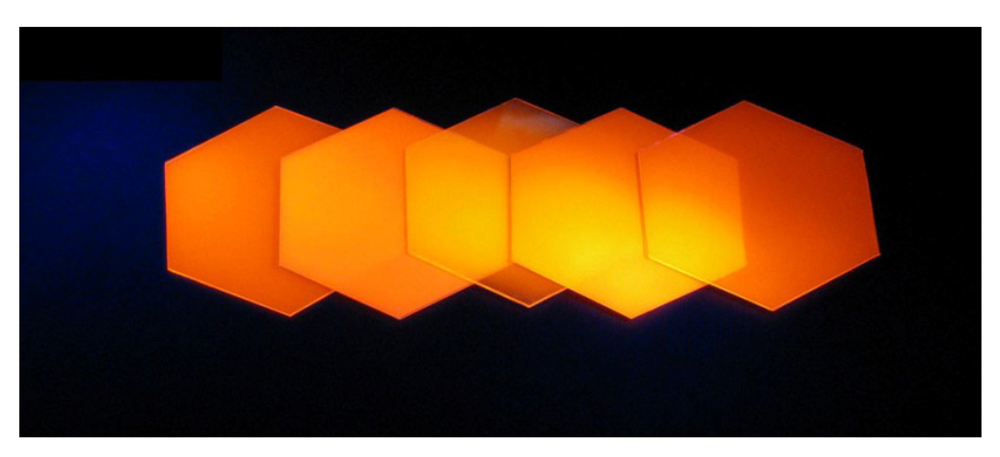
        <p>In order to improve the overall luminescence efficiency, a lot of research groups try to increase the PL QY of the light converting hybrid material. Weaver <italic>et al.</italic> for example studied the fluorescence quenching behavior during the incorporation of CdSe@ZnS NCs into cyanoacrylate, epoxy and silicone [<xref ref-type="bibr" rid="B46-polymers-04-00001">46</xref>]. They found that excess of amines in the NCs solution passivated the NCs surface and preserved the PL QY of the NCs-polymer composites. Yu <italic>et al.</italic> reported on a white light LED with a luminescence efficiency of 44.2 lm/W by mixing a relatively high amount of CdSe NCs (20% by weight) into PFPV [<xref ref-type="bibr" rid="B47-polymers-04-00001">47</xref>]. Since the luminescence efficiencies achieved for light conversion layers so far are still low, efforts have to be dedicated for the development of NCs/polymer composites with high QY. Low cost and high PL QY hybrid materials would be the key parameters for NC based white light conversion materials towards their utilization and for commercializing. First commercially available NCs/polymer based white light converter plates are already on the market (<xref ref-type="fig" rid="polymers-04-00001-f011">Figure 11</xref>). </p>
        <fig id="polymers-04-00001-f011" position="anchor">
          <label>Figure 11</label>
          <caption>
            <p>Photograph of Quantum LightTM optics from the company QD Vision, Lexington, MA, USA for converting cold white light emitting LEDs into warm white light sources (Image source: <uri>www.qdvision.com</uri>, 2010, copyright QD Vision).</p>
          </caption>
          <graphic xmlns:xlink="http://www.w3.org/1999/xlink" xlink:href="polymers-04-00001-g011.tif"/>
        </fig>
      </sec>
      <sec>
        <title>4.2. Light Conversion Layers in Concentrator Solar Cells</title>
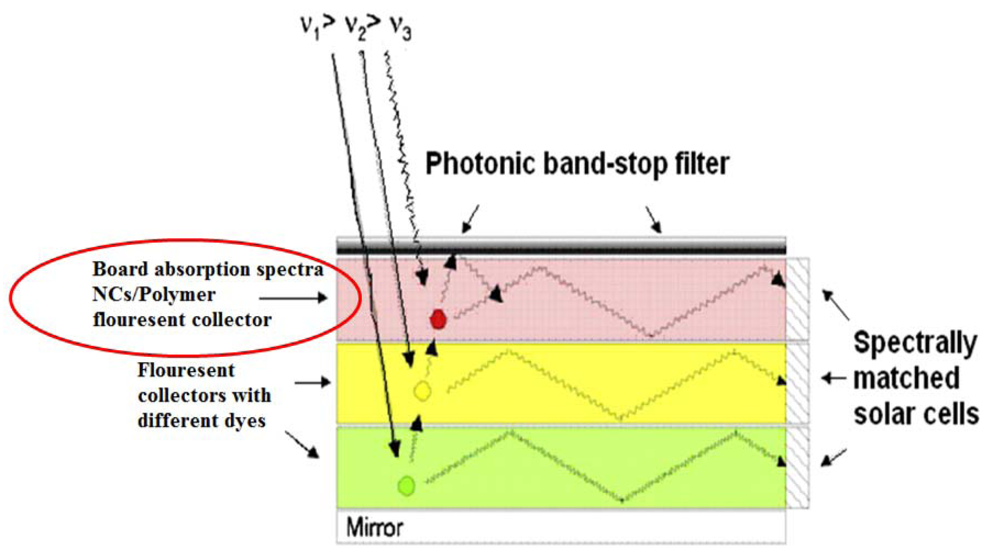
        <p>One main driving force of photovoltaic (PV) research and development is attaining higher power conversion efficiencies at lower costs. Compared with expensive prices of high efficient PV modules, it is preferable to convert incident light from the solar spectrum collected at large areas to monochromatic light and concentrate the converted light onto a small area of a high efficient solar cells with optimized power conversion efficiencies for the chosen monochromatic light . Based on this concept, luminescent solar concentrators (LSC) were developed in the late 1970s as an alternative approach to lower the costs of PV. The achievable efficiency of LSCs is dependent on how well it is spectrally matched with the attached absorbing fluorescent material. Recently, Goldschmidt <italic>et al.</italic> reported two independent methods to increase the collection efficiency of LSCs. One is to combine two different dyes to enlarge the utilizable spectral range. The other is to increase the collection efficiency by using a photonic structure acting as a band stop reflection filter in the emission range of the dye. <xref ref-type="fig" rid="polymers-04-00001-f012">Figure 12</xref> demonstrates the principle of a multi-fluorescent concentrator cell based on Goldschmidt’s concept [<xref ref-type="bibr" rid="B48-polymers-04-00001">48</xref>].</p>
         <p>However, over 60% of the total solar photon flux occurs at wavelengths above 600 nm, which is beyond to the absorption range of most organic dyes. Novel luminescent photo stable materials with absorptions reaching to the infrared are needed for increasing the efficiency of LSCs. Semiconductor NC based hybrid materials have good potential to match this need. NCs can provide excellent PL QY with sufficient long term stabilities. For example PLQE of 85% has been reported for core-shell NCs [<xref ref-type="bibr" rid="B49-polymers-04-00001">49</xref>], and PL QY of 70% for the transparent NCs/polymer composites so far [<xref ref-type="bibr" rid="B32-polymers-04-00001">32</xref>].</p>
        <fig id="polymers-04-00001-f012" position="anchor">
          <label>Figure 12</label>
          <caption>
            <p>Principle of a multi-fluorescent concentrator. The light collection unit consists of a stack of different absorber layers. An additional photonic structure helps to minimize reflection losses. The photonic structure acts as a band stop reflection filter. It allows light in the absorption range of the dyes to enter the collector, but reflects light in the emission range. Therefore a larger amount of light is trapped in the collector and guided to the high efficient spectrally matched solar cells mounted at the edges (The figure is reproduced from [<xref ref-type="bibr" rid="B48-polymers-04-00001">48</xref>] with permission).</p>
          </caption>
          <graphic xmlns:xlink="http://www.w3.org/1999/xlink" xlink:href="polymers-04-00001-g012.tif"/>
        </fig>
       
      </sec>
      <sec>
        <title>4.3. Light Conversion Layers for Enhanced Plant Growth to Increase Biofuel Production</title>
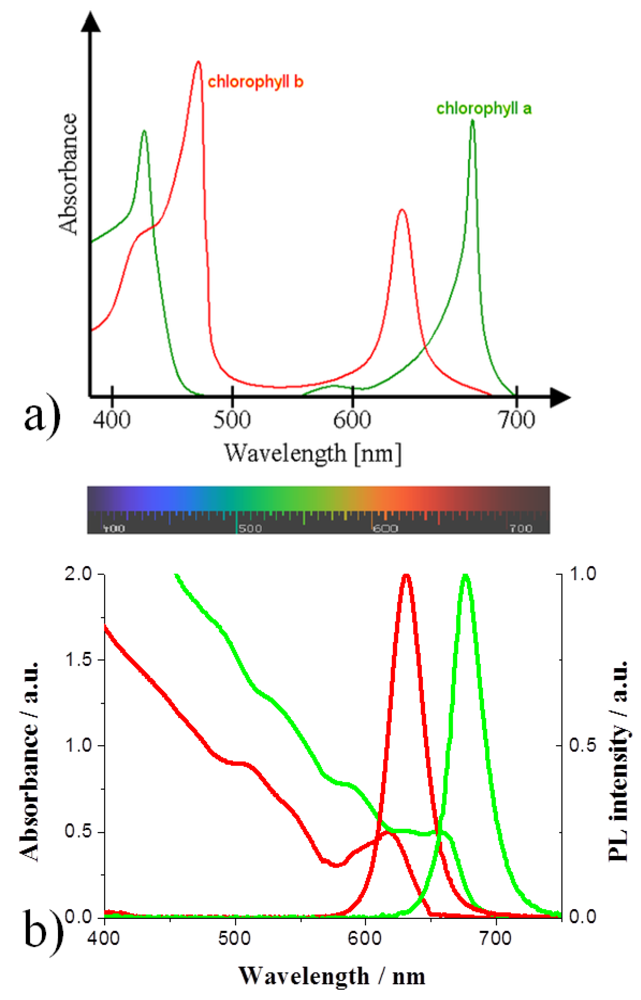
        <p>The improvement of energy conversion and storage is one of the major tasks to achieve further optimization of the global energy management. In addition self-sufficient energy harvesting technologies are currently developed to obtain autonomous and flexible small devices harvesting energy from the environment similar to photosynthesis. The overall energy conversion efficiency of photosynthesis is below 1%. One reason is that chlorophyll as main absorber in plants for photosynthesis does not use the fully visible spectrum but rather the blue and red light only. <xref ref-type="fig" rid="polymers-04-00001-f013">Figure 13</xref>(a) shows the absorption of chlorophyll a and b demonstrating the loss based on incomplete absorption of the visible light range. Recently there have been tremendous efforts undertaken to utilize biofuels for transportation by e.g., mixing some biofuel content to petrol. Since biofuel production is competing with food production, negative consequences such as increasing food prices enhancing the poverty of millions of people have already been observed. Enhancing plant growth especially of plants not competing with the food chain is of outermost importance to damp and hinder these negative developments. Due to the broad range absorption properties of semiconductor NCs and the tunability of their absorption and emission properties over a wide range, NCs/polymer hybrid materials could be used as solar absorbing and light converting layers matching to the absorption characteristics of chlorophyll (<xref ref-type="fig" rid="polymers-04-00001-f013">Figure 13</xref>(b)). This would lead to a better utilization of the incident solar light for plant or algae growth for the production of biofuels. As one can see in <xref ref-type="fig" rid="polymers-04-00001-f013">Figure 13</xref>(a), the absorption spectrum of chlorophyll is very narrow, only blue and red light is useful for the photosynthesis. For example CdSe NCs can absorb the energy of the green, yellow and orange spectrum the light and convert it into the emission of red light matching to the absorption maximum of the respective chlorophyll (<xref ref-type="fig" rid="polymers-04-00001-f013">Figure 13</xref>(b)).</p>
        <fig id="polymers-04-00001-f013" position="anchor">
          <label>Figure 13</label>
          <caption>
            <p>(<bold>a</bold>) Absorbance spectra of chlorophyll a (green) and b (red) in solution. The spectra of chlorophyll molecules are slightly modified <italic>in vivo</italic> depending on specific pigment-protein interactions (The image is reproduced from [<xref ref-type="bibr" rid="B50-polymers-04-00001">50</xref>] with permission), (<bold>b</bold>) Absorption and PL spectra of differently sized CdSe NCs matching to the absorption of the chlorophylls respectively. The excitation for the NC emission was performed at 380 nm.</p>
          </caption>
          <graphic xmlns:xlink="http://www.w3.org/1999/xlink" xlink:href="polymers-04-00001-g013.tif"/>
        </fig>
      </sec>
    </sec>
    <sec>
      <title>5. Outlook</title>
      <p>The development of semiconductor NCs-polymer hybrid materials continues. Once the excellent photo stability, high QY and tunable sized-dependent PL properties of NCs are maintained in NC-polymers hybrid materials they can be utilized in a wide range of applications including LED conversion layers, absorber layers in fluorescent concentrator solar cells and light converting layers for enhanced plant and algae growth for increasing the biofuel production. Further applications might be high sensitive fluorescence detection screens or the development of fluorescence standards for three dimensional confocal laser scanning microscopy. Since cadmium and lead based materials are considered toxic and therefore not environmental friendly, the development of cadmium and lead-free NC materials are of high importance for future applications. Luminescent NCs based on Y<sub>2</sub>O<sub>3</sub>@Eu<sub>2</sub>O<sub>3</sub>, InP@ZnS, MnSe@ZnSe might be promising materials to be incorporated into polymers for various light conversion applications [<xref ref-type="bibr" rid="B28-polymers-04-00001">28</xref>,<xref ref-type="bibr" rid="B33-polymers-04-00001">33</xref>,<xref ref-type="bibr" rid="B51-polymers-04-00001">51</xref>].</p>
    </sec>
    
  </body>
  <back>
    <ack>
      <title>Acknowledgments</title>
      <p>We thank the University of Freiburg and the “Deutsche Forschungsgemeinschaft” (DFG) within the DFG graduate school “Micro Energy Harvesting” for financial support. Y. Yuan acknowledges the support of the University of Freiburg for granting a Ph.D. scholarship within the “Landesgraduiertenförderung” program. We thank F.S. Riehle for fruitful scientific discussions.</p>
    </ack>
    <ref-list>
      <title>References</title>
      <ref id="B1-polymers-04-00001">
        <label>1.</label>
        <citation citation-type="journal">
          <person-group person-group-type="author">
            <name>
              <surname>Rossetti</surname>
              <given-names>R.</given-names>
            </name>
            <name>
              <surname>Nakahara</surname>
              <given-names>S.</given-names>
            </name>
            <name>
              <surname>Brus</surname>
              <given-names>L.E.</given-names>
            </name>
          </person-group>
          <article-title>Quantum size effects in the redox potentials, resonance raman spectra, and electronic spectra of CdS crystallites in aqueous solutions</article-title>
          <source>J. Chem. Phys.</source>
          <year>1983</year>
          <volume>79</volume>
          <fpage>1086</fpage>
          <lpage>1087</lpage>
          <pub-id pub-id-type="doi">10.1063/1.445834</pub-id>
        </citation>
      </ref>
      <ref id="B2-polymers-04-00001">
        <label>2.</label>
        <citation citation-type="journal">
          <person-group person-group-type="author">
            <name>
              <surname>Brus</surname>
              <given-names>L.E.</given-names>
            </name>
          </person-group>
          <article-title>Electron-electron and electron-hole interactions in small semiconductor crystallites: The size dependence of the lowest excited electronic state</article-title>
          <source>J. Chem. Phys.</source>
          <year>1984</year>
          <volume>80</volume>
          <fpage>4403</fpage>
          <lpage>4409</lpage>
          <pub-id pub-id-type="doi">10.1063/1.447218</pub-id>
        </citation>
      </ref>
      <ref id="B3-polymers-04-00001">
        <label>3.</label>
        <citation citation-type="journal">
          <person-group person-group-type="author">
            <name>
              <surname>Zhou</surname>
              <given-names>Y.</given-names>
            </name>
            <name>
              <surname>Riehle</surname>
              <given-names>F.S.</given-names>
            </name>
            <name>
              <surname>Yuan</surname>
              <given-names>Y.</given-names>
            </name>
            <name>
              <surname>Schleiermacher</surname>
              <given-names>H.F.</given-names>
            </name>
            <name>
              <surname>Niggemann</surname>
              <given-names>M.</given-names>
            </name>
            <name>
              <surname>Urban</surname>
              <given-names>G.A.</given-names>
            </name>
            <name>
              <surname>Krueger</surname>
              <given-names>M.</given-names>
            </name>
          </person-group>
          <article-title>Improved efficiency of hybrid solar cells based on non-ligand exchanged CdSe quantum dots and poly (3-hexylthiophene)</article-title>
          <source>Appl. Phys. Lett.</source>
          <year>2010</year>
          <volume>96</volume>
          <fpage>013304</fpage>
        <pub-id pub-id-type="doi">10.1063/1.3280370</pub-id></citation>
      </ref>
      <ref id="B4-polymers-04-00001">
        <label>4.</label>
        <citation citation-type="journal">
          <person-group person-group-type="author">
            <name>
              <surname>Zhou</surname>
              <given-names>Y.</given-names>
            </name>
            <name>
              <surname>Eck</surname>
              <given-names>M.</given-names>
            </name>
            <name>
              <surname>Kruger</surname>
              <given-names>M.</given-names>
            </name>
          </person-group>
          <article-title>Bulk-heterojunction hybrid solar cells based on colloidal nanocrystals and conjugated polymers</article-title>
          <source>Energy Environ. Sci.</source>
          <year>2010</year>
          <volume>3</volume>
          <fpage>1851</fpage>
          <lpage>1864</lpage>
          <pub-id pub-id-type="doi">10.1039/c0ee00143k</pub-id>
        </citation>
      </ref>
      <ref id="B5-polymers-04-00001">
        <label>5.</label>
        <citation citation-type="journal">
          <person-group person-group-type="author">
            <name>
              <surname>Klimov</surname>
              <given-names>V.I.</given-names>
            </name>
            <name>
              <surname>Mikhaelovsky</surname>
              <given-names>A.A.</given-names>
            </name>
            <name>
              <surname>Xu</surname>
              <given-names>S.</given-names>
            </name>
            <name>
              <surname>Malko</surname>
              <given-names>A.</given-names>
            </name>
            <name>
              <surname>Hollingsworth</surname>
              <given-names>J.A.</given-names>
            </name>
            <name>
              <surname>Leatherdale</surname>
              <given-names>C.A.</given-names>
            </name>
            <name>
              <surname>Eisler</surname>
              <given-names>H.-J.</given-names>
            </name>
            <name>
              <surname>Bawendi</surname>
              <given-names>M.D.</given-names>
            </name>
          </person-group>
          <article-title>Optical gain and stimulated emission in nanocrystal quantum dots</article-title>
          <source>Science</source>
          <year>2000</year>
          <volume>290</volume>
          <fpage>314</fpage>
          <lpage>317</lpage>
          <pub-id pub-id-type="doi">10.1126/science.290.5490.314</pub-id>
        </citation>
      </ref>
      <ref id="B6-polymers-04-00001">
        <label>6.</label>
        <citation citation-type="journal">
          <person-group person-group-type="author">
            <name>
              <surname>Kazes</surname>
              <given-names>M.</given-names>
            </name>
            <name>
              <surname>Lewis</surname>
              <given-names>D.T.</given-names>
            </name>
            <name>
              <surname>Ebenstein</surname>
              <given-names>Y.</given-names>
            </name>
            <name>
              <surname>Mokari</surname>
              <given-names>T.</given-names>
            </name>
            <name>
              <surname>Banin</surname>
              <given-names>U.</given-names>
            </name>
          </person-group>
          <article-title>Lasing from semiconductor quantum rods in a cylindrical microcavity</article-title>
          <source>Adv. Mater.</source>
          <year>2002</year>
          <volume>14</volume>
          <fpage>317</fpage>
          <lpage>321</lpage>
          <pub-id pub-id-type="doi">10.1002/1521-4095(20020219)14:4&lt;317::AID-ADMA317&gt;3.0.CO;2-U</pub-id>
        </citation>
      </ref>
      <ref id="B7-polymers-04-00001">
        <label>7.</label>
        <citation citation-type="journal">
          <person-group person-group-type="author">
            <name>
              <surname>Colvin</surname>
              <given-names>V.L.</given-names>
            </name>
            <name>
              <surname>Schlamp</surname>
              <given-names>M.C.</given-names>
             </name>
            <name>
              <surname>Alivisatos</surname>
              <given-names>A.P.</given-names>
             </name>
          </person-group>
          <article-title>Light-emitting diodes made from cadmium selenide nanocrystals and a semiconducting polymer</article-title>
          <source>Nature</source>
          <year>1994</year>
          <volume>370</volume>
          <fpage>354</fpage>
          <lpage>357</lpage>
        <pub-id pub-id-type="doi">10.1038/370354a0</pub-id></citation>
      </ref>
      <ref id="B8-polymers-04-00001">
        <label>8.</label>
        <citation citation-type="journal">
          <person-group person-group-type="author">
            <name>
              <surname>Tessler</surname>
              <given-names>N.</given-names>
            </name>
            <name>
              <surname>Medvedev</surname>
              <given-names>V.</given-names>
            </name>
            <name>
              <surname>Kazes</surname>
              <given-names>M.</given-names>
            </name>
            <name>
              <surname>Kan</surname>
              <given-names>S.</given-names>
            </name>
            <name>
              <surname>Banin</surname>
              <given-names>Y.</given-names>
            </name>
          </person-group>
          <article-title>Efficient near-infrared polymer nanocrystal light-emitting diodes</article-title>
          <source>Science</source>
          <year>2002</year>
          <volume>295</volume>
          <fpage>1506</fpage>
          <lpage>1508</lpage>
          <pub-id pub-id-type="doi">10.1126/science.1068153</pub-id>
        </citation>
      </ref>
      <ref id="B9-polymers-04-00001">
        <label>9.</label>
        <citation citation-type="journal">
          <person-group person-group-type="author">
            <name>
              <surname>Huynh</surname>
              <given-names>W.U.</given-names>
            </name>
            <name>
              <surname>Dittmer</surname>
              <given-names>J.J.</given-names>
            </name>
            <name>
              <surname>Alivisatos</surname>
              <given-names>A.P.</given-names>
            </name>
          </person-group>
          <article-title>Hybrid nanorod-polymer solar cells</article-title>
          <source>Science</source>
          <year>2002</year>
          <volume>295</volume>
          <fpage>2425</fpage>
          <lpage>2427</lpage>
          <pub-id pub-id-type="doi">10.1126/science.1069156</pub-id>
        </citation>
      </ref>
      <ref id="B10-polymers-04-00001">
        <label>10.</label>
        <citation citation-type="journal">
          <person-group person-group-type="author">
            <name>
              <surname>Wang</surname>
              <given-names>R.Y.</given-names>
            </name>
            <name>
              <surname>Feser</surname>
              <given-names>J.P.</given-names>
            </name>
            <name>
              <surname>Lee</surname>
              <given-names>J.-S.</given-names>
            </name>
            <name>
              <surname>Talapin</surname>
              <given-names>D.V.</given-names>
            </name>
            <name>
              <surname>Segalman</surname>
              <given-names>R.</given-names>
            </name>
            <name>
              <surname>Majumdar</surname>
              <given-names>A.</given-names>
            </name>
          </person-group>
          <article-title>Enhanced thermopower in PbSe nanocrystal quantum dot superlattices</article-title>
          <source>Nano Lett.</source>
          <year>2008</year>
          <volume>8</volume>
          <fpage>2283</fpage>
          <lpage>2288</lpage>
        <pub-id pub-id-type="doi">10.1021/nl8009704</pub-id><pub-id pub-id-type="pmid">18597536</pub-id></citation>
      </ref>
      <ref id="B11-polymers-04-00001">
        <label>11.</label>
        <citation citation-type="journal">
          <person-group person-group-type="author">
            <name>
              <surname>Talapin</surname>
              <given-names>D.V.</given-names>
            </name>
            <name>
              <surname>Lee</surname>
              <given-names>J.</given-names>
            </name>
            <name>
              <surname>Kovalenko</surname>
              <given-names>M.V.</given-names>
            </name>
            <name>
              <surname>Schevchenko</surname>
              <given-names>E.V.</given-names>
            </name>
          </person-group>
          <article-title>Prospects of colloidal nanocrystals for electronic and optoelectronic applications</article-title>
          <source>Chem. Rev.</source>
          <year>2010</year>
          <volume>110</volume>
          <fpage>389</fpage>
          <lpage>458</lpage>
        <pub-id pub-id-type="doi">10.1021/cr900137k</pub-id><pub-id pub-id-type="pmid">19958036</pub-id></citation>
      </ref>
      <ref id="B12-polymers-04-00001">
        <label>12.</label>
        <citation citation-type="journal">
          <person-group person-group-type="author">
            <name>
              <surname>Bruchez</surname>
              <given-names>M.</given-names>
              <suffix>Jr.</suffix>
            </name>
            <name>
              <surname>Moronne</surname>
              <given-names>M.</given-names>
            </name>
            <name>
              <surname>Gin</surname>
              <given-names>P.</given-names>
            </name>
            <name>
              <surname>Weiss</surname>
              <given-names>S.</given-names>
            </name>
            <name>
              <surname>Alivisatos</surname>
              <given-names>A.P.</given-names>
            </name>
          </person-group>
          <article-title>Semiconductor nanocrystals as fluorescent biological labels</article-title>
          <source>Science</source>
          <year>1998</year>
          <volume>281</volume>
          <fpage>2013</fpage>
          <lpage>2016</lpage>
        <pub-id pub-id-type="doi">10.1126/science.281.5385.2013</pub-id><pub-id pub-id-type="pmid">9748157</pub-id></citation>
      </ref>
      <ref id="B13-polymers-04-00001">
        <label>13.</label>
        <citation citation-type="journal">
          <person-group person-group-type="author">
            <name>
              <surname>Chan</surname>
              <given-names>W.C.W.</given-names>
            </name>
            <name>
              <surname>Nie</surname>
              <given-names>S.</given-names>
            </name>
          </person-group>
          <article-title>Quantum dot bioconjugates for ultrasensitive nonisotopic detection</article-title>
          <source>Science</source>
          <year>1998</year>
          <volume>281</volume>
          <fpage>2016</fpage>
          <lpage>2018</lpage>
          <pub-id pub-id-type="doi">10.1126/science.281.5385.2016</pub-id>
        </citation>
      </ref>
      <ref id="B14-polymers-04-00001">
        <label>14.</label>
        <citation citation-type="journal">
          <person-group person-group-type="author">
            <name>
              <surname>Mitchell</surname>
              <given-names>P.G.</given-names>
            </name>
            <name>
              <surname>Mirkin</surname>
              <given-names>A.C.</given-names>
            </name>
            <name>
              <surname>Letsinger</surname>
              <given-names>L.R.</given-names>
            </name>
          </person-group>
          <article-title>Programmed assembly of DNA functionalized quantum dots</article-title>
          <source>J. Am. Chem. Soc.</source>
          <year>1999</year>
          <volume>121</volume>
          <fpage>8122</fpage>
          <lpage>8123</lpage>
          <pub-id pub-id-type="doi">10.1021/ja991662v</pub-id>
        </citation>
      </ref>
      <ref id="B15-polymers-04-00001">
        <label>15.</label>
        <citation citation-type="book">
          <person-group person-group-type="author">
            <name>
              <surname>Peng</surname>
              <given-names>X.</given-names>
            </name>
            <name>
              <surname>Mingos</surname>
              <given-names>D.M.P.</given-names>
            </name>
          </person-group>
          <source>Semiconductor Nanocrytals and Silicate Nanoparticles</source>
          <publisher-name>Springer</publisher-name>
          <publisher-loc>Berlin, Germany</publisher-loc>
          <year>2005</year>
          <fpage>59</fpage>
          <lpage>119</lpage>
        </citation>
      </ref>
      <ref id="B16-polymers-04-00001">
        <label>16.</label>
        <citation citation-type="journal">
          <person-group person-group-type="author">
            <name>
              <surname>Riehle</surname>
              <given-names>F.S.</given-names>
            </name>
            <name>
              <surname>Bienert</surname>
              <given-names>R.</given-names>
            </name>
            <name>
              <surname>Thomann</surname>
              <given-names>R.</given-names>
            </name>
            <name>
              <surname>Urban</surname>
              <given-names>G.A.</given-names>
            </name>
            <name>
              <surname>Krüger</surname>
              <given-names>M.</given-names>
            </name>
          </person-group>
          <article-title>Blue luminescence and superstructures from magic size clusters of CdSe</article-title>
          <source>Nano Lett.</source>
          <year>2009</year>
          <volume>9</volume>
          <fpage>514</fpage>
          <lpage>518</lpage>
          <pub-id pub-id-type="doi">10.1021/nl080150o</pub-id>
        </citation>
      </ref>
      <ref id="B17-polymers-04-00001">
        <label>17.</label>
        <citation citation-type="journal">
          <person-group person-group-type="author">
            <name>
              <surname>Yuan</surname>
              <given-names>Y.</given-names>
            </name>
            <name>
              <surname>Riehle</surname>
              <given-names>F.S.</given-names>
            </name>
            <name>
              <surname>Gu</surname>
              <given-names>H.</given-names>
            </name>
            <name>
              <surname>Thomann</surname>
              <given-names>R.</given-names>
            </name>
            <name>
              <surname>Urban</surname>
              <given-names>G.</given-names>
            </name>
            <name>
              <surname>Krueger</surname>
              <given-names>M.</given-names>
            </name>
          </person-group>
          <article-title>Critical parameters for the scale-up synthesis of quantum dots</article-title>
          <source>J. Nanosci. Nanotech.</source>
          <year>2010</year>
          <volume>10</volume>
          <fpage>6041</fpage>
          <lpage>6045</lpage>
          <pub-id pub-id-type="doi">10.1166/jnn.2010.2564</pub-id>
        </citation>
      </ref>
      <ref id="B18-polymers-04-00001">
        <label>18.</label>
        <citation citation-type="journal">
          <person-group person-group-type="author">
            <name>
              <surname>Yuan</surname>
              <given-names>Y.</given-names>
            </name>
            <name>
              <surname>Riehle</surname>
              <given-names>F.S.</given-names>
            </name>
            <name>
              <surname>Nitschke</surname>
              <given-names>R.</given-names>
            </name>
            <name>
              <surname>Krueger</surname>
              <given-names>M.</given-names>
            </name>
          </person-group>
          <article-title>Highly photoluminescent and photostable CdSe quantum dot-nylon hybrid composites for efficient light conversion applications</article-title>
          <source>Mater. Sci. Eng. B</source>
          <year>2012</year>
        </citation>
      </ref>
      <ref id="B19-polymers-04-00001">
        <label>19.</label>
        <citation citation-type="journal">
          <person-group person-group-type="author">
            <name>
              <surname>Cao</surname>
              <given-names>X.</given-names>
            </name>
            <name>
              <surname>Li</surname>
              <given-names>C.</given-names>
            </name>
            <name>
              <surname>Bao</surname>
              <given-names>H.</given-names>
            </name>
            <name>
              <surname>Bao</surname>
              <given-names>Q.</given-names>
            </name>
            <name>
              <surname>Dong</surname>
              <given-names>H.</given-names>
            </name>
          </person-group>
          <article-title>Fabrication of strongly fluorescent quantum dot-polymercomposite in aqueous solution</article-title>
          <source>Chem. Mater.</source>
          <year>2007</year>
          <volume>19</volume>
          <fpage>3773</fpage>
          <lpage>3779</lpage>
        <pub-id pub-id-type="doi">10.1021/cm070898s</pub-id></citation>
      </ref>
      <ref id="B20-polymers-04-00001">
        <label>20.</label>
        <citation citation-type="journal">
          <person-group person-group-type="author">
            <name>
              <surname>Lee</surname>
              <given-names>J.</given-names>
            </name>
            <name>
              <surname>Sundar</surname>
              <given-names>V.C.</given-names>
            </name>
            <name>
              <surname>Heine</surname>
              <given-names>J.R.</given-names>
            </name>
            <name>
              <surname>Bawendi</surname>
              <given-names>M.G.</given-names>
            </name>
            <name>
              <surname>Jesen</surname>
              <given-names>K.F.</given-names>
            </name>
          </person-group>
          <article-title>Full color emission from II-VI semiconductor quantum dot-polymer composites</article-title>
          <source>Adv. Mater.</source>
          <year>2000</year>
          <volume>12</volume>
          <fpage>1102</fpage>
          <lpage>1105</lpage>
          <pub-id pub-id-type="doi">10.1002/1521-4095(200008)12:15&lt;1102::AID-ADMA1102&gt;3.0.CO;2-J</pub-id>
        </citation>
      </ref>
      <ref id="B21-polymers-04-00001">
        <label>21.</label>
        <citation citation-type="journal">
          <person-group person-group-type="author">
            <name>
              <surname>Bomm</surname>
              <given-names>J.</given-names>
            </name>
            <name>
              <surname>Büchtemann</surname>
              <given-names>A.</given-names>
            </name>
            <name>
              <surname>Chatten</surname>
              <given-names>A.J.</given-names>
            </name>
            <name>
              <surname>Bose</surname>
              <given-names>R.</given-names>
            </name>
            <name>
              <surname>Farrell</surname>
              <given-names>D.J.</given-names>
            </name>
            <name>
              <surname>Chan</surname>
              <given-names>N.L.A.</given-names>
            </name>
            <name>
              <surname>Xiao</surname>
              <given-names>Y.</given-names>
            </name>
            <name>
              <surname>Slooff</surname>
              <given-names>L.H.</given-names>
            </name>
            <name>
              <surname>Meyer</surname>
              <given-names>H.</given-names>
            </name>
            <name>
              <surname>van Sark</surname>
              <given-names>W.G.J.H.M.</given-names>
            </name>
            <etal/>
          </person-group>
          <article-title>Fabrication and full characterization of state-of-the-art quantum dot luminescent solar concentrators</article-title>
          <source>Sol. Energy Mater. Sol. Cells</source>
          <year>2011</year>
          <volume>95</volume>
          <fpage>2087</fpage>
          <lpage>2094</lpage>
          <pub-id pub-id-type="doi">10.1016/j.solmat.2011.02.027</pub-id>
        </citation>
      </ref>
      <ref id="B22-polymers-04-00001">
        <label>22.</label>
        <citation citation-type="journal">
          <person-group person-group-type="author">
            <name>
              <surname>Yang</surname>
              <given-names>J.</given-names>
            </name>
            <name>
              <surname>Dave</surname>
              <given-names>S.R.</given-names>
            </name>
            <name>
              <surname>Gao</surname>
              <given-names>X.</given-names>
            </name>
          </person-group>
          <article-title>Quantum dot nanobarcodes: Epitaxial assembly of nanoparticle-polymer complexes in homogeneous solution</article-title>
          <source>J. Am. Chem. Soc.</source>
          <year>2008</year>
          <volume>130</volume>
          <fpage>5286</fpage>
          <lpage>5292</lpage>
          <pub-id pub-id-type="doi">10.1021/ja710934v</pub-id>
        </citation>
      </ref>
      <ref id="B23-polymers-04-00001">
        <label>23.</label>
        <citation citation-type="journal">
          <person-group person-group-type="author">
            <name>
              <surname>Liu</surname>
              <given-names>S.</given-names>
            </name>
            <name>
              <surname>Ke</surname>
              <given-names>D.</given-names>
            </name>
            <name>
              <surname>Zeng</surname>
              <given-names>J.</given-names>
            </name>
            <name>
              <surname>Zhou</surname>
              <given-names>J.</given-names>
            </name>
            <name>
              <surname>Peng</surname>
              <given-names>T.</given-names>
            </name>
            <name>
              <surname>Zhang</surname>
              <given-names>L.</given-names>
            </name>
          </person-group>
          <article-title>Construction of inorganic nanoparticles by micro-nanoporous structure of cellulose matrix</article-title>
          <source>Cellulose</source>
          <year>2011</year>
          <volume>18</volume>
          <fpage>945</fpage>
          <lpage>956</lpage>
          <pub-id pub-id-type="doi">10.1007/s10570-011-9556-5</pub-id>
        </citation>
      </ref>
      <ref id="B24-polymers-04-00001">
        <label>24.</label>
        <citation citation-type="journal">
          <person-group person-group-type="author">
            <name>
              <surname>Schlamp</surname>
              <given-names>M.C.</given-names>
            </name>
            <name>
              <surname>Peng</surname>
              <given-names>X.</given-names>
            </name>
            <name>
              <surname>Alivisatos</surname>
              <given-names>A.P.</given-names>
            </name>
          </person-group>
          <article-title>Improved efficiencies in light emitting diodes made with CdSe.CdS.core/shell type nanocrystals and a semiconducting polymer</article-title>
          <source>J. Appl. Phys.</source>
          <year>1997</year>
          <volume>82</volume>
          <fpage>5837</fpage>
          <lpage>5842</lpage>
          <pub-id pub-id-type="doi">10.1063/1.366452</pub-id>
        </citation>
      </ref>
      <ref id="B25-polymers-04-00001">
        <label>25.</label>
        <citation citation-type="journal">
          <person-group person-group-type="author">
            <name>
              <surname>Wood</surname>
              <given-names>V.</given-names>
            </name>
            <name>
              <surname>Panzer</surname>
              <given-names>M.J.</given-names>
            </name>
            <name>
              <surname>Chen</surname>
              <given-names>J.</given-names>
            </name>
            <name>
              <surname>Bradley</surname>
              <given-names>M.S.</given-names>
            </name>
            <name>
              <surname>Halpert</surname>
              <given-names>J.E.</given-names>
            </name>
            <name>
              <surname>Bawendi</surname>
              <given-names>M.G.</given-names>
            </name>
            <name>
              <surname>Bulovic</surname>
              <given-names>V.</given-names>
            </name>
          </person-group>
          <article-title>Inkjet-printed quantum dot-polymer composites for full-color AC-driven displays</article-title>
          <source>Adv. Mater.</source>
          <year>2009</year>
          <volume>21</volume>
          <fpage>2151</fpage>
          <lpage>2155</lpage>
          <pub-id pub-id-type="doi">10.1002/adma.200803256</pub-id>
        </citation>
      </ref>
      <ref id="B26-polymers-04-00001">
        <label>26.</label>
        <citation citation-type="journal">
          <person-group person-group-type="author">
            <name>
              <surname>Kim</surname>
              <given-names>T.</given-names>
            </name>
            <name>
              <surname>Cho</surname>
              <given-names>K.</given-names>
            </name>
            <name>
              <surname>Lee</surname>
              <given-names>E.K.</given-names>
            </name>
            <name>
              <surname>Lee</surname>
              <given-names>S.J.</given-names>
            </name>
            <name>
              <surname>Chae</surname>
              <given-names>J.</given-names>
            </name>
            <name>
              <surname>Kim</surname>
              <given-names>J.W.</given-names>
            </name>
            <name>
              <surname>Kim</surname>
              <given-names>D.H.</given-names>
            </name>
            <name>
              <surname>Kwon</surname>
              <given-names>J.</given-names>
            </name>
            <name>
              <surname>Amaratunga</surname>
              <given-names>G.</given-names>
            </name>
            <name>
              <surname>Lee</surname>
              <given-names>S.Y.</given-names>
            </name>
            <etal/>
          </person-group>
          <article-title>Full-color quantum dot displays fabricated by transfer printing</article-title>
          <source>Nat. Photonic</source>
          <year>2011</year>
          <volume>5</volume>
          <fpage>176</fpage>
          <lpage>182</lpage>
          <pub-id pub-id-type="doi">10.1038/nphoton.2011.12</pub-id>
        </citation>
      </ref>
      <ref id="B27-polymers-04-00001">
        <label>27.</label>
        <citation citation-type="journal">
          <person-group person-group-type="author">
            <name>
              <surname>Chung</surname>
              <given-names>W.</given-names>
            </name>
            <name>
              <surname>Park</surname>
              <given-names>K.</given-names>
            </name>
            <name>
              <surname>Yu</surname>
              <given-names>H.J.</given-names>
            </name>
            <name>
              <surname>Kim</surname>
              <given-names>B.</given-names>
            </name>
            <name>
              <surname>Kim</surname>
              <given-names>S.H.</given-names>
            </name>
          </person-group>
          <article-title>White emission using mixtures of CdSe quantum dots and PMMA as a phosphor</article-title>
          <source>Opt. Mater.</source>
          <year>2010</year>
          <volume>32</volume>
          <fpage>515</fpage>
          <lpage>521</lpage>
          <pub-id pub-id-type="doi">10.1016/j.optmat.2009.11.005</pub-id>
        </citation>
      </ref>
      <ref id="B28-polymers-04-00001">
        <label>28.</label>
        <citation citation-type="journal">
          <person-group person-group-type="author">
            <name>
              <surname>Menkara</surname>
              <given-names>H.</given-names>
            </name>
            <name>
              <surname>Gilstrap</surname>
              <given-names>R.A.</given-names>
              <suffix>Jr.</suffix>
            </name>
            <name>
              <surname>Morris</surname>
              <given-names>T.</given-names>
            </name>
            <name>
              <surname>Minkara</surname>
              <given-names>M.</given-names>
            </name>
            <name>
              <surname>Wagner</surname>
              <given-names>B.K.</given-names>
            </name>
            <name>
              <surname>Summers</surname>
              <given-names>C.J.</given-names>
            </name>
          </person-group>
          <article-title>Develoment of nanophosphors for light emitting diodes</article-title>
          <source>Opt. Express</source>
          <year>2011</year>
          <volume>19</volume>
          <fpage>972</fpage>
          <lpage>981</lpage>
        <pub-id pub-id-type="doi">10.1364/OE.19.00A972</pub-id></citation>
      </ref>
      <ref id="B29-polymers-04-00001">
        <label>29.</label>
        <citation citation-type="journal">
          <person-group person-group-type="author">
            <name>
              <surname>Song</surname>
              <given-names>H.</given-names>
            </name>
            <name>
              <surname>Lee</surname>
              <given-names>S.</given-names>
            </name>
          </person-group>
          <article-title>Red light emitting solid state hybrid quantum dot-near-UV GaN LED devices</article-title>
          <source>Nanotechnology</source>
          <year>2007</year>
        </citation>
      </ref>
      <ref id="B30-polymers-04-00001">
        <label>30.</label>
        <citation citation-type="journal">
          <person-group person-group-type="author">
            <name>
              <surname>Nizamoglu</surname>
              <given-names>S.</given-names>
            </name>
            <name>
              <surname>Zengin</surname>
              <given-names>G.</given-names>
            </name>
            <name>
              <surname>Demir</surname>
              <given-names>H.V.</given-names>
            </name>
          </person-group>
          <article-title>Color-converting combination of nanocrystal emittrts for warm-white light generation with high color rendering index</article-title>
          <source>Appl. Phys. Lett.</source>
          <year>2008</year>
        </citation>
      </ref>
      <ref id="B31-polymers-04-00001">
        <label>31.</label>
        <citation citation-type="journal">
          <person-group person-group-type="author">
            <name>
              <surname>Schreuder</surname>
              <given-names>M.A.</given-names>
            </name>
            <name>
              <surname>Gosnell</surname>
              <given-names>J.D.</given-names>
            </name>
            <name>
              <surname>Smith</surname>
              <given-names>N.J.</given-names>
            </name>
            <name>
              <surname>Warnement</surname>
              <given-names>M.R.</given-names>
            </name>
            <name>
              <surname>Weiss</surname>
              <given-names>S.M.</given-names>
            </name>
            <name>
              <surname>Rosenthal</surname>
              <given-names>S.J.</given-names>
            </name>
          </person-group>
          <article-title>Encapsulated white-light CdSe nanocrystals as nanophosphors for solid-state lighting</article-title>
          <source>J. Chem. Mater.</source>
          <year>2008</year>
          <volume>18</volume>
          <fpage>970</fpage>
          <lpage>975</lpage>
          <pub-id pub-id-type="doi">10.1039/b716803a</pub-id>
        </citation>
      </ref>
      <ref id="B32-polymers-04-00001">
        <label>32.</label>
        <citation citation-type="journal">
          <person-group person-group-type="author">
            <name>
              <surname>Bomm</surname>
              <given-names>J.</given-names>
            </name>
            <name>
              <surname>Buechtemann</surname>
              <given-names>A.</given-names>
            </name>
            <name>
              <surname>Fiore</surname>
              <given-names>A.</given-names>
            </name>
            <name>
              <surname>Manna</surname>
              <given-names>L.</given-names>
            </name>
            <name>
              <surname>Nelson</surname>
              <given-names>J.H.</given-names>
            </name>
            <name>
              <surname>Hill</surname>
              <given-names>D.</given-names>
            </name>
            <name>
              <surname>Sark</surname>
              <given-names>W.G.J.H.M.V.</given-names>
            </name>
          </person-group>
          <article-title>Fabrication and spectroscopic studies on highly luminescent CdSe/CdS nanorod polymer composites</article-title>
          <source>Beilstein J. Nanotechnol.</source>
          <year>2010</year>
          <volume>1</volume>
          <fpage>94</fpage>
          <lpage>100</lpage>
          <pub-id pub-id-type="doi">10.3762/bjnano.1.11</pub-id>
        </citation>
      </ref>
      <ref id="B33-polymers-04-00001">
        <label>33.</label>
        <citation citation-type="journal">
          <person-group person-group-type="author">
            <name>
              <surname>Ziegler</surname>
              <given-names>J.</given-names>
            </name>
            <name>
              <surname>Xu</surname>
              <given-names>S.</given-names>
            </name>
            <name>
              <surname>Kucur</surname>
              <given-names>E.</given-names>
            </name>
            <name>
              <surname>Meister</surname>
              <given-names>F.</given-names>
            </name>
            <name>
              <surname>Batentschuk</surname>
              <given-names>M.</given-names>
            </name>
            <name>
              <surname>Gindele</surname>
              <given-names>F.</given-names>
            </name>
            <name>
              <surname>Nann</surname>
              <given-names>T.</given-names>
            </name>
          </person-group>
          <article-title>Silica-coated InP/ZnS nanocrystals as converter material in white leds</article-title>
          <source>Adv. Mater.</source>
          <year>2008</year>
          <volume>20</volume>
          <fpage>4068</fpage>
          <lpage>4073</lpage>
          <pub-id pub-id-type="doi">10.1002/adma.200800724</pub-id>
        </citation>
      </ref>
      <ref id="B34-polymers-04-00001">
        <label>34.</label>
        <citation citation-type="book">
          <person-group person-group-type="author">
            <name>
              <surname>Rogach</surname>
              <given-names>A.L.</given-names>
            </name>
          </person-group>
          <source>Semiconductor Nanocrystal quantum Dots: Synthesis, Assembly, Spectroscopy and Application</source>
          <publisher-name>Springer Verlag</publisher-name>
          <publisher-loc>Berlin, Germany</publisher-loc>
          <year>2008</year>
          <fpage>173</fpage>
          <lpage>176</lpage>
        </citation>
      </ref>
      <ref id="B35-polymers-04-00001">
        <label>35.</label>
        <citation citation-type="journal">
          <person-group person-group-type="author">
            <name>
              <surname>Haggata</surname>
              <given-names>S.W.</given-names>
            </name>
            <name>
              <surname>Li</surname>
              <given-names>X.</given-names>
            </name>
            <name>
              <surname>Cole-Hamilton</surname>
              <given-names>D.J.</given-names>
            </name>
            <name>
              <surname>Fryer</surname>
              <given-names>J.R.</given-names>
            </name>
          </person-group>
          <article-title>Synthesis and characterization of II-VI semiconductor nanoparticulates by the reaction of a metal alkyl polymer adduct with hydrogen sulfide</article-title>
          <source>J. Chem. Mater.</source>
          <year>1996</year>
          <volume>6</volume>
          <fpage>1771</fpage>
          <lpage>1780</lpage>
          <pub-id pub-id-type="doi">10.1039/jm9960601771</pub-id>
        </citation>
      </ref>
      <ref id="B36-polymers-04-00001">
        <label>36.</label>
        <citation citation-type="journal">
          <person-group person-group-type="author">
            <name>
              <surname>Haggata</surname>
              <given-names>S.W.</given-names>
            </name>
            <name>
              <surname>Cole-Hamilton</surname>
              <given-names>D.J.</given-names>
            </name>
            <name>
              <surname>Fryer</surname>
              <given-names>J.R.</given-names>
            </name>
          </person-group>
          <article-title>Control of average size and size distribution in as-grown nanoparticle polymer composites of MSe (M=Cd or Zn)</article-title>
          <source>J. Mater. Chem.</source>
          <year>1997</year>
          <volume>7</volume>
          <fpage>1969</fpage>
          <lpage>1975</lpage>
          <pub-id pub-id-type="doi">10.1039/a701943b</pub-id>
        </citation>
      </ref>
      <ref id="B37-polymers-04-00001">
        <label>37.</label>
        <citation citation-type="journal">
          <person-group person-group-type="author">
            <name>
              <surname>Firth</surname>
              <given-names>A.V.</given-names>
            </name>
            <name>
              <surname>Haggata</surname>
              <given-names>S.W.</given-names>
            </name>
            <name>
              <surname>Khanna</surname>
              <given-names>P.K.</given-names>
            </name>
            <name>
              <surname>Williams</surname>
              <given-names>S.J.</given-names>
            </name>
            <name>
              <surname>Allen</surname>
              <given-names>J.W.</given-names>
            </name>
            <name>
              <surname>Magennis</surname>
              <given-names>S.W.</given-names>
            </name>
            <name>
              <surname>Samuel</surname>
              <given-names>I.D.W.</given-names>
            </name>
            <name>
              <surname>Cole-Hamilton</surname>
              <given-names>D.J.</given-names>
            </name>
          </person-group>
          <article-title>Production and luminescent properties of CdSe and CdS nanoparticle polymer composites</article-title>
          <source>J. Lumin.</source>
          <year>2004</year>
          <volume>109</volume>
          <fpage>163</fpage>
          <lpage>172</lpage>
        </citation>
      </ref>
      <ref id="B38-polymers-04-00001">
        <label>38.</label>
        <citation citation-type="journal">
          <person-group person-group-type="author">
            <name>
              <surname>Woelfle</surname>
              <given-names>C.</given-names>
            </name>
            <name>
              <surname>Claus</surname>
              <given-names>R.O.</given-names>
            </name>
          </person-group>
          <article-title>Transparent and flexible quantum dot-polymer composites using an ionic liquid as compatible polymerization medium</article-title>
          <source>Nanotechnology</source>
          <year>2007</year>
          <volume>18</volume>
          <fpage>025402</fpage>
          <pub-id pub-id-type="doi">10.1088/0957-4484/18/2/025402</pub-id>
        </citation>
      </ref>
      <ref id="B39-polymers-04-00001">
        <label>39.</label>
        <citation citation-type="journal">
          <person-group person-group-type="author">
            <name>
              <surname>Zhang</surname>
              <given-names>H.</given-names>
            </name>
            <name>
              <surname>Cui</surname>
              <given-names>Z.</given-names>
            </name>
            <name>
              <surname>Wang</surname>
              <given-names>Y.</given-names>
            </name>
            <name>
              <surname>Zhang</surname>
              <given-names>K.</given-names>
            </name>
            <name>
              <surname>Ji</surname>
              <given-names>X.</given-names>
            </name>
            <name>
              <surname>Lü</surname>
              <given-names>C.</given-names>
            </name>
            <name>
              <surname>Yang</surname>
              <given-names>B.</given-names>
            </name>
            <name>
              <surname>Gao</surname>
              <given-names>M.</given-names>
            </name>
          </person-group>
          <article-title>From water-soluble CdTe nanocrystals to fluorescent nanocrystal-polymer transparent composites using polymerizable surfactants</article-title>
          <source>Adv. Mater.</source>
          <year>2003</year>
          <volume>15</volume>
          <fpage>777</fpage>
          <lpage>780</lpage>
          <pub-id pub-id-type="doi">10.1002/adma.200304521</pub-id>
        </citation>
      </ref>
      <ref id="B40-polymers-04-00001">
        <label>40.</label>
        <citation citation-type="journal">
          <person-group person-group-type="author">
            <name>
              <surname>Krames</surname>
              <given-names>M.R.</given-names>
            </name>
            <name>
              <surname>Shchekin</surname>
              <given-names>O.B.</given-names>
            </name>
            <name>
              <surname>Mueller-Mach</surname>
              <given-names>R.</given-names>
            </name>
            <name>
              <surname>Zhou</surname>
              <given-names>L.</given-names>
            </name>
            <name>
              <surname>Harbers</surname>
              <given-names>G.</given-names>
            </name>
            <name>
              <surname>Craford</surname>
              <given-names>M.G.</given-names>
            </name>
          </person-group>
          <article-title>Novel color-sequential transflective liquid crystal displays</article-title>
          <source>J. Display Technol.</source>
          <year>2007</year>
          <volume>3</volume>
          <fpage>2</fpage>
          <lpage>8</lpage>
          <pub-id pub-id-type="doi">10.1109/JDT.2006.890700</pub-id>
        </citation>
      </ref>
      <ref id="B41-polymers-04-00001">
        <label>41.</label>
        <citation citation-type="journal">
          <person-group person-group-type="author">
            <name>
              <surname>Tsao</surname>
              <given-names>J.Y.</given-names>
            </name>
          </person-group>
          <article-title>Solid-state lighting: Lamps, chips, and materials for tomorrow</article-title>
          <source>IEEE Circuits Devices Mag.</source>
          <year>2004</year>
          <volume>20</volume>
          <fpage>28</fpage>
          <lpage>37</lpage>
          <pub-id pub-id-type="doi">10.1109/MCD.2004.1304539</pub-id>
        </citation>
      </ref>
      <ref id="B42-polymers-04-00001">
        <label>42.</label>
        <citation citation-type="journal">
          <person-group person-group-type="author">
            <name>
              <surname>Nizamoglu</surname>
              <given-names>S.</given-names>
            </name>
            <name>
              <surname>Erdem</surname>
              <given-names>T.</given-names>
            </name>
            <name>
              <surname>Sun</surname>
              <given-names>X.W.</given-names>
            </name>
            <name>
              <surname>Demir</surname>
              <given-names>H.V.</given-names>
            </name>
          </person-group>
          <article-title>Warm-whiter light-emitting diodes integrated with colloidal quantum dots for high luminous efficacy and color redering</article-title>
          <source>Opt. Lett.</source>
          <year>2010</year>
          <volume>35</volume>
          <fpage>3372</fpage>
          <lpage>3374</lpage>
        <pub-id pub-id-type="doi">10.1364/OL.35.003372</pub-id><pub-id pub-id-type="pmid">20967070</pub-id></citation>
      </ref>
      <ref id="B43-polymers-04-00001">
        <label>43.</label>
        <citation citation-type="journal">
          <person-group person-group-type="author">
            <name>
              <surname>Gosnell</surname>
              <given-names>J.D.</given-names>
            </name>
            <name>
              <surname>Rosenthal</surname>
              <given-names>S.J.</given-names>
            </name>
            <name>
              <surname>Weiss</surname>
              <given-names>S.M.</given-names>
            </name>
          </person-group>
          <article-title>White light emission characteristics of polymer-encapsulated CdSe nanocrystal films</article-title>
          <source>IEEE Photon. Technol. Lett.</source>
          <year>2010</year>
          <volume>22</volume>
          <fpage>541</fpage>
          <lpage>543</lpage>
          <pub-id pub-id-type="doi">10.1109/LPT.2010.2041549</pub-id>
        </citation>
      </ref>
      <ref id="B44-polymers-04-00001">
        <label>44.</label>
        <citation citation-type="journal">
          <person-group person-group-type="author">
            <name>
              <surname>Chandramohan</surname>
              <given-names>S.</given-names>
            </name>
            <name>
              <surname>Ryu</surname>
              <given-names>B.D.</given-names>
            </name>
            <name>
              <surname>Kim</surname>
              <given-names>H.K.</given-names>
            </name>
            <name>
              <surname>Hong</surname>
              <given-names>C.</given-names>
            </name>
            <name>
              <surname>Suh</surname>
              <given-names>E.</given-names>
            </name>
          </person-group>
          <article-title>Trap-state-assisted white light emission from a CdSe nanocrystal integrated hybrid light-emitting diode</article-title>
          <source>Opt. Lett.</source>
          <year>2011</year>
          <volume>36</volume>
          <fpage>802</fpage>
          <lpage>804</lpage>
          <pub-id pub-id-type="doi">10.1364/OL.36.000802</pub-id>
        </citation>
      </ref>
      <ref id="B45-polymers-04-00001">
        <label>45.</label>
        <citation citation-type="confproc">
          <person-group person-group-type="author">
            <name>
              <surname>Chung</surname>
              <given-names>W.</given-names>
            </name>
            <name>
              <surname>Jung</surname>
              <given-names>H.</given-names>
            </name>
            <name>
              <surname>Kim</surname>
              <given-names>S.H.</given-names>
            </name>
          </person-group>
          <article-title>Application of CuInS2-ZnS Nanocrystals Red Light Converter for white LED</article-title>
          <source>Proceedings of the 2011 Spring Meeting, Symposium G</source>
          <conf-loc>Nice, France</conf-loc>
          <conf-date>9-13 May 2011</conf-date>
        </citation>
      </ref>
      <ref id="B46-polymers-04-00001">
        <label>46.</label>
        <citation citation-type="journal">
          <person-group person-group-type="author">
            <name>
              <surname>Weaver</surname>
              <given-names>J.</given-names>
            </name>
            <name>
              <surname>Zakeri</surname>
              <given-names>R.</given-names>
            </name>
            <name>
              <surname>Aouadi</surname>
              <given-names>S.</given-names>
            </name>
            <name>
              <surname>Kohli</surname>
              <given-names>P.</given-names>
            </name>
          </person-group>
          <article-title>Synthesis and characterization of quantum dot-polymer composites</article-title>
          <source>J. Mater. Chem.</source>
          <year>2009</year>
          <volume>19</volume>
          <fpage>3198</fpage>
          <lpage>3206</lpage>
          <pub-id pub-id-type="doi">10.1039/b820204d</pub-id>
        </citation>
      </ref>
      <ref id="B47-polymers-04-00001">
        <label>47.</label>
        <citation citation-type="confproc">
          <person-group person-group-type="author">
            <name>
              <surname>Yu</surname>
              <given-names>H.</given-names>
            </name>
            <name>
              <surname>Chung</surname>
              <given-names>W.</given-names>
            </name>
            <name>
              <surname>Kim</surname>
              <given-names>S.H.</given-names>
            </name>
          </person-group>
          <article-title>White Light Emission from Blue InGaN LED with Hybrid Phosphor</article-title>
          <source>Proceedings of the 10th IEEE Conference on Nanotechnology (IEEE-NANO)</source>
          <conf-loc>Seoul, Korea</conf-loc>
          <conf-date>17-20 August 2010</conf-date>
          <fpage>958</fpage>
          <lpage>961</lpage>
        </citation>
      </ref>
      <ref id="B48-polymers-04-00001">
        <label>48.</label>
        <citation citation-type="journal">
          <person-group person-group-type="author">
            <name>
              <surname>Goldschmidt</surname>
              <given-names>J.C.</given-names>
            </name>
            <name>
              <surname>Peters</surname>
              <given-names>M.</given-names>
            </name>
            <name>
              <surname>Bösch</surname>
              <given-names>A.</given-names>
            </name>
            <name>
              <surname>Henning</surname>
              <given-names>H.</given-names>
            </name>
            <name>
              <surname>Dimroth</surname>
              <given-names>F.</given-names>
            </name>
            <name>
              <surname>Glunz</surname>
              <given-names>S.W.</given-names>
            </name>
            <name>
              <surname>Willeke</surname>
              <given-names>G.</given-names>
            </name>
          </person-group>
          <article-title>Increasing the efficiency of fluorescent concentrator systems</article-title>
          <source>Sol. Energy Mater. Sol. Cells</source>
          <year>2009</year>
          <volume>93</volume>
          <fpage>176</fpage>
          <lpage>182</lpage>
          <pub-id pub-id-type="doi">10.1016/j.solmat.2008.09.048</pub-id>
        </citation>
      </ref>
      <ref id="B49-polymers-04-00001">
        <label>49.</label>
        <citation citation-type="journal">
          <person-group person-group-type="author">
            <name>
              <surname>Shcherbatyuk</surname>
              <given-names>G.V.</given-names>
            </name>
            <name>
              <surname>Inman</surname>
              <given-names>R.H.</given-names>
            </name>
            <name>
              <surname>Wang</surname>
              <given-names>C.</given-names>
            </name>
            <name>
              <surname>Winston</surname>
              <given-names>R.</given-names>
            </name>
            <name>
              <surname>Ghosh</surname>
              <given-names>S.</given-names>
            </name>
          </person-group>
          <article-title>Viability of using near infrared PbS quantum dots as active materials in luminescent solar concentrators</article-title>
          <source>Appl. Phys. Lett.</source>
          <year>2010</year>
          <volume>96</volume>
          <fpage>191901</fpage>
        <pub-id pub-id-type="doi">10.1063/1.3422485</pub-id></citation>
      </ref>
      <ref id="B50-polymers-04-00001">
        <label>50.</label>
        <citation citation-type="web">
          <article-title>Image by Aushulz. Licensed: GNU</article-title>
          <access-date>(accessed on 22 December 2011)</access-date>
          <comment>Available online:<ext-link xmlns:xlink="http://www.w3.org/1999/xlink" xlink:href="http://en.wikipedia.org/wiki/File:Chlorophyll_ab_spectra2.PNG" ext-link-type="uri">http://en.wikipedia.org/wiki/File:Chlorophyll_ab_spectra2.PNG</ext-link></comment>
        </citation>
      </ref>
      <ref id="B51-polymers-04-00001">
        <label>51.</label>
        <citation citation-type="journal">
          <person-group person-group-type="author">
            <name>
              <surname>Anh</surname>
              <given-names>T.</given-names>
            </name>
            <name>
              <surname>Benalloul</surname>
              <given-names>P.</given-names>
            </name>
            <name>
              <surname>Barthou</surname>
              <given-names>C.</given-names>
            </name>
            <name>
              <surname>Giang</surname>
              <given-names>L.T.</given-names>
            </name>
            <name>
              <surname>Vu</surname>
              <given-names>N.</given-names>
            </name>
            <name>
              <surname>Minh</surname>
              <given-names>L.</given-names>
            </name>
          </person-group>
          <article-title>Luminescrnce, energy transfer and uoconversion machanisms of Y<sub>2</sub>O<sub>3</sub> nanomat rials doped with Eu<sup>3+</sup>, Tb<sup>3+</sup>, Tm<sup>3+</sup>, and, Yb<sup>3+</sup> ions</article-title>
          <source>J. Nanomater.</source>
          <year>2007</year>
          <volume>10</volume>
          <fpage>48247</fpage>
        </citation>
      </ref>
    </ref-list>
  </back>
</article>