<?xml version="1.0" encoding="UTF-8"?>
<!DOCTYPE article PUBLIC "-//NLM//DTD Journal Publishing DTD v2.3 20070202//EN" "journalpublishing.dtd">
<article xmlns:mml="http://www.w3.org/1998/Math/MathML" xmlns:xlink="http://www.w3.org/1999/xlink" xml:lang="en" article-type="research-article">
<front>
<journal-meta>
<journal-id journal-id-type="publisher-id">Polymers</journal-id>
<journal-title>Polymers</journal-title>
<issn pub-type="epub">2073-4360</issn>
<publisher>
<publisher-name>Molecular Diversity Preservation International (MDPI)</publisher-name></publisher></journal-meta>
<article-meta>
<article-id pub-id-type="doi">10.3390/polym3041944</article-id>
<article-id pub-id-type="publisher-id">polymers-03-01944</article-id>
<article-categories>
<subj-group>
<subject>Article</subject></subj-group></article-categories>
<title-group>
<article-title>Threshold Particle Diameters in Miniemulsion Reversible-Deactivation Radical Polymerization</article-title></title-group>
<contrib-group>
<contrib contrib-type="author">
<name><surname>Tobita</surname><given-names>Hidetaka</given-names></name></contrib>
<aff id="af1-polymers-03-01944">Department of Materials Science and Engineering, University of Fukui, 3-9-1 Bunkyo, Fukui 901-8507, Japan; E-Mail: <email>tobita@matse.u-fukui.ac.jp</email>; Tel.: +81-776-27-8775; Fax: +81-776-27-8767</aff></contrib-group>
<pub-date pub-type="collection">
<year>2011</year></pub-date>
<pub-date pub-type="epub">
<day>11</day>
<month>11</month>
<year>2011</year></pub-date>
<volume>3</volume>
<issue>4</issue>
<fpage>1944</fpage>
<lpage>1971</lpage>
<history>
<date date-type="received">
<day>07</day>
<month>09</month>
<year>2011</year></date>
<date date-type="rev-recd">
<day>17</day>
<month>10</month>
<year>2011</year></date>
<date date-type="accepted">
<day>09</day>
<month>11</month>
<year>2011</year></date></history>
<permissions>
<copyright-statement>© 2011 by the authors; licensee MDPI, Basel, Switzerland.</copyright-statement>
<copyright-year>2011</copyright-year>
<license>
<p>This article is an open access article distributed under the terms and conditions of the Creative Commons Attribution license (http://creativecommons.org/licenses/by/3.0/).</p></license></permissions>
<abstract>
<p>Various types of controlled/living radical polymerizations, or using the IUPAC recommended term, reversible-deactivation radical polymerization (RDRP), conducted inside nano-sized reaction loci are considered in a unified manner, based on the polymerization rate expression, <italic>R</italic><sub>p</sub> = <italic>k</italic><sub>p</sub>[M]<italic>K</italic>[<italic>Interm</italic>]/[<italic>Trap</italic>]. Unique miniemulsion polymerization kinetics of RDRP are elucidated on the basis of the following two factors: (1) A high single molecule concentration in a nano-sized particle; and (2) a significant statistical concentration variation among particles. The characteristic particle diameters below which the polymerization rate start to deviate significantly (1) from the corresponding bulk polymerization, and (2) from the estimate using the average concentrations, can be estimated by using simple equations. For stable-radical-mediated polymerization (SRMP) and atom-transfer radical polymerization (ATRP), an acceleration window is predicted for the particle diameter range, 
<inline-formula>
<mml:math id="mm1" display="inline">
<mml:semantics id="sm1">
<mml:mrow>
<mml:msubsup>
<mml:mi>D</mml:mi>
<mml:mrow>
<mml:mtext>p</mml:mtext>
<mml:mo>,</mml:mo>
<mml:mtext>Trap</mml:mtext></mml:mrow>
<mml:mrow>
<mml:mrow>
<mml:mo stretchy="false">(</mml:mo>
<mml:mn>1</mml:mn>
<mml:mo stretchy="false">)</mml:mo></mml:mrow></mml:mrow></mml:msubsup>
<mml:mo>&lt;</mml:mo>
<mml:msub>
<mml:mi>D</mml:mi>
<mml:mtext>p</mml:mtext></mml:msub>
<mml:mo>&lt;</mml:mo>
<mml:msubsup>
<mml:mi>D</mml:mi>
<mml:mrow>
<mml:mi>p</mml:mi>
<mml:mo>,</mml:mo>
<mml:mtext>Trap</mml:mtext></mml:mrow>
<mml:mrow>
<mml:mrow>
<mml:mo stretchy="false">(</mml:mo>
<mml:mrow>
<mml:mtext>sv</mml:mtext></mml:mrow>
<mml:mo stretchy="false">)</mml:mo></mml:mrow></mml:mrow></mml:msubsup></mml:mrow></mml:semantics></mml:math></inline-formula>. For reversible-addition-fragmentation chain-transfer polymerization (RAFT), degenerative-transfer radical polymerization (DTRP) and also for the conventional nonliving radical polymerization, a significant rate increase occurs for 
<inline-formula>
<mml:math id="mm2" display="inline">
<mml:semantics id="sm2">
<mml:mrow>
<mml:msub>
<mml:mi>D</mml:mi>
<mml:mtext>p</mml:mtext></mml:msub>
<mml:mo>&lt;</mml:mo>
<mml:msubsup>
<mml:mi>D</mml:mi>
<mml:mrow>
<mml:mtext>p</mml:mtext>
<mml:mo>,</mml:mo>
<mml:mtext>R</mml:mtext>
<mml:mo>•</mml:mo></mml:mrow>
<mml:mrow>
<mml:mrow>
<mml:mo stretchy="false">(</mml:mo>
<mml:mn>1</mml:mn>
<mml:mo stretchy="false">)</mml:mo></mml:mrow></mml:mrow></mml:msubsup></mml:mrow></mml:semantics></mml:math></inline-formula>. On the other hand, for 
<inline-formula>
<mml:math id="mm3" display="inline">
<mml:semantics id="sm3">
<mml:mrow>
<mml:msub>
<mml:mi>D</mml:mi>
<mml:mtext>p</mml:mtext></mml:msub>
<mml:mo>&lt;</mml:mo>
<mml:msubsup>
<mml:mi>D</mml:mi>
<mml:mrow>
<mml:mtext>p</mml:mtext>
<mml:mo>,</mml:mo>
<mml:mtext>M</mml:mtext></mml:mrow>
<mml:mrow>
<mml:mrow>
<mml:mo stretchy="false">(</mml:mo>
<mml:mrow>
<mml:mtext>sv</mml:mtext></mml:mrow>
<mml:mo stretchy="false">)</mml:mo></mml:mrow></mml:mrow></mml:msubsup></mml:mrow></mml:semantics></mml:math></inline-formula> the polymerization rate is suppressed because of a large statistical variation of monomer concentration among particles.</p></abstract>
<kwd-group>
<kwd>controlled/living radical polymerization</kwd>
<kwd>emulsion polymerization</kwd>
<kwd>stable-radical-mediated polymerization (SRMP)</kwd>
<kwd>atom-transfer radical polymerization (ATRP)</kwd>
<kwd>reversible-addition-fragmentation chain-transfer polymerization (RAFT)</kwd>
<kwd>polymerization kinetics</kwd></kwd-group></article-meta></front>
<body>
<sec sec-type="intro">
<label>1.</label>
<title>Introduction</title>
<p>With the advent of reversible-deactivation radical polymerization (RDRP), the characteristics of living polymerization can be introduced to radical polymerization, creating novel possibilities to produce well-defined polymers, such as narrow distributed, end-functionalized, block, star, and dendritic polymers. A significant number of papers are being published these days for various types of RDRPs. The RDRPs include stable-radical-mediated polymerization (SRMP) such as nitroxide-mediated polymerization, atom-transfer radical polymerization (ATRP), reversible-addition-fragmentation chain-transfer polymerization (RAFT), and degenerative-transfer radical polymerization (DTRP). The experimental and theoretical investigations conducted for these types of RDRPs in bulk [<xref ref-type="bibr" rid="b1-polymers-03-01944">1</xref>,<xref ref-type="bibr" rid="b2-polymers-03-01944">2</xref>] and also in a dispersed system [<xref ref-type="bibr" rid="b3-polymers-03-01944">3</xref>-<xref ref-type="bibr" rid="b5-polymers-03-01944">5</xref>] have been summarized in review articles.</p>
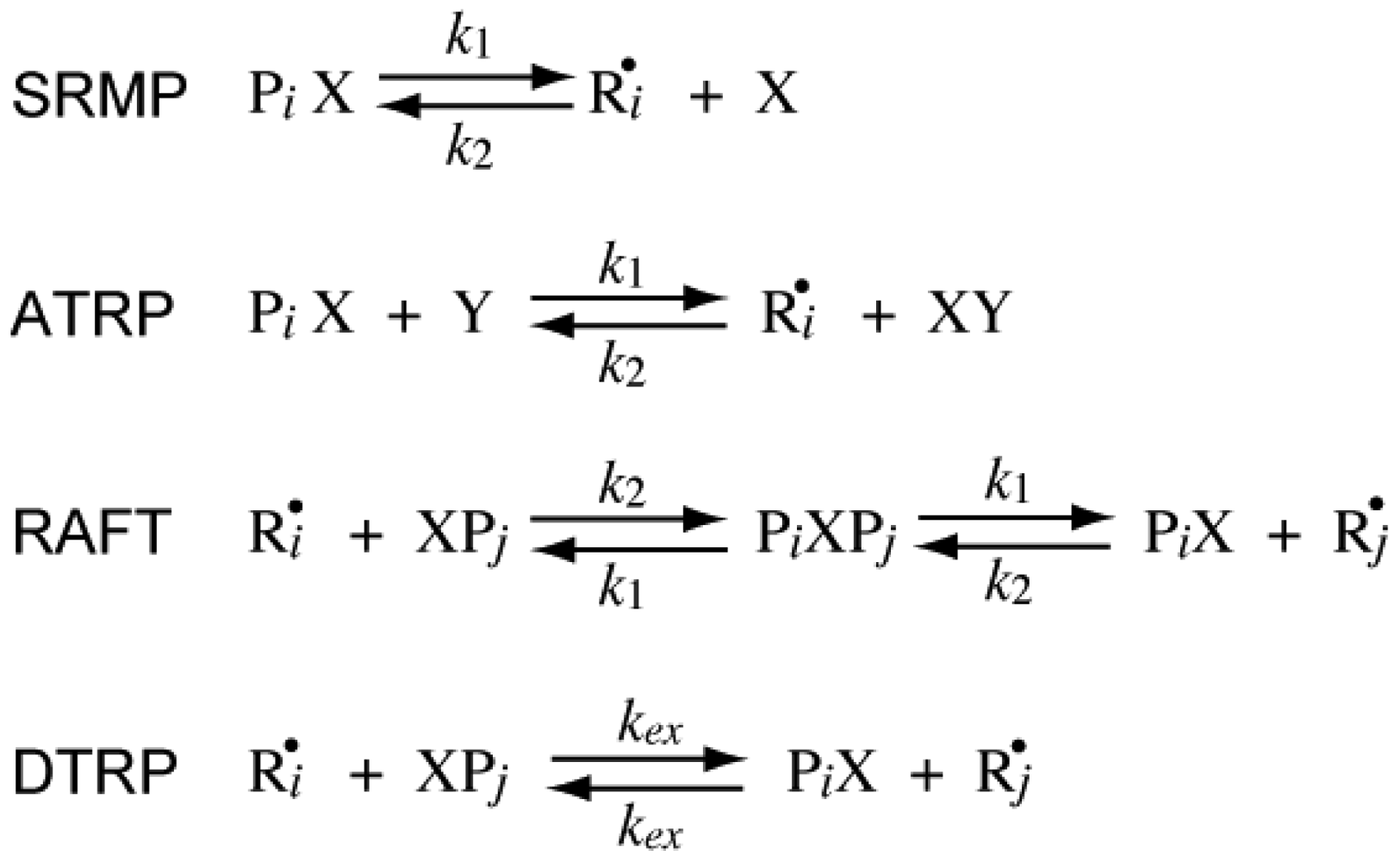
<p>The reversible deactivation reactions for various types of RDRPs are shown in <xref ref-type="fig" rid="f1-polymers-03-01944">Figure 1</xref>. In SRMP and ATRP, an active radical is protected from termination reactions by reversible capping with a trapping agent, reducing the frequency of bimolecular termination. On the other hand, in RAFT it is not required to reduce the frequency of bimolecular termination, and the pseudo-livingness is attained if an active radical is transferred to a large number of chains before finally being stopped by bimolecular termination. The DTRP could be considered as a special case of RAFT with <italic>k</italic><sub>1</sub>→∞. In an ideal DTRP, the polymerization rate is the same as the conventional nonliving free radical polymerization without using the chain transfer agent.</p>
<p>When the conventional nonliving free-radical polymerization is conducted in a dispersed system, typically for <italic>D</italic><sub>p</sub> &lt; 100 nm, the polymerization rate increases significantly by reducing the particle size. Fundamental knowledge on how the particle size changes the polymerization rate in comparison with the corresponding bulk polymerization is important for the development of emulsion polymerization processes of RDRPs.</p>
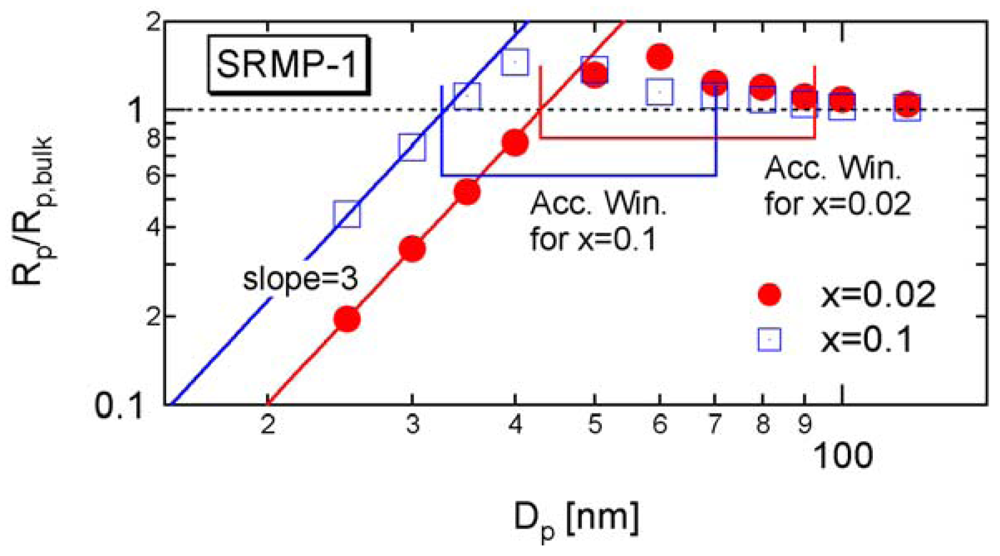
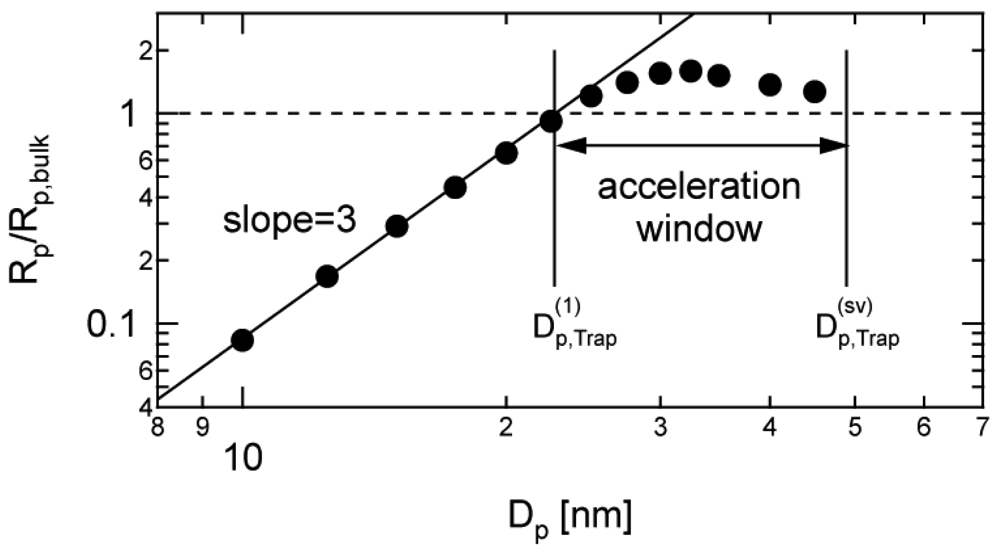
<p>In RDRPs, there are important characteristic particle diameters in miniemulsion polymerization below or above which the polymerization rate changes with the particle size. For SRMP and ATRP, theoretical calculation results have shown that a particle size region may exist in which the polymerization rate is larger than bulk polymerization [<xref ref-type="bibr" rid="b6-polymers-03-01944">6</xref>-<xref ref-type="bibr" rid="b14-polymers-03-01944">14</xref>], which was named the <italic>acceleration window</italic> [<xref ref-type="bibr" rid="b10-polymers-03-01944">10</xref>]. <xref ref-type="fig" rid="f2-polymers-03-01944">Figure 2</xref> shows a typical example. As shown in the figure, there are two important threshold diameters in this reaction system, represented in this article by 
<inline-formula>
<mml:math id="mm4" display="inline">
<mml:semantics id="sm4">
<mml:mrow>
<mml:msubsup>
<mml:mi>D</mml:mi>
<mml:mrow>
<mml:mtext>p</mml:mtext>
<mml:mo>,</mml:mo>
<mml:mtext>Trap</mml:mtext></mml:mrow>
<mml:mrow>
<mml:mrow>
<mml:mo stretchy="false">(</mml:mo>
<mml:mn>1</mml:mn>
<mml:mo stretchy="false">)</mml:mo></mml:mrow></mml:mrow></mml:msubsup></mml:mrow></mml:semantics></mml:math></inline-formula> and 
<inline-formula>
<mml:math id="mm5" display="inline">
<mml:semantics id="sm5">
<mml:mrow>
<mml:msubsup>
<mml:mi>D</mml:mi>
<mml:mrow>
<mml:mtext>p</mml:mtext>
<mml:mo>,</mml:mo>
<mml:mtext>Trap</mml:mtext></mml:mrow>
<mml:mrow>
<mml:mrow>
<mml:mo stretchy="false">(</mml:mo>
<mml:mrow>
<mml:mtext>sv</mml:mtext></mml:mrow>
<mml:mo stretchy="false">)</mml:mo></mml:mrow></mml:mrow></mml:msubsup></mml:mrow></mml:semantics></mml:math></inline-formula>.</p>
<p>In RAFT, it is known that the rate retardation occurs by increasing the RAFT concentration. Monteiro and Brouwer [<xref ref-type="bibr" rid="b15-polymers-03-01944">15</xref>] proposed a cross-termination between propagating and adduct radical, <italic>i.e.</italic>, between R<sup>•</sup> and PXP. This intermediate termination model usually leads to a large value of <italic>k</italic><sub>1</sub>, namely, a very small intermediate time, <italic>t̅</italic><sub>PXP</sub> = 1/<italic>k</italic><sub>1</sub>. On the other hand, Barner-Kowollik <italic>et al.</italic> [<xref ref-type="bibr" rid="b16-polymers-03-01944">16</xref>] attributed the retardation to the slow fragmentation of adduct radicals (slow fragmentation model), and a small <italic>k</italic><sub>1</sub>-value that could be about 10<sup>6</sup> times smaller than the intermediate termination model might be obtained even for the same set of experimental data for a bulk polymerization [<xref ref-type="bibr" rid="b17-polymers-03-01944">17</xref>,<xref ref-type="bibr" rid="b18-polymers-03-01944">18</xref>]. It is very difficult to discriminate these two types of models only from the bulk polymerization data [<xref ref-type="bibr" rid="b19-polymers-03-01944">19</xref>,<xref ref-type="bibr" rid="b20-polymers-03-01944">20</xref>].</p>
<p>On the other hand, these two types of models can be discriminated in a straightforward manner by using the miniemulsion polymerization. The IT model leads to show that the polymerization rate increases significantly for <italic>D</italic><sub>p</sub> smaller than 
<inline-formula>
<mml:math id="mm6" display="inline">
<mml:semantics id="sm6">
<mml:mrow>
<mml:msubsup>
<mml:mi>D</mml:mi>
<mml:mrow>
<mml:mtext>p</mml:mtext>
<mml:mo>,</mml:mo>
<mml:mtext>PXP</mml:mtext></mml:mrow>
<mml:mrow>
<mml:mrow>
<mml:mo stretchy="false">(</mml:mo>
<mml:mn>1</mml:mn>
<mml:mo stretchy="false">)</mml:mo></mml:mrow></mml:mrow></mml:msubsup></mml:mrow></mml:semantics></mml:math></inline-formula>, while with the SF model the polymerization rate is essentially unchanged with the particle size [<xref ref-type="bibr" rid="b9-polymers-03-01944">9</xref>,<xref ref-type="bibr" rid="b13-polymers-03-01944">13</xref>,<xref ref-type="bibr" rid="b21-polymers-03-01944">21</xref>]. Recently, this simple discrimination method is applied experimentally [<xref ref-type="bibr" rid="b22-polymers-03-01944">22</xref>], and concluded that the IT model applies for the dithiobenzoate mediated styrene polymerization.</p>
<p>The threshold diameter below which the polymerization rate increases significantly by reducing the particle size 
<inline-formula>
<mml:math id="mm7" display="inline">
<mml:semantics id="sm7">
<mml:mrow>
<mml:msubsup>
<mml:mi>D</mml:mi>
<mml:mrow>
<mml:mtext>p</mml:mtext>
<mml:mo>,</mml:mo>
<mml:mtext>R</mml:mtext>
<mml:mo>•</mml:mo></mml:mrow>
<mml:mrow>
<mml:mrow>
<mml:mo stretchy="false">(</mml:mo>
<mml:mn>1</mml:mn>
<mml:mo stretchy="false">)</mml:mo></mml:mrow></mml:mrow></mml:msubsup></mml:mrow></mml:semantics></mml:math></inline-formula>, for DTRP and the conventional nonliving free-radical polymerization, where the intermediate PXP does not exist, can also be determined similarly with 
<inline-formula>
<mml:math id="mm8" display="inline">
<mml:semantics id="sm8">
<mml:mrow>
<mml:msubsup>
<mml:mi>D</mml:mi>
<mml:mrow>
<mml:mtext>p</mml:mtext>
<mml:mo>,</mml:mo>
<mml:mtext>PXP</mml:mtext></mml:mrow>
<mml:mrow>
<mml:mrow>
<mml:mo stretchy="false">(</mml:mo>
<mml:mn>1</mml:mn>
<mml:mo stretchy="false">)</mml:mo></mml:mrow></mml:mrow></mml:msubsup></mml:mrow></mml:semantics></mml:math></inline-formula> [<xref ref-type="bibr" rid="b21-polymers-03-01944">21</xref>].</p>
<p>Another characteristic particle diameter 
<inline-formula>
<mml:math id="mm9" display="inline">
<mml:semantics id="sm9">
<mml:mrow>
<mml:msubsup>
<mml:mi>D</mml:mi>
<mml:mrow>
<mml:mtext>p</mml:mtext>
<mml:mo>,</mml:mo>
<mml:mtext>M</mml:mtext></mml:mrow>
<mml:mrow>
<mml:mrow>
<mml:mo stretchy="false">(</mml:mo>
<mml:mrow>
<mml:mtext>sv</mml:mtext></mml:mrow>
<mml:mo stretchy="false">)</mml:mo></mml:mrow></mml:mrow></mml:msubsup></mml:mrow></mml:semantics></mml:math></inline-formula> may exist for RAFT, together with DTRP and the conventional nonliving free-radical polymerization (FRP), below which the miniemulsion polymerization rate may become smaller than that predicted by using the average concentrations [<xref ref-type="bibr" rid="b23-polymers-03-01944">23</xref>].</p>
<p>In this article, all of the above characteristic particle diameters for various types of RDRPs are represented by simple equations in a unified manner, based on the characteristic polymerization rate expression for the RDRPs, <italic>R</italic><sub>p</sub> = <italic>k</italic><sub>p</sub>[M]<italic>K</italic>[<italic>Interm</italic>]/[<italic>Trap</italic>].</p></sec>
<sec>
<label>2.</label>
<title>Polymerization Rate Expression</title>
<sec>
<label>2.1.</label>
<title>Bulk Polymerization Rate</title>
<p>The rate of free-radical polymerization (FRP), including the RDRP, is represented by:
<disp-formula id="FD1">
<label>(1)</label>
<mml:math id="mm10" display="block">
<mml:semantics id="sm10">
<mml:mrow>
<mml:msub>
<mml:mi>R</mml:mi>
<mml:mtext>p</mml:mtext></mml:msub>
<mml:mo>=</mml:mo>
<mml:msub>
<mml:mi>k</mml:mi>
<mml:mtext>p</mml:mtext></mml:msub>
<mml:mrow>
<mml:mo>[</mml:mo>
<mml:mtext>M</mml:mtext>
<mml:mo>]</mml:mo></mml:mrow>
<mml:mrow>
<mml:mo>[</mml:mo>
<mml:mrow>
<mml:msup>
<mml:mtext>R</mml:mtext>
<mml:mo>•</mml:mo></mml:msup></mml:mrow>
<mml:mo>]</mml:mo></mml:mrow></mml:mrow></mml:semantics></mml:math></disp-formula> where <italic>k</italic><sub>p</sub> is the propagation rate constant, [M] is the monomer concentration, and [R<sup>•</sup>] is the total active radical concentration.</p>
<p>For the calculation of the polymerization rate, <xref rid="FD1" ref-type="disp-formula">Equation (1)</xref> is convenient to use. On the other hand, because <xref rid="FD1" ref-type="disp-formula">Equation (1)</xref> does not involve concentrations of characteristic components shown in <xref ref-type="fig" rid="f1-polymers-03-01944">Figure 1</xref>, <xref rid="FD1" ref-type="disp-formula">Equation (1)</xref> is not suitable for the prediction and control of the RDRPs, based on the reaction mechanism. Unique representation of <italic>R</italic><sub>p</sub> for RDRP, <italic>R</italic><sub>p</sub> = <italic>k</italic><sub>p</sub>[M]<italic>K</italic>[<italic>Interm</italic>]/[<italic>Trap</italic>] can be obtained as follows [<xref ref-type="bibr" rid="b13-polymers-03-01944">13</xref>].</p>
<p>In order for the pseudo-living condition to be valid, the deactivation rate <italic>R</italic><sub>deact</sub> must be much larger than the bimolecular termination of active radicals <italic>R</italic><sub>t</sub>, <italic>i.e.</italic>, <italic>R</italic><sub>deact</sub> ≫ <italic>R</italic><sub>t</sub>. If not, a large amount of dead polymer chains are formed. Similarly, if the initiation reaction <italic>R</italic><sub>I</sub> is involved, the activation reaction in RDRP <italic>R</italic><sub>act</sub> must be much larger than <italic>R</italic><sub>I</sub>, <italic>i.e.</italic>, <italic>R</italic><sub>act</sub> ≫ <italic>R</italic><sub>I</sub>.</p>
<p>As long as the active period is short enough, the polymerization rate is given by the product of the radical generation rate (<italic>R</italic><sub>RG</sub>) and the average number of monomeric units added during a single active period (<italic>L</italic><sub>ν</sub>).</p>
<disp-formula id="FD2">
<label>(2)</label>
<mml:math id="mm11" display="block">
<mml:semantics id="sm11">
<mml:mrow>
<mml:msub>
<mml:mi>R</mml:mi>
<mml:mtext>p</mml:mtext></mml:msub>
<mml:mo>=</mml:mo>
<mml:msub>
<mml:mi>R</mml:mi>
<mml:mrow>
<mml:mtext>RG</mml:mtext></mml:mrow></mml:msub>
<mml:msub>
<mml:mi>L</mml:mi>
<mml:mi>V</mml:mi></mml:msub></mml:mrow></mml:semantics></mml:math></disp-formula>
<p><xref rid="FD2" ref-type="disp-formula">Equation (2)</xref> is usually valid also for the conventional nonliving FRP, where <italic>R</italic><sub>RG</sub> = <italic>R</italic><sub>I</sub> and <italic>L<sub>ν</sub></italic> is equal to the kinetic chain length, <italic>ν</italic>. In RDRP, the active period is much shorter than the conventional nonliving FRP because of the fast deactivation reaction, and the validity of <xref rid="FD2" ref-type="disp-formula">Equation (2)</xref> is guaranteed.</p>
<p>For RDRPs, <italic>R</italic><sub>RG</sub> and <italic>L</italic><sub>ν</sub> are represented by:
<disp-formula id="FD3">
<label>(3)</label>
<mml:math id="mm12" display="block">
<mml:semantics id="sm12">
<mml:mrow>
<mml:msub>
<mml:mi>R</mml:mi>
<mml:mrow>
<mml:mtext>RG</mml:mtext></mml:mrow></mml:msub>
<mml:mo>=</mml:mo>
<mml:msub>
<mml:mi>R</mml:mi>
<mml:mn>1</mml:mn></mml:msub>
<mml:mo>+</mml:mo>
<mml:msub>
<mml:mi>R</mml:mi>
<mml:mrow>
<mml:mtext>act</mml:mtext></mml:mrow></mml:msub>
<mml:mo>≅</mml:mo>
<mml:msub>
<mml:mi>R</mml:mi>
<mml:mrow>
<mml:mtext>act</mml:mtext></mml:mrow></mml:msub></mml:mrow></mml:semantics></mml:math></disp-formula>
<disp-formula id="FD4">
<label>(4)</label>
<mml:math id="mm13" display="block">
<mml:semantics id="sm13">
<mml:mrow>
<mml:msub>
<mml:mi>L</mml:mi>
<mml:mi>v</mml:mi></mml:msub>
<mml:mo>=</mml:mo>
<mml:mfrac>
<mml:mrow>
<mml:msub>
<mml:mi>R</mml:mi>
<mml:mtext>p</mml:mtext></mml:msub></mml:mrow>
<mml:mrow>
<mml:msub>
<mml:mi>R</mml:mi>
<mml:mtext>t</mml:mtext></mml:msub>
<mml:mo>+</mml:mo>
<mml:msub>
<mml:mi>R</mml:mi>
<mml:mrow>
<mml:mtext>deact</mml:mtext></mml:mrow></mml:msub></mml:mrow></mml:mfrac>
<mml:mo>≅</mml:mo>
<mml:mfrac>
<mml:mrow>
<mml:msub>
<mml:mi>R</mml:mi>
<mml:mtext>p</mml:mtext></mml:msub></mml:mrow>
<mml:mrow>
<mml:msub>
<mml:mi>R</mml:mi>
<mml:mrow>
<mml:mtext>deact</mml:mtext></mml:mrow></mml:msub></mml:mrow></mml:mfrac></mml:mrow></mml:semantics></mml:math></disp-formula></p>
<p>For instance, <italic>R</italic><sub>RG</sub> = <italic>k</italic><sub>1</sub>[PX] and <italic>L</italic><sub>ν</sub> = <italic>k</italic><sub>p</sub>[M]/(<italic>k</italic><sub>2</sub>[X]) in SRMP. In general, the polymerization rate of RDRP is given by:
<disp-formula id="FD5">
<label>(5)</label>
<mml:math id="mm14" display="block">
<mml:semantics id="sm14">
<mml:mrow>
<mml:msub>
<mml:mi>R</mml:mi>
<mml:mtext>p</mml:mtext></mml:msub>
<mml:mo>=</mml:mo>
<mml:msub>
<mml:mi>k</mml:mi>
<mml:mtext>p</mml:mtext></mml:msub>
<mml:mrow>
<mml:mo>[</mml:mo>
<mml:mtext>M</mml:mtext>
<mml:mo>]</mml:mo></mml:mrow>
<mml:mi>K</mml:mi>
<mml:mfrac>
<mml:mrow>
<mml:mrow>
<mml:mo>[</mml:mo>
<mml:mrow>
<mml:mtext mathvariant="italic">Interm</mml:mtext></mml:mrow>
<mml:mo>]</mml:mo></mml:mrow></mml:mrow>
<mml:mrow>
<mml:mrow>
<mml:mo>[</mml:mo>
<mml:mrow>
<mml:mtext mathvariant="italic">Trap</mml:mtext></mml:mrow>
<mml:mo>]</mml:mo></mml:mrow></mml:mrow></mml:mfrac></mml:mrow></mml:semantics></mml:math></disp-formula></p>
<p>The terms, <italic>K</italic>, [<italic>Interm</italic>], and [<italic>Trap</italic>] used in <xref rid="FD5" ref-type="disp-formula">Equation (5)</xref> are summarized for SRMP, ATRP, and RAFT in <xref ref-type="table" rid="t1-polymers-03-01944">Table 1</xref>. For ATRP, <xref rid="FD5" ref-type="disp-formula">Equation (5)</xref> was already shown in [<xref ref-type="bibr" rid="b2-polymers-03-01944">2</xref>].</p>
<p>Validity of <xref rid="FD5" ref-type="disp-formula">Equation (5)</xref> to SRMP, ATRP, and RAFT was confirmed by using various kinetic parameters [<xref ref-type="bibr" rid="b13-polymers-03-01944">13</xref>].</p>
<p><xref rid="FD5" ref-type="disp-formula">Equation (5)</xref> may appear that the termination reaction does not affect the polymerization rate, but it is not so. For example, in SRMP and ATRP, a single termination event leaves two additional trapping agents, leading to the increase of [<italic>Trap</italic>], resulting in a smaller polymerization rate. For TEMPO-mediated styrene polymerization, it is known that the active radical concentration is represented by 
<inline-formula>
<mml:math id="mm15" display="inline">
<mml:semantics id="sm15">
<mml:mrow>
<mml:mo stretchy="false">[</mml:mo>
<mml:msup>
<mml:mtext>R</mml:mtext>
<mml:mo>•</mml:mo></mml:msup>
<mml:mo stretchy="false">]</mml:mo>
<mml:mo>=</mml:mo>
<mml:msqrt>
<mml:msub>
<mml:mi>R</mml:mi>
<mml:mtext>I</mml:mtext></mml:msub>
<mml:mo>/</mml:mo>
<mml:msub>
<mml:mi>R</mml:mi>
<mml:mtext>t</mml:mtext></mml:msub></mml:msqrt></mml:mrow></mml:semantics></mml:math></inline-formula> [<xref ref-type="bibr" rid="b24-polymers-03-01944">24</xref>,<xref ref-type="bibr" rid="b25-polymers-03-01944">25</xref>]. This equation conforms to <xref rid="FD5" ref-type="disp-formula">Equation (5)</xref>, provided <italic>R</italic><sub>I</sub> is not too small. The quantitative discussion on this problem can be found in [<xref ref-type="bibr" rid="b26-polymers-03-01944">26</xref>,<xref ref-type="bibr" rid="b27-polymers-03-01944">27</xref>].</p></sec>
<sec>
<label>2.2.</label>
<title>Polymerization Rate in Dispersed Systems</title>
<p>The polymerization rate of the <italic>i</italic>th polymerization loci, <italic>R</italic><sub>p,</sub> <italic><sub>i</sub></italic> is given by:
<disp-formula id="FD6">
<label>(6)</label>
<mml:math id="mm16" display="block">
<mml:semantics id="sm16">
<mml:mrow>
<mml:msub>
<mml:mi>R</mml:mi>
<mml:mrow>
<mml:mtext>p</mml:mtext>
<mml:mo>,</mml:mo>
<mml:mi>i</mml:mi></mml:mrow></mml:msub>
<mml:mo>=</mml:mo>
<mml:msub>
<mml:mi>R</mml:mi>
<mml:mrow>
<mml:mtext>RG</mml:mtext>
<mml:mo>,</mml:mo>
<mml:mi>i</mml:mi></mml:mrow></mml:msub>
<mml:msub>
<mml:mi>L</mml:mi>
<mml:mrow>
<mml:mi>v</mml:mi>
<mml:mo>,</mml:mo>
<mml:mi>i</mml:mi></mml:mrow></mml:msub></mml:mrow></mml:semantics></mml:math></disp-formula></p>
<p>The overall polymerization rate is given by:
<disp-formula id="FD7">
<label>(7)</label>
<mml:math id="mm17" display="block">
<mml:semantics id="sm17">
<mml:mrow>
<mml:msub>
<mml:mi>R</mml:mi>
<mml:mtext>p</mml:mtext></mml:msub>
<mml:mo>=</mml:mo>
<mml:mrow>
<mml:mo>〈</mml:mo>
<mml:mrow>
<mml:msub>
<mml:mi>R</mml:mi>
<mml:mrow>
<mml:mtext>RG</mml:mtext>
<mml:mo>,</mml:mo>
<mml:mi>i</mml:mi></mml:mrow></mml:msub>
<mml:msub>
<mml:mi>L</mml:mi>
<mml:mrow>
<mml:mi>v</mml:mi>
<mml:mo>,</mml:mo>
<mml:mi>i</mml:mi></mml:mrow></mml:msub></mml:mrow>
<mml:mo>〉</mml:mo></mml:mrow></mml:mrow></mml:semantics></mml:math></disp-formula>where 〈 〉 represents the average over all <italic>i</italic>'s.
<disp-formula id="FD8">
<label>(8)</label>
<mml:math id="mm18" display="block">
<mml:semantics id="sm18">
<mml:mrow>
<mml:mrow>
<mml:mo>〈</mml:mo>
<mml:mrow>
<mml:msub>
<mml:mi>R</mml:mi>
<mml:mrow>
<mml:mtext>RG</mml:mtext>
<mml:mo>,</mml:mo>
<mml:mi>i</mml:mi></mml:mrow></mml:msub>
<mml:msub>
<mml:mi>L</mml:mi>
<mml:mrow>
<mml:mi>v</mml:mi>
<mml:mo>,</mml:mo>
<mml:mi>i</mml:mi></mml:mrow></mml:msub></mml:mrow>
<mml:mo>〉</mml:mo></mml:mrow>
<mml:mo>=</mml:mo>
<mml:mfrac>
<mml:mn>1</mml:mn>
<mml:mi>V</mml:mi></mml:mfrac>
<mml:munderover>
<mml:mo>∑</mml:mo>
<mml:mrow>
<mml:mi>i</mml:mi>
<mml:mo>=</mml:mo>
<mml:mn>1</mml:mn></mml:mrow>
<mml:mi>N</mml:mi></mml:munderover>
<mml:mrow>
<mml:msub>
<mml:mi>V</mml:mi>
<mml:mi>i</mml:mi></mml:msub></mml:mrow>
<mml:msub>
<mml:mi>R</mml:mi>
<mml:mrow>
<mml:mtext>RG</mml:mtext>
<mml:mo>,</mml:mo>
<mml:mi>i</mml:mi></mml:mrow></mml:msub>
<mml:msub>
<mml:mi>L</mml:mi>
<mml:mrow>
<mml:mi>v</mml:mi>
<mml:mo>,</mml:mo>
<mml:mi>i</mml:mi></mml:mrow></mml:msub></mml:mrow></mml:semantics></mml:math></disp-formula></p>
<p>In <xref rid="FD8" ref-type="disp-formula">Equation (8)</xref>, <italic>N</italic> is the total number of reaction loci, and <italic>V</italic> represents the total volume of the reaction loci, <italic>i.e.</italic>, 
<inline-formula>
<mml:math id="mm19" display="inline">
<mml:semantics id="sm19">
<mml:mrow>
<mml:mi>V</mml:mi>
<mml:mo>=</mml:mo>
<mml:munderover>
<mml:mo>∑</mml:mo>
<mml:mrow>
<mml:mi>i</mml:mi>
<mml:mo>=</mml:mo>
<mml:mn>1</mml:mn></mml:mrow>
<mml:mi>N</mml:mi></mml:munderover>
<mml:mrow>
<mml:msub>
<mml:mi>V</mml:mi>
<mml:mi>i</mml:mi></mml:msub></mml:mrow></mml:mrow></mml:semantics></mml:math></inline-formula>.</p>
<p>For instance, considering SRMP, <italic>R</italic><sub>RG</sub> is the radical generation rate through the activation reaction, and <italic>R</italic><sub>RG,</sub><italic><sub>i</sub></italic> = <italic>k</italic><sub>1</sub>[PX]<italic><sub>i</sub></italic>. On the other hand, <italic>L</italic><sub>ν,</sub><italic><sub>i</sub></italic> is the average number of monomeric units added during a single active period, and therefore, given by:
<disp-formula id="FD9">
<label>(9)</label>
<mml:math id="mm20" display="block">
<mml:semantics id="sm20">
<mml:mrow>
<mml:msub>
<mml:mi>L</mml:mi>
<mml:mrow>
<mml:mi>v</mml:mi>
<mml:mo>,</mml:mo>
<mml:mi>i</mml:mi></mml:mrow></mml:msub>
<mml:mo>=</mml:mo>
<mml:msub>
<mml:mi>k</mml:mi>
<mml:mtext>p</mml:mtext></mml:msub>
<mml:msub>
<mml:mrow>
<mml:mrow>
<mml:mo>[</mml:mo>
<mml:mtext>M</mml:mtext>
<mml:mo>]</mml:mo></mml:mrow></mml:mrow>
<mml:mi>i</mml:mi></mml:msub>
<mml:msubsup>
<mml:mover>
<mml:mi>t</mml:mi>
<mml:mo>−</mml:mo></mml:mover>
<mml:mrow>
<mml:msup>
<mml:mtext>R</mml:mtext>
<mml:mo>•</mml:mo></mml:msup></mml:mrow>
<mml:mrow>
<mml:mo stretchy="false">(</mml:mo>
<mml:mi>i</mml:mi>
<mml:mo stretchy="false">)</mml:mo></mml:mrow></mml:msubsup></mml:mrow></mml:semantics></mml:math></disp-formula> where 
<inline-formula>
<mml:math id="mm21" display="inline">
<mml:semantics id="sm21">
<mml:mrow>
<mml:msubsup>
<mml:mover>
<mml:mi>t</mml:mi>
<mml:mo>−</mml:mo></mml:mover>
<mml:mrow>
<mml:msup>
<mml:mtext>R</mml:mtext>
<mml:mo>•</mml:mo></mml:msup></mml:mrow>
<mml:mrow>
<mml:mo stretchy="false">(</mml:mo>
<mml:mtext>i</mml:mtext>
<mml:mo stretchy="false">)</mml:mo></mml:mrow></mml:msubsup></mml:mrow></mml:semantics></mml:math></inline-formula> is the average active radical period in the <italic>i</italic>th polymerization locus (particle), which is given by:
<disp-formula id="FD10">
<label>(10)</label>
<mml:math id="mm22" display="block">
<mml:semantics id="sm22">
<mml:mrow>
<mml:msubsup>
<mml:mover>
<mml:mi>t</mml:mi>
<mml:mo>−</mml:mo></mml:mover>
<mml:mrow>
<mml:msup>
<mml:mtext>R</mml:mtext>
<mml:mo>•</mml:mo></mml:msup></mml:mrow>
<mml:mrow>
<mml:mo stretchy="false">(</mml:mo>
<mml:mtext>i</mml:mtext>
<mml:mo stretchy="false">)</mml:mo></mml:mrow></mml:msubsup>
<mml:mo>=</mml:mo>
<mml:mfrac>
<mml:mn>1</mml:mn>
<mml:mrow>
<mml:msub>
<mml:mi>k</mml:mi>
<mml:mn>2</mml:mn></mml:msub>
<mml:msub>
<mml:mrow>
<mml:mrow>
<mml:mo>[</mml:mo>
<mml:mtext>X</mml:mtext>
<mml:mo>]</mml:mo></mml:mrow></mml:mrow>
<mml:mrow>
<mml:mtext>Act</mml:mtext>
<mml:mo>,</mml:mo>
<mml:mi>i</mml:mi></mml:mrow></mml:msub></mml:mrow></mml:mfrac></mml:mrow></mml:semantics></mml:math></disp-formula></p>
<p>Note that the chains are formed only during the active period, and therefore, the trapping agent concentration must be that during the active period. The difference of [<italic>Trap</italic>]<sub>Act,</sub><italic><sub>i</sub></italic> and [<italic>Trap</italic>]<italic><sub>i</sub></italic> is important in miniemulsion SRMP and ATRP. In SRMP and ATRP, [<italic>Interm</italic>] ≫ [<italic>Trap</italic>], and therefore, the number of trapping agents in a particle could be very small, and in a small reaction locus, there may exist a long time period for which no active radicals exist. When the activation reaction occurs to generate a radical, one trapping agent is formed. This difference of one molecule of trapping agent could be important in a nano-sized particle.</p>
<p>In general, the polymerization rate in dispersed system is given by:
<disp-formula id="FD11">
<label>(11)</label>
<mml:math id="mm23" display="block">
<mml:semantics id="sm23">
<mml:mrow>
<mml:msub>
<mml:mi>R</mml:mi>
<mml:mtext>p</mml:mtext></mml:msub>
<mml:mo>=</mml:mo>
<mml:msub>
<mml:mi>k</mml:mi>
<mml:mtext>p</mml:mtext></mml:msub>
<mml:mrow>
<mml:mo>〈</mml:mo>
<mml:mrow>
<mml:msub>
<mml:mi>k</mml:mi>
<mml:mi>i</mml:mi></mml:msub>
<mml:msub>
<mml:mrow>
<mml:mrow>
<mml:mo>[</mml:mo>
<mml:mtext>M</mml:mtext>
<mml:mo>]</mml:mo></mml:mrow></mml:mrow>
<mml:mi>i</mml:mi></mml:msub>
<mml:mfrac>
<mml:mrow>
<mml:msub>
<mml:mrow>
<mml:mrow>
<mml:mo>[</mml:mo>
<mml:mrow>
<mml:mtext mathvariant="italic">Interm</mml:mtext></mml:mrow>
<mml:mo>]</mml:mo></mml:mrow></mml:mrow>
<mml:mi>i</mml:mi></mml:msub></mml:mrow>
<mml:mrow>
<mml:msub>
<mml:mrow>
<mml:mrow>
<mml:mo>[</mml:mo>
<mml:mrow>
<mml:mtext mathvariant="italic">Trap</mml:mtext></mml:mrow>
<mml:mo>]</mml:mo></mml:mrow></mml:mrow>
<mml:mrow>
<mml:mtext>Act</mml:mtext>
<mml:mo>,</mml:mo>
<mml:mi>i</mml:mi></mml:mrow></mml:msub></mml:mrow></mml:mfrac></mml:mrow>
<mml:mo>〉</mml:mo></mml:mrow></mml:mrow></mml:semantics></mml:math></disp-formula></p>
<p>Note for SRMP and RAFT, <italic>K<sub>i</sub></italic> is simply a constant, and <italic>K</italic> does not have to be included inside the brackets, 〈 〉.</p>
<p>In the conventional theoretical treatment, the average concentrations are used. When the average concentrations are used without accounting for the statistical variation of concentrations:
<disp-formula id="FD12">
<label>(12)</label>
<mml:math id="mm24" display="block">
<mml:semantics id="sm24">
<mml:mrow>
<mml:msub>
<mml:mi>R</mml:mi>
<mml:mrow>
<mml:mtext>p</mml:mtext>
<mml:mo>,</mml:mo>
<mml:mtext>NoSV</mml:mtext></mml:mrow></mml:msub>
<mml:mo>=</mml:mo>
<mml:msub>
<mml:mi>k</mml:mi>
<mml:mtext>p</mml:mtext></mml:msub>
<mml:mrow>
<mml:mo>〈</mml:mo>
<mml:mrow>
<mml:msub>
<mml:mi>K</mml:mi>
<mml:mi>i</mml:mi></mml:msub></mml:mrow>
<mml:mo>〉</mml:mo></mml:mrow>
<mml:mrow>
<mml:mo>〈</mml:mo>
<mml:mrow>
<mml:msub>
<mml:mrow>
<mml:mrow>
<mml:mo>[</mml:mo>
<mml:mtext>M</mml:mtext>
<mml:mo>]</mml:mo></mml:mrow></mml:mrow>
<mml:mi>i</mml:mi></mml:msub></mml:mrow>
<mml:mo>〉</mml:mo></mml:mrow>
<mml:mfrac>
<mml:mrow>
<mml:mrow>
<mml:mo>〈</mml:mo>
<mml:mrow>
<mml:msub>
<mml:mrow>
<mml:mrow>
<mml:mo stretchy="false">[</mml:mo>
<mml:mrow>
<mml:mtext mathvariant="italic">Interm</mml:mtext></mml:mrow>
<mml:mo stretchy="false">]</mml:mo></mml:mrow></mml:mrow>
<mml:mi>i</mml:mi></mml:msub></mml:mrow>
<mml:mo>〉</mml:mo></mml:mrow></mml:mrow>
<mml:mrow>
<mml:mrow>
<mml:mo>〈</mml:mo>
<mml:mrow>
<mml:msub>
<mml:mrow>
<mml:mrow>
<mml:mo stretchy="false">[</mml:mo>
<mml:mrow>
<mml:mtext mathvariant="italic">Trap</mml:mtext></mml:mrow>
<mml:mo stretchy="false">]</mml:mo></mml:mrow></mml:mrow>
<mml:mrow>
<mml:mtext>Act</mml:mtext>
<mml:mo>,</mml:mo>
<mml:mi>i</mml:mi></mml:mrow></mml:msub></mml:mrow>
<mml:mo>〉</mml:mo></mml:mrow></mml:mrow></mml:mfrac></mml:mrow></mml:semantics></mml:math></disp-formula>where the subscript, “NoSV” is used to designate the polymerization rate that is calculated without accounting for any statistical variation effect, by using the average concentrations.</p>
<p>Theoretically, the average concentration approximation applies to the following two cases: (1) Negligible statistical concentration variation among particles; (2) The numerator terms, <italic>K<sub>i</sub></italic>, [M]<italic><sub>i</sub></italic>, and [<italic>Interm</italic>]<italic><sub>i</sub></italic> have statistical variation among particles, but there are no correlations with other terms.</p>
<p>For example, suppose the statistical variation of [<italic>Interm</italic>]<italic><sub>i</sub></italic> is significant but the variations of <italic>K<sub>i</sub></italic>, [M]<italic><sub>i</sub></italic>, and [<italic>Trap</italic>]<italic><sub>i</sub></italic> are negligible, the average method given by <xref rid="FD12" ref-type="disp-formula">Equation (12)</xref> still works. On the other hand, if both [M]<italic><sub>i</sub></italic> and [<italic>Interm</italic>]<italic><sub>i</sub></italic> have correlation and statistical variation, <xref rid="FD12" ref-type="disp-formula">Equation (12)</xref> cannot be used. Another case where <xref rid="FD12" ref-type="disp-formula">Equation (12)</xref> is invalid is the cases where the statistical variation of [<italic>Trap</italic>]<italic><sub>i</sub></italic> that exists in the denominator is significant. This is because of a simple mathematical principle, <italic>i.e.</italic>, the average of the inverse is always larger than the inverse of the average [<xref ref-type="bibr" rid="b10-polymers-03-01944">10</xref>,<xref ref-type="bibr" rid="b13-polymers-03-01944">13</xref>,<xref ref-type="bibr" rid="b14-polymers-03-01944">14</xref>].</p>
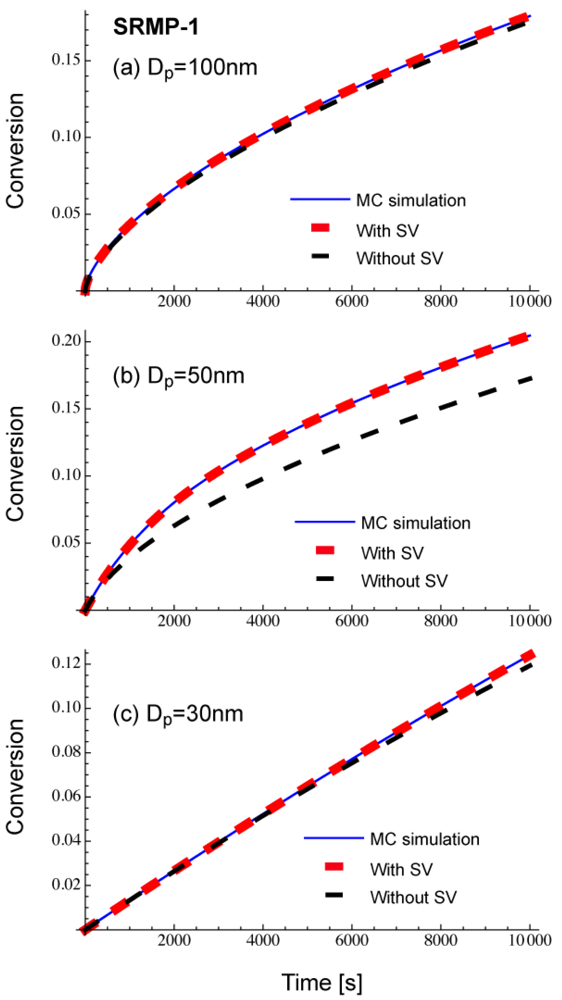
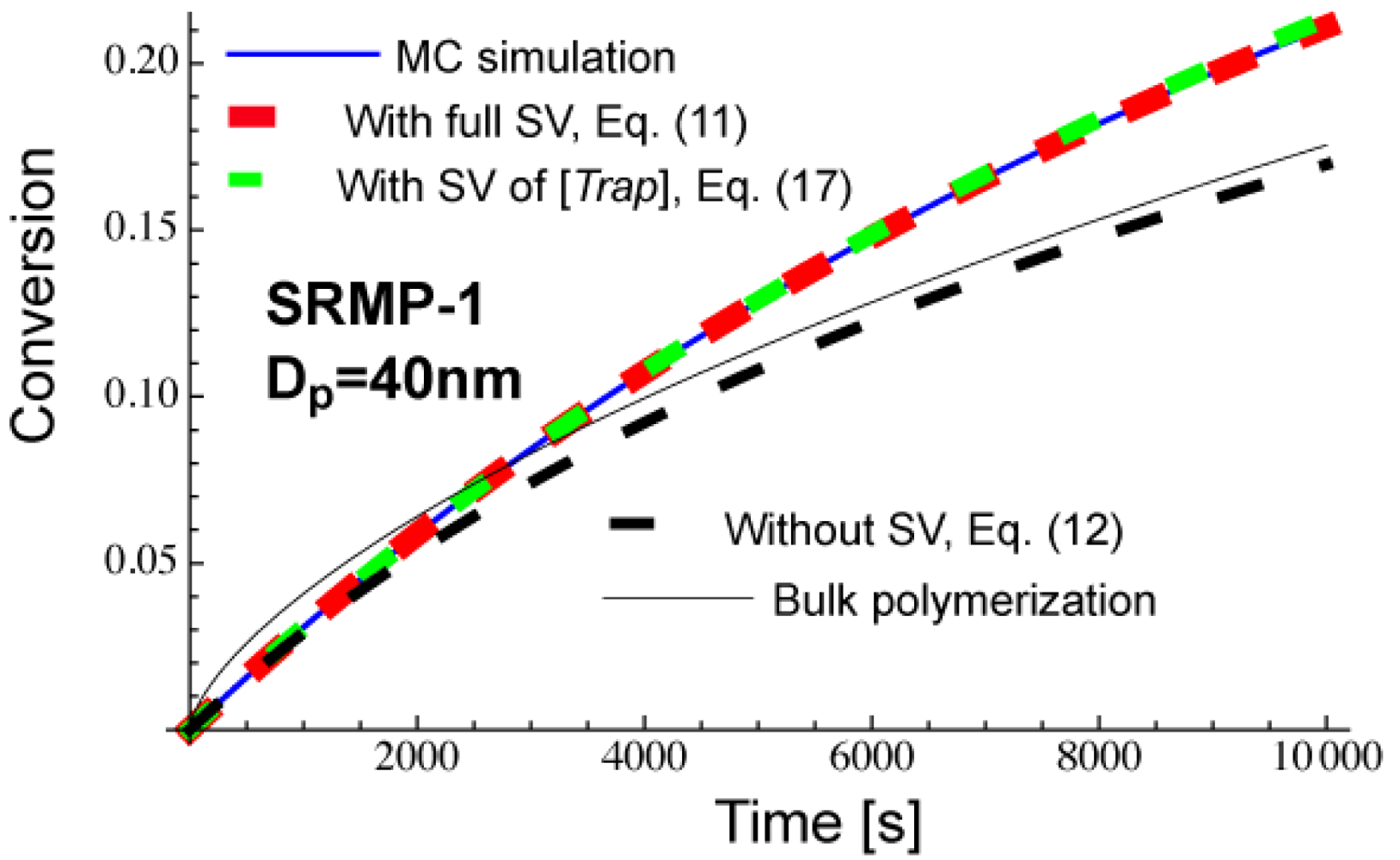
<p><xref ref-type="fig" rid="f3-polymers-03-01944">Figure 3</xref> shows comparison of <xref rid="FD11" ref-type="disp-formula">Equations (11)</xref> and <xref rid="FD12" ref-type="disp-formula">(12)</xref>, with the Monte Carlo (MC) simulation result for a miniemulsion polymerization of SRMP. Uniform particles are assumed for the calculation. The set of parameters is named SRPM-1, and the parameters are: <italic>k</italic><sub>1</sub> = 2 × 10<sup>−3</sup> s<sup>−1</sup>, <italic>k</italic><sub>2</sub> = 1 × 10<sup>8</sup> L mol <sup>−1</sup> s<sup>−1</sup>, <italic>k</italic><sub>p</sub> = 2 × 10<sup>3</sup> L mol <sup>−1</sup> s<sup>−1</sup>, <italic>k</italic><sub>t</sub> = 1 × 10<sup>8</sup> L mol <sup>−1</sup> s<sup>−1</sup>, [M]<sub>0</sub> = 8 mol L <sup>−1</sup>, [PX]<sub>0</sub> = 0.04 mol L <sup>−1</sup>, and [X]<sub>0</sub> = 0. This condition is the same as that for SFRP-1 used in [<xref ref-type="bibr" rid="b13-polymers-03-01944">13</xref>], and more detailed kinetic behavior in bulk and miniemulsion polymerization can be found therein. Note that the termination rate constant, <italic>k</italic><sub>t</sub> is defined by <italic>R</italic><sub>t</sub> = <italic>k</italic><sub>t</sub>[<italic>R</italic><sup>•</sup>]<sup>2</sup>, not <italic>R</italic><sub>t</sub> = 2<italic>k</italic><sub>t</sub>[<italic>R</italic><sup>•</sup>]<sup>2</sup>. The MC calculation method used in this article is described in [<xref ref-type="bibr" rid="b9-polymers-03-01944">9</xref>]. When applying <xref rid="FD11" ref-type="disp-formula">Equations (11)</xref> and <xref rid="FD12" ref-type="disp-formula">(12)</xref>, [M]<italic><sub>i</sub></italic>, [PX]<italic><sub>i</sub></italic>, and [X]<italic><sub>i</sub></italic> are determined by the MC simulation, and the monomer conversion to polymer, <italic>x</italic> is obtained by the integration of <xref rid="FD11" ref-type="disp-formula">Equations (11)</xref> and <xref rid="FD12" ref-type="disp-formula">(12)</xref>.</p>
<p>As shown in <xref ref-type="fig" rid="f3-polymers-03-01944">Figure 3</xref>, <xref rid="FD11" ref-type="disp-formula">Equation (11)</xref> that accounts for the statistical variation agrees completely with the MC simulation results. On the other hand, when <xref rid="FD12" ref-type="disp-formula">Equation (12)</xref> that does not account for the statistical variation of concentrations is used, clear deviation is observed for <italic>D</italic><sub>p</sub> = 50 nm, while the prediction from <xref rid="FD12" ref-type="disp-formula">Equation (12)</xref> could be a reasonable approximation for <italic>D</italic><sub>p</sub> = 100 nm and 30 nm. <xref ref-type="fig" rid="f3-polymers-03-01944">Figure 3</xref> shows there exists a particle size region for an SRMP in which the statistical variation among particles is vital. This region corresponds to the acceleration window observed for SRMP and ATRP [<xref ref-type="bibr" rid="b10-polymers-03-01944">10</xref>,<xref ref-type="bibr" rid="b13-polymers-03-01944">13</xref>,<xref ref-type="bibr" rid="b14-polymers-03-01944">14</xref>].</p>
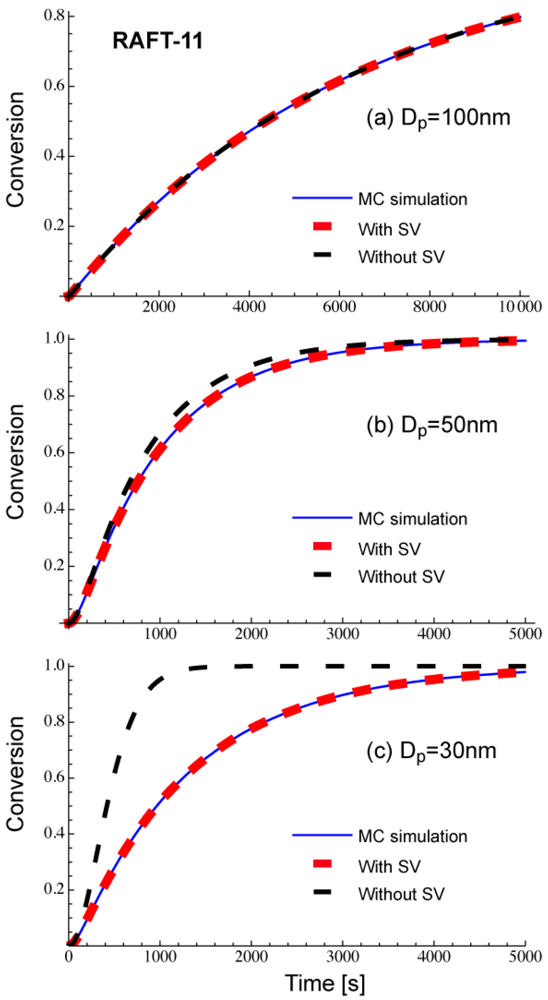
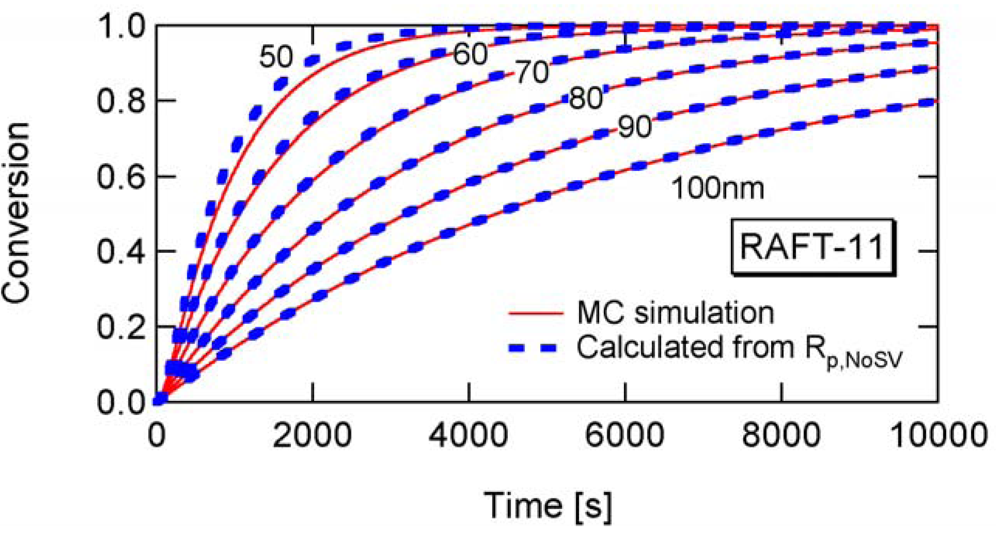
<p><xref ref-type="fig" rid="f4-polymers-03-01944">Figure 4</xref> shows comparison of <xref rid="FD11" ref-type="disp-formula">Equations (11)</xref> and <xref rid="FD12" ref-type="disp-formula">(12)</xref>, with the Monte Carlo (MC) simulation results for a miniemulsion polymerization of RAFT. The kinetic parameters used here are RAFT-11 shown in <xref ref-type="table" rid="t2-polymers-03-01944">Table 2</xref>. The characteristics of parameters used are discussed in Section 3.2. Again, <xref rid="FD11" ref-type="disp-formula">Equation (11)</xref> that accounts for the statistical variation of the concentrations of the components among particles agrees perfectly with the MC simulation results. The average concentration method represented by <xref rid="FD12" ref-type="disp-formula">Equation (12)</xref> shows clear deviation for smaller particle sizes. For <italic>D</italic><sub>p</sub> = 30 nm, use of the average concentrations leads to overestimate the polymerization rate very significantly.</p>
<p>The characteristic particle diameter below which the effect of statistical variation becomes significant will be represented by 
<inline-formula>
<mml:math id="mm25" display="inline">
<mml:semantics id="sm25">
<mml:mrow>
<mml:msubsup>
<mml:mi>D</mml:mi>
<mml:mtext>p</mml:mtext>
<mml:mrow>
<mml:mrow>
<mml:mo stretchy="false">(</mml:mo>
<mml:mrow>
<mml:mtext>sv</mml:mtext></mml:mrow>
<mml:mo stretchy="false">)</mml:mo></mml:mrow></mml:mrow></mml:msubsup></mml:mrow></mml:semantics></mml:math></inline-formula>, and simple equations to determine the 
<inline-formula>
<mml:math id="mm26" display="inline">
<mml:semantics id="sm26">
<mml:mrow>
<mml:msubsup>
<mml:mi>D</mml:mi>
<mml:mtext>p</mml:mtext>
<mml:mrow>
<mml:mrow>
<mml:mo stretchy="false">(</mml:mo>
<mml:mrow>
<mml:mtext>sv</mml:mtext></mml:mrow>
<mml:mo stretchy="false">)</mml:mo></mml:mrow></mml:mrow></mml:msubsup></mml:mrow></mml:semantics></mml:math></inline-formula> -values will be presented later in Section 4. For SRMP and ATRP, 
<inline-formula>
<mml:math id="mm27" display="inline">
<mml:semantics id="sm27">
<mml:mrow>
<mml:msubsup>
<mml:mi>D</mml:mi>
<mml:mtext>p</mml:mtext>
<mml:mrow>
<mml:mrow>
<mml:mo stretchy="false">(</mml:mo>
<mml:mrow>
<mml:mtext>sv</mml:mtext></mml:mrow>
<mml:mo stretchy="false">)</mml:mo></mml:mrow></mml:mrow></mml:msubsup></mml:mrow></mml:semantics></mml:math></inline-formula> corresponds to <italic>D</italic><sub>p,Fluct</sub> in the earlier publications [<xref ref-type="bibr" rid="b10-polymers-03-01944">10</xref>,<xref ref-type="bibr" rid="b13-polymers-03-01944">13</xref>,<xref ref-type="bibr" rid="b14-polymers-03-01944">14</xref>]. On the other hand, however, before discussing the statistical variation effect, consider a much simpler problem, that the concentration of a single molecule may become very high in a nano-sized reaction locus.</p></sec></sec>
<sec>
<label>3.</label>
<title>Effect of High Single-Molecule Concentration inside Small Polymerization Locus</title>
<p>Basically, even when a reaction medium is separated into small reaction loci, the concentration does not change. However, this statement requires a premise that each reaction locus contains a large number of molecules. When the number of molecules of a given component in a reaction locus is small, the statistical variation becomes significant, and the concentration is not the same for all reaction loci. When the volume of reaction locus is further decreased, some reaction loci contain only a single molecule of a component, while the other loci do not contain the component at all. The reaction loci that contain a single molecule may show unusually high concentration compared with the bulk system.</p>
<p>This is the reason for showing extremely high polymerization rate in the zero-one kinetics [<xref ref-type="bibr" rid="b28-polymers-03-01944">28</xref>] of conventional emulsion polymerization. Some polymer particles contain a single radical, while the others not, but the particles having a radical shows an unusually high radical concentration, leading to a high polymerization rate. <xref ref-type="table" rid="t3-polymers-03-01944">Table 3</xref> shows the concentration of a single molecule in a particle. The radical concentration of [R<sup>•</sup>] = 3.18 × 10<sup>−6</sup> mol L<sup>−1</sup> for <italic>D</italic><sub>p</sub> = 100 nm could be significantly higher than that in bulk polymerization.</p>
<p>Conventionally, the rate increase in emulsion polymerization is explained by the segregation of radicals, <italic>i.e.</italic>, by separating radicals into different particles, the termination reactions between the radicals located in different particles are prohibited and the apparent (overall) termination rate constant decreases, leading to a higher radical concentration. However, remarkable rate increase is observed when the zero-one kinetics is valid, and one can practically estimate the particle size below which a significant rate increase is observed for the conventional nonliving FRP, based on the high single-molecule concentration effect, as shown in the appendix of [<xref ref-type="bibr" rid="b21-polymers-03-01944">21</xref>].</p>
<p>Now, look at the fundamental polymerization rate expression, <xref rid="FD5" ref-type="disp-formula">Equation (5)</xref>. For SRMP and ATRP, [<italic>Trap</italic>] ≪ [<italic>Interm</italic>], and [<italic>Trap</italic>] in a small particle may become larger than that in bulk. Because the denominator term, [<italic>Trap</italic>] becomes larger, it is expected that the polymerization rate becomes smaller when the particle size is decreased. On the other hand, for many RAFT systems, [<italic>Interm</italic>] ≪ [<italic>Trap</italic>], and [<italic>Interm</italic>] in a small particle may become larger than that in bulk. Because [<italic>Interm</italic>] is a numerator term, it is expected that the polymerization rate becomes larger by making the particle size smaller.</p>
<sec sec-type="cases">
<label>3.1.</label>
<title>Cases with [Trap] ≪ [Interm]—SRMP and ATRP</title>
<p>For the cases with [<italic>Trap</italic>] ≪ [<italic>Interm</italic>], the concentration of a single trapping agent in a small particle may become larger than in the corresponding bulk polymerization. Therefore, <xref rid="FD5" ref-type="disp-formula">Equation (5)</xref> states that the polymerization rate may become smaller than in bulk polymerization.</p>
<p>SRMP and ATRP fall into this category. In the reversible reactions shown in <xref ref-type="fig" rid="f1-polymers-03-01944">Figure 1</xref>, when an active radical is generated by the activation reaction, one trapping agent always coexists. If the exit of this trapping agent is neglected, at least one trapping agent always exists during the active period. On the other hand, when this trapping agent exits from the particle, the polymerization is not controlled, and usual free-radical polymerization occurs. However, in the present discussion, I consider the cases where RDRP is well controlled.</p>
<p>The concentration of a single molecule in a particle with diameter <italic>D</italic><sub>p</sub> is given by 
<inline-formula>
<mml:math id="mm28" display="inline">
<mml:semantics id="sm28">
<mml:mrow>
<mml:mrow>
<mml:mn>1</mml:mn>
<mml:mo>/</mml:mo>
<mml:mrow>
<mml:mrow>
<mml:mo>{</mml:mo>
<mml:mrow>
<mml:msub>
<mml:mi>N</mml:mi>
<mml:mtext>A</mml:mtext></mml:msub>
<mml:mrow>
<mml:mo stretchy="false">(</mml:mo>
<mml:mrow>
<mml:mrow>
<mml:mi>π</mml:mi>
<mml:mo>/</mml:mo>
<mml:mn>6</mml:mn></mml:mrow></mml:mrow>
<mml:mo stretchy="false">)</mml:mo></mml:mrow>
<mml:msubsup>
<mml:mi>D</mml:mi>
<mml:mtext>p</mml:mtext>
<mml:mn>3</mml:mn></mml:msubsup></mml:mrow>
<mml:mo>}</mml:mo></mml:mrow></mml:mrow></mml:mrow></mml:mrow></mml:semantics></mml:math></inline-formula>, where <italic>N</italic><sub>A</sub> is the Avogadro constant. When this concentration is equal to the trapping agent concentration in the corresponding bulk polymerization, the polymerization rate would be equal to that in bulk polymerization, given all the other conditions are the same. The particle size below which the polymerization rate becomes smaller than in the corresponding bulk polymerization, 
<inline-formula>
<mml:math id="mm29" display="inline">
<mml:semantics id="sm29">
<mml:mrow>
<mml:msubsup>
<mml:mi>D</mml:mi>
<mml:mrow>
<mml:mtext>p</mml:mtext>
<mml:mo>,</mml:mo>
<mml:mtext>Trap</mml:mtext></mml:mrow>
<mml:mrow>
<mml:mrow>
<mml:mo stretchy="false">(</mml:mo>
<mml:mn>1</mml:mn>
<mml:mo stretchy="false">)</mml:mo></mml:mrow></mml:mrow></mml:msubsup></mml:mrow></mml:semantics></mml:math></inline-formula> is given by:
<disp-formula id="FD13">
<label>(13)</label>
<mml:math id="mm30" display="block">
<mml:semantics id="sm30">
<mml:mrow>
<mml:msubsup>
<mml:mi>D</mml:mi>
<mml:mrow>
<mml:mtext>p</mml:mtext>
<mml:mo>,</mml:mo>
<mml:mtext>Trap</mml:mtext></mml:mrow>
<mml:mrow>
<mml:mrow>
<mml:mo stretchy="false">(</mml:mo>
<mml:mn>1</mml:mn>
<mml:mo stretchy="false">)</mml:mo></mml:mrow></mml:mrow></mml:msubsup>
<mml:mo>=</mml:mo>
<mml:msup>
<mml:mrow>
<mml:mrow>
<mml:mo>(</mml:mo>
<mml:mrow>
<mml:mfrac>
<mml:mn>6</mml:mn>
<mml:mrow>
<mml:mi>π</mml:mi>
<mml:msub>
<mml:mi>N</mml:mi>
<mml:mtext>A</mml:mtext></mml:msub>
<mml:msub>
<mml:mrow>
<mml:mrow>
<mml:mo>[</mml:mo>
<mml:mrow>
<mml:mtext mathvariant="italic">Trap</mml:mtext></mml:mrow>
<mml:mo>]</mml:mo></mml:mrow></mml:mrow>
<mml:mrow>
<mml:mtext>bulk</mml:mtext></mml:mrow></mml:msub></mml:mrow></mml:mfrac></mml:mrow>
<mml:mo>)</mml:mo></mml:mrow></mml:mrow>
<mml:mrow>
<mml:mrow>
<mml:mn>1</mml:mn>
<mml:mo>/</mml:mo>
<mml:mn>3</mml:mn></mml:mrow></mml:mrow></mml:msup></mml:mrow></mml:semantics></mml:math></disp-formula> where [<italic>Trap</italic>]<sub>bulk</sub> is the trapping agent concentration in the corresponding bulk polymerization, which can be determined in a straightforward manner by solving a set of differential equations describing the time development of various concentrations. Note, 
<inline-formula>
<mml:math id="mm31" display="inline">
<mml:semantics id="sm31">
<mml:mrow>
<mml:msubsup>
<mml:mi>D</mml:mi>
<mml:mrow>
<mml:mtext>p</mml:mtext>
<mml:mo>,</mml:mo>
<mml:mtext>Trap</mml:mtext></mml:mrow>
<mml:mrow>
<mml:mrow>
<mml:mo stretchy="false">(</mml:mo>
<mml:mn>1</mml:mn>
<mml:mo stretchy="false">)</mml:mo></mml:mrow></mml:mrow></mml:msubsup></mml:mrow></mml:semantics></mml:math></inline-formula> corresponds to <italic>D</italic><sub>p,SMC</sub> used in earlier publications [<xref ref-type="bibr" rid="b10-polymers-03-01944">10</xref>,<xref ref-type="bibr" rid="b13-polymers-03-01944">13</xref>,<xref ref-type="bibr" rid="b14-polymers-03-01944">14</xref>].</p>
<p>The lower limit of the acceleration window shown in <xref ref-type="fig" rid="f2-polymers-03-01944">Figure 2</xref> was determined by using <xref rid="FD13" ref-type="disp-formula">Equation (13)</xref>. The equation to determine the upper limit of the acceleration window, 
<inline-formula>
<mml:math id="mm32" display="inline">
<mml:semantics id="sm32">
<mml:mrow>
<mml:msubsup>
<mml:mi>D</mml:mi>
<mml:mrow>
<mml:mtext>p</mml:mtext>
<mml:mo>,</mml:mo>
<mml:mtext>Trap</mml:mtext></mml:mrow>
<mml:mrow>
<mml:mrow>
<mml:mo stretchy="false">(</mml:mo>
<mml:mrow>
<mml:mtext>sv</mml:mtext></mml:mrow>
<mml:mo stretchy="false">)</mml:mo></mml:mrow></mml:mrow></mml:msubsup></mml:mrow></mml:semantics></mml:math></inline-formula> will be introduced in Section 4.1.</p>
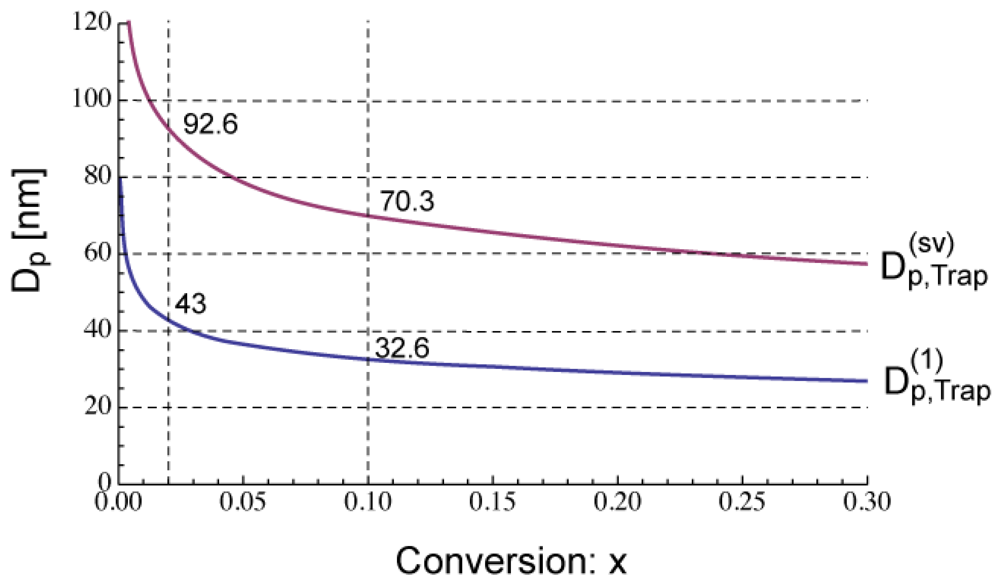
<p><xref ref-type="fig" rid="f5-polymers-03-01944">Figure 5</xref> shows the calculated development of 
<inline-formula>
<mml:math id="mm33" display="inline">
<mml:semantics id="sm33">
<mml:mrow>
<mml:msubsup>
<mml:mi>D</mml:mi>
<mml:mrow>
<mml:mtext>p</mml:mtext>
<mml:mo>,</mml:mo>
<mml:mtext>Trap</mml:mtext></mml:mrow>
<mml:mrow>
<mml:mrow>
<mml:mo stretchy="false">(</mml:mo>
<mml:mn>1</mml:mn>
<mml:mo stretchy="false">)</mml:mo></mml:mrow></mml:mrow></mml:msubsup></mml:mrow></mml:semantics></mml:math></inline-formula> during polymerization under the condition SRMP-1, whose conversion development was shown in <xref ref-type="fig" rid="f3-polymers-03-01944">Figure 3</xref>. The 
<inline-formula>
<mml:math id="mm34" display="inline">
<mml:semantics id="sm34">
<mml:mrow>
<mml:msubsup>
<mml:mi>D</mml:mi>
<mml:mrow>
<mml:mtext>p</mml:mtext>
<mml:mo>,</mml:mo>
<mml:mtext>Trap</mml:mtext></mml:mrow>
<mml:mrow>
<mml:mrow>
<mml:mo stretchy="false">(</mml:mo>
<mml:mn>1</mml:mn>
<mml:mo stretchy="false">)</mml:mo></mml:mrow></mml:mrow></mml:msubsup></mml:mrow></mml:semantics></mml:math></inline-formula>-value decreases because [<italic>Trap</italic>]<sub>bulk</sub> increases with time. In <xref ref-type="fig" rid="f5-polymers-03-01944">Figure 5</xref>, the 
<inline-formula>
<mml:math id="mm35" display="inline">
<mml:semantics id="sm35">
<mml:mrow>
<mml:msubsup>
<mml:mi>D</mml:mi>
<mml:mrow>
<mml:mtext>p</mml:mtext>
<mml:mo>,</mml:mo>
<mml:mtext>Trap</mml:mtext></mml:mrow>
<mml:mrow>
<mml:mrow>
<mml:mo stretchy="false">(</mml:mo>
<mml:mrow>
<mml:mtext>sv</mml:mtext></mml:mrow>
<mml:mo stretchy="false">)</mml:mo></mml:mrow></mml:mrow></mml:msubsup></mml:mrow></mml:semantics></mml:math></inline-formula> -value whose equation will be shown in Section 4.1 is also shown. The acceleration window at conversion, <italic>x</italic> = 0.02 is predicted to be <italic>D</italic><sub>p</sub> = 43–92.6 nm, and that at <italic>x</italic> = 0.1 is <italic>D</italic><sub>p</sub> = 32.6–70.3 nm.</p>
<p><xref ref-type="fig" rid="f6-polymers-03-01944">Figure 6</xref> shows the miniemulsion polymerization rate of SRMP-1 at <italic>x</italic> = 0.02 and 0.1 for various particle diameter, <italic>D</italic><sub>p</sub>. The polymerization rate was calculated by the MC simulation as follows. The concentrations at <italic>x</italic> = 0.02 and 0.1 in each particle are first determined by the MC simulation, and then <xref rid="FD11" ref-type="disp-formula">Equation (11)</xref> is used to obtain the polymerization rate, <italic>R</italic><sub>p</sub>. The lower limit of the acceleration window, 
<inline-formula>
<mml:math id="mm36" display="inline">
<mml:semantics id="sm36">
<mml:mrow>
<mml:msubsup>
<mml:mi>D</mml:mi>
<mml:mrow>
<mml:mtext>p</mml:mtext>
<mml:mo>,</mml:mo>
<mml:mtext>Trap</mml:mtext></mml:mrow>
<mml:mrow>
<mml:mrow>
<mml:mo stretchy="false">(</mml:mo>
<mml:mn>1</mml:mn>
<mml:mo stretchy="false">)</mml:mo></mml:mrow></mml:mrow></mml:msubsup></mml:mrow></mml:semantics></mml:math></inline-formula> agrees perfectly. Because the concentration of a single trapping agent is in inverse proportion to 
<inline-formula>
<mml:math id="mm37" display="inline">
<mml:semantics id="sm37">
<mml:mrow>
<mml:msubsup>
<mml:mi>D</mml:mi>
<mml:mtext>p</mml:mtext>
<mml:mn>3</mml:mn></mml:msubsup>
<mml:mo>,</mml:mo>
<mml:msub>
<mml:mi>R</mml:mi>
<mml:mtext>p</mml:mtext></mml:msub>
<mml:mo>∝</mml:mo>
<mml:msubsup>
<mml:mi>D</mml:mi>
<mml:mtext>p</mml:mtext>
<mml:mn>3</mml:mn></mml:msubsup>
<mml:mspace width="0.2em"/>
<mml:mtext>for</mml:mtext>
<mml:mspace width="0.2em"/>
<mml:msub>
<mml:mi>D</mml:mi>
<mml:mtext>p</mml:mtext></mml:msub>
<mml:mo>&lt;</mml:mo>
<mml:msubsup>
<mml:mi>D</mml:mi>
<mml:mrow>
<mml:mtext>p</mml:mtext>
<mml:mo>,</mml:mo>
<mml:mtext>Trap</mml:mtext></mml:mrow>
<mml:mrow>
<mml:mrow>
<mml:mo stretchy="false">(</mml:mo>
<mml:mn>1</mml:mn>
<mml:mo stretchy="false">)</mml:mo></mml:mrow></mml:mrow></mml:msubsup></mml:mrow></mml:semantics></mml:math></inline-formula>.</p>
<p>Excellent agreement of 
<inline-formula>
<mml:math id="mm38" display="inline">
<mml:semantics id="sm38">
<mml:mrow>
<mml:msubsup>
<mml:mi>D</mml:mi>
<mml:mrow>
<mml:mtext>p</mml:mtext>
<mml:mo>,</mml:mo>
<mml:mtext>Trap</mml:mtext></mml:mrow>
<mml:mrow>
<mml:mrow>
<mml:mo stretchy="false">(</mml:mo>
<mml:mn>1</mml:mn>
<mml:mo stretchy="false">)</mml:mo></mml:mrow></mml:mrow></mml:msubsup></mml:mrow></mml:semantics></mml:math></inline-formula> with the lower limit of the acceleration window for other SRMP conditions can also be found in [<xref ref-type="bibr" rid="b10-polymers-03-01944">10</xref>,<xref ref-type="bibr" rid="b13-polymers-03-01944">13</xref>], and for ATRP in [<xref ref-type="bibr" rid="b13-polymers-03-01944">13</xref>,<xref ref-type="bibr" rid="b14-polymers-03-01944">14</xref>].</p></sec>
<sec sec-type="cases">
<label>3.2.</label>
<title>Cases with [Interm] ≪ [Trap]—RAFT</title>
<p>For the cases with [<italic>Interm</italic>] ≪ [<italic>Trap</italic>], the concentration of a single intermediate molecule in a small particle may become larger than in the corresponding bulk polymerization. Therefore, <xref rid="FD5" ref-type="disp-formula">Equation (5)</xref> states that the polymerization rate may become larger than in bulk polymerization, given all other terms are essentially the same. Many RAFT polymerization systems may fall into this category.</p>
<p>Suppose that the average number of radicals in a particle for the conventional nonliving FRP using the same monomer but without using RAFT agent is given by <italic>n̅</italic>. In the case of RAFT polymerization, the active radical experiences deactivation-activation cycle shown in <xref ref-type="fig" rid="f1-polymers-03-01944">Figure 1</xref> repeatedly, and therefore, the sum of the numbers of R<sup>•</sup> and PXP would be, at least approximately, equal to <italic>n̅</italic>, <italic>i.e.</italic>, <italic>n̅</italic> = <italic>n̅</italic><sub>R<sup>•</sup></sub> + <italic>n̅</italic><sub>PXP</sub>.</p>
<p>The time fraction of the active period during the deactivation-activation cycle, <italic>ϕ</italic><sub>A</sub> is given by:
<disp-formula id="FD14">
<label>(14)</label>
<mml:math id="mm39" display="block">
<mml:semantics id="sm39">
<mml:mrow>
<mml:msub>
<mml:mi>ϕ</mml:mi>
<mml:mtext>A</mml:mtext></mml:msub>
<mml:mo>=</mml:mo>
<mml:mfrac>
<mml:mrow>
<mml:msub>
<mml:mrow>
<mml:mover accent="true">
<mml:mi>t</mml:mi>
<mml:mo>¯</mml:mo></mml:mover></mml:mrow>
<mml:mrow>
<mml:msup>
<mml:mtext>R</mml:mtext>
<mml:mo>•</mml:mo></mml:msup></mml:mrow></mml:msub></mml:mrow>
<mml:mrow>
<mml:msub>
<mml:mrow>
<mml:mover accent="true">
<mml:mi>t</mml:mi>
<mml:mo>¯</mml:mo></mml:mover></mml:mrow>
<mml:mrow>
<mml:msup>
<mml:mtext>R</mml:mtext>
<mml:mo>•</mml:mo></mml:msup></mml:mrow></mml:msub>
<mml:mo>+</mml:mo>
<mml:msub>
<mml:mrow>
<mml:mover accent="true">
<mml:mi>t</mml:mi>
<mml:mo>¯</mml:mo></mml:mover></mml:mrow>
<mml:mrow>
<mml:mtext>PXP</mml:mtext></mml:mrow></mml:msub></mml:mrow></mml:mfrac>
<mml:mo>=</mml:mo>
<mml:mfrac>
<mml:mrow>
<mml:mrow>
<mml:mn>1</mml:mn>
<mml:mo>/</mml:mo>
<mml:mrow>
<mml:msub>
<mml:mi>k</mml:mi>
<mml:mn>2</mml:mn></mml:msub>
<mml:mrow>
<mml:mo>[</mml:mo>
<mml:mrow>
<mml:mtext>XP</mml:mtext></mml:mrow>
<mml:mo>]</mml:mo></mml:mrow></mml:mrow></mml:mrow></mml:mrow>
<mml:mrow>
<mml:mrow>
<mml:mn>1</mml:mn>
<mml:mo>/</mml:mo>
<mml:mrow>
<mml:msub>
<mml:mi>k</mml:mi>
<mml:mn>2</mml:mn></mml:msub>
<mml:mrow>
<mml:mo>[</mml:mo>
<mml:mrow>
<mml:mtext>XP</mml:mtext></mml:mrow>
<mml:mo>]</mml:mo></mml:mrow></mml:mrow></mml:mrow>
<mml:mo>+</mml:mo>
<mml:mrow>
<mml:mn>1</mml:mn>
<mml:mo>/</mml:mo>
<mml:mrow>
<mml:msub>
<mml:mi>k</mml:mi>
<mml:mn>1</mml:mn></mml:msub></mml:mrow></mml:mrow></mml:mrow></mml:mfrac>
<mml:mo>=</mml:mo>
<mml:mfrac>
<mml:mi>K</mml:mi>
<mml:mrow>
<mml:mi>K</mml:mi>
<mml:mo>+</mml:mo>
<mml:mrow>
<mml:mo>[</mml:mo>
<mml:mrow>
<mml:mtext>XP</mml:mtext></mml:mrow>
<mml:mo>]</mml:mo></mml:mrow></mml:mrow></mml:mfrac></mml:mrow></mml:semantics></mml:math></disp-formula> where <italic>t̅</italic><sub>R</sub>• and <italic>t̅</italic><sub>PXP</sub> are the average time length of the active and inactive period, respectively.</p>
<p>Using the <italic>ϕ</italic><sub>A</sub>-value, the average number of the intermediate molecule in a particle, <italic>n̅</italic><sub>PXP</sub> is represented by <italic>t̅</italic><sub>PXP</sub> = <italic>n̅</italic>(1 – <italic>ϕ</italic><sub>A</sub>). Therefore, the effective intermediate concentration in a particle with diameter <italic>D<sub>p</sub></italic> is given by 
<inline-formula>
<mml:math id="mm40" display="inline">
<mml:semantics id="sm40">
<mml:mrow>
<mml:mover accent="true">
<mml:mi>n</mml:mi>
<mml:mo>¯</mml:mo></mml:mover>
<mml:mrow>
<mml:mrow>
<mml:mrow>
<mml:mo stretchy="false">(</mml:mo>
<mml:mrow>
<mml:mn>1</mml:mn>
<mml:mo>−</mml:mo>
<mml:msub>
<mml:mi>ϕ</mml:mi>
<mml:mtext>A</mml:mtext></mml:msub></mml:mrow>
<mml:mo stretchy="false">)</mml:mo></mml:mrow></mml:mrow>
<mml:mo>/</mml:mo>
<mml:mrow>
<mml:mrow>
<mml:mo>{</mml:mo>
<mml:mrow>
<mml:msub>
<mml:mi>N</mml:mi>
<mml:mtext>A</mml:mtext></mml:msub>
<mml:mrow>
<mml:mo stretchy="false">(</mml:mo>
<mml:mrow>
<mml:mrow>
<mml:mn>1</mml:mn>
<mml:mo>/</mml:mo>
<mml:mn>6</mml:mn></mml:mrow></mml:mrow>
<mml:mo stretchy="false">)</mml:mo></mml:mrow>
<mml:msubsup>
<mml:mi>D</mml:mi>
<mml:mtext>p</mml:mtext>
<mml:mn>3</mml:mn></mml:msubsup></mml:mrow>
<mml:mo>}</mml:mo></mml:mrow></mml:mrow></mml:mrow></mml:mrow></mml:semantics></mml:math></inline-formula>. When this PXP concentration is larger than in the corresponding bulk polymerization, the polymerization rate is larger than in bulk polymerization. The particle size below which the polymerization rate becomes larger than in the corresponding bulk polymerization, 
<inline-formula>
<mml:math id="mm41" display="inline">
<mml:semantics id="sm41">
<mml:mrow>
<mml:msubsup>
<mml:mi>D</mml:mi>
<mml:mrow>
<mml:mtext>p</mml:mtext>
<mml:mo>,</mml:mo>
<mml:mtext>Interm</mml:mtext></mml:mrow>
<mml:mrow>
<mml:mrow>
<mml:mo stretchy="false">(</mml:mo>
<mml:mn>1</mml:mn>
<mml:mo stretchy="false">)</mml:mo></mml:mrow></mml:mrow></mml:msubsup></mml:mrow></mml:semantics></mml:math></inline-formula> is given by:
<disp-formula id="FD15">
<label>(15)</label>
<mml:math id="mm42" display="block">
<mml:semantics id="sm42">
<mml:mrow>
<mml:msubsup>
<mml:mi>D</mml:mi>
<mml:mrow>
<mml:mrow>
<mml:mtext>p</mml:mtext>
<mml:mo>,</mml:mo>
<mml:mtext>Interm</mml:mtext></mml:mrow></mml:mrow>
<mml:mrow>
<mml:mrow>
<mml:mo stretchy="false">(</mml:mo>
<mml:mtext>1</mml:mtext>
<mml:mo stretchy="false">)</mml:mo></mml:mrow></mml:mrow></mml:msubsup>
<mml:mo>=</mml:mo>
<mml:msup>
<mml:mrow>
<mml:mrow>
<mml:mo>(</mml:mo>
<mml:mrow>
<mml:mfrac>
<mml:mrow>
<mml:mn>6</mml:mn>
<mml:mover accent="true">
<mml:mi>n</mml:mi>
<mml:mo>¯</mml:mo></mml:mover>
<mml:mrow>
<mml:mo stretchy="false">(</mml:mo>
<mml:mrow>
<mml:mn>1</mml:mn>
<mml:mo>−</mml:mo>
<mml:msub>
<mml:mi>ϕ</mml:mi>
<mml:mtext>A</mml:mtext></mml:msub></mml:mrow>
<mml:mo stretchy="false">)</mml:mo></mml:mrow></mml:mrow>
<mml:mrow>
<mml:mi>π</mml:mi>
<mml:msub>
<mml:mi>N</mml:mi>
<mml:mtext>A</mml:mtext></mml:msub>
<mml:msub>
<mml:mrow>
<mml:mrow>
<mml:mo>[</mml:mo>
<mml:mrow>
<mml:mtext mathvariant="italic">Interm</mml:mtext></mml:mrow>
<mml:mo>]</mml:mo></mml:mrow></mml:mrow>
<mml:mrow>
<mml:mtext>bulk</mml:mtext></mml:mrow></mml:msub></mml:mrow></mml:mfrac></mml:mrow>
<mml:mo>)</mml:mo></mml:mrow></mml:mrow>
<mml:mrow>
<mml:mrow>
<mml:mn>1</mml:mn>
<mml:mo>/</mml:mo>
<mml:mn>3</mml:mn></mml:mrow></mml:mrow></mml:msup></mml:mrow></mml:semantics></mml:math></disp-formula> where [<italic>Interm</italic>]<sub>bulk</sub> is the trapping agent concentration in the corresponding bulk polymerization, <italic>i.e.</italic>, [PXP]<sub>bulk</sub>, which can be determined easily by solving a set of differential equations describing the time development of various concentrations. 
<inline-formula>
<mml:math id="mm43" display="inline">
<mml:semantics id="sm43">
<mml:mrow>
<mml:msubsup>
<mml:mi>D</mml:mi>
<mml:mrow>
<mml:mrow>
<mml:mtext>p</mml:mtext>
<mml:mo>,</mml:mo>
<mml:mtext>Interm</mml:mtext></mml:mrow></mml:mrow>
<mml:mrow>
<mml:mrow>
<mml:mo stretchy="false">(</mml:mo>
<mml:mtext>1</mml:mtext>
<mml:mo stretchy="false">)</mml:mo></mml:mrow></mml:mrow></mml:msubsup></mml:mrow></mml:semantics></mml:math></inline-formula> corresponds to <italic>D</italic><sub>p,ZIM</sub> used in earlier publications [<xref ref-type="bibr" rid="b13-polymers-03-01944">13</xref>,<xref ref-type="bibr" rid="b21-polymers-03-01944">21</xref>].</p>
<p>Strictly, the particle size dependency of <italic>n̅</italic> needs to be accounted for. However, because the drastic increase in the polymerization rate by decreasing the particle size is observed, essentially for the zero-one condition in the conventional nonliving FRP where the time fraction in which more than one radical exists in a particle can be neglected. To roughly estimate the 
<inline-formula>
<mml:math id="mm44" display="inline">
<mml:semantics id="sm44">
<mml:mrow>
<mml:msubsup>
<mml:mi>D</mml:mi>
<mml:mrow>
<mml:mrow>
<mml:mtext>p</mml:mtext>
<mml:mo>,</mml:mo>
<mml:mtext>Interm</mml:mtext></mml:mrow></mml:mrow>
<mml:mrow>
<mml:mrow>
<mml:mo stretchy="false">(</mml:mo>
<mml:mtext>1</mml:mtext>
<mml:mo stretchy="false">)</mml:mo></mml:mrow></mml:mrow></mml:msubsup></mml:mrow></mml:semantics></mml:math></inline-formula>-value, one can use the <italic>n̅</italic>-value of the zero-one condition for the corresponding nonliving FRP. For example, if the exit of a radical from the particle can be neglected, <italic>n̅</italic> = 0.5 can be used. Because the acceleration normally starts to be observed slightly before the system reaches the zero-one condition, use of <italic>n̅</italic>-value of the zero-one condition underestimate the 
<inline-formula>
<mml:math id="mm45" display="inline">
<mml:semantics id="sm45">
<mml:mrow>
<mml:msubsup>
<mml:mi>D</mml:mi>
<mml:mrow>
<mml:mrow>
<mml:mtext>p</mml:mtext>
<mml:mo>,</mml:mo>
<mml:mtext>Interm</mml:mtext></mml:mrow></mml:mrow>
<mml:mrow>
<mml:mrow>
<mml:mo stretchy="false">(</mml:mo>
<mml:mtext>1</mml:mtext>
<mml:mo stretchy="false">)</mml:mo></mml:mrow></mml:mrow></mml:msubsup></mml:mrow></mml:semantics></mml:math></inline-formula>-value. However, considering the experimental errors, this estimate would provide a useful pointer for the design of RAFT miniemulsion polymerization processes.</p>
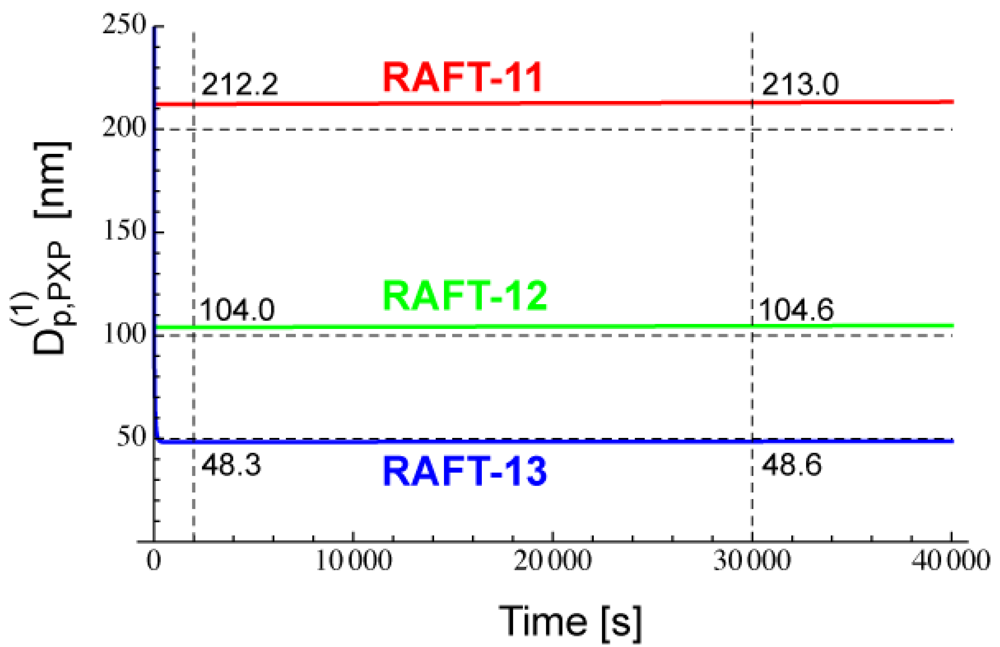
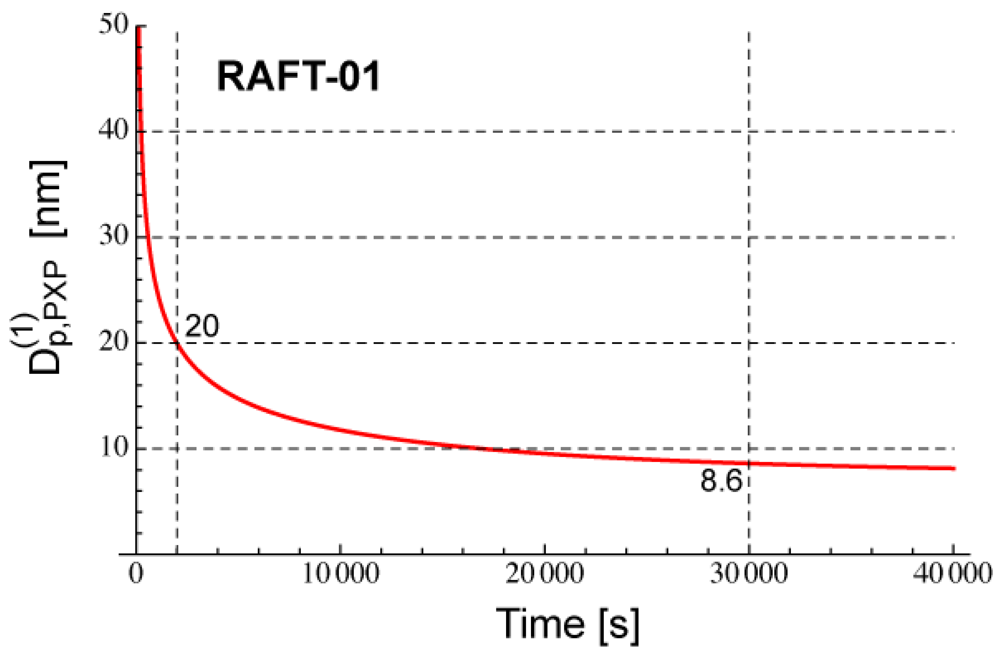
<p>The parameters shown in <xref ref-type="table" rid="t2-polymers-03-01944">Table 2</xref> in Section 2.2 are used in the present RAFT investigation. RAFT-11 is a typical example of the intermediate termination (IT) model that involves cross-termination between a propagating R<sup>•</sup> and an intermediate adduct radical PXP, whose rate constant is represented by <italic>k</italic><sub>ct</sub>. For RAFT-12 and -13, <italic>k</italic><sub>1</sub> is made smaller, and the average intermediate time <italic>t̅</italic><sub>PXP</sub> becomes larger. A larger frequency of cross-termination is expected for RAFT-12 and -13. On the other hand, RAFT-01 is a typical example of the slow fragmentation (SF) model, and it takes as large as <italic>t̅</italic><sub>PXP</sub> = 1/<italic>k</italic><sub>1</sub> = 2 s for a PXP molecule to generate a radical. These parameters are used also in the earlier articles [<xref ref-type="bibr" rid="b13-polymers-03-01944">13</xref>,<xref ref-type="bibr" rid="b21-polymers-03-01944">21</xref>], and detailed kinetic behavior of these reaction conditions can be found therein. As shown in <xref ref-type="fig" rid="f2-polymers-03-01944">Figure 2</xref> of [<xref ref-type="bibr" rid="b22-polymers-03-01944">22</xref>], the model discrimination of RAFT-11 and RAFT-01 based on the bulk polymerization data is difficult.</p>
<p><xref ref-type="fig" rid="f7-polymers-03-01944">Figure 7</xref> shows the calculated 
<inline-formula>
<mml:math id="mm46" display="inline">
<mml:semantics id="sm46">
<mml:mrow>
<mml:msubsup>
<mml:mi>D</mml:mi>
<mml:mrow>
<mml:mrow>
<mml:mtext>p</mml:mtext>
<mml:mo>,</mml:mo>
<mml:mtext>PXP</mml:mtext></mml:mrow></mml:mrow>
<mml:mrow>
<mml:mo stretchy="false">(</mml:mo>
<mml:mn>1</mml:mn>
<mml:mo stretchy="false">)</mml:mo></mml:mrow></mml:msubsup></mml:mrow></mml:semantics></mml:math></inline-formula>-values for RAFT-11, -12, and -13. The 
<inline-formula>
<mml:math id="mm47" display="inline">
<mml:semantics id="sm47">
<mml:mrow>
<mml:msubsup>
<mml:mi>D</mml:mi>
<mml:mrow>
<mml:mrow>
<mml:mtext>p</mml:mtext>
<mml:mo>,</mml:mo>
<mml:mtext>PXP</mml:mtext></mml:mrow></mml:mrow>
<mml:mrow>
<mml:mo stretchy="false">(</mml:mo>
<mml:mn>1</mml:mn>
<mml:mo stretchy="false">)</mml:mo></mml:mrow></mml:msubsup></mml:mrow></mml:semantics></mml:math></inline-formula>-value reaches a nearly constant value in a very short period of time, because [PXP]<sub>bulk</sub> reaches an equilibrium rapidly.</p>
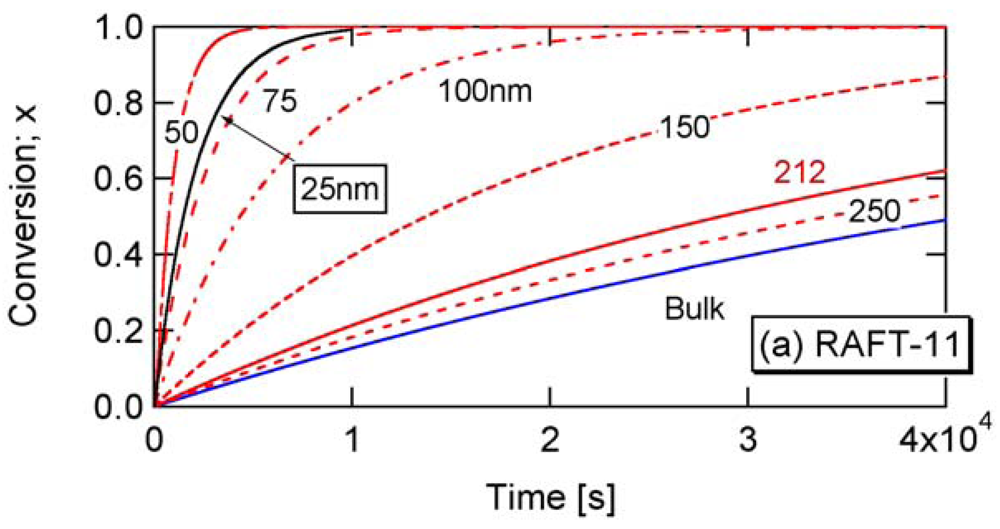
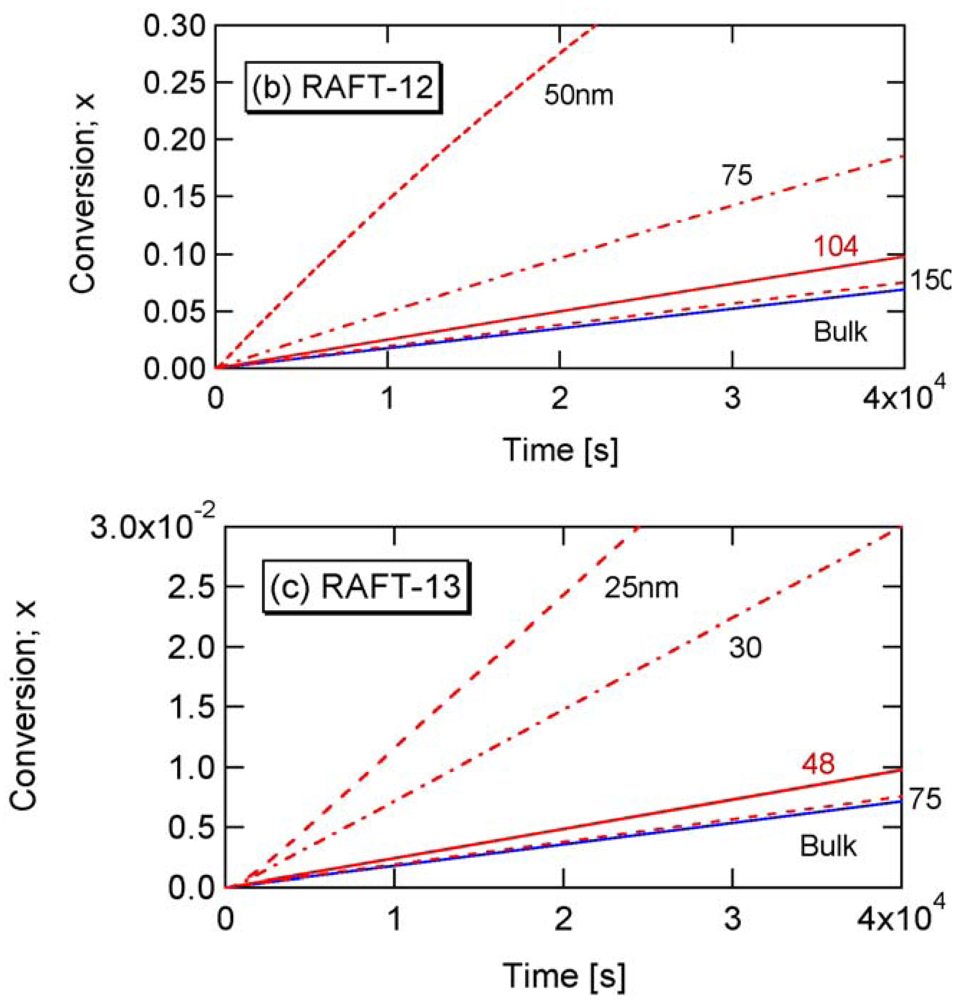
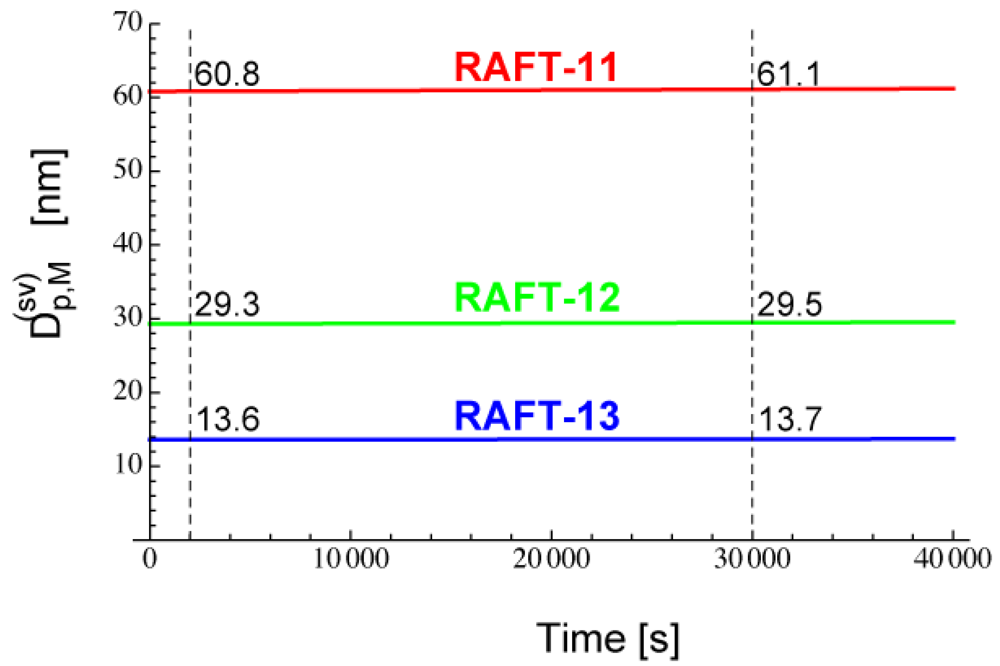
<p><xref ref-type="fig" rid="f8-polymers-03-01944">Figure 8</xref> shows the conversion development of the RAFT miniemulsion polymerization with various particle sizes for RAFT-11, -12, and -13. Significant acceleration is observed for 
<inline-formula>
<mml:math id="mm48" display="inline">
<mml:semantics id="sm48">
<mml:mrow>
<mml:msub>
<mml:mi>D</mml:mi>
<mml:mtext>p</mml:mtext></mml:msub>
<mml:mo>&lt;</mml:mo>
<mml:msubsup>
<mml:mi>D</mml:mi>
<mml:mrow>
<mml:mrow>
<mml:mtext>p</mml:mtext>
<mml:mo>,</mml:mo>
<mml:mtext>PXP</mml:mtext></mml:mrow></mml:mrow>
<mml:mrow>
<mml:mrow>
<mml:mo stretchy="false">(</mml:mo>
<mml:mn>1</mml:mn>
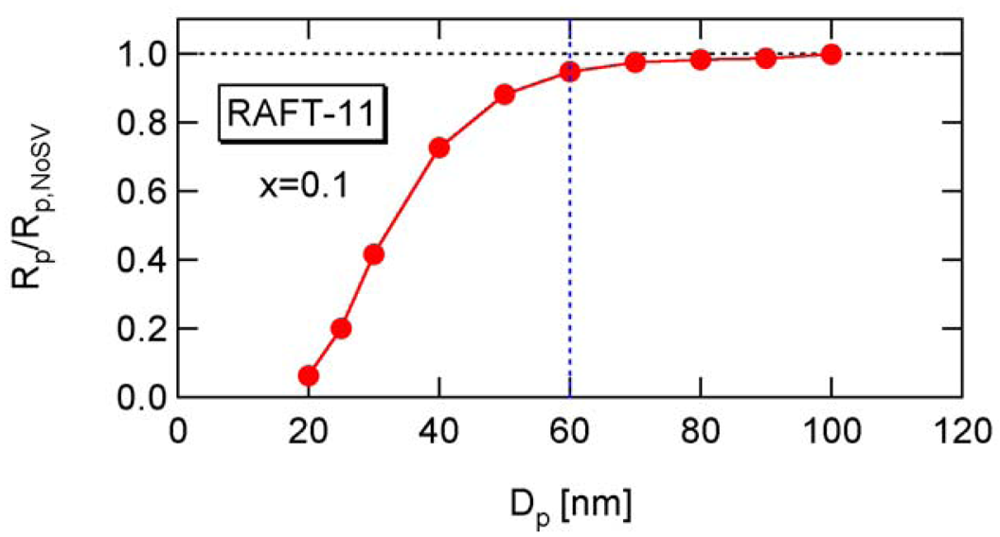
<mml:mo stretchy="false">)</mml:mo></mml:mrow></mml:mrow></mml:msubsup></mml:mrow></mml:semantics></mml:math></inline-formula>. Note that the polymerization rate of <italic>D</italic><sub>p</sub> = 25 nm in RAFT-11 is smaller than that for <italic>D</italic><sub>p</sub> = 50 nm. This is due to the statistical variation effect, which will be discussed in detail in Section 4.2.</p>
<p><xref ref-type="fig" rid="f9-polymers-03-01944">Figure 9</xref> shows the calculated 
<inline-formula>
<mml:math id="mm49" display="inline">
<mml:semantics id="sm49">
<mml:mrow>
<mml:msubsup>
<mml:mi>D</mml:mi>
<mml:mrow>
<mml:mrow>
<mml:mtext>p</mml:mtext>
<mml:mo>,</mml:mo>
<mml:mtext>PXP</mml:mtext></mml:mrow></mml:mrow>
<mml:mrow>
<mml:mo stretchy="false">(</mml:mo>
<mml:mn>1</mml:mn>
<mml:mo stretchy="false">)</mml:mo></mml:mrow></mml:msubsup></mml:mrow></mml:semantics></mml:math></inline-formula> development of RAFT-01, which is a typical example of the SF model without the cross-termination. In this case, <italic>k</italic><sub>1</sub> is very small and <italic>t̅</italic><sub>PXP</sub> is large enough, therefore, PXP molecules are accumulated during polymerization. [PXP]<sub>bulk</sub> is not small enough, and therefore, 
<inline-formula>
<mml:math id="mm50" display="inline">
<mml:semantics id="sm50">
<mml:mrow>
<mml:msubsup>
<mml:mi>D</mml:mi>
<mml:mrow>
<mml:mrow>
<mml:mtext>p</mml:mtext>
<mml:mo>,</mml:mo>
<mml:mtext>PXP</mml:mtext></mml:mrow></mml:mrow>
<mml:mrow>
<mml:mo stretchy="false">(</mml:mo>
<mml:mn>1</mml:mn>
<mml:mo stretchy="false">)</mml:mo></mml:mrow></mml:msubsup></mml:mrow></mml:semantics></mml:math></inline-formula>-value is too small for the real miniemulsion polymerization.</p>
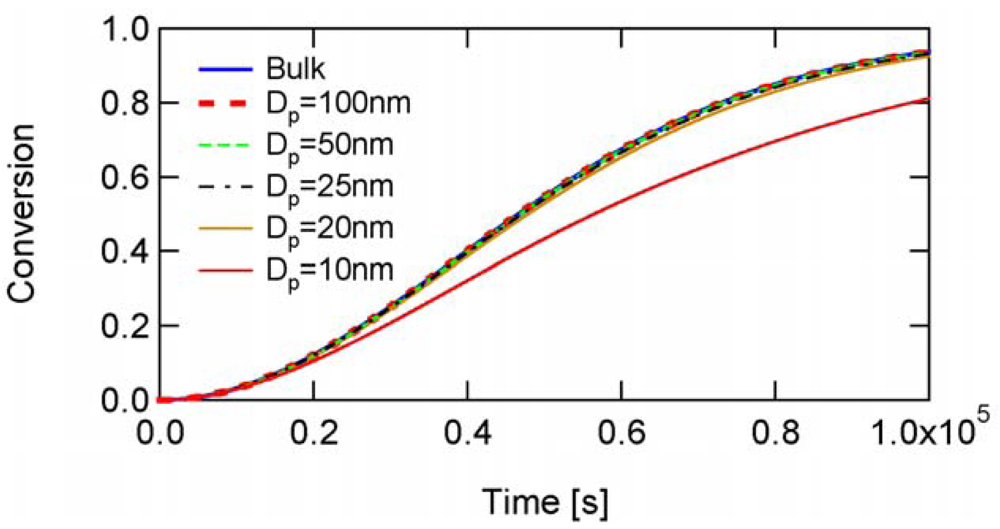
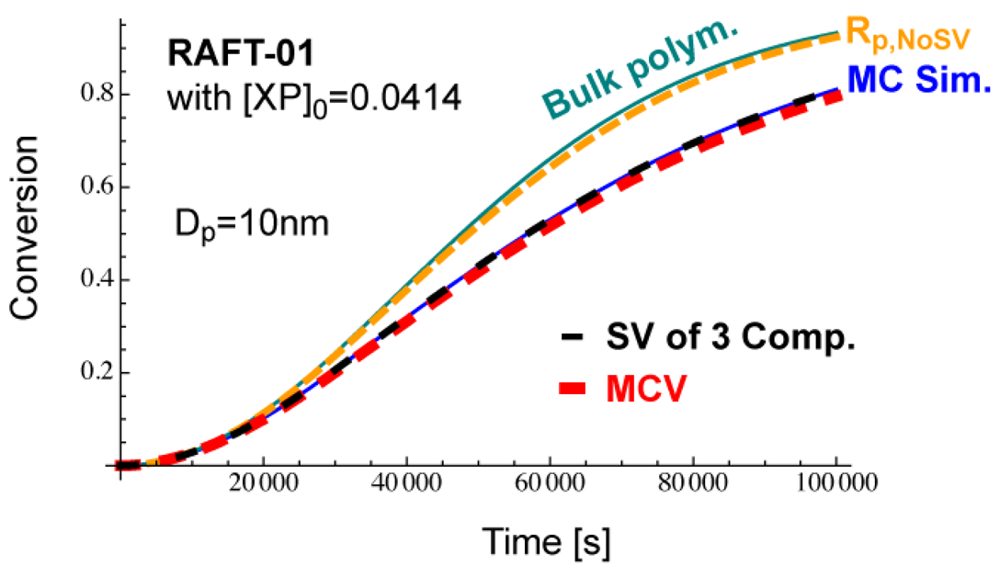
<p><xref ref-type="fig" rid="f10-polymers-03-01944">Figure 10</xref> shows the conversion development of the RAFT miniemulsion polymerization with various particle sizes for RAFT-01. The polymerization rate is essentially unchanged down to <italic>D</italic><sub>p</sub> = 20 nm. At <italic>D</italic><sub>p</sub> = 10 nm on the other hand, the polymerization rate slows down rather than the acceleration. As will be discussed in Section 4.2, this deceleration is due to the statistical variation effect.</p>
<p><xref rid="FD15" ref-type="disp-formula">Equation (15)</xref> was developed on the basis of the intermediate concentration, using <xref rid="FD5" ref-type="disp-formula">Equation (5)</xref> as the fundamental rate expression. On the other hand, if one focuses the attention to the active radical concentration, by using <xref rid="FD1" ref-type="disp-formula">Equation (1)</xref> as the fundamental rate expression, one obtains the following representation of the threshold diameter, which is equivalent to <xref rid="FD15" ref-type="disp-formula">Equation (15)</xref>.</p>
<disp-formula id="FD16">
<label>(16)</label>
<mml:math id="mm51" display="block">
<mml:semantics id="sm51">
<mml:mrow>
<mml:msubsup>
<mml:mi>D</mml:mi>
<mml:mrow>
<mml:mrow>
<mml:mtext>p</mml:mtext>
<mml:mo>,</mml:mo>
<mml:mtext>R</mml:mtext></mml:mrow>
<mml:mo>•</mml:mo></mml:mrow>
<mml:mrow>
<mml:mrow>
<mml:mo stretchy="false">(</mml:mo>
<mml:mn>1</mml:mn>
<mml:mo stretchy="false">)</mml:mo></mml:mrow></mml:mrow></mml:msubsup>
<mml:mo>=</mml:mo>
<mml:msup>
<mml:mrow>
<mml:mrow>
<mml:mo>(</mml:mo>
<mml:mrow>
<mml:msub>
<mml:mrow>
<mml:mfrac>
<mml:mrow>
<mml:mn>6</mml:mn>
<mml:mover accent="true">
<mml:mi>n</mml:mi>
<mml:mo>¯</mml:mo></mml:mover>
<mml:msub>
<mml:mi>ϕ</mml:mi>
<mml:mtext>A</mml:mtext></mml:msub></mml:mrow>
<mml:mrow>
<mml:mi>π</mml:mi>
<mml:msub>
<mml:mi>N</mml:mi>
<mml:mtext>A</mml:mtext></mml:msub>
<mml:mrow>
<mml:mo>[</mml:mo>
<mml:mrow>
<mml:msup>
<mml:mtext>R</mml:mtext>
<mml:mo>•</mml:mo></mml:msup></mml:mrow>
<mml:mo>]</mml:mo></mml:mrow></mml:mrow></mml:mfrac></mml:mrow>
<mml:mrow>
<mml:mtext>bulk</mml:mtext></mml:mrow></mml:msub></mml:mrow>
<mml:mo>)</mml:mo></mml:mrow></mml:mrow>
<mml:mrow>
<mml:mrow>
<mml:mn>1</mml:mn>
<mml:mo>/</mml:mo>
<mml:mn>3</mml:mn></mml:mrow></mml:mrow></mml:msup></mml:mrow></mml:semantics></mml:math></disp-formula>
<p>The derivation of <xref rid="FD16" ref-type="disp-formula">Equation (16)</xref> is shown in the appendix of [<xref ref-type="bibr" rid="b21-polymers-03-01944">21</xref>]. <xref rid="FD16" ref-type="disp-formula">Equation (16)</xref> is useful especially for DTRP and conventional nonliving FRP, where the intermediate molecule is not involved.</p></sec>
<sec>
<label>4.</label>
<title>Effect of Large Statistical Concentration Variation among Polymerization Loci</title>
<p>As discussed in Section 2.2, the statistical variation of the component molecules in a particle must be accounted for, and <xref rid="FD11" ref-type="disp-formula">Equation (11)</xref> needs to be used. The use of the average concentrations, <italic>i.e.</italic> <xref rid="FD12" ref-type="disp-formula">Equation (12)</xref> may underestimate the polymerization rate, as shown in <xref ref-type="fig" rid="f3-polymers-03-01944">Figure 3(b)</xref>, or overestimate as in the cases of <xref ref-type="fig" rid="f4-polymers-03-01944">Figure 4(b,c)</xref>.</p>
<p>For the cases with [<italic>Trap</italic>] ≪ [<italic>Interm</italic>], the statistical variation of the trapping agent concentration in a particle may not be neglected. Because [<italic>Trap</italic>] resides in the denominator in the rate expression shown by <xref rid="FD11" ref-type="disp-formula">Equation (11)</xref>, the use of the average concentrations leads to underestimate the polymerization rate. This is due to a simple mathematical relationship, 1/〈[<italic>Trap</italic>]<sub>Act,</sub><italic><sub>i</sub></italic>〉 ≤ 〈1/[<italic>Trap</italic>]<sub>Act,</sub><italic><sub>i</sub></italic>〉. For the cases with [<italic>Interm</italic>]≪[<italic>Trap</italic>], the statistical variation of the intermediate concentration in a particle may not be neglected. On the other hand, however, if [<italic>Interm</italic>] is the only term to fluctuate, the average concentration still applies because [<italic>Interm</italic>] resides in the numerator of <xref rid="FD11" ref-type="disp-formula">Equation (11)</xref>. On the other hand, if the fluctuation of [<italic>Interm</italic>] correlates, for example, with [M], the statistical variation must be accounted for.</p>
<sec sec-type="cases">
<label>4.1.</label>
<title>Cases with [Trap] ≪ [Interm]—SRMP and ATRP</title>
<p>In usual SRMP and ATRP, the relationship [<italic>Trap</italic>] ≪ [<italic>Interm</italic>] holds, and therefore, the polymerization could be accelerated because of the statistical variation of [<italic>Trap</italic>]. If [<italic>Trap</italic>] is the only term to have significant fluctuation, <xref rid="FD11" ref-type="disp-formula">Equation (11)</xref> reduces to:
<disp-formula id="FD17">
<label>(17)</label>
<mml:math id="mm52" display="block">
<mml:semantics id="sm52">
<mml:mrow>
<mml:msub>
<mml:mi>R</mml:mi>
<mml:mrow>
<mml:mrow>
<mml:mtext>p</mml:mtext>
<mml:mo>,</mml:mo>
<mml:mtext>Trap</mml:mtext></mml:mrow></mml:mrow></mml:msub>
<mml:mo>=</mml:mo>
<mml:msub>
<mml:mi>k</mml:mi>
<mml:mtext>p</mml:mtext></mml:msub>
<mml:mrow>
<mml:mo>〈</mml:mo>
<mml:mrow>
<mml:msub>
<mml:mi>K</mml:mi>
<mml:mi>i</mml:mi></mml:msub></mml:mrow>
<mml:mo>〉</mml:mo></mml:mrow>
<mml:mrow>
<mml:mo>〈</mml:mo>
<mml:mrow>
<mml:msub>
<mml:mrow>
<mml:mrow>
<mml:mo>[</mml:mo>
<mml:mtext>M</mml:mtext>
<mml:mo>]</mml:mo></mml:mrow></mml:mrow>
<mml:mi>i</mml:mi></mml:msub></mml:mrow>
<mml:mo>〉</mml:mo></mml:mrow>
<mml:mrow>
<mml:mo>〈</mml:mo>
<mml:mrow>
<mml:msub>
<mml:mrow>
<mml:mrow>
<mml:mo>[</mml:mo>
<mml:mrow>
<mml:mtext mathvariant="italic">Interm</mml:mtext></mml:mrow>
<mml:mo>]</mml:mo></mml:mrow></mml:mrow>
<mml:mi>i</mml:mi></mml:msub></mml:mrow>
<mml:mo>〉</mml:mo></mml:mrow>
<mml:mrow>
<mml:mo>〈</mml:mo>
<mml:mrow>
<mml:mfrac>
<mml:mn>1</mml:mn>
<mml:mrow>
<mml:msub>
<mml:mrow>
<mml:mrow>
<mml:mo>[</mml:mo>
<mml:mrow>
<mml:mtext mathvariant="italic">Trap</mml:mtext></mml:mrow>
<mml:mo>]</mml:mo></mml:mrow></mml:mrow>
<mml:mrow>
<mml:mrow>
<mml:mtext>Act</mml:mtext>
<mml:mo>,</mml:mo></mml:mrow>
<mml:mi>i</mml:mi></mml:mrow></mml:msub></mml:mrow></mml:mfrac></mml:mrow>
<mml:mo>〉</mml:mo></mml:mrow></mml:mrow></mml:semantics></mml:math></disp-formula> where the subscript “Trap” is used for <italic>R</italic><sub>p</sub> to represent the polymerization rate calculated by accounting for the statistical variation of the trapping agent concentration.</p>
<p><xref ref-type="fig" rid="f11-polymers-03-01944">Figure 11</xref> shows calculated conversion development of a miniemulsion polymerization, SRMP-1 with <italic>D</italic><sub>p</sub> = 40 nm. The parameters used are the same as for <xref ref-type="fig" rid="f3-polymers-03-01944">Figures 3</xref> and <xref ref-type="fig" rid="f5-polymers-03-01944">5</xref>, and can be found in the text before <xref ref-type="fig" rid="f3-polymers-03-01944">Figure 3</xref>. <xref rid="FD11" ref-type="disp-formula">Equation (11)</xref> that accounts for the full statistical variation of all components agrees completely with the MC simulation results. <xref rid="FD17" ref-type="disp-formula">Equation (17)</xref> that accounts for only the statistical variation of [<italic>Trap</italic>]<sub>Act,</sub><italic><sub>i</sub></italic> agrees very well with the MC, and it can be concluded that the fluctuation of [<italic>Trap</italic>]<sub>Act,</sub><italic><sub>i</sub></italic> is dominant in the present reaction system.</p>
<p>As was shown in <xref ref-type="fig" rid="f5-polymers-03-01944">Figure 5</xref>, D<sub>p</sub> = 40 nm is smaller than 
<inline-formula>
<mml:math id="mm53" display="inline">
<mml:semantics id="sm53">
<mml:mrow>
<mml:msubsup>
<mml:mi>D</mml:mi>
<mml:mrow>
<mml:mrow>
<mml:mtext>p</mml:mtext>
<mml:mo>,</mml:mo>
<mml:mtext>Trap</mml:mtext></mml:mrow></mml:mrow>
<mml:mrow>
<mml:mrow>
<mml:mo stretchy="false">(</mml:mo>
<mml:mn>1</mml:mn>
<mml:mo stretchy="false">)</mml:mo></mml:mrow></mml:mrow></mml:msubsup></mml:mrow></mml:semantics></mml:math></inline-formula>at the earlier stage of polymerization, and therefore, the miniemulsion polymerization shows lower conversion than in bulk in the beginning of polymerization, as shown in <xref ref-type="fig" rid="f11-polymers-03-01944">Figure 11</xref>. On the other hand, <italic>D</italic><sub>p</sub> = 40 nm stays in an acceleration window of <xref ref-type="fig" rid="f5-polymers-03-01944">Figure 5</xref>, and the polymerization is faster for the miniemulsion polymerization in the later stage of polymerization. The use of average concentrations, <xref rid="FD12" ref-type="disp-formula">Equation (12)</xref> shows smaller polymerization rate than in bulk. This is because 〈[<italic>Trap</italic>]<sub>Act,</sub><italic><sub>i</sub></italic>〉 &gt; [<italic>Trap</italic>]<sub>bulk</sub>, as was discussed earlier [<xref ref-type="bibr" rid="b10-polymers-03-01944">10</xref>,<xref ref-type="bibr" rid="b14-polymers-03-01944">14</xref>]. On the other hand, when the effect of bimolecular termination is significant in bulk polymerization, <italic>R</italic><sub>p,NoSV</sub> given by <xref rid="FD12" ref-type="disp-formula">Equation (12)</xref> may show a faster polymerization rate than the corresponding bulk polymerization [<xref ref-type="bibr" rid="b14-polymers-03-01944">14</xref>].</p>
<p>The degree of rate increase due to the fluctuation in [<italic>Trap</italic>]<sub>Act,</sub><italic><sub>i</sub></italic> changes with the number distribution of the trapping agents among particles. The statistical variation would become significant when the average number of trapping agents in a particle is small. To determine an approximate value of the average number of trapping agents in a particle, below which the statistical variation effect to increase the polymerization rate becomes significant, a simple model for the approximate distribution was proposed [<xref ref-type="bibr" rid="b10-polymers-03-01944">10</xref>]. <xref ref-type="fig" rid="f12-polymers-03-01944">Figure 12</xref> shows the acceleration ratio, <italic>i.e.</italic> the polymerization rate accounting for the statistical variation (<italic>R</italic><sub>p</sub>) is divided by that estimated by neglecting the statistical variation (<italic>R</italic><sub>p,NoSV</sub>). <italic>R</italic><sub>p</sub> corresponds to the rate represented by <xref rid="FD17" ref-type="disp-formula">Equation (17)</xref>, and <italic>R</italic><sub>p,NoSV</sub> corresponds to <xref rid="FD12" ref-type="disp-formula">Equation (12)</xref>. The simplified model used for the calculation is elucidated in [<xref ref-type="bibr" rid="b10-polymers-03-01944">10</xref>]. The <italic>x</italic>-ordinate in <xref ref-type="fig" rid="f12-polymers-03-01944">Figure 12</xref> is the average number of trapping agents in a particle during active period, <italic>n̅</italic><sub>TraP,Act</sub>.</p>
<p><xref ref-type="fig" rid="f12-polymers-03-01944">Figure 12</xref> shows that the acceleration due to the statistical variation of the trapping agents becomes significant when the average number of trapping agents in a particle is smaller than a certain number, 
<inline-formula>
<mml:math id="mm54" display="inline">
<mml:semantics id="sm54">
<mml:mrow>
<mml:msubsup>
<mml:mrow>
<mml:mover accent="true">
<mml:mi>n</mml:mi>
<mml:mo>¯</mml:mo></mml:mover></mml:mrow>
<mml:mrow>
<mml:mtext>Trap</mml:mtext></mml:mrow>
<mml:mrow>
<mml:mrow>
<mml:mo stretchy="false">(</mml:mo>
<mml:mrow>
<mml:mtext>sv</mml:mtext></mml:mrow>
<mml:mo stretchy="false">)</mml:mo></mml:mrow></mml:mrow></mml:msubsup></mml:mrow></mml:semantics></mml:math></inline-formula> The 
<inline-formula>
<mml:math id="mm55" display="inline">
<mml:semantics id="sm55">
<mml:mrow>
<mml:msubsup>
<mml:mrow>
<mml:mover accent="true">
<mml:mi>n</mml:mi>
<mml:mo>¯</mml:mo></mml:mover></mml:mrow>
<mml:mrow>
<mml:mtext>Trap</mml:mtext></mml:mrow>
<mml:mrow>
<mml:mrow>
<mml:mo stretchy="false">(</mml:mo>
<mml:mrow>
<mml:mtext>sv</mml:mtext></mml:mrow>
<mml:mo stretchy="false">)</mml:mo></mml:mrow></mml:mrow></mml:msubsup></mml:mrow></mml:semantics></mml:math></inline-formula> -value is a function of the ratio between the deactivation rate constant and termination rate constant, <italic>k</italic><sub>2</sub>/<italic>k</italic><sub>t</sub>. In SRMP and ATRP, the number of trapping agents increases by the bimolecular termination. A single bimolecular termination leads to form two extra trapping agents in a particle. Smaller <italic>k</italic><sub>2</sub>/<italic>k</italic><sub>t</sub> means bimolecular termination is significant, forming a larger number of trapping agents faster. Significant bimolecular termination is not suitable for the controlled RDRP, however, <italic>k</italic><sub>2</sub>/<italic>k</italic><sub>t</sub>-value as small as 1.24 × 10<sup>−3</sup> is reported for 2,2,5-trimethyl-4-phenyl-3-azahexane-3-oxy (TIPNO)/styrene system [<xref ref-type="bibr" rid="b29-polymers-03-01944">29</xref>]. <xref ref-type="fig" rid="f12-polymers-03-01944">Figure 12</xref> shows that the acceleration is significant for smaller <italic>k</italic> <sub>2</sub>/<italic>k</italic><sub>t</sub>-values.</p>
<p>Assuming about 10% increase in polymerization is considered significant (<italic>R</italic><sub>p</sub>/<italic>R</italic><sub>p,NoSV</sub> = 1.1 shown by a broken line in <xref ref-type="fig" rid="f12-polymers-03-01944">Figure 12</xref>), 
<inline-formula>
<mml:math id="mm56" display="inline">
<mml:semantics id="sm56">
<mml:mrow>
<mml:msubsup>
<mml:mrow>
<mml:mover accent="true">
<mml:mi>n</mml:mi>
<mml:mo>¯</mml:mo></mml:mover></mml:mrow>
<mml:mrow>
<mml:mtext>Trap</mml:mtext></mml:mrow>
<mml:mrow>
<mml:mrow>
<mml:mo stretchy="false">(</mml:mo>
<mml:mrow>
<mml:mtext>sv</mml:mtext></mml:mrow>
<mml:mo stretchy="false">)</mml:mo></mml:mrow></mml:mrow></mml:msubsup></mml:mrow></mml:semantics></mml:math></inline-formula> -value is about 10 for <italic>k</italic><sub>2</sub>/<italic>k</italic><sub>t</sub> &gt; 0.5, and is about 20 for <italic>k</italic><sub>2</sub>/<italic>k</italic><sub>t</sub> around 0.05. The 
<inline-formula>
<mml:math id="mm57" display="inline">
<mml:semantics id="sm57">
<mml:mrow>
<mml:msubsup>
<mml:mrow>
<mml:mover accent="true">
<mml:mi>n</mml:mi>
<mml:mo>¯</mml:mo></mml:mover></mml:mrow>
<mml:mrow>
<mml:mtext>Trap</mml:mtext></mml:mrow>
<mml:mrow>
<mml:mrow>
<mml:mo stretchy="false">(</mml:mo>
<mml:mrow>
<mml:mtext>sv</mml:mtext></mml:mrow>
<mml:mo stretchy="false">)</mml:mo></mml:mrow></mml:mrow></mml:msubsup></mml:mrow></mml:semantics></mml:math></inline-formula> -value larger than 30 is needed for <italic>k</italic><sub>2</sub>/<italic>k</italic><sub>t</sub> &lt; 0.01. For the calculation condition shown in <xref ref-type="fig" rid="f3-polymers-03-01944">Figures 3</xref>, <xref ref-type="fig" rid="f5-polymers-03-01944">5</xref>, and <xref ref-type="fig" rid="f6-polymers-03-01944">6</xref> (SRMP-1), <italic>k</italic><sub>2</sub>/<italic>k</italic><sub>t</sub> = 1, and 
<inline-formula>
<mml:math id="mm58" display="inline">
<mml:semantics id="sm58">
<mml:mrow>
<mml:msubsup>
<mml:mrow>
<mml:mover accent="true">
<mml:mi>n</mml:mi>
<mml:mo>¯</mml:mo></mml:mover></mml:mrow>
<mml:mrow>
<mml:mtext>Trap</mml:mtext></mml:mrow>
<mml:mrow>
<mml:mrow>
<mml:mo stretchy="false">(</mml:mo>
<mml:mrow>
<mml:mtext>sv</mml:mtext></mml:mrow>
<mml:mo stretchy="false">)</mml:mo></mml:mrow></mml:mrow></mml:msubsup></mml:mrow></mml:semantics></mml:math></inline-formula> is about 10.</p>
<p>Note the acceleration discussed in this section is in comparison with the polymerization rate without accounting for the statistical variation, represented by <xref rid="FD12" ref-type="disp-formula">Equation (12)</xref>, not with respect to the bulk polymerization rate. When compared with the bulk polymerization, 〈[<italic>Trap</italic>]<sub>Act,</sub><italic><sub>i</sub></italic>〉 could be larger or smaller than [<italic>Trap</italic>]<sub>bulk</sub><italic>,</italic> as was shown earlier [<xref ref-type="bibr" rid="b10-polymers-03-01944">10</xref>,<xref ref-type="bibr" rid="b14-polymers-03-01944">14</xref>]. For the cases with 〈[<italic>Trap</italic>]<sub>Act,</sub><italic><sub>i</sub></italic>〉 &gt; [<italic>Trap</italic>]<sub>bulk</sub>, <italic>R</italic><sub>p,NoSV</sub> is smaller than that in bulk, <italic>R</italic><sub>p,bulk</sub>, as in the case of <xref ref-type="fig" rid="f11-polymers-03-01944">Figure 11</xref>. Such cases are found in many good living conditions where <italic>k</italic><sub>2</sub>/<italic>k</italic><sub>t</sub> is large. With the activation reaction, one trapping agent is formed and this increase may make 〈[<italic>Trap</italic>]<sub>Act,</sub><italic><sub>i</sub></italic>〉 &gt; [<italic>Trap</italic>]<sub>bulk</sub> [<xref ref-type="bibr" rid="b10-polymers-03-01944">10</xref>]. In some cases, the miniemulsion polymerization rate cannot make the polymerization rate faster compared with <italic>R</italic> <sub>p,bulk</sub>, even though <italic>Rp</italic> &gt; <italic>R</italic><sub>p,NoSV</sub>.</p>
<p>On the other hand, with [<italic>Trap</italic>]<sub>bulk</sub> &gt; 〈[<italic>Trap</italic>]<sub>Act,</sub><italic><sub>i</sub></italic>〉, the miniemulsion polymerization rate may show larger acceleration expected from <xref ref-type="fig" rid="f12-polymers-03-01944">Figure 12</xref>. Such cases are found when <italic>k</italic><sub>2</sub>/ <italic>k</italic><sub>t</sub> is small, <italic>i.e.</italic>, in a bad living condition [<xref ref-type="bibr" rid="b14-polymers-03-01944">14</xref>]. Because the bimolecular termination is significant in bulk polymerization in such cases, the segregation of radicals into different polymer particles [<xref ref-type="bibr" rid="b6-polymers-03-01944">6</xref>] reduces the termination frequency. Reduced termination frequency slows down the accumulation of the trapping agents in a particle. A smaller 〈[<italic>Trap</italic>]<sub>Act,</sub><italic><sub>i</sub></italic>〉 leads a faster polymerization rate, resulting in the relationship, <italic>R</italic><sub>p,NoSV</sub> &gt; <italic>R</italic><sub>p,bulk</sub>.</p>
<p>In order to develop a simple equation that can be used as a pointer to roughly determine the diameter below which the acceleration due to the statistical variation becomes significant 
<inline-formula>
<mml:math id="mm59" display="inline">
<mml:semantics id="sm59">
<mml:mrow>
<mml:msubsup>
<mml:mi>D</mml:mi>
<mml:mrow>
<mml:mrow>
<mml:mtext>p</mml:mtext>
<mml:mo>,</mml:mo>
<mml:mtext>Trap</mml:mtext></mml:mrow></mml:mrow>
<mml:mrow>
<mml:mrow>
<mml:mo stretchy="false">(</mml:mo>
<mml:mrow>
<mml:mtext>sv</mml:mtext></mml:mrow>
<mml:mo stretchy="false">)</mml:mo></mml:mrow></mml:mrow></mml:msubsup></mml:mrow></mml:semantics></mml:math></inline-formula> let us assume 
<inline-formula>
<mml:math id="mm60" display="inline">
<mml:semantics id="sm60">
<mml:mrow>
<mml:mrow>
<mml:mo>〈</mml:mo>
<mml:mrow>
<mml:msub>
<mml:mrow>
<mml:mrow>
<mml:mo>[</mml:mo>
<mml:mrow>
<mml:mtext mathvariant="italic">Trap</mml:mtext></mml:mrow>
<mml:mo>]</mml:mo></mml:mrow></mml:mrow>
<mml:mrow>
<mml:mtext>Act</mml:mtext>
<mml:mo>,</mml:mo>
<mml:mi>i</mml:mi></mml:mrow></mml:msub></mml:mrow>
<mml:mo>〉</mml:mo></mml:mrow>
<mml:mo>≅</mml:mo>
<mml:msub>
<mml:mrow>
<mml:mrow>
<mml:mo>[</mml:mo>
<mml:mrow>
<mml:mtext mathvariant="italic">Trap</mml:mtext></mml:mrow>
<mml:mo>]</mml:mo></mml:mrow></mml:mrow>
<mml:mrow>
<mml:mtext>bulk</mml:mtext></mml:mrow></mml:msub></mml:mrow></mml:semantics></mml:math></inline-formula> The concentration of 
<inline-formula>
<mml:math id="mm61" display="inline">
<mml:semantics id="sm61">
<mml:mrow>
<mml:msubsup>
<mml:mrow>
<mml:mover accent="true">
<mml:mi>n</mml:mi>
<mml:mo>¯</mml:mo></mml:mover></mml:mrow>
<mml:mrow>
<mml:mtext>Trap</mml:mtext></mml:mrow>
<mml:mrow>
<mml:mrow>
<mml:mo stretchy="false">(</mml:mo>
<mml:mrow>
<mml:mtext>sv</mml:mtext></mml:mrow>
<mml:mo stretchy="false">)</mml:mo></mml:mrow></mml:mrow></mml:msubsup></mml:mrow></mml:semantics></mml:math></inline-formula> trapping agents in a particle with diameter <italic>D</italic><sub>p</sub> is given by 
<inline-formula>
<mml:math id="mm62" display="inline">
<mml:semantics id="sm62">
<mml:mrow>
<mml:mrow>
<mml:mrow>
<mml:msubsup>
<mml:mrow>
<mml:mover accent="true">
<mml:mi>n</mml:mi>
<mml:mo>¯</mml:mo></mml:mover></mml:mrow>
<mml:mrow>
<mml:mtext>Trap</mml:mtext></mml:mrow>
<mml:mrow>
<mml:mrow>
<mml:mo stretchy="false">(</mml:mo>
<mml:mrow>
<mml:mtext>sv</mml:mtext></mml:mrow>
<mml:mo stretchy="false">)</mml:mo></mml:mrow></mml:mrow></mml:msubsup></mml:mrow>
<mml:mo>/</mml:mo>
<mml:mrow>
<mml:mrow>
<mml:mo>{</mml:mo>
<mml:mrow>
<mml:msub>
<mml:mi>N</mml:mi>
<mml:mtext>A</mml:mtext></mml:msub>
<mml:mrow>
<mml:mo stretchy="false">(</mml:mo>
<mml:mrow>
<mml:mrow>
<mml:mi>π</mml:mi>
<mml:mo>/</mml:mo>
<mml:mn>6</mml:mn></mml:mrow></mml:mrow>
<mml:mo stretchy="false">)</mml:mo></mml:mrow>
<mml:msubsup>
<mml:mi>D</mml:mi>
<mml:mtext>p</mml:mtext>
<mml:mn>3</mml:mn></mml:msubsup></mml:mrow>
<mml:mo>}</mml:mo></mml:mrow></mml:mrow></mml:mrow></mml:mrow></mml:semantics></mml:math></inline-formula> Assuming 
<inline-formula>
<mml:math id="mm63" display="inline">
<mml:semantics id="sm63">
<mml:mrow>
<mml:mrow>
<mml:mo>〈</mml:mo>
<mml:mrow>
<mml:msub>
<mml:mrow>
<mml:mrow>
<mml:mo>[</mml:mo>
<mml:mrow>
<mml:mtext mathvariant="italic">Trap</mml:mtext></mml:mrow>
<mml:mo>]</mml:mo></mml:mrow></mml:mrow>
<mml:mrow>
<mml:mtext>Act</mml:mtext>
<mml:mo>,</mml:mo>
<mml:mi>i</mml:mi></mml:mrow></mml:msub></mml:mrow>
<mml:mo>〉</mml:mo></mml:mrow>
<mml:mo>≅</mml:mo>
<mml:msub>
<mml:mrow>
<mml:mrow>
<mml:mo>[</mml:mo>
<mml:mrow>
<mml:mtext mathvariant="italic">Trap</mml:mtext></mml:mrow>
<mml:mo>]</mml:mo></mml:mrow></mml:mrow>
<mml:mrow>
<mml:mtext>bulk</mml:mtext></mml:mrow></mml:msub></mml:mrow></mml:semantics></mml:math></inline-formula> this concentration is equal to [<italic>Trap</italic>]<sub>bulk</sub>. Therefore, the particle size below which the polymerization rate becomes larger because of the statistical variation effect, 
<inline-formula>
<mml:math id="mm64" display="inline">
<mml:semantics id="sm64">
<mml:mrow>
<mml:msubsup>
<mml:mi>D</mml:mi>
<mml:mrow>
<mml:mrow>
<mml:mtext>p</mml:mtext>
<mml:mo>,</mml:mo>
<mml:mtext>Trap</mml:mtext></mml:mrow></mml:mrow>
<mml:mrow>
<mml:mrow>
<mml:mo stretchy="false">(</mml:mo>
<mml:mrow>
<mml:mtext>sv</mml:mtext></mml:mrow>
<mml:mo stretchy="false">)</mml:mo></mml:mrow></mml:mrow></mml:msubsup></mml:mrow></mml:semantics></mml:math></inline-formula> is given by:
<disp-formula id="FD18">
<label>(18)</label>
<mml:math id="mm65" display="block">
<mml:semantics id="sm65">
<mml:mrow>
<mml:msubsup>
<mml:mi>D</mml:mi>
<mml:mrow>
<mml:mrow>
<mml:mtext>p</mml:mtext>
<mml:mo>,</mml:mo>
<mml:mtext>Trap</mml:mtext></mml:mrow></mml:mrow>
<mml:mrow>
<mml:mrow>
<mml:mo stretchy="false">(</mml:mo>
<mml:mrow>
<mml:mtext>sv</mml:mtext></mml:mrow>
<mml:mo stretchy="false">)</mml:mo></mml:mrow></mml:mrow></mml:msubsup>
<mml:mo>=</mml:mo>
<mml:msup>
<mml:mrow>
<mml:mrow>
<mml:mo>(</mml:mo>
<mml:mrow>
<mml:mfrac>
<mml:mrow>
<mml:mn>6</mml:mn>
<mml:msubsup>
<mml:mrow>
<mml:mover accent="true">
<mml:mi>n</mml:mi>
<mml:mo>¯</mml:mo></mml:mover></mml:mrow>
<mml:mrow>
<mml:mtext>Trap</mml:mtext></mml:mrow>
<mml:mrow>
<mml:mrow>
<mml:mo stretchy="false">(</mml:mo>
<mml:mrow>
<mml:mtext>sv</mml:mtext></mml:mrow>
<mml:mo stretchy="false">)</mml:mo></mml:mrow></mml:mrow></mml:msubsup></mml:mrow>
<mml:mrow>
<mml:mi>π</mml:mi>
<mml:msub>
<mml:mi>N</mml:mi>
<mml:mtext>A</mml:mtext></mml:msub>
<mml:msub>
<mml:mrow>
<mml:mrow>
<mml:mo>[</mml:mo>
<mml:mrow>
<mml:mtext mathvariant="italic">Trap</mml:mtext></mml:mrow>
<mml:mo>]</mml:mo></mml:mrow></mml:mrow>
<mml:mrow>
<mml:mtext>bulk</mml:mtext></mml:mrow></mml:msub></mml:mrow></mml:mfrac></mml:mrow>
<mml:mo>)</mml:mo></mml:mrow></mml:mrow>
<mml:mrow>
<mml:mrow>
<mml:mn>1</mml:mn>
<mml:mo>/</mml:mo>
<mml:mn>3</mml:mn></mml:mrow></mml:mrow></mml:msup></mml:mrow></mml:semantics></mml:math></disp-formula></p>
<p>The upper curve shown in <xref ref-type="fig" rid="f5-polymers-03-01944">Figure 5</xref> and the upper limit of the acceleration window shown in Figure 6 are calculated by using <xref rid="FD18" ref-type="disp-formula">Equation (18)</xref> with 
<inline-formula>
<mml:math id="mm66" display="inline">
<mml:semantics id="sm66">
<mml:mrow>
<mml:msubsup>
<mml:mrow>
<mml:mover accent="true">
<mml:mi>n</mml:mi>
<mml:mo>¯</mml:mo></mml:mover></mml:mrow>
<mml:mrow>
<mml:mtext>Trap</mml:mtext></mml:mrow>
<mml:mrow>
<mml:mrow>
<mml:mo stretchy="false">(</mml:mo>
<mml:mrow>
<mml:mtext>sv</mml:mtext></mml:mrow>
<mml:mo stretchy="false">)</mml:mo></mml:mrow></mml:mrow></mml:msubsup>
<mml:mo>=</mml:mo>
<mml:mn>10</mml:mn></mml:mrow></mml:semantics></mml:math></inline-formula> Good agreement of the upper limit of the acceleration window for the other SRMP conditions and ATRPs, including bad living conditions, can be found elsewhere [<xref ref-type="bibr" rid="b10-polymers-03-01944">10</xref>,<xref ref-type="bibr" rid="b13-polymers-03-01944">13</xref>,<xref ref-type="bibr" rid="b14-polymers-03-01944">14</xref>].</p></sec>
<sec sec-type="cases">
<label>4.2.</label>
<title>Cases with [Interm] ≪ [Trap]—RAFT</title>
<p>In many RAFT systems, [<italic>Interm</italic>] ≪ [<italic>Trap</italic>] holds, and the statistical variation of [<italic>Interm</italic>] may become significant in smaller particles. On the other hand, however, if [<italic>Interm</italic>] is the only term to fluctuate, the average concentration still applies because [<italic>Interm</italic>] resides in the numerator of <xref rid="FD11" ref-type="disp-formula">Equation (11)</xref>. Therefore, the statistical variation effect would become significant when other concentration terms are significant. It was discovered that the statistical variation of monomer concentration is significant when the particle size is small with a relatively fast polymerization conditions [<xref ref-type="bibr" rid="b23-polymers-03-01944">23</xref>]. This monomer-concentration-variation (MCV) effect applies also for DTRP and conventional nonliving FRP. Note that the MCV effect is attributed to the correlated variation of both [M] and [PXP], or [M] and [<italic>R</italic><sup>•</sup>], as clarified in [<xref ref-type="bibr" rid="b21-polymers-03-01944">21</xref>]. When the MCV effect is dominant, the exact miniemulsion polymerization rate expression, <xref rid="FD11" ref-type="disp-formula">Equation (11)</xref> reduces to:
<disp-formula id="FD19">
<label>(19)</label>
<mml:math id="mm67" display="block">
<mml:semantics id="sm67">
<mml:mrow>
<mml:msub>
<mml:mi>R</mml:mi>
<mml:mrow>
<mml:mrow>
<mml:mtext>p</mml:mtext>
<mml:mo>,</mml:mo>
<mml:mtext>MCV</mml:mtext></mml:mrow></mml:mrow></mml:msub>
<mml:mo>=</mml:mo>
<mml:msub>
<mml:mi>k</mml:mi>
<mml:mtext>p</mml:mtext></mml:msub>
<mml:mrow>
<mml:mo>〈</mml:mo>
<mml:mrow>
<mml:msub>
<mml:mi>K</mml:mi>
<mml:mi>i</mml:mi></mml:msub></mml:mrow>
<mml:mo>〉</mml:mo></mml:mrow>
<mml:mfrac>
<mml:mrow>
<mml:mrow>
<mml:mo>〈</mml:mo>
<mml:mrow>
<mml:msub>
<mml:mrow>
<mml:mrow>
<mml:mo>[</mml:mo>
<mml:mtext>M</mml:mtext>
<mml:mo>]</mml:mo></mml:mrow></mml:mrow>
<mml:mi>i</mml:mi></mml:msub>
<mml:msub>
<mml:mrow>
<mml:mrow>
<mml:mo>[</mml:mo>
<mml:mrow>
<mml:mtext mathvariant="italic">Interm</mml:mtext></mml:mrow>
<mml:mo>]</mml:mo></mml:mrow></mml:mrow>
<mml:mi>i</mml:mi></mml:msub></mml:mrow>
<mml:mo>〉</mml:mo></mml:mrow></mml:mrow>
<mml:mrow>
<mml:mrow>
<mml:mo>〈</mml:mo>
<mml:mrow>
<mml:msub>
<mml:mrow>
<mml:mrow>
<mml:mo>[</mml:mo>
<mml:mrow>
<mml:mtext mathvariant="italic">Trap</mml:mtext></mml:mrow>
<mml:mo>]</mml:mo></mml:mrow></mml:mrow>
<mml:mrow>
<mml:mrow>
<mml:mtext>ACT</mml:mtext>
<mml:mo>,</mml:mo></mml:mrow>
<mml:mi>i</mml:mi></mml:mrow></mml:msub></mml:mrow>
<mml:mo>〉</mml:mo></mml:mrow></mml:mrow></mml:mfrac></mml:mrow></mml:semantics></mml:math></disp-formula>where the subscript, “MCV” is used for <italic>R</italic><sub>p</sub> to represent the polymerization rate that accounts for the MCV effect.</p>
<p>Specifically for RAFT, <italic>K</italic> is a constant, and therefore:
<disp-formula id="FD20">
<label>(20)</label>
<mml:math id="mm68" display="block">
<mml:semantics id="sm68">
<mml:mrow>
<mml:msub>
<mml:mi>R</mml:mi>
<mml:mrow>
<mml:mrow>
<mml:mtext>p</mml:mtext>
<mml:mo>,</mml:mo>
<mml:mtext>MCV</mml:mtext></mml:mrow></mml:mrow></mml:msub>
<mml:mo>=</mml:mo>
<mml:msub>
<mml:mi>k</mml:mi>
<mml:mtext>p</mml:mtext></mml:msub>
<mml:mi>K</mml:mi>
<mml:mfrac>
<mml:mrow>
<mml:mrow>
<mml:mo>〈</mml:mo>
<mml:mrow>
<mml:msub>
<mml:mrow>
<mml:mrow>
<mml:mo>[</mml:mo>
<mml:mtext>M</mml:mtext>
<mml:mo>]</mml:mo></mml:mrow></mml:mrow>
<mml:mi>i</mml:mi></mml:msub>
<mml:msub>
<mml:mrow>
<mml:mrow>
<mml:mo>[</mml:mo>
<mml:mrow>
<mml:mtext>PXP</mml:mtext></mml:mrow>
<mml:mo>]</mml:mo></mml:mrow></mml:mrow>
<mml:mi>i</mml:mi></mml:msub></mml:mrow>
<mml:mo>〉</mml:mo></mml:mrow></mml:mrow>
<mml:mrow>
<mml:mrow>
<mml:mo>〈</mml:mo>
<mml:mrow>
<mml:msub>
<mml:mrow>
<mml:mrow>
<mml:mo>[</mml:mo>
<mml:mrow>
<mml:mtext>XP</mml:mtext></mml:mrow>
<mml:mo>]</mml:mo></mml:mrow></mml:mrow>
<mml:mrow>
<mml:mtext>ACT.</mml:mtext>
<mml:mi>i</mml:mi></mml:mrow></mml:msub></mml:mrow>
<mml:mo>〉</mml:mo></mml:mrow></mml:mrow></mml:mfrac></mml:mrow></mml:semantics></mml:math></disp-formula></p>
<p>Because [XP] is large, the difference of a single molecule concentration in XP is negligible, and 
<inline-formula>
<mml:math id="mm69" display="inline">
<mml:semantics id="sm69">
<mml:mrow>
<mml:mrow>
<mml:mo>〈</mml:mo>
<mml:mrow>
<mml:msub>
<mml:mrow>
<mml:mrow>
<mml:mo>[</mml:mo>
<mml:mrow>
<mml:mtext>XP</mml:mtext></mml:mrow>
<mml:mo>]</mml:mo></mml:mrow></mml:mrow>
<mml:mi>i</mml:mi></mml:msub></mml:mrow>
<mml:mo>〉</mml:mo></mml:mrow>
<mml:mo>≅</mml:mo>
<mml:mrow>
<mml:mo>〈</mml:mo>
<mml:mrow>
<mml:msub>
<mml:mrow>
<mml:mrow>
<mml:mo>[</mml:mo>
<mml:mrow>
<mml:mtext>XP</mml:mtext></mml:mrow>
<mml:mo>]</mml:mo></mml:mrow></mml:mrow>
<mml:mrow>
<mml:mtext>Act</mml:mtext>
<mml:mo>,</mml:mo>
<mml:mi>i</mml:mi></mml:mrow></mml:msub></mml:mrow>
<mml:mo>〉</mml:mo></mml:mrow></mml:mrow></mml:semantics></mml:math></inline-formula> The validity of <xref rid="FD20" ref-type="disp-formula">Equation (20)</xref> for RAFT polymerization was confirmed in [<xref ref-type="bibr" rid="b21-polymers-03-01944">21</xref>].</p>
<p>With the MCV effect, the polymerization rate becomes smaller than that estimated by using the average concentrations, <italic>R</italic><sub>p,NoSV</sub>, <italic>i.e.</italic>, <xref rid="FD12" ref-type="disp-formula">Equation (12)</xref>. The slower polymerization rate of <italic>D</italic><sub>p</sub> = 25 nm in <xref ref-type="fig" rid="f8-polymers-03-01944">Figure 8(a)</xref> and that of <italic>D</italic><sub>p</sub> = 10 nm in <xref ref-type="fig" rid="f10-polymers-03-01944">Figure 10</xref> is because of the MCV effect.</p>
<p>In the present discussion, however, it is worth noting that the transfer of monomer molecules among particles is neglected. Especially for particles with smaller <italic>D</italic><sub>p</sub>'s the monomer transfer may not be neglected. However, as will be discussed later, <italic>D</italic><sub>p</sub>-values below which the MCV effect becomes significant may not be extremely small depending on the polymerization condition. In addition, even when the monomer transfer mitigates the statistical variation, the MCV may still have a certain degree of effect to slow down the polymerization rate. The present discussion provides the minimum polymerization rate due to the MCV effect. For the ideal zero-one condition, an analytic solution of the polymerization rate was also proposed [<xref ref-type="bibr" rid="b23-polymers-03-01944">23</xref>].</p>
<p>The question to be answered in this section is that how to determine the diameter, 
<inline-formula>
<mml:math id="mm70" display="inline">
<mml:semantics id="sm70">
<mml:mrow>
<mml:msubsup>
<mml:mi>D</mml:mi>
<mml:mrow>
<mml:mtext>p</mml:mtext>
<mml:mo>,</mml:mo>
<mml:mtext>M</mml:mtext></mml:mrow>
<mml:mrow>
<mml:mrow>
<mml:mo stretchy="false">(</mml:mo>
<mml:mrow>
<mml:mtext>sv</mml:mtext></mml:mrow>
<mml:mo stretchy="false">)</mml:mo></mml:mrow></mml:mrow></mml:msubsup></mml:mrow></mml:semantics></mml:math></inline-formula> below which the polymerization rate becomes smaller than the estimate using the average concentrations, <italic>R</italic><sub>p,NoSV</sub> given by <xref rid="FD12" ref-type="disp-formula">Equation (12)</xref>.</p>
<p><xref ref-type="fig" rid="f13-polymers-03-01944">Figure 13</xref> shows the conversion development in each particle, obtained by the MC simulation for RAFT-11 with <italic>D</italic><sub>p</sub> = 50 nm. The first 5 particles simulated are shown. The conversion development is different significantly among particles, <italic>i.e.</italic>, the monomer concentration differs significantly at the same reaction time.</p>
<p>The average time interval between radical entry for the condition shown in <xref ref-type="fig" rid="f13-polymers-03-01944">Figure 13</xref> is <italic>t̅<sub>e</sub></italic> = 254.6 s. In the present series of RAFT simulations, the radical generation rate per unit oil phase is kept constant, which corresponds to a series of experiments where the monomer/initiator ratio is kept constant.</p>
<p>The MCV effect is expected to be significant when the conversion increase in a particle during the time period of <italic>t̅<sub>e</sub></italic> is significant. The average radical concentration in a particle is given by 
<inline-formula>
<mml:math id="mm71" display="inline">
<mml:semantics id="sm71">
<mml:mrow>
<mml:mover accent="true">
<mml:mi>n</mml:mi>
<mml:mo>¯</mml:mo></mml:mover>
<mml:mrow>
<mml:mrow>
<mml:msub>
<mml:mi>ϕ</mml:mi>
<mml:mtext>A</mml:mtext></mml:msub></mml:mrow>
<mml:mo>/</mml:mo>
<mml:mrow>
<mml:mrow>
<mml:mo>{</mml:mo>
<mml:mrow>
<mml:msub>
<mml:mi>N</mml:mi>
<mml:mtext>A</mml:mtext></mml:msub>
<mml:mrow>
<mml:mo stretchy="false">(</mml:mo>
<mml:mrow>
<mml:mrow>
<mml:mn>1</mml:mn>
<mml:mo>/</mml:mo>
<mml:mn>6</mml:mn></mml:mrow></mml:mrow>
<mml:mo stretchy="false">)</mml:mo></mml:mrow>
<mml:msubsup>
<mml:mi>D</mml:mi>
<mml:mtext>p</mml:mtext>
<mml:mn>3</mml:mn></mml:msubsup></mml:mrow>
<mml:mo>}</mml:mo></mml:mrow></mml:mrow></mml:mrow></mml:mrow></mml:semantics></mml:math></inline-formula>. With this radical concentration, the conversion development in a particle is given by:
<disp-formula id="FD21">
<label>(21)</label>
<mml:math id="mm72" display="block">
<mml:semantics id="sm72">
<mml:mrow>
<mml:mi>x</mml:mi>
<mml:mo>=</mml:mo>
<mml:mn>1</mml:mn>
<mml:mo>−</mml:mo>
<mml:mtext>exp</mml:mtext>
<mml:mrow>
<mml:mo>(</mml:mo>
<mml:mrow>
<mml:mrow>
<mml:mo>−</mml:mo></mml:mrow>
<mml:mfrac>
<mml:mrow>
<mml:msub>
<mml:mi>k</mml:mi>
<mml:mtext>p</mml:mtext></mml:msub>
<mml:mover accent="true">
<mml:mi>n</mml:mi>
<mml:mo>¯</mml:mo></mml:mover>
<mml:msub>
<mml:mi>ϕ</mml:mi>
<mml:mtext>A</mml:mtext></mml:msub></mml:mrow>
<mml:mrow>
<mml:msub>
<mml:mi>N</mml:mi>
<mml:mtext>A</mml:mtext></mml:msub>
<mml:mrow>
<mml:mo stretchy="false">(</mml:mo>
<mml:mrow>
<mml:mrow>
<mml:mi>π</mml:mi>
<mml:mo>/</mml:mo>
<mml:mn>6</mml:mn></mml:mrow></mml:mrow>
<mml:mo stretchy="false">)</mml:mo></mml:mrow>
<mml:msubsup>
<mml:mi>D</mml:mi>
<mml:mtext>p</mml:mtext>
<mml:mn>3</mml:mn></mml:msubsup></mml:mrow></mml:mfrac>
<mml:mi>t</mml:mi></mml:mrow>
<mml:mo>)</mml:mo></mml:mrow></mml:mrow></mml:semantics></mml:math></disp-formula></p>
<p>The characteristic time for the conversion development, <italic>t̅</italic> or the relaxation time is given by:
<disp-formula id="FD22">
<label>(22)</label>
<mml:math id="mm73" display="block">
<mml:semantics id="sm73">
<mml:mrow>
<mml:mover accent="true">
<mml:mi>t</mml:mi>
<mml:mo>¯</mml:mo></mml:mover>
<mml:mo>=</mml:mo>
<mml:mfrac>
<mml:mrow>
<mml:msub>
<mml:mi>N</mml:mi>
<mml:mtext>A</mml:mtext></mml:msub>
<mml:mrow>
<mml:mo stretchy="false">(</mml:mo>
<mml:mrow>
<mml:mrow>
<mml:mi>π</mml:mi>
<mml:mo>/</mml:mo>
<mml:mn>6</mml:mn></mml:mrow></mml:mrow>
<mml:mo stretchy="false">)</mml:mo></mml:mrow>
<mml:msubsup>
<mml:mi>D</mml:mi>
<mml:mtext>p</mml:mtext>
<mml:mn>3</mml:mn></mml:msubsup></mml:mrow>
<mml:mrow>
<mml:msub>
<mml:mi>k</mml:mi>
<mml:mtext>p</mml:mtext></mml:msub>
<mml:mover accent="true">
<mml:mi>n</mml:mi>
<mml:mo>¯</mml:mo></mml:mover>
<mml:msub>
<mml:mi>ϕ</mml:mi>
<mml:mtext>A</mml:mtext></mml:msub></mml:mrow></mml:mfrac></mml:mrow></mml:semantics></mml:math></disp-formula></p>
<p>On the other hand, the average time between radical entry, <italic>t̅<sub>e</sub></italic> is given by:
<disp-formula id="FD23">
<label>(23)</label>
<mml:math id="mm74" display="block">
<mml:semantics id="sm74">
<mml:mrow>
<mml:msub>
<mml:mover accent="true">
<mml:mi>t</mml:mi>
<mml:mo>¯</mml:mo></mml:mover>
<mml:mi>e</mml:mi></mml:msub>
<mml:mo>=</mml:mo>
<mml:mfrac>
<mml:mn>1</mml:mn>
<mml:mrow>
<mml:msub>
<mml:mi>R</mml:mi>
<mml:mtext>I</mml:mtext></mml:msub>
<mml:mrow>
<mml:mo stretchy="false">(</mml:mo>
<mml:mrow>
<mml:mrow>
<mml:mi>π</mml:mi>
<mml:mo>/</mml:mo>
<mml:mn>6</mml:mn></mml:mrow></mml:mrow>
<mml:mo stretchy="false">)</mml:mo></mml:mrow>
<mml:msubsup>
<mml:mi>D</mml:mi>
<mml:mtext>p</mml:mtext>
<mml:mn>3</mml:mn></mml:msubsup>
<mml:msub>
<mml:mi>N</mml:mi>
<mml:mtext>A</mml:mtext></mml:msub></mml:mrow></mml:mfrac></mml:mrow></mml:semantics></mml:math></disp-formula>where <italic>R</italic><sub>I</sub> is the initiation rate per unit oil phase (monomer and polymer mixture).</p>
<p>Therefore, the characteristic particle diameter below which the MCV effect is significant, 
<inline-formula>
<mml:math id="mm75" display="inline">
<mml:semantics id="sm75">
<mml:mrow>
<mml:msubsup>
<mml:mi>D</mml:mi>
<mml:mrow>
<mml:mtext>p</mml:mtext>
<mml:mo>,</mml:mo>
<mml:mtext>M</mml:mtext></mml:mrow>
<mml:mrow>
<mml:mrow>
<mml:mo stretchy="false">(</mml:mo>
<mml:mrow>
<mml:mtext>sv</mml:mtext></mml:mrow>
<mml:mo stretchy="false">)</mml:mo></mml:mrow></mml:mrow></mml:msubsup></mml:mrow></mml:semantics></mml:math></inline-formula> would be obtained from the relationship, <italic>t̅</italic> = <italic>at̅<sub>e</sub></italic>, where <italic>a</italic> is a constant, or:
<disp-formula id="FD24">
<label>(24)</label>
<mml:math id="mm76" display="block">
<mml:semantics id="sm76">
<mml:mrow>
<mml:mfrac>
<mml:mrow>
<mml:msub>
<mml:mi>N</mml:mi>
<mml:mtext>A</mml:mtext></mml:msub>
<mml:mrow>
<mml:mo stretchy="false">(</mml:mo>
<mml:mrow>
<mml:mrow>
<mml:mi>π</mml:mi>
<mml:mo>/</mml:mo>
<mml:mn>6</mml:mn></mml:mrow></mml:mrow>
<mml:mo stretchy="false">)</mml:mo></mml:mrow>
<mml:msup>
<mml:mrow>
<mml:mrow>
<mml:mo stretchy="false">(</mml:mo>
<mml:mrow>
<mml:msubsup>
<mml:mi>D</mml:mi>
<mml:mrow>
<mml:mtext>p</mml:mtext>
<mml:mo>,</mml:mo>
<mml:mtext>M</mml:mtext></mml:mrow>
<mml:mrow>
<mml:mrow>
<mml:mo stretchy="false">(</mml:mo>
<mml:mrow>
<mml:mtext>sv</mml:mtext></mml:mrow>
<mml:mo stretchy="false">)</mml:mo></mml:mrow></mml:mrow></mml:msubsup></mml:mrow>
<mml:mo stretchy="false">)</mml:mo></mml:mrow></mml:mrow>
<mml:mn>3</mml:mn></mml:msup></mml:mrow>
<mml:mrow>
<mml:msub>
<mml:mi>k</mml:mi>
<mml:mtext>p</mml:mtext></mml:msub>
<mml:mover accent="true">
<mml:mi>n</mml:mi>
<mml:mo>¯</mml:mo></mml:mover>
<mml:msub>
<mml:mi>ϕ</mml:mi>
<mml:mtext>A</mml:mtext></mml:msub></mml:mrow></mml:mfrac>
<mml:mo>=</mml:mo>
<mml:mfrac>
<mml:mtext>A</mml:mtext>
<mml:mrow>
<mml:msub>
<mml:mi>N</mml:mi>
<mml:mtext>A</mml:mtext></mml:msub>
<mml:msub>
<mml:mi>R</mml:mi>
<mml:mtext>I</mml:mtext></mml:msub>
<mml:mrow>
<mml:mo stretchy="false">(</mml:mo>
<mml:mrow>
<mml:mrow>
<mml:mi>π</mml:mi>
<mml:mo>/</mml:mo>
<mml:mn>6</mml:mn></mml:mrow></mml:mrow>
<mml:mo stretchy="false">)</mml:mo></mml:mrow>
<mml:msup>
<mml:mrow>
<mml:mrow>
<mml:mo>(</mml:mo>
<mml:mrow>
<mml:msubsup>
<mml:mi>D</mml:mi>
<mml:mrow>
<mml:mtext>p</mml:mtext>
<mml:mo>,</mml:mo>
<mml:mtext>M</mml:mtext></mml:mrow>
<mml:mrow>
<mml:mrow>
<mml:mo stretchy="false">(</mml:mo>
<mml:mrow>
<mml:mi>s</mml:mi>
<mml:mi>v</mml:mi></mml:mrow>
<mml:mo stretchy="false">)</mml:mo></mml:mrow></mml:mrow></mml:msubsup></mml:mrow>
<mml:mo>)</mml:mo></mml:mrow></mml:mrow>
<mml:mn>3</mml:mn></mml:msup></mml:mrow></mml:mfrac></mml:mrow></mml:semantics></mml:math></disp-formula></p>
<p><xref rid="FD24" ref-type="disp-formula">Equation (24)</xref> leads to obtain:
<disp-formula id="FD25">
<label>(25)</label>
<mml:math id="mm77" display="block">
<mml:semantics id="sm77">
<mml:mrow>
<mml:msubsup>
<mml:mi>D</mml:mi>
<mml:mrow>
<mml:mtext>p</mml:mtext>
<mml:mo>,</mml:mo>
<mml:mtext>M</mml:mtext></mml:mrow>
<mml:mrow>
<mml:mrow>
<mml:mo stretchy="false">(</mml:mo>
<mml:mrow>
<mml:mtext>sv</mml:mtext></mml:mrow>
<mml:mo stretchy="false">)</mml:mo></mml:mrow></mml:mrow></mml:msubsup>
<mml:mo>=</mml:mo>
<mml:msup>
<mml:mrow>
<mml:mrow>
<mml:mo>{</mml:mo>
<mml:mrow>
<mml:mfrac>
<mml:mrow>
<mml:mn>36</mml:mn>
<mml:mtext>A</mml:mtext>
<mml:msub>
<mml:mi>k</mml:mi>
<mml:mtext>p</mml:mtext></mml:msub>
<mml:mover accent="true">
<mml:mi>n</mml:mi>
<mml:mo>¯</mml:mo></mml:mover>
<mml:msub>
<mml:mi>ϕ</mml:mi>
<mml:mtext>A</mml:mtext></mml:msub></mml:mrow>
<mml:mrow>
<mml:msub>
<mml:mi>R</mml:mi>
<mml:mtext>I</mml:mtext></mml:msub>
<mml:msup>
<mml:mrow>
<mml:mrow>
<mml:mo stretchy="false">(</mml:mo>
<mml:mrow>
<mml:msub>
<mml:mi>N</mml:mi>
<mml:mtext>A</mml:mtext></mml:msub>
<mml:mi>π</mml:mi></mml:mrow>
<mml:mo stretchy="false">)</mml:mo></mml:mrow></mml:mrow>
<mml:mn>2</mml:mn></mml:msup></mml:mrow></mml:mfrac></mml:mrow>
<mml:mo>}</mml:mo></mml:mrow></mml:mrow>
<mml:mrow>
<mml:mrow>
<mml:mn>1</mml:mn>
<mml:mo>/</mml:mo>
<mml:mn>6</mml:mn></mml:mrow></mml:mrow></mml:msup></mml:mrow></mml:semantics></mml:math></disp-formula></p>
<p>To determine the <italic>a</italic>-value, first consider the conventional nonliving FRP. <xref ref-type="fig" rid="f14-polymers-03-01944">Figure 14</xref> shows the conversion development of the conventional nonliving FRP with various particle sizes, obtained from the MC simulation. The parameters used are the same as RAFT-11 in <xref ref-type="table" rid="t2-polymers-03-01944">Table 2</xref>, except that the RAFT agent is not used here. At <italic>D</italic><sub>p</sub> = 25 nm, the MCV effect is so significant that the polymerization rate is smaller than that for <italic>D</italic><sub>p</sub> = 50 and 100 nm.</p>
<p>The miniemulsion polymerization rate is determined from the MC simulation data, using the following equation:
<disp-formula id="FD26">
<label>(26)</label>
<mml:math id="mm78" display="block">
<mml:semantics id="sm78">
<mml:mrow>
<mml:msub>
<mml:mi>R</mml:mi>
<mml:mtext>p</mml:mtext></mml:msub>
<mml:mo>=</mml:mo>
<mml:msub>
<mml:mi>k</mml:mi>
<mml:mtext>p</mml:mtext></mml:msub>
<mml:mrow>
<mml:mo>〈</mml:mo>
<mml:mrow>
<mml:msub>
<mml:mrow>
<mml:mrow>
<mml:mo>[</mml:mo>
<mml:mi>M</mml:mi>
<mml:mo>]</mml:mo></mml:mrow></mml:mrow>
<mml:mi>i</mml:mi></mml:msub>
<mml:msub>
<mml:mrow>
<mml:mrow>
<mml:mo>[</mml:mo>
<mml:mrow>
<mml:msup>
<mml:mi>R</mml:mi>
<mml:mo>•</mml:mo></mml:msup></mml:mrow>
<mml:mo>]</mml:mo></mml:mrow></mml:mrow>
<mml:mi>i</mml:mi></mml:msub></mml:mrow>
<mml:mo>〉</mml:mo></mml:mrow></mml:mrow></mml:semantics></mml:math></disp-formula></p>
<p>On the other hand, if the statistical variation effect is neglected, the polymerization rate is given by:
<disp-formula id="FD27">
<label>(27)</label>
<mml:math id="mm79" display="block">
<mml:semantics id="sm79">
<mml:mrow>
<mml:msub>
<mml:mi>R</mml:mi>
<mml:mrow>
<mml:mtext>p</mml:mtext>
<mml:mo>,</mml:mo>
<mml:mtext mathvariant="normal">NoSV</mml:mtext></mml:mrow></mml:msub>
<mml:mo>=</mml:mo>
<mml:msub>
<mml:mi>k</mml:mi>
<mml:mtext>p</mml:mtext></mml:msub>
<mml:mrow>
<mml:mo>〈</mml:mo>
<mml:mrow>
<mml:msub>
<mml:mrow>
<mml:mrow>
<mml:mo>[</mml:mo>
<mml:mi>M</mml:mi>
<mml:mo>]</mml:mo></mml:mrow></mml:mrow>
<mml:mi>i</mml:mi></mml:msub></mml:mrow>
<mml:mo>〉</mml:mo></mml:mrow>
<mml:mrow>
<mml:mo>〈</mml:mo>
<mml:mrow>
<mml:msub>
<mml:mrow>
<mml:mrow>
<mml:mo>[</mml:mo>
<mml:mrow>
<mml:msup>
<mml:mi>R</mml:mi>
<mml:mo>•</mml:mo></mml:msup></mml:mrow>
<mml:mo>]</mml:mo></mml:mrow></mml:mrow>
<mml:mi>i</mml:mi></mml:msub></mml:mrow>
<mml:mo>〉</mml:mo></mml:mrow></mml:mrow></mml:semantics></mml:math></disp-formula></p>
<p><xref ref-type="fig" rid="f15-polymers-03-01944">Figure 15</xref> shows the ratio between <italic>R</italic><sub>p</sub> and <italic>R</italic><sub>p</sub>,<sub>NoSV</sub> at conversion <italic>x</italic> = 0.1. <xref ref-type="fig" rid="f16-polymers-03-01944">Figure 16</xref> shows the comparison of the conversion developments obtained from <italic>R</italic><sub>p</sub> and <italic>R</italic> <sub>p,NoSV</sub>. From these figures, a noticeable statistical variation effect is observed for <italic>D</italic><sub>p</sub> &lt; 80 nm. By setting 
<inline-formula>
<mml:math id="mm80" display="inline">
<mml:semantics id="sm80">
<mml:mrow>
<mml:msubsup>
<mml:mi>D</mml:mi>
<mml:mrow>
<mml:mtext>p</mml:mtext>
<mml:mo>,</mml:mo>
<mml:mtext>M</mml:mtext></mml:mrow>
<mml:mrow>
<mml:mrow>
<mml:mo stretchy="false">(</mml:mo>
<mml:mrow>
<mml:mtext>sv</mml:mtext></mml:mrow>
<mml:mo stretchy="false">)</mml:mo></mml:mrow></mml:mrow></mml:msubsup>
<mml:mo>=</mml:mo>
<mml:mn>80</mml:mn>
<mml:mtext>nm</mml:mtext></mml:mrow></mml:semantics></mml:math></inline-formula> <xref rid="FD25" ref-type="disp-formula">Equation (25)</xref> leads to obtain <italic>a</italic> = 10.3, and therefore, the applicability of <italic>a =</italic> 10 is now examined for the RAFT cases.</p>
<p><xref ref-type="fig" rid="f17-polymers-03-01944">Figure 17</xref> shows the calculated 
<inline-formula>
<mml:math id="mm81" display="inline">
<mml:semantics id="sm81">
<mml:mrow>
<mml:msubsup>
<mml:mi>D</mml:mi>
<mml:mrow>
<mml:mtext>p</mml:mtext>
<mml:mo>,</mml:mo>
<mml:mtext>M</mml:mtext></mml:mrow>
<mml:mrow>
<mml:mrow>
<mml:mo stretchy="false">(</mml:mo>
<mml:mrow>
<mml:mtext>sv</mml:mtext></mml:mrow>
<mml:mo stretchy="false">)</mml:mo></mml:mrow></mml:mrow></mml:msubsup></mml:mrow></mml:semantics></mml:math></inline-formula> developments for RAFT-11, -12, and -13, using <xref rid="FD25" ref-type="disp-formula">Equation (25)</xref> with <italic>a</italic> = 10. For RAFT-11, the statistical variation effect is predicted to be significant for <italic>D</italic><sub>p</sub> smaller than about 60 nm. <xref ref-type="fig" rid="f18-polymers-03-01944">Figure 18</xref> shows the ratio between <italic>R</italic><sub>p</sub> and <italic>R</italic><sub>p,NoSV</sub> that does not account for the statistical variation effect. <xref ref-type="fig" rid="f19-polymers-03-01944">Figure 19</xref> shows the comparison of the conversion developments obtained from <italic>R</italic><sub>p</sub> and <italic>R</italic><sub>p,NoSV</sub>. From <xref ref-type="fig" rid="f18-polymers-03-01944">Figures 18</xref> and <xref ref-type="fig" rid="f19-polymers-03-01944">19</xref>, it is confirmed that 
<inline-formula>
<mml:math id="mm82" display="inline">
<mml:semantics id="sm82">
<mml:mrow>
<mml:msubsup>
<mml:mi>D</mml:mi>
<mml:mrow>
<mml:mtext>p</mml:mtext>
<mml:mo>,</mml:mo>
<mml:mtext>M</mml:mtext></mml:mrow>
<mml:mrow>
<mml:mrow>
<mml:mo stretchy="false">(</mml:mo>
<mml:mrow>
<mml:mtext>sv</mml:mtext></mml:mrow>
<mml:mo stretchy="false">)</mml:mo></mml:mrow></mml:mrow></mml:msubsup>
<mml:mo>=</mml:mo>
<mml:mn>60</mml:mn></mml:mrow></mml:semantics></mml:math></inline-formula> obtained from <italic>a</italic> = 10 is a reasonable estimate below which the MCV effect becomes significant.</p>
<p>From <xref ref-type="fig" rid="f17-polymers-03-01944">Figure 17</xref>, the 
<inline-formula>
<mml:math id="mm83" display="inline">
<mml:semantics id="sm83">
<mml:mrow>
<mml:msubsup>
<mml:mi>D</mml:mi>
<mml:mrow>
<mml:mtext>p</mml:mtext>
<mml:mo>,</mml:mo>
<mml:mtext>M</mml:mtext></mml:mrow>
<mml:mrow>
<mml:mrow>
<mml:mo stretchy="false">(</mml:mo>
<mml:mrow>
<mml:mtext>sv</mml:mtext></mml:mrow>
<mml:mo stretchy="false">)</mml:mo></mml:mrow></mml:mrow></mml:msubsup></mml:mrow></mml:semantics></mml:math></inline-formula> -value for RAFT-12 is estimated to be about 30 nm, and <xref ref-type="fig" rid="f20-polymers-03-01944">Figure 20</xref> confirms such estimation.</p>
<p>Because <italic>a</italic> = 10 applies to various reaction conditions, by using <italic>a</italic> = 10 in <xref rid="FD25" ref-type="disp-formula">Equation (25)</xref> the following equation is now proposed to estimate the particle diameter 
<inline-formula>
<mml:math id="mm84" display="inline">
<mml:semantics id="sm84">
<mml:mrow>
<mml:msubsup>
<mml:mtext>D</mml:mtext>
<mml:mrow>
<mml:mrow>
<mml:mtext>p</mml:mtext>
<mml:mo>,</mml:mo>
<mml:mtext>M</mml:mtext></mml:mrow></mml:mrow>
<mml:mrow>
<mml:mrow>
<mml:mo stretchy="false">(</mml:mo>
<mml:mrow>
<mml:mtext>sv</mml:mtext></mml:mrow>
<mml:mo stretchy="false">)</mml:mo></mml:mrow></mml:mrow></mml:msubsup></mml:mrow></mml:semantics></mml:math></inline-formula> below which the statistical variation effect to make the polymerization rate smaller than that estimated by using the average concentrations.</p>
<disp-formula id="FD28">
<label>(28)</label>
<mml:math id="mm85" display="block">
<mml:semantics id="sm85">
<mml:mrow>
<mml:msubsup>
<mml:mi>D</mml:mi>
<mml:mrow>
<mml:mtext>p</mml:mtext>
<mml:mo>,</mml:mo>
<mml:mi>M</mml:mi></mml:mrow>
<mml:mrow>
<mml:mrow>
<mml:mo stretchy="false">(</mml:mo>
<mml:mrow>
<mml:mtext>sv</mml:mtext></mml:mrow>
<mml:mo stretchy="false">)</mml:mo></mml:mrow></mml:mrow></mml:msubsup>
<mml:mo>=</mml:mo>
<mml:msup>
<mml:mrow>
<mml:mrow>
<mml:mo>{</mml:mo>
<mml:mrow>
<mml:mfrac>
<mml:mrow>
<mml:mn>360</mml:mn>
<mml:msub>
<mml:mi>k</mml:mi>
<mml:mtext>p</mml:mtext></mml:msub>
<mml:mover accent="true">
<mml:mi>n</mml:mi>
<mml:mo>¯</mml:mo></mml:mover>
<mml:msub>
<mml:mi>ϕ</mml:mi>
<mml:mtext>A</mml:mtext></mml:msub></mml:mrow>
<mml:mrow>
<mml:msub>
<mml:mi>R</mml:mi>
<mml:mtext>I</mml:mtext></mml:msub>
<mml:msup>
<mml:mrow>
<mml:mrow>
<mml:mo stretchy="false">(</mml:mo>
<mml:mrow>
<mml:msub>
<mml:mi>N</mml:mi>
<mml:mtext>A</mml:mtext></mml:msub>
<mml:mi>π</mml:mi></mml:mrow>
<mml:mo stretchy="false">)</mml:mo></mml:mrow></mml:mrow>
<mml:mn>2</mml:mn></mml:msup></mml:mrow></mml:mfrac></mml:mrow>
<mml:mo>}</mml:mo></mml:mrow></mml:mrow>
<mml:mrow>
<mml:mrow>
<mml:mn>1</mml:mn>
<mml:mo>/</mml:mo>
<mml:mn>6</mml:mn></mml:mrow></mml:mrow></mml:msup></mml:mrow></mml:semantics></mml:math></disp-formula>
<p>Finally, let us consider the case with the slow fragmentation (SF) model, RAFT-01 in <xref ref-type="table" rid="t2-polymers-03-01944">Table 2</xref>. In this case, [PXP] &lt; [XP], but not [PXP] ≪ [XP], and the 
<inline-formula>
<mml:math id="mm86" display="inline">
<mml:semantics id="sm86">
<mml:mrow>
<mml:msubsup>
<mml:mi>D</mml:mi>
<mml:mrow>
<mml:mtext>p</mml:mtext>
<mml:mo>,</mml:mo>
<mml:mtext>p</mml:mtext>
<mml:mi>X</mml:mi>
<mml:mtext>p</mml:mtext></mml:mrow>
<mml:mrow>
<mml:mo stretchy="false">(</mml:mo>
<mml:mn>1</mml:mn>
<mml:mo stretchy="false">)</mml:mo></mml:mrow></mml:msubsup></mml:mrow></mml:semantics></mml:math></inline-formula> -value below which a significant rate acceleration is predicted is very small, as was shown in <xref ref-type="fig" rid="f9-polymers-03-01944">Figure 9</xref>.</p>
<p>As shown in <xref ref-type="fig" rid="f10-polymers-03-01944">Figure 10</xref>, <italic>D</italic><sub>p</sub> = 10 nm in RAFT-01 condition leads to show smaller polymerization rate than bulk polymerization, rather than showing a larger polymerization rates as was shown in the cases of RAFT-11, -12, and -13. It is now shown that the deceleration is caused by the correlated variation of [M] and [PXP], <italic>i.e.</italic>, the MCV effect.</p>
<p>The condition, [XP]<sub>0</sub> = 0.04 mol L<sup>−1</sup> leads to obtain the initial number of RAFT agent in a 10 nm particle being <italic>n</italic><sub>XP</sub> = 12.6, and <italic>n</italic><sub>XP</sub> = 13 is used for the MC simulation. This condition leads to [XP]<sub>0</sub> = 0.0414, a slightly larger [XP]<sub>0</sub> than the originally set condition shown in <xref ref-type="table" rid="t2-polymers-03-01944">Table 2</xref>. The time development of 
<inline-formula>
<mml:math id="mm87" display="inline">
<mml:semantics id="sm87">
<mml:mrow>
<mml:msubsup>
<mml:mi>D</mml:mi>
<mml:mrow>
<mml:mtext>p</mml:mtext>
<mml:mo>,</mml:mo>
<mml:mtext>p</mml:mtext>
<mml:mi>X</mml:mi>
<mml:mtext>p</mml:mtext></mml:mrow>
<mml:mrow>
<mml:mo stretchy="false">(</mml:mo>
<mml:mn>1</mml:mn>
<mml:mo stretchy="false">)</mml:mo></mml:mrow></mml:msubsup></mml:mrow></mml:semantics></mml:math></inline-formula> and 
<inline-formula>
<mml:math id="mm88" display="inline">
<mml:semantics id="sm88">
<mml:mrow>
<mml:msubsup>
<mml:mi>D</mml:mi>
<mml:mrow>
<mml:mrow>
<mml:mtext>p</mml:mtext>
<mml:mo>,</mml:mo>
<mml:mtext>M</mml:mtext></mml:mrow></mml:mrow>
<mml:mrow>
<mml:mrow>
<mml:mo stretchy="false">(</mml:mo>
<mml:mrow>
<mml:mtext>sv</mml:mtext></mml:mrow>
<mml:mo stretchy="false">)</mml:mo></mml:mrow></mml:mrow></mml:msubsup></mml:mrow></mml:semantics></mml:math></inline-formula> with [XP]<sub>0</sub> = 0.0414 are shown in <xref ref-type="fig" rid="f21-polymers-03-01944">Figure 21</xref>. As shown in this figure, <italic>D</italic><sub>p</sub> = 10 nm is smaller than 
<inline-formula>
<mml:math id="mm89" display="inline">
<mml:semantics id="sm89">
<mml:mrow>
<mml:msubsup>
<mml:mtext>D</mml:mtext>
<mml:mrow>
<mml:mrow>
<mml:mtext>p</mml:mtext>
<mml:mo>,</mml:mo>
<mml:mtext>M</mml:mtext></mml:mrow></mml:mrow>
<mml:mrow>
<mml:mrow>
<mml:mo stretchy="false">(</mml:mo>
<mml:mrow>
<mml:mtext>sv</mml:mtext></mml:mrow>
<mml:mo stretchy="false">)</mml:mo></mml:mrow></mml:mrow></mml:msubsup></mml:mrow></mml:semantics></mml:math></inline-formula> throughout the polymerization. This is the reason for not showing acceleration. The MCV effect is dominant throughout the polymerization, and the polymerization rate becomes smaller than that expected from the average concentrations, <italic>R</italic><sub>p,NoSV</sub>.</p>
<p><xref ref-type="fig" rid="f22-polymers-03-01944">Figure 22</xref> shows the conversion development calculated from various methods. The MC simulation (blue) corresponds to the experimental results of the miniemulsion polymerization with <italic>D</italic><sub>p</sub> = 10 nm. If one neglects the statistical variation and use the average concentrations incorrectly, one obtains <italic>R</italic><sub>p,NoSV</sub>-curve (orange), which clearly overestimates the polymerization rate, and is close to the bulk polymerization rate. On the other hand, if one accounts for the MCV effect (red), the calculated results agree reasonably well with the MC simulation, which shows that the MCV effect dominates the rate decrease. Perfect agreement with the MC simulation is obtained when the statistical variation of all three components are accounted for, as shown by the black broken curve.</p></sec></sec>
<sec sec-type="conclusions">
<label>5.</label>
<title>Conclusions</title>
<p>Important threshold diameters below which the polymerization rate starts to deviate significantly (1) from the bulk polymerization, and (2) from the estimate using the average concentrations, for various types of RDRPs, are determined, as summarized in <xref ref-type="table" rid="t4-polymers-03-01944">Table 4</xref>. These diameters are obtained on the basis of two important features of polymerization carried out in nano-sized reaction loci, (1) high single-molecule concentration effect, and (2) large statistical variation effect. These values can be calculated in a straightforward manner, and provide vital information for the design of miniemulsion polymerization processes.</p>
<p>For the cases with [<italic>Trap</italic>] ≪ [<italic>Interm</italic>], such as for SRMP and ATRP, there may be an acceleration window in which the polymerization rate is larger than that of the corresponding bulk polymerization. The lower and upper limits of the particle sizes are represented by 
<inline-formula>
<mml:math id="mm90" display="inline">
<mml:semantics id="sm90">
<mml:mrow>
<mml:msubsup>
<mml:mi>D</mml:mi>
<mml:mrow>
<mml:mtext>p</mml:mtext>
<mml:mo>,</mml:mo>
<mml:mtext>Trap</mml:mtext></mml:mrow>
<mml:mrow>
<mml:mrow>
<mml:mo stretchy="false">(</mml:mo>
<mml:mn>1</mml:mn>
<mml:mo stretchy="false">)</mml:mo></mml:mrow></mml:mrow></mml:msubsup></mml:mrow></mml:semantics></mml:math></inline-formula> and 
<inline-formula>
<mml:math id="mm91" display="inline">
<mml:semantics id="sm91">
<mml:mrow>
<mml:msubsup>
<mml:mi>D</mml:mi>
<mml:mrow>
<mml:mtext>p</mml:mtext>
<mml:mo>,</mml:mo>
<mml:mtext>Trap</mml:mtext></mml:mrow>
<mml:mrow>
<mml:mrow>
<mml:mo stretchy="false">(</mml:mo>
<mml:mrow>
<mml:mtext>sv</mml:mtext></mml:mrow>
<mml:mo stretchy="false">)</mml:mo></mml:mrow></mml:mrow></mml:msubsup></mml:mrow></mml:semantics></mml:math></inline-formula> respectively. For 
<inline-formula>
<mml:math id="mm92" display="inline">
<mml:semantics id="sm92">
<mml:mrow>
<mml:msub>
<mml:mi>D</mml:mi>
<mml:mtext>p</mml:mtext></mml:msub>
<mml:mo>&lt;</mml:mo>
<mml:msubsup>
<mml:mi>D</mml:mi>
<mml:mrow>
<mml:mtext>p</mml:mtext>
<mml:mo>,</mml:mo>
<mml:mtext>Trap</mml:mtext></mml:mrow>
<mml:mrow>
<mml:mrow>
<mml:mo stretchy="false">(</mml:mo>
<mml:mn>1</mml:mn>
<mml:mo stretchy="false">)</mml:mo></mml:mrow></mml:mrow></mml:msubsup></mml:mrow></mml:semantics></mml:math></inline-formula> the polymerization rate decreases significantly with 
<inline-formula>
<mml:math id="mm93" display="inline">
<mml:semantics id="sm93">
<mml:mrow>
<mml:msubsup>
<mml:mi>D</mml:mi>
<mml:mtext>p</mml:mtext>
<mml:mn>3</mml:mn></mml:msubsup></mml:mrow></mml:semantics></mml:math></inline-formula> by making <italic>D</italic><sub>p</sub> smaller, provided that the trapping agents do not exit from the particle. The 
<inline-formula>
<mml:math id="mm94" display="inline">
<mml:semantics id="sm94">
<mml:mrow>
<mml:msubsup>
<mml:mrow>
<mml:mover accent="true">
<mml:mi>n</mml:mi>
<mml:mo>¯</mml:mo></mml:mover></mml:mrow>
<mml:mrow>
<mml:mtext>Trap</mml:mtext></mml:mrow>
<mml:mrow>
<mml:mrow>
<mml:mo stretchy="false">(</mml:mo>
<mml:mrow>
<mml:mtext>sv</mml:mtext></mml:mrow>
<mml:mo stretchy="false">)</mml:mo></mml:mrow></mml:mrow></mml:msubsup></mml:mrow></mml:semantics></mml:math></inline-formula>-value required for the calculation of 
<inline-formula> 
<mml:math id="mm95" display="inline">
<mml:semantics id="sm95">
<mml:mrow>
<mml:msubsup>
<mml:mi>D</mml:mi>
<mml:mrow>
<mml:mrow>
<mml:mtext>p</mml:mtext>
<mml:mo>,</mml:mo>
<mml:mtext>Trap</mml:mtext></mml:mrow></mml:mrow>
<mml:mrow>
<mml:mrow>
<mml:mo stretchy="false">(</mml:mo>
<mml:mrow>
<mml:mtext>sv</mml:mtext></mml:mrow>
<mml:mo stretchy="false">)</mml:mo></mml:mrow></mml:mrow></mml:msubsup></mml:mrow></mml:semantics></mml:math></inline-formula> is a function of <italic>k</italic><sub>2</sub>/<italic>k</italic><sub>t</sub>, and a smaller <italic>k</italic><sub>2</sub>/<italic>k</italic><sub>t</sub>-value leads to a larger
<inline-formula>
<mml:math id="mm96" display="inline">
<mml:semantics id="sm96">
<mml:mrow>
<mml:msubsup>
<mml:mrow>
<mml:mover accent="true">
<mml:mi>n</mml:mi>
<mml:mo>¯</mml:mo></mml:mover></mml:mrow>
<mml:mrow>
<mml:mtext>Trap</mml:mtext></mml:mrow>
<mml:mrow>
<mml:mrow>
<mml:mo stretchy="false">(</mml:mo>
<mml:mrow>
<mml:mtext>sv</mml:mtext></mml:mrow>
<mml:mo stretchy="false">)</mml:mo></mml:mrow></mml:mrow></mml:msubsup></mml:mrow></mml:semantics></mml:math></inline-formula>-value. As a rough indicator,
<inline-formula>
<mml:math id="mm97" display="inline">
<mml:semantics id="sm97">
<mml:mrow>
<mml:msubsup>
<mml:mrow>
<mml:mover accent="true">
<mml:mi>n</mml:mi>
<mml:mo>¯</mml:mo></mml:mover></mml:mrow>
<mml:mrow>
<mml:mtext>Trap</mml:mtext></mml:mrow>
<mml:mrow>
<mml:mrow>
<mml:mo stretchy="false">(</mml:mo>
<mml:mrow>
<mml:mtext>sv</mml:mtext></mml:mrow>
<mml:mo stretchy="false">)</mml:mo></mml:mrow></mml:mrow></mml:msubsup></mml:mrow></mml:semantics></mml:math></inline-formula> -value is about 10 for <italic>k</italic><sub>2</sub>/<italic>k</italic><sub>t</sub> &gt; 0.5, about 20 for <italic>k</italic><sub>2</sub>/<italic>k</italic><sub>t</sub> around 0.05, and larger than 30 for <italic>k</italic><sub>2</sub>/<italic>k</italic><sub>t</sub> &lt; 0.01. <xref ref-type="fig" rid="f12-polymers-03-01944">Figure 12</xref> can be used to roughly determine the 
<inline-formula> 
<mml:math id="mm98" display="inline">
<mml:semantics id="sm98">
<mml:mrow>
<mml:msubsup>
<mml:mrow>
<mml:mover accent="true">
<mml:mi>n</mml:mi>
<mml:mo>¯</mml:mo></mml:mover></mml:mrow>
<mml:mrow>
<mml:mtext>Trap</mml:mtext></mml:mrow>
<mml:mrow>
<mml:mrow>
<mml:mo stretchy="false">(</mml:mo>
<mml:mrow>
<mml:mtext>sv</mml:mtext></mml:mrow>
<mml:mo stretchy="false">)</mml:mo></mml:mrow></mml:mrow></mml:msubsup></mml:mrow></mml:semantics></mml:math></inline-formula> -value. Note, however, from the theoretical point of view, the acceleration discussed here is with respect to the polymerization rate calculated by using the average concentrations, <italic>R</italic><sub>p,NoSV</sub>, and therefore, acceleration compared with the bulk polymerization is not always observed.</p>
<p>For the cases with [<italic>Interm</italic>] ≪ [<italic>Trap</italic>], such as for many RAFT systems, the significant rate increase by decreasing the particle size, as in the cases of conventional FRP, occurs for 
<inline-formula>
<mml:math id="mm99" display="inline">
<mml:semantics id="sm99">
<mml:mrow>
<mml:msub>
<mml:mi>D</mml:mi>
<mml:mtext>p</mml:mtext></mml:msub>
<mml:mo>&lt;</mml:mo>
<mml:msubsup>
<mml:mi>D</mml:mi>
<mml:mrow>
<mml:mrow>
<mml:mtext>p</mml:mtext>
<mml:mo>,</mml:mo>
<mml:mtext>Interm</mml:mtext></mml:mrow></mml:mrow>
<mml:mrow>
<mml:mrow>
<mml:mo stretchy="false">(</mml:mo>
<mml:mn>1</mml:mn>
<mml:mo stretchy="false">)</mml:mo></mml:mrow></mml:mrow></mml:msubsup></mml:mrow></mml:semantics></mml:math></inline-formula> or equivalently, 
<inline-formula>
<mml:math id="mm100" display="inline">
<mml:semantics id="sm100">
<mml:mrow>
<mml:msub>
<mml:mi>D</mml:mi>
<mml:mtext>p</mml:mtext></mml:msub>
<mml:mo>&lt;</mml:mo>
<mml:msubsup>
<mml:mi>D</mml:mi>
<mml:mrow>
<mml:mtext>p</mml:mtext>
<mml:mo>,</mml:mo>
<mml:mi>R</mml:mi>
<mml:mo>•</mml:mo></mml:mrow>
<mml:mrow>
<mml:mrow>
<mml:mo stretchy="false">(</mml:mo>
<mml:mn>1</mml:mn>
<mml:mo stretchy="false">)</mml:mo></mml:mrow></mml:mrow></mml:msubsup></mml:mrow></mml:semantics></mml:math></inline-formula> For 
<inline-formula>
<mml:math id="mm101" display="inline">
<mml:semantics id="sm101">
<mml:mrow>
<mml:msub>
<mml:mi>D</mml:mi>
<mml:mtext>p</mml:mtext></mml:msub>
<mml:mo>&lt;</mml:mo>
<mml:msubsup>
<mml:mi>D</mml:mi>
<mml:mrow>
<mml:mtext>p</mml:mtext>
<mml:mo>,</mml:mo>
<mml:mtext>M</mml:mtext></mml:mrow>
<mml:mrow>
<mml:mrow>
<mml:mo stretchy="false">(</mml:mo>
<mml:mrow>
<mml:mtext>sv</mml:mtext></mml:mrow>
<mml:mo stretchy="false">)</mml:mo></mml:mrow></mml:mrow></mml:msubsup></mml:mrow></mml:semantics></mml:math></inline-formula> the statistical variation effect becomes significant, and the polymerization rate becomes smaller than <italic>R</italic> <sub>p,NoSV</sub>, and the average concentration cannot be used. For the cases with 
<inline-formula>
<mml:math id="mm102" display="inline">
<mml:semantics id="sm102">
<mml:mrow>
<mml:msubsup>
<mml:mi>D</mml:mi>
<mml:mrow>
<mml:mtext>p</mml:mtext>
<mml:mo>,</mml:mo>
<mml:mtext mathvariant="italic">Interm</mml:mtext></mml:mrow>
<mml:mrow>
<mml:mrow>
<mml:mo stretchy="false">(</mml:mo>
<mml:mn>1</mml:mn>
<mml:mo stretchy="false">)</mml:mo></mml:mrow></mml:mrow></mml:msubsup>
<mml:mo>&lt;</mml:mo>
<mml:msubsup>
<mml:mi>D</mml:mi>
<mml:mrow>
<mml:mtext>p</mml:mtext>
<mml:mo>,</mml:mo>
<mml:mi>M</mml:mi></mml:mrow>
<mml:mrow>
<mml:mrow>
<mml:mo stretchy="false">(</mml:mo>
<mml:mrow>
<mml:mi>s</mml:mi>
<mml:mi>v</mml:mi></mml:mrow>
<mml:mo stretchy="false">)</mml:mo></mml:mrow></mml:mrow></mml:msubsup></mml:mrow></mml:semantics></mml:math></inline-formula> such as for the representative SF model, the rate increase by decreasing the particle size does not occur at all.</p>
<p>The conventional nonliving FRP and DTRP can be considered as a special case of RAFT with <italic>ϕ</italic><sub>A</sub> = 1, and the values of 
<inline-formula>
<mml:math id="mm103" display="inline">
<mml:semantics id="sm103">
<mml:mrow>
<mml:msubsup>
<mml:mi>D</mml:mi>
<mml:mrow>
<mml:mtext>p</mml:mtext>
<mml:mo>,</mml:mo>
<mml:mtext>R</mml:mtext>
<mml:mo>•</mml:mo></mml:mrow>
<mml:mrow>
<mml:mrow>
<mml:mo stretchy="false">(</mml:mo>
<mml:mn>1</mml:mn>
<mml:mo stretchy="false">)</mml:mo></mml:mrow></mml:mrow></mml:msubsup></mml:mrow></mml:semantics></mml:math></inline-formula> and 
<inline-formula>
<mml:math id="mm104" display="inline">
<mml:semantics id="sm104">
<mml:mrow>
<mml:msubsup>
<mml:mi>D</mml:mi>
<mml:mrow>
<mml:mtext>p</mml:mtext>
<mml:mo>,</mml:mo>
<mml:mtext>M</mml:mtext></mml:mrow>
<mml:mrow>
<mml:mrow>
<mml:mo stretchy="false">(</mml:mo>
<mml:mrow>
<mml:mtext>sv</mml:mtext></mml:mrow>
<mml:mo stretchy="false">)</mml:mo></mml:mrow></mml:mrow></mml:msubsup></mml:mrow></mml:semantics></mml:math></inline-formula> for these systems can be determined by applying <italic>ϕ</italic><sub>A</sub> = 1 to the equations for RAFT.</p></sec></sec></body>
<back>
<sec sec-type="display-objects">
<title>Figures and Tables</title>
<fig id="f1-polymers-03-01944" position="float">
<label>Figure 1.</label>
<caption>
<p>Reversible deactivation reaction scheme in each type of reversible-deactivation radical polymerization (RDRP). In the figure, P<italic><sub>i</sub></italic>X or XP<italic><sub>i</sub></italic> is the dormant polymer with chain length <italic>i</italic>. 
<inline-formula>
<mml:math id="mm105" display="inline">
<mml:semantics id="sm105">
<mml:mrow>
<mml:msubsup>
<mml:mtext>R</mml:mtext>
<mml:mi>i</mml:mi>
<mml:mo>•</mml:mo></mml:msubsup></mml:mrow></mml:semantics></mml:math></inline-formula> is the active polymer radical with chain length <italic>i</italic>.</p></caption>
<graphic xlink:href="polymers-03-01944f1.gif"/></fig>
<fig id="f2-polymers-03-01944" position="float">
<label>Figure 2.</label>
<caption>
<p>Calculated polymerization rate at 10% conversion for a model stable-radical-mediated polymerization (SRMP) miniemulsion polymerization with various particle diameter, <italic>D</italic><sub>p</sub>. The original calculated data shown by the symbols were taken from [<xref ref-type="bibr" rid="b8-polymers-03-01944">8</xref>].</p></caption>
<graphic xlink:href="polymers-03-01944f2.gif"/></fig>
<fig id="f3-polymers-03-01944" position="float">
<label>Figure 3.</label>
<caption>
<p>Calculated conversion development for a miniemulsion SRMP, whose parameters are described in the text, and are the same as SFRP-1 used in [<xref ref-type="bibr" rid="b13-polymers-03-01944">13</xref>]. The blue line is obtained from the Monte Carlo simulation; the red symbols are calculated from <xref rid="FD11" ref-type="disp-formula">Equation (11)</xref> that accounts for the statistical variation of concentrations among particles; and the black symbols are from <xref rid="FD12" ref-type="disp-formula">Equation (12)</xref> that neglects the statistical variation.</p></caption>
<graphic xlink:href="polymers-03-01944f3.gif"/></fig>
<fig id="f4-polymers-03-01944" position="float">
<label>Figure 4.</label>
<caption>
<p>Calculated conversion development for a miniemulsion RAFT polymerization, whose parameters are shown in <xref ref-type="table" rid="t2-polymers-03-01944">Table 2</xref>, named as RAFT-11. The blue line is obtained from the Monte Carlo simulation; the red symbols are calculated from <xref rid="FD11" ref-type="disp-formula">Equation (11)</xref> that accounts for the statistical variation of concentrations among particles; and the black symbols are from <xref rid="FD12" ref-type="disp-formula">Equation (12)</xref> that neglects the statistical variation.</p></caption>
<graphic xlink:href="polymers-03-01944f4.gif"/></fig>
<fig id="f5-polymers-03-01944" position="float">
<label>Figure 5.</label>
<caption>
<p>Calculated development of the acceleration window for the miniemulsion polymerization of SRMP-1, whose parameters are the same as <xref ref-type="fig" rid="f3-polymers-03-01944">Figure 3</xref>.</p></caption>
<graphic xlink:href="polymers-03-01944f5.gif"/></fig>
<fig id="f6-polymers-03-01944" position="float">
<label>Figure 6.</label>
<caption>
<p>Calculated polymerization rate at 2 and 10% conversion for the miniemulsion polymerization of SRMP-1 with various particle diameter, <italic>D</italic><sub>p</sub>. The lower limit of the acceleration window, 
<inline-formula>
<mml:math id="mm106" display="inline">
<mml:semantics id="sm106">
<mml:mrow>
<mml:msubsup>
<mml:mi>D</mml:mi>
<mml:mrow>
<mml:mtext>p</mml:mtext>
<mml:mo>,</mml:mo>
<mml:mtext>Trap</mml:mtext></mml:mrow>
<mml:mrow>
<mml:mrow>
<mml:mo stretchy="false">(</mml:mo>
<mml:mn>1</mml:mn>
<mml:mo stretchy="false">)</mml:mo></mml:mrow></mml:mrow></mml:msubsup></mml:mrow></mml:semantics></mml:math></inline-formula> is calculated from <xref rid="FD13" ref-type="disp-formula">Equation (13)</xref>, and the upper limit, 
<inline-formula>
<mml:math id="mm107" display="inline">
<mml:semantics id="sm107">
<mml:mrow>
<mml:msubsup>
<mml:mi>D</mml:mi>
<mml:mrow>
<mml:mtext>p</mml:mtext>
<mml:mo>,</mml:mo>
<mml:mtext>Trap</mml:mtext></mml:mrow>
<mml:mrow>
<mml:mrow>
<mml:mo stretchy="false">(</mml:mo>
<mml:mrow>
<mml:mtext>sv</mml:mtext></mml:mrow>
<mml:mo stretchy="false">)</mml:mo></mml:mrow></mml:mrow></mml:msubsup></mml:mrow></mml:semantics></mml:math></inline-formula>is from <xref rid="FD18" ref-type="disp-formula">Equation (18)</xref> shown in Section 4.1.</p></caption>
<graphic xlink:href="polymers-03-01944f6.gif"/></fig>
<fig id="f7-polymers-03-01944" position="float">
<label>Figure 7.</label>
<caption>
<p>Calculated time development of the 
<inline-formula>
<mml:math id="mm108" display="inline">
<mml:semantics id="sm108">
<mml:mrow>
<mml:msubsup>
<mml:mi>D</mml:mi>
<mml:mrow>
<mml:mrow>
<mml:mtext>p</mml:mtext>
<mml:mo>,</mml:mo>
<mml:mtext>PXP</mml:mtext></mml:mrow></mml:mrow>
<mml:mrow>
<mml:mo stretchy="false">(</mml:mo>
<mml:mn>1</mml:mn>
<mml:mo stretchy="false">)</mml:mo></mml:mrow></mml:msubsup></mml:mrow></mml:semantics></mml:math></inline-formula>-values for RAFT-11, -12, and -13. The parameters used are given in <xref ref-type="table" rid="t2-polymers-03-01944">Table 2</xref> shown in Section 2.2.</p></caption>
<graphic xlink:href="polymers-03-01944f7.gif"/></fig>
<fig id="f8-polymers-03-01944" position="float">
<label>Figure 8.</label>
<caption>
<p>Conversion development of (<bold>a</bold>) RAFT-11, (<bold>b</bold>) RAFT-12, and (<bold>c</bold>) RAFT-13.</p></caption>
<graphic xlink:href="polymers-03-01944f8a.gif"/>
<graphic xlink:href="polymers-03-01944f8b.gif"/></fig>
<fig id="f9-polymers-03-01944" position="float">
<label>Figure 9.</label>
<caption>
<p>Calculated time development of the 
<inline-formula>
<mml:math id="mm109" display="inline">
<mml:semantics id="sm109">
<mml:mrow>
<mml:msubsup>
<mml:mi>D</mml:mi>
<mml:mrow>
<mml:mrow>
<mml:mtext>p</mml:mtext>
<mml:mo>,</mml:mo>
<mml:mtext>PXP</mml:mtext></mml:mrow></mml:mrow>
<mml:mrow>
<mml:mo stretchy="false">(</mml:mo>
<mml:mn>1</mml:mn>
<mml:mo stretchy="false">)</mml:mo></mml:mrow></mml:msubsup></mml:mrow></mml:semantics></mml:math></inline-formula>-value for RAFT-01.</p></caption>
<graphic xlink:href="polymers-03-01944f9.gif"/></fig>
<fig id="f10-polymers-03-01944" position="float">
<label>Figure 10.</label>
<caption>
<p>Conversion development of RAFT-01, with various particle sizes.</p></caption>
<graphic xlink:href="polymers-03-01944f10.gif"/></fig>
<fig id="f11-polymers-03-01944" position="float">
<label>Figure 11.</label>
<caption>
<p>Calculated conversion development of a miniemulsion polymerization with <italic>D</italic><sub>p</sub> = 40 nm. The parameters used are the same as for <xref ref-type="fig" rid="f3-polymers-03-01944">Figures 3</xref> and <xref ref-type="fig" rid="f5-polymers-03-01944">5</xref>.</p></caption>
<graphic xlink:href="polymers-03-01944f11.gif"/></fig>
<fig id="f12-polymers-03-01944" position="float">
<label>Figure 12.</label>
<caption>
<p>Estimated ratio of polymerization rates, with and without statistical variation of trapping agents among particles, as a function of the average number of trapping agents in a polymer particle. The model was proposed in [<xref ref-type="bibr" rid="b10-polymers-03-01944">10</xref>].</p></caption>
<graphic xlink:href="polymers-03-01944f12.gif"/></fig>
<fig id="f13-polymers-03-01944" position="float">
<label>Figure 13.</label>
<caption>
<p>Conversion development in each particle for RAFT-11 with <italic>D</italic><sub>p</sub> = 50 nm. The average time interval between radical entry is <italic>t̅<sub>e</sub></italic> = 254.6 s.</p></caption>
<graphic xlink:href="polymers-03-01944f13.gif"/></fig>
<fig id="f14-polymers-03-01944" position="float">
<label>Figure 14.</label>
<caption>
<p>Conversion development of the conventional nonliving free-radical polymerization (FRP), whose kinetic parameters are the same as RAFT-11, except that the RAFT agent is not used here.</p></caption>
<graphic xlink:href="polymers-03-01944f14.gif"/></fig>
<fig id="f15-polymers-03-01944" position="float">
<label>Figure 15.</label>
<caption>
<p>Ratio between the true miniemulsion rate <italic>R</italic><sub>p</sub> and the polymerization rate obtained by using the average concentrations without accounting for the statistical variation effect <italic>R</italic><sub>p,NoSV</sub> for conventional FRP at <italic>x</italic> = 0.1.</p></caption>
<graphic xlink:href="polymers-03-01944f15.gif"/></fig>
<fig id="f16-polymers-03-01944" position="float">
<label>Figure 16.</label>
<caption>
<p>Conversion development of the conventional FRP with various particle sizes. The numbers in the figure shows the particle diameter <italic>D</italic><sub>p</sub> in nanometer. Noticeable difference is observed for <italic>D</italic><sub>p</sub> &lt; 80 nm.</p></caption>
<graphic xlink:href="polymers-03-01944f16.gif"/></fig>
<fig id="f17-polymers-03-01944" position="float">
<label>Figure 17.</label>
<caption>
<p>Calculated 
<inline-formula>
<mml:math id="mm110" display="inline">
<mml:semantics id="sm110">
<mml:mrow>
<mml:msubsup>
<mml:mi>D</mml:mi>
<mml:mrow>
<mml:mtext>p</mml:mtext>
<mml:mo>,</mml:mo>
<mml:mtext>M</mml:mtext></mml:mrow>
<mml:mrow>
<mml:mrow>
<mml:mo stretchy="false">(</mml:mo>
<mml:mrow>
<mml:mtext>sv</mml:mtext></mml:mrow>
<mml:mo stretchy="false">)</mml:mo></mml:mrow></mml:mrow></mml:msubsup></mml:mrow></mml:semantics></mml:math></inline-formula> developments for RAFT-11, -12, and -13, using <xref rid="FD25" ref-type="disp-formula">Equation (25)</xref> with <italic>a</italic> = 10. The 
<inline-formula>
<mml:math id="mm111" display="inline">
<mml:semantics id="sm111">
<mml:mrow>
<mml:msubsup>
<mml:mi>D</mml:mi>
<mml:mrow>
<mml:mtext>p</mml:mtext>
<mml:mo>,</mml:mo>
<mml:mtext>M</mml:mtext></mml:mrow>
<mml:mrow>
<mml:mrow>
<mml:mo stretchy="false">(</mml:mo>
<mml:mrow>
<mml:mtext>sv</mml:mtext></mml:mrow>
<mml:mo stretchy="false">)</mml:mo></mml:mrow></mml:mrow></mml:msubsup></mml:mrow></mml:semantics></mml:math></inline-formula> -values at <italic>t</italic> = 2 × 10<sup>3</sup> and 3 × 10<sup>4</sup> s are shown in the figure.</p></caption>
<graphic xlink:href="polymers-03-01944f17.gif"/></fig>
<fig id="f18-polymers-03-01944" position="float">
<label>Figure 18.</label>
<caption>
<p>Ratio between the true miniemulsion rate <italic>R</italic><sub>p</sub> and the polymerization rate obtained by using the average concentrations without accounting for the statistical variation effect <italic>R</italic><sub>p,NoSV</sub> for RAFT-11 at <italic>x</italic> = 0.1.</p></caption>
<graphic xlink:href="polymers-03-01944f18.gif"/></fig>
<fig id="f19-polymers-03-01944" position="float">
<label>Figure 19.</label>
<caption>
<p>Conversion development of RAFT-11 with various particle sizes. The numbers in the figure show the particle diameter <italic>D</italic><sub>p</sub> in nanometer. Noticeable difference is observed for <italic>D</italic><sub>p</sub> &lt; 60 nm.</p></caption>
<graphic xlink:href="polymers-03-01944f19.gif"/></fig>
<fig id="f20-polymers-03-01944" position="float">
<label>Figure 20.</label>
<caption>
<p>Conversion development of RAFT-12 with various particle sizes. Noticeable difference is observed for <italic>D</italic><sub>p</sub> &lt; 30 nm, as predicted in <xref ref-type="fig" rid="f17-polymers-03-01944">Figure 17</xref>.</p></caption>
<graphic xlink:href="polymers-03-01944f20.gif"/></fig>
<fig id="f21-polymers-03-01944" position="float">
<label>Figure 21.</label>
<caption>
<p>Calculated time development of 
<inline-formula>
<mml:math id="mm112" display="inline">
<mml:semantics id="sm112">
<mml:mrow>
<mml:msubsup>
<mml:mi>D</mml:mi>
<mml:mrow>
<mml:mtext>p</mml:mtext>
<mml:mo>,</mml:mo>
<mml:mtext>p</mml:mtext>
<mml:mi>X</mml:mi>
<mml:mtext>p</mml:mtext></mml:mrow>
<mml:mrow>
<mml:mo stretchy="false">(</mml:mo>
<mml:mn>1</mml:mn>
<mml:mo stretchy="false">)</mml:mo></mml:mrow></mml:msubsup></mml:mrow></mml:semantics></mml:math></inline-formula> and 
<inline-formula>
<mml:math id="mm113" display="inline">
<mml:semantics id="sm113">
<mml:mrow>
<mml:msubsup>
<mml:mtext>D</mml:mtext>
<mml:mrow>
<mml:mrow>
<mml:mtext>p</mml:mtext>
<mml:mo>,</mml:mo>
<mml:mtext>M</mml:mtext></mml:mrow></mml:mrow>
<mml:mrow>
<mml:mrow>
<mml:mo stretchy="false">(</mml:mo>
<mml:mrow>
<mml:mtext>sv</mml:mtext></mml:mrow>
<mml:mo stretchy="false">)</mml:mo></mml:mrow></mml:mrow></mml:msubsup></mml:mrow></mml:semantics></mml:math></inline-formula> with [XP]<sub>0</sub> = 0.0414 mol L<sup>−1</sup>. The 
<inline-formula>
<mml:math id="mm114" display="inline">
<mml:semantics id="sm114">
<mml:mrow>
<mml:msubsup>
<mml:mtext>D</mml:mtext>
<mml:mrow>
<mml:mrow>
<mml:mtext>p</mml:mtext>
<mml:mo>,</mml:mo>
<mml:mtext>M</mml:mtext></mml:mrow></mml:mrow>
<mml:mrow>
<mml:mrow>
<mml:mo stretchy="false">(</mml:mo>
<mml:mrow>
<mml:mtext>sv</mml:mtext></mml:mrow>
<mml:mo stretchy="false">)</mml:mo></mml:mrow></mml:mrow></mml:msubsup></mml:mrow></mml:semantics></mml:math></inline-formula> -values at <italic>t</italic> = 1 × 10<sup>4</sup> and 8 × 10<sup>4</sup> s are shown in the figure.</p></caption>
<graphic xlink:href="polymers-03-01944f21.gif"/></fig>
<fig id="f22-polymers-03-01944" position="float">
<label>Figure 22.</label>
<caption>
<p>Conversion development for miniemulsion RAFT-01 polymerization with <italic>D</italic><sub>p</sub> = 10 nm, obtained from MC simulation (<bold>blue</bold>), from <italic>R</italic><sub>p,NoSV</sub> given by <xref rid="FD12" ref-type="disp-formula">Equation (12)</xref> (<bold>orange</bold>), from <italic>R</italic><sub>p,MCV</sub> given by <xref rid="FD20" ref-type="disp-formula">Equation (20)</xref> (<bold>red</bold>), and from the exact rate expression accounting for the statistical variation of all three components given by <xref rid="FD11" ref-type="disp-formula">Equation (11)</xref> (<bold>black</bold>), as well as for the bulk polymerization with [XP]<sub>0</sub> = 0.0414 mol L<sup>−1</sup>.</p></caption>
<graphic xlink:href="polymers-03-01944f22.gif"/></fig>
<table-wrap id="t1-polymers-03-01944" position="float">
<label>Table 1.</label>
<caption>
<p>Explicit representation of <italic>K</italic>, [<italic>Interm</italic>], and [<italic>Trap</italic>]. Note that XP and PX in reversible-addition-fragmentation chain-transfer polymerization (RAFT) shown in <xref ref-type="fig" rid="f1-polymers-03-01944">Figure 1</xref> are the same species, whose concentration is represented by [XP] in this table.</p></caption>
<table frame="hsides" rules="groups">
<thead>
<tr>
<th align="center" valign="top"/>
<th align="center" valign="top"><bold><italic>K</italic></bold></th>
<th align="center" valign="top"><bold>[<italic>Interm</italic>]</bold></th>
<th align="center" valign="top"><bold>[<italic>Trap</italic>]</bold></th></tr></thead>
<tbody>
<tr>
<td align="center" valign="top">SRMP</td>
<td align="center" valign="top"><italic>k</italic><sub>1</sub>/<italic>k</italic><sub>2</sub></td>
<td align="center" valign="top">[PX]</td>
<td align="center" valign="top">[X]</td></tr>
<tr>
<td align="center" valign="top">ATRP</td>
<td align="center" valign="top"><italic>k</italic><sub>1</sub>[Y]/<italic>k</italic><sub>2</sub></td>
<td align="center" valign="top">[PX]</td>
<td align="center" valign="top">[XY]</td></tr>
<tr>
<td align="center" valign="top">RAFT</td>
<td align="center" valign="top"><italic>k</italic><sub>1</sub>/<italic>k</italic><sub>2</sub></td>
<td align="center" valign="top">[PXP]</td>
<td align="center" valign="top">[XP]</td></tr></tbody></table></table-wrap>
<table-wrap id="t2-polymers-03-01944" position="float">
<label>Table 2.</label>
<caption>
<p>Parameters used in the present RAFT calculations (<italic>R</italic><sub>I</sub> = 1 × 10<sup>−7</sup> mol L<sup>−1</sup> s<sup>−1</sup>, <italic>k</italic><sub>p</sub> = 500 L mol<sup>−1</sup> s<sup>−1</sup>, <italic>k</italic><sub>t</sub> = 1 × 10<sup>7</sup> L mol<sup>−1</sup> s<sup>−1</sup>, [M]<sub>0</sub> = 8 mol L<sup>−1</sup>, [XP]<sub>0</sub> = 0.04 mol L<sup>−1</sup>, and [PXP]<sub>0</sub> = 0 for all cases).</p></caption>
<table frame="hsides" rules="groups">
<thead>
<tr>
<th align="center" valign="top"/>
<th align="center" valign="top"><bold><italic>k</italic><sub>1</sub> [s<sup>−1</sup>]</bold></th>
<th align="center" valign="top"><bold><italic>k</italic><sub>2</sub> [L mol<sup>−1</sup> s<sup>−1</sup>]</bold></th>
<th align="center" valign="top"><bold><italic>k</italic><sub>ct</sub> [L mol<sup>−1</sup> s<sup>−1</sup>]</bold></th>
<th align="center" valign="top" colspan="2"><bold>Comment</bold></th></tr></thead>
<tbody>
<tr>
<td align="center" valign="top">RAFT-11</td>
<td align="center" valign="top">1 × 10<sup>4</sup></td>
<td align="center" valign="top">1 × 10<sup>6</sup></td>
<td align="center" valign="top">1 × 10<sup>7</sup></td>
<td align="left" valign="top" colspan="2">Typical IT model</td></tr>
<tr>
<td align="center" valign="top">RAFT-12</td>
<td align="center" valign="top">1 × 10<sup>2</sup></td>
<td align="center" valign="top">1 × 10<sup>6</sup></td>
<td align="center" valign="top">1 × 10<sup>7</sup></td>
<td align="left" valign="middle" rowspan="2">
<graphic xlink:href="polymers-03-01944t1.gif"/></td>
<td align="left" valign="middle" rowspan="2">Lager intermediate time, <italic>t̅</italic><sub>PXP</sub></td></tr>
<tr>
<td align="center" valign="top">RAFT-13</td>
<td align="center" valign="top">1</td>
<td align="center" valign="top">1 × 10<sup>6</sup></td>
<td align="center" valign="top">1 × 10<sup>7</sup></td></tr>
<tr>
<td align="center" valign="top">RAFT-01</td>
<td align="center" valign="top">0.5</td>
<td align="center" valign="top">1 × 10<sup>6</sup></td>
<td align="center" valign="top">0</td>
<td align="left" valign="top" colspan="2">Typical SF model</td></tr></tbody></table></table-wrap>
<table-wrap id="t3-polymers-03-01944" position="float">
<label>Table 3.</label>
<caption>
<p>Concentration of a single molecule in a particle.</p></caption>
<table frame="hsides" rules="groups">
<thead>
<tr>
<th align="center" valign="top"><bold>Diameter, <italic>D</italic><sub>p</sub> (nm)</bold></th>
<th align="center" valign="top"><bold>Concentration of a single molecule (mol L<sup>−1</sup>)</bold></th></tr></thead>
<tbody>
<tr>
<td align="center" valign="top">150</td>
<td align="center" valign="top">9.43 × 10<sup>−7</sup></td></tr>
<tr>
<td align="center" valign="top">100</td>
<td align="center" valign="top">3.18 × 10<sup>−6</sup></td></tr>
<tr>
<td align="center" valign="top">75</td>
<td align="center" valign="top">7.55 × 10<sup>−6</sup></td></tr>
<tr>
<td align="center" valign="top">50</td>
<td align="center" valign="top">2.55 × 10<sup>−5</sup></td></tr>
<tr>
<td align="center" valign="top">30</td>
<td align="center" valign="top">1.18 × 10<sup>−4</sup></td></tr>
<tr>
<td align="center" valign="top">25</td>
<td align="center" valign="top">2.04 × 10<sup>−4</sup></td></tr></tbody></table></table-wrap>
<table-wrap id="t4-polymers-03-01944" position="float">
<label>Table 4.</label>
<caption>
<p>Obtained threshold particle diameters for various RDRPs and conventional FRP.</p></caption>
<table frame="hsides" rules="groups">
<thead>
<tr>
<th align="center" valign="bottom"><bold>Cases</bold></th>
<th align="center" valign="bottom"><bold>High Single-Molecule Conc. Effect</bold></th>
<th align="center" valign="bottom"><bold>Large Statistical Variation Effect</bold></th></tr></thead>
<tbody>
<tr>
<td align="center" valign="middle">[<italic>Trap</italic>] ≪ [<italic>Interm</italic>] (SRMP, ATRP)</td>
<td align="center" valign="middle">
<mml:math id="mm115" display="inline">
<mml:semantics id="sm115">
<mml:mrow>
<mml:msubsup>
<mml:mi>D</mml:mi>
<mml:mrow>
<mml:mtext>p</mml:mtext>
<mml:mo>,</mml:mo>
<mml:mtext>Trap</mml:mtext></mml:mrow>
<mml:mrow>
<mml:mrow>
<mml:mo stretchy="false">(</mml:mo>
<mml:mn>1</mml:mn>
<mml:mo stretchy="false">)</mml:mo></mml:mrow></mml:mrow></mml:msubsup>
<mml:mo>=</mml:mo>
<mml:msup>
<mml:mrow>
<mml:mrow>
<mml:mo>(</mml:mo>
<mml:mrow>
<mml:mfrac>
<mml:mn>6</mml:mn>
<mml:mrow>
<mml:mi>π</mml:mi>
<mml:msub>
<mml:mi>N</mml:mi>
<mml:mtext>A</mml:mtext></mml:msub>
<mml:msub>
<mml:mrow>
<mml:mrow>
<mml:mo>[</mml:mo>
<mml:mrow>
<mml:mtext mathvariant="italic">Trap</mml:mtext></mml:mrow>
<mml:mo>]</mml:mo></mml:mrow></mml:mrow>
<mml:mrow>
<mml:mtext>bulk</mml:mtext></mml:mrow></mml:msub></mml:mrow></mml:mfrac></mml:mrow>
<mml:mo>)</mml:mo></mml:mrow></mml:mrow>
<mml:mrow>
<mml:mrow>
<mml:mn>1</mml:mn>
<mml:mo>/</mml:mo>
<mml:mn>3</mml:mn></mml:mrow></mml:mrow></mml:msup></mml:mrow></mml:semantics></mml:math></td>
<td align="center" valign="middle">
<mml:math id="mm116" display="inline">
<mml:semantics id="sm116">
<mml:mrow>
<mml:msubsup>
<mml:mi>D</mml:mi>
<mml:mrow>
<mml:mtext>p</mml:mtext>
<mml:mo>,</mml:mo>
<mml:mtext>Trap</mml:mtext></mml:mrow>
<mml:mrow>
<mml:mrow>
<mml:mo stretchy="false">(</mml:mo>
<mml:mrow>
<mml:mtext>sv</mml:mtext></mml:mrow>
<mml:mo stretchy="false">)</mml:mo></mml:mrow></mml:mrow></mml:msubsup>
<mml:mo>=</mml:mo>
<mml:msup>
<mml:mrow>
<mml:mrow>
<mml:mo>(</mml:mo>
<mml:mrow>
<mml:mfrac>
<mml:mrow>
<mml:mn>6</mml:mn>
<mml:msubsup>
<mml:mover accent="true">
<mml:mi>n</mml:mi>
<mml:mo>¯</mml:mo></mml:mover>
<mml:mrow>
<mml:mtext>Trap</mml:mtext></mml:mrow>
<mml:mrow>
<mml:mrow>
<mml:mo stretchy="false">(</mml:mo>
<mml:mrow>
<mml:mtext>sv</mml:mtext></mml:mrow>
<mml:mo stretchy="false">)</mml:mo></mml:mrow></mml:mrow></mml:msubsup></mml:mrow>
<mml:mrow>
<mml:mi>π</mml:mi>
<mml:msub>
<mml:mi>N</mml:mi>
<mml:mtext>A</mml:mtext></mml:msub>
<mml:msub>
<mml:mrow>
<mml:mrow>
<mml:mo>[</mml:mo>
<mml:mrow>
<mml:mtext mathvariant="italic">Trap</mml:mtext></mml:mrow>
<mml:mo>]</mml:mo></mml:mrow></mml:mrow>
<mml:mrow>
<mml:mtext>bulk</mml:mtext></mml:mrow></mml:msub></mml:mrow></mml:mfrac></mml:mrow>
<mml:mo>)</mml:mo></mml:mrow></mml:mrow>
<mml:mrow>
<mml:mrow>
<mml:mn>1</mml:mn>
<mml:mo>/</mml:mo>
<mml:mn>3</mml:mn></mml:mrow></mml:mrow></mml:msup></mml:mrow></mml:semantics></mml:math></td></tr>
<tr>
<td align="center" valign="middle">[<italic>Interm</italic>] ≪ [<italic>Trap</italic>] (RAFT)</td>
<td align="center" valign="middle">
<mml:math id="mm117" display="inline">
<mml:semantics id="sm117">
<mml:mrow>
<mml:msubsup>
<mml:mi>D</mml:mi>
<mml:mrow>
<mml:mtext>p</mml:mtext>
<mml:mo>,</mml:mo>
<mml:mtext>Interm</mml:mtext></mml:mrow>
<mml:mrow>
<mml:mrow>
<mml:mo stretchy="false">(</mml:mo>
<mml:mn>1</mml:mn>
<mml:mo stretchy="false">)</mml:mo></mml:mrow></mml:mrow></mml:msubsup>
<mml:mo>=</mml:mo>
<mml:msup>
<mml:mrow>
<mml:mrow>
<mml:mo>(</mml:mo>
<mml:mrow>
<mml:mfrac>
<mml:mrow>
<mml:mn>6</mml:mn>
<mml:mover accent="true">
<mml:mi>n</mml:mi>
<mml:mo>¯</mml:mo></mml:mover>
<mml:mrow>
<mml:mo stretchy="false">(</mml:mo>
<mml:mrow>
<mml:mn>1</mml:mn>
<mml:mo>−</mml:mo>
<mml:msub>
<mml:mi>ϕ</mml:mi>
<mml:mtext>A</mml:mtext></mml:msub></mml:mrow>
<mml:mo stretchy="false">)</mml:mo></mml:mrow></mml:mrow>
<mml:mrow>
<mml:mi>π</mml:mi>
<mml:msub>
<mml:mi>N</mml:mi>
<mml:mtext>A</mml:mtext></mml:msub>
<mml:msub>
<mml:mrow>
<mml:mrow>
<mml:mo>[</mml:mo>
<mml:mrow>
<mml:mtext mathvariant="italic">Interm</mml:mtext></mml:mrow>
<mml:mo>]</mml:mo></mml:mrow></mml:mrow>
<mml:mrow>
<mml:mtext>bulk</mml:mtext></mml:mrow></mml:msub></mml:mrow></mml:mfrac></mml:mrow>
<mml:mo>)</mml:mo></mml:mrow></mml:mrow>
<mml:mrow>
<mml:mrow>
<mml:mn>1</mml:mn>
<mml:mo>/</mml:mo>
<mml:mn>3</mml:mn></mml:mrow></mml:mrow></mml:msup></mml:mrow></mml:semantics></mml:math><break/>or<break/>
<mml:math id="mm118" display="inline">
<mml:semantics id="sm118">
<mml:mrow>
<mml:msubsup>
<mml:mi>D</mml:mi>
<mml:mrow>
<mml:mtext>p</mml:mtext>
<mml:mo>,</mml:mo>
<mml:mtext>R</mml:mtext>
<mml:mo>•</mml:mo></mml:mrow>
<mml:mrow>
<mml:mrow>
<mml:mo stretchy="false">(</mml:mo>
<mml:mn>1</mml:mn>
<mml:mo stretchy="false">)</mml:mo></mml:mrow></mml:mrow></mml:msubsup>
<mml:mo>=</mml:mo>
<mml:msup>
<mml:mrow>
<mml:mrow>
<mml:mo>(</mml:mo>
<mml:mrow>
<mml:mfrac>
<mml:mrow>
<mml:mn>6</mml:mn>
<mml:mover accent="true">
<mml:mi>n</mml:mi>
<mml:mo>¯</mml:mo></mml:mover>
<mml:msub>
<mml:mi>ϕ</mml:mi>
<mml:mtext>A</mml:mtext></mml:msub></mml:mrow>
<mml:mrow>
<mml:mi>π</mml:mi>
<mml:msub>
<mml:mi>N</mml:mi>
<mml:mtext>A</mml:mtext></mml:msub>
<mml:msub>
<mml:mrow>
<mml:mrow>
<mml:mo>[</mml:mo>
<mml:mrow>
<mml:msup>
<mml:mtext>R</mml:mtext>
<mml:mo>•</mml:mo></mml:msup></mml:mrow>
<mml:mo>]</mml:mo></mml:mrow></mml:mrow>
<mml:mrow>
<mml:mtext>bulk</mml:mtext></mml:mrow></mml:msub></mml:mrow></mml:mfrac></mml:mrow>
<mml:mo>)</mml:mo></mml:mrow></mml:mrow>
<mml:mrow>
<mml:mrow>
<mml:mn>1</mml:mn>
<mml:mo>/</mml:mo>
<mml:mn>3</mml:mn></mml:mrow></mml:mrow></mml:msup></mml:mrow></mml:semantics></mml:math></td>
<td align="center" valign="middle">
<mml:math id="mm119" display="inline">
<mml:semantics id="sm119">
<mml:mrow>
<mml:msubsup>
<mml:mi>D</mml:mi>
<mml:mrow>
<mml:mtext>p</mml:mtext>
<mml:mo>,</mml:mo>
<mml:mtext>M</mml:mtext></mml:mrow>
<mml:mrow>
<mml:mrow>
<mml:mo stretchy="false">(</mml:mo>
<mml:mrow>
<mml:mtext>sv</mml:mtext></mml:mrow>
<mml:mo stretchy="false">)</mml:mo></mml:mrow></mml:mrow></mml:msubsup>
<mml:mo>=</mml:mo>
<mml:msup>
<mml:mrow>
<mml:mrow>
<mml:mo>{</mml:mo>
<mml:mrow>
<mml:mfrac>
<mml:mrow>
<mml:mn>360</mml:mn>
<mml:msub>
<mml:mi>k</mml:mi>
<mml:mtext>p</mml:mtext></mml:msub>
<mml:mover accent="true">
<mml:mi>n</mml:mi>
<mml:mo>¯</mml:mo></mml:mover>
<mml:mrow>
<mml:msub>
<mml:mo mathvariant="italic">ϕ</mml:mo>
<mml:mtext>A</mml:mtext></mml:msub></mml:mrow></mml:mrow>
<mml:mrow>
<mml:msub>
<mml:mi>R</mml:mi>
<mml:mn>1</mml:mn></mml:msub>
<mml:msup>
<mml:mrow>
<mml:mrow>
<mml:mo stretchy="false">(</mml:mo>
<mml:mrow>
<mml:msub>
<mml:mi>N</mml:mi>
<mml:mtext>A</mml:mtext></mml:msub>
<mml:mi>π</mml:mi></mml:mrow>
<mml:mo stretchy="false">)</mml:mo></mml:mrow></mml:mrow>
<mml:mn>2</mml:mn></mml:msup></mml:mrow></mml:mfrac></mml:mrow>
<mml:mo>}</mml:mo></mml:mrow></mml:mrow>
<mml:mrow>
<mml:mrow>
<mml:mn>1</mml:mn>
<mml:mo>/</mml:mo>
<mml:mn>6</mml:mn></mml:mrow></mml:mrow></mml:msup></mml:mrow></mml:semantics></mml:math></td></tr>
<tr>
<td align="center" valign="middle">Conventional FRP, DTRP</td>
<td align="center" valign="middle">
<mml:math id="mm120" display="inline">
<mml:semantics id="sm120">
<mml:mrow>
<mml:msubsup>
<mml:mi>D</mml:mi>
<mml:mrow>
<mml:mtext>p</mml:mtext>
<mml:mo>,</mml:mo>
<mml:mtext>R</mml:mtext>
<mml:mo>•</mml:mo></mml:mrow>
<mml:mrow>
<mml:mrow>
<mml:mo stretchy="false">(</mml:mo>
<mml:mn>1</mml:mn>
<mml:mo stretchy="false">)</mml:mo></mml:mrow></mml:mrow></mml:msubsup>
<mml:mo>=</mml:mo>
<mml:msup>
<mml:mrow>
<mml:mrow>
<mml:mo>(</mml:mo>
<mml:mrow>
<mml:mfrac>
<mml:mrow>
<mml:mn>6</mml:mn>
<mml:mover accent="true">
<mml:mi>n</mml:mi>
<mml:mo>¯</mml:mo></mml:mover></mml:mrow>
<mml:mrow>
<mml:mi>π</mml:mi>
<mml:msub>
<mml:mi>N</mml:mi>
<mml:mtext>A</mml:mtext></mml:msub>
<mml:msub>
<mml:mrow>
<mml:mrow>
<mml:mo>[</mml:mo>
<mml:mrow>
<mml:msup>
<mml:mtext>R</mml:mtext>
<mml:mo>•</mml:mo></mml:msup></mml:mrow>
<mml:mo>]</mml:mo></mml:mrow></mml:mrow>
<mml:mrow>
<mml:mtext>bulk</mml:mtext></mml:mrow></mml:msub></mml:mrow></mml:mfrac></mml:mrow>
<mml:mo>)</mml:mo></mml:mrow></mml:mrow>
<mml:mrow>
<mml:mrow>
<mml:mn>1</mml:mn>
<mml:mo>/</mml:mo>
<mml:mn>3</mml:mn></mml:mrow></mml:mrow></mml:msup></mml:mrow></mml:semantics></mml:math></td>
<td align="center" valign="middle">
<mml:math id="mm121" display="inline">
<mml:semantics id="sm121">
<mml:mrow>
<mml:msubsup>
<mml:mi>D</mml:mi>
<mml:mrow>
<mml:mtext>p</mml:mtext>
<mml:mo>,</mml:mo>
<mml:mtext>M</mml:mtext></mml:mrow>
<mml:mrow>
<mml:mrow>
<mml:mo stretchy="false">(</mml:mo>
<mml:mrow>
<mml:mtext>sv</mml:mtext></mml:mrow>
<mml:mo stretchy="false">)</mml:mo></mml:mrow></mml:mrow></mml:msubsup>
<mml:mo>=</mml:mo>
<mml:msup>
<mml:mrow>
<mml:mrow>
<mml:mo>(</mml:mo>
<mml:mrow>
<mml:mfrac>
<mml:mrow>
<mml:mn>360</mml:mn>
<mml:msub>
<mml:mi>k</mml:mi>
<mml:mtext>p</mml:mtext></mml:msub>
<mml:mover accent="true">
<mml:mi>n</mml:mi>
<mml:mo>¯</mml:mo></mml:mover></mml:mrow>
<mml:mrow>
<mml:msub>
<mml:mi>R</mml:mi>
<mml:mn>1</mml:mn></mml:msub>
<mml:msup>
<mml:mrow>
<mml:mrow>
<mml:mo stretchy="false">(</mml:mo>
<mml:mrow>
<mml:msub>
<mml:mi>N</mml:mi>
<mml:mtext>A</mml:mtext></mml:msub>
<mml:mi>π</mml:mi></mml:mrow>
<mml:mo stretchy="false">)</mml:mo></mml:mrow></mml:mrow>
<mml:mn>2</mml:mn></mml:msup></mml:mrow></mml:mfrac></mml:mrow>
<mml:mo>)</mml:mo></mml:mrow></mml:mrow>
<mml:mrow>
<mml:mrow>
<mml:mn>1</mml:mn>
<mml:mo>/</mml:mo>
<mml:mn>6</mml:mn></mml:mrow></mml:mrow></mml:msup></mml:mrow></mml:semantics></mml:math></td></tr></tbody></table></table-wrap></sec>
<ack>
<p>This work is supported by a grant-in-aid for Scientific Research, the Ministry of Education, Culture, Sports, Science, and Technology, Japan (grant-in-aid 21560890).</p></ack>
<ref-list>
<ref id="b1-polymers-03-01944"><label>1.</label><citation citation-type="journal"><person-group person-group-type="author"><name><surname>Goto</surname><given-names>A.</given-names></name><name><surname>Fukuda</surname><given-names>T.</given-names></name></person-group><article-title>Kinetics of living radical polymerization</article-title><source>Prog. Polym. Sci.</source><year>2004</year><volume>29</volume><fpage>329</fpage><lpage>385</lpage><pub-id pub-id-type="doi">10.1016/j.progpolymsci.2004.01.002</pub-id></citation></ref>
<ref id="b2-polymers-03-01944"><label>2.</label><citation citation-type="journal"><person-group person-group-type="author"><name><surname>Braunecker</surname><given-names>W.A.</given-names></name><name><surname>Matyjaszewski</surname><given-names>K.</given-names></name></person-group><article-title>Controlled/living radical polymerization: Features, developments, and perspectives</article-title><source>Prog. Polym. Sci.</source><year>2007</year><volume>32</volume><fpage>93</fpage><lpage>146</lpage><pub-id pub-id-type="doi">10.1016/j.progpolymsci.2006.11.002</pub-id></citation></ref>
<ref id="b3-polymers-03-01944"><label>3.</label><citation citation-type="journal"><person-group person-group-type="author"><name><surname>Cunningham</surname><given-names>M.F.</given-names></name></person-group><article-title>Controlled/living radical polymerization in aqueous dispersed systems</article-title><source>Prog. Polym. Sci.</source><year>2008</year><volume>33</volume><fpage>365</fpage><lpage>398</lpage><pub-id pub-id-type="doi">10.1016/j.progpolymsci.2007.11.002</pub-id></citation></ref>
<ref id="b4-polymers-03-01944"><label>4.</label><citation citation-type="journal"><person-group person-group-type="author"><name><surname>Zetterlund</surname><given-names>P.B.</given-names></name><name><surname>Kagawa</surname><given-names>K.</given-names></name><name><surname>Okubo</surname><given-names>M.</given-names></name></person-group><article-title>Controlled/living radical polymerization in dispersed systems</article-title><source>Chem. Rev.</source><year>2008</year><volume>108</volume><fpage>3747</fpage><lpage>3794</lpage><pub-id pub-id-type="doi">10.1021/cr800242x</pub-id><pub-id pub-id-type="pmid">18729519</pub-id></citation></ref>
<ref id="b5-polymers-03-01944"><label>5.</label><citation citation-type="journal"><person-group person-group-type="author"><name><surname>Zetterlund</surname><given-names>P.B.</given-names></name></person-group><article-title>Controlled/living radical polymerization in nanoreactors: Compartmentalization effects</article-title><source>Polym. Chem.</source><year>2011</year><volume>2</volume><fpage>534</fpage><lpage>549</lpage><pub-id pub-id-type="doi">10.1039/c0py00247j</pub-id></citation></ref>
<ref id="b6-polymers-03-01944"><label>6.</label><citation citation-type="journal"><person-group person-group-type="author"><name><surname>Zetterlund</surname><given-names>P.B.</given-names></name><name><surname>Okubo</surname><given-names>M.</given-names></name></person-group><article-title>Compartmentalization in nitroxide-mediated radical polymerization in dispersed systems</article-title><source>Macromolecules</source><year>2006</year><volume>39</volume><fpage>8959</fpage><lpage>8967</lpage><pub-id pub-id-type="doi">10.1021/ma060841b</pub-id></citation></ref>
<ref id="b7-polymers-03-01944"><label>7.</label><citation citation-type="journal"><person-group person-group-type="author"><name><surname>Kagawa</surname><given-names>Y.</given-names></name><name><surname>Zetterlund</surname><given-names>P.B.</given-names></name><name><surname>Minami</surname><given-names>H.</given-names></name><name><surname>Okubo</surname><given-names>M.</given-names></name></person-group><article-title>Compartmentalization in atom transfer radical polymerization (ATRP) in dispersed systems</article-title><source>Macromol. Theory Simul.</source><year>2006</year><volume>15</volume><fpage>608</fpage><lpage>613</lpage><pub-id pub-id-type="doi">10.1002/mats.200600049</pub-id></citation></ref>
<ref id="b8-polymers-03-01944"><label>8.</label><citation citation-type="journal"><person-group person-group-type="author"><name><surname>Zetterlund</surname><given-names>P.B.</given-names></name><name><surname>Okubo</surname><given-names>M.</given-names></name></person-group><article-title>Compartmentalization in TEMPO-mediated radical polymerization in dispersed systems: Effect of macroinitiator concentration</article-title><source>Macromol. Theory Simul.</source><year>2007</year><volume>16</volume><fpage>221</fpage><lpage>226</lpage><pub-id pub-id-type="doi">10.1002/mats.200600085</pub-id></citation></ref>
<ref id="b9-polymers-03-01944"><label>9.</label><citation citation-type="journal"><person-group person-group-type="author"><name><surname>Tobita</surname><given-names>H.</given-names></name><name><surname>Yanase</surname><given-names>F.</given-names></name></person-group><article-title>Monte carlo simulation of controlled/living radical polymerization in emulsified systems</article-title><source>Macromol. Theory Simul.</source><year>2007</year><volume>16</volume><fpage>476</fpage><lpage>488</lpage><pub-id pub-id-type="doi">10.1002/mats.200700007</pub-id></citation></ref>
<ref id="b10-polymers-03-01944"><label>10.</label><citation citation-type="journal"><person-group person-group-type="author"><name><surname>Tobita</surname><given-names>H.</given-names></name></person-group><article-title>Kinetics of stable free radical mediated polymerization inside submicron particles</article-title><source>Macromol. Theory Simul.</source><year>2007</year><volume>16</volume><fpage>810</fpage><lpage>823</lpage><pub-id pub-id-type="doi">10.1002/mats.200700052</pub-id></citation></ref>
<ref id="b11-polymers-03-01944"><label>11.</label><citation citation-type="journal"><person-group person-group-type="author"><name><surname>Zetterlund</surname><given-names>P.B.</given-names></name><name><surname>Kagawa</surname><given-names>Y.</given-names></name><name><surname>Okubo</surname><given-names>M.</given-names></name></person-group><article-title>Compartmentalization in atom transfer radical polymerization of styrene in dispersed systems: Effects of target molecular weight and halide end group</article-title><source>Macromolecules</source><year>2009</year><volume>42</volume><fpage>2488</fpage><lpage>2496</lpage><pub-id pub-id-type="doi">10.1021/ma900035x</pub-id></citation></ref>
<ref id="b12-polymers-03-01944"><label>12.</label><citation citation-type="journal"><person-group person-group-type="author"><name><surname>Thomson</surname><given-names>M.E.</given-names></name><name><surname>Cunningham</surname><given-names>M.F.</given-names></name></person-group><article-title>Compartmentalization effects of the rate of polymerization and the degree of control in ATRP aqueous dispersed phase polymerization</article-title><source>Macromolecules</source><year>2010</year><volume>43</volume><fpage>2772</fpage><lpage>2779</lpage><pub-id pub-id-type="doi">10.1021/ma902445u</pub-id></citation></ref>
<ref id="b13-polymers-03-01944"><label>13.</label><citation citation-type="journal"><person-group person-group-type="author"><name><surname>Tobita</surname><given-names>H.</given-names></name></person-group><article-title>Modeling controlled/living radical polymerization kinetics: Bulk and miniemulsion</article-title><source>Macromol. React. Eng.</source><year>2010</year><volume>4</volume><fpage>643</fpage><lpage>662</lpage><pub-id pub-id-type="doi">10.1002/mren.201000029</pub-id></citation></ref>
<ref id="b14-polymers-03-01944"><label>14.</label><citation citation-type="journal"><person-group person-group-type="author"><name><surname>Tobita</surname><given-names>H.</given-names></name></person-group><article-title>Effect of fluctuation and segregation in the rate acceleration of ATRP miniemulsion polymerization</article-title><source>Macromol. Theory Simul.</source><year>2011</year><volume>20</volume><fpage>179</fpage><lpage>190</lpage><pub-id pub-id-type="doi">10.1002/mats.201000069</pub-id></citation></ref>
<ref id="b15-polymers-03-01944"><label>15.</label><citation citation-type="journal"><person-group person-group-type="author"><name><surname>Monteiro</surname><given-names>M.I.</given-names></name><name><surname>Brouwer</surname><given-names>H.</given-names></name></person-group><article-title>Intermediate radical termination as the mechanism for retardation in reversible addition-fragmentation chain transfer polymerization</article-title><source>Macromolecules</source><year>2001</year><volume>34</volume><fpage>349</fpage><lpage>352</lpage><pub-id pub-id-type="doi">10.1021/ma001484m</pub-id></citation></ref>
<ref id="b16-polymers-03-01944"><label>16.</label><citation citation-type="journal"><person-group person-group-type="author"><name><surname>Barner-Kowollik</surname><given-names>C.</given-names></name><name><surname>Quinn</surname><given-names>J.F.</given-names></name><name><surname>Uyen Nguyen</surname><given-names>T.L.</given-names></name><name><surname>Heuts</surname><given-names>J.P.A.</given-names></name><name><surname>Davis</surname><given-names>T.P.</given-names></name></person-group><article-title>Kinetic investigations of reversible addition fragmentation chain transfer polymerizations: Cumil phenyldithioacetate mediated homopolymerizations of styrene and methyl methacrylate</article-title><source>Macromolecules</source><year>2001</year><volume>34</volume><fpage>7849</fpage><lpage>7857</lpage><pub-id pub-id-type="doi">10.1021/ma010349m</pub-id></citation></ref>
<ref id="b17-polymers-03-01944"><label>17.</label><citation citation-type="journal"><person-group person-group-type="author"><name><surname>Barner-Kowollik</surname><given-names>C.</given-names></name><name><surname>Coote</surname><given-names>M.L.</given-names></name><name><surname>Davis</surname><given-names>T.P.</given-names></name><name><surname>Randon</surname><given-names>L.</given-names></name><name><surname>Vana</surname><given-names>P.</given-names></name></person-group><article-title>The reversible addition-fragmentation chain transfer process and the strength and limitations of modeling: Comment on “The Magnitude of the Fragmentation Rate Coefficient”</article-title><source>J. Polym. Sci. Part A: Polym. Chem.</source><year>2003</year><volume>41</volume><fpage>2828</fpage><lpage>2832</lpage><pub-id pub-id-type="doi">10.1002/pola.10854</pub-id></citation></ref>
<ref id="b18-polymers-03-01944"><label>18.</label><citation citation-type="journal"><person-group person-group-type="author"><name><surname>Wang</surname><given-names>A.R.</given-names></name><name><surname>Zhu</surname><given-names>S.</given-names></name><name><surname>Kwak</surname><given-names>Y.</given-names></name><name><surname>Goto</surname><given-names>A.</given-names></name><name><surname>Fukuda</surname><given-names>T.</given-names></name><name><surname>Monteiro</surname><given-names>M.S.</given-names></name></person-group><article-title>A difference of six order of magnitude: A reply to “The Magnitude of the Fragmentation Rate Coefficient”</article-title><source>J. Polym. Sci. Part A: Polym. Chem.</source><year>2003</year><volume>41</volume><fpage>2833</fpage><lpage>2839</lpage><pub-id pub-id-type="doi">10.1002/pola.10853</pub-id></citation></ref>
<ref id="b19-polymers-03-01944"><label>19.</label><citation citation-type="journal"><person-group person-group-type="author"><name><surname>Barner-Kowollik</surname><given-names>C.</given-names></name><name><surname>Buback</surname><given-names>M.</given-names></name><name><surname>Charleux</surname><given-names>B.</given-names></name><name><surname>Coote</surname><given-names>M.L.</given-names></name><name><surname>Drache</surname><given-names>M.</given-names></name><name><surname>Fukuda</surname><given-names>T.</given-names></name><name><surname>Goto</surname><given-names>A.</given-names></name><name><surname>Klumperman</surname><given-names>B.</given-names></name><name><surname>Lowe</surname><given-names>A.B.</given-names></name><name><surname>Mcleary</surname><given-names>J.B.</given-names></name><name><surname>Moad</surname><given-names>G.</given-names></name><name><surname>Monteiro</surname><given-names>M.J.</given-names></name><name><surname>Sanderson</surname><given-names>R.D.</given-names></name><name><surname>Tonge</surname><given-names>M.P.</given-names></name><name><surname>Vana</surname><given-names>P.</given-names></name></person-group><article-title>Mechanism and kinetics of dithiobenzoate-mediated RAFT polymerization. I. The current situation</article-title><source>J. Polym. Sci. Part A: Polym. Chem.</source><year>2006</year><volume>44</volume><fpage>5809</fpage><lpage>5831</lpage><pub-id pub-id-type="doi">10.1002/pola.21589</pub-id></citation></ref>
<ref id="b20-polymers-03-01944"><label>20.</label><citation citation-type="journal"><person-group person-group-type="author"><name><surname>Klumperman</surname><given-names>B.</given-names></name><name><surname>van den Dungen</surname><given-names>E.T.A.</given-names></name><name><surname>Heuts</surname><given-names>J.P.A.</given-names></name><name><surname>Monteiro</surname><given-names>M.J.</given-names></name></person-group><article-title>RAFT-mediated polymerization—A story of incompatible data?</article-title><source>Macromol. Rapid Commun.</source><year>2010</year><volume>31</volume><fpage>1846</fpage><lpage>1862</lpage><pub-id pub-id-type="doi">10.1002/marc.200900907</pub-id><pub-id pub-id-type="pmid">21567603</pub-id></citation></ref>
<ref id="b21-polymers-03-01944"><label>21.</label><citation citation-type="journal"><person-group person-group-type="author"><name><surname>Tobita</surname><given-names>H.</given-names></name></person-group><article-title>Effects of retardation and variation of monomer concentration in RAFT miniemulsion polymerization</article-title><source>Macromol. Theory Simul.</source><year>2011</year><volume>20</volume><fpage>709</fpage><lpage>720</lpage><pub-id pub-id-type="doi">10.1002/mats.201100035</pub-id></citation></ref>
<ref id="b22-polymers-03-01944"><label>22.</label><citation citation-type="journal"><person-group person-group-type="author"><name><surname>Suzuki</surname><given-names>K.</given-names></name><name><surname>Nishimura</surname><given-names>Y.</given-names></name><name><surname>Kanematsu</surname><given-names>Y.</given-names></name><name><surname>Masuda</surname><given-names>Y.</given-names></name><name><surname>Satoh</surname><given-names>S.</given-names></name><name><surname>Tobita</surname><given-names>H.</given-names></name></person-group><article-title>Experimental varidation of intermediate termination in RAFT polymerization with dithiobenzoate via comparison of rates of miniemulsion polymerization and bulk polymerization</article-title><source>Macromol. React. Eng.</source><year>2011</year><pub-id pub-id-type="doi">10.1002/mren.201100054</pub-id></citation></ref>
<ref id="b23-polymers-03-01944"><label>23.</label><citation citation-type="journal"><person-group person-group-type="author"><name><surname>Tobita</surname><given-names>H.</given-names></name></person-group><article-title>RAFT miniemulsion polymerization kinetics, 1—Polymerization rate</article-title><source>Macromol. Theory Simul.</source><year>2009</year><volume>18</volume><fpage>108</fpage><lpage>119</lpage><pub-id pub-id-type="doi">10.1002/mats.200800069</pub-id></citation></ref>
<ref id="b24-polymers-03-01944"><label>24.</label><citation citation-type="journal"><person-group person-group-type="author"><name><surname>Fukuda</surname><given-names>T.</given-names></name><name><surname>Terauchi</surname><given-names>T.</given-names></name><name><surname>Goto</surname><given-names>A.</given-names></name><name><surname>Ohno</surname><given-names>K.</given-names></name><name><surname>Tsuji</surname><given-names>Y.</given-names></name><name><surname>Miyamoto</surname><given-names>T.</given-names></name></person-group><article-title>Mechanism and kinetics of nitroxide-controlled free radical polymerization</article-title><source>Macromolecules</source><year>1996</year><volume>29</volume><fpage>6393</fpage><lpage>6398</lpage><pub-id pub-id-type="doi">10.1021/ma960552v</pub-id></citation></ref>
<ref id="b25-polymers-03-01944"><label>25.</label><citation citation-type="journal"><person-group person-group-type="author"><name><surname>Goto</surname><given-names>A.</given-names></name><name><surname>Fukuda</surname><given-names>T.</given-names></name></person-group><article-title>Effects of radical initiator on polymerization rate and polydispersity in nitroxide-controlled free radical polymerization</article-title><source>Macromolecules</source><year>1997</year><volume>30</volume><fpage>4272</fpage><lpage>4277</lpage><pub-id pub-id-type="doi">10.1021/ma9702152</pub-id></citation></ref>
<ref id="b26-polymers-03-01944"><label>26.</label><citation citation-type="book"><person-group person-group-type="author"><name><surname>Tobita</surname><given-names>H.</given-names></name></person-group><article-title>Effects of nano-sized polymerization locus on the kinetics of controlled/living radical polymerization</article-title><source>Advanced Polymer Nanoparticles: Synthesis and Surface Modifications</source><person-group person-group-type="editor"><name><surname>Mittal</surname><given-names>V.</given-names></name></person-group><publisher-name>CRC Press</publisher-name><publisher-loc>Boca Raton, FL, USA</publisher-loc><year>2011</year><fpage>263</fpage><lpage>305</lpage></citation></ref>
<ref id="b27-polymers-03-01944"><label>27.</label><citation citation-type="journal"><person-group person-group-type="author"><name><surname>Tobita</surname><given-names>H.</given-names></name></person-group><article-title>Kinetics of controlled/living radical polymerization in emulsified systems</article-title><source>Macromol. Symp.</source><year>2008</year><volume>261</volume><fpage>36</fpage><lpage>45</lpage><pub-id pub-id-type="doi">10.1002/masy.200850106</pub-id></citation></ref>
<ref id="b28-polymers-03-01944"><label>28.</label><citation citation-type="book"><person-group person-group-type="author"><name><surname>Gilbert</surname><given-names>R.G.</given-names></name></person-group><source>Emulsion Polymerization: A Mechanistic Approach</source><publisher-name>Academic Press</publisher-name><publisher-loc>London, UK</publisher-loc><year>1995</year></citation></ref>
<ref id="b29-polymers-03-01944"><label>29.</label><citation citation-type="journal"><person-group person-group-type="author"><name><surname>Zetterlund</surname><given-names>P.B.</given-names></name><name><surname>Okubo</surname><given-names>M.</given-names></name></person-group><article-title>Compartmentalization in NMP in dispersed systems: Relative contributions of confined space effect and segregation effect depending on nitroxide type</article-title><source>Macromol. Theory Simul.</source><year>2009</year><volume>18</volume><fpage>277</fpage><lpage>286</lpage><pub-id pub-id-type="doi">10.1002/mats.200900006</pub-id></citation></ref></ref-list></back></article>