
<?xml version="1.0" encoding="UTF-8"?>
<!DOCTYPE article PUBLIC "-//NLM//DTD Journal Publishing DTD v2.3 20070202//EN" "journalpublishing.dtd">
<article xmlns:xlink="http://www.w3.org/1999/xlink" xml:lang="en" article-type="research-article">
<front>
<journal-meta>
<journal-id journal-id-type="publisher-id">Polymers</journal-id>
<journal-title>Polymers</journal-title>
<issn pub-type="epub">2073-4360</issn>
<publisher>
<publisher-name>Molecular Diversity Preservation International (MDPI)</publisher-name></publisher></journal-meta>
<article-meta>
<article-id pub-id-type="doi">10.3390/polym3041673</article-id>
<article-id pub-id-type="publisher-id">polymers-03-01673</article-id>
<article-categories>
<subj-group>
<subject>Article</subject></subj-group></article-categories>
<title-group>
<article-title>Metal-Free Polymethyl Methacrylate (PMMA) Nanoparticles by Enamine “Click” Chemistry at Room Temperature</article-title></title-group>
<contrib-group>
<contrib contrib-type="author">
<name><surname>Buruaga</surname><given-names>Lorea</given-names></name><xref ref-type="aff" rid="af1-polymers-03-01673"><sup>1</sup></xref></contrib>
<contrib contrib-type="author">
<name><surname>Pomposo</surname><given-names>José A.</given-names></name><xref ref-type="aff" rid="af1-polymers-03-01673"><sup>1</sup></xref><xref ref-type="aff" rid="af2-polymers-03-01673"><sup>2</sup></xref><xref ref-type="aff" rid="af3-polymers-03-01673"><sup>3</sup></xref><xref ref-type="corresp" rid="c1-polymers-03-01673"><sup>*</sup></xref></contrib></contrib-group>
<aff id="af1-polymers-03-01673">
<label>1</label> Centro de Física de Materiales (CSIC, UPV/EHU) - Materials Physics Center, Paseo Manuel de Lardizabal 5, 20018 San Sebastián, Spain; E-Mail: <email>loreaburuaga@hotmail.com</email></aff>
<aff id="af2-polymers-03-01673">
<label>2</label> Departamento de Física de Materiales, Universidad del País Vasco (UPV/EHU), Apartado 1072, 20800 San Sebastián, Spain</aff>
<aff id="af3-polymers-03-01673">
<label>3</label> IKERBASQUE - Basque Foundation for Science, Alameda Urquijo 36, 48011 Bilbao, Spain</aff>
<author-notes>
<corresp id="c1-polymers-03-01673">
<label>*</label> Author to whom correspondence should be addressed; E-Mail: <email>josetxo_pomposo@ehu.es</email>; Tel.: +34-943-018-801; Fax: +34-943-015-800.</corresp></author-notes>
<pub-date pub-type="collection">
<year>2011</year></pub-date>
<pub-date pub-type="epub">
<day>07</day>
<month>10</month>
<year>2011</year></pub-date>
<volume>3</volume>
<issue>4</issue>
<fpage>1673</fpage>
<lpage>1683</lpage>
<history>
<date date-type="received">
<day>01</day>
<month>09</month>
<year>2011</year></date>
<date date-type="rev-recd">
<day>15</day>
<month>09</month>
<year>2011</year></date>
<date date-type="accepted">
<day>06</day>
<month>10</month>
<year>2011</year></date></history>
<permissions>
<copyright-statement>© 2011 by the authors; licensee MDPI, Basel, Switzerland.</copyright-statement>
<copyright-year>2011</copyright-year>
<license>
<p>This article is an open access article distributed under the terms and conditions of the Creative Commons Attribution license (http://creativecommons.org/licenses/by/3.0/).</p></license></permissions>
<abstract>
<p>“Click” chemistry has become an efficient avenue to unimolecular polymeric nanoparticles through the self-crosslinking of individual polymer chains containing appropriate functional groups. Herein we report the synthesis of ultra-small (7 nm in size) polymethyl methacrylate (PMMA) nanoparticles (NPs) by the “metal-free” cross-linking of PMMA-precursor chains prepared by reversible addition-fragmentation chain transfer (RAFT) polymerization containing β-ketoester functional groups. Intramolecular collapse was performed by the one-pot reaction of β-ketoester moieties with alkyl diamines in tetrahydrofurane at r.t. (<italic>i.e.</italic>, by enamine formation). The collapsing process was followed by size exclusion chromatography and by nuclear magnetic resonance spectroscopy. The size of the resulting PMMA-NPs was determined by dynamic light scattering. Enamine “click” chemistry increases the synthetic toolbox for the efficient synthesis of metal-free, ultra-small polymeric NPs.</p></abstract>
<kwd-group>
<kwd>enamine “click” chemistry</kwd>
<kwd>intramolecular collapse</kwd>
<kwd>unimolecular polymeric nanoparticles</kwd></kwd-group></article-meta></front>
<body>
<sec sec-type="intro">
<label>1.</label>
<title>Introduction</title>
<p>Unimolecular polymeric nanoparticles (NPs) are emerging soft nano-objects showing dimensions below 10–15 nm displaying promising properties for different end-use applications such as processing additives [<xref ref-type="bibr" rid="b1-polymers-03-01673">1</xref>], blend compatibilizers [<xref ref-type="bibr" rid="b2-polymers-03-01673">2</xref>], artificial enzymes [<xref ref-type="bibr" rid="b3-polymers-03-01673">3</xref>], photostable bio-imaging agents [<xref ref-type="bibr" rid="b4-polymers-03-01673">4</xref>] and drug/siRNA-delivery systems [<xref ref-type="bibr" rid="b5-polymers-03-01673">5</xref>], among others. Significant efforts have been devoted in recent years to open new routes to unimolecular nanoparticles relying on efficient synthetic methods for the controlled, irreversible intramolecular collapse of individual polymer chains. In this sense, different synthetic approaches have been reported: free-radical cross-linking of vinyl units [<xref ref-type="bibr" rid="b6-polymers-03-01673">6</xref>-<xref ref-type="bibr" rid="b8-polymers-03-01673">8</xref>], thermal cross-linking of benzocyclobutene and <italic>o</italic>-quinodimethane functional groups by Diels-Alder reactions [<xref ref-type="bibr" rid="b9-polymers-03-01673">9</xref>,<xref ref-type="bibr" rid="b10-polymers-03-01673">10</xref>], copper-catalyzed azide-alkyne “click” chemistry [<xref ref-type="bibr" rid="b11-polymers-03-01673">11</xref>-<xref ref-type="bibr" rid="b13-polymers-03-01673">13</xref>] and fast cross-linking of isocyanate groups from appropriate precursor chains by diamines [<xref ref-type="bibr" rid="b14-polymers-03-01673">14</xref>].</p>
<p>Pioneering results were obtained by Mecerreyes <italic>et al.</italic> [<xref ref-type="bibr" rid="b6-polymers-03-01673">6</xref>] for polycaprolactone (PCL)-, polystyrene (PS)- and polymethyl methacrylate (PMMA)-NPs synthesized by free-radical cross-linking of vinyl units by using ultra-diluted conditions. Following a similar route, Park <italic>et al.</italic> [<xref ref-type="bibr" rid="b7-polymers-03-01673">7</xref>] reported the preparation of nanoparticles with sizes ranging from 10 to 30 nm by self-crosslinking of polymetacrylate terpolymers in ultra-dilute solutions. Additionally, amine-functionalized PS-nanoparticles were prepared by Jiang <italic>et al.</italic> [<xref ref-type="bibr" rid="b8-polymers-03-01673">8</xref>] from PS precursors with a very high amount of vinyl cross-linking units (33 and 50 mol%). One of the main shortcomings of the ultra-dilute technique was the relatively high dispersity in size of the resulting polymeric NPs.</p>
<p>Harth <italic>et al.</italic> [<xref ref-type="bibr" rid="b9-polymers-03-01673">9</xref>] developed a continuous addition technique in which intramolecular cross-linking was performed in benzyl ether (BE) at 250 °C from PS-, PMMA- and poly(<italic>n</italic>-butyl acrylate) (PnBA)-precursors containing benzocyclobutene (BCB) cross-linking units. PS-nanoparticles were also synthesized by Croce <italic>et al.</italic> [<xref ref-type="bibr" rid="b10-polymers-03-01673">10</xref>] following this route from PS-precursors containing <italic>o</italic>-quinodimethane cross-linking units instead of BCB moieties. A clear limitation of the technique is that reaction conditions are harsh, precluding the use of thermally labile polymers and/or functional groups.</p>
<p>In an attempt to solve the limitations of the previous techniques, we introduced the macromolecular “click” cycloaddition route [<xref ref-type="bibr" rid="b11-polymers-03-01673">11</xref>-<xref ref-type="bibr" rid="b13-polymers-03-01673">13</xref>] which relies on the use of alkyne and azide functional groups allowing the synthesis of unimolecular NPs by copper-catalyzed azide-alkyne “click” chemistry. Currently, a great interest exists for developing “click” chemistry procedures beyond the copper-catalyzed azide-alkyne cycloaddition [<xref ref-type="bibr" rid="b15-polymers-03-01673">15</xref>], allowing the synthesis of “metal-free” unimolecular polymeric nanoparticles at r.t. In addition to cross-linking of isocyanate by diamines leading to PMMA-NPs of relatively high polydispersity [<xref ref-type="bibr" rid="b14-polymers-03-01673">14</xref>], several alternative (metal-free) “click” chemistry reactions are promising candidates, including: (i) enamine formation [<xref ref-type="bibr" rid="b16-polymers-03-01673">16</xref>]; (ii) thiol-ene [<xref ref-type="bibr" rid="b17-polymers-03-01673">17</xref>]/thiol-yne coupling [<xref ref-type="bibr" rid="b18-polymers-03-01673">18</xref>]; (iii) thiol-isocyanate addition [<xref ref-type="bibr" rid="b19-polymers-03-01673">19</xref>]; (iv) nitrile oxide-alkyne cycloaddition [<xref ref-type="bibr" rid="b20-polymers-03-01673">20</xref>]; and (v) hydroxylamine-carbonyl reaction [<xref ref-type="bibr" rid="b21-polymers-03-01673">21</xref>].</p>
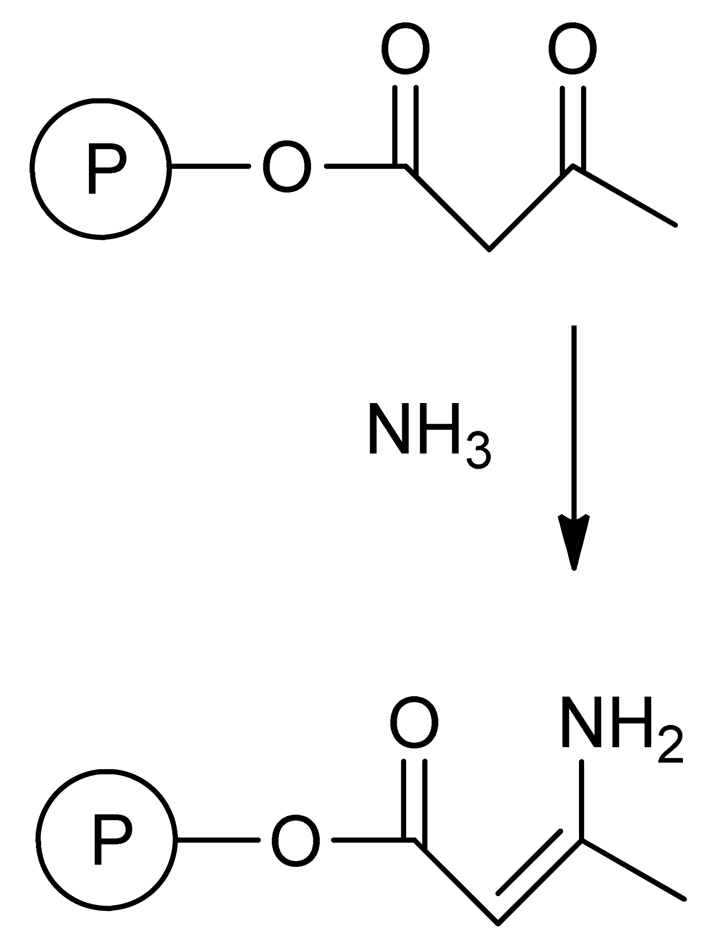
<p>Here we disclose intramolecular enamine cross-linking as an alternative “click” technique for the metal-free, room temperature synthesis of unimolecular polymeric nanoparticles. The direct reaction of β-ketoester groups with ammonia to give enamine groups is well-known in polymer chemistry [<xref ref-type="bibr" rid="b22-polymers-03-01673">22</xref>] as a useful reaction to protect latexes containing β-ketoester moieties from hydrolysis (see <xref ref-type="fig" rid="f1-polymers-03-01673">Figure 1</xref>). Enamine formation follows the “click” chemistry concept [<xref ref-type="bibr" rid="b23-polymers-03-01673">23</xref>,<xref ref-type="bibr" rid="b24-polymers-03-01673">24</xref>] since: (i) it can be performed under equimolar conditions and proceeds in appropriate time-scales even at room temperature, with high yields; (ii) the reaction is insensitive to oxygen and can be performed in solvents that can be easily removed; (iii) products can be easily isolated by simple methods; (iv) tedious fine-tuning of reaction conditions is not required; and (v) there are no side-reactions involved.</p>
<p>In this communication, we report the synthesis of ultra-small PMMA-NPs synthesized by metal-free enamine cross-linking from PMMA precursors containing β-ketoester units by using alkyl diamines. The collapsing process was followed by size exclusion chromatography and nuclear magnetic resonance spectroscopy. The size of the resulting PMMA-NPs was determined by dynamic light scattering. Similar attempts via reductive amination did not lead to defined nanoparticles and the enamine formation might be the only way to form ultra-small nanoparticles from ketones and amines. Subtle hydrogen bonding effects, affecting the solubility of the resulting NPs upon isolation and drying, are also indicated.</p></sec>
<sec sec-type="results|discussion">
<label>2.</label>
<title>Results and Discussion</title>
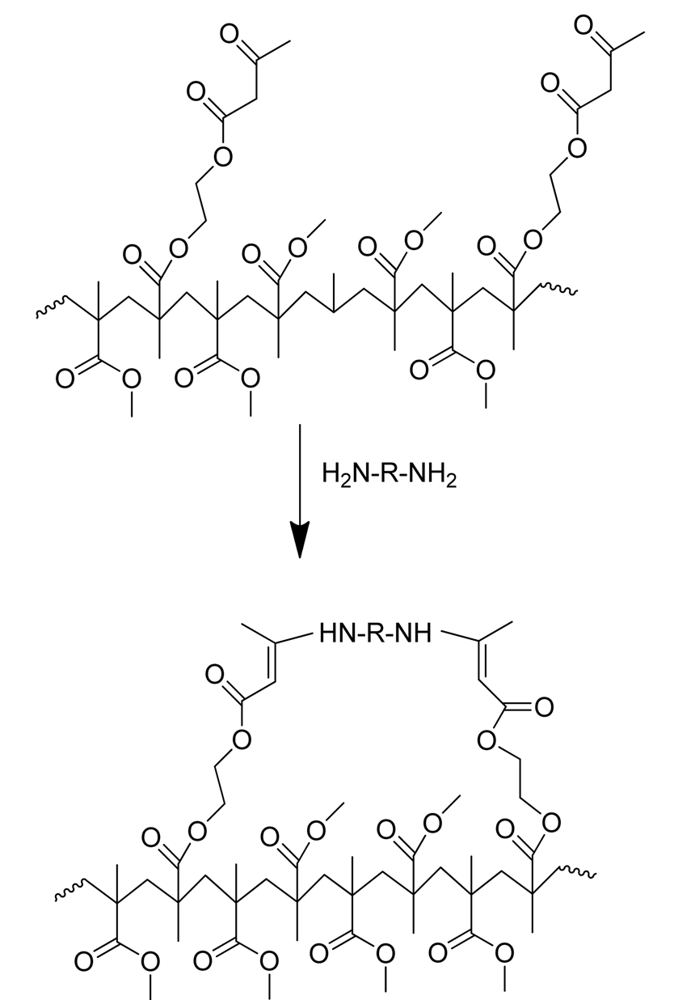
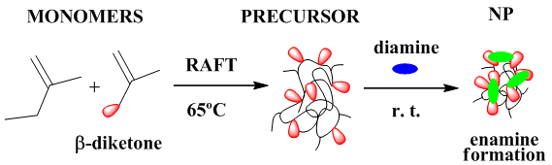
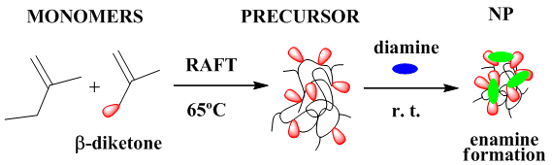
<p>The “metal-free” synthetic pathway to PMMA-NPs is summarized in <xref ref-type="fig" rid="f2-polymers-03-01673">Figure 2</xref>. As PMMA-nanoparticle precursors we targeted random copolymers of methyl methacrylate (MMA) and (2-acetoacetoxy)ethyl methacrylate (AEMA) containing different molar fractions of β-ketoester units and/or different molecular weight (denoted as <bold>1a</bold>, <bold>1b</bold> and <bold>1c</bold> in <xref ref-type="table" rid="t1-polymers-03-01673">Table 1</xref>). The precursors were synthesized by reversible addition-fragmentation chain transfer (RAFT) polymerization using 2-cyanoprop-2-yl-dithiobenzoate (CDB) as chain transfer agent and 2,2′-azobis(2-methylpropionitrile) (AIBN) as free-radical initiator. RAFT is a very convenient polymerization technique for obtaining nanoparticle precursors with low molecular-weight dispersity [<xref ref-type="bibr" rid="b11-polymers-03-01673">11</xref>-<xref ref-type="bibr" rid="b13-polymers-03-01673">13</xref>] and hence nanoparticles with uniform size. The main characteristics of the random P(MMA-<italic>co</italic>-AEMA) copolymers investigated in this work are summarized in <xref ref-type="table" rid="t1-polymers-03-01673">Table 1</xref>, as determined by size exclusion chromatography with absolute molar mass characterization and proton nuclear magnetic resonance spectroscopy. Well-defined copolymers showing low molecular-weight dispersity (Ð = M<sub>w</sub>/M<sub>n</sub>) values were obtained. The copolymer composition was found to be very close to the feed monomer composition, as expected for a statistical copolymerization process (reactivity ratios: r<sub>MMA</sub> = 0.90 and r<sub>AEMA</sub> = 0.95) allowing the random placement of the β-ketoester moieties along the copolymer chains.</p>
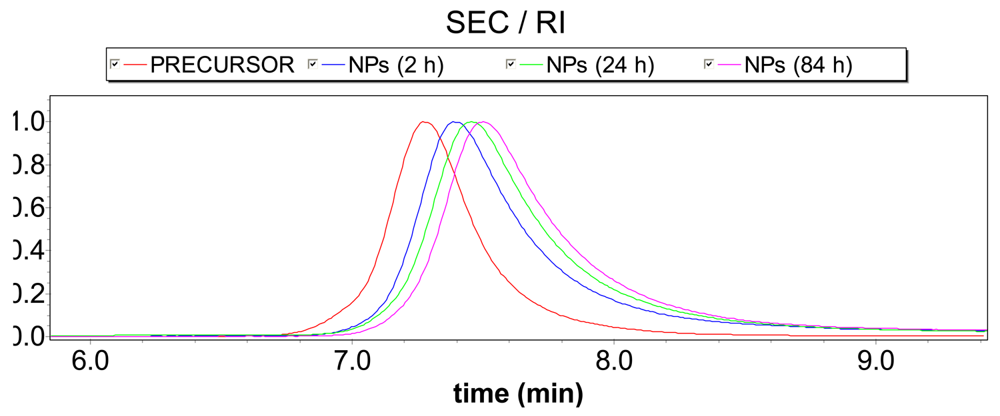
<p>The collapsing process upon enamine formation was followed by size-exclusion chromatography (SEC) which is a technique very valuable to discriminate macromolecules according to their hydrodynamic radius (R<sub>H</sub>). In this sense, a significant reduction in R<sub>H</sub> is expected by SEC/refractive index (RI) upon collapse of individual polymer chains to ultra-small nanoparticles. Conversely, for totally collapsed single-chain NPs only a slight increase of the <italic>actual</italic> molecular weight due to enamine cross-linking (<italic>i.e.</italic>, less than 10%) is expected by SEC/multi-angle laser light scattering (MALLS) when compared to the molecular weight of the starting linear precursor chains. A significant increase in retention time (corresponding to a clear reduction in R<sub>H</sub>) is observed in <xref ref-type="fig" rid="f3-polymers-03-01673">Figure 3</xref> accompanying NP formation by enamine cross-linking.</p>
<p>It is noteworthy that since intermolecular reactions give rise inevitably to a large increase in the molecular weight (<italic>i.e.</italic>, ≥100%), an “apparent” molecular weight reduction, as deduced from <xref ref-type="fig" rid="f3-polymers-03-01673">Figure 3</xref> due to the increase in retention time upon enamine cross-linking, is a clear signature of chain collapse. A slight increase in “absolute” mass-average molecular weight, M<sub>w</sub>, upon reaction was found by SEC/MALLS (M<sub>w</sub> = 89,000 g/mol) when compared to the expected value (M<sub>w</sub> = 61,900 g/mol) suggesting that some degree of inter-particle coupling could be also present in addition to the principal single-chain intramolecular cross-linking process. On average, the number of polymer chains per nanoparticle is estimated to be around 89,000/61,900 = 1.4.</p>
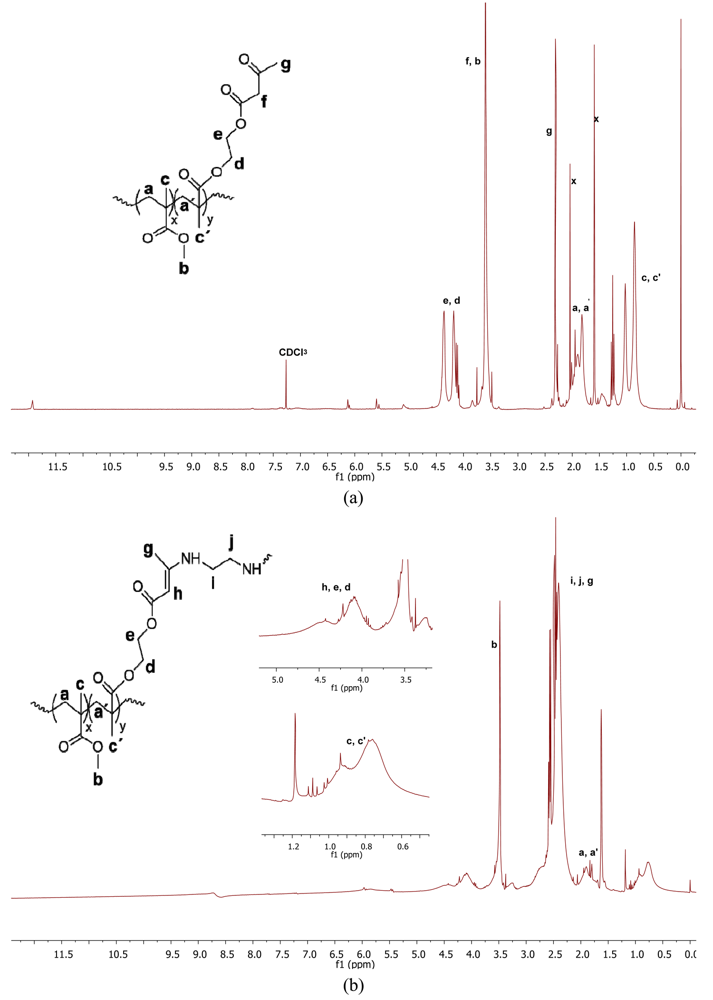
<p>As expected, nanoparticle collapse by enamine formation introduces significant changes in the <sup>1</sup>H-NMR spectrum of the material. <xref ref-type="fig" rid="f4-polymers-03-01673">Figure 4(a)</xref> illustrates the <sup>1</sup>H-NMR spectrum of the starting precursor <bold>1a</bold>, whereas <xref ref-type="fig" rid="f4-polymers-03-01673">Figure 4(b)</xref> gives the spectrum of the resulting nanoparticles. The corresponding peak assignation is also indicated.</p>
<p>The peak broadening observed in <xref ref-type="fig" rid="f4-polymers-03-01673">Figure 4(b)</xref> is a clear signature of NP formation and is well-documented in the literature [<xref ref-type="bibr" rid="b9-polymers-03-01673">9</xref>]. This band broadening cannot be attributed to an increase of the “absolute” molecular weight upon nanoparticle formation but to its own nanoparticle structure upon changing from a solvated random coil to a compact, globular object. As an example, insets in <xref ref-type="fig" rid="f4-polymers-03-01673">Figure 4</xref> show band broadening in signals from –CH= protons of enamine groups (4.5 ppm, broad) and –CH<sub>3</sub> protons of main-chain methyl groups (0.5–1.1 ppm, very broad).</p>
<p>The signal from the =N–H protons of enamine groups is visible in the <sup>1</sup>H-NMR spectrum at 8.7 ppm. It is worth noting that the weak signal from the proton enol-form which can be seen at around 12 ppm in the precursor (<xref ref-type="fig" rid="f4-polymers-03-01673">Figure 4(a)</xref>) disappears upon nanoparticle formation.</p>
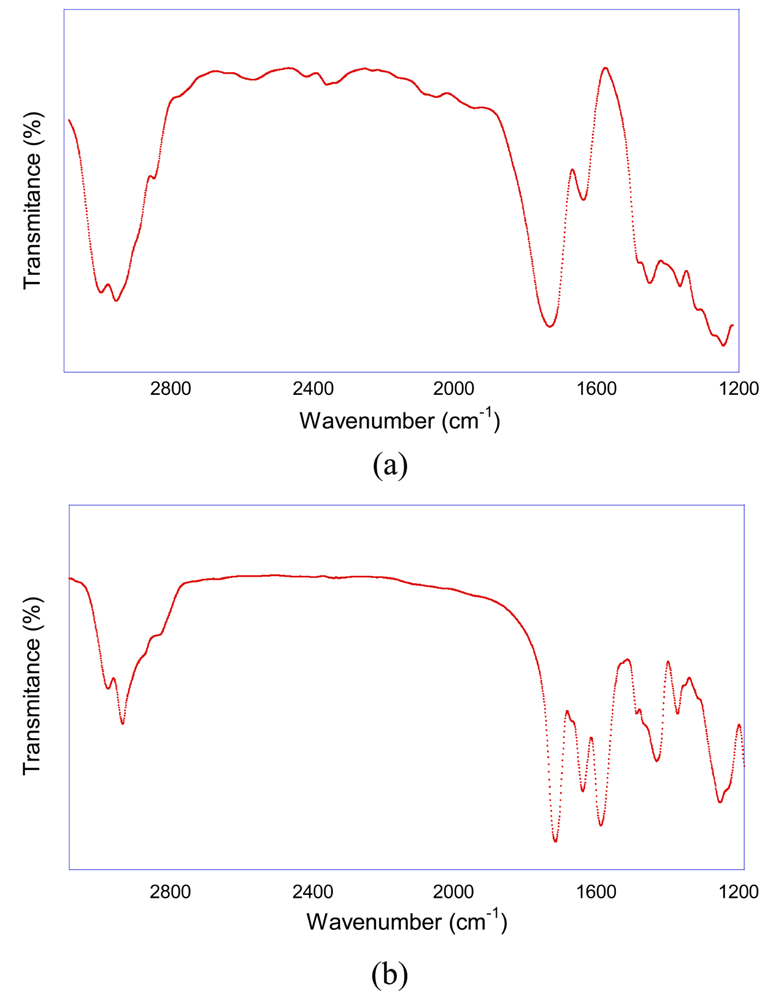
<p>Upon NP formation, a shift of a significant part of the original infra-red C=O band of AEMA from 1,732 cm<sup>−1</sup> to 1,656 cm<sup>−1</sup> is observed as well as the presence of a new band at 1,605 cm<sup>−1</sup> which can be assigned to stretching vibrations of enamine double bonds (<xref ref-type="fig" rid="f5-polymers-03-01673">Figure 5</xref>). Based on previous works on model compounds [<xref ref-type="bibr" rid="b25-polymers-03-01673">25</xref>,<xref ref-type="bibr" rid="b26-polymers-03-01673">26</xref>], the large shifts observed can be attributed to the presence of significant NH/C=O hydrogen bonding interactions upon enamine formation.</p>
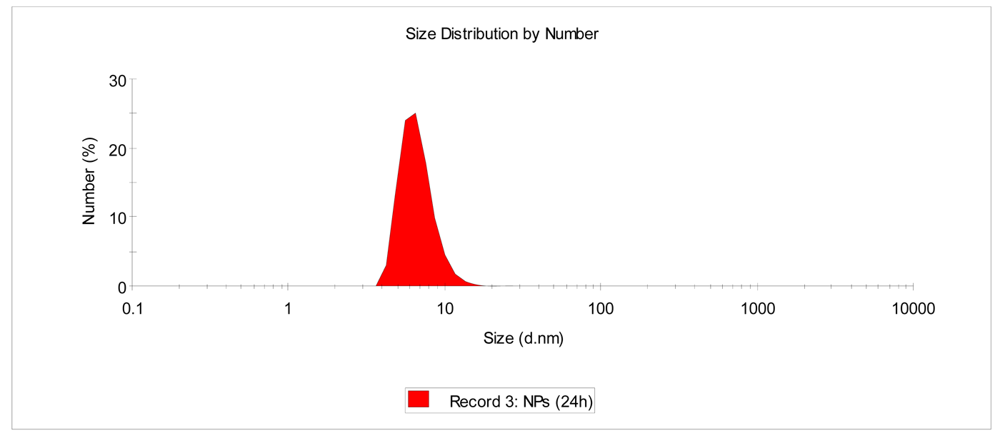
<p>As depicted in <xref ref-type="fig" rid="f6-polymers-03-01673">Figure 6</xref>, nanoparticle size measurements by DLS supported the SEC and <sup>1</sup>H-NMR results. Ultra-small PMMA-NPs with 7 nm in size were routinely obtained at r.t. upon reaction completion. Interestingly, the size of the PMMA-NPs remained unaltered while stored in dilute THF solutions (<italic>c</italic> &lt; 1 g/L).</p>
<p>However, when isolated by precipitation and further drying the resulting PMMA-NPs became insoluble in THF probably as a consequence of strong inter-nanoparticle hydrogen bonding (HB) interactions [<xref ref-type="bibr" rid="b14-polymers-03-01673">14</xref>]. Attempts to solubilize the nanoparticles by adding lithium chloride, methanol, or trifluoroacetic acid failed. Similar attempts to change from THF solvent to dimethyl formamide before precipitation do not avoid nanoparticle aggregation presumably by cooperative HB interactions upon isolation.</p>
<p>Work is in progress to investigate the influence of the diamine structure on this striking behavior by using diamines containing bulky <italic>tert</italic>-butyl groups in the structure, as well as to determine the precise NP morphology by transmission electron microscopy and atomic force microscopy. Such research, which is outside the scope of the present paper, will be published in the near future.</p></sec>
<sec>
<label>3.</label>
<title>Experimental Section</title>
<sec sec-type="materials">
<label>3.1.</label>
<title>Materials</title>
<p>2,2′-Azobis(2-methylpropionitrile) (AIBN), methyl methacrylate (MMA), (2-acetoacetoxy)ethyl methacrylate (AEMA), diethylenetriamine (DETA), deuterated tetrahydrofurane (THF-d<sub>8</sub>) and deuterated chloroform (99.96 atom% D) containing 0.03% (v/v) tetramethylsilane (TMS) were supplied by Aldrich. AIBN was purified by re-crystallization. MMA was distilled under reduced pressure (Buchi Glass Oven B-585) immediately before use. AEMA was purified by passing through a neutral alumina column. 2-Cyanoprop-2-yl-dithiobenzoate (CDB) and HPLC grade tetrahydrofurane (THF) were obtained from Strem Chemicals and Scharlau, respectively, and were used as received.</p></sec>
<sec sec-type="methods">
<label>3.2.</label>
<title>Methods</title>
<p>Size-exclusion chromatography (SEC) was performed with an Agilent G-1310A liquid chromatograph equipped with a high performance PLgel Mixed column and on-line differential refractometer (RI) and multi-angle laser light scattering (MALLS) Wyatt detectors (Optilab-Rex and Mini-Dawn Treos, respectively) and. THF (flow rate of 1.0 mL/min) was used as eluent at 30 °C. <sup>1</sup>H-NMR spectra were recorded on a Bruker AVANCE spectrometer (300 MHz). Nanoparticle size was measured by dynamic light scattering (DLS) in a Malvern Zetasizer apparatus at r.t. Infrared (IR) spectra were recorded in a Jasco 3600 FT-IR Spectrometer.</p></sec>
<sec>
<label>3.3.</label>
<title>Precursor Synthesis</title>
<p>In a typical procedure, a solution containing AIBN (1 mg, 6 μmol), CDB (9 mg, 40 μmol), MMA (1 mL, 9.3 mmol) and AEMA (1.2 mL, 6.2 mmol) was degassed and heated to 65 °C under magnetic stirring. After reaction, the resulting copolymer, <bold>1a</bold>, was purified by precipitation in methanol and drying under dynamic vacuum for 24 h. Yield (gravimetric): 1.52 g (67%). Mass-average molecular weight and dispersity (SEC/RI/MALLS): 57,100 g/mol and 1.1, respectively. Molar fraction of MMA (<sup>1</sup>H-NMR): 0.65.</p></sec>
<sec>
<label>3.4.</label>
<title>Nanoparticle Synthesis</title>
<p>On a round-bottom flask, the precursor <bold>1a</bold> (150 mg, 0.3 mmol of AEMA) was dissolved in 25 mL of THF. On a separate flask, DETA (equimolar amount of amine groups) was dissolved in 25 mL of THF. Both solutions were mixed at once and allowed to stir at r.t. Samples were removed periodically from the reaction medium for SEC/RI/MALLS and DLS analysis. In separate experiments, nanoparticle formation was monitored by <sup>1</sup>H-NMR by using THF-d<sub>8</sub> as solvent. After reaction completion, the transparent solution was concentrated and precipitated onto methanol to give <bold>2a</bold> as a powder which was dried under dynamic vacuum for 24 h. Reaction yield: 100 mg, (67%). Average NP size (by DLS in THF): 7 nm.</p></sec></sec>
<sec sec-type="conclusions">
<label>4.</label>
<title>Conclusions</title>
<p>A new, “metal-free” route to PMMA-NPs has been developed based on enamine “click” chemistry. As appropriate precursors, well-defined random copolymers of MMA and AEMA have been synthesized by RAFT polymerization, showing low molecular-weight dispersity and a random placement of β-ketoester moieties along the copolymer chains. Intramolecular collapse of the PMMA-NP precursors was performed by the one-pot reaction of the β-ketoester moieties with alkyl diamines in THF at r.t. (<italic>i.e.</italic>, by enamine formation). Significant changes were observed both in the <sup>1</sup>H-NMR and FTIR spectra upon enamine cross-linking.</p>
<p>Nanoparticle formation was followed by SEC/RI/MALLS and, in separate experiments, by <sup>1</sup>H-NMR spectroscopy in THF-d<sub>8</sub>. The size of the resulting PMMA-NPs was &lt;10 nm as determined by DLS and remained unaltered while the nanoparticles were stored in dilute THF solutions (<italic>c</italic> &lt; 1 g/L). Strong inter-nanoparticle hydrogen bonding upon nanoparticle drying rendered the isolated PMMA-NPs insoluble in THF.</p></sec></body>
<back>
<sec sec-type="display-objects">
<title>Figures and Table</title>
<fig id="f1-polymers-03-01673" position="float">
<label>Figure 1.</label>
<caption>
<p>Schematic illustration of enamine formation upon reaction of a β-ketoester functional group with ammonia.</p></caption>
<graphic xlink:href="polymers-03-01673f1.gif"/></fig>
<fig id="f2-polymers-03-01673" position="float">
<label>Figure 2.</label>
<caption>
<p>Enamine “click” chemistry route for the synthesis of ultra-small polymethyl methacrylate nanoparticles (PMMA-NPs).</p></caption>
<graphic xlink:href="polymers-03-01673f2.gif"/></fig>
<fig id="f3-polymers-03-01673" position="float">
<label>Figure 3.</label>
<caption>
<p>Evolution of the size-exclusion chromatography (SEC) traces with reaction time during the synthesis of PMMA-NPs by enamine “click” chemistry from precursor <bold>1a</bold>. All curves from the SEC/refractive index (RI) detector are normalized to the same ordinate scale for clarity of presentation.</p></caption>
<graphic xlink:href="polymers-03-01673f3.gif"/></fig>
<fig id="f4-polymers-03-01673" position="float">
<label>Figure 4.</label>
<caption>
<p>(<bold>a</bold>) <sup>1</sup>H-NMR spectrum of the starting P(MMA-<italic>co</italic>-AEMA) precursor <bold>1a</bold>. (<bold>b</bold>) <sup>1</sup>H-NMR spectrum in tetrahydrofurane (THF)-d<sub>8</sub> of the PMMA-NPs, <bold>2a</bold>, synthesized by enamine “click” chemistry. The sharp, intense band around 1.7 arises from solvent (THF-d<sub>8</sub>).</p></caption>
<graphic xlink:href="polymers-03-01673f4.gif"/></fig>
<fig id="f5-polymers-03-01673" position="float">
<label>Figure 5.</label>
<caption>
<p>(<bold>a</bold>) FTIR spectrum of precursor <bold>1a</bold> in the solid state. (<bold>b</bold>) FTIR spectrum of the isolated PMMA-NPs <bold>2a</bold> synthesized by enamine “click” chemistry.</p></caption>
<graphic xlink:href="polymers-03-01673f5.gif"/></fig>
<fig id="f6-polymers-03-01673" position="float">
<label>Figure 6.</label>
<caption>
<p>Size distribution of PMMA-NPs <bold>2a</bold> in THF by DLS.</p></caption>
<graphic xlink:href="polymers-03-01673f6.gif"/></fig>
<table-wrap id="t1-polymers-03-01673" position="float">
<label>Table 1.</label>
<caption>
<p>Characteristics of different precursors of ultra-small PMMA-NPs synthesized by reversible addition-fragmentation chain transfer (RAFT) polymerization.</p></caption>
<table frame="hsides" rules="groups">
<thead>
<tr>
<th align="center" valign="top"><bold>Precursor</bold></th>
<th align="center" valign="top"><bold>M<sub>w</sub>(g/mol)</bold></th>
<th align="center" valign="top"><bold>Dispersity</bold></th>
<th align="center" valign="top"><bold>AEMA (mol%)</bold></th></tr></thead>
<tbody>
<tr>
<td align="center" valign="top"><bold>1a</bold></td>
<td align="center" valign="top">57,100</td>
<td align="center" valign="top">1.2</td>
<td align="center" valign="top">35</td></tr>
<tr>
<td align="center" valign="top"><bold>1b</bold></td>
<td align="center" valign="top">35,000</td>
<td align="center" valign="top">1.1</td>
<td align="center" valign="top">34</td></tr>
<tr>
<td align="center" valign="top"><bold>1c</bold></td>
<td align="center" valign="top">43,000</td>
<td align="center" valign="top">1.1</td>
<td align="center" valign="top">25</td></tr></tbody></table></table-wrap></sec>
<ack>
<p>We thank Maria Isabel Asenjo-Sanz for excellent experimental technical support. L.B. acknowledges financial support by Basque Excellence Research Center-Materials Physics Center (BERC-MPC). Authors gratefully acknowledge financial support from the Spanish Ministry of Science and Innovation, project MAT-22007-63681, and Diputación de Gipuzkoa, project 2011-CIEN-000085-01.</p></ack>
<ref-list>
<title>References</title>
<ref id="b1-polymers-03-01673"><label>1.</label><citation citation-type="journal"><person-group person-group-type="author"><name><surname>Tuteja</surname><given-names>A.</given-names></name><name><surname>Duxbury</surname><given-names>P.M.</given-names></name><name><surname>Mackay</surname><given-names>M.E.</given-names></name></person-group><article-title>Multifunctional Nanocomposites with Reduced Viscosity</article-title><source>Macromolecules</source><year>2007</year><volume>40</volume><fpage>9427</fpage><lpage>9434</lpage><pub-id pub-id-type="doi">10.1021/ma071313i</pub-id></citation></ref>
<ref id="b2-polymers-03-01673"><label>2.</label><citation citation-type="journal"><person-group person-group-type="author"><name><surname>Pomposo</surname><given-names>J.A.</given-names></name><name><surname>Ruiz de Luzuriaga</surname><given-names>A.</given-names></name><name><surname>García</surname><given-names>I.</given-names></name><name><surname>Etxeberria</surname><given-names>A.</given-names></name><name><surname>Colmenero</surname><given-names>J.A.</given-names></name></person-group><article-title>Nanotechnology Pathway to Arresting Phase Separation in Soft Nanocomposites</article-title><source>Macromol. Rapid Commun.</source><year>2011</year><volume>32</volume><fpage>573</fpage><lpage>578</lpage><pub-id pub-id-type="doi">10.1002/marc.201000720</pub-id><pub-id pub-id-type="pmid">21438055</pub-id></citation></ref>
<ref id="b3-polymers-03-01673"><label>3.</label><citation citation-type="journal"><person-group person-group-type="author"><name><surname>Wulff</surname><given-names>G.</given-names></name><name><surname>Chong</surname><given-names>B.-O.</given-names></name><name><surname>Kolb</surname><given-names>U.</given-names></name></person-group><article-title>Soluble Single-Molecule Nanogels of Controlled Structure as a Matrix for Efficient Artificial Enzymes</article-title><source>Angew. Chem. Int. Ed.</source><year>2006</year><volume>45</volume><fpage>2955</fpage><lpage>2958</lpage><pub-id pub-id-type="doi">10.1002/anie.200503926</pub-id></citation></ref>
<ref id="b4-polymers-03-01673"><label>4.</label><citation citation-type="journal"><person-group person-group-type="author"><name><surname>Adkins</surname><given-names>C.T.</given-names></name><name><surname>Muchalski</surname><given-names>H.</given-names></name><name><surname>Harth</surname><given-names>E.</given-names></name></person-group><article-title>Nanoparticles with Individual Site-Isolated Semiconducting Polymers from Intramolecular Chain Collapse Processes</article-title><source>Macromolecules</source><year>2009</year><volume>42</volume><fpage>5786</fpage><lpage>5792</lpage><pub-id pub-id-type="doi">10.1021/ma9007913</pub-id></citation></ref>
<ref id="b5-polymers-03-01673"><label>5.</label><citation citation-type="journal"><person-group person-group-type="author"><name><surname>Tamura</surname><given-names>A.</given-names></name><name><surname>Nagasaki</surname><given-names>Y.</given-names></name></person-group><article-title>Smart siRNA Delivery Systems Based on Polymeric Nanoassemblies and Nanoparticles</article-title><source>Nanomedicine</source><year>2010</year><volume>5</volume><fpage>1089</fpage><lpage>1102</lpage><pub-id pub-id-type="doi">10.2217/nnm.10.76</pub-id><pub-id pub-id-type="pmid">20874023</pub-id></citation></ref>
<ref id="b6-polymers-03-01673"><label>6.</label><citation citation-type="journal"><person-group person-group-type="author"><name><surname>Mecerreyes</surname><given-names>D.</given-names></name><name><surname>Lee</surname><given-names>V.</given-names></name><name><surname>Hawker</surname><given-names>C.J.</given-names></name><name><surname>Hedrick</surname><given-names>J.L.</given-names></name><name><surname>Wursch</surname><given-names>A.</given-names></name><name><surname>Volksen</surname><given-names>W.</given-names></name><name><surname>Magbitang</surname><given-names>T.</given-names></name><name><surname>Huang</surname><given-names>E.</given-names></name><name><surname>Miller</surname><given-names>R.D.</given-names></name></person-group><article-title>A Novel Approach to Functionalized Nanoparticles: Self-Crosslinking of Macromolecules in Ultradilute Solution</article-title><source>Adv. Mater.</source><year>2001</year><volume>13</volume><fpage>204</fpage><lpage>208</lpage><pub-id pub-id-type="doi">10.1002/1521-4095(200102)13:3&lt;204::AID-ADMA204&gt;3.0.CO;2-9</pub-id></citation></ref>
<ref id="b7-polymers-03-01673"><label>7.</label><citation citation-type="journal"><person-group person-group-type="author"><name><surname>Park</surname><given-names>K.S.</given-names></name><name><surname>Kim</surname><given-names>D.Y.</given-names></name><name><surname>Choi</surname><given-names>S.K.</given-names></name><name><surname>Suh</surname><given-names>D.H.</given-names></name></person-group><article-title>Novel Approach to Chemically Amplified Resist Materials for Next Generation of Lithography</article-title><source>Jpn. J. Appl. Phys.</source><year>2003</year><volume>42</volume><fpage>3877</fpage><lpage>3880</lpage><pub-id pub-id-type="doi">10.1143/JJAP.42.3877</pub-id></citation></ref>
<ref id="b8-polymers-03-01673"><label>8.</label><citation citation-type="journal"><person-group person-group-type="author"><name><surname>Jiang</surname><given-names>J.</given-names></name><name><surname>Thayumanavan</surname><given-names>S.</given-names></name></person-group><article-title>Synthesis and Characterization of Amine-Functionalized Polystyrene Nanoparticles</article-title><source>Macromolecules</source><year>2005</year><volume>38</volume><fpage>5886</fpage><lpage>5891</lpage><pub-id pub-id-type="doi">10.1021/ma0507286</pub-id></citation></ref>
<ref id="b9-polymers-03-01673"><label>9.</label><citation citation-type="journal"><person-group person-group-type="author"><name><surname>Harth</surname><given-names>E.</given-names></name><name><surname>Horn</surname><given-names>B.V.</given-names></name><name><surname>Lee</surname><given-names>V.Y.</given-names></name><name><surname>Germack</surname><given-names>D.S.</given-names></name><name><surname>Gonzales</surname><given-names>C.P.</given-names></name><name><surname>Miller</surname><given-names>R.D.</given-names></name><name><surname>Hawker</surname><given-names>C.J.</given-names></name></person-group><article-title>A Facile Approach to Architecturally Defined Nanoparticles via Intramolecular Chain Collapse</article-title><source>J. Am. Chem. Soc.</source><year>2002</year><volume>124</volume><fpage>8653</fpage><lpage>8660</lpage><pub-id pub-id-type="doi">10.1021/ja026208x</pub-id><pub-id pub-id-type="pmid">12121107</pub-id></citation></ref>
<ref id="b10-polymers-03-01673"><label>10.</label><citation citation-type="journal"><person-group person-group-type="author"><name><surname>Croce</surname><given-names>T.A.</given-names></name><name><surname>Hamilton</surname><given-names>S.K.</given-names></name><name><surname>Chen</surname><given-names>M.L.</given-names></name><name><surname>Muchalski</surname><given-names>H.</given-names></name><name><surname>Harth</surname><given-names>E.</given-names></name></person-group><article-title>Alternative o-Quinodimethane Cross-Linking Precursors for Intramolecular Chain Collapse Nanoparticles</article-title><source>Macromolecules</source><year>2007</year><volume>40</volume><fpage>6028</fpage><lpage>6031</lpage><pub-id pub-id-type="doi">10.1021/ma071111m</pub-id></citation></ref>
<ref id="b11-polymers-03-01673"><label>11.</label><citation citation-type="journal"><person-group person-group-type="author"><name><surname>Oria</surname><given-names>L.</given-names></name><name><surname>Aguado</surname><given-names>R.</given-names></name><name><surname>Pomposo</surname><given-names>J.A.</given-names></name><name><surname>Colmenero</surname><given-names>J.A.</given-names></name></person-group><article-title>Versatile “Click” Chemistry Precursor of Functional Polystyrene Nanoparticles</article-title><source>Adv. Mater.</source><year>2010</year><volume>22</volume><fpage>3038</fpage><lpage>3041</lpage><pub-id pub-id-type="doi">10.1002/adma.201000243</pub-id><pub-id pub-id-type="pmid">20521263</pub-id></citation></ref>
<ref id="b12-polymers-03-01673"><label>12.</label><citation citation-type="journal"><person-group person-group-type="author"><name><surname>Ruiz de Luzuriaga</surname><given-names>A.</given-names></name><name><surname>Perez-Baena</surname><given-names>I.</given-names></name><name><surname>Montes</surname><given-names>S.</given-names></name><name><surname>Loinaz</surname><given-names>I.</given-names></name><name><surname>Odriozola</surname><given-names>I.</given-names></name><name><surname>Garcia</surname><given-names>I.</given-names></name><name><surname>Pomposo</surname><given-names>J.A.</given-names></name></person-group><article-title>New Route to Polymeric Nanoparticles by Click Chemistry Using Bifunctional Cross-Linkers</article-title><source>Macromol. Symp.</source><year>2010</year><volume>296</volume><fpage>303</fpage><lpage>310</lpage><pub-id pub-id-type="doi">10.1002/masy.201051042</pub-id></citation></ref>
<ref id="b13-polymers-03-01673"><label>13.</label><citation citation-type="journal"><person-group person-group-type="author"><name><surname>Ruiz de Luzuriaga</surname><given-names>A.</given-names></name><name><surname>Ormategui</surname><given-names>N.</given-names></name><name><surname>Grande</surname><given-names>H.J.</given-names></name><name><surname>Odriozola</surname><given-names>I.</given-names></name><name><surname>Pomposo</surname><given-names>J.A.</given-names></name><name><surname>Loinaz</surname><given-names>I.</given-names></name></person-group><article-title>Intramolecular Click Cycloaddition: An Efficient Room-Temperature Route towards Bioconjugable Polymeric Nanoparticles</article-title><source>Macromol. Rapid Commun.</source><year>2008</year><volume>29</volume><fpage>1156</fpage><lpage>1160</lpage><pub-id pub-id-type="doi">10.1002/marc.200700877</pub-id></citation></ref>
<ref id="b14-polymers-03-01673"><label>14.</label><citation citation-type="journal"><person-group person-group-type="author"><name><surname>Beck</surname><given-names>J.B.</given-names></name><name><surname>Killops</surname><given-names>K.L.</given-names></name><name><surname>Kang</surname><given-names>T.</given-names></name><name><surname>Sivanandan</surname><given-names>K.</given-names></name><name><surname>Bayles</surname><given-names>A.</given-names></name><name><surname>Mackay</surname><given-names>M.E.</given-names></name><name><surname>Wooley</surname><given-names>K.</given-names></name><name><surname>Hawker</surname><given-names>C.J.</given-names></name></person-group><article-title>Facile Preparation of Nanoparticles by Intramolecular Cross-Linking of Isocyanate Functionalized Copolymers</article-title><source>Macromolecules</source><year>2009</year><volume>42</volume><fpage>5629</fpage><lpage>5635</lpage><pub-id pub-id-type="doi">10.1021/ma900899v</pub-id><pub-id pub-id-type="pmid">20717499</pub-id></citation></ref>
<ref id="b15-polymers-03-01673"><label>15.</label><citation citation-type="journal"><person-group person-group-type="author"><name><surname>Canalle</surname><given-names>L.A.</given-names></name><name><surname>van Berkel</surname><given-names>S.S.</given-names></name><name><surname>de Haan</surname><given-names>L.T.</given-names></name><name><surname>van Hest</surname><given-names>J.C.M.</given-names></name></person-group><article-title>Copper-Free Clickable Coatings</article-title><source>Adv. Funct. Mat.</source><year>2009</year><volume>19</volume><fpage>3464</fpage><lpage>3470</lpage><pub-id pub-id-type="doi">10.1002/adfm.200900743</pub-id></citation></ref>
<ref id="b16-polymers-03-01673"><label>16.</label><citation citation-type="book"><person-group person-group-type="author"><name><surname>Cook</surname><given-names>A.G.</given-names></name></person-group><source>Enamines: Synthesis, Structure and Reactions</source><person-group person-group-type="editor"><name><surname>Dekker</surname><given-names>M.</given-names></name></person-group><publisher-name>CRC Press</publisher-name><publisher-loc>New York, NY, USA</publisher-loc><year>1988</year></citation></ref>
<ref id="b17-polymers-03-01673"><label>17.</label><citation citation-type="journal"><person-group person-group-type="author"><name><surname>Lowe</surname><given-names>A.B.</given-names></name></person-group><article-title>Thiol-Ene “Click” Reactions and Recent Applications in Polymer and Materials Synthesis</article-title><source>Polym. Chem.</source><year>2010</year><volume>1</volume><fpage>17</fpage><lpage>36</lpage><pub-id pub-id-type="doi">10.1039/b9py00216b</pub-id></citation></ref>
<ref id="b18-polymers-03-01673"><label>18.</label><citation citation-type="journal"><person-group person-group-type="author"><name><surname>Lowe</surname><given-names>A.B.</given-names></name><name><surname>Hoyle</surname><given-names>C.E.</given-names></name><name><surname>Bowman</surname><given-names>C.N.</given-names></name></person-group><article-title>Thiol-Yne Click Chemistry: A Powerful and Versatile Methodology for Materials Synthesis</article-title><source>J. Mater. Chem.</source><year>2010</year><volume>20</volume><fpage>4745</fpage><lpage>4750</lpage><pub-id pub-id-type="doi">10.1039/b917102a</pub-id></citation></ref>
<ref id="b19-polymers-03-01673"><label>19.</label><citation citation-type="journal"><person-group person-group-type="author"><name><surname>Li</surname><given-names>H.</given-names></name><name><surname>Yu</surname><given-names>B.</given-names></name><name><surname>Matsushima</surname><given-names>H.</given-names></name><name><surname>Hoyle</surname><given-names>C.E.</given-names></name><name><surname>Lowe</surname><given-names>A.B.</given-names></name></person-group><article-title>The Thiol-Isocyanate Click Reaction: Facile and Quantitative Access to ω-End-Functional Poly(N,N -diethylacrylamide) Synthesized by RAFT Radical Polymerization</article-title><source>Macromolecules</source><year>2009</year><volume>42</volume><fpage>6537</fpage><lpage>6542</lpage><pub-id pub-id-type="doi">10.1021/ma9010878</pub-id></citation></ref>
<ref id="b20-polymers-03-01673"><label>20.</label><citation citation-type="journal"><person-group person-group-type="author"><name><surname>Singh</surname><given-names>I.</given-names></name><name><surname>Zarafshani</surname><given-names>Z.</given-names></name><name><surname>Lutz</surname><given-names>J.-F.</given-names></name><name><surname>Heaney</surname><given-names>F.</given-names></name></person-group><article-title>Metal-Free “Click” Chemistry: Efficient Polymer Modification via 1,3-Dipolar Cycloaddition of Nitrile Oxides and Alkynes</article-title><source>Macromolecules</source><year>2009</year><volume>42</volume><fpage>5411</fpage><lpage>5413</lpage><pub-id pub-id-type="doi">10.1021/ma9013912</pub-id></citation></ref>
<ref id="b21-polymers-03-01673"><label>21.</label><citation citation-type="journal"><person-group person-group-type="author"><name><surname>Heredia</surname><given-names>K.L.</given-names></name><name><surname>Maynard</surname><given-names>H.D.</given-names></name></person-group><article-title>Synthesis of Protein-Polymer Conjugates</article-title><source>Org. Biomol. Chem.</source><year>2007</year><volume>5</volume><fpage>45</fpage><lpage>53</lpage><pub-id pub-id-type="doi">10.1039/b612355d</pub-id><pub-id pub-id-type="pmid">17164904</pub-id></citation></ref>
<ref id="b22-polymers-03-01673"><label>22.</label><citation citation-type="journal"><person-group person-group-type="author"><name><surname>Gonzalez</surname><given-names>I.</given-names></name><name><surname>Arzamendi</surname><given-names>G.</given-names></name><name><surname>Asua</surname><given-names>J.M.</given-names></name><name><surname>Leiza</surname><given-names>J.R.</given-names></name></person-group><article-title>Unexpected Crosslinking during Acetoacetoxy Group Protection on Waterborne Crosslinkable Latexes</article-title><source>Macromol. Mater. Eng.</source><year>2006</year><volume>291</volume><fpage>1185</fpage><lpage>1193</lpage><pub-id pub-id-type="doi">10.1002/mame.200600235</pub-id></citation></ref>
<ref id="b23-polymers-03-01673"><label>23.</label><citation citation-type="journal"><person-group person-group-type="author"><name><surname>Kolb</surname><given-names>H.C.</given-names></name><name><surname>Finn</surname><given-names>M.G.</given-names></name><name><surname>Sharpless</surname><given-names>K.B.</given-names></name></person-group><article-title>Click Chemistry: Diverse Chemical Function from a Few Good Reactions</article-title><source>Angew. Chem. Int. Ed.</source><year>2001</year><volume>40</volume><fpage>2004</fpage><lpage>2021</lpage><pub-id pub-id-type="doi">10.1002/1521-3773(20010601)40:11&lt;2004::AID-ANIE2004&gt;3.0.CO;2-5</pub-id></citation></ref>
<ref id="b24-polymers-03-01673"><label>24.</label><citation citation-type="journal"><person-group person-group-type="author"><name><surname>Barner-Kowollik</surname><given-names>C.</given-names></name><name><surname>Du Prez</surname><given-names>F.E.</given-names></name><name><surname>Espeel</surname><given-names>P.</given-names></name><name><surname>Hawker</surname><given-names>C.J.</given-names></name><name><surname>Junkers</surname><given-names>T.</given-names></name><name><surname>Schlaad</surname><given-names>H.</given-names></name><name><surname>van Camp</surname><given-names>W.</given-names></name></person-group><article-title>“Clicking” Polymers or Just Efficient Linking: What Is the Difference?</article-title><source>Angew. Chem. Int. Ed.</source><year>2011</year><volume>50</volume><fpage>60</fpage><lpage>62</lpage><pub-id pub-id-type="doi">10.1002/anie.201003707</pub-id></citation></ref>
<ref id="b25-polymers-03-01673"><label>25.</label><citation citation-type="journal"><person-group person-group-type="author"><name><surname>Labelle</surname><given-names>M.</given-names></name><name><surname>Gravel</surname><given-names>D.</given-names></name></person-group><article-title>Tautomeric Equilibrium of Cyclic β-Ketoester Enamines</article-title><source>Can. J. Chem.</source><year>1985</year><volume>63</volume><fpage>1884</fpage><lpage>1890</lpage><pub-id pub-id-type="doi">10.1139/v85-312</pub-id></citation></ref>
<ref id="b26-polymers-03-01673"><label>26.</label><citation citation-type="journal"><person-group person-group-type="author"><name><surname>Witkop</surname><given-names>B.</given-names></name></person-group><article-title>Imine-Enamine Systems and the Mechanism of Their Oxidation</article-title><source>J. Am. Chem. Soc.</source><year>1956</year><volume>78</volume><fpage>2873</fpage><lpage>2882</lpage><pub-id pub-id-type="doi">10.1021/ja01593a065</pub-id></citation></ref></ref-list></back></article>