<?xml version="1.0" encoding="UTF-8"?>
<!DOCTYPE article PUBLIC "-//NLM//DTD Journal Publishing DTD v2.3 20070202//EN" "journalpublishing.dtd">
<article xmlns:xlink="http://www.w3.org/1999/xlink" xml:lang="en" article-type="review-article">
<front>
<journal-meta>
<journal-id journal-id-type="publisher-id">Polymers</journal-id>
<journal-title>Polymers</journal-title>
<issn pub-type="epub">2073-4360</issn>
<publisher>
<publisher-name>Molecular Diversity Preservation International (MDPI)</publisher-name></publisher></journal-meta>
<article-meta>
<article-id pub-id-type="doi">10.3390/polym3041607</article-id>
<article-id pub-id-type="publisher-id">polymers-03-01607</article-id>
<article-categories>
<subj-group>
<subject>Review</subject></subj-group></article-categories>
<title-group>
<article-title>Polysaccharides: The “Click” Chemistry Impact</article-title></title-group>
<contrib-group>
<contrib contrib-type="author">
<name><surname>Elchinger</surname><given-names>Pierre-Henri</given-names></name><xref ref-type="aff" rid="af1-polymers-03-01607"><sup>1</sup></xref><xref ref-type="aff" rid="af2-polymers-03-01607"><sup>2</sup></xref></contrib>
<contrib contrib-type="author">
<name><surname>Faugeras</surname><given-names>Pierre-Antoine</given-names></name><xref ref-type="aff" rid="af1-polymers-03-01607"><sup>1</sup></xref><xref ref-type="aff" rid="af2-polymers-03-01607"><sup>2</sup></xref></contrib>
<contrib contrib-type="author">
<name><surname>Boëns</surname><given-names>Benjamin</given-names></name><xref ref-type="aff" rid="af1-polymers-03-01607"><sup>1</sup></xref></contrib>
<contrib contrib-type="author">
<name><surname>Brouillette</surname><given-names>François</given-names></name><xref ref-type="aff" rid="af2-polymers-03-01607"><sup>2</sup></xref></contrib>
<contrib contrib-type="author">
<name><surname>Montplaisir</surname><given-names>Daniel</given-names></name><xref ref-type="aff" rid="af2-polymers-03-01607"><sup>2</sup></xref></contrib>
<contrib contrib-type="author">
<name><surname>Zerrouki</surname><given-names>Rachida</given-names></name><xref ref-type="aff" rid="af1-polymers-03-01607"><sup>1</sup></xref></contrib>
<contrib contrib-type="author">
<name><surname>Lucas</surname><given-names>Romain</given-names></name><xref ref-type="aff" rid="af3-polymers-03-01607"><sup>3</sup></xref><xref ref-type="corresp" rid="c1-polymers-03-01607"><sup>*</sup></xref></contrib></contrib-group>
<aff id="af1-polymers-03-01607">
<label>1</label> Laboratoire de Chimie des Substances Naturelles, EA1069, 123 Avenue Albert Thomas, 87060 Limoges, France; E-Mails: <email>pierre-henri.elchinger@etu.unilim.fr</email> (P.-H.E.); <email>pierre-antoine.faugeras@etu.unilim.fr</email> (P.-A.F.); <email>benjamin.boens@unilim.fr</email> (B.B.); <email>rachida.zerrouki@unilim.fr</email> (R.Z.)</aff>
<aff id="af2-polymers-03-01607">
<label>2</label> Centre de recherche sur les matériaux lignocellulosiques, Université du Québec à Trois-Rivières, 3351 boul. des Forges, C.P. 500, Trois-Rivières (QC) G9A 5H7, France;E-Mails: <email>brouillf@uqtr.ca</email> (F.B.); <email>daniel.montplaisir@uqtr.ca</email> (D.M.)</aff>
<aff id="af3-polymers-03-01607">
<label>3</label> Laboratoire Science des Procédés Céramiques et de Traitements de Surface - UMR CNRS 6638 12 Rue Atlantis, F-87068, Limoges, France</aff>
<author-notes>
<corresp id="c1-polymers-03-01607">
<label>*</label> Author to whom correspondence should be addressed; E-Mail: <email>romain.lucas@unilim.fr</email>; Tel.: +33-587-5023-50; Fax: +33-587-5023-07.</corresp></author-notes>
<pub-date pub-type="collection">
<year>2011</year></pub-date>
<pub-date pub-type="epub">
<day>27</day>
<month>09</month>
<year>2011</year></pub-date>
<volume>3</volume>
<issue>4</issue>
<fpage>1607</fpage>
<lpage>1651</lpage>
<history>
<date date-type="received">
<day>30</day>
<month>06</month>
<year>2011</year></date>
<date date-type="rev-recd">
<day>23</day>
<month>08</month>
<year>2011</year></date>
<date date-type="accepted">
<day>09</day>
<month>09</month>
<year>2011</year></date></history>
<permissions>
<copyright-statement>© 2011 by the authors; licensee MDPI, Basel, Switzerland.</copyright-statement>
<copyright-year>2011</copyright-year>
<license>
<p>This article is an open access article distributed under the terms and conditions of the Creative Commons Attribution license (http://creativecommons.org/licenses/by/3.0/).</p></license></permissions>
<abstract>
<p>Polysaccharides are complex but essential compounds utilized in many areas such as biomaterials, drug delivery, cosmetics, food chemistry or renewable energy. Modifications and functionalizations of such polymers are often necessary to achieve molecular structures of interest. In this area, the emergence of the “click” chemistry concept, and particularly the copper-catalyzed version of the Huisgen 1,3-dipolar cycloaddition reaction between terminal acetylenes and azides, had an impact on the polysaccharides chemistry. The present review summarizes the contribution of “click” chemistry in the world of polysaccharides.</p></abstract>
<kwd-group>
<kwd>polysaccharides</kwd>
<kwd>“click” chemistry</kwd>
<kwd>1</kwd>
<kwd>3-dipolar cycloaddition</kwd>
<kwd>azide</kwd>
<kwd>alkyne</kwd>
<kwd>triazole</kwd>
<kwd>catalysis</kwd></kwd-group></article-meta></front>
<body>
<sec sec-type="intro">
<label>1.</label>
<title>Introduction</title>
<sec>
<label>1.1.</label>
<title>“Click Chemistry”: When Copper Salts Met Polysaccharides</title>
<p>The impact of the “click” chemistry concept [<xref ref-type="bibr" rid="b1-polymers-03-01607">1</xref>] and, especially, the copper catalyzed azide/alkyne cycloaddition (CuAAC) [<xref ref-type="bibr" rid="b2-polymers-03-01607">2</xref>-<xref ref-type="bibr" rid="b4-polymers-03-01607">4</xref>] do not need to be re-demonstrated in this paper. Indeed several reviews have previously developed applications of the triazole chemistry in many areas [<xref ref-type="bibr" rid="b5-polymers-03-01607">5</xref>-<xref ref-type="bibr" rid="b8-polymers-03-01607">8</xref>]. Fundamental and mechanistic aspects of the CuAAC were fully described in [<xref ref-type="bibr" rid="b9-polymers-03-01607">9</xref>]. Materials, polymer and dendrimer science were also approached in [<xref ref-type="bibr" rid="b10-polymers-03-01607">10</xref>], as wasthe area of drug discovery [<xref ref-type="bibr" rid="b11-polymers-03-01607">11</xref>], bioconjugations, peptidomimetics, chemical ligations, <italic>etc.</italic> However no review was designated to the role of the CuAAC on polysaccharides. Therefore, the present paper will try to describe how the ‘polyosides’ behaved towards the azide/alkyne-“click”-reaction, and assess if, also in this chemistry domain, “everything is as easy as a click” [<xref ref-type="bibr" rid="b12-polymers-03-01607">12</xref>].</p>
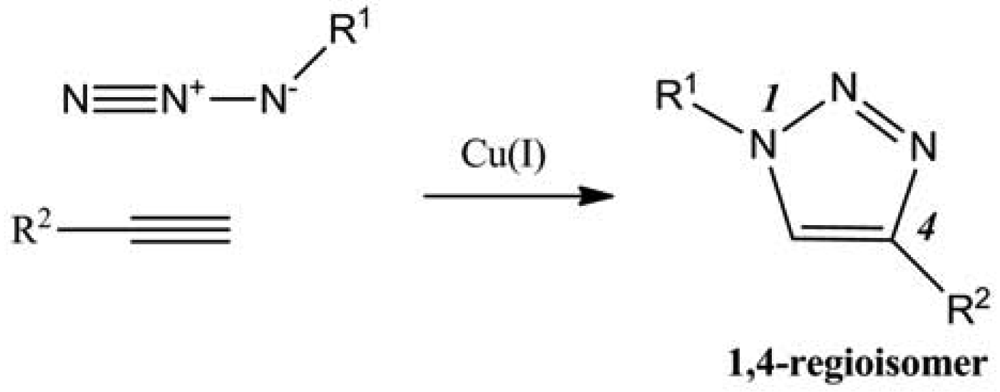
<p>Among the multiple reactions that could be named “click”, the focus will be on the catalyzed version of Huigen 1,3-dipolar cycloaddition reaction between azides and terminal alkynes (<xref ref-type="fig" rid="f1-polymers-03-01607">Figure 1</xref>). Indeed polysaccharides were often modified using this reaction for different purposes such as creating new materials, new therapeutic or diagnostic agents, or merely to understand the reactivity of such complex structures in terms of regioselectivity, degree of substitution (DS), cross-linking, <italic>etc.</italic></p>
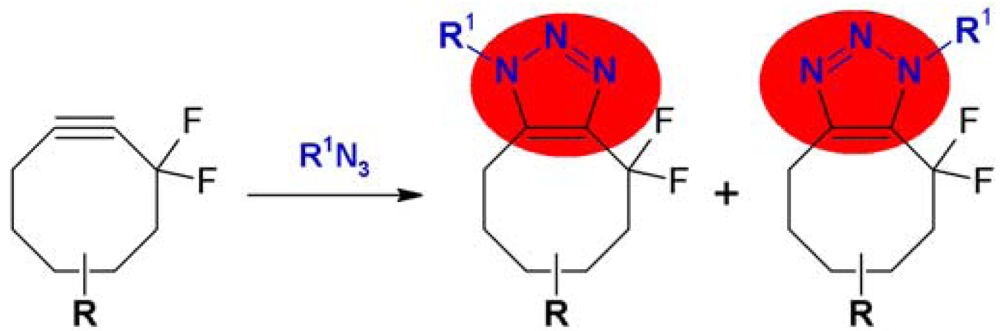
<p>A non-catalytic variation of the 1,3-dipolar azide-alkyne cycloaddition was also utilized to functionalize polysaccharides, thanks notably to difluorocyclooctynes (DIFO), with interesting applications in the biochemical area, because of the removal of copper toxicity (<xref ref-type="fig" rid="f2-polymers-03-01607">Figure 2</xref>) [<xref ref-type="bibr" rid="b13-polymers-03-01607">13</xref>,<xref ref-type="bibr" rid="b14-polymers-03-01607">14</xref>]. The copper-free reaction was recently developed and proved suitable for many applications, notably in the glycans area. This reaction, achieved by increasing the reactivity of the alkyne by introducing ring strain, was named Strain Promoted Alkyne Azide Cycloaddition (SPAAC).</p>
<p>Through the reactions described above, different families of polysaccharides will be investigated in terms of their reactivity and their applications, in order to understand the influence of “click” chemistry on the polyosides.</p></sec>
<sec>
<label>1.2.</label>
<title>The World of Polysaccharides: Various Entities Associated to Various Reactivities</title>
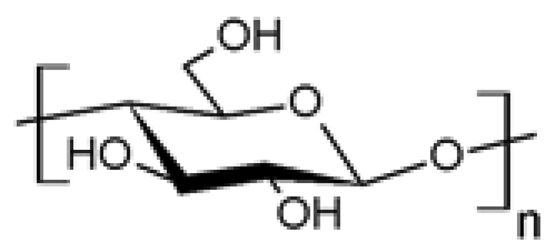
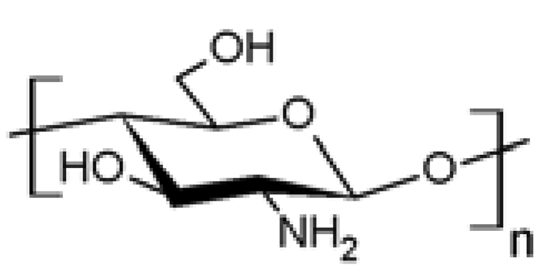
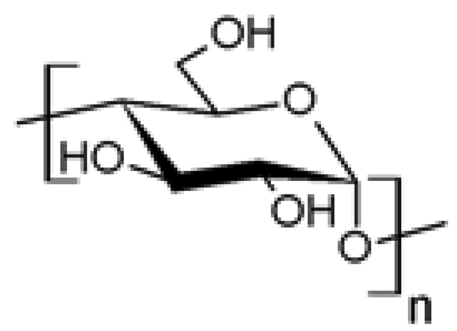
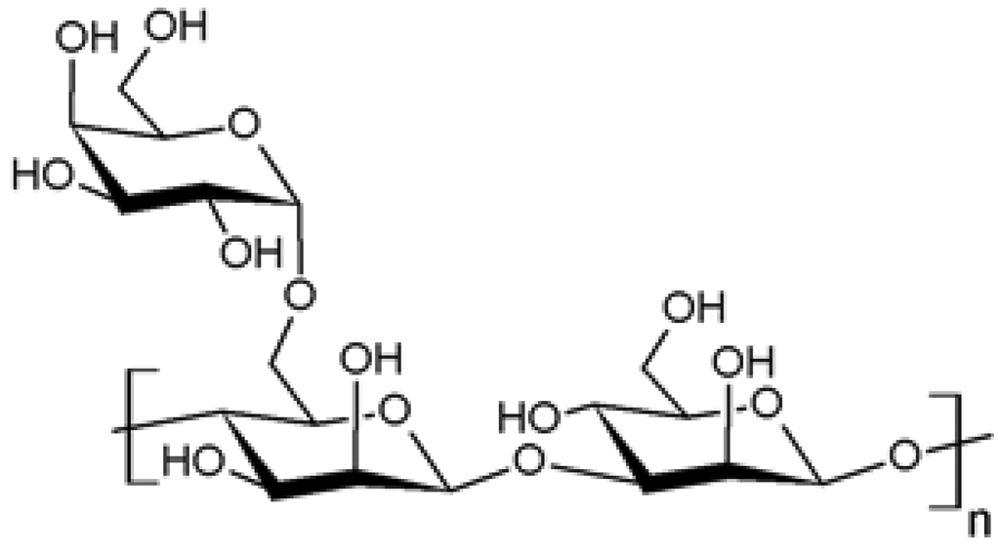
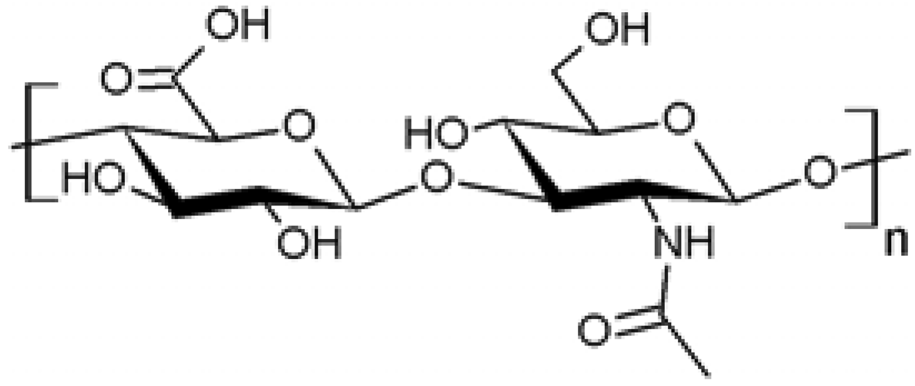
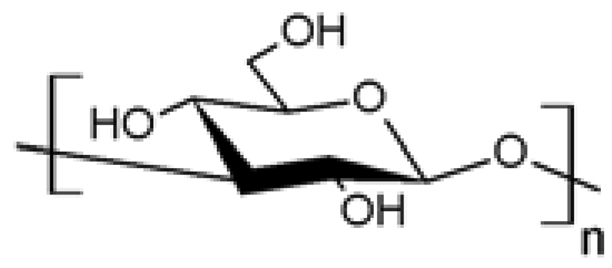
<p>The polysaccharides regroup lots of types of macromolecules. Among them, only eight categories were identified to have been impacted by the CuAAC or the SPAAC (<xref ref-type="table" rid="t1-polymers-03-01607">Table 1</xref>), which are cellulose, dextran, chitosan, starch, guar, hyaluronan, (1→3)-(β-D-glucan, and glycans. The different approaches of modifications will be detailed in the paper. Indeed, even if the “click” reactions are by definition reactions with quantitative yields, high tolerance of functional groups, <italic>etc.</italic> [<xref ref-type="bibr" rid="b1-polymers-03-01607">1</xref>], they require however particular starting reagents. Thus, the terminal alkyne or azide groups need to be “inserted” in the polymer. In order to control the final structure/composition of the macromolecules, regioselective reactions are often necessary.</p></sec></sec>
<sec>
<label>2.</label>
<title>A Need for Pre-“Click” Functionalization</title>
<p>Considering the hydroxyl/amine positions in the polymer structure (except for hyaluronan), a well-defined functionalization is a preliminary step towards the “click” modification. Several attempts were undertaken, with an asymptotic trend towards the regioselective functionalization. To understand the problem, three examples of modifications are developed below, for four different polysaccharides: starch, chitosan, cellulose and (1→3)-β-D-glucan.</p>
<sec>
<label>2.1.</label>
<title>Positions 2, 3 and 6 in Starch</title>
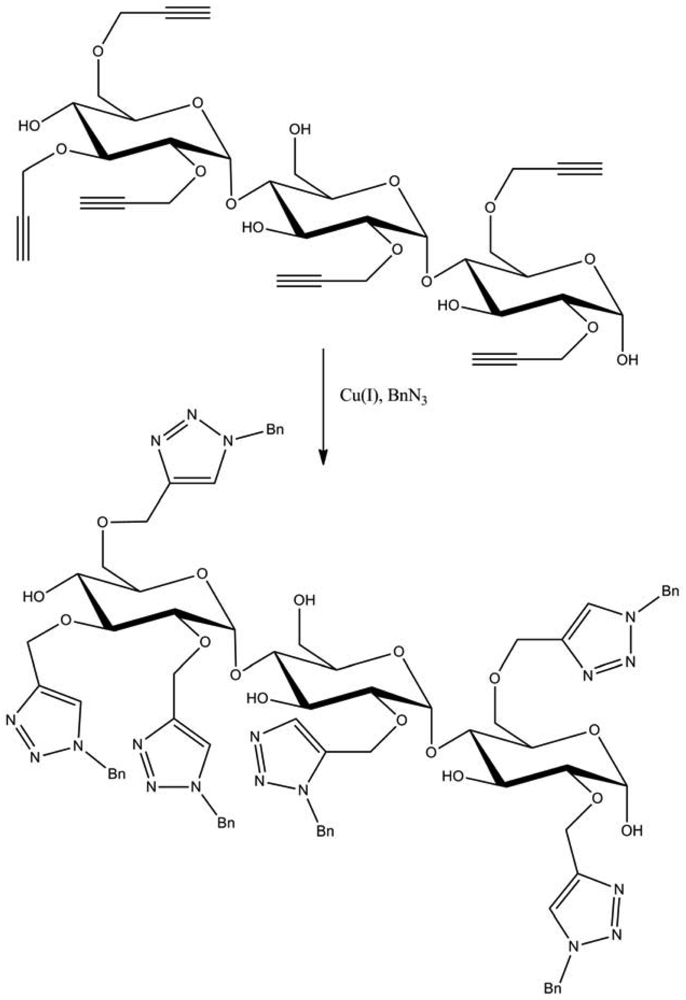
<p>The repeating units of starch present three potentially reactive sites that correspond to the hydroxyls in positions 2, 3 and 6 of the sugar. In this way, Hopf and co-workers described an etherification of potato starch using sodium hydroxide or Li dimsyl in dimethylsulfoxide, and propargyl bromide [<xref ref-type="bibr" rid="b49-polymers-03-01607">49</xref>]. Thus, they established an order of reactivity, which was 2 &gt; 6 ≫ 3. Then a further functionalization by CuAAC with benzyl azide was carried out and led to a <italic>N</italic>-benzyltriazole derivatized starch (<xref ref-type="fig" rid="f3-polymers-03-01607">Figure 3</xref>).</p></sec>
<sec>
<label>2.2.</label>
<title>From Chitosan to Cellulose</title>
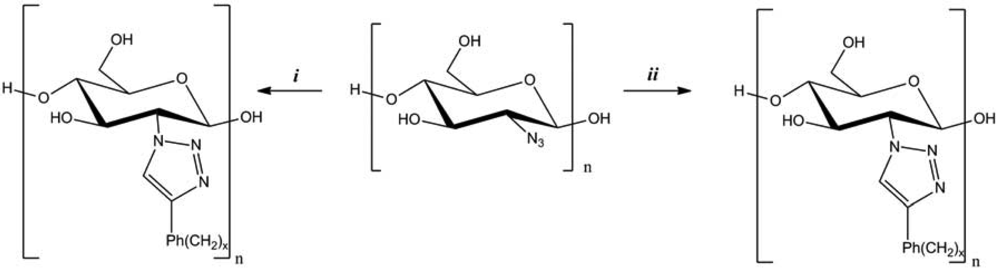
<p>An original pathway was established by Vasella and co-workers to synthesize 2-azido-2-deoxycellulose from chitosan (<xref ref-type="fig" rid="f4-polymers-03-01607">Figure 4</xref>) [<xref ref-type="bibr" rid="b34-polymers-03-01607">34</xref>]. The azido-functionalization was carried out using a diazo transfer from trifluoromethanesulfonyl azide (TfN<sub>3</sub>), among four to five reaction steps. Then the reactivity of 2-azido-2-deoxycellulose was evaluated by the CuAAC, in the presence of CuI, dimethylsulfoxide (DMSO), and phenyl-, (phenyl)alkyl-, and alkylacetylenes. New cellulose derivatives were thus obtained, in high yield.</p></sec>
<sec>
<label>2.3.</label>
<title>Position 6: The Case of Cellulose and (1→3)-β-D-Glucan</title>
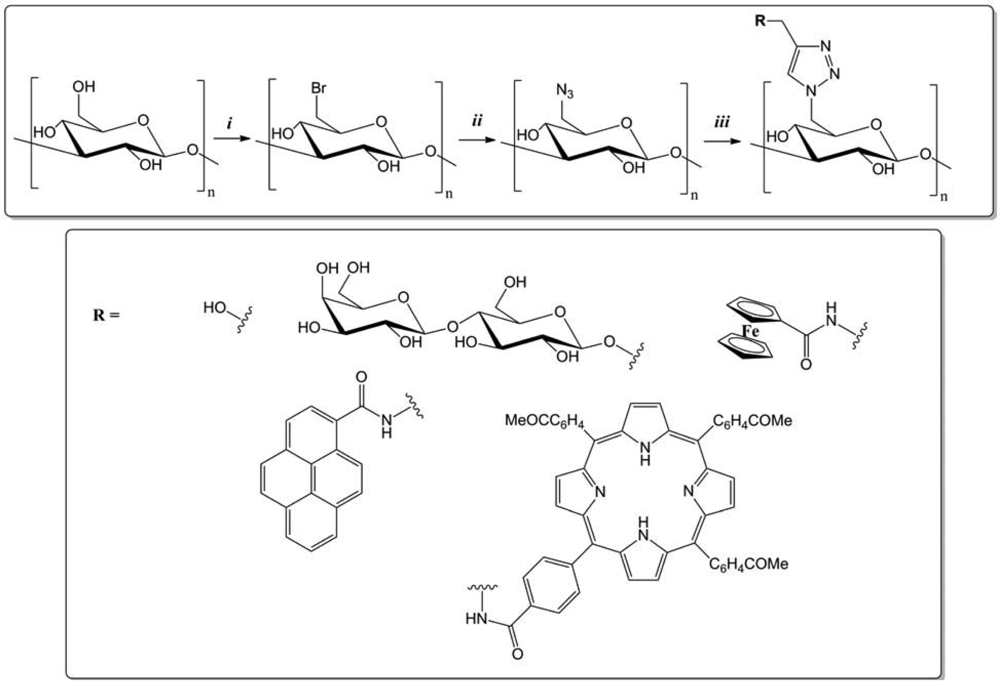
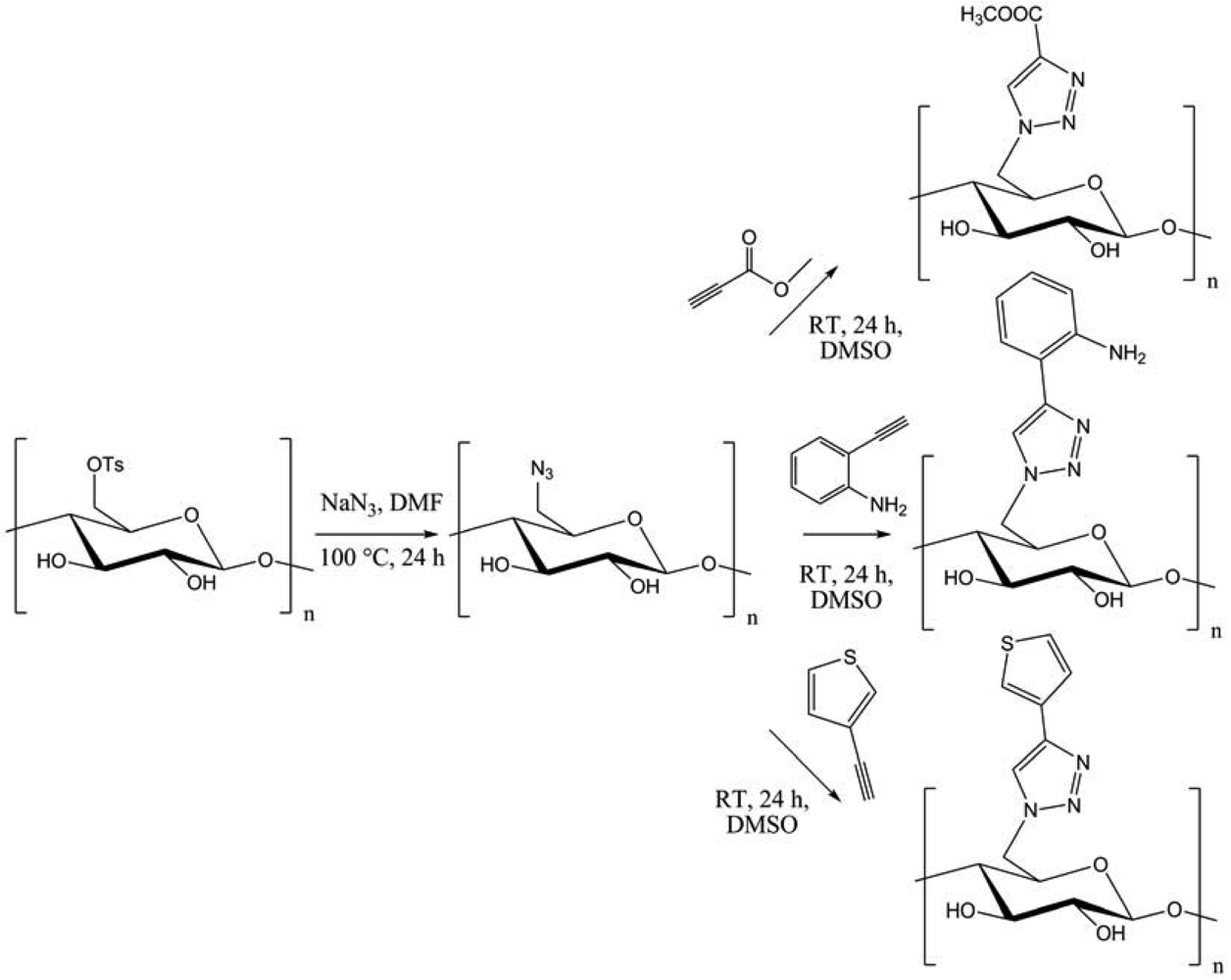
<p>According to the literature, the position 6 of polysaccharides seems to be more accessible in terms of reactivity. Indeed the azido-derivatives are easily synthesized, introducing first a good leaving group in the polysaccharide structure, then by a nucleophilic displacement using sodium azide. In this way, Shinkai and co-workers developed a convenient approach to elaborate (1→3)-(β-D-glucan with various functional appendages (<xref ref-type="fig" rid="f5-polymers-03-01607">Figure 5</xref>) [<xref ref-type="bibr" rid="b56-polymers-03-01607">56</xref>].</p>
<p>Bromination-azidation of curdlan afforded 6-azido-6-deoxycurdlan. The chemoselective [3 + 2] cycloaddition with several functional modules led to functionalized (1→3)-(β-D-glucan, with possible applications in gene carriers, redox-active or fluorescent “green” materials. In another context, Heinze <italic>et al.</italic> introduced azide group into cellulose using the tosyl derivative (<xref ref-type="fig" rid="f6-polymers-03-01607">Figure 6</xref>) [<xref ref-type="bibr" rid="b15-polymers-03-01607">15</xref>].</p>
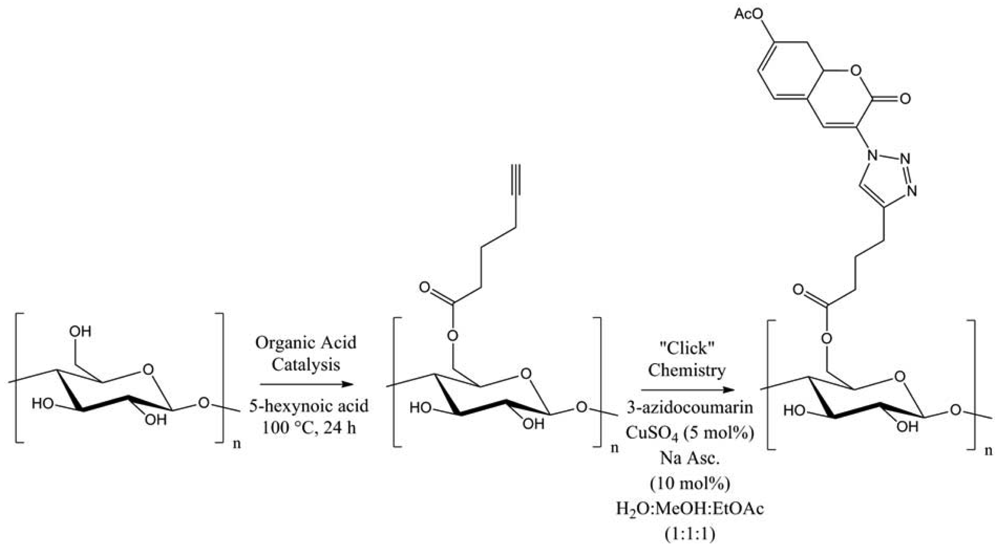
<p>Several functional moieties were then “clicked”, such as methylcarboxylate, 2-aniline or 3-thiophene. Hydrolytically stable cellulose derivatives were so generated, with high conversions and DS up to 0.9. Always using cellulose, Hafrén and co-workers described a simple and original method, combining a first acid-catalyzed esterification followed by CuAAC, in order to attach fluorescent probes (<xref ref-type="fig" rid="f7-polymers-03-01607">Figure 7</xref>) [<xref ref-type="bibr" rid="b23-polymers-03-01607">23</xref>].This was the first approach describing the modification of polysaccharides surfaces by a combination of organocatalysis and “click” chemistry under environmentally friendly reaction conditions.</p></sec></sec>
<sec sec-type="materials">
<label>3.</label>
<title>Materials</title>
<p>Nowadays, oily fossil resource materials play an important role in the economy, particularly, in packaging, car industries, agriculture and furniture applications. Two major drawbacks are related to these commodity products: they are obtained from a non-renewable resource, and at the end of their life, there is an accumulation of this non-biodegradable waste (within a reasonable laps of time). Recently, the need to develop materials from renewable and biodegradable resources has known a growing interest [<xref ref-type="bibr" rid="b57-polymers-03-01607">57</xref>-<xref ref-type="bibr" rid="b60-polymers-03-01607">60</xref>], because bio-based materials and composites could be a promising solution both in terms of environmental and performance aspects [<xref ref-type="bibr" rid="b24-polymers-03-01607">24</xref>]. In this context, the use of natural polysaccharides can constitute an interesting viable alternative to the formerly discussed problems. Thus, these macromolecular architectures can provide several advantages, namely: their low density, their bio-renewable character, their ubiquitous availability at low cost and their interesting mechanical properties. Therefore the attention they received from chemists has continued to grow in recent years.</p>
<sec>
<label>3.1.</label>
<title>Dendrimers</title>
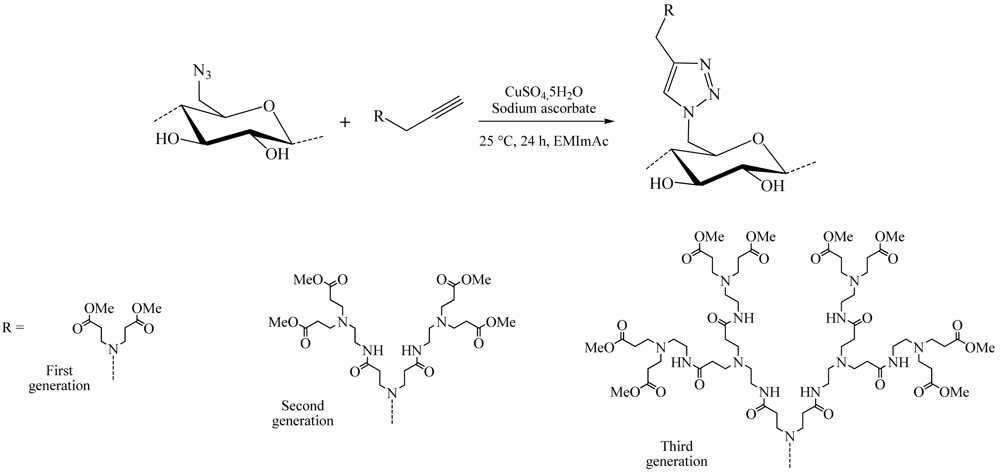
<p>Among these large fields of application, one of the most studied subjects is the grafting of dendron molecules onto cellulose. This work was performed by Thomas Heinze and co-workers. The products so-obtained were used as biomaterials or even as liquid crystals. The first results were published in 2008 [<xref ref-type="bibr" rid="b16-polymers-03-01607">16</xref>]. In this approach, the dendrons (propargyl-polyamidoamine) were grafted to the 6-azido-6-deoxycellulose (DS 0.75) using the CuAAC reaction in ionic liquid medium (1-ethyl-3-methylimidazolium acetate) to promote dissolution of the compounds (<xref ref-type="fig" rid="f8-polymers-03-01607">Figure 8</xref>). The reaction was catalyzed by copper sulfate reduced by an aqueous solution of sodium ascorbate and took place at RT for 24 h. 1-Ethyl-3-methylimidazolium acetate (EMImAc) dissolved very well 6-azido-6-deoxy cellulose with a DS of 0.75 and represented a suitable reaction medium for the homogenous conversion of 6-azido-6-deoxycellulose with propargyl-dendrons (PAMAM) via copper catalyzed Huisgen reaction. In this way, it was possible to prepare PAMAM-triazolo-cellulose derivatives from the first to the third generation with DS values of up to 0.60 using the CuAAC reaction.</p>
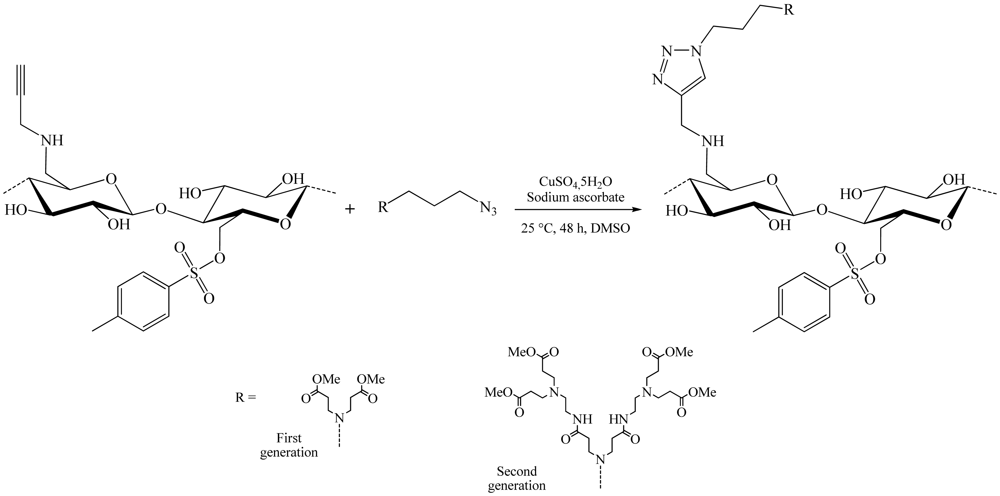
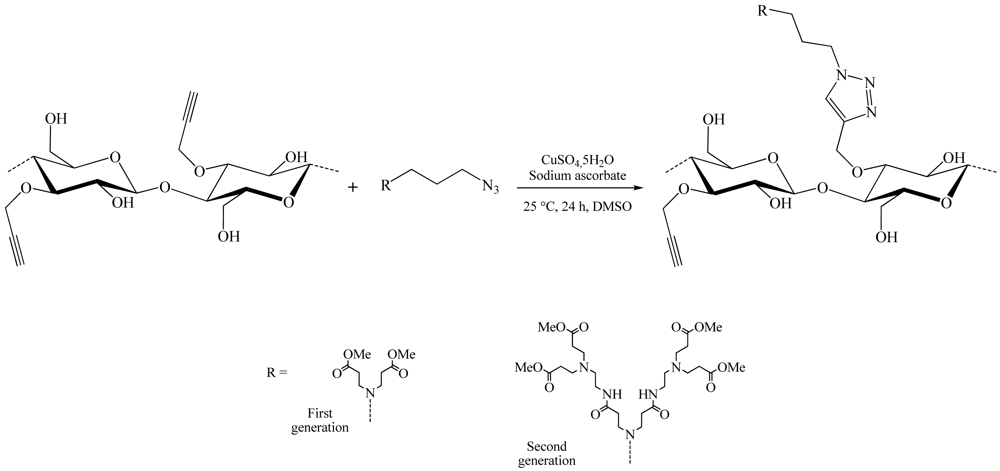
<p>During the same year, a slightly different synthesis method of these dendrons cellulose was developed (<xref ref-type="fig" rid="f9-polymers-03-01607">Figure 9</xref>) [<xref ref-type="bibr" rid="b19-polymers-03-01607">19</xref>]. This time, azidopropyl-dendrons and the 6-deoxy-6-cellulose aminopropargyl (DS 0.41) facilitated modified cellulose by nucleophilic displacement of the 6-tosylcellulose (DS 0.58), using propargyl amine. The copper-catalyzed Huisgen reaction in DMSO using CuSO<sub>4</sub>,5H<sub>2</sub>O/sodium ascorbate as catalytic system, yield 6-deoxy-6-amino-(4-methyl-[1,2,3-triazolo]-1-propyl- polyamido amine) cellulose derivatives of the first (DS 0.33) and the second (DS 0.25) generation.</p>
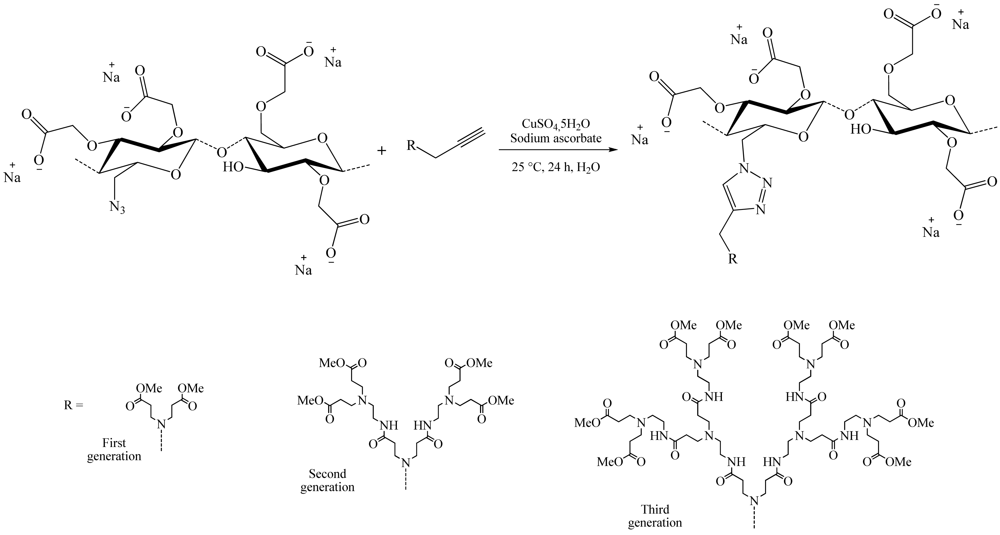
<p>To facilitate the solubilization of dendronized cellulose in water, Heinze and colleagues published works in 2009 showing new compounds obtained from the 6-deoxy-6-azidocellulose [<xref ref-type="bibr" rid="b17-polymers-03-01607">17</xref>]. Water-soluble deoxy-azidocellulose derivatives were synthesized by heterogeneous carboxymethylation, applying 2-propanol/aqueous NaOH as slurry medium (<xref ref-type="fig" rid="f10-polymers-03-01607">Figure 10</xref>). The novel, carboxymethyl deoxy-azidocellulose provided a convenient starting material for the selective dendronization of cellulose via the copper-catalyzed Huisgen reaction, in water, yielding water-soluble carboxymethyl 6-deoxy-(1-<italic>N</italic>-[1,2,3-triazolo]-4-polyamidoamine) cellulose derivatives of first (DS 0.51), second (DS 0.44) and third generation (DS 0.39).</p>
<p>Over this year, the same team also proposed a different structure from previous ones [<xref ref-type="bibr" rid="b28-polymers-03-01607">28</xref>]. This time, the position 3 of the anhydroglucose units was referred. This structure was obtained by reacting as shown before the azido-PAMAM and 3-<italic>O</italic>-propargyl cellulose using CuSO<sub>4</sub>,5H<sub>2</sub>O/sodium ascorbate as catalytic system in a water/DMSO mixture. The synthesis of 3-<italic>O</italic>-propargyl cellulose (DS 1) was realized using the thexyldimethylsilyl moiety as protecting group. The treatment of 3-<italic>O</italic>-propargyl-2,6-di-<italic>O</italic>-thexyldimethylsilyl cellulose with tetrabutylammonium fluoride trihydrate led to the complete removal of the silicon containing groups. A comprehensive analysis of the obtained products showed a conversion rate of the triple bonds of 25% and 13% respectively for the first and second generation dendrons (<xref ref-type="fig" rid="f11-polymers-03-01607">Figure 11</xref>).</p></sec>
<sec>
<label>3.2.</label>
<title>Gels Preparation</title>
<p>Another area of application of “click” chemistry to polysaccharides concerns the formation of gel by crosslinking. In 2009, Zhang and co-workers published the synthesis of a composite gel having interesting properties of swelling and temperature resistance [<xref ref-type="bibr" rid="b18-polymers-03-01607">18</xref>]. This material is an azido-cellulose coupled to a polyacrylamide based polymer. Azide-modified cellulose and the alkyne-modified P(NIPAAm-<italic>co</italic>-HEMA) were synthesized in two steps each. Then a series of novel hydrogels were prepared by mixing the solution of two components functionalized with alkyne and azide groups through Cu(I)-catalyzed Huisgen's 1,3-dipolar cycloaddition (<xref ref-type="fig" rid="f12-polymers-03-01607">Figure 12</xref>). The resulting hydrogels exhibited a porous network structure and favorable thermosensitivity in terms of temperature dependence of swelling ratio, deswelling kinetics and reswelling kinetics.</p>

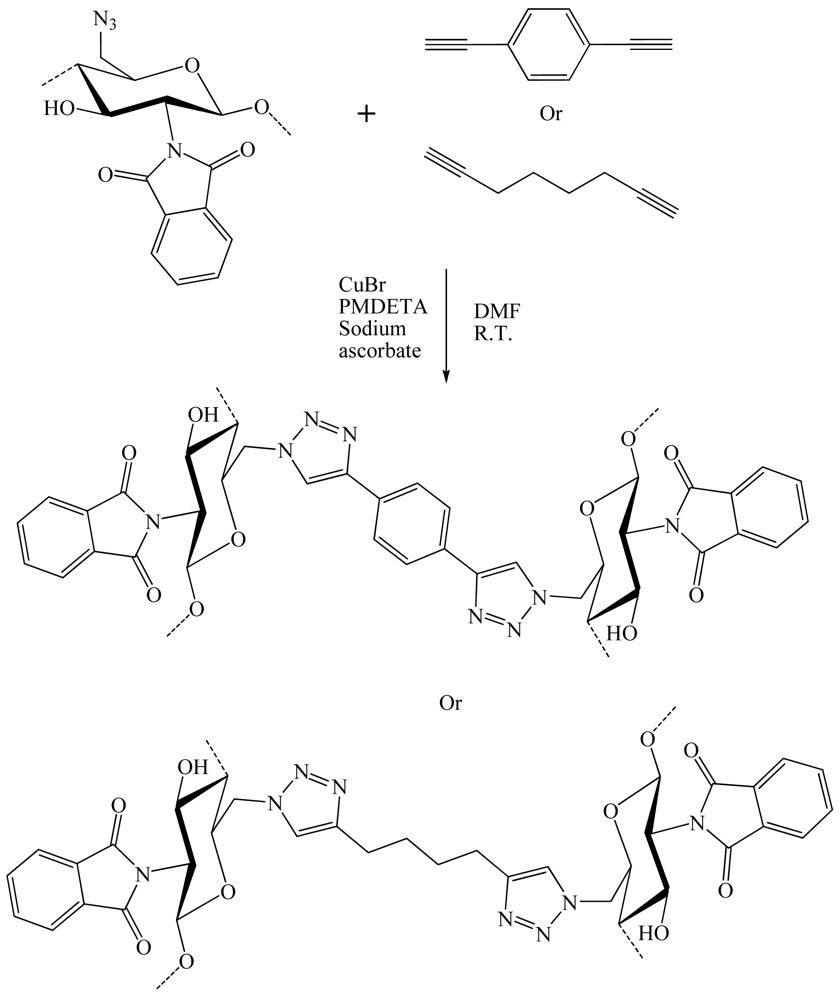
<p>In 2010, three research groups published their work on the development of new gels from three different polysaccharides (cellulose, chitosan and guar gum) and a spacer molecule to cross-link these polysaccharides. Zampano and co-workers [<xref ref-type="bibr" rid="b35-polymers-03-01607">35</xref>] used an aliphatic or an aromatic chain bearing two alkyne functions to cross-link the 6-deoxy-6-azido chitosan (<xref ref-type="fig" rid="f13-polymers-03-01607">Figure 13</xref>). The azido-functionalized products reacted efficiently in Cu(I)-catalyzed “click” cycloaddition at room temperature with a model reagent phenylacetylene, the di-alkynes 1,7-octadiyne and 1,4-diethynylbenzene used for cross-linking. All alkynes reacted efficiently both in heterogeneous and homogeneous phases. Thus the “click” functionalized/cross-linked derivatives were easily deprotected with hydrazine in order to restore the amino groups. The cross-linked NH<sub>2</sub>-deprotected products showed a pH-dependent swellability in water.</p>
<p>Argyropoulos <italic>et al.</italic> described the formation of nanoplatelet gel-like nanomaterials formed using cellulose nanocrystals (CNC) as starting materials (<xref ref-type="fig" rid="f14-polymers-03-01607">Figure 14</xref>) [<xref ref-type="bibr" rid="b27-polymers-03-01607">27</xref>]. Initially, the primary hydroxyl groups on the surfaces of the CNCs were selectively activated to carboxylic acids by using TEMPO-mediated hypohalite oxidation. In the next step, 11-azido-3,6,9-trioxaundecan-1-amine was grafted onto the activated oxidized surface CNCs via an amidation reaction. The grafted amine compounds contained terminal alkyne or azide functionalities and as such two sets of precursors were prepared. The alkyne and azide, surface-functionalized CNC precursors, were then brought together using “click” chemistry, creating for the first time unique nanoplatelet gels.</p>
<p>Fleury and co-workers [<xref ref-type="bibr" rid="b50-polymers-03-01607">50</xref>] designed new thermosensitive guar-based hydrogels by CuAAC cross-linking between alkyne-functionalized guar chains and α,ω-diazido poly[(ethylene glycol)-<italic>co</italic>-(propylene glycol)] (PEG-<italic>co</italic>-PPG) (<xref ref-type="fig" rid="f15-polymers-03-01607">Figure 15</xref>). The reaction was successfully performed in water under mild conditions with gelation times relatively shorter than other described guar-based hydrogels [<xref ref-type="bibr" rid="b61-polymers-03-01607">61</xref>]. They demonstrated that both mechanical and swelling properties can be efficiently tuned by varying experimental parameters, such as the CuAAC coupling temperature, the guar molecular weight and the mass fraction of guar/cross-linker chains. It appears that for sufficient cross-linker content, the resulting hydrogel shrinks while heating. Preliminary data concerning the capability of these networks to act as capsule for a temperature controlled drug delivery are given, owing to the thermo-dependant microstructure of hydrogels.</p>
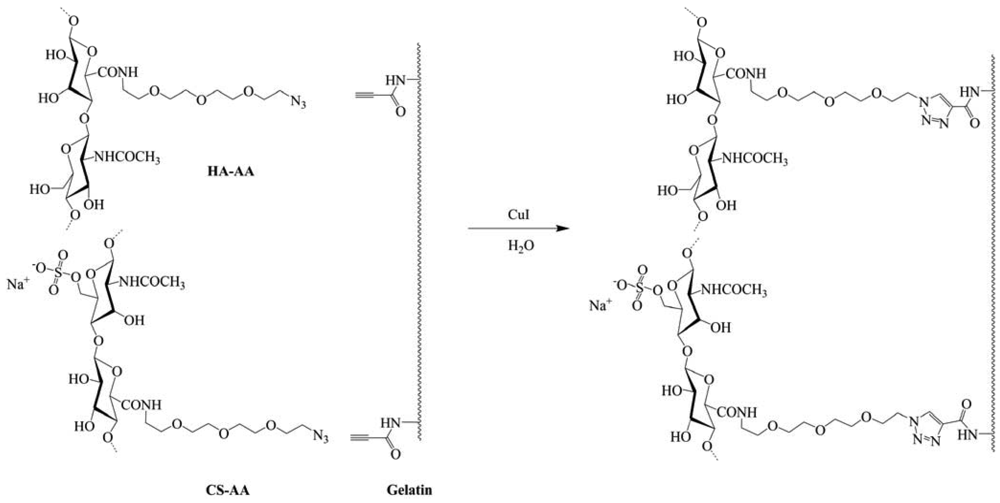
<p>Very recently, two works on this area were published. The first comes from Gao <italic>et al.</italic>, [<xref ref-type="bibr" rid="b51-polymers-03-01607">51</xref>] they synthesized a biological hydrogel from the biopolymers hyaluronic acid (HA), chondroitin sulfate (CS) and gelatin via “click” chemistry, in order to mimic the natural cartilage extracellular matrix, which is composed of core proteins and glycosaminoglycans. HA and CS were modified with 11-azido-3,6,9-trioxaundecan-1-amine (AA) and gelatin was modified with propiolic acid (PA). The biological hydrogel was readily formed at room temperature within 5 min after HA–AA, CS–AA and G–PA were mixed together in the presence of Cu(I) as catalyst at a concentration of 0.95 mg mL<sup>−1</sup> (<xref ref-type="fig" rid="f16-polymers-03-01607">Figure 16</xref>). The hydrogel obtained was in a highly swollen state and showed the characteristics of an elastomer. Incubation in phosphate-buffered saline for 4 weeks resulted in a weight loss of up to 45%. Moreover, about 20% gelatin and 10% CS were released from the hydrogel in 2 weeks. <italic>In vitro</italic> cell culture confirmed that chondrocytes could adhere and proliferate on the hydrogel. Thus the molecular modification endowed the biopolymers with good reactivity to form a biological hydrogel under very mild conditions by “click” chemistry, which has also shown the potential for biomedical applications.</p>
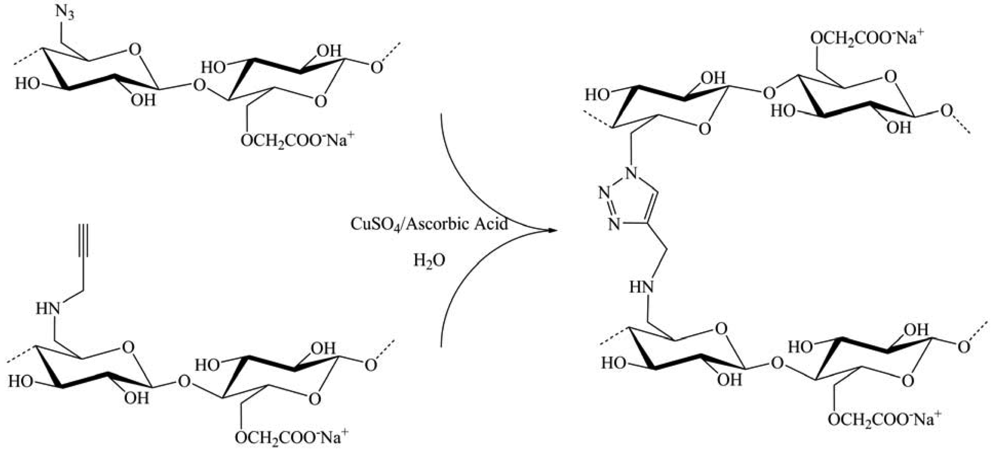
<p>The second comes from Heinze <italic>et al.</italic> [<xref ref-type="bibr" rid="b26-polymers-03-01607">26</xref>]. They synthesized a novel cellulose-based hydrogel. Cellulose derivatives bearing azide and alkyne moieties were prepared by conversion of cellulose <italic>p</italic>-toluenesulphonic acid ester with sodium azide, on the one hand, and propargylamine, on the other. The products obtained were carboxymethylated to yield water soluble multifunctional cellulose derivatives. The CuAAC was applied for the cross-linking. Gel formation occurred within 55 and 1,600 s after mixing the aqueous solutions with both compounds and CuSO<sub>4</sub>/Ascorbic acid. The gelation time was found to depend on the degree of functionalization and the amount of copper (I) catalyst. The gels contain up to 98.4% water. Freeze-drying led to spongy materials with a porous structure (<xref ref-type="fig" rid="f17-polymers-03-01607">Figure 17</xref>).</p></sec>
<sec>
<label>3.3.</label>
<title>Miscellaneous Materials</title>
<p>Cross-linking through the “click” chemistry did not develop only gels. Indeed, during 2008, De Geest and colleagues published work on the preparation of biodegradable dextran-based multilayer films or capsules. On the other hand, Bras and co-workers showed the feasibility of developing new materials from cellulose using a heterogeneous CuAAC reaction. The biodegradable [<xref ref-type="bibr" rid="b29-polymers-03-01607">29</xref>] film consists in alternating layers of dextran modified with azide and alkyne groups. The dextran was modified in such a way that the azide and alkyne moieties were connected to the dextran backbone by a hydrolyzable carbonate ester function (<xref ref-type="fig" rid="f18-polymers-03-01607">Figure 18</xref>). Therefore, the multilayered structures obtained after successive CuAAC reactions can be degraded by simple hydrolysis in alkaline medium. This type of multilayer could be interesting for the fields of drug delivery and tissue engineering.</p>
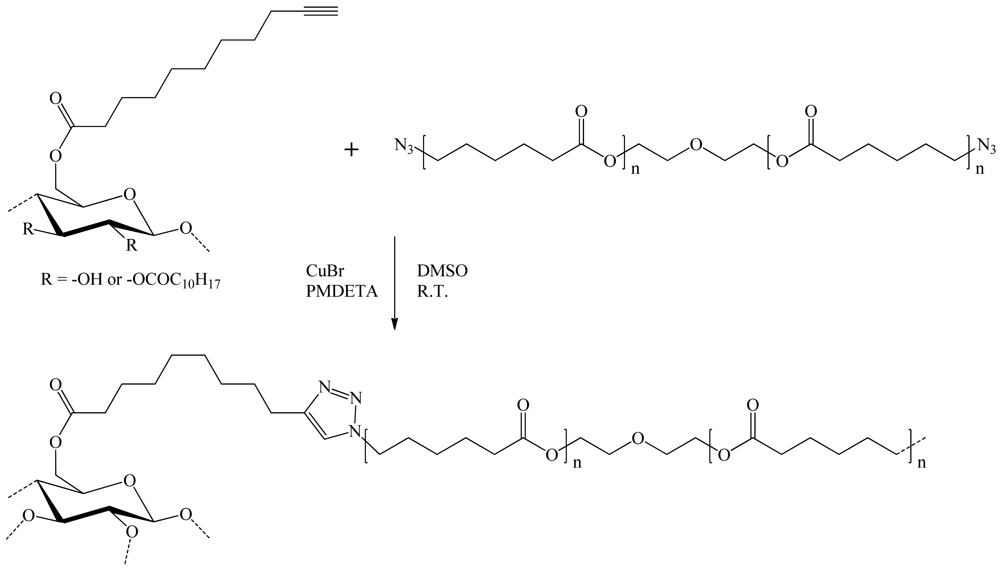
<p>Bras <italic>et al.</italic> [<xref ref-type="bibr" rid="b25-polymers-03-01607">25</xref>] used cellulose ester bearing a terminal alkyne function and a diazido-polycaprolactone (N3-PCL-N3) for the preparation of their material. Esterification of cellulose was realized in a moderately swelling solvent mixture to limit the modification to the superficial surface hydroxyl groups only (DS 0.1). Convertion of commercial polycaprolactone-diol (PCL-diol) into diazido-polycaprolactone was then achieved in two steps through a nucleophilic displacement reaction between di-<italic>p</italic>-toluenesulfonyl-polycaprolactone (Ts-PCL-Ts) and NaN<sub>3</sub>. The heterogeneous copper (I)-catalyzed reaction between azido-polycaprolactone and undecynoate cellulose in tetrahydrofuran (THF) led to a weight gain of 20% (<xref ref-type="fig" rid="f19-polymers-03-01607">Figure 19</xref>). This procedure was further expected to produce highly grafted cellulose particles, which can be considered as thermoformables.</p>
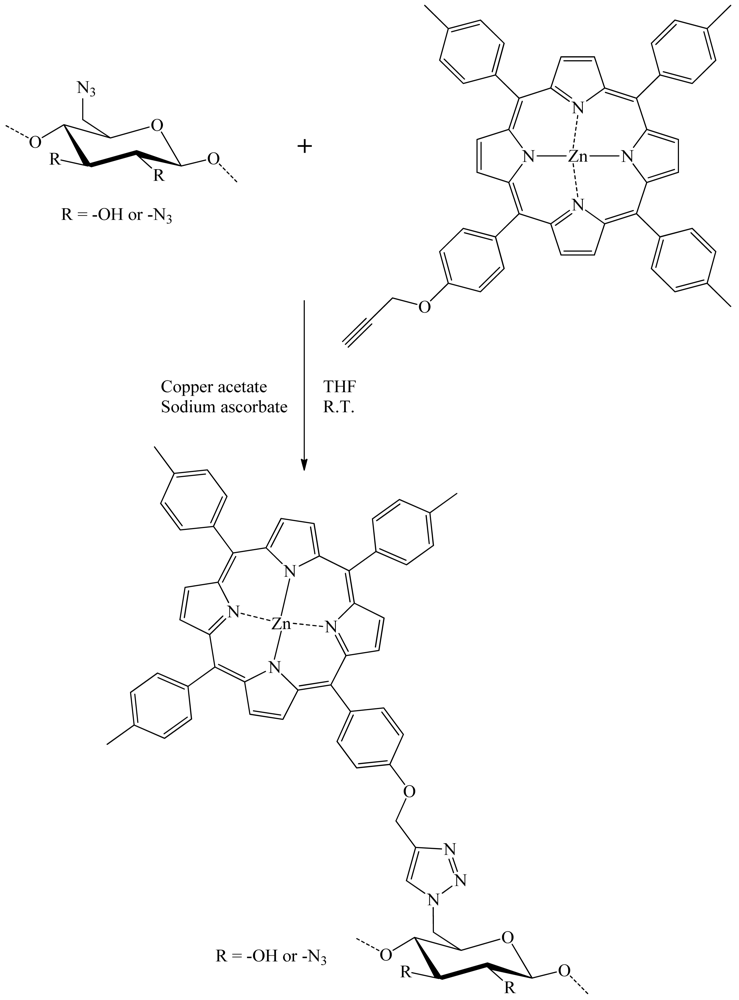
<p>Sol and colleagues published in 2009 [<xref ref-type="bibr" rid="b22-polymers-03-01607">22</xref>] the results of their work on the development of a new photobactericidal tissue. They were elaborated by grafting meso-arylporphyrin on cotton fabric by the means of direct cellulose azidation, followed by “click” chemistry reaction in THF and water with acetylenic porphyrin (<xref ref-type="fig" rid="f20-polymers-03-01607">Figure 20</xref>). Under irradiation with visible light, this material displayed an antibacterial activity against representative strains of <italic>Escherichia Coli</italic> and <italic>Staphylococcus Aureus</italic>. This new photobactericidal textile showed potential for industrial, medical, and household applications.</p>
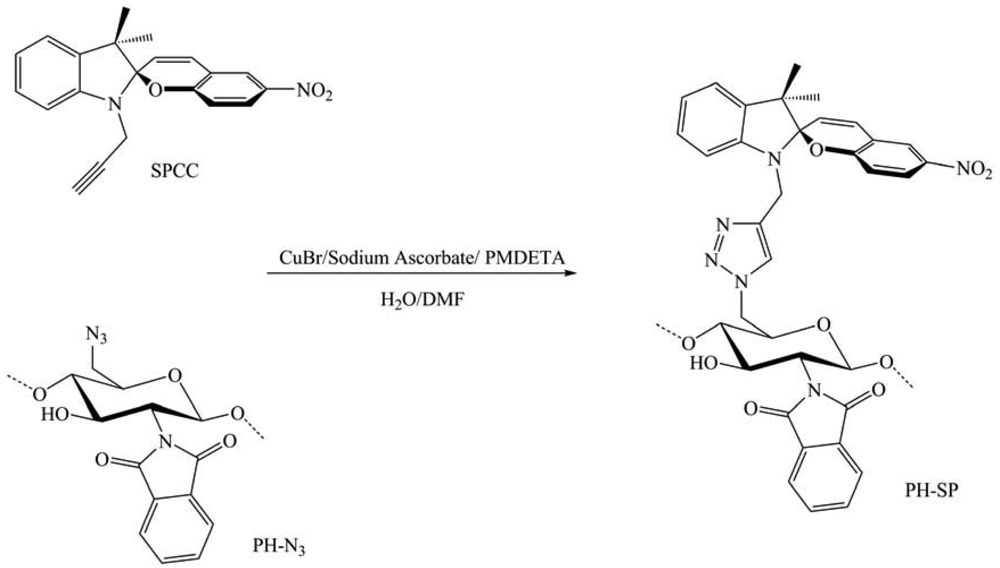
<p>In 2011, Nazzi <italic>et al.</italic> published their work on the creation of new materials by combining chromophores and polysaccharides [<xref ref-type="bibr" rid="b36-polymers-03-01607">36</xref>]. They questioned the effect of the polysaccharide backbone on their properties. A new light responsive polysaccharide based on a precisely defined <italic>N</italic>-phthaloyl chitosan with a covalent bound photochromic spiropyran moiety in C-6 was synthesized through CuAAC reaction between 6-azido-6-deoxy, <italic>N</italic>-phthaloyl chitosan and a new spiropyran derivative containing an alkynyl group (SPCC) (<xref ref-type="fig" rid="f21-polymers-03-01607">Figure 21</xref>). Various analyses were performed on the product cast as a film or in solution to evaluate these reactions. The new chitosan-based material with covalently bound spiropyran groups showed an interesting photochromic response. Indeed, after UV light irradiation, the colorless material became intensely colored either in diethyl ether suspension or solid film, due to the conversion of the spiropyran in the merocyanine form. The photo-excited merocyanine form lived more than 24 h as suspension in diethyl ether and more than two months as dry film at room temperature. By contrast, the unbound spiropyran in ethanol or diethyl ether bleached in few minutes. These findings indicate a very well controlled route to provide a polysaccharide, in particular chitosan, with a specific photoresponse to light irradiation, which is affected and modified to large extent by chromophore-biomacromolecule nonbonded interaction.</p></sec>
<sec>
<label>3.4.</label>
<title>Development of Chemical Tools</title>
<p>CuAAC applied to polysaccharides also helped to develop tools for synthesis, preparation or purification of compounds. Regarding the latter application area, three groups presented their work in 2010 and 2011, covering both the purification of proteins, or water. Ye and co-workers immobilized boronic acid ligands on Sepharose for an effective separation of glycoproteins [<xref ref-type="bibr" rid="b62-polymers-03-01607">62</xref>]. A new “clickable” boronic acid ligand was synthesized by introducing a terminal acetylene group onto commercially available 3-aminophenyl boronic acid. The “clickable” ligand, 3-(prop-2-ynyloxycarbonylamino)phenylboronic acid, was easily coupled to azide-functionalized Sepharose using CuAAC reaction in aqueous methanol (<xref ref-type="fig" rid="f22-polymers-03-01607">Figure 22</xref>). Compared to other boronic acid affinity gels, the new affinity gel displayed superior effectiveness in separating model glycoproteins from closely related bovine serum albumin and RNase A in the presence of <italic>Escherichia Coli</italic> proteins.</p>
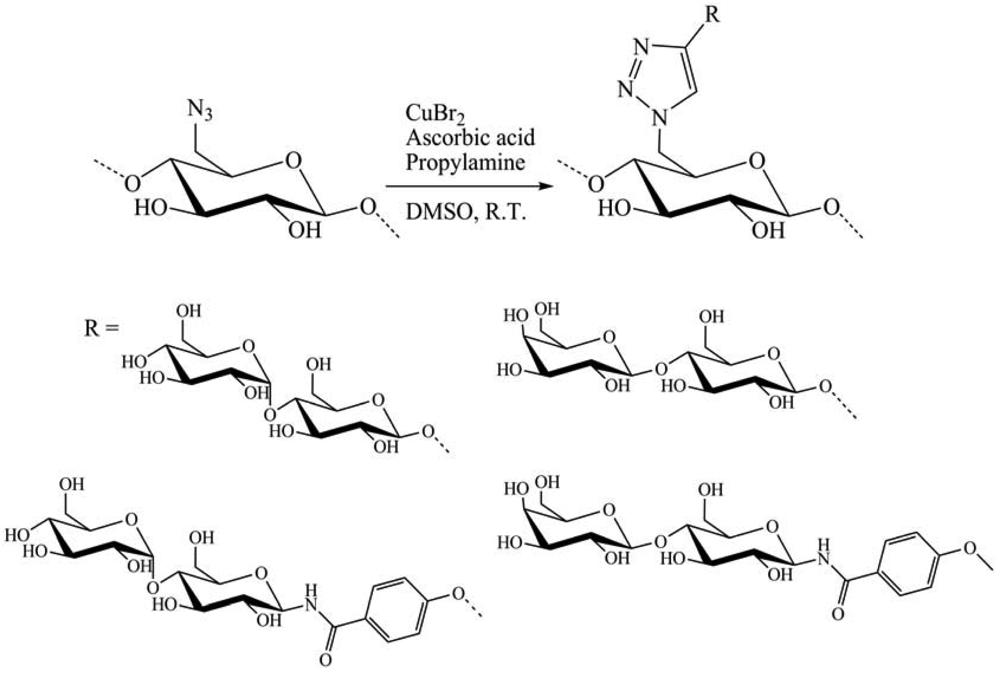
<p>In 2011, Hasegawa <italic>et al.</italic> [<xref ref-type="bibr" rid="b20-polymers-03-01607">20</xref>] presented the synthesis of cellulose glycoclusters having an affinity for proteins, lectin and more. Oligosaccharide appendages (<italic>O</italic>-/<italic>N</italic>-linked β-maltoside and <italic>O</italic>-/<italic>N</italic>-linked β-lactoside) with a terminal alkyne function were grafted onto C-6 positions of all UAG of 6-azido-6-deoxycellulose prepared from cellulose through a regioselective and quantitative bromination/azidation. Oligosaccharides carrying terminal alkyne were prepared through two different synthetic routes. Per-acetylated maltose (AcMal) and lactose (AcLac) were coupled with propargyl alcohol by treating with boron trifluoride and then deacetylated. They could otherwise be brominated first with hydrogen bromide, azidated with sodium azide, and then hydrogenated to give the corresponding oligosaccharide derivatives having amino functionalities at their anomeric positions. The resultant oligosaccharides were coupled to a benzoic acid derivative having terminal alkyne and then, deprotected to give <italic>N</italic>-linked β-maltoside and β-lactoside having terminal alkyne. CuAAC reaction was then realized in DMSO with CuBr, ascorbic acid and propylamine, at R.T. during 12 h (<xref ref-type="fig" rid="f23-polymers-03-01607">Figure 23</xref>). The resultant cellulose derivatives showed improved water solubility in comparison to native cellulose. However, they bound to carbohydrate-binding proteins in a rather non-specific manner. Molecular dynamics calculations revealed that these properties were attributable to rigid sheet-like structures of the cellulose derivatives and the subsequent exposure of their hydrophobic moieties to solvents.</p>
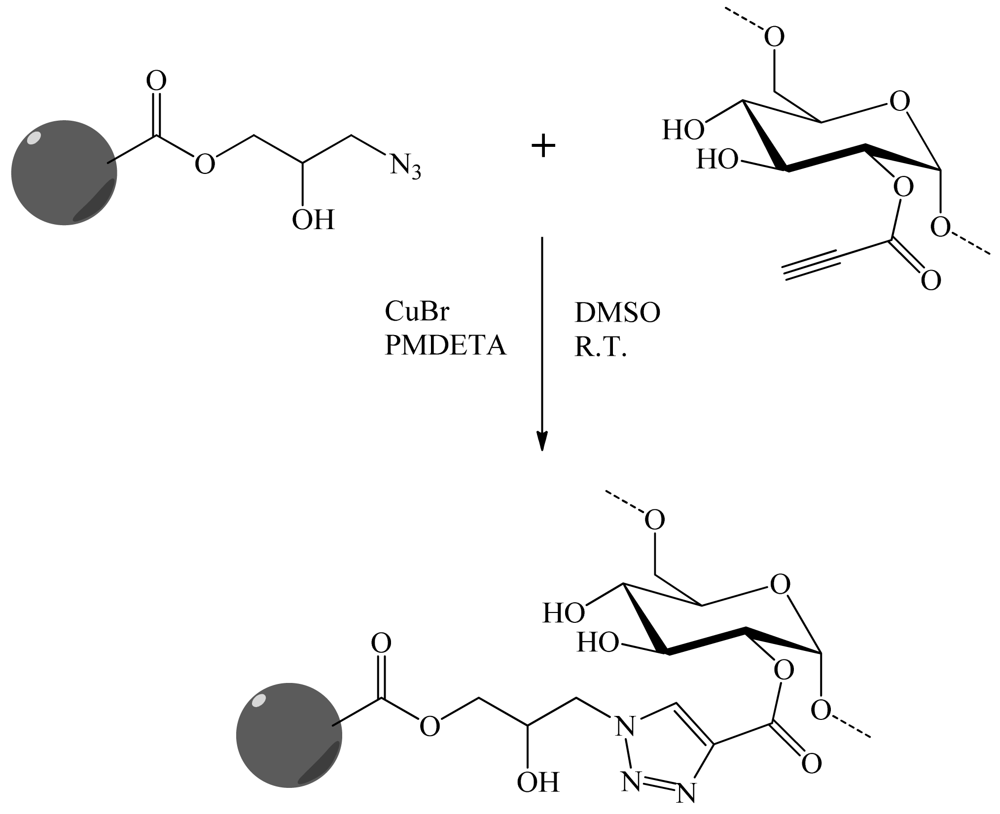
<p>To solve problems of water contamination by boron, Tuncel and co-workers [<xref ref-type="bibr" rid="b30-polymers-03-01607">30</xref>] have developed porous particles supporting dextran molecular brushes for boron removal. The monodisperse porous poly(glycidyl methacrylate-<italic>co</italic>-ethylene dimethacrylate) (poly(GMA-<italic>co</italic>-EDM)) particles 6 μm in size, were obtained by “modified seeded polymerization”. They were then derivatized. The azide groups were obtained by the reaction between NaN<sub>3</sub> and the epoxypropyl functionality. In parallel, an alkyne carrying ligand, propiolic acid was covalently linked to the dextran via activation with a water soluble carbodiimide. Dextran was finally grafted onto the particles via “click” chemistry (<xref ref-type="fig" rid="f24-polymers-03-01607">Figure 24</xref>). A second sorbent was synthesized by the direct covalent attachment of dextran onto the poly(GMA-<italic>co</italic>-EDM), particles. Boron sorption capacities of both sorbents were investigated using model boron solutions and compared with the commercial resins. Monodisperse-porous particles with dextran-based molecular brushes were an effective sorbent for boron-removal from water.</p>
<p>Save and colleagues [<xref ref-type="bibr" rid="b31-polymers-03-01607">31</xref>] applied “click” chemistry to dextran in order to produce an emulsion stabilizer for the polymerization <italic>ab initio</italic> of poly(vinyl acetate) (PVAc). The dextran end-functionalized by a xanthate moiety was synthesized by Huisgen's 1,3-dipolar cycloaddition catalyzed by copper. It was applied as a macromolecular “reversible addition fragmentation chain transfer” agent in surfactant-free emulsion polymerization of vinyl acetate to form <italic>in situ</italic> an amphiphilic block copolymer able to efficiently stabilize the latex particles. The reducing end of dextran was propargyled using propargylamine. In parallel, α-azide-functionalized chain transfer agent (CTA) is prepared by alkylation of <italic>O</italic>-ethyl xanthic acid potassium salt by the 2-bromopropionic acid 3-azido-propyl ester. CuAAC reaction was then realized at R.T. in a DMSO/H<sub>2</sub>O solvent system with CuSO<sub>4</sub>,5 H<sub>2</sub>O/sodium ascorbate as catalytic system. Finally this method of polymerization afforded the preparation of high solids content lattices coated by dextran.</p>
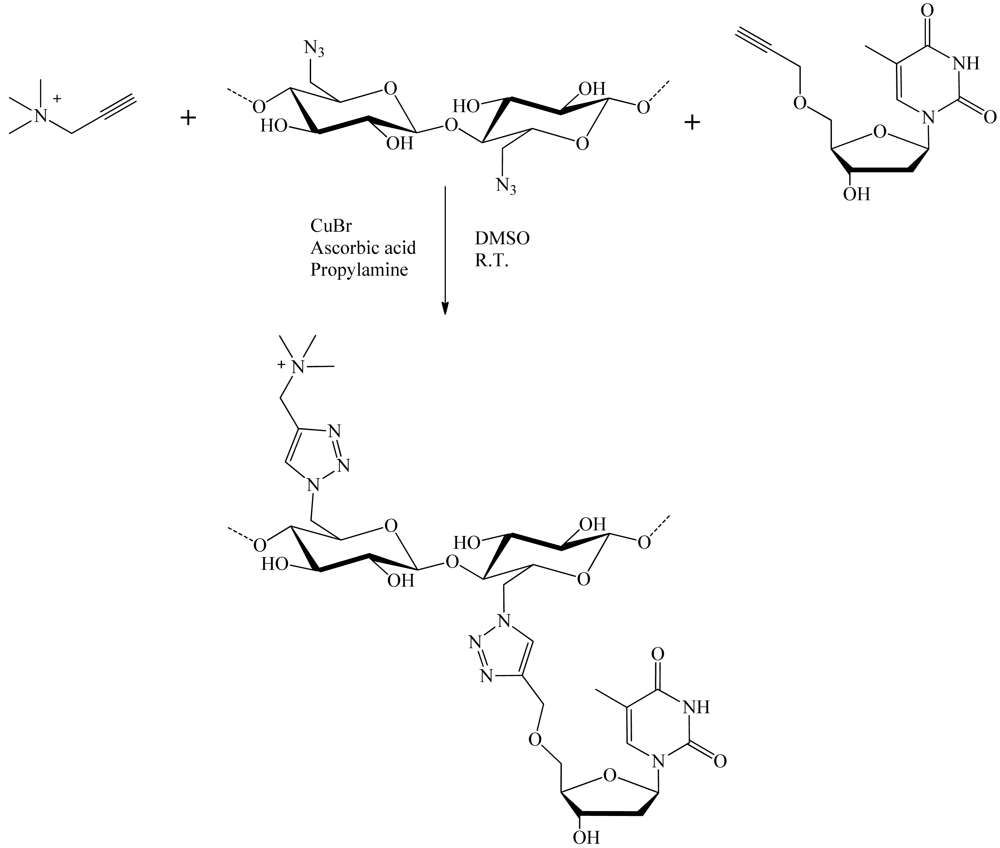
<p>Hasegawa <italic>et al.</italic> [<xref ref-type="bibr" rid="b21-polymers-03-01607">21</xref>] have shown that nucleosides grafted onto cellulose chains could be used to facilitate the dispersion of carbon nanotubes in water (<xref ref-type="fig" rid="f25-polymers-03-01607">Figure 25</xref>). Cellulose derivatives having thymidine and/or trimethylammonium appendages exclusively at C-6 position can be prepared in a convenient manner through C-6 direct azidation on cellulose to afford 6-azido-6-deoxycellulose, followed by a CuAAC reaction in DMSO with CuBr<sub>2</sub>/ascorbic acid and propylamine as a catalytic system. These cellulose derivatives took unique sheet-like structures and functions as “wrapping papers” to effectively disperse single walled carbon nanotubes in water. Although the resultant nanocomposites finally aggregated to form black precipitates after several weeks mainly due to the intrinsic nature of cellulose main chain to induce strong interstranded interactions.</p></sec></sec>
<sec>
<label>4.</label>
<title>Therapeutics</title>
<p>In therapeutic domains, polysaccharides are often used to deliver drugs with micelles, vesicles and polymersomes (similar structure to viral capsids). They can also be useful in hiding peptide in a cell, to target cancer related protein receptors or DNA and to enhance efficiency of lytic peptide for cancer treatment. One modification most commonly found of polysaccharides is the formation of drug delivery agent using chitosan (CS) and dextran. Indeed CS is a typical natural polyaminosaccharide with good biocompatibility, biodegradability, nontoxicity, and bioactivity. Therefore, it presents wide applications in the biomedical field.</p>
<sec>
<label>4.1.</label>
<title>Modification of Position 6</title>
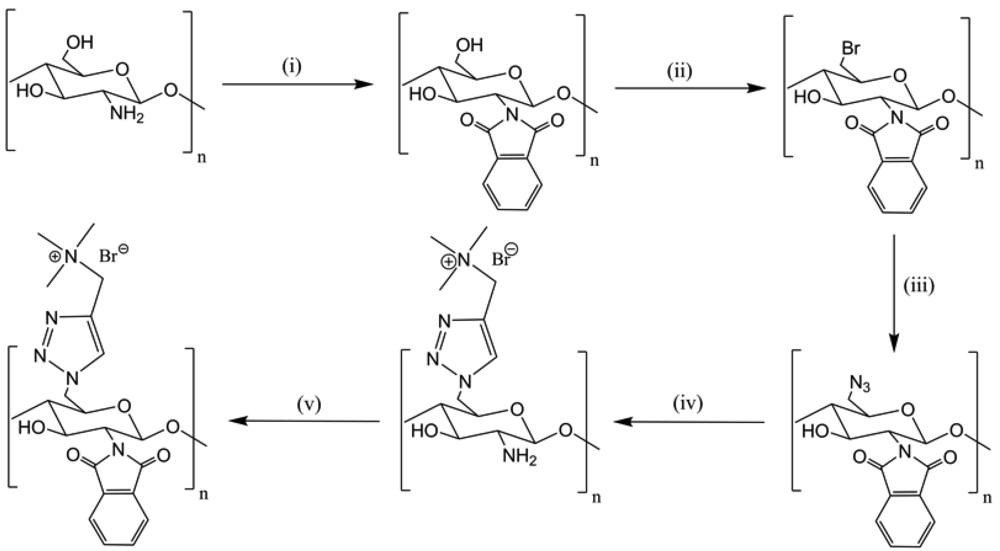
<p>“Click” reactions were done using CuSO<sub>4</sub>/NaAsc according to Li <italic>et al.</italic> [<xref ref-type="bibr" rid="b37-polymers-03-01607">37</xref>] The modification on C-6 of CS is the selective introduction of a trimethylammonium cationic group which led to the 6-<italic>N</italic>,<italic>N</italic>,<italic>N</italic>-trimethyltriazole-CS (TCs) (<xref ref-type="fig" rid="f26-polymers-03-01607">Figure 26</xref>). This product showed a good solubility in water, a strong DNA binding ability and a high protection of DNA against nuclease degradation. These results suggested that TCs could be an efficient and safe material for gene delivery by transfection.</p>
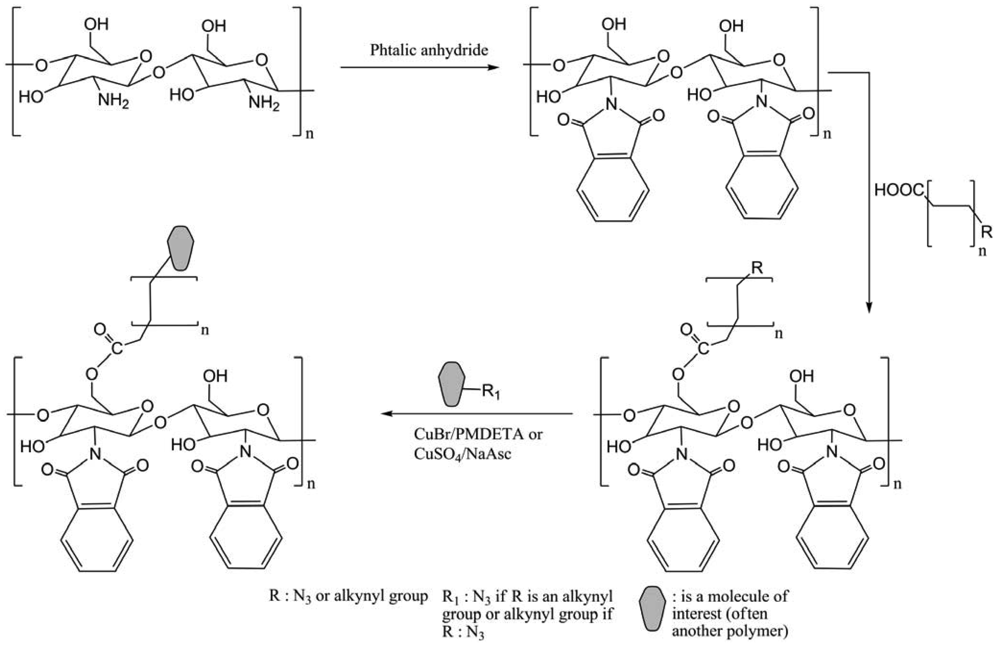
<p>The graft modification has been explored as a convenient method to overcome the insolubility of CS in common solvents and to develop multifunctional CS copolymers. These copolymers owned self-assembling properties to form polymersomes and micelles. Two positions of CS are commonly modified, NH<sub>2</sub> on position 2 and OH on position 6. For the modification of position 6, the first step is the protection of NH<sub>2</sub> (<xref ref-type="fig" rid="f27-polymers-03-01607">Figure 27</xref>). Then a second step concerns the linking of a carboxylic arm with a propargyl or azido group for “click” reaction. Finally the molecule of interest is grafted by “click” chemistry on modified CS.</p>
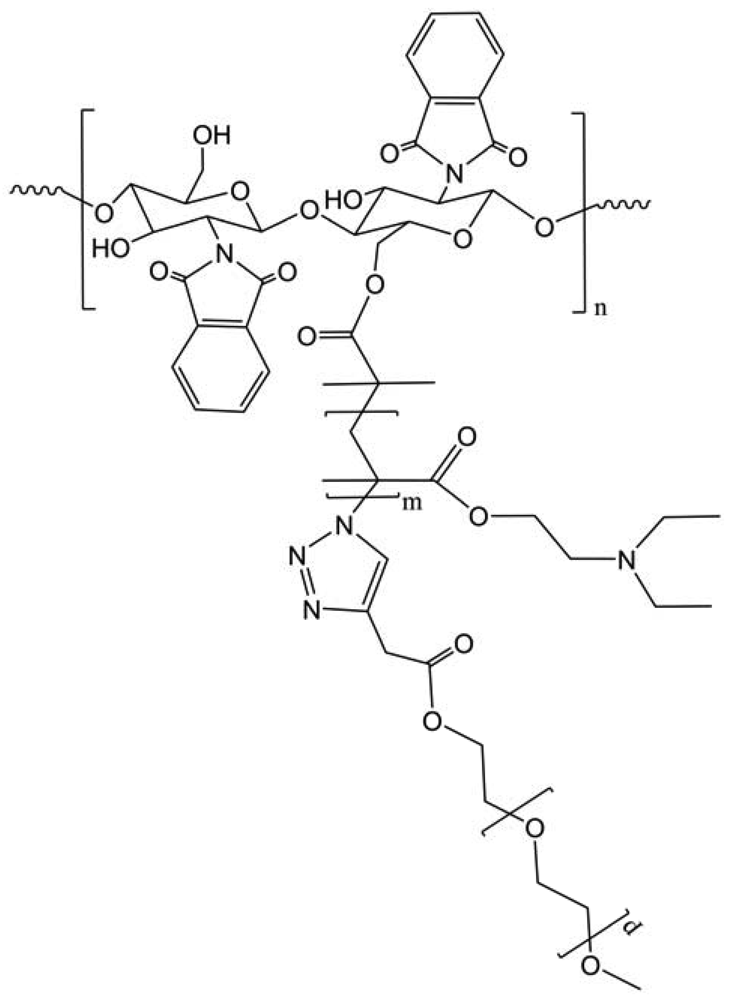
<p>Ifuku <italic>et al.</italic> developed a highly regioselective 6-substitution of chitosan derivatives using “click” chemistry, and Cu(SO<sub>4</sub>)/NaAsc as catalytic system [<xref ref-type="bibr" rid="b39-polymers-03-01607">39</xref>]. Generally, reactions were performed using CuBr/PMDETA (<italic>N</italic>,<italic>N</italic>,<italic>N</italic>′,<italic>N</italic>′,<italic>N</italic>-pentamethyldiethylenetriamine) to form CS copolymers, which all have self-assembling abilities in water to form polymersomes and micelles. Amphiphilic chitosan-<italic>graft</italic>-poly(2-(<italic>N</italic>,<italic>N</italic>-diethylamino)ethyl methacrylate)-block-poly(ethylene oxide) (CS-<italic>g</italic>-(PDEAEMA-<italic>b</italic>-PEO)) copolymer was synthesized by the combination of atom transfer radical polymerization (ATRP) and “click” chemistry (<xref ref-type="fig" rid="f28-polymers-03-01607">Figure 28</xref>) [<xref ref-type="bibr" rid="b40-polymers-03-01607">40</xref>]. The micelle sizes were adjusted through the alteration of the pH values of solutions. The presence of PEO segments improved hydrophilicity of copolymer and avoided excessive aggregation of the micelles. CS-<italic>g</italic>-(PDEAEMA<bold>-</bold><italic>b</italic>-PEO) copolymer presented both the unique properties of PDEAEMA-<italic>b</italic>-PEO and CS.</p>
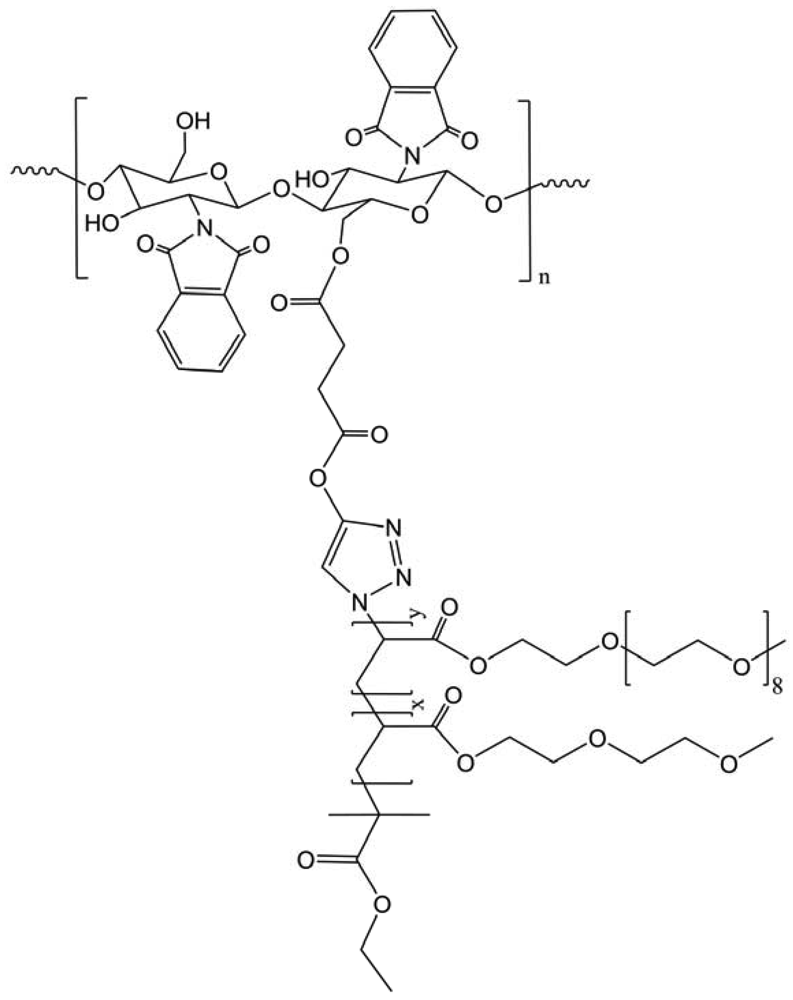
<p>Amphiphilic chitosan-graft-P(2-(2-methoxyethoxy)ethylmethacrylate-<italic>co</italic>-oligo(ethylene glycol) methacrylate) (CS-<italic>g</italic>-P(MEO<sub>2</sub>MA-<italic>co</italic>-OEGMA)) copolymers have a self-assembling behavior and tunable thermosensitive properties (<xref ref-type="fig" rid="f29-polymers-03-01607">Figure 29</xref>) [<xref ref-type="bibr" rid="b41-polymers-03-01607">41</xref>]. The lower critical solution temperature (LCST) values of CS copolymer micelle solutions were tuned by altering the molar ratio of MEO<sub>2</sub>MA and OEGMA in copolymers. Furthermore, the copolymer micelles can reversibly swell and shrink in response to external temperature. The obtained tunable thermosensitive amphiphilic CS copolymers have both the unique properties of P(MEO<sub>2</sub>MA-<italic>co</italic>-OEGMA) and chitosan.</p>
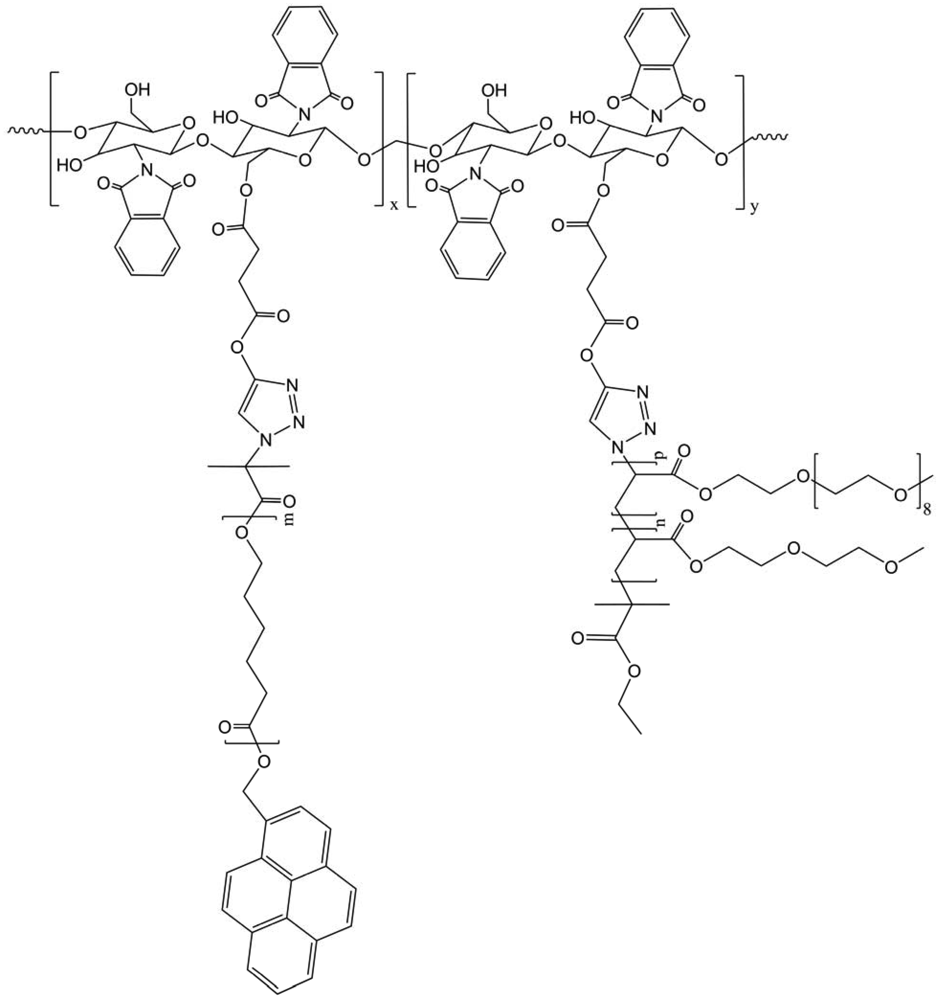
<p>Another amphiphilic chitosan-<italic>g</italic>-poly(ε-caprolactone)-(<italic>g</italic>-poly(2-(2-methoxyethoxy)ethyl methacrylate)-<italic>co</italic>-oligo(ethylene glycol) methacrylate) (CS-<italic>g</italic>-PCL(-<italic>g</italic>-P(MEO<sub>2</sub>MA-<italic>co</italic>-OEGMA))) copolymers with double side chains of PCL and P(MEO<sub>2</sub>MA-<italic>co</italic>-OEGMA) were synthesized via combination of ring-opening polymerization (ROP), ATRP and “click” chemistry (<xref ref-type="fig" rid="f30-polymers-03-01607">Figure 30</xref>) [<xref ref-type="bibr" rid="b42-polymers-03-01607">42</xref>]. As the precedent product, the micelles can reversibly swell and shrink in response to temperature, impacting the fluorescent intensity. The model drug release from the micelles indicated that the release rate of drug could be effectively controlled by altering temperature.</p>
<p>Melting, crystallization behaviors and crystalline morphology of the chistosan-<italic>g</italic>-poly(ε-caprolactone) and poly(ethylene oxide) (CS-<italic>g</italic>-PCL/PEO) copolymers were adjusted by alteration of the feed ratio of PCL and PEO segments. CS-<italic>g</italic>-PCL/PEO copolymers revealed crystalline morphology different from that of linear alkynyl PCL and alkynyl PEO due to the influence of brush structure of copolymers and the mutual influence of PCL and PEO segments (<xref ref-type="fig" rid="f31-polymers-03-01607">Figure 31</xref>) [<xref ref-type="bibr" rid="b43-polymers-03-01607">43</xref>]. Hydrophilicity of the CS copolymers was improved and adjusted by the alteration of the composition of PCL and PEO segments. Investigation showed that the size of CS copolymer micelles increased with the increase of the content of hydrophobic PCL segments in copolymers, which indicated that the micellar behavior of the copolymers can be controlled by the adjustment of the ratio of PCL and PEO segments in copolymer.</p>
<p>Starch is another substrate to create micelles. Recently, Xiao <italic>et al.</italic> synthesized a starch grafted poly(vinyl acetate) (PVAc) using CuAAC [<xref ref-type="bibr" rid="b48-polymers-03-01607">48</xref>]. Authors controlled the structure and the composition of their final compound, which may expand field of exploitation of starch/PVAc biohybrid.</p>
<p>Furthermore, in the same spirit, Huerta-Angeles <italic>et al. N</italic>-acetylated the hyaluronan and modified on position 6 [<xref ref-type="bibr" rid="b52-polymers-03-01607">52</xref>]. The obtained amide derivatives were applied as precursor for crosslinking reactions. Their modifications led to hydrogels, which might have applications in tissue engineering.</p></sec>
<sec>
<label>4.2.</label>
<title>Modification of Position 2</title>
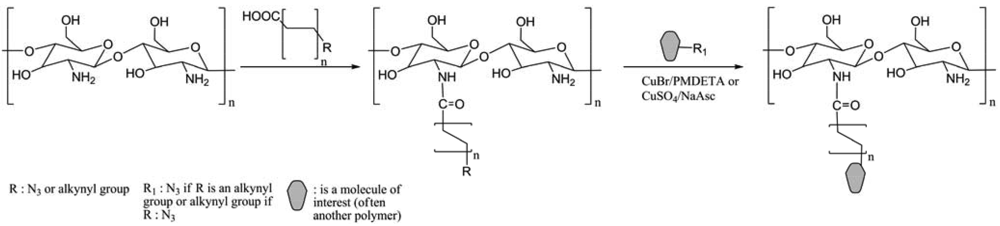
<p>For the modification of the position 2, most of the works have a common strategy of modification (<xref ref-type="fig" rid="f32-polymers-03-01607">Figure 32</xref>). The first step is to graft an azido or a propargyl arm on CS with a reaction of amidation between the amino group of CS and the carboxylic functional group (COOH) of the arm. The second step is to graft by “clicking” the molecule of interest on modified CS using CuSO<sub>4</sub>, H<sub>2</sub>O/NaAsc or SPAAC.</p>
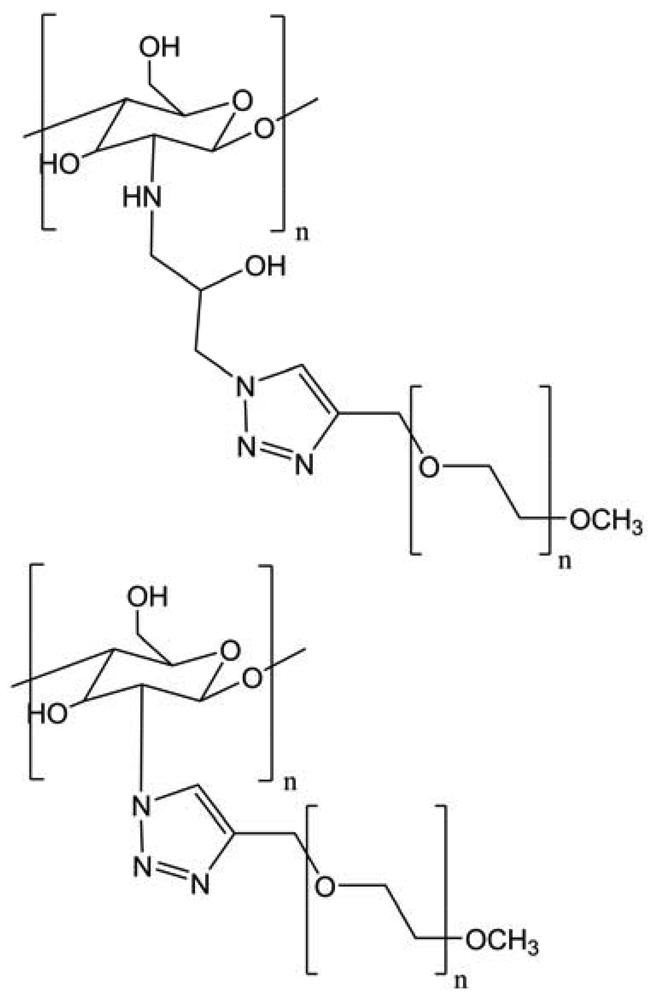
<p>The publication of Kulbokaite and colleagues, in 2009, compared the azidation of position 2 using four different ways with azidated epichlorohydrin, sodium azide, sodium nitrite, trifluoromethane sulfonyl azide or imidazole-1-sulfonyl azide hydrochloride (<xref ref-type="fig" rid="f33-polymers-03-01607">Figure 33</xref>) [<xref ref-type="bibr" rid="b38-polymers-03-01607">38</xref>]. The two last reagents are the most suitable for <italic>N</italic>-azidation of chitosan giving the degree of azidation (DA) of chitosan up to 40% and 65%, respectively. <italic>N</italic>-azidated chitosans with DA of about 60% are insoluble in aqueous and common organic solvents, but dissolve in 5% LiCl solution in <italic>N</italic>-methyl-2-pyrrolidone, which is one of the very few solvents for chitin. Chitosan-methoxy poly(ethylene glycol) derivatives containing triazolyl moiety (chitosan-<italic>N</italic>-TMPEG comb copolymers) were prepared for the first time by coupling via 1,3-dipolar cycloaddition between pendant azide and end alkyne groups of chitosan and MPEG, respectively. Comb copolymers chitosan-<italic>N</italic>-TMPEG with DS equal to DA were synthesized at a certain excess of MPEG alkyne proving “click” chemistry to be useful in exact predicting composition of the graft copolymers. “Clicking” of MPEG alkyne onto soluble azidated chitosan was successful in binary mixture of water and methylene chloride but failed in 5% LiCl solution in <italic>N</italic>-methyl-2-pyrrolidone. Significant breakdown of chitosan backbone took place under “clicking” of MPEG in the presence of Cu(II)/ascorbate catalyst resulting in graft copolymers with bimodal molecular weight distribution. Chitosan-<italic>N</italic>-TMPEG copolymers contained a certain residual amount of Cu and were soluble in acetate buffer (pH 3.7).</p>
<p>In this study, a well-defined and dually stimuli-responsive graft copolymer, CS-<italic>g</italic>-(poly(<italic>N</italic>-isopropylacrylamide) or PNIPAM, was successfully synthesized via the combination of ATRP and “click” reaction techniques (<xref ref-type="fig" rid="f34-polymers-03-01607">Figure 34</xref>) [<xref ref-type="bibr" rid="b44-polymers-03-01607">44</xref>]. The thermo-induced self-assembling behavior of the copolymer in dilute solutions was investigated in order to determine that at elevated temperatures (&gt;32 °C), the core-shell structured micelles with PNIPAM as a core and ionized CS as a shell were formed in an acidic environment (pH ∼ 4). By increasing pH at 40 °C, the uniform micelles turned into larger aggregates gradually and precipitated at pH 7. Furthermore, the cosolute effects on the low critical solution temperature (LCST) phase transition of the concentrated CS-<italic>g</italic>-PNIPAM solutions were also studied by micro differential scanning calorimetry (DSC) and UV turbidimetry.</p>
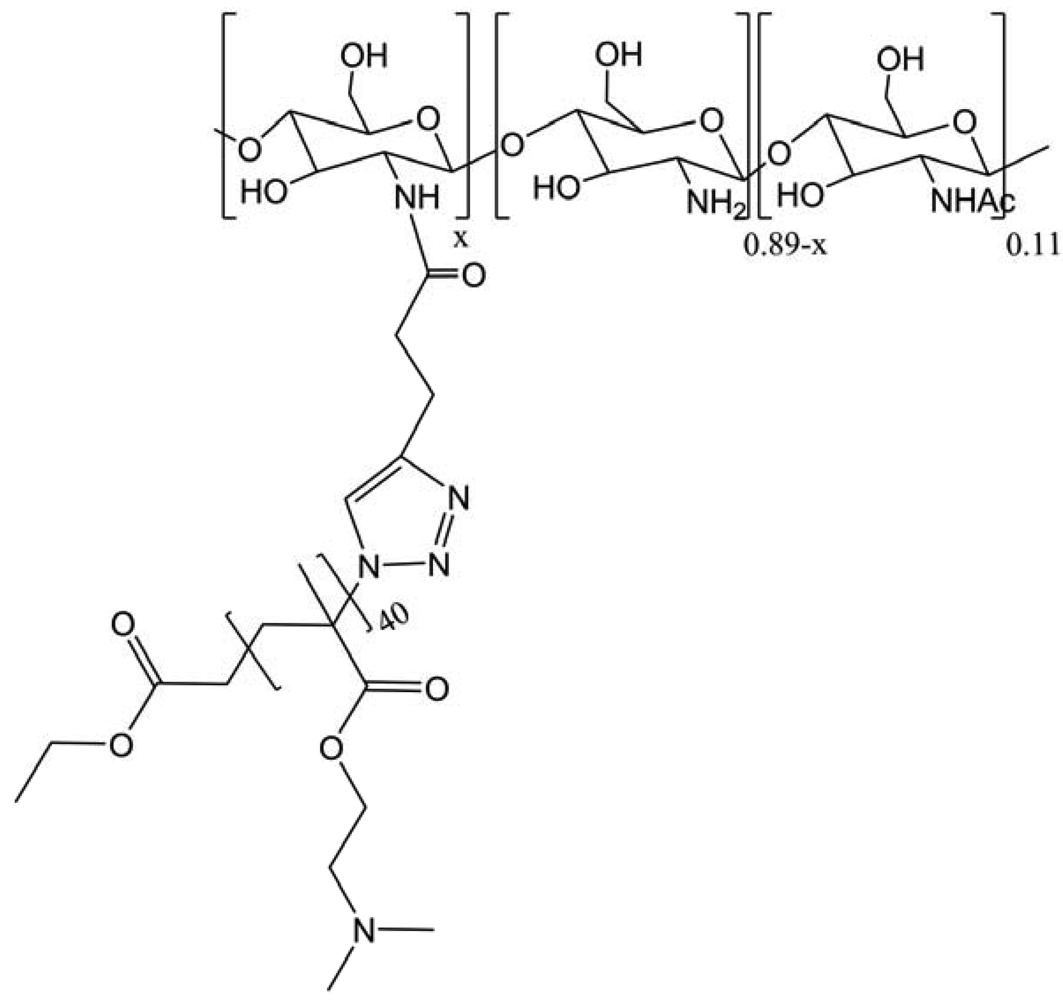
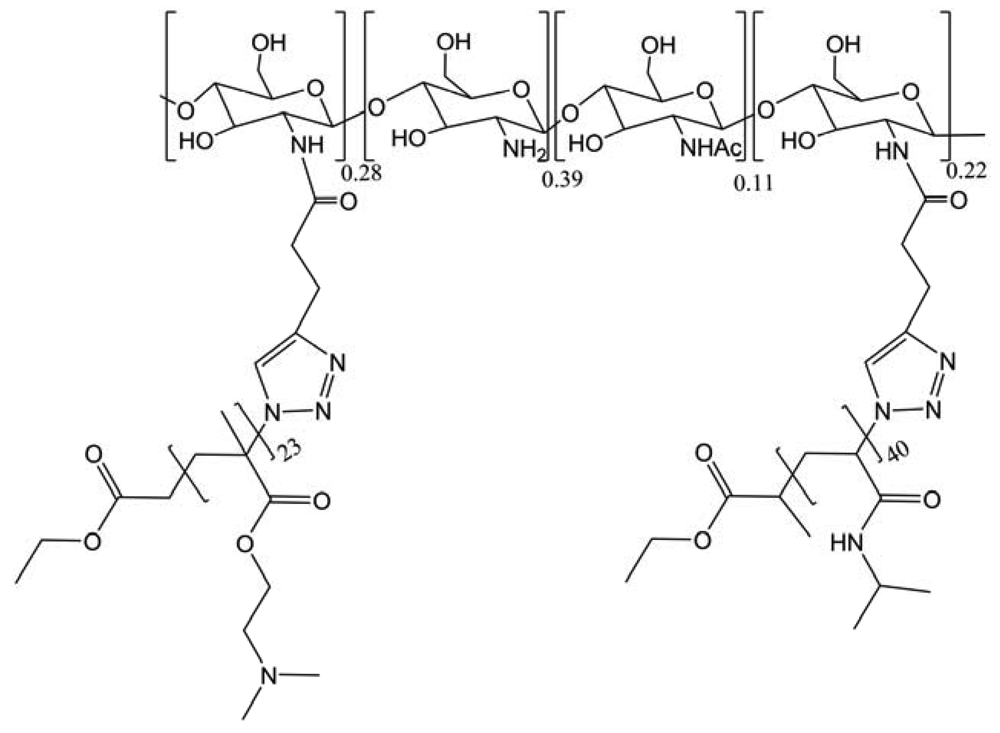
<p>In the same class of modification, a novel dually stimuli-responsive graft terpolymer, CS(-<italic>g</italic>-(poly((2-dimethylamino)ethyl methacrylate)) or PDMAEMA)-<italic>g</italic>-(poly(<italic>N</italic>-isopropylacrylamide) or PNIPAM), based on the CS derivative, was synthesized using the combination of ATRP and “click” reaction (<xref ref-type="fig" rid="f35-polymers-03-01607">Figure 35</xref>) [<xref ref-type="bibr" rid="b45-polymers-03-01607">45</xref>]. The use of ATRP not only allowed to modulate the side chains flexibly but also guaranteed their narrow molecular weight distribution, which further brought on a low polydispersity of the terpolymer. The “click” reaction taking place in the mild and homogeneous solution was proved to be an efficient coupling method to obtain a high degree of grafting on CS. The grafted terpolymer could aggregate into three-layer “onion-like” micelles at 25 °C when pH is above 7. Moreover, spherical micelles with PNIPAM cores were obtained around 40 °C in acidic solution (pH &lt; 4). Most importantly, switching between different types of aggregates and unimers can be reversibly achieved by properly tuning pH and temperature of the aqueous solutions. This work represents the first example of nonlinear dual hydrophilic CS copolymer showing the micellization behavior.</p>
<p>Some other work used the SPAAC in order to avoid copper salts that have two major side effects to polysaccharides: depolymerization and contamination [<xref ref-type="bibr" rid="b46-polymers-03-01607">46</xref>]. So in order to perform selective functionalization of polysaccharides based system, the use of SPAAC appears as an efficient alternative that eliminates the requirement of Cu(I). In this context, the application of SPAAC for the efficient decoration of CS-<italic>g</italic>-PEG nanostructures with an IgG under physiological conditions represents a step forward in the development of environmentally friendly bioconjugation technologies for the preparation of immunonanoparticles. The very recent enhancement of the SPAAC rate to values comparable to that of CuAAC, by appending propargylic fluorine atoms or fused phenyl rings to the cyclooctyne probe, suggests a rich future for SPAAC in nanotechnology and materials science.</p>
<p>Recently, Zhang <italic>et al.</italic> used CS to form microcapsules composed of a multilayer CS. These layers were obtained by “click” reaction using CaCO<sub>3</sub>. They obtained a versatile platform for designing novel vehicles with applications in targeted drug delivery field, particularly in liver [<xref ref-type="bibr" rid="b47-polymers-03-01607">47</xref>].</p></sec>
<sec>
<label>4.3.</label>
<title>Modification of Position 1</title>
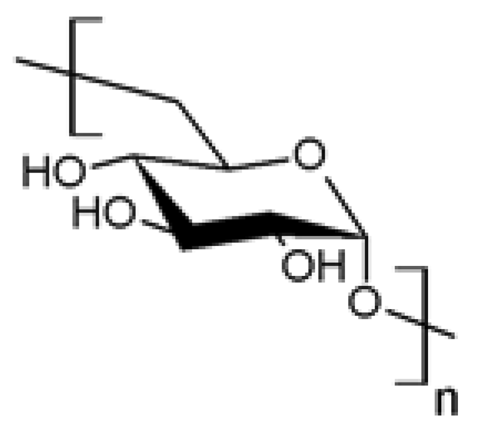
<p>In the same field of application, but with another polysaccharide, dextran is here modified on the first position in this work to form a polysaccharide block-polypeptide (<xref ref-type="fig" rid="f36-polymers-03-01607">Figure 36</xref>) [<xref ref-type="bibr" rid="b32-polymers-03-01607">32</xref>]. Dextran is a water-soluble microbial polysaccharide composed of <sub>D</sub>-glucopyranose units linked by α(1-6) glycosidic bonds with a low percentage of (1-3)-linked side chains. The polypeptide used as a model is a poly(γ-benzyl <sub>L</sub>-glutamate). This kind of compound has a real ability to self-assemble into small vesicles, which could be used to construct a new generation of drug and gene-delivery systems with high affinities for the surface glycoproteins of living cells. It has also been noted previously that the structure and properties of polymersomes are similar to those of viral capsids.</p>
<p>Another polysaccharide was used and consisted of block copolymers composed of a polypeptide segment and hyaluronan (<xref ref-type="fig" rid="f36-polymers-03-01607">Figure 36</xref>) [<xref ref-type="bibr" rid="b53-polymers-03-01607">53</xref>]. This polysaccharide with its hydrophilic stabilizing block, combined with its specific ligand properties to CD44 glycoprotein receptors that are overexpressed in many cancers, provides a means to obtain a synergy between structure and biofunctionality within a single material.</p>
<p>Another polysaccharides modification on position 1 was performed using glycans, commonly used to hide from the defense mechanism of cells' medical active polypeptide [<xref ref-type="bibr" rid="b54-polymers-03-01607">54</xref>].</p>
<p>Here, Yamaguchi and co-workers performed the preparation of an alkyne containing chondroitin 6 sulfate (ChS) using an enzymatic method and synthesized an azido group containing polyethylene glycol or bovine serum albumin (<xref ref-type="fig" rid="f37-polymers-03-01607">Figure 37</xref>). These compounds were used for “click” chemistry to form neoproteoglycans. Biological assays employing these neo-proteoglycans are now under investigation.</p>
<p>Another ChS-conjugated therapeutic peptides and proteins can be made to acquire resistance to proteolysis, which would improve their performance as medicines from two viewpoints (<xref ref-type="fig" rid="f38-polymers-03-01607">Figure 38</xref>) [<xref ref-type="bibr" rid="b55-polymers-03-01607">55</xref>]. First, their resistance to proteolysis would extend their biological halflife, and second, their binding to specific tissues would enable them to deliver drugs precisely to a target site. Thus, addition of ChS would improve the biopharmaceutical properties of drugs. The approach proposed here will be broadly used for utilization of ChS.</p>
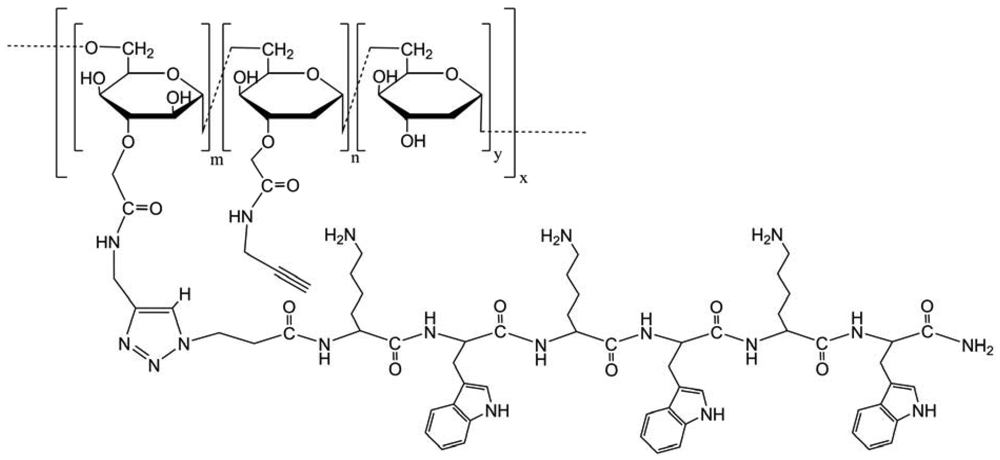
<p>After the modification of the positions 2, 6 and 1, Zhong <italic>et al.</italic> modified the position 3 on dextran. This modification aims to synthesize a polyvalent lytic peptide-polymer conjugate Dex-(KW)<sub>3</sub> (<xref ref-type="fig" rid="f39-polymers-03-01607">Figure 39</xref>) [<xref ref-type="bibr" rid="b33-polymers-03-01607">33</xref>]. The new conjugate showed significantly enhanced activity against cancer cells compared to monomeric peptides, and the anticancer activity was not affected by the acquisition of multidrug resistance in cancer cells. The detrimental effect on erythrocytes was negligible. The encouraging <italic>in vitro</italic> data showed the potential of this new conjugate for systemic treatment against drug-resistant cancer. For the first time, the mechanism of polyvalency-mediated activity enhancement of lytic peptides was investigated by quantitative thermodynamic study. At the same bulk concentration, the polyvalent conjugate caused a stronger perturbation of membrane structure, which should be attributed to the increased local concentration of peptides in a polyvalent conjugate.</p></sec></sec>
<sec>
<label>5.</label>
<title>Diagnostic Agents</title>
<p>In biological systems, a wide range of polysaccharides plays an important role. Usually known as glycans, these macromolecules are present in various complex structures: independent polysaccharides, glycoproteins, glycolipids and some glycoconjugates with small molecules. These glycans are involved in many physiological events (fertilization, development, immunity, inflammation, <italic>etc.</italic>) and in pathophysiological phenomena (<italic>i.e.</italic>, viral entry, bacteria-host interactions and tumor progression) [<xref ref-type="bibr" rid="b63-polymers-03-01607">63</xref>]. The importance in biological systems relies on the structural heterogeneity of glycans. Indeed, this diversity is the result of chemical properties of saccharides, which compose the glycans (composition amongst nine different hexoses, anomeric linkage, regio-linkage, branching) and of auxiliary chemical modifications (sulfation, phosphorylation, acetylation, methylation and epimerization) [<xref ref-type="bibr" rid="b63-polymers-03-01607">63</xref>]. All of the biosynthetic processes are non-templated and glycans are often bound to lipid or protein scaffolds, render small quantities, difficult to isolate. These factors make the comprehension of glycans synthesis and roles very difficult. In order to avoid these difficulties, glycans need to be directly visualized <italic>in vivo</italic>, by biocompatible and fast processes.</p>
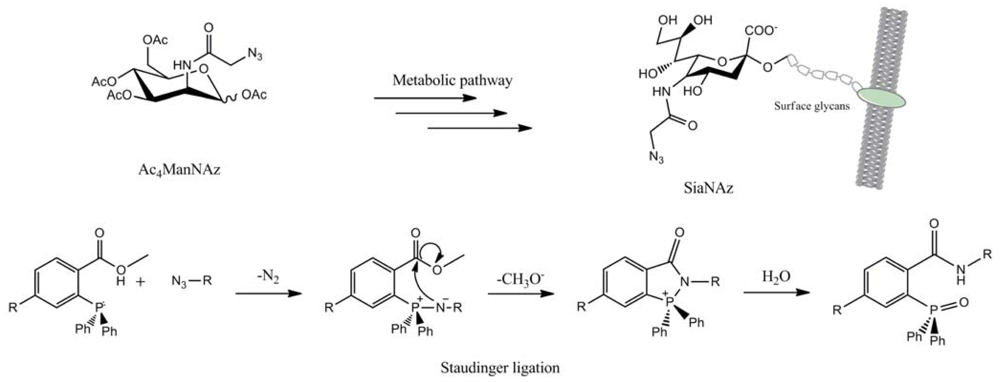
<p>In this regard, the works on Staudinger ligation made by Bertozzi and co-workers are prominent [<xref ref-type="bibr" rid="b64-polymers-03-01607">64</xref>]. A unnatural azido-sugar, the peracetylatedazidoacetylmannosamine (Ac<sub>4</sub>ManNAz), was metabolically modified into the corresponding <italic>N</italic>-azidoacetylsialic acid (SiaNAz) and incorporated into the cell's glycans. Thus, these cells were incubated with a biotinylatedtriphenylphosphine and the Staudinger ligation led to an amide bond between the marked surface glycans and the phosphine (<xref ref-type="fig" rid="f40-polymers-03-01607">Figure 40</xref>). The introduction of fluorescein isothiocyanate (FITC)–avidin allowed the visualization of surface glycans by fluorescence.</p>
<p>This process does not affect the cell viability and the ligation can be realized within three hours. This progress in <italic>in vivo</italic> engineering, even applied on living animals [<xref ref-type="bibr" rid="b65-polymers-03-01607">65</xref>], has some drawbacks as this is a pH-dependent reaction and the triphenylphosphines are binding to use (air oxidation, poor water solubility and limited reaction rate).</p>
<p>In parallel, “click” chemistry was developed, especially the CuAAC, and was widely used throughout numerous fields of chemistry. The CuAAC was applied to biological systems such as virus particles [<xref ref-type="bibr" rid="b65-polymers-03-01607">65</xref>] and <italic>Escherichia coli</italic> cells [<xref ref-type="bibr" rid="b66-polymers-03-01607">66</xref>-<xref ref-type="bibr" rid="b69-polymers-03-01607">69</xref>] quite early on. Considering that the harmless introduction of modified sugars in glycans had already been studied, [<xref ref-type="bibr" rid="b70-polymers-03-01607">70</xref>,<xref ref-type="bibr" rid="b71-polymers-03-01607">71</xref>] the “click” chemistry was naturally employed for its mild conditions and its short reaction time. At this time, two ways were offered to “click” glycans in biological systems: the CuAAC or the SPAAC.</p>
<sec>
<label>5.1.</label>
<title>The CuAAC Guide to Label Glycans</title>
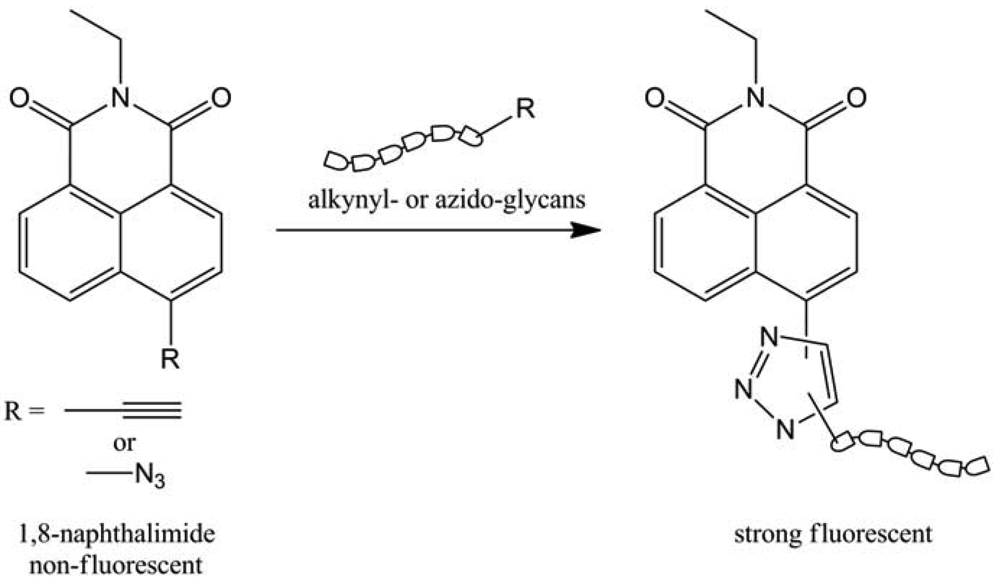
<p>In order to label glycans, CuAAC was first used by Wong and colleagues [<xref ref-type="bibr" rid="b72-polymers-03-01607">72</xref>] by developing a “click”-activated fluorescent labeling technique. They tried to investigate and to visualize the fucosylation in Jurkat cancer cells' glycans. They used the triazole formation generated by CuAAC to activate the fluorescence of 1,8-naphtalimide derivatives (<xref ref-type="fig" rid="f41-polymers-03-01607">Figure 41</xref>).</p>
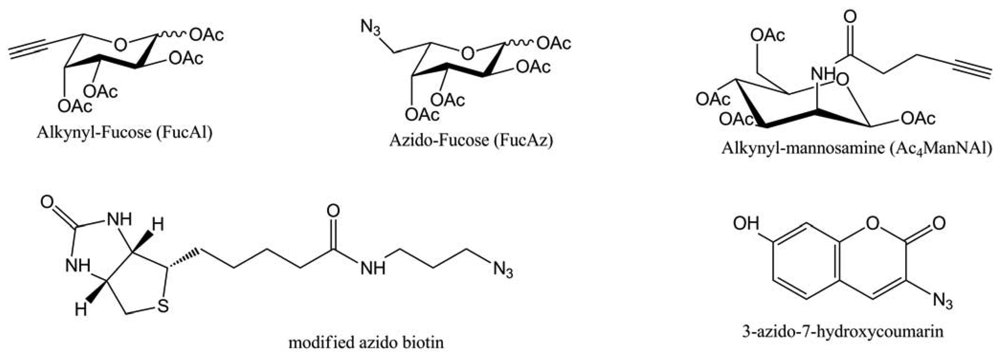
<p>The well-known toxicity of copper was decreased (but not avoided) by the introduction of a tris-(triazoleamine) ligand and the copper sources were CuBr, or CuSO<sub>4</sub> reduced by sodium ascorbate. Thanks to this process, they managed to visualize fucosylated glycans at the cell surface and inside the cell by fluorescence, with a two-steps method: introduction of azido-fucose and <italic>in-situ</italic> “click” chemistry. In the line of this work, this team extended this method to other modified sugars, probes (<xref ref-type="fig" rid="f42-polymers-03-01607">Figure 42</xref>) and on two more cancer cell lines: Hep3B and MCF-7 [<xref ref-type="bibr" rid="b73-polymers-03-01607">73</xref>].</p>
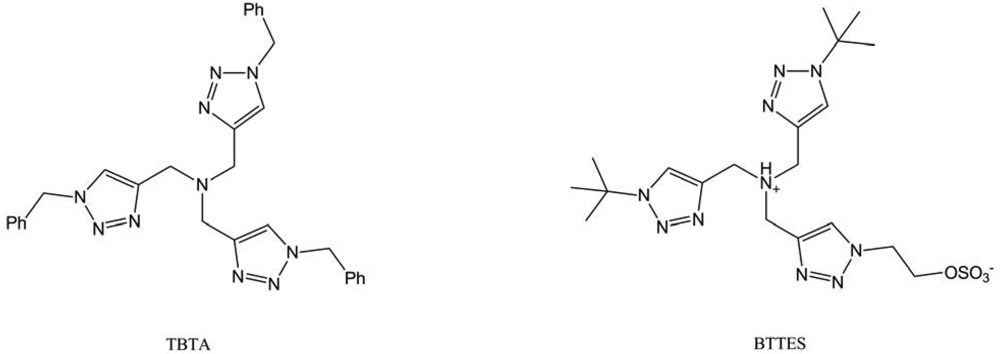
<p>This time, they compared the “click”-generated fluorescence of 3-azido-7-hydroxycoumarine with the immunomarked fluorescence of azido-biotin. The two systems led to equivalent signals, proving the interest of designing “click”-activated probes, which requires fewer steps (one less incubation and no washing step). Nevertheless, the major issue in this method is the use of cytotoxic copper, even in the presence of ligand like the tris-[(1-benzyl-1<italic>H</italic>-1,2,3-triazol-4-yl) (TBTA). That's why Wu and co-workers tried to improve these tris-triazoleamine ligands by screening their water solubility and their reactivity [<xref ref-type="bibr" rid="b74-polymers-03-01607">74</xref>]. The best ligand, called BTTES (<xref ref-type="fig" rid="f43-polymers-03-01607">Figure 43</xref>), allowed avoiding cell death due to copper presence and did not seem to affect cells proliferation rate. This was tested on four cancer cell lines (Jurkat, CHO, HEK and LNCaP) and on Zebrafish embryos.</p>
<p>Even in CuAAC conditions, this ligand greatly decreased copper toxicity (development abnormalities in Zebrafish embryos are only observed four days after “click” reaction) and led to very fast reaction (within minutes).</p>
<p>To sum up, the CuAAC has proven its efficiency in biological systems, labeling glycans in a short time. The strength of this “CuAAC way” is the wide range of possibilities in markers synthesis and the “click”-generated fluorescence, conducted by small bio-compatible molecules, limits the steps necessary to visualize glycans. Thus, progress in copper ligation nearly avoided the cytotoxic effect of catalyst. All of these parameters still need to be improved and further applications in biological systems, like living animals, are not yet demonstrated.</p></sec>
<sec sec-type="discussion">
<label>5.2.</label>
<title>The Impact of SPAAC</title>
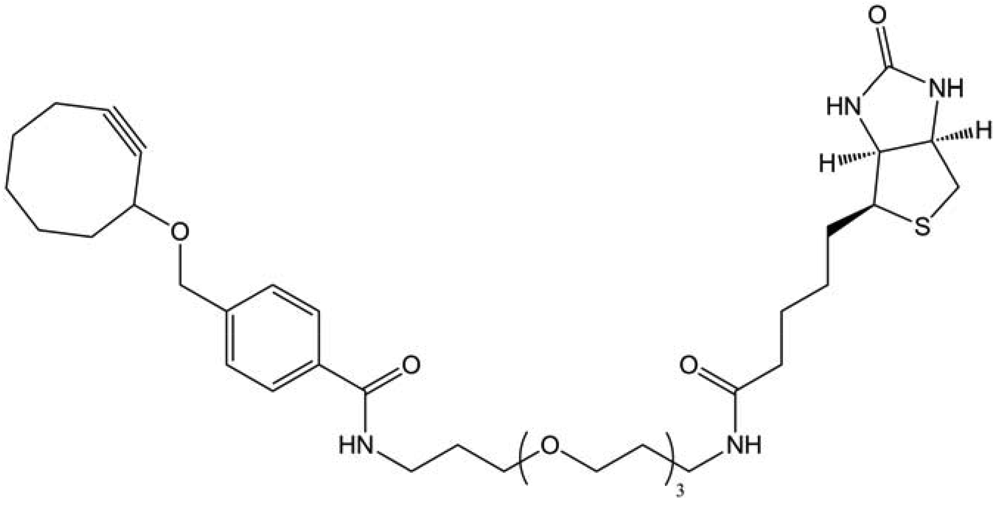
<p>The first attempt to “click” glycans in living systems was made by Bertozzi and co-workers [<xref ref-type="bibr" rid="b13-polymers-03-01607">13</xref>], by using the strain-promoted azide-alkyne cycloaddition. They introduced SiaNAz in Jurkat cells glycans, as described previously in Staudinger ligation, and made the cycloaddition thanks to a biotinylated cyclooctyne (<xref ref-type="fig" rid="f44-polymers-03-01607">Figure 44</xref>).</p>
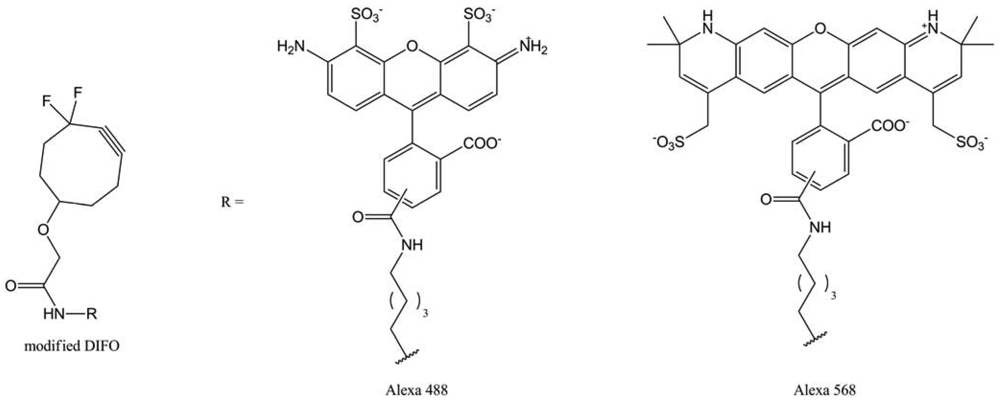
<p>This method seemed to be faster than the Staudinger ligation one (within 1.5 h), but the mean fluorescence is half as efficient. Cells viability did not seem to be affected as there was no use of toxic copper catalyst. These encouraging results, led Bertozzi's team to develop new cyclooctyne markers, including fluorescent moieties [<xref ref-type="bibr" rid="b75-polymers-03-01607">75</xref>]. They employed modified DIFOs, because of their high reaction rate, due to the electron-withdrawing effect of the difluoromethylene group (<xref ref-type="fig" rid="f45-polymers-03-01607">Figure 45</xref>).</p>
<p>This time, the SPAAC-labeling, using these DIFOs, was about 20-times more efficient than the Staudinger ligation. This short reaction time opened the way to dynamic labeling. Bertozzi <italic>et al.</italic> synthesized two new DIFO derivatives with different fluorescent moieties (Alexa Fluor 488 and Alexa Fluor 568). Then, they proceeded to a two-step labeling: they labeled cells bearing SiaNAz residues with DIFO-488, reincubated it with Ac<sub>4</sub>ManNAz and realized a second labeling with DIFO-568. With this method, they were able to visualize the glycan trafficking from the cells internal compartments to the lysosomes, suggesting this labeling protocol did not disturb this biological phenomenon. However, the major limit of this method was the DIFO synthesis, which is conducted in 12 steps with an overall yield of 1%.</p>
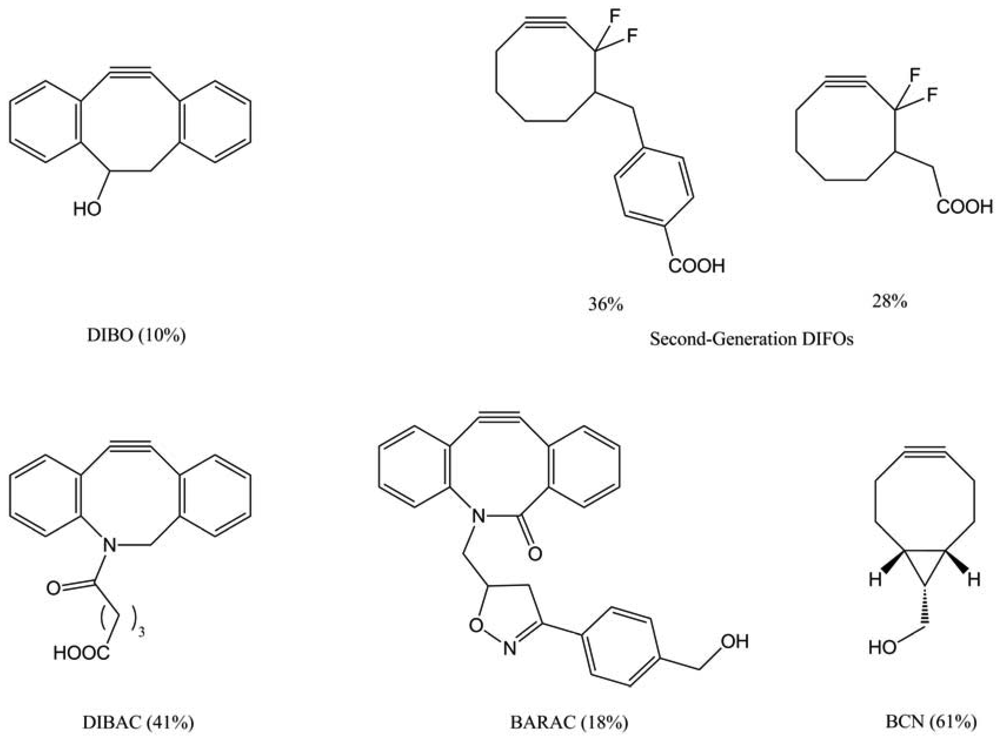
<p>Boons and co-workers proposed another type of cyclooctynes: dibenzocyclooctynes (DIBO) [<xref ref-type="bibr" rid="b76-polymers-03-01607">76</xref>]. In that case, a four-step synthesis yielded the desired compound in 10%, but the DIBO-labeling conduced to a less important mean fluorescence than DIFO. In parallel, Bertozzi and colleagues developed another generation of DIFO, which possessed a C-C bond to a linker substituent at C-4, rather than a C-O bond at C6 (<xref ref-type="fig" rid="f46-polymers-03-01607">Figure 46</xref>). They synthesized two of these second-generation DIFOs in 28% and 36% overall yield for six steps. These novel reagents can selectively tag azide-labeled glycans with efficiencies approaching that of the first generation DIFOs. We can also report the synthesis of the dibenzoazacyclooctyne (DIBAC) [<xref ref-type="bibr" rid="b77-polymers-03-01607">77</xref>], obtained in an overall yield of 41% over 9 steps, and the synthesis of biarylazacyclooctynone (BARAC) [<xref ref-type="bibr" rid="b78-polymers-03-01607">78</xref>] conducted in 6 steps to a lesser overall yield of 18%. More recently, Van Delft and co-workers [<xref ref-type="bibr" rid="b79-polymers-03-01607">79</xref>] described the synthesis of a promising bicyclononyne (BCN) issued by a short synthetic route (4 steps) with only two purifications in an overall yield of 61%. The BCN-labeling showed interesting results, with a higher reactivity than the other cyclooctynes and a very good sensitivity.</p>
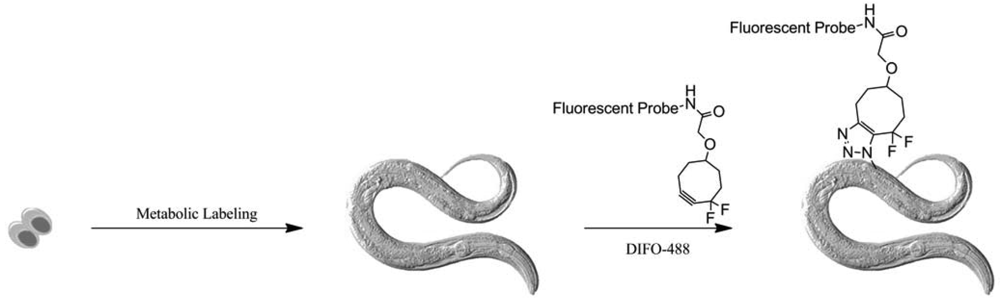
<p>In the meantime, Bertozzi and co-workers pursued the extension of her method to other biological systems. First, they used Alexa Fluor combined first-generation DIFO (DIFO-488 and -568) to visualize glycans in <italic>C. Elegans</italic> (<xref ref-type="fig" rid="f47-polymers-03-01607">Figure 47</xref>) [<xref ref-type="bibr" rid="b80-polymers-03-01607">80</xref>]. As we saw earlier, they applied the two-color labeling strategy to observe the glycans biosynthesis from larval stage to adulthood.</p>
<p>No toxicity was observed during this process and labeling showed some good results at the larval stages. However, in adult stage, only the organs accessible to solutions are readily labeled by DIFO, highlighting their limited penetrance into the organism.</p>
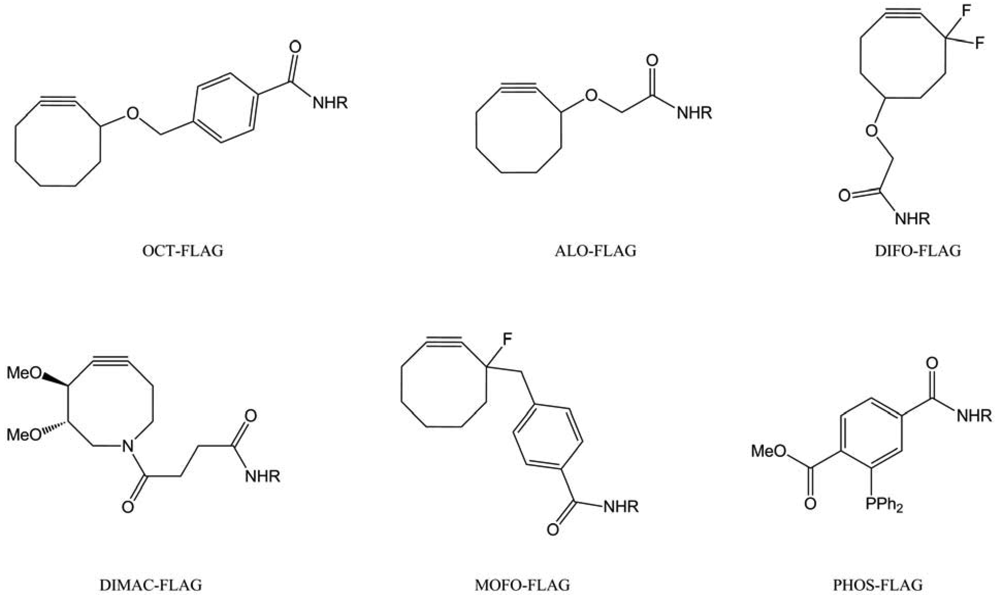
<p>Finally, the SPAAC was investigated on more complex living system: mice [<xref ref-type="bibr" rid="b82-polymers-03-01607">82</xref>]. In this study, the “chemical reporters” were the unnatural azido-sugar Ac<sub>4</sub>ManNAz and several cyclooctynes (<xref ref-type="fig" rid="f48-polymers-03-01607">Figure 48</xref>) have been used, conjugated to a small peptide (FLAG). This FLAG peptide allowed further analysis thanks to anti-FLAG antibody.</p>
<p>Attempts with OCT-FLAG and MOFO-FLAG were not conductive to any labeling, showing its poor water solubility and lesser reactivity. The ALO-FLAG only weakly labeled intestines; meanwhile DIMAC- and DIFO-FLAG tagged all of the harvested organs (intestines, liver and heart). In comparison, PHOS-FLAG appears to access the same organs. The DIFO-FLAG proved to be the best cyclooctyne to label modified glycans, due to its high reactivity, but it also had a high affinity to serum albumin, which compromised its bioavailability.</p>
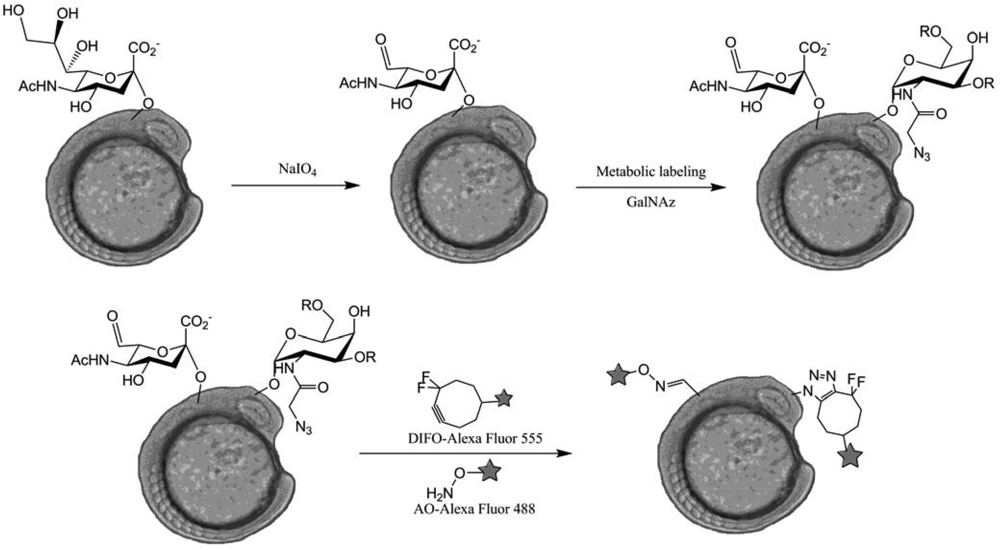
<p>The most advanced work on SPAAC labeling was conducted by Bertozzi <italic>et al.</italic> [<xref ref-type="bibr" rid="b82-polymers-03-01607">82</xref>] as they managed to directly visualize glycans in membrane cells of zebrafish embryos during their development. Injection of Ac<sub>4</sub>GalNAz combined with a DIFO-fluorophore conjugates labeling led to very interesting observations about <italic>O</italic>-glycans distribution in zebrafish embryos. They were able to proceed to a simultaneous visualization of two types of glycans using two independent labeling: the <italic>O</italic>-glycans labeling, using DIFO, and the sialic acid labeling, using NaIO<sub>4</sub> and aminooxy fluorophores (AO) (<xref ref-type="fig" rid="f49-polymers-03-01607">Figure 49</xref>).</p>
<p>Their experiments validate the ability of using two independent chemistries to visualize different classes of glycan in the same organism. Moreover, a time-lapse monitoring of mitotic cells showed a very fast reorganization of membrane <italic>O</italic>-glycans to the cleavage furrow. In order to visualize the glycans trafficking during this phenomenon, they tried to apply the two-color labeling on that case but the observed reorganization took place on a faster scale than that of the labeling protocol.</p>
<p>In conclusion, SPAAC used in glycans imaging is now at an advanced stage and has been applied to various biological models: cultured cells, zebrafish embryos, nematodes or mice. Despite all of these progresses, the SPAAC labeling suffers from the difficult cyclooctynes synthesis and design (reactivity and poor water solubility). The real stake of this labeling way relies on organic chemistry and one of these challenges will be the design of “click”-generated fluorescent cyclooctynes.</p></sec></sec>
<sec sec-type="conclusions">
<label>6.</label>
<title>Conclusions</title>
<p>Over the past ten years, polysaccharides have been clearly impacted by “click” chemistry, and particularly by the CuAAC and SPAAC. Among the early work on polyoses, few different scientific areas were involved, such as materials, therapeutics, or diagnostic agents. In several cases, a functionalization approach was considered, often leading to the issue of regioselectivity in polymer chemistry; leading to the interrogation whether to “click” or not to “click” on polysaccharides. The answer might well be yes, but not forgetting that the click concept should be ideally applicable to all the reaction steps, and not only to the cycloaddition step. Finally the first studies of the use of “simple” reactions on polysaccharides are just emerging, and the combination of new “click” reactions to specific polysaccharides could open a wide field of discovery in future research.</p></sec></body>
<back>
<sec sec-type="display-objects">
<title>Figures and Table</title>
<fig id="f1-polymers-03-01607" position="float">
<label>Figure 1.</label>
<caption>
<p>Cu-catalyzed azide-alkyne cycloaddition [<xref ref-type="bibr" rid="b2-polymers-03-01607">2</xref>-<xref ref-type="bibr" rid="b4-polymers-03-01607">4</xref>].</p></caption>
<graphic xlink:href="polymers-03-01607f1.gif"/></fig>
<fig id="f2-polymers-03-01607" position="float">
<label>Figure 2.</label>
<caption>
<p>Reagents used in the copper-free azide-alkyne “click”-reaction [<xref ref-type="bibr" rid="b13-polymers-03-01607">13</xref>,<xref ref-type="bibr" rid="b14-polymers-03-01607">14</xref>].</p></caption>
<graphic xlink:href="polymers-03-01607f2.gif"/></fig>
<fig id="f3-polymers-03-01607" position="float">
<label>Figure 3.</label>
<caption>
<p>Copper catalyzed azide/alkyne cycloaddition (CuAAC): a route to <italic>N</italic>-benzyltriazole derivatized starch [<xref ref-type="bibr" rid="b49-polymers-03-01607">49</xref>].</p></caption>
<graphic xlink:href="polymers-03-01607f3.gif"/></fig>
<fig id="f4-polymers-03-01607" position="float">
<label>Figure 4.</label>
<caption>
<p>Copper catalyzed azide/alkyne cycloaddition (CuAAC) between 2-azido-2-deoxycellulose and phenyl-, (phenyl)alkyl-, and alkylacetylenes. Reagents and conditions: (<bold><italic>i</italic></bold>) 4.0 equiv. of Ph(CH<sub>2</sub>)<sub>x</sub>CCH (x = 0, 1, 2 or 3), CuI, DMSO, 8–100 °C, 48–60 h, 8–90%; (<bold><italic>ii</italic></bold>) 4.0–10.0 equiv. of Me(CH<sub>2</sub>)<sub>x</sub>CCH (x = 2, 3, 4, or 5), CuI, DMSO, 60–100 °C, 5–72 h, 8–93% [<xref ref-type="bibr" rid="b34-polymers-03-01607">34</xref>].</p></caption>
<graphic xlink:href="polymers-03-01607f4.gif"/></fig>
<fig id="f5-polymers-03-01607" position="float">
<label>Figure 5.</label>
<caption>
<p>Copper catalyzed azide/alkyne cycloaddition (CuAAC) between 6-azido-6-deoxycurdlan and alkyne-terminated functional modules. Reagents and conditions: (<bold><italic>i</italic></bold>) P(Ph)<sub>3</sub>, DMF, LiCl, RT, 3 h, then CCl<sub>4</sub>, 60 °C, 24 h; (<bold><italic>ii</italic></bold>) NaN<sub>3</sub>, Me<sub>2</sub>SO, 80 °C, 36 h; (<bold><italic>iii</italic></bold>) alkyne-terminated functional modules, CuBr<sub>2</sub>, ascorbic acid, propylamine, RT, 12 h, Me<sub>2</sub>SO or NMP [<xref ref-type="bibr" rid="b56-polymers-03-01607">56</xref>].</p></caption>
<graphic xlink:href="polymers-03-01607f5.gif"/></fig>
<fig id="f6-polymers-03-01607" position="float">
<label>Figure 6.</label>
<caption>
<p>Preparation of 6-azido-6-deoxycellulose and subsequent CuAAC [<xref ref-type="bibr" rid="b15-polymers-03-01607">15</xref>].</p></caption>
<graphic xlink:href="polymers-03-01607f6.gif"/></fig>
<fig id="f7-polymers-03-01607" position="float">
<label>Figure 7.</label>
<caption>
<p>Reaction scheme for preparation of cellulose grafted with coumarins [<xref ref-type="bibr" rid="b23-polymers-03-01607">23</xref>].</p></caption>
<graphic xlink:href="polymers-03-01607f7.gif"/></fig>
<fig id="f8-polymers-03-01607" position="float">
<label>Figure 8.</label>
<caption>
<p>Synthesis of propargyl-dendrons (PAMAM)-triazolo-cellulose derivatives in ionic liquid [<xref ref-type="bibr" rid="b16-polymers-03-01607">16</xref>].</p></caption>
<graphic xlink:href="polymers-03-01607f8.gif"/></fig>
<fig id="f9-polymers-03-01607" position="float">
<label>Figure 9.</label>
<caption>
<p>Second PAMAM-triazolo-cellulose derivatives [<xref ref-type="bibr" rid="b19-polymers-03-01607">19</xref>].</p></caption>
<graphic xlink:href="polymers-03-01607f9.gif"/></fig>
<fig id="f10-polymers-03-01607" position="float">
<label>Figure 10.</label>
<caption>
<p>Synthesis of PAMAM-triazolo-cellulose derivatives with water-soluble deoxy-azidocellulose derivatives [<xref ref-type="bibr" rid="b17-polymers-03-01607">17</xref>].</p></caption>
<graphic xlink:href="polymers-03-01607f10.gif"/></fig>
<fig id="f11-polymers-03-01607" position="float">
<label>Figure 11.</label>
<caption>
<p>Synthesis of PAMAM-triazolo-cellulose derivatives with 3-<italic>O</italic>-propargyl cellulose [<xref ref-type="bibr" rid="b28-polymers-03-01607">28</xref>].</p></caption>
<graphic xlink:href="polymers-03-01607f11.gif"/></fig>
<fig id="f12-polymers-03-01607" position="float">
<label>Figure 12.</label>
<caption>
<p>Synthesis of an azido cellulose and polyacrylamide based composite gel [<xref ref-type="bibr" rid="b18-polymers-03-01607">18</xref>].</p></caption>
<graphic xlink:href="polymers-03-01607f12.gif"/></fig>
<fig id="f13-polymers-03-01607" position="float">
<label>Figure 13.</label>
<caption>
<p>Synthesis of chitosan based gel [<xref ref-type="bibr" rid="b35-polymers-03-01607">35</xref>].</p></caption>
<graphic xlink:href="polymers-03-01607f13.gif"/></fig>
<fig id="f14-polymers-03-01607" position="float">
<label>Figure 14.</label>
<caption>
<p>Synthesis of cellulose based gel [<xref ref-type="bibr" rid="b27-polymers-03-01607">27</xref>].</p></caption>
<graphic xlink:href="polymers-03-01607f14.gif"/></fig>
<fig id="f15-polymers-03-01607" position="float">
<label>Figure 15.</label>
<caption>
<p>Synthesis of guar based gel [<xref ref-type="bibr" rid="b50-polymers-03-01607">50</xref>].</p></caption>
<graphic xlink:href="polymers-03-01607f15.gif"/></fig>
<fig id="f16-polymers-03-01607" position="float">
<label>Figure 16.</label>
<caption>
<p>Synthesis of biological hydrogel [<xref ref-type="bibr" rid="b51-polymers-03-01607">51</xref>].</p></caption>
<graphic xlink:href="polymers-03-01607f16.gif"/></fig>
<fig id="f17-polymers-03-01607" position="float">
<label>Figure 17.</label>
<caption>
<p>Synthesis of cellulose-based hydrogel [<xref ref-type="bibr" rid="b26-polymers-03-01607">26</xref>].</p></caption>
<graphic xlink:href="polymers-03-01607f17.gif"/></fig>
<fig id="f18-polymers-03-01607" position="float">
<label>Figure 18.</label>
<caption>
<p>Synthesis of a biodegradable film [<xref ref-type="bibr" rid="b29-polymers-03-01607">29</xref>].</p></caption>
<graphic xlink:href="polymers-03-01607f18.gif"/></fig>
<fig id="f19-polymers-03-01607" position="float">
<label>Figure 19.</label>
<caption>
<p>Synthesis of cellulose and polycaprolactone based material [<xref ref-type="bibr" rid="b25-polymers-03-01607">25</xref>].</p></caption>
<graphic xlink:href="polymers-03-01607f19.gif"/></fig>
<fig id="f20-polymers-03-01607" position="float">
<label>Figure 20.</label>
<caption>
<p>Preparation of a photobactericidal textile [<xref ref-type="bibr" rid="b22-polymers-03-01607">22</xref>].</p></caption>
<graphic xlink:href="polymers-03-01607f20.gif"/></fig>
<fig id="f21-polymers-03-01607" position="float">
<label>Figure 21.</label>
<caption>
<p>Preparation of a new light responsive polysaccharide [<xref ref-type="bibr" rid="b36-polymers-03-01607">36</xref>].</p></caption>
<graphic xlink:href="polymers-03-01607f21.gif"/></fig>
<fig id="f22-polymers-03-01607" position="float">
<label>Figure 22.</label>
<caption>
<p>Preparation of a Sepharose resin for glycoproteins separation [<xref ref-type="bibr" rid="b62-polymers-03-01607">62</xref>].</p></caption>
<graphic xlink:href="polymers-03-01607f22.gif"/></fig>
<fig id="f23-polymers-03-01607" position="float">
<label>Figure 23.</label>
<caption>
<p>Synthesis of cellulose glycoclusters having an affinity for proteins [<xref ref-type="bibr" rid="b20-polymers-03-01607">20</xref>].</p></caption>
<graphic xlink:href="polymers-03-01607f23.gif"/></fig>
<fig id="f24-polymers-03-01607" position="float">
<label>Figure 24.</label>
<caption>
<p>Preparation of a dextran based composite resin for boron removal from water [<xref ref-type="bibr" rid="b30-polymers-03-01607">30</xref>].</p></caption>
<graphic xlink:href="polymers-03-01607f24.gif"/></fig>
<fig id="f25-polymers-03-01607" position="float">
<label>Figure 25.</label>
<caption>
<p>Production of a cellulose derivative to facilitate the dispersion of carbon nanotubes in water [<xref ref-type="bibr" rid="b21-polymers-03-01607">21</xref>].</p></caption>
<graphic xlink:href="polymers-03-01607f25.gif"/></fig>
<fig id="f26-polymers-03-01607" position="float">
<label>Figure 26.</label>
<caption>
<p>Structure of the 6-<italic>N</italic>,<italic>N</italic>,<italic>N</italic>-Trimethyltriazole Chitosan [<xref ref-type="bibr" rid="b37-polymers-03-01607">37</xref>]. (<bold>i</bold>) phtalic anhydride, DMF, 120 °C, 8 h; (<bold>ii</bold>) <italic>N</italic>-Bromosuccinimide, triphenylphosphine, 1-methyl-2-pyrrolidinone (NMP), 80 °C, 2 h; (iii) sodium azide, NMP, 80 °C, 4 h; (<bold>iv</bold>) propargyltrimethylamonium bromide, CuSO<sub>4</sub>, DMF/water, RT, 24 h; (<bold>v</bold>) hydrazine monohydrate, water, 100 °C, 10 h.</p></caption>
<graphic xlink:href="polymers-03-01607f26.gif"/></fig>
<fig id="f27-polymers-03-01607" position="float">
<label>Figure 27.</label>
<caption>
<p>General procedure of chitosan (CS) modification on position 6.</p></caption>
<graphic xlink:href="polymers-03-01607f27.gif"/></fig>
<fig id="f28-polymers-03-01607" position="float">
<label>Figure 28.</label>
<caption>
<p>Structure of the CS-<italic>g</italic>-(PDEAEMA-<italic>b</italic>-PEO) [<xref ref-type="bibr" rid="b40-polymers-03-01607">40</xref>].</p></caption>
<graphic xlink:href="polymers-03-01607f28.gif"/></fig>
<fig id="f29-polymers-03-01607" position="float">
<label>Figure 29.</label>
<caption>
<p>CS-<italic>g</italic>-P(MEO<sub>2</sub>MA-<italic>co</italic>-OEGMA) [<xref ref-type="bibr" rid="b41-polymers-03-01607">41</xref>].</p></caption>
<graphic xlink:href="polymers-03-01607f29.gif"/></fig>
<fig id="f30-polymers-03-01607" position="float">
<label>Figure 30.</label>
<caption>
<p>Structure of the CS-<italic>g</italic>-PCL(-<italic>g</italic>-P(MEO<sub>2</sub>MA-<italic>co</italic>-OEGMA)) [<xref ref-type="bibr" rid="b42-polymers-03-01607">42</xref>].</p></caption>
<graphic xlink:href="polymers-03-01607f30.gif"/></fig>
<fig id="f31-polymers-03-01607" position="float">
<label>Figure 31.</label>
<caption>
<p>Structure of the CS-<italic>g</italic>-PCL/PEO [<xref ref-type="bibr" rid="b43-polymers-03-01607">43</xref>].</p></caption>
<graphic xlink:href="polymers-03-01607f31.gif"/></fig>
<fig id="f32-polymers-03-01607" position="float">
<label>Figure 32.</label>
<caption>
<p>General procedure of CS modification on position 2.</p></caption>
<graphic xlink:href="polymers-03-01607f32.gif"/></fig>
<fig id="f33-polymers-03-01607" position="float">
<label>Figure 33.</label>
<caption>
<p>Structure of the CS-<italic>N</italic>-TMPEG [<xref ref-type="bibr" rid="b38-polymers-03-01607">38</xref>].</p></caption>
<graphic xlink:href="polymers-03-01607f33.gif"/></fig>
<fig id="f34-polymers-03-01607" position="float">
<label>Figure 34.</label>
<caption>
<p>Structure of the CS-<italic>g</italic>-PNIPAM [<xref ref-type="bibr" rid="b44-polymers-03-01607">44</xref>].</p></caption>
<graphic xlink:href="polymers-03-01607f34.gif"/></fig>
<fig id="f35-polymers-03-01607" position="float">
<label>Figure 35.</label>
<caption>
<p>Structure of the CS(-<italic>g</italic>-(PDMAEMA)-<italic>g</italic>-(PNIPAM)) [<xref ref-type="bibr" rid="b45-polymers-03-01607">45</xref>].</p></caption>
<graphic xlink:href="polymers-03-01607f35.gif"/></fig>
<fig id="f36-polymers-03-01607" position="float">
<label>Figure 36.</label>
<caption>
<p>Dextran/Hyaluronan-<italic>g</italic>- poly(γ-benzyl <sub>L</sub>-glutamate) [<xref ref-type="bibr" rid="b32-polymers-03-01607">32</xref>,<xref ref-type="bibr" rid="b53-polymers-03-01607">53</xref>].</p></caption>
<graphic xlink:href="polymers-03-01607f36.gif"/></fig>
<fig id="f37-polymers-03-01607" position="float">
<label>Figure 37.</label>
<caption>
<p>Structure of the roteoglycan with polyethylene glycol (PEG) or bovine serum albumin (BSA) [<xref ref-type="bibr" rid="b54-polymers-03-01607">54</xref>].</p></caption>
<graphic xlink:href="polymers-03-01607f37.gif"/></fig>
<fig id="f38-polymers-03-01607" position="float">
<label>Figure 38.</label>
<caption>
<p>Fluorogenic peptide-ChS 6 [<xref ref-type="bibr" rid="b55-polymers-03-01607">55</xref>].</p></caption>
<graphic xlink:href="polymers-03-01607f38.gif"/></fig>
<fig id="f39-polymers-03-01607" position="float">
<label>Figure 39.</label>
<caption>
<p>Dextran-<italic>g</italic>-hexapeptide [<xref ref-type="bibr" rid="b33-polymers-03-01607">33</xref>].</p></caption>
<graphic xlink:href="polymers-03-01607f39.gif"/></fig>
<fig id="f40-polymers-03-01607" position="float">
<label>Figure 40.</label>
<caption>
<p>Metabolic pathway of unnatural sugar to glycan and Staudinger ligation [<xref ref-type="bibr" rid="b64-polymers-03-01607">64</xref>].</p></caption>
<graphic xlink:href="polymers-03-01607f40.gif"/></fig>
<fig id="f41-polymers-03-01607" position="float">
<label>Figure 41.</label>
<caption>
<p>“Click”-activated fluorescence [<xref ref-type="bibr" rid="b72-polymers-03-01607">72</xref>].</p></caption>
<graphic xlink:href="polymers-03-01607f41.gif"/></fig>
<fig id="f42-polymers-03-01607" position="float">
<label>Figure 42.</label>
<caption>
<p>Modified fucoses and “click”-generated fluorescence [<xref ref-type="bibr" rid="b73-polymers-03-01607">73</xref>].</p></caption>
<graphic xlink:href="polymers-03-01607f42.gif"/></fig>
<fig id="f43-polymers-03-01607" position="float">
<label>Figure 43.</label>
<caption>
<p>Copper-ligand for CuAAC in living systems [<xref ref-type="bibr" rid="b74-polymers-03-01607">74</xref>].</p></caption>
<graphic xlink:href="polymers-03-01607f43.gif"/></fig>
<fig id="f44-polymers-03-01607" position="float">
<label>Figure 44.</label>
<caption>
<p>First strain promoted alkyne azide cycloaddition (SPAAC) biotinylated cyclooctyne [<xref ref-type="bibr" rid="b13-polymers-03-01607">13</xref>].</p></caption>
<graphic xlink:href="polymers-03-01607f44.gif"/></fig>
<fig id="f45-polymers-03-01607" position="float">
<label>Figure 45.</label>
<caption>
<p>Modified difluorocyclooctynes (DIFOs) and fluorescent moieties [<xref ref-type="bibr" rid="b75-polymers-03-01607">75</xref>].</p></caption>
<graphic xlink:href="polymers-03-01607f45.gif"/></fig>
<fig id="f46-polymers-03-01607" position="float">
<label>Figure 46.</label>
<caption>
<p>Different types of cyclooctynes and their overall yields.</p></caption>
<graphic xlink:href="polymers-03-01607f46.gif"/></fig>
<fig id="f47-polymers-03-01607" position="float">
<label>Figure 47.</label>
<caption>
<p>Dynamic imaging of glycans in <italic>C. Elegans</italic> development [<xref ref-type="bibr" rid="b80-polymers-03-01607">80</xref>].</p></caption>
<graphic xlink:href="polymers-03-01607f47.gif"/></fig>
<fig id="f48-polymers-03-01607" position="float">
<label>Figure 48.</label>
<caption>
<p>Modified cyclooctynes and phosphine used on mice (R = FLAG moiety) [<xref ref-type="bibr" rid="b81-polymers-03-01607">81</xref>].</p></caption>
<graphic xlink:href="polymers-03-01607f48.gif"/></fig>
<fig id="f49-polymers-03-01607" position="float">
<label>Figure 49.</label>
<caption>
<p>Simultaneous visualization of two types of glycans [<xref ref-type="bibr" rid="b82-polymers-03-01607">82</xref>].</p></caption>
<graphic xlink:href="polymers-03-01607f49.gif"/></fig>
<table-wrap id="t1-polymers-03-01607" position="float">
<label>Table 1.</label>
<caption>
<p>Polysaccharides involved in “click” chemistry.</p></caption>
<table frame="box" rules="all">
<thead>
<tr>
<th align="center" valign="middle"><bold>Entry</bold></th>
<th align="center" valign="middle"><bold>Polysaccharides</bold></th>
<th align="center" valign="middle"><bold>Modifications pre-“click” (positions)</bold></th>
<th align="center" valign="middle"><bold>Regio-selectivity</bold></th>
<th align="center" valign="middle"><bold>Reference</bold></th></tr></thead>
<tbody>
<tr>
<td align="center" valign="middle" rowspan="6">1</td>
<td align="center" valign="top" rowspan="6">
<graphic xlink:href="polymers-03-01607t1.gif"/><break/>Cellulose</td>
<td align="center" valign="top">Azidation (C6)</td>
<td align="center" valign="top">Yes</td>
<td align="center" valign="top">[<xref ref-type="bibr" rid="b15-polymers-03-01607">15</xref>-<xref ref-type="bibr" rid="b21-polymers-03-01607">21</xref>]</td></tr>
<tr>
<td align="center" valign="top">Azidation</td>
<td align="center" valign="top">No</td>
<td align="center" valign="top">[<xref ref-type="bibr" rid="b22-polymers-03-01607">22</xref>]</td></tr>
<tr>
<td align="center" valign="top">Esterification (C6)</td>
<td align="center" valign="top">Yes</td>
<td align="center" valign="top">[<xref ref-type="bibr" rid="b23-polymers-03-01607">23</xref>-<xref ref-type="bibr" rid="b25-polymers-03-01607">25</xref>]</td></tr>
<tr>
<td align="center" valign="top">Amination (C6)</td>
<td align="center" valign="top">Yes</td>
<td align="center" valign="top">[<xref ref-type="bibr" rid="b19-polymers-03-01607">19</xref>,<xref ref-type="bibr" rid="b26-polymers-03-01607">26</xref>]</td></tr>
<tr>
<td align="center" valign="top">Amidation (C6)</td>
<td align="center" valign="top">Yes</td>
<td align="center" valign="top">[<xref ref-type="bibr" rid="b27-polymers-03-01607">27</xref>]</td></tr>
<tr>
<td align="center" valign="top">Propargylation (C3)</td>
<td align="center" valign="top">Yes</td>
<td align="center" valign="top">[<xref ref-type="bibr" rid="b28-polymers-03-01607">28</xref>]</td></tr>
<tr>
<td align="center" valign="middle" rowspan="4">2</td>
<td align="center" valign="top" rowspan="4">
<graphic xlink:href="polymers-03-01607t2.gif"/><break/>Dextran</td>
<td align="center" valign="top">Esterification (C3)</td>
<td align="center" valign="top">Yes</td>
<td align="center" valign="top">[<xref ref-type="bibr" rid="b29-polymers-03-01607">29</xref>]</td></tr>
<tr>
<td align="center" valign="top">Esterification (C2)</td>
<td align="center" valign="top">Yes</td>
<td align="center" valign="top">[<xref ref-type="bibr" rid="b30-polymers-03-01607">30</xref>]</td></tr>
<tr>
<td align="center" valign="top">Reductive amination(reductive end)</td>
<td align="center" valign="top">Yes</td>
<td align="center" valign="top">[<xref ref-type="bibr" rid="b31-polymers-03-01607">31</xref>,<xref ref-type="bibr" rid="b32-polymers-03-01607">32</xref>]</td></tr>
<tr>
<td align="center" valign="top">Etherification (C3)</td>
<td align="center" valign="top">Yes</td>
<td align="center" valign="top">[<xref ref-type="bibr" rid="b33-polymers-03-01607">33</xref>]</td></tr>
<tr>
<td align="center" valign="middle" rowspan="3">3</td>
<td align="center" valign="top" rowspan="3">
<graphic xlink:href="polymers-03-01607t3.gif"/><break/>Chitosan</td>
<td align="center" valign="top">Azidation (C6, C2)</td>
<td align="center" valign="top">Yes</td>
<td align="center" valign="top">[<xref ref-type="bibr" rid="b34-polymers-03-01607">34</xref>-<xref ref-type="bibr" rid="b38-polymers-03-01607">38</xref>]</td></tr>
<tr>
<td align="center" valign="top">Esterification (C6)</td>
<td align="center" valign="top">Yes</td>
<td align="center" valign="top">[<xref ref-type="bibr" rid="b39-polymers-03-01607">39</xref>-<xref ref-type="bibr" rid="b43-polymers-03-01607">43</xref>]</td></tr>
<tr>
<td align="center" valign="top">Amidation (C2)</td>
<td align="center" valign="top">Yes</td>
<td align="center" valign="top">[<xref ref-type="bibr" rid="b44-polymers-03-01607">44</xref>-<xref ref-type="bibr" rid="b47-polymers-03-01607">47</xref>]</td></tr>
<tr>
<td align="center" valign="middle" rowspan="2">4</td>
<td align="center" valign="top" rowspan="2">
<graphic xlink:href="polymers-03-01607t4.gif"/><break/>Starch</td>
<td align="center" valign="top">Azidation</td>
<td align="center" valign="top">No</td>
<td align="center" valign="top">[<xref ref-type="bibr" rid="b48-polymers-03-01607">48</xref>]</td></tr>
<tr>
<td align="center" valign="top">Propargylation</td>
<td align="center" valign="top">No</td>
<td align="center" valign="top">[<xref ref-type="bibr" rid="b49-polymers-03-01607">49</xref>]</td></tr>
<tr>
<td align="center" valign="middle">5</td>
<td align="center" valign="top">
<graphic xlink:href="polymers-03-01607t5.gif"/><break/>Guar</td>
<td align="center" valign="top">Propargylation</td>
<td align="center" valign="top">No</td>
<td align="center" valign="top">[<xref ref-type="bibr" rid="b50-polymers-03-01607">50</xref>]</td></tr>
<tr>
<td align="center" valign="middle" rowspan="2">6</td>
<td align="center" valign="top" rowspan="2">
<graphic xlink:href="polymers-03-01607t6.gif"/><break/>Hyaluronan</td>
<td align="center" valign="top">Amidation (C6)</td>
<td align="center" valign="top">Yes</td>
<td align="center" valign="top">[<xref ref-type="bibr" rid="b51-polymers-03-01607">51</xref>,<xref ref-type="bibr" rid="b52-polymers-03-01607">52</xref>]</td></tr>
<tr>
<td align="center" valign="top">Reductive amination(reductive end)</td>
<td align="center" valign="top">Yes</td>
<td align="center" valign="top">[<xref ref-type="bibr" rid="b53-polymers-03-01607">53</xref>]</td></tr>
<tr>
<td align="center" valign="middle">7</td>
<td align="center" valign="top">Glycans</td>
<td align="center" valign="top">Propargylation (reductive end)</td>
<td align="center" valign="top">Yes</td>
<td align="center" valign="top">[<xref ref-type="bibr" rid="b54-polymers-03-01607">54</xref>,<xref ref-type="bibr" rid="b55-polymers-03-01607">55</xref>]</td></tr>
<tr>
<td align="center" valign="middle">8</td>
<td align="center" valign="top">
<graphic xlink:href="polymers-03-01607t7.gif"/><break/>(1→3)̃β̃-D-glucan</td>
<td align="center" valign="top">Azidation (C6)</td>
<td align="center" valign="top">Yes</td>
<td align="center" valign="top">[<xref ref-type="bibr" rid="b56-polymers-03-01607">56</xref>]</td></tr></tbody></table></table-wrap></sec>
<ack>
<p>The authors thank Jessica Roper for her help in writing the manuscript.</p></ack>
<ref-list>
<title>References</title>
<ref id="b1-polymers-03-01607"><label>1.</label><citation citation-type="journal"><person-group person-group-type="author"><name><surname>Kolb</surname><given-names>H.C.</given-names></name><name><surname>Finn</surname><given-names>M.G.</given-names></name><name><surname>Sharpless</surname><given-names>K.B.</given-names></name></person-group><article-title>Click chemistry: Diverse chemical function from a few good reactions</article-title><source>Angew. Chem. Int. Ed.</source><year>2001</year><volume>40</volume><fpage>2004</fpage><lpage>2021</lpage><pub-id pub-id-type="doi">10.1002/1521-3773(20010601)40:11&lt;2004::AID-ANIE2004&gt;3.0.CO;2-5</pub-id></citation></ref>
<ref id="b2-polymers-03-01607"><label>2.</label><citation citation-type="book"><person-group person-group-type="author"><name><surname>Tornøe</surname><given-names>C.W.</given-names></name><name><surname>Meldal</surname><given-names>M.</given-names></name></person-group><article-title>Peptidotriazoles: Copper(I)-Catalyzed 1,3-Dipolar Cycloadditions on Solid-Phase</article-title><source>Peptides 2001, Proc. Am. Pept. Symp.</source><person-group person-group-type="editor"><name><surname>Lebl</surname><given-names>M.</given-names></name><name><surname>Houghten</surname><given-names>R.A.</given-names></name></person-group><publisher-name>American Peptide Society and Kluwer Academic Publishers</publisher-name><publisher-loc>San Diego, CA, USA</publisher-loc><year>2001</year><fpage>263</fpage><lpage>264</lpage></citation></ref>
<ref id="b3-polymers-03-01607"><label>3.</label><citation citation-type="journal"><person-group person-group-type="author"><name><surname>Rostovtsev</surname><given-names>V.V.</given-names></name><name><surname>Green</surname><given-names>L.G.</given-names></name><name><surname>Fokin</surname><given-names>V.V.</given-names></name><name><surname>Sharpless</surname><given-names>K.B.</given-names></name></person-group><article-title>A stepwise huisgen cycloaddition process: Copper(i)-catalyzed regioselective “ligation” of azides and terminal alkynes</article-title><source>Angew. Chem. Int. Ed.</source><year>2002</year><volume>41</volume><fpage>2596</fpage><lpage>2599</lpage><pub-id pub-id-type="doi">10.1002/1521-3773(20020715)41:14&lt;2596::AID-ANIE2596&gt;3.0.CO;2-4</pub-id></citation></ref>
<ref id="b4-polymers-03-01607"><label>4.</label><citation citation-type="journal"><person-group person-group-type="author"><name><surname>Tornøe</surname><given-names>C.W.</given-names></name><name><surname>Christensen</surname><given-names>C.</given-names></name><name><surname>Meldal</surname><given-names>M.</given-names></name></person-group><article-title>Peptidotriazoles on solid phase: [1,2,3]-Triazoles by regiospecific copper(I)-catalyzed 1,3-dipolar cycloadditions of terminal alkynes to azides</article-title><source>J. Org. Chem.</source><year>2002</year><volume>67</volume><fpage>3057</fpage><lpage>3064</lpage><pub-id pub-id-type="doi">10.1021/jo011148j</pub-id><pub-id pub-id-type="pmid">11975567</pub-id></citation></ref>
<ref id="b5-polymers-03-01607"><label>5.</label><citation citation-type="journal"><person-group person-group-type="author"><name><surname>Bock</surname><given-names>V.D.</given-names></name><name><surname>Hiemstra</surname><given-names>H.</given-names></name><name><surname>Maarseveen</surname><given-names>J.H.</given-names></name></person-group><article-title>Cu<sup>I</sup>-catalyzed alkyne-azide “click” cycloadditions from a mechanistic and synthetic perspective</article-title><source>Eur. J. Org. Chem.</source><year>2006</year><volume>2006</volume><fpage>51</fpage><lpage>68</lpage></citation></ref>
<ref id="b6-polymers-03-01607"><label>6.</label><citation citation-type="journal"><person-group person-group-type="author"><name><surname>Dondoni</surname><given-names>A.</given-names></name></person-group><article-title>Triazole: The Keystone in glycosylated molecular architectures constructed by a click reaction</article-title><source>Chem. Asian J.</source><year>2007</year><volume>2</volume><fpage>700</fpage><lpage>708</lpage><pub-id pub-id-type="doi">10.1002/asia.200700015</pub-id><pub-id pub-id-type="pmid">17464957</pub-id></citation></ref>
<ref id="b7-polymers-03-01607"><label>7.</label><citation citation-type="journal"><person-group person-group-type="author"><name><surname>Tron</surname><given-names>G.C.</given-names></name><name><surname>Pirali</surname><given-names>T.</given-names></name><name><surname>Billington</surname><given-names>R.A.</given-names></name><name><surname>Canonico</surname><given-names>P.L.</given-names></name><name><surname>Sorba</surname><given-names>G.</given-names></name><name><surname>Genazzani</surname><given-names>A.A.</given-names></name></person-group><article-title>Click chemistry reactions in medicinal chemistry: Applications of the 1,3-dipolar cycloaddition between azides and alkynes</article-title><source>Med. Res. Rev.</source><year>2007</year><volume>28</volume><fpage>278</fpage><lpage>308</lpage></citation></ref>
<ref id="b8-polymers-03-01607"><label>8.</label><citation citation-type="journal"><person-group person-group-type="author"><name><surname>Meldal</surname><given-names>M.</given-names></name><name><surname>Tornøe</surname><given-names>C.W.</given-names></name></person-group><article-title>Cu-catalyzed azide-alkyne cycloaddition</article-title><source>Chem. Rev.</source><year>2008</year><volume>108</volume><fpage>2952</fpage><lpage>3015</lpage><pub-id pub-id-type="doi">10.1021/cr0783479</pub-id><pub-id pub-id-type="pmid">18698735</pub-id></citation></ref>
<ref id="b9-polymers-03-01607"><label>9.</label><citation citation-type="journal"><person-group person-group-type="author"><name><surname>Hein</surname><given-names>J.E.</given-names></name><name><surname>Fokin</surname><given-names>V.V.</given-names></name></person-group><article-title>Copper-catalyzed azide-alkyne cycloaddition (CuAAC) and beyond: New reactivity of copper(I) acetylides</article-title><source>Chem. Soc. Rev.</source><year>2010</year><volume>39</volume><fpage>1302</fpage><lpage>1315</lpage><pub-id pub-id-type="doi">10.1039/b904091a</pub-id><pub-id pub-id-type="pmid">20309487</pub-id></citation></ref>
<ref id="b10-polymers-03-01607"><label>10.</label><citation citation-type="journal"><person-group person-group-type="author"><name><surname>Binder</surname><given-names>W.H.</given-names></name><name><surname>Sachsenhofer</surname><given-names>R.</given-names></name></person-group><article-title>“Click” chemistry in polymer and materials science</article-title><source>Macromol. Rapid Commun.</source><year>2007</year><volume>28</volume><fpage>15</fpage><lpage>54</lpage><pub-id pub-id-type="doi">10.1002/marc.200600625</pub-id></citation></ref>
<ref id="b11-polymers-03-01607"><label>11.</label><citation citation-type="journal"><person-group person-group-type="author"><name><surname>Kolb</surname><given-names>H.C.</given-names></name><name><surname>Sharpless</surname><given-names>K.B.</given-names></name></person-group><article-title>The growing impact of click chemistry on drug discovery</article-title><source>Drug Discov. Today</source><year>2003</year><volume>24</volume><fpage>1128</fpage><lpage>1137</lpage></citation></ref>
<ref id="b12-polymers-03-01607"><label>12.</label><citation citation-type="journal"><person-group person-group-type="author"><name><surname>Lucas</surname><given-names>R.</given-names></name><name><surname>Zerrouki</surname><given-names>R.</given-names></name><name><surname>Krausz</surname><given-names>P.</given-names></name></person-group><article-title>And if everything was as easy as a “click”. Cu(I)-catalyzed 1,3-dipolar cycloaddition between terminal alkynes and azides</article-title><source>L'actualité Chim.</source><year>2009</year><volume>335</volume><fpage>5</fpage><lpage>9</lpage></citation></ref>
<ref id="b13-polymers-03-01607"><label>13.</label><citation citation-type="journal"><person-group person-group-type="author"><name><surname>Agard</surname><given-names>N.J.</given-names></name><name><surname>Prescher</surname><given-names>J.A.</given-names></name><name><surname>Bertozzi</surname><given-names>C.R.</given-names></name></person-group><article-title>A strain-promoted [3 + 2] azide-alkyne cycloaddition for covalent modification of biomolecules in living systems</article-title><source>J. Am. Chem. Soc.</source><year>2004</year><volume>126</volume><fpage>15046</fpage><lpage>15047</lpage><pub-id pub-id-type="doi">10.1021/ja044996f</pub-id><pub-id pub-id-type="pmid">15547999</pub-id></citation></ref>
<ref id="b14-polymers-03-01607"><label>14.</label><citation citation-type="journal"><person-group person-group-type="author"><name><surname>Codelli</surname><given-names>J.A.</given-names></name><name><surname>Baskin</surname><given-names>J.M.</given-names></name><name><surname>Agard</surname><given-names>N.J.</given-names></name><name><surname>Bertozzi</surname><given-names>C.R.</given-names></name></person-group><article-title>Second-generation difluorinated cyclooctynes for copper-free click chemistry</article-title><source>J. Am. Chem. Soc.</source><year>2008</year><volume>130</volume><fpage>11486</fpage><lpage>11493</lpage><pub-id pub-id-type="doi">10.1021/ja803086r</pub-id><pub-id pub-id-type="pmid">18680289</pub-id></citation></ref>
<ref id="b15-polymers-03-01607"><label>15.</label><citation citation-type="journal"><person-group person-group-type="author"><name><surname>Liebert</surname><given-names>T.</given-names></name><name><surname>Hänsch</surname><given-names>C.</given-names></name><name><surname>Heinze</surname><given-names>T.</given-names></name></person-group><article-title>Click chemistry with polysaccharides</article-title><source>Macromol. Rapid Commun.</source><year>2006</year><volume>27</volume><fpage>208</fpage><lpage>213</lpage><pub-id pub-id-type="doi">10.1002/marc.200500686</pub-id></citation></ref>
<ref id="b16-polymers-03-01607"><label>16.</label><citation citation-type="journal"><person-group person-group-type="author"><name><surname>Heinze</surname><given-names>T.</given-names></name><name><surname>Schöbitz</surname><given-names>M.</given-names></name><name><surname>Pohl</surname><given-names>M.</given-names></name><name><surname>Meister</surname><given-names>F.</given-names></name></person-group><article-title>Interactions of ionic liquids with polysaccharides. IV. dendronization of 6-azido-6-deoxy cellulose</article-title><source>J. Polym. Sci. Part A: Polym. Chem.</source><year>2008</year><volume>46</volume><fpage>3853</fpage><lpage>3859</lpage><pub-id pub-id-type="doi">10.1002/pola.22697</pub-id></citation></ref>
<ref id="b17-polymers-03-01607"><label>17.</label><citation citation-type="journal"><person-group person-group-type="author"><name><surname>Pohl</surname><given-names>M.</given-names></name><name><surname>Morris</surname><given-names>G.A.</given-names></name><name><surname>Harding</surname><given-names>S.E.</given-names></name><name><surname>Heinze</surname><given-names>T.</given-names></name></person-group><article-title>Studies on the molecular flexibility of novel dendronized carboxymethyl cellulose derivatives</article-title><source>Eur. Polym. J.</source><year>2009</year><volume>45</volume><fpage>1098</fpage><lpage>1110</lpage><pub-id pub-id-type="doi">10.1016/j.eurpolymj.2009.01.009</pub-id></citation></ref>
<ref id="b18-polymers-03-01607"><label>18.</label><citation citation-type="journal"><person-group person-group-type="author"><name><surname>Zhang</surname><given-names>J.</given-names></name><name><surname>Xu</surname><given-names>X.-D.</given-names></name><name><surname>Wu</surname><given-names>D.-Q.</given-names></name><name><surname>Zhang</surname><given-names>X.-Z.</given-names></name><name><surname>Zhuo</surname><given-names>R.-X.</given-names></name></person-group><article-title>Synthesis of thermosensitive p(NIPAAm-<italic>co</italic>-HEMA)/cellulose hydrogels via “click” chemistry</article-title><source>Carbohyd. Polym.</source><year>2009</year><volume>77</volume><fpage>583</fpage><lpage>589</lpage><pub-id pub-id-type="doi">10.1016/j.carbpol.2009.01.023</pub-id></citation></ref>
<ref id="b19-polymers-03-01607"><label>19.</label><citation citation-type="journal"><person-group person-group-type="author"><name><surname>Pohl</surname><given-names>M.</given-names></name><name><surname>Heinze</surname><given-names>T.</given-names></name></person-group><article-title>Novel biopolymer structures synthesized by dendronization of 6-deoxy-6-aminopropargyl cellulose</article-title><source>Macromol. Rapid Commun.</source><year>2008</year><volume>29</volume><fpage>1739</fpage><lpage>1745</lpage><pub-id pub-id-type="doi">10.1002/marc.200800452</pub-id></citation></ref>
<ref id="b20-polymers-03-01607"><label>20.</label><citation citation-type="journal"><person-group person-group-type="author"><name><surname>Negishi</surname><given-names>K.</given-names></name><name><surname>Mashiko</surname><given-names>Y.</given-names></name><name><surname>Yamashita</surname><given-names>E.</given-names></name><name><surname>Otsuka</surname><given-names>A.</given-names></name><name><surname>Hasegawa</surname><given-names>T.</given-names></name></person-group><article-title>Cellulose chemistry meets click chemistry: Syntheses and properties of cellulose-based glycoclusters with high structural homogeneity</article-title><source>Polymer</source><year>2011</year><volume>3</volume><fpage>489</fpage><lpage>508</lpage><pub-id pub-id-type="doi">10.3390/polym3010489</pub-id></citation></ref>
<ref id="b21-polymers-03-01607"><label>21.</label><citation citation-type="journal"><person-group person-group-type="author"><name><surname>Kawagoe</surname><given-names>N.</given-names></name><name><surname>Kasori</surname><given-names>Y.</given-names></name><name><surname>Hasegawa</surname><given-names>T.</given-names></name></person-group><article-title>Highly C6-selective and quantitative modification of cellulose: Nucleoside-appended celluloses to solubilize single walled carbon nanotubes</article-title><source>Cellulose</source><year>2011</year><volume>18</volume><fpage>83</fpage><lpage>93</lpage><pub-id pub-id-type="doi">10.1007/s10570-010-9468-9</pub-id></citation></ref>
<ref id="b22-polymers-03-01607"><label>22.</label><citation citation-type="journal"><person-group person-group-type="author"><name><surname>Ringot</surname><given-names>C.</given-names></name><name><surname>Sol</surname><given-names>V.</given-names></name><name><surname>Granet</surname><given-names>R.</given-names></name><name><surname>Krausz</surname><given-names>P.</given-names></name></person-group><article-title>Porphyrin-grafted cellulose fabric: New photobactericidal material obtained by “click-chemistry” reaction</article-title><source>Mater. Lett.</source><year>2009</year><volume>63</volume><fpage>1889</fpage><lpage>1891</lpage><pub-id pub-id-type="doi">10.1016/j.matlet.2009.06.009</pub-id></citation></ref>
<ref id="b23-polymers-03-01607"><label>23.</label><citation citation-type="journal"><person-group person-group-type="author"><name><surname>Hafrén</surname><given-names>J.</given-names></name><name><surname>Zou</surname><given-names>W.</given-names></name><name><surname>Córdova</surname><given-names>A.</given-names></name></person-group><article-title>Heterogeneous ‘organoclick’ derivatization of polysaccharides</article-title><source>Macromol. Rapid Comm.</source><year>2006</year><volume>27</volume><fpage>1362</fpage><lpage>1366</lpage><pub-id pub-id-type="doi">10.1002/marc.200600328</pub-id></citation></ref>
<ref id="b24-polymers-03-01607"><label>24.</label><citation citation-type="journal"><person-group person-group-type="author"><name><surname>Hafren</surname><given-names>J.</given-names></name><name><surname>Cordova</surname><given-names>A.</given-names></name></person-group><article-title>Direct organocatalytic polymerization from cellulose fibers</article-title><source>Macromol. Rapid Commun.</source><year>2005</year><volume>26</volume><fpage>82</fpage><lpage>86</lpage><pub-id pub-id-type="doi">10.1002/marc.200400470</pub-id></citation></ref>
<ref id="b25-polymers-03-01607"><label>25.</label><citation citation-type="journal"><person-group person-group-type="author"><name><surname>Krouit</surname><given-names>M.</given-names></name><name><surname>Bras</surname><given-names>J.</given-names></name><name><surname>Belgacem</surname><given-names>M.N.</given-names></name></person-group><article-title>Cellulose surface grafting with polycaprolactone by heterogeneous click-chemistry</article-title><source>Eur. Polym. J.</source><year>2008</year><volume>44</volume><fpage>4074</fpage><lpage>4081</lpage><pub-id pub-id-type="doi">10.1016/j.eurpolymj.2008.09.016</pub-id></citation></ref>
<ref id="b26-polymers-03-01607"><label>26.</label><citation citation-type="journal"><person-group person-group-type="author"><name><surname>Koschella</surname><given-names>A.</given-names></name><name><surname>Hartlieb</surname><given-names>M.</given-names></name><name><surname>Heinze</surname><given-names>T.</given-names></name></person-group><article-title>A “click-chemistry” approach to cellulose-based hydrogels</article-title><source>Carbohydr. Polym.</source><year>2011</year><volume>86</volume><fpage>154</fpage><lpage>161</lpage><pub-id pub-id-type="doi">10.1016/j.carbpol.2011.04.031</pub-id></citation></ref>
<ref id="b27-polymers-03-01607"><label>27.</label><citation citation-type="journal"><person-group person-group-type="author"><name><surname>Filpponen</surname><given-names>I.</given-names></name><name><surname>Argyropoulos</surname><given-names>D.S.</given-names></name></person-group><article-title>Regular linking of cellulose nanocrystals via click chemistry: Synthesis and formation of cellulose nanoplatelet gels</article-title><source>Biomacromolecules</source><year>2010</year><volume>11</volume><fpage>1060</fpage><lpage>1066</lpage><pub-id pub-id-type="doi">10.1021/bm1000247</pub-id><pub-id pub-id-type="pmid">20235575</pub-id></citation></ref>
<ref id="b28-polymers-03-01607"><label>28.</label><citation citation-type="journal"><person-group person-group-type="author"><name><surname>Fenn</surname><given-names>D.</given-names></name><name><surname>Pohl</surname><given-names>M.</given-names></name><name><surname>Heinze</surname><given-names>T.</given-names></name></person-group><article-title>Novel 3-<italic>O</italic>-propargyl cellulose as a precursor for regioselective functionalization of cellulose</article-title><source>React. Funct. Polym.</source><year>2009</year><volume>69</volume><fpage>347</fpage><lpage>352</lpage><pub-id pub-id-type="doi">10.1016/j.reactfunctpolym.2009.02.007</pub-id></citation></ref>
<ref id="b29-polymers-03-01607"><label>29.</label><citation citation-type="journal"><person-group person-group-type="author"><name><surname>De Geest</surname><given-names>B.G.</given-names></name><name><surname>van Camp</surname><given-names>W.</given-names></name><name><surname>Du Prez</surname><given-names>F.E.</given-names></name><name><surname>De Smedt</surname><given-names>S.C.</given-names></name><name><surname>Demeester</surname><given-names>J.</given-names></name><name><surname>Hennink</surname><given-names>W.E.</given-names></name></person-group><article-title>Degradable multilayer films and hollow capsules via a ‘click’ strategy</article-title><source>Macromol. Rapid Commun.</source><year>2008</year><volume>29</volume><fpage>1111</fpage><lpage>1118</lpage><pub-id pub-id-type="doi">10.1002/marc.200800093</pub-id></citation></ref>
<ref id="b30-polymers-03-01607"><label>30.</label><citation citation-type="journal"><person-group person-group-type="author"><name><surname>Samatya</surname><given-names>S.</given-names></name><name><surname>Orhan</surname><given-names>E.</given-names></name><name><surname>Kabay</surname><given-names>N.</given-names></name><name><surname>Tuncel</surname><given-names>A.</given-names></name></person-group><article-title>Comparative boron removal performance of monodisperse-porous particles with molecular brushes via “click chemistry” and direct coupling</article-title><source>Colloid. Surface. A: Physicochem. Eng. Asp.</source><year>2010</year><volume>372</volume><fpage>102</fpage><lpage>106</lpage><pub-id pub-id-type="doi">10.1016/j.colsurfa.2010.09.026</pub-id></citation></ref>
<ref id="b31-polymers-03-01607"><label>31.</label><citation citation-type="journal"><person-group person-group-type="author"><name><surname>Bernard</surname><given-names>J.</given-names></name><name><surname>Save</surname><given-names>M.</given-names></name><name><surname>Arathoon</surname><given-names>B.</given-names></name><name><surname>Charleux</surname><given-names>B.</given-names></name></person-group><article-title>Preparation of a xanthate-terminated dextran by click chemistry: Application to the synthesis of polysaccharide-coated nanoparticles via surfactant-free ab initio emulsion polymerization of vinyl acetate</article-title><source>J. Polym. Sci. Part A: Polym. Chem.</source><year>2008</year><volume>46</volume><fpage>2845</fpage><lpage>2857</lpage><pub-id pub-id-type="doi">10.1002/pola.22618</pub-id></citation></ref>
<ref id="b32-polymers-03-01607"><label>32.</label><citation citation-type="journal"><person-group person-group-type="author"><name><surname>Schatz</surname><given-names>C.</given-names></name><name><surname>Louguet</surname><given-names>S.</given-names></name><name><surname>Le Meins</surname><given-names>J.-F.</given-names></name><name><surname>Lecommandoux</surname><given-names>S.</given-names></name></person-group><article-title>Polysaccharide-<italic>block</italic>-polypeptide copolymer vesicles: Towards synthetic viral capsids</article-title><source>Angew. Chem. Int. Ed.</source><year>2009</year><volume>48</volume><fpage>2572</fpage><lpage>2575</lpage><pub-id pub-id-type="doi">10.1002/anie.200805895</pub-id></citation></ref>
<ref id="b33-polymers-03-01607"><label>33.</label><citation citation-type="journal"><person-group person-group-type="author"><name><surname>Zhong</surname><given-names>J.</given-names></name><name><surname>Chau</surname><given-names>Y.</given-names></name></person-group><article-title>Synthesis, characterization, and thermodynamic study of a polyvalent lytic peptide-polymer conjugate as novel anticancer agent</article-title><source>Bioconjugate Chem.</source><year>2010</year><volume>21</volume><fpage>2055</fpage><lpage>2064</lpage><pub-id pub-id-type="doi">10.1021/bc1002899</pub-id></citation></ref>
<ref id="b34-polymers-03-01607"><label>34.</label><citation citation-type="journal"><person-group person-group-type="author"><name><surname>Zhang</surname><given-names>F.</given-names></name><name><surname>Bernet</surname><given-names>B.</given-names></name><name><surname>Bonnet</surname><given-names>V.</given-names></name><name><surname>Dangles</surname><given-names>O.</given-names></name><name><surname>Sarabia</surname><given-names>F.</given-names></name><name><surname>Vasella</surname><given-names>A.</given-names></name></person-group><article-title>2-Azido-2-deoxycellulose: Synthesis and 1,3-dipolar Cycloaddition</article-title><source>Helv. Chim. Acta</source><year>2008</year><volume>91</volume><fpage>608</fpage><lpage>617</lpage><pub-id pub-id-type="doi">10.1002/hlca.200890064</pub-id></citation></ref>
<ref id="b35-polymers-03-01607"><label>35.</label><citation citation-type="journal"><person-group person-group-type="author"><name><surname>Zampano</surname><given-names>G.</given-names></name><name><surname>Bertoldo</surname><given-names>M.</given-names></name><name><surname>Ciardelli</surname><given-names>F.</given-names></name></person-group><article-title>Defined chitosan-based networks by C-6-Azide-alkyne “click” reaction</article-title><source>React. Funct. Polym.</source><year>2010</year><volume>70</volume><fpage>272</fpage><lpage>281</lpage><pub-id pub-id-type="doi">10.1016/j.reactfunctpolym.2010.01.004</pub-id></citation></ref>
<ref id="b36-polymers-03-01607"><label>36.</label><citation citation-type="journal"><person-group person-group-type="author"><name><surname>Bertoldo</surname><given-names>M.</given-names></name><name><surname>Nazzi</surname><given-names>S.</given-names></name><name><surname>Zampano</surname><given-names>G.</given-names></name><name><surname>Ciardelli</surname><given-names>F.</given-names></name></person-group><article-title>Synthesis and photochromic response of a new precisely functionalized chitosan with “clicked” spiropyran</article-title><source>Carbohydr. Polym.</source><year>2011</year><volume>85</volume><fpage>401</fpage><lpage>407</lpage><pub-id pub-id-type="doi">10.1016/j.carbpol.2011.02.043</pub-id></citation></ref>
<ref id="b37-polymers-03-01607"><label>37.</label><citation citation-type="journal"><person-group person-group-type="author"><name><surname>Gao</surname><given-names>Y.</given-names></name><name><surname>Zhang</surname><given-names>Z.</given-names></name><name><surname>Chen</surname><given-names>L.</given-names></name><name><surname>Gu</surname><given-names>W.</given-names></name><name><surname>Li</surname><given-names>Y.</given-names></name></person-group><article-title>Synthesis of 6-<italic>N</italic>,<italic>N</italic>,<italic>N</italic>-trimethyltriazole chitosan via “click chemistry” and evaluation for gene delivery</article-title><source>Biomacromolecules</source><year>2009</year><volume>10</volume><fpage>2175</fpage><lpage>2182</lpage><pub-id pub-id-type="doi">10.1021/bm900341d</pub-id><pub-id pub-id-type="pmid">19722556</pub-id></citation></ref>
<ref id="b38-polymers-03-01607"><label>38.</label><citation citation-type="journal"><person-group person-group-type="author"><name><surname>Kulbokaite</surname><given-names>R.</given-names></name><name><surname>Ciuta</surname><given-names>G.</given-names></name><name><surname>Netopilik</surname><given-names>M.</given-names></name><name><surname>Makuska</surname><given-names>R.</given-names></name></person-group><article-title><italic>N</italic>-PEG'ylation of chitosan via “click chemistry” reactions</article-title><source>React. Funct. Polym.</source><year>2009</year><volume>69</volume><fpage>771</fpage><lpage>778</lpage><pub-id pub-id-type="doi">10.1016/j.reactfunctpolym.2009.06.010</pub-id></citation></ref>
<ref id="b39-polymers-03-01607"><label>39.</label><citation citation-type="journal"><person-group person-group-type="author"><name><surname>Ifuku</surname><given-names>S.</given-names></name><name><surname>Wada</surname><given-names>M.</given-names></name><name><surname>Morimoto</surname><given-names>M.</given-names></name><name><surname>Saimoto</surname><given-names>H.</given-names></name></person-group><article-title>Preparation of highly regioselective chitosan derivatives via “click chemistry”</article-title><source>Carbohydr. Polym.</source><year>2011</year><volume>85</volume><fpage>653</fpage><lpage>657</lpage><pub-id pub-id-type="doi">10.1016/j.carbpol.2011.03.030</pub-id></citation></ref>
<ref id="b40-polymers-03-01607"><label>40.</label><citation citation-type="journal"><person-group person-group-type="author"><name><surname>Yuan</surname><given-names>W.</given-names></name><name><surname>Zhao</surname><given-names>Z.</given-names></name><name><surname>Gu</surname><given-names>S.</given-names></name><name><surname>Ren</surname><given-names>T.</given-names></name><name><surname>Ren</surname><given-names>J.</given-names></name></person-group><article-title>Synthesis and self-assembly of pH-responsive chitosan graft copolymer by the combination of atom transfer radical polymerization and click chemistry</article-title><source>Mater. Lett.</source><year>2011</year><volume>65</volume><fpage>793</fpage><lpage>796</lpage><pub-id pub-id-type="doi">10.1016/j.matlet.2010.11.043</pub-id></citation></ref>
<ref id="b41-polymers-03-01607"><label>41.</label><citation citation-type="journal"><person-group person-group-type="author"><name><surname>Li</surname><given-names>X.</given-names></name><name><surname>Yuan</surname><given-names>W.</given-names></name><name><surname>Gu</surname><given-names>S.</given-names></name><name><surname>Ren</surname><given-names>J.</given-names></name></person-group><article-title>Synthesis and self-assembly of tunable thermosensitive chitosan amphiphilic copolymers by click chemistry</article-title><source>Mater. Lett.</source><year>2010</year><volume>64</volume><fpage>2663</fpage><lpage>2666</lpage><pub-id pub-id-type="doi">10.1016/j.matlet.2010.08.077</pub-id></citation></ref>
<ref id="b42-polymers-03-01607"><label>42.</label><citation citation-type="journal"><person-group person-group-type="author"><name><surname>Yuan</surname><given-names>W.</given-names></name><name><surname>Li</surname><given-names>X.</given-names></name><name><surname>Gu</surname><given-names>S.</given-names></name><name><surname>Cao</surname><given-names>A.</given-names></name><name><surname>Ren</surname><given-names>J.</given-names></name></person-group><article-title>Amphiphilic chitosan graft copolymer via combination of ROP, ATRP, and click chemistry: Synthesis, self-assembly, thermosensitivity, fluorescence, and controlled drug release</article-title><source>Polymer</source><year>2010</year><volume>52</volume><fpage>658</fpage><lpage>666</lpage></citation></ref>
<ref id="b43-polymers-03-01607"><label>43.</label><citation citation-type="journal"><person-group person-group-type="author"><name><surname>Yuan</surname><given-names>W.</given-names></name><name><surname>Zhao</surname><given-names>Z.</given-names></name><name><surname>Gu</surname><given-names>S.</given-names></name><name><surname>Ren</surname><given-names>J.</given-names></name></person-group><article-title>Synthesis, characterization, and properties of amphiphilic chitosan copolymers with mixed side chains by click chemistry</article-title><source>J. Polym. Sci. Part A: Polym. Chem.</source><year>2010</year><volume>48</volume><fpage>3476</fpage><lpage>3486</lpage><pub-id pub-id-type="doi">10.1002/pola.24136</pub-id></citation></ref>
<ref id="b44-polymers-03-01607"><label>44.</label><citation citation-type="journal"><person-group person-group-type="author"><name><surname>Bao</surname><given-names>H.</given-names></name><name><surname>Li</surname><given-names>L.</given-names></name><name><surname>Leong</surname><given-names>W.C.</given-names></name><name><surname>Gan</surname><given-names>L.H.</given-names></name></person-group><article-title>Thermo-responsive association of chitosan-<italic>graft</italic>-poly(<italic>N</italic>-isopropylacrylamide) in aqueous solutions hongqian</article-title><source>J. Phys. Chem. B.</source><year>2010</year><volume>114</volume><fpage>10666</fpage><lpage>10673</lpage><pub-id pub-id-type="doi">10.1021/jp105041z</pub-id><pub-id pub-id-type="pmid">20734475</pub-id></citation></ref>
<ref id="b45-polymers-03-01607"><label>45.</label><citation citation-type="journal"><person-group person-group-type="author"><name><surname>Bao</surname><given-names>H.</given-names></name><name><surname>Li</surname><given-names>L.</given-names></name><name><surname>Gan</surname><given-names>L.H.</given-names></name><name><surname>Ping</surname><given-names>Y.</given-names></name><name><surname>Li</surname><given-names>J.</given-names></name><name><surname>Ravi</surname><given-names>P.</given-names></name></person-group><article-title>Thermo- and pH-responsive association behavior of dual hydrophilic graft chitosan terpolymer synthesized via ATRP and click chemistry</article-title><source>Macromolecules</source><year>2010</year><volume>43</volume><fpage>5679</fpage><lpage>5687</lpage><pub-id pub-id-type="doi">10.1021/ma100894p</pub-id></citation></ref>
<ref id="b46-polymers-03-01607"><label>46.</label><citation citation-type="journal"><person-group person-group-type="author"><name><surname>Lallana</surname><given-names>E.</given-names></name><name><surname>Fernandez-Megia</surname><given-names>E.</given-names></name><name><surname>Riguera</surname><given-names>R.</given-names></name></person-group><article-title>Surpassing the use of copper in the click functionalization of polymeric nanostructures: A strain-promoted approach</article-title><source>J. Amer. Chem. Soc.</source><year>2009</year><volume>131</volume><fpage>5748</fpage><lpage>5750</lpage><pub-id pub-id-type="doi">10.1021/ja8100243</pub-id></citation></ref>
<ref id="b47-polymers-03-01607"><label>47.</label><citation citation-type="journal"><person-group person-group-type="author"><name><surname>Zhang</surname><given-names>J.</given-names></name><name><surname>Li</surname><given-names>C.</given-names></name><name><surname>Xue</surname><given-names>Z.-Y.</given-names></name><name><surname>Cheng</surname><given-names>H.-W.</given-names></name><name><surname>Huang</surname><given-names>F.-W.</given-names></name><name><surname>Zhuo</surname><given-names>R.-X.</given-names></name><name><surname>Zhang</surname><given-names>X.-Z.</given-names></name></person-group><article-title>Fabrication of lactobionic-loaded chitosan microcapsules as potential drug carriers targeting the liver</article-title><source>Acta Biomater.</source><year>2011</year><volume>7</volume><fpage>1665</fpage><lpage>1673</lpage><pub-id pub-id-type="doi">10.1016/j.actbio.2010.11.042</pub-id><pub-id pub-id-type="pmid">21130904</pub-id></citation></ref>
<ref id="b48-polymers-03-01607"><label>48.</label><citation citation-type="journal"><person-group person-group-type="author"><name><surname>Xiao</surname><given-names>C.</given-names></name><name><surname>Lu</surname><given-names>D.</given-names></name><name><surname>Xu</surname><given-names>S.</given-names></name><name><surname>Huang</surname><given-names>L.</given-names></name></person-group><article-title>Tunable synthesis of starch-poly(vinyl acetate) bioconjugate</article-title><source>Starch</source><year>2011</year><volume>63</volume><fpage>209</fpage><lpage>216</lpage><pub-id pub-id-type="doi">10.1002/star.201000128</pub-id></citation></ref>
<ref id="b49-polymers-03-01607"><label>49.</label><citation citation-type="journal"><person-group person-group-type="author"><name><surname>Tankam</surname><given-names>P.F.</given-names></name><name><surname>Müller</surname><given-names>R.</given-names></name><name><surname>Mischnick</surname><given-names>P.</given-names></name><name><surname>Hopf</surname><given-names>H.</given-names></name></person-group><article-title>Alkynyl polysaccharides: Synthesis of propargyl potato starch followed by subsequent derivatizations</article-title><source>Carbohydr. Res.</source><year>2007</year><volume>342</volume><fpage>2049</fpage><lpage>2060</lpage><pub-id pub-id-type="doi">10.1016/j.carres.2007.05.017</pub-id><pub-id pub-id-type="pmid">17573053</pub-id></citation></ref>
<ref id="b50-polymers-03-01607"><label>50.</label><citation citation-type="journal"><person-group person-group-type="author"><name><surname>Tizzotti</surname><given-names>M.</given-names></name><name><surname>Labeau</surname><given-names>M.-P.</given-names></name><name><surname>Hamaide</surname><given-names>T.</given-names></name><name><surname>Drockenmuller</surname><given-names>E.</given-names></name><name><surname>Charlot</surname><given-names>A.</given-names></name><name><surname>Fleury</surname><given-names>E.</given-names></name></person-group><article-title>Synthesis of thermosensitive guar-based hydrogels with tunable physico-chemical properties by click chemistry</article-title><source>J. Polym. Sci., Part A: Polym. Chem.</source><year>2010</year><volume>48</volume><fpage>2733</fpage><lpage>2742</lpage><pub-id pub-id-type="doi">10.1002/pola.24015</pub-id></citation></ref>
<ref id="b51-polymers-03-01607"><label>51.</label><citation citation-type="journal"><person-group person-group-type="author"><name><surname>Hu</surname><given-names>X.</given-names></name><name><surname>Li</surname><given-names>D.</given-names></name><name><surname>Zhou</surname><given-names>F.</given-names></name><name><surname>Gao</surname><given-names>C.</given-names></name></person-group><article-title>Biological hydrogel synthesized from hyaluronic acid, gelatin and chondroitin sulfate by click chemistry</article-title><source>Acta Biomat.</source><year>2011</year><volume>7</volume><fpage>1618</fpage><lpage>1626</lpage><pub-id pub-id-type="doi">10.1016/j.actbio.2010.12.005</pub-id></citation></ref>
<ref id="b52-polymers-03-01607"><label>52.</label><citation citation-type="journal"><person-group person-group-type="author"><name><surname>Huerta-Angeles</surname><given-names>G.</given-names></name><name><surname>Šmejkalová</surname><given-names>D.</given-names></name><name><surname>Chládková</surname><given-names>D.</given-names></name><name><surname>Ehlová</surname><given-names>T.</given-names></name><name><surname>Buffa</surname><given-names>R.</given-names></name><name><surname>Velebný</surname><given-names>V.</given-names></name></person-group><article-title>Synthesis of highly substituted amide hyaluronan derivatives with tailored degree of substitution and their crosslinking via click chemistry</article-title><source>Carbohydr. Polym.</source><year>2011</year><volume>84</volume><fpage>1293</fpage><lpage>1300</lpage><pub-id pub-id-type="doi">10.1016/j.carbpol.2011.01.021</pub-id></citation></ref>
<ref id="b53-polymers-03-01607"><label>53.</label><citation citation-type="journal"><person-group person-group-type="author"><name><surname>Upadhyay</surname><given-names>K.K.</given-names></name><name><surname>Le Meins</surname><given-names>J.-F.</given-names></name><name><surname>Misra</surname><given-names>A.</given-names></name><name><surname>Voisin</surname><given-names>P.</given-names></name><name><surname>Bouchaud</surname><given-names>V.</given-names></name><name><surname>Ibarboure</surname><given-names>E.</given-names></name><name><surname>Schatz</surname><given-names>C.</given-names></name><name><surname>Lecommandoux</surname><given-names>S.</given-names></name></person-group><article-title>Biomimetic Doxorubicin loaded polymersomes from hyaluoran-<italic>block</italic>-poly(γ-benzyl glucamate) copolymers</article-title><source>Biomacromolecules</source><year>2009</year><volume>10</volume><fpage>2802</fpage><lpage>2808</lpage><pub-id pub-id-type="doi">10.1021/bm9006419</pub-id><pub-id pub-id-type="pmid">19655718</pub-id></citation></ref>
<ref id="b54-polymers-03-01607"><label>54.</label><citation citation-type="journal"><person-group person-group-type="author"><name><surname>Yamaguchi</surname><given-names>M.</given-names></name><name><surname>Kojima</surname><given-names>K.</given-names></name><name><surname>Hayashi</surname><given-names>N.</given-names></name><name><surname>Kakizaki</surname><given-names>I.</given-names></name><name><surname>Kon</surname><given-names>A.</given-names></name><name><surname>Takagaki</surname><given-names>K.</given-names></name></person-group><article-title>Efficient and widely applicable method of constructing neo-proteoglycan utilizing copper(I) catalyzed 1,3-dipolar cycloaddition</article-title><source>Tetrahedron Lett.</source><year>2006</year><volume>47</volume><fpage>7455</fpage><lpage>7458</lpage><pub-id pub-id-type="doi">10.1016/j.tetlet.2006.08.041</pub-id></citation></ref>
<ref id="b55-polymers-03-01607"><label>55.</label><citation citation-type="journal"><person-group person-group-type="author"><name><surname>Yamaguchi</surname><given-names>M.</given-names></name><name><surname>Takagaki</surname><given-names>K.</given-names></name><name><surname>Kojima</surname><given-names>K.</given-names></name><name><surname>Hayashi</surname><given-names>N.</given-names></name><name><surname>Chen</surname><given-names>F.</given-names></name><name><surname>Kakizaki</surname><given-names>I.</given-names></name><name><surname>Kon</surname><given-names>A.</given-names></name><name><surname>Endo</surname><given-names>M.</given-names></name></person-group><article-title>Novel proteoglycan glycotechnology: Chemoenzymatic synthesis of chondroitin sulfate-containing molecules and its application</article-title><source>Glycoconjugate J.</source><year>2010</year><volume>27</volume><fpage>189</fpage><lpage>198</lpage><pub-id pub-id-type="doi">10.1007/s10719-009-9252-y</pub-id></citation></ref>
<ref id="b56-polymers-03-01607"><label>56.</label><citation citation-type="journal"><person-group person-group-type="author"><name><surname>Hasegawa</surname><given-names>T.</given-names></name><name><surname>Umeda</surname><given-names>M.</given-names></name><name><surname>Numata</surname><given-names>M.</given-names></name><name><surname>Li</surname><given-names>C.</given-names></name><name><surname>Bae</surname><given-names>A.-H.</given-names></name><name><surname>Fujisawa</surname><given-names>T.</given-names></name><name><surname>Haraguchi</surname><given-names>S.</given-names></name><name><surname>Sakurai</surname><given-names>K.</given-names></name><name><surname>Shinkai</surname><given-names>S.</given-names></name></person-group><article-title>‘Click Chemistry’ on polysaccharides: A convenient, general, and monitorable approach to develop (1-&gt;3)-β-D-glucans with various functional appendages</article-title><source>Carbohydr. Res.</source><year>2006</year><volume>341</volume><fpage>35</fpage><lpage>40</lpage><pub-id pub-id-type="doi">10.1016/j.carres.2005.10.009</pub-id><pub-id pub-id-type="pmid">16289495</pub-id></citation></ref>
<ref id="b57-polymers-03-01607"><label>57.</label><citation citation-type="book"><person-group person-group-type="author"><name><surname>Belgacem</surname><given-names>M.N.</given-names></name><name><surname>Gandini</surname><given-names>A.</given-names></name></person-group><source>Monomers, Polymers and Composites from Renewable Resources</source><publisher-name>Elsevier</publisher-name><publisher-loc>Amesterdam, The Netherlands</publisher-loc><year>2008</year></citation></ref>
<ref id="b58-polymers-03-01607"><label>58.</label><citation citation-type="book"><person-group person-group-type="author"><name><surname>Thomas</surname><given-names>S.</given-names></name><name><surname>Pothan</surname><given-names>L.</given-names></name></person-group><source>Cellulose Fibre Reinforced Polymer Composites</source><publisher-name>Old City Publishing</publisher-name><publisher-loc>Philadelphia, PA, USA</publisher-loc><year>2008</year></citation></ref>
<ref id="b59-polymers-03-01607"><label>59.</label><citation citation-type="book"><person-group person-group-type="author"><name><surname>Wool</surname><given-names>R.P.</given-names></name><name><surname>Sun</surname><given-names>X.S.</given-names></name></person-group><source>Bio-Based Polymers and Composites</source><publisher-name>Elsevier</publisher-name><publisher-loc>Amesterdam, The Netherlands</publisher-loc><year>2005</year></citation></ref>
<ref id="b60-polymers-03-01607"><label>60.</label><citation citation-type="journal"><person-group person-group-type="author"><name><surname>Eichhorn</surname><given-names>S.J.</given-names></name><name><surname>Baillie</surname><given-names>C.A.</given-names></name><name><surname>Zafeiropoulos</surname><given-names>N.</given-names></name><name><surname>Mwaikambo</surname><given-names>L.Y.</given-names></name><name><surname>Ansell</surname><given-names>M.P.</given-names></name><name><surname>Dufresne</surname><given-names>A.</given-names></name><name><surname>Entwistle</surname><given-names>K.M.</given-names></name><name><surname>Herrera-Franco</surname><given-names>P.J.</given-names></name><name><surname>Escamilla</surname><given-names>G.C.</given-names></name><name><surname>Groom</surname><given-names>L.</given-names></name></person-group><article-title>Current international research into cellulosic fibres and composites</article-title><source>J. Mater. Sci.</source><year>2001</year><volume>36</volume><fpage>2107</fpage><lpage>2131</lpage><pub-id pub-id-type="doi">10.1023/A:1017512029696</pub-id></citation></ref>
<ref id="b61-polymers-03-01607"><label>61.</label><citation citation-type="journal"><person-group person-group-type="author"><name><surname>Li</surname><given-names>X.</given-names></name><name><surname>Wu</surname><given-names>W.</given-names></name><name><surname>Liu</surname><given-names>W.</given-names></name></person-group><article-title>Synthesis and properties of thermo-responsive guar gum/poly(<italic>N</italic>-isopropylacrylamide) interpenetrating polymer network hydrogels</article-title><source>Carbohydr. Polym.</source><year>2008</year><volume>71</volume><fpage>394</fpage><lpage>402</lpage><pub-id pub-id-type="doi">10.1016/j.carbpol.2007.06.005</pub-id></citation></ref>
<ref id="b62-polymers-03-01607"><label>62.</label><citation citation-type="journal"><person-group person-group-type="author"><name><surname>Suksrichavalit</surname><given-names>T.</given-names></name><name><surname>Yoshimatsu</surname><given-names>K.</given-names></name><name><surname>Prachayasittikul</surname><given-names>V.</given-names></name><name><surname>Bülow</surname><given-names>L.</given-names></name><name><surname>Ye</surname><given-names>L.</given-names></name></person-group><article-title>“Clickable” affinity ligands for effective separation of glycoproteins</article-title><source>J. Chromatogr. A</source><year>2010</year><volume>1217</volume><fpage>3635</fpage><lpage>3641</lpage><pub-id pub-id-type="doi">10.1016/j.chroma.2010.03.050</pub-id><pub-id pub-id-type="pmid">20403604</pub-id></citation></ref>
<ref id="b63-polymers-03-01607"><label>63.</label><citation citation-type="journal"><person-group person-group-type="author"><name><surname>Hanson</surname><given-names>S.R.</given-names></name><name><surname>Greenberg</surname><given-names>W.A.</given-names></name><name><surname>Wong</surname><given-names>C.-H.</given-names></name></person-group><article-title>Probing glycans with the copper(I)-catalyzed [3 + 2] azide-alkyne cycloaddition</article-title><source>QSAR Comb. Sci.</source><year>2007</year><volume>11-12</volume><fpage>1243</fpage><lpage>1252</lpage></citation></ref>
<ref id="b64-polymers-03-01607"><label>64.</label><citation citation-type="journal"><person-group person-group-type="author"><name><surname>Saxon</surname><given-names>E.</given-names></name><name><surname>Bertozzi</surname><given-names>C.R.</given-names></name></person-group><article-title>Cell surface engineering by a modified Staudinger reaction</article-title><source>Science</source><year>2000</year><volume>287</volume><fpage>2007</fpage><lpage>2010</lpage><pub-id pub-id-type="doi">10.1126/science.287.5460.2007</pub-id><pub-id pub-id-type="pmid">10720325</pub-id></citation></ref>
<ref id="b65-polymers-03-01607"><label>65.</label><citation citation-type="journal"><person-group person-group-type="author"><name><surname>Prescher</surname><given-names>J.A.</given-names></name><name><surname>Dube</surname><given-names>D.H.</given-names></name><name><surname>Bertozzi</surname><given-names>C.R.</given-names></name></person-group><article-title>Chemical remodelling of cell surfaces in living animals</article-title><source>Nature</source><year>2004</year><volume>430</volume><fpage>873</fpage><lpage>877</lpage><pub-id pub-id-type="doi">10.1038/nature02791</pub-id><pub-id pub-id-type="pmid">15318217</pub-id></citation></ref>
<ref id="b66-polymers-03-01607"><label>66.</label><citation citation-type="journal"><person-group person-group-type="author"><name><surname>Wang</surname><given-names>Q.</given-names></name><name><surname>Chan</surname><given-names>T.R.</given-names></name><name><surname>Hilgraf</surname><given-names>R.</given-names></name><name><surname>Fokin</surname><given-names>V.V.</given-names></name><name><surname>Sharpless</surname><given-names>K.B.</given-names></name><name><surname>Finn</surname><given-names>M.G.</given-names></name></person-group><article-title>Bioconjugation by copper(I)-catalyzed azide-alkyne [3 + 2] cycloaddition</article-title><source>J. Am. Chem. Soc.</source><year>2003</year><volume>125</volume><fpage>3192</fpage><lpage>3193</lpage><pub-id pub-id-type="doi">10.1021/ja021381e</pub-id><pub-id pub-id-type="pmid">12630856</pub-id></citation></ref>
<ref id="b67-polymers-03-01607"><label>67.</label><citation citation-type="journal"><person-group person-group-type="author"><name><surname>Link</surname><given-names>A.J.</given-names></name><name><surname>Tirrell</surname><given-names>D.A.</given-names></name></person-group><article-title>Cell surface labeling of <italic>Escherichia coli</italic> via copper(I)-catalyzed [3 + 2] cycloaddition</article-title><source>J. Am. Chem. Soc.</source><year>2003</year><volume>125</volume><fpage>11164</fpage><lpage>11165</lpage><pub-id pub-id-type="doi">10.1021/ja036765z</pub-id><pub-id pub-id-type="pmid">16220915</pub-id></citation></ref>
<ref id="b68-polymers-03-01607"><label>68.</label><citation citation-type="journal"><person-group person-group-type="author"><name><surname>Link</surname><given-names>A.J.</given-names></name><name><surname>Vink</surname><given-names>M.K.S.</given-names></name><name><surname>Tirrell</surname><given-names>D.A.</given-names></name></person-group><article-title>Presentation and detection of azide functionality in bacterial cell surface proteins</article-title><source>J. Am. Chem. Soc.</source><year>2004</year><volume>126</volume><fpage>10598</fpage><lpage>10602</lpage><pub-id pub-id-type="doi">10.1021/ja047629c</pub-id><pub-id pub-id-type="pmid">15327317</pub-id></citation></ref>
<ref id="b69-polymers-03-01607"><label>69.</label><citation citation-type="journal"><person-group person-group-type="author"><name><surname>Beatty</surname><given-names>K.E.</given-names></name><name><surname>Xie</surname><given-names>F.</given-names></name><name><surname>Wang</surname><given-names>Q.</given-names></name><name><surname>Tirrell</surname><given-names>D.A.</given-names></name></person-group><article-title>Selective dye-labeling of newly synthesized proteins in bacterial cells</article-title><source>J. Am. Chem. Soc.</source><year>2005</year><volume>127</volume><fpage>14150</fpage><lpage>14151</lpage><pub-id pub-id-type="doi">10.1021/ja054643w</pub-id><pub-id pub-id-type="pmid">16218586</pub-id></citation></ref>
<ref id="b70-polymers-03-01607"><label>70.</label><citation citation-type="journal"><person-group person-group-type="author"><name><surname>Keppler</surname><given-names>O.T.</given-names></name><name><surname>Horstkorte</surname><given-names>R.</given-names></name><name><surname>Pawlita</surname><given-names>M.</given-names></name><name><surname>Schmidt</surname><given-names>C.</given-names></name><name><surname>Reutter</surname><given-names>W.</given-names></name></person-group><article-title>Biochemical engineering of the <italic>N</italic>-acyl side chain of sialic acid: Biological implications</article-title><source>Glycobiology</source><year>2001</year><volume>11</volume><fpage>11R</fpage><lpage>18R</lpage><pub-id pub-id-type="doi">10.1093/glycob/11.2.11R</pub-id><pub-id pub-id-type="pmid">11287396</pub-id></citation></ref>
<ref id="b71-polymers-03-01607"><label>71.</label><citation citation-type="journal"><person-group person-group-type="author"><name><surname>Hang</surname><given-names>H.C.</given-names></name><name><surname>Yu</surname><given-names>C.</given-names></name><name><surname>Kato</surname><given-names>D.L.</given-names></name><name><surname>Bertozzi</surname><given-names>C.R.</given-names></name></person-group><article-title>A metabolic labeling approach toward proteomic analysis of mucin-type <italic>O</italic>-linked glycosylation</article-title><source>PNAS</source><year>2003</year><volume>100</volume><fpage>14846</fpage><lpage>14851</lpage><pub-id pub-id-type="doi">10.1073/pnas.2335201100</pub-id><pub-id pub-id-type="pmid">14657396</pub-id></citation></ref>
<ref id="b72-polymers-03-01607"><label>72.</label><citation citation-type="journal"><person-group person-group-type="author"><name><surname>Sawa</surname><given-names>M.</given-names></name><name><surname>Hsu</surname><given-names>T.-L.</given-names></name><name><surname>Itoh</surname><given-names>T.</given-names></name><name><surname>Sugiyama</surname><given-names>M.</given-names></name><name><surname>Hanson</surname><given-names>S.R.</given-names></name><name><surname>Vogt</surname><given-names>P.K.</given-names></name><name><surname>Wong</surname><given-names>C.-H.</given-names></name></person-group><article-title>Glycoproteomic probes for fluorescent imaging of fucosylated glycans <italic>in vivo</italic></article-title><source>PNAS</source><year>2006</year><volume>103</volume><fpage>12371</fpage><lpage>12376</lpage><pub-id pub-id-type="doi">10.1073/pnas.0605418103</pub-id><pub-id pub-id-type="pmid">16895981</pub-id></citation></ref>
<ref id="b73-polymers-03-01607"><label>73.</label><citation citation-type="journal"><person-group person-group-type="author"><name><surname>Hsu</surname><given-names>T.-L.</given-names></name><name><surname>Hanson</surname><given-names>S.R.</given-names></name><name><surname>Kishikawa</surname><given-names>K.</given-names></name><name><surname>Wang</surname><given-names>S.-K.</given-names></name><name><surname>Sawa</surname><given-names>M.</given-names></name><name><surname>Wong</surname><given-names>C.-H.</given-names></name></person-group><article-title>Alkynyl sugar analogs for the labeling and visualization of glycoconjugates in cells</article-title><source>PNAS</source><year>2007</year><volume>104</volume><fpage>2614</fpage><lpage>2619</lpage><pub-id pub-id-type="doi">10.1073/pnas.0611307104</pub-id><pub-id pub-id-type="pmid">17296930</pub-id></citation></ref>
<ref id="b74-polymers-03-01607"><label>74.</label><citation citation-type="journal"><person-group person-group-type="author"><name><surname>Soriano Del Amo</surname><given-names>D.</given-names></name><name><surname>Wang</surname><given-names>W.</given-names></name><name><surname>Jiang</surname><given-names>H.</given-names></name><name><surname>Besanceney</surname><given-names>C.</given-names></name><name><surname>Yan</surname><given-names>A.C.</given-names></name><name><surname>Levy</surname><given-names>M.</given-names></name><name><surname>Liu</surname><given-names>Y.</given-names></name><name><surname>Marlow</surname><given-names>F.L.</given-names></name><name><surname>Wu</surname><given-names>P.</given-names></name></person-group><article-title>Biocompatible copper(I) catalysts for <italic>in vivo</italic> imaging of glycans</article-title><source>J. Am. Chem. Soc.</source><year>2010</year><volume>132</volume><fpage>16893</fpage><lpage>16899</lpage><pub-id pub-id-type="doi">10.1021/ja106553e</pub-id><pub-id pub-id-type="pmid">21062072</pub-id></citation></ref>
<ref id="b75-polymers-03-01607"><label>75.</label><citation citation-type="journal"><person-group person-group-type="author"><name><surname>Baskin</surname><given-names>J.M.</given-names></name><name><surname>Prescher</surname><given-names>J.A.</given-names></name><name><surname>Laughlin</surname><given-names>S.T.</given-names></name><name><surname>Agard</surname><given-names>N.J.</given-names></name><name><surname>Chang</surname><given-names>P.V.</given-names></name><name><surname>Miller</surname><given-names>I.A.</given-names></name><name><surname>Lo</surname><given-names>A.</given-names></name><name><surname>Codelli</surname><given-names>J.A.</given-names></name><name><surname>Bertozzi</surname><given-names>C.R.</given-names></name></person-group><article-title>Copper-free click chemistry for dynamic <italic>in vivo</italic> imaging</article-title><source>PNAS</source><year>2007</year><volume>104</volume><fpage>16793</fpage><lpage>16797</lpage><pub-id pub-id-type="doi">10.1073/pnas.0707090104</pub-id><pub-id pub-id-type="pmid">17942682</pub-id></citation></ref>
<ref id="b76-polymers-03-01607"><label>76.</label><citation citation-type="journal"><person-group person-group-type="author"><name><surname>Ning</surname><given-names>X.</given-names></name><name><surname>Guo</surname><given-names>J.</given-names></name><name><surname>Wolfert</surname><given-names>M.A.</given-names></name><name><surname>Boons</surname><given-names>G.-J.</given-names></name></person-group><article-title>Visualizing metabolically labeled glycoconjugates of living cells by copper-free and fast huisgen cycloadditions</article-title><source>Angew. Chem. Int. Ed.</source><year>2008</year><volume>47</volume><fpage>2253</fpage><lpage>2255</lpage><pub-id pub-id-type="doi">10.1002/anie.200705456</pub-id></citation></ref>
<ref id="b77-polymers-03-01607"><label>77.</label><citation citation-type="journal"><person-group person-group-type="author"><name><surname>Debets</surname><given-names>M.F.</given-names></name><name><surname>van Berkel</surname><given-names>S.S.</given-names></name><name><surname>Schoffelen</surname><given-names>S.</given-names></name><name><surname>Rutjes</surname><given-names>F.P.J.T.</given-names></name><name><surname>van Hest</surname><given-names>J.C.M.</given-names></name><name><surname>van Delft</surname><given-names>F.L.</given-names></name></person-group><article-title>Aza-dibenzocyclooctynes for fast and efficient enzyme PEGylation via copper-free (3 + 2) cycloaddition</article-title><source>Chem. Commun.</source><year>2010</year><volume>46</volume><fpage>97</fpage><lpage>99</lpage><pub-id pub-id-type="doi">10.1039/b917797c</pub-id></citation></ref>
<ref id="b78-polymers-03-01607"><label>78.</label><citation citation-type="journal"><person-group person-group-type="author"><name><surname>Jewett</surname><given-names>J.C.</given-names></name><name><surname>Sletten</surname><given-names>E.M.</given-names></name><name><surname>Bertozzi</surname><given-names>C.R.</given-names></name></person-group><article-title>Rapid Cu-free click chemistry with readily synthesized biarylazacyclooctynones</article-title><source>J. Am. Chem. Soc.</source><year>2010</year><volume>132</volume><fpage>3688</fpage><lpage>3690</lpage><pub-id pub-id-type="doi">10.1021/ja100014q</pub-id><pub-id pub-id-type="pmid">20187640</pub-id></citation></ref>
<ref id="b79-polymers-03-01607"><label>79.</label><citation citation-type="journal"><person-group person-group-type="author"><name><surname>Dommerholt</surname><given-names>J.</given-names></name><name><surname>Schmidt</surname><given-names>S.</given-names></name><name><surname>Temming</surname><given-names>R.</given-names></name><name><surname>Hendriks</surname><given-names>L.J.A.</given-names></name><name><surname>Rutjes</surname><given-names>F.P.J.T.</given-names></name><name><surname>van Hest</surname><given-names>J.C.M.</given-names></name><name><surname>Lefeber</surname><given-names>D.J.</given-names></name><name><surname>Friedl</surname><given-names>P.</given-names></name><name><surname>van Delft</surname><given-names>F.L.</given-names></name></person-group><article-title>Readily accessible bicyclononynes for bioorthogonal labeling and three-dimensional imaging of living cells</article-title><source>Angew. Chem. Int. Ed.</source><year>2010</year><volume>49</volume><fpage>9422</fpage><lpage>9425</lpage><pub-id pub-id-type="doi">10.1002/anie.201003761</pub-id></citation></ref>
<ref id="b80-polymers-03-01607"><label>80.</label><citation citation-type="journal"><person-group person-group-type="author"><name><surname>Laughlin</surname><given-names>S.T.</given-names></name><name><surname>Bertozzi</surname><given-names>C.R.</given-names></name></person-group><article-title><italic>In vivo</italic> imaging of Caenorhabditis elegans glycans</article-title><source>ACS Chem. Biol.</source><year>2009</year><volume>4</volume><fpage>1068</fpage><lpage>1072</lpage><pub-id pub-id-type="doi">10.1021/cb900254y</pub-id><pub-id pub-id-type="pmid">19954190</pub-id></citation></ref>
<ref id="b81-polymers-03-01607"><label>81.</label><citation citation-type="journal"><person-group person-group-type="author"><name><surname>Changa</surname><given-names>P.V.</given-names></name><name><surname>Preschera</surname><given-names>J.A.</given-names></name><name><surname>Sletten</surname><given-names>E.M.</given-names></name><name><surname>Baskin</surname><given-names>J.M.</given-names></name><name><surname>Miller</surname><given-names>I.A.</given-names></name><name><surname>Agard</surname><given-names>N.J.</given-names></name><name><surname>Lo</surname><given-names>A.</given-names></name><name><surname>Bertozzi</surname><given-names>C.R.</given-names></name></person-group><article-title>Copper-free click chemistry in living animals</article-title><source>PNAS</source><year>2010</year><volume>107</volume><fpage>1821</fpage><lpage>1826</lpage><pub-id pub-id-type="doi">10.1073/pnas.0911116107</pub-id><pub-id pub-id-type="pmid">20080615</pub-id></citation></ref>
<ref id="b82-polymers-03-01607"><label>82.</label><citation citation-type="journal"><person-group person-group-type="author"><name><surname>Baskin</surname><given-names>J.M.</given-names></name><name><surname>Dehnert</surname><given-names>K.W.</given-names></name><name><surname>Laughlin</surname><given-names>S.T.</given-names></name><name><surname>Amacher</surname><given-names>S.L.</given-names></name><name><surname>Bertozzi</surname><given-names>C.R.</given-names></name></person-group><article-title>Visualizing enveloping layer glycans during zebrafish early embryogenesis</article-title><source>PNAS</source><year>2010</year><volume>107</volume><fpage>10360</fpage><lpage>10365</lpage><pub-id pub-id-type="doi">10.1073/pnas.0912081107</pub-id><pub-id pub-id-type="pmid">20489181</pub-id></citation></ref></ref-list></back></article>