<?xml version="1.0" encoding="UTF-8"?>
<!DOCTYPE article PUBLIC "-//NLM//DTD Journal Publishing DTD v2.3 20070202//EN" "journalpublishing.dtd">
<article xmlns:mml="http://www.w3.org/1998/Math/MathML" xmlns:xlink="http://www.w3.org/1999/xlink" xml:lang="en" article-type="research-article">
<front>
<journal-meta>
<journal-id journal-id-type="publisher-id">Polymers</journal-id>
<journal-title>Polymers</journal-title>
<issn pub-type="epub">2073-4360</issn>
<publisher>
<publisher-name>Molecular Diversity Preservation International (MDPI)</publisher-name></publisher></journal-meta>
<article-meta>
<article-id pub-id-type="doi">10.3390/polym3031423</article-id>
<article-id pub-id-type="publisher-id">polymers-03-01423</article-id>
<article-categories>
<subj-group>
<subject>Article</subject></subj-group></article-categories>
<title-group>
<article-title>Consolidation of Inorganic Precipitated Silica Gel</article-title></title-group>
<contrib-group>
<contrib contrib-type="author">
<name><surname>Sahabi</surname><given-names>Hussein</given-names></name></contrib>
<contrib contrib-type="author">
<name><surname>Kind</surname><given-names>Matthias</given-names></name><xref ref-type="corresp" rid="c1-polymers-03-01423"><sup>*</sup></xref></contrib>
<aff id="af1-polymers-03-01423">Karlsruhe Institute of Technology (KIT), Institute of Thermal Process Engineering, Kaiserstr. 12, 76128 Karlsruhe, Germany</aff></contrib-group>
<author-notes>
<corresp id="c1-polymers-03-01423">
<label>*</label> Author to whom correspondence should be addressed; E-Mail: <email>Matthias.Kind@kit.edu</email>; Tel.: +49-721-608-423-90; Fax: +49-721-608-434-90.</corresp></author-notes>
<pub-date pub-type="collection">
<year>2011</year></pub-date>
<pub-date pub-type="epub">
<day>29</day>
<month>08</month>
<year>2011</year></pub-date>
<volume>3</volume>
<issue>3</issue>
<fpage>1423</fpage>
<lpage>1432</lpage>
<history>
<date date-type="received">
<day>25</day>
<month>07</month>
<year>2011</year></date>
<date date-type="rev-recd">
<day>15</day>
<month>08</month>
<year>2011</year></date>
<date date-type="accepted">
<day>24</day>
<month>08</month>
<year>2011</year></date></history>
<permissions>
<copyright-statement>© 2011 by the authors; licensee MDPI, Basel, Switzerland.</copyright-statement>
<copyright-year>2011</copyright-year>
<license>
<p>This article is an open access article distributed under the terms and conditions of the Creative Commons Attribution license (http://creativecommons.org/licenses/by/3.0/).</p></license></permissions>
<abstract>
<p>Colloidal gels are possible intermediates in the generation of highly porous particle systems. In the production process the gels are fragmented after their formation. These gel fragments compact to particles whose application-technological properties are determined by their size and porosity. In the case of precipitated silica gels, this consolidation process depends on temperature and pH, among other parameters. It is shown that these dependencies can be characterized by oedometer measurements. Originally, the oedometer test (one-dimensional compression test) stemmed from soil mechanics. It has proven to be an interesting novel examination method for gels. Quantitative data of the time-dependent shrinkage of gel samples can be obtained. The consolidation of the gels shows a characteristic dependence on the above parameters.</p></abstract>
<kwd-group>
<kwd>consolidation</kwd>
<kwd>oedometer</kwd>
<kwd>reorganization</kwd>
<kwd>shrinkage</kwd>
<kwd>silica gel</kwd>
<kwd>syneresis</kwd></kwd-group></article-meta></front>
<body>
<sec sec-type="intro">
<label>1.</label>
<title>Introduction</title>
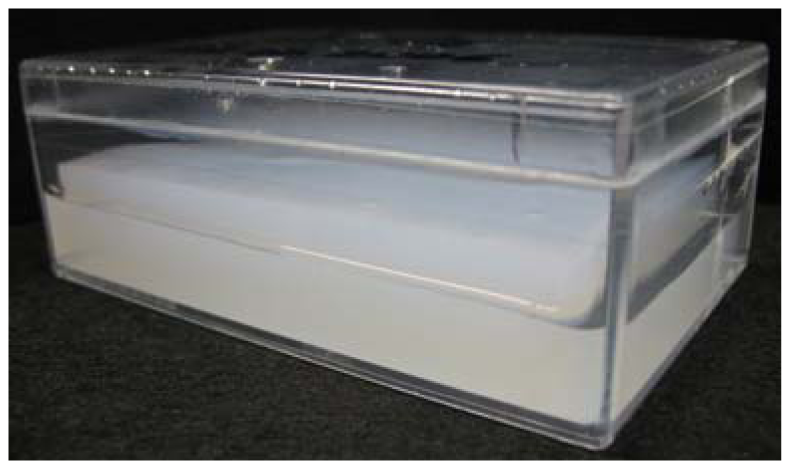
<p>Silica gel consists of nanoscale particles of amorphous SiO<sub>2</sub> (see <xref ref-type="fig" rid="f1-polymers-03-01423">Figure 1</xref>).</p>
<p>Silica gels were first mentioned in 1640 [<xref ref-type="bibr" rid="b1-polymers-03-01423">1</xref>] and remained a curiosity until their adsorption properties were found to be useful. Dried silica gel is used, for example, as a desiccant because of its highly hygroscopic properties. The manufacturing is carried out by mixing water glass (Na<sub>2</sub>SiO<sub>3</sub>·xH<sub>2</sub>O) with acid. This work pursues the goal to quantify the consolidation of silica gels and gel fragments.</p>
<p>The phenomenon of syneresis occurs during the aging of gel samples. Syneresis is a consolidation of the nano-particulate gel network resulting in the expulsion of liquid [<xref ref-type="bibr" rid="b2-polymers-03-01423">2</xref>]. In the following it is shown that the oedometer test is applicable to silica gel. This measuring method originally stems from soil mechanics and has not been used in colloid science so far. In principle the oedometer test is a one-dimensional compression test. A load is applied to a gel sample. While the sample is shrinking, liquid passes through the pore network and leaves the sample at its top and at its bottom. The consolidation is measured as a function of time [<xref ref-type="bibr" rid="b3-polymers-03-01423">3</xref>]. The oedometer test is regarded as an appropriate experiment for the investigation of consolidation of gel samples. It is a faster testing method than aging, and the effect of the process parameters, such as pH value, ionic strength, temperature, and solids content, can be identified more rapidly. Experimental results of the consolidation of gel samples as a function of time measured with the oedometer test are given. Furthermore, the semi-empirical method of Terzaghi is used to describe the experimental curves.</p></sec>
<sec>
<label>2.</label>
<title>Experimental</title>
<sec>
<label>2.1.</label>
<title>State of the Art</title>
<p>Syneresis is believed to be driven by van der Waals forces [<xref ref-type="bibr" rid="b4-polymers-03-01423">4</xref>]. Shrinkage is ultimately stopped by the remaining repulsive force [<xref ref-type="bibr" rid="b2-polymers-03-01423">2</xref>]. Syneresis is irreversible in most inorganic gels, and swelling of the gel is not observed. Syneresis in these systems is generally attributed to the formation of new bonds through condensation reactions of two silanol groups (–Si-OH) or hydrogen bonds [<xref ref-type="bibr" rid="b2-polymers-03-01423">2</xref>].</p>
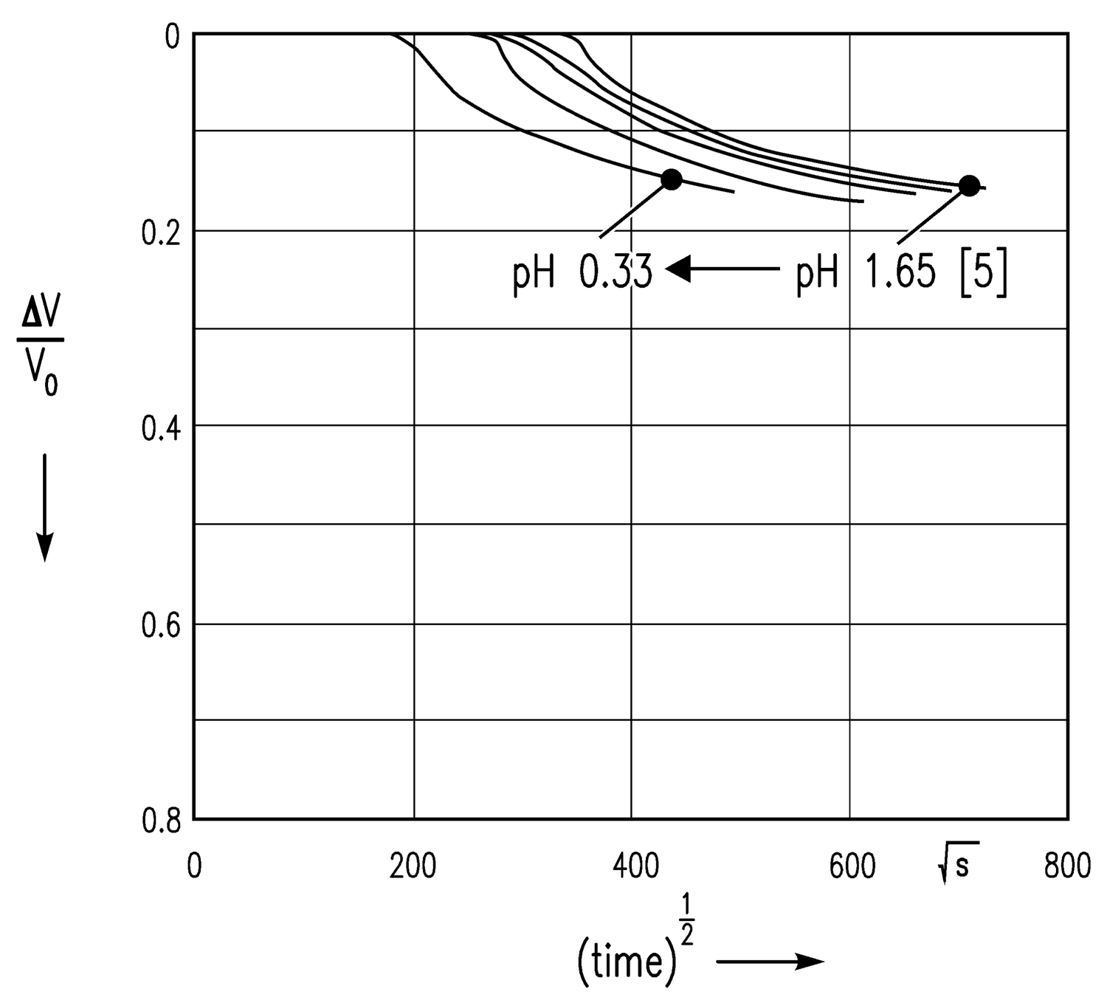
<p>The most thorough studies of syneresis have been performed by Vysotskii <italic>et al.</italic> [<xref ref-type="bibr" rid="b5-polymers-03-01423">5</xref>,<xref ref-type="bibr" rid="b6-polymers-03-01423">6</xref>] using silica gel made by the neutralization of sodium silicate with acid. Shrinkage of the gel was observed with a cathetometer. Vertical changes in position can be measured with a cathetometer. A cathetometer consists of a telescope that can be moved up and down along a stand. The kinetics of shrinkage is shown in <xref ref-type="fig" rid="f2-polymers-03-01423">Figure 2</xref>. There is an initial period during which no shrinkage occurs; then the shrinkage rate rises rapidly and eventually decreases again [<xref ref-type="bibr" rid="b2-polymers-03-01423">2</xref>]. The total extent of shrinkage is about 15 vol%.</p>
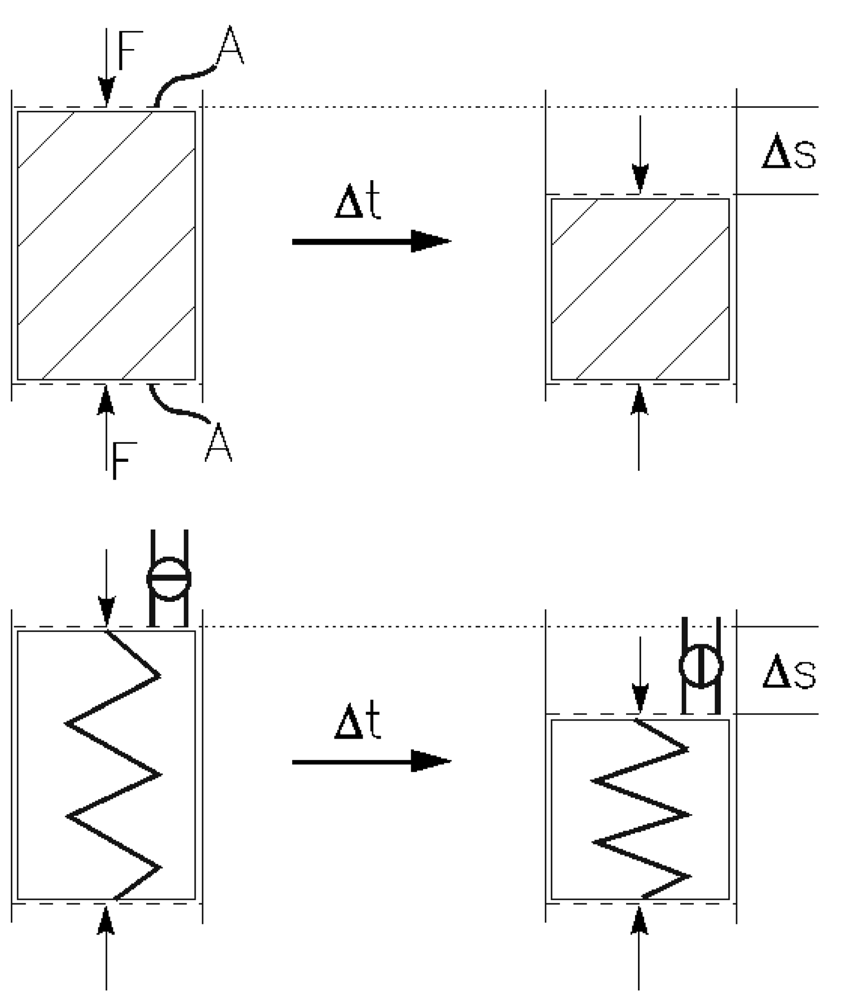
<p>Since gel aging is a relatively slow test, it is desirable to have a faster and more quantitative testing method, e.g., the above mentioned oedometer test. <xref ref-type="fig" rid="f3-polymers-03-01423">Figure 3</xref> (top) shows a schematic illustration of the consolidation of a gel sample during an oedometer test.</p>
<p>The consolidation curves measured (consolidation Δs <italic>vs.</italic> time <italic>t</italic>) are described by semi-empirical models. The most important physical description is the piston-spring analogy according to Terzaghi (1925) [<xref ref-type="bibr" rid="b7-polymers-03-01423">7</xref>]: The filter cake (here: gel body) that is to be squeezed is represented as a spring which is immersed in a liquid [<xref ref-type="bibr" rid="b8-polymers-03-01423">8</xref>]. Pressure is applied by a frictionless piston (see <xref ref-type="fig" rid="f3-polymers-03-01423">Figure 3</xref>, bottom). The piston cannot move down because the tap on the piston is shut and the pressure is entirely supported by the liquid. When the tap is opened the piston moves down and liquid flows out. The descent of the piston is slowed by the stiffness of the spring until equilibrium is reached, where liquid no longer flows and the pressure is fully supported by the compressed spring [<xref ref-type="bibr" rid="b8-polymers-03-01423">8</xref>]. Shirato [<xref ref-type="bibr" rid="b9-polymers-03-01423">9</xref>] succeeded in proposing an equation based on the piston-spring analogy that is valid for filter cakes with a sinusoidal initial distribution of the hydraulic pressure [<xref ref-type="bibr" rid="b8-polymers-03-01423">8</xref>,<xref ref-type="bibr" rid="b9-polymers-03-01423">9</xref>]:
<disp-formula id="FD1">
<label>(1)</label>
<mml:math id="mm1" display="block">
<mml:semantics id="sm1">
<mml:mrow>
<mml:mi>U</mml:mi>
<mml:mo>=</mml:mo>
<mml:mn>1</mml:mn>
<mml:mo>−</mml:mo>
<mml:mo>exp</mml:mo>
<mml:mrow>
<mml:mo>{</mml:mo>
<mml:mrow>
<mml:mo>−</mml:mo>
<mml:mfrac>
<mml:mrow>
<mml:msup>
<mml:mi>π</mml:mi>
<mml:mn>2</mml:mn></mml:msup>
<mml:msub>
<mml:mi>T</mml:mi>
<mml:mi>c</mml:mi></mml:msub></mml:mrow>
<mml:mn>4</mml:mn></mml:mfrac></mml:mrow>
<mml:mo>}</mml:mo></mml:mrow></mml:mrow></mml:semantics></mml:math></disp-formula> with the consolidation ratio
<disp-formula id="FD2">
<label>(2)</label>
<mml:math id="mm2" display="block">
<mml:semantics id="sm2">
<mml:mrow>
<mml:mi>U</mml:mi>
<mml:mo>=</mml:mo>
<mml:mfrac>
<mml:mrow>
<mml:mi>Δ</mml:mi>
<mml:mtext>s</mml:mtext></mml:mrow>
<mml:mrow>
<mml:mi>Δ</mml:mi>
<mml:msub>
<mml:mtext>s</mml:mtext>
<mml:mo>∞</mml:mo></mml:msub></mml:mrow></mml:mfrac></mml:mrow></mml:semantics></mml:math></disp-formula> and the reduced consolidation time
<disp-formula id="FD3">
<label>(3)</label>
<mml:math id="mm3" display="block">
<mml:semantics id="sm3">
<mml:mrow>
<mml:msub>
<mml:mi>T</mml:mi>
<mml:mi>c</mml:mi></mml:msub>
<mml:mo>=</mml:mo>
<mml:mfrac>
<mml:mrow>
<mml:msup>
<mml:mi>i</mml:mi>
<mml:mn>2</mml:mn></mml:msup>
<mml:msub>
<mml:mi>C</mml:mi>
<mml:mi>e</mml:mi></mml:msub>
<mml:mi>t</mml:mi></mml:mrow>
<mml:mrow>
<mml:msup>
<mml:mi>A</mml:mi>
<mml:mn>2</mml:mn></mml:msup></mml:mrow></mml:mfrac></mml:mrow></mml:semantics></mml:math></disp-formula> where <italic>i</italic> is the number of dewatering surfaces (<italic>i</italic> = 2 for oedometer testing), <italic>A</italic> is the cross-sectional area of filtration and <italic>C<sub>e</sub></italic> is a material specific parameter.</p></sec>
<sec>
<label>2.2.</label>
<title>Experimental Setup</title>
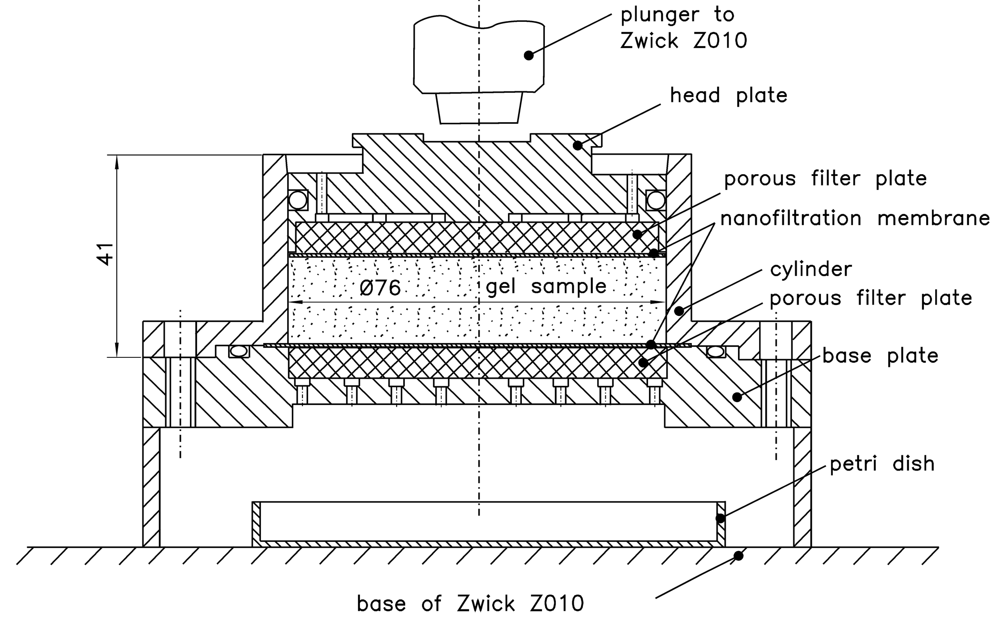
<p>The setup of the used oedometer measuring cell is illustrated in <xref ref-type="fig" rid="f4-polymers-03-01423">Figure 4</xref>. The head plate, the cylinder and the base plate are made of stainless steel, and so are the highly porous, sintered filter plates (Tridelta Siperm<sup>®</sup> R with a pore size of 100 μm). The nanofiltration membranes (Dow FILMTEC NF 270 and NF 90) are necessary for the retention of small gel fragments in the order of micrometers or nanometers. It was observed that the loss of solid through the membrane was higher for the NF 270 membrane than for the NF 90 membrane. Therefore, the latter was used for the further tests. The load was put on the gel sample for the experiments via a universal testing machine (Zwick Z010—load up to 10 kN).</p>
<p>It is possible with this experimental setup to investigate gel samples at different pressure differences. The set-up was immersed in a thermostated water bath for the investigation of gel samples at different temperatures.</p>
<p>The silica gels were generated by rapidly mixing alkaline water glass (sodium silicate solution Na<sub>2</sub>O·3.3SiO<sub>2</sub>) and sulfuric acid in a Y-mixing nozzle [<xref ref-type="bibr" rid="b10-polymers-03-01423">10</xref>-<xref ref-type="bibr" rid="b13-polymers-03-01423">13</xref>]. Acidic and alkaline gels can be formed depending on the mixing ratio. Gels with a short gelation time (∼12 min) were chosen as acidic and alkaline model gels: The acidic gel is produced by mixing sulfuric acid (50 %w/w) with sodium silicate solution (40 %w/w) in a ratio of 1:1 and has pH −0.97. The alkaline gel is produced by mixing sulfuric acid (3.2 %w/w) with sodium silicate solution (40 %w/w) in a ratio of 1:1 and has ∼pH 9.</p></sec>
<sec sec-type="methods">
<label>2.3.</label>
<title>Data Evaluation</title>
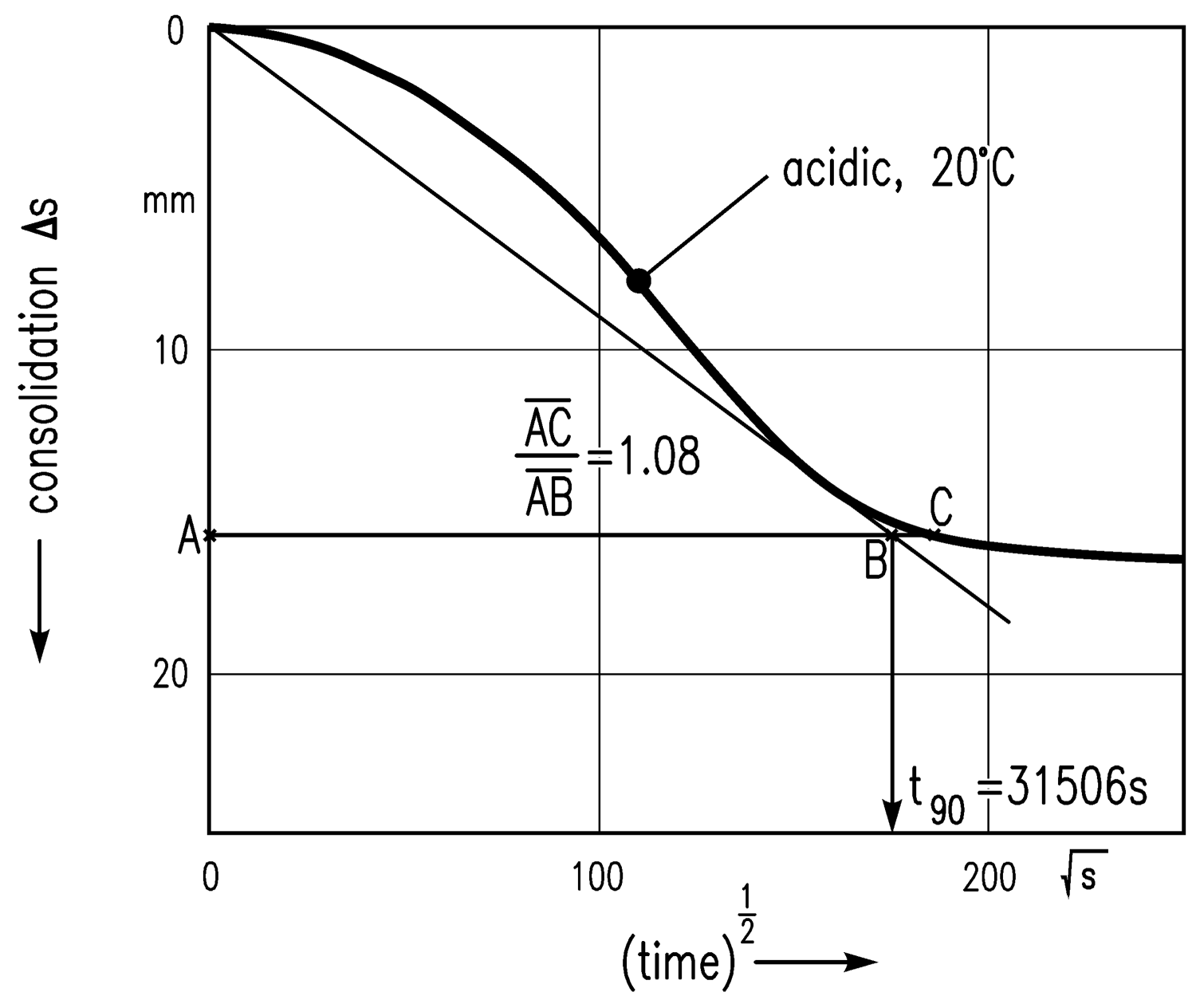
<p>The consolidation measured Δs is plotted against the consolidation time <italic>t</italic>. The course of a series of measurement is shown in <xref ref-type="fig" rid="f5-polymers-03-01423">Figure 5</xref>.</p>
<p>The square-root-of-time fitting method of consolidation courses is described in [<xref ref-type="bibr" rid="b14-polymers-03-01423">14</xref>]. Shirato mentions the equations [<xref ref-type="bibr" rid="b9-polymers-03-01423">9</xref>] 
<disp-formula id="FD4">
<mml:math id="mm4" display="block">
<mml:semantics id="sm4">
<mml:mrow>
<mml:mi>U</mml:mi>
<mml:mo>=</mml:mo>
<mml:mfrac>
<mml:mrow>
<mml:mover accent="true">
<mml:mrow>
<mml:mtext>AC</mml:mtext></mml:mrow>
<mml:mo>¯</mml:mo></mml:mover></mml:mrow>
<mml:mrow>
<mml:mover accent="true">
<mml:mrow>
<mml:mtext>AB</mml:mtext></mml:mrow>
<mml:mo>¯</mml:mo></mml:mover></mml:mrow></mml:mfrac>
<mml:mo>=</mml:mo>
<mml:mn>1.08</mml:mn>
<mml:mspace width="0.4em"/>
<mml:mtext>and</mml:mtext>
<mml:mspace width="0.4em"/>
<mml:msub>
<mml:mi>C</mml:mi>
<mml:mi>e</mml:mi></mml:msub>
<mml:mo>=</mml:mo>
<mml:mfrac>
<mml:mrow>
<mml:mn>0.933</mml:mn>
<mml:msup>
<mml:mi>A</mml:mi>
<mml:mn>2</mml:mn></mml:msup></mml:mrow>
<mml:mrow>
<mml:msup>
<mml:mi>i</mml:mi>
<mml:mn>2</mml:mn></mml:msup>
<mml:msub>
<mml:mi>t</mml:mi>
<mml:mrow>
<mml:mn>90</mml:mn></mml:mrow></mml:msub></mml:mrow></mml:mfrac></mml:mrow></mml:semantics></mml:math></disp-formula> for a sinusoidal initial distribution of the hydraulic pressure. These relations are valid if <italic>U</italic> = 0.90. Hence, point C belongs to a consolidation ratio of <italic>U</italic> = 0.90 [<xref ref-type="bibr" rid="b8-polymers-03-01423">8</xref>,<xref ref-type="bibr" rid="b14-polymers-03-01423">14</xref>]. The consolidation time t<sub>90</sub> in <xref ref-type="disp-formula" rid="FD5">Equation 4</xref> where <italic>U</italic> = 0.9 is determined using the fitting method. It follows that
<disp-formula id="FD5">
<label>(4)</label>
<mml:math id="mm5" display="block">
<mml:semantics id="sm5">
<mml:mrow>
<mml:mi>U</mml:mi>
<mml:mo>=</mml:mo>
<mml:mn>1</mml:mn>
<mml:mo>−</mml:mo>
<mml:mo>exp</mml:mo>
<mml:mrow>
<mml:mo>{</mml:mo>
<mml:mrow>
<mml:mo>−</mml:mo>
<mml:mfrac>
<mml:mrow>
<mml:msup>
<mml:mi>π</mml:mi>
<mml:mn>2</mml:mn></mml:msup></mml:mrow>
<mml:mn>4</mml:mn></mml:mfrac>
<mml:mfrac>
<mml:mrow>
<mml:mn>0.933</mml:mn></mml:mrow>
<mml:mrow>
<mml:msub>
<mml:mi>t</mml:mi>
<mml:mrow>
<mml:mn>90</mml:mn></mml:mrow></mml:msub></mml:mrow></mml:mfrac>
<mml:mi>t</mml:mi></mml:mrow>
<mml:mo>}</mml:mo></mml:mrow></mml:mrow></mml:semantics></mml:math></disp-formula></p></sec>
<sec sec-type="results|discussion">
<label>2.4.</label>
<title>Results and Discussion</title>
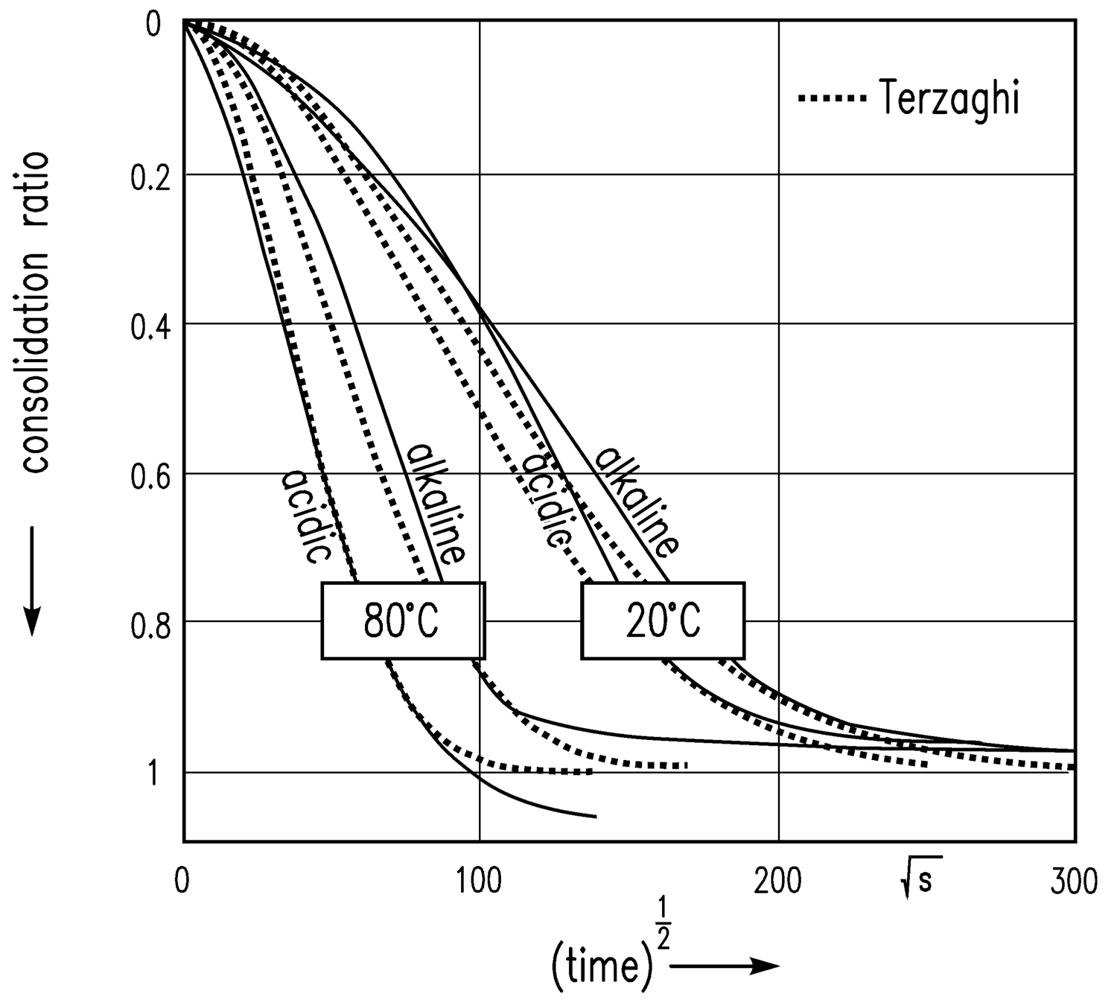
<p>In <xref ref-type="fig" rid="f6-polymers-03-01423">Figure 6</xref> the consolidation ratio <italic>U</italic> is shown as a function of the square root of time (√<italic>t</italic>) for the alkaline and the acidic SiO<sub>2</sub> model gel at constant pressure but at variable temperature. In 1 s, 10 s and 100 s almost no consolidation takes place, but it can be observed after longer times. In the scale of seconds, the gel resists and bears the load, but in the scale of hours consolidation of the gel occurs until an extent of about 90% of its original volume. The gel skeleton gives way to the outer pressure (∼15 bar) more rapidly with increasing temperature. Shrinkage of 50% is achieved for the alkaline gel at 80 °C after a shorter time (factor ∼ 4) than for the gel at 20 °C. This shrinkage is achieved after an even shorter time (factor ∼ 5) for the acidic gel.</p>
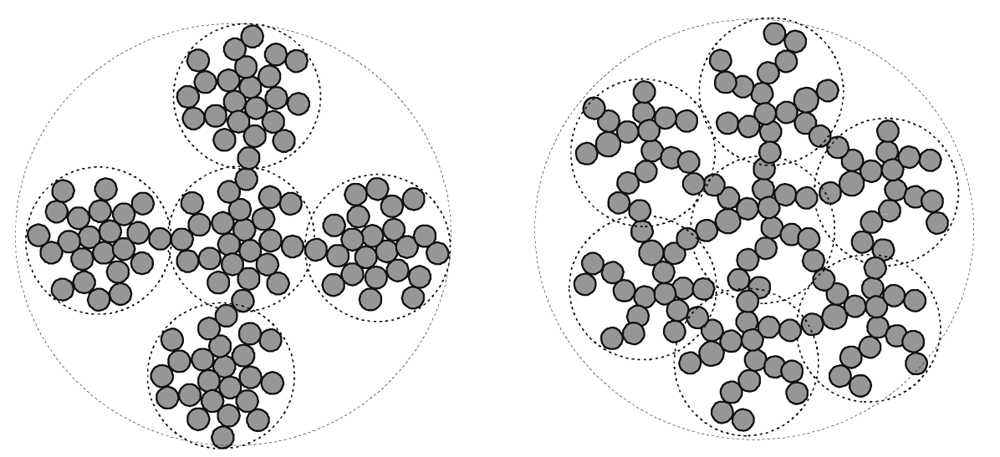
<p>In general, the shrinkage is faster for the acidic gel than for the alkaline gel. Quarch <italic>et al.</italic> (2010) have found that the primary particles of acidic gels are smaller than the primary particles of alkaline gels. The structure of the acidic gel is compact in the nanoscale, but is open structured in the microscale. This structure is <italic>vice versa</italic> for the alkaline gel, see <xref ref-type="fig" rid="f7-polymers-03-01423">Figure 7</xref> [<xref ref-type="bibr" rid="b15-polymers-03-01423">15</xref>].</p>
<p>We assume that the microscale structure of the gel is firstly destroyed during oedometer testing. Since the acidic gel is open-structured in the microscale, it can be more easily compressed than the dense structure of the alkaline gel in the microscale. This might be the reason for the faster shrinkage of the acidic gels. These findings indicate that it is possible to investigate the consolidation behavior of gel samples and their dependence on temperature and pH more rapidly than with gel aging.</p>
<p>The analytical course of the consolidation ratio <italic>U</italic> according to Terzaghi-Shirato's <xref ref-type="disp-formula" rid="FD5">Equation 4</xref> is also given in <xref ref-type="fig" rid="f6-polymers-03-01423">Figure 6</xref>. The compliance of this semi-empirical approach to the experimental data is quite good except for the acidic gel at 20 °C. The model parameter <italic>t</italic><sub>90</sub> is given in <xref ref-type="table" rid="t1-polymers-03-01423">Table 1</xref>.</p>
<p>Leclerc <italic>et al.</italic> [<xref ref-type="bibr" rid="b8-polymers-03-01423">8</xref>] investigated non-flocculated kaolin and measured <italic>S</italic>-shaped compression curves in the <italic>U</italic>-√<italic>t</italic> plot. They succeeded in describing the experimental data with the analytical expression for the pressing of filter cakes with a sinusoidal initial hydraulic pressure distribution within the cake (<xref ref-type="disp-formula" rid="FD1">Equation 1</xref>). They showed that Terzaghi's model is limited to the initial phase of primary consolidation. They used the Voigt model, which includes a damping pot in the equivalent network, for a better description of the secondary consolidation which occurs at high consolidation times. With this combined Terzaghi-Voigt model they found an even better agreement with the experimental data for high consolidation times. Finally, they mentioned simplified models—industrial equations— developed by Shirato. However, they found that the simplified equation for filter cakes brings less simplification [<xref ref-type="bibr" rid="b8-polymers-03-01423">8</xref>]. Contrary to kaolin, investigated by Leclerc <italic>et al.</italic>, the silica gels investigated here deviate from Terzaghi's analytical expression in the primary consolidation phase. This means that the sole assumption of a spring cannot satisfactorily describe the data measured. The theoretical curves run below the experimental curves in this phase, except for the 80 °C acidic curve, where the agreement with the theoretical curve is very good. A new equivalent network including a damping pot in the primary consolidation phase probably has to be added in order to describe the experimental data in a better way.</p>
<p>There are also deviations from the theoretical Terzaghi curves in the phase of secondary consolidation. The reason why the Terzaghi curve for an 80 °C acidic gel assumes values of <italic>U</italic> &gt; 1 is an overestimated value of Δs<sub>∞</sub>. Δs<sub>∞</sub> can be estimated with <xref ref-type="disp-formula" rid="FD2">Equation 2</xref>. There are deviations for high consolidation times because this estimated value is different from the real value of Δs<sub>∞</sub>.</p>
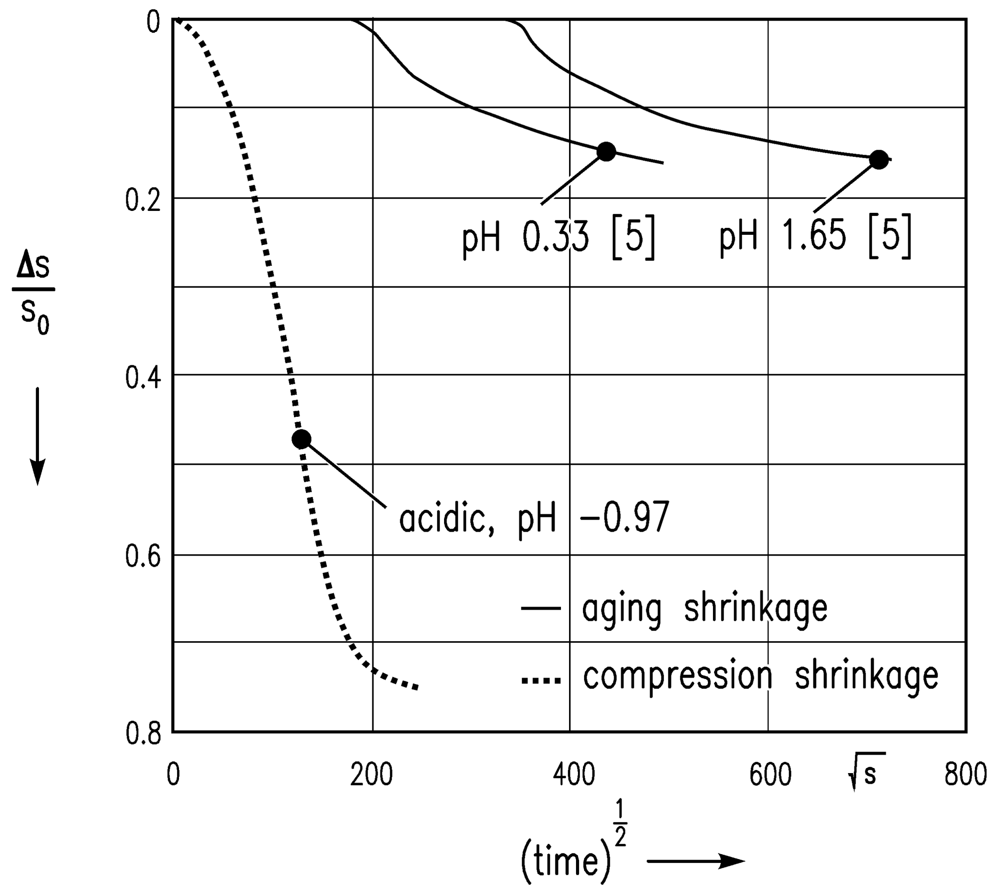
<p>In the following a qualitative comparison between “aging shrinkage” (syneresis) and “compression shrinkage” (consolidation in oedometer testing) is given. The kinetics of syneresis for two exemplary acidic experiments (pH 0.33 and pH 1.65) from [<xref ref-type="bibr" rid="b5-polymers-03-01423">5</xref>] and the consolidation in oedometer testing of an exemplary acidic experiment (pH −0.97) are shown in <xref ref-type="fig" rid="f8-polymers-03-01423">Figure 8</xref>.</p>
<p>In <xref ref-type="fig" rid="f7-polymers-03-01423">Figure 7</xref>, the ratio
<disp-formula id="FD6">
<label>(5)</label>
<mml:math id="mm6" display="block">
<mml:semantics id="sm6">
<mml:mrow>
<mml:mfrac>
<mml:mrow>
<mml:mo>Δ</mml:mo>
<mml:mtext>s</mml:mtext></mml:mrow>
<mml:mrow>
<mml:msub>
<mml:mtext>s</mml:mtext>
<mml:mn>0</mml:mn></mml:msub></mml:mrow></mml:mfrac>
<mml:mo>=</mml:mo>
<mml:mfrac>
<mml:mrow>
<mml:mo>Δ</mml:mo>
<mml:mtext>s</mml:mtext>
<mml:mo>⋅</mml:mo>
<mml:mtext>A</mml:mtext></mml:mrow>
<mml:mrow>
<mml:msub>
<mml:mtext>s</mml:mtext>
<mml:mn>0</mml:mn></mml:msub>
<mml:mo>⋅</mml:mo>
<mml:mtext>A</mml:mtext></mml:mrow></mml:mfrac>
<mml:mo>=</mml:mo>
<mml:mfrac>
<mml:mrow>
<mml:mo>Δ</mml:mo>
<mml:mtext>V</mml:mtext></mml:mrow>
<mml:mrow>
<mml:msub>
<mml:mtext>V</mml:mtext>
<mml:mn>0</mml:mn></mml:msub></mml:mrow></mml:mfrac></mml:mrow></mml:semantics></mml:math></disp-formula> is given as a function of time. Δs is the consolidation, s<sub>0</sub> is the height of the original gel sample, A is the cross-sectional area of the gel sample, ΔV is the change in volume and V<sub>0</sub> is the volume of the original gel sample. The extent of syneresis is about 15% of the original gel volume for the acidic gels (pH 0.33 and pH 1.65) while the time for this shrinkage is between 70 to 150 h. In the exemplary oedometer experiment (acidic, pH −0.97) the extent of the consolidation of the gel is about 75% while the time for this shrinkage is about 20 h.</p></sec></sec>
<sec sec-type="conclusions">
<label>3.</label>
<title>Conclusions</title>
<p>The experimental findings can be summarized as follows: The process of reorganization of the gel fragments (syneresis) that occurs after fragmentation, depends on the process parameters, pH value and temperature. Hence, the rate at which syneresis occurs can be influenced in wide ranges by the choice of temperature. The oedometer test is suitable for the characterization of these dependencies. The mathematical description of the semi-empirical models shows deficiencies which may be attributed to the simplicity of these models.</p></sec></body>
<back>
<sec sec-type="display-objects">
<title>Figures and Table</title>
<fig id="f1-polymers-03-01423" position="float">
<label>Figure 1.</label>
<caption>
<p>Silica gel sample.</p></caption>
<graphic xlink:href="polymers-03-01423f1.gif"/></fig>
<fig id="f2-polymers-03-01423" position="float">
<label>Figure 2.</label>
<caption>
<p>Kinetics of syneresis in silica gel as a function of time in solutions with various pH [<xref ref-type="bibr" rid="b2-polymers-03-01423">2</xref>,<xref ref-type="bibr" rid="b5-polymers-03-01423">5</xref>].</p></caption>
<graphic xlink:href="polymers-03-01423f2.gif"/></fig>
<fig id="f3-polymers-03-01423" position="float">
<label>Figure 3.</label>
<caption>
<p><bold>Top:</bold> Consolidation behavior during an oedometer test; <bold>bottom:</bold> Terzaghi's piston-spring analogy.</p></caption>
<graphic xlink:href="polymers-03-01423f3.gif"/></fig>
<fig id="f4-polymers-03-01423" position="float">
<label>Figure 4.</label>
<caption>
<p>Set-up of the oedometer measuring cell.</p></caption>
<graphic xlink:href="polymers-03-01423f4.gif"/></fig>
<fig id="f5-polymers-03-01423" position="float">
<label>Figure 5.</label>
<caption>
<p>Curve Fitting Method: Graphical determination of <italic>t</italic><sub>90</sub>.</p></caption>
<graphic xlink:href="polymers-03-01423f5.gif"/></fig>
<fig id="f6-polymers-03-01423" position="float">
<label>Figure 6.</label>
<caption>
<p>Consolidation ratio <italic>U</italic> as a function of time for an <italic>alkaline</italic> and an <italic>acidic</italic> SiO<sub>2</sub> model gel at constant pressure (∼15 bar) and variable temperature (20 °C and 80 °C).</p></caption>
<graphic xlink:href="polymers-03-01423f6.gif"/></fig>
<fig id="f7-polymers-03-01423" position="float">
<label>Figure 7.</label>
<caption>
<p>Schematic illustration of the aggregate's structure: <bold>left</bold> (acidic): dense in the nanoscale, open structured in the microscale; <bold>right</bold> (alkaline): <italic>vice versa</italic> [<xref ref-type="bibr" rid="b15-polymers-03-01423">15</xref>].</p></caption>
<graphic xlink:href="polymers-03-01423f7.gif"/></fig>
<fig id="f8-polymers-03-01423" position="float">
<label>Figure 8.</label>
<caption>
<p>Kinetics of syneresis (pH 0.33 and pH 1.65, continuous curves) [<xref ref-type="bibr" rid="b5-polymers-03-01423">5</xref>] and consolidation in oedometer testing (acidic, pH −0.97, dotted curve).</p></caption>
<graphic xlink:href="polymers-03-01423f8.gif"/></fig>
<table-wrap id="t1-polymers-03-01423" position="float">
<label>Table 1.</label>
<caption>
<p>Model parameter <italic>t</italic><sub>90</sub>.</p></caption>
<table frame="hsides" rules="groups">
<thead>
<tr>
<th align="center" valign="top"><bold><italic>t</italic><sub>90</sub></bold></th>
<th align="right" valign="top"><bold>20 °C</bold></th>
<th align="right" valign="top"><bold>80 °C</bold></th></tr></thead>
<tbody>
<tr>
<td align="left" valign="top">alkaline (∼pH 9)</td>
<td align="right" valign="top">40,401 s</td>
<td align="right" valign="top">11,236 s</td></tr>
<tr>
<td align="left" valign="top">acidic (pH −0.97)</td>
<td align="right" valign="top">31,506 s</td>
<td align="right" valign="top">5,625 s</td></tr></tbody></table></table-wrap></sec>
<ack>
<p>One of us (H.S.) wants to express that first and foremost all praise is due to God.</p>
<p>This research project is financially supported by the German Research Foundation DFG within the priority programme “SPP 1273 Kolloidverfahrenstechnik” (colloid process engineering).</p>
<p>We would like to thank the assisting student, Mustapha Aboulmaouahib, who performed parts of the measurements.</p>
<p>Special thanks to the reviewers.</p></ack>
<ref-list>
<title>References</title>
<ref id="b1-polymers-03-01423"><label>1.</label><citation citation-type="journal"><person-group person-group-type="author"><name><surname>Feldman</surname><given-names>M.</given-names></name><name><surname>Desrochers</surname><given-names>P.</given-names></name></person-group><article-title>Research Universities and Local Economic Development: Lessons from the History of the Johns Hopkins University</article-title><source>Ind. Innov.</source><year>2003</year><volume>10</volume><fpage>5</fpage><lpage>24</lpage></citation></ref>
<ref id="b2-polymers-03-01423"><label>2.</label><citation citation-type="book"><person-group person-group-type="author"><name><surname>Brinker</surname><given-names>C.J.</given-names></name><name><surname>Scherer</surname><given-names>G.W.</given-names></name></person-group><article-title>Aging of Gels</article-title><source>Sol-Gel Science: The Physics and Chemistry of Sol–Gel Processing</source><publisher-name>Academic Press Inc.</publisher-name><publisher-loc>San Diego, CA, USA</publisher-loc><year>1990</year><fpage>357</fpage><lpage>405</lpage></citation></ref>
<ref id="b3-polymers-03-01423"><label>3.</label><citation citation-type="confproc"><person-group person-group-type="author"><name><surname>Sahabi</surname><given-names>H.</given-names></name><name><surname>Quarch</surname><given-names>K.</given-names></name><name><surname>Kind</surname><given-names>M.</given-names></name></person-group><article-title>Gelation Gel Fragmentation and Consolidation of Precipitated Silica</article-title><conf-name>Proceedings of WCPT6-2010, World Congress on Particle Technology</conf-name><conf-loc>Nürnberg, Germany</conf-loc><conf-date>26–29 April 2010</conf-date></citation></ref>
<ref id="b4-polymers-03-01423"><label>4.</label><citation citation-type="book"><person-group person-group-type="author"><name><surname>Pierre</surname><given-names>A.C.</given-names></name><name><surname>Uhlmann</surname><given-names>D.R.</given-names></name></person-group><source>Better Ceramics through Chemistry III</source><person-group person-group-type="editor"><name><surname>Brinker</surname><given-names>C.J.</given-names></name><name><surname>Clark</surname><given-names>D.E.</given-names></name><name><surname>Ulrich</surname><given-names>D.R.</given-names></name></person-group><publisher-name>Mat. Res. Soc.</publisher-name><publisher-loc>Pittsburgh, PA, USA</publisher-loc><year>1988</year><fpage>207</fpage><lpage>212</lpage></citation></ref>
<ref id="b5-polymers-03-01423"><label>5.</label><citation citation-type="book"><person-group person-group-type="author"><name><surname>Vysotskii</surname><given-names>Z.Z.</given-names></name><name><surname>Strazhesko</surname><given-names>D.N.</given-names></name></person-group><source>Adsorption and Adsorbents</source><edition>No. 1 ed.</edition><person-group person-group-type="editor"><name><surname>Strazhesko</surname><given-names>D.N.</given-names></name></person-group><publisher-name>Wiley</publisher-name><publisher-loc>New York, NY, USA</publisher-loc><year>1973</year><fpage>55</fpage><lpage>71</lpage></citation></ref>
<ref id="b6-polymers-03-01423"><label>6.</label><citation citation-type="book"><person-group person-group-type="author"><name><surname>Vysotskii</surname><given-names>Z.Z.</given-names></name><name><surname>Galinskaya</surname><given-names>V.I.</given-names></name><name><surname>Kolychev</surname><given-names>V.I.</given-names></name><name><surname>Strelko</surname><given-names>V.V.</given-names></name><name><surname>Strazhesko</surname><given-names>D.N.</given-names></name></person-group><source>Adsorption and Adsorbents</source><edition>No. 1 ed.</edition><person-group person-group-type="editor"><name><surname>Strazhesko</surname><given-names>D.N.</given-names></name></person-group><publisher-name>Wiley</publisher-name><publisher-loc>New York, NY, USA</publisher-loc><year>1973</year><fpage>72</fpage><lpage>86</lpage></citation></ref>
<ref id="b7-polymers-03-01423"><label>7.</label><citation citation-type="book"><person-group person-group-type="author"><name><surname>Terzaghi</surname><given-names>K.</given-names></name><name><surname>Peck</surname><given-names>R.B.</given-names></name></person-group><source>Soil Mechanics in Engineering Practice</source><publisher-name>John Wiley &amp; Sons</publisher-name><publisher-loc>London, UK</publisher-loc><year>1948</year></citation></ref>
<ref id="b8-polymers-03-01423"><label>8.</label><citation citation-type="book"><person-group person-group-type="author"><name><surname>Leclerc</surname><given-names>D.</given-names></name><name><surname>Rebouillat</surname><given-names>S.</given-names></name></person-group><article-title>Dewatering by Compression</article-title><source>Mathematical Models and Design Methods in Solid-Liquid Separation</source><person-group person-group-type="editor"><name><surname>Rushton</surname><given-names>A.</given-names></name></person-group><series>NATO ASI Series</series><publisher-name>Springer</publisher-name><publisher-loc>Berlin, Germany</publisher-loc><year>1985</year></citation></ref>
<ref id="b9-polymers-03-01423"><label>9.</label><citation citation-type="journal"><person-group person-group-type="author"><name><surname>Shirato</surname><given-names>M.</given-names></name><name><surname>Murase</surname><given-names>T.</given-names></name><name><surname>Kato</surname><given-names>H.</given-names></name><name><surname>Fukaya</surname><given-names>S.</given-names></name></person-group><article-title>Fundamental Analysis for Expression under Constant Pressure</article-title><source>Filtr. Sep.</source><year>1970</year><volume>7</volume><fpage>277</fpage><lpage>282</lpage></citation></ref>
<ref id="b10-polymers-03-01423"><label>10.</label><citation citation-type="journal"><person-group person-group-type="author"><name><surname>Haselhuhn</surname><given-names>F.</given-names></name><name><surname>Kind</surname><given-names>M.</given-names></name></person-group><article-title>Pseudo-polymorphic Behavior of Precipitated Calcium Oxalate</article-title><source>Chem. Eng. Technol.</source><year>2003</year><pub-id pub-id-type="doi">10.1002/ceat.200390053</pub-id></citation></ref>
<ref id="b11-polymers-03-01423"><label>11.</label><citation citation-type="journal"><person-group person-group-type="author"><name><surname>Quarch</surname><given-names>K.</given-names></name><name><surname>Kind</surname><given-names>M.</given-names></name></person-group><article-title>Inorganic Precipitated Silica Gel. Part 1: Gelation Kinetics and Gel Properties</article-title><source>Chem. Eng. Technol.</source><year>2010</year><pub-id pub-id-type="doi">10.1002/ceat.201000080</pub-id></citation></ref>
<ref id="b12-polymers-03-01423"><label>12.</label><citation citation-type="thesis"><person-group person-group-type="author"><name><surname>Schlomach</surname><given-names>J.</given-names></name></person-group><article-title>Feststoffbildung bei technischen Fällprozessen</article-title><source>Ph.D. Dissertation</source><publisher-name>Universität Fridericiana Karlsruhe</publisher-name><publisher-loc>Karlsruhe, Germany</publisher-loc><year>2006</year></citation></ref>
<ref id="b13-polymers-03-01423"><label>13.</label><citation citation-type="journal"><person-group person-group-type="author"><name><surname>Özmetin</surname><given-names>C.</given-names></name><name><surname>Schlomach</surname><given-names>J.</given-names></name><name><surname>Kind</surname><given-names>M.</given-names></name></person-group><article-title>Polymerisierungskinetik von Kieselsäure</article-title><source>Chem. Ing. Technol.</source><year>2004</year><volume>76</volume><fpage>1832</fpage><lpage>1836</lpage><pub-id pub-id-type="doi">10.1002/cite.200407037</pub-id></citation></ref>
<ref id="b14-polymers-03-01423"><label>14.</label><citation citation-type="book"><person-group person-group-type="author"><name><surname>Taylor</surname><given-names>D.W.</given-names></name></person-group><source>Fundamentals of Soil Mechanics</source><publisher-name>John Wiley &amp; Sons, Inc.</publisher-name><publisher-loc>New York, NY, USA</publisher-loc><year>1950</year></citation></ref>
<ref id="b15-polymers-03-01423"><label>15.</label><citation citation-type="book"><person-group person-group-type="author"><name><surname>Quarch</surname><given-names>K.</given-names></name></person-group><source>Produktgestaltung an kolloidalen Agglomeraten und Gelen—Gelierung und Fragmentierung anorganisch gefällten Siliciumdioxids</source><publisher-name>KIT Scientific Publishing</publisher-name><publisher-loc>Karlsruhe, Germany</publisher-loc><year>2010</year></citation></ref></ref-list>
<glossary>
<title>Symbols</title>
<def-list>
<def-item>
<term><italic>F/A</italic></term>
<def>
<p>pressure (force per area)</p></def></def-item>
<def-item>
<term><italic>t</italic></term>
<def>
<p>consolidation time</p></def></def-item>
<def-item>
<term><italic>t<sub>90</sub></italic></term>
<def>
<p>consolidation time when U = 0.90</p></def></def-item>
<def-item>
<term><italic>U</italic></term>
<def>
<p>consolidation ratio</p></def></def-item>
<def-item>
<term><italic>T<sub>c</sub></italic></term>
<def>
<p>reduced consolidation time</p></def></def-item>
<def-item>
<term><italic>i</italic></term>
<def>
<p>number of dewatering surfaces</p></def></def-item>
<def-item>
<term><italic>A</italic></term>
<def>
<p>cross-sectional area of filtration</p></def></def-item>
<def-item>
<term><italic>C<sub>e</sub></italic></term>
<def>
<p>material specific parameter</p></def></def-item>
<def-item>
<term>s<sub>0</sub></term>
<def>
<p>height of the original gel sample</p></def></def-item>
<def-item>
<term>Δs</term>
<def>
<p>consolidation</p></def></def-item>
<def-item>
<term>Δs<sub>∞</sub></term>
<def>
<p>consolidation for <italic>t</italic> → ∞</p></def></def-item>
<def-item>
<term>V<sub>0</sub></term>
<def>
<p>volume of the original gel sample</p></def></def-item>
<def-item>
<term>ΔV</term>
<def>
<p>change in the volume of the gel sample</p></def></def-item></def-list></glossary></back></article>