<?xml version="1.0" encoding="UTF-8"?>
<!DOCTYPE article PUBLIC "-//NLM//DTD Journal Publishing DTD v2.3 20070202//EN" "journalpublishing.dtd">
<article xmlns:mml="http://www.w3.org/1998/Math/MathML" xmlns:xlink="http://www.w3.org/1999/xlink" xml:lang="en" article-type="rapid-communication">
  <front>
    <journal-meta>
      <journal-id journal-id-type="publisher-id">crystals</journal-id>
      <journal-title>Crystals</journal-title>
      <abbrev-journal-title abbrev-type="publisher">Crystals</abbrev-journal-title>
      <abbrev-journal-title abbrev-type="pubmed">Crystals</abbrev-journal-title>
      <issn pub-type="epub">2073-4352</issn>
      <publisher>
        <publisher-name>MDPI</publisher-name>
      </publisher>
    </journal-meta>
    <article-meta>
      <article-id pub-id-type="doi">10.3390/cryst2041374</article-id>
      <article-id pub-id-type="publisher-id">crystals-02-01374</article-id>
      <article-categories>
        <subj-group>
          <subject>Communication</subject>
        </subj-group>
      </article-categories>
      <title-group>
        <article-title>An Unusual Bismuth Ethanedisulfonate Network </article-title>

      </title-group>
      
      <contrib-group>
        <contrib contrib-type="author">
          <name>
            <surname>Gschwind</surname>
            <given-names>Fabienne</given-names>
          </name>
          <xref rid="c1-crystals-02-01374" ref-type="corresp">*</xref>
        </contrib>
        <contrib contrib-type="author">
          <name>
            <surname>Jansen</surname>
            <given-names>Martin</given-names>
          </name>
        </contrib>
      </contrib-group>
      <aff id="af1-crystals-02-01374">Max Planck Institute for Solid State Research, Heisenbergstrasse 1, 70569 Stuttgart, Germany; Email: <email>m.jansen@fkf.mpg.de</email></aff>
	  <author-notes>
        <corresp id="c1-crystals-02-01374"><label>*</label> Author to whom correspondence should be addressed; Email: <email>f.gschwind@fkf.mpg.de</email>; Tel.: +49-711-689-1409; Fax: +49-711-689-1502. </corresp>
      </author-notes>
      <pub-date pub-type="epub">
        <day>28</day>
        <month>09</month>
        <year>2012</year>
      </pub-date>
      <pub-date pub-type="collection"> <month>12</month>
        <year>2012</year>
      </pub-date>
      <volume>2</volume>
      <issue>4</issue>
      <fpage>1374</fpage>
      <lpage>1381</lpage>
      <history>
        <date date-type="received">
          <day>11</day>
          <month>06</month>
          <year>2012</year>
        </date>
        <date date-type="rev-recd">
          <day>16</day>
          <month>07</month>
          <year>2012</year>
        </date>
        <date date-type="accepted">
          <day>14</day>
          <month>09</month>
          <year>2012</year>
        </date>
      </history>
      <permissions>
        <copyright-statement>© 2012 by the authors; licensee MDPI, Basel, Switzerland.</copyright-statement>
        <copyright-year>2012</copyright-year>
        <license xmlns:xlink="http://www.w3.org/1999/xlink" license-type="open-access" xlink:href="http://creativecommons.org/licenses/by/3.0/">
          <p>This article is an open-access article distributed under the terms and conditions of the Creative Commons Attribution license (http://creativecommons.org/licenses/by/3.0/).</p>
        </license>
      </permissions>
      <abstract>
        <p>The three dimensional bismuth ethanedisulfonate framework Bi(O<sub>3</sub>SC<sub>2</sub>H<sub>4</sub>SO<sub>3</sub>)<sub>1.5</sub>(H<sub>2</sub>O)<sub>2</sub> was synthesized under hydrothermal conditions using the bidentate ligand 1,2-ethanedisulfonate and then characterized through X-ray diffraction and elemental analyses. The bismuth cation coordinates at three different ethanedisulfonate ligands and has a coordination number of eight, which is accompanied by a distorted square antiprismatic configuration. Here, we report on the crystal structure of this bismuth metal–organic framework and its coordination behavior, which has thus far not been reported in heavier main group elements.</p>
      </abstract>
      <kwd-group>
        <kwd>main group chemistry</kwd>
        <kwd>bismuth complex</kwd>
        <kwd>ethanedisulfonate</kwd>
        <kwd>MOF</kwd>
      </kwd-group>
    </article-meta>
  </front>
  <body>
    <sec sec-type="intro">
      <title>1. Introduction</title>
      <p>Bismuth(III) complexes are used in a variety of fields including biology and medicine [<xref ref-type="bibr" rid="B1-crystals-02-01374">1</xref>,<xref ref-type="bibr" rid="B2-crystals-02-01374">2</xref>], materials chemistry [<xref ref-type="bibr" rid="B3-crystals-02-01374">3</xref>,<xref ref-type="bibr" rid="B4-crystals-02-01374">4</xref>], and catalysis [<xref ref-type="bibr" rid="B5-crystals-02-01374">5</xref>]. For this reason, the synthesis of bismuth metal-organic frameworks (MOFs) has received considerable attention [<xref ref-type="bibr" rid="B6-crystals-02-01374">6</xref>]. A handful of bismuth organic frameworks exist, which have a broad range of structures due to their different molecular topologies [<xref ref-type="bibr" rid="B7-crystals-02-01374">7</xref>,<xref ref-type="bibr" rid="B8-crystals-02-01374">8</xref>]. By varying the set of donor atoms in the organic ligand, it is possible to enlarge this growing class of organometallic compounds. The formation of such frameworks depends significantly on the dimension of the internal cavity, rigidity of the ligands, nature of the electronegative atoms, and complex forming properties of the anion that is involved in the coordination bonding [<xref ref-type="bibr" rid="B6-crystals-02-01374">6</xref>]. Generally, Bi<sup>3+</sup> with its ionic radius of 1.16 Å [<xref ref-type="bibr" rid="B9-crystals-02-01374">9</xref>] has one inert 6s<sup>2</sup> electron pair and forms non-transition metal center complexes with higher coordination-number atoms. Therefore, bismuth is predestined to form higher dimensionality cationic frameworks. The well-studied hydrolysis behavior of Bi<sup>3+</sup> makes it an especially desirable system for conducting hydrothermal studies on [Bi<sub>6</sub>O<sub>4</sub>(OH)<sub>4</sub>(H<sub>2</sub>O)<sub>2</sub>][(CH<sub>2</sub>)<sub>2</sub>(SO<sub>3</sub>)<sub>2</sub>]<sub>3</sub> and [Bi<sub>9</sub>O<sub>8</sub>(OH)<sub>6</sub>][CF<sub>3</sub>SO<sub>3</sub>]<sub>5</sub> [<xref ref-type="bibr" rid="B10-crystals-02-01374">10</xref>]. Crystalline hybrid materials composed of main group elements are mostly based on metal carboxylates [<xref ref-type="bibr" rid="B11-crystals-02-01374">11</xref>,<xref ref-type="bibr" rid="B12-crystals-02-01374">12</xref>,<xref ref-type="bibr" rid="B13-crystals-02-01374">13</xref>,<xref ref-type="bibr" rid="B14-crystals-02-01374">14</xref>] and phosphonates [<xref ref-type="bibr" rid="B15-crystals-02-01374">15</xref>,<xref ref-type="bibr" rid="B16-crystals-02-01374">16</xref>], for further references please refer to Cambridge database [<xref ref-type="bibr" rid="B17-crystals-02-01374">17</xref>]. The nature of sulfonate ligands has been less thoroughly investigated in terms of their ability to function as an organic linker in main group MOFs and coordination polymers. However, they may be used in potentially interesting applications such as gas separation, storage, as well as catalysis [<xref ref-type="bibr" rid="B18-crystals-02-01374">18</xref>,<xref ref-type="bibr" rid="B19-crystals-02-01374">19</xref>]. In particular, porous hybrid transition metal compounds based on carboxylates [<xref ref-type="bibr" rid="B20-crystals-02-01374">20</xref>] and phosphonates [<xref ref-type="bibr" rid="B17-crystals-02-01374">17</xref>,<xref ref-type="bibr" rid="B21-crystals-02-01374">21</xref>,<xref ref-type="bibr" rid="B22-crystals-02-01374">22</xref>] have attracted widespread interest in the past few years. However, there exist few MOFs that entail heavier main group elements with sulfonate linker ligands, for instance lead 4-sulfobenzoate complexes [<xref ref-type="bibr" rid="B23-crystals-02-01374">23</xref>,<xref ref-type="bibr" rid="B24-crystals-02-01374">24</xref>] and the wide range of tin disulfonic MOFs [<xref ref-type="bibr" rid="B25-crystals-02-01374">25</xref>].</p>
      <p>Research on bismuth based MOFs is rare [<xref ref-type="bibr" rid="B6-crystals-02-01374">6</xref>,<xref ref-type="bibr" rid="B7-crystals-02-01374">7</xref>,<xref ref-type="bibr" rid="B8-crystals-02-01374">8</xref>]. Even so, some examples of compounds with diethanesulfonate ligands [<xref ref-type="bibr" rid="B10-crystals-02-01374">10</xref>,<xref ref-type="bibr" rid="B26-crystals-02-01374">26</xref>,<xref ref-type="bibr" rid="B27-crystals-02-01374">27</xref>,<xref ref-type="bibr" rid="B28-crystals-02-01374">28</xref>,<xref ref-type="bibr" rid="B29-crystals-02-01374">29</xref>,<xref ref-type="bibr" rid="B30-crystals-02-01374">30</xref>,<xref ref-type="bibr" rid="B31-crystals-02-01374">31</xref>] can be found in the Cambridge Database [<xref ref-type="bibr" rid="B17-crystals-02-01374">17</xref>]. For instance works about Ag and Cu ethandisulfonate complexes [<xref ref-type="bibr" rid="B27-crystals-02-01374">27</xref>,<xref ref-type="bibr" rid="B28-crystals-02-01374">28</xref>], bismuth clusters [<xref ref-type="bibr" rid="B10-crystals-02-01374">10</xref>] or also mixed ligand cadmium complexes [<xref ref-type="bibr" rid="B32-crystals-02-01374">32</xref>] to name only a few examples. Consequently, we would like to report on a three-dimensionally bismuth coordination polymer that encompasses a new structure type, which has not been observed, to the best of our knowledge, in any other MOF composed of heavier main group elements. </p>
    </sec>
    <sec sec-type="results">
      <title>2. Results and Discussion</title>
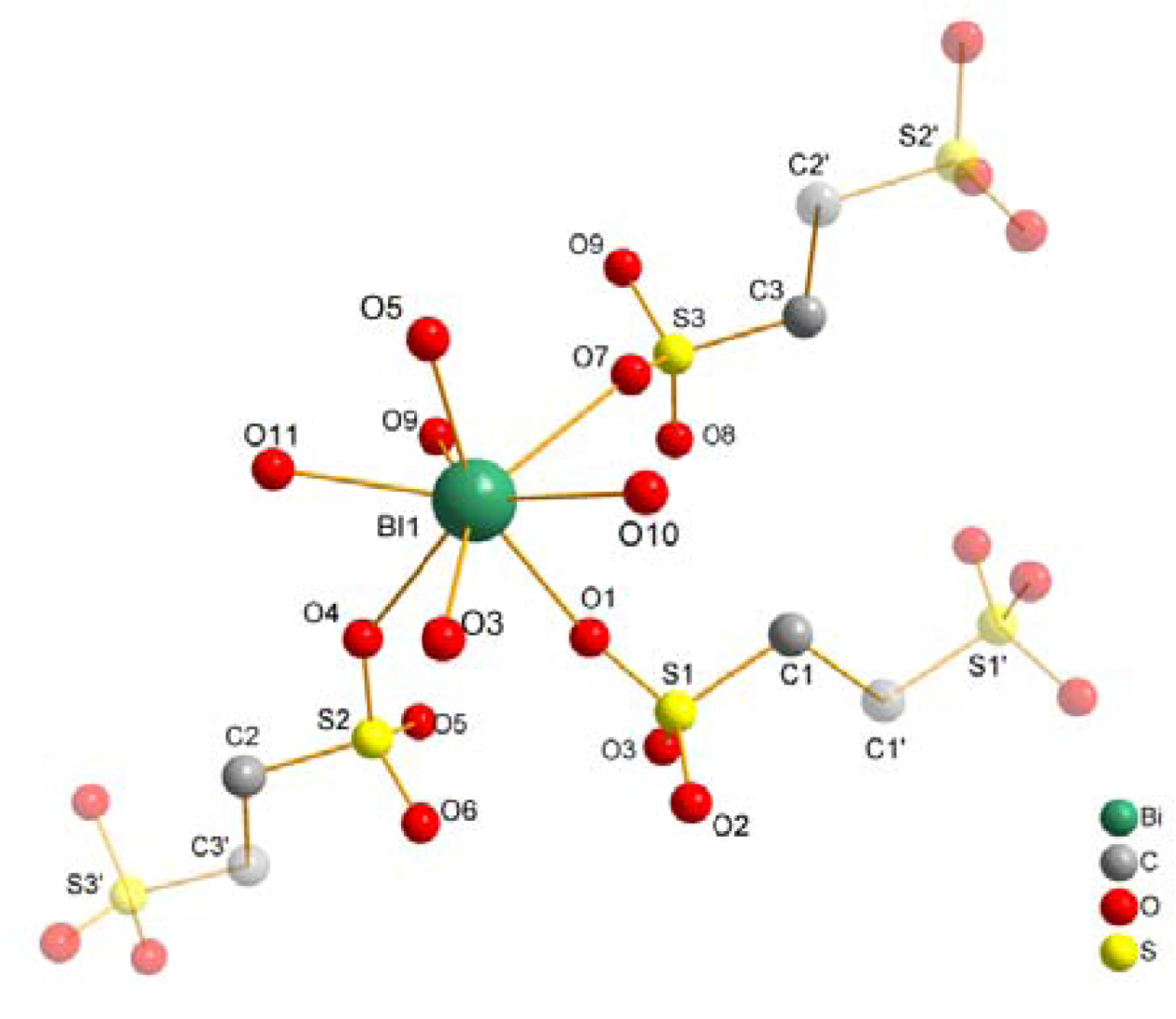
      <p>The colorless crystals of Bi(O<sub>3</sub>SC<sub>2</sub>H<sub>4</sub>SO<sub>3</sub>)<sub>1.5</sub>(H<sub>2</sub>O)<sub>2</sub> (<bold>1</bold>) crystallize in the space group <italic>P</italic>2<sub>1</sub>/c. The asymmetric unit, shown in <xref ref-type="fig" rid="crystals-02-01374-f001">Figure 1</xref>, consists of an eight-coordinated bismuth cation, at which one and a half moieties of the 1,2-ethanedisulfonate ligand are coordinated, and two water molecules. The complete compound contains one crystallographic independent Bi<sup>3+</sup> ion, which is surrounded by eight oxygen atoms. Six of these oxygen atoms are part of the R–SO<sub>3</sub><sup>−</sup> groups (O1, O3, O4, O5, O7, O9), and two are coordinated with water molecules (O10 and O11).</p>
      <fig id="crystals-02-01374-f001" position="anchor">
        <label>Figure 1</label>
        <caption>
          <p>Asymmetric unit of <bold>1</bold> and the prolongation of the ethanesulfonate ligands, which are drawn in transparency mode (hydrogen atoms are omitted for clarity).</p>
        </caption>
        <graphic xmlns:xlink="http://www.w3.org/1999/xlink" xlink:href="crystals-02-01374-g001.tif"/>
      </fig>
      <p>The bridging oxygen atoms (O1, O3, O4, O5, O7, O9) have slightly shorter bond lengths [<xref ref-type="bibr" rid="B10-crystals-02-01374">10</xref>] with the bismuth atoms, ranging from 2.324(8) to 2.590(8) Å (<xref ref-type="table" rid="crystals-02-01374-t001">Table 1</xref>). The bond lengths between water atoms (O10 and O11) and the bismuth lie in the range of other Bi–OH<sub>2</sub> bond lengths (Cambridge Database: 2.303–3.123 Å). A bond valence analysis reveals a value of 2.819 for the bismuth cation, which reflects the slightly insufficient coordination environment of the cation [<xref ref-type="bibr" rid="B33-crystals-02-01374">33</xref>,<xref ref-type="bibr" rid="B34-crystals-02-01374">34</xref>].</p>
      <table-wrap id="crystals-02-01374-t001" position="float">
        <object-id pub-id-type="pii">crystals-02-01374-t001_Table 1</object-id>
        <label>Table 1</label>
        <caption>
          <p>Selected bond lengths (Å) for <bold>1</bold> with estimated standard deviations in parentheses.</p>
        </caption>
        <table>
          <thead>
            <tr>
              <th align="left" valign="middle">Bond</th>
              <th align="left" valign="middle">Distance</th>
            </tr>
          </thead>
          <tbody>
            <tr>
              <td align="left" valign="middle">Bi1―O1</td>
              <td align="left" valign="middle">2.427(9)</td>
            </tr>
            <tr>
              <td align="left" valign="middle">Bi1―O3</td>
              <td align="left" valign="middle">2.284(8)</td>
            </tr>
            <tr>
              <td align="left" valign="middle">Bi1―O4</td>
              <td align="left" valign="middle">2.590(9)</td>
            </tr>
            <tr>
              <td align="left" valign="middle">Bi1―O5</td>
              <td align="left" valign="middle">2.324(8)</td>
            </tr>
            <tr>
              <td align="left" valign="middle">Bi1―O7</td>
              <td align="left" valign="middle">2.591(8)</td>
            </tr>
            <tr>
              <td align="left" valign="middle">Bi1―O9</td>
              <td align="left" valign="middle">2.510(7)</td>
            </tr>
            <tr>
              <td align="left" valign="middle">Bi1―O10</td>
              <td align="left" valign="middle">2.420(8)</td>
            </tr>
            <tr>
              <td align="left" valign="middle">Bi1―O11</td>
              <td align="left" valign="middle">2.4249(5)</td>
            </tr>
          </tbody>
        </table>
      </table-wrap>
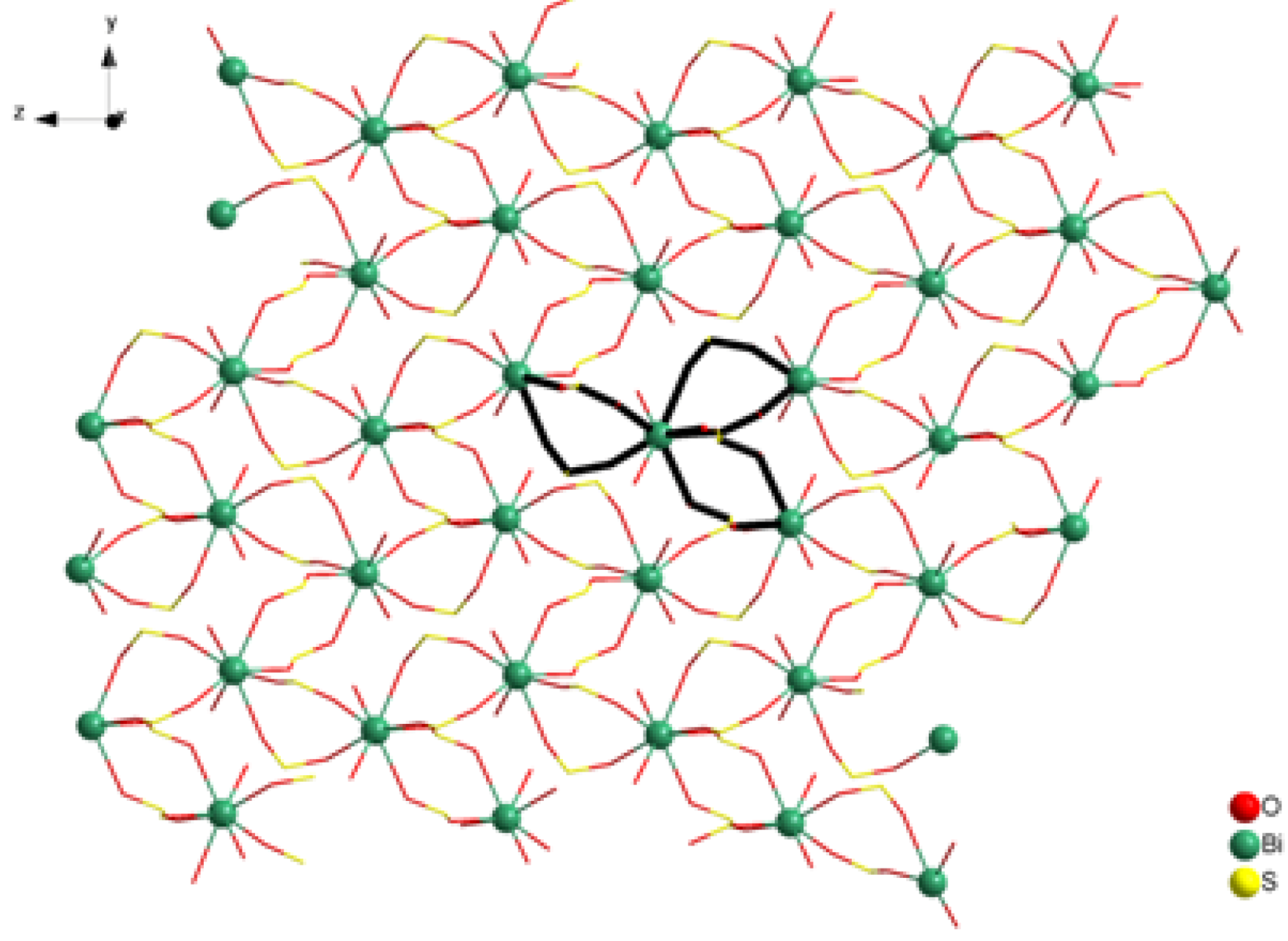
      <p>Consequently the ligands are spreading out in all three directions to the neighbor bismuth cations forming a metal organic framework with very small cavities. An ideal way to understand the structure is to investigate the bismuth-bridging SO<sub>2</sub> units and omit the ethylene groups (<xref ref-type="fig" rid="crystals-02-01374-f002">Figure 2</xref>). The resulting three-dimensional network built by the organosulfonate groups is cross-linked to the adjacent bismuth cation, and the MOF-like system can be seen clearly.</p>
      <fig id="crystals-02-01374-f002" position="anchor">
        <label>Figure 2</label>
        <caption>
          <p>The Bi–SO<sub>3</sub> framework of <bold>1</bold>. The carbon and hydrogen atoms are omitted for clarity.</p>
        </caption>
        <graphic xmlns:xlink="http://www.w3.org/1999/xlink" xlink:href="crystals-02-01374-g002.tif"/>
      </fig>
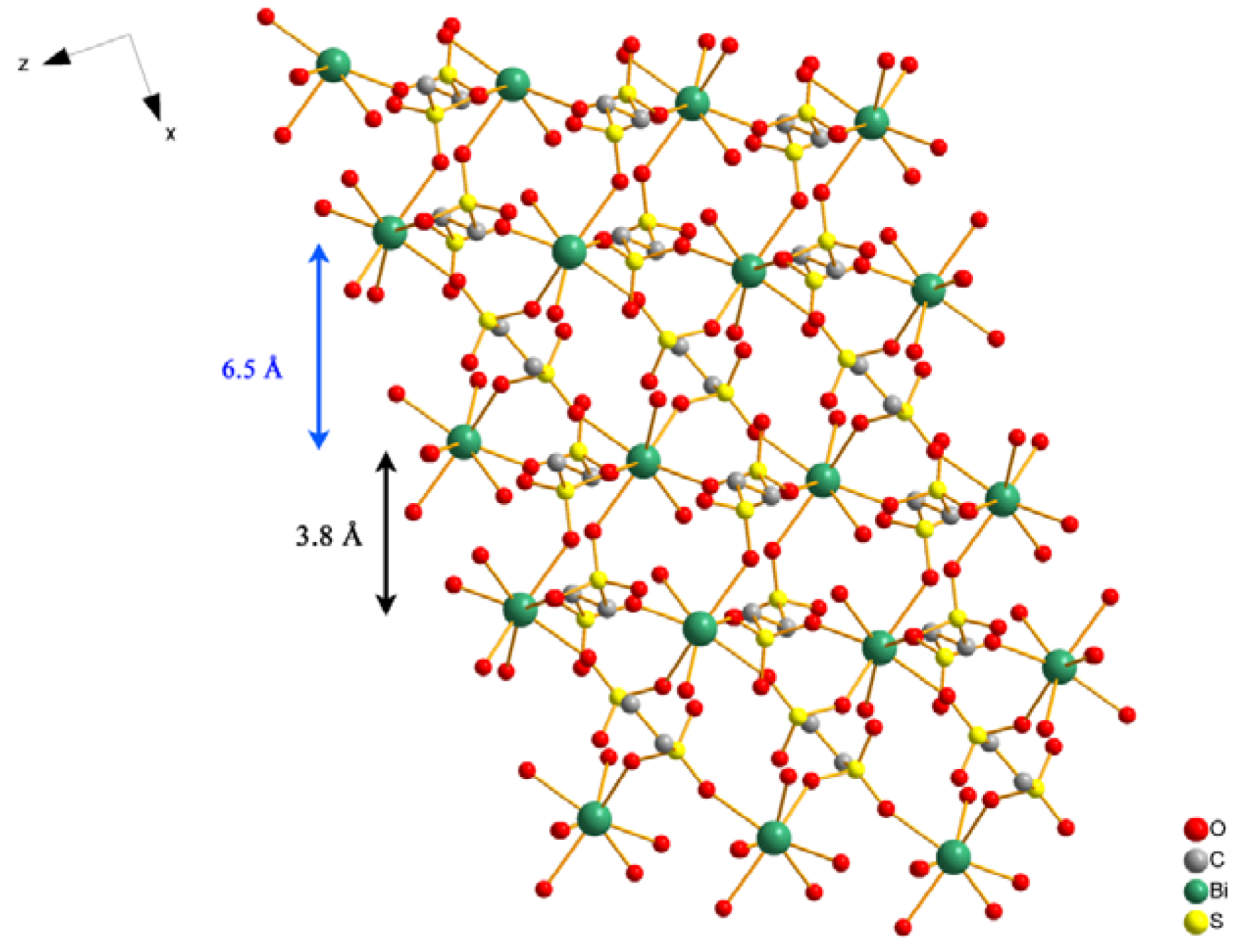
      <p>When the whole crystal structure is examined the alternating layers of bismuth cations and ligands becomes visible. Two different sheet systems can be distinguished. One has a large distance of around 6.5 Å as measured between the bismuth layers where the ligand lies stretched out in the <italic>z</italic>-direction (<xref ref-type="fig" rid="crystals-02-01374-f003">Figure 3</xref>). The second system has a shorter distance between the bismuth layers of around 3.8 Å due to the ligands that lie in the <italic>x</italic>-direction. The structure does not contain solvent accessible voids, which could be calculated by PLATON Void-Analyser [<xref ref-type="bibr" rid="B35-crystals-02-01374">35</xref>].</p>
      <fig id="crystals-02-01374-f003" position="anchor">
        <label>Figure 3</label>
        <caption>
          <p>View of the Bi layers in the <italic>y</italic>- direction (the hydrogen atoms are omitted for clarity).</p>
        </caption>
        <graphic xmlns:xlink="http://www.w3.org/1999/xlink" xlink:href="crystals-02-01374-g003.tif"/>
      </fig>
	  <table-wrap id="crystals-02-01374-t002" position="float">
        <object-id pub-id-type="pii">crystals-02-01374-t002_Table 2</object-id>
        <label>Table 2</label>
        <caption>
          <p>Crystal structure data for <bold>1</bold>.</p>
        </caption>
        <table>
          <thead>
            <tr>
              <th align="left" valign="middle">Crystal Data</th>
              <th align="left" valign="middle">1</th>
            </tr>
          </thead>
          <tbody>
            <tr>
              <td align="left" valign="middle">Formula</td>
              <td align="left" valign="middle">C<sub>3</sub>H<sub>10</sub>BiO<sub>11</sub>S<sub>3</sub></td>
            </tr>
            <tr>
              <td align="left" valign="middle">
                <italic>M</italic>
                <sub>r</sub>
              </td>
              <td align="left" valign="middle">527.27</td>
            </tr>
            <tr>
              <td align="left" valign="middle">Cryst. size, mm<sup>3</sup></td>
              <td align="left" valign="middle">0.18 × 0.12 × 0.07 </td>
            </tr>
            <tr>
              <td align="left" valign="middle">Crystal system</td>
              <td align="left" valign="middle">monoclinic</td>
            </tr>
            <tr>
              <td align="left" valign="middle">Space group</td>
              <td align="left" valign="middle"><italic>P</italic>2<sub>1</sub>/c</td>
            </tr>
            <tr>
              <td align="left" valign="middle"><italic>a</italic>, Å</td>
              <td align="left" valign="middle">11.601(2)</td>
            </tr>
            <tr>
              <td align="left" valign="middle"><italic>b</italic>, Å</td>
              <td align="left" valign="middle">10.390(2)</td>
            </tr>
            <tr>
              <td align="left" valign="middle"><italic>c</italic>, Å</td>
              <td align="left" valign="middle">10.498(2)</td>
            </tr>
            <tr>
              <td align="left" valign="middle"><italic>β</italic>, deg</td>
              <td align="left" valign="middle">115.15(3)</td>
            </tr>
            <tr>
              <td align="left" valign="middle"><italic>V</italic>, Å<sup>3</sup></td>
              <td align="left" valign="middle">1145.3(4)</td>
            </tr>
            <tr>
              <td align="left" valign="middle">
                <italic>Z</italic>
              </td>
              <td align="left" valign="middle">4</td>
            </tr>
            <tr>
              <td align="left" valign="middle"><italic>D</italic><sub>calcd</sub>, g cm<sup>–3</sup></td>
              <td align="left" valign="middle">3.058</td>
            </tr>
            <tr>
              <td align="left" valign="middle"><italic>μ</italic>(Mo<italic>K<sub>α</sub></italic>), cm<sup>–1</sup></td>
              <td align="left" valign="middle">15.994</td>
            </tr>
            <tr>
              <td align="left" valign="middle"><italic>F</italic>(000), e</td>
              <td align="left" valign="middle">988</td>
            </tr>
            <tr>
              <td align="left" valign="middle">Refl. measd./unique</td>
              <td align="left" valign="middle">12498/10592</td>
            </tr>
            <tr>
              <td align="left" valign="middle">Param. refined</td>
              <td align="left" valign="middle">3144</td>
            </tr>
            <tr>
              <td align="left" valign="middle"><italic>R</italic>(<italic>F</italic>)/<italic>wR</italic>(<italic>F</italic><sup>2</sup>)<sup>a</sup> (all refl.)</td>
              <td align="left" valign="middle">0.0475/0.0283</td>
            </tr>
            <tr>
              <td align="left" valign="middle">GoF (<italic>F</italic><sup>2</sup>)<sup>a</sup></td>
              <td align="left" valign="middle">1.124</td>
            </tr>
          </tbody>
        </table>
      </table-wrap>
    
      <p>The bulk material of compound <bold>1</bold> was confirmed through IR, powder X-ray-diffraction and elemental analyses. Even though compound <bold>1</bold> is the main product of the bulk material, a small amount of the compound [Bi<sub>6</sub>O<sub>4</sub>(OH)<sub>4</sub>(H<sub>2</sub>O)<sub>2</sub>][(CH<sub>2</sub>)<sub>2</sub>(SO<sub>3</sub>)<sub>2</sub>]<sub>3</sub> [<xref ref-type="bibr" rid="B10-crystals-02-01374">10</xref>] was always isolated after the first filtration and discarded. </p>
      <p>For a better insight into the thermal stability a thermal analysis (TGA) under oxygen was performed: Single crystals of <bold>1</bold> were crushed thus only the pure phase could be investigated: up to the first decomposition peak starting at about 320 °C only the weight loss of the two coordinated water molecules can be observed (at about 139 °C and 222 °C, observed 6.7% calculated 6.8%). Higher temperatures led to the decomposition of the organic moiety in one step (320 °C–395 °C, observed 35.9%, calculated 35.8%), followed by weight gain of 2.5% till 870 °C, which could be possibly be explained by the adsorption of oxygen molecules. The crystal parameters used in the unit cell determination, and structure refinement parameters are summarized in <xref ref-type="table" rid="crystals-02-01374-t002">Table 2</xref>.</p>
      </sec>
    <sec>
      <title>3. Experimental Section</title>
      <p>All reagents were obtained commercially and were used in the form that they were received in. The reactions were performed under hydrothermal conditions in air.</p>
      <p>Bi(O<sub>3</sub>SC<sub>2</sub>H<sub>4</sub>SO<sub>3</sub>)<sub>1.5</sub>(H<sub>2</sub>O)<sub>2</sub> (<bold>1</bold>) </p>
      <p>A mixture of Bi<sub>2</sub>O<sub>3</sub> (1.16 g, 2.4 mmol), 1,2-ethanedisulfonic acid (2.5 g, 1.3 mmol), and H<sub>2</sub>O (20 mL) was placed into a 25 mL teflon-lined stainless steel autoclave and kept for 3 days at 170 °C. After slowly cooling the autoclave to room temperature, a colorless solution with a little [Bi<sub>6</sub>O<sub>4</sub>(OH)<sub>4</sub>(H<sub>2</sub>O)<sub>2</sub>][(CH<sub>2</sub>)<sub>2</sub>(SO<sub>3</sub>)<sub>2</sub>]<sub>3</sub> precipitate [<xref ref-type="bibr" rid="B10-crystals-02-01374">10</xref>] had formed. The solution was filtered, and the mother liquor was allowed to evaporate in an open beaker. After two weeks, white crystals had formed. The crystals were filtered, washed with water, and then dried in air. Yield of the pure crystals: 20%.</p>
      <p>Single-crystal measurements were carried out on a Stoe IPDS-II diffractometer with a Mo<italic>K<sub>α</sub></italic> sealed tube at room temperature (<italic>λ</italic> = 0.71073 Å). The structure was solved using direct methods and refined in anisotropic approximation using the S<sc>HELX</sc> program suite [<xref ref-type="bibr" rid="B36-crystals-02-01374">36</xref>].</p>
      <p>A crystal was selected for single-crystal X-ray diffraction. The composition of the bulk material was confirmed through IR, powder X-ray-diffraction and elemental analyses. –C<sub>3</sub>S<sub>3</sub>BiO<sub>11</sub>H<sub>10</sub>·2H<sub>2</sub>O (632.66): calcd. C 6.19 Bi 38.5; found C 5.74, Bi 38.43, TGA: decomposition at 395 °C. FTIR (cm<sup>−1</sup>): 3467 (O–H), 2967 and 2920 (C–C), 1632 (O–H), 1457 (C–H), 1159 (C–C) 1024 (S=O), 895 (C–H), 613 (C–S).</p>
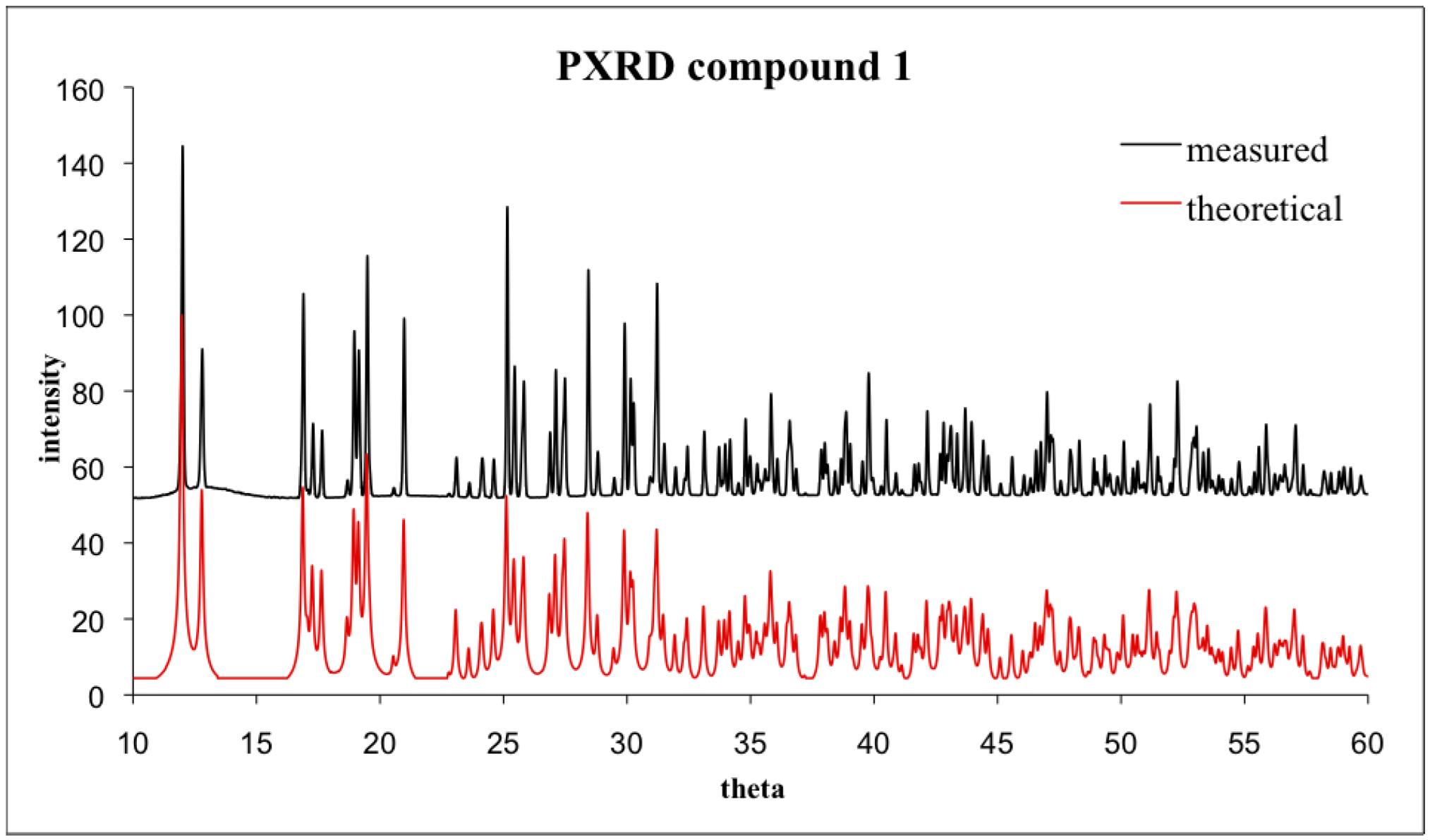
      <p>Powder X-ray diffraction (PXRD) data were recorded using a Bruker ASX D8 Advance powder diffractometer with <italic>CuK<sub>α</sub></italic> radiation (<italic>λ</italic> = 1.5418 Å). Lattice parameters of the bulk material of <bold>1</bold> according to the P<sc>AWLEY</sc> fit could be found as; <italic>a</italic> = 11.596, <italic>b</italic> = 110.385, <italic>c</italic> = 10.4926, <italic>β</italic> = 115.197. The reflections of the powder pattern can be assigned to compound <bold>1</bold> (<xref ref-type="fig" rid="crystals-02-01374-f004">Figure 4</xref>, Table S1).</p>
      <fig id="crystals-02-01374-f004" position="anchor">
        <label>Figure 4</label>
        <caption>
          <p>Experimental powder pattern of the sample in comparison to the theoretical powder pattern of <bold>1</bold> as based on the single-crystal structure determination.</p>
        </caption>
        <graphic xmlns:xlink="http://www.w3.org/1999/xlink" xlink:href="crystals-02-01374-g004.tif"/>
      </fig>
    </sec>
    <sec sec-type="conclusions">
      <title>4. Conclusions</title>
      <p>We have demonstrated that a simple and direct reaction between bismuth oxide and 1,2-ethanedisulfonic acid under hydrothermal conditions yields a new bismuth network structure with an organosulfonic ligand. The bismuth atom has an eight-coordinated environment and is the first three-dimensionally coordinated bismuth ethanedisulfonate framework to be documented.</p>
    </sec>
    
  </body>
  <back>
  <ack>
      <title>Acknowledgment</title>
      <p>The authors thank the Swiss National Science Foundation for its generous support. </p>
    </ack>
    <notes>
      <title>Conflict of Interest</title>
      <p>The authors declare no conflict of interest. </p>
    </notes>
    <ref-list>
      <title>References</title>
      <ref id="B1-crystals-02-01374">
        <label>1.</label>
        <citation citation-type="journal">
          <person-group person-group-type="author">
            <name>
              <surname>Briand</surname>
              <given-names>G.G.</given-names>
            </name>
            <name>
              <surname>Burford</surname>
              <given-names>N.</given-names>
            </name>
          </person-group>
          <article-title>Bismuth compounds and preparations with biological or medicinal relevance</article-title>
          <source>Chem. Rev.</source>
          <year>1999</year>
          <volume>99</volume>
          <fpage>2601</fpage>
          <lpage>2657</lpage>
          <pub-id pub-id-type="doi">10.1021/cr980425s</pub-id>
        </citation>
      </ref>
      <ref id="B2-crystals-02-01374">
        <label>2.</label>
        <citation citation-type="journal">
          <person-group person-group-type="author">
            <name>
              <surname>Csajbok</surname>
              <given-names>E.</given-names>
            </name>
            <name>
              <surname>Baranyai</surname>
              <given-names>Z.</given-names>
            </name>
            <name>
              <surname>Banyai</surname>
              <given-names>I.</given-names>
            </name>
            <name>
              <surname>Brücher</surname>
              <given-names>E.</given-names>
            </name>
            <name>
              <surname>Kiraly</surname>
              <given-names>R.</given-names>
            </name>
            <name>
              <surname>Müller-Fahrnow</surname>
              <given-names>A.</given-names>
            </name>
            <name>
              <surname>Platzek</surname>
              <given-names>J.</given-names>
            </name>
            <name>
              <surname>Radüchel</surname>
              <given-names>B.</given-names>
            </name>
            <name>
              <surname>Schäfer</surname>
              <given-names>M.</given-names>
            </name>
          </person-group>
          <article-title>Equilibrium, <sup>1</sup>H and <sup>13</sup>C NMR Spectroscopy, and X-ray Diffraction Studies on the Complexes Bi(DOTA) and Bi(DO3A-Bu)</article-title>
          <source>Inorg. Chem.</source>
          <year>2003</year>
          <volume>42</volume>
          <fpage>2342</fpage>
          <lpage>2349</lpage>
          <pub-id pub-id-type="doi">10.1021/ic0261272</pub-id>
        </citation>
      </ref>
      <ref id="B3-crystals-02-01374">
        <label>3.</label>
        <citation citation-type="journal">
          <person-group person-group-type="author">
            <name>
              <surname>Stavila</surname>
              <given-names>V.</given-names>
            </name>
            <name>
              <surname>Davidoch</surname>
              <given-names>R.L.</given-names>
            </name>
            <name>
              <surname>Gulea</surname>
              <given-names>A.</given-names>
            </name>
            <name>
              <surname>Whitmire</surname>
              <given-names>K.H.</given-names>
            </name>
          </person-group>
          <article-title>Bismuth (III) complexes with aminopolycarboxylate and polyaminopolycarboxylate ligands: Chemistry and structure</article-title>
          <source>Coord. Chem. Rev.</source>
          <year>2006</year>
          <volume>250</volume>
          <fpage>2782</fpage>
          <lpage>2810</lpage>
          <pub-id pub-id-type="doi">10.1016/j.ccr.2006.02.032</pub-id>
        </citation>
      </ref>
      <ref id="B4-crystals-02-01374">
        <label>4.</label>
        <citation citation-type="journal">
          <person-group person-group-type="author">
            <name>
              <surname>Garje</surname>
              <given-names>S.S.</given-names>
            </name>
            <name>
              <surname>Jain</surname>
              <given-names>V.K.</given-names>
            </name>
          </person-group>
          <article-title>Chemistry of arsenic, antimony and bismuth compounds derived from xanthate, dithiocarbamate and phosphorus based ligands</article-title>
          <source>Coord. Chem. Rev.</source>
          <year>2003</year>
          <volume>236</volume>
          <fpage>35</fpage>
          <lpage>56</lpage>
        <pub-id pub-id-type="doi">10.1016/S0010-8545(02)00159-5</pub-id></citation>
      </ref>
      <ref id="B5-crystals-02-01374">
        <label>5.</label>
        <citation citation-type="journal">
          <person-group person-group-type="author">
            <name>
              <surname>Hanna</surname>
              <given-names>T.A.</given-names>
            </name>
          </person-group>
          <article-title>The role of bismuth in the SOHIO process</article-title>
          <source>Coord. Chem. Rev.</source>
          <year>2004</year>
          <volume>248</volume>
          <fpage>429</fpage>
          <lpage>440</lpage>
          <pub-id pub-id-type="doi">10.1016/j.ccr.2003.10.001</pub-id>
        </citation>
      </ref>
      <ref id="B6-crystals-02-01374">
        <label>6.</label>
        <citation citation-type="journal">
          <person-group person-group-type="author">
            <name>
              <surname>Kumar</surname>
              <given-names>R.</given-names>
            </name>
            <name>
              <surname>Mishra</surname>
              <given-names>P.</given-names>
            </name>
          </person-group>
          <article-title>Bi (V) organic framework in an asymmetric system: Synthesis, spectroscopic, XRPD and molecular modeling</article-title>
          <source>Main Group Chem.</source>
          <year>2007</year>
          <volume>6</volume>
          <fpage>85</fpage>
          <lpage>95</lpage>
          <pub-id pub-id-type="doi">10.1080/10241220701825087</pub-id>
        </citation>
      </ref>
      <ref id="B7-crystals-02-01374">
        <label>7.</label>
        <citation citation-type="journal">
          <person-group person-group-type="author">
            <name>
              <surname>Thirumurugan</surname>
              <given-names>A.</given-names>
            </name>
            <name>
              <surname>Tan</surname>
              <given-names>J.C.</given-names>
            </name>
            <name>
              <surname>Cheetham</surname>
              <given-names>A.K.</given-names>
            </name>
          </person-group>
          <article-title>Heterometallic Inorganic-Organic Framework of Sodium-Bismuth Benzenedicarboxylates</article-title>
          <source>Cryst. Growth Des.</source>
          <year>2010</year>
          <volume>10</volume>
          <fpage>1736</fpage>
          <lpage>1741</lpage>
          <pub-id pub-id-type="doi">10.1021/cg901402f</pub-id>
        </citation>
      </ref>
      <ref id="B8-crystals-02-01374">
        <label>8.</label>
        <citation citation-type="journal">
          <person-group person-group-type="author">
            <name>
              <surname>Tran</surname>
              <given-names>D.T.</given-names>
            </name>
            <name>
              <surname>Chu</surname>
              <given-names>D.</given-names>
            </name>
            <name>
              <surname>Oliver</surname>
              <given-names>A.G.</given-names>
            </name>
            <name>
              <surname>Oliver</surname>
              <given-names>S.R.J.</given-names>
            </name>
          </person-group>
          <article-title>3-D bismuth-organic framework containing 1-D cationic inorganic [Bi<sub>2</sub>O<sub>2</sub>]<sup>2+</sup> chains</article-title>
          <source>Inorg. Chem. Commun.</source>
          <year>2009</year>
          <volume>10</volume>
          <fpage>1081</fpage>
          <lpage>1084</lpage>
        </citation>
      </ref>
      <ref id="B9-crystals-02-01374">
        <label>9.</label>
        <citation citation-type="book">
          <person-group person-group-type="author">
            <name>
              <surname>Cotton</surname>
              <given-names>F.A.</given-names>
            </name>
            <name>
              <surname>Wilkinson</surname>
              <given-names>G.</given-names>
            </name>
            <name>
              <surname>Gaus</surname>
              <given-names>P.L.</given-names>
            </name>
          </person-group>
          <article-title>The GroupVB(15) Elements: Phosphorus, Arsenic, Antimony, and Bismuth</article-title>
          <source>Basic Inorganic Chemistry</source>
          <edition>3rd</edition>
          <person-group person-group-type="editor">
            <name>
              <surname>Rose</surname>
              <given-names>N.</given-names>
            </name>
            <name>
              <surname>Herbert</surname>
              <given-names>D.</given-names>
            </name>
          </person-group>
          <publisher-name>Wiley and Sons, Inc.</publisher-name>
          <publisher-loc>New York, NY, USA</publisher-loc>
          <year>1995</year>
          <fpage>399</fpage>
          <lpage>435</lpage>
        </citation>
      </ref>
      <ref id="B10-crystals-02-01374">
        <label>10.</label>
        <citation citation-type="journal">
          <person-group person-group-type="author">
            <name>
              <surname>Rogow</surname>
              <given-names>D.L.</given-names>
            </name>
            <name>
              <surname>Fei</surname>
              <given-names>H.</given-names>
            </name>
            <name>
              <surname>Brennan</surname>
              <given-names>D.P.</given-names>
            </name>
            <name>
              <surname>Ikehata</surname>
              <given-names>M.</given-names>
            </name>
            <name>
              <surname>Oliver</surname>
              <given-names>S.R.J.</given-names>
            </name>
          </person-group>
          <article-title>Hydrothermal synthesis of two cationic bismuthate clusters: An alkylenedisulfonate bridged hexamer, [Bi<sub>6</sub>O<sub>4</sub>(OH)<sub>4</sub>(H<sub>2</sub>O)<sub>2</sub>][(CH<sub>2</sub>)<sub>2</sub>(SO<sub>3</sub>)<sub>2</sub>]<sub>3</sub> and a rare nonamer templated by triflate, [Bi<sub>9</sub>O<sub>8</sub>(OH)<sub>6</sub>][CF<sub>3</sub>SO<sub>3</sub>]<sub>5</sub></article-title>
          <source>Inorg. Chem.</source>
          <year>2010</year>
          <volume>49</volume>
          <fpage>5619</fpage>
          <lpage>5624</lpage>
          <pub-id pub-id-type="doi">10.1021/ic1004402</pub-id>
        </citation>
      </ref>
      <ref id="B11-crystals-02-01374">
        <label>11.</label>
        <citation citation-type="journal">
          <person-group person-group-type="author">
            <name>
              <surname>Thurston</surname>
              <given-names>J.H.</given-names>
            </name>
            <name>
              <surname>Trahan</surname>
              <given-names>D.</given-names>
            </name>
            <name>
              <surname>Ould-Ely</surname>
              <given-names>T.</given-names>
            </name>
            <name>
              <surname>Whitmire</surname>
              <given-names>K.H.</given-names>
            </name>
          </person-group>
          <article-title>Toward an general strategy for synthesis of heterobimetallic coordination complexes for use as precursors to metal oxide materials: Synthesis, Characterization, and Thermal Decomposition of Bi<sub>2</sub>(Hsal)<sub>6</sub>*M(Acac)<sub>3</sub> (M = Al, Co, V, Fe, Cr)</article-title>
          <source>Inorg. Chem.</source>
          <year>2004</year>
          <volume>43</volume>
          <fpage>3299</fpage>
          <lpage>3305</lpage>
          <pub-id pub-id-type="doi">10.1021/ic035284d</pub-id>
        </citation>
      </ref>
      <ref id="B12-crystals-02-01374">
        <label>12.</label>
        <citation citation-type="journal">
          <person-group person-group-type="author">
            <name>
              <surname>Andrews</surname>
              <given-names>P.C.</given-names>
            </name>
            <name>
              <surname>Deacon</surname>
              <given-names>G.B.</given-names>
            </name>
            <name>
              <surname>Junk</surname>
              <given-names>P.C.</given-names>
            </name>
            <name>
              <surname>Kumar</surname>
              <given-names>I.</given-names>
            </name>
            <name>
              <surname>Silberstein</surname>
              <given-names>M.</given-names>
            </name>
          </person-group>
          <article-title>Synthetic and structural comparisons of bismuth(III) carboxylates synthesized under solvent-free and reflux conditions</article-title>
          <source>Dalton Trans.</source>
          <year>2006</year>
          <volume>40</volume>
          <fpage>4852</fpage>
          <lpage>4858</lpage>
        <pub-id pub-id-type="pmid">17033711</pub-id></citation>
      </ref>
      <ref id="B13-crystals-02-01374">
        <label>13.</label>
        <citation citation-type="journal">
          <person-group person-group-type="author">
            <name>
              <surname>Holmes</surname>
              <given-names>R.R.</given-names>
            </name>
            <name>
              <surname>Schmid</surname>
              <given-names>C.G.</given-names>
            </name>
            <name>
              <surname>Chandrasekhar</surname>
              <given-names>V.</given-names>
            </name>
            <name>
              <surname>Day</surname>
              <given-names>R.O.</given-names>
            </name>
            <name>
              <surname>Holmes</surname>
              <given-names>J.M.</given-names>
            </name>
          </person-group>
          <article-title>Oxo carboxylate tin ladder Clusters. A New Structural Class of Organotin Compounds</article-title>
          <source>J. Am. Chem. Soc.</source>
          <year>1987</year>
          <volume>109</volume>
          <fpage>1408</fpage>
          <lpage>1414</lpage>
        <pub-id pub-id-type="doi">10.1021/ja00239a022</pub-id></citation>
      </ref>
      <ref id="B14-crystals-02-01374">
        <label>14.</label>
        <citation citation-type="journal">
          <person-group person-group-type="author">
            <name>
              <surname>Asato</surname>
              <given-names>E.</given-names>
            </name>
            <name>
              <surname>Driessen</surname>
              <given-names>W.L.</given-names>
            </name>
            <name>
              <surname>de Graaff</surname>
              <given-names>R.A.G.</given-names>
            </name>
            <name>
              <surname>Hulsbergen</surname>
              <given-names>F.B.</given-names>
            </name>
            <name>
              <surname>Reedijk</surname>
              <given-names>J.</given-names>
            </name>
          </person-group>
          <article-title>Synthesis, Structure, and Spectroscopoc Properties of Bismuth Citrate Compounds</article-title>
          <source>Inorg. Chem.</source>
          <year>1991</year>
          <volume>30</volume>
          <fpage>4210</fpage>
          <lpage>4218</lpage>
          <pub-id pub-id-type="doi">10.1021/ic00022a023</pub-id>
        </citation>
      </ref>
      <ref id="B15-crystals-02-01374">
        <label>15.</label>
        <citation citation-type="journal">
          <person-group person-group-type="author">
            <name>
              <surname>Adair</surname>
              <given-names>B.A.</given-names>
            </name>
            <name>
              <surname>Neeray</surname>
              <given-names>S.</given-names>
            </name>
            <name>
              <surname>Cheetham</surname>
              <given-names>A.K.</given-names>
            </name>
          </person-group>
          <article-title>Role of Chains in the Formation of Extended Framework Tin(II) Phosphates and Related Materials</article-title>
          <source>Chem. Mater.</source>
          <year>2003</year>
          <volume>15</volume>
          <fpage>1518</fpage>
          <lpage>1529</lpage>
          <pub-id pub-id-type="doi">10.1021/cm020650x</pub-id>
        </citation>
      </ref>
      <ref id="B16-crystals-02-01374">
        <label>16.</label>
        <citation citation-type="journal">
          <person-group person-group-type="author">
            <name>
              <surname>Bujoli-Doeuff</surname>
              <given-names>M.</given-names>
            </name>
            <name>
              <surname>Evain</surname>
              <given-names>M.</given-names>
            </name>
            <name>
              <surname>Janvier</surname>
              <given-names>P.</given-names>
            </name>
            <name>
              <surname>Massiot</surname>
              <given-names>D.</given-names>
            </name>
            <name>
              <surname>Clearfield</surname>
              <given-names>A.</given-names>
            </name>
            <name>
              <surname>Gan</surname>
              <given-names>Z.</given-names>
            </name>
            <name>
              <surname>Bujoli</surname>
              <given-names>B.</given-names>
            </name>
          </person-group>
          <article-title>New pillared layered gallium phosphonates in the gallium/1,2-ethylenediphosphonic acid system</article-title>
          <source>Inorg. Chem.</source>
          <year>2001</year>
          <volume>40</volume>
          <fpage>6694</fpage>
          <lpage>6698</lpage>
        <pub-id pub-id-type="doi">10.1021/ic010588q</pub-id><pub-id pub-id-type="pmid">11735480</pub-id></citation>
      </ref>
      <ref id="B17-crystals-02-01374">
        <label>17.</label>
        <citation citation-type="book">
          <person-group person-group-type="author">
            <name>
              <surname>Bruno</surname>
              <given-names>I.J.</given-names>
            </name>
            <name>
              <surname>Cole</surname>
              <given-names>J.C.</given-names>
            </name>
            <name>
              <surname>Edgington</surname>
              <given-names>P.R.</given-names>
            </name>
            <name>
              <surname>Kessler</surname>
              <given-names>M.</given-names>
            </name>
            <name>
              <surname>Macrae</surname>
              <given-names>C.F.</given-names>
            </name>
            <name>
              <surname>McCabe</surname>
              <given-names>P.</given-names>
            </name>
            <name>
              <surname>Pearson</surname>
              <given-names>J.</given-names>
            </name>
            <name>
              <surname>Taylor</surname>
              <given-names>R.</given-names>
            </name>
          </person-group>
          <source>ConQuest, Version 1.14</source>
          <publisher-name>Cambridge Crystallographic Data Centre</publisher-name>
          <publisher-loc>Cambridge, UK</publisher-loc>
          <year>2012</year>
        </citation>
      </ref>
      <ref id="B18-crystals-02-01374">
        <label>18.</label>
        <citation citation-type="journal">
          <person-group person-group-type="author">
            <name>
              <surname>Müller</surname>
              <given-names>U.</given-names>
            </name>
            <name>
              <surname>Schubert</surname>
              <given-names>M</given-names>
            </name>
            <name>
              <surname>Teich</surname>
              <given-names>F.</given-names>
            </name>
            <name>
              <surname>Pütter</surname>
              <given-names>H.</given-names>
            </name>
            <name>
              <surname>Schierle-Arndt</surname>
              <given-names>K.</given-names>
            </name>
            <name>
              <surname>Pastré.</surname>
              <given-names>J.</given-names>
            </name>
          </person-group>
          <article-title>Metal-organic frameworks-prospective industrial applications</article-title>
          <source>J. Mater. Chem.</source>
          <year>2006</year>
          <volume>16</volume>
          <fpage>626</fpage>
          <lpage>636</lpage>
        <pub-id pub-id-type="doi">10.1039/b511962f</pub-id></citation>
      </ref>
      <ref id="B19-crystals-02-01374">
        <label>19.</label>
        <citation citation-type="journal">
          <person-group person-group-type="author">
            <name>
              <surname>Kitagawa</surname>
              <given-names>S.</given-names>
            </name>
            <name>
              <surname>Kitaura</surname>
              <given-names>R.</given-names>
            </name>
            <name>
              <surname>Noro</surname>
              <given-names>S.I.</given-names>
            </name>
          </person-group>
          <article-title>Functional Porous Coordination Polymers</article-title>
          <source>Angew. Chem. Int. Ed.</source>
          <year>2004</year>
          <volume>43</volume>
          <fpage>2334</fpage>
          <lpage>2375</lpage>
          <pub-id pub-id-type="doi">10.1002/anie.200300610</pub-id>
        </citation>
      </ref>
      <ref id="B20-crystals-02-01374">
        <label>20.</label>
        <citation citation-type="journal">
          <person-group person-group-type="author">
            <name>
              <surname>Li</surname>
              <given-names>H.</given-names>
            </name>
            <name>
              <surname>Eddaoudi</surname>
              <given-names>M.</given-names>
            </name>
            <name>
              <surname>O’Keeffe</surname>
              <given-names>M.</given-names>
            </name>
            <name>
              <surname>Yaghi</surname>
              <given-names>O.M.</given-names>
            </name>
          </person-group>
          <article-title>Design and synthesis of an exceptionally stable and highly porous metal-organic framework</article-title>
          <source>Nature</source>
          <year>1999</year>
          <volume>402</volume>
          <fpage>276</fpage>
          <lpage>279</lpage>
        <pub-id pub-id-type="doi">10.1038/46248</pub-id></citation>
      </ref>
      <ref id="B21-crystals-02-01374">
        <label>21.</label>
        <citation citation-type="journal">
          <person-group person-group-type="author">
            <name>
              <surname>Bauer</surname>
              <given-names>S.</given-names>
            </name>
            <name>
              <surname>Müller</surname>
              <given-names>H.</given-names>
            </name>
            <name>
              <surname>Bein</surname>
              <given-names>T.</given-names>
            </name>
            <name>
              <surname>Stock</surname>
              <given-names>N.</given-names>
            </name>
          </person-group>
          <article-title>Synthesis and characterization of the open-framework barium bisphosphonate [Ba<sub>3</sub>(O<sub>3</sub>PCH<sub>2</sub>NH<sub>2</sub>CH<sub>2</sub>PO<sub>3</sub>)<sub>2</sub>(H<sub>2</sub>O)<sub>4</sub>]*3H<sub>2</sub>O</article-title>
          <source>Inorg. Chem.</source>
          <year>2005</year>
          <volume>44</volume>
          <fpage>9464</fpage>
          <lpage>9470</lpage>
          <pub-id pub-id-type="doi">10.1021/ic050935m</pub-id>
        </citation>
      </ref>
      <ref id="B22-crystals-02-01374">
        <label>22.</label>
        <citation citation-type="journal">
          <person-group person-group-type="author">
            <name>
              <surname>Serre</surname>
              <given-names>C.</given-names>
            </name>
            <name>
              <surname>Groves</surname>
              <given-names>J.A.</given-names>
            </name>
            <name>
              <surname>Lightfoot</surname>
              <given-names>P.</given-names>
            </name>
            <name>
              <surname>Slawin</surname>
              <given-names>A.M.Z.</given-names>
            </name>
            <name>
              <surname>Wright</surname>
              <given-names>P.A.</given-names>
            </name>
            <name>
              <surname>Stock</surname>
              <given-names>N.</given-names>
            </name>
            <name>
              <surname>Bein</surname>
              <given-names>T.</given-names>
            </name>
            <name>
              <surname>Haouas</surname>
              <given-names>M.</given-names>
            </name>
            <name>
              <surname>Taulelle</surname>
              <given-names>F.</given-names>
            </name>
            <name>
              <surname>Férey</surname>
              <given-names>G.</given-names>
            </name>
          </person-group>
          <article-title>Synthesis, Structure and Properties of Related Microporous <italic>N</italic>,<italic>N</italic>-Piperazinebismethylenephosphonates of Aluminium and Titanium</article-title>
          <source>Chem. Mater.</source>
          <year>2006</year>
          <volume>18</volume>
          <fpage>1451</fpage>
          <lpage>1457</lpage>
          <pub-id pub-id-type="doi">10.1021/cm052149l</pub-id>
        </citation>
      </ref>
      <ref id="B23-crystals-02-01374">
        <label>23.</label>
        <citation citation-type="journal">
          <person-group person-group-type="author">
            <name>
              <surname>Zhang</surname>
              <given-names>L.P.</given-names>
            </name>
            <name>
              <surname>Zhu</surname>
              <given-names>L.G.</given-names>
            </name>
          </person-group>
          <article-title>Influence of neutral amine ligands on the network assembly of lead(II) 4-sulfobenzoate complexes</article-title>
          <source>J. Mol. Struct.</source>
          <year>2008</year>
          <volume>873</volume>
          <fpage>61</fpage>
          <lpage>68</lpage>
          <pub-id pub-id-type="doi">10.1016/j.molstruc.2007.03.006</pub-id>
        </citation>
      </ref>
      <ref id="B24-crystals-02-01374">
        <label>24.</label>
        <citation citation-type="journal">
          <person-group person-group-type="author">
            <name>
              <surname>Schreuer</surname>
              <given-names>J.</given-names>
            </name>
          </person-group>
          <article-title>Crystal structure of thalium sulfanilate semihydrate, TlH<sub>2</sub>C<sub>6</sub>H<sub>4</sub>SO<sub>3</sub>·0.5H<sub>2</sub>O</article-title>
          <source>Z. Kristallogr. New Cryst. Struct.</source>
          <year>1999</year>
          <volume>214</volume>
          <fpage>313</fpage>
          <lpage>314</lpage>
        </citation>
      </ref>
      <ref id="B25-crystals-02-01374">
        <label>25.</label>
        <citation citation-type="journal">
          <person-group person-group-type="author">
            <name>
              <surname>Miao</surname>
              <given-names>X.H.</given-names>
            </name>
            <name>
              <surname>Zhu</surname>
              <given-names>L.G.</given-names>
            </name>
          </person-group>
          <article-title>Influence of secondary bonds on the network assembly and property in lead(II) 3-sulfobenzoate</article-title>
          <source>Z. Anorg. Allg. Chem.</source>
          <year>2008</year>
          <volume>634</volume>
          <fpage>335</fpage>
          <lpage>338</lpage>
          <pub-id pub-id-type="doi">10.1002/zaac.200700363</pub-id>
        </citation>
      </ref>
      <ref id="B26-crystals-02-01374">
        <label>26.</label>
        <citation citation-type="journal">
          <person-group person-group-type="author">
            <name>
              <surname>Chandrasekhar</surname>
              <given-names>V.</given-names>
            </name>
            <name>
              <surname>Singh</surname>
              <given-names>P.</given-names>
            </name>
          </person-group>
          <article-title><italic>In Situ</italic> Generated Hydrated Diorganotin Cations as Synthons for Hydrogen-Bonded and Coordination-Driven 1D-, 2D, and 3D-Assemblies</article-title>
          <source>Cryst. Growth Des.</source>
          <year>2010</year>
          <volume>10</volume>
          <fpage>3077</fpage>
          <lpage>3093</lpage>
        <pub-id pub-id-type="doi">10.1021/cg100179q</pub-id></citation>
      </ref>
      <ref id="B27-crystals-02-01374">
        <label>27.</label>
        <citation citation-type="journal">
          <person-group person-group-type="author">
            <name>
              <surname>Charbonnier</surname>
              <given-names>F.</given-names>
            </name>
            <name>
              <surname>Faure</surname>
              <given-names>R.</given-names>
            </name>
            <name>
              <surname>Loiseleur</surname>
              <given-names>H.</given-names>
            </name>
          </person-group>
          <article-title>Structure Cristalline de l’Ethanedisulfonate-1,2 de Cuivre Tétrahydraté: Cu[SO<sub>3</sub>(CH<sub>2</sub>)<sub>2</sub>SO<sub>3</sub>]·4H<sub>2</sub>O</article-title>
          <source>Acta Cryst.</source>
          <year>1977</year>
          <volume>B33</volume>
          <fpage>3342</fpage>
          <lpage>3345</lpage>
        </citation>
      </ref>
      <ref id="B28-crystals-02-01374">
        <label>28.</label>
        <citation citation-type="journal">
          <person-group person-group-type="author">
            <name>
              <surname>Charbonnier</surname>
              <given-names>F.</given-names>
            </name>
            <name>
              <surname>Faure</surname>
              <given-names>R.</given-names>
            </name>
            <name>
              <surname>Loiseleur</surname>
              <given-names>H.</given-names>
            </name>
          </person-group>
          <article-title>Coordination et Disposition de l’Argent dans l’Ethanedisulfonate-1,2 et le Butanedisulfonate-1,4 d’Argent(I) Cristallisés</article-title>
          <source>Acta Cryst.</source>
          <year>1981</year>
          <volume>B37</volume>
          <fpage>822</fpage>
          <lpage>826</lpage>
        </citation>
      </ref>
      <ref id="B29-crystals-02-01374">
        <label>29.</label>
        <citation citation-type="journal">
          <person-group person-group-type="author">
            <name>
              <surname>Forster</surname>
              <given-names>P.M.</given-names>
            </name>
            <name>
              <surname>Tafoya</surname>
              <given-names>M.M.</given-names>
            </name>
            <name>
              <surname>Cheetham</surname>
              <given-names>A.K.</given-names>
            </name>
          </person-group>
          <article-title>Synthesis and characterization of Co<sub>7</sub>(OH)<sub>12</sub>(C<sub>2</sub>H<sub>4</sub>S<sub>2</sub>O<sub>6</sub>)(H<sub>2</sub>O)<sub>2</sub>—A single crystal structural study of a ferromagnetic layered cobalt hydroxide</article-title>
          <source>J. Phys. Chem. Solids</source>
          <year>2004</year>
          <volume>65</volume>
          <fpage>11</fpage>
          <lpage>16</lpage>
          <pub-id pub-id-type="doi">10.1016/j.jpcs.2003.08.016</pub-id>
        </citation>
      </ref>
      <ref id="B30-crystals-02-01374">
        <label>30.</label>
        <citation citation-type="journal">
          <person-group person-group-type="author">
            <name>
              <surname>Mootz</surname>
              <given-names>D.</given-names>
            </name>
            <name>
              <surname>Wunderlich</surname>
              <given-names>H.</given-names>
            </name>
          </person-group>
          <article-title>Kristallstrukturen von säurehydraten und oxoniumsalzen. IV. dioxonium-äthan-1,2-disulfonat, (H<sub>3</sub>O)<sub>2</sub>[O<sub>3</sub>SCH<sub>2</sub>CH<sub>2</sub>SO<sub>3</sub>]</article-title>
          <source>Acta Cryst.</source>
          <year>1970</year>
          <volume>B26</volume>
          <fpage>1820</fpage>
          <lpage>1825</lpage>
        </citation>
      </ref>
      <ref id="B31-crystals-02-01374">
        <label>31.</label>
        <citation citation-type="journal">
          <person-group person-group-type="author">
            <name>
              <surname>Sartori</surname>
              <given-names>P.</given-names>
            </name>
            <name>
              <surname>Juschke</surname>
              <given-names>R.</given-names>
            </name>
            <name>
              <surname>Boese</surname>
              <given-names>R.</given-names>
            </name>
            <name>
              <surname>Blaser</surname>
              <given-names>D.</given-names>
            </name>
          </person-group>
          <article-title>Structure of dihydroxononium alkanedisulfonates</article-title>
          <source>Z. Naturforsch. B</source>
          <year>1994</year>
          <volume>49</volume>
          <fpage>1467</fpage>
          <lpage>1471</lpage>
        </citation>
      </ref>
      <ref id="B32-crystals-02-01374">
        <label>32.</label>
        <citation citation-type="journal">
          <person-group person-group-type="author">
            <name>
              <surname>Fei</surname>
              <given-names>H.</given-names>
            </name>
            <name>
              <surname>Oliver</surname>
              <given-names>S.R.J.</given-names>
            </name>
          </person-group>
          <article-title>Two cationic metal–organic frameworks based on cadmium and a,x-alkanedisulfonate anions and their photoluminescent properties</article-title>
          <source>Dalton Trans.</source>
          <year>2010</year>
          <volume>39</volume>
          <fpage>11193</fpage>
          <lpage>11200</lpage>
          <pub-id pub-id-type="doi">10.1039/c0dt01064b</pub-id>
        </citation>
      </ref>
      <ref id="B33-crystals-02-01374">
        <label>33.</label>
        <citation citation-type="journal">
          <person-group person-group-type="author">
            <name>
              <surname>Brese</surname>
              <given-names>N.E.</given-names>
            </name>
            <name>
              <surname>O'Keeffe</surname>
              <given-names>M.</given-names>
            </name>
          </person-group>
          <article-title>Bond-valence parameters for solids</article-title>
          <source>Acta Cryst.</source>
          <year>1991</year>
          <volume>B47</volume>
          <fpage>192</fpage>
          <lpage>197</lpage>
        </citation>
      </ref>
      <ref id="B34-crystals-02-01374">
        <label>34.</label>
        <citation citation-type="journal">
          <person-group person-group-type="author">
            <name>
              <surname>Brown</surname>
              <given-names>I.D.</given-names>
            </name>
            <name>
              <surname>Altermatt</surname>
              <given-names>D.</given-names>
            </name>
          </person-group>
          <article-title>Bond-Valence Parameters Obtained from a Systematic Analysis of the inorganic crystal structure database</article-title>
          <source>Acta Cryst.</source>
          <year>1985</year>
          <volume>B41</volume>
          <fpage>244</fpage>
          <lpage>247</lpage>
        </citation>
      </ref>
      <ref id="B35-crystals-02-01374">
        <label>35.</label>
        <citation citation-type="journal">
          <person-group person-group-type="author">
            <name>
              <surname>Spek</surname>
              <given-names>A.L.</given-names>
            </name>
          </person-group>
          <article-title>Structure validation in chemical crystallography</article-title>
          <source>Acta Cryst.</source>
          <year>2009</year>
          <volume>D65</volume>
          <fpage>148</fpage>
          <lpage>155</lpage>
        </citation>
      </ref>
      <ref id="B36-crystals-02-01374">
        <label>36.</label>
        <citation citation-type="book">
          <person-group person-group-type="author">
            <name>
              <surname>Sheldrick</surname>
              <given-names>G.M.</given-names>
            </name>
          </person-group>
          <source>SHELXS-97, Program for Structure Analysis, version 97-2</source>
          <publisher-name>University of Göttingen</publisher-name>
          <publisher-loc>Göttingen, Germany</publisher-loc>
          <year>1998</year>
        </citation>
      </ref>
    </ref-list>
  </back>
</article>