<?xml version="1.0" encoding="UTF-8"?>
<!DOCTYPE article PUBLIC "-//NLM//DTD Journal Publishing DTD v2.3 20070202//EN" "journalpublishing.dtd">
<article xmlns:mml="http://www.w3.org/1998/Math/MathML" xmlns:xlink="http://www.w3.org/1999/xlink" xml:lang="en" article-type="research-article">
  <front>
    <journal-meta>
      <journal-id journal-id-type="publisher-id">crystals</journal-id>
      <journal-title>Crystals</journal-title>
      <abbrev-journal-title abbrev-type="publisher">Crystals</abbrev-journal-title>
      <abbrev-journal-title abbrev-type="pubmed">Crystals</abbrev-journal-title>
      <issn pub-type="epub">2073-4352</issn>
      <publisher>
        <publisher-name>MDPI</publisher-name>
      </publisher>
    </journal-meta>
    <article-meta>
      <article-id pub-id-type="doi">10.3390/cryst2030861</article-id>
      <article-id pub-id-type="publisher-id">crystals-02-00861</article-id>
      <article-categories>
        <subj-group>
          <subject>Article</subject>
        </subj-group>
      </article-categories>
      <title-group>
        <article-title>Cation Dependence of Crystal Structure and Band Parameters in a Series of Molecular Conductors, β'-(Cation)[Pd(dmit)<sub>2</sub>]<sub>2</sub> (dmit = 1,3-dithiole-2-thione-4,5-dithiolate)</article-title>
      </title-group>
      
      <contrib-group>
        <contrib contrib-type="author">
          <name>
            <surname>Kato</surname>
            <given-names>Reizo</given-names>
          </name>
          <xref rid="c1-crystals-02-00861" ref-type="corresp">*</xref>
        </contrib>
        <contrib contrib-type="author">
          <name>
            <surname>Hengbo</surname>
            <given-names>Cui</given-names>
          </name>
        </contrib>
      </contrib-group>
      <aff id="af1-crystals-02-00861">Condensed Molecular Materials Laboratory, RIKEN, 2-1, Hirosawa, Wako-shi, Saitama, 351-0198, Japan; Email: <email>hcui@riken.jp</email> (C.H.)</aff>
      <author-notes>
        <corresp id="c1-crystals-02-00861"><label>*</label> Author  to whom correspondence should be addressed; Email: <email>reizo@riken.jp</email>; Tel.: +81-48-467-9408; Fax: +81-48-462-4661.</corresp>
      </author-notes>
      <pub-date pub-type="epub">
        <day>04</day>
        <month>07</month>
        <year>2012</year>
      </pub-date>
      <pub-date pub-type="collection"><month>09</month>
        <year>2012</year>
      </pub-date>
      <volume>2</volume>
      <issue>3</issue>
      <fpage>861</fpage>
      <lpage>874</lpage>
      <history>
        <date date-type="received">
          <day>27</day>
          <month>03</month>
          <year>2012</year>
        </date>
        <date date-type="rev-recd">
          <day>25</day>
          <month>06</month>
          <year>2012</year>
        </date>
        <date date-type="accepted">
          <day>27</day>
          <month>06</month>
          <year>2012</year>
        </date>
      </history>
      <permissions>
        <copyright-statement>©  2012 by the authors; licensee MDPI, Basel, Switzerland.</copyright-statement>
        <copyright-year>2012</copyright-year>
        <license xmlns:xlink="http://www.w3.org/1999/xlink" license-type="open-access" xlink:href="http://creativecommons.org/licenses/by/3.0/">
          <p>This article is an open-access article distributed under the terms and conditions of the Creative Commons Attribution license (http://creativecommons.org/licenses/by/3.0/).</p>
        </license>
      </permissions>
      <abstract>
        <p>An isostructural series of anion radical salts, β'-(Et<italic><sub>x</sub></italic>Me<sub>4−<italic>x</italic></sub><italic>Z</italic>)[Pd(dmit)<sub>2</sub>]<sub>2</sub> (<italic>x</italic> = 0–2, <italic>Z</italic> = P, As, Sb), with a quasi-triangular lattice comprising the dimer unit [Pd(dmit)<sub>2</sub>]<sub>2</sub><sup>−</sup> belong to a strongly correlated electron system with geometrical frustration. Intra and interdimer transfer integrals between the frontier molecular orbitals, which characterize the strength of electron correlation and degree of frustration, can be tuned by selection of the counter cation. We have systematically analyzed the crystal structure with X-ray diffraction method and intermolecular transfer integrals using extended Hückel molecular orbital calculations based on structural data. The variation in the cation affects the unit cell in a manner equivalent to an anisotropic pressure. Increasing the covalent radius of the central atom <italic>Z</italic> and the number of ethyl groups (<italic>x</italic>) in the cation leads to slight arching of the Pd(dmit)<sub>2</sub> molecule. This arch-shaped distortion of the Pd(dmit)<sub>2</sub> molecule modifies the interdimer transfer integrals in formation of the regular triangular dimer lattice. On the other hand, the intradimer transfer integral, which is correlated with the effective on-site Coulomb interaction of the dimer, is weakly dependent on the type of cation.</p>
      </abstract>
      <kwd-group>
        <kwd>molecular conductors</kwd>
        <kwd>strongly correlated electron system</kwd>
        <kwd>geometrical frustration</kwd>
        <kwd>X-ray crystal structure analysis</kwd>
        <kwd>transfer integrals</kwd>
      </kwd-group>
    </article-meta>
  </front>
  <body>
    <sec sec-type="intro">
      <title>1. Introduction</title>
      <p>Molecular conductors are notable for their simple and clear electronic structures. This means that simple tight-binding band calculations based on the extended Hückel method are quite useful for describing the energy bands in the vicinity of the Fermi level [<xref ref-type="bibr" rid="B1-crystals-02-00861">1</xref>]. The conduction process in molecular conductors is governed by electron transfer between the frontier molecular orbitals; that is, the highest occupied molecular orbital (HOMO) or the lowest unoccupied molecular orbital (LUMO), and thus the transfer integrals between HOMOs or LUMOs determine the electronic structure. In the crystal state, the transfer integrals are generally sensitive to the molecular arrangement and orientation, because the component molecules belong to conjugated π systems with highly anisotropic molecular shapes. Another notable attribute of molecular conductors is the variety of chemical modifications that are possible, leading to a diversity of electronic properties and enabling their fine tuning. Most molecular conductors are classified as ion (cation or anion) radical salts composed of conducting and insulating parts. Notably, chemical modifications of the insulating part, as well as the conducting part, allow control of the electronic properties, because the insulating part can affect the molecular arrangement and orientation of the conducting part.</p>
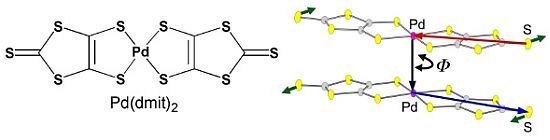
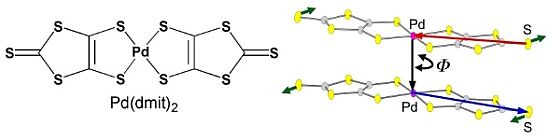
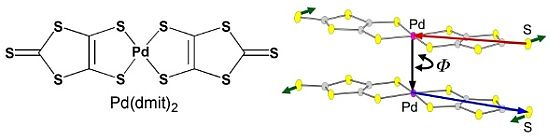
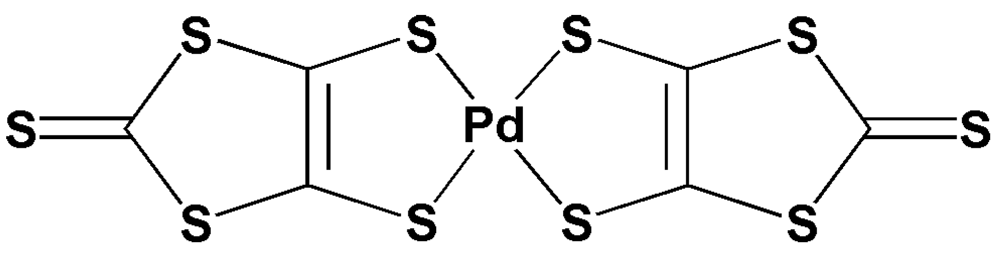
      <p>The metal dithiolene complex Pd(dmit)<sub>2</sub> (dmit = 1,3-dithiole-2-thione-4,5-dithiolate; <xref ref-type="fig" rid="crystals-02-00861-f001">Figure 1</xref>) provides an isostructural series of anion radical salts, β'-(Et<italic><sub>x</sub></italic>Me<sub>4−<italic>x</italic></sub><italic>Z</italic>)[Pd(dmit)<sub>2</sub>]<sub>2</sub> (<italic>x</italic> = 0–2, <italic>Z</italic> = P, As, Sb) [<xref ref-type="bibr" rid="B2-crystals-02-00861">2</xref>,<xref ref-type="bibr" rid="B3-crystals-02-00861">3</xref>,<xref ref-type="bibr" rid="B4-crystals-02-00861">4</xref>,<xref ref-type="bibr" rid="B5-crystals-02-00861">5</xref>]. Here, the monovalent counter cations, Et<italic><sub>x</sub></italic>Me<sub>4−<italic>x</italic></sub><italic>Z</italic><sup>+</sup>, form the insulating part while electrical conduction is attributed to the anion radical of Pd(dmit)<sub>2</sub>. In crystals of the β'-type Pd(dmit)<sub>2</sub> salts, Pd(dmit)<sub>2</sub> molecules form a dimer unit with one negative charge, [Pd(dmit)<sub>2</sub>]<sub>2</sub><sup>−</sup>. The dimer units are networked to form a quasi-triangular lattice. At ambient pressure, they are Mott insulators, in which the electrons cannot move due to strong on-site Coulomb repulsion. Application of (hydrostatic or uni-axial) pressure enlarges the band width and leads to metallic and (frequently) superconducting states. In the Mott insulating state, the localized spins exhibit various ground states (antiferromagnetic long-range order [<xref ref-type="bibr" rid="B6-crystals-02-00861">6</xref>], quantum spin liquid state [<xref ref-type="bibr" rid="B7-crystals-02-00861">7</xref>,<xref ref-type="bibr" rid="B8-crystals-02-00861">8</xref>,<xref ref-type="bibr" rid="B9-crystals-02-00861">9</xref>,<xref ref-type="bibr" rid="B10-crystals-02-00861">10</xref>,<xref ref-type="bibr" rid="B11-crystals-02-00861">11</xref>], and non-magnetic charge-ordered state [<xref ref-type="bibr" rid="B12-crystals-02-00861">12</xref>,<xref ref-type="bibr" rid="B13-crystals-02-00861">13</xref>,<xref ref-type="bibr" rid="B14-crystals-02-00861">14</xref>]), depending on the counter cation. In the background of all these transport and magnetic properties, electron correlation and geometrical frustration operate [<xref ref-type="bibr" rid="B3-crystals-02-00861">3</xref>,<xref ref-type="bibr" rid="B6-crystals-02-00861">6</xref>]. The strength of the electron correlation and degree of frustration are characterized by the intra- and interdimer transfer integrals between the frontier molecular orbitals [<xref ref-type="bibr" rid="B2-crystals-02-00861">2</xref>,<xref ref-type="bibr" rid="B15-crystals-02-00861">15</xref>]. These transfer integrals can be systematically tuned by selecting counter cations, Et<italic><sub>x</sub></italic>Me<sub>4−<italic>x</italic></sub><italic>Z</italic><sup>+</sup>, with different <italic>x</italic> (number of ethyl groups) and <italic>Z</italic> (central pnictogen atom). However, the observed effects of the counter cation on the structural properties of the Pd(dmit)<sub>2</sub> site remain unclear. Herein, we report on the cation dependence of the crystal and molecular structures of β'-type Pd(dmit)<sub>2</sub> salts and discuss their relation in terms of intermolecular transfer integrals.</p>
      <fig id="crystals-02-00861-f001" position="anchor">
        <label>Figure 1</label>
        <caption>
          <p>Molecular structure of Pd(dmit)<sub>2</sub>.</p>
        </caption>
        <graphic xmlns:xlink="http://www.w3.org/1999/xlink" xlink:href="crystals-02-00861-g001.tif"/>
      </fig>
    </sec>
    <sec sec-type="results">
      <title>2. Results and Discussion</title>
      <sec>
        <title>2.1. Lattice Constants</title>
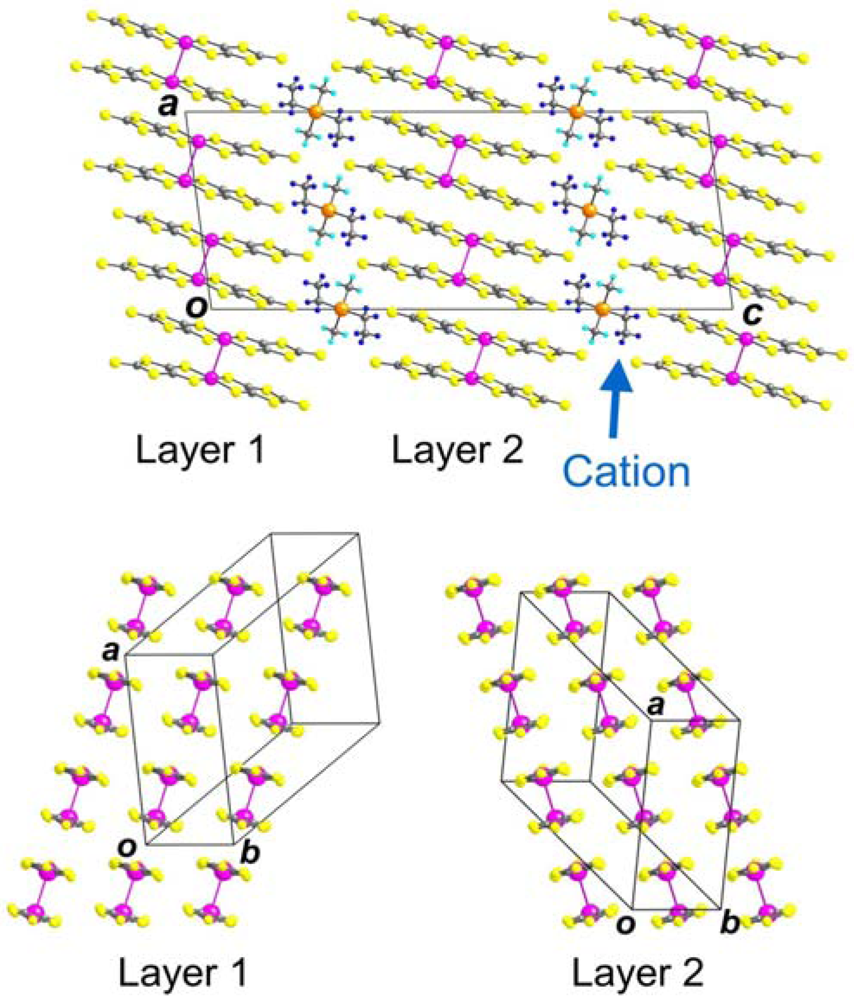
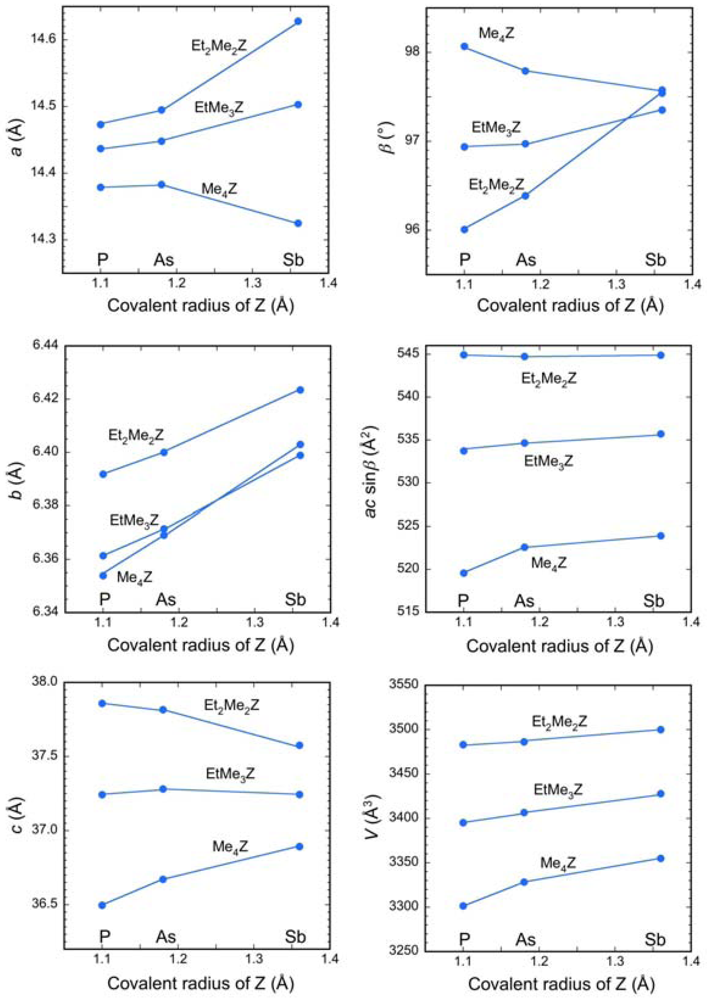
        <p>Crystals of the β'-type Pd(dmit)<sub>2</sub> salts belong to a monoclinic system with space group <italic>C</italic>2/<italic>c</italic>. The unit cell contains two crystallographically equivalent Pd(dmit)<sub>2</sub> anion layers (1 and 2), which are separated by a cation layer (<xref ref-type="fig" rid="crystals-02-00861-f002">Figure 2</xref>). The Pd(dmit)<sub>2</sub> layers are related by glide plane symmetry. The cations are located on a two-fold axis, and thus cations without two-fold symmetry (EtMe<sub>3</sub><italic>Z</italic><sup>+</sup>) may adopt two possible orientations with an occupancy of 50% for each orientation. In the Pd(dmit)<sub>2</sub> layer, Pd(dmit)<sub>2</sub> molecules are strongly dimerized with an eclipsed overlapping mode. The number of crystallographically independent dimer units is one. The two Pd(dmit)<sub>2</sub> molecules in the dimer unit are equivalent and related by inversion symmetry. The dimer units stack along the <italic>a</italic> + <italic>b</italic> direction in layer 1 and along the <italic>a</italic> − <italic>b</italic> direction in layer 2 (<xref ref-type="fig" rid="crystals-02-00861-f002">Figure 2</xref>; solid-crossing column structure). <xref ref-type="table" rid="crystals-02-00861-t001">Table 1</xref> shows the lattice constants of β'-(Et<italic><sub>x</sub></italic>Me<sub>4−<italic>x</italic></sub><italic>Z</italic>)[Pd(dmit)<sub>2</sub>]<sub>2</sub>, plotted as a function of the covalent radius of the central atom <italic>Z</italic> (<italic>R</italic><sub>Z</sub>) in <xref ref-type="fig" rid="crystals-02-00861-f003">Figure 3</xref>. Understandably, the effect of the number of ethyl groups (<italic>x</italic>) is larger than that of <italic>R</italic><sub>Z</sub> in general. With decreasing <italic>R</italic><sub>Z</sub> and <italic>x</italic>, the unit cell volume <italic>V</italic> decreases. In this sense, the cation effect appears equivalent to an application of pressure. However, each lattice constant shows complicated behavior. In particular, in the <italic>ac</italic> plane, the lattice constants <italic>a</italic> and <italic>c</italic> exhibit opposite<italic>R</italic><sub>Z</sub> dependences, and the <italic>x</italic> dependence of the <italic>β</italic> angle gets weaker as <italic>R</italic><sub>Z</sub> increases. Overall, however, the area of the <italic>ac</italic> plane (<italic>ac </italic>sin<italic>β</italic>) shows rather normal dependence on <italic>R</italic><sub>Z</sub> and <italic>x</italic>. All these results indicate that the cation effect on the unit cell is similar to the pressure effect but is not isotropic, which would be a feature of chemical pressure. </p>
        <fig id="crystals-02-00861-f002" position="anchor">
          <label>Figure 2</label>
          <caption>
            <p>Crystal structure of the β'-type Pd(dmit)<sub>2</sub> salt.</p>
          </caption>
          <graphic xmlns:xlink="http://www.w3.org/1999/xlink" xlink:href="crystals-02-00861-g002.tif"/>
        </fig>
        <fig id="crystals-02-00861-f003" position="anchor">
          <label>Figure 3</label>
          <caption>
            <p>Lattice constants of β'-(Et<italic><sub>x</sub></italic>Me<sub>4−x</sub><italic>Z</italic>)[Pd(dmit)<sub>2</sub>]<sub>2 </sub>plotted as a function of the covalent radius of the central atom <italic>Z</italic> (<italic>R</italic><sub>Z</sub>).</p>
          </caption>
          <graphic xmlns:xlink="http://www.w3.org/1999/xlink" xlink:href="crystals-02-00861-g003.tif"/>
        </fig>
        <table-wrap id="crystals-02-00861-t001" position="anchor">
          <object-id pub-id-type="pii">crystals-02-00861-t001_Table 1</object-id>
          <label>Table 1</label>
          <caption>
            <p>Lattice constants of β'-(Cation)[Pd(dmit)<sub>2</sub>]<sub>2</sub>.</p>
          </caption>
          <table>
            <thead>
              <tr>
                <th align="center" valign="middle">Cation</th>
                <th align="center" valign="middle"><italic>a</italic> (Å)</th>
                <th align="center" valign="middle"><italic>b </italic>(Å)</th>
                <th align="center" valign="middle"><italic>c</italic> (Å)</th>
                <th align="center" valign="middle"><italic>β</italic> (°)</th>
                <th align="center" valign="middle"><italic>V</italic> (Å<sup>3</sup>)</th>
              </tr>
            </thead>
            <tbody>
              <tr>
                <td align="left" valign="middle">Me<sub>4</sub>P</td>
                <td align="center" valign="middle">14.379(3)</td>
                <td align="center" valign="middle">6.3539(12)</td>
                <td align="center" valign="middle">36.496(7)</td>
                <td align="center" valign="middle">98.070(2)</td>
                <td align="center" valign="middle">3301.5(11)</td>
              </tr>
              <tr>
                <td align="left" valign="middle">Me<sub>4</sub>As</td>
                <td align="center" valign="middle">14.383(4)</td>
                <td align="center" valign="middle">6.3691(15)</td>
                <td align="center" valign="middle">36.672(9)</td>
                <td align="center" valign="middle">97.793(3)</td>
                <td align="center" valign="middle">3328.4(14)</td>
              </tr>
              <tr>
                <td align="left" valign="middle">EtMe<sub>3</sub>P</td>
                <td align="center" valign="middle">14.437(4)</td>
                <td align="center" valign="middle">6.3614(15)</td>
                <td align="center" valign="middle">37.243(9)</td>
                <td align="center" valign="middle">96.938(3)</td>
                <td align="center" valign="middle">3395.3(14)</td>
              </tr>
              <tr>
                <td align="left" valign="middle">EtMe<sub>3</sub>As</td>
                <td align="center" valign="middle">14.448(4)</td>
                <td align="center" valign="middle">6.3715(18)</td>
                <td align="center" valign="middle">37.282(11)</td>
                <td align="center" valign="middle">96.973(3)</td>
                <td align="center" valign="middle">3406.7(18)</td>
              </tr>
              <tr>
                <td align="left" valign="middle">Et<sub>2</sub>Me<sub>2</sub>P</td>
                <td align="center" valign="middle">14.473(3)</td>
                <td align="center" valign="middle">6.3918(13)</td>
                <td align="center" valign="middle">37.859(8)</td>
                <td align="center" valign="middle">96.009(3)</td>
                <td align="center" valign="middle">3483.1(13)</td>
              </tr>
              <tr>
                <td align="left" valign="middle">Et<sub>2</sub>Me<sub>2</sub>As</td>
                <td align="center" valign="middle">14.495(4)</td>
                <td align="center" valign="middle">6.4000(15)</td>
                <td align="center" valign="middle">37.816(10)</td>
                <td align="center" valign="middle">96.388(3)</td>
                <td align="center" valign="middle">3486.3(15)</td>
              </tr>
              <tr>
                <td align="left" valign="middle">Me<sub>4</sub>Sb</td>
                <td align="center" valign="middle">14.325(7)</td>
                <td align="center" valign="middle">6.403(3)</td>
                <td align="center" valign="middle">36.893(19)</td>
                <td align="center" valign="middle">97.543(5)</td>
                <td align="center" valign="middle">3355(3)</td>
              </tr>
              <tr>
                <td align="left" valign="middle">EtMe<sub>3</sub>Sb</td>
                <td align="center" valign="middle">14.503(3)</td>
                <td align="center" valign="middle">6.3989(12)</td>
                <td align="center" valign="middle">37.244(7)</td>
                <td align="center" valign="middle">97.352(2)</td>
                <td align="center" valign="middle">3427.9(12)</td>
              </tr>
              <tr>
                <td align="left" valign="middle">Et<sub>2</sub>Me<sub>2</sub>Sb</td>
                <td align="center" valign="middle">14.628(4)</td>
                <td align="center" valign="middle">6.4235(15)</td>
                <td align="center" valign="middle">37.577(9)</td>
                <td align="center" valign="middle">97.577(2)</td>
                <td align="center" valign="middle">3500.0(15)</td>
              </tr>
            </tbody>
          </table>
        </table-wrap>
        
        
      </sec>
      <sec>
        <title>2.2. Interdimer Transfer Integrals</title>
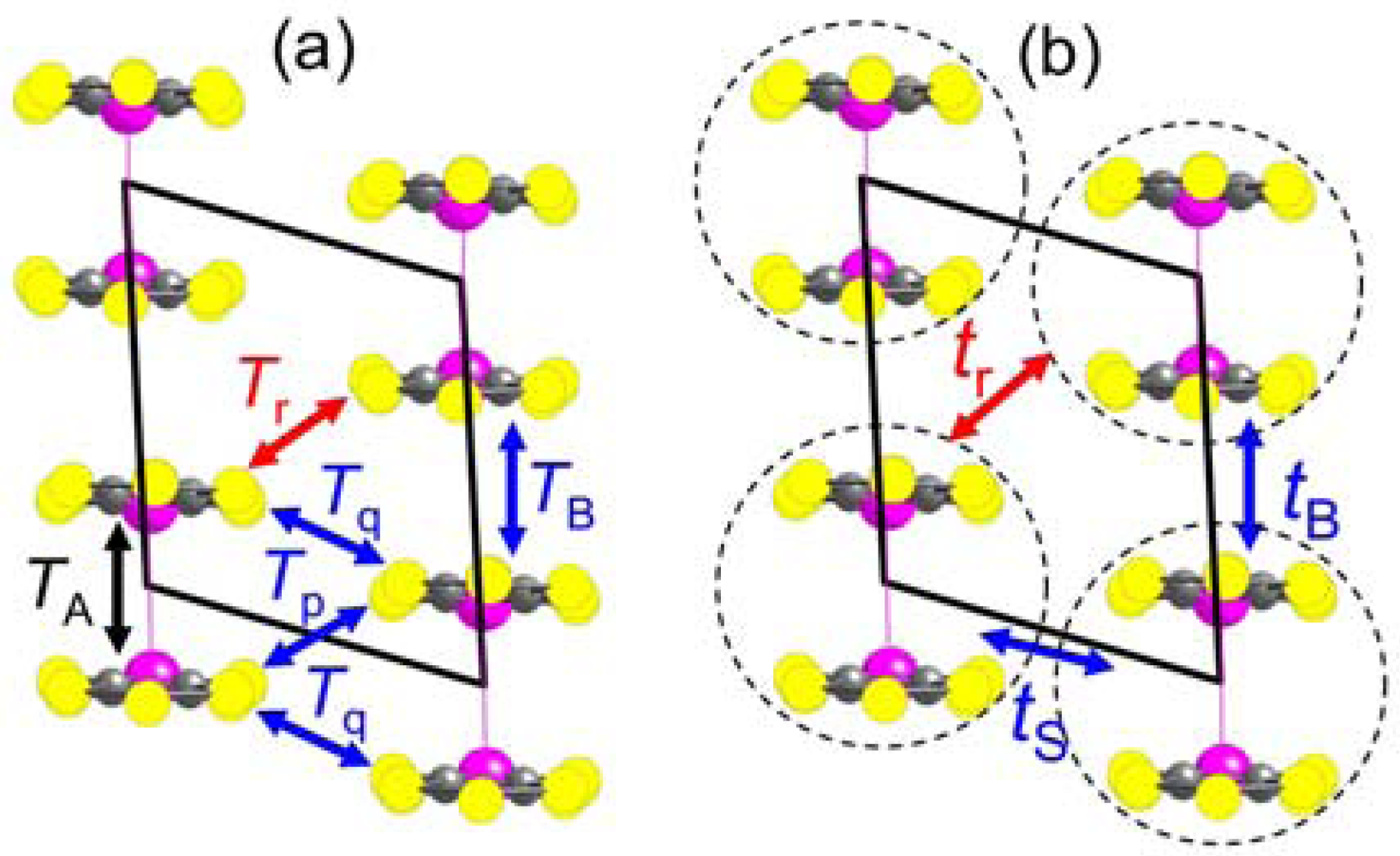
        <p>In molecular conductors, including the present system, the electronic structure in the vicinity of the Fermi level is well described by the tight-binding method based on the extended Hückel molecular orbital calculation. Intermolecular transfer integrals between frontier orbitals (in general, HOMOs in a donor system and LUMOs in an acceptor system) calculated from crystal data determine the energy bands around the Fermi level. <xref ref-type="fig" rid="crystals-02-00861-f004">Figure 4</xref>a shows a set of intermolecular transfer integrals for the β'-type Pd(dmit)<sub>2</sub> salts. (Note here that the <italic>C</italic>-centered unit cell is reduced to a primitive cell that contains only one dimer in the anion layer. Interlayer interactions are weak, and thus neglected in this work). Although the Pd(dmit)<sub>2</sub> molecule is an acceptor, the conduction band of the β'-type Pd(dmit)<sub>2</sub> salts originates from the HOMO. This is a quite unique feature of this system, and is due to the small HOMO-LUMO energy gap, <italic>∆</italic>, and the strong dimerization [<xref ref-type="bibr" rid="B16-crystals-02-00861">16</xref>]. In the dimer unit, each HOMO and LUMO in the monomer forms bonding and antibonding pairs with a dimerization gap. The dimerization gap is expressed as 2|<italic>T</italic><sub>A</sub>|, and both pairs have nearly the same gap value. In the β'-type Pd(dmit)<sub>2</sub> salts, because 2|<italic>T</italic><sub>A</sub>| is larger than <italic>∆</italic>, the antibonding HOMO pair is located above the bonding LUMO pair and forms a half-filled conduction band. The LUMO-based energy bands are located near the HOMO-based conduction band and play an important role, which is another unique feature of the present system. Hereinafter, however, we focus on the intermolecular HOMO-HOMO interactions that govern the electronic structure near the Fermi level. In <xref ref-type="table" rid="crystals-02-00861-t002">Table 2</xref>, the intermolecular HOMO-HOMO transfer integrals are listed for all the salts. </p>
        <fig id="crystals-02-00861-f004" position="anchor">
          <label>Figure 4</label>
          <caption>
            <p>End-on projections of the dimer lattice in β'-type Pd(dmit)<sub>2</sub> salts showinglabelling of (<bold>a</bold>) intermolecular transfer integrals and (<bold>b</bold>) interdimer transfer integrals.</p>
          </caption>
          <graphic xmlns:xlink="http://www.w3.org/1999/xlink" xlink:href="crystals-02-00861-g004.tif"/>
        </fig>
        <table-wrap id="crystals-02-00861-t002" position="anchor">
          <object-id pub-id-type="pii">crystals-02-00861-t002_Table 2</object-id>
          <label>Table 2</label>
          <caption>
            <p>Intermolecular highest occupied molecular orbital (HOMO)-HOMO transfer integrals in β'-(Cation)[Pd(dmit)<sub>2</sub>]<sub>2</sub> (See <xref ref-type="fig" rid="crystals-02-00861-f004">Figure 4</xref>a).</p>
          </caption>
          <table>
            <thead>
              <tr>
                <th align="center" valign="middle">Cation</th>
                <th align="center" valign="middle"><italic>T</italic><sub>A</sub> (meV)</th>
                <th align="center" valign="middle"><italic>T</italic><sub>B</sub> (meV)</th>
                <th align="center" valign="middle"><italic>T</italic><sub>p</sub> (meV)</th>
                <th align="center" valign="middle"><italic>T</italic><sub>q</sub> (meV)</th>
                <th align="center" valign="middle"><italic>T</italic><sub>r</sub> (meV)</th>
              </tr>
            </thead>
            <tbody>
              <tr>
                <td align="left" valign="middle">Me<sub>4</sub>P</td>
                <td align="center" valign="middle">437</td>
                <td align="center" valign="middle">68.2</td>
                <td align="center" valign="middle">29.5</td>
                <td align="center" valign="middle">18.2</td>
                <td align="center" valign="middle">41.6</td>
              </tr>
              <tr>
                <td align="left" valign="middle">Me<sub>4</sub>As</td>
                <td align="center" valign="middle">440</td>
                <td align="center" valign="middle">65.2</td>
                <td align="center" valign="middle">27.2</td>
                <td align="center" valign="middle">18.0</td>
                <td align="center" valign="middle">44.7</td>
              </tr>
              <tr>
                <td align="left" valign="middle">EtMe<sub>3</sub>P</td>
                <td align="center" valign="middle">443</td>
                <td align="center" valign="middle">64.7</td>
                <td align="center" valign="middle">25.3</td>
                <td align="center" valign="middle">18.6</td>
                <td align="center" valign="middle">45.1</td>
              </tr>
              <tr>
                <td align="left" valign="middle">EtMe<sub>3</sub>As</td>
                <td align="center" valign="middle">441</td>
                <td align="center" valign="middle">64.6</td>
                <td align="center" valign="middle">24.1</td>
                <td align="center" valign="middle">18.3</td>
                <td align="center" valign="middle">46.3</td>
              </tr>
              <tr>
                <td align="left" valign="middle">Et<sub>2</sub>Me<sub>2</sub>P</td>
                <td align="center" valign="middle">440</td>
                <td align="center" valign="middle">56.0</td>
                <td align="center" valign="middle">22. 0</td>
                <td align="center" valign="middle">17.3</td>
                <td align="center" valign="middle">47.2</td>
              </tr>
              <tr>
                <td align="left" valign="middle">Et<sub>2</sub>Me<sub>2</sub>As</td>
                <td align="center" valign="middle">436</td>
                <td align="center" valign="middle">53.7</td>
                <td align="center" valign="middle">21.1</td>
                <td align="center" valign="middle">17.1</td>
                <td align="center" valign="middle">47.5</td>
              </tr>
              <tr>
                <td align="left" valign="middle">Me<sub>4</sub>Sb</td>
                <td align="center" valign="middle">449</td>
                <td align="center" valign="middle">57.7</td>
                <td align="center" valign="middle">22.7</td>
                <td align="center" valign="middle">16.3</td>
                <td align="center" valign="middle">48.5</td>
              </tr>
              <tr>
                <td align="left" valign="middle">EtMe<sub>3</sub>Sb</td>
                <td align="center" valign="middle">449</td>
                <td align="center" valign="middle">56.4</td>
                <td align="center" valign="middle">20.4</td>
                <td align="center" valign="middle">16.8</td>
                <td align="center" valign="middle">50.1</td>
              </tr>
              <tr>
                <td align="left" valign="middle">Et<sub>2</sub>Me<sub>2</sub>Sb</td>
                <td align="center" valign="middle">445</td>
                <td align="center" valign="middle">52.5</td>
                <td align="center" valign="middle">18.3</td>
                <td align="center" valign="middle">15.9</td>
                <td align="center" valign="middle">51.6</td>
              </tr>
            </tbody>
          </table>
        </table-wrap>
        
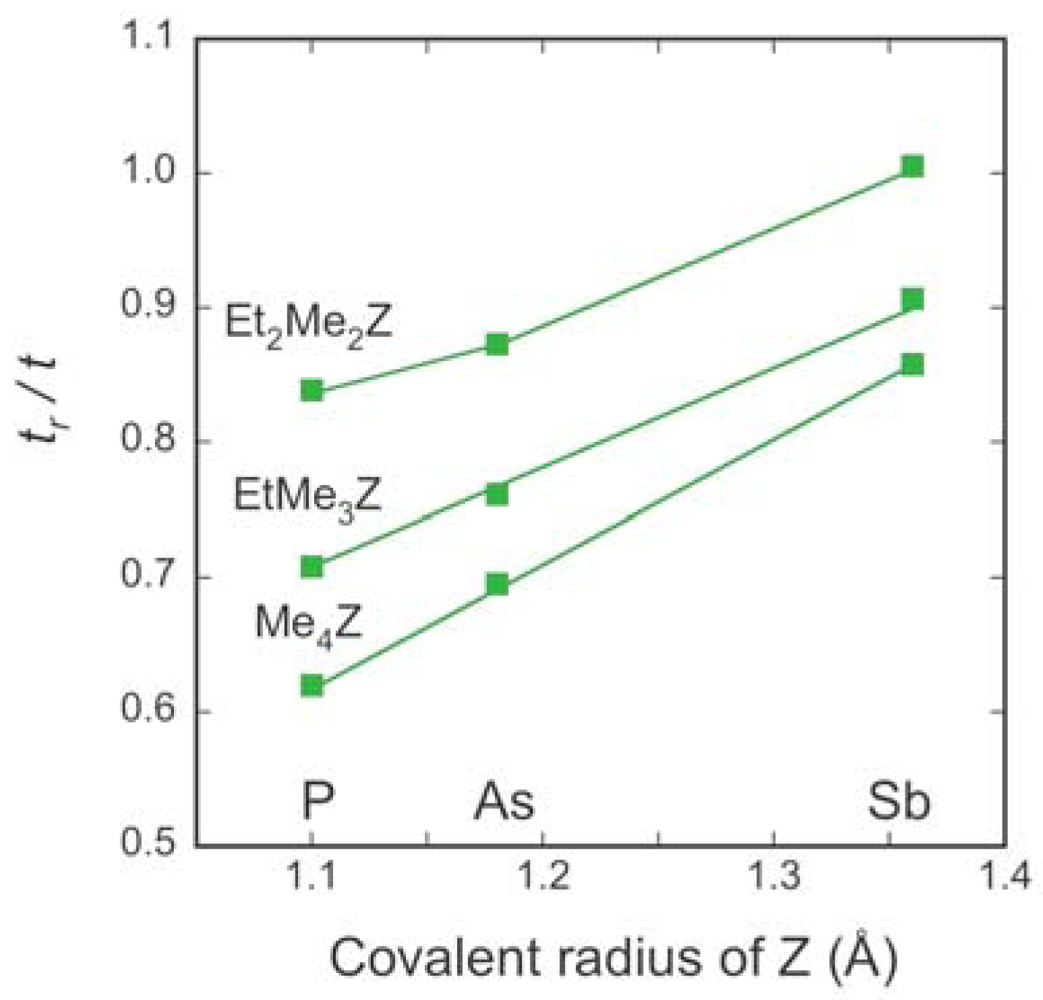
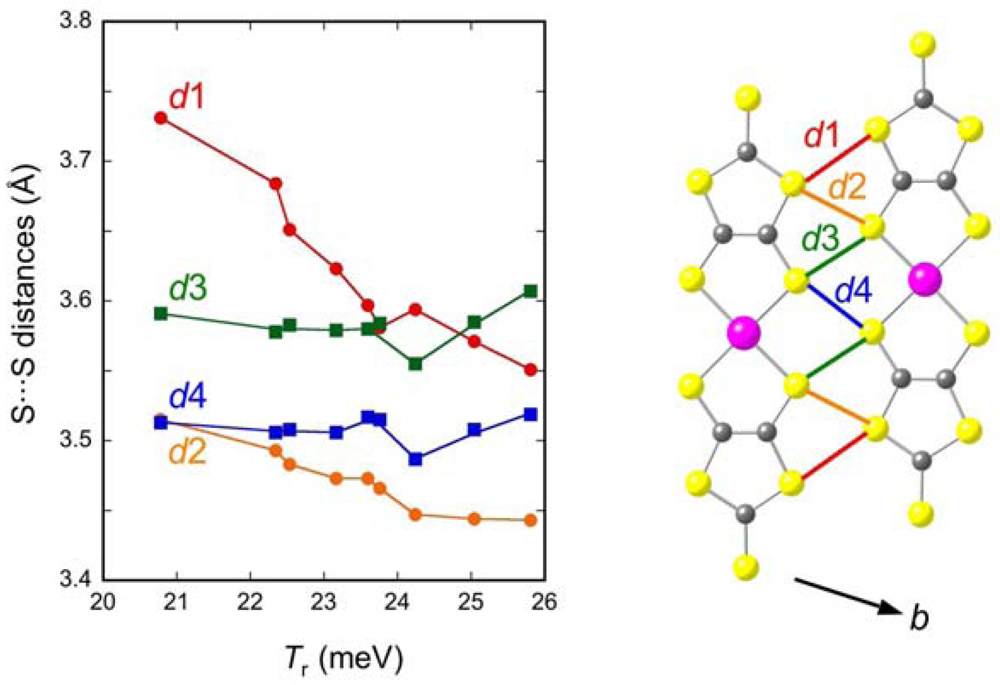
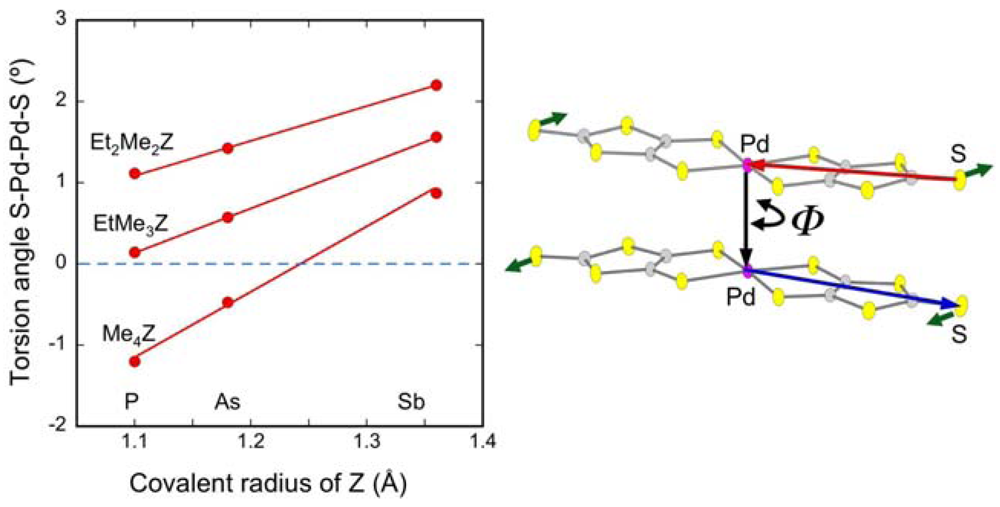
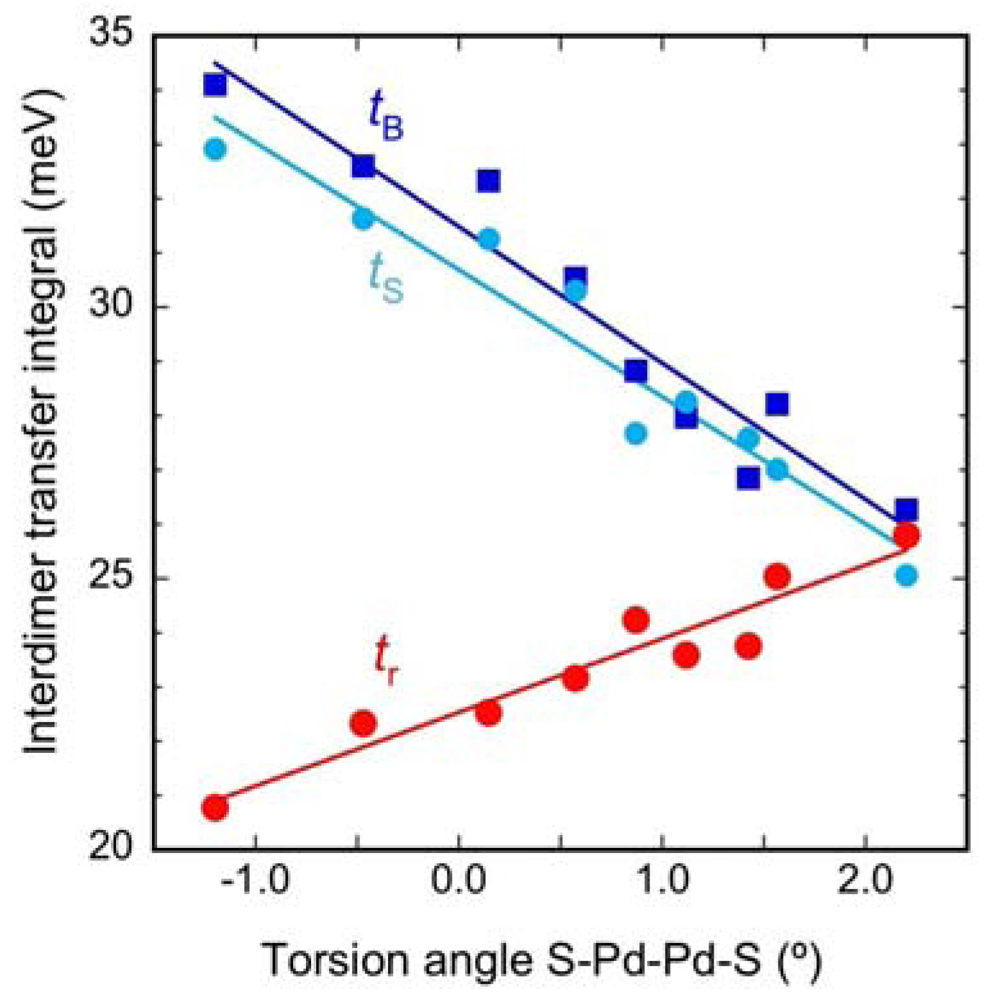
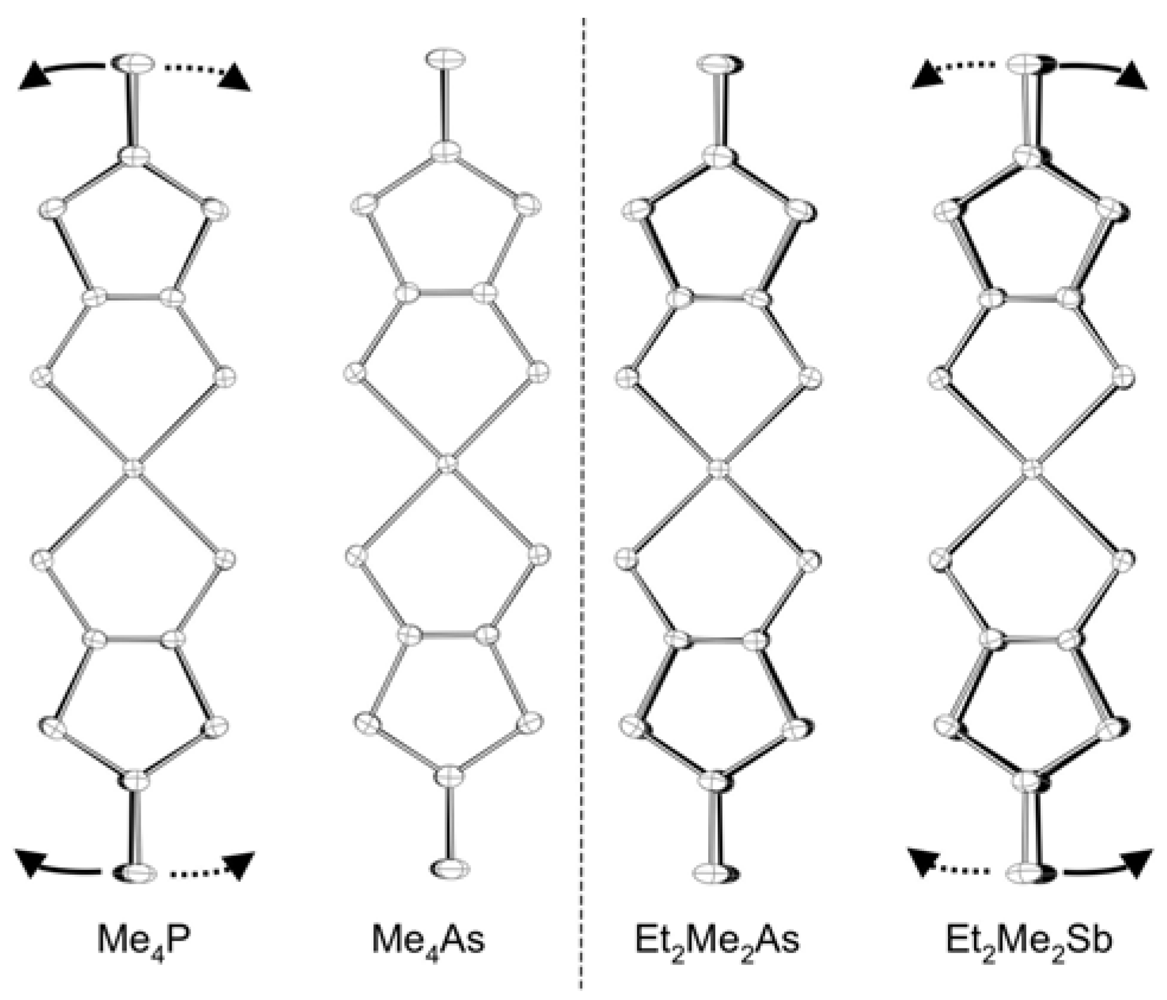
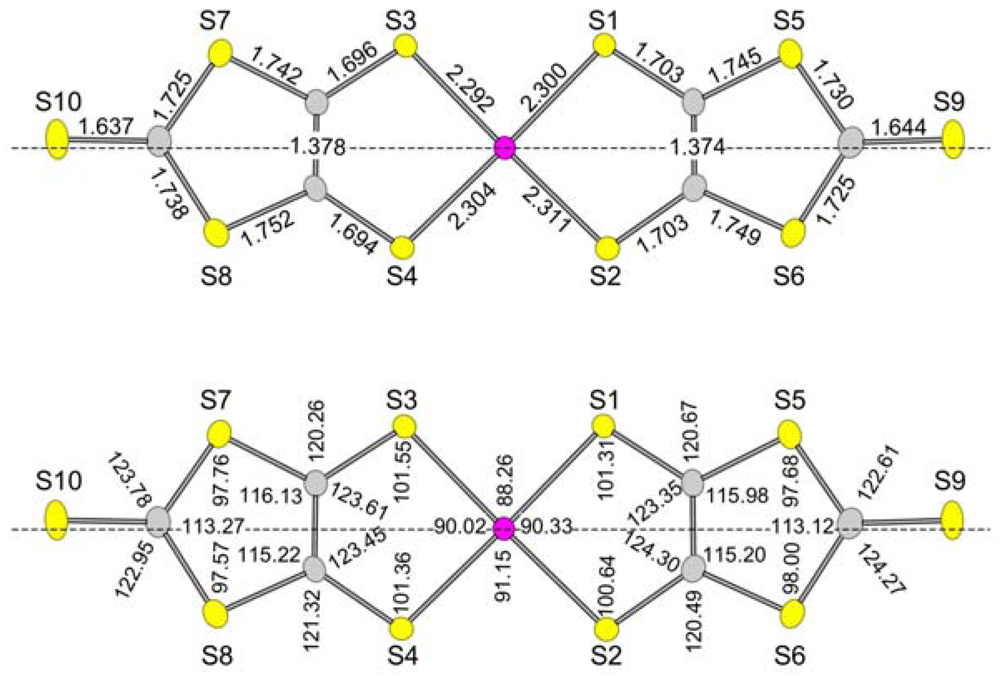
        <p>The strong dimerization allows us to take each dimer as an effective unit [<xref ref-type="bibr" rid="B2-crystals-02-00861">2</xref>] and we can then redraw the unit cell with interdimer transfer integrals as shown in <xref ref-type="fig" rid="crystals-02-00861-f004">Figure 4</xref>b. In the dimer model, the conduction band is described by three interdimer transfer integrals, <italic>t</italic><sub>B</sub>, <italic>t</italic><sub>S</sub>, and <italic>t</italic><sub>r</sub>, as listed in <xref ref-type="table" rid="crystals-02-00861-t003">Table 3</xref>. The interdimer transfer integrals relate to the intermolecular transfer integrals in <xref ref-type="table" rid="crystals-02-00861-t002">Table 2</xref> as <italic>t</italic><sub>B</sub> = <italic>T</italic><sub>B</sub>/2, <italic>t</italic><sub>S</sub> = (<italic>T</italic><sub>p</sub> + 2<italic>T</italic><sub>q</sub>)/2, and <italic>t</italic><sub>r</sub> = <italic>T</italic><sub>r</sub>/2. The largest transfer integral, <italic>t</italic><sub>B </sub>or <italic>t</italic><sub>S</sub>, is correlated with the band width <italic>W</italic>. For each salt, the triangular lattice formed by the interdimer interactions is approximately isosceles (<italic>t</italic><sub>B</sub> ≈ <italic>t</italic><sub>S</sub>), and thus the anisotropy of the triangular lattice can be estimated by the ratio <italic>t</italic><sub>r</sub>/<italic>t</italic>, where <italic>t</italic> = (<italic>t</italic><sub>B</sub> + <italic>t</italic><sub>S</sub>)/2. The anisotropy of the triangular lattice indicates the degree of geometrical frustration. As shown in <xref ref-type="table" rid="crystals-02-00861-t003">Table 3</xref> and <xref ref-type="fig" rid="crystals-02-00861-f005">Figure 5</xref>, <italic>t</italic><sub>r</sub>/<italic>t</italic> increases with increasing <italic>R</italic><sub>Z</sub> and <italic>x</italic>, and the Et<sub>2</sub>Me<sub>2</sub>Sb salt has an almost regular triangular lattice. The <italic>R</italic><sub>Z</sub> and <italic>x</italic> dependences of <italic>t</italic> and <italic>t</italic><sub>r</sub> are plotted in <xref ref-type="fig" rid="crystals-02-00861-f006">Figure 6</xref>. The increasing tendency of <italic>t</italic><sub>r</sub>/<italic>t</italic> is a consequence of decreasing <italic>t</italic> and increasing <italic>t</italic><sub>r</sub>. The decrease in <italic>t</italic> may be reasonable given that any increase in <italic>R</italic><sub>Z</sub> or <italic>x</italic> would expand the lattice and lengthen the intermolecular distances. On the other hand, the increase in <italic>t</italic><sub>r</sub> indicates some non-trivial structural change. In this system, the intermolecular transfer integrals are governed mainly by the overlap between the p orbitals of the sulfur atoms in the dmit ligand. <xref ref-type="fig" rid="crystals-02-00861-f007">Figure 7</xref> shows the relation between <italic>T</italic><sub>r</sub> and the intermolecular S···S distances responsible for <italic>T</italic><sub>r</sub>. Notably, an increase in <italic>T</italic><sub>r</sub> results in shortening of <italic>d</italic>1 and <italic>d</italic>2, associated with the outer heteroring, while <italic>d</italic>3 and <italic>d</italic>4, associated with the inner heteroring, remain almost constant or slightly lengthen. These trends cannot be explained by changes in the lattice constants. When the dimer is viewed along the vector connecting the two Pd atoms, we notice that the Pd(dmit)<sub>2</sub> molecules in the dimer are not completely eclipsed (<xref ref-type="fig" rid="crystals-02-00861-f008">Figure 8</xref>). In particular, there is significant displacement of the outer parts, which indicates that the Pd(dmit)<sub>2</sub> molecule is slightly arched, with both ends of the molecule slightly deviating from the expected linear axis. Indeed, the arch-shaped distortion of the molecule can be detected in the bond lengths and angles, for example, in the Et<sub>2</sub>Me<sub>2</sub>Sb salt (<xref ref-type="fig" rid="crystals-02-00861-f009">Figure 9</xref>). In addition, <xref ref-type="fig" rid="crystals-02-00861-f008">Figure 8</xref> suggests that the curvature depends on the counter cation. We tentatively describe the degree of arch-shaped distortion by defining the torsion angle of S–Pd–Pd–S (<italic>Φ</italic>) within the dimer (<xref ref-type="fig" rid="crystals-02-00861-f010">Figure 10</xref>). <xref ref-type="fig" rid="crystals-02-00861-f010">Figure 10</xref> indicates that <italic>Φ</italic> changes systematically depending on the counter cation (<italic>R</italic><sub>Z</sub> and <italic>x</italic>), which is consistent with the above-mentioned trends for the intermolecular S···S distances.</p>
        <table-wrap id="crystals-02-00861-t003" position="anchor">
          <object-id pub-id-type="pii">crystals-02-00861-t003_Table 3</object-id>
          <label>Table 3</label>
          <caption>
            <p>Interdimer HOMO-HOMO transfer integrals and band width, <italic>W</italic>, calculated in the dimer model (See <xref ref-type="fig" rid="crystals-02-00861-f004">Figure 4</xref>b).</p>
          </caption>
          <table>
            <thead>
              <tr>
                <th align="center" valign="middle">Cation</th>
                <th align="center" valign="middle"><italic>t</italic><sub>B</sub> (meV)</th>
                <th align="center" valign="middle"><italic>t</italic><sub>S</sub> (meV)</th>
                <th align="center" valign="middle"><italic>t</italic> (meV)</th>
                <th align="center" valign="middle"><italic>t</italic><sub>r</sub> (meV)</th>
                <th align="center" valign="middle"><italic>t</italic><sub>r</sub>/<italic>t</italic></th>
                <th align="center" valign="middle"><italic>W </italic>(meV)</th>
              </tr>
            </thead>
            <tbody>
              <tr>
                <td align="left" valign="middle">Me<sub>4</sub>P</td>
                <td align="center" valign="middle">34.1</td>
                <td align="center" valign="middle">32.9</td>
                <td align="center" valign="middle">33.5</td>
                <td align="center" valign="middle">20.8</td>
                <td align="center" valign="middle">0.620</td>
                <td align="center" valign="middle">271</td>
              </tr>
              <tr>
                <td align="left" valign="middle">Me<sub>4</sub>As</td>
                <td align="center" valign="middle">32.6</td>
                <td align="center" valign="middle">31.6</td>
                <td align="center" valign="middle">32.1</td>
                <td align="center" valign="middle">22.3</td>
                <td align="center" valign="middle">0.696</td>
                <td align="center" valign="middle">264</td>
              </tr>
              <tr>
                <td align="left" valign="middle">EtMe<sub>3</sub>P</td>
                <td align="center" valign="middle">32.3</td>
                <td align="center" valign="middle">31.3</td>
                <td align="center" valign="middle">31.8</td>
                <td align="center" valign="middle">22.5</td>
                <td align="center" valign="middle">0.709</td>
                <td align="center" valign="middle">262</td>
              </tr>
              <tr>
                <td align="left" valign="middle">EtMe<sub>3</sub>As</td>
                <td align="center" valign="middle">30.5</td>
                <td align="center" valign="middle">30.3</td>
                <td align="center" valign="middle">30.4</td>
                <td align="center" valign="middle">23.2</td>
                <td align="center" valign="middle">0.761</td>
                <td align="center" valign="middle">254</td>
              </tr>
              <tr>
                <td align="left" valign="middle">Et<sub>2</sub>Me<sub>2</sub>P</td>
                <td align="center" valign="middle">28.0</td>
                <td align="center" valign="middle">28.3</td>
                <td align="center" valign="middle">28.1</td>
                <td align="center" valign="middle">23.6</td>
                <td align="center" valign="middle">0.839</td>
                <td align="center" valign="middle">240</td>
              </tr>
              <tr>
                <td align="left" valign="middle">Et<sub>2</sub>Me<sub>2</sub>As</td>
                <td align="center" valign="middle">26.9</td>
                <td align="center" valign="middle">27.6</td>
                <td align="center" valign="middle">27.2</td>
                <td align="center" valign="middle">23.8</td>
                <td align="center" valign="middle">0.873</td>
                <td align="center" valign="middle">235</td>
              </tr>
              <tr>
                <td align="left" valign="middle">Me<sub>4</sub>Sb</td>
                <td align="center" valign="middle">28.8</td>
                <td align="center" valign="middle">27.7</td>
                <td align="center" valign="middle">28.3</td>
                <td align="center" valign="middle">24.2</td>
                <td align="center" valign="middle">0.858</td>
                <td align="center" valign="middle">243</td>
              </tr>
              <tr>
                <td align="left" valign="middle">EtMe<sub>3</sub>Sb</td>
                <td align="center" valign="middle">28.2</td>
                <td align="center" valign="middle">27.0</td>
                <td align="center" valign="middle">27.6</td>
                <td align="center" valign="middle">25.0</td>
                <td align="center" valign="middle">0.907</td>
                <td align="center" valign="middle">241</td>
              </tr>
              <tr>
                <td align="left" valign="middle">Et<sub>2</sub>Me<sub>2</sub>Sb</td>
                <td align="center" valign="middle">26.3</td>
                <td align="center" valign="middle">25.1</td>
                <td align="center" valign="middle">25. 7</td>
                <td align="center" valign="middle">25.8</td>
                <td align="center" valign="middle">1.005</td>
                <td align="center" valign="middle">231</td>
              </tr>
            </tbody>
          </table>
        </table-wrap>
        <fig id="crystals-02-00861-f005" position="anchor">
          <label>Figure 5</label>
          <caption>
            <p>Relation between anisotropy of the dimer lattice <italic>t</italic><sub>r</sub>/<italic>t</italic> (See <xref ref-type="table" rid="crystals-02-00861-t003">Table 3</xref>), and the covalent radius of the central atom <italic>Z</italic> (<italic>R</italic><sub>Z</sub>).</p>
          </caption>
          <graphic xmlns:xlink="http://www.w3.org/1999/xlink" xlink:href="crystals-02-00861-g005.tif"/>
        </fig>
        <fig id="crystals-02-00861-f006" position="anchor">
          <label>Figure 6</label>
          <caption>
            <p>Intermolecular highest occupied molecular orbital (HOMO)-HOMO transfer integrals <italic>t</italic> and <italic>t</italic><sub>r</sub> (See <xref ref-type="table" rid="crystals-02-00861-t003">Table 3</xref>) plotted as a function of the covalent radius of the central atom <italic>Z</italic> (<italic>R</italic><sub>Z</sub>).</p>
          </caption>
          <graphic xmlns:xlink="http://www.w3.org/1999/xlink" xlink:href="crystals-02-00861-g006.tif"/>
        </fig>
        <fig id="crystals-02-00861-f007" position="anchor">
          <label>Figure 7</label>
          <caption>
            <p>Relations between <italic>t</italic><sub>r</sub> and intermolecular S···S distances (Å) responsible for <italic>T</italic><sub>r</sub>.</p>
          </caption>
          <graphic xmlns:xlink="http://www.w3.org/1999/xlink" xlink:href="crystals-02-00861-g007.tif"/>
        </fig>
        <fig id="crystals-02-00861-f008" position="anchor">
          <label>Figure 8</label>
          <caption>
            <p>[Pd(dmit)<sub>2</sub>]<sub>2</sub><sup>−</sup> dimers viewed along the vector connecting the two Pd atoms in Me<sub>4</sub>P, Me<sub>4</sub>As, Et<sub>2</sub>Me<sub>2</sub>As, and Et<sub>2</sub>Me<sub>2</sub>Sb salts.</p>
          </caption>
          <graphic xmlns:xlink="http://www.w3.org/1999/xlink" xlink:href="crystals-02-00861-g008.tif"/>
        </fig>
        <fig id="crystals-02-00861-f009" position="anchor">
          <label>Figure 9</label>
          <caption>
            <p>Bond lengths and angles of the Pd(dmit)<sub>2</sub> unit in the Et<sub>2</sub>Me<sub>2</sub>Sb salt.</p>
          </caption>
          <graphic xmlns:xlink="http://www.w3.org/1999/xlink" xlink:href="crystals-02-00861-g009.tif"/>
        </fig>
        <fig id="crystals-02-00861-f010" position="anchor">
          <label>Figure 10</label>
          <caption>
            <p>Relation between torsion angle of S–Pd–Pd–S (<italic>Φ</italic>) within the dimer and the covalent radius of the central atom <italic>Z</italic> (<italic>R</italic><sub>Z</sub>).</p>
          </caption>
          <graphic xmlns:xlink="http://www.w3.org/1999/xlink" xlink:href="crystals-02-00861-g010.tif"/>
        </fig>
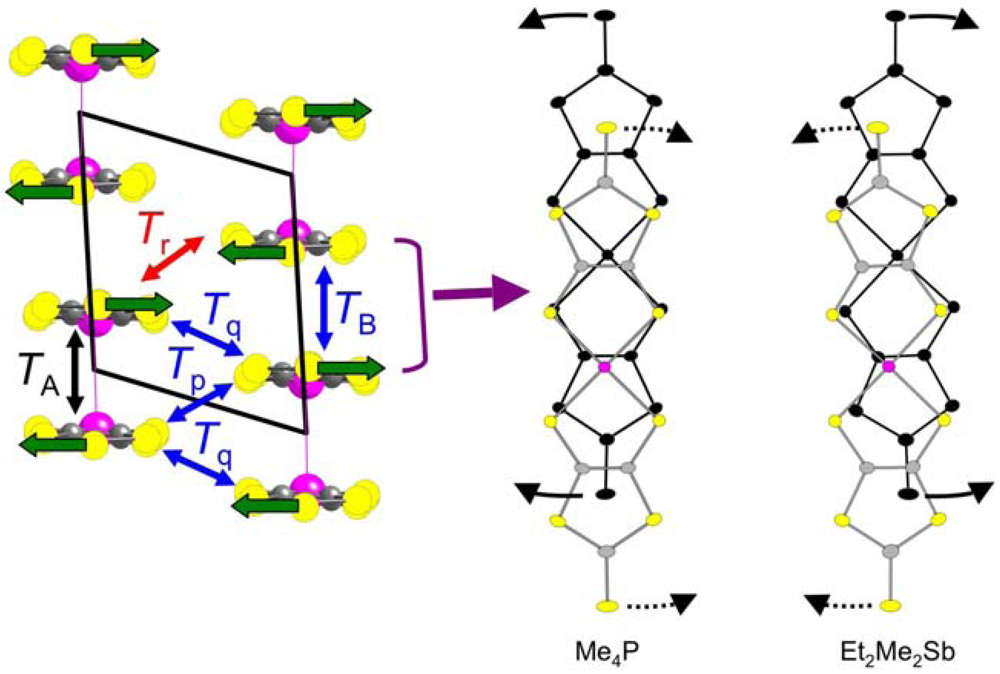
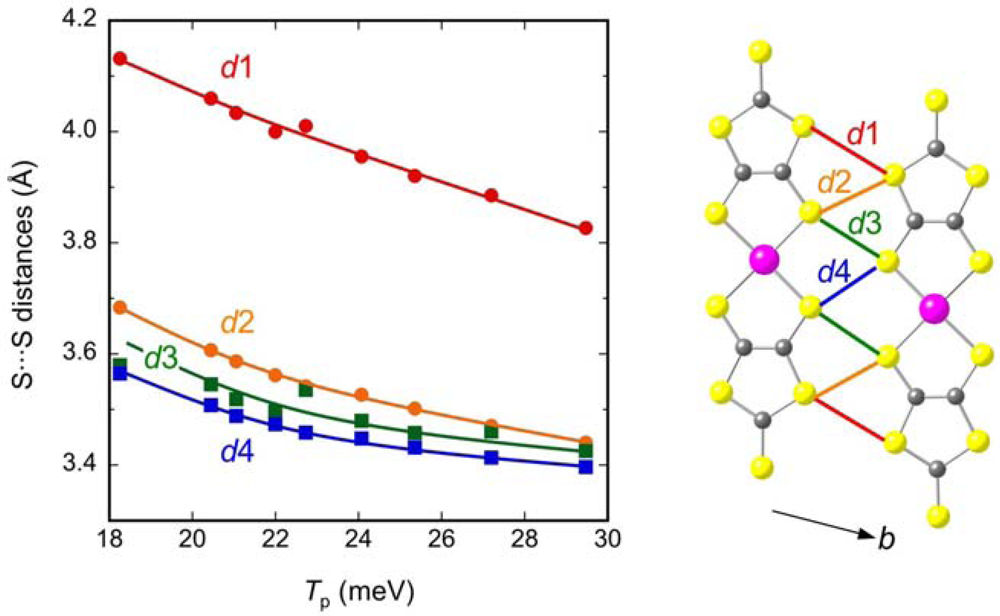
        <p>The arch-shaped distortion affects not only <italic>T</italic><sub>r</sub> but also the other intermolecular transfer integrals. With increasing cation size (<italic>R</italic><sub>Z</sub> and <italic>x</italic>), the Pd(dmit)<sub>2</sub> molecule becomes distorted, as indicated by the green arrows in <xref ref-type="fig" rid="crystals-02-00861-f011">Figure 11</xref>. The distortion reduces the face-to-face overlap along the stacking direction that correlates with <italic>T</italic><sub>B</sub> (<xref ref-type="fig" rid="crystals-02-00861-f011">Figure 11</xref>). The distortion lengthens the intermolecular S···S contacts responsible for <italic>T</italic><sub>p</sub>, which is consistent with the observed relation between <italic>T</italic><sub>p</sub> and the intermolecular S···S distances responsible for <italic>T</italic><sub>p</sub> (<xref ref-type="fig" rid="crystals-02-00861-f012">Figure 12</xref>). In contrast to the results for <italic>T</italic><sub>r</sub> (<xref ref-type="fig" rid="crystals-02-00861-f007">Figure 7</xref>), a reduction in <italic>T</italic><sub>p</sub> correlates with elongation of all the S···S distances (<xref ref-type="fig" rid="crystals-02-00861-f012">Figure 12</xref>). As a result, the three interdimer transfer integrals, <italic>t</italic><sub>B</sub>, <italic>t</italic><sub>S</sub>, and <italic>t</italic><sub>r</sub>, are reasonably correlated with <italic>Ф</italic> (<xref ref-type="fig" rid="crystals-02-00861-f013">Figure 13</xref>). </p>
        <fig id="crystals-02-00861-f011" position="anchor">
          <label>Figure 11</label>
          <caption>
            <p>End-on projection of the dimer lattice, in which the green arrows indicate the molecular distortions occurring with increasing cation size (<italic>R</italic><sub>Z</sub> and <italic>x</italic>). Overlapping modes associated with <italic>T</italic><sub>B</sub> for Me<sub>4</sub>P and Et<sub>2</sub>Me<sub>2</sub>Sb salts are also presented on the right side.</p>
          </caption>
          <graphic xmlns:xlink="http://www.w3.org/1999/xlink" xlink:href="crystals-02-00861-g011.tif"/>
        </fig>
        <fig id="crystals-02-00861-f012" position="anchor">
          <label>Figure 12</label>
          <caption>
            <p>Relations between <italic>T</italic><sub>p</sub> and intermolecular S···S distances (Å) responsible for <italic>T</italic><sub>p</sub>.</p>
          </caption>
          <graphic xmlns:xlink="http://www.w3.org/1999/xlink" xlink:href="crystals-02-00861-g012.tif"/>
        </fig>
        <fig id="crystals-02-00861-f013" position="anchor">
          <label>Figure 13</label>
          <caption>
            <p>Interdimer transfer integrals as a function of the torsion angle of S–Pd–Pd–S (<italic>Ф</italic>).</p>
          </caption>
          <graphic xmlns:xlink="http://www.w3.org/1999/xlink" xlink:href="crystals-02-00861-g013.tif"/>
        </fig>
      </sec>
      <sec>
        <title>2.3. Intradimer Transfer Integrals</title>
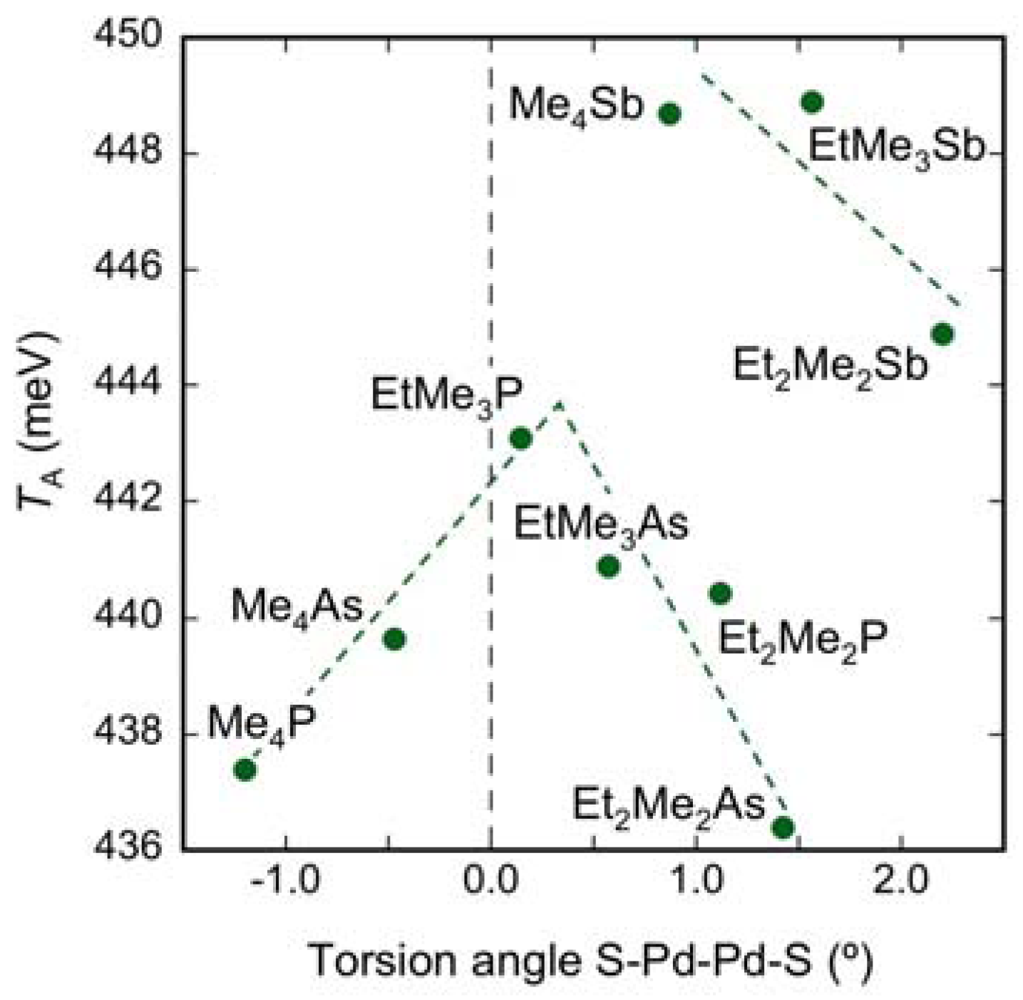
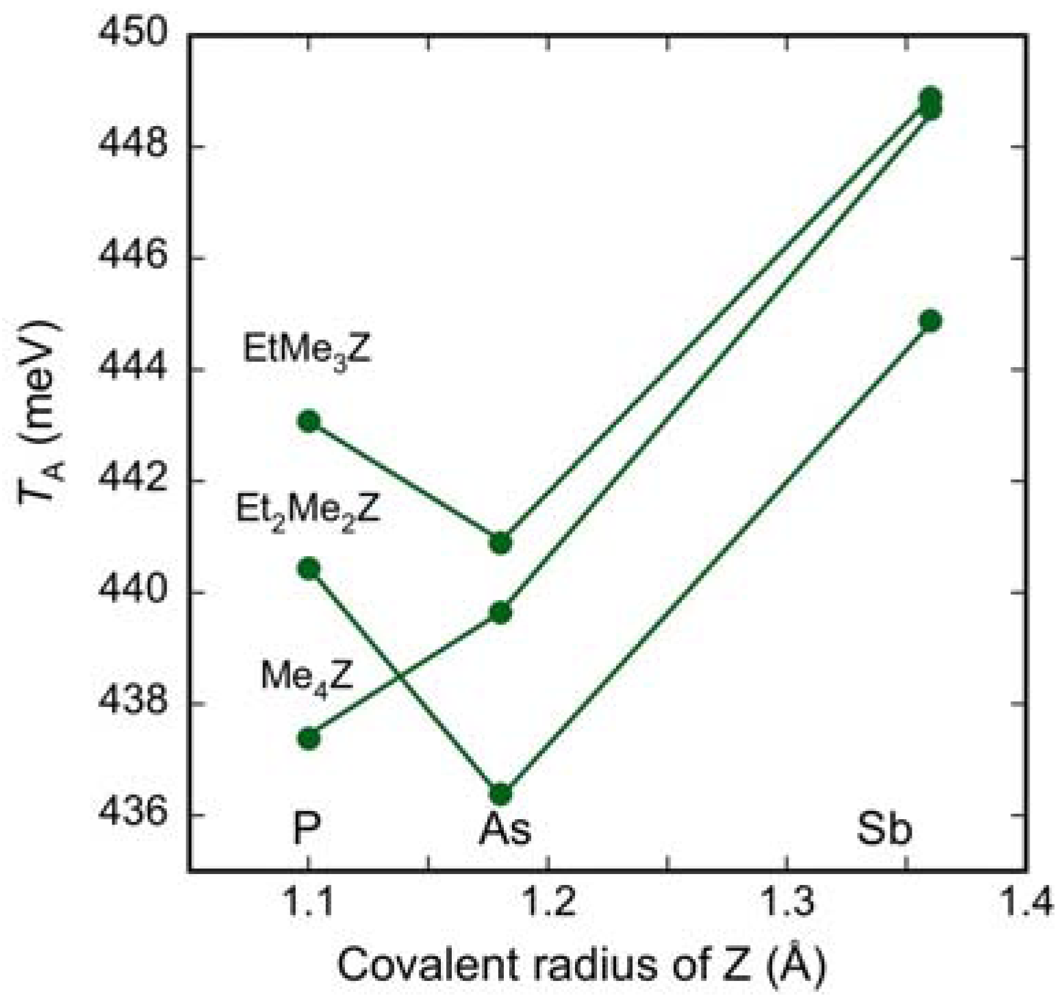
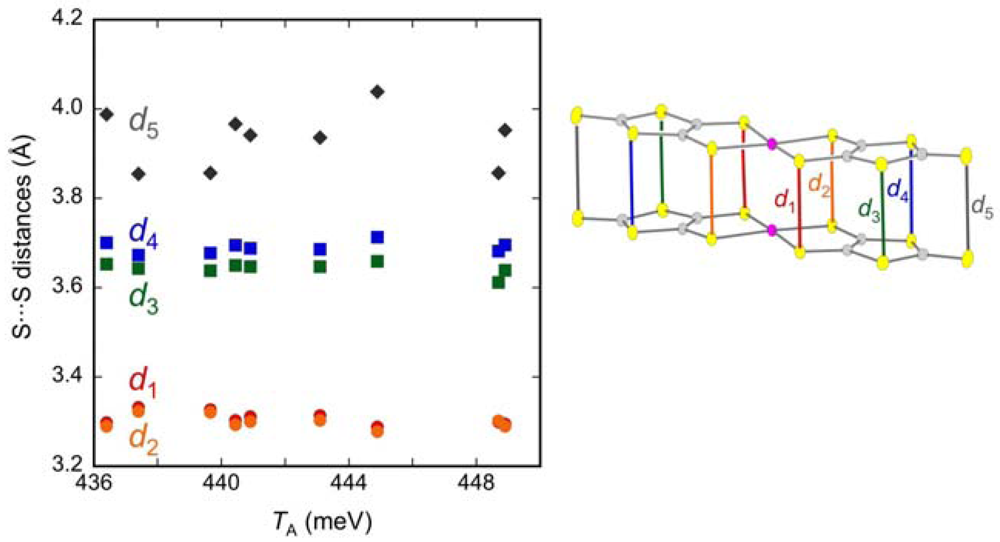
        <p>In the Mott system based on dimer units, the intradimer transfer integral (<italic>T</italic><sub>A</sub>) is approximately correlated with the effective on-site Coulomb energy of the dimer [<xref ref-type="bibr" rid="B15-crystals-02-00861">15</xref>]. <xref ref-type="fig" rid="crystals-02-00861-f014">Figure 14</xref> shows the <italic>T</italic><sub>A</sub> values of β'-type Pd(dmit)<sub>2</sub> salts as a function of <italic>R</italic><sub>Z</sub>. Although the <italic>T</italic><sub>A</sub> values are larger than the interdimer transfer integrals, their variation is within 5%, which is smaller than the observed variations in <italic>t</italic> and <italic>t</italic><sub>r</sub>. As a result, we can say that the effect of the counter cation on <italic>T</italic><sub>A</sub> is relatively weak. The cation dependence of <italic>T</italic><sub>A</sub> appears complicated and does not show a systematic trend. In <xref ref-type="fig" rid="crystals-02-00861-f015">Figure 15</xref>, the intermolecular S···S distances responsible for <italic>T</italic><sub>A</sub> are plotted against <italic>T</italic><sub>A</sub>. (Note here that the <italic>T</italic><sub>A</sub> contribution of the Pd···Pd contact is small because the contribution of the d orbital of Pd to the HOMO is small). The inner S···S distances (<italic>d</italic>1 and <italic>d</italic>2) are shorter than the outer S···S distances (<italic>d</italic>3 and <italic>d</italic>4), which implies that the molecular plane is warped, as if the two Pd(dmit)<sub>2</sub> molecules in the dimer act to repel each other. For these two distinct groupings, the S···S distances are almost constant within each group over all the salts. The terminal S···S distances (<italic>d</italic>5) are largest and are slightly scattered without any clear tendency. The relation between <italic>T</italic><sub>A</sub> and <italic>Ф</italic> is shown in <xref ref-type="fig" rid="crystals-02-00861-f016">Figure 16</xref>, which suggests there are two distinct groups among the salts. The salts with <italic>Z</italic> = Sb show larger <italic>T</italic><sub>A</sub> values, while the other salts (<italic>Z</italic> = P, As) exhibit a chevron-shaped <italic>Ф</italic> dependence. Since it is expected that the dimer with <italic>Ф</italic> <italic>=</italic>0 would have well-eclipsed overlapping modes, this chevron-shaped dependence on <italic>Ф</italic> seems reasonable. On the other hand, the origin of the larger <italic>T</italic><sub>A</sub> values for the Sb series remains an open question. </p>
        
      </sec>
    </sec>
    <sec>
      <title>3. Experimental Section</title>
      <p>Single crystals of β'-(Et<italic><sub>x</sub></italic>Me<sub>4−<italic>x</italic></sub><italic>Z</italic>)[Pd(dmit)<sub>2</sub>]<sub>2</sub> were obtained by air oxidation of (Et<italic><sub>x</sub></italic>Me<sub>4−<italic>x</italic></sub><italic>Z</italic>)<sub>2</sub> [Pd(dmit)<sub>2</sub>] in acetone containing acetic acid. A typical procedure was as follows: (Et<italic><sub>x</sub></italic>Me<sub>4−<italic>x</italic></sub><italic>Z</italic>)<sub>2</sub> [Pd(dmit)<sub>2</sub>] (<italic>ca</italic>. 35 μmol) was dissolved in acetone (35–70 mL). After addition of acetic acid (4.0–5.5 mL), the resultant solution was allowed to stand at 5–10 °C for 3–4 weeks. The β'-type crystals (black elongated or hexagonal plates) were obtained as a single phase, with the exception of the EtMe<sub>3</sub>P salt. The EtMe<sub>3</sub>P salt contains a monoclinic <italic>P</italic>2<sub>1</sub>/m phase [<xref ref-type="bibr" rid="B17-crystals-02-00861">17</xref>,<xref ref-type="bibr" rid="B18-crystals-02-00861">18</xref>,<xref ref-type="bibr" rid="B19-crystals-02-00861">19</xref>,<xref ref-type="bibr" rid="B20-crystals-02-00861">20</xref>,<xref ref-type="bibr" rid="B21-crystals-02-00861">21</xref>] as the main phase, and triclinic- [<xref ref-type="bibr" rid="B22-crystals-02-00861">22</xref>] and β'-phases (monoclinic <italic>C</italic>2/<italic>c</italic>) as minor phases . The β'-phase of the EtMe<sub>3</sub>P salt was a very minor component. </p>
      <fig id="crystals-02-00861-f014" position="anchor">
          <label>Figure 14</label>
          <caption>
            <p>Mapping of intradimer HOMO-HOMO transfer integrals <italic>T</italic><sub>A</sub> to the covalent radius of the central atom <italic>Z</italic> (<italic>R</italic><sub>Z</sub>).</p>
          </caption>
          <graphic xmlns:xlink="http://www.w3.org/1999/xlink" xlink:href="crystals-02-00861-g014.tif"/>
        </fig>
        <fig id="crystals-02-00861-f015" position="anchor">
          <label>Figure 15</label>
          <caption>
            <p>Relations between <italic>T</italic><sub>A</sub> and intermolecular S···S distances (Å) responsible for <italic>T</italic><sub>A</sub>.</p>
          </caption>
          <graphic xmlns:xlink="http://www.w3.org/1999/xlink" xlink:href="crystals-02-00861-g015.tif"/>
        </fig>
        <fig id="crystals-02-00861-f016" position="anchor">
          <label>Figure 16</label>
          <caption>
            <p>Mapping of intradimer HOMO-HOMO transfer integrals <italic>T</italic><sub>A</sub> to torsion angle of S–Pd–Pd–S (<italic>Ф</italic>).</p>
          </caption>
          <graphic xmlns:xlink="http://www.w3.org/1999/xlink" xlink:href="crystals-02-00861-g016.tif"/>
        </fig>
      <p>X-ray diffraction data were collected using a Rigaku Mercury CCD AFC10 system with monochromated Mo <italic>K</italic>α radiation at room temperature. All structures were solved by a direct method (SIR92) [<xref ref-type="bibr" rid="B23-crystals-02-00861">23</xref>] and refined on <italic>F</italic><sup>2</sup> by the full-matrix least-squares method (SHELXL-97) [<xref ref-type="bibr" rid="B24-crystals-02-00861">24</xref>]. Anisotropic atomic displacements were applied to all non-H atoms. The H atoms were placed at the calculated positions and refined by applying the riding model. </p>
      <p>Intermolecular overlap integrals (<italic>S</italic>) between HOMOs were obtained using extended Hückel molecular orbital calculations based on structural data. Semi-empirical parameters for Slater-type atomic orbitals are summarized in <xref ref-type="table" rid="crystals-02-00861-t004">Table 4</xref>. Intermolecular transfer integrals, <italic>t</italic> (eV), were estimated using the equation <italic>t</italic> = −10<italic>S</italic>[<xref ref-type="bibr" rid="B1-crystals-02-00861">1</xref>].</p>
      <table-wrap id="crystals-02-00861-t004" position="anchor">
        <object-id pub-id-type="pii">crystals-02-00861-t004_Table 4</object-id>
        <label>Table 4</label>
        <caption>
          <p>Semi-empirical parameters for Slater-type atomic orbitals.</p>
        </caption>
        <table>
          <thead>
            <tr>
              <th align="center" valign="middle">atom</th>
              <th align="center" valign="middle">orbital</th>
              <th align="center" valign="middle"><italic>I</italic><sub>p</sub> (Ryd)</th>
              <th align="center" valign="middle">
                <italic>ζ</italic>
                <sub>1</sub>
              </th>
              <th align="center" valign="middle">
                <italic>ζ</italic>
                <sub>2</sub>
              </th>
            </tr>
          </thead>
          <tbody>
            <tr>
              <td align="center" valign="middle">
                <bold>C</bold>
              </td>
              <td align="center" valign="middle">2s</td>
              <td align="center" valign="middle">1.573</td>
              <td align="center" valign="middle">1.625</td>
              <td align="center" valign="middle"> </td>
            </tr>
            <tr>
              <td align="center" valign="middle"> </td>
              <td align="center" valign="middle">2p</td>
              <td align="center" valign="middle">0.838</td>
              <td align="center" valign="middle">1.625</td>
              <td align="center" valign="middle"> </td>
            </tr>
            <tr>
              <td align="center" valign="middle">
                <bold>S</bold>
              </td>
              <td align="center" valign="middle">3s</td>
              <td align="center" valign="middle">1.620</td>
              <td align="center" valign="middle">2.122</td>
              <td align="center" valign="middle"> </td>
            </tr>
            <tr>
              <td align="center" valign="middle"> </td>
              <td align="center" valign="middle">3p</td>
              <td align="center" valign="middle">0.770</td>
              <td align="center" valign="middle">1.827</td>
              <td align="center" valign="middle"> </td>
            </tr>
            <tr>
              <td align="center" valign="middle">
                <bold>Pd</bold>
              </td>
              <td align="center" valign="middle">5s</td>
              <td align="center" valign="middle">0.676</td>
              <td align="center" valign="middle">2.19</td>
              <td align="center" valign="middle"> </td>
            </tr>
            <tr>
              <td align="center" valign="middle"> </td>
              <td align="center" valign="middle">5p</td>
              <td align="center" valign="middle">0.390</td>
              <td align="center" valign="middle">2.15</td>
              <td align="center" valign="middle"> </td>
            </tr>
            <tr>
              <td align="center" valign="middle"> </td>
              <td align="center" valign="middle">4d</td>
              <td align="center" valign="middle">0.949</td>
              <td align="center" valign="middle">5.98</td>
              <td align="center" valign="middle">2.613</td>
            </tr>
            <tr>
              <td align="center" valign="middle"> </td>
              <td align="center" valign="middle"> </td>
              <td align="center" valign="middle"> </td>
              <td align="center" valign="middle">(0.5264) *</td>
              <td align="center" valign="middle">(0.6372) *</td>
            </tr>
          </tbody>
        </table>
        <table-wrap-foot>
        <fn>
        <p>* Contraction coefficients used in the double-<italic>ζ</italic> expansion.</p>
        </fn>
        </table-wrap-foot>
      </table-wrap>
      
    </sec>
    <sec sec-type="conclusions">
      <title>4. Conclusions</title>
      <p>The crystal structures of β'-type Pd(dmit)<sub>2</sub> salts corresponding to a two-dimensional Mott system with a quasi triangular lattice were investigated systematically, and the effects of the counter cation on intermolecular transfer integrals revealed. The intradimer transfer integral, which is correlated with the effective on-site Coulomb interaction of the dimer and the dimerization gap, weakly depends on the type of cation. On the other hand, the anisotropy of the triangular lattice (the ratio of interdimer transfer integrals, <italic>t</italic><sub>r</sub>/<italic>t</italic>), which determines the degree of frustration, can be tuned from 0.6 (Me<sub>4</sub>P salt) to 1.0 (Et<sub>2</sub>Me<sub>2</sub>Sb salt) by changing the bulkiness of the cation (<italic>R</italic><sub>Z</sub> and <italic>x</italic>). An essential feature of the effect of the cation on the interdimer transfer integrals is the arch-shaped distortion observed in the Pd(dmit)<sub>2</sub> molecule rather than molecular rearrangement. That is, the Pd(dmit)<sub>2</sub> molecule is sufficiently flexible within the crystal field, allowing distortions of the molecular skeleton to occur with different counter cations, in turn leading to systematic changes in the intermolecular interactions. Understanding the origin of the arch-shaped molecular distortion is of considerable interest in materials design in such systems. In the present system, the counter cations are located discretely and there is no observable cation framework based on cation···cation interactions which can accommodate anions. Although some kind of cation···anion interaction would be expected, we did not identify any significant short contacts between cations and anions. Notably, structural optimization for atomic geometries calculated within the generalized gradient approximation can reproduce the arch-shaped molecular distortion and its cation dependence [<xref ref-type="bibr" rid="B25-crystals-02-00861">25</xref>], which should provide important clues to its origin. Further studies are needed to clarify how the degree of molecular distortion is controlled by the counter cation in the crystal.</p>
    </sec>
    
  </body>
  <back>
   <ack>
      <title>Acknowledgments</title>
      <p>This research was partially supported by grant-in-aid for Scientific Research on Innovative Areas (No. 20110003) from the Ministry of Education, Culture, Sports, Science and Technology (MEXT), and by grant-in-aid for Scientific Research (S) (No. 22224006) from the Japan Society for the Promotion of Science (JSPS).</p>
    </ack>
    <notes>
      <title>Conflict of Interest</title>
      <p>The authors declare no conflict of interest.</p>
    </notes>
    <ref-list>
      <title>References and Notes</title>
      <ref id="B1-crystals-02-00861">
        <label>1.</label>
        <citation citation-type="journal">
          <person-group person-group-type="author">
            <name>
              <surname>Mori</surname>
              <given-names>T.</given-names>
            </name>
            <name>
              <surname>Kobayashi</surname>
              <given-names>A.</given-names>
            </name>
            <name>
              <surname>Sasaki</surname>
              <given-names>Y.</given-names>
            </name>
            <name>
              <surname>Kobayashi</surname>
              <given-names>H.</given-names>
            </name>
            <name>
              <surname>Saito</surname>
              <given-names>G.</given-names>
            </name>
            <name>
              <surname>Inokuchi</surname>
              <given-names>H.</given-names>
            </name>
          </person-group>
          <article-title>The intermolecular interaction of tetrathiafulvalene and bis(ethylenedithio)tetrathiafulvalene in organic metals. Calculation of orbital overlaps and models of energy-band structures</article-title>
          <source>Bull. Chem. Soc. Jpn.</source>
          <year>1984</year>
          <volume>57</volume>
          <fpage>627</fpage>
          <lpage>633</lpage>
        <pub-id pub-id-type="doi">10.1246/bcsj.57.627</pub-id></citation>
      </ref>
      <ref id="B2-crystals-02-00861">
        <label>2.</label>
        <citation citation-type="journal">
          <person-group person-group-type="author">
            <name>
              <surname>Kato</surname>
              <given-names>R.</given-names>
            </name>
          </person-group>
          <article-title>Conducting metal dithiolene complexes: Structural and electronic properties</article-title>
          <source>Chem. Rev.</source>
          <year>2004</year>
          <volume>104</volume>
          <fpage>5319</fpage>
          <lpage>5346</lpage>
          <pub-id pub-id-type="doi">10.1021/cr030655t</pub-id>
        </citation>
      </ref>
      <ref id="B3-crystals-02-00861">
        <label>3.</label>
        <citation citation-type="journal">
          <person-group person-group-type="author">
            <name>
              <surname>Tamura</surname>
              <given-names>M.</given-names>
            </name>
            <name>
              <surname>Kato</surname>
              <given-names>R.</given-names>
            </name>
          </person-group>
          <article-title>Variety of valence bond states formed of frustrated spins on triangular lattices based on a two-level System Pd(dmit)<sub>2</sub></article-title>
          <source>Sci. Technol. Adv. Mater.</source>
          <year>2009</year>
          <volume>10</volume>
          <fpage>024304:1</fpage>
          <lpage>024304:12</lpage>
        </citation>
      </ref>
      <ref id="B4-crystals-02-00861">
        <label>4.</label>
        <citation citation-type="journal">
          <person-group person-group-type="author">
            <name>
              <surname>Tamura</surname>
              <given-names>M.</given-names>
            </name>
            <name>
              <surname>Kato</surname>
              <given-names>R.</given-names>
            </name>
          </person-group>
          <article-title>Spin-1/2 Heisenberg antiferromagnets on anisotropic triangular lattice, [Pd(dmit)<sub>2</sub>] salts—How do they release frustration?</article-title>
          <source>Polyhedron</source>
          <year>2005</year>
          <volume>24</volume>
          <fpage>2817</fpage>
          <lpage>2820</lpage>
          <pub-id pub-id-type="doi">10.1016/j.poly.2005.03.170</pub-id>
        </citation>
      </ref>
      <ref id="B5-crystals-02-00861">
        <label>5.</label>
        <citation citation-type="journal">
          <person-group person-group-type="author">
            <name>
              <surname>Kanoda</surname>
              <given-names>K.</given-names>
            </name>
            <name>
              <surname>Kato</surname>
              <given-names>R.</given-names>
            </name>
          </person-group>
          <article-title>Mott physics in organic conductors with triangular lattices</article-title>
          <source>Annu. Rev. Condens. Matter Phys.</source>
          <year>2011</year>
          <volume>2</volume>
          <fpage>167</fpage>
          <lpage>188</lpage>
          <pub-id pub-id-type="doi">10.1146/annurev-conmatphys-062910-140521</pub-id>
        </citation>
      </ref>
      <ref id="B6-crystals-02-00861">
        <label>6.</label>
        <citation citation-type="journal">
          <person-group person-group-type="author">
            <name>
              <surname>Tamura</surname>
              <given-names>M.</given-names>
            </name>
            <name>
              <surname>Kato</surname>
              <given-names>R.</given-names>
            </name>
          </person-group>
          <article-title>Magnetic susceptibility of β'-[Pd(dmit)<sub>2</sub>] salts (dmit = 1,3-dithiol-2-thione-4,5-dithiolate, C<sub>3</sub>S<sub>5</sub>): Evidence for frustration in spin-1/2 Heisenberg antiferromagnets on a triangular lattice</article-title>
          <source>J. Phys. Condens. Matter.</source>
          <year>2002</year>
          <volume>14</volume>
          <fpage>L729</fpage>
          <lpage>L734</lpage>
          <pub-id pub-id-type="doi">10.1088/0953-8984/14/47/102</pub-id>
        </citation>
      </ref>
      <ref id="B7-crystals-02-00861">
        <label>7.</label>
        <citation citation-type="journal">
          <person-group person-group-type="author">
            <name>
              <surname>Itou</surname>
              <given-names>T.</given-names>
            </name>
            <name>
              <surname>Oyamada</surname>
              <given-names>A.</given-names>
            </name>
            <name>
              <surname>Maegawa</surname>
              <given-names>S.</given-names>
            </name>
            <name>
              <surname>Tamura</surname>
              <given-names>M.</given-names>
            </name>
            <name>
              <surname>Kato</surname>
              <given-names>R.</given-names>
            </name>
          </person-group>
          <article-title>Quantum spin liquid in the spin-1/2 triangular antiferromagnet EtMe<sub>3</sub>Sb[Pd(dmit)<sub>2</sub>]<sub>2</sub></article-title>
          <source>Phys. Rev. B</source>
          <year>2008</year>
          <volume>77</volume>
          <fpage>104413:1</fpage>
          <lpage>104413:5</lpage>
        </citation>
      </ref>
      <ref id="B8-crystals-02-00861">
        <label>8.</label>
        <citation citation-type="journal">
          <person-group person-group-type="author">
            <name>
              <surname>Itou</surname>
              <given-names>T.</given-names>
            </name>
            <name>
              <surname>Oyamada</surname>
              <given-names>A.</given-names>
            </name>
            <name>
              <surname>Maegawa</surname>
              <given-names>S.</given-names>
            </name>
            <name>
              <surname>Kato</surname>
              <given-names>R.</given-names>
            </name>
          </person-group>
          <article-title>Instability of a quantum spin liquid in an organic triangular-lattice antiferromagnet</article-title>
          <source>Nat. Physics</source>
          <year>2010</year>
          <volume>6</volume>
          <fpage>673</fpage>
          <lpage>676</lpage>
          <pub-id pub-id-type="doi">10.1038/nphys1715</pub-id>
        </citation>
      </ref>
      <ref id="B9-crystals-02-00861">
        <label>9.</label>
        <citation citation-type="journal">
          <person-group person-group-type="author">
            <name>
              <surname>Yamashita</surname>
              <given-names>M.</given-names>
            </name>
            <name>
              <surname>Nakata</surname>
              <given-names>N.</given-names>
            </name>
            <name>
              <surname>Senshu</surname>
              <given-names>Y.</given-names>
            </name>
            <name>
              <surname>Nagata</surname>
              <given-names>M.</given-names>
            </name>
            <name>
              <surname>Yamamoto</surname>
              <given-names>H.M.</given-names>
            </name>
            <name>
              <surname>Kato</surname>
              <given-names>R.</given-names>
            </name>
            <name>
              <surname>Shibauchi</surname>
              <given-names>T.</given-names>
            </name>
            <name>
              <surname>Matsuda</surname>
              <given-names>Y.</given-names>
            </name>
          </person-group>
          <article-title>Highly mobile gapless excitations in a two-dimensional candidate quantum spin liquid</article-title>
          <source>Science</source>
          <year>2010</year>
          <volume>328</volume>
          <fpage>1246</fpage>
          <lpage>1248</lpage>
        <pub-id pub-id-type="doi">10.1126/science.1188200</pub-id><pub-id pub-id-type="pmid">20522768</pub-id></citation>
      </ref>
      <ref id="B10-crystals-02-00861">
        <label>10.</label>
        <citation citation-type="book">
          <person-group person-group-type="author">
            <name>
              <surname>Kato</surname>
              <given-names>R.</given-names>
            </name>
            <name>
              <surname>Itou</surname>
              <given-names>T.</given-names>
            </name>
          </person-group>
          <article-title>Molecular quasi-triangular lattice antiferromagnets</article-title>
          <source>Understanding Quantum Phase Transitions</source>
          <person-group person-group-type="editor">
            <name>
              <surname>Lincoln</surname>
              <given-names>D.C.</given-names>
            </name>
          </person-group>
          <publisher-name>CRC Press</publisher-name>
          <publisher-loc>Boca Raton, FL, USA</publisher-loc>
          <year>2010</year>
          <fpage>419</fpage>
          <lpage>443</lpage>
        </citation>
      </ref>
      <ref id="B11-crystals-02-00861">
        <label>11.</label>
        <citation citation-type="journal">
          <person-group person-group-type="author">
            <name>
              <surname>Yamashita</surname>
              <given-names>S.</given-names>
            </name>
            <name>
              <surname>Yamamoto</surname>
              <given-names>T.</given-names>
            </name>
            <name>
              <surname>Nakazawa</surname>
              <given-names>Y.</given-names>
            </name>
            <name>
              <surname>Tamura</surname>
              <given-names>M.</given-names>
            </name>
            <name>
              <surname>Kato</surname>
              <given-names>R.</given-names>
            </name>
          </person-group>
          <article-title>Gapless spin liquid of an organic triangular compound evidenced by thermodynamic measurements</article-title>
          <source>Nature Commun.</source>
          <year>2011</year>
          <volume>2</volume>
          <fpage>275:1</fpage>
          <lpage>275:6</lpage>
        </citation>
      </ref>
      <ref id="B12-crystals-02-00861">
        <label>12.</label>
        <citation citation-type="journal">
          <person-group person-group-type="author">
            <name>
              <surname>Tamura</surname>
              <given-names>M.</given-names>
            </name>
            <name>
              <surname>Kato</surname>
              <given-names>R.</given-names>
            </name>
          </person-group>
          <article-title>Valence instability in a dimer of two-orbital system: Possible charge separation due to “Negative <italic>U</italic>” effect</article-title>
          <source>Chem. Phys. Lett.</source>
          <year>2004</year>
          <volume>387</volume>
          <fpage>448</fpage>
          <lpage>452</lpage>
          <pub-id pub-id-type="doi">10.1016/j.cplett.2004.02.053</pub-id>
        </citation>
      </ref>
      <ref id="B13-crystals-02-00861">
        <label>13.</label>
        <citation citation-type="journal">
          <person-group person-group-type="author">
            <name>
              <surname>Nakao</surname>
              <given-names>A.</given-names>
            </name>
            <name>
              <surname>Kato</surname>
              <given-names>R.</given-names>
            </name>
          </person-group>
          <article-title>Structural study of low temperature charge-separated phases of Pd(dmit)<sub>2</sub>-based molecular conductors</article-title>
          <source>J. Phys. Soc. Jpn.</source>
          <year>2005</year>
          <volume>74</volume>
          <fpage>2754</fpage>
          <lpage>2763</lpage>
          <pub-id pub-id-type="doi">10.1143/JPSJ.74.2754</pub-id>
        </citation>
      </ref>
      <ref id="B14-crystals-02-00861">
        <label>14.</label>
        <citation citation-type="journal">
          <person-group person-group-type="author">
            <name>
              <surname>Tamura</surname>
              <given-names>M.</given-names>
            </name>
            <name>
              <surname>Takenaka</surname>
              <given-names>K.</given-names>
            </name>
            <name>
              <surname>Takagi</surname>
              <given-names>H.</given-names>
            </name>
            <name>
              <surname>Sugai</surname>
              <given-names>S.</given-names>
            </name>
            <name>
              <surname>Tajima</surname>
              <given-names>A.</given-names>
            </name>
            <name>
              <surname>Kato</surname>
              <given-names>R.</given-names>
            </name>
          </person-group>
          <article-title>Spectroscopic evidence for the low-temperature charge-separated state of [Pd(dmit)<sub>2</sub>] salts</article-title>
          <source>Chem. Phys. Lett.</source>
          <year>2005</year>
          <volume>411</volume>
          <fpage>133</fpage>
          <lpage>137</lpage>
          <pub-id pub-id-type="doi">10.1016/j.cplett.2005.06.026</pub-id>
        </citation>
      </ref>
      <ref id="B15-crystals-02-00861">
        <label>15.</label>
        <citation citation-type="journal">
          <person-group person-group-type="author">
            <name>
              <surname>Tamura</surname>
              <given-names>M.</given-names>
            </name>
            <name>
              <surname>Kato</surname>
              <given-names>R.</given-names>
            </name>
          </person-group>
          <article-title>Effective on-site repulsion in molecular conductors with dimeric structure: Is the transfer integral a good measure of correlation?</article-title>
          <source>J. Phys. Soc. Jpn.</source>
          <year>2004</year>
          <volume>73</volume>
          <fpage>3108</fpage>
          <lpage>3110</lpage>
          <pub-id pub-id-type="doi">10.1143/JPSJ.73.3108</pub-id>
        </citation>
      </ref>
      <ref id="B16-crystals-02-00861">
        <label>16.</label>
        <citation citation-type="journal">
          <person-group person-group-type="author">
            <name>
              <surname>Canadell</surname>
              <given-names>E.</given-names>
            </name>
            <name>
              <surname>Ravy</surname>
              <given-names>S.</given-names>
            </name>
            <name>
              <surname>Pouget</surname>
              <given-names>J.P.</given-names>
            </name>
            <name>
              <surname>Brossard</surname>
              <given-names>L.</given-names>
            </name>
          </person-group>
          <article-title>Concerning the band structure of <italic>D</italic>[<italic>M</italic>(dmit)<sub>2</sub>]<sub>2</sub> (<italic>D</italic>=TTF,Cs,NMe<sub>4</sub>; <italic>M</italic>=Ni,Pd) molecular conductors and superconductors: Role of the M(dmit)<sub>2</sub> HOMO and LUMO</article-title>
          <source>Solid State Commun.</source>
          <year>1990</year>
          <volume>75</volume>
          <fpage>633</fpage>
          <lpage>638</lpage>
          <pub-id pub-id-type="doi">10.1016/0038-1098(90)90214-V</pub-id>
        </citation>
      </ref>
      <ref id="B17-crystals-02-00861">
        <label>17.</label>
        <citation citation-type="journal">
          <person-group person-group-type="author">
            <name>
              <surname>Tamura</surname>
              <given-names>M.</given-names>
            </name>
            <name>
              <surname>Nakao</surname>
              <given-names>A.</given-names>
            </name>
            <name>
              <surname>Kato</surname>
              <given-names>R.</given-names>
            </name>
          </person-group>
          <article-title>Frustration-induced valence-bond ordering in a new quantum triangular antiferromagnet based on [Pd(dmit)<sub>2</sub>]</article-title>
          <source>J. Phys. Soc. Jpn.</source>
          <year>2006</year>
          <volume>75</volume>
          <fpage>093701:1</fpage>
          <lpage>093701:4</lpage>
        </citation>
      </ref>
      <ref id="B18-crystals-02-00861">
        <label>18.</label>
        <citation citation-type="journal">
          <person-group person-group-type="author">
            <name>
              <surname>Kato</surname>
              <given-names>R.</given-names>
            </name>
            <name>
              <surname>Tajima</surname>
              <given-names>A.</given-names>
            </name>
            <name>
              <surname>Nakao</surname>
              <given-names>A.</given-names>
            </name>
            <name>
              <surname>Tamura</surname>
              <given-names>M.</given-names>
            </name>
          </person-group>
          <article-title>Two pressure-induced superconducting anion radical salts exhibiting different spin states at ambient pressure</article-title>
          <source>J. Am. Chem. Soc.</source>
          <year>2006</year>
          <volume>128</volume>
          <fpage>10016</fpage>
          <lpage>10017</lpage>
        <pub-id pub-id-type="doi">10.1021/ja063525l</pub-id><pub-id pub-id-type="pmid">16881622</pub-id></citation>
      </ref>
      <ref id="B19-crystals-02-00861">
        <label>19.</label>
        <citation citation-type="journal">
          <person-group person-group-type="author">
            <name>
              <surname>Ishii</surname>
              <given-names>Y.</given-names>
            </name>
            <name>
              <surname>Tamura</surname>
              <given-names>M.</given-names>
            </name>
            <name>
              <surname>Kato</surname>
              <given-names>R.</given-names>
            </name>
          </person-group>
          <article-title>Magnetic study of pressure-induced superconductivity in the [Pd(dmit)2] salt with spin-gapped ground state</article-title>
          <source>J. Phys. Soc. Jpn.</source>
          <year>2007</year>
          <volume>76</volume>
          <fpage>033704:1</fpage>
          <lpage>033704:4</lpage>
        </citation>
      </ref>
      <ref id="B20-crystals-02-00861">
        <label>20.</label>
        <citation citation-type="journal">
          <person-group person-group-type="author">
            <name>
              <surname>Shimizu</surname>
              <given-names>Y.</given-names>
            </name>
            <name>
              <surname>Akimoto</surname>
              <given-names>H.</given-names>
            </name>
            <name>
              <surname>Tsujii</surname>
              <given-names>H.</given-names>
            </name>
            <name>
              <surname>Tajima</surname>
              <given-names>A.</given-names>
            </name>
            <name>
              <surname>Kato</surname>
              <given-names>R.</given-names>
            </name>
          </person-group>
          <article-title>Mott transition in a valence-bond solid insulator with a triangular lattice</article-title>
          <source>Phys. Rev. Lett.</source>
          <year>2007</year>
          <volume>99</volume>
          <fpage>256403:1</fpage>
          <lpage>256403:4</lpage>
        </citation>
      </ref>
      <ref id="B21-crystals-02-00861">
        <label>21.</label>
        <citation citation-type="journal">
          <person-group person-group-type="author">
            <name>
              <surname>Itou</surname>
              <given-names>T.</given-names>
            </name>
            <name>
              <surname>Oyamada</surname>
              <given-names>A.</given-names>
            </name>
            <name>
              <surname>Maegawa</surname>
              <given-names>S.</given-names>
            </name>
            <name>
              <surname>Kubo</surname>
              <given-names>K.</given-names>
            </name>
            <name>
              <surname>Yamamoto</surname>
              <given-names>H.M.</given-names>
            </name>
            <name>
              <surname>Kato</surname>
              <given-names>R.</given-names>
            </name>
          </person-group>
          <article-title>Superconductivity on the border of a spin-gapped Mott insulator: NMR studies of the quasi-two-dimensional organic system EtMe<sub>3</sub>P[Pd(dmit)<sub>2</sub>]<sub>2</sub></article-title>
          <source>Phys. Rev. B</source>
          <year>2009</year>
          <volume>79</volume>
          <fpage>174517:1</fpage>
          <lpage>174517:6</lpage>
        </citation>
      </ref>
      <ref id="B22-crystals-02-00861">
        <label>22.</label>
        <citation citation-type="journal">
          <person-group person-group-type="author">
            <name>
              <surname>Yamamoto</surname>
              <given-names>T.</given-names>
            </name>
            <name>
              <surname>Nakazawa</surname>
              <given-names>Y.</given-names>
            </name>
            <name>
              <surname>Tamura</surname>
              <given-names>M.</given-names>
            </name>
            <name>
              <surname>Nakao</surname>
              <given-names>A.</given-names>
            </name>
            <name>
              <surname>Ikemoto</surname>
              <given-names>Y.</given-names>
            </name>
            <name>
              <surname>Moriwaki</surname>
              <given-names>T.</given-names>
            </name>
            <name>
              <surname>Fukaya</surname>
              <given-names>A.</given-names>
            </name>
            <name>
              <surname>Kato</surname>
              <given-names>R.</given-names>
            </name>
            <name>
              <surname>Yakushi</surname>
              <given-names>K.</given-names>
            </name>
          </person-group>
          <article-title>Intradimer charge disproportionation in triclinic-EtMe<sub>3</sub>P[Pd(dmit)<sub>2</sub>]<sub>2</sub> (dmit: 1,3-dithiole-2-thione-4,5-dithiolate)</article-title>
          <source>J. Phys. Soc. Jpn.</source>
          <year>2011</year>
          <volume>80</volume>
          <fpage>123709:1</fpage>
          <lpage>123709:4</lpage>
        </citation>
      </ref>
      <ref id="B23-crystals-02-00861">
        <label>23.</label>
        <citation citation-type="journal">
          <person-group person-group-type="author">
            <name>
              <surname>Altomare</surname>
              <given-names>A.</given-names>
            </name>
            <name>
              <surname>Cascarano</surname>
              <given-names>G.</given-names>
            </name>
            <name>
              <surname>Giacovazzo</surname>
              <given-names>C.</given-names>
            </name>
            <name>
              <surname>Gualiardi</surname>
              <given-names>A.</given-names>
            </name>
            <name>
              <surname>Burla</surname>
              <given-names>M.C.</given-names>
            </name>
            <name>
              <surname>Polidori</surname>
              <given-names>G.</given-names>
            </name>
            <name>
              <surname>Camalli</surname>
              <given-names>M.</given-names>
            </name>
          </person-group>
          <article-title>SIR92—a program for automatic solution of crystal structures by direct methods</article-title>
          <source>J. Appl. Cryst.</source>
          <year>1994</year>
          <volume>27</volume>
          <fpage>435</fpage>
          <lpage>435</lpage>
        </citation>
      </ref>
      <ref id="B24-crystals-02-00861">
        <label>24.</label>
        <citation citation-type="journal">
          <person-group person-group-type="author">
            <name>
              <surname>Sheldrick</surname>
              <given-names>G.M.</given-names>
            </name>
          </person-group>
          <article-title>A short history of SHELX</article-title>
          <source>Acta Crystallogr. Sect. A</source>
          <year>2008</year>
          <volume>64</volume>
          <fpage>112</fpage>
          <lpage>122</lpage>
          <pub-id pub-id-type="doi">10.1107/S0108767307043930</pub-id>
        </citation>
      </ref>
      <ref id="B25-crystals-02-00861">
        <label>25.</label>
        <citation citation-type="journal">
          <person-group person-group-type="author">
            <name>
              <surname>Tsumuraya</surname>
              <given-names>T.</given-names>
            </name>
            <name>
              <surname>Seo</surname>
              <given-names>H.</given-names>
            </name>
            <name>
              <surname>Miyazaki</surname>
              <given-names>T.</given-names>
            </name>
            <name>
              <surname>Kato</surname>
              <given-names>R.</given-names>
            </name>
          </person-group>
          <article-title>Frustrated Mott system on the quasi-triangular lattice, Pd(dmit)<sub>2</sub> salts; A first-principles study</article-title>
          <source>J. Phys. Soc. Jpn.</source>
          <year>2012</year>
          <comment>to be submitted for publication.</comment>
        </citation>
      </ref>
    </ref-list>
  </back>
</article>