<?xml version="1.0" encoding="UTF-8"?>
<!DOCTYPE article PUBLIC "-//NLM//DTD Journal Publishing DTD v2.3 20070202//EN" "journalpublishing.dtd">
<article xmlns:mml="http://www.w3.org/1998/Math/MathML" xmlns:xlink="http://www.w3.org/1999/xlink" xml:lang="en" article-type="research-article">
  <front>
    <journal-meta>
      <journal-id journal-id-type="publisher-id">crystals</journal-id>
      <journal-title>Crystals</journal-title>
      <abbrev-journal-title abbrev-type="publisher">Crystals</abbrev-journal-title>
      <abbrev-journal-title abbrev-type="pubmed">Crystals</abbrev-journal-title>
      <issn pub-type="epub">2073-4352</issn>
      <publisher>
        <publisher-name>MDPI</publisher-name>
      </publisher>
    </journal-meta>
    <article-meta>
      <article-id pub-id-type="doi">10.3390/cryst2030730</article-id>
      <article-id pub-id-type="publisher-id">crystals-02-00730</article-id>
      <article-categories>
        <subj-group>
          <subject>Article</subject>
        </subj-group>
      </article-categories>
      <title-group>
        <article-title>Gate-Induced Thermally Stimulated Current on the Ferroelectric-like Dielectric Properties of (BEDT-TTF)(TCNQ) Crystalline Field Effect Transistor </article-title>

      </title-group>
      <contrib-group>
        <contrib contrib-type="author">
          <name>
            <surname>Sakai</surname>
            <given-names>Masatoshi</given-names>
          </name>
          <xref rid="af1-crystals-02-00730" ref-type="aff">1</xref>
          <xref rid="c1-crystals-02-00730" ref-type="corresp">*</xref>
        </contrib>
        <contrib contrib-type="author">
          <name>
            <surname>Hanada</surname>
            <given-names>Mitsutoshi</given-names>
          </name>
          <xref rid="af1-crystals-02-00730" ref-type="aff">1</xref>
        </contrib>
        <contrib contrib-type="author">
          <name>
            <surname>Kuniyoshi</surname>
            <given-names>Shigekazu</given-names>
          </name>
          <xref rid="af1-crystals-02-00730" ref-type="aff">1</xref>
        </contrib>
        <contrib contrib-type="author">
          <name>
            <surname>Yamauchi</surname>
            <given-names>Hiroshi</given-names>
          </name>
          <xref rid="af1-crystals-02-00730" ref-type="aff">1</xref>
        </contrib>
        <contrib contrib-type="author">
          <name>
            <surname>Nakamura</surname>
            <given-names>Masakazu</given-names>
          </name>
          <xref rid="af2-crystals-02-00730" ref-type="aff">2</xref>
        </contrib>
        <contrib contrib-type="author">
          <name>
            <surname>Kudo</surname>
            <given-names>Kazuhiro</given-names>
          </name>
          <xref rid="af1-crystals-02-00730" ref-type="aff">1</xref>
        </contrib>
      </contrib-group>
      <aff id="af1-crystals-02-00730"><label>1</label> Department of Electrical and Electronic Engineering, Chiba University, 1-33 Yayoi-cho, Inage-ku, Chiba 263-8522, Japan; Email: <email>hanada@graduate.chiba-u.jp</email> (M.H.); <email>kuniyosi@faculty.chiba-u.jp</email> (S.K.); <email>yamauchi@office.chiba-u.jp</email> (H.Y.); <email>kudo@faculty.chiba-u.jp</email> (K.K.)</aff>
      <aff id="af2-crystals-02-00730"><label>2</label> Graduate School of Materials Science, Nara Institute of Science and Technology (NAIST), 8916-5 Takayama, Ikoma, Nara 630-0192, Japan; Email: <email>mnakamura@ms.naist.jp</email></aff>
      <author-notes>
        <corresp id="c1-crystals-02-00730"><label>*</label> Author  to whom correspondence should be addressed; Email: <email>sakai@faculty.chiba-u.jp</email> </corresp>
      </author-notes>
      <pub-date pub-type="epub">
        <day>29</day>
        <month>06</month>
        <year>2012</year>
      </pub-date>
      <pub-date pub-type="collection"><month>09</month>
        <year>2012</year>
      </pub-date>
      <volume>2</volume>
      <issue>3</issue>
      <fpage>730</fpage>
      <lpage>740</lpage>
      <history>
        <date date-type="received">
          <day>20</day>
          <month>03</month>
          <year>2012</year>
        </date>
        <date date-type="rev-recd">
          <day>15</day>
          <month>06</month>
          <year>2012</year>
        </date>
        <date date-type="accepted">
          <day>18</day>
          <month>06</month>
          <year>2012</year>
        </date>
      </history>
      <permissions>
        <copyright-statement>©  2012 by the authors; licensee MDPI, Basel, Switzerland.</copyright-statement>
        <copyright-year>2012</copyright-year>
        <license xmlns:xlink="http://www.w3.org/1999/xlink" license-type="open-access" xlink:href="http://creativecommons.org/licenses/by/3.0/">
          <p>This article is an open-access article distributed under the terms and conditions of the Creative Commons Attribution license (http://creativecommons.org/licenses/by/3.0/).</p>
        </license>
      </permissions>
      <abstract>
        <p>A gate-induced thermally stimulated current (TSC) on <italic>β</italic>´-(BEDT-TTF)(TCNQ) crystalline FET were conducted to elucidate the previously observed ferroelectric-like behaviors. TSC which is symmetric for the polarization of an applied <inline-graphic xmlns:xlink="http://www.w3.org/1999/xlink" xlink:href="crystals-02-00730-i012.tif"/> and has a peak at around 285 K was assigned as a pyroelectric current. By integrating the pyroelectric current, temperature dependence of the remnant polarization charge was obtained and the existence of the ferroelectric phase transition at 285 K was clearly demonstrated. We have tentatively concluded that the phase transition between dimer Mott insulator and charge ordered phase occurred at around the interface of organic crystal and substrate. </p>
      </abstract>
      <kwd-group>
        <kwd>ferroelectricity</kwd>
        <kwd>pyroelectric current</kwd>
        <kwd>field effect transistor</kwd>
        <kwd>Mott insulator</kwd>
        <kwd>charge order </kwd>
      </kwd-group>
    </article-meta>
  </front>
  <body>
    <sec sec-type="intro">
      <title>1. Introduction</title>
      <p>Recently electronic ferroelectricity derived from charge ordered phase attract much attention in the wide range of the research area. In the quarter-filled charge ordered phase, carriers are localized by on-site and inter-site Coulomb repulsion and form a stripe pattern of carrier distribution. The carrier patterns make large coherent domains in low temperature [<xref ref-type="bibr" rid="B1-crystals-02-00730">1</xref>,<xref ref-type="bibr" rid="B2-crystals-02-00730">2</xref>,<xref ref-type="bibr" rid="B3-crystals-02-00730">3</xref>,<xref ref-type="bibr" rid="B4-crystals-02-00730">4</xref>,<xref ref-type="bibr" rid="B5-crystals-02-00730">5</xref>,<xref ref-type="bibr" rid="B6-crystals-02-00730">6</xref>]. Since this is a kind of an electrically polarized electronic state, the charge distribution is modulated by an external electric field with increasing temperature. In these days, it is recognized that several types of organic correlated electronic materials exhibit electronic ferroelectricity. </p>
      <p>We have investigated the field effect transistor (FET) characteristics of <italic>β</italic>´-(BEDT-TTF)(TCNQ) being known as an organic dimer Mott insulator [<xref ref-type="bibr" rid="B7-crystals-02-00730">7</xref>,<xref ref-type="bibr" rid="B8-crystals-02-00730">8</xref>]. The FET exhibited ambipolar FET characteristics at room temperature [<xref ref-type="bibr" rid="B9-crystals-02-00730">9</xref>,<xref ref-type="bibr" rid="B10-crystals-02-00730">10</xref>]. However, field effect mobility of both electron and hole abruptly changed at around 285 K and also showed the hysteresis on the temperature sweep [<xref ref-type="bibr" rid="B10-crystals-02-00730">10</xref>]. We also found that the transfer curve of the FET indicated hysteresis on the applied gate voltage sweep below 285 K [<xref ref-type="bibr" rid="B10-crystals-02-00730">10</xref>]. By the measurement of the temperature dependence and applied gate voltage dependence of gate capacitance included in a FET structure, we have found out that a ferroelectric-like transition exists in <italic>β</italic>´-(BEDT-TTF)(TCNQ). However, there has been no report on a ferroelectric-like phase transition observed in <italic>β</italic>´-(BEDT-TTF)(TCNQ) crystal. In addition, there has been no report on the ferroelectric-like phase transition at 285 K for two known polymorph [<xref ref-type="bibr" rid="B11-crystals-02-00730">11</xref>,<xref ref-type="bibr" rid="B12-crystals-02-00730">12</xref>,<xref ref-type="bibr" rid="B13-crystals-02-00730">13</xref>]. To elucidate the origin of the ferroelectric-like properties, a thermally stimulated current (TSC) method was conducted on the FET sample. </p>
      <p>TSC is a conventional electrical measurement to investigate a carrier trap and thermal dissolution of a spontaneous polarization. In this work, we conducted a gate-induced TSC measurement to mainly investigate a pyroelectric current. By measuring a pyroelectric current, the existence of spontaneous polarization which is the origin of the observed ferroelectric-like behavior is experimentally demonstrated. </p>
    </sec>
    <sec>
      <title>2. Experimental Details</title>
      <p>A Si wafer was cleaved and cleaned by warm semiconductor-grade acetone and UV/O<sub>3</sub> cleaner to remove organic contaminants on the surface. Then the Si wafer was cleaned by a semiconductor-grade H<sub>2</sub>SO<sub>4</sub> mixture. Pre-fabricated surface SiO<sub>2</sub> layer of 1 µm thickness to protect the Si wafer was completely etched with a hydrofluoric acid mixture to remove alkali ion possibly diffused into SiO<sub>2</sub> layer. Then, SiO<sub>2</sub> layer of 300 µm thickness as a gate insulator of FET structure was formed by thermal oxidization. Then interdigital source and drain electrode of FET were fabricated by a standard vacuum evaporation method. The FET substrate was carefully prepared in a clean room. </p>
      <p>The source materials, substrate preparation, and crystal growth method were described in our previous studies [<xref ref-type="bibr" rid="B9-crystals-02-00730">9</xref>,<xref ref-type="bibr" rid="B10-crystals-02-00730">10</xref>]. The high crystallinity, majority of the triclinic phase, and spontaneous oriented growth in the <italic>a</italic><sup>*</sup>-direction normal to the substrate surface were elucidated by the X-ray diffraction [<xref ref-type="bibr" rid="B9-crystals-02-00730">9</xref>]. As a result, the <italic>b</italic> − <italic>c</italic> conductive plane of the BEDT-TTF layer is parallel to the SiO<sub>2</sub> surface and continuous from source to drain electrode. A sample structure is not a normal capacitor structure but a bottom-contact FET structure itself because this ferroelectric-like phenomena is observed in this FET structure. In addition, dimension of the tiny crystal (0.8 × 300 × 0.4 µm) is not suitable for making parallel capacitor structure. </p>
      <p>A gate-induced thermally stimulated current was measured in the procedure explained below. Initially, the sample was placed in vacuum chamber in which a base pressure is approximately 10<sup>−</sup><sup>8 </sup>Pa and sample temperature was decreased to 280 K which is lower than the observed ferroelectric-like phase transition temperature (285 K). A poling voltage (<inline-graphic xmlns:xlink="http://www.w3.org/1999/xlink" xlink:href="crystals-02-00730-i012.tif"/>) was applied under 280 K and this poling bias was kept for 30 min. After the poling, the sample was cooled until about 90 K under the application of <inline-graphic xmlns:xlink="http://www.w3.org/1999/xlink" xlink:href="crystals-02-00730-i012.tif"/> to freeze the gate-induced polarization. After <inline-graphic xmlns:xlink="http://www.w3.org/1999/xlink" xlink:href="crystals-02-00730-i012.tif"/> was turned to 0 V, an electrical current from source electrode was measured under the constant sample heating rate of about 5 K/min. A thermally stimulated current was observed with the dissolution of initially frozen polarization. </p>
      <fig id="crystals-02-00730-f001" position="anchor">
        <label>Figure 1</label>
        <caption>
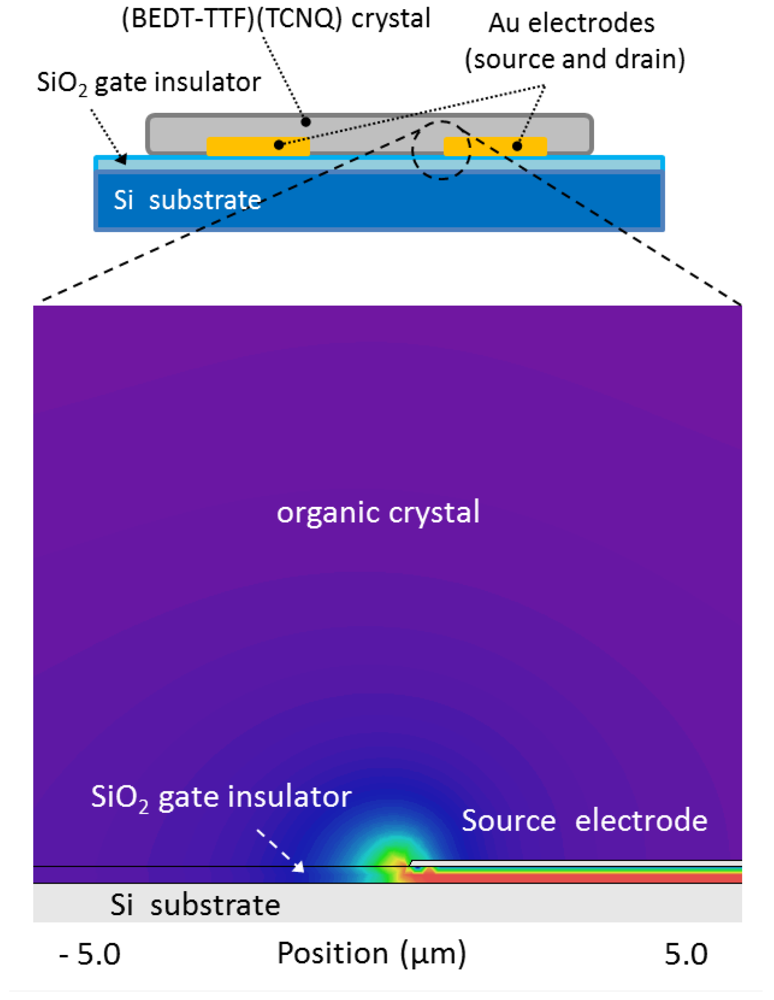
          <p>Calculated electrical flux density distribution in the FET sample with the source and gate voltage of 0 and 30 V, respectively. The electric flux density in (BEDT-TTF)(TCNQ) is not uniform; far from that of parallel capacitor. The electric flux density is concentrated in the vicinity of the source electrode edge and at the interface between (BEDT-TTF)(TCNQ) and SiO<sub>2</sub> gate insulator. </p>
        </caption>
        <graphic xmlns:xlink="http://www.w3.org/1999/xlink" xlink:href="crystals-02-00730-g001.tif"/>
      </fig>
    </sec>
    <sec sec-type="results">
      <title>3. Results and Discussion</title>
      <p>At first, distribution of the electric field in our sample was calculated by the finite element method (FEM). Since the anisotropic dielectric constant of (BEDT-TTF)(TCNQ) is unknown, we assumed an isotropic dielectric constant of 100–10000 as trial values. This model dielectric isotropy is not so realistic because the 2-dimensional BEDT-TTF materials exhibit large anisotropy. However, the variation of dielectric constant barely affected the result of the FEM calculation. <xref ref-type="fig" rid="crystals-02-00730-f001">Figure 1</xref> is a calculated distribution of an electric flux density in our bottom contact FET structure at around the source electrode. The thickness of source electrode is approximately 20 nm and the height of the organic crystals is ranging from 200 to 600 nm along <italic>a</italic><sup>*</sup> -axis. As shown in the figure, the electric flux density in (BEDT-TTF)(TCNQ) is not uniform but concentrated in the vicinity of the Au electrode edge and at the interface between (BEDT-TTF)(TCNQ) and SiO<sub>2</sub> gate insulator. The fringe field in the crystal is mainly consisted of a horizontal component which is parallel to the conductive <italic>b</italic>-<italic>c</italic> plane of BEDT-TTF layer. Therefore, the main contribution to the observed dielectric response is due to the horizontal component of the dielectric constant of (BEDT-TTF)(TCNQ). </p>
      <p>Dielectric constant estimated from the simulated capacitance was larger than the typical value measured in inorganic ferroelectric ceramics such as BaTiO<sub>3</sub>. This estimation is tentative because of the limited precision of this calculation. However, early reports on one-dimensional charge ordered materials such as TMTSF compounds [<xref ref-type="bibr" rid="B14-crystals-02-00730">14</xref>,<xref ref-type="bibr" rid="B15-crystals-02-00730">15</xref>,<xref ref-type="bibr" rid="B16-crystals-02-00730">16</xref>,<xref ref-type="bibr" rid="B17-crystals-02-00730">17</xref>,<xref ref-type="bibr" rid="B18-crystals-02-00730">18</xref>,<xref ref-type="bibr" rid="B19-crystals-02-00730">19</xref>] indicated the extremely high dielectric constants of over 10000. Charge ordered state is one of the polarized state of which the polarization originate from the alternative localization of carrier. For the rigid charge ordered phase, it is impossible to invert the polarization by an external electric field. However, in a fluctuated charge ordered state, weakly localized carriers are mobile by the external electric field. Therefore, the effective electric field contributing to the observed dielectric response is horizontal component in the vicinity of the Au electrode and at the interface between (BEDT-TTF)(TCNQ) crystal and SiO<sub>2</sub> gate insulator, by no means from whole bulk. </p>
      <fig id="crystals-02-00730-f002" position="anchor">
        <label>Figure 2</label>
        <caption>
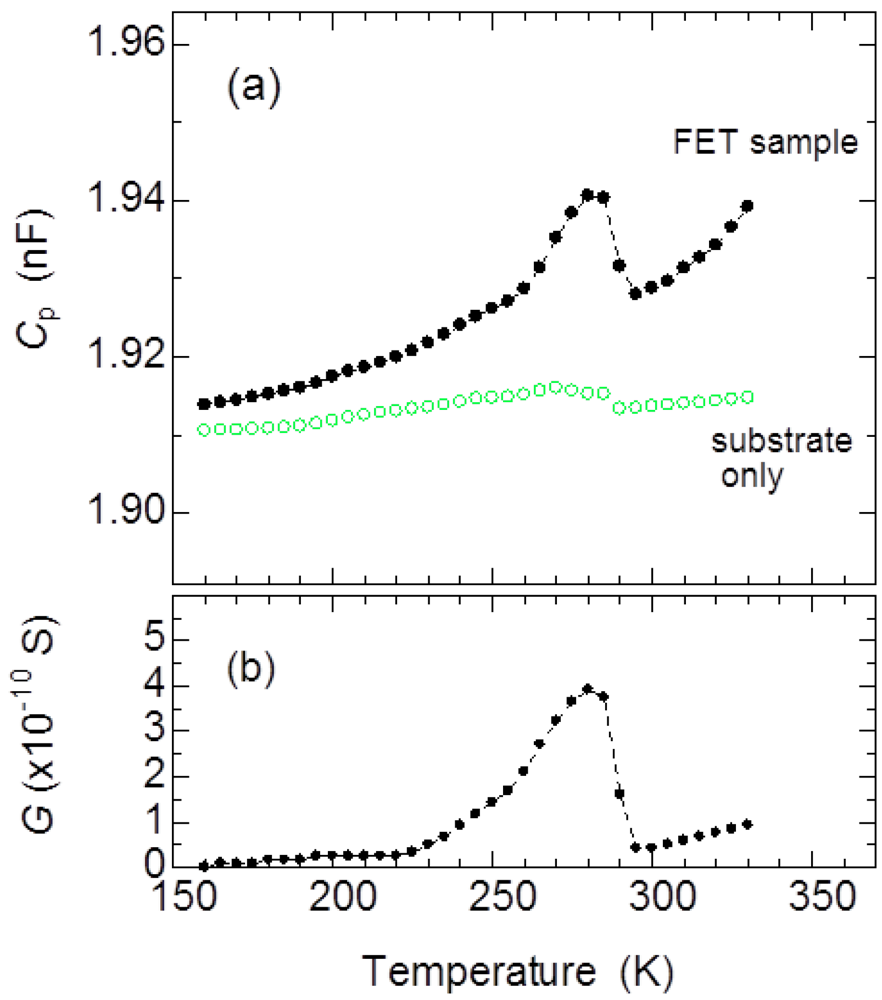
          <p>Temperature dependence of the capacitance (<italic>C</italic><sub>p</sub> and dielectric loss (<italic>G</italic>) measured in (BEDT-TTF)(TCNQ) FET structure. <italic>C</italic><sub>p</sub> and <italic>G</italic> were measured by impedance meter at 4 Hz. </p>
        </caption>
        <graphic xmlns:xlink="http://www.w3.org/1999/xlink" xlink:href="crystals-02-00730-g002.tif"/>
      </fig>
      <p><xref ref-type="fig" rid="crystals-02-00730-f002">Figure 2</xref> shows the temperature dependence of the dielectric response measured in (BEDT-TTF)(TCNQ) FET structure. <italic>C</italic><sub>p</sub> and <italic>G</italic> stand for a capacitance and a dielectric loss, respectively. The observed admittance is written as, </p>
      <p><inline-graphic xmlns:xlink="http://www.w3.org/1999/xlink" xlink:href="crystals-02-00730-i001.tif"/></p>
      <p><inline-graphic xmlns:xlink="http://www.w3.org/1999/xlink" xlink:href="crystals-02-00730-i002.tif"/></p>
      <p>where <italic>j</italic> is the imaginary unit and <italic>C</italic><sub>0</sub> is a geometrical capacitance. Therefore, <italic>C</italic><sub>p</sub> and <italic>G</italic> are related to the complex dielectric constant <inline-graphic xmlns:xlink="http://www.w3.org/1999/xlink" xlink:href="crystals-02-00730-i003.tif"/>. However in our case, it is impossible to transform <italic>C</italic><sub>p</sub> and <italic>G</italic> into the <inline-graphic xmlns:xlink="http://www.w3.org/1999/xlink" xlink:href="crystals-02-00730-i004.tif"/> and <inline-graphic xmlns:xlink="http://www.w3.org/1999/xlink" xlink:href="crystals-02-00730-i005.tif"/> because an electric field is not uniform in the FET structure (see <xref ref-type="fig" rid="crystals-02-00730-f001">Figure 1</xref> ). Although a parallel capacitor structure is generally used for conventional dielectric measurements, we had to observe a novel ferroelectric-like property which was observed in the channel region of FET structure [<xref ref-type="bibr" rid="B10-crystals-02-00730">10</xref>] and had not been reported in bulk crystal. Both the observed <italic>C</italic><sub>p</sub> and <italic>G</italic> have a peak at around 280 K, and abruptly decrease at around 290 K. In our previous work [<xref ref-type="bibr" rid="B10-crystals-02-00730">10</xref>], we suggested the existence of unknown ferroelectric-like transition by a displacement current measurement. In this work, the conventional impedance measurement also discovered this ferroelectric-like transition. However, compared to the typical ferroelectric transition, the observed temperature dependence of dielectric response is rather dispersive because the polarization in our sample is not uniform due to the non-uniformity of electric field in the crystal. </p>
      <fig id="crystals-02-00730-f003" position="anchor">
        <label>Figure 3</label>
        <caption>
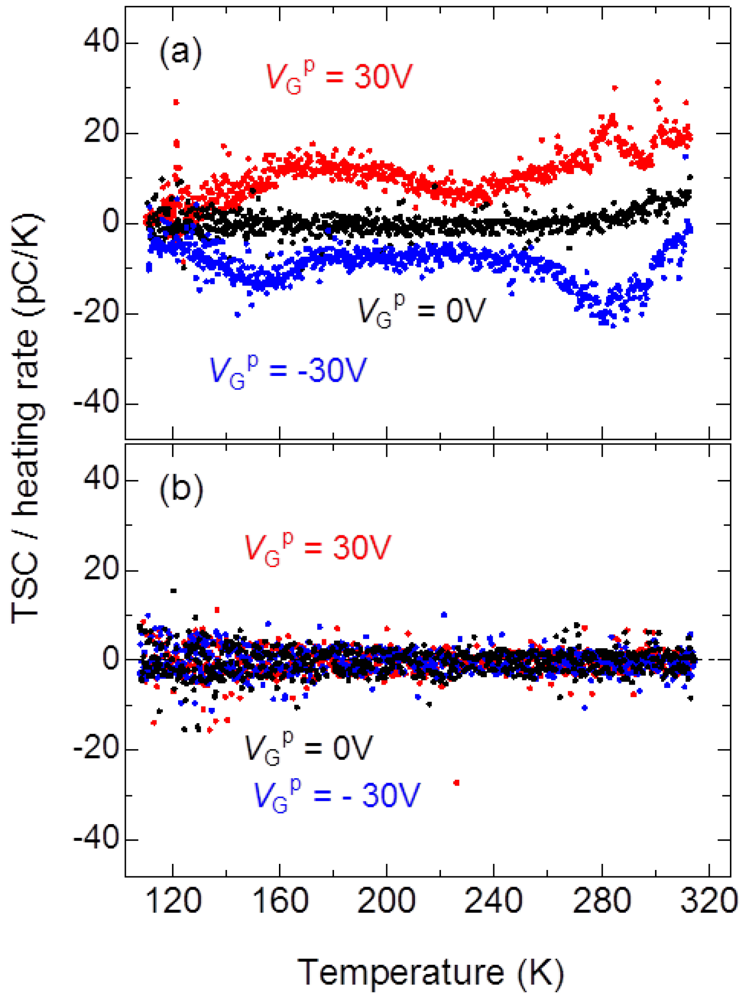
          <p>(<bold>a</bold>) Gate-induced TSCs observed in the FET sample after various <inline-graphic xmlns:xlink="http://www.w3.org/1999/xlink" xlink:href="crystals-02-00730-i012.tif"/>; (<bold>b</bold>) The TSCs observed in the substrate without (BEDT-TTF)(TCNQ) crystals.</p>
        </caption>
        <graphic xmlns:xlink="http://www.w3.org/1999/xlink" xlink:href="crystals-02-00730-g003.tif"/>
      </fig>
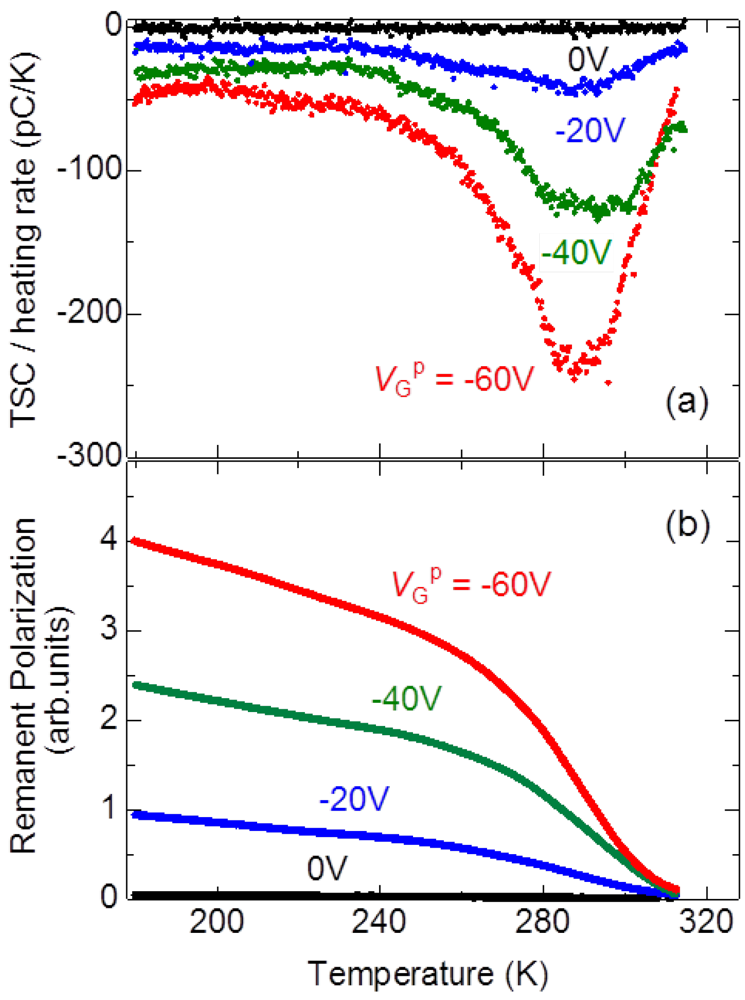
      <p><xref ref-type="fig" rid="crystals-02-00730-f003">Figure 3</xref>(a) shows observed gate-induced TSCs. By application of the positive <inline-graphic xmlns:xlink="http://www.w3.org/1999/xlink" xlink:href="crystals-02-00730-i012.tif"/>, positive TSC was observed. On the other hand, negative TSC was observed by application of negative <inline-graphic xmlns:xlink="http://www.w3.org/1999/xlink" xlink:href="crystals-02-00730-i012.tif"/>. In addition, by application of zero <inline-graphic xmlns:xlink="http://www.w3.org/1999/xlink" xlink:href="crystals-02-00730-i012.tif"/>, no TSC peak was observed. Only a minor increase of a TSC was observed above 290 K, which was also observed in a blank test which is described afterwards. The observed TSC under non-zero <inline-graphic xmlns:xlink="http://www.w3.org/1999/xlink" xlink:href="crystals-02-00730-i012.tif"/> have a maximum at 285 K, and there are minor and broad peaks in 180–210 K. These minor and broad peaks do not belong to a pyroelectric current but correspond to detrapping of carriers because these peaks are not symmetric to the polarization of an applied <inline-graphic xmlns:xlink="http://www.w3.org/1999/xlink" xlink:href="crystals-02-00730-i012.tif"/>. A thermal activation energy for electron and hole detrapping should be different. On the other hand, major TSC observed above 210 K belongs to a pyroelectric current because these peaks are symmetric to the <inline-graphic xmlns:xlink="http://www.w3.org/1999/xlink" xlink:href="crystals-02-00730-i012.tif"/> polarization, and the TSC corresponds to the dielectric response and <italic>Q</italic> − <italic>V</italic> hysteresis observed in our previous work [<xref ref-type="bibr" rid="B10-crystals-02-00730">10</xref>]. The <italic>Q</italic> − <italic>V</italic> hysteresis, divergent increase of dielectric constant and loss are a part of the feature of the ferroelectricity. Therefore, we concluded that the observed TSC corresponded to the dissolution of the ferroelectric-like polarization. </p>
      <p>Here, other possible origin of observed TSC should be carefully considered. A possibility for mobile alkali ion (especially Na<sup>+ </sup>ion in our environment) diffused into the SiO<sub>2</sub> gate insulator or a residual moisture on the substrate surface are denied by blank test in <xref ref-type="fig" rid="crystals-02-00730-f003">Figure 3</xref> (b). <xref ref-type="fig" rid="crystals-02-00730-f003">Figure 3</xref> (b) shows a result of blank tests which is measured by using the FET substrate without (BEDT-TTF)(TCNQ) crystals. There is no TSC signal in this sample. Although weak increase of TSC above 290 K was observed in some samples, the weak TSC did not depend on applied <inline-graphic xmlns:xlink="http://www.w3.org/1999/xlink" xlink:href="crystals-02-00730-i012.tif"/> and its polarity. In addition, the observed weak TSC decreases after the several thermal cycles. A possible origin of the weak TSC in the blank test is surface moisture or mobile alkali ion naturally diffused into the SiO<sub>2</sub> layer. However, thick pre-fabricated SiO<sub>2</sub> layer to protect the Si wafer from the alkali ion pollution is completely removed in the sample preparation procedure. Moreover, a contribution of alkali ion cannot decrease after several thermal cycles because alkali ion diffused in Si cannot vaporize in this experimental condition. Therefore, we conclude that the origin of the small TSC observed in the blank test is residual surface moisture at the substrate surface. Incidentally, the existence of ferroelectric phase of H<sub>2</sub>O is proposed at around 60 K [<xref ref-type="bibr" rid="B20-crystals-02-00730">20</xref>]. However, this phase cannot affect our results. </p>
      <fig id="crystals-02-00730-f004" position="anchor">
        <label>Figure 4</label>
        <caption>
          <p>(<bold>a</bold>) <inline-graphic xmlns:xlink="http://www.w3.org/1999/xlink" xlink:href="crystals-02-00730-i012.tif"/> dependence of the observed TSCs; (<bold>b</bold>) Temperature and <inline-graphic xmlns:xlink="http://www.w3.org/1999/xlink" xlink:href="crystals-02-00730-i012.tif"/> dependence of the remnant polarization charge. The values for the remnant polarization charge at the lowest temperature (<italic>Q</italic><sub>ini</sub>) was taken rather arbitrarily to let the remnant polarization charge be proportional to <inline-graphic xmlns:xlink="http://www.w3.org/1999/xlink" xlink:href="crystals-02-00730-i012.tif"/> because it was difficult to determine the absolute value of <italic>Q</italic><sub>ini</sub> due to the non-uniform electric field. </p>
        </caption>
        <graphic xmlns:xlink="http://www.w3.org/1999/xlink" xlink:href="crystals-02-00730-g004.tif"/>
      </fig>
      <p>Now we discuss the TSC as a pyroelectric current. <xref ref-type="fig" rid="crystals-02-00730-f004">Figure 4</xref> (a) shows the <inline-graphic xmlns:xlink="http://www.w3.org/1999/xlink" xlink:href="crystals-02-00730-i012.tif"/> dependence of the observed TSCs. These TSCs increase with increasing <inline-graphic xmlns:xlink="http://www.w3.org/1999/xlink" xlink:href="crystals-02-00730-i012.tif"/> because induced average polarization increase with increasing <inline-graphic xmlns:xlink="http://www.w3.org/1999/xlink" xlink:href="crystals-02-00730-i012.tif"/>. However, the TSC peak temperature shows little dependence on the <inline-graphic xmlns:xlink="http://www.w3.org/1999/xlink" xlink:href="crystals-02-00730-i012.tif"/>. In this temperature region, the observed TSC is expected to mainly consist of the pyroelectric current because the temperature range is higher than that of which the detrapping from the carrier traps are observed. On this basis, we integrated the observed TSCs. The relation between the polarization and observed TSC is written as </p>
      <p><inline-graphic xmlns:xlink="http://www.w3.org/1999/xlink" xlink:href="crystals-02-00730-i006.tif"/></p>
      <p>where, <italic>s</italic><sub>eff</sub> is the effective surface area of the sample and is defined for a parallel capacitor. <italic>Q</italic><sub>r</sub> and <italic>P</italic><sub>r</sub> is a remnant polarization charge and a remnant polarization, respectively. In the case of the parallel capacitor, one can define the pyroelectric coefficient <italic>p</italic>(T), </p>
      <p><inline-graphic xmlns:xlink="http://www.w3.org/1999/xlink" xlink:href="crystals-02-00730-i007.tif"/></p>
      <p>thus one obtains: </p>
      <p><inline-graphic xmlns:xlink="http://www.w3.org/1999/xlink" xlink:href="crystals-02-00730-i008.tif"/></p>
      <p>If the heating rate (<inline-graphic xmlns:xlink="http://www.w3.org/1999/xlink" xlink:href="crystals-02-00730-i009.tif"/>) is constant, one can obtain the pyroelectric coefficient. Then, <italic>P</italic><sub>r</sub> was calculated as an integration of the pyroelectric current <italic>i</italic>(<italic>T</italic>). </p>
      <p><inline-graphic xmlns:xlink="http://www.w3.org/1999/xlink" xlink:href="crystals-02-00730-i010.tif"/></p>
      <p>In our case, remnant polarization charge is calculated as, </p>
      <p><inline-graphic xmlns:xlink="http://www.w3.org/1999/xlink" xlink:href="crystals-02-00730-i011.tif"/></p>
      <p>where <italic>Q</italic><sub>ini</sub> is a constant of integration which is fixed by an initial condition, <italic>i.e.</italic>, initially induced polarization. <xref ref-type="fig" rid="crystals-02-00730-f004">Figure 4</xref> (b) shows integrated TSC, which corresponds to the temperature and <inline-graphic xmlns:xlink="http://www.w3.org/1999/xlink" xlink:href="crystals-02-00730-i012.tif"/> dependence of the remnant polarization charge (<italic>Q</italic><sub>r</sub>). Although the <italic>Q</italic><sub>ini</sub> is difficult to determine, because of the non-uniform electric field in the crystal, we determined the <italic>Q</italic><sub>ini</sub> for each <inline-graphic xmlns:xlink="http://www.w3.org/1999/xlink" xlink:href="crystals-02-00730-i012.tif"/> on the assumption that the initially induced <italic>Q</italic><sub>r</sub> is proportional to the <inline-graphic xmlns:xlink="http://www.w3.org/1999/xlink" xlink:href="crystals-02-00730-i012.tif"/>. <xref ref-type="fig" rid="crystals-02-00730-f004">Figure 4</xref> (b) indicates that <italic>Q</italic><sub>r</sub> gradually decrease with increasing temperature until 260 K, and begin to decrease steeply at around 280–290 K. A little <italic>Q</italic><sub>r</sub> remains at 320 K. These observed temperature dependence well corresponds to the temperature dependence of the <italic>C</italic><sub>p</sub> as shown in <xref ref-type="fig" rid="crystals-02-00730-f002">Figure 2</xref> (a). Temperature dependence of <italic>C</italic><sub>p</sub> and previously observed hysteresis [<xref ref-type="bibr" rid="B10-crystals-02-00730">10</xref>] had suggested the existence of ferroelectric phase transition, which is now supported by the additional evidence in this work. </p>
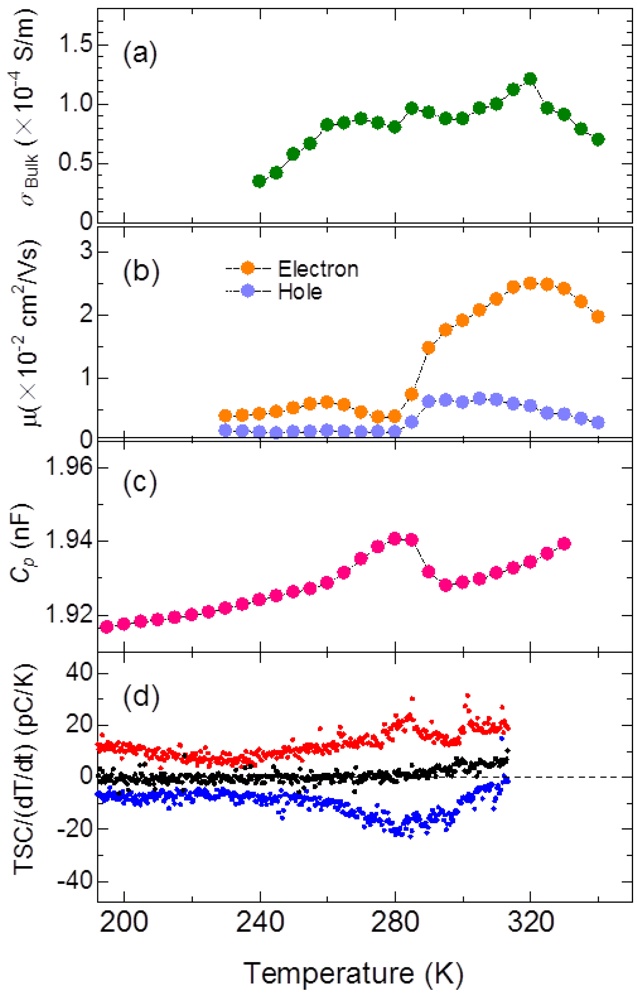
      <p><xref ref-type="fig" rid="crystals-02-00730-f005">Figure 5</xref> are the summary of the physical and electrical parameters of the <italic>β</italic>´-(BEDT-TTF)(TCNQ) crystalline FET. There are clear relationships between the observed parameters; especially, the ferroelectric-like transition, which is indicated in <xref ref-type="fig" rid="crystals-02-00730-f005">Figure 5</xref> (c) and (d), and a change of the field effect mobility (shown in <xref ref-type="fig" rid="crystals-02-00730-f005">Figure 5</xref> (b)) occurred simultaneously. On the other hand, this ferroelectric-like transition hardly affected on the bulk conduction shown in <xref ref-type="fig" rid="crystals-02-00730-f005">Figure 5</xref> (a). Therefore, this correlation is related to the interface of the organic crystals and SiO<sub>2</sub> because both field effect mobility and the ferroelectric-like properties were observed at around the interface, not as the bulk properties. Because a bulk <italic>β</italic>´-(BEDT-TTF)(TCNQ) crystal is known as a dimer Mott insulator, the ferroelectric-like phase below 285 K, discovered in this work, is exceptional. On the other hand, there are many examples of ferroelectric phase transition observed in charge ordered materials [<xref ref-type="bibr" rid="B1-crystals-02-00730">1</xref>,<xref ref-type="bibr" rid="B2-crystals-02-00730">2</xref>,<xref ref-type="bibr" rid="B3-crystals-02-00730">3</xref>,<xref ref-type="bibr" rid="B4-crystals-02-00730">4</xref>,<xref ref-type="bibr" rid="B5-crystals-02-00730">5</xref>,<xref ref-type="bibr" rid="B6-crystals-02-00730">6</xref>]. Therefore, we have speculated that the phase transition between the charge-ordered phase and dimer Mott insulator phase occurred at the interface of organic crystal and gate insulator. </p>
      <fig id="crystals-02-00730-f005" position="anchor">
        <label>Figure 5</label>
        <caption>
          <p>Summary of the physical and electrical parameters observed in the <italic>β</italic>´-(BEDT-TTF)(TCNQ) crystalline FET. Temperature dependence of (<bold>a</bold>) bulk conductance; (<bold>b</bold>) field effect mobility; (<bold>c</bold>) gate capacitance, and (<bold>d</bold>) TSC. </p>
        </caption>
        <graphic xmlns:xlink="http://www.w3.org/1999/xlink" xlink:href="crystals-02-00730-g005.tif"/>
      </fig>
      <p>The band filling of both the dimer Mott insulator and charge ordered phase are quarter filling. The difference of the dimer Mott insulator and charge ordered phase is the degree of localization of correlated carriers. The carrier of the dimer Mott insulator and charge ordered phase is localized in one dimer site and one BEDT-TTF site, respectively. If a carrier is localized in a BEDT-TTF site and the thermal hopping to the intradimer neighboring BEDT-TTF site is allowed, spontaneous polarization derived from the biased carrier distribution in dimer sites is induced by an external electric field. Based on this assumption, the strange temperature behavior shown in <xref ref-type="fig" rid="crystals-02-00730-f005">Figure 5</xref> is explained by the abrupt change of the degree of the localization on correlated carriers. And also, phase transition between charge ordered phase and Mott insulator phase in a quarter-filled dimer Mott insulator had been predicted in theoretical works [<xref ref-type="bibr" rid="B21-crystals-02-00730">21</xref>,<xref ref-type="bibr" rid="B22-crystals-02-00730">22</xref>,<xref ref-type="bibr" rid="B23-crystals-02-00730">23</xref>]. By introducing the intradimer strain, Mott insulator phase undergoes the phase transition to ferroelectric phase in the way to the charge ordered phase. </p>
      <p>Although the effect of a gate electric field on the phase transition is not clear now, it is indubitable that an interface strain on the soft organic material affects this phase transition. A modulation of a crystal lattice parameter is one of the necessary factor to lead the phase transition between charge ordered and Mott insulator phase in the theoretical prediction [<xref ref-type="bibr" rid="B21-crystals-02-00730">21</xref>,<xref ref-type="bibr" rid="B22-crystals-02-00730">22</xref>,<xref ref-type="bibr" rid="B23-crystals-02-00730">23</xref>]. Thermal expansion coefficient of Si wafer is much smaller than that of the organic materials. Therefore, if there is no slippage at the interface, the in-plane (<italic>b</italic>-<italic>c</italic> plane) lattice parameter of the organic crystal at around the interface of the Si wafer is effectively expanded with decreasing temperature compared to its thermal expansion in free crystal [<xref ref-type="bibr" rid="B24-crystals-02-00730">24</xref>,<xref ref-type="bibr" rid="B25-crystals-02-00730">25</xref>]. In fact, in our preliminary result, distance of (0<italic>kl</italic>) planes are expanded compared to the free (0<italic>kl</italic>) plane distance (to be published elsewhere). On the other hand, (<italic>h</italic>00) plane distance is rather compressed compared to (<italic>h</italic>00) distance of the free bulk crystal. These facts are explained by the interfacial strain on the soft organic material. </p>
    </sec>
    <sec sec-type="conclusions">
      <title>4. Conclusions</title>
      <p>We have presented the gate-induced TSC experiment on (BEDT-TTF)(TCNQ) crystalline FET sample to elucidate previously observed ferroelectric-like behaviors and related abrupt change of the field effect carrier mobility. Among the observed TSC components, TSC which is symmetric for the applied <inline-graphic xmlns:xlink="http://www.w3.org/1999/xlink" xlink:href="crystals-02-00730-i012.tif"/> and has a peak at around 285 K was assigned as a pyroelectric current derived from the spontaneous polarization of ferroelectricity. By integrating the pyroelectric current, temperature dependence of the remnant polarization charge was exhibited and the existence of the ferroelectric phase transition at 285 K was clearly demonstrated. With the calculated distribution of an electric field and obvious relationship of the field effect mobility and ferroelectric behavior, we have concluded that the observed novel phenomena is brought about at around the interface of organic crystal and substrate. Although the phenomena has not fully been elucidated yet, we temporarily concluded that the phase transition occurred between dimer Mott insulator and charge ordered phase. </p>
    </sec>
    <sec>
      <title>Acknowledgments</title>
      <p>The authors wish to thank T. Mori in Tokyo Institute of Technology and K. Yamamoto in Institute of Molecular Science for fruitful discussion, A. Nakao for experimental help in Photon Factory, KEK, and H. Furumi in Nippon Steel Chemical Co. Ltd. for providing highly purified materials. This work was supported by a Grant-in-Aid for Scientific Research (young research grant #19760211) and Chiba University Global COE Program from Ministry of Education, Culture, Sports, Science and Technology, Japan. </p>
    </sec>
  </body>
  <back>
    <ref-list>
      <title>References</title>
      <ref id="B1-crystals-02-00730">
        <label>1.</label>
        <citation citation-type="journal">
          <person-group person-group-type="author">
            <name>
              <surname>Yamamoto</surname>
              <given-names>K.</given-names>
            </name>
            <name>
              <surname>Kowalska</surname>
              <given-names>A.A.</given-names>
            </name>
            <name>
              <surname>Yakushi</surname>
              <given-names>K.</given-names>
            </name>
          </person-group>
          <article-title>Direct observation of ferroelectric domains created by Wigner crystallization of electrons in α-[bis(ethylenedithio)tetrathiafulvalene]<sub>2</sub>I<sub>3</sub></article-title>
          <source>Appl. Phys. Lett.</source>
          <year>2010</year>
          <volume>96</volume>
          <fpage>122901</fpage>
          <lpage>1</lpage>
          <supplement>122901-1-122901-3.</supplement>
          <pub-id pub-id-type="doi">10.1063/1.3327810</pub-id>
        </citation>
      </ref>
      <ref id="B2-crystals-02-00730">
        <label>2.</label>
        <citation citation-type="journal">
          <person-group person-group-type="author">
            <name>
              <surname>Yamamoto</surname>
              <given-names>K.</given-names>
            </name>
            <name>
              <surname>Kowalska</surname>
              <given-names>A.A.</given-names>
            </name>
            <name>
              <surname>Nakano</surname>
              <given-names>C.</given-names>
            </name>
            <name>
              <surname>Yakushi</surname>
              <given-names>K.</given-names>
            </name>
          </person-group>
          <article-title>Inhomogeneous ferroelectric polarization in α '-(BEDT-TTF)2IBr2 revealed by second-harmonic generation microscopy</article-title>
          <source>Physica B</source>
          <year>2010</year>
          <volume>405</volume>
          <fpage>S363</fpage>
          <lpage>S364</lpage>
          <pub-id pub-id-type="doi">10.1016/j.physb.2009.10.027</pub-id>
        </citation>
      </ref>
      <ref id="B3-crystals-02-00730">
        <label>3.</label>
        <citation citation-type="journal">
          <person-group person-group-type="author">
            <name>
              <surname>Kowalska</surname>
              <given-names>A.A.</given-names>
            </name>
            <name>
              <surname>Yamamoto</surname>
              <given-names>K.</given-names>
            </name>
            <name>
              <surname>Nakano</surname>
              <given-names>C.</given-names>
            </name>
            <name>
              <surname>Yakushi</surname>
              <given-names>K.</given-names>
            </name>
          </person-group>
          <article-title>Ferroelectric Polarization in α-(ET)<sub>2</sub>I<sub>2</sub>Br Studied by Second -Harmonic Generation Microscopy</article-title>
          <source>J. Phys.</source>
          <year>2008</year>
          <volume>132</volume>
          <fpage>012006</fpage>
          <lpage>1</lpage>
          <supplement>012006-1-012006-5</supplement>
        </citation>
      </ref>
      <ref id="B4-crystals-02-00730">
        <label>4.</label>
        <citation citation-type="journal">
          <person-group person-group-type="author">
            <name>
              <surname>Yamamoto</surname>
              <given-names>K.</given-names>
            </name>
            <name>
              <surname>Iwai</surname>
              <given-names>S.</given-names>
            </name>
            <name>
              <surname>Boyko</surname>
              <given-names>S.</given-names>
            </name>
            <name>
              <surname>Kashiwazaki</surname>
              <given-names>A.</given-names>
            </name>
            <name>
              <surname>Hiramatsu</surname>
              <given-names>F.</given-names>
            </name>
            <name>
              <surname>Okabe</surname>
              <given-names>C.</given-names>
            </name>
            <name>
              <surname>Nishi</surname>
              <given-names>N.</given-names>
            </name>
            <name>
              <surname>Yakushi</surname>
              <given-names>K.</given-names>
            </name>
          </person-group>
          <article-title>Strong Optical Nonlinearity and its Ultrafast Response Associated with Electron Ferroelectricity in an Organic Conductor</article-title>
          <source>J. Phys. Soc. Jpn.</source>
          <year>2008</year>
          <volume>77</volume>
          <fpage>074709</fpage>
          <lpage>1</lpage>
          <supplement>074709-1-074709-6.</supplement>
          <pub-id pub-id-type="doi">10.1143/JPSJ.77.074709</pub-id>
        </citation>
      </ref>
      <ref id="B5-crystals-02-00730">
        <label>5.</label>
        <citation citation-type="journal">
          <person-group person-group-type="author">
            <name>
              <surname>Abdel-Jawad</surname>
              <given-names>M.</given-names>
            </name>
            <name>
              <surname>Terasaki</surname>
              <given-names>I.</given-names>
            </name>
            <name>
              <surname>Sasaki</surname>
              <given-names>T.</given-names>
            </name>
            <name>
              <surname>Yoneyama</surname>
              <given-names>N.</given-names>
            </name>
            <name>
              <surname>Kobayashi</surname>
              <given-names>N.</given-names>
            </name>
            <name>
              <surname>Uesu</surname>
              <given-names>Y.</given-names>
            </name>
            <name>
              <surname>Hotta</surname>
              <given-names>C.</given-names>
            </name>
          </person-group>
          <article-title>Anomalous dielectric response in the dimer Mott insulator κ-(BEDT-TTF)<sub>2</sub>Cu<sub>2</sub>(CN)<sub>3</sub></article-title>
          <source>Phys. Rev. B</source>
          <year>2010</year>
          <volume>82</volume>
          <pub-id pub-id-type="doi">10.1103/PhysRevB.82.125119</pub-id>
        </citation>
      </ref>
      <ref id="B6-crystals-02-00730">
        <label>6.</label>
        <citation citation-type="journal">
          <person-group person-group-type="author">
            <name>
              <surname>Niizeki</surname>
              <given-names>S.</given-names>
            </name>
            <name>
              <surname>Yoshikane</surname>
              <given-names>F.</given-names>
            </name>
            <name>
              <surname>Kohno</surname>
              <given-names>K.</given-names>
            </name>
            <name>
              <surname>Takahashi</surname>
              <given-names>K.</given-names>
            </name>
            <name>
              <surname>Mori</surname>
              <given-names>H.</given-names>
            </name>
            <name>
              <surname>Bando</surname>
              <given-names>Y.</given-names>
            </name>
            <name>
              <surname>Kawamoto</surname>
              <given-names>T.</given-names>
            </name>
            <name>
              <surname>Mori</surname>
              <given-names>T.</given-names>
            </name>
          </person-group>
          <article-title>Dielectric Response and Electric-Field-Induced Metastable State in an Organic Conductor β-(<italic>meso</italic>-DMBEDT-TTF)<sub>2</sub>PF<sub>6</sub></article-title>
          <source>J. Phys. Soc. Jpn.</source>
          <year>2008</year>
          <volume>77</volume>
          <fpage>073710</fpage>
        <pub-id pub-id-type="doi">10.1143/JPSJ.77.073710</pub-id></citation>
      </ref>
      <ref id="B7-crystals-02-00730">
        <label>7.</label>
        <citation citation-type="journal">
          <person-group person-group-type="author">
            <name>
              <surname>Mori</surname>
              <given-names>T.</given-names>
            </name>
            <name>
              <surname>Inokuchi</surname>
              <given-names>H.</given-names>
            </name>
          </person-group>
          <article-title>Structural and electrical properties of (BEDT-TTF)(TCNQ)</article-title>
          <source>Solid State Commun.</source>
          <year>1986</year>
          <volume>59</volume>
          <fpage>355</fpage>
          <lpage>359</lpage>
          <pub-id pub-id-type="doi">10.1016/0038-1098(86)90562-4</pub-id>
        </citation>
      </ref>
      <ref id="B8-crystals-02-00730">
        <label>8.</label>
        <citation citation-type="journal">
          <person-group person-group-type="author">
            <name>
              <surname>Iwasa</surname>
              <given-names>Y.</given-names>
            </name>
            <name>
              <surname>Mizuhashi</surname>
              <given-names>K.</given-names>
            </name>
            <name>
              <surname>Koda</surname>
              <given-names>T.</given-names>
            </name>
            <name>
              <surname>Tokura</surname>
              <given-names>Y.</given-names>
            </name>
            <name>
              <surname>Saito</surname>
              <given-names>G.</given-names>
            </name>
          </person-group>
          <article-title>Metal-insulator transition and antiferromagnetic order in bis(ethylenedithio)tetrathiafulvalene tetracyanoquinodimethane (BEDT-TTF)(TCNQ)</article-title>
          <source>Phys. Rev. B</source>
          <year>1994</year>
          <volume>49</volume>
          <fpage>3580</fpage>
          <lpage>3583</lpage>
        <pub-id pub-id-type="doi">10.1103/PhysRevB.49.3580</pub-id></citation>
      </ref>
      <ref id="B9-crystals-02-00730">
        <label>9.</label>
        <citation citation-type="journal">
          <person-group person-group-type="author">
            <name>
              <surname>Sakai</surname>
              <given-names>M.</given-names>
            </name>
            <name>
              <surname>Sakuma</surname>
              <given-names>H.</given-names>
            </name>
            <name>
              <surname>Ito</surname>
              <given-names>Y.</given-names>
            </name>
            <name>
              <surname>Saito</surname>
              <given-names>A.</given-names>
            </name>
            <name>
              <surname>Nakamura</surname>
              <given-names>M.</given-names>
            </name>
            <name>
              <surname>Kudo</surname>
              <given-names>K.</given-names>
            </name>
          </person-group>
          <article-title>Ambipolar field-effect transistor characteristics of (BEDT-TTF)(TCNQ) crystals and metal-like conduction induced by a gate electric field</article-title>
          <source>Phys. Rev. B</source>
          <year>2007</year>
          <volume>76</volume>
          <fpage>045111</fpage>
          <lpage>1</lpage>
          <supplement>045111-1-045111-1-5.</supplement>
        <pub-id pub-id-type="doi">10.1103/PhysRevB.76.045111</pub-id></citation>
      </ref>
      <ref id="B10-crystals-02-00730">
        <label>10.</label>
        <citation citation-type="journal">
          <person-group person-group-type="author">
            <name>
              <surname>Sakai</surname>
              <given-names>M.</given-names>
            </name>
            <name>
              <surname>Ito</surname>
              <given-names>Y.</given-names>
            </name>
            <name>
              <surname>Takahara</surname>
              <given-names>T.</given-names>
            </name>
            <name>
              <surname>Ishiguro</surname>
              <given-names>M.</given-names>
            </name>
            <name>
              <surname>Nakamura</surname>
              <given-names>M.</given-names>
            </name>
            <name>
              <surname>Kudo</surname>
              <given-names>K.</given-names>
            </name>
          </person-group>
          <article-title>Ferroelectriclike dielectric response and metal-insulator transition in organic Mott insulator-gate insulator interface</article-title>
          <source>J. Appl. Phys.</source>
          <year>2010</year>
          <volume>107</volume>
          <fpage>043711</fpage>
          <lpage>1</lpage>
          <supplement>043711-1-043711-5.</supplement>
        <pub-id pub-id-type="doi">10.1063/1.3310735</pub-id></citation>
      </ref>
      <ref id="B11-crystals-02-00730">
        <label>11.</label>
        <citation citation-type="journal">
          <person-group person-group-type="author">
            <name>
              <surname>Mori</surname>
              <given-names>T.</given-names>
            </name>
            <name>
              <surname>Inokuchi</surname>
              <given-names>H.</given-names>
            </name>
          </person-group>
          <article-title>Crystal Structure of the Mixed-Stacked Salt of Bis(ethylenedithio) tetrathiafulvalene (BEDT-TTF) and Tetracyanoquinodimethane (TCNQ)</article-title>
          <source>Bull. Chem. Soc. Jpn.</source>
          <year>1987</year>
          <volume>60</volume>
          <fpage>402</fpage>
          <lpage>404</lpage>
          <pub-id pub-id-type="doi">10.1246/bcsj.60.402</pub-id>
        </citation>
      </ref>
      <ref id="B12-crystals-02-00730">
        <label>12.</label>
        <citation citation-type="journal">
          <person-group person-group-type="author">
            <name>
              <surname>Yamamoto</surname>
              <given-names>H.M.</given-names>
            </name>
            <name>
              <surname>Hagiwara</surname>
              <given-names>M.</given-names>
            </name>
            <name>
              <surname>Kato</surname>
              <given-names>R.</given-names>
            </name>
          </person-group>
          <article-title>New phase of (BEDT-TTF)(TCNQ)</article-title>
          <source>Synth. Met</source>
          <year>2003</year>
          <volume>n133-134</volume>
          <fpage>449</fpage>
          <lpage>451</lpage>
        </citation>
      </ref>
      <ref id="B13-crystals-02-00730">
        <label>13.</label>
        <citation citation-type="journal">
          <person-group person-group-type="author">
            <name>
              <surname>Yamamoto</surname>
              <given-names>H.M.</given-names>
            </name>
            <name>
              <surname>Tajima</surname>
              <given-names>N.</given-names>
            </name>
            <name>
              <surname>Hagiwara</surname>
              <given-names>M.</given-names>
            </name>
            <name>
              <surname>Kato</surname>
              <given-names>R.</given-names>
            </name>
            <name>
              <surname>Yamaura</surname>
              <given-names>J.-I.</given-names>
            </name>
          </person-group>
          <article-title>Strange Electric/Magnetic Behavior of New (BEDT-TTF)(TCNQ)</article-title>
          <source>Synth. Met.</source>
          <year>2003</year>
          <volume>135-136</volume>
          <fpage>623</fpage>
          <lpage>624</lpage>
          <pub-id pub-id-type="doi">10.1016/S0379-6779(02)00808-1</pub-id>
        </citation>
      </ref>
      <ref id="B14-crystals-02-00730">
        <label>14.</label>
        <citation citation-type="journal">
          <person-group person-group-type="author">
            <name>
              <surname>Brazovskii</surname>
              <given-names>S.</given-names>
            </name>
            <name>
              <surname>Monceau</surname>
              <given-names>P.</given-names>
            </name>
            <name>
              <surname>Nad</surname>
              <given-names>F.</given-names>
            </name>
          </person-group>
          <article-title>The ferroelectric Mott-Hubbard phase in organic conductors</article-title>
          <source>Synth. Met.</source>
          <year>2003</year>
          <volume>137</volume>
          <fpage>1331</fpage>
          <lpage>1333</lpage>
          <pub-id pub-id-type="doi">10.1016/S0379-6779(02)01076-7</pub-id>
        </citation>
      </ref>
      <ref id="B15-crystals-02-00730">
        <label>15.</label>
        <citation citation-type="journal">
          <person-group person-group-type="author">
            <name>
              <surname>Monceau</surname>
              <given-names>P.</given-names>
            </name>
            <name>
              <surname>Nad</surname>
              <given-names>F.</given-names>
            </name>
            <name>
              <surname>Brazovskii</surname>
              <given-names>S.</given-names>
            </name>
          </person-group>
          <article-title>Ferroelectric mott-hubbard phase of organic (TMTTF)<sub>2</sub>X conductors</article-title>
          <source>Phys. Rev. Lett.</source>
          <year>2001</year>
          <volume>86</volume>
          <fpage>4080</fpage>
          <lpage>4083</lpage>
          <pub-id pub-id-type="doi">10.1103/PhysRevLett.86.4080</pub-id>
        </citation>
      </ref>
      <ref id="B16-crystals-02-00730">
        <label>16.</label>
        <citation citation-type="journal">
          <person-group person-group-type="author">
            <name>
              <surname>Nad</surname>
              <given-names>F.</given-names>
            </name>
            <name>
              <surname>Monceau</surname>
              <given-names>P.</given-names>
            </name>
            <name>
              <surname>Carcel</surname>
              <given-names>C.</given-names>
            </name>
            <name>
              <surname>Fabre</surname>
              <given-names>J.M.</given-names>
            </name>
          </person-group>
          <article-title>Dielectric response of the charge-induced correlated state in the quasi-one-dimensional conductor (TMTTF)<sub>2</sub>PF<sub>6</sub></article-title>
          <source>Phys. Rev. B</source>
          <year>2000</year>
          <volume>62</volume>
          <fpage>1753</fpage>
          <lpage>1756</lpage>
        <pub-id pub-id-type="doi">10.1103/PhysRevB.62.1753</pub-id></citation>
      </ref>
      <ref id="B17-crystals-02-00730">
        <label>17.</label>
        <citation citation-type="journal">
          <person-group person-group-type="author">
            <name>
              <surname>Nad</surname>
              <given-names>F.</given-names>
            </name>
            <name>
              <surname>Monceau</surname>
              <given-names>P.</given-names>
            </name>
            <name>
              <surname>Fabre</surname>
              <given-names>J.M.</given-names>
            </name>
          </person-group>
          <article-title>Low frequency dielectric permittivity of quasi-one-dimensional conductor (TMTTF)<sub>2</sub>Br</article-title>
          <source>Eur. Phys. J. B</source>
          <year>1998</year>
          <volume>3</volume>
          <fpage>301</fpage>
          <lpage>306</lpage>
          <pub-id pub-id-type="doi">10.1007/s100510050316</pub-id>
        </citation>
      </ref>
      <ref id="B18-crystals-02-00730">
        <label>18.</label>
        <citation citation-type="journal">
          <person-group person-group-type="author">
            <name>
              <surname>Nad</surname>
              <given-names>F.</given-names>
            </name>
            <name>
              <surname>Monceau</surname>
              <given-names>P.</given-names>
            </name>
            <name>
              <surname>Bechgaard</surname>
              <given-names>K.</given-names>
            </name>
          </person-group>
          <article-title>Low-frequency permittivity of spin-density wave in (TMTSF)<sub>2</sub>PF<sub>6</sub> at low temperatures</article-title>
          <source>Solid State Commun.</source>
          <year>1995</year>
          <volume>95</volume>
          <fpage>655</fpage>
          <lpage>660</lpage>
          <pub-id pub-id-type="doi">10.1016/0038-1098(95)00360-6</pub-id>
        </citation>
      </ref>
      <ref id="B19-crystals-02-00730">
        <label>19.</label>
        <citation citation-type="journal">
          <person-group person-group-type="author">
            <name>
              <surname>Nad</surname>
              <given-names>F.</given-names>
            </name>
            <name>
              <surname>Monceau</surname>
              <given-names>P.</given-names>
            </name>
          </person-group>
          <article-title>Charge-density-wave glass state in quasi-one-dimensional conductors</article-title>
          <source>Phys. Rev. B</source>
          <year>1995</year>
          <volume>51</volume>
          <fpage>2052</fpage>
          <lpage>2060</lpage>
          <pub-id pub-id-type="doi">10.1103/PhysRevB.51.2052</pub-id>
        </citation>
      </ref>
      <ref id="B20-crystals-02-00730">
        <label>20.</label>
        <citation citation-type="journal">
          <person-group person-group-type="author">
            <name>
              <surname>Fukazawa</surname>
              <given-names>H.</given-names>
            </name>
            <name>
              <surname>Hoshikawa</surname>
              <given-names>A.</given-names>
            </name>
            <name>
              <surname>Ishii</surname>
              <given-names>Y.</given-names>
            </name>
            <name>
              <surname>Chakoumakos</surname>
              <given-names>B.C.</given-names>
            </name>
            <name>
              <surname>Fernandez-Baca</surname>
              <given-names>J.A.</given-names>
            </name>
          </person-group>
          <article-title>Existence of Ferroelectric Ice in the Universe</article-title>
          <source>Astrophys. J.</source>
          <year>2006</year>
          <volume>652</volume>
          <fpage>L57</fpage>
          <lpage>L60</lpage>
          <pub-id pub-id-type="doi">10.1086/510017</pub-id>
        </citation>
      </ref>
      <ref id="B21-crystals-02-00730">
        <label>21.</label>
        <citation citation-type="journal">
          <person-group person-group-type="author">
            <name>
              <surname>Yoshioka</surname>
              <given-names>H.</given-names>
            </name>
            <name>
              <surname>Tsuchiizu</surname>
              <given-names>M.</given-names>
            </name>
            <name>
              <surname>Seo</surname>
              <given-names>H.</given-names>
            </name>
          </person-group>
          <article-title>Charge-Ordered State versus Dimer-Mott Insulator at Finite Temperatures</article-title>
          <source>J. Phys. Soc. Jpn.</source>
          <year>2007</year>
          <volume>76</volume>
          <fpage>103701</fpage>
          <lpage>1</lpage>
          <supplement>103701-1-103701-4.</supplement>
          <pub-id pub-id-type="doi">10.1143/JPSJ.76.103701</pub-id>
        </citation>
      </ref>
      <ref id="B22-crystals-02-00730">
        <label>22.</label>
        <citation citation-type="journal">
          <person-group person-group-type="author">
            <name>
              <surname>Seo</surname>
              <given-names>H.</given-names>
            </name>
            <name>
              <surname>Motome</surname>
              <given-names>Y.</given-names>
            </name>
            <name>
              <surname>Kato</surname>
              <given-names>T.</given-names>
            </name>
          </person-group>
          <article-title>Finite-Temperature Phase Transitions in Quasi-One-Dimensional Molecular Conductors</article-title>
          <source>J. Phys. Soc. Jpn.</source>
          <year>2007</year>
          <volume>76</volume>
          <fpage>013707</fpage>
          <lpage>1</lpage>
          <supplement>013707-1-013707-6.</supplement>
          <pub-id pub-id-type="doi">10.1143/JPSJ.76.013707</pub-id>
        </citation>
      </ref>
      <ref id="B23-crystals-02-00730">
        <label>23.</label>
        <citation citation-type="journal">
          <person-group person-group-type="author">
            <name>
              <surname>Otsuka</surname>
              <given-names>Y.</given-names>
            </name>
            <name>
              <surname>Seo</surname>
              <given-names>H.</given-names>
            </name>
            <name>
              <surname>Motome</surname>
              <given-names>Y.</given-names>
            </name>
            <name>
              <surname>Kato</surname>
              <given-names>T.</given-names>
            </name>
          </person-group>
          <article-title>Finite-Temperature Phase Diagram of Quasi-One-Dimensional Molecular Conductors: Quantum Monte Carlo Study</article-title>
          <source>J. Phys. Soc. Jpn.</source>
          <year>2008</year>
          <volume>77</volume>
          <fpage>113705</fpage>
          <lpage>1</lpage>
          <supplement>113705-1-4.</supplement>
          <pub-id pub-id-type="doi">10.1143/JPSJ.77.113705</pub-id>
        </citation>
      </ref>
      <ref id="B24-crystals-02-00730">
        <label>24.</label>
        <citation citation-type="journal">
          <person-group person-group-type="author">
            <name>
              <surname>Kawasugi</surname>
              <given-names>Y.</given-names>
            </name>
            <name>
              <surname>Yamamoto</surname>
              <given-names>H.M.</given-names>
            </name>
            <name>
              <surname>Hosoda</surname>
              <given-names>M.</given-names>
            </name>
            <name>
              <surname>Tajima</surname>
              <given-names>N.</given-names>
            </name>
            <name>
              <surname>Fukunaga</surname>
              <given-names>T.</given-names>
            </name>
            <name>
              <surname>Tsukagoshi</surname>
              <given-names>K.</given-names>
            </name>
            <name>
              <surname>Kato</surname>
              <given-names>R.</given-names>
            </name>
          </person-group>
          <article-title>Strain-Induced Superconductor/Insulator Transition and Field Effect in a Thin Single Crystal of Molecular Conductor</article-title>
          <source>Appl. Phys. Lett.</source>
          <year>2008</year>
          <volume>92</volume>
          <fpage>243508</fpage>
          <lpage>1</lpage>
          <supplement>243508-1-243508-3.</supplement>
        <pub-id pub-id-type="doi">10.1063/1.2949316</pub-id></citation>
      </ref>
      <ref id="B25-crystals-02-00730">
        <label>25.</label>
        <citation citation-type="journal">
          <person-group person-group-type="author">
            <name>
              <surname>Kawasugi</surname>
              <given-names>Y.</given-names>
            </name>
            <name>
              <surname>Yamamoto</surname>
              <given-names>H.M.</given-names>
            </name>
            <name>
              <surname>Tajima</surname>
              <given-names>N.</given-names>
            </name>
            <name>
              <surname>Fukunaga</surname>
              <given-names>T.</given-names>
            </name>
            <name>
              <surname>Tsukagoshi</surname>
              <given-names>K.</given-names>
            </name>
            <name>
              <surname>Kato</surname>
              <given-names>R.</given-names>
            </name>
          </person-group>
          <article-title>Field-Induced Carrier Delocalization in the Strain-Induced Mott Insulating State of an Organic Superconductor</article-title>
          <source>Phys. Rev. Lett.</source>
          <year>2009</year>
          <volume>103</volume>
          <fpage>116801</fpage>
          <lpage>1</lpage>
          <supplement>116801-1-116801-1-4.</supplement>
        <pub-id pub-id-type="doi">10.1103/PhysRevLett.103.116801</pub-id><pub-id pub-id-type="pmid">19792389</pub-id></citation>
      </ref>
    </ref-list>
  </back>
</article>