<?xml version="1.0" encoding="UTF-8"?>
<!DOCTYPE article PUBLIC "-//NLM//DTD Journal Publishing DTD v2.3 20070202//EN" "journalpublishing.dtd">
<article xmlns:mml="http://www.w3.org/1998/Math/MathML" xmlns:xlink="http://www.w3.org/1999/xlink" xml:lang="en" article-type="other">
  <front>
    <journal-meta>
      <journal-id journal-id-type="publisher-id">crystals</journal-id>
      <journal-title>Crystals</journal-title>
      <abbrev-journal-title abbrev-type="publisher">Crystals</abbrev-journal-title>
      <abbrev-journal-title abbrev-type="pubmed">Crystals</abbrev-journal-title>
      <issn pub-type="epub">2073-4352</issn>
      <publisher>
        <publisher-name>MDPI</publisher-name>
      </publisher>
    </journal-meta>
    <article-meta>
      <article-id pub-id-type="doi">10.3390/cryst2031084</article-id>
      <article-id pub-id-type="publisher-id">crystals-02-01084</article-id>
      <article-categories>
        <subj-group>
          <subject>Short Note</subject>
        </subj-group>
      </article-categories>
      <title-group>
        <article-title>[KDy(Hptc)<sub>3</sub>(H<sub>3</sub>ptc)]<italic><sub>n</sub></italic>·2<italic>n</italic>(Hbipy)·5<italic>n</italic>(H<sub>2</sub>O), a Layered Coordination Polymer Containing DyO<sub>6</sub>N<sub>3</sub> Tri-Capped Trigonal Prisms (H<sub>3</sub>ptc = Pyridine 2,4,6-Tricarboxylic Acid, C<sub>8</sub>H<sub>5</sub>NO<sub>6</sub>; Bipy = 2,2'-Bipyridine, C<sub>10</sub>H<sub>8</sub>N<sub>2</sub>)</article-title>
      </title-group>
      <contrib-group>
        <contrib contrib-type="author">
          <name>
            <surname>Anwar</surname>
            <given-names>Shoaib</given-names>
          </name>
          <xref rid="af1-crystals-02-01084" ref-type="aff">1</xref>
        </contrib>
        <contrib contrib-type="author">
          <name>
            <surname>Mariam</surname>
            <given-names>Irfana</given-names>
          </name>
          <xref rid="af2-crystals-02-01084" ref-type="aff">2</xref>
        </contrib>
        <contrib contrib-type="author">
          <name>
            <surname>Khan</surname>
            <given-names>Islam Ullah</given-names>
          </name>
          <xref rid="af1-crystals-02-01084" ref-type="aff">1</xref>
          <xref rid="c1-crystals-02-01084" ref-type="corresp">*</xref>
        </contrib>
        <contrib contrib-type="author">
          <name>
            <surname>Harrison</surname>
            <given-names>William T. A.</given-names>
          </name>
          <xref rid="af3-crystals-02-01084" ref-type="aff">3</xref>
          <xref rid="c1-crystals-02-01084" ref-type="corresp">*</xref>
        </contrib>
        <contrib contrib-type="author">
          <name>
            <surname>Anwar</surname>
            <given-names>Sohail</given-names>
          </name>
          <xref rid="af1-crystals-02-01084" ref-type="aff">1</xref>
        </contrib>
      </contrib-group>
      <aff id="af1-crystals-02-01084"><label>1</label> Materials Chemistry Laboratory, Department of Chemistry, Government College University, Lahore-54000, Pakistan; Email: <email>shoaib.anwer731@gmail.com</email>; (Sh.A.); <email> ejaz_lhr_pk@yahoo.com</email> (E.); <email>sohail.anwar21@gmail.com</email> (So.A.)</aff>
      <aff id="af2-crystals-02-01084"><label>2</label> Department of Chemistry, Queen Mary College for Girls, Lahore, Pakistan; Email: <email>majied.irfana@yahoo.com</email></aff>
      <aff id="af3-crystals-02-01084"><label>3</label> Department of Chemistry, University of Aberdeen, Meston Walk, Aberdeen AB24 3UE, UK</aff>
      <author-notes>
        <corresp id="c1-crystals-02-01084"><label>*</label> Authors to whom correspondence should be addressed; Email: <email>iuklodhi@yahoo.com</email> (I.U.K.); <email>w.harrison@abdn.ac.uk</email> (W.T.A.H.); Tel.: +92-042-99213338 (I.U.K.); +44-1224-272897 (W.T.A.H.); Fax: +44-1224-272921 (W.T.A.H.).</corresp>
      </author-notes>
      <pub-date pub-type="epub">
        <day>03</day>
        <month>08</month>
        <year>2012</year>
      </pub-date>
      <pub-date pub-type="collection"><month>09</month>
        <year>2012</year>
      </pub-date>
      <volume>2</volume>
      <issue>3</issue>
      <fpage>1084</fpage>
      <lpage>1091</lpage>
      <history>
        <date date-type="received">
          <day>10</day>
          <month>05</month>
          <year>2012</year>
        </date>
        <date date-type="rev-recd">
          <day>07</day>
          <month>06</month>
          <year>2012</year>
        </date>
        <date date-type="accepted">
          <day>25</day>
          <month>06</month>
          <year>2012</year>
        </date>
      </history>
      <permissions>
        <copyright-statement>©  2012 by the authors; licensee MDPI, Basel, Switzerland.</copyright-statement>
        <copyright-year>2012</copyright-year>
        <license xmlns:xlink="http://www.w3.org/1999/xlink" license-type="open-access" xlink:href="http://creativecommons.org/licenses/by/3.0/">
          <p>This article is an open-access article distributed under the terms and conditions of the Creative Commons Attribution license (http://creativecommons.org/licenses/by/3.0/).</p>
        </license>
      </permissions>
      <abstract>
        <p>The synthesis, structure and properties of the bimetallic layered coordination polymer, [KDy(C<sub>8</sub>H<sub>3</sub>NO<sub>6</sub>)<sub>3</sub>(C<sub>8</sub>H<sub>5</sub>NO<sub>6</sub>)]<italic><sub>n</sub></italic>·2<italic>n</italic>(C<sub>10</sub>H<sub>9</sub>N<sub>2</sub>)·5<italic>n</italic>(H<sub>2</sub>O) = [KDy(Hptc)<sub>3</sub>(H<sub>3</sub>ptc)]<italic><sub>n</sub></italic>·2<italic>n</italic>(Hbipy)·5<italic>n</italic>(H<sub>2</sub>O), are described. The Dy<sup>3+</sup> ion is coordinated by three O,N,O-tridentate doubly-deprotonated pyridine tri-carboxylate (Hptc) ligands to generate a fairly regular DyO<sub>6</sub>N<sub>3</sub> tri-capped trigonal prism, with the N atoms acting as the caps. The potassium ion is coordinated by an O,N,O-tridentate H<sub>3</sub>ptc molecule as well as monodentate and bidentate Hptc ligands to result in an irregular KNO<sub>9</sub> coordination geometry. The ligands bridge the metal-atom nodes into a bimetallic, layered, coordination polymer, which extends as corrugated layers in the (010) plane, with the mono-protonated bipyridine cations and water molecules occupying the inter-layer regions: Unlike related structures, there are no dysprosium–water bonds. Many O–H…O and N–H…O hydrogen bonds consolidate the structure. Characterization and bioactivity data are described. Crystal data: C<sub>52</sub>H<sub>42</sub>DyKN<sub>8</sub>O<sub>29</sub>, <italic>M</italic><sub>r</sub> = 1444.54, triclinic, <inline-graphic xmlns:xlink="http://www.w3.org/1999/xlink" xlink:href="crystals-02-01084-i001.tif"/> (No. 2), <italic>Z</italic> = 2, <italic>a</italic> = 9.188(2) Å, <italic>b</italic> = 15.7332(17) Å, <italic>c</italic> = 19.1664(19) Å, <italic>α</italic> = 92.797(6)°, <italic>β</italic> = 92.319(7)°, <italic>γ</italic> = 91.273(9)°, <italic>V</italic> = 2764.3(7) Å<sup>3</sup>, <italic>R</italic>(<italic>F</italic>) = 0.029, <italic>wR</italic>(<italic>F</italic><sup>2</sup>) = 0.084.</p>
      </abstract>
      <kwd-group>
        <kwd>coordination polymer</kwd>
        <kwd>layered supramolecular network</kwd>
        <kwd>dysprosium </kwd>
      </kwd-group>
    </article-meta>
  </front>
  <body>
    <sec sec-type="intro">
      <title>1. Introduction</title>
      <p>Coordination polymers, in which bridging ligands connect metal atoms into an extended network [<xref ref-type="bibr" rid="B1-crystals-02-01084">1</xref>], have been intensively studied for the past 100 years. This area of chemistry is so vast that a journal solely devoted to reviewing the field—<italic>Coordination Chemistry Reviews</italic>—publishes some 3000 pages per year. </p>
      <p>In this paper we describe the synthesis and structure of the new bimetallic coordination polymer [KDy(C<sub>8</sub>H<sub>3</sub>NO<sub>6</sub>)<sub>3</sub>(C<sub>8</sub>H<sub>5</sub>NO<sub>6</sub>)]<italic><sub>n</sub></italic>·2<italic>n</italic>(C<sub>10</sub>H<sub>9</sub>N<sub>2</sub>)·5<italic>n</italic>(H<sub>2</sub>O): (1) Related structures containing Dy<sup>3+</sup> ions in combination with pyridine 2,4,6-tricarboxylate (ptc) ligands include <italic>α</italic>-[Dy(C<sub>8</sub>H<sub>2</sub>NO<sub>6</sub>)(H<sub>2</sub>O)<sub>3</sub>]<italic><sub>n</sub></italic>·<italic>n</italic>H<sub>2</sub>O [<xref ref-type="bibr" rid="B2-crystals-02-01084">2</xref>], [Dy(C<sub>8</sub>H<sub>2</sub>NO<sub>6</sub>)(H<sub>2</sub>O)]<italic><sub>n</sub></italic>·<italic>n</italic>H<sub>2</sub>O [<xref ref-type="bibr" rid="B3-crystals-02-01084">3</xref>], <italic>β</italic>-[Dy(C<sub>8</sub>H<sub>2</sub>NO<sub>6</sub>)(H<sub>2</sub>O)<sub>3</sub>]<italic><sub>n</sub></italic>·<italic>n</italic>H<sub>2</sub>O [<xref ref-type="bibr" rid="B4-crystals-02-01084">4</xref>] and [Dy<sub>2</sub>(C<sub>8</sub>H<sub>2</sub>NO<sub>6</sub>)<sub>2</sub><sup>−</sup>(H<sub>2</sub>O)<sub>5</sub>]<italic><sub>n</sub></italic>·<italic>n</italic>H<sub>2</sub>O [<xref ref-type="bibr" rid="B5-crystals-02-01084">5</xref>]. In all these compounds, the tri-anionic ptc ligand forms an O,N,O-tridentate link to one metal ion and also bridges to other Dy<sup>3+</sup> ions to form a coordination network. One or more water molecules are also directly coordinated to the dysprosium ion. </p>
      <p>The crystal structures of [K(VO<sub>2</sub>)(C<sub>8</sub>H<sub>3</sub>NO<sub>6</sub>)]<italic><sub>n</sub></italic>·<italic>n</italic>H<sub>2</sub>O [<xref ref-type="bibr" rid="B6-crystals-02-01084">6</xref>], [KCaEr(C<sub>8</sub>H<sub>2</sub>NO<sub>6</sub>)<sub>2</sub>(H<sub>2</sub>O)]<italic><sub>n</sub></italic> [<xref ref-type="bibr" rid="B7-crystals-02-01084">7</xref>] and [KBa(C<sub>8</sub>H<sub>2</sub>NO<sub>6</sub>)(H<sub>2</sub>O)<sub>2</sub>]<italic><sub>n</sub></italic> [<xref ref-type="bibr" rid="B7-crystals-02-01084">7</xref>] have been reported but there are no mixed-metal K/Dy/ptc coordination polymers yet known. </p>
    </sec>
    <sec sec-type="results">
      <title>2. Results and Discussion</title>
      <sec>
        <title>2.1. Crystal Structure of [KDy(C<sub>8</sub>H<sub>3</sub>NO<sub>6</sub>)<sub>3</sub>(C<sub>8</sub>H<sub>5</sub>NO<sub>6</sub>)]<sub>n</sub>·2<italic>n</italic>(C<sub>10</sub>H<sub>9</sub>N<sub>2</sub>)·5<italic>n</italic>(H<sub>2</sub>O) (1)</title>
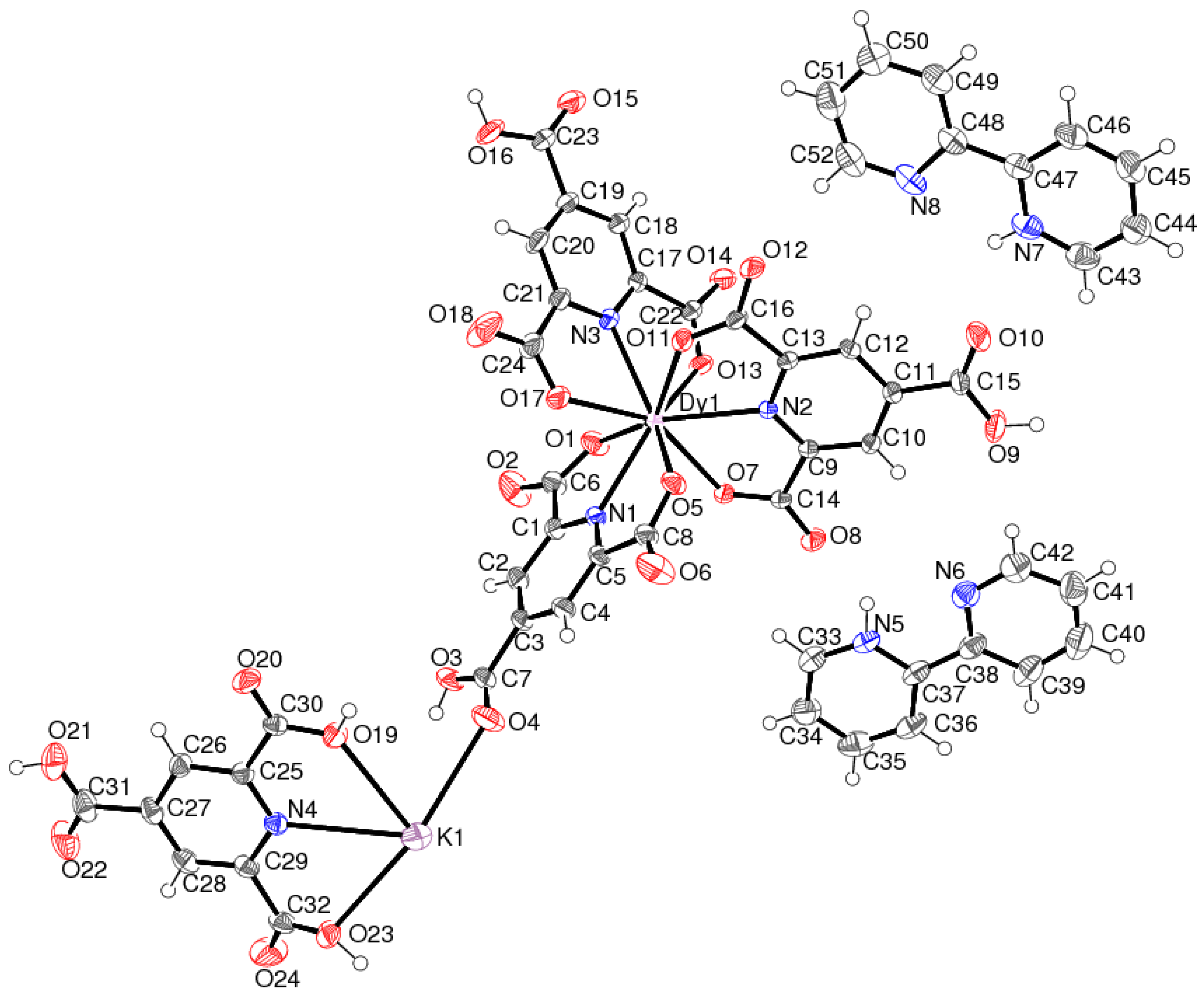
        <p>Compound 1 is a bimetallic, layered coordination polymer: The complex asymmetric unit contains one K<sup>+</sup> cation, one Dy<sup>3+</sup> cation, three doubly-deprotonated (C<sub>8</sub>H<sub>3</sub>NO<sub>6</sub>)<sup>2−</sup> (Hptc<sup>2−</sup>) dianions, one neutral C<sub>8</sub>H<sub>5</sub>NO<sub>6</sub> (H<sub>3</sub>ptc) molecule, two singly protonated bipyridinium (C<sub>10</sub>H<sub>9</sub>N<sub>2</sub>)<sup>+</sup> cations and five water molecules (<xref ref-type="fig" rid="crystals-02-01084-f001">Figure 1</xref>).</p>
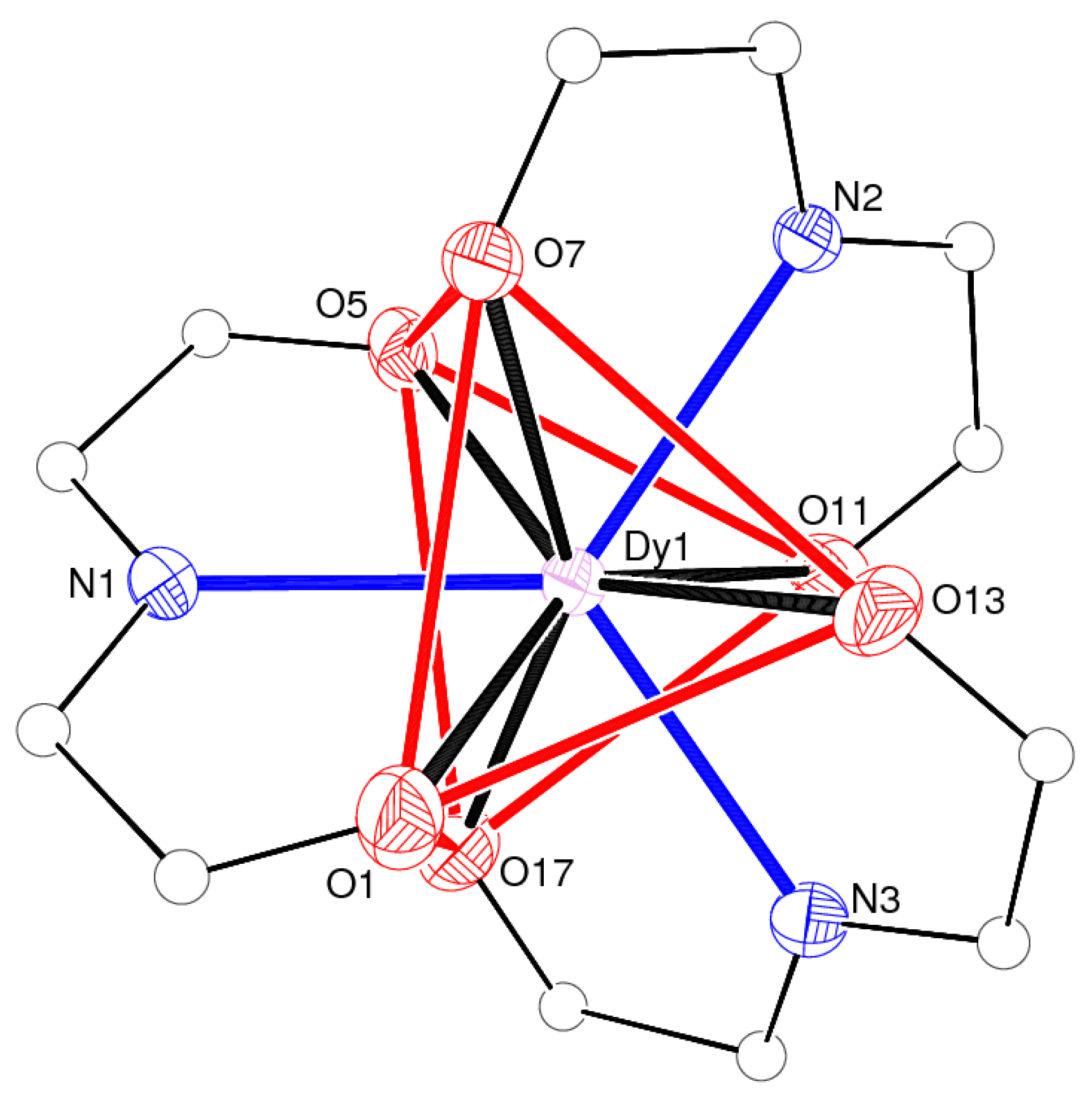
        <p>The dysprosium ion in 1 is coordinated by the three O,N,O-tridentate C<sub>8</sub>H<sub>3</sub>NO<sub>6</sub> dianions (in which two carboxylate protons have been lost from the C<sub>8</sub>H<sub>5</sub>NO<sub>6</sub> neutral molecule) to generate a near-regular tri-capped trigonal prismatic DyO<sub>6</sub>N<sub>3</sub> coordination geometry with the N atoms serving as the caps protruding through the prismatic side-faces (<xref ref-type="fig" rid="crystals-02-01084-f002">Figure 2</xref>). Each ligand forms one Dy–O bond to the “top” triangular face and one to the bottom. The dihedral angle between the O1/O7/O13 and O5/O11/O17 triangular faces is 4.30(4)° and the metal ion is displaced by −1.6580(13) Å from the first triplet of O atoms and by 1.6133(13) Å from the second. The Dy–N bond lengths (<xref ref-type="table" rid="crystals-02-01084-t001">Table 1</xref>) (mean = 2.501 Å) are longer than all but one of the Dy–O bonds (mean = 2.413 Å). The Dy<sup>3+</sup> bond-valence sum (BVS), calculated using the Brown–Altermatt [<xref ref-type="bibr" rid="B8-crystals-02-01084">8</xref>] formalism, is 3.18, compared to an expected value of 3.00. </p>
        <fig id="crystals-02-01084-f001" position="anchor">
          <label>Figure 1</label>
          <caption>
            <p>The asymmetric unit of 1 (50% displacement ellipsoids for the non-hydrogen atoms). The water molecules are omitted for clarity.</p>
          </caption>
          <graphic xmlns:xlink="http://www.w3.org/1999/xlink" xlink:href="crystals-02-01084-g001.tif"/>
        </fig>
        <fig id="crystals-02-01084-f002" position="anchor">
          <label>Figure 2</label>
          <caption>
            <p>Detail of the structure of 1 showing the tri-capped trigonal prismatic coordination of the Dy<sup>3+</sup> ion (50% displacement ellipsoids, arbitrary spheres for the C atoms). Note the overall, approximate, local <italic>C</italic>3 symmetry of these atoms.</p>
          </caption>
          <graphic xmlns:xlink="http://www.w3.org/1999/xlink" xlink:href="crystals-02-01084-g002.tif"/>
        </fig>
        <table-wrap id="crystals-02-01084-t001" position="anchor">
          <object-id pub-id-type="pii">crystals-02-01084-t001_Table 1</object-id>
          <label>Table 1</label>
          <caption>
            <p>Selected bond-distances (Å) in 1.</p>
          </caption>
          <table>
            <tbody>
              <tr>
                <td align="left" valign="middle">K1–O19</td>
                <td align="left" valign="middle">2.885(2)</td>
                <td align="left" valign="middle">K1–O23</td>
                <td align="left" valign="middle">2.946(2)</td>
              </tr>
              <tr>
                <td align="left" valign="middle">K1–O4</td>
                <td align="left" valign="middle">2.949(2)</td>
                <td align="left" valign="middle">K1–O15 <sup>i</sup></td>
                <td align="left" valign="middle">2.958(2)</td>
              </tr>
              <tr>
                <td align="left" valign="middle">K1–O13 <sup>ii</sup></td>
                <td align="left" valign="middle">3.025(2)</td>
                <td align="left" valign="middle">K1–O11 <sup>iii</sup></td>
                <td align="left" valign="middle">3.073(2)</td>
              </tr>
              <tr>
                <td align="left" valign="middle">K1–N4</td>
                <td align="left" valign="middle">3.074(2)</td>
                <td align="left" valign="middle">K1–O7 <sup>ii</sup></td>
                <td align="left" valign="middle">3.201(2)</td>
              </tr>
              <tr>
                <td align="left" valign="middle">K1–O12 <sup>iii</sup></td>
                <td align="left" valign="middle">3.388(3)</td>
                <td align="left" valign="middle">K1–O1 <sup>ii</sup></td>
                <td align="left" valign="middle">3.432(3)</td>
              </tr>
              <tr>
                <td align="left" valign="middle">Dy1–O1</td>
                <td align="left" valign="middle">2.366(2)</td>
                <td align="left" valign="middle">Dy1–O17</td>
                <td align="left" valign="middle">2.392(2)</td>
              </tr>
              <tr>
                <td align="left" valign="middle">Dy1–O13</td>
                <td align="left" valign="middle">2.397(2)</td>
                <td align="left" valign="middle">Dy1–O11</td>
                <td align="left" valign="middle">2.397(2)</td>
              </tr>
              <tr>
                <td align="left" valign="middle">Dy1–O5</td>
                <td align="left" valign="middle">2.440(2)</td>
                <td align="left" valign="middle">Dy1–N1</td>
                <td align="left" valign="middle">2.481(2)</td>
              </tr>
              <tr>
                <td align="left" valign="middle">Dy1–O7</td>
                <td align="left" valign="middle">2.4838(19)</td>
                <td align="left" valign="middle">Dy1–N3</td>
                <td align="left" valign="middle">2.500(2)</td>
              </tr>
              <tr>
                <td align="left" valign="middle">Dy1–N2</td>
                <td align="left" valign="middle">2.523(2)</td>
                <td align="left" valign="middle"> </td>
                <td align="left" valign="middle"> </td>
              </tr>
            </tbody>
          </table>
    <table-wrap-foot>
      <fn>
        <p>Symmetry codes: (i) <italic>x</italic>, <italic>y</italic>, <italic>z</italic>−1; (ii) 1−<italic>x</italic>, 1−<italic>y</italic>, 1−<italic>z</italic>; (iii) −<italic>x</italic>, 1−<italic>y</italic>, 1−<italic>z</italic>.</p>
      </fn>
    </table-wrap-foot>		
		</table-wrap>
        <p>The geometrical parameters for the three Dy-bonded ligands (containing atoms N1, N2 and N3) are unexceptional, and all the carboxylate groups are close to coplanar with their attached rings. In each case, the protonated (carboxylic acid –CO<sub>2</sub>H) grouping is the one not bonded to the rare-earth ion at the para position with respect to the pyridine N atom. </p>
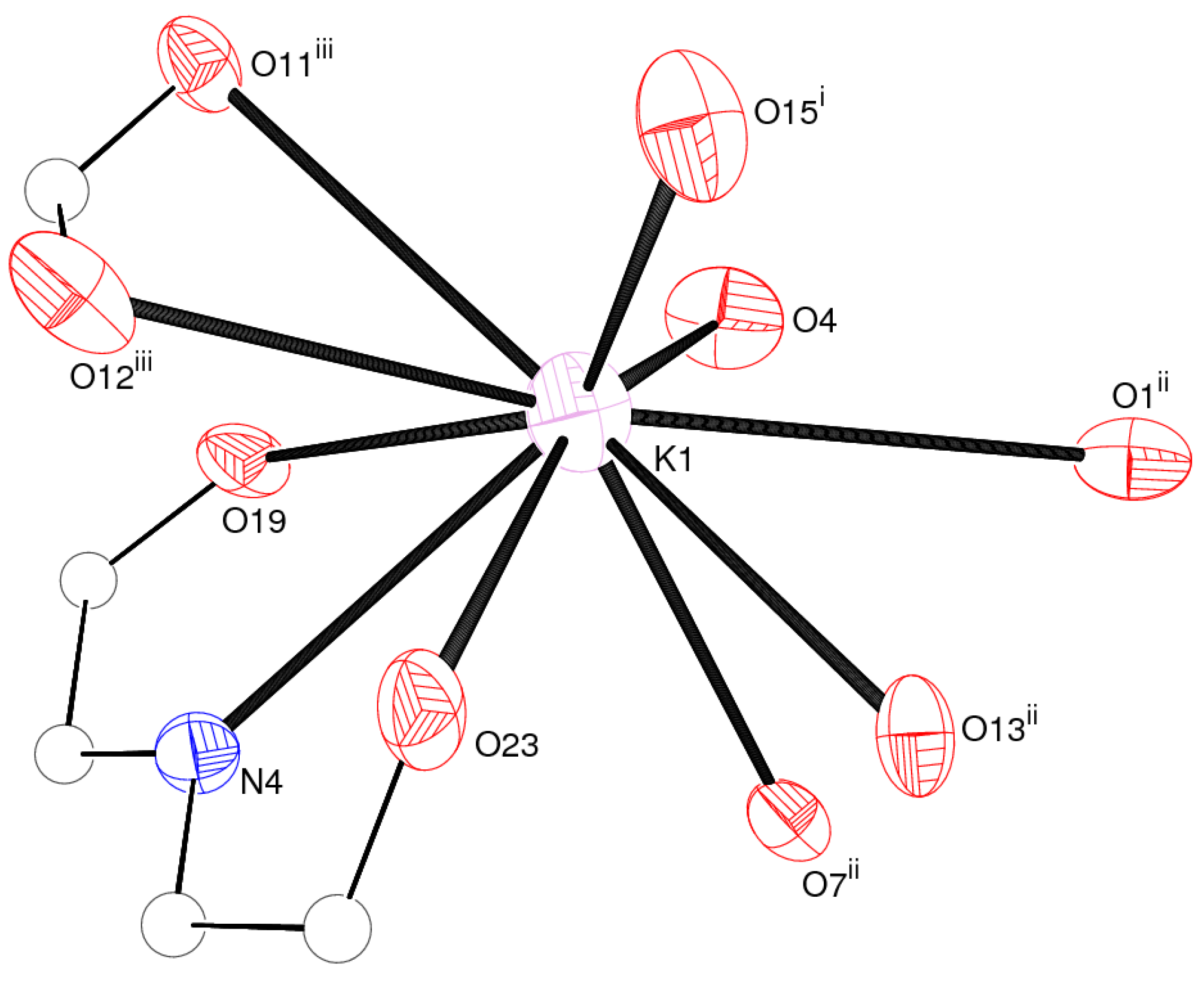
        <p>The potassium ion in 1 is coordinated by the O,N,O-tridentate C<sub>8</sub>H<sub>5</sub>NO<sub>6</sub> neutral molecule (containing N4), as well as monodentate and bidentate dianions also bonded to the dysprosium ion to generate a KNO<sub>9</sub> coordination polyhedron (mean K–O = 3.095 Å) that can only be described as irregular (<xref ref-type="fig" rid="crystals-02-01084-f003">Figure 3</xref>). It is also decidedly asymmetric with the potassium ion displaced by 0.481 Å from the geometric centroid of its attached atoms. The next-nearest O atom is over 4.0 Å from the K<sup>+</sup> ion and the BVS for potassium is 0.87 (expected value = 1.00). The existence of a protonated carboxylic acid forming a coordinate bond to a potassium ion from its OH moiety is uncommon, but some examples such as [K(C<sub>5</sub>H<sub>4</sub>N<sub>2</sub>O<sub>4</sub>)(C<sub>5</sub>H<sub>3</sub>N<sub>2</sub>O<sub>4</sub>)]<italic><sub>n</sub></italic> [<xref ref-type="bibr" rid="B9-crystals-02-01084">9</xref>] and [K(C<sub>8</sub>H<sub>8</sub>O<sub>2</sub>S)(C<sub>8</sub>H<sub>7</sub>O<sub>4</sub>S)]<italic><sub>n</sub></italic> [<xref ref-type="bibr" rid="B10-crystals-02-01084">10</xref>] have been structurally characterised previously. </p>
        <fig id="crystals-02-01084-f003" position="anchor">
          <label>Figure 3</label>
          <caption>
            <p>Detail of 1 (50% displacement ellipsoids, arbitrary spheres for the C atoms) showing the potassium-ion coordination. Symmetry codes as in <xref ref-type="table" rid="crystals-02-01084-t001">Table 1</xref>. </p>
          </caption>
          <graphic xmlns:xlink="http://www.w3.org/1999/xlink" xlink:href="crystals-02-01084-g003.tif"/>
        </fig>
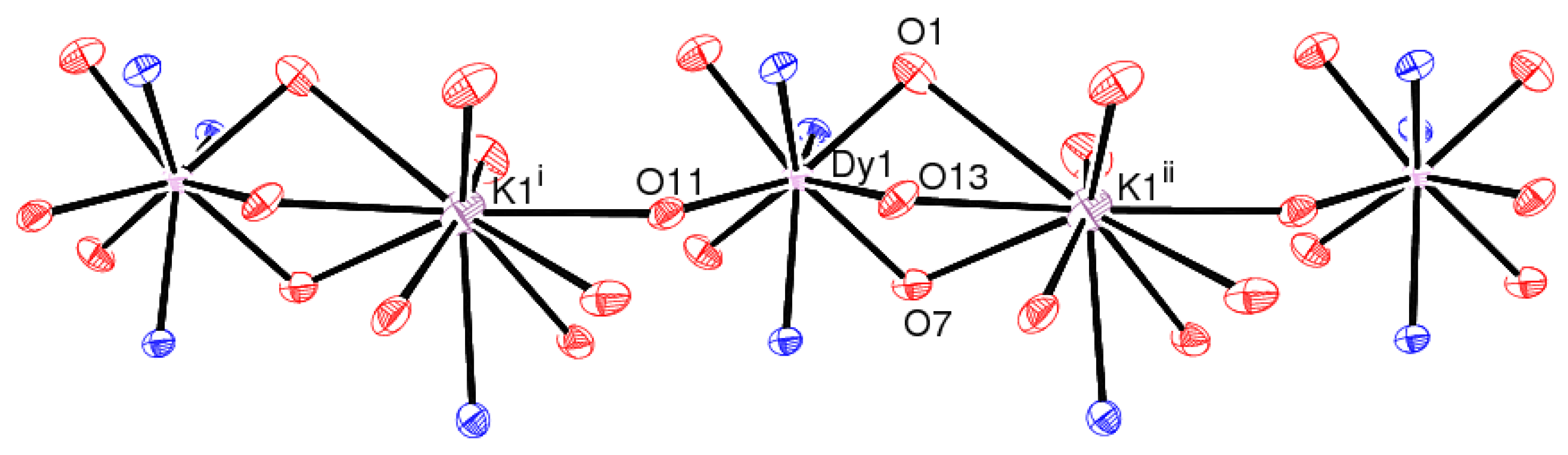
        <p>A notable feature of this phase is the sharing of some of the ligand O atoms (<italic>i.e</italic>., as <italic>μ</italic><sup>2</sup> bridges) by the dysprosium and potassium ions: In particular, the three oxygen atoms of the O1/O7/O13 triangular face of the Dy-trigonal prism also bond to the K<sup>+</sup> ion. This leads to polymeric chains of alternating DyO<sub>6</sub>N<sub>3</sub> and KNO<sub>9</sub> units, which propagate in the [100] direction (<xref ref-type="fig" rid="crystals-02-01084-f004">Figure 4</xref>). </p>
        <fig id="crystals-02-01084-f004" position="anchor">
          <label>Figure 4</label>
          <caption>
            <p>Fragment of a [100] chain of DyO<sub>6</sub>N<sub>3</sub> and KNO<sub>9</sub> polyhedra in 1 (50% displacement ellipsoids). Note how Dy1 and K1 <sup>ii</sup> are linked via a triangular face but Dy1 and K1 <sup>i</sup> are linked by a single O atom. Symmetry codes: (i) −<italic>x</italic>, 1−<italic>y</italic>, 1−<italic>z</italic>; (ii) 1−<italic>x</italic>, 1−<italic>y</italic>, 1−<italic>z</italic>.</p>
          </caption>
          <graphic xmlns:xlink="http://www.w3.org/1999/xlink" xlink:href="crystals-02-01084-g004.tif"/>
        </fig>
        <fig id="crystals-02-01084-f005" position="anchor">
          <label>Figure 5</label>
          <caption>
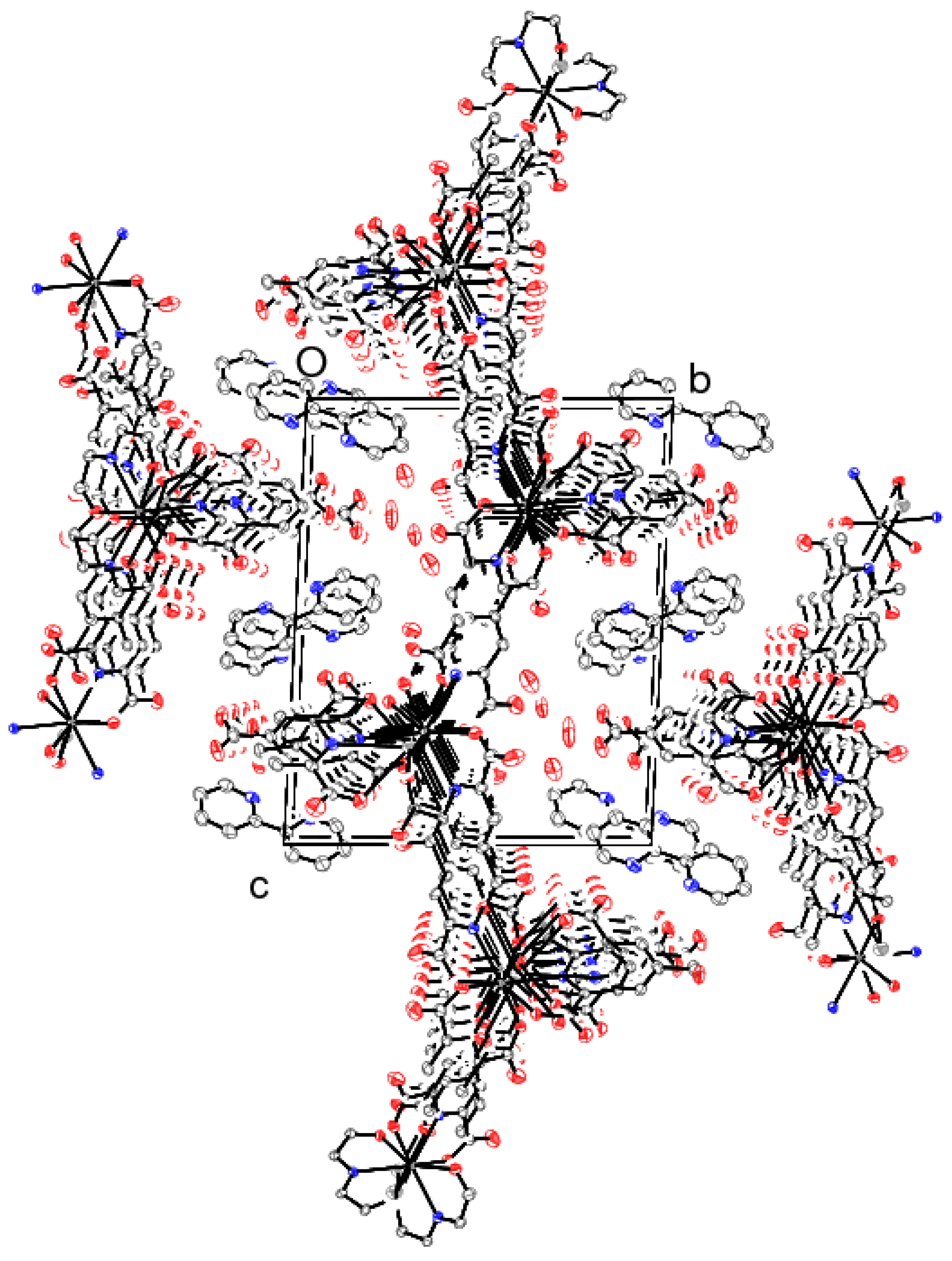
            <p>The packing for 1 viewed approximately down [100] showing the wavy (010) polymeric sheets with the organic cations and water molecules occupying the inter-sheet regions. </p>
          </caption>
          <graphic xmlns:xlink="http://www.w3.org/1999/xlink" xlink:href="crystals-02-01084-g005.tif"/>
        </fig>
        <p>When ligand bridging via the aromatic rings is also considered, a layered anionic network of stoichiometry [KDy(C<sub>8</sub>H<sub>3</sub>NO<sub>6</sub>)<sub>3</sub>(C<sub>8</sub>H<sub>5</sub>NO<sub>6</sub>)]<sup>2<italic>n</italic>−</sup> results, which propagates in the (010) plane (<xref ref-type="fig" rid="crystals-02-01084-f005">Figure 5</xref>). The layer is corrugated and the (C<sub>10</sub>H<sub>9</sub>N<sub>2</sub>)<sup>+</sup> bipyridinium cations and water molecules occupy the inter-layer regions. The dihedral angles between the aromatic rings of the bipyridinium cations are 5.23(17)° and 3.39(18)° for the N5- and N7-containing ions, respectively. To complete the structure of 1, numerous O–H…O and N–H…O hydrogen bonds occur (<xref ref-type="table" rid="crystals-02-01084-t002">Table 2</xref>). The acceptor atoms are either carboxylate O atoms or water O atoms. </p>
        <table-wrap id="crystals-02-01084-t002" position="anchor">
          <object-id pub-id-type="pii">crystals-02-01084-t002_Table 2</object-id>
          <label>Table 2</label>
          <caption>
            <p>Hydrogen-bond geometries for 1.</p>
          </caption>
          <table>
            
            <tbody>
              <tr>
                <td align="left" valign="middle">O3–H3o…O7 <sup>ii</sup></td>
                <td align="left" valign="middle">0.81</td>
                <td align="left" valign="middle">1.79</td>
                <td align="left" valign="middle">2.537(3)</td>
                <td align="left" valign="middle">153</td>
              </tr>
              <tr>
                <td align="left" valign="middle">O9–H9o…O4w <sup>iv</sup></td>
                <td align="left" valign="middle">0.92</td>
                <td align="left" valign="middle">1.60</td>
                <td align="left" valign="middle">2.511(4)</td>
                <td align="left" valign="middle">169</td>
              </tr>
              <tr>
                <td align="left" valign="middle">O16–H16o…O12 <sup>v</sup></td>
                <td align="left" valign="middle">0.85</td>
                <td align="left" valign="middle">1.63</td>
                <td align="left" valign="middle">2.458(3)</td>
                <td align="left" valign="middle">163</td>
              </tr>
              <tr>
                <td align="left" valign="middle">O19–H19o…O5 <sup>iii</sup></td>
                <td align="left" valign="middle">0.96</td>
                <td align="left" valign="middle">1.57</td>
                <td align="left" valign="middle">2.502(3)</td>
                <td align="left" valign="middle">162</td>
              </tr>
              <tr>
                <td align="left" valign="middle">O21–H21o…O1w <sup>vi</sup></td>
                <td align="left" valign="middle">0.93</td>
                <td align="left" valign="middle">1.65</td>
                <td align="left" valign="middle">2.515(3)</td>
                <td align="left" valign="middle">152</td>
              </tr>
              <tr>
                <td align="left" valign="middle">O23–H23o…O14 <sup>ii</sup></td>
                <td align="left" valign="middle">0.96</td>
                <td align="left" valign="middle">1.57</td>
                <td align="left" valign="middle">2.514(3)</td>
                <td align="left" valign="middle">168</td>
              </tr>
              <tr>
                <td align="left" valign="middle">N5–H5n…O8</td>
                <td align="left" valign="middle">0.95</td>
                <td align="left" valign="middle">1.96</td>
                <td align="left" valign="middle">2.772(3)</td>
                <td align="left" valign="middle">142</td>
              </tr>
              <tr>
                <td align="left" valign="middle">N7–H7n…O10</td>
                <td align="left" valign="middle">0.87</td>
                <td align="left" valign="middle">2.23</td>
                <td align="left" valign="middle">2.882(3)</td>
                <td align="left" valign="middle">132</td>
              </tr>
              <tr>
                <td align="left" valign="middle">O1w–H1w…O2 <sup>vii</sup></td>
                <td align="left" valign="middle">0.92</td>
                <td align="left" valign="middle">1.80</td>
                <td align="left" valign="middle">2.702(4)</td>
                <td align="left" valign="middle">167</td>
              </tr>
              <tr>
                <td align="left" valign="middle">O1w–H2w…O18</td>
                <td align="left" valign="middle">0.92</td>
                <td align="left" valign="middle">1.77</td>
                <td align="left" valign="middle">2.672(4)</td>
                <td align="left" valign="middle">165</td>
              </tr>
              <tr>
                <td align="left" valign="middle">O2w–H3w…O1w</td>
                <td align="left" valign="middle">0.92</td>
                <td align="left" valign="middle">2.37</td>
                <td align="left" valign="middle">3.044(5)</td>
                <td align="left" valign="middle">130</td>
              </tr>
              <tr>
                <td align="left" valign="middle">O2w–H4w…O17</td>
                <td align="left" valign="middle">0.92</td>
                <td align="left" valign="middle">2.05</td>
                <td align="left" valign="middle">2.865(4)</td>
                <td align="left" valign="middle">146</td>
              </tr>
              <tr>
                <td align="left" valign="middle">O3w–H5w…O5w</td>
                <td align="left" valign="middle">0.92</td>
                <td align="left" valign="middle">1.92</td>
                <td align="left" valign="middle">2.816(5)</td>
                <td align="left" valign="middle">163</td>
              </tr>
              <tr>
                <td align="left" valign="middle">O3w–H6w…O22 <sup>viii</sup></td>
                <td align="left" valign="middle">0.92</td>
                <td align="left" valign="middle">1.97</td>
                <td align="left" valign="middle">2.878(4)</td>
                <td align="left" valign="middle">171</td>
              </tr>
              <tr>
                <td align="left" valign="middle">O4w–H7w…O3w</td>
                <td align="left" valign="middle">0.92</td>
                <td align="left" valign="middle">1.87</td>
                <td align="left" valign="middle">2.709(6)</td>
                <td align="left" valign="middle">151</td>
              </tr>
              <tr>
                <td align="left" valign="middle">O4w–H8w…O2w</td>
                <td align="left" valign="middle">0.85</td>
                <td align="left" valign="middle">2.06</td>
                <td align="left" valign="middle">2.909(6)</td>
                <td align="left" valign="middle">180</td>
              </tr>
              <tr>
                <td align="left" valign="middle">O5w–H9w…O1</td>
                <td align="left" valign="middle">0.92</td>
                <td align="left" valign="middle">1.95</td>
                <td align="left" valign="middle">2.844(4)</td>
                <td align="left" valign="middle">164</td>
              </tr>
              <tr>
                <td align="left" valign="middle">O5w–H10w…O15 <sup>ix</sup></td>
                <td align="left" valign="middle">0.92</td>
                <td align="left" valign="middle">2.01</td>
                <td align="left" valign="middle">2.891(4)</td>
                <td align="left" valign="middle">161</td>
              </tr>
            </tbody>
          </table>
    <table-wrap-foot>
      <fn>
        <p>The four columns specify the <italic>D</italic>–H, H…<italic>A</italic> and <italic>D</italic>…<italic>A</italic> separations (Å) and the <italic>D</italic>–H…<italic>A</italic> angle (°), respectively. Symmetry codes: (ii) 1−<italic>x</italic>, 1−<italic>y</italic>, 1−<italic>z</italic>; (iii) −<italic>x</italic>, 1−<italic>y</italic>, 1−<italic>z</italic>; (iv) <italic>x</italic>, <italic>y</italic>−1, <italic>z</italic>; (v) −<italic>x</italic>, 1−<italic>y</italic>, 2−<italic>z</italic>; (vi) −<italic>x</italic>, 2−<italic>y</italic>, 1−<italic>z</italic>; (vii) <italic>x</italic>−1, <italic>y</italic>, <italic>z</italic>; (viii) 1−<italic>x</italic>, 2−<italic>y</italic>, 1−<italic>z</italic>; (ix) 1−<italic>x</italic>, 1−<italic>y</italic>, 2−<italic>z</italic>.</p>
      </fn>
    </table-wrap-foot>		
		</table-wrap>
      </sec>
      <sec>
        <title>2.2. Bacteriological Tests</title>
        <p>Seven bacterial strains including two Gram positive <italic>Staphylococcus aureus</italic> and <italic>Micrococcus luteus</italic> and five Gram negative, <italic>Escherichia coli</italic>, <italic>Salmonella setubal</italic>, <italic>Salmonella typhimurium</italic>, <italic>Enterobacter aerogenes</italic> and <italic>Bordetella bronchiseptica</italic> were used. Roxithromycin (R) and Cefixixme (C) drugs were used as positive controls, which had shown maximum growth inhibition at 1 mg·mL<sup>−1</sup> concentrations and DMSO was used as a negative control. Compound 1 shows significant antibacterial activity against all these bacterial strains (<xref ref-type="table" rid="crystals-02-01084-t003">Table 3</xref>) except <italic>Salmonella typhimurium</italic>.</p>
        <table-wrap id="crystals-02-01084-t003" position="anchor">
          <object-id pub-id-type="pii">crystals-02-01084-t003_Table 3</object-id>
          <label>Table 3</label>
          <caption>
            <p>Bacteriological data.</p>
          </caption>
          <table>
            <thead>
              <tr>
                <th colspan="6" align="center" valign="middle">Minimum Inhibitory Concenteration (MIC)</th>
              </tr>
            </thead>
            <tbody>
              <tr>
                <td align="center" valign="middle">
                  <italic>M. leuteus</italic>
                </td>
                <td align="center" valign="middle">
                  <italic>S. aureus</italic>
                </td>
                <td align="center" valign="middle">
                  <italic>Ent. bac</italic>
                </td>
                <td align="center" valign="middle">
                  <italic>B. step</italic>
                </td>
                <td align="center" valign="middle">
                  <italic>E. coli</italic>
                </td>
                <td align="center" valign="middle">
                  <italic>S.</italic>
                  <italic>typhi</italic>
                </td>
              </tr>
              <tr>
                <td align="center" valign="middle">30 ppm</td>
                <td align="center" valign="middle">150 ppm</td>
                <td align="center" valign="middle">200 ppm</td>
                <td align="center" valign="middle">70 ppm</td>
                <td align="center" valign="middle">110 ppm</td>
                <td align="center" valign="middle">Nil</td>
              </tr>
            </tbody>
          </table>
        </table-wrap>
      </sec>
    </sec>
    <sec>
      <title>3. Experimental Section</title>
      <p>The nominal pyridine 2,4,6-tricarboxylic acid (H<sub>3</sub>ptc) starting material was prepared by oxidizing 2,4,6-trimethyl pyridine with KMnO<sub>4</sub> solution, as described by Syper <italic>et al</italic>. [<xref ref-type="bibr" rid="B11-crystals-02-01084">11</xref>]. This evidently generated a potassium salt: A 0.5-mmol solution was prepared by heating 0.11 g of the solid product in 10.0 mL water in a 50-mL round bottom flask. Then, 0.0063 g of 2,2-bipyridine in 5 mL methanol was added, and the mixture was refluxed for 25 min. Then, a 0.125 mmol solution of DyCl<sub>3</sub>·6H<sub>2</sub>O was prepared by dissolving 0.040 g of the metal chloride in 10 mL distilled water and this solution was added to the flask. The Dy:H<sub>3</sub>ptc:bipy molar ratio was 1:4:4. The mixture was refluxed for four hours and transferred to a vial for crystallization. After ten days, pale pinkish needle like crystals of the title compound were obtained. IR (cm<sup>−1</sup>): 3410 [ν(O–H)], 1631[ν<sub>asym</sub>(O–C–O)], 1373 [ν(C<sub>ar</sub>–C)], 1265 [ν<sub>sym</sub>(O–C–O)], 539 [ν(M–O, M–N)]. TGA showed an initial weight loss of about 5% between 70 °C and 120 °C, presumably attributable to the loss of the water molecules of crystallization (calc. = 6%). From 205 °C to 300 °C (the limit of the experiment), a continuous weight loss of 55% occurred. </p>
      <p>The single-crystal data for 1 (pale pink block 0.30 × 0.25 × 0.25 mm) were collected using a Bruker Kappa APEX II CCD diffractometer (graphite monochromated Mo K<italic>α</italic> radiation, <italic>λ</italic> = 0.71073 Å) at room temperature. Data reduction with SAINT then proceeded and the structure was solved by direct methods with SHELXS. The resulting atomic model was developed and refined against |<italic>F</italic>|<sup>2</sup> with SHELXL [<xref ref-type="bibr" rid="B12-crystals-02-01084">12</xref>] and the “observed data” threshold for calculating the <italic>R</italic>(<italic>F</italic>) residuals was set as <italic>I</italic> &gt; 2σ(<italic>I</italic>). The model was analyzed and validated with PLATON [<xref ref-type="bibr" rid="B13-crystals-02-01084">13</xref>]. </p>
      <p>The C-bound H atoms were placed in idealised locations (C–H = 0.96–0.97 Å) and refined as riding atoms. The ligand N-bond and O-bound and water H atoms were located in difference maps and refined as riding atoms in their as-found relative locations. The constraint <italic>U</italic><sub>iso</sub>(H) = 1.2<italic>U</italic><sub>eq</sub>(carrier) was applied in all cases. The difference maps in the regions around the water molecules O2w and O4w were not very well defined, and the possibility of disorder of the H atoms attached to these O atoms cannot be ruled out. Full refinement details and software references are given in the deposited cif. </p>
      <p>Crystal data for 1: C<sub>52</sub>H<sub>42</sub>DyKN<sub>8</sub>O<sub>29</sub>, <italic>M</italic><sub>r</sub> = 1444.54, triclinic, <inline-graphic xmlns:xlink="http://www.w3.org/1999/xlink" xlink:href="crystals-02-01084-i001.tif"/> (No. 2), <italic>Z</italic> = 2, <italic>a</italic> = 9.188(2) Å, <italic>b</italic> = 15.7332(17) Å, <italic>c</italic> = 19.1664(19) Å, <italic>α</italic> = 92.797(6)°, <italic>β</italic> = 92.319(7)°, <italic>γ</italic> = 91.273(9)°, <italic>V</italic> = 2764.3(7) Å<sup>3</sup>, <italic>F</italic>(000) = 1454, <italic>T</italic> = 296(2) K, <italic>ρ</italic><sub>calc</sub> = 1.736 g·cm<sup>−3</sup>, <italic>μ</italic> = 1.532 mm<sup>−1</sup>, 37880 reflections measured (−7 ≤ <italic>h</italic> ≤ 12, −20 ≤ <italic>k</italic> ≤ 20, −25 ≤ <italic>l</italic> ≤ 25; 4.88° ≤ 2<italic>θ</italic> ≤ 56.74°), <italic>R</italic><sub>Int</sub> = 0.025, 13445 merged reflections, 12100 with <italic>I</italic> &gt; 2<italic>σ</italic>(<italic>I</italic>), 825 variable parameters, <italic>R</italic>(<italic>F</italic>) = 0.029, <italic>wR</italic>(<italic>F</italic><sup>2</sup>) = 0.084, <italic>w</italic> = 1/[<italic>σ</italic><sup>2</sup>(<italic>F</italic><sub>o</sub><sup>2</sup>) + (0.0387<italic>P</italic>)<sup>2</sup> + 3.7247<italic>P</italic>], where <italic>P</italic> = (<italic>F</italic><sub>o</sub><sup>2</sup> + 2<italic>F</italic><sub>c</sub><sup>2</sup>)/3, min./max. D<italic>ρ</italic> = −0.74, +1.12 <italic>e</italic> Å<sup>−3</sup>. Cambridge Structural Database deposition number: CCDC-879106.</p>
    </sec>
    <sec sec-type="conclusions">
      <title>4. Conclusions</title>
      <p>The synthesis and crystal structure of [KDy(Hptc)<sub>3</sub>(H<sub>3</sub>ptc)]<italic><sub>n</sub></italic>·2<italic>n</italic>(Hbipy)·5<italic>n</italic>(H<sub>2</sub>O) has been described. The coordination of the dysprosium ion by three tridentate Hptc ligands in this compound is distinctly different to those of the compounds noted in the introduction, in which only one ptc ligand bonds in this way, as well as monodentate bridging ligands and water molecules. </p>
    </sec>
  </body>
  <back>
    <ref-list>
      <title>References</title>
      <ref id="B1-crystals-02-01084">
        <label>1.</label>
        <citation citation-type="journal">
          <person-group person-group-type="author">
            <name>
              <surname>Batten</surname>
              <given-names>S.R.</given-names>
            </name>
            <name>
              <surname>Champness</surname>
              <given-names>N.R.</given-names>
            </name>
            <name>
              <surname>Chen</surname>
              <given-names>X.-M.</given-names>
            </name>
            <name>
              <surname>Garcia-Martinez</surname>
              <given-names>J.</given-names>
            </name>
            <name>
              <surname>Kitagawa</surname>
              <given-names>S.</given-names>
            </name>
            <name>
              <surname>Öhrström</surname>
              <given-names>L.</given-names>
            </name>
            <name>
              <surname>O’Keeffe</surname>
              <given-names>M.</given-names>
            </name>
            <name>
              <surname>Suh</surname>
              <given-names>M.P.</given-names>
            </name>
            <name>
              <surname>Reedijk</surname>
              <given-names>J.</given-names>
            </name>
          </person-group>
          <article-title>Coordination polymers, metal-organic frameworks and the need for terminology guidelines</article-title>
          <source>CrystEngComm</source>
          <year>2012</year>
          <volume>14</volume>
          <fpage>3001</fpage>
          <lpage>3004</lpage>
          <pub-id pub-id-type="doi">10.1039/c2ce06488j</pub-id>
        </citation>
      </ref>
      <ref id="B2-crystals-02-01084">
        <label>2.</label>
        <citation citation-type="journal">
          <person-group person-group-type="author">
            <name>
              <surname>Wang</surname>
              <given-names>H.-S.</given-names>
            </name>
            <name>
              <surname>Zhao</surname>
              <given-names>B.</given-names>
            </name>
            <name>
              <surname>Zhai</surname>
              <given-names>B.</given-names>
            </name>
            <name>
              <surname>Shi</surname>
              <given-names>W.</given-names>
            </name>
            <name>
              <surname>Cheng</surname>
              <given-names>P.</given-names>
            </name>
            <name>
              <surname>Liao</surname>
              <given-names>D.-Z.</given-names>
            </name>
            <name>
              <surname>Yan</surname>
              <given-names>S.-P.</given-names>
            </name>
          </person-group>
          <article-title>Syntheses, structures and photoluminescence of one-dimensional lanthanide coordination polymers with 2,4,6-pyridine-tricarboxylic acid</article-title>
          <source>Cryst. Growth Des.</source>
          <year>2007</year>
          <volume>7</volume>
          <fpage>1851</fpage>
          <lpage>1857</lpage>
          <pub-id pub-id-type="doi">10.1021/cg0705052</pub-id>
        </citation>
      </ref>
      <ref id="B3-crystals-02-01084">
        <label>3.</label>
        <citation citation-type="journal">
          <person-group person-group-type="author">
            <name>
              <surname>Li</surname>
              <given-names>C.-J.</given-names>
            </name>
            <name>
              <surname>Peng</surname>
              <given-names>M.-X.</given-names>
            </name>
            <name>
              <surname>Leng</surname>
              <given-names>J.-D.</given-names>
            </name>
            <name>
              <surname>Yang</surname>
              <given-names>M.-M.</given-names>
            </name>
            <name>
              <surname>Lin</surname>
              <given-names>J.</given-names>
            </name>
            <name>
              <surname>Tong</surname>
              <given-names>M.-L.</given-names>
            </name>
          </person-group>
          <article-title>Synthesis, structure, photoluminescence and magnetic properties of new 3-D lanthanide-pyridine-2,4,6-tricarboxate framework</article-title>
          <source>CrysEngComm</source>
          <year>2008</year>
          <volume>10</volume>
          <fpage>1645</fpage>
          <lpage>1652</lpage>
          <pub-id pub-id-type="doi">10.1039/b811883n</pub-id>
        </citation>
      </ref>
      <ref id="B4-crystals-02-01084">
        <label>4.</label>
        <citation citation-type="journal">
          <person-group person-group-type="author">
            <name>
              <surname>Das</surname>
              <given-names>M.C.</given-names>
            </name>
            <name>
              <surname>Ghosh</surname>
              <given-names>S.K.</given-names>
            </name>
            <name>
              <surname>Sanudo</surname>
              <given-names>E.C.</given-names>
            </name>
            <name>
              <surname>Bharadwaj</surname>
              <given-names>P.K.</given-names>
            </name>
          </person-group>
          <article-title>Coordination polymers with pyridine-2,4,6-tricarboxylic acid and alkaline-earth/lanthanide/transition metals: Synthesis and X-ray structures</article-title>
          <source>Dalton Trans.</source>
          <year>2009</year>
          <fpage>1644</fpage>
          <lpage>1658</lpage>
        </citation>
      </ref>
      <ref id="B5-crystals-02-01084">
        <label>5.</label>
        <citation citation-type="journal">
          <person-group person-group-type="author">
            <name>
              <surname>Lin</surname>
              <given-names>J.-L.</given-names>
            </name>
            <name>
              <surname>Xu</surname>
              <given-names>W.</given-names>
            </name>
            <name>
              <surname>Zhao</surname>
              <given-names>L.</given-names>
            </name>
            <name>
              <surname>Zheng</surname>
              <given-names>Y.-Q.</given-names>
            </name>
          </person-group>
          <article-title>Synthesis, crystal structure and properties of a new lanthanide pyridine-2,4,6-tricarboxylato coordination polymer</article-title>
          <source>Z. Naturforsch.B</source>
          <year>2011</year>
          <volume>66</volume>
          <fpage>570</fpage>
          <lpage>576</lpage>
          <pub-id pub-id-type="doi">10.5560/ZNB.2011.66b0570</pub-id>
        </citation>
      </ref>
      <ref id="B6-crystals-02-01084">
        <label>6.</label>
        <citation citation-type="journal">
          <person-group person-group-type="author">
            <name>
              <surname>Holder</surname>
              <given-names>A.A.</given-names>
            </name>
            <name>
              <surname>VanDerveer</surname>
              <given-names>D.</given-names>
            </name>
          </person-group>
          <article-title>Potassium (4-carboxypyridine-2,6-dicarboxylato)-dioxido-vanadate(V) monohydrate</article-title>
          <source>Acta Cryst.</source>
          <year>2007</year>
          <volume>E63</volume>
          <fpage>m2051</fpage>
          <lpage>m2052</lpage>
        </citation>
      </ref>
      <ref id="B7-crystals-02-01084">
        <label>7.</label>
        <citation citation-type="journal">
          <person-group person-group-type="author">
            <name>
              <surname>Zhang</surname>
              <given-names>W.-Z.</given-names>
            </name>
            <name>
              <surname>Lv</surname>
              <given-names>T.-Y.</given-names>
            </name>
            <name>
              <surname>Wei</surname>
              <given-names>D.-Z.</given-names>
            </name>
            <name>
              <surname>Xu</surname>
              <given-names>R.</given-names>
            </name>
            <name>
              <surname>Xiong</surname>
              <given-names>G.</given-names>
            </name>
            <name>
              <surname>Wang</surname>
              <given-names>Y.-Q.</given-names>
            </name>
            <name>
              <surname>Gao</surname>
              <given-names>E.-J.</given-names>
            </name>
            <name>
              <surname>Sun</surname>
              <given-names>Y.-G.</given-names>
            </name>
          </person-group>
          <article-title>Synthesis, crystal structures and luminescence properties of two novel 3D heterometallic coordination polymers</article-title>
          <source>Inorg. Chem. Commun.</source>
          <year>2011</year>
          <volume>14</volume>
          <fpage>1245</fpage>
          <lpage>1249</lpage>
          <pub-id pub-id-type="doi">10.1016/j.inoche.2011.04.032</pub-id>
        </citation>
      </ref>
      <ref id="B8-crystals-02-01084">
        <label>8.</label>
        <citation citation-type="journal">
          <person-group person-group-type="author">
            <name>
              <surname>Brown</surname>
              <given-names>I.D.</given-names>
            </name>
            <name>
              <surname>Altermatt</surname>
              <given-names>D.</given-names>
            </name>
          </person-group>
          <article-title>Bond-Valence parameters obtained from a systematic analysis of the Inorganic Crystal Structure Database</article-title>
          <source>Acta Cryst.</source>
          <year>1985</year>
          <volume>B41</volume>
          <fpage>244</fpage>
          <lpage>247</lpage>
        </citation>
      </ref>
      <ref id="B9-crystals-02-01084">
        <label>9.</label>
        <citation citation-type="journal">
          <person-group person-group-type="author">
            <name>
              <surname>Nichol</surname>
              <given-names>G.S.</given-names>
            </name>
            <name>
              <surname>Clegg</surname>
              <given-names>W.</given-names>
            </name>
          </person-group>
          <article-title>Classical hydrogen bonding and weaker C-H…O interactions in complexes of uracil-5-carboxylic acid with the alkali metals Na-Cs</article-title>
          <source>Polyhedron</source>
          <year>2006</year>
          <volume>25</volume>
          <fpage>1043</fpage>
          <lpage>1056</lpage>
          <pub-id pub-id-type="doi">10.1016/j.poly.2005.12.013</pub-id>
        </citation>
      </ref>
      <ref id="B10-crystals-02-01084">
        <label>10.</label>
        <citation citation-type="journal">
          <person-group person-group-type="author">
            <name>
              <surname>Mak</surname>
              <given-names>T.C.W.</given-names>
            </name>
            <name>
              <surname>Wai-Hing</surname>
              <given-names>Y.</given-names>
            </name>
            <name>
              <surname>Smith</surname>
              <given-names>G.</given-names>
            </name>
            <name>
              <surname>O’Reilly</surname>
              <given-names>E.J.</given-names>
            </name>
            <name>
              <surname>Kennard</surname>
              <given-names>C.H.L.</given-names>
            </name>
          </person-group>
          <article-title>Metal (phenylthio)acetic acid interactions 3. The crystal structures of anhydrous barium (phenylthio)-acetate and the potassium (phenylthio)acetate (phenylthio)acetic acid adduct</article-title>
          <source>Inorg. Chim. Acta</source>
          <year>1984</year>
          <volume>88</volume>
          <fpage>35</fpage>
          <lpage>39</lpage>
        <pub-id pub-id-type="doi">10.1016/S0020-1693(00)81867-8</pub-id></citation>
      </ref>
      <ref id="B11-crystals-02-01084">
        <label>11.</label>
        <citation citation-type="journal">
          <person-group person-group-type="author">
            <name>
              <surname>Syper</surname>
              <given-names>L.</given-names>
            </name>
            <name>
              <surname>Kloc</surname>
              <given-names>K.</given-names>
            </name>
            <name>
              <surname>Młochowski</surname>
              <given-names>K.</given-names>
            </name>
          </person-group>
          <article-title>Synthesis of ubiquinone and menaquinone analogues by oxidative demethylation of alkenylhydroquinine ethers with argentic oxide or ceric ammonium nitrate in the presence of 2,4,6-pyridine tricarboxylic aicd</article-title>
          <source>Tetrahedron</source>
          <year>1980</year>
          <volume>36</volume>
          <fpage>123</fpage>
          <lpage>129</lpage>
          <pub-id pub-id-type="doi">10.1016/0040-4020(80)85034-4</pub-id>
        </citation>
      </ref>
      <ref id="B12-crystals-02-01084">
        <label>12.</label>
        <citation citation-type="journal">
          <person-group person-group-type="author">
            <name>
              <surname>Sheldrick</surname>
              <given-names>G.M.</given-names>
            </name>
          </person-group>
          <article-title>A short history of SHELX</article-title>
          <source>Acta Cryst.</source>
          <year>2008</year>
          <volume>A64</volume>
          <fpage>112</fpage>
          <lpage>122</lpage>
        </citation>
      </ref>
      <ref id="B13-crystals-02-01084">
        <label>13.</label>
        <citation citation-type="journal">
          <person-group person-group-type="author">
            <name>
              <surname>Spek</surname>
              <given-names>A.L.</given-names>
            </name>
          </person-group>
          <article-title>Structure validation in chemical crystallography</article-title>
          <source>Acta Cryst.</source>
          <year>2009</year>
          <volume>D65</volume>
          <fpage>148</fpage>
          <lpage>155</lpage>
        </citation>
      </ref>
    </ref-list>
  </back>
</article>