<?xml version="1.0" encoding="UTF-8"?>
<!DOCTYPE article PUBLIC "-//NLM//DTD Journal Publishing DTD v2.3 20070202//EN" "journalpublishing.dtd">
<article xmlns:mml="http://www.w3.org/1998/Math/MathML" xmlns:xlink="http://www.w3.org/1999/xlink" xml:lang="en" article-type="research-article">
  <front>
    <journal-meta>
      <journal-id journal-id-type="publisher-id">crystals</journal-id>
      <journal-title>Crystals</journal-title>
      <abbrev-journal-title abbrev-type="publisher">Crystals</abbrev-journal-title>
      <abbrev-journal-title abbrev-type="pubmed">Crystals</abbrev-journal-title>
      <issn pub-type="epub">2073-4352</issn>
      <publisher>
        <publisher-name>MDPI</publisher-name>
      </publisher>
    </journal-meta>
    <article-meta>
      <article-id pub-id-type="doi">10.3390/cryst2020579</article-id>
      <article-id pub-id-type="publisher-id">crystals-02-00579</article-id>
      <article-categories>
        <subj-group>
          <subject>Article</subject>
        </subj-group>
      </article-categories>
      <title-group>
        <article-title>Spin and Charge Transport in the X-ray Irradiated Quasi-2D Layered Compound: <italic>κ</italic>-(BEDT-TTF)<sub>2</sub>Cu[N(CN)<sub>2</sub>]Cl</article-title>
      </title-group>
      <contrib-group>
        <contrib contrib-type="author">
          <name>
            <surname>Antal</surname>
            <given-names>Ágnes</given-names>
          </name>
          <xref rid="af1-crystals-02-00579" ref-type="aff">1</xref>
          <xref rid="af2-crystals-02-00579" ref-type="aff">2</xref>
        </contrib>
        <contrib contrib-type="author">
          <name>
            <surname>Fehér</surname>
            <given-names>Titusz</given-names>
          </name>
          <xref rid="af1-crystals-02-00579" ref-type="aff">1</xref>
          <xref rid="af2-crystals-02-00579" ref-type="aff">2</xref>
        </contrib>
        <contrib contrib-type="author">
          <name>
            <surname>Yoneyama</surname>
            <given-names>Naoki</given-names>
          </name>
          <xref rid="af3-crystals-02-00579" ref-type="aff">3</xref>
        </contrib>
        <contrib contrib-type="author">
          <name>
            <surname>Forró</surname>
            <given-names>László</given-names>
          </name>
          <xref rid="af4-crystals-02-00579" ref-type="aff">4</xref>
        </contrib>
        <contrib contrib-type="author">
          <name>
            <surname>Sasaki</surname>
            <given-names>Takahiko</given-names>
          </name>
          <xref rid="af5-crystals-02-00579" ref-type="aff">5</xref>
        </contrib>
        <contrib contrib-type="author">
          <name>
            <surname>Jánossy</surname>
            <given-names>András</given-names>
          </name>
          <xref rid="af1-crystals-02-00579" ref-type="aff">1</xref>
          <xref rid="af2-crystals-02-00579" ref-type="aff">2</xref>
          <xref rid="c1-crystals-02-00579" ref-type="corresp">*</xref>
        </contrib>
      </contrib-group>
      <aff id="af1-crystals-02-00579"><label>1 </label>Condensed Matter Research Group of the Hungarian Academy of Sciences, P.O.Box 91, Budapest H-1521, Hungary; Email: <email>agnesantal@gmail.com</email> (Á.A.); <email>tif@phy.bme.hu</email> (T.F.)</aff>
      <aff id="af2-crystals-02-00579"><label>2 </label>Institute of Physics, Budapest University of Technology and Economics, Budapest H-1111, Hungary</aff>
      <aff id="af3-crystals-02-00579"><label>3 </label>Interdisciplinary Graduate School of Medicine and Engineering, University of Yamanashi, Takeda 4-4-37, Kofu, Yamanashi 400-8511, Japan; Email: <email>nyoneyama@yamanashi.ac.jp</email></aff>
      <aff id="af4-crystals-02-00579"><label>4 </label>Laboratory of Physics of Complex Matter, École Polytechnique Fédérale de Lausanne, Lausanne CH-1015, Switzerland; Email: <email>laszlo.forro@epfl.ch</email></aff>
      <aff id="af5-crystals-02-00579"><label>5 </label>Institute for Materials Research, Tohoku University, 2-1-1 Katahira, Aoba-ku, Sendai 980-8577, Japan; Email: <email>takahiko@imr.tohoku.ac.jp</email></aff>
      <author-notes>
        <corresp id="c1-crystals-02-00579"><label>*</label> Author to whom correspondence should be addressed; Email: <email>atj@szfki.hu</email>.</corresp>
      </author-notes>
      <pub-date pub-type="epub">
        <day>24</day>
        <month>05</month>
        <year>2012</year>
      </pub-date>
      <pub-date pub-type="collection">
        <month>06</month>
        <year>2012</year>
      </pub-date>
      <volume>2</volume>
      <issue>2</issue>
      <fpage>579</fpage>
      <lpage>589</lpage>
      <history>
        <date date-type="received">
          <day>23</day>
          <month>03</month>
          <year>2012</year>
        </date>
        <date date-type="rev-recd">
          <day>25</day>
          <month>04</month>
          <year>2012</year>
        </date>
        <date date-type="accepted">
          <day>11</day>
          <month>05</month>
          <year>2012</year>
        </date>
      </history>
      <permissions>
        <copyright-statement>© 2012 by the authors; licensee MDPI, Basel, Switzerland.</copyright-statement>
        <copyright-year>2012</copyright-year>
        <license xmlns:xlink="http://www.w3.org/1999/xlink" license-type="open-access" xlink:href="http://creativecommons.org/licenses/by/3.0/">
          <p>This article is an open-access article distributed under the terms and conditions of the Creative Commons Attribution license (http://creativecommons.org/licenses/by/3.0/).</p>
        </license>
      </permissions>
      <abstract>
        <p>The interplane spin cross relaxation time <italic>Tx</italic> measured by high frequency ESR in X-ray irradiated <italic>κ</italic>-(BEDT-TTF)<sub>2</sub>Cu[N(CN)<sub>2</sub>]Cl is compared to the interplane resisitivity <inline-graphic xmlns:xlink="http://www.w3.org/1999/xlink" xlink:href="crystals-02-00579-i001.tif"/> and the in-plane resistivity <italic>ρ</italic><sub>||</sub> between 50 K and 250 K. The irradiation transforms the semiconductor behavior of the non-irradiated crystal into metallic. Irradiation decreases <italic>T</italic><sub>x</sub>, <inline-graphic xmlns:xlink="http://www.w3.org/1999/xlink" xlink:href="crystals-02-00579-i001.tif"/> and <italic>ρ</italic><sub>||</sub> but the ratio <italic>T</italic><sub>x</sub>/<inline-graphic xmlns:xlink="http://www.w3.org/1999/xlink" xlink:href="crystals-02-00579-i001.tif"/> and <inline-graphic xmlns:xlink="http://www.w3.org/1999/xlink" xlink:href="crystals-02-00579-i001.tif"/>/<italic>ρ</italic><sub>||</sub> remain unchanged between 50 and 250 K. Models describing the unusual defect concentration dependence in <italic>κ</italic>-(BEDT-TTF)<sub>2</sub>Cu[N(CN)<sub>2</sub>]Cl are discussed.</p>
      </abstract>
      <kwd-group>
        <kwd>organic</kwd>
        <kwd>two dimensional</kwd>
        <kwd>X-ray irradiation</kwd>
      </kwd-group>
    </article-meta>
  </front>
  <body>
    <sec sec-type="intro">
      <title>1. Introduction</title>
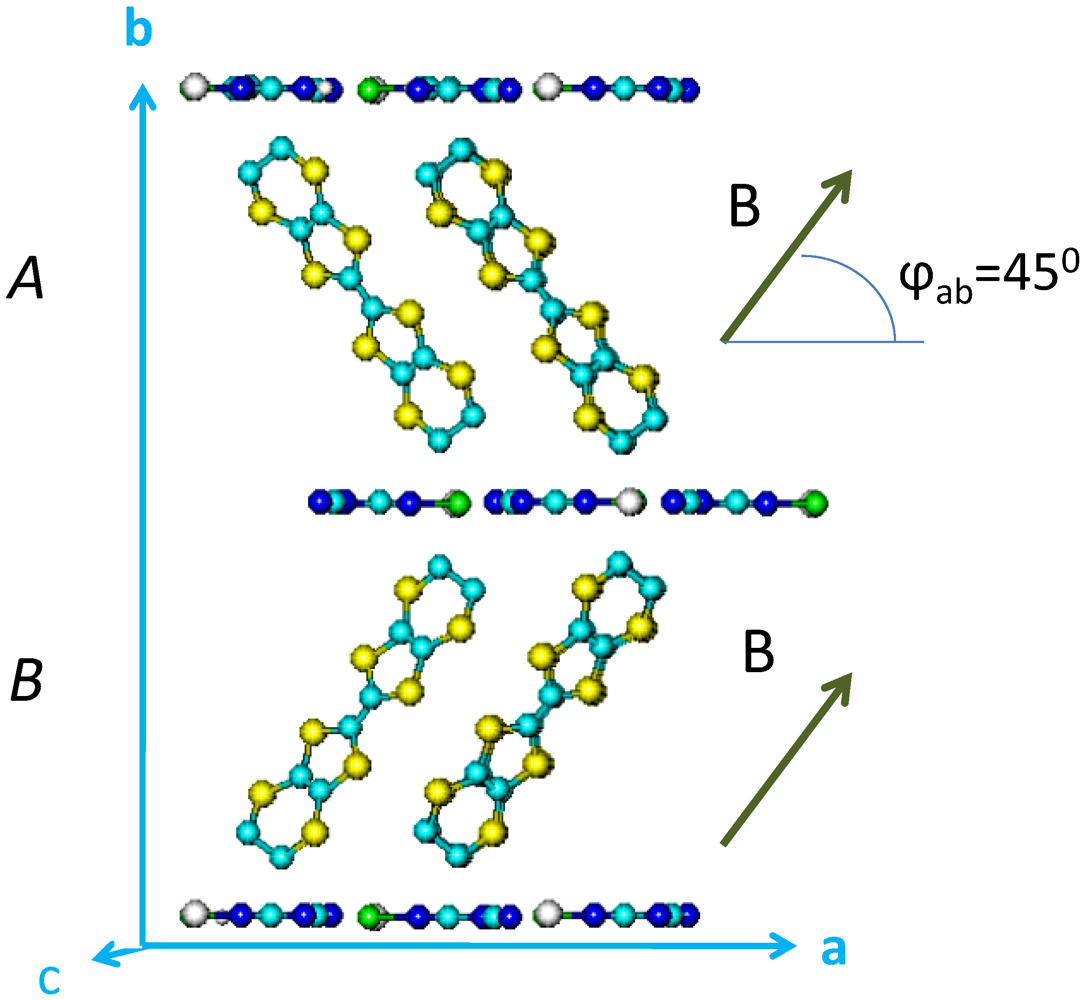
      <p><italic>κ</italic>-(BEDT-TTF)<sub>2</sub> Cu[N(CN)<sub>2</sub>]Cl (<italic>κ</italic>-ET<sub>2</sub>-Cl hereafter) is a layered organic conductor on the borderline of a Mott metal–insulator transition [<xref ref-type="bibr" rid="B1-crystals-02-00579">1</xref>,<xref ref-type="bibr" rid="B2-crystals-02-00579">2</xref>]. The electronic band is effectively half-filled with one hole per two ET molecules. The electronic structure is two dimensional, layers of ET molecules are separated by polymeric anion layers (<xref ref-type="fig" rid="crystals-02-00579-f001">Figure 1</xref>). Judged from the electrical and magnetic properties of non-irradiated <italic>κ</italic>-ET<sub>2</sub>-Cl, the following temperature ranges are distinguished: (i) Below <italic>T<sub>N</sub></italic> = 23 K: weakly ferromagnetic insulator [<xref ref-type="bibr" rid="B3-crystals-02-00579">3</xref>]; (ii) Between 23 and about 50 K: a smooth insulator to a semiconductor transition with an anomalous magnetic field dependent magnetism; (iii) Above 50 K: semiconductor with a very small gap and a temperature-independent paramagnetic susceptibility [<xref ref-type="bibr" rid="B4-crystals-02-00579">4</xref>]. In all three temperature ranges the coupling between layers is extremely weak: in ranges (i) and (ii) magnetic oscillations of adjacent layers are independent in general direction magnetic fields; In range (iii) electron hopping between layers is extremely rare. At ambient temperatures electrons diffuse several tenths of a micrometer confined to a single molecular layer [<xref ref-type="bibr" rid="B5-crystals-02-00579">5</xref>].</p>
      <fig id="crystals-02-00579-f001" position="anchor">
        <label>Figure 1</label>
        <caption>
          <p>Structure of <italic>κ</italic>-ET<sub>2</sub>-Cl projected onto the (a,b) plane. Only one type of ET molecule per plane is shown for clarity. In the experiments the external field B is along <inline-graphic xmlns:xlink="http://www.w3.org/1999/xlink" xlink:href="crystals-02-00579-i004.tif"/>, where <inline-graphic xmlns:xlink="http://www.w3.org/1999/xlink" xlink:href="crystals-02-00579-i005.tif"/> denotes the angle from a in the (a,b) plane.</p>
        </caption>
        <graphic xmlns:xlink="http://www.w3.org/1999/xlink" xlink:href="crystals-02-00579-g001.tif"/>
      </fig>
      <p>X-ray irradiation at relatively small doses changes drastically the physical properties in all three temperature ranges. Sasaki <italic>et al</italic>. [<xref ref-type="bibr" rid="B6-crystals-02-00579">6</xref>] proposed that the deviation from half filling is the underlying reason for the sensitivity to irradiation. The results and discussion of irradiation induced changes of magnetism in range (i) and (ii) will be presented in a forthcoming paper. This paper is restricted to the discussion of the conducting high temperature range. Here the change by irradiation of the resistivity from a semiconductor to a metallic temperature dependence is the most remarkable phenomenon. <xref ref-type="sec" rid="sec2-crystals-02-00579">Section 2</xref> is a brief description of experimental details and the high frequency ESR method to determine the interlayer hopping frequency <inline-graphic xmlns:xlink="http://www.w3.org/1999/xlink" xlink:href="crystals-02-00579-i007.tif"/>. The relation between interlayer hopping and resistivity (<xref ref-type="sec" rid="sec3-crystals-02-00579">Section 3</xref>) is most important for the interpretation. Details of the method and the high frequency ESR results in non-irradiated <italic>κ</italic>-ET<sub>2</sub>-Cl and <italic>κ</italic>-ET<sub>2</sub>-Br were published in References [<xref ref-type="bibr" rid="B7-crystals-02-00579">7</xref>,<xref ref-type="bibr" rid="B8-crystals-02-00579">8</xref>]. <xref ref-type="sec" rid="sec4-crystals-02-00579">Section 4</xref> presents the experimental results. Irradiation has little effect on both interlayer coupling and intralayer spin relaxation at 250 K and we argue in <xref ref-type="sec" rid="sec4dot1-crystals-02-00579">Section 4.1</xref> that the concentration of irradiation-induced defects is low. In <xref ref-type="sec" rid="sec5-crystals-02-00579">Section 5</xref> we discuss possible mechanisms for the qualitative changes in the electronic transport.</p>
    </sec>
    <sec sec-type="methods" id="sec2-crystals-02-00579">
      <title>2. Experimental</title>
      <p>This study follows previous optical, resistivity, static magnetization and low frequency (9 GHz) ESR measurements on irradiated <italic>κ</italic>-ET<sub>2</sub>-Cl [<xref ref-type="bibr" rid="B6-crystals-02-00579">6</xref>,<xref ref-type="bibr" rid="B9-crystals-02-00579">9</xref>] and <italic>κ</italic>-ET<sub>2</sub>-Br [<xref ref-type="bibr" rid="B10-crystals-02-00579">10</xref>] crystals at Tohoku University (Sendai, Japan). The method of irradiation has been described earlier [<xref ref-type="bibr" rid="B6-crystals-02-00579">6</xref>]. Irradiation intensities were about 1/2 MGy per hour. ESR was measured on the same crystal with increasing doses. The total doses of 90 h, 180 h, 360 h, 720 h resulted from incremental irradiation after each ESR measurement. The ESR data on the non-irradiated crystal are taken from measurements on a different crystal. We found that the ESR of non-irradiated crystals are well reproducible. Although the non-irradiated crystal in this study is different from the two crystals in the previous ESR study [<xref ref-type="bibr" rid="B7-crystals-02-00579">7</xref>], the results agree well. ESR spectra between 3 K and 250 K were recorded for all irradiation doses in magnetic fields along the crystallographic b and c axes and along <inline-graphic xmlns:xlink="http://www.w3.org/1999/xlink" xlink:href="crystals-02-00579-i004.tif"/> from the a axis in the (a,b) plane. In this paper we present only the <inline-graphic xmlns:xlink="http://www.w3.org/1999/xlink" xlink:href="crystals-02-00579-i004.tif"/> data from which the interlayer hopping rate is determined. The ESR spectra were taken at 111.2 GHz and 222.4 GHz in the BUTE ESR Laboratory [<xref ref-type="bibr" rid="B11-crystals-02-00579">11</xref>]. <italic>ρ</italic><sub>||</sub> in-plane and <inline-graphic xmlns:xlink="http://www.w3.org/1999/xlink" xlink:href="crystals-02-00579-i001.tif"/> interplane resistivity data were measured on different crystals and with different irradiation doses but under the same conditions as used for ESR. The difficulty of contacting make absolute values of <inline-graphic xmlns:xlink="http://www.w3.org/1999/xlink" xlink:href="crystals-02-00579-i001.tif"/> and in particular of <italic>ρ</italic><sub>||</sub> uncertain.</p>
      <sec id="sec2dot1-crystals-02-00579">
        <title>2.1. Method of Measuring <inline-graphic xmlns:xlink="http://www.w3.org/1999/xlink" xlink:href="crystals-02-00579-i007.tif"/></title>
        <p>The measurement of <inline-graphic xmlns:xlink="http://www.w3.org/1999/xlink" xlink:href="crystals-02-00579-i007.tif"/> by ESR is based on the assumption that spin and charge hopping rates are equal. We use the convention <inline-graphic xmlns:xlink="http://www.w3.org/1999/xlink" xlink:href="crystals-02-00579-i008.tif"/>, where 1/<italic>T<sub>x</sub></italic> is the spin cross relaxation rate due to hopping from one layer to the two adjacent layers. In <italic>κ</italic>-ET<sub>2</sub>-Cl <inline-graphic xmlns:xlink="http://www.w3.org/1999/xlink" xlink:href="crystals-02-00579-i010.tif"/> and <inline-graphic xmlns:xlink="http://www.w3.org/1999/xlink" xlink:href="crystals-02-00579-i011.tif"/>, the spin relaxation rates of conduction electrons due to processes intrinsic to layers <italic>A</italic> and <italic>B</italic> are long (<italic>i.e.</italic>, in the ns range); consequently the ESR spectrum depends sensitively on interlayer hopping.</p>
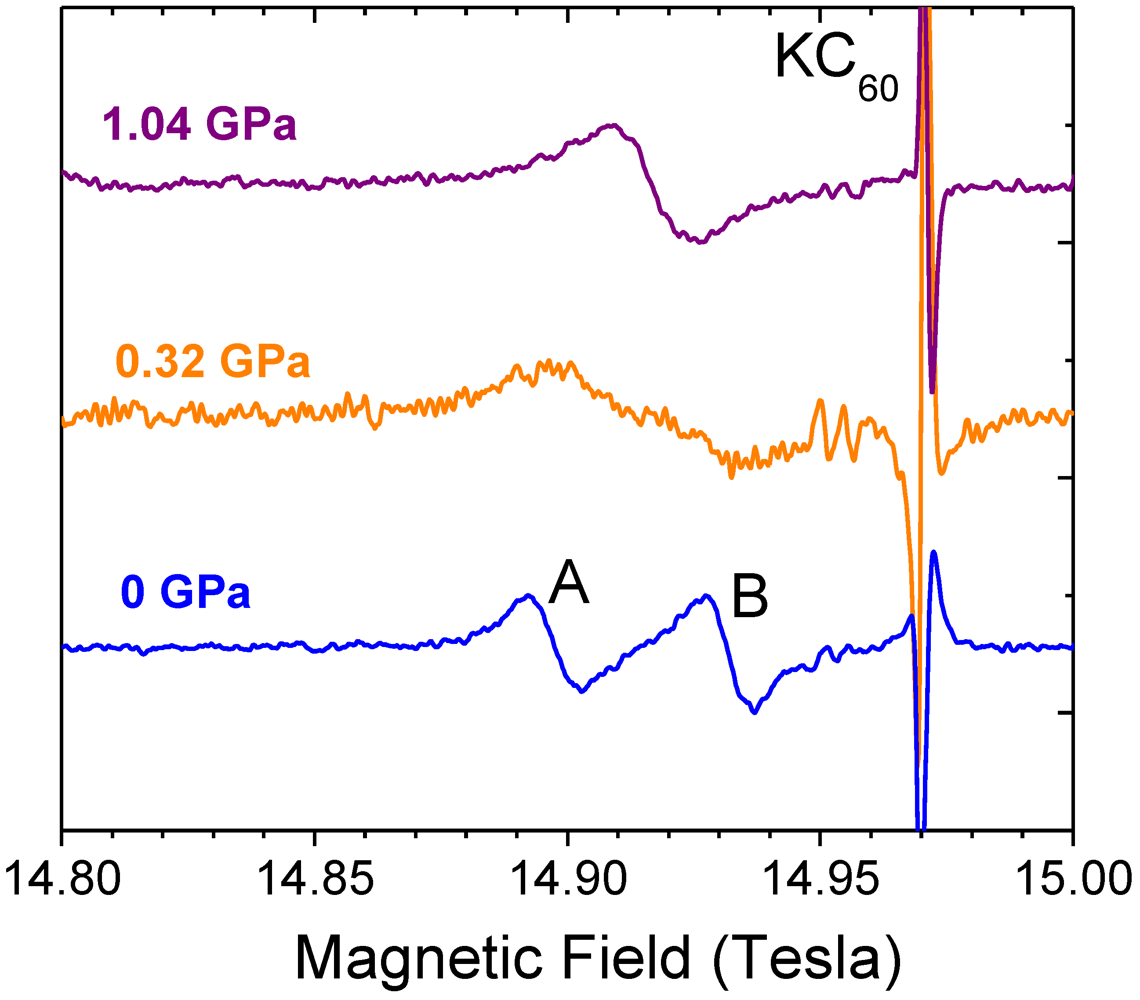
        <p><inline-graphic xmlns:xlink="http://www.w3.org/1999/xlink" xlink:href="crystals-02-00579-i007.tif"/> can be measured by electron spin resonance (ESR) in materials like <italic>κ</italic>-ET<sub>2</sub>-Cl where chemically equivalent but structurally different layers (denoted by <italic>A</italic> and <italic>B</italic> in <xref ref-type="fig" rid="crystals-02-00579-f001">Figure 1</xref>) alternate [<xref ref-type="bibr" rid="B8-crystals-02-00579">8</xref>]. If the <italic>A</italic> and <italic>B</italic> layers do not interact, the ESR spectrum is a superposition of two lines at the Larmor frequencies <italic>ν<sub>A</sub></italic> and <italic>ν<sub>B</sub></italic>. Since the <italic>g</italic>-factor tensors of <italic>A</italic> and <italic>B</italic> layers are differently oriented, the <italic>A</italic> and <italic>B</italic> lines are resolved in sufficiently high magnetic fields. In <italic>κ</italic>-ET<sub>2</sub>-Cl the splitting is largest in fields oriented along <inline-graphic xmlns:xlink="http://www.w3.org/1999/xlink" xlink:href="crystals-02-00579-i004.tif"/> in the (a,b) plane while it is zero in the (a,c) plane and in the principal crystallographic directions. For a finite interaction between adjacent layers the ESR spectrum depends on the strength of the interlayer interaction, <italic>i.e.</italic>, on the magnitude of <inline-graphic xmlns:xlink="http://www.w3.org/1999/xlink" xlink:href="crystals-02-00579-i007.tif"/>: </p>
        <list list-type="simple">
          <list-item>
            <p>(a) <inline-graphic xmlns:xlink="http://www.w3.org/1999/xlink" xlink:href="crystals-02-00579-i017.tif"/>. The two lines are resolved; the lineshapes differ only slightly from the non interacting case.</p>
          </list-item>
          <list-item>
            <p>(b) <inline-graphic xmlns:xlink="http://www.w3.org/1999/xlink" xlink:href="crystals-02-00579-i018.tif"/>. The spectrum has a complicated lineshape.</p>
          </list-item>
          <list-item>
            <p>(c) <inline-graphic xmlns:xlink="http://www.w3.org/1999/xlink" xlink:href="crystals-02-00579-i019.tif"/>. A “motionally narrowed" line appears at the frequency <inline-graphic xmlns:xlink="http://www.w3.org/1999/xlink" xlink:href="crystals-02-00579-i020.tif"/>. The linewidth depends on <inline-graphic xmlns:xlink="http://www.w3.org/1999/xlink" xlink:href="crystals-02-00579-i007.tif"/>.</p>
          </list-item>
        </list>
        <p>The three cases are demonstrated in <xref ref-type="fig" rid="crystals-02-00579-f002">Figure 2</xref> for <italic>κ</italic>-ET<sub>2</sub>-Cl. Here <inline-graphic xmlns:xlink="http://www.w3.org/1999/xlink" xlink:href="crystals-02-00579-i007.tif"/> was increased by applying pressure [<xref ref-type="bibr" rid="B7-crystals-02-00579">7</xref>].</p>
        <fig id="crystals-02-00579-f002" position="anchor">
          <label>Figure 2</label>
          <caption>
            <p>Motional narrowing of the ESR lines of adjacent <italic>A</italic> and <italic>B</italic> ET layers in <italic>κ</italic>-ET<sub>2</sub>-Cl under pressure (after [<xref ref-type="bibr" rid="B7-crystals-02-00579">7</xref>]). <bold>B</bold> || <inline-graphic xmlns:xlink="http://www.w3.org/1999/xlink" xlink:href="crystals-02-00579-i004.tif"/>. The spectra were measured at 420 GHz, <italic>T</italic> = 250 K and pressures of 0, 0.32 and 1.04 GPa. KC<sub>60</sub> is an ESR reference.</p>
          </caption>
          <graphic xmlns:xlink="http://www.w3.org/1999/xlink" xlink:href="crystals-02-00579-g002.tif"/>
        </fig>
        <p>To extract <inline-graphic xmlns:xlink="http://www.w3.org/1999/xlink" xlink:href="crystals-02-00579-i007.tif"/> and <inline-graphic xmlns:xlink="http://www.w3.org/1999/xlink" xlink:href="crystals-02-00579-i023.tif"/>, the lineshapes are fitted to spectra calculated from two coupled Bloch equations. The electronic exchange between layers represented by an effective magnetic field is also included in the fit. In this paper all data were obtained by fitting ESR spectra recorded at two frequencies, 222.4 GHz and 111.2 GHz. <italic>g<sub>A</sub></italic> and <italic>g<sub>B</sub></italic> were also free parameters, they change little with temperature.</p>
      </sec>
    </sec>
    <sec id="sec3-crystals-02-00579">
      <title>3. Relation between Interlayer Hopping <inline-graphic xmlns:xlink="http://www.w3.org/1999/xlink" xlink:href="crystals-02-00579-i007.tif"/> and Resistivity <inline-graphic xmlns:xlink="http://www.w3.org/1999/xlink" xlink:href="crystals-02-00579-i001.tif"/></title>
      <p><inline-graphic xmlns:xlink="http://www.w3.org/1999/xlink" xlink:href="crystals-02-00579-i007.tif"/> and <inline-graphic xmlns:xlink="http://www.w3.org/1999/xlink" xlink:href="crystals-02-00579-i001.tif"/> are closely related [<xref ref-type="bibr" rid="B12-crystals-02-00579">12</xref>]. The resistivity is proportional to the hopping time and inversely proportional to the density of available states, <italic>D</italic>. The electrical current <italic>j</italic> is given by </p>
      <p><disp-formula id="crystals-02-00579-i028">
          <inline-graphic xmlns:xlink="http://www.w3.org/1999/xlink" xlink:href="crystals-02-00579-i028.tif"/>
          <label>(1)</label>
          </disp-formula></p>
      <p> where <inline-graphic xmlns:xlink="http://www.w3.org/1999/xlink" xlink:href="crystals-02-00579-i029.tif"/> = <inline-graphic xmlns:xlink="http://www.w3.org/1999/xlink" xlink:href="crystals-02-00579-i030.tif"/> is the potential difference between adjacent layers due to the electric field <inline-graphic xmlns:xlink="http://www.w3.org/1999/xlink" xlink:href="crystals-02-00579-i031.tif"/>. The relation is particularly simple if the electrons of molecular layers form a Fermi liquid. Then <italic>D</italic> = <italic>D</italic>(<italic>E<sub>F</sub></italic>) is the density of states (DOS) per ET dimer for both spin directions of the metallic layers at the Fermi energy, <italic>E<sub>F</sub></italic>. The perpendicular conductivity calculated from the hopping rate is </p>
      <p><disp-formula id="crystals-02-00579-i034">
          <inline-graphic xmlns:xlink="http://www.w3.org/1999/xlink" xlink:href="crystals-02-00579-i034.tif"/>
          <label>(2)</label>
          </disp-formula></p>
      <p> where 1/<italic>F</italic> is the two dimensional charge carrier density. Assuming one hole/dimer in <italic>κ</italic>-ET<sub>2</sub>-Cl, <italic>F</italic> = (<italic>ac</italic>)/2, where <italic>a</italic> and <italic>c</italic> are the in-plane, <inline-graphic xmlns:xlink="http://www.w3.org/1999/xlink" xlink:href="crystals-02-00579-i038.tif"/> the out-of-plane lattice constants. The significance of Equation (2) lies in the possibility to determine the DOS from measurements of the perpendicular resistivity and spin cross relaxation time without knowing details of the barrier between layers: </p>
      <p><disp-formula id="crystals-02-00579-i039">
          <inline-graphic xmlns:xlink="http://www.w3.org/1999/xlink" xlink:href="crystals-02-00579-i039.tif"/>
          <label>(3)</label>
          </disp-formula></p>
      <p>In a simple semiconductor with a gap <italic>U</italic> and phonon assisted hopping with attempt frequency <italic>ν</italic><sub>0</sub>, the hopping rate is given by <inline-graphic xmlns:xlink="http://www.w3.org/1999/xlink" xlink:href="crystals-02-00579-i042.tif"/> and <inline-graphic xmlns:xlink="http://www.w3.org/1999/xlink" xlink:href="crystals-02-00579-i043.tif"/> is replaced by <inline-graphic xmlns:xlink="http://www.w3.org/1999/xlink" xlink:href="crystals-02-00579-i044.tif"/> in Equation (3).</p>
      <p>Interlayer hopping measured by ESR in non-irradiated <italic>κ</italic>-ET<sub>2</sub>-Cl and <italic>κ</italic>-ET<sub>2</sub>-Br crystals hasbeen discussed in detail in Reference [<xref ref-type="bibr" rid="B7-crystals-02-00579">7</xref>]. At 250 K the interlayer hopping time is <inline-graphic xmlns:xlink="http://www.w3.org/1999/xlink" xlink:href="crystals-02-00579-i045.tif"/> for the Cl compound and the same for the Br compound within experimental accuracy. The conduction is quasi-two-dimensional: at 250 K electrons are confined to single layers for times several orders of magnitude longer than the momentum relaxation time. The density of states estimated from Equation (2) is about a factor of 5 larger than calculated from the band structure. Between 250 K and 50 K <italic>T<sub>x</sub></italic> increases rapidly with decreasing temperature in the Cl compound while it is about constant in the Br compound.</p>
    </sec>
    <sec id="sec4-crystals-02-00579">
      <title>4. Interlayer Hopping Rate and Resistivity above the Metal Insulator Transition</title>
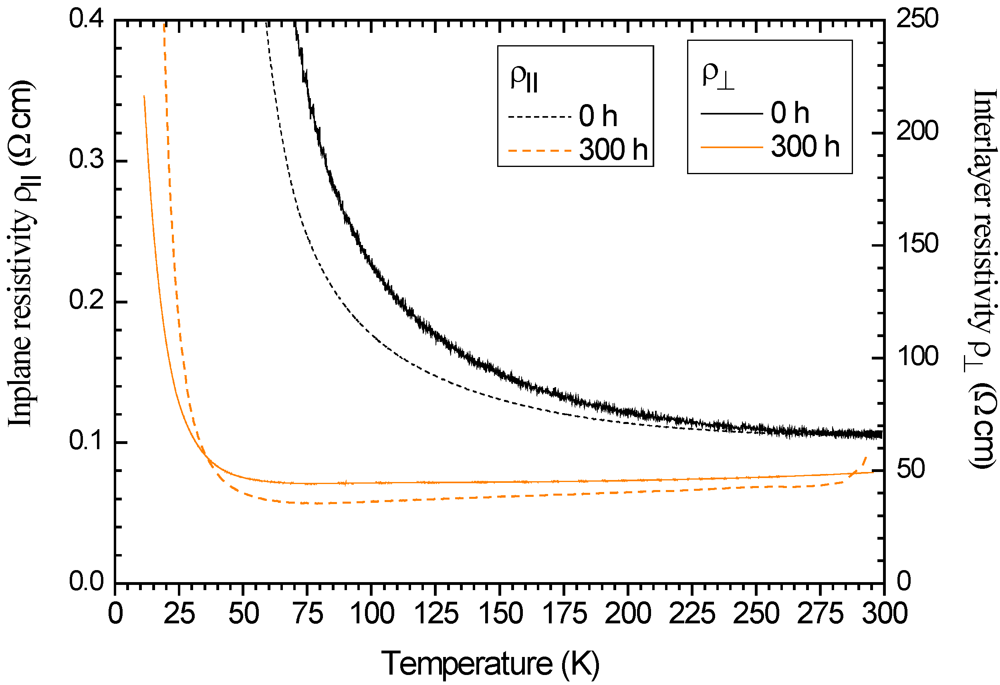
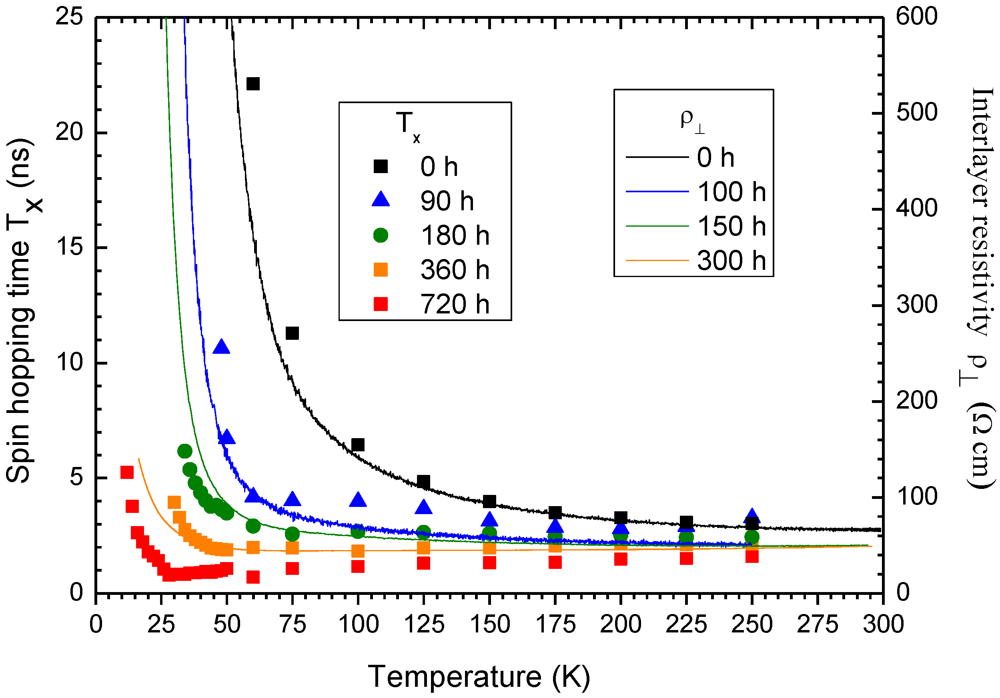
      <p>The experimental data of the cross relaxation time <inline-graphic xmlns:xlink="http://www.w3.org/1999/xlink" xlink:href="crystals-02-00579-i047.tif"/> and the perpendicular resistivity <inline-graphic xmlns:xlink="http://www.w3.org/1999/xlink" xlink:href="crystals-02-00579-i001.tif"/> above the metal-insulator transition at various irradiation doses are summarized in <xref ref-type="fig" rid="crystals-02-00579-f003">Figure 3</xref>. The irradiation doses are in the same range in the two experiments. The scales of <italic>T<sub>x</sub></italic> and <inline-graphic xmlns:xlink="http://www.w3.org/1999/xlink" xlink:href="crystals-02-00579-i001.tif"/> are chosen in the figure so that the experimental points of <italic>T<sub>x</sub></italic> and <inline-graphic xmlns:xlink="http://www.w3.org/1999/xlink" xlink:href="crystals-02-00579-i001.tif"/> coincide at 250 K for the non-irradiated sample. <xref ref-type="fig" rid="crystals-02-00579-f004">Figure 4</xref> displays the in-plane and interplane resistivities <italic>ρ</italic><sub>||</sub> and <inline-graphic xmlns:xlink="http://www.w3.org/1999/xlink" xlink:href="crystals-02-00579-i001.tif"/> respectively of non-irradiated and 300 h irradiated samples. The resistivities in <xref ref-type="fig" rid="crystals-02-00579-f003">Figure 3</xref> and <xref ref-type="fig" rid="crystals-02-00579-f004">Figure 4</xref> are similar to the ones measured on a different crystal in Reference [<xref ref-type="bibr" rid="B6-crystals-02-00579">6</xref>]. The resistivity <inline-graphic xmlns:xlink="http://www.w3.org/1999/xlink" xlink:href="crystals-02-00579-i048.tif"/> in this work agrees reasonably well with the measurements of Reference [<xref ref-type="bibr" rid="B13-crystals-02-00579">13</xref>].</p>
      <p>We note from <xref ref-type="fig" rid="crystals-02-00579-f003">Figure 3</xref> that the interlayer hopping time and the perpendicular resistivity are to a good approximation proportional for all irradiation doses and in the full temperature range above 50 K. The non-irradiated sample has a semiconducting behavior with <italic>T<sub>x</sub></italic> and <inline-graphic xmlns:xlink="http://www.w3.org/1999/xlink" xlink:href="crystals-02-00579-i001.tif"/> smoothly increasing as the temperature is decreased. On the contrary, the 180 h and more irradiated samples have a metallic like behavior: <italic>T<sub>x</sub></italic> and <inline-graphic xmlns:xlink="http://www.w3.org/1999/xlink" xlink:href="crystals-02-00579-i001.tif"/> decrease with decreasing temperature. In the irradiated samples the abrupt metal-insulator transition is qualitatively different from the smooth transition in the non-irradiated sample. Furthermore, irradiation shifts the transition to lower temperatures.</p>
      <p><xref ref-type="fig" rid="crystals-02-00579-f004">Figure 4</xref> shows that <inline-graphic xmlns:xlink="http://www.w3.org/1999/xlink" xlink:href="crystals-02-00579-i001.tif"/> and <italic>ρ</italic><sub>||</sub> have similar temperature and irradiation dependence. The ratio <inline-graphic xmlns:xlink="http://www.w3.org/1999/xlink" xlink:href="crystals-02-00579-i001.tif"/>/<italic>ρ</italic><sub>||</sub> is about 600 independent of temperature for both the irradiated and non-irradiated samples. This ratio, even if uncertain, is typical for measurements in the literature.</p>
      <fig id="crystals-02-00579-f003" position="anchor">
        <label>Figure 3</label>
        <caption>
          <p>Comparison of the temperature dependence of the spin hopping time <inline-graphic xmlns:xlink="http://www.w3.org/1999/xlink" xlink:href="crystals-02-00579-i049.tif"/> and interlayer resistivity <inline-graphic xmlns:xlink="http://www.w3.org/1999/xlink" xlink:href="crystals-02-00579-i050.tif"/> in <italic>κ</italic>-ET<sub>2</sub>-Cl. Left scale: <italic>T<sub>x</sub></italic> after 0, 90, 180, 360 and 720 h of irradiation. Right scale: <inline-graphic xmlns:xlink="http://www.w3.org/1999/xlink" xlink:href="crystals-02-00579-i001.tif"/> after 0, 100, 150 and 300 h of irradiation. </p>
        </caption>
        <graphic xmlns:xlink="http://www.w3.org/1999/xlink" xlink:href="crystals-02-00579-g003.tif"/>
      </fig>
      <fig id="crystals-02-00579-f004" position="anchor">
        <label>Figure 4</label>
        <caption>
          <p>Comparison of in-plane resistivity <italic>ρ</italic><sub>||</sub> and interlayer resistivity <inline-graphic xmlns:xlink="http://www.w3.org/1999/xlink" xlink:href="crystals-02-00579-i001.tif"/> in non-irradiated and 300 hours irradiated <italic>κ</italic>-ET<sub>2</sub>-Cl. <italic>ρ</italic><sub>||</sub> and <inline-graphic xmlns:xlink="http://www.w3.org/1999/xlink" xlink:href="crystals-02-00579-i001.tif"/> were measured on different samples. </p>
        </caption>
        <graphic xmlns:xlink="http://www.w3.org/1999/xlink" xlink:href="crystals-02-00579-g004.tif"/>
      </fig>
      <sec id="sec4dot1-crystals-02-00579">
        <title>4.1. Irradiation Dependence of <inline-graphic xmlns:xlink="http://www.w3.org/1999/xlink" xlink:href="crystals-02-00579-i007.tif"/> and <inline-graphic xmlns:xlink="http://www.w3.org/1999/xlink" xlink:href="crystals-02-00579-i052.tif"/> at 250 K</title>
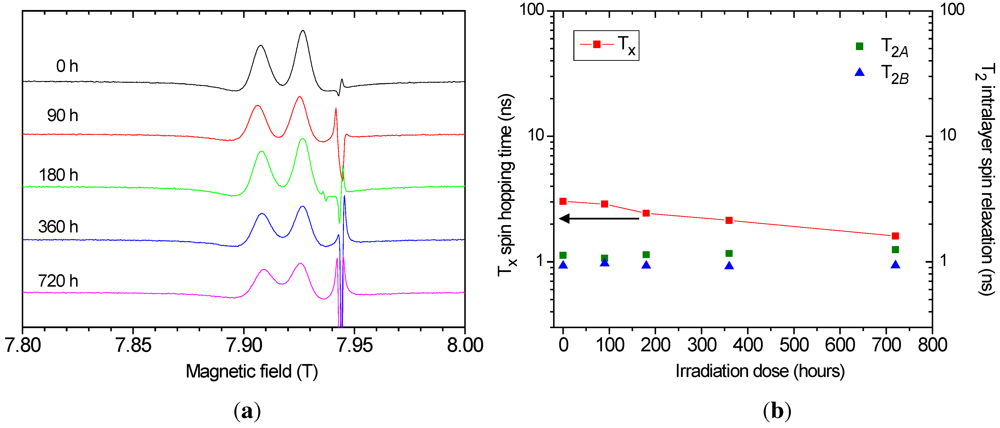
        <p>The 250 K ESR spectra change little under irradiation (<xref ref-type="fig" rid="crystals-02-00579-f005">Figure 5</xref>a). Even at the highest irradiation dose the interlayer hopping rate remains low since the <italic>A</italic> and <italic>B</italic> layer lines are well resolved. <xref ref-type="fig" rid="crystals-02-00579-f005">Figure 5</xref>b shows the cross relaxation <italic>T<sub>x</sub></italic> and intrinsic relaxations <inline-graphic xmlns:xlink="http://www.w3.org/1999/xlink" xlink:href="crystals-02-00579-i053.tif"/> and <inline-graphic xmlns:xlink="http://www.w3.org/1999/xlink" xlink:href="crystals-02-00579-i054.tif"/> calculated from the spectra. <italic>T<sub>x</sub></italic> decreases by less then a factor of 2 for the largest dose while <inline-graphic xmlns:xlink="http://www.w3.org/1999/xlink" xlink:href="crystals-02-00579-i053.tif"/> and <inline-graphic xmlns:xlink="http://www.w3.org/1999/xlink" xlink:href="crystals-02-00579-i054.tif"/> are not changed significantly by the irradiation.</p>
        <p>The mean free path within ET layers is shorter than the molecular separation, implying a very short in-plane electronic momentum lifetime. In contrast, out of plane hopping events are rare, <inline-graphic xmlns:xlink="http://www.w3.org/1999/xlink" xlink:href="crystals-02-00579-i007.tif"/> in <italic>κ</italic>-ET<sub>2</sub>-Cl is about <inline-graphic xmlns:xlink="http://www.w3.org/1999/xlink" xlink:href="crystals-02-00579-i055.tif"/> and electrons diffuse to long distances without hopping to adjacent layers. Although the irradiation increases somewhat <inline-graphic xmlns:xlink="http://www.w3.org/1999/xlink" xlink:href="crystals-02-00579-i007.tif"/>, electrons remain confined to single molecular layers for long times. In addition, <inline-graphic xmlns:xlink="http://www.w3.org/1999/xlink" xlink:href="crystals-02-00579-i056.tif"/>, the electronic spin relaxation time within the conducting ET layers, is independent of irradiation. Usually charged defects effectively increase the spin relaxation rate in conductors. The insensitivity of <inline-graphic xmlns:xlink="http://www.w3.org/1999/xlink" xlink:href="crystals-02-00579-i056.tif"/> to irradiation and the relatively small decrease in <italic>T<sub>x</sub></italic> are in agreement with earlier findings [<xref ref-type="bibr" rid="B9-crystals-02-00579">9</xref>] that the concentration of induced defects is small even under the largest dose.</p>
        <fig id="crystals-02-00579-f005" position="anchor">
          <label>Figure 5</label>
          <caption>
            <p>(<bold>a</bold>) ESR spectra of <italic>κ</italic>-ET<sub>2</sub>-Cl at 222.4 GHz and 250 K after different doses of X-ray irradiation. There is a small impurity line at 7.935 T in the spectrum of the sample irradiated for 180 h, not present in the other spectra. The signal at 7.943 T is the KC<sub>60</sub> reference; (<bold>b</bold>) Irradiation dose dependence of <italic>T<sub>x</sub></italic> and <inline-graphic xmlns:xlink="http://www.w3.org/1999/xlink" xlink:href="crystals-02-00579-i056.tif"/> at 250 K.</p>
          </caption>
          <graphic xmlns:xlink="http://www.w3.org/1999/xlink" xlink:href="crystals-02-00579-g005.tif"/>
        </fig>
        <fig id="crystals-02-00579-f006" position="anchor">
          <label>Figure 6</label>
          <caption>
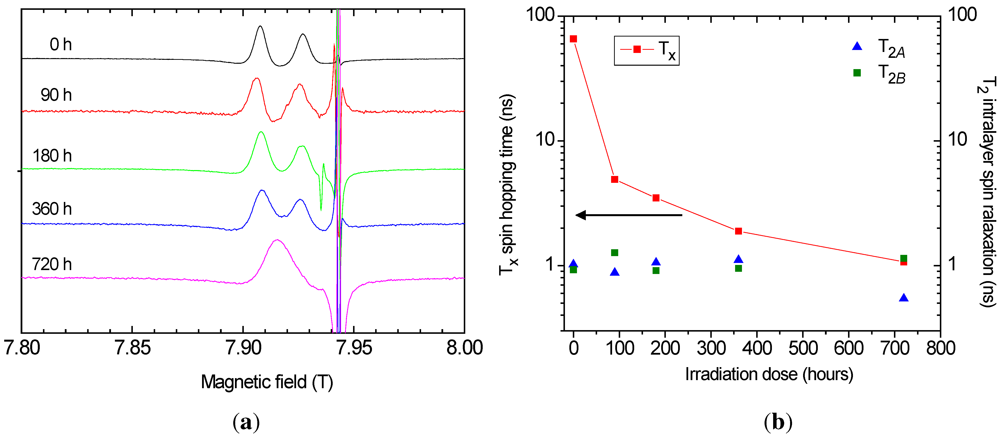
            <p>(<bold>a</bold>) ESR spectra of <italic>κ</italic>-ET<sub>2</sub>-Cl at 222.4 GHz and 50 K as a function of X-ray irradiation dose. The line at 7.935 T for 180 h irradiation, not present in the other spectra, is an impurity line. The signal at 7.943 T is a KC<sub>60</sub> reference; (<bold>b</bold>) Irradiation dose dependence of <italic>T<sub>x</sub></italic> and <inline-graphic xmlns:xlink="http://www.w3.org/1999/xlink" xlink:href="crystals-02-00579-i056.tif"/> at 50 K. </p>
          </caption>
          <graphic xmlns:xlink="http://www.w3.org/1999/xlink" xlink:href="crystals-02-00579-g006.tif"/>
        </fig>
      </sec>
      <sec>
        <title>4.2. Irradiation Dependence of <inline-graphic xmlns:xlink="http://www.w3.org/1999/xlink" xlink:href="crystals-02-00579-i007.tif"/> and <inline-graphic xmlns:xlink="http://www.w3.org/1999/xlink" xlink:href="crystals-02-00579-i023.tif"/> at 50 K</title>
        <p><xref ref-type="fig" rid="crystals-02-00579-f006">Figure 6</xref> displays the irradiation dependence of the ESR spectra at 222.4 GHz and the spin relaxation times. The interlayer hopping time <italic>T<sub>x</sub></italic> decreases rapidly with irradiation, especially at low doses. On the other hand, the intrinsic spin relaxation is not sensitive to the irradiation. The single ESR line at 720 h irradiation has an ESR-frequency-dependent width and illustrates the “motional narrowing” case described in <xref ref-type="sec" rid="sec2dot1-crystals-02-00579">Section 2.1</xref>.</p>
      </sec>
    </sec>
    <sec sec-type="discussion" id="sec5-crystals-02-00579">
      <title>5 Discussion</title>
      <p>We first list the main findings of the present and earlier works on the conducting and magnetic properties in the temperature range between 50 K and 250 K. (Below this temperature the properties change).</p>
      <list list-type="simple">
        <list-item>
          <p>(1) The perpendicular resistivity <inline-graphic xmlns:xlink="http://www.w3.org/1999/xlink" xlink:href="crystals-02-00579-i001.tif"/> is semiconducting-like in non-irradiated <italic>κ</italic>-ET<sub>2</sub>-Cl. Irradiation decreases <inline-graphic xmlns:xlink="http://www.w3.org/1999/xlink" xlink:href="crystals-02-00579-i001.tif"/> in the full temperature range, the decrease is non-linear with dose. At higher doses the resistivity is metallic, <italic>i.e.</italic>, it increases linearly with temperature.</p>
        </list-item>
        <list-item>
          <p>(2) The interlayer spin hopping time <italic>T<sub>x</sub></italic> and <inline-graphic xmlns:xlink="http://www.w3.org/1999/xlink" xlink:href="crystals-02-00579-i001.tif"/> have the same temperature and irradiation dose dependence. The ratio <inline-graphic xmlns:xlink="http://www.w3.org/1999/xlink" xlink:href="crystals-02-00579-i058.tif"/> is independent of temperature and irradiation dose.</p>
        </list-item>
        <list-item>
          <p>(3) The resistivity anisotropy <inline-graphic xmlns:xlink="http://www.w3.org/1999/xlink" xlink:href="crystals-02-00579-i001.tif"/>/<italic>ρ</italic><sub>||</sub> is typically between 100 and 1000. It is independent of temperature and irradiation dose.</p>
        </list-item>
        <list-item>
          <p>(4) The magnetic spin susceptibility is approximately temperature independent and does not change with irradiation [<xref ref-type="bibr" rid="B9-crystals-02-00579">9</xref>].</p>
        </list-item>
        <list-item>
          <p>(5) Theintralayer spin relaxation time <inline-graphic xmlns:xlink="http://www.w3.org/1999/xlink" xlink:href="crystals-02-00579-i056.tif"/> is independent of temperature and dose.</p>
        </list-item>
      </list>
      <p>The interpretation of the qualitative change in transport properties by irradiation in <italic>κ</italic>-ET<sub>2</sub>-Cl poses a difficult problem. Matthiessen’s rule describes the change of resistivity by defects in usual metals. Impurity scattering in metals increase the resistivity by a temperature independent quantity, the increase is linear with defect concentration and the temperature dependent phonon resistivity is not affected. Clearly, nothing of this applies to <italic>κ</italic>-ET<sub>2</sub>-Cl: irradiation <italic>decreases</italic> the resistivity, the decrease is non-linear with defect concentration and the temperature dependence is drastically changed from semiconducting like to metallic.</p>
      <p>At the same time other quantities that depend sensitively on the electronic structure are independent of temperature and defect concentration. In Fermi liquids the magnetic spin susceptibility <inline-graphic xmlns:xlink="http://www.w3.org/1999/xlink" xlink:href="crystals-02-00579-i059.tif"/> and the perpendicular hopping time to resistivity ratio <inline-graphic xmlns:xlink="http://www.w3.org/1999/xlink" xlink:href="crystals-02-00579-i058.tif"/> are both proportional to the density of states. Although <italic>κ</italic>-ET<sub>2</sub>-Cl is a strongly correlated system and at high temperatures there are no long lifetime quasi-particles, the independence of the susceptibility and the <inline-graphic xmlns:xlink="http://www.w3.org/1999/xlink" xlink:href="crystals-02-00579-i058.tif"/> ratio indicate that the electronic structure is not strongly affected by the irradiation. The defect dose independence of <inline-graphic xmlns:xlink="http://www.w3.org/1999/xlink" xlink:href="crystals-02-00579-i056.tif"/>, the relatively small decrease of <italic>T<sub>x</sub></italic> at 250 K with dose and earlier magnetic measurements [<xref ref-type="bibr" rid="B9-crystals-02-00579">9</xref>] indicate that the defect concentration is small.</p>
      <p>Sasaki <italic>et al</italic>. [<xref ref-type="bibr" rid="B6-crystals-02-00579">6</xref>] proposed that irradiation of organic layered compounds has two effects: it increases the electron momentum scattering rate and at the same time dopes the material. By creating localized electrons at defects in the anion layer and delocalized holes in the conducting molecular layers a charge imbalance from half filling takes place. In metallic compounds far from the Mott transition, like <italic>κ</italic>-(BETS)<sub>2</sub> FeCl<sub>4</sub>, defects enhance the electron scattering as in other metals. In materials close to the Mott metal-insulator transition, doping of holes changes the electronic properties drastically as the band is no more half filled. At high temperatures the extra holes change the semiconducting behavior to metallic, at low temperatures the metal-insulator and the magnetic ordering transitions are suppressed. To understand the measured electric and magnetic properties one has to assume that the small deviation from half band filling changes the resistivity from semiconducting to metallic-like but has little effect on the band structure in general.</p>
      <p>It is not simple to understand within the model the independence of the resistivity anisotropy from irradiation induced defect concentration. Why does adding high mobility carriers increase the in-plane conductivity and the interlayer hopping time in the same way? Kumar and Jayannavar [<xref ref-type="bibr" rid="B12-crystals-02-00579">12</xref>] proposed a mechanism for a temperature independent anisotropy <inline-graphic xmlns:xlink="http://www.w3.org/1999/xlink" xlink:href="crystals-02-00579-i001.tif"/>/<italic>ρ</italic><sub>||</sub> in materials where the perpendicular conductivity is incoherent. They showed that if the in-plane scattering time <inline-graphic xmlns:xlink="http://www.w3.org/1999/xlink" xlink:href="crystals-02-00579-i060.tif"/> is much shorter than the interlayer hopping time <inline-graphic xmlns:xlink="http://www.w3.org/1999/xlink" xlink:href="crystals-02-00579-i061.tif"/>, then the ratio <inline-graphic xmlns:xlink="http://www.w3.org/1999/xlink" xlink:href="crystals-02-00579-i001.tif"/>/<italic>ρ</italic><sub>||</sub> is independent of <inline-graphic xmlns:xlink="http://www.w3.org/1999/xlink" xlink:href="crystals-02-00579-i060.tif"/>. To understand the doping independence of <inline-graphic xmlns:xlink="http://www.w3.org/1999/xlink" xlink:href="crystals-02-00579-i001.tif"/>/<italic>ρ</italic><sub>||</sub> one has to assume that irradiation introduces carriers with an increased <inline-graphic xmlns:xlink="http://www.w3.org/1999/xlink" xlink:href="crystals-02-00579-i060.tif"/> but at the same time the parallel and perpendicular electronic overlap integrals remain unchanged.</p>
      <p>A different approach has been proposed by Analytis <italic>et al</italic>. [<xref ref-type="bibr" rid="B14-crystals-02-00579">14</xref>]. They assumed that irradiation creates two kinds of defects. Like in the model of Sasaki <italic>et al</italic>., some defects increase the electronic scattering rate. There is a further defect-assisted interlayer channel which decreases the interlayer resistivity. This model gives a good description of the irradiation dose dependence of <inline-graphic xmlns:xlink="http://www.w3.org/1999/xlink" xlink:href="crystals-02-00579-i001.tif"/> in <italic>κ</italic>-(BEDT-TTF)<sub>2</sub> Cu(SCN)<sub>2</sub>, an organic conductor close to the Mott transition. The in-plane resistivity is assumed to be small and without any effect on <inline-graphic xmlns:xlink="http://www.w3.org/1999/xlink" xlink:href="crystals-02-00579-i001.tif"/>. A defect-assisted interplane conductivity has also been proposed [<xref ref-type="bibr" rid="B15-crystals-02-00579">15</xref>] to explain the metallic zero frequency interplane conductivity and the absence of a Drude peak in the optical conductivity in <italic>κ</italic>-ET<sub>2</sub>-Br. However, it is difficult to understand within this model the irradiation and temperature independence of the anisotropy between 50 and 250 K in <italic>κ</italic>-ET<sub>2</sub>-Cl. Due to difficulties in contacting and/or macroscopic sample imperfections, the current is usually inhomogeneous in strongly anisotropic conductors and in general the interlayer resistivity affects in-plane measurements. If <italic>ρ</italic><sub>||</sub> is very small, the contribution of <inline-graphic xmlns:xlink="http://www.w3.org/1999/xlink" xlink:href="crystals-02-00579-i001.tif"/> might dominate the apparent in-plane resistivity. This would explain that <inline-graphic xmlns:xlink="http://www.w3.org/1999/xlink" xlink:href="crystals-02-00579-i001.tif"/> and <italic>ρ</italic><sub>||</sub> have (apparently) the same temperature dependence both for the non-irradiated and irradiated crystal. However, this model does not explain why the anisotropy is independent of irradiation dose.</p>
    </sec>
    <sec sec-type="conclusions">
      <title>6 Conclusions</title>
      <p>In <italic>κ</italic>-ET<sub>2</sub>-Cl, the interplane spin cross relaxation time measured by high frequency ESR is proportional to the interplane resistivity in the temperature range between 50 and 250 K. The ratio <inline-graphic xmlns:xlink="http://www.w3.org/1999/xlink" xlink:href="crystals-02-00579-i058.tif"/> is unchanged in the range of irradiation doses where the resistivity changes from a semiconductor-like behavior to metallic. Since <italic>κ</italic>-ET<sub>2</sub>-Cl is a strongly correlated conductor close to the metal insulator and magnetic ordering transitions, the spin and charge hopping rates could have different temperature or doping dependence. The insensitivity of <inline-graphic xmlns:xlink="http://www.w3.org/1999/xlink" xlink:href="crystals-02-00579-i058.tif"/> to doping and temperature makes this unlikely. The qualitative change of the temperature dependence of the resistivity with irradiation and the insensitivity of other quantities depending on the density of states poses a difficult problem, which is not yet satisfactorily resolved.</p>
    </sec>
  </body>
  <back>
    <ack>
      <title>Acknowledgements</title>
      <p>We acknowledge the Hungarian National Research Fund OTKA NN76727, CNK80991, CK84324, the New Hungary Development Plan TÁMOP-4.2.1/B-09/1/KMR-2010-0002. </p>
    </ack>
    <ref-list>
      <title>References</title>
      <ref id="B1-crystals-02-00579">
        <label>1.</label>
        <citation citation-type="journal">
          <person-group person-group-type="author">
            <name>
              <surname>Williams</surname>
              <given-names>J.M.</given-names>
            </name>
            <name>
              <surname>Kini</surname>
              <given-names>A.M.</given-names>
            </name>
            <name>
              <surname>Wang</surname>
              <given-names>H.H.</given-names>
            </name>
            <name>
              <surname>Carlson</surname>
              <given-names>K.D.</given-names>
            </name>
            <name>
              <surname>Geiser</surname>
              <given-names>U.</given-names>
            </name>
            <name>
              <surname>Montgomery</surname>
              <given-names>L.K.</given-names>
            </name>
            <name>
              <surname>Pyrka</surname>
              <given-names>G.J.</given-names>
            </name>
            <name>
              <surname>Watkins</surname>
              <given-names>D.M.</given-names>
            </name>
            <name>
              <surname>Kommers</surname>
              <given-names>J.M.</given-names>
            </name>
            <name>
              <surname>Boryschuk</surname>
              <given-names>S.J.</given-names>
            </name>
            <name>
              <surname>Crouch</surname>
              <given-names>A.V.S.</given-names>
            </name>
            <name>
              <surname>Kwok</surname>
              <given-names>W.K.</given-names>
            </name>
            <name>
              <surname>Schirber</surname>
              <given-names>J.E.</given-names>
            </name>
            <name>
              <surname>Overmyer</surname>
              <given-names>D.L.</given-names>
            </name>
            <name>
              <surname>Jung</surname>
              <given-names>D.</given-names>
            </name>
            <name>
              <surname>Whangbo</surname>
              <given-names>M.H.</given-names>
            </name>
          </person-group>
          <article-title>From semiconductor semiconductor transition (42 K) to the highest-12.5 k organic superconductor, Kappa-(ET)<sub>2</sub>Cu[N(Cn)<sub>2</sub>]Cl</article-title>
          <source>Inorg.Chem.</source>
          <year>1990</year>
          <volume>29</volume>
          <fpage>3272</fpage>
          <lpage>3274</lpage>
        <pub-id pub-id-type="doi">10.1021/ic00343a003</pub-id></citation>
      </ref>
      <ref id="B2-crystals-02-00579">
        <label>2.</label>
        <citation citation-type="journal">
          <person-group person-group-type="author">
            <name>
              <surname>Miyagawa</surname>
              <given-names>K.</given-names>
            </name>
            <name>
              <surname>Kawamoto</surname>
              <given-names>A.</given-names>
            </name>
            <name>
              <surname>Nakazawa</surname>
              <given-names>Y.</given-names>
            </name>
            <name>
              <surname>Kanoda</surname>
              <given-names>K.</given-names>
            </name>
          </person-group>
          <article-title>Antiferromagnetic Ordering and Spin Structure in the Organic Conductor, <italic>κ</italic>-(BEDT-TTF)<sub>2</sub>Cu[N(CN)<sub>2</sub>]Cl</article-title>
          <source>Phys. Rev. Lett.</source>
          <year>1995</year>
          <volume>75</volume>
          <fpage>1174</fpage>
          <lpage>1177</lpage>
          <pub-id pub-id-type="doi">10.1103/PhysRevLett.75.1174</pub-id>
        </citation>
      </ref>
      <ref id="B3-crystals-02-00579">
        <label>3.</label>
        <citation citation-type="journal">
          <person-group person-group-type="author">
            <name>
              <surname>Welp</surname>
              <given-names>U.</given-names>
            </name>
            <name>
              <surname>Fleshler</surname>
              <given-names>S.</given-names>
            </name>
            <name>
              <surname>Kwok</surname>
              <given-names>W.K.</given-names>
            </name>
            <name>
              <surname>Crabtree</surname>
              <given-names>G.W.</given-names>
            </name>
            <name>
              <surname>Carlson</surname>
              <given-names>K.D.</given-names>
            </name>
            <name>
              <surname>Wang</surname>
              <given-names>H.H.</given-names>
            </name>
            <name>
              <surname>Geiser</surname>
              <given-names>U.</given-names>
            </name>
            <name>
              <surname>Williams</surname>
              <given-names>J.M.</given-names>
            </name>
            <name>
              <surname>Hitsman</surname>
              <given-names>V.M.</given-names>
            </name>
          </person-group>
          <article-title>Weak ferromagnetism in <italic>κ</italic>-(ET)<sub>2</sub>Cu[N(CN]<sub>2</sub>Cl, where (ET) is bis(ethylenedithio)tetrathiafulvalene</article-title>
          <source>Phys. Rev. Lett.</source>
          <year>1992</year>
          <volume>69</volume>
          <fpage>840</fpage>
          <lpage>843</lpage>
          <pub-id pub-id-type="doi">10.1103/PhysRevLett.69.840</pub-id>
        </citation>
      </ref>
      <ref id="B4-crystals-02-00579">
        <label>4.</label>
        <citation citation-type="journal">
          <person-group person-group-type="author">
            <name>
              <surname>Kawamoto</surname>
              <given-names>A.</given-names>
            </name>
            <name>
              <surname>Miyagawa</surname>
              <given-names>K.</given-names>
            </name>
            <name>
              <surname>Nakazawa</surname>
              <given-names>Y.</given-names>
            </name>
            <name>
              <surname>Kanoda</surname>
              <given-names>K.</given-names>
            </name>
          </person-group>
          <article-title>Electron correlation in the <italic>κ</italic>-phase family of BEDT-TTF compounds studied by <sup>13</sup><italic>C</italic> NMR, where BEDT-TTF is bis(ethylenedithio)tetrathiafulvalene</article-title>
          <source>Phys. Rev. B</source>
          <year>1995</year>
          <volume>52</volume>
          <fpage>15522</fpage>
          <lpage>15533</lpage>
          <pub-id pub-id-type="doi">10.1103/PhysRevB.52.15522</pub-id>
        </citation>
      </ref>
      <ref id="B5-crystals-02-00579">
        <label>5.</label>
        <citation citation-type="journal">
          <person-group person-group-type="author">
            <name>
              <surname>Antal</surname>
              <given-names>A.</given-names>
            </name>
            <name>
              <surname>Fehér</surname>
              <given-names>T.</given-names>
            </name>
            <name>
              <surname>Jánossy</surname>
              <given-names>A.</given-names>
            </name>
            <name>
              <surname>Tátrai-Szekeres</surname>
              <given-names>E.</given-names>
            </name>
            <name>
              <surname>Fülöp</surname>
              <given-names>F.</given-names>
            </name>
          </person-group>
          <article-title>Spin diffusion and magnetic eigenoscillations confined to single molecular layers in the organic conductors <italic>κ</italic>-(BEDT-TTF)<sub>2</sub> Cu[N(CN)<sub>2</sub>]<italic>X</italic> (<italic>X</italic>=Cl, Br)</article-title>
          <source>Phys. Rev. Lett.</source>
          <year>2009</year>
          <volume>102</volume>
          <pub-id pub-id-type="doi">10.1103/PhysRevLett.102.086404</pub-id>
        </citation>
      </ref>
      <ref id="B6-crystals-02-00579">
        <label>6.</label>
        <citation citation-type="journal">
          <person-group person-group-type="author">
            <name>
              <surname>Sasaki</surname>
              <given-names>T.</given-names>
            </name>
            <name>
              <surname>Oizumi</surname>
              <given-names>H.</given-names>
            </name>
            <name>
              <surname>Yoneyama</surname>
              <given-names>N.</given-names>
            </name>
            <name>
              <surname>Kobayashi</surname>
              <given-names>N.</given-names>
            </name>
            <name>
              <surname>Toyota</surname>
              <given-names>N.</given-names>
            </name>
          </person-group>
          <article-title>X-ray irradiation-induced carrier doping effects in organic dimer–mott insulators</article-title>
          <source>J. Phys. Soc. Jpn.</source>
          <year>2007</year>
          <volume>76</volume>
          <pub-id pub-id-type="doi">10.1143/JPSJ.76.123701</pub-id>
        </citation>
      </ref>
      <ref id="B7-crystals-02-00579">
        <label>7.</label>
        <citation citation-type="journal">
          <person-group person-group-type="author">
            <name>
              <surname>Antal</surname>
              <given-names>A.</given-names>
            </name>
            <name>
              <surname>Fehér</surname>
              <given-names>T.</given-names>
            </name>
            <name>
              <surname>Tátrai-Szekeres</surname>
              <given-names>E.</given-names>
            </name>
            <name>
              <surname>Fülöp</surname>
              <given-names>F.</given-names>
            </name>
            <name>
              <surname>Náfrádi</surname>
              <given-names>B.</given-names>
            </name>
            <name>
              <surname>Forró</surname>
              <given-names>L.</given-names>
            </name>
            <name>
              <surname>Jánossy</surname>
              <given-names>A. </given-names>
            </name>
          </person-group>
          <article-title>Pressure and temperature dependence of interlayer spin diffusion and electrical conductivity in the layered organic conductors <italic>κ</italic>-(BEDT-TTF)<sub>2</sub> Cu[N(CN)<sub>2</sub>]<italic>X</italic> (<italic>X</italic> = Cl, Br)</article-title>
          <source>Phys. Rev. B</source>
          <year>2011</year>
          <volume>84</volume>
          <pub-id pub-id-type="doi">10.1103/PhysRevB.84.075124</pub-id>
        </citation>
      </ref>
      <ref id="B8-crystals-02-00579">
        <label>8.</label>
        <citation citation-type="journal">
          <person-group person-group-type="author">
            <name>
              <surname>Antal</surname>
              <given-names>A.</given-names>
            </name>
            <name>
              <surname>Fehér</surname>
              <given-names>T.</given-names>
            </name>
            <name>
              <surname>Náfrádi</surname>
              <given-names>B.</given-names>
            </name>
            <name>
              <surname>Gaál</surname>
              <given-names>R.</given-names>
            </name>
            <name>
              <surname>Forró</surname>
              <given-names>L.</given-names>
            </name>
            <name>
              <surname>Jánossy</surname>
              <given-names>A.</given-names>
            </name>
          </person-group>
          <article-title>Measurement of interlayer spin diffusion in the organic conductor <italic>κ</italic>-(BEDT-TTF)<sub>2</sub> Cu[N(CN)<sub>2</sub>]X, X =Cl, Br</article-title>
          <source>Phys. B Condens.Matter</source>
          <year>2010</year>
          <volume>405</volume>
          <fpage>168</fpage>
          <lpage>171</lpage>
        <pub-id pub-id-type="doi">10.1016/j.physb.2009.11.024</pub-id></citation>
      </ref>
      <ref id="B9-crystals-02-00579">
        <label>9.</label>
        <citation citation-type="journal">
          <person-group person-group-type="author">
            <name>
              <surname>Yoneyama</surname>
              <given-names>N.</given-names>
            </name>
            <name>
              <surname>Furukawa</surname>
              <given-names>K.</given-names>
            </name>
            <name>
              <surname>Nakamura</surname>
              <given-names>T.</given-names>
            </name>
            <name>
              <surname>Sasaki</surname>
              <given-names>T.</given-names>
            </name>
            <name>
              <surname>Kobayashi</surname>
              <given-names>N.</given-names>
            </name>
          </person-group>
          <article-title>Magnetic properties of X-ray irradiated organic mott insulator <italic>κ</italic>-(BEDT-TTF)<sub>2</sub> Cu[N(CN)<sub>2</sub>]Cl</article-title>
          <source>J. Phys. Soc. Jpn.</source>
          <year>2010</year>
          <volume>79</volume>
          <fpage>063706</fpage>
          <pub-id pub-id-type="doi">10.1143/JPSJ.79.063706</pub-id>
        </citation>
      </ref>
      <ref id="B10-crystals-02-00579">
        <label>10.</label>
        <citation citation-type="journal">
          <person-group person-group-type="author">
            <name>
              <surname>Sano</surname>
              <given-names>K.</given-names>
            </name>
            <name>
              <surname>Sasaki</surname>
              <given-names>T.</given-names>
            </name>
            <name>
              <surname>Yoneyama</surname>
              <given-names>N.</given-names>
            </name>
            <name>
              <surname>Kobayashi</surname>
              <given-names>N.</given-names>
            </name>
          </person-group>
          <article-title>Electron localization near the mott transition in the organic superconductor <italic>κ</italic>-(BEDT-TTF)<sub>2</sub> Cu[N(CN)<sub>2</sub>]Br</article-title>
          <source>Phys. Rev. Lett.</source>
          <year>2010</year>
          <volume>104</volume>
          <pub-id pub-id-type="doi">10.1103/PhysRevLett.104.217003</pub-id>
        </citation>
      </ref>
      <ref id="B11-crystals-02-00579">
        <label>11.</label>
        <citation citation-type="journal">
          <person-group person-group-type="author">
            <name>
              <surname>Nagy</surname>
              <given-names>K.L.</given-names>
            </name>
            <name>
              <surname>Náfrádi</surname>
              <given-names>B.</given-names>
            </name>
            <name>
              <surname>Kushch</surname>
              <given-names>N.D.</given-names>
            </name>
            <name>
              <surname>Yagubskii</surname>
              <given-names>E.B.</given-names>
            </name>
            <name>
              <surname>Herdtweck</surname>
              <given-names>E.</given-names>
            </name>
            <name>
              <surname>Fehér</surname>
              <given-names>T.</given-names>
            </name>
            <name>
              <surname>Kiss</surname>
              <given-names>L.F.</given-names>
            </name>
            <name>
              <surname>Forró</surname>
              <given-names>L.</given-names>
            </name>
            <name>
              <surname>Jánossy</surname>
              <given-names>A.</given-names>
            </name>
          </person-group>
          <article-title>Multifrequency ESR in ET<sub>2</sub>MnCu[N(CN)<sub>2</sub>]<sub>4</sub>: A radical cation salt with quasi-two-dimensional magnetic layers in a three-dimensional polymeric structure</article-title>
          <source>Phys. Rev. B</source>
          <year>2009</year>
          <volume>80</volume>
          <pub-id pub-id-type="doi">10.1103/PhysRevB.80.104407</pub-id>
        </citation>
      </ref>
      <ref id="B12-crystals-02-00579">
        <label>12.</label>
        <citation citation-type="journal">
          <person-group person-group-type="author">
            <name>
              <surname>Kumar</surname>
              <given-names>N.</given-names>
            </name>
            <name>
              <surname>Jayannavar</surname>
              <given-names>A.M.</given-names>
            </name>
          </person-group>
          <article-title>Temperature dependence of the c-axis resistivity of high-<italic>Tc</italic> layered oxides</article-title>
          <source>Phys. Rev. B</source>
          <year>1992</year>
          <volume>45</volume>
          <fpage>5001</fpage>
          <lpage>5004</lpage>
          <pub-id pub-id-type="doi">10.1103/PhysRevB.45.5001</pub-id>
        </citation>
      </ref>
      <ref id="B13-crystals-02-00579">
        <label>13.</label>
        <citation citation-type="journal">
          <person-group person-group-type="author">
            <name>
              <surname>Ito</surname>
              <given-names>H.</given-names>
            </name>
            <name>
              <surname>Ishiguro</surname>
              <given-names>T.</given-names>
            </name>
            <name>
              <surname>Kubota</surname>
              <given-names>M.</given-names>
            </name>
            <name>
              <surname>Saito</surname>
              <given-names>G.</given-names>
            </name>
          </person-group>
          <article-title>Metal-nonmetal transition and superconductivity localization in the two-dimensional conductor <italic>κ</italic>-(BEDT-TTF)<sub>2</sub> Cu[N(CN)<sub>2</sub>]Cl under Pressure</article-title>
          <source>J. Phys. Soc. Jpn.</source>
          <year>1996</year>
          <volume>65</volume>
          <fpage>2987</fpage>
          <lpage>2993</lpage>
          <pub-id pub-id-type="doi">10.1143/JPSJ.65.2987</pub-id>
        </citation>
      </ref>
      <ref id="B14-crystals-02-00579">
        <label>14.</label>
        <citation citation-type="journal">
          <person-group person-group-type="author">
            <name>
              <surname>Analytis</surname>
              <given-names>J.G.</given-names>
            </name>
            <name>
              <surname>Ardavan</surname>
              <given-names>A.</given-names>
            </name>
            <name>
              <surname>Blundell</surname>
              <given-names>S.J.</given-names>
            </name>
            <name>
              <surname>Owen</surname>
              <given-names>R.L.</given-names>
            </name>
            <name>
              <surname>Garman</surname>
              <given-names>E.F.</given-names>
            </name>
            <name>
              <surname>Jeynes</surname>
              <given-names>C.</given-names>
            </name>
            <name>
              <surname>Powell</surname>
              <given-names>B.J.</given-names>
            </name>
          </person-group>
          <article-title>Effect of irradiation-induced disorder on the conductivity and critical temperature of the organic superconductor <italic>κ</italic>-(BEDT-TTF)<sub>2</sub> Cu(SCN)<sub>2</sub></article-title>
          <source>Phys. Rev. Lett.</source>
          <year>2006</year>
          <volume>96</volume>
          <pub-id pub-id-type="doi">10.1103/PhysRevLett.96.177002</pub-id>
        </citation>
      </ref>
      <ref id="B15-crystals-02-00579">
        <label>15.</label>
        <citation citation-type="journal">
          <person-group person-group-type="author">
            <name>
              <surname>McGuire</surname>
              <given-names>J.J.</given-names>
            </name>
            <name>
              <surname>Rõom</surname>
              <given-names>T.</given-names>
            </name>
            <name>
              <surname>Pronin</surname>
              <given-names>A.</given-names>
            </name>
            <name>
              <surname>Timusk</surname>
              <given-names>T.</given-names>
            </name>
            <name>
              <surname>Schlueter</surname>
              <given-names>J.A.</given-names>
            </name>
            <name>
              <surname>Kelly</surname>
              <given-names>M.E.</given-names>
            </name>
            <name>
              <surname>Kini</surname>
              <given-names>A.M. </given-names>
            </name>
          </person-group>
          <article-title>Incoherent interplane conductivity of <italic>κ</italic>-(BEDT-TTF)<sub>2</sub> Cu[N(CN)<sub>2</sub>]Br</article-title>
          <source>Phys. Rev. B</source>
          <year>2001</year>
          <volume>64</volume>
          <pub-id pub-id-type="doi">10.1103/PhysRevB.64.094503</pub-id>
        </citation>
      </ref>
    </ref-list>
  </back>
</article>