<?xml version="1.0" encoding="UTF-8"?>
<!DOCTYPE article PUBLIC "-//NLM//DTD Journal Publishing DTD v2.3 20070202//EN" "journalpublishing.dtd">
<article xmlns:mml="http://www.w3.org/1998/Math/MathML" xmlns:xlink="http://www.w3.org/1999/xlink" xml:lang="en" article-type="research-article">
  <front>
    <journal-meta>
      <journal-id journal-id-type="publisher-id">crystals</journal-id>
      <journal-title>Crystals</journal-title>
      <abbrev-journal-title abbrev-type="publisher">Crystals</abbrev-journal-title>
      <abbrev-journal-title abbrev-type="pubmed">Crystals</abbrev-journal-title>
      <issn pub-type="epub">2073-4352</issn>
      <publisher>
        <publisher-name>MDPI</publisher-name>
      </publisher>
    </journal-meta>
    <article-meta>
      <article-id pub-id-type="doi">10.3390/cryst2020213</article-id>
      <article-id pub-id-type="publisher-id">crystals-02-00213</article-id>
      <article-categories>
        <subj-group>
          <subject>Article</subject>
        </subj-group>
      </article-categories>
      <title-group>
        <article-title>Synthesis and Crystal Structures of the Quaternary Zintl Phases RbNa<sub>8</sub>Ga<sub>3</sub><italic>Pn</italic><sub>6</sub> (<italic>Pn</italic> = P, As) and Na<sub>10</sub>NbGaAs<sub>6</sub></article-title>
      </title-group>
      <contrib-group>
        <contrib contrib-type="author">
          <name>
            <surname>He</surname>
            <given-names>Hua</given-names>
          </name>
        </contrib>
        <contrib contrib-type="author">
          <name>
            <surname>Tyson</surname>
            <given-names>Chauntae</given-names>
          </name>
        </contrib>
        <contrib contrib-type="author">
          <name>
            <surname>Bobev</surname>
            <given-names>Svilen</given-names>
          </name>
          <xref rid="c1-crystals-02-00213" ref-type="corresp">*</xref>
        </contrib>
      </contrib-group>
      <aff id="af1-crystals-02-00213">Department of Chemistry and Biochemistry, University of Delaware, Newark, DE 19716, USA </aff>
      <author-notes>
        <corresp id="c1-crystals-02-00213"><label>*</label> Author to whom correspondence should be addressed;  Email:  bobev@udel.edu; Email: <email>bobev@udel.edu</email>; Tel.: +1-302-831-8720.; Fax: +1-302-831-6335.</corresp>
      </author-notes>
      <pub-date pub-type="epub">
        <day>11</day>
        <month>04</month>
        <year>2012</year>
      </pub-date>
      <pub-date pub-type="collection"><month>04</month>
        <year>2012</year>
      </pub-date>
      <volume>2</volume>
      <issue>2</issue>
      <fpage>213</fpage>
      <lpage>223</lpage>
      <history>
        <date date-type="received">
          <day>21</day>
          <month>12</month>
          <year>2011</year>
        </date>
        <date date-type="rev-recd">
          <day>27</day>
          <month>03</month>
          <year>2012</year>
        </date>
        <date date-type="accepted">
          <day>31</day>
          <month>03</month>
          <year>2012</year>
        </date>
      </history>
      <permissions>
        <copyright-statement>© 2012 by the authors; licensee MDPI, Basel, Switzerland.</copyright-statement>
        <copyright-year>2012</copyright-year>
        <license xmlns:xlink="http://www.w3.org/1999/xlink" license-type="open-access" xlink:href="http://creativecommons.org/licenses/by/3.0/">
          <p>This article is an open-access article distributed under the terms and conditions of the Creative Commons Attribution license (http://creativecommons.org/licenses/by/3.0/).</p>
        </license>
      </permissions>
      <abstract>
        <p>The new Zintl compounds RbNa<sub>8</sub>Ga<sub>3</sub><italic>Pn</italic><sub>6</sub> (<italic>Pn</italic> = P, As) and Na<sub>10</sub>NbGaAs<sub>6</sub> have been synthesized from the corresponding elements at high temperatures. RbNa<sub>8</sub>Ga<sub>3</sub>P<sub>6</sub> and RbNa<sub>8</sub>Ga<sub>3</sub>As<sub>6</sub> crystallize with a novel structure type that features trigonal planar [Ga<sub>3</sub>P<sub>6</sub>]<sup>9–</sup> and [Ga<sub>3</sub>As<sub>6</sub>]<sup>9–</sup> motifs, which are isosteric with the 1,3,5-trioxanetrione (a cyclic trimer of carbon dioxide). Na<sub>10</sub>NbGaAs<sub>6</sub>, an unforeseen side product of the same reactions boasts a structure, which is based on NbAs<sub>4</sub> and GaAs<sub>4</sub> tetrahedra, condensed by sharing common edges into [NbGaAs<sub>6</sub>]<sup>10–</sup> dimers. The bonding characteristics of both structures are discussed. All three compounds reported herein represent the first compounds found in the respective quaternary systems. </p>
      </abstract>
      <kwd-group>
        <kwd>arsenides</kwd>
        <kwd>crystal structure</kwd>
        <kwd>phosphides</kwd>
        <kwd>Zintl phases </kwd>
      </kwd-group>
    </article-meta>
  </front>
  <body>
    <sec sec-type="intro">
      <title>1. Introduction</title>
      <p>In the past 10–15 years, intermetallic clathrates have attracted widespread interest, largely due to their demonstrated potential in thermoelectrics development [<xref ref-type="bibr" rid="B1-crystals-02-00213">1</xref>,<xref ref-type="bibr" rid="B2-crystals-02-00213">2</xref>,<xref ref-type="bibr" rid="B3-crystals-02-00213">3</xref>,<xref ref-type="bibr" rid="B4-crystals-02-00213">4</xref>]. Having successfully synthesized Rb<sub>7.3</sub>Na<sub>16</sub>Ga<sub>20</sub>Si<sub>116</sub> and Cs<sub>8</sub>Na<sub>16</sub>Ga<sub>21</sub>Si<sub>115</sub>—the first clathrate-II compounds with mixed Ga and Si [<xref ref-type="bibr" rid="B5-crystals-02-00213">5</xref>], as well as the first arsenic-based clathrates of type-I Rb<sub>8</sub>Zn<sub>18</sub>As<sub>28</sub> and Cs<sub>8</sub>Cd<sub>18</sub>As<sub>28</sub> [<xref ref-type="bibr" rid="B6-crystals-02-00213">6</xref>], we extended our attention to the <italic>A</italic>-Ga-<italic>Pn</italic> systems (<italic>A</italic> = alkali metal or mixtures of alkali metals, <italic>Pn</italic> = pnictogen, <italic>i.e.</italic>, group 15 element). Our motivation here was the idea to produce gallium-phosphide and/or gallium-arsenide clathrates (in analogy with the well-known III-V semiconductors, which are isoelectronic with Si and Ge), but so far, all synthetic efforts have failed to provide any evidence for the possible existence of such compounds. Instead, these experiments afforded a number of binary, ternary, and even quaternary compounds, some of which are with novel structures. </p>
      <p>With this paper we detail the synthesis and the structural characterization of the new quaternary Zintl compounds RbNa<sub>8</sub>Ga<sub>3</sub>As<sub>6</sub> and RbNa<sub>8</sub>Ga<sub>3</sub>P<sub>6</sub>, which are isoelectronic and isostructural. They crystallize with a novel orthorhombic structure type, featuring a somewhat unusual building block—[Ga<italic>Pn</italic><sub>3</sub>]<sup>6−</sup> trigonal planar units (isosteric with the borate BO<sub>3</sub><sup>3−</sup>, as well as carbonate CO<sub>3</sub><sup>2−</sup> anions), which are cyclically trimerized into [Ga<sub>3</sub><italic>Pn</italic><sub>6</sub>]<sup>9−</sup> (isosteric with the metaborate anion B<sub>3</sub>O<sub>6</sub><sup>3−</sup>, as well as the 1,3,5-trioxanetrione, a cyclic trimer of carbon dioxide). We note here that while the ternary <italic>A</italic>-<italic>Tr</italic>-<italic>Pn</italic> (<italic>Tr</italic> = triel <italic>i.e.</italic>, group 13 element) phase diagrams have already been extensively explored, and many <italic>A</italic>-<italic>Tr</italic>-<italic>Pn</italic> compounds have been reported [<xref ref-type="bibr" rid="B7-crystals-02-00213">7</xref>,<xref ref-type="bibr" rid="B8-crystals-02-00213">8</xref>,<xref ref-type="bibr" rid="B9-crystals-02-00213">9</xref>,<xref ref-type="bibr" rid="B10-crystals-02-00213">10</xref>,<xref ref-type="bibr" rid="B11-crystals-02-00213">11</xref>,<xref ref-type="bibr" rid="B12-crystals-02-00213">12</xref>], very little is known about the corresponding <italic>A'-A''</italic>-<italic>Tr</italic>-<italic>Pn</italic> systems, where <italic>A' and A''</italic> are two different alkali metals. The newly identified RbNa<sub>8</sub>Ga<sub>3</sub>As<sub>6</sub> and RbNa<sub>8</sub>Ga<sub>3</sub>P<sub>6</sub> (formally <italic>A<sub>3</sub>TrPn</italic><sub>2</sub>) underscore the utility of mixtures of chemically and spatially dissimilar cations for the discovery of new compounds with novel structures. On this note, we point out that the prevailing motifs in the structures of most ternary <italic>A</italic>-<italic>Tr</italic>-<italic>Pn</italic> compounds are [<italic>TrPn</italic><sub>4</sub>]<sup>9−</sup> tetrahedra, either isolated or condensed in different fashions to form diverse polyanionic structures, e.g., <inline-graphic xmlns:xlink="http://www.w3.org/1999/xlink" xlink:href="crystals-02-00213-i001.tif"/> and <inline-graphic xmlns:xlink="http://www.w3.org/1999/xlink" xlink:href="crystals-02-00213-i002.tif"/> chains in Na<sub>3</sub>AlAs<sub>2</sub> [<xref ref-type="bibr" rid="B7-crystals-02-00213">7</xref>] and K<sub>3</sub>Al<sub>2</sub>As<sub>3</sub> [<xref ref-type="bibr" rid="B8-crystals-02-00213">8</xref>], respectively; <inline-graphic xmlns:xlink="http://www.w3.org/1999/xlink" xlink:href="crystals-02-00213-i003.tif"/> and <inline-graphic xmlns:xlink="http://www.w3.org/1999/xlink" xlink:href="crystals-02-00213-i004.tif"/> layers in K<sub>2</sub>Al<sub>2</sub>Sb<sub>3</sub> [<xref ref-type="bibr" rid="B9-crystals-02-00213">9</xref>] and K<sub>3</sub>Ga<sub>3</sub>As<sub>4</sub> [<xref ref-type="bibr" rid="B10-crystals-02-00213">10</xref>], respectively; and 3-D framework in Na<sub>9</sub>In<sub>3</sub>Bi<sub>6</sub> structure [<xref ref-type="bibr" rid="B11-crystals-02-00213">11</xref>]. Planar [Ga<sub>3</sub>As<sub>6</sub>]<sup>9−</sup>, [Ga<sub>3</sub>Sb<sub>6</sub>]<sup>9−</sup> and [Ga<sub>3</sub>Bi<sub>6</sub>]<sup>9−</sup> units, analogous to the ones described herein are known only for K<sub>20</sub>(Ga<sub>3</sub>As<sub>6</sub>)<sub>2</sub>As<sub>0.66</sub> and K<sub>20</sub>(Ga<sub>3</sub>Sb<sub>6</sub>)<sub>2</sub>Sb<sub>0.66</sub> [<xref ref-type="bibr" rid="B12-crystals-02-00213">12</xref>]; and K<sub>20</sub>(Ga<sub>3</sub>Bi<sub>6</sub>)<sub>2</sub>Bi<sub>0.66</sub> [<xref ref-type="bibr" rid="B11-crystals-02-00213">11</xref>].</p>
      <p>Reported as well is the new compound Na<sub>10</sub>NbGaAs<sub>6</sub>, which is isoelectronic and isostructural to K<sub>10</sub>NbInAs<sub>6</sub> [<xref ref-type="bibr" rid="B13-crystals-02-00213">13</xref>]. This phase was identified as an inadvertent product from the unwanted reaction of the reaction vessel (niobium) with elemental arsenic; its structure comprises NbAs<sub>4</sub> and GaAs<sub>4</sub> tetrahedra, edge-shared into [NbGaAs<sub>6</sub>]<sup>10−</sup> dimers, which are isosteric with diborane molecule, B<sub>2</sub>H<sub>6</sub>. </p>
    </sec>
    <sec sec-type="results">
      <title>2. Results and Discussion</title>
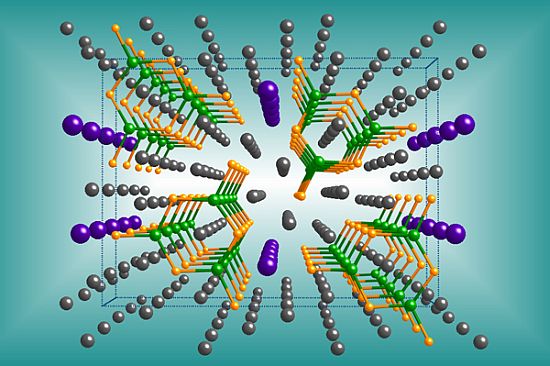
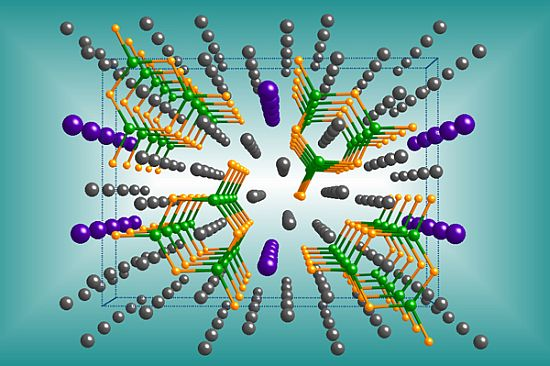
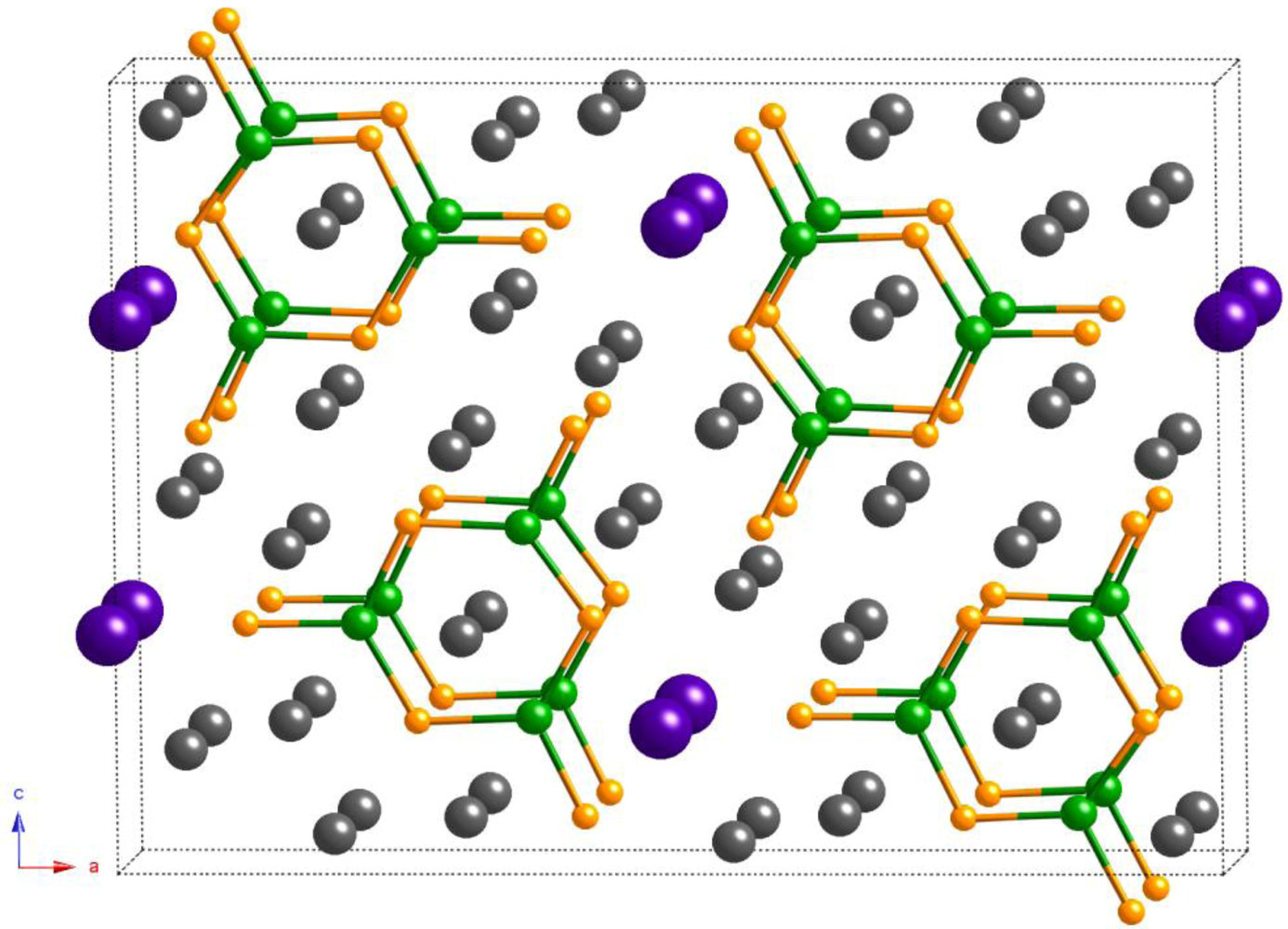
      <p>RbNa<sub>8</sub>Ga<sub>3</sub>As<sub>6</sub> and RbNa<sub>8</sub>Ga<sub>3</sub>P<sub>6</sub> both crystallize with the orthorhombic space group <italic>Pnma</italic> (No. 62, Pearson symbol <italic>oP</italic>72). The structure contains 18 independent sites in the asymmetric unit—one Rb, eight Na, three Ga, and six pnictogen atoms—all located at special position 4<italic>c</italic>. The structure can be viewed as being built from [Ga<sub>3</sub><italic>Pn</italic><sub>6</sub>]<sup>9−</sup> polyanions with alkali metal cations counterbalancing the charges and filling the space among them (<xref ref-type="fig" rid="crystals-02-00213-f001">Figure 1</xref>). The triangularly-shaped [Ga<sub>3</sub><italic>Pn</italic><sub>6</sub>]<sup>9−</sup> motif could be considered as a cyclic trimer of the [Ga<italic>Pn</italic><sub>3</sub>]<sup>6−</sup> trigonal planar units, which form a 6-membered ring by sharing two of the <italic>Pn</italic> atoms from each [Ga<italic>Pn</italic><sub>3</sub>]<sup>6−</sup>. Therefore, all three Ga atoms are 3-bonded, while the three <italic>Pn</italic> atoms on the 6-membered ring are 2-bonded and the three <italic>Pn</italic> atoms attaching to the ring are 1-bonded. The distances between Ga and the <italic>Pn</italic> atoms are all within the normal ranges for covalently bound Ga–As and Ga–P. For example, the Ga–As distances range from 2.335 to 2.422 Å; the Ga–P distances range from 2.245 to 2.337 Å (<xref ref-type="table" rid="crystals-02-00213-t001">Table 1</xref>). These values compare very well with the sums of the corresponding covalent radii (<italic>r</italic><sub>Ga </sub>= 1.246 Å; <italic>r</italic><sub>As</sub> = 1.210 Å; <italic>r</italic><sub>P</sub> = 1.10 Å) [<xref ref-type="bibr" rid="B14-crystals-02-00213">14</xref>], as well as with the Ga–<italic>Pn</italic> distances found in compounds with Ga in similar 3-fold coordination environment of As or P (<xref ref-type="table" rid="crystals-02-00213-t002">Table 2</xref>), e.g., <italic>d</italic><sub>Ga–As </sub>= 2.367 ÷ 2.426 Å in Rb<sub>2</sub>GaAs<sub>2</sub> [<xref ref-type="bibr" rid="B15-crystals-02-00213">15</xref>], <italic>d</italic><sub>Ga–As</sub> = 2.367 ÷ 2.442 Å in K<sub>20</sub>(Ga<sub>3</sub>As<sub>6</sub>)<sub>2</sub>As<sub>0.66</sub> [<xref ref-type="bibr" rid="B12-crystals-02-00213">12</xref>], and <italic>d</italic><sub>Ga–P </sub>= 2.226 ÷ 2.392 Å in Rb<sub>3</sub>GaP<sub>2</sub> [<xref ref-type="bibr" rid="B16-crystals-02-00213">16</xref>]. In general, the distances between Ga and the 2-bonded <italic>Pn</italic> are just about 0.08 Å longer than those between Ga and the 1-bonded <italic>Pn</italic> atom, which indicates that there is no appreciable <italic>π</italic>-bonding in the 6-membered ring. Hence, the formula RbNa<sub>8</sub>Ga<sub>3</sub><italic>Pn</italic><sub>6</sub> represents a salt-like, electron-balanced Zintl phase [<xref ref-type="bibr" rid="B17-crystals-02-00213">17</xref>]. According to the valence rules, the charges could be assigned as Rb<sup>+</sup>(Na<sup>+</sup>)<sub>8</sub>(Ga<sup>3+</sup>)<sub>3</sub>(<italic>Pn</italic><sup>3–</sup>)<sub>6</sub> based on oxidation states and counting the Ga and the <italic>Pn</italic> atoms as tri-valent species; alternatively, based on formal charges, the formula can be broken down to Rb<sup>+</sup>(Na<sup>+</sup>)<sub>8</sub>(3<italic>b</italic>-Ga<sup>0</sup>)<sub>3</sub>(2<italic>b</italic>-<italic>Pn</italic><sup>1–</sup>)<sub>3</sub>(1<italic>b</italic>-<italic>Pn</italic><sup>2–</sup>)<sub>3</sub>, where 2-bonded and 1-bonded <italic>Pn</italic> atoms carry different negative charges, consistent with the Zintl formalism. </p>
      <fig id="crystals-02-00213-f001" position="anchor">
        <label>Figure 1</label>
        <caption>
          <p>Crystal structure of RbNa<sub>8</sub>Ga<sub>3</sub><italic>Pn</italic><sub>6</sub> (<italic>Pn</italic> = P, As).The different elements are color-coded as follows: Ga—green; <italic>Pn</italic>—orange; Rb—purple; and Na-grey. The covalent Ga–<italic>Pn</italic> bonds are emphasized as yellow-green cylinders. </p>
        </caption>
        <graphic xmlns:xlink="http://www.w3.org/1999/xlink" xlink:href="crystals-02-00213-g001.tif"/>
      </fig>
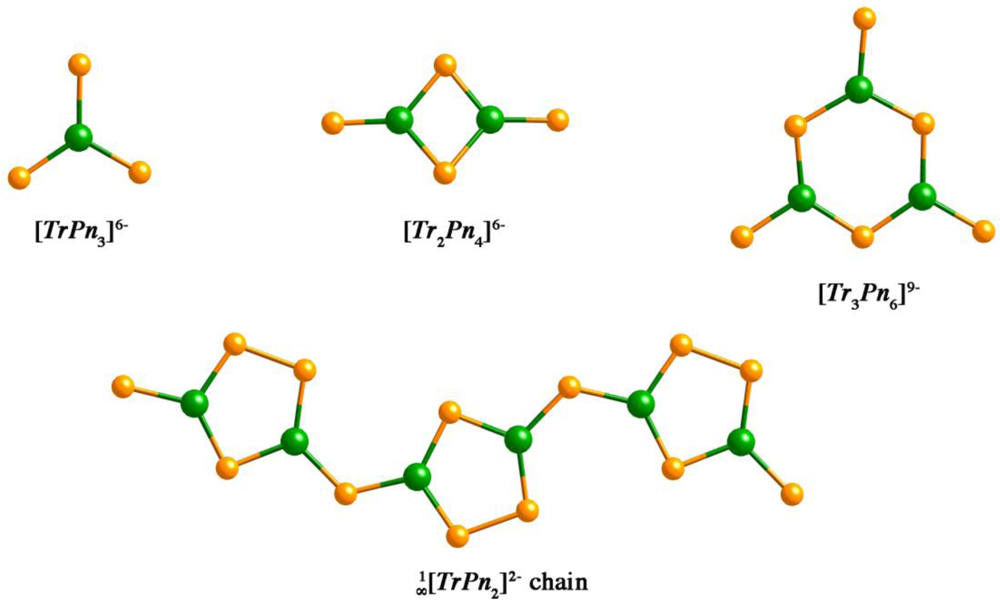
      <p>Three-coordinated Ga (or a triel element in general) is much less common within the <italic>A</italic>-<italic>Tr</italic>-<italic>Pn</italic> compounds than the four-coordinated tetrahedral geometry, which appears to be the prevailing building block among such solids. Examples of borate-like (or carbonate-like) [<italic>TrPn</italic><sub>3</sub>]<sup>6−</sup> units exist and can be exemplified by [InAs<sub>3</sub>]<sup>6−</sup> seen in the K<sub>6</sub>InAs<sub>3</sub> structure [<xref ref-type="bibr" rid="B18-crystals-02-00213">18</xref>]; [Ga<sub>2</sub>P<sub>4</sub>]<sup>6−</sup> found in the Rb<sub>3</sub>GaP<sub>2</sub> structure [<xref ref-type="bibr" rid="B16-crystals-02-00213">16</xref>] can be cited as an example of 4-membered rings formed via condensation of two [GaP<sub>3</sub>]<sup>6−</sup> units into [Ga<sub>2</sub>P<sub>4</sub>]<sup>6−</sup> dimers (isosteric with 1,3-Dioxetanedione). Higher oligomers, such as the cyclic trimers [Ga<sub>3</sub><italic>Pn</italic><sub>6</sub>]<sup>9−</sup> that present 6-membered rings are known in the K<sub>20</sub>(Ga<sub>3</sub><italic>Pn</italic><sub>6</sub>)<sub>2</sub><italic>Pn</italic><sub>0.66</sub> structures [<xref ref-type="bibr" rid="B12-crystals-02-00213">12</xref>] and in the structures of the title compounds. Since the [<italic>TrPn</italic><sub>3</sub>]<sup>6−</sup> unit is a planar structural motif, it is not common for it to form structures in higher dimension. A search of the ICSD database only reveals <inline-graphic xmlns:xlink="http://www.w3.org/1999/xlink" xlink:href="crystals-02-00213-i005.tif"/> the chain found in the K<sub>2</sub>GaP<sub>2</sub> type structure [<xref ref-type="bibr" rid="B19-crystals-02-00213">19</xref>]. In this bonding arrangement, 5-memered rings are generated by sharing one common <italic>Pn</italic> and forming one <italic>Pn</italic>–<italic>Pn</italic> bond between every two [Ga<italic>Pn</italic><sub>3</sub>]<sup>6–</sup> units—these 5-membered rings are further connected to form an infinite chain using the third <italic>Pn</italic> atom as a linker (<xref ref-type="fig" rid="crystals-02-00213-f002">Figure 2</xref>). </p>
      <table-wrap id="crystals-02-00213-t001" position="float">
        <object-id pub-id-type="pii">crystals-02-00213-t001_Table 1</object-id>
        <label>Table 1</label>
        <caption>
          <p>Important interatomic distances (Å) in RbNa<sub>8</sub>Ga<sub>3</sub><italic>Pn</italic><sub>6</sub> (<italic>Pn</italic> = As, P).</p>
        </caption>
        <table>
          <thead>
            <tr>
              <th align="left" valign="middle"> </th>
              <th align="center" valign="middle"> </th>
              <th align="center" valign="middle">RbNa<sub>8</sub>Ga<sub>3</sub>As<sub>6</sub></th>
              <th align="center" valign="middle">RbNa<sub>8</sub>Ga<sub>3</sub>P<sub>6</sub></th>
              <th align="center" valign="middle"> </th>
              <th align="center" valign="middle"> </th>
              <th align="center" valign="middle"> </th>
              <th align="center" valign="middle">RbNa<sub>8</sub>Ga<sub>3</sub>As<sub>6</sub></th>
              <th align="center" valign="middle">RbNa<sub>8</sub>Ga<sub>3</sub>P<sub>6</sub></th>
            </tr>
          </thead>
          <tbody>
            <tr style="border-top:solid thin">
              <td align="left" valign="middle">Ga1–</td>
              <td align="center" valign="middle"><italic>Pn</italic>1</td>
              <td align="center" valign="middle">2.335(1)</td>
              <td align="center" valign="middle">2.245(2)</td>
              <td align="center" valign="middle"> </td>
              <td align="center" valign="middle">Na3–</td>
              <td align="center" valign="middle"><italic>Pn2</italic></td>
              <td align="center" valign="middle">3.015(3)</td>
              <td align="center" valign="middle">2.935(3)</td>
            </tr>
            <tr>
              <td align="left" valign="middle"> </td>
              <td align="center" valign="middle"><italic>Pn</italic>2</td>
              <td align="center" valign="middle">2.388(1)</td>
              <td align="center" valign="middle">2.303(2)</td>
              <td align="center" valign="middle"> </td>
              <td align="center" valign="middle"> </td>
              <td align="center" valign="middle"><italic>Pn3</italic> (×2)</td>
              <td align="center" valign="middle">3.235(2)</td>
              <td align="center" valign="middle">3.158(2)</td>
            </tr>
            <tr>
              <td align="left" valign="middle"> </td>
              <td align="center" valign="middle"><italic>Pn</italic>3</td>
              <td align="center" valign="middle">2.400(1)</td>
              <td align="center" valign="middle">2.312(2)</td>
              <td align="center" valign="middle"> </td>
              <td align="center" valign="middle"> </td>
              <td align="center" valign="middle"><italic>Pn</italic>5 (×2)</td>
              <td align="center" valign="middle">3.270(2)</td>
              <td align="center" valign="middle">3.213(2)</td>
            </tr>
            <tr>
              <td align="left" valign="middle">Ga2–</td>
              <td align="center" valign="middle"><italic>Pn</italic>4</td>
              <td align="center" valign="middle">2.351(1)</td>
              <td align="center" valign="middle">2.259(2)</td>
              <td align="center" valign="middle"> </td>
              <td align="center" valign="middle"> </td>
              <td align="center" valign="middle">Ga3 (×2)</td>
              <td align="center" valign="middle">3.270(2)</td>
              <td align="center" valign="middle">3.216(2)</td>
            </tr>
            <tr>
              <td align="left" valign="middle"> </td>
              <td align="center" valign="middle"><italic>Pn</italic>2</td>
              <td align="center" valign="middle">2.383(1)</td>
              <td align="center" valign="middle">2.300(2)</td>
              <td align="center" valign="middle"> </td>
              <td align="center" valign="middle">Na4–</td>
              <td align="center" valign="middle">Ga2 (×2)</td>
              <td align="center" valign="middle">3.336(2)</td>
              <td align="center" valign="middle">3.260(2)</td>
            </tr>
            <tr>
              <td align="left" valign="middle"> </td>
              <td align="center" valign="middle"><italic>Pn</italic>6</td>
              <td align="center" valign="middle">2.391(1)</td>
              <td align="center" valign="middle">2.309(2)</td>
              <td align="center" valign="middle"> </td>
              <td align="center" valign="middle"> </td>
              <td align="center" valign="middle">Ga3 (×2)</td>
              <td align="center" valign="middle">3.346(2)</td>
              <td align="center" valign="middle">3.257(2)</td>
            </tr>
            <tr>
              <td align="left" valign="middle">Ga3–</td>
              <td align="center" valign="middle"><italic>Pn</italic>5</td>
              <td align="center" valign="middle">2.351(1)</td>
              <td align="center" valign="middle">2.259(2)</td>
              <td align="center" valign="middle"> </td>
              <td align="center" valign="middle"> </td>
              <td align="center" valign="middle">Ga1 (×2)</td>
              <td align="center" valign="middle">3.364(2)</td>
              <td align="center" valign="middle">3.282(2)</td>
            </tr>
            <tr>
              <td align="left" valign="middle"> </td>
              <td align="center" valign="middle"><italic>Pn</italic>3</td>
              <td align="center" valign="middle">2.418(1)</td>
              <td align="center" valign="middle">2.329(2)</td>
              <td align="center" valign="middle"> </td>
              <td align="center" valign="middle"> </td>
              <td align="center" valign="middle"><italic>Pn</italic>3 (×2)</td>
              <td align="center" valign="middle">3.375(2)</td>
              <td align="center" valign="middle">3.265(2)</td>
            </tr>
            <tr>
              <td align="left" valign="middle"> </td>
              <td align="center" valign="middle"><italic>Pn</italic>6</td>
              <td align="center" valign="middle">2.422(1)</td>
              <td align="center" valign="middle">2.337(2)</td>
              <td align="center" valign="middle"> </td>
              <td align="center" valign="middle"> </td>
              <td align="center" valign="middle"><italic>Pn</italic>6 (×2)</td>
              <td align="center" valign="middle">3.416(2)</td>
              <td align="center" valign="middle">3.314(2)</td>
            </tr>
            <tr>
              <td align="left" valign="middle"><italic>Pn</italic>1–</td>
              <td align="center" valign="middle">Ga1</td>
              <td align="center" valign="middle">2.335(1)</td>
              <td align="center" valign="middle">2.245(2)</td>
              <td align="center" valign="middle"> </td>
              <td align="center" valign="middle"> </td>
              <td align="center" valign="middle"><italic>Pn</italic>2 (×2)</td>
              <td align="center" valign="middle">3.500(2)</td>
              <td align="center" valign="middle">3.401(2)</td>
            </tr>
            <tr>
              <td align="left" valign="middle"><italic>Pn</italic>2–</td>
              <td align="center" valign="middle">Ga1</td>
              <td align="center" valign="middle">2.388(1)</td>
              <td align="center" valign="middle">2.303(2)</td>
              <td align="center" valign="middle"> </td>
              <td align="center" valign="middle">Na5–</td>
              <td align="center" valign="middle"><italic>Pn</italic>3</td>
              <td align="center" valign="middle">2.967(3)</td>
              <td align="center" valign="middle">2.892(3)</td>
            </tr>
            <tr>
              <td align="left" valign="middle"> </td>
              <td align="center" valign="middle">Ga2</td>
              <td align="center" valign="middle">2.383(1)</td>
              <td align="center" valign="middle">2.300(2)</td>
              <td align="center" valign="middle"> </td>
              <td align="center" valign="middle"> </td>
              <td align="center" valign="middle"><italic>Pn</italic>2 (×2)</td>
              <td align="center" valign="middle">3.190(2)</td>
              <td align="center" valign="middle">3.116(2)</td>
            </tr>
            <tr>
              <td align="left" valign="middle"><italic>Pn</italic>3–</td>
              <td align="center" valign="middle">Ga1</td>
              <td align="center" valign="middle">2.400(1)</td>
              <td align="center" valign="middle">2.312(2)</td>
              <td align="center" valign="middle"> </td>
              <td align="center" valign="middle"> </td> 
              <td align="center" valign="middle"><italic>Pn</italic>4 (×2)</td>
              <td align="center" valign="middle">3.338(2)</td>
              <td align="center" valign="middle">3.278(2)</td>
            </tr>
            <tr>
              <td align="left" valign="middle"> </td>
              <td align="center" valign="middle">Ga3</td>
              <td align="center" valign="middle">2.418(1)</td>
              <td align="center" valign="middle">2.329(2)</td>
              <td align="center" valign="middle"> </td>
              <td align="center" valign="middle"> </td>
              <td align="center" valign="middle">Ga2 (×2)</td>
              <td align="center" valign="middle">3.296(2)</td>
              <td align="center" valign="middle">3.244(2)</td>
            </tr>
            <tr>
              <td align="left" valign="middle"><italic>Pn</italic>4–</td>
              <td align="center" valign="middle">Ga2</td>
              <td align="center" valign="middle">2.351(1)</td>
              <td align="center" valign="middle">2.259(2)</td>
              <td align="center" valign="middle"> </td>
              <td align="center" valign="middle">Na6–</td>
              <td align="center" valign="middle"><italic>Pn</italic>4</td>
              <td align="center" valign="middle">2.970(3)</td>
              <td align="center" valign="middle">2.882(3)</td>
            </tr>
            <tr>
              <td align="left" valign="middle"><italic>Pn</italic>5–</td>
              <td align="center" valign="middle">Ga3</td>
              <td align="center" valign="middle">2.351(1)</td>
              <td align="center" valign="middle">2.259(2)</td>
              <td align="center" valign="middle"> </td>
              <td align="center" valign="middle"> </td>
              <td align="center" valign="middle"><italic>Pn</italic>1 (×2)</td>
              <td align="center" valign="middle">3.211(2)</td>
              <td align="center" valign="middle">3.126(2)</td>
            </tr>
            <tr>
              <td align="left" valign="middle"><italic>Pn</italic>6–</td>
              <td align="center" valign="middle">Ga2</td>
              <td align="center" valign="middle">2.391(1)</td>
              <td align="center" valign="middle">2.309(2)</td>
              <td align="center" valign="middle"> </td>
              <td align="center" valign="middle"> </td>
              <td align="center" valign="middle"><italic>Pn</italic>3 (×2)</td>
              <td align="center" valign="middle">3.386(2)</td>
              <td align="center" valign="middle">3.328(2)</td>
            </tr>
            <tr>
              <td align="left" valign="middle"> </td>
              <td align="center" valign="middle">Ga3</td>
              <td align="center" valign="middle">2.422(1)</td>
              <td align="center" valign="middle">2.337(2)</td>
              <td align="center" valign="middle"> </td>
              <td align="center" valign="middle"> </td>
              <td align="center" valign="middle">Ga1 (×2)</td>
              <td align="center" valign="middle">3.240(2)</td>
              <td align="center" valign="middle">3.181(2)</td>
            </tr>
            <tr>
              <td align="left" valign="middle">Rb–</td>
              <td align="center" valign="middle"><italic>Pn</italic>1 (×2)</td>
              <td align="center" valign="middle">3.5491(9)</td>
              <td align="center" valign="middle">3.487(1)</td>
              <td align="center" valign="middle"> </td>
              <td align="center" valign="middle">Na7–</td>
              <td align="center" valign="middle"><italic>Pn</italic>5</td>
              <td align="center" valign="middle">3.019(3)</td>
              <td align="center" valign="middle">2.933(3)</td>
            </tr>
            <tr>
              <td align="left" valign="middle"> </td>
              <td align="center" valign="middle"><italic>Pn</italic>6 (×2)</td>
              <td align="center" valign="middle">3.5929(9)</td>
              <td align="center" valign="middle">3.523(1)</td>
              <td align="center" valign="middle"> </td>
              <td align="center" valign="middle"> </td>
              <td align="center" valign="middle"><italic>Pn</italic>1 (×2)</td>
              <td align="center" valign="middle">3.209(2)</td>
              <td align="center" valign="middle">3.134(2)</td>
            </tr>
            <tr>
              <td align="left" valign="middle"> </td>
              <td align="center" valign="middle"><italic>Pn</italic>5 (×2)</td>
              <td align="center" valign="middle">3.6975(9)</td>
              <td align="center" valign="middle">3.623(1)</td>
              <td align="center" valign="middle"> </td>
              <td align="center" valign="middle"> </td>
              <td align="center" valign="middle"><italic>Pn</italic>2 (×2)</td>
              <td align="center" valign="middle">3.343(2)</td>
              <td align="center" valign="middle">3.280(2)</td>
            </tr>
            <tr>
              <td align="left" valign="middle"> </td>
              <td align="center" valign="middle">Ga3 (×2)</td>
              <td align="center" valign="middle">3.735(1)</td>
              <td align="center" valign="middle">3.6707(8)</td>
              <td align="center" valign="middle"> </td>
              <td align="center" valign="middle"> </td>
              <td align="center" valign="middle">Ga1 (×2)</td>
              <td align="center" valign="middle">3.284(2)</td>
              <td align="center" valign="middle">3.227(2)</td>
            </tr>
            <tr>
              <td align="left" valign="middle">Na1–</td>
              <td align="center" valign="middle"><italic>Pn</italic>5 (×2)</td>
              <td align="center" valign="middle">2.992(2)</td>
              <td align="center" valign="middle">2.931(2)</td>
              <td align="center" valign="middle"> </td>
              <td align="center" valign="middle">Na8–</td>
              <td align="center" valign="middle"><italic>Pn</italic>4</td>
              <td align="center" valign="middle">2.967(3)</td>
              <td align="center" valign="middle">2.874(3)</td>
            </tr>
            <tr>
              <td align="left" valign="middle"> </td>
              <td align="center" valign="middle"><italic>Pn</italic>1</td>
              <td align="center" valign="middle">3.018(3)</td>
              <td align="center" valign="middle">2.965(3)</td>
              <td align="center" valign="middle"> </td>
              <td align="center" valign="middle"> </td>
              <td align="center" valign="middle"><italic>Pn</italic>4 (×2)</td>
              <td align="center" valign="middle">3.239(2)</td>
              <td align="center" valign="middle">3.176(2)</td>
            </tr>
            <tr>
              <td align="left" valign="middle"> </td>
              <td align="center" valign="middle"><italic>Pn</italic>5</td>
              <td align="center" valign="middle">3.117(3)</td>
              <td align="center" valign="middle">3.051(3)</td>
              <td align="center" valign="middle"> </td>
              <td align="center" valign="middle"> </td>
              <td align="center" valign="middle"><italic>Pn</italic>6 (×2)</td>
              <td align="center" valign="middle">3.330(2)</td>
              <td align="center" valign="middle">3.250(2)</td>
            </tr>
            <tr>
              <td align="left" valign="middle">Na2–</td>
              <td align="center" valign="middle"><italic>Pn</italic>4 (×2)</td>
              <td align="center" valign="middle">2.967(2)</td>
              <td align="center" valign="middle">2.909(2)</td>
              <td align="center" valign="middle"> </td>
              <td align="center" valign="middle"> </td>
              <td align="center" valign="middle">Ga2 (×2)</td>
              <td align="center" valign="middle">3.245(2)</td>
              <td align="center" valign="middle">3.183(2)</td>
            </tr>
            <tr>
              <td align="left" valign="middle"> </td>
              <td align="center" valign="middle"><italic>Pn</italic>1</td>
              <td align="center" valign="middle">2.970(3)</td>
              <td align="center" valign="middle">2.911(3)</td>
              <td align="center" valign="middle"> </td>
              <td align="center" valign="middle"> </td>
              <td align="center" valign="middle"> </td>
              <td align="center" valign="middle"> </td>
              <td align="center" valign="middle"> </td>
            </tr>
            <tr>
              <td align="left" valign="middle"> </td>
              <td align="center" valign="middle"><italic>Pn</italic>6</td>
              <td align="center" valign="middle">3.069(3)</td>
              <td align="center" valign="middle">3.008(3)</td>
              <td align="center" valign="middle"> </td>
              <td align="center" valign="middle"> </td>
              <td align="center" valign="middle"> </td>
              <td align="center" valign="middle"> </td>
              <td align="center" valign="middle"> </td>
            </tr>
          </tbody>
        </table>
      </table-wrap>
      <table-wrap id="crystals-02-00213-t002" position="float">
        <object-id pub-id-type="pii">crystals-02-00213-t002_Table 2</object-id>
        <label>Table 2</label>
        <caption>
          <p>Selected angles (°) in RbNa<sub>8</sub>Ga<sub>3</sub><italic>Pn</italic><sub>6</sub> (<italic>Pn</italic> = As, P).</p>
        </caption>
         <table>
          <thead>
            <tr>
              <th align="left" valign="middle"> </th>
              <th align="left" valign="middle"> </th>
              <th align="center" valign="middle">RbNa<sub>8</sub>Ga<sub>3</sub>As<sub>6</sub></th>
              <th align="center" valign="middle">RbNa<sub>8</sub>Ga<sub>3</sub>P<sub>6</sub></th>
              <th align="center" valign="middle"> </th>
              <th align="center" valign="middle"> </th>
              <th align="center" valign="middle"> </th>
              <th align="center" valign="middle">RbNa<sub>8</sub>Ga<sub>3</sub>As<sub>6</sub></th>
              <th align="center" valign="middle">RbNa<sub>8</sub>Ga<sub>3</sub>P<sub>6</sub></th>
            </tr>
          </thead>
          <tbody>
            <tr style="border top;solid thin">
              <td colspan="2" align="left" valign="middle"><italic>Pn</italic>1-Ga1-<italic>Pn</italic>2</td>
              <td align="center" valign="middle">115.89(4)</td>
              <td align="center" valign="middle">116.42(7)</td>
              <td align="center" valign="middle"> </td>
              <td colspan="2" align="center" valign="middle"><italic>Pn</italic>5-Ga3-<italic>Pn</italic>3</td>
              <td align="center" valign="middle">113.79(4)</td>
              <td align="center" valign="middle">114.48(7)</td>
            </tr>
            <tr>
              <td colspan="2" align="left" valign="middle"><italic>Pn</italic>1-Ga1-<italic>Pn</italic>3</td>
              <td align="center" valign="middle">119.19(4)</td>
              <td align="center" valign="middle">119.78(7)</td>
              <td align="center" valign="middle"> </td>
              <td colspan="2" align="center" valign="middle"><italic>Pn</italic>5-Ga3-<italic>Pn</italic>6</td>
              <td align="center" valign="middle">124.65(4)</td>
              <td align="center" valign="middle">125.05(7)</td>
            </tr>
            <tr>
              <td colspan="2" align="left" valign="middle"><italic>Pn</italic>2-Ga1-<italic>Pn</italic>3</td>
              <td align="center" valign="middle">124.92(4)</td>
              <td align="center" valign="middle">123.81(7)</td>
              <td align="center" valign="middle"> </td>
              <td colspan="2" align="center" valign="middle"><italic>Pn</italic>3-Ga3-<italic>Pn</italic>6</td>
              <td align="center" valign="middle">121.56(4)</td>
              <td align="center" valign="middle">120.47(7)</td>
            </tr>
            <tr>
              <td colspan="2" align="left" valign="middle"><italic>Pn</italic>4-Ga2-<italic>Pn</italic>2</td>
              <td align="center" valign="middle">114.31(4)</td>
              <td align="center" valign="middle">114.77(7)</td>
              <td align="center" valign="middle"> </td>
              <td colspan="2" align="center" valign="middle">Ga2-
              <italic>Pn</italic>2-Ga1</td>
              <td align="center" valign="middle">113.01(4)</td>
              <td align="center" valign="middle">114.04(8)</td>
            </tr>
            <tr>
              <td colspan="2" align="left" valign="middle"><italic>Pn</italic>4-Ga2-<italic>Pn</italic>6</td>
              <td align="center" valign="middle">117.77(4)</td>
              <td align="center" valign="middle">118.39(7)</td>
              <td align="center" valign="middle"> </td>
              <td colspan="2" align="center" valign="middle">Ga1-
              <italic>Pn</italic>3-Ga3</td>
              <td align="center" valign="middle">117.57(4)</td>
              <td align="center" valign="middle">118.85(8)</td>
            </tr>
            <tr>
              <td colspan="2" align="left" valign="middle"><italic>Pn</italic>2-Ga2-<italic>Pn</italic>6</td>
              <td align="center" valign="middle">127.93(4)</td>
              <td align="center" valign="middle">126.84(7)</td>
              <td align="center" valign="middle"> </td>
              <td colspan="2" align="center" valign="middle">Ga2-
              <italic>Pn</italic>6-Ga3</td>
              <td align="center" valign="middle">115.01(4)</td>
              <td align="center" valign="middle">115.98(7)</td>
            </tr>
          </tbody>
        </table>
      </table-wrap>
      <fig id="crystals-02-00213-f002" position="anchor">
        <label>Figure 2</label>
        <caption>
          <p>Diverse structural motifs based on the [<italic>TrPn</italic><sub>3</sub>]<sup>6−</sup> unit (<italic>Tr</italic> = triel, <italic>Pn</italic> = pnictogen).</p>
        </caption>
        <graphic xmlns:xlink="http://www.w3.org/1999/xlink" xlink:href="crystals-02-00213-g002.tif"/>
      </fig>
      <p>As we already mentioned, there are nine crystallographically different cations in the RbNa<sub>8</sub>Ga<sub>3</sub><italic>Pn</italic><sub>6</sub> structure and they have subtly different coordination environments. The large Rb cation is coordinated to six pnictogen atoms that form trigonal prism, with Rb–<italic>Pn</italic> distances falling in the range from 3.549 to 3.698 Å for Rb–As, and from 3.487 to 3.623 Å for Rb–P (<xref ref-type="table" rid="crystals-02-00213-t001">Table 1</xref>). Two Ga atoms are found at a little longer distance, enlarging the Rb first coordination sphere to the shape of a quadrilateral prism (<xref ref-type="fig" rid="crystals-02-00213-f003">Figure 3</xref>). Three different local environments could be found for Na: Na1 and Na2 are found in a tetrahedral surrounding of four pnictogen atoms; square pyramids formed by five next-nearest pnictogen atoms are observed for Na3, Na5, Na6, Na7, and Na8—notice that the bases of the square-pyramids are capped by two Ga atoms, enlarging the coordination number to 7; and a hexagonal prism for Na4, where each hexagonal base is formed by three Ga and three <italic>Pn</italic> atoms. The Na–<italic>Pn</italic> distances fall into a very wide range due to the different coordination numbers (CN) for Na, with the shortest Na–<italic>Pn</italic> distance noted for 4-coordinated Na, and the longest Na–<italic>Pn</italic> distance found for the 12-coordinated Na (<xref ref-type="table" rid="crystals-02-00213-t001">Table 1</xref>).</p>
      <fig id="crystals-02-00213-f003" position="anchor">
        <label>Figure 3</label>
        <caption>
          <p>Cation coordination in RbNa<sub>8</sub>Ga<sub>3</sub><italic>Pn</italic><sub>6</sub>. The polyhedron around Rb is shown in purple (a); Na1 and Na2 in light blue (b); Na3, Na5, Na6, Na7, and Na8 in dark blue (c); and Na4 in olive (d). See text for details. </p>
        </caption>
        <graphic xmlns:xlink="http://www.w3.org/1999/xlink" xlink:href="crystals-02-00213-g003.tif"/>
      </fig>
      <fig id="crystals-02-00213-f004" position="anchor">
        <label>Figure 4</label>
        <caption>
          <p>Side-by-side comparison of the cation packing in the crystal structures of K<sub>20</sub>(Ga<sub>3</sub>As<sub>6</sub>)<sub>2</sub>As<sub>0.66</sub> and RbNa<sub>8</sub>Ga<sub>3</sub>As<sub>6</sub>, where the trigonal prisms formed by the cations are emphasized. Different shades represent the different heights in the projected directions. The corresponding elements are color-coded as follows: Ga—green;<italic>Pn</italic>—orange; K—light blue; Rb—purple; and Na—grey. The covalent Ga–As bonds and the unit cells are outlined too.</p>
        </caption>
        <graphic xmlns:xlink="http://www.w3.org/1999/xlink" xlink:href="crystals-02-00213-g004.tif"/>
      </fig>
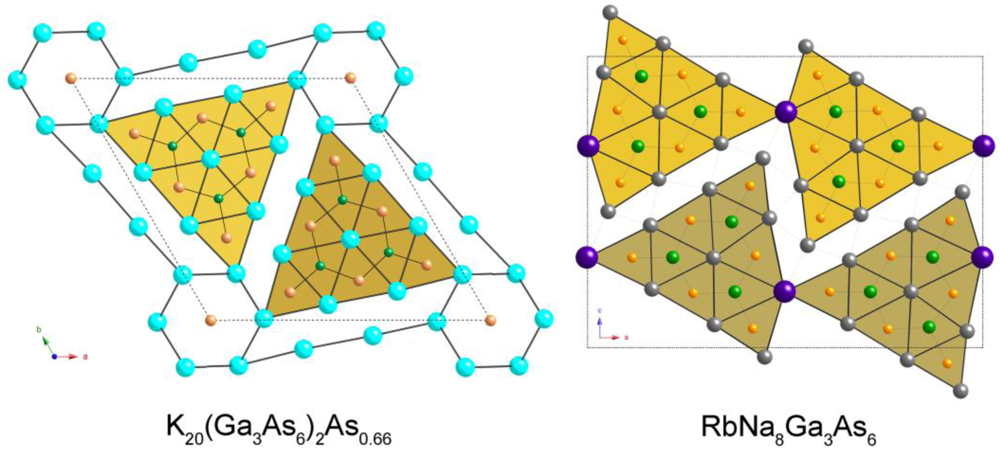
      <p>As already noted, the [Ga<sub>3</sub><italic>Pn</italic><sub>6</sub>]<sup>9−</sup> 6-membered motif is not without a precedent, having been reported for some time already in K<sub>20</sub>(Ga<sub>3</sub><italic>Pn</italic><sub>6</sub>)<sub>2</sub><italic>Pn</italic><sub>0.66</sub> (defect Ho<sub>6</sub>Ni<sub>20</sub>P<sub>13</sub> structure type, Pearson symbol <italic>hP</italic>39) [<xref ref-type="bibr" rid="B11-crystals-02-00213">11</xref>,<xref ref-type="bibr" rid="B12-crystals-02-00213">12</xref>]. However, in the latter hexagonal structure, in addition to the [Ga<sub>3</sub><italic>Pn</italic><sub>6</sub>]<sup>9−</sup> polyanions, there are isolated <italic>Pn</italic><sup>3−</sup> anions (note the partial occupancy of this site). Apparently, a single cation like K<sup>+</sup> cannot pack well enough with the [Ga<sub>3</sub><italic>Pn</italic><sub>6</sub>]<sup>9−</sup> polyanions, requiring some subtle rearrangements to accommodate the counterbalancing <italic>Pn</italic><sup>3−</sup> anions. Following the notion of describing the structure from the standpoint of cation packing, in analogy with what has already been presented for K<sub>20</sub>(Ga<sub>3</sub><italic>Pn</italic><sub>6</sub>)<sub>2</sub><italic>Pn</italic><sub>0.66</sub> [<xref ref-type="bibr" rid="B12-crystals-02-00213">12</xref>], one can see that the cation arrangements in both cases are actually very similar. From <xref ref-type="fig" rid="crystals-02-00213-f004">Figure 4</xref>, it can be seen that in both structures, apart from the partially occupied <italic>Pn</italic> atoms in the K<sub>20</sub>(Ga<sub>3</sub><italic>Pn</italic><sub>6</sub>)<sub>2</sub><italic>Pn</italic><sub>0.66</sub> structure, which reside in large hexagonal channels, all Ga and <italic>Pn</italic> atoms are at the centers of trigonal prisms formed by the cations. Nine such trigonal prisms are conjoined, forming a much larger prism that encloses the entire [Ga<sub>3</sub><italic>Pn</italic><sub>6</sub>]<sup>9−</sup> unit. The difference is that in K<sub>20</sub>(Ga<sub>3</sub><italic>Pn</italic><sub>6</sub>)<sub>2</sub><italic>Pn</italic><sub>0.66</sub>, these larger trigonal prisms can be noted as discrete components, while in RbNa<sub>8</sub>Ga<sub>3</sub><italic>Pn</italic><sub>6</sub> (=Rb<sub>2</sub>Na<sub>16</sub>(Ga<sub>3</sub><italic>Pn</italic><sub>6</sub>)<sub>2</sub>, <italic>i.e.</italic>, two cations less per formula) they further connect with each other along the <italic>a</italic> axis by sharing Rb atoms (<xref ref-type="fig" rid="crystals-02-00213-f004">Figure 4</xref>). It seems that the much bigger Rb brings the necessary distortion to the larger trigonal prisms, which leads to a slightly different packing of the cations compared with K<sub>20</sub>(Ga<sub>3</sub><italic>Pn</italic><sub>6</sub>)<sub>2</sub><italic>Pn</italic><sub>0.66</sub>. </p>
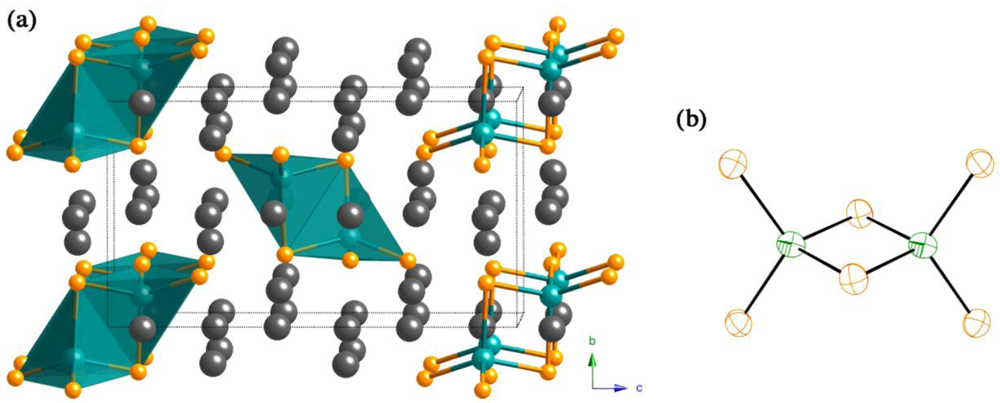
      <p>Na<sub>10</sub>NbGaAs<sub>6</sub> crystallizes with the monoclinic space group <italic>P</italic>2<sub>1</sub>/<italic>n</italic> (No. 14, Pearson symbol <italic>mP</italic>36), and is found to be isoelectronic and isostructural to the Zintl compound K<sub>10</sub>NbInAs<sub>6</sub> [<xref ref-type="bibr" rid="B13-crystals-02-00213">13</xref>]. The structure is composed of isolated dimers of edge-shared tetrahedra (NbAs<sub>4</sub> or GaAs<sub>4</sub>), which are isosteric with diborane, B<sub>2</sub>H<sub>6</sub>. These dimeric units are separated by the alkali metal cations (<xref ref-type="fig" rid="crystals-02-00213-f005">Figure 5</xref>). Note that there is only one tetrahedral site in the structure, which is co-occupied by Ga and Nb in equal amounts. In the earlier paper on K<sub>10</sub>NbInAs<sub>6</sub>, a diamagnetic response from the magnetic susceptibility of the compound can be inferred, suggesting the Nb to be assigned as Nb<sup>5+</sup> (<italic>i.e.</italic>, <italic>d</italic><sup>0</sup> closed-shell species) [<xref ref-type="bibr" rid="B13-crystals-02-00213">13</xref>]. This argument allows for the structure to be rationalized readily as (K<sup>+</sup>)<sub>10</sub>Nb<sup>5+</sup>In<sup>3+</sup>(As<sup>3–</sup>)<sub>6</sub>. Clearly, the same approach will be applicable to Na<sub>10</sub>NbGaAs<sub>6</sub> (e.g., (Na<sup>+</sup>)<sub>10</sub>Nb<sup>5+</sup>Ga<sup>3+</sup>(As<sup>3–</sup>)<sub>6</sub>), which means that it can be classified as a Zintl compound with a transition metal [<xref ref-type="bibr" rid="B13-crystals-02-00213">13</xref>,<xref ref-type="bibr" rid="B20-crystals-02-00213">20</xref>].</p>
      <fig id="crystals-02-00213-f005" position="anchor">
        <label>Figure 5</label>
        <caption>
          <p>(a)Crystal structure of Na<sub>10</sub>NbGaAs<sub>6</sub>, viewed along the <italic>a</italic> axis; (b) representation of [(As)<sub>2</sub>Nb(<italic>μ</italic>-As)<sub>2</sub>Ga(As)<sub>2</sub>]<sup>10–</sup> with thermal ellipsoids, drawn at the 95% probability. The atoms at the centers of the tetrahedra of As atoms are statistically distributed Nb and Ga. The corresponding elements are color-coded as follows: Ga/Nb—light blue; As—orange; and Na—grey. </p>
        </caption>
        <graphic xmlns:xlink="http://www.w3.org/1999/xlink" xlink:href="crystals-02-00213-g005.tif"/>
      </fig>
      <table-wrap id="crystals-02-00213-t003" position="float">
        <object-id pub-id-type="pii">crystals-02-00213-t003_Table 3</object-id>
        <label>Table 3</label>
        <caption>
          <p>Selected interatomic distances (Å) and angles (°) in Na<sub>10</sub>NbGaAs<sub>6</sub>. </p>
        </caption>
       <table rules="all" style="border:solid thin">
          <tbody>
            <tr>
              <td align="left" valign="middle">Nb/Ga–</td>
              <td align="center" valign="middle">As3</td>
              <td align="center" valign="middle">2.4855(6)</td>
              <td align="center" valign="middle">As3-Nb/Ga-As2</td>
              <td align="center" valign="middle">114.20(2)</td>
            </tr>
            <tr>
              <td align="left" valign="middle"> </td>
              <td align="center" valign="middle">As2</td>
              <td align="center" valign="middle">2.4959(6)</td>
              <td align="center" valign="middle">As3-Nb/Ga-As1</td>
              <td align="center" valign="middle">108.68(2)</td>
            </tr>
            <tr>
              <td align="left" valign="middle"> </td>
              <td align="center" valign="middle">As1</td>
              <td align="center" valign="middle">2.5274(6)</td>
              <td align="center" valign="middle">As2-Nb/Ga-As1</td>
              <td align="center" valign="middle">113.79(2)</td>
            </tr>
            <tr>
              <td align="left" valign="middle"> </td>
              <td align="center" valign="middle">As1</td>
              <td align="center" valign="middle">2.5645(6)</td>
              <td align="center" valign="middle">As3-Nb/Ga-As1</td>
              <td align="center" valign="middle">111.17(2)</td>
            </tr>
            <tr>
              <td align="left" valign="middle"> </td>
              <td align="center" valign="middle"> </td>
              <td align="center" valign="middle"> </td>
              <td align="center" valign="middle">As2-Nb/Ga-As1</td>
              <td align="center" valign="middle">106.78(2)</td>
            </tr>
            <tr>
              <td align="left" valign="middle"> </td>
              <td align="center" valign="middle"> </td>
              <td align="center" valign="middle"> </td>
              <td align="center" valign="middle">As1-Nb/Ga-As1</td>
              <td align="center" valign="middle">101.49(2)</td>
            </tr>
          </tbody>
        </table>
		</table-wrap>
      <p>The Nb/Ga–;As distances fall in the range of 2.4855(6) to 2.5645(6) Å, and all of the As-Nb/Ga-As angles are close to the ideal tetrahedral angle 109°28' (<xref ref-type="table" rid="crystals-02-00213-t003">Table 3</xref>). An examination of the structures of some compounds with ordered GaAs<sub>4</sub> and NbAs<sub>4</sub> tetrahedra reveals similar lengths for the Ga–As and Nb–As bonds. For example, the Ga–As bonds range from 2.444 to 2.556 Å in K<sub>3</sub>Ga<sub>3</sub>As<sub>4</sub> [<xref ref-type="bibr" rid="B9-crystals-02-00213">9</xref>], and from 2.435 to 2.599 Å in Na<sub>2</sub>Ga<sub>2</sub>As<sub>3</sub> [<xref ref-type="bibr" rid="B21-crystals-02-00213">21</xref>], respectively. The Nb–As distances, as reported for K<sub>38</sub>Nb<sub>7</sub>As<sub>24</sub> [<xref ref-type="bibr" rid="B22-crystals-02-00213">22</xref>] fall in the range of 2.444–2.571 Å; very similar values for <italic>d</italic><sub>Nb-As</sub> are seen in Cs<sub>9</sub>Nb<sub>2</sub>As<sub>6</sub> (2.464–2.592 Å) [<xref ref-type="bibr" rid="B22-crystals-02-00213">22</xref>]. Since the established ranges for the Nb–As and Ga–As distances are similar, refinements of the thermal ellipsoids in Na<sub>10</sub>NbGaAs<sub>6</sub> do not show any abnormal behavior—in fact they are virtually spherical. This is not the case for K<sub>10</sub>NbInAs<sub>6</sub>, where the significant difference between the lengths of the Nb–As and In–As bonds gives rise to characteristic features in their thermal ellipsoids—the thermal ellipsoids of the bridging As atoms are elongated tangentially to the central square (Nb/In-As-Nb/In-As). This observation has been considered as a key evidence of these dimers being heteroatomic [(As)<sub>2</sub>Nb(<italic>µ</italic>-As)<sub>2</sub>In(As)<sub>2</sub>] species, and not an equimolar mixture of [(As)<sub>2</sub>Nb(<italic>µ</italic>-As)<sub>2</sub>Nb(As)<sub>2</sub>] and [(As)<sub>2</sub>In(<italic>µ</italic>-As)<sub>2</sub>In(As)<sub>2</sub>] dimers [<xref ref-type="bibr" rid="B13-crystals-02-00213">13</xref>]. </p>
    </sec>
    <sec>
      <title>3. Experimental Section</title>
      <p>All the manipulations involving alkali metals were performed either inside an argon-filled glove box or under vacuum. The starting materials were elemental Rb, Na, Ga, As, and P, either from Alfa Aesar or Aldrich with the stated purity higher than 99.9%. Crystals of RbNa<sub>8</sub>Ga<sub>3</sub>As<sub>6</sub> were first identified from a reaction starting with Na/Rb/Ga/As with a molar ratio of 16/8/80/56, which was originally attempted for type II clathrate Na<sub>16</sub>Rb<sub>8</sub>Ga<sub>80</sub>As<sub>56</sub>. The elements with a total mass of ca. 500 mg were loaded into a niobium ampoule, which was subsequently arc-welded under high purity Ar and then jacketed in a fused silica tube under vacuum. The reaction mixture was heated up to 550 °C, and equilibrated for one week before it was slowly cooled to room temperature. This experiment resulted in black, small crystals of RbNa<sub>8</sub>Ga<sub>3</sub>As<sub>6</sub>, which were found to be extremely air-sensitive and had to be handled with great care. After the composition was established, the reaction was repeated with the correct stoichiometry. However, besides RbNa<sub>8</sub>Ga<sub>3</sub>As<sub>6</sub>, Na<sub>10</sub>NbGaAs<sub>6</sub>, which formed from a side reaction with the Nb container, was also identified. This observation indicated that Nb containers were not well suited for such reactions; more expensive Ta or Mo tubes should be considered. RbNa<sub>8</sub>Ga<sub>3</sub>P<sub>6</sub> could be synthesized from the same setup as well as the same heat treatment, with the coexistence of another known Zintl compound, Na<sub>6</sub>GaP<sub>3</sub> [<xref ref-type="bibr" rid="B23-crystals-02-00213">23</xref>].</p>
      <p>The crystal structures of the title compounds were established using single-crystal X-ray diffraction with a Bruker SMART CCD-based diffractometer (monochromated Mo Kα<sub>1</sub> radiation). Crystals with suitable dimensions (&lt;100 µm) were mounted on glass fiber with Paratone-N oil, and then quickly transferred to the goniometer of the diffractometer. A cold nitrogen stream (200(2) K) was used to keep the crystals at low temperature as well as to protect them from being oxidized. Full spheres of data were collected in four batch runs with a frame width of 0.4° for ω and θ. Integration of the intensity data was done with the SAINT program [<xref ref-type="bibr" rid="B24-crystals-02-00213">24</xref>], and semi-empirical absorption correction based on equivalents was applied with the SADABS code [<xref ref-type="bibr" rid="B25-crystals-02-00213">25</xref>]. The structures were solved by direct method and refined to convergence by full matrix least squares on <italic>F</italic><sup>2</sup> using the SHELXTL package [<xref ref-type="bibr" rid="B26-crystals-02-00213">26</xref>]. The unit cell axes and the atomic coordinates of RbNa<sub>8</sub>Ga<sub>3</sub><italic>Pn</italic><sub>6</sub> were standardized with the aid of the Structure TIDY [<xref ref-type="bibr" rid="B27-crystals-02-00213">27</xref>] in the last refinement cycles.</p>
      <p>The structure refinements for Na<sub>10</sub>NbGaAs<sub>6</sub> required some specific attention. In this structure, the tetrahedrally coordinated site was originally assigned as Ga, which is a common coordination environment for it. However, the thermal displacement parameter in this situation was unreasonably small. Based on the discussion on K<sub>10</sub>NbInAs<sub>6</sub> structure, the model that this site was co-occupied by Ga and Nb was considered, where Nb was from the reaction vessel. Such refinement lead to nearly half and half occupancy of Ga and Nb, <italic>i.e.</italic>, 49% Ga and 51% Nb. Thus, the ratio was fixed at 1:1 in the final refinement cycle, which resulted in <italic>R</italic><sub>1</sub> values as low as 0.0263 and reasonable thermal ellipsoids. </p>
      <p>Selected crystal data and refinement parameters are given in <xref ref-type="table" rid="crystals-02-00213-t004">Table 4</xref>; important bond distances and angles are listed in <xref ref-type="table" rid="crystals-02-00213-t001">Table 1</xref>,<xref ref-type="table" rid="crystals-02-00213-t002">Table 2</xref>,<xref ref-type="table" rid="crystals-02-00213-t003">Table 3</xref>. CIFs have also been deposited with the Fachinformationszentrum Karlsruhe, 76344 Eggenstein-Leopoldshafen, Germany, (fax: (49) 7247-808-666; Email: crysdata@fiz.karlsruhe.de)—depository numbers CSD-423946 for RbNa<sub>8</sub>Ga<sub>3</sub>As<sub>6</sub>, CSD-423947 for RbNa<sub>8</sub>Ga<sub>3</sub>P<sub>6</sub>, and CSD-423948 for Na<sub>10</sub>NbGaAs<sub>6</sub>.</p>
      <table-wrap id="crystals-02-00213-t004" position="float">
        <object-id pub-id-type="pii">crystals-02-00213-t004_Table 4</object-id>
        <label>Table 4</label>
        <caption>
          <p>Selected crystal data and structure refinement parameters for RbNa<sub>8</sub>Ga<sub>3</sub><italic>Pn</italic><sub>6</sub> (<italic>Pn</italic> = As, P) and Na<sub>10</sub>NbGaAs<sub>6</sub>.</p>
        </caption>
       <table rules="all" style="border:solid thin">
          <tbody>
            <tr>
              <td colspan="2" align="center" valign="middle">Empirical formula</td>
              <td align="center" valign="middle">RbNa8Ga3As6</td>
              <td align="center" valign="middle">RbNa8Ga3P6</td>
              <td align="center" valign="middle">Na10NbGaAs6</td>
            </tr>
            <tr>
              <td colspan="2" align="center" valign="middle">Formula weight</td>
              <td align="center" valign="middle">928.07</td>
              <td align="center" valign="middle">664.37</td>
              <td align="center" valign="middle">842.05</td>
            </tr>
            <tr>
              <td colspan="2" align="center" valign="middle">Space group, 
              <italic>Z</italic></td>
              <td align="center" valign="middle"><italic>Pnma</italic> (No. 62), 4</td>
              <td align="center" valign="middle"><italic>Pnma</italic> (No. 62), 4</td>
              <td align="center" valign="middle"><italic>P2</italic>1/n (No. 14), 2</td>
            </tr>
            <tr>
              <td colspan="2" align="center" valign="middle">Temperature</td>
              <td colspan="3" align="center" valign="middle">200(2) K</td>
            </tr>
            <tr>
              <td colspan="2" align="center" valign="middle">Wavelength</td>
              <td colspan="3" align="center" valign="middle">Mo 
              <italic>K</italic>α, 0.71073 Å</td>
            </tr>
            <tr>
              <td align="center" valign="middle">Cell parameters</td>
              <td align="center" valign="middle"><italic>a</italic> (Å)</td>
              <td align="center" valign="middle">22.843(6)</td>
              <td align="center" valign="middle">22.276(3)</td>
              <td align="center" valign="middle">8.3243(7)</td>
            </tr>
            <tr>
              <td align="center" valign="middle"> </td>
              <td align="center" valign="middle"><italic>b</italic> (Å)</td>
              <td align="center" valign="middle">4.7892(12)</td>
              <td align="center" valign="middle">4.6947(6)</td>
              <td align="center" valign="middle">7.5173(6)</td>
            </tr>
            <tr>
              <td align="center" valign="middle"> </td>
              <td align="center" valign="middle"><italic>c</italic> (Å)</td>
              <td align="center" valign="middle">16.861(4)</td>
              <td align="center" valign="middle">16.356(2)</td>
              <td align="center" valign="middle">13.546(2)</td>
            </tr>
            <tr>
              <td align="center" valign="middle"> </td>
              <td align="center" valign="middle"><italic>β</italic>(°)</td>
              <td align="center" valign="middle"> </td>
              <td align="center" valign="middle"> </td>
              <td align="center" valign="middle">90.908(1)°</td>
            </tr>
            <tr>
              <td align="center" valign="middle"> </td>
              <td align="center" valign="middle"><italic>V</italic> (Å3)</td>
              <td align="center" valign="middle">1844.6(8)</td>
              <td align="center" valign="middle">1710.4(4)</td>
              <td align="center" valign="middle">847.58(12)</td>
            </tr>
            <tr>
              <td colspan="2" align="center" valign="middle">Calculated density (g/cm3)</td>
              <td align="center" valign="middle">3.342</td>
              <td align="center" valign="middle">2.580</td>
              <td align="center" valign="middle">3.299</td>
            </tr>
            <tr>
              <td colspan="2" align="center" valign="middle">Absorption coefficient (cm−1)</td>
              <td align="center" valign="middle">178.14</td>
              <td align="center" valign="middle">82.52</td>
              <td align="center" valign="middle">141.13</td>
            </tr>
            <tr>
              <td colspan="2" align="center" valign="middle">Crystal size (mm3)</td>
              <td align="center" valign="middle">0.070 × 0.030 × 0.025</td>
              <td align="center" valign="middle">0.050 × 0.030 × 0.030</td>
              <td align="center" valign="middle">0.060 × 0.055 × 0.035</td>
            </tr>
            <tr>
              <td colspan="2" align="center" valign="middle">Reflections collected/independent</td>
              <td align="center" valign="middle">24813/2575</td>
              <td align="center" valign="middle">22860/2382</td>
              <td align="center" valign="middle">10644/1948</td>
            </tr>
            <tr>
              <td colspan="2" align="center" valign="middle"><italic>R</italic>int</td>
              <td align="center" valign="middle">0.0888</td>
              <td align="center" valign="middle">0.0954</td>
              <td align="center" valign="middle">0.0528</td>
            </tr>
            <tr>
              <td colspan="2" align="center" valign="middle">Goodness-of-fit on 
              <italic>F</italic><sup>2</sup></td>
              <td align="center" valign="middle">1.031</td>
              <td align="center" valign="middle">1.104</td>
              <td align="center" valign="middle">1.006</td>
            </tr>
            <tr>
              <td colspan="2" align="center" valign="middle"><italic>R</italic>1 (<italic>I</italic> &gt; 2<italic>σ</italic>I)<sup>a</sup></td>
              <td align="center" valign="middle">0.0326</td>
              <td align="center" valign="middle">0.0410</td>
              <td align="center" valign="middle">0.0263</td>
            </tr>
            <tr>
              <td colspan="2" align="center" valign="middle">w
              <italic>R</italic>2 (<italic>I</italic> &gt; 2<italic>σ</italic>I)<sup>a</sup></td>
              <td align="center" valign="middle">0.0521</td>
              <td align="center" valign="middle">0.0625</td>
              <td align="center" valign="middle">0.0464</td>
            </tr>
            <tr>
              <td colspan="2" align="center" valign="middle">Largest diff. peak/hole (e–/Å<sup>3</sup>)</td>
              <td align="center" valign="middle">1.164/−0.928</td>
              <td align="center" valign="middle">0.802/−0.880</td>
              <td align="center" valign="middle">0.751/−0.578</td>
            </tr>
            <tr>
              <td colspan="2" align="center" valign="middle">Weight coefficient, 
              <italic>A/B</italic><sup>a</sup></td>
              <td align="center" valign="middle">0.0163/0</td>
              <td align="center" valign="middle">0.0109/1.1965</td>
              <td align="center" valign="middle">0.0176/0</td>
            </tr>
          </tbody>
        </table>
      <table-wrap-foot><fn><p><sup>a</sup> <italic>R</italic><sub>1</sub> = Σ | |<italic>F</italic><sub>o</sub>| – |<italic>F</italic><sub>c</sub>| |/Σ|<italic>F</italic><sub>o</sub>|, w<italic>R</italic><sub>2</sub> = {Σ[<italic>w</italic>(<italic>F</italic><sub>o</sub><sup>2</sup> − <italic>F</italic><sub>c</sub><sup>2</sup>)<sup>2</sup>]/Σ[<italic>w</italic>(<italic>F</italic><sub>o</sub><sup>2</sup>)<sup>2</sup>]}<sup>1/2</sup>, where <italic>w</italic> = 1/[<italic>σ</italic><sup>2</sup><italic>F</italic><sub>o</sub><sup>2</sup> + (<italic>AP</italic>)<sup>2</sup> + <italic>BP</italic>], and <italic>P</italic> = (<italic>F</italic><sub>o</sub><sup>2</sup> + 2<italic>F</italic><sub>c</sub><sup>2</sup>)/3. <italic>A</italic> and <italic>B</italic> are weight coefficients.</p></fn></table-wrap-foot>
	  </table-wrap> 
    </sec>
    <sec sec-type="conclusions">
      <title>4. Conclusions</title>
      <p>Quaternary compounds RbNa<sub>8</sub>Ga<sub>3</sub><italic>Pn</italic><sub>6</sub> (<italic>Pn</italic> = P, As) and Na<sub>10</sub>NbGaAs<sub>6</sub> have been synthesized and characterized. These findings suggest that although many ternary compounds of the alkali and alkaline-earth metals with the triels and the pnictogen elements have already been discovered, still little is known about the corresponding systems with two types of cations. Such seemingly trivial approaches can be the key for the synthesis of many more new compounds with novel structures.</p>
    </sec>
    </body>
  <back>
    <ack>
      <title>Acknowledgments</title>
      <p>Svilen Bobev acknowledges financial support from the US Department of Energy through a grant (DE-SC0001360). </p>
    </ack>
  <ref-list>
      <title>References</title>
      <ref id="B1-crystals-02-00213">
        <label>1.</label>
        <citation citation-type="journal">
          <person-group person-group-type="author">
            <name>
              <surname>Blake</surname>
              <given-names>N.P.</given-names>
            </name>
            <name>
              <surname>Mollnitz</surname>
              <given-names>L.</given-names>
            </name>
            <name>
              <surname>Kresse</surname>
              <given-names>G.</given-names>
            </name>
            <name>
              <surname>Metiu</surname>
              <given-names>H.</given-names>
            </name>
          </person-group>
          <article-title>Why Clathrates are Good Thermoelectrics: A Theoretical Study of Sr<sub>8</sub>Ga<sub>16</sub>Ge<sub>30</sub></article-title>
          <source>J. Chem. Phys.</source>
          <year>1999</year>
          <volume>111</volume>
          <fpage>3133</fpage>
          <lpage>3144</lpage>
        <pub-id pub-id-type="doi">10.1063/1.479615</pub-id></citation>
      </ref>
      <ref id="B2-crystals-02-00213">
        <label>2.</label>
        <citation citation-type="journal">
          <person-group person-group-type="author">
            <name>
              <surname>Kuznetsov</surname>
              <given-names>V.L.</given-names>
            </name>
            <name>
              <surname>Kuznetsova</surname>
              <given-names>L.A.</given-names>
            </name>
            <name>
              <surname>Kaliazin</surname>
              <given-names>A.E.</given-names>
            </name>
            <name>
              <surname>Rowe</surname>
              <given-names>D.M.</given-names>
            </name>
          </person-group>
          <article-title>Preparation and Thermoelectric Properties of A<sub>8</sub><sup>II</sup>B<sub>16</sub><sup>III</sup>B<sub>30</sub><sup>IV</sup> Clathrate Compounds</article-title>
          <source>J. Appl. Phys.</source>
          <year>2000</year>
          <volume>87</volume>
          <fpage>7871</fpage>
          <lpage>7875</lpage>
        <pub-id pub-id-type="doi">10.1063/1.373469</pub-id></citation>
      </ref>
      <ref id="B3-crystals-02-00213">
        <label>3.</label>
        <citation citation-type="journal">
          <person-group person-group-type="author">
            <name>
              <surname>Sales</surname>
              <given-names>B.C.</given-names>
            </name>
            <name>
              <surname>Chakoumakos</surname>
              <given-names>B.C.</given-names>
            </name>
            <name>
              <surname>Jin</surname>
              <given-names>R.</given-names>
            </name>
            <name>
              <surname>Thompson</surname>
              <given-names>J.R.</given-names>
            </name>
            <name>
              <surname>Mandrus</surname>
              <given-names>D.</given-names>
            </name>
          </person-group>
          <article-title>Structural, Magnetic, Thermal, and Transport Properties of <italic>X</italic>8Ga<sub>16</sub>Ge<sub>30</sub> (<italic>X</italic> = Eu, Sr, Ba) Single Crystals</article-title>
          <source>Phys. Rev. B</source>
          <year>2001</year>
          <volume>63</volume>
          <fpage>245113</fpage>
        <pub-id pub-id-type="doi">10.1103/PhysRevB.63.245113</pub-id></citation>
      </ref>
      <ref id="B4-crystals-02-00213">
        <label>4.</label>
        <citation citation-type="journal">
          <person-group person-group-type="author">
            <name>
              <surname>Saramat</surname>
              <given-names>A.</given-names>
            </name>
            <name>
              <surname>Svensson</surname>
              <given-names>G.</given-names>
            </name>
            <name>
              <surname>Palmqvist</surname>
              <given-names>A.E.C.</given-names>
            </name>
            <name>
              <surname>Stiewe</surname>
              <given-names>C.</given-names>
            </name>
            <name>
              <surname>Mueller</surname>
              <given-names>E.</given-names>
            </name>
            <name>
              <surname>Platzek</surname>
              <given-names>D.</given-names>
            </name>
            <name>
              <surname>Williams</surname>
              <given-names>S.G.K.</given-names>
            </name>
            <name>
              <surname>Rowe</surname>
              <given-names>D.M.</given-names>
            </name>
            <name>
              <surname>Bryan</surname>
              <given-names>J.D.</given-names>
            </name>
            <name>
              <surname>Stucky</surname>
              <given-names>G.D.</given-names>
            </name>
          </person-group>
          <article-title>Large Thermoelectric Figure of Merit at High Temperature in Czochralski-Grown Clathrate Ba<sub>8</sub>Ga<sub>16</sub>Ge<sub>30</sub></article-title>
          <source>J. Appl. Phys.</source>
          <year>2006</year>
          <volume>99</volume>
          <fpage>023708</fpage>
        <pub-id pub-id-type="doi">10.1063/1.2163979</pub-id></citation>
      </ref>
      <ref id="B5-crystals-02-00213">
        <label>5.</label>
        <citation citation-type="confproc">
          <person-group person-group-type="author">
            <name>
              <surname>Bobev</surname>
              <given-names>S.</given-names>
            </name>
            <name>
              <surname>Meyers</surname>
              <given-names>J.</given-names>
              <suffix>Jr.</suffix>
            </name>
            <name>
              <surname>Fritsch</surname>
              <given-names>V.</given-names>
            </name>
            <name>
              <surname>Yamasaki</surname>
              <given-names>Y.</given-names>
            </name>
          </person-group>
          <article-title>Synthesis and Structural Characterization of Novel Clathrate-II Compounds of Silicon</article-title>
          <source>Proceedings of 25th International Conference on Thermoelectrics 2006 (ICT’06)</source>
          <publisher-name> IEEE</publisher-name>
          <publisher-loc>NewYork, NY, USA</publisher-loc>
          <conf-loc>Vienna, Austria</conf-loc>
          <conf-date>6-10 August 2006</conf-date>
          <year>2006</year>
          <volume>25</volume>
          <fpage>48</fpage>
          <lpage>52</lpage>
        </citation>
      </ref>
      <ref id="B6-crystals-02-00213">
        <label>6.</label>
        <citation citation-type="other">
          <person-group person-group-type="author">
            <name>
              <surname>He</surname>
              <given-names>H.</given-names>
            </name>
            <name>
              <surname>Tyson</surname>
              <given-names>C.</given-names>
            </name>
            <name>
              <surname>Bobev</surname>
              <given-names>S.</given-names>
            </name>
          </person-group>
          <article-title>Unpublished Results</article-title>
          <source>Unpublished Results.</source>
          <publisher-name>University of Delaware</publisher-name>
          <publisher-loc>Newark, DE 19716, USA</publisher-loc>
          <year>2012</year>
          <fpage>2012</fpage>
        </citation>
      </ref>
      <ref id="B7-crystals-02-00213">
        <label>7.</label>
        <citation citation-type="journal">
          <person-group person-group-type="author">
            <name>
              <surname>Cordier</surname>
              <given-names>G.</given-names>
            </name>
            <name>
              <surname>Ochmann</surname>
              <given-names>H.</given-names>
            </name>
          </person-group>
          <article-title>Na<sub>3</sub>AlAs<sub>2</sub>, a Zintl Phase with SiS<sub>2</sub>-Isosteric Anions</article-title>
          <source>Z. Naturforsch.</source>
          <year>1988</year>
          <volume>43</volume>
          <fpage>1538</fpage>
          <lpage>1540</lpage>
        </citation>
      </ref>
      <ref id="B8-crystals-02-00213">
        <label>8.</label>
        <citation citation-type="journal">
          <person-group person-group-type="author">
            <name>
              <surname>Cordier</surname>
              <given-names>G.</given-names>
            </name>
            <name>
              <surname>Ochmann</surname>
              <given-names>H.</given-names>
            </name>
            <name>
              <surname>Schaefer</surname>
              <given-names>H.</given-names>
            </name>
          </person-group>
          <article-title>New Types of Al<sub>2</sub>As<sub>3</sub>-Chains in K<sub>3</sub>Al<sub>2</sub>As<sub>3</sub></article-title>
          <source>Rev. Chim. Miner.</source>
          <year>1985</year>
          <volume>22</volume>
          <fpage>58</fpage>
          <lpage>63</lpage>
        </citation>
      </ref>
      <ref id="B9-crystals-02-00213">
        <label>9.</label>
        <citation citation-type="journal">
          <person-group person-group-type="author">
            <name>
              <surname>Cordier</surname>
              <given-names>G.</given-names>
            </name>
            <name>
              <surname>Ochmann</surname>
              <given-names>H.</given-names>
            </name>
            <name>
              <surname>Schaefer</surname>
              <given-names>H.</given-names>
            </name>
          </person-group>
          <article-title>Na<sub>2</sub>Al<sub>2</sub>Sb<sub>3</sub> and K<sub>2</sub>Al<sub>2</sub>Sb<sub>3</sub>, Two New Zintl Phases with Layered Anions</article-title>
          <source>Rev. Chim. Miner.</source>
          <year>1984</year>
          <volume>21</volume>
          <fpage>282</fpage>
          <lpage>291</lpage>
        </citation>
      </ref>
      <ref id="B10-crystals-02-00213">
        <label>10.</label>
        <citation citation-type="journal">
          <person-group person-group-type="author">
            <name>
              <surname>Birdwhistell</surname>
              <given-names>T.L.T.</given-names>
            </name>
            <name>
              <surname>Stevens</surname>
              <given-names>E.D.</given-names>
            </name>
            <name>
              <surname>O’Connor</surname>
              <given-names>C.J.</given-names>
            </name>
          </person-group>
          <article-title>Synthesis and Crystal Structure of a Novel Layered Zintl Phase: K3Ga3As4</article-title>
          <source>Inorg. Chem.</source>
          <year>1990</year>
          <volume>29</volume>
          <fpage>3892</fpage>
          <lpage>3894</lpage>
        <pub-id pub-id-type="doi">10.1021/ic00344a047</pub-id></citation>
      </ref>
      <ref id="B11-crystals-02-00213">
        <label>11.</label>
        <citation citation-type="journal">
          <person-group person-group-type="author">
            <name>
              <surname>Bobev</surname>
              <given-names>S.</given-names>
            </name>
            <name>
              <surname>Sevov</surname>
              <given-names>S.C.</given-names>
            </name>
          </person-group>
          <article-title>Five Ternary Zintl Phases in the Systems Alkali-Metal-Indium-Bismuth</article-title>
          <source>J. Solid State Chem.</source>
          <year>2001</year>
          <volume>163</volume>
          <fpage>436</fpage>
          <lpage>448</lpage>
          <pub-id pub-id-type="doi">10.1006/jssc.2001.9423</pub-id>
        </citation>
      </ref>
      <ref id="B12-crystals-02-00213">
        <label>12.</label>
        <citation citation-type="journal">
          <person-group person-group-type="author">
            <name>
              <surname>Cordier</surname>
              <given-names>G.</given-names>
            </name>
            <name>
              <surname>Ochmann</surname>
              <given-names>H.</given-names>
            </name>
          </person-group>
          <article-title>K<sub>20</sub>Ga<sub>6</sub>Sb<sub>12.66</sub> and K<sub>20</sub>Ga<sub>6</sub>As<sub>12.66</sub>, Compounds with (Ga<sub>3</sub>Sb<sub>6</sub>)<sub>9-</sub> Anion and (Ga<sub>3</sub>As<sub>6</sub>)<sub>9-</sub> Anion Isostructural to (B<sub>3</sub>O<sub>6</sub>)<sub>3−</sub></article-title>
          <source>Z. Naturforsch.</source>
          <year>1990</year>
          <volume>45</volume>
          <fpage>277</fpage>
          <lpage>282</lpage>
        </citation>
      </ref>
      <ref id="B13-crystals-02-00213">
        <label>13.</label>
        <citation citation-type="journal">
          <person-group person-group-type="author">
            <name>
              <surname>Gascoin</surname>
              <given-names>F.</given-names>
            </name>
            <name>
              <surname>Sevov</surname>
              <given-names>S.C.</given-names>
            </name>
          </person-group>
          <article-title>Synthesis and Characterization of Transition Metal Zintl phases: K10NbInAs6 and K9Nb2As6</article-title>
          <source>Inorg. Chem.</source>
          <year>2003</year>
          <volume>42</volume>
          <fpage>904</fpage>
          <lpage>907</lpage>
          <pub-id pub-id-type="doi">10.1021/ic020557a</pub-id>
        </citation>
      </ref>
      <ref id="B14-crystals-02-00213">
        <label>14.</label>
        <citation citation-type="book">
          <person-group person-group-type="author">
            <name>
              <surname>Pauling</surname>
              <given-names>L.</given-names>
            </name>
          </person-group>
          <source>The Nature of the Chemical Bond</source>
          <edition>3</edition>
          <publisher-name>Cornell University Press</publisher-name>
          <publisher-loc>Ithaca, NY, USA</publisher-loc>
          <year>1960</year>
          <fpage>400</fpage>
          <lpage>404</lpage>
        </citation>
      </ref>
      <ref id="B15-crystals-02-00213">
        <label>15.</label>
        <citation citation-type="journal">
          <person-group person-group-type="author">
            <name>
              <surname>Cordier</surname>
              <given-names>G.</given-names>
            </name>
            <name>
              <surname>Ochmann</surname>
              <given-names>H.</given-names>
            </name>
          </person-group>
          <article-title>Crystal Structure of Dirubidium Catena-Diarsenidogallate, Rb2GaAs2</article-title>
          <source>Z. Kristallogr.</source>
          <year>1991</year>
          <volume>195</volume>
          <fpage>113</fpage>
          <lpage>114</lpage>
          <pub-id pub-id-type="doi">10.1524/zkri.1991.195.1-2.113</pub-id>
        </citation>
      </ref>
      <ref id="B16-crystals-02-00213">
        <label>16.</label>
        <citation citation-type="journal">
          <person-group person-group-type="author">
            <name>
              <surname>Somer</surname>
              <given-names>M.</given-names>
            </name>
            <name>
              <surname>Peters</surname>
              <given-names>K.</given-names>
            </name>
            <name>
              <surname>Thiery</surname>
              <given-names>D.</given-names>
            </name>
            <name>
              <surname>von Schnering</surname>
              <given-names>H.G.</given-names>
            </name>
          </person-group>
          <article-title>Crystal Structure of Trirubidium Diphosphidogallate, Rb3GaP2</article-title>
          <source>Z. Kristallogr.</source>
          <year>1990</year>
          <volume>192</volume>
          <fpage>271</fpage>
          <lpage>272</lpage>
          <pub-id pub-id-type="doi">10.1524/zkri.1990.192.3-4.271</pub-id>
        </citation>
      </ref>
      <ref id="B17-crystals-02-00213">
        <label>17.</label>
        <citation citation-type="journal">
          <person-group person-group-type="author">
            <name>
              <surname>Zintl</surname>
              <given-names>E.</given-names>
            </name>
          </person-group>
          <article-title>Internietallische Verbindungen</article-title>
          <source>Angew. Chem.</source>
          <year>1939</year>
          <volume>52</volume>
          <fpage>1</fpage>
          <lpage>6</lpage>
          <pub-id pub-id-type="doi">10.1002/ange.19390520102</pub-id>
        </citation>
      </ref>
      <ref id="B18-crystals-02-00213">
        <label>18.</label>
        <citation citation-type="journal">
          <person-group person-group-type="author">
            <name>
              <surname>Blase</surname>
              <given-names>W.</given-names>
            </name>
            <name>
              <surname>Cordier</surname>
              <given-names>G.</given-names>
            </name>
            <name>
              <surname>Somer</surname>
              <given-names>M.</given-names>
            </name>
          </person-group>
          <article-title>Crystal Structure of Hexapotassium Triarsenidoindate, K6InAs3</article-title>
          <source>Z. Kristallogr.</source>
          <year>1993</year>
          <volume>206</volume>
          <fpage>141</fpage>
          <lpage>142</lpage>
          <pub-id pub-id-type="doi">10.1524/zkri.1993.206.Part-1.141</pub-id>
        </citation>
      </ref>
      <ref id="B19-crystals-02-00213">
        <label>19.</label>
        <citation citation-type="journal">
          <person-group person-group-type="author">
            <name>
              <surname>Blase</surname>
              <given-names>W.</given-names>
            </name>
            <name>
              <surname>Cordier</surname>
              <given-names>G.</given-names>
            </name>
            <name>
              <surname>Somer</surname>
              <given-names>M.</given-names>
            </name>
          </person-group>
          <article-title>Crystal Structure of Dipotassium Catena-Diphosphidogallate, K2GaP2</article-title>
          <source>Z. Kristallogr.</source>
          <year>1991</year>
          <volume>195</volume>
          <fpage>115</fpage>
          <lpage>116</lpage>
          <pub-id pub-id-type="doi">10.1524/zkri.1991.195.1-2.115</pub-id>
        </citation>
      </ref>
      <ref id="B20-crystals-02-00213">
        <label>20.</label>
        <citation citation-type="book">
          <person-group person-group-type="author">
            <name>
              <surname>Kauzlarich</surname>
              <given-names>S.M.</given-names>
            </name>
          </person-group>
          <article-title>Transition Metal Zintl Compounds</article-title>
          <source>Chemistry, Structure, and Bonding of Zintl Phases and Ions</source>
          <person-group person-group-type="editor">
            <name>
              <surname>Kauzlarich</surname>
              <given-names>S.M.</given-names>
            </name>
          </person-group>
          <publisher-name>VCH</publisher-name>
          <publisher-loc>New York, NY, USA</publisher-loc>
          <year>1996</year>
          <fpage>245</fpage>
          <lpage>274</lpage>
        </citation>
      </ref>
      <ref id="B21-crystals-02-00213">
        <label>21.</label>
        <citation citation-type="journal">
          <person-group person-group-type="author">
            <name>
              <surname>Cordier</surname>
              <given-names>G.</given-names>
            </name>
            <name>
              <surname>Ochmann</surname>
              <given-names>H.</given-names>
            </name>
          </person-group>
          <article-title>Crystal Structure of Disodium Phyllo-triarsenidodigallate, Na2Ga2As3</article-title>
          <source>Z. Kristallogr.</source>
          <year>1991</year>
          <volume>197</volume>
          <fpage>285</fpage>
          <lpage>286</lpage>
          <pub-id pub-id-type="doi">10.1524/zkri.1991.197.3-4.285</pub-id>
        </citation>
      </ref>
      <ref id="B22-crystals-02-00213">
        <label>22.</label>
        <citation citation-type="journal">
          <person-group person-group-type="author">
            <name>
              <surname>Gascoin</surname>
              <given-names>F.</given-names>
            </name>
            <name>
              <surname>Sevov</surname>
              <given-names>S.C.</given-names>
            </name>
          </person-group>
          <article-title>Synthesis and Characterization of K38Nb7As24 and Cs9Nb2As6</article-title>
          <source>Inorg. Chem.</source>
          <year>2002</year>
          <volume>41</volume>
          <fpage>5920</fpage>
          <lpage>5924</lpage>
          <pub-id pub-id-type="doi">10.1021/ic020250b</pub-id>
        </citation>
      </ref>
      <ref id="B23-crystals-02-00213">
        <label>23.</label>
        <citation citation-type="journal">
          <person-group person-group-type="author">
            <name>
              <surname>Blase</surname>
              <given-names>W.</given-names>
            </name>
            <name>
              <surname>Cordier</surname>
              <given-names>G.</given-names>
            </name>
            <name>
              <surname>Somer</surname>
              <given-names>M.</given-names>
            </name>
          </person-group>
          <article-title>Crysal Structure of Hexasodium Triphosphidogallate, Na6GaP3</article-title>
          <source>Z. Kristallogr.</source>
          <year>1993</year>
          <volume>206</volume>
          <fpage>143</fpage>
          <lpage>144</lpage>
          <pub-id pub-id-type="doi">10.1524/zkri.1993.206.Part-1.143</pub-id>
        </citation>
      </ref>
      <ref id="B24-crystals-02-00213">
        <label>24.</label>
        <citation citation-type="book">
          <source>SMART &amp; SAINT</source>
          <publisher-name>Bruker Analytical X-ray Systems, Inc.</publisher-name>
          <publisher-loc>Madison, WI, USA</publisher-loc>
          <year>2003</year>
        </citation>
      </ref>
      <ref id="B25-crystals-02-00213">
        <label>25.</label>
        <citation citation-type="book">
          <person-group person-group-type="author">
            <name>
              <surname>Sheldrick</surname>
              <given-names>G.M.</given-names>
            </name>
          </person-group>
          <source>SADABS</source>
          <publisher-name>University of Göttingen</publisher-name>
          <publisher-loc>Göttingen, Germany</publisher-loc>
          <year>2003</year>
        </citation>
      </ref>
      <ref id="B26-crystals-02-00213">
        <label>26.</label>
        <citation citation-type="book">
          <person-group person-group-type="author">
            <name>
              <surname>Sheldrick</surname>
              <given-names>G.M.</given-names>
            </name>
          </person-group>
          <source>SHELXTL</source>
          <publisher-name>University of Göttingen</publisher-name>
          <publisher-loc>Göttingen, Germany</publisher-loc>
          <year>2001</year>
        </citation>
      </ref>
      <ref id="B27-crystals-02-00213">
        <label>27.</label>
        <citation citation-type="journal">
          <person-group person-group-type="author">
            <name>
              <surname>Gelato</surname>
              <given-names>L.M.</given-names>
            </name>
            <name>
              <surname>Parthe</surname>
              <given-names>E.</given-names>
            </name>
          </person-group>
          <article-title>Structure Tidy—a Computer Program to Standardize Crystal Structure Data</article-title>
          <source>J. Appl. Crystallogr.</source>
          <year>1987</year>
          <volume>20</volume>
          <fpage>139</fpage>
          <lpage>146</lpage>
          <pub-id pub-id-type="doi">10.1107/S0021889887086965</pub-id>
        </citation>
      </ref>
    </ref-list>
  </back>
</article>