<?xml version="1.0" encoding="UTF-8"?>
<!DOCTYPE article PUBLIC "-//NLM//DTD Journal Publishing DTD v2.3 20070202//EN" "journalpublishing.dtd">
<article xmlns:mml="http://www.w3.org/1998/Math/MathML" xmlns:xlink="http://www.w3.org/1999/xlink" xml:lang="en" article-type="rapid-communication">
  <front>
    <journal-meta>
      <journal-id journal-id-type="publisher-id">crystals</journal-id>
      <journal-title>Crystals</journal-title>
      <abbrev-journal-title abbrev-type="publisher">Crystals</abbrev-journal-title>
      <abbrev-journal-title abbrev-type="pubmed">Crystals</abbrev-journal-title>
      <issn pub-type="epub">2073-4352</issn>
      <publisher>
        <publisher-name>MDPI</publisher-name>
      </publisher>
    </journal-meta>
    <article-meta>
      <article-id pub-id-type="doi">10.3390/cryst2010090</article-id>
      <article-id pub-id-type="publisher-id">crystals-02-00090</article-id>
      <article-categories>
        <subj-group>
          <subject>Communication</subject>
        </subj-group>
      </article-categories>
      <title-group>
        <article-title>Synthesis and Molecular Structure of <italic>tert</italic>-Butyl 4-(2-<italic>tert</italic>-butoxy-2-oxoethyl)piperazine-1-carboxylate</article-title>
      </title-group>
      <contrib-group>
        <contrib contrib-type="author">
          <name>
            <surname>Mamat</surname>
            <given-names>Constantin</given-names>
          </name>
          <xref rid="af1-crystals-02-00090" ref-type="aff">1</xref>
          <xref rid="c1-crystals-02-00090" ref-type="corresp">*</xref>
        </contrib>
        <contrib contrib-type="author">
          <name>
            <surname>Flemming</surname>
            <given-names>Anke</given-names>
          </name>
          <xref rid="af2-crystals-02-00090" ref-type="aff">2</xref>
        </contrib>
        <contrib contrib-type="author">
          <name>
            <surname>Köckerling</surname>
            <given-names>Martin</given-names>
          </name>
          <xref rid="af2-crystals-02-00090" ref-type="aff">2</xref>
        </contrib>
      </contrib-group>
      <aff id="af1-crystals-02-00090"><label>1 </label>Institut für Radiopharmazie, Helmholtz-Zentrum Dresden-Rossendorf, Bautzner Landstraße 400, D‑01328 Dresden, Germany </aff>
      <aff id="af2-crystals-02-00090"><label>2 </label>Institut für Chemie, Anorganische Festkörperchemie, Albert-Einstein-Straße 3a, D‑18059 Rostock, Germany; Email: <email>Martin.Koeckerling@uni-rostock.de</email> (M.K.) </aff>
      <author-notes>
        <corresp id="c1-crystals-02-00090"><label>*</label> Author to whom correspondence should be addressed; Email: <email>c.mamat@hzdr.de</email>; Tel.: +49-351-260-2805; Fax: +49-351-260-3232.</corresp>
      </author-notes>
      <pub-date pub-type="epub">
        <day>06</day>
        <month>02</month>
        <year>2012</year>
      </pub-date>
      <pub-date pub-type="collection">
        <month>03</month>
        <year>2012</year>
      </pub-date>
      <volume>2</volume>
      <issue>1</issue>
      <fpage>90</fpage>
      <lpage>95</lpage>
      <history>
        <date date-type="received">
          <day>20</day>
          <month>12</month>
          <year>2011</year>
        </date>
        <date date-type="rev-recd">
          <day>30</day>
          <month>01</month>
          <year>2012</year>
        </date>
        <date date-type="accepted">
          <day>31</day>
          <month>01</month>
          <year>2012</year>
        </date>
      </history>
      <permissions>
        <copyright-statement>© 2012 by the authors; licensee MDPI, Basel, Switzerland.</copyright-statement>
        <copyright-year>2012</copyright-year>
        <license xmlns:xlink="http://www.w3.org/1999/xlink" license-type="open-access" xlink:href="http://creativecommons.org/licenses/by/3.0/">
          <p>This article is an open-access article distributed under the terms and conditions of the Creative Commons Attribution license (http://creativecommons.org/licenses/by/3.0/).</p>
        </license>
      </permissions>
      <abstract>
        <p>The crystal and molecular structure of <italic>tert</italic>-butyl 4-(2-<italic>tert</italic>-butoxy-2-oxoethyl)-piperazine-1-carboxylate is reported. The title compound crystallizes from a petroleum ether/ethyl acetate mixture in the monoclinic space group P 2<sub>1</sub>/c with four molecules in the unit cell. The unit cell parameters are: <italic>a</italic> = 8.4007(2) Å, <italic>b</italic> = 16.4716(4) Å, <italic>c</italic> = 12.4876(3) Å; <italic>β</italic> = 90.948(1)° and <italic>V</italic> = 1727.71(7) Å<sup>3</sup>. Bond lengths and angles of this piperazine-carboxylate are typical.</p>
      </abstract>
      <kwd-group>
        <kwd>piperazines</kwd>
        <kwd>building blocks</kwd>
        <kwd>X-ray structure</kwd>
      </kwd-group>
    </article-meta>
  </front>
  <body>
    <sec sec-type="intro">
      <title>1. Introduction</title>
      <p>The piperazine moiety plays an important role and is found in various bioactive compounds. In particular, the piperazinoacetic acid motif was found in highly selective factor Xa trypsin-like protease inhibitors [<xref ref-type="bibr" rid="B1-crystals-02-00090">1</xref>]. Furthermore, the piperazine residue was used as spacer in pleuromutilin derivatives [<xref ref-type="bibr" rid="B2-crystals-02-00090">2</xref>] or as linker in piperazine based hydroxamic acids as histone acylase (HDAC) inhibitors [<xref ref-type="bibr" rid="B3-crystals-02-00090">3</xref>]. Functionalized piperazine derivatives were applied in radiopharmaceutical research as starting material for spiro-compounds, which were used for the mild introduction of fluorine-18 [<xref ref-type="bibr" rid="B4-crystals-02-00090">4</xref>]. Finally, the acetic acid-piperazine core was used for the linkage of biological active peptides [<xref ref-type="bibr" rid="B5-crystals-02-00090">5</xref>]. Alongside to the convenient reaction of piperazine with haloacetic acid derivatives via nucleophilic substitution, several mild methods were developed using Triton B [<xref ref-type="bibr" rid="B6-crystals-02-00090">6</xref>] or RuCl<sub>3</sub> [<xref ref-type="bibr" rid="B7-crystals-02-00090">7</xref>] as catalysts.</p>
    </sec>
    <sec sec-type="results">
      <title>2. Results and Discussion</title>
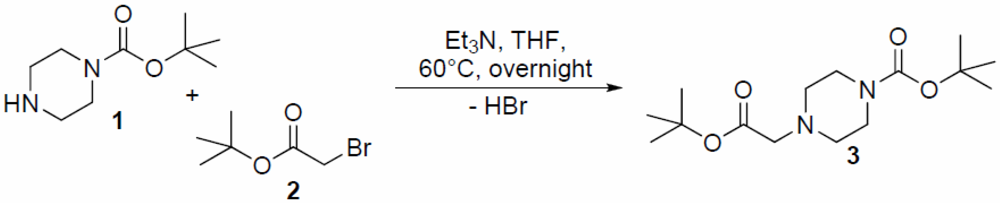
      <p>The preparation of the title compound <italic>tert</italic>-butyl 4-(2-<italic>tert</italic>-butoxy-2-oxoethyl)piperazine-1-carboxylate (<bold>3</bold>) in a high yield of 79% was accomplished via nucleophilic displacement of the bromine in <italic>tert</italic>-butyl bromoacetate (<bold>2</bold>) with the secondary amine of the Boc-protected piperazine <bold>1</bold> under basic conditions using triethylamine. (<xref ref-type="fig" rid="crystals-02-00090-f001">Figure 1</xref>) The reaction was performed under mild conditions at 60 °C overnight using tetrahydrofuran as solvent. Crystals of <bold>3</bold> were grown during the purification step from a saturated petroleum ether/ethyl acetate solution.</p>
      <fig id="crystals-02-00090-f001" position="anchor">
        <label>Figure 1</label>
        <caption>
          <p>The synthesis of title compound <bold>3</bold>.</p>
        </caption>
        <graphic xmlns:xlink="http://www.w3.org/1999/xlink" xlink:href="crystals-02-00090-g001.tif"/>
      </fig>
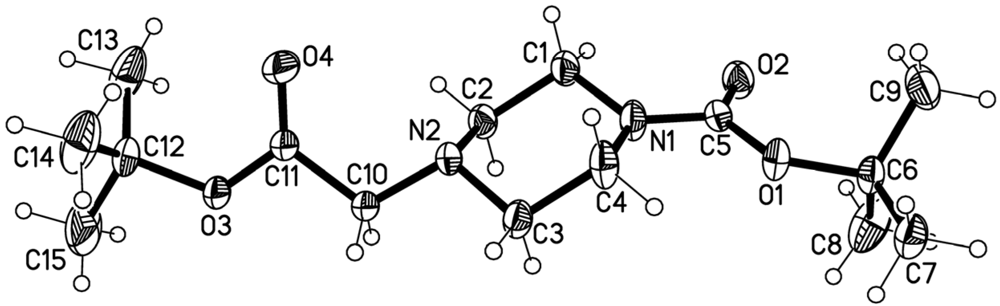
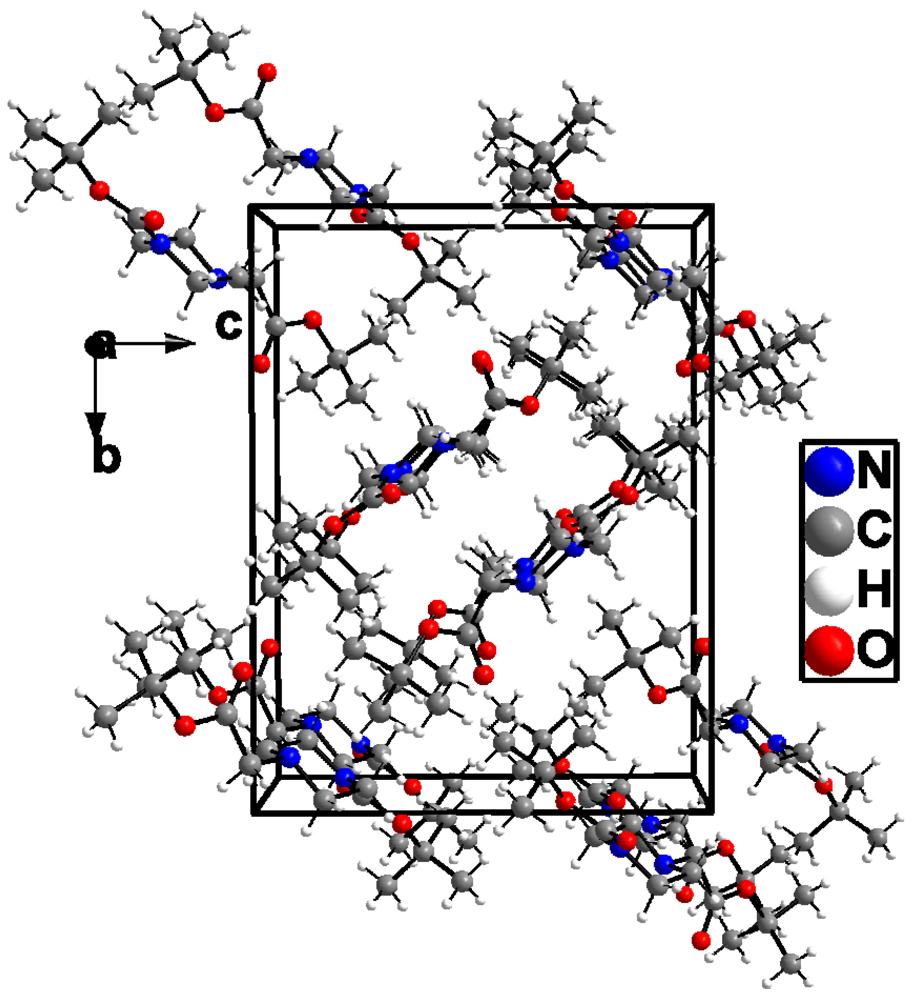
      <p>The crystal and instrumental parameters used in the unit cell determination, the data collection, and structure refinement parameters are summarized in <xref ref-type="table" rid="crystals-02-00090-t001">Table 1</xref>. The molecular structure of <bold>3</bold> is shown in <xref ref-type="fig" rid="crystals-02-00090-f002">Figure 2</xref> with the used atom-labeling scheme. The displacement thermal ellipsoids are drawn at the 50% probability level. Selected bond lengths comprising key features of <italic>tert</italic>-butyl 4-(2-<italic>tert</italic>-butoxy-2-oxoethyl)piperazine-1-carboxylate (<bold>3</bold>), are given in <xref ref-type="table" rid="crystals-02-00090-t002">Table 2</xref>. The central piperazine ring adopts a chair conformation. Whereas the carboxyl unit of the Boc residue, which is attached to N1, is almost in plane with the mean plane of the piperazine ring atoms (22.3°), the plane through the atoms of the second carboxyl unit (C11, O3 and O4) has an angle of 116.3° to the mean plane through the piperazine ring atoms. The packing of the molecules in the unit cell in a view along the crystallographic <italic>a</italic> direction is demonstrated in <xref ref-type="fig" rid="crystals-02-00090-f003">Figure 3</xref>. As visible from this plot, the title molecules have two different but symmetry-related orientations with respect to each other in the crystals of <bold>3</bold>. Intermolecular contacts are limited to those of van-der-Waals type. The shortest intermolecular distances of the polar atoms are between O3 and H atoms of the neighboring molecule at 2.991 Å and between O4 and H atoms at 2.702 and 2.710 Å.</p>

      <fig id="crystals-02-00090-f002" position="anchor">
        <label>Figure 2</label>
        <caption>
          <p>A view of the structure of the title molecules in crystals of <bold>3</bold> showing the atom labeling scheme. Displacement ellipsoids are drawn at the 50% probability level.</p>
        </caption>
        <graphic xmlns:xlink="http://www.w3.org/1999/xlink" xlink:href="crystals-02-00090-g002.tif"/>
      </fig>
      <table-wrap id="crystals-02-00090-t001" position="anchor">
        <object-id pub-id-type="pii">crystals-02-00090-t001_Table 1</object-id>
        <label>Table 1</label>
        <caption>
          <p>Crystal data and structure refinement for compound <bold>3</bold>.</p>
        </caption>
        <table style="border: solid thin">
          <thead>
            <tr>
              <th colspan="2" align="center" valign="middle" style="border-right: solid thin">Crystal data</th>
              <th colspan="2" align="center" valign="middle">Refinement</th>
            </tr>
          </thead>
          <tbody>
            <tr>
              <td align="left" valign="middle">Formula</td>
              <td align="left" valign="middle" style="border-right: solid thin">C<sub>15</sub>H<sub>28</sub>N<sub>2</sub>O<sub>4</sub></td>
              <td align="left" valign="middle">Refinement method</td>
              <td align="left" valign="middle">Full-matrix least-</td>
            </tr>
            <tr>
              <td align="left" valign="middle">Formula weight</td>
              <td align="left" valign="middle" style="border-right: solid thin">300.39 g·mol<sup>−1</sup></td>
              <td align="left" valign="middle"> </td>
              <td align="left" valign="middle">squares on <italic>F</italic><sup>2</sup></td>
            </tr>
            <tr>
              <td align="left" valign="middle">Temperature</td>
              <td align="left" valign="middle" style="border-right: solid thin">173 K</td>
              <td align="left" valign="middle">Data/restraints/parameters</td>
              <td align="left" valign="middle">7089/0/190</td>
            </tr>
            <tr>
              <td align="left" valign="middle">Wavelength</td>
              <td align="left" valign="middle" style="border-right: solid thin">0.71073 Å</td>
              <td align="left" valign="middle">Measured reflections</td>
              <td align="left" valign="middle">52521</td>
            </tr>
            <tr>
              <td align="left" valign="middle">Crystal system</td>
              <td align="left" valign="middle" style="border-right: solid thin">monoclinic </td>
              <td align="left" valign="middle">2 <italic>θ</italic><sub>max</sub></td>
              <td align="left" valign="middle">68.6°</td>
            </tr>
            <tr>
              <td align="left" valign="middle">Space group</td>
              <td align="left" valign="middle" style="border-right: solid thin">P2<sub>1</sub>/c</td>
              <td align="left" valign="middle">
                <italic>R</italic><sub>int</sub>
              </td>
              <td align="left" valign="middle">2.4%</td>
            </tr>
            <tr>
              <td align="left" valign="middle">Unit cell dimensions</td>
              <td align="left" valign="middle" style="border-right: solid thin"><italic>a</italic> = 8.4007(2) Å</td>
              <td align="left" valign="middle"> </td>
              <td align="left" valign="middle"> </td>
            </tr>
            <tr>
              <td align="left" valign="middle"> </td>
              <td align="left" valign="middle" style="border-right: solid thin"><italic>b</italic> = 16.4716(4) Å</td>
              <td align="left" valign="middle">Goodness-of-fit on <italic>F</italic><sup>2</sup></td>
              <td align="left" valign="middle">1.04</td>
            </tr>
            <tr>
              <td align="left" valign="middle"> </td>
              <td align="left" valign="middle" style="border-right: solid thin"><italic>c</italic> = 12.4876(3) Å</td>
              <td align="left" valign="middle"> </td>
              <td align="left" valign="middle"> </td>
            </tr>
            <tr>
              <td align="left" valign="middle"> </td>
              <td align="left" valign="middle" style="border-right: solid thin"><italic>β</italic> = 90.948(1)°</td>
              <td align="left" valign="middle">Final <italic>R</italic> indices</td>
              <td align="left" valign="middle"><italic>R<sub>1</sub></italic> = 0.0629</td>
            </tr>
            <tr>
              <td align="left" valign="middle">Volume</td>
              <td align="left" valign="middle" style="border-right: solid thin">1727.71(7) Å<sup>3</sup></td>
              <td align="left" valign="middle">[<italic>I</italic> &gt; 2σ(<italic>I</italic>)]</td>
              <td align="left" valign="middle"><italic>wR<sub>2</sub></italic> = 0.1791</td>
            </tr>
            <tr>
              <td align="left" valign="middle">
                <italic>Z</italic>
              </td>
              <td align="left" valign="middle" style="border-right: solid thin">4</td>
              <td align="left" valign="middle"><italic>R</italic> indices (all data)</td>
              <td align="left" valign="middle"><italic>R<sub>1</sub></italic> = 0.0801</td>
            </tr>
            <tr>
              <td align="left" valign="middle">Density (calcd.)</td>
              <td align="left" valign="middle" style="border-right: solid thin">1155 g·cm<sup>−3</sup></td>
              <td align="left" valign="middle"> </td>
              <td align="left" valign="middle"><italic>wR<sub>2</sub></italic> = 0.1969</td>
            </tr>
            <tr>
              <td align="left" valign="middle">Absorption coefficient</td>
              <td align="left" valign="middle" style="border-right: solid thin">0.08 mm<sup>−1</sup></td>
              <td align="left" valign="middle">Largest diff. peak and hole</td>
              <td align="left" valign="middle">0.97/−0.52 e·Å<sup>−3</sup></td>
            </tr>
            <tr>
              <td align="left" valign="middle">F(000)</td>
              <td align="left" valign="middle" style="border-right: solid thin">656</td>
              <td align="left" valign="middle"> </td>
              <td align="left" valign="middle"> </td>
            </tr>
            <tr>
              <td align="left" valign="middle">Crystal size</td>
              <td align="left" valign="middle" style="border-right: solid thin">0.63 × 0.42 × 0.39 mm<sup>3</sup></td>
              <td align="left" valign="middle"> </td>
              <td align="left" valign="middle"> </td>
            </tr>
          </tbody>
        </table>
      </table-wrap>
      <fig id="crystals-02-00090-f003" position="anchor">
        <label>Figure 3</label>
        <caption>
          <p>View of the packing of molecules in crystals of <bold>3</bold> along the crystallographic <italic>a</italic> axis.</p>
        </caption>
        <graphic xmlns:xlink="http://www.w3.org/1999/xlink" xlink:href="crystals-02-00090-g003.tif"/>
      </fig>
      <table-wrap id="crystals-02-00090-t002" position="anchor">
        <object-id pub-id-type="pii">crystals-02-00090-t002_Table 2</object-id>
        <label>Table 2</label>
        <caption>
          <p>Selected atom distances [Å] in <bold>3</bold>.</p>
        </caption>
        <table style="border: solid thin">
          <thead>
            <tr>
              <th align="left" valign="middle">atoms</th>
              <th align="left" valign="middle" style="border-right: solid thin">distance</th>
              <th align="left" valign="middle">atoms</th>
              <th align="left" valign="middle">distance</th>
            </tr>
          </thead>
          <tbody>
            <tr>
              <td align="left" valign="middle">N1−C1</td>
              <td align="left" valign="middle" style="border-right: solid thin">1.459(2)</td>
              <td align="left" valign="middle">C5−O2</td>
              <td align="left" valign="middle">1.220(1)</td>
            </tr>
            <tr>
              <td align="left" valign="middle">C1−C2</td>
              <td align="left" valign="middle" style="border-right: solid thin">1.520(2)</td>
              <td align="left" valign="middle">O1−C6</td>
              <td align="left" valign="middle">1.471(1)</td>
            </tr>
            <tr>
              <td align="left" valign="middle">C2−N2</td>
              <td align="left" valign="middle" style="border-right: solid thin">1.463(2)</td>
              <td align="left" valign="middle">N2−C10</td>
              <td align="left" valign="middle">1.452(1)</td>
            </tr>
            <tr>
              <td align="left" valign="middle">N2−C3</td>
              <td align="left" valign="middle" style="border-right: solid thin">1.463(2)</td>
              <td align="left" valign="middle">C10−C11</td>
              <td align="left" valign="middle">1.516(2)</td>
            </tr>
            <tr>
              <td align="left" valign="middle">C3−C4</td>
              <td align="left" valign="middle" style="border-right: solid thin">1.517(2)</td>
              <td align="left" valign="middle">C11−O3</td>
              <td align="left" valign="middle">1.333(1)</td>
            </tr>
            <tr>
              <td align="left" valign="middle">C4−N1</td>
              <td align="left" valign="middle" style="border-right: solid thin">1.466(2)</td>
              <td align="left" valign="middle">C11−O4</td>
              <td align="left" valign="middle">1.200(2)</td>
            </tr>
            <tr>
              <td align="left" valign="middle">N1−C5</td>
              <td align="left" valign="middle" style="border-right: solid thin">1.358(1)</td>
              <td align="left" valign="middle">O3−C12</td>
              <td align="left" valign="middle">1.477(1)</td>
            </tr>
            <tr>
              <td align="left" valign="middle">C5−O1</td>
              <td align="left" valign="middle" style="border-right: solid thin">1.348(1)</td>
              <td align="left" valign="middle"> </td>
              <td align="left" valign="middle"> </td>
            </tr>
          </tbody>
        </table>
      </table-wrap>
    </sec>
    <sec>
      <title>3. Experimental Section</title>
      <sec>
        <title>3.1. General</title>
        <p>NMR spectra were recorded on a Varian Inova-400 and chemical shifts of the <sup>1</sup>H and <sup>13</sup>C spectra are reported in parts per million (ppm) using tetramethylsilane as internal standard. The melting point was determined on a Galen III (Cambridge Instruments) melting point apparatus (Leica, Vienna, Austria) and is uncorrected. The mass spectrum (MS) was obtained on a Quattro/LC mass spectrometer (MICROMASS) by electrospray ionization.</p>
      </sec>
      <sec>
        <title>3.2. Synthesis of tert-Butyl 4-(2-tert-butoxy-2-oxoethyl)piperazine-1-carboxylate (3)</title>
        <p><italic>N</italic>-Boc-piperazine (207 mg, 1.11 mmol) and Et<sub>3</sub>N (225 mg, 2.22 mmol) were dissolved in anhydrous THF (10 mL). <italic>tert</italic>-Butyl bromoacetate (434 mg, 2.22 mmol) was added dropwise at ambient temperature and the mixture was stirred at 60 °C overnight. After cooling to room temperature, saturated hydrogen carbonate solution (15 mL) was added and the aqueous layer was extracted with ethyl acetate (3 × 15 mL). The combined organic layers were dried over Na<sub>2</sub>SO<sub>4</sub>, the solvent was removed and purification was done via column chromatography (petroleum ether/ethyl acetate = 4:1) to yield <bold>3</bold> as colorless solid (264 mg, 79%). m.p. 102 °C. <sup>1</sup>H NMR (400 MHz, CDCl<sub>3</sub>): <italic>δ</italic> = 1.45 (s, 9H, <sup>t</sup>Bu), 1.46 (s, 9H,<sup> t</sup>Bu), 2.52 (t, <sup>3</sup><italic>J</italic> = 4.9 Hz, 4H, NCH<sub>2</sub>), 3.12 (s, 2H, NCH<sub>2</sub>), 3.47 (t, <sup>3</sup><italic>J</italic> = 4.9 Hz, 4H, NCH<sub>2</sub>). <sup>13</sup>C NMR (101 MHz, CDCl<sub>3</sub>): <italic>δ</italic> = 28.3, 28.6 (2 × <sup>t</sup>Bu), 52.8 (NCH<sub>2</sub>), 60.1 (NCH<sub>2</sub>), 79.8, 81.4 (2 × C<sub>quart</sub>), 154.8 (C=O). MS (ESI+): <italic>m/z</italic> = 323 (11) [M+Na], 301 (100) [M<sup>+</sup>+H].</p>
      </sec>
      <sec>
        <title>3.3. Data Collection and Refinement</title>
        <p>Crystallographic data were collected with a Bruker-Nonius Apex-X8 CCD-diffractometer with monochromatic Mo–<italic>K</italic>α radiation (<italic>λ</italic> = 0.71073 Å) and a CCD detector. Preliminary data of the unit cell dimensions were obtained from the reflection positions of 36 frames, measured in three different directions of the reciprocal space. After completion of the data measurements the reflection intensities were corrected for Lorentz, polarization, and absorption effects. The data set of 7089 reflections was averaged from 52521 reflections (up to 68.6°) with an internal R value of 2.4% in Laue group 2/m. Averaging in <italic>mmm</italic> (orthorhombic) gives an R<sub>int</sub> larger than 50%, indicating the monoclinic crystal system to be the correct choice. The structures were solved by direct methods using SHELXS-97 and refined against <italic>F</italic><sup>2</sup> on all data by full-matrix least-squares methods using SHELXL-97 version 2 [<xref ref-type="bibr" rid="B8-crystals-02-00090">8</xref>,<xref ref-type="bibr" rid="B9-crystals-02-00090">9</xref>]. All non-hydrogen atoms were refined anisotropically; all hydrogen atoms bonded to carbon atoms were placed on geometrically calculated positions and refined using riding models. Crystallographic data has been deposited with the Cambridge Crystallographic Data Centre, CCDC-858567. It can be retrieved free of charge through <email>deposit@ccdc.cam.ac.uk</email> or <uri>http://www.ccdc.cam.ac.uk</uri>.</p>
      </sec>
    </sec>
    <sec sec-type="conclusions">
      <title>4. Conclusions</title>
      <p>The crystal and molecular structure of <italic>tert</italic>-butyl 4-(2-<italic>tert</italic>-butoxy-2-oxoethyl)-piperazine-1-carboxylate (<bold>3</bold>) is reported. These data represent a crystallographically characterized example of a molecular compound with a piperazine building block, which found various applications in the preparation of biological active compounds in pharmaceutical research.</p>
    </sec>
  </body>
  <back>
    <ref-list>
      <title>References</title>
      <ref id="B1-crystals-02-00090">
        <label>1.</label>
        <citation citation-type="journal">
          <person-group person-group-type="author">
            <name>
              <surname>Huang</surname>
              <given-names>W.</given-names>
            </name>
            <name>
              <surname>Naughton</surname>
              <given-names>M.A.</given-names>
            </name>
            <name>
              <surname>Yang</surname>
              <given-names>H.</given-names>
            </name>
            <name>
              <surname>Su</surname>
              <given-names>T.</given-names>
            </name>
            <name>
              <surname>Dam</surname>
              <given-names>S.</given-names>
            </name>
            <name>
              <surname>Wong</surname>
              <given-names>P.W.</given-names>
            </name>
            <name>
              <surname>Arfsten</surname>
              <given-names>A.</given-names>
            </name>
            <name>
              <surname>Edwards</surname>
              <given-names>S.</given-names>
            </name>
            <name>
              <surname>Sinha</surname>
              <given-names>U.</given-names>
            </name>
            <name>
              <surname>Hollenbach</surname>
              <given-names>S.</given-names>
            </name>
            <name>
              <surname>Scarborough</surname>
              <given-names>R.M.</given-names>
            </name>
            <name>
              <surname>Zhu</surname>
              <given-names>B.-Y.</given-names>
            </name>
          </person-group>
          <article-title>Design, synthesis, and structure-Activity relationships of unsubstituted piperazinone-Based transition state factor Xa inhibitors</article-title>
          <source>Bioorg. Med. Chem. Lett.</source>
          <year>2003</year>
          <volume>13</volume>
          <fpage>723</fpage>
          <lpage>728</lpage>
        <pub-id pub-id-type="doi">10.1016/S0960-894X(02)01037-5</pub-id><pub-id pub-id-type="pmid">12639567</pub-id></citation>
      </ref>
      <ref id="B2-crystals-02-00090">
        <label>2.</label>
        <citation citation-type="journal">
          <person-group person-group-type="author">
            <name>
              <surname>Hirokawa</surname>
              <given-names>Y.</given-names>
            </name>
            <name>
              <surname>Kinoshita</surname>
              <given-names>H.</given-names>
            </name>
            <name>
              <surname>Tanaka</surname>
              <given-names>T.</given-names>
            </name>
            <name>
              <surname>Nakamura</surname>
              <given-names>T.</given-names>
            </name>
            <name>
              <surname>Fujimoto</surname>
              <given-names>K.</given-names>
            </name>
            <name>
              <surname>Kashimoto</surname>
              <given-names>S.</given-names>
            </name>
            <name>
              <surname>Kojima</surname>
              <given-names>T.</given-names>
            </name>
            <name>
              <surname>Kato</surname>
              <given-names>S.</given-names>
            </name>
          </person-group>
          <article-title>Pleuromutilin derivatives having a purine ring. Part 2: Influence of the central spacer on the antibacterial activity against Gram-positive pathogens</article-title>
          <source>Bioorg. Med. Chem. Lett.</source>
          <year>2009</year>
          <volume>19</volume>
          <fpage>170</fpage>
          <lpage>174</lpage>
        <pub-id pub-id-type="doi">10.1016/j.bmcl.2008.10.123</pub-id><pub-id pub-id-type="pmid">19028096</pub-id></citation>
      </ref>
      <ref id="B3-crystals-02-00090">
        <label>3.</label>
        <citation citation-type="journal">
          <person-group person-group-type="author">
            <name>
              <surname>Rossi</surname>
              <given-names>C.</given-names>
            </name>
            <name>
              <surname>Porcelloni</surname>
              <given-names>M.</given-names>
            </name>
            <name>
              <surname>D’Andrea</surname>
              <given-names>P.</given-names>
            </name>
            <name>
              <surname>Fincham</surname>
              <given-names>C.I.</given-names>
            </name>
            <name>
              <surname>Ettorre</surname>
              <given-names>A.</given-names>
            </name>
            <name>
              <surname>Mauro</surname>
              <given-names>S.</given-names>
            </name>
            <name>
              <surname>Squarcia</surname>
              <given-names>A.</given-names>
            </name>
            <name>
              <surname>Bigioni</surname>
              <given-names>M.</given-names>
            </name>
            <name>
              <surname>Parlani</surname>
              <given-names>M.</given-names>
            </name>
            <name>
              <surname>Nardelli</surname>
              <given-names>F.</given-names>
            </name>
            <name>
              <surname>Binaschi</surname>
              <given-names>M.</given-names>
            </name>
            <name>
              <surname>Maggi</surname>
              <given-names>C.A.</given-names>
            </name>
            <name>
              <surname>Fattori</surname>
              <given-names>D.</given-names>
            </name>
          </person-group>
          <article-title>Alkyl piperidine and piperazine hydroxamic acids as HDAC inhibitors</article-title>
          <source>Bioorg. Med. Chem. Lett.</source>
          <year>2011</year>
          <volume>21</volume>
          <fpage>2305</fpage>
          <lpage>2308</lpage>
        <pub-id pub-id-type="doi">10.1016/j.bmcl.2011.02.085</pub-id><pub-id pub-id-type="pmid">21420859</pub-id></citation>
      </ref>
      <ref id="B4-crystals-02-00090">
        <label>4.</label>
        <citation citation-type="journal">
          <person-group person-group-type="author">
            <name>
              <surname>Grosse-Gehling</surname>
              <given-names>P.</given-names>
            </name>
            <name>
              <surname>Wuest</surname>
              <given-names>F.R.</given-names>
            </name>
            <name>
              <surname>Peppel</surname>
              <given-names>T.</given-names>
            </name>
            <name>
              <surname>Köckerling</surname>
              <given-names>M.</given-names>
            </name>
            <name>
              <surname>Mamat</surname>
              <given-names>C.</given-names>
            </name>
          </person-group>
          <article-title>1-(3-[<sup>18</sup>F]fluoro-propyl)piperazines as model compounds for the radiofluorination of pyrido[2,3-<italic>d</italic>]pyrimidines</article-title>
          <source>Radiochim. Acta</source>
          <year>2011</year>
          <volume>99</volume>
          <fpage>365</fpage>
          <lpage>373</lpage>
          <pub-id pub-id-type="doi">10.1524/ract.2011.1834</pub-id>
        </citation>
      </ref>
      <ref id="B5-crystals-02-00090">
        <label>5.</label>
        <citation citation-type="journal">
          <person-group person-group-type="author">
            <name>
              <surname>Dutta</surname>
              <given-names>A.S.</given-names>
            </name>
            <name>
              <surname>Crowther</surname>
              <given-names>M.</given-names>
            </name>
            <name>
              <surname>Gormley</surname>
              <given-names>J.J.</given-names>
            </name>
            <name>
              <surname>Hassall</surname>
              <given-names>L.</given-names>
            </name>
            <name>
              <surname>Hayward</surname>
              <given-names>C.F.</given-names>
            </name>
            <name>
              <surname>Gellert</surname>
              <given-names>P.R.</given-names>
            </name>
            <name>
              <surname>Kittlety</surname>
              <given-names>R.S.</given-names>
            </name>
            <name>
              <surname>Alcock</surname>
              <given-names>P.J.</given-names>
            </name>
            <name>
              <surname>Jamieson</surname>
              <given-names>A.</given-names>
            </name>
            <name>
              <surname>Moores</surname>
              <given-names>J.M.</given-names>
            </name>
            <etal/>
          </person-group>
          <article-title>Potent cyclic peptide inhibitors of VLA-4 (α<sub>4</sub>β<sub>1</sub> integrin)-mediated cell adhesion. Discovery of compounds like cyclo(MePhe-Leu-Asp-Val-<sc>D</sc>-Arg-<sc>D</sc>-Arg) (ZD7349) compatible with depot formulation</article-title>
          <source>J. Peptide Sci.</source>
          <year>2000</year>
          <volume>6</volume>
          <fpage>321</fpage>
          <lpage>341</lpage>
          <pub-id pub-id-type="doi">10.1002/1099-1387(200007)6:7&lt;321::AID-PSC259&gt;3.0.CO;2-A</pub-id>
        </citation>
      </ref>
      <ref id="B6-crystals-02-00090">
        <label>6.</label>
        <citation citation-type="journal">
          <person-group person-group-type="author">
            <name>
              <surname>Meshram</surname>
              <given-names>H.M.</given-names>
            </name>
            <name>
              <surname>Chennakesava Reddy</surname>
              <given-names>B.</given-names>
            </name>
            <name>
              <surname>Ramesh Goud</surname>
              <given-names>P.</given-names>
            </name>
          </person-group>
          <article-title>Triton B-Mediated Mild, Convenient, and Efficient Method for the Selective Alkylation of Cyclic Secondary Amines and Thiols</article-title>
          <source>Synth. Commun.</source>
          <year>2009</year>
          <volume>39</volume>
          <fpage>2297</fpage>
          <lpage>2303</lpage>
          <pub-id pub-id-type="doi">10.1080/00397910802654740</pub-id>
        </citation>
      </ref>
      <ref id="B7-crystals-02-00090">
        <label>7.</label>
        <citation citation-type="journal">
          <person-group person-group-type="author">
            <name>
              <surname>Varala</surname>
              <given-names>R.</given-names>
            </name>
            <name>
              <surname>Enugala</surname>
              <given-names>R.</given-names>
            </name>
            <name>
              <surname>Adapa</surname>
              <given-names>S.R.</given-names>
            </name>
          </person-group>
          <article-title>Ruthenium(III) chloride-catalyzed efficient protocol for ethyl diazoacetate insertion into the N–H bond of secondary amines</article-title>
          <source>Monatsh. Chem.</source>
          <year>2008</year>
          <volume>139</volume>
          <fpage>1369</fpage>
          <lpage>1372</lpage>
          <pub-id pub-id-type="doi">10.1007/s00706-008-0927-z</pub-id>
        </citation>
      </ref>
      <ref id="B8-crystals-02-00090">
        <label>8.</label>
        <citation citation-type="book">
          <person-group person-group-type="author">
            <name>
              <surname>Sheldrick</surname>
              <given-names>G.M.</given-names>
            </name>
          </person-group>
          <source>SHELXS/L-97, Programs for the Solution and Refinement of Crystal Structures</source>
          <publisher-name>University of Göttingen</publisher-name>
          <publisher-loc>Göttingen, Germany</publisher-loc>
          <year>1997</year>
        </citation>
      </ref>
      <ref id="B9-crystals-02-00090">
        <label>9.</label>
        <citation citation-type="journal">
          <person-group person-group-type="author">
            <name>
              <surname>Sheldrick</surname>
              <given-names>G.M.</given-names>
            </name>
          </person-group>
          <article-title>A short history of <italic>SHELX</italic></article-title>
          <source>Acta Cryst.</source>
          <year>2008</year>
          <volume>A64</volume>
          <fpage>112</fpage>
          <lpage>122</lpage>
        </citation>
      </ref>
    </ref-list>
  </back>
</article>