<?xml version="1.0" encoding="UTF-8"?>
<!DOCTYPE article PUBLIC "-//NLM//DTD Journal Publishing DTD v2.3 20070202//EN" "journalpublishing.dtd">
<article xmlns:mml="http://www.w3.org/1998/Math/MathML" xmlns:xlink="http://www.w3.org/1999/xlink" xml:lang="en" article-type="research-article">
  <front>
    <journal-meta>
      <journal-id journal-id-type="publisher-id">crystals</journal-id>
      <journal-title>Crystals</journal-title>
      <abbrev-journal-title abbrev-type="publisher">Crystals</abbrev-journal-title>
      <abbrev-journal-title abbrev-type="pubmed">Crystals</abbrev-journal-title>
      <issn pub-type="epub">2073-4352</issn>
      <publisher>
        <publisher-name>MDPI</publisher-name>
      </publisher>
    </journal-meta>
    <article-meta>
      <article-id pub-id-type="doi">10.3390/cryst2010043</article-id>
      <article-id pub-id-type="publisher-id">crystals-02-00043</article-id>
      <article-categories>
        <subj-group>
          <subject>Article</subject>
        </subj-group>
      </article-categories>
      <title-group>
        <article-title>New Fulvalenium Salts of Cobalt Bis(dicarbollide): Crystal Structures and Electrical Conductivities</article-title>
      </title-group>
	  <contrib-group>
        <contrib contrib-type="author">
          <name>
            <surname>Kazheva</surname>
            <given-names>Olga N.</given-names>
          </name>
          <xref rid="af1-crystals-02-00043" ref-type="aff">1</xref>
        </contrib>
        <contrib contrib-type="author">
          <name>
            <surname>Aleksandrov</surname>
            <given-names>Grigory G.</given-names>
          </name>
          <xref rid="af2-crystals-02-00043" ref-type="aff">2</xref>
        </contrib>
        <contrib contrib-type="author">
          <name>
            <surname>Kravchenko</surname>
            <given-names>Andrey V.</given-names>
          </name>
          <xref rid="af3-crystals-02-00043" ref-type="aff">3</xref>
        </contrib>
        <contrib contrib-type="author">
          <name>
            <surname>Starodub</surname>
            <given-names>Vladimir A.</given-names>
          </name>
          <xref rid="af4-crystals-02-00043" ref-type="aff">4</xref>
        </contrib>
        <contrib contrib-type="author">
          <name>
            <surname>Lobanova</surname>
            <given-names>Irina A.</given-names>
          </name>
          <xref rid="af5-crystals-02-00043" ref-type="aff">5</xref>
        </contrib>
        <contrib contrib-type="author">
          <name>
            <surname>Kosenko</surname>
            <given-names>Irina D.</given-names>
          </name>
          <xref rid="af5-crystals-02-00043" ref-type="aff">5</xref>
        </contrib>
        <contrib contrib-type="author">
          <name>
            <surname>Sivaev</surname>
            <given-names>Igor B.</given-names>
          </name>
          <xref rid="af5-crystals-02-00043" ref-type="aff">5</xref>
          <xref rid="c1-crystals-02-00043" ref-type="corresp">*</xref>
        </contrib>
        <contrib contrib-type="author">
          <name>
            <surname>Bregadze</surname>
            <given-names>Vladimir I.</given-names>
          </name>
          <xref rid="af5-crystals-02-00043" ref-type="aff">5</xref>
        </contrib>
        <contrib contrib-type="author">
          <name>
            <surname>Buravov</surname>
            <given-names>Lev I.</given-names>
          </name>
          <xref rid="af1-crystals-02-00043" ref-type="aff">1</xref>
        </contrib>
        <contrib contrib-type="author">
          <name>
            <surname>Dyachenko</surname>
            <given-names>Oleg A.</given-names>
          </name>
          <xref rid="af1-crystals-02-00043" ref-type="aff">1</xref>
        </contrib>
      </contrib-group>
      
      <aff id="af1-crystals-02-00043"><label>1 </label>Institute of Problems of Chemical Physics, Russian Academy of Sciences, Semenov Av. 1, 142432, Chernogolovka, Moscow Region, Russia; Email: <email>koh@icp.ac.ru</email> (O.N.K.); <email>buravov@icp.ac.ru</email> (L.I.B.); <email>doa@icp.ac.ru</email> (O.A.D.)</aff>
      <aff id="af2-crystals-02-00043"><label>2 </label>N.S.Kurnakov Institute of General and Inorganic Chemistry, Russian Academy of Sciences, Leninskii Prosp. 31, 119991, Moscow, Russia; Email: <email>aleks@igic.ras.ru</email></aff>
      <aff id="af3-crystals-02-00043"><label>3 </label>V.N.Karazin Kharkiv National University, Svoboda Sq. 4, 61077, Kharkiv, Ukraine; Email: <email>twkravchenko@univer.kharkov.ua</email></aff>
      <aff id="af4-crystals-02-00043"><label>4 </label>Institute of Chemistry, Jan Kochanowski University of Humanities and Sciences, 15G Swietokrzyska Str., 25-406, Kielce, Poland; Email: <email>vladimir.a.starodub@univer.kharkov.ua</email></aff>
      <aff id="af5-crystals-02-00043"><label>5 </label>A.N.Nesmeyanov Institute of Organoelement Compounds, Russian Academy of Sciences, Vavilov Str. 28, 119991, Moscow, Russia; Email: <email>lobanova@ineos.ac.ru</email> (I.A.L.); <email>kosenko@ineos.ac.ru</email> (I.D.K.); <email>bre@ineos.ac.ru</email> (V.I.B.)</aff>
      <author-notes>
        <corresp id="c1-crystals-02-00043"><label>*</label> Author to whom correspondence should be addressed; Email: <email>sivaev@ineos.ac.ru</email>; Tel.: +7-499-1359242; Fax: +7-499-1355085.</corresp>
      </author-notes>
      <pub-date pub-type="epub">
        <day>06</day>
        <month>01</month>
        <year>2012</year>
      </pub-date>
      <pub-date pub-type="collection">
	  <month>03</month>
        <year>2012</year>
      </pub-date>
      <volume>2</volume>
      <issue>1</issue>
      <fpage>43</fpage>
      <lpage>55</lpage>
      <history>
        <date date-type="received">
          <day>06</day>
          <month>12</month>
          <year>2011</year>
        </date>
        <date date-type="rev-recd">
          <day>21</day>
          <month>12</month>
          <year>2011</year>
        </date>
        <date date-type="accepted">
          <day>22</day>
          <month>12</month>
          <year>2011</year>
        </date>
      </history>
      <permissions>
        <copyright-statement>©  2012 by the authors; licensee MDPI, Basel, Switzerland.</copyright-statement>
        <copyright-year>2012</copyright-year>
        <license xmlns:xlink="http://www.w3.org/1999/xlink" license-type="open-access" xlink:href="http://creativecommons.org/licenses/by/3.0/">
          <p>This article is an open-access article distributed under the terms and conditions of the Creative Commons Attribution license (<uri>http://creativecommons.org/licenses/by/3.0/</uri>).</p>
        </license>
      </permissions>
      <abstract>
        <p>New radical cation salts (BEDT-TTF)[8,8',(7)-Cl<sub>2</sub>(Cl<sub>0.09</sub>)-3,3'-Co(1,2-C<sub>2</sub>B<sub>9</sub>H<sub>9.91</sub>)(1',2'-C<sub>2</sub>B<sub>9</sub>H<sub>10</sub>)] (<bold>1</bold>), (BEDT-TTF)[8,8'-Br<sub>0.75</sub>Cl<sub>1.25</sub>-3,3'-Co(1,2-C<sub>2</sub>B<sub>9</sub>H<sub>10</sub>)<sub>2</sub>] (<bold>2</bold>), and (BMDT-TTF)<sub>4</sub>[8,8'-Br<sub>1.16</sub>(OH)<sub>0.72</sub>-3,3'-Co(1,2-C<sub>2</sub>B<sub>9</sub>H<sub>10.06</sub>)<sub>2</sub>] (<bold>3</bold>) were synthesized, and their crystal structures and electrical conductivities were determined. All the radical cation salts are semiconductors. Compounds <bold>1</bold> and <bold>2</bold> were found to be isostructural, however their electrical conductivities strongly differ (σ<sub>293 </sub>= 2 Ω<sup>−1</sup>cm<sup>−1</sup> and 10<sup>−5</sup> Ω<sup>−1</sup>cm<sup>−1</sup>, respectively).</p>
      </abstract>
      <kwd-group>
        <kwd>molecular conductors</kwd>
        <kwd>cobalt bis(dicarbollide)</kwd>
        <kwd>bis(ethylenedithio) tetrathiafulvalene</kwd>
        <kwd>bis(methylenedithio)tetrathiafulvalene</kwd>
        <kwd>structure</kwd>
        <kwd>conductivity</kwd>
      </kwd-group>
    </article-meta>
  </front>
  <body>
    <sec sec-type="intro">
      <title>1. Introduction</title>
      <p>Tetrathiafulvalene based radical cation salts and charge transfer complexes constitute a wide class of organic materials with transport properties ranging from insulating to superconducting [<xref ref-type="bibr" rid="B1-crystals-02-00043">1</xref>,<xref ref-type="bibr" rid="B2-crystals-02-00043">2</xref>]. Conductivity in these materials occurs via the π-electron donor network made up of stacks or sheets of closely packed radical cations. A crucial parameter determining conductivity of the target compounds is packing of the radical cations, which depends strongly on the nature of counterions. Organometallic chemistry provides a wide choice of metal complexes of various shapes and sizes that can be used as counterions in conducting radical cation salts and organometallic crystal engineering of molecular materials has become a rapidly developing research field [<xref ref-type="bibr" rid="B3-crystals-02-00043">3</xref>]. The bis(1,2-dicarbollide) complexes of the iron group metals, [<italic>commo</italic>-3,3'-M(1,2-C<sub>2</sub>B<sub>9</sub>H<sub>11</sub>)<sub>2</sub>]<sup>−</sup> (M = Fe, Co, Ni), demonstrate extraordinary high stability due to delocalized cluster bonding of the metal atom with π orbitals of the dicarbollide ligands [<xref ref-type="bibr" rid="B4-crystals-02-00043">4</xref>,<xref ref-type="bibr" rid="B5-crystals-02-00043">5</xref>] and can be considered as charge-compensating counterions for synthesis of new radical cation–based molecular materials [<xref ref-type="bibr" rid="B6-crystals-02-00043">6</xref>,<xref ref-type="bibr" rid="B7-crystals-02-00043">7</xref>]. Substitution of hydrogen atoms in these compounds for various non-hydrogen atoms and groups discovers practically unlimited perspectives of their modification [<xref ref-type="bibr" rid="B4-crystals-02-00043">4</xref>,<xref ref-type="bibr" rid="B5-crystals-02-00043">5</xref>,<xref ref-type="bibr" rid="B8-crystals-02-00043">8</xref>]. Moreover, an introduction of substituents which are capable of hydrogen bond formation provides an important strategy for molecular design to control molecular arrangement in crystals based on organometallic compounds.</p>
      <p>Recently we studied the effect of iodo- [<xref ref-type="bibr" rid="B9-crystals-02-00043">9</xref>,<xref ref-type="bibr" rid="B10-crystals-02-00043">10</xref>,<xref ref-type="bibr" rid="B11-crystals-02-00043">11</xref>], bromo- [<xref ref-type="bibr" rid="B12-crystals-02-00043">12</xref>] and hydroxy- [<xref ref-type="bibr" rid="B13-crystals-02-00043">13</xref>] substituents in cobalt bis(1,2-dicarbollide) complexes on crystal packing and physical properties of their salts with TTF-based radical cations. In this paper, we report the crystal structures and electrical conductivities of tetrathiafulvalenium salts of dichloro and mixed bromo-chloro and bromo-hydroxy derivatives of cobalt bis(dicarbollide) anion.</p>
    </sec>
    <sec sec-type="results">
      <title>2. Results and Discussion</title>
      <sec>
        <title>2.1. (BEDT-TTF)[8,8',(7)-Cl<sub>2</sub>(Cl<sub>0.09</sub>)-3,3'-Co(1,2-C<sub>2</sub>B<sub>9</sub>H<sub>9.91</sub>)(1',2'-C<sub>2</sub>B<sub>9</sub>H<sub>10</sub>)]</title>
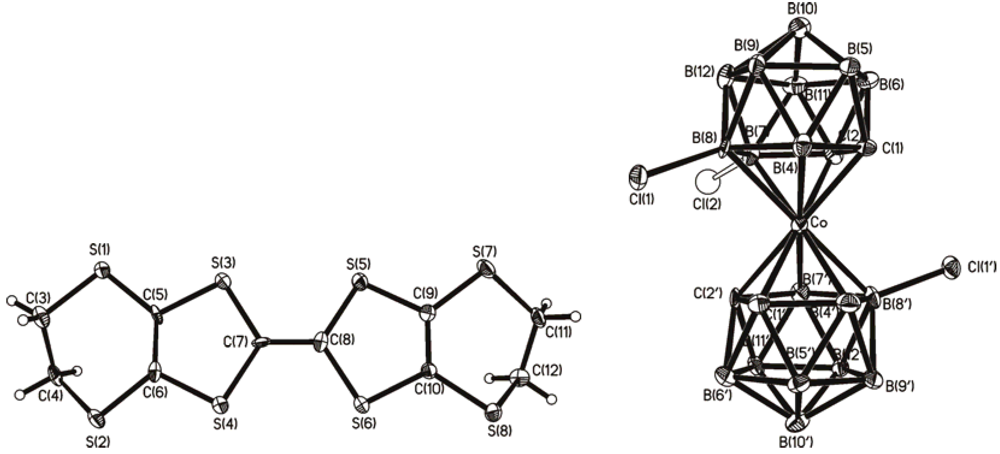
        <p>The crystals of (BEDT-TTF)[8,8',(7)-Cl<sub>2</sub>(Cl<sub>0.09</sub>)-3,3'-Co(1,2-C<sub>2</sub>B<sub>9</sub>H<sub>9.91</sub>)(1',2'-C<sub>2</sub>B<sub>9</sub>H<sub>10</sub>)] (<bold>1</bold>) were prepared by electrochemical oxidation of bis(ethylenedithio)tetrathiafulvalene (BEDT-TTF) in 1,2,2-trichloroethane–acetonitrile with (Me<sub>4</sub>N)[8,8'-Cl<sub>2</sub>-3,3'-Co(1,2-C<sub>2</sub>B<sub>9</sub>H<sub>10</sub>)<sub>2</sub>] as an electrolyte under galvanostatic conditions. The X-ray structure analysis revealed partial substitution of a hydrogen atom at position 7 of the metallacarborane anion by a chlorine atom. The substitution can be the result of electrochemical reaction of cobaltacarborane with 1,2,2-trichloroethane as a source of chlorine and is not typical for the chemistry of cobalt bis(1,2-dicarbollide) [<xref ref-type="bibr" rid="B4-crystals-02-00043">4</xref>,<xref ref-type="bibr" rid="B14-crystals-02-00043">14</xref>]. </p>
        <p>The crystal structure of <bold>1</bold> belongs to the triclinic system (space group <italic>P-1</italic>) with two BEDT-TTF radical cations and two [8,8',(7)-Cl<sub>2</sub>(Cl<sub>0.09</sub>)-3,3'-Co(1,2-C<sub>2</sub>B<sub>9</sub>H<sub>9.91</sub>)(1',2'-C<sub>2</sub>B<sub>9</sub>H<sub>10</sub>)]<sup>−</sup> anions in general positions of unit cell (<xref ref-type="fig" rid="crystals-02-00043-f001">Figure 1</xref>).</p>
        <fig id="crystals-02-00043-f001" position="anchor">
          <label>Figure 1</label>
          <caption>
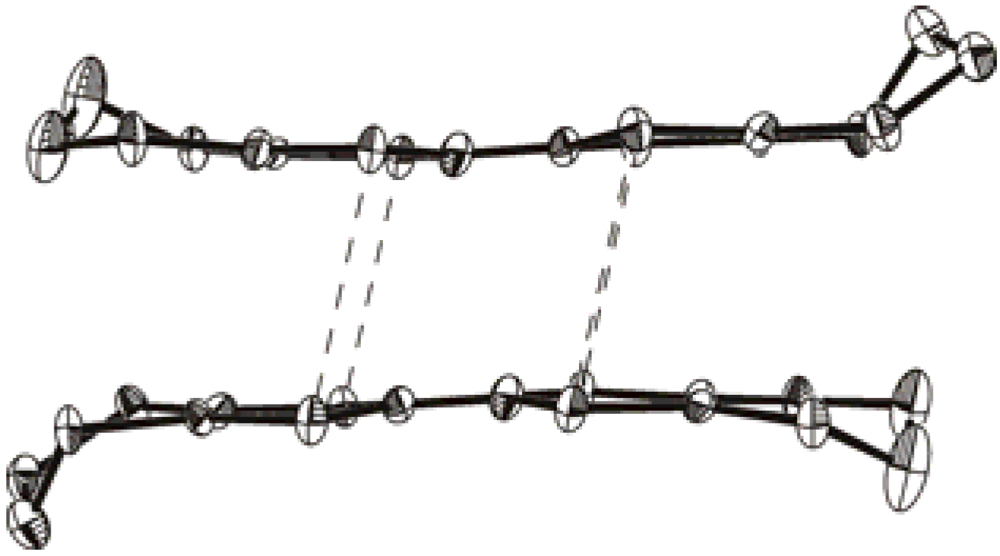
            <p>Atom designations in (BEDT-TTF)[8,8',(7)-Cl<sub>2</sub>(Cl<sub>0.09</sub>)-3,3'-Co(1,2-C<sub>2</sub>B<sub>9</sub>H<sub>9.91</sub>)(1',2'-C<sub>2</sub>B<sub>9</sub>H<sub>10</sub>)] (1).</p>
          </caption>
          <graphic xmlns:xlink="http://www.w3.org/1999/xlink" xlink:href="crystals-02-00043-g001.tif"/>
        </fig>
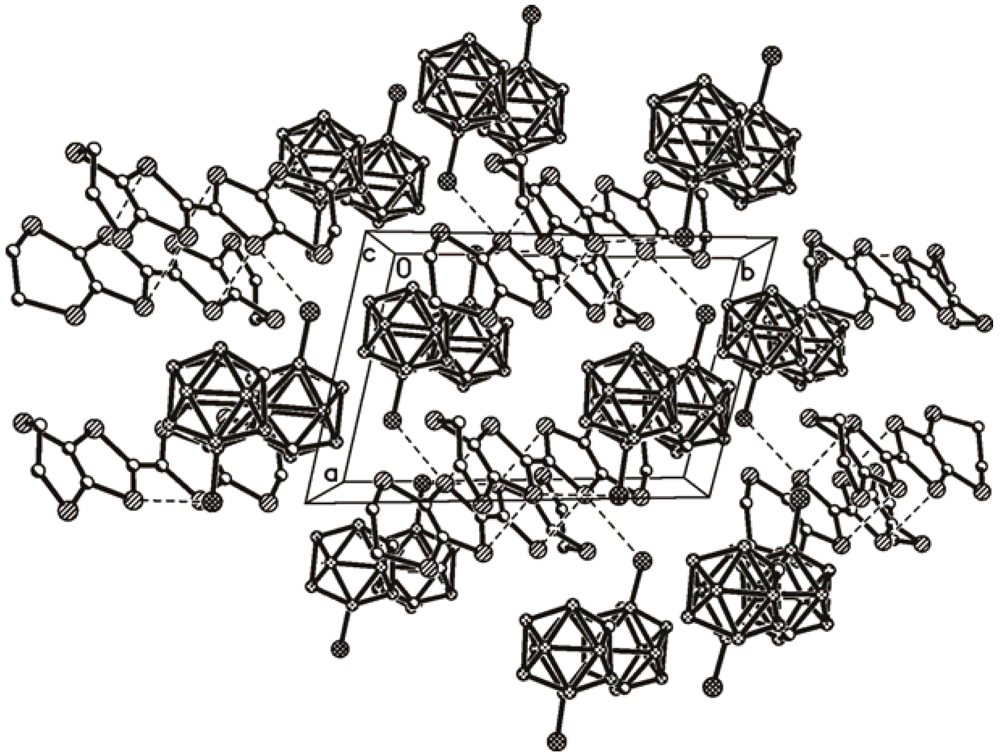
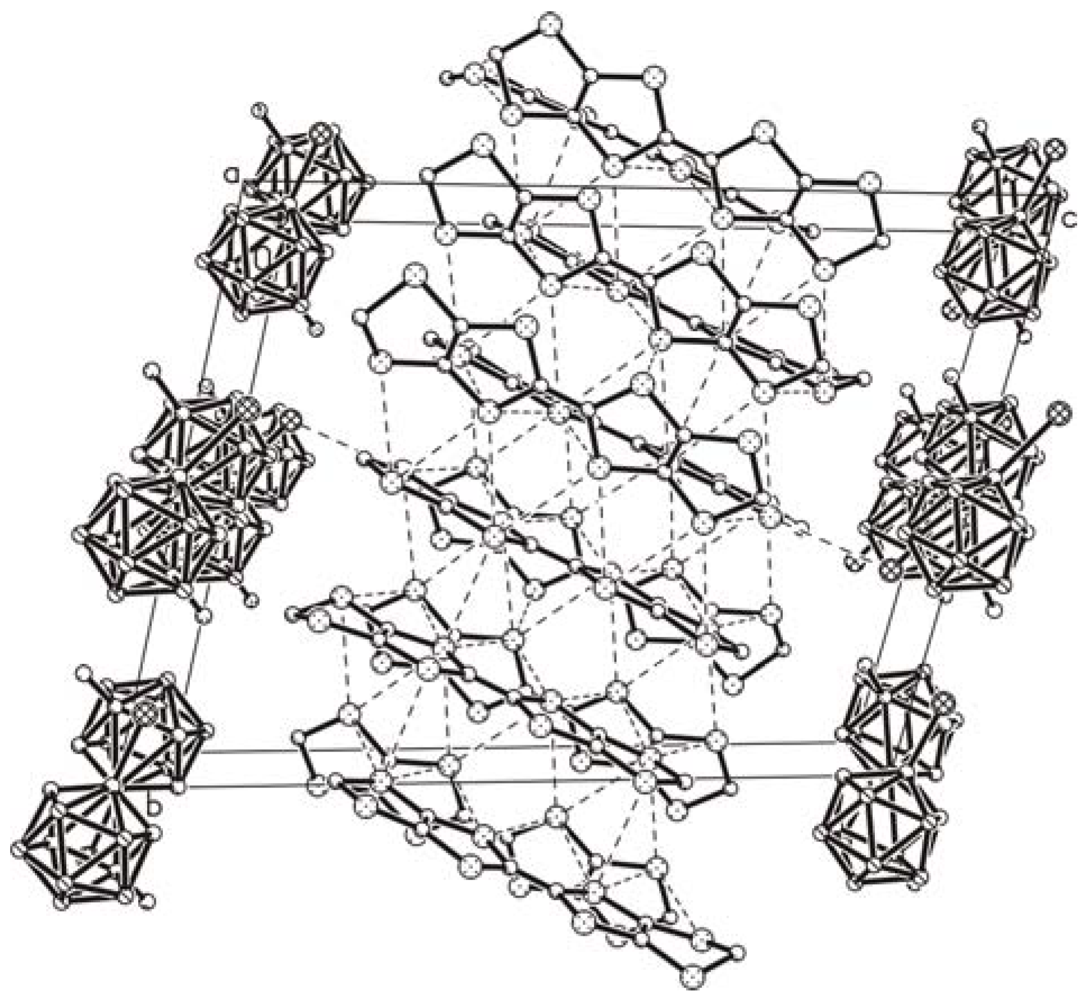
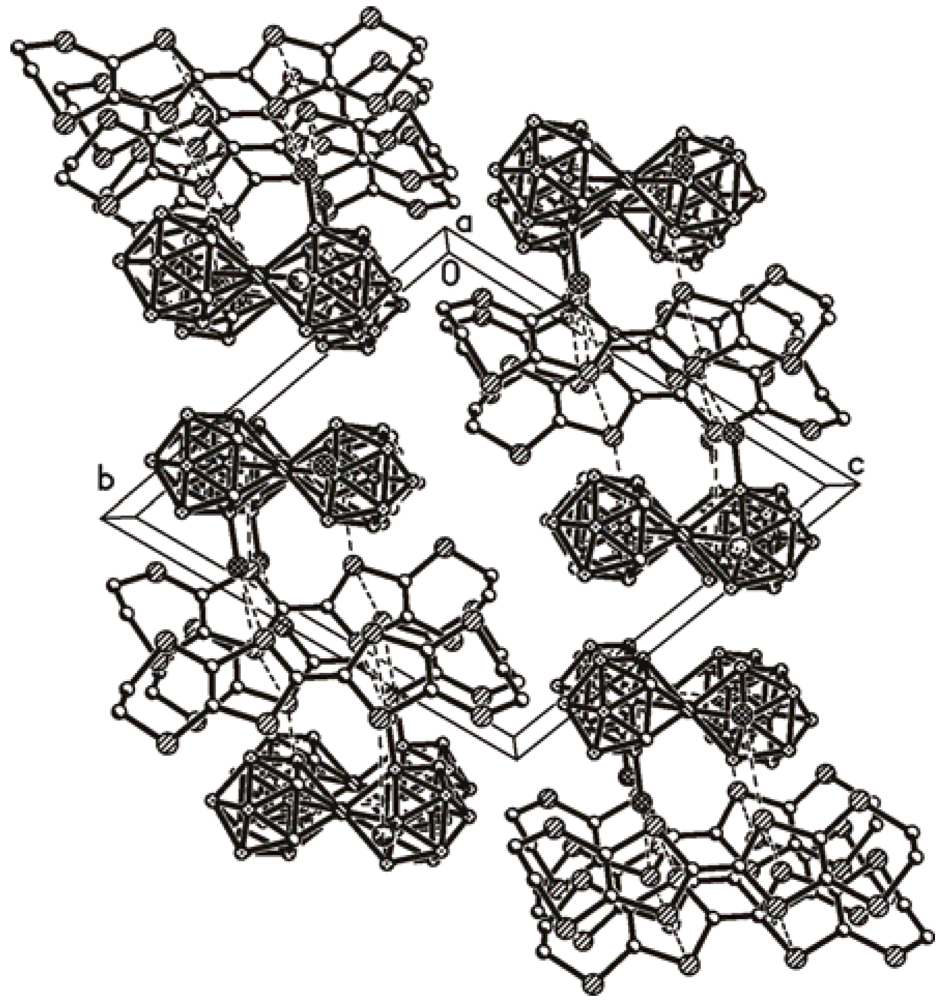
        <p>The cobaltacarborane anions and pairs of the BEDT-TTF<sup>+</sup><bold>·</bold> radical cations alternate along the <italic>a</italic> axis, forming the mixed stacks (<xref ref-type="fig" rid="crystals-02-00043-f002">Figure 2</xref>). The radical cation pairs are formed by a nearly eclipsed overlap of the BEDT-TTF units, related by an inversion centre with interplanar distance of 3.50 Å (<xref ref-type="fig" rid="crystals-02-00043-f003">Figure 3</xref>). The shortest S…S intermolecular distances in the pairs (3.417(2)–3.506(2) Å) are less than the sum of the van der Waals radii of two sulfur atoms (3.68 Å [<xref ref-type="bibr" rid="B15-crystals-02-00043">15</xref>]). The estimation of the donor charge through the bond distance analysis [<xref ref-type="bibr" rid="B16-crystals-02-00043">16</xref>] is in a good agreement with the donor charge +1 deduced from the 1:1 compound stoichiometry. The BEDT-TTF<sup>+</sup><bold>·</bold> radical cations are slightly bent, the maximum deviation of sulfur atoms from the cation plane being 0.13 Å and deviations of carbon atoms of the ethylene groups reaching 1.35 Å.</p>
        <fig id="crystals-02-00043-f002" position="anchor">
          <label>Figure 2</label>
          <caption>
            <p>A fragment of crystal structure of (BEDT-TTF)[8,8',(7)-Cl<sub>2</sub>(Cl<sub>0.09</sub>)-3,3'-Co(1,2-C<sub>2</sub>B<sub>9</sub>H<sub>9.91</sub>)(1',2'-C<sub>2</sub>B<sub>9</sub>H<sub>10</sub>)] (1). </p>
          </caption>
          <graphic xmlns:xlink="http://www.w3.org/1999/xlink" xlink:href="crystals-02-00043-g002.tif"/>
        </fig>
        <fig id="crystals-02-00043-f003" position="anchor">
          <label>Figure 3</label>
          <caption>
            <p>The pair of the BEDT-TTF radical cations in (BEDT-TTF)[8,8',(7)-Cl<sub>2</sub>(Cl<sub>0.09</sub>)-3,3'-Co(1,2-C<sub>2</sub>B<sub>9</sub>H<sub>9.91</sub>)(1',2'-C<sub>2</sub>B<sub>9</sub>H<sub>10</sub>)] (1). </p>
          </caption>
          <graphic xmlns:xlink="http://www.w3.org/1999/xlink" xlink:href="crystals-02-00043-g003.tif"/>
        </fig>
        <p>The dicarbollide ligands in the cobaltacarborane anion are mutually rotated by 180° producing <italic>transoid</italic> conformation. The C<sub>2</sub>B<sub>3</sub> faces of the dicarbollide ligands are nearly parallel (the dihedral angle is 1.8°). The distances from the cobalt atom to the C<sub>2</sub>B<sub>3</sub> planes are equal 1.47 Å. The Co-C and Co-B distances in the [8,8',(7)-Cl<sub>2</sub>(Cl<sub>0.09</sub>)-3,3'-Co(1,2-C<sub>2</sub>B<sub>9</sub>H<sub>9.91</sub>)(1',2'-C<sub>2</sub>B<sub>9</sub>H<sub>10</sub>)]<sup>− </sup>anion are 2.014(5)–2.027(5) Å and 2.097(5)–2.154(6) Ǻ, respectively. The B(8)-Cl(1) and B(8')-Cl(1') distances are 1.821(6)–1.822(6) Å, that is close to similar ones found in K[8,8'-Cl<sub>2</sub>-3,3'-Co(1,2-C<sub>2</sub>B<sub>9</sub>H<sub>10</sub>)<sub>2</sub>] [<xref ref-type="bibr" rid="B17-crystals-02-00043">17</xref>] and (PPN)[8,8'-Cl<sub>2</sub>-3,3'-Co(1,2-C<sub>2</sub>B<sub>9</sub>H<sub>10</sub>)<sub>2</sub>] [<xref ref-type="bibr" rid="B18-crystals-02-00043">18</xref>], whereas the B(7)-Cl(2) distance is some shorter and equals 1.77(1) Å.</p>
        <p>Additional intermolecular contacts Cl(1)…S(5) and Cl(1')…S(3) (3.547(2) and 3.334(2) Å, respectively, sum of van der Waals radii is 3.74 Å [<xref ref-type="bibr" rid="B15-crystals-02-00043">15</xref>]) were found between the BEDT-TTF<sup>+</sup><bold>·</bold> radical cations and the cobaltacarborane anions.</p>
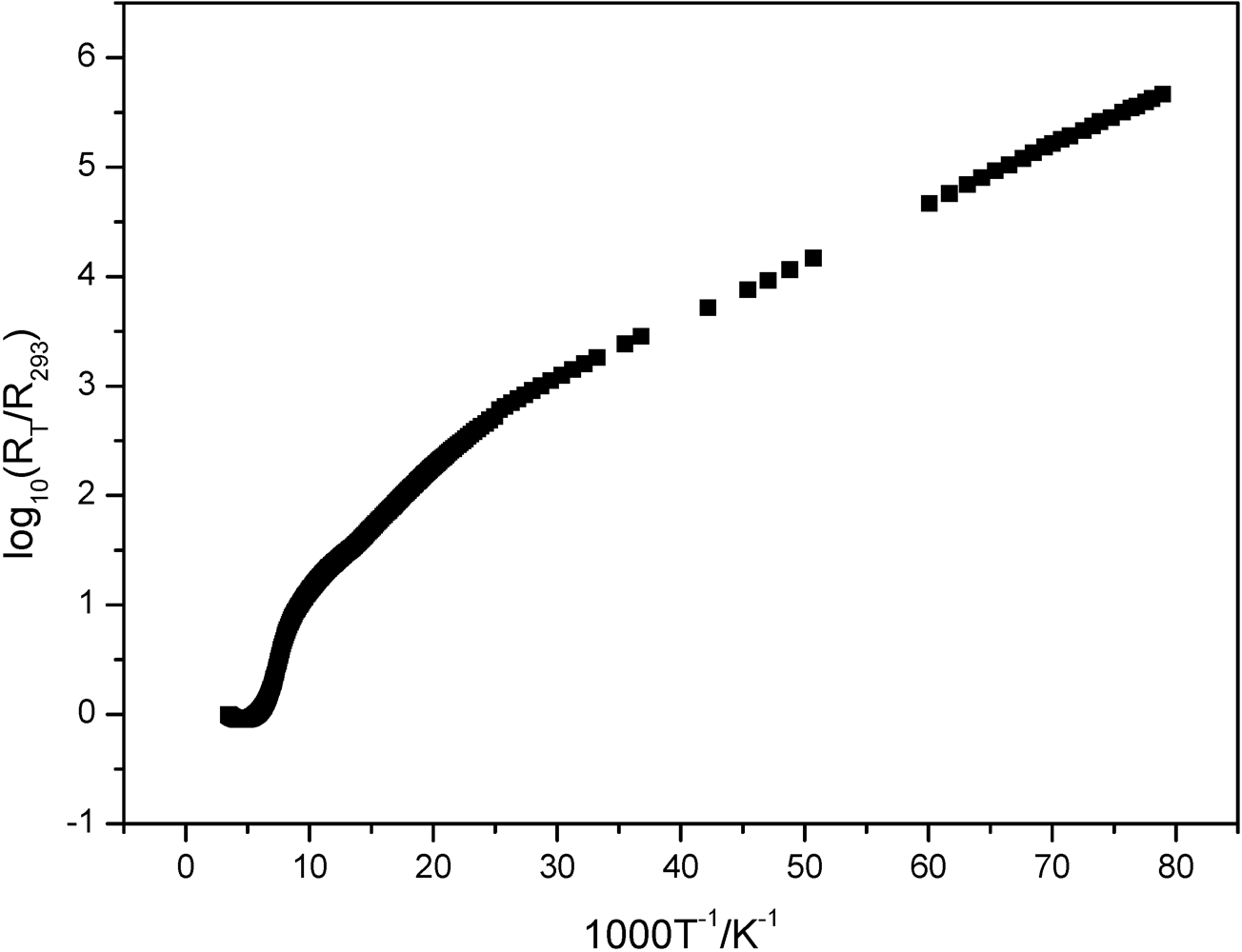
		<fig id="crystals-02-00043-f004" position="anchor">
          <label>Figure 4</label>
          <caption>
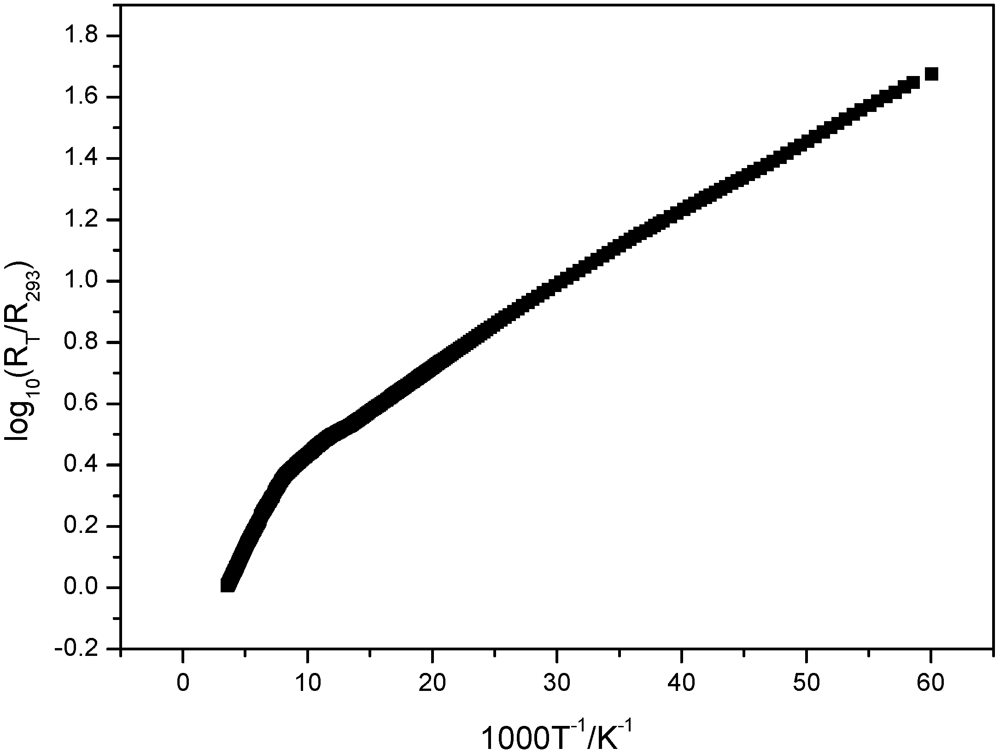
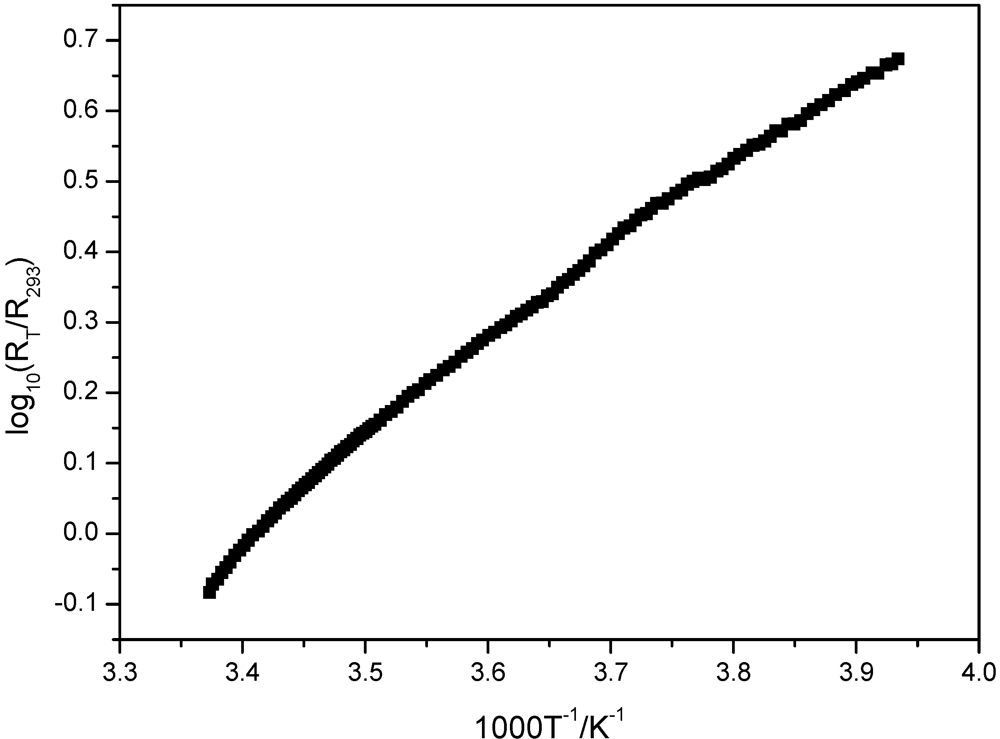
            <p>Temperature dependence of resistance for a single crystal of (BEDT-TTF)[8,8',(7)-Cl<sub>2</sub>(Cl<sub>0.09</sub>)-3,3'-Co(1,2-C<sub>2</sub>B<sub>9</sub>H<sub>9.91</sub>)(1',2'-C<sub>2</sub>B<sub>9</sub>H<sub>10</sub>)] (1).</p>
          </caption>
          <graphic xmlns:xlink="http://www.w3.org/1999/xlink" xlink:href="crystals-02-00043-g004.tif"/>
        </fig>
      
        <p>The conductivity study revealed that <bold>1</bold> is a semiconductor with a maximum activation energy E<sub>a </sub>≅ 0.09 eV in the range 125–140 K. When the temperature is lowered to 12–40 K the activation energy decreases to 0.01 eV. Lowering the temperature from 300 to 215 K leads to a decrease in resistance by 10%, with a further decrease in temperature resulting in an increase of the resistance. The room temperature conductivity of <bold>1</bold>, σ<sub>293 </sub>is 2 Ω<sup>−1</sup>cm<sup>−1</sup> (<xref ref-type="fig" rid="crystals-02-00043-f004">Figure 4</xref>). </p>
        </sec>
      <sec>
        <title>2.2. (BEDT-TTF)[8,8'-Br<sub>0.75</sub>Cl<sub>1.25</sub>-3,3'-Co(1,2-C<sub>2</sub>B<sub>9</sub>H<sub>10</sub>)<sub>2</sub>]</title>
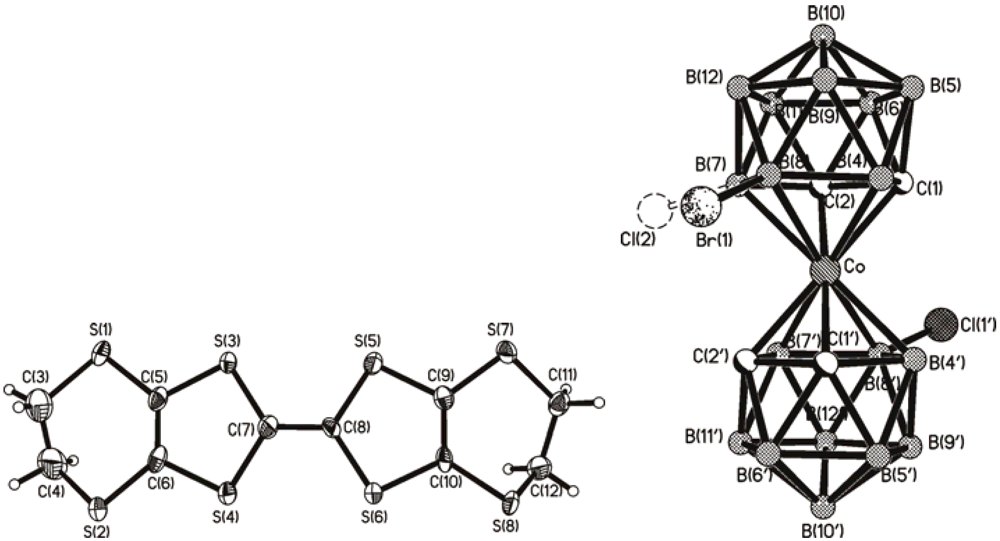
        <p>The crystals of (BEDT-TTF)[8,8'-Br<sub>0.75</sub>Cl<sub>1.25</sub>-3,3'-Co(1,2-C<sub>2</sub>B<sub>9</sub>H<sub>10</sub>)<sub>2</sub>] (<bold>2</bold>) were prepared by electrochemical oxidation of bis(ethylenedithio)tetrathiafulvalene (BEDT-TTF) in 1,2,2-trichloroethane–acetonitrile with (Me<sub>4</sub>N)[8,8'-Br<sub>2</sub>-3,3'-Co(1,2-C<sub>2</sub>B<sub>9</sub>H<sub>10</sub>)<sub>2</sub>] as an electrolyte. The X-ray structure analysis revealed partial substitution of bromine atoms by chlorine atoms. <bold>2</bold> was found to be isostructural to the dichloro derivative <bold>1</bold>. The crystal structure of <bold>2</bold> is formed by the BEDT-TTF<sup>+</sup><bold>·</bold> radical cations and [8,8'-Br<sub>0.75</sub>Cl<sub>1.25</sub>-3,3'-Co(1,2-C<sub>2</sub>B<sub>9</sub>H<sub>10</sub>)<sub>2</sub>]<sup>−</sup> anions in general positions (<xref ref-type="fig" rid="crystals-02-00043-f005">Figure 5</xref>).</p>
        <fig id="crystals-02-00043-f005" position="anchor">
          <label>Figure 5</label>
          <caption>
            <p>Atom designations in (BEDT-TTF)[8,8'-Br<sub>0.75</sub>Cl<sub>1.25</sub>-3,3'-Co(1,2-C<sub>2</sub>B<sub>9</sub>H<sub>10</sub>)<sub>2</sub>] (<bold>2</bold>). The dashed line denotes position of the atom Cl(2) populated by 25%, the position of the atom Br(1) is populated by 75%.</p>
          </caption>
          <graphic xmlns:xlink="http://www.w3.org/1999/xlink" xlink:href="crystals-02-00043-g005.tif"/>
        </fig>
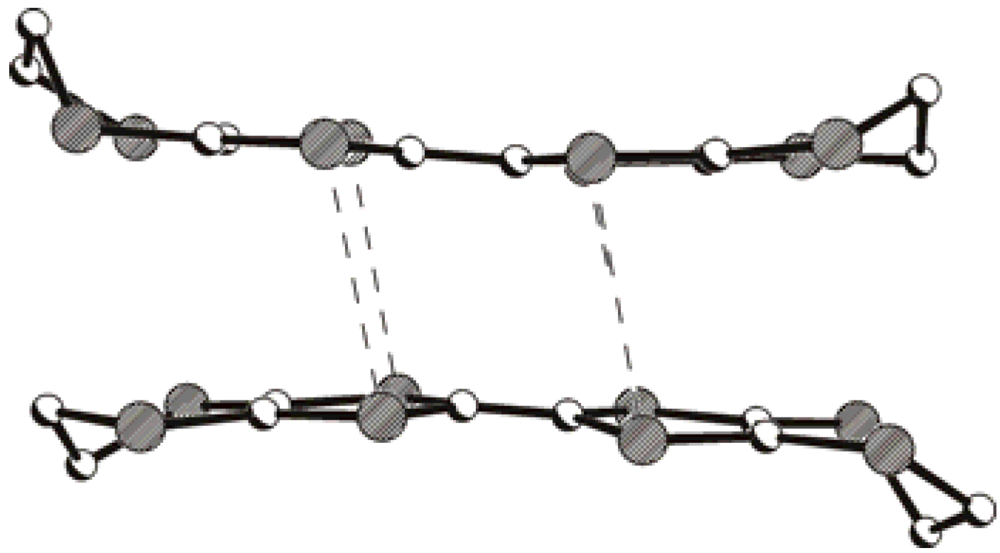
        <p>The cobaltacarborane anions and pairs of the BEDT-TTF<sup>+</sup><bold>·</bold> radical cations alternate along the <italic>a</italic> axis, forming the mixed stacks (<xref ref-type="fig" rid="crystals-02-00043-f006">Figure 6</xref>). The BEDT-TTF<sup>+</sup><bold>·</bold> radical cations form pairs possessing an inversion center. The distances between averaged planes the radical cations in the pairs are 3.47 Å and the shortest S…S intermolecular distances between the BEDT-TTF<sup>+</sup><bold>·</bold> cations in the pairs are 3.436(3)–3.502(3) Å (<xref ref-type="fig" rid="crystals-02-00043-f007">Figure 7</xref>). The bond lengths in the BEDT-TTF skeleton are in a good agreement with +1 donor charge and the overall compound stoichiometry [<xref ref-type="bibr" rid="B16-crystals-02-00043">16</xref>]. The BEDT-TTF<sup>+</sup><bold>·</bold> radical cations are slightly bent, the maximum deviation of sulfur atoms from the cation plane being 0.12 Å and deviations of carbon atoms of the ethylene groups reaching 1.33 Å.</p>
        <fig id="crystals-02-00043-f006" position="anchor">
          <label>Figure 6</label>
          <caption>
            <p>A fragment of crystal structure of (BEDT-TTF)[8,8'-Br<sub>0.75</sub>Cl<sub>1.25</sub>-3,3'-Co(1,2-C<sub>2</sub>B<sub>9</sub>H<sub>10</sub>)<sub>2</sub>] (<bold>2</bold>). </p>
          </caption>
          <graphic xmlns:xlink="http://www.w3.org/1999/xlink" xlink:href="crystals-02-00043-g006.tif"/>
        </fig>
        <fig id="crystals-02-00043-f007" position="anchor">
          <label>Figure 7</label>
          <caption>
            <p>The pair of the BEDT-TTF radical cations in (BEDT-TTF)[8,8'-Br<sub>0.75</sub>Cl<sub>1.25</sub>-3,3'-Co(1,2-C<sub>2</sub>B<sub>9</sub>H<sub>10</sub>)<sub>2</sub>] (<bold>2</bold>). </p>
          </caption>
          <graphic xmlns:xlink="http://www.w3.org/1999/xlink" xlink:href="crystals-02-00043-g007.tif"/>
        </fig>
        <p>The C<sub>2</sub>B<sub>3</sub> faces of the dicarbollide ligands are nearly parallel (the dihedral angle is 1.4°). The distances from the cobalt atom to the C<sub>2</sub>B<sub>3</sub> planes are equal to 1.47 Å. The Co-C and Co-B distances are 2.014(8)–2.045(8) Å and 2.06(1)–2.160(9) Ǻ, respectively, suggesting <italic>transoid</italic> conformation for the [8-Br-8-Cl-3,3'-Co(1,2-C<sub>2</sub>B<sub>9</sub>H<sub>10</sub>)<sub>2</sub>]<sup>− </sup>anion and <italic>gauche</italic> conformation for the [8,8'-Cl<sub>2</sub>-3,3'-Co(1,2-C<sub>2</sub>B<sub>9</sub>H<sub>10</sub>)<sub>2</sub>]<sup>− </sup>anion. The B(8)-Br(1) distance is 1.941(10) Å, which is close to similar ones in radical cation salts of the [8,8'-Br<sub>2</sub>-3,3'-Co(1,2-C<sub>2</sub>B<sub>9</sub>H<sub>10</sub>)<sub>2</sub>] anion [<xref ref-type="bibr" rid="B12-crystals-02-00043">12</xref>].</p>
        <p>Additional intermolecular contacts Br(1)…S(5) (3.630(2) Å) and Cl(1')…S(3) (3.295(2) Å) (sum of van der Waals radii are 3.81 and 3.74 Å, respectively [<xref ref-type="bibr" rid="B13-crystals-02-00043">13</xref>]) were found between the BEDT-TTF<sup>+</sup><bold>·</bold> radical cations and the cobaltacarborane anions.</p>
        <p>The conductivity study revealed that <bold>2</bold> is a semiconductor with a maximum activation energy E<sub>a </sub>≅ 0.26 eV in the range 250–300 K. The room temperature conductivity of <bold>1</bold>, σ<sub>293 </sub>is 10<sup>−5</sup> Ω<sup>−1</sup>cm<sup>−1</sup> (<xref ref-type="fig" rid="crystals-02-00043-f008">Figure 8</xref>).</p>
        <fig id="crystals-02-00043-f008" position="anchor">
          <label>Figure 8</label>
          <caption>
            <p>Temperature dependence of resistance for polycrystalline of (BEDT-TTF)[8,8'-Br<sub>0.75</sub>Cl<sub>1.25</sub>-3,3'-Co(1,2-C<sub>2</sub>B<sub>9</sub>H<sub>10</sub>)<sub>2</sub>] (<bold>2</bold>).</p>
          </caption>
          <graphic xmlns:xlink="http://www.w3.org/1999/xlink" xlink:href="crystals-02-00043-g008.tif"/>
        </fig>
      </sec>
      <sec>
        <title>2.3. (BMDT-TTF)<sub>4</sub>[8,8'-Br<sub>1.16</sub>(OH)<sub>0.72</sub>-3,3'-Co(1,2-C<sub>2</sub>B<sub>9</sub>H<sub>10.06</sub>)<sub>2</sub>]</title>
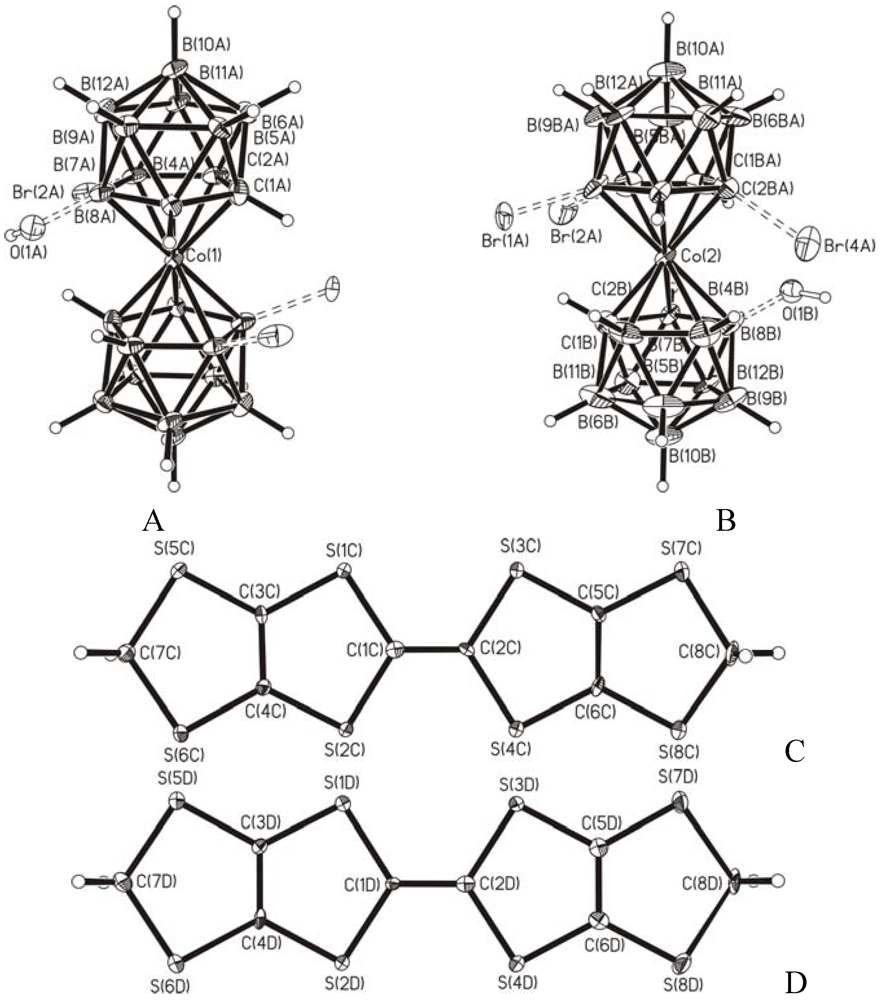
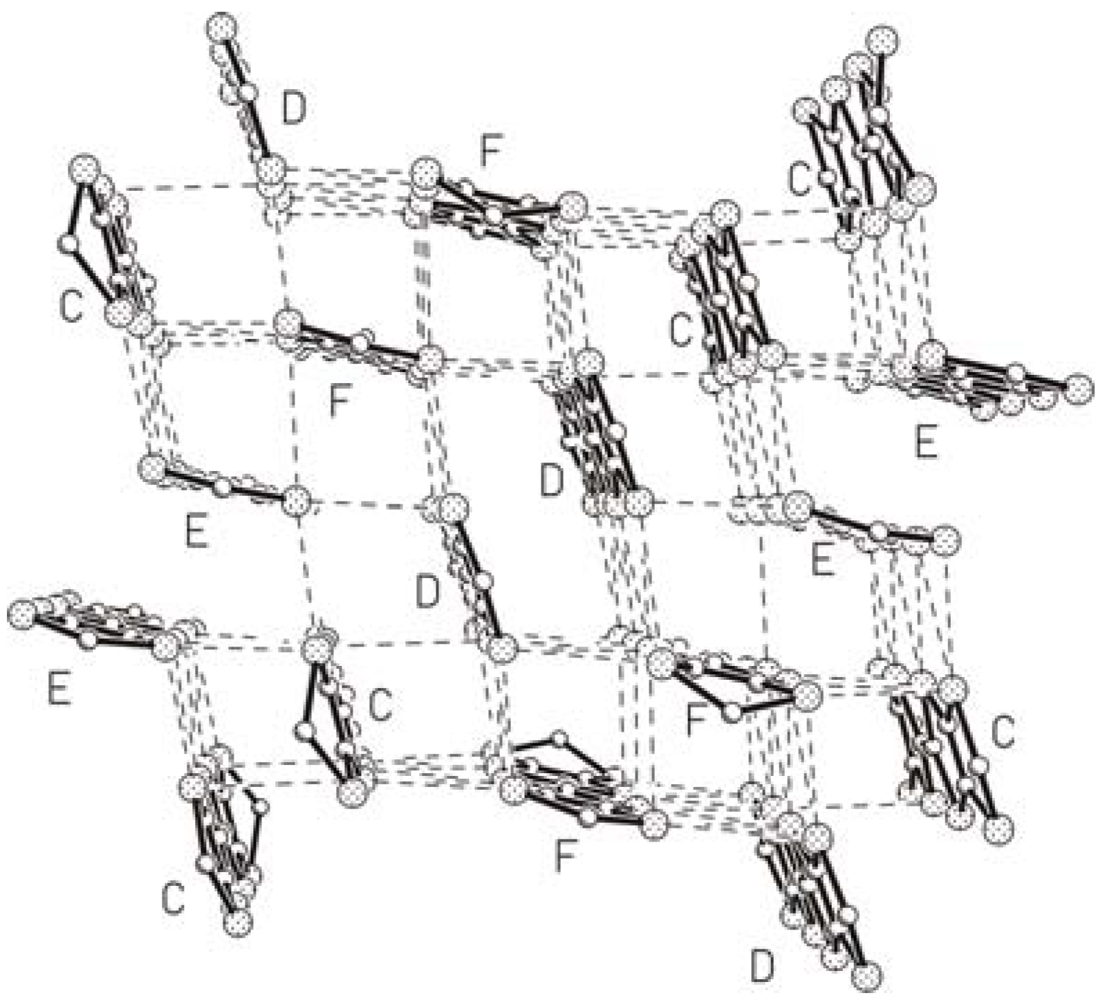
        <p>The crystals of (BMDT-TTF)<sub>4</sub>[8,8'-Br<sub>1.16</sub>(OH)<sub>0.72</sub>-3,3'-Co(1,2-C<sub>2</sub>B<sub>9</sub>H<sub>10.06</sub>)<sub>2</sub>] (<bold>3</bold>) were prepared by electrochemical oxidation of bis(methylenedithio)tetrathiafulvalene (BMDT-TTF) in 1,2,2-trichloroethane–acetonitrile with (Me<sub>4</sub>N)[8-Br-8'-HO-3,3'-Co(1,2-C<sub>2</sub>B<sub>9</sub>H<sub>10</sub>)<sub>2</sub>] as an electrolyte under galvanostatic conditions. Compound <bold>3</bold> was found to be isostructural with the corresponding 8,8'-dibromo [<xref ref-type="bibr" rid="B12-crystals-02-00043">12</xref>] and 8,8'-diiodo [<xref ref-type="bibr" rid="B10-crystals-02-00043">10</xref>] derivatives. The asymmetric cell unit of <bold>3</bold> contains four crystallographically independent BMDT-TTF radical cations, labeled C, D, E and F, in general positions and two independent halves of the cobaltcarborane anions (A and B) in the special centrosymmetric positions (<xref ref-type="fig" rid="crystals-02-00043-f009">Figure 9</xref>). In common with many BEDT-TTF charge transfer salts, the crystal packing consists of cationic and anionic layers alternating along the <italic>c</italic> axis (<xref ref-type="fig" rid="crystals-02-00043-f010">Figure 10</xref>). The structure of the organic layer is reminiscent of the well known α-type in the BEDT-TTF series. In the BMDT-TTF layer, there are two types of different stacks, the first one is formed by the C and D donor molecules alternating in the -C-C-D-D- order and second one is formed by the E and F molecules in the -E-E-F-F- alternate arrangement (<xref ref-type="fig" rid="crystals-02-00043-f011">Figure 11</xref>). The radical cations are nearly planar, the maximum deviation of sulfur atoms from the cation plane being 0.12 Ǻ and deviations of terminal carbon atoms mounting 0.66 Ǻ. Dihedral angles formed by the BMDT-TTF molecules from different stacks were found to be C-E 61.0°, D-E 58.0°, C-F 60.6°, and D-F 57.6°. The donor molecules of different types in stacks (C-D and E-F) are near parallel (dihedral angles are 0.7–3.0°), whereas donors of the same type (C-C, D-D, E-E, and F-F) are parallel on the symmetry conditions. The distances between the donor planes are 3.44 Ǻ for C-C, 3.47 Ǻ for C-D, 3.60 Ǻ for D-D, 3.54 Ǻ for E-E, 3.54 Ǻ for E-F, and 3.49 Ǻ for F-F. There are many shortened S…S contacts of side-to-side mode between adjacent BMDT-TTF cation stacks (interstack contacts) ranging from 3.374(2) to 3.644(2) Ǻ.</p>
        <fig id="crystals-02-00043-f009" position="anchor">
          <label>Figure 9</label>
          <caption>
            <p>Atom designations in (BMDT-TTF)<sub>4</sub>[8,8'-Br<sub>1.16</sub>(OH)<sub>0.72</sub>-3,3'-Co(1,2-C<sub>2</sub>B<sub>9</sub>H<sub>10.06</sub>)<sub>2</sub>] (<bold>3</bold>). The dashed line denotes bonds with atoms in partially populated positions.</p>
          </caption>
          <graphic xmlns:xlink="http://www.w3.org/1999/xlink" xlink:href="crystals-02-00043-g009.tif"/>
        </fig>
        <fig id="crystals-02-00043-f010" position="anchor">
          <label>Figure 10</label>
          <caption>
            <p>A fragment of crystal structure of (BMDT-TTF)<sub>4</sub>[8,8'-Br<sub>1.16</sub>(OH)<sub>0.72</sub>-3,3'-Co(1,2-C<sub>2</sub>B<sub>9</sub>H<sub>10.06</sub>)<sub>2</sub>] (<bold>3</bold>). </p>
          </caption>
          <graphic xmlns:xlink="http://www.w3.org/1999/xlink" xlink:href="crystals-02-00043-g010.tif"/>
        </fig>
        <fig id="crystals-02-00043-f011" position="anchor">
          <label>Figure 11</label>
          <caption>
            <p>Packing the BMDT-TTF cation radicals in (BMDT-TTF)<sub>4</sub>[8,8'-Br<sub>1.16</sub>(OH)<sub>0.72</sub>-3,3'-Co(1,2-C<sub>2</sub>B<sub>9</sub>H<sub>10.06</sub>)<sub>2</sub>] (<bold>3</bold>). </p>
          </caption>
          <graphic xmlns:xlink="http://www.w3.org/1999/xlink" xlink:href="crystals-02-00043-g011.tif"/>
        </fig>
        <p>In the cobaltacarborane anion the distances from the cobalt atom to the C<sub>2</sub>B<sub>3</sub> planes of the ligands are equal to 1.48 Ǻ. The Co-C and Co-B bonds lie in the range 2.023(6)–2.139(8) Ǻ, indicating strong rotational disorder of the dicarbollide ligands. Short intermolecular contacts Br(2B)…S(8D), Br(4B)…S(8D) and Br(2A)…S(8E) (3.350(7)–3.576(3) Å) were found between the BMDT-TTF radical cations and the cobaltacarborane anions.</p>
        <p>The conductivity study (<xref ref-type="fig" rid="crystals-02-00043-f012">Figure 12</xref>) revealed that <bold>3</bold> is a semiconductor with a maximum activation energy E<sub>a </sub>≅ 0.02 eV in the range 140–293 K. When temperature is lowered to 16–35 K the activation energy decreases to 0.004 eV. The room temperature conductivity of <bold>3</bold>σ<sub>293 </sub>is 0.5 Ω<sup>−1 </sup>cm<sup>−1</sup> that is close to conductivities of the isostructural 8,8'-dibromo and 8,8'-diiodo derivatives (1.0 Ω<sup>−1 </sup>cm<sup>−1 </sup>and 0.25 Ω<sup>−1 </sup>cm<sup>−1</sup>, respectively).</p>
        <fig id="crystals-02-00043-f012" position="anchor">
          <label>Figure 12</label>
          <caption>
            <p>Temperature dependence of resistance for a single crystal of (BMDT-TTF)<sub>4</sub>[8,8'-Br<sub>1.16</sub>(OH)<sub>0.72</sub>-3,3'-Co(1,2-C<sub>2</sub>B<sub>9</sub>H<sub>10.06</sub>)<sub>2</sub>] (<bold>3</bold>).</p>
          </caption>
          <graphic xmlns:xlink="http://www.w3.org/1999/xlink" xlink:href="crystals-02-00043-g012.tif"/>
        </fig>
      </sec>
    </sec>
    <sec>
      <title>3. Experimental Section</title>
      <sec>
        <title>3.1. Synthesis</title>
        <p>BEDT-TTF and BMDT-TTF (Aldrich) were used as received. (Me<sub>4</sub>N)[8,8'-Cl<sub>2</sub>-3,3'-Co(1,2-C<sub>2</sub>B<sub>9</sub>H<sub>10</sub>)<sub>2</sub>], (Me<sub>4</sub>N)[8,8'-Br<sub>2</sub>-3,3'-Co(1,2-C<sub>2</sub>B<sub>9</sub>H<sub>10</sub>)<sub>2</sub>] and (Me<sub>4</sub>N)[8-Br-8'-HO-3,3'-Co(1,2-C<sub>2</sub>B<sub>9</sub>H<sub>10</sub>)<sub>2</sub>] were prepared by the literature methods [<xref ref-type="bibr" rid="B17-crystals-02-00043">17</xref>,<xref ref-type="bibr" rid="B18-crystals-02-00043">18</xref>,<xref ref-type="bibr" rid="B19-crystals-02-00043">19</xref>]. The purity of cobalt bis(dicarbollide) derivatives was monitored using <sup>11</sup>B{<sup>1</sup>H} NMR spectroscopy. The single crystals were grown by electrochemical crystallization in two-electrode glass U-cell with platinum electrodes separated by glass frit under galvanostatic conditions at 25 °C during 4–5 weeks under argon atmosphere. The current applied was changed discretely on 0.05 μA per day from 0.20 to 0.70 μA.</p>
        <p>Crystals of <bold>1</bold> were obtained from the (Me<sub>4</sub>N)[8,8'-Cl<sub>2</sub>-3,3'-Co(1,2-C<sub>2</sub>B<sub>9</sub>H<sub>10</sub>)<sub>2</sub>] (1 ×10<sup>−2</sup> mol/L)–BEDT-TTF (2 × 10<sup>−3</sup> mol/L) system using the 1,2,2-trichloroethane–acetonitrile mixture (5.5:1 v/v) as a solvent.</p>
        <p>Crystals of <bold>2</bold> were obtained from the (Me<sub>4</sub>N)[8,8'-Br<sub>2</sub>-3,3'-Co(1,2-C<sub>2</sub>B<sub>9</sub>H<sub>10</sub>)<sub>2</sub>] (1 × 10<sup>−2</sup> mol/L)-BEDT-TTF (2 × 10<sup>−3</sup> mol/L) system using the 1,2,2-trichloroethane – acetonitrile mixture (5.5:1 v/v) as a solvent.</p>
        <p>Crystals of <bold>3</bold> were obtained from the (Me<sub>4</sub>N)[8-Br-8'-HO-3,3'-Co(1,2-C<sub>2</sub>B<sub>9</sub>H<sub>10</sub>)<sub>2</sub>] (1 × 10⁻² mol/L)–BMDT-TTF (2 × 10⁻³ mol/L) system using the 1,2,2-trichloroethane–acetonitrile mixture (5.5:1 v/v) as a solvent.</p>
      </sec>
      <sec>
        <title>3.2. Data Collection and Refinements</title>
        <p>X-ray diffraction studies were carried out with a Bruker SMART APEX2 CCD diffractometer, using graphite-monochromated Mo-K<sub>α</sub> radiation (w scanning). The structures were solved by direct methods followed by Fourier difference syntheses using SHELXS-97 software [<xref ref-type="bibr" rid="B20-crystals-02-00043">20</xref>] and refined by the full-matrix least-squares method in an anisotropic approximation for all non-hydrogen atoms using SHELXL-97 software [<xref ref-type="bibr" rid="B21-crystals-02-00043">21</xref>]. The reflection intensities were corrected for absorption using APEX2 software [<xref ref-type="bibr" rid="B22-crystals-02-00043">22</xref>]. The hydrogen atoms were fixed in positions of ideal geometry. A refinement of the positional population of the chlorine atoms in structure of <bold>1</bold> revealed that one ligand in the cobaltacarborane anion is the mixture of 8- and 7-Cl-substituted ligands with the Cl(2) position occupancy equal to 0.09, while the second one is 8-Cl-substituted, the positions of the Cl(1) and Cl(1') atoms being fully populated. According to the refinement of the positional population of halogen atoms in the structure of <bold>2</bold>, one ligand in the cobaltacarborane anion is the mixture of 8-Br- and 7-Cl-substituted ligands in the ratio 3:1, while the second one is 8-Cl-substituted. A refinement of the positional population of bromine and oxygen atoms in the structure of <bold>3</bold> revealed that both ligands in the cobaltacarborane anion are a mixture of Br- and OH-substituted ligands with approximate ratio of the bromo- and hydroxy- substituents 5:3. The total population of the bromine atom positions in each crystallographically unique anion is 0.58. The populations of the oxygen atom positions are 0.32 and 0.40 for different crystallographically unique anions. The positions of carbon and boron atoms in the pentagonal faces of the dicarbollide ligands are disordered with the carbon occupancy varying from 0.09 to 0.77. Details concerning the crystal data collection and refinement parameters for compounds <bold>1</bold>–<bold>3</bold> are summarized in <xref ref-type="table" rid="crystals-02-00043-t001">Table 1</xref>. CCDC-767910, CCDC-769707 and CCDC-855901 (for <bold>1</bold>, <bold>2</bold> and <bold>3</bold> respectively) contain the supplementary crystallographic data for this paper. These data can be obtained free of charge from The Cambridge Crystallographic Data Centre via <uri>www.ccdc.cam.ac.uk/data_request/cif</uri>.</p>
        <table-wrap id="crystals-02-00043-t001" position="anchor">
          <object-id pub-id-type="pii">crystals-02-00043-t001_Table 1</object-id>
          <label>Table 1</label>
          <caption>
            <p>Crystal data and structure refinement for (BEDT-TTF)[8,8',(7)-Cl<sub>2</sub>(Cl<sub>0.09</sub>)-3,3'-Co(1,2-C<sub>2</sub>B<sub>9</sub>H<sub>9.91</sub>)(1',2'-C<sub>2</sub>B<sub>9</sub>H<sub>10</sub>)] (<sub>1</sub>), (BEDT-TTF)[8-Br<sub>0.75</sub>Cl<sub>0.25</sub>-8'-Cl-3,3'-Co(1,2-C<sub>2</sub>B<sub>9</sub>H<sub>10</sub>)<sub>2</sub>] (<sub>2</sub>) and (BMDT-TTF)<sub>4</sub>[8,8'-Br<sub>1.16</sub>(OH)<sub>0.72</sub>-3,3'-Co(1,2-C<sub>2</sub>B<sub>9</sub>H<sub>10.06</sub>)<sub>2</sub>] (<sub>3</sub>).</p>
          </caption>
          <table rules="all" style="border:solid thin">
<thead>
              <tr>
                <th align="center" valign="middle">Compound</th>
                <th align="center" valign="middle">1</th>
                <th align="center" valign="middle">2</th>
                <th align="center" valign="middle">3</th>
              </tr>
            </thead>
            <tbody>
              <tr>
                <td align="center" valign="middle">Empirical formula</td>
                <td align="center" valign="middle">C<sub>14</sub>H<sub>27.91</sub>B<sub>18</sub>Cl<sub>2.09</sub>CoS<sub>8</sub></td>
                <td align="center" valign="middle">C<sub>14</sub>H<sub>27.75</sub>B<sub>18</sub>Br<sub>0.75</sub>Cl<sub>1.25</sub>CoS<sub>8</sub></td>
                <td align="center" valign="middle">C<sub>36</sub>H<sub>36.84</sub>B<sub>18</sub>Br<sub>1.16</sub>CoO<sub>0.72</sub>S<sub>32</sub></td>
              </tr>
              <tr>
                <td align="center" valign="middle">Formula weight</td>
                <td align="center" valign="middle">780.54</td>
                <td align="center" valign="middle">810.51</td>
                <td align="center" valign="middle">1853.14</td>
              </tr>
              <tr>
                <td align="center" valign="middle">Crystal system</td>
                <td align="center" valign="middle">Triclinic </td>
                <td align="center" valign="middle">Triclinic</td>
                <td align="center" valign="middle">Triclinic</td>
              </tr>
              <tr>
                <td align="center" valign="middle">Space group</td>
                <td align="center" valign="middle">
                  <italic>P-1</italic>
                </td>
                <td align="center" valign="middle">
                  <italic>P-1</italic>
                </td>
                <td align="center" valign="middle">
                  <italic>P-1</italic>
                </td>
              </tr>
              <tr>
                <td align="center" valign="middle"><italic>a</italic> (Å)</td>
                <td align="center" valign="middle">8.8565(7)</td>
                <td align="center" valign="middle">8.711(2)</td>
                <td align="center" valign="middle">10.809(1)</td>
              </tr>
              <tr>
                <td align="center" valign="middle"><italic>b</italic> (Å)</td>
                <td align="center" valign="middle">13.349(1)</td>
                <td align="center" valign="middle">13.441(2)</td>
                <td align="center" valign="middle">16.187(1)</td>
              </tr>
              <tr>
                <td align="center" valign="middle"><italic>c</italic> (Å)</td>
                <td align="center" valign="middle">14.654(1)</td>
                <td align="center" valign="middle">14.742(3)</td>
                <td align="center" valign="middle">20.412(1)</td>
              </tr>
              <tr>
                <td align="center" valign="middle"><italic>α</italic> (°)</td>
                <td align="center" valign="middle">106.617(2)</td>
                <td align="center" valign="middle">106.991(3)</td>
                <td align="center" valign="middle">100.22(1)</td>
              </tr>
              <tr>
                <td align="center" valign="middle"><italic>β</italic> (°)</td>
                <td align="center" valign="middle">102.684(2)</td>
                <td align="center" valign="middle">101.784(3)</td>
                <td align="center" valign="middle">100.43(1)</td>
              </tr>
              <tr>
                <td align="center" valign="middle"><italic>γ</italic> (°)</td>
                <td align="center" valign="middle">98.963(2)</td>
                <td align="center" valign="middle">99.504(3)</td>
                <td align="center" valign="middle">107.21(1)</td>
              </tr>
              <tr>
                <td align="center" valign="middle"><italic>U</italic> (Å<sup>3</sup>)</td>
                <td align="center" valign="middle">1574.7(2)</td>
                <td align="center" valign="middle">1568.6(5)</td>
                <td align="center" valign="middle">3252.1(4)</td>
              </tr>
              <tr>
                <td align="center" valign="middle">Z</td>
                <td align="center" valign="middle">2</td>
                <td align="center" valign="middle">2</td>
                <td align="center" valign="middle">2</td>
              </tr>
              <tr>
                <td align="center" valign="middle"><italic>λ</italic> (Å)</td>
                <td align="center" valign="middle">0.71073</td>
                <td align="center" valign="middle">0.71073</td>
                <td align="center" valign="middle">0.71073</td>
              </tr>
              <tr>
                <td align="center" valign="middle">D<sub>calc</sub> (mg m<sup>−3</sup>)</td>
                <td align="center" valign="middle">1.64</td>
                <td align="center" valign="middle">1.72</td>
                <td align="center" valign="middle">1.89</td>
              </tr>
              <tr>
                <td align="center" valign="middle"><italic>μ</italic> (mm<sup>−1</sup>)</td>
                <td align="center" valign="middle">1.268</td>
                <td align="center" valign="middle">2.159</td>
                <td align="center" valign="middle">2.043</td>
              </tr>
              <tr>
                <td align="center" valign="middle">Number of reflections collected</td>
                <td align="center" valign="middle">10902</td>
                <td align="center" valign="middle">13848</td>
                <td align="center" valign="middle">11525</td>
              </tr>
              <tr>
                <td align="center" valign="middle">Number of independent reflections</td>
                <td align="center" valign="middle">6081</td>
                <td align="center" valign="middle">6324</td>
                <td align="center" valign="middle">11525</td>
              </tr>
              <tr>
                <td align="center" valign="middle">Number of reflections with [
                <italic>F</italic><sub>0 </sub>&gt; 4σ(F<sub>0</sub>)]</td>
                <td align="center" valign="middle">3391</td>
                <td align="center" valign="middle">2424</td>
                <td align="center" valign="middle">6107</td>
              </tr>
              <tr>
                <td align="center" valign="middle">Number of parameters refined</td>
                <td align="center" valign="middle">395</td>
                <td align="center" valign="middle">393</td>
                <td align="center" valign="middle">865</td>
              </tr>
              <tr>
                <td align="center" valign="middle"><italic>(2</italic><italic>θ)<sub>max</sub>,</italic> (°)</td>
                <td align="center" valign="middle">53.68</td>
                <td align="center" valign="middle">52.98</td>
                <td align="center" valign="middle">61.22</td>
              </tr>
              <tr>
                <td align="center" valign="middle">
                  <italic>R</italic> 
                </td>
                <td align="center" valign="middle">0.059</td>
                <td align="center" valign="middle">0.076</td>
                <td align="center" valign="middle">0.051</td>
              </tr>
            </tbody>
          </table>
        </table-wrap>
      </sec>
      <sec>
        <title>3.3. Electric Conductivity Measurements</title>
        <p>The temperature dependence of electric resistivity of single crystals and polycrystalline materials was measured using standard dc-four-probe technique. The samples preliminary were glued on the module with 4 platinum thin wire of diameter 15 µm with the aid of conducting graphite paint. The module was mounted inside of thin-wall stainless-steel pipe (diameter ~11 mm), and the tube was slowly inserted to the portable helium jar with gradual cooling of the sample from 300 K to 4.2 K with cooling rate of 50–60 K/h.</p>
      </sec>
    </sec>
    <sec sec-type="conclusions">
      <title>4. Conclusions</title>
      <p>New radical cation salts (BEDT-TTF)[8,8',(7)-Cl<sub>2</sub>(Cl<sub>0.09</sub>)-3,3'-Co(1,2-C<sub>2</sub>B<sub>9</sub>H<sub>9.91</sub>)(1',2'-C<sub>2</sub>B<sub>9</sub>H<sub>10</sub>)] (<bold>1</bold>), (BEDT-TTF)[8,8'-Br<sub>0.75</sub>Cl<sub>1.25</sub>-3,3'-Co(1,2-C<sub>2</sub>B<sub>9</sub>H<sub>10</sub>)<sub>2</sub>] (<bold>2</bold>), and (BMDT-TTF)<sub>4</sub>[8,8'-Br<sub>1.16</sub>(OH)<sub>0.72</sub>-3,3'-Co(1,2-C<sub>2</sub>B<sub>9</sub>H<sub>10.06</sub>)<sub>2</sub>] (<bold>3</bold>) were synthesized by electrochemical oxidation of BEDT-TTF and BMDT-TTF in 1,2,2-trichloroethane–acetonitrile in the presence of the corresponding cobalt bis(dicarbollide) derivatives as electrolytes. The crystal structures and electrical conductivities of the compounds prepared were determined. Compounds <bold>1</bold> and <bold>2</bold> are isostructural, however their electrical conductivities differ strongly (σ<sub>293 </sub>= 2 Ω<sup>−1 </sup>cm<sup>−1</sup> and 10<sup>−5</sup> Ω<sup>−1 </sup>cm<sup>−1</sup>, respectively). Compound <bold>3</bold> is isostructural to the corresponding salts with 8,8'-Br<sub>2</sub>- and 8,8'-I<sub>2</sub>- cobalt bis(dicarbollide) anions and has similar conductivity (σ<sub>293 </sub>= 0.5 Ω<sup>−1 </sup>cm<sup>−1</sup>, 1.0 Ω<sup>−1 </sup>cm<sup>−1 </sup>and 0.25 Ω<sup>−1 </sup>cm<sup>−1</sup>, respectively).</p>
    </sec>
    
  </body>
  <back><ack>
      <title>Acknowledgments</title>
      <p>This work was supported by the Russian Foundation for Basic Research (Grants 10-03-00698 and 11-03-00702).</p>
    </ack>
    <ref-list>
      <title>References</title>
      <ref id="B1-crystals-02-00043">
        <label>1.</label>
        <citation citation-type="journal">
          <person-group person-group-type="author">
            <name>
              <surname>Shibaeva</surname>
              <given-names>R.P.</given-names>
            </name>
            <name>
              <surname>Yagubskii</surname>
              <given-names>E.B.</given-names>
            </name>
          </person-group>
          <article-title>Molecular conductors and superconductors based on trihalides of BEDT-TTF and some of its analogues</article-title>
          <source>Chem. Rev.</source>
          <year>2004</year>
          <volume>105</volume>
          <fpage>5347</fpage>
          <lpage>5378</lpage>
        </citation>
      </ref>
      <ref id="B2-crystals-02-00043">
        <label>2.</label>
        <citation citation-type="journal">
          <person-group person-group-type="author">
            <name>
              <surname>Saito</surname>
              <given-names>G.</given-names>
            </name>
            <name>
              <surname>Yoshida</surname>
              <given-names>Y.</given-names>
            </name>
          </person-group>
          <article-title>Organic superconductors</article-title>
          <source>Chem. Rec.</source>
          <year>2011</year>
          <volume>11</volume>
          <fpage>124</fpage>
          <lpage>145</lpage>
        <pub-id pub-id-type="doi">10.1002/tcr.201000039</pub-id><pub-id pub-id-type="pmid">21626655</pub-id></citation>
      </ref>
      <ref id="B3-crystals-02-00043">
        <label>3.</label>
        <citation citation-type="book">
          <person-group person-group-type="author">
            <name>
              <surname>Schlueter</surname>
              <given-names>J.A.</given-names>
            </name>
          </person-group>
          <article-title>Tetrathiafulvalene-based conductors containing organometallic compounds</article-title>
          <source>Conducting and Magnetic Organometallic Molecular Materials. (Topics in Organometallic Chemistry, V.27)</source>
          <person-group person-group-type="editor">
            <name>
              <surname>Fourmigue</surname>
              <given-names>M.</given-names>
            </name>
            <name>
              <surname>Ouahab</surname>
              <given-names>L.</given-names>
            </name>
          </person-group>
          <publisher-name>Springer-Verlag</publisher-name>
          <publisher-loc>Berlin, Germany</publisher-loc>
          <year>2009</year>
          <fpage>1</fpage>
          <lpage>33</lpage>
        </citation>
      </ref>
      <ref id="B4-crystals-02-00043">
        <label>4.</label>
        <citation citation-type="journal">
          <person-group person-group-type="author">
            <name>
              <surname>Sivaev</surname>
              <given-names>I.B.</given-names>
            </name>
            <name>
              <surname>Bregadze</surname>
              <given-names>V.I.</given-names>
            </name>
          </person-group>
          <article-title>Chemistry of cobalt bis(dicarbollides). A review</article-title>
          <source>Collect. Czech. Chem. Commun.</source>
          <year>1999</year>
          <volume>64</volume>
          <fpage>783</fpage>
          <lpage>805</lpage>
          <pub-id pub-id-type="doi">10.1135/cccc19990783</pub-id>
        </citation>
      </ref>
      <ref id="B5-crystals-02-00043">
        <label>5.</label>
        <citation citation-type="journal">
          <person-group person-group-type="author">
            <name>
              <surname>Sivaev</surname>
              <given-names>I.B.</given-names>
            </name>
            <name>
              <surname>Bregadze</surname>
              <given-names>V.I.</given-names>
            </name>
          </person-group>
          <article-title>Chemistry of nickel and iron bis(dicarbollides). A review</article-title>
          <source>J. Organomet. Chem.</source>
          <year>2000</year>
          <volume>614-615</volume>
          <fpage>27</fpage>
          <lpage>36</lpage>
        <pub-id pub-id-type="doi">10.1016/S0022-328X(00)00610-0</pub-id></citation>
      </ref>
      <ref id="B6-crystals-02-00043">
        <label>6.</label>
        <citation citation-type="journal">
          <person-group person-group-type="author">
            <name>
              <surname>Yan</surname>
              <given-names>Y.-K.</given-names>
            </name>
            <name>
              <surname>Mingos</surname>
              <given-names>D.M.</given-names>
            </name>
          </person-group>
          <article-title>Structural, magnetic, and conductivity properties of charge-transfer salts derived from metallacarboranes</article-title>
          <source>Chem. Soc. Rev.</source>
          <year>1995</year>
          <fpage>203</fpage>
          <lpage>213</lpage>
        </citation>
      </ref>
      <ref id="B7-crystals-02-00043">
        <label>7.</label>
        <citation citation-type="journal">
          <person-group person-group-type="author">
            <name>
              <surname>Bregadze</surname>
              <given-names>V.</given-names>
            </name>
            <name>
              <surname>Sivaev</surname>
              <given-names>I.</given-names>
            </name>
            <name>
              <surname>Lobanova</surname>
              <given-names>I.</given-names>
            </name>
            <name>
              <surname>Kazheva</surname>
              <given-names>O.</given-names>
            </name>
            <name>
              <surname>Alexandrov</surname>
              <given-names>G.</given-names>
            </name>
            <name>
              <surname>Kravchenko</surname>
              <given-names>A.</given-names>
            </name>
            <name>
              <surname>Starodub</surname>
              <given-names>V.</given-names>
            </name>
            <name>
              <surname>Buravov</surname>
              <given-names>L.</given-names>
            </name>
            <name>
              <surname>Titov</surname>
              <given-names>L.</given-names>
            </name>
            <name>
              <surname>Dyachenko</surname>
              <given-names>O.</given-names>
            </name>
          </person-group>
          <article-title>Synthesis, structure and electrical conductivity of fulvalenium salts of cobalt bis(dicarbollide) anion and its derivatives</article-title>
          <source>J. Chem. Sci.</source>
          <year>2010</year>
          <volume>122</volume>
          <fpage>37</fpage>
          <lpage>41</lpage>
        <pub-id pub-id-type="doi">10.1007/s12039-010-0002-2</pub-id></citation>
      </ref>
      <ref id="B8-crystals-02-00043">
        <label>8.</label>
        <citation citation-type="journal">
          <person-group person-group-type="author">
            <name>
              <surname>Bregadze</surname>
              <given-names>V.I.</given-names>
            </name>
            <name>
              <surname>Timofeev</surname>
              <given-names>S.V.</given-names>
            </name>
            <name>
              <surname>Sivaev</surname>
              <given-names>I.B.</given-names>
            </name>
            <name>
              <surname>Lobanova</surname>
              <given-names>I.A.</given-names>
            </name>
          </person-group>
          <article-title>Substitution reactions at the boron atoms in metallacarboranes</article-title>
          <source>Russ. Chem. Rev.</source>
          <year>2004</year>
          <volume>73</volume>
          <fpage>470</fpage>
          <lpage>491</lpage>
        </citation>
      </ref>
      <ref id="B9-crystals-02-00043">
        <label>9.</label>
        <citation citation-type="journal">
          <person-group person-group-type="author">
            <name>
              <surname>Kazheva</surname>
              <given-names>O.N.</given-names>
            </name>
            <name>
              <surname>Alexandrov</surname>
              <given-names>G.G.</given-names>
            </name>
            <name>
              <surname>Kravchenko</surname>
              <given-names>A.V.</given-names>
            </name>
            <name>
              <surname>Starodub</surname>
              <given-names>V.A.</given-names>
            </name>
            <name>
              <surname>Sivaev</surname>
              <given-names>I.B.</given-names>
            </name>
            <name>
              <surname>Lobanova</surname>
              <given-names>I.A.</given-names>
            </name>
            <name>
              <surname>Bregadze</surname>
              <given-names>V.I.</given-names>
            </name>
            <name>
              <surname>Buravov</surname>
              <given-names>L.I.</given-names>
            </name>
            <name>
              <surname>Dyachenko</surname>
              <given-names>O.A.</given-names>
            </name>
          </person-group>
          <article-title>New fulvalenium salts of bis(dicarbollide) cobalt and iron: Synthesis, crystal structure and electrical conductivity</article-title>
          <source>J. Organomet. Chem.</source>
          <year>2007</year>
          <volume>692</volume>
          <fpage>5033</fpage>
          <lpage>5043</lpage>
        <pub-id pub-id-type="doi">10.1016/j.jorganchem.2007.07.034</pub-id></citation>
      </ref>
      <ref id="B10-crystals-02-00043">
        <label>10.</label>
        <citation citation-type="journal">
          <person-group person-group-type="author">
            <name>
              <surname>Kazheva</surname>
              <given-names>O.N.</given-names>
            </name>
            <name>
              <surname>Alexandrov</surname>
              <given-names>G.G.</given-names>
            </name>
            <name>
              <surname>Kravchenko</surname>
              <given-names>A.V.</given-names>
            </name>
            <name>
              <surname>Starodub</surname>
              <given-names>V.A.</given-names>
            </name>
            <name>
              <surname>Lobanova</surname>
              <given-names>I.A.</given-names>
            </name>
            <name>
              <surname>Sivaev</surname>
              <given-names>I.B.</given-names>
            </name>
            <name>
              <surname>Bregadze</surname>
              <given-names>V.I.</given-names>
            </name>
            <name>
              <surname>Titov</surname>
              <given-names>L.V.</given-names>
            </name>
            <name>
              <surname>Buravov</surname>
              <given-names>L.I.</given-names>
            </name>
            <name>
              <surname>Dyachenko</surname>
              <given-names>O.A.</given-names>
            </name>
          </person-group>
          <article-title>Molecular conductors with 8,8'-diiodo cobalt bis(dicarbollide) anion</article-title>
          <source>J. Organomet. Chem.</source>
          <year>2009</year>
          <volume>694</volume>
          <fpage>2336</fpage>
          <lpage>2342</lpage>
        <pub-id pub-id-type="doi">10.1016/j.jorganchem.2009.03.035</pub-id></citation>
      </ref>
      <ref id="B11-crystals-02-00043">
        <label>11.</label>
        <citation citation-type="journal">
          <person-group person-group-type="author">
            <name>
              <surname>Kazheva</surname>
              <given-names>O.N.</given-names>
            </name>
            <name>
              <surname>Alexandrov</surname>
              <given-names>G.G.</given-names>
            </name>
            <name>
              <surname>Kravchenko</surname>
              <given-names>A.V.</given-names>
            </name>
            <name>
              <surname>Starodub</surname>
              <given-names>V.A.</given-names>
            </name>
            <name>
              <surname>Zhigareva</surname>
              <given-names>G.G.</given-names>
            </name>
            <name>
              <surname>Sivaev</surname>
              <given-names>I.B.</given-names>
            </name>
            <name>
              <surname>Bregadze</surname>
              <given-names>V.I.</given-names>
            </name>
            <name>
              <surname>Buravov</surname>
              <given-names>L.I.</given-names>
            </name>
            <name>
              <surname>Titov</surname>
              <given-names>L.V.</given-names>
            </name>
            <name>
              <surname>Dyachenko</surname>
              <given-names>O.A.</given-names>
            </name>
          </person-group>
          <article-title>Synthesis, structures and conductivities of salts (BEDT-TTF)[9,9'(12')-I<sub>2</sub>-3,3'-Co(1,2-C<sub>2</sub>B<sub>9</sub>H<sub>10</sub>)<sub>2</sub>] and (TTF)[9,9',12,12'-I<sub>4</sub>-3,3'-Co(1,2-C<sub>2</sub>B<sub>9</sub>H<sub>9</sub>)<sub>2</sub>]</article-title>
          <source>Russ. Chem. Bull.</source>
          <year>2010</year>
          <volume>59</volume>
          <fpage>1137</fpage>
          <lpage>1144</lpage>
        <pub-id pub-id-type="doi">10.1007/s11172-010-0216-y</pub-id></citation>
      </ref>
      <ref id="B12-crystals-02-00043">
        <label>12.</label>
        <citation citation-type="journal">
          <person-group person-group-type="author">
            <name>
              <surname>Kazheva</surname>
              <given-names>O.</given-names>
            </name>
            <name>
              <surname>Alexandrov</surname>
              <given-names>G.</given-names>
            </name>
            <name>
              <surname>Kravchenko</surname>
              <given-names>A.</given-names>
            </name>
            <name>
              <surname>Starodub</surname>
              <given-names>V.</given-names>
            </name>
            <name>
              <surname>Lobanova</surname>
              <given-names>I.</given-names>
            </name>
            <name>
              <surname>Sivaev</surname>
              <given-names>I.</given-names>
            </name>
            <name>
              <surname>Bregadze</surname>
              <given-names>V.</given-names>
            </name>
            <name>
              <surname>Buravov</surname>
              <given-names>L.</given-names>
            </name>
            <name>
              <surname>Dyachenko</surname>
              <given-names>O.</given-names>
            </name>
          </person-group>
          <article-title>First molecular conductors with 8,8'-dibromo cobalt bis(dicarbollide) anion</article-title>
          <source>Solid State Sci.</source>
          <year>2008</year>
          <volume>10</volume>
          <fpage>1734</fpage>
          <lpage>1739</lpage>
        <pub-id pub-id-type="doi">10.1016/j.solidstatesciences.2008.03.016</pub-id></citation>
      </ref>
      <ref id="B13-crystals-02-00043">
        <label>13.</label>
        <citation citation-type="journal">
          <person-group person-group-type="author">
            <name>
              <surname>Kazheva</surname>
              <given-names>O.N.</given-names>
            </name>
            <name>
              <surname>Alexandrov</surname>
              <given-names>G.G.</given-names>
            </name>
            <name>
              <surname>Kravchenko</surname>
              <given-names>A.V.</given-names>
            </name>
            <name>
              <surname>Kosenko</surname>
              <given-names>I.D.</given-names>
            </name>
            <name>
              <surname>Lobanova</surname>
              <given-names>I.A.</given-names>
            </name>
            <name>
              <surname>Sivaev</surname>
              <given-names>I.B.</given-names>
            </name>
            <name>
              <surname>Filippov</surname>
              <given-names>O.A.</given-names>
            </name>
            <name>
              <surname>Shubina</surname>
              <given-names>E.S.</given-names>
            </name>
            <name>
              <surname>Bregadze</surname>
              <given-names>V.I.</given-names>
            </name>
            <name>
              <surname>Starodub</surname>
              <given-names>V.A.</given-names>
            </name>
            <etal/>
          </person-group>
          <article-title>Molecular conductors with 8-hydroxy cobalt bis(dicarbollide) anion</article-title>
          <source>Inorg. Chem.</source>
          <year>2011</year>
          <volume>50</volume>
          <fpage>444</fpage>
          <lpage>450</lpage>
        <pub-id pub-id-type="doi">10.1021/ic101168b</pub-id></citation>
      </ref>
      <ref id="B14-crystals-02-00043">
        <label>14.</label>
        <citation citation-type="journal">
          <person-group person-group-type="author">
            <name>
              <surname>Rudakov</surname>
              <given-names>D.A.</given-names>
            </name>
            <name>
              <surname>Shirokii</surname>
              <given-names>V.L.</given-names>
            </name>
            <name>
              <surname>Knizhnikov</surname>
              <given-names>V.A.</given-names>
            </name>
            <name>
              <surname>Bazhanov</surname>
              <given-names>A.V.</given-names>
            </name>
            <name>
              <surname>Vecher</surname>
              <given-names>E.I.</given-names>
            </name>
            <name>
              <surname>Maier</surname>
              <given-names>N.A.</given-names>
            </name>
            <name>
              <surname>Potkin</surname>
              <given-names>V.I.</given-names>
            </name>
            <name>
              <surname>Ryabtsev</surname>
              <given-names>A.N.</given-names>
            </name>
            <name>
              <surname>Petrovskii</surname>
              <given-names>P.V.</given-names>
            </name>
            <name>
              <surname>Sivaev</surname>
              <given-names>I.B.</given-names>
            </name>
            <etal/>
          </person-group>
          <article-title>Electrochemical synthesis of halogen derivatives of bis(dicarbollyl)cobalt(III)</article-title>
          <source>Russ. Chem. Bull.</source>
          <year>2004</year>
          <volume>53</volume>
          <fpage>2554</fpage>
          <lpage>2557</lpage>
        <pub-id pub-id-type="doi">10.1007/s11172-005-0153-3</pub-id></citation>
      </ref>
      <ref id="B15-crystals-02-00043">
        <label>15.</label>
        <citation citation-type="journal">
          <person-group person-group-type="author">
            <name>
              <surname>Zefirov</surname>
              <given-names>Y.V.</given-names>
            </name>
          </person-group>
          <article-title>Reduced intermolecular contacts and specific interactions in molecular crystals</article-title>
          <source>Crystallogr. Rep.</source>
          <year>1997</year>
          <volume>42</volume>
          <fpage>865</fpage>
          <lpage>886</lpage>
        </citation>
      </ref>
      <ref id="B16-crystals-02-00043">
        <label>16.</label>
        <citation citation-type="journal">
          <person-group person-group-type="author">
            <name>
              <surname>Guionneau</surname>
              <given-names>P.</given-names>
            </name>
            <name>
              <surname>Kepert</surname>
              <given-names>C.J.</given-names>
            </name>
            <name>
              <surname>Bravic</surname>
              <given-names>G.</given-names>
            </name>
            <name>
              <surname>Chasseau</surname>
              <given-names>D.</given-names>
            </name>
            <name>
              <surname>Truter</surname>
              <given-names>M.R.</given-names>
            </name>
            <name>
              <surname>Kurmoo</surname>
              <given-names>M.</given-names>
            </name>
            <name>
              <surname>Day</surname>
              <given-names>P.</given-names>
            </name>
          </person-group>
          <article-title>Determining the charge distribution in BEDT-TTF salts</article-title>
          <source>Synth. Met.</source>
          <year>1997</year>
          <volume>86</volume>
          <fpage>1973</fpage>
          <lpage>1974</lpage>
        <pub-id pub-id-type="doi">10.1016/S0379-6779(97)80983-6</pub-id></citation>
      </ref>
      <ref id="B17-crystals-02-00043">
        <label>17.</label>
        <citation citation-type="journal">
          <person-group person-group-type="author">
            <name>
              <surname>Kirillova</surname>
              <given-names>N.I.</given-names>
            </name>
            <name>
              <surname>Zhdanov</surname>
              <given-names>A.S</given-names>
            </name>
            <name>
              <surname>Gusev</surname>
              <given-names>A.I.</given-names>
            </name>
            <name>
              <surname>Kirin</surname>
              <given-names>V.N.</given-names>
            </name>
            <name>
              <surname>Knyazev</surname>
              <given-names>S.P.</given-names>
            </name>
            <name>
              <surname>Sokolova</surname>
              <given-names>T.V.</given-names>
            </name>
          </person-group>
          <article-title>The molecular structures of the dicarbaboryl derivatives [3,3'-M(8,1,2-ClC<sub>2</sub>B<sub>9</sub>H<sub>10</sub>)<sub>2</sub>]K</article-title>
          <source>Organomet. Chem. USSR</source>
          <year>1989</year>
          <volume>2</volume>
          <fpage>448</fpage>
          <lpage>450</lpage>
        </citation>
      </ref>
      <ref id="B18-crystals-02-00043">
        <label>18.</label>
        <citation citation-type="journal">
          <person-group person-group-type="author">
            <name>
              <surname>Hurlburt</surname>
              <given-names>P.K.</given-names>
            </name>
            <name>
              <surname>Miller</surname>
              <given-names>R.L.</given-names>
            </name>
            <name>
              <surname>Abney</surname>
              <given-names>K.D.</given-names>
            </name>
            <name>
              <surname>Foreman</surname>
              <given-names>T.M.</given-names>
            </name>
            <name>
              <surname>Butcher</surname>
              <given-names>R.J.</given-names>
            </name>
            <name>
              <surname>Kinkead</surname>
              <given-names>S.A.</given-names>
            </name>
          </person-group>
          <article-title>New synthetic routes to <italic>B</italic>-halogenated derivatives of cobalt dicarbollide</article-title>
          <source>Inorg. Chem.</source>
          <year>1995</year>
          <volume>34</volume>
          <fpage>5215</fpage>
          <lpage>5219</lpage>
        <pub-id pub-id-type="doi">10.1021/ic00125a021</pub-id></citation>
      </ref>
      <ref id="B19-crystals-02-00043">
        <label>19.</label>
        <citation citation-type="journal">
          <person-group person-group-type="author">
            <name>
              <surname>Kosenko</surname>
              <given-names>I.D.</given-names>
            </name>
            <name>
              <surname>Lobanova</surname>
              <given-names>I.A.</given-names>
            </name>
            <name>
              <surname>Sivaev</surname>
              <given-names>I.B.</given-names>
            </name>
            <name>
              <surname>Petrovskii</surname>
              <given-names>P.V.</given-names>
            </name>
            <name>
              <surname>Bregadze</surname>
              <given-names>V.I.</given-names>
            </name>
          </person-group>
          <article-title>Synthesis of heterosubstituted derivatives of cobalt bis(1,2-dicarbollide)</article-title>
          <source>Izv. Akad. Nauk, Ser. Khim.</source>
          <year>2011</year>
          <volume>60</volume>
          <fpage>2308</fpage>
          <lpage>2311</lpage>
          <comment>Russ. Chem. Bull. 2011, 60, in press</comment>
        </citation>
      </ref>
      <ref id="B20-crystals-02-00043">
        <label>20.</label>
        <citation citation-type="book">
          <person-group person-group-type="author">
            <name>
              <surname>Sheldrick</surname>
              <given-names>G.M.</given-names>
            </name>
          </person-group>
          <source>SHELXS-97, Program for Solution of Crystal Structures</source>
          <publisher-name>University of Göttingen</publisher-name>
          <publisher-loc>Göttingen, Germany</publisher-loc>
          <year>1997</year>
        </citation>
      </ref>
      <ref id="B21-crystals-02-00043">
        <label>21.</label>
        <citation citation-type="book">
          <person-group person-group-type="author">
            <name>
              <surname>Sheldrick</surname>
              <given-names>G.M.</given-names>
            </name>
          </person-group>
          <source>SHELXL-97, Program for Refinement of Crystal Structures</source>
          <publisher-name>University of Göttingen</publisher-name>
          <publisher-loc>Göttingen, Germany</publisher-loc>
          <year>1997</year>
        </citation>
      </ref>
      <ref id="B22-crystals-02-00043">
        <label>22.</label>
        <citation citation-type="other">
		  <source>APEX2 Softwarwe Package</source>
          <publisher-name>Bruker AXS</publisher-name>
          <publisher-loc>Madison, WI, USA</publisher-loc>
          <year>2005</year>
        </citation>
      </ref>
    </ref-list>
  </back>
</article>