
<?xml version="1.0" encoding="UTF-8"?>
<!DOCTYPE article PUBLIC "-//NLM//DTD Journal Publishing DTD v2.3 20070202//EN" "journalpublishing.dtd">
<article xmlns:mml="http://www.w3.org/1998/Math/MathML" xmlns:xlink="http://www.w3.org/1999/xlink" xml:lang="en" article-type="research-article">
  <front>
    <journal-meta>
      <journal-id journal-id-type="publisher-id">crystals</journal-id>
      <journal-title>Crystals</journal-title>
      <abbrev-journal-title abbrev-type="publisher">Crystals</abbrev-journal-title>
      <abbrev-journal-title abbrev-type="pubmed">Crystals</abbrev-journal-title>
      <issn pub-type="epub">2073-4352</issn>
      <publisher>
        <publisher-name>MDPI</publisher-name>
      </publisher>
    </journal-meta>
    <article-meta>
      <article-id pub-id-type="doi">10.3390/cryst2010118</article-id>
      <article-id pub-id-type="publisher-id">crystals-02-00118</article-id>
      <article-categories>
        <subj-group>
          <subject>Article</subject>
        </subj-group>
      </article-categories>
      <title-group>
        <article-title>Crystal Structure of 2-Ethylimidazole-1-sulfonyl Azide: A New Azidation Reagent</article-title>
      </title-group>
      
      <contrib-group>
        <contrib contrib-type="author">
          <name>
            <surname>Laus</surname>
            <given-names>Gerhard</given-names>
          </name>
          <xref rid="af1-crystals-02-00118" ref-type="aff">1</xref>
        </contrib>
        <contrib contrib-type="author">
          <name>
            <surname>Adamer</surname>
            <given-names>Verena</given-names>
          </name>
          <xref rid="af1-crystals-02-00118" ref-type="aff">1</xref>
        </contrib>
        <contrib contrib-type="author">
          <name>
            <surname>Hummel</surname>
            <given-names>Michael</given-names>
          </name>
          <xref rid="af1-crystals-02-00118" ref-type="aff">1</xref>
         </contrib>
        <contrib contrib-type="author">
          <name>
            <surname>Kahlenberg</surname>
            <given-names>Volker</given-names>
          </name>
          <xref rid="af2-crystals-02-00118" ref-type="aff">2</xref>
        </contrib>
        <contrib contrib-type="author">
          <name>
            <surname>Wurst</surname>
            <given-names>Klaus</given-names>
          </name>
          <xref rid="af1-crystals-02-00118" ref-type="aff">1</xref>
        </contrib>
        <contrib contrib-type="author">
          <name>
            <surname>Nerdinger</surname>
            <given-names>Sven</given-names>
          </name>
          <xref rid="af3-crystals-02-00118" ref-type="aff">3</xref>
        </contrib>
        <contrib contrib-type="author">
          <name>
            <surname>Schottenberger</surname>
            <given-names>Herwig</given-names>
          </name>
          <xref rid="af1-crystals-02-00118" ref-type="aff">1</xref>
          <xref rid="c1-crystals-02-00118" ref-type="corresp">*</xref>
        </contrib>
      </contrib-group>
      <aff id="af1-crystals-02-00118"><label>1 </label>Faculty of Chemistry and Pharmacy, University of Innsbruck, 6020 Innsbruck, Austria</aff>
      <aff id="af2-crystals-02-00118"><label>2 </label>Institute of Mineralogy and Petrography, University of Innsbruck, 6020 Innsbruck, Austria</aff>
      <aff id="af3-crystals-02-00118"><label>3 </label>Sandoz GmbH, 6250 Kundl, Austria</aff>
      <author-notes>
        <corresp id="c1-crystals-02-00118"><label>*</label> Author  to whom correspondence should be addressed; Email: <email>herwig.schottenberger@uibk.ac.at</email>; Tel.: +43-512-5120; Fax: +43-512-2934.</corresp>
      </author-notes>
      <pub-date pub-type="epub">
        <day>12</day>
        <month>03</month>
        <year>2012</year>
      </pub-date>
      <pub-date pub-type="collection"><month>03</month>
        <year>2012</year>
      </pub-date>
      <volume>2</volume>
      <issue>1</issue>
      <fpage>118</fpage>
      <lpage>126</lpage>
      <history>
        <date date-type="received">
          <day>04</day>
          <month>01</month>
          <year>2012</year>
        </date>
        <date date-type="rev-recd">
          <day>21</day>
          <month>02</month>
          <year>2012</year>
        </date>
        <date date-type="accepted">
          <day>29</day>
          <month>02</month>
          <year>2012</year>
        </date>
      </history>
      <permissions>
        <copyright-statement>©  2012 by the authors; licensee MDPI, Basel, Switzerland.</copyright-statement>
        <copyright-year>2012</copyright-year>
        <license xmlns:xlink="http://www.w3.org/1999/xlink" license-type="open-access" xlink:href="http://creativecommons.org/licenses/by/3.0/">
          <p>This article is an open-access article distributed under the terms and conditions of the Creative Commons Attribution license (http://creativecommons.org/licenses/by/3.0/).</p>
        </license>
      </permissions>
      <abstract>
        <p>Crystalline 2-ethylimidazole-1-sulfonyl azide was designed as a convenient reagent with improved thermal stability for electrophilic azidation of carbanions. The compound crystallized in the monoclinic space group <italic>P</italic>2<sub>1</sub>/<italic>c</italic>. The molecules are arranged into chains by short C–H...O contacts along a two-fold screw axis. The quaternary 1-azidosulfonyl-2-ethyl-3-methylimidazolium tetrafluoroborate crystallized in <italic>Fdd</italic>2 with two independent ion pairs which engage in C–H...F interactions.</p>
      </abstract>
      <kwd-group>
        <kwd>azide</kwd>
        <kwd>electrophilicazidation</kwd>
        <kwd>imidazole</kwd>
        <kwd>stability</kwd>
      </kwd-group>
    </article-meta>
  </front>
  <body>
    <sec sec-type="intro">
      <title>1. Introduction</title>
      <p>Azides are versatile building blocks which play an important role in synthetic chemistry [<xref ref-type="bibr" rid="B1-crystals-02-00118">1</xref>,<xref ref-type="bibr" rid="B2-crystals-02-00118">2</xref>]. They can be used in “click chemistry” [<xref ref-type="bibr" rid="B3-crystals-02-00118">3</xref>,<xref ref-type="bibr" rid="B4-crystals-02-00118">4</xref>,<xref ref-type="bibr" rid="B5-crystals-02-00118">5</xref>,<xref ref-type="bibr" rid="B6-crystals-02-00118">6</xref>] to introduce heterocyclic structures and serve as a latent amino group [<xref ref-type="bibr" rid="B7-crystals-02-00118">7</xref>]. However, most of the reagents commonly used to procure the azides, such as tosyl [<xref ref-type="bibr" rid="B8-crystals-02-00118">8</xref>,<xref ref-type="bibr" rid="B9-crystals-02-00118">9</xref>], triflyl [<xref ref-type="bibr" rid="B10-crystals-02-00118">10</xref>,<xref ref-type="bibr" rid="B11-crystals-02-00118">11</xref>,<xref ref-type="bibr" rid="B12-crystals-02-00118">12</xref>], mesyl [<xref ref-type="bibr" rid="B13-crystals-02-00118">13</xref>], or trisyl azide [<xref ref-type="bibr" rid="B14-crystals-02-00118">14</xref>] suffer from hazardous properties and poor shelf life due to thermal instability [<xref ref-type="bibr" rid="B15-crystals-02-00118">15</xref>]. Thus a robust and safe alternative is required. Recently, imidazole-1-sulfonyl azide hydrochloride was introduced as a new efficient and inexpensive diazo-transfer reagent [<xref ref-type="bibr" rid="B16-crystals-02-00118">16</xref>]. Depending on the conditions, diazo-transfer reagents can also act as reagents for electrophilic azidation of carbanions [<xref ref-type="bibr" rid="B17-crystals-02-00118">17</xref>,<xref ref-type="bibr" rid="B18-crystals-02-00118">18</xref>,<xref ref-type="bibr" rid="B19-crystals-02-00118">19</xref>,<xref ref-type="bibr" rid="B20-crystals-02-00118">20</xref>,<xref ref-type="bibr" rid="B21-crystals-02-00118">21</xref>]. Here we present the crystalline 2-ethylimidazole-1-sulfonyl azide which we designed to offer several advantages over existing reagents regarding solubility and stability.</p>
    </sec>
    <sec sec-type="results">
      <title>2. Results and Discussion</title>
      <sec>
        <title>2.1. Design and Synthesis</title>
        <p>The imidazole-1-sulfonyl group is an electron-withdrawing group which is able to replace the arenesulfonyl moieties. The capacity of an imidazole-1-sulfinate as an excellent leaving group resembles that of a benzenesulfinate. Hence, for the intended design of a new azidation reagent, the recently proposed imidazole-1-sulfonyl azide is a good option to start with. Notably, the solubility of imidazole in acid allows an alternative work-up procedure, thus expanding the methodological repertory. There are, however, several points still on a synthetic chemist’s wish list, and the nature of the imidazole-based reagent leaves room for further development. We planned to address the following issues:</p>
        <list list-type="simple">
          <list-item>
            <p>a) the solid hydrochloride is clearly not suitable for use with lithiated species, a free base is desired</p>
          </list-item>
          <list-item>
            <p>b) imidazole-1-sulfonyl azide is liquid, but a solid is preferred for improved handling</p>
          </list-item>
          <list-item>
            <p>c) the acidic 2-position of the imidazole should be blocked to facilitate its use with strong bases</p>
          </list-item>
          <list-item>
            <p>d) solubility of the reagent in aprotic solvents is requested</p>
          </list-item>
        </list>
        <p>Introduction of a 2-alkyl substituent was expected to raise the melting point and suitably protect the 2-position, thus killing two birds with one stone. In addition, the free base was assumed to exhibit sufficient solubility. According to this concept, the 2-methyl derivative was prepared but was found to be unsatisfactory due to its still low melting point and remaining acidity. Finally, our efforts settled on the 2-ethyl homologue which met all of the above requirements. The synthesis of 2-ethylimidazole-1-sulfonyl azide (<bold>1</bold>) was accomplished by analogy with the reported procedure for imidazole-1-sulfonyl azide [<xref ref-type="bibr" rid="B16-crystals-02-00118">16</xref>] with minor adaptations.</p>
        <p>The quaternary 3-methyl and 3-ethylimidazolium tetrafluoroborates were also prepared in order to assess a modified leaving group. The crystal structure of the 3-methyl derivative <bold>2</bold> was determined. Furthermore, metathesis yielded the respective bis(trifluoromethyl-sulfonyl)imide (“triflimide”) salts with increased solubility in less polar solvents. On the downside, triflimides often have very low melting points, rendering them liquid at room temperature (“ionic liquids” [<xref ref-type="bibr" rid="B22-crystals-02-00118">22</xref>]). However, these tailor-made derivatives did not show any additional advantages in preliminary experiments.</p>
        <p>After completion of this exploratory work [<xref ref-type="bibr" rid="B23-crystals-02-00118">23</xref>], another azole-1-sulfonyl azide was reported as diazo-transfer reagent [<xref ref-type="bibr" rid="B24-crystals-02-00118">24</xref>] which also combined the above mentioned advantageous properties, confirming that our original considerations had been in the right direction.</p>
      </sec>
      <sec>
        <title>2.2. Crystal Structures of <italic><bold>1</bold></italic> and <italic><bold>2</bold></italic></title>
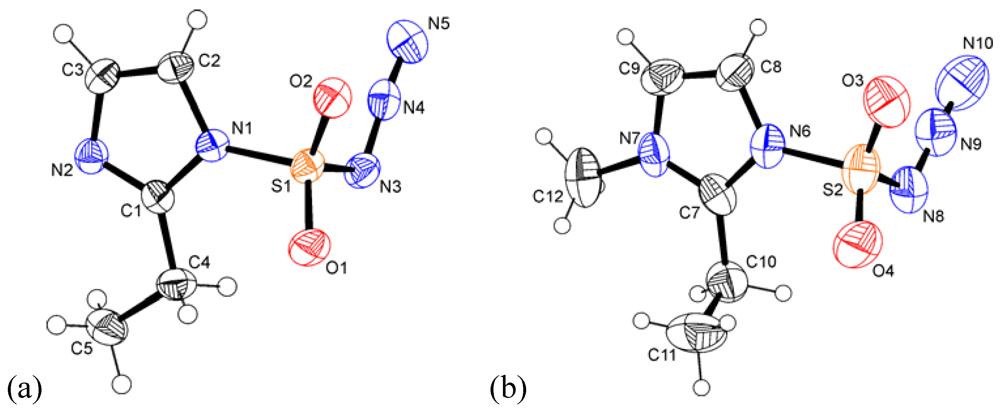
        <p>The title compound <bold>1</bold> crystallized in the monoclinic space group <italic>P</italic>2<sub>1</sub>/<italic>c</italic>. The asymmetric unit is shown in <xref ref-type="fig" rid="crystals-02-00118-f001">Figure 1</xref>a. The azide group is bent, and the N–N–N angle exhibits a typical value of 173.4°. The N3–N4 and N4–N5 bond lengths (1.272(3) and 1.111(3) Å, respectively) are both comparable with those in other sulfonyl azides [<xref ref-type="bibr" rid="B24-crystals-02-00118">24</xref>,<xref ref-type="bibr" rid="B25-crystals-02-00118">25</xref>,<xref ref-type="bibr" rid="B26-crystals-02-00118">26</xref>,<xref ref-type="bibr" rid="B27-crystals-02-00118">27</xref>]. In arenesulfonyl azides, the C–S and S–N distances are reportedly sensitive to the electron-withdrawing power of the arene [<xref ref-type="bibr" rid="B25-crystals-02-00118">25</xref>]. Here, the corresponding N1–S and S–N3 bonds are comparatively short with 1.654(2) and 1.657(2) Å, which should not be over-interpreted since for obvious reasons <italic>C</italic>-sulfonyl and <italic>N</italic>-sulfonyl groups are sufficiently different to preclude such conclusions, but these bonds are also shorter than in the closely related benzotriazole compound (1.673(2) and 1.665(2) Å) [<xref ref-type="bibr" rid="B24-crystals-02-00118">24</xref>]. It is also noteworthy that the wave number of the infrared asymmetric N<sub>3</sub> stretching vibration is significantly higher than in related compounds [<xref ref-type="bibr" rid="B25-crystals-02-00118">25</xref>].</p>
        <p>One S=O bond resides near the plane of the imidazole ring (interplanar angle between ring and N1–S1–O2 plane 11.8°), the other one is rotated out of this plane by 37.0°. The almost perpendicular orientation of the S–N3 unit with regard to the heterocycle, as judged by the dihedral angle of 73.8° between the N1–S1–N3 plane and ring, is in line with other sulfonyl azides where the corresponding angles range from 60 to 88°. This is in stark contrast to the situation in benzoyl azides which exhibit a planar arrangement of the phenyl and the azidocarbonyl moieties [<xref ref-type="bibr" rid="B28-crystals-02-00118">28</xref>]. The ethyl substituent lies almost perfectly within the ring plane (C5 tilted by only 1.6°).</p>
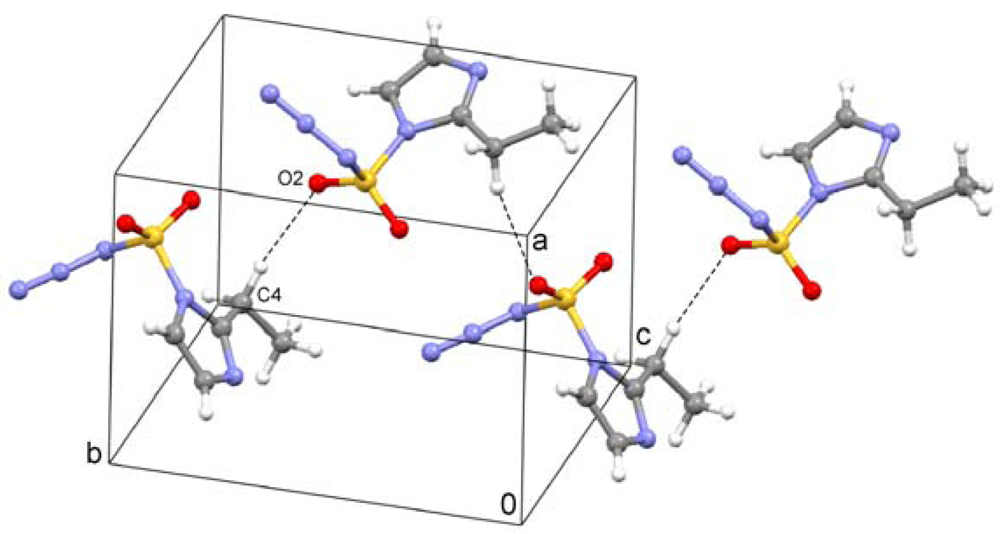
        <p>A weak C4–H...O2<sup>i</sup> interaction (H...O2 distance 2.54 Å, C4...O2 distance 3.424 Å, C4...H...O2 angle 149°; symmetry code i: 1 – <italic>x</italic>, –1/2 + <italic>y</italic>, 3/2 – <italic>z</italic>) is observed linking the molecules into infinite chains along a two-fold screw axis in the [0 1 0] direction (<xref ref-type="fig" rid="crystals-02-00118-f002">Figure 2</xref>).</p>
        <fig id="crystals-02-00118-f001" position="anchor">
          <label>Figure 1</label>
          <caption>
            <p>(<bold>a</bold>) View of the 2-ethylimidazole-1-sulfonyl azide (<bold>1</bold>) molecule and (<bold>b</bold>) of the 1-azidosulfonyl-3-methyl-2-ethylimidazolium cation in <bold>2</bold>, showing the atom-labeling scheme. The most notable difference is the orientation of the 2-ethyl group.</p>
          </caption>
          <graphic xmlns:xlink="http://www.w3.org/1999/xlink" xlink:href="crystals-02-00118-g001.tif"/>
        </fig>
        
        
        <fig id="crystals-02-00118-f002" position="anchor">
          <label>Figure 2</label>
          <caption>
            <p>The molecules of <bold>1</bold> are arranged into chains by short C–H...O contacts in the direction of the crystallographic <italic>b</italic> axis.</p>
          </caption>
          <graphic xmlns:xlink="http://www.w3.org/1999/xlink" xlink:href="crystals-02-00118-g002.tif"/>
        </fig>
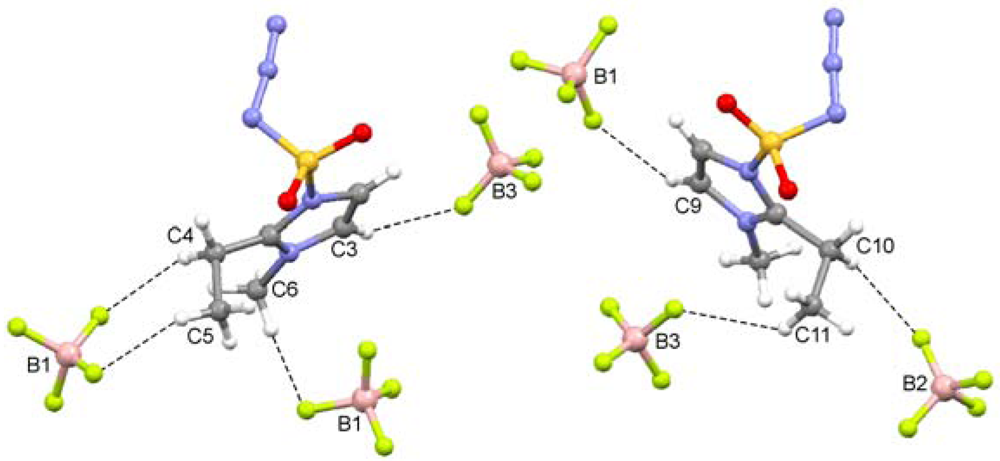
        <p>The asymmetric unit of the quaternary salt <bold>2</bold> contained two independent cations. Azide angles and N–N bond lengths are not unusual. Again, one S=O bond is located near the ring plane (tilted by only 5.6 and 6.4°), whereas the second one is rotated out of this plane by 45.0 and 41.0°, respectively. The orientation of the S–N3(8) unit resembles that of the free base <bold>1</bold>, with interplanar angles of 66.0 and 65.3°. In a remarkable conformational difference between the two structures (<xref ref-type="fig" rid="crystals-02-00118-f001">Figure 1</xref>a,b), the ethyl substituent in <bold>2</bold> is oriented almost perpendicular to the ring plane (87.4 and 89.7°). The tetrafluoroborate ions exhibit distorted tetrahedral geometries (F–B–F angles range from 103 to 119°). One BF<sub>4</sub> anion, on a general position, is disordered with a refined ratio of 2:1 for the fluorine atoms. The boron atoms of the other anions, B2 and B3, lie on a twofold rotation axis with direction [0 0 1]. Several significant interactions between the hydrogen atoms of the cations and fluorine atoms of the anions can be recognized (<xref ref-type="fig" rid="crystals-02-00118-f003">Figure 3</xref>). The detailed parameters of these contacts are summarized in <xref ref-type="table" rid="crystals-02-00118-t001">Table 1</xref>.</p>
        <fig id="crystals-02-00118-f003" position="anchor">
          <label>Figure 3</label>
          <caption>
            <p>The components of <bold>2</bold> engage in short interionic C–H...F contacts.</p>
          </caption>
          <graphic xmlns:xlink="http://www.w3.org/1999/xlink" xlink:href="crystals-02-00118-g003.tif"/>
        </fig>
        <table-wrap id="crystals-02-00118-t001" position="anchor">
          <object-id pub-id-type="pii">crystals-02-00118-t001_Table 1</object-id>
          <label>Table 1</label>
          <caption>
            <p>Distances and angles for the short C–H...F contacts (Å,°) in the structure of <bold>2</bold>.</p>
          </caption>
          <table>
             <tbody>
              <tr>
                <td align="left" valign="middle">Interaction</td>
                <td align="left" valign="middle">H...F</td>
                <td align="left" valign="middle">C...F</td>
                <td align="left" valign="middle">C–H...F</td>
                <td align="left" valign="middle">Symmetry code (F)</td>
              </tr>
              <tr style="border-top: solid thin">
                <td align="left" valign="middle">C3–H...F</td>
                <td align="left" valign="middle">2.399(8)</td>
                <td align="left" valign="middle">3.14(1)</td>
                <td align="left" valign="middle">135.3(6)</td>
                <td align="left" valign="middle"><italic>x</italic>, –1/2 + <italic>y</italic>, –1/2 + <italic>z</italic></td>
              </tr>
              <tr>
                <td align="left" valign="middle">C4–H...F</td>
                <td align="left" valign="middle">2.56(2)</td>
                <td align="left" valign="middle">3.44(2)</td>
                <td align="left" valign="middle">148.9(6)</td>
                <td align="left" valign="middle">–1/4 + <italic>x</italic>,–1/4 – <italic>y</italic>,–3/4 + <italic>z</italic></td>
              </tr>
              <tr>
                <td align="left" valign="middle">C5–H...F</td>
                <td align="left" valign="middle">2.57(2)</td>
                <td align="left" valign="middle">3.26(2)</td>
                <td align="left" valign="middle">128.3(8)</td>
                <td align="left" valign="middle">–1/4 + <italic>x</italic>,–1/4 – <italic>y</italic>,–3/4 + <italic>z</italic></td>
              </tr>
              <tr>
                <td align="left" valign="middle">C6–H...F</td>
                <td align="left" valign="middle">2.29(1)</td>
                <td align="left" valign="middle">3.19(1)</td>
                <td align="left" valign="middle">155.3(7)</td>
                <td align="left" valign="middle">1/4 – <italic>x</italic>,–1/4 + <italic>y</italic>,–1/4 + <italic>z</italic></td>
              </tr>
              <tr>
                <td align="left" valign="middle">C9–H...F</td>
                <td align="left" valign="middle">2.47(2)</td>
                <td align="left" valign="middle">3.29(2)</td>
                <td align="left" valign="middle">146.0(7)</td>
                <td align="left" valign="middle">–</td>
              </tr>
              <tr>
                <td align="left" valign="middle">C10–H...F</td>
                <td align="left" valign="middle">2.404(8)</td>
                <td align="left" valign="middle">3.14(1)</td>
                <td align="left" valign="middle">131.3(6)</td>
                <td align="left" valign="middle">1/4 – <italic>x</italic>,–1/4 + <italic>y</italic>,3/4 + <italic>z</italic></td>
              </tr>
              <tr>
                <td align="left" valign="middle">C11–H...F</td>
                <td align="left" valign="middle">2.57(1)</td>
                <td align="left" valign="middle">3.22(2)</td>
                <td align="left" valign="middle">124.3(7)</td>
                <td align="left" valign="middle">1/4 – <italic>x</italic>,–1/4 + <italic>y</italic>,–1/4 + <italic>z</italic></td>
              </tr>
            </tbody>
          </table>
        </table-wrap>
        
      </sec>
      <sec>
        <title>2.3. Reactivity and Stability</title>
        <p>We investigated the title compound and some derivatives as potential reagents for electrophilic azidation of carbanions. Ferrocene and 4-methoxybiphenyl served as model substrates. Lithiation (<italic>tert</italic>-BuLi [<xref ref-type="bibr" rid="B29-crystals-02-00118">29</xref>] and <italic>n</italic>-BuLi [<xref ref-type="bibr" rid="B30-crystals-02-00118">30</xref>], respectively) followed by addition of <bold>1</bold> and purification by chromatography yielded known 1-azidoferrocene [<xref ref-type="bibr" rid="B31-crystals-02-00118">31</xref>] and new 3-azido-4-methoxybiphenyl, providing proof of principle that <bold>1</bold> can act as an azidation reagent [<xref ref-type="bibr" rid="B23-crystals-02-00118">23</xref>]. The other reagents, 3-methyl and 3-ethylimidazolium salts <bold>2</bold>, <bold>2a</bold>, <bold>3</bold> and <bold>3a</bold>, gave similar, but not superior, results.</p>
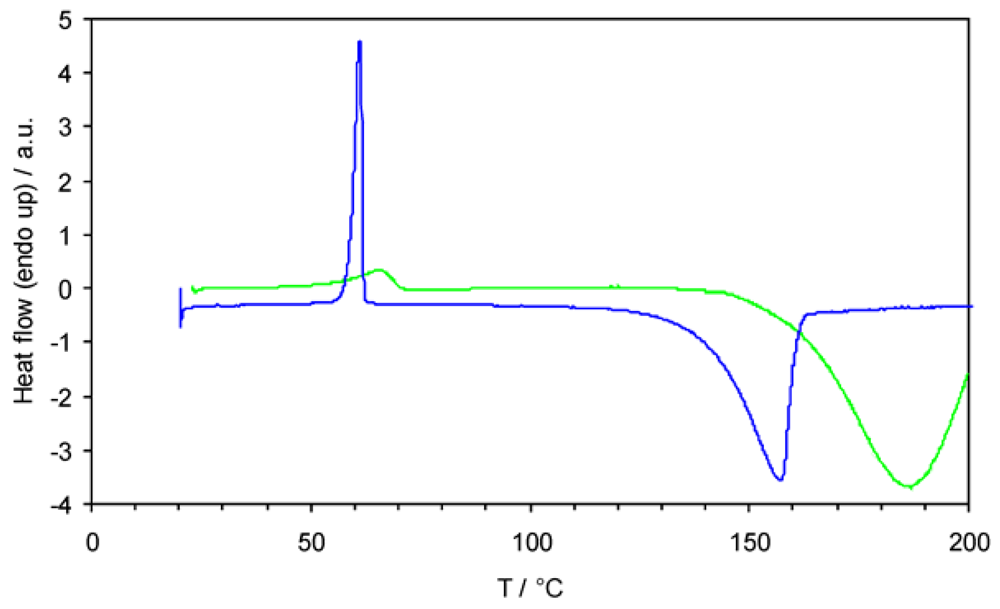
        <p>Most diazo-transfer or azidation reagents suffer from poor thermal stability [<xref ref-type="bibr" rid="B15-crystals-02-00118">15</xref>]. DSC analysis of <bold>1</bold> showed decomposition at 157 °C with an onset temperature of 142 °C; the quaternary salt <bold>2</bold> decomposed at 187 °C (<xref ref-type="fig" rid="crystals-02-00118-f004">Figure 3</xref>). Inherently, no azide can be considered completely innocent, but the new reagents are among the safest.</p>
        <fig id="crystals-02-00118-f004" position="anchor">
          <label>Figure 3</label>
          <caption>
            <p>Differential Scanning Calorimetry (DSC) curves of <bold>1</bold> (blue) and <bold>2</bold> (green) showing the endothermic melting events and the exothermic decomposition.</p>
          </caption>
          <graphic xmlns:xlink="http://www.w3.org/1999/xlink" xlink:href="crystals-02-00118-g004.tif"/>
        </fig>
      </sec>
    </sec>
    <sec>
      <title>3. Experimental Section</title>
      <sec>
        <title>3.1. Synthesis of 2-Ethylimidazole-1-sulfonyl Azide (<italic><bold>1</bold></italic>)</title>
        <p>Cautionary note: although we did not encounter any difficulties, azides should generally be treated with respect because they are potentially explosive. SO<sub>2</sub>Cl<sub>2</sub> (8.1 mL, 0.1 mol) was added within 10 min to NaN<sub>3</sub> (6.5 g, 0.1 mol) in anhydrous CH<sub>3</sub>CN (100 mL) at 0 °C, and the suspension was stirred for 26 h at room temperature. 2-Ethylimidazole (19.2 g, 0.2 mol) was added and stirring continued at room temperature for 3 h. Longer reaction times gave lower yields. The mixture was partitioned between EtOAc (200 mL) and H<sub>2</sub>O (100 mL), the organic phase was washed with H<sub>2</sub>O (200 mL) and saturated NaHCO<sub>3</sub> solution (2 × 100 mL), dried over anhydrous MgSO<sub>4</sub>, and the solvent evaporated. The resulting crude solid was stirred in Et<sub>2</sub>O (15 mL) at 40 °C, and a small amount of insoluble brown oil was removed by filtration. A seed crystal of the crude product was added to the ice-cooled filtrate, immediate crystallization occurred, and the colourless crystalline product was collected, washed with cold Et<sub>2</sub>O (5 mL) and <italic>iso</italic>-pentane (20 mL), and vacuum-dried (yield 8.9 g, 44 %). m.p. 61 °C. <sup>1</sup>H NMR (CDCl<sub>3</sub>, 300 MHz): <italic>δ</italic> 1.36 (t, <italic>J</italic> = 7.4 Hz, 3H), 2.94 (q, <italic>J</italic> = 7.4 Hz, 2H), 6.97 (d, <italic>J</italic> = 1.8 Hz, 1H), 7.31 (d, <italic>J</italic> = 1.8 Hz, 1H) ppm. <sup>13</sup>C NMR (CDCl<sub>3</sub>, 75 MHz): <italic>δ</italic> 11.7, 22.2, 119.8, 128.7, 151.4 ppm. IR (neat): <italic>v</italic> 3136 (w), 3115 (m), 2981 (w), 2940 (w), 2157 (s), 1547 (m), 1435 (m), 1408 (s), 1189 (s), 1149 (s), 1124 (s), 1043 (s), 885 (m), 774 (s), 758 (s), 691 (m), 628 (s), 582 (s) cm<sup>–1</sup>.</p>
      </sec>
      <sec>
        <title>3.2. Synthesis of 1-Azidosulfonyl-3-alkyl-2-ethylimidazolium Tetrafluoroborates (<italic><bold>2</bold></italic> and <italic><bold>3</bold></italic>)</title>
        <p>A mixture of 2-ethylimidazole-1-sulfonyl azide (1.0 g, 5 mmol) and trialkyloxonium (methyl for <bold>2</bold>, ethyl for <bold>3</bold>) tetrafluoroborate (5 mmol) in dry CH<sub>2</sub>Cl<sub>2</sub> (10 mL) was stirred for 48 h at room temperature. After removal of the solvent the remaining syrup crystallized after several days.</p>
        <p><bold>2</bold>: Single crystals were obtained by slow evaporation of a CH<sub>2</sub>Cl<sub>2</sub> solution. m.p. 66 °C. <sup>1</sup>H NMR (DMSO-d<sub>6</sub>, 300 MHz): <italic>δ</italic> 1.25 (t, <italic>J</italic> = 7.6 Hz, 3H), 2.92 (q, <italic>J</italic> = 7.6 Hz, 2H), 3.74 (s, 3H), 7.54 (s, 1H), 5.56 (s, 1H) ppm. <sup>13</sup>C NMR (DMSO-d<sub>6</sub>, 75 MHz): <italic>δ</italic> 10.5, 17.7, 33.9, 117.9, 123.2, 148.4 ppm. IR (neat): <italic>v</italic> 3147 (w), 2167 (m), 1425 (m), 1193 (m), 1146 (m), 1024 (s), 773 (m), 570 (s) cm<sup>–1</sup>.</p>
        <p><bold>3</bold>: <sup>1</sup>H NMR (CDCl<sub>3</sub>, 300 MHz): <italic>δ</italic> 1.40 (t, <italic>J</italic> = 7.7 Hz, 3H), 1.60 (t, <italic>J</italic> = 7.4 Hz, 3H), 3.27 (q, <italic>J</italic> = 7.7 Hz, 2H), 4.27 (q, <italic>J</italic> = 7.4 Hz, 2H), 7.47 (d, <italic>J</italic> = 2.5 Hz, 1H), 7.68 (d, <italic>J</italic> = 2.5 Hz, 1H) ppm. <sup>13</sup>C NMR (CDCl<sub>3</sub>, 75 MHz): <italic>δ</italic> 11.9, 14.5, 19.3, 45.3, 121.2, 121.7, 151.0 ppm.</p>
      </sec>
      <sec>
        <title>3.3. Synthesis of 1-Azidosulfonyl-3-alkyl-2-ethylimidazolium Triflimides (<italic><bold>2a</bold></italic> and <italic><bold>3a</bold></italic>)</title>
        <p>A solution of Li triflimide (2.01 g, 7 mmol) in H<sub>2</sub>O (3 mL) was added to a stirred solution of the respective tetrafluoroborate (7 mmol) in H<sub>2</sub>O (50 mL). The mixture was extracted with CH<sub>2</sub>Cl<sub>2</sub> (2 × 50 mL). The organic phase was washed with H<sub>2</sub>O (2 × 100 mL), dried over anhydrous Na<sub>2</sub>SO<sub>4</sub>, and the solvent was evaporated. The resulting clear liquid was vacuum-dried.</p>
        <p><bold>2a</bold>: <sup>1</sup>H NMR (CDCl<sub>3</sub>, 300 MHz): <italic>δ</italic>1.39 (t, <italic>J</italic> = 7.7 Hz, 3H), 3.27 (q, <italic>J</italic> = 7.7 Hz, 2H), 3.96 (s, 3H), 7.41 (d, <italic>J</italic> = 2.4 Hz, 1H), 7.64 (d, <italic>J</italic> = 2.4 Hz, 1H) ppm. <sup>1</sup>H NMR (DMSO-d<sub>6</sub>, 300 MHz): <italic>δ</italic> 1.24 (t, <italic>J</italic> = 7.6 Hz, 3H), 2.91 (q, <italic>J</italic> = 7.6 Hz, 2H), 3.74 (s, 3H), 7.52 (d, <italic>J</italic> = 1.8 Hz, 1H), 7.55 (d, <italic>J</italic> = 1.8 Hz, 1H) ppm. <sup>13</sup>C NMR (CDCl<sub>3</sub>, 75 MHz): <italic>δ</italic> 11.2, 19.4, 36.7, 120.0 (q, <italic>J</italic> = 321 Hz), 120.7, 124.0, 151.7 ppm.</p>
        <p><bold>3a</bold>: <sup>1</sup>H NMR (DMSO-d<sub>6</sub>, 300 MHz): <italic>δ</italic> 1.26 (t, <italic>J</italic> = 7.5 Hz, 3H), 1.35 (t, <italic>J</italic> = 7.2 Hz, 3H), 2.95 (q, <italic>J</italic> = 7.5 Hz, 2H), 4.11 (q, <italic>J</italic> = 7.2 Hz, 2H), 7.59 (s, 1H), 7.66 (s, 1H) ppm. <sup>13</sup>C NMR (DMSO-d<sub>6</sub>, 75 MHz): <italic>δ</italic> 11.0, 15.1, 17.6, 42.0, 118.3, 120.0 (q, <italic>J</italic> = 321 Hz), 121.4, 147.8 ppm.</p>
      </sec>
      <sec>
        <title>3.4. Azidation of 4-Methoxybiphenyl</title>
        <p>A solution of 4-methoxybiphenyl (500 mg, 2.71 mmol) in dry THF (15 mL) was cooled to –40 °C under argon. TMEDA (310 mg, 2.66 mmol) and <italic>n</italic>-BuLi (1.6 M solution in hexane, 1.70 mL, 2.72 mmol) were added and the reaction mixture warmed to room temperature over a period of 2 h. The slightly yellowish solution was cooled again (–70 °C), and a solution of 2-ethylimidazole-1-sulfonyl azide in THF (5 mL) was added. The mixture was stirred overnight at room temperature. After removal of the solvent, the residue was partitioned between CH<sub>2</sub>Cl<sub>2</sub> and H<sub>2</sub>O. The organic layer was washed with H<sub>2</sub>O, dried over Na<sub>2</sub>SO<sub>4</sub>, and the solvent was evaporated. Chromatography (silica, <italic>n</italic>-hexane/EtOAc = 3:1) of the crude product gave 3-azido-4-methoxybiphenyl as an oil (120 mg, 20 %). <sup>1</sup>H NMR (CDCl<sub>3</sub>, 300 MHz): <italic>δ</italic> 3.92 (3 H, s), 6.96 (1 H, d, <italic>J</italic> = 8.5 Hz), 7.24 (1 H, d, <italic>J</italic> = 2.2 Hz), 7.31–7.36 (2 H, m), 7.43 (2 H, t, <italic>J</italic> = 8.0 Hz), 7.53 (2 H, d, <italic>J</italic> = 8.0 Hz) ppm. <sup>13</sup>C NMR (CDCl<sub>3</sub>, 75 MHz): <italic>δ</italic> 56.3, 112.6, 119.3, 124.5, 126.9, 127.0, 127.5, 129.1, 135.0, 140.2, 151.7 ppm. IR (neat): <italic>v</italic> 2107 cm<sup>–1</sup>.</p>
      </sec>
      <sec>
        <title>3.5. X-ray Data Collection and Structure Refinement</title>
        <p>Structure solution and refinement was performed with the programs SIR2002 (direct methods) [<xref ref-type="bibr" rid="B32-crystals-02-00118">32</xref>] and SHELXL-97 [<xref ref-type="bibr" rid="B33-crystals-02-00118">33</xref>].</p>
        <p><bold>1</bold>: Stoe IPDS-II diffractometer, Mo-Kα radiation; rotation method; <italic>T</italic> = 173(2) K; <italic>θ</italic><sub>max</sub> = 25.7°; indices: −9 ≤ <italic>h</italic> ≤ 9, −12 ≤ <italic>k</italic> ≤ 12, −12 ≤ <italic>l</italic> ≤ 12; <italic>D</italic><sub>x</sub> = 1.56 g cm<sup>–3</sup>; 4991 reflections measured, 1562 independent with <italic>R</italic><sub>int</sub> = 0.050, <italic>F</italic>(000) = 416, <italic>µ</italic> = 0.35 mm<sup>–1</sup>. Crystal data for C<sub>5</sub>H<sub>7</sub>N<sub>5</sub>O<sub>2</sub>S (<italic>M</italic> = 201.22 g mol<sup>–1</sup>). Monoclinic, <italic>P</italic>2<sub>1</sub>/<italic>c</italic>, <italic>a</italic> = 8.0815(7), <italic>b</italic> = 10.0732(9), <italic>c</italic> = 10.7291(10) Å, <italic>β</italic> = 100.383(7)°, <italic>V</italic> = 859.11(13) Å<sup>3</sup>, <italic>Z</italic> = 4. <italic>R</italic><sub>1</sub> = 0.038 and <italic>wR</italic><sub>2</sub> = 0.089 for 1211 reflections with <italic>I</italic> &gt; 2<italic>σ</italic>(<italic>I</italic>), <italic>R</italic><sub>1</sub> = 0.054 and <italic>wR</italic><sub>2</sub> = 0.094 for all data; <italic>S</italic> = 1.00; Δ<italic>ρ</italic><sub>max</sub> = 0.27 and Δ<italic>ρ</italic><sub>min</sub> = −0.32 e Å<sup>–3</sup>. CCDC reference number: 853383.</p>
        <p><bold>2</bold>: Nonius KappaCCD diffractometer, Mo-Kα radiation; <italic>φ</italic> and <italic>ω</italic> scans; <italic>T</italic> = 233(2) K; <italic>θ</italic><sub>max</sub> = 21.0°; indices: −24 ≤ <italic>h</italic> ≤ 24, −29 ≤ <italic>k</italic> ≤ 30, −13 ≤ <italic>l</italic> ≤ 13; <italic>D</italic><sub>x</sub> = 1.60 g cm<sup>–3</sup>; 9666 reflections measured, 2699 independent with <italic>R</italic><sub>int</sub> = 0.073, <italic>F</italic>(000) = 4928, <italic>µ</italic> = 0.31 mm<sup>–1</sup>. Crystal data for C<sub>6</sub>H<sub>10</sub>BF<sub>4</sub>N<sub>5</sub>O<sub>2</sub>S (<italic>M</italic> = 303.06 g mol<sup>–1</sup>). Orthorhombic, <italic>Fdd</italic>2, <italic>a</italic> = 24.375(1), <italic>b</italic> = 30.163(2), <italic>c</italic> = 13.653(1) Å, <italic>V</italic> = 10038.0(11) Å<sup>3</sup>, <italic>Z</italic> = 32. <italic>R</italic><sub>1</sub> = 0.054 and <italic>wR</italic><sub>2</sub> = 0.132 for 2010 reflections with <italic>I</italic> &gt; 2<italic>σ</italic>(<italic>I</italic>), <italic>R</italic><sub>1</sub> = 0.082 and <italic>wR</italic><sub>2</sub> = 0.147 for all data; <italic>S</italic> = 1.04; Δ<italic>ρ</italic><sub>max</sub> = 0.24 and Δ<italic>ρ</italic><sub>min</sub> = −0.21 e Å<sup>–3</sup>. CCDC reference number: 855784. These data can be obtained free of charge from The Cambridge Crystallographic Data Centre.</p>
      </sec>
    </sec>
    <sec sec-type="conclusions">
      <title>4. Conclusions</title>
      <p>There is continued interest in the exploration of inexpensive azidation reagents. They are important tools for C–N bond formation which is a topic of high relevance in synthetic chemistry. The new reagent presented in this work showed promising reactivity. The quaternary salts were disappointing as they did not exhibit the superior properties we had hoped. The two crystal structures, however, contribute valuable data to the still scarce knowledge of this class of compounds.</p>
    </sec>
    
  </body>
  <back>
   <ack>
      <title>Acknowledgments</title>
      <p>Financial support of this work by Sandoz GmbH is gratefully acknowledged.</p>
    </ack>
    <ref-list>
      <title>References and Notes</title>
      <ref id="B1-crystals-02-00118">
        <label>1.</label>
        <citation citation-type="journal">
          <person-group person-group-type="author">
            <name>
              <surname>Bräse</surname>
              <given-names>S.</given-names>
            </name>
            <name>
              <surname>Gil</surname>
              <given-names>C.</given-names>
            </name>
            <name>
              <surname>Knepper</surname>
              <given-names>K.</given-names>
            </name>
            <name>
              <surname>Zimmermann</surname>
              <given-names>V.</given-names>
            </name>
          </person-group>
          <article-title>Organic Azides: An Exploding Diversity of a Unique Class of Compounds</article-title>
          <source>Angew. Chem. Int. Ed.</source>
          <year>2005</year>
          <volume>44</volume>
          <fpage>5188</fpage>
          <lpage>5240</lpage>
        <pub-id pub-id-type="doi">10.1002/anie.200400657</pub-id></citation>
      </ref>
      <ref id="B2-crystals-02-00118">
        <label>2.</label>
        <citation citation-type="journal">
          <person-group person-group-type="author">
            <name>
              <surname>Scriven</surname>
              <given-names>E.F.V.</given-names>
            </name>
            <name>
              <surname>Turnbull</surname>
              <given-names>K.</given-names>
            </name>
          </person-group>
          <article-title>Azides: Their Preparation and Synthetic Uses</article-title>
          <source>Chem. Rev.</source>
          <year>1988</year>
          <volume>88</volume>
          <fpage>297</fpage>
          <lpage>368</lpage>
        <pub-id pub-id-type="doi">10.1021/cr00084a001</pub-id></citation>
      </ref>
      <ref id="B3-crystals-02-00118">
        <label>3.</label>
        <citation citation-type="journal">
          <person-group person-group-type="author">
            <name>
              <surname>Kolb</surname>
              <given-names>H.C.</given-names>
            </name>
            <name>
              <surname>Finn</surname>
              <given-names>M.G.</given-names>
            </name>
            <name>
              <surname>Sharpless</surname>
              <given-names>K.B.</given-names>
            </name>
          </person-group>
          <article-title>Click Chemistry: Diverse Chemical Function from a Few Good Reactions</article-title>
          <source>Angew. Chem. Int. Ed.</source>
          <year>2001</year>
          <volume>40</volume>
          <fpage>2004</fpage>
          <lpage>2021</lpage>
          <pub-id pub-id-type="doi">10.1002/1521-3773(20010601)40:11&lt;2004::AID-ANIE2004&gt;3.0.CO;2-5</pub-id>
        </citation>
      </ref>
      <ref id="B4-crystals-02-00118">
        <label>4.</label>
        <citation citation-type="journal">
          <person-group person-group-type="author">
            <name>
              <surname>Rostovtsev</surname>
              <given-names>V.V.</given-names>
            </name>
            <name>
              <surname>Green</surname>
              <given-names>L.G.</given-names>
            </name>
            <name>
              <surname>Fokin</surname>
              <given-names>V.V.</given-names>
            </name>
            <name>
              <surname>Sharpless</surname>
              <given-names>K.B.</given-names>
            </name>
          </person-group>
          <article-title>A Stepwise HuisgenCycloaddition Process: Copper(I)-Catalyzed Regioselective Ligation of Azides and Terminal Alkynes</article-title>
          <source>Angew. Chem. Int. Ed.</source>
          <year>2002</year>
          <volume>41</volume>
          <fpage>2596</fpage>
          <lpage>2599</lpage>
          <pub-id pub-id-type="doi">10.1002/1521-3773(20020715)41:14&lt;2596::AID-ANIE2596&gt;3.0.CO;2-4</pub-id>
        </citation>
      </ref>
      <ref id="B5-crystals-02-00118">
        <label>5.</label>
        <citation citation-type="journal">
          <person-group person-group-type="author">
            <name>
              <surname>Bock</surname>
              <given-names>V.D.</given-names>
            </name>
            <name>
              <surname>Hiemstra</surname>
              <given-names>H.</given-names>
            </name>
            <name>
              <surname>van Maarseveen</surname>
              <given-names>J.H.</given-names>
            </name>
          </person-group>
          <article-title>Cu<sup>I</sup>-Catalyzed Alkyne-Azide“Click”Cycloadditions from a Mechanistic and Synthetic Perspective</article-title>
          <source>Eur. J. Org. Chem.</source>
          <year>2006</year>
          <fpage>51</fpage>
          <lpage>68</lpage>
        </citation>
      </ref>
      <ref id="B6-crystals-02-00118">
        <label>6.</label>
        <citation citation-type="journal">
          <person-group person-group-type="author">
            <name>
              <surname>Amblard</surname>
              <given-names>F.</given-names>
            </name>
            <name>
              <surname>Cho</surname>
              <given-names>J.H.</given-names>
            </name>
            <name>
              <surname>Schinazi</surname>
              <given-names>R.F.</given-names>
            </name>
          </person-group>
          <article-title>Cu(I)-Catalyzed HuisgenAzide-Alkyne 1,3-Dipolar Cycloaddition Reaction in Nucleoside, Nucleotide, and Oligonucleotide Chemistry</article-title>
          <source>Chem. Rev.</source>
          <year>2009</year>
          <volume>109</volume>
          <fpage>4207</fpage>
          <lpage>4220</lpage>
          <pub-id pub-id-type="doi">10.1021/cr9001462</pub-id>
        </citation>
      </ref>
      <ref id="B7-crystals-02-00118">
        <label>7.</label>
        <citation citation-type="journal">
          <person-group person-group-type="author">
            <name>
              <surname>Nyffeler</surname>
              <given-names>P.T.</given-names>
            </name>
            <name>
              <surname>Liang</surname>
              <given-names>C.-H.</given-names>
            </name>
            <name>
              <surname>Koeller</surname>
              <given-names>K.M.</given-names>
            </name>
            <name>
              <surname>Wong</surname>
              <given-names>C.-H.</given-names>
            </name>
          </person-group>
          <article-title>The Chemistry of Amine-AzideInterconversion: Catalytic Diazotransfer and RegioselectiveAzide Reduction</article-title>
          <source>J. Am. Chem. Soc.</source>
          <year>2002</year>
          <volume>124</volume>
          <fpage>10773</fpage>
          <lpage>10778</lpage>
        <pub-id pub-id-type="doi">10.1021/ja0264605</pub-id><pub-id pub-id-type="pmid">12207533</pub-id></citation>
      </ref>
      <ref id="B8-crystals-02-00118">
        <label>8.</label>
        <citation citation-type="journal">
          <person-group person-group-type="author">
            <name>
              <surname>Regitz</surname>
              <given-names>M.</given-names>
            </name>
          </person-group>
          <article-title>New Methods of Preparative Organic Chemistry. Transfer of Diazo Groups</article-title>
          <source>Angew. Chem. Int. Ed. Engl.</source>
          <year>1967</year>
          <volume>6</volume>
          <fpage>733</fpage>
          <lpage>749</lpage>
          <pub-id pub-id-type="doi">10.1002/anie.196707331</pub-id>
        </citation>
      </ref>
      <ref id="B9-crystals-02-00118">
        <label>9.</label>
        <citation citation-type="journal">
          <person-group person-group-type="author">
            <name>
              <surname>Curphey</surname>
              <given-names>T.J.</given-names>
            </name>
          </person-group>
          <article-title>Preparation of <italic>p</italic>-toluenesulfonylazide. A cautionary note</article-title>
          <source> Org. Prep. Proc. Int.</source>
          <year>1981</year>
          <volume>13</volume>
          <fpage>112</fpage>
          <lpage>115</lpage>
          <pub-id pub-id-type="doi">10.1080/00304948109356105</pub-id>
        </citation>
      </ref>
      <ref id="B10-crystals-02-00118">
        <label>10.</label>
        <citation citation-type="journal">
          <person-group person-group-type="author">
            <name>
              <surname>Cavender</surname>
              <given-names>C.J.</given-names>
            </name>
            <name>
              <surname>Shiner</surname>
              <given-names>V.J.</given-names>
              <suffix>Jr.</suffix>
            </name>
          </person-group>
          <article-title>Trifluoromethanesulfonyl Azide. Its Reaction with Alkyl Amines to Form Alkyl Azides</article-title>
          <source>J. Org. Chem.</source>
          <year>1972</year>
          <volume>37</volume>
          <fpage>3567</fpage>
          <lpage>3569</lpage>
          <pub-id pub-id-type="doi">10.1021/jo00795a052</pub-id>
        </citation>
      </ref>
      <ref id="B11-crystals-02-00118">
        <label>11.</label>
        <citation citation-type="journal">
          <person-group person-group-type="author">
            <name>
              <surname>Liu</surname>
              <given-names>Q.</given-names>
            </name>
            <name>
              <surname>Tor</surname>
              <given-names>Y.</given-names>
            </name>
          </person-group>
          <article-title>Simple Conversion of Aromatic Amines into Azides</article-title>
          <source>Org. Lett.</source>
          <year>2003</year>
          <volume>14</volume>
          <fpage>2571</fpage>
          <lpage>2572</lpage>
        </citation>
      </ref>
      <ref id="B12-crystals-02-00118">
        <label>12.</label>
        <citation citation-type="journal">
          <person-group person-group-type="author">
            <name>
              <surname>Zaloom</surname>
              <given-names>J.</given-names>
            </name>
            <name>
              <surname>Roberts</surname>
              <given-names>D.C.</given-names>
            </name>
          </person-group>
          <article-title>Preparation of Azido Derivatives from Amino Acids and Peptides by Diazo Transfer</article-title>
          <source>J. Org. Chem.</source>
          <year>1981</year>
          <volume>46</volume>
          <fpage>5173</fpage>
          <lpage>5176</lpage>
          <pub-id pub-id-type="doi">10.1021/jo00338a022</pub-id>
        </citation>
      </ref>
      <ref id="B13-crystals-02-00118">
        <label>13.</label>
        <citation citation-type="journal">
          <person-group person-group-type="author">
            <name>
              <surname>Taber</surname>
              <given-names>D.F.</given-names>
            </name>
            <name>
              <surname>Ruckle</surname>
              <given-names>R.E.</given-names>
            </name>
            <name>
              <surname>Hennessy</surname>
              <given-names>M.J.</given-names>
            </name>
          </person-group>
          <article-title>MesylAzide: A Superior Reagent for Diazo Transfer</article-title>
          <source>J. Org. Chem.</source>
          <year>1986</year>
          <volume>51</volume>
          <fpage>4077</fpage>
          <lpage>4078</lpage>
        <pub-id pub-id-type="doi">10.1021/jo00371a034</pub-id></citation>
      </ref>
      <ref id="B14-crystals-02-00118">
        <label>14.</label>
        <citation citation-type="journal">
          <person-group person-group-type="author">
            <name>
              <surname>Besenyei</surname>
              <given-names>G.</given-names>
            </name>
            <name>
              <surname>Parkanyi</surname>
              <given-names>L.</given-names>
            </name>
            <name>
              <surname>Foch</surname>
              <given-names>I.</given-names>
            </name>
            <name>
              <surname>Simandi</surname>
              <given-names>L.I.</given-names>
            </name>
          </person-group>
          <article-title>Sterically controlled pathways in the reaction of 2,4,6-tris(isopropyl)benzenesulfonylazide and [Pd<sub>2</sub>Cl<sub>2</sub>(dppm)<sub>2</sub>]</article-title>
          <source>Angew. Chem. Int. Ed.</source>
          <year>2000</year>
          <volume>39</volume>
          <fpage>956</fpage>
          <lpage>958</lpage>
          <pub-id pub-id-type="doi">10.1002/(SICI)1521-3773(20000303)39:5&lt;956::AID-ANIE956&gt;3.0.CO;2-6</pub-id>
        </citation>
      </ref>
      <ref id="B15-crystals-02-00118">
        <label>15.</label>
        <citation citation-type="journal">
          <person-group person-group-type="author">
            <name>
              <surname>Tuma</surname>
              <given-names>L.D.</given-names>
            </name>
          </person-group>
          <article-title>Identification of a safe diazotransfer reagent</article-title>
          <source>Thermochim. Acta</source>
          <year>1994</year>
          <volume>243</volume>
          <fpage>161</fpage>
          <lpage>167</lpage>
          <pub-id pub-id-type="doi">10.1016/0040-6031(94)85051-8</pub-id>
        </citation>
      </ref>
      <ref id="B16-crystals-02-00118">
        <label>16.</label>
        <citation citation-type="journal">
          <person-group person-group-type="author">
            <name>
              <surname>Goddard-Borger</surname>
              <given-names>E.D.</given-names>
            </name>
            <name>
              <surname>Stick</surname>
              <given-names>R.V.</given-names>
            </name>
          </person-group>
          <article-title>An Efficient, Inexpensive, and Shelf-Stable Diazotransfer Reagent: Imidazole-1-sulfonyl Azide Hydrochloride</article-title>
          <source>Org. Lett.</source>
          <year>2007</year>
          <volume>9</volume>
          <fpage>3797</fpage>
          <lpage>3800</lpage>
          <comment>Supporting Information.</comment>
          <pub-id pub-id-type="doi">10.1021/ol701581g</pub-id>
        </citation>
      </ref>
      <ref id="B17-crystals-02-00118">
        <label>17.</label>
        <citation citation-type="journal">
          <person-group person-group-type="author">
            <name>
              <surname>Benati</surname>
              <given-names>L.</given-names>
            </name>
            <name>
              <surname>Nanni</surname>
              <given-names>D.</given-names>
            </name>
            <name>
              <surname>Spagnolo</surname>
              <given-names>P.</given-names>
            </name>
          </person-group>
          <article-title>Reactions of Benzocyclic <italic>β</italic>-Keto Esters with SulfonylAzides. Further Insight into the Influence of Azide Structure and Solvent on the Reaction Course</article-title>
          <source>J. Org. Chem.</source>
          <year>1999</year>
          <volume>64</volume>
          <fpage>5132</fpage>
          <lpage>5138</lpage>
          <pub-id pub-id-type="doi">10.1021/jo9901541</pub-id>
        </citation>
      </ref>
      <ref id="B18-crystals-02-00118">
        <label>18.</label>
        <citation citation-type="journal">
          <person-group person-group-type="author">
            <name>
              <surname>Kumar</surname>
              <given-names>J.S.D.</given-names>
            </name>
            <name>
              <surname>Dupradeau</surname>
              <given-names>F.-Y.</given-names>
            </name>
            <name>
              <surname>Strouse</surname>
              <given-names>M.J.</given-names>
            </name>
            <name>
              <surname>Phelps</surname>
              <given-names>M.E.</given-names>
            </name>
            <name>
              <surname>Toyokuni</surname>
              <given-names>T.</given-names>
            </name>
          </person-group>
          <article-title>ElectrophilicAzidation for Stereoselective Synthesis of 2-Azido-2-deoxyaldono-1,5-lactones</article-title>
          <source>J. Org. Chem.</source>
          <year>2001</year>
          <volume>66</volume>
          <fpage>3220</fpage>
          <lpage>3223</lpage>
        <pub-id pub-id-type="doi">10.1021/jo005728c</pub-id><pub-id pub-id-type="pmid">11325293</pub-id></citation>
      </ref>
      <ref id="B19-crystals-02-00118">
        <label>19.</label>
        <citation citation-type="journal">
          <person-group person-group-type="author">
            <name>
              <surname>Batch</surname>
              <given-names>A.</given-names>
            </name>
            <name>
              <surname>Dodd</surname>
              <given-names>R.H.</given-names>
            </name>
          </person-group>
          <article-title>Ortho-Directed Metalation of 3-Carboxy-β-carbolines: Use of the SmI<sub>2</sub>-Cleavable 9-N-(N',N'-Dimethylsulfamoyl) Blocking Group for the Preparation of 9-N-Deprotected 4-Amino Derivatives via Azide Introduction or a Palladium-Catalyzed Cross-Coupling Reaction</article-title>
          <source>J. Org. Chem.</source>
          <year>1998</year>
          <volume>63</volume>
          <fpage>872</fpage>
          <lpage>877</lpage>
          <pub-id pub-id-type="doi">10.1021/jo971485l</pub-id>
        </citation>
      </ref>
      <ref id="B20-crystals-02-00118">
        <label>20.</label>
        <citation citation-type="journal">
          <person-group person-group-type="author">
            <name>
              <surname>Hanessian</surname>
              <given-names>S.</given-names>
            </name>
            <name>
              <surname>Bennani</surname>
              <given-names>Y.L.</given-names>
            </name>
          </person-group>
          <article-title>ElectrophilicAmination and Azidation of Chiralα-Alkyl Phosphonamides: Asymmetric Syntheses of α-Amino α-Alkyl Phosphonic Acids</article-title>
          <source>Synthesis</source>
          <year>1994</year>
          <fpage>1272</fpage>
          <lpage>1274</lpage>
          <pub-id pub-id-type="doi">10.1055/s-1994-25679</pub-id>
        </citation>
      </ref>
      <ref id="B21-crystals-02-00118">
        <label>21.</label>
        <citation citation-type="journal">
          <person-group person-group-type="author">
            <name>
              <surname>Denmark</surname>
              <given-names>S.E.</given-names>
            </name>
            <name>
              <surname>Chatani</surname>
              <given-names>N.</given-names>
            </name>
            <name>
              <surname>Pansare</surname>
              <given-names>S.V.</given-names>
            </name>
          </person-group>
          <article-title>Asymmetric electrophilicamination of chiral phosphorus-stabilized anions</article-title>
          <source>Tetrahedron</source>
          <year>1992</year>
          <volume>48</volume>
          <fpage>2191</fpage>
          <lpage>2208</lpage>
        <pub-id pub-id-type="doi">10.1016/S0040-4020(01)88883-9</pub-id></citation>
      </ref>
      <ref id="B22-crystals-02-00118">
        <label>22.</label>
        <citation citation-type="book">
          <source>Ionic Liquids in Synthesis</source>
          <edition>2nd</edition>
          <person-group person-group-type="editor">
            <name>
              <surname>Wasserscheid</surname>
              <given-names>P.</given-names>
            </name>
            <name>
              <surname>Welton</surname>
              <given-names>T.</given-names>
            </name>
          </person-group>
          <publisher-name>Wiley-VCH</publisher-name>
          <publisher-loc>Weinheim, Germany</publisher-loc>
          <year>2007</year>
        </citation>
      </ref>
      <ref id="B23-crystals-02-00118">
        <label>23.</label>
        <citation citation-type="confproc">
          <person-group person-group-type="author">
            <name>
              <surname>Laus</surname>
              <given-names>G.</given-names>
            </name>
            <name>
              <surname>Hummel</surname>
              <given-names>M.</given-names>
            </name>
            <name>
              <surname>Adamer</surname>
              <given-names>V.</given-names>
            </name>
            <name>
              <surname>Bentivoglio</surname>
              <given-names>G.</given-names>
            </name>
            <name>
              <surname>Wurst</surname>
              <given-names>K.</given-names>
            </name>
            <name>
              <surname>Griesser</surname>
              <given-names>U.</given-names>
            </name>
            <name>
              <surname>Schottenberger</surname>
              <given-names>H.</given-names>
            </name>
          </person-group>
          <article-title>Approaches to Azidometallocenes and Related Azidoarenes</article-title>
          <source>Proceedings of 7th Ferrocene Colloquium</source>
          <conf-loc>Düsseldorf, Germany</conf-loc>
          <conf-date>2009</conf-date>
        </citation>
      </ref>
      <ref id="B24-crystals-02-00118">
        <label>24.</label>
        <citation citation-type="journal">
          <person-group person-group-type="author">
            <name>
              <surname>Katritzky</surname>
              <given-names>A.R.</given-names>
            </name>
            <name>
              <surname>El Khatib</surname>
              <given-names>M.</given-names>
            </name>
            <name>
              <surname>Bol’shakov</surname>
              <given-names>O.</given-names>
            </name>
            <name>
              <surname>Khelashvili</surname>
              <given-names>L.</given-names>
            </name>
            <name>
              <surname>Steel</surname>
              <given-names>P.J.</given-names>
            </name>
          </person-group>
          <article-title>Benzotriazol-1-yl-sulfonyl Azide for Diazotransfer and Preparation of Azidoacylbenzotriazoles</article-title>
          <source>J. Org. Chem.</source>
          <year>2010</year>
          <volume>75</volume>
          <fpage>6532</fpage>
          <lpage>6539</lpage>
        <pub-id pub-id-type="doi">10.1021/jo101296s</pub-id><pub-id pub-id-type="pmid">20825153</pub-id></citation>
      </ref>
      <ref id="B25-crystals-02-00118">
        <label>25.</label>
        <citation citation-type="journal">
          <person-group person-group-type="author">
            <name>
              <surname>Besenyei</surname>
              <given-names>G.</given-names>
            </name>
            <name>
              <surname>Parkanyi</surname>
              <given-names>L.</given-names>
            </name>
            <name>
              <surname>Foch</surname>
              <given-names>I.</given-names>
            </name>
            <name>
              <surname>Simandi</surname>
              <given-names>L.I.</given-names>
            </name>
            <name>
              <surname>Kalman</surname>
              <given-names>A.</given-names>
            </name>
          </person-group>
          <article-title>Crystallographic characterisation of arenesulfonyl azides. Structural and kinetic effects induced by <italic>ortho-</italic> and <italic>para-</italic>substituents</article-title>
          <source>J. Chem. Soc. Perkin Trans.</source>
          <year>2000</year>
          <volume>2</volume>
          <fpage>1798</fpage>
          <lpage>1802</lpage>
        </citation>
      </ref>
      <ref id="B26-crystals-02-00118">
        <label>26.</label>
        <citation citation-type="journal">
          <person-group person-group-type="author">
            <name>
              <surname>Vicarel</surname>
              <given-names>M.L.</given-names>
            </name>
            <name>
              <surname>Norris</surname>
              <given-names>P.</given-names>
            </name>
            <name>
              <surname>Zeller</surname>
              <given-names>M.</given-names>
            </name>
          </person-group>
          <article-title>4-Acetamidobenzenesulfonyl azide</article-title>
          <source>Acta Crystallogr.</source>
          <year>2006</year>
          <volume>E62</volume>
          <fpage>o1751</fpage>
          <lpage>o1753</lpage>
        </citation>
      </ref>
      <ref id="B27-crystals-02-00118">
        <label>27.</label>
        <citation citation-type="journal">
          <person-group person-group-type="author">
            <name>
              <surname>Basanagouda</surname>
              <given-names>M.</given-names>
            </name>
            <name>
              <surname>Nayak</surname>
              <given-names>S.K.</given-names>
            </name>
            <name>
              <surname>Row</surname>
              <given-names>T.N.G.</given-names>
            </name>
            <name>
              <surname>Kulkarni</surname>
              <given-names>M.V.</given-names>
            </name>
          </person-group>
          <article-title>4-Azidomethyl-7-methyl-2-oxo-2H-chromene-6-sulfonyl azide</article-title>
          <source>Acta Crystallogr.</source>
          <year>2010</year>
          <volume>E66</volume>
          <fpage>o2780</fpage>
        </citation>
      </ref>
      <ref id="B28-crystals-02-00118">
        <label>28.</label>
        <citation citation-type="journal">
          <person-group person-group-type="author">
            <name>
              <surname>Parkanyi</surname>
              <given-names>L.</given-names>
            </name>
            <name>
              <surname>Besenyei</surname>
              <given-names>G.</given-names>
            </name>
          </person-group>
          <article-title>Crystallographic characterisation of benzoylazides. A comparative study</article-title>
          <source>J. Mol. Struct.</source>
          <year>2004</year>
          <volume>691</volume>
          <fpage>97</fpage>
          <lpage>106</lpage>
          <pub-id pub-id-type="doi">10.1016/j.molstruc.2003.11.036</pub-id>
        </citation>
      </ref>
      <ref id="B29-crystals-02-00118">
        <label>29.</label>
        <citation citation-type="journal">
          <person-group person-group-type="author">
            <name>
              <surname>Herberhold</surname>
              <given-names>M.</given-names>
            </name>
            <name>
              <surname>Ayazi</surname>
              <given-names>A.</given-names>
            </name>
            <name>
              <surname>Milius</surname>
              <given-names>W.</given-names>
            </name>
            <name>
              <surname>Wrackmeyer</surname>
              <given-names>B.</given-names>
            </name>
          </person-group>
          <article-title>Silyl derivatives of ferrocene with pending indenyl or fluorenylsubstituents at silicon</article-title>
          <source>J. Organomet. Chem.</source>
          <year>2002</year>
          <volume>656</volume>
          <fpage>71</fpage>
          <lpage>80</lpage>
        <pub-id pub-id-type="doi">10.1016/S0022-328X(02)01560-7</pub-id></citation>
      </ref>
      <ref id="B30-crystals-02-00118">
        <label>30.</label>
        <citation citation-type="journal">
          <person-group person-group-type="author">
            <name>
              <surname>Trost</surname>
              <given-names>B.M.</given-names>
            </name>
            <name>
              <surname>Pearson</surname>
              <given-names>W.H.</given-names>
            </name>
          </person-group>
          <article-title>Azidomethyl Phenyl Sulfide. A Synthon for NH<sub>2</sub><sup>+</sup></article-title>
          <source>J. Am. Chem. Soc.</source>
          <year>1981</year>
          <volume>103</volume>
          <fpage>2483</fpage>
          <lpage>2485</lpage>
        <pub-id pub-id-type="doi">10.1021/ja00399a089</pub-id></citation>
      </ref>
      <ref id="B31-crystals-02-00118">
        <label>31.</label>
        <citation citation-type="journal">
          <person-group person-group-type="author">
            <name>
              <surname>Walla</surname>
              <given-names>P.</given-names>
            </name>
            <name>
              <surname>Arion</surname>
              <given-names>V.B.</given-names>
            </name>
            <name>
              <surname>Brinker</surname>
              <given-names>U.H.</given-names>
            </name>
          </person-group>
          <article-title>Solvent- and Temperature-Tuned Orientation of FerrocenylAzide Inside <italic>β</italic>-Cyclodextrin</article-title>
          <source>J. Org. Chem.</source>
          <year>2006</year>
          <volume>71</volume>
          <fpage>3274</fpage>
          <lpage>3277</lpage>
          <pub-id pub-id-type="doi">10.1021/jo060102t</pub-id>
        </citation>
      </ref>
      <ref id="B32-crystals-02-00118">
        <label>32.</label>
        <citation citation-type="journal">
          <person-group person-group-type="author">
            <name>
              <surname>Burla</surname>
              <given-names>M.C.</given-names>
            </name>
            <name>
              <surname>Carrozzini</surname>
              <given-names>B.</given-names>
            </name>
            <name>
              <surname>Cascarano</surname>
              <given-names>G.L.</given-names>
            </name>
            <name>
              <surname>Giacovazzo</surname>
              <given-names>C.</given-names>
            </name>
            <name>
              <surname>Polidori</surname>
              <given-names>G.</given-names>
            </name>
          </person-group>
          <article-title>More power for direct methods: SIR2002</article-title>
          <source>Z. Kristallogr.</source>
          <year>2002</year>
          <volume>217</volume>
          <fpage>629</fpage>
          <lpage>635</lpage>
          <pub-id pub-id-type="doi">10.1524/zkri.217.12.629.20658</pub-id>
        </citation>
      </ref>
      <ref id="B33-crystals-02-00118">
        <label>33.</label>
        <citation citation-type="journal">
          <person-group person-group-type="author">
            <name>
              <surname>Sheldrick</surname>
              <given-names>G.M.</given-names>
            </name>
          </person-group>
          <article-title>A short history of SHELX</article-title>
          <source>Acta Crystallogr.</source>
          <year>2008</year>
          <volume>A64</volume>
          <fpage>112</fpage>
          <lpage>122</lpage>
        </citation>
      </ref>
    </ref-list>
  </back>
</article>