
<?xml version="1.0" encoding="UTF-8"?>
<!DOCTYPE article PUBLIC "-//NLM//DTD Journal Publishing DTD v2.3 20070202//EN" "journalpublishing.dtd">
<article xmlns:xlink="http://www.w3.org/1999/xlink" xml:lang="en" article-type="research-article">
<front>
<journal-meta>
<journal-id journal-id-type="publisher-id">Crystals</journal-id>
<journal-title>Crystals</journal-title>
<issn pub-type="epub">2073-4352</issn>
<publisher>
<publisher-name>Molecular Diversity Preservation International (MDPI)</publisher-name></publisher></journal-meta>
<article-meta>
<article-id pub-id-type="doi">10.3390/cryst1030104</article-id>
<article-id pub-id-type="publisher-id">crystals-01-00104</article-id>
<article-categories>
<subj-group>
<subject>Article</subject></subj-group></article-categories>
<title-group>
<article-title>Indium Doping in BaSn<sub>3−<italic>x</italic></sub>In<italic><sub>x</sub></italic> (0 ≤ <italic>x</italic> ≤ 0.2) with Ni<sub>3</sub>Sn Structure</article-title></title-group>
<contrib-group>
<contrib contrib-type="author">
<name><surname>Schäfer</surname><given-names>Marion C.</given-names></name><xref ref-type="aff" rid="af1-crystals-01-00104"><sup>1</sup></xref></contrib>
<contrib contrib-type="author">
<name><surname>Yamasaki</surname><given-names>Yuki</given-names></name><xref ref-type="aff" rid="af1-crystals-01-00104"><sup>1</sup></xref><xref ref-type="aff" rid="af2-crystals-01-00104"><sup>2</sup></xref></contrib>
<contrib contrib-type="author">
<name><surname>Fritsch</surname><given-names>Veronika</given-names></name><xref ref-type="aff" rid="af3-crystals-01-00104"><sup>3</sup></xref></contrib>
<contrib contrib-type="author">
<name><surname>Bobev</surname><given-names>Svilen</given-names></name><xref ref-type="aff" rid="af1-crystals-01-00104"><sup>1</sup></xref><xref ref-type="corresp" rid="c1-crystals-01-00104"><sup>*</sup></xref></contrib></contrib-group>
<aff id="af1-crystals-01-00104">
<label>1</label> Department of Chemistry and Biochemistry, University of Delaware, Newark, DE 19716, USA</aff>
<aff id="af2-crystals-01-00104">
<label>2</label> Department of Chemistry, Hosei University, Tokyo 194-0298, Japan</aff>
<aff id="af3-crystals-01-00104">
<label>3</label> Physikalisches Institut, Karlsruher Institut für Technologie, D-76131 Karlsruhe, Germany</aff>
<author-notes>
<corresp id="c1-crystals-01-00104">
<label>*</label> Author to whom correspondence should be addressed; E-Mail: <email>bobev@udel.edu</email>; Tel.: +1-302-831-8720; Fax: +1-302-831-6335.</corresp></author-notes>
<pub-date pub-type="collection">
<year>2011</year></pub-date>
<pub-date pub-type="epub">
<day>12</day>
<month>07</month>
<year>2011</year></pub-date>
<volume>1</volume>
<issue>3</issue>
<fpage>104</fpage>
<lpage>111</lpage>
<history>
<date date-type="received">
<day>20</day>
<month>06</month>
<year>2011</year></date>
<date date-type="rev-recd">
<day>01</day>
<month>07</month>
<year>2011</year></date>
<date date-type="accepted">
<day>11</day>
<month>07</month>
<year>2011</year></date></history>
<permissions>
<copyright-statement>© 2011 by the authors; licensee MDPI, Basel, Switzerland.</copyright-statement>
<copyright-year>2011</copyright-year>
<license>
<p>This article is an open access article distributed under the terms and conditions of the Creative Commons Attribution license (http://creativecommons.org/licenses/by/3.0/).</p></license></permissions>
<abstract>
<p>Investigations of the system Ba–In–Sn, with the objective to synthesize Ba<sub>8</sub>In<sub>16</sub>Sn<sub>30</sub> clathrate using Sn and In flux reactions, yielded instead the known BaSn<sub>3</sub> compound (<italic>P</italic>6<sub>3</sub>/<italic>mmc</italic>; <italic>a</italic> = 7.228(2) Å, <italic>c</italic> = 5.469(3) Å) from Sn flux and its In-doped variant BaSn<sub>2.8</sub>In<sub>0.2(1)</sub> (<italic>a</italic> = 7.260(1) Å, <italic>c</italic> = 5.382(2) Å) from In flux. BaSn<sub>3−<italic>x</italic></sub>In<italic><sub>x</sub></italic> is the first, and up until now, the only ternary phase containing these elements. Its structure is isomorphic with the Ni<sub>3</sub>Sn type (Pearson symbol <italic>hP</italic>8) and is apparently capable of sustaining small variations in the valence electron count by virtue of replacing Sn with the electron poorer In. Electrical resistivity measurements on single-crystals of both undoped and doped phases show different metallic-like behavior, suggesting that neither BaSn<sub>3</sub> nor BaSn<sub>3−<italic>x</italic></sub>In<italic><sub>x</sub></italic> are valence compounds.</p></abstract>
<kwd-group>
<kwd>polar intermetallic phases</kwd>
<kwd>stannides</kwd>
<kwd>barium</kwd>
<kwd>tin</kwd>
<kwd>crystal structure</kwd></kwd-group></article-meta></front>
<body>
<sec sec-type="intro">
<label>1.</label>
<title>Introduction</title>
<p>Due to their potential as thermoelectric materials [<xref ref-type="bibr" rid="b1-crystals-01-00104">1</xref>,<xref ref-type="bibr" rid="b2-crystals-01-00104">2</xref>], intermetallic clathrates (A<sub>8</sub>[X,Y]<sub>46</sub>)—aka type-I; A<sub>24</sub>[X,Y]<sub>136</sub>)—aka type-II, where A = alkali or alkaline-earth metal; X and Y = groups 13 and 14 elements) have attracted much attention in recent years. Not long ago, our group had reported on several new Si-based clathartes with type-II structure [<xref ref-type="bibr" rid="b3-crystals-01-00104">3</xref>]. We were intrigued by the scarcity of isotypic Ge- and particularly Sn-based compounds, with Ba<sub>16</sub>Ga<sub>32</sub>Sn<sub>104</sub> [<xref ref-type="bibr" rid="b4-crystals-01-00104">4</xref>] being the sole example. Our attention was also piqued by the fact that the system Ba–Ga–Sn appeared carefully mapped out—for example, the polymorphic Ba<sub>8</sub>Ga<sub>16</sub>Sn<sub>30</sub> clathrate-I and clathrate-VIII compounds [<xref ref-type="bibr" rid="b5-crystals-01-00104">5</xref>-<xref ref-type="bibr" rid="b7-crystals-01-00104">7</xref>], as well as some other ternary phases like BaGaSn [<xref ref-type="bibr" rid="b8-crystals-01-00104">8</xref>], Ba<sub>3</sub>Ga<sub>0.491</sub>Sn<sub>4.509</sub> [<xref ref-type="bibr" rid="b9-crystals-01-00104">9</xref>], and BaGa<sub>3.11</sub>Sn<sub>0.89</sub> [<xref ref-type="bibr" rid="b10-crystals-01-00104">10</xref>], have been well characterized—while in the Ba–In–Sn system, no ternary phases have been obtained until now.</p>
<p>Therefore, we embarked on systematic investigations of the system Ba–In–Sn. The initial results from our exploratory work in the Sn-rich part of this ternary phase diagram suggested that the known binary phases BaSn<sub>3</sub> [<xref ref-type="bibr" rid="b11-crystals-01-00104">11</xref>-<xref ref-type="bibr" rid="b13-crystals-01-00104">13</xref>] and BaSn<sub>5</sub> [<xref ref-type="bibr" rid="b11-crystals-01-00104">11</xref>,<xref ref-type="bibr" rid="b14-crystals-01-00104">14</xref>] are the most common products of such reactions. Being at the border of the typical intermetallic and Zintl phases, both compounds are reported as superconductors below 2.4 K (BaSn<sub>3</sub>) and 4.4 K (BaSn<sub>5</sub>), respectively. The first and only (so far) ternary phase, the solid-solution BaSn<sub>3−<italic>x</italic></sub>In<italic><sub>x</sub></italic> was identified from a reaction of the elements using excess In as a metal flux. Its structure is the main subject of this article and was refined from single-crystal X-ray diffraction data; the composition was independently obtained via elemental micro-probe analysis by means of energy-dispersive X-ray spectroscopy (EDX). Electrical resistivity and heat-capacity measurements on single crystals of both phases are also reported.</p></sec>
<sec sec-type="results|discussion">
<label>2.</label>
<title>Results and Discussion</title>
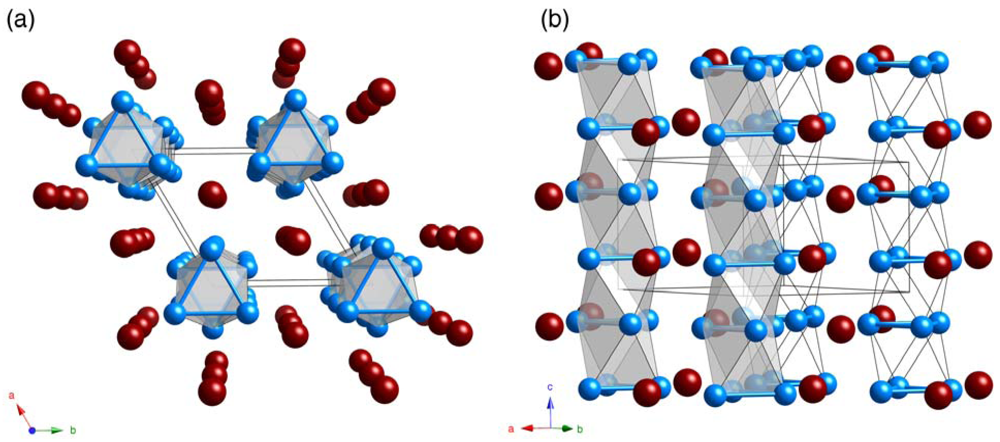
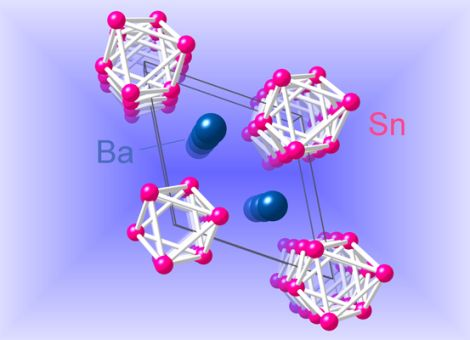
<p>During the investigations of the Ba–In–Sn system, single crystals of the known barium tristannide BaSn<sub>3</sub> [<xref ref-type="bibr" rid="b11-crystals-01-00104">11</xref>-<xref ref-type="bibr" rid="b13-crystals-01-00104">13</xref>] and the In-doped barium tristannide BaSn<sub>3−<italic>x</italic></sub>In<italic><sub>x</sub></italic> (x ≈ 0.2) were obtained, instead of the desired, still unknown, clathrates Ba<sub>8</sub>In<sub>16</sub>Sn<sub>30</sub> or Ba<sub>16</sub>In<sub>32</sub>Sn<sub>104</sub>. While BaSn<sub>3</sub> can be readily synthesized from elemental mixtures [<xref ref-type="bibr" rid="b11-crystals-01-00104">11</xref>-<xref ref-type="bibr" rid="b13-crystals-01-00104">13</xref>] or by using Sn flux (this work), BaSn<sub>3−<italic>x</italic></sub>In<italic><sub>x</sub></italic> with a small (less than <italic>ca.</italic> 10% at.) substitution of Sn by In was only observed when using large amounts of In as a metal flux. BaSn<sub>3</sub> and BaSn<sub>3−<italic>x</italic></sub>In<italic><sub>x</sub></italic> both crystallize with the hexagonal space group <italic>P</italic>6<sub>3</sub>/<italic>mmc</italic> (No. 194) (Pearson symbol <italic>hP</italic>8; Ni<sub>3</sub>Sn type structure [<xref ref-type="bibr" rid="b15-crystals-01-00104">15</xref>]), the hexagonal variant of the Cu<sub>3</sub>Au structure [<xref ref-type="bibr" rid="b16-crystals-01-00104">16</xref>]. The structure can be viewed as alternating layers of Ba<sup>2+</sup> cations (<italic>Wyckoff</italic> site 2<italic>c</italic>: ⅓ ⅔ ¼) and [Sn<sub>3</sub>]<sup>2−</sup> triangles (<italic>Wyckoff</italic> site 6<italic>h</italic>: 2<italic>x</italic>, <italic>x</italic>, ¾), as shown in <xref ref-type="fig" rid="f1-crystals-01-00104">Figure 1</xref>. These slabs are arranged in an ABAB sequence along the crystallographic <italic>c</italic>-axis. Since the triangular Sn<sub>3</sub> fragments can also be considered as parts of Sn<sub>6</sub> octahedra that are linked via face-sharing, one can also rationalize the structure as polyanionic 1D-chains along the <italic>c</italic>-axis and Ba<sup>2+</sup> cations [<xref ref-type="bibr" rid="b13-crystals-01-00104">13</xref>]. Full description of the crystal and electronic structure can be found elsewhere [<xref ref-type="bibr" rid="b12-crystals-01-00104">12</xref>,<xref ref-type="bibr" rid="b13-crystals-01-00104">13</xref>].</p>
<p>The lattice parameters we report for Sn flux-grown BaSn<sub>3</sub> are <italic>a</italic> = 7.228(2) Å, <italic>c</italic> = 5.469(3) Å; the literature values for BaSn<sub>3</sub> [<xref ref-type="bibr" rid="b12-crystals-01-00104">12</xref>,<xref ref-type="bibr" rid="b13-crystals-01-00104">13</xref>] are <italic>a</italic> = 7.254(4) and <italic>c</italic> = 5.500(3) Å. These periodicity constants appear to be slightly longer, however, this elongation is not due to any phase width, but to a thermal expansion—our data were obtained at 120(2) K (<xref ref-type="table" rid="t1-crystals-01-00104">Table 1</xref>), while the previously reported structure was done at room temperature [<xref ref-type="bibr" rid="b12-crystals-01-00104">12</xref>,<xref ref-type="bibr" rid="b13-crystals-01-00104">13</xref>]. The virtually identical <italic>c</italic>/<italic>a</italic> ratios (0.757 <italic>vs</italic> 0.758) confirm that BaSn<sub>3</sub> is a line compound with a robust structure, which is invariant of the method of preparation (stoichiometric reactions vs Sn flux).</p>
<p>However, upon comparison of the above values with the refined unit cell parameters for the “same” compound, grown from In flux, one immediately notices that the structure expands slightly in the <italic>ab</italic>-plane (<italic>a</italic> = 7.260(1) Å) and contracts along the <italic>c</italic> axis (<italic>c</italic> = 5.382(2) Å), which results in significantly smaller <italic>c</italic>/<italic>a</italic> ratio of 0.741, <italic>i.e.</italic>, solid solution BaSn<sub>3−<italic>x</italic></sub>In<italic><sub>x</sub></italic> forms. Given the large excess of In employed in the synthesis, we can speculate that the homogeneity range of this phase is rather small, and that the discussed composition represents the maximum solubility range under these conditions, <italic>i.e.</italic>, BaSn<sub>3−<italic>x</italic></sub>In<italic><sub>x</sub></italic> (0 ≤ <italic>x</italic> ≤ 0.2).</p>
<p>In BaSn<sub>3</sub>, the Sn–Sn distances within the Sn<sub>3</sub> triangles are 3.051(1) Å, slightly shorter than the corresponding distances in BaSn<sub>3−<italic>x</italic></sub>In<italic><sub>x</sub></italic> (<italic>d</italic><sub>Sn/In−Sn/In</sub> = 3.075(1) Å). The opposite trend is observed for the interlayer Sn–Sn distances—they are slightly longer in the pure binary compound (d<sub>Sn–Sn</sub> = 3.253 Å) compared to the In-doped variant (d<sub>Sn/In−Sn/In</sub> = 3.224(1) Å). The substitution of Sn with In has a very minor effect (or almost no-effect) on the Ba–Sn and Ba–Sn/In distances—<italic>d</italic><sub>Ba–Sn</sub> = 3.629(1)/3.646(1) Å <italic>vs d</italic><sub>Ba–Sn/In</sub> = 3.617(1)/3.644(1) Å, respectively. The discussed bond lengths are in good agreement with those reported for other binary compounds like BaSn (<italic>d</italic><sub>Sn−Sn</sub> = 2. 985 Å; <italic>d</italic><sub>Ba−Sn</sub> = 3.600−3.705 Å) [<xref ref-type="bibr" rid="b17-crystals-01-00104">17</xref>]; BaSn<sub>2</sub> (<italic>d</italic><sub>Sn−Sn</sub> = 2.919 Å; <italic>d</italic><sub>Ba−Sn</sub> = 3.473 Å) [<xref ref-type="bibr" rid="b18-crystals-01-00104">18</xref>], BaSn<sub>5</sub> (<italic>d</italic><sub>Sn−Sn</sub> = 2.959−3.437 Å; <italic>d</italic><sub>Ba−Sn</sub> = 3.549−3.729 Å) [<xref ref-type="bibr" rid="b14-crystals-01-00104">14</xref>], and Ba<sub>3</sub>Sn<sub>5</sub> (d<sub>Sn−Sn</sub> = 2.992−3.695 Å; <italic>d</italic><sub>Ba−Sn</sub> = 3.488−3.731 Å) [<xref ref-type="bibr" rid="b19-crystals-01-00104">19</xref>].</p>
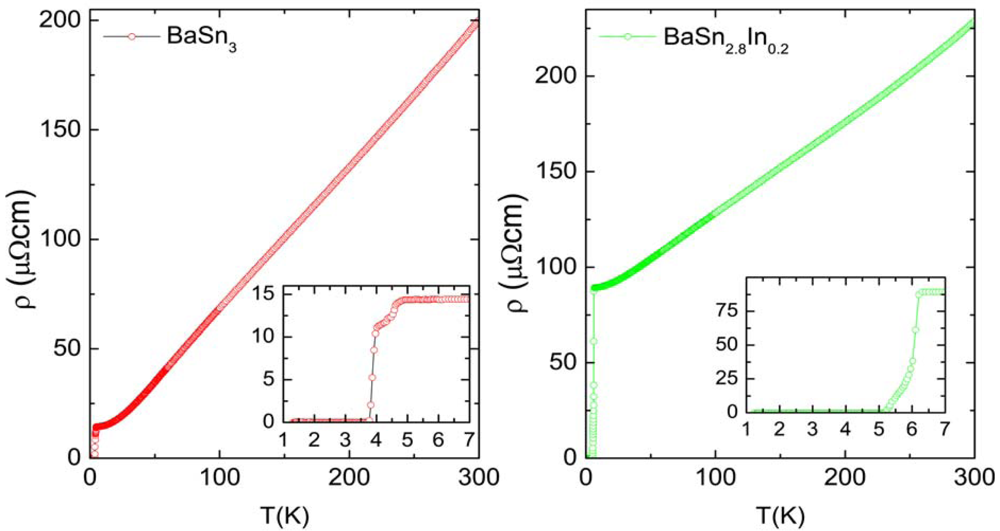
<p>Electrical resistivity measurements (<xref ref-type="fig" rid="f2-crystals-01-00104">Figure 2</xref>) for single-crystals of BaSn<sub>3</sub> show metallic behavior with ρ<sub>300K</sub> on the order of 200 μΩ·cm. At temperature below <italic>ca.</italic> 4.5 K, the material undergoes a phase change, following which it becomes superconducting, as evidenced from the abrupt jump in the ρ(T) curve from nearly 12 μΩ·cm to zero resistivity at 3.7 K. This behavior is somewhat puzzling, since superconductivity was reported originally below 2.4 K by <italic>Fässler et al.</italic> [<xref ref-type="bibr" rid="b12-crystals-01-00104">12</xref>,<xref ref-type="bibr" rid="b13-crystals-01-00104">13</xref>]. Perhaps even more puzzling is the fact that the ρ(T) results are reproducible between crystals from different batches, while heat capacity measurements on the same crystals (<xref ref-type="fn" rid="fn1-crystals-01-00104">supporting information</xref>) show no anomalies at this temperature regime. A reasonable interpretation of the data can be accomplished if one recognizes that T<sub>C</sub> is very close to the critical temperature of elemental Sn (3.7 K [<xref ref-type="bibr" rid="b20-crystals-01-00104">20</xref>]), and since we cannot rule out the presence of small amounts of free Sn in the BaSn<sub>3</sub> specimens grown from Sn flux, most likely this material is not a superconductor.</p>
<p>The resistivity of single-crystals of the In-doped BaSn<sub>2.8</sub>In<sub>0.2</sub> confirms similar metallic behavior with ρ<sub>300K</sub> on the order of 230 μΩ·cm). This material also becomes a superconductor, but at a higher temperature (<italic>ca.</italic> 6 K). This T<sub>C</sub> is 2−3 degrees higher than the critical temperature of elemental Sn (3.7 K [<xref ref-type="bibr" rid="b20-crystals-01-00104">20</xref>]) and In (3.4 K [<xref ref-type="bibr" rid="b20-crystals-01-00104">20</xref>]), however the heat capacity measurements mirror the behavior observed for BaSn<sub>3</sub> and show no anomalies at this temperature regime. Although the ρ(T) behavior of another BaSn<sub>3−<italic>x</italic></sub>In<italic><sub>x</sub></italic> sample is similar (T<sub>C</sub> is slightly different but the sample might inadvertently has slightly different doping level), the susceptibility data indicate only a small volume fraction. Therefore, we argue that bulk superconductivity is not an intrinsic property of these materials.</p></sec>
<sec>
<label>3.</label>
<title>Experimental Section</title>
<p>Both BaSn<sub>3</sub> and BaSn<sub>2.8</sub>In<sub>0.2</sub> were obtained using excess of Sn and In as metal fluxes, respectively. In all cases, the corresponding elements (Alfa or Aldrich, purity greater than 99.9%) were loaded in alumina crucibles (2 cm<sup>3</sup>) inside an argon-filled glove box. After enclosing the crucibles in evacuated fused silica tubes, they were heated in programmable muffle furnaces to 1000 °C (rate 10 °C/h), equilibrated for 5 h, cooled to 450 °C (rate −300 °C/h) and annealed at 450 °C for 12 h. The flux was removed (by decanting it) subsequent to another cooling step to 400 °C (rate −10 °C/h). The silica tubes were crack-opened in the glove box and the crystals were isolated.</p>
<p>BaSn<sub>3</sub> crystals grow very big (up to 7–8 mm long) from Sn flux reactions (loaded in the molar ratio Ba:Sn = 2:15), whereas similar in size crystals of BaSn<sub>3−<italic>x</italic></sub>In<italic><sub>x</sub></italic> emerge only from In flux reactions (loaded in the molar ratio Ba:In:Sn = 2:15:7.5). In both cases, the crystals' appear as silver rods. Extensive efforts to synthesize the desired clathrate Ba<sub>8</sub>In<sub>16</sub>Sn<sub>30</sub> (or any other <italic><sub>ternary</sub></italic> phase in this system) have been unsuccessful so far.</p>
<p>X-ray powder diffraction patterns were taken at room temperature on a Rigaku MiniFlex powder diffractometer using Cu Kα radiation. Typical runs included <italic>θ</italic>–<italic>θ</italic> scans (2<italic>θ</italic><sub>max</sub> = 80°) with scan steps of 0.05° and 5 sec/step counting time. The <italic>JADE</italic> 6.5 software package [<xref ref-type="bibr" rid="b21-crystals-01-00104">21</xref>] was used for data analysis. The intensities and the positions of the experimentally observed peaks and those calculated from the crystal structures matched very well. Since the diffractometer was enclosed in a nitrogen-filled glove box, we were able to test the air-sensitivity of the title compounds by comparing the diffraction patterns of the freshly prepared samples with those that had been exposed to air. Based on the test results, all of the title compounds are moderately unstable and decompose/hydrolyze after an overnight exposure to air.</p>
<p>Intensity data collections were carried out on a Bruker SMART CCD diffractometer at 120 K using graphite-monochromated Mo-Kα radiation. Suitable single-crystals of BaSn<sub>3</sub> and BaSn<sub>3−<italic>x</italic></sub>In<italic><sub>x</sub></italic> were selected in a glove box and cut to smaller dimensions (less than 0.1 mm) under mineral oil. The <italic>SMART</italic> [<xref ref-type="bibr" rid="b22-crystals-01-00104">22</xref>] and <italic>SAINTplus</italic> [<xref ref-type="bibr" rid="b23-crystals-01-00104">23</xref>] programs were used for the data collection, integration and the global unit cell refinement from all data. Semi-empirical absorption correction was applied with <italic>SADABS</italic> [<xref ref-type="bibr" rid="b24-crystals-01-00104">24</xref>]. The structures were refined to convergence by full matrix least-square methods on F<sup>2</sup>, as implemented in <italic>SHELXTL</italic> [<xref ref-type="bibr" rid="b25-crystals-01-00104">25</xref>]. All atoms were refined with anisotropic displacement parameters.</p>
<p>In the refinements of BaSn<sub>3−<italic>x</italic></sub>In<italic><sub>x</sub></italic>, the Sn atoms, located at <italic>Wyckoff</italic> site 6<italic>h</italic>, were determined to be statistically disordered with a small amount of In (<italic>vide supra</italic>). This was done by freeing the occupation parameter of the Sn site, while keeping the Ba-one fixed, which suggested a slight deviation from full occupancy. Because the X-ray scattering factors for In and Sn are very close, reliable refinements of the composition were not possible and the ratio of Sn to In was established from elemental microanalysis (JEOL 7400F electron microscope equipped with an INCA-OXFORD energy-dispersive spectrometer). In agreement with the averaged ratio of Sn:In = 2.8:0.2, the 6<italic>h</italic> site was assigned as 7 atomic % In and the balance Sn (fixed), yielding a formula BaSn<sub>2.8</sub>In<sub>0.2</sub>. Selected details of the data collections and structure refinement parameters are summarized in <xref ref-type="table" rid="t1-crystals-01-00104">Table 1</xref>. The refined atomic coordinates and equivalent isotropic displacement parameters are given in <xref ref-type="table" rid="t2-crystals-01-00104">Table 2</xref>. Additional details of the crystal structure investigations may be obtained from Fachinformationszentrum Karlsruhe, D-76344 Eggenstein-Leopoldshafen, Germany (Fax: +49-7247-808-666, E-Mail: <email>crysdata@fiz-karlsruhe.de</email>) on quoting the depository numbers CSD-423108 for BaSn<sub>3</sub> and CSD-423109 for BaSn<sub>2.8</sub>In<sub>0.2</sub>, respectively.</p>
<p>Four-probe measurements of the electrical resistivity and heat capacity measurements (thermal relaxation method) as a function of the temperature were carried out on a Quantum Design PPMS system in the interval 2 to 300 K with excitation current of 1 mA. The electrical resistivity was measured on at least two crystals from each batch to assure reproducibility. Polished single crystals were used to minimize geometric errors.</p></sec>
<sec sec-type="conclusions">
<label>4.</label>
<title>Conclusions</title>
<p>Large single-crystals of BaSn<sub>3</sub> and BaSn<sub>2.8</sub>In<sub>0.2</sub> were obtained using the flux method, following systematic investigations of the Ba–In–Sn ternary diagram. The first and only (so far) ternary phase, the solid-solution BaSn<sub>3−<italic>x</italic></sub>In<italic><sub>x</sub></italic> was identified from a reaction of the elements using excess in as a metal flux, while BaSn<sub>3</sub> crystals can be readily grown from Sn flux. Both structures were refined from single-crystal X-ray diffraction data and the composition of BaSn<sub>2.8</sub>In<sub>0.2</sub> was independently confirmed via energy-dispersive X-ray spectroscopy (EDX). Electrical resistivity measurements on single crystals of both phases indicate metallic behavior in the temperature interval 6−300 K and superconducting behavior below 4–6 K. However, the susceptibility data indicate only a small volume fraction of a superconducting phase in the samples. Based on this, and the fact that the heat capacity measurements show no anomalies around 2–10 K, we argue that bulk superconductivity is not an intrinsic property of these materials.</p></sec></body>
<back>
<sec sec-type="display-objects">
<title>Figures and Tables</title>
<fig id="f1-crystals-01-00104" position="float">
<label>Figure 1.</label>
<caption>
<p>Views of the crystal structure of BaSn<sub>3</sub> and BaSn<sub>3−<italic>x</italic></sub>In<italic><sub>x</sub></italic>, projected along [001] (<bold>a</bold>) and slightly off [110] (<bold>b</bold>). The linkage of the Sn<sub>6</sub> octahedra (and (Sn,In)<sub>6</sub>, respectively) via face-sharing into infinite chains is emphasized. Ba atoms are drawn as red spheres, and the Sn (or disordered Sn/In) atoms as blue spheres. The thick cylinders between the Sn atoms signify the [Sn<sub>3</sub>]<sup>2−</sup> triangles in the <italic>ab</italic>-planes (<italic>d</italic> ≈ 3.05−3.07 Å) and the thin lines represent the longer interlayer bond (d ≈ 3.22−3.25 Å).</p></caption>
<graphic xlink:href="crystals-01-00104f1.gif"/></fig>
<fig id="f2-crystals-01-00104" position="float">
<label>Figure 2.</label>
<caption>
<p>Temperature dependent electrical resistivity measurements for single-crystals of BaSn<sub>3</sub> and BaSn<sub>2.8</sub>In<sub>0.2</sub> (Inset: Magnified view of the low temperature region of the resistivity).</p></caption>
<graphic xlink:href="crystals-01-00104f2.gif"/></fig>
<table-wrap id="t1-crystals-01-00104" position="float">
<label>Table 1.</label>
<caption>
<p>Selected crystal data and structure refinement parameters for BaSn<sub>3</sub> and BaSn<sub>3−<italic>x</italic></sub>In<italic><sub>x</sub></italic>.</p></caption>
<table frame="hsides" rules="none">
<tbody>
<tr>
<td align="left" valign="top">empirical formula</td>
<td align="left" valign="top">BaSn<sub>3</sub></td>
<td align="center" valign="top">BaSn<sub>2.8</sub>In<sub>0.2</sub></td></tr>
<tr>
<td align="left" valign="top">Fw, g/mol</td>
<td align="left" valign="top">493.41</td>
<td align="center" valign="top">492.64</td></tr>
<tr>
<td align="left" valign="top">Crystal system</td>
<td align="left" valign="top">Hexagonal</td>
<td align="center" valign="top">Hexagonal</td></tr>
<tr>
<td align="left" valign="top">Space group</td>
<td align="left" valign="top"><italic>P</italic>6<sub>3</sub>/<italic>mmc</italic> (No. 194)</td>
<td align="center" valign="top"><italic>P</italic>6<sub>3</sub>/<italic>mmc</italic> (No. 194)</td></tr>
<tr>
<td align="left" valign="top"><italic>a</italic> (Å)</td>
<td align="left" valign="top">7.2279(17)</td>
<td align="center" valign="top">7.2604(13)</td></tr>
<tr>
<td align="left" valign="top"><italic>c</italic> (Å)</td>
<td align="left" valign="top">5.4689(26)</td>
<td align="center" valign="top">5.3817(20)</td></tr>
<tr>
<td align="left" valign="top"><italic>V</italic> (Å<sup>3</sup>)</td>
<td align="left" valign="top">247.43</td>
<td align="center" valign="top">245.68</td></tr>
<tr>
<td align="left" valign="top"><italic>Z</italic></td>
<td align="left" valign="top">2</td>
<td align="center" valign="top">2</td></tr>
<tr>
<td align="left" valign="top"><italic>T</italic> (K)</td>
<td align="left" valign="top">120(2)</td>
<td align="center" valign="top">120(2)</td></tr>
<tr>
<td align="left" valign="top">Radiation, λ (Å)</td>
<td align="left" valign="top">Mo Kα, 0.71073</td>
<td align="center" valign="top">Mo Kα, 0.71073</td></tr>
<tr>
<td align="left" valign="top">ρ (g·cm<sup>−3</sup>)</td>
<td align="left" valign="top">6.623</td>
<td align="center" valign="top">6.659</td></tr>
<tr>
<td align="left" valign="top"><italic>μ</italic> (cm<sup>−1</sup>)</td>
<td align="left" valign="top">226.2</td>
<td align="center" valign="top">227.0</td></tr>
<tr>
<td align="left" valign="top"><italic>R</italic><sub>1</sub> [<italic>I</italic> &gt; 2σ(<italic>I</italic>)]<xref ref-type="table-fn" rid="tfn1-crystals-01-00104">a</xref></td>
<td align="left" valign="top">0.014</td>
<td align="center" valign="top">0.021</td></tr>
<tr>
<td align="left" valign="top"><italic>w</italic>R<sub>2</sub> [<italic>I</italic> &gt; 2σ (<italic>I</italic>)]<xref ref-type="table-fn" rid="tfn1-crystals-01-00104">a</xref></td>
<td align="left" valign="top">0.030</td>
<td align="center" valign="top">0.041</td></tr>
<tr>
<td align="left" valign="top">largest peak/hole (e<sup>−</sup>·Å<sup>−3</sup>)</td>
<td align="left" valign="top">0.45/ −0.84</td>
<td align="center" valign="top">0.68/ −1.67</td></tr></tbody></table>
<table-wrap-foot><fn id="tfn1-crystals-01-00104">
<label>a</label>
<p><italic>R</italic><sub>1</sub> = Σ||<italic>F<sub>o</sub></italic>| − |<italic>F</italic><sub>c</sub>||/Σ|<italic>F<sub>o</sub></italic>|; <italic>w</italic>R<sub>2</sub> = [Σ[<italic>w</italic>(|<italic>F<sub>o</sub></italic><sup>2</sup>−<italic>F<sub>c</sub></italic><sup>2</sup>)<sup>2</sup>]/ Σ[<italic>w</italic>(F<italic><sub>o</sub></italic><sup>2</sup>)<sup>2</sup>]]<sup>1/2</sup>, where <italic>w</italic> = 1/[σ<sup>2</sup> <italic>F</italic><sub>o</sub><sup>2</sup> + (A<italic>P</italic>)<sup>2</sup> + B<italic>P</italic>], <italic>P</italic> = [<italic>F</italic><sub>o</sub><sup>2</sup> +2 <italic>F</italic><sub>c</sub><sup>2</sup> ]/3; A and B: weight coefficients.</p></fn></table-wrap-foot></table-wrap>
<table-wrap id="t2-crystals-01-00104" position="float">
<label>Table 2.</label>
<caption>
<p>Atomic coordinates and equivalent isotropic displacement parameters (U<italic><sub>eq</sub></italic>)<xref ref-type="table-fn" rid="tfn2-crystals-01-00104">a</xref>.</p></caption>
<table frame="hsides" rules="groups">
<thead>
<tr>
<th align="left" valign="top"><bold>Atom</bold></th>
<th align="left" valign="top"><bold>Site</bold> <xref ref-type="table-fn" rid="tfn3-crystals-01-00104">b</xref></th>
<th align="left" valign="top"><bold><italic>x</italic></bold></th>
<th align="left" valign="top"><bold><italic>y</italic></bold></th>
<th align="left" valign="top"><bold><italic>z</italic></bold></th>
<th align="left" valign="top"><bold>U<sub><italic>eq</italic></sub> (Å<sup>2</sup>)</bold></th></tr></thead>
<tbody>
<tr>
<td align="left" valign="top">BaSn<sub>3</sub></td>
<td align="left" valign="top"/>
<td align="left" valign="top"/></tr>
<tr>
<td align="left" valign="top">Ba</td>
<td align="left" valign="top">2<italic>c</italic></td>
<td align="left" valign="top">⅓</td>
<td align="left" valign="top">⅔</td>
<td align="left" valign="top">¼</td>
<td align="left" valign="top">0.0100(2)</td></tr>
<tr>
<td align="left" valign="top">Sn</td>
<td align="left" valign="top">6<italic>h</italic></td>
<td align="left" valign="top">0.7186(1)</td>
<td align="left" valign="top">0.8593(1)</td>
<td align="left" valign="top">¾</td>
<td align="left" valign="top">0.0094(2)</td></tr>
<tr>
<td valign="bottom" colspan="6">
<hr/></td></tr>
<tr>
<td align="left" valign="top">BaSn<sub>2.8</sub>In<sub>0.2</sub></td>
<td align="left" valign="top"/>
<td align="left" valign="top"/></tr>
<tr>
<td align="left" valign="top">Ba</td>
<td align="left" valign="top">2<italic>c</italic></td>
<td align="left" valign="top">⅓</td>
<td align="left" valign="top">⅔</td>
<td align="left" valign="top">¼</td>
<td align="left" valign="top">0.0085(4)</td></tr>
<tr>
<td align="left" valign="top">Sn/In</td>
<td align="left" valign="top">6<italic>h</italic></td>
<td align="left" valign="top">0.7176(1)</td>
<td align="left" valign="top">0.8588(1)</td>
<td align="left" valign="top">¾</td>
<td align="left" valign="top">0.0095(3)</td></tr></tbody></table>
<table-wrap-foot><fn id="tfn2-crystals-01-00104">
<label>a</label>
<p>U<italic><sub>eq</sub></italic> is defined as one third of the trace of the orthogonalized U<italic><sub>ij</sub></italic> tensor;</p></fn><fn id="tfn3-crystals-01-00104">
<label>b</label>
<p>Standardization of the coordinates moves the origin by 0 0 ½ and changes the Wyckoff letter for Ba from 2<italic>c</italic> (⅓ ⅔ ¼) to 2<italic>d</italic> (⅓ ⅔ ¾). The Wyckoff letter for the Sn (Sn/In) site does not change, but the coordinates become <italic>x</italic> = 0.1407(1); <italic>y</italic> = 0.2814(1); z = ¼ and <italic>x</italic> = 0.1412(1); <italic>y</italic> = 0.2824(1); z = ¼, for BaSn<sub>3</sub> and BaSn<sub>2.8</sub>In<sub>0.2</sub>, respectively.</p></fn></table-wrap-foot></table-wrap></sec>
<ack>
<p>The authors gratefully acknowledge the financial support from the University of Delaware and US Department of Energy through a grant DE-SC0001360.</p></ack>
<ref-list>
<title>References and Notes</title>
<ref id="b1-crystals-01-00104"><label>1.</label><citation citation-type="journal"><person-group person-group-type="author"><name><surname>Nolas</surname><given-names>G.S.</given-names></name><name><surname>Cohn</surname><given-names>J.L.</given-names></name><name><surname>Slack</surname><given-names>G.A.</given-names></name><name><surname>Schjuman</surname><given-names>S.B.</given-names></name></person-group><article-title>Semiconducting Ge clathrates: Promising candidates for thermoelectric applications</article-title><source>Appl. Phys. Lett.</source><year>1998</year><volume>73</volume><fpage>178</fpage><lpage>180</lpage><pub-id pub-id-type="doi">10.1063/1.121747</pub-id></citation></ref>
<ref id="b2-crystals-01-00104"><label>2.</label><citation citation-type="journal"><person-group person-group-type="author"><name><surname>Christensen</surname><given-names>M.</given-names></name><name><surname>Johnson</surname><given-names>S.</given-names></name><name><surname>Iversen</surname><given-names>B.B.</given-names></name></person-group><article-title>Thermoelectric clathrates of type I</article-title><source>Dalton Trans.</source><year>2010</year><volume>39</volume><fpage>978</fpage><lpage>992</lpage><pub-id pub-id-type="doi">10.1039/b916400f</pub-id><pub-id pub-id-type="pmid">20066182</pub-id></citation></ref>
<ref id="b3-crystals-01-00104"><label>3.</label><citation citation-type="journal"><person-group person-group-type="author"><name><surname>Bobev</surname><given-names>S.</given-names></name><name><surname>Meyers</surname><given-names>J.</given-names><suffix>Jr.</suffix></name><name><surname>Fritsch</surname><given-names>V.</given-names></name><name><surname>Yamasaki</surname><given-names>Y.</given-names></name></person-group><article-title>Synthesis and structural characterization of novel clathrate-II compounds of silicon</article-title><source>Proc. Int. Conf. Thermoelectr.</source><year>2006</year><volume>25</volume><fpage>48</fpage><lpage>52</lpage></citation></ref>
<ref id="b4-crystals-01-00104"><label>4.</label><citation citation-type="journal"><person-group person-group-type="author"><name><surname>Kroner</surname><given-names>R.</given-names></name><name><surname>Peters</surname><given-names>K.</given-names></name><name><surname>von Schnering</surname><given-names>H.G.</given-names></name><name><surname>Nespers</surname><given-names>R.</given-names></name></person-group><article-title>Crystal structure of the clathrate-II, Ba<sub>16</sub>Ga<sub>32</sub>Sn<sub>104</sub></article-title><source>Z. Kristallogr. NCS</source><year>1998</year><volume>644</volume><fpage>664</fpage><lpage>664</lpage></citation></ref>
<ref id="b5-crystals-01-00104"><label>5.</label><citation citation-type="journal"><person-group person-group-type="author"><name><surname>Eisenmann</surname><given-names>B.</given-names></name><name><surname>Schäfer</surname><given-names>H.</given-names></name><name><surname>Zagler</surname><given-names>R.</given-names></name></person-group><article-title>Die Verbindungen A<sub>8</sub>B<sub>16</sub>C<sub>30</sub> (A = Sr, Ba; B = Al, Ga; C = Si, Ge, Sn) und ihre Käfigstrukturen</article-title><source>J. Less-Common Met.</source><year>1986</year><volume>118</volume><fpage>43</fpage><lpage>55</lpage><pub-id pub-id-type="doi">10.1016/0022-5088(86)90609-0</pub-id></citation></ref>
<ref id="b6-crystals-01-00104"><label>6.</label><citation citation-type="journal"><person-group person-group-type="author"><name><surname>Suekuni</surname><given-names>K.</given-names></name><name><surname>Avila</surname><given-names>M.A.</given-names></name><name><surname>Umeo</surname><given-names>K.</given-names></name><name><surname>Fukuoka</surname><given-names>H.</given-names></name><name><surname>Yamanaka</surname><given-names>S.</given-names></name><name><surname>Nakagawa</surname><given-names>T.</given-names></name><name><surname>Takabatake</surname><given-names>T.</given-names></name></person-group><article-title>Simultaneous structure and carrier tuning of dimorphic clathrate Ba<sub>8</sub>Ga<sub>16</sub>Sn<sub>30</sub></article-title><source>Phys. Rev.</source><year>2008</year><volume>B77</volume><fpage>235119</fpage></citation></ref>
<ref id="b7-crystals-01-00104"><label>7.</label><citation citation-type="journal"><person-group person-group-type="author"><name><surname>Carrillo-Cabrera</surname><given-names>W.</given-names></name><name><surname>Cardoso Gil</surname><given-names>R.H.</given-names></name><name><surname>Tran</surname><given-names>V.H.</given-names></name><name><surname>Grin</surname><given-names>Yu.</given-names></name></person-group><article-title>Refinement of the crystal structure of Ba<sub>8</sub>Ga<sub>17.2</sub>Sn<sub>28.8</sub></article-title><source>Z. Kristallogr. NCS</source><year>2002</year><volume>217</volume><fpage>181</fpage><lpage>182</lpage></citation></ref>
<ref id="b8-crystals-01-00104"><label>8.</label><citation citation-type="journal"><person-group person-group-type="author"><name><surname>Evans</surname><given-names>J.E.</given-names></name><name><surname>Wu</surname><given-names>Y.</given-names></name><name><surname>Kranak</surname><given-names>V.F.</given-names></name><name><surname>Newman</surname><given-names>N.</given-names></name><name><surname>Reller</surname><given-names>A.</given-names></name><name><surname>Garcia-Garcia</surname><given-names>F.J.</given-names></name><name><surname>Häussermann</surname><given-names>U.</given-names></name></person-group><article-title>Structural properties and superconductivity in the ternary intermetallic compounds MAB (M = Ca, Sr, Ba; A = Al, Ga, In; B = Si, Ge, Sn)</article-title><source>Phys. Rev.</source><year>2009</year><volume>B80</volume><fpage>064514</fpage></citation></ref>
<ref id="b9-crystals-01-00104"><label>9.</label><citation citation-type="journal"><person-group person-group-type="author"><name><surname>Dürr</surname><given-names>I.</given-names></name><name><surname>Schwarz</surname><given-names>M.</given-names></name><name><surname>Wendorff</surname><given-names>M.</given-names></name><name><surname>Röhr</surname><given-names>C.</given-names></name></person-group><article-title>Novel barium triel/tetrelides with the Pu<sub>3</sub>Pd<sub>5</sub> structure type</article-title><source>J. Alloys Compounds</source><year>2010</year><volume>494</volume><fpage>62</fpage><lpage>71</lpage><pub-id pub-id-type="doi">10.1016/j.jallcom.2009.12.176</pub-id></citation></ref>
<ref id="b10-crystals-01-00104"><label>10.</label><citation citation-type="journal"><person-group person-group-type="author"><name><surname>Tobash</surname><given-names>P.H.</given-names></name><name><surname>Yamasaki</surname><given-names>Y.</given-names></name><name><surname>Bobev</surname><given-names>S.</given-names></name></person-group><article-title>Gallium-tin mixing in BaGa<sub>(4−<italic>x</italic>)</sub>Sn<italic><sub>x</sub></italic> [<italic>x</italic> = 0.89(2)] with the BaAl<sub>4</sub> structure type</article-title><source>Acta Crystallogr.</source><year>2007</year><volume>E63</volume><fpage>i35</fpage><lpage>i37</lpage></citation></ref>
<ref id="b11-crystals-01-00104"><label>11.</label><citation citation-type="journal"><person-group person-group-type="author"><name><surname>Ray</surname><given-names>K.W.</given-names></name><name><surname>Thompson</surname><given-names>R.G.</given-names></name></person-group><article-title>A Study of Barium-Tin Alloys</article-title><source>Metals Alloys</source><year>1930</year><volume>1</volume><fpage>314</fpage><lpage>316</lpage></citation></ref>
<ref id="b12-crystals-01-00104"><label>12.</label><citation citation-type="journal"><person-group person-group-type="author"><name><surname>Fässler</surname><given-names>T.F.</given-names></name><name><surname>Kronseder</surname><given-names>C.</given-names></name></person-group><article-title>BaSn<sub>3</sub>: Superconductor at the border of Zintl phases and intermetallic compounds. Real-space analysis of band structures</article-title><source>Angew. Chem. Int. Ed. Engl.</source><year>1997</year><volume>36</volume><fpage>2683</fpage><lpage>2686</lpage><pub-id pub-id-type="doi">10.1002/anie.199726831</pub-id></citation></ref>
<ref id="b13-crystals-01-00104"><label>13.</label><citation citation-type="journal"><person-group person-group-type="author"><name><surname>Ponou</surname><given-names>S.</given-names></name><name><surname>Fässler</surname><given-names>T.F.</given-names></name><name><surname>Kienle</surname><given-names>L.</given-names></name></person-group><article-title>Structural complexity in intermetallic alloys: long-range order beyond 100 nm in the system of BaSn<sub>3</sub>/BaBi<sub>3</sub></article-title><source>Angew. Chem. Int. Ed. Engl.</source><year>2008</year><volume>47</volume><fpage>3999</fpage><lpage>4004</lpage><pub-id pub-id-type="doi">10.1002/anie.200800378</pub-id><pub-id pub-id-type="pmid">18421737</pub-id></citation></ref>
<ref id="b14-crystals-01-00104"><label>14.</label><citation citation-type="journal"><person-group person-group-type="author"><name><surname>Fässler</surname><given-names>T.F.</given-names></name><name><surname>Hoffmann</surname><given-names>S.</given-names></name><name><surname>Kronseder</surname><given-names>C.</given-names></name></person-group><article-title>Novel tin structure motives in superconducting BaSn<sub>5</sub>- The role of lone pairs in intermetallic compounds (1)</article-title><source>Z. Anorg. Allg. Chem.</source><year>2001</year><volume>627</volume><fpage>2486</fpage><lpage>2492</lpage><pub-id pub-id-type="doi">10.1002/1521-3749(200111)627:11&lt;2486::AID-ZAAC2486&gt;3.0.CO;2-I</pub-id></citation></ref>
<ref id="b15-crystals-01-00104"><label>15.</label><citation citation-type="journal"><person-group person-group-type="author"><name><surname>Rahlfs</surname><given-names>P.</given-names></name></person-group><article-title>Die Kristallstruktur des Ni<sub>3</sub>Sn (Mg<sub>3</sub>Cd-Typ = Überstruktur der hexagonal dichtesten Kugelpackung)</article-title><source>Metallwirtschaft, Metallwissenschaft, Metalltechnik</source><year>1937</year><volume>16</volume><fpage>343</fpage><lpage>345</lpage></citation></ref>
<ref id="b16-crystals-01-00104"><label>16.</label><citation citation-type="journal"><person-group person-group-type="author"><name><surname>Betteridge</surname><given-names>W.</given-names></name></person-group><article-title>Relation between the degree of order and the lattice parameters of Cu<sub>3</sub>Au</article-title><source>J. Inst. Met.</source><year>1949</year><volume>75</volume><fpage>559</fpage><lpage>570</lpage></citation></ref>
<ref id="b17-crystals-01-00104"><label>17.</label><citation citation-type="journal"><person-group person-group-type="author"><name><surname>Rieger</surname><given-names>W.</given-names></name><name><surname>Parthé</surname><given-names>E.</given-names></name></person-group><article-title>Alkaline earth silicides, germanides and stannides with CrB structure type</article-title><source>Acta Crystallogr.</source><year>1967</year><volume>22</volume><fpage>919</fpage><lpage>922</lpage><pub-id pub-id-type="doi">10.1107/S0365110X67001793</pub-id></citation></ref>
<ref id="b18-crystals-01-00104"><label>18.</label><citation citation-type="journal"><person-group person-group-type="author"><name><surname>Kim</surname><given-names>S.-J.</given-names></name><name><surname>Fässler</surname><given-names>T.F.</given-names></name></person-group><article-title>Crystal structure of barium distannide, BaSn<sub>2</sub></article-title><source>Z. Kristallogr. NCS</source><year>2008</year><volume>223</volume><fpage>325</fpage><lpage>326</lpage></citation></ref>
<ref id="b19-crystals-01-00104"><label>19.</label><citation citation-type="journal"><person-group person-group-type="author"><name><surname>Zürcher</surname><given-names>F.</given-names></name><name><surname>Nesper</surname><given-names>R.</given-names></name><name><surname>Hoffmann</surname><given-names>S.</given-names></name><name><surname>Fässler</surname><given-names>T.</given-names></name></person-group><article-title>Novel Arachno-type (X<sub>5</sub>)<sup>6−</sup> Zintl anions in Sr<sub>3</sub>Sn<sub>5</sub>, Ba<sub>3</sub>Sn<sub>5</sub>, and Ba<sub>3</sub>Pb<sub>5</sub> and charge influence on Zintl clusters</article-title><source>Z. Anorg. Allg. Chem.</source><year>2001</year><volume>627</volume><fpage>2211</fpage><lpage>2219</lpage><pub-id pub-id-type="doi">10.1002/1521-3749(200109)627:9&lt;2211::AID-ZAAC2211&gt;3.0.CO;2-2</pub-id></citation></ref>
<ref id="b20-crystals-01-00104"><label>20.</label><citation citation-type="journal"><person-group person-group-type="author"><name><surname>Wernick</surname><given-names>J.H.</given-names></name><name><surname>Matthias</surname><given-names>B.T.</given-names></name></person-group><article-title>Superconductivity in the In-Sn System</article-title><source>Chem. Phys.</source><year>1961</year><volume>34</volume><fpage>2194</fpage><lpage>2195</lpage></citation></ref>
<ref id="b21-crystals-01-00104"><label>21.</label><citation citation-type="book"><source>JADE, Version 6.5</source><publisher-name>Materials Data, Inc.</publisher-name><publisher-loc>Livermore, CA, USA</publisher-loc><year>2003</year></citation></ref>
<ref id="b22-crystals-01-00104"><label>22.</label><citation citation-type="book"><source>SMART NT, Version 5.63</source><publisher-name>Bruker Analytical X-ray Systems Inc.</publisher-name><publisher-loc>Madison, WI, USA</publisher-loc><year>2003</year></citation></ref>
<ref id="b23-crystals-01-00104"><label>23.</label><citation citation-type="book"><source>SAINT NT, Version 6.45</source><publisher-name>Bruker Analytical X-ray Systems Inc.</publisher-name><publisher-loc>Madison, WI, USA</publisher-loc><year>2003</year></citation></ref>
<ref id="b24-crystals-01-00104"><label>24.</label><citation citation-type="book"><source>SADABS NT, Version 2.10</source><publisher-name>Bruker Analytical X-ray Systems Inc.</publisher-name><publisher-loc>Madison, WI, USA</publisher-loc><year>2001</year></citation></ref>
<ref id="b25-crystals-01-00104"><label>25.</label><citation citation-type="book"><source>SHELXTL, Version 6.12</source><publisher-name>Bruker Analytical X-ray Systems Inc.</publisher-name><publisher-loc>Madison, WI, USA</publisher-loc><year>2001</year></citation></ref></ref-list>
<fn-group><fn id="fn1-crystals-01-00104" fn-type="supplementary-material">
<p><bold>Supplementary Material:</bold> Supplementary data associated with this article can be found in the online version at doi: 10.3390/cryst1030104.</p></fn></fn-group></back></article>