
<?xml version="1.0" encoding="UTF-8"?>
<!DOCTYPE article PUBLIC "-//NLM//DTD Journal Publishing DTD v2.3 20070202//EN" "journalpublishing.dtd">
<article xmlns:mml="http://www.w3.org/1998/Math/MathML" xmlns:xlink="http://www.w3.org/1999/xlink" xml:lang="en" article-type="research-article">
<front>
<journal-meta>
<journal-id journal-id-type="publisher-id">Crystals</journal-id>
<journal-title>Crystals</journal-title>
<issn pub-type="epub">2073-4352</issn>
<publisher>
<publisher-name>Molecular Diversity Preservation International (MDPI)</publisher-name></publisher></journal-meta>
<article-meta>
<article-id pub-id-type="doi">10.3390/cryst1020022</article-id>
<article-id pub-id-type="publisher-id">crystals-01-00022</article-id>
<article-categories>
<subj-group>
<subject>Article</subject></subj-group></article-categories>
<title-group>
<article-title>A New Open-framework Iron Borophosphate from Ionic Liquids: KFe[BP<sub>2</sub>O<sub>8</sub>(OH)]</article-title></title-group>
<contrib-group>
<contrib contrib-type="author">
<name><surname>Wang</surname><given-names>Guangmei</given-names></name></contrib>
<contrib contrib-type="author">
<name><surname>Mudring</surname><given-names>Anja-Verena</given-names></name><xref ref-type="corresp" rid="c1-crystals-01-00022"><sup>*</sup></xref></contrib>
<aff id="af1-crystals-01-00022">Fakultät für Chemie, Ruhr-Universität Bochum, D-44780 Bochum, Germany; E-Mail: <email>guangmei.wang@rub.de</email></aff></contrib-group>
<author-notes>
<corresp id="c1-crystals-01-00022">
<label>*</label> Author to whom correspondence should be addressed; E-Mail: <email>anja.mudring@rub.de</email>; Tel.: +49(0)234-32-27408 Fax: +49(0)234-32-14951.</corresp></author-notes>
<pub-date pub-type="collection">
<year>2011</year></pub-date>
<pub-date pub-type="epub">
<day>19</day>
<month>04</month>
<year>2011</year></pub-date>
<volume>1</volume>
<issue>2</issue>
<fpage>22</fpage>
<lpage>27</lpage>
<history>
<date date-type="received">
<day>11</day>
<month>04</month>
<year>2011</year></date>
<date date-type="rev-recd">
<day>15</day>
<month>04</month>
<year>2011</year></date>
<date date-type="accepted">
<day>18</day>
<month>04</month>
<year>2011</year></date></history>
<permissions>
<copyright-statement>© 2011 by the authors; licensee MDPI, Basel, Switzerland.</copyright-statement>
<copyright-year>2011</copyright-year>
<license>
<p>This article is an open access article distributed under the terms and conditions of the Creative Commons Attribution license (http://creativecommons.org/licenses/by/3.0/).</p></license></permissions>
<abstract>
<p>A new open-framework iron borophosphate, KFe[BP<sub>2</sub>O<sub>8</sub>(OH)], has been obtained by ionothermal synthesis from KH<sub>2</sub>PO<sub>4</sub>, FeCl<sub>3</sub>·4H<sub>2</sub>O, H<sub>3</sub>BO<sub>3</sub> and [C<sub>4</sub>mpyr]Br (1-butyl-1-methylpyrrolidinium bromide). Single-crystal X-ray diffraction analysis shows that KFe[BP<sub>2</sub>O<sub>8</sub>(OH)] (monoclinic, <italic>P</italic>2<sub>1</sub>/<italic>c</italic>, a = 9.372(2) Å , <italic>b</italic> = 8.146(2)Å , <italic>c</italic> = 9.587(2) Å, <italic>β</italic> = 101.18(3)°, <italic>V</italic> = 718.0(2)Å<sup>3</sup> and <italic>Z</italic>= 4) has a three-dimensional (3-D) framework structure composed by {Fe(III)O<sub>5</sub>(OH)} octahedra as well as {BO<sub>3</sub>(OH)} and {PO<sub>4</sub>} tetrahedra. As anionic structural sub-unit, KFe[BP<sub>2</sub>O<sub>8</sub>(OH)], contains an infinite open-branched {[BP<sub>2</sub>O<sub>8</sub>(OH)]<sup>4-</sup>} chain which is formed by alternating {BO<sub>3</sub>(OH)} and {PO<sub>4</sub>} tetrahedra. {Fe(III)O<sub>5</sub>(OH)} octahedra share common O corners with five phosphate tetrahedra and the OH corner links to the hydrogen borate group to give a 3D framework. The negative charges of the inorganic framework are balanced by K<sup>+</sup> ions.</p></abstract>
<kwd-group>
<kwd>iron borophosphate</kwd>
<kwd>ionothermal synthesis</kwd>
<kwd>crystal structure</kwd></kwd-group></article-meta></front>
<body>
<sec sec-type="intro">
<label>1.</label>
<title>Introduction</title>
<p>Open-framework iron borophosphates have received much attention for their potential magnetic properties. A broad spectrum of borophosphates with various dimensionalities and stoichiometries has been prepared using hydro-/solvothermal, as well as boric acid flux methods with or without the employment of organic amines as templates [<xref ref-type="bibr" rid="b1-crystals-01-00022">1</xref>-<xref ref-type="bibr" rid="b7-crystals-01-00022">7</xref>]. So far, the ionothermal synthesis of iron borophosphates has not been explored [<xref ref-type="bibr" rid="b8-crystals-01-00022">8</xref>-<xref ref-type="bibr" rid="b11-crystals-01-00022">11</xref>].</p>
<p>The known borophosphate anionic frameworks can be derived from a few typical borophosphate fundamental building units (FBUs) with B/P ratios of 6/1, 5/1, 3/1, 3/2, 1/1, 3/4, 2/3, 1/2, 2/5, 1/3 and 1/4 [<xref ref-type="bibr" rid="b12-crystals-01-00022">12</xref>,<xref ref-type="bibr" rid="b13-crystals-01-00022">13</xref>]. Among them, nonameric FBUs, [B<sub>3</sub>P<sub>6</sub>X<sub>26</sub>] [<xref ref-type="bibr" rid="b14-crystals-01-00022">14</xref>] and [BP<sub>2</sub>X<sub>8</sub>] [<xref ref-type="bibr" rid="b15-crystals-01-00022">15</xref>] (X = O, OH) with a B/P ratio of 1/2, form the largest group. Borophosphates of the general formula AM[BP<sub>2</sub>O<sub>8</sub>(OH)] (A = K, Rb, Cs or NH<sub>4</sub>, M = V, Fe, Al, Ga, Sc) have been described in the past several years [<xref ref-type="bibr" rid="b12-crystals-01-00022">12</xref>]. Here we report on a new member of this family, KFe[B(PO<sub>4</sub>)<sub>2</sub>OH], obtained by ionothermal synthesis.</p></sec>
<sec sec-type="results|discussion">
<label>2.</label>
<title>Results and Discussion</title>
<p>KFe[BP<sub>2</sub>O<sub>8</sub>(OH)] was prepared by reacting ionothermally FeCl<sub>3</sub>·4H<sub>2</sub>O, KH<sub>2</sub>PO<sub>4</sub>, H<sub>3</sub>BO<sub>3</sub> and 1-butyl-1-methylpyrrolidinium bromide, [C<sub>4</sub>mpy]Br, in a ratio of 3:3:1;1.5 at 200 °C for 5 days. Upon cooling crystals of KFe[BP<sub>2</sub>O<sub>8</sub>(OH)] formed. The crystal structure of KFe[BP<sub>2</sub>O<sub>8</sub>(OH)] (monoclinic, <italic>P</italic>2<sub>1</sub>/<italic>c</italic>, <italic>a</italic> = 9.372(2) Å, <italic>b</italic> = 8.146(2) Å, <italic>c</italic> = 9.587(2) Å, <italic>β</italic> = 101.18(3)°, <italic>V</italic> = 718.0(2) Å<sup>3</sup> and <italic>Z</italic> = 4) is built up by a 3-D framework of {Fe(III)O<sub>6</sub>} octahedra, {BO<sub>3</sub>(OH)} and {PO<sub>4</sub>} tetrahedra. It is isotypic with KAl[BP<sub>2</sub>O<sub>8</sub>(OH)] [<xref ref-type="bibr" rid="b16-crystals-01-00022">16</xref>], (NH<sub>4</sub>)M[BP<sub>2</sub>O<sub>8</sub>(OH)] (M, Al, Ga, Fe, V) [<xref ref-type="bibr" rid="b17-crystals-01-00022">17</xref>-<xref ref-type="bibr" rid="b20-crystals-01-00022">20</xref>], RbM[BP<sub>2</sub>O<sub>8</sub>(OH)] (M = Al, Ga, V, Fe) [<xref ref-type="bibr" rid="b21-crystals-01-00022">21</xref>-<xref ref-type="bibr" rid="b25-crystals-01-00022">25</xref>], Cs[BP<sub>2</sub>O<sub>8</sub>(OH)] (M = Al, Ga, Fe) [<xref ref-type="bibr" rid="b26-crystals-01-00022">26</xref>-<xref ref-type="bibr" rid="b28-crystals-01-00022">28</xref>].</p>
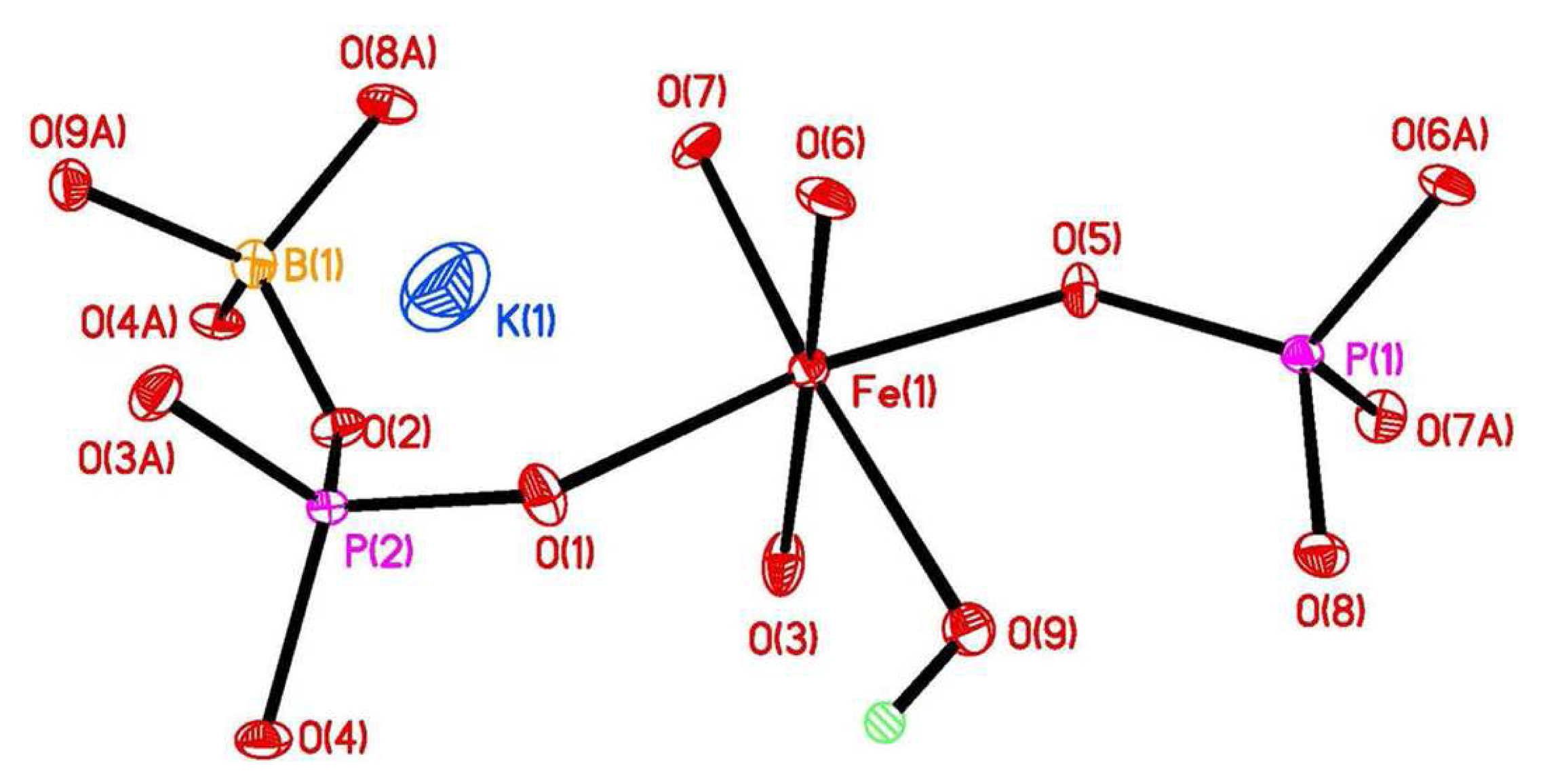
<p>The asymmetric unit of KFe[BP<sub>2</sub>O<sub>8</sub>(OH)] contains one crystallographically distinct Fe<sup>3+</sup> cation, one B<sup>3+</sup> cation, one K<sup>+</sup> cation, two crystallographically distinct P<sup>5+</sup> cations, which are all coordinated by oxygen (<xref ref-type="fig" rid="f1-crystals-01-00022">Figure 1</xref>).</p>
<p>In KFe[BP<sub>2</sub>O<sub>8</sub>(OH)], the Fe(1) atom connects three O atoms to three P(1), two O atoms to two P(2) atoms, and one O(9)H to the B(1) atom. The Fe–O internuclear distances vary in the range of 1.954(4)–2.143(4) Å. All boron and phosphorus atoms are tetrahedrally coordinated by oxygen atoms. The P(1) atom connects via three oxygen atoms to Fe(1) and one O atom to B(1) atom; the P(2) atom connects two Fe(1) atoms and two B(1) atoms via four oxygen atoms, respectively. The P–O bond lengths vary in the range of 1.505(4)–1.562(3) Å. The B(1) atom connects via one oxygen atom to a P(1) atom, two oxygen atoms to P(2) atoms and one O(9)H to Fe(1) atom, respectively. The B–O bond lengths vary in the range of 1.457(6)–1.475(7) Å.</p>
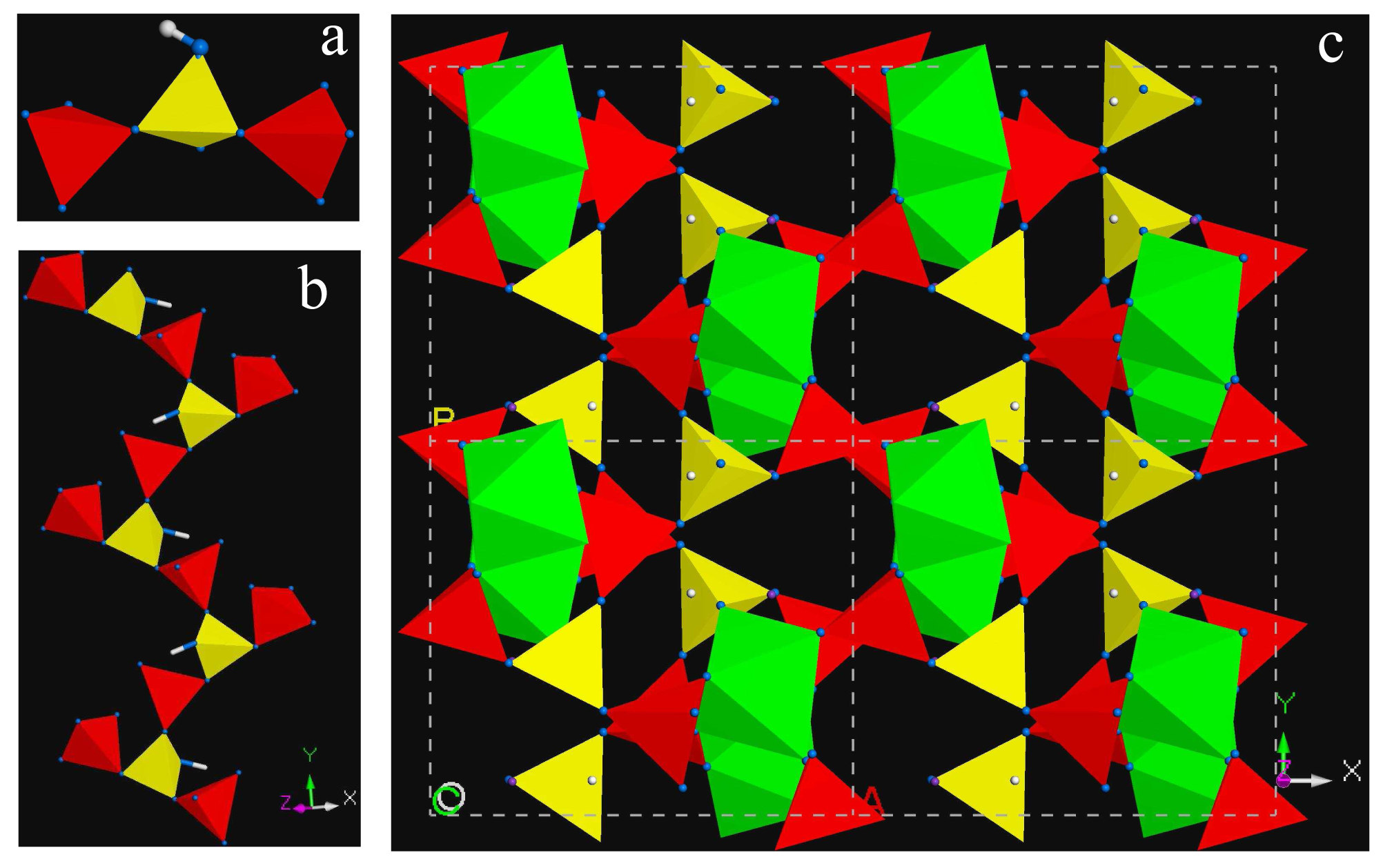
<p>KFe[BP<sub>2</sub>O<sub>8</sub>(OH)] features an unbranched trimer, 3□:3□, as the basic building unit (BBU) (<xref ref-type="fig" rid="f2-crystals-01-00022">Figure 2a</xref>). These BBUs are connected to an infinite open-branched (oB) vierer <sup>1</sup><sub>∞</sub>{[BP<sub>2</sub>Φ<sub>9</sub>]<sub>2</sub> (Φ = O, OH) chain (<xref ref-type="fig" rid="f2-crystals-01-00022">Figure 2b</xref>). The condensation of this borophosphate FBU with {Fe(III)O<sub>5</sub>(OH)} octahedra by sharing common oxygen atoms with five phosphate tetrahedra and an OH group with a hydrogenborate group link to a 3-D framework (<xref ref-type="fig" rid="f2-crystals-01-00022">Figure 2c</xref>). It features 8-ring channels along the [100] direction enclosed by two FeO<sub>5</sub>(OH) octahedra, two BO<sub>3</sub>(OH) and four PO<sub>4</sub> tetrahedra.</p></sec>
<sec>
<label>3.</label>
<title>Experimental Section</title>
<p>KFe[BP<sub>2</sub>O<sub>8</sub>(OH)] is prepared under ionothermal synthesis conditions using the ionic liquid 1-butyl-1-methylpyrrolidinium bromide, [C<sub>4</sub>mpyr]Br, as the solvent. A mixture of FeCl<sub>3</sub>·4H<sub>2</sub>O (99%, Fluka), KH<sub>2</sub>PO<sub>4</sub> (99%, J.T. Baker), H<sub>3</sub>BO<sub>3</sub> (99.8%, Appl. Chem.) and [C<sub>4</sub>mpy]Br (99%, Merck) was reacted in a 3 mL Teflon-lined stainless steel container at 200 °C for 5 days followed by cooling to room temperature. The products were filtered off, washed with deionized water and acetone, filtered by suction, and dried at 60 °C for one day.</p>
<p>A suitable single crystal of KFe[BP<sub>2</sub>O<sub>8</sub>(OH)] was selected for single-crystal X-ray diffraction (XRD) analysis. The data were collected at ambient temperature using graphite-monochromated Mo-Kα radiation on an Image Plate Diffraction System, IPDS I, (Stoe, Darmstadt, Germany). The data were corrected for Lorentz and polarization effects. Data correction was carried out with the program X-RED [<xref ref-type="bibr" rid="b29-crystals-01-00022">29</xref>]. A face-indexed numerical absorption correction (X-SHAPE) was applied [<xref ref-type="bibr" rid="b30-crystals-01-00022">30</xref>]. The structure was solved by direct methods and refined by full-matrix least-squares techniques with the SHELXTL crystallographic software package [<xref ref-type="bibr" rid="b31-crystals-01-00022">31</xref>]. The Fe, B, P, and O atoms could be unambiguously located. The K<sup>+</sup> ions were subsequently located from a difference Fourier map. In the final refinement cycles H atoms associated with the hydroxyl groups were added computationally.</p>
<p>Further details of the crystal structure investigations may be obtained from the Fachinformationszentrum Karlsruhe, 76344 Eggenstein-Leopoldshafen, Germany (Fax: +49-7247-808-666; E-Mail: <email>crysdata@fiz-karlsruhe.de</email>, <ext-link xlink:href="http://www.fiz-karlsruhe.de/request_for_deposited_data.hmtl" ext-link-type="uri">http://www.fiz-karlsruhe.de/request_for_deposited_data.hmtl</ext-link>) on quoting ICSD-422900.</p>
<p>Crystal data for KFe[BP<sub>2</sub>O<sub>8</sub>(OH)], (312.71 gmol<sup>−1</sup>); diffractometer IPDS-I, Stoe, Darmstadt; Mo-K<sub>α</sub> (graphite monochromator, λ = 71.073 pm); T = 293(2) K; 2θ<sub>max</sub> = 56.18°; 100 images, 0° ≤ φ ≤ 200°; Δφ = 2°; indices: -12 ≤ h ≤12, -10 ≤ k ≤ 10, -12 ≤ l ≤12; transmission (min, max) = 0.0307, 0.0929; ρ<sub>calc</sub> = 2.893 g cm<sup>−3</sup>; 8321 reflection intensities measured of which 1726 were symmetrically independent, R<sub>int</sub> = 0.0653, F(000) = 612, μ = 27.547 mm<sup>−1</sup>. Monoclinic, P2<sub>1</sub>/<italic>c</italic> (no. 62), <italic>a</italic> = 9.372(2) Å, <italic>b</italic> = 8.146(2) Å, <italic>c</italic> = 9.587(2) Å, <italic>β</italic> = 101.18(3)°, <italic>V</italic> = 718.0(2) Å<sup>3</sup> and <italic>Z</italic> = 4. R values: R<sub>1</sub>/wR<sub>2</sub> for final indices with [I<sub>o</sub> &gt; 2σ(I<sub>o</sub>)]: 0.0400/ 0.1095 and for all data: 0.0541/0.1122; S<sub>all</sub> = 1.071.</p></sec>
<sec sec-type="conclusions">
<label>4.</label>
<title>Conclusions</title>
<p>A new open-framework iron borophosphate KFe[BP<sub>2</sub>O<sub>8</sub>(OH)], has been prepared under ionothermal conditions using the ionic liquid 1-butyl-1-methyl pyrrolidinium bromide, [C<sub>4</sub>mpy]Br, as the solvent. The successful preparation of the new iron borophosphate in an ionic liquid demonstrates not only that many more open-framework borophosphates could be obtained, but also that the ionothermal method is a promising method to synthesize new kinds of open-framework materials.</p></sec></body>
<back>
<sec sec-type="display-objects">
<title>Figures</title>
<fig id="f1-crystals-01-00022" position="float">
<label>Figure 1.</label>
<caption>
<p>Thermal ellipsoid plot (50% probability) of the asymmetric unit of KFe[BP<sub>2</sub>O<sub>8</sub>(OH)].</p></caption>
<graphic xlink:href="crystals-01-00022f1.gif"/></fig>
<fig id="f2-crystals-01-00022" position="float">
<label>Figure 2.</label>
<caption>
<p><bold>a:</bold> Trimeric borophosphate basic building unit; <bold>b</bold>: open-branched vierer chain <sup>1</sup><sub>∞</sub>{[BP<sub>2</sub>O<sub>8</sub>(OH)]<sup>4-</sup>} FBU; <bold>c</bold>: view of the open-framework structure of KFe[BP<sub>2</sub>O<sub>8</sub>(OH)] along the [001] direction showing irregular 8-ring channels (color code: Fe, green; B, yellow; P, red; O, blue; K, purple; H, white).</p></caption>
<graphic xlink:href="crystals-01-00022f2.gif"/></fig></sec>
<ack>
<p>This work is supported by the European Research Council (ERC) under the contract 200475.</p></ack>
<ref-list>
<title>References and Notes</title>
<ref id="b1-crystals-01-00022"><label>1.</label><citation citation-type="journal"><person-group person-group-type="author"><name><surname>Kniep</surname><given-names>R.</given-names></name><name><surname>Will</surname><given-names>H.G.</given-names></name><name><surname>Boy</surname><given-names>I.</given-names></name><name><surname>Röhr</surname><given-names>C.</given-names></name></person-group><article-title>6<sub>1</sub> Helices from Tetrahedral Ribbons <inline-formula><mml:math id="mm1" display="inline"><mml:semantics id="sm1"><mml:mrow><mml:mmultiscripts><mml:mrow><mml:mo stretchy="false">[</mml:mo><mml:msub><mml:mrow><mml:mtext>BP</mml:mtext></mml:mrow><mml:mn>2</mml:mn></mml:msub><mml:msubsup><mml:mtext>O</mml:mtext><mml:mn>8</mml:mn><mml:mrow><mml:mn>3</mml:mn><mml:mo>−</mml:mo></mml:mrow></mml:msubsup><mml:mo stretchy="false">]</mml:mo></mml:mrow><mml:mn>1</mml:mn><mml:mi>∞</mml:mi></mml:mmultiscripts></mml:mrow></mml:semantics></mml:math></inline-formula>1<sup>∞</sup>[BP<sub>2</sub>O<sup>3-</sup><sub>8</sub> ] Isostructural Borophosphates M<sup>I</sup>M<sup>II</sup>(H<sub>2</sub>O)<sub>2</sub>[BP<sub>2</sub>O8]H<sub>2</sub>O (M<sup>I</sup> = Na, K; M<sup>II</sup> = Mg, Mn, Fe, Co, Ni, Zn) and Their Dehydration to Microporous Phases M<sup>I</sup>M<sup>II</sup>(H<sub>2</sub>O)[BP<sub>2</sub>O<sub>8</sub>]</article-title><source>Angew. Chem. Int. Ed. Engl.</source><year>1997</year><volume>36</volume><fpage>1013</fpage><lpage>1014</lpage><pub-id pub-id-type="doi">10.1002/anie.199710131</pub-id></citation></ref>
<ref id="b2-crystals-01-00022"><label>2.</label><citation citation-type="journal"><person-group person-group-type="author"><name><surname>Yang</surname><given-names>T.</given-names></name><name><surname>Li</surname><given-names>G.B.</given-names></name><name><surname>Ju</surname><given-names>J.</given-names></name><name><surname>Liao</surname><given-names>F.H.</given-names></name><name><surname>Xiong</surname><given-names>M.</given-names></name><name><surname>Lin</surname><given-names>J.H.</given-names></name></person-group><article-title>A series of borate-rich metalloborophosphates Na<sub>2</sub>[M<sup>II</sup>B<sub>3</sub>P<sub>2</sub>O<sub>11</sub>(OH)]·0.67H<sub>2</sub>O (M<sup>II</sup> = Mg, Mn, Fe, Co, Ni, Cu, Zn): Synthesis, structure and magnetic susceptibility</article-title><source>J. Solid State Chem.</source><year>2006</year><volume>179</volume><fpage>2513</fpage></citation></ref>
<ref id="b3-crystals-01-00022"><label>3.</label><citation citation-type="journal"><person-group person-group-type="author"><name><surname>Yilmaz</surname><given-names>A.</given-names></name><name><surname>Bu</surname><given-names>X.H.</given-names></name><name><surname>Kizilyalli</surname><given-names>M.</given-names></name><name><surname>Stucky</surname><given-names>G.D.</given-names></name></person-group><article-title>Fe(H<sub>2</sub>O)<sub>2</sub>BP<sub>2</sub>O<sub>8</sub>·H<sub>2</sub>O, a First Zeotype Ferriborophosphate with Chiral Tetrahedral Framework Topology</article-title><source>Chem. Mater.</source><year>2000</year><volume>12</volume><fpage>3243</fpage><lpage>3245</lpage><pub-id pub-id-type="doi">10.1021/cm001082t</pub-id></citation></ref>
<ref id="b4-crystals-01-00022"><label>4.</label><citation citation-type="journal"><person-group person-group-type="author"><name><surname>Kniep</surname><given-names>R.</given-names></name><name><surname>Schäfer</surname><given-names>G.</given-names></name></person-group><article-title>Isotype Borophosphate M<sup>II</sup>(C<sub>2</sub>H<sub>10</sub>N<sub>2</sub>)[B<sub>2</sub>P<sub>3</sub>O<sub>12</sub>(OH)] (M<sup>II</sup> = Mg, Mn, Fe, Ni, Cu, Zn): Verbindungen mit Tetraeder-Schichtverbänden</article-title><source>Z. Anorg. Allg. Chem.</source><year>2000</year><volume>626</volume><fpage>141</fpage><lpage>147</lpage><pub-id pub-id-type="doi">10.1002/(SICI)1521-3749(200001)626:1&lt;141::AID-ZAAC141&gt;3.0.CO;2-#</pub-id></citation></ref>
<ref id="b5-crystals-01-00022"><label>5.</label><citation citation-type="journal"><person-group person-group-type="author"><name><surname>Huang</surname><given-names>Y.X.</given-names></name><name><surname>Ewald</surname><given-names>B.</given-names></name><name><surname>Schnelle</surname><given-names>W.</given-names></name><name><surname>Prots</surname><given-names>Y.</given-names></name><name><surname>Kniep</surname><given-names>R.</given-names></name></person-group><article-title>Chirality and Magnetism in a Novel Series of Isotypic Borophosphates: M<sup>II</sup>[BPO<sub>4</sub>(OH)<sub>2</sub>] (M<sup>II</sup> = Mn, Fe, Co)</article-title><source>Inorg. Chem.</source><year>2006</year><volume>45</volume><fpage>7578</fpage><lpage>7580</lpage><pub-id pub-id-type="doi">10.1021/ic0607991</pub-id><pub-id pub-id-type="pmid">16961345</pub-id></citation></ref>
<ref id="b6-crystals-01-00022"><label>6.</label><citation citation-type="journal"><person-group person-group-type="author"><name><surname>Yang</surname><given-names>W.T.</given-names></name><name><surname>Li</surname><given-names>J.Y.</given-names></name><name><surname>Pan</surname><given-names>Q.H.</given-names></name><name><surname>Xing</surname><given-names>H.H.</given-names></name><name><surname>Chen</surname><given-names>Y.</given-names></name><name><surname>Yu</surname><given-names>J.H.</given-names></name><name><surname>Xu</surname><given-names>R.R.</given-names></name></person-group><article-title>Synthesis, structure and magnetic property of a new organo-templated mixed-valent iron(II, III) borophosphate</article-title><source>J. Mater. Chem.</source><year>2009</year><volume>19</volume><fpage>4523</fpage><lpage>4528</lpage><pub-id pub-id-type="doi">10.1039/b820130g</pub-id></citation></ref>
<ref id="b7-crystals-01-00022"><label>7.</label><citation citation-type="journal"><person-group person-group-type="author"><name><surname>Yang</surname><given-names>T.</given-names></name><name><surname>Sun</surname><given-names>J.L.</given-names></name><name><surname>Li</surname><given-names>G.B.</given-names></name><name><surname>Wang</surname><given-names>Y.X.</given-names></name><name><surname>Christensen</surname><given-names>J.</given-names></name><name><surname>He</surname><given-names>Z.B.</given-names></name><name><surname>Christensen</surname><given-names>K.E.</given-names></name><name><surname>Zou</surname><given-names>X.D.</given-names></name><name><surname>Liao</surname><given-names>F.H.</given-names></name><name><surname>Lin</surname><given-names>J.H.</given-names></name></person-group><article-title>Fe<sub>5</sub>O<sub>5</sub>[B<sub>6</sub>O<sub>10</sub>(OH)<sub>3</sub>]nH<sub>2</sub>O: Wave-Layered Iron Borate and Frustrated Antiferromagnetism</article-title><source>Inorg. Chem.</source><year>2009</year><volume>48</volume><fpage>11209</fpage><lpage>11214</lpage><pub-id pub-id-type="doi">10.1021/ic9016867</pub-id><pub-id pub-id-type="pmid">19856951</pub-id></citation></ref>
<ref id="b8-crystals-01-00022"><label>8.</label><citation citation-type="journal"><person-group person-group-type="author"><name><surname>Shi</surname><given-names>H.</given-names></name><name><surname>Shan</surname><given-names>Y.</given-names></name><name><surname>He</surname><given-names>M.</given-names></name><name><surname>Liu</surname><given-names>Y.</given-names></name></person-group><article-title>Impetus for solvothermal synthesis technique: Synthesis and structure of a novel 1-D borophosphate using ionic liquid as medium</article-title><source>J. Solid State Chem.</source><year>2003</year><volume>176</volume><fpage>33</fpage><lpage>36</lpage><pub-id pub-id-type="doi">10.1016/S0022-4596(03)00340-2</pub-id></citation></ref>
<ref id="b9-crystals-01-00022"><label>9.</label><citation citation-type="journal"><person-group person-group-type="author"><name><surname>Lin</surname><given-names>Z.</given-names></name><name><surname>Wragg</surname><given-names>D.S.</given-names></name><name><surname>Lightfoot</surname><given-names>P.</given-names></name><name><surname>Morris</surname><given-names>R.E.</given-names></name></person-group><article-title>A novel non-centrosymmetric metallophosphate- borate compound via ionothermal synthesis</article-title><source>Dalton Trans.</source><year>2009</year><fpage>5287</fpage><lpage>5289</lpage></citation></ref>
<ref id="b10-crystals-01-00022"><label>10.</label><citation citation-type="journal"><person-group person-group-type="author"><name><surname>Xing</surname><given-names>H.</given-names></name><name><surname>Li</surname><given-names>Y.</given-names></name><name><surname>Su</surname><given-names>T.</given-names></name><name><surname>Xu</surname><given-names>J.</given-names></name><name><surname>Yang</surname><given-names>W.</given-names></name><name><surname>Zhu</surname><given-names>E.</given-names></name><name><surname>Yu</surname><given-names>J.</given-names></name><name><surname>Xu</surname><given-names>R.</given-names></name></person-group><article-title>Spontaneous crystallization of a new chiral open-framework borophosphate in the ionothermal system</article-title><source>Dalton Trans.</source><year>2010</year><volume>39</volume><fpage>1713</fpage><lpage>1715</lpage><pub-id pub-id-type="doi">10.1039/b919933k</pub-id><pub-id pub-id-type="pmid">20449410</pub-id></citation></ref>
<ref id="b11-crystals-01-00022"><label>11.</label><citation citation-type="journal"><person-group person-group-type="author"><name><surname>Yang</surname><given-names>M.</given-names></name><name><surname>Xu</surname><given-names>F.F.</given-names></name><name><surname>Liu</surname><given-names>Q.S.</given-names></name><name><surname>Yan</surname><given-names>P.F.</given-names></name><name><surname>Liu</surname><given-names>X.F.</given-names></name><name><surname>Wang</surname><given-names>C.</given-names></name><name><surname>Welz-Biermann</surname><given-names>U.</given-names></name></person-group><article-title>Chelated orthoborate ionic liquid as a reactant for the synthesis of a new cobalt borophosphate containing extra-large 16-ring channels</article-title><source>Dalton Trans.</source><year>2010</year><volume>39</volume><fpage>10571</fpage><lpage>10573</lpage><pub-id pub-id-type="doi">10.1039/c0dt00368a</pub-id><pub-id pub-id-type="pmid">20830394</pub-id></citation></ref>
<ref id="b12-crystals-01-00022"><label>12.</label><citation citation-type="journal"><person-group person-group-type="author"><name><surname>Kniep</surname><given-names>R.</given-names></name><name><surname>Engelhardt</surname><given-names>H.</given-names></name><name><surname>Hauf</surname><given-names>C.</given-names></name></person-group><article-title>A First Approach to Borophosphate Structural Chemistry</article-title><source>Chem. Mater.</source><year>1998</year><volume>10</volume><fpage>2930</fpage><lpage>2934</lpage><comment>and references therein</comment><pub-id pub-id-type="doi">10.1021/cm980263g</pub-id></citation></ref>
<ref id="b13-crystals-01-00022"><label>13.</label><citation citation-type="journal"><person-group person-group-type="author"><name><surname>Ewald</surname><given-names>B.</given-names></name><name><surname>Huang</surname><given-names>Y.X.</given-names></name><name><surname>Kniep</surname><given-names>R.</given-names></name></person-group><article-title>Structural Chemistry of Borophosphates, Metalloborophosphates, and Related Compounds</article-title><source>Z. Anorg. Allg. Chem.</source><year>2007</year><volume>633</volume><fpage>1517</fpage><lpage>1540</lpage><comment>and references therein</comment><pub-id pub-id-type="doi">10.1002/zaac.200700232</pub-id></citation></ref>
<ref id="b14-crystals-01-00022"><label>14.</label><citation citation-type="journal"><person-group person-group-type="author"><name><surname>Huang</surname><given-names>Y.X.</given-names></name><name><surname>Prots</surname><given-names>Y.</given-names></name><name><surname>Schnelle</surname><given-names>W.</given-names></name><name><surname>Kniep</surname><given-names>R.</given-names></name></person-group><article-title>A new borophosphate chain anion in an organo-templated iron(III) borophosphate: Synthesis, crystal structure and magnetic properties of (C<sub>4</sub>H<sub>12</sub>N<sub>2</sub>)<sub>3</sub>Fe<sup>III</sup><sub>6</sub>(H<sub>2</sub>O)<sub>4</sub>[B<sub>6</sub>P<sub>12</sub>O<sub>50</sub>(OH)<sub>2</sub>]·2H<sub>2</sub>O</article-title><source>Sci. Technol. Adv. Mater.</source><year>2007</year><volume>8</volume><fpage>399</fpage><lpage>405</lpage><pub-id pub-id-type="doi">10.1016/j.stam.2007.06.002</pub-id></citation></ref>
<ref id="b15-crystals-01-00022"><label>15.</label><citation citation-type="journal"><person-group person-group-type="author"><name><surname>Kniep</surname><given-names>R.</given-names></name><name><surname>Engelhardt</surname><given-names>H.</given-names></name></person-group><article-title>Na<sub>1.89</sub>Ag<sub>0.11</sub>[BP<sub>2</sub>O<sub>7</sub>(OH)] und Na<sub>2</sub>[BP<sub>2</sub>O<sub>7</sub>(OH)] – Isotype Borophosphate mit Tetraeder-Schichtpaketen</article-title><source>Z. Anorg. Allg. Chem.</source><year>1998</year><volume>624</volume><fpage>1291</fpage><lpage>1297</lpage><pub-id pub-id-type="doi">10.1002/(SICI)1521-3749(199808)624:8&lt;1291::AID-ZAAC1291&gt;3.0.CO;2-R</pub-id></citation></ref>
<ref id="b16-crystals-01-00022"><label>16.</label><citation citation-type="journal"><person-group person-group-type="author"><name><surname>Kniep</surname><given-names>R.</given-names></name><name><surname>Koch</surname><given-names>D.</given-names></name><name><surname>Hartmann</surname><given-names>T.</given-names></name></person-group><article-title>Crystal structure of potassium aluminum catena- (monohydrogenmonoborate)-bis(monophosphate), KAl[BP<sub>2</sub>O<sub>8</sub>(OH)]</article-title><source>Z. Kristallogr. NCS</source><year>2002</year><volume>217</volume><fpage>186</fpage></citation></ref>
<ref id="b17-crystals-01-00022"><label>17.</label><citation citation-type="journal"><person-group person-group-type="author"><name><surname>Mi</surname><given-names>J.</given-names></name><name><surname>Huang</surname><given-names>Y.X.</given-names></name><name><surname>Deng</surname><given-names>J.F.</given-names></name><name><surname>Borrmann</surname><given-names>H.</given-names></name><name><surname>Zhao</surname><given-names>J.T.</given-names></name><name><surname>Kniep</surname><given-names>R.</given-names></name></person-group><article-title>Crystal structure of ammonium aluminum catena-[monohydrogenmonoborate-bis(monophosphate)], (NH<sub>4</sub>)Al [BP<sub>2</sub>O<sub>8</sub>(OH)]</article-title><source>Z. Kristallogr. NCS</source><year>2002</year><volume>217</volume><fpage>305</fpage><lpage>306</lpage><pub-id pub-id-type="doi">10.1524/zkri.217.7.305.23708</pub-id></citation></ref>
<ref id="b18-crystals-01-00022"><label>18.</label><citation citation-type="journal"><person-group person-group-type="author"><name><surname>Li</surname><given-names>M.R.</given-names></name><name><surname>Mao</surname><given-names>S.Y.</given-names></name><name><surname>Huang</surname><given-names>Y.X.</given-names></name><name><surname>Mi</surname><given-names>J.X.</given-names></name><name><surname>Wei</surname><given-names>Z.B.</given-names></name><name><surname>Zhao</surname><given-names>J.T.</given-names></name><name><surname>Kniep</surname><given-names>R.</given-names></name></person-group><article-title>Crystal structure of ammonium gallium (monophosphate-hydrogenmonoborate-mono-phosphate), (NH<sub>4</sub>)Ga[BP<sub>2</sub>O<sub>8</sub>(OH)]</article-title><source>Z. Kristallogr. NCS</source><year>2002</year><volume>217</volume><fpage>165</fpage><lpage>166</lpage></citation></ref>
<ref id="b19-crystals-01-00022"><label>19.</label><citation citation-type="journal"><person-group person-group-type="author"><name><surname>Kriticos</surname><given-names>M.</given-names></name><name><surname>Wikstad</surname><given-names>E.</given-names></name><name><surname>Walldén</surname><given-names>K.</given-names></name></person-group><article-title>Hydrothermal synthesis, characterization and magnetic properties of three isostructural chain borophosphates; NH<sub>4</sub>M(III)[BP<sub>2</sub>O<sub>8</sub>(OH)] with M = V or Fe and NH<sub>4</sub>(Fe(III)<sub>0.53</sub>V(III)<sub>0.47</sub>)[BP<sub>2</sub>O<sub>8</sub>(OH)]</article-title><source>Solid State Sci.</source><year>2001</year><volume>3</volume><fpage>649</fpage><lpage>658</lpage><pub-id pub-id-type="doi">10.1016/S1293-2558(01)01182-7</pub-id></citation></ref>
<ref id="b20-crystals-01-00022"><label>20.</label><citation citation-type="journal"><person-group person-group-type="author"><name><surname>Huang</surname><given-names>Y.X.</given-names></name><name><surname>Schäfer</surname><given-names>G.</given-names></name><name><surname>Carrillo Cabrera</surname><given-names>W.</given-names></name><name><surname>Cardoso</surname><given-names>R.</given-names></name><name><surname>Schnelle</surname><given-names>W.</given-names></name><name><surname>Zhao</surname><given-names>J.T.</given-names></name><name><surname>Kniep</surname><given-names>R.</given-names></name></person-group><article-title>Open-Framework Borophosphates: (NH<sub>4</sub>)<sub>0.4</sub>Fe<sup>II</sup><sub>0.55</sub>Fe<sup>III</sup><sub>0.5</sub>(H<sub>2</sub>O)<sub>2</sub>[BP<sub>2</sub>O<sub>8</sub>]-·0.6H<sub>2</sub>O and NH<sub>4</sub>Fe<sup>III</sup>[BP<sub>2</sub>O<sub>8</sub>(OH)]</article-title><source>Chem. Mater.</source><year>2001</year><volume>13</volume><fpage>4348</fpage><lpage>4354</lpage><pub-id pub-id-type="doi">10.1021/cm011101e</pub-id></citation></ref>
<ref id="b21-crystals-01-00022"><label>21.</label><citation citation-type="journal"><person-group person-group-type="author"><name><surname>Mi</surname><given-names>J.</given-names></name><name><surname>Zhao</surname><given-names>J.T.</given-names></name><name><surname>Huang</surname><given-names>Y.X.</given-names></name><name><surname>Deng</surname><given-names>J.F.</given-names></name><name><surname>Borrmann</surname><given-names>H.</given-names></name><name><surname>Kniep</surname><given-names>R.</given-names></name></person-group><article-title>Crystal structure of rubidium aluminum catena-[monohydrogen-monoborate-bis(monophosphate)], RbAl[BP<sub>2</sub>O<sub>8</sub>(OH)]</article-title><source>Z. Kristallogr. NCS</source><year>2002</year><volume>217</volume><fpage>171</fpage><lpage>172</lpage></citation></ref>
<ref id="b22-crystals-01-00022"><label>22.</label><citation citation-type="journal"><person-group person-group-type="author"><name><surname>Yakubovicha</surname><given-names>O.V.</given-names></name><name><surname>Steeleb</surname><given-names>I.M.</given-names></name><name><surname>Dimitrovab</surname><given-names>O.V.</given-names></name></person-group><article-title>Polymorphism of the Borophosphate Anion in K(Fe,Al)[BP<sub>2</sub>O<sub>8</sub>(OH)] and Rb(Al, Fe)[BP<sub>2</sub>O<sub>8</sub>(OH)] Crystal Structures</article-title><source>Kristallografiya</source><year>2010</year><volume>55</volume><fpage>810</fpage><lpage>817</lpage></citation></ref>
<ref id="b23-crystals-01-00022"><label>23.</label><citation citation-type="journal"><person-group person-group-type="author"><name><surname>Mi</surname><given-names>J.</given-names></name><name><surname>Borrmann</surname><given-names>H.</given-names></name><name><surname>Mao</surname><given-names>S.Y.</given-names></name><name><surname>Huang</surname><given-names>Y.-X.</given-names></name><name><surname>Zhang</surname><given-names>H.</given-names></name><name><surname>Zhao</surname><given-names>J.T.</given-names></name><name><surname>Kniep</surname><given-names>R.</given-names></name></person-group><article-title>Crystal structure of rubidium gallium catena-[monohydrogen-monoborate-bis(monophosphate)] RbGa[BP<sub>2</sub>O<sub>8</sub>(OH)], from a twinned crystal</article-title><source>Z. Kristallogr. NCS</source><year>2003</year><volume>218</volume><fpage>17</fpage><lpage>18</lpage><pub-id pub-id-type="doi">10.1524/zkri.218.1.17.20770</pub-id></citation></ref>
<ref id="b24-crystals-01-00022"><label>24.</label><citation citation-type="journal"><person-group person-group-type="author"><name><surname>Engelhardt</surname><given-names>H.</given-names></name><name><surname>Borrmann</surname><given-names>H.</given-names></name><name><surname>Kniep</surname><given-names>R.</given-names></name></person-group><article-title>Crystal structure of rubidium vanadium(III) catena-[monohydrogenmonoborate-bis(monophosphate)], RbV[BP<sub>2</sub>O<sub>8</sub>(OH)]</article-title><source>Z. Kristallogr. NCS</source><year>2000</year><volume>215</volume><fpage>203</fpage><lpage>204</lpage></citation></ref>
<ref id="b25-crystals-01-00022"><label>25.</label><citation citation-type="journal"><person-group person-group-type="author"><name><surname>Kniep</surname><given-names>R.</given-names></name><name><surname>Boy</surname><given-names>I.</given-names></name><name><surname>Engelhard</surname><given-names>H.</given-names></name></person-group><article-title>RbFe[BP<sub>2</sub>O<sub>8</sub>(OH)]: A New Borophosphate Containing Open-Branched Tetrahedral Vierer-Einfach Chains</article-title><source>Z. Anorg. Allg. Chem.</source><year>1999</year><volume>625</volume><fpage>1512</fpage><lpage>1516</lpage><pub-id pub-id-type="doi">10.1002/(SICI)1521-3749(199909)625:9&lt;1512::AID-ZAAC1512&gt;3.0.CO;2-F</pub-id></citation></ref>
<ref id="b26-crystals-01-00022"><label>26.</label><citation citation-type="journal"><person-group person-group-type="author"><name><surname>Mi</surname><given-names>J.</given-names></name><name><surname>Huang</surname><given-names>Y.X.</given-names></name><name><surname>Deng</surname><given-names>J.F.</given-names></name><name><surname>Borrmann</surname><given-names>H.</given-names></name><name><surname>Zhao</surname><given-names>J.T.</given-names></name><name><surname>Kniep</surname><given-names>R.</given-names></name></person-group><article-title>Crystal structure of caesium aluminum catena-[monohydrogen-monoborate-bis(monophosphate)], CsAl[BP<sub>2</sub>O<sub>8</sub>(OH)</article-title><source>Z. Kristallogr. NCS</source><year>2002</year><volume>217</volume><fpage>169</fpage><lpage>170</lpage></citation></ref>
<ref id="b27-crystals-01-00022"><label>27.</label><citation citation-type="journal"><person-group person-group-type="author"><name><surname>Mi</surname><given-names>J.</given-names></name><name><surname>Borrmann</surname><given-names>H.</given-names></name><name><surname>Huang</surname><given-names>Y.X.</given-names></name><name><surname>Mao</surname><given-names>S.Y.</given-names></name><name><surname>Zhao</surname><given-names>J.T.</given-names></name><name><surname>Kniep</surname><given-names>R.</given-names></name></person-group><article-title>Crystal structure of caesium gallium(III) catena-[monohydrogenmonoborate-bis(monophosphate)], CsGa[BP<sub>2</sub>O<sub>8</sub>(OH)]</article-title><source>Z. Kristallogr. NCS</source><year>2003</year><volume>218</volume><fpage>171</fpage><lpage>172</lpage><pub-id pub-id-type="doi">10.1524/zkri.218.3.171.20754</pub-id></citation></ref>
<ref id="b28-crystals-01-00022"><label>28.</label><citation citation-type="journal"><person-group person-group-type="author"><name><surname>Engelhard</surname><given-names>H.</given-names></name><name><surname>Kniep</surname><given-names>R.</given-names></name></person-group><article-title>Crystal structure of caesium iron(III) catena-[monohydrogenmonoborate- bis(monophosphate)], CsFe[BP<sub>2</sub>O<sub>8</sub>(OH)]</article-title><source>Z. Kristallogr. NCS</source><year>1999</year><volume>214</volume><fpage>443</fpage><lpage>444</lpage><pub-id pub-id-type="doi">10.1524/zkri.1999.214.8.443</pub-id></citation></ref>
<ref id="b29-crystals-01-00022"><label>29.</label><citation citation-type="book"><source>X-RED 1.22, Stoe Data Reduction Program (C)</source><publisher-name>Stoe &amp; Cie GmbH</publisher-name><publisher-loc>Darmstadt, Germany</publisher-loc><year>2001</year></citation></ref>
<ref id="b30-crystals-01-00022"><label>30.</label><citation citation-type="book"><source>X-Shape 1.06, Crystal Optimization for Numerical Absorption Correction (C)</source><publisher-name>Stoe &amp; Cie GmbH</publisher-name><publisher-loc>Darmstadt, Germany</publisher-loc><year>1999</year></citation></ref>
<ref id="b31-crystals-01-00022"><label>31.</label><citation citation-type="book"><source>SHELXTL Program</source><comment>version 5.1</comment><publisher-name>Siemens Industrial Automation, Inc.</publisher-name><publisher-loc>Madison, WI, USA</publisher-loc><year>1997</year></citation></ref></ref-list></back></article>