
<?xml version="1.0" encoding="UTF-8"?>
<!DOCTYPE article PUBLIC "-//NLM//DTD Journal Publishing DTD v2.3 20070202//EN" "journalpublishing.dtd">
<article xmlns:mml="http://www.w3.org/1998/Math/MathML" xmlns:xlink="http://www.w3.org/1999/xlink" xml:lang="en" article-type="research-article">
<front>
<journal-meta>
<journal-id journal-id-type="publisher-id">Crystals</journal-id>
<journal-title>Crystals</journal-title>
<issn pub-type="epub">2073-4352</issn>
<publisher>
<publisher-name>Molecular Diversity Preservation International (MDPI)</publisher-name></publisher></journal-meta>
<article-meta>
<article-id pub-id-type="doi">10.3390/cryst1010003</article-id>
<article-id pub-id-type="publisher-id">crystals-01-00003</article-id>
<article-categories>
<subj-group>
<subject>Article</subject></subj-group></article-categories>
<title-group>
<article-title>New Layered Oxide-Fluoride Perovskites: KNaNbOF<sub>5</sub> and KNa<italic>M</italic>O<sub>2</sub>F<sub>4</sub> (<italic>M</italic> = Mo<sup>6+</sup>, W<sup>6+</sup>)</article-title></title-group>
<contrib-group>
<contrib contrib-type="author">
<name><surname>Pinlac</surname><given-names>Rachelle Ann F.</given-names></name></contrib>
<contrib contrib-type="author">
<name><surname>Stern</surname><given-names>Charlotte L.</given-names></name></contrib>
<contrib contrib-type="author">
<name><surname>Poeppelmeier</surname><given-names>Kenneth R.</given-names></name><xref ref-type="corresp" rid="c1-crystals-01-00003"><sup>*</sup></xref></contrib>
<aff id="af1-crystals-01-00003">Department of Chemistry, Northwestern University, 2145 Sheridan Road, Evanston, IL 60208, USA; E-Mails: <email>r-pinlac@u.northwestern.edu</email> (R.A.F.P.); <email>c-stern@northwestern.edu</email> (C.L.S.)</aff></contrib-group>
<author-notes>
<corresp id="c1-crystals-01-00003">
<label>*</label> Author to whom correspondence should be addressed; E-Mail: <email>krp@northwestern.edu</email>; Tel.: +1-847-491-3505; Fax: +1-847-491-7713.</corresp></author-notes>
<pub-date pub-type="collection">
<year>2011</year></pub-date>
<pub-date pub-type="epub">
<day>18</day>
<month>03</month>
<year>2011</year></pub-date>
<volume>1</volume>
<issue>1</issue>
<fpage>3</fpage>
<lpage>14</lpage>
<history>
<date date-type="received">
<day>24</day>
<month>02</month>
<year>2011</year></date>
<date date-type="rev-recd">
<day>09</day>
<month>03</month>
<year>2011</year></date>
<date date-type="accepted">
<day>16</day>
<month>03</month>
<year>2011</year></date></history>
<permissions>
<copyright-statement>© 2011 by the authors; licensee MDPI, Basel, Switzerland.</copyright-statement>
<copyright-year>2011</copyright-year>
<license>
<p>This article is an open access article distributed under the terms and conditions of the Creative Commons Attribution license (http://creativecommons.org/licenses/by/3.0/).</p></license></permissions>
<abstract>
<p>KNaNbOF<sub>5</sub> and KNa<italic>M</italic>O<sub>2</sub>F<sub>4</sub> (<italic>M</italic> = Mo<sup>6+</sup>, W<sup>6+</sup>), three new layered oxide-fluoride perovskites with the general formula ABB′X<sub>6</sub>, form from the combination of a second-order Jahn-Teller d<sup>0</sup> transition metal and an alkali metal (Na<sup>+</sup>) on the B-site. Alternating layers of cation vacancies and K<sup>+</sup> cations on the A-site complete the structure. The K<sup>+</sup> cations are found in the A-site layer where the fluoride ions are located. The A-site is vacant in the adjacent A-site layer where the axial oxides are located. This unusual layered arrangement of unoccupied A-sites and under bonded oxygen has not been observed previously although many perovskite-related structures are known.</p></abstract>
<kwd-group>
<kwd>perovskites</kwd>
<kwd>oxide-fluorides</kwd>
<kwd>hydrothermal synthesis</kwd></kwd-group></article-meta></front>
<body>
<sec sec-type="intro">
<label>1.</label>
<title>Introduction</title>
<p>Perovskites with the general formula ABX<sub>3</sub> are some of the most studied structures owing to their many interesting properties including magnetism, ionic conductivity, and ferroelectricity [<xref ref-type="bibr" rid="b1-crystals-01-00003">1</xref>-<xref ref-type="bibr" rid="b3-crystals-01-00003">3</xref>]. Their structure and properties can be altered by substitution at either the A- or B-sites or creating either cation or anion vacancies. For example, ferromagnetism has been achieved with the complex perovskite AA′<sub>3</sub>B<sub>4</sub>O<sub>12</sub>, such as CaCu<sub>3</sub>Ge<sub>4</sub>O<sub>12</sub> [<xref ref-type="bibr" rid="b1-crystals-01-00003">1</xref>], and ionic conductivity has been observed for the A-site deficient perovskites Li<sub>3x</sub>La<sub>(2/3)-x</sub> □ <sub>1/3-2x</sub>TiO<sub>3</sub> (0 &lt; x &lt; 0.16) [<xref ref-type="bibr" rid="b2-crystals-01-00003">2</xref>].</p>
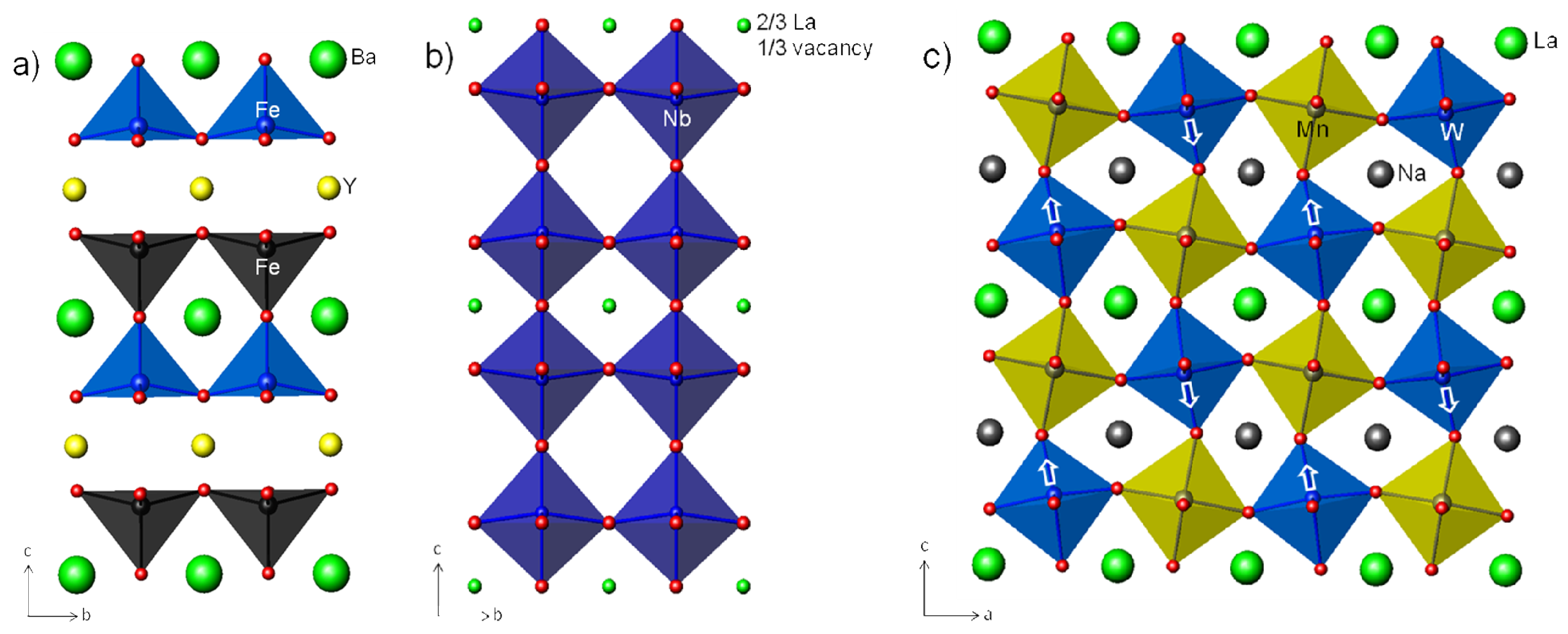
<p>A-site cation ordering is typically seen in anion deficient perovskites, such as the antiferromagnetic YBaFe<sub>2</sub>O<sub>5</sub> where the A-site cations (Y<sup>3+</sup> and Ba<sup>2+</sup> ) are ordered owing to the oxygen vacancies (<xref ref-type="fig" rid="f1-crystals-01-00003">Figure 1a</xref>) [<xref ref-type="bibr" rid="b4-crystals-01-00003">4</xref>]. Ordered layers of occupied and unoccupied A-sites occur in non-stoichiometric perovskites A<sub>1-x</sub>BO<sub>3</sub> [<xref ref-type="bibr" rid="b5-crystals-01-00003">5</xref>-<xref ref-type="bibr" rid="b8-crystals-01-00003">8</xref>]. For example, La<sub>1/3</sub>NbO<sub>3</sub> contains a ReO<sub>3</sub> framework of NbO<sub>6</sub> octahedra with unoccupied A-site layers and A-site layers occupied with 2/3 La alternating along <italic>c</italic> (<xref ref-type="fig" rid="f1-crystals-01-00003">Figure 1b</xref>) [<xref ref-type="bibr" rid="b6-crystals-01-00003">6</xref>,<xref ref-type="bibr" rid="b7-crystals-01-00003">7</xref>] Examples of A-site cation ordering in stoichiometric AA′B<sub>2</sub>X<sub>6</sub> and AA′BB′X<sub>6</sub> perovskites with neither anion vacancies nor A-site vacancies are rare [<xref ref-type="bibr" rid="b9-crystals-01-00003">9</xref>]. Woodward <italic>et al.</italic> showed that in Na<italic>Ln</italic>MnWO<sub>6</sub> (<italic>Ln</italic> = Ce, Pr, Sm, Gd, Dy and Ho) and Na<italic>Ln</italic>MgWO<sub>6</sub> (<italic>Ln</italic> = Ce, Pr, Sm, Gd, Tb, Dy and Ho) the A-site cations Na and <italic>Ln</italic> prefer to order in a layered arrangement [<xref ref-type="bibr" rid="b10-crystals-01-00003">10</xref>,<xref ref-type="bibr" rid="b11-crystals-01-00003">11</xref>]. The layered A-site ordering is stabilized by the second order Jahn Teller displacement of the d<sup>0</sup> transition metal W at the B-site towards the oxide that is under bonded to alleviate the lattice strain arising from the A-site cations size mismatch (<xref ref-type="fig" rid="f1-crystals-01-00003">Figure 1c</xref>).</p>
<p>In comparison, B-site cation ordering in A<sub>2</sub>BB′X<sub>6</sub> double perovskites has been well documented [<xref ref-type="bibr" rid="b12-crystals-01-00003">12</xref>-<xref ref-type="bibr" rid="b14-crystals-01-00003">14</xref>]. The majority of the B and B′ cations crystallize in an ordered rock-salt structure. In general, a disordered arrangement is observed when the oxidation states of B and B′ differ by less than two, whereas a difference greater than two nearly always produces an ordered arrangement [<xref ref-type="bibr" rid="b12-crystals-01-00003">12</xref>]. When the difference in oxidation state is exactly two, disordered, partially ordered or fully ordered arrangements can result, depending on the differences in size and/or bonding preference of the B and B′ cations [<xref ref-type="bibr" rid="b12-crystals-01-00003">12</xref>,<xref ref-type="bibr" rid="b15-crystals-01-00003">15</xref>,<xref ref-type="bibr" rid="b16-crystals-01-00003">16</xref>].</p>
<p>Oxyfluoride perovskites that contain ordered oxide and fluoride ions with the general formula [<italic>M</italic>O<sub>x</sub>F<sub>6-x</sub>]<sup>n-</sup> (<italic>x</italic> = 1, <italic>n</italic> = 2, and <italic>M</italic> = V<sup>5+</sup>, Nb<sup>5+</sup>, Ta<sup>5+</sup>; <italic>x</italic> = 2, <italic>n</italic> = 2, and <italic>M</italic> = Mo<sup>6+</sup>, W<sup>6+</sup>; <italic>x</italic> = 2, <italic>n</italic> = 3, and <italic>M</italic> = V<sup>5+</sup>, Nb<sup>5+</sup>, Ta<sup>5+</sup>; <italic>x</italic> = 3, <italic>n</italic> = 3, and <italic>M</italic> = Mo<sup>6+</sup>) are known but not common [<xref ref-type="bibr" rid="b17-crystals-01-00003">17</xref>]. One well known example Na<sub>3</sub>MoO<sub>3</sub>F<sub>3</sub>, which crystallizes in the cryolite structure and has ordered oxide and fluoride ligands, displays ferroelectric-ferroelastic properties [<xref ref-type="bibr" rid="b3-crystals-01-00003">3</xref>]. In this paper, we report a new class of A-site deficient oxyfluoride perovskites AB<italic>M</italic>O<sub>x</sub>F<sub>6-x</sub> (where A = K<sup>+</sup>; B = Na<sup>+</sup>; x =1, <italic>M</italic>= Nb<sup>5+</sup>; x = 2, <italic>M</italic>= Mo<sup>6+</sup>, W<sup>6+</sup>) that crystallize with both A- and B-site ordered cations. KNaNbOF<sub>5</sub> [<xref ref-type="bibr" rid="b18-crystals-01-00003">18</xref>] and KNa<italic>M</italic>O<sub>2</sub>F<sub>4</sub> (<italic>M</italic> = Mo<sup>6+</sup>, W<sup>6+</sup>) have a rock-salt ordering of the B-site Na and Nb/<italic>M</italic> cations. The A-sites are arranged in a layered manner where one A-site layer contains all of the K<sup>+</sup> cations and in the adjacent layer the A-sites are completely vacant.</p></sec>
<sec sec-type="results|discussion">
<label>2.</label>
<title>Results and Discussion</title>
<sec>
<label>2.1.</label>
<title>Structure description</title>
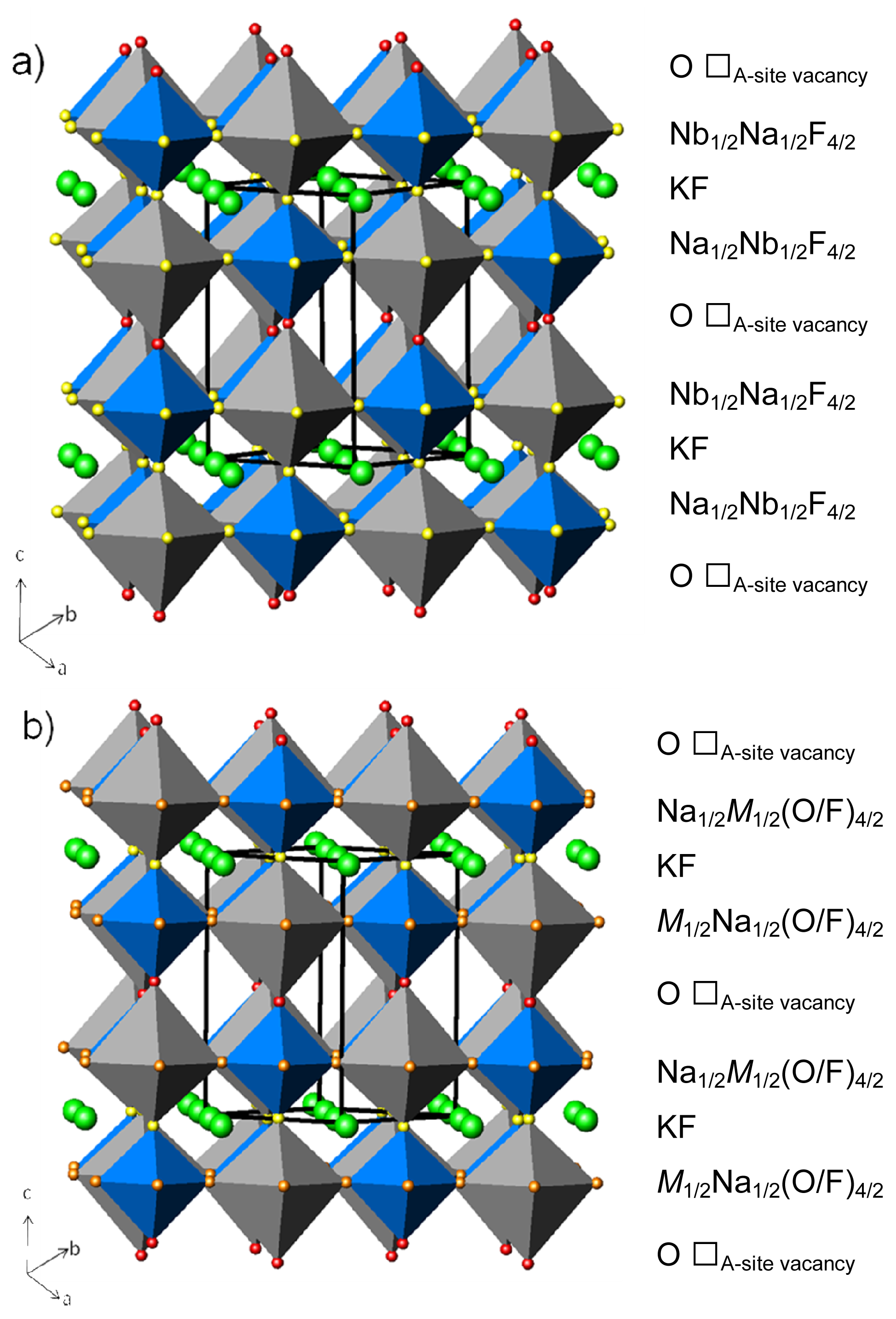
<p>The polyhedral representations of KNaNbOF<sub>5</sub> and KNaMO<sub>2</sub>F<sub>4</sub> (<italic>M</italic> = Mo<sup>6</sup>+, W<sup>6+</sup>) are shown in <xref ref-type="fig" rid="f2-crystals-01-00003">Figure 2</xref>. These three-dimensional structures can be described as an ordered rock-salt double perovskite with the general formula ABB′X<sub>6</sub> with ordered A-site layers where K<sup>+</sup> occupies half the A-sites and Na<sup>+</sup> and Nb<sup>5+</sup> or <italic>M</italic><sup>6+</sup> occupy the B and B′ sites, respectively. X represents one O<sup>2-</sup> and five F<sup>-</sup> in KNaNbOF<sub>5</sub> and two O<sup>2-</sup> and four F<sup>-</sup> in KNa<italic>M</italic>O<sub>2</sub>F<sub>4</sub>. Note that throughout the following discussion <italic>M</italic> corresponds to either molybdenum or tungsten atoms.</p>
<p>In KNaNbOF<sub>5</sub>, the Na<sup>+</sup> and Nb<sup>5+</sup> ions occupy ordered corner-shared octahedra (no tilt, a<sup>0</sup>a<sup>0</sup>a<sup>0</sup>) as in the ReO<sub>3</sub> structure type. The Nb<sup>5+</sup> ions form short Nb=O bonds and one long Nb–F bond <italic>trans</italic> to the oxide (<xref ref-type="table" rid="t1-crystals-01-00003">Table 1</xref>) resulting in a distorted octahedron, as seen in previously reported d<sup>0</sup> transition metal anionic units [<xref ref-type="bibr" rid="b19-crystals-01-00003">19</xref>,<xref ref-type="bibr" rid="b20-crystals-01-00003">20</xref>]. Mid-IR confirms the presence of the Nb=O bond with a peak at ν<sub>s</sub> 975 cm<sup>-1</sup> [<xref ref-type="bibr" rid="b21-crystals-01-00003">21</xref>]. The Nb–O–Na and Nb–F2–Na bond angles are 180° along the c-axis (<xref ref-type="table" rid="t1-crystals-01-00003">Table 1</xref>), consistent with corner sharing octahedra with no tilt. The Nb–F3–Na bond angle is 162.50(4)°.</p>
<p>In KNa<italic>M</italic>O2F4, the oxide ion and its <italic>trans</italic> fluoride are ordered. The second oxide ion is disordered among the other three fluorides in the equatorial positions. Although this partial ordering occurs between the oxide and fluoride ions, the A- and B-site cations are both ordered. The B-site cations, Na<sup>+</sup> and <italic>M</italic><sup>6+</sup>, form corner-sharing octahedra (no tilt, a<sup>0</sup>a<sup>0</sup>a<sup>0</sup>). The <italic>M</italic><sup>6+</sup> ions form one short <italic>M</italic>=O and one long <italic>M</italic>–F bond <italic>trans</italic> to the oxide (<xref ref-type="table" rid="t1-crystals-01-00003">Table 1</xref>) and, as a result, distort toward the corners of the octahedra as opposed to the edges [<xref ref-type="bibr" rid="b22-crystals-01-00003">22</xref>,<xref ref-type="bibr" rid="b23-crystals-01-00003">23</xref>]. Mid-IR confirms the presence of the <italic>M</italic>=O bond with peaks at ν<sub>s</sub> 969 cm<sup>-1</sup> and ν<sub>as</sub> 916 cm<sup>-1</sup> for Mo and ν<sub>s</sub> 991 cm<sup>-1</sup> and ν<sub>as</sub> 923 cm<sup>-1</sup> for W [<xref ref-type="bibr" rid="b21-crystals-01-00003">21</xref>]. Again, the <italic>M</italic>–O–Na and <italic>M</italic>–F2–Na bond angles are 180° along the <italic>c</italic>-axis consistent with corner-shared octahedra with no tilt. The <italic>M</italic>–X3–Na bond angle is 164.03(5)° and 162.11(8)° for Mo and W, respectively.</p>
<p>The A-site K<sup>+</sup> cations occupy half of the positions in an ordered array. Along the <italic>c</italic>-axis, the K<sup>+</sup> cations are 12-coordinated to the F<sup>-</sup> in the A-site layer. In the adjacent layer, where the axial oxides are located, the A-site is vacant. The unique ABB′X<sub>6</sub> structure can be described as repeating AX layers of KF, BX<sub>2</sub> layers of Na<sub>1/2</sub>Nb<sub>1/2</sub>F<sub>4/2</sub>, X layers of O, BX<sub>2</sub> layers of Na<sub>1/2</sub>Nb<sub>1/2</sub>F<sub>4/2</sub>, <italic>etc</italic> (<xref ref-type="fig" rid="f2-crystals-01-00003">Figure 2a</xref>) for KNaNbOF<sub>5</sub>. KNa<italic>M</italic>O<sub>2</sub>F<sub>4</sub> can be described as repeating AX layers of KF, BX<sub>2</sub> layers of Na<sub>1/2</sub><italic>M</italic><sub>1/2</sub>(O/F)<sub>4/2</sub>, X layers of O, BX<sub>2</sub> layers of Na<sub>1/2</sub><italic>M</italic><sub>1/2</sub>(O/F)<sub>4/2</sub>, <italic>etc.</italic> (<xref ref-type="fig" rid="f2-crystals-01-00003">Figure 2b</xref>).</p></sec>
<sec>
<label>2.2.</label>
<title>Bond valence and anionic connectivity</title>
<p>Electronic potentials and chemical hardness cooperatively influence the long-range order of the [NbOF<sub>5</sub>]<sup>2-</sup> anionic unit [<xref ref-type="bibr" rid="b20-crystals-01-00003">20</xref>,<xref ref-type="bibr" rid="b23-crystals-01-00003">23</xref>]. Oxide and fluoride order can be understood in the context of Pauling's second crystal rule (PSCR) which states that anions with the largest negative potentials will occupy sites having the largest positive potentials [<xref ref-type="bibr" rid="b24-crystals-01-00003">24</xref>]. The assessment of the positive potential in the crystal frameworks, carried out by calculating the PSCR (bond strength) sum [<xref ref-type="bibr" rid="b25-crystals-01-00003">25</xref>] and bond valence sum [<xref ref-type="bibr" rid="b24-crystals-01-00003">24</xref>,<xref ref-type="bibr" rid="b26-crystals-01-00003">26</xref>] around each anionic position, should match as closely as possible to the assessment of the negative potentials of each oxide and fluoride ion (<xref ref-type="table" rid="t2-crystals-01-00003">Tables 2</xref> and <xref ref-type="table" rid="t3-crystals-01-00003">3</xref>). The central Nb<sup>5+</sup> ion has been excluded from the PCSR calculations because we are only interested in the oxide and fluoride interactions with the extended bond network.</p>
<p>In a purely inorganic bond network, the oxide and fluoride ligands in the [NbOF<sub>5</sub>]<sup>2-</sup> anionic unit with the largest residual negative charge will make the most and strongest contacts to the coordination environment [<xref ref-type="bibr" rid="b20-crystals-01-00003">20</xref>]. In KNaNbOF<sub>5</sub>, the F2 fluorides, which occupy positions in contact with one six-coordinate Na<sup>+</sup> and four twelve-coordinate K<sup>+</sup> (1/6 + 4 × 1/12 = 0.5 PSCR sum and bond valence sums of 0.46 vu), retain the most negative potentials (0.58 vu) (<xref ref-type="table" rid="t3-crystals-01-00003">Table 3</xref>). The four remaining fluorides, F3, have less negative potentials (0.29 vu). They are each three-coordinate (one Na<sup>+</sup> and two K<sup>+</sup>) with lower bond valence sums of 0.40 vu and PSCR sums of 0.33.</p>
<p>The observation that the O1 site in KNaNbOF<sub>5</sub> makes one cationic contact to Na<sup>+</sup> in the extended bond network is understandable when other crystal chemistry factors are considered. The polarizability of the oxide (6.49 Å<sup>3</sup>) and fluoride (1.57 Å<sup>3</sup>) ions [<xref ref-type="bibr" rid="b29-crystals-01-00003">29</xref>] also influences their interactions with the extended bond network. For instance, the “harder” (relative to oxide) F2 <italic>trans</italic> fluoride interacts with one Na<sup>+</sup> (2.3501(14) Å) and four K<sup>+</sup> (2.9586(9) Å) cations (<xref ref-type="table" rid="t2-crystals-01-00003">Tables 2</xref> and <xref ref-type="table" rid="t3-crystals-01-00003">3</xref>). Although there are fewer Na–F bonds compared to K–F, the Na–F interactions are much stronger, as seen by their shorter bond lengths and higher bond valences. Thus, the Na<sup>+</sup> cation is significantly over bonded (1.22 vu) with respect to K<sup>+</sup> (1.08 vu). The K<sup>+</sup> cation is softer than Na<sup>+</sup>, therefore it needs to make more contacts to the fluorides in order to satisfy PSCR. At the same time, the Nb<sup>5+</sup> ion displaces away from the <italic>trans</italic> fluoride toward the “softer” oxide which has the lowest PSCR sum and bond valence sum of 0.17 and 0.26, respectively. As a result, the oxide attracts one Na<sup>+</sup> in the extended bond network at 2.2961(16) Å and is under bonded.</p></sec>
<sec>
<label>2.3.</label>
<title>Centrosymmetry versus Noncentrosymmetry</title>
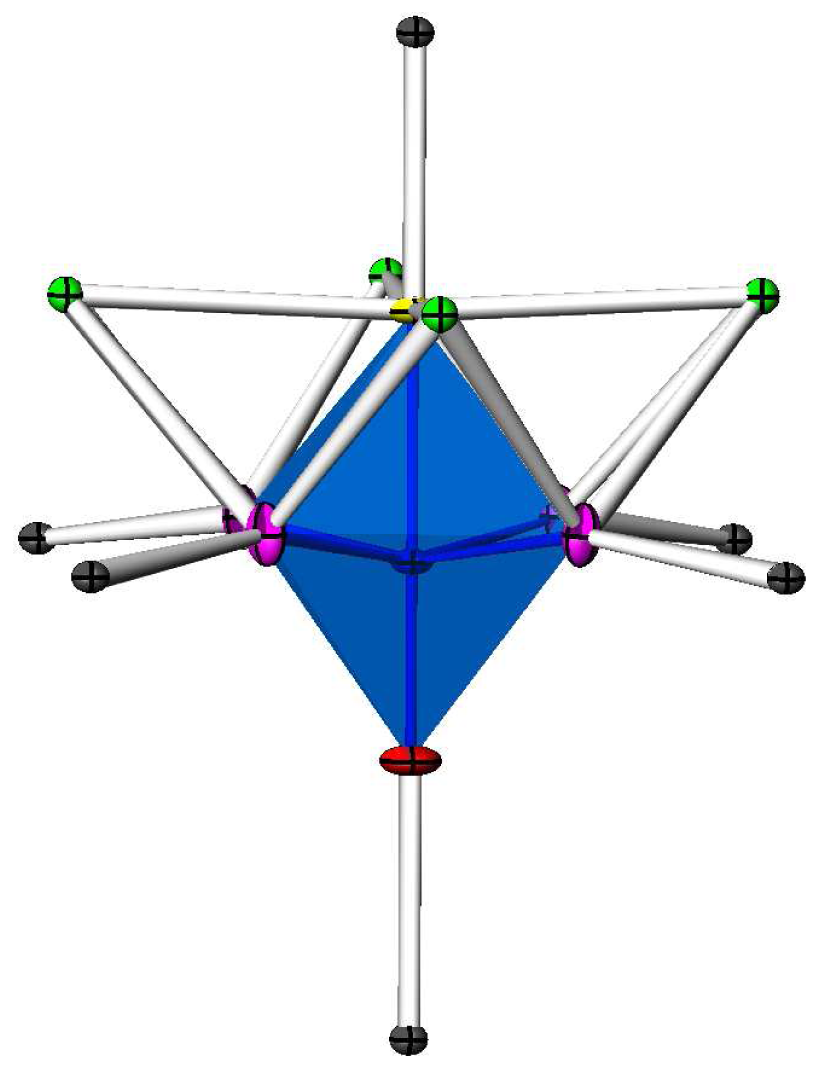
<p>KNaNbOF<sub>5</sub> has a noncentrosymmetric polymorph [<xref ref-type="bibr" rid="b20-crystals-01-00003">20</xref>]. The results discussed here on the noncentrosymmetric polymorph can be found in [<xref ref-type="bibr" rid="b20-crystals-01-00003">20</xref>]. The different local coordination environments around the centrosymmetric (CS) and noncentrosymmetric (NCS) [NbOF<sub>5</sub>]<sup>2-</sup> structures are illustrated in <xref ref-type="fig" rid="f3-crystals-01-00003">Figure 3</xref>. In the NCS polymorph the two fluorides F1 and F3 contain the largest residual negative charge (0.48 and 0.23 vu, respectively) and make three contacts with two eight-coordinate K<sup>+</sup> and one six-coordinate Na<sup>+</sup>. In the CS polymorph, one fluoride, F1, has the largest residual negative charge (0.58 vu) and makes four contacts with four twelve-coordinate K<sup>+</sup> and one six-coordinate Na<sup>+</sup>. Although there are fewer Na–F interactions than K–F in both the NCS and CS polymorphs, the Na–F interactions are stronger, as seen by their shorter bond lengths and higher bond valences. As a result, in the CS polymorph the Na<sup>+</sup> cation is slightly more over bonded (1.22 vu) compared to K<sup>+</sup> (1.08 vu).</p>
<p>The oxides in both the NCS and CS polymorph are under bonded. In the NCS polymorph, the oxide is three-coordinate with one K<sup>+</sup> and one Na<sup>+</sup> contact and a Nb=O bond at 1.745(5) Å. In the CS polymorph, the oxide is two-coordinate and makes one Na<sup>+</sup> contact and as expected there is a shorter Nb=O bond distance of 1.7179(14) Å. Conversely, the extra K<sup>+</sup> contact in the NCS polymorph results in a longer Nb=O bond.</p>
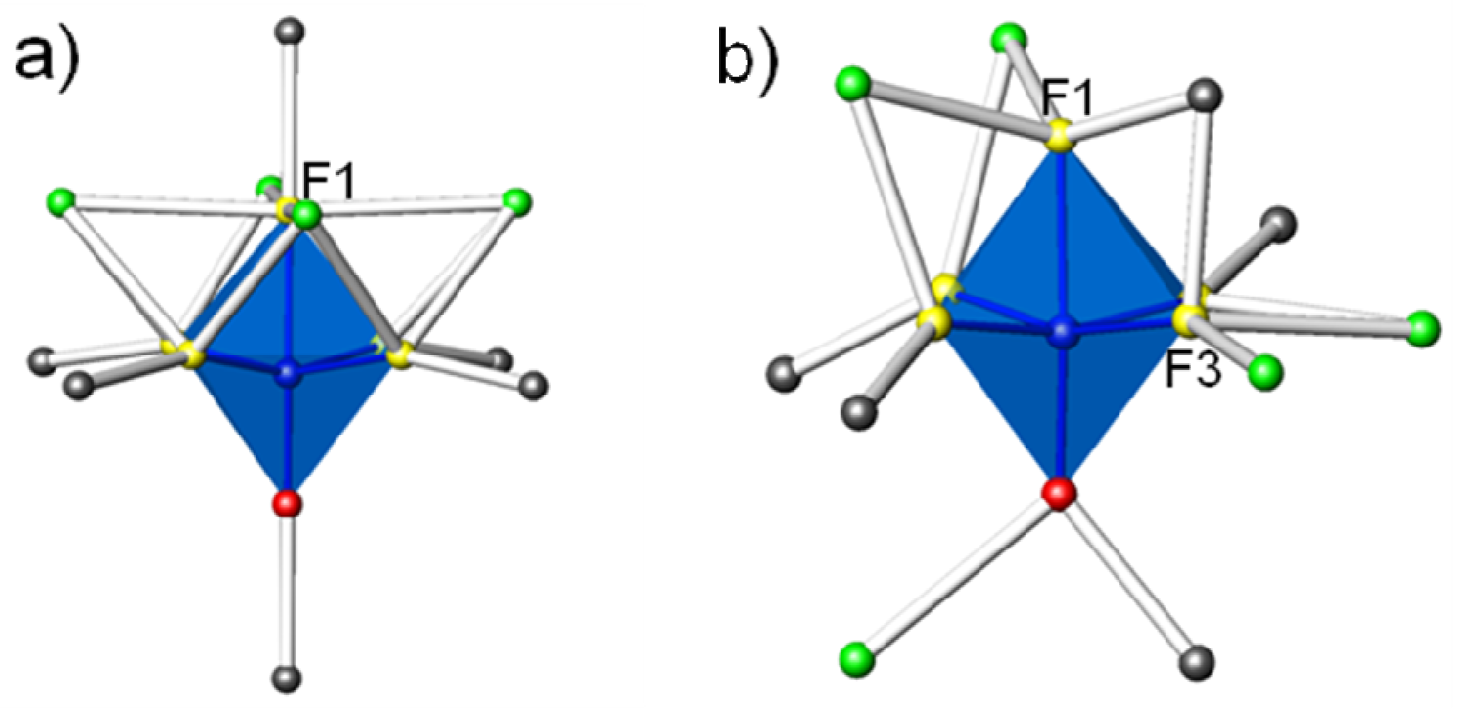
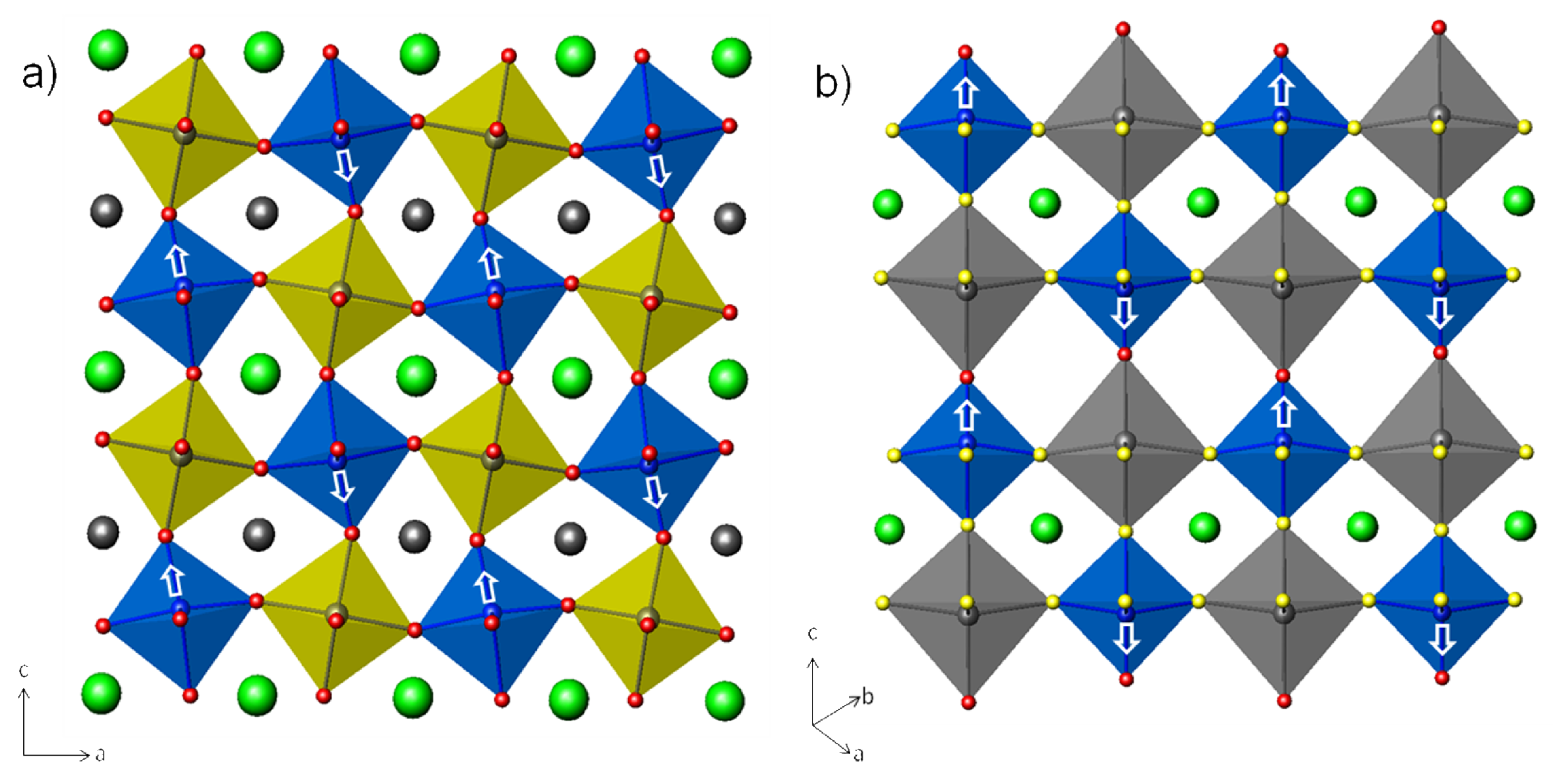
<p>In a perovskite with B-site rock-salt ordering the A-site cations prefer to order in a layered arrangement which is stabilized by the presence of a second order Jahn Teller displacement of at least one d<sup>0</sup> transition metal at the B-site [<xref ref-type="bibr" rid="b10-crystals-01-00003">10</xref>,<xref ref-type="bibr" rid="b11-crystals-01-00003">11</xref>]. In Na<italic>L</italic>nMnWO<sub>6</sub> and Na<italic>L</italic>nMgWO<sub>6</sub> with a trivalent and monovalent A-site cation, the oxides coordinated to the Na<sup>+</sup> are under bonded while the oxides coordinated to the <italic>Ln<sup>3+</sup></italic> are over bonded. To compensate, the d<sup>0</sup> transition metal, W<sup>6+</sup>, at the B-site will shift towards the oxide coordinated to the smaller cation (Na<sup>+</sup>) and away from the larger cation (<italic>Ln</italic><sup>3+</sup>) to alleviate the lattice strain arising from the size mismatch (<xref ref-type="fig" rid="f4-crystals-01-00003">Figure 4a</xref>). A similar comparison can be made to KNaNbOF<sub>5</sub>. Instead of having two A-site cations, there is an occupied and unoccupied A-site. As a result, the oxide in the same layer as the unoccupied A-site is under bonded. To compensate, the Nb<sup>5+</sup> at the B-site shifts toward the oxide and away from the <italic>trans</italic> fluoride (<xref ref-type="fig" rid="f4-crystals-01-00003">Figure 4b</xref>). Thus, the long range ordering of the KNaNbOF<sub>5</sub> structure results in a centrosymmetric arrangement of the anionic units.</p></sec>
<sec>
<label>2.4.</label>
<title>KNaMO<sub>2</sub>F<sub>4</sub> and partial anionic ordering</title>
<p>In KNa<italic>M</italic>O<sub>2</sub>F<sub>4</sub> (<italic>M</italic> = Mo<sup>6+</sup>, W<sup>6+</sup>), the oxide and its <italic>trans</italic> fluoride are ordered while the second oxide is disordered along with the other three fluorides at the equatorial positions. Despite the partial ordering of the oxide and fluoride, the A- and B-site cations are ordered. The partial ordering of the anionic unit has been reported previously, where Mo/W distorts towards the corner as opposed to the edge [<xref ref-type="bibr" rid="b22-crystals-01-00003">22</xref>,<xref ref-type="bibr" rid="b23-crystals-01-00003">23</xref>]. The partial ordering of the oxide and fluoride is due to the symmetric environment around the equatorial positions. In KNaNbOF<sub>5</sub>, the bond network at the oxide differs from the <italic>trans</italic> fluoride; therefore, the oxide can be identified based on bond lengths. When two oxides are present as in KNa<italic>M</italic>O<sub>2</sub>F<sub>4</sub>, one oxide is ordered (<xref ref-type="fig" rid="f5-crystals-01-00003">Figure 5</xref>). The bond lengths of the oxide and the <italic>trans</italic> fluoride at the axial positions are different, which we use to identify the oxide and fluoride sites. However, at the equatorial positions, the bond length is the average of the four bonds from the second oxide and three fluorides, therefore the second oxide and three fluorides are not differentiated. In addition, bond valence sums cannot be accurately calculated because it is dependent on the observed bond lengths.</p></sec></sec>
<sec>
<label>3.</label>
<title>Experimental Section</title>
<sec sec-type="materials">
<label>3.1.</label>
<title>Materials and synthesis</title>
<sec>
<title>Caution</title>
<p>Hydrofluoric acid is toxic and corrosive, and must be handled with extreme caution and the appropriate protective gear! If contact with the liquid or vapor occurs, proper treatment procedures should immediately be followed [<xref ref-type="bibr" rid="b30-crystals-01-00003">30</xref>-<xref ref-type="bibr" rid="b32-crystals-01-00003">32</xref>].</p></sec>
<sec>
<title>Materials</title>
<p>Nb<sub>2</sub>O<sub>5</sub>(99.9%, Aldrich), Na2MoO4•2H<sub>2</sub>O (99.9%, Aldrich), Na<sub>2</sub>WO<sub>4</sub>•2H<sub>2</sub>O (99.9%, Aldrich), NaF (99.9%, Aldrich), KF (99.9%, Aldrich), and aqueous hydrofluoric acid (HF) (48% HF by weight, Aldrich) were used as received. Owing to their hygroscopic nature, the alkali fluorides were weighed under nitrogen in a dry box.</p>
<p>All reactants were sealed in Teflon [fluoro(ethylenepropylene), FEP] “pouches” [<xref ref-type="bibr" rid="b33-crystals-01-00003">33</xref>]. Single or multiple pouches were placed in a 125 mL Teflon-lined Parr pressure vessel filled 33% with deionized H<sub>2</sub>O as backfill [<xref ref-type="bibr" rid="b34-crystals-01-00003">34</xref>]. The pressure vessel was heated for 24 h at 150 °C and cooled to room temperature over an additional 24 h. The pouches were opened in air, and the products were recovered by vacuum filtration.</p></sec>
<sec>
<title>KNaNbOF<sub>5</sub></title>
<p>KNaNbOF<sub>5</sub> was synthesized by reacting NaF (0.0790g, 0.0019 mol), KF (0.1639g, 0.0028 mol), Nb2O5 (0.25g, 0.0009 mol) and 48% aqueous HF (0.5000 g, 0.0250 mol). Colorless plates were recovered in 68% yield based on Nb.</p></sec>
<sec>
<title>KNaMoO<sub>2</sub>F<sub>4</sub></title>
<p>KNaMoO<sub>2</sub>F<sub>4</sub> was synthesized by reacting KF (0.0600g, 0.0010 mol), Na<sub>2</sub>MoO<sub>4</sub>•2H<sub>2</sub>O (0.25g, 0.0010 mol) and 48% aqueous HF (0.2500 g, 0125 mol). Colorless plates were recovered in 66% yield based on Mo.</p></sec>
<sec>
<title>KNaWO<sub>2</sub>F<sub>4</sub></title>
<p>KNaWO<sub>2</sub>F<sub>4</sub> was synthesized by reacting KF (0.0440g, 0.0008 mol), Na<sub>2</sub>WO<sub>4</sub>•2H<sub>2</sub>O (0.25g, 0.0008 mol) and 48% aqueous HF (0.2500 g, 0.0125 mol). Colorless plates were recovered in 72% yield based on W.</p></sec></sec>
<sec>
<label>3.2.</label>
<title>Crystallographic determination</title>
<p>Single crystal X-ray diffraction data of KNaNbOF<sub>5</sub>, KNaMoO<sub>2</sub>F<sub>4</sub> and KNaWO<sub>2</sub>F<sub>4</sub> were collected with Mo-Kα radiation (0.71073 Å) on a Bruker APEX2 CCD diffractometer and integrated with the SAINT-Plus program [<xref ref-type="bibr" rid="b35-crystals-01-00003">35</xref>]. The structures were solved by direct methods and refined against F<sup>2</sup> by full-matrix least-squares techniques with SHELX. A face-indexed absorption correction was performed numerically using the program XPREP. All structures were checked for missing symmetry elements with PLATON [<xref ref-type="bibr" rid="b36-crystals-01-00003">36</xref>]. The final refinement includes anisotropic displacement parameters. Further details of the crystal structure investigations may be obtained from Fachinformationszentrum Karlsruhe, 76344 Eggenstein-Leopoldshafen, Germany (fax: (+49)7247-808-666; e-mail: <email>crysdata@fiz-karlsruhe.de</email>, <ext-link xlink:href="http://www.fiz-karlsruhe.de/request_for_deposited_data.html" ext-link-type="uri">http://www.fiz-karlsruhe.de/request_for_deposited_data.html</ext-link>) on quoting the 422708 (KNaNbOF<sub>5</sub>), 422707 (KNaMoO<sub>2</sub>F<sub>4</sub>) and 422709 (KNaWO<sub>2</sub>F<sub>4</sub>) CSD numbers. Crystallographic data for KNaNbOF<sub>5</sub> and KNa<italic>M</italic>O<sub>2</sub>F<sub>4</sub>, (<italic>M</italic> = Mo<sup>6+</sup>, W<sup>6+</sup>) are given in <xref ref-type="table" rid="t4-crystals-01-00003">Table 4</xref>.</p></sec>
<sec>
<label>3.3.</label>
<title>Spectroscopic measurements</title>
<p>Mid-infrared (600–4000 cm<sup>-1</sup>) spectra of KNaNbOF<sub>5</sub>, KNaMoO<sub>2</sub>F<sub>4</sub> and KNaWO<sub>2</sub>F<sub>4</sub> were collected using a Bruker 37 Tensor FTIR spectrometer equipped with an ATR germanium cell attachment operating at a resolution of 2 cm<sup>-1</sup>.</p></sec></sec>
<sec sec-type="conclusions">
<label>4.</label>
<title>Conclusions</title>
<p>The interactions of the [NbOF<sub>5</sub>]<sup>2-</sup> and [<italic>M</italic>O<sub>2</sub>F<sub>4</sub>]<sup>2-</sup> anionic units with the cationic bond network (Na<sup>+</sup> and K<sup>+</sup>) influences the long range ordering of the anionic units. The oxide coordinated to the unoccupied A-sites is under bonded. To compensate, the d<sup>0</sup> transition metal (Nb/<italic>M</italic>) shifts towards the oxide coordinated to the unoccupied A-site and away from the fluoride coordinated to the K<sup>+</sup> to satisfy PSCR. These interactions in KNaNbOF<sub>5</sub> and KNa<italic>M</italic>O<sub>2</sub>F<sub>4</sub> lead to a rock salt ordering of the B-site cations and an ordered layering of the occupied and unoccupied A-sites resulting in a centrosymmetric arrangement.</p></sec></body>
<back>
<sec sec-type="display-objects">
<title>Figures and Tables</title>
<fig id="f1-crystals-01-00003" position="float">
<label>Figure 1.</label>
<caption>
<p>Structures of <bold>(a)</bold> anion deficient YBaFe<sub>2</sub>O<sub>5</sub> [<xref ref-type="bibr" rid="b4-crystals-01-00003">4</xref>], <bold>(b)</bold> non-stoichiometric La<sub>1/3</sub>NbO<sub>3</sub> [<xref ref-type="bibr" rid="b6-crystals-01-00003">6</xref>,<xref ref-type="bibr" rid="b7-crystals-01-00003">7</xref>] and <bold>(c)</bold> stoichiometric NaLaMnWO<sub>6</sub> [<xref ref-type="bibr" rid="b10-crystals-01-00003">10</xref>,<xref ref-type="bibr" rid="b11-crystals-01-00003">11</xref>].</p></caption>
<graphic xlink:href="crystals-01-00003f1.gif"/></fig>
<fig id="f2-crystals-01-00003" position="float">
<label>Figure 2.</label>
<caption>
<p>View of the three dimensional rock salt double perovskite <bold>(a)</bold> KNaNbOF<sub>5</sub> and <bold>(b)</bold> KNa<italic>M</italic>O<sub>2</sub>F<sub>4</sub> (<italic>M</italic> = Mo<sup>6+</sup>, W<sup>6+</sup>). Blue octahedra represent the [NbOF<sub>5</sub>]<sup>2-</sup> or [<italic>M</italic>O<sub>2</sub>F<sub>4</sub>]<sup>2-</sup> units, grey octahedra represent Na-centered units and green spheres represent K<sup>+</sup> ions.</p></caption>
<graphic xlink:href="crystals-01-00003f2.gif"/></fig>
<fig id="f3-crystals-01-00003" position="float">
<label>Figure 3.</label>
<caption>
<p>Cationic coordination environment around <bold>(a)</bold> the centrosymmetric (CS) polymorph and <bold>(b)</bold> the noncentrosymmetric (NCS) polymorph. Blue octahedra represents the [NbOF<sub>5</sub>]<sup>2-</sup> unit. The spheres represent O<sup>2-</sup> (red), F<sup>-</sup> (yellow), Na<sup>+</sup> (black) and K<sup>+</sup> (orange).</p></caption>
<graphic xlink:href="crystals-01-00003f3.gif"/></fig>
<fig id="f4-crystals-01-00003" position="float">
<label>Figure 4.</label>
<caption>
<p>The d<sup>0</sup> transition metal (blue) at the B-site shifts towards the oxide that contains the smallest A-site cation, Na (grey) for <bold>(a)</bold> NaLaMnWO<sub>6</sub> [<xref ref-type="bibr" rid="b10-crystals-01-00003">10</xref>,<xref ref-type="bibr" rid="b11-crystals-01-00003">11</xref>] or the vacancy in <bold>(b)</bold> KNaNbOF<sub>5</sub>.</p></caption>
<graphic xlink:href="crystals-01-00003f4.gif"/></fig>
<fig id="f5-crystals-01-00003" position="float">
<label>Figure 5.</label>
<caption>
<p>Cationic coordination environment around KNaMO<sub>2</sub>F<sub>4</sub>. Blue octahedra represents the [<italic>M</italic>OF<sub>5</sub>]<sup>2-</sup> unit (no tilt, a<sup>0</sup> a<sup>0</sup> a<sup>0</sup> ). The ellipsoids represent O<sup>2-</sup> (red), F<sup>-</sup> (yellow), O<sup>2-</sup>/F<sup>-</sup> (purple), Na<sup>+</sup> (black) and K<sup>+</sup> (orange).</p></caption>
<graphic xlink:href="crystals-01-00003f5.gif"/></fig>
<table-wrap id="t1-crystals-01-00003" position="float">
<label>Table 1.</label>
<caption>
<p>Selected bond lengths and bond angles for KNaNbOF<sub>5</sub> and KNa<italic>M</italic>O<sub>2</sub>F<sub>4</sub> (<italic>M</italic> = Mo, W).</p></caption>
<table frame="hsides" rules="groups">
<thead>
<tr>
<th colspan="12" align="center" valign="top"><bold>Bond Distances (Å)</bold></th></tr></thead>
<tbody>
<tr>
<td colspan="2" align="left" valign="top">Nb-O</td>
<td colspan="2" align="left" valign="top">1.7179(14)</td>
<td colspan="2" align="left" valign="top">Mo-O</td>
<td colspan="2" align="left" valign="top">1.6718(16)</td>
<td colspan="2" align="left" valign="top">W-O</td>
<td colspan="2" align="left" valign="top">1.698(3)</td></tr>
<tr>
<td colspan="2" align="left" valign="top">Nb-F2</td>
<td colspan="2" align="left" valign="top">2.1473(h)</td>
<td colspan="2" align="left" valign="top">Mo-F2</td>
<td colspan="2" align="left" valign="top">2.1110(12)</td>
<td colspan="2" align="left" valign="top">W-F2</td>
<td colspan="2" align="left" valign="top">2.100(2)</td></tr>
<tr>
<td colspan="2" align="left" valign="top">Nb-F3 x 4</td>
<td colspan="2" align="left" valign="top">1.9552(7)</td>
<td colspan="2" align="left" valign="top">Mo-X3 x 4</td>
<td colspan="2" align="left" valign="top">1.9074(7)</td>
<td colspan="2" align="left" valign="top">W-X3 x 4</td>
<td colspan="2" align="left" valign="top">1.9033(13)</td></tr>
<tr>
<td colspan="2" align="left" valign="top">Na-O</td>
<td colspan="2" align="left" valign="top">2.2961(16)</td>
<td colspan="2" align="left" valign="top">Na-O</td>
<td colspan="2" align="left" valign="top">2.3408(17)</td>
<td colspan="2" align="left" valign="top">Na-O</td>
<td colspan="2" align="left" valign="top">2.298(3)</td></tr>
<tr>
<td colspan="2" align="left" valign="top">Na-F2</td>
<td colspan="2" align="left" valign="top">2.3501(14)</td>
<td colspan="2" align="left" valign="top">Na-F2</td>
<td colspan="2" align="left" valign="top">2.3360(14)</td>
<td colspan="2" align="left" valign="top">Na-F2</td>
<td colspan="2" align="left" valign="top">2.394(3)</td></tr>
<tr>
<td colspan="2" align="left" valign="top">Na-F3 x 4</td>
<td colspan="2" align="left" valign="top">2.2754(7)</td>
<td colspan="2" align="left" valign="top">Na-X3 x 4</td>
<td colspan="2" align="left" valign="top">2.2766(7)</td>
<td colspan="2" align="left" valign="top">Na-X3 x 4</td>
<td colspan="2" align="left" valign="top">2.2938(13)</td></tr></tbody>
<tbody>
<tr>
<td colspan="12" align="center" valign="top"><bold>Bond Angles</bold></td></tr>
<tr>
<td colspan="12" valign="bottom">
<hr/></td></tr>
<tr>
<td colspan="2" align="left" valign="top">O-Nb-F2</td>
<td colspan="2" align="left" valign="top">180.00°</td>
<td colspan="2" align="left" valign="top">O-Mo-F2</td>
<td colspan="2" align="left" valign="top">180.00°</td>
<td colspan="2" align="left" valign="top">O-W-F2</td>
<td colspan="2" align="left" valign="top">180.00°</td></tr>
<tr>
<td colspan="2" align="left" valign="top">O-Nb-F3</td>
<td colspan="2" align="left" valign="top">99.364(18)°</td>
<td colspan="2" align="left" valign="top">O-Mo-X3</td>
<td colspan="2" align="left" valign="top">99.07(2)°</td>
<td colspan="2" align="left" valign="top">O-W-X3</td>
<td colspan="2" align="left" valign="top">99.03(4)°</td></tr>
<tr>
<td colspan="2" align="left" valign="top">F2-Nb-F3</td>
<td colspan="2" align="left" valign="top">80.636(18)°</td>
<td colspan="2" align="left" valign="top">F2-Mo-X3</td>
<td colspan="2" align="left" valign="top">80.93(2)°</td>
<td colspan="2" align="left" valign="top">F2-W-X3</td>
<td colspan="2" align="left" valign="top">80.97(4)°</td></tr>
<tr>
<td colspan="2" align="left" valign="top">Nb-O-Na</td>
<td colspan="2" align="left" valign="top">180.00°</td>
<td colspan="2" align="left" valign="top">Mo-O-Na</td>
<td colspan="2" align="left" valign="top">180.00°</td>
<td colspan="2" align="left" valign="top">W-O-Na</td>
<td colspan="2" align="left" valign="top">180.00°</td></tr>
<tr>
<td colspan="2" align="left" valign="top">Nb-F2-Na</td>
<td colspan="2" align="left" valign="top">180.00°</td>
<td colspan="2" align="left" valign="top">Mo-F2-Na</td>
<td colspan="2" align="left" valign="top">180.00°</td>
<td colspan="2" align="left" valign="top">W-F2-Na</td>
<td colspan="2" align="left" valign="top">180.00°</td></tr>
<tr>
<td colspan="2" align="left" valign="top">Nb-F3-Na</td>
<td colspan="2" align="left" valign="top">162.50(4)°</td>
<td colspan="2" align="left" valign="top">Mo-X3-Na</td>
<td colspan="2" align="left" valign="top">164.03(5)°</td>
<td colspan="2" align="left" valign="top">W-X3-Na</td>
<td colspan="2" align="left" valign="top">162.11(8)°</td></tr></tbody></table></table-wrap>
<table-wrap id="t2-crystals-01-00003" position="float">
<label>Table 2.</label>
<caption>
<p>Bond lengths, experimental bond valences and bond valence sums for KNaNbOF<sub>5</sub>.</p></caption>
<table frame="hsides" rules="groups">
<thead>
<tr>
<th align="left" valign="top"><bold>KNaNbOF<sub>5</sub></bold></th>
<th align="left" valign="top"/>
<th align="left" valign="top"><bold>K</bold></th>
<th align="left" valign="top"><bold>Na</bold></th>
<th align="left" valign="top"><bold>Nb</bold></th>
<th align="left" valign="top"><bold><italic>V<sub>i</sub> = Σ<sub>i</sub> S<sub>ij</sub></italic></bold></th></tr></thead>
<tbody>
<tr>
<td align="left" valign="top">R<sub>ij</sub> (Å)</td>
<td align="left" valign="middle" rowspan="2">O1</td>
<td align="left" valign="top"/>
<td align="left" valign="top">2.2961(16)</td>
<td align="left" valign="top">1.7179(14)</td>
<td align="left" valign="top"/></tr>
<tr>
<td align="left" valign="top"><bold>S<italic><sub>ij</sub></italic> (vu)</bold></td>
<td align="left" valign="top"/>
<td align="left" valign="top"><bold><italic>0.26</italic></bold></td>
<td align="left" valign="top"><bold><italic>1.69</italic></bold></td>
<td align="left" valign="top"><bold><italic>1.95</italic></bold></td></tr>
<tr>
<td valign="bottom" colspan="6">
<hr/></td></tr>
<tr>
<td align="left" valign="top">R<sub>ij</sub> (Å)</td>
<td align="left" valign="middle" rowspan="2">F2</td>
<td align="left" valign="top">2.9586(9)</td>
<td align="left" valign="top">2.3501(14)</td>
<td align="left" valign="top">2.1473(11)</td>
<td align="left" valign="top"/></tr>
<tr>
<td align="left" valign="top"><bold>S<italic><sub>ij</sub></italic> (vu)</bold></td>
<td align="left" valign="top"><bold><italic>0.07</italic></bold></td>
<td align="left" valign="top"><bold><italic>0.16</italic></bold></td>
<td align="left" valign="top"><bold><italic>0.42</italic></bold></td>
<td align="left" valign="top"><bold><italic>0.88</italic></bold></td></tr>
<tr>
<td valign="bottom" colspan="6">
<hr/></td></tr>
<tr>
<td align="left" valign="top">R<sub>ij</sub> (Å)</td>
<td align="left" valign="middle" rowspan="2">F3</td>
<td align="left" valign="top">2.8492(4)</td>
<td align="left" valign="top">2.2754(7)</td>
<td align="left" valign="top">1.9552(7)</td>
<td align="left" valign="top"/></tr>
<tr>
<td align="left" valign="top"><bold>S<italic><sub>ij</sub></italic> (vu)</bold></td>
<td align="left" valign="top"><bold><italic>0.10</italic></bold></td>
<td align="left" valign="top"><bold><italic>0.20</italic></bold></td>
<td align="left" valign="top"><bold><italic>0.71</italic></bold></td>
<td align="left" valign="top"><bold><italic>1.11</italic></bold></td></tr>
<tr>
<td valign="bottom" colspan="6">
<hr/></td></tr>
<tr>
<td align="left" valign="top"><bold><italic>V<sub>j</sub> = Σ<sub>j</sub> S<sub>ij</sub></italic></bold></td>
<td align="left" valign="top"/>
<td align="left" valign="top"><bold><italic>1.08</italic></bold></td>
<td align="left" valign="top"><bold><italic>1.22</italic></bold></td>
<td align="left" valign="top"><bold><italic>4.95</italic></bold></td>
<td align="left" valign="top"/></tr></tbody></table>
<table-wrap-foot><fn id="tfn1-crystals-01-00003">
<p><italic>R<sub>ij</sub></italic> = bond length of the bond ″<italic>ij</italic>″; <italic>S<sub>ij</sub></italic> = exp[<italic>R<sub>0</sub></italic>−<italic>R<sub>ij</sub></italic>)/<italic>B</italic>] experimental bond valence of bond ″<italic>ij</italic>″, where <italic>R<sub>0</sub></italic> = constant dependent on <italic>i</italic> and <italic>j</italic> bonded elements, and <italic>B</italic> = 0.37; <italic>R<sub>0</sub></italic>(Nb–O) = 1.911, <italic>R<sub>0</sub></italic>(Nb–F) = 1.87 ; <italic>R<sub>0</sub></italic>(Na–O) = 1.803, <italic>R<sub>0</sub></italic>(Na–F) = 1.677; <italic>s<sub>ij</sub></italic> = theoretical bond valence of bond “<italic>ij</italic>”, calculated by solving the network equations based on the methods described by Brown [<xref ref-type="bibr" rid="b27-crystals-01-00003">27</xref>,<xref ref-type="bibr" rid="b28-crystals-01-00003">28</xref>]; V<sub>i</sub>, V<sub>j</sub> = experimental valences of anions “<italic>i</italic>” and cations “<italic>j</italic>”.; z<sub>i</sub>, z<sub>j</sub> = charge or formal valence of anions “<italic>i</italic>” and cations “<italic>j</italic>”.</p></fn></table-wrap-foot></table-wrap>
<table-wrap id="t3-crystals-01-00003" position="float">
<label>Table 3.</label>
<caption>
<p>Estimations of the negative potentials of the ions of the (NbOF<sub>5</sub>)<sup>2−</sup> anions and the surrounding positive potentials in KNaNbOF<sub>5</sub>, through bond strength and bond valence calculations.</p></caption>
<table frame="hsides" rules="groups">
<thead>
<tr>
<th colspan="2" align="left" valign="top"><bold>KNaNbOF<sub>5</sub></bold></th>
<th colspan="2" align="left" valign="top"/>
<th colspan="2" align="left" valign="top"/></tr>
<tr>
<th colspan="2" align="left" valign="top">Bond</th>
<th colspan="2" align="left" valign="top">Anionic BV (vu) <italic><xref ref-type="table-fn" rid="tfn2-crystals-01-00003">a</xref></italic></th>
<th colspan="2" align="left" valign="top">Cationic PSCR sum (vu) <italic><xref ref-type="table-fn" rid="tfn3-crystals-01-00003">b</xref></italic></th>
<th colspan="2" align="left" valign="top">Cationic BV sum (vu) <italic><xref ref-type="table-fn" rid="tfn4-crystals-01-00003">c</xref></italic></th></tr></thead>
<tbody>
<tr>
<td colspan="2" align="left" valign="top">Nb–O1</td>
<td colspan="2" align="left" valign="top">0.31</td>
<td colspan="2" align="left" valign="top">0.17</td>
<td colspan="2" align="left" valign="top">0.26</td></tr>
<tr>
<td colspan="2" align="left" valign="top">Nb–F2</td>
<td colspan="2" align="left" valign="top">0.58</td>
<td colspan="2" align="left" valign="top">0.50</td>
<td colspan="2" align="left" valign="top">0.46</td></tr>
<tr>
<td colspan="2" align="left" valign="top">Nb–F3</td>
<td colspan="2" align="left" valign="top">0.29</td>
<td colspan="2" align="left" valign="top">0.33</td>
<td colspan="2" align="left" valign="top">0.40</td></tr></tbody></table>
<table-wrap-foot><fn id="tfn2-crystals-01-00003">
<label>a</label>
<p>Anionic BV (Bond Valence) = z<sub>i</sub>−S<sub>Nb−O/F</sub>, where z<sub>i</sub> is the electric charge of each ligand and S<sub>Nb−O/F</sub> is taken from the <xref ref-type="table" rid="t2-crystals-01-00003">Table 2</xref> for each Nb−O/F bond;</p></fn><fn id="tfn3-crystals-01-00003">
<label>b</label>
<p>Cationic PSCR sum =
<disp-formula id="FD1">
<mml:math id="mm1" display="block">
<mml:semantics id="sm1">
<mml:mrow>
<mml:munder>
<mml:mo>∑</mml:mo>
<mml:mtext>j</mml:mtext></mml:munder>
<mml:mrow>
<mml:msubsup>
<mml:mtext>s</mml:mtext>
<mml:mrow>
<mml:mtext>j</mml:mtext>
<mml:mo>,</mml:mo>
<mml:mtext>cat</mml:mtext></mml:mrow>
<mml:mo>′</mml:mo></mml:msubsup></mml:mrow>
<mml:mo>=</mml:mo>
<mml:munder>
<mml:mo>∑</mml:mo>
<mml:mtext>j</mml:mtext></mml:munder>
<mml:mrow>
<mml:mfrac>
<mml:mrow>
<mml:msub>
<mml:mtext>Z</mml:mtext>
<mml:mrow>
<mml:mtext>j</mml:mtext>
<mml:mo>,</mml:mo>
<mml:mtext>cat</mml:mtext></mml:mrow></mml:msub></mml:mrow>
<mml:mrow>
<mml:msub>
<mml:mtext>V</mml:mtext>
<mml:mrow>
<mml:mtext>j</mml:mtext>
<mml:mo>,</mml:mo>
<mml:mtext>cat</mml:mtext></mml:mrow></mml:msub></mml:mrow></mml:mfrac></mml:mrow></mml:mrow></mml:semantics></mml:math></disp-formula>, where Z<sub>j,cat</sub> is the electric charge of each <italic>A<sub>i</sub></italic> alkali cation bonded to a given ligand and v<sub>j,cat</sub> is its coordination number;</p></fn><fn id="tfn4-crystals-01-00003">
<label>c</label>
<p>Cationic BV sum =
<disp-formula id="FD2">
<mml:math id="mm2" display="block">
<mml:semantics id="sm2">
<mml:mrow>
<mml:munder>
<mml:mo>∑</mml:mo>
<mml:mtext>j</mml:mtext></mml:munder>
<mml:mrow>
<mml:msub>
<mml:mtext>S</mml:mtext>
<mml:mrow>
<mml:mtext>i</mml:mtext>
<mml:mo>,</mml:mo>
<mml:mtext>cat</mml:mtext></mml:mrow></mml:msub></mml:mrow></mml:mrow></mml:semantics></mml:math></disp-formula>, where S<sub>i,cat</sub> is taken from <xref ref-type="table" rid="t2-crystals-01-00003">Table 2</xref> for each <italic>A</italic><sub>i</sub>−O/F bond.</p></fn></table-wrap-foot></table-wrap>
<table-wrap id="t4-crystals-01-00003" position="float">
<label>Table 4.</label>
<caption>
<p>Crystallographic Data for KNaNbOF<sub>5</sub>, KNaMoO<sub>2</sub>F<sub>4</sub> and KNaWO<sub>2</sub>F<sub>4</sub>.</p></caption>
<table frame="hsides" rules="none">
<thead>
<tr>
<th align="left" valign="top">Formula</th>
<th align="left" valign="top">KNaNbOF<sub>5</sub></th>
<th align="left" valign="top">KNaMoO<sub>2</sub>F<sub>4</sub></th>
<th align="left" valign="top">KNWO<sub>2</sub>F<sub>4</sub></th></tr></thead>
<tbody>
<tr>
<td align="left" valign="top">fw</td>
<td align="left" valign="top">266.00</td>
<td align="left" valign="top">266.03</td>
<td align="left" valign="top">353.94</td></tr>
<tr>
<td align="left" valign="top">Space group</td>
<td align="left" valign="top">P4/nmm (No. 129)</td>
<td align="left" valign="top">P4/nmm (No. 129)</td></tr>
<tr>
<td align="left" valign="top">a (Å)</td>
<td align="left" valign="top">5.91390(10)</td>
<td align="left" valign="top">5.8600(2)</td>
<td align="left" valign="top">5.86350(10)</td></tr>
<tr>
<td align="left" valign="top">c (Å)</td>
<td align="left" valign="top">8.5114(2)</td>
<td align="left" valign="top">8.45960(10)</td>
<td align="left" valign="top">8.49070(10)</td></tr>
<tr>
<td align="left" valign="top">V(Å<sup>3</sup>)</td>
<td align="left" valign="top">297.680(10)</td>
<td align="left" valign="top">290.499(3)</td>
<td align="left" valign="top">219.916(8)</td></tr>
<tr>
<td align="left" valign="top">Z</td>
<td align="left" valign="top">2</td>
<td align="left" valign="top">2</td></tr>
<tr>
<td align="left" valign="top">T(K)</td>
<td align="left" valign="top">100(2)</td>
<td align="left" valign="top">100(2)</td></tr>
<tr>
<td align="left" valign="top">λ(Å)</td>
<td align="left" valign="top">0.71073</td>
<td align="left" valign="top">0.71073</td></tr>
<tr>
<td align="left" valign="top">ρ<sub>calc</sub>(g/cm<sup>3</sup>)</td>
<td align="left" valign="top">2.968</td>
<td align="left" valign="top">3.041</td>
<td align="left" valign="top">4.027</td></tr>
<tr>
<td align="left" valign="top">μ (mm<sup>-1</sup>)</td>
<td align="left" valign="top">2.812</td>
<td align="left" valign="top">3.055</td>
<td align="left" valign="top">20.579</td></tr>
<tr>
<td align="left" valign="top">R(F)<xref ref-type="table-fn" rid="tfn5-crystals-01-00003">a</xref></td>
<td align="left" valign="top">0.0102</td>
<td align="left" valign="top">0.0163</td>
<td align="left" valign="top">0.0111</td></tr>
<tr>
<td align="left" valign="top">wR<sub>2</sub>(F<sub>2</sub>)<xref ref-type="table-fn" rid="tfn6-crystals-01-00003">b</xref></td>
<td align="left" valign="top">0.0274</td>
<td align="left" valign="top">0.0342</td>
<td align="left" valign="top">0.0248</td></tr></tbody></table>
<table-wrap-foot><fn id="tfn5-crystals-01-00003">
<label>a</label>
<p><italic>R</italic>=Σ| |<italic>F<sub>o</sub></italic>|−|<italic>F<sub>c</sub></italic>| |/Σ|<italic>F<sub>o</sub></italic>|;</p></fn><fn id="tfn6-crystals-01-00003">
<label>b</label>
<p><italic>wR<sub>2</sub></italic>=[Σ<italic>w</italic>(<italic>F<sub>o</sub></italic><sup>2</sup>−<italic>F<sub>c</sub></italic><sup>2</sup>)<sup>2</sup>/Σ<italic>w</italic>(<italic>F<sub>o</sub></italic><sup>2</sup>)<sup>2</sup>]<sup>1/2</sup></p></fn></table-wrap-foot></table-wrap></sec>
<ack>
<p>The authors thank Michael R. Marvel for valuable insights and discussions and Martin Donakowski for the IR measurements of KNaNbOF<sub>5</sub>, KNaMoO<sub>2</sub>F<sub>4</sub> and KNaWO<sub>2</sub>F<sub>4</sub>. The authors gratefully acknowledge the support from the National Science Foundation (Solid State Chemistry Award Nos. DMR-0604454 and DMR-1005827) and the use of the Central Facilities supported by the MRSEC program of the National Science Foundation (DMR-0076097 and DMR-0520513) at the Materials Research Center of Northwestern University.</p></ack>
<ref-list>
<title>References and Notes</title>
<ref id="b1-crystals-01-00003"><label>1.</label><citation citation-type="journal"><person-group person-group-type="author"><name><surname>Shimakawa</surname><given-names>Y.</given-names></name></person-group><article-title>A-Site Ordered Perovskites with Intriguing Physical Properties</article-title><source>Inorg. Chem.</source><year>2008</year><volume>47</volume><fpage>8562</fpage><lpage>8570</lpage><pub-id pub-id-type="doi">10.1021/ic800696u</pub-id><pub-id pub-id-type="pmid">18821822</pub-id></citation></ref>
<ref id="b2-crystals-01-00003"><label>2.</label><citation citation-type="journal"><person-group person-group-type="author"><name><surname>Stramare</surname><given-names>S.</given-names></name><name><surname>Thangadurai</surname><given-names>V.</given-names></name><name><surname>Weppner</surname><given-names>W.</given-names></name></person-group><article-title>Lithium Lanthanum Titanates: A Review</article-title><source>Chem. Mater.</source><year>2003</year><volume>15</volume><fpage>3974</fpage><lpage>3990</lpage><pub-id pub-id-type="doi">10.1021/cm0300516</pub-id></citation></ref>
<ref id="b3-crystals-01-00003"><label>3.</label><citation citation-type="journal"><person-group person-group-type="author"><name><surname>Brink</surname><given-names>F.J.</given-names></name><name><surname>Norén</surname><given-names>L.</given-names></name><name><surname>Goossens</surname><given-names>D.J.</given-names></name><name><surname>Withers</surname><given-names>R.L.</given-names></name><name><surname>Liu</surname><given-names>Y.</given-names></name><name><surname>Xu</surname><given-names>C.-N.</given-names></name></person-group><article-title>A combined diffraction (XRD, electron and neutron) and electrical study of Na<sub>3</sub>MoO<sub>3</sub>F<sub>3</sub></article-title><source>J. Solid State Chem.</source><year>2003</year><volume>174</volume><fpage>450</fpage><lpage>458</lpage><pub-id pub-id-type="doi">10.1016/S0022-4596(03)00303-7</pub-id></citation></ref>
<ref id="b4-crystals-01-00003"><label>4.</label><citation citation-type="journal"><person-group person-group-type="author"><name><surname>Woodward</surname><given-names>P.M.</given-names></name><name><surname>Karen</surname><given-names>P.</given-names></name></person-group><article-title>Mixed Valence in YBaFe<sub>2</sub>O<sub>5</sub></article-title><source>Inorg. Chem.</source><year>2003</year><volume>42</volume><fpage>1121</fpage><lpage>1129</lpage><pub-id pub-id-type="doi">10.1021/ic026022z</pub-id><pub-id pub-id-type="pmid">12588147</pub-id></citation></ref>
<ref id="b5-crystals-01-00003"><label>5.</label><citation citation-type="journal"><person-group person-group-type="author"><name><surname>Chakhmouradian</surname><given-names>A.R.</given-names></name><name><surname>Mitchell</surname><given-names>R.H.</given-names></name><name><surname>Burns</surname><given-names>P.C.</given-names></name></person-group><article-title>The A-site deficient ordered perovskite Th<sub>0.25□0.75</sub>NbO<sub>3</sub>: a re-investigation</article-title><source>J. Alloys Compounds</source><year>2000</year><volume>307</volume><fpage>149</fpage><lpage>156</lpage><pub-id pub-id-type="doi">10.1016/S0925-8388(00)00830-6</pub-id></citation></ref>
<ref id="b6-crystals-01-00003"><label>6.</label><citation citation-type="journal"><person-group person-group-type="author"><name><surname>Iyer</surname><given-names>P.N.</given-names></name><name><surname>Smith</surname><given-names>A.J.</given-names></name></person-group><article-title>Double Oxides Containing Niobium, Tantalum, or Protactinium. III. Systems Involving the Rare Earths</article-title><source>Acta Crystallogr.</source><year>1967</year><volume>23</volume><fpage>740</fpage><pub-id pub-id-type="doi">10.1107/S0365110X67003639</pub-id></citation></ref>
<ref id="b7-crystals-01-00003"><label>7.</label><citation citation-type="journal"><person-group person-group-type="author"><name><surname>Kennedy</surname><given-names>B.J.</given-names></name><name><surname>Howard</surname><given-names>C.J.</given-names></name><name><surname>Kubota</surname><given-names>Y.</given-names></name><name><surname>Kenichi</surname><given-names>K.</given-names></name></person-group><article-title>Phase transition behavior in the <italic>A</italic>-site deficient perovskite oxide La<sub>1/3</sub>NbO<sub>3</sub></article-title><source>J. Solid State Chem.</source><year>2004</year><volume>177</volume><fpage>4552</fpage><lpage>4556</lpage><pub-id pub-id-type="doi">10.1016/j.jssc.2004.08.047</pub-id></citation></ref>
<ref id="b8-crystals-01-00003"><label>8.</label><citation citation-type="journal"><person-group person-group-type="author"><name><surname>Sefat</surname><given-names>A.S.</given-names></name><name><surname>Amow</surname><given-names>G.</given-names></name><name><surname>Wu</surname><given-names>M.-Y.</given-names></name><name><surname>Botton</surname><given-names>G.A.</given-names></name><name><surname>Greedan</surname><given-names>J.E.</given-names></name></person-group><article-title>High-resolution EELS study of the vacancy-doped metal/insulator system, Nd<sub>1-x</sub>TiO<sub>3</sub>, x = 0 to 0.33</article-title><source>J. Solid State Chem.</source><year>2005</year><volume>178</volume><fpage>1008</fpage><lpage>1016</lpage><pub-id pub-id-type="doi">10.1016/j.jssc.2004.12.027</pub-id></citation></ref>
<ref id="b9-crystals-01-00003"><label>9.</label><citation citation-type="journal"><person-group person-group-type="author"><name><surname>Dupont</surname><given-names>L.</given-names></name><name><surname>Chai</surname><given-names>L.</given-names></name><name><surname>Davies</surname><given-names>P.K.</given-names></name></person-group><article-title>A- and B-site ordered in (Na<sub>1/2</sub>La<sub>1/2</sub>)(Mg<sub>1/3</sub>Ta<sub>2/3</sub>)O<sub>3</sub> Perovskites</article-title><source>Mater. Res. Soc. Symp. P.</source><year>1998</year><volume>547</volume><fpage>93</fpage><lpage>98</lpage><pub-id pub-id-type="doi">10.1557/PROC-547-93</pub-id></citation></ref>
<ref id="b10-crystals-01-00003"><label>10.</label><citation citation-type="journal"><person-group person-group-type="author"><name><surname>King</surname><given-names>G.</given-names></name><name><surname>Wayman</surname><given-names>L.M.</given-names></name><name><surname>Woodward</surname><given-names>P.M.</given-names></name></person-group><article-title>Magnetic and structural properties of Na<italic>Ln</italic>MnWO<sub>6</sub> and Na<italic>Ln</italic>MgWO<sub>6</sub></article-title><source>J. Solid State Chem.</source><year>2009</year><volume>182</volume><fpage>1319</fpage><lpage>1325</lpage><pub-id pub-id-type="doi">10.1016/j.jssc.2009.02.033</pub-id></citation></ref>
<ref id="b11-crystals-01-00003"><label>11.</label><citation citation-type="journal"><person-group person-group-type="author"><name><surname>Knapp</surname><given-names>M.C.</given-names></name><name><surname>Woodward</surname><given-names>P.M.</given-names></name></person-group><article-title><italic>A</italic>-site cation ordering in AA′BB′O<sub>6</sub> perovskites</article-title><source>J. Solid State Chem.</source><year>2006</year><volume>179</volume><fpage>1076</fpage><lpage>1085</lpage><pub-id pub-id-type="doi">10.1016/j.jssc.2006.01.005</pub-id></citation></ref>
<ref id="b12-crystals-01-00003"><label>12.</label><citation citation-type="journal"><person-group person-group-type="author"><name><surname>Anderson</surname><given-names>M.T.</given-names></name><name><surname>Greenwood</surname><given-names>K.B.</given-names></name><name><surname>Taylor</surname><given-names>G.A.</given-names></name><name><surname>Poeppelmeier</surname><given-names>K.R.</given-names></name></person-group><article-title>B-Cation Arrangements in Double Perovskites</article-title><source>Prog. Solid State Chem.</source><year>1993</year><volume>22</volume><fpage>197</fpage><lpage>233</lpage><pub-id pub-id-type="doi">10.1016/0079-6786(93)90004-B</pub-id></citation></ref>
<ref id="b13-crystals-01-00003"><label>13.</label><citation citation-type="journal"><person-group person-group-type="author"><name><surname>Howard</surname><given-names>C.J.</given-names></name><name><surname>Kennedy</surname><given-names>B.J.</given-names></name><name><surname>Woodward</surname><given-names>P.M.</given-names></name></person-group><article-title>Ordered double perovskites - a group-theoretical analysis</article-title><source>Acta Crystallogr. B</source><year>2003</year><volume>59</volume><fpage>463</fpage><lpage>471</lpage><pub-id pub-id-type="doi">10.1107/S0108768103010073</pub-id><pub-id pub-id-type="pmid">12947230</pub-id></citation></ref>
<ref id="b14-crystals-01-00003"><label>14.</label><citation citation-type="journal"><person-group person-group-type="author"><name><surname>Lufaso</surname><given-names>M.W.</given-names></name><name><surname>Barnes</surname><given-names>P.W.</given-names></name><name><surname>Woodward</surname><given-names>P.M.</given-names></name></person-group><article-title>Structure prediction of ordered and disordered multiple octahedral cation perovskites using SPuDS</article-title><source>Acta Crystallogr. B</source><year>2006</year><volume>62</volume><fpage>397</fpage><lpage>410</lpage><pub-id pub-id-type="doi">10.1107/S010876810600262X</pub-id><pub-id pub-id-type="pmid">16710058</pub-id></citation></ref>
<ref id="b15-crystals-01-00003"><label>15.</label><citation citation-type="journal"><person-group person-group-type="author"><name><surname>Barnes</surname><given-names>P.W.</given-names></name><name><surname>Lufaso</surname><given-names>M.W.</given-names></name><name><surname>Woodward</surname><given-names>P.M.</given-names></name></person-group><article-title>Structure determination of A<sub>2</sub>M3<sup>+</sup>TaO<sub>6</sub> and A<sub>2</sub>M<sup>3+</sup>NbO<sub>6</sub> ordered perovskites: octahedral tilting and pseudosymmetry</article-title><source>Acta Crystallogr. B</source><year>2006</year><volume>62</volume><fpage>384</fpage><lpage>396</lpage><pub-id pub-id-type="doi">10.1107/S0108768106002448</pub-id><pub-id pub-id-type="pmid">16710057</pub-id></citation></ref>
<ref id="b16-crystals-01-00003"><label>16.</label><citation citation-type="journal"><person-group person-group-type="author"><name><surname>Woodward</surname><given-names>P.</given-names></name><name><surname>Hoffmann</surname><given-names>R.D.</given-names></name><name><surname>Sleight</surname><given-names>A.W.</given-names></name></person-group><article-title>Order-disorder in A<sub>2</sub>M<sup>3+</sup>M<sup>5+</sup>O<sub>6</sub> perovskites</article-title><source>J. Mater. Res.</source><year>1994</year><volume>9</volume><fpage>2118</fpage><lpage>2127</lpage><pub-id pub-id-type="doi">10.1557/JMR.1994.2118</pub-id></citation></ref>
<ref id="b17-crystals-01-00003"><label>17.</label><citation citation-type="journal"><person-group person-group-type="author"><name><surname>Flerov</surname><given-names>I.N.</given-names></name><name><surname>Gorev</surname><given-names>M.V.</given-names></name><name><surname>Tressaud</surname><given-names>A.</given-names></name><name><surname>Laptash</surname><given-names>N.M.</given-names></name></person-group><article-title>Perovskite-Like Fluorides and Oxyfluorides: Phase Transitions and Caloric Effects</article-title><source>Crystallogr. Rep.</source><year>2011</year><volume>56</volume><fpage>9</fpage><lpage>17</lpage><pub-id pub-id-type="doi">10.1134/S106377451101010X</pub-id></citation></ref>
<ref id="b18-crystals-01-00003"><label>18.</label><citation citation-type="journal"><person-group person-group-type="author"><name><surname>Vasiliev</surname><given-names>A.D.</given-names></name><name><surname>Zaitsev</surname><given-names>A.</given-names></name><name><surname>Cherepakhin</surname><given-names>A.V.</given-names></name><name><surname>Laptash</surname><given-names>N.M.</given-names></name></person-group><article-title>Polymorphic Modification of Crystal SrB<sub>4</sub>O<sub>7</sub> and KNaNbOF<sub>5</sub></article-title><source>Phase Transit., Ordered State., New Mater.</source><year>2010</year><volume>11</volume><fpage>2</fpage></citation></ref>
<ref id="b19-crystals-01-00003"><label>19.</label><citation citation-type="journal"><person-group person-group-type="author"><name><surname>Izumi</surname><given-names>H.K.</given-names></name><name><surname>Kirsch</surname><given-names>J.E.</given-names></name><name><surname>Stern</surname><given-names>C.L.</given-names></name><name><surname>Poeppelmeier</surname><given-names>K.R.</given-names></name></person-group><article-title>Examining the Out-of-Center Distortion in the [NbOF5]<sup>2-</sup> Anion</article-title><source>Inorg. Chem.</source><year>2005</year><volume>44</volume><fpage>884</fpage><lpage>895</lpage><pub-id pub-id-type="doi">10.1021/ic048766d</pub-id><pub-id pub-id-type="pmid">15859265</pub-id></citation></ref>
<ref id="b20-crystals-01-00003"><label>20.</label><citation citation-type="journal"><person-group person-group-type="author"><name><surname>Marvel</surname><given-names>M.R.</given-names></name><name><surname>Lesage</surname><given-names>J.</given-names></name><name><surname>Baek</surname><given-names>J.</given-names></name><name><surname>Halasyamani</surname><given-names>P.S.</given-names></name><name><surname>Stern</surname><given-names>C.L.</given-names></name><name><surname>Poeppelmeier</surname><given-names>K.R.</given-names></name></person-group><article-title>Cation-Anion Interactions and Polar Structures in the Solid State</article-title><source>J. Am. Chem. Soc.</source><year>2007</year><volume>129</volume><fpage>13963</fpage><lpage>13969</lpage><pub-id pub-id-type="doi">10.1021/ja074659h</pub-id><pub-id pub-id-type="pmid">17944466</pub-id></citation></ref>
<ref id="b21-crystals-01-00003"><label>21.</label><citation citation-type="journal"><person-group person-group-type="author"><name><surname>Pausewang</surname><given-names>G.</given-names></name><name><surname>Schmitt</surname><given-names>R.</given-names></name><name><surname>Dehnicke</surname><given-names>K.</given-names></name></person-group><article-title>Vibrational-Spectra of Oxofluoro Complexes of Species NbOF<sub>5</sub><sup>2-</sup>, TaOF<sub>5</sub><sup>2-</sup>, MoO<sub>2</sub>F<sub>4</sub><sup>2-</sup>, WO2F<sub>4</sub><sup>2-</sup>, NbOF<sub>6</sub><sup>3-</sup>, and MoO<sub>2</sub>F<sub>5</sub><sup>3-</sup></article-title><source>Z Anorg. Allg. Chem.</source><year>1974</year><volume>408</volume><fpage>1</fpage><lpage>8</lpage><pub-id pub-id-type="doi">10.1002/zaac.19744080102</pub-id></citation></ref>
<ref id="b22-crystals-01-00003"><label>22.</label><citation citation-type="journal"><person-group person-group-type="author"><name><surname>Heier</surname><given-names>K.R.</given-names></name><name><surname>Norquist</surname><given-names>A.J.</given-names></name><name><surname>Halasyamani</surname><given-names>P.S.</given-names></name><name><surname>Duarte</surname><given-names>A.</given-names></name><name><surname>Stern</surname><given-names>C.L.</given-names></name><name><surname>Poeppelmeier</surname><given-names>K.R.</given-names></name></person-group><article-title>The polar [WO<sub>2</sub>F<sub>4</sub>]<sup>2-</sup> anion in the solid state</article-title><source>Inorg. Chem.</source><year>1999</year><volume>38</volume><fpage>762</fpage><lpage>767</lpage><pub-id pub-id-type="doi">10.1021/ic980863h</pub-id></citation></ref>
<ref id="b23-crystals-01-00003"><label>23.</label><citation citation-type="journal"><person-group person-group-type="author"><name><surname>Marvel</surname><given-names>M.R.</given-names></name><name><surname>Pinlac</surname><given-names>R.A.F.</given-names></name><name><surname>Lesage</surname><given-names>J.</given-names></name><name><surname>Stern</surname><given-names>C.L.</given-names></name><name><surname>Poeppelmeier</surname><given-names>K.R.</given-names></name></person-group><article-title>Chemical Hardness and the Adaptive Coordination Behavior of the d<sup>0</sup> Transition Metal Oxide Fluoride Anions</article-title><source>Z Anorg. Allg. Chem.</source><year>2009</year><volume>635</volume><fpage>869</fpage><lpage>877</lpage><pub-id pub-id-type="doi">10.1002/zaac.200900019</pub-id></citation></ref>
<ref id="b24-crystals-01-00003"><label>24.</label><citation citation-type="journal"><person-group person-group-type="author"><name><surname>Pauling</surname><given-names>L.</given-names></name></person-group><article-title>The principles determining the structure of complex ionic crystals</article-title><source>J. Am. Chem. Soc.</source><year>1929</year><volume>51</volume><fpage>1010</fpage><lpage>26</lpage><pub-id pub-id-type="doi">10.1021/ja01379a006</pub-id></citation></ref>
<ref id="b25-crystals-01-00003"><label>25.</label><citation citation-type="journal"><person-group person-group-type="author"><name><surname>Tobias</surname><given-names>G.</given-names></name><name><surname>Beltran-Porter</surname><given-names>D.</given-names></name><name><surname>Lebedev</surname><given-names>O.I.</given-names></name><name><surname>Van Tendeloo</surname><given-names>G.</given-names></name><name><surname>Rodriguez-Carvajal</surname><given-names>J.</given-names></name><name><surname>Fuertes</surname><given-names>A.</given-names></name></person-group><article-title>Anion Ordering and Defect Structure in Ruddlesden-Popper Strontium Niobium Oxynitrides</article-title><source>Inorg. Chem.</source><year>2004</year><volume>43</volume><fpage>8010</fpage><lpage>8017</lpage><pub-id pub-id-type="doi">10.1021/ic049236k</pub-id><pub-id pub-id-type="pmid">15578839</pub-id></citation></ref>
<ref id="b26-crystals-01-00003"><label>26.</label><citation citation-type="journal"><person-group person-group-type="author"><name><surname>Brown</surname><given-names>I.D.</given-names></name><name><surname>Altermatt</surname><given-names>D.</given-names></name></person-group><article-title>Bond-valence parameters obtained from a systematic analysis of the inorganic crystal structure database</article-title><source>Acta Crystallogr. B Struct. Sci.</source><year>1985</year><volume>B41</volume><fpage>244</fpage><lpage>247</lpage></citation></ref>
<ref id="b27-crystals-01-00003"><label>27.</label><citation citation-type="book"><person-group person-group-type="author"><name><surname>Brown</surname><given-names>I.D.</given-names></name></person-group><source>The Chemical Bond in Inorganic Chemistry: The Bond Valence Model</source><edition>1st ed.</edition><publisher-name>Oxford University Press</publisher-name><publisher-loc>Oxford, UK</publisher-loc><year>2002</year><volume>1</volume><fpage>278</fpage></citation></ref>
<ref id="b28-crystals-01-00003"><label>28.</label><citation citation-type="journal"><person-group person-group-type="author"><name><surname>Brown</surname><given-names>I.D.</given-names></name></person-group><article-title>Recent developments in the bond valence model of inorganic bonding</article-title><source>Phys. Chem. Miner.</source><year>1987</year><volume>15</volume><fpage>30</fpage><lpage>34</lpage><pub-id pub-id-type="doi">10.1007/BF00307605</pub-id></citation></ref>
<ref id="b29-crystals-01-00003"><label>29.</label><citation citation-type="journal"><person-group person-group-type="author"><name><surname>Shannon</surname><given-names>R.D.</given-names></name><name><surname>Fischer</surname><given-names>R.X.</given-names></name></person-group><article-title>Emperical electronic polarizabilities in oxides, hydroxides, oxyfluorides, and oxychlorides</article-title><source>Phys. Rev. B</source><year>2006</year><volume>73</volume><fpage>235111</fpage><pub-id pub-id-type="doi">10.1103/PhysRevB.73.235111</pub-id></citation></ref>
<ref id="b30-crystals-01-00003"><label>30.</label><citation citation-type="journal"><person-group person-group-type="author"><name><surname>Bertolini</surname><given-names>J.C.</given-names></name></person-group><article-title>Hydrofluoric acid: a review of toxicity</article-title><source>J. Emerg. Med.</source><year>1992</year><volume>10</volume><fpage>163</fpage><lpage>168</lpage><pub-id pub-id-type="doi">10.1016/0736-4679(92)90211-B</pub-id><pub-id pub-id-type="pmid">1607623</pub-id></citation></ref>
<ref id="b31-crystals-01-00003"><label>31.</label><citation citation-type="journal"><person-group person-group-type="author"><name><surname>Peters</surname><given-names>D.</given-names></name><name><surname>Miethchen</surname><given-names>R.</given-names></name></person-group><article-title>Symptoms and treatment of hydrogen fluoride injuries</article-title><source>J. Fluorine Chem.</source><year>1996</year><volume>79</volume><fpage>161</fpage><lpage>165</lpage><pub-id pub-id-type="doi">10.1016/S0022-1139(96)03484-7</pub-id></citation></ref>
<ref id="b32-crystals-01-00003"><label>32.</label><citation citation-type="journal"><person-group person-group-type="author"><name><surname>Segal</surname><given-names>E.B.</given-names></name></person-group><article-title>First aid for a unique acid, HF: A sequel</article-title><source>Chem. Health Safety</source><year>2000</year><volume>7</volume><fpage>18</fpage><lpage>23</lpage><pub-id pub-id-type="doi">10.1016/S1074-9098(99)00077-5</pub-id></citation></ref>
<ref id="b33-crystals-01-00003"><label>33.</label><citation citation-type="journal"><person-group person-group-type="author"><name><surname>Harrison</surname><given-names>W.T.A.</given-names></name><name><surname>Nenoff</surname><given-names>T.M.</given-names></name><name><surname>Gier</surname><given-names>T.E.</given-names></name><name><surname>Stucky</surname><given-names>G.D.</given-names></name></person-group><article-title>Tetrahedral-atom 3-ring groupings in 1-dimensional inorganic chains: beryllium arsenate hydroxide hydrate (Be<sub>2</sub>AsO<sub>4</sub>OH·4H<sub>2</sub>O) and sodium zinc hydroxide phosphate hydrate (Na<sub>2</sub>ZnPO<sub>4</sub>OH·7H<sub>2</sub>O)</article-title><source>Inorg. Chem.</source><year>1993</year><volume>32</volume><fpage>2437</fpage><lpage>2441</lpage><pub-id pub-id-type="doi">10.1021/ic00063a039</pub-id></citation></ref>
<ref id="b34-crystals-01-00003"><label>34.</label><citation citation-type="journal"><person-group person-group-type="author"><name><surname>Norquist</surname><given-names>A.J.</given-names></name><name><surname>Heier</surname><given-names>K.R.</given-names></name><name><surname>Stern</surname><given-names>C.L.</given-names></name><name><surname>Poeppelmeier</surname><given-names>K.R.</given-names></name></person-group><article-title>Composition space diagrams for mixed transition metal oxide fluorides</article-title><source>Inorg. Chem.</source><year>1998</year><volume>37</volume><fpage>6495</fpage><lpage>6501</lpage><pub-id pub-id-type="doi">10.1021/ic9807238</pub-id><pub-id pub-id-type="pmid">11670770</pub-id></citation></ref>
<ref id="b35-crystals-01-00003"><label>35.</label><citation citation-type="book"><person-group person-group-type="author"><collab>Bruker Analytical X-ray Instruments, Inc.</collab></person-group><source>SAINT-Plus</source><comment>version 6.02A</comment><publisher-name>Bruker Analytical X-ray Instruments, Inc.</publisher-name><publisher-loc>Madison, WI, USA</publisher-loc><year>2000</year></citation></ref>
<ref id="b36-crystals-01-00003"><label>36.</label><citation citation-type="book"><person-group person-group-type="author"><name><surname>Spek</surname><given-names>A.L.</given-names></name></person-group><source>PLATON</source><publisher-name>Utrecht University</publisher-name><publisher-loc>Utrecht, The Netherlands</publisher-loc><year>2001</year></citation></ref></ref-list></back></article>