<?xml version="1.0" encoding="UTF-8"?>
<!DOCTYPE article PUBLIC "-//NLM//DTD Journal Publishing DTD v2.3 20070202//EN" "journalpublishing.dtd">
<article xmlns:mml="http://www.w3.org/1998/Math/MathML" xmlns:xlink="http://www.w3.org/1999/xlink" xml:lang="en" article-type="review-article">
  <front>
    <journal-meta>
      <journal-id journal-id-type="publisher-id">catalysts</journal-id>
      <journal-title>Catalysts</journal-title>
      <abbrev-journal-title abbrev-type="publisher">Catalysts</abbrev-journal-title>
      <abbrev-journal-title abbrev-type="pubmed">Catalysts</abbrev-journal-title>
      <issn pub-type="epub">2073-4344</issn>
      <publisher>
        <publisher-name>MDPI</publisher-name>
      </publisher>
    </journal-meta>
    <article-meta>
      <article-id pub-id-type="doi">10.3390/catal2040544</article-id>
      <article-id pub-id-type="publisher-id">catalysts-02-00544</article-id>
      <article-categories>
        <subj-group>
          <subject>Review</subject>
        </subj-group>
      </article-categories>
      <title-group>
        <article-title>Conversion of CO<sub>2</sub> via Visible Light Promoted Homogeneous Redox Catalysis</article-title>
      </title-group>
      
      <contrib-group>
        <contrib contrib-type="author">
          <name>
            <surname>Reithmeier</surname>
            <given-names>Richard</given-names>
          </name>
        </contrib>
        <contrib contrib-type="author">
          <name>
            <surname>Bruckmeier</surname>
            <given-names>Christian</given-names>
          </name>
        </contrib>
        <contrib contrib-type="author">
          <name>
            <surname>Rieger</surname>
            <given-names>Bernhard</given-names>
          </name>
          <xref rid="c1-catalysts-02-00544" ref-type="corresp">*</xref>
        </contrib>
      </contrib-group>
      
	  <aff id="af1-catalysts-02-00544">Catalysis Research Centre, WACKER-Chair of Macromolecular Chemistry, TU-Munich, Lichtenbergstraße 4, 85748 Garching, Germany; Email: <email>richard.reithmeier@mytum.de</email> (R.R.); <email>christian.bruckmeier@mytum.de</email> (C.B.)</aff>
	  <author-notes>
        <corresp id="c1-catalysts-02-00544"><label>*</label> Author to whom correspondence should be addressed; Email: <email>rieger@tum.de</email>; Tel.: +49-89-289-13571; Fax: +49-89-289-13562.</corresp>
      </author-notes>
      <pub-date pub-type="epub">
        <day>27</day>
        <month>11</month>
        <year>2012</year>
      </pub-date>
      <pub-date pub-type="collection"> <month>12</month>
        <year>2012</year>
      </pub-date>
      <volume>2</volume>
      <issue>4</issue>
      <fpage>544</fpage>
      <lpage>571</lpage>
      <history>
        <date date-type="received">
          <day>27</day>
          <month>08</month>
          <year>2012</year>
        </date>
        <date date-type="rev-recd">
          <day>26</day>
          <month>10</month>
          <year>2012</year>
        </date>
        <date date-type="accepted">
          <day>13</day>
          <month>11</month>
          <year>2012</year>
        </date>
      </history>
      <permissions>
        <copyright-statement>© 2012 by the authors; licensee MDPI, Basel, Switzerland.</copyright-statement>
        <copyright-year>2012</copyright-year>
        <license xmlns:xlink="http://www.w3.org/1999/xlink" license-type="open-access" xlink:href="http://creativecommons.org/licenses/by/3.0/">
          <p>This article is an open-access article distributed under the terms and conditions of the Creative Commons Attribution license (http://creativecommons.org/licenses/by/3.0/).</p>
        </license>
      </permissions>
      <abstract>
        <p>This review gives an overview on the principles of light-promoted homogeneous redox catalysis in terms of applications in CO<sub>2</sub> conversion. Various chromophores and the advantages of different structures and metal centers as well as optimization strategies are discussed. All aspects of the reduction catalyst site are restricted to CO<sub>2</sub> conversion. An important focus of this review is the question of a replacement of the sacrificial donor which is found in most of the current publications. Furthermore, electronic parameters of supramolecular systems are reviewed with reference to the requisite of chromophores, oxidation and reduction sites.</p>
      </abstract>
      <kwd-group>
        <kwd>CO<sub>2</sub></kwd>
        <kwd>photoreduction</kwd>
        <kwd>photocatalysis</kwd>
        <kwd>photooxidation</kwd>
        <kwd>sacrificial amines</kwd>
      </kwd-group>
    </article-meta>
  </front>
  <body>
    <sec sec-type="intro">
      <title>1. Introduction</title>
      <p>The hunger for energy is unbroken and will not even stagnate in the face of a growing human population. The amount of CO<sub>2</sub> emitted in human activities was recently estimated to be about 5.5 Gt carbon per year [<xref ref-type="bibr" rid="B1-catalysts-02-00544">1</xref>]. With a growing CO<sub>2</sub> concentration, the effects of greenhouse gases to nature enforce recurring discussions on how to handle this interference with effects on the climate that are already noticeable and will even rise. Beside direct heat emission (e.g., via combustion gases) these greenhouse gases are responsible for the greenhouse effect and, according to reports of the Intergovermental Panel on Climate Change (IPCC), cause a slow but increasing global warming [<xref ref-type="bibr" rid="B2-catalysts-02-00544">2</xref>]. In the context of climate aspects, the discussions are not so much about the existence of global warming, but more about the influence of CO<sub>2</sub> on this process. In 1990, Lindzen <italic>et al.</italic> reported that 98% of the greenhouse effect is due to water vapor and stratiform clouds with CO<sub>2</sub> contributing less than 2% [<xref ref-type="bibr" rid="B3-catalysts-02-00544">3</xref>]. However, these studies do not differentiate between condensing and noncondensing greenhouse gases. Unlike water, gases like CO<sub>2</sub>, N<sub>2</sub>O, CH<sub>4</sub> and chlorofluorocarbons do not condense and precipitate at current climate temperatures. Therefore, those gases provide the stable temperature structure that sustains the current levels of atmospheric water vapor and clouds. The direct influence of water is, in current studies, still estimated to be 75% on the climate but without the radiative forcing supplied by noncondensing gases like CO<sub>2</sub> the earth temperature would be strongly reduced [<xref ref-type="bibr" rid="B4-catalysts-02-00544">4</xref>]. </p>
      <p>Even for CO<sub>2</sub>, as a noncondensing gas, measurements and reconstructions of the atmospheric CO<sub>2</sub> history reveals that less than half of these emissions remain in the atmosphere. The anthropogenic CO<sub>2</sub> that did not accumulate in the atmosphere has been taken up by the ocean, by the land biosphere, or by a combination of both [<xref ref-type="bibr" rid="B5-catalysts-02-00544">5</xref>]. This leads to a measurable acidification of the oceans and changes the saturation state of the oceans with respect to calcium carbonate (CaCO<sub>3</sub>) particles [<xref ref-type="bibr" rid="B6-catalysts-02-00544">6</xref>], with a huge negative impact on especially corals and plankton [<xref ref-type="bibr" rid="B7-catalysts-02-00544">7</xref>,<xref ref-type="bibr" rid="B8-catalysts-02-00544">8</xref>,<xref ref-type="bibr" rid="B9-catalysts-02-00544">9</xref>]. On the other hand, the amount of fossil carbon sources are limited. Due to rising oil prices, CO<sub>2</sub> gains more and more interest as cheap and abundant C1 feedstock, although CO<sub>2</sub> is the lowest in energy of all carbon-containing binary neutral species. Reactions that generate reduced forms of CO<sub>2</sub> (e.g., CO, formates) require energy [<xref ref-type="bibr" rid="B1-catalysts-02-00544">1</xref>]. However, routes towards organic base chemicals have the potential of high volume CO<sub>2</sub> conversions, although the energy problem of these uphill reactions need to be solved. In terms of sustainability the photocatalytic reduction of CO<sub>2</sub> is a very interesting pathway, in which the activation energy originates from sunlight. Within one hour the irradiation power of sunlight on the earth would be sufficient for the human energy consumption of a complete year. However, the intensity of sunlight strongly depends on the wavelength with a maximum at 550 nm. Thus, with sunlight as the energy source, a visible light absorbing photosensitizer is required. These requirements for an effective chromophore, as well as the general principles of light promoted homogeneous redox catalysis in terms of applications in CO<sub>2</sub> conversions, are summarized in this review. Mechanistic aspects, as well as the products, are discussed in the face of possible applications. Especially the question about a replacement of the sacrificial donor which is found in most of the current publications is an important focus of this review.</p>
    </sec>
    <sec>
      <title>2. Principle of Homogeneous Redox Photocatalysts and Their Building Units</title>
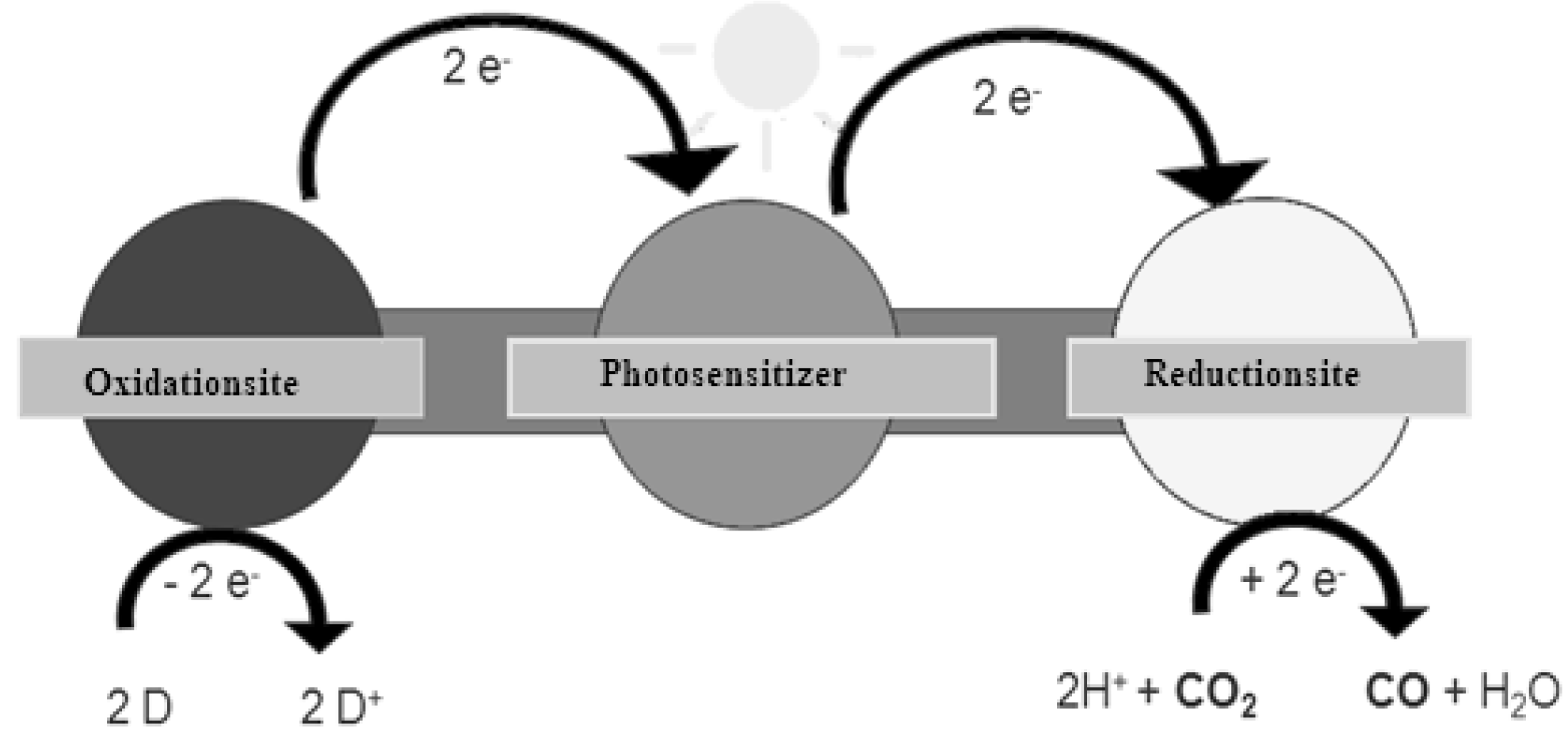
      <p>Homogenous redox photocatalysts, in principle, consist of a light harvesting unit (photosensitizer) and two catalytic sites [<xref ref-type="bibr" rid="B10-catalysts-02-00544">10</xref>]. One site is for the oxidation process, where a donor provides the electrons, and the other is the reduction site, where the electrons are transferred to an acceptor. For clarity, this review covers only processes where CO<sub>2</sub> acts as acceptor (<xref ref-type="fig" rid="catalysts-02-00544-f001">Figure 1</xref>). In many cases the photosensitizer has dual activity, e.g., as photosensitizer and reduction site, as will be discussed later on (especially in rhenium(I) catalysts).</p>
      
	  <fig id="catalysts-02-00544-f001" position="anchor">
        <label>Figure 1</label>
        <caption>
          <p>Building principle of homogeneous photoredox catalysts.</p>
        </caption>
        <graphic xmlns:xlink="http://www.w3.org/1999/xlink" xlink:href="catalysts-02-00544-g001.tif"/>
      </fig>
      
	  <fig id="catalysts-02-00544-f002" position="anchor">
        <label>Figure 2</label>
        <caption>
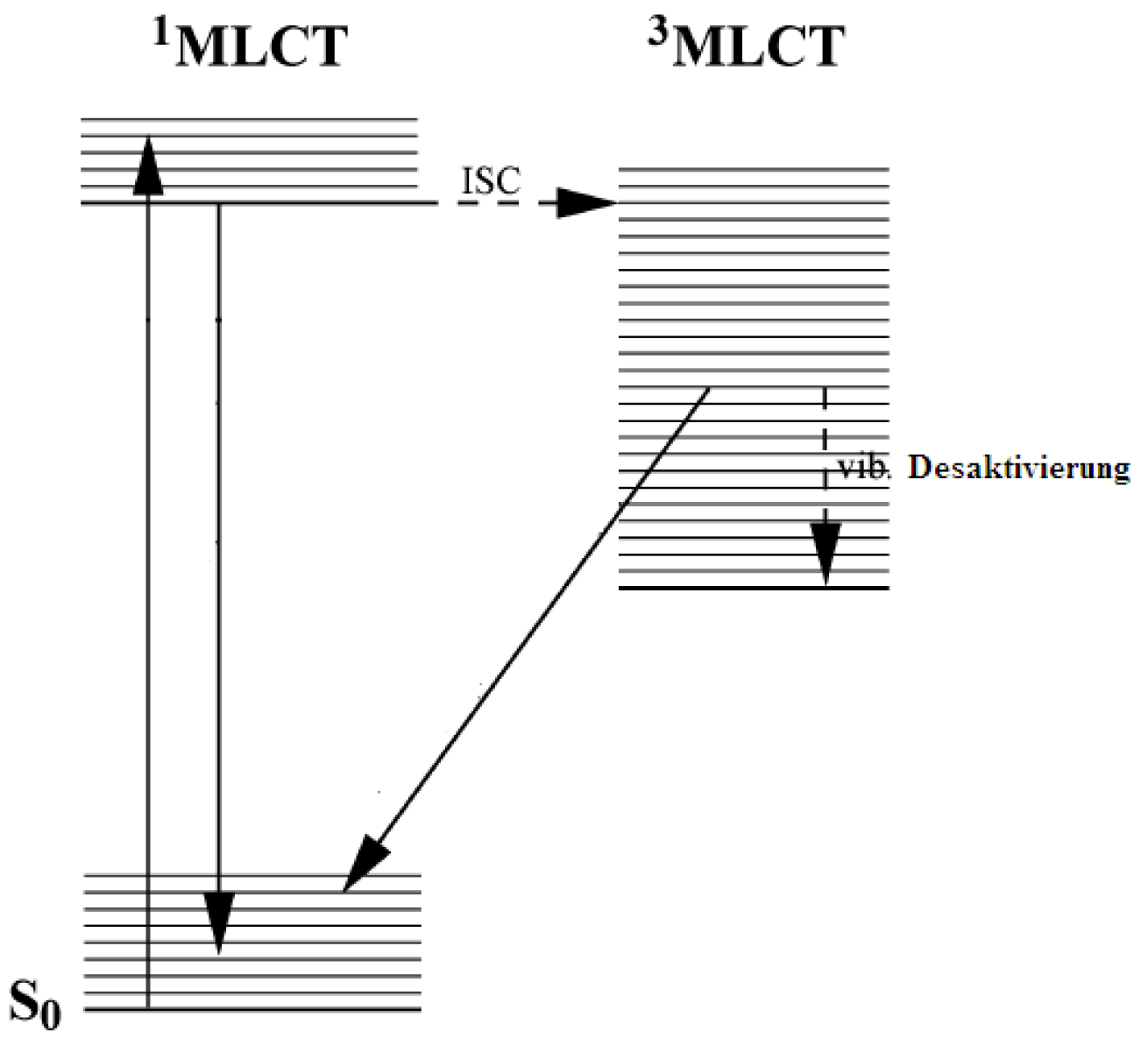
          <p>Formation of the <sup>3</sup>MLCT state via photon absorption.</p>
        </caption>
        <graphic xmlns:xlink="http://www.w3.org/1999/xlink" xlink:href="catalysts-02-00544-g002.tif"/>
      </fig>
      
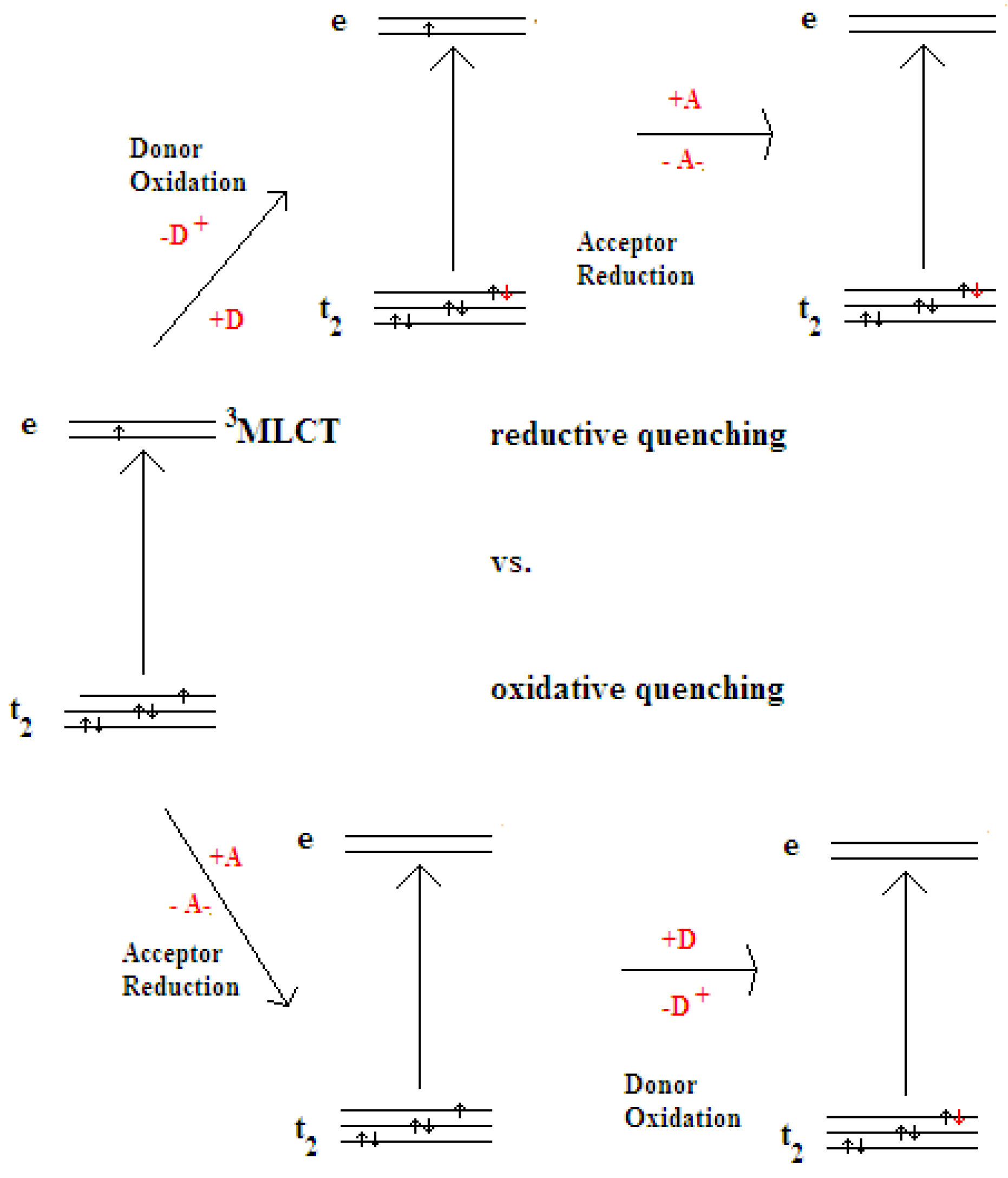
	  <p>Visible light absorption by the photosensitizer unit leads to the excited state. Concerning CO<sub>2</sub> reduction, the most commonly used photosensitizers are ruthenium (polypyridyl)- and (bipyridyl)-rhenium(I) complexes (2.1 Chromophores). In this case, the light absorption gives rise to a singlet metal to ligand charge transfer (<sup>1</sup>MLCT) which produces a triplet excited state (<sup>3</sup>MLCT) by inter system crossing (<xref ref-type="fig" rid="catalysts-02-00544-f002">Figure 2</xref>). This <sup>3</sup>MLCT state has different redox properties than the ground state. Due to the reducing properties of this state, direct interaction with an acceptor can lead to the one-electron oxidized ground state of the photosensitizer via oxidative quenching, as it was reported for the interaction of *Ru(bpy)<sub>3</sub><sup>2+</sup> with methylviologen (<xref ref-type="scheme" rid="catalysts-02-00544-scheme1">Scheme 1</xref>) [<xref ref-type="bibr" rid="B11-catalysts-02-00544">11</xref>,<xref ref-type="bibr" rid="B12-catalysts-02-00544">12</xref>]. </p>
      <fig id="catalysts-02-00544-scheme1" position="anchor">
        <object-id pub-id-type="pii">catalysts-02-00544-scheme1_Scheme 1</object-id>
        <label>Scheme 1</label>
        <caption>
          <p>Reduction of methylviologen with *Ru(bpy)<sub>3</sub><sup>2+</sup>.</p>
        </caption>
        <graphic xmlns:xlink="http://www.w3.org/1999/xlink" xlink:href="catalysts-02-00544-g017.tif"/>
      </fig>
      <p>However, in terms of CO<sub>2</sub> reduction, reductive quenching is the more important process. With an electron that is provided from the oxidation site, a ground state of the one-electron reduced species is formed, which is capable of transferring one electron to the reduction site to recover the d<sup>6</sup> neutral ground state of the photosensitizer (<xref ref-type="fig" rid="catalysts-02-00544-f003">Figure 3</xref>) [<xref ref-type="bibr" rid="B13-catalysts-02-00544">13</xref>,<xref ref-type="bibr" rid="B14-catalysts-02-00544">14</xref>,<xref ref-type="bibr" rid="B15-catalysts-02-00544">15</xref>].</p>
      <fig id="catalysts-02-00544-f003" position="anchor">
        <label>Figure 3</label>
        <caption>
          <p>Schematic representation of the electronic aspects of the electron transfer during oxidation of the donor and the reduction of the acceptor site.</p>
        </caption>
        <graphic xmlns:xlink="http://www.w3.org/1999/xlink" xlink:href="catalysts-02-00544-g003.tif"/>
      </fig>
      <sec>
        <title>2.1. Chromophores</title>
        <p>As already discussed, the intensity of sunlight strongly depends on the light wavelength with a maximum at 550 nm and, therefore, a visible light-absorbing photosensitizer is required. The most frequently used and thoroughly investigated photosensitizers are <italic>tris</italic>(bipyridyl)ruthenium(II) chloride and its analogs. The photophysics and photochemistry of these types of complexes with their powerful photosensitization capacity for electron transfer processes have already been summarized in several comprehensive reviews [<xref ref-type="bibr" rid="B16-catalysts-02-00544">16</xref>,<xref ref-type="bibr" rid="B17-catalysts-02-00544">17</xref>,<xref ref-type="bibr" rid="B18-catalysts-02-00544">18</xref>]. The excited state of <italic>tris</italic>(bipyridyl)ruthenium(II) chloride is sufficiently long lived (<italic>ca.</italic> 800 ns in water at room temperature), so that this excited state can act as both a reducing agent [<xref ref-type="bibr" rid="B19-catalysts-02-00544">19</xref>,<xref ref-type="bibr" rid="B20-catalysts-02-00544">20</xref>,<xref ref-type="bibr" rid="B21-catalysts-02-00544">21</xref>,<xref ref-type="bibr" rid="B22-catalysts-02-00544">22</xref>,<xref ref-type="bibr" rid="B23-catalysts-02-00544">23</xref>] and an oxidizing agent [<xref ref-type="bibr" rid="B24-catalysts-02-00544">24</xref>,<xref ref-type="bibr" rid="B25-catalysts-02-00544">25</xref>,<xref ref-type="bibr" rid="B26-catalysts-02-00544">26</xref>]. Great attention has also been paid to <italic>bis</italic>(terpyridine)ruthenium(II) complexes, due to the easy accessibility of stereopure polynuclear complexes with this motif [<xref ref-type="bibr" rid="B27-catalysts-02-00544">27</xref>]. However, the excited lifetime of Ru(tpy)<sub>2</sub><sup>2+</sup> is only 0.25 ns at room temperature [<xref ref-type="bibr" rid="B28-catalysts-02-00544">28</xref>], which is far too short for any long range electron transfer [<xref ref-type="bibr" rid="B29-catalysts-02-00544">29</xref>].</p>
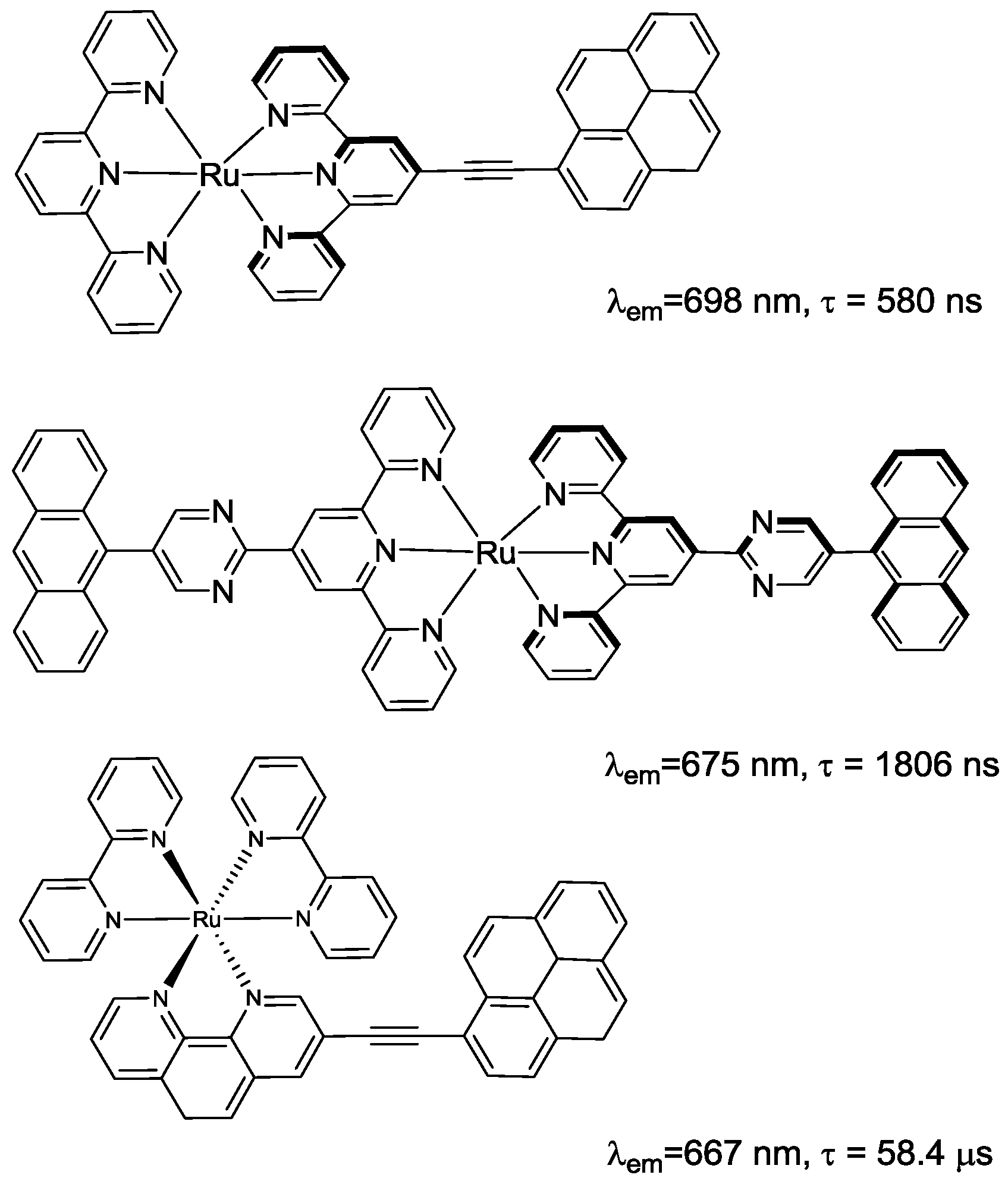
        <p>The excited state lifetime is dependent on the radiative and nonradiative rate constants of the relaxation process. In the weakly emitting Ru(II) polypyridine complexes the nonradiative decay constant is the more important factor [<xref ref-type="bibr" rid="B30-catalysts-02-00544">30</xref>]. Beside direct contributions from the ground state, this nonradiative decay can be reached via a thermally accessible metal-centered state (<sup>3</sup>MC). Lowering the energy of the <sup>3</sup>MLCT state reduces the accessibility of this <sup>3</sup>MC state, but increases the direct contribution of the ground state according to the energy gap law [<xref ref-type="bibr" rid="B31-catalysts-02-00544">31</xref>,<xref ref-type="bibr" rid="B32-catalysts-02-00544">32</xref>]. Synthetic strategies to prolong this lifetime have already been discussed. [<xref ref-type="bibr" rid="B29-catalysts-02-00544">29</xref>,<xref ref-type="bibr" rid="B33-catalysts-02-00544">33</xref>]. For example, by introduction of electron withdrawing substituents (e.g., SO<sub>2</sub>Me) [<xref ref-type="bibr" rid="B34-catalysts-02-00544">34</xref>], or acetylene groups [<xref ref-type="bibr" rid="B35-catalysts-02-00544">35</xref>], lifetimes of the <sup>3</sup>MLCT state up to 580 ns were found, due to the lowering of the <sup>3</sup>MLCT energy which reduces the population of the <sup>3</sup>MC state. However, the most successful strategy to extend the lifetime of the excited state is to equilibrate the emissive <sup>3</sup>MLCT state with a nonemissive triplet state [<xref ref-type="bibr" rid="B36-catalysts-02-00544">36</xref>]. The ruthenium(II) complex bearing a terpyridine-pyrimidyl-anthranyl ligand reached two lifetimes for the decay of the excited states of 9 ns and 1806 ns [<xref ref-type="bibr" rid="B37-catalysts-02-00544">37</xref>]. Utilizing similar strategies the lifetime of Ru(II) bipyridine complexes can also be extended reaching lifetimes of up to 58.4 µs in CH<sub>3</sub>CN (<xref ref-type="fig" rid="catalysts-02-00544-f004">Figure 4</xref>).</p>
        <p>Comparing Ru(tpy)<sub>2</sub><sup>2+</sup> with its higher homolog Os(tpy)<sub>2</sub><sup>2+</sup><sub>,</sub> a relatively long-lived <sup>3</sup>MLCT (269 ns in acetonitrile) is found. The absorption wavelength of the MLCT transfer and its first reduction potential are nearly identical to the analogous ruthenium complex [<xref ref-type="bibr" rid="B27-catalysts-02-00544">27</xref>]. A comprehensive list of the excited state behavior of further metal terpyridine complexes is detailed in <xref ref-type="table" rid="catalysts-02-00544-t001">Table 1</xref>. </p>
        <p>Beside ruthenium(II) complexes and their higher homologs, another well-established category of photosensitizers are rhenium(I) complexes. One important aspect to note for this type of complex is that they can act as both photosensitizers and catalytic site for the selective reduction of CO<sub>2</sub> to CO. </p>
		
		<fig id="catalysts-02-00544-f004" position="anchor">
          <label>Figure 4</label>
          <caption>
            <p>Representation of Ru(II)terpyridine and Ru(II)bipyridine complexes with elongated lifetime of the activated state [<xref ref-type="bibr" rid="B33-catalysts-02-00544">33</xref>,<xref ref-type="bibr" rid="B38-catalysts-02-00544">38</xref>].</p>
          </caption>
          <graphic xmlns:xlink="http://www.w3.org/1999/xlink" xlink:href="catalysts-02-00544-g004.tif"/>
        </fig>
        
        <p>The absorption of visible light by (bipyridyl)Re(I) complexes is much weaker than the previously discussed <italic>tris</italic>(bipyridyl)ruthenium(II) complexes (<xref ref-type="table" rid="catalysts-02-00544-t001">Table 1</xref>), however, Re(I) complexes are found in many reports on photocatalysis. Even in terms of photocatalytic hydrogen formation, where Re(I) cannot act as a catalytic reduction site but only as photosensitizer, this type of complex is found [<xref ref-type="bibr" rid="B39-catalysts-02-00544">39</xref>]. This is likely because in the excited state, these complexes undergo faster reductive quenching by tertiary amines as compared to ruthenium polypyridine dyes [<xref ref-type="bibr" rid="B40-catalysts-02-00544">40</xref>,<xref ref-type="bibr" rid="B41-catalysts-02-00544">41</xref>]. In terms of photocatalytic formation of hydrogen, further reports can be found with Pt(II) [<xref ref-type="bibr" rid="B42-catalysts-02-00544">42</xref>,<xref ref-type="bibr" rid="B43-catalysts-02-00544">43</xref>], Ir(III) [<xref ref-type="bibr" rid="B44-catalysts-02-00544">44</xref>,<xref ref-type="bibr" rid="B45-catalysts-02-00544">45</xref>,<xref ref-type="bibr" rid="B46-catalysts-02-00544">46</xref>], and Os(II) [<xref ref-type="bibr" rid="B47-catalysts-02-00544">47</xref>]-based chromophores.</p>
		
		<table-wrap id="catalysts-02-00544-t001" position="float">
          <object-id pub-id-type="pii">catalysts-02-00544-t001_Table 1</object-id>
          <label>Table 1</label>
          <caption>
            <p>Absorption, Luminescence and Electrochemical Data.</p>
          </caption>
          <table>
            <thead>
              <tr>
                <th align="center" valign="middle"> </th>
                <th align="center" valign="middle"> </th>
                <th colspan="3" align="center" valign="middle" style="border-bottom:solid thin">Emission</th>
                <th colspan="2" align="center" valign="middle" style="border-bottom:solid thin">Electrochemistry E [V] </th>
                <th align="center" valign="middle"> </th>
              </tr>
              <tr>
                <th align="center" valign="middle">Complex</th>
                <th align="center" valign="middle">λ<sub>max</sub> absorption [nm] (10<sup>3</sup>M<sup>−1</sup>cm<sup>−1</sup>])</th>
                <th align="center" valign="middle">[nm] </th>
                <th align="center" valign="middle"/>
                <th align="center" valign="middle">[ns]</th>
                <th align="center" valign="middle">ox</th>
                <th align="center" valign="middle">red</th>
                <th align="center" valign="middle">ref</th>
              </tr>
            </thead>
            <tbody>
              <tr>
                <td align="left" valign="top">Ru(bpy)<sub>3</sub><sup>2+</sup></td>
                <td align="left" valign="top">452 * (4.16)</td>
                <td align="left" valign="top">607 *</td>
                <td align="left" valign="top">0.073 *</td>
                <td align="left" valign="top">800 *</td>
                <td align="left" valign="top">1.29</td>
                <td align="left" valign="top">−1.33, −0.81 <sup>a</sup></td>
                <td align="left" valign="top">[<xref ref-type="bibr" rid="B48-catalysts-02-00544">48</xref>,<xref ref-type="bibr" rid="B49-catalysts-02-00544">49</xref>]</td>
              </tr>
              <tr>
                <td align="left" valign="top">Ru(dmb)<sub>3</sub><sup>2+</sup></td>
                <td align="left" valign="top">459 (14.9)</td>
                <td align="left" valign="top">630</td>
                <td align="left" valign="top">0.089</td>
                <td align="left" valign="top">840 </td>
                <td align="left" valign="top">+0.80</td>
                <td align="left" valign="top">−2.22, −1.96, −1.77 <sup>b</sup></td>
                <td align="left" valign="top">[<xref ref-type="bibr" rid="B17-catalysts-02-00544">17</xref>,<xref ref-type="bibr" rid="B50-catalysts-02-00544">50</xref>,<xref ref-type="bibr" rid="B51-catalysts-02-00544">51</xref>,<xref ref-type="bibr" rid="B52-catalysts-02-00544">52</xref>,<xref ref-type="bibr" rid="B53-catalysts-02-00544">53</xref>,<xref ref-type="bibr" rid="B54-catalysts-02-00544">54</xref>]</td>
              </tr>
              <tr>
                <td align="left" valign="top">Ru(tpy)<sub>2</sub><sup>2+</sup></td>
                <td align="left" valign="top">476 (17.7)</td>
                <td align="left" valign="top">-</td>
                <td align="left" valign="top">-</td>
                <td align="left" valign="top">0.250</td>
                <td align="left" valign="top">+1.30</td>
                <td align="left" valign="top">−1.24 <sup>a</sup></td>
                <td align="left" valign="top">[<xref ref-type="bibr" rid="B28-catalysts-02-00544">28</xref>,<xref ref-type="bibr" rid="B55-catalysts-02-00544">55</xref>]</td>
              </tr>
              <tr>
                <td align="left" valign="top">Os(tpy)<sub>2</sub><sup>2+</sup></td>
                <td align="left" valign="top">657 (3.65), 477 (13.75)</td>
                <td align="left" valign="top">718</td>
                <td align="left" valign="top">0.014</td>
                <td align="left" valign="top">296</td>
                <td align="left" valign="top">+0.97</td>
                <td align="left" valign="top">−1.23 <sup>a</sup></td>
                <td align="left" valign="top">[<xref ref-type="bibr" rid="B56-catalysts-02-00544">56</xref>,<xref ref-type="bibr" rid="B57-catalysts-02-00544">57</xref>,<xref ref-type="bibr" rid="B58-catalysts-02-00544">58</xref>]</td>
              </tr>
              <tr>
                <td align="left" valign="top">Cr(tpy)<sub>2</sub><sup>3+</sup></td>
                <td align="left" valign="top">473</td>
                <td align="left" valign="top">775</td>
                <td align="left" valign="top"> </td>
                <td align="left" valign="top">50</td>
                <td align="left" valign="top">+1.43</td>
                <td align="left" valign="top">−0.17 <sup>c</sup></td>
                <td align="left" valign="top">[<xref ref-type="bibr" rid="B59-catalysts-02-00544">59</xref>,<xref ref-type="bibr" rid="B60-catalysts-02-00544">60</xref>]</td>
              </tr>
              <tr>
                <td align="left" valign="top">Fe(tpy)<sub>2</sub><sup>2+</sup></td>
                <td align="left" valign="top">522</td>
                <td align="left" valign="top">-</td>
                <td align="left" valign="top">-</td>
                <td align="left" valign="top">2.5</td>
                <td align="left" valign="top">+1.05</td>
                <td align="left" valign="top">−1.17 <sup>c</sup></td>
                <td align="left" valign="top">[<xref ref-type="bibr" rid="B61-catalysts-02-00544">61</xref>]</td>
              </tr>
              <tr>
                <td align="left" valign="top">Ir(tpy)<sub>2</sub><sup>3+</sup></td>
                <td align="left" valign="top">355 (13.8)</td>
                <td align="left" valign="top">455</td>
                <td align="left" valign="top"> </td>
                <td align="left" valign="top">70</td>
                <td align="left" valign="top"> </td>
                <td align="left" valign="top"> </td>
                <td align="left" valign="top">[<xref ref-type="bibr" rid="B62-catalysts-02-00544">62</xref>]</td>
              </tr>
              <tr>
                <td align="left" valign="top">(bpy)Re(CO)<sub>3</sub>Cl</td>
                <td align="left" valign="top">370 (3.42)</td>
                <td align="left" valign="top">637</td>
                <td align="left" valign="top"> </td>
                <td align="left" valign="top">30</td>
                <td align="left" valign="top"> </td>
                <td align="left" valign="top">−1.61 <sup>b</sup></td>
                <td align="left" valign="top">[<xref ref-type="bibr" rid="B63-catalysts-02-00544">63</xref>,<xref ref-type="bibr" rid="B64-catalysts-02-00544">64</xref>]</td>
              </tr>
              <tr>
                <td align="left" valign="top">(bpy)Re(CO)<sub>3</sub>NCS</td>
                <td align="left" valign="top">375</td>
                <td align="left" valign="top">635</td>
                <td align="left" valign="top"> </td>
                <td align="left" valign="top">25</td>
                <td align="left" valign="top"> </td>
                <td align="left" valign="top">−1.67 <sup>b</sup></td>
                <td align="left" valign="top">[<xref ref-type="bibr" rid="B63-catalysts-02-00544">63</xref>,<xref ref-type="bibr" rid="B65-catalysts-02-00544">65</xref>]</td>
              </tr>
              <tr>
                <td align="left" valign="top">(dmb)Re(CO)<sub>3</sub>Cl</td>
                <td align="left" valign="top">366 (3.7)</td>
                <td align="left" valign="top">601</td>
                <td align="left" valign="top">0.0016</td>
                <td align="left" valign="top"> </td>
                <td align="left" valign="top">+1.36, 1.85</td>
                <td align="left" valign="top">−1.43, −1.95 <sup>a</sup></td>
                <td align="left" valign="top">[<xref ref-type="bibr" rid="B66-catalysts-02-00544">66</xref>]</td>
              </tr>
            </tbody>
          </table>
		  <table-wrap-foot><fn>
		<p><sup>a</sup> <italic>vs.</italic> SSCE, <sup>b</sup> <italic>vs</italic>. AgNO<sub>3</sub> <sup>c</sup> <italic>vs.</italic> NHE–measured in acetonitrile unless otherwise noted, * measured in H<sub>2</sub>O.</p>
		</fn></table-wrap-foot>
		  </table-wrap>


      </sec>
      <sec id="sec2dot2-catalysts-02-00544">
        <title>2.2. Design of the Reduction Site</title>
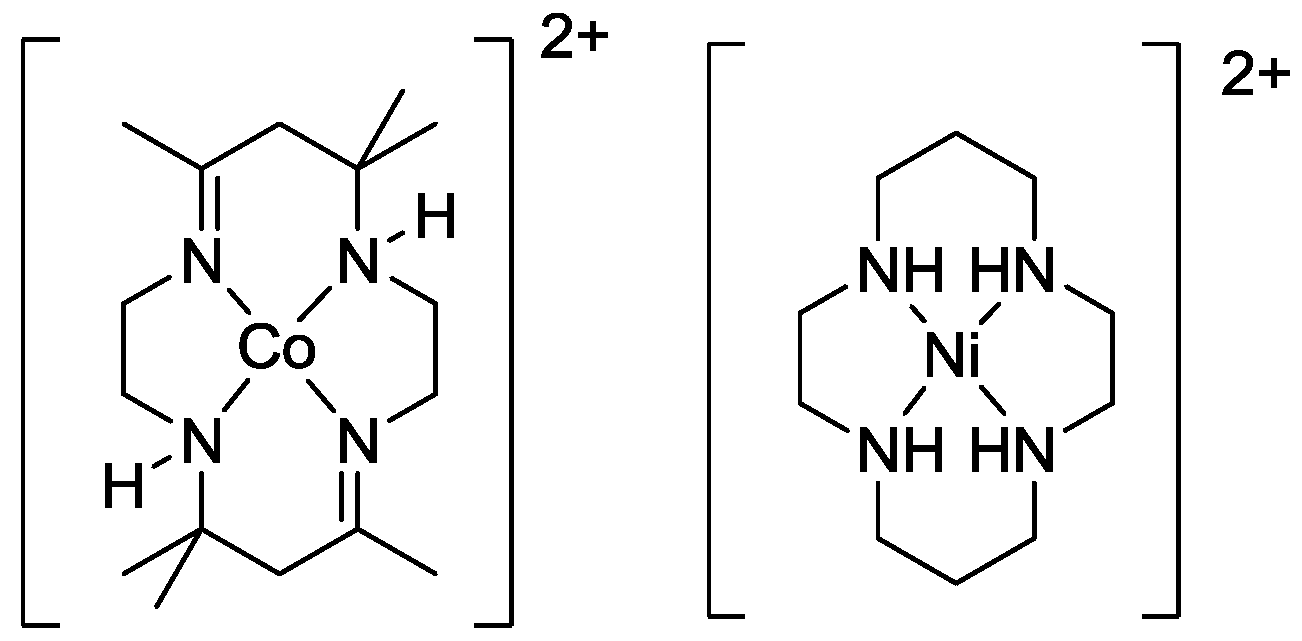
        <p>In the first report about homogeneous catalyst systems for the photoreduction of CO<sub>2</sub> by Lehn and co-workers, CoCl<sub>2</sub> was used as the catalytic site with [Ru(bpy)<sub>3</sub>]Cl<sub>2</sub> as photosensitizer [<xref ref-type="bibr" rid="B67-catalysts-02-00544">67</xref>,<xref ref-type="bibr" rid="B68-catalysts-02-00544">68</xref>]. However, CoCl<sub>2</sub> has only very low selectivity towards the reduction of CO<sub>2</sub> and hydrogen, resulting from the reduction of water in the aqueous media that is the main product in this system. In alternative catalyst systems such as RhCl<sub>3</sub>, NiCl<sub>2</sub>, CuCl<sub>2</sub> or K<sub>2</sub>PtCl<sub>4,</sub> the selectivity towards CO<sub>2</sub> reduction was found to be further reduced. Cobalt macrocycles such as CoHMD<sup>2+</sup> with <italic>p</italic>-terphenyl as a photosensitizer and a tertiary amine as a sacrificial electron led to formation of both CO and formate with a reduced hydrogen yield (<xref ref-type="fig" rid="catalysts-02-00544-f005">Figure 5</xref>) [<xref ref-type="bibr" rid="B69-catalysts-02-00544">69</xref>,<xref ref-type="bibr" rid="B70-catalysts-02-00544">70</xref>,<xref ref-type="bibr" rid="B71-catalysts-02-00544">71</xref>].</p>
        <fig id="catalysts-02-00544-f005" position="anchor">
          <label>Figure 5</label>
          <caption>
            <p><italic>N</italic>-<italic>rac</italic>-CoHMD<sup>2+</sup> (left) and Ni(II)-cyclam (right) complex.</p>
          </caption>
          <graphic xmlns:xlink="http://www.w3.org/1999/xlink" xlink:href="catalysts-02-00544-g005.tif"/>
        </fig>
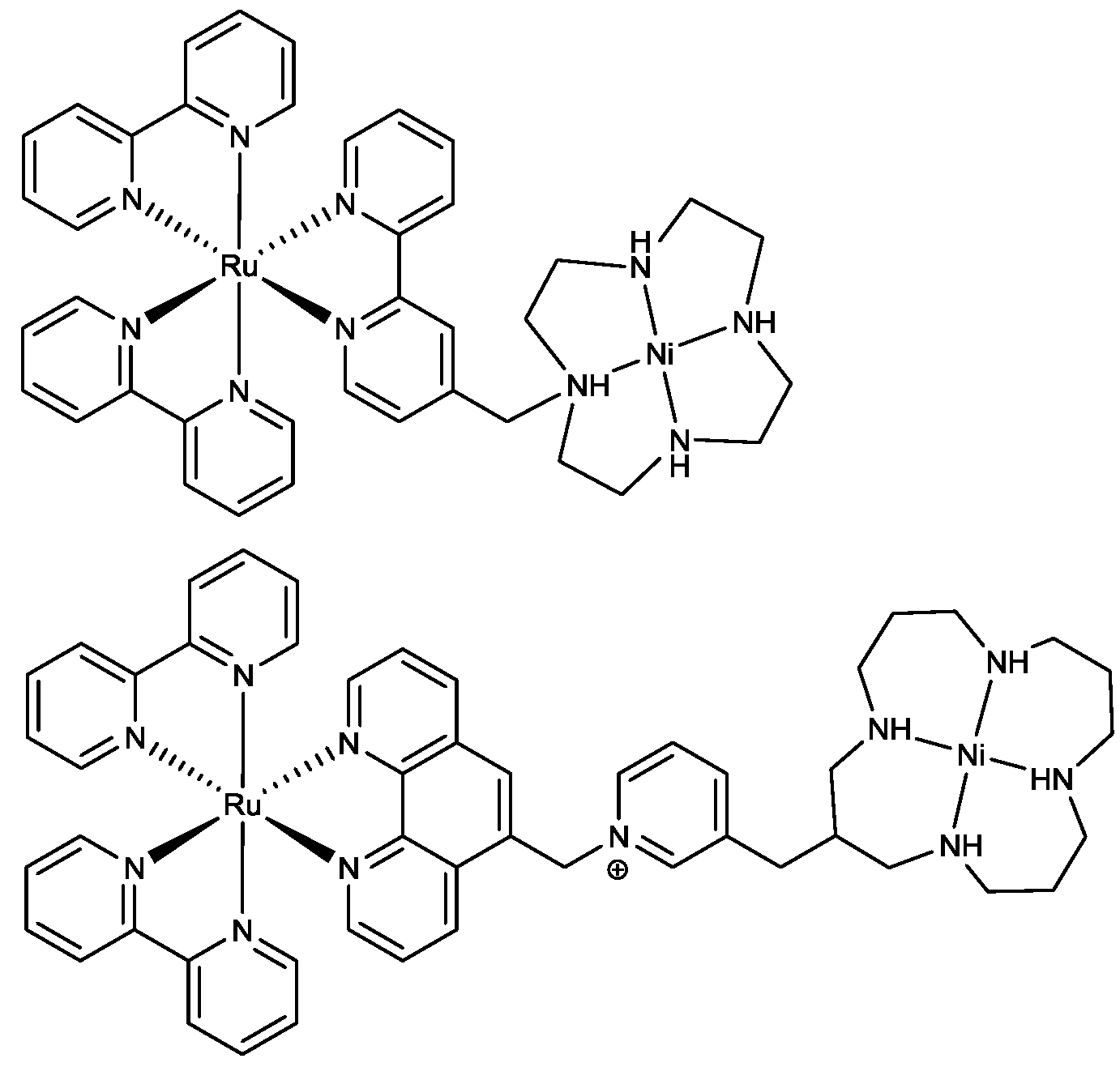
        <p>Grant <italic>et al.</italic> reported a Ni(II)-cyclam reduction site for the photoreduction of CO<sub>2</sub> to CO with Ru(bpy)<sub>3</sub><sup>2+</sup> as photosensitizer (<xref ref-type="fig" rid="catalysts-02-00544-f005">Figure 5</xref>) [<xref ref-type="bibr" rid="B72-catalysts-02-00544">72</xref>,<xref ref-type="bibr" rid="B73-catalysts-02-00544">73</xref>]. These Ni-cyclam catalysts were modified by Kimura <italic>et al.</italic> for the photocatalytic CO<sub>2</sub> reduction by synthesis of supramolecular Ru-Ni catalysts with covalent linkage of the Ru-based chromophores to the reduction site (<xref ref-type="fig" rid="catalysts-02-00544-f006">Figure 6</xref>). However, due to the lack of selectivity for production of CO over H<sub>2</sub> and other unidentified competing processes in the catalytic cycle, these complexes exhibit very low yields. The amount of CO, produced by this type of investigated Ni-cyclam catalyst is less than stoichiometric [<xref ref-type="bibr" rid="B74-catalysts-02-00544">74</xref>,<xref ref-type="bibr" rid="B75-catalysts-02-00544">75</xref>,<xref ref-type="bibr" rid="B76-catalysts-02-00544">76</xref>].</p>
        <fig id="catalysts-02-00544-f006" position="anchor">
          <label>Figure 6</label>
          <caption>
            <p>Bimetallic Ru-Ni catalysts for CO<sub>2</sub> reduction.</p>
          </caption>
          <graphic xmlns:xlink="http://www.w3.org/1999/xlink" xlink:href="catalysts-02-00544-g006.tif"/>
        </fig>
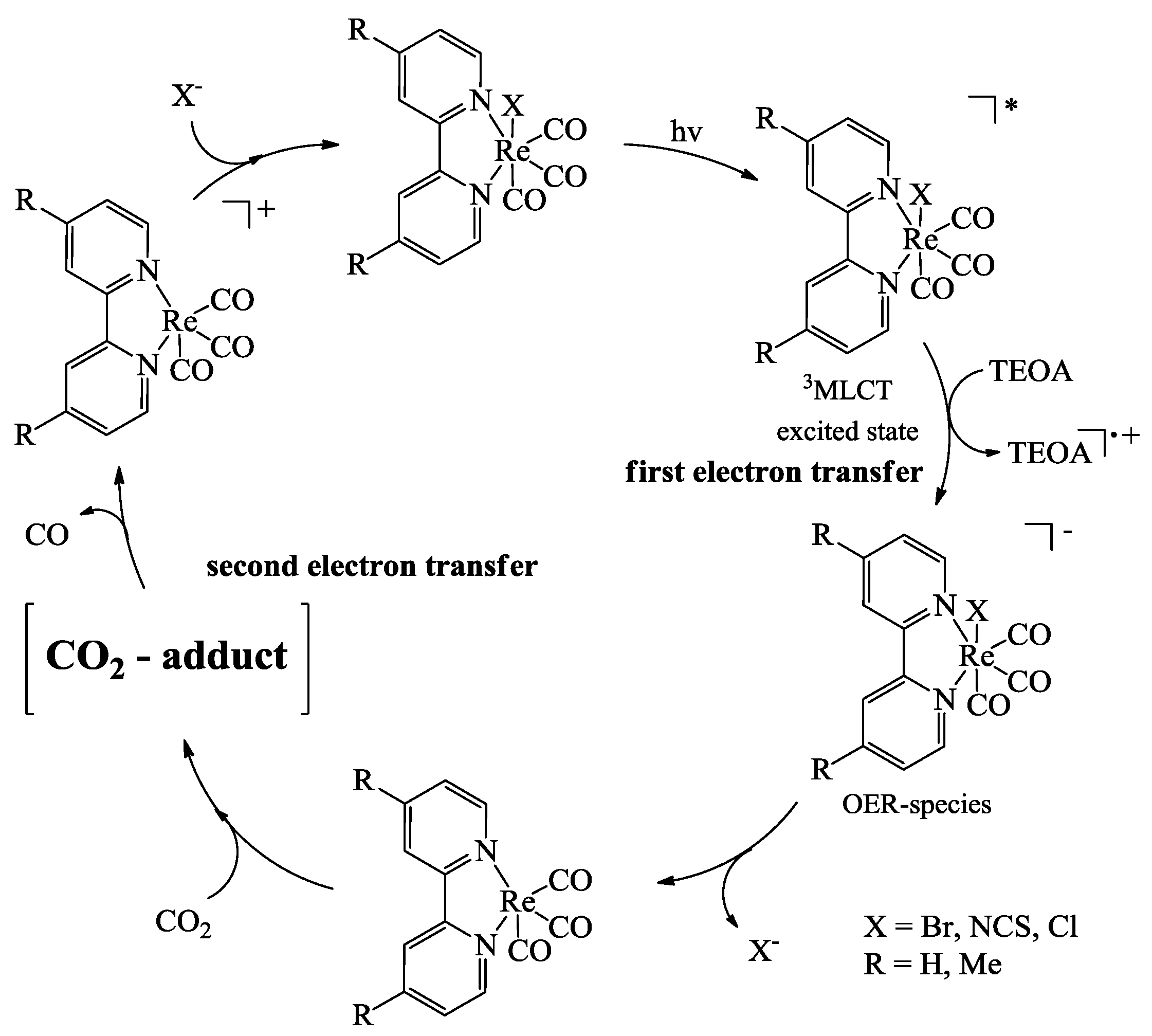
        <p>To date, the most selective catalytic reduction site for the photoreduction of CO<sub>2</sub> are rhenium(I) systems. These selectively form CO from CO<sub>2</sub> with only small amounts of hydrogen as a by-product [<xref ref-type="bibr" rid="B63-catalysts-02-00544">63</xref>]. The first reported Re(I)-type complexes were [Re(bpy)(CO)<sub>3</sub>X] (X = Cl, Br), affording quantum yields of up to 0.14 [<xref ref-type="bibr" rid="B77-catalysts-02-00544">77</xref>,<xref ref-type="bibr" rid="B78-catalysts-02-00544">78</xref>]. Mechanistic aspects are summarized and discussed in recently published reviews [<xref ref-type="bibr" rid="B13-catalysts-02-00544">13</xref>,<xref ref-type="bibr" rid="B14-catalysts-02-00544">14</xref>,<xref ref-type="bibr" rid="B15-catalysts-02-00544">15</xref>]. A central role in reduction half-cell reaction with Re(I) complexes is ascribed to the one-electron reduced species (OER). The reduction site is capable of transferring the electron that is provided from the electron donating site to the CO<sub>2</sub> molecule. In reports on mechanistic investigations of this half-cell reaction, this OER is simply formed by one-electron reduction of the <sup>3</sup>MLCT state of the Re(I) complex via TEOA (triethanolamine), which forms the ground state of the OER. This gives an unstable 19 electron species in which a coordination site becomes available by dissociation of the ligand X [<xref ref-type="bibr" rid="B78-catalysts-02-00544">78</xref>]. Subsequently, a CO<sub>2</sub> adduct can be formed via nucleophilic attack of the rhenium center on the electrophilic carbon atom of the CO<sub>2</sub> molecule (<xref ref-type="scheme" rid="catalysts-02-00544-scheme2">Scheme 2</xref>). The intermediates of the catalytic cycle cannot be unambiguously labeled, but at least several carboxylato-metal complexes of rhenium have been isolated, characterized, and their reactivity towards decarboxylation studied [<xref ref-type="bibr" rid="B79-catalysts-02-00544">79</xref>,<xref ref-type="bibr" rid="B80-catalysts-02-00544">80</xref>]. </p>
        <p>Due to the high reduction potential of the one-electron reduction (−1.9 V <italic>vs</italic>. normal hydrogen electrode), multielectron reduction processes are more favorable [<xref ref-type="bibr" rid="B81-catalysts-02-00544">81</xref>]. Therefore, the reduction of CO<sub>2</sub> to CO at moderate potentials requires the concerted transfer of two electrons. Ishitani and co-workers postulated a bimetallic reaction sequence where the second electron originates from another OER [<xref ref-type="bibr" rid="B65-catalysts-02-00544">65</xref>]. This bimetallic mechanism and the special role of the OER was confirmed by the direct comparison of the activity of Re-NCS and Re-Cl complexes in the photocatalytic formation of CO in the presence of a sacrificial donor (TEOA). The photophysical properties (especially absorption and emission properties) of both complexes do not differ remarkably, but the Re-NCS complex with the longer-lived OER is the more active catalyst. With the cationic complex [Re(bpy)(CO)<sub>3</sub>{P(OEt)<sub>3</sub>}]<sup>+</sup>, a quantum yield of up to 0.38 was reached, strongly depending on the light intensity [<xref ref-type="bibr" rid="B82-catalysts-02-00544">82</xref>]. This again can be ascribed to the long-lived OER due to the strong π-accepting ability of the P(OEt)<sub>3</sub> ligand. With further modifications, Ishitani <italic>et al.</italic> reached the highest known quantum yield for the photocatalytic formation of CO of 0.59 with the cationic [Re(bpy)(CO)<sub>3</sub>(MeCN)]<sup>+</sup> complex [<xref ref-type="bibr" rid="B65-catalysts-02-00544">65</xref>]. The weakly bound MeCN ligand can be easily dissociated to generate a free coordination site for CO<sub>2</sub> and the strongly bound P(OEt)<sub>3</sub> in [Re{4,4'-(MeO)2bpy}(CO)<sub>3</sub>(POEt)<sub>3</sub>)]<sup>+</sup> results in a long-lived OER that can provide a second electron. </p>
		
		<fig id="catalysts-02-00544-scheme2" position="anchor">
          <object-id pub-id-type="pii">catalysts-02-00544-scheme2_Scheme 2</object-id>
          <label>Scheme 2</label>
          <caption>
            <p>Catalytic cycle for the photoreduction of CO<sub>2</sub> with (bipyridyl)Re(CO)<sub>3</sub>X complexes [<xref ref-type="bibr" rid="B78-catalysts-02-00544">78</xref>].</p>
          </caption>
          <graphic xmlns:xlink="http://www.w3.org/1999/xlink" xlink:href="catalysts-02-00544-g018.tif"/>
        </fig>
        
        <p>The nature of the bimetallic intermediate that enables the transfer of two electrons is not fully clarified. However, Fujita and co-workers identified a CO<sub>2</sub> bridged dimer [(CO)<sub>3</sub>(dmb)Re-CO(O)-Re(dmb)(CO)<sub>3</sub>] as an intermediate in the photocatalytic reduction of CO<sub>2</sub> [<xref ref-type="bibr" rid="B83-catalysts-02-00544">83</xref>]. This key product was isolated previously by Gibson <italic>et al.</italic> via thermolysis of [(dmb)Re(CO)<sub>3</sub>(COOH)] in dimethyl formamide [<xref ref-type="bibr" rid="B84-catalysts-02-00544">84</xref>,<xref ref-type="bibr" rid="B85-catalysts-02-00544">85</xref>].</p>
        
		<fig id="catalysts-02-00544-f007" position="anchor">
          <label>Figure 7</label>
          <caption>
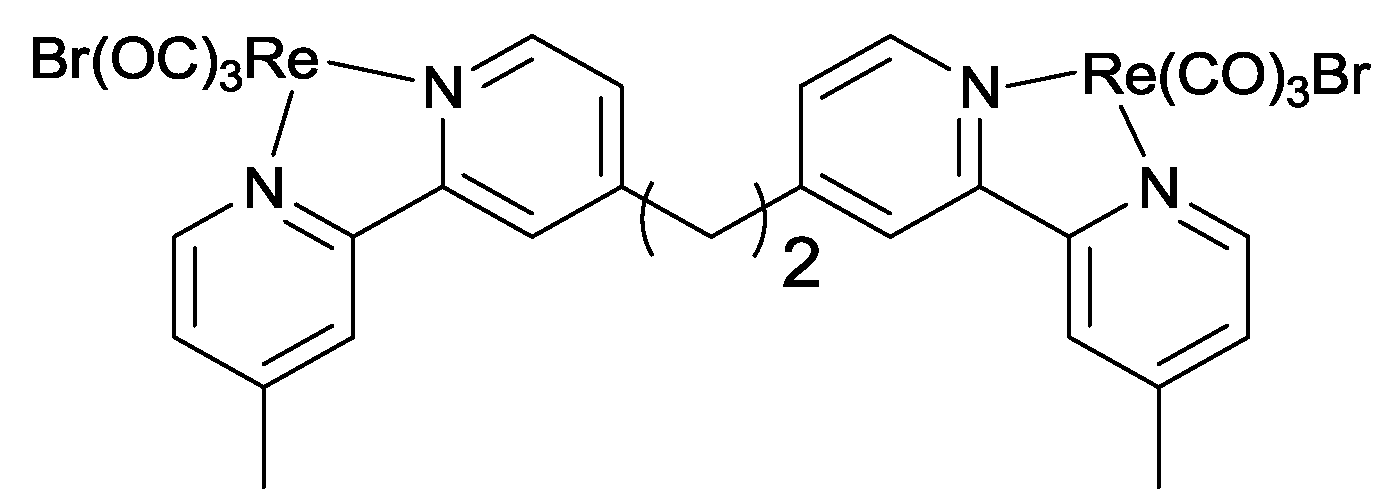
            <p>Binuclear Re(I)-catalyst.</p>
          </caption>
          <graphic xmlns:xlink="http://www.w3.org/1999/xlink" xlink:href="catalysts-02-00544-g007.tif"/>
        </fig>
        
		
		<p>The binuclearity of this reduction reaction was recently investigated with binuclear rhenium complexes (<xref ref-type="fig" rid="catalysts-02-00544-f007">Figure 7</xref>) [<xref ref-type="bibr" rid="B86-catalysts-02-00544">86</xref>]. Usually Re-Br type complexes with their short-lived OER clearly show a mononuclear overall reaction rate for the photocatalytic reduction of CO<sub>2</sub>, with no indication of any binuclear aspects. However, with a covalently linked binary Re(I) complex (<xref ref-type="fig" rid="catalysts-02-00544-f007">Figure 7</xref>) the catalytic activity was increased due to the presence of a second Re center in proximity to the first. According to this it was concluded that a binuclear mechanism predominates if the proximity of centers is adjusted according to the lifetime of the OER. In case of Re-NCS-type complexes, with long-lived OERs, the bimetallic mechanism can be realized by simply increasing the concentration of the catalyst. Therefore, Re-NCS-type complexes were often reported to be the most active rhenium(I) photocatalysts for the reduction of CO<sub>2</sub> [<xref ref-type="bibr" rid="B65-catalysts-02-00544">65</xref>]. However, in case of the binuclear complexes, it was shown that Re-Br type complexes are more active, if the proximity of centers is precisely adjusted by covalent linkage. In the case of bimetallic rhenium(I) complexes, the Re-Br type complexes act in a bimetallic fashion, which results in unexpectedly high activity. </p>
        <p>Another well-established category of reduction sites are catalysts of the type [Ru(bpy)<sub>2</sub>(CO)X]<italic><sup>n</sup></italic><sup>+</sup> (X = CO, Cl, H) and [Ru(bpy)<sub>2</sub>(CO)<sub>2</sub>X<sub>2</sub>]<italic><sup>n</sup></italic><sup>+</sup> (X = Cl, CH<sub>3</sub>CN). They are known to produce formate and CO by photocatalytic and electrocatalytic processes. In these systems, the open cluster polymeric [{Ru<sup>0</sup>(bpy)(CO)<sub>2</sub>}<italic><sub>n</sub></italic>] species was identified as the catalytically active product that is formed by two-electron reduction and loss of ligand. These polymeric precipitates selectively form CO from the reduction of CO<sub>2</sub> [<xref ref-type="bibr" rid="B87-catalysts-02-00544">87</xref>,<xref ref-type="bibr" rid="B88-catalysts-02-00544">88</xref>,<xref ref-type="bibr" rid="B89-catalysts-02-00544">89</xref>,<xref ref-type="bibr" rid="B90-catalysts-02-00544">90</xref>,<xref ref-type="bibr" rid="B91-catalysts-02-00544">91</xref>,<xref ref-type="bibr" rid="B92-catalysts-02-00544">92</xref>,<xref ref-type="bibr" rid="B93-catalysts-02-00544">93</xref>,<xref ref-type="bibr" rid="B94-catalysts-02-00544">94</xref>,<xref ref-type="bibr" rid="B95-catalysts-02-00544">95</xref>,<xref ref-type="bibr" rid="B96-catalysts-02-00544">96</xref>,<xref ref-type="bibr" rid="B97-catalysts-02-00544">97</xref>].</p>
      </sec>
      <sec>
        <title>2.3. Oxidation Site</title>
        <p>In most of the reports on the photocatalytic reduction of CO<sub>2</sub> the oxidation site is circumvented with the help of a sacrificial donor that reduces the activated <sup>3</sup>MLCT state of the photosensitizer. This generates the one-electron reduced species of the photosensitizer which is important for the further reduction process (reductive quenching). In case of rhenium(I) complexes TEOA (triethanolamine) is most frequently used as donor (<italic>E</italic><sub>0</sub>[TEOA/TEOA<sup>+</sup>] = 0.82 V) (<xref ref-type="scheme" rid="catalysts-02-00544-scheme3">Scheme 3</xref>) [<xref ref-type="bibr" rid="B12-catalysts-02-00544">12</xref>].</p>
        <fig id="catalysts-02-00544-scheme3" position="anchor">
          <object-id pub-id-type="pii">catalysts-02-00544-scheme3_Scheme 3</object-id>
          <label>Scheme 3</label>
          <caption>
            <p>Reductive quenching of the activated rhenium(I) complex with TEOA [<xref ref-type="bibr" rid="B12-catalysts-02-00544">12</xref>].</p>
          </caption>
          <graphic xmlns:xlink="http://www.w3.org/1999/xlink" xlink:href="catalysts-02-00544-g019.tif"/>
        </fig>
        
		<fig id="catalysts-02-00544-scheme4" position="anchor">
          <object-id pub-id-type="pii">catalysts-02-00544-scheme4_Scheme 4</object-id>
          <label>Scheme 4</label>
          <caption>
            <p>Reaction sequence for the oxidation of TEOA [<xref ref-type="bibr" rid="B98-catalysts-02-00544">98</xref>].</p>
          </caption>
          <graphic xmlns:xlink="http://www.w3.org/1999/xlink" xlink:href="catalysts-02-00544-g020.tif"/>
        </fig>
        
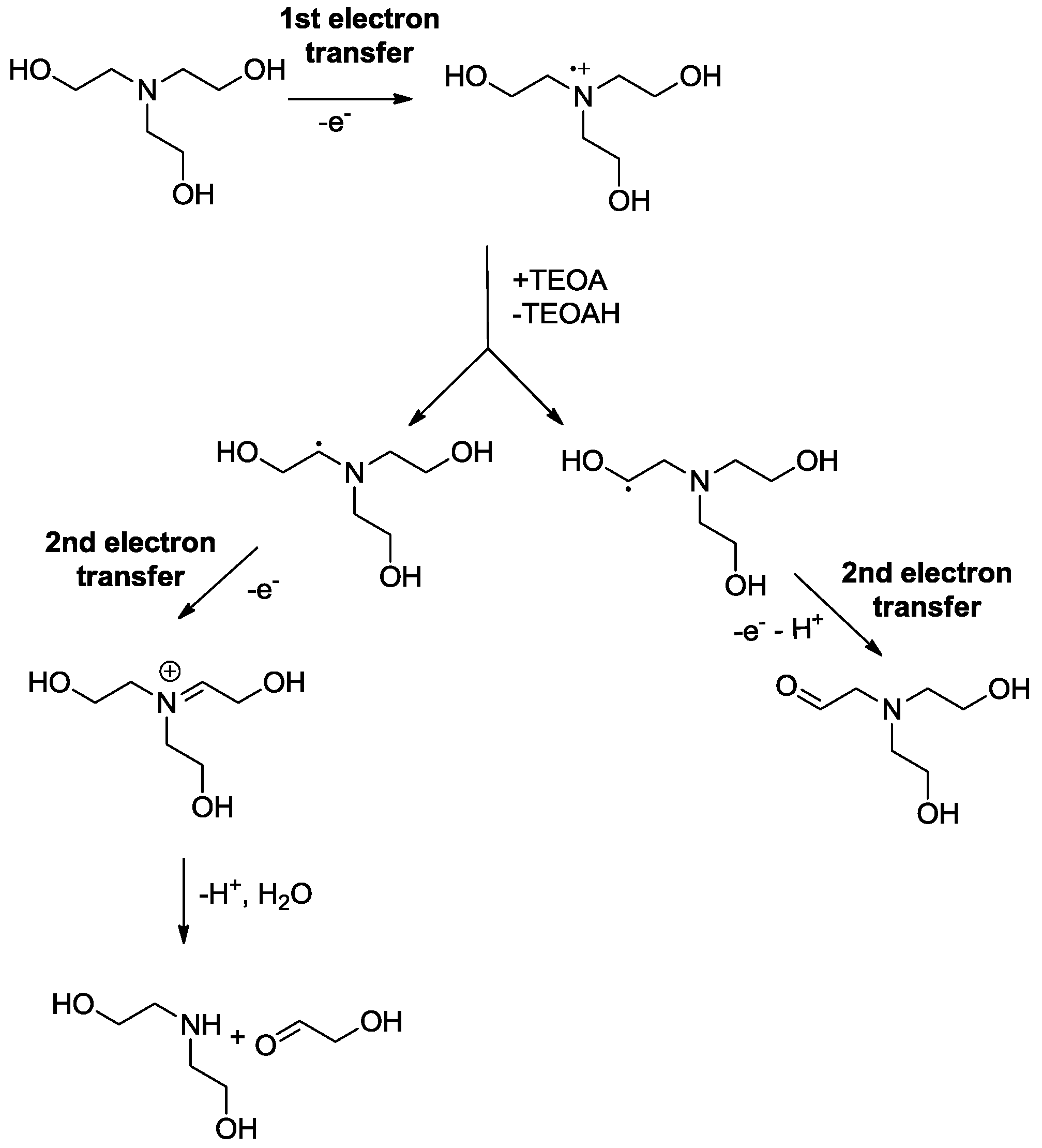
		<p>Reductive quenching of the activated photosensitizer with TEOA generates the nitrogen-centered radical cation of TEOA. Abstraction of a proton at this TEOA radical by a further TEOA molecule yields the carbon-centered radicals (<xref ref-type="scheme" rid="catalysts-02-00544-scheme4">Scheme 4</xref>) [<xref ref-type="bibr" rid="B12-catalysts-02-00544">12</xref>,<xref ref-type="bibr" rid="B99-catalysts-02-00544">99</xref>,<xref ref-type="bibr" rid="B100-catalysts-02-00544">100</xref>,<xref ref-type="bibr" rid="B101-catalysts-02-00544">101</xref>,<xref ref-type="bibr" rid="B102-catalysts-02-00544">102</xref>]. Unlike the aminyl radical TEOA·, these carbon-centered radicals are strong reducing agents that prevent back electron transfer from the OER and are capable of donating a second electron [<xref ref-type="bibr" rid="B12-catalysts-02-00544">12</xref>,<xref ref-type="bibr" rid="B99-catalysts-02-00544">99</xref>,<xref ref-type="bibr" rid="B100-catalysts-02-00544">100</xref>,<xref ref-type="bibr" rid="B101-catalysts-02-00544">101</xref>,<xref ref-type="bibr" rid="B102-catalysts-02-00544">102</xref>,<xref ref-type="bibr" rid="B103-catalysts-02-00544">103</xref>,<xref ref-type="bibr" rid="B104-catalysts-02-00544">104</xref>].</p>
		
		<table-wrap id="catalysts-02-00544-t002" position="float">
          <object-id pub-id-type="pii">catalysts-02-00544-t002_Table 2</object-id>
          <label>Table 2</label>
          <caption>
            <p>Properties of various organic donors in face of reductive quenching of Ru(bpy)<sub>3</sub><sup>2+</sup>.</p>
          </caption>
          <table>
            <thead>
              <tr>
                <th align="center" valign="middle">Donor</th>
                <th align="center" valign="middle"><italic>k</italic><sub>q</sub> [10<sup>7</sup> M<sup>−1</sup> s<sup>−1</sup>]</th>
                <th align="center" valign="middle"><italic>E</italic><sub>0</sub>[V]</th>
                <th align="center" valign="middle">Lit</th>
              </tr>
            </thead>
            <tbody>
              <tr>
                <td align="center" valign="middle"><italic>N</italic>,<italic>N</italic>,<italic>N</italic><italic>'</italic>,<italic>N</italic>'-Tetramethylbenzidine</td>
                <td align="center" valign="middle">740</td>
                <td align="center" valign="middle">0.69</td>
                <td align="center" valign="middle">[<xref ref-type="bibr" rid="B98-catalysts-02-00544">98</xref>]</td>
              </tr>
              <tr>
                <td align="center" valign="middle">Phenothiazine</td>
                <td align="center" valign="middle">560</td>
                <td align="center" valign="middle">0.73</td>
                <td align="center" valign="middle">[<xref ref-type="bibr" rid="B98-catalysts-02-00544">98</xref>]</td>
              </tr>
              <tr>
                <td align="center" valign="middle">Dimethyl-Dibenzothiofulvalene</td>
                <td align="center" valign="middle">400</td>
                <td align="center" valign="middle">0.78</td>
                <td align="center" valign="middle">[<xref ref-type="bibr" rid="B98-catalysts-02-00544">98</xref>]</td>
              </tr>
              <tr>
                <td align="center" valign="middle"><italic>N</italic>-Methylpheno-thiazine</td>
                <td align="center" valign="middle">130</td>
                <td align="center" valign="middle"> </td>
                <td align="center" valign="middle">[<xref ref-type="bibr" rid="B98-catalysts-02-00544">98</xref>]</td>
              </tr>
              <tr>
                <td align="center" valign="middle">1-Benzyl-1,4-dihydronicotinamide</td>
                <td align="center" valign="middle">15</td>
                <td align="center" valign="middle">
                  <italic>0.52</italic> <sup>a</sup>
                </td>
                <td align="center" valign="middle">[<xref ref-type="bibr" rid="B105-catalysts-02-00544">105</xref>,<xref ref-type="bibr" rid="B106-catalysts-02-00544">106</xref>]</td>
              </tr>
              <tr>
                <td align="center" valign="middle">Diphenylamine</td>
                <td align="center" valign="middle">2.50</td>
                <td align="center" valign="middle">0.80</td>
                <td align="center" valign="middle">[
                <xref ref-type="bibr" rid="B98-catalysts-02-00544">98</xref>]</td>
              </tr>
              <tr>
                <td align="center" valign="middle">Triethanolamine</td>
                <td align="center" valign="middle">0.65</td>
                <td align="center" valign="middle">0.82</td>
                <td align="center" valign="middle">[<xref ref-type="bibr" rid="B12-catalysts-02-00544">12</xref>]</td>
              </tr>
            </tbody>
          </table>
		  <table-wrap-foot><fn>
		<p><sup>a</sup> calculated value from original measurements <italic>vs.</italic> Ag/AgNO<sub>3</sub> reference electrode.</p>
		</fn></table-wrap-foot>
		</table-wrap>


        <p>For <italic>tris</italic>(2,2'-bipyridine)-ruthenium(II) chloride, the photoreduction with various organic donors was investigated by Maestri <italic>et al.</italic> [<xref ref-type="bibr" rid="B107-catalysts-02-00544">107</xref>]. The rate constants obtained for the reductive quenching of *Ru(bpy)<sub>3</sub><sup>2+</sup> are given in <xref ref-type="table" rid="catalysts-02-00544-t002">Table 2</xref>. The electrochemical transfer coefficient and therefore the quenching rate constants depend on the electrochemical potential in agreement with the Marcus theory [<xref ref-type="bibr" rid="B108-catalysts-02-00544">108</xref>,<xref ref-type="bibr" rid="B109-catalysts-02-00544">109</xref>]. When the potentials of donor and acceptor become approximately equal a sharp decrease of the rate constant is obtained according to the parabolic free energy relation of Marcus. Therefore, the reduction potential of *Ru(bpy)<sub>3</sub><sup>2+</sup> was estimated to be close to the thermodynamic limit of <italic>E</italic><sub>0</sub> = 0.85 V [<xref ref-type="bibr" rid="B98-catalysts-02-00544">98</xref>].</p>
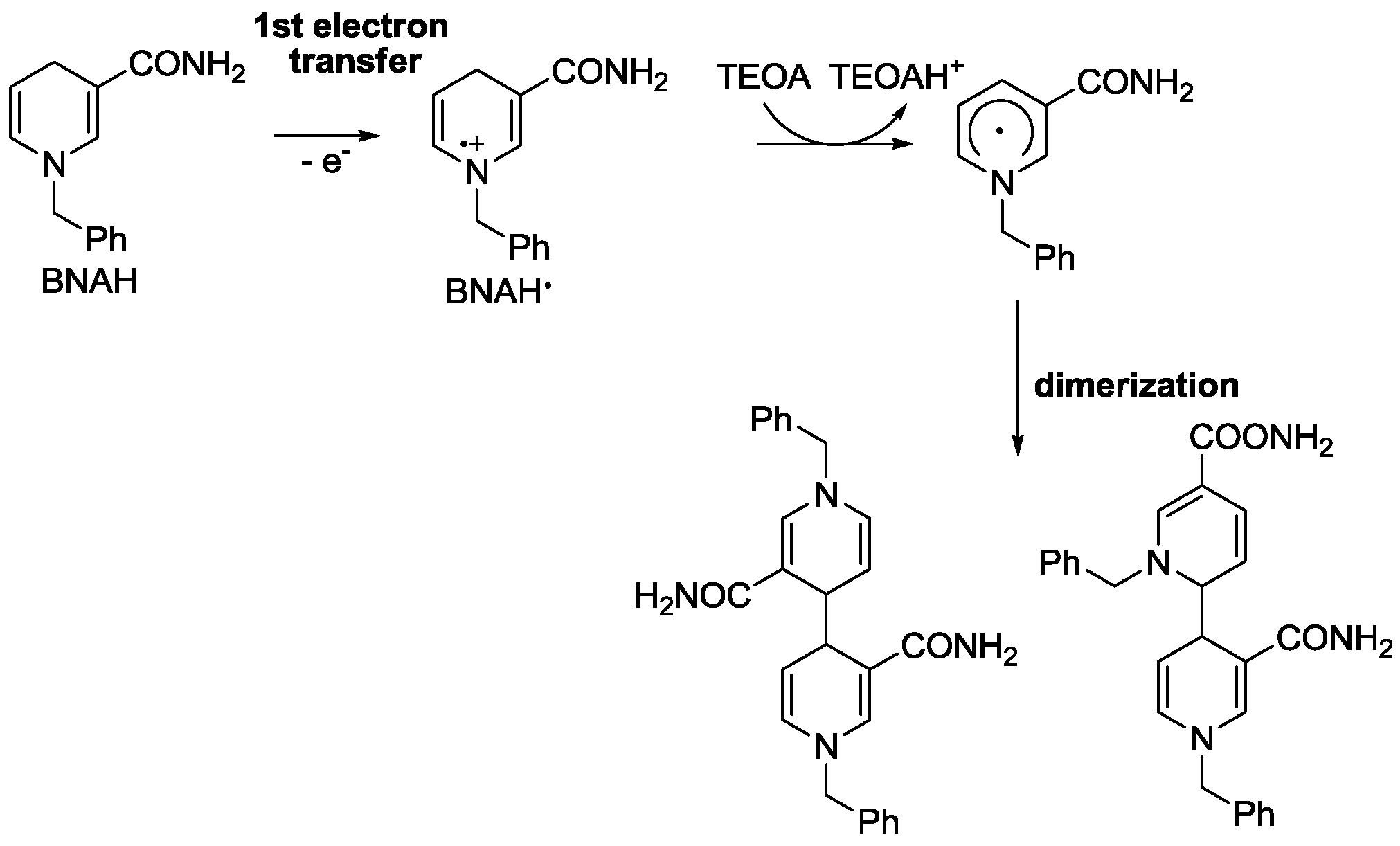
        <p>For complexes of the type Ru(dmb)<sub>3</sub><sup>2+</sup> and its multinuclear analogs, the most frequently used sacrificial donor is BNAH (1-benzyl-1,4-dihydronicotinamide) as the emissive <sup>3</sup>MLCT state cannot be quenched effectively with tertiary amines in this case [<xref ref-type="bibr" rid="B110-catalysts-02-00544">110</xref>] However, deprotonation of the BNAH<sup>+•</sup> radical is accelerated in the presence of TEOA and therefore inhibits the back electron transfer (<xref ref-type="scheme" rid="catalysts-02-00544-scheme5">Scheme 5</xref>). Further dimerization products of the one-electron oxidized BNAH<sup>•</sup> radical are known [<xref ref-type="bibr" rid="B105-catalysts-02-00544">105</xref>].</p>
        <fig id="catalysts-02-00544-scheme5" position="anchor">
          <object-id pub-id-type="pii">catalysts-02-00544-scheme5_Scheme 5</object-id>
          <label>Scheme 5</label>
          <caption>
            <p>Reaction sequence for the oxidation of BNAH [<xref ref-type="bibr" rid="B111-catalysts-02-00544">111</xref>].</p>
          </caption>
          <graphic xmlns:xlink="http://www.w3.org/1999/xlink" xlink:href="catalysts-02-00544-g021.tif"/>
        </fig>
      </sec>
    </sec>
    <sec>
      <title>3. Reduction Products of CO<sub>2</sub></title>
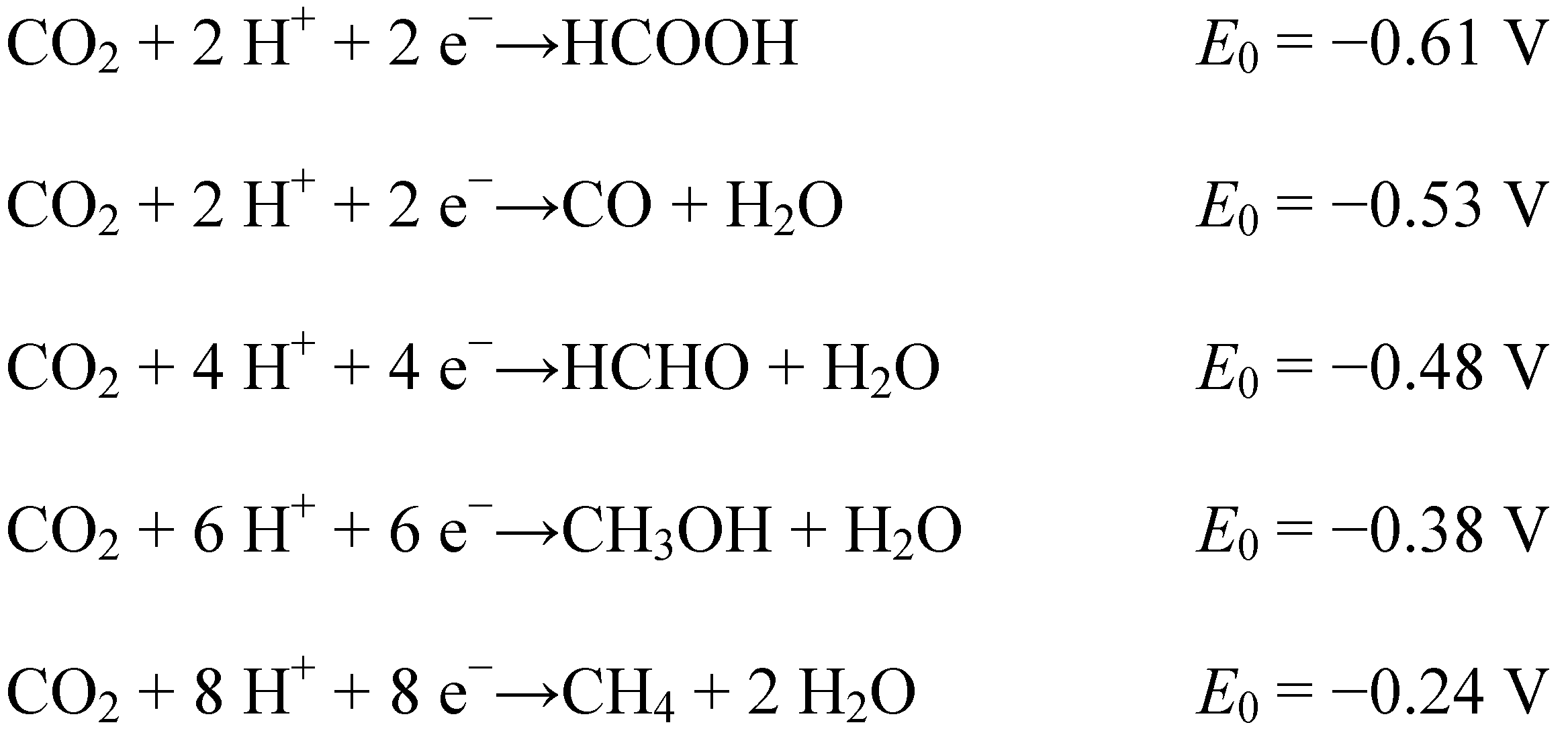
      <p>Due to the high reduction potential of the one-electron reduction (−1.9 V <italic>vs.</italic> normal hydrogen electrode), multielectron reduction processes are more favorable [<xref ref-type="bibr" rid="B81-catalysts-02-00544">81</xref>]. <xref ref-type="scheme" rid="catalysts-02-00544-scheme6">Scheme 6</xref> shows potential multielectron reduction products of CO<sub>2</sub>. From the beginning of homogeneous photocatalytic reduction of CO<sub>2</sub>, this topic was associated with the formation of CO. </p>
      
	  <fig id="catalysts-02-00544-scheme6" position="anchor">
        <object-id pub-id-type="pii">catalysts-02-00544-scheme6_Scheme 6</object-id>
        <label>Scheme 6</label>
        <caption>
          <p>Multielectron reduction products of CO<sub>2</sub> [<xref ref-type="bibr" rid="B81-catalysts-02-00544">81</xref>].</p>
        </caption>
        <graphic xmlns:xlink="http://www.w3.org/1999/xlink" xlink:href="catalysts-02-00544-g022.tif"/>
      </fig>
      
	  <p>CO is the feedstock for several synthetic processes, such as d-metal catalyzed Fischer Tropsch (production of hydrocarbons), Monsanato and Cativa (both acetic acid) processes [<xref ref-type="bibr" rid="B112-catalysts-02-00544">112</xref>]. Carbon monoxide also has a significant fuel value (Δ<italic>H</italic><sub>c</sub><sup>0</sup> = −283 kJ/mol) and can readily be converted into methanol (e.g., by the CuO/ZnO/Al<sub>2</sub>O<sub>3</sub>-catalyzed ICI process) for use as a liquid fuel [<xref ref-type="bibr" rid="B113-catalysts-02-00544">113</xref>]. The most active and selective catalysts for the photoreduction of CO<sub>2</sub> to CO are Re(I) type catalysts, but as already mentioned in <xref ref-type="sec" rid="sec2dot2-catalysts-02-00544">section 2.2</xref>, formic acid can also be obtained via homogeneous photocatalytic CO<sub>2</sub> reduction [<xref ref-type="bibr" rid="B13-catalysts-02-00544">13</xref>,<xref ref-type="bibr" rid="B14-catalysts-02-00544">14</xref>,<xref ref-type="bibr" rid="B15-catalysts-02-00544">15</xref>]. Formic acid has been used as a preservative and an insecticide, as well as a reducing agent and a source of carbon in synthetic chemical industry. However, only a few photocatalysts for selective formation of formic acid from CO<sub>2</sub> have been reported. Yanagida <italic>et al.</italic> published systems based on oligo(<italic>p</italic>-phenylenes) with quantum yields of formic acid formation up to 0.084. Another system developed by the same group involves phenazine as photosensitizer, Co<sup>III</sup>-cyclam (cyclam = 1,4,8,-11–tetraazacyclotetradecan) as an electron mediator and triethylamine as electron donor. In this case, quantum yields reach values up to 0.07. Both systems require UV-light activation [<xref ref-type="bibr" rid="B70-catalysts-02-00544">70</xref>,<xref ref-type="bibr" rid="B114-catalysts-02-00544">114</xref>]. In contrast, Tanaka <italic>et al.</italic> were able to selectively produce HCOO<sup>−</sup> via visible light irradiation using [Ru(bpy)<sub>3</sub>]<sup>2+</sup> and [Ru(bpy)<sub>2</sub>(CO)<sub>2</sub>]<sup>2+</sup> in a CO<sub>2</sub>-saturated TEOA/DMF solution (1:4). The maximum quantum yield in this case is 14% [<xref ref-type="bibr" rid="B95-catalysts-02-00544">95</xref>,<xref ref-type="bibr" rid="B115-catalysts-02-00544">115</xref>,<xref ref-type="bibr" rid="B116-catalysts-02-00544">116</xref>]. </p>
      <p>According to <xref ref-type="scheme" rid="catalysts-02-00544-scheme6">Scheme 6</xref>, the reduction potential for the proton-assisted formation of methane is even smaller than in case of CO formation. Therefore, from a thermodynamic perspective, these photoreduction catalysts should also be capable of producing methane. The reduction of CO<sub>2</sub> to methane, commonly known as the sabatier process, is of substantial industrial importance. This reaction proceeds at high temperatures and hydrogen pressures and is catalyzed by metal catalysts such as Ru, Mo and Ni [<xref ref-type="bibr" rid="B117-catalysts-02-00544">117</xref>,<xref ref-type="bibr" rid="B118-catalysts-02-00544">118</xref>,<xref ref-type="bibr" rid="B119-catalysts-02-00544">119</xref>,<xref ref-type="bibr" rid="B120-catalysts-02-00544">120</xref>]. However, to date, through strictly homogeneous photocatalysis, this process has never been realized, which is probably due to the requirement of eight electrons that need to be transferred. The only report of photocatalytic reduction of CO<sub>2</sub> to methane employed <italic>tris</italic>(bipyrazine)ruthenium(II) as the photosensitizer and a Ru metal colloid as the reduction catalyst. In aqueous solution in the presence of TEOA, this system selectively formed methane (no CO formation) in a quantum yield of 0.04% [<xref ref-type="bibr" rid="B121-catalysts-02-00544">121</xref>].</p>
    </sec>
    <sec>
      <title>4. Alternatives to Sacrificial Amines</title>
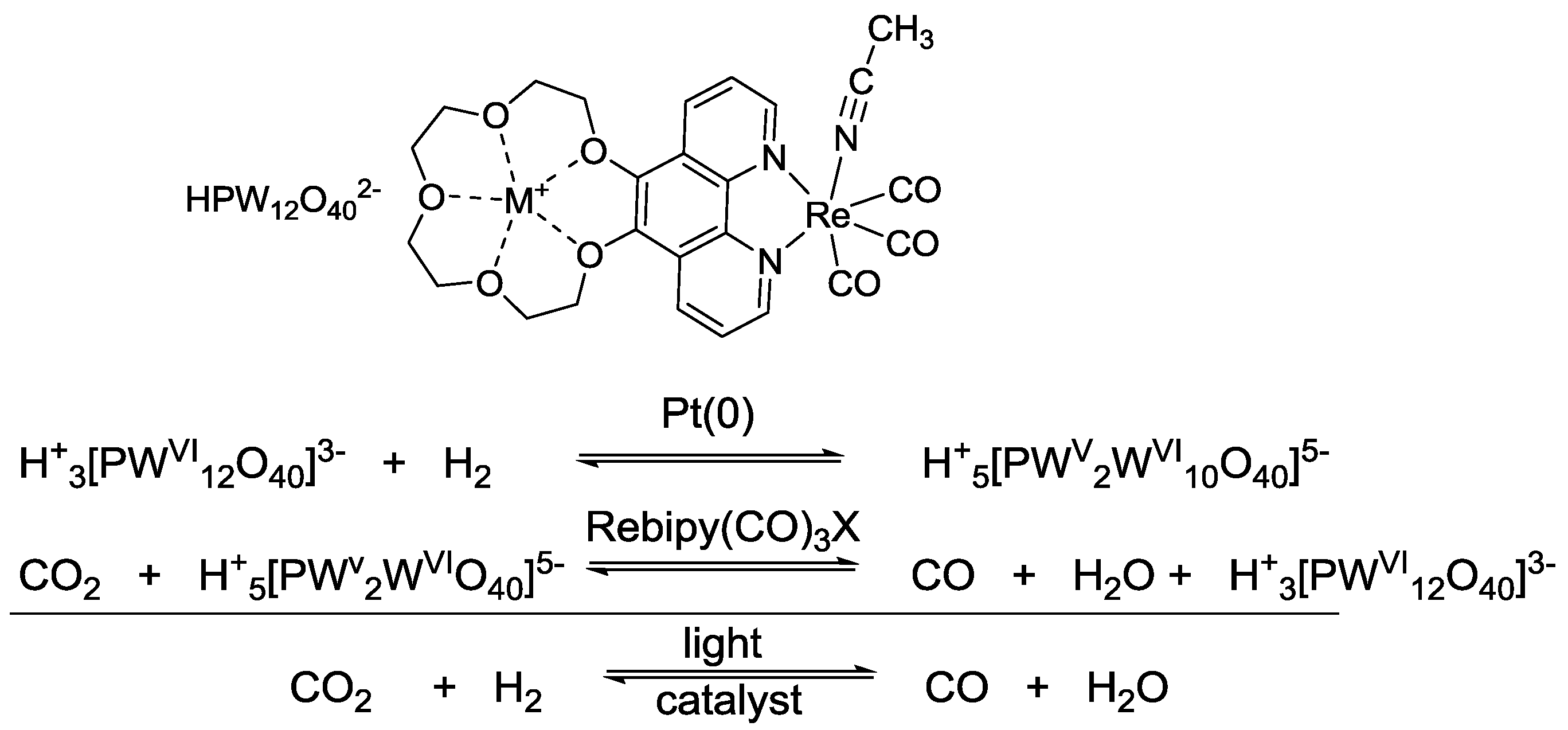
      <p>As amine sacrificial donors react to undesirable site products during the catalytic cycle, one of the most challenging goals is to develop catalytic systems which are able to quench the excited state (<sup>3</sup>MLCT) without sacrificial agents. In this context, Neumann <italic>et al.</italic> published an organometallic-polyoxometalate hybrid complex that is capable of replacing sacrificial amines in the photoreduction of CO<sub>2</sub> by hydrogen (<xref ref-type="fig" rid="catalysts-02-00544-f008">Figure 8</xref>) [<xref ref-type="bibr" rid="B122-catalysts-02-00544">122</xref>]. A first important reaction step is the oxidation of hydrogen forming two protons and two electrons, which has been realized by using the Keggin-type polyoxometalate H<sub>3</sub>PW<sub>12</sub>O<sub>40</sub> as oxidizing agent. This polyoxometalate was linked to a photocatalyst by coordination of 5,6-(15-crown-5)-1,10-phenanthroline (L) and thus proton and electron transfer between the H<sub>2</sub> oxidative site and the CO<sub>2</sub> reductive site is supported. However, quantum yields and turnover frequencies in the reduction of CO<sub>2</sub> in this system are lower than in some previous rhenium and ruthenium catalyzed photoreductions using amines as sacrificial electron donors. </p>
      <fig id="catalysts-02-00544-f008" position="anchor">
        <label>Figure 8</label>
        <caption>
          <p>Photoreduction of CO<sub>2</sub> with H<sub>2</sub> [<xref ref-type="bibr" rid="B122-catalysts-02-00544">122</xref>].</p>
        </caption>
        <graphic xmlns:xlink="http://www.w3.org/1999/xlink" xlink:href="catalysts-02-00544-g008.tif"/>
      </fig>
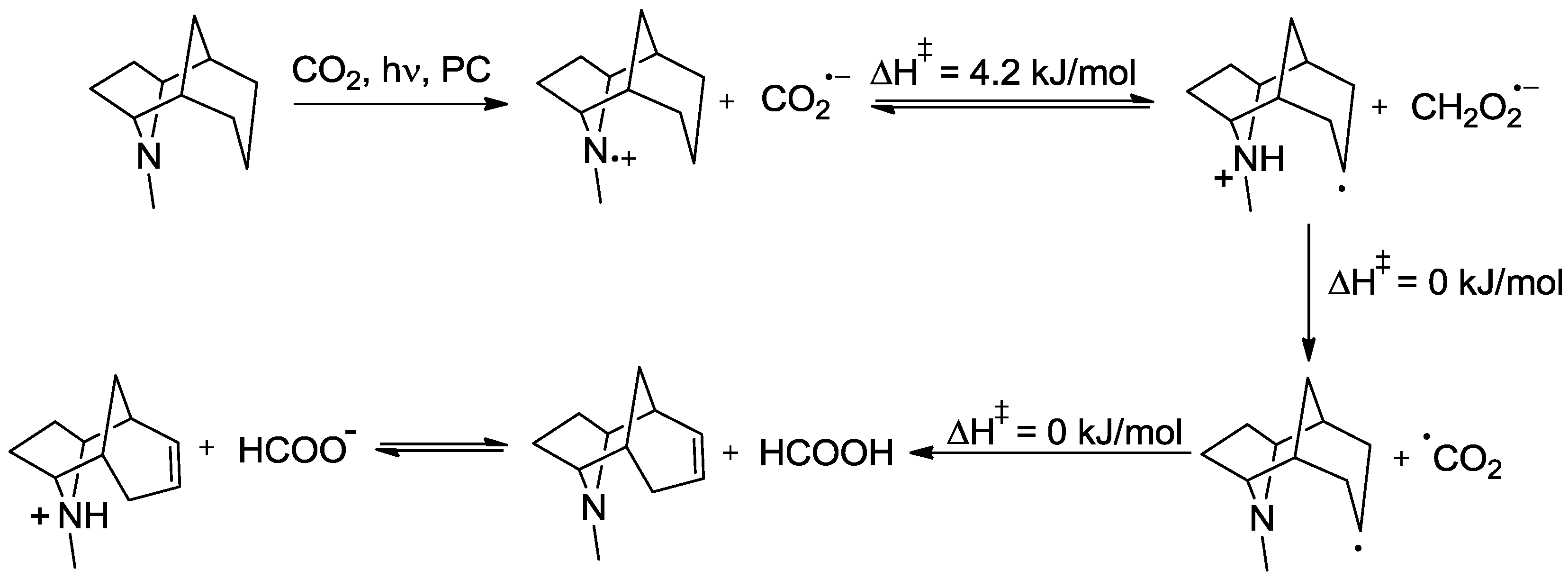
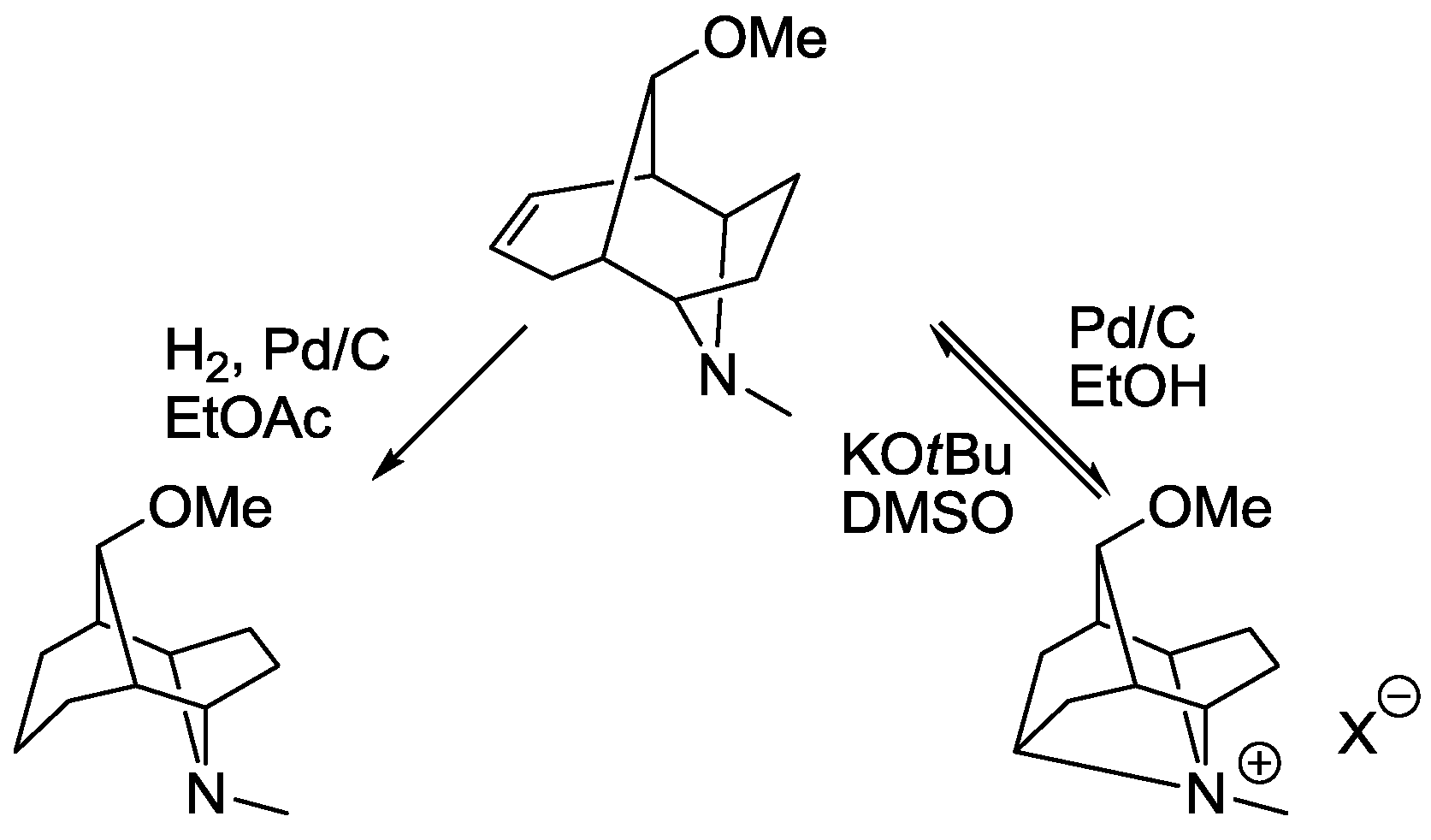
      <p>Another possible method to circumvent the use of sacrificial agents has been described by Carpenter <italic>et al.</italic> [<xref ref-type="bibr" rid="B123-catalysts-02-00544">123</xref>]. Instead of replacing an external reductant, the idea was to recycle the sacrificial agent by hydrogenation. To realize this approach it was necessary to find amine structures which do not form typical reactive species such as amino radicals, enamines and iminium ions from the radical cation, but an alkene product [<xref ref-type="bibr" rid="B124-catalysts-02-00544">124</xref>]. One suggested structure, with complaints about these requirements, is shown in <xref ref-type="fig" rid="catalysts-02-00544-f009">Figure 9</xref>. The tricyclic structure blocks the formation of undesired reactive intermediates and reacts to the corresponding olefinic compound, which can then be converted back to the starting material with a Pd/C catalyst in EtOAc. It has to be mentioned that there is a counterion- and solvent-dependent side reaction of the olefin, as well, which is shown in <xref ref-type="fig" rid="catalysts-02-00544-f010">Figure 10</xref>.</p>
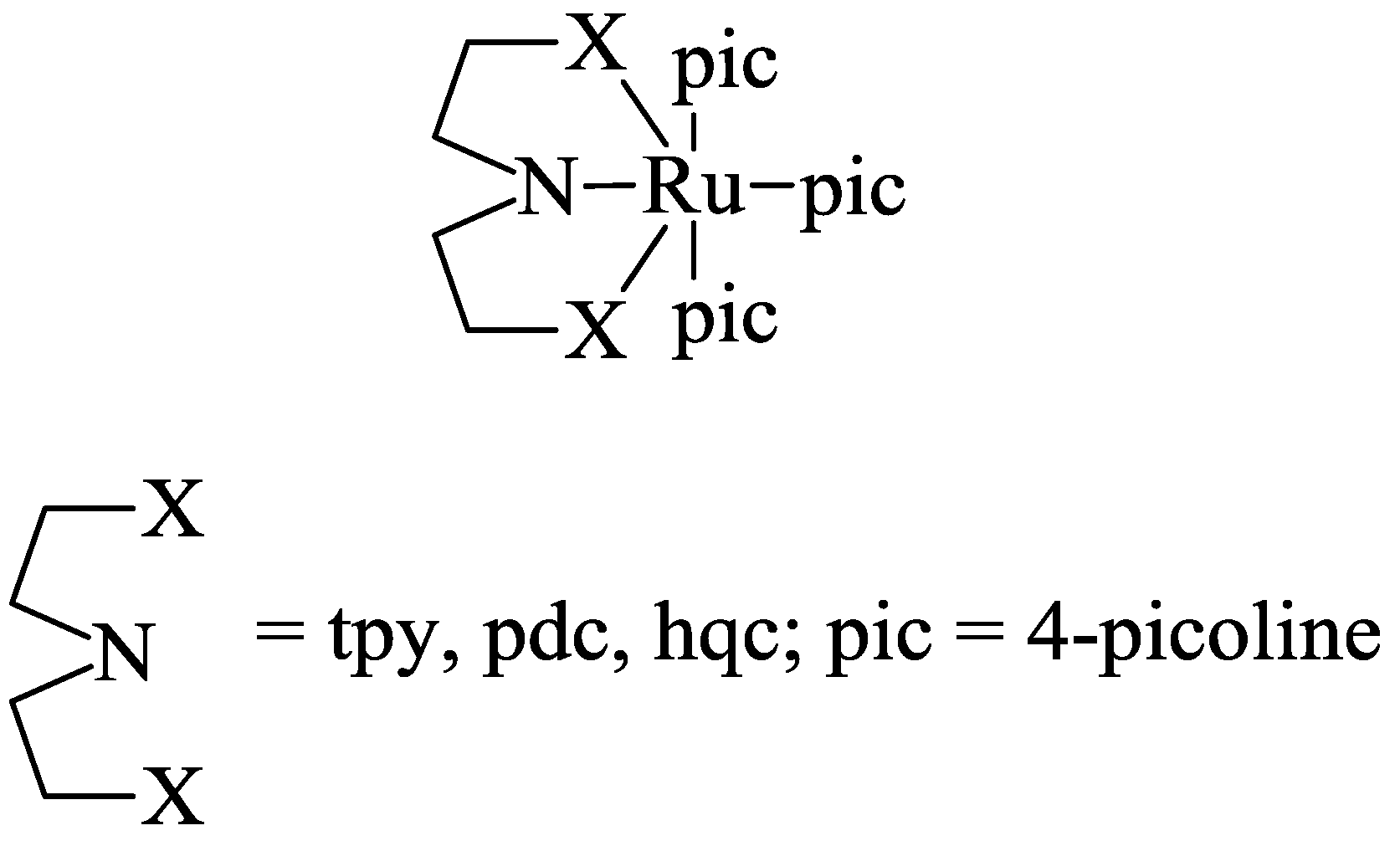
      <p>One of the most desired reactions in the field of photocatalytic CO<sub>2</sub> reduction is the coupling to water oxidation. There are some reports of photocatalytic water oxidation in homogeneous systems such as molecular ruthenium complexes [<xref ref-type="bibr" rid="B125-catalysts-02-00544">125</xref>,<xref ref-type="bibr" rid="B126-catalysts-02-00544">126</xref>,<xref ref-type="bibr" rid="B127-catalysts-02-00544">127</xref>,<xref ref-type="bibr" rid="B128-catalysts-02-00544">128</xref>,<xref ref-type="bibr" rid="B129-catalysts-02-00544">129</xref>,<xref ref-type="bibr" rid="B130-catalysts-02-00544">130</xref>,<xref ref-type="bibr" rid="B131-catalysts-02-00544">131</xref>,<xref ref-type="bibr" rid="B132-catalysts-02-00544">132</xref>,<xref ref-type="bibr" rid="B133-catalysts-02-00544">133</xref>,<xref ref-type="bibr" rid="B134-catalysts-02-00544">134</xref>,<xref ref-type="bibr" rid="B135-catalysts-02-00544">135</xref>], as well as earth abundant metal complexes [<xref ref-type="bibr" rid="B136-catalysts-02-00544">136</xref>,<xref ref-type="bibr" rid="B137-catalysts-02-00544">137</xref>,<xref ref-type="bibr" rid="B138-catalysts-02-00544">138</xref>] in the presence of sacrificial electron acceptors. In this case, a recently published mononuclear ruthenium complex shows TOF values up to 0.32 s<sup>−1</sup> [<xref ref-type="bibr" rid="B139-catalysts-02-00544">139</xref>]. The main structure motif is a ruthenium center with a tridentate ligand and three picoline ligands (<xref ref-type="fig" rid="catalysts-02-00544-f011">Figure 11</xref>).</p>
	  
	  <fig id="catalysts-02-00544-f009" position="anchor">
        <label>Figure 9</label>
        <caption>
          <p>Tricyclic amine structure as recyclable electron donor [<xref ref-type="bibr" rid="B123-catalysts-02-00544">123</xref>].</p>
        </caption>
        <graphic xmlns:xlink="http://www.w3.org/1999/xlink" xlink:href="catalysts-02-00544-g009.tif"/>
      </fig>
      <fig id="catalysts-02-00544-f010" position="anchor">
        <label>Figure 10</label>
        <caption>
          <p>Recycling of the amine donor (<bold>left</bold>) and side reaction (<bold>right</bold>) [<xref ref-type="bibr" rid="B123-catalysts-02-00544">123</xref>].</p>
        </caption>
        <graphic xmlns:xlink="http://www.w3.org/1999/xlink" xlink:href="catalysts-02-00544-g010.tif"/>
      </fig>
      
      <fig id="catalysts-02-00544-f011" position="anchor">
        <label>Figure 11</label>
        <caption>
          <p>Mononuclear ruthenium water oxidation catalyst (WOC) [<xref ref-type="bibr" rid="B139-catalysts-02-00544">139</xref>].</p>
        </caption>
        <graphic xmlns:xlink="http://www.w3.org/1999/xlink" xlink:href="catalysts-02-00544-g011.tif"/>
      </fig>
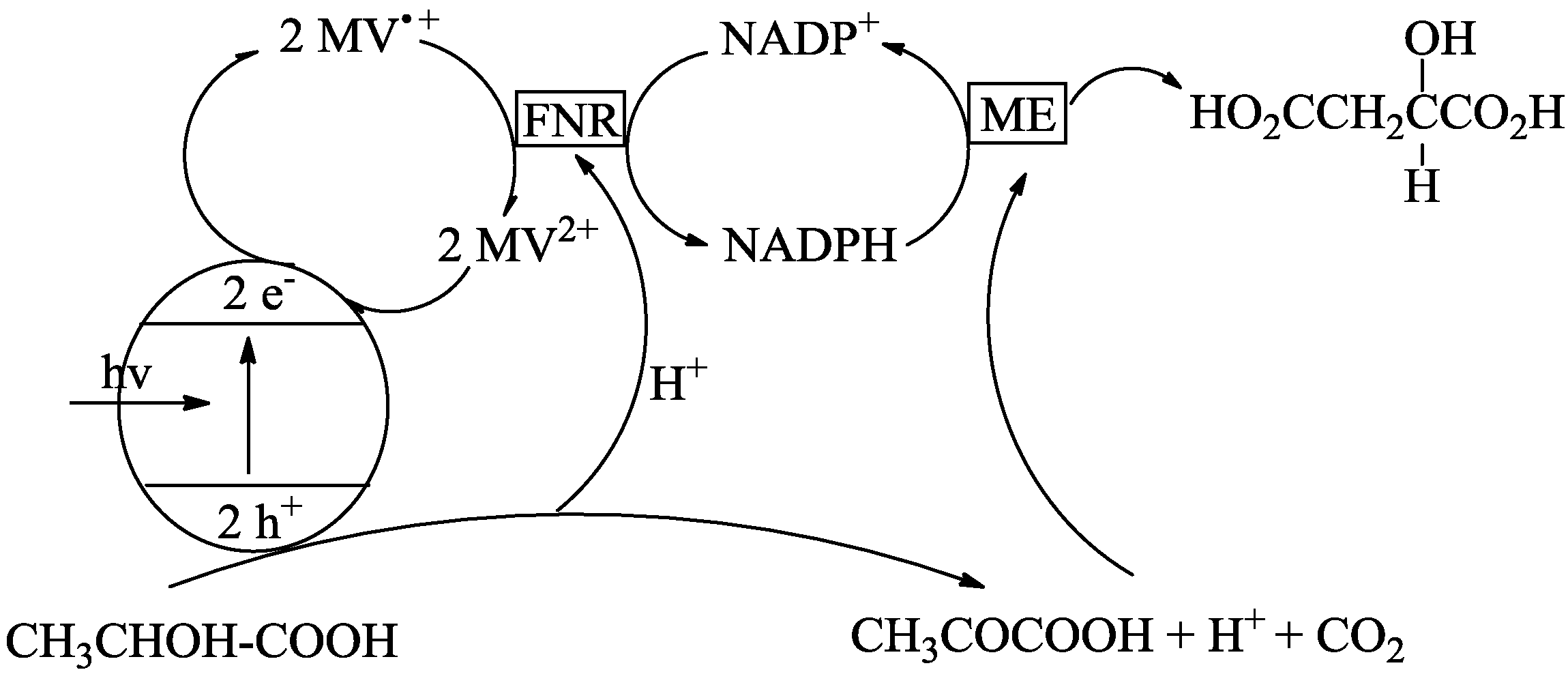
      <p>By varying the tridentate ligand site, Tong <italic>et al.</italic> could show that anionic tridentate ligands compared to neutral ligands demonstrate an increased picoline/water substitution rate which results in higher activity of the catalysts. These results demonstrate a correlation between the activity of WOCs and ligand properties, providing important information for future catalyst design. However, water oxidation in the absence of sacrificial acceptors to date was only realized in heterogeneous systems. For example Kudo <italic>et al.</italic> developed an Ag cocatalyst-loaded ALa<sub>4</sub>Ti<sub>4</sub>O<sub>15</sub> (A = Ca, Sr, Ba) photocatalyst, which reduces CO<sub>2</sub> to CO and HCOOH in aqueous suspension without any additional sacrificial reagents [<xref ref-type="bibr" rid="B140-catalysts-02-00544">140</xref>]. Furthermore Kajino <italic>et al.</italic> have been able to combine reduction of CO<sub>2</sub> to HCOO<sup>-</sup> and water oxidation with a <italic>p</italic>-type InP/Ru-complex polymer hybrid photocatalyst connected to TiO<sub>2</sub>. In this case, water is the donor of electrons, as well as the source of protons. The conversion efficiency (solar energy to chemical energy) of this catalytic process is 0.03–0.04%. Therefore, an electrical bias-free reaction approaching photosynthesis was found. Further optimization in selectivity, as well as efficiency, can be achieved by configuration of the energy band, variation of catalyst structure, as well as conjugation conformation [<xref ref-type="bibr" rid="B141-catalysts-02-00544">141</xref>]. An alternative heterogeneous approach was developed by Yoneyama <italic>et al.</italic> in 1992 (<xref ref-type="scheme" rid="catalysts-02-00544-scheme7">Scheme 7</xref>) [<xref ref-type="bibr" rid="B142-catalysts-02-00544">142</xref>,<xref ref-type="bibr" rid="B143-catalysts-02-00544">143</xref>]. In this case, malic acid was synthesized from lactic acid and CO<sub>2</sub> using a multicomponent system containing a cadmium sulfide suspension as photocatalyst, methylviologen (MV) as electron relay, and malic enzyme (ME) and ferredoxin-NADP<sup>+</sup> reductase (FNR). Firstly, photogenerated electrons are transferred from the cadmium sulfide photocatalyst to MV<sup>2+</sup> and the reduced MV provides the electrons to reduce NADP<sup>+</sup> and H<sup>+</sup>. The resulting hole in the conduction band of the semiconductor particles leads to a potential which is adequate to regenerate the photocatalyst and to oxidize lactic acid. The resulting pyruvic acid is then converted to malic acid by reaction with CO<sub>2</sub> and NADPH in a ME-catalyzed process. This catalytic cycle therefore consists of two coupled photoredox reactions. First, the reduction of MV<sup>2+</sup>, and, second, the oxidation of lactic acid. The C-C bond formation between CO<sub>2</sub> and pyruvic acid takes place in the absence of light with the quantum efficiency of this system being around 2.5% [<xref ref-type="bibr" rid="B142-catalysts-02-00544">142</xref>,<xref ref-type="bibr" rid="B143-catalysts-02-00544">143</xref>].</p>
      <fig id="catalysts-02-00544-scheme7" position="anchor">
        <object-id pub-id-type="pii">catalysts-02-00544-scheme7_Scheme 7</object-id>
        <label>Scheme 7</label>
        <caption>
          <p>Photocatalytic conversion of lactic acid to malic acid via pyruvic acid [<xref ref-type="bibr" rid="B142-catalysts-02-00544">142</xref>,<xref ref-type="bibr" rid="B143-catalysts-02-00544">143</xref>].</p>
        </caption>
        <graphic xmlns:xlink="http://www.w3.org/1999/xlink" xlink:href="catalysts-02-00544-g023.tif"/>
      </fig>
      
	  <fig id="catalysts-02-00544-f012" position="anchor">
        <label>Figure 12</label>
        <caption>
          <p>Mechanistic aspects of the hydrogen production coupled to hydrocarbon oxygenation [<xref ref-type="bibr" rid="B144-catalysts-02-00544">144</xref>].</p>
        </caption>
        <graphic xmlns:xlink="http://www.w3.org/1999/xlink" xlink:href="catalysts-02-00544-g012.tif"/>
      </fig>
      
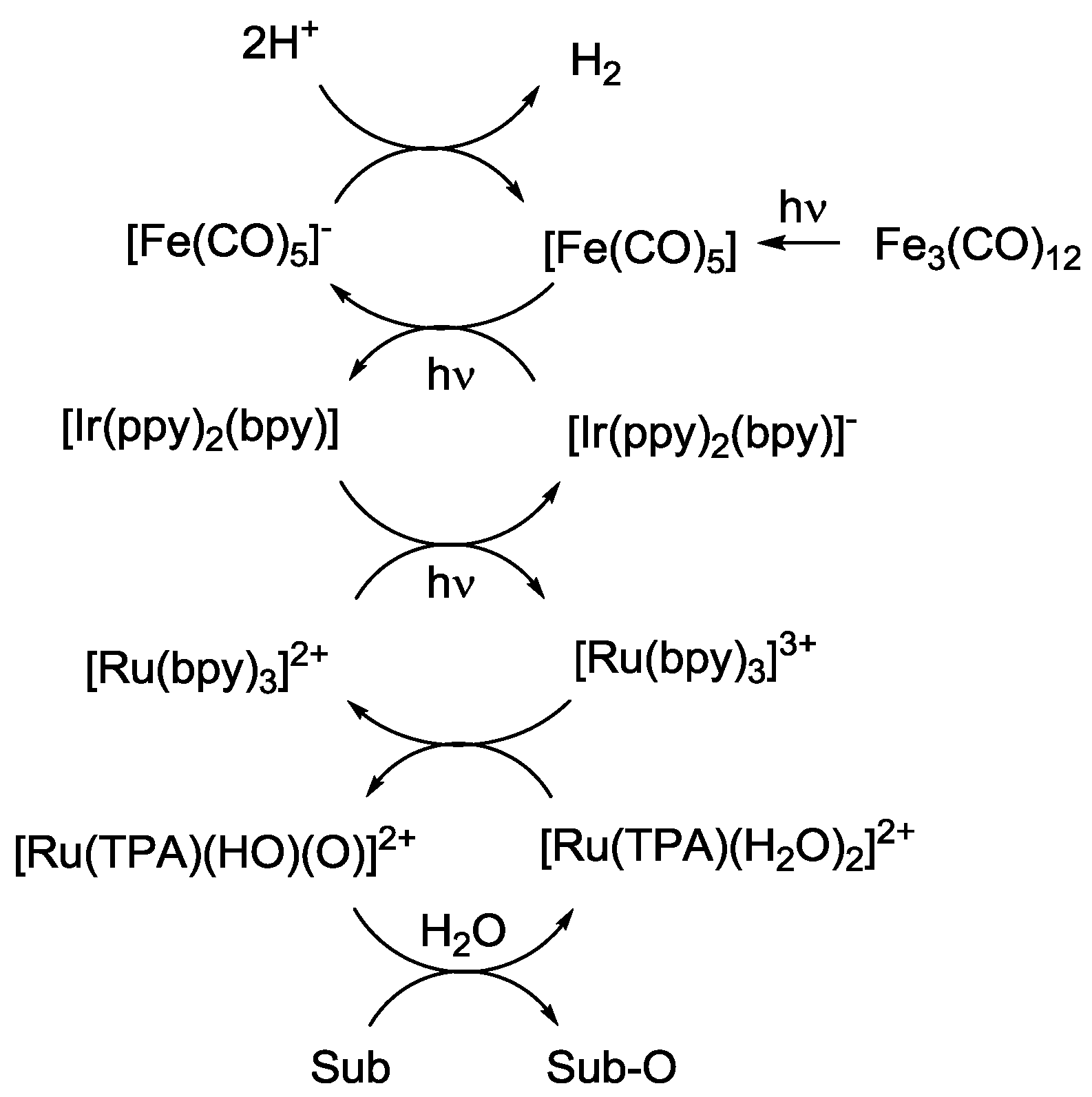
	  <p>In 2011, Zhao <italic>et al.</italic> published a light-induced hydrocarbon oxygenation coupled to H<sub>2</sub> formation from water splitting (<xref ref-type="fig" rid="catalysts-02-00544-f012">Figure 12</xref>) [<xref ref-type="bibr" rid="B144-catalysts-02-00544">144</xref>]. Starting from the photocatalytic oxidation of hydrocarbons using [Co(NH<sub>3</sub>)<sub>5</sub>Cl]<sup>2+</sup> as sacrificial electron acceptor, Zhao’s group has been able to develop a complex system containing a [Ru(TPA)(H<sub>2</sub>O)<sub>2</sub>]<sup>2+</sup> photocatalyst, Ru- and Ir photosensitizers as well as the proton reduction catalyst Fe<sub>3</sub>(CO)<sub>12</sub> for water splitting in a one-pot reaction without sacrificial agents (<xref ref-type="fig" rid="catalysts-02-00544-f013">Figure 13</xref>). This kind of electron transfer cascade is believed to be a good initial point for photocatalytic CO<sub>2</sub> reduction combined with desirable oxidation processes.</p>
      <fig id="catalysts-02-00544-f013" position="anchor">
        <label>Figure 13</label>
        <caption>
          <p>Hydrocarbon oxygenation as electron donor in photocatalysis [<xref ref-type="bibr" rid="B144-catalysts-02-00544">144</xref>].</p>
        </caption>
        <graphic xmlns:xlink="http://www.w3.org/1999/xlink" xlink:href="catalysts-02-00544-g013.tif"/>
      </fig>
    </sec>
    <sec>
      <title>5. Structural Parameters for Supramolecular Catalyst Design</title>
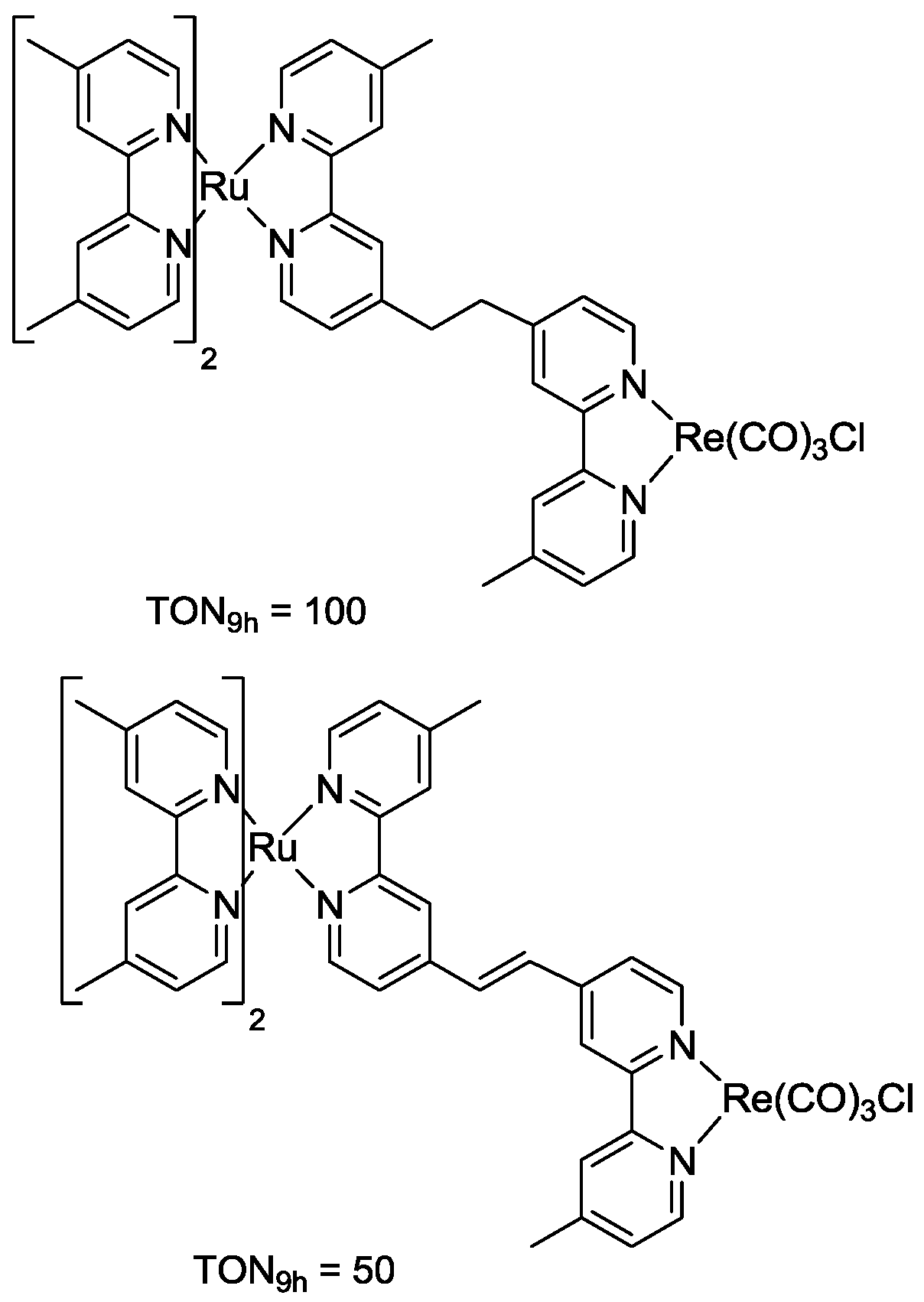
      <p>The bridging ligand in multinuclear tethered complexes affects the properties of the assemblies, such as photoinduced energy transfer [<xref ref-type="bibr" rid="B145-catalysts-02-00544">145</xref>,<xref ref-type="bibr" rid="B146-catalysts-02-00544">146</xref>,<xref ref-type="bibr" rid="B147-catalysts-02-00544">147</xref>,<xref ref-type="bibr" rid="B148-catalysts-02-00544">148</xref>,<xref ref-type="bibr" rid="B149-catalysts-02-00544">149</xref>], and intervalence transition [<xref ref-type="bibr" rid="B150-catalysts-02-00544">150</xref>,<xref ref-type="bibr" rid="B151-catalysts-02-00544">151</xref>]. There are many examples of multifunctional CO<sub>2</sub> reduction photocatalysts with visible light absorbing antenna (e.g., [Ru(dmb)<sub>3</sub>]<sup>2+</sup> derivatives) and CO<sub>2</sub> catalytic reduction centers (e.g., [Re(dmb)(CO)<sub>3</sub>Cl], where the catalytic activity strongly depends on the efficiency of electron transfer from reduced photosensitizers to catalytic centers [<xref ref-type="bibr" rid="B74-catalysts-02-00544">74</xref>,<xref ref-type="bibr" rid="B75-catalysts-02-00544">75</xref>,<xref ref-type="bibr" rid="B110-catalysts-02-00544">110</xref>,<xref ref-type="bibr" rid="B152-catalysts-02-00544">152</xref>,<xref ref-type="bibr" rid="B153-catalysts-02-00544">153</xref>]. By direct comparison of the photocatalytic activity of the two Ru(II)–Re(I) binuclear complexes of <xref ref-type="fig" rid="catalysts-02-00544-f014">Figure 14</xref>, one comprising a saturated linker and one with a conjugated linker, it was found that the saturated covalently bridged photocatalyst shows higher activity for the photoreduction of CO<sub>2</sub> compared with its conjugated analogue [<xref ref-type="bibr" rid="B154-catalysts-02-00544">154</xref>]. The nature of the ligand has an impact on the electrochemical properties of the supramolecular systems, which strongly affects the photoreduction activity [<xref ref-type="bibr" rid="B155-catalysts-02-00544">155</xref>]. In the case of the conjugated ligand with strong electronic communication across the bridging ligand, the reducing power of the OER species is insufficient for efficient reduction of CO<sub>2</sub>. Therefore, strong electronic communication between the photosensitizer moiety and the reduction site lessens the photocatalytic activity even though it accelerates the electron transfer between them. [<xref ref-type="bibr" rid="B53-catalysts-02-00544">53</xref>].</p>
      <fig id="catalysts-02-00544-f014" position="anchor">
        <label>Figure 14</label>
        <caption>
          <p>Structures of hetero binuclear Ru(II)–Re(I) complexes.</p>
        </caption>
        <graphic xmlns:xlink="http://www.w3.org/1999/xlink" xlink:href="catalysts-02-00544-g014.tif"/>
      </fig>
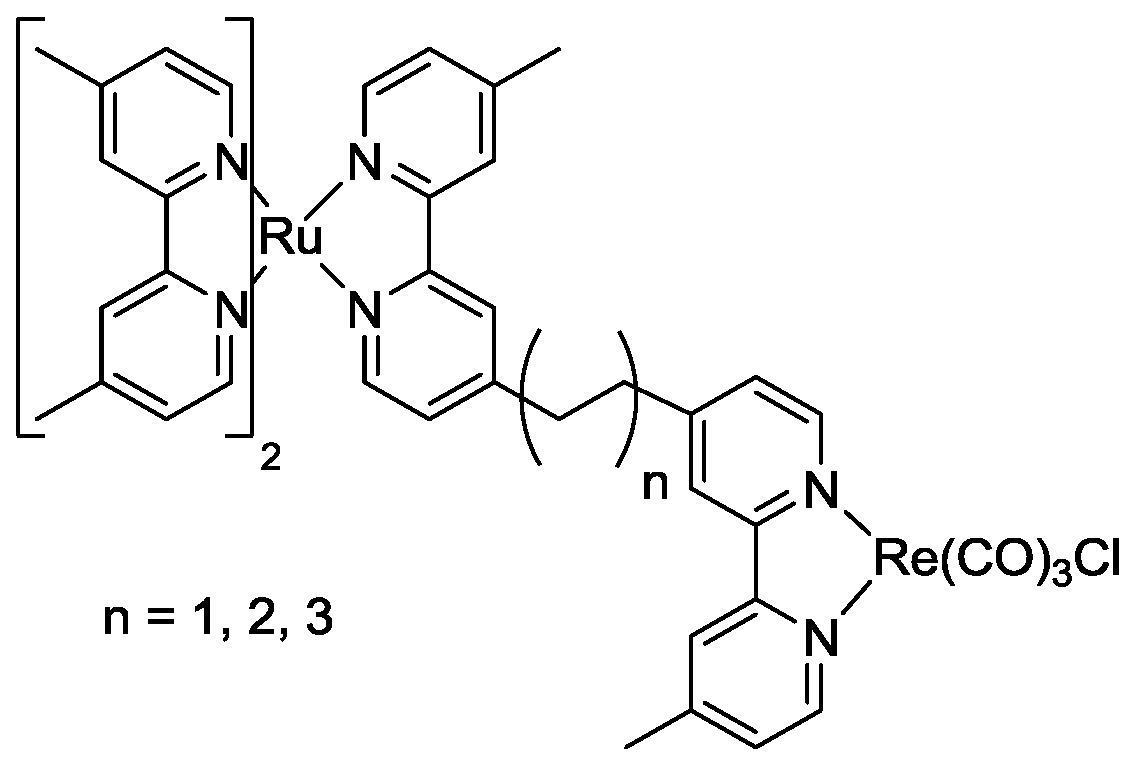
      <p>Another consideration for supramolecular systems is adjustment of the distance between the covalently tethered metal centers. Koike <italic>et al.</italic> investigated a series of covalently linked Ru-Re complexes with a saturated alkyl linker of various lengths and compared their activity in the photoreduction of CO<sub>2</sub> (<xref ref-type="fig" rid="catalysts-02-00544-f015">Figure 15</xref>). The most efficient catalyst was that comprising of the shortest alkyl chain in the bridging position. According to the photophysical properties of these complexes, the most obvious difference is found in the luminescence quenching with BNAH. According to Stern-Volmer plot measurements, the quenching of the emissive state to form the OER was most effective for the complex with <italic>n</italic> = 2. The quenching fraction affects the efficiency of the photocatalysis of the diad as this reductive quenching is the first process of the photocatalytic reaction [<xref ref-type="bibr" rid="B156-catalysts-02-00544">156</xref>]. The electron transfer rate from the Ru site to the Re site may be another factor, but it could play only a minor role because it is assumed not to be a rate-determining process in the photocatalytic reaction.</p>
      <fig id="catalysts-02-00544-f015" position="anchor">
        <label>Figure 15</label>
        <caption>
          <p>Covalently linked Ru-Re complexes with tethers of different lengths.</p>
        </caption>
        <graphic xmlns:xlink="http://www.w3.org/1999/xlink" xlink:href="catalysts-02-00544-g015.tif"/>
      </fig>
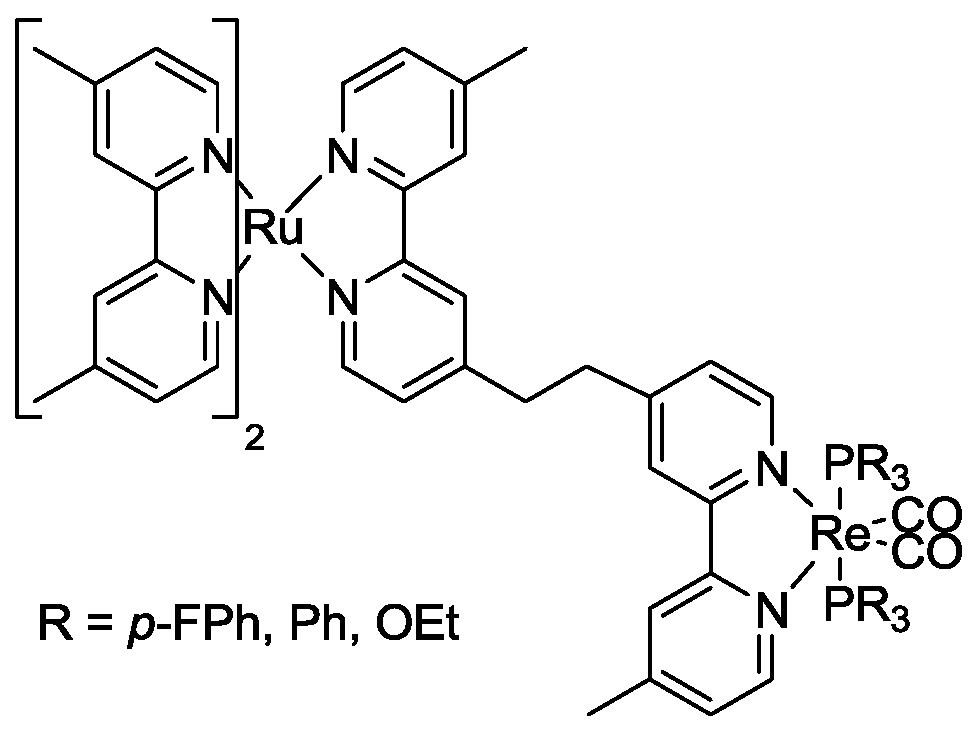
      <p>In a recent review [<xref ref-type="bibr" rid="B111-catalysts-02-00544">111</xref>], the photocatalytic ability of these supramolecular Ru-Re catalysts was further modified by phosphorus ligands on the rhenium site, resulting in one of the most active photocatalysts for CO<sub>2</sub> reduction (TOF<sub>CO</sub> = 281 h<sup>−1</sup>). Especially for R = p-FPh, the selectivity towards CO formation and the durability of the catalysts was optimized by the phosphorus ligands (<xref ref-type="fig" rid="catalysts-02-00544-f016">Figure 16</xref>).</p>
      <fig id="catalysts-02-00544-f016" position="anchor">
        <label>Figure 16</label>
        <caption>
          <p>Modified Ru-Re complexes with phosphorus ligands.</p>
        </caption>
        <graphic xmlns:xlink="http://www.w3.org/1999/xlink" xlink:href="catalysts-02-00544-g016.tif"/>
      </fig>
    </sec>
    <sec sec-type="conclusions">
      <title>6. Conclusions</title>
      <p>In contrast to thermal reactions, photocatalytic systems have the potential to conduct uphill transformations, which cannot be realized by thermal reactions. The central building unit of each visible light photocatalyst is the photosensitizer. The most widely investigated systems are Ru(II) catalysts which are known for their high absorption of visible light and their long-lived <sup>3</sup>MLCT state. With regards to the reduction site rhenium(I) catalysts with their high efficiencies and high selectivities towards CO formation have been subject to most study. However, other products such as formates can be obtained via photoreduction of CO<sub>2</sub> with special optimized reduction sites. One major task for prospective investigations is the search for alternatives to the sacrificial donors which are used in most cases. To date, there are a limited number of reports on alcohol or olefin oxidation that give defined oxidation products, but they are barely used in photoredox reactions with CO<sub>2</sub>. The search for supramolecular catalysts that combine both an effective oxidation and reduction site must continue. Many important parameters (e.g., saturated bridging linkers) for the building principle of supramolecular systems have already been identified and will help to find optimized systems.</p>
    </sec>
    
  </body>
  <back>
  <ack>
      <title>Acknowledgments</title>
      <p>This review was supported by the BMBF and is part of the iC<sup>4</sup> project which includes the categories Integrated Carbon Capture, Conversion and Cycling. We thank Carly Anderson for proofreading the manuscript.</p>
    </ack>
    <ref-list>
      <title>References</title>
      <ref id="B1-catalysts-02-00544">
        <label>1.</label>
        <citation citation-type="journal">
          <person-group person-group-type="author">
            <name>
              <surname>Aresta</surname>
              <given-names>M.</given-names>
            </name>
            <name>
              <surname>Dibenedetto</surname>
              <given-names>D.</given-names>
            </name>
          </person-group>
          <article-title>Utilisation of CO<sub>2</sub> as chemical feedstock: opportunities and challenges</article-title>
          <source>Dalton Trans.</source>
          <year>2007</year>
          <fpage>2975</fpage>
          <lpage>2992</lpage>
        </citation>
      </ref>
      <ref id="B2-catalysts-02-00544">
        <label>2.</label>
        <citation citation-type="book">
          <person-group person-group-type="author">
            <name>
              <surname>2.	Solomon</surname>
              <given-names>S.</given-names>
            </name>
            <name>
              <surname>Quin</surname>
              <given-names>D.</given-names>
            </name>
            <name>
              <surname>Manning</surname>
              <given-names>M.</given-names>
            </name>
            <name>
              <surname>Marquis</surname>
              <given-names>M.</given-names>
            </name>
            <name>
              <surname>Averyt</surname>
              <given-names>K.</given-names>
            </name>
            <name>
              <surname>Tignor</surname>
              <given-names>M.M.B.</given-names>
            </name>
            <name>
              <surname>Miller</surname>
              <given-names>H.L.</given-names>
              <suffix>Jr.</suffix>
            </name>
            <name>
              <surname>Chen</surname>
              <given-names>Z.</given-names>
            </name>
          </person-group>
          <source>The Physical Science Basis, Climate Change, 4th Assessment Report of the IPCC</source>
          <publisher-name>Cambridge University Press</publisher-name>
          <publisher-loc>Cambridge, UK</publisher-loc>
          <year>2007</year>
        </citation>
      </ref>
      <ref id="B3-catalysts-02-00544">
        <label>3.</label>
        <citation citation-type="journal">
          <person-group person-group-type="author">
            <name>
              <surname>Lindzen</surname>
              <given-names>R.S.</given-names>
            </name>
            <name>
              <surname>Quart</surname>
              <given-names>J.R.</given-names>
            </name>
          </person-group>
          <source>Meteorol. Soc.</source>
          <year>1991</year>
          <volume>117</volume>
          <fpage>651</fpage>
          <pub-id pub-id-type="doi">10.1002/qj.49711749912</pub-id>
        </citation>
      </ref>
      <ref id="B4-catalysts-02-00544">
        <label>4.</label>
        <citation citation-type="journal">
          <person-group person-group-type="author">
            <name>
              <surname>Lacis</surname>
              <given-names>A.A.</given-names>
            </name>
            <name>
              <surname>Schmidt</surname>
              <given-names>G.A.</given-names>
            </name>
            <name>
              <surname>Rind</surname>
              <given-names>D.</given-names>
            </name>
            <name>
              <surname>Ruedy</surname>
              <given-names>R.A.</given-names>
            </name>
          </person-group>
          <article-title>Atmospheric CO<sub>2</sub>: Principal Control Knob Governing Earth’s Temperature</article-title>
          <source>Science</source>
          <year>2010</year>
          <volume>330</volume>
          <fpage>356</fpage>
          <lpage>359</lpage>
        <pub-id pub-id-type="doi">10.1126/science.1190653</pub-id><pub-id pub-id-type="pmid">20947761</pub-id></citation>
      </ref>
      <ref id="B5-catalysts-02-00544">
        <label>5.</label>
        <citation citation-type="journal">
          <person-group person-group-type="author">
            <name>
              <surname>Sabine</surname>
              <given-names>L.C.</given-names>
            </name>
          </person-group>
          <article-title>The Oceanic Sink for Anthropogenic CO<sub>2</sub></article-title>
          <source>Science</source>
          <year>2004</year>
          <volume>305</volume>
          <fpage>367</fpage>
          <lpage>371</lpage>
          <pub-id pub-id-type="doi">10.1126/science.1097403</pub-id>
        </citation>
      </ref>
      <ref id="B6-catalysts-02-00544">
        <label>6.</label>
        <citation citation-type="journal">
          <person-group person-group-type="author">
            <name>
              <surname>Feely</surname>
              <given-names>R.A.</given-names>
            </name>
          </person-group>
          <article-title>Impact of Anthropogenic CO<sub>2</sub> on the CaCO<sub>3</sub> System in the Oceans</article-title>
          <source>Science</source>
          <year>2004</year>
          <volume>305</volume>
          <fpage>362</fpage>
          <lpage>366</lpage>
          <pub-id pub-id-type="doi">10.1126/science.1097329</pub-id>
        </citation>
      </ref>
      <ref id="B7-catalysts-02-00544">
        <label>7.</label>
        <citation citation-type="journal">
          <person-group person-group-type="author">
            <name>
              <surname>Langdon</surname>
              <given-names>C.</given-names>
            </name>
          </person-group>
          <article-title>Effect of elevated CO<sub>2</sub> on the community metabolism of an experimental coral reef</article-title>
          <source>Glob. Biogeochem. Cycles</source>
          <year>2003</year>
          <volume>17</volume>
          <fpage>1011</fpage>
          <lpage>1025</lpage>
          <pub-id pub-id-type="doi">10.1029/2002GB001941</pub-id>
        </citation>
      </ref>
      <ref id="B8-catalysts-02-00544">
        <label>8.</label>
        <citation citation-type="journal">
          <person-group person-group-type="author">
            <name>
              <surname>Gattuso</surname>
              <given-names>J.-P.</given-names>
            </name>
            <name>
              <surname>Frankignoulle</surname>
              <given-names>M.</given-names>
            </name>
            <name>
              <surname>Bourge</surname>
              <given-names>I.</given-names>
            </name>
            <name>
              <surname>Romaine</surname>
              <given-names>S.</given-names>
            </name>
            <name>
              <surname>Buddemeier</surname>
              <given-names>R.W.</given-names>
            </name>
          </person-group>
          <article-title>Effect of calcium carbonate saturation of seawater on coral calcification</article-title>
          <source>Glob. Planet Change</source>
          <year>1998</year>
          <volume>18</volume>
          <fpage>37</fpage>
          <lpage>46</lpage>
          <pub-id pub-id-type="doi">10.1016/S0921-8181(98)00035-6</pub-id>
        </citation>
      </ref>
      <ref id="B9-catalysts-02-00544">
        <label>9.</label>
        <citation citation-type="journal">
          <person-group person-group-type="author">
            <name>
              <surname>Riebesell</surname>
              <given-names>U.</given-names>
            </name>
            <name>
              <surname>Zondervan</surname>
              <given-names>I.</given-names>
            </name>
            <name>
              <surname>Rost</surname>
              <given-names>B.</given-names>
            </name>
            <name>
              <surname>Tortell</surname>
              <given-names>P.D.</given-names>
            </name>
            <name>
              <surname>Zeebe</surname>
              <given-names>R.E.</given-names>
            </name>
            <name>
              <surname>Morell</surname>
              <given-names>F.M.</given-names>
            </name>
          </person-group>
          <article-title>Reduced calcification of marine plankton in response to increased atmospheric CO<sub>2</sub></article-title>
          <source>Nature</source>
          <year>2000</year>
          <volume>407</volume>
          <fpage>364</fpage>
          <lpage>367</lpage>
        <pub-id pub-id-type="doi">10.1038/35030078</pub-id><pub-id pub-id-type="pmid">11014189</pub-id></citation>
      </ref>
      <ref id="B10-catalysts-02-00544">
        <label>10.</label>
        <citation citation-type="journal">
          <person-group person-group-type="author">
            <name>
              <surname>Rau</surname>
              <given-names>S.</given-names>
            </name>
            <name>
              <surname>Walther</surname>
              <given-names>D.</given-names>
            </name>
            <name>
              <surname>Vos</surname>
              <given-names>G.G.</given-names>
            </name>
          </person-group>
          <article-title>Inspired by nature: Light driven organometallic catalysis by heterooligonuclear Ru(II) complexes</article-title>
          <source>Dalton Trans.</source>
          <year>2007</year>
          <pub-id pub-id-type="doi">10.1039/B615987G</pub-id>
        </citation>
      </ref>
      <ref id="B11-catalysts-02-00544">
        <label>11.</label>
        <citation citation-type="journal">
          <person-group person-group-type="author">
            <name>
              <surname>Young</surname>
              <given-names>R.C.</given-names>
            </name>
            <name>
              <surname>Meyer</surname>
              <given-names>T.J.</given-names>
            </name>
            <name>
              <surname>Whitten</surname>
              <given-names>D.G.</given-names>
            </name>
          </person-group>
          <article-title>Electron transfer quenching of excited states of metal complexes</article-title>
          <source>J. Am. Chem. Soc.</source>
          <year>1976</year>
          <volume>98</volume>
          <fpage>286</fpage>
          <lpage>287</lpage>
          <pub-id pub-id-type="doi">10.1021/ja00417a073</pub-id>
        </citation>
      </ref>
      <ref id="B12-catalysts-02-00544">
        <label>12.</label>
        <citation citation-type="journal">
          <person-group person-group-type="author">
            <name>
              <surname>Kalyanasundaram</surname>
              <given-names>K.</given-names>
            </name>
          </person-group>
          <article-title>Hydrogen Evolution from Water by Visible Light, a Homogeneous Three Component Test System for Redox Catalysis</article-title>
          <source>Helv. Chim. Acta</source>
          <year>1978</year>
          <volume>61</volume>
          <fpage>2720</fpage>
          <lpage>2730</lpage>
          <pub-id pub-id-type="doi">10.1002/hlca.19780610740</pub-id>
        </citation>
      </ref>
      <ref id="B13-catalysts-02-00544">
        <label>13.</label>
        <citation citation-type="journal">
          <person-group person-group-type="author">
            <name>
              <surname>Takeda</surname>
              <given-names>H.</given-names>
            </name>
            <name>
              <surname>Ishitani</surname>
              <given-names>O.</given-names>
            </name>
          </person-group>
          <article-title>Development of efficient photocatalytic systems for CO<sub>2</sub> reduction using mononuclear and multinuclear metal complexes based on mechanistic studies</article-title>
          <source>Coord. Chem. Rev.</source>
          <year>2010</year>
          <volume>254</volume>
          <fpage>346</fpage>
          <lpage>354</lpage>
          <pub-id pub-id-type="doi">10.1016/j.ccr.2009.09.030</pub-id>
        </citation>
      </ref>
      <ref id="B14-catalysts-02-00544">
        <label>14.</label>
        <citation citation-type="journal">
          <person-group person-group-type="author">
            <name>
              <surname>Cokoja</surname>
              <given-names>M.</given-names>
            </name>
            <name>
              <surname>Bruckmeier</surname>
              <given-names>C.</given-names>
            </name>
            <name>
              <surname>Rieger</surname>
              <given-names>B.</given-names>
            </name>
            <name>
              <surname>Kühn</surname>
              <given-names>F.</given-names>
            </name>
            <name>
              <surname>Hermann</surname>
              <given-names>W.A.</given-names>
            </name>
          </person-group>
          <article-title>Transformation of Carbon Dioxide with Homogeneous Transition-Metal Catalysts: A Molecular Solution to a Global Challenge?</article-title>
          <source>Angew. Chem. Int. Ed.</source>
          <year>2011</year>
          <volume>50</volume>
          <fpage>8510</fpage>
          <lpage>8537</lpage>
        <pub-id pub-id-type="doi">10.1002/anie.201102010</pub-id></citation>
      </ref>
      <ref id="B15-catalysts-02-00544">
        <label>15.</label>
        <citation citation-type="journal">
          <person-group person-group-type="author">
            <name>
              <surname>Morris</surname>
              <given-names>A.J.</given-names>
            </name>
            <name>
              <surname>Meyer</surname>
              <given-names>G.J.</given-names>
            </name>
            <name>
              <surname>Fujita</surname>
              <given-names>E.</given-names>
            </name>
          </person-group>
          <article-title>Molecular Approaches to the Photocatalytic Reduction of Carbon Dioxide for Solar Fuels</article-title>
          <source>Acc. Chem. Res.</source>
          <year>2009</year>
          <volume>42</volume>
          <fpage>1983</fpage>
          <lpage>1994</lpage>
          <pub-id pub-id-type="doi">10.1021/ar9001679</pub-id>
        </citation>
      </ref>
      <ref id="B16-catalysts-02-00544">
        <label>16.</label>
        <citation citation-type="journal">
          <person-group person-group-type="author">
            <name>
              <surname>Kalyanasundaram</surname>
              <given-names>K.</given-names>
            </name>
          </person-group>
          <article-title>Photophysics, photochemistry and solar energy conversion with tris(bipyridyl)ruthenium(II) and its analogues</article-title>
          <source>Coord. Chem. Rev.</source>
          <year>1982</year>
          <volume>46</volume>
          <fpage>159</fpage>
          <lpage>244</lpage>
          <pub-id pub-id-type="doi">10.1016/0010-8545(82)85003-0</pub-id>
        </citation>
      </ref>
      <ref id="B17-catalysts-02-00544">
        <label>17.</label>
        <citation citation-type="journal">
          <person-group person-group-type="author">
            <name>
              <surname>Juris</surname>
              <given-names>A.</given-names>
            </name>
            <name>
              <surname>Balzani</surname>
              <given-names>V.</given-names>
            </name>
          </person-group>
          <article-title>Ru(II) polypyridine complexes: photophysics, photochemistry, eletrochemistry, and chemiluminescence</article-title>
          <source>Coord. Chem. Rev.</source>
          <year>1988</year>
          <volume>84</volume>
          <fpage>85</fpage>
          <lpage>277</lpage>
        <pub-id pub-id-type="doi">10.1016/0010-8545(88)80032-8</pub-id></citation>
      </ref>
      <ref id="B18-catalysts-02-00544">
        <label>18.</label>
        <citation citation-type="journal">
          <person-group person-group-type="author">
            <name>
              <surname>Meyer</surname>
              <given-names>T.J.</given-names>
            </name>
          </person-group>
          <article-title>Photochemistry of metal coordination complexes: metal to ligand charge transfer excited states</article-title>
          <source>Pure Appl. Chem.</source>
          <year>1986</year>
          <volume>58</volume>
          <fpage>1193</fpage>
          <lpage>1206</lpage>
          <pub-id pub-id-type="doi">10.1351/pac198658091193</pub-id>
        </citation>
      </ref>
      <ref id="B19-catalysts-02-00544">
        <label>19.</label>
        <citation citation-type="journal">
          <person-group person-group-type="author">
            <name>
              <surname>Gafney</surname>
              <given-names>H.D.</given-names>
            </name>
            <name>
              <surname>Adainson</surname>
              <given-names>A.W.</given-names>
            </name>
          </person-group>
          <article-title>Excited state Ru(bipyr)<sub>3</sub><sup>2+</sup> as an electron-transfer reductant</article-title>
          <source>J. Am. Chem. Soc.</source>
          <year>1972</year>
          <volume>94</volume>
          <fpage>8238</fpage>
          <lpage>8239</lpage>
        <pub-id pub-id-type="doi">10.1021/ja00778a054</pub-id></citation>
      </ref>
      <ref id="B20-catalysts-02-00544">
        <label>20.</label>
        <citation citation-type="journal">
          <person-group person-group-type="author">
            <name>
              <surname>Danas</surname>
              <given-names>T.N.</given-names>
            </name>
            <name>
              <surname>Adenson</surname>
              <given-names>A.W.</given-names>
            </name>
          </person-group>
          <article-title>Tris (2,2'-bipyridine)ruthenium(II) sensitized reactions of some oxalato complexes</article-title>
          <source>J. Am. Chem. Soc.</source>
          <year>1973</year>
          <volume>95</volume>
          <fpage>5159</fpage>
          <lpage>5168</lpage>
          <pub-id pub-id-type="doi">10.1021/ja00797a011</pub-id>
        </citation>
      </ref>
      <ref id="B21-catalysts-02-00544">
        <label>21.</label>
        <citation citation-type="journal">
          <person-group person-group-type="author">
            <name>
              <surname>Bock</surname>
              <given-names>C.R.</given-names>
            </name>
            <name>
              <surname>Meyer</surname>
              <given-names>T.J.</given-names>
            </name>
            <name>
              <surname>Whitten</surname>
              <given-names>D.G.</given-names>
            </name>
          </person-group>
          <article-title>Electron transfer quenching of the luminescent excited state of tris(2,2'-bipyridine)ruthenium(II). Flash photolysis relaxation technique for measuring the rates of very rapid electron transfer reactions</article-title>
          <source>J. Am. Chem. Soc.</source>
          <year>1974</year>
          <volume>96</volume>
          <fpage>4710</fpage>
          <lpage>4712</lpage>
          <pub-id pub-id-type="doi">10.1021/ja00821a078</pub-id>
        </citation>
      </ref>
      <ref id="B22-catalysts-02-00544">
        <label>22.</label>
        <citation citation-type="journal">
          <person-group person-group-type="author">
            <name>
              <surname>Young</surname>
              <given-names>R.C.</given-names>
            </name>
            <name>
              <surname>Meyer</surname>
              <given-names>T.J.</given-names>
            </name>
            <name>
              <surname>Whitten</surname>
              <given-names>D.G.</given-names>
            </name>
          </person-group>
          <article-title>Kinetic relaxation measurement of rapid electron transfer reactions by flash photolysis. Conversion of light energy into chemical energy using the tris(2,2'-bipyridine)ruthenium(3+)-tris(2,2'-bipyridine)ruthenium(2+*) couple</article-title>
          <source>J. Am. Chem. Soc.</source>
          <year>1975</year>
          <volume>97</volume>
          <fpage>4781</fpage>
          <lpage>4782</lpage>
        <pub-id pub-id-type="doi">10.1021/ja00849a064</pub-id></citation>
      </ref>
      <ref id="B23-catalysts-02-00544">
        <label>23.</label>
        <citation citation-type="journal">
          <person-group person-group-type="author">
            <name>
              <surname>Navon</surname>
              <given-names>G.</given-names>
            </name>
            <name>
              <surname>Sutin</surname>
              <given-names>N.</given-names>
            </name>
          </person-group>
          <article-title>Mechanism of the quenching of the phosphorescence of tris(2,2'-bipyridine)ruthenium(II) by some cobalt(III) and ruthenium(III) complexes</article-title>
          <source>Inorg. Chem.</source>
          <year>1974</year>
          <volume>13</volume>
          <fpage>2159</fpage>
          <lpage>2164</lpage>
          <pub-id pub-id-type="doi">10.1021/ic50139a021</pub-id>
        </citation>
      </ref>
      <ref id="B24-catalysts-02-00544">
        <label>24.</label>
        <citation citation-type="journal">
          <person-group person-group-type="author">
            <name>
              <surname>Anderson</surname>
              <given-names>C.P.</given-names>
            </name>
            <name>
              <surname>Salnon</surname>
              <given-names>D.J.</given-names>
            </name>
            <name>
              <surname>Meyer</surname>
              <given-names>T.J.</given-names>
            </name>
            <name>
              <surname>Young</surname>
              <given-names>R.C.</given-names>
            </name>
          </person-group>
          <article-title>Photochemical Generation of Ru(bpy)<sup>3+</sup> and O<sup>2−</sup></article-title>
          <source>J. Am. Chem. Soc.</source>
          <year>1977</year>
          <volume>99</volume>
          <fpage>1980</fpage>
          <lpage>1982</lpage>
          <pub-id pub-id-type="doi">10.1021/ja00448a054</pub-id>
        </citation>
      </ref>
      <ref id="B25-catalysts-02-00544">
        <label>25.</label>
        <citation citation-type="journal">
          <person-group person-group-type="author">
            <name>
              <surname>Bock</surname>
              <given-names>C.R.</given-names>
            </name>
            <name>
              <surname>Meyer</surname>
              <given-names>T.J.</given-names>
            </name>
            <name>
              <surname>Whitten</surname>
              <given-names>D.G.</given-names>
            </name>
          </person-group>
          <article-title>Photochemistry of transition metal complexes. Mechanism and efficiency of energy conversion by electron-transfer quenching</article-title>
          <source>J. Am. Chem. Soc.</source>
          <year>1975</year>
          <volume>97</volume>
          <fpage>2909</fpage>
          <lpage>2911</lpage>
        <pub-id pub-id-type="doi">10.1021/ja00843a055</pub-id></citation>
      </ref>
      <ref id="B26-catalysts-02-00544">
        <label>26.</label>
        <citation citation-type="journal">
          <person-group person-group-type="author">
            <name>
              <surname>Bock</surname>
              <given-names>C.R.</given-names>
            </name>
            <name>
              <surname>Conner</surname>
              <given-names>J.A.</given-names>
            </name>
            <name>
              <surname>Gutierrez</surname>
              <given-names>A.R.</given-names>
            </name>
            <name>
              <surname>Meyer</surname>
              <given-names>T.J.</given-names>
            </name>
            <name>
              <surname>Whitten</surname>
              <given-names>D.G.</given-names>
            </name>
            <name>
              <surname>Sullivan</surname>
              <given-names>B.P.</given-names>
            </name>
            <name>
              <surname>Nagle</surname>
              <given-names>J.K.</given-names>
            </name>
          </person-group>
          <article-title>Estimation of excited-state redox potentials by electron-transfer quenching. Application of electron-transfer theory to excited-state redox processes</article-title>
          <source>J. Am. Chem. Soc.</source>
          <year>1979</year>
          <volume>101</volume>
          <fpage>4815</fpage>
          <lpage>4824</lpage>
        <pub-id pub-id-type="doi">10.1021/ja00511a007</pub-id></citation>
      </ref>
      <ref id="B27-catalysts-02-00544">
        <label>27.</label>
        <citation citation-type="journal">
          <person-group person-group-type="author">
            <name>
              <surname>Sauvage</surname>
              <given-names>J.-P.</given-names>
            </name>
            <name>
              <surname>Collin</surname>
              <given-names>J.-P.</given-names>
            </name>
            <name>
              <surname>Chambron</surname>
              <given-names>J.-C.</given-names>
            </name>
            <name>
              <surname>Guillerez</surname>
              <given-names>S.</given-names>
            </name>
            <name>
              <surname>Coudret</surname>
              <given-names>C.</given-names>
            </name>
          </person-group>
          <article-title>Ruthenium(II) and Osmium(II) Bis(terpyridine) Complexes in Covalently-Linked Multicomponent Systems: Synthesis, Electrochemical Behavior, Absorption Spectra, and Photochemical and Photophysical Properties</article-title>
          <source>Chem. Rev.</source>
          <year>1994</year>
          <volume>94</volume>
          <fpage>993</fpage>
          <lpage>1019</lpage>
          <pub-id pub-id-type="doi">10.1021/cr00028a006</pub-id>
        </citation>
      </ref>
      <ref id="B28-catalysts-02-00544">
        <label>28.</label>
        <citation citation-type="journal">
          <person-group person-group-type="author">
            <name>
              <surname>Winkler</surname>
              <given-names>J.R.</given-names>
            </name>
            <name>
              <surname>Netzel</surname>
              <given-names>T.L.</given-names>
            </name>
            <name>
              <surname>Creutz</surname>
              <given-names>C.</given-names>
            </name>
            <name>
              <surname>Sutin</surname>
              <given-names>N.</given-names>
            </name>
          </person-group>
          <article-title>Direct observation of metal-to-ligand charge-transfer (MLCT) excited states of pentaammineruthenium(II) complexes</article-title>
          <source>J. Am. Chem. Soc.</source>
          <year>1987</year>
          <volume>109</volume>
          <fpage>2381</fpage>
          <lpage>2392</lpage>
        <pub-id pub-id-type="doi">10.1021/ja00242a023</pub-id></citation>
      </ref>
      <ref id="B29-catalysts-02-00544">
        <label>29.</label>
        <citation citation-type="journal">
          <person-group person-group-type="author">
            <name>
              <surname>Medlycott</surname>
              <given-names>E.A.</given-names>
            </name>
            <name>
              <surname>Hanan</surname>
              <given-names>G.S.</given-names>
            </name>
          </person-group>
          <article-title>Synthesis and properties of mono- and oligo-nuclear Ru(II) complexes of tridentate ligands: The quest for long-lived excited states at room temperature</article-title>
          <source>Coord. Chem. Rev.</source>
          <year>2006</year>
          <volume>250</volume>
          <fpage>1763</fpage>
          <lpage>1782</lpage>
          <pub-id pub-id-type="doi">10.1016/j.ccr.2006.02.015</pub-id>
        </citation>
      </ref>
      <ref id="B30-catalysts-02-00544">
        <label>30.</label>
        <citation citation-type="journal">
          <person-group person-group-type="author">
            <name>
              <surname>Treadway</surname>
              <given-names>J.A.</given-names>
            </name>
            <name>
              <surname>Loeb</surname>
              <given-names>B.</given-names>
            </name>
            <name>
              <surname>Lopez</surname>
              <given-names>R.</given-names>
            </name>
            <name>
              <surname>Anderson</surname>
              <given-names>P.A.</given-names>
            </name>
            <name>
              <surname>Keene</surname>
              <given-names>F.R.</given-names>
            </name>
            <name>
              <surname>Meyer</surname>
              <given-names>T.J.</given-names>
            </name>
          </person-group>
          <article-title>Effect of Delocalization and Rigidity in the Acceptor Ligand on MLCT Excited-State Decay</article-title>
          <source>Inorg Chem.</source>
          <year>1996</year>
          <volume>35</volume>
          <fpage>2242</fpage>
          <lpage>2246</lpage>
          <pub-id pub-id-type="doi">10.1021/ic950961s</pub-id>
        </citation>
      </ref>
      <ref id="B31-catalysts-02-00544">
        <label>31.</label>
        <citation citation-type="journal">
          <person-group person-group-type="author">
            <name>
              <surname>Baranoff</surname>
              <given-names>E.</given-names>
            </name>
            <name>
              <surname>Collin</surname>
              <given-names>J.-P.</given-names>
            </name>
            <name>
              <surname>Flamigni</surname>
              <given-names>L.</given-names>
            </name>
            <name>
              <surname>Sauvage</surname>
              <given-names>J.-P.</given-names>
            </name>
          </person-group>
          <article-title>From ruthenium(II) to iridium(III): 15 years of triads based on bis-terpyridine complexes</article-title>
          <source>Chem. Soc. Rev.</source>
          <year>2004</year>
          <pub-id pub-id-type="doi">10.1039/B308983E</pub-id>
        </citation>
      </ref>
      <ref id="B32-catalysts-02-00544">
        <label>32.</label>
        <citation citation-type="journal">
          <person-group person-group-type="author">
            <name>
              <surname>Xian</surname>
              <given-names>X.-Y.</given-names>
            </name>
            <name>
              <surname>Del Guerzo</surname>
              <given-names>A.</given-names>
            </name>
            <name>
              <surname>Schmehl</surname>
              <given-names>R.H.</given-names>
            </name>
          </person-group>
          <article-title>Photophysical behavior of transition metal complexes having interacting ligand localized and metal-to-ligand charge transfer states</article-title>
          <source>J. Photochem. Photobiol.C</source>
          <year>2004</year>
          <volume>5</volume>
          <fpage>55</fpage>
          <lpage>77</lpage>
          <pub-id pub-id-type="doi">10.1016/j.jphotochemrev.2004.01.002</pub-id>
        </citation>
      </ref>
      <ref id="B33-catalysts-02-00544">
        <label>33.</label>
        <citation citation-type="journal">
          <person-group person-group-type="author">
            <name>
              <surname>Medlycott</surname>
              <given-names>E.A.</given-names>
            </name>
            <name>
              <surname>Hanan</surname>
              <given-names>G.S.</given-names>
            </name>
          </person-group>
          <article-title>Designing tridentate ligands for ruthenium(II) complexes with prolonged room temperature luminescence lifetimes</article-title>
          <source>Chem. Soc. Rev.</source>
          <year>2005</year>
          <volume>34</volume>
          <fpage>133</fpage>
          <lpage>142</lpage>
          <pub-id pub-id-type="doi">10.1039/b316486c</pub-id>
        </citation>
      </ref>
      <ref id="B34-catalysts-02-00544">
        <label>34.</label>
        <citation citation-type="journal">
          <person-group person-group-type="author">
            <name>
              <surname>Maestri</surname>
              <given-names>M.</given-names>
            </name>
            <name>
              <surname>Armaroli</surname>
              <given-names>N.</given-names>
            </name>
            <name>
              <surname>Balzani</surname>
              <given-names>V.</given-names>
            </name>
            <name>
              <surname>Constable</surname>
              <given-names>E.C.</given-names>
            </name>
            <name>
              <surname>Thompson</surname>
              <given-names>A.M.W.C.</given-names>
            </name>
          </person-group>
          <article-title>Complexes of the Ruthenium(II)-2,2':6',2''-terpyridine Family. Effect of Electron-Accepting and -Donating Substituents on the Photophysical and Electrochemical Properties</article-title>
          <source>Inorg. Chem.</source>
          <year>1995</year>
          <volume>34</volume>
          <fpage>2759</fpage>
          <lpage>2767</lpage>
        <pub-id pub-id-type="doi">10.1021/ic00114a039</pub-id></citation>
      </ref>
      <ref id="B35-catalysts-02-00544">
        <label>35.</label>
        <citation citation-type="journal">
          <person-group person-group-type="author">
            <name>
              <surname>Harriman</surname>
              <given-names>A.</given-names>
            </name>
            <name>
              <surname>Mayeux</surname>
              <given-names>A.</given-names>
            </name>
            <name>
              <surname>De Nicola</surname>
              <given-names>A.</given-names>
            </name>
            <name>
              <surname>Ziessel</surname>
              <given-names>R.</given-names>
            </name>
          </person-group>
          <article-title>Synthesis and photophysical properties of ruthenium(II) bis(2,2′:6′,2″-terpyridine) complexes constructed from a diethynylated-thiophene residue</article-title>
          <source>Phys. Chem. Phys.</source>
          <year>2002</year>
          <fpage>2229</fpage>
          <lpage>2235</lpage>
        </citation>
      </ref>
      <ref id="B36-catalysts-02-00544">
        <label>36.</label>
        <citation citation-type="journal">
          <person-group person-group-type="author">
            <name>
              <surname>Baba</surname>
              <given-names>A.I.</given-names>
            </name>
            <name>
              <surname>Shaw</surname>
              <given-names>J.R.</given-names>
            </name>
            <name>
              <surname>Simon</surname>
              <given-names>J.A.</given-names>
            </name>
            <name>
              <surname>Thummel</surname>
              <given-names>R.P.</given-names>
            </name>
            <name>
              <surname>Schmehl</surname>
              <given-names>R.H.</given-names>
            </name>
          </person-group>
          <article-title>The photophysical behavior of d6 complexes having nearly isoenergetic MLCT and ligand localized excited states</article-title>
          <source>Coord. Chem. Rev.</source>
          <year>1998</year>
          <volume>171</volume>
          <fpage>43</fpage>
          <lpage>59</lpage>
        <pub-id pub-id-type="doi">10.1016/S0010-8545(98)90009-1</pub-id></citation>
      </ref>
      <ref id="B37-catalysts-02-00544">
        <label>37.</label>
        <citation citation-type="journal">
          <person-group person-group-type="author">
            <name>
              <surname>Passalacqua</surname>
              <given-names>R.</given-names>
            </name>
            <name>
              <surname>Loiseau</surname>
              <given-names>F.</given-names>
            </name>
            <name>
              <surname>Campagna</surname>
              <given-names>S.</given-names>
            </name>
            <name>
              <surname>Fang</surname>
              <given-names>Y.-Q.</given-names>
            </name>
            <name>
              <surname>Hanan</surname>
              <given-names>G.S.</given-names>
            </name>
          </person-group>
          <article-title>In Search of Ruthenium(II) Complexes Based on Tridentate Polypyridine ligands that Feature Long-lived Room-Temperature Luminescence: The Multichromophore Approach</article-title>
          <source>Angew. Chem. Int. Ed.</source>
          <year>2003</year>
          <volume>42</volume>
          <fpage>1608</fpage>
          <lpage>1611</lpage>
          <pub-id pub-id-type="doi">10.1002/anie.200250613</pub-id>
        </citation>
      </ref>
      <ref id="B38-catalysts-02-00544">
        <label>38.</label>
        <citation citation-type="journal">
          <person-group person-group-type="author">
            <name>
              <surname>Ji</surname>
              <given-names>S.</given-names>
            </name>
            <name>
              <surname>Wu</surname>
              <given-names>W.</given-names>
            </name>
            <name>
              <surname>Wu</surname>
              <given-names>W.</given-names>
            </name>
            <name>
              <surname>Guo</surname>
              <given-names>H.</given-names>
            </name>
            <name>
              <surname>Zhao</surname>
              <given-names>J.</given-names>
            </name>
          </person-group>
          <article-title>Ruthenium(II) Polyimine Complexes with a Long-Lived <sup>3</sup>IL Excited State or a <sup>3</sup>MLCT/<sup>3</sup>IL Equilibrium: Efficient Triplet Sensitizers for Low-Power Upconversion</article-title>
          <source>Angew. Chem. Int. Ed.</source>
          <year>2011</year>
          <volume>50</volume>
          <fpage>1626</fpage>
          <lpage>1629</lpage>
          <pub-id pub-id-type="doi">10.1002/anie.201006192</pub-id>
        </citation>
      </ref>
      <ref id="B39-catalysts-02-00544">
        <label>39.</label>
        <citation citation-type="journal">
          <person-group person-group-type="author">
            <name>
              <surname>Fihri</surname>
              <given-names>A.</given-names>
            </name>
            <name>
              <surname>Artero</surname>
              <given-names>V.</given-names>
            </name>
            <name>
              <surname>Pereirab</surname>
              <given-names>A.</given-names>
            </name>
            <name>
              <surname>Fontecavea</surname>
              <given-names>M.</given-names>
            </name>
          </person-group>
          <article-title>Efficient H<sub>2</sub>-producing photocatalytic systems based on cyclometalated iridium- and tricarbonylrhenium-diimine photosensitizers and cobaloxime catalysts</article-title>
          <source>Dalton Trans.</source>
          <year>2008</year>
          <pub-id pub-id-type="doi">10.1039/B812605B</pub-id>
        </citation>
      </ref>
      <ref id="B40-catalysts-02-00544">
        <label>40.</label>
        <citation citation-type="journal">
          <person-group person-group-type="author">
            <name>
              <surname>Tinker</surname>
              <given-names>L.L.</given-names>
            </name>
            <name>
              <surname>McDaniel</surname>
              <given-names>N.D.</given-names>
            </name>
            <name>
              <surname>Curtin</surname>
              <given-names>P.N.</given-names>
            </name>
            <name>
              <surname>Smith</surname>
              <given-names>C.K.</given-names>
            </name>
            <name>
              <surname>Ireland</surname>
              <given-names>M.J.</given-names>
            </name>
            <name>
              <surname>Bernhard</surname>
              <given-names>S.</given-names>
            </name>
          </person-group>
          <article-title>Visible Light Induced Catalytic Water Reduction without an Electron Relay</article-title>
          <source>Chem.–Eur. J.</source>
          <year>2007</year>
          <volume>13</volume>
          <fpage>8726</fpage>
          <lpage>8732</lpage>
        <pub-id pub-id-type="doi">10.1002/chem.200700480</pub-id><pub-id pub-id-type="pmid">17654456</pub-id></citation>
      </ref>
      <ref id="B41-catalysts-02-00544">
        <label>41.</label>
        <citation citation-type="journal">
          <person-group person-group-type="author">
            <name>
              <surname>Luong</surname>
              <given-names>J.C.</given-names>
            </name>
            <name>
              <surname>Nadjo</surname>
              <given-names>L.</given-names>
            </name>
            <name>
              <surname>Wrighton</surname>
              <given-names>M.S.</given-names>
            </name>
          </person-group>
          <article-title>Ground and excited state electron transfer processes involving fac-tricarbonylchloro(1,10-phenanthroline)rhenium(I). Electrogenerated chemiluminescence and electron transfer quenching of the lowest excited state</article-title>
          <source>J. Am. Chem. Soc.</source>
          <year>1978</year>
          <volume>100</volume>
          <fpage>5790</fpage>
          <lpage>5795</lpage>
          <pub-id pub-id-type="doi">10.1021/ja00486a033</pub-id>
        </citation>
      </ref>
      <ref id="B42-catalysts-02-00544">
        <label>42.</label>
        <citation citation-type="journal">
          <person-group person-group-type="author">
            <name>
              <surname>Du</surname>
              <given-names>P.</given-names>
            </name>
            <name>
              <surname>Schneider</surname>
              <given-names>J.</given-names>
            </name>
            <name>
              <surname>Jarosz</surname>
              <given-names>P.</given-names>
            </name>
            <name>
              <surname>Eisenberg</surname>
              <given-names>R.</given-names>
            </name>
          </person-group>
          <article-title>Photocatalytic Generation of Hydrogen from Water Using a Platinum(II) Terpyridyl Acetylide Chromophore</article-title>
          <source>J. Am. Chem. Soc.</source>
          <year>2006</year>
          <volume>128</volume>
          <fpage>7726</fpage>
          <lpage>7727</lpage>
          <pub-id pub-id-type="doi">10.1021/ja0610683</pub-id>
        </citation>
      </ref>
      <ref id="B43-catalysts-02-00544">
        <label>43.</label>
        <citation citation-type="journal">
          <person-group person-group-type="author">
            <name>
              <surname>Du</surname>
              <given-names>P.</given-names>
            </name>
            <name>
              <surname>Schneider</surname>
              <given-names>J.</given-names>
            </name>
            <name>
              <surname>Li</surname>
              <given-names>F.</given-names>
            </name>
            <name>
              <surname>Zhao</surname>
              <given-names>W.</given-names>
            </name>
            <name>
              <surname>Patel</surname>
              <given-names>U.</given-names>
            </name>
            <name>
              <surname>Castellano</surname>
              <given-names>F.N.</given-names>
            </name>
            <name>
              <surname>Eisenberg</surname>
              <given-names>R.</given-names>
            </name>
          </person-group>
          <article-title>Bi- and Terpyridyl Platinum(II) Chloro Complexes: Molecular Catalysts for the Photogeneration of Hydrogen from Water or Simply Precursors for Colloidal Platinum?</article-title>
          <source>J. Am. Chem. Soc.</source>
          <year>2008</year>
          <volume>130</volume>
          <fpage>5056</fpage>
          <lpage>5058</lpage>
          <pub-id pub-id-type="doi">10.1021/ja711090w</pub-id>
        </citation>
      </ref>
      <ref id="B44-catalysts-02-00544">
        <label>44.</label>
        <citation citation-type="journal">
          <person-group person-group-type="author">
            <name>
              <surname>Goldsmith</surname>
              <given-names>J.I.</given-names>
            </name>
            <name>
              <surname>Hudson</surname>
              <given-names>W.R.</given-names>
            </name>
            <name>
              <surname>Lowry</surname>
              <given-names>M.S.</given-names>
            </name>
            <name>
              <surname>Anderson</surname>
              <given-names>T.</given-names>
            </name>
            <name>
              <surname>Bernhard</surname>
              <given-names>S.</given-names>
            </name>
          </person-group>
          <article-title>Discovery and High-Throughput Screening of Heteroleptic Iridium Complexes for Photoinduced Hydrogen Production</article-title>
          <source>J. Am. Chem. Soc.</source>
          <year>2005</year>
          <volume>127</volume>
          <fpage>7502</fpage>
          <lpage>7510</lpage>
        <pub-id pub-id-type="doi">10.1021/ja0427101</pub-id><pub-id pub-id-type="pmid">15898800</pub-id></citation>
      </ref>
      <ref id="B45-catalysts-02-00544">
        <label>45.</label>
        <citation citation-type="journal">
          <person-group person-group-type="author">
            <name>
              <surname>Cline</surname>
              <given-names>E.D.</given-names>
            </name>
            <name>
              <surname>Adamson</surname>
              <given-names>S.E.</given-names>
            </name>
            <name>
              <surname>Bernhard</surname>
              <given-names>S.</given-names>
            </name>
          </person-group>
          <article-title>Homogeneous Catalytic System for Photoinduced Hydrogen Production Utilizing Iridium and Rhodium Complexes</article-title>
          <source>Inorg. Chem.</source>
          <year>2008</year>
          <volume>47</volume>
          <fpage>10378</fpage>
          <lpage>10388</lpage>
          <pub-id pub-id-type="doi">10.1021/ic800988b</pub-id>
        </citation>
      </ref>
      <ref id="B46-catalysts-02-00544">
        <label>46.</label>
        <citation citation-type="journal">
          <person-group person-group-type="author">
            <name>
              <surname>Holmann</surname>
              <given-names>D.</given-names>
            </name>
            <name>
              <surname>Gärtner</surname>
              <given-names>F.</given-names>
            </name>
            <name>
              <surname>Ludwig</surname>
              <given-names>R.</given-names>
            </name>
            <name>
              <surname>Barsch</surname>
              <given-names>E.</given-names>
            </name>
            <name>
              <surname>Lunge</surname>
              <given-names>H.</given-names>
            </name>
            <name>
              <surname>Blug</surname>
              <given-names>M.</given-names>
            </name>
            <name>
              <surname>Hoch</surname>
              <given-names>S.</given-names>
            </name>
            <name>
              <surname>Beller</surname>
              <given-names>M.</given-names>
            </name>
            <name>
              <surname>Brückner</surname>
              <given-names>A.</given-names>
            </name>
          </person-group>
          <article-title>Insights into the Mechanism of Photocatalytic Water Reduction by DFT-Supported In Situ EPR/Raman Spectroscopy</article-title>
          <source>Angew. Chem. Int. Ed.</source>
          <year>2011</year>
          <volume>50</volume>
          <fpage>10246</fpage>
          <lpage>10250</lpage>
        <pub-id pub-id-type="doi">10.1002/anie.201103710</pub-id></citation>
      </ref>
      <ref id="B47-catalysts-02-00544">
        <label>47.</label>
        <citation citation-type="journal">
          <person-group person-group-type="author">
            <name>
              <surname>Miyake</surname>
              <given-names>Y.</given-names>
            </name>
            <name>
              <surname>Nakajima</surname>
              <given-names>N.</given-names>
            </name>
            <name>
              <surname>Sasaki</surname>
              <given-names>K.</given-names>
            </name>
            <name>
              <surname>Saito</surname>
              <given-names>R.</given-names>
            </name>
            <name>
              <surname>Nakanishi</surname>
              <given-names>H.</given-names>
            </name>
            <name>
              <surname>Nishibayashi</surname>
              <given-names>Y.</given-names>
            </name>
          </person-group>
          <article-title>Design and Synthesis of Diphosphine Ligands Bearing an Osmium(II) Bis(terpyridyl) Moiety as a Light-Harvesting Unit: Application to Photocatalytic Production of Dihydrogen</article-title>
          <source>Organometallics</source>
          <year>2009</year>
          <volume>28</volume>
          <fpage>5240</fpage>
          <lpage>5243</lpage>
          <pub-id pub-id-type="doi">10.1021/om900489d</pub-id>
        </citation>
      </ref>
      <ref id="B48-catalysts-02-00544">
        <label>48.</label>
        <citation citation-type="journal">
          <person-group person-group-type="author">
            <name>
              <surname>Crosby</surname>
              <given-names>G.A.</given-names>
            </name>
          </person-group>
          <article-title>Spectroscopic investigations of excited states of transition-metal complexes</article-title>
          <source>Acc. Chem. Res.</source>
          <year>1975</year>
          <volume>8</volume>
          <fpage>231</fpage>
          <lpage>238</lpage>
          <pub-id pub-id-type="doi">10.1021/ar50091a003</pub-id>
        </citation>
      </ref>
      <ref id="B49-catalysts-02-00544">
        <label>49.</label>
        <citation citation-type="journal">
          <person-group person-group-type="author">
            <name>
              <surname>Balzani</surname>
              <given-names>V.</given-names>
            </name>
            <name>
              <surname>Boletta</surname>
              <given-names>F.</given-names>
            </name>
            <name>
              <surname>Gandolfi</surname>
              <given-names>M.T.</given-names>
            </name>
            <name>
              <surname>Maestri</surname>
              <given-names>M.</given-names>
            </name>
          </person-group>
          <article-title>Bimolecular Electron Transfer Reactions of Excited States of Transition Metal Complexes</article-title>
          <source>Topics Curr. Chem.</source>
          <year>1978</year>
          <volume>75</volume>
          <fpage>1</fpage>
          <lpage>64</lpage>
        </citation>
      </ref>
      <ref id="B50-catalysts-02-00544">
        <label>50.</label>
        <citation citation-type="journal">
          <person-group person-group-type="author">
            <name>
              <surname>Islangulov</surname>
              <given-names>R.R.</given-names>
            </name>
            <name>
              <surname>Kozlov</surname>
              <given-names>D.V.</given-names>
            </name>
            <name>
              <surname>Castellano</surname>
              <given-names>F.N.</given-names>
            </name>
          </person-group>
          <article-title>Low power upconversion using MLCT sensitizers</article-title>
          <source>Chem. Commun.</source>
          <year>2005</year>
          <volume>30</volume>
          <fpage>3776</fpage>
          <lpage>3778</lpage>
        </citation>
      </ref>
      <ref id="B51-catalysts-02-00544">
        <label>51.</label>
        <citation citation-type="journal">
          <person-group person-group-type="author">
            <name>
              <surname>Foxon</surname>
              <given-names>S.P.</given-names>
            </name>
            <name>
              <surname>Alamiry</surname>
              <given-names>M.A.H.</given-names>
            </name>
            <name>
              <surname>Walker</surname>
              <given-names>M.G.</given-names>
            </name>
            <name>
              <surname>Meijer</surname>
              <given-names>A.J.H.M.</given-names>
            </name>
            <name>
              <surname>Sazanovich</surname>
              <given-names>I.V.</given-names>
            </name>
            <name>
              <surname>Weinstein</surname>
              <given-names>J.A.</given-names>
            </name>
            <name>
              <surname>Thomas</surname>
              <given-names>J.A.</given-names>
            </name>
          </person-group>
          <article-title>Photophysical Properties and Singlet Oxygen Production by Ruthenium(II) Complexes of Benzo[i]dipyrido[3,2-a:2′,3′-c]phenazine: Spectroscopic and TD-DFT Study</article-title>
          <source>J. Phys. Chem. A</source>
          <year>2009</year>
          <volume>113</volume>
          <fpage>12754</fpage>
          <lpage>12762</lpage>
        <pub-id pub-id-type="doi">10.1021/jp906716g</pub-id><pub-id pub-id-type="pmid">19791785</pub-id></citation>
      </ref>
      <ref id="B52-catalysts-02-00544">
        <label>52.</label>
        <citation citation-type="journal">
          <person-group person-group-type="author">
            <name>
              <surname>Zhou</surname>
              <given-names>G.</given-names>
            </name>
            <name>
              <surname>Wong</surname>
              <given-names>W.-Y.</given-names>
            </name>
            <name>
              <surname>Yao</surname>
              <given-names>B.</given-names>
            </name>
            <name>
              <surname>Xie</surname>
              <given-names>Z.</given-names>
            </name>
            <name>
              <surname>Wang</surname>
              <given-names>L.</given-names>
            </name>
          </person-group>
          <article-title>Triphenylamine-Dendronized Pure Red Iridium Phosphors with Superior OLED Efficiency/Color Purity Trade-Offs</article-title>
          <source>Angew. Chem. Int. Ed.</source>
          <year>2007</year>
          <volume>46</volume>
          <fpage>1149</fpage>
          <lpage>1151</lpage>
          <pub-id pub-id-type="doi">10.1002/anie.200604094</pub-id>
        </citation>
      </ref>
      <ref id="B53-catalysts-02-00544">
        <label>53.</label>
        <citation citation-type="journal">
          <person-group person-group-type="author">
            <name>
              <surname>Gholamkhass</surname>
              <given-names>B.</given-names>
            </name>
            <name>
              <surname>Mametsuka</surname>
              <given-names>H.</given-names>
            </name>
            <name>
              <surname>Koike</surname>
              <given-names>K.</given-names>
            </name>
            <name>
              <surname>Tanabe</surname>
              <given-names>T.</given-names>
            </name>
            <name>
              <surname>Furue</surname>
              <given-names>M.</given-names>
            </name>
            <name>
              <surname>Ishitani</surname>
              <given-names>O.</given-names>
            </name>
          </person-group>
          <article-title>Architecture of Supramolecular Metal Complexes for Photocatalytic CO<sub>2</sub> Reduction:  Ruthenium−Rhenium Bi- and Tetranuclear Complexes</article-title>
          <source>Inorg. Chem.</source>
          <year>2005</year>
          <volume>44</volume>
          <fpage>2326</fpage>
          <lpage>2336</lpage>
          <pub-id pub-id-type="doi">10.1021/ic048779r</pub-id>
        </citation>
      </ref>
      <ref id="B54-catalysts-02-00544">
        <label>54.</label>
        <citation citation-type="journal">
          <person-group person-group-type="author">
            <name>
              <surname>Tamaki</surname>
              <given-names>Y.</given-names>
            </name>
            <name>
              <surname>Watanabe</surname>
              <given-names>K.</given-names>
            </name>
            <name>
              <surname>Koike</surname>
              <given-names>K.</given-names>
            </name>
            <name>
              <surname>Inoue</surname>
              <given-names>H.</given-names>
            </name>
            <name>
              <surname>Morimoto</surname>
              <given-names>T.</given-names>
            </name>
            <name>
              <surname>Ishitani</surname>
              <given-names>O.</given-names>
            </name>
          </person-group>
          <article-title>Development of highly efficient supramolecular CO<sub>2</sub> reduction photocatalysts with high turnover frequency and durability</article-title>
          <source>Faraday Discuss.</source>
          <year>2012</year>
          <volume>155</volume>
          <fpage>115</fpage>
          <pub-id pub-id-type="doi">10.1039/c1fd00091h</pub-id>
        </citation>
      </ref>
      <ref id="B55-catalysts-02-00544">
        <label>55.</label>
        <citation citation-type="journal">
          <person-group person-group-type="author">
            <name>
              <surname>Stone</surname>
              <given-names>M.L.</given-names>
            </name>
            <name>
              <surname>Crosby</surname>
              <given-names>G.A.</given-names>
            </name>
          </person-group>
          <article-title>Charge-transfer luminescence from ruthenium(II) complexes containing tridentate ligands</article-title>
          <source>Chem. Phys. Lett.</source>
          <year>1981</year>
          <volume>79</volume>
          <fpage>169</fpage>
          <lpage>173</lpage>
          <pub-id pub-id-type="doi">10.1016/0009-2614(81)85312-2</pub-id>
        </citation>
      </ref>
      <ref id="B56-catalysts-02-00544">
        <label>56.</label>
        <citation citation-type="journal">
          <person-group person-group-type="author">
            <name>
              <surname>Beley</surname>
              <given-names>M.</given-names>
            </name>
            <name>
              <surname>Collin</surname>
              <given-names>J.</given-names>
            </name>
            <name>
              <surname>Sauvage</surname>
              <given-names>J.-P.</given-names>
            </name>
            <name>
              <surname>Sugihara</surname>
              <given-names>H.</given-names>
            </name>
            <name>
              <surname>Heisel</surname>
              <given-names>F.</given-names>
            </name>
            <name>
              <surname>Miehe</surname>
              <given-names>A.</given-names>
            </name>
          </person-group>
          <article-title>Photophysical and photochemical properties of ruthenium and osmium complexes with substituted terpyridines</article-title>
          <source>Dalton. Trans.</source>
          <year>1991</year>
          <pub-id pub-id-type="doi">10.1039/DT9910003157</pub-id>
        </citation>
      </ref>
      <ref id="B57-catalysts-02-00544">
        <label>57.</label>
        <citation citation-type="journal">
          <person-group person-group-type="author">
            <name>
              <surname>Demas</surname>
              <given-names>J.M.</given-names>
            </name>
            <name>
              <surname>Crosby</surname>
              <given-names>G.A.</given-names>
            </name>
          </person-group>
          <article-title>Quantum efficiencies on transition metal complexes. II, Charge-transfer luminescence</article-title>
          <source>J. Am. Chem. Soc.</source>
          <year>1971</year>
          <volume>93</volume>
          <fpage>2841</fpage>
          <lpage>2847</lpage>
        <pub-id pub-id-type="doi">10.1021/ja00741a003</pub-id></citation>
      </ref>
      <ref id="B58-catalysts-02-00544">
        <label>58.</label>
        <citation citation-type="journal">
          <person-group person-group-type="author">
            <name>
              <surname>Kober</surname>
              <given-names>E.M.</given-names>
            </name>
            <name>
              <surname>Marshall</surname>
              <given-names>J.L.</given-names>
            </name>
            <name>
              <surname>Dressick</surname>
              <given-names>W.J.</given-names>
            </name>
            <name>
              <surname>Sullivan</surname>
              <given-names>B.P.</given-names>
            </name>
            <name>
              <surname>Caspar</surname>
              <given-names>J.-V.</given-names>
            </name>
            <name>
              <surname>Meyer</surname>
              <given-names>T.J.</given-names>
            </name>
          </person-group>
          <article-title>Synthetic control of excited states. Nonchromophoric ligand variations in polypyridyl complexes of osmium(II)</article-title>
          <source>Inorg. Chem.</source>
          <year>1985</year>
          <volume>24</volume>
          <fpage>2755</fpage>
          <lpage>2763</lpage>
        <pub-id pub-id-type="doi">10.1021/ic00212a010</pub-id></citation>
      </ref>
      <ref id="B59-catalysts-02-00544">
        <label>59.</label>
        <citation citation-type="journal">
          <person-group person-group-type="author">
            <name>
              <surname>Brunschwig</surname>
              <given-names>B.S.</given-names>
            </name>
            <name>
              <surname>Sutin</surname>
              <given-names>N.</given-names>
            </name>
          </person-group>
          <article-title>Reactions of the excited states of substituted polypyridinechromium(III) complexes with oxygen, iron(II) ions, ruthenium(II) and -(III), and osmium(II) and -(III) complexs</article-title>
          <source>J. Am. Chem. Soc.</source>
          <year>1978</year>
          <volume>100</volume>
          <fpage>7568</fpage>
          <lpage>7577</lpage>
          <pub-id pub-id-type="doi">10.1021/ja00492a023</pub-id>
        </citation>
      </ref>
      <ref id="B60-catalysts-02-00544">
        <label>60.</label>
        <citation citation-type="journal">
          <person-group person-group-type="author">
            <name>
              <surname>Ohno</surname>
              <given-names>T.</given-names>
            </name>
            <name>
              <surname>Kato</surname>
              <given-names>S.</given-names>
            </name>
            <name>
              <surname>Kaiazaki</surname>
              <given-names>S.</given-names>
            </name>
            <name>
              <surname>Hanazaki</surname>
              <given-names>I.</given-names>
            </name>
          </person-group>
          <article-title>Singlet-triplet transitions of aromatic compounds coordinating to a paramagnetic chromium(III) ion</article-title>
          <source>Inorg. Chem.</source>
          <year>1986</year>
          <volume>25</volume>
          <fpage>3853</fpage>
          <lpage>3858</lpage>
          <pub-id pub-id-type="doi">10.1021/ic00242a005</pub-id>
        </citation>
      </ref>
      <ref id="B61-catalysts-02-00544">
        <label>61.</label>
        <citation citation-type="journal">
          <person-group person-group-type="author">
            <name>
              <surname>Creutz</surname>
              <given-names>C.</given-names>
            </name>
            <name>
              <surname>Chou</surname>
              <given-names>M.</given-names>
            </name>
            <name>
              <surname>Netzel</surname>
              <given-names>T.L.</given-names>
            </name>
            <name>
              <surname>Okumura</surname>
              <given-names>M.</given-names>
            </name>
            <name>
              <surname>Sutin</surname>
              <given-names>N.</given-names>
            </name>
          </person-group>
          <article-title>Lifetimes, spectra, and quenching of the excited states of polypyridine complexes of iron(II), ruthenium(II), and osmium(II)</article-title>
          <source>J. Am. Chem. Soc.</source>
          <year>1980</year>
          <volume>102</volume>
          <fpage>1309</fpage>
          <lpage>1319</lpage>
          <pub-id pub-id-type="doi">10.1021/ja00524a014</pub-id>
        </citation>
      </ref>
      <ref id="B62-catalysts-02-00544">
        <label>62.</label>
        <citation citation-type="journal">
          <person-group person-group-type="author">
            <name>
              <surname>Ayala</surname>
              <given-names>N.P.</given-names>
            </name>
            <name>
              <surname>Flynn</surname>
              <given-names>C.M.</given-names>
            </name>
            <name>
              <surname>Sacksteder</surname>
              <given-names>L.A.</given-names>
            </name>
            <name>
              <surname>Demas</surname>
              <given-names>J.N.</given-names>
            </name>
            <name>
              <surname>de Graff</surname>
              <given-names>B.A.</given-names>
            </name>
          </person-group>
          <article-title>Synthesis, luminescence, and excited-state complexes of the tris(1,10-phenanthroline)- and bis(terpyridine)iridium(III) cations</article-title>
          <source>J. Am. Chem. Soc.</source>
          <year>1990</year>
          <volume>112</volume>
          <fpage>3837</fpage>
          <lpage>3844</lpage>
          <pub-id pub-id-type="doi">10.1021/ja00166a018</pub-id>
        </citation>
      </ref>
      <ref id="B63-catalysts-02-00544">
        <label>63.</label>
        <citation citation-type="journal">
          <person-group person-group-type="author">
            <name>
              <surname>Kurz</surname>
              <given-names>P.</given-names>
            </name>
            <name>
              <surname>Probst</surname>
              <given-names>B.</given-names>
            </name>
            <name>
              <surname>Spingler</surname>
              <given-names>B.</given-names>
            </name>
            <name>
              <surname>Alberto</surname>
              <given-names>R.</given-names>
            </name>
          </person-group>
          <article-title>Ligand Variations in [ReX(diimine)(CO)<sub>3</sub>] Complexes: Effects on Photocatalytic CO<sub>2</sub> Reduction</article-title>
          <source>Eur. J. Inorg. Chem.</source>
          <year>2006</year>
          <fpage>2966</fpage>
          <lpage>2974</lpage>
        </citation>
      </ref>
      <ref id="B64-catalysts-02-00544">
        <label>64.</label>
        <citation citation-type="journal">
          <person-group person-group-type="author">
            <name>
              <surname>Kalyanasundaram</surname>
              <given-names>K.J.</given-names>
            </name>
          </person-group>
          <article-title>Luminescence and redox reactions of the metal-to-ligand charge-transfer excited state of tricarbonylchloro-(polypyridyl)rhenium(I) complexes</article-title>
          <source>Chem. Soc. Faraday Trans.</source>
          <year>1986</year>
          <volume>82</volume>
          <fpage>2401</fpage>
          <lpage>2415</lpage>
        </citation>
      </ref>
      <ref id="B65-catalysts-02-00544">
        <label>65.</label>
        <citation citation-type="journal">
          <person-group person-group-type="author">
            <name>
              <surname>Takeda</surname>
              <given-names>H.</given-names>
            </name>
            <name>
              <surname>Koike</surname>
              <given-names>K.</given-names>
            </name>
            <name>
              <surname>Inoue</surname>
              <given-names>H.</given-names>
            </name>
            <name>
              <surname>Ishitani</surname>
              <given-names>O.</given-names>
            </name>
          </person-group>
          <article-title>Development of an Efficient Photocatalytic System for CO<sub>2</sub> Reduction Using Rhenium(I) Complexes Based on Mechanistic Studies</article-title>
          <source>J. Am. Chem. Soc.</source>
          <year>2008</year>
          <volume>130</volume>
          <fpage>2023</fpage>
          <lpage>2031</lpage>
          <pub-id pub-id-type="doi">10.1021/ja077752e</pub-id>
        </citation>
      </ref>
      <ref id="B66-catalysts-02-00544">
        <label>66.</label>
        <citation citation-type="journal">
          <person-group person-group-type="author">
            <name>
              <surname>van Wallendael</surname>
              <given-names>S.</given-names>
            </name>
            <name>
              <surname>Shaver</surname>
              <given-names>R.J.</given-names>
            </name>
            <name>
              <surname>Rillema</surname>
              <given-names>D.P.</given-names>
            </name>
            <name>
              <surname>Yoblinski</surname>
              <given-names>B.J.</given-names>
            </name>
            <name>
              <surname>Stathis</surname>
              <given-names>M.</given-names>
            </name>
            <name>
              <surname>Guarr</surname>
              <given-names>T.F.</given-names>
            </name>
          </person-group>
          <article-title>Ground-state and excited-state properties of monometallic and bimetallic complexes based on rhenium(I) tricarbonyl chloride: effect of an insulating vs a conducting bridge</article-title>
          <source>Inorg. Chem.</source>
          <year>1990</year>
          <volume>29</volume>
          <fpage>1761</fpage>
          <lpage>1767</lpage>
        <pub-id pub-id-type="doi">10.1021/ic00334a033</pub-id></citation>
      </ref>
      <ref id="B67-catalysts-02-00544">
        <label>67.</label>
        <citation citation-type="journal">
          <person-group person-group-type="author">
            <name>
              <surname>Kirch</surname>
              <given-names>M.</given-names>
            </name>
            <name>
              <surname>Lehn</surname>
              <given-names>J.-M.</given-names>
            </name>
            <name>
              <surname>Sauvage</surname>
              <given-names>J.-P.</given-names>
            </name>
          </person-group>
          <article-title>Hydrogen Generation by Visible Light Irradiation of Aqueous Solutions of Metal Complexes. An approach to the photochemical conversion and storage of solar energy</article-title>
          <source>Helv. Chim. Acta</source>
          <year>1979</year>
          <volume>62</volume>
          <fpage>1345</fpage>
          <lpage>1384</lpage>
        <pub-id pub-id-type="doi">10.1002/hlca.19790620449</pub-id></citation>
      </ref>
      <ref id="B68-catalysts-02-00544">
        <label>68.</label>
        <citation citation-type="journal">
          <person-group person-group-type="author">
            <name>
              <surname>Lehn</surname>
              <given-names>J.-M.</given-names>
            </name>
            <name>
              <surname>Ziessel</surname>
              <given-names>R.</given-names>
            </name>
          </person-group>
          <article-title>Photochemical generation of carbon monoxide and hydrogen by reduction of carbon dioxide and water under visible light irradiation</article-title>
          <source>Proc. Natl. Acad. Sci. USA</source>
          <year>1982</year>
          <volume>79</volume>
          <fpage>701</fpage>
          <lpage>704</lpage>
        <pub-id pub-id-type="doi">10.1073/pnas.79.2.701</pub-id><pub-id pub-id-type="pmid">16593151</pub-id></citation>
      </ref>
      <ref id="B69-catalysts-02-00544">
        <label>69.</label>
        <citation citation-type="journal">
          <person-group person-group-type="author">
            <name>
              <surname>Matsuoka</surname>
              <given-names>S.</given-names>
            </name>
            <name>
              <surname>Yamamoto</surname>
              <given-names>K.</given-names>
            </name>
            <name>
              <surname>Ogata</surname>
              <given-names>T.</given-names>
            </name>
            <name>
              <surname>Kusaba</surname>
              <given-names>M.</given-names>
            </name>
            <name>
              <surname>Nakashima</surname>
              <given-names>N.</given-names>
            </name>
            <name>
              <surname>Fujita</surname>
              <given-names>E.</given-names>
            </name>
            <name>
              <surname>Yanagida</surname>
              <given-names>S.</given-names>
            </name>
          </person-group>
          <article-title>Efficient and selective electron mediation of cobalt complexes with cyclam and related macrocycles in the p-terphenyl-catalyzed photoreduction of carbon dioxide</article-title>
          <source>J. Am. Chem. Soc.</source>
          <year>1993</year>
          <volume>115</volume>
          <fpage>601</fpage>
          <lpage>609</lpage>
        <pub-id pub-id-type="doi">10.1021/ja00055a032</pub-id></citation>
      </ref>
      <ref id="B70-catalysts-02-00544">
        <label>70.</label>
        <citation citation-type="journal">
          <person-group person-group-type="author">
            <name>
              <surname>Ogata</surname>
              <given-names>T.</given-names>
            </name>
            <name>
              <surname>Yamamoto</surname>
              <given-names>Y.</given-names>
            </name>
            <name>
              <surname>Wada</surname>
              <given-names>Y.</given-names>
            </name>
            <name>
              <surname>Murakoshi</surname>
              <given-names>K.</given-names>
            </name>
            <name>
              <surname>Kusaba</surname>
              <given-names>M.</given-names>
            </name>
            <name>
              <surname>Nakashima</surname>
              <given-names>N.</given-names>
            </name>
            <name>
              <surname>Ishida</surname>
              <given-names>A.</given-names>
            </name>
            <name>
              <surname>Takamuku</surname>
              <given-names>S.</given-names>
            </name>
            <name>
              <surname>Yanagida</surname>
              <given-names>S.</given-names>
            </name>
          </person-group>
          <article-title>Phenazine-Photosensitized Reduction of CO<sub>2</sub> Mediated by a Cobalt-Cyclam Complex through Electron and Hydrogen Transfer</article-title>
          <source>J. Phys. Chem.</source>
          <year>1995</year>
          <volume>99</volume>
          <fpage>11916</fpage>
          <lpage>11922</lpage>
        <pub-id pub-id-type="doi">10.1021/j100031a020</pub-id></citation>
      </ref>
      <ref id="B71-catalysts-02-00544">
        <label>71.</label>
        <citation citation-type="journal">
          <person-group person-group-type="author">
            <name>
              <surname>Fisher</surname>
              <given-names>B.</given-names>
            </name>
            <name>
              <surname>Eisenberg</surname>
              <given-names>R.</given-names>
            </name>
          </person-group>
          <article-title>Electrocatalytic reduction of carbon dioxide by using macrocycles of nickel and cobalt</article-title>
          <source>J. Am. Chem. Soc.</source>
          <year>1980</year>
          <volume>102</volume>
          <fpage>7361</fpage>
          <lpage>7363</lpage>
          <pub-id pub-id-type="doi">10.1021/ja00544a035</pub-id>
        </citation>
      </ref>
      <ref id="B72-catalysts-02-00544">
        <label>72.</label>
        <citation citation-type="journal">
          <person-group person-group-type="author">
            <name>
              <surname>Grant</surname>
              <given-names>J.L.</given-names>
            </name>
            <name>
              <surname>Goswami</surname>
              <given-names>K.</given-names>
            </name>
            <name>
              <surname>Spreer</surname>
              <given-names>L.O.</given-names>
            </name>
            <name>
              <surname>Otvos</surname>
              <given-names>J.W.</given-names>
            </name>
            <name>
              <surname>Calvin</surname>
              <given-names>M.</given-names>
            </name>
          </person-group>
          <article-title>Photochemical reduction of carbon dioxide to carbon monoxide in water using a nickel(II) tetra-azamacrocycle complex as catalyst</article-title>
          <source>J. Chem. Soc. Dalton Trans.</source>
          <year>1987</year>
          <pub-id pub-id-type="doi">10.1039/DT9870002105</pub-id>
        </citation>
      </ref>
      <ref id="B73-catalysts-02-00544">
        <label>73.</label>
        <citation citation-type="journal">
          <person-group person-group-type="author">
            <name>
              <surname>Craig</surname>
              <given-names>C.A.</given-names>
            </name>
            <name>
              <surname>Spreer</surname>
              <given-names>L.O.</given-names>
            </name>
            <name>
              <surname>Otvos</surname>
              <given-names>J.W.</given-names>
            </name>
            <name>
              <surname>Calvin</surname>
              <given-names>M.</given-names>
            </name>
          </person-group>
          <article-title>Photochemical reduction of carbon dioxide using nickel tetraazamacrocycles</article-title>
          <source>J. Phys. Chem.</source>
          <year>1990</year>
          <volume>94</volume>
          <fpage>7957</fpage>
          <lpage>7960</lpage>
          <pub-id pub-id-type="doi">10.1021/j100383a038</pub-id>
        </citation>
      </ref>
      <ref id="B74-catalysts-02-00544">
        <label>74.</label>
        <citation citation-type="journal">
          <person-group person-group-type="author">
            <name>
              <surname>Kimura</surname>
              <given-names>E.</given-names>
            </name>
            <name>
              <surname>Bu</surname>
              <given-names>X.</given-names>
            </name>
            <name>
              <surname>Shionoya</surname>
              <given-names>M.</given-names>
            </name>
            <name>
              <surname>Wada</surname>
              <given-names>S.</given-names>
            </name>
            <name>
              <surname>Maruyama</surname>
              <given-names>S.</given-names>
            </name>
          </person-group>
          <article-title>A new nickel(II) cyclam (cyclam = 1,4,8,11-tetraazacyclotetradecane) complex covalently attached to tris(1,10-phenanthroline)ruthenium(2+). A new candidate for the catalytic photoreduction of carbon dioxide</article-title>
          <source>Inorg. Chem.</source>
          <year>1992</year>
          <volume>31</volume>
          <fpage>4542</fpage>
          <lpage>4546</lpage>
          <pub-id pub-id-type="doi">10.1021/ic00048a020</pub-id>
        </citation>
      </ref>
      <ref id="B75-catalysts-02-00544">
        <label>75.</label>
        <citation citation-type="journal">
          <person-group person-group-type="author">
            <name>
              <surname>Kimura</surname>
              <given-names>E.</given-names>
            </name>
            <name>
              <surname>Wada</surname>
              <given-names>S.</given-names>
            </name>
            <name>
              <surname>Shionoya</surname>
              <given-names>M.</given-names>
            </name>
            <name>
              <surname>Okazaki</surname>
              <given-names>Y.</given-names>
            </name>
          </person-group>
          <article-title>New Series of Multifunctionalized Nickel(II)-Cyclam (Cyclam = 1,4,8,11-Tetraazacyclotetradecane) Complexes. Application to the Photoreduction of Carbon Dioxide</article-title>
          <source>Inorg. Chem.</source>
          <year>1994</year>
          <volume>33</volume>
          <fpage>770</fpage>
          <lpage>778</lpage>
          <pub-id pub-id-type="doi">10.1021/ic00082a025</pub-id>
        </citation>
      </ref>
      <ref id="B76-catalysts-02-00544">
        <label>76.</label>
        <citation citation-type="journal">
          <person-group person-group-type="author">
            <name>
              <surname>Kimura</surname>
              <given-names>E.</given-names>
            </name>
            <name>
              <surname>Wada</surname>
              <given-names>S.</given-names>
            </name>
            <name>
              <surname>Shionoya</surname>
              <given-names>M.</given-names>
            </name>
            <name>
              <surname>Takahashi</surname>
              <given-names>T.</given-names>
            </name>
            <name>
              <surname>Litaka</surname>
              <given-names>Y.</given-names>
            </name>
          </person-group>
          <article-title>A novel cyclam-nickel(II) complex appended with a tris-(2,2′-bipyridine) ruthenium(II) complex (cyclam = 1,4,8,11-tetra-azacyclotetradecane)</article-title>
          <source>Chem. Commun.</source>
          <year>1990</year>
          <pub-id pub-id-type="doi">10.1039/C39900000397</pub-id>
        </citation>
      </ref>
      <ref id="B77-catalysts-02-00544">
        <label>77.</label>
        <citation citation-type="journal">
          <person-group person-group-type="author">
            <name>
              <surname>Hawecker</surname>
              <given-names>J.</given-names>
            </name>
            <name>
              <surname>Lehn</surname>
              <given-names>J.-M.</given-names>
            </name>
            <name>
              <surname>Ziessel</surname>
              <given-names>R.</given-names>
            </name>
          </person-group>
          <article-title>Efficient photochemical reduction of CO<sub>2</sub> to CO by visible light irradiation of systems containing Re(bipy)(CO)<sub>3</sub>X or Ru(bipy)<sub>3</sub><sup>2+</sup>–CO<sup>2+</sup> combinations as homogeneous catalysts</article-title>
          <source>J. Chem. Soc. Chem. Commun.</source>
          <year>1983</year>
          <pub-id pub-id-type="doi">10.1039/C39830000536</pub-id>
        </citation>
      </ref>
      <ref id="B78-catalysts-02-00544">
        <label>78.</label>
        <citation citation-type="journal">
          <person-group person-group-type="author">
            <name>
              <surname>Hawecker</surname>
              <given-names>J.</given-names>
            </name>
            <name>
              <surname>Lehn</surname>
              <given-names>J.-M.</given-names>
            </name>
            <name>
              <surname>Ziessel</surname>
              <given-names>R.</given-names>
            </name>
          </person-group>
          <article-title>Photochemical and Electrochemical Reduction of Carbon Dioxide to Carbon Monoxide Mediated by (2,2′-Bipyridine)tricarbonylchlororhenium(I) and Related Complexes as Homogeneous Catalysts</article-title>
          <source>Helv. Chim. Acta</source>
          <year>1986</year>
          <volume>69</volume>
          <fpage>1990</fpage>
          <lpage>2012</lpage>
          <pub-id pub-id-type="doi">10.1002/hlca.19860690824</pub-id>
        </citation>
      </ref>
      <ref id="B79-catalysts-02-00544">
        <label>79.</label>
        <citation citation-type="journal">
          <person-group person-group-type="author">
            <name>
              <surname>Tam</surname>
              <given-names>W.</given-names>
            </name>
            <name>
              <surname>Lin</surname>
              <given-names>G.-Y.</given-names>
            </name>
            <name>
              <surname>Wong</surname>
              <given-names>W.-K.</given-names>
            </name>
            <name>
              <surname>Kiel</surname>
              <given-names>W.A.</given-names>
            </name>
            <name>
              <surname>Wong</surname>
              <given-names>V.-K.</given-names>
            </name>
            <name>
              <surname>Gladysz</surname>
              <given-names>J.A.</given-names>
            </name>
          </person-group>
          <article-title>Synthesis and electrophile-induced disproportionation of the neutral formyl triphenylphosphinenitrosyl-.eta.-cyclopentadienylrhenium formyl ((.eta.-C<sub>5</sub>H<sub>5</sub>)Re(NO)(PPh<sub>3</sub>)(CHO))</article-title>
          <source>J. Am. Chem. Soc.</source>
          <year>1982</year>
          <volume>104</volume>
          <fpage>141</fpage>
          <lpage>152</lpage>
        <pub-id pub-id-type="doi">10.1021/ja00365a027</pub-id></citation>
      </ref>
      <ref id="B80-catalysts-02-00544">
        <label>80.</label>
        <citation citation-type="journal">
          <person-group person-group-type="author">
            <name>
              <surname>Barrientos-Penna</surname>
              <given-names>C.F.</given-names>
            </name>
            <name>
              <surname>Gilchrist</surname>
              <given-names>A.B.</given-names>
            </name>
            <name>
              <surname>Klahn-Oliva</surname>
              <given-names>A.H.</given-names>
            </name>
            <name>
              <surname>Hanlan</surname>
              <given-names>A.J.L.</given-names>
            </name>
            <name>
              <surname>Sutton</surname>
              <given-names>D.</given-names>
            </name>
          </person-group>
          <article-title>Aryldiazenido (N2Ar) complexes. Carboxylate, formate, hydroxycarbonyl, and hydride derivatives of [(.eta.-C<sub>5</sub>H<sub>5</sub>)Re(CO)<sub>2</sub>(N<sub>2</sub>Ar)][BF<sub>4</sub>] and [(.eta.-C<sub>5</sub>Me<sub>5</sub>)Re(CO)<sub>2</sub>(N<sub>2</sub>Ar)][BF<sub>4</sub>] (Ar = aryl)</article-title>
          <source>Organometallics</source>
          <year>1985</year>
          <volume>4</volume>
          <fpage>478</fpage>
          <lpage>485</lpage>
        <pub-id pub-id-type="doi">10.1021/om00122a008</pub-id></citation>
      </ref>
      <ref id="B81-catalysts-02-00544">
        <label>81.</label>
        <citation citation-type="book">
          <person-group person-group-type="author">
            <name>
              <surname>Aresta</surname>
              <given-names>M.</given-names>
            </name>
          </person-group>
          <article-title>Activation of Small Molecules</article-title>
          <source>Carbon Dioxide Reduction and Uses as a Chemical Feedstock</source>
          <person-group person-group-type="editor">
            <name>
              <surname>Tolman</surname>
              <given-names>W.B.</given-names>
            </name>
          </person-group>
          <publisher-name>Wiley-VCH</publisher-name>
          <publisher-loc>Weinheim, Germany</publisher-loc>
          <year>2006</year>
          <fpage>1</fpage>
          <lpage>41</lpage>
        </citation>
      </ref>
      <ref id="B82-catalysts-02-00544">
        <label>82.</label>
        <citation citation-type="journal">
          <person-group person-group-type="author">
            <name>
              <surname>Hori</surname>
              <given-names>H.</given-names>
            </name>
            <name>
              <surname>Johnson</surname>
              <given-names>F.P.A.</given-names>
            </name>
            <name>
              <surname>Koike</surname>
              <given-names>K.</given-names>
            </name>
            <name>
              <surname>Ishitani</surname>
              <given-names>O.</given-names>
            </name>
            <name>
              <surname>Ibusuki</surname>
              <given-names>T.</given-names>
            </name>
          </person-group>
          <article-title>Efficient photocatalytic CO<sub>2</sub> reduction using [Re(bpy) (CO)<sub>3</sub>{P(OEt)<sub>3</sub>}]<sup>+</sup></article-title>
          <source>Photochem. J. Photobiol. A</source>
          <year>1996</year>
          <volume>96</volume>
          <fpage>171</fpage>
          <lpage>174</lpage>
        <pub-id pub-id-type="doi">10.1016/1010-6030(95)04298-9</pub-id></citation>
      </ref>
      <ref id="B83-catalysts-02-00544">
        <label>83.</label>
        <citation citation-type="journal">
          <person-group person-group-type="author">
            <name>
              <surname>Hayashi</surname>
              <given-names>Y.</given-names>
            </name>
            <name>
              <surname>Kita</surname>
              <given-names>S.</given-names>
            </name>
            <name>
              <surname>Brundschwig</surname>
              <given-names>B.S.</given-names>
            </name>
            <name>
              <surname>Fujita</surname>
              <given-names>E.</given-names>
            </name>
          </person-group>
          <article-title>Involvement of a Binuclear Species with the Re−C(O)O−Re Moiety in CO<sub>2</sub> Reduction Catalyzed by Tricarbonyl Rhenium(I) Complexes with Diimine Ligands:  Strikingly Slow Formation of the Re−Re and Re−C(O)O−Re Species from Re(dmb)(CO)<sub>3</sub>S (dmb = 4,4‘-Dimethyl-2,2‘-bipyridine, S = Solvent)</article-title>
          <source>J. Am. Chem. Soc.</source>
          <year>2003</year>
          <volume>125</volume>
          <fpage>11976</fpage>
          <lpage>11987</lpage>
          <pub-id pub-id-type="doi">10.1021/ja035960a</pub-id>
        </citation>
      </ref>
      <ref id="B84-catalysts-02-00544">
        <label>84.</label>
        <citation citation-type="journal">
          <person-group person-group-type="author">
            <name>
              <surname>Gibson</surname>
              <given-names>D.H.</given-names>
            </name>
            <name>
              <surname>Xiaolong</surname>
              <given-names>Y.</given-names>
            </name>
          </person-group>
          <article-title>Synthesis and Reactions of fac-Re(dmbpy)(CO)<sub>3</sub>X (dmbpy = 4,4'-dimethyl-2,2'-bipyridyl; X = COOH, COOMe, H, OH, and OCHO)</article-title>
          <source>J. Am. Chem. Soc.</source>
          <year>1998</year>
          <volume>120</volume>
          <fpage>11200</fpage>
          <lpage>11201</lpage>
          <pub-id pub-id-type="doi">10.1021/ja982284h</pub-id>
        </citation>
      </ref>
      <ref id="B85-catalysts-02-00544">
        <label>85.</label>
        <citation citation-type="journal">
          <person-group person-group-type="author">
            <name>
              <surname>Gibson</surname>
              <given-names>D.H.</given-names>
            </name>
            <name>
              <surname>Xiaolong</surname>
              <given-names>Y.</given-names>
            </name>
          </person-group>
          <article-title>Transformations of fac-Re(dmbpy)(CO)<sub>3</sub>(CO<sub>2</sub>H) in the presence of carbon dioxide (dmbpy=4,4′-dimethyl-2,2′-bipyridine)</article-title>
          <source>Chem. Commun.</source>
          <year>1999</year>
          <fpage>1411</fpage>
          <lpage>1412</lpage>
        </citation>
      </ref>
      <ref id="B86-catalysts-02-00544">
        <label>86.</label>
        <citation citation-type="journal">
          <person-group person-group-type="author">
            <name>
              <surname>Bruckmeier</surname>
              <given-names>C.</given-names>
            </name>
            <name>
              <surname>Lehenmeier</surname>
              <given-names>M.W.</given-names>
            </name>
            <name>
              <surname>Reithmeier</surname>
              <given-names>R.</given-names>
            </name>
            <name>
              <surname>Rieger</surname>
              <given-names>B.</given-names>
            </name>
            <name>
              <surname>Herranz</surname>
              <given-names>J.</given-names>
            </name>
            <name>
              <surname>Kavakli</surname>
              <given-names>C.</given-names>
            </name>
          </person-group>
          <article-title>Binuclear rhenium(I) complexes for the photocatalytic reduction of CO<sub>2</sub></article-title>
          <source>Dalton Trans.</source>
          <year>2012</year>
          <volume>41</volume>
          <fpage>5026</fpage>
          <lpage>5037</lpage>
        <pub-id pub-id-type="doi">10.1039/c2dt30273j</pub-id><pub-id pub-id-type="pmid">22415540</pub-id></citation>
      </ref>
      <ref id="B87-catalysts-02-00544">
        <label>87.</label>
        <citation citation-type="journal">
          <person-group person-group-type="author">
            <name>
              <surname>Ishida</surname>
              <given-names>H.</given-names>
            </name>
            <name>
              <surname>Fujiki</surname>
              <given-names>K.</given-names>
            </name>
            <name>
              <surname>Ohba</surname>
              <given-names>T.</given-names>
            </name>
            <name>
              <surname>Ohkubo</surname>
              <given-names>K.</given-names>
            </name>
            <name>
              <surname>Tanaka</surname>
              <given-names>K.</given-names>
            </name>
            <name>
              <surname>Terada</surname>
              <given-names>T.</given-names>
            </name>
            <name>
              <surname>Tanaka</surname>
              <given-names>T.</given-names>
            </name>
          </person-group>
          <article-title>Ligand effects of ruthenium 2,2′-bipyridine and 1,10-phenanthroline complexes on the electrochemical reduction of CO<sub>2</sub></article-title>
          <source>J. Chem. Soc. Dalton Trans.</source>
          <year>1990</year>
          <pub-id pub-id-type="doi">10.1039/DT9900002155</pub-id>
        </citation>
      </ref>
      <ref id="B88-catalysts-02-00544">
        <label>88.</label>
        <citation citation-type="journal">
          <person-group person-group-type="author">
            <name>
              <surname>Collomb-Dunand-Sauthier</surname>
              <given-names>M.-N.</given-names>
            </name>
            <name>
              <surname>Deronzier</surname>
              <given-names>A.</given-names>
            </name>
            <name>
              <surname>Ziessel</surname>
              <given-names>R.</given-names>
            </name>
          </person-group>
          <article-title>Electrocatalytic Reduction of Carbon Dioxide with Mono(bipyridine)carbonylruthenium Complexes in Solution or as Polymeric Thin Films</article-title>
          <source>Inorg. Chem.</source>
          <year>1994</year>
          <volume>33</volume>
          <fpage>2961</fpage>
          <lpage>2967</lpage>
          <pub-id pub-id-type="doi">10.1021/ic00091a040</pub-id>
        </citation>
      </ref>
      <ref id="B89-catalysts-02-00544">
        <label>89.</label>
        <citation citation-type="journal">
          <person-group person-group-type="author">
            <name>
              <surname>Fujita</surname>
              <given-names>E.</given-names>
            </name>
          </person-group>
          <article-title>Photochemical carbon dioxide reduction with metal complexes</article-title>
          <source>Coord. Chem. Rev.</source>
          <year>1999</year>
          <volume>185–186</volume>
          <fpage>373</fpage>
          <lpage>384</lpage>
        </citation>
      </ref>
      <ref id="B90-catalysts-02-00544">
        <label>90.</label>
        <citation citation-type="journal">
          <person-group person-group-type="author">
            <name>
              <surname>Collomb-Dunand-Sauthier</surname>
              <given-names>M.-N.</given-names>
            </name>
            <name>
              <surname>Deronzier</surname>
              <given-names>A.</given-names>
            </name>
            <name>
              <surname>Ziessel</surname>
              <given-names>R.</given-names>
            </name>
          </person-group>
          <article-title>Electrocatalytic reduction of CO<sub>2</sub> in water on a polymeric [{Ru<sup>0</sup>(bpy)(CO)<sub>2</sub>}<sub>n</sub>](bpy = 2,2′-bipyridine) complex immobilized on carbon electrodes</article-title>
          <source>J. Chem. Soc. Chem. Commun.</source>
          <year>1994</year>
          <pub-id pub-id-type="doi">10.1039/C39940000189</pub-id>
        </citation>
      </ref>
      <ref id="B91-catalysts-02-00544">
        <label>91.</label>
        <citation citation-type="journal">
          <person-group person-group-type="author">
            <name>
              <surname>Collomb-Dunand-Sauthier</surname>
              <given-names>M.-N.</given-names>
            </name>
            <name>
              <surname>Deronzier</surname>
              <given-names>A.</given-names>
            </name>
            <name>
              <surname>Ziessel</surname>
              <given-names>R.</given-names>
            </name>
          </person-group>
          <article-title>Electrochemical characterization of [RuII(bpy)(CO)<sub>2</sub>Cl<sub>2</sub>] (bpy = 2,2'-bipyridine): Isolation of a new complex: [RuII(bpy)(CO)Cl<sub>2</sub>][Me<sub>4</sub>N]</article-title>
          <source>J. Electroanal. Chem. Interfacial Electrochem.</source>
          <year>1991</year>
          <volume>319</volume>
          <fpage>347</fpage>
          <lpage>353</lpage>
          <pub-id pub-id-type="doi">10.1016/0022-0728(91)87090-Q</pub-id>
        </citation>
      </ref>
      <ref id="B92-catalysts-02-00544">
        <label>92.</label>
        <citation citation-type="journal">
          <person-group person-group-type="author">
            <name>
              <surname>Ishida</surname>
              <given-names>H.</given-names>
            </name>
            <name>
              <surname>Tanaka</surname>
              <given-names>K.</given-names>
            </name>
            <name>
              <surname>Tanaka</surname>
              <given-names>T.</given-names>
            </name>
          </person-group>
          <article-title>The electrochemical reduction of CO<sub>2</sub> catalyzed by ruthenium carbonyl complexes</article-title>
          <source>Chem. Lett.</source>
          <year>1985</year>
          <fpage>405</fpage>
          <lpage>406</lpage>
        </citation>
      </ref>
      <ref id="B93-catalysts-02-00544">
        <label>93.</label>
        <citation citation-type="journal">
          <person-group person-group-type="author">
            <name>
              <surname>Ishida</surname>
              <given-names>H.</given-names>
            </name>
            <name>
              <surname>Tanaka</surname>
              <given-names>K.</given-names>
            </name>
            <name>
              <surname>Tanaka</surname>
              <given-names>T.</given-names>
            </name>
          </person-group>
          <article-title>Electrochemical CO<sub>2</sub> reduction catalyzed by ruthenium complexes [Ru(bpy)<sub>2</sub>(CO)<sub>2</sub>]<sup>2+</sup> and [Ru(bpy)<sub>2</sub>(CO)Cl]<sup>+</sup>. Effect of pH on the formation of CO and HCOO<sup>−</sup></article-title>
          <source>Organometallics</source>
          <year>1987</year>
          <volume>6</volume>
          <fpage>181</fpage>
          <lpage>186</lpage>
        <pub-id pub-id-type="doi">10.1021/om00144a033</pub-id></citation>
      </ref>
      <ref id="B94-catalysts-02-00544">
        <label>94.</label>
        <citation citation-type="journal">
          <person-group person-group-type="author">
            <name>
              <surname>Ishida</surname>
              <given-names>H.</given-names>
            </name>
            <name>
              <surname>Tanaka</surname>
              <given-names>H.</given-names>
            </name>
            <name>
              <surname>Tanaka</surname>
              <given-names>K.</given-names>
            </name>
            <name>
              <surname>Tanaka</surname>
              <given-names>T.</given-names>
            </name>
          </person-group>
          <article-title>Selective formation of HCOO<sup>–</sup> in the electrochemical CO<sub>2</sub> reduction catalysed by [Ru(bpy)<sub>2</sub>(CO)<sub>2</sub>]<sup>2+</sup>(bpy = 2,2′-bipyridine)</article-title>
          <source>J. Chem. Soc. Chem. Commun.</source>
          <year>1987</year>
          <fpage>131</fpage>
          <lpage>132</lpage>
        </citation>
      </ref>
      <ref id="B95-catalysts-02-00544">
        <label>95.</label>
        <citation citation-type="journal">
          <person-group person-group-type="author">
            <name>
              <surname>Ishida</surname>
              <given-names>H.</given-names>
            </name>
            <name>
              <surname>Terada</surname>
              <given-names>T.</given-names>
            </name>
            <name>
              <surname>Tanaka</surname>
              <given-names>K.</given-names>
            </name>
            <name>
              <surname>Tanaka</surname>
              <given-names>T.</given-names>
            </name>
          </person-group>
          <article-title>Photochemical carbon dioxide reduction catalyzed by bis(2,2'-bipyridine)dicarbonylruthenium(2+) using triethanolamine and 1-benzyl-1,4-dihydronicotinamide as an electron donor</article-title>
          <source>Inorg. Chem.</source>
          <year>1990</year>
          <volume>29</volume>
          <fpage>905</fpage>
          <lpage>911</lpage>
          <pub-id pub-id-type="doi">10.1021/ic00330a004</pub-id>
        </citation>
      </ref>
      <ref id="B96-catalysts-02-00544">
        <label>96.</label>
        <citation citation-type="journal">
          <person-group person-group-type="author">
            <name>
              <surname>Lehn</surname>
              <given-names>J.-M.</given-names>
            </name>
            <name>
              <surname>Ziessel</surname>
              <given-names>R.</given-names>
            </name>
          </person-group>
          <article-title>Photochemical reduction of carbon dioxide to formate catalyzed by 2,2<inline-graphic xmlns:xlink="http://www.w3.org/1999/xlink" xlink:href="catalysts-02-00544-i001.tif"/>-bipyridine- or 1,10-phenanthroline-ruthenium(II) complexes</article-title>
          <source>J. Organomet. Chem.</source>
          <year>1990</year>
          <volume>382</volume>
          <fpage>157</fpage>
          <lpage>173</lpage>
        <pub-id pub-id-type="doi">10.1016/0022-328X(90)85224-M</pub-id></citation>
      </ref>
      <ref id="B97-catalysts-02-00544">
        <label>97.</label>
        <citation citation-type="journal">
          <person-group person-group-type="author">
            <name>
              <surname>Chardon-Noblat</surname>
              <given-names>S.</given-names>
            </name>
            <name>
              <surname>Collomb-Dunand-Sauthier</surname>
              <given-names>M.-N.</given-names>
            </name>
            <name>
              <surname>Deronzier</surname>
              <given-names>A.</given-names>
            </name>
            <name>
              <surname>Ziessel</surname>
              <given-names>R.</given-names>
            </name>
            <name>
              <surname>Zsoldos</surname>
              <given-names>D.</given-names>
            </name>
          </person-group>
          <article-title>Formation of Polymeric [{Ru<sup>0</sup>(bpy)(CO)<sub>2</sub>}<sub>n</sub>] Films by Electrochemical Reduction of [Ru(bpy)<sub>2</sub>(CO)<sub>2</sub>](PF<sub>6</sub>)<sub>2</sub>: Its Implication in CO<sub>2</sub> Electrocatalytic Reduction.</article-title>
          <source>Inorg. Chem.</source>
          <year>1994</year>
          <volume>33</volume>
          <fpage>4410</fpage>
          <lpage>4412</lpage>
          <pub-id pub-id-type="doi">10.1021/ic00097a034</pub-id>
        </citation>
      </ref>
      <ref id="B98-catalysts-02-00544">
        <label>98.</label>
        <citation citation-type="journal">
          <person-group person-group-type="author">
            <name>
              <surname>Probst</surname>
              <given-names>B.</given-names>
            </name>
            <name>
              <surname>Rodenberg</surname>
              <given-names>A.</given-names>
            </name>
            <name>
              <surname>Guttentag</surname>
              <given-names>M.</given-names>
            </name>
            <name>
              <surname>Hamm</surname>
              <given-names>P.</given-names>
            </name>
            <name>
              <surname>Alberto</surname>
              <given-names>R.</given-names>
            </name>
          </person-group>
          <article-title>A Highly Stable Rhenium−Cobalt System for Photocatalytic H<sub>2</sub> Production: Unraveling the Performance-Limiting Steps</article-title>
          <source>Inorg. Chem.</source>
          <year>2010</year>
          <volume>49</volume>
          <fpage>6453</fpage>
          <lpage>6460</lpage>
          <pub-id pub-id-type="doi">10.1021/ic100036v</pub-id>
        </citation>
      </ref>
      <ref id="B99-catalysts-02-00544">
        <label>99.</label>
        <citation citation-type="journal">
          <person-group person-group-type="author">
            <name>
              <surname>Chan</surname>
              <given-names>S.F.</given-names>
            </name>
            <name>
              <surname>Chou</surname>
              <given-names>M.</given-names>
            </name>
            <name>
              <surname>Creutz</surname>
              <given-names>C.</given-names>
            </name>
            <name>
              <surname>Matsubara</surname>
              <given-names>T.</given-names>
            </name>
            <name>
              <surname>Sutin</surname>
              <given-names>N.</given-names>
            </name>
          </person-group>
          <article-title>Mechanism of the formation of dihydrogen from the photoinduced reactions of poly(pyridine)ruthenium(II) and poly(pyridine)rhodium(III) complexes</article-title>
          <source>J. Am. Chem. Soc.</source>
          <year>1981</year>
          <volume>103</volume>
          <fpage>369</fpage>
          <lpage>379</lpage>
          <pub-id pub-id-type="doi">10.1021/ja00392a022</pub-id>
        </citation>
      </ref>
      <ref id="B100-catalysts-02-00544">
        <label>100.</label>
        <citation citation-type="journal">
          <person-group person-group-type="author">
            <name>
              <surname>Delaive</surname>
              <given-names>P.J.</given-names>
            </name>
            <name>
              <surname>Foreman</surname>
              <given-names>T.K.</given-names>
            </name>
            <name>
              <surname>Giannotti</surname>
              <given-names>C.</given-names>
            </name>
            <name>
              <surname>Whitten</surname>
              <given-names>D.G.</given-names>
            </name>
          </person-group>
          <article-title>Photoinduced electron transfer reactions of transition-metal complexes with amines. Mechanistic studies of alternate pathways to back electron transfer</article-title>
          <source>J. Am. Chem. Soc.</source>
          <year>1980</year>
          <volume>102</volume>
          <fpage>5627</fpage>
          <lpage>5631</lpage>
        <pub-id pub-id-type="doi">10.1021/ja00537a037</pub-id></citation>
      </ref>
      <ref id="B101-catalysts-02-00544">
        <label>101.</label>
        <citation citation-type="journal">
          <person-group person-group-type="author">
            <name>
              <surname>Neshvad</surname>
              <given-names>G.</given-names>
            </name>
            <name>
              <surname>Hoffman</surname>
              <given-names>M.Z.</given-names>
            </name>
          </person-group>
          <article-title>Reductive quenching of the luminescent excited state of tris(2,2'-bipyrazine)ruthenium(2+) ion in aqueous solution</article-title>
          <source>J. Phys. Chem.</source>
          <year>1989</year>
          <volume>93</volume>
          <fpage>2445</fpage>
          <lpage>2452</lpage>
          <pub-id pub-id-type="doi">10.1021/j100343a044</pub-id>
        </citation>
      </ref>
      <ref id="B102-catalysts-02-00544">
        <label>102.</label>
        <citation citation-type="journal">
          <person-group person-group-type="author">
            <name>
              <surname>Kishore</surname>
              <given-names>K.</given-names>
            </name>
            <name>
              <surname>Dey</surname>
              <given-names>G.R.</given-names>
            </name>
            <name>
              <surname>Mukherjee</surname>
              <given-names>T.</given-names>
            </name>
          </person-group>
          <article-title>OH radical reactions with ethanolamine: formation of reducing as well as oxidizing radicals</article-title>
          <source>Res. Chem. Intermed.</source>
          <year>2004</year>
          <volume>30</volume>
          <fpage>837</fpage>
          <lpage>845</lpage>
          <pub-id pub-id-type="doi">10.1163/1568567042420758</pub-id>
        </citation>
      </ref>
      <ref id="B103-catalysts-02-00544">
        <label>103.</label>
        <citation citation-type="journal">
          <person-group person-group-type="author">
            <name>
              <surname>Kutal</surname>
              <given-names>C.</given-names>
            </name>
            <name>
              <surname>Corbin</surname>
              <given-names>A.J.</given-names>
            </name>
            <name>
              <surname>Ferraudi</surname>
              <given-names>G.</given-names>
            </name>
          </person-group>
          <article-title>Further studies of the photoinduced reduction of carbon dioxide mediated by tricarbonylbromo(2,2'-bipyridine)rhenium(I)</article-title>
          <source>Organometallics</source>
          <year>1987</year>
          <volume>6</volume>
          <fpage>553</fpage>
          <lpage>557</lpage>
        <pub-id pub-id-type="doi">10.1021/om00146a020</pub-id></citation>
      </ref>
      <ref id="B104-catalysts-02-00544">
        <label>104.</label>
        <citation citation-type="journal">
          <person-group person-group-type="author">
            <name>
              <surname>Kutal</surname>
              <given-names>C.</given-names>
            </name>
            <name>
              <surname>Weber</surname>
              <given-names>M.A.</given-names>
            </name>
            <name>
              <surname>Ferraudi</surname>
              <given-names>G.</given-names>
            </name>
            <name>
              <surname>Geiger</surname>
              <given-names>D.</given-names>
            </name>
          </person-group>
          <article-title>A mechanistic investigation of the photoinduced reduction of carbon dioxide mediated by tricarbonylbromo(2,2'-bipyridine)rhenium(I)</article-title>
          <source>Organometallics</source>
          <year>1985</year>
          <volume>4</volume>
          <fpage>2161</fpage>
          <lpage>2166</lpage>
        <pub-id pub-id-type="doi">10.1021/om00131a016</pub-id></citation>
      </ref>
      <ref id="B105-catalysts-02-00544">
        <label>105.</label>
        <citation citation-type="journal">
          <person-group person-group-type="author">
            <name>
              <surname>Pac</surname>
              <given-names>C.</given-names>
            </name>
            <name>
              <surname>Miyauchi</surname>
              <given-names>Y.</given-names>
            </name>
            <name>
              <surname>Ishitani</surname>
              <given-names>O.</given-names>
            </name>
            <name>
              <surname>Ihama</surname>
              <given-names>M.</given-names>
            </name>
            <name>
              <surname>Yasuda</surname>
              <given-names>M.</given-names>
            </name>
            <name>
              <surname>Sakurai</surname>
              <given-names>H.</given-names>
            </name>
          </person-group>
          <article-title>Redox-photosensitized reactions. 11. Ru(bpy)<sub>3</sub><sup>2+</sup>-photosensitized reactions of 1-benzyl-1,4-dihydronicotinamide with aryl-substituted enones, derivatives of methyl cinnamate, and substituted cinnamonitriles: electron-transfer mechanism and structure-reactivity relationships</article-title>
          <source>J. Org. Chem.</source>
          <year>1984</year>
          <volume>49</volume>
          <fpage>26</fpage>
          <lpage>34</lpage>
        <pub-id pub-id-type="doi">10.1021/jo00175a006</pub-id></citation>
      </ref>
      <ref id="B106-catalysts-02-00544">
        <label>106.</label>
        <citation citation-type="journal">
          <person-group person-group-type="author">
            <name>
              <surname>Kobayashi</surname>
              <given-names>A.</given-names>
            </name>
            <name>
              <surname>Konno</surname>
              <given-names>H.</given-names>
            </name>
            <name>
              <surname>Sakamoto</surname>
              <given-names>K.</given-names>
            </name>
            <name>
              <surname>Sekine</surname>
              <given-names>A.</given-names>
            </name>
            <name>
              <surname>Ohashi</surname>
              <given-names>Y.</given-names>
            </name>
            <name>
              <surname>Iida</surname>
              <given-names>M.</given-names>
            </name>
            <name>
              <surname>Ishitani</surname>
              <given-names>O.</given-names>
            </name>
          </person-group>
          <article-title>Transition Metal Complexes Coordinated by an NAD(P)H Model Compound and their Enhanced Hydride-Donating Abilities in the Presence of a Base</article-title>
          <source>Chem. Eur. J.</source>
          <year>2005</year>
          <volume>11</volume>
          <fpage>4219</fpage>
          <lpage>4226</lpage>
          <pub-id pub-id-type="doi">10.1002/chem.200401211</pub-id>
        </citation>
      </ref>
      <ref id="B107-catalysts-02-00544">
        <label>107.</label>
        <citation citation-type="journal">
          <person-group person-group-type="author">
            <name>
              <surname>Maestri</surname>
              <given-names>M.</given-names>
            </name>
            <name>
              <surname>Grätzel</surname>
              <given-names>M.</given-names>
            </name>
          </person-group>
          <article-title>530 nm-Laser Photolysis Studies of the Photo Reduction of Tris (2,2-bipyridine)-ruthenium(II) by Organic Donors</article-title>
          <source>Ber. Bunsenges. Phys. Chem.</source>
          <year>1977</year>
          <volume>81</volume>
          <fpage>504</fpage>
          <lpage>507</lpage>
          <pub-id pub-id-type="doi">10.1002/bbpc.19770810510</pub-id>
        </citation>
      </ref>
      <ref id="B108-catalysts-02-00544">
        <label>108.</label>
        <citation citation-type="journal">
          <person-group person-group-type="author">
            <name>
              <surname>Suga</surname>
              <given-names>K.</given-names>
            </name>
            <name>
              <surname>Mizota</surname>
              <given-names>H.</given-names>
            </name>
            <name>
              <surname>Kanzaki</surname>
              <given-names>Y.</given-names>
            </name>
            <name>
              <surname>Aoyagui</surname>
              <given-names>S.</given-names>
            </name>
          </person-group>
          <article-title>Δ<italic>G</italic><sup>0</sup>-dependence of the chemical transfer coefficient and the potential dependence of the electrochemical transfer coefficient</article-title>
          <source>Electroanal. Chem. Interfacial Chem.</source>
          <year>1973</year>
          <volume>41</volume>
          <fpage>313</fpage>
          <lpage>321</lpage>
          <pub-id pub-id-type="doi">10.1016/S0022-0728(73)80410-3</pub-id>
        </citation>
      </ref>
      <ref id="B109-catalysts-02-00544">
        <label>109.</label>
        <citation citation-type="journal">
          <person-group person-group-type="author">
            <name>
              <surname>Marcus</surname>
              <given-names>R.A.</given-names>
            </name>
          </person-group>
          <article-title>On the theory of oxidation-reduction reactions involving electron transfer. V. Comparison and properties of electrochemical and chemical rate constants</article-title>
          <source>J. Phys. Chem.</source>
          <year>1963</year>
          <volume>67</volume>
          <fpage>853</fpage>
          <lpage>857</lpage>
          <pub-id pub-id-type="doi">10.1021/j100798a033</pub-id>
        </citation>
      </ref>
      <ref id="B110-catalysts-02-00544">
        <label>110.</label>
        <citation citation-type="journal">
          <person-group person-group-type="author">
            <name>
              <surname>Bian</surname>
              <given-names>Z.Y.</given-names>
            </name>
            <name>
              <surname>Sumi</surname>
              <given-names>K.</given-names>
            </name>
            <name>
              <surname>Furue</surname>
              <given-names>M.</given-names>
            </name>
            <name>
              <surname>Sato</surname>
              <given-names>S.</given-names>
            </name>
            <name>
              <surname>Koikeand</surname>
              <given-names>K.</given-names>
            </name>
            <name>
              <surname>Ishitani</surname>
              <given-names>O.</given-names>
            </name>
          </person-group>
          <article-title>A Novel Tripodal Ligand, Tris[(4′-methyl-2,2′-bipyridyl-4-yl)methyl]carbinol and Its Trinuclear Ru<sup>II</sup>/Re<sup>I</sup> Mixed-Metal Complexes: Synthesis, Emission Properties, and Photocatalytic CO<sub>2</sub> Reduction</article-title>
          <source>Inorg. Chem.</source>
          <year>2008</year>
          <volume>47</volume>
          <fpage>10801</fpage>
          <lpage>10803</lpage>
        <pub-id pub-id-type="doi">10.1021/ic801527y</pub-id><pub-id pub-id-type="pmid">18986137</pub-id></citation>
      </ref>
      <ref id="B111-catalysts-02-00544">
        <label>111.</label>
        <citation citation-type="journal">
          <person-group person-group-type="author">
            <name>
              <surname>Tamaki</surname>
              <given-names>Y.</given-names>
            </name>
            <name>
              <surname>Watanabe</surname>
              <given-names>K.</given-names>
            </name>
            <name>
              <surname>Koike</surname>
              <given-names>K.</given-names>
            </name>
            <name>
              <surname>Inoue</surname>
              <given-names>H.</given-names>
            </name>
            <name>
              <surname>Morimto</surname>
              <given-names>T.</given-names>
            </name>
            <name>
              <surname>Ishitani</surname>
              <given-names>O.</given-names>
            </name>
          </person-group>
          <article-title>Development of highly efficient supramolecular CO<sub>2</sub> reduction photocatalysts with high turnover frequency and durability</article-title>
          <source>Faraday Discuss.</source>
          <year>2012</year>
          <volume>155</volume>
          <fpage>115</fpage>
          <lpage>127</lpage>
          <pub-id pub-id-type="doi">10.1039/c1fd00091h</pub-id>
        </citation>
      </ref>
      <ref id="B112-catalysts-02-00544">
        <label>112.</label>
        <citation citation-type="journal">
          <person-group person-group-type="author">
            <name>
              <surname>Woolerton</surname>
              <given-names>T.W.</given-names>
            </name>
            <name>
              <surname>Sheard</surname>
              <given-names>S.</given-names>
            </name>
            <name>
              <surname>Reisner</surname>
              <given-names>E.</given-names>
            </name>
            <name>
              <surname>Pierce</surname>
              <given-names>E.</given-names>
            </name>
            <name>
              <surname>Ragsdale</surname>
              <given-names>S.W.</given-names>
            </name>
            <name>
              <surname>Armstrong</surname>
              <given-names>F.A.</given-names>
            </name>
          </person-group>
          <article-title>Efficient and Clean Photoreduction of CO<sub>2</sub> to CO by Enzyme-Modified TiO<sub>2</sub> Nanoparticles Using Visible Light</article-title>
          <source>J. Am. Chem. Soc.</source>
          <year>2010</year>
          <volume>132</volume>
          <fpage>2132</fpage>
          <lpage>2133</lpage>
        <pub-id pub-id-type="doi">10.1021/ja910091z</pub-id><pub-id pub-id-type="pmid">20121138</pub-id></citation>
      </ref>
      <ref id="B113-catalysts-02-00544">
        <label>113.</label>
        <citation citation-type="journal">
          <person-group person-group-type="author">
            <name>
              <surname>Waugh</surname>
              <given-names>K.C.</given-names>
            </name>
          </person-group>
          <article-title>Methanol Synthesis</article-title>
          <source>Catal. Today</source>
          <year>1992</year>
          <volume>15</volume>
          <fpage>51</fpage>
          <lpage>75</lpage>
        <pub-id pub-id-type="doi">10.1016/0920-5861(92)80122-4</pub-id></citation>
      </ref>
      <ref id="B114-catalysts-02-00544">
        <label>114.</label>
        <citation citation-type="journal">
          <person-group person-group-type="author">
            <name>
              <surname>Matsuoka</surname>
              <given-names>S.</given-names>
            </name>
            <name>
              <surname>Kohzuki</surname>
              <given-names>T.</given-names>
            </name>
            <name>
              <surname>Pac</surname>
              <given-names>C.</given-names>
            </name>
            <name>
              <surname>Ishida</surname>
              <given-names>A.</given-names>
            </name>
            <name>
              <surname>Takamuku</surname>
              <given-names>S.</given-names>
            </name>
            <name>
              <surname>Kusaba</surname>
              <given-names>M.</given-names>
            </name>
            <name>
              <surname>Nakashima</surname>
              <given-names>N.</given-names>
            </name>
            <name>
              <surname>Yanagida</surname>
              <given-names>S.</given-names>
            </name>
          </person-group>
          <article-title>Photocatalysis of oligo(p-phenylenes): photochemical reduction of carbon dioxide with triethylamine</article-title>
          <source>J. Phys. Chem.</source>
          <year>1992</year>
          <volume>96</volume>
          <fpage>4437</fpage>
          <lpage>4442</lpage>
          <pub-id pub-id-type="doi">10.1021/j100190a057</pub-id>
        </citation>
      </ref>
      <ref id="B115-catalysts-02-00544">
        <label>115.</label>
        <citation citation-type="journal">
          <person-group person-group-type="author">
            <name>
              <surname>Ishida</surname>
              <given-names>H.</given-names>
            </name>
            <name>
              <surname>Tanaka</surname>
              <given-names>K.</given-names>
            </name>
            <name>
              <surname>Tanaka</surname>
              <given-names>T.</given-names>
            </name>
          </person-group>
          <article-title>Electrochemical CO<sub>2</sub> reduction catalyzed by ruthenium complexes [Ru(bpy)<sub>2</sub>(CO)<sub>2</sub>]<sup>2+</sup> and [Ru(bpy)<sub>2</sub>(CO)Cl]<sup>+</sup>. Effect of pH on the formation of CO and HCOO<sup>−</sup></article-title>
          <source>Organometallics</source>
          <year>1987</year>
          <volume>6</volume>
          <fpage>181</fpage>
        <pub-id pub-id-type="doi">10.1021/om00144a033</pub-id></citation>
      </ref>
      <ref id="B116-catalysts-02-00544">
        <label>116.</label>
        <citation citation-type="journal">
          <person-group person-group-type="author">
            <name>
              <surname>Ishida</surname>
              <given-names>H.</given-names>
            </name>
            <name>
              <surname>Fujiki</surname>
              <given-names>K.</given-names>
            </name>
            <name>
              <surname>Ohba</surname>
              <given-names>T.</given-names>
            </name>
            <name>
              <surname>Ohkubo</surname>
              <given-names>K.</given-names>
            </name>
            <name>
              <surname>Tanaka</surname>
              <given-names>K.</given-names>
            </name>
            <name>
              <surname>Terada</surname>
              <given-names>T.</given-names>
            </name>
            <name>
              <surname>Tanaka</surname>
              <given-names>T.</given-names>
            </name>
          </person-group>
          <article-title>Ligand effects of ruthenium 2,2′-bipyridine and 1,10-phenanthroline complexes on the electrochemical reduction of CO<sub>2</sub></article-title>
          <source>J. Chem. Soc. Dalton Trans.</source>
          <year>1990</year>
          <fpage>2155</fpage>
          <lpage>2160</lpage>
        </citation>
      </ref>
      <ref id="B117-catalysts-02-00544">
        <label>117.</label>
        <citation citation-type="journal">
          <person-group person-group-type="author">
            <name>
              <surname>Bloomfield</surname>
              <given-names>L.A.</given-names>
            </name>
            <name>
              <surname>Freeman</surname>
              <given-names>R.R.</given-names>
            </name>
            <name>
              <surname>Brown</surname>
              <given-names>W.A.</given-names>
            </name>
          </person-group>
          <article-title>Photofragmentation of Mass-Resolved Si<sub>2–12</sub><sup>+</sup> Clusters.</article-title>
          <source>Phys. Rev. Lett.</source>
          <year>1985</year>
          <volume>54</volume>
          <fpage>2246</fpage>
          <lpage>2249</lpage>
          <pub-id pub-id-type="doi">10.1103/PhysRevLett.54.2246</pub-id>
        </citation>
      </ref>
      <ref id="B118-catalysts-02-00544">
        <label>118.</label>
        <citation citation-type="journal">
          <person-group person-group-type="author">
            <name>
              <surname>Geusic</surname>
              <given-names>M.E.</given-names>
            </name>
            <name>
              <surname>McIlrath</surname>
              <given-names>T.J.</given-names>
            </name>
            <name>
              <surname>Jarrold</surname>
              <given-names>M.F.</given-names>
            </name>
            <name>
              <surname>Bloomfield</surname>
              <given-names>L.A.</given-names>
            </name>
            <name>
              <surname>Freeman</surname>
              <given-names>R.R.</given-names>
            </name>
            <name>
              <surname>Brown</surname>
              <given-names>W.L.</given-names>
            </name>
          </person-group>
          <article-title>Photofragmentation of mass-resolved carbon cluster ions: Observation of a ‘‘magic’’ neutral fragment</article-title>
          <source>J. Chem. Phys.</source>
          <year>1986</year>
          <volume>84</volume>
          <fpage>2421</fpage>
          <lpage>2422</lpage>
        <pub-id pub-id-type="doi">10.1063/1.450354</pub-id></citation>
      </ref>
      <ref id="B119-catalysts-02-00544">
        <label>119.</label>
        <citation citation-type="journal">
          <person-group person-group-type="author">
            <name>
              <surname>Mandich</surname>
              <given-names>M.L.</given-names>
            </name>
            <name>
              <surname>Reents</surname>
              <given-names>W.D.</given-names>
              <suffix>Jr.</suffix>
            </name>
            <name>
              <surname>Bondybey</surname>
              <given-names>V.E.</given-names>
            </name>
          </person-group>
          <article-title>Reactivity of ionic silicon clusters with methylsilane studied by Fourier transform ion cyclotron resonance mass spectrometry</article-title>
          <source>J. Phys. Chem.</source>
          <year>1986</year>
          <volume>90</volume>
          <fpage>2315</fpage>
          <lpage>2319</lpage>
          <pub-id pub-id-type="doi">10.1021/j100402a013</pub-id>
        </citation>
      </ref>
      <ref id="B120-catalysts-02-00544">
        <label>120.</label>
        <citation citation-type="journal">
          <person-group person-group-type="author">
            <name>
              <surname>Bondybey</surname>
              <given-names>V.E.</given-names>
            </name>
            <name>
              <surname>Schwartz</surname>
              <given-names>G.P.</given-names>
            </name>
            <name>
              <surname>English</surname>
              <given-names>J.H.</given-names>
            </name>
          </person-group>
          <article-title>Laser vaporization of alloys: Laser induced fluorescence of heteronuclear metal clusters</article-title>
          <source>J. Chem. Phys.</source>
          <year>1983</year>
          <volume>78</volume>
          <fpage>11</fpage>
          <lpage>15</lpage>
          <pub-id pub-id-type="doi">10.1063/1.444532</pub-id>
        </citation>
      </ref>
      <ref id="B121-catalysts-02-00544">
        <label>121.</label>
        <citation citation-type="journal">
          <person-group person-group-type="author">
            <name>
              <surname>Maidan</surname>
              <given-names>R.</given-names>
            </name>
            <name>
              <surname>Willner</surname>
              <given-names>I.</given-names>
            </name>
          </person-group>
          <article-title>Neutral gas-phase analogs of condensed-phase post-transition-metal cluster ions: laser vaporization and photoionization of tin-bismuth and lead-antimony alloys</article-title>
          <source>J. Am. Chem. Soc.</source>
          <year>1986</year>
          <volume>108</volume>
          <fpage>8101</fpage>
          <lpage>8102</lpage>
          <pub-id pub-id-type="doi">10.1021/ja00285a044</pub-id>
        </citation>
      </ref>
      <ref id="B122-catalysts-02-00544">
        <label>122.</label>
        <citation citation-type="journal">
          <person-group person-group-type="author">
            <name>
              <surname>Ettedgui</surname>
              <given-names>J.</given-names>
            </name>
            <name>
              <surname>Diskin-Posner</surname>
              <given-names>Y.</given-names>
            </name>
            <name>
              <surname>Weiner</surname>
              <given-names>L.</given-names>
            </name>
            <name>
              <surname>Neumann</surname>
              <given-names>R.</given-names>
            </name>
          </person-group>
          <article-title>Photoreduction of Carbon Dioxide to Carbon Monoxide with Hydrogen Catalyzed by a Rhenium(I) Phenanthroline−Polyoxometalate Hybrid Complex</article-title>
          <source>J. Am. Chem. Soc.</source>
          <year>2011</year>
          <volume>133</volume>
          <fpage>188</fpage>
          <lpage>190</lpage>
        <pub-id pub-id-type="doi">10.1021/ja1078199</pub-id><pub-id pub-id-type="pmid">21158388</pub-id></citation>
      </ref>
      <ref id="B123-catalysts-02-00544">
        <label>123.</label>
        <citation citation-type="journal">
          <person-group person-group-type="author">
            <name>
              <surname>Richardson</surname>
              <given-names>R.D.</given-names>
            </name>
            <name>
              <surname>Holland</surname>
              <given-names>E.J.</given-names>
            </name>
            <name>
              <surname>Carpenter</surname>
              <given-names>B.K.</given-names>
            </name>
          </person-group>
          <article-title>A renewable amine for photochemical reduction of CO<sub>2</sub></article-title>
          <source>Nature Chem.</source>
          <year>2011</year>
          <volume>3</volume>
          <fpage>301</fpage>
          <lpage>303</lpage>
          <pub-id pub-id-type="doi">10.1038/nchem.1000</pub-id>
        </citation>
      </ref>
      <ref id="B124-catalysts-02-00544">
        <label>124.</label>
        <citation citation-type="journal">
          <person-group person-group-type="author">
            <name>
              <surname>Cohen</surname>
              <given-names>S.G.</given-names>
            </name>
            <name>
              <surname>Parola</surname>
              <given-names>A.</given-names>
            </name>
            <name>
              <surname>Parson</surname>
              <given-names>G.H.</given-names>
            </name>
          </person-group>
          <article-title>Photoreduction by amines</article-title>
          <source>Chem. Rev.</source>
          <year>1973</year>
          <volume>73</volume>
          <fpage>141</fpage>
          <lpage>161</lpage>
        <pub-id pub-id-type="doi">10.1021/cr60282a004</pub-id></citation>
      </ref>
      <ref id="B125-catalysts-02-00544">
        <label>125.</label>
        <citation citation-type="journal">
          <person-group person-group-type="author">
            <name>
              <surname>Cape</surname>
              <given-names>J.L.</given-names>
            </name>
            <name>
              <surname>Hurst</surname>
              <given-names>J.K.</given-names>
            </name>
          </person-group>
          <article-title>Detection and Mechanistic Relevance of Transient Ligand Radicals Formed during [Ru(bpy)<sub>2</sub>(OH<sub>2</sub>)]<sub>2</sub>O<sup>4+</sup>-Catalyzed Water Oxidation</article-title>
          <source>J. Am. Chem. Soc.</source>
          <year>2008</year>
          <volume>130</volume>
          <fpage>827</fpage>
          <lpage>829</lpage>
        <pub-id pub-id-type="doi">10.1021/ja077276s</pub-id><pub-id pub-id-type="pmid">18161977</pub-id></citation>
      </ref>
      <ref id="B126-catalysts-02-00544">
        <label>126.</label>
        <citation citation-type="journal">
          <person-group person-group-type="author">
            <name>
              <surname>Geletii</surname>
              <given-names>Y.V.</given-names>
            </name>
            <name>
              <surname>Huang</surname>
              <given-names>Z.</given-names>
            </name>
            <name>
              <surname>Hou</surname>
              <given-names>Y.</given-names>
            </name>
            <name>
              <surname>Musaev</surname>
              <given-names>D.G.</given-names>
            </name>
            <name>
              <surname>Lian</surname>
              <given-names>T.</given-names>
            </name>
            <name>
              <surname>Hill</surname>
              <given-names>C.L.</given-names>
            </name>
          </person-group>
          <article-title>Homogeneous Light-Driven Water Oxidation Catalyzed by a Tetraruthenium Complex with All Inorganic Ligands</article-title>
          <source>J. Am. Chem. Soc.</source>
          <year>2009</year>
          <volume>131</volume>
          <fpage>7522</fpage>
          <lpage>7523</lpage>
        <pub-id pub-id-type="doi">10.1021/ja901373m</pub-id><pub-id pub-id-type="pmid">19489637</pub-id></citation>
      </ref>
      <ref id="B127-catalysts-02-00544">
        <label>127.</label>
        <citation citation-type="journal">
          <person-group person-group-type="author">
            <name>
              <surname>Besson</surname>
              <given-names>C.</given-names>
            </name>
            <name>
              <surname>Huang</surname>
              <given-names>Z.</given-names>
            </name>
            <name>
              <surname>Geletii</surname>
              <given-names>Y.V.</given-names>
            </name>
            <name>
              <surname>Lense</surname>
              <given-names>S.</given-names>
            </name>
            <name>
              <surname>Hardcasle</surname>
              <given-names>K.L.</given-names>
            </name>
            <name>
              <surname>Musaev</surname>
              <given-names>D.G.</given-names>
            </name>
            <name>
              <surname>Lian</surname>
              <given-names>T.</given-names>
            </name>
            <name>
              <surname>Proust</surname>
              <given-names>A.</given-names>
            </name>
            <name>
              <surname>Hill</surname>
              <given-names>C.L.</given-names>
            </name>
          </person-group>
          <article-title>Cs<sub>9</sub>[(γ-PW<sub>10</sub>O<sub>36</sub>)<sub>2</sub>Ru<sub>4</sub>O<sub>5</sub>(OH)(H<sub>2</sub>O)<sub>4</sub>], a new all-inorganic, soluble catalyst for the efficient visible-light-driven oxidation of water</article-title>
          <source>Chem. Commun.</source>
          <year>2010</year>
          <volume>46</volume>
          <fpage>2784</fpage>
          <lpage>2786</lpage>
        <pub-id pub-id-type="doi">10.1039/b926064a</pub-id></citation>
      </ref>
      <ref id="B128-catalysts-02-00544">
        <label>128.</label>
        <citation citation-type="journal">
          <person-group person-group-type="author">
            <name>
              <surname>Orlandi</surname>
              <given-names>M.</given-names>
            </name>
            <name>
              <surname>Argazzi</surname>
              <given-names>R.</given-names>
            </name>
            <name>
              <surname>Sartorel</surname>
              <given-names>A.</given-names>
            </name>
            <name>
              <surname>Carraro</surname>
              <given-names>M.</given-names>
            </name>
            <name>
              <surname>Scorrano</surname>
              <given-names>G.</given-names>
            </name>
            <name>
              <surname>Bonchio</surname>
              <given-names>M.</given-names>
            </name>
            <name>
              <surname>Scandola</surname>
              <given-names>F.</given-names>
            </name>
          </person-group>
          <article-title>Ruthenium polyoxometalate water splitting catalyst: very fast hole scavenging from photogenerated oxidants</article-title>
          <source>Chem. Commun.</source>
          <year>2010</year>
          <volume>46</volume>
          <fpage>3152</fpage>
          <lpage>3154</lpage>
        <pub-id pub-id-type="doi">10.1039/b926823e</pub-id></citation>
      </ref>
      <ref id="B129-catalysts-02-00544">
        <label>129.</label>
        <citation citation-type="journal">
          <person-group person-group-type="author">
            <name>
              <surname>Puntoriero</surname>
              <given-names>F.</given-names>
            </name>
            <name>
              <surname>Ganga</surname>
              <given-names>G.L.</given-names>
            </name>
            <name>
              <surname>Sartorel</surname>
              <given-names>A.</given-names>
            </name>
            <name>
              <surname>Carraro</surname>
              <given-names>M.</given-names>
            </name>
            <name>
              <surname>Scorrano</surname>
              <given-names>G.</given-names>
            </name>
            <name>
              <surname>Bonchio</surname>
              <given-names>M.</given-names>
            </name>
            <name>
              <surname>Campagna</surname>
              <given-names>S.</given-names>
            </name>
          </person-group>
          <article-title>Photo-induced water oxidation with tetra-nuclear ruthenium sensitizer and catalyst: A unique 4 × 4 ruthenium interplay triggering high efficiency with low-energy visible light</article-title>
          <source>Chem. Commun.</source>
          <year>2010</year>
          <volume>46</volume>
          <fpage>4725</fpage>
          <lpage>4727</lpage>
        <pub-id pub-id-type="doi">10.1039/c0cc00444h</pub-id></citation>
      </ref>
      <ref id="B130-catalysts-02-00544">
        <label>130.</label>
        <citation citation-type="journal">
          <person-group person-group-type="author">
            <name>
              <surname>Roeser</surname>
              <given-names>S.</given-names>
            </name>
            <name>
              <surname>Farras</surname>
              <given-names>P.</given-names>
            </name>
            <name>
              <surname>Bozoglian</surname>
              <given-names>F.</given-names>
            </name>
            <name>
              <surname>Martínez-Belmonte</surname>
              <given-names>M.</given-names>
            </name>
            <name>
              <surname>Benet-Buchholz</surname>
              <given-names>J.</given-names>
            </name>
            <name>
              <surname>Llobet</surname>
              <given-names>A.</given-names>
            </name>
          </person-group>
          <article-title>Chemical, Electrochemical, and Photochemical Catalytic Oxidation of Water to Dioxygen with Mononuclear Ruthenium Complexes</article-title>
          <source>ChemSusChem</source>
          <year>2011</year>
          <volume>4</volume>
          <fpage>197</fpage>
          <lpage>207</lpage>
        <pub-id pub-id-type="pmid">21275063</pub-id></citation>
      </ref>
      <ref id="B131-catalysts-02-00544">
        <label>131.</label>
        <citation citation-type="journal">
          <person-group person-group-type="author">
            <name>
              <surname>Duan</surname>
              <given-names>L.</given-names>
            </name>
            <name>
              <surname>Xu</surname>
              <given-names>Y.</given-names>
            </name>
            <name>
              <surname>Zhang</surname>
              <given-names>P.</given-names>
            </name>
            <name>
              <surname>Wang</surname>
              <given-names>M.</given-names>
            </name>
            <name>
              <surname>Sun</surname>
              <given-names>L.</given-names>
            </name>
          </person-group>
          <article-title>Chemical, Electrochemical, and Photochemical Catalytic Oxidation of Water to Dioxygen with Mononuclear Ruthenium Complexes</article-title>
          <source>Inorg. Chem.</source>
          <year>2010</year>
          <volume>49</volume>
          <fpage>209</fpage>
          <lpage>215</lpage>
        <pub-id pub-id-type="doi">10.1021/ic9017486</pub-id><pub-id pub-id-type="pmid">19994841</pub-id></citation>
      </ref>
      <ref id="B132-catalysts-02-00544">
        <label>132.</label>
        <citation citation-type="journal">
          <person-group person-group-type="author">
            <name>
              <surname>Duan</surname>
              <given-names>L.</given-names>
            </name>
            <name>
              <surname>Xu</surname>
              <given-names>Y.</given-names>
            </name>
            <name>
              <surname>Gorlov</surname>
              <given-names>M.</given-names>
            </name>
            <name>
              <surname>Tong</surname>
              <given-names>L.</given-names>
            </name>
            <name>
              <surname>Andersson</surname>
              <given-names>S.</given-names>
            </name>
            <name>
              <surname>Sun</surname>
              <given-names>L.</given-names>
            </name>
          </person-group>
          <article-title>Chemical and Photochemical Water Oxidation Catalyzed by Mononuclear Ruthenium Complexes with a Negatively Charged Tridentate Ligand</article-title>
          <source>Chem. Eur. J.</source>
          <year>2010</year>
          <volume>16</volume>
          <fpage>4659</fpage>
          <lpage>4668</lpage>
        <pub-id pub-id-type="doi">10.1002/chem.200902603</pub-id><pub-id pub-id-type="pmid">20229528</pub-id></citation>
      </ref>
      <ref id="B133-catalysts-02-00544">
        <label>133.</label>
        <citation citation-type="journal">
          <person-group person-group-type="author">
            <name>
              <surname>Xu</surname>
              <given-names>Y.</given-names>
            </name>
            <name>
              <surname>Duan</surname>
              <given-names>L.</given-names>
            </name>
            <name>
              <surname>Tong</surname>
              <given-names>L.</given-names>
            </name>
            <name>
              <surname>Akermark</surname>
              <given-names>B.</given-names>
            </name>
            <name>
              <surname>Sun</surname>
              <given-names>L.</given-names>
            </name>
          </person-group>
          <article-title>Visible light-driven water oxidation catalyzed by a highly efficient dinuclear ruthenium complex</article-title>
          <source>Chem. Commun.</source>
          <year>2010</year>
          <volume>46</volume>
          <fpage>6506</fpage>
          <lpage>6508</lpage>
          <pub-id pub-id-type="doi">10.1039/c0cc01250e</pub-id>
        </citation>
      </ref>
      <ref id="B134-catalysts-02-00544">
        <label>134.</label>
        <citation citation-type="journal">
          <person-group person-group-type="author">
            <name>
              <surname>Xu</surname>
              <given-names>Y.</given-names>
            </name>
            <name>
              <surname>Fischer</surname>
              <given-names>A.</given-names>
            </name>
            <name>
              <surname>Duan</surname>
              <given-names>L.</given-names>
            </name>
            <name>
              <surname>Tong</surname>
              <given-names>L.</given-names>
            </name>
            <name>
              <surname>Gabrirlsson</surname>
              <given-names>E.</given-names>
            </name>
            <name>
              <surname>Akermark</surname>
              <given-names>B.</given-names>
            </name>
            <name>
              <surname>Sun</surname>
              <given-names>L.</given-names>
            </name>
          </person-group>
          <article-title>Chemical and Light-Driven Oxidation of Water Catalyzed by an Efficient Dinuclear Ruthenium Complex</article-title>
          <source>Angew. Chem. Int. Ed.</source>
          <year>2010</year>
          <volume>49</volume>
          <fpage>8934</fpage>
          <lpage>8937</lpage>
        <pub-id pub-id-type="doi">10.1002/anie.201004278</pub-id></citation>
      </ref>
      <ref id="B135-catalysts-02-00544">
        <label>135.</label>
        <citation citation-type="journal">
          <person-group person-group-type="author">
            <name>
              <surname>Li</surname>
              <given-names>F.</given-names>
            </name>
            <name>
              <surname>Jiang</surname>
              <given-names>Y.</given-names>
            </name>
            <name>
              <surname>Zhang</surname>
              <given-names>B.</given-names>
            </name>
            <name>
              <surname>Huang</surname>
              <given-names>F.</given-names>
            </name>
            <name>
              <surname>Gao</surname>
              <given-names>Y.</given-names>
            </name>
            <name>
              <surname>Sun</surname>
              <given-names>L.</given-names>
            </name>
          </person-group>
          <article-title>Towards A Solar Fuel Device: Light-Driven Water Oxidation Catalyzed by a Supramolecular Assembly</article-title>
          <source>Angew. Chem. Int. Ed.</source>
          <year>2012</year>
          <volume>51</volume>
          <fpage>2417</fpage>
          <lpage>2420</lpage>
        <pub-id pub-id-type="doi">10.1002/anie.201108051</pub-id></citation>
      </ref>
      <ref id="B136-catalysts-02-00544">
        <label>136.</label>
        <citation citation-type="journal">
          <person-group person-group-type="author">
            <name>
              <surname>Huang</surname>
              <given-names>Z.</given-names>
            </name>
            <name>
              <surname>Luo</surname>
              <given-names>Z.</given-names>
            </name>
            <name>
              <surname>Geletii</surname>
              <given-names>Y.V.</given-names>
            </name>
            <name>
              <surname>Vickers</surname>
              <given-names>J.W.</given-names>
            </name>
            <name>
              <surname>Yin</surname>
              <given-names>Q.</given-names>
            </name>
            <name>
              <surname>Wu</surname>
              <given-names>D.</given-names>
            </name>
            <name>
              <surname>Hou</surname>
              <given-names>Y.</given-names>
            </name>
            <name>
              <surname>Ding</surname>
              <given-names>Y.</given-names>
            </name>
            <name>
              <surname>Song</surname>
              <given-names>J.</given-names>
            </name>
            <name>
              <surname>Musaev</surname>
              <given-names>D.G.</given-names>
            </name>
            <etal/>
          </person-group>
          <article-title>Efficient Light-Driven Carbon-Free Cobalt-Based Molecular Catalyst for Water Oxidation</article-title>
          <source>J. Am. Chem. Soc.</source>
          <year>2011</year>
          <volume>133</volume>
          <fpage>2068</fpage>
          <lpage>2071</lpage>
        <pub-id pub-id-type="doi">10.1021/ja109681d</pub-id><pub-id pub-id-type="pmid">21268644</pub-id></citation>
      </ref>
      <ref id="B137-catalysts-02-00544">
        <label>137.</label>
        <citation citation-type="journal">
          <person-group person-group-type="author">
            <name>
              <surname>McCool</surname>
              <given-names>N.S.</given-names>
            </name>
            <name>
              <surname>Robinson</surname>
              <given-names>D.M.</given-names>
            </name>
            <name>
              <surname>Sheats</surname>
              <given-names>J.E.</given-names>
            </name>
            <name>
              <surname>Dismukes</surname>
              <given-names>G.C.</given-names>
            </name>
          </person-group>
          <article-title>A Co<sub>4</sub>O<sub>4</sub> “Cubane” Water Oxidation Catalyst Inspired by Photosynthesis</article-title>
          <source>J. Am. Chem. Soc.</source>
          <year>2011</year>
          <volume>133</volume>
          <fpage>11446</fpage>
          <lpage>11449</lpage>
        <pub-id pub-id-type="doi">10.1021/ja203877y</pub-id><pub-id pub-id-type="pmid">21739983</pub-id></citation>
      </ref>
      <ref id="B138-catalysts-02-00544">
        <label>138.</label>
        <citation citation-type="journal">
          <person-group person-group-type="author">
            <name>
              <surname>la Ganga</surname>
              <given-names>G.</given-names>
            </name>
            <name>
              <surname>Puntoriero</surname>
              <given-names>F.</given-names>
            </name>
            <name>
              <surname>Campagna</surname>
              <given-names>S.</given-names>
            </name>
            <name>
              <surname>Bazzan</surname>
              <given-names>I.</given-names>
            </name>
            <name>
              <surname>Berardi</surname>
              <given-names>S.</given-names>
            </name>
            <name>
              <surname>Bonchio</surname>
              <given-names>M.</given-names>
            </name>
            <name>
              <surname>Sartorel</surname>
              <given-names>A.</given-names>
            </name>
            <name>
              <surname>Natalic</surname>
              <given-names>M.</given-names>
            </name>
            <name>
              <surname>Scandola</surname>
              <given-names>F.</given-names>
            </name>
          </person-group>
          <article-title>Light-driven water oxidation with a molecular tetra-cobalt(III) cubane cluster</article-title>
          <source>Faraday Discuss.</source>
          <year>2012</year>
          <volume>155</volume>
          <fpage>177</fpage>
          <lpage>190</lpage>
          <pub-id pub-id-type="doi">10.1039/c1fd00093d</pub-id>
        </citation>
      </ref>
      <ref id="B139-catalysts-02-00544">
        <label>139.</label>
        <citation citation-type="journal">
          <person-group person-group-type="author">
            <name>
              <surname>Tong</surname>
              <given-names>L.</given-names>
            </name>
            <name>
              <surname>Wang</surname>
              <given-names>Y.</given-names>
            </name>
            <name>
              <surname>Duan</surname>
              <given-names>L.</given-names>
            </name>
            <name>
              <surname>Xu</surname>
              <given-names>Y.</given-names>
            </name>
            <name>
              <surname>Cheng</surname>
              <given-names>X.</given-names>
            </name>
            <name>
              <surname>Fischer</surname>
              <given-names>A.</given-names>
            </name>
            <name>
              <surname>Ahlquist</surname>
              <given-names>M.S.G.</given-names>
            </name>
            <name>
              <surname>Sun</surname>
              <given-names>L.</given-names>
            </name>
          </person-group>
          <article-title>Water Oxidation Catalysis: Influence of Anionic Ligands upon the Redox Properties and Catalytic Performance of Mononuclear Ruthenium Complexes</article-title>
          <source>Inorg. Chem.</source>
          <year>2012</year>
          <volume>51</volume>
          <fpage>3388</fpage>
          <lpage>3398</lpage>
        <pub-id pub-id-type="doi">10.1021/ic201348u</pub-id><pub-id pub-id-type="pmid">22360662</pub-id></citation>
      </ref>
      <ref id="B140-catalysts-02-00544">
        <label>140.</label>
        <citation citation-type="journal">
          <person-group person-group-type="author">
            <name>
              <surname>Iizuka</surname>
              <given-names>K.</given-names>
            </name>
            <name>
              <surname>Wato</surname>
              <given-names>T.</given-names>
            </name>
            <name>
              <surname>Miseki</surname>
              <given-names>Y.</given-names>
            </name>
            <name>
              <surname>Saito</surname>
              <given-names>K.</given-names>
            </name>
            <name>
              <surname>Kudo</surname>
              <given-names>A.</given-names>
            </name>
          </person-group>
          <article-title>Photocatalytic Reduction of Carbon Dioxide over Ag Cocatalyst-Loaded ALa<sub>4</sub>Ti<sub>4</sub>O<sub>15</sub> (A = Ca, Sr, and Ba) Using Water as a Reducing Reagent</article-title>
          <source>J. Am. Chem. Soc.</source>
          <year>2011</year>
          <volume>133</volume>
          <fpage>20863</fpage>
          <lpage>20868</lpage>
          <pub-id pub-id-type="doi">10.1021/ja207586e</pub-id>
        </citation>
      </ref>
      <ref id="B141-catalysts-02-00544">
        <label>141.</label>
        <citation citation-type="journal">
          <person-group person-group-type="author">
            <name>
              <surname>Sato</surname>
              <given-names>S.</given-names>
            </name>
            <name>
              <surname>Arai</surname>
              <given-names>T.</given-names>
            </name>
            <name>
              <surname>Morikawa</surname>
              <given-names>T.</given-names>
            </name>
            <name>
              <surname>Uemura</surname>
              <given-names>K.</given-names>
            </name>
            <name>
              <surname>Suzuki</surname>
              <given-names>T.M.</given-names>
            </name>
            <name>
              <surname>Tanaka</surname>
              <given-names>H.</given-names>
            </name>
            <name>
              <surname>Kajino</surname>
              <given-names>T.</given-names>
            </name>
          </person-group>
          <article-title>Selective CO<sub>2</sub> Conversion to Formate Conjugated with H<sub>2</sub>O Oxidation Utilizing Semiconductor/Complex Hybrid Photocatalysts</article-title>
          <source>J. Am. Chem. Soc.</source>
          <year>2011</year>
          <volume>133</volume>
          <fpage>15240</fpage>
          <lpage>15243</lpage>
        <pub-id pub-id-type="doi">10.1021/ja204881d</pub-id><pub-id pub-id-type="pmid">21899327</pub-id></citation>
      </ref>
      <ref id="B142-catalysts-02-00544">
        <label>142.</label>
        <citation citation-type="journal">
          <person-group person-group-type="author">
            <name>
              <surname>Inoue</surname>
              <given-names>H.</given-names>
            </name>
            <name>
              <surname>Yamachika</surname>
              <given-names>M.</given-names>
            </name>
            <name>
              <surname>Yoneyama</surname>
              <given-names>H.J.</given-names>
            </name>
          </person-group>
          <article-title>Photocatalytic conversion of lactic acid to malic acid through pyruvic acid in the presence of malic enzyme and semiconductor photocatalysts</article-title>
          <source>Chem. SOC. Faraday Trans.</source>
          <year>1992</year>
          <volume>88</volume>
          <fpage>2215</fpage>
          <lpage>2219</lpage>
          <pub-id pub-id-type="doi">10.1039/ft9928802215</pub-id>
        </citation>
      </ref>
      <ref id="B143-catalysts-02-00544">
        <label>143.</label>
        <citation citation-type="journal">
          <person-group person-group-type="author">
            <name>
              <surname>Walther</surname>
              <given-names>D.</given-names>
            </name>
            <name>
              <surname>Ruben</surname>
              <given-names>M.</given-names>
            </name>
            <name>
              <surname>Rau</surname>
              <given-names>S.</given-names>
            </name>
          </person-group>
          <article-title>Carbon dioxide and metal centres: from reactions inspired by nature to reactions in compressed carbon dioxide as solvent</article-title>
          <source>Coord. Chem. Rev.</source>
          <year>1999</year>
          <volume>182</volume>
          <fpage>67</fpage>
          <lpage>100</lpage>
        <pub-id pub-id-type="doi">10.1016/S0010-8545(98)00200-8</pub-id></citation>
      </ref>
      <ref id="B144-catalysts-02-00544">
        <label>144.</label>
        <citation citation-type="journal">
          <person-group person-group-type="author">
            <name>
              <surname>Singh</surname>
              <given-names>W.M.</given-names>
            </name>
            <name>
              <surname>Pegram</surname>
              <given-names>D.</given-names>
            </name>
            <name>
              <surname>Duan</surname>
              <given-names>H.</given-names>
            </name>
            <name>
              <surname>Kalita</surname>
              <given-names>D.</given-names>
            </name>
            <name>
              <surname>Simone</surname>
              <given-names>P.</given-names>
            </name>
            <name>
              <surname>Emmert</surname>
              <given-names>G.L.</given-names>
            </name>
            <name>
              <surname>Zhao</surname>
              <given-names>X.</given-names>
            </name>
          </person-group>
          <article-title>Hydrogen Production Coupled to Hydrocarbon Oxygenation from Photocatalytic Water Splitting</article-title>
          <source>Angew. Chem. Int. Ed.</source>
          <year>2012</year>
          <volume>51</volume>
          <fpage>1653</fpage>
          <lpage>1656</lpage>
        <pub-id pub-id-type="doi">10.1002/anie.201106494</pub-id></citation>
      </ref>
      <ref id="B145-catalysts-02-00544">
        <label>145.</label>
        <citation citation-type="journal">
          <person-group person-group-type="author">
            <name>
              <surname>Endicott</surname>
              <given-names>J.F.</given-names>
            </name>
            <name>
              <surname>Chen</surname>
              <given-names>Y.</given-names>
            </name>
            <name>
              <surname>Xie</surname>
              <given-names>P.</given-names>
            </name>
          </person-group>
          <article-title>Electron-transfer spectroscopy: donor–acceptor electronic coupling, reorganizational energies, reaction pathways and dynamics</article-title>
          <source>Coord. Chem. Rev.</source>
          <year>2005</year>
          <volume>249</volume>
          <fpage>343</fpage>
          <lpage>373</lpage>
        <pub-id pub-id-type="doi">10.1016/j.ccr.2004.08.013</pub-id></citation>
      </ref>
      <ref id="B146-catalysts-02-00544">
        <label>146.</label>
        <citation citation-type="journal">
          <person-group person-group-type="author">
            <name>
              <surname>Gabrielsson</surname>
              <given-names>A.</given-names>
            </name>
            <name>
              <surname>Smith</surname>
              <given-names>J.R.L.</given-names>
            </name>
            <name>
              <surname>Perutz</surname>
              <given-names>R.N.</given-names>
            </name>
          </person-group>
          <article-title>Remote site photosubstitution in metalloporphyrin-rhenium tricarbonylbipyridine assemblies: photo-reactions of molecules with very short lived excited states</article-title>
          <source>Dalton Trans.</source>
          <year>2008</year>
          <pub-id pub-id-type="doi">10.1039/B806267F</pub-id>
        </citation>
      </ref>
      <ref id="B147-catalysts-02-00544">
        <label>147.</label>
        <citation citation-type="journal">
          <person-group person-group-type="author">
            <name>
              <surname>Easun</surname>
              <given-names>T.L.</given-names>
            </name>
            <name>
              <surname>Alsindi</surname>
              <given-names>W.Z.</given-names>
            </name>
            <name>
              <surname>Towrie</surname>
              <given-names>M.</given-names>
            </name>
            <name>
              <surname>Ronayne</surname>
              <given-names>K.L.</given-names>
            </name>
            <name>
              <surname>Sun</surname>
              <given-names>X.Z.</given-names>
            </name>
            <name>
              <surname>Ward</surname>
              <given-names>M.D.</given-names>
            </name>
            <name>
              <surname>George</surname>
              <given-names>M.W.</given-names>
            </name>
          </person-group>
          <article-title>Photoinduced Energy Transfer in a Conformationally Flexible Re(I)/Ru(II) Dyad Probed by Time-Resolved Infrared Spectroscopy: Effects of Conformation and Spatial Localization of Excited States</article-title>
          <source>Inorg. Chem.</source>
          <year>2008</year>
          <volume>47</volume>
          <fpage>5071</fpage>
          <lpage>5078</lpage>
        <pub-id pub-id-type="doi">10.1021/ic702005w</pub-id><pub-id pub-id-type="pmid">18476689</pub-id></citation>
      </ref>
      <ref id="B148-catalysts-02-00544">
        <label>148.</label>
        <citation citation-type="journal">
          <person-group person-group-type="author">
            <name>
              <surname>Lazarides</surname>
              <given-names>T.</given-names>
            </name>
            <name>
              <surname>Sykes</surname>
              <given-names>D.</given-names>
            </name>
            <name>
              <surname>Faulkner</surname>
              <given-names>S.</given-names>
            </name>
            <name>
              <surname>Barbieri</surname>
              <given-names>A.</given-names>
            </name>
            <name>
              <surname>Ward</surname>
              <given-names>M.D.</given-names>
            </name>
          </person-group>
          <article-title>On the Mechanism of d–f Energy Transfer in Ru<sup>II</sup>/Ln<sup>III</sup> and Os<sup>II</sup>/Ln<sup>III</sup> Dyads: Dexter-Type Energy Transfer Over a Distance of 20 Å</article-title>
          <source>Chem.–Eur. J.</source>
          <year>2008</year>
          <volume>14</volume>
          <fpage>9389</fpage>
          <lpage>9399</lpage>
        <pub-id pub-id-type="doi">10.1002/chem.200800600</pub-id><pub-id pub-id-type="pmid">18756566</pub-id></citation>
      </ref>
      <ref id="B149-catalysts-02-00544">
        <label>149.</label>
        <citation citation-type="journal">
          <person-group person-group-type="author">
            <name>
              <surname>Welter</surname>
              <given-names>S.</given-names>
            </name>
            <name>
              <surname>Lafolet</surname>
              <given-names>F.</given-names>
            </name>
            <name>
              <surname>Cecchetto</surname>
              <given-names>E.</given-names>
            </name>
            <name>
              <surname>Vergeer</surname>
              <given-names>F.</given-names>
            </name>
            <name>
              <surname>de Cola</surname>
              <given-names>L.</given-names>
            </name>
          </person-group>
          <article-title>Energy Transfer by a Hopping Mechanism in Dinuclear Ir<sup>III</sup>/Ru<sup>II</sup> Complexes: A Molecular Wire?</article-title>
          <source>Chem. Phys. Chem.</source>
          <year>2005</year>
          <volume>6</volume>
          <fpage>2417</fpage>
          <lpage>2427</lpage>
          <pub-id pub-id-type="doi">10.1002/cphc.200500360</pub-id>
        </citation>
      </ref>
      <ref id="B150-catalysts-02-00544">
        <label>150.</label>
        <citation citation-type="journal">
          <person-group person-group-type="author">
            <name>
              <surname>Patoux</surname>
              <given-names>C.</given-names>
            </name>
            <name>
              <surname>Launay</surname>
              <given-names>J.</given-names>
            </name>
            <name>
              <surname>Beley</surname>
              <given-names>M.</given-names>
            </name>
            <name>
              <surname>Chodorowski-Kimmes</surname>
              <given-names>S.</given-names>
            </name>
            <name>
              <surname>Collin</surname>
              <given-names>J.</given-names>
            </name>
            <name>
              <surname>James</surname>
              <given-names>S.</given-names>
            </name>
            <name>
              <surname>Sauvage</surname>
              <given-names>J.</given-names>
            </name>
          </person-group>
          <article-title>Long-Range Electronic Coupling in Bis(cyclometalated) Ruthenium Complexes</article-title>
          <source>J. Am. Chem. Soc.</source>
          <year>1998</year>
          <volume>120</volume>
          <fpage>3717</fpage>
          <lpage>3725</lpage>
        <pub-id pub-id-type="doi">10.1021/ja974137+</pub-id></citation>
      </ref>
      <ref id="B151-catalysts-02-00544">
        <label>151.</label>
        <citation citation-type="journal">
          <person-group person-group-type="author">
            <name>
              <surname>Callahan</surname>
              <given-names>R.W.</given-names>
            </name>
            <name>
              <surname>Brown</surname>
              <given-names>G.M.</given-names>
            </name>
            <name>
              <surname>Meyer</surname>
              <given-names>T.J.</given-names>
            </name>
          </person-group>
          <article-title>Effects of weak metal-metal interactions in ligand-bridged complexes of ruthenium. Dimeric complexes containing ruthenium ions in different coordination environments</article-title>
          <source>Inorg. Chem.</source>
          <year>1975</year>
          <volume>14</volume>
          <fpage>1443</fpage>
          <lpage>1453</lpage>
        <pub-id pub-id-type="doi">10.1021/ic50149a001</pub-id></citation>
      </ref>
      <ref id="B152-catalysts-02-00544">
        <label>152.</label>
        <citation citation-type="journal">
          <person-group person-group-type="author">
            <name>
              <surname>Kimura</surname>
              <given-names>E.</given-names>
            </name>
            <name>
              <surname>Wada</surname>
              <given-names>S.</given-names>
            </name>
            <name>
              <surname>Shionoya</surname>
              <given-names>M.</given-names>
            </name>
            <name>
              <surname>Takahashi</surname>
              <given-names>T.</given-names>
            </name>
            <name>
              <surname>Litaka</surname>
              <given-names>Y.</given-names>
            </name>
          </person-group>
          <article-title>A novel cyclam–nickel(II) complex appended with a tris-(2,2′-bipyridine) ruthenium(II) complex (cyclam = 1,4,8,11-tetra-azacyclotetradecane)</article-title>
          <source>J. Chem. Soc. Chem. Commun.</source>
          <year>1990</year>
          <fpage>397</fpage>
          <lpage>398</lpage>
        </citation>
      </ref>
      <ref id="B153-catalysts-02-00544">
        <label>153.</label>
        <citation citation-type="journal">
          <person-group person-group-type="author">
            <name>
              <surname>Bian</surname>
              <given-names>Z.Y.</given-names>
            </name>
            <name>
              <surname>Sumi</surname>
              <given-names>K.</given-names>
            </name>
            <name>
              <surname>Furue</surname>
              <given-names>M.</given-names>
            </name>
            <name>
              <surname>Sato</surname>
              <given-names>S.</given-names>
            </name>
            <name>
              <surname>Koike</surname>
              <given-names>K.</given-names>
            </name>
            <name>
              <surname>Ishitani</surname>
              <given-names>O.</given-names>
            </name>
          </person-group>
          <article-title>Synthesis and properties of a novel tripodal bipyridyl ligand tb-carbinol and its Ru(II)–Re(I) trimetallic complexes: investigation of multimetallic artificial systems for photocatalytic CO<sub>2</sub> reduction</article-title>
          <source>Dalton Trans.</source>
          <year>2009</year>
          <fpage>983</fpage>
          <lpage>993</lpage>
        </citation>
      </ref>
      <ref id="B154-catalysts-02-00544">
        <label>154.</label>
        <citation citation-type="journal">
          <person-group person-group-type="author">
            <name>
              <surname>Bian</surname>
              <given-names>Z.-Y.</given-names>
            </name>
            <name>
              <surname>Chi</surname>
              <given-names>S.-M.</given-names>
            </name>
            <name>
              <surname>Lia</surname>
              <given-names>L.</given-names>
            </name>
            <name>
              <surname>Fu</surname>
              <given-names>W.</given-names>
            </name>
          </person-group>
          <article-title>Conjugation effect of the bridging ligand on the CO<sub>2</sub> reduction properties in difunctional photocatalysts</article-title>
          <source>Dalton Trans.</source>
          <year>2010</year>
          <volume>39</volume>
          <fpage>7884</fpage>
          <lpage>7887</lpage>
          <pub-id pub-id-type="doi">10.1039/c0dt00310g</pub-id>
        </citation>
      </ref>
      <ref id="B155-catalysts-02-00544">
        <label>155.</label>
        <citation citation-type="journal">
          <person-group person-group-type="author">
            <name>
              <surname>Koike</surname>
              <given-names>K.</given-names>
            </name>
            <name>
              <surname>Hori</surname>
              <given-names>H.</given-names>
            </name>
            <name>
              <surname>Ishizuka</surname>
              <given-names>M.</given-names>
            </name>
            <name>
              <surname>Westwell</surname>
              <given-names>J.R.</given-names>
            </name>
            <name>
              <surname>Takeuchi</surname>
              <given-names>K.</given-names>
            </name>
            <name>
              <surname>Ibusuki</surname>
              <given-names>T.</given-names>
            </name>
            <name>
              <surname>Enjouji</surname>
              <given-names>K.</given-names>
            </name>
            <name>
              <surname>Konno</surname>
              <given-names>H.</given-names>
            </name>
            <name>
              <surname>Sakamoto</surname>
              <given-names>K.</given-names>
            </name>
            <name>
              <surname>Ishitani</surname>
              <given-names>O.</given-names>
            </name>
          </person-group>
          <article-title>Key Process of the Photocatalytic Reduction of CO<sub>2</sub> Using [Re(4,4‘-X<sub>2</sub>-bipyridine)(CO)<sub>3</sub>PR<sub>3</sub>]<sup>+</sup> (X = CH<sub>3</sub>, H, CF<sub>3</sub>; PR<sub>3</sub> = Phosphorus Ligands):  Dark Reaction of the One-Electron-Reduced Complexes with CO<sub>2</sub></article-title>
          <source>Organometallics</source>
          <year>1997</year>
          <volume>16</volume>
          <fpage>5724</fpage>
          <lpage>5729</lpage>
          <pub-id pub-id-type="doi">10.1021/om970608p</pub-id>
        </citation>
      </ref>
      <ref id="B156-catalysts-02-00544">
        <label>156.</label>
        <citation citation-type="journal">
          <person-group person-group-type="author">
            <name>
              <surname>Koike</surname>
              <given-names>K.</given-names>
            </name>
            <name>
              <surname>Naito</surname>
              <given-names>S.</given-names>
            </name>
            <name>
              <surname>Sato</surname>
              <given-names>S.</given-names>
            </name>
            <name>
              <surname>Tamaki</surname>
              <given-names>Y.</given-names>
            </name>
            <name>
              <surname>Ishitani</surname>
              <given-names>O.</given-names>
            </name>
          </person-group>
          <article-title>Architecture of supramolecular metal complexes for photocatalytic CO<sub>2</sub> reduction: III: Effects of length of alkyl chain connecting photosensitizer to catalyst</article-title>
          <source>J. Photochem. Photobiol. A</source>
          <year>2009</year>
          <volume>207</volume>
          <fpage>109</fpage>
          <lpage>114</lpage>
        <pub-id pub-id-type="doi">10.1016/j.jphotochem.2008.12.014</pub-id></citation>
      </ref>
    </ref-list>
  </back>
</article>