
<?xml version="1.0" encoding="UTF-8"?>
<!DOCTYPE article PUBLIC "-//NLM//DTD Journal Publishing DTD v2.3 20070202//EN" "journalpublishing.dtd">
<article xmlns:mml="http://www.w3.org/1998/Math/MathML" xmlns:xlink="http://www.w3.org/1999/xlink" xml:lang="en" article-type="letter">
  <front>
    <journal-meta>
      <journal-id journal-id-type="publisher-id">games</journal-id>
      <journal-title>Games</journal-title>
      <abbrev-journal-title abbrev-type="publisher">Games</abbrev-journal-title>
      <abbrev-journal-title abbrev-type="pubmed">games</abbrev-journal-title>
      <issn pub-type="epub">2073-4336</issn>
      <publisher>
        <publisher-name>MDPI</publisher-name>
      </publisher>
    </journal-meta>
    <article-meta>
      <article-id pub-id-type="doi">10.3390/g3040138</article-id>
      <article-id pub-id-type="publisher-id">games-03-00138</article-id>
      <article-categories>
        <subj-group>
          <subject>Letter</subject>
        </subj-group>
      </article-categories>
      <title-group>
        <article-title>Modeling Inequity Aversion in a Dictator Game with Production</article-title>
      </title-group>
	  <contrib-group>
        <contrib contrib-type="author">
          <name>
            <surname>Rodriguez-Lara</surname>
            <given-names>Ismael</given-names>
          </name>
          <xref rid="af1-games-03-00138" ref-type="aff">1</xref>
          <xref rid="c1-games-03-00138" ref-type="corresp">*</xref>
        </contrib>
        <contrib contrib-type="author">
          <name>
            <surname>Moreno-Garrido</surname>
            <given-names>Luis</given-names>
          </name>
          <xref rid="af2-games-03-00138" ref-type="aff">2</xref>
        </contrib>
      </contrib-group>
      
      <aff id="af1-games-03-00138"><label>1 </label>ERICES Universidad Valencia, Analisis Economico, Universidad de Valencia, Avda. Naranjos s/n, 46022 Valencia, Spain</aff>
      <aff id="af2-games-03-00138"><label>2 </label>Universidad de Alicante, San Vicente del Raspeig s/n, Alicante, Spain; Email: <email>luisjoseblas@merlin.fae.ua.es</email></aff>
      <author-notes>
        <corresp id="c1-games-03-00138"><label>*</label> Author to whom correspondence should be addressed; Email: <email>Ismael.Rodriguez@uv.es</email>; Tel.: (+34) 96-3828211; Fax: (+34) 96-3828249.</corresp>
      </author-notes>
      <pub-date pub-type="epub">
        <day>23</day>
        <month>10</month>
        <year>2012</year>
      </pub-date>
      <pub-date pub-type="collection">
	  <month>12</month>
        <year>2012</year>
      </pub-date>
      <volume>3</volume>
      <issue>4</issue>
      <fpage>138</fpage>
      <lpage>149</lpage>
      <history>
        <date date-type="received">
          <day>21</day>
          <month>09</month>
          <year>2012</year>
        </date>
        <date date-type="rev-recd">
          <day>14</day>
          <month>10</month>
          <year>2012</year>
        </date>
        <date date-type="accepted">
          <day>16</day>
          <month>10</month>
          <year>2012</year>
        </date>
      </history>
      <permissions>
        <copyright-statement>©  2012 by the authors; licensee MDPI, Basel, Switzerland.</copyright-statement>
        <copyright-year>2012</copyright-year>
        <license xmlns:xlink="http://www.w3.org/1999/xlink" license-type="open-access" xlink:href="http://creativecommons.org/licenses/by/3.0/">
          <p>This article is an open-access article distributed under the terms and conditions of the Creative Commons Attribution license (<uri>http://creativecommons.org/licenses/by/3.0/</uri>).</p>
        </license>
      </permissions>
      <abstract>
        <p>We expand upon the previous models of inequity aversion of Fehr and Schmidt [<xref ref-type="bibr" rid="B1-games-03-00138">1</xref>], and Frohlich <italic>et al.</italic> [<xref ref-type="bibr" rid="B2-games-03-00138">2</xref>], which assume that dictators get disutility if the final allocation of surplus deviates from the equal split (egalitarian principle) or from the subjects' production (libertarian principle). In our model, dictators may also account for the way in which the surplus was generated. More precisely, our model incorporates the idea of liberal egalitarian ethics into the analysis, making it possible for dictators to divide the surplus according to the accountability principle, which states that subjects should only be rewarded for factors under their control. This fairness ideal does not hold subjects responsible for factors beyond their control in the production of the surplus, an idea that is absent in the models of inequity aversion cited above (JEL Codes: D3, D6, D63). </p>
      </abstract>
      <kwd-group>
        <kwd>social preferences</kwd>
        <kwd>inequity aversion</kwd>
        <kwd>inequality aversion</kwd>
        <kwd>egalitarian principle</kwd>
        <kwd>libertarian principle</kwd>
        <kwd>accountability principle</kwd>
      </kwd-group>
    </article-meta>
  </front>
  <body>
    <sec sec-type="intro">
      <title>1. Introduction</title>
      <p>The standard assumption that subjects only care about their own material payoff is frequently used to solve economic models. However, the overwhelming experimental evidence against this assumption (especially in the dictator experiment) indicates that subjects are willing to sacrifice their own material payoff so as to achieve fair allocations (see Camerer [<xref ref-type="bibr" rid="B3-games-03-00138">3</xref>] and Engel [<xref ref-type="bibr" rid="B4-games-03-00138">4</xref>]). </p>
      <p>In the field of experimental economics, the dictator game with production (e.g., Cappelen <italic>et al.</italic> [<xref ref-type="bibr" rid="B5-games-03-00138">5</xref>], Cherry <italic>et al.</italic> [<xref ref-type="bibr" rid="B6-games-03-00138">6</xref>] and Konow [<xref ref-type="bibr" rid="B7-games-03-00138">7</xref>]) has recently emerged as a useful tool to investigate fairness attitudes towards redistribution. In this game, subjects contribute to the production of surplus before a randomly selected dictator chooses a division of this surplus.<xref ref-type="fn" rid="fn001-games-03-00138">1</xref> The findings of the literature highlight that dictators are willing to reward other subjects' efforts, even though this behavior contradicts the selfish hypothesis (Frohlich <italic>et al.</italic> [<xref ref-type="bibr" rid="B2-games-03-00138">2</xref>], Oxoby and Spraggon [<xref ref-type="bibr" rid="B8-games-03-00138">8</xref>], Ruffle [<xref ref-type="bibr" rid="B9-games-03-00138">9</xref>]). It is also found that subjects exhibit heterogeneous preferences with regard to the distribution of the surplus (Cappelen <italic>et al.</italic> [<xref ref-type="bibr" rid="B5-games-03-00138">5</xref>], Konow [<xref ref-type="bibr" rid="B7-games-03-00138">7</xref>], Miller and Ubeda [<xref ref-type="bibr" rid="B10-games-03-00138">10</xref>], Rodriguez-Lara and Moreno-Garrido [<xref ref-type="bibr" rid="B11-games-03-00138">11</xref>]), suggesting the existence of different fairness ideals. </p>
      <p>Although the importance of the production stage has been crucial to achieve these results, almost no studies of social preferences incorporate the source of the surplus into the theoretical analysis. The models of social preferences that have been put forward to explain dictators’ deviations from narrow self-interest usually focus on the way in which dictators divide the surplus, while leaving aside the way in which the surplus was generated (see Fehr and Schmidt [<xref ref-type="bibr" rid="B12-games-03-00138">12</xref>] for an overview of the theoretical literature). One exception is Frohlich <italic>et al.</italic> [<xref ref-type="bibr" rid="B2-games-03-00138">2</xref>] who generalize the model of inequality aversion of Fehr and Schmidt [<xref ref-type="bibr" rid="B1-games-03-00138">1</xref>]. In their model, Frohlich <italic>et al.</italic> [<xref ref-type="bibr" rid="B2-games-03-00138">2</xref>] consider that dictators' behavior depends on two different costs. On the one hand, dictators' utility decreases if subjects do not receive exactly the same monetary payoff, as in Fehr and Schmidt [<xref ref-type="bibr" rid="B1-games-03-00138">1</xref>]. On the other hand, there exists a cost for dictators if the final allocation deviates from the subjects' production. By assessing both types of costs, the model of Frohlich <italic>et al.</italic> [<xref ref-type="bibr" rid="B2-games-03-00138">2</xref>] allows dictators to choose the egalitarian allocation (which divides the surplus in two identical parts) and the libertarian allocation (which assumes that subjects ought to receive exactly the value of their production).<xref ref-type="fn" rid="fn002-games-03-00138">2</xref> Arguably, some factors that determine the subjects' production might be beyond their control, not withstanding that the libertarian allocation holds subjects responsible for all factors determining production. </p>
      <p>In this paper, we propose a simple extension of Fehr and Schmidt [<xref ref-type="bibr" rid="B1-games-03-00138">1</xref>] and Frohlich <italic>et al.</italic> [<xref ref-type="bibr" rid="B2-games-03-00138">2</xref>] so as to account for the possibility of dictators dividing the surplus according to the accountability principle. The accountability principle, as first proposed by Konow [<xref ref-type="bibr" rid="B13-games-03-00138">13</xref>], combines both equity theory (which makes the final allocation proportional to the agents’ inputs) and attribution theory (which considers responsibility or control over inputs). This fairness ideal is related to liberal egalitarian ethics (which assumes that subjects should only be rewarded for factors under their control). There exists overwhelming evidence showing that subjects employ to some extent the accountability principle (see Cappelen <italic>et al.</italic> [<xref ref-type="bibr" rid="B5-games-03-00138">5</xref>,<xref ref-type="bibr" rid="B14-games-03-00138">14</xref>,<xref ref-type="bibr" rid="B15-games-03-00138">15</xref>], Konow [<xref ref-type="bibr" rid="B7-games-03-00138">7</xref>], Konow [<xref ref-type="bibr" rid="B16-games-03-00138">16</xref>], Rodriguez-Lara and Moreno-Garrido [<xref ref-type="bibr" rid="B11-games-03-00138">11</xref>]). We lack, however, theoretical models that predict this allocation. We posit a utility function in which dictators juggle the tradeoff between subjects' inputs and monetary contributions, so that dictators weigh three different fairness ideals: the egalitarian principle, the libertarian principle and the accountability principle. The latter fairness ideal is disregarded in Fehr and Schmidt [<xref ref-type="bibr" rid="B1-games-03-00138">1</xref>] and Frohlich <italic>et al.</italic> [<xref ref-type="bibr" rid="B2-games-03-00138">2</xref>], but it is relevant whenever subjects' inputs are differently rewarded to determine the size of the surplus, <italic>i.e.</italic>, when there are factors outside the subjects' control (Cappelen <italic>et al.</italic> [<xref ref-type="bibr" rid="B5-games-03-00138">5</xref>,<xref ref-type="bibr" rid="B14-games-03-00138">14</xref>], Konow [<xref ref-type="bibr" rid="B7-games-03-00138">7</xref>], Rodriguez-Lara and Moreno-Garrido [<xref ref-type="bibr" rid="B11-games-03-00138">11</xref>]). In this framework, it is plausible to assume that dictators do not only care about the final distribution of payoffs, but also about the way in which entitlements were generated. In particular, our model allows for dictators to evaluate the role of compensation and responsibility, two features that constitute the gist of fairness (see among others Cappelen <italic>et al.</italic> [<xref ref-type="bibr" rid="B17-games-03-00138">17</xref>], Fleurbaey and Maniquet [<xref ref-type="bibr" rid="B18-games-03-00138">18</xref>], Rawls [<xref ref-type="bibr" rid="B19-games-03-00138">19</xref>] and Roemer [<xref ref-type="bibr" rid="B20-games-03-00138">20</xref>]). </p>
      <p>To the best of our knowledge, there are only two theoretical models that consider the possibility of dictators choosing the accountability principle (Cappelen <italic>et al.</italic> [<xref ref-type="bibr" rid="B5-games-03-00138">5</xref>] and Konow [<xref ref-type="bibr" rid="B7-games-03-00138">7</xref>]). Despite some differences in their functional form, the models assume that dictators endorse a fairness ideal (e.g., the accountability principle) and suffer a cost if they deviate from it. Our approach does also account for this possibility, but generalizes the framework by allowing heterogeneity in fairness preferences to take place within subjects. In that vein, we do not need to consider that dictators are motivated by a single fairness ideal, with dictators being heterogeneous in what they consider as fair. It is also plausible to assume that fairness ideals are tradeoffs against each other, and heterogeneity lies inside each individual (<italic>i.e.</italic>, our model could be used to investigate whether fairness principles are context-dependent, to study the consistency of fairness rules or to analyze the possibility of self-serving bias).<xref ref-type="fn" rid="fn003-games-03-00138">3</xref> </p>
      <p>The rest of the paper is organized as follows. <xref ref-type="sec" rid="sec2-games-03-00138">Section 2</xref> briefly describes the models of Fehr and Schmidt [<xref ref-type="bibr" rid="B1-games-03-00138">1</xref>] and Frohlich <italic>et al.</italic> [<xref ref-type="bibr" rid="B2-games-03-00138">2</xref>] and then presents our theoretical model. In <xref ref-type="sec" rid="sec3-games-03-00138">Section 3</xref>, we discuss our findings and use a couple of examples so as to clarify when our model does yield different predictions than previous models of inequity aversion in the literature. We conclude in <xref ref-type="sec" rid="sec4-games-03-00138">Section 4</xref>.</p>
    </sec>
    <sec sec-type="results" id="sec2-games-03-00138">
      <title>2. Results and Discussion</title>
      <p>Consider the dictator game in which subjects can be labeled iϵ{d,r}, where d represents the dictator and r represents the recipient. The dictator has to divide a certain surplus <inline-graphic xmlns:xlink="http://www.w3.org/1999/xlink" xlink:href="games-03-00138-i001.tif"/>≥ 0 between herself and her counterpart. The size of this surplus depends on both the subjects' monetary contributions, which are denoted by y<sub>i</sub>≥ 0 for iϵ{d,r}, in particular,
	  <disp-formula id="games-03-00138-i002">
<inline-graphic xmlns:xlink="http://www.w3.org/1999/xlink" xlink:href="games-03-00138-i002.tif"/>
<label>(1)</label>
</disp-formula>
      where q<sub>i</sub>≥ 0 represents subject i’s performance in a (previous) production stage, and p<sub>i</sub> &gt; 0 is the weight assigned to this input, for i ϵ{d,r}. In what follows, we shall think that q<sub>i</sub>≥ 0 is under the subject i's control (e.g., exerted effort, time of work, money to be invested in a project, <italic>etc.</italic>). The value of p<sub>i </sub>&gt; 0 is assumed to be independent of q<sub>i</sub> ≥ 0 and determines the way in which agent i’s input is transformed into money. We shall think that p<sub>i </sub>&gt; 0 is outside the subject i's control (e.g., reward level, rate of return, luck, <italic>etc.</italic>).<xref ref-type="fn" rid="fn004-games-03-00138">4</xref> </p>
      <p>The dictator has to choose a division of the surplus <bold>x</bold> = (x<sub>d</sub>, x<sub>r</sub>) that satisfies x<sub>d</sub> + x<sub>r </sub>= <inline-graphic xmlns:xlink="http://www.w3.org/1999/xlink" xlink:href="games-03-00138-i001.tif"/>, where x<sub>i</sub>≥ 0 denotes the monetary payoff that subject i will receive, for i ϵ{d,r}. The model of inequality aversion of Fehr and Schmidt [<xref ref-type="bibr" rid="B1-games-03-00138">1</xref>] builds on the assumption that the dictator dislikes unequal outcomes (see Nielsen [<xref ref-type="bibr" rid="B26-games-03-00138">26</xref>]). More specifically, the authors posit the following utility function for the dictator:<disp-formula id="games-03-00138-i003">
<inline-graphic xmlns:xlink="http://www.w3.org/1999/xlink" xlink:href="games-03-00138-i003.tif"/>
<label>(2)</label>
</disp-formula></p>
      <p>This function accounts for social preferences because the dictator does not only care about her own monetary payoff. The dictator's utility also depends on the recipient’s payoffs and the relationship between both subjects’ payoffs. In particular, the model of Fehr and Schmidt [<xref ref-type="bibr" rid="B1-games-03-00138">1</xref>] assumes that it would be costly for the dictator to take more than half of the surplus, but it would also be costly for her to take less. The magnitude of the costs is given by the values of <inline-graphic xmlns:xlink="http://www.w3.org/1999/xlink" xlink:href="games-03-00138-i004.tif"/> and β, which are assumed to satisfy <inline-graphic xmlns:xlink="http://www.w3.org/1999/xlink" xlink:href="games-03-00138-i004.tif"/> &gt; β ≥ 0 and β ≤1. This implies that the dictator cares more for inequality when she has less than half of the surplus than the dictator does when she has more. </p>
      <p>As x<sub>r </sub>= <inline-graphic xmlns:xlink="http://www.w3.org/1999/xlink" xlink:href="games-03-00138-i001.tif"/> - x<sub>d</sub> , equation (2) can be rewritten as follows:
      <disp-formula id="games-03-00138-i005">
<inline-graphic xmlns:xlink="http://www.w3.org/1999/xlink" xlink:href="games-03-00138-i005.tif"/>
<label>(3)</label>
</disp-formula>
      and the value of β determines whether dictators divide the surplus in two identical parts (egalitarian allocation) or keep the entire surplus for herself (selfish allocation). It can be shown that the dictator who maximizes equation (3) chooses the egalitarian allocation <inline-graphic xmlns:xlink="http://www.w3.org/1999/xlink" xlink:href="games-03-00138-i006.tif"/> if <inline-graphic xmlns:xlink="http://www.w3.org/1999/xlink" xlink:href="games-03-00138-i007.tif"/> &gt; 0.5. Otherwise, the dictator behaves selfishly, <inline-graphic xmlns:xlink="http://www.w3.org/1999/xlink" xlink:href="games-03-00138-i008.tif"/>).<xref ref-type="fn" rid="fn005-games-03-00138">5</xref> </p>
      <p>The prediction of Fehr and Schmidt [<xref ref-type="bibr" rid="B1-games-03-00138">1</xref>] goes in line with the observed behavior in many laboratory experiments, where the equal split is a modal outcome (see Camerer [<xref ref-type="bibr" rid="B3-games-03-00138">3</xref>] and Engel [<xref ref-type="bibr" rid="B4-games-03-00138">4</xref>] for a review). The model is especially well-suited when the surplus to be divided as "manna from heaven", because it predicts an allocation that ignores the source of the surplus or its size. However, the underlying idea of Fehr and Schmidt [<xref ref-type="bibr" rid="B1-games-03-00138">1</xref>] contrasts with fairness ideals that plead for a solution in which entitlements to the available surplus are directly determined by subjects' contributions, an idea that goes back to Selten [<xref ref-type="bibr" rid="B30-games-03-00138">30</xref>] and it presented in Cherry <italic>et al.</italic> [<xref ref-type="bibr" rid="B6-games-03-00138">6</xref>], Oxoby and Spraggon [<xref ref-type="bibr" rid="B8-games-03-00138">8</xref>] or Ruffle [<xref ref-type="bibr" rid="B9-games-03-00138">9</xref>], among others. The libertarian ethics indeed pursue the idea that subjects ought to receive exactly what they have contributed to surplus (Nozick [<xref ref-type="bibr" rid="B31-games-03-00138">31</xref>]). The model of Frohlich <italic>et al.</italic> [<xref ref-type="bibr" rid="B2-games-03-00138">2</xref>] incorporates this idea by adding two terms to the dictator's utility function:<disp-formula id="games-03-00138-i009">
<inline-graphic xmlns:xlink="http://www.w3.org/1999/xlink" xlink:href="games-03-00138-i009.tif"/>
<label>(4)</label>
</disp-formula></p>
      <p>The utility function (4) expands upon the previous one so as to include what the authors call “just deserts”. Frohlich <italic>et al.</italic> [<xref ref-type="bibr" rid="B2-games-03-00138">2</xref>] consider that the dictator suffers a cost <inline-graphic xmlns:xlink="http://www.w3.org/1999/xlink" xlink:href="games-03-00138-i010.tif"/> if she does not take her own production, whereas <inline-graphic xmlns:xlink="http://www.w3.org/1999/xlink" xlink:href="games-03-00138-i011.tif"/> represents the cost of taking more than what she produces.<xref ref-type="fn" rid="fn006-games-03-00138">6</xref> The new parameters are assumed to satisfy γ ≥<inline-graphic xmlns:xlink="http://www.w3.org/1999/xlink" xlink:href="games-03-00138-i012.tif"/> &gt;0. The authors note that if <inline-graphic xmlns:xlink="http://www.w3.org/1999/xlink" xlink:href="games-03-00138-i004.tif"/> and β are both zero, then just deserts affect the dictator's choice when γ &gt;1 or ψ&gt;1. If<inline-graphic xmlns:xlink="http://www.w3.org/1999/xlink" xlink:href="games-03-00138-i013.tif"/> $ and β are not zero, two different contexts are at stake: when the dictator accumulates less money than the recipient (<inline-graphic xmlns:xlink="http://www.w3.org/1999/xlink" xlink:href="games-03-00138-i014.tif"/>), and when the dictator accumulates more (<inline-graphic xmlns:xlink="http://www.w3.org/1999/xlink" xlink:href="games-03-00138-i015.tif"/>). In either case, when 2β + ψ &lt;1, the dictator behaves selfishly and keeps the entire surplus, <inline-graphic xmlns:xlink="http://www.w3.org/1999/xlink" xlink:href="games-03-00138-i008.tif"/>). If the dictator accumulates less money than the recipient and 2β + ψ &gt; 1, the model predicts that the dictator will either keep half of the surplus or her own production, depending on whether ψ – 1 &gt; 2<inline-graphic xmlns:xlink="http://www.w3.org/1999/xlink" xlink:href="games-03-00138-i004.tif"/> or ψ – 1 &lt; 2<inline-graphic xmlns:xlink="http://www.w3.org/1999/xlink" xlink:href="games-03-00138-i004.tif"/>. Both the egalitarian allocation, <inline-graphic xmlns:xlink="http://www.w3.org/1999/xlink" xlink:href="games-03-00138-i006.tif"/> and the libertarian allocation <inline-graphic xmlns:xlink="http://www.w3.org/1999/xlink" xlink:href="games-03-00138-i016.tif"/> can also be predicted if the dictator accumulates more money than the recipient. </p>
      <p>The model of Frohlich <italic>et al.</italic> [<xref ref-type="bibr" rid="B2-games-03-00138">2</xref>] generalizes the model of Fehr and Schmidt [<xref ref-type="bibr" rid="B1-games-03-00138">1</xref>] and predicts that recipients might receive any payoff x<sub>r</sub><inline-graphic xmlns:xlink="http://www.w3.org/1999/xlink" xlink:href="games-03-00138-i017.tif"/>. Arguably, the prediction of this model contrasts with liberal egalitarian ethics, which states that subjects should only be rewarded for factors under their control. In that vein, the accountability principle as first proposed by Konow [<xref ref-type="bibr" rid="B13-games-03-00138">13</xref>] states that the dictator will choose a division that gives to each subject the amount of money that is generated by her input. We denote this amount predicted by the accountability principle as<inline-graphic xmlns:xlink="http://www.w3.org/1999/xlink" xlink:href="games-03-00138-i018.tif"/> for iϵ{d,r}, so that if the dictator ignores those factors beyond the subjects’ control, she will choose the allocation <inline-graphic xmlns:xlink="http://www.w3.org/1999/xlink" xlink:href="games-03-00138-i019.tif"/>. We propose to model the dictator's utility function as follows:
	  <disp-formula id="games-03-00138-i020">
<inline-graphic xmlns:xlink="http://www.w3.org/1999/xlink" xlink:href="games-03-00138-i020.tif"/>
<label>(5)</label>
</disp-formula></p>
      <p>Our specification assumes that the dictator cares about her own monetary payoff, but juggles the tradeoff between subjects’ inputs and monetary contributions. This implies that the dictator suffers a cost <inline-graphic xmlns:xlink="http://www.w3.org/1999/xlink" xlink:href="games-03-00138-i021.tif"/> if she free-rides on the recipient's effort, but she also suffers a cost <inline-graphic xmlns:xlink="http://www.w3.org/1999/xlink" xlink:href="games-03-00138-i022.tif"/>if she takes less money than what corresponds to her input, where ρ ≥ <inline-graphic xmlns:xlink="http://www.w3.org/1999/xlink" xlink:href="games-03-00138-i023.tif"/> &gt; 0 is assumed to be satisfied (<italic>i.e.</italic>, the dictator cares less about the recipient’s disadvantage than about her own). </p>
      <p>The utility function (5) allows dictators to take into account the way in which inputs are transformed into money so as to "compensate" for those factors outside the subjects’ control. Our prediction is that dictators might (i) behave selfishly <inline-graphic xmlns:xlink="http://www.w3.org/1999/xlink" xlink:href="games-03-00138-i024.tif"/> (ii) choose the egalitarian allocation and divide the surplus in two identical parts <inline-graphic xmlns:xlink="http://www.w3.org/1999/xlink" xlink:href="games-03-00138-i006.tif"/>, (iii) choose the libertarian allocation that is based on subjects' production <inline-graphic xmlns:xlink="http://www.w3.org/1999/xlink" xlink:href="games-03-00138-i025.tif"/> or (iv) behave according to the accountability principle that is based solely on factors under the subjects’ control <inline-graphic xmlns:xlink="http://www.w3.org/1999/xlink" xlink:href="games-03-00138-i019.tif"/>.<xref ref-type="fn" rid="fn007-games-03-00138">7</xref> We summarize our results in <xref ref-type="table" rid="games-03-00138-t001">Table 1</xref>. As we argue, the dictator's choice depends on the relationship between factors within and beyond the subjects’ control, which determines the relationship between <inline-graphic xmlns:xlink="http://www.w3.org/1999/xlink" xlink:href="games-03-00138-i026.tif"/>, <inline-graphic xmlns:xlink="http://www.w3.org/1999/xlink" xlink:href="games-03-00138-i027.tif"/> and <inline-graphic xmlns:xlink="http://www.w3.org/1999/xlink" xlink:href="games-03-00138-i028.tif"/>, as well as the values of the parameters. </p>
      <p>We derive these results in the supplementary material. Our model predicts that the dictator will behave selfishly, if 2β + ψ + ω &lt; 1. If it is not the case, the dictator's decision depends on the subjects’ inputs (q<sub>i</sub>≥ 0) as well as on the weight that is assigned to these inputs (p<sub>i</sub> &gt; 0). Consider that the dictator is at a relative advantage with regard to the accumulation of money (<inline-graphic xmlns:xlink="http://www.w3.org/1999/xlink" xlink:href="games-03-00138-i029.tif"/>) so that the dictator's production in terms of money <inline-graphic xmlns:xlink="http://www.w3.org/1999/xlink" xlink:href="games-03-00138-i027.tif"/> would be greater than her production in terms of inputs <inline-graphic xmlns:xlink="http://www.w3.org/1999/xlink" xlink:href="games-03-00138-i030.tif"/> The values of q<sub>i</sub> ≥ 0 and p<sub>i </sub>&gt; 0 determine in this framework whether these contributions (<inline-graphic xmlns:xlink="http://www.w3.org/1999/xlink" xlink:href="games-03-00138-i027.tif"/> and <inline-graphic xmlns:xlink="http://www.w3.org/1999/xlink" xlink:href="games-03-00138-i028.tif"/>) are above half of the surplus (<inline-graphic xmlns:xlink="http://www.w3.org/1999/xlink" xlink:href="games-03-00138-i031.tif"/>) or not. Assume that <inline-graphic xmlns:xlink="http://www.w3.org/1999/xlink" xlink:href="games-03-00138-i032.tif"/> is satisfied. It is clear that the dictator gets the highest monetary payoff by choosing the egalitarian allocation <inline-graphic xmlns:xlink="http://www.w3.org/1999/xlink" xlink:href="games-03-00138-i033.tif"/> The dictator will choose this division of the surplus as long as the cost of deviating from the accountability principle (that yields the smallest payoff) is small enough. More precisely, <inline-graphic xmlns:xlink="http://www.w3.org/1999/xlink" xlink:href="games-03-00138-i034.tif"/> will be chosen if ω &lt; 1 + 2<inline-graphic xmlns:xlink="http://www.w3.org/1999/xlink" xlink:href="games-03-00138-i013.tif"/>– ψ. If the cost is very high and the condition ω &gt; 1 + 2<inline-graphic xmlns:xlink="http://www.w3.org/1999/xlink" xlink:href="games-03-00138-i004.tif"/> + γ holds, the dictator will choose to divide the surplus according to the accountability principle <inline-graphic xmlns:xlink="http://www.w3.org/1999/xlink" xlink:href="games-03-00138-i019.tif"/> that yields the dictator the smallest monetary payoff. If <inline-graphic xmlns:xlink="http://www.w3.org/1999/xlink" xlink:href="games-03-00138-i035.tif"/>, then the libertarian allocation will be chosen because it would be very costly to divide the surplus according to the egalitarian allocation, but the cost is not sufficiently high to enforce the use of the accountability principle. We can follow this reasoning so as to explain the prediction of our model in <xref ref-type="table" rid="games-03-00138-t001">Table 1</xref>. We observe that there always exists a tradeoff between a higher monetary payoff and the cost of deviating from the fairness ideal that yields the smallest payoff. </p>

	  <table-wrap id="games-03-00138-t001" position="float">
        <object-id pub-id-type="pii">games-03-00138-t001_Table 1</object-id>
        <label>Table 1</label>
        <caption>
          <p>Predictions of our model.</p>
        </caption>
        <table>
          <tbody>
            <tr>
              <td align="center" valign="middle"><inline-graphic xmlns:xlink="http://www.w3.org/1999/xlink" xlink:href="games-03-00138-i036.tif"/></td>
            </tr>
          </tbody>
        </table>
		<table-wrap-foot><fn><p>Note. In all the cases above, it is assumed that <inline-graphic xmlns:xlink="http://www.w3.org/1999/xlink" xlink:href="games-03-00138-i037.tif"/>. Otherwise, the dictator behaves selfish, <inline-graphic xmlns:xlink="http://www.w3.org/1999/xlink" xlink:href="games-03-00138-i038.tif"/>. We do not consider the possibility of <inline-graphic xmlns:xlink="http://www.w3.org/1999/xlink" xlink:href="games-03-00138-i039.tif"/>, because (by definition) <inline-graphic xmlns:xlink="http://www.w3.org/1999/xlink" xlink:href="games-03-00138-i040.tif"/> in that case our predictions would be identical to the ones in Frohlich <italic>et al.</italic> (2004).</p></fn></table-wrap-foot>
      </table-wrap>
      
      
    </sec>
    <sec id="sec3-games-03-00138">
      <title>3. Applications of our model</title>
      <p>Overall, our model in <xref ref-type="sec" rid="sec2-games-03-00138">Section 2</xref> relies on liberal egalitarian ethics, which states that subjects should be only rewarded for factors under their control. The model is especially useful for those cases in which the dictator is at a relative advantage with regard to the accumulation of money (p<sub>d </sub>&gt; p<sub>r</sub>), because in this case our model predicts a larger set of transfers from the part of the dictator than previous models of inequity aversion. In this section, we present a couple of examples so as to illustrate this feature. We also mention at the end of this section some experimental papers that produce behavior that is consistent with our model, and then discuss the relevance of our approach. </p>
      <p>To start with, let us consider a numerical example. Imagine that subjects solve a questionnaire during the production stage. In particular, assume that q<sub>d </sub>= 10 and q<sub>r </sub>= 15 are the number of correct answers, which are assumed to be controlled by the subjects (<italic>i.e.</italic>, the number of correct answers depends on the exerted effort in the questionnaire). Consider that these questions are rewarded at p<sub>d </sub>= 1.5 and p<sub>r </sub>= 1, respectively, where the reward level is exogenously determined and is independent of performance.<xref ref-type="fn" rid="fn008-games-03-00138">8</xref> In that case, the surplus to be distributed is <inline-graphic xmlns:xlink="http://www.w3.org/1999/xlink" xlink:href="games-03-00138-i001.tif"/>= 30 and the subjects’ contributions to the surplus is given by <italic>y<sub>d </sub>= y<sub>r </sub>=</italic>15. Since both subjects contribute the same (<italic>i.e.</italic>, y<sub>d </sub>= y<sub>r </sub>= <inline-graphic xmlns:xlink="http://www.w3.org/1999/xlink" xlink:href="games-03-00138-i031.tif"/>), the models of Fehr and Schmidt [<xref ref-type="bibr" rid="B1-games-03-00138">1</xref>] and Frohlich <italic>et al.</italic> [<xref ref-type="bibr" rid="B2-games-03-00138">2</xref>] predict that the recipient will receive at most half of the surplus. It is worth noting, however, that the dictator might consider this allocation as <italic>unfair</italic> because the recipient has more questions correct at a lower reward level. Liberal egalitarian ethics states that the recipient ought to receive the part of the surplus that is due to her performance, which would compensate recipients for the lower reward. In our example, <inline-graphic xmlns:xlink="http://www.w3.org/1999/xlink" xlink:href="games-03-00138-i041.tif"/> 18. This amount represents 60-percent of the surplus. Importantly, our model is able to predict this allocation, although this behavior cannot be predicted by equations (3) or (4). In fact, the nonlinear versions of our model in the supplementary material can predict any dictator's giving x<sub>r</sub> in the interval [<xref ref-type="bibr" rid="B15-games-03-00138">15</xref>,<xref ref-type="bibr" rid="B18-games-03-00138">18</xref>], which are above the equal split allocation. </p>
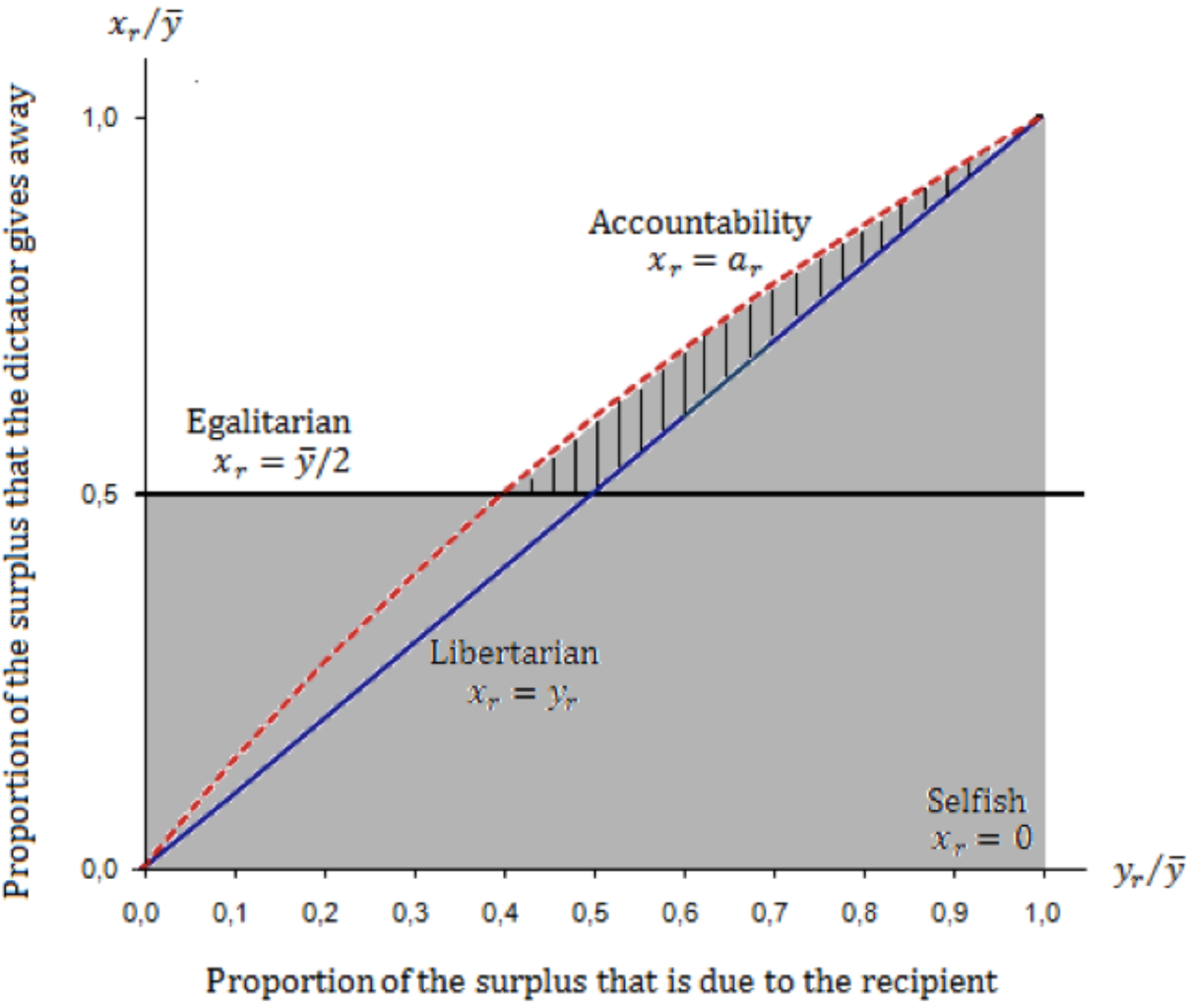
      <p>To further illustrate that our model extends upon the previous ones, we consider <xref ref-type="fig" rid="games-03-00138-f001">Figure 1</xref>. Along the horizontal axis, we plot the proportion of the surplus that is due to the recipient’s production (y<sub>r</sub>/<inline-graphic xmlns:xlink="http://www.w3.org/1999/xlink" xlink:href="games-03-00138-i001.tif"/>). We use the vertical axis to represent the proportion of the surplus that the dictator gives away to the recipient (x<sub>r</sub>/<inline-graphic xmlns:xlink="http://www.w3.org/1999/xlink" xlink:href="games-03-00138-i042.tif"/>. As a consequence, the 45-degree line represents the appropriate theoretical prediction in Frohlich <italic>et al.</italic> [<xref ref-type="bibr" rid="B2-games-03-00138">2</xref>], because observations on this line indicate that recipients are being transferred exactly the proportion of the surplus that they have contributed, <italic>i.e.</italic>, the 45-degree line represents the libertarian allocation x<sub>r </sub>= y<sub>r</sub>. In <xref ref-type="fig" rid="games-03-00138-f001">Figure 1</xref>, we also plot the horizontal line (x<sub>r</sub>/<inline-graphic xmlns:xlink="http://www.w3.org/1999/xlink" xlink:href="games-03-00138-i001.tif"/> = 0.5), which represents the egalitarian allocation x<sub>r </sub>=<inline-graphic xmlns:xlink="http://www.w3.org/1999/xlink" xlink:href="games-03-00138-i043.tif"/>2 (Fehr and Schmid [<xref ref-type="bibr" rid="B1-games-03-00138">1</xref>]). The dotted curve depicts the accountability principle x<sub>r</sub>=a<sub>r</sub>. Therefore, allocations on this curve indicate that recipients are being transferred exactly the proportion of the surplus that is due to their effort.<xref ref-type="fn" rid="fn009-games-03-00138">9</xref> The difference between p<sub>d</sub> and p<sub>r</sub> establishes the concavity of the dotted curve x<sub>r </sub>= a<sub>r</sub> and determines those allocations that cannot be predicted by Fehr and Schmidt [<xref ref-type="bibr" rid="B1-games-03-00138">1</xref>] or Frohlich <italic>et al.</italic> [<xref ref-type="bibr" rid="B2-games-03-00138">2</xref>]. In particular, the nonlinear version of these models predicts no allocations above both “just dessert” and the horizontal line x<sub>r </sub>= <inline-graphic xmlns:xlink="http://www.w3.org/1999/xlink" xlink:href="games-03-00138-i031.tif"/>. Graphically, this implies that the models predict any giving in the shadowed area, except the striped area (<italic>i.e.</italic>, the models predict x<sub>r </sub>≤ max{<inline-graphic xmlns:xlink="http://www.w3.org/1999/xlink" xlink:href="games-03-00138-i031.tif"/>,y<sub>r</sub>}). However, our model takes into account the accountability principle so that our prediction includes the striped area (<italic>i.e.</italic>, our model predict x<sub>r </sub>≤ max{<inline-graphic xmlns:xlink="http://www.w3.org/1999/xlink" xlink:href="games-03-00138-i031.tif"/>,y<sub>r,</sub>a<sub>r</sub>}). </p>
      <fig id="games-03-00138-f001" position="anchor">
        <label>Figure 1</label>
        <caption>
          <p>Graphical representation of our predictions if p<sub>d</sub> &gt; p<sub>r</sub>.</p>
        </caption>
        <graphic xmlns:xlink="http://www.w3.org/1999/xlink" xlink:href="games-03-00138-g001.tif"/>
      </fig>
      <p>All the allocations on the striped area give some weight to the accountability principle, such that these allocations cannot be explained with the models of inequity aversion of Fehr and Schmidt [<xref ref-type="bibr" rid="B1-games-03-00138">1</xref>] and Frohlich <italic>et al.</italic> [<xref ref-type="bibr" rid="B2-games-03-00138">2</xref>], in which the idea of liberal egalitarian ethics is disregarded (<italic>i.e.</italic>, <inline-graphic xmlns:xlink="http://www.w3.org/1999/xlink" xlink:href="games-03-00138-i045.tif"/><inline-graphic xmlns:xlink="http://www.w3.org/1999/xlink" xlink:href="games-03-00138-i023.tif"/> = 0 is assumed). </p>
      <p>We find that our model generalizes the previous ones and can be used to explain dictators’ behavior, especially when the production stage involves factors within and beyond the subject's control. In that context, the accountability principle is likely to lead dictators' behavior, especially when dictators act as a third party in the distributional problem (e.g., Cappelen <italic>et al.</italic> [<xref ref-type="bibr" rid="B17-games-03-00138">17</xref>] and Konow [<xref ref-type="bibr" rid="B7-games-03-00138">7</xref>]). The results in Cappelen <italic>et al.</italic> [<xref ref-type="bibr" rid="B5-games-03-00138">5</xref>], Konow [<xref ref-type="bibr" rid="B16-games-03-00138">16</xref>] and Rodriguez-Lara and Moreno-Garrido [<xref ref-type="bibr" rid="B11-games-03-00138">11</xref>] do also produce behavior that is also consistent with the idea of subjects who endorse the accountability principle. In particular, Cappelen <italic>et al.</italic> [<xref ref-type="bibr" rid="B5-games-03-00138">5</xref>] consider a dictator game with production and estimate that 38 percent of dictators are closest to satisfying the accountability principle, 43 percent to being egalitarians and 18 percent to being libertarians when dividing the surplus. If we use the reported data in Cappelen <italic>et al.</italic> [<xref ref-type="bibr" rid="B5-games-03-00138">5</xref>] and focus our analysis on the cases in which dictators are at relative advantage with regard to the accumulation of money (p<sub>d </sub>&gt; p<sub>r</sub>), we will find that 15-percent of the dictators behave according to the accountability principle. In <xref ref-type="fig" rid="games-03-00138-f001">Figure 1</xref>, these observations would lie on the striped area; therefore these allocation choices cannot be predicted by the previous models of inequity aversion. Similar results can be derived from the reported results in Rodriguez-Lara and Moreno-Garrido [<xref ref-type="bibr" rid="B11-games-03-00138">11</xref>] or Ubeda [<xref ref-type="bibr" rid="B24-games-03-00138">24</xref>]. For instance when p<sub>d </sub>&gt; p<sub>r</sub>, roughly 17-percent of the data in Rodriguez-Lara and Moreno-Garrido [<xref ref-type="bibr" rid="B11-games-03-00138">11</xref>] is incompatible with Fehr and Schmid [<xref ref-type="bibr" rid="B1-games-03-00138">1</xref>] and Frohlich <italic>et al.</italic> [<xref ref-type="bibr" rid="B2-games-03-00138">2</xref>], because it includes dictators who transfer x<sub>r </sub>≥ max{<inline-graphic xmlns:xlink="http://www.w3.org/1999/xlink" xlink:href="games-03-00138-i031.tif"/>,y<sub>r</sub>}.<xref ref-type="fn" rid="fn010-games-03-00138">10</xref> </p>
      <p>One important feature of our model is that dictators are allowed to weigh three different fairness ideals instead of only one. Graphically, this implies that any allocation on the shadowed area can be derived after considering that dictators weigh the lines x<sub>r </sub>= 0, x<sub>r </sub>= <inline-graphic xmlns:xlink="http://www.w3.org/1999/xlink" xlink:href="games-03-00138-i001.tif"/>/ 2, x<sub>r </sub>= a<sub>r</sub> and x<sub>r </sub>= y<sub>r</sub>. This feature of our model generalizes the idea that each dictator is motivated by a single fairness view (<italic>i.e.</italic>, by a single “line”), with dictators being heterogeneous in what they consider as fair, and the marginal utility loss of deviating from this fairness ideal increasing in the size of the deviation. Our way of modeling social preference is also valid under the assumptions that fairness ideals are tradeoffs against each other, and heterogeneity lies inside each subject rather, than taking place across subjects. It remains to be discussed whether we should expect subjects to hold different fairness ideals at each time. Using a questionnaire, the seminal paper of Yaari [<xref ref-type="bibr" rid="B25-games-03-00138">25</xref>] provides evidence that subjects choose different solutions for the same distribution problems, depending on the prevalence of tastes or needs in the story underlying each question (see also Messick and Sentis [<xref ref-type="bibr" rid="B23-games-03-00138">23</xref>]). Recent experimental findings are also in line with the idea of within-subject heterogeneity (e.g., Croson and Konow [<xref ref-type="bibr" rid="B22-games-03-00138">22</xref>], Konow [<xref ref-type="bibr" rid="B16-games-03-00138">16</xref>], Ubeda [<xref ref-type="bibr" rid="B24-games-03-00138">24</xref>], Blanco <italic>et al.</italic> [<xref ref-type="bibr" rid="B33-games-03-00138">33</xref>] and Miller and Ubeda [<xref ref-type="bibr" rid="B10-games-03-00138">10</xref>]). In their paper, Blanco <italic>et al.</italic> (2011) test the consistency of the Fehr and Schmidt's model and find that it fails to predict behavior at the individual level, as subjects exhibit different fairness attitudes across games (<italic>i.e.</italic>, the estimation of and <inline-graphic xmlns:xlink="http://www.w3.org/1999/xlink" xlink:href="games-03-00138-i046.tif"/> and β for a given subject changes depending on the game). The work of Miller and Ubeda [<xref ref-type="bibr" rid="B10-games-03-00138">10</xref>] focuses on a repeated dictator game with production and highlight that women are likely to switch between the three different fairness ideals presented in the current paper. </p>
    </sec>
    <sec id="sec4-games-03-00138">
      <title>4. Conclusion</title>
      <p>We have presented a theoretical model of social preferences that expands upon Fehr and Schmidt [<xref ref-type="bibr" rid="B1-games-03-00138">1</xref>] and Frohlich <italic>et al.</italic> [<xref ref-type="bibr" rid="B2-games-03-00138">2</xref>]. The underlying idea of our model is that dictators who are involved in a dictator game with production care about three different features. First, dictators get disutility if the final allocation deviates from the equal division. Second, dictators consider that subjects should receive exactly what they have produced. Finally, dictators account for the way in which entitlements are generated and try to compensate for factors beyond subjects' control. </p>
      <p>Our contribution to the literature is to provide a model that predicts the accountability principle in Konow [<xref ref-type="bibr" rid="B13-games-03-00138">13</xref>], which states that subjects should only be rewarded for factors under their control. This behavior is in accordance with liberal egalitarian ethics and cannot be predicted by the models of inequity aversion of Fehr and Schmidt [<xref ref-type="bibr" rid="B1-games-03-00138">1</xref>] and Frohlich <italic>et al.</italic> [<xref ref-type="bibr" rid="B2-games-03-00138">2</xref>], although it is observed in many laboratory experiments. </p>
      <p>One novelty of our approach with respect to Cappelen <italic>et al.</italic> [<xref ref-type="bibr" rid="B5-games-03-00138">5</xref>], Cappelen <italic>et al.</italic> [<xref ref-type="bibr" rid="B15-games-03-00138">15</xref>] or Konow [<xref ref-type="bibr" rid="B7-games-03-00138">7</xref>] is that we do not need to assume that, "individuals have a fairness ideal that is independent of the distributional function in which they find themselves [Cappelen <italic>et al.</italic> 2007, page 824].” Our model is suitable for this case of between-subjects heterogeneity, but it does also accommodate for the possibility of heterogeneity of fairness ideals lying inside each individual.</p>
    </sec>
    </body>
  <back>
  <ack>
      <title>Acknowledgments</title>
      <p>We would like to thank two anonymous referees for their comments and suggestion, which helped to shape the exposition of the paper. We are also grateful to Elisabet Rutstrom, Glenn W. Harrison, Giovanni Ponti, Paloma Ubeda, Juan D. Moreno-Ternero, Hubert Janos Kiss, Alfonso Rosa-Garcia, David Gill, Vicente Calabuig, Gonzalo Olcina and Jaromir Kovarik for valuable comments. Financial support from the Instituto Valenciano de Investigaciones Economicas (IVIE) and the Spanish Ministry of Education and Science under the projects SEJ2007-62656 and ECO2011-29230 is gratefully acknowledged. </p>
	  </ack>
	  <fn-group>
	<fn id="fn001-games-03-00138"><label>1 </label>
	<p>Hereafter we focus our exposition on the dictator game with production, which has been an important device for studying social preferences and distributional justice. We note that the existence of the production stage is important to disentangle the effect of fairness concerns and property rights in the final outcome. As noted by Cherry <italic>et al.</italic> [<xref ref-type="bibr" rid="B6-games-03-00138">6</xref>], if there is not a production stage, then dictators might give money away, because they are fair-minded, or simply because the surplus to be divided is "manna from heaven", and dictators do not feel any right to keep the entire surplus for themselves.</p></fn>
    <fn id="fn002-games-03-00138"><label>2 </label>
	<p>Frohlich <italic>et al.</italic> [<xref ref-type="bibr" rid="B2-games-03-00138">2</xref>] use the concept of “just desert” to identify the division of the surplus that corresponds to the subjects’ production. We borrow the terminology in Cappelen <italic>et al.</italic> [<xref ref-type="bibr" rid="B5-games-03-00138">5</xref>,<xref ref-type="bibr" rid="B14-games-03-00138">14</xref>] and refer to this division as the libertarian allocation. Hereafter, we follow Cappelen <italic>et al.</italic> [<xref ref-type="bibr" rid="B5-games-03-00138">5</xref>,<xref ref-type="bibr" rid="B14-games-03-00138">14</xref>] in labeling the rest of the fairness ideals presented in the paper.</p></fn>
    <fn id="fn003-games-03-00138"><label>3 </label>
      <p>The approach in Cappelen <italic>et al.</italic> [<xref ref-type="bibr" rid="B5-games-03-00138">5</xref>,<xref ref-type="bibr" rid="B14-games-03-00138">14</xref>] relies on the assumption of between-subject heterogeneity; <italic>i.e.</italic>, subjects differ with respect to their consideration of fairness ideals (see also Engel [<xref ref-type="bibr" rid="B4-games-03-00138">4</xref>] or Visser [<xref ref-type="bibr" rid="B21-games-03-00138">21</xref>] for evidence of between-subject heterogeneity). However, there exists experimental evidence suggesting the existence of within-subject heterogeneity; <italic>i.e.</italic>, the same subject might choose different allocations (or fairness ideals) depending on the context (see, among others, in Croson and Konow [<xref ref-type="bibr" rid="B22-games-03-00138">22</xref>], Konow [<xref ref-type="bibr" rid="B16-games-03-00138">16</xref>], Messick and Sentis [<xref ref-type="bibr" rid="B23-games-03-00138">23</xref>], Miller and Ubeda [<xref ref-type="bibr" rid="B10-games-03-00138">10</xref>], Ubeda [<xref ref-type="bibr" rid="B24-games-03-00138">24</xref>] or Yaari [<xref ref-type="bibr" rid="B25-games-03-00138">25</xref>]).</p></fn>
    <fn id="fn004-games-03-00138"><label>4 </label>
      <p>We acknowledge that it might be hard to disentangle which variables are under the subjects’ control and which variables are outside their control in some situations. We find, however, that the classification of factors within and beyond individuals’ control is beyond the scope of this paper. For further discussion on this topic, the interested reader can see Fleurbaey and Maniquet [<xref ref-type="bibr" rid="B18-games-03-00138">18</xref>]. Konow [<xref ref-type="bibr" rid="B27-games-03-00138">27</xref>] is also an excellent overview of various theories of justice that deals with this feature.</p></fn>
    <fn id="fn005-games-03-00138"><label>5 </label>
      <p>For the special case in which β = 0.5, the dictator is indifferent between any share x<sub>d</sub>ϵ<inline-graphic xmlns:xlink="http://www.w3.org/1999/xlink" xlink:href="games-03-00138-i047.tif"/>]. As Fehr and Schmidt [<xref ref-type="bibr" rid="B1-games-03-00138">1</xref>] argue, the nonlinear versions of their model lead also to predictions <bold>x</bold>= (x<sub>d</sub>, x<sub>r</sub>) that satisfy x<sub>d</sub>ϵ<inline-graphic xmlns:xlink="http://www.w3.org/1999/xlink" xlink:href="games-03-00138-i048.tif"/>] and x<sub>r</sub> = <inline-graphic xmlns:xlink="http://www.w3.org/1999/xlink" xlink:href="games-03-00138-i001.tif"/>- x<sub>d</sub>≥ 0. The models of Bolton and Ockenfelds [<xref ref-type="bibr" rid="B28-games-03-00138">28</xref>] and Charness and Rabin [<xref ref-type="bibr" rid="B29-games-03-00138">29</xref>] do also integrate equality as an argument. In particular, Bolton and Ockenfelds [<xref ref-type="bibr" rid="B28-games-03-00138">28</xref>] show that the results of Fehr and Schmidt [<xref ref-type="bibr" rid="B1-games-03-00138">1</xref>] are robust to non-linearity as well as incomplete information.</p></fn>
    <fn id="fn006-games-03-00138"><label>6 </label>
      <p>We note that we have rewritten the original equation in Frohlich <italic>et al.</italic> [<xref ref-type="bibr" rid="B2-games-03-00138">2</xref>] so as to follow our reasoning in equation (3). In particular, because y<sub>d</sub> + y<sub>r </sub>= x<sub>d </sub>+ x<sub>r</sub>, the latter term in equation (4) can also be thought of as the cost of not giving to the recipient her production.</p></fn>
    <fn id="fn007-games-03-00138"><label>7 </label>
      <p>Nonlinear versions of our model would predict interior results that lead to compromises between these fairness ideals. The interested reader can find a brief discussion about the linearity assumption in the supplementary material. We note that Bolton and Ockenfelds [<xref ref-type="bibr" rid="B28-games-03-00138">28</xref>] is an extension of Fehr and Schmidt [<xref ref-type="bibr" rid="B1-games-03-00138">1</xref>] to the non-linear case. The model of Bolton <italic>et al.</italic> [<xref ref-type="bibr" rid="B32-games-03-00138">32</xref>] incorporates an idea that is related to the accountability principle in the context of procedural fairness; <italic>i.e.</italic>, the authors use different games and investigate the extent to which subjects care about fair procedures.</p></fn>
    <fn id="fn008-games-03-00138"><label>8 </label>
      <p>The experimental design in Rodriguez-Lara and Moreno-Garrido [<xref ref-type="bibr" rid="B11-games-03-00138">11</xref>] relies on this production stage. In Konow [<xref ref-type="bibr" rid="B7-games-03-00138">7</xref>], subjects are differently rewarded for a real-effort task that involves stuffing letters into envelops. In Ubeda [<xref ref-type="bibr" rid="B24-games-03-00138">24</xref>], the task consists of solving puzzles, whereas in Cappelen <italic>et al.</italic> [<xref ref-type="bibr" rid="B5-games-03-00138">5</xref>], subjects have to choose how much money to invest in an investment game in which the rate of return is exogenously determined.</p></fn>
    <fn id="fn009-games-03-00138"><label>9 </label>
      <p>Recall that we focus on the case in which the dictator is rewarded at a higher rate; therefore the recipient's monetary contribution to the surplus will be below her contribution in terms of inputs (a<sub>r </sub>&gt; y<sub>r</sub>). Graphically, this implies that the dotted curve (the accountability principle) is above the 45-degree line (the libertarian principle). Both principles coincide when (y<sub>r </sub>/ <inline-graphic xmlns:xlink="http://www.w3.org/1999/xlink" xlink:href="games-03-00138-i001.tif"/>) = 0 and (y<sub>r </sub>/ <inline-graphic xmlns:xlink="http://www.w3.org/1999/xlink" xlink:href="games-03-00138-i001.tif"/>) = 1. In the first case, all the available surplus is due to the dictators' inputs (q<sub>r </sub>= 0). The contrary is true if (y<sub>r </sub>/ <inline-graphic xmlns:xlink="http://www.w3.org/1999/xlink" xlink:href="games-03-00138-i001.tif"/>) = 1.We also note that we represent (y<sub>r </sub>/ <inline-graphic xmlns:xlink="http://www.w3.org/1999/xlink" xlink:href="games-03-00138-i001.tif"/>) on the horizontal line and assume that p<sub>d </sub>= 1.5 and p<sub>r </sub>= 1. Thus, the egalitarian principle and the libertarian one coincide when (y<sub>r </sub>/ <inline-graphic xmlns:xlink="http://www.w3.org/1999/xlink" xlink:href="games-03-00138-i001.tif"/>) = 0.5 (<italic>i.e.</italic>, when y<sub>r </sub>= <inline-graphic xmlns:xlink="http://www.w3.org/1999/xlink" xlink:href="games-03-00138-i049.tif"/>), whereas the egalitarian principle and the accountability one coincide if a<sub>r </sub>/ <inline-graphic xmlns:xlink="http://www.w3.org/1999/xlink" xlink:href="games-03-00138-i001.tif"/> = 0.5 (<italic>i.e.</italic>, when a<sub>r </sub>= <inline-graphic xmlns:xlink="http://www.w3.org/1999/xlink" xlink:href="games-03-00138-i049.tif"/>). In order to satisfy this latter condition, both subjects should have exactly the same number of correct answers (q<sub>d </sub>= q<sub>r</sub>), which implies that y<sub>r </sub>/ <inline-graphic xmlns:xlink="http://www.w3.org/1999/xlink" xlink:href="games-03-00138-i050.tif"/> = 0.4.</p></fn>
    <fn id="fn010-games-03-00138"><label>10 </label>
      <p>We note that our model cannot be tested using the reported data in other experiments such as Bolton and Ockenfelds [<xref ref-type="bibr" rid="B28-games-03-00138">28</xref>], Charness and Rabin [<xref ref-type="bibr" rid="B29-games-03-00138">29</xref>] or Fehr and Schmidt [<xref ref-type="bibr" rid="B1-games-03-00138">1</xref>], which do not consider a production stage.</p></fn>
	  </fn-group>
    
    <ref-list>
      <title>References</title>
      <ref id="B1-games-03-00138">
        <label>1.</label>
        <citation citation-type="journal">
          <person-group person-group-type="author">
            <name>
              <surname>Fehr</surname>
              <given-names>E.</given-names>
            </name>
            <name>
              <surname>Schmidt</surname>
              <given-names>K.</given-names>
            </name>
          </person-group>
          <article-title>A theory of fairness, competition and cooperation</article-title>
          <source>Q. J. Econ.</source>
          <year>1999</year>
          <volume>114</volume>
          <fpage>817</fpage>
          <lpage>868</lpage>
          <pub-id pub-id-type="doi">10.1162/003355399556151</pub-id>
        </citation>
      </ref>
      <ref id="B2-games-03-00138">
        <label>2.</label>
        <citation citation-type="journal">
          <person-group person-group-type="author">
            <name>
              <surname>Frohlich</surname>
              <given-names>N.</given-names>
            </name>
            <name>
              <surname>Oppenheimer</surname>
              <given-names>J.</given-names>
            </name>
            <name>
              <surname>Kurki</surname>
              <given-names>A.</given-names>
            </name>
          </person-group>
          <article-title>Modeling other-regarding preferences and an experimental test</article-title>
          <source>Public Choice</source>
          <year>2004</year>
          <volume>119</volume>
          <fpage>91</fpage>
          <lpage>117</lpage>
          <pub-id pub-id-type="doi">10.1023/B:PUCH.0000024169.08329.eb</pub-id>
        </citation>
      </ref>
      <ref id="B3-games-03-00138">
        <label>3.</label>
        <citation citation-type="book">
          <person-group person-group-type="author">
            <name>
              <surname>Camerer</surname>
              <given-names>C.</given-names>
            </name>
          </person-group>
          <source>Behavioral Game Theory</source>
          <publisher-name>Princeton University Press</publisher-name>
          <publisher-loc>Princeton, NJ, USA</publisher-loc>
          <year>2003</year>
        </citation>
      </ref>
      <ref id="B4-games-03-00138">
        <label>4.</label>
        <citation citation-type="journal">
          <person-group person-group-type="author">
            <name>
              <surname>Engel</surname>
              <given-names>C.</given-names>
            </name>
          </person-group>
          <article-title>Dictator games: A meta study</article-title>
          <source>Exp. Econ.</source>
          <year>2011</year>
          <volume>14</volume>
          <fpage>583</fpage>
          <lpage>610</lpage>
          <pub-id pub-id-type="doi">10.1007/s10683-011-9283-7</pub-id>
        </citation>
      </ref>
      <ref id="B5-games-03-00138">
        <label>5.</label>
        <citation citation-type="journal">
          <person-group person-group-type="author">
            <name>
              <surname>Cappelen</surname>
              <given-names>A.W.</given-names>
            </name>
            <name>
              <surname>Hole</surname>
              <given-names>A.D.</given-names>
            </name>
            <name>
              <surname>Sorensen</surname>
              <given-names>E.</given-names>
            </name>
            <name>
              <surname>Tungodden</surname>
              <given-names>B.</given-names>
            </name>
          </person-group>
          <article-title>The pluralism of fairness ideals: An experimental approach</article-title>
          <source>Am. Econ. Rev.</source>
          <year>2007</year>
          <volume>97</volume>
          <fpage>818</fpage>
          <lpage>827</lpage>
          <pub-id pub-id-type="doi">10.1257/aer.97.3.818</pub-id>
        </citation>
      </ref>
      <ref id="B6-games-03-00138">
        <label>6.</label>
        <citation citation-type="journal">
          <person-group person-group-type="author">
            <name>
              <surname>Cherry</surname>
              <given-names>T.L.</given-names>
            </name>
            <name>
              <surname>Frykblom</surname>
              <given-names>P.</given-names>
            </name>
            <name>
              <surname>Shogren</surname>
              <given-names>J.F.</given-names>
            </name>
          </person-group>
          <article-title>Hardnose the dictator</article-title>
          <source>Am. Econ. Rev.</source>
          <year>2002</year>
          <volume>92</volume>
          <fpage>1218</fpage>
          <lpage>1221</lpage>
          <pub-id pub-id-type="doi">10.1257/00028280260344740</pub-id>
        </citation>
      </ref>
      <ref id="B7-games-03-00138">
        <label>7.</label>
        <citation citation-type="journal">
          <person-group person-group-type="author">
            <name>
              <surname>Konow</surname>
              <given-names>J.</given-names>
            </name>
          </person-group>
          <article-title>Fair shares: Accountability and cognitive dissonance in allocation decisions</article-title>
          <source>Am. Econ. Rev.</source>
          <year>2000</year>
          <volume>90</volume>
          <fpage>1072</fpage>
          <lpage>1091</lpage>
          <pub-id pub-id-type="doi">10.1257/aer.90.4.1072</pub-id>
        </citation>
      </ref>
      <ref id="B8-games-03-00138">
        <label>8.</label>
        <citation citation-type="journal">
          <person-group person-group-type="author">
            <name>
              <surname>Oxoby</surname>
              <given-names>R.J.</given-names>
            </name>
            <name>
              <surname>Spraggon</surname>
              <given-names>J.</given-names>
            </name>
          </person-group>
          <article-title>Mine and yours: Property rights in dictator games</article-title>
          <source>J. Econ. Behav. Organ.</source>
          <year>2008</year>
          <volume>65</volume>
          <fpage>703</fpage>
          <lpage>713</lpage>
          <pub-id pub-id-type="doi">10.1016/j.jebo.2005.12.006</pub-id>
        </citation>
      </ref>
      <ref id="B9-games-03-00138">
        <label>9.</label>
        <citation citation-type="journal">
          <person-group person-group-type="author">
            <name>
              <surname>Ruffle</surname>
              <given-names>B.J.</given-names>
            </name>
          </person-group>
          <article-title>More is better, but fair is fair: Tipping in dictator and ultimatum game</article-title>
          <source>Games Econ. Behav.</source>
          <year>1998</year>
          <volume>23</volume>
          <fpage>247</fpage>
          <lpage>265</lpage>
          <pub-id pub-id-type="doi">10.1006/game.1997.0630</pub-id>
        </citation>
      </ref>
      <ref id="B10-games-03-00138">
        <label>10.</label>
        <citation citation-type="journal">
          <person-group person-group-type="author">
            <name>
              <surname>Miller</surname>
              <given-names>L.</given-names>
            </name>
            <name>
              <surname>Ubeda</surname>
              <given-names>P.</given-names>
            </name>
          </person-group>
          <article-title>Are women more sensitive to the decision-making context?</article-title>
          <source>J. Econ. Behav. Organ.</source>
          <year>2011</year>
          <volume>83</volume>
          <fpage>98</fpage>
          <lpage>104</lpage>
          <pub-id pub-id-type="doi">10.1016/j.jebo.2011.06.014</pub-id>
        </citation>
      </ref>
      <ref id="B11-games-03-00138">
        <label>11.</label>
        <citation citation-type="journal">
          <person-group person-group-type="author">
            <name>
              <surname>Rodriguez-Lara</surname>
              <given-names>I.</given-names>
            </name>
            <name>
              <surname>Moreno-Garrido</surname>
              <given-names>L.</given-names>
            </name>
          </person-group>
          <article-title>Self-Interest and fairness: Self-serving choices of justice principles</article-title>
          <source>Exp. Econ.</source>
          <year>2012</year>
          <volume>15</volume>
          <fpage>158</fpage>
          <lpage>175</lpage>
          <pub-id pub-id-type="doi">10.1007/s10683-011-9295-3</pub-id>
        </citation>
      </ref>
      <ref id="B12-games-03-00138">
        <label>12.</label>
        <citation citation-type="book">
          <person-group person-group-type="author">
            <name>
              <surname>Fehr</surname>
              <given-names>E.</given-names>
            </name>
            <name>
              <surname>Schmidt</surname>
              <given-names>K.</given-names>
            </name>
          </person-group>
          <article-title>Theories of fairness and reciprocity: Evidence and economic applications</article-title>
          <source>Advances in Economics and Econometrics</source>
          <person-group person-group-type="editor">
            <name>
              <surname>Dewatripont</surname>
              <given-names>M.e.A.</given-names>
            </name>
          </person-group>
          <publisher-name>Cambridge University Press</publisher-name>
          <publisher-loc>Cambridge, UK</publisher-loc>
          <year>2003</year>
          <fpage>208</fpage>
          <lpage>257</lpage>
        </citation>
      </ref>
      <ref id="B13-games-03-00138">
        <label>13.</label>
        <citation citation-type="journal">
          <person-group person-group-type="author">
            <name>
              <surname>Konow</surname>
              <given-names>J.</given-names>
            </name>
          </person-group>
          <article-title>A positive theory of economic fairness</article-title>
          <source>J. Econ. Behav. Organ.</source>
          <year>1996</year>
          <volume>31</volume>
          <fpage>13</fpage>
          <lpage>35</lpage>
          <pub-id pub-id-type="doi">10.1016/S0167-2681(96)00862-1</pub-id>
        </citation>
      </ref>
      <ref id="B14-games-03-00138">
        <label>14.</label>
        <citation citation-type="book">
          <person-group person-group-type="author">
            <name>
              <surname>Cappelen</surname>
              <given-names>A.W.</given-names>
            </name>
            <name>
              <surname>Moene</surname>
              <given-names>K.O.</given-names>
            </name>
            <name>
              <surname>Sorensen</surname>
              <given-names>E.</given-names>
            </name>
            <name>
              <surname>Tungodden</surname>
              <given-names>B.</given-names>
            </name>
          </person-group>
          <article-title>Rich meets poor: An international fairness experiment. CMI working paper, Mimeo</article-title>
          <publisher-name>CMI</publisher-name>
          <publisher-loc>Bergen, Norway</publisher-loc>
          <year>2008</year>
        </citation>
      </ref>
      <ref id="B15-games-03-00138">
        <label>15.</label>
        <citation citation-type="journal">
          <person-group person-group-type="author">
            <name>
              <surname>Cappelen</surname>
              <given-names>A.W.</given-names>
            </name>
            <name>
              <surname>Sorensen</surname>
              <given-names>E.</given-names>
            </name>
            <name>
              <surname>Tungodden</surname>
              <given-names>B.</given-names>
            </name>
          </person-group>
          <article-title>Responsability for what? Fairness and individual responsibility</article-title>
          <source>European Econ. Rev.</source>
          <year>2010</year>
          <volume>54</volume>
          <fpage>429</fpage>
          <lpage>441</lpage>
          <pub-id pub-id-type="doi">10.1016/j.euroecorev.2009.08.005</pub-id>
        </citation>
      </ref>
      <ref id="B16-games-03-00138">
        <label>16.</label>
        <citation citation-type="journal">
          <person-group person-group-type="author">
            <name>
              <surname>Konow</surname>
              <given-names>J.</given-names>
            </name>
          </person-group>
          <article-title>Fair and square: The four sides of distributive justice</article-title>
          <source>J. Econ. Behav. Organ.</source>
          <year>2001</year>
          <volume>46</volume>
          <fpage>137</fpage>
          <lpage>164</lpage>
          <pub-id pub-id-type="doi">10.1016/S0167-2681(01)00194-9</pub-id>
        </citation>
      </ref>
      <ref id="B17-games-03-00138">
        <label>17.</label>
        <citation citation-type="journal">
          <person-group person-group-type="author">
            <name>
              <surname>Cappelen</surname>
              <given-names>A.W.</given-names>
            </name>
            <name>
              <surname>Tungodden</surname>
              <given-names>B.</given-names>
            </name>
          </person-group>
          <article-title>Rewarding effort</article-title>
          <source>Econ. Theory</source>
          <year>2009</year>
          <volume>39</volume>
          <fpage>425</fpage>
          <lpage>441</lpage>
          <pub-id pub-id-type="doi">10.1007/s00199-007-0320-x</pub-id>
        </citation>
      </ref>
      <ref id="B18-games-03-00138">
        <label>18.</label>
        <citation citation-type="book">
          <person-group person-group-type="author">
            <name>
              <surname>Fleurbaey</surname>
              <given-names>M.</given-names>
            </name>
            <name>
              <surname>Maniquet</surname>
              <given-names>F.</given-names>
            </name>
          </person-group>
          <article-title>Compensation and responsability</article-title>
          <source>Handbook of Social Choice and Welfare</source>
          <person-group person-group-type="editor">
            <name>
              <surname>Arrow</surname>
              <given-names>K.</given-names>
            </name>
            <name>
              <surname>Sen</surname>
              <given-names>A.</given-names>
            </name>
            <name>
              <surname>Suzumura</surname>
              <given-names>K.</given-names>
            </name>
          </person-group>
          <publisher-name>Northe-Holland</publisher-name>
          <publisher-loc>Amsterdam, The Netherlands</publisher-loc>
          <year>2010</year>
          <volume>2</volume>
        </citation>
      </ref>
      <ref id="B19-games-03-00138">
        <label>19.</label>
        <citation citation-type="book">
          <person-group person-group-type="author">
            <name>
              <surname>Rawls</surname>
              <given-names>J.</given-names>
            </name>
          </person-group>
          <source>A Theory of Justice</source>
          <publisher-name>Harvard University Press</publisher-name>
          <publisher-loc>Cambridge, MA, USA</publisher-loc>
          <year>1999</year>
        </citation>
      </ref>
      <ref id="B20-games-03-00138">
        <label>20.</label>
        <citation citation-type="book">
          <person-group person-group-type="author">
            <name>
              <surname>Roemer</surname>
              <given-names>J.E.</given-names>
            </name>
          </person-group>
          <source>Equality of Opportunity</source>
          <publisher-name>Harvard University Press</publisher-name>
          <publisher-loc>Cambridge, MA, USA</publisher-loc>
          <year>1998</year>
        </citation>
      </ref>
      <ref id="B21-games-03-00138">
        <label>21.</label>
        <citation citation-type="journal">
          <person-group person-group-type="author">
            <name>
              <surname>Visser</surname>
              <given-names>M.S.</given-names>
            </name>
            <name>
              <surname>Roelofs</surname>
              <given-names>M.R.</given-names>
            </name>
          </person-group>
          <article-title>Heterogeneous preferences for altruism: Gender and personality, social status, giving and taking</article-title>
          <source>Exp Econ.</source>
          <year>2011</year>
          <volume>14</volume>
          <fpage>490</fpage>
          <lpage>506</lpage>
          <pub-id pub-id-type="doi">10.1007/s10683-011-9278-4</pub-id>
        </citation>
      </ref>
      <ref id="B22-games-03-00138">
        <label>22.</label>
        <citation citation-type="journal">
          <person-group person-group-type="author">
            <name>
              <surname>Croson</surname>
              <given-names>R.</given-names>
            </name>
            <name>
              <surname>Konow</surname>
              <given-names>J.</given-names>
            </name>
          </person-group>
          <article-title>Social preferences and moral biases</article-title>
          <source>J. Econ. Behav. Organization</source>
          <year>2009</year>
          <volume>69</volume>
          <fpage>201</fpage>
          <lpage>212</lpage>
          <pub-id pub-id-type="doi">10.1016/j.jebo.2008.10.007</pub-id>
        </citation>
      </ref>
      <ref id="B23-games-03-00138">
        <label>23.</label>
        <citation citation-type="book">
          <person-group person-group-type="author">
            <name>
              <surname>Messick</surname>
              <given-names>D.</given-names>
            </name>
            <name>
              <surname>Sentis</surname>
              <given-names>K.</given-names>
            </name>
          </person-group>
          <article-title>Fairness, preference and fairness biases</article-title>
          <source>Equity Theory, Psychological and Sociological Perspectives</source>
          <person-group person-group-type="editor">
            <name>
              <surname>Messick</surname>
              <given-names>D.</given-names>
            </name>
            <name>
              <surname>Cook</surname>
              <given-names>K.S.</given-names>
            </name>
          </person-group>
          <publisher-name>Praeger</publisher-name>
          <publisher-loc>New York, NY, USA</publisher-loc>
          <year>1983</year>
          <fpage>61</fpage>
          <lpage>94</lpage>
        </citation>
      </ref>
      <ref id="B24-games-03-00138">
        <label>24.</label>
        <citation citation-type="book">
          <person-group person-group-type="author">
            <name>
              <surname>Ubeda</surname>
              <given-names>P.</given-names>
            </name>
          </person-group>
          <article-title>The consistency of fairness rules: An experimental study. Working Paper DPEB No. 10/10</article-title>
          <publisher-name>Nuffield College, University of Oxford</publisher-name>
          <publisher-loc>Oxford, UK</publisher-loc>
          <year>2010</year>
        </citation>
      </ref>
      <ref id="B25-games-03-00138">
        <label>25.</label>
        <citation citation-type="journal">
          <person-group person-group-type="author">
            <name>
              <surname>Yaari</surname>
              <given-names>M.</given-names>
            </name>
            <name>
              <surname>Bar-Hillel</surname>
              <given-names>M.</given-names>
            </name>
          </person-group>
          <article-title>On dividing justly</article-title>
          <source>Soc. Choice Welfare</source>
          <year>1984</year>
          <volume>1</volume>
          <fpage>1</fpage>
          <lpage>24</lpage>
        <pub-id pub-id-type="doi">10.1007/BF00297056</pub-id></citation>
      </ref>
      <ref id="B26-games-03-00138">
        <label>26.</label>
        <citation citation-type="book">
          <person-group person-group-type="author">
            <name>
              <surname>Nielsen</surname>
              <given-names>K.</given-names>
            </name>
          </person-group>
          <source>Equality and Liberty: A Defense of Radical Egalitarianism</source>
          <publisher-name>Rowman and Littlefield Publishers, Inc.</publisher-name>
          <publisher-loc>Lanham, MD, USA</publisher-loc>
          <year>1984</year>
        </citation>
      </ref>
      <ref id="B27-games-03-00138">
        <label>27.</label>
        <citation citation-type="journal">
          <person-group person-group-type="author">
            <name>
              <surname>Konow</surname>
              <given-names>J.</given-names>
            </name>
          </person-group>
          <article-title>Which is the fairest one of all? A positive analysis of justice theories</article-title>
          <source>J. Econ. Literature</source>
          <year>2003</year>
          <volume>41</volume>
          <fpage>1188</fpage>
          <lpage>1239</lpage>
          <pub-id pub-id-type="doi">10.1257/002205103771800013</pub-id>
        </citation>
      </ref>
      <ref id="B28-games-03-00138">
        <label>28.</label>
        <citation citation-type="journal">
          <person-group person-group-type="author">
            <name>
              <surname>Bolton</surname>
              <given-names>G.E.</given-names>
            </name>
            <name>
              <surname>Ockenfels</surname>
              <given-names>A.</given-names>
            </name>
          </person-group>
          <article-title>A theory of equity, reciprocity, and competition</article-title>
          <source>Am. Econ. Rev.</source>
          <year>2000</year>
          <volume>30</volume>
          <fpage>166</fpage>
          <lpage>193</lpage>
        </citation>
      </ref>
      <ref id="B29-games-03-00138">
        <label>29.</label>
        <citation citation-type="journal">
          <person-group person-group-type="author">
            <name>
              <surname>Charness</surname>
              <given-names>G.</given-names>
            </name>
            <name>
              <surname>Rabin</surname>
              <given-names>M.</given-names>
            </name>
          </person-group>
          <article-title>Understanding social preferences with simple tests</article-title>
          <source>Q. J. Econ</source>
          <year>2002</year>
          <volume>117</volume>
          <fpage>817</fpage>
          <lpage>869</lpage>
          <pub-id pub-id-type="doi">10.1162/003355302760193904</pub-id>
        </citation>
      </ref>
      <ref id="B30-games-03-00138">
        <label>30.</label>
        <citation citation-type="book">
          <person-group person-group-type="author">
            <name>
              <surname>Selten</surname>
              <given-names>R.</given-names>
            </name>
          </person-group>
          <article-title>The equity principle in economic behavior</article-title>
          <source>Decision Theory and Social Ethics, Issues in Social Choice</source>
          <person-group person-group-type="editor">
            <name>
              <surname>Gottinger</surname>
              <given-names>H.W.</given-names>
            </name>
            <name>
              <surname>Leinfellner</surname>
              <given-names>W.</given-names>
            </name>
          </person-group>
          <publisher-name>Springer</publisher-name>
          <publisher-loc>Berlin, Germany</publisher-loc>
          <year>1984</year>
          <fpage>289</fpage>
          <lpage>301</lpage>
        </citation>
      </ref>
      <ref id="B31-games-03-00138">
        <label>31.</label>
        <citation citation-type="book">
          <person-group person-group-type="author">
            <name>
              <surname>Nozick</surname>
              <given-names>R.</given-names>
            </name>
          </person-group>
          <source>Anarchy, State and Utopia</source>
          <publisher-name>Wiley-Blackwell</publisher-name>
          <publisher-loc>New York, NY, USA</publisher-loc>
          <year>1974</year>
        </citation>
      </ref>
      <ref id="B32-games-03-00138">
        <label>32.</label>
        <citation citation-type="journal">
          <person-group person-group-type="author">
            <name>
              <surname>Bolton</surname>
              <given-names>G.E.</given-names>
            </name>
            <name>
              <surname>Brandts</surname>
              <given-names>J.</given-names>
            </name>
            <name>
              <surname>Ockenfels</surname>
              <given-names>A.</given-names>
            </name>
          </person-group>
          <article-title>Fair procedures: Evidence from games involving lotteries</article-title>
          <source>Econ. J.</source>
          <year>2005</year>
          <volume>115</volume>
          <fpage>1054</fpage>
          <lpage>1076</lpage>
          <pub-id pub-id-type="doi">10.1111/j.1468-0297.2005.01032.x</pub-id>
        </citation>
      </ref>
      <ref id="B33-games-03-00138">
        <label>33.</label>
        <citation citation-type="journal">
          <person-group person-group-type="author">
            <name>
              <surname>Blanco</surname>
              <given-names>M.</given-names>
            </name>
            <name>
              <surname>Engelmann</surname>
              <given-names>D.</given-names>
            </name>
            <name>
              <surname>Normann</surname>
              <given-names>H.T.</given-names>
            </name>
          </person-group>
          <article-title>A within-subject analysis of other-regarding preferences</article-title>
          <source>Games Econ. Behav.</source>
          <year>2011</year>
          <volume>7</volume>
          <fpage>321</fpage>
          <lpage>338</lpage>
        </citation>
      </ref>
    </ref-list>
  </back>
</article>