<?xml version="1.0" encoding="UTF-8"?>
<!DOCTYPE article PUBLIC "-//NLM//DTD Journal Publishing DTD v2.3 20070202//EN" "journalpublishing.dtd">
<article xmlns:mml="http://www.w3.org/1998/Math/MathML" xmlns:xlink="http://www.w3.org/1999/xlink" xml:lang="en" article-type="research-article">
<front>
<journal-meta>
<journal-id journal-id-type="publisher-id">Games</journal-id>
<journal-title>Games</journal-title>
<issn pub-type="epub">2073-4336</issn>
<publisher>
<publisher-name>Molecular Diversity Preservation International (MDPI)</publisher-name></publisher></journal-meta>
<article-meta>
<article-id pub-id-type="doi">10.3390/g2030355</article-id>
<article-id pub-id-type="publisher-id">games-02-00355</article-id>
<article-categories>
<subj-group>
<subject>Article</subject></subj-group></article-categories>
<title-group>
<article-title>Strictly Dominated Strategies in the Replicator-Mutator Dynamics</article-title></title-group>
<contrib-group>
<contrib contrib-type="author">
<name><surname>Izquierdo</surname><given-names>Segismundo S.</given-names></name><xref ref-type="aff" rid="af1-games-02-00355"><sup>1</sup></xref><xref ref-type="aff" rid="af2-games-02-00355"><sup>2</sup></xref><xref ref-type="corresp" rid="c1-games-02-00355"><sup>*</sup></xref></contrib>
<contrib contrib-type="author">
<name><surname>Izquierdo</surname><given-names>Luis R.</given-names></name><xref ref-type="aff" rid="af2-games-02-00355"><sup>2</sup></xref><xref ref-type="aff" rid="af3-games-02-00355"><sup>3</sup></xref></contrib></contrib-group>
<aff id="af1-games-02-00355">
<label>1</label> Department of Industrial Organization, Universidad de Valladolid, Valladolid, 47011 Spain</aff>
<aff id="af2-games-02-00355">
<label>2</label> Social Systems Engineering Centre (InSiSoc), Valladolid, 47011 Spain</aff>
<aff id="af3-games-02-00355">
<label>3</label> Department of Civil Engineering, Universidad de Burgos, Burgos, 09001 Spain; E-Mail: <email>luis@izquierdo.name</email></aff>
<author-notes>
<corresp id="c1-games-02-00355">
<label>*</label> Author to whom correspondence should be addressed; E-Mail: <email>segis@eii.uva.es</email>; Tel.: +34-983-183873; Fax: +34-983-423310.</corresp></author-notes>
<pub-date pub-type="collection">
<year>2011</year></pub-date>
<pub-date pub-type="epub">
<day>14</day>
<month>09</month>
<year>2011</year></pub-date>
<volume>2</volume>
<issue>3</issue>
<fpage>355</fpage>
<lpage>364</lpage>
<history>
<date date-type="received">
<day>27</day>
<month>06</month>
<year>2011</year></date>
<date date-type="rev-recd">
<day>02</day>
<month>09</month>
<year>2011</year></date>
<date date-type="accepted">
<day>02</day>
<month>09</month>
<year>2011</year></date></history>
<permissions>
<copyright-statement>© 2011 by the authors; licensee MDPI, Basel, Switzerland.</copyright-statement>
<copyright-year>2011</copyright-year>
<license>
<p>This article is an open access article distributed under the terms and conditions of the Creative Commons Attribution license (http://creativecommons.org/licenses/by/3.0/).</p></license></permissions>
<abstract>
<p>The replicator-mutator dynamics is a set of differential equations frequently used in biological and socioeconomic contexts to model evolutionary processes subject to mutation, error or experimentation. The replicator-mutator dynamics generalizes the widely used replicator dynamics, which appears in this framework as the extreme case where replication is perfectly precise. This paper studies the influence of strictly dominated strategies on the location of the rest points of the replicator-mutator dynamics, at the limit where the mutation terms become arbitrarily small. It can be proved that such limit rest points for small mutation are Nash equilibria, so strictly dominated strategies do not occur at limit stationary points. However, we show through a simple case how strictly dominated strategies can have an influence on the location of the limit rest points for small mutation. Consequently, the characterization of the limit rest points of the replicator-mutator dynamics cannot in general proceed safely by readily eliminating strictly dominated strategies.</p></abstract>
<kwd-group>
<kwd>replicator-mutator</kwd>
<kwd>dominated strategies</kwd>
<kwd>limit stationary states</kwd>
<kwd>limit rest points</kwd></kwd-group></article-meta></front>
<body>
<sec sec-type="intro">
<label>1.</label>
<title>Introduction</title>
<p>The continuous time selection mutation equation [<xref ref-type="bibr" rid="b1-games-02-00355">1</xref>], usually called Replicator-Mutator Dynamics (RMD) [<xref ref-type="bibr" rid="b2-games-02-00355">2</xref>], is a set of differential equations frequently used in biological and socioeconomic contexts to model evolutionary processes subject to mutation or experimentation. Among other applications, the replicator-mutator has been used to study molecular reactions [<xref ref-type="bibr" rid="b3-games-02-00355">3</xref>], the evolution of viral variants [<xref ref-type="bibr" rid="b4-games-02-00355">4</xref>], the evolution of cooperation [<xref ref-type="bibr" rid="b5-games-02-00355">5</xref>], the evolution of language [<xref ref-type="bibr" rid="b6-games-02-00355">6</xref>–<xref ref-type="bibr" rid="b8-games-02-00355">8</xref>], signaling games [<xref ref-type="bibr" rid="b9-games-02-00355">9</xref>,<xref ref-type="bibr" rid="b10-games-02-00355">10</xref>] and, with some modifications over the standard version, carcinogenesis and tumor progression [<xref ref-type="bibr" rid="b11-games-02-00355">11</xref>]. Formally, the replicator-mutator dynamics reads:
<disp-formula id="FD1">
<mml:math id="mm1" display="block">
<mml:semantics id="sm1">
<mml:mrow>
<mml:msub>
<mml:mi>ẋ</mml:mi>
<mml:mi>i</mml:mi></mml:msub>
<mml:mo>=</mml:mo>
<mml:munderover>
<mml:mtext>∑</mml:mtext>
<mml:mrow>
<mml:mi>j</mml:mi>
<mml:mo>=</mml:mo>
<mml:mn>1</mml:mn></mml:mrow>
<mml:mi>n</mml:mi></mml:munderover>
<mml:mrow>
<mml:msub>
<mml:mi>x</mml:mi>
<mml:mi>j</mml:mi></mml:msub></mml:mrow>
<mml:msub>
<mml:mi>f</mml:mi>
<mml:mi>j</mml:mi></mml:msub>
<mml:msub>
<mml:mi>μ</mml:mi>
<mml:mrow>
<mml:mi>j</mml:mi>
<mml:mi>i</mml:mi></mml:mrow></mml:msub>
<mml:mo>−</mml:mo>
<mml:msub>
<mml:mi>x</mml:mi>
<mml:mi>i</mml:mi></mml:msub>
<mml:mover accent="true">
<mml:mi>f</mml:mi>
<mml:mi>¯</mml:mi></mml:mover>
<mml:mo>,</mml:mo>
<mml:mspace width="1.5em"/>
<mml:mi>i</mml:mi>
<mml:mo>=</mml:mo>
<mml:mn>1</mml:mn>
<mml:mo>,</mml:mo>
<mml:mo>…</mml:mo>
<mml:mo>,</mml:mo>
<mml:mi>n</mml:mi></mml:mrow></mml:semantics></mml:math></disp-formula></p>
<p>Here <italic>x<sub>i</sub></italic> represents the fraction of individuals in a large (infinite) population using pure strategy <italic>i</italic> (<italic>i</italic> = 1,…, <italic>n</italic>) and <italic>μ<sub>ij</sub></italic> is the probability that strategy <italic>i</italic> generates an offspring using strategy <italic>j</italic> (therefore, Σ<italic><sub>j</sub></italic> <italic>μ<sub>ij</sub></italic> =1). The payoff or fitness matrix is <italic>A</italic> = [<italic>a<sub>ij</sub></italic>], where <italic>a<sub>ij</sub></italic> ≥ 0 is the payoff that an <italic>i</italic>-strategist obtains in an interaction with a <italic>j</italic>-strategist. The fitness of strategy <italic>i</italic> is <italic>f<sub>i</sub></italic> = Σ<italic><sub>j</sub></italic> <italic>x<sub>j</sub></italic> <italic>a<sub>ij</sub></italic> and the average fitness is <italic>f</italic>̄ = Σ<italic><sub>i</sub></italic> <italic>x<sub>i</sub>f<sub>i</sub></italic>.</p>
<p>In the replicator-mutator dynamics, the unit simplex Δ<italic><sub>n</sub></italic> = {(<italic>x</italic><sub>1</sub>,…,<italic>x<sub>n</sub></italic>)∈ℜ<italic><sup>n</sup></italic>: Σ<italic><sub>i</sub></italic> <italic>x<sub>i</sub></italic> = 1 and <italic>x<sub>i</sub></italic> ≥ 0 }is forward invariant: if the state vector <italic>x</italic> = (<italic>x</italic><sub>1</sub>,…,<italic>x<sub>n</sub></italic>) starts in the unit simplex, it remains there; existence and uniqueness of trajectories can be proved by the Picard-Lindelöf theorem; and the existence of at least one stationary point (in the interior of the simplex if <italic>μ<sub>ij</sub></italic> &gt; 0) can be proved using Brouwer's fixed point theorem. Results for the extension of the replicator-mutator to an infinite number of possibly mixed strategies are provided by Bomze and Bürger [<xref ref-type="bibr" rid="b12-games-02-00355">12</xref>].</p>
<p>For the particular case of symmetric payoff matrices (which corresponds to the standard population-genetic model of natural selection on a large diploid population) and mutation rates <italic>μ<sub>ji</sub></italic> = <italic>μ<sub>i</sub></italic> for <italic>i</italic> ≠ <italic>j</italic> (an assumption introduced by Kingman [<xref ref-type="bibr" rid="b13-games-02-00355">13</xref>] in his “house of cards” model), a global Lyapunov function can be found which excludes cyclic behavior and guarantees that all orbits converge to the set of fixed points [<xref ref-type="bibr" rid="b1-games-02-00355">1</xref>,<xref ref-type="bibr" rid="b9-games-02-00355">9</xref>]. However, this “nice” behavior is not the general case [<xref ref-type="bibr" rid="b1-games-02-00355">1</xref>,<xref ref-type="bibr" rid="b3-games-02-00355">3</xref>,<xref ref-type="bibr" rid="b14-games-02-00355">14</xref>].</p>
<p>A well-known particular instance of the Replicator-Mutator Dynamics is the widely-used replicator dynamics. The Replicator Dynamics (RD) appears in this framework as the extreme case where replication is perfectly precise, <italic>i.e.</italic>, where <italic>i</italic>-strategists can only give birth to <italic>i</italic>-strategists, leaving no room for mutation, error or experimentation. A crucial point in this regard is to note the difference between an evolutionary process <italic>without</italic> mutation (<italic>i.e.</italic>, the RD or, equivalently, the RMD with <italic>μ<sub>ij</sub></italic> = 0 for <italic>i</italic> ≠ <italic>j</italic>) and an evolutionary process subject to arbitrarily rare mutations, which can be studied using the limit of the RMD when <italic>μ<sub>ij</sub></italic> → 0 for <italic>i</italic> ≠ <italic>j</italic>. Any property of the RD that does not hold in the small mutation limit of the RMD is a property that vanishes if only arbitrarily small departures from the perfect model could happen; thus the importance of studying discrepancies between the RD and the RMD with small mutation. Bomze and Bürger [<xref ref-type="bibr" rid="b12-games-02-00355">12</xref>] show that an important difference between the RD and the RMD is that, in general, the effect of introducing mutation in the RD is to dissolve continua of neutrally stable equilibria into isolated asymptotically stable ones.</p>
<p>In this paper we focus on the influence of strictly dominated strategies on the location of the rest points of the RMD in the limit of small mutation. Following Samuelson [<xref ref-type="bibr" rid="b15-games-02-00355">15</xref>], we will refer to the limit of the stationary states of the RMD, as the mutation terms become arbitrarily small, as “limit stationary states”. The limit stationary states of the RMD constitute a subset of the stationary points of the RD. For the sake of completeness, we start by reviewing the results concerning weakly dominated strategies.</p>
<p>It is well known that weakly dominated strategies in the RD may remain present forever [<xref ref-type="bibr" rid="b16-games-02-00355">16</xref>-<xref ref-type="bibr" rid="b18-games-02-00355">18</xref>]. While at any point in the interior of the simplex a weakly dominated strategy obtains a strictly lower payoff than some alternative (pure or mixed) strategy, the dynamics may lead the process “quickly” towards the boundary of the simplex, where the selection pressure over weakly dominated strategies may disappear.</p>
<p>In the RMD with <italic>μ<sub>ij</sub></italic> &gt; 0, where <italic>a persistent</italic> form of mutation, migration or noise guarantees that all strategies enjoy a minimum inflow into the system (<italic>i.e.</italic>, the process is pushed away from the boundaries of the simplex towards its interior), weakly dominated strategies always earn a strictly lower payoff than some other strategy. Thus, one could expect that this permanent selection pressure against weakly dominated strategies would keep them at minimal levels (<italic>i.e.</italic>, those strictly induced by the mutation), and therefore, that in the small mutation limit (<italic>i.e.</italic>, when those minimal levels tend to zero) weakly dominated strategies would be asymptotically wiped out. However, rather surprisingly, it has been shown that weakly dominated strategies are not wiped out in the limit of the RMD, or in more general <italic>perturbed selection dynamics</italic> [<xref ref-type="bibr" rid="b15-games-02-00355">15</xref>,<xref ref-type="bibr" rid="b19-games-02-00355">19</xref>,<xref ref-type="bibr" rid="b20-games-02-00355">20</xref>].</p>
<p>Let us now turn to strictly dominated strategies. In the RD, starting from any interior point, strictly dominated strategies are asymptotically wiped out [<xref ref-type="bibr" rid="b20-games-02-00355">20</xref>,<xref ref-type="bibr" rid="b21-games-02-00355">21</xref>]. This result has been extended to some more general selection dynamics [<xref ref-type="bibr" rid="b22-games-02-00355">22</xref>], but it has also been shown not to hold for many other common dynamics [<xref ref-type="bibr" rid="b23-games-02-00355">23</xref>]. The disappearance of strictly dominated strategies along interior trajectories in the RD suggests the (stronger) conjecture that, in order to calculate the set of points to which these trajectories converge, strictly dominated strategies can be safely removed from the analysis. In any case, we show in this paper that this conjecture does not hold for the limit stationary points of the RMD.</p>
<p>For the RMD with <italic>μ<sub>ij</sub></italic> &gt; 0 and <italic>a<sub>ii</sub></italic> &gt; ∀ <italic>i</italic>, <italic>j</italic> = 1,…<italic>n</italic>, (from now on we will assume that these conditions hold) it can be proved—by the same arguments put forward by Samuelson [<xref ref-type="bibr" rid="b15-games-02-00355">15</xref>] (Proposition 4.7) or Samuelson and Zhang [<xref ref-type="bibr" rid="b20-games-02-00355">20</xref>] (Theorem 9)—that the limit stationary states for small mutation are Nash equilibria, so strictly dominated strategies are also absent from any limit stationary state. However, we show in this paper that strictly dominated strategies, even though they disappear at the limit stationary states of the RMD, can completely modify their position, thus changing the set of limit stationary points that correspond to trajectories that begin in the interior of the simplex. Strictly dominated strategies can dramatically alter the position of even asymptotically stable rest points. As a result, when analyzing the asymptotic dynamics of this kind of process for low mutation rates, and particularly the set of limit points, one should not readily dispose of strictly dominated strategies.</p>
<p>A biological implication of this result is that, in an evolutionary system in which the flow of mutations between behaviors, species or varieties is small, a very poorly fit and very rarely observed behavior in an ecosystem can be the main force explaining, predicting or controlling the observed proportions of the other behaviors or species. The impact of the poorly fit behavior can be more profound than the mere selection of a particular point within a set of neutrally stable equilibria subject to random drift (like in the RD): in the RMD with arbitrarily rare mutations, the poorly fit behavior may modify the location of a unique asymptotically stable point. Below, we use an example to show that equilibria that, in the RD, would be subject to random drift within a large range of values, can actually be stabilized at a precise particular level which is influenced by the scarce appearance of strictly dominated strategies or entrants.</p>
<p>The dependence of limit stationary states of the RMD on strictly dominated strategies is not as disheartening as it may seem: there are some cases where one can safely calculate the limit stationary states of the RMD with relation to the stationary states of the RD [<xref ref-type="bibr" rid="b15-games-02-00355">15</xref>,<xref ref-type="bibr" rid="b19-games-02-00355">19</xref>]. For instance, if we are dealing with a hyperbolic stationary state <italic>z</italic> of the RD, then the RMD has a rest point close to <italic>z</italic> which moves arbitrarily close to <italic>z</italic> as the mutation term becomes arbitrarily small, and has the same stability properties as <italic>z</italic> [<xref ref-type="bibr" rid="b24-games-02-00355">24</xref>]. Bomze and Bürger [<xref ref-type="bibr" rid="b12-games-02-00355">12</xref>,<xref ref-type="bibr" rid="b25-games-02-00355">25</xref>], Stadler and Nuno [<xref ref-type="bibr" rid="b26-games-02-00355">26</xref>] and Stadler and Schuster [<xref ref-type="bibr" rid="b3-games-02-00355">3</xref>] provide further results on the relation between stationary states of the RD and the RMD, and some particular cases have been studied in detail [<xref ref-type="bibr" rid="b27-games-02-00355">27</xref>].</p></sec>
<sec sec-type="results">
<label>2.</label>
<title>Results</title>
<p>We study a replicator-mutator system with three strategies, one of which is strictly dominated, and we provide an analytical formula for the limit of its stationary state as the mutation rate goes to zero. The limit stationary state is shown to depend on the parameters that correspond to the strictly dominated strategy.</p>
<p>Let <italic>μ</italic> be the total fraction of mutants or entrants in the population, and let <italic>m<sub>i</sub></italic> be the fraction of mutants that adopt strategy <italic>i</italic>, so that <italic>μ<sub>ji</sub></italic> = <italic>μ<sub>i</sub></italic> for <italic>j</italic> ≠ <italic>i</italic>, where <italic>μ<sub>i</sub></italic> = <italic>μ<sub>i</sub> ·m<sub>i</sub></italic>, with <italic>m<sub>i</sub></italic> &gt; 0 and Σ<italic><sub>i</sub></italic> <italic>m<sub>i</sub></italic> = 1. Then the persistence rate equals <italic>μ<sub>ii</sub></italic> = 1 — <italic>μ</italic> (1 — <italic>m<sub>i</sub></italic>). The replicator-mutator equation for this case can be written as:
<disp-formula id="FD2">
<label>(1)</label>
<mml:math id="mm2" display="block">
<mml:semantics id="sm2">
<mml:mrow>
<mml:msub>
<mml:mi>ẋ</mml:mi>
<mml:mi>i</mml:mi></mml:msub>
<mml:mo>=</mml:mo>
<mml:msub>
<mml:mi>x</mml:mi>
<mml:mi>i</mml:mi></mml:msub>
<mml:mrow>
<mml:mo>[</mml:mo>
<mml:mrow>
<mml:mrow>
<mml:mo>(</mml:mo>
<mml:mrow>
<mml:mn>1</mml:mn>
<mml:mo>−</mml:mo>
<mml:mi>μ</mml:mi></mml:mrow>
<mml:mo>)</mml:mo></mml:mrow>
<mml:msub>
<mml:mi>f</mml:mi>
<mml:mi>i</mml:mi></mml:msub>
<mml:mo>−</mml:mo>
<mml:mover accent="true">
<mml:mi>f</mml:mi>
<mml:mi>¯</mml:mi></mml:mover></mml:mrow>
<mml:mo>]</mml:mo></mml:mrow>
<mml:mo>+</mml:mo>
<mml:msub>
<mml:mi>μ</mml:mi>
<mml:mi>i</mml:mi></mml:msub>
<mml:mover accent="true">
<mml:mi>f</mml:mi>
<mml:mi>¯</mml:mi></mml:mover></mml:mrow></mml:semantics></mml:math></disp-formula></p>
<p>Assuming <italic>a<sub>ii</sub></italic> &gt; 0, <xref rid="FD2" ref-type="disp-formula">Equation (1)</xref> is equivalent (via a change in speed) to
<disp-formula id="FD3">
<label>(2)</label>
<mml:math id="mm3" display="block">
<mml:semantics id="sm3">
<mml:mrow>
<mml:msub>
<mml:mi>ẋ</mml:mi>
<mml:mi>i</mml:mi></mml:msub>
<mml:mo>=</mml:mo>
<mml:msub>
<mml:mi>x</mml:mi>
<mml:mi>i</mml:mi></mml:msub>
<mml:mrow>
<mml:mo>(</mml:mo>
<mml:mrow>
<mml:mn>1</mml:mn>
<mml:mo>−</mml:mo>
<mml:mi>μ</mml:mi></mml:mrow>
<mml:mo>)</mml:mo></mml:mrow>
<mml:mfrac>
<mml:mrow>
<mml:msub>
<mml:mi>f</mml:mi>
<mml:mi>i</mml:mi></mml:msub>
<mml:mo>−</mml:mo>
<mml:mover accent="true">
<mml:mi>f</mml:mi>
<mml:mi>¯</mml:mi></mml:mover></mml:mrow>
<mml:mrow>
<mml:mover accent="true">
<mml:mi>f</mml:mi>
<mml:mo>¯</mml:mo></mml:mover></mml:mrow></mml:mfrac>
<mml:mo>+</mml:mo>
<mml:mi>μ</mml:mi>
<mml:mrow>
<mml:mo>(</mml:mo>
<mml:mrow>
<mml:msub>
<mml:mi>m</mml:mi>
<mml:mi>i</mml:mi></mml:msub>
<mml:mo>−</mml:mo>
<mml:msub>
<mml:mi>x</mml:mi>
<mml:mi>i</mml:mi></mml:msub></mml:mrow>
<mml:mo>)</mml:mo></mml:mrow></mml:mrow></mml:semantics></mml:math></disp-formula>and, considering that, for <italic>x<sub>i</sub></italic> = 0, the first term in the right-hand side of <xref rid="FD3" ref-type="disp-formula">Equation (2)</xref> is null, it is straightforward to see that, for <italic>μ<sub>i</sub></italic> = <italic>μ·m<sub>i</sub></italic> &gt; 0, any stationary state of this system must be interior and a solution to
<disp-formula id="FD4">
<label>(3)</label>
<mml:math id="mm4" display="block">
<mml:semantics id="sm4">
<mml:mrow>
<mml:msub>
<mml:mi>x</mml:mi>
<mml:mi>i</mml:mi></mml:msub>
<mml:msub>
<mml:mi>f</mml:mi>
<mml:mi>i</mml:mi></mml:msub>
<mml:mo>=</mml:mo>
<mml:mfrac>
<mml:mrow>
<mml:mover accent="true">
<mml:mi>f</mml:mi>
<mml:mi>¯</mml:mi></mml:mover></mml:mrow>
<mml:mrow>
<mml:mn>1</mml:mn>
<mml:mo>−</mml:mo>
<mml:mi>μ</mml:mi></mml:mrow></mml:mfrac>
<mml:mrow>
<mml:mo>(</mml:mo>
<mml:mrow>
<mml:msub>
<mml:mi>x</mml:mi>
<mml:mi>i</mml:mi></mml:msub>
<mml:mo>−</mml:mo>
<mml:mi>μ</mml:mi>
<mml:mi>·</mml:mi>
<mml:msub>
<mml:mi>m</mml:mi>
<mml:mi>i</mml:mi></mml:msub></mml:mrow>
<mml:mo>)</mml:mo></mml:mrow></mml:mrow></mml:semantics></mml:math></disp-formula></p>
<p>Let us now consider the payoff matrix
<disp-formula id="FD5">
<mml:math id="mm5" display="block">
<mml:semantics id="sm5">
<mml:mrow>
<mml:mi>A</mml:mi>
<mml:mo>=</mml:mo>
<mml:mrow>
<mml:mo>[</mml:mo>
<mml:mrow>
<mml:mtable>
<mml:mtr>
<mml:mtd>
<mml:mn>1</mml:mn></mml:mtd>
<mml:mtd>
<mml:mn>1</mml:mn></mml:mtd>
<mml:mtd>
<mml:mrow>
<mml:msub>
<mml:mi>a</mml:mi>
<mml:mrow>
<mml:mn>13</mml:mn></mml:mrow></mml:msub></mml:mrow></mml:mtd></mml:mtr>
<mml:mtr>
<mml:mtd>
<mml:mn>1</mml:mn></mml:mtd>
<mml:mtd>
<mml:mn>1</mml:mn></mml:mtd>
<mml:mtd>
<mml:mrow>
<mml:msub>
<mml:mi>a</mml:mi>
<mml:mrow>
<mml:mn>23</mml:mn></mml:mrow></mml:msub></mml:mrow></mml:mtd></mml:mtr>
<mml:mtr>
<mml:mtd>
<mml:mrow>
<mml:msub>
<mml:mi>a</mml:mi>
<mml:mrow>
<mml:mn>31</mml:mn></mml:mrow></mml:msub></mml:mrow></mml:mtd>
<mml:mtd>
<mml:mrow>
<mml:msub>
<mml:mi>a</mml:mi>
<mml:mrow>
<mml:mn>32</mml:mn></mml:mrow></mml:msub></mml:mrow></mml:mtd>
<mml:mtd>
<mml:mrow>
<mml:msub>
<mml:mi>a</mml:mi>
<mml:mrow>
<mml:mn>33</mml:mn></mml:mrow></mml:msub></mml:mrow></mml:mtd></mml:mtr></mml:mtable></mml:mrow>
<mml:mo>]</mml:mo></mml:mrow></mml:mrow></mml:semantics></mml:math></disp-formula>where strategy 3 is strictly dominated by the other two strategies:
<disp-formula id="FD6">
<mml:math id="mm6" display="block">
<mml:semantics id="sm6">
<mml:mrow>
<mml:mn>0</mml:mn>
<mml:mo>≤</mml:mo>
<mml:msub>
<mml:mi>a</mml:mi>
<mml:mn>31</mml:mn></mml:msub>
<mml:mo>&lt;</mml:mo>
<mml:mn>1</mml:mn>
<mml:mo>;</mml:mo>
<mml:mn>0</mml:mn>
<mml:mo>≤</mml:mo>
<mml:msub>
<mml:mi>a</mml:mi>
<mml:mn>32</mml:mn></mml:msub>
<mml:mo>&lt;</mml:mo>
<mml:mn>1</mml:mn>
<mml:mo>;</mml:mo>
<mml:mn>0</mml:mn>
<mml:mo>&lt;</mml:mo>
<mml:msub>
<mml:mi>a</mml:mi>
<mml:mn>33</mml:mn></mml:msub>
<mml:mo>&lt;</mml:mo>
<mml:mo>min</mml:mo>
<mml:mo stretchy="false">(</mml:mo>
<mml:msub>
<mml:mi>a</mml:mi>
<mml:mn>13</mml:mn></mml:msub>
<mml:mo>,</mml:mo>
<mml:msub>
<mml:mi>a</mml:mi>
<mml:mn>23</mml:mn></mml:msub>
<mml:mo stretchy="false">)</mml:mo></mml:mrow></mml:semantics></mml:math></disp-formula></p>
<p>Let 
<inline-formula>
<mml:math id="mm7" display="inline">
<mml:semantics id="sm7">
<mml:mrow>
<mml:msup>
<mml:mi>x</mml:mi>
<mml:mo>*</mml:mo></mml:msup>
<mml:mo>=</mml:mo>
<mml:mrow>
<mml:mo>[</mml:mo>
<mml:mrow>
<mml:msubsup>
<mml:mi>x</mml:mi>
<mml:mn>1</mml:mn>
<mml:mo>*</mml:mo></mml:msubsup>
<mml:mo>,</mml:mo>
<mml:msubsup>
<mml:mi>x</mml:mi>
<mml:mn>2</mml:mn>
<mml:mo>*</mml:mo></mml:msubsup>
<mml:mo>,</mml:mo>
<mml:msubsup>
<mml:mi>x</mml:mi>
<mml:mn>3</mml:mn>
<mml:mo>*</mml:mo></mml:msubsup></mml:mrow>
<mml:mo>]</mml:mo></mml:mrow></mml:mrow></mml:semantics></mml:math></inline-formula> be a stationary state of the replicator-mutator <xref rid="FD4" ref-type="disp-formula">Equation (3)</xref> for matrix <italic>A</italic>. We show in the <xref rid="app1" ref-type="app">appendix</xref> that 
<inline-formula>
<mml:math id="mm8" display="inline">
<mml:semantics id="sm8">
<mml:mrow>
<mml:msub>
<mml:mo>lim</mml:mo>
<mml:mrow>
<mml:mi>μ</mml:mi>
<mml:mo>→</mml:mo>
<mml:mn>0</mml:mn></mml:mrow></mml:msub>
<mml:msubsup>
<mml:mi>x</mml:mi>
<mml:mn>3</mml:mn>
<mml:mo>*</mml:mo></mml:msubsup>
<mml:mo>=</mml:mo>
<mml:mn>0</mml:mn></mml:mrow></mml:semantics></mml:math></inline-formula> and that <italic>x</italic>* satisfies the equation
<disp-formula id="FD7">
<mml:math id="mm9" display="block">
<mml:semantics id="sm9">
<mml:mrow>
<mml:msub>
<mml:mi>m</mml:mi>
<mml:mn>3</mml:mn></mml:msub>
<mml:mrow>
<mml:mo>(</mml:mo>
<mml:mrow>
<mml:msub>
<mml:mi>a</mml:mi>
<mml:mrow>
<mml:mn>13</mml:mn></mml:mrow></mml:msub>
<mml:mo>−</mml:mo>
<mml:msub>
<mml:mi>a</mml:mi>
<mml:mrow>
<mml:mn>23</mml:mn></mml:mrow></mml:msub></mml:mrow>
<mml:mo>)</mml:mo></mml:mrow>
<mml:msubsup>
<mml:mi>x</mml:mi>
<mml:mn>1</mml:mn>
<mml:mo>*</mml:mo></mml:msubsup>
<mml:mrow>
<mml:mo>(</mml:mo>
<mml:mrow>
<mml:msubsup>
<mml:mi>x</mml:mi>
<mml:mn>1</mml:mn>
<mml:mo>*</mml:mo></mml:msubsup>
<mml:mo>−</mml:mo>
<mml:mn>1</mml:mn></mml:mrow>
<mml:mo>)</mml:mo></mml:mrow>
<mml:mo>+</mml:mo>
<mml:mrow>
<mml:mo>[</mml:mo>
<mml:mrow>
<mml:mn>1</mml:mn>
<mml:mo>−</mml:mo>
<mml:msub>
<mml:mi>a</mml:mi>
<mml:mrow>
<mml:mn>32</mml:mn></mml:mrow></mml:msub>
<mml:mo>−</mml:mo>
<mml:mrow>
<mml:mo>(</mml:mo>
<mml:mrow>
<mml:msub>
<mml:mi>a</mml:mi>
<mml:mrow>
<mml:mn>31</mml:mn></mml:mrow></mml:msub>
<mml:mo>−</mml:mo>
<mml:msub>
<mml:mi>a</mml:mi>
<mml:mrow>
<mml:mn>32</mml:mn></mml:mrow></mml:msub></mml:mrow>
<mml:mo>)</mml:mo></mml:mrow>
<mml:msubsup>
<mml:mi>x</mml:mi>
<mml:mn>1</mml:mn>
<mml:mo>*</mml:mo></mml:msubsup></mml:mrow>
<mml:mo>]</mml:mo></mml:mrow>
<mml:mrow>
<mml:mo>[</mml:mo>
<mml:mrow>
<mml:mrow>
<mml:mo>(</mml:mo>
<mml:mrow>
<mml:msub>
<mml:mi>m</mml:mi>
<mml:mn>1</mml:mn></mml:msub>
<mml:mo>+</mml:mo>
<mml:msub>
<mml:mi>m</mml:mi>
<mml:mn>2</mml:mn></mml:msub></mml:mrow>
<mml:mo>)</mml:mo></mml:mrow>
<mml:msubsup>
<mml:mi>x</mml:mi>
<mml:mn>1</mml:mn>
<mml:mo>*</mml:mo></mml:msubsup>
<mml:mo>−</mml:mo>
<mml:msub>
<mml:mi>m</mml:mi>
<mml:mn>1</mml:mn></mml:msub></mml:mrow>
<mml:mo>]</mml:mo></mml:mrow>
<mml:mo>=</mml:mo>
<mml:mi>O</mml:mi>
<mml:mrow>
<mml:mo>(</mml:mo>
<mml:mrow>
<mml:msubsup>
<mml:mi>x</mml:mi>
<mml:mn>3</mml:mn>
<mml:mo>*</mml:mo></mml:msubsup></mml:mrow>
<mml:mo>)</mml:mo></mml:mrow></mml:mrow></mml:semantics></mml:math></disp-formula>where 
<inline-formula>
<mml:math id="mm10" display="inline">
<mml:semantics id="sm10">
<mml:mrow>
<mml:mi>O</mml:mi>
<mml:mrow>
<mml:mo>(</mml:mo>
<mml:mrow>
<mml:msubsup>
<mml:mi>x</mml:mi>
<mml:mn>3</mml:mn>
<mml:mo>*</mml:mo></mml:msubsup></mml:mrow>
<mml:mo>)</mml:mo></mml:mrow></mml:mrow></mml:semantics></mml:math></inline-formula> is a term that goes to zero as 
<inline-formula>
<mml:math id="mm11" display="inline">
<mml:semantics id="sm11">
<mml:mrow>
<mml:msubsup>
<mml:mi>x</mml:mi>
<mml:mn>3</mml:mn>
<mml:mo>*</mml:mo></mml:msubsup>
<mml:mo>→</mml:mo>
<mml:mn>0</mml:mn></mml:mrow></mml:semantics></mml:math></inline-formula>, more precisely,
<disp-formula id="FD8">
<mml:math id="mm12" display="block">
<mml:semantics id="sm12">
<mml:mrow>
<mml:mo>∃</mml:mo>
<mml:mi>M</mml:mi>
<mml:mo>,</mml:mo>
<mml:mi>δ</mml:mi>
<mml:mo>&gt;</mml:mo>
<mml:mn>0</mml:mn>
<mml:mo>:</mml:mo>
<mml:mrow>
<mml:mo>|</mml:mo>
<mml:mrow>
<mml:msubsup>
<mml:mi>x</mml:mi>
<mml:mn>3</mml:mn>
<mml:mo>*</mml:mo></mml:msubsup></mml:mrow>
<mml:mo>|</mml:mo></mml:mrow>
<mml:mo>&lt;</mml:mo>
<mml:mi>δ</mml:mi>
<mml:mo>⇒</mml:mo>
<mml:mrow>
<mml:mo>|</mml:mo>
<mml:mrow>
<mml:mtext>O</mml:mtext>
<mml:mrow>
<mml:mo>(</mml:mo>
<mml:mrow>
<mml:msubsup>
<mml:mi>x</mml:mi>
<mml:mn>3</mml:mn>
<mml:mo>*</mml:mo></mml:msubsup></mml:mrow>
<mml:mo>)</mml:mo></mml:mrow></mml:mrow>
<mml:mo>|</mml:mo></mml:mrow>
<mml:mo>≤</mml:mo>
<mml:mi>M</mml:mi>
<mml:mrow>
<mml:mo>|</mml:mo>
<mml:mrow>
<mml:msubsup>
<mml:mi>x</mml:mi>
<mml:mn>3</mml:mn>
<mml:mo>*</mml:mo></mml:msubsup></mml:mrow>
<mml:mo>|</mml:mo></mml:mrow></mml:mrow></mml:semantics></mml:math></disp-formula></p>
<p>Consequently, for small <italic>μ</italic>, <italic>x</italic>* must be in a small neighborhood of some point <italic>l</italic> = [<italic>l</italic> <sub>1</sub>, 1 − <italic>l</italic> <sub>1</sub>, 0]which satisfies
<disp-formula id="FD9">
<mml:math id="mm13" display="block">
<mml:semantics id="sm13">
<mml:mrow>
<mml:mi>g</mml:mi>
<mml:mrow>
<mml:mo>(</mml:mo>
<mml:mrow>
<mml:msub>
<mml:mi>l</mml:mi>
<mml:mn>1</mml:mn></mml:msub></mml:mrow>
<mml:mo>)</mml:mo></mml:mrow>
<mml:mo>=</mml:mo>
<mml:msub>
<mml:mi>m</mml:mi>
<mml:mn>3</mml:mn></mml:msub>
<mml:mrow>
<mml:mo>(</mml:mo>
<mml:mrow>
<mml:msub>
<mml:mi>a</mml:mi>
<mml:mrow>
<mml:mn>13</mml:mn></mml:mrow></mml:msub>
<mml:mo>−</mml:mo>
<mml:msub>
<mml:mi>a</mml:mi>
<mml:mrow>
<mml:mn>23</mml:mn></mml:mrow></mml:msub></mml:mrow>
<mml:mo>)</mml:mo></mml:mrow>
<mml:msub>
<mml:mi>l</mml:mi>
<mml:mn>1</mml:mn></mml:msub>
<mml:mrow>
<mml:mo>(</mml:mo>
<mml:mrow>
<mml:msub>
<mml:mi>l</mml:mi>
<mml:mn>1</mml:mn></mml:msub>
<mml:mo>−</mml:mo>
<mml:mn>1</mml:mn></mml:mrow>
<mml:mo>)</mml:mo></mml:mrow>
<mml:mo>+</mml:mo>
<mml:mrow>
<mml:mo>[</mml:mo>
<mml:mrow>
<mml:mn>1</mml:mn>
<mml:mo>−</mml:mo>
<mml:msub>
<mml:mi>a</mml:mi>
<mml:mrow>
<mml:mn>32</mml:mn></mml:mrow></mml:msub>
<mml:mo>−</mml:mo>
<mml:mrow>
<mml:mo>(</mml:mo>
<mml:mrow>
<mml:msub>
<mml:mi>a</mml:mi>
<mml:mrow>
<mml:mn>31</mml:mn></mml:mrow></mml:msub>
<mml:mo>−</mml:mo>
<mml:msub>
<mml:mi>a</mml:mi>
<mml:mrow>
<mml:mn>32</mml:mn></mml:mrow></mml:msub></mml:mrow>
<mml:mo>)</mml:mo></mml:mrow>
<mml:msub>
<mml:mi>l</mml:mi>
<mml:mn>1</mml:mn></mml:msub></mml:mrow>
<mml:mo>]</mml:mo></mml:mrow>
<mml:mrow>
<mml:mo>[</mml:mo>
<mml:mrow>
<mml:mrow>
<mml:mo>(</mml:mo>
<mml:mrow>
<mml:msub>
<mml:mi>m</mml:mi>
<mml:mn>1</mml:mn></mml:msub>
<mml:mo>+</mml:mo>
<mml:msub>
<mml:mi>m</mml:mi>
<mml:mn>2</mml:mn></mml:msub></mml:mrow>
<mml:mo>)</mml:mo></mml:mrow>
<mml:msub>
<mml:mi>l</mml:mi>
<mml:mn>1</mml:mn></mml:msub>
<mml:mo>−</mml:mo>
<mml:msub>
<mml:mi>m</mml:mi>
<mml:mn>1</mml:mn></mml:msub></mml:mrow>
<mml:mo>]</mml:mo></mml:mrow>
<mml:mo>=</mml:mo>
<mml:mn>0</mml:mn></mml:mrow></mml:semantics></mml:math></disp-formula></p>
<p>Note that <italic>g</italic>(<italic>l</italic> <sub>1</sub>) is a quadratic function. Given that <italic>g</italic>(0) = −<italic>m</italic> <sub>1</sub>(1 − <italic>a</italic><sub>32</sub>) &lt; 0 and <italic>g</italic>(1) = <italic>m</italic><sub>2</sub>(1 − <italic>a</italic><sub>31</sub>) &gt; 0, there is a unique solution to the equation <italic>g</italic>(<italic>l</italic> <sub>1</sub>) = 0 in <italic>l</italic><sub>1</sub> ∈[0,1], which proves that there is a unique limit stationary state <italic>l</italic>. This solution is given by
<disp-formula id="FD10">
<label>(4)</label>
<mml:math id="mm14" display="block">
<mml:semantics id="sm14">
<mml:mrow>
<mml:msub>
<mml:mi>l</mml:mi>
<mml:mn>1</mml:mn></mml:msub>
<mml:mo>=</mml:mo>
<mml:mrow>
<mml:mo>{</mml:mo>
<mml:mrow>
<mml:mtable>
<mml:mtr>
<mml:mtd>
<mml:mrow>
<mml:mfrac>
<mml:mrow>
<mml:msqrt>
<mml:mrow>
<mml:msup>
<mml:mi>b</mml:mi>
<mml:mn>2</mml:mn></mml:msup>
<mml:mo>−</mml:mo>
<mml:mn>4</mml:mn>
<mml:mi>a</mml:mi>
<mml:mi>c</mml:mi></mml:mrow></mml:msqrt>
<mml:mo>−</mml:mo>
<mml:mi>b</mml:mi></mml:mrow>
<mml:mrow>
<mml:mn>2</mml:mn>
<mml:mi>a</mml:mi></mml:mrow></mml:mfrac></mml:mrow></mml:mtd>
<mml:mtd>
<mml:mrow>
<mml:mtext>if</mml:mtext>
<mml:mspace width="0.2em"/>
<mml:mi>a</mml:mi>
<mml:mo>≠</mml:mo>
<mml:mn>0</mml:mn></mml:mrow></mml:mtd></mml:mtr>
<mml:mtr>
<mml:mtd>
<mml:mrow>
<mml:mo>−</mml:mo>
<mml:mfrac>
<mml:mi>c</mml:mi>
<mml:mi>b</mml:mi></mml:mfrac></mml:mrow></mml:mtd>
<mml:mtd>
<mml:mrow>
<mml:mtext>if</mml:mtext>
<mml:mspace width="0.2em"/>
<mml:mi>a</mml:mi>
<mml:mo>=</mml:mo>
<mml:mn>0</mml:mn></mml:mrow></mml:mtd></mml:mtr></mml:mtable></mml:mrow></mml:mrow></mml:mrow></mml:semantics></mml:math></disp-formula>where
<disp-formula id="FD11">
<mml:math id="mm15" display="block">
<mml:semantics id="sm15">
<mml:mrow>
<mml:mtable>
<mml:mtr>
<mml:mtd>
<mml:mrow>
<mml:mi>a</mml:mi>
<mml:mo>=</mml:mo>
<mml:mi>m</mml:mi>
<mml:msub>
<mml:malignmark/>
<mml:mn>3</mml:mn></mml:msub>
<mml:mo stretchy="false">(</mml:mo>
<mml:msub>
<mml:mi>a</mml:mi>
<mml:mrow>
<mml:mn>13</mml:mn></mml:mrow></mml:msub>
<mml:mo>−</mml:mo>
<mml:mi>a</mml:mi>
<mml:msub>
<mml:malignmark/>
<mml:mrow>
<mml:mn>23</mml:mn></mml:mrow></mml:msub>
<mml:mo stretchy="false">)</mml:mo>
<mml:mo>−</mml:mo>
<mml:mo stretchy="false">(</mml:mo>
<mml:mi>m</mml:mi>
<mml:msub>
<mml:malignmark/>
<mml:mn>1</mml:mn></mml:msub>
<mml:mo>+</mml:mo>
<mml:msub>
<mml:mi>m</mml:mi>
<mml:mn>2</mml:mn></mml:msub>
<mml:mo stretchy="false">)</mml:mo>
<mml:mo stretchy="false">(</mml:mo>
<mml:msub>
<mml:mi>a</mml:mi>
<mml:mrow>
<mml:mn>31</mml:mn></mml:mrow></mml:msub>
<mml:mo>−</mml:mo>
<mml:msub>
<mml:mi>a</mml:mi>
<mml:mrow>
<mml:mn>32</mml:mn></mml:mrow></mml:msub>
<mml:mo stretchy="false">)</mml:mo>
<mml:mo>,</mml:mo></mml:mrow></mml:mtd></mml:mtr>
<mml:mtr>
<mml:mtd>
<mml:mrow>
<mml:mi>b</mml:mi>
<mml:mo>=</mml:mo>
<mml:mo stretchy="false">(</mml:mo>
<mml:mi>m</mml:mi>
<mml:msub>
<mml:malignmark/>
<mml:mn>1</mml:mn></mml:msub>
<mml:mo>+</mml:mo>
<mml:msub>
<mml:mi>m</mml:mi>
<mml:mn>2</mml:mn></mml:msub>
<mml:mo stretchy="false">)</mml:mo>
<mml:mo stretchy="false">(</mml:mo>
<mml:mn>1</mml:mn>
<mml:mo>−</mml:mo>
<mml:msub>
<mml:mi>a</mml:mi>
<mml:mrow>
<mml:mn>32</mml:mn></mml:mrow></mml:msub>
<mml:mo stretchy="false">)</mml:mo>
<mml:mo>−</mml:mo>
<mml:msub>
<mml:mi>m</mml:mi>
<mml:mn>3</mml:mn></mml:msub>
<mml:mo stretchy="false">(</mml:mo>
<mml:msub>
<mml:mi>a</mml:mi>
<mml:mrow>
<mml:mn>13</mml:mn></mml:mrow></mml:msub>
<mml:mo>−</mml:mo>
<mml:msub>
<mml:mi>a</mml:mi>
<mml:mrow>
<mml:mn>23</mml:mn></mml:mrow></mml:msub>
<mml:mo stretchy="false">)</mml:mo>
<mml:mo>+</mml:mo>
<mml:msub>
<mml:mi>m</mml:mi>
<mml:mn>1</mml:mn></mml:msub>
<mml:mo stretchy="false">(</mml:mo>
<mml:msub>
<mml:mi>a</mml:mi>
<mml:mrow>
<mml:mn>31</mml:mn></mml:mrow></mml:msub>
<mml:mo>−</mml:mo>
<mml:msub>
<mml:mi>a</mml:mi>
<mml:mrow>
<mml:mn>32</mml:mn></mml:mrow></mml:msub>
<mml:mo stretchy="false">)</mml:mo>
<mml:mo>,</mml:mo>
<mml:mspace width="0.2em"/>
<mml:mtext>and</mml:mtext></mml:mrow></mml:mtd></mml:mtr>
<mml:mtr>
<mml:mtd>
<mml:mrow>
<mml:mi>c</mml:mi>
<mml:mo>=</mml:mo>
<mml:mo>−</mml:mo>
<mml:msub>
<mml:mi>m</mml:mi>
<mml:mn>1</mml:mn></mml:msub>
<mml:mo stretchy="false">(</mml:mo>
<mml:mn>1</mml:mn>
<mml:mo>−</mml:mo>
<mml:msub>
<mml:mi>a</mml:mi>
<mml:mrow>
<mml:mn>32</mml:mn></mml:mrow></mml:msub>
<mml:mo stretchy="false">)</mml:mo></mml:mrow></mml:mtd></mml:mtr></mml:mtable></mml:mrow></mml:semantics></mml:math></disp-formula></p>
<p>Note also that the limit stationary state does not depend on the payoff <italic>a</italic><sub>33</sub>, and the analysis is locally valid dropping the constraint <italic>a</italic><sub>33</sub> &lt; min(<italic>a</italic><sub>13</sub>, <italic>a</italic><sub>23</sub>), as there would still be an <italic>ε</italic> &gt; 0 such that <italic>f</italic> <sub>3</sub> &lt; <italic>f</italic><sub>2</sub> and <italic>f</italic><sub>3</sub> &lt; <italic>f</italic><sub>1</sub>, for <italic>x</italic><sub>3</sub> &lt; <italic>ε</italic>.</p>
<p>Finally, notice that, without mutation, the 3-strategy case we have selected presents a connected component of critical points along the edge where the strictly dominated strategy is null (<italic>x</italic><sub>3</sub> = 0). In this neutral component the other two strategies are payoff-equivalent (<italic>f</italic><sub>1</sub> = <italic>f</italic><sub>2</sub>). Thus, the selection of one single limit stationary point within this neutral component is necessarily due to the second-order forces induced by mutations [<xref ref-type="bibr" rid="b28-games-02-00355">28</xref>]. Our results show that, at least in such situations where first-order selection forces vanish and second-order forces come into play, regardless of the number of strategies involved, strictly dominated strategies may influence the location of the limit stationary states of the RMD.</p></sec>
<sec>
<label>3.</label>
<title>Example</title>
<p>Consider the case
<disp-formula id="FD12">
<mml:math id="mm16" display="block">
<mml:semantics id="sm16">
<mml:mrow>
<mml:mi>A</mml:mi>
<mml:mo>=</mml:mo>
<mml:mrow>
<mml:mo>[</mml:mo>
<mml:mrow>
<mml:mtable>
<mml:mtr>
<mml:mtd>
<mml:mn>1</mml:mn></mml:mtd>
<mml:mtd>
<mml:mn>1</mml:mn></mml:mtd>
<mml:mtd>
<mml:mi>α</mml:mi></mml:mtd></mml:mtr>
<mml:mtr>
<mml:mtd>
<mml:mn>1</mml:mn></mml:mtd>
<mml:mtd>
<mml:mn>1</mml:mn></mml:mtd>
<mml:mtd>
<mml:mi>β</mml:mi></mml:mtd></mml:mtr>
<mml:mtr>
<mml:mtd>
<mml:mi>α</mml:mi></mml:mtd>
<mml:mtd>
<mml:mi>β</mml:mi></mml:mtd>
<mml:mtd>
<mml:mi>γ</mml:mi></mml:mtd></mml:mtr></mml:mtable></mml:mrow>
<mml:mo>]</mml:mo></mml:mrow></mml:mrow></mml:semantics></mml:math></disp-formula>with strategy 3 being strictly dominated: 0≤<italic>α</italic>&lt; 1, 0≤<italic>β</italic>&lt; 1, and 0 &lt; <italic>γ</italic> &lt; max(<italic>α, β</italic>). <italic>A</italic> is a symmetric matrix, so in this case, and with <italic>μ<sub>ji</sub></italic> = <italic>μ<sub>i</sub></italic> for <italic>j</italic> ≠ <italic>i</italic>, all orbits converge to the set of fixed points [<xref ref-type="bibr" rid="b1-games-02-00355">1</xref>,<xref ref-type="bibr" rid="b9-games-02-00355">9</xref>]. The fixed points are the solutions to
<disp-formula id="FD13">
<mml:math id="mm17" display="block">
<mml:semantics id="sm17">
<mml:mrow>
<mml:msub>
<mml:mi>x</mml:mi>
<mml:mi>i</mml:mi></mml:msub>
<mml:msub>
<mml:mi>f</mml:mi>
<mml:mi>i</mml:mi></mml:msub>
<mml:mo>=</mml:mo>
<mml:mfrac>
<mml:mrow>
<mml:mover accent="true">
<mml:mi>f</mml:mi>
<mml:mo>¯</mml:mo></mml:mover></mml:mrow>
<mml:mrow>
<mml:mn>1</mml:mn>
<mml:mo>−</mml:mo>
<mml:mi>μ</mml:mi></mml:mrow></mml:mfrac>
<mml:mrow>
<mml:mo stretchy="false">(</mml:mo>
<mml:mrow>
<mml:msub>
<mml:mi>x</mml:mi>
<mml:mi>i</mml:mi></mml:msub>
<mml:mo>−</mml:mo>
<mml:msub>
<mml:mi>μ</mml:mi>
<mml:mi>i</mml:mi></mml:msub></mml:mrow>
<mml:mo stretchy="false">)</mml:mo></mml:mrow></mml:mrow></mml:semantics></mml:math></disp-formula></p>
<p>For small mutation the limit stationary state <italic>l</italic> = [<italic>l</italic> <sub>1</sub>, 1 − <italic>l</italic> <sub>1</sub>, 0] can be calculated according to <xref rid="FD5" ref-type="disp-formula">Equation (4)</xref>. In the particular case <italic>m</italic><sub>1</sub> =<italic>m</italic><sub>2</sub> = <italic>m</italic><sub>3</sub> = 1/3, this leads to
<disp-formula id="FD14">
<mml:math id="mm18" display="block">
<mml:semantics id="sm18">
<mml:mrow>
<mml:msub>
<mml:mi>l</mml:mi>
<mml:mn>1</mml:mn></mml:msub>
<mml:mo>=</mml:mo>
<mml:mrow>
<mml:mo>{</mml:mo>
<mml:mrow>
<mml:mtable>
<mml:mtr>
<mml:mtd>
<mml:mrow>
<mml:mfrac>
<mml:mrow>
<mml:mrow>
<mml:mo>(</mml:mo>
<mml:mrow>
<mml:mn>1</mml:mn>
<mml:mo>−</mml:mo>
<mml:mi>β</mml:mi></mml:mrow>
<mml:mo>)</mml:mo></mml:mrow>
<mml:mo>−</mml:mo>
<mml:msqrt>
<mml:mrow>
<mml:mrow>
<mml:mo>(</mml:mo>
<mml:mrow>
<mml:mn>1</mml:mn>
<mml:mo>−</mml:mo>
<mml:mi>β</mml:mi></mml:mrow>
<mml:mo>)</mml:mo></mml:mrow>
<mml:mrow>
<mml:mo>(</mml:mo>
<mml:mrow>
<mml:mn>1</mml:mn>
<mml:mo>−</mml:mo>
<mml:mi>α</mml:mi></mml:mrow>
<mml:mo>)</mml:mo></mml:mrow></mml:mrow></mml:msqrt></mml:mrow>
<mml:mrow>
<mml:mi>α</mml:mi>
<mml:mo>−</mml:mo>
<mml:mi>β</mml:mi></mml:mrow></mml:mfrac></mml:mrow></mml:mtd>
<mml:mtd>
<mml:mrow>
<mml:mtext>if</mml:mtext>
<mml:mspace width="0.2em"/>
<mml:mi>α</mml:mi>
<mml:mo>≠</mml:mo>
<mml:mi>β</mml:mi></mml:mrow></mml:mtd></mml:mtr>
<mml:mtr>
<mml:mtd>
<mml:mrow>
<mml:mn>1</mml:mn>
<mml:mo>/</mml:mo>
<mml:mn>2</mml:mn></mml:mrow></mml:mtd>
<mml:mtd>
<mml:mrow>
<mml:mtext>if</mml:mtext>
<mml:mspace width="0.2em"/>
<mml:mi>α</mml:mi>
<mml:mo>=</mml:mo>
<mml:mi>β</mml:mi></mml:mrow></mml:mtd></mml:mtr></mml:mtable></mml:mrow></mml:mrow></mml:mrow></mml:semantics></mml:math></disp-formula></p>
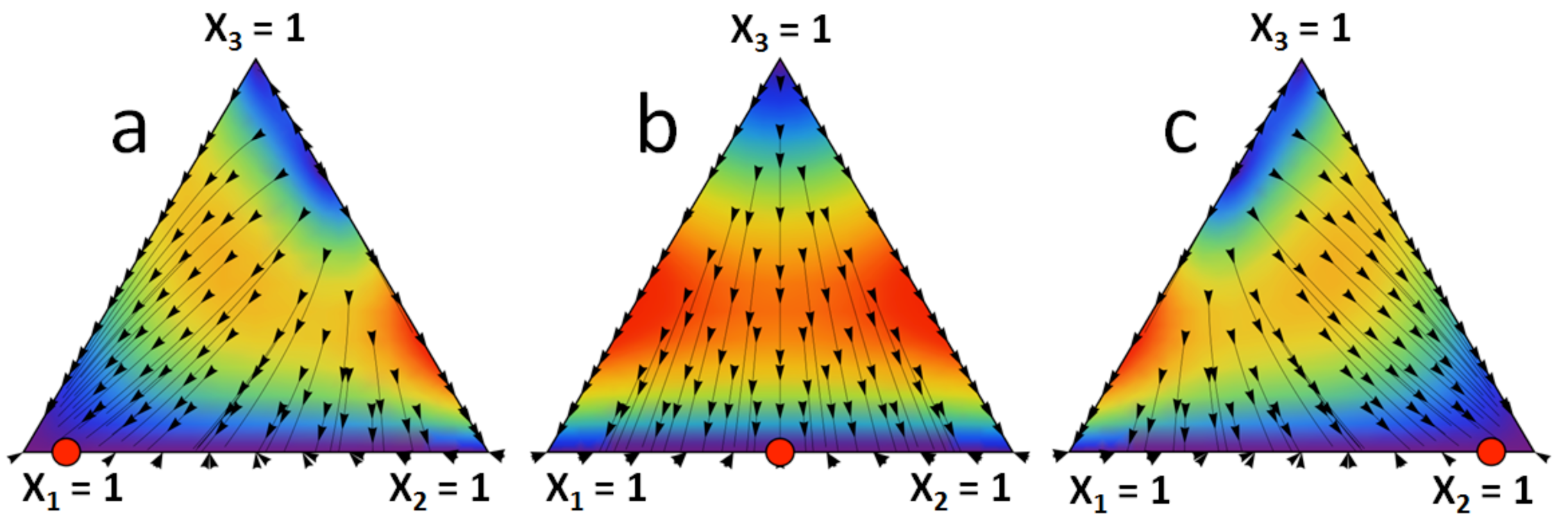
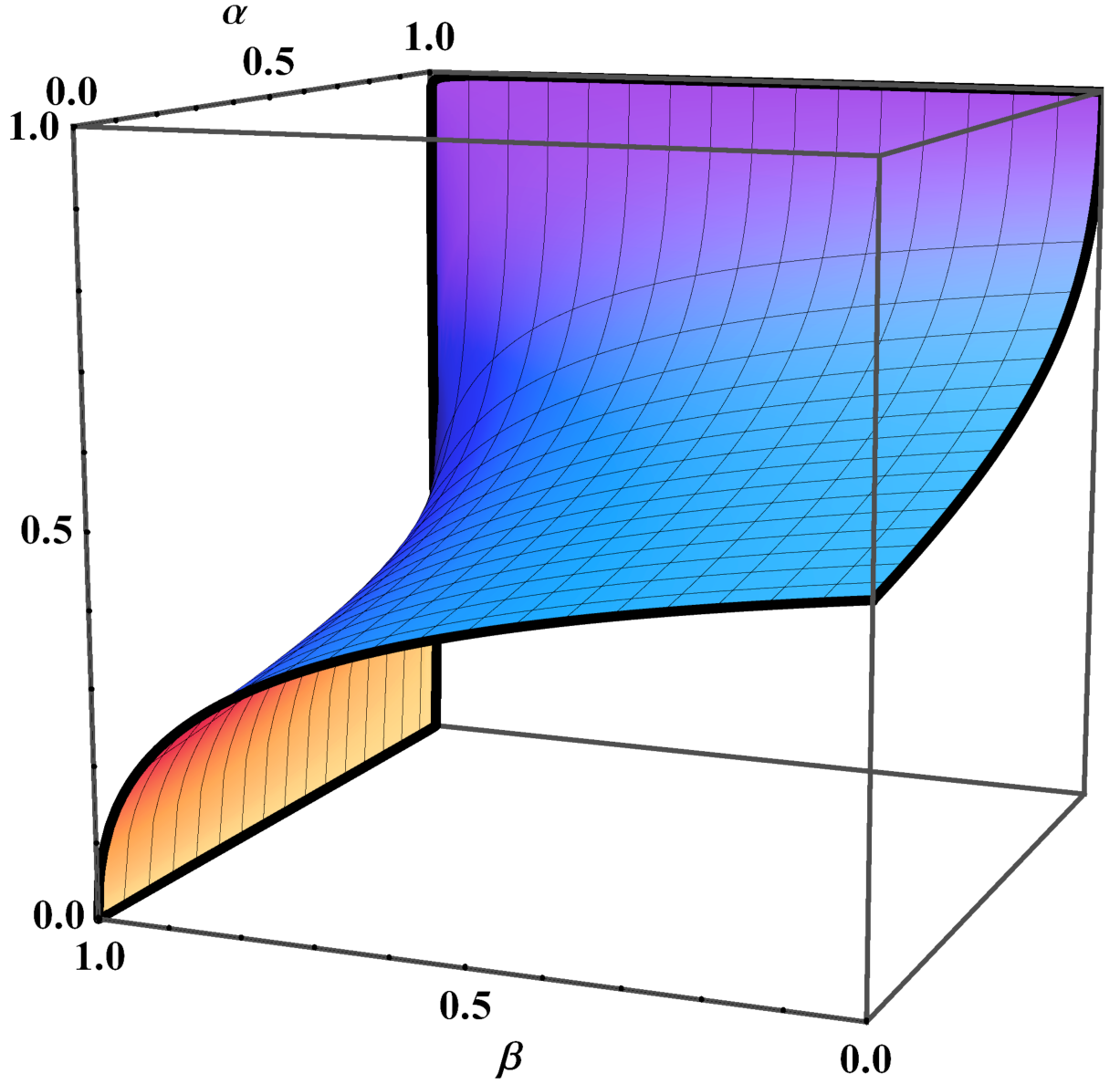
<p><xref ref-type="fig" rid="f1-games-02-00355">Figure 1</xref> represents <italic>l</italic><sub>1</sub> as a function of <italic>α</italic> and <italic>β</italic>. It can be seen how the limit stationary state <italic>l</italic> = [<italic>l</italic> <sub>1</sub>, 1 − <italic>l</italic> <sub>1</sub>, 0] can vary from one extreme to the other with the parameters <italic>α</italic> and <italic>β</italic> that correspond to the strictly dominated strategy. <xref ref-type="fig" rid="f2-games-02-00355">Figure 2</xref> shows the limit stationary state in the unit simplex corresponding to three different combinations of values of <italic>α</italic> and <italic>β</italic>. <xref ref-type="fig" rid="f2-games-02-00355">Figure 2</xref> can be reproduced using the <italic>Mathematica</italic>® computer program provided as supplementary material. This program can be run with Wolfram <italic>CDF Player</italic>, which is freely available on the Web.</p>
<p>It might be thought that which particular point is selected out of a continua of RD equilibria, such as the line <italic>x</italic><sub>1</sub> + <italic>x</italic><sub>2</sub> = 1 in this example, is not very relevant, given that strategy 1 and strategy 2 are equivalent in the absence of other strategies. Note, however, that the response of this system to shocks or perturbations can be very different depending on the proportions of strategy 1 and strategy 2. Suppose, for instance, that the model corresponds to the coexistence of three species in an ecosystem, and the system is resting at the stationary point where <italic>x</italic><sub>1</sub> + <italic>x</italic><sub>2</sub> ≈ 1. If a small fraction <italic>x</italic><sub>4</sub> of individuals of a fourth species arrives at this ecosystem, and this fourth species rates poorly against species 1, but well against species 2 and against itself, needing a minimal value of <italic>x</italic><sub>2</sub> in order to proliferate (<italic>i.e.</italic>, in order to obtain enough fitness), it is clear that both the short-run and the long-run behavior of this system in response to the potential invasion can be completely different depending on the initial proportions of species 1 and 2.</p></sec>
<sec sec-type="conclusions">
<label>4.</label>
<title>Conclusions</title>
<p>The limit stationary points of the RMD constitute a subset of the stationary points of the RD. Bomze and Bürger [<xref ref-type="bibr" rid="b12-games-02-00355">12</xref>] show that the effect of introducing mutation in the RD (in a framework which admits mixed strategies) is to dissolve continua of neutrally stable equilibria into isolated asymptotically stable ones. This paper provides a formula to calculate a limit stationary point of the RMD for a simple kind of game and illustrates that, in general, the location of a limit stationary point of the RMD depends not only on the surviving strategies at that point and their mutation rates, but it can also depend on the non-surviving strategies, including strictly dominated strategies. It also shows as a corollary that, in order to calculate the set of limit stationary points of the RMD, strictly dominated strategies cannot be readily eliminated.</p></sec></body>
<back>
<sec sec-type="display-objects">
<title>Figures</title>
<fig id="f1-games-02-00355" position="float">
<label>Figure 1.</label>
<caption>
<p>Proportion <italic>l</italic><sub>1</sub> of strategy 1 in the limit stationary state of the RMD for matrix <italic>A</italic> as a function of the payoffs <italic>α</italic> and <italic>β</italic>, with mutation fractions <italic>m</italic><sub>1</sub> = m<sub>2</sub> = <italic>m</italic><sub>3</sub>.</p></caption>
<graphic xlink:href="games-02-00355f1.gif"/></fig>
<fig id="f2-games-02-00355" position="float">
<label>Figure 2.</label>
<caption>
<p>The red circle shows the unique stationary state of the RMD for matrix <italic>A</italic>, with mutation fractions <italic>m</italic><sub>1</sub> = <italic>m</italic><sub>2</sub> = <italic>m</italic><sub>3</sub>, and mutation rate <italic>μ</italic> = 10<sup>−4</sup>, for three different combinations of values of the payoffs [<italic>α,β,γ</italic>]. (<bold>a</bold>) [<italic>α,β,γ</italic>] = [0.99, 0.01, 0.4]; (<bold>b</bold>) [<italic>α,β,γ</italic>] = [0.5, 0.5, 0.4]; (<bold>c</bold>) [<italic>α,β,γ</italic>] = [0.01, 0.99, 0.4].</p></caption>
<graphic xlink:href="games-02-00355f2.gif"/></fig></sec>
<ack>
<p>The authors would like to thank Fernando Vega-Redondo and two anonymous reviewers for comments. This work has received financial support from the Spanish JCyL (GREX251-2009 and VA006B09), Ministry of Science and Innovation (TIN2008-06464-C03-02, DPI2010-16920 and CSD2010-00034) and Ministry of Education (grant JC2009-00263).</p></ack>
<app-group>
<app id="app1">
<title>Appendix</title>
<p>From <xref rid="FD3" ref-type="disp-formula">Equation (2)</xref>, and considering that <italic>f<sub>3</sub></italic> − <italic>f</italic>̄ ≤ 0 (with the equality holding only at <italic>x</italic><sub>3</sub> = 1), we have 
<inline-formula>
<mml:math id="mm19" display="inline">
<mml:semantics id="sm19">
<mml:mrow>
<mml:msubsup>
<mml:mi>x</mml:mi>
<mml:mn>3</mml:mn>
<mml:mo>*</mml:mo></mml:msubsup>
<mml:mo>≤</mml:mo>
<mml:msub>
<mml:mi>m</mml:mi>
<mml:mn>3</mml:mn></mml:msub>
<mml:mo>&lt;</mml:mo>
<mml:mn>1</mml:mn></mml:mrow></mml:semantics></mml:math></inline-formula> This, with the strict dominance relation, implies
<disp-formula id="FD15">
<label>(a1)</label>
<mml:math id="mm20" display="block">
<mml:semantics id="sm20">
<mml:mrow>
<mml:mo>∃</mml:mo>
<mml:mi>δ</mml:mi>
<mml:mo>&gt;</mml:mo>
<mml:mn>0</mml:mn>
<mml:mo>:</mml:mo>
<mml:mfrac>
<mml:mrow>
<mml:msubsup>
<mml:mi>f</mml:mi>
<mml:mn>3</mml:mn>
<mml:mo>*</mml:mo></mml:msubsup></mml:mrow>
<mml:mrow>
<mml:msup>
<mml:mi>f</mml:mi>
<mml:mo>*</mml:mo></mml:msup></mml:mrow></mml:mfrac>
<mml:mo>&lt;</mml:mo>
<mml:mn>1</mml:mn>
<mml:mo>−</mml:mo>
<mml:mi>δ</mml:mi></mml:mrow></mml:semantics></mml:math></disp-formula></p>
<p>From <xref rid="FD4" ref-type="disp-formula">(3)</xref>, noting that 
<inline-formula>
<mml:math id="mm21" display="inline">
<mml:semantics id="sm21">
<mml:mrow>
<mml:msubsup>
<mml:mi>f</mml:mi>
<mml:mi>i</mml:mi>
<mml:mo>*</mml:mo></mml:msubsup>
<mml:mo>&gt;</mml:mo>
<mml:mn>0</mml:mn></mml:mrow></mml:semantics></mml:math></inline-formula> and, consequently 
<inline-formula>
<mml:math id="mm22" display="inline">
<mml:semantics id="sm22">
<mml:mrow>
<mml:msubsup>
<mml:mi>x</mml:mi>
<mml:mi>i</mml:mi>
<mml:mo>*</mml:mo></mml:msubsup>
<mml:mo>−</mml:mo>
<mml:mi>μ</mml:mi>
<mml:mi>·</mml:mi>
<mml:msub>
<mml:mi>m</mml:mi>
<mml:mi>i</mml:mi></mml:msub>
<mml:mo>&gt;</mml:mo>
<mml:mn>0</mml:mn>
<mml:mo>:</mml:mo></mml:mrow></mml:semantics></mml:math></inline-formula>
<disp-formula id="FD16">
<mml:math id="mm23" display="block">
<mml:semantics id="sm23">
<mml:mrow>
<mml:mfrac>
<mml:mrow>
<mml:msubsup>
<mml:mi>x</mml:mi>
<mml:mn>3</mml:mn>
<mml:mo>*</mml:mo></mml:msubsup>
<mml:msubsup>
<mml:mi>f</mml:mi>
<mml:mn>3</mml:mn>
<mml:mo>*</mml:mo></mml:msubsup></mml:mrow>
<mml:mrow>
<mml:msubsup>
<mml:mi>x</mml:mi>
<mml:mn>3</mml:mn>
<mml:mo>*</mml:mo></mml:msubsup>
<mml:mo>−</mml:mo>
<mml:msub>
<mml:mi>μ</mml:mi>
<mml:mn>3</mml:mn></mml:msub></mml:mrow></mml:mfrac>
<mml:mo>=</mml:mo>
<mml:mfrac>
<mml:mrow>
<mml:msup>
<mml:mrow>
<mml:mover accent="true">
<mml:mi>f</mml:mi>
<mml:mo>¯</mml:mo></mml:mover></mml:mrow>
<mml:mo>*</mml:mo></mml:msup></mml:mrow>
<mml:mrow>
<mml:mn>1</mml:mn>
<mml:mo>−</mml:mo>
<mml:mi>μ</mml:mi></mml:mrow></mml:mfrac></mml:mrow></mml:semantics></mml:math></disp-formula></p>
<p>So,
<disp-formula id="FD17">
<label>(a2)</label>
<mml:math id="mm24" display="block">
<mml:semantics id="sm24">
<mml:mrow>
<mml:mn>1</mml:mn>
<mml:mo>−</mml:mo>
<mml:msub>
<mml:mi>m</mml:mi>
<mml:mn>3</mml:mn></mml:msub>
<mml:mfrac>
<mml:mi>μ</mml:mi>
<mml:mrow>
<mml:msubsup>
<mml:mi>x</mml:mi>
<mml:mn>3</mml:mn>
<mml:mo>*</mml:mo></mml:msubsup></mml:mrow></mml:mfrac>
<mml:mo>=</mml:mo>
<mml:mrow>
<mml:mo>(</mml:mo>
<mml:mrow>
<mml:mn>1</mml:mn>
<mml:mo>−</mml:mo>
<mml:mi>μ</mml:mi></mml:mrow>
<mml:mo>)</mml:mo></mml:mrow>
<mml:mfrac>
<mml:mrow>
<mml:msubsup>
<mml:mi>f</mml:mi>
<mml:mn>3</mml:mn>
<mml:mo>*</mml:mo></mml:msubsup></mml:mrow>
<mml:mrow>
<mml:msup>
<mml:mi>f</mml:mi>
<mml:mo>*</mml:mo></mml:msup></mml:mrow></mml:mfrac></mml:mrow></mml:semantics></mml:math></disp-formula></p>
<p><xref rid="FD15" ref-type="disp-formula">Equation (a1)</xref> together with <xref rid="FD17" ref-type="disp-formula">Equation (a2)</xref> imply 
<inline-formula>
<mml:math id="mm25" display="inline">
<mml:semantics id="sm25">
<mml:mrow>
<mml:msub>
<mml:mo>lim</mml:mo>
<mml:mrow>
<mml:mi>μ</mml:mi>
<mml:mo>→</mml:mo>
<mml:mn>0</mml:mn></mml:mrow></mml:msub>
<mml:msubsup>
<mml:mi>x</mml:mi>
<mml:mn>3</mml:mn>
<mml:mo>*</mml:mo></mml:msubsup>
<mml:mo>=</mml:mo>
<mml:mn>0</mml:mn></mml:mrow></mml:semantics></mml:math></inline-formula></p>
<p>Besides,
<disp-formula id="FD18">
<mml:math id="mm26" display="block">
<mml:semantics id="sm26">
<mml:mrow>
<mml:msubsup>
<mml:mi>f</mml:mi>
<mml:mn>3</mml:mn>
<mml:mo>*</mml:mo></mml:msubsup>
<mml:mo>=</mml:mo>
<mml:msub>
<mml:mi>a</mml:mi>
<mml:mrow>
<mml:mn>31</mml:mn></mml:mrow></mml:msub>
<mml:msubsup>
<mml:mi>x</mml:mi>
<mml:mn>1</mml:mn>
<mml:mo>*</mml:mo></mml:msubsup>
<mml:mo>+</mml:mo>
<mml:msub>
<mml:mi>a</mml:mi>
<mml:mrow>
<mml:mn>32</mml:mn></mml:mrow></mml:msub>
<mml:mrow>
<mml:mo>(</mml:mo>
<mml:mrow>
<mml:mn>1</mml:mn>
<mml:mo>−</mml:mo>
<mml:msubsup>
<mml:mi>x</mml:mi>
<mml:mn>1</mml:mn>
<mml:mo>*</mml:mo></mml:msubsup>
<mml:mo>−</mml:mo>
<mml:msubsup>
<mml:mi>x</mml:mi>
<mml:mn>3</mml:mn>
<mml:mo>*</mml:mo></mml:msubsup></mml:mrow>
<mml:mo>)</mml:mo></mml:mrow>
<mml:mo>+</mml:mo>
<mml:msub>
<mml:mi>a</mml:mi>
<mml:mrow>
<mml:mn>33</mml:mn></mml:mrow></mml:msub>
<mml:msubsup>
<mml:mi>x</mml:mi>
<mml:mn>3</mml:mn>
<mml:mo>*</mml:mo></mml:msubsup>
<mml:mo>=</mml:mo>
<mml:msub>
<mml:mi>a</mml:mi>
<mml:mrow>
<mml:mn>31</mml:mn></mml:mrow></mml:msub>
<mml:msubsup>
<mml:mi>x</mml:mi>
<mml:mn>1</mml:mn>
<mml:mo>*</mml:mo></mml:msubsup>
<mml:mo>+</mml:mo>
<mml:msub>
<mml:mi>a</mml:mi>
<mml:mrow>
<mml:mn>32</mml:mn></mml:mrow></mml:msub>
<mml:mrow>
<mml:mo>(</mml:mo>
<mml:mrow>
<mml:mn>1</mml:mn>
<mml:mo>−</mml:mo>
<mml:msubsup>
<mml:mi>x</mml:mi>
<mml:mn>1</mml:mn>
<mml:mo>*</mml:mo></mml:msubsup></mml:mrow>
<mml:mo>)</mml:mo></mml:mrow>
<mml:mo>+</mml:mo>
<mml:mi>O</mml:mi>
<mml:mrow>
<mml:mo>(</mml:mo>
<mml:mrow>
<mml:msubsup>
<mml:mi>x</mml:mi>
<mml:mn>3</mml:mn>
<mml:mo>*</mml:mo></mml:msubsup></mml:mrow>
<mml:mo>)</mml:mo></mml:mrow></mml:mrow></mml:semantics></mml:math></disp-formula>and
<disp-formula id="FD19">
<mml:math id="mm27" display="block">
<mml:semantics id="sm27">
<mml:mrow>
<mml:msup>
<mml:mrow>
<mml:mover accent="true">
<mml:mi>f</mml:mi>
<mml:mo>¯</mml:mo></mml:mover></mml:mrow>
<mml:mo>*</mml:mo></mml:msup>
<mml:mo>=</mml:mo>
<mml:msubsup>
<mml:mi>x</mml:mi>
<mml:mn>1</mml:mn>
<mml:mo>*</mml:mo></mml:msubsup>
<mml:msubsup>
<mml:mi>f</mml:mi>
<mml:mn>1</mml:mn>
<mml:mo>*</mml:mo></mml:msubsup>
<mml:mo>+</mml:mo>
<mml:msubsup>
<mml:mi>x</mml:mi>
<mml:mn>2</mml:mn>
<mml:mo>*</mml:mo></mml:msubsup>
<mml:msubsup>
<mml:mi>f</mml:mi>
<mml:mn>2</mml:mn>
<mml:mo>*</mml:mo></mml:msubsup>
<mml:mo>+</mml:mo>
<mml:msubsup>
<mml:mi>x</mml:mi>
<mml:mn>3</mml:mn>
<mml:mo>*</mml:mo></mml:msubsup>
<mml:msubsup>
<mml:mi>f</mml:mi>
<mml:mn>3</mml:mn>
<mml:mo>*</mml:mo></mml:msubsup>
<mml:mo>=</mml:mo>
<mml:msubsup>
<mml:mi>x</mml:mi>
<mml:mn>1</mml:mn>
<mml:mo>*</mml:mo></mml:msubsup>
<mml:mrow>
<mml:mo>(</mml:mo>
<mml:mrow>
<mml:msubsup>
<mml:mi>x</mml:mi>
<mml:mn>1</mml:mn>
<mml:mo>*</mml:mo></mml:msubsup>
<mml:mo>+</mml:mo>
<mml:msubsup>
<mml:mi>x</mml:mi>
<mml:mn>2</mml:mn>
<mml:mo>*</mml:mo></mml:msubsup>
<mml:mo>+</mml:mo>
<mml:msub>
<mml:mi>a</mml:mi>
<mml:mrow>
<mml:mn>13</mml:mn></mml:mrow></mml:msub>
<mml:msubsup>
<mml:mi>x</mml:mi>
<mml:mn>3</mml:mn>
<mml:mo>*</mml:mo></mml:msubsup></mml:mrow>
<mml:mo>)</mml:mo></mml:mrow>
<mml:mo>+</mml:mo>
<mml:mo>…</mml:mo>
<mml:mo>=</mml:mo>
<mml:msup>
<mml:mrow>
<mml:mrow>
<mml:mo>(</mml:mo>
<mml:mrow>
<mml:msubsup>
<mml:mi>x</mml:mi>
<mml:mn>1</mml:mn>
<mml:mo>*</mml:mo></mml:msubsup>
<mml:mo>+</mml:mo>
<mml:msubsup>
<mml:mi>x</mml:mi>
<mml:mn>2</mml:mn>
<mml:mo>*</mml:mo></mml:msubsup></mml:mrow>
<mml:mo>)</mml:mo></mml:mrow></mml:mrow>
<mml:mn>2</mml:mn></mml:msup>
<mml:mo>+</mml:mo>
<mml:mi>O</mml:mi>
<mml:mrow>
<mml:mo>(</mml:mo>
<mml:mrow>
<mml:msubsup>
<mml:mi>x</mml:mi>
<mml:mn>3</mml:mn>
<mml:mo>*</mml:mo></mml:msubsup></mml:mrow>
<mml:mo>)</mml:mo></mml:mrow>
<mml:mo>=</mml:mo>
<mml:mn>1</mml:mn>
<mml:mo>+</mml:mo>
<mml:mi>O</mml:mi>
<mml:mrow>
<mml:mo>(</mml:mo>
<mml:mrow>
<mml:msubsup>
<mml:mi>x</mml:mi>
<mml:mn>3</mml:mn>
<mml:mo>*</mml:mo></mml:msubsup></mml:mrow>
<mml:mo>)</mml:mo></mml:mrow></mml:mrow></mml:semantics></mml:math></disp-formula></p>
<p>So, from <xref rid="FD17" ref-type="disp-formula">Equation (a2)</xref>,
<disp-formula id="FD20">
<label>(a3)</label>
<mml:math id="mm28" display="block">
<mml:semantics id="sm28">
<mml:mrow>
<mml:mtable>
<mml:mtr>
<mml:mtd>
<mml:mrow>
<mml:mfrac>
<mml:mrow>
<mml:msubsup>
<mml:mi>x</mml:mi>
<mml:mn>3</mml:mn>
<mml:mo>*</mml:mo></mml:msubsup></mml:mrow>
<mml:mi>μ</mml:mi></mml:mfrac>
<mml:mrow>
<mml:mo>[</mml:mo>
<mml:mrow>
<mml:mn>1</mml:mn>
<mml:mo>−</mml:mo>
<mml:msub>
<mml:mi>a</mml:mi>
<mml:mrow>
<mml:mn>32</mml:mn></mml:mrow></mml:msub>
<mml:mo>−</mml:mo>
<mml:mrow>
<mml:mo>(</mml:mo>
<mml:mrow>
<mml:msub>
<mml:mi>a</mml:mi>
<mml:mrow>
<mml:mn>31</mml:mn></mml:mrow></mml:msub>
<mml:mo>−</mml:mo>
<mml:msub>
<mml:mi>a</mml:mi>
<mml:mrow>
<mml:mn>32</mml:mn></mml:mrow></mml:msub></mml:mrow>
<mml:mo>)</mml:mo></mml:mrow>
<mml:msubsup>
<mml:mi>x</mml:mi>
<mml:mn>1</mml:mn>
<mml:mo>*</mml:mo></mml:msubsup></mml:mrow>
<mml:mo>]</mml:mo></mml:mrow>
<mml:mo>=</mml:mo>
<mml:msub>
<mml:mi>m</mml:mi>
<mml:mn>3</mml:mn></mml:msub>
<mml:mo>+</mml:mo>
<mml:mi>O</mml:mi>
<mml:mrow>
<mml:mo>(</mml:mo>
<mml:mrow>
<mml:msubsup>
<mml:mi>x</mml:mi>
<mml:mn>3</mml:mn>
<mml:mo>*</mml:mo></mml:msubsup></mml:mrow>
<mml:mo>)</mml:mo></mml:mrow></mml:mrow></mml:mtd></mml:mtr>
<mml:mtr>
<mml:mtd>
<mml:mrow>
<mml:mfrac>
<mml:mrow>
<mml:msubsup>
<mml:mi>x</mml:mi>
<mml:mn>3</mml:mn>
<mml:mo>*</mml:mo></mml:msubsup></mml:mrow>
<mml:mi>μ</mml:mi></mml:mfrac>
<mml:mo>=</mml:mo>
<mml:mfrac>
<mml:mrow>
<mml:msub>
<mml:mi>m</mml:mi>
<mml:mn>3</mml:mn></mml:msub></mml:mrow>
<mml:mrow>
<mml:mn>1</mml:mn>
<mml:mo>−</mml:mo>
<mml:msub>
<mml:mi>a</mml:mi>
<mml:mrow>
<mml:mn>32</mml:mn></mml:mrow></mml:msub>
<mml:mo>−</mml:mo>
<mml:mrow>
<mml:mo>(</mml:mo>
<mml:mrow>
<mml:msub>
<mml:mi>a</mml:mi>
<mml:mrow>
<mml:mn>31</mml:mn></mml:mrow></mml:msub>
<mml:mo>−</mml:mo>
<mml:msub>
<mml:mi>a</mml:mi>
<mml:mrow>
<mml:mn>32</mml:mn></mml:mrow></mml:msub></mml:mrow>
<mml:mo>)</mml:mo></mml:mrow>
<mml:msubsup>
<mml:mi>x</mml:mi>
<mml:mn>1</mml:mn>
<mml:mo>*</mml:mo></mml:msubsup></mml:mrow></mml:mfrac>
<mml:mo>+</mml:mo>
<mml:mi>O</mml:mi>
<mml:mrow>
<mml:mo>(</mml:mo>
<mml:mrow>
<mml:msubsup>
<mml:mi>x</mml:mi>
<mml:mn>3</mml:mn>
<mml:mo>*</mml:mo></mml:msubsup></mml:mrow>
<mml:mo>)</mml:mo></mml:mrow></mml:mrow></mml:mtd></mml:mtr></mml:mtable></mml:mrow></mml:semantics></mml:math></disp-formula></p>
<p>From the conditions of stationary state <xref rid="FD4" ref-type="disp-formula">Equation (3)</xref> for strategies 2 and 3:
<disp-formula id="FD21">
<mml:math id="mm29" display="block">
<mml:semantics id="sm29">
<mml:mrow>
<mml:mtable>
<mml:mtr>
<mml:mtd>
<mml:mrow>
<mml:msubsup>
<mml:mi>x</mml:mi>
<mml:mn>1</mml:mn>
<mml:mo>*</mml:mo></mml:msubsup>
<mml:msubsup>
<mml:mi>f</mml:mi>
<mml:mn>1</mml:mn>
<mml:mo>*</mml:mo></mml:msubsup>
<mml:mrow>
<mml:mo stretchy="false">(</mml:mo>
<mml:mrow>
<mml:msubsup>
<mml:mi>x</mml:mi>
<mml:mn>2</mml:mn>
<mml:mo>*</mml:mo></mml:msubsup>
<mml:mo>−</mml:mo>
<mml:msub>
<mml:mi>μ</mml:mi>
<mml:mn>2</mml:mn></mml:msub></mml:mrow>
<mml:mo stretchy="false">)</mml:mo></mml:mrow>
<mml:mo>=</mml:mo>
<mml:msubsup>
<mml:mi>x</mml:mi>
<mml:mn>2</mml:mn>
<mml:mo>*</mml:mo></mml:msubsup>
<mml:msubsup>
<mml:mi>f</mml:mi>
<mml:mn>2</mml:mn>
<mml:mo>*</mml:mo></mml:msubsup>
<mml:mrow>
<mml:mo stretchy="false">(</mml:mo>
<mml:mrow>
<mml:msubsup>
<mml:mi>x</mml:mi>
<mml:mn>1</mml:mn>
<mml:mo>*</mml:mo></mml:msubsup>
<mml:mo>−</mml:mo>
<mml:msub>
<mml:mi>μ</mml:mi>
<mml:mn>1</mml:mn></mml:msub></mml:mrow>
<mml:mo stretchy="false">)</mml:mo></mml:mrow></mml:mrow></mml:mtd></mml:mtr>
<mml:mtr>
<mml:mtd>
<mml:mrow>
<mml:msubsup>
<mml:mi>x</mml:mi>
<mml:mn>1</mml:mn>
<mml:mo>*</mml:mo></mml:msubsup>
<mml:mrow>
<mml:mo stretchy="false">(</mml:mo>
<mml:mrow>
<mml:msubsup>
<mml:mi>x</mml:mi>
<mml:mn>1</mml:mn>
<mml:mo>*</mml:mo></mml:msubsup>
<mml:mo>+</mml:mo>
<mml:msubsup>
<mml:mi>x</mml:mi>
<mml:mn>2</mml:mn>
<mml:mo>*</mml:mo></mml:msubsup>
<mml:mo>+</mml:mo>
<mml:msub>
<mml:mi>a</mml:mi>
<mml:mrow>
<mml:mn>13</mml:mn></mml:mrow></mml:msub>
<mml:msubsup>
<mml:mi>x</mml:mi>
<mml:mn>3</mml:mn>
<mml:mo>*</mml:mo></mml:msubsup></mml:mrow>
<mml:mo stretchy="false">)</mml:mo></mml:mrow>
<mml:mrow>
<mml:mo stretchy="false">(</mml:mo>
<mml:mrow>
<mml:msubsup>
<mml:mi>x</mml:mi>
<mml:mn>2</mml:mn>
<mml:mo>*</mml:mo></mml:msubsup>
<mml:mo>−</mml:mo>
<mml:msub>
<mml:mi>μ</mml:mi>
<mml:mn>2</mml:mn></mml:msub></mml:mrow>
<mml:mo stretchy="false">)</mml:mo></mml:mrow>
<mml:mo>=</mml:mo>
<mml:msubsup>
<mml:mi>x</mml:mi>
<mml:mn>2</mml:mn>
<mml:mo>*</mml:mo></mml:msubsup>
<mml:mrow>
<mml:mo stretchy="false">(</mml:mo>
<mml:mrow>
<mml:msubsup>
<mml:mi>x</mml:mi>
<mml:mn>1</mml:mn>
<mml:mo>*</mml:mo></mml:msubsup>
<mml:mo>+</mml:mo>
<mml:msubsup>
<mml:mi>x</mml:mi>
<mml:mn>2</mml:mn>
<mml:mo>*</mml:mo></mml:msubsup>
<mml:mo>+</mml:mo>
<mml:msub>
<mml:mi>a</mml:mi>
<mml:mrow>
<mml:mn>23</mml:mn></mml:mrow></mml:msub>
<mml:msubsup>
<mml:mi>x</mml:mi>
<mml:mn>3</mml:mn>
<mml:mo>*</mml:mo></mml:msubsup></mml:mrow>
<mml:mo stretchy="false">)</mml:mo></mml:mrow>
<mml:mrow>
<mml:mo stretchy="false">(</mml:mo>
<mml:mrow>
<mml:msubsup>
<mml:mi>x</mml:mi>
<mml:mn>1</mml:mn>
<mml:mo>*</mml:mo></mml:msubsup>
<mml:mo>−</mml:mo>
<mml:msub>
<mml:mi>μ</mml:mi>
<mml:mn>1</mml:mn></mml:msub></mml:mrow>
<mml:mo stretchy="false">)</mml:mo></mml:mrow></mml:mrow></mml:mtd></mml:mtr></mml:mtable></mml:mrow></mml:semantics></mml:math></disp-formula></p>
<p>Considering that 
<inline-formula>
<mml:math id="mm30" display="inline">
<mml:semantics id="sm30">
<mml:mrow>
<mml:msubsup>
<mml:mi>x</mml:mi>
<mml:mn>1</mml:mn>
<mml:mo>*</mml:mo></mml:msubsup>
<mml:mo>+</mml:mo>
<mml:msubsup>
<mml:mi>x</mml:mi>
<mml:mn>2</mml:mn>
<mml:mo>*</mml:mo></mml:msubsup>
<mml:mo>=</mml:mo>
<mml:mn>1</mml:mn>
<mml:mo>−</mml:mo>
<mml:msubsup>
<mml:mi>x</mml:mi>
<mml:mn>3</mml:mn>
<mml:mo>*</mml:mo></mml:msubsup></mml:mrow></mml:semantics></mml:math></inline-formula>,
<disp-formula id="FD23">
<mml:math id="mm31" display="block">
<mml:semantics id="sm31">
<mml:mrow>
<mml:mtable>
<mml:mtr>
<mml:mtd>
<mml:mrow>
<mml:msubsup>
<mml:mi>x</mml:mi>
<mml:mn>1</mml:mn>
<mml:mo>*</mml:mo></mml:msubsup>
<mml:mrow>
<mml:mo>(</mml:mo>
<mml:mrow>
<mml:mn>1</mml:mn>
<mml:mo>−</mml:mo>
<mml:msubsup>
<mml:mi>x</mml:mi>
<mml:mn>3</mml:mn>
<mml:mo>*</mml:mo></mml:msubsup>
<mml:mo>+</mml:mo>
<mml:msub>
<mml:mi>a</mml:mi>
<mml:mrow>
<mml:mn>13</mml:mn></mml:mrow></mml:msub>
<mml:msubsup>
<mml:mi>x</mml:mi>
<mml:mn>3</mml:mn>
<mml:mo>*</mml:mo></mml:msubsup></mml:mrow>
<mml:mo>)</mml:mo></mml:mrow>
<mml:mrow>
<mml:mo stretchy="false">(</mml:mo>
<mml:mrow>
<mml:msubsup>
<mml:mi>x</mml:mi>
<mml:mn>2</mml:mn>
<mml:mo>*</mml:mo></mml:msubsup>
<mml:mo>−</mml:mo>
<mml:msub>
<mml:mi>μ</mml:mi>
<mml:mn>2</mml:mn></mml:msub></mml:mrow>
<mml:mo stretchy="false">)</mml:mo></mml:mrow>
<mml:mo>=</mml:mo>
<mml:msubsup>
<mml:mi>x</mml:mi>
<mml:mn>2</mml:mn>
<mml:mo>*</mml:mo></mml:msubsup>
<mml:mrow>
<mml:mo>(</mml:mo>
<mml:mrow>
<mml:mn>1</mml:mn>
<mml:mo>−</mml:mo>
<mml:msubsup>
<mml:mi>x</mml:mi>
<mml:mn>3</mml:mn>
<mml:mo>*</mml:mo></mml:msubsup>
<mml:mo>+</mml:mo>
<mml:msub>
<mml:mi>a</mml:mi>
<mml:mrow>
<mml:mn>23</mml:mn></mml:mrow></mml:msub>
<mml:msubsup>
<mml:mi>x</mml:mi>
<mml:mn>3</mml:mn>
<mml:mo>*</mml:mo></mml:msubsup></mml:mrow>
<mml:mo>)</mml:mo></mml:mrow>
<mml:mrow>
<mml:mo stretchy="false">(</mml:mo>
<mml:mrow>
<mml:msubsup>
<mml:mi>x</mml:mi>
<mml:mn>1</mml:mn>
<mml:mo>*</mml:mo></mml:msubsup>
<mml:mo>−</mml:mo>
<mml:msub>
<mml:mi>μ</mml:mi>
<mml:mn>1</mml:mn></mml:msub></mml:mrow>
<mml:mo stretchy="false">)</mml:mo></mml:mrow></mml:mrow></mml:mtd></mml:mtr>
<mml:mtr>
<mml:mtd>
<mml:mrow>
<mml:msubsup>
<mml:mi>x</mml:mi>
<mml:mn>1</mml:mn>
<mml:mo>*</mml:mo></mml:msubsup>
<mml:msubsup>
<mml:mi>x</mml:mi>
<mml:mn>2</mml:mn>
<mml:mo>*</mml:mo></mml:msubsup>
<mml:msubsup>
<mml:mi>x</mml:mi>
<mml:mn>3</mml:mn>
<mml:mo>*</mml:mo></mml:msubsup>
<mml:mrow>
<mml:mo>(</mml:mo>
<mml:mrow>
<mml:msub>
<mml:mi>a</mml:mi>
<mml:mrow>
<mml:mn>13</mml:mn></mml:mrow></mml:msub>
<mml:mo>−</mml:mo>
<mml:msub>
<mml:mi>a</mml:mi>
<mml:mrow>
<mml:mn>23</mml:mn></mml:mrow></mml:msub></mml:mrow>
<mml:mo>)</mml:mo></mml:mrow>
<mml:mo>=</mml:mo>
<mml:msub>
<mml:mi>μ</mml:mi>
<mml:mn>2</mml:mn></mml:msub>
<mml:msubsup>
<mml:mi>x</mml:mi>
<mml:mn>1</mml:mn>
<mml:mo>*</mml:mo></mml:msubsup>
<mml:mo>−</mml:mo>
<mml:msub>
<mml:mi>μ</mml:mi>
<mml:mn>1</mml:mn></mml:msub>
<mml:msubsup>
<mml:mi>x</mml:mi>
<mml:mn>2</mml:mn>
<mml:mo>*</mml:mo></mml:msubsup>
<mml:mo>+</mml:mo>
<mml:mi>μ</mml:mi>
<mml:mi>O</mml:mi>
<mml:mrow>
<mml:mo>(</mml:mo>
<mml:mrow>
<mml:msubsup>
<mml:mi>x</mml:mi>
<mml:mn>3</mml:mn>
<mml:mo>*</mml:mo></mml:msubsup></mml:mrow>
<mml:mo>)</mml:mo></mml:mrow></mml:mrow></mml:mtd></mml:mtr>
<mml:mtr>
<mml:mtd>
<mml:mrow>
<mml:msubsup>
<mml:mi>x</mml:mi>
<mml:mn>1</mml:mn>
<mml:mo>*</mml:mo></mml:msubsup>
<mml:msubsup>
<mml:mi>x</mml:mi>
<mml:mn>2</mml:mn>
<mml:mo>*</mml:mo></mml:msubsup>
<mml:mfrac>
<mml:mrow>
<mml:msubsup>
<mml:mi>x</mml:mi>
<mml:mn>3</mml:mn>
<mml:mo>*</mml:mo></mml:msubsup></mml:mrow>
<mml:mi>μ</mml:mi></mml:mfrac>
<mml:mrow>
<mml:mo>(</mml:mo>
<mml:mrow>
<mml:msub>
<mml:mi>a</mml:mi>
<mml:mrow>
<mml:mn>13</mml:mn></mml:mrow></mml:msub>
<mml:mo>−</mml:mo>
<mml:msub>
<mml:mi>a</mml:mi>
<mml:mrow>
<mml:mn>23</mml:mn></mml:mrow></mml:msub></mml:mrow>
<mml:mo>)</mml:mo></mml:mrow>
<mml:mo>=</mml:mo>
<mml:msub>
<mml:mi>m</mml:mi>
<mml:mn>2</mml:mn></mml:msub>
<mml:msubsup>
<mml:mi>x</mml:mi>
<mml:mn>1</mml:mn>
<mml:mo>*</mml:mo></mml:msubsup>
<mml:mo>−</mml:mo>
<mml:msub>
<mml:mi>m</mml:mi>
<mml:mn>1</mml:mn></mml:msub>
<mml:msubsup>
<mml:mi>x</mml:mi>
<mml:mn>2</mml:mn>
<mml:mo>*</mml:mo></mml:msubsup>
<mml:mo>+</mml:mo>
<mml:mi>O</mml:mi>
<mml:mrow>
<mml:mo>(</mml:mo>
<mml:mrow>
<mml:msubsup>
<mml:mi>x</mml:mi>
<mml:mn>3</mml:mn>
<mml:mo>*</mml:mo></mml:msubsup></mml:mrow>
<mml:mo>)</mml:mo></mml:mrow></mml:mrow></mml:mtd></mml:mtr></mml:mtable></mml:mrow></mml:semantics></mml:math></disp-formula></p>
<p>And considering that 
<inline-formula>
<mml:math id="mm32" display="inline">
<mml:semantics id="sm32">
<mml:mrow>
<mml:msubsup>
<mml:mi>x</mml:mi>
<mml:mn>2</mml:mn>
<mml:mo>*</mml:mo></mml:msubsup>
<mml:mo>=</mml:mo>
<mml:mn>1</mml:mn>
<mml:mo>−</mml:mo>
<mml:msubsup>
<mml:mi>x</mml:mi>
<mml:mn>1</mml:mn>
<mml:mo>*</mml:mo></mml:msubsup>
<mml:mo>+</mml:mo>
<mml:mi>O</mml:mi>
<mml:mrow>
<mml:mo>(</mml:mo>
<mml:mrow>
<mml:msubsup>
<mml:mi>x</mml:mi>
<mml:mn>3</mml:mn>
<mml:mo>*</mml:mo></mml:msubsup></mml:mrow>
<mml:mo>)</mml:mo></mml:mrow></mml:mrow></mml:semantics></mml:math></inline-formula>, we finally obtain
<disp-formula id="FD24">
<label>(a4)</label>
<mml:math id="mm33" display="block">
<mml:semantics id="sm33">
<mml:mrow>
<mml:msubsup>
<mml:mi>x</mml:mi>
<mml:mn>1</mml:mn>
<mml:mo>*</mml:mo></mml:msubsup>
<mml:mrow>
<mml:mo>(</mml:mo>
<mml:mrow>
<mml:mn>1</mml:mn>
<mml:mo>−</mml:mo>
<mml:msubsup>
<mml:mi>x</mml:mi>
<mml:mn>1</mml:mn>
<mml:mo>*</mml:mo></mml:msubsup></mml:mrow>
<mml:mo>)</mml:mo></mml:mrow>
<mml:mfrac>
<mml:mrow>
<mml:msubsup>
<mml:mi>x</mml:mi>
<mml:mn>3</mml:mn>
<mml:mo>*</mml:mo></mml:msubsup></mml:mrow>
<mml:mi>μ</mml:mi></mml:mfrac>
<mml:mrow>
<mml:mo>(</mml:mo>
<mml:mrow>
<mml:msub>
<mml:mi>a</mml:mi>
<mml:mrow>
<mml:mn>13</mml:mn></mml:mrow></mml:msub>
<mml:mo>−</mml:mo>
<mml:msub>
<mml:mi>a</mml:mi>
<mml:mrow>
<mml:mn>23</mml:mn></mml:mrow></mml:msub></mml:mrow>
<mml:mo>)</mml:mo></mml:mrow>
<mml:mo>=</mml:mo>
<mml:msub>
<mml:mi>m</mml:mi>
<mml:mn>2</mml:mn></mml:msub>
<mml:msubsup>
<mml:mi>x</mml:mi>
<mml:mn>1</mml:mn>
<mml:mo>*</mml:mo></mml:msubsup>
<mml:mo>−</mml:mo>
<mml:msub>
<mml:mi>m</mml:mi>
<mml:mn>1</mml:mn></mml:msub>
<mml:mrow>
<mml:mo>(</mml:mo>
<mml:mrow>
<mml:mn>1</mml:mn>
<mml:mo>−</mml:mo>
<mml:msubsup>
<mml:mi>x</mml:mi>
<mml:mn>1</mml:mn>
<mml:mo>*</mml:mo></mml:msubsup></mml:mrow>
<mml:mo>)</mml:mo></mml:mrow>
<mml:mo>+</mml:mo>
<mml:mi>O</mml:mi>
<mml:mrow>
<mml:mo>(</mml:mo>
<mml:mrow>
<mml:msubsup>
<mml:mi>x</mml:mi>
<mml:mn>3</mml:mn>
<mml:mo>*</mml:mo></mml:msubsup></mml:mrow>
<mml:mo>)</mml:mo></mml:mrow></mml:mrow></mml:semantics></mml:math></disp-formula></p>
<p>As a consequence of <xref rid="FD20" ref-type="disp-formula">Equations (a3)</xref> and <xref rid="FD24" ref-type="disp-formula">(a4)</xref>, a stationary state 
<inline-formula>
<mml:math id="mm34" display="inline">
<mml:semantics id="sm34">
<mml:mrow>
<mml:msup>
<mml:mi>x</mml:mi>
<mml:mo>*</mml:mo></mml:msup>
<mml:mo>=</mml:mo>
<mml:mrow>
<mml:mo>[</mml:mo>
<mml:mrow>
<mml:msubsup>
<mml:mi>x</mml:mi>
<mml:mn>1</mml:mn>
<mml:mo>*</mml:mo></mml:msubsup>
<mml:mo>,</mml:mo>
<mml:msubsup>
<mml:mi>x</mml:mi>
<mml:mn>2</mml:mn>
<mml:mo>*</mml:mo></mml:msubsup>
<mml:mo>,</mml:mo>
<mml:msubsup>
<mml:mi>x</mml:mi>
<mml:mn>3</mml:mn>
<mml:mo>*</mml:mo></mml:msubsup></mml:mrow>
<mml:mo>]</mml:mo></mml:mrow></mml:mrow></mml:semantics></mml:math></inline-formula>must satisfy the equation
<disp-formula id="FD25">
<mml:math id="mm35" display="block">
<mml:semantics id="sm35">
<mml:mrow>
<mml:msub>
<mml:mi>m</mml:mi>
<mml:mn>3</mml:mn></mml:msub>
<mml:mrow>
<mml:mo>(</mml:mo>
<mml:mrow>
<mml:msub>
<mml:mi>a</mml:mi>
<mml:mrow>
<mml:mn>13</mml:mn></mml:mrow></mml:msub>
<mml:mo>−</mml:mo>
<mml:msub>
<mml:mi>a</mml:mi>
<mml:mrow>
<mml:mn>23</mml:mn></mml:mrow></mml:msub></mml:mrow>
<mml:mo>)</mml:mo></mml:mrow>
<mml:msubsup>
<mml:mi>x</mml:mi>
<mml:mn>1</mml:mn>
<mml:mo>*</mml:mo></mml:msubsup>
<mml:mrow>
<mml:mo>(</mml:mo>
<mml:mrow>
<mml:msubsup>
<mml:mi>x</mml:mi>
<mml:mn>1</mml:mn>
<mml:mo>*</mml:mo></mml:msubsup>
<mml:mo>−</mml:mo>
<mml:mn>1</mml:mn></mml:mrow>
<mml:mo>)</mml:mo></mml:mrow>
<mml:mo>+</mml:mo>
<mml:mrow>
<mml:mo>[</mml:mo>
<mml:mrow>
<mml:mn>1</mml:mn>
<mml:mo>−</mml:mo>
<mml:msub>
<mml:mi>a</mml:mi>
<mml:mrow>
<mml:mn>32</mml:mn></mml:mrow></mml:msub>
<mml:mo>−</mml:mo>
<mml:mrow>
<mml:mo>(</mml:mo>
<mml:mrow>
<mml:msub>
<mml:mi>a</mml:mi>
<mml:mrow>
<mml:mn>31</mml:mn></mml:mrow></mml:msub>
<mml:mo>−</mml:mo>
<mml:msub>
<mml:mi>a</mml:mi>
<mml:mrow>
<mml:mn>32</mml:mn></mml:mrow></mml:msub></mml:mrow>
<mml:mo>)</mml:mo></mml:mrow>
<mml:msubsup>
<mml:mi>x</mml:mi>
<mml:mn>1</mml:mn>
<mml:mo>*</mml:mo></mml:msubsup></mml:mrow>
<mml:mo>]</mml:mo></mml:mrow>
<mml:mrow>
<mml:mo>[</mml:mo>
<mml:mrow>
<mml:mrow>
<mml:mo>(</mml:mo>
<mml:mrow>
<mml:msub>
<mml:mi>m</mml:mi>
<mml:mn>1</mml:mn></mml:msub>
<mml:mo>+</mml:mo>
<mml:msub>
<mml:mi>m</mml:mi>
<mml:mn>2</mml:mn></mml:msub></mml:mrow>
<mml:mo>)</mml:mo></mml:mrow>
<mml:msubsup>
<mml:mi>x</mml:mi>
<mml:mn>1</mml:mn>
<mml:mo>*</mml:mo></mml:msubsup>
<mml:mo>−</mml:mo>
<mml:msub>
<mml:mi>m</mml:mi>
<mml:mn>1</mml:mn></mml:msub></mml:mrow>
<mml:mo>]</mml:mo></mml:mrow>
<mml:mo>=</mml:mo>
<mml:mi>O</mml:mi>
<mml:mrow>
<mml:mo>(</mml:mo>
<mml:mrow>
<mml:msubsup>
<mml:mi>x</mml:mi>
<mml:mn>3</mml:mn>
<mml:mo>*</mml:mo></mml:msubsup></mml:mrow>
<mml:mo>)</mml:mo></mml:mrow></mml:mrow></mml:semantics></mml:math></disp-formula></p></app></app-group>
<ref-list>
<title>References</title>
<ref id="b1-games-02-00355"><label>1.</label><citation citation-type="journal"><person-group person-group-type="author"><name><surname>Hofbauer</surname><given-names>J.</given-names></name></person-group><article-title>The selection mutation equation</article-title><source>J. Math. Biol.</source><year>1985</year><volume>23</volume><fpage>41</fpage><lpage>53</lpage><pub-id pub-id-type="doi">10.1007/BF00276557</pub-id><pub-id pub-id-type="pmid">4078498</pub-id></citation></ref>
<ref id="b2-games-02-00355"><label>2.</label><citation citation-type="journal"><person-group person-group-type="author"><name><surname>Page</surname><given-names>K.M.</given-names></name><name><surname>Nowak</surname><given-names>M.A.</given-names></name></person-group><article-title>Unifying evolutionary dynamics</article-title><source>J. Theor. Biol.</source><year>2002</year><volume>219</volume><fpage>93</fpage><lpage>98</lpage><pub-id pub-id-type="pmid">12392978</pub-id></citation></ref>
<ref id="b3-games-02-00355"><label>3.</label><citation citation-type="journal"><person-group person-group-type="author"><name><surname>Stadler</surname><given-names>P.F.</given-names></name><name><surname>Schuster</surname><given-names>P.</given-names></name></person-group><article-title>Mutation in autocatalytic reaction networks—An analysis based on perturbation-theory</article-title><source>J. Math. Biol.</source><year>1992</year><volume>30</volume><fpage>597</fpage><lpage>632</lpage><pub-id pub-id-type="doi">10.1007/BF00948894</pub-id><pub-id pub-id-type="pmid">1640182</pub-id></citation></ref>
<ref id="b4-games-02-00355"><label>4.</label><citation citation-type="journal"><person-group person-group-type="author"><name><surname>Arbiza</surname><given-names>J.</given-names></name><name><surname>Mirazo</surname><given-names>S.</given-names></name><name><surname>Fort</surname><given-names>H.</given-names></name></person-group><article-title>Viral quasispecies profiles as the result of the interplay of competition cooperation</article-title><source>BMC Evol. Biol.</source><year>2010</year><volume>10</volume><fpage>137:1</fpage><lpage>137:9</lpage></citation></ref>
<ref id="b5-games-02-00355"><label>5.</label><citation citation-type="journal"><person-group person-group-type="author"><name><surname>Imhof</surname><given-names>L.A.</given-names></name><name><surname>Fudenberg</surname><given-names>D.</given-names></name><name><surname>Nowak</surname><given-names>M.A.</given-names></name></person-group><article-title>Evolutionary cycles of cooperation and defection</article-title><source>Proc. Natl. Acad. Sci. USA</source><year>2005</year><volume>102</volume><fpage>10797</fpage><lpage>10800</lpage><pub-id pub-id-type="doi">10.1073/pnas.0502589102</pub-id><pub-id pub-id-type="pmid">16043717</pub-id></citation></ref>
<ref id="b6-games-02-00355"><label>6.</label><citation citation-type="journal"><person-group person-group-type="author"><name><surname>Komarova</surname><given-names>N.L.</given-names></name></person-group><article-title>Replicator-mutator equation, universality property and population dynamics of learning</article-title><source>J. Theor. Biol.</source><year>2004</year><volume>230</volume><fpage>227</fpage><lpage>239</lpage><pub-id pub-id-type="doi">10.1016/j.jtbi.2004.05.004</pub-id><pub-id pub-id-type="pmid">15302554</pub-id></citation></ref>
<ref id="b7-games-02-00355"><label>7.</label><citation citation-type="journal"><person-group person-group-type="author"><name><surname>Nowak</surname><given-names>M.A.</given-names></name><name><surname>Komarova</surname><given-names>N.L.</given-names></name><name><surname>Niyogi</surname><given-names>P.</given-names></name></person-group><article-title>Evolution of universal grammar</article-title><source>Science</source><year>2001</year><volume>291</volume><fpage>114</fpage><lpage>118</lpage><pub-id pub-id-type="doi">10.1126/science.291.5501.114</pub-id><pub-id pub-id-type="pmid">11141560</pub-id></citation></ref>
<ref id="b8-games-02-00355"><label>8.</label><citation citation-type="journal"><person-group person-group-type="author"><name><surname>Tavares</surname><given-names>J.M.</given-names></name><name><surname>da Gama</surname><given-names>M.M.T.</given-names></name><name><surname>Nunes</surname><given-names>A.</given-names></name></person-group><article-title>Coherence thresholds in models of language change and evolution: The effects of noise, dynamics, and network of interactions</article-title><source>Phys. Rev. E.</source><year>2008</year><volume>77</volume><fpage>18517691:1</fpage><lpage>18517691:19</lpage><comment>(Epub 11 April 2008)</comment></citation></ref>
<ref id="b9-games-02-00355"><label>9.</label><citation citation-type="journal"><person-group person-group-type="author"><name><surname>Hofbauer</surname><given-names>J.</given-names></name><name><surname>Huttegger</surname><given-names>S.M.</given-names></name></person-group><article-title>Feasibility of communication in binary signaling games</article-title><source>J. Theor. Biol.</source><year>2008</year><volume>254</volume><fpage>843</fpage><lpage>849</lpage><pub-id pub-id-type="doi">10.1016/j.jtbi.2008.07.010</pub-id><pub-id pub-id-type="pmid">18675279</pub-id></citation></ref>
<ref id="b10-games-02-00355"><label>10.</label><citation citation-type="journal"><person-group person-group-type="author"><name><surname>Huttegger</surname><given-names>S.M.</given-names></name><name><surname>Skyrms</surname><given-names>B.</given-names></name><name><surname>Smead</surname><given-names>R.</given-names></name><name><surname>Zollman</surname><given-names>K.J.S.</given-names></name></person-group><article-title>Evolutionary dynamics of Lewis signaling games: Signaling systems <italic>vs.</italic> partial pooling</article-title><source>Synthese</source><year>2010</year><volume>172</volume><fpage>177</fpage><lpage>191</lpage><pub-id pub-id-type="doi">10.1007/s11229-009-9477-0</pub-id></citation></ref>
<ref id="b11-games-02-00355"><label>11.</label><citation citation-type="journal"><person-group person-group-type="author"><name><surname>Sachs</surname><given-names>R.K.</given-names></name><name><surname>Hlatky</surname><given-names>L.</given-names></name></person-group><article-title>A rapid-mutation approximation for cell population dynamics</article-title><source>B. Math. Biol.</source><year>2010</year><volume>72</volume><fpage>359</fpage><lpage>374</lpage><pub-id pub-id-type="doi">10.1007/s11538-009-9450-6</pub-id></citation></ref>
<ref id="b12-games-02-00355"><label>12.</label><citation citation-type="journal"><person-group person-group-type="author"><name><surname>Bomze</surname><given-names>I.M.</given-names></name><name><surname>Bürger</surname><given-names>R.</given-names></name></person-group><article-title>Stability by mutation in evolutionary games</article-title><source>Game. Econ. Behav.</source><year>1995</year><volume>11</volume><fpage>146</fpage><lpage>172</lpage><pub-id pub-id-type="doi">10.1006/game.1995.1047</pub-id></citation></ref>
<ref id="b13-games-02-00355"><label>13.</label><citation citation-type="journal"><person-group person-group-type="author"><name><surname>Kingman</surname><given-names>J.F.C.</given-names></name></person-group><article-title>A simple model for the balance between selection and mutation</article-title><source>J. Appl. Prob.</source><year>1978</year><volume>15</volume><fpage>1</fpage><lpage>12</lpage><pub-id pub-id-type="doi">10.2307/3213231</pub-id></citation></ref>
<ref id="b14-games-02-00355"><label>14.</label><citation citation-type="book"><person-group person-group-type="author"><name><surname>Akin</surname><given-names>E.</given-names></name></person-group><source>The Geometry of Population Genetics</source><publisher-name>Springer</publisher-name><publisher-loc>Berlin, Germany</publisher-loc><year>1979</year></citation></ref>
<ref id="b15-games-02-00355"><label>15.</label><citation citation-type="book"><person-group person-group-type="author"><name><surname>Samuelson</surname><given-names>L.</given-names></name></person-group><source>Evolutionary Games and Equilibrium Selection</source><publisher-name>IT Press</publisher-name><publisher-loc>Cambridge, MA, USA</publisher-loc><year>1997</year></citation></ref>
<ref id="b16-games-02-00355"><label>16.</label><citation citation-type="book"><person-group person-group-type="author"><name><surname>Hofbauer</surname><given-names>J.</given-names></name><name><surname>Sigmund</surname><given-names>K.</given-names></name></person-group><source>Evolutionary Games and Population Dynamics</source><publisher-name>Cambridge University Press</publisher-name><publisher-loc>Cambridge, UK</publisher-loc><year>1998</year></citation></ref>
<ref id="b17-games-02-00355"><label>17.</label><citation citation-type="book"><person-group person-group-type="author"><name><surname>Vega-Redondo</surname><given-names>F.</given-names></name></person-group><source>Economics and the Theory of Games</source><publisher-name>Cambridge University Press</publisher-name><publisher-loc>Cambridge, UK</publisher-loc><year>2003</year></citation></ref>
<ref id="b18-games-02-00355"><label>18.</label><citation citation-type="book"><person-group person-group-type="author"><name><surname>Weibull</surname><given-names>J.W.</given-names></name></person-group><source>Evolutionary Game Theory</source><publisher-name>MIT Press</publisher-name><publisher-loc>Cambridge, MA, USA</publisher-loc><year>1995</year></citation></ref>
<ref id="b19-games-02-00355"><label>19.</label><citation citation-type="journal"><person-group person-group-type="author"><name><surname>Binmore</surname><given-names>K.</given-names></name><name><surname>Samuelson</surname><given-names>L.</given-names></name></person-group><article-title>Evolutionary drift and equilibrium selection</article-title><source>Rev. Econ. Stud.</source><year>1999</year><volume>66</volume><fpage>363</fpage><lpage>393</lpage><pub-id pub-id-type="doi">10.1111/1467-937X.00091</pub-id></citation></ref>
<ref id="b20-games-02-00355"><label>20.</label><citation citation-type="journal"><person-group person-group-type="author"><name><surname>Samuelson</surname><given-names>L.</given-names></name><name><surname>Zhang</surname><given-names>J.</given-names></name></person-group><article-title>Evolutionary stability in asymmetric games</article-title><source>J. Econ. Theor.</source><year>1992</year><volume>57</volume><fpage>363</fpage><lpage>391</lpage><pub-id pub-id-type="doi">10.1016/0022-0531(92)90041-F</pub-id></citation></ref>
<ref id="b21-games-02-00355"><label>21.</label><citation citation-type="journal"><person-group person-group-type="author"><name><surname>Akin</surname><given-names>E.</given-names></name></person-group><article-title>Domination or equilibrium</article-title><source>Math. Biosci.</source><year>1980</year><volume>50</volume><fpage>239</fpage><lpage>250</lpage><pub-id pub-id-type="doi">10.1016/0025-5564(80)90039-5</pub-id></citation></ref>
<ref id="b22-games-02-00355"><label>22.</label><citation citation-type="journal"><person-group person-group-type="author"><name><surname>Hofbauer</surname><given-names>J.</given-names></name><name><surname>Weibull</surname><given-names>J.W.</given-names></name></person-group><article-title>Evolutionary selection against dominated strategies</article-title><source>J. Econ. Theor.</source><year>1996</year><volume>71</volume><fpage>558</fpage><lpage>573</lpage><pub-id pub-id-type="doi">10.1006/jeth.1996.0133</pub-id></citation></ref>
<ref id="b23-games-02-00355"><label>23.</label><citation citation-type="journal"><person-group person-group-type="author"><name><surname>Hofbauer</surname><given-names>J.</given-names></name><name><surname>Sandholm</surname><given-names>W.H.</given-names></name></person-group><article-title>Survival of dominated strategies under evolutionary dynamics</article-title><source>Theor. Econ.</source><year>2011</year><comment>in press</comment></citation></ref>
<ref id="b24-games-02-00355"><label>24.</label><citation citation-type="book"><person-group person-group-type="author"><name><surname>Hirsch</surname><given-names>M.W.</given-names></name><name><surname>Smale</surname><given-names>S.</given-names></name></person-group><source>Differential Equations, Dynamical Systems and Linear Algebra</source><publisher-name>Academic Press</publisher-name><publisher-loc>New York, NY, USA</publisher-loc><year>1974</year></citation></ref>
<ref id="b25-games-02-00355"><label>25.</label><citation citation-type="book"><person-group person-group-type="author"><name><surname>Bomze</surname><given-names>I.M.</given-names></name><name><surname>Bürger</surname><given-names>R.</given-names></name></person-group><source>Evolution Equations, Control Theory, and Biomathematics</source><person-group person-group-type="editor"><name><surname>Clement</surname><given-names>P.</given-names></name><name><surname>Lumer</surname><given-names>G.</given-names></name></person-group><publisher-name>Marcel Dekker, Inc.</publisher-name><publisher-loc>New York, NY, USA</publisher-loc><year>1994</year><fpage>11</fpage><lpage>23</lpage></citation></ref>
<ref id="b26-games-02-00355"><label>26.</label><citation citation-type="journal"><person-group person-group-type="author"><name><surname>Stadler</surname><given-names>P.F.</given-names></name><name><surname>Nuno</surname><given-names>J.C.</given-names></name></person-group><article-title>The influence of mutation on autocatalytic reaction networks</article-title><source>Math. Biosci.</source><year>1994</year><volume>122</volume><fpage>127</fpage><lpage>160</lpage><pub-id pub-id-type="doi">10.1016/0025-5564(94)90055-8</pub-id><pub-id pub-id-type="pmid">7919664</pub-id></citation></ref>
<ref id="b27-games-02-00355"><label>27.</label><citation citation-type="journal"><person-group person-group-type="author"><name><surname>Stadler</surname><given-names>P.F.</given-names></name><name><surname>Schnabl</surname><given-names>W.</given-names></name><name><surname>Forst</surname><given-names>C.V.</given-names></name><name><surname>Schuster</surname><given-names>P.</given-names></name></person-group><article-title>Dynamics of small autocatalytic reaction networks 2. Replication, mutation and catalysis</article-title><source>B. Math. Biol.</source><year>1995</year><volume>57</volume><fpage>21</fpage><lpage>61</lpage></citation></ref>
<ref id="b28-games-02-00355"><label>28.</label><citation citation-type="journal"><person-group person-group-type="author"><name><surname>Binmore</surname><given-names>K.</given-names></name><name><surname>Samuelson</surname><given-names>L.</given-names></name></person-group><article-title>Sex and evolutionary stability</article-title><source>J. Theor. Biol.</source><year>2011</year><volume>278</volume><fpage>63</fpage><lpage>73</lpage><pub-id pub-id-type="doi">10.1016/j.jtbi.2011.02.024</pub-id><pub-id pub-id-type="pmid">21376733</pub-id></citation></ref></ref-list></back></article>