<?xml version="1.0" encoding="UTF-8"?>
<!DOCTYPE article PUBLIC "-//NLM//DTD Journal Publishing DTD v2.3 20070202//EN" "journalpublishing.dtd">
<article xmlns:mml="http://www.w3.org/1998/Math/MathML" xmlns:xlink="http://www.w3.org/1999/xlink" xml:lang="en" article-type="research-article">
  <front>
    <journal-meta>
      <journal-id journal-id-type="publisher-id">cancers</journal-id>
      <journal-title>Cancers</journal-title>
      <abbrev-journal-title abbrev-type="publisher">Cancers</abbrev-journal-title>
      <abbrev-journal-title abbrev-type="pubmed">cancers</abbrev-journal-title>
      <issn pub-type="epub">2072-6694</issn>
      <publisher>
        <publisher-name>MDPI</publisher-name>
      </publisher>
    </journal-meta>
    <article-meta>
      <article-id pub-id-type="doi">10.3390/cancers4030673</article-id>
      <article-id pub-id-type="publisher-id">cancers-04-00673</article-id>
      <article-categories>
        <subj-group>
          <subject>Article</subject>
        </subj-group>
      </article-categories>
      <title-group>
        <article-title>Preclinical Cancer Chemoprevention Studies Using Animal Model of Inflammation-Associated Colorectal Carcinogenesis</article-title>
      </title-group>
      
      <contrib-group>
        <contrib contrib-type="author">
          <name>
            <surname>Tanaka</surname>
            <given-names>Takuji</given-names>
          </name>
          <xref rid="af1-cancers-04-00673" ref-type="aff">1</xref>
          <xref rid="af2-cancers-04-00673" ref-type="aff">2</xref>
        </contrib>
      </contrib-group>
      <aff id="af1-cancers-04-00673"><label>1 </label>Cytopatholgy Division, Tohkai Cytopathology Institute, Cancer Research and Prevention (TCI-CaRP), 5-1-2 Minami-uzura, Gifu 500-8285, Japan; E-Mail: <email>takutt@toukaisaibou.co.jp</email>; Tel.: +81-58-273-4399; Fax: +81-58-273-4392</aff>
      <aff id="af2-cancers-04-00673"><label>2 </label>Department of Tumor Pathology, Gifu University Graduate School of Medicine, 1-1 Yanagido, Gifu 501-1194, Japan</aff>
      <pub-date pub-type="epub">
        <day>16</day>
        <month>07</month>
        <year>2012</year>
      </pub-date>
      <pub-date pub-type="collection"><month>09</month>
        <year>2012</year>
      </pub-date>
      <volume>4</volume>
      <issue>3</issue>
      <fpage>673</fpage>
      <lpage>700</lpage>
      <history>
        <date date-type="received">
          <day>05</day>
          <month>04</month>
          <year>2012</year>
        </date>
        <date date-type="rev-recd">
          <day>14</day>
          <month>06</month>
          <year>2012</year>
        </date>
        <date date-type="accepted">
          <day>06</day>
          <month>07</month>
          <year>2012</year>
        </date>
      </history>
      <permissions>
        <copyright-statement>© 2012 by the authors; licensee MDPI, Basel, Switzerland.</copyright-statement>
        <copyright-year>2012</copyright-year>
        <license xmlns:xlink="http://www.w3.org/1999/xlink" license-type="open-access" xlink:href="http://creativecommons.org/licenses/by/3.0/">
          <p>This article is an open access article distributed under the terms and conditions of the Creative Commons Attribution license (http://creativecommons.org/licenses/by/3.0/).</p>
        </license>
      </permissions>
      <abstract>
        <p>Inflammation is involved in all stages of carcinogenesis. Inflammatory bowel disease, such as ulcerative colitis and Crohn’s disease is a longstanding inflammatory disease of intestine with increased risk for colorectal cancer (CRC). Several molecular events involved in chronic inflammatory process are reported to contribute to multi-step carcinogenesis of CRC in the inflamed colon. They include over-production of free radicals, reactive oxygen and nitrogen species, up-regulation of inflammatory enzymes in arachidonic acid biosynthesis pathway, up-regulation of certain cytokines, and intestinal immune system dysfunction. In this article, firstly I briefly introduce our experimental animal models where colorectal neoplasms rapidly develop in the inflamed colorectum. Secondary, data on preclinical cancer chemoprevention studies of inflammation-associated colon carcinogenesis by morin, bezafibrate, and valproic acid, using this novel inflammation-related colorectal carcinogenesis model is described.</p>
      </abstract>
      <kwd-group>
        <kwd>inflammatory bowel disease</kwd>
        <kwd>colorectal cancer</kwd>
        <kwd>chemoprevention</kwd>
        <kwd>animal model</kwd>
        <kwd>AOM</kwd>
        <kwd>DSS</kwd>
        <kwd>morin</kwd>
        <kwd>bezafibrate</kwd>
        <kwd>valproic acid</kwd>
      </kwd-group>
    </article-meta>
  </front>
  <body>
    <sec>
      <title>Abbreviations</title>
      <def-list>
      <def-item><term id="G1">ACF</term><def><p>aberrant crypt foci</p></def></def-item>
      <def-item><term id="G2">AD</term><def><p>adenoma</p></def></def-item>
      <def-item><term id="G3">ADC</term><def><p>adenocarcinoma</p></def></def-item>
      <def-item><term id="G4">AOM</term><def><p>azoxymetheane</p></def></def-item>
      <def-item><term id="G5">5-ASA</term><def><p>5-aminosalicylic acid</p></def></def-item>
      <def-item><term id="G6">CD</term><def><p>Crohn’s disease</p></def></def-item>
      <def-item><term id="G7">COX</term><def><p>cyclooxygenase</p></def></def-item>
      <def-item><term id="G8">CRC</term><def><p>colorectal cancer</p></def></def-item>
      <def-item><term id="G9">DMH</term><def><p>1,2-dimethylhydrazine</p></def></def-item>
      <def-item><term id="G10">DSS</term><def><p>dextran sodium sulfate</p></def></def-item>
      <def-item><term id="G11">H&amp;E</term><def><p>hematoxylin and eosin</p></def></def-item>
      <def-item><term id="G12">HATs</term><def><p>histone acetylases</p></def></def-item>
      <def-item><term id="G13">HCC</term><def><p>hepatocellular carcinoma</p></def></def-item>
      <def-item><term id="G14">HDACs</term><def><p>histone decarboxylases</p></def></def-item>
      <def-item><term id="G15">HDACIs</term><def><p>histone decarboxylase inhibitors</p></def></def-item>
      <def-item><term id="G16">HIF</term><def><p>hypoxia-inducible factor</p></def></def-item>
      <def-item><term id="G17">HMG-CoA</term><def><p>3-hydroxy-3-methylglutary coenzyme A</p></def></def-item>
      <def-item><term id="G18">IBD</term><def><p>inflammatory bowel disease</p></def></def-item>
      <def-item><term id="G19">IL</term><def><p>interleukin</p></def></def-item>
      <def-item><term id="G20">iNOS</term><def><p>inducible nitric oxide synthase</p></def></def-item>
      <def-item><term id="G21">KAD</term><def><p>Kyoto <italic>Apc</italic> Delta</p></def></def-item>
      <def-item><term id="G22">MAM</term><def><p>methylazoxymethanol</p></def></def-item>
      <def-item><term id="G23">NF-κB</term><def><p>nuclear factor-kappaB</p></def></def-item>
      <def-item><term id="G24">NSAIDs</term><def><p>non-steroidal anti-inflammatory drugs</p></def></def-item>
      <def-item><term id="G25">PhIP</term><def><p>2-amino-1-methyl-6-phenylimidazo[4,5-<italic>b</italic>]pyridine</p></def></def-item>
      <def-item><term id="G26">PPARs</term><def><p>peroxisome proliferator-activated receptors</p></def></def-item>
      <def-item><term id="G27">PSC</term><def><p>primary sclerosing cholangitis</p></def></def-item>
      <def-item><term id="G28">RXR</term><def><p>retinoid X receptor</p></def></def-item>
      <def-item><term id="G29">TNF</term><def><p>tumor necrosis factor</p></def></def-item>
      <def-item><term id="G30">Stat3</term><def><p>signal transducer and activator of transcription</p></def></def-item>
      <def-item><term id="G31">UC</term><def><p>ulcerative colitis</p></def></def-item>
      <def-item><term id="G32">UDCA</term><def><p>ursodeoxycholic acid</p></def></def-item>
      <def-item><term id="G33">VPA</term><def><p>valproic acid</p></def></def-item>
      </def-list>
    </sec>
    <sec sec-type="intro">
      <title>1. Introduction</title>
      <p>An association between inflammation and cancer has been suggested for a long time [<xref ref-type="bibr" rid="B1-cancers-04-00673">1</xref>] and it is now well-recognized that inflammation is involved in carcinogenesis in several tissues [<xref ref-type="bibr" rid="B2-cancers-04-00673">2</xref>,<xref ref-type="bibr" rid="B3-cancers-04-00673">3</xref>]. Patients with inflammatory bowel disease (IBD), especially major types of IBD ulcerative colitis (UC) and Crohn’s disease (CD) have a significantly increased risk of developing premalignancy (dysplastic lesions) and malignancy (adenocarcinoma, ADC) in the colorectum [<xref ref-type="bibr" rid="B4-cancers-04-00673">4</xref>,<xref ref-type="bibr" rid="B5-cancers-04-00673">5</xref>,<xref ref-type="bibr" rid="B6-cancers-04-00673">6</xref>]. Although UC-associated colorectal cancer (CRC) accounts for only less than 2% of all CRCs in the general population, it is responsible for 10–15% of deaths in the UC patients [<xref ref-type="bibr" rid="B7-cancers-04-00673">7</xref>]. The risk of CRC increases in relation to the degrees of inflammation and the disease duration (duration/risk = 10 years/1.6%, 20 years/8.3%, and 30 years/18.4%) in UC patients [<xref ref-type="bibr" rid="B8-cancers-04-00673">8</xref>]. Even younger patients with UC have high risk of CRC [<xref ref-type="bibr" rid="B9-cancers-04-00673">9</xref>]. CD is also associated with an increased risk of large and small bowel ADC [<xref ref-type="bibr" rid="B10-cancers-04-00673">10</xref>]. Patients with CD have an increased cumulative risk for CRC, from 2.9% at 10 years to 8.3% after 30 years of disease [<xref ref-type="bibr" rid="B10-cancers-04-00673">10</xref>]. Patients with UC as well as those with CRC have been increasing in Asian countries including Japan, similarly to Western countries [<xref ref-type="bibr" rid="B11-cancers-04-00673">11</xref>]. Therefore, it is necessary to investigate the mechanisms of CRC development with the background of inflammation for establishing the countermeasure strategy such as chemoprevention [<xref ref-type="bibr" rid="B12-cancers-04-00673">12</xref>,<xref ref-type="bibr" rid="B13-cancers-04-00673">13</xref>,<xref ref-type="bibr" rid="B14-cancers-04-00673">14</xref>]. Also, a novel animal model is required [<xref ref-type="bibr" rid="B15-cancers-04-00673">15</xref>,<xref ref-type="bibr" rid="B16-cancers-04-00673">16</xref>,<xref ref-type="bibr" rid="B17-cancers-04-00673">17</xref>,<xref ref-type="bibr" rid="B18-cancers-04-00673">18</xref>,<xref ref-type="bibr" rid="B19-cancers-04-00673">19</xref>], as until now there have been few useful ones.</p>
      <p>Along with the development of surveillance colonoscopy or prophylactic colonoscopy, recently the concept of chemoprevention has gained increasing importance [<xref ref-type="bibr" rid="B20-cancers-04-00673">20</xref>]. Many natural or synthetic pharmacological agents have been evaluated for their chemopreventive efficacy for UC-associated CRC using animal models. The ideal chemopreventive agents would be effective for preventing neoplastic progression, safe (without or low side-effects), and inexpensive [<xref ref-type="bibr" rid="B20-cancers-04-00673">20</xref>,<xref ref-type="bibr" rid="B21-cancers-04-00673">21</xref>]. The most frequently used chemopreventive agents in UC patients are 5-aminosalicylic acid (5-ASA) compounds (mesalazine and sulfasalazine) as well as ursodeoxycholic acid (UDCA), which is applied in patients with primary sclerosing cholangitis (PSC) [<xref ref-type="bibr" rid="B22-cancers-04-00673">22</xref>] being one of the extra-intestinal manifestations. Although the chemopreventive role for UDCA in PSC patients is generally accepted [<xref ref-type="bibr" rid="B23-cancers-04-00673">23</xref>,<xref ref-type="bibr" rid="B24-cancers-04-00673">24</xref>], there is still debate regarding the chemopreventive capability of 5-ASA derivatives in the patients without PSC [<xref ref-type="bibr" rid="B21-cancers-04-00673">21</xref>]. While there are numerous studies supporting the chemopreventive efficacy of 5-ASA [<xref ref-type="bibr" rid="B25-cancers-04-00673">25</xref>,<xref ref-type="bibr" rid="B26-cancers-04-00673">26</xref>], several studies [<xref ref-type="bibr" rid="B27-cancers-04-00673">27</xref>,<xref ref-type="bibr" rid="B28-cancers-04-00673">28</xref>] could not find significant reduction in UC-associated dysplasia and CRC. We have reported that chemopreventive efficacy of UDCA is superior to that of 5-ASA in the mouse azoxymethane (AOM)/dextran sodium sulfate (DSS) model [<xref ref-type="bibr" rid="B15-cancers-04-00673">15</xref>,<xref ref-type="bibr" rid="B17-cancers-04-00673">17</xref>,<xref ref-type="bibr" rid="B18-cancers-04-00673">18</xref>] of colitis-related colorectal carcinogenesis [<xref ref-type="bibr" rid="B29-cancers-04-00673">29</xref>]. Therefore, further pharmacological candidates and potential targets should be evaluated for chemoprevention in UC-associated CRC [<xref ref-type="bibr" rid="B12-cancers-04-00673">12</xref>,<xref ref-type="bibr" rid="B13-cancers-04-00673">13</xref>,<xref ref-type="bibr" rid="B14-cancers-04-00673">14</xref>,<xref ref-type="bibr" rid="B17-cancers-04-00673">17</xref>,<xref ref-type="bibr" rid="B30-cancers-04-00673">30</xref>].</p>
      <p>This article describes our short-term mouse and rat CRC models with the background of colitis mimicking human UC and our exploration of chemopreventive agents [<xref ref-type="bibr" rid="B12-cancers-04-00673">12</xref>,<xref ref-type="bibr" rid="B13-cancers-04-00673">13</xref>,<xref ref-type="bibr" rid="B14-cancers-04-00673">14</xref>], and finally summarizes our recent data on chemopreventive abilities of morin, bezafibrate, and valproic acid (VPA) against inflammation-related mouse or rat colorectal carcinogenesis.</p>
    </sec>
    <sec>
      <title>2. Development of an Inflammation-Associated CRC Model</title>
      <sec>
        <title>2.1. AOM/DSS Mouse Model</title>
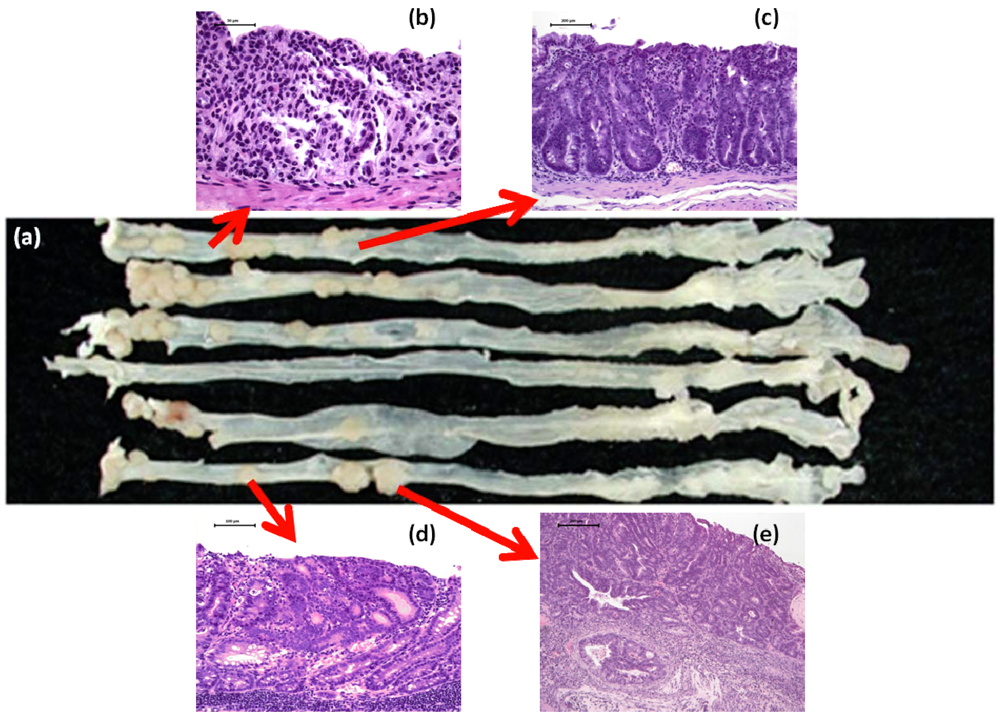
        <p>Rats have mostly been employed for animal colorectal carcinogenesis models, and AOM, methylazoxymethanol (MAM) acetate, and 1,2-dimethylhydrazine (DMH) have been widely used as colorectal carcinogens [<xref ref-type="bibr" rid="B15-cancers-04-00673">15</xref>]. About 30 weeks are required for development of CRC in about half of rats that are initiated with these colonic carcinogens. On the other hand, in experiments and studies using mice, multiple administrations of the colorectal carcinogens are required and it takes a long-term of 40 weeks or longer to develop CRC [<xref ref-type="bibr" rid="B31-cancers-04-00673">31</xref>]. Therefore, I have developed a novel mouse model that would produce CRC in a short-term in the inflamed colorectum [<xref ref-type="bibr" rid="B18-cancers-04-00673">18</xref>]. AOM-DSS, here called the TANAKA model [<xref ref-type="bibr" rid="B15-cancers-04-00673">15</xref>,<xref ref-type="bibr" rid="B17-cancers-04-00673">17</xref>,<xref ref-type="bibr" rid="B18-cancers-04-00673">18</xref>], is a well-characterized experimental model for UC-associated colorectal carcinogenesis (<xref ref-type="fig" rid="cancers-04-00673-f001">Figure 1</xref>a–e) [<xref ref-type="bibr" rid="B18-cancers-04-00673">18</xref>,<xref ref-type="bibr" rid="B32-cancers-04-00673">32</xref>,<xref ref-type="bibr" rid="B33-cancers-04-00673">33</xref>,<xref ref-type="bibr" rid="B34-cancers-04-00673">34</xref>,<xref ref-type="bibr" rid="B35-cancers-04-00673">35</xref>,<xref ref-type="bibr" rid="B36-cancers-04-00673">36</xref>]. Mice that received a single injection of a low dose of the classic colon carcinogen AOM prior to administration of DSS in drinking water develop inflammation and mucosal ulcer (<xref ref-type="fig" rid="cancers-04-00673-f001">Figure 1</xref>b) [<xref ref-type="bibr" rid="B18-cancers-04-00673">18</xref>,<xref ref-type="bibr" rid="B37-cancers-04-00673">37</xref>,<xref ref-type="bibr" rid="B38-cancers-04-00673">38</xref>] as well as dysplasia (<xref ref-type="fig" rid="cancers-04-00673-f001">Figure 1</xref>c), adenoma (AD) (<xref ref-type="fig" rid="cancers-04-00673-f001">Figure 1</xref>d) and ADC (<xref ref-type="fig" rid="cancers-04-00673-f001">Figure 1</xref>e) with pathologic features that resemble those of human UC-associated neoplasia [<xref ref-type="bibr" rid="B18-cancers-04-00673">18</xref>,<xref ref-type="bibr" rid="B33-cancers-04-00673">33</xref>,<xref ref-type="bibr" rid="B34-cancers-04-00673">34</xref>,<xref ref-type="bibr" rid="B36-cancers-04-00673">36</xref>]. The extent of neoplastic lesions depends on several factors like strain susceptibility as well as duration, dosage, and schedule of cyclic DSS application [<xref ref-type="bibr" rid="B39-cancers-04-00673">39</xref>,<xref ref-type="bibr" rid="B40-cancers-04-00673">40</xref>,<xref ref-type="bibr" rid="B41-cancers-04-00673">41</xref>].</p>
        
        <p>To settle the issue of the influence of peroxisome proliferator-activated receptor (PPAR) agonists on colorectal carcinogenesis, which has been a topic since 1998 [<xref ref-type="bibr" rid="B42-cancers-04-00673">42</xref>,<xref ref-type="bibr" rid="B43-cancers-04-00673">43</xref>,<xref ref-type="bibr" rid="B44-cancers-04-00673">44</xref>], we confirmed that colitis induced by DSS, which is a non-genotoxic carcinogen [<xref ref-type="bibr" rid="B45-cancers-04-00673">45</xref>,<xref ref-type="bibr" rid="B46-cancers-04-00673">46</xref>], using aberrant crypt foci (ACF) as a biomarker [<xref ref-type="bibr" rid="B16-cancers-04-00673">16</xref>,<xref ref-type="bibr" rid="B47-cancers-04-00673">47</xref>,<xref ref-type="bibr" rid="B48-cancers-04-00673">48</xref>,<xref ref-type="bibr" rid="B49-cancers-04-00673">49</xref>], had tumor promoter activity to enhance development of ACF in rats and hypothesized that a combination of DSS and AOM would induce CRC in a short-term period in mice as well [<xref ref-type="bibr" rid="B50-cancers-04-00673">50</xref>].</p>
      </sec>
      <sec>
        <title>2.2. DMH/DSS and 2-Amino-1-methyl-6-phenylimidazo[4,5-b]pyridine (PhIP)/DSS Mouse Models</title>
        <p>Instead of AOM, experiments with DMH [<xref ref-type="bibr" rid="B51-cancers-04-00673">51</xref>] or a heterocyclic amine, PhIP [<xref ref-type="bibr" rid="B52-cancers-04-00673">52</xref>] as an initiator (colon carcinogen) and followed by DSS treatment resulted in rapid development of colorectal neoplasms. Histopathologically, ADC induced by DMH/DSS showed severer atypia and more aggressive biological nature than that induced by AOM/DSS. As noticed in the cancers induced by AOM/DSS, the ADC cells developed in the inflamed colon of mice that received DMH and DSS were positive for cyclooxygenase (COX)-2, inducible nitric oxide synthase (iNOS), and β-catenin. Mutation patterns of the <italic>β-catenin</italic> gene slightly differ among the ADCs that were induced by the different treatment regimens: AOM/DSS, codon 32–34, 37, and 41; DMH/DSS, codon 32, 34, 37, and 41; and PhIP/DSS, codon 32 and 34. However, these mutations was limited to the codon 32–34, 37, 41, and 45 that played an important role in degradation of β-catenin protein.</p>
        <fig id="cancers-04-00673-f001" position="float">
          <label>Figure 1</label>
          <caption>
            <p>(<bold>a</bold>) Macroscopic view of colorectal tumors developed in mice that received AOM and DSS. Histopathology of (<bold>b</bold>) severe mucosal ulcer; (<bold>c</bold>) dysplastic crypts, (<bold>d</bold>) colonic adenoma (AD), and (<bold>e</bold>) adenocarcinoma (ADC) in a mouse that received AOM and DSS.</p>
          </caption>
          <graphic xmlns:xlink="http://www.w3.org/1999/xlink" xlink:href="cancers-04-00673-g001.tif"/>
        </fig>
      </sec>
      <sec>
        <title>2.3. DSS Promotes CRC Development in Apc<sup>Min/+</sup> Mice</title>
        <p>In <italic>Apc<sup>Min/+</sup></italic> mice, known as an animal model for familial adenomatous polyposis (FAP), multiple tumors (tubular ADs) develop in the small intestine, instead of the large intestine in human FAP, and markedly few tumors develop in the large bowel. However, dysplastic crypts are observed in the colonic mucosa of <italic>Apc<sup>Min/+</sup></italic> mice [<xref ref-type="bibr" rid="B53-cancers-04-00673">53</xref>,<xref ref-type="bibr" rid="B54-cancers-04-00673">54</xref>]. Therefore, DSS possibly enhances the growth of dysplastic crypts, and finally the lesions progress to ADCs. To investigate whether DSS-induced inflammation in the colonic mucosa would accelerate the growth of dysplastic crypts, <italic>Apc<sup>Min/+</sup></italic> mice were given drinking water containing 2% DSS for one week without the initiation (carcinogen) treatment [<xref ref-type="bibr" rid="B53-cancers-04-00673">53</xref>]. Surprisingly, multiple colorectal tumors, which were histopathologically tubular ADs and ADCs, developed four weeks after the end of DSS treatment. Immunohistochemistry showed that the developed colorectal ADCs were positive against β-catenin, COX-2, iNOS, and p53 antibodies, suggesting that these factors were involved in the development of colorectal neoplasms in the <italic>Apc<sup>Min/+</sup></italic> mice by the DSS treatment, in addition to oxidative stress and nitrosative stress. The findings suggested that DSS-induced inflammation in the large bowel of <italic>Apc<sup>Min/+</sup></italic> mice exert powerful tumor-promotion and/or progression effects on the growth of dysplastic crypts, which had already existed after the birth [<xref ref-type="bibr" rid="B53-cancers-04-00673">53</xref>,<xref ref-type="bibr" rid="B54-cancers-04-00673">54</xref>].</p>
      </sec>
      <sec>
        <title>2.4. AOM/DSS and DMH/DSS Rat Models</title>
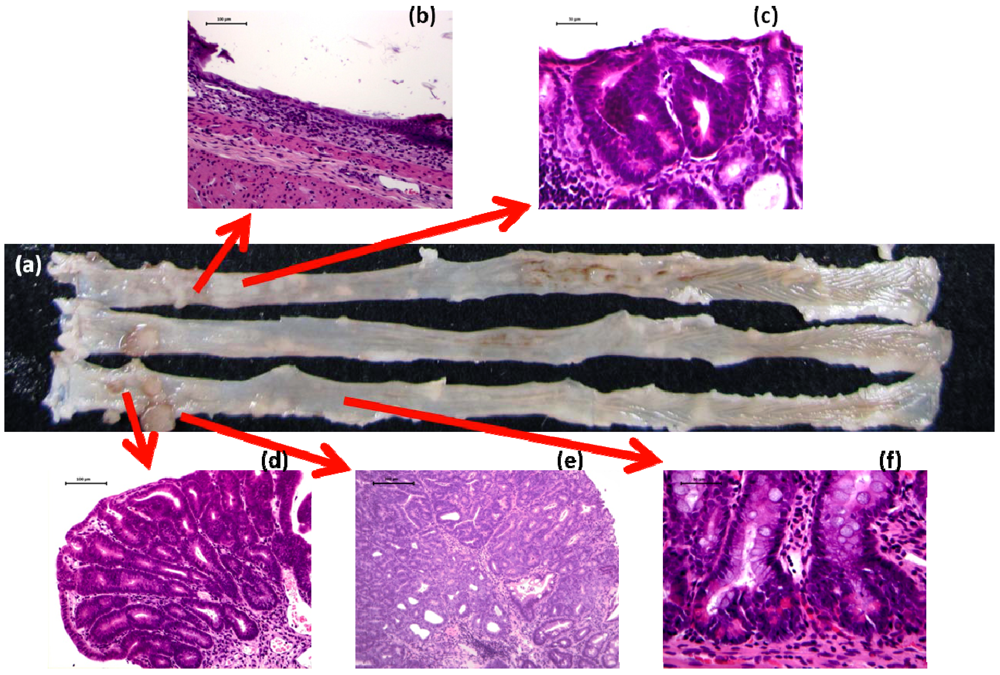
        <p>The mouse inflammation-associated colorectal carcinogenesis model was named the TANAKA model. With this model it was possible to induce colorectal tumors in a short-term period in rats as well as by similar treatment regimens (AOM/DSS and DMH/DSS) [<xref ref-type="bibr" rid="B55-cancers-04-00673">55</xref>,<xref ref-type="bibr" rid="B56-cancers-04-00673">56</xref>]. The administration dose of colon carcinogens for initiation is too low to induce colon tumors, but it can initiate or induce DNA modification [<xref ref-type="bibr" rid="B18-cancers-04-00673">18</xref>]. Treatment with DSS followed by AOM did not produce colonic neoplasms [<xref ref-type="bibr" rid="B18-cancers-04-00673">18</xref>]. The TANAKA model will help advance the research on elucidation of the mechanisms of inflammation-associated colorectal carcinogenesis, inhibition of carcinogenesis, and clarification of the mechanisms of the tumor-promotion ability of DSS. In particular, development of challenging research using the Kyoto <italic>Apc </italic>Delta (KAD) rats (<xref ref-type="fig" rid="cancers-04-00673-f002">Figure 2</xref>a–e) [<xref ref-type="bibr" rid="B57-cancers-04-00673">57</xref>] and <italic>gpt </italic>delta rats [<xref ref-type="bibr" rid="B58-cancers-04-00673">58</xref>] will give new insight in the pathogenesis of CRC development in the inflamed colon [<xref ref-type="bibr" rid="B57-cancers-04-00673">57</xref>]. Interestingly, atypical and neoplastic cells of dysplastic crypts, AD, and ADC in the KAD rats that received AOM and DSS contain Paneth’s granules (<xref ref-type="fig" rid="cancers-04-00673-f002">Figure 2</xref>f), which consist of several anti-microbial compounds and other compounds that are known to be important in immunity and host-defense, in their cytoplasm. We have thus confirmed that in rats with or without genetically alterations colonic tumors are rapidly produced as observed in mice and the rat AOM/DSS and DMH/DSS models can be applied to determine the chemopreventive ability of target compounds.</p>
        <fig id="cancers-04-00673-f002" position="float">
          <label>Figure 2</label>
          <caption>
            <p>(<bold>a</bold>) Macroscopic view of colorectal tumors developed in KAD rats that received AOM and DSS. Histopathology of (<bold>b</bold>) severe mucosal ulcer; (<bold>c</bold>) dysplastic crypts; (<bold>d</bold>) colonic adenoma (AD); (<bold>e</bold>) adenocarcinoma (ADC), and (<bold>f</bold>) cryptal cells containing Paneth’s granules in a mouse that received AOM and DSS.</p>
          </caption>
          <graphic xmlns:xlink="http://www.w3.org/1999/xlink" xlink:href="cancers-04-00673-g002.tif"/>
        </fig>
      </sec>
      <sec>
        <title>2.5. Detection of Initiators and Promoters in Colorectal Carcinogenesis</title>
        <p>We could identify initiators and promoters of colorectal carcinogenesis by modifying the regimens of AOM/DSS and DMH/DSS. When applied test compounds to the initiation treatment instead of AOM or DMH and followed by DSS treatment, we could evaluate initiation activity of test compounds [<xref ref-type="bibr" rid="B59-cancers-04-00673">59</xref>]. When test chemicals are applied after initiation treatment with AOM or DMH, we could determine tumor promotion activity of test compounds (unpublished data and [<xref ref-type="bibr" rid="B60-cancers-04-00673">60</xref>]). Thus, modification of two regimens in the TANAKA model will determine environmental carcinogens and tumor promoters in the colorectum.</p>
      </sec>
    </sec>
    <sec>
      <title>3. Exploration of Chemopreventive Agents Using an Inflammation-Associated Colorectal Carcinogenic Model and Elucidation of the Mechanisms</title>
      <p>Studies on chemoprevention of inflammation-associated colorectal carcinogenesis by several natural and synthetic compounds against have been reported using the AOM/DSS-induced mouse and rat colorectal carcinogenesis models. Several are promising compounds and their clinical application is expected. Representative compounds are: auraptene and nobiletin from citrus fruits [<xref ref-type="bibr" rid="B61-cancers-04-00673">61</xref>], collinin [<xref ref-type="bibr" rid="B61-cancers-04-00673">61</xref>], β-cyclodextrin inclusion compounds of auraptene and 4'-geranyloxyferulic acid [<xref ref-type="bibr" rid="B62-cancers-04-00673">62</xref>], tricin [<xref ref-type="bibr" rid="B35-cancers-04-00673">35</xref>], melatonin [<xref ref-type="bibr" rid="B55-cancers-04-00673">55</xref>], urosodeoxycholic acid [<xref ref-type="bibr" rid="B29-cancers-04-00673">29</xref>], COX-2 selective inhibitor nimesulide [<xref ref-type="bibr" rid="B63-cancers-04-00673">63</xref>], iNOS selective inhibitors [<xref ref-type="bibr" rid="B64-cancers-04-00673">64</xref>], PPAR ligands (troglitazone and bezafibrate) [<xref ref-type="bibr" rid="B63-cancers-04-00673">63</xref>], and the lipophilic statin pitavastatin [<xref ref-type="bibr" rid="B65-cancers-04-00673">65</xref>]. All these compounds have anti-inflammatory activity and are able to suppress the expression of COX-2, iNOS, and inflammatory cytokines.</p>
    </sec>
    <sec>
      <title>4. Preclinical <italic>in Vivo</italic> Chemoprevention Studies</title>
      <p>Using our animal models of inflammation-associated colorectal carcinogenesis, cancer chemopreventive abilities of candidate compounds, morin, bezafibrate, and VPA in mice or rats were investigated. All animal experiments were performed in accordance with protocols approved by the Animal Care and Use Committee of the Institute, TCI-CaRP.</p>
      <sec>
        <title>4.1. Morin Study</title>
        <p>A flavonol, morin (3,5,7,2',4'-pentahydroxyflavone) found in almonds, mill, fig, mulberry, and other Moraceae, acts as a potent antioxidant, inhibitor of xanthine oxidase, protein kinase C and proliferation, apoptosis inducer and modulator of lipoxygenase and cyclooxygenase activities. This flavone has been reported to inhibit the growth of COLO205 cells in nude mice [<xref ref-type="bibr" rid="B66-cancers-04-00673">66</xref>], exhibit intestinal anti-inflammatory activity in the acute phase of rat colitis induced by trinitrobenzenesulfonic acid [<xref ref-type="bibr" rid="B67-cancers-04-00673">67</xref>,<xref ref-type="bibr" rid="B68-cancers-04-00673">68</xref>]. We have previously reported that morin inhibits AOM-induced putative precursor lesions, ACF, in rats [<xref ref-type="bibr" rid="B69-cancers-04-00673">69</xref>] and inhibit chemically-induced rat tongue carcinogenesis [<xref ref-type="bibr" rid="B70-cancers-04-00673">70</xref>]. Morin exerts anti-inflammatory effects on septic shock induced by lipopolysaccharide [<xref ref-type="bibr" rid="B71-cancers-04-00673">71</xref>]. This study aimed to determine possible inhibitory potential of morin in colitis-associated colon carcinogenesis initiated with AOM and promoted by DSS in male F344 rats.</p>
        <p><underline>Materials and methods</underline>: A total of 66 male rats (5-week-old) were initiated with a single s.c. injection of AOM (20 mg/kg bw), and then they were given promotion stimuli by the treatment with 1.5% DSS in their drinking water for seven days. They were then given a basal diet containing 50, 250 and 1,000 ppm of morin for 17 weeks. Experimental groups included the AOM/1.5% DSS (n = 14), AOM/1.5% DSS/50 ppm morin (n = 10), AOM/1.5% DSS/250 ppm morin (n = 11), AOM/1.5% DSS/1,000 ppm morin (n = 11), AOM alone (n = 5), 1.5% DSS alone (n = 5), 500 ppm morin alone (n = 5), and untreated (n = 5) groups. At the end (week 20) of the study histopathological analysis of colorectum was performed on hematoxylin and eosin (H&amp;E)-stained histologic sections (3 μm thickness). Proliferation activity of colonic ADCs was determined by immunofluorescence technique using anti-Mcm2 antibody (BD Biosciences PharMingen, Tokyo, Japan). Apoptotic cells were detected by fluorescein in situ tunnel method, TACS TdT kit (R&amp;D Systems, Inc., Minneapolis, MN, USA). Polyamine levels [<xref ref-type="bibr" rid="B72-cancers-04-00673">72</xref>] and mRNA expression of nuclear factor-kappaB (NF-κB), tumor necrosis factor (TNF)-α, interleukin (IL)-1β, Stat3, and hypoxia-inducible factor (HIF)-1α [<xref ref-type="bibr" rid="B73-cancers-04-00673">73</xref>] in colonic mucosa were determined in mice randomly selected from each group. All measurements were statistically analyzed using either the Tukey multiple comparison post test or Fisher’s extract probability test. Differences were considered to be statistically significant at <italic>p</italic> &lt; 0.05.</p>
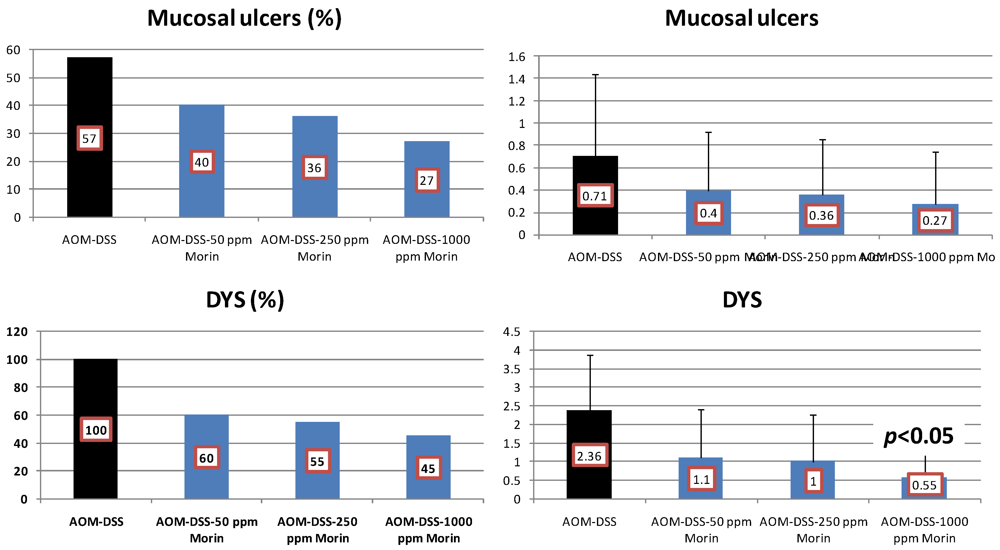
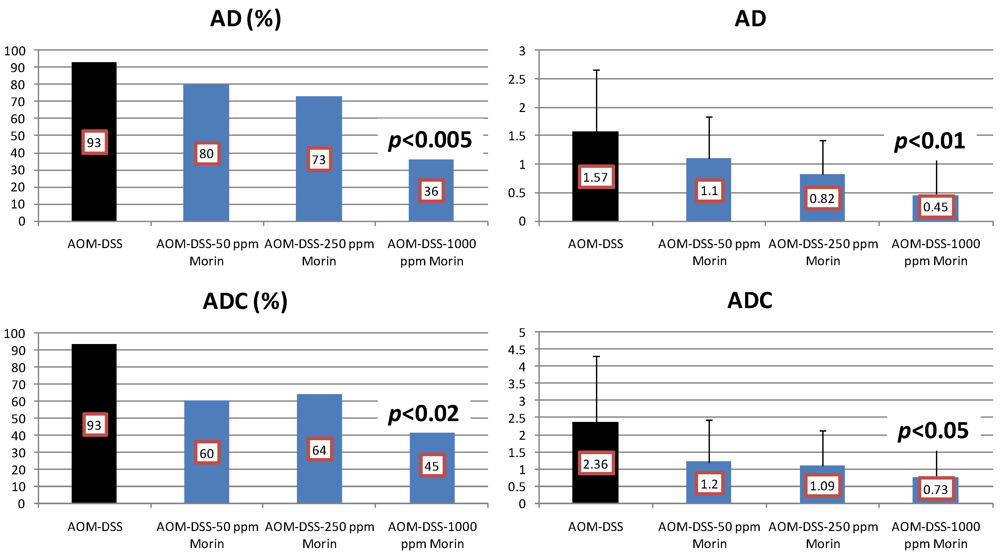
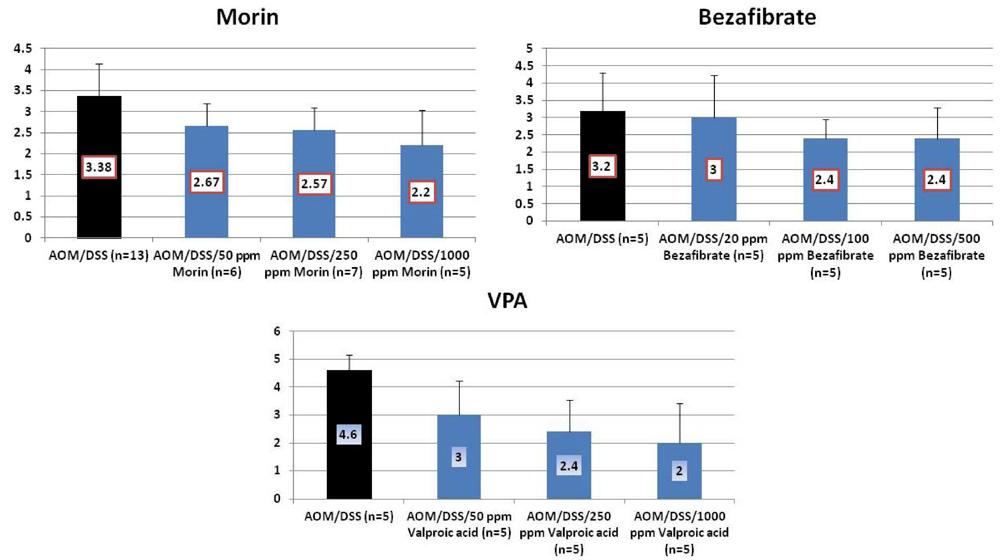
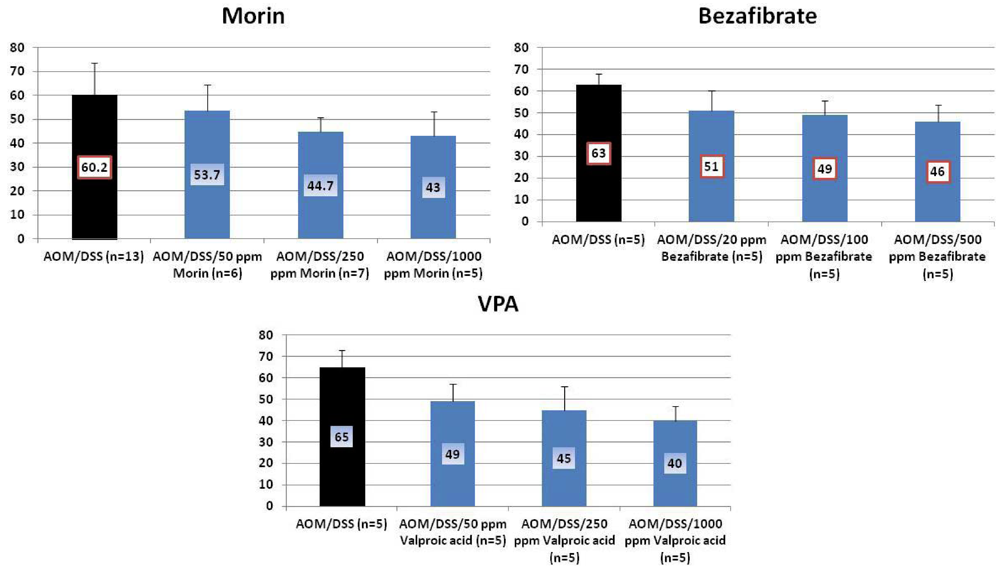
        <p><underline>Results</underline>: At week 20, the treatment with morin inhibited colonic mucosal ulcer (<xref ref-type="fig" rid="cancers-04-00673-f003">Figure 3</xref>) and dysplastic crypts (<italic>p</italic> &lt; 0.05 at 1,000 ppm, <xref ref-type="fig" rid="cancers-04-00673-f003">Figure 3</xref>). The incidence (<italic>p</italic> &lt; 0.005) and multiplicity (<italic>p</italic> &lt; 0.01) of colonic AD were significantly reduced by feeding with 1000 ppm morin (<xref ref-type="fig" rid="cancers-04-00673-f004">Figure 4</xref>). Also, dietary administration with 1,000 ppm morin significantly inhibited the incidence (<italic>p</italic> &lt; 0.02) and multiplicity (<italic>p</italic> &lt; 0.05) of colonic ADC (<xref ref-type="fig" rid="cancers-04-00673-f004">Figure 4</xref>), when compared to the AOM/DSS group (93% incidence and 2.36 ± 1.95 multiplicity). Feeding with 50 ppm and 250 ppm morin lowered the incidence and multiplicity of ADC, but the inhibition rates did not reach statistically significance. The treatments also modulated proliferation and apoptosis in ADCs. Mcm2 positive rates (%) of ADCs in rats fed the diets containing 50 ppm morin (n = 6, 78.7 ± 6.8), 250 ppm morin (n = 7, 63.4 ± 6.3, <italic>p</italic> &lt; 0.001), and 1,000 ppm morin (n = 5, 55.6 ± 12.5, <italic>p</italic> &lt; 0.001) were lower than that of rats given AOM and DSS (n = 13, 83.4 ± 8.8). When compared with the AOM and DSS group (n = 13, 8.23 ± 1.24), apoptotic index (%) of ADCs was increased by feeding with morin: 50 ppm morin (n = 6, 10.83 ± 3.66), 250 ppm morin (n = 7, 11.29 ± 3.95), and 1,000 ppm morin (n = 5, 13.00 ± 2.74, <italic>p</italic> &lt; 0.05).</p>
        
        <p>Growth inhibition and apoptosis induction by morin in CRC might be caused by activation of caspase 3 and increase of p21 protein [<xref ref-type="bibr" rid="B66-cancers-04-00673">66</xref>]. Suppression of NF-κB-regulated gene products and enhancement of apoptosis induced by TNF [<xref ref-type="bibr" rid="B74-cancers-04-00673">74</xref>] also contribute to inhibition of colitis-related colorectal carcinogenesis by morin. Our findings suggest that dietary morin is able to inhibit colitis-related colon carcinogenesis in rats and a flavonol morin is one of the candidates for clinical application of chemoprevention against CRC development in patients with ulcerative colitis.</p>
        <p>Because morin can inhibit inflammation, inhibit tumor promotion, suppress tumor growth, and down-regulate the expression of certain genes regulated by NF-κB, it may be possible that morin modulates the activation of NF-κB and NF-κB-regulated gene expression induced by carcinogens, inflammatory agents, and immune modulators. In fact, Manna <italic>et al</italic>. [<xref ref-type="bibr" rid="B74-cancers-04-00673">74</xref>] have recently reported morin suppresses the activation of NF-κB and NF-κB-regulated gene expression that leads to enhancement of apoptosis.</p>
        <fig id="cancers-04-00673-f003" position="float">
          <label>Figure 3</label>
          <caption>
            <p>Incidences and multiplicities of mucosal ulcer and dysplastic crypts in the morin study.</p>
          </caption>
          <graphic xmlns:xlink="http://www.w3.org/1999/xlink" xlink:href="cancers-04-00673-g003.tif"/>
        </fig>
        <fig id="cancers-04-00673-f004" position="float">
          <label>Figure 4</label>
          <caption>
            <p>Incidences and multiplicities of adenoma (AD) and adenocarcinoma (ADC) in the morin study.</p>
          </caption>
          <graphic xmlns:xlink="http://www.w3.org/1999/xlink" xlink:href="cancers-04-00673-g004.tif"/>
        </fig>
      </sec>
      <sec>
        <title>4.2. Bezafibrate Study</title>
        <p>CRC is one of the leading forms of malignancy in the developed countries. Epidemiologic and animal studies have suggested that risk factors for coronary artery disease like insulin resistance and dyslipidemia are probably related to the development of colon cancer [<xref ref-type="bibr" rid="B75-cancers-04-00673">75</xref>,<xref ref-type="bibr" rid="B76-cancers-04-00673">76</xref>,<xref ref-type="bibr" rid="B77-cancers-04-00673">77</xref>]. In particular, nuclear peroxisome proliferator-activated receptors (PPARs), mainly PPARα and PPARγ, which play a central role in lipid and glucose metabolism, had been hypothesized as being involved in colon carcinogenesis [<xref ref-type="bibr" rid="B50-cancers-04-00673">50</xref>,<xref ref-type="bibr" rid="B78-cancers-04-00673">78</xref>,<xref ref-type="bibr" rid="B79-cancers-04-00673">79</xref>]. Furthermore, synthetic PPAR ligands (glitazones and bezafibrate) with proven beneficial effects on insulin resistance and triglyceride levels had been proposed to be candidates as tumor preventive agents [<xref ref-type="bibr" rid="B50-cancers-04-00673">50</xref>,<xref ref-type="bibr" rid="B63-cancers-04-00673">63</xref>,<xref ref-type="bibr" rid="B79-cancers-04-00673">79</xref>]. This study aimed to determine inhibitory potential of bezafibrate in colitis-associated colon carcinogenesis initiated with AOM and promoted by DSS in mice.</p>
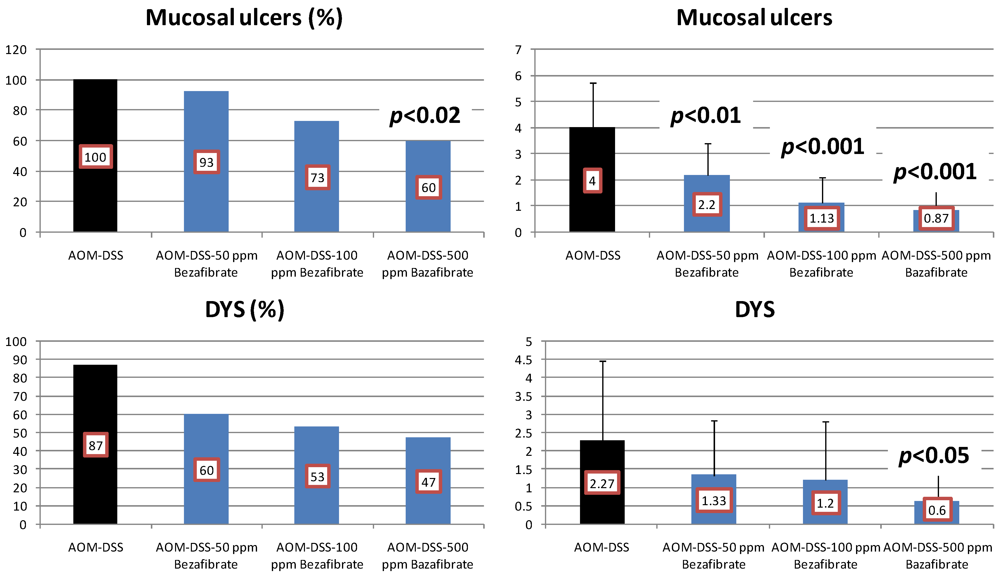
        <p><underline>Materials and methods</underline>: A total of 100 male ICR mice (5-week old) initiated with a single s.c. injection of AOM (10 mg/kg bw) were promoted by 1.5% DSS in their drinking water for seven days. They were then given a basal diet containing 50, 100 and 500 ppm of bezafibrate for 17 weeks. Mice were divided into 8 groups: AOM/1.5% DSS (n = 20), AOM/1.5% DSS/50 ppm bezafibrate (n = 20), AOM/1.5% DSS/100 ppm bezafibrate (n = 20), AOM/1.5% DSS/500 ppm bezafibrate (n = 20), AOM alone (n = 5), 1.5% DSS alone (n = 5), 500 ppm bezafibrate alone (n = 5), and untreated (n = 5) groups. At the end (week 20) of the study histopathological analysis of colorectum was performed on H&amp;E-stained histological sections of 3 μm in thickness. Immunofluorescence technique using anti-Mcm2 antibody (BD Biosciences PharMingen) and fluorescein in situ tunnel method, TACS TdT kit (R&amp;D Systems, Inc.) were used for determination of proliferation activity and apoptosis index of colonic ADCs, respectively. Polyamine levels [<xref ref-type="bibr" rid="B72-cancers-04-00673">72</xref>] and mRNA expression of NF-κB, TNF-α, IL-1β, Stat3, and HIF-1α [<xref ref-type="bibr" rid="B73-cancers-04-00673">73</xref>] in colonic mucosa were assayed in some mice of each group. Measurements were statistically analyzed using either the Tukey multiple comparison post-test or Fisher’s extract probability test. Differences were considered to be statistically significant at <italic>p</italic> &lt; 0.05.</p>
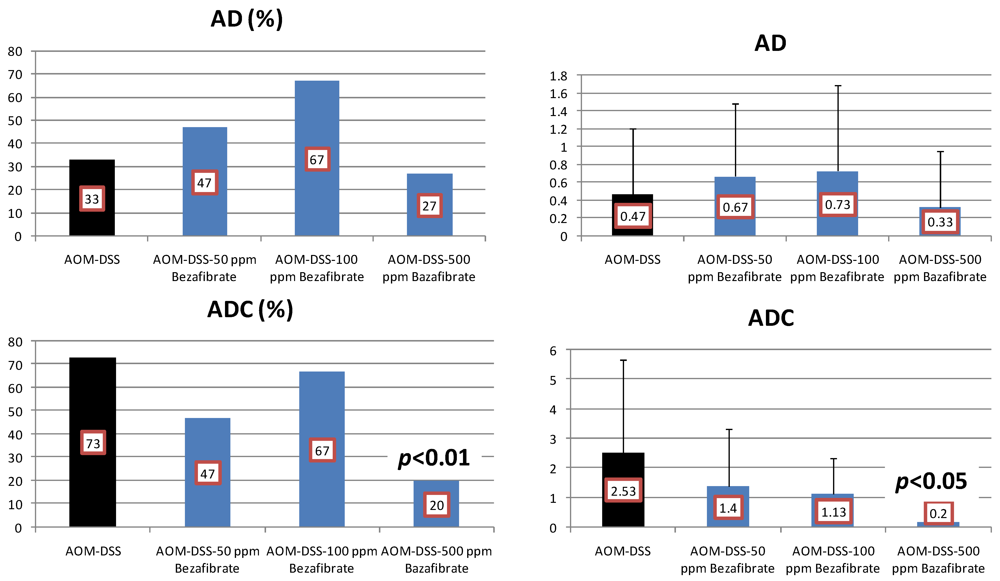
        <p><underline>Results</underline>: At week 20, the bezafibrate feeding inhibited the occurrence of mucosal ulcer (the incidence at 500 ppm, <italic>p </italic>&lt; 0.02; and the multiplicity at 50, 100 and 500 ppm, <italic>p</italic> &lt; 0.01 or <italic>p</italic> &lt; 0.001, <xref ref-type="fig" rid="cancers-04-00673-f005">Figure 5</xref>) and dysplastic crypts (the multiplicity at 500 ppm, <italic>p</italic> &lt; 0.05, <xref ref-type="fig" rid="cancers-04-00673-f005">Figure 5</xref>). As illustrated in <xref ref-type="fig" rid="cancers-04-00673-f006">Figure 6</xref>, he development of colonic ADC was significantly inhibited by feeding with 500 ppm bezafibrate (incidence: 73% reduction, <italic>p</italic> &lt; 0.01; and multiplicity: 92%, <italic>p</italic> &lt; 0.05), when compared to the AOM/DSS group (73% incidence and 2.53 ± 3.14 multiplicity). Feeding with 50 ppm (47% incidence with a multiplicity of 1.40 ± 1.92) and 100 ppm bezafibrate (67% incidence with a multiplicity of 1.13 ± 1.19) also lowered the incidence and multiplicity of ADC, but the inhibition was not statistically significant when compared to the AOM/DSS group (<xref ref-type="fig" rid="cancers-04-00673-f006">Figure 6</xref>). Although statistically insignificant, feeding with 50 and 100 ppm bezafibrate increased the incidence and multiplicity of ADs, but 500 ppm bezafibrate decreased the development of ADs (<xref ref-type="fig" rid="cancers-04-00673-f006">Figure 6</xref>). These findings may suggest the threshold of chemopreventive ability of bezafibrate. Feeding with bezafibrate lowered Mcm2 positive rates (%) of ADCs, when compared with the AOM and DSS group (n = 10, 72.9 ± 10.1): 50 ppm bezafibrate (n = 7, 54.3 ± 9.5), 100 ppm bezafibrate (n = 4, 38.8 ± 7.4, <italic>p</italic> &lt; 0.01), and 500 ppm bezafibrate (n = 3, 22.7 ± 3.2, <italic>p</italic> &lt; 0.001) were lower than that of rats given AOM and DSS (n = 13, 83.4 ± 8.8). When compared with the AOM and DSS group (n = 10, 8.18 ± 1.17), apoptotic index (%) of ADCs was increased by feeding with bezafibrate: 50 ppm bezafibrate (n = 7, 10.71 ± 3.35), 100 ppm bezafibrate (n = 4, 13.20 ± 2.49, <italic>p</italic> &lt; 0.05), and 500 ppm bezafibrate (n = 3, 13.25 ± 3.10, <italic>p</italic> &lt; 0.05).</p>
        
        <p>Anti-angiogenic effects and anti-inflammatory activity of PPARα agonist [<xref ref-type="bibr" rid="B80-cancers-04-00673">80</xref>] are considered to contribute to inhibition of CRC growth. Down-regulation of the anti-apoptotic gene <italic>Mcl-1</italic> by PPARα agonist [<xref ref-type="bibr" rid="B81-cancers-04-00673">81</xref>] causes apoptosis. The findings suggest that dietary bezafibrate is able to inhibit colitis-related colon carcinogenesis in mice and a hypolipidemic drug bezafibrate is one of the candidates for clinical application of chemoprevention against CRC development in patients with ulcerative colitis.</p>
        <fig id="cancers-04-00673-f005" position="float">
          <label>Figure 5</label>
          <caption>
            <p>Incidences and multiplicities of mucosal ulcer and dysplastic crypts in the bezafibrate study.</p>
          </caption>
          <graphic xmlns:xlink="http://www.w3.org/1999/xlink" xlink:href="cancers-04-00673-g005.tif"/>
        </fig>
        <fig id="cancers-04-00673-f006" position="float">
          <label>Figure 6</label>
          <caption>
            <p>Incidences and multiplicities of adenoma (AD) and adenocarcinoma (ADC) in the bezafibrate study.</p>
          </caption>
          <graphic xmlns:xlink="http://www.w3.org/1999/xlink" xlink:href="cancers-04-00673-g006.tif"/>
        </fig>
        <p>Accumulating animal experimental, human laboratory and epidemiologic data [<xref ref-type="bibr" rid="B50-cancers-04-00673">50</xref>,<xref ref-type="bibr" rid="B63-cancers-04-00673">63</xref>,<xref ref-type="bibr" rid="B79-cancers-04-00673">79</xref>,<xref ref-type="bibr" rid="B82-cancers-04-00673">82</xref>,<xref ref-type="bibr" rid="B83-cancers-04-00673">83</xref>] support the hypothesis linking triglyceride levels and insulin resistance to the development of colon cancer. These facts emphasize the potential for this cancer to become a preventable disease not only via screening and removal of polyps but through relevant lifestyle changes and pharmacological interventions which can provide even more avenues for prevention [<xref ref-type="bibr" rid="B83-cancers-04-00673">83</xref>,<xref ref-type="bibr" rid="B84-cancers-04-00673">84</xref>,<xref ref-type="bibr" rid="B85-cancers-04-00673">85</xref>].</p>
        <p>The incidence of insulin resistance has been increasing in the Western world where colon cancer is the second leading cause of cancer death. This suggests the interrelationship of these conditions. The biological role of PPARs in various diseases, including inflammation and cancer, has been highlighted recently [<xref ref-type="bibr" rid="B50-cancers-04-00673">50</xref>,<xref ref-type="bibr" rid="B63-cancers-04-00673">63</xref>,<xref ref-type="bibr" rid="B78-cancers-04-00673">78</xref>,<xref ref-type="bibr" rid="B85-cancers-04-00673">85</xref>,<xref ref-type="bibr" rid="B86-cancers-04-00673">86</xref>,<xref ref-type="bibr" rid="B87-cancers-04-00673">87</xref>]. PPARs are members of the nuclear hormone receptor family of ligand-activated transcription factors that play a prominent role in the regulation of many metabolic processes. The PPAR isoformes α and γ are important regulators in lipid and glucose metabolism, cell differentiation and inflammatory response [<xref ref-type="bibr" rid="B87-cancers-04-00673">87</xref>,<xref ref-type="bibr" rid="B88-cancers-04-00673">88</xref>]. These data propose that PPAR may be associated with many aspects of colon cancer development including insulin- and inflammation-related mechanisms. The fibric acid derivative bezafibrate is the pan PPAR (α, β/δ, and γ) activator with predominantly PPARα (as all fibrates) and β/δ effects but also with perceptible PPARγ properties [<xref ref-type="bibr" rid="B88-cancers-04-00673">88</xref>,<xref ref-type="bibr" rid="B89-cancers-04-00673">89</xref>,<xref ref-type="bibr" rid="B90-cancers-04-00673">90</xref>]. The use of bezafibrate is associated with triglyceride-lowering and high density-cholesterol raising effects resulting in decreased systemic availability of fatty acid, diminished of fatty acid uptake by muscle and improvement of insulin sensitization [<xref ref-type="bibr" rid="B91-cancers-04-00673">91</xref>,<xref ref-type="bibr" rid="B92-cancers-04-00673">92</xref>]. These direct and indirect effects may have contributed to the suppression of the development of colonic tumors in rodents by bezafibrate [<xref ref-type="bibr" rid="B50-cancers-04-00673">50</xref>,<xref ref-type="bibr" rid="B63-cancers-04-00673">63</xref>,<xref ref-type="bibr" rid="B79-cancers-04-00673">79</xref>]. Recently, Tenenbaum <italic>et al</italic>. [<xref ref-type="bibr" rid="B93-cancers-04-00673">93</xref>] have reported possible preventive effects of bezafibrate on the development of CRC from patients with coronary artery disease.</p>
      </sec>
      <sec>
        <title>4.3. Valproic Acid (VPA) Study</title>
        <p>Epigenetic modification plays an important role in tumorigenesis. Affecting epigenetic and tumorigenic alterations is a promising strategy for anticancer targeted therapy [<xref ref-type="bibr" rid="B94-cancers-04-00673">94</xref>,<xref ref-type="bibr" rid="B95-cancers-04-00673">95</xref>,<xref ref-type="bibr" rid="B96-cancers-04-00673">96</xref>]. Among the key chromatin modifying enzymes which influence gene expression, histone acetyltransferases (HATs) and histone deacetylases (HDACs) have attracted interest because of their impact on tumor development and progression. Histone deacetylase inhibitors (HDACIs) represent a new and promising class of antitumor drugs that influence gene expression by enhancing acetylation of histones in specific chromatin domains. HDACIs also exert potent anticancer activities inducing cell cycle arrest and apoptosis. Moreover, HDACIs down-regulate genes involved in tumor progression, invasion and angiogenesis. Based on the ability of HDACIs to regulate many signaling pathways, co-treatment of these compounds that are currently under clinical investigation with molecular targeted drugs is a promising strategy against many types of tumors.</p>
        <p>VPA (2-propylpentanoic acid) [<xref ref-type="bibr" rid="B97-cancers-04-00673">97</xref>] is a well-established drug for the therapy of epilepsy. It is teratogenic when administered during early pregnancy and can induce birth defects such as neural tube closure defects and other malformations. This well-tolerated antiepileptic drug was found to be a powerful HDAC-1 inhibitor [<xref ref-type="bibr" rid="B97-cancers-04-00673">97</xref>]. VPA induces differentiation of carcinoma cells, transformed hematopoietic progenitor cells and leukemic blasts from acute myeloid leukemia patients [<xref ref-type="bibr" rid="B98-cancers-04-00673">98</xref>]. Our microarray analysis during the AOM-DSS carcinogenesis revealed alteration of Wif-1 expression [<xref ref-type="bibr" rid="B34-cancers-04-00673">34</xref>]. VPA has been reported to modify the Wif-1 expression [<xref ref-type="bibr" rid="B99-cancers-04-00673">99</xref>]. These findings may suggest possible modifying effects of VPA on AOM-DSS colorectal carcinogenesis. In this study, we determined whether VPA is able to inhibit colitis-associated colon carcinogenesis in mice.</p>
        <p><underline>Materials and methods</underline>: A total of 85 mice aged five weeks was used and they were divided into 8 groups: AOM/2% DSS (n = 19), AOM/2% DSS/50 ppm VPA (n = 15), AOM/2% DSS/250 ppm VPA (n = 15), AOM/2% DSS/1,000 ppm VPA (n = 16), AOM alone (n = 5), 2% DSS alone (n = 5), 1,000 ppm VPA alone (n = 5), and untreated (n = 5) groups. Mice were initiated with a single s.c. injection of AOM (10 mg/kg bw) were promoted by 2% DSS in their drinking water for seven days. They were then given a basal diet containing 50, 250 or 1,000 ppm of VPA for 17 weeks. At the end (week 20) of the study histopathological examination of large bowel was performed on H&amp;E-stained histological sections (3 μm in thickness). Immunofluorescence technique using anti-Mcm2 antibody (BD Biosciences PharMingen) for evaluating proliferating activity and fluorescein in situ tunnel method, TACS TdT kit (R&amp;D Systems, Inc.) for detecting apoptosis cells were applied on histological sections of colonic ADCs. Polyamine levels [<xref ref-type="bibr" rid="B72-cancers-04-00673">72</xref>] and mRNA expression of NF-κB, TNF-α, IL-1β, Stat3, and HIF-1α [<xref ref-type="bibr" rid="B73-cancers-04-00673">73</xref>] in colonic mucosa were assayed in some mice of each group.At the end of the study (week 20), Measurements were statistically analyzed using either the Tukey multiple comparison post test or Fisher’s extract probability test. Differences were considered to be statistically significant at <italic>p</italic> &lt; 0.05.</p>
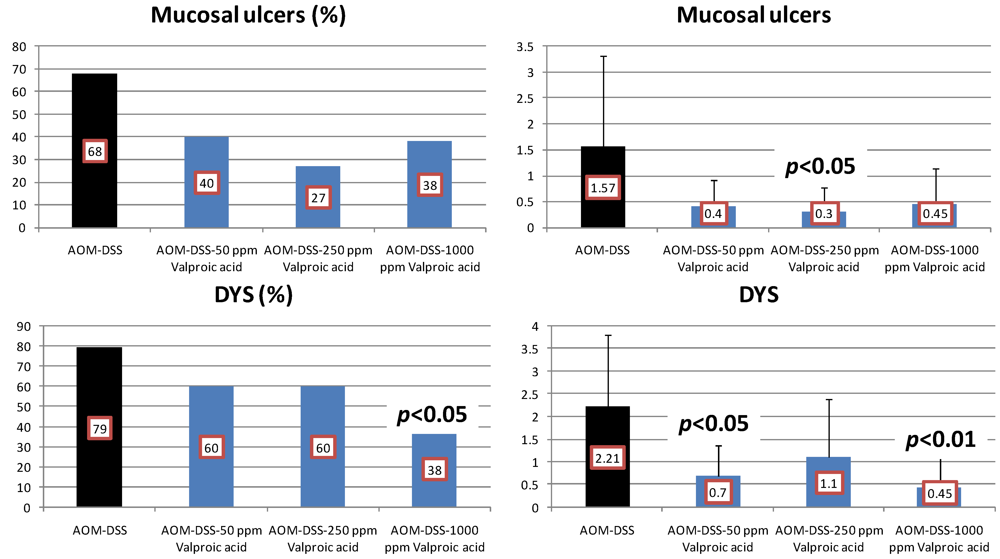
        <p><underline>Results</underline>: VPA feeding inhibited the development of mucosal ulcer (<xref ref-type="fig" rid="cancers-04-00673-f007">Figure 7</xref>) and dysplastic crypts (the incidence at 1,000 ppm VPA, <italic>p</italic> &lt; 0.05; and the multiplicity at 50 ppm, <italic>p</italic> &lt; 0.05 and at 1,000 ppm, <italic>p</italic> &lt; 0.01, <xref ref-type="fig" rid="cancers-04-00673-f007">Figure 7</xref>).</p>
        <fig id="cancers-04-00673-f007" position="float">
          <label>Figure 7</label>
          <caption>
            <p>Incidences and multiplicities of mucosal ulcer and dysplastic crypts in the Valproic Acid (VPA) Study.</p>
          </caption>
          <graphic xmlns:xlink="http://www.w3.org/1999/xlink" xlink:href="cancers-04-00673-g007.tif"/>
        </fig>
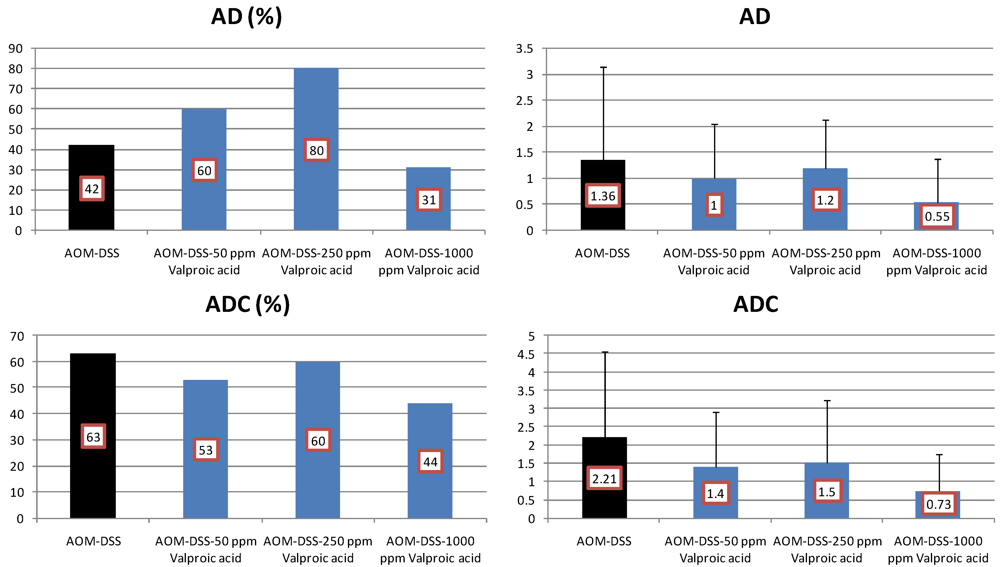
        <p>The development of colonic AD and ADC was lowered by feeding with VPA, but the reduction rates were statistically insignificant (<xref ref-type="fig" rid="cancers-04-00673-f008">Figure 8</xref>). When fed with VPA-containing diet, Mcm2 positive rates (%) of ADCs were lower than that of the AOM and DSS group (n = 9, 80.1 ± 6.8): 125 ppm VPA (n = 7, 73.7 ± 8.0), 250 ppm VPA (n = 6, 64.2 ± 2.5, <italic>p</italic> &lt; 0.01), and 1,000 ppm VPA (n = 5, 61.6 ± 9.6, <italic>p</italic> &lt; 0.001). As to apoptotic index (%) of ADCs, the values of mice fed with 125 ppm VPA (n = 7, 10.67 ± 3.44), 250 ppm VPA (n = 6, 12.33 ± 1.75, <italic>p</italic> &lt; 0.05), and 1,000 ppm VPA (n = 5, 12.80 ± 2.39, <italic>p</italic> &lt; 0.05) were higher thab the AOM and DSS group (n = 9, 8.44 ± 1.33).</p>
        <fig id="cancers-04-00673-f008" position="float">
          <label>Figure 8</label>
          <caption>
            <p>Incidences and multiplicities of adenoma (AD) and adenocarcinoma (ADC) in the Valproic Acid (VPA) Study.</p>
          </caption>
          <graphic xmlns:xlink="http://www.w3.org/1999/xlink" xlink:href="cancers-04-00673-g008.tif"/>
        </fig>
        <p>Our findings suggest slight chemopreventive effects of VPA on colitis-related colon carcinogenesis in mice, suggesting that single use of a HDAC inhibitor VPA is not practical for inhibiting CRC development in inflamed colon. VPA combined with other known chemopreventive or chemotherapeutic agent(s) may exert to inhibit CRC that develop in colitic mucosa.</p>
        <p>VPA was studied in combination with all-<italic>trans</italic> retinoid acid in patients with acute myeloid leukemia who were not candidates for intensive chemotherapy [<xref ref-type="bibr" rid="B100-cancers-04-00673">100</xref>]. Using human hepatocellular carcinoma (HCC) cells, HepG2, combination treatment with acyclic retinoid and VPA is demonstrated to be an effective regimen for the chemoprevention and chemotherapy of HCC [<xref ref-type="bibr" rid="B101-cancers-04-00673">101</xref>]. Acyclic retinoid and VPA cooperatively increase the expression of retinoid X receptor (RXR)-β and p21 (CIP1), while inhibiting the phosphorylation of RXRα, and these effects were associated with induction of apoptosis and the inhibition of cell growth in HepG2 cells. Several HDACIs seem to exert an antitumor effect in a synergistic manner with different anticancer compounds and to overcome the resistance induced by conventional chemotherapeutic drugs [<xref ref-type="bibr" rid="B102-cancers-04-00673">102</xref>,<xref ref-type="bibr" rid="B103-cancers-04-00673">103</xref>,<xref ref-type="bibr" rid="B104-cancers-04-00673">104</xref>,<xref ref-type="bibr" rid="B105-cancers-04-00673">105</xref>]. A phase I trial of single agent VPA was reported in patients with newly diagnosed cervical cancer [<xref ref-type="bibr" rid="B106-cancers-04-00673">106</xref>]. Twelve patients were included. VPA doses ranged from 20 mg/kg to 40 mg/kg daily for five days. Tumor HDAC activity decreased in 8 patients. Many lines of evidence suggest that tumor cells are characterized by histone hypoacetylation and that over-expression of HDACs is involved in tumorigenesis of various human malignancies [<xref ref-type="bibr" rid="B107-cancers-04-00673">107</xref>,<xref ref-type="bibr" rid="B108-cancers-04-00673">108</xref>]. Recently, a population-based case-control study with long-term users of VPA has not supported HDAC inhibition by VPA as a pharmacologic principle for general chemoprevention [<xref ref-type="bibr" rid="B109-cancers-04-00673">109</xref>]. However, VPA doses (0.35–0.70 mmol/L) used in clinical practice could be too low to achieve cancer preventive effects in contrast the doses (0.50–3.0 mmol/L) that inhibit HDAC. Since VPA is reported to suppress progression of urological malignancies [<xref ref-type="bibr" rid="B110-cancers-04-00673">110</xref>,<xref ref-type="bibr" rid="B111-cancers-04-00673">111</xref>], it is worthy to evaluate the modifying effects of VPA on different stage of carcinogenesis.</p>
      </sec>
    </sec>
    <sec>
      <title>5. Effects of Morin, Bezafibrate and VPA on Expression of Pro-Inflammatory Cytokines and HIF-1α and Content of Tissue Polyamines in the Inflamed Colon</title>
      <p>IBD represents a dysregulated mucosal immune response to antigens derived from the commensal microbiota in a genetically susceptible host that initially derives from innate immune abnormalities leading to an excessive pro-inflammatory cytokines (T-helper 1, T-helper 2, and T-helper 17 cytokines) derived from CD4<sup>+</sup> T cells [<xref ref-type="bibr" rid="B9-cancers-04-00673">9</xref>,<xref ref-type="bibr" rid="B112-cancers-04-00673">112</xref>]. A key point in understanding IBD pathophysiology is to understand the immunoregulatory pathways associated with the intestinal immune system as they apply to IBD. Therefore, in addition to immunotherapy, pro-inflammatory cytokines secreted by innate and adaptive immune cells are targets for IBD treatment [<xref ref-type="bibr" rid="B73-cancers-04-00673">73</xref>]. Similarly, cytokines, including NF-κB [<xref ref-type="bibr" rid="B73-cancers-04-00673">73</xref>,<xref ref-type="bibr" rid="B113-cancers-04-00673">113</xref>], TNF-α [<xref ref-type="bibr" rid="B9-cancers-04-00673">9</xref>,<xref ref-type="bibr" rid="B35-cancers-04-00673">35</xref>,<xref ref-type="bibr" rid="B64-cancers-04-00673">64</xref>], and interleukin (IL)-1β [<xref ref-type="bibr" rid="B64-cancers-04-00673">64</xref>,<xref ref-type="bibr" rid="B114-cancers-04-00673">114</xref>,<xref ref-type="bibr" rid="B115-cancers-04-00673">115</xref>] are potentially molecular targets for inflammation-associated CRC [<xref ref-type="bibr" rid="B14-cancers-04-00673">14</xref>]. Potential cancer chemopreventive agents also modulate expression of signal transducer and activator of transcription (Stat3) [<xref ref-type="bibr" rid="B55-cancers-04-00673">55</xref>,<xref ref-type="bibr" rid="B114-cancers-04-00673">114</xref>], HIF-1α [<xref ref-type="bibr" rid="B116-cancers-04-00673">116</xref>,<xref ref-type="bibr" rid="B117-cancers-04-00673">117</xref>], and survivin [<xref ref-type="bibr" rid="B73-cancers-04-00673">73</xref>] in the target tissues.</p>
      <p>Polyamines are organic cations that control gene expression at the transcriptional, posttranscriptional, and translational levels. Multiple cellular carcinogenesis pathways are involved in regulation of transcription and translation of polyamine-metabolizing enzymes [<xref ref-type="bibr" rid="B118-cancers-04-00673">118</xref>]. We have reported he importance of research utilizing pharmaceutical inhibitors and cancer chemoprevention against CRC targeting the polyamine pathway [<xref ref-type="bibr" rid="B72-cancers-04-00673">72</xref>,<xref ref-type="bibr" rid="B119-cancers-04-00673">119</xref>,<xref ref-type="bibr" rid="B120-cancers-04-00673">120</xref>].</p>
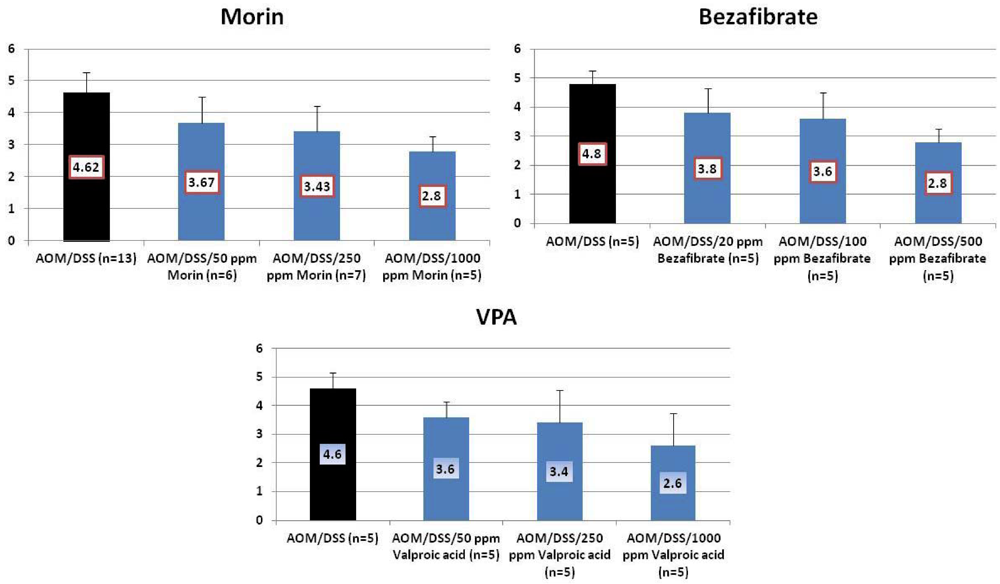
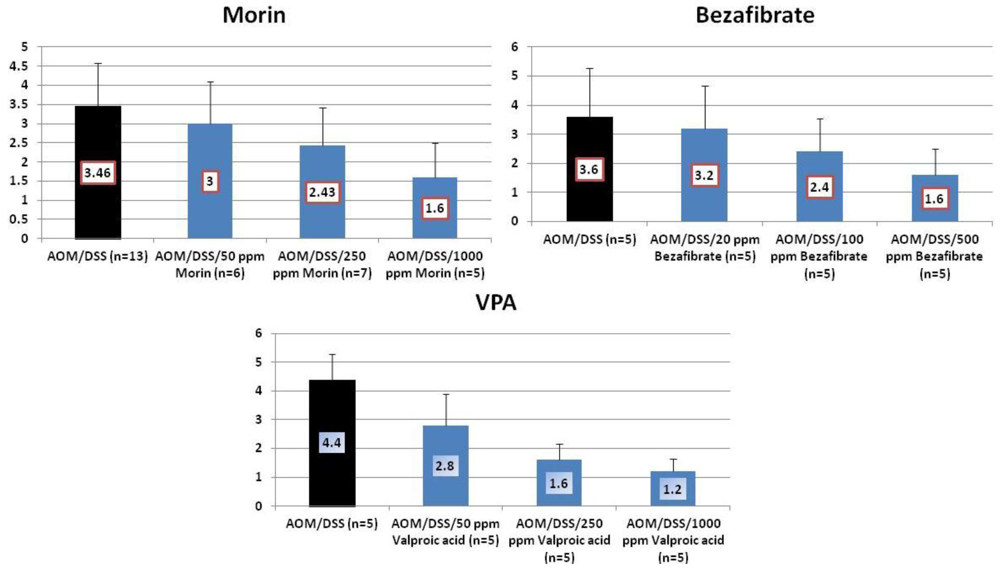
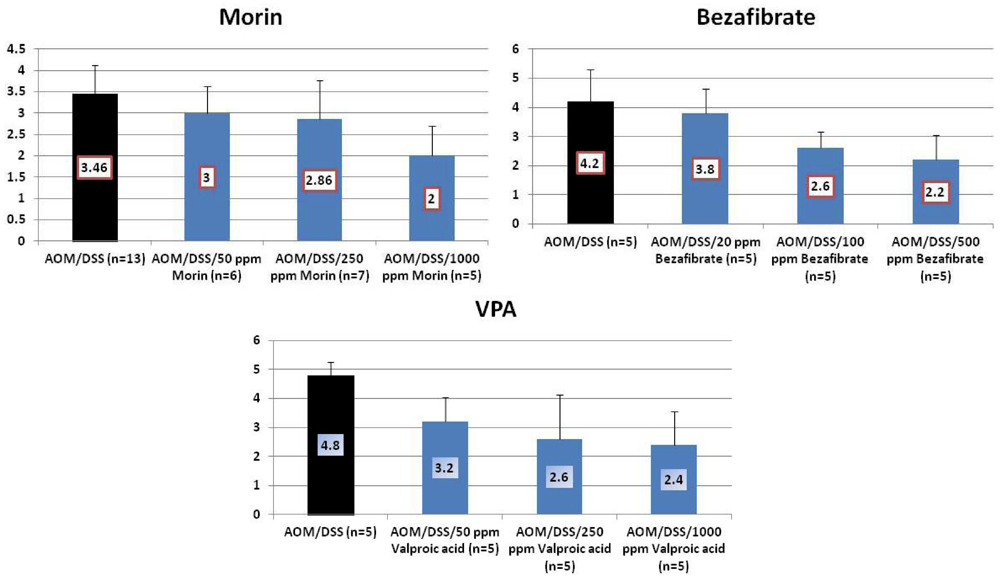
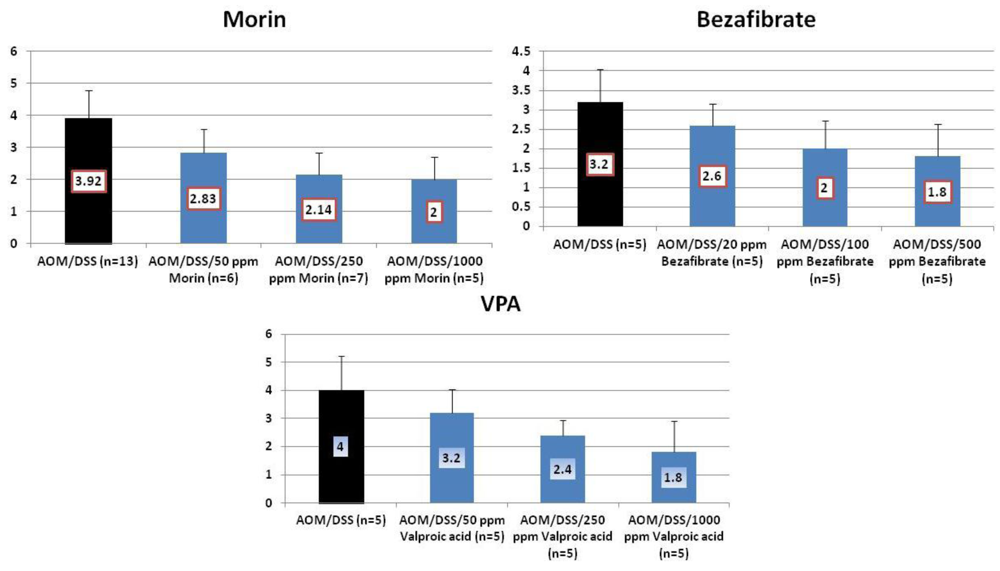
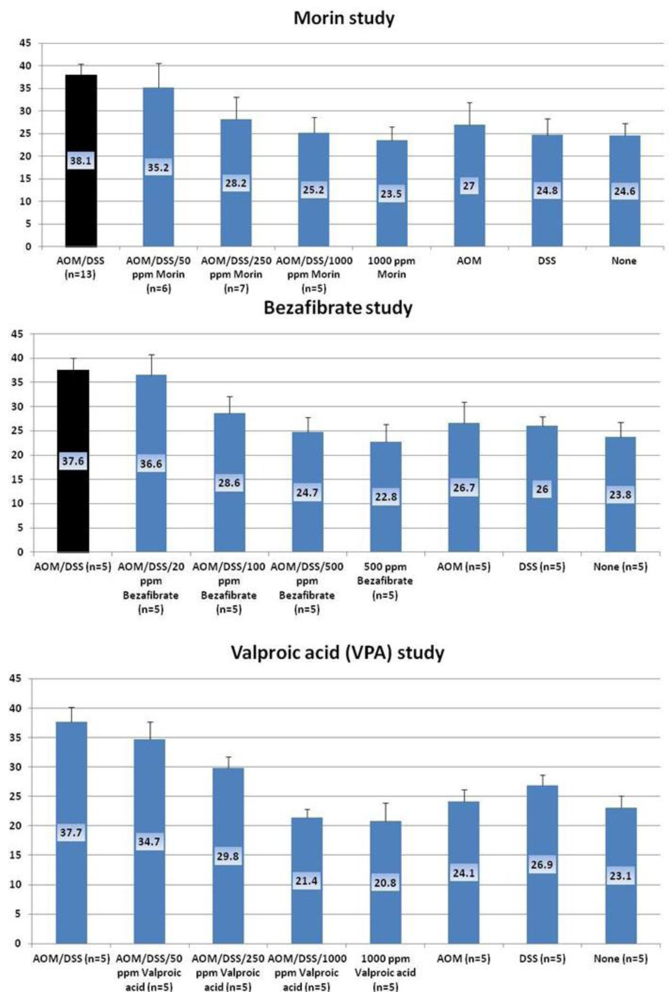
      <p>The findings in <italic>in vivo</italic> studies using the TANAKA models suggest that the order of chemopreventive potential of test compounds was bezafibrate &gt; morin &gt; VPA by estimating inhibition rate of CRC development. To investigate the effects of these chemicals on the molecules that are involved in carcinogenesis, we determined mRNA expression of the NF-κB (<xref ref-type="fig" rid="cancers-04-00673-f009">Figure 9</xref>), TNF-α, (<xref ref-type="fig" rid="cancers-04-00673-f010">Figure 10</xref>), IL-1β (<xref ref-type="fig" rid="cancers-04-00673-f011">Figure 11</xref>). Stat 3 (<xref ref-type="fig" rid="cancers-04-00673-f012">Figure 12</xref>), HIF-1α (<xref ref-type="fig" rid="cancers-04-00673-f013">Figure 13</xref>) in colorectal mucosa of mice or rats from the experiments with morin, bezafibrate, and VPA. At sacrifice, each colon was cut open longitudinally, and was flushed clean with PBS. Five animals of each group from three experiments were used for real-time quantitative RT-PCR analysis. Their distal colon was taken for total RNA isolation. For total RNA isolation, epithelial cells were scraped from the underlying muscle layer with a glass microscope slide, were homogenized on ice in lysis buffer (Qiagen, Tokyo, Japan), and were frozen at −80°C until RNA was isolated. Total RNA was extracted from colonic mucosa using the RNeasy Mini Kit (Qiagen) according to the manufacturer’s protocol. The cDNA was then synthesized from total RNA using the High-Capacity cDNA Reverse Transcription Kit (Applied Biosystems Japan Ltd., Tokyo, Japan). Quantitative real time PCR analysis of individual cDNA was performed with ABI Prism 7500 (Applied Biosystems Japan Ltd., Tokyo, Japan) using TaqMan Gene Expression Assays (Applied Biosystems Japan Ltd., Tokyo, Japan) and primers, which were chosen on the basis of rat or mouse nucleotide sequences in the GenBank database (<xref ref-type="table" rid="cancers-04-00673-t001">Table 1</xref>). PCR cycling conditions were 50 °C for 2 min, 95 °C for 10 min, followed by 40 cycles of 95 °C for 15 s and 60 °C for 1 min. The relative mRNA expression was normalized by b-actin mRNA. All the test chemicals lowered mRNA expression of these proteins. Therefore, effects of these three test compounds on the development of mucosal ulcer, dysplastic crypts, and colonic neoplasms may be related to the expression that was modified by feeding with test chemicals.</p>
      
      <fig id="cancers-04-00673-f009" position="float">
        <label>Figure 9</label>
        <caption>
          <p>mRNA expression of NF-κB in the colorectum of mice or rats from the morin, bezafibrate, and VPA studies.</p>
        </caption>
        <graphic xmlns:xlink="http://www.w3.org/1999/xlink" xlink:href="cancers-04-00673-g009.tif"/>
      </fig>
      <fig id="cancers-04-00673-f010" position="float">
        <label>Figure 10</label>
        <caption>
          <p>mRNA expression of TNF-α in the colorectum of mice or rats from the morin, bezafibrate, and VPA studies.</p>
        </caption>
        <graphic xmlns:xlink="http://www.w3.org/1999/xlink" xlink:href="cancers-04-00673-g010.tif"/>
      </fig>
      <fig id="cancers-04-00673-f011" position="float">
        <label>Figure 11</label>
        <caption>
          <p>mRNA expression of IL-1β in the colorectum of mice or rats from the morin, bezafibrate, and VPA studies.</p>
        </caption>
        <graphic xmlns:xlink="http://www.w3.org/1999/xlink" xlink:href="cancers-04-00673-g011.tif"/>
      </fig>
      <fig id="cancers-04-00673-f012" position="float">
        <label>Figure 12</label>
        <caption>
          <p>mRNA expression of Stat3 in the colorectum of mice or rats from the morin, bezafibrate, and VPA studies.</p>
        </caption>
        <graphic xmlns:xlink="http://www.w3.org/1999/xlink" xlink:href="cancers-04-00673-g012.tif"/>
      </fig>
      <fig id="cancers-04-00673-f013" position="float">
        <label>Figure 13</label>
        <caption>
          <p>mRNA expression of HIF-1α in the colorectum of mice or rats from the morin, bezafibrate, and VPA studies.</p>
        </caption>
        <graphic xmlns:xlink="http://www.w3.org/1999/xlink" xlink:href="cancers-04-00673-g013.tif"/>
      </fig>
      <table-wrap id="cancers-04-00673-t001" position="float">
        <object-id pub-id-type="pii">cancers-04-00673-t001_Table 1</object-id>
        <label>Table 1</label>
        <caption>
          <p>Primer sequences used for real-time PCR assays.</p>
        </caption>
        <table>
          <thead>
            <tr style="border-top: solid thin">
              <th rowspan="2" align="center" valign="middle" style="border-left: solid thin">Gene symbol</th>
              <th colspan="2" align="center" valign="middle" style="border-left: solid thin; border-right: solid thin">Primers</th>
            </tr>
            <tr style="border-top: solid thin">
              <th align="center" valign="middle" style="border-left: solid thin">Rat</th>
              <th align="center" valign="middle" style="border-left: solid thin; border-right: solid thin">Mouse</th>
            </tr>
          </thead>
          <tbody>
            <tr style="border-top: solid thin">
              <td rowspan="2" align="left" valign="middle" style="border-left: solid thin">
                <bold>NF-</bold>
                <bold>κ</bold>
                <bold>B</bold>
              </td>
              <td align="left" valign="middle" style="border-left: solid thin">Forward: 5'-ctggcagctcttctcaaagc-3'</td>
              <td rowspan="2" align="left" valign="middle" style="border-left: solid thin; border-right: solid thin">Mm00476361_m1 *</td>
            </tr>
            <tr>
              <td align="left" valign="middle" style="border-left: solid thin">Reverse: 5'-ccaggtcatagagaggctcaa-3'</td>
            </tr>
            <tr style="border-top: solid thin">
              <td rowspan="2" align="left" valign="middle" style="border-left: solid thin">
                <bold>Tnf-</bold>
                <bold>α</bold>
              </td>
              <td align="left" valign="middle" style="border-left: solid thin">Forward: 5'-cgagatgtggaactggcaga-3'</td>
              <td rowspan="2" align="left" valign="middle" style="border-left: solid thin; border-right: solid thin">Mm00443258_m1 *</td>
            </tr>
            <tr>
              <td align="left" valign="middle" style="border-left: solid thin">Reverse: 5'-ctacgggcttgtcactcga-3'</td>
            </tr>
            <tr style="border-top: solid thin">
              <td align="left" valign="middle" style="border-left: solid thin">
                <bold>IL-1β</bold>
              </td>
              <td align="left" valign="middle" style="border-left: solid thin">Rn00 580432_m1 *</td>
              <td align="left" valign="middle" style="border-left: solid thin; border-right: solid thin">Mm00434228_m1 *</td>
            </tr>
            <tr style="border-top: solid thin">
              <td rowspan="2" align="left" valign="middle" style="border-left: solid thin">
                <bold>Stat3</bold>
              </td>
              <td align="left" valign="middle" style="border-left: solid thin">Forward: 5'-ttgtgatgcctccttgattgtc-3'</td>
              <td rowspan="2" align="left" valign="middle" style="border-left: solid thin; border-right: solid thin">Mm00456961_m1 *</td>
            </tr>
            <tr>
              <td align="left" valign="middle" style="border-left: solid thin">Reverse: 5'-atcggaggcttagtgaagaagttc-3'</td>
            </tr>
            <tr style="border-top: solid thin">
              <td align="left" valign="middle" style="border-left: solid thin">
                <bold>Hif-1</bold>
                <bold>α</bold>
              </td>
              <td align="left" valign="middle" style="border-left: solid thin">Rn00577560_ml *</td>
              <td align="left" valign="middle" style="border-left: solid thin; border-right: solid thin">Forward: 5'-cctggaaacgagtgaaagga-3'Reverse: 5'-tggtcagctgtggtaatcca-3'</td>
            </tr>
            <tr style="border-top: solid thin">
              <td rowspan="2" align="left" valign="middle" style="border-left: solid thin">
                <bold><inline-graphic xmlns:xlink="http://www.w3.org/1999/xlink" xlink:href="cancers-04-00673-i001.tif"/>actin</bold>
              </td>
              <td align="left" valign="middle" style="border-left: solid thin">Forward: 5'-tcaggtcatcactatcggcaat-3'</td>
              <td rowspan="2" align="left" valign="middle" style="border-left: solid thin; border-right: solid thin">Mm00607939_s1*</td>
            </tr>
            <tr>
              <td align="left" valign="middle" style="border-left: solid thin">Reverse: 5'-aaagaaagggtgtaaaacgca-3'</td>
            </tr>
          </tbody>
        </table>
        <table-wrap-foot><fn><p>* TaqMan (Assay ID#).</p></fn></table-wrap-foot>
      </table-wrap>
      
      <p>Treatments with morin, bezafibrate, and VPA also lowered immunohistochemical positivity of survivin (<xref ref-type="fig" rid="cancers-04-00673-f014">Figure 14</xref>) in ADCs and polyamine contents (<xref ref-type="fig" rid="cancers-04-00673-f015">Figure 15</xref>) of colorectal mucosa. These effects may be also responsible for modulatory effects of these three compounds on colonic tumor development. However, further studies including dose selection and toxicity of the compounds should be conducted before going to clinical trials.</p>
      <fig id="cancers-04-00673-f014" position="float">
        <label>Figure 14</label>
        <caption>
          <p>Immunohistochemical positivity (%) against survivin in colonic ADC cells that developed in mice or rats in the morin, bezafibrate, and VPA studies.</p>
        </caption>
        <graphic xmlns:xlink="http://www.w3.org/1999/xlink" xlink:href="cancers-04-00673-g014.tif"/>
      </fig>
      <fig id="cancers-04-00673-f015" position="float">
        <label>Figure 15</label>
        <caption>
          <p>Polyamine content (nmol/mg) in the colonic mucosa of mice or rats in the morin, bezafibrate, and VPA studies.</p>
        </caption>
        <graphic xmlns:xlink="http://www.w3.org/1999/xlink" xlink:href="cancers-04-00673-g015.tif"/>
      </fig>
    </sec>
    <sec sec-type="conclusions">
      <title>6. Conclusions</title>
      <p>Chemoprevention is an important approach to decreasing cancer morbidity and mortality by the use of non-toxic natural or synthetic substances to reverse the processes of initiation, promotion, and subsequent progression of cancer. Evidence is rapidly accumulating that chronic inflammation contributes to carcinogenesis through increase of cell proliferation, angiogenesis, and metastasis in a number of neoplasms, including colorectal carcinoma. To investigate pathobiology of CRC developed in inflamed colorectum and search effective cancer chemopreventive agents against such colitis-related CRC, we developed mouse and rat models (TANAKA models) of inflammation-associated colorectal carcinogenesis. In this article, powerful tumor-promotion effect of inflammation induced by DSS in rodents that are initiated with a low dose of a colonic carcinogen is described. Also, our recent data on the modifying effects of morin, bezafibrate, and VPA on AOM/DSS-induced colorectal carcinogenesis is presented. I would stress that inflammatory stress and several cytokines produced by inflammatory cells are important in pathobiology of CRC development in colitic mucosa. These could be molecular targets for chemoprevention and/or therapy in CRC in IBD patients.</p>
    </sec>
  </body>
  <back>
    <ack>
      <title>Acknowledgements</title>
      <p>This work was partly supported by a Grant-in-Aid for the 2nd and 3rd Terms Comprehensive 10-year Strategy for Cancer Control, Cancer Prevention, from the Ministry of Health and Welfare of Japan, a Grant-in-Aid for Cancer Research from the Ministry of Health and Welfare of Japan, and a Grant-in-Aid (No. 13671986 and No. 23501324) from the Ministry of Education, Science, Sports and Culture of Japan.</p>
    </ack>
    <notes>
    <title>Conflict of interest</title>
      <p>None declared.</p>
    </notes>
    <ref-list>
      <title>References</title>
      <ref id="B1-cancers-04-00673">
        <label>1.</label>
        <citation citation-type="journal">
          <person-group person-group-type="author">
            <name>
              <surname>Balkwill</surname>
              <given-names>F.</given-names>
            </name>
            <name>
              <surname>Mantovani</surname>
              <given-names>A.</given-names>
            </name>
          </person-group>
          <article-title>Inflammation and cancer: Back to Virchow?</article-title>
          <source>Lancet</source>
          <year>2001</year>
          <volume>357</volume>
          <fpage>539</fpage>
          <lpage>545</lpage>
          <pub-id pub-id-type="doi">10.1016/S0140-6736(00)04046-0</pub-id>
        </citation>
      </ref>
      <ref id="B2-cancers-04-00673">
        <label>2.</label>
        <citation citation-type="journal">
          <person-group person-group-type="author">
            <name>
              <surname>Marshall</surname>
              <given-names>B.J.</given-names>
            </name>
            <name>
              <surname>Warren</surname>
              <given-names>J.R.</given-names>
            </name>
          </person-group>
          <article-title>Unidentified curved bacilli in the stomach of patients with gastritis and peptic ulceration</article-title>
          <source>Lancet</source>
          <year>1984</year>
          <volume>1</volume>
          <fpage>1311</fpage>
          <lpage>1315</lpage>
        <pub-id pub-id-type="pmid">6145023</pub-id></citation>
      </ref>
      <ref id="B3-cancers-04-00673">
        <label>3.</label>
        <citation citation-type="book">
          <person-group person-group-type="author">
            <name>
              <surname>Tanaka</surname>
              <given-names>T.</given-names>
            </name>
            <name>
              <surname>Suzuki</surname>
              <given-names>R.</given-names>
            </name>
          </person-group>
          <article-title>Inflammation and cancer</article-title>
          <source>Cancer: Disease Progression and Chemoprevention 2007</source>
          <person-group person-group-type="editor">
            <name>
              <surname>Tanaka</surname>
              <given-names>T.</given-names>
            </name>
          </person-group>
          <publisher-name>Research Signpost</publisher-name>
          <publisher-loc>Kerala, India</publisher-loc>
          <year>2007</year>
          <fpage>27</fpage>
          <lpage>44</lpage>
        </citation>
      </ref>
      <ref id="B4-cancers-04-00673">
        <label>4.</label>
        <citation citation-type="journal">
          <person-group person-group-type="author">
            <name>
              <surname>Lakatos</surname>
              <given-names>P.L.</given-names>
            </name>
            <name>
              <surname>Lakatos</surname>
              <given-names>L.</given-names>
            </name>
          </person-group>
          <article-title>Risk for colorectal cancer in ulcerative colitis: Changes, causes and management strategies</article-title>
          <source>World J. Gastroenterol.</source>
          <year>2008</year>
          <volume>14</volume>
          <fpage>3937</fpage>
          <lpage>3947</lpage>
          <pub-id pub-id-type="doi">10.3748/wjg.14.3937</pub-id>
        </citation>
      </ref>
      <ref id="B5-cancers-04-00673">
        <label>5.</label>
        <citation citation-type="journal">
          <person-group person-group-type="author">
            <name>
              <surname>Itzkowitz</surname>
              <given-names>S.H.</given-names>
            </name>
            <name>
              <surname>Yio</surname>
              <given-names>X.</given-names>
            </name>
          </person-group>
          <article-title>Inflammation and cancer IV. Colorectal cancer in inflammatory bowel disease: The role of inflammation</article-title>
          <source>Am. J. Physiol. Gastrointest. Liver Physiol.</source>
          <year>2004</year>
          <volume>287</volume>
          <fpage>G7</fpage>
          <lpage>G17</lpage>
          <pub-id pub-id-type="doi">10.1152/ajpgi.00079.2004</pub-id>
        </citation>
      </ref>
      <ref id="B6-cancers-04-00673">
        <label>6.</label>
        <citation citation-type="journal">
          <person-group person-group-type="author">
            <name>
              <surname>Ullman</surname>
              <given-names>T.A.</given-names>
            </name>
            <name>
              <surname>Itzkowitz</surname>
              <given-names>S.H.</given-names>
            </name>
          </person-group>
          <article-title>Intestinal inflammation and cancer</article-title>
          <source>Gastroenterology</source>
          <year>2011</year>
          <volume>140</volume>
          <fpage>1807</fpage>
          <lpage>1816</lpage>
          <pub-id pub-id-type="doi">10.1053/j.gastro.2011.01.057</pub-id>
        </citation>
      </ref>
      <ref id="B7-cancers-04-00673">
        <label>7.</label>
        <citation citation-type="journal">
          <person-group person-group-type="author">
            <name>
              <surname>Munkholm</surname>
              <given-names>P.</given-names>
            </name>
          </person-group>
          <article-title>Review article: The incidence and prevalence of colorectal cancer in inflammatory bowel disease</article-title>
          <source>Aliment. Pharmacol. Ther.</source>
          <year>2003</year>
          <volume>18</volume>
          <fpage>S1</fpage>
          <lpage>S5</lpage>
          <pub-id pub-id-type="doi">10.1046/j.1365-2036.18.s2.2.x</pub-id>
        </citation>
      </ref>
      <ref id="B8-cancers-04-00673">
        <label>8.</label>
        <citation citation-type="journal">
          <person-group person-group-type="author">
            <name>
              <surname>Eaden</surname>
              <given-names>J.A.</given-names>
            </name>
            <name>
              <surname>Abrams</surname>
              <given-names>K.R.</given-names>
            </name>
            <name>
              <surname>Mayberry</surname>
              <given-names>J.F.</given-names>
            </name>
          </person-group>
          <article-title>The risk of colorectal cancer in ulcerative colitis: A meta-analysis</article-title>
          <source>Gut</source>
          <year>2001</year>
          <volume>48</volume>
          <fpage>526</fpage>
          <lpage>535</lpage>
          <pub-id pub-id-type="doi">10.1136/gut.48.4.526</pub-id>
        </citation>
      </ref>
      <ref id="B9-cancers-04-00673">
        <label>9.</label>
        <citation citation-type="journal">
          <person-group person-group-type="author">
            <name>
              <surname>Tanaka</surname>
              <given-names>T.</given-names>
            </name>
            <name>
              <surname>Kohno</surname>
              <given-names>H.</given-names>
            </name>
            <name>
              <surname>Murakami</surname>
              <given-names>M.</given-names>
            </name>
            <name>
              <surname>Shimada</surname>
              <given-names>R.</given-names>
            </name>
            <name>
              <surname>Kagami</surname>
              <given-names>S.</given-names>
            </name>
          </person-group>
          <article-title>Colitis-related rat colon carcinogenesis induced by 1-hydroxy-anthraquinone and methylazoxymethanol acetate (Review)</article-title>
          <source>Oncol. Rep.</source>
          <year>2000</year>
          <volume>7</volume>
          <fpage>501</fpage>
          <lpage>508</lpage>
        <pub-id pub-id-type="pmid">10767359</pub-id></citation>
      </ref>
      <ref id="B10-cancers-04-00673">
        <label>10.</label>
        <citation citation-type="journal">
          <person-group person-group-type="author">
            <name>
              <surname>Canavan</surname>
              <given-names>C.</given-names>
            </name>
            <name>
              <surname>Abrams</surname>
              <given-names>K.R.</given-names>
            </name>
            <name>
              <surname>Mayberry</surname>
              <given-names>J.</given-names>
            </name>
          </person-group>
          <article-title>Meta-analysis: Colorectal and small bowel cancer risk in patients with Crohn’s disease</article-title>
          <source>Aliment. Pharmacol. Ther.</source>
          <year>2006</year>
          <volume>23</volume>
          <fpage>1097</fpage>
          <lpage>1104</lpage>
          <pub-id pub-id-type="doi">10.1111/j.1365-2036.2006.02854.x</pub-id>
        </citation>
      </ref>
      <ref id="B11-cancers-04-00673">
        <label>11.</label>
        <citation citation-type="journal">
          <person-group person-group-type="author">
            <name>
              <surname>Sung</surname>
              <given-names>J.J.</given-names>
            </name>
            <name>
              <surname>Lau</surname>
              <given-names>J.Y.</given-names>
            </name>
            <name>
              <surname>Goh</surname>
              <given-names>K.L.</given-names>
            </name>
            <name>
              <surname>Leung</surname>
              <given-names>W.K.</given-names>
            </name>
          </person-group>
          <article-title>Increasing incidence of colorectal cancer in Asia: Implications for screening</article-title>
          <source>Lancet Oncol.</source>
          <year>2005</year>
          <volume>6</volume>
          <fpage>871</fpage>
          <lpage>876</lpage>
          <pub-id pub-id-type="doi">10.1016/S1470-2045(05)70422-8</pub-id>
        </citation>
      </ref>
      <ref id="B12-cancers-04-00673">
        <label>12.</label>
        <citation citation-type="journal">
          <person-group person-group-type="author">
            <name>
              <surname>Tanaka</surname>
              <given-names>T.</given-names>
            </name>
            <name>
              <surname>Oyama</surname>
              <given-names>T.</given-names>
            </name>
            <name>
              <surname>Yasui</surname>
              <given-names>Y.</given-names>
            </name>
          </person-group>
          <article-title>Dietary supplements and colorectal cancer</article-title>
          <source>Curr. Topics Neutraceut. Res.</source>
          <year>2008</year>
          <volume>6</volume>
          <fpage>165</fpage>
          <lpage>188</lpage>
        </citation>
      </ref>
      <ref id="B13-cancers-04-00673">
        <label>13.</label>
        <citation citation-type="journal">
          <person-group person-group-type="author">
            <name>
              <surname>Tanaka</surname>
              <given-names>T.</given-names>
            </name>
            <name>
              <surname>Sugie</surname>
              <given-names>S.</given-names>
            </name>
          </person-group>
          <article-title>Inhibition of colon carcinogenesis by dietary non-nutritive compounds</article-title>
          <source>J. Toxicol. Pathol.</source>
          <year>2007</year>
          <volume>20</volume>
          <fpage>215</fpage>
          <lpage>235</lpage>
          <pub-id pub-id-type="doi">10.1293/tox.20.215</pub-id>
        </citation>
      </ref>
      <ref id="B14-cancers-04-00673">
        <label>14.</label>
        <citation citation-type="journal">
          <person-group person-group-type="author">
            <name>
              <surname>Yasui</surname>
              <given-names>Y.</given-names>
            </name>
            <name>
              <surname>Kim</surname>
              <given-names>M.</given-names>
            </name>
            <name>
              <surname>Oyama</surname>
              <given-names>T.</given-names>
            </name>
            <name>
              <surname>Tanaka</surname>
              <given-names>T.</given-names>
            </name>
          </person-group>
          <article-title>Colorectal carcinogenesis and suppression of tumor development by inhibition of enzymes and molecular targets</article-title>
          <source>Curr. Enzym. Inhib.</source>
          <year>2009</year>
          <volume>5</volume>
          <fpage>1</fpage>
          <lpage>26</lpage>
          <pub-id pub-id-type="doi">10.2174/157340809787314247</pub-id>
        </citation>
      </ref>
      <ref id="B15-cancers-04-00673">
        <label>15.</label>
        <citation citation-type="journal">
          <person-group person-group-type="author">
            <name>
              <surname>Rosenberg</surname>
              <given-names>D.W.</given-names>
            </name>
            <name>
              <surname>Giardina</surname>
              <given-names>C.</given-names>
            </name>
            <name>
              <surname>Tanaka</surname>
              <given-names>T.</given-names>
            </name>
          </person-group>
          <article-title>Mouse models for the study of colon carcinogenesis</article-title>
          <source>Carcinogenesis</source>
          <year>2009</year>
          <volume>30</volume>
          <fpage>183</fpage>
          <lpage>196</lpage>
        <pub-id pub-id-type="pmid">19037092</pub-id></citation>
      </ref>
      <ref id="B16-cancers-04-00673">
        <label>16.</label>
        <citation citation-type="journal">
          <person-group person-group-type="author">
            <name>
              <surname>Tanaka</surname>
              <given-names>T.</given-names>
            </name>
          </person-group>
          <article-title>Colorectal carcinogenesis: Review of human and experimental animal studies</article-title>
          <source>J. Carcinog.</source>
          <year>2009</year>
          <volume>8</volume>
          <fpage>5</fpage>
          <pub-id pub-id-type="doi">10.4103/1477-3163.49014</pub-id>
        </citation>
      </ref>
      <ref id="B17-cancers-04-00673">
        <label>17.</label>
        <citation citation-type="journal">
          <person-group person-group-type="author">
            <name>
              <surname>Tanaka</surname>
              <given-names>T.</given-names>
            </name>
          </person-group>
          <article-title>Development of an inflammation-associated colorectal cancer model and its application for research on carcinogenesis and chemoprevention</article-title>
          <source>Int. J. Inflamm.</source>
          <year>2012</year>
          <volume>2012</volume>
          <fpage>658786</fpage>
        </citation>
      </ref>
      <ref id="B18-cancers-04-00673">
        <label>18.</label>
        <citation citation-type="journal">
          <person-group person-group-type="author">
            <name>
              <surname>Tanaka</surname>
              <given-names>T.</given-names>
            </name>
            <name>
              <surname>Kohno</surname>
              <given-names>H.</given-names>
            </name>
            <name>
              <surname>Suzuki</surname>
              <given-names>R.</given-names>
            </name>
            <name>
              <surname>Yamada</surname>
              <given-names>Y.</given-names>
            </name>
            <name>
              <surname>Sugie</surname>
              <given-names>S.</given-names>
            </name>
            <name>
              <surname>Mori</surname>
              <given-names>H.</given-names>
            </name>
          </person-group>
          <article-title>A novel inflammation-related mouse colon carcinogenesis model induced by azoxymethane and dextran sodium sulfate</article-title>
          <source>Cancer Sci.</source>
          <year>2003</year>
          <volume>94</volume>
          <fpage>965</fpage>
          <lpage>973</lpage>
          <pub-id pub-id-type="doi">10.1111/j.1349-7006.2003.tb01386.x</pub-id>
        </citation>
      </ref>
      <ref id="B19-cancers-04-00673">
        <label>19.</label>
        <citation citation-type="journal">
          <person-group person-group-type="author">
            <name>
              <surname>Tanaka</surname>
              <given-names>T.</given-names>
            </name>
            <name>
              <surname>Yasui</surname>
              <given-names>Y.</given-names>
            </name>
            <name>
              <surname>Ishigamori-Suzuki</surname>
              <given-names>R.</given-names>
            </name>
            <name>
              <surname>Oyama</surname>
              <given-names>T.</given-names>
            </name>
          </person-group>
          <article-title>Citrus compounds inhibit inflammation- and obesity-related colon carcinogenesis in mice</article-title>
          <source>Nutr. Cancer</source>
          <year>2008</year>
          <volume>60</volume>
          <fpage>S70</fpage>
          <lpage>S80</lpage>
          <pub-id pub-id-type="doi">10.1080/01635580802381253</pub-id>
        </citation>
      </ref>
      <ref id="B20-cancers-04-00673">
        <label>20.</label>
        <citation citation-type="journal">
          <person-group person-group-type="author">
            <name>
              <surname>Levine</surname>
              <given-names>J.S.</given-names>
            </name>
            <name>
              <surname>Burakoff</surname>
              <given-names>R.</given-names>
            </name>
          </person-group>
          <article-title>Chemoprophylaxis of colorectal cancer in inflammatory bowel disease: Current concepts</article-title>
          <source>Inflamm. Bowel Dis.</source>
          <year>2007</year>
          <volume>13</volume>
          <fpage>1293</fpage>
          <lpage>1298</lpage>
          <pub-id pub-id-type="doi">10.1002/ibd.20186</pub-id>
        </citation>
      </ref>
      <ref id="B21-cancers-04-00673">
        <label>21.</label>
        <citation citation-type="journal">
          <person-group person-group-type="author">
            <name>
              <surname>Zisman</surname>
              <given-names>T.L.</given-names>
            </name>
            <name>
              <surname>Rubin</surname>
              <given-names>D.T.</given-names>
            </name>
          </person-group>
          <article-title>Colorectal cancer and dysplasia in inflammatory bowel disease</article-title>
          <source>World J. Gastroenterol.</source>
          <year>2008</year>
          <volume>14</volume>
          <fpage>2662</fpage>
          <lpage>2669</lpage>
          <pub-id pub-id-type="doi">10.3748/wjg.14.2662</pub-id>
        </citation>
      </ref>
      <ref id="B22-cancers-04-00673">
        <label>22.</label>
        <citation citation-type="journal">
          <person-group person-group-type="author">
            <name>
              <surname>Das</surname>
              <given-names>D.</given-names>
            </name>
            <name>
              <surname>Arber</surname>
              <given-names>N.</given-names>
            </name>
            <name>
              <surname>Jankowski</surname>
              <given-names>J.A.</given-names>
            </name>
          </person-group>
          <article-title>Chemoprevention of colorectal cancer</article-title>
          <source>Digestion</source>
          <year>2007</year>
          <volume>76</volume>
          <fpage>51</fpage>
          <lpage>67</lpage>
          <pub-id pub-id-type="doi">10.1159/000108394</pub-id>
        </citation>
      </ref>
      <ref id="B23-cancers-04-00673">
        <label>23.</label>
        <citation citation-type="journal">
          <person-group person-group-type="author">
            <name>
              <surname>Pardi</surname>
              <given-names>D.S.</given-names>
            </name>
            <name>
              <surname>Loftus</surname>
              <given-names>E.V.</given-names>
              <suffix>Jr.</suffix>
            </name>
            <name>
              <surname>Kremers</surname>
              <given-names>W.K.</given-names>
            </name>
            <name>
              <surname>Keach</surname>
              <given-names>J.</given-names>
            </name>
            <name>
              <surname>Lindor</surname>
              <given-names>K.D.</given-names>
            </name>
          </person-group>
          <article-title>Ursodeoxycholic acid as a chemopreventive agent in patients with ulcerative colitis and primary sclerosing cholangitis</article-title>
          <source>Gastroenterology</source>
          <year>2003</year>
          <volume>124</volume>
          <fpage>889</fpage>
          <lpage>893</lpage>
        <pub-id pub-id-type="doi">10.1053/gast.2003.50156</pub-id><pub-id pub-id-type="pmid">12671884</pub-id></citation>
      </ref>
      <ref id="B24-cancers-04-00673">
        <label>24.</label>
        <citation citation-type="journal">
          <person-group person-group-type="author">
            <name>
              <surname>Tung</surname>
              <given-names>B.Y.</given-names>
            </name>
            <name>
              <surname>Emond</surname>
              <given-names>M.J.</given-names>
            </name>
            <name>
              <surname>Haggitt</surname>
              <given-names>R.C.</given-names>
            </name>
            <name>
              <surname>Bronner</surname>
              <given-names>M.P.</given-names>
            </name>
            <name>
              <surname>Kimmey</surname>
              <given-names>M.B.</given-names>
            </name>
            <name>
              <surname>Kowdley</surname>
              <given-names>K.V.</given-names>
            </name>
            <name>
              <surname>Brentnall</surname>
              <given-names>T.A.</given-names>
            </name>
          </person-group>
          <article-title>Ursodiol use is associated with lower prevalence of colonic neoplasia in patients with ulcerative colitis and primary sclerosing cholangitis</article-title>
          <source>Ann. Intern. Med.</source>
          <year>2001</year>
          <volume>134</volume>
          <fpage>89</fpage>
          <lpage>95</lpage>
        <pub-id pub-id-type="pmid">11177311</pub-id></citation>
      </ref>
      <ref id="B25-cancers-04-00673">
        <label>25.</label>
        <citation citation-type="journal">
          <person-group person-group-type="author">
            <name>
              <surname>Andrews</surname>
              <given-names>J.M.</given-names>
            </name>
            <name>
              <surname>Travis</surname>
              <given-names>S.P.</given-names>
            </name>
            <name>
              <surname>Gibson</surname>
              <given-names>P.R.</given-names>
            </name>
            <name>
              <surname>Gasche</surname>
              <given-names>C.</given-names>
            </name>
          </person-group>
          <article-title>Systematic review: Does concurrent therapy with 5-ASA and immunomodulators in inflammatory bowel disease improve outcomes?</article-title>
          <source>Aliment. Pharmacol. Ther.</source>
          <year>2009</year>
          <volume>29</volume>
          <fpage>459</fpage>
          <lpage>469</lpage>
          <pub-id pub-id-type="doi">10.1111/j.1365-2036.2008.03915.x</pub-id>
        </citation>
      </ref>
      <ref id="B26-cancers-04-00673">
        <label>26.</label>
        <citation citation-type="journal">
          <person-group person-group-type="author">
            <name>
              <surname>Velayos</surname>
              <given-names>F.S.</given-names>
            </name>
            <name>
              <surname>Terdiman</surname>
              <given-names>J.P.</given-names>
            </name>
            <name>
              <surname>Walsh</surname>
              <given-names>J.M.</given-names>
            </name>
          </person-group>
          <article-title>Effect of 5-aminosalicylate use on colorectal cancer and dysplasia risk: A systematic review and metaanalysis of observational studies</article-title>
          <source>Am. J. Gastroenterol.</source>
          <year>2005</year>
          <volume>100</volume>
          <fpage>1345</fpage>
          <lpage>1353</lpage>
          <pub-id pub-id-type="doi">10.1111/j.1572-0241.2005.41442.x</pub-id>
        </citation>
      </ref>
      <ref id="B27-cancers-04-00673">
        <label>27.</label>
        <citation citation-type="journal">
          <person-group person-group-type="author">
            <name>
              <surname>Bernstein</surname>
              <given-names>C.N.</given-names>
            </name>
            <name>
              <surname>Blanchard</surname>
              <given-names>J.F.</given-names>
            </name>
            <name>
              <surname>Metge</surname>
              <given-names>C.</given-names>
            </name>
            <name>
              <surname>Yogendran</surname>
              <given-names>M.</given-names>
            </name>
          </person-group>
          <article-title>Does the use of 5-aminosalicylates in inflammatory bowel disease prevent the development of colorectal cancer?</article-title>
          <source>Am. J. Gastroenterol.</source>
          <year>2003</year>
          <volume>98</volume>
          <fpage>2784</fpage>
          <lpage>2788</lpage>
        <pub-id pub-id-type="doi">10.1111/j.1572-0241.2003.08718.x</pub-id><pub-id pub-id-type="pmid">14687833</pub-id></citation>
      </ref>
      <ref id="B28-cancers-04-00673">
        <label>28.</label>
        <citation citation-type="journal">
          <person-group person-group-type="author">
            <name>
              <surname>Bernstein</surname>
              <given-names>C.N.</given-names>
            </name>
            <name>
              <surname>Eaden</surname>
              <given-names>J.</given-names>
            </name>
            <name>
              <surname>Steinhart</surname>
              <given-names>A.H.</given-names>
            </name>
            <name>
              <surname>Munkholm</surname>
              <given-names>P.</given-names>
            </name>
            <name>
              <surname>Gordon</surname>
              <given-names>P.H.</given-names>
            </name>
          </person-group>
          <article-title>Cancer prevention in inflammatory bowel disease and the chemoprophylactic potential of 5-aminosalicylic acid</article-title>
          <source>Inflamm. Bowel Dis.</source>
          <year>2002</year>
          <volume>8</volume>
          <fpage>356</fpage>
          <lpage>361</lpage>
          <pub-id pub-id-type="doi">10.1097/00054725-200209000-00007</pub-id>
        </citation>
      </ref>
      <ref id="B29-cancers-04-00673">
        <label>29.</label>
        <citation citation-type="journal">
          <person-group person-group-type="author">
            <name>
              <surname>Kohno</surname>
              <given-names>H.</given-names>
            </name>
            <name>
              <surname>Suzuki</surname>
              <given-names>R.</given-names>
            </name>
            <name>
              <surname>Yasui</surname>
              <given-names>Y.</given-names>
            </name>
            <name>
              <surname>Miyamoto</surname>
              <given-names>S.</given-names>
            </name>
            <name>
              <surname>Wakabayashi</surname>
              <given-names>K.</given-names>
            </name>
            <name>
              <surname>Tanaka</surname>
              <given-names>T.</given-names>
            </name>
          </person-group>
          <article-title>Ursodeoxycholic acid versus sulfasalazine in colitis-related colon carcinogenesis in mice</article-title>
          <source>Clin. Cancer Res.</source>
          <year>2007</year>
          <volume>13</volume>
          <fpage>2519</fpage>
          <lpage>2525</lpage>
        <pub-id pub-id-type="doi">10.1158/1078-0432.CCR-06-2727</pub-id><pub-id pub-id-type="pmid">17438113</pub-id></citation>
      </ref>
      <ref id="B30-cancers-04-00673">
        <label>30.</label>
        <citation citation-type="journal">
          <person-group person-group-type="author">
            <name>
              <surname>Tanaka</surname>
              <given-names>T.</given-names>
            </name>
            <name>
              <surname>Shnimizu</surname>
              <given-names>M.</given-names>
            </name>
            <name>
              <surname>Moriwaki</surname>
              <given-names>H.</given-names>
            </name>
          </person-group>
          <article-title>Cancer chemoprevention by carotenoids</article-title>
          <source>Molecules</source>
          <year>2012</year>
          <volume>17</volume>
          <fpage>3202</fpage>
          <lpage>3242</lpage>
        <pub-id pub-id-type="doi">10.3390/molecules17033202</pub-id><pub-id pub-id-type="pmid">22418926</pub-id></citation>
      </ref>
      <ref id="B31-cancers-04-00673">
        <label>31.</label>
        <citation citation-type="journal">
          <person-group person-group-type="author">
            <name>
              <surname>Takahashi</surname>
              <given-names>M.</given-names>
            </name>
            <name>
              <surname>Wakabayashi</surname>
              <given-names>K.</given-names>
            </name>
          </person-group>
          <article-title>Gene mutations and altered gene expression in azoxymethane-induced colon carcinogenesis in rodents</article-title>
          <source>Cancer Sci.</source>
          <year>2004</year>
          <volume>95</volume>
          <fpage>475</fpage>
          <lpage>480</lpage>
          <pub-id pub-id-type="doi">10.1111/j.1349-7006.2004.tb03235.x</pub-id>
        </citation>
      </ref>
      <ref id="B32-cancers-04-00673">
        <label>32.</label>
        <citation citation-type="journal">
          <person-group person-group-type="author">
            <name>
              <surname>Boivin</surname>
              <given-names>G.P.</given-names>
            </name>
            <name>
              <surname>Washington</surname>
              <given-names>K.</given-names>
            </name>
            <name>
              <surname>Yang</surname>
              <given-names>K.</given-names>
            </name>
            <name>
              <surname>Ward</surname>
              <given-names>J.M.</given-names>
            </name>
            <name>
              <surname>Pretlow</surname>
              <given-names>T.P.</given-names>
            </name>
            <name>
              <surname>Russell</surname>
              <given-names>R.</given-names>
            </name>
            <name>
              <surname>Besselsen</surname>
              <given-names>D.G.</given-names>
            </name>
            <name>
              <surname>Godfrey</surname>
              <given-names>V.L.</given-names>
            </name>
            <name>
              <surname>Doetschman</surname>
              <given-names>T.</given-names>
            </name>
            <name>
              <surname>Dove</surname>
              <given-names>W.F.</given-names>
            </name>
            <etal/>
          </person-group>
          <article-title>Pathology of mouse models of intestinal cancer: Consensus report and recommendations</article-title>
          <source>Gastroenterology</source>
          <year>2003</year>
          <volume>124</volume>
          <fpage>762</fpage>
          <lpage>777</lpage>
        <pub-id pub-id-type="doi">10.1053/gast.2003.50094</pub-id><pub-id pub-id-type="pmid">12612914</pub-id></citation>
      </ref>
      <ref id="B33-cancers-04-00673">
        <label>33.</label>
        <citation citation-type="journal">
          <person-group person-group-type="author">
            <name>
              <surname>Clapper</surname>
              <given-names>M.L.</given-names>
            </name>
            <name>
              <surname>Cooper</surname>
              <given-names>H.S.</given-names>
            </name>
            <name>
              <surname>Chang</surname>
              <given-names>W.C.</given-names>
            </name>
          </person-group>
          <article-title>Dextran sulfate sodium-induced colitis-associated neoplasia: A promising model for the development of chemopreventive interventions</article-title>
          <source>Acta Pharmacol. Sin.</source>
          <year>2007</year>
          <volume>28</volume>
          <fpage>1450</fpage>
          <lpage>1459</lpage>
          <pub-id pub-id-type="doi">10.1111/j.1745-7254.2007.00695.x</pub-id>
        </citation>
      </ref>
      <ref id="B34-cancers-04-00673">
        <label>34.</label>
        <citation citation-type="journal">
          <person-group person-group-type="author">
            <name>
              <surname>Suzuki</surname>
              <given-names>R.</given-names>
            </name>
            <name>
              <surname>Miyamoto</surname>
              <given-names>S.</given-names>
            </name>
            <name>
              <surname>Yasui</surname>
              <given-names>Y.</given-names>
            </name>
            <name>
              <surname>Sugie</surname>
              <given-names>S.</given-names>
            </name>
            <name>
              <surname>Tanaka</surname>
              <given-names>T.</given-names>
            </name>
          </person-group>
          <article-title>Global gene expression analysis of the mouse colonic mucosa treated with azoxymethane and dextran sodium sulfate</article-title>
          <source>BMC Cancer</source>
          <year>2007</year>
          <volume>7</volume>
          <fpage>84</fpage>
          <pub-id pub-id-type="doi">10.1186/1471-2407-7-84</pub-id>
        </citation>
      </ref>
      <ref id="B35-cancers-04-00673">
        <label>35.</label>
        <citation citation-type="journal">
          <person-group person-group-type="author">
            <name>
              <surname>Oyama</surname>
              <given-names>T.</given-names>
            </name>
            <name>
              <surname>Yasui</surname>
              <given-names>Y.</given-names>
            </name>
            <name>
              <surname>Sugie</surname>
              <given-names>S.</given-names>
            </name>
            <name>
              <surname>Koketsu</surname>
              <given-names>M.</given-names>
            </name>
            <name>
              <surname>Watanabe</surname>
              <given-names>K.</given-names>
            </name>
            <name>
              <surname>Tanaka</surname>
              <given-names>T.</given-names>
            </name>
          </person-group>
          <article-title>Dietary tricin suppresses inflammation-related colon carcinogenesis in male Crj: CD-1 mice</article-title>
          <source>Cancer Prev. Res. (Phila)</source>
          <year>2009</year>
          <volume>2</volume>
          <fpage>1031</fpage>
          <lpage>1038</lpage>
          <pub-id pub-id-type="doi">10.1158/1940-6207.CAPR-09-0061</pub-id>
        </citation>
      </ref>
      <ref id="B36-cancers-04-00673">
        <label>36.</label>
        <citation citation-type="journal">
          <person-group person-group-type="author">
            <name>
              <surname>Yasui</surname>
              <given-names>Y.</given-names>
            </name>
            <name>
              <surname>Tanaka</surname>
              <given-names>T.</given-names>
            </name>
          </person-group>
          <article-title>Protein expression analysis of inflammation-related colon carcinogenesis</article-title>
          <source>J. Carcinog.</source>
          <year>2009</year>
          <volume>8</volume>
          <fpage>10</fpage>
          <pub-id pub-id-type="doi">10.4103/1477-3163.51851</pub-id>
        </citation>
      </ref>
      <ref id="B37-cancers-04-00673">
        <label>37.</label>
        <citation citation-type="journal">
          <person-group person-group-type="author">
            <name>
              <surname>Cooper</surname>
              <given-names>H.S.</given-names>
            </name>
            <name>
              <surname>Murthy</surname>
              <given-names>S.N.</given-names>
            </name>
            <name>
              <surname>Shah</surname>
              <given-names>R.S.</given-names>
            </name>
            <name>
              <surname>Sedergran</surname>
              <given-names>D.J.</given-names>
            </name>
          </person-group>
          <article-title>Clinicopathologic study of dextran sulfate sodium experimental murine colitis</article-title>
          <source>Lab. Invest.</source>
          <year>1993</year>
          <volume>69</volume>
          <fpage>238</fpage>
          <lpage>249</lpage>
        <pub-id pub-id-type="pmid">8350599</pub-id></citation>
      </ref>
      <ref id="B38-cancers-04-00673">
        <label>38.</label>
        <citation citation-type="journal">
          <person-group person-group-type="author">
            <name>
              <surname>Murthy</surname>
              <given-names>S.N.</given-names>
            </name>
            <name>
              <surname>Cooper</surname>
              <given-names>H.S.</given-names>
            </name>
            <name>
              <surname>Shim</surname>
              <given-names>H.</given-names>
            </name>
            <name>
              <surname>Shah</surname>
              <given-names>R.S.</given-names>
            </name>
            <name>
              <surname>Ibrahim</surname>
              <given-names>S.A.</given-names>
            </name>
            <name>
              <surname>Sedergran</surname>
              <given-names>D.J.</given-names>
            </name>
          </person-group>
          <article-title>Treatment of dextran sulfate sodium-induced murine colitis by intracolonic cyclosporin</article-title>
          <source>Dig. Dis. Sci.</source>
          <year>1993</year>
          <volume>38</volume>
          <fpage>1722</fpage>
          <lpage>1734</lpage>
          <pub-id pub-id-type="doi">10.1007/BF01303184</pub-id>
        </citation>
      </ref>
      <ref id="B39-cancers-04-00673">
        <label>39.</label>
        <citation citation-type="journal">
          <person-group person-group-type="author">
            <name>
              <surname>Suzuki</surname>
              <given-names>R.</given-names>
            </name>
            <name>
              <surname>Kohno</surname>
              <given-names>H.</given-names>
            </name>
            <name>
              <surname>Sugie</surname>
              <given-names>S.</given-names>
            </name>
            <name>
              <surname>Nakagama</surname>
              <given-names>H.</given-names>
            </name>
            <name>
              <surname>Tanaka</surname>
              <given-names>T.</given-names>
            </name>
          </person-group>
          <article-title>Strain differences in the susceptibility to azoxymethane and dextran sodium sulfate-induced colon carcinogenesis in mice</article-title>
          <source>Carcinogenesis</source>
          <year>2006</year>
          <volume>27</volume>
          <fpage>162</fpage>
          <lpage>169</lpage>
        <pub-id pub-id-type="pmid">16081511</pub-id></citation>
      </ref>
      <ref id="B40-cancers-04-00673">
        <label>40.</label>
        <citation citation-type="journal">
          <person-group person-group-type="author">
            <name>
              <surname>Suzuki</surname>
              <given-names>R.</given-names>
            </name>
            <name>
              <surname>Kohno</surname>
              <given-names>H.</given-names>
            </name>
            <name>
              <surname>Sugie</surname>
              <given-names>S.</given-names>
            </name>
            <name>
              <surname>Tanaka</surname>
              <given-names>T.</given-names>
            </name>
          </person-group>
          <article-title>Sequential observations on the occurrence of preneoplastic and neoplastic lesions in mouse colon treated with azoxymethane and dextran sodium sulfate</article-title>
          <source>Cancer Sci.</source>
          <year>2004</year>
          <volume>95</volume>
          <fpage>721</fpage>
          <lpage>727</lpage>
          <pub-id pub-id-type="doi">10.1111/j.1349-7006.2004.tb03252.x</pub-id>
        </citation>
      </ref>
      <ref id="B41-cancers-04-00673">
        <label>41.</label>
        <citation citation-type="journal">
          <person-group person-group-type="author">
            <name>
              <surname>Suzuki</surname>
              <given-names>R.</given-names>
            </name>
            <name>
              <surname>Kohno</surname>
              <given-names>H.</given-names>
            </name>
            <name>
              <surname>Sugie</surname>
              <given-names>S.</given-names>
            </name>
            <name>
              <surname>Tanaka</surname>
              <given-names>T.</given-names>
            </name>
          </person-group>
          <article-title>Dose-dependent promoting effect of dextran sodium sulfate on mouse colon carcinogenesis initiated with azoxymethane</article-title>
          <source>Histol. Histopathol.</source>
          <year>2005</year>
          <volume>20</volume>
          <fpage>483</fpage>
          <lpage>492</lpage>
        <pub-id pub-id-type="pmid">15736053</pub-id></citation>
      </ref>
      <ref id="B42-cancers-04-00673">
        <label>42.</label>
        <citation citation-type="journal">
          <person-group person-group-type="author">
            <name>
              <surname>Lefebvre</surname>
              <given-names>A.M.</given-names>
            </name>
            <name>
              <surname>Chen</surname>
              <given-names>I.</given-names>
            </name>
            <name>
              <surname>Desreumaux</surname>
              <given-names>P.</given-names>
            </name>
            <name>
              <surname>Najib</surname>
              <given-names>J.</given-names>
            </name>
            <name>
              <surname>Fruchart</surname>
              <given-names>J.C.</given-names>
            </name>
            <name>
              <surname>Geboes</surname>
              <given-names>K.</given-names>
            </name>
            <name>
              <surname>Briggs</surname>
              <given-names>M.</given-names>
            </name>
            <name>
              <surname>Heyman</surname>
              <given-names>R.</given-names>
            </name>
            <name>
              <surname>Auwerx</surname>
              <given-names>J.</given-names>
            </name>
          </person-group>
          <article-title>Activation of the peroxisome proliferator-activated receptor gamma promotes the development of colon tumors in C57BL/6J-APCMin/+ mice</article-title>
          <source>Nat. Med.</source>
          <year>1998</year>
          <volume>4</volume>
          <fpage>1053</fpage>
          <lpage>1057</lpage>
        <pub-id pub-id-type="doi">10.1038/2036</pub-id><pub-id pub-id-type="pmid">9734399</pub-id></citation>
      </ref>
      <ref id="B43-cancers-04-00673">
        <label>43.</label>
        <citation citation-type="journal">
          <person-group person-group-type="author">
            <name>
              <surname>Saez</surname>
              <given-names>E.</given-names>
            </name>
            <name>
              <surname>Tontonoz</surname>
              <given-names>P.</given-names>
            </name>
            <name>
              <surname>Nelson</surname>
              <given-names>M.C.</given-names>
            </name>
            <name>
              <surname>Alvarez</surname>
              <given-names>J.G.</given-names>
            </name>
            <name>
              <surname>Ming</surname>
              <given-names>U.T.</given-names>
            </name>
            <name>
              <surname>Baird</surname>
              <given-names>S.M.</given-names>
            </name>
            <name>
              <surname>Thomazy</surname>
              <given-names>V.A.</given-names>
            </name>
            <name>
              <surname>Evans</surname>
              <given-names>R.M.</given-names>
            </name>
          </person-group>
          <article-title>Activators of the nuclear receptor PPARgamma enhance colon polyp formation</article-title>
          <source>Nat. Med.</source>
          <year>1998</year>
          <volume>4</volume>
          <fpage>1058</fpage>
          <lpage>1061</lpage>
          <pub-id pub-id-type="doi">10.1038/2042</pub-id>
        </citation>
      </ref>
      <ref id="B44-cancers-04-00673">
        <label>44.</label>
        <citation citation-type="journal">
          <person-group person-group-type="author">
            <name>
              <surname>Sarraf</surname>
              <given-names>P.</given-names>
            </name>
            <name>
              <surname>Mueller</surname>
              <given-names>E.</given-names>
            </name>
            <name>
              <surname>Jones</surname>
              <given-names>D.</given-names>
            </name>
            <name>
              <surname>King</surname>
              <given-names>F.J.</given-names>
            </name>
            <name>
              <surname>DeAngelo</surname>
              <given-names>D.J.</given-names>
            </name>
            <name>
              <surname>Partridge</surname>
              <given-names>J.B.</given-names>
            </name>
            <name>
              <surname>Holden</surname>
              <given-names>S.A.</given-names>
            </name>
            <name>
              <surname>Chen</surname>
              <given-names>L.B.</given-names>
            </name>
            <name>
              <surname>Singer</surname>
              <given-names>S.</given-names>
            </name>
            <name>
              <surname>Fletcher</surname>
              <given-names>C.</given-names>
            </name>
            <etal/>
          </person-group>
          <article-title>Differentiation and reversal of malignant changes in colon cancer through PPARgamma</article-title>
          <source>Nat. Med.</source>
          <year>1998</year>
          <volume>4</volume>
          <fpage>1046</fpage>
          <lpage>1052</lpage>
        <pub-id pub-id-type="doi">10.1038/2030</pub-id><pub-id pub-id-type="pmid">9734398</pub-id></citation>
      </ref>
      <ref id="B45-cancers-04-00673">
        <label>45.</label>
        <citation citation-type="journal">
          <person-group person-group-type="author">
            <name>
              <surname>Hirono</surname>
              <given-names>I.</given-names>
            </name>
            <name>
              <surname>Kuhara</surname>
              <given-names>K.</given-names>
            </name>
            <name>
              <surname>Hosaka</surname>
              <given-names>S.</given-names>
            </name>
            <name>
              <surname>Tomizawa</surname>
              <given-names>S.</given-names>
            </name>
            <name>
              <surname>Golberg</surname>
              <given-names>L.</given-names>
            </name>
          </person-group>
          <article-title>Induction of intestinal tumors in rats by dextran sulfate sodium</article-title>
          <source>J. Natl. Cancer Inst.</source>
          <year>1981</year>
          <volume>66</volume>
          <fpage>579</fpage>
          <lpage>583</lpage>
        <pub-id pub-id-type="pmid">6162992</pub-id></citation>
      </ref>
      <ref id="B46-cancers-04-00673">
        <label>46.</label>
        <citation citation-type="journal">
          <person-group person-group-type="author">
            <name>
              <surname>Mori</surname>
              <given-names>H.</given-names>
            </name>
            <name>
              <surname>Ohbayashi</surname>
              <given-names>F.</given-names>
            </name>
            <name>
              <surname>Hirono</surname>
              <given-names>I.</given-names>
            </name>
            <name>
              <surname>Shimada</surname>
              <given-names>T.</given-names>
            </name>
            <name>
              <surname>Williams</surname>
              <given-names>G.M.</given-names>
            </name>
          </person-group>
          <article-title>Absence of genotoxicity of the carcinogenic sulfated polysaccharides carrageenan and dextran sulfate in mammalian DNA repair and bacterial mutagenicity assays</article-title>
          <source>Nutr. Cancer</source>
          <year>1984</year>
          <volume>6</volume>
          <fpage>92</fpage>
          <lpage>97</lpage>
        <pub-id pub-id-type="pmid">6085849</pub-id></citation>
      </ref>
      <ref id="B47-cancers-04-00673">
        <label>47.</label>
        <citation citation-type="journal">
          <person-group person-group-type="author">
            <name>
              <surname>Alrawi</surname>
              <given-names>S.J.</given-names>
            </name>
            <name>
              <surname>Schiff</surname>
              <given-names>M.</given-names>
            </name>
            <name>
              <surname>Carroll</surname>
              <given-names>R.E.</given-names>
            </name>
            <name>
              <surname>Dayton</surname>
              <given-names>M.</given-names>
            </name>
            <name>
              <surname>Gibbs</surname>
              <given-names>J.F.</given-names>
            </name>
            <name>
              <surname>Kulavlat</surname>
              <given-names>M.</given-names>
            </name>
            <name>
              <surname>Tan</surname>
              <given-names>D.</given-names>
            </name>
            <name>
              <surname>Berman</surname>
              <given-names>K.</given-names>
            </name>
            <name>
              <surname>Stoler</surname>
              <given-names>D.L.</given-names>
            </name>
            <name>
              <surname>Anderson</surname>
              <given-names>G.R.</given-names>
            </name>
          </person-group>
          <article-title>Aberrant crypt foci</article-title>
          <source>Anticancer Res.</source>
          <year>2006</year>
          <volume>26</volume>
          <fpage>107</fpage>
          <lpage>119</lpage>
        <pub-id pub-id-type="pmid">16475686</pub-id></citation>
      </ref>
      <ref id="B48-cancers-04-00673">
        <label>48.</label>
        <citation citation-type="journal">
          <person-group person-group-type="author">
            <name>
              <surname>Bird</surname>
              <given-names>R.P.</given-names>
            </name>
          </person-group>
          <article-title>Role of aberrant crypt foci in understanding the pathogenesis of colon cancer</article-title>
          <source>Cancer Lett.</source>
          <year>1995</year>
          <volume>93</volume>
          <fpage>55</fpage>
          <lpage>71</lpage>
          <pub-id pub-id-type="doi">10.1016/0304-3835(95)03788-X</pub-id>
        </citation>
      </ref>
      <ref id="B49-cancers-04-00673">
        <label>49.</label>
        <citation citation-type="journal">
          <person-group person-group-type="author">
            <name>
              <surname>Gupta</surname>
              <given-names>A.K.</given-names>
            </name>
            <name>
              <surname>Pretlow</surname>
              <given-names>T.P.</given-names>
            </name>
            <name>
              <surname>Schoen</surname>
              <given-names>R.E.</given-names>
            </name>
          </person-group>
          <article-title>Aberrant crypt foci: What we know and what we need to know</article-title>
          <source>Clin. Gastroenterol. Hepatol.</source>
          <year>2007</year>
          <volume>5</volume>
          <fpage>526</fpage>
          <lpage>533</lpage>
          <pub-id pub-id-type="doi">10.1016/j.cgh.2007.02.014</pub-id>
        </citation>
      </ref>
      <ref id="B50-cancers-04-00673">
        <label>50.</label>
        <citation citation-type="journal">
          <person-group person-group-type="author">
            <name>
              <surname>Tanaka</surname>
              <given-names>T.</given-names>
            </name>
            <name>
              <surname>Kohno</surname>
              <given-names>H.</given-names>
            </name>
            <name>
              <surname>Yoshitani</surname>
              <given-names>S.</given-names>
            </name>
            <name>
              <surname>Takashima</surname>
              <given-names>S.</given-names>
            </name>
            <name>
              <surname>Okumura</surname>
              <given-names>A.</given-names>
            </name>
            <name>
              <surname>Murakami</surname>
              <given-names>A.</given-names>
            </name>
            <name>
              <surname>Hosokawa</surname>
              <given-names>M.</given-names>
            </name>
          </person-group>
          <article-title>Ligands for peroxisome proliferator-activated receptors alpha and gamma inhibit chemically induced colitis and formation of aberrant crypt foci in rats</article-title>
          <source>Cancer Res.</source>
          <year>2001</year>
          <volume>61</volume>
          <fpage>2424</fpage>
          <lpage>2428</lpage>
        <pub-id pub-id-type="pmid">11289109</pub-id></citation>
      </ref>
      <ref id="B51-cancers-04-00673">
        <label>51.</label>
        <citation citation-type="journal">
          <person-group person-group-type="author">
            <name>
              <surname>Kohno</surname>
              <given-names>H.</given-names>
            </name>
            <name>
              <surname>Suzuki</surname>
              <given-names>R.</given-names>
            </name>
            <name>
              <surname>Sugie</surname>
              <given-names>S.</given-names>
            </name>
            <name>
              <surname>Tanaka</surname>
              <given-names>T.</given-names>
            </name>
          </person-group>
          <article-title>Beta-Catenin mutations in a mouse model of inflammation-related colon carcinogenesis induced by 1,2-dimethylhydrazine and dextran sodium sulfate</article-title>
          <source>Cancer Sci.</source>
          <year>2005</year>
          <volume>96</volume>
          <fpage>69</fpage>
          <lpage>76</lpage>
          <pub-id pub-id-type="doi">10.1111/j.1349-7006.2005.00020.x</pub-id>
        </citation>
      </ref>
      <ref id="B52-cancers-04-00673">
        <label>52.</label>
        <citation citation-type="journal">
          <person-group person-group-type="author">
            <name>
              <surname>Tanaka</surname>
              <given-names>T.</given-names>
            </name>
            <name>
              <surname>Suzuki</surname>
              <given-names>R.</given-names>
            </name>
            <name>
              <surname>Kohno</surname>
              <given-names>H.</given-names>
            </name>
            <name>
              <surname>Sugie</surname>
              <given-names>S.</given-names>
            </name>
            <name>
              <surname>Takahashi</surname>
              <given-names>M.</given-names>
            </name>
            <name>
              <surname>Wakabayashi</surname>
              <given-names>K.</given-names>
            </name>
          </person-group>
          <article-title>Colonic adenocarcinomas rapidly induced by the combined treatment with 2-amino-1-methyl-6-phenylimidazo[4,5-<italic>b</italic>]pyridine and dextran sodium sulfate in male ICR mice possess beta-catenin gene mutations and increases immunoreactivity for beta-catenin, cyclooxygenase-2 and inducible nitric oxide synthase</article-title>
          <source>Carcinogenesis</source>
          <year>2005</year>
          <volume>26</volume>
          <fpage>229</fpage>
          <lpage>238</lpage>
        <pub-id pub-id-type="pmid">15459021</pub-id></citation>
      </ref>
      <ref id="B53-cancers-04-00673">
        <label>53.</label>
        <citation citation-type="journal">
          <person-group person-group-type="author">
            <name>
              <surname>Tanaka</surname>
              <given-names>T.</given-names>
            </name>
            <name>
              <surname>Kohno</surname>
              <given-names>H.</given-names>
            </name>
            <name>
              <surname>Suzuki</surname>
              <given-names>R.</given-names>
            </name>
            <name>
              <surname>Hata</surname>
              <given-names>K.</given-names>
            </name>
            <name>
              <surname>Sugie</surname>
              <given-names>S.</given-names>
            </name>
            <name>
              <surname>Niho</surname>
              <given-names>N.</given-names>
            </name>
            <name>
              <surname>Sakano</surname>
              <given-names>K.</given-names>
            </name>
            <name>
              <surname>Takahashi</surname>
              <given-names>M.</given-names>
            </name>
            <name>
              <surname>Wakabayashi</surname>
              <given-names>K.</given-names>
            </name>
          </person-group>
          <article-title>Dextran sodium sulfate strongly promotes colorectal carcinogenesis in Apc(Min/+) mice: Inflammatory stimuli by dextran sodium sulfate results in development of multiple colonic neoplasms</article-title>
          <source>Int. J. Cancer</source>
          <year>2006</year>
          <volume>118</volume>
          <fpage>25</fpage>
          <lpage>34</lpage>
          <pub-id pub-id-type="doi">10.1002/ijc.21282</pub-id>
        </citation>
      </ref>
      <ref id="B54-cancers-04-00673">
        <label>54.</label>
        <citation citation-type="journal">
          <person-group person-group-type="author">
            <name>
              <surname>Yamada</surname>
              <given-names>Y.</given-names>
            </name>
            <name>
              <surname>Hata</surname>
              <given-names>K.</given-names>
            </name>
            <name>
              <surname>Hirose</surname>
              <given-names>Y.</given-names>
            </name>
            <name>
              <surname>Hara</surname>
              <given-names>A.</given-names>
            </name>
            <name>
              <surname>Sugie</surname>
              <given-names>S.</given-names>
            </name>
            <name>
              <surname>Kuno</surname>
              <given-names>T.</given-names>
            </name>
            <name>
              <surname>Yoshimi</surname>
              <given-names>N.</given-names>
            </name>
            <name>
              <surname>Tanaka</surname>
              <given-names>T.</given-names>
            </name>
            <name>
              <surname>Mori</surname>
              <given-names>H.</given-names>
            </name>
          </person-group>
          <article-title>Microadenomatous lesions involving loss of Apc heterozygosity in the colon of adult Apc(Min/+) mice</article-title>
          <source>Cancer Res.</source>
          <year>2002</year>
          <volume>62</volume>
          <fpage>6367</fpage>
          <lpage>6370</lpage>
        <pub-id pub-id-type="pmid">12438216</pub-id></citation>
      </ref>
      <ref id="B55-cancers-04-00673">
        <label>55.</label>
        <citation citation-type="journal">
          <person-group person-group-type="author">
            <name>
              <surname>Tanaka</surname>
              <given-names>T.</given-names>
            </name>
            <name>
              <surname>Yasui</surname>
              <given-names>Y.</given-names>
            </name>
            <name>
              <surname>Tanaka</surname>
              <given-names>M.</given-names>
            </name>
            <name>
              <surname>Oyama</surname>
              <given-names>T.</given-names>
            </name>
            <name>
              <surname>Rahman</surname>
              <given-names>K.M.</given-names>
            </name>
          </person-group>
          <article-title>Melatonin suppresses AOM/DSS-induced large bowel oncogenesis in rats</article-title>
          <source>Chem. Biol. Interact.</source>
          <year>2009</year>
          <volume>177</volume>
          <fpage>128</fpage>
          <lpage>136</lpage>
          <pub-id pub-id-type="doi">10.1016/j.cbi.2008.10.047</pub-id>
        </citation>
      </ref>
      <ref id="B56-cancers-04-00673">
        <label>56.</label>
        <citation citation-type="journal">
          <person-group person-group-type="author">
            <name>
              <surname>Toyoda-Hokaiwado</surname>
              <given-names>N.</given-names>
            </name>
            <name>
              <surname>Yasui</surname>
              <given-names>Y.</given-names>
            </name>
            <name>
              <surname>Muramatsu</surname>
              <given-names>M.</given-names>
            </name>
            <name>
              <surname>Masumura</surname>
              <given-names>K.</given-names>
            </name>
            <name>
              <surname>Takamune</surname>
              <given-names>M.</given-names>
            </name>
            <name>
              <surname>Yamada</surname>
              <given-names>M.</given-names>
            </name>
            <name>
              <surname>Ohta</surname>
              <given-names>T.</given-names>
            </name>
            <name>
              <surname>Tanaka</surname>
              <given-names>T.</given-names>
            </name>
            <name>
              <surname>Nohmi</surname>
              <given-names>T.</given-names>
            </name>
          </person-group>
          <article-title>Chemopreventive effects of silymarin against 1,2-dimethylhydrazine plus dextran sodium sulfate-induced inflammation-associated carcinogenicity and genotoxicity in the colon of gpt delta rats</article-title>
          <source>Carcinogenesis</source>
          <year>2011</year>
          <pub-id pub-id-type="doi">10.1093/carcin/bgr130</pub-id>
        </citation>
      </ref>
      <ref id="B57-cancers-04-00673">
        <label>57.</label>
        <citation citation-type="journal">
          <person-group person-group-type="author">
            <name>
              <surname>Yoshimi</surname>
              <given-names>K.</given-names>
            </name>
            <name>
              <surname>Tanaka</surname>
              <given-names>T.</given-names>
            </name>
            <name>
              <surname>Takizawa</surname>
              <given-names>A.</given-names>
            </name>
            <name>
              <surname>Kato</surname>
              <given-names>M.</given-names>
            </name>
            <name>
              <surname>Hirabayashi</surname>
              <given-names>M.</given-names>
            </name>
            <name>
              <surname>Mashimo</surname>
              <given-names>T.</given-names>
            </name>
            <name>
              <surname>Serikawa</surname>
              <given-names>T.</given-names>
            </name>
            <name>
              <surname>Kuramoto</surname>
              <given-names>T.</given-names>
            </name>
          </person-group>
          <article-title>Enhanced colitis-associated colon carcinogenesis in a novel Apc mutant rat</article-title>
          <source>Cancer Sci.</source>
          <year>2009</year>
          <volume>100</volume>
          <fpage>2022</fpage>
          <lpage>2027</lpage>
          <pub-id pub-id-type="doi">10.1111/j.1349-7006.2009.01287.x</pub-id>
        </citation>
      </ref>
      <ref id="B58-cancers-04-00673">
        <label>58.</label>
        <citation citation-type="journal">
          <person-group person-group-type="author">
            <name>
              <surname>Toyoda-Hokaiwado</surname>
              <given-names>N.</given-names>
            </name>
            <name>
              <surname>Yasui</surname>
              <given-names>Y.</given-names>
            </name>
            <name>
              <surname>Muramatsu</surname>
              <given-names>M.</given-names>
            </name>
            <name>
              <surname>Masumura</surname>
              <given-names>K.</given-names>
            </name>
            <name>
              <surname>Takamune</surname>
              <given-names>M.</given-names>
            </name>
            <name>
              <surname>Yamada</surname>
              <given-names>M.</given-names>
            </name>
            <name>
              <surname>Ohta</surname>
              <given-names>T.</given-names>
            </name>
            <name>
              <surname>Tanaka</surname>
              <given-names>T.</given-names>
            </name>
            <name>
              <surname>Nohmi</surname>
              <given-names>T.</given-names>
            </name>
          </person-group>
          <article-title>Chemopreventive effects of silymarin against 1,2-dimethylhydrazine plus dextran sodium sulfate-induced inflammation-associated carcinogenicity and genotoxicity in the colon of gpt delta rats</article-title>
          <source>Carcinogenesis</source>
          <year>2011</year>
          <volume>32</volume>
          <fpage>1512</fpage>
          <lpage>1517</lpage>
        <pub-id pub-id-type="doi">10.1093/carcin/bgr130</pub-id><pub-id pub-id-type="pmid">21803737</pub-id></citation>
      </ref>
      <ref id="B59-cancers-04-00673">
        <label>59.</label>
        <citation citation-type="journal">
          <person-group person-group-type="author">
            <name>
              <surname>Kohno</surname>
              <given-names>H.</given-names>
            </name>
            <name>
              <surname>Totsuka</surname>
              <given-names>Y.</given-names>
            </name>
            <name>
              <surname>Yasui</surname>
              <given-names>Y.</given-names>
            </name>
            <name>
              <surname>Suzuki</surname>
              <given-names>R.</given-names>
            </name>
            <name>
              <surname>Sugie</surname>
              <given-names>S.</given-names>
            </name>
            <name>
              <surname>Wakabayashi</surname>
              <given-names>K.</given-names>
            </name>
            <name>
              <surname>Tanaka</surname>
              <given-names>T.</given-names>
            </name>
          </person-group>
          <article-title>Tumor-initiating potency of a novel heterocyclic amine, aminophenylnorharman in mouse colonic carcinogenesis model</article-title>
          <source>Int. J. Cancer</source>
          <year>2007</year>
          <volume>121</volume>
          <fpage>1659</fpage>
          <lpage>1664</lpage>
          <pub-id pub-id-type="doi">10.1002/ijc.22864</pub-id>
        </citation>
      </ref>
      <ref id="B60-cancers-04-00673">
        <label>60.</label>
        <citation citation-type="journal">
          <person-group person-group-type="author">
            <name>
              <surname>Hata</surname>
              <given-names>K.</given-names>
            </name>
            <name>
              <surname>Tanaka</surname>
              <given-names>T.</given-names>
            </name>
            <name>
              <surname>Kohno</surname>
              <given-names>H.</given-names>
            </name>
            <name>
              <surname>Suzuki</surname>
              <given-names>R.</given-names>
            </name>
            <name>
              <surname>Qiang</surname>
              <given-names>S.H.</given-names>
            </name>
            <name>
              <surname>Kuno</surname>
              <given-names>T.</given-names>
            </name>
            <name>
              <surname>Hirose</surname>
              <given-names>Y.</given-names>
            </name>
            <name>
              <surname>Hara</surname>
              <given-names>A.</given-names>
            </name>
            <name>
              <surname>Mori</surname>
              <given-names>H.</given-names>
            </name>
          </person-group>
          <article-title>Lack of enhancing effects of degraded lambda-carrageenan on the development of beta-catenin-accumulated crypts in male DBA/2J mice initiated with azoxymethane</article-title>
          <source>Cancer Lett.</source>
          <year>2006</year>
          <volume>238</volume>
          <fpage>69</fpage>
          <lpage>75</lpage>
          <pub-id pub-id-type="doi">10.1016/j.canlet.2005.06.016</pub-id>
        </citation>
      </ref>
      <ref id="B61-cancers-04-00673">
        <label>61.</label>
        <citation citation-type="journal">
          <person-group person-group-type="author">
            <name>
              <surname>Kohno</surname>
              <given-names>H.</given-names>
            </name>
            <name>
              <surname>Suzuki</surname>
              <given-names>R.</given-names>
            </name>
            <name>
              <surname>Curini</surname>
              <given-names>M.</given-names>
            </name>
            <name>
              <surname>Epifano</surname>
              <given-names>F.</given-names>
            </name>
            <name>
              <surname>Maltese</surname>
              <given-names>F.</given-names>
            </name>
            <name>
              <surname>Gonzales</surname>
              <given-names>S.P.</given-names>
            </name>
            <name>
              <surname>Tanaka</surname>
              <given-names>T.</given-names>
            </name>
          </person-group>
          <article-title>Dietary administration with prenyloxycoumarins, auraptene and collinin, inhibits colitis-related colon carcinogenesis in mice</article-title>
          <source>Int. J. Cancer</source>
          <year>2006</year>
          <volume>118</volume>
          <fpage>2936</fpage>
          <lpage>2942</lpage>
          <pub-id pub-id-type="doi">10.1002/ijc.21719</pub-id>
        </citation>
      </ref>
      <ref id="B62-cancers-04-00673">
        <label>62.</label>
        <citation citation-type="journal">
          <person-group person-group-type="author">
            <name>
              <surname>Kim</surname>
              <given-names>M.</given-names>
            </name>
            <name>
              <surname>Murakami</surname>
              <given-names>A.</given-names>
            </name>
            <name>
              <surname>Miyamoto</surname>
              <given-names>S.</given-names>
            </name>
            <name>
              <surname>Tanaka</surname>
              <given-names>T.</given-names>
            </name>
            <name>
              <surname>Ohigashi</surname>
              <given-names>H.</given-names>
            </name>
          </person-group>
          <article-title>The modifying effects of green tea polyphenols on acute colitis and inflammation-associated colon carcinogenesis in male ICR mice</article-title>
          <source>Biofactors</source>
          <year>2010</year>
          <volume>36</volume>
          <fpage>43</fpage>
          <lpage>51</lpage>
        <pub-id pub-id-type="pmid">20108331</pub-id></citation>
      </ref>
      <ref id="B63-cancers-04-00673">
        <label>63.</label>
        <citation citation-type="journal">
          <person-group person-group-type="author">
            <name>
              <surname>Kohno</surname>
              <given-names>H.</given-names>
            </name>
            <name>
              <surname>Suzuki</surname>
              <given-names>R.</given-names>
            </name>
            <name>
              <surname>Sugie</surname>
              <given-names>S.</given-names>
            </name>
            <name>
              <surname>Tanaka</surname>
              <given-names>T.</given-names>
            </name>
          </person-group>
          <article-title>Suppression of colitis-related mouse colon carcinogenesis by a COX-2 inhibitor and PPAR ligands</article-title>
          <source>BMC Cancer</source>
          <year>2005</year>
          <volume>5</volume>
          <fpage>46</fpage>
          <pub-id pub-id-type="doi">10.1186/1471-2407-5-46</pub-id>
        </citation>
      </ref>
      <ref id="B64-cancers-04-00673">
        <label>64.</label>
        <citation citation-type="journal">
          <person-group person-group-type="author">
            <name>
              <surname>Kohno</surname>
              <given-names>H.</given-names>
            </name>
            <name>
              <surname>Takahashi</surname>
              <given-names>M.</given-names>
            </name>
            <name>
              <surname>Yasui</surname>
              <given-names>Y.</given-names>
            </name>
            <name>
              <surname>Suzuki</surname>
              <given-names>R.</given-names>
            </name>
            <name>
              <surname>Miyamoto</surname>
              <given-names>S.</given-names>
            </name>
            <name>
              <surname>Kamanaka</surname>
              <given-names>Y.</given-names>
            </name>
            <name>
              <surname>Naka</surname>
              <given-names>M.</given-names>
            </name>
            <name>
              <surname>Maruyama</surname>
              <given-names>T.</given-names>
            </name>
            <name>
              <surname>Wakabayashi</surname>
              <given-names>K.</given-names>
            </name>
            <name>
              <surname>Tanaka</surname>
              <given-names>T.</given-names>
            </name>
          </person-group>
          <article-title>A specific inducible nitric oxide synthase inhibitor, ONO-1714 attenuates inflammation-related large bowel carcinogenesis in male Apc(Min/+) mice</article-title>
          <source>Int. J. Cancer</source>
          <year>2007</year>
          <volume>121</volume>
          <fpage>506</fpage>
          <lpage>513</lpage>
          <pub-id pub-id-type="doi">10.1002/ijc.22736</pub-id>
        </citation>
      </ref>
      <ref id="B65-cancers-04-00673">
        <label>65.</label>
        <citation citation-type="journal">
          <person-group person-group-type="author">
            <name>
              <surname>Yasui</surname>
              <given-names>Y.</given-names>
            </name>
            <name>
              <surname>Suzuki</surname>
              <given-names>R.</given-names>
            </name>
            <name>
              <surname>Miyamoto</surname>
              <given-names>S.</given-names>
            </name>
            <name>
              <surname>Tsukamoto</surname>
              <given-names>T.</given-names>
            </name>
            <name>
              <surname>Sugie</surname>
              <given-names>S.</given-names>
            </name>
            <name>
              <surname>Kohno</surname>
              <given-names>H.</given-names>
            </name>
            <name>
              <surname>Tanaka</surname>
              <given-names>T.</given-names>
            </name>
          </person-group>
          <article-title>A lipophilic statin, pitavastatin, suppresses inflammation-associated mouse colon carcinogenesis</article-title>
          <source>Int. J. Cancer</source>
          <year>2007</year>
          <volume>121</volume>
          <fpage>2331</fpage>
          <lpage>2339</lpage>
          <pub-id pub-id-type="doi">10.1002/ijc.22976</pub-id>
        </citation>
      </ref>
      <ref id="B66-cancers-04-00673">
        <label>66.</label>
        <citation citation-type="journal">
          <person-group person-group-type="author">
            <name>
              <surname>Chen</surname>
              <given-names>Y.C.</given-names>
            </name>
            <name>
              <surname>Shen</surname>
              <given-names>S.C.</given-names>
            </name>
            <name>
              <surname>Chow</surname>
              <given-names>J.M.</given-names>
            </name>
            <name>
              <surname>Ko</surname>
              <given-names>C.H.</given-names>
            </name>
            <name>
              <surname>Tseng</surname>
              <given-names>S.W.</given-names>
            </name>
          </person-group>
          <article-title>Flavone inhibition of tumor growth via apoptosis <italic>in vitro</italic> and <italic>in vivo</italic></article-title>
          <source>Int. J. Oncol.</source>
          <year>2004</year>
          <volume>25</volume>
          <fpage>661</fpage>
          <lpage>670</lpage>
        <pub-id pub-id-type="pmid">15289867</pub-id></citation>
      </ref>
      <ref id="B67-cancers-04-00673">
        <label>67.</label>
        <citation citation-type="journal">
          <person-group person-group-type="author">
            <name>
              <surname>Galvez</surname>
              <given-names>J.</given-names>
            </name>
            <name>
              <surname>Coelho</surname>
              <given-names>G.</given-names>
            </name>
            <name>
              <surname>Crespo</surname>
              <given-names>M.E.</given-names>
            </name>
            <name>
              <surname>Cruz</surname>
              <given-names>T.</given-names>
            </name>
            <name>
              <surname>Rodriguez-Cabezas</surname>
              <given-names>M.E.</given-names>
            </name>
            <name>
              <surname>Concha</surname>
              <given-names>A.</given-names>
            </name>
            <name>
              <surname>Gonzalez</surname>
              <given-names>M.</given-names>
            </name>
            <name>
              <surname>Zarzuelo</surname>
              <given-names>A.</given-names>
            </name>
          </person-group>
          <article-title>Intestinal anti-inflammatory activity of morin on chronic experimental colitis in the rat</article-title>
          <source>Aliment. Pharmacol. Ther.</source>
          <year>2001</year>
          <volume>15</volume>
          <fpage>2027</fpage>
          <lpage>2039</lpage>
          <pub-id pub-id-type="doi">10.1046/j.1365-2036.2001.01133.x</pub-id>
        </citation>
      </ref>
      <ref id="B68-cancers-04-00673">
        <label>68.</label>
        <citation citation-type="journal">
          <person-group person-group-type="author">
            <name>
              <surname>Ocete</surname>
              <given-names>M.A.</given-names>
            </name>
            <name>
              <surname>Galvez</surname>
              <given-names>J.</given-names>
            </name>
            <name>
              <surname>Crespo</surname>
              <given-names>M.E.</given-names>
            </name>
            <name>
              <surname>Cruz</surname>
              <given-names>T.</given-names>
            </name>
            <name>
              <surname>Gonzalez</surname>
              <given-names>M.</given-names>
            </name>
            <name>
              <surname>Torres</surname>
              <given-names>M.I.</given-names>
            </name>
            <name>
              <surname>Zarzuelo</surname>
              <given-names>A.</given-names>
            </name>
          </person-group>
          <article-title>Effects of morin on an experimental model of acute colitis in rats</article-title>
          <source>Pharmacology</source>
          <year>1998</year>
          <volume>57</volume>
          <fpage>261</fpage>
          <lpage>270</lpage>
          <pub-id pub-id-type="doi">10.1159/000028250</pub-id>
        </citation>
      </ref>
      <ref id="B69-cancers-04-00673">
        <label>69.</label>
        <citation citation-type="journal">
          <person-group person-group-type="author">
            <name>
              <surname>Tanaka</surname>
              <given-names>T.</given-names>
            </name>
            <name>
              <surname>Kawabata</surname>
              <given-names>K.</given-names>
            </name>
            <name>
              <surname>Honjo</surname>
              <given-names>S.</given-names>
            </name>
            <name>
              <surname>Kohno</surname>
              <given-names>H.</given-names>
            </name>
            <name>
              <surname>Murakami</surname>
              <given-names>M.</given-names>
            </name>
            <name>
              <surname>Shimada</surname>
              <given-names>R.</given-names>
            </name>
            <name>
              <surname>Matsunaga</surname>
              <given-names>K.</given-names>
            </name>
            <name>
              <surname>Yamada</surname>
              <given-names>Y.</given-names>
            </name>
            <name>
              <surname>Shimizu</surname>
              <given-names>M.</given-names>
            </name>
          </person-group>
          <article-title>Inhibition of azoxymethane-induced aberrant crypt foci in rats by natural compounds, caffeine, quercetin and morin</article-title>
          <source>Oncol. Rep.</source>
          <year>1999</year>
          <volume>6</volume>
          <fpage>1333</fpage>
          <lpage>1340</lpage>
        <pub-id pub-id-type="pmid">10523707</pub-id></citation>
      </ref>
      <ref id="B70-cancers-04-00673">
        <label>70.</label>
        <citation citation-type="journal">
          <person-group person-group-type="author">
            <name>
              <surname>Kawabata</surname>
              <given-names>K.</given-names>
            </name>
            <name>
              <surname>Tanaka</surname>
              <given-names>T.</given-names>
            </name>
            <name>
              <surname>Honjo</surname>
              <given-names>S.</given-names>
            </name>
            <name>
              <surname>Kakumoto</surname>
              <given-names>M.</given-names>
            </name>
            <name>
              <surname>Hara</surname>
              <given-names>A.</given-names>
            </name>
            <name>
              <surname>Makita</surname>
              <given-names>H.</given-names>
            </name>
            <name>
              <surname>Tatematsu</surname>
              <given-names>N.</given-names>
            </name>
            <name>
              <surname>Ushida</surname>
              <given-names>J.</given-names>
            </name>
            <name>
              <surname>Tsuda</surname>
              <given-names>H.</given-names>
            </name>
            <name>
              <surname>Mori</surname>
              <given-names>H.</given-names>
            </name>
          </person-group>
          <article-title>Chemopreventive effect of dietary flavonoid morin on chemically induced rat tongue carcinogenesis</article-title>
          <source>Int. J. Cancer</source>
          <year>1999</year>
          <volume>83</volume>
          <fpage>381</fpage>
          <lpage>386</lpage>
          <pub-id pub-id-type="doi">10.1002/(SICI)1097-0215(19991029)83:3&lt;381::AID-IJC14&gt;3.0.CO;2-X</pub-id>
        </citation>
      </ref>
      <ref id="B71-cancers-04-00673">
        <label>71.</label>
        <citation citation-type="journal">
          <person-group person-group-type="author">
            <name>
              <surname>Fang</surname>
              <given-names>S.H.</given-names>
            </name>
            <name>
              <surname>Hou</surname>
              <given-names>Y.C.</given-names>
            </name>
            <name>
              <surname>Chang</surname>
              <given-names>W.C.</given-names>
            </name>
            <name>
              <surname>Hsiu</surname>
              <given-names>S.L.</given-names>
            </name>
            <name>
              <surname>Chao</surname>
              <given-names>P.D.</given-names>
            </name>
            <name>
              <surname>Chiang</surname>
              <given-names>B.L.</given-names>
            </name>
          </person-group>
          <article-title>Morin sulfates/glucuronides exert anti-inflammatory activity on activated macrophages and decreased the incidence of septic shock</article-title>
          <source>Life Sci.</source>
          <year>2003</year>
          <volume>74</volume>
          <fpage>743</fpage>
          <lpage>756</lpage>
          <pub-id pub-id-type="doi">10.1016/j.lfs.2003.07.017</pub-id>
        </citation>
      </ref>
      <ref id="B72-cancers-04-00673">
        <label>72.</label>
        <citation citation-type="journal">
          <person-group person-group-type="author">
            <name>
              <surname>Tanaka</surname>
              <given-names>T.</given-names>
            </name>
            <name>
              <surname>Kawabata</surname>
              <given-names>K.</given-names>
            </name>
            <name>
              <surname>Kakumoto</surname>
              <given-names>M.</given-names>
            </name>
            <name>
              <surname>Hara</surname>
              <given-names>A.</given-names>
            </name>
            <name>
              <surname>Murakami</surname>
              <given-names>A.</given-names>
            </name>
            <name>
              <surname>Kuki</surname>
              <given-names>W.</given-names>
            </name>
            <name>
              <surname>Takahashi</surname>
              <given-names>Y.</given-names>
            </name>
            <name>
              <surname>Yonei</surname>
              <given-names>H.</given-names>
            </name>
            <name>
              <surname>Maeda</surname>
              <given-names>M.</given-names>
            </name>
            <name>
              <surname>Ota</surname>
              <given-names>T.</given-names>
            </name>
            <etal/>
          </person-group>
          <article-title>Citrus auraptene exerts dose-dependent chemopreventive activity in rat large bowel tumorigenesis: The inhibition correlates with suppression of cell proliferation and lipid peroxidation and with induction of phase II drug-metabolizing enzymes</article-title>
          <source>Cancer Res.</source>
          <year>1998</year>
          <volume>58</volume>
          <fpage>2550</fpage>
          <lpage>2556</lpage>
        <pub-id pub-id-type="pmid">9635577</pub-id></citation>
      </ref>
      <ref id="B73-cancers-04-00673">
        <label>73.</label>
        <citation citation-type="journal">
          <person-group person-group-type="author">
            <name>
              <surname>Yasui</surname>
              <given-names>Y.</given-names>
            </name>
            <name>
              <surname>Hosokawa</surname>
              <given-names>M.</given-names>
            </name>
            <name>
              <surname>Mikami</surname>
              <given-names>N.</given-names>
            </name>
            <name>
              <surname>Miyashita</surname>
              <given-names>K.</given-names>
            </name>
            <name>
              <surname>Tanaka</surname>
              <given-names>T.</given-names>
            </name>
          </person-group>
          <article-title>Dietary astaxanthin inhibits colitis and colitis-associated colon carcinogenesis in mice via modulation of the inflammatory cytokines</article-title>
          <source>Chemico. Biol. Interact.</source>
          <year>2011</year>
          <volume>193</volume>
          <fpage>79</fpage>
          <lpage>87</lpage>
          <pub-id pub-id-type="doi">10.1016/j.cbi.2011.05.006</pub-id>
        </citation>
      </ref>
      <ref id="B74-cancers-04-00673">
        <label>74.</label>
        <citation citation-type="journal">
          <person-group person-group-type="author">
            <name>
              <surname>Manna</surname>
              <given-names>S.K.</given-names>
            </name>
            <name>
              <surname>Aggarwal</surname>
              <given-names>R.S.</given-names>
            </name>
            <name>
              <surname>Sethi</surname>
              <given-names>G.</given-names>
            </name>
            <name>
              <surname>Aggarwal</surname>
              <given-names>B.B.</given-names>
            </name>
            <name>
              <surname>Ramesh</surname>
              <given-names>G.T.</given-names>
            </name>
          </person-group>
          <article-title>Morin (3,5,7,2',4'-Pentahydroxyflavone) abolishes nuclear factor-kappaB activation induced by various carcinogens and inflammatory stimuli, leading to suppression of nuclear factor-kappaB-regulated gene expression and up-regulation of apoptosis</article-title>
          <source>Clin. Cancer Res.</source>
          <year>2007</year>
          <volume>13</volume>
          <fpage>2290</fpage>
          <lpage>2297</lpage>
          <pub-id pub-id-type="doi">10.1158/1078-0432.CCR-06-2394</pub-id>
        </citation>
      </ref>
      <ref id="B75-cancers-04-00673">
        <label>75.</label>
        <citation citation-type="journal">
          <person-group person-group-type="author">
            <name>
              <surname>Giovannucci</surname>
              <given-names>E.</given-names>
            </name>
          </person-group>
          <article-title>Insulin and colon cancer</article-title>
          <source>Cancer Causes Control</source>
          <year>1995</year>
          <volume>6</volume>
          <fpage>164</fpage>
          <lpage>179</lpage>
          <pub-id pub-id-type="doi">10.1007/BF00052777</pub-id>
        </citation>
      </ref>
      <ref id="B76-cancers-04-00673">
        <label>76.</label>
        <citation citation-type="journal">
          <person-group person-group-type="author">
            <name>
              <surname>Mutoh</surname>
              <given-names>M.</given-names>
            </name>
            <name>
              <surname>Niho</surname>
              <given-names>N.</given-names>
            </name>
            <name>
              <surname>Wakabayashi</surname>
              <given-names>K.</given-names>
            </name>
          </person-group>
          <article-title>Concomitant suppression of hyperlipidemia and intestinal polyp formation by increasing lipoprotein lipase activity in Apc-deficient mice</article-title>
          <source>Biol. Chem.</source>
          <year>2006</year>
          <volume>387</volume>
          <fpage>381</fpage>
          <lpage>385</lpage>
          <pub-id pub-id-type="doi">10.1515/BC.2006.051</pub-id>
        </citation>
      </ref>
      <ref id="B77-cancers-04-00673">
        <label>77.</label>
        <citation citation-type="journal">
          <person-group person-group-type="author">
            <name>
              <surname>Tabuchi</surname>
              <given-names>M.</given-names>
            </name>
            <name>
              <surname>Kitayama</surname>
              <given-names>J.</given-names>
            </name>
            <name>
              <surname>Nagawa</surname>
              <given-names>H.</given-names>
            </name>
          </person-group>
          <article-title>Hypertriglyceridemia is positively correlated with the development of colorectal tubular adenoma in Japanese men</article-title>
          <source>World J. Gastroenterol.</source>
          <year>2006</year>
          <volume>12</volume>
          <fpage>1261</fpage>
          <lpage>1264</lpage>
        <pub-id pub-id-type="pmid">16534881</pub-id></citation>
      </ref>
      <ref id="B78-cancers-04-00673">
        <label>78.</label>
        <citation citation-type="journal">
          <person-group person-group-type="author">
            <name>
              <surname>Matthiessen</surname>
              <given-names>M.W.</given-names>
            </name>
            <name>
              <surname>Pedersen</surname>
              <given-names>G.</given-names>
            </name>
            <name>
              <surname>Albrektsen</surname>
              <given-names>T.</given-names>
            </name>
            <name>
              <surname>Adamsen</surname>
              <given-names>S.</given-names>
            </name>
            <name>
              <surname>Fleckner</surname>
              <given-names>J.</given-names>
            </name>
            <name>
              <surname>Brynskov</surname>
              <given-names>J.</given-names>
            </name>
          </person-group>
          <article-title>Peroxisome proliferator-activated receptor expression and activation in normal human colonic epithelial cells and tubular adenomas</article-title>
          <source>Scand. J. Gastroenterol.</source>
          <year>2005</year>
          <volume>40</volume>
          <fpage>198</fpage>
          <lpage>205</lpage>
        <pub-id pub-id-type="doi">10.1080/00365520410009573</pub-id><pub-id pub-id-type="pmid">15764152</pub-id></citation>
      </ref>
      <ref id="B79-cancers-04-00673">
        <label>79.</label>
        <citation citation-type="journal">
          <person-group person-group-type="author">
            <name>
              <surname>Niho</surname>
              <given-names>N.</given-names>
            </name>
            <name>
              <surname>Takahashi</surname>
              <given-names>M.</given-names>
            </name>
            <name>
              <surname>Kitamura</surname>
              <given-names>T.</given-names>
            </name>
            <name>
              <surname>Shoji</surname>
              <given-names>Y.</given-names>
            </name>
            <name>
              <surname>Itoh</surname>
              <given-names>M.</given-names>
            </name>
            <name>
              <surname>Noda</surname>
              <given-names>T.</given-names>
            </name>
            <name>
              <surname>Sugimura</surname>
              <given-names>T.</given-names>
            </name>
            <name>
              <surname>Wakabayashi</surname>
              <given-names>K.</given-names>
            </name>
          </person-group>
          <article-title>Concomitant suppression of hyperlipidemia and intestinal polyp formation in Apc-deficient mice by peroxisome proliferator-activated receptor ligands</article-title>
          <source>Cancer Res.</source>
          <year>2003</year>
          <volume>63</volume>
          <fpage>6090</fpage>
          <lpage>6095</lpage>
        <pub-id pub-id-type="pmid">14522940</pub-id></citation>
      </ref>
      <ref id="B80-cancers-04-00673">
        <label>80.</label>
        <citation citation-type="journal">
          <person-group person-group-type="author">
            <name>
              <surname>Panigrahy</surname>
              <given-names>D.</given-names>
            </name>
            <name>
              <surname>Kaipainen</surname>
              <given-names>A.</given-names>
            </name>
            <name>
              <surname>Huang</surname>
              <given-names>S.</given-names>
            </name>
            <name>
              <surname>Butterfield</surname>
              <given-names>C.E.</given-names>
            </name>
            <name>
              <surname>Barnes</surname>
              <given-names>C.M.</given-names>
            </name>
            <name>
              <surname>Fannon</surname>
              <given-names>M.</given-names>
            </name>
            <name>
              <surname>Laforme</surname>
              <given-names>A.M.</given-names>
            </name>
            <name>
              <surname>Chaponis</surname>
              <given-names>D.M.</given-names>
            </name>
            <name>
              <surname>Folkman</surname>
              <given-names>J.</given-names>
            </name>
            <name>
              <surname>Kieran</surname>
              <given-names>M.W.</given-names>
            </name>
          </person-group>
          <article-title>PPARalpha agonist fenofibrate suppresses tumor growth through direct and indirect angiogenesis inhibition</article-title>
          <source>Proc. Natl. Acad. Sci. USA</source>
          <year>2008</year>
          <volume>105</volume>
          <fpage>985</fpage>
          <lpage>990</lpage>
        <pub-id pub-id-type="doi">10.1073/pnas.0711281105</pub-id><pub-id pub-id-type="pmid">18199835</pub-id></citation>
      </ref>
      <ref id="B81-cancers-04-00673">
        <label>81.</label>
        <citation citation-type="journal">
          <person-group person-group-type="author">
            <name>
              <surname>Xiao</surname>
              <given-names>S.</given-names>
            </name>
            <name>
              <surname>Anderson</surname>
              <given-names>S.P.</given-names>
            </name>
            <name>
              <surname>Swanson</surname>
              <given-names>C.</given-names>
            </name>
            <name>
              <surname>Bahnemann</surname>
              <given-names>R.</given-names>
            </name>
            <name>
              <surname>Voss</surname>
              <given-names>K.A.</given-names>
            </name>
            <name>
              <surname>Stauber</surname>
              <given-names>A.J.</given-names>
            </name>
            <name>
              <surname>Corton</surname>
              <given-names>J.C.</given-names>
            </name>
          </person-group>
          <article-title>Activation of peroxisome proliferator-activated receptor alpha enhances apoptosis in the mouse liver</article-title>
          <source>Toxicol. Sci.</source>
          <year>2006</year>
          <volume>92</volume>
          <fpage>368</fpage>
          <lpage>377</lpage>
          <pub-id pub-id-type="doi">10.1093/toxsci/kfl002</pub-id>
        </citation>
      </ref>
      <ref id="B82-cancers-04-00673">
        <label>82.</label>
        <citation citation-type="journal">
          <person-group person-group-type="author">
            <name>
              <surname>Bruce</surname>
              <given-names>W.R.</given-names>
            </name>
            <name>
              <surname>Wolever</surname>
              <given-names>T.M.</given-names>
            </name>
            <name>
              <surname>Giacca</surname>
              <given-names>A.</given-names>
            </name>
          </person-group>
          <article-title>Mechanisms linking diet and colorectal cancer: The possible role of insulin resistance</article-title>
          <source>Nutr. Cancer</source>
          <year>2000</year>
          <volume>37</volume>
          <fpage>19</fpage>
          <lpage>26</lpage>
          <pub-id pub-id-type="doi">10.1207/S15327914NC3701_2</pub-id>
        </citation>
      </ref>
      <ref id="B83-cancers-04-00673">
        <label>83.</label>
        <citation citation-type="journal">
          <person-group person-group-type="author">
            <name>
              <surname>Colangelo</surname>
              <given-names>L.A.</given-names>
            </name>
            <name>
              <surname>Gapstur</surname>
              <given-names>S.M.</given-names>
            </name>
            <name>
              <surname>Gann</surname>
              <given-names>P.H.</given-names>
            </name>
            <name>
              <surname>Dyer</surname>
              <given-names>A.R.</given-names>
            </name>
            <name>
              <surname>Liu</surname>
              <given-names>K.</given-names>
            </name>
          </person-group>
          <article-title>Colorectal cancer mortality and factors related to the insulin resistance syndrome</article-title>
          <source>Cancer Epidemiol. Biomarkers Prev.</source>
          <year>2002</year>
          <volume>11</volume>
          <fpage>385</fpage>
          <lpage>391</lpage>
        <pub-id pub-id-type="pmid">11927499</pub-id></citation>
      </ref>
      <ref id="B84-cancers-04-00673">
        <label>84.</label>
        <citation citation-type="journal">
          <person-group person-group-type="author">
            <name>
              <surname>Cowey</surname>
              <given-names>S.</given-names>
            </name>
            <name>
              <surname>Hardy</surname>
              <given-names>R.W.</given-names>
            </name>
          </person-group>
          <article-title>The metabolic syndrome: A high-risk state for cancer?</article-title>
          <source>Am. J. Pathol.</source>
          <year>2006</year>
          <volume>169</volume>
          <fpage>1505</fpage>
          <lpage>1522</lpage>
          <pub-id pub-id-type="doi">10.2353/ajpath.2006.051090</pub-id>
        </citation>
      </ref>
      <ref id="B85-cancers-04-00673">
        <label>85.</label>
        <citation citation-type="journal">
          <person-group person-group-type="author">
            <name>
              <surname>Giovannucci</surname>
              <given-names>E.</given-names>
            </name>
          </person-group>
          <article-title>Insulin, insulin-like growth factors and colon cancer: A review of the evidence</article-title>
          <source>J. Nutr.</source>
          <year>2001</year>
          <volume>131</volume>
          <fpage>3109S</fpage>
          <lpage>3120S</lpage>
        <pub-id pub-id-type="pmid">11694656</pub-id></citation>
      </ref>
      <ref id="B86-cancers-04-00673">
        <label>86.</label>
        <citation citation-type="journal">
          <person-group person-group-type="author">
            <name>
              <surname>Thompson</surname>
              <given-names>E.A.</given-names>
            </name>
          </person-group>
          <article-title>PPARgamma physiology and pathology in gastrointestinal epithelial cells</article-title>
          <source>Mol. Cells</source>
          <year>2007</year>
          <volume>24</volume>
          <fpage>167</fpage>
          <lpage>176</lpage>
        <pub-id pub-id-type="pmid">17978568</pub-id></citation>
      </ref>
      <ref id="B87-cancers-04-00673">
        <label>87.</label>
        <citation citation-type="journal">
          <person-group person-group-type="author">
            <name>
              <surname>Yasui</surname>
              <given-names>Y.</given-names>
            </name>
            <name>
              <surname>Kim</surname>
              <given-names>M.</given-names>
            </name>
            <name>
              <surname>Tanaka</surname>
              <given-names>T.</given-names>
            </name>
          </person-group>
          <article-title>PPAR Ligands for Cancer Chemoprevention</article-title>
          <source>PPAR Res.</source>
          <year>2008</year>
          <volume>2008</volume>
          <fpage>548919</fpage>
        <pub-id pub-id-type="pmid">18483618</pub-id></citation>
      </ref>
      <ref id="B88-cancers-04-00673">
        <label>88.</label>
        <citation citation-type="journal">
          <person-group person-group-type="author">
            <name>
              <surname>Willson</surname>
              <given-names>T.M.</given-names>
            </name>
            <name>
              <surname>Brown</surname>
              <given-names>P.J.</given-names>
            </name>
            <name>
              <surname>Sternbach</surname>
              <given-names>D.D.</given-names>
            </name>
            <name>
              <surname>Henke</surname>
              <given-names>B.R.</given-names>
            </name>
          </person-group>
          <article-title>The PPARs: From orphan receptors to drug discovery</article-title>
          <source>J. Med. Chem.</source>
          <year>2000</year>
          <volume>43</volume>
          <fpage>527</fpage>
          <lpage>550</lpage>
          <pub-id pub-id-type="doi">10.1021/jm990554g</pub-id>
        </citation>
      </ref>
      <ref id="B89-cancers-04-00673">
        <label>89.</label>
        <citation citation-type="journal">
          <person-group person-group-type="author">
            <name>
              <surname>Peters</surname>
              <given-names>J.M.</given-names>
            </name>
            <name>
              <surname>Aoyama</surname>
              <given-names>T.</given-names>
            </name>
            <name>
              <surname>Burns</surname>
              <given-names>A.M.</given-names>
            </name>
            <name>
              <surname>Gonzalez</surname>
              <given-names>F.J.</given-names>
            </name>
          </person-group>
          <article-title>Bezafibrate is a dual ligand for PPARalpha and PPARbeta: Studies using null mice</article-title>
          <source>Biochim. Biophys. Acta</source>
          <year>2003</year>
          <volume>1632</volume>
          <fpage>80</fpage>
          <lpage>89</lpage>
        <pub-id pub-id-type="doi">10.1016/S1388-1981(03)00065-9</pub-id><pub-id pub-id-type="pmid">12782154</pub-id></citation>
      </ref>
      <ref id="B90-cancers-04-00673">
        <label>90.</label>
        <citation citation-type="journal">
          <person-group person-group-type="author">
            <name>
              <surname>Tenenbaum</surname>
              <given-names>A.</given-names>
            </name>
            <name>
              <surname>Motro</surname>
              <given-names>M.</given-names>
            </name>
            <name>
              <surname>Fisman</surname>
              <given-names>E.Z.</given-names>
            </name>
          </person-group>
          <article-title>Dual and pan-peroxisome proliferator-activated receptors (PPAR) co-agonism: The bezafibrate lessons</article-title>
          <source>Cardiovasc. Diabetol.</source>
          <year>2005</year>
          <volume>4</volume>
          <fpage>14</fpage>
          <pub-id pub-id-type="doi">10.1186/1475-2840-4-14</pub-id>
        </citation>
      </ref>
      <ref id="B91-cancers-04-00673">
        <label>91.</label>
        <citation citation-type="journal">
          <person-group person-group-type="author">
            <name>
              <surname>Robillard</surname>
              <given-names>R.</given-names>
            </name>
            <name>
              <surname>Fontaine</surname>
              <given-names>C.</given-names>
            </name>
            <name>
              <surname>Chinetti</surname>
              <given-names>G.</given-names>
            </name>
            <name>
              <surname>Fruchart</surname>
              <given-names>J.C.</given-names>
            </name>
            <name>
              <surname>Staels</surname>
              <given-names>B.</given-names>
            </name>
          </person-group>
          <article-title>Fibrates</article-title>
          <source>Handb. Exp. Pharmacol.</source>
          <year>2005</year>
          <volume>170</volume>
          <fpage>389</fpage>
          <lpage>406</lpage>
          <pub-id pub-id-type="doi">10.1007/3-540-27661-0_14</pub-id>
        </citation>
      </ref>
      <ref id="B92-cancers-04-00673">
        <label>92.</label>
        <citation citation-type="journal">
          <person-group person-group-type="author">
            <name>
              <surname>Tenenbaum</surname>
              <given-names>A.</given-names>
            </name>
            <name>
              <surname>Motro</surname>
              <given-names>M.</given-names>
            </name>
            <name>
              <surname>Fisman</surname>
              <given-names>E.Z.</given-names>
            </name>
            <name>
              <surname>Schwammenthal</surname>
              <given-names>E.</given-names>
            </name>
            <name>
              <surname>Adler</surname>
              <given-names>Y.</given-names>
            </name>
            <name>
              <surname>Goldenberg</surname>
              <given-names>I.</given-names>
            </name>
            <name>
              <surname>Leor</surname>
              <given-names>J.</given-names>
            </name>
            <name>
              <surname>Boyko</surname>
              <given-names>V.</given-names>
            </name>
            <name>
              <surname>Mandelzweig</surname>
              <given-names>L.</given-names>
            </name>
            <name>
              <surname>Behar</surname>
              <given-names>S.</given-names>
            </name>
          </person-group>
          <article-title>Peroxisome proliferator-activated receptor ligand bezafibrate for prevention of type 2 diabetes mellitus in patients with coronary artery disease</article-title>
          <source>Circulation</source>
          <year>2004</year>
          <volume>109</volume>
          <fpage>2197</fpage>
          <lpage>2202</lpage>
        <pub-id pub-id-type="doi">10.1161/01.CIR.0000126824.12785.B6</pub-id><pub-id pub-id-type="pmid">15123532</pub-id></citation>
      </ref>
      <ref id="B93-cancers-04-00673">
        <label>93.</label>
        <citation citation-type="journal">
          <person-group person-group-type="author">
            <name>
              <surname>Tenenbaum</surname>
              <given-names>A.</given-names>
            </name>
            <name>
              <surname>Boyko</surname>
              <given-names>V.</given-names>
            </name>
            <name>
              <surname>Fisman</surname>
              <given-names>E.Z.</given-names>
            </name>
            <name>
              <surname>Goldenberg</surname>
              <given-names>I.</given-names>
            </name>
            <name>
              <surname>Adler</surname>
              <given-names>Y.</given-names>
            </name>
            <name>
              <surname>Feinberg</surname>
              <given-names>M.S.</given-names>
            </name>
            <name>
              <surname>Motro</surname>
              <given-names>M.</given-names>
            </name>
            <name>
              <surname>Tanne</surname>
              <given-names>D.</given-names>
            </name>
            <name>
              <surname>Shemesh</surname>
              <given-names>J.</given-names>
            </name>
            <name>
              <surname>Schwammenthal</surname>
              <given-names>E.</given-names>
            </name>
            <etal/>
          </person-group>
          <article-title>Does the lipid-lowering peroxisome proliferator-activated receptors ligand bezafibrate prevent colon cancer in patients with coronary artery disease?</article-title>
          <source>Cardiovasc. Diabetol.</source>
          <year>2008</year>
          <volume>7</volume>
          <fpage>18</fpage>
          <pub-id pub-id-type="doi">10.1186/1475-2840-7-18</pub-id>
        </citation>
      </ref>
      <ref id="B94-cancers-04-00673">
        <label>94.</label>
        <citation citation-type="journal">
          <person-group person-group-type="author">
            <name>
              <surname>Cang</surname>
              <given-names>S.</given-names>
            </name>
            <name>
              <surname>Ma</surname>
              <given-names>Y.</given-names>
            </name>
            <name>
              <surname>Liu</surname>
              <given-names>D.</given-names>
            </name>
          </person-group>
          <article-title>New clinical developments in histone deacetylase inhibitors for epigenetic therapy of cancer</article-title>
          <source>J. Hematol. Oncol.</source>
          <year>2009</year>
          <volume>2</volume>
          <fpage>22</fpage>
          <pub-id pub-id-type="doi">10.1186/1756-8722-2-22</pub-id>
        </citation>
      </ref>
      <ref id="B95-cancers-04-00673">
        <label>95.</label>
        <citation citation-type="journal">
          <person-group person-group-type="author">
            <name>
              <surname>Tanji</surname>
              <given-names>N.</given-names>
            </name>
            <name>
              <surname>Ozawa</surname>
              <given-names>A.</given-names>
            </name>
            <name>
              <surname>Kikugawa</surname>
              <given-names>T.</given-names>
            </name>
            <name>
              <surname>Miura</surname>
              <given-names>N.</given-names>
            </name>
            <name>
              <surname>Sasaki</surname>
              <given-names>T.</given-names>
            </name>
            <name>
              <surname>Azuma</surname>
              <given-names>K.</given-names>
            </name>
            <name>
              <surname>Yokoyama</surname>
              <given-names>M.</given-names>
            </name>
          </person-group>
          <article-title>Potential of histone deacetylase inhibitors for bladder cancer treatment</article-title>
          <source>Expert Rev. Anticancer Ther.</source>
          <year>2011</year>
          <volume>11</volume>
          <fpage>959</fpage>
          <lpage>965</lpage>
          <pub-id pub-id-type="doi">10.1586/era.10.230</pub-id>
        </citation>
      </ref>
      <ref id="B96-cancers-04-00673">
        <label>96.</label>
        <citation citation-type="journal">
          <person-group person-group-type="author">
            <name>
              <surname>Wanczyk</surname>
              <given-names>M.</given-names>
            </name>
            <name>
              <surname>Roszczenko</surname>
              <given-names>K.</given-names>
            </name>
            <name>
              <surname>Marcinkiewicz</surname>
              <given-names>K.</given-names>
            </name>
            <name>
              <surname>Bojarczuk</surname>
              <given-names>K.</given-names>
            </name>
            <name>
              <surname>Kowara</surname>
              <given-names>M.</given-names>
            </name>
            <name>
              <surname>Winiarska</surname>
              <given-names>M.</given-names>
            </name>
          </person-group>
          <article-title>HDACi—Going through the mechanisms</article-title>
          <source>Front. Biosci.</source>
          <year>2011</year>
          <volume>16</volume>
          <fpage>340</fpage>
          <lpage>359</lpage>
          <pub-id pub-id-type="doi">10.2741/3691</pub-id>
        </citation>
      </ref>
      <ref id="B97-cancers-04-00673">
        <label>97.</label>
        <citation citation-type="journal">
          <person-group person-group-type="author">
            <name>
              <surname>Blaheta</surname>
              <given-names>R.A.</given-names>
            </name>
            <name>
              <surname>Cinatl</surname>
              <given-names>J.</given-names>
              <suffix>Jr.</suffix>
            </name>
          </person-group>
          <article-title>Anti-tumor mechanisms of valproate: A novel role for an old drug</article-title>
          <source>Med. Res. Rev.</source>
          <year>2002</year>
          <volume>22</volume>
          <fpage>492</fpage>
          <lpage>511</lpage>
          <pub-id pub-id-type="doi">10.1002/med.10017</pub-id>
        </citation>
      </ref>
      <ref id="B98-cancers-04-00673">
        <label>98.</label>
        <citation citation-type="journal">
          <person-group person-group-type="author">
            <name>
              <surname>Gottlicher</surname>
              <given-names>M.</given-names>
            </name>
            <name>
              <surname>Minucci</surname>
              <given-names>S.</given-names>
            </name>
            <name>
              <surname>Zhu</surname>
              <given-names>P.</given-names>
            </name>
            <name>
              <surname>Kramer</surname>
              <given-names>O.H.</given-names>
            </name>
            <name>
              <surname>Schimpf</surname>
              <given-names>A.</given-names>
            </name>
            <name>
              <surname>Giavara</surname>
              <given-names>S.</given-names>
            </name>
            <name>
              <surname>Sleeman</surname>
              <given-names>J.P.</given-names>
            </name>
            <name>
              <surname>Lo Coco</surname>
              <given-names>F.</given-names>
            </name>
            <name>
              <surname>Nervi</surname>
              <given-names>C.</given-names>
            </name>
            <name>
              <surname>Pelicci</surname>
              <given-names>P.G.</given-names>
            </name>
            <etal/>
          </person-group>
          <article-title>Valproic acid defines a novel class of HDAC inhibitors inducing differentiation of transformed cells</article-title>
          <source>EMBO J.</source>
          <year>2001</year>
          <volume>20</volume>
          <fpage>6969</fpage>
          <lpage>6978</lpage>
          <pub-id pub-id-type="doi">10.1093/emboj/20.24.6969</pub-id>
        </citation>
      </ref>
      <ref id="B99-cancers-04-00673">
        <label>99.</label>
        <citation citation-type="journal">
          <person-group person-group-type="author">
            <name>
              <surname>Milutinovic</surname>
              <given-names>S.</given-names>
            </name>
            <name>
              <surname>D’Alessio</surname>
              <given-names>A.C.</given-names>
            </name>
            <name>
              <surname>Detich</surname>
              <given-names>N.</given-names>
            </name>
            <name>
              <surname>Szyf</surname>
              <given-names>M.</given-names>
            </name>
          </person-group>
          <article-title>Valproate induces widespread epigenetic reprogramming which involves demethylation of specific genes</article-title>
          <source>Carcinogenesis</source>
          <year>2007</year>
          <volume>28</volume>
          <fpage>560</fpage>
          <lpage>571</lpage>
        <pub-id pub-id-type="pmid">17012225</pub-id></citation>
      </ref>
      <ref id="B100-cancers-04-00673">
        <label>100.</label>
        <citation citation-type="journal">
          <person-group person-group-type="author">
            <name>
              <surname>Kuendgen</surname>
              <given-names>A.</given-names>
            </name>
            <name>
              <surname>Schmid</surname>
              <given-names>M.</given-names>
            </name>
            <name>
              <surname>Schlenk</surname>
              <given-names>R.</given-names>
            </name>
            <name>
              <surname>Knipp</surname>
              <given-names>S.</given-names>
            </name>
            <name>
              <surname>Hildebrandt</surname>
              <given-names>B.</given-names>
            </name>
            <name>
              <surname>Steidl</surname>
              <given-names>C.</given-names>
            </name>
            <name>
              <surname>Germing</surname>
              <given-names>U.</given-names>
            </name>
            <name>
              <surname>Haas</surname>
              <given-names>R.</given-names>
            </name>
            <name>
              <surname>Dohner</surname>
              <given-names>H.</given-names>
            </name>
            <name>
              <surname>Gattermann</surname>
              <given-names>N.</given-names>
            </name>
          </person-group>
          <article-title>The histone deacetylase (HDAC) inhibitor valproic acid as monotherapy or in combination with all-trans retinoic acid in patients with acute myeloid leukemia</article-title>
          <source>Cancer</source>
          <year>2006</year>
          <volume>106</volume>
          <fpage>112</fpage>
          <lpage>119</lpage>
        <pub-id pub-id-type="doi">10.1002/cncr.21552</pub-id><pub-id pub-id-type="pmid">16323176</pub-id></citation>
      </ref>
      <ref id="B101-cancers-04-00673">
        <label>101.</label>
        <citation citation-type="journal">
          <person-group person-group-type="author">
            <name>
              <surname>Tatebe</surname>
              <given-names>H.</given-names>
            </name>
            <name>
              <surname>Shimizu</surname>
              <given-names>M.</given-names>
            </name>
            <name>
              <surname>Shirakami</surname>
              <given-names>Y.</given-names>
            </name>
            <name>
              <surname>Sakai</surname>
              <given-names>H.</given-names>
            </name>
            <name>
              <surname>Yasuda</surname>
              <given-names>Y.</given-names>
            </name>
            <name>
              <surname>Tsurumi</surname>
              <given-names>H.</given-names>
            </name>
            <name>
              <surname>Moriwaki</surname>
              <given-names>H.</given-names>
            </name>
          </person-group>
          <article-title>Acyclic retinoid synergises with valproic acid to inhibit growth in human hepatocellular carcinoma cells</article-title>
          <source>Cancer Lett.</source>
          <year>2009</year>
          <volume>285</volume>
          <fpage>210</fpage>
          <lpage>217</lpage>
          <pub-id pub-id-type="doi">10.1016/j.canlet.2009.05.019</pub-id>
        </citation>
      </ref>
      <ref id="B102-cancers-04-00673">
        <label>102.</label>
        <citation citation-type="journal">
          <person-group person-group-type="author">
            <name>
              <surname>Drexler</surname>
              <given-names>H.C.</given-names>
            </name>
            <name>
              <surname>Euler</surname>
              <given-names>M.</given-names>
            </name>
          </person-group>
          <article-title>Synergistic apoptosis induction by proteasome and histone deacetylase inhibitors is dependent on protein synthesis</article-title>
          <source>Apoptosis</source>
          <year>2005</year>
          <volume>10</volume>
          <fpage>743</fpage>
          <lpage>758</lpage>
          <pub-id pub-id-type="doi">10.1007/s10495-005-2942-4</pub-id>
        </citation>
      </ref>
      <ref id="B103-cancers-04-00673">
        <label>103.</label>
        <citation citation-type="journal">
          <person-group person-group-type="author">
            <name>
              <surname>Emanuele</surname>
              <given-names>S.</given-names>
            </name>
            <name>
              <surname>Lauricella</surname>
              <given-names>M.</given-names>
            </name>
            <name>
              <surname>Carlisi</surname>
              <given-names>D.</given-names>
            </name>
            <name>
              <surname>Vassallo</surname>
              <given-names>B.</given-names>
            </name>
            <name>
              <surname>D’Anneo</surname>
              <given-names>A.</given-names>
            </name>
            <name>
              <surname>di Fazio</surname>
              <given-names>P.</given-names>
            </name>
            <name>
              <surname>Vento</surname>
              <given-names>R.</given-names>
            </name>
            <name>
              <surname>Tesoriere</surname>
              <given-names>G.</given-names>
            </name>
          </person-group>
          <article-title>SAHA induces apoptosis in hepatoma cells and synergistically interacts with the proteasome inhibitor Bortezomib</article-title>
          <source>Apoptosis</source>
          <year>2007</year>
          <volume>12</volume>
          <fpage>1327</fpage>
          <lpage>1338</lpage>
        <pub-id pub-id-type="doi">10.1007/s10495-007-0063-y</pub-id><pub-id pub-id-type="pmid">17351739</pub-id></citation>
      </ref>
      <ref id="B104-cancers-04-00673">
        <label>104.</label>
        <citation citation-type="journal">
          <person-group person-group-type="author">
            <name>
              <surname>Fandy</surname>
              <given-names>T.E.</given-names>
            </name>
            <name>
              <surname>Shankar</surname>
              <given-names>S.</given-names>
            </name>
            <name>
              <surname>Ross</surname>
              <given-names>D.D.</given-names>
            </name>
            <name>
              <surname>Sausville</surname>
              <given-names>E.</given-names>
            </name>
            <name>
              <surname>Srivastava</surname>
              <given-names>R.K.</given-names>
            </name>
          </person-group>
          <article-title>Interactive effects of HDAC inhibitors and TRAIL on apoptosis are associated with changes in mitochondrial functions and expressions of cell cycle regulatory genes in multiple myeloma</article-title>
          <source>Neoplasia</source>
          <year>2005</year>
          <volume>7</volume>
          <fpage>646</fpage>
          <lpage>657</lpage>
          <pub-id pub-id-type="doi">10.1593/neo.04655</pub-id>
        </citation>
      </ref>
      <ref id="B105-cancers-04-00673">
        <label>105.</label>
        <citation citation-type="journal">
          <person-group person-group-type="author">
            <name>
              <surname>Yu</surname>
              <given-names>C.</given-names>
            </name>
            <name>
              <surname>Rahmani</surname>
              <given-names>M.</given-names>
            </name>
            <name>
              <surname>Conrad</surname>
              <given-names>D.</given-names>
            </name>
            <name>
              <surname>Subler</surname>
              <given-names>M.</given-names>
            </name>
            <name>
              <surname>Dent</surname>
              <given-names>P.</given-names>
            </name>
            <name>
              <surname>Grant</surname>
              <given-names>S.</given-names>
            </name>
          </person-group>
          <article-title>The proteasome inhibitor bortezomib interacts synergistically with histone deacetylase inhibitors to induce apoptosis in Bcr/Abl+ cells sensitive and resistant to STI571</article-title>
          <source>Blood</source>
          <year>2003</year>
          <volume>102</volume>
          <fpage>3765</fpage>
          <lpage>3774</lpage>
          <pub-id pub-id-type="doi">10.1182/blood-2003-03-0737</pub-id>
        </citation>
      </ref>
      <ref id="B106-cancers-04-00673">
        <label>106.</label>
        <citation citation-type="journal">
          <person-group person-group-type="author">
            <name>
              <surname>Chavez-Blanco</surname>
              <given-names>A.</given-names>
            </name>
            <name>
              <surname>Segura-Pacheco</surname>
              <given-names>B.</given-names>
            </name>
            <name>
              <surname>Perez-Cardenas</surname>
              <given-names>E.</given-names>
            </name>
            <name>
              <surname>Taja-Chayeb</surname>
              <given-names>L.</given-names>
            </name>
            <name>
              <surname>Cetina</surname>
              <given-names>L.</given-names>
            </name>
            <name>
              <surname>Candelaria</surname>
              <given-names>M.</given-names>
            </name>
            <name>
              <surname>Cantu</surname>
              <given-names>D.</given-names>
            </name>
            <name>
              <surname>Gonzalez-Fierro</surname>
              <given-names>A.</given-names>
            </name>
            <name>
              <surname>Garcia-Lopez</surname>
              <given-names>P.</given-names>
            </name>
            <name>
              <surname>Zambrano</surname>
              <given-names>P.</given-names>
            </name>
            <etal/>
          </person-group>
          <article-title>Histone acetylation and histone deacetylase activity of magnesium valproate in tumor and peripheral blood of patients with cervical cancer. A phase I study</article-title>
          <source>Mol. Cancer</source>
          <year>2005</year>
          <volume>4</volume>
          <fpage>22</fpage>
        <pub-id pub-id-type="doi">10.1186/1476-4598-4-22</pub-id><pub-id pub-id-type="pmid">16001982</pub-id></citation>
      </ref>
      <ref id="B107-cancers-04-00673">
        <label>107.</label>
        <citation citation-type="journal">
          <person-group person-group-type="author">
            <name>
              <surname>Liu</surname>
              <given-names>T.</given-names>
            </name>
            <name>
              <surname>Kuljaca</surname>
              <given-names>S.</given-names>
            </name>
            <name>
              <surname>Tee</surname>
              <given-names>A.</given-names>
            </name>
            <name>
              <surname>Marshall</surname>
              <given-names>G.M.</given-names>
            </name>
          </person-group>
          <article-title>Histone deacetylase inhibitors: Multifunctional anticancer agents</article-title>
          <source>Cancer Treat. Rev.</source>
          <year>2006</year>
          <volume>32</volume>
          <fpage>157</fpage>
          <lpage>165</lpage>
          <pub-id pub-id-type="doi">10.1016/j.ctrv.2005.12.006</pub-id>
        </citation>
      </ref>
      <ref id="B108-cancers-04-00673">
        <label>108.</label>
        <citation citation-type="journal">
          <person-group person-group-type="author">
            <name>
              <surname>Mahlknecht</surname>
              <given-names>U.</given-names>
            </name>
            <name>
              <surname>Hoelzer</surname>
              <given-names>D.</given-names>
            </name>
          </person-group>
          <article-title>Histone acetylation modifiers in the pathogenesis of malignant disease</article-title>
          <source>Mol. Med.</source>
          <year>2000</year>
          <volume>6</volume>
          <fpage>623</fpage>
          <lpage>644</lpage>
        <pub-id pub-id-type="pmid">11055583</pub-id></citation>
      </ref>
      <ref id="B109-cancers-04-00673">
        <label>109.</label>
        <citation citation-type="journal">
          <person-group person-group-type="author">
            <name>
              <surname>Hallas</surname>
              <given-names>J.</given-names>
            </name>
            <name>
              <surname>Friis</surname>
              <given-names>S.</given-names>
            </name>
            <name>
              <surname>Bjerrum</surname>
              <given-names>L.</given-names>
            </name>
            <name>
              <surname>Stovring</surname>
              <given-names>H.</given-names>
            </name>
            <name>
              <surname>Narverud</surname>
              <given-names>S.F.</given-names>
            </name>
            <name>
              <surname>Heyerdahl</surname>
              <given-names>T.</given-names>
            </name>
            <name>
              <surname>Gronbaek</surname>
              <given-names>K.</given-names>
            </name>
            <name>
              <surname>Andersen</surname>
              <given-names>M.</given-names>
            </name>
          </person-group>
          <article-title>Cancer risk in long-term users of valproate: A population-based case-control study</article-title>
          <source>Cancer Epidemiol. Biomarkers Prev.</source>
          <year>2009</year>
          <volume>18</volume>
          <fpage>1714</fpage>
          <lpage>1719</lpage>
          <pub-id pub-id-type="doi">10.1158/1055-9965.EPI-08-0646</pub-id>
        </citation>
      </ref>
      <ref id="B110-cancers-04-00673">
        <label>110.</label>
        <citation citation-type="journal">
          <person-group person-group-type="author">
            <name>
              <surname>Chen</surname>
              <given-names>C.L.</given-names>
            </name>
            <name>
              <surname>Sung</surname>
              <given-names>J.</given-names>
            </name>
            <name>
              <surname>Cohen</surname>
              <given-names>M.</given-names>
            </name>
            <name>
              <surname>Chowdhury</surname>
              <given-names>W.H.</given-names>
            </name>
            <name>
              <surname>Sachs</surname>
              <given-names>M.D.</given-names>
            </name>
            <name>
              <surname>Li</surname>
              <given-names>Y.</given-names>
            </name>
            <name>
              <surname>Lakshmanan</surname>
              <given-names>Y.</given-names>
            </name>
            <name>
              <surname>Yung</surname>
              <given-names>B.Y.</given-names>
            </name>
            <name>
              <surname>Lupold</surname>
              <given-names>S.E.</given-names>
            </name>
            <name>
              <surname>Rodriguez</surname>
              <given-names>R.</given-names>
            </name>
          </person-group>
          <article-title>Valproic acid inhibits invasiveness in bladder cancer but not in prostate cancer cells</article-title>
          <source>J. Pharmacol. Exp. Ther.</source>
          <year>2006</year>
          <volume>319</volume>
          <fpage>533</fpage>
          <lpage>542</lpage>
          <pub-id pub-id-type="doi">10.1124/jpet.106.106658</pub-id>
        </citation>
      </ref>
      <ref id="B111-cancers-04-00673">
        <label>111.</label>
        <citation citation-type="journal">
          <person-group person-group-type="author">
            <name>
              <surname>Xia</surname>
              <given-names>Q.</given-names>
            </name>
            <name>
              <surname>Sung</surname>
              <given-names>J.</given-names>
            </name>
            <name>
              <surname>Chowdhury</surname>
              <given-names>W.</given-names>
            </name>
            <name>
              <surname>Chen</surname>
              <given-names>C.L.</given-names>
            </name>
            <name>
              <surname>Hoti</surname>
              <given-names>N.</given-names>
            </name>
            <name>
              <surname>Shabbeer</surname>
              <given-names>S.</given-names>
            </name>
            <name>
              <surname>Carducci</surname>
              <given-names>M.</given-names>
            </name>
            <name>
              <surname>Rodriguez</surname>
              <given-names>R.</given-names>
            </name>
          </person-group>
          <article-title>Chronic administration of valproic acid inhibits prostate cancer cell growth <italic>in vitro</italic> and <italic>in vivo</italic></article-title>
          <source>Cancer Res.</source>
          <year>2006</year>
          <volume>66</volume>
          <fpage>7237</fpage>
          <lpage>7244</lpage>
          <pub-id pub-id-type="doi">10.1158/0008-5472.CAN-05-0487</pub-id>
        </citation>
      </ref>
      <ref id="B112-cancers-04-00673">
        <label>112.</label>
        <citation citation-type="journal">
          <person-group person-group-type="author">
            <name>
              <surname>Blumberg</surname>
              <given-names>R.S.</given-names>
            </name>
          </person-group>
          <article-title>Inflammation in the intestinal tract: Pathogenesis and treatment</article-title>
          <source>Dig. Dis.</source>
          <year>2009</year>
          <volume>27</volume>
          <fpage>455</fpage>
          <lpage>464</lpage>
          <pub-id pub-id-type="doi">10.1159/000235851</pub-id>
        </citation>
      </ref>
      <ref id="B113-cancers-04-00673">
        <label>113.</label>
        <citation citation-type="journal">
          <person-group person-group-type="author">
            <name>
              <surname>Kim</surname>
              <given-names>M.</given-names>
            </name>
            <name>
              <surname>Miyamoto</surname>
              <given-names>S.</given-names>
            </name>
            <name>
              <surname>Yasui</surname>
              <given-names>Y.</given-names>
            </name>
            <name>
              <surname>Oyama</surname>
              <given-names>T.</given-names>
            </name>
            <name>
              <surname>Murakami</surname>
              <given-names>A.</given-names>
            </name>
            <name>
              <surname>Tanaka</surname>
              <given-names>T.</given-names>
            </name>
          </person-group>
          <article-title>Zerumbone, a tropical ginger sesquiterpene, inhibits colon and lung carcinogenesis in mice</article-title>
          <source>Int. J. Cancer</source>
          <year>2009</year>
          <volume>124</volume>
          <fpage>264</fpage>
          <lpage>271</lpage>
          <pub-id pub-id-type="doi">10.1002/ijc.23923</pub-id>
        </citation>
      </ref>
      <ref id="B114-cancers-04-00673">
        <label>114.</label>
        <citation citation-type="journal">
          <person-group person-group-type="author">
            <name>
              <surname>Tanaka</surname>
              <given-names>T.</given-names>
            </name>
            <name>
              <surname>de Azevedo</surname>
              <given-names>M.B.</given-names>
            </name>
            <name>
              <surname>Duran</surname>
              <given-names>N.</given-names>
            </name>
            <name>
              <surname>Alderete</surname>
              <given-names>J.B.</given-names>
            </name>
            <name>
              <surname>Epifano</surname>
              <given-names>F.</given-names>
            </name>
            <name>
              <surname>Genovese</surname>
              <given-names>S.</given-names>
            </name>
            <name>
              <surname>Tanaka</surname>
              <given-names>M.</given-names>
            </name>
            <name>
              <surname>Curini</surname>
              <given-names>M.</given-names>
            </name>
          </person-group>
          <article-title>Colorectal cancer chemoprevention by 2 beta-cyclodextrin inclusion compounds of auraptene and 4'-geranyloxyferulic acid</article-title>
          <source>Int. J. Cancer</source>
          <year>2010</year>
          <volume>126</volume>
          <fpage>830</fpage>
          <lpage>840</lpage>
        <pub-id pub-id-type="pmid">19688830</pub-id></citation>
      </ref>
      <ref id="B115-cancers-04-00673">
        <label>115.</label>
        <citation citation-type="journal">
          <person-group person-group-type="author">
            <name>
              <surname>Tanaka</surname>
              <given-names>T.</given-names>
            </name>
            <name>
              <surname>Sugiura</surname>
              <given-names>H.</given-names>
            </name>
            <name>
              <surname>Inaba</surname>
              <given-names>R.</given-names>
            </name>
            <name>
              <surname>Nishikawa</surname>
              <given-names>A.</given-names>
            </name>
            <name>
              <surname>Murakami</surname>
              <given-names>A.</given-names>
            </name>
            <name>
              <surname>Koshimizu</surname>
              <given-names>K.</given-names>
            </name>
            <name>
              <surname>Ohigashi</surname>
              <given-names>H.</given-names>
            </name>
          </person-group>
          <article-title>Immunomodulatory action of citrus auraptene on macrophage functions and cytokine production of lymphocytes in female BALB/c mice</article-title>
          <source>Carcinogenesis</source>
          <year>1999</year>
          <volume>20</volume>
          <fpage>1471</fpage>
          <lpage>1476</lpage>
          <pub-id pub-id-type="doi">10.1093/carcin/20.8.1471</pub-id>
        </citation>
      </ref>
      <ref id="B116-cancers-04-00673">
        <label>116.</label>
        <citation citation-type="journal">
          <person-group person-group-type="author">
            <name>
              <surname>Shimizu</surname>
              <given-names>M.</given-names>
            </name>
            <name>
              <surname>Shirakami</surname>
              <given-names>Y.</given-names>
            </name>
            <name>
              <surname>Sakai</surname>
              <given-names>H.</given-names>
            </name>
            <name>
              <surname>Yasuda</surname>
              <given-names>Y.</given-names>
            </name>
            <name>
              <surname>Kubota</surname>
              <given-names>M.</given-names>
            </name>
            <name>
              <surname>Adachi</surname>
              <given-names>S.</given-names>
            </name>
            <name>
              <surname>Tsurumi</surname>
              <given-names>H.</given-names>
            </name>
            <name>
              <surname>Hara</surname>
              <given-names>Y.</given-names>
            </name>
            <name>
              <surname>Moriwaki</surname>
              <given-names>H.</given-names>
            </name>
          </person-group>
          <article-title>(−)-Epigallocatechin gallate inhibits growth and activation of the VEGF/VEGFR axis in human colorectal cancer cells</article-title>
          <source>Chem. Biol. Interact.</source>
          <year>2010</year>
          <volume>185</volume>
          <fpage>247</fpage>
          <lpage>252</lpage>
          <pub-id pub-id-type="doi">10.1016/j.cbi.2010.03.036</pub-id>
        </citation>
      </ref>
      <ref id="B117-cancers-04-00673">
        <label>117.</label>
        <citation citation-type="journal">
          <person-group person-group-type="author">
            <name>
              <surname>Ben-Shoshan</surname>
              <given-names>M.</given-names>
            </name>
            <name>
              <surname>Amir</surname>
              <given-names>S.</given-names>
            </name>
            <name>
              <surname>Dang</surname>
              <given-names>D.T.</given-names>
            </name>
            <name>
              <surname>Dang</surname>
              <given-names>L.H.</given-names>
            </name>
            <name>
              <surname>Weisman</surname>
              <given-names>Y.</given-names>
            </name>
            <name>
              <surname>Mabjeesh</surname>
              <given-names>N.J.</given-names>
            </name>
          </person-group>
          <article-title>1alpha,25-dihydroxyvitamin D3 (Calcitriol) inhibits hypoxia-inducible factor-1/vascular endothelial growth factor pathway in human cancer cells</article-title>
          <source>Mol. Cancer Ther.</source>
          <year>2007</year>
          <volume>6</volume>
          <fpage>1433</fpage>
          <lpage>1439</lpage>
          <pub-id pub-id-type="doi">10.1158/1535-7163.MCT-06-0677</pub-id>
        </citation>
      </ref>
      <ref id="B118-cancers-04-00673">
        <label>118.</label>
        <citation citation-type="journal">
          <person-group person-group-type="author">
            <name>
              <surname>Paz</surname>
              <given-names>E.A.</given-names>
            </name>
            <name>
              <surname>Garcia-Huidobro</surname>
              <given-names>J.</given-names>
            </name>
            <name>
              <surname>Ignatenkos</surname>
              <given-names>N.A.</given-names>
            </name>
          </person-group>
          <article-title>Polyamines in cancer</article-title>
          <source>Adv. Clin. Chem.</source>
          <year>2011</year>
          <volume>54</volume>
          <fpage>45</fpage>
          <lpage>70</lpage>
          <pub-id pub-id-type="doi">10.1016/B978-0-12-387025-4.00002-9</pub-id>
        </citation>
      </ref>
      <ref id="B119-cancers-04-00673">
        <label>119.</label>
        <citation citation-type="journal">
          <person-group person-group-type="author">
            <name>
              <surname>Kohno</surname>
              <given-names>H.</given-names>
            </name>
            <name>
              <surname>Tanaka</surname>
              <given-names>T.</given-names>
            </name>
            <name>
              <surname>Kawabata</surname>
              <given-names>K.</given-names>
            </name>
            <name>
              <surname>Hirose</surname>
              <given-names>Y.</given-names>
            </name>
            <name>
              <surname>Sugie</surname>
              <given-names>S.</given-names>
            </name>
            <name>
              <surname>Tsuda</surname>
              <given-names>H.</given-names>
            </name>
            <name>
              <surname>Mori</surname>
              <given-names>H.</given-names>
            </name>
          </person-group>
          <article-title>Silymarin, a naturally occurring polyphenolic antioxidant flavonoid, inhibits azoxymethane-induced colon carcinogenesis in male F344 rats</article-title>
          <source>Int. J. Cancer</source>
          <year>2002</year>
          <volume>101</volume>
          <fpage>461</fpage>
          <lpage>468</lpage>
          <pub-id pub-id-type="doi">10.1002/ijc.10625</pub-id>
        </citation>
      </ref>
      <ref id="B120-cancers-04-00673">
        <label>120.</label>
        <citation citation-type="journal">
          <person-group person-group-type="author">
            <name>
              <surname>Tanaka</surname>
              <given-names>T.</given-names>
            </name>
            <name>
              <surname>Kawabata</surname>
              <given-names>K.</given-names>
            </name>
            <name>
              <surname>Kakumoto</surname>
              <given-names>M.</given-names>
            </name>
            <name>
              <surname>Makita</surname>
              <given-names>H.</given-names>
            </name>
            <name>
              <surname>Ushida</surname>
              <given-names>J.</given-names>
            </name>
            <name>
              <surname>Honjo</surname>
              <given-names>S.</given-names>
            </name>
            <name>
              <surname>Hara</surname>
              <given-names>A.</given-names>
            </name>
            <name>
              <surname>Tsuda</surname>
              <given-names>H.</given-names>
            </name>
            <name>
              <surname>Mori</surname>
              <given-names>H.</given-names>
            </name>
          </person-group>
          <article-title>Modifying effects of a flavonoid morin on azoxymethane-induced large bowel tumorigenesis in rats</article-title>
          <source>Carcinogenesis</source>
          <year>1999</year>
          <volume>20</volume>
          <fpage>1477</fpage>
          <lpage>1484</lpage>
          <pub-id pub-id-type="doi">10.1093/carcin/20.8.1477</pub-id>
        </citation>
      </ref>
    </ref-list>
  </back>
</article>