<?xml version="1.0" encoding="UTF-8"?>
<!DOCTYPE article PUBLIC "-//NLM//DTD Journal Publishing DTD v2.3 20070202//EN" "journalpublishing.dtd">
<article xmlns:xlink="http://www.w3.org/1999/xlink" xml:lang="en" article-type="research-article">
<front>
<journal-meta>
<journal-id journal-id-type="publisher-id">Cancers</journal-id>
<journal-title>Cancers</journal-title>
<issn pub-type="epub">2072-6694</issn>
<publisher>
<publisher-name>Molecular Diversity Preservation International (MDPI)</publisher-name></publisher></journal-meta>
<article-meta>
<article-id pub-id-type="doi">10.3390/cancers3021732</article-id>
<article-id pub-id-type="publisher-id">cancers-03-01732</article-id>
<article-categories>
<subj-group>
<subject>Article</subject></subj-group></article-categories>
<title-group>
<article-title>DNA Methylation in Thyroid Tumorigenesis</article-title></title-group>
<contrib-group>
<contrib contrib-type="author">
<name><surname>Stephen</surname><given-names>Josena K.</given-names></name><xref ref-type="aff" rid="af1-cancers-03-01732"><sup>1</sup></xref><xref ref-type="corresp" rid="c1-cancers-03-01732"><sup>*</sup></xref></contrib>
<contrib contrib-type="author">
<name><surname>Chitale</surname><given-names>Dhananjay</given-names></name><xref ref-type="aff" rid="af2-cancers-03-01732"><sup>2</sup></xref></contrib>
<contrib contrib-type="author">
<name><surname>Narra</surname><given-names>Vinod</given-names></name><xref ref-type="aff" rid="af3-cancers-03-01732"><sup>3</sup></xref></contrib>
<contrib contrib-type="author">
<name><surname>Chen</surname><given-names>Kang Mei</given-names></name><xref ref-type="aff" rid="af1-cancers-03-01732"><sup>1</sup></xref></contrib>
<contrib contrib-type="author">
<name><surname>Sawhney</surname><given-names>Raja</given-names></name><xref ref-type="aff" rid="af1-cancers-03-01732"><sup>1</sup></xref></contrib>
<contrib contrib-type="author">
<name><surname>Worsham</surname><given-names>Maria J.</given-names></name><xref ref-type="aff" rid="af1-cancers-03-01732"><sup>1</sup></xref></contrib></contrib-group>
<aff id="af1-cancers-03-01732">
<label>1.</label> Department of Otolaryngology/Head and Neck Surgery, Henry Ford Hospital, Detroit, MI 48202, USA; E-Mails: <email>kchen1@hfhs.org</email> (K.M.C.); <email>sawhneyraja@gmail.com</email> (R.S.); <email>mworsha1@hfhs.org</email> (M.J.W.)</aff>
<aff id="af2-cancers-03-01732">
<label>2.</label> Department of Pathology, Henry Ford Hospital, Detroit, MI 48202, USA; E-Mail: <email>DChital1@hfhs.org</email></aff>
<aff id="af3-cancers-03-01732">
<label>3.</label> Essex Surgical Associates, PC, Beverly, MA 01915, USA; E-Mail: <email>vnarra@partners.org</email></aff>
<author-notes>
<corresp id="c1-cancers-03-01732">
<label>*</label>Author to whom correspondence should be addressed; E-Mail: <email>jstephe2@hfhs.org</email>; Tel.: +1-313-874-3487; Fax: +1-313-874-6257.</corresp></author-notes>
<pub-date pub-type="collection">
<year>2011</year></pub-date>
<pub-date pub-type="epub">
<day>29</day>
<month>03</month>
<year>2011</year></pub-date>
<volume>3</volume>
<issue>2</issue>
<fpage>1732</fpage>
<lpage>1743</lpage>
<history>
<date date-type="received">
<day>14</day>
<month>01</month>
<year>2011</year></date>
<date date-type="rev-recd">
<day>16</day>
<month>03</month>
<year>2011</year></date>
<date date-type="accepted">
<day>21</day>
<month>03</month>
<year>2011</year></date></history>
<permissions>
<copyright-statement>© 2011 by the authors; licensee MDPI, Basel, Switzerland.</copyright-statement>
<copyright-year>2011</copyright-year>
<license>
<p>This article is an open access article distributed under the terms and conditions of the Creative Commons Attribution license (http://creativecommons.org/licenses/by/3.0/).</p></license></permissions>
<abstract>
<p>Thyroid cancer is the most common endocrine cancer with 1,690 deaths each year. There are four main types of which the papillary and follicular types together account for &gt;90% followed by medullary cancers with 3% to 5% and anaplastic carcinomas making up &lt;3%. Epigenetic events of DNA hypermethylation are emerging as promising molecular targets for cancer detection. Our immediate and long term goal is to identify DNA methylation markers for early detection of thyroid cancer. This pilot study comprised of 21 patients to include 11 papillary thyroid cancers (PTC), 2 follicular thyroid cancers (FTC), 5 normal thyroid cases, and 3 hyperthyroid cases. Aberrant promoter methylation was examined in 24 tumor suppressor genes using the methylation specific multiplex ligation-dependent probe amplification (MS-MLPA) assay and in the <italic>NIS</italic> gene using methylation-specific PCR (MSP). The frequently methylated genes were <italic>CASP8</italic> (17/21), <italic>RASSF1</italic> (16/21) and <italic>NIS</italic> (9/21). In the normal samples, <italic>CASP8, RASSF1</italic> and <italic>NIS</italic> were methylated in 5/5, 4/5 and 1/5 respectively. In the hyperthyroid samples, <italic>CASP8, RASSF1</italic> and <italic>NIS</italic> were methylated in 3/3, 2/3 and 1/3 respectively. In the thyroid cancers, <italic>CASP8</italic>, <italic>RASSF1</italic>, and <italic>NIS</italic> were methylated in 9/13, 10/13, and 7/13 respectively. <italic>CASP8, RASSF1</italic> and <italic>NIS</italic> were also methylated in concurrently present normal thyroid tissue in 3/11, 4/11 and 3/11 matched thyroid cancer cases (matched for presence of both normal thyroid tissue and thyroid cancer), respectively. Our data suggests that aberrant methylation of <italic>CASP8</italic>, <italic>RASSF1</italic>, and <italic>NIS</italic> maybe an early change in thyroid tumorigenesis regardless of cell type.</p></abstract>
<kwd-group>
<kwd>papillary thyroid cancer</kwd>
<kwd>follicular thyroid cancer</kwd>
<kwd>hypermethylation</kwd>
<kwd><italic>NIS</italic></kwd>
<kwd><italic>CASP8</italic></kwd>
<kwd><italic>RASSF1</italic></kwd></kwd-group></article-meta></front>
<body>
<sec sec-type="intro">
<label>1.</label>
<title>Introduction</title>
<p>The National Cancer Institute [<xref ref-type="bibr" rid="b1-cancers-03-01732">1</xref>] estimated that in 2010 there would be 44,670 new cases of thyroid cancer (TC) with 1,690 deaths. Compared to other adult cancers, TC tends to occur in younger people between the ages of 20 and 60 years [<xref ref-type="bibr" rid="b2-cancers-03-01732">2</xref>]. It is three times more common in women than men [<xref ref-type="bibr" rid="b2-cancers-03-01732">2</xref>], has the fastest rising incidence rates in women, and the second fastest in men with an annual percentage change of approximately 5%, making TC the sixth most common cancer in women [<xref ref-type="bibr" rid="b3-cancers-03-01732">3</xref>]. Reasons for this trend have been attributed to improvement in imaging (ultrasound technology) that is allowing the identification of ever smaller thyroid nodules. However, with this gain in detection, determining which benign nodules (adenomas) will progress to cancer cannot be determined on the basis of histology alone, underscoring the need for genetic markers of early detection for TC.</p>
<p>There are four main types of thyroid cancers: papillary, follicular, medullary and anaplastic. The papillary and follicular types, also known as differentiated thyroid cancers, account for &gt;90% of thyroid carcinomas, followed by medullary cancers with 3–5% and anaplastic carcinomas with &lt;3% [<xref ref-type="bibr" rid="b4-cancers-03-01732">4</xref>]. Papillary thyroid cancers (PTC) are the most common and have the best prognosis. Follicular thyroid carcinomas (FTC) are the next most common type of thyroid cancer and have a slightly worse prognosis than PTC. The cells in follicular carcinomas can accumulate radioactive iodine which can be used in its treatment. Hürthle cell carcinoma, also known as oxyphil cell carcinoma, is a variant of follicular carcinoma but has a worse outcome. It is less likely to concentrate radioactive iodine [<xref ref-type="bibr" rid="b4-cancers-03-01732">4</xref>] making it harder to detect and treat. Besides age, other risk factors for developing thyroid cancer include diets low in iodine, radiation exposure and certain hereditary conditions like familial medullary thyroid carcinoma, multiple endocrine neoplasia type 2A (MEN-2A) and multiple endocrine neoplasia type 2B (MEN-2B).</p>
<p>Until recently, thyroid cancer has been largely ignored in the US because the majority of thyroid cancer cases have very good prognosis, with five-year survival rates of approximately 96% when submitted to timely and appropriate treatment [<xref ref-type="bibr" rid="b3-cancers-03-01732">3</xref>,<xref ref-type="bibr" rid="b5-cancers-03-01732">5</xref>]. However, those diagnosed at late stages and presenting with advanced diseases have a devastating five-year survival rate of under 60% [<xref ref-type="bibr" rid="b6-cancers-03-01732">6</xref>]. The recurrence rate of thyroid cancer is high (30%) [<xref ref-type="bibr" rid="b7-cancers-03-01732">7</xref>], and only one third of patients with distant metastases respond to radioactive iodine (<sup>131</sup>I) therapy with complete remission [<xref ref-type="bibr" rid="b8-cancers-03-01732">8</xref>]. Thus, despite advances on scientific and clinical fronts, advanced thyroid cancers remain incurable. The present challenge is to obtain a highly accurate diagnostic test for early stage thyroid cancers and effective molecular-directed therapies for advanced thyroid cancer.</p>
<p>Early detection of cancers before metastasis is important for patients and clinicians as it improves prognosis, patient quality of life and provides additional treatment options. One of the best ways for early detection of cancer is through the use biomarkers. These can be DNA, mRNA, proteins, metabolites, or processes such as apoptosis, angiogenesis or proliferation [<xref ref-type="bibr" rid="b9-cancers-03-01732">9</xref>]. These markers of early tumor development can be produced by either the tumor or by other tissues, so they are present in all types of body fluids, tissues or cell lines. Tumor markers include hormones, functional subgroups of proteins (like enzymes, glycoproteins, and receptors), molecular markers (such as genetic mutations, amplifications or translocations) [<xref ref-type="bibr" rid="b10-cancers-03-01732">10</xref>] and epigenetic markers (like tumor suppressor gene hypermethylation) [<xref ref-type="bibr" rid="b11-cancers-03-01732">11</xref>]. Beyond their screening and diagnostic value, biomarkers can be used to estimate tumor volume, evaluate response to treatment, assess disease recurrence, or as prognostic indicators of disease progression [<xref ref-type="bibr" rid="b10-cancers-03-01732">10</xref>].</p>
<p>Over the past 15 years, the application of molecular technologies has focused on genetic events. New approaches are necessary to identify potential novel diagnostic and prognostic markers, which would allow accurate early diagnosis, with personalized clinical management and surveillance. Epigenetic silencing through aberrant DNA methylation of tumor suppressor genes has been reported in TC [<xref ref-type="bibr" rid="b11-cancers-03-01732">11</xref>]. Methylation of <italic>TSHR, ECAD, NIS-L, ATM</italic> and <italic>DAPK</italic> are frequent in PTC [<xref ref-type="bibr" rid="b12-cancers-03-01732">12</xref>]. Increased methylation of several tumor suppressor genes (<italic>TIMP3, SLC5A8, DAPK</italic>, and <italic>RARB2</italic>) is associated with features of PTC aggressiveness [<xref ref-type="bibr" rid="b11-cancers-03-01732">11</xref>,<xref ref-type="bibr" rid="b13-cancers-03-01732">13</xref>]. Hypermethylation of <italic>RASSF1A</italic>, a known tumor suppressor gene, has been described in 75% (9 of 12) of follicular thyroid cancers as well as in a smaller percentage of benign adenomas (44%), and papillary thyroid cancers (20%) [<xref ref-type="bibr" rid="b14-cancers-03-01732">14</xref>] indicating that this may be an early step in follicular cell derived thyroid tumorigenesis.</p>
<p>Our immediate and long-term goal is to identify DNA methylation markers for early detection of thyroid cancer. In this exploratory study, we examined promoter hypermethylation in 24 tumor suppressor genes using the methylation-specific multiplex ligation-dependent probe amplification (MS-MLPA) assay and in the <italic>NIS</italic> gene using methylation-specific PCR (MSP).</p></sec>
<sec sec-type="results|discussion">
<label>2.</label>
<title>Results and Discussion</title>
<p>In this study, <italic>CASP8 and RASSF1</italic> were the only two genes found to be aberrantly methylated from the MS-MLPA panel of 24 tumor suppressor genes. Additionally, the <italic>NIS</italic> gene was selected to be examined by MSP as it is not present in the MS-MLPA gene panel, is known to be methylated in PTC [<xref ref-type="bibr" rid="b12-cancers-03-01732">12</xref>], and is a thyroid-specific gene that plays a role in iodine uptake and normal thyroid cell function [<xref ref-type="bibr" rid="b15-cancers-03-01732">15</xref>-<xref ref-type="bibr" rid="b17-cancers-03-01732">17</xref>]. Aberrant methylation of <italic>CASP8</italic> was most frequent occurring in 17/21 samples, followed by <italic>RASSF1</italic> in 16/21 and <italic>NIS</italic> in 9/21. Methylation of <italic>CASP8</italic> was observed in all 5 normal samples, all 3 hyperthyroid samples and in 3/11 concurrent thyroid cancer with normal thyroid lesions. This was followed by <italic>RASSF1</italic> in 4/5 normal samples, 2/3 hyperthyroid samples and in 4/11 concurrent thyroid cancer with normal thyroid lesions. <italic>NIS</italic> methylation occurred in 1 normal thyroid sample, 1 hyperthyroid sample and in 3/11 concurrent thyroid cancer with normal thyroid lesions.</p>
<p>Proper management of TC depends on accurate pathological diagnosis and although most thyroid nodules are benign, distinguishing thyroid cancer from benign lesions is crucial for appropriate treatment and follow-up. Fine-needle aspiration (FNA) biopsy is the standard diagnostic tool for preoperative diagnosis [<xref ref-type="bibr" rid="b18-cancers-03-01732">18</xref>]. The FNA biopsy allows diagnosis of the nature of thyroid nodules in a majority of cases, but it has some limitations, especially in the presence of follicular lesions where it can be difficult to distinguish between a follicular adenoma (FA) and FTC because they are cytologically indistinguishable [<xref ref-type="bibr" rid="b19-cancers-03-01732">19</xref>]. About 20% of FNA biopsies performed for nodular thyroid lesions in USA are reported as inconclusive or suspicious for malignancy [<xref ref-type="bibr" rid="b19-cancers-03-01732">19</xref>]. A majority of these inconclusive cases (70%) [<xref ref-type="bibr" rid="b20-cancers-03-01732">20</xref>] are benign. A single false-negative FNA can delay surgical treatment by 28 months even with clinical evidence suggesting malignancy, leading to higher rates of vascular and capsular invasion and persistent disease at follow up which is in the advanced stage making it incurable [<xref ref-type="bibr" rid="b21-cancers-03-01732">21</xref>]. Even amongst PTC, where diagnosis is straightforward on FNA, the tall cell variant (TCV), which has a worse prognosis, can be misdiagnosed [<xref ref-type="bibr" rid="b22-cancers-03-01732">22</xref>,<xref ref-type="bibr" rid="b23-cancers-03-01732">23</xref>]. FNA has been found to be less sensitive in detecting FTC and Hürthle cell carcinomas when compared to PTC [<xref ref-type="bibr" rid="b21-cancers-03-01732">21</xref>]. The diagnosis of PTC, MTC and anaplastic thyroid cancer by FNA biopsy is straightforward in that it is based on nuclear changes that are specific to each of these types of cancers, whereas the diagnosis of FA and FTC is based on the presence of capsular and vascular invasion which cannot be seen on FNA [<xref ref-type="bibr" rid="b24-cancers-03-01732">24</xref>]. Only on surgical removal can FA be differentiated from FTC. Hence, there is a need for reliable, novel preoperative markers to help differentiate benign and malignant thyroid nodules.</p>
<p>In this exploratory study methylation of <italic>CASP8</italic> is the most frequent (17/21 cases) and appears to be an early change since it was present in all 5 normal samples, all 3 hyperthyroid samples and in 3/11 concurrent thyroid cancer with normal thyroid lesions.</p>
<p>Methylation of <italic>CASP8</italic> in thyroid cancer is relatively new. It has been reported in childhood medulloblastoma and neuroblastoma [<xref ref-type="bibr" rid="b25-cancers-03-01732">25</xref>,<xref ref-type="bibr" rid="b26-cancers-03-01732">26</xref>], neuroendocrine lung tumors [<xref ref-type="bibr" rid="b27-cancers-03-01732">27</xref>] and breast cancer [<xref ref-type="bibr" rid="b28-cancers-03-01732">28</xref>]. The gene is located on chromosome 2q33, encodes a member of the caspase family, Caspase-8, which is an apical caspase acting in the death receptor–ligand interaction–induced apoptotic process [<xref ref-type="bibr" rid="b29-cancers-03-01732">29</xref>]. The absence or downregulation of CASP8 may be attributed to epigenetic changes, such as hypermethylation, or mutations [<xref ref-type="bibr" rid="b30-cancers-03-01732">30</xref>,<xref ref-type="bibr" rid="b31-cancers-03-01732">31</xref>] The promoter region has binding sites for p53, nuclear factor-κB (NF-κB), AP-1, SP-1, IRF-1, and Ets-like transcription factors [<xref ref-type="bibr" rid="b32-cancers-03-01732">32</xref>]. CASP8 functions both as a key molecule for apoptosis as well as a selective signal transducer [<xref ref-type="bibr" rid="b33-cancers-03-01732">33</xref>]. As an important initiator of apoptosis [<xref ref-type="bibr" rid="b34-cancers-03-01732">34</xref>], loss or reduced expression supports its role in tumorigenesis. The cytotoxic drugs 5-fluorouracil (5-Fu) and methotrexate, used to treat some cancers, have been shown to upregulate <italic>CASP8</italic> and induce cell apoptosis in multiple cancers including breast cancer [<xref ref-type="bibr" rid="b35-cancers-03-01732">35</xref>,<xref ref-type="bibr" rid="b36-cancers-03-01732">36</xref>]. A study by Wu <italic>et al.</italic> [<xref ref-type="bibr" rid="b28-cancers-03-01732">28</xref>] found that breast cancer cells treated with 5-Fu induced cell apoptosis by demethylation of the <italic>CASP8</italic> promoter region resulting in a significant increase in its mRNA expression.</p>
<p><italic>RASSF1</italic> was the next most frequently methylated gene, detected in 16 of the 21 cases. Among the 16 cases, 10 cases demonstrated <italic>RASSF1</italic> methylation as an early change. It was methylated in 4/5 normal samples, 2/3 hyperthyroid samples and in 4/11 concurrent thyroid cancer with normal thyroid lesions. <italic>RASSF1</italic> encodes a signaling protein that functions through a pathway involving Ras which is a component of the phosphatidylinositol 3-kinase (PI3K)/Akt pathway [<xref ref-type="bibr" rid="b11-cancers-03-01732">11</xref>]. Mutational inactivation of this gene is very rare (&lt;2%), and the main mechanism of its inactivation is through promoter methylation and LOH [<xref ref-type="bibr" rid="b37-cancers-03-01732">37</xref>]. <italic>RASSF1</italic> has been found to be methylated in benign thyroid lesions and thyroid cancers, including PTC, FTC, and ATC [<xref ref-type="bibr" rid="b14-cancers-03-01732">14</xref>,<xref ref-type="bibr" rid="b37-cancers-03-01732">37</xref>].</p>
<p>Methylation of thyroid-specific genes, such as those for sodium/iodide symporter <italic>(NIS)</italic> and thyroid-stimulating hormone receptor, is a cause for the failure of clinical radioiodine treatment of thyroid cancer [<xref ref-type="bibr" rid="b38-cancers-03-01732">38</xref>,<xref ref-type="bibr" rid="b39-cancers-03-01732">39</xref>]. Methylation of <italic>NIS</italic> has severe treatment implications in TC. The function of the thyroid is to produce thyroid hormones, through the uptake and concentration of iodine, to meet the body's normal metabolic needs. Thyroid specific genes, thyroid peroxidase (<italic>TPO</italic>), thyroglobulin [<xref ref-type="bibr" rid="b40-cancers-03-01732">40</xref>], TSH receptor (<italic>TSHR</italic>) and <italic>NIS</italic>, all play a role in iodine uptake and normal thyroid cell function [<xref ref-type="bibr" rid="b15-cancers-03-01732">15</xref>-<xref ref-type="bibr" rid="b17-cancers-03-01732">17</xref>]. The cornerstone of follow-up and treatment of patients with thyroid cancer is by the measurement of iodide uptake by thyroid cancer cells. However, radioiodide uptake is found only in about 67% of patients with persistent or recurrent disease. Several studies have demonstrated a decrease in or a loss of NIS expression in primary human thyroid carcinomas [<xref ref-type="bibr" rid="b41-cancers-03-01732">41</xref>,<xref ref-type="bibr" rid="b42-cancers-03-01732">42</xref>]. Immunohistochemical studies have confirmed this considerably decreased expression of the NIS protein in thyroid cancer tissues, suggesting that low expression of NIS may represent an early abnormality in the pathway of thyroid cell transformation, rather than being a consequence of cancer progression [<xref ref-type="bibr" rid="b43-cancers-03-01732">43</xref>]. <italic>NIS</italic> methylation has been reported in advanced stage PTC but was not detected in adjacent benign tissue [<xref ref-type="bibr" rid="b12-cancers-03-01732">12</xref>]. In this study, <italic>NIS</italic> methylation occurred in 1 normal thyroid sample, 1 hyperthyroid sample and in 3/11 concurrent thyroid cancer with normal thyroid lesions.</p>
<p>A distinct advantage of MS-MLPA is the ability to examine aberrant promoter methylation in multiple cancer genes in a single assay using formalin-fixed paraffin embedded tissue. This is because probes added to the samples are amplified and quantified instead of target nucleic acids. The probe target sequences are small (50-70 nucleotides), making it ideal for fragmented formalin-fixed paraffin embedded tissue DNA. When compared to MSP, the MS-MLPA assay requires minimal sample preparation and very small quantities of DNA (20 ng). It is extremely easy to perform and is an inexpensive one-tube assay compared to array based technologies. MS-MLPA has been validated in other studies by our group [<xref ref-type="bibr" rid="b44-cancers-03-01732">44</xref>,<xref ref-type="bibr" rid="b45-cancers-03-01732">45</xref>] with a high degree of sensitivity and specificity as well as by MRC Holland [<xref ref-type="bibr" rid="b46-cancers-03-01732">46</xref>], the makers of MS-MLPA. MRC Holland demonstrated the sensitivity of MS-MLPA by analyzing human sample DNA methylated in vitro which resulted in amplification products for all probes. Specificity was demonstrated by noting that all MS-MLPA probes that recognized a <italic>Hha</italic>I site within a CpG island did not produce amplification products after <italic>Hha</italic>I digestion. MS-MLPA profiling of multiple genes for aberrantly methylated promoter regions is a valuable screening tool to determine frequency and pattern of promoter methylation in neoplasia. These epigenetic signatures, upon subsequent validation as diagnostic or prognostic biomarkers, can become reduced to a more definitive candidate gene panel of only a few key genes.</p>
<p><italic>CASP8</italic>, <italic>RASSF1</italic>and <italic>NIS</italic>, were found to be consistently methylated in normal thyroid, hyperthyroid lesions, as well as in those thyroid cancer cases with matched normal and tumor blocks from the same biopsy specimen and likely represent early changes in thyroid tumorigenesis.</p></sec>
<sec>
<label>3.</label>
<title>Experimental Section</title>
<sec>
<label>3.1.</label>
<title>Cohort</title>
<p>The cohort of 21 patients consisted of 11 papillary thyroid cancers (PTC), 2 follicular thyroid cancers (FTC), 5 normal thyroid cases and 3 hyperthyroid cases. Of the 2 FTC, one was a poorly differentiated follicular (insular) carcinoma and the other was a Hürthle cell carcinoma. Thyroid cancer specimens were matched for normal and tumor lesions in 11 of the 13 cases where normal and tumor blocks were taken from the same biopsy specimen. The five histologically normal thyroid tissues were from patients who had their thyroid removed at the time of surgery for laryngeal cancers. The 3 cases of hyperthyroidism were due to Graves' disease.</p></sec>
<sec>
<label>3.2.</label>
<title>DNA Extraction</title>
<p>Whole 5 micron tissue sections or microdissected thyroid lesions and adjacent normal when present were processed for DNA extraction as previously described [<xref ref-type="bibr" rid="b47-cancers-03-01732">47</xref>].</p></sec>
<sec>
<label>3.3.</label>
<title>Methylation-Specific Multiplex Ligation-dependent Probe Amplification (MS-MLPA) Assay</title>
<p>MS-MLPA, a modification of the conventional MLPA assay, allows for the simultaneous detection of changes in methylation status as well as copy number changes of approximately 41 different DNA sequences in a single reaction requiring only 20 ng of human DNA [<xref ref-type="bibr" rid="b46-cancers-03-01732">46</xref>,<xref ref-type="bibr" rid="b48-cancers-03-01732">48</xref>,<xref ref-type="bibr" rid="b49-cancers-03-01732">49</xref>].</p>
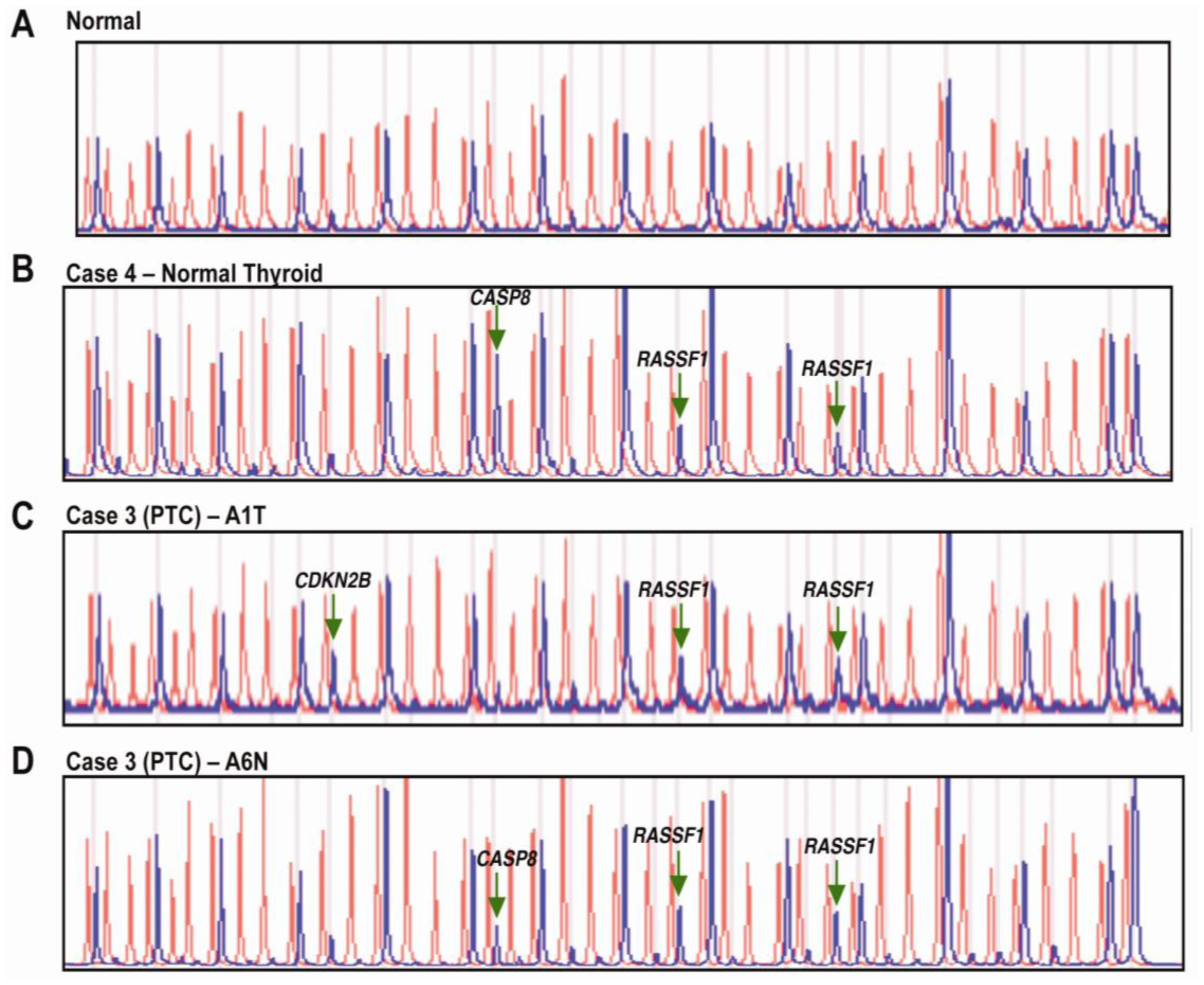
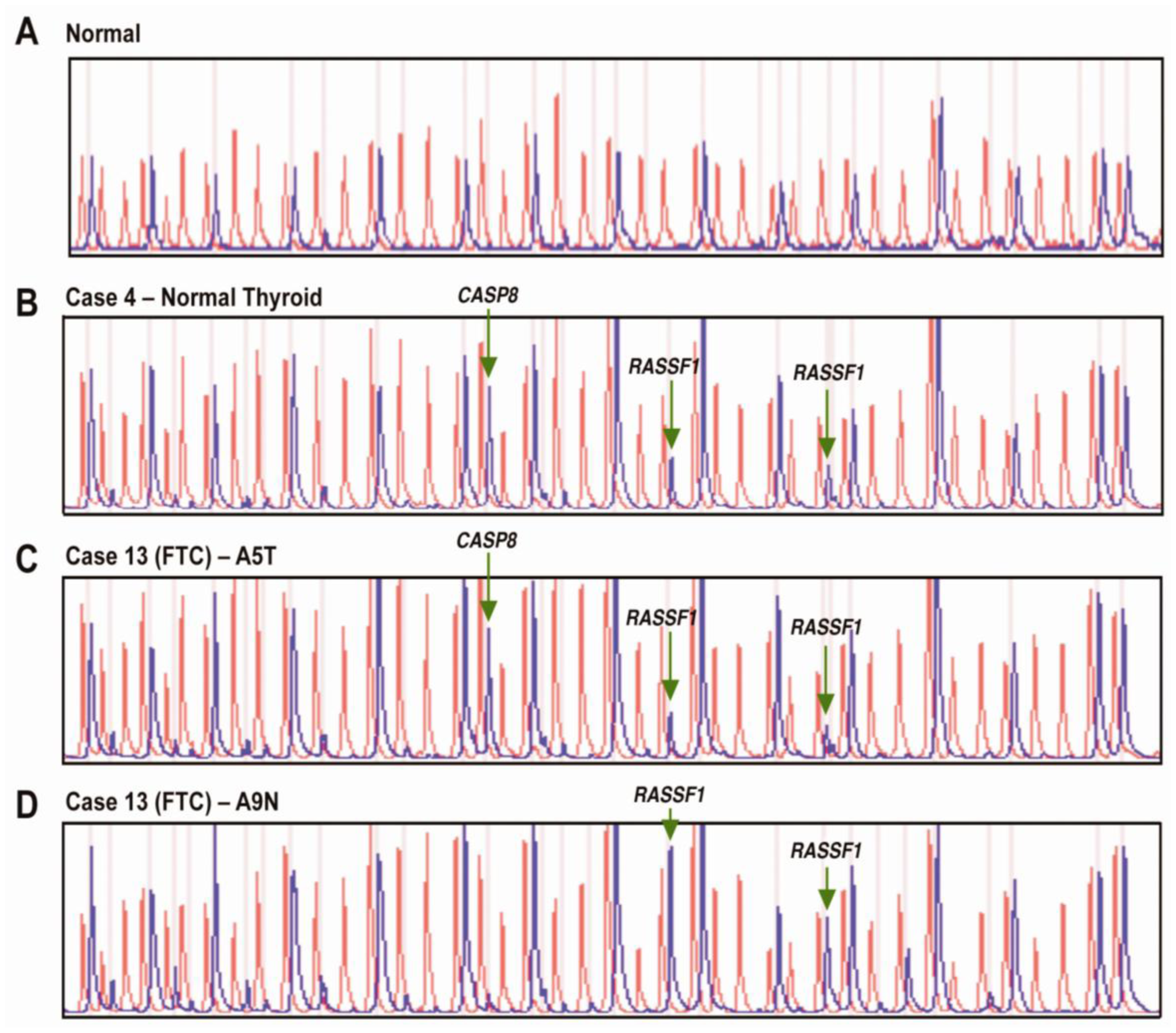
<p>Briefly, the MS-MLPA panel in the presence of <italic>Hha</italic>I detects aberrant promoter hypermethylation by taking advantage of a <italic>Hha</italic>I site in the gene probes of interest. The control gene probes, without a <italic>Hha</italic>I site, serve as undigested controls. A normal control DNA sample will generate 41 individual peaks for all probes in the absence of <italic>Hha</italic>I and 15 separate peaks in the presence of <italic>Hha</italic>I (<xref ref-type="fig" rid="f1-cancers-03-01732">Figure 1A</xref> and <xref ref-type="fig" rid="f2-cancers-03-01732">Figure 2A</xref>). Normal controls for methylation assays are run using DNA from paraffin-embdedded squamous epithelium from individuals with no evidence of cancer.</p></sec>
<sec>
<label>3.4.</label>
<title>Gene Probe Panels</title>
<p>The 41 gene probe panel (ME001B, <ext-link xlink:href="http://www.mlpa.com" ext-link-type="uri">www.mlpa.com</ext-link>) used in this cohort interrogates 38 unique genes implicated in cancer (24 tumor suppressor genes) for methylation status in two separate reactions (one in the absence of the methyl-sensitive enzyme <italic>Hha</italic>I and one in the presence of the <italic>Hha</italic>I enzyme). There are two probes each for <italic>MLH1</italic>, <italic>RASSF1</italic> and <italic>BRCA2</italic>, and a normal control DNA sample will generate 41 individual peaks in the absence of <italic>Hha</italic>I and 15 individual peaks in the presence of <italic>Hha</italic>I.</p></sec>
<sec>
<label>3.5.</label>
<title>Bisulfite Modification and Methylation-Specific Polymerase Chain Reaction (MSP) Assay</title>
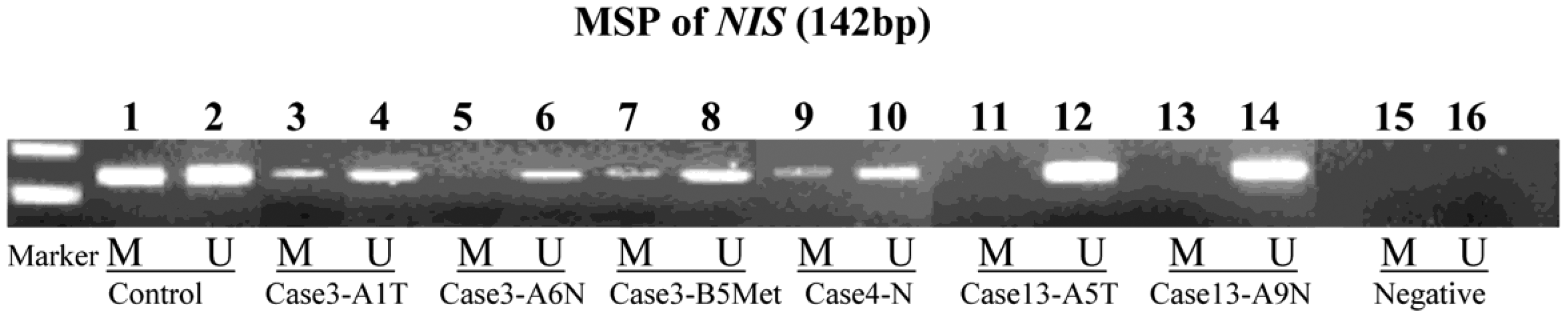
<p>Genomic DNA (100 ng) from formalin-fixed paraffin embedded normal and cancerous thyroid tissue, control universal methylated DNA (Chamicon International, Inc) and control unmethylated DNA (normal genomic DNA) were modified using the EZ DNA methylation gold kit (Zymo Research, Orange, CA) during which methylated DNA is protected and unmethylated cytosine is converted to uracil [<xref ref-type="bibr" rid="b49-cancers-03-01732">49</xref>]. The modified DNA served as a template using primers specific for the methylated or modified unmethylated sequences (<xref ref-type="table" rid="t1-cancers-03-01732">Table 1</xref>). MSP amplification was performed using 3 μL of bisulfite modified DNA in a final volume of 25 μL using Promega Hot Start Master Mix (Promega Biosystems, Sunnyvale, CA), 0.5 μM primer followed by 95 °C 5 minutes then 40 cycles at 95 °C 40 seconds, 60 °C 40 seconds, 72 °C 1 min [<xref ref-type="bibr" rid="b49-cancers-03-01732">49</xref>]. The resultant PCR products were separated on 2% agarose gel stained with ethidium bromide and visualized under UV illumination (<xref ref-type="fig" rid="f3-cancers-03-01732">Figure 3</xref>).</p></sec></sec>
<sec sec-type="conclusions">
<label>4.</label>
<title>Conclusions</title>
<p>Our data suggests that aberrant methylation of <italic>CASP8, RASSF1</italic>, and <italic>NIS</italic> maybe an early change in thyroid tumorigenesis regardless of cell type. Epigenetic events of promoter hypermethylation are emerging as promising molecular targets for cancer detection and represent an important tumor-specific marker in tumorigenesis. Further confirmation and validation of these findings in larger cohorts would support these genes as early makers of thyroid tumorigenesis.</p></sec></body>
<back>
<sec sec-type="display-objects">
<title>Figures and Table</title>
<fig id="f1-cancers-03-01732" position="float">
<label>Figure 1.</label>
<caption>
<p>(<bold>A</bold>) Normal control DNA sample with 41 individual peaks (red) in the absence of <italic>Hha</italic>I and 15 separate peaks (blue) in the presence of <italic>Hha</italic>I. (<bold>B</bold>) Normal thyroid sample with methylation of <italic>CASP8</italic> and <italic>RASSF1</italic>. (<bold>C</bold>) Papillary thyroid cancer (Case 3 - tumor block) with methylation of <italic>CDKN2B</italic> and <italic>RASSF1</italic>. (<bold>D</bold>) Papillary thyroid cancer (Case 3 -normal block) with methylation of <italic>CASP8</italic> and <italic>RASSF1</italic>. (PTC – papillary thyroid cancer, A1T – block A1 tumor, A6N – block A6 normal).</p></caption>
<graphic xlink:href="cancers-03-01732f1.gif"/></fig>
<fig id="f2-cancers-03-01732" position="float">
<label>Figure 2.</label>
<caption>
<p>(<bold>A</bold>) Normal control DNA sample with 41 individual peaks (red) in the absence of <italic>Hha</italic>I and 15 separate peaks (blue) in the presence of <italic>Hha</italic>I. (<bold>B</bold>) Normal thyroid sample with methylation of <italic>CASP8</italic> and <italic>RASSF1</italic>. (<bold>C</bold>) Follicular thyroid cancer (Case 13 - tumor block) with methylation of <italic>CASP8</italic> and <italic>RASSF1</italic>. (<bold>D</bold>) Follicular thyroid cancer (Case 13 -normal block) with methylation of <italic>RASSF1</italic>. (FTC – follicular thyroid cancer, A5T – block A5 tumor, A9N – block A9 normal).</p></caption>
<graphic xlink:href="cancers-03-01732f2.gif"/></fig>
<fig id="f3-cancers-03-01732" position="float">
<label>Figure 3.</label>
<caption>
<p>Aberrant methylation of <italic>NIS</italic> detected by methylation-specific PCR (MSP). Lanes 1 and 2: universal methylated and unmethylated controls. Lanes 3-14 span biopsies for Cases 3, 4 and 13. Note presence of methylated product in lanes 3, 7 and 9. Note absence of methylated product in lanes 5, 11 and 13. Lanes 15 and 16: negative control. (A1T – block A1 tumor, A6N – block A6 normal, B5Met – block B5 metastasis, Case4-N – normal thyroid, A5T – block A5 tumor, A9N – block A9 normal).</p></caption>
<graphic xlink:href="cancers-03-01732f3.gif"/></fig>
<table-wrap id="t1-cancers-03-01732" position="float">
<label>Table 1.</label>
<caption>
<p>Methylation-Specific PCR (MSP) Primer Sequences for <italic>NIS</italic> gene.</p></caption>
<table frame="box" rules="all">
<thead>
<tr>
<th align="left" valign="top"/>
<th align="left" valign="top"><bold>Methylation Specific Primers</bold></th>
<th align="left" valign="top"><bold>Unmethylation Specific Primers</bold></th>
<th align="left" valign="top"><bold>Product Size</bold></th></tr></thead>
<tbody>
<tr>
<td align="left" valign="top">Forward</td>
<td align="left" valign="top">5′-ATAGGGAGGTCGATACGGATATC</td>
<td align="left" valign="top">5′-ATAGGGAGGTTGATATGGATATTGA</td>
<td align="left" valign="top">M-142 bp</td></tr>
<tr>
<td align="left" valign="top">Reverse</td>
<td align="left" valign="top">5′-GAAAAAACAAAACGAAAAAAACG</td>
<td align="left" valign="top">5′-AAAAAAACAAAACAAAAAAAACAAA</td>
<td align="left" valign="top">U-142 bp</td></tr></tbody></table>
<table-wrap-foot><fn id="tfn1-cancers-03-01732">
<p>M = methylated product; U = unmethylated product</p></fn></table-wrap-foot></table-wrap></sec>
<ack>
<p>This work was supported by R01 NIH DE 15990 (MJW).</p></ack>
<ref-list>
<title>References</title>
<ref id="b1-cancers-03-01732"><label>1.</label><citation citation-type="web"><person-group person-group-type="author"><collab>Thyroid cancer</collab></person-group><comment>Available online: <ext-link xlink:href="http://www.cancer.gov/cancertopics/types/thyroid" ext-link-type="uri">http://www.cancer.gov/cancertopics/types/thyroid</ext-link> (accessed on 24 February 2011)</comment></citation></ref>
<ref id="b2-cancers-03-01732"><label>2.</label><citation citation-type="book"><person-group person-group-type="author"><collab>American Cancer Society</collab></person-group><article-title>Quickfacts</article-title><source>Thyroid Cancer</source><publisher-name>American Cancer Society</publisher-name><publisher-loc>Atlanta, GA, USA</publisher-loc><year>2009</year></citation></ref>
<ref id="b3-cancers-03-01732"><label>3.</label><citation citation-type="journal"><person-group person-group-type="author"><name><surname>Stearns</surname><given-names>V.</given-names></name><name><surname>Yamauchi</surname><given-names>H.</given-names></name><name><surname>Hayes</surname><given-names>D.F.</given-names></name></person-group><article-title>Circulating tumor markers in breast cancer: Accepted utilities and novel prospects</article-title><source>Breast Cancer Res. Treat.</source><year>1998</year><volume>52</volume><fpage>239</fpage><lpage>259</lpage><pub-id pub-id-type="doi">10.1023/A:1006137619153</pub-id><pub-id pub-id-type="pmid">10066086</pub-id></citation></ref>
<ref id="b4-cancers-03-01732"><label>4.</label><citation citation-type="book"><person-group person-group-type="author"><name><surname>Hu</surname><given-names>M.I.</given-names></name><name><surname>Vassilopoulou-Sellin</surname><given-names>R.</given-names></name><name><surname>Lustig</surname><given-names>R.</given-names></name><name><surname>Lamont</surname><given-names>J.P.</given-names></name></person-group><article-title>Thyroid and parathyroid cancers</article-title><source>Cancer Management: A Multidisciplinary Approach</source><edition>11th ed.</edition><person-group person-group-type="editor"><name><surname>Pazdur</surname><given-names>R.</given-names></name><name><surname>Wagman</surname><given-names>L.D.</given-names></name><name><surname>Camphausen</surname><given-names>K.A.</given-names></name><name><surname>Hoskins</surname><given-names>W.J.</given-names></name></person-group><publisher-name>Congregational Ministries Publishing</publisher-name><publisher-loc>Louisville, KY, USA</publisher-loc><year>2008</year></citation></ref>
<ref id="b5-cancers-03-01732"><label>5.</label><citation citation-type="book"><person-group person-group-type="author"><collab>American Cancer Society</collab></person-group><source>American Cancer Society Cancer Facts and Figures</source><publisher-name>American Cancer Society</publisher-name><publisher-loc>Atlanta, GA, USA</publisher-loc><year>2005</year></citation></ref>
<ref id="b6-cancers-03-01732"><label>6.</label><citation citation-type="journal"><person-group person-group-type="author"><name><surname>Weber</surname><given-names>F.</given-names></name><name><surname>Eng</surname><given-names>C.</given-names></name></person-group><article-title>Gene-expression profiling in differentiated thyroid cancer--a viable strategy for the practice of genomic medicine?</article-title><source>Future Oncol.</source><year>2005</year><volume>1</volume><fpage>497</fpage><lpage>510</lpage><pub-id pub-id-type="doi">10.2217/14796694.1.4.497</pub-id><pub-id pub-id-type="pmid">16556026</pub-id></citation></ref>
<ref id="b7-cancers-03-01732"><label>7.</label><citation citation-type="journal"><person-group person-group-type="author"><name><surname>Mazzaferri</surname><given-names>E.L.</given-names></name><name><surname>Kloos</surname><given-names>R.T.</given-names></name></person-group><article-title>Clinical review 128: Current approaches to primary therapy for papillary and follicular thyroid cancer</article-title><source>J. Clin. Endocrinol. Metab.</source><year>2001</year><volume>86</volume><fpage>1447</fpage><lpage>1463</lpage><pub-id pub-id-type="doi">10.1210/jc.86.4.1447</pub-id><pub-id pub-id-type="pmid">11297567</pub-id></citation></ref>
<ref id="b8-cancers-03-01732"><label>8.</label><citation citation-type="journal"><person-group person-group-type="author"><name><surname>Schlumberger</surname><given-names>M.J.</given-names></name></person-group><article-title>Papillary and follicular thyroid carcinoma</article-title><source>N. Engl. J. Med.</source><year>1998</year><volume>338</volume><fpage>297</fpage><lpage>306</lpage><pub-id pub-id-type="doi">10.1056/NEJM199801293380506</pub-id><pub-id pub-id-type="pmid">9445411</pub-id></citation></ref>
<ref id="b9-cancers-03-01732"><label>9.</label><citation citation-type="journal"><person-group person-group-type="author"><name><surname>Hayes</surname><given-names>D.F.</given-names></name><name><surname>Bast</surname><given-names>R.C.</given-names></name><name><surname>Desch</surname><given-names>C.E.</given-names></name><name><surname>Fritsche</surname><given-names>H.</given-names><suffix>Jr.</suffix></name><name><surname>Kemeny</surname><given-names>N.E.</given-names></name><name><surname>Jessup</surname><given-names>J.M.</given-names></name><name><surname>Locker</surname><given-names>G.Y.</given-names></name><name><surname>Macdonald</surname><given-names>J.S.</given-names></name><name><surname>Mennel</surname><given-names>R.G.</given-names></name><name><surname>Norton</surname><given-names>L.</given-names></name><name><surname>Ravdin</surname><given-names>P.</given-names></name><name><surname>Taube</surname><given-names>S.</given-names></name><name><surname>Winn</surname><given-names>R.J.</given-names></name></person-group><article-title>Tumor marker utility grading system: A framework to evaluate clinical utility of tumor markers</article-title><source>J. Natl. Cancer Inst.</source><year>1996</year><volume>88</volume><fpage>1456</fpage><lpage>1466</lpage><pub-id pub-id-type="doi">10.1093/jnci/88.20.1456</pub-id><pub-id pub-id-type="pmid">8841020</pub-id></citation></ref>
<ref id="b10-cancers-03-01732"><label>10.</label><citation citation-type="journal"><person-group person-group-type="author"><name><surname>Kulasingam</surname><given-names>V.</given-names></name><name><surname>Diamandis</surname><given-names>E.P.</given-names></name></person-group><article-title>Strategies for discovering novel cancer biomarkers through utilization of emerging technologies</article-title><source>Nat. Clin. Pract. Oncol.</source><year>2008</year><volume>5</volume><fpage>588</fpage><lpage>599</lpage><pub-id pub-id-type="pmid">18695711</pub-id></citation></ref>
<ref id="b11-cancers-03-01732"><label>11.</label><citation citation-type="journal"><person-group person-group-type="author"><name><surname>Xing</surname><given-names>M.</given-names></name></person-group><article-title>Gene methylation in thyroid tumorigenesis</article-title><source>Endocrinology</source><year>2007</year><volume>148</volume><fpage>948</fpage><lpage>953</lpage><pub-id pub-id-type="pmid">16946009</pub-id></citation></ref>
<ref id="b12-cancers-03-01732"><label>12.</label><citation citation-type="journal"><person-group person-group-type="author"><name><surname>Smith</surname><given-names>J.A.</given-names></name><name><surname>Fan</surname><given-names>C.Y.</given-names></name><name><surname>Zou</surname><given-names>C.</given-names></name><name><surname>Bodenner</surname><given-names>D.</given-names></name><name><surname>Kokoska</surname><given-names>M.S.</given-names></name></person-group><article-title>Methylation status of genes in papillary thyroid carcinoma</article-title><source>Arch. Otolaryngol. Head Neck Surg.</source><year>2007</year><volume>133</volume><fpage>1006</fpage><lpage>1011</lpage><pub-id pub-id-type="doi">10.1001/archotol.133.10.1006</pub-id><pub-id pub-id-type="pmid">17938324</pub-id></citation></ref>
<ref id="b13-cancers-03-01732"><label>13.</label><citation citation-type="journal"><person-group person-group-type="author"><name><surname>Hu</surname><given-names>S.</given-names></name><name><surname>Liu</surname><given-names>D.</given-names></name><name><surname>Tufano</surname><given-names>R.P.</given-names></name><name><surname>Carson</surname><given-names>K.A.</given-names></name><name><surname>Rosenbaum</surname><given-names>E.</given-names></name><name><surname>Cohen</surname><given-names>Y.</given-names></name><name><surname>Holt</surname><given-names>E.H.</given-names></name><name><surname>Kiseljak-Vassiliades</surname><given-names>K.</given-names></name><name><surname>Rhoden</surname><given-names>K.J.</given-names></name><name><surname>Tolaney</surname><given-names>S.</given-names></name><name><surname>Condouris</surname><given-names>S.</given-names></name><name><surname>Tallini</surname><given-names>G.</given-names></name><name><surname>Westra</surname><given-names>W.H.</given-names></name><name><surname>Umbricht</surname><given-names>C.B.</given-names></name><name><surname>Zeiger</surname><given-names>M.A.</given-names></name><name><surname>Califano</surname><given-names>J.A.</given-names></name><name><surname>Vasko</surname><given-names>V.</given-names></name><name><surname>Xing</surname><given-names>M.</given-names></name></person-group><article-title>Association of aberrant methylation of tumor suppressor genes with tumor aggressiveness and braf mutation in papillary thyroid cancer</article-title><source>Int. J. Cancer</source><year>2006</year><volume>119</volume><fpage>2322</fpage><lpage>2329</lpage><pub-id pub-id-type="doi">10.1002/ijc.22110</pub-id><pub-id pub-id-type="pmid">16858683</pub-id></citation></ref>
<ref id="b14-cancers-03-01732"><label>14.</label><citation citation-type="journal"><person-group person-group-type="author"><name><surname>Xing</surname><given-names>M.</given-names></name><name><surname>Cohen</surname><given-names>Y.</given-names></name><name><surname>Mambo</surname><given-names>E.</given-names></name><name><surname>Tallini</surname><given-names>G.</given-names></name><name><surname>Udelsman</surname><given-names>R.</given-names></name><name><surname>Ladenson</surname><given-names>P.W.</given-names></name><name><surname>Sidransky</surname><given-names>D.</given-names></name></person-group><article-title>Early occurrence of rassf1a hypermethylation and its mutual exclusion with braf mutation in thyroid tumorigenesis</article-title><source>Cancer Res.</source><year>2004</year><volume>64</volume><fpage>1664</fpage><lpage>1668</lpage><pub-id pub-id-type="doi">10.1158/0008-5472.CAN-03-3242</pub-id><pub-id pub-id-type="pmid">14996725</pub-id></citation></ref>
<ref id="b15-cancers-03-01732"><label>15.</label><citation citation-type="journal"><person-group person-group-type="author"><name><surname>Lazar</surname><given-names>V.</given-names></name><name><surname>Bidart</surname><given-names>J.M.</given-names></name><name><surname>Caillou</surname><given-names>B.</given-names></name><name><surname>Mahe</surname><given-names>C.</given-names></name><name><surname>Lacroix</surname><given-names>L.</given-names></name><name><surname>Filetti</surname><given-names>S.</given-names></name><name><surname>Schlumberger</surname><given-names>M.</given-names></name></person-group><article-title>Expression of the na+/i- symporter gene in human thyroid tumors: A comparison study with other thyroid-specific genes</article-title><source>J. Clin. Endocrinol. Metab.</source><year>1999</year><volume>84</volume><fpage>3228</fpage><lpage>3234</lpage><pub-id pub-id-type="doi">10.1210/jc.84.9.3228</pub-id><pub-id pub-id-type="pmid">10487692</pub-id></citation></ref>
<ref id="b16-cancers-03-01732"><label>16.</label><citation citation-type="journal"><person-group person-group-type="author"><name><surname>Xing</surname><given-names>M.</given-names></name><name><surname>Usadel</surname><given-names>H.</given-names></name><name><surname>Cohen</surname><given-names>Y.</given-names></name><name><surname>Tokumaru</surname><given-names>Y.</given-names></name><name><surname>Guo</surname><given-names>Z.</given-names></name><name><surname>Westra</surname><given-names>W.B.</given-names></name><name><surname>Tong</surname><given-names>B.C.</given-names></name><name><surname>Tallini</surname><given-names>G.</given-names></name><name><surname>Udelsman</surname><given-names>R.</given-names></name><name><surname>Califano</surname><given-names>J.A.</given-names></name><name><surname>Ladenson</surname><given-names>P.W.</given-names></name><name><surname>Sidransky</surname><given-names>D.</given-names></name></person-group><article-title>Methylation of the thyroid-stimulating hormone receptor gene in epithelial thyroid tumors: A marker of malignancy and a cause of gene silencing</article-title><source>Cancer Res.</source><year>2003</year><volume>63</volume><fpage>2316</fpage><lpage>2321</lpage><pub-id pub-id-type="pmid">12727856</pub-id></citation></ref>
<ref id="b17-cancers-03-01732"><label>17.</label><citation citation-type="journal"><person-group person-group-type="author"><name><surname>Ringel</surname><given-names>M.D.</given-names></name><name><surname>Anderson</surname><given-names>J.</given-names></name><name><surname>Souza</surname><given-names>S.L.</given-names></name><name><surname>Burch</surname><given-names>H.B.</given-names></name><name><surname>Tambascia</surname><given-names>M.</given-names></name><name><surname>Shriver</surname><given-names>C.D.</given-names></name><name><surname>Tuttle</surname><given-names>R.M.</given-names></name></person-group><article-title>Expression of the sodium iodide symporter and thyroglobulin genes are reduced in papillary thyroid cancer</article-title><source>Mod. Pathol.</source><year>2001</year><volume>14</volume><fpage>289</fpage><lpage>296</lpage><pub-id pub-id-type="doi">10.1038/modpathol.3880305</pub-id><pub-id pub-id-type="pmid">11301345</pub-id></citation></ref>
<ref id="b18-cancers-03-01732"><label>18.</label><citation citation-type="journal"><person-group person-group-type="author"><name><surname>Segev</surname><given-names>D.L.</given-names></name><name><surname>Clark</surname><given-names>D.P.</given-names></name><name><surname>Zeiger</surname><given-names>M.A.</given-names></name><name><surname>Umbricht</surname><given-names>C.</given-names></name></person-group><article-title>Beyond the suspicious thyroid fine needle aspirate. A review</article-title><source>Acta. Cytol.</source><year>2003</year><volume>47</volume><fpage>709</fpage><lpage>722</lpage><pub-id pub-id-type="doi">10.1159/000326594</pub-id><pub-id pub-id-type="pmid">14526667</pub-id></citation></ref>
<ref id="b19-cancers-03-01732"><label>19.</label><citation citation-type="journal"><person-group person-group-type="author"><name><surname>Sherman</surname><given-names>S.I.</given-names></name></person-group><article-title>Thyroid carcinoma</article-title><source>Lancet</source><year>2003</year><volume>361</volume><fpage>501</fpage><lpage>511</lpage><pub-id pub-id-type="doi">10.1016/S0140-6736(03)12488-9</pub-id><pub-id pub-id-type="pmid">12583960</pub-id></citation></ref>
<ref id="b20-cancers-03-01732"><label>20.</label><citation citation-type="journal"><person-group person-group-type="author"><name><surname>Baloch</surname><given-names>Z.W.</given-names></name><name><surname>Fleisher</surname><given-names>S.</given-names></name><name><surname>LiVolsi</surname><given-names>V.A.</given-names></name><name><surname>Gupta</surname><given-names>P.K.</given-names></name></person-group><article-title>Diagnosis of “Follicular neoplasm”: A gray zone in thyroid fine-needle aspiration cytology</article-title><source>Diagn. Cytopathol.</source><year>2002</year><volume>26</volume><fpage>41</fpage><lpage>44</lpage><pub-id pub-id-type="doi">10.1002/dc.10043</pub-id><pub-id pub-id-type="pmid">11782086</pub-id></citation></ref>
<ref id="b21-cancers-03-01732"><label>21.</label><citation citation-type="journal"><person-group person-group-type="author"><name><surname>Yeh</surname><given-names>M.W.</given-names></name><name><surname>Demircan</surname><given-names>O.</given-names></name><name><surname>Ituarte</surname><given-names>P.</given-names></name><name><surname>Clark</surname><given-names>O.H.</given-names></name></person-group><article-title>False-negative fine-needle aspiration cytology results delay treatment and adversely affect outcome in patients with thyroid carcinoma</article-title><source>Thyroid</source><year>2004</year><volume>14</volume><fpage>207</fpage><lpage>215</lpage><pub-id pub-id-type="doi">10.1089/105072504773297885</pub-id><pub-id pub-id-type="pmid">15072703</pub-id></citation></ref>
<ref id="b22-cancers-03-01732"><label>22.</label><citation citation-type="journal"><person-group person-group-type="author"><name><surname>Putti</surname><given-names>T.C.</given-names></name><name><surname>Bhuiya</surname><given-names>T.A.</given-names></name><name><surname>Wasserman</surname><given-names>P.G.</given-names></name></person-group><article-title>Fine needle aspiration cytology of mixed tall and columnar cell papillary carcinoma of the thyroid. A case report</article-title><source>Acta. Cytol.</source><year>1998</year><volume>42</volume><fpage>387</fpage><lpage>390</lpage><pub-id pub-id-type="doi">10.1159/000331622</pub-id><pub-id pub-id-type="pmid">9568142</pub-id></citation></ref>
<ref id="b23-cancers-03-01732"><label>23.</label><citation citation-type="journal"><person-group person-group-type="author"><name><surname>Wreesmann</surname><given-names>V.B.</given-names></name><name><surname>Sieczka</surname><given-names>E.M.</given-names></name><name><surname>Socci</surname><given-names>N.D.</given-names></name><name><surname>Hezel</surname><given-names>M.</given-names></name><name><surname>Belbin</surname><given-names>T.J.</given-names></name><name><surname>Childs</surname><given-names>G.</given-names></name><name><surname>Patel</surname><given-names>S.G.</given-names></name><name><surname>Patel</surname><given-names>K.N.</given-names></name><name><surname>Tallini</surname><given-names>G.</given-names></name><name><surname>Prystowsky</surname><given-names>M.</given-names></name><name><surname>Shaha</surname><given-names>A.R.</given-names></name><name><surname>Kraus</surname><given-names>D.</given-names></name><name><surname>Shah</surname><given-names>J.P.</given-names></name><name><surname>Rao</surname><given-names>P.H.</given-names></name><name><surname>Ghossein</surname><given-names>R.</given-names></name><name><surname>Singh</surname><given-names>B.</given-names></name></person-group><article-title>Genome-wide profiling of papillary thyroid cancer identifies muc1 as an independent prognostic marker</article-title><source>Cancer Res.</source><year>2004</year><volume>64</volume><fpage>3780</fpage><lpage>3789</lpage><pub-id pub-id-type="doi">10.1158/0008-5472.CAN-03-1460</pub-id><pub-id pub-id-type="pmid">15172984</pub-id></citation></ref>
<ref id="b24-cancers-03-01732"><label>24.</label><citation citation-type="journal"><person-group person-group-type="author"><name><surname>Ruggeri</surname><given-names>R.M.</given-names></name><name><surname>Campenni</surname><given-names>A.</given-names></name><name><surname>Baldari</surname><given-names>S.</given-names></name><name><surname>Trimarchi</surname><given-names>F.</given-names></name><name><surname>Trovato</surname><given-names>M.</given-names></name></person-group><article-title>What is new on thyroid cancer biomarkers</article-title><source>Biomark. Insights</source><year>2008</year><volume>3</volume><fpage>237</fpage><lpage>252</lpage><pub-id pub-id-type="pmid">19578508</pub-id></citation></ref>
<ref id="b25-cancers-03-01732"><label>25.</label><citation citation-type="journal"><person-group person-group-type="author"><name><surname>Pingoud-Meier</surname><given-names>C.</given-names></name><name><surname>Lang</surname><given-names>D.</given-names></name><name><surname>Janss</surname><given-names>A.J.</given-names></name><name><surname>Rorke</surname><given-names>L.B.</given-names></name><name><surname>Phillips</surname><given-names>P.C.</given-names></name><name><surname>Shalaby</surname><given-names>T.</given-names></name><name><surname>Grotzer</surname><given-names>M.A.</given-names></name></person-group><article-title>Loss of caspase-8 protein expression correlates with unfavorable survival outcome in childhood medulloblastoma</article-title><source>Clin. Cancer. Res.</source><year>2003</year><volume>9</volume><fpage>6401</fpage><lpage>6409</lpage><pub-id pub-id-type="pmid">14695141</pub-id></citation></ref>
<ref id="b26-cancers-03-01732"><label>26.</label><citation citation-type="journal"><person-group person-group-type="author"><name><surname>Yang</surname><given-names>Q.</given-names></name><name><surname>Kiernan</surname><given-names>C.M.</given-names></name><name><surname>Tian</surname><given-names>Y.</given-names></name><name><surname>Salwen</surname><given-names>H.R.</given-names></name><name><surname>Chlenski</surname><given-names>A.</given-names></name><name><surname>Brumback</surname><given-names>B.A.</given-names></name><name><surname>London</surname><given-names>W.B.</given-names></name><name><surname>Cohn</surname><given-names>S.L.</given-names></name></person-group><article-title>Methylation of casp8, dcr2, and hin-1 in neuroblastoma is associated with poor outcome</article-title><source>Clin. Cancer. Res.</source><year>2007</year><volume>13</volume><fpage>3191</fpage><lpage>3197</lpage><pub-id pub-id-type="doi">10.1158/1078-0432.CCR-06-2846</pub-id><pub-id pub-id-type="pmid">17545522</pub-id></citation></ref>
<ref id="b27-cancers-03-01732"><label>27.</label><citation citation-type="journal"><person-group person-group-type="author"><name><surname>Harada</surname><given-names>K.</given-names></name><name><surname>Toyooka</surname><given-names>S.</given-names></name><name><surname>Shivapurkar</surname><given-names>N.</given-names></name><name><surname>Maitra</surname><given-names>A.</given-names></name><name><surname>Reddy</surname><given-names>J.L.</given-names></name><name><surname>Matta</surname><given-names>H.</given-names></name><name><surname>Miyajima</surname><given-names>K.</given-names></name><name><surname>Timmons</surname><given-names>C.F.</given-names></name><name><surname>Tomlinson</surname><given-names>G.E.</given-names></name><name><surname>Mastrangelo</surname><given-names>D.</given-names></name><name><surname>Hay</surname><given-names>R.J.</given-names></name><name><surname>Chaudhary</surname><given-names>P.M.</given-names></name><name><surname>Gazdar</surname><given-names>A.F.</given-names></name></person-group><article-title>Deregulation of caspase 8 and 10 expression in pediatric tumors and cell lines</article-title><source>Cancer Res.</source><year>2002</year><volume>62</volume><fpage>5897</fpage><lpage>5901</lpage><pub-id pub-id-type="pmid">12384554</pub-id></citation></ref>
<ref id="b28-cancers-03-01732"><label>28.</label><citation citation-type="journal"><person-group person-group-type="author"><name><surname>Wu</surname><given-names>Y.</given-names></name><name><surname>Alvarez</surname><given-names>M.</given-names></name><name><surname>Slamon</surname><given-names>D.J.</given-names></name><name><surname>Koeffler</surname><given-names>P.</given-names></name><name><surname>Vadgama</surname><given-names>J.V.</given-names></name></person-group><article-title>Caspase 8 and maspin are downregulated in breast cancer cells due to cpg site promoter methylation</article-title><source>BMC Cancer</source><year>2010</year><volume>10</volume><fpage>32</fpage><pub-id pub-id-type="doi">10.1186/1471-2407-10-32</pub-id><pub-id pub-id-type="pmid">20132554</pub-id></citation></ref>
<ref id="b29-cancers-03-01732"><label>29.</label><citation citation-type="journal"><person-group person-group-type="author"><name><surname>Ho</surname><given-names>P.K.</given-names></name><name><surname>Hawkins</surname><given-names>C.J.</given-names></name></person-group><article-title>Mammalian initiator apoptotic caspases</article-title><source>Febs. J.</source><year>2005</year><volume>272</volume><fpage>5436</fpage><lpage>5453</lpage><pub-id pub-id-type="doi">10.1111/j.1742-4658.2005.04966.x</pub-id><pub-id pub-id-type="pmid">16262685</pub-id></citation></ref>
<ref id="b30-cancers-03-01732"><label>30.</label><citation citation-type="journal"><person-group person-group-type="author"><name><surname>Teitz</surname><given-names>T.</given-names></name><name><surname>Wei</surname><given-names>T.</given-names></name><name><surname>Valentine</surname><given-names>M.B.</given-names></name><name><surname>Vanin</surname><given-names>E.F.</given-names></name><name><surname>Grenet</surname><given-names>J.</given-names></name><name><surname>Valentine</surname><given-names>V.A.</given-names></name><name><surname>Behm</surname><given-names>F.G.</given-names></name><name><surname>Look</surname><given-names>A.T.</given-names></name><name><surname>Lahti</surname><given-names>J.M.</given-names></name><name><surname>Kidd</surname><given-names>V.J.</given-names></name></person-group><article-title>Caspase 8 is deleted or silenced preferentially in childhood neuroblastomas with amplification of mycn</article-title><source>Nat. Med.</source><year>2000</year><volume>6</volume><fpage>529</fpage><lpage>535</lpage><pub-id pub-id-type="doi">10.1038/75007</pub-id><pub-id pub-id-type="pmid">10802708</pub-id></citation></ref>
<ref id="b31-cancers-03-01732"><label>31.</label><citation citation-type="journal"><person-group person-group-type="author"><name><surname>Fulda</surname><given-names>S.</given-names></name><name><surname>Debatin</surname><given-names>K.M.</given-names></name></person-group><article-title>Ifngamma sensitizes for apoptosis by upregulating caspase-8 expression through the stat1 pathway</article-title><source>Oncogene</source><year>2002</year><volume>21</volume><fpage>2295</fpage><lpage>2308</lpage><pub-id pub-id-type="doi">10.1038/sj.onc.1205255</pub-id><pub-id pub-id-type="pmid">11948413</pub-id></citation></ref>
<ref id="b32-cancers-03-01732"><label>32.</label><citation citation-type="journal"><person-group person-group-type="author"><name><surname>Liedtke</surname><given-names>C.</given-names></name><name><surname>Groger</surname><given-names>N.</given-names></name><name><surname>Manns</surname><given-names>M.P.</given-names></name><name><surname>Trautwein</surname><given-names>C.</given-names></name></person-group><article-title>The human caspase-8 promoter sustains basal activity through sp1 and ets-like transcription factors and can be up-regulated by a p53-dependent mechanism</article-title><source>J. Biol. Chem.</source><year>2003</year><volume>278</volume><fpage>27593</fpage><lpage>27604</lpage><pub-id pub-id-type="doi">10.1074/jbc.M304077200</pub-id><pub-id pub-id-type="pmid">12748179</pub-id></citation></ref>
<ref id="b33-cancers-03-01732"><label>33.</label><citation citation-type="journal"><person-group person-group-type="author"><name><surname>Chaudhary</surname><given-names>P.M.</given-names></name><name><surname>Eby</surname><given-names>M.T.</given-names></name><name><surname>Jasmin</surname><given-names>A.</given-names></name><name><surname>Kumar</surname><given-names>A.</given-names></name><name><surname>Liu</surname><given-names>L.</given-names></name><name><surname>Hood</surname><given-names>L.</given-names></name></person-group><article-title>Activation of the nf-kappab pathway by caspase 8 and its homologs</article-title><source>Oncogene</source><year>2000</year><volume>19</volume><fpage>4451</fpage><lpage>4460</lpage><pub-id pub-id-type="doi">10.1038/sj.onc.1203812</pub-id><pub-id pub-id-type="pmid">11002417</pub-id></citation></ref>
<ref id="b34-cancers-03-01732"><label>34.</label><citation citation-type="journal"><person-group person-group-type="author"><name><surname>Salvesen</surname><given-names>G.S.</given-names></name></person-group><article-title>Caspase 8: Igniting the death machine</article-title><source>Structure</source><year>1999</year><volume>7</volume><fpage>R225</fpage><lpage>R229</lpage><pub-id pub-id-type="doi">10.1016/S0969-2126(00)80048-9</pub-id><pub-id pub-id-type="pmid">10545333</pub-id></citation></ref>
<ref id="b35-cancers-03-01732"><label>35.</label><citation citation-type="journal"><person-group person-group-type="author"><name><surname>Zoli</surname><given-names>W.</given-names></name><name><surname>Ulivi</surname><given-names>P.</given-names></name><name><surname>Tesei</surname><given-names>A.</given-names></name><name><surname>Fabbri</surname><given-names>F.</given-names></name><name><surname>Rosetti</surname><given-names>M.</given-names></name><name><surname>Maltoni</surname><given-names>R.</given-names></name><name><surname>Giunchi</surname><given-names>D.C.</given-names></name><name><surname>Ricotti</surname><given-names>L.</given-names></name><name><surname>Brigliadori</surname><given-names>G.</given-names></name><name><surname>Vannini</surname><given-names>I.</given-names></name><name><surname>Amadori</surname><given-names>D.</given-names></name></person-group><article-title>Addition of 5-fluorouracil to doxorubicin-paclitaxel sequence increases caspase-dependent apoptosis in breast cancer cell lines</article-title><source>Breast Cancer Res.</source><year>2005</year><volume>7</volume><fpage>R681</fpage><lpage>R689</lpage><pub-id pub-id-type="doi">10.1186/bcr1274</pub-id><pub-id pub-id-type="pmid">16168113</pub-id></citation></ref>
<ref id="b36-cancers-03-01732"><label>36.</label><citation citation-type="journal"><person-group person-group-type="author"><name><surname>Ehrhardt</surname><given-names>H.</given-names></name><name><surname>Hacker</surname><given-names>S.</given-names></name><name><surname>Wittmann</surname><given-names>S.</given-names></name><name><surname>Maurer</surname><given-names>M.</given-names></name><name><surname>Borkhardt</surname><given-names>A.</given-names></name><name><surname>Toloczko</surname><given-names>A.</given-names></name><name><surname>Debatin</surname><given-names>K.M.</given-names></name><name><surname>Fulda</surname><given-names>S.</given-names></name><name><surname>Jeremias</surname><given-names>I.</given-names></name></person-group><article-title>Cytotoxic drug-induced, p53-mediated upregulation of caspase-8 in tumor cells</article-title><source>Oncogene</source><year>2008</year><volume>27</volume><fpage>783</fpage><lpage>793</lpage><pub-id pub-id-type="doi">10.1038/sj.onc.1210666</pub-id><pub-id pub-id-type="pmid">17637740</pub-id></citation></ref>
<ref id="b37-cancers-03-01732"><label>37.</label><citation citation-type="journal"><person-group person-group-type="author"><name><surname>Schagdarsurengin</surname><given-names>U.</given-names></name><name><surname>Gimm</surname><given-names>O.</given-names></name><name><surname>Hoang-Vu</surname><given-names>C.</given-names></name><name><surname>Dralle</surname><given-names>H.</given-names></name><name><surname>Pfeifer</surname><given-names>G.P.</given-names></name><name><surname>Dammann</surname><given-names>R.</given-names></name></person-group><article-title>Frequent epigenetic silencing of the cpg island promoter of rassf1a in thyroid carcinoma</article-title><source>Cancer Res.</source><year>2002</year><volume>62</volume><fpage>3698</fpage><lpage>3701</lpage><pub-id pub-id-type="pmid">12097277</pub-id></citation></ref>
<ref id="b38-cancers-03-01732"><label>38.</label><citation citation-type="journal"><person-group person-group-type="author"><name><surname>Hou</surname><given-names>P.</given-names></name><name><surname>Bojdani</surname><given-names>E.</given-names></name><name><surname>Xing</surname><given-names>M.</given-names></name></person-group><article-title>Induction of thyroid gene expression and radioiodine uptake in thyroid cancer cells by targeting major signaling pathways</article-title><source>J. Clin. Endocrinol. Metab.</source><year>2010</year><volume>95</volume><fpage>820</fpage><lpage>828</lpage><pub-id pub-id-type="doi">10.1210/jc.2009-1888</pub-id><pub-id pub-id-type="pmid">20008023</pub-id></citation></ref>
<ref id="b39-cancers-03-01732"><label>39.</label><citation citation-type="journal"><person-group person-group-type="author"><name><surname>Venkataraman</surname><given-names>G.M.</given-names></name><name><surname>Yatin</surname><given-names>M.</given-names></name><name><surname>Marcinek</surname><given-names>R.</given-names></name><name><surname>Ain</surname><given-names>K.B.</given-names></name></person-group><article-title>Restoration of iodide uptake in dedifferentiated thyroid carcinoma: Relationship to human na+/i-symporter gene methylation status</article-title><source>J. Clin. Endocrinol. Metab.</source><year>1999</year><volume>84</volume><fpage>2449</fpage><lpage>2457</lpage><pub-id pub-id-type="doi">10.1210/jc.84.7.2449</pub-id><pub-id pub-id-type="pmid">10404820</pub-id></citation></ref>
<ref id="b40-cancers-03-01732"><label>40.</label><citation citation-type="journal"><person-group person-group-type="author"><name><surname>Boltze</surname><given-names>C.</given-names></name><name><surname>Zack</surname><given-names>S.</given-names></name><name><surname>Quednow</surname><given-names>C.</given-names></name><name><surname>Bettge</surname><given-names>S.</given-names></name><name><surname>Roessner</surname><given-names>A.</given-names></name><name><surname>Schneider-Stock</surname><given-names>R.</given-names></name></person-group><article-title>Hypermethylation of the cdkn2/p16ink4a promotor in thyroid carcinogenesis</article-title><source>Pathol. Res. Pract.</source><year>2003</year><volume>199</volume><fpage>399</fpage><lpage>404</lpage><pub-id pub-id-type="doi">10.1078/0344-0338-00436</pub-id><pub-id pub-id-type="pmid">12924440</pub-id></citation></ref>
<ref id="b41-cancers-03-01732"><label>41.</label><citation citation-type="journal"><person-group person-group-type="author"><name><surname>Smanik</surname><given-names>P.A.</given-names></name><name><surname>Ryu</surname><given-names>K.Y.</given-names></name><name><surname>Theil</surname><given-names>K.S.</given-names></name><name><surname>Mazzaferri</surname><given-names>E.L.</given-names></name><name><surname>Jhiang</surname><given-names>S.M.</given-names></name></person-group><article-title>Expression, exon-intron organization, and chromosome mapping of the human sodium iodide symporter</article-title><source>Endocrinology</source><year>1997</year><volume>138</volume><fpage>3555</fpage><lpage>3558</lpage><pub-id pub-id-type="doi">10.1210/en.138.8.3555</pub-id><pub-id pub-id-type="pmid">9231811</pub-id></citation></ref>
<ref id="b42-cancers-03-01732"><label>42.</label><citation citation-type="journal"><person-group person-group-type="author"><name><surname>Arturi</surname><given-names>F.</given-names></name><name><surname>Russo</surname><given-names>D.</given-names></name><name><surname>Schlumberger</surname><given-names>M.</given-names></name><name><surname>du Villard</surname><given-names>J.A.</given-names></name><name><surname>Caillou</surname><given-names>B.</given-names></name><name><surname>Vigneri</surname><given-names>P.</given-names></name><name><surname>Wicker</surname><given-names>R.</given-names></name><name><surname>Chiefari</surname><given-names>E.</given-names></name><name><surname>Suarez</surname><given-names>H.G.</given-names></name><name><surname>Filetti</surname><given-names>S.</given-names></name></person-group><article-title>Iodide symporter gene expression in human thyroid tumors</article-title><source>J. Clin. Endocrinol. Metab.</source><year>1998</year><volume>83</volume><fpage>2493</fpage><lpage>2496</lpage><pub-id pub-id-type="doi">10.1210/jc.83.7.2493</pub-id><pub-id pub-id-type="pmid">9661633</pub-id></citation></ref>
<ref id="b43-cancers-03-01732"><label>43.</label><citation citation-type="journal"><person-group person-group-type="author"><name><surname>Filetti</surname><given-names>S.</given-names></name><name><surname>Bidart</surname><given-names>J.M.</given-names></name><name><surname>Arturi</surname><given-names>F.</given-names></name><name><surname>Caillou</surname><given-names>B.</given-names></name><name><surname>Russo</surname><given-names>D.</given-names></name><name><surname>Schlumberger</surname><given-names>M.</given-names></name></person-group><article-title>Sodium/iodide symporter: A key transport system in thyroid cancer cell metabolism</article-title><source>Eur. J. Endocrinol.</source><year>1999</year><volume>141</volume><fpage>443</fpage><lpage>457</lpage><pub-id pub-id-type="doi">10.1530/eje.0.1410443</pub-id><pub-id pub-id-type="pmid">10576759</pub-id></citation></ref>
<ref id="b44-cancers-03-01732"><label>44.</label><citation citation-type="journal"><person-group person-group-type="author"><name><surname>Stephen</surname><given-names>J.K.</given-names></name><name><surname>Vaught</surname><given-names>L.E.</given-names></name><name><surname>Chen</surname><given-names>K.M.</given-names></name><name><surname>Sethi</surname><given-names>S.</given-names></name><name><surname>Shah</surname><given-names>V.</given-names></name><name><surname>Benninger</surname><given-names>M.S.</given-names></name><name><surname>Gardner</surname><given-names>G.M.</given-names></name><name><surname>Schweitzer</surname><given-names>V.G.</given-names></name><name><surname>Khan</surname><given-names>M.</given-names></name><name><surname>Worsham</surname><given-names>M.J.</given-names></name></person-group><article-title>Epigenetic events underlie the pathogenesis of sinonasal papillomas</article-title><source>Mod. Pathol.</source><year>2007</year><volume>20</volume><fpage>1019</fpage><lpage>1027</lpage><pub-id pub-id-type="doi">10.1038/modpathol.3800944</pub-id><pub-id pub-id-type="pmid">17673925</pub-id></citation></ref>
<ref id="b45-cancers-03-01732"><label>45.</label><citation citation-type="journal"><person-group person-group-type="author"><name><surname>Stephen</surname><given-names>J.K.</given-names></name><name><surname>Chen</surname><given-names>K.M.</given-names></name><name><surname>Shah</surname><given-names>V.</given-names></name><name><surname>Schweitzer</surname><given-names>V.G.</given-names></name><name><surname>Gardner</surname><given-names>G.</given-names></name><name><surname>Benninger</surname><given-names>M.S.</given-names></name><name><surname>Worsham</surname><given-names>M.J.</given-names></name></person-group><article-title>Consistent DNA hypermethylation patterns in laryngeal papillomas</article-title><source>Int. J. Head Neck Surg.</source><year>2010</year><volume>1</volume><fpage>69</fpage><lpage>77</lpage><pub-id pub-id-type="pmid">21603083</pub-id></citation></ref>
<ref id="b46-cancers-03-01732"><label>46.</label><citation citation-type="journal"><person-group person-group-type="author"><name><surname>Nygren</surname><given-names>A.O.</given-names></name><name><surname>Ameziane</surname><given-names>N.</given-names></name><name><surname>Duarte</surname><given-names>H.M.</given-names></name><name><surname>Vijzelaar</surname><given-names>R.N.</given-names></name><name><surname>Waisfisz</surname><given-names>Q.</given-names></name><name><surname>Hess</surname><given-names>C.J.</given-names></name><name><surname>Schouten</surname><given-names>J.P.</given-names></name><name><surname>Errami</surname><given-names>A.</given-names></name></person-group><article-title>Methylation-specific mlpa (ms-mlpa): Simultaneous detection of cpg methylation and copy number changes of up to 40 sequences</article-title><source>Nucleic Acids Res.</source><year>2005</year><volume>33</volume><fpage>e128</fpage><pub-id pub-id-type="doi">10.1093/nar/gni127</pub-id><pub-id pub-id-type="pmid">16106041</pub-id></citation></ref>
<ref id="b47-cancers-03-01732"><label>47.</label><citation citation-type="journal"><person-group person-group-type="author"><name><surname>Stephen</surname><given-names>J.K.</given-names></name><name><surname>Vaught</surname><given-names>L.E.</given-names></name><name><surname>Chen</surname><given-names>K.M.</given-names></name><name><surname>Shah</surname><given-names>V.</given-names></name><name><surname>Schweitzer</surname><given-names>V.G.</given-names></name><name><surname>Gardner</surname><given-names>G.</given-names></name><name><surname>Benninger</surname><given-names>M.S.</given-names></name><name><surname>Worsham</surname><given-names>M.J.</given-names></name></person-group><article-title>An epigenetically derived monoclonal origin for recurrent respiratory papillomatosis</article-title><source>Arch. Otolaryngol. Head Neck Surg.</source><year>2007</year><volume>133</volume><fpage>684</fpage><lpage>692</lpage><pub-id pub-id-type="doi">10.1001/archotol.133.7.684</pub-id><pub-id pub-id-type="pmid">17638782</pub-id></citation></ref>
<ref id="b48-cancers-03-01732"><label>48.</label><citation citation-type="journal"><person-group person-group-type="author"><name><surname>Worsham</surname><given-names>M.J.</given-names></name><name><surname>Chen</surname><given-names>K.M.</given-names></name><name><surname>Meduri</surname><given-names>V.</given-names></name><name><surname>Nygren</surname><given-names>A.O.</given-names></name><name><surname>Errami</surname><given-names>A.</given-names></name><name><surname>Schouten</surname><given-names>J.P.</given-names></name><name><surname>Benninger</surname><given-names>M.S.</given-names></name></person-group><article-title>Epigenetic events of disease progression in head and neck squamous cell carcinoma</article-title><source>Arch. Otolaryngol. Head Neck Surg.</source><year>2006</year><volume>132</volume><fpage>668</fpage><lpage>677</lpage><pub-id pub-id-type="doi">10.1001/archotol.132.6.668</pub-id><pub-id pub-id-type="pmid">16785414</pub-id></citation></ref>
<ref id="b49-cancers-03-01732"><label>49.</label><citation citation-type="journal"><person-group person-group-type="author"><name><surname>Chen</surname><given-names>K.</given-names></name><name><surname>Sawhney</surname><given-names>R.</given-names></name><name><surname>Khan</surname><given-names>M.</given-names></name><name><surname>Benninger</surname><given-names>M.S.</given-names></name><name><surname>Hou</surname><given-names>Z.</given-names></name><name><surname>Sethi</surname><given-names>S.</given-names></name><name><surname>Stephen</surname><given-names>J.K.</given-names></name><name><surname>Worsham</surname><given-names>M.J.</given-names></name></person-group><article-title>Methylation of multiple genes as diagnostic and therapeutic markers in primary head and neck squamous cell carcinoma</article-title><source>Arch. Otolaryngol. Head Neck Surg.</source><year>2007</year><volume>133</volume><fpage>1131</fpage><lpage>1138</lpage><pub-id pub-id-type="doi">10.1001/archotol.133.11.1131</pub-id><pub-id pub-id-type="pmid">18025318</pub-id></citation></ref></ref-list></back></article>