<?xml version="1.0" encoding="UTF-8"?>
<!DOCTYPE article PUBLIC "-//NLM//DTD Journal Publishing DTD v2.3 20070202//EN" "journalpublishing.dtd">
<article xmlns:xlink="http://www.w3.org/1999/xlink" xml:lang="en" article-type="review-article">
<front>
<journal-meta>
<journal-id journal-id-type="publisher-id">Cancers</journal-id>
<journal-title>Cancers</journal-title>
<issn pub-type="epub">2072-6694</issn>
<publisher>
<publisher-name>Molecular Diversity Preservation International (MDPI)</publisher-name></publisher></journal-meta>
<article-meta>
<article-id pub-id-type="doi">10.3390/cancers3010446</article-id>
<article-id pub-id-type="publisher-id">cancers-03-00446</article-id>
<article-categories>
<subj-group>
<subject>Review</subject></subj-group></article-categories>
<title-group>
<article-title>Metabolic Disorder, Inflammation, and Deregulated Molecular Pathways Converging in Pancreatic Cancer Development: Implications for New Therapeutic Strategies</article-title></title-group>
<contrib-group>
<contrib contrib-type="author">
<name><surname>Motoo</surname><given-names>Yoshiharu</given-names></name><xref ref-type="aff" rid="af1-cancers-03-00446"><sup>1</sup></xref><xref ref-type="corresp" rid="c1-cancers-03-00446"><sup>*</sup></xref></contrib>
<contrib contrib-type="author">
<name><surname>Shimasaki</surname><given-names>Takeo</given-names></name><xref ref-type="aff" rid="af1-cancers-03-00446"><sup>1</sup></xref><xref ref-type="aff" rid="af3-cancers-03-00446"><sup>3</sup></xref></contrib>
<contrib contrib-type="author">
<name><surname>Ishigaki</surname><given-names>Yasuhito</given-names></name><xref ref-type="aff" rid="af2-cancers-03-00446"><sup>2</sup></xref></contrib>
<contrib contrib-type="author">
<name><surname>Nakajima</surname><given-names>Hideo</given-names></name><xref ref-type="aff" rid="af1-cancers-03-00446"><sup>1</sup></xref></contrib>
<contrib contrib-type="author">
<name><surname>Kawakami</surname><given-names>Kazuyuki</given-names></name><xref ref-type="aff" rid="af3-cancers-03-00446"><sup>3</sup></xref></contrib>
<contrib contrib-type="author">
<name><surname>Minamoto</surname><given-names>Toshinari</given-names></name><xref ref-type="aff" rid="af3-cancers-03-00446"><sup>3</sup></xref></contrib></contrib-group>
<aff id="af1-cancers-03-00446">
<label>1</label> Department of Medical Oncology, Kanazawa Medical University, 1-1 Daigaku, Uchinada, Ishikawa 920-0293, Japan; E-Mails: <email>takeo@kanazawa-med.ac.jp</email> (T.S.); <email>hideonak@kanazawa-med.ac.jp</email> (H.N.)</aff>
<aff id="af2-cancers-03-00446">
<label>2</label> Medical Research Institute, Kanazawa Medical University, 1-1 Daigaku, Uchinada, Ishikawa 920-0293, Japan; E-Mail: <email>ishigaki@kanazawa-med.ac.jp</email></aff>
<aff id="af3-cancers-03-00446">
<label>3</label> Division of Translational &amp; Clinical Oncology, Cancer Research Institute, Kanazawa University, Kanazawa, Japan; E-Mails: <email>kawakami@med.kanazawa-u.ac.jp</email> (K.K.); <email>minamoto@staff.kanazawa-u.ac.jp</email> (T.M.)</aff>
<author-notes>
<corresp id="c1-cancers-03-00446">
<label>*</label> Author to whom correspondence should be addressed; E-Mail: <email>motoo@kanazawa-med.ac.jp</email>; Tel.: +81-76-218-8284; Fax: +81-76-218-8283.</corresp></author-notes>
<pub-date pub-type="collection">
<year>2011</year></pub-date>
<pub-date pub-type="epub">
<day>24</day>
<month>01</month>
<year>2011</year></pub-date>
<volume>3</volume>
<issue>1</issue>
<fpage>446</fpage>
<lpage>460</lpage>
<history>
<date date-type="received">
<day>17</day>
<month>12</month>
<year>2010</year></date>
<date date-type="rev-recd">
<day>18</day>
<month>01</month>
<year>2011</year></date>
<date date-type="accepted">
<day>21</day>
<month>01</month>
<year>2011</year></date></history>
<permissions>
<copyright-statement>© 2011 by the authors; licensee MDPI, Basel, Switzerland.</copyright-statement>
<copyright-year>2011</copyright-year>
<license>
<p>This article is an open access article distributed under the terms and conditions of the Creative Commons Attribution license (http://creativecommons.org/licenses/by/3.0/).</p></license></permissions>
<abstract>
<p>Pancreatic cancer develops and progresses through complex, cumulative biological processes involving metabolic disorder, local inflammation, and deregulated molecular pathways. The resulting tumor aggressiveness hampers surgical intervention and renders pancreatic cancer resistant to standard chemotherapy and radiation therapy. Based on these pathologic properties, several therapeutic strategies are being developed to reverse refractory pancreatic cancer. Here, we outline molecular targeting therapies, which are primarily directed against growth factor receptor-type tyrosine kinases deregulated in tumors, but have failed to improve the survival of pancreatic cancer patients. Glycogen synthase kinase-3β (GSK3β) is a member of a serine/threonine protein kinase family that plays a critical role in various cellular pathways. GSK3β has also emerged as a mediator of pathological states, including glucose intolerance, inflammation, and various cancers (e.g., pancreatic cancer). We review recent studies that demonstrate the anti-tumor effects of GSK3β inhibition alone or in combination with chemotherapy and radiation. GSK3β inhibition may exert indirect anti-tumor actions in pancreatic cancer by modulating metabolic disorder and inflammation.</p></abstract>
<kwd-group>
<kwd>pancreatic cancer</kwd>
<kwd>glucose intolerance</kwd>
<kwd>inflammation</kwd>
<kwd>oncogenic pathways</kwd>
<kwd>therapeutic target</kwd>
<kwd>GSK3β</kwd></kwd-group></article-meta></front>
<body>
<sec sec-type="intro">
<label>1.</label>
<title>Introduction</title>
<p>Pancreatic cancer is a devastating disease and a major unresolved health problem due to its late clinical diagnosis and predisposition towards metastasis [<xref ref-type="bibr" rid="b1-cancers-03-00446">1</xref>,<xref ref-type="bibr" rid="b2-cancers-03-00446">2</xref>]. Pancreatic cancer is characterized by highly proliferative and invasive tumor cells [<xref ref-type="bibr" rid="b3-cancers-03-00446">3</xref>]. Despite progress in approaches to treatment [<xref ref-type="bibr" rid="b4-cancers-03-00446">4</xref>], such aggressive biological behavior thwarts early diagnosis and curative surgical intervention and renders tumors resistant to conventional chemotherapy, radiation therapy, and their combination [<xref ref-type="bibr" rid="b5-cancers-03-00446">5</xref>-<xref ref-type="bibr" rid="b7-cancers-03-00446">7</xref>], leading to a poor prognosis [<xref ref-type="bibr" rid="b8-cancers-03-00446">8</xref>]. Therefore, understanding the detailed molecular and biological basis of pancreatic cancer pathogenesis facilitates advances in the diagnosis, treatment, and prevention of this disease.</p>
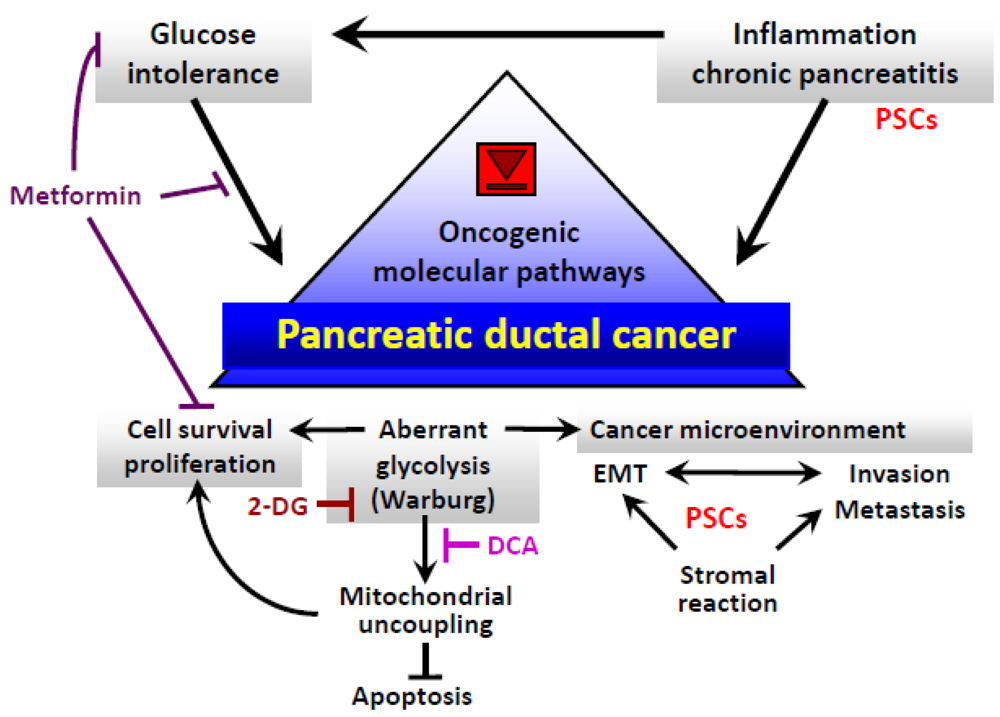
<p>Pancreatic cancer develops through a series of complex, cumulative biological processes involving metabolic disorder and chronic local inflammation in association with stromal changes and deregulated molecular pathways (<xref ref-type="fig" rid="f1-cancers-03-00446">Figure 1</xref>). Based on these pathologic properties, new therapeutic strategies are being developed to reverse the refractory stage of pancreatic cancer. Here, we review the multidimensional processes leading to pancreatic cancer development and progression, and discuss biology-based therapeutic alternatives to conventional cancer treatments. In addition, we highlight an emerging strategy for cancer treatment that targets glycogen synthase kinase 3β (GSK3β), focusing on the effect of its deregulation on pancreatic cancer.</p></sec>
<sec>
<label>2.</label>
<title>Metabolic Disorder Coincides with Pancreatic Cancer</title>
<p>Although systemic metabolic disorders such as obesity and type II diabetes mellitus (DM) influence the risk of developing pancreatic cancer and clinical outcomes (reviewed in [<xref ref-type="bibr" rid="b9-cancers-03-00446">9</xref>,<xref ref-type="bibr" rid="b10-cancers-03-00446">10</xref>]), the abnormal metabolic profile of cancer cells dictates their survival, proliferation, and invasion, as well as susceptibility to chemotherapy and radiation [<xref ref-type="bibr" rid="b11-cancers-03-00446">11</xref>,<xref ref-type="bibr" rid="b12-cancers-03-00446">12</xref>]. Thus, metabolic disorder and altered tumor cell metabolism are potential targets for cancer treatment and (chemo) prevention [<xref ref-type="bibr" rid="b13-cancers-03-00446">13</xref>,<xref ref-type="bibr" rid="b14-cancers-03-00446">14</xref>].</p>
<sec>
<label>2.1.</label>
<title>Obesity, Glucose Intolerance, and Pancreatic Cancer</title>
<p>The association between obesity/DM and pancreatic cancer risk has long been controversial. However, recent reviews and meta-analyses of prospective observational studies have demonstrated that obesity, defined by an increased body mass index, is significantly associated with a risk of pancreatic cancer development [<xref ref-type="bibr" rid="b15-cancers-03-00446">15</xref>,<xref ref-type="bibr" rid="b16-cancers-03-00446">16</xref>]. DM is also a clinical manifestation of pancreatic cancer, and case-control and prospective studies have demonstrated an increased risk of pancreatic cancer in patients with long-term DM [<xref ref-type="bibr" rid="b17-cancers-03-00446">17</xref>-<xref ref-type="bibr" rid="b19-cancers-03-00446">19</xref>]. Obesity is associated with the early manifestations of pancreatic cancer and lower overall patient survival [<xref ref-type="bibr" rid="b20-cancers-03-00446">20</xref>], although the influence of DM on pancreatic cancer progression or morbidity is not clear [<xref ref-type="bibr" rid="b10-cancers-03-00446">10</xref>]. Possible mechanisms behind the association between obesity and worse clinical outcomes may include increased risk of DM, thrombosis, or other comorbidities; impaired immune response leading to aggressive tumor behavior; and poor response to conventional anticancer therapies [<xref ref-type="bibr" rid="b10-cancers-03-00446">10</xref>]. The effect of obesity and DM on the development and progression of pancreatic cancer appears to be mediated by adipokines, reactive oxygen species (ROS), inflammatory cytokines, and insulin resistance, which result in activation of insulin-like growth factor-1 (IGF-1) and mammalian target of rapamycin (mTOR) pathways (reviewed in [<xref ref-type="bibr" rid="b10-cancers-03-00446">10</xref>]).</p>
<p>A number of studies have reported the potential role of glucose-lowering therapies in reducing the risk of pancreatic cancer (reviewed in [<xref ref-type="bibr" rid="b21-cancers-03-00446">21</xref>]). Metformin is a biguanide that is most frequently prescribed for diabetes [<xref ref-type="bibr" rid="b22-cancers-03-00446">22</xref>]. Recently, a comprehensive review and meta-analysis of epidemiologic studies demonstrated an inverse correlation between the use of metformin and incidence of pancreatic cancer and overall survival of patients with diabetes [<xref ref-type="bibr" rid="b23-cancers-03-00446">23</xref>]. Increasing evidence also suggests that metformin exerts a therapeutic effect against cancer [<xref ref-type="bibr" rid="b24-cancers-03-00446">24</xref>,<xref ref-type="bibr" rid="b25-cancers-03-00446">25</xref>]. Metformin decreases insulin resistance and indirectly reduces levels of insulin and IGF-1, which promote cancer cell proliferation [<xref ref-type="bibr" rid="b26-cancers-03-00446">26</xref>]. Further, metformin activates the tumor suppressor pathway mediated by liver kinase B1 (LKB1) and 5′ AMP-activated protein kinase (AMPK), an important sensor of cellular energy status [<xref ref-type="bibr" rid="b27-cancers-03-00446">27</xref>], thereby inactivating mTOR signaling [<xref ref-type="bibr" rid="b14-cancers-03-00446">14</xref>]. IGF-1 receptor and G protein-coupled receptor signaling is implicated in the autocrine-paracrine stimulation of a variety of malignant tumors, including exocrine pancreatic cancer. Recent studies demonstrated that metformin-induced activation of AMPK disrupts the crosstalk between insulin/IGF-1 receptor and G protein-coupled receptor signaling pathways in pancreatic cancer cells and inhibits proliferation of these cells in xenograft models, suggesting this crosstalk as a target for treatment of pancreatic cancer by metformin [<xref ref-type="bibr" rid="b28-cancers-03-00446">28</xref>].</p></sec>
<sec>
<label>2.2.</label>
<title>Distinct Metabolic Properties of Cancer Cells</title>
<p>The fundamental metabolic characteristics of cancer cells include increased glucose uptake, aerobic glycolysis even under normoxic condition (Warburg effect) [<xref ref-type="bibr" rid="b29-cancers-03-00446">29</xref>], and impaired oxidative phosphorylation in the tricarboxylic acid (TCA) cycle, which results in mitochondrial uncoupling [<xref ref-type="bibr" rid="b30-cancers-03-00446">30</xref>]. These properties could explain the ability of cancer cells to survive, invade host tissues, and resist the induction of apoptosis by chemotherapeutic agents and ionizing radiation [<xref ref-type="bibr" rid="b30-cancers-03-00446">30</xref>,<xref ref-type="bibr" rid="b31-cancers-03-00446">31</xref>]. However, the glycolytic phenotype of cancer cells is a potential target for cancer diagnosis and treatment [<xref ref-type="bibr" rid="b32-cancers-03-00446">32</xref>]. For example, enhanced glucose uptake by cancer cells can be used to visualize cancer by positron emission tomography (PET) using the radioisotope-labeled glucose analogue 2-[<sup>18</sup>F]-fluoro-2-deoxy-D-glucose (FDG). FDG-PET in combination with computed tomography (PET-CT) enables detection of metastatic lesions of most cancers with both sensitivity and specificity greater than 90% [<xref ref-type="bibr" rid="b33-cancers-03-00446">33</xref>]. Pharmacologic agents targeting the glycolytic phenotype of cancer cells include 2-deoxy-D-glucose (2-DG) and dichloroacetate (DCA).</p>
<p>A glucose analogue, 2-DG, is the most attractive agent for targeting aberrant glucose metabolism in cancer cells [<xref ref-type="bibr" rid="b34-cancers-03-00446">34</xref>]. 2-DG inhibits glucose transport by competing with glucose transporters and is subsequently phosphorylated by hexokinase to form 2-DG-6-phospate. Phosphorylated 2-DG is not further metabolized by inhibiting glucose-6-phosphate isomerase, thereby reducing the production of adenosine triphosphate (ATP) and nicotinamide adenine dinucleotide phosphate (NADPH) from glycolysis coupled with the pentose phosphate pathway. Thus, 2-DG exerts antitumor effects by starving cancer cells [<xref ref-type="bibr" rid="b34-cancers-03-00446">34</xref>].</p>
<p>The association between the glycolytic phenotype (<italic>i.e.</italic>, TCA cycle defects) and resistance to apoptosis is attributed to decreased mitochondrial hydrogen peroxide production and cytochrome C release [<xref ref-type="bibr" rid="b30-cancers-03-00446">30</xref>,<xref ref-type="bibr" rid="b31-cancers-03-00446">31</xref>]. Pyruvate dehydrogenase (PDH) plays a crucial role in triggering the TCA cycle by converting pyruvate to citric acid. PDH kinase 1 (PDK1), which phosphorylates and inactivates PDH, is frequently overactivated in cancer cells, resulting in an impaired TCA cycle and mitochondrial hyperpolarization. Thus, inhibiting PDK1 would re-activate PDH and restore mitochondrial membrane polarity, thereby facilitating cancer cell apoptosis in response to chemotherapeutic agents and radiation. DCA, an orally bio-available small molecule, is a well characterized PDK1 inhibitor. The ability of DCA to inhibit lactate production (by stimulating PDH and the TCA cycle) has been long used to treat lactic acidosis, which complicates inherited mitochondrial disorders [<xref ref-type="bibr" rid="b35-cancers-03-00446">35</xref>,<xref ref-type="bibr" rid="b36-cancers-03-00446">36</xref>]. A recent study demonstrated that DCA induces cancer cell apoptosis by selectively inhibiting PDK1 in cancer cells, leading to metabolic remodeling from glycolysis to glucose oxidation and normalization of mitochondrial function [<xref ref-type="bibr" rid="b37-cancers-03-00446">37</xref>]. A recent clinical trial of oral DCA in children with congenital lactic acidosis reported that DCA was well tolerated and safe [<xref ref-type="bibr" rid="b36-cancers-03-00446">36</xref>]. Thus, orally available DCA is a promising selective anticancer agent.</p></sec></sec>
<sec>
<label>3.</label>
<title>Inflammation and Stromal Reactions in Pancreatic Cancer</title>
<p>The well recognized link between chronic inflammation and tumor development in many organs [<xref ref-type="bibr" rid="b38-cancers-03-00446">38</xref>] is consistent with the reported causative association and interaction between chronic pancreatitis and pancreatic cancer [<xref ref-type="bibr" rid="b39-cancers-03-00446">39</xref>-<xref ref-type="bibr" rid="b41-cancers-03-00446">41</xref>]. In addition to the etiologic role of inflammation in carcinogenesis, systemic and local inflammation are frequent manifestations of pancreatic cancer and have been implicated in tumor progression and clinical outcomes [<xref ref-type="bibr" rid="b39-cancers-03-00446">39</xref>].</p>
<sec>
<label>3.1.</label>
<title>Chronic Pancreatitis and Pancreatic Cancer</title>
<p>Chronic pancreatitis is a risk factor for developing pancreatic cancer [<xref ref-type="bibr" rid="b39-cancers-03-00446">39</xref>-<xref ref-type="bibr" rid="b41-cancers-03-00446">41</xref>]. This association is supported by a recent meta-analysis of 22 well-performed epidemiologic studies [<xref ref-type="bibr" rid="b42-cancers-03-00446">42</xref>]. The risk of developing pancreatic cancer for patients with hereditary pancreatitis is much higher than for patients with sporadic chronic pancreatitis [<xref ref-type="bibr" rid="b43-cancers-03-00446">43</xref>-<xref ref-type="bibr" rid="b45-cancers-03-00446">45</xref>]. The incidence of chronic pancreatitis in the general population is only about 5 to 10 per 100,000 persons a year, as estimated from hospitalization data. In particular, hereditary pancreatitis caused by germline mutations in the cationic trypsinogen gene [<xref ref-type="bibr" rid="b46-cancers-03-00446">46</xref>] accounts for less than 1% of all chronic pancreatitis cases. Therefore, chronic pancreatitis does not constitute a main precursor of pancreatic cancer [<xref ref-type="bibr" rid="b9-cancers-03-00446">9</xref>,<xref ref-type="bibr" rid="b42-cancers-03-00446">42</xref>].</p>
<p>Despite this low incidence, both forms of chronic pancreatitis have provided substantial evidence for putative inflammatory mechanisms contributing to pancreatic cancer development and progression, including proinflammatory cytokines, nuclear factor-κB (NF-κB), cyclooxygenase-2 (COX-2), peroxisome proliferator-activated receptor-γ (PPARγ), nitric oxide (NO) synthesized by inducible NO synthase (iNOS), DNA damage caused by release of proteolytic enzymes and ROS, and somatic mutations in oncogenes (e.g., K-ras) and tumor suppressor genes (e.g., p53, p16, DPC4/Smad) [<xref ref-type="bibr" rid="b47-cancers-03-00446">47</xref>-<xref ref-type="bibr" rid="b49-cancers-03-00446">49</xref>]. Pancreatic cancer progression shares these molecular alterations, which are promising targets for early molecular diagnosis, treatment, and prevention of the disease [<xref ref-type="bibr" rid="b47-cancers-03-00446">47</xref>-<xref ref-type="bibr" rid="b49-cancers-03-00446">49</xref>].</p>
<p>Histopathologic findings of chronic pancreatitis include marked fibrosis, in which pancreatic stellate cells (PSCs) play a crucial role [<xref ref-type="bibr" rid="b50-cancers-03-00446">50</xref>,<xref ref-type="bibr" rid="b51-cancers-03-00446">51</xref>]. In the normal pancreas, quiescent PSCs produce vitamin A in the periacinar and interlobular space. In response to pancreatic inflammation, PSCs are activated and transformed to a myofibroblast-like phenotype; they proliferate, migrate and produce extracellular matrix components (e.g., collagens, laminin, fibronectin), matrix metalloproteinases, and tissue inhibitors of matrix metalloproteinases. This phenotypic change is induced by inflammatory cytokines (e.g., tumor necrosis factor, interleukin-1, and interleukin-6), growth factors such as transforming growth factor (TGF)-β1, TGF-α, platelet-derived growth factor (PDGF), and fibroblast growth factor (FGF)-2; and ROS [<xref ref-type="bibr" rid="b52-cancers-03-00446">52</xref>]. In addition to their roles in the pathogenesis of chronic pancreatitis and cancer, these factors also promote pancreatic cancer progression [<xref ref-type="bibr" rid="b50-cancers-03-00446">50</xref>,<xref ref-type="bibr" rid="b51-cancers-03-00446">51</xref>].</p></sec>
<sec>
<label>3.2.</label>
<title>Cancer-Stromal Interaction and Tumor Microenvironment</title>
<p>Chronic inflammation, desmoplastic stromal reaction, and neovascularization associated with pancreatic cancer combine to produce a distinct tissue microenvironment where cancer cell proliferation and invasion are facilitated by cancer-stromal interactions [<xref ref-type="bibr" rid="b53-cancers-03-00446">53</xref>,<xref ref-type="bibr" rid="b54-cancers-03-00446">54</xref>]. Activated PSCs are primarily responsible for the desmoplastic reaction and tumor angiogenesis in response to various growth factors such as TGF-β, FGF, HGF, and IGF-1. Results from <italic>in vitro</italic> and <italic>in vivo</italic> studies suggest that cancer cells recruit PSCs to tumors, where PSCs promote cancer cell proliferation and facilitate their invasion and metastasis, and that FGF and PDGF mediate these interactions between the two cell types (reviewed in [<xref ref-type="bibr" rid="b55-cancers-03-00446">55</xref>]).</p>
<p>Phenotypic changes also occur in cancer cells, as represented by epithelial-mesenchymal transition (EMT) at the interface between tumor and stroma, in which epithelial cells undergo morphologic changes characterized by a transition from epithelial to fibroblastic (mesenchymal cell) phenotypes. Most factors involved in pancreatic cancer-stromal interactions have the potential to induce EMT in cancer cells. This process involves loss of cell-to-cell adhesion and E-cadherin expression, actin cytoskeleton reorganization, and increased expression of mesenchymal molecules (e.g., vimentin, fibronectin, α-smooth muscle actin, N-cadherin). In this way, EMT facilitates the invasion and metastasis of cancer cells and renders them resistant to chemotherapy and radiation [<xref ref-type="bibr" rid="b56-cancers-03-00446">56</xref>,<xref ref-type="bibr" rid="b57-cancers-03-00446">57</xref>]. Accordingly, growth factors such as TGF-β and hepatocyte growth factor (HGF, or its receptor c-Met) that are involved in cancer-stromal interactions and EMT have been well studied in order to develop therapeutic strategies targeting these factors [<xref ref-type="bibr" rid="b53-cancers-03-00446">53</xref>,<xref ref-type="bibr" rid="b54-cancers-03-00446">54</xref>].</p></sec></sec>
<sec>
<label>4.</label>
<title>Targeting Molecular Pathways Deregulated in Pancreatic Cancer</title>
<p>Most cases of pancreatic cancer are resistant to conventional chemotherapy and radiation therapy [<xref ref-type="bibr" rid="b5-cancers-03-00446">5</xref>-<xref ref-type="bibr" rid="b7-cancers-03-00446">7</xref>]; therefore, new strategies are needed to enhance the antitumor effects of gemcitabine, which is the standard chemotherapeutic agent used to treat pancreatic cancer [<xref ref-type="bibr" rid="b58-cancers-03-00446">58</xref>]. These new classes of biology-based treatment modalities include molecular target-directed therapies.</p>
<sec>
<label>4.1.</label>
<title>Deregulated Molecular Pathways Mediated by Receptor-Type Tyrosine Kinases</title>
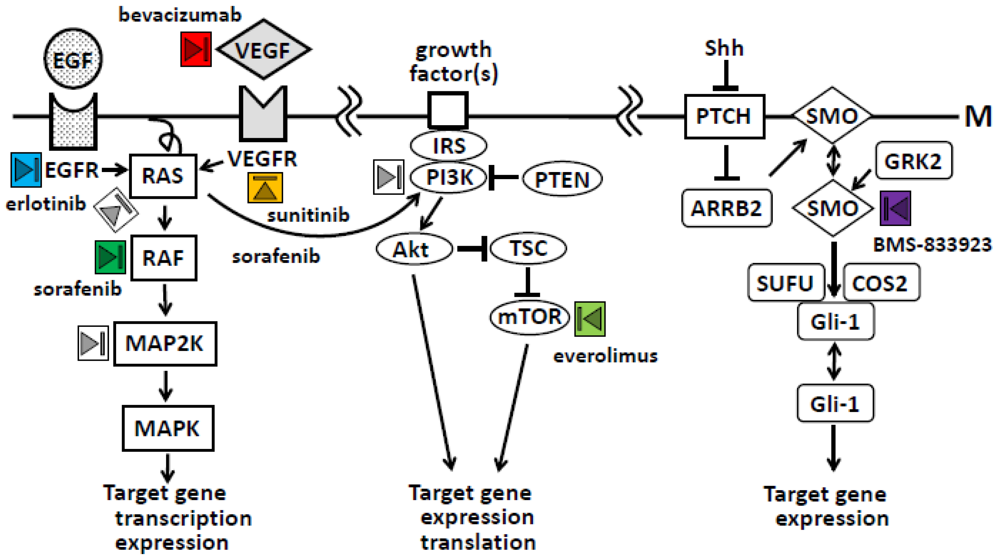
<p>Molecular studies have investigated the complex genetic mechanisms of cancer, which involve multidirectional signal transduction pathways [<xref ref-type="bibr" rid="b3-cancers-03-00446">3</xref>,<xref ref-type="bibr" rid="b59-cancers-03-00446">59</xref>,<xref ref-type="bibr" rid="b60-cancers-03-00446">60</xref>]. As shown in <xref ref-type="fig" rid="f2-cancers-03-00446">Figure 2</xref>, the major signal transduction pathways in pancreatic cancer pathogenesis and progression are RAS/mitogen-activated protein kinase (MAPK), phosphatidylinositol 3-kinase (PI3K)/Akt/mTOR, and hedgehog pathways [<xref ref-type="bibr" rid="b3-cancers-03-00446">3</xref>]. The receptor tyrosine kinase family and their ligands, which include epidermal growth factor (EGF) receptor (EGFR), vascular endothelial growth factor (VEGF) receptor (VEGFR), and PDGF receptor (PDGFR), are targets of therapy because they are overexpressed in many tumor types, including pancreatic cancer [<xref ref-type="bibr" rid="b61-cancers-03-00446">61</xref>].</p></sec>
<sec>
<label>4.2.</label>
<title>Pharmacologic Agents that Target Deregulated Kinases</title>
<p>Currently available agents that target these factors include anti-EGFR antibodies (cetuximab, panitumumab), small molecule EGFR inhibitors (gefitinib, erlotinib), an anti-VEGF antibody (bevacizumab), and a small molecule VEGFR inhibitor (axitinib). A number of phase III clinical trials have tested kinase inhibitors as monotherapy or in combination therapy with gemcitabine for pancreatic cancer, but other than the combination of erlotinib and gemcitabine [<xref ref-type="bibr" rid="b62-cancers-03-00446">62</xref>], these approaches have produced few therapeutic benefits [<xref ref-type="bibr" rid="b63-cancers-03-00446">63</xref>]. Characterization of new molecular targets is necessary in order to develop strategies that enhance the effect of gemcitabine and improve the survival rate. Recent studies have pursued potential kinases as targets for new anticancer agents [<xref ref-type="bibr" rid="b64-cancers-03-00446">64</xref>] and evaluated agents targeting known kinases (e.g., EGFR, check-point kinase 1) to combine with gemcitabine in order to improve its antitumor effects [<xref ref-type="bibr" rid="b65-cancers-03-00446">65</xref>].</p></sec></sec>
<sec>
<label>5.</label>
<title>GSK3β, an Emerging Therapeutic Target in Cancer</title>
<p>GSK3β has emerged as a critical factor that plays distinct pathologic roles in glucose intolerance, inflammation, and in various cancer types (e.g., pancreatic cancer). Here, we briefly review recent studies, including our own, that demonstrate the direct anticancer effects of GSK3β inhibition, alone or in combination with chemotherapy and radiation.</p>
<sec>
<label>5.1.</label>
<title>Outline of GSK3β and its Involvement in Chronic Progressive Diseases</title>
<p>GSK3β was first identified as a serine/threonine protein kinase that regulates glucose/glycogen metabolism under the control of insulin signaling. Unlike most protein kinases, GSK3β is active in normal cells, and its activity is controlled by subcellular localization, differential phosphorylation at serine 9 (S9) and tyrosine 216 (Y216) residues, and different binding partners. In addition to regulating its primary target, glycogen synthase, GSK3β is involved in other fundamental cellular pathways depending on its substrates and binding partners [<xref ref-type="bibr" rid="b66-cancers-03-00446">66</xref>-<xref ref-type="bibr" rid="b68-cancers-03-00446">68</xref>]. GSK3β is a potential therapeutic target for common chronic diseases including type 2 DM and Alzheimer's disease, given the causative associations with glucose intolerance, neurodegenerative disorders, and inflammation [<xref ref-type="bibr" rid="b69-cancers-03-00446">69</xref>-<xref ref-type="bibr" rid="b71-cancers-03-00446">71</xref>].</p></sec>
<sec>
<label>5.2.</label>
<title>Pathologic Role of GSK3β in Various Cancer Types</title>
<p>Under physiologic conditions, GSK3β phosphorylates several transcription factors (e.g., c-Jun, c-Myc), cell cycle regulators (e.g., cyclin D1), and proto-oncoproteins (e.g., β-catenin), thereby triggering their degradation via the ubiquitin-proteasome system. GSK3β is, therefore, hypothesized to inhibit tumor development by interfering with oncogenic signaling (e.g., Wnt, hedgehog) [<xref ref-type="bibr" rid="b72-cancers-03-00446">72</xref>]. However, there is little evidence that links GSK3β inactivation or loss of GSK3β expression with tumor development.</p>
<p>In the last five years, we demonstrated that deregulated expression, phosphorylation of S9 and Y216, and GSK3β activity are distinct features of gastrointestinal cancers including pancreatic cancers and glioblastoma, and that GSK3β sustains the survival and proliferation of these tumor cells. A pathologic role for GSK3β is supported by observations that inhibition of its activity reduced the survival and proliferation of different cancer cell types, predisposing them to apoptosis both <italic>in vitro</italic> and in tumor xenografts [<xref ref-type="bibr" rid="b73-cancers-03-00446">73</xref>-<xref ref-type="bibr" rid="b76-cancers-03-00446">76</xref>]. We also found that GSK3β inhibition in cancer cells was accompanied by restoration of p53 and Rb tumor suppressor pathways [<xref ref-type="bibr" rid="b75-cancers-03-00446">75</xref>,<xref ref-type="bibr" rid="b76-cancers-03-00446">76</xref>] and downregulation of human telomerase reverse transcriptase (hTERT), resulting in cell senescence [<xref ref-type="bibr" rid="b76-cancers-03-00446">76</xref>]. This led us to propose GSK3β as a potential target for cancer treatment and to apply for domestic and international patents [<xref ref-type="bibr" rid="b77-cancers-03-00446">77</xref>].</p>
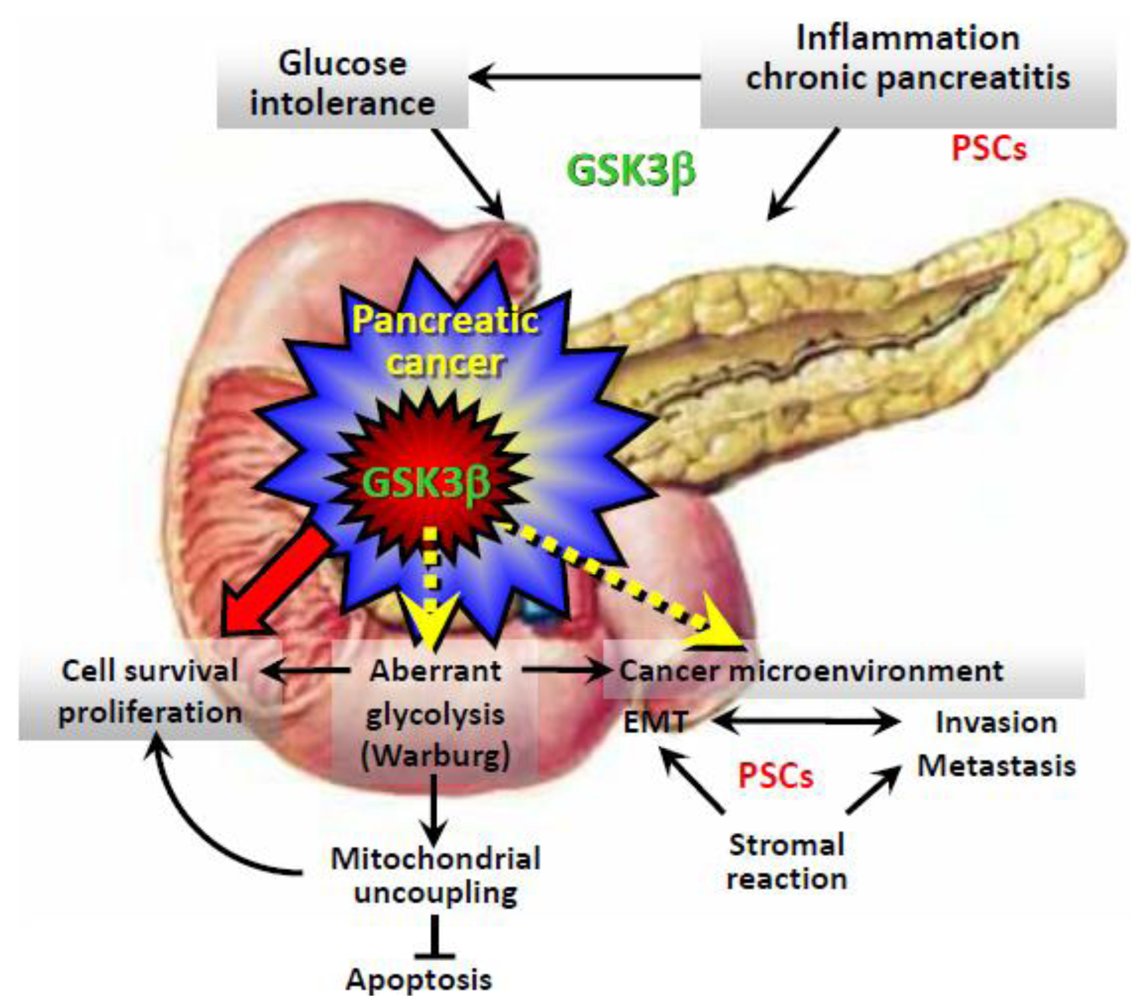
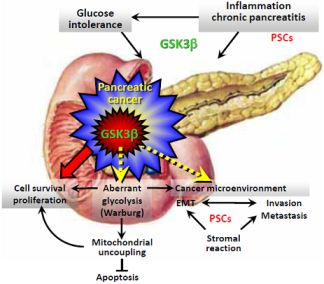
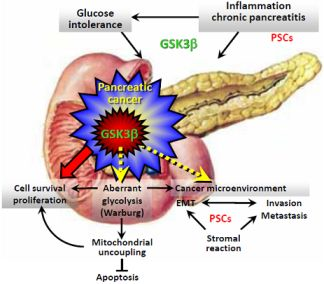
<p>Simultaneously and following our studies on the antitumor effects of GSK3β inhibition, similar observations from other laboratories were reported for various cancer types with underlying mechanisms that included regulation by GSK3β inhibition of several pathways mediated by p53, Rb, p27<sup>Kip1</sup>, cyclin-dependent kinase (CDK), cyclin D1, c-Myc, and NF-κB [<xref ref-type="bibr" rid="b78-cancers-03-00446">78</xref>]. Although the putative role of GSK3β in cancer is still debated [<xref ref-type="bibr" rid="b79-cancers-03-00446">79</xref>,<xref ref-type="bibr" rid="b80-cancers-03-00446">80</xref>], the overall results indicate that aberrant expression and activity of GSK3β is likely to be a common and fundamental characteristic of a broad spectrum of cancers (<xref ref-type="fig" rid="f3-cancers-03-00446">Figure 3</xref>) [<xref ref-type="bibr" rid="b78-cancers-03-00446">78</xref>].</p>
<p>Based on the potential involvement of GSK3β in NF-κB-mediated cell survival [<xref ref-type="bibr" rid="b81-cancers-03-00446">81</xref>,<xref ref-type="bibr" rid="b82-cancers-03-00446">82</xref>], a number of studies demonstrated that GSK3β is involved in pancreatic cancer cell survival via the NF-κB pathway [<xref ref-type="bibr" rid="b83-cancers-03-00446">83</xref>-<xref ref-type="bibr" rid="b85-cancers-03-00446">85</xref>]. Few studies had focused on the role of GSK3β in the cellular response to chemotherapy until we reported that GSK3β inhibition sensitizes glioblastoma cells to chemotherapeutic agents (e.g., temozolomide, ACNU) and ionizing radiation [<xref ref-type="bibr" rid="b75-cancers-03-00446">75</xref>]. However, a recent study failed to demonstrate that disrupting NF-κB activity by inhibiting GSK3β sensitizes PANC-1 pancreatic cancer cells to gemcitabine [<xref ref-type="bibr" rid="b85-cancers-03-00446">85</xref>]. We previously found that GSK3β inhibition did not affect endogenous NF-κB transcriptional activity in tumor cells established from pancreatic cancers and glioblastoma [<xref ref-type="bibr" rid="b75-cancers-03-00446">75</xref>,<xref ref-type="bibr" rid="b76-cancers-03-00446">76</xref>]. In a preliminary study, we found that a small-molecule GSK3β inhibitor increased pancreatic cancer cell sensitivity to gemcitabine in cell culture and tumor xenografts when its dose and treatment protocol were optimized, and have identified the molecular mechanisms underlying the increased sensitivity [<xref ref-type="bibr" rid="b86-cancers-03-00446">86</xref>]. Our findings indicate that GSK3β inhibition combined with chemotherapy is a novel and promising strategy to sensitize pancreatic cancer cells to gemcitabine.</p></sec>
<sec>
<label>5.3.</label>
<title>Putative Antitumor Effects of GSK3β Inhibition via Modulation of Tumor Biology</title>
<p>Increasing evidence suggests that GSK3β participates in a wide range of physiological processes that determine cell fate, including cell motility, energy metabolism, and transcriptional control (reviewed in [<xref ref-type="bibr" rid="b78-cancers-03-00446">78</xref>]). In addition to the pathologic roles of GSK3β in cancer cell survival and proliferation [<xref ref-type="bibr" rid="b73-cancers-03-00446">73</xref>-<xref ref-type="bibr" rid="b78-cancers-03-00446">78</xref>,<xref ref-type="bibr" rid="b83-cancers-03-00446">83</xref>-<xref ref-type="bibr" rid="b85-cancers-03-00446">85</xref>] as discussed above, GSK3β may influence critical biological properties of cancer cells, such as their dependence on glycolysis and invasive ability associated with EMT (<xref ref-type="fig" rid="f3-cancers-03-00446">Figure 3</xref>). Modulation of these biological properties by pharmacologic inhibition of GSK3β may sensitize pancreatic cancer cells to standard chemotherapy and radiation. Given the systemic pathology caused by aberrant GSK3β activity in glucose intolerance and chronic inflammation [<xref ref-type="bibr" rid="b71-cancers-03-00446">71</xref>], GSK3β inhibition may decrease the risk of developing pancreatic cancer by improving these conditions. Accordingly, investigating the functions and pathologic roles of GSK3β should establish a firm molecular basis for future cancer treatments that target this kinase.</p></sec></sec>
<sec>
<label>6.</label>
<title>Perspectives</title>
<p>Here, we reviewed recent studies on the epidemiologic characteristics of pancreatic cancer and the molecular and biological mechanisms contributing to its development and progression, and highlight advances in alternatives to conventional treatments. Although molecular target-directed therapy is currently attracting considerable attention, especially for cancer refractory to standard chemotherapy and radiation, this therapy produces therapeutic effects that are still far from sufficient for most patients with advanced and recurrent pancreatic cancer. For many cancer patients, including those with pancreatic cancer, resistance to currently available therapeutics presents a major obstacle and is due to the aberrant metabolism of cancer cells, their microenvironment, their ability to invade and metastasize, and the acquisition of gene mutations. Multidisciplinary approaches directed to a more complete understanding of pancreatic cancer pathogenesis hold great promise in improving the outlook of this disease.</p></sec></body>
<back>
<sec sec-type="display-objects">
<title>Figures</title>
<fig id="f1-cancers-03-00446" position="float">
<label>Figure 1.</label>
<caption>
<p>Molecular and biological pathways involved in the development and progression of pancreatic cancer and putative mechanisms underlying the anticancer effects of metformin, 2-deoxyglucose (2-DG), and dichloroacetate (DCA). The gray triangle in a box indicates a molecular target. Abbreviations: EMT, epithelial-to-mesenchymal transition; PSCs, pancreatic stellate cells; Warburg, Warburg effect.</p></caption>
<graphic xlink:href="cancers-03-00446f1.gif"/></fig>
<fig id="f2-cancers-03-00446" position="float">
<label>Figure 2.</label>
<caption>
<p>Critical molecular pathways leading to the development and progression of pancreatic cancer. Abbreviations: ARRB2, arrestin β2 ; COS2, kinesin-related protein Costal 2; DUSP6, dual specificity phosphatase 6; EGF, epidermal growth factor; EGFR, EGF receptor; GRK2, G protein-coupled receptor kinase-2; IRS, insulin receptor substrate 1; M, cell membrane; MAPK, mitogen-activated protein kinase; MAP2K, MAP kinase kinases; mTOR, mammalian target of rapamycin; PI3K, phosphatidylinositol 3-kinase; PTCH, patched; PTEN, phosphatase and tensin homolog deleted in chromosome 10; Shh, sonic hedgehog; SMO, smoothened; SUFU, suppressor of fused; TSC, tuberous sclerosis complex; VEGF, vascular endothelial growth factor; VEGFR, VEGF receptor. The gray triangle in a box indicates a target for drug development.</p></caption>
<graphic xlink:href="cancers-03-00446f2.gif"/></fig>
<fig id="f3-cancers-03-00446" position="float">
<label>Figure 3.</label>
<caption>
<p>Systemic and local effects of aberrant GSK3β on risk factors (glucose intolerance and chronic inflammation) and progression of pancreatic cancer. Molecular mechanisms leading to the pathways indicated by the dotted arrows are not well characterized.</p></caption>
<graphic xlink:href="cancers-03-00446f3.gif"/></fig></sec>
<ack>
<p>This work was supported in part by Grants-in-Aids for Scientific Research from the Japanese Ministry of Education, Science, Sports, Technology and Culture (to Y.M., T.M.), Grant for Collaborative Research from Kanazawa Medical University (C2008-3), and by a Project Research Grant from the High-Tech Research Center of Kanazawa Medical University (H2010 -11).</p></ack>
<ref-list>
<title>References</title>
<ref id="b1-cancers-03-00446"><label>1.</label><citation citation-type="journal"><person-group person-group-type="author"><name><surname>Li</surname><given-names>D.</given-names></name><name><surname>Xie</surname><given-names>K.</given-names></name><name><surname>Wolff</surname><given-names>R.</given-names></name><name><surname>Abbruzzese</surname><given-names>J.L.</given-names></name></person-group><article-title>Pancreatic cancer</article-title><source>Lancet</source><year>2004</year><volume>363</volume><fpage>1049</fpage><lpage>1057</lpage><pub-id pub-id-type="doi">10.1016/S0140-6736(04)15841-8</pub-id><pub-id pub-id-type="pmid">15051286</pub-id></citation></ref>
<ref id="b2-cancers-03-00446"><label>2.</label><citation citation-type="journal"><person-group person-group-type="author"><name><surname>Schneider</surname><given-names>G.</given-names></name><name><surname>Siveke</surname><given-names>J.T.</given-names></name><name><surname>Eckel</surname><given-names>F.</given-names></name><name><surname>Schmid</surname><given-names>R.M.</given-names></name></person-group><article-title>Pancreatic cancer: Basic and clinical aspects</article-title><source>Gastroenterology</source><year>2005</year><volume>128</volume><fpage>1606</fpage><lpage>1625</lpage><pub-id pub-id-type="doi">10.1053/j.gastro.2005.04.001</pub-id><pub-id pub-id-type="pmid">15887154</pub-id></citation></ref>
<ref id="b3-cancers-03-00446"><label>3.</label><citation citation-type="journal"><person-group person-group-type="author"><name><surname>Bardeesy</surname><given-names>N.</given-names></name><name><surname>DePinho</surname><given-names>R.A.</given-names></name></person-group><article-title>Pancreatic cancer biology and genetics</article-title><source>Nat. Rev. Cancer</source><year>2002</year><volume>2</volume><fpage>897</fpage><lpage>909</lpage><pub-id pub-id-type="pmid">12459728</pub-id></citation></ref>
<ref id="b4-cancers-03-00446"><label>4.</label><citation citation-type="journal"><person-group person-group-type="author"><name><surname>Lockhart</surname><given-names>A.C.</given-names></name><name><surname>Rothenberg</surname><given-names>M.L.</given-names></name><name><surname>Berlin</surname><given-names>J.D.</given-names></name></person-group><article-title>Treatment for pancreatic cancer: Current therapy and continued progress</article-title><source>Gastroenterology</source><year>2005</year><volume>128</volume><fpage>1642</fpage><lpage>1654</lpage><pub-id pub-id-type="doi">10.1053/j.gastro.2005.03.039</pub-id><pub-id pub-id-type="pmid">15887156</pub-id></citation></ref>
<ref id="b5-cancers-03-00446"><label>5.</label><citation citation-type="journal"><person-group person-group-type="author"><name><surname>Wray</surname><given-names>C.J.</given-names></name><name><surname>Ahmad</surname><given-names>S.A.</given-names></name><name><surname>Matthews</surname><given-names>J.B.</given-names></name><name><surname>Lowy</surname><given-names>A.M.</given-names></name></person-group><article-title>Surgery for pancreatic cancer: Recent controversies and current practice</article-title><source>Gastroenterology</source><year>2005</year><volume>128</volume><fpage>1626</fpage><lpage>1641</lpage><pub-id pub-id-type="doi">10.1053/j.gastro.2005.03.035</pub-id><pub-id pub-id-type="pmid">15887155</pub-id></citation></ref>
<ref id="b6-cancers-03-00446"><label>6.</label><citation citation-type="journal"><person-group person-group-type="author"><name><surname>Ben-Josef</surname><given-names>E.</given-names></name><name><surname>Lawrence</surname><given-names>T.S.</given-names></name></person-group><article-title>Chemotherapy for unresectable pancreatic cancer</article-title><source>Int. J. Clin. Oncol.</source><year>2008</year><volume>13</volume><fpage>121</fpage><lpage>126</lpage><pub-id pub-id-type="doi">10.1007/s10147-007-0763-x</pub-id><pub-id pub-id-type="pmid">18463955</pub-id></citation></ref>
<ref id="b7-cancers-03-00446"><label>7.</label><citation citation-type="journal"><person-group person-group-type="author"><name><surname>Okusaka</surname><given-names>T.</given-names></name><name><surname>Ito</surname><given-names>Y.</given-names></name><name><surname>Furuse</surname><given-names>J.</given-names></name><name><surname>Yamada</surname><given-names>S.</given-names></name><name><surname>Ishii</surname><given-names>H.</given-names></name><name><surname>Shibuya</surname><given-names>K.</given-names></name><name><surname>Ioka</surname><given-names>T.</given-names></name><name><surname>Shinchi</surname><given-names>H.</given-names></name></person-group><article-title>Current status of chemoradiotherapy for locally advanced pancreatic cancer in Japan</article-title><source>Int. J. Clin. Oncol.</source><year>2008</year><volume>13</volume><fpage>127</fpage><lpage>131</lpage><pub-id pub-id-type="doi">10.1007/s10147-007-0739-x</pub-id><pub-id pub-id-type="pmid">18463956</pub-id></citation></ref>
<ref id="b8-cancers-03-00446"><label>8.</label><citation citation-type="journal"><person-group person-group-type="author"><name><surname>Jamel</surname><given-names>A.</given-names></name><name><surname>Siegel</surname><given-names>R.</given-names></name><name><surname>Ward</surname><given-names>E.</given-names></name><name><surname>Hao</surname><given-names>Y.</given-names></name><name><surname>Xu</surname><given-names>J.</given-names></name><name><surname>Thun</surname><given-names>M.J.</given-names></name></person-group><article-title>Cancer statistics, 2009</article-title><source>CA Cancer J. Clin.</source><year>2009</year><volume>59</volume><fpage>225</fpage><lpage>249</lpage><pub-id pub-id-type="doi">10.3322/caac.20006</pub-id><pub-id pub-id-type="pmid">19474385</pub-id></citation></ref>
<ref id="b9-cancers-03-00446"><label>9.</label><citation citation-type="journal"><person-group person-group-type="author"><name><surname>Raimondi</surname><given-names>S.</given-names></name><name><surname>Maisonneuve</surname><given-names>P.</given-names></name><name><surname>Lowenfels</surname><given-names>A.B.</given-names></name></person-group><article-title>Epidemiology of pancreatic cancer: An overview</article-title><source>Nat. Rev. Gastroenterol. Hepatol.</source><year>2009</year><volume>6</volume><fpage>699</fpage><lpage>708</lpage><pub-id pub-id-type="doi">10.1038/nrgastro.2009.177</pub-id><pub-id pub-id-type="pmid">19806144</pub-id></citation></ref>
<ref id="b10-cancers-03-00446"><label>10.</label><citation citation-type="journal"><person-group person-group-type="author"><name><surname>Li</surname><given-names>D.</given-names></name><name><surname>Abbruzzese</surname><given-names>J.L.</given-names></name></person-group><article-title>New strategies in pancreatic cancer: Emerging epidemiologic and therapeutic concepts</article-title><source>Clin. Cancer Res.</source><year>2010</year><volume>16</volume><fpage>4313</fpage><lpage>4318</lpage><pub-id pub-id-type="doi">10.1158/1078-0432.CCR-09-1942</pub-id><pub-id pub-id-type="pmid">20647474</pub-id></citation></ref>
<ref id="b11-cancers-03-00446"><label>11.</label><citation citation-type="journal"><person-group person-group-type="author"><name><surname>Smallbone</surname><given-names>K.</given-names></name><name><surname>Gatenby</surname><given-names>R.A.</given-names></name><name><surname>Gillies</surname><given-names>R.J.</given-names></name><name><surname>Maini</surname><given-names>P.K.</given-names></name><name><surname>Gavaghan</surname><given-names>D.J.</given-names></name></person-group><article-title>Metabolic changes during carcinogenesis: Potential impact on invasiveness</article-title><source>J. Theor. Biol.</source><year>2007</year><volume>244</volume><fpage>703</fpage><lpage>713</lpage><pub-id pub-id-type="doi">10.1016/j.jtbi.2006.09.010</pub-id><pub-id pub-id-type="pmid">17055536</pub-id></citation></ref>
<ref id="b12-cancers-03-00446"><label>12.</label><citation citation-type="journal"><person-group person-group-type="author"><name><surname>DeBerardinis</surname><given-names>R.J.</given-names></name><name><surname>Sayed</surname><given-names>N.</given-names></name><name><surname>Ditsworth</surname><given-names>D.</given-names></name><name><surname>Thompson</surname><given-names>C.B.</given-names></name></person-group><article-title>Brick by brick: Metabolism and tumor cell growth</article-title><source>Curr. Opin. Genet. Dev.</source><year>2008</year><volume>18</volume><fpage>54</fpage><lpage>61</lpage><pub-id pub-id-type="doi">10.1016/j.gde.2008.02.003</pub-id><pub-id pub-id-type="pmid">18387799</pub-id></citation></ref>
<ref id="b13-cancers-03-00446"><label>13.</label><citation citation-type="journal"><person-group person-group-type="author"><name><surname>Gatenby</surname><given-names>R.A.</given-names></name><name><surname>Gillies</surname><given-names>R.J.</given-names></name></person-group><article-title>Glycolysis in cancer: A potential target for therapy</article-title><source>Int. J. Biochem. Cell Biol.</source><year>2007</year><volume>39</volume><fpage>1358</fpage><lpage>1366</lpage><pub-id pub-id-type="doi">10.1016/j.biocel.2007.03.021</pub-id><pub-id pub-id-type="pmid">17499003</pub-id></citation></ref>
<ref id="b14-cancers-03-00446"><label>14.</label><citation citation-type="journal"><person-group person-group-type="author"><name><surname>Engelman</surname><given-names>J.A.</given-names></name><name><surname>Cantley</surname><given-names>L.C.</given-names></name></person-group><article-title>Chemoprevention meets glucose control</article-title><source>Cancer Prev. Res.</source><year>2010</year><volume>3</volume><fpage>1049</fpage><lpage>1052</lpage><pub-id pub-id-type="doi">10.1158/1940-6207.CAPR-10-0178</pub-id></citation></ref>
<ref id="b15-cancers-03-00446"><label>15.</label><citation citation-type="journal"><person-group person-group-type="author"><name><surname>Larsson</surname><given-names>S.C.</given-names></name><name><surname>Orsini</surname><given-names>N.</given-names></name><name><surname>Wolk</surname><given-names>A.</given-names></name></person-group><article-title>Body mass index and pancreatic cancer risk: A meta-analysis of prospective studies</article-title><source>Int. J. Cancer</source><year>2007</year><volume>120</volume><fpage>1993</fpage><lpage>1998</lpage><pub-id pub-id-type="doi">10.1002/ijc.22535</pub-id><pub-id pub-id-type="pmid">17266034</pub-id></citation></ref>
<ref id="b16-cancers-03-00446"><label>16.</label><citation citation-type="journal"><person-group person-group-type="author"><name><surname>Renehan</surname><given-names>A.G.</given-names></name><name><surname>Tyson</surname><given-names>M.</given-names></name><name><surname>Egger</surname><given-names>M.</given-names></name><name><surname>Heller</surname><given-names>R.F.</given-names></name><name><surname>Zwahlen</surname><given-names>M.</given-names></name></person-group><article-title>Body-mass index and incidence of cancer: A systemic review and meta-analysis of prospective observation studies</article-title><source>Lancet</source><year>2008</year><volume>371</volume><fpage>569</fpage><lpage>578</lpage><pub-id pub-id-type="doi">10.1016/S0140-6736(08)60269-X</pub-id><pub-id pub-id-type="pmid">18280327</pub-id></citation></ref>
<ref id="b17-cancers-03-00446"><label>17.</label><citation citation-type="journal"><person-group person-group-type="author"><name><surname>Huxley</surname><given-names>R.</given-names></name><name><surname>Ansary-Moghaddam</surname><given-names>A.</given-names></name><name><surname>Berrington de González</surname><given-names>A.</given-names></name><name><surname>Barzi</surname><given-names>F.</given-names></name><name><surname>Woodward</surname><given-names>M.</given-names></name></person-group><article-title>Type-II diabetes and pancreatic cancer: A meta-analysis of 36 studies</article-title><source>Br. J. Cancer</source><year>2005</year><volume>92</volume><fpage>2076</fpage><lpage>2083</lpage><pub-id pub-id-type="doi">10.1038/sj.bjc.6602619</pub-id><pub-id pub-id-type="pmid">15886696</pub-id></citation></ref>
<ref id="b18-cancers-03-00446"><label>18.</label><citation citation-type="journal"><person-group person-group-type="author"><name><surname>Luo</surname><given-names>J.</given-names></name><name><surname>Iwasaki</surname><given-names>M.</given-names></name><name><surname>Inoue</surname><given-names>M.</given-names></name><name><surname>Sasazuki</surname><given-names>S.</given-names></name><name><surname>Otani</surname><given-names>T.</given-names></name><name><surname>Ye</surname><given-names>W.</given-names></name><name><surname>Tsugane</surname><given-names>S.</given-names></name><collab>JPHC Study Group</collab></person-group><article-title>Body mass index, physical activity and the risk of pancreatic cancer in relation to smoking status and history of diabetes: A large-scale population-based cohort study in Japan—the JPHC study</article-title><source>Cancer Causes Contr.</source><year>2007</year><volume>18</volume><fpage>603</fpage><lpage>612</lpage><pub-id pub-id-type="doi">10.1007/s10552-007-9002-z</pub-id></citation></ref>
<ref id="b19-cancers-03-00446"><label>19.</label><citation citation-type="journal"><person-group person-group-type="author"><name><surname>Li</surname><given-names>D.</given-names></name><name><surname>Tang</surname><given-names>H.</given-names></name><name><surname>Hassan</surname><given-names>M.M.</given-names></name><name><surname>Holly</surname><given-names>E.A.</given-names></name><name><surname>Bracci</surname><given-names>P.M.</given-names></name><name><surname>Silverman</surname><given-names>D.T.</given-names></name></person-group><article-title>Diabetes and risk of pancreatic cancer: A pooled analysis of three large case-control studies</article-title><source>Cancer Causes Contr.</source><year>2010</year><pub-id pub-id-type="doi">10.1007/s10552-010-9686-3</pub-id></citation></ref>
<ref id="b20-cancers-03-00446"><label>20.</label><citation citation-type="journal"><person-group person-group-type="author"><name><surname>Li</surname><given-names>D.</given-names></name><name><surname>Morris</surname><given-names>J.S.</given-names></name><name><surname>Liu</surname><given-names>J.</given-names></name><name><surname>Hassan</surname><given-names>M.M.</given-names></name><name><surname>Day</surname><given-names>R.S.</given-names></name><name><surname>Bondy</surname><given-names>M.L.</given-names></name><name><surname>Abbruzzese</surname><given-names>J.L.</given-names></name></person-group><article-title>Body mass index and risk, age of onset, and survival in patients with pancreatic cancer</article-title><source>JAMA</source><year>2009</year><volume>301</volume><fpage>2553</fpage><lpage>2562</lpage><pub-id pub-id-type="doi">10.1001/jama.2009.886</pub-id><pub-id pub-id-type="pmid">19549972</pub-id></citation></ref>
<ref id="b21-cancers-03-00446"><label>21.</label><citation citation-type="journal"><person-group person-group-type="author"><name><surname>Li</surname><given-names>D.</given-names></name><name><surname>Yeung</surname><given-names>S.C.</given-names></name><name><surname>Hassan</surname><given-names>M.M.</given-names></name><name><surname>Konopleva</surname><given-names>M.</given-names></name><name><surname>Abbruzzese</surname><given-names>J.L.</given-names></name></person-group><article-title>Antidiabetic therapies affect risk of pancreatic cancer</article-title><source>Gastroenterology</source><year>2009</year><volume>137</volume><fpage>482</fpage><lpage>488</lpage><pub-id pub-id-type="doi">10.1053/j.gastro.2009.04.013</pub-id><pub-id pub-id-type="pmid">19375425</pub-id></citation></ref>
<ref id="b22-cancers-03-00446"><label>22.</label><citation citation-type="journal"><person-group person-group-type="author"><name><surname>Bolen</surname><given-names>S.</given-names></name><name><surname>Feldman</surname><given-names>L.</given-names></name><name><surname>Vassy</surname><given-names>J.</given-names></name><name><surname>Wilson</surname><given-names>L.</given-names></name><name><surname>Yeh</surname><given-names>H.C.</given-names></name><name><surname>Marinopoulos</surname><given-names>S.</given-names></name><name><surname>Wiley</surname><given-names>C.</given-names></name><name><surname>Selvin</surname><given-names>E.</given-names></name><name><surname>Wilson</surname><given-names>R.</given-names></name><name><surname>Bass</surname><given-names>E.B.</given-names></name><name><surname>Brancati</surname><given-names>F.L.</given-names></name></person-group><article-title>Systematic review: Comparative effectiveness and safety of oral medications for type 2 diabetes mellitus</article-title><source>Ann. Intern. Med.</source><year>2007</year><volume>147</volume><fpage>386</fpage><lpage>399</lpage><pub-id pub-id-type="pmid">17638715</pub-id></citation></ref>
<ref id="b23-cancers-03-00446"><label>23.</label><citation citation-type="journal"><person-group person-group-type="author"><name><surname>DeCensi</surname><given-names>A.</given-names></name><name><surname>Puntoni</surname><given-names>M.</given-names></name><name><surname>Goodwin</surname><given-names>P.</given-names></name><name><surname>Cazzaniga</surname><given-names>M.</given-names></name><name><surname>Gennari</surname><given-names>A.</given-names></name><name><surname>Bonanni</surname><given-names>B.</given-names></name><name><surname>Gandini</surname><given-names>S.</given-names></name></person-group><article-title>Metformin and cancer risk in diabetic patients: A systemic review and meta-analysis</article-title><source>Cancer Prev. Res.</source><year>2010</year><volume>3</volume><fpage>1452</fpage><lpage>1461</lpage></citation></ref>
<ref id="b24-cancers-03-00446"><label>24.</label><citation citation-type="journal"><person-group person-group-type="author"><name><surname>Ben Sahra</surname><given-names>I.</given-names></name><name><surname>Le Marchand-Brustel</surname><given-names>Y.</given-names></name><name><surname>Tanti</surname><given-names>J.-F.</given-names></name><name><surname>Bost</surname><given-names>F.</given-names></name></person-group><article-title>Metformin in cancer therapy: A new perspective for an old antidiabetic drug?</article-title><source>Mol. Cancer Ther.</source><year>2010</year><volume>9</volume><fpage>1092</fpage><lpage>1099</lpage><pub-id pub-id-type="doi">10.1158/1535-7163.MCT-09-1186</pub-id><pub-id pub-id-type="pmid">20442309</pub-id></citation></ref>
<ref id="b25-cancers-03-00446"><label>25.</label><citation citation-type="journal"><person-group person-group-type="author"><name><surname>Pollak</surname><given-names>M.</given-names></name></person-group><article-title>Metformin and other biguanides in oncology: Advancing the research agenda</article-title><source>Cancer Prev. Res.</source><year>2010</year><volume>3</volume><fpage>1060</fpage><lpage>1065</lpage><pub-id pub-id-type="doi">10.1158/1940-6207.CAPR-10-0175</pub-id></citation></ref>
<ref id="b26-cancers-03-00446"><label>26.</label><citation citation-type="journal"><person-group person-group-type="author"><name><surname>Pollak</surname><given-names>M.</given-names></name></person-group><article-title>Insulin and insulin-like growth factor signalling in neoplasia</article-title><source>Nat. Rev. Cancer</source><year>2008</year><volume>8</volume><fpage>915</fpage><lpage>928</lpage><pub-id pub-id-type="doi">10.1038/nrc2536</pub-id><pub-id pub-id-type="pmid">19029956</pub-id></citation></ref>
<ref id="b27-cancers-03-00446"><label>27.</label><citation citation-type="journal"><person-group person-group-type="author"><name><surname>Shackelford</surname><given-names>D.B.</given-names></name><name><surname>Shaw</surname><given-names>R.J.</given-names></name></person-group><article-title>The LKB1-MAPK pathway: Metabolism and growth control in tumor suppression</article-title><source>Nat. Rev. Cancer</source><year>2009</year><volume>9</volume><fpage>563</fpage><lpage>575</lpage><pub-id pub-id-type="doi">10.1038/nrc2676</pub-id><pub-id pub-id-type="pmid">19629071</pub-id></citation></ref>
<ref id="b28-cancers-03-00446"><label>28.</label><citation citation-type="journal"><person-group person-group-type="author"><name><surname>Rozengurt</surname><given-names>E.</given-names></name><name><surname>Sinnett-Smith</surname><given-names>J.</given-names></name><name><surname>Kisfalvi</surname><given-names>K.</given-names></name></person-group><article-title>Crosstalk between insulin/insulin-like growth factor-1 receptors and G protein-coupled receptor signaling systems: A novel target for the antidiabetic drug metformin in pancreatic cancer</article-title><source>Clin. Cancer Res.</source><year>2010</year><volume>16</volume><fpage>2505</fpage><lpage>2511</lpage><pub-id pub-id-type="doi">10.1158/1078-0432.CCR-09-2229</pub-id><pub-id pub-id-type="pmid">20388847</pub-id></citation></ref>
<ref id="b29-cancers-03-00446"><label>29.</label><citation citation-type="journal"><person-group person-group-type="author"><name><surname>Kim</surname><given-names>J.</given-names></name><name><surname>Dang</surname><given-names>C.V.</given-names></name></person-group><article-title>Cancer's molecular sweet tooth and the Warburg effect</article-title><source>Cancer Res.</source><year>2006</year><volume>66</volume><fpage>8927</fpage><lpage>8930</lpage><pub-id pub-id-type="doi">10.1158/0008-5472.CAN-06-1501</pub-id><pub-id pub-id-type="pmid">16982728</pub-id></citation></ref>
<ref id="b30-cancers-03-00446"><label>30.</label><citation citation-type="journal"><person-group person-group-type="author"><name><surname>Samudio</surname><given-names>I.</given-names></name><name><surname>Fiegl</surname><given-names>M.</given-names></name><name><surname>Andreeff</surname><given-names>M.</given-names></name></person-group><article-title>Mitochondrial uncoupling and the Warburg effect: Molecular basis for the reprogrammimg of cancer cell metabolism</article-title><source>Cancer Res.</source><year>2009</year><volume>69</volume><fpage>2163</fpage><lpage>2166</lpage><pub-id pub-id-type="doi">10.1158/0008-5472.CAN-08-3722</pub-id><pub-id pub-id-type="pmid">19258498</pub-id></citation></ref>
<ref id="b31-cancers-03-00446"><label>31.</label><citation citation-type="journal"><person-group person-group-type="author"><name><surname>Vander Heiden</surname><given-names>M.G.</given-names></name><name><surname>Cantley</surname><given-names>L.C.</given-names></name><name><surname>Thompson</surname><given-names>C.B.</given-names></name></person-group><article-title>Understanding the Warburg effect: The metabolic requirements of cell proliferation</article-title><source>Science</source><year>2010</year><volume>324</volume><fpage>1029</fpage><lpage>1033</lpage></citation></ref>
<ref id="b32-cancers-03-00446"><label>32.</label><citation citation-type="journal"><person-group person-group-type="author"><name><surname>Kroemer</surname><given-names>G.</given-names></name><name><surname>Pouyssegur</surname><given-names>J.</given-names></name></person-group><article-title>Tumor cell metabolism: Cancer's Achilles' heel</article-title><source>Cancer Cell</source><year>2008</year><volume>13</volume><fpage>472</fpage><lpage>482</lpage><pub-id pub-id-type="doi">10.1016/j.ccr.2008.05.005</pub-id><pub-id pub-id-type="pmid">18538731</pub-id></citation></ref>
<ref id="b33-cancers-03-00446"><label>33.</label><citation citation-type="journal"><person-group person-group-type="author"><name><surname>Mankoff</surname><given-names>D.A.</given-names></name><name><surname>Eary</surname><given-names>J.F.</given-names></name><name><surname>Link</surname><given-names>J.M.</given-names></name><name><surname>Muzi</surname><given-names>M.</given-names></name><name><surname>Rajendran</surname><given-names>J.G.</given-names></name><name><surname>Spence</surname><given-names>A.M.</given-names></name><name><surname>Krohn</surname><given-names>K.A.</given-names></name></person-group><article-title>Tumor-specific positron emission tomography imaging in patients: [<sup>18</sup>F] Fruolodeoxyglucose and beyond</article-title><source>Clin. Cancer Res.</source><year>2007</year><volume>13</volume><fpage>3460</fpage><lpage>3469</lpage><pub-id pub-id-type="doi">10.1158/1078-0432.CCR-07-0074</pub-id><pub-id pub-id-type="pmid">17575208</pub-id></citation></ref>
<ref id="b34-cancers-03-00446"><label>34.</label><citation citation-type="journal"><person-group person-group-type="author"><name><surname>Dwarakanath</surname><given-names>B.S.</given-names></name><name><surname>Jain</surname><given-names>V.</given-names></name></person-group><article-title>Targeting glucose metabolism with 2-deoxy-D-glucose for improving cancer therapy</article-title><source>Future Oncol.</source><year>2009</year><volume>5</volume><fpage>581</fpage><lpage>585</lpage><pub-id pub-id-type="doi">10.2217/fon.09.44</pub-id><pub-id pub-id-type="pmid">19519197</pub-id></citation></ref>
<ref id="b35-cancers-03-00446"><label>35.</label><citation citation-type="journal"><person-group person-group-type="author"><name><surname>Stacpoole</surname><given-names>P.W.</given-names></name><name><surname>Nagaraja</surname><given-names>N.V.</given-names></name><name><surname>Hutson</surname><given-names>A.D.</given-names></name></person-group><article-title>Efficacy of dichloroacetate as a lactate-lowering drug</article-title><source>J. Clin. Pharmacol.</source><year>2003</year><volume>43</volume><fpage>683</fpage><lpage>691</lpage><pub-id pub-id-type="pmid">12856382</pub-id></citation></ref>
<ref id="b36-cancers-03-00446"><label>36.</label><citation citation-type="journal"><person-group person-group-type="author"><name><surname>Stacpoole</surname><given-names>P.W.</given-names></name><name><surname>Kerr</surname><given-names>D.S.</given-names></name><name><surname>Barnes</surname><given-names>C.</given-names></name><name><surname>Bunch</surname><given-names>S.T.</given-names></name><name><surname>Carney</surname><given-names>P.R.</given-names></name><name><surname>Fennell</surname><given-names>E.M.</given-names></name><name><surname>Felitsyn</surname><given-names>N.M.</given-names></name><name><surname>Gilmore</surname><given-names>R.L.</given-names></name><name><surname>Greer</surname><given-names>M.</given-names></name><name><surname>Henderson</surname><given-names>G.N.</given-names></name><name><surname>Hutson</surname><given-names>A.D.</given-names></name><name><surname>Neiberger</surname><given-names>R.E.</given-names></name><name><surname>O'Brien</surname><given-names>R.G.</given-names></name><name><surname>Perkins</surname><given-names>L.A.</given-names></name><name><surname>Quisling</surname><given-names>R.G.</given-names></name><name><surname>Shroads</surname><given-names>A.L.</given-names></name><name><surname>Shuster</surname><given-names>J.J.</given-names></name><name><surname>Silverstein</surname><given-names>J.H.</given-names></name><name><surname>Theriaque</surname><given-names>D.W.</given-names></name><name><surname>Valenstein</surname><given-names>E.</given-names></name></person-group><article-title>Controlled clinical trial of dichloroacetate for treatment of congenital lactic acidosis in children</article-title><source>Pediatrics</source><year>2006</year><volume>117</volume><fpage>1519</fpage><lpage>1531</lpage><pub-id pub-id-type="doi">10.1542/peds.2005-1226</pub-id><pub-id pub-id-type="pmid">16651305</pub-id></citation></ref>
<ref id="b37-cancers-03-00446"><label>37.</label><citation citation-type="journal"><person-group person-group-type="author"><name><surname>Bonnet</surname><given-names>S.</given-names></name><name><surname>Archer</surname><given-names>S.L.</given-names></name><name><surname>Allalunis-Turner</surname><given-names>J.</given-names></name><name><surname>Haromy</surname><given-names>A.</given-names></name><name><surname>Beaulieu</surname><given-names>C.</given-names></name><name><surname>Thompson</surname><given-names>R.</given-names></name><name><surname>Lee</surname><given-names>C.T.</given-names></name><name><surname>Lopaschuk</surname><given-names>G.D.</given-names></name><name><surname>Puttagunta</surname><given-names>L.</given-names></name><name><surname>Bonnet</surname><given-names>S.</given-names></name><name><surname>Harry</surname><given-names>G.</given-names></name><name><surname>Hashimoto</surname><given-names>K.</given-names></name><name><surname>Porter</surname><given-names>C.J.</given-names></name><name><surname>Andrade</surname><given-names>M.A.</given-names></name><name><surname>Thebaud</surname><given-names>B.</given-names></name><name><surname>Michelakis</surname><given-names>E.D.</given-names></name></person-group><article-title>A mitochondria-K+ channel axis is suppressed in cancer and its normalization promotes apoptosis and inhibits cancer growth</article-title><source>Cancer Cell</source><year>2007</year><volume>11</volume><fpage>37</fpage><lpage>51</lpage><pub-id pub-id-type="doi">10.1016/j.ccr.2006.10.020</pub-id><pub-id pub-id-type="pmid">17222789</pub-id></citation></ref>
<ref id="b38-cancers-03-00446"><label>38.</label><citation citation-type="journal"><person-group person-group-type="author"><name><surname>Coussens</surname><given-names>L.M.</given-names></name><name><surname>Werb</surname><given-names>Z.</given-names></name></person-group><article-title>Inflammation and cancer</article-title><source>Nature</source><year>2002</year><volume>420</volume><fpage>860</fpage><lpage>867</lpage><pub-id pub-id-type="doi">10.1038/nature01322</pub-id><pub-id pub-id-type="pmid">12490959</pub-id></citation></ref>
<ref id="b39-cancers-03-00446"><label>39.</label><citation citation-type="journal"><person-group person-group-type="author"><name><surname>McKay</surname><given-names>C.J.</given-names></name><name><surname>Glen</surname><given-names>P.</given-names></name><name><surname>McMillan</surname><given-names>D.C.</given-names></name></person-group><article-title>Chronic inflammation and pancreatic cancer</article-title><source>Best Pract. Res. Clin. Gastroenterol.</source><year>2008</year><volume>22</volume><fpage>65</fpage><lpage>73</lpage><pub-id pub-id-type="doi">10.1016/j.bpg.2007.11.007</pub-id><pub-id pub-id-type="pmid">18206813</pub-id></citation></ref>
<ref id="b40-cancers-03-00446"><label>40.</label><citation citation-type="journal"><person-group person-group-type="author"><name><surname>Hart</surname><given-names>A.R.</given-names></name><name><surname>Kennedy</surname><given-names>H.</given-names></name><name><surname>Harvey</surname><given-names>I.</given-names></name></person-group><article-title>Pancreatic cancer: A review of the evidence on causation</article-title><source>Clin. Gastroenterol. Hepatol.</source><year>2008</year><volume>6</volume><fpage>275</fpage><lpage>282</lpage><pub-id pub-id-type="doi">10.1016/j.cgh.2007.12.041</pub-id><pub-id pub-id-type="pmid">18328435</pub-id></citation></ref>
<ref id="b41-cancers-03-00446"><label>41.</label><citation citation-type="journal"><person-group person-group-type="author"><name><surname>Greer</surname><given-names>J.B.</given-names></name><name><surname>Whitcomb</surname><given-names>D.C.</given-names></name></person-group><article-title>Inflammation and pancreatic cancer: An evidence-based review</article-title><source>Curr. Opin. Pharmacol.</source><year>2009</year><volume>9</volume><fpage>411</fpage><lpage>418</lpage><pub-id pub-id-type="doi">10.1016/j.coph.2009.06.011</pub-id><pub-id pub-id-type="pmid">19589727</pub-id></citation></ref>
<ref id="b42-cancers-03-00446"><label>42.</label><citation citation-type="journal"><person-group person-group-type="author"><name><surname>Raimondi</surname><given-names>S.</given-names></name><name><surname>Lowenfels</surname><given-names>A.B.</given-names></name><name><surname>Morselli-Labate</surname><given-names>A.M.</given-names></name><name><surname>Maisonneuve</surname><given-names>P.</given-names></name><name><surname>Pezzilli</surname><given-names>R.</given-names></name></person-group><article-title>Pancreatic cancer in chronic pancreatitis: Aetiology, incidence, and early detection</article-title><source>Best Practice Res. Clin. Gastroenterol.</source><year>2010</year><volume>24</volume><fpage>349</fpage><lpage>358</lpage><pub-id pub-id-type="doi">10.1016/j.bpg.2010.02.007</pub-id></citation></ref>
<ref id="b43-cancers-03-00446"><label>43.</label><citation citation-type="journal"><person-group person-group-type="author"><name><surname>Howes</surname><given-names>N.</given-names></name><name><surname>Lerch</surname><given-names>M.M.</given-names></name><name><surname>Greenhalf</surname><given-names>W.</given-names></name><name><surname>Stocken</surname><given-names>D.D.</given-names></name><name><surname>Ellis</surname><given-names>I.</given-names></name><name><surname>Simon</surname><given-names>P.</given-names></name><name><surname>Truninger</surname><given-names>K.</given-names></name><name><surname>Ammann</surname><given-names>R.</given-names></name><name><surname>Cavallini</surname><given-names>G.</given-names></name><name><surname>Charnley</surname><given-names>R.M.</given-names></name><name><surname>Uomo</surname><given-names>G.</given-names></name><name><surname>Delhaye</surname><given-names>M.</given-names></name><name><surname>Spicak</surname><given-names>J.</given-names></name><name><surname>Drumm</surname><given-names>B.</given-names></name><name><surname>Jansen</surname><given-names>J.</given-names></name><name><surname>Mountford</surname><given-names>R.</given-names></name><name><surname>Whitcomb</surname><given-names>D.C.</given-names></name><name><surname>Neoptolemos</surname><given-names>J.P.</given-names></name><collab>European Registry of Hereditary Pancreatitis and Pancreatic Cancer (EUROPAC)</collab></person-group><article-title>Clinical and genetic characteristics of hereditary pancreatitis in Europe</article-title><source>Clin. Gastroenterol. Hepatol.</source><year>2004</year><volume>2</volume><fpage>252</fpage><lpage>261</lpage><pub-id pub-id-type="doi">10.1016/S1542-3565(04)00013-8</pub-id><pub-id pub-id-type="pmid">15017610</pub-id></citation></ref>
<ref id="b44-cancers-03-00446"><label>44.</label><citation citation-type="journal"><person-group person-group-type="author"><name><surname>Rebours</surname><given-names>V.</given-names></name><name><surname>Boutron-Ruault</surname><given-names>M.C.</given-names></name><name><surname>Schnee</surname><given-names>M.</given-names></name><name><surname>Férec</surname><given-names>C.</given-names></name><name><surname>Maire</surname><given-names>F.</given-names></name><name><surname>Hammel</surname><given-names>P.</given-names></name><name><surname>Ruszniewski</surname><given-names>P.</given-names></name><name><surname>Lévy</surname><given-names>P.</given-names></name></person-group><article-title>Risk of pancreatic adenocarcinoma in patients with hereditary pancreatitis: A national exhaustive series</article-title><source>Am. J. Gastroenterol.</source><year>2008</year><volume>103</volume><fpage>111</fpage><lpage>119</lpage><pub-id pub-id-type="pmid">18184119</pub-id></citation></ref>
<ref id="b45-cancers-03-00446"><label>45.</label><citation citation-type="journal"><person-group person-group-type="author"><name><surname>Greer</surname><given-names>J.B.</given-names></name><name><surname>Lynch</surname><given-names>H.T.</given-names></name><name><surname>Brand</surname><given-names>R.E.</given-names></name></person-group><article-title>Herediatry pancreatic cancer: A clinical perspective</article-title><source>Best Pract. Res. Clin. Gastroenterol.</source><year>2009</year><volume>23</volume><fpage>159</fpage><lpage>170</lpage><pub-id pub-id-type="doi">10.1016/j.bpg.2009.02.001</pub-id><pub-id pub-id-type="pmid">19414143</pub-id></citation></ref>
<ref id="b46-cancers-03-00446"><label>46.</label><citation citation-type="journal"><person-group person-group-type="author"><name><surname>Whitcomb</surname><given-names>D.C.</given-names></name><name><surname>Gorry</surname><given-names>M.C.</given-names></name><name><surname>Preston</surname><given-names>R.A.</given-names></name><name><surname>Furey</surname><given-names>W.</given-names></name><name><surname>Sossenheimer</surname><given-names>M.J.</given-names></name><name><surname>Ulrich</surname><given-names>C.D.</given-names></name><name><surname>Martin</surname><given-names>S.P.</given-names></name><name><surname>Gates</surname><given-names>L.K.</given-names><suffix>Jr.</suffix></name><name><surname>Amann</surname><given-names>S.T.</given-names></name><name><surname>Toskes</surname><given-names>P.P.</given-names></name><name><surname>Liddle</surname><given-names>R.</given-names></name><name><surname>McGrath</surname><given-names>K.</given-names></name><name><surname>Uomo</surname><given-names>G.</given-names></name><name><surname>Post</surname><given-names>J.C.</given-names></name><name><surname>Ehrlich</surname><given-names>G.D.</given-names></name></person-group><article-title>Herediatry pancreatitis is caused by a mutation in the cationic trypsinogen gene</article-title><source>Nat. Genet.</source><year>1996</year><volume>14</volume><fpage>141</fpage><lpage>145</lpage><pub-id pub-id-type="doi">10.1038/ng1096-141</pub-id><pub-id pub-id-type="pmid">8841182</pub-id></citation></ref>
<ref id="b47-cancers-03-00446"><label>47.</label><citation citation-type="journal"><person-group person-group-type="author"><name><surname>Farrow</surname><given-names>B.</given-names></name><name><surname>Evers</surname><given-names>B.M.</given-names></name></person-group><article-title>Inflammation and the development of pancreatic cancer</article-title><source>Surg. Oncol.</source><year>2002</year><volume>10</volume><fpage>153</fpage><lpage>169</lpage><pub-id pub-id-type="doi">10.1016/S0960-7404(02)00015-4</pub-id><pub-id pub-id-type="pmid">12020670</pub-id></citation></ref>
<ref id="b48-cancers-03-00446"><label>48.</label><citation citation-type="journal"><person-group person-group-type="author"><name><surname>Garcea</surname><given-names>G.</given-names></name><name><surname>Dennison</surname><given-names>A.R.</given-names></name><name><surname>Steward</surname><given-names>W.P.</given-names></name><name><surname>Berry</surname><given-names>D.P.</given-names></name></person-group><article-title>Role of inflammation in pancreatic carcinogenesis and the implications for future therapy</article-title><source>Pancreatology</source><year>2005</year><volume>5</volume><fpage>514</fpage><lpage>529</lpage><pub-id pub-id-type="doi">10.1159/000087493</pub-id><pub-id pub-id-type="pmid">16110250</pub-id></citation></ref>
<ref id="b49-cancers-03-00446"><label>49.</label><citation citation-type="journal"><person-group person-group-type="author"><name><surname>Uomo</surname><given-names>I.</given-names></name><name><surname>Miraglia</surname><given-names>S.</given-names></name><name><surname>Pastorello</surname><given-names>M.</given-names></name></person-group><article-title>Inflammation and pancreatic ductal adenocarcinoma: A potential scenario for novel drug targets</article-title><source>J. Pancreatol. (JOP)</source><year>2010</year><volume>11</volume><fpage>199</fpage><lpage>202</lpage></citation></ref>
<ref id="b50-cancers-03-00446"><label>50.</label><citation citation-type="journal"><person-group person-group-type="author"><name><surname>Algül</surname><given-names>H.</given-names></name><name><surname>Treiber</surname><given-names>M.</given-names></name><name><surname>Lesina</surname><given-names>M.</given-names></name><name><surname>Schmid</surname><given-names>R.M.</given-names></name></person-group><article-title>Mechanisms of disease: Chronic inflammation and cancer in the pancreas—a potential role for pancreatic stellate cells?</article-title><source>Nat. Clin. Pract. Gastroenterol. Hepatol.</source><year>2007</year><volume>4</volume><fpage>454</fpage><lpage>462</lpage><pub-id pub-id-type="pmid">17667994</pub-id></citation></ref>
<ref id="b51-cancers-03-00446"><label>51.</label><citation citation-type="journal"><person-group person-group-type="author"><name><surname>Apte</surname><given-names>M.</given-names></name><name><surname>Pirola</surname><given-names>R.</given-names></name><name><surname>Wilson</surname><given-names>J.</given-names></name></person-group><article-title>New insights into alcoholic pancreatitis and pancreatic cancer</article-title><source>J. Gastroenterol. Hepatol.</source><year>2009</year><volume>24</volume><fpage>S51</fpage><lpage>S56</lpage><pub-id pub-id-type="doi">10.1111/j.1440-1746.2009.06071.x</pub-id><pub-id pub-id-type="pmid">19799699</pub-id></citation></ref>
<ref id="b52-cancers-03-00446"><label>52.</label><citation citation-type="journal"><person-group person-group-type="author"><name><surname>Masamune</surname><given-names>A.</given-names></name><name><surname>Shimosegawa</surname><given-names>T.</given-names></name></person-group><article-title>Signal transduction in pancreatic stellate cells</article-title><source>J. Gastroenterol.</source><year>2009</year><volume>44</volume><fpage>249</fpage><lpage>260</lpage><pub-id pub-id-type="doi">10.1007/s00535-009-0013-2</pub-id><pub-id pub-id-type="pmid">19271115</pub-id></citation></ref>
<ref id="b53-cancers-03-00446"><label>53.</label><citation citation-type="journal"><person-group person-group-type="author"><name><surname>Mahadevan</surname><given-names>D.</given-names></name><name><surname>Von Hoff</surname><given-names>D.D.</given-names></name></person-group><article-title>Tumor-stroma interactions in pancreatic ductal adenocarcinoma</article-title><source>Mol. Cancer Ther.</source><year>2007</year><volume>6</volume><fpage>1186</fpage><lpage>1197</lpage><pub-id pub-id-type="doi">10.1158/1535-7163.MCT-06-0686</pub-id><pub-id pub-id-type="pmid">17406031</pub-id></citation></ref>
<ref id="b54-cancers-03-00446"><label>54.</label><citation citation-type="journal"><person-group person-group-type="author"><name><surname>Joyce</surname><given-names>A.C.</given-names></name></person-group><article-title>Therapeutic targeting of the tumor microenvironment</article-title><source>Cancer Cell</source><year>2005</year><volume>7</volume><fpage>513</fpage><lpage>520</lpage><pub-id pub-id-type="doi">10.1016/j.ccr.2005.05.024</pub-id><pub-id pub-id-type="pmid">15950901</pub-id></citation></ref>
<ref id="b55-cancers-03-00446"><label>55.</label><citation citation-type="journal"><person-group person-group-type="author"><name><surname>Vonlaufen</surname><given-names>A.</given-names></name><name><surname>Phillips</surname><given-names>P.A.</given-names></name><name><surname>Xu</surname><given-names>Z.</given-names></name><name><surname>Goldstein</surname><given-names>D.</given-names></name><name><surname>Pirola</surname><given-names>R.C.</given-names></name><name><surname>Wilson</surname><given-names>J.S.</given-names></name><name><surname>Apte</surname><given-names>M.V.</given-names></name></person-group><article-title>Pancreatic stellate cells and pancreatic cancer cells: An unholy alliance</article-title><source>Cancer Res.</source><year>2008</year><volume>68</volume><fpage>7707</fpage><lpage>7710</lpage><pub-id pub-id-type="doi">10.1158/0008-5472.CAN-08-1132</pub-id><pub-id pub-id-type="pmid">18829522</pub-id></citation></ref>
<ref id="b56-cancers-03-00446"><label>56.</label><citation citation-type="journal"><person-group person-group-type="author"><name><surname>Yilmaz</surname><given-names>M.</given-names></name><name><surname>Christofori</surname><given-names>G.</given-names></name></person-group><article-title>EMT, the cytoskeleton, and cancer cell invasion</article-title><source>Cancer Metastasis Rev.</source><year>2009</year><volume>28</volume><fpage>15</fpage><lpage>33</lpage><pub-id pub-id-type="doi">10.1007/s10555-008-9169-0</pub-id><pub-id pub-id-type="pmid">19169796</pub-id></citation></ref>
<ref id="b57-cancers-03-00446"><label>57.</label><citation citation-type="journal"><person-group person-group-type="author"><name><surname>Polyak</surname><given-names>K.</given-names></name><name><surname>Weiberg</surname><given-names>R.A.</given-names></name></person-group><article-title>Transition between epithelial and mesenchymal states: Acquisition of malignant and stem cell traits</article-title><source>Nat. Rev. Cancer</source><year>2009</year><volume>9</volume><fpage>265</fpage><lpage>273</lpage><pub-id pub-id-type="doi">10.1038/nrc2620</pub-id><pub-id pub-id-type="pmid">19262571</pub-id></citation></ref>
<ref id="b58-cancers-03-00446"><label>58.</label><citation citation-type="journal"><person-group person-group-type="author"><name><surname>Giovannetti</surname><given-names>E.</given-names></name><name><surname>Mey</surname><given-names>V.</given-names></name><name><surname>Nannizzi</surname><given-names>S.</given-names></name><name><surname>Pasqualetti</surname><given-names>G.</given-names></name><name><surname>Tacca</surname><given-names>M.D.</given-names></name><name><surname>Danesi</surname><given-names>R.</given-names></name></person-group><article-title>Pharmacogenetics of anticancer drug sensitivity in pancreatic cancer</article-title><source>Mol. Cancer Ther.</source><year>2006</year><volume>5</volume><fpage>1387</fpage><lpage>1395</lpage><pub-id pub-id-type="doi">10.1158/1535-7163.MCT-06-0004</pub-id><pub-id pub-id-type="pmid">16818496</pub-id></citation></ref>
<ref id="b59-cancers-03-00446"><label>59.</label><citation citation-type="journal"><person-group person-group-type="author"><name><surname>Hruban</surname><given-names>R.H.</given-names></name><name><surname>Goggins</surname><given-names>M.</given-names></name><name><surname>Parsons</surname><given-names>J.</given-names></name><name><surname>Kern</surname><given-names>S.E.</given-names></name></person-group><article-title>Progression model for pancreatic cancer</article-title><source>Clin. Cancer Res.</source><year>2000</year><volume>6</volume><fpage>2969</fpage><lpage>2972</lpage><pub-id pub-id-type="pmid">10955772</pub-id></citation></ref>
<ref id="b60-cancers-03-00446"><label>60.</label><citation citation-type="journal"><person-group person-group-type="author"><name><surname>Furukawa</surname><given-names>T.</given-names></name><name><surname>Sunamura</surname><given-names>M.</given-names></name><name><surname>Horii</surname><given-names>A.</given-names></name></person-group><article-title>Moecular mechanisms of pancreatic carcinogenesis</article-title><source>Cancer Sci.</source><year>2006</year><volume>97</volume><fpage>1</fpage><lpage>7</lpage><pub-id pub-id-type="doi">10.1111/j.1349-7006.2005.00134.x</pub-id><pub-id pub-id-type="pmid">16367914</pub-id></citation></ref>
<ref id="b61-cancers-03-00446"><label>61.</label><citation citation-type="journal"><person-group person-group-type="author"><name><surname>Giroux</surname><given-names>V.</given-names></name><name><surname>Dagorn</surname><given-names>J.C.</given-names></name><name><surname>Iovanna</surname><given-names>J.L.</given-names></name></person-group><article-title>A review of kinases implicated in pancreatic cancer</article-title><source>Pancreatology</source><year>2009</year><volume>9</volume><fpage>738</fpage><lpage>754</lpage><pub-id pub-id-type="doi">10.1159/000199435</pub-id><pub-id pub-id-type="pmid">20090395</pub-id></citation></ref>
<ref id="b62-cancers-03-00446"><label>62.</label><citation citation-type="journal"><person-group person-group-type="author"><name><surname>Moore</surname><given-names>M.J.</given-names></name><name><surname>Goldstein</surname><given-names>D.</given-names></name><name><surname>Hamm</surname><given-names>J.</given-names></name><name><surname>Figer</surname><given-names>A.</given-names></name><name><surname>Hecht</surname><given-names>J.R.</given-names></name><name><surname>Gallinger</surname><given-names>S.</given-names></name><name><surname>Au</surname><given-names>H.J.</given-names></name><name><surname>Murawa</surname><given-names>P.</given-names></name><name><surname>Walde</surname><given-names>D.</given-names></name><name><surname>Wolff</surname><given-names>R.A.</given-names></name><name><surname>Campos</surname><given-names>D.</given-names></name><name><surname>Lim</surname><given-names>R.</given-names></name><name><surname>Ding</surname><given-names>K.</given-names></name><name><surname>Clark</surname><given-names>G.</given-names></name><name><surname>Voskoglou-Nomikos</surname><given-names>T.</given-names></name><name><surname>Ptasynski</surname><given-names>M.</given-names></name><name><surname>Parulekar</surname><given-names>W.</given-names></name></person-group><article-title>Erlotinib plus gemcitabine compared with gemcitabine alone in patients with advanced pancreatic cancer: A phase III trial of the National Cancer Institute of Canada Clinical Trials Group</article-title><source>J. Clin. Oncol.</source><year>2007</year><volume>25</volume><fpage>1960</fpage><lpage>1966</lpage><pub-id pub-id-type="doi">10.1200/JCO.2006.07.9525</pub-id><pub-id pub-id-type="pmid">17452677</pub-id></citation></ref>
<ref id="b63-cancers-03-00446"><label>63.</label><citation citation-type="journal"><person-group person-group-type="author"><name><surname>Furukawa</surname><given-names>T.</given-names></name></person-group><article-title>Molecular targeting therapy for pancreatic cancer: Current knowledge and perspectives from bench to bedside</article-title><source>J. Gastroenterol.</source><year>2008</year><volume>43</volume><fpage>905</fpage><lpage>911</lpage><pub-id pub-id-type="doi">10.1007/s00535-008-2226-1</pub-id><pub-id pub-id-type="pmid">19107333</pub-id></citation></ref>
<ref id="b64-cancers-03-00446"><label>64.</label><citation citation-type="journal"><person-group person-group-type="author"><name><surname>Giroux</surname><given-names>V.</given-names></name><name><surname>Iovanna</surname><given-names>J.</given-names></name><name><surname>Dagorn</surname><given-names>J.-C.</given-names></name></person-group><article-title>Probing the human kinome for kinases involved in pancreatic cancer cell survival and gemcitabine resistance</article-title><source>FASEB J.</source><year>2006</year><volume>20</volume><fpage>1982</fpage><lpage>1991</lpage><pub-id pub-id-type="doi">10.1096/fj.06-6239com</pub-id><pub-id pub-id-type="pmid">17012250</pub-id></citation></ref>
<ref id="b65-cancers-03-00446"><label>65.</label><citation citation-type="journal"><person-group person-group-type="author"><name><surname>Morgan</surname><given-names>M.A.</given-names></name><name><surname>Parsels</surname><given-names>L.A.</given-names></name><name><surname>Maybaum</surname><given-names>J.</given-names></name><name><surname>Lawrence</surname><given-names>T.S.</given-names></name></person-group><article-title>Improving gemcitabine-mediated radiosensitization using molecularly targeted therapy: A review</article-title><source>Clin. Cancer Res.</source><year>2008</year><volume>14</volume><fpage>6744</fpage><lpage>6750</lpage><pub-id pub-id-type="doi">10.1158/1078-0432.CCR-08-1032</pub-id><pub-id pub-id-type="pmid">18980967</pub-id></citation></ref>
<ref id="b66-cancers-03-00446"><label>66.</label><citation citation-type="journal"><person-group person-group-type="author"><name><surname>Harwood</surname><given-names>A.J.</given-names></name></person-group><article-title>Regulation of GSK-3: A cellular multiprocessor</article-title><source>Cell</source><year>2001</year><volume>105</volume><fpage>821</fpage><lpage>824</lpage><pub-id pub-id-type="doi">10.1016/S0092-8674(01)00412-3</pub-id><pub-id pub-id-type="pmid">11439177</pub-id></citation></ref>
<ref id="b67-cancers-03-00446"><label>67.</label><citation citation-type="journal"><person-group person-group-type="author"><name><surname>Doble</surname><given-names>B.W.</given-names></name><name><surname>Woodgett</surname><given-names>J.R.</given-names></name></person-group><article-title>GSK-3: Tricks of the trade for a multi-tasking kinase</article-title><source>J. Cell. Sci.</source><year>2003</year><volume>116</volume><fpage>1175</fpage><lpage>1186</lpage><pub-id pub-id-type="doi">10.1242/jcs.00384</pub-id><pub-id pub-id-type="pmid">12615961</pub-id></citation></ref>
<ref id="b68-cancers-03-00446"><label>68.</label><citation citation-type="journal"><person-group person-group-type="author"><name><surname>Jope</surname><given-names>R.S.</given-names></name><name><surname>Johnson</surname><given-names>G.V.</given-names></name></person-group><article-title>The glamour and gloom of glycogen synthase kinase-3</article-title><source>Trends Biochem. Sci.</source><year>2004</year><volume>29</volume><fpage>95</fpage><lpage>102</lpage><pub-id pub-id-type="doi">10.1016/j.tibs.2003.12.004</pub-id><pub-id pub-id-type="pmid">15102436</pub-id></citation></ref>
<ref id="b69-cancers-03-00446"><label>69.</label><citation citation-type="journal"><person-group person-group-type="author"><name><surname>Cohen</surname><given-names>P.</given-names></name><name><surname>Goedert</surname><given-names>M.</given-names></name></person-group><article-title>GSK3 inhibitors: Development and therapeutic potential</article-title><source>Nat. Rev. Drug Discov.</source><year>2004</year><volume>3</volume><fpage>479</fpage><lpage>487</lpage><pub-id pub-id-type="doi">10.1038/nrd1415</pub-id><pub-id pub-id-type="pmid">15173837</pub-id></citation></ref>
<ref id="b70-cancers-03-00446"><label>70.</label><citation citation-type="journal"><person-group person-group-type="author"><name><surname>Meijer</surname><given-names>L.</given-names></name><name><surname>Flajolet</surname><given-names>M.</given-names></name><name><surname>Greengard</surname><given-names>P.</given-names></name></person-group><article-title>Pharmacological inhibitors of glycogen synthase kinase 3</article-title><source>Trends Pharmacol. Sci.</source><year>2004</year><volume>25</volume><fpage>471</fpage><lpage>480</lpage><pub-id pub-id-type="doi">10.1016/j.tips.2004.07.006</pub-id><pub-id pub-id-type="pmid">15559249</pub-id></citation></ref>
<ref id="b71-cancers-03-00446"><label>71.</label><citation citation-type="journal"><person-group person-group-type="author"><name><surname>Jope</surname><given-names>R.S.</given-names></name><name><surname>Yuskaitis</surname><given-names>C.J.</given-names></name><name><surname>Beurel</surname><given-names>E.</given-names></name></person-group><article-title>Glycogen synthase kinase-3 (GSK3): Inflammation, diseases, and therapeutics</article-title><source>Neurochem. Res.</source><year>2007</year><volume>32</volume><fpage>577</fpage><lpage>595</lpage><pub-id pub-id-type="doi">10.1007/s11064-006-9128-5</pub-id><pub-id pub-id-type="pmid">16944320</pub-id></citation></ref>
<ref id="b72-cancers-03-00446"><label>72.</label><citation citation-type="journal"><person-group person-group-type="author"><name><surname>Manoukian</surname><given-names>A.S.</given-names></name><name><surname>Woodgett</surname><given-names>J.R.</given-names></name></person-group><article-title>Role of GSK-3 in cancer: Regulation by Wnts and other signaling pathways</article-title><source>Adv. Cancer Res.</source><year>2002</year><volume>84</volume><fpage>203</fpage><lpage>229</lpage><pub-id pub-id-type="pmid">11883528</pub-id></citation></ref>
<ref id="b73-cancers-03-00446"><label>73.</label><citation citation-type="journal"><person-group person-group-type="author"><name><surname>Shakoori</surname><given-names>A.</given-names></name><name><surname>Ougolkov</surname><given-names>A.</given-names></name><name><surname>Yu</surname><given-names>Z.W.</given-names></name><name><surname>Zhang</surname><given-names>B.</given-names></name><name><surname>Modarressi</surname><given-names>M.H.</given-names></name><name><surname>Billadeau</surname><given-names>D.D.</given-names></name><name><surname>Mai</surname><given-names>M.</given-names></name><name><surname>Takahashi</surname><given-names>Y.</given-names></name><name><surname>Minamoto</surname><given-names>T.</given-names></name></person-group><article-title>Deregulated GSK3β activity in colorectal cancer: Its association with tumor cell survival and proliferation</article-title><source>Biochem. Biophys. Res. Commun.</source><year>2005</year><volume>334</volume><fpage>1365</fpage><lpage>1373</lpage><pub-id pub-id-type="doi">10.1016/j.bbrc.2005.07.041</pub-id><pub-id pub-id-type="pmid">16043125</pub-id></citation></ref>
<ref id="b74-cancers-03-00446"><label>74.</label><citation citation-type="journal"><person-group person-group-type="author"><name><surname>Shakoori</surname><given-names>A.</given-names></name><name><surname>Mai</surname><given-names>W.</given-names></name><name><surname>Miyashita</surname><given-names>K.</given-names></name><name><surname>Yasumoto</surname><given-names>K.</given-names></name><name><surname>Takahashi</surname><given-names>Y.</given-names></name><name><surname>Ooi</surname><given-names>A.</given-names></name><name><surname>Kawakami</surname><given-names>K.</given-names></name><name><surname>Minamoto</surname><given-names>T.</given-names></name></person-group><article-title>Inhibition of GSK-3β activity attenuates proliferation of human colon cancer cells in rodents</article-title><source>Cancer Sci.</source><year>2007</year><volume>98</volume><fpage>1388</fpage><lpage>1393</lpage><pub-id pub-id-type="doi">10.1111/j.1349-7006.2007.00545.x</pub-id><pub-id pub-id-type="pmid">17640304</pub-id></citation></ref>
<ref id="b75-cancers-03-00446"><label>75.</label><citation citation-type="journal"><person-group person-group-type="author"><name><surname>Miyashita</surname><given-names>K.</given-names></name><name><surname>Kawakami</surname><given-names>K.</given-names></name><name><surname>Nakada</surname><given-names>M.</given-names></name><name><surname>Mai</surname><given-names>W.</given-names></name><name><surname>Shakoori</surname><given-names>A.</given-names></name><name><surname>Fujisawa</surname><given-names>H.</given-names></name><name><surname>Hayashi</surname><given-names>Y.</given-names></name><name><surname>Hamada</surname><given-names>J.</given-names></name><name><surname>Minamoto</surname><given-names>T.</given-names></name></person-group><article-title>Potential therapeutic effect of glycogen synthase kinase 3β inhibition against human glioblastoma</article-title><source>Clin. Cancer Res.</source><year>2009</year><volume>15</volume><fpage>887</fpage><lpage>897</lpage><pub-id pub-id-type="doi">10.1158/1078-0432.CCR-08-0760</pub-id><pub-id pub-id-type="pmid">19188159</pub-id></citation></ref>
<ref id="b76-cancers-03-00446"><label>76.</label><citation citation-type="journal"><person-group person-group-type="author"><name><surname>Mai</surname><given-names>W.</given-names></name><name><surname>Kawakami</surname><given-names>K.</given-names></name><name><surname>Shakoori</surname><given-names>A.</given-names></name><name><surname>Kyo</surname><given-names>S.</given-names></name><name><surname>Miyashita</surname><given-names>K.</given-names></name><name><surname>Yokoi</surname><given-names>K.</given-names></name><name><surname>Jin</surname><given-names>M.</given-names></name><name><surname>Shimasaki</surname><given-names>T.</given-names></name><name><surname>Motoo</surname><given-names>Y.</given-names></name><name><surname>Minamoto</surname><given-names>T.</given-names></name></person-group><article-title>Deregulated GSK3β sustains gastrointestinal cancer cells survival by modulating human telomerase reverse transcriptase and telomerase</article-title><source>Clin. Cancer Res.</source><year>2009</year><volume>15</volume><fpage>6810</fpage><lpage>6819</lpage><pub-id pub-id-type="doi">10.1158/1078-0432.CCR-09-0973</pub-id><pub-id pub-id-type="pmid">19903789</pub-id></citation></ref>
<ref id="b77-cancers-03-00446"><label>77.</label><citation citation-type="patent"><person-group person-group-type="author"><name><surname>Minamoto</surname><given-names>T.</given-names></name></person-group><article-title>Suppression of cancer and method for evaluating anticancer agent based on the effect of inhibiting GSK3β</article-title><patent>International patent WO2006/073202</patent><year>2006</year><month>Jul</month><day>13</day><patent>United States patent US 11/794,716</patent><day>4</day><month>January</month><year>2006</year><patent>European patent EP1845094</patent><day>17</day><month>October</month><year>2007</year><patent>Japan patent 2006-550915</patent><day>21</day><month>June</month><year>2007</year></citation></ref>
<ref id="b78-cancers-03-00446"><label>78.</label><citation citation-type="journal"><person-group person-group-type="author"><name><surname>Miyashita</surname><given-names>K.</given-names></name><name><surname>Nakada</surname><given-names>M.</given-names></name><name><surname>Shakoori</surname><given-names>A.</given-names></name><name><surname>Ishigaki</surname><given-names>Y.</given-names></name><name><surname>Shimasaki</surname><given-names>T.</given-names></name><name><surname>Motoo</surname><given-names>Y.</given-names></name><name><surname>Kawakami</surname><given-names>K.</given-names></name><name><surname>Minamoto</surname><given-names>T.</given-names></name></person-group><article-title>An emerging strategy for cancer treatment targeting aberrant glycogen synthase kinase 3β</article-title><source>Anti-Cancer Agents Med. Chem.</source><year>2009</year><volume>9</volume><fpage>1114</fpage><lpage>1122</lpage><pub-id pub-id-type="doi">10.2174/187152009789734982</pub-id></citation></ref>
<ref id="b79-cancers-03-00446"><label>79.</label><citation citation-type="journal"><person-group person-group-type="author"><name><surname>Patel</surname><given-names>S.</given-names></name><name><surname>Woodgett</surname><given-names>J.</given-names></name></person-group><article-title>Glycogen synthase kinase-3 and cancer: Good cop, bad cop?</article-title><source>Cancer Cell</source><year>2008</year><volume>14</volume><fpage>351</fpage><lpage>353</lpage><pub-id pub-id-type="doi">10.1016/j.ccr.2008.10.013</pub-id><pub-id pub-id-type="pmid">18977324</pub-id></citation></ref>
<ref id="b80-cancers-03-00446"><label>80.</label><citation citation-type="journal"><person-group person-group-type="author"><name><surname>Luo</surname><given-names>J.</given-names></name></person-group><article-title>Glycogen synthase kinase 3β (GSK3β) in tumorigenesis and cancer chemotherapy</article-title><source>Cancer Lett.</source><year>2009</year><volume>273</volume><fpage>194</fpage><lpage>200</lpage><pub-id pub-id-type="doi">10.1016/j.canlet.2008.05.045</pub-id><pub-id pub-id-type="pmid">18606491</pub-id></citation></ref>
<ref id="b81-cancers-03-00446"><label>81.</label><citation citation-type="journal"><person-group person-group-type="author"><name><surname>Hoeflich</surname><given-names>K.P.</given-names></name><name><surname>Luo</surname><given-names>J.</given-names></name><name><surname>Rubie</surname><given-names>E.A.</given-names></name><name><surname>Tsao</surname><given-names>M.S.</given-names></name><name><surname>Jin</surname><given-names>O.</given-names></name><name><surname>Woodgett</surname><given-names>J.R.</given-names></name></person-group><article-title>Requirement for glycogen synthase kinase-3β in cell survival and NF-κB activation</article-title><source>Nature</source><year>2000</year><volume>406</volume><fpage>86</fpage><lpage>90</lpage><pub-id pub-id-type="doi">10.1038/35017574</pub-id><pub-id pub-id-type="pmid">10894547</pub-id></citation></ref>
<ref id="b82-cancers-03-00446"><label>82.</label><citation citation-type="journal"><person-group person-group-type="author"><name><surname>Schwabe</surname><given-names>R.F.</given-names></name><name><surname>Brenner</surname><given-names>D.A.</given-names></name></person-group><article-title>Role of glycogen synthase kinase-3 in TNF-α-induced NF-κB activation and apoptosis in hepatocytes</article-title><source>Am. J. Physiol. Gastrointest. Liver Physiol.</source><year>2002</year><volume>283</volume><fpage>G204</fpage><lpage>G211</lpage><pub-id pub-id-type="pmid">12065308</pub-id></citation></ref>
<ref id="b83-cancers-03-00446"><label>83.</label><citation citation-type="journal"><person-group person-group-type="author"><name><surname>Ougolkov</surname><given-names>A.V.</given-names></name><name><surname>Fernandez-Zapico</surname><given-names>M.E.</given-names></name><name><surname>Savoy</surname><given-names>D.N.</given-names></name><name><surname>Urrutia</surname><given-names>R.A.</given-names></name><name><surname>Billadeau</surname><given-names>D.D.</given-names></name></person-group><article-title>Glycogen synthase kinase-3β participates in nuclear factor κB-mediated gene transcription and cell survival in pancreatic cancer cells</article-title><source>Cancer Res.</source><year>2005</year><volume>65</volume><fpage>2076</fpage><lpage>2081</lpage><pub-id pub-id-type="doi">10.1158/0008-5472.CAN-04-3642</pub-id><pub-id pub-id-type="pmid">15781615</pub-id></citation></ref>
<ref id="b84-cancers-03-00446"><label>84.</label><citation citation-type="journal"><person-group person-group-type="author"><name><surname>Wilson</surname><given-names>W.</given-names><suffix>3rd.</suffix></name><name><surname>Baldwin</surname><given-names>A.S.</given-names></name></person-group><article-title>Maintenance of constitutive IκB kinase activity by glycogen synthase kinase-3α/β in pancreatic cancer</article-title><source>Cancer Res.</source><year>2008</year><volume>68</volume><fpage>8156</fpage><lpage>8163</lpage><pub-id pub-id-type="doi">10.1158/0008-5472.CAN-08-1061</pub-id><pub-id pub-id-type="pmid">18829575</pub-id></citation></ref>
<ref id="b85-cancers-03-00446"><label>85.</label><citation citation-type="journal"><person-group person-group-type="author"><name><surname>Mamaghani</surname><given-names>S.</given-names></name><name><surname>Patel</surname><given-names>S.</given-names></name><name><surname>Hedley</surname><given-names>D.W.</given-names></name></person-group><article-title>Glycogen synthase kinase-3 inhibition disrupts nuclear factor-κB activity in pancreatic cancer, but fails to sensitize to gemcitabine chemotherapy</article-title><source>BMC Cancer</source><year>2009</year><volume>9</volume><fpage>132</fpage><lpage>132</lpage><pub-id pub-id-type="doi">10.1186/1471-2407-9-132</pub-id><pub-id pub-id-type="pmid">19405981</pub-id></citation></ref>
<ref id="b86-cancers-03-00446"><label>86.</label><citation citation-type="journal"><person-group person-group-type="author"><name><surname>Shimasaki</surname><given-names>T.</given-names></name><name><surname>Ishigaki</surname><given-names>Y.</given-names></name><name><surname>Nakamura</surname><given-names>Y.</given-names></name><name><surname>Takata</surname><given-names>T.</given-names></name><name><surname>Nakaya</surname><given-names>N.</given-names></name><name><surname>Nakajima</surname><given-names>H.</given-names></name><name><surname>Sato</surname><given-names>I.</given-names></name><name><surname>Zhao</surname><given-names>X.</given-names></name><name><surname>Kitano</surname><given-names>A.</given-names></name><name><surname>Kawakami</surname><given-names>K.</given-names></name><name><surname>Tanaka</surname><given-names>T.</given-names></name><name><surname>Takegami</surname><given-names>T.</given-names></name><name><surname>Tomosugi</surname><given-names>N.</given-names></name><name><surname>Minamoto</surname><given-names>T.</given-names></name><name><surname>Motoo</surname><given-names>Y.</given-names></name></person-group><article-title>Glycogen synthase kinase 3β inhibition sensitizes pancreatic cancer cells to gemcitabine</article-title><source>J. Gastroenterol.</source><year>2011</year><comment>submitted</comment></citation></ref></ref-list>
<glossary>
<title>Abbreviations</title>
<def-list>
<def-item>
<term>AMPK</term>
<def>
<p>5′-AMP-activated protein kinase</p></def></def-item>
<def-item>
<term>ATP</term>
<def>
<p>adenosine triphosphate</p></def></def-item>
<def-item>
<term>CDK</term>
<def>
<p>cyclin-dependent kinase</p></def></def-item>
<def-item>
<term>COX-2</term>
<def>
<p>cyclooxygenase-2</p></def></def-item>
<def-item>
<term>CT</term>
<def>
<p>computed tomography</p></def></def-item>
<def-item>
<term>DCA</term>
<def>
<p>dichloroacetate</p></def></def-item>
<def-item>
<term>2-DG</term>
<def>
<p>2-deoxy-D-glucose</p></def></def-item>
<def-item>
<term>DM</term>
<def>
<p>diabetes mellitus</p></def></def-item>
<def-item>
<term>DPC</term>
<def>
<p>deleted in pancreatic carcinoma</p></def></def-item>
<def-item>
<term>EGF</term>
<def>
<p>epidermal growth factor</p></def></def-item>
<def-item>
<term>EGFR</term>
<def>
<p>EGF receptor</p></def></def-item>
<def-item>
<term>EMT</term>
<def>
<p>epithelial-mesenchymal transition</p></def></def-item>
<def-item>
<term>FDG</term>
<def>
<p>[<sup>18</sup>F] fluoro-2-D-deoxyglucose</p></def></def-item>
<def-item>
<term>FGF</term>
<def>
<p>fibroblast growth factor</p></def></def-item>
<def-item>
<term>GSK3β</term>
<def>
<p>glycogen synthase kinase-3β</p></def></def-item>
<def-item>
<term>HGF</term>
<def>
<p>hepatocyte growth factor</p></def></def-item>
<def-item>
<term>hTERT</term>
<def>
<p>human telomerase reverse transcriptase</p></def></def-item>
<def-item>
<term>IGF-1</term>
<def>
<p>insulin-like growth factor-1</p></def></def-item>
<def-item>
<term>LKB1</term>
<def>
<p>liver kinase B1</p></def></def-item>
<def-item>
<term>MAPK</term>
<def>
<p>mitogen-activated protein kinase</p></def></def-item>
<def-item>
<term>mTOR</term>
<def>
<p>mammalian target of rapamycin</p></def></def-item>
<def-item>
<term>NADPH</term>
<def>
<p>nicotinamide adenine dinucleotide phosphate</p></def></def-item>
<def-item>
<term>NF-κB</term>
<def>
<p>nuclear factor-κB</p></def></def-item>
<def-item>
<term>NO</term>
<def>
<p>nitric oxide</p></def></def-item>
<def-item>
<term>iNOS</term>
<def>
<p>inducible NO synthase</p></def></def-item>
<def-item>
<term>PDGF</term>
<def>
<p>platelet-derived growth factor</p></def></def-item>
<def-item>
<term>PDGFR</term>
<def>
<p>PDGF receptor</p></def></def-item>
<def-item>
<term>PDH</term>
<def>
<p>pyruvate dehydrogenase</p></def></def-item>
<def-item>
<term>PDK1</term>
<def>
<p>PDH kinase 1</p></def></def-item>
<def-item>
<term>PET</term>
<def>
<p>positron emission tomography</p></def></def-item>
<def-item>
<term>PI3K</term>
<def>
<p>phosphatidylinositol 3′-kinase</p></def></def-item>
<def-item>
<term>PPARγ</term>
<def>
<p>peroxisome proliferator-activated receptor-γ</p></def></def-item>
<def-item>
<term>PSC</term>
<def>
<p>pancreatic stellate cell</p></def></def-item>
<def-item>
<term>ROS</term>
<def>
<p>reactive oxygen species</p></def></def-item>
<def-item>
<term>TCA</term>
<def>
<p>tricarboxylic acid</p></def></def-item>
<def-item>
<term>TGF</term>
<def>
<p>transforming growth factor</p></def></def-item>
<def-item>
<term>VEGF</term>
<def>
<p>vascular endothelial growth factor</p></def></def-item>
<def-item>
<term>VEGFR</term>
<def>
<p>VEGF receptor</p></def></def-item></def-list></glossary></back></article>