<?xml version="1.0" encoding="UTF-8"?>
<!DOCTYPE article PUBLIC "-//NLM//DTD Journal Publishing DTD v2.3 20070202//EN" "journalpublishing.dtd">
<article xmlns:mml="http://www.w3.org/1998/Math/MathML" xmlns:xlink="http://www.w3.org/1999/xlink" xml:lang="en" article-type="research-article">
  <front>
    <journal-meta>
      <journal-id journal-id-type="publisher-id">toxins</journal-id>
      <journal-title>Toxins</journal-title>
      <abbrev-journal-title abbrev-type="publisher">Toxins</abbrev-journal-title>
      <abbrev-journal-title abbrev-type="pubmed">Toxins</abbrev-journal-title>
      <issn pub-type="epub">2072-6651</issn>
      <publisher>
        <publisher-name>MDPI</publisher-name>
      </publisher>
    </journal-meta>
    <article-meta>
      <article-id pub-id-type="doi">10.3390/toxins5020445</article-id>
      <article-id pub-id-type="publisher-id">toxins-05-00445</article-id>
      <article-categories>
        <subj-group>
          <subject>Article</subject>
        </subj-group>
      </article-categories>
      <title-group>
        <article-title>Partial Reconstruction of the Ergot Alkaloid Pathway by Heterologous Gene Expression in <italic>Aspergillus nidulans</italic></article-title>
      </title-group>
      <contrib-group>
        <contrib contrib-type="author">
          <name>
            <surname>Ryan</surname>
            <given-names>Katy L.</given-names>
          </name>
        </contrib>
        <contrib contrib-type="author">
          <name>
            <surname>Moore</surname>
            <given-names>Christopher T.</given-names>
          </name>
        </contrib>
        <contrib contrib-type="author">
          <name>
            <surname>Panaccione</surname>
            <given-names>Daniel G.</given-names>
          </name>
          <xref rid="c1-toxins-05-00445" ref-type="corresp">*</xref>
        </contrib>
      </contrib-group>
      <aff id="af1-toxins-05-00445">Genetics and Developmental Biology Program, Division of Plant and Soil Sciences, West Virginia University, Morgantown, WV 26506, USA; E-Mails: <email>kryan10@mix.wvu.edu</email> (K.L.R.); <email>cmoore6@mix.wvu.edu</email> (C.T.M.)</aff>
      <author-notes>
        <corresp id="c1-toxins-05-00445"><label>*</label> Author  to whom correspondence should be addressed; E-Mail: <email>danpan@wvu.edu</email>; Tel.: +1-304-293-8819; Fax: +1-304-293-2960.</corresp>
      </author-notes>
      <pub-date pub-type="epub">
        <day>22</day>
        <month>02</month>
        <year>2013</year>
      </pub-date>
      <pub-date pub-type="collection"><month>02</month>
        <year>2013</year>
      </pub-date>
      <volume>5</volume>
      <issue>2</issue>
      <fpage>445</fpage>
      <lpage>455</lpage>
      <history>
        <date date-type="received">
          <day>23</day>
          <month>01</month>
          <year>2013</year>
        </date>
        <date date-type="rev-recd">
          <day>08</day>
          <month>02</month>
          <year>2013</year>
        </date>
        <date date-type="accepted">
          <day>17</day>
          <month>02</month>
          <year>2013</year>
        </date>
      </history>
      <permissions>
        <copyright-statement>© 2013 by the authors; licensee MDPI, Basel, Switzerland.</copyright-statement>
        <copyright-year>2013</copyright-year>
        <license xmlns:xlink="http://www.w3.org/1999/xlink" license-type="open-access" xlink:href="http://creativecommons.org/licenses/by/3.0/">
          <p>This article is an open access article distributed under the terms and conditions of the Creative Commons Attribution license (http://creativecommons.org/licenses/by/3.0/).</p>
        </license>
      </permissions>
      <abstract>
        <p>Ergot alkaloids are pharmaceutically and agriculturally important secondary metabolites produced by several species of fungi. Ergot alkaloid pathways vary among different fungal lineages, but the pathway intermediate chanoclavine-I is evolutionarily conserved among ergot alkaloid producers. At least four genes, <italic>dmaW</italic>, <italic>easF</italic>, <italic>easE</italic>, and <italic>easC</italic>, are necessary for pathway steps prior to chanoclavine-I; however, the sufficiency of these genes for chanoclavine-I synthesis has not been established. A fragment of genomic DNA containing <italic>dmaW</italic>, <italic>easF</italic>, <italic>easE</italic>, and <italic>easC</italic> was amplified from the human-pathogenic, ergot alkaloid-producing fungus <italic>Aspergillus</italic> <italic>fumigatus</italic> and transformed into <italic>Aspergillus</italic> <italic>nidulans</italic>, a model fungus that does not contain any of the ergot alkaloid synthesis genes. HPLC and LC-MS analyses demonstrated that transformed <italic>A. nidulans</italic> strains produced chanoclavine-I and an earlier pathway intermediate. <italic>Aspergillus</italic> <italic>nidulans</italic> transformants containing <italic>dmaW</italic>, <italic>easF</italic>, and either <italic>easE</italic> or <italic>easC</italic> did not produce chanoclavine-I but did produce an early pathway intermediate and, in the case of the <italic>easC</italic> transformant, an additional ergot alkaloid-like compound. We conclude that <italic>dmaW</italic>, <italic>easF</italic>, <italic>easE</italic>, and <italic>easC</italic> are sufficient for the synthesis of chanoclavine-I in <italic>A. nidulans</italic> and expressing ergot alkaloid pathway genes in <italic>A. nidulans</italic> provides a novel approach to understanding the early steps in ergot alkaloid synthesis.</p>
      </abstract>
      <kwd-group>
        <kwd>ergot alkaloids</kwd>
        <kwd>mycotoxins</kwd>
        <kwd>
          <italic>Aspergillus fumigatus</italic>
        </kwd>
        <kwd>gene cluster</kwd>
        <kwd>chanoclavine-I</kwd>
      </kwd-group>
    </article-meta>
  </front>
  <body>
    <sec sec-type="intro">
      <title>1. Introduction</title>
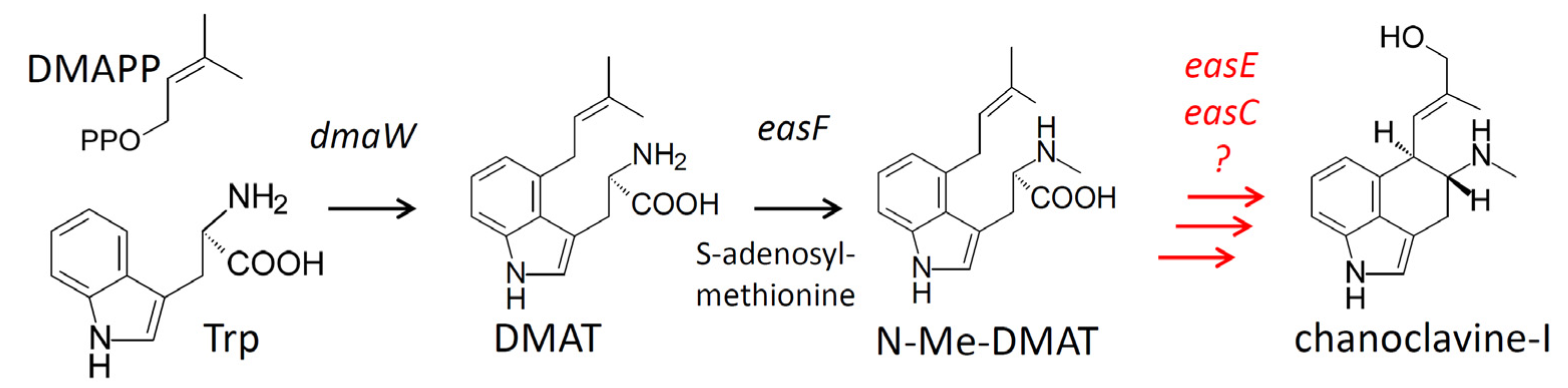
      <p>Ergot alkaloids are tryptophan-derived mycotoxins produced by several different fungi and have proven to be both pharmaceutically and agriculturally important. Several <italic>Claviceps</italic>, <italic>Neotyphodium</italic>, and <italic>Epichloë</italic> species of the order Hypocreales produce a variety of complex ergot alkaloids [<xref ref-type="bibr" rid="B1-toxins-05-00445">1</xref>,<xref ref-type="bibr" rid="B2-toxins-05-00445">2</xref>]. <italic>Aspergillus</italic> <italic>fumigatus</italic> and <italic>Penicillium commune</italic> of the order Eurotiales also are capable of ergot alkaloid synthesis; however, their ergot alkaloid profiles differ considerably from those of the Hypocrealean ergot alkaloid producers [<xref ref-type="bibr" rid="B2-toxins-05-00445">2</xref>,<xref ref-type="bibr" rid="B3-toxins-05-00445">3</xref>]. Ergot alkaloid-producing fungi contain an ergot alkaloid synthesis (<italic>eas</italic>) gene cluster with a set of core genes that is well conserved [<xref ref-type="bibr" rid="B1-toxins-05-00445">1</xref>,<xref ref-type="bibr" rid="B2-toxins-05-00445">2</xref>,<xref ref-type="bibr" rid="B3-toxins-05-00445">3</xref>,<xref ref-type="bibr" rid="B4-toxins-05-00445">4</xref>]. The <italic>eas</italic> clusters of the various ergot alkaloid producers also contain variable, lineage-specific genes that result in the formation of different pathway products among lineages [<xref ref-type="bibr" rid="B2-toxins-05-00445">2</xref>,<xref ref-type="bibr" rid="B4-toxins-05-00445">4</xref>]. The steps of ergot alkaloid synthesis leading to the formation of chanoclavine-I (the earliest ergot alkaloid pathway biosynthetic intermediate observed accumulating in most producers) (<xref ref-type="fig" rid="toxins-05-00445-f001">Figure 1</xref>) are believed to be evolutionarily conserved among the different fungi that produce ergot alkaloids [<xref ref-type="bibr" rid="B1-toxins-05-00445">1</xref>,<xref ref-type="bibr" rid="B2-toxins-05-00445">2</xref>,<xref ref-type="bibr" rid="B3-toxins-05-00445">3</xref>,<xref ref-type="bibr" rid="B4-toxins-05-00445">4</xref>]; however, the identity and catalytic activities of all the genes required for chanoclavine-I synthesis have not yet been determined. </p>
      <fig id="toxins-05-00445-f001" position="float">
        <label>Figure 1</label>
        <caption>
          <p>Early steps of the ergot alkaloid pathway. Genes controlling specific steps are listed beside arrows. Abbreviations: DMAPP = dimethylallyldiphosphate; Trp = tryptophan; DMAT = dimethylallyltryptophan. Unresolved steps are indicated in red.</p>
        </caption>
        <graphic xmlns:xlink="http://www.w3.org/1999/xlink" xlink:href="toxins-05-00445-g001.tif"/>
      </fig>
      <p>Based on the proposed biochemical scheme of Kozikowski <italic>et al</italic>. [<xref ref-type="bibr" rid="B5-toxins-05-00445">5</xref>], the synthesis of chanoclavine-I occurs in at least five steps. Gene knockout and heterologous expression studies have demonstrated that at least four genes, <italic>dmaW</italic>, <italic>easF</italic>, <italic>easE</italic>, and <italic>easC</italic>, are required prior to chanoclavine-I [<xref ref-type="bibr" rid="B6-toxins-05-00445">6</xref>,<xref ref-type="bibr" rid="B7-toxins-05-00445">7</xref>,<xref ref-type="bibr" rid="B8-toxins-05-00445">8</xref>,<xref ref-type="bibr" rid="B9-toxins-05-00445">9</xref>]. However, it is currently unknown whether these genes are sufficient to synthesize chanoclavine-I. DMAT synthase, the product of <italic>dmaW</italic>, catalyzes the initial prenylation reaction to yield dimethylallyltryptophan (DMAT) [<xref ref-type="bibr" rid="B6-toxins-05-00445">6</xref>,<xref ref-type="bibr" rid="B10-toxins-05-00445">10</xref>,<xref ref-type="bibr" rid="B11-toxins-05-00445">11</xref>], and <italic>easF</italic> encodes a methyltransferase that <italic>N</italic>-methylates DMAT to form the second intermediate, <italic>N</italic>-Me-DMAT [<xref ref-type="bibr" rid="B7-toxins-05-00445">7</xref>]. The order of activity and function of EasE and EasC have not been established, though gene knockout studies indicate these enzymes are necessary for the conversion of <italic>N</italic>-Me-DMAT to chanoclavine-I [<xref ref-type="bibr" rid="B8-toxins-05-00445">8</xref>,<xref ref-type="bibr" rid="B9-toxins-05-00445">9</xref>]. Based on their sequences, <italic>easE</italic> encodes an oxidoreductase and <italic>easC</italic> encodes a catalase. Involvement of additional enzymes cannot be excluded because the synthesis of chanoclavine-I requires two two-electron oxidations, and EasE is the only oxidoreductase among the four required genes. However, the <italic>eas</italic> clusters in the diverse fungi that produce ergot alkaloids do not contain any additional conserved oxidoreductase genes for which a function has not been assigned. Thus, the question of sufficiency of the four required genes is unresolved. </p>
      <p><italic>Aspergillus fumigatus</italic> is a common saprophytic fungus and potentially fatal pathogen in immunocompromised individuals [<xref ref-type="bibr" rid="B12-toxins-05-00445">12</xref>]. Ergot alkaloid synthesis genes are clustered in the <italic>A. fumigatus</italic> genome [<xref ref-type="bibr" rid="B10-toxins-05-00445">10</xref>,<xref ref-type="bibr" rid="B11-toxins-05-00445">11</xref>] and are expressed during asexual reproduction [<xref ref-type="bibr" rid="B13-toxins-05-00445">13</xref>,<xref ref-type="bibr" rid="B14-toxins-05-00445">14</xref>]. <italic>Aspergillus</italic> <italic>nidulans</italic>, a model fungus that is closely related to <italic>A</italic>. <italic>fumigatus</italic>, does not contain the ergot alkaloid gene cluster nor does it produce ergot alkaloids. The primary objective of this study was to test if <italic>dmaW</italic>, <italic>easF</italic>, <italic>easC</italic>, and <italic>easE</italic> are sufficient to direct chanoclavine-I synthesis in <italic>A</italic>. <italic>nidulans</italic>. We used a novel approach to test the sufficiency of the genes by transforming <italic>A</italic>. <italic>nidulans</italic> with <italic>dmaW</italic>, <italic>easF</italic>, <italic>easC</italic>, and <italic>easE</italic>, or subsets of those genes, from <italic>A</italic>. <italic>fumigatus</italic> under the control of their native promoters. </p>
    </sec>
    <sec sec-type="results">
      <title>2. Results</title>
      <sec>
        <title>2.1. Engineering of Chanoclavine-I Producing Strains of <italic>A. nidulans</italic></title>
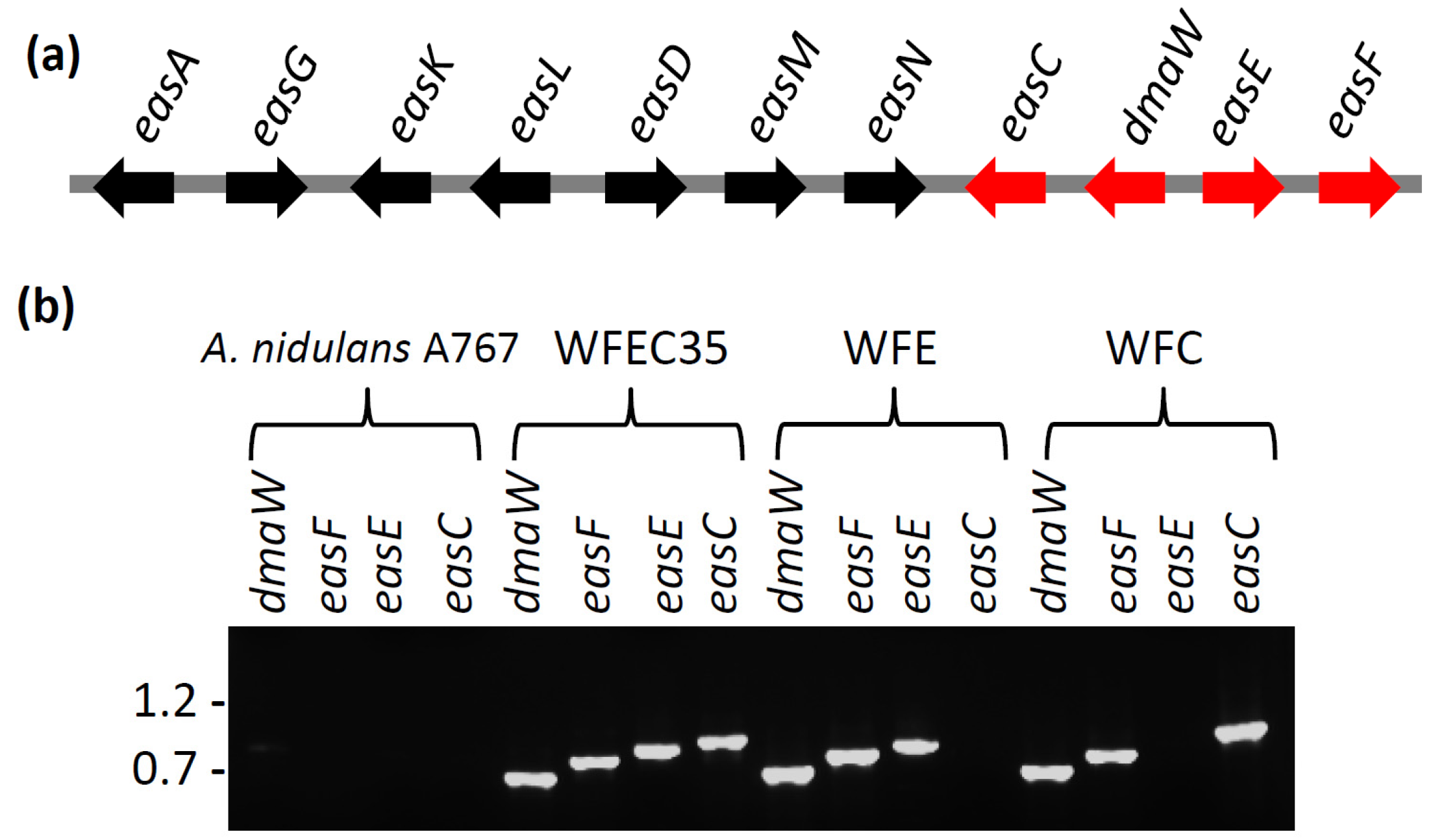
        <p>An 8.8-kb fragment of <italic>A. fumigatus</italic> DNA containing the genes <italic>dmaW</italic>, <italic>easF</italic>, <italic>easE</italic>, and <italic>easC</italic> was successfully amplified by PCR and integrated into the genome of two <italic>A. nidulans</italic> transformants, yielding strains WFEC33 and WFEC35. The presence of each of the four <italic>A. fumigatus</italic> genes in the WFEC strains was verified by PCR primed from internal gene primer-annealing sites (<xref ref-type="fig" rid="toxins-05-00445-f002">Figure 2</xref>). The recipient strain <italic>A. nidulans</italic> A767 did not contain any of the four genes. The absence of the ergot alkaloid gene cluster in <italic>A. nidulans</italic> was further supported by the lack of sequences with an E value less than 10 in a BLASTn search between the <italic>A. fumigatus</italic> <italic>dmaW</italic>, <italic>easF</italic>, <italic>easE</italic>, and <italic>easC</italic> cluster sequence with the genome of <italic>A. nidulans</italic> FGSC A4.</p>
        <fig id="toxins-05-00445-f002" position="float">
          <label>Figure 2</label>
          <caption>
            <p>Ergot alkaloid synthesis genes. (<bold>a</bold>) The ergot alkaloid gene cluster of <italic>A. fumigatus</italic>. Genes expressed in <italic>A. nidulans</italic> in this study are shown in red; (<bold>b</bold>) PCR verification of the presence or absence of <italic>dmaW</italic>, <italic>easF</italic>, <italic>easE</italic>, and <italic>easC</italic> from wild type and mutant strains. Each gene was independently amplified from internal primer binding sites. Relative mobility of relevant <italic>Bst</italic>EII-digested bacteriophage lambda fragments (sizes in kb) is indicated to the left of the gel.</p>
          </caption>
          <graphic xmlns:xlink="http://www.w3.org/1999/xlink" xlink:href="toxins-05-00445-g002.tif"/>
        </fig>
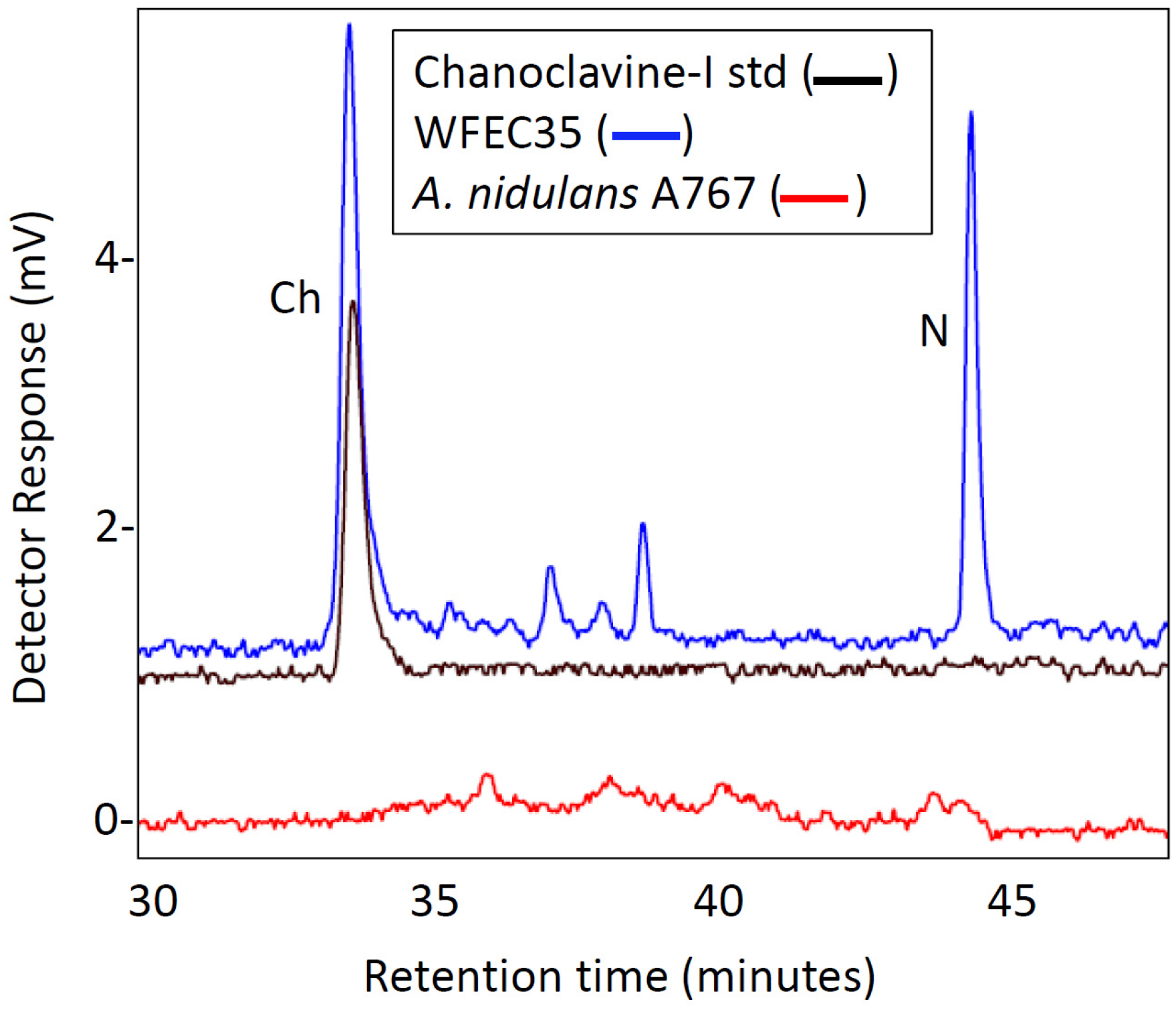
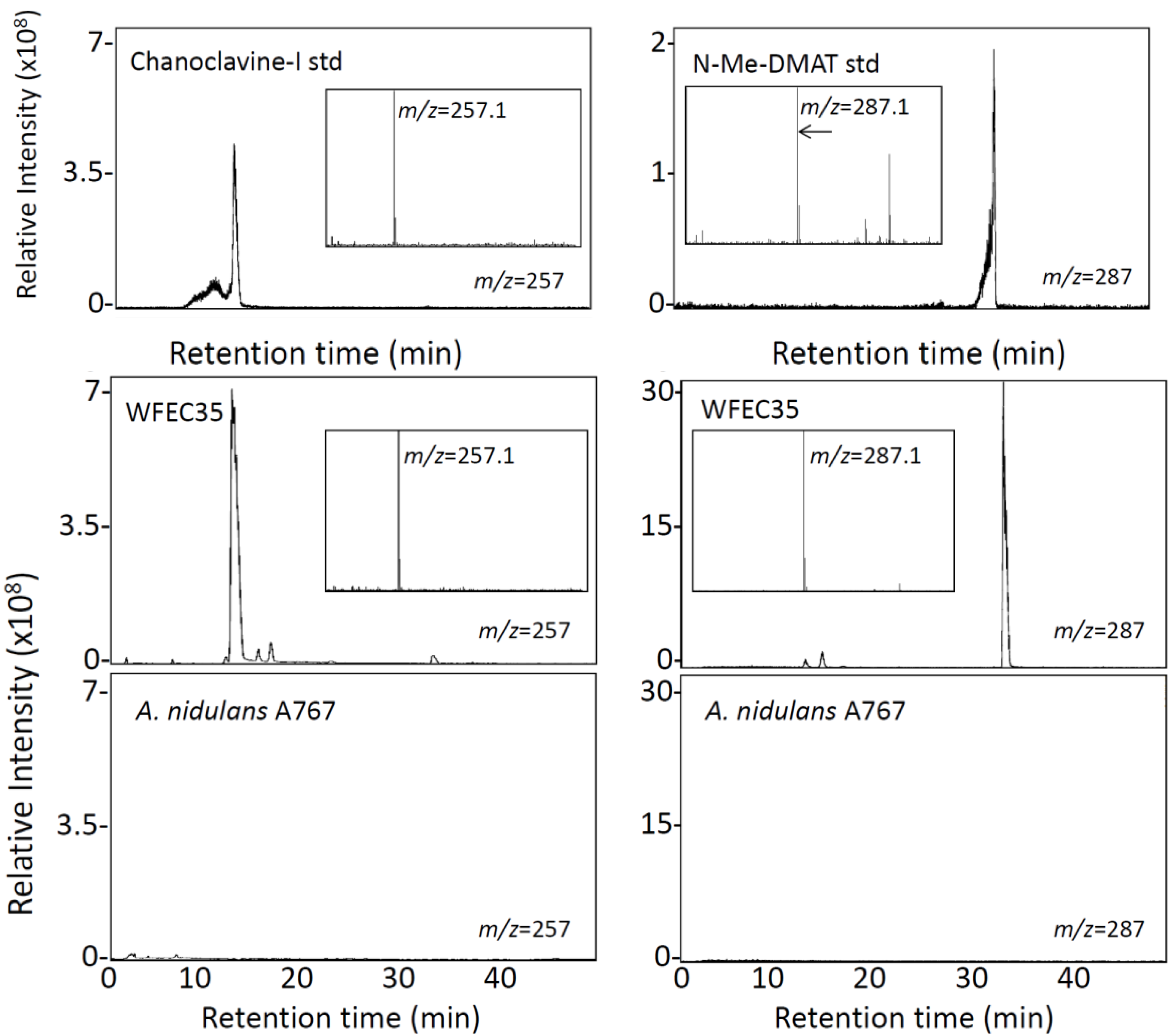
        <p>Both WFEC strains and <italic>A. nidulans</italic> A767 were analyzed by HPLC with fluorescence detection to investigate the presence of ergot alkaloids. Transformed strains accumulated an analyte that co-eluted with chanoclavine-I at approximately 33 min, whereas <italic>A. nidulans</italic> A767 did not (<xref ref-type="fig" rid="toxins-05-00445-f003">Figure 3</xref>). Extracts of WFEC35 and <italic>A. nidulans</italic> A767 also were analyzed by electrospray ionization (ESI) LC-MS in positive mode. Again WFEC35 contained a peak that co-eluted with chanoclavine-I standard. The analyte had an <italic>m/z</italic> of 257.1 consistent with the [M + H]<sup>+</sup> of chanoclavine-I (<xref ref-type="fig" rid="toxins-05-00445-f004">Figure 4</xref>). HPLC with fluorescence detection of mutant strain WFEC35 also revealed the presence of the early pathway intermediate <italic>N</italic>-Me-DMAT which eluted at approximately 44 min (<xref ref-type="fig" rid="toxins-05-00445-f003">Figure 3</xref>). The identity of this analyte as <italic>N</italic>-Me-DMAT was supported by an ion of <italic>m/z</italic> 287.1 in ESI LC-MS analyses (corresponding to [<italic>N</italic>-Me-DMAT + H]<sup>+</sup>) and by co-elution with authentic standard (<xref ref-type="fig" rid="toxins-05-00445-f004">Figure 4</xref>). </p>
        <p>Conidiating cultures produced modest quantities of chanoclavine-I. <italic>Aspergillus nidulans</italic> strain WFEC35 produced approximately 0.3 fg chanoclavine-I per conidium, or about 3 ng chanoclavine-I per mm<sup>2</sup> of culture surface area and comparable quantities of <italic>N</italic>-Me-DMAT. Strain WFEC33 produced lesser quantities of chanoclavine-I and did not accumulate measurable quantities of <italic>N</italic>-Me-DMAT. </p>
      <fig id="toxins-05-00445-f003" position="float">
          <label>Figure 3</label>
          <caption>
            <p>HPLC analyses of <italic>A. nidulans</italic> strain WFEC35 (transformed with <italic>dmaW</italic>, <italic>easF</italic>, <italic>easE</italic>, and <italic>easC</italic>), <italic>A. nidulans</italic> FGSC A767, and chanoclavine-I standard. Ch, chanoclavine-I; N, <italic>N</italic>-Me-DMAT. Fluorescence properties were observed with an excitation wavelength of 272 nm and an emission wavelength of 372 nm.</p>
          </caption>
          <graphic xmlns:xlink="http://www.w3.org/1999/xlink" xlink:href="toxins-05-00445-g003.tif"/>
        </fig>
        <fig id="toxins-05-00445-f004" position="float">
          <label>Figure 4</label>
          <caption>
            <p>LC-MS analysis of <italic>A. nidulans</italic> extracts. Chromatograms display presence and elution time of molecules with an <italic>m/z</italic> value of 257 ± 0.5 (left column) or 287 ± 0.5 (right column). Chromatograms of <italic>A. nidulans</italic> strains A767 and WFEC35 were normalized to the intensity of the highest peak in the WFEC35 trace for each analyte. The <italic>N</italic>-Me-DMAT standard chromatogram is displayed at a higher sensitivity because of paucity of material available. Inserts show the mass spectrum of the major peak in each chromatogram.</p>
          </caption>
          <graphic xmlns:xlink="http://www.w3.org/1999/xlink" xlink:href="toxins-05-00445-g004.tif"/>
        </fig>
        </sec>
      <sec>
        <title>2.2. Engineering of <italic>A. nidulans</italic> Strains Expressing Subsets of Early Pathway Genes</title>
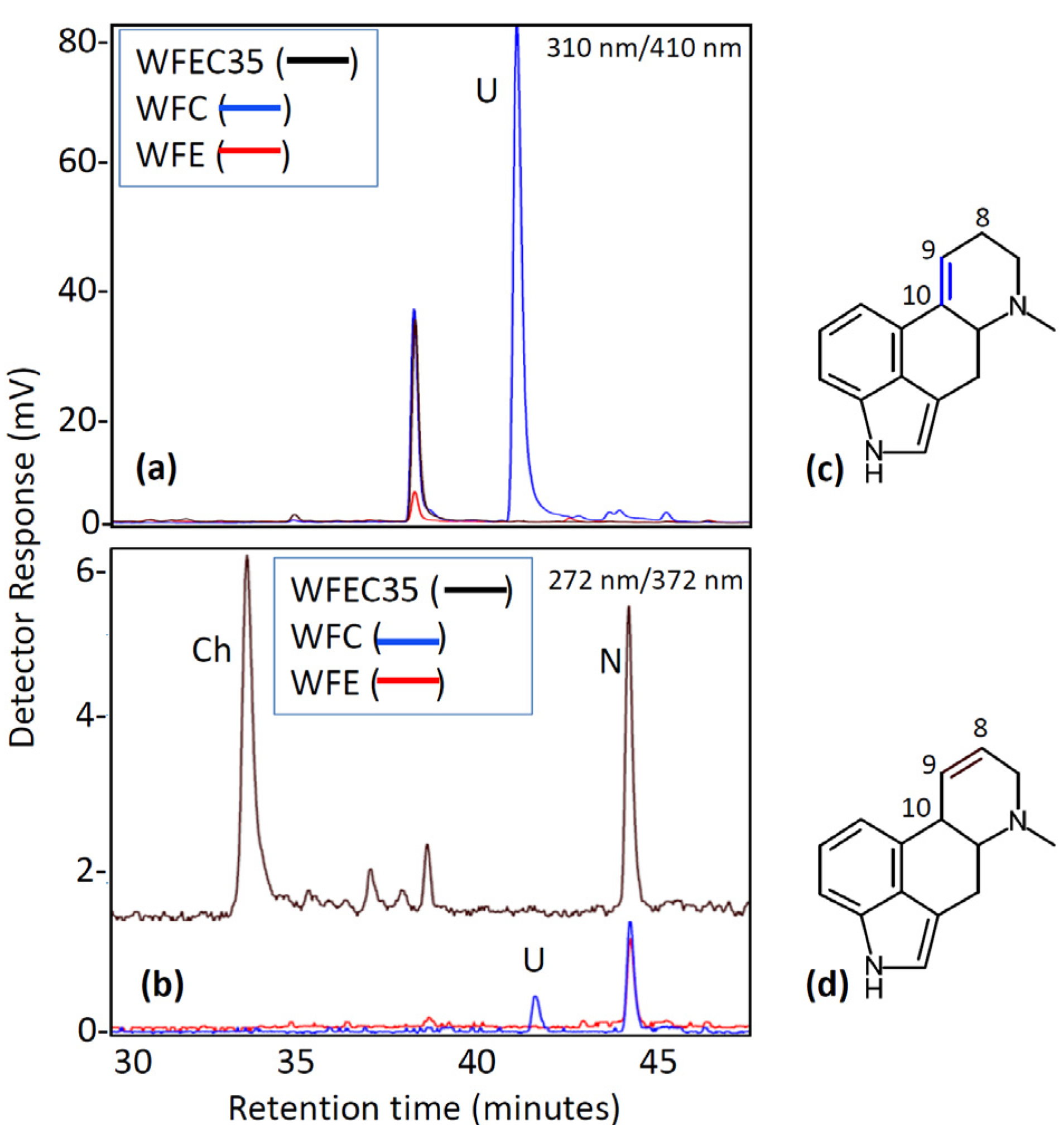
        <p>Two additional mutant strains of <italic>A. nidulans</italic> were generated by transformation with subsets of three of the four ergot alkaloid cluster genes: strains WFC (containing <italic>dmaW</italic>, <italic>easF</italic>, and <italic>easC</italic>) and WFE (containing <italic>dmaW</italic>, <italic>easF</italic>, and <italic>easE</italic>). The presence of each gene in the genomes of the different mutants was verified by PCR (<xref ref-type="fig" rid="toxins-05-00445-f002">Figure 2</xref>). Chanoclavine-I was not detectable by HPLC (<xref ref-type="fig" rid="toxins-05-00445-f005">Figure 5</xref>) or ESI LC-MS (data not shown) in either strain. Expression of <italic>dmaW</italic> and <italic>easF</italic> from the inserted construct in both strains was validated by the accumulation of the early pathway intermediate, <italic>N</italic>-Me-DMAT, which eluted from the column at approximately 44 min (<xref ref-type="fig" rid="toxins-05-00445-f005">Figure 5</xref>). In addition, WFC cultures accumulated a novel molecule with an elution time of 41 min and that had an <italic>m/z</italic> value of 259.0 in ESI LC-MS analyses. The unidentified metabolite displayed a higher fluorescence at excitation and emission wavelengths of 310 nm and 410 nm, respectively, than at 272 nm excitation and 372 nm emission settings (<xref ref-type="fig" rid="toxins-05-00445-f005">Figure 5</xref>). Ergot alkaloids with a double bond between carbons 9 and 10 of the ergot alkaloid ring system fluoresce stronger at the 310 nm (excitation) and 410 nm (emission) setting compared to their fluorescence at the 272 nm/372 nm setting; conversely, ergot alkaloids with a 8,9 double bond or those lacking a double bond at either of those positions fluoresce stronger at the 272 nm/372 nm setting [<xref ref-type="bibr" rid="B15-toxins-05-00445">15</xref>]. The novel alkaloid was not produced in sufficient quantities to allow the acquisition of additional structural data at this time. </p>
        <fig id="toxins-05-00445-f005" position="float">
          <label>Figure 5</label>
          <caption>
            <p>Fluorescence HPLC analysis of WFC and WFE mutant cultures. (<bold>a</bold>) Chromatogram with excitation at 310 nm and emission at 410 nm; (<bold>b</bold>) Chromatogram with excitation at 272 nm and emission at 372 nm; (<bold>c</bold>) Generic ergoline ring system with double bond between carbons 9 and 10; (<bold>d</bold>) Generic ergoline ring system with double bond between carbons 8 and 9. Ch, chanoclavine-I; N, <italic>N</italic>-Me-DMAT; U, Unknown unique to strain WFC. </p>
          </caption>
          <graphic xmlns:xlink="http://www.w3.org/1999/xlink" xlink:href="toxins-05-00445-g005.tif"/>
        </fig>
      </sec>
    </sec>
    <sec sec-type="discussion">
      <title>3. Discussion</title>
      <p>Our results describe the first transfer of ergot alkaloid biosynthetic capability to a previously non-producing fungus. These data also indicate that <italic>dmaW</italic>, <italic>easF</italic>, <italic>easE</italic>, and <italic>easC</italic> are sufficient for <italic>A. nidulans</italic> to synthesize chanoclavine-I. Since the pathway leading to the formation of chanoclavine-I appears to be evolutionarily conserved, the knowledge gained from this study will not only apply to <italic>A. fumigatus</italic> but theoretically to all ergot alkaloid producers. Despite the large amount of research conducted on ergot alkaloid synthesis, the formation of chanoclavine-I has yet to be completely understood. Only two steps in this evolutionarily conserved portion of the pathway have been completely characterized—those controlled by <italic>dmaW</italic> and <italic>easF</italic> [<xref ref-type="bibr" rid="B6-toxins-05-00445">6</xref>,<xref ref-type="bibr" rid="B7-toxins-05-00445">7</xref>,<xref ref-type="bibr" rid="B10-toxins-05-00445">10</xref>,<xref ref-type="bibr" rid="B11-toxins-05-00445">11</xref>]. After the formation of <italic>N</italic>-Me-DMAT, the order of activity and catalytic functions of enzymes is not clear. Our data indicate that EasE and EasC individually are necessary and together are sufficient to convert <italic>N</italic>-Me-DMAT to chanoclavine-I. Nonetheless, the observations in this study do not rule out the possibility that <italic>A. nidulans</italic> naturally possesses an enzyme that also contributes to the formation of chanoclavine-I from <italic>N</italic>-Me-DMAT. Despite the fact that all known ergot alkaloid genes are clustered in <italic>A. fumigatus</italic> and other ergot alkaloid-producing fungi [<xref ref-type="bibr" rid="B1-toxins-05-00445">1</xref>,<xref ref-type="bibr" rid="B2-toxins-05-00445">2</xref>,<xref ref-type="bibr" rid="B3-toxins-05-00445">3</xref>,<xref ref-type="bibr" rid="B4-toxins-05-00445">4</xref>,<xref ref-type="bibr" rid="B15-toxins-05-00445">15</xref>], we cannot presently exclude the possibility that a required gene in the pathway may be located elsewhere in the genome and common to non-producing fungi. </p>
      <p>Transformations with subsets of three of the four studied genes, combining alternately <italic>easC</italic> or <italic>easE</italic> with the combination of <italic>dmaW</italic> and <italic>easF</italic>, did not yield strains capable of producing chanoclavine-I. These results support previous knockout data indicating that both <italic>easE</italic> and <italic>easC</italic> are required for chanoclavine-I synthesis from <italic>N</italic>-Me-DMAT [<xref ref-type="bibr" rid="B9-toxins-05-00445">9</xref>]. A metabolite of undetermined structure accumulated to relatively high levels in the WFC transformant; this metabolite was not detectable in extracts of the <italic>A. nidulans</italic> WFE strain. Improved strains or altered growth conditions will be necessary to increase yield of the compound for the purpose of collecting adequate material for structure determination. The WFC analyte could potentially be the next intermediate downstream of <italic>N</italic>-Me-DMAT, in which case <italic>easC</italic> would code for the enzyme involved in the third step of ergot alkaloid synthesis. Considering its catalase activity, one proposed function for EasC is detoxification of hydrogen peroxide produced from the oxidative activities of EasE [<xref ref-type="bibr" rid="B9-toxins-05-00445">9</xref>], in which case EasC would not act directly on an ergot alkaloid substrate; however, comparison of the alkaloid profiles of WFE and WFC mutants indicates that EasC can act independent of EasE and chemically modifies an ergot alkaloid substrate. In a previous study, <italic>easE</italic> was knocked out in <italic>A. fumigatus</italic>, creating a strain of <italic>A. fumigatus</italic> that lacked <italic>easE</italic> but contained <italic>easC</italic> [<xref ref-type="bibr" rid="B9-toxins-05-00445">9</xref>]. <italic>N</italic>-Me-DMAT was detected in cultures of the <italic>easE</italic> knockout strain, but the novel metabolite from the <italic>A. nidulans</italic> WFC strain was not observed. One potential explanation for this apparent discrepancy is that the <italic>A. fumigatus</italic> <italic>easE</italic> knockout mutant contained downstream enzymes in the ergot alkaloid pathway that may have altered its ergot alkaloid profile. Alternatively, the difference between alkaloid profiles of <italic>A. fumigatus easE</italic> knockout and <italic>A. nidulans</italic> WFC could be due to other factors in the species backgrounds in which <italic>N</italic>-Me-DMAT accumulated. It is presently unknown whether the observed WFC analyte is an actual, on-pathway intermediate or whether it is a byproduct of EasC acting out of sequence on a compound that is not ordinarily its substrate. Feeding studies with the unidentified analyte and strains expressing defined sets of ergot alkaloid synthesis genes would be a reasonable approach to test the involvement of this compound in the ergot alkaloid pathway. Again, greater quantities of the analyte would be required for such studies. An <italic>in vitro</italic> approach involving separate and combined enzymes also would help to fully understand the functions of these enzymes. Difficulty with expressing EasE in active form <italic>in vitro</italic> has slowed studies of catalytic function of this enzyme [<xref ref-type="bibr" rid="B9-toxins-05-00445">9</xref>]. </p>
      <p>The approach of expressing genes in <italic>A. nidulans</italic> may be applied to other genes in the pathway to study their roles in the biosynthesis of ergot alkaloids (as was recently reviewed by Chiang <italic>et al.</italic> [<xref ref-type="bibr" rid="B16-toxins-05-00445">16</xref>] for other fungal secondary metabolite pathways). Heterologous expression in <italic>A. nidulans</italic> also should be applicable to studying genes from ergot alkaloid pathways of other fungi, such as those genes from lineage-specific branches of the pathway. In such cases, it may be necessary to replace the native promoters of those heterologous genes with promoters from <italic>A. fumigatus</italic> <italic>eas</italic> genes or strong <italic>A. nidulans</italic> promoters. </p>
    </sec>
    <sec>
      <title>4. Experimental Section</title>
      <sec>
        <title>4.1. Fungal Strains and Growth Conditions</title>
        <p><italic>Aspergillus fumigatus</italic> isolate Af293, as a source of genomic DNA, was grown in malt extract broth (15 g malt extract/L) overnight at 37 °C. The uridine auxotrophic <italic>A. nidulans</italic> isolate FGSC A767 (Fungal Genetic Stock Center, Kansas City, MO, USA) was grown at 37 °C on SYE medium (20 g/L sucrose, 10 g/L yeast extract, 10 g/L MgSO<sub>4</sub>, 2 mL/L trace element solution [<xref ref-type="bibr" rid="B17-toxins-05-00445">17</xref>], 2.2 g/L uracil, 2.2 g/L uridine, with or without 15 g/L agar). For preparation of protoplasts, <italic>A. nidulans</italic> was grown in liquid SYE medium overnight. Transformants were regenerated on selective SYE agar medium which did not contain uracil or uridine and was supplemented with 304 g/L sucrose (to serve as osmoticum as well as carbon source). To test alkaloid accumulation, cultures were grown on SYE agar medium at 37 °C for one week. </p>
      </sec>
      <sec>
        <title>4.2. DNA Manipulations</title>
        <p>DNA was extracted from <italic>A. fumigatus</italic> according to the protocol described by Richards <italic>et al.</italic> [<xref ref-type="bibr" rid="B18-toxins-05-00445">18</xref>]. An 8774-bp fragment containing <italic>dmaW</italic>, <italic>easF</italic>, <italic>easC</italic>, and <italic>easE</italic> was amplified by PCR primed with oligonucleotides primer 1 (5'-TACCTATACCTAATCGAAGCCGCACGCAGTGCACC-3') and primer 2 (5'-GCCGCCCATTCACCAAGATTTTTGCACAAATCTGCG-3'). A 25 μL reaction contained 1× LongAmp Taq reaction buffer, 200 μM of each deoxynucleotide triphosphate, 1 μM of each primer, and 2.5 units LongAmp Taq DNA polymerase (New England BioLabs, Ipswich, MA, USA). The reaction began with an initial denaturing step of 3 min at 94 °C, followed by 35 cycles of 30 s at 94 °C and 10 min at 65 °C, with a final extension of 5 min at 65 °C. </p>
        <p>A 6123-bp fragment containing <italic>dmaW</italic>, <italic>easF</italic>, and <italic>easE</italic> was amplified by PCR primed with oligonucleotides primer 3 (5'-GAGAGCTACTTGACATATTGTGTCGGCAGGTGCGCA-3') and primer 2 (5'-GCCGCCCATTCACCAAGATTTTTGCACAAATCTGCG-3'). The PCR conditions were the same as stated above except the elongation time was 7 min. </p>
        <p>In order to generate transformant WFC (containing <italic>dmaW</italic>, <italic>easF</italic>, and <italic>easC</italic>), two separate DNA fragments were amplified for co-transformation. The first fragment containing <italic>dmaW</italic> and <italic>easC</italic> was primed with primer 1 (5'-TACCTATACCTAATCGAAGCCGCACGCAGTGCACC-3') and primer 5 (5'-CTACTCCATTGTCCTGTGAGTTG-3') which primed amplification of a 4846-bp fragment. The PCR conditions were the same as stated above except the elongation time was 5 min. The second fragment (2943 bp) contained only <italic>easF</italic> and was amplified by PCR primed with oligonucleotides easFF (5'-TCCATTCTTCGCTCGTTCAACCAGCAGG-3') and easFR (5'-CAGGACCTGTACCTAAAGCCTGGTAACC-3') in a 25 μL reaction containing 1× GoTaq Flexi buffer, 200 μM each deoxynucleotide triphosphate, 1.5 mM MgCl<sub>2</sub>, 1 μM of each primer, and 2.5 units of Taq DNA polymerase (Promega, Madison, WI, USA). The reaction began with an initial denaturing step of 3 min at 94 °C, followed by 35 cycles of 30 s at 94 °C, 30 s at 55 °C, and 3 min at 72 °C, with a final extension of 5 min at 72 °C.</p>
        <p>PCR products were purified with QIAquick gel extraction kits (Qiagen, Valencia, CA, USA) prior to their inclusion in fungal transformations. The selectable marker pPyrG was obtained from the Fungal Genetics Stock Center and was digested with <italic>Xho</italic>I (New England BioLabs, Ipswich, MA, USA) and purified with QIAquick gel extraction kit prior to transformation.</p>
      </sec>
      <sec>
        <title>4.3. Fungal Transformation and Screening</title>
        <p>Protoplasts of <italic>A. nidulans</italic> FGSC A767 were prepared by incubating overnight cultures with 50 mg driselase (Sigma-Aldrich, St. Louis, MO, USA), which was filter sterilized with a 0.22 μm filter, and 75 mg lysing enzyme (Sigma-Aldrich, St. Louis, MO, USA) in 15 mL of 0.7 M sodium chloride. Protoplasts were purified and co-transformed with PCR product and selectable marker (pPyrG) as described by Coyle <italic>et al.</italic> [<xref ref-type="bibr" rid="B19-toxins-05-00445">19</xref>]. Protoplasts were plated on SYE agar medium containing no uracil or uridine. Transformation plates were incubated at 37 °C, and transformants were collected approximately three days after transformation. </p>
        <p>Each transformant was screened by PCR for the presence or absence of <italic>dmaW</italic>, <italic>easF</italic>, <italic>easC</italic>, and <italic>easE</italic>. An internal region of <italic>dmaW</italic> was primed with dmaWF (5'-TTGATCTGGAGTGGTTCCGC-3') and dmaWR (5'-CGTTCATGCCGAAGGTTGTG-3') yielding a 651-bp fragment. Primers for amplifying an internal region of <italic>easE</italic> were easEF (5'-CCAGATACATTGCCATCGCATG-3') and easER (5'-TGTTCCAACTGCTTGGCCAGAT-3'), which primed amplification of a 897-bp fragment. The presence or absence of <italic>easC</italic> was tested by PCR with primers easCF (5'-GAATTCGAGGTATTGATCTCC-3') and easCR (5'-AGCCAGGCAAAGATCCATAGTT-3') which flank a 1036-bp fragment. An internal region of <italic>easF</italic> was primed with easFF (5'-AAGTTGTCGAAGGTCTCACGAA-3') and easFR (5'-GTGATTAGAGATGCTTCTGTC-3'), yielding an 820-bp fragment. Each of these PCRs were 25 μL reactions containing 1× GoTaq Flexi buffer, 200 μM deoxynucleotide triphosphate, 1.5 mM MgCl<sub>2</sub>, 1 μM of each primer, and 2.5 units of Taq DNA polymerase (Promega, Madison, WI, USA). PCR conditions began with an initial denaturing step of 3 min at 94 °C, followed by 35 cycles of 30 s at 94 °C followed by 30 s at 55 °C, and 1 min and 30 s at 72 °C, followed by a final extension of 5 min at 72 °C.</p>
      </sec>
      <sec>
        <title>4.4. HPLC Analyses</title>
        <p>Transformants positive for the presence of the target genes were analyzed by HPLC for the accumulation of chanoclavine-I. Ergot alkaloids were extracted by incubating a spore-rich sample of the colony, containing approximately 1 cm<sup>2</sup> of culture surface area, in 400 μL of methanol for 30 min and clarifying the extract by centrifugation. Extracts were injected into a C<sub>18</sub> column (Prodigy 5-μm ODS3 (150 mm by 4.6 mm); Phenomenex, Torrance, CA, USA) and subjected to a multilinear binary gradient from 5% (<italic>v</italic>/<italic>v</italic>) acetonitrile plus 95% (<italic>v</italic>/<italic>v</italic>) aqueous 50 mM ammonium acetate to 75% acetonitrile plus 25% aqueous 50 mM aqueous ammonium acetate at a flow rate 1 mL/min, as previously described [<xref ref-type="bibr" rid="B15-toxins-05-00445">15</xref>]. Ergot alkaloids were detected using two fluorescence settings. The first setting had an excitation wavelength of 272 nm and emission wavelength of 372 nm; the second setting was 310 nm (excitation) and 410 nm (emission). Chanoclavine-I (generously provided by Brian Tapper, AgResearch, New Zealand) and <italic>N</italic>-Me-DMAT (gift from Sarah O’Connor, University of East Anglia) were run as standards. Peaks of interest were isolated from the HPLC by collecting the runoff from the discard tube for 30 s after the peak was visualized on the detector. </p>
      </sec>
      <sec>
        <title>4.5. LC-MS Analyses</title>
        <p>Ergot alkaloid extracts were prepared by washing the surface of a conidiating colony with 2 mL of methanol, rotating the extract at 30 rpm for 30 min, and then clarifying the extract by centrifugation. Clarified extracts were then concentrated to a volume of 50 μL in a speed-vac apparatus, and 10 μL of concentrated extract were injected into the LC-MS. To isolate individual analytes, concentrated extracts were analyzed by fluorescence HPLC, peaks were collected manually, and concentrated to a volume of 50 μL in a speed-vac apparatus prior to LC-MS analysis. Concentrated samples were analyzed on a Finnigan LCQDecaXP plus mass spectrometer equipped with a Surveyor HPLC system. Analytes were separated on a C<sub>18</sub> column (Phenomenex 4-μm polar-RP (150 mm by 2 mm)), maintained at 30 °C, by combining mobile phases A (5% acetonitrile, 0.1% formic acid) and B (75% acetonitrile, 0.1% formic acid). Initial conditions were 86% A + 14% B, which ramped linearly to 73% A + 27% B at 25 min, 25% A + 75% B at 40 min, and 0% A + 100% B at 42 min. The flow rate was 200 μL/min. Analytes were ionized by electrospray ionization in positive mode and were detected by scanning for ions with a <italic>m/z</italic> between 200–400. </p>
      </sec>
    </sec>
    <sec sec-type="conclusions">
      <title>5. Conclusions</title>
      <p>Four genes common to all ergot alkaloid synthesis gene clusters—<italic>dmaW</italic>, <italic>easF</italic>, <italic>easE</italic>, and <italic>easC</italic>—are sufficient to direct synthesis of chanoclavine-I in <italic>A. nidulans</italic>. Both <italic>easC</italic> and <italic>easE</italic> are required for the synthesis of chanoclavine-I from <italic>N</italic>-Me-DMAT, but neither alone is sufficient. <italic>Aspergillus nidulans</italic> is a suitable heterologous host for expressing ergot alkaloids synthesis genes. </p>
    </sec>
  </body>
  <back>
    <ack>
      <title>Acknowledgments</title>
      <p>This research was conducted with funding from the U.S. Department of Agriculture National Institute of Food and Agriculture (2012-67013-19384). We thank Sarah O’Connor (University of East Anglia) for helpful discussions and Brian Tapper (AgResearch, New Zealand) and Sarah O’Connor for standards. This article is published with permission of the West Virginia Agriculture and Forestry Experiment Station as scientific article number 3156. </p>
    </ack>
    <notes>
      <title>Conflict of Interest</title>
      <p>The authors declare no conflict of interest. </p>
    </notes>
    <ref-list>
      <title>References</title>
      <ref id="B1-toxins-05-00445">
        <label>1.</label>
        <citation citation-type="journal">
          <person-group person-group-type="author">
            <name>
              <surname>Lorenz</surname>
              <given-names>N.</given-names>
            </name>
            <name>
              <surname>Haarmann</surname>
              <given-names>T.</given-names>
            </name>
            <name>
              <surname>Pažoutová</surname>
              <given-names>S.</given-names>
            </name>
            <name>
              <surname>Jung</surname>
              <given-names>M.</given-names>
            </name>
            <name>
              <surname>Tudzynski</surname>
              <given-names>P.</given-names>
            </name>
          </person-group>
          <article-title>The ergot alkaloid gene cluster: Functional analyses and evolutionary aspects</article-title>
          <source>Phytochemistry</source>
          <year>2009</year>
          <volume>70</volume>
          <fpage>1822</fpage>
          <lpage>1832</lpage>
          <pub-id pub-id-type="doi">10.1016/j.phytochem.2009.05.023</pub-id>
        </citation>
      </ref>
      <ref id="B2-toxins-05-00445">
        <label>2.</label>
        <citation citation-type="book">
          <person-group person-group-type="author">
            <name>
              <surname>Panaccione</surname>
              <given-names>D.G.</given-names>
            </name>
          </person-group>
          <article-title>Ergot Alkaloids</article-title>
          <source>The Mycota, Industrial Applications</source>
          <edition>2nd</edition>
          <person-group person-group-type="editor">
            <name>
              <surname>Hofrichter</surname>
              <given-names>M.</given-names>
            </name>
          </person-group>
          <publisher-name>Springer-Verlag</publisher-name>
          <publisher-loc>Berlin, Germany</publisher-loc>
          <year>2010</year>
          <volume>Volume X</volume>
          <fpage>195</fpage>
          <lpage>214</lpage>
        </citation>
      </ref>
      <ref id="B3-toxins-05-00445">
        <label>3.</label>
        <citation citation-type="journal">
          <person-group person-group-type="author">
            <name>
              <surname>Wallwey</surname>
              <given-names>C.</given-names>
            </name>
            <name>
              <surname>Li</surname>
              <given-names>S.-M.</given-names>
            </name>
          </person-group>
          <article-title>Ergot alkaloids: Structure diversity, biosynthetic gene clusters and functional proof of biosynthetic genes</article-title>
          <source>Nat. Prod. Rep.</source>
          <year>2011</year>
          <volume>28</volume>
          <fpage>496</fpage>
          <lpage>510</lpage>
          <pub-id pub-id-type="doi">10.1039/c0np00060d</pub-id>
        </citation>
      </ref>
      <ref id="B4-toxins-05-00445">
        <label>4.</label>
        <citation citation-type="journal">
          <person-group person-group-type="author">
            <name>
              <surname>Schardl</surname>
              <given-names>C.L.</given-names>
            </name>
            <name>
              <surname>Young</surname>
              <given-names>C.A.</given-names>
            </name>
            <name>
              <surname>Hesse</surname>
              <given-names>U.</given-names>
            </name>
            <name>
              <surname>Amyotte</surname>
              <given-names>S.G.</given-names>
            </name>
            <name>
              <surname>Andreeva</surname>
              <given-names>K.</given-names>
            </name>
            <name>
              <surname>Calie</surname>
              <given-names>P.J.</given-names>
            </name>
            <name>
              <surname> Fleetwood</surname>
              <given-names>D.J.</given-names>
            </name>
            <name>
              <surname>Haws</surname>
              <given-names>D.C.</given-names>
            </name>
            <name>
              <surname>Moore</surname>
              <given-names>N.</given-names>
            </name>
            <name>
              <surname>Oeser</surname>
              <given-names>B.</given-names>
            </name>
            <etal/>
          </person-group>
          <article-title>Plant-symbiotic fungi as chemical engineers: Multi-genome analysis of the Clavicipitaceae reveals dynamics of alkaloid loci</article-title>
          <source>PLoS Genet.</source>
          <year>2013</year>
          <comment>in press</comment>
        </citation>
      </ref>
      <ref id="B5-toxins-05-00445">
        <label>5.</label>
        <citation citation-type="journal">
          <person-group person-group-type="author">
            <name>
              <surname>Kozikowski</surname>
              <given-names>A.P.</given-names>
            </name>
            <name>
              <surname>Chen</surname>
              <given-names>C.</given-names>
            </name>
            <name>
              <surname>Wu</surname>
              <given-names>J.-P.</given-names>
            </name>
            <name>
              <surname>Shibuya</surname>
              <given-names>M.</given-names>
            </name>
            <name>
              <surname>Kim</surname>
              <given-names>C.-G.</given-names>
            </name>
            <name>
              <surname>Floss</surname>
              <given-names>H.G.</given-names>
            </name>
          </person-group>
          <article-title>Probing ergot alkaloid biosynthesis: Intermediates in the formation of ring C</article-title>
          <source>J. Am. Chem. Soc.</source>
          <year>1993</year>
          <volume>115</volume>
          <fpage>2482</fpage>
          <lpage>2488</lpage>
        </citation>
      </ref>
      <ref id="B6-toxins-05-00445">
        <label>6.</label>
        <citation citation-type="journal">
          <person-group person-group-type="author">
            <name>
              <surname>Wang</surname>
              <given-names>J.</given-names>
            </name>
            <name>
              <surname>Machado</surname>
              <given-names>C.</given-names>
            </name>
            <name>
              <surname>Panaccione</surname>
              <given-names>D.G.</given-names>
            </name>
            <name>
              <surname>Tsai</surname>
              <given-names>H.-F.</given-names>
            </name>
            <name>
              <surname>Schardl</surname>
              <given-names>C.L.</given-names>
            </name>
          </person-group>
          <article-title>The determinant step in ergot alkaloid biosynthesis by an endophyte of perennial ryegrass</article-title>
          <source>Fungal Genet. Biol.</source>
          <year>2004</year>
          <volume>41</volume>
          <fpage>189</fpage>
          <lpage>198</lpage>
          <pub-id pub-id-type="doi">10.1016/j.fgb.2003.10.002</pub-id>
        </citation>
      </ref>
      <ref id="B7-toxins-05-00445">
        <label>7.</label>
        <citation citation-type="journal">
          <person-group person-group-type="author">
            <name>
              <surname>Rigbers</surname>
              <given-names>O.</given-names>
            </name>
            <name>
              <surname>Li</surname>
              <given-names>S.-M.</given-names>
            </name>
          </person-group>
          <article-title>Ergot alkaloid biosynthesis in <italic>Aspergillus fumigatus</italic>: Overproduction and biochemical characterization of a 4-dimethylallyltryptophan <italic>N</italic>-methyltransferase</article-title>
          <source>J. Biol. Chem.</source>
          <year>2008</year>
          <volume>283</volume>
          <fpage>26859</fpage>
          <lpage>26868</lpage>
          <pub-id pub-id-type="doi">10.1074/jbc.M804979200</pub-id>
        </citation>
      </ref>
      <ref id="B8-toxins-05-00445">
        <label>8.</label>
        <citation citation-type="journal">
          <person-group person-group-type="author">
            <name>
              <surname>Lorenz</surname>
              <given-names>N.</given-names>
            </name>
            <name>
              <surname>Olšovská</surname>
              <given-names>J.</given-names>
            </name>
            <name>
              <surname>Šulc</surname>
              <given-names>M.</given-names>
            </name>
            <name>
              <surname>Tudzynski</surname>
              <given-names>P. </given-names>
            </name>
          </person-group>
          <article-title>Alkaloid cluster gene <italic>ccsA</italic> of the ergot fungus <italic>Claviceps purpurea</italic> encodes chanoclavine I synthase, a flavin adenine dinucleotide-containing oxidoreductase mediating the transformation of <italic>N</italic>-methyl-dimethylallyltryptophan to chanoclavine I</article-title>
          <source>Appl. Environ. Microbiol.</source>
          <year>2010</year>
          <volume>76</volume>
          <fpage>1822</fpage>
          <lpage>1830</lpage>
          <pub-id pub-id-type="doi">10.1128/AEM.00737-09</pub-id>
        </citation>
      </ref>
      <ref id="B9-toxins-05-00445">
        <label>9.</label>
        <citation citation-type="journal">
          <person-group person-group-type="author">
            <name>
              <surname>Goetz</surname>
              <given-names>K.E.</given-names>
            </name>
            <name>
              <surname>Coyle</surname>
              <given-names>C.M.</given-names>
            </name>
            <name>
              <surname>Cheng</surname>
              <given-names>J.Z.</given-names>
            </name>
            <name>
              <surname>O’Connor</surname>
              <given-names>S.E.</given-names>
            </name>
            <name>
              <surname>Panaccione</surname>
              <given-names>D.G.</given-names>
            </name>
          </person-group>
          <article-title>Ergot cluster-encoded catalase is required for synthesis of chanoclavine-I in <italic>Aspergillus fumigatus</italic></article-title>
          <source>Curr. Genet.</source>
          <year>2011</year>
          <volume>57</volume>
          <fpage>201</fpage>
          <lpage>211</lpage>
          <pub-id pub-id-type="doi">10.1007/s00294-011-0336-4</pub-id>
        </citation>
      </ref>
      <ref id="B10-toxins-05-00445">
        <label>10.</label>
        <citation citation-type="journal">
          <person-group person-group-type="author">
            <name>
              <surname>Unsöld</surname>
              <given-names>I.A.</given-names>
            </name>
            <name>
              <surname>Li</surname>
              <given-names>S.-M.</given-names>
            </name>
          </person-group>
          <article-title>Overproduction, purification and characterization of FgaPT2, a dimethylallyltryptophan synthase from <italic>Aspergillus fumigatu</italic></article-title>
          <source>Microbiology</source>
          <year>2005</year>
          <volume>151</volume>
          <fpage>1499</fpage>
          <lpage>1505</lpage>
          <pub-id pub-id-type="doi">10.1099/mic.0.27759-0</pub-id>
        </citation>
      </ref>
      <ref id="B11-toxins-05-00445">
        <label>11.</label>
        <citation citation-type="journal">
          <person-group person-group-type="author">
            <name>
              <surname>Coyle</surname>
              <given-names>C.M.</given-names>
            </name>
            <name>
              <surname>Panaccione</surname>
              <given-names>D.G.</given-names>
            </name>
          </person-group>
          <article-title>An ergot alkaloid biosynthesis gene and clustered hypothetical genes from <italic>Aspergillus fumigatus</italic></article-title>
          <source>Appl. Environ. Microbiol.</source>
          <year>2005</year>
          <volume>71</volume>
          <fpage>3112</fpage>
          <lpage>3118</lpage>
          <pub-id pub-id-type="doi">10.1128/AEM.71.6.3112-3118.2005</pub-id>
        </citation>
      </ref>
      <ref id="B12-toxins-05-00445">
        <label>12.</label>
        <citation citation-type="journal">
          <person-group person-group-type="author">
            <name>
              <surname>Latgé</surname>
              <given-names>J.-P.</given-names>
            </name>
          </person-group>
          <article-title><italic>Aspergillus fumigatus</italic> and aspergillosis</article-title>
          <source>Clin. Microbiol. Rev.</source>
          <year>1999</year>
          <volume>12</volume>
          <fpage>310</fpage>
          <lpage>350</lpage>
        <pub-id pub-id-type="pmid">10194462</pub-id></citation>
      </ref>
      <ref id="B13-toxins-05-00445">
        <label>13.</label>
        <citation citation-type="journal">
          <person-group person-group-type="author">
            <name>
              <surname>Coyle</surname>
              <given-names>C.M.</given-names>
            </name>
            <name>
              <surname>Kenaley</surname>
              <given-names>S.C.</given-names>
            </name>
            <name>
              <surname>Rittenour</surname>
              <given-names>W.R.</given-names>
            </name>
            <name>
              <surname>Panaccione</surname>
              <given-names>D.G.</given-names>
            </name>
          </person-group>
          <article-title>Association of ergot alkaloids with conidiation in <italic>Aspergillus fumigatus</italic></article-title>
          <source>Mycologia</source>
          <year>2007</year>
          <volume>99</volume>
          <fpage>804</fpage>
          <lpage>811</lpage>
          <pub-id pub-id-type="doi">10.3852/mycologia.99.6.804</pub-id>
        </citation>
      </ref>
      <ref id="B14-toxins-05-00445">
        <label>14.</label>
        <citation citation-type="journal">
          <person-group person-group-type="author">
            <name>
              <surname>Twumasi-Boateng</surname>
              <given-names>K.</given-names>
            </name>
            <name>
              <surname>Yu</surname>
              <given-names>Y.</given-names>
            </name>
            <name>
              <surname>Chen</surname>
              <given-names>D.</given-names>
            </name>
            <name>
              <surname>Gravelat</surname>
              <given-names>F.N.</given-names>
            </name>
            <name>
              <surname>Nierman</surname>
              <given-names>W.C.</given-names>
            </name>
            <name>
              <surname>Sheppard</surname>
              <given-names>D.C.</given-names>
            </name>
          </person-group>
          <article-title>Transcriptional profiling identifies a role for BrlA in the response to nitrogen depletion and for StuA in the regulation of secondary metabolite clusters in <italic>Aspergillus fumigatus</italic></article-title>
          <source>Eukaryot. Cell</source>
          <year>2009</year>
          <volume>8</volume>
          <fpage>104</fpage>
          <lpage>115</lpage>
          <pub-id pub-id-type="doi">10.1128/EC.00265-08</pub-id>
        </citation>
      </ref>
      <ref id="B15-toxins-05-00445">
        <label>15.</label>
        <citation citation-type="journal">
          <person-group person-group-type="author">
            <name>
              <surname>Panaccione</surname>
              <given-names>D.G.</given-names>
            </name>
            <name>
              <surname>Ryan</surname>
              <given-names>K.L.</given-names>
            </name>
            <name>
              <surname>Schardl</surname>
              <given-names>C.L.</given-names>
            </name>
            <name>
              <surname>Florea</surname>
              <given-names>S.</given-names>
            </name>
          </person-group>
          <article-title>Analysis and modification of ergot alkaloid profiles in fungi</article-title>
          <source>Method. Enzymol.</source>
          <year>2012</year>
          <volume>515</volume>
          <fpage>267</fpage>
          <lpage>290</lpage>
          <pub-id pub-id-type="doi">10.1016/B978-0-12-394290-6.00012-4</pub-id>
        </citation>
      </ref>
      <ref id="B16-toxins-05-00445">
        <label>16.</label>
        <citation citation-type="journal">
          <person-group person-group-type="author">
            <name>
              <surname>Chiang</surname>
              <given-names>Y.M.</given-names>
            </name>
            <name>
              <surname>Chang</surname>
              <given-names>S.L.</given-names>
            </name>
            <name>
              <surname>Oakley</surname>
              <given-names>B.R.</given-names>
            </name>
            <name>
              <surname>Wang</surname>
              <given-names>C.C.C.</given-names>
            </name>
          </person-group>
          <article-title>Recent advances in awakening silent biosynthetic gene clusters and linking orphan clusters to natural products in microorganisms</article-title>
          <source>Curr. Opin. Chem. Biol.</source>
          <year>2011</year>
          <volume>15</volume>
          <fpage>137</fpage>
          <lpage>143</lpage>
          <pub-id pub-id-type="doi">10.1016/j.cbpa.2010.10.011</pub-id>
        </citation>
      </ref>
      <ref id="B17-toxins-05-00445">
        <label>17.</label>
        <citation citation-type="journal">
          <person-group person-group-type="author">
            <name>
              <surname>Hunter</surname>
              <given-names>S.H.</given-names>
            </name>
            <name>
              <surname>Provasoli</surname>
              <given-names>L.</given-names>
            </name>
            <name>
              <surname>Schatz</surname>
              <given-names>A.</given-names>
            </name>
            <name>
              <surname>Haskins</surname>
              <given-names>C.P.</given-names>
            </name>
          </person-group>
          <article-title>Some approaches to the study of the role of metals in the metabolism of microorganisms</article-title>
          <source>Am. Philos. Soc. Proc.</source>
          <year>1950</year>
          <volume>94</volume>
          <fpage>152</fpage>
          <lpage>170</lpage>
        </citation>
      </ref>
      <ref id="B18-toxins-05-00445">
        <label>18.</label>
        <citation citation-type="journal">
          <person-group person-group-type="author">
            <name>
              <surname>Richards</surname>
              <given-names>E.</given-names>
            </name>
            <name>
              <surname>Reichardt</surname>
              <given-names>M.</given-names>
            </name>
            <name>
              <surname>Rogers</surname>
              <given-names>S.</given-names>
            </name>
          </person-group>
          <article-title>Preparation of genomic DNA from plant tissue</article-title>
          <source>Curr. Protoc. Mol. Biol.</source>
          <year>2001</year>
          <volume>27</volume>
          <fpage>2.3.1</fpage>
          <lpage>2.3.7</lpage>
        </citation>
      </ref>
      <ref id="B19-toxins-05-00445">
        <label>19.</label>
        <citation citation-type="journal">
          <person-group person-group-type="author">
            <name>
              <surname>Coyle</surname>
              <given-names>C.M.</given-names>
            </name>
            <name>
              <surname>Cheng</surname>
              <given-names>J.Z.</given-names>
            </name>
            <name>
              <surname>O’Connor</surname>
              <given-names>S.E.</given-names>
            </name>
            <name>
              <surname>Panaccione</surname>
              <given-names>D.G.</given-names>
            </name>
          </person-group>
          <article-title>An old yellow enzyme gene controls the branch point between <italic>Aspergillus fumigatus</italic> and <italic>Claviceps purpurea</italic> ergot alkaloid pathways</article-title>
          <source>Appl. Environ. Microbiol.</source>
          <year>2010</year>
          <volume>76</volume>
          <fpage>3898</fpage>
          <lpage>3903</lpage>
          <pub-id pub-id-type="doi">10.1128/AEM.02914-09</pub-id>
        </citation>
      </ref>
    </ref-list>
  </back>
</article>