<?xml version="1.0" encoding="UTF-8"?>
<!DOCTYPE article PUBLIC "-//NLM//DTD Journal Publishing DTD v2.3 20070202//EN" "journalpublishing.dtd">
<article xmlns:mml="http://www.w3.org/1998/Math/MathML" xmlns:xlink="http://www.w3.org/1999/xlink" xml:lang="en" article-type="research-article">
  <front>
    <journal-meta>
      <journal-id journal-id-type="publisher-id">toxins</journal-id>
      <journal-title>Toxins</journal-title>
      <abbrev-journal-title abbrev-type="publisher">Toxins</abbrev-journal-title>
      <abbrev-journal-title abbrev-type="pubmed">Toxins</abbrev-journal-title>
      <issn pub-type="epub">2072-6651</issn>
      <publisher>
        <publisher-name>MDPI</publisher-name>
      </publisher>
    </journal-meta>
    <article-meta>
      <article-id pub-id-type="doi">10.3390/toxins5020203</article-id>
      <article-id pub-id-type="publisher-id">toxins-05-00203</article-id>
      <article-categories>
        <subj-group>
          <subject>Article</subject>
        </subj-group>
      </article-categories>
      <title-group>
        <article-title>Interactions of PLA<sub>2</sub>-s from <italic>Vipera lebetina</italic>, <italic>Vipera berus berus</italic> and <italic>Naja naja oxiana</italic> Venom with Platelets, Bacterial and Cancer Cells</article-title>
      </title-group>
      <contrib-group>
        <contrib contrib-type="author">
          <name>
            <surname>Samel</surname>
            <given-names>Mari</given-names>
          </name>
        </contrib>
        <contrib contrib-type="author">
          <name>
            <surname>Vija</surname>
            <given-names>Heiki</given-names>
          </name>
        </contrib>
        <contrib contrib-type="author">
          <name>
            <surname>Kurvet</surname>
            <given-names>Imbi</given-names>
          </name>
        </contrib>
        <contrib contrib-type="author">
          <name>
            <surname>Künnis-Beres</surname>
            <given-names>Kai</given-names>
          </name>
        </contrib>
        <contrib contrib-type="author">
          <name>
            <surname>Trummal</surname>
            <given-names>Katrin</given-names>
          </name>
        </contrib>
        <contrib contrib-type="author">
          <name>
            <surname>Subbi</surname>
            <given-names>Juhan</given-names>
          </name>
        </contrib>
        <contrib contrib-type="author">
          <name>
            <surname>Kahru</surname>
            <given-names>Anne</given-names>
          </name>
        </contrib>
        <contrib contrib-type="author">
          <name>
            <surname>Siigur</surname>
            <given-names>Jüri</given-names>
          </name>
          <xref rid="c1-toxins-05-00203" ref-type="corresp">*</xref>
        </contrib>
      </contrib-group>
      <aff id="af1-toxins-05-00203">National Institute of Chemical Physics and Biophysics, Tallinn 12618, Estonia; E-Mails: <email>mari.samel@kbfi.ee</email> (M.S.); <email>heiki.vija@kbfi.ee</email> (H.V.); <email>imbi.kurvet@kbfi.ee</email> (I.K.); <email>kkunnis@gmail.com</email> (K.K.-B.); <email>katrin.trummal@kbfi.ee</email> (K.T.); <email>juhan.subbi@kbfi.ee</email> (J.S.); <email>anne.kahru@kbfi.ee</email> (A.K.)</aff>
      <author-notes>
        <corresp id="c1-toxins-05-00203"><label>*</label> Author to whom correspondence should be addressed; E-Mail: <email>juri.siigur@kbfi.ee</email>; Tel.: +372-639-8360; Fax: +372-670-3662.</corresp>
      </author-notes>
      <pub-date pub-type="epub">
        <day>24</day>
        <month>01</month>
        <year>2013</year>
      </pub-date>
      <pub-date pub-type="collection">
        <month>02</month>
        <year>2013</year>
      </pub-date>
      <volume>5</volume>
      <issue>2</issue>
      <fpage>203</fpage>
      <lpage>223</lpage>
      <history>
        <date date-type="received">
          <day>07</day>
          <month>12</month>
          <year>2012</year>
        </date>
        <date date-type="rev-recd">
          <day>16</day>
          <month>01</month>
          <year>2013</year>
        </date>
        <date date-type="accepted">
          <day>17</day>
          <month>01</month>
          <year>2013</year>
        </date>
      </history>
      <permissions>
        <copyright-statement>© 2013 by the authors; licensee MDPI, Basel, Switzerland.</copyright-statement>
        <copyright-year>2013</copyright-year>
        <license xmlns:xlink="http://www.w3.org/1999/xlink" license-type="open-access" xlink:href="http://creativecommons.org/licenses/by/3.0/">
          <p>This article is an open-access article distributed under the terms and conditions of the Creative Commons Attribution license (http://creativecommons.org/licenses/by/3.0/).</p>
        </license>
      </permissions>
      <abstract>
        <p>Secretory phospholipasesA<sub>2</sub> (sPLA<sub>2</sub>s) form a large family of structurally related enzymes widespread in nature. Herein, we studied the inhibitory effects of sPLA<sub>2</sub>s from <italic>Vipera lebetina</italic> (VLPLA<sub>2</sub>), <italic>Vipera berus berus</italic> (VBBPLA<sub>2</sub>), and <italic>Naja naja oxiana</italic> (NNOPLA<sub>2</sub>) venoms on (i) human platelets, (ii) four different bacterial strains (gram-negative <italic>Escherichia coli</italic> and <italic>Vibrio fischeri</italic>; gram-positive <italic>Staphylococcus aureus</italic> and <italic>Bacillus subtilis</italic>) and (iii) five types of cancer cells (PC-3, LNCaP, MCF-7, K-562 and B16-F10) <italic>in vitro.</italic> sPLA<sub>2</sub>s inhibited collagen-induced platelet aggregation: VBBPLA<sub>2</sub> IC<sub>50</sub> = 0.054, VLPLA<sub>2</sub> IC<sub>50</sub> = 0.072, NNOPLA<sub>2</sub> IC<sub>50</sub> = 0.814 μM. <italic>p</italic>-Bromophenacylbromide-inhibited sPLA<sub>2</sub> had no inhibitory action on platelets. 36.17 μM VBBPLA<sub>2 </sub>completely inhibited the growth of gram-positive <italic>Bacillus subtilis</italic> whereas no growth inhibition was observed towards gram-negative <italic>Escherichia coli</italic>. The inhibitory action of sPLA<sub>2</sub>s (~0.7 μM and ~7 μM) towards cancer cells depended on both venom and cell type. VBBPLA<sub>2 </sub>(7.2 μM) inhibited significantly the viability of K-562 cells and the cell death appeared apoptotic. The sPLA<sub>2</sub>s exhibited no inhibitory effect towards LNCaP cells and some effect (8%–20%) towards other cells. Thus, already sub-μM concentrations of sPLA<sub>2</sub>s inhibited collagen-induced platelet aggregation and from the current suite of studied svPLA<sub>2</sub>s and test cells, VBBPLA<sub>2</sub> was the most growth inhibitory towards <italic>Bacillus subtilis</italic> and K-562 cells.</p>
      </abstract>
      <kwd-group>
        <kwd>Snake venom</kwd>
        <kwd>
          <italic>Vipera lebetina</italic>
        </kwd>
        <kwd>
          <italic>Vipera berus berus</italic>
        </kwd>
        <kwd>
          <italic>Naja naja oxiana</italic>
        </kwd>
        <kwd>phospholipase A<sub>2</sub></kwd>
        <kwd>human platelet aggregation inhibition</kwd>
        <kwd>antibacterial</kwd>
        <kwd>bioluminescent bacteria</kwd>
        <kwd>cancer cells</kwd>
      </kwd-group>
    </article-meta>
  </front>
  <body>
  <sec>
  <title>Abbreviations</title>
  <def-list>
  <def-item>
  <term>svPLA<sub>2</sub></term>
  <def><p>snake venom PLA<sub>2</sub></p></def>
  </def-item>
  <def-item>
  <term>sPLA<sub>2</sub></term>
  <def><p>secretory PLA<sub>2</sub></p></def>
  </def-item>
  <def-item>
  <term>VLPLA<sub>2</sub></term>
  <def><p><italic>Vipera lebetina</italic> phospholipase A<sub>2</sub></p></def>
  </def-item>
  <def-item>
  <term>VBBPLA<sub>2</sub></term>
  <def><p><italic>Vipera berus berus</italic> phospholipase A<sub>2</sub></p></def>
  </def-item>
  <def-item>
  <term>NNOPLA<sub>2</sub></term>
  <def><p><italic>Naja naja oxiana</italic> phospholipase A<sub>2</sub></p></def>
  </def-item>
  <def-item>
  <term><italic>p</italic>-BPB</term>
  <def><p><italic>p</italic>-bromophenacylbromide</p></def>
  </def-item>
  <def-item>
  <term>MALDI-TOF MS</term>
  <def><p>matrix assisted laser desorption ionization time-of-flight mass spectrometry</p></def>
  </def-item>
  <def-item>
  <term>lysoPC</term>
  <def><p>lysophosphatidylcholine</p></def>
  </def-item>
  <def-item>
  <term>PRP</term>
  <def><p>platelet-rich plasma</p></def>
  </def-item>
  </def-list>
  </sec>
    <sec sec-type="intro">
      <title>1. Introduction</title>
      <p>Phospholipases A<sub>2</sub> (E.C. 3.1.1.4) are enzymes that catalyze the hydrolysis of the <italic>sn-2</italic> fatty acyl ester bond of <italic>sn-3</italic> phosphoglycerides, liberating free fatty acids, and lysophospholipids. Phospholipases A<sub>2</sub> (PLA<sub>2</sub>s) are a large family of proteins found in various mammalian tissues: arthropods, as well as in the venoms of snakes, scorpions and bees. Based on their source, catalytic activity, amino acid sequence, chain length and disulfide bond patterns, PLA<sub>2</sub>s are divided into 16 groups [<xref ref-type="bibr" rid="B1-toxins-05-00203">1</xref>] including 10 groups of secretory PLA<sub>2</sub>s (sPLA<sub>2</sub>s) [<xref ref-type="bibr" rid="B2-toxins-05-00203">2</xref>,<xref ref-type="bibr" rid="B3-toxins-05-00203">3</xref>]. The variability of the structure of the conserved domains of sPLA<sub>2</sub>s from bacteria to mammals was recently investigated by Nevalainen <italic>et al.</italic> [<xref ref-type="bibr" rid="B4-toxins-05-00203">4</xref>]. </p>
      <p>The sPLA<sub>2</sub>s are small-molecular-mass proteins (13–15 kDa) that require the presence of Ca<sup>2+</sup> for their catalytic activity. In snake venoms, only two groups of sPLA<sub>2</sub>s (GI and GII) have been identified. Group I (GIA) includes the svPLA<sub>2</sub>s from <italic>Elapinae</italic> and <italic>Hydrophiinae</italic> venoms with 115–120 amino acid residues and these svPLA<sub>2</sub>s are homologous to mammalian pancreatic GIB sPLA<sub>2</sub>. Group II (GIIA and GIIB) comprises the svPLA<sub>2</sub>s from <italic>Crotalinae</italic> and <italic>Viperinae</italic> venoms with 120–125 amino acid residues and homologous to mammalian non-pancreatic Group II-A sPLA<sub>2</sub> [<xref ref-type="bibr" rid="B3-toxins-05-00203">3</xref>]. Group II PLA<sub>2</sub>s are in turn divided into different subgroups on the basis of amino acid residue in the 49<sup>th</sup> position: catalytically active D49 enzymes, catalytically inactive or with low activity K49, S49, N49 or R49 forms [<xref ref-type="bibr" rid="B5-toxins-05-00203">5</xref>,<xref ref-type="bibr" rid="B6-toxins-05-00203">6</xref>]. The above described subgroups exhibit a wide variety of physiological and pathological effects. In addition to their possible role in the digestion of prey, snake venom sPLA<sub>2</sub>s exhibit a wide spectrum of pharmacological effects such as neurotoxicity, cardiotoxicity, myotoxicity, anticoagulant, anticancer effects <italic>etc.</italic> [<xref ref-type="bibr" rid="B3-toxins-05-00203">3</xref>,<xref ref-type="bibr" rid="B5-toxins-05-00203">5</xref>,<xref ref-type="bibr" rid="B6-toxins-05-00203">6</xref>,<xref ref-type="bibr" rid="B7-toxins-05-00203">7</xref>,<xref ref-type="bibr" rid="B8-toxins-05-00203">8</xref>,<xref ref-type="bibr" rid="B9-toxins-05-00203">9</xref>,<xref ref-type="bibr" rid="B10-toxins-05-00203">10</xref>,<xref ref-type="bibr" rid="B11-toxins-05-00203">11</xref>,<xref ref-type="bibr" rid="B12-toxins-05-00203">12</xref>].</p>
      <p>Numerous snake venom sPLA<sub>2</sub>s that modulate platelet function have been characterized [<xref ref-type="bibr" rid="B13-toxins-05-00203">13</xref>,<xref ref-type="bibr" rid="B14-toxins-05-00203">14</xref>,<xref ref-type="bibr" rid="B15-toxins-05-00203">15</xref>,<xref ref-type="bibr" rid="B16-toxins-05-00203">16</xref>,<xref ref-type="bibr" rid="B17-toxins-05-00203">17</xref>,<xref ref-type="bibr" rid="B18-toxins-05-00203">18</xref>,<xref ref-type="bibr" rid="B19-toxins-05-00203">19</xref>] and different mechanisms of action shown [<xref ref-type="bibr" rid="B6-toxins-05-00203">6</xref>,<xref ref-type="bibr" rid="B15-toxins-05-00203">15</xref>,<xref ref-type="bibr" rid="B20-toxins-05-00203">20</xref>,<xref ref-type="bibr" rid="B21-toxins-05-00203">21</xref>,<xref ref-type="bibr" rid="B22-toxins-05-00203">22</xref>,<xref ref-type="bibr" rid="B23-toxins-05-00203">23</xref>,<xref ref-type="bibr" rid="B24-toxins-05-00203">24</xref>,<xref ref-type="bibr" rid="B25-toxins-05-00203">25</xref>,<xref ref-type="bibr" rid="B26-toxins-05-00203">26</xref>]. The sPLA<sub>2</sub>s effect on platelet aggregation can be independent or dependent on their catalytic activity. However, the mechanism of action of snake sPLA<sub>2</sub>s on platelet aggregation is not fully elucidated. </p>
      <p>In addition, an increasing number of sPLA<sub>2</sub>s with antibacterial properties has been reported [<xref ref-type="bibr" rid="B27-toxins-05-00203">27</xref>,<xref ref-type="bibr" rid="B28-toxins-05-00203">28</xref>,<xref ref-type="bibr" rid="B29-toxins-05-00203">29</xref>,<xref ref-type="bibr" rid="B30-toxins-05-00203">30</xref>,<xref ref-type="bibr" rid="B31-toxins-05-00203">31</xref>,<xref ref-type="bibr" rid="B32-toxins-05-00203">32</xref>,<xref ref-type="bibr" rid="B33-toxins-05-00203">33</xref>,<xref ref-type="bibr" rid="B34-toxins-05-00203">34</xref>,<xref ref-type="bibr" rid="B35-toxins-05-00203">35</xref>,<xref ref-type="bibr" rid="B36-toxins-05-00203">36</xref>]. For example, sPLA<sub>2</sub>s have been shown to be inhibitory (bacteriostatic) or killing (bactericidal) to gram-positive bacteria <italic>Staphylococcus aureus</italic> [<xref ref-type="bibr" rid="B37-toxins-05-00203">37</xref>]. In case of svPLA<sub>2 </sub>from <italic>Crotalus durissus collilineatus</italic> venom the bactericidal effect was entirely dependent on its enzymatic activity [<xref ref-type="bibr" rid="B38-toxins-05-00203">38</xref>]. The effect of sPLA<sub>2</sub>s towards gram-positive and gram-negative bacteria and their role in the host defence against bacterial infections has been reviewed by Nevalainen <italic>et al.</italic> [<xref ref-type="bibr" rid="B39-toxins-05-00203">39</xref>].</p>
      <p>Different types of sPLA<sub>2</sub>s and synthetic peptides derived from sPLA<sub>2</sub> homologues have been shown to possess antitumor and antiangiogenic activity against different cancer cells <italic>in vitro.</italic> The antitumor activities have been detected for the acidic BthA-I-PLA<sub>2</sub> from <italic>Bothrops jararacussu</italic> venom [<xref ref-type="bibr" rid="B40-toxins-05-00203">40</xref>], for RVV-7, a basic 7 kDa toxin from Russell’s viper venom [<xref ref-type="bibr" rid="B41-toxins-05-00203">41</xref>], for two sPLA<sub>2</sub>s from <italic>Cerastes cerastes</italic> venom [<xref ref-type="bibr" rid="B42-toxins-05-00203">42</xref>], for sPLA<sub>2</sub> from <italic>Naja naja atra</italic> venom [<xref ref-type="bibr" rid="B43-toxins-05-00203">43</xref>], for a Lys<sup>49 </sup>sPLA<sub>2</sub> from <italic>Protobothrops flavoviridis</italic> venom [<xref ref-type="bibr" rid="B44-toxins-05-00203">44</xref>], for a Drs-PLA<sub>2</sub> from <italic>Daboia russelii siamensis</italic> venom [<xref ref-type="bibr" rid="B45-toxins-05-00203">45</xref>]. Recent studies have shown that MVL-PLA<sub>2</sub> from <italic>Macrovipera lebetina transmediterranea</italic> venom inhibited cell adhesion and migration of melanoma IGR39 cells and fibrosarcoma HT1080 cells <italic>in vitro</italic> [<xref ref-type="bibr" rid="B46-toxins-05-00203">46</xref>,<xref ref-type="bibr" rid="B47-toxins-05-00203">47</xref>]. Antitumor properties of different snake venom phospholipases A<sub>2 </sub>have been reviewed by Rodrigues <italic>et al.</italic> [<xref ref-type="bibr" rid="B12-toxins-05-00203">12</xref>].</p>
      <p>In the current study sPLAs from <italic>Vipera berus berus</italic> (common viper), <italic>Vipera lebetina</italic> (Levantine viper) and <italic>Naja naja oxiana</italic> (Middle-Asian cobra) venoms were studied for their biological effects using (i) human platelets, (ii) different gram-negative (<italic>Vibrio fischeri</italic>, <italic>Escherichia coli</italic>) and gram-positive (<italic>Bacillus subtilis</italic>, <italic>Staphylococcus aureus</italic>) bacterial strains and (iii) five different cancer cells lines (prostate cancer cell lines PC-3, LNCaP, breast cancer cell line MCF-7, chronic myeloid leukemic cell line K-562 and mouse melanoma cell line B16-F10).</p>
    </sec>
    <sec sec-type="results">
      <title>2. Results</title>
      <sec>
        <title>2.1. Purification and Characterization of sPLA<sub>2</sub>s</title>
        <p>VLPLA<sub>2</sub> (<italic>Vipera lebetina</italic> sPLA<sub>2</sub>) was purified as described by Vija <italic>et al.</italic> [<xref ref-type="bibr" rid="B18-toxins-05-00203">18</xref>] and VBBPLA<sub>2</sub> (<italic>Vipera berus berus</italic> sPLA<sub>2</sub>) according to Križaj <italic>et al.</italic> [<xref ref-type="bibr" rid="B48-toxins-05-00203">48</xref>]. In the case of NNOPLA<sub>2</sub> (<italic>Naja naja oxiana</italic> sPLA<sub>2</sub>), a new two-step purification scheme involving Sephadex G-50 sf and pentylagarose chromatography was used resulting in homogeneous sample. </p>
        <p>The relative activity of studied svPLA<sub>2</sub>s was comparatively high: VLPLA<sub>2</sub>—882 μmol/min mg; VBBPLA<sub>2</sub>—1900 μmol/min mg and NNOPLA<sub>2</sub>—1200 μmol/min mg. The molecular masses of PLA<sub>2</sub>s after reduction with 2-mercaptoethanol detected by SDS-PAGE were about 14,000 Da. VLPLA<sub>2</sub> had pI value in the acidic region (4.3), VBBPLA<sub>2</sub> in the basic region (9.3) and NNOPLA<sub>2</sub> in the neutral region (6.7). The activity of svPLA<sub>2</sub> after isoelectric focusing in the gel was detected using egg-yolk overlay-technique (data not shown). </p>
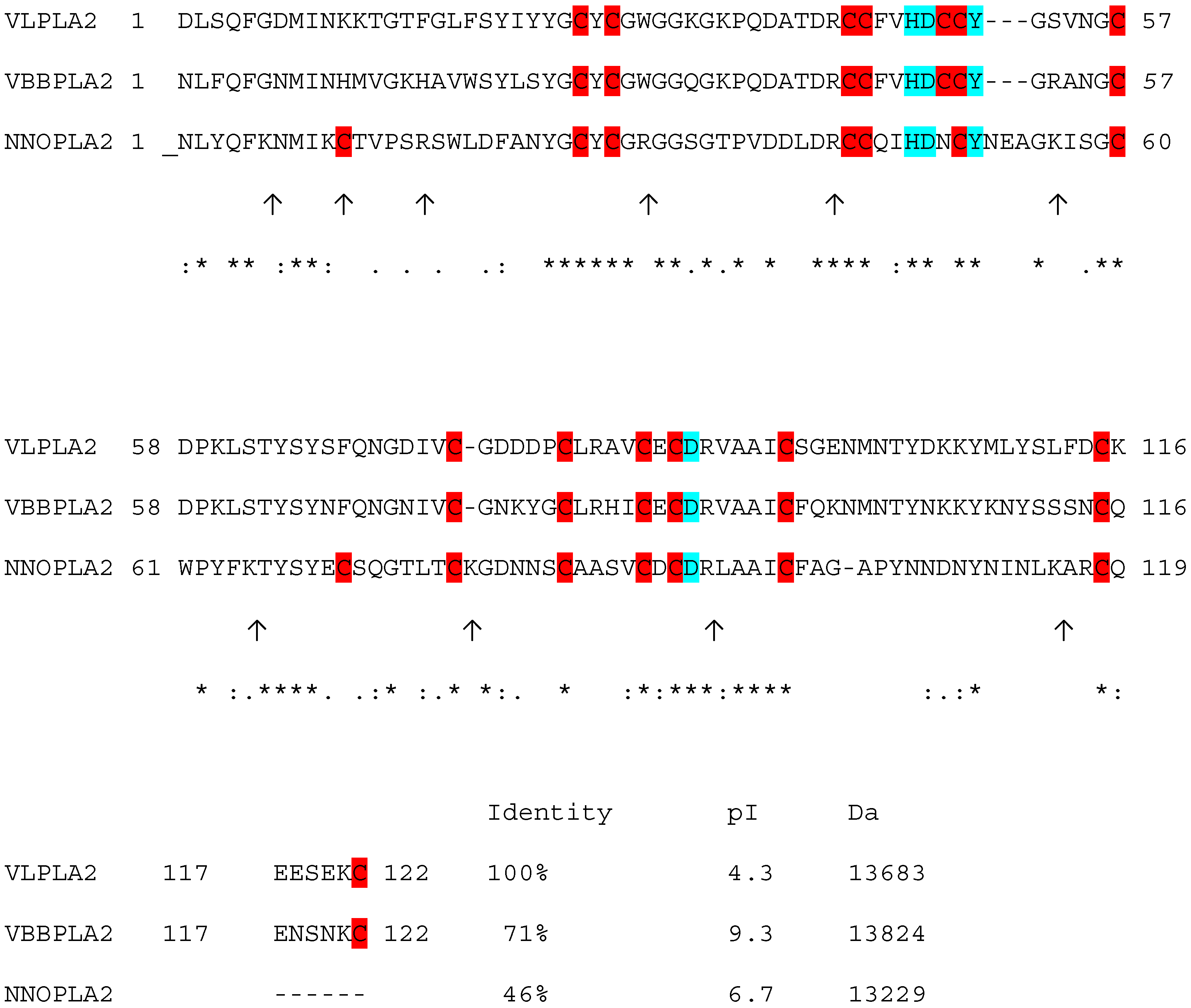
        <p>MALDI-TOF MS analysis confirmed the molecular masses estimates of native PLA<sub>2</sub>s revealing single peaks for enzymes with the actual molecular masses of 13,683 Da for VLPLA<sub>2</sub>, 13,824 Da for VBBPLA<sub>2</sub> and 13,229 Da for NNOPLA<sub>2</sub>. To distinguish between the possible isoforms, PLA<sub>2</sub>s of different venoms were subjected to trypsinolysis and the masses of the resulting peptides were analysed by MALDI-TOF MS. The peptide mass fingerprinting results confirmed that VBBPLA<sub>2</sub> was a close match with enzyme formerly sequenced by Križaj <italic>et al.</italic> [<xref ref-type="bibr" rid="B48-toxins-05-00203">48</xref>], VLPLA<sub>2</sub> matched with sequence (EU421953) [<xref ref-type="bibr" rid="B18-toxins-05-00203">18</xref>] and NNOPLA<sub>2 </sub>with enzyme isoform 3 formerly sequenced by Ovchinnikov <italic>et al.</italic> [<xref ref-type="bibr" rid="B49-toxins-05-00203">49</xref>] (<xref ref-type="fig" rid="toxins-05-00203-f001">Figure 1</xref>). MALDI-TOF analysis of tryptic peptides derived from NNOPLA<sub>2</sub> is provided in Figure S1.</p>
        <fig id="toxins-05-00203-f001" position="float">
          <label>Figure 1</label>
          <caption>
            <p>Alignment of <italic>V. lebetina</italic> VLPLA<sub>2</sub> (EU421953) [<xref ref-type="bibr" rid="B18-toxins-05-00203">18</xref>], VBBPLA<sub>2</sub><italic> V. berus berus</italic> (P31854) [<xref ref-type="bibr" rid="B48-toxins-05-00203">48</xref>] and NNOPLA<sub>2</sub> isozyme E from <italic>N. naja oxiana</italic> (P25498) [<xref ref-type="bibr" rid="B49-toxins-05-00203">49</xref>]. The alignment was performed using the program CLUSTAL W (1.83) multiple sequence alignment. “*” indicates positions which have a single, fully conserved residue; “:” indicates that one of the “strong” amino acid groups is fully conserved; “.” indicates that one of the “weaker” groups is fully conserved. Trypsin cleavage sites in NNOPLA<sub>2</sub> are indicated as ↑. Cysteine residues are on red background, conserved catalytic network formed by four amino acid residues His48, Asp49, Tyr52 and Asp99 are on blue background.</p>
          </caption>
          <graphic xmlns:xlink="http://www.w3.org/1999/xlink" xlink:href="toxins-05-00203-g001.tif"/>
        </fig>
      </sec>
      <sec>
        <title>2.2. Inhibition of Human Platelet Aggregation <italic>in Vitro</italic></title>
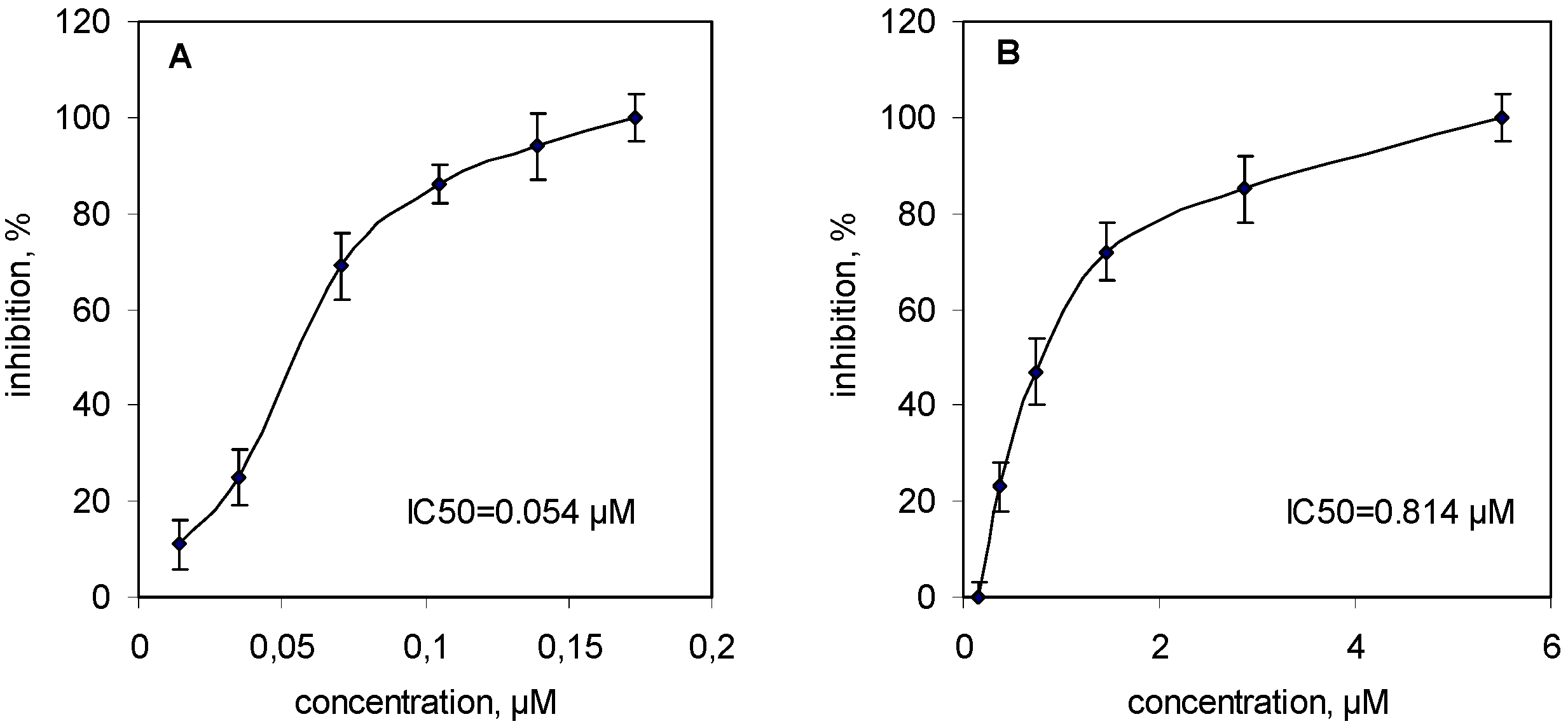
        <p>sPLA<sub>2</sub>s from all three venoms inhibited collagen-induced platelet aggregation in platelet-rich plasma in a concentration-dependent manner: the IC<sub>50</sub> = 0.054 μM for VBBPLA<sub>2</sub> (<xref ref-type="fig" rid="toxins-05-00203-f002">Figure 2</xref>A); IC<sub>50</sub> = 0.072 μM for VLPLA<sub>2</sub> [<xref ref-type="bibr" rid="B18-toxins-05-00203">18</xref>] and IC<sub>50</sub> = 0.814 μM for NNOPLA<sub>2</sub> (<xref ref-type="fig" rid="toxins-05-00203-f002">Figure 2</xref>B). </p>
        <p>In order to explore if the inhibitory effects of sPLA<sub>2</sub>s on platelet aggregation were related to their enzymatic activities, the native sPLA<sub>2</sub>s were treated by <italic>p</italic>-bromophenacylbromide (<italic>p</italic>-BPB) that modifies the histidine in the active center causing the inhibition of the catalytic activity. The <italic>p</italic>-BPB-treated enzymes were tested in the same conditions as the native vPLA<sub>2</sub>s. The treatment of all three svPLA<sub>2</sub>s by <italic>p</italic>-BPB resulted in complete loss of their catalytic activity that was accompanied by the loss of their inhibitory effect on collagen-induced platelet aggregation. </p>
        <fig id="toxins-05-00203-f002" position="float">
          <label>Figure 2</label>
          <caption>
            <p>Inhibitory effects of svPLA<sub>2</sub>s on collagen-induced human platelet aggregation. (<bold>A</bold>) human platelet rich plasma (PRP) samples were stirred for 2 min at 37 °C with VBBPLA<sub>2</sub>s (0.014–0.173 μM) and then 2 μg/mL of collagen (final concentration in the test) was added to induce platelet aggregation; (<bold>B</bold>) The PRP samples were preincubated with NNOPLA<sub>2</sub>s (0.148–5.510 μM) under the same conditions. Results are reported as means ± SD (<italic>n</italic> = 3). </p>
          </caption>
          <graphic xmlns:xlink="http://www.w3.org/1999/xlink" xlink:href="toxins-05-00203-g002.tif"/>
        </fig>
      </sec>
      <sec>
        <title>2.3. Inhibitory Effect of Snake Venoms and Their sPLA<sub>2</sub>s on Bacteria</title>
        <sec>
          <title>2.3.1. Acute Toxicity to <italic>Vibrio fischeri</italic></title>
          <p>For the evaluation of the acute toxicity of studied enzyme preparations, naturally luminescent gram-negative bacteria <italic>V. fischeri</italic> were used. In these bacteria, the exposure to toxicants causes rapid decrease of their bioluminescence whereas the effect is dose-dependent [<xref ref-type="bibr" rid="B50-toxins-05-00203">50</xref>]. In the current study, in addition to svPLA<sub>2</sub>s also the effect of the whole venom was evaluated. As a toxicity endpoint, inhibition of bacterial bioluminescence after 15 min of exposure to the whole venom or sPLA<sub>2</sub>s was used. In general, the venoms and sPLA<sub>2</sub>s were not acutely toxic to <italic>V. fischeri</italic>. Also, the sPLA<sub>2</sub>s were not acutely toxic: only enzyme from <italic>V. lebetina</italic> inhibited the luminescence of bacteria at &lt;100 μg/mL (&lt;7.31 μM) level, the 15-min EC<sub>50 </sub>was 58 μg/mL, <italic>i.e.</italic>, 4.24 μM; <xref ref-type="table" rid="toxins-05-00203-t001">Table 1</xref>).</p>
          <table-wrap id="toxins-05-00203-t001" position="float">
            <object-id pub-id-type="pii">toxins-05-00203-t001_Table 1</object-id>
            <label>Table 1</label>
            <caption>
              <p>Acute toxicity (15-min EC<sub>50</sub>, μg/mL) of venoms and sPLA<sub>2</sub>s from different snakes to bacteria <italic>Vibrio fischeri</italic>. As a toxicity endpoint, inhibition of the bacterial bioluminescence was used. </p>
            </caption>
            <table>
            <thead>
                <tr>
                  <th align="center" valign="middle">Tested item</th>
                  <th colspan="4" align="center" valign="middle">Acute toxicity (15-min EC<sub>50</sub>, μg/mL)</th>
                </tr>
            </thead>
            <tbody>
                <tr>
                  <td align="center" valign="middle"> </td>
                  <td align="center" valign="middle">3,5-DCP *</td>
                  <td align="center" valign="middle">
                    <italic>V. b. berus</italic>
                  </td>
                  <td align="center" valign="middle">
                    <italic>V. lebetina</italic>
                  </td>
                  <td align="center" valign="middle">
                    <italic>N. n. oxiana</italic>
                  </td>
                </tr>
                <tr>
                  <td align="center" valign="middle">Venom</td>
                  <td align="center" valign="middle">3–4</td>
                  <td align="center" valign="middle">370</td>
                  <td align="center" valign="middle">944</td>
                  <td align="center" valign="middle">&gt;1315</td>
                </tr>
                <tr>
                  <td align="center" valign="middle">PLA<sub>2</sub></td>
                  <td align="center" valign="middle">3–4</td>
                  <td align="center" valign="middle">&gt;909 (&gt;65.76 μM)</td>
                  <td align="center" valign="middle">58 (4.24 μM)</td>
                  <td align="center" valign="middle">&gt;606 (&gt;45.81 μM)</td>
                </tr>
            </tbody>
            </table>
			<table-wrap-foot>
			<fn>
          <p>* 3,5-dichlorophenol (a positive control).</p>
			</fn>
			</table-wrap-foot>
          </table-wrap>
        </sec>
        <sec>
          <title>2.3.2. Inhibitory Effect of the Snake Venom PLA2s on Bacterial Growth</title>
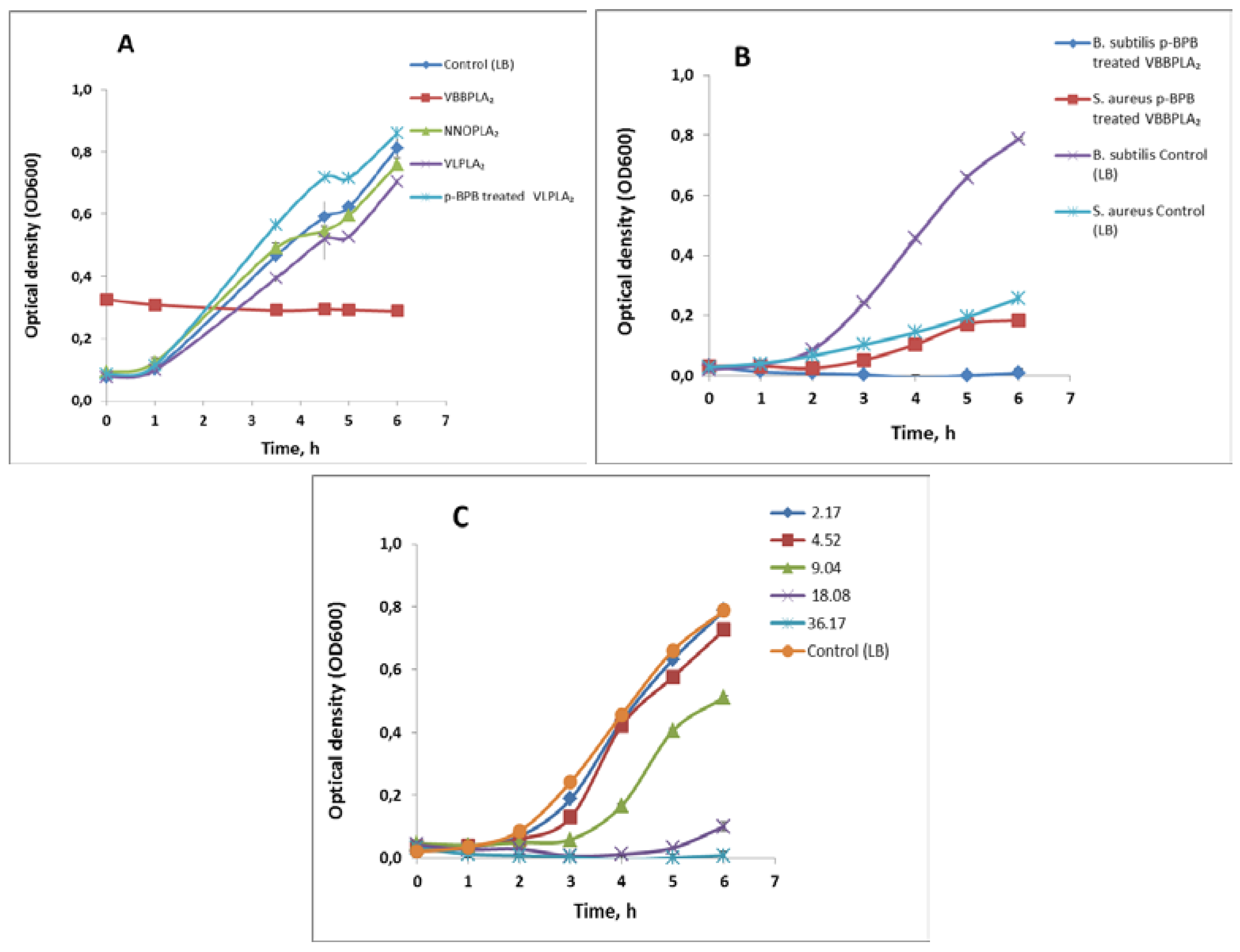
          <p>The inhibitory effect of svPLA<sub>2</sub>s on bacterial growth (a chronic toxicity) was evaluated at 500 μg/mL (36.2 μM for VBBPLA<sub>2</sub>; 37.8 μM for NNOPLA<sub>2</sub>; 36.5 μM for VLPLA<sub>2</sub>) level of the enzymes. The effect of VBBPLA<sub>2</sub> on the growth of gram-positive bacterial strains was studied in parallel for the native enzymes and <italic>p</italic>-bromophenacylbromide-inactivated VBBPLA<sub>2</sub>s. The results are shown in <xref ref-type="table" rid="toxins-05-00203-t002">Table 2</xref> and <xref ref-type="fig" rid="toxins-05-00203-f003">Figure 3</xref>. Although the tested concentration was relatively high, none of the svPLA<sub>2</sub>s inhibited the growth of gram-negative bacteria <italic>Escherichia coli</italic> but there were inhibitory effects in case of some enzyme preparations on gram-positive bacterial strains (<xref ref-type="fig" rid="toxins-05-00203-f003">Figure 3</xref>A–C). Specifically, the <italic>V. berus berus</italic> PLA<sub>2</sub> was most potent and totally (100%) inhibited the growth of <italic>B. subtilis</italic> (<xref ref-type="fig" rid="toxins-05-00203-f003">Figure 3</xref>A). The total growth inhibition of <italic>B. subtilis</italic> was also observed in case of <italic>p</italic>-BPB-inactivated VBBPLA<sub>2 </sub>(<xref ref-type="fig" rid="toxins-05-00203-f003">Figure 3</xref>B) whereas the effect was dose-dependent (<xref ref-type="fig" rid="toxins-05-00203-f003">Figure 3</xref>C). PLA<sub>2</sub> from <italic>V. lebetina</italic> showed also some inhibitory effect (13%) towards <italic>B. subtilis</italic> but this inhibitory effect was not observed in case of <italic>p</italic>-BPB-inactivated enzyme (<xref ref-type="fig" rid="toxins-05-00203-f003">Figure 3</xref>A). Intact VBBPLA<sub>2</sub> preparations (<xref ref-type="table" rid="toxins-05-00203-t002">Table 2</xref>) had no inhibitory effect on gram-positive bacteria <italic>S. aureus</italic> but there was some inhibitory effect in case of inactivated enzyme (<xref ref-type="fig" rid="toxins-05-00203-f003">Figure 3</xref>B; <xref ref-type="table" rid="toxins-05-00203-t002">Table 2</xref>). The <italic>N. naja oxiana</italic> PLA<sub>2</sub> was inhibitory (42%) towards <italic>S. aureus</italic> (<xref ref-type="table" rid="toxins-05-00203-t002">Table 2</xref>). </p>
          <table-wrap id="toxins-05-00203-t002" position="float">
            <object-id pub-id-type="pii">toxins-05-00203-t002_Table 2</object-id>
            <label>Table 2</label>
            <caption>
              <p>Inhibition of the bacterial growth (incubation time 6 h) in LB medium at 30 °C supplemented by svPLA<sub>2</sub>s (500 μg/mL, <italic>i.e.</italic>, 36.2 μM for VBBPLA<sub>2</sub>; 37.8 μM for NNOPLA<sub>2</sub>; 36.5 μM for VLPLA<sub>2</sub>) from three different snakes. </p>
            </caption>
            <table>
            <thead>
                <tr>
                  <th colspan="2" align="center" valign="middle"> </th>
                  <th colspan="5" align="center" valign="middle">Inhibition of the bacterial growth, % (<italic>t</italic> = 6 h)</th>
                </tr>
                <tr style="border-top: solid thin">
                  <th colspan="2" align="center" valign="middle">Bacteria(Gram staining)</th>
                  <th colspan="5" align="center" valign="middle">svPLA<sub>2</sub></th>
                </tr>
                <tr style="border-top: solid thin">
                  <th colspan="2" align="center" valign="middle"> </th>
                  <th align="center" valign="middle">
                    <italic>V. b. berus</italic>
                  </th>
                  <th align="center" valign="middle"><italic>V. b. berus</italic> *</th>
                  <th align="center" valign="middle">
                    <italic>V. lebetina</italic>
                  </th>
                  <th align="center" valign="middle"><italic>V. lebetina</italic> *</th>
                  <th align="center" valign="middle">
                    <italic>N. n. oxiana</italic>
                  </th>
                </tr>
            </thead>
            <tbody>
              <tr style="border-top: solid thin">
              <td align="center" valign="middle">
                    <italic>Escherichia coli</italic> 
                </td>
                  <td align="center" valign="middle">Gram (−)</td>
                  <td align="center" valign="middle">No effect</td>
                  <td align="center" valign="middle">not tested</td>
                  <td align="center" valign="middle">No effect</td>
                  <td align="center" valign="middle">No effect</td>
                  <td align="center" valign="middle">No effect</td>
                </tr>
                <tr>
                  <td align="center" valign="middle">
                    <italic>Bacillus subtilis</italic>
                  </td>
                  <td align="center" valign="middle">Gram (+)</td>
                  <td align="center" valign="middle">100% **</td>
                  <td align="center" valign="middle">99% **</td>
                  <td align="center" valign="middle">13%</td>
                  <td align="center" valign="middle">No effect</td>
                  <td align="center" valign="middle">Slight effect (6.5%)</td>
                </tr>
                <tr>
                  <td align="center" valign="middle">
                    <italic>Staphylococcus aureus</italic>
                  </td>
                  <td align="center" valign="middle">Gram (+)</td>
                  <td align="center" valign="middle">No effect</td>
                  <td align="center" valign="middle">29%</td>
                  <td align="center" valign="middle">No effect</td>
                  <td align="center" valign="middle">No effect</td>
                  <td align="center" valign="middle">42%</td>
                </tr>
            </tbody>
            </table>
			<table-wrap-foot>
			<fn>
          <p><bold>*</bold> histidine in PLA<sub>2</sub> was modified by <italic>p</italic>-bromophenacylbromide, to inactivate its catalytic activity; <bold>**</bold> growth was inhibited by 100% but the viability of bacteria remained unchanged (<italic>i.e.</italic>, after the 6 h exposure to enzyme preparation, bacteria were able to grow on agarized LB-medium; data not shown).</p>
			</fn>
			</table-wrap-foot>
          </table-wrap>
          <fig id="toxins-05-00203-f003" position="float">
            <label>Figure 3</label>
            <caption>
              <p>The effect of different snake venom sPLA<sub>2</sub>s on the growth of bacteria in LB medium at 30 °C. (<bold>A</bold>) The effect of different snake venom sPLA<sub>2</sub>s (500 μg/mL, <italic>i.e.</italic>, 36.2 μM for VBBPLA<sub>2</sub>; 37.8 μM for NNOPLA<sub>2</sub>; 36.5 μM for VLPLA<sub>2</sub>) on the growth of gram-positive bacteria <italic>Bacillus subtilis</italic> BR151. The different svPLA<sub>2</sub>s are indicated as data labels; (<bold>B</bold>) The effect of <italic>p</italic>-BPB-treated <italic>V. berus berus</italic> sPLA<sub>2</sub> (500 μg/mL = 36.17 μM) on the growth of gram-positive bacteria <italic>Bacillus subtilis</italic> BR151 and <italic>Staphylococcus aureus</italic>. Growth of not treated bacteria is shown as data labels; (<bold>C</bold>) The effect of different concentrations of <italic>p</italic>-BPB-treated <italic>V. berus berus</italic> venom sPLA<sub>2</sub> on the growth of <italic>Bacillus subtilis</italic> BR151; concentrations (μM) are shown as data labels. Results are reported as means ± SD (<italic>n</italic> = 3). </p>
            </caption>
            <graphic xmlns:xlink="http://www.w3.org/1999/xlink" xlink:href="toxins-05-00203-g003.tif"/>
          </fig>
        </sec>
      </sec>
      <sec>
        <title>2.4. Effects of Snake Venom PLA<sub>2</sub>s on Cancer Cells Viability</title>
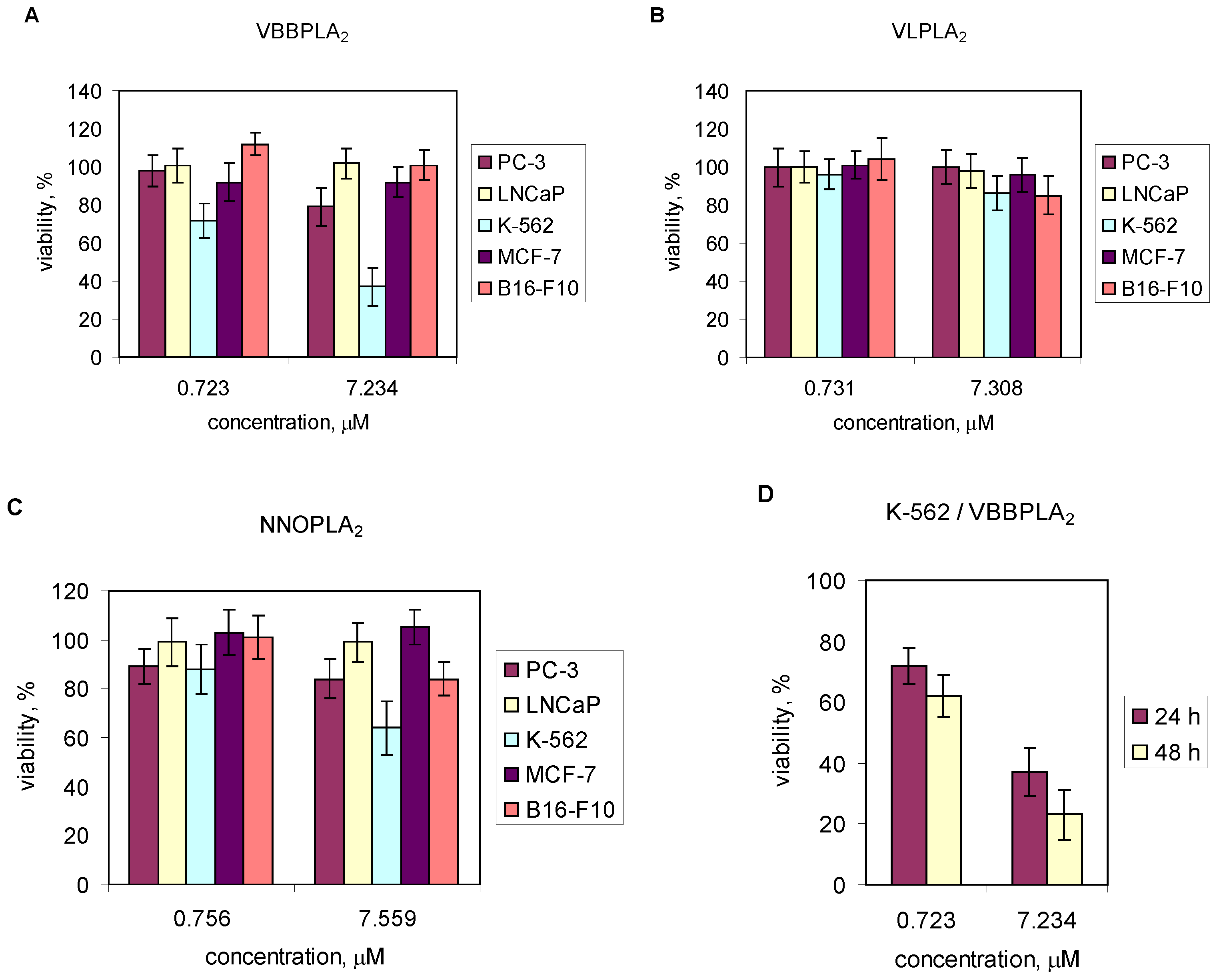
        <p>Cancer cell lines (PC-3, LNCaP, MCF-7, B10-F16 and K-562) were exposed to PLA<sub>2</sub>s from <italic>V. lebetina</italic>, <italic>V. berus berus</italic> and <italic>N. naja oxiana</italic> at concentrations of 10 and 100 μg/mL (~0.7 and ~7 μM). The results are shown in <xref ref-type="fig" rid="toxins-05-00203-f004">Figure 4</xref>. There was no inhibitory effect of studied PLA<sub>2</sub> preparations towards LNCaP cells in this concentration range (<xref ref-type="fig" rid="toxins-05-00203-f004">Figure 4</xref>A–C). The viability of PC-3 cells was not changed after treating with 7.31 μM of VLPLA<sub>2</sub> (<xref ref-type="fig" rid="toxins-05-00203-f004">Figure 4</xref>B). NNOPLA<sub>2</sub> had no cytotoxic effect on MCF-7 cells (<xref ref-type="fig" rid="toxins-05-00203-f004">Figure 4</xref>C), VBBPLA<sub>2</sub> and VLPLA<sub>2</sub> only slightly reduced the viability of MCF-7 cells (<xref ref-type="fig" rid="toxins-05-00203-f004">Figure 4</xref>A,B). VLPLA<sub>2 </sub>and NNOPLA<sub>2</sub> decreased viability of B16-F10 cells about 17% (<xref ref-type="fig" rid="toxins-05-00203-f004">Figure 4</xref>B,C), VBBPLA<sub>2 </sub>had no effect (<xref ref-type="fig" rid="toxins-05-00203-f004">Figure 4</xref>A). All three enzymes inhibited the viability of K-562 cells (<xref ref-type="fig" rid="toxins-05-00203-f004">Figure 4</xref>A–C), although VLPLA<sub>2</sub> had only slight effect (<xref ref-type="fig" rid="toxins-05-00203-f004">Figure 4</xref>B). The most potent inhibitory effect was observed in case of VBBPLA<sub>2</sub>. After 48 h treatment of K-562 cells with 7.23 μM of VBBPLA<sub>2</sub>, the cellular viability reduced to 20% (<xref ref-type="fig" rid="toxins-05-00203-f004">Figure 4</xref>D). <italic>p</italic>-BPB-treated VBBPLA<sub>2</sub> inhibited the viability of K-562 cells by 27%. VBBPLA<sub>2</sub> reduced the viability of K-562 cells in time- and dose-dependent manner. </p>
        <fig id="toxins-05-00203-f004" position="float">
          <label>Figure 4</label>
          <caption>
            <p>Effect of svPLA<sub>2</sub>s on viability of PC-3, LNCaP, K-562, MCF-7 and B16-F10 cells <italic>in vitro</italic>. (<bold>A</bold>–<bold>C</bold>) Cells were seeded in 96-well plates at a density 10<sup>5</sup> cells/mL and incubated at 37 °C for at least 24 h. After treatment with snake venom PLA<sub>2</sub>s (~0.7 and ~7 μM) for 24 h, the viability of the cells was determined by MTT assay (PC-3) or by water-soluble tetrazolium salt WST-1 assay (LNCaP, K-562, MCF-7 and B16-F10); (<bold>D</bold>) K-562 cells were treated with VBBPLA<sub>2</sub> (0.72 μM and 7.23μM) for 24 and 48 h. Data are means (±SD) from two independent experiments performed in triplicate. </p>
          </caption>
          <graphic xmlns:xlink="http://www.w3.org/1999/xlink" xlink:href="toxins-05-00203-g004.tif"/>
        </fig>
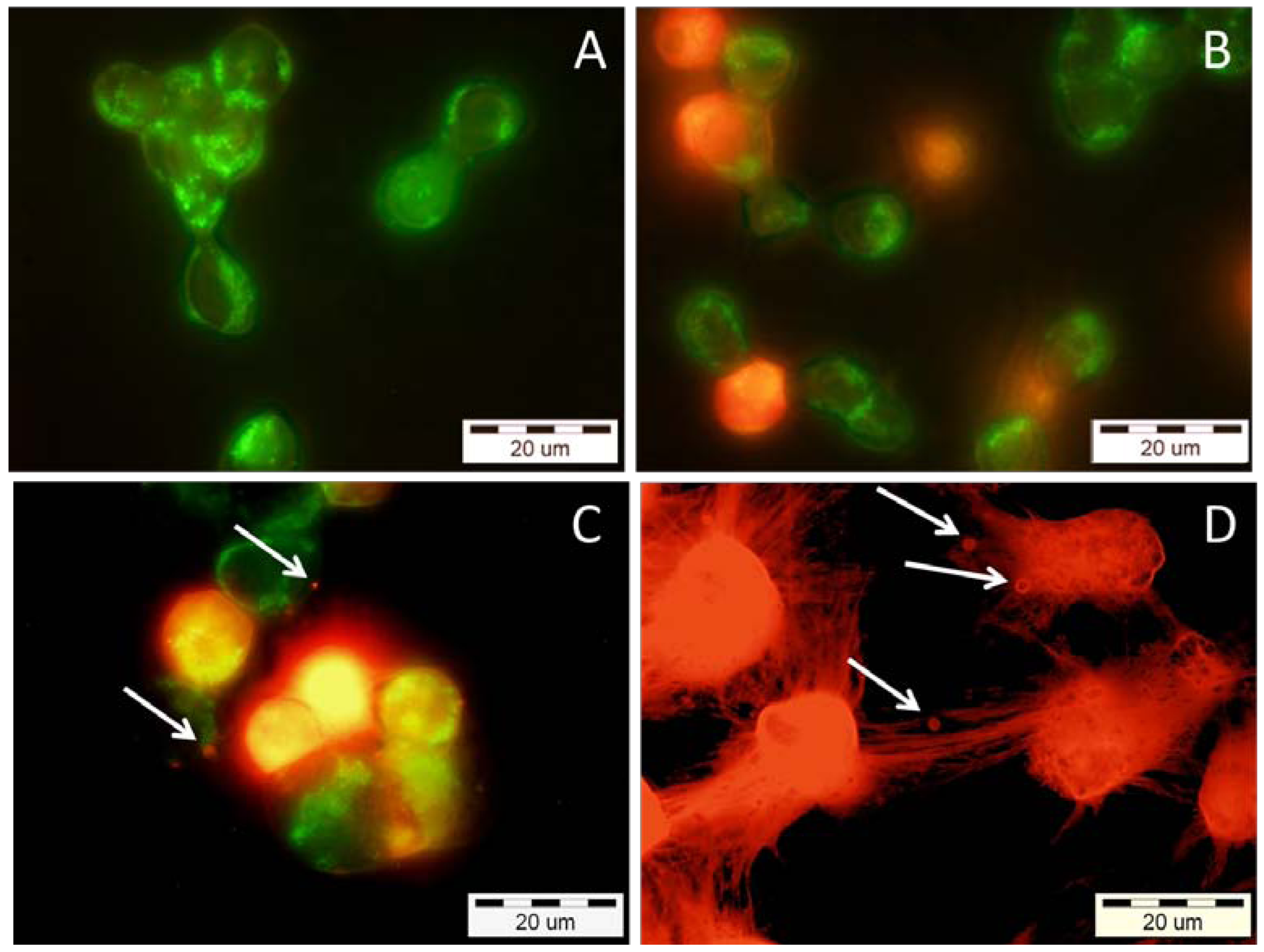
        <p>To evaluate whether the cytotoxicity effect of VBBPLA<sub>2</sub> on K-562 cells (<xref ref-type="fig" rid="toxins-05-00203-f004">Figure 4</xref>D) was necrotic or apoptotic, the treated cells were stained with Annexin-V-FITC and propidium iodide (PI) (<xref ref-type="fig" rid="toxins-05-00203-f005">Figure 5</xref>). One characteristic feature of apoptosis is the externalisation of the lipid phosphatidyl serine (PS) from the inner to the outer plasma membrane. Annexin-V is a calcium-dependent phospholipid-binding protein that specifically binds PS and hence stains apoptotic cells. When used in conjunction with a live/dead cell discriminator such as propidium iodide, which measures membrane integrity, the bright green early apoptotic cells (Annexin-V positive) can be distinguished from the red colored late apoptotic/necrotic cells (PI positive). PI stains the cells with ruptured plasma membrane as cells with intact membranes are not permeable to PI. Thus, PI stains both, the cells in the late stage of apoptosis and the cells in necrosis. The treatment of K-562 cells with 0.36 μM VBBPLA<sub>2</sub> caused the loss of cell membrane’s asymmetry which is a sign of early apoptosis (<xref ref-type="fig" rid="toxins-05-00203-f005">Figure 5</xref>A). </p>
        <fig id="toxins-05-00203-f005" position="float">
          <label>Figure 5</label>
          <caption>
            <p>Epifluorescence micrographs of human K-562 cells after incubation with different concentrations of VBBPLA<sub>2</sub>. After the exposure, the cells were stained with both Annexin V-FITC and propidium iodide, to visualize the early and late stage of apoptosis and/or necrosis of the cells, respectively. (<bold>A</bold>) 0.36 μM (expose 24 h)—early apoptotic cells with intact membranes—green; (<bold>B</bold>) 0.36 μM (expose 28 h)—mixture of early apoptotic cells (green) and cells which have already lost their membrane integrity (orange); (<bold>C</bold>) 0.72 μM (expose 24 h)—late apoptotic cells (orange to red) with blebbes (white arrows) and green membrane fragments; (<bold>D</bold>) 7.23 μM (expose 24 h)—totally destroyed necrotic (red) cells with membrane blebbes (white arrows). </p>
          </caption>
          <graphic xmlns:xlink="http://www.w3.org/1999/xlink" xlink:href="toxins-05-00203-g005.tif"/>
        </fig>
        <p>The transition from apoptosis to necrosis is a loosely defined continuum that necessitates recognition of the various stages of the process. Therefore, we performed a time course experiment (the cells were photographed after 24 h and 28 h of incubation) to prove that the cells were traversing through early apoptosis before reaching the late apoptosis/necrosis (<xref ref-type="fig" rid="toxins-05-00203-f005">Figure 5</xref>A,B). In our study the bright green cells (Annexin-V positive early apoptotic cells) turned to orange (Annexin-V and PI positive late apoptotic cells) when VBBPLA<sub>2</sub> concentration was increased from 0.36 μM (<xref ref-type="fig" rid="toxins-05-00203-f005">Figure 5</xref>A) to 0.72 μM (<xref ref-type="fig" rid="toxins-05-00203-f005">Figure 5</xref>C) but also in case of lower VBBPLA<sub>2</sub> concentration (0.36 μM) if the incubation time was prolonged to 28 h (<xref ref-type="fig" rid="toxins-05-00203-f005">Figure 5</xref>B). The cells treated with 7.23 μM VBBPLA<sub>2</sub> appeared totally destroyed, but it was still possible to detect the characteristic sign of apoptosis—membrane blebbing (<xref ref-type="fig" rid="toxins-05-00203-f005">Figure 5</xref>D, white arrows).</p>
      </sec>
    </sec>
    <sec sec-type="discussion">
      <title>3. Discussion</title>
      <p>Snake venom sPLA<sub>2</sub>s exhibit a large variety of pharmacological effects. In this work we compared the effects of sPLA<sub>2</sub>s originating from the venoms of three different snakes on human platelets, different bacteria and five types of cancer cells <italic>in vitro. Naja naja oxiana</italic> PLA<sub>2</sub> belongs to PLA<sub>2</sub> from old world snakes (group I) and has different disulfide bond pattern than PLA<sub>2</sub>s from new world’s snakes such as VBBPLA<sub>2</sub> and VLPLA<sub>2</sub> (group II).</p>
      <p>Kini and Evans [<xref ref-type="bibr" rid="B15-toxins-05-00203">15</xref>] divided snake venom PLA<sub>2</sub>s based on their effects on platelet function into three classes: class A involves PLA<sub>2</sub>s which initiate platelet aggregation, class B PLA<sub>2</sub>s cause only the inhibition of platelet aggregation induced by several physiological agonists such as collagen and class C involves PLA<sub>2</sub>s that have dual activity acting as inducer and inhibitor, depending of conditions. Classes B and C are both subdivided into two subgroups. Inhibitory activity of class B1 PLA<sub>2</sub>s (but not class B2) is dependent on their catalytic activity. Results of the current study show that VBBPLA<sub>2 </sub>and NNOPLA<sub>2</sub> belong to class B1. In class B1 the inhibitory effects against platelets aggregation have been explained by hydrolysis of phospholipids from the plasma and/or from lipoproteins and the formation of lysophosphatidylcholine (lysoPC) [<xref ref-type="bibr" rid="B21-toxins-05-00203">21</xref>,<xref ref-type="bibr" rid="B22-toxins-05-00203">22</xref>,<xref ref-type="bibr" rid="B51-toxins-05-00203">51</xref>]. The platelet aggregation inhibitory effects of PLA<sub>2</sub>s have shown to be dependent on plasma factor for several snake venom PLA<sub>2</sub>s, including VLPLA<sub>2</sub> [<xref ref-type="bibr" rid="B18-toxins-05-00203">18</xref>], the antiplatelet PLA<sub>2</sub> purified from the venoms of <italic>Austrelaps superba</italic> [<xref ref-type="bibr" rid="B51-toxins-05-00203">51</xref>], <italic>Lachesis muta</italic> [<xref ref-type="bibr" rid="B21-toxins-05-00203">21</xref>,<xref ref-type="bibr" rid="B52-toxins-05-00203">52</xref>], and <italic>Micropechis ikaheka</italic> [<xref ref-type="bibr" rid="B53-toxins-05-00203">53</xref>]. Yuan <italic>et al.</italic> [<xref ref-type="bibr" rid="B51-toxins-05-00203">51</xref>] showed that the formation of lysoPC after incubation with snake venom PLA<sub>2</sub> correlated with the inhibition of platelet aggregation. </p>
      <p>The isoelectric point values of snake venom PLA<sub>2</sub>s vary and therefore PLA<sub>2</sub>s are classified as acidic, neutral or basic. This property may affect the binding affinity and specificity of PLA<sub>2</sub>s to phospholipid membranes. However, pI values of PLA<sub>2</sub>s are not predictive for their effect on platelet aggregation: the acidic VLPLA<sub>2 </sub> [<xref ref-type="bibr" rid="B18-toxins-05-00203">18</xref>], acidic PLA<sub>2</sub>s from the venoms of <italic>Trimeresurus gramineus</italic> [<xref ref-type="bibr" rid="B13-toxins-05-00203">13</xref>] and <italic>Agkistrodon acutus</italic> [<xref ref-type="bibr" rid="B14-toxins-05-00203">14</xref>] and basic PLA<sub>2</sub>s from <italic>V. berus berus</italic> venom (this work), from <italic>Acanthopis praelongus</italic> venom [<xref ref-type="bibr" rid="B16-toxins-05-00203">16</xref>] and acanthins from <italic>Acanthopis antarcticus</italic> venom [<xref ref-type="bibr" rid="B22-toxins-05-00203">22</xref>] are all potent platelet inhibitors. On the contrary, bothropstoxin-II (Bthtx-II), a basic Asp<sup>49</sup> phospholipase A<sub>2</sub> isolated from <italic>Bothrops jararacussu</italic> snake venom was able to induce platelet aggregation in a concentration-dependent manner [<xref ref-type="bibr" rid="B17-toxins-05-00203">17</xref>]. NNOPLA<sub>2 </sub>with almost neutral pI (6.7) inhibited collagen induced platelet aggregation more slowly than VBBPLA<sub>2</sub> and VLPLA<sub>2</sub> (<xref ref-type="fig" rid="toxins-05-00203-f002">Figure 2</xref>).</p>
      <p>Although only PLA<sub>2</sub> from <italic>V. lebetina</italic> but not the PLA<sub>2</sub>s from <italic>V. berus berus</italic> and <italic>N. naja oxiana</italic> showed acute toxic effect on <italic>Vibrio fischeri</italic> at 4.24 μM level (<xref ref-type="table" rid="toxins-05-00203-t001">Table 1</xref>), many snake venom phospholipases A<sub>2</sub> have been shown antibacterial and antiparasitic properties. For example, the Lys<sup>49 </sup>protein from <italic>Bothrops asper</italic> venom showed bactericidal activity on both, gram-positive and gram-negative bacteria [<xref ref-type="bibr" rid="B27-toxins-05-00203">27</xref>]. Contrarily, the Lys<sup>49</sup> BmarPLA<sub>2</sub> from <italic>Bothrops marajoensis</italic> showed no antibacterial and antiparasitic effects [<xref ref-type="bibr" rid="B36-toxins-05-00203">36</xref>]. Two myotoxic Asp<sup>49</sup> PLA<sub>2</sub>s from <italic>Bothrops neuwiedi pauloensis</italic> venom were bactericidal towards <italic>Escherichia coli</italic> and <italic>Staphylococcus aureus</italic> [<xref ref-type="bibr" rid="B31-toxins-05-00203">31</xref>]. Myotoxin I Lys<sup>49</sup> PLA<sub>2</sub> from <italic>Bothrops atrox</italic> venom was weakly bactericidal against <italic>E. coli</italic> [<xref ref-type="bibr" rid="B30-toxins-05-00203">30</xref>]. Myotoxin I Lys<sup>49</sup> PLA<sub>2</sub> and myotoxin II Asp<sup>49</sup> PLA<sub>2</sub>from <italic>Bothrops jararacussu</italic> venom showed antibacterial effect against gram-negative bacteria <italic>Xanthomonas</italic> [<xref ref-type="bibr" rid="B54-toxins-05-00203">54</xref>]. Myotoxic Asp<sup>49</sup> PLA<sub>2</sub> MTX-I and Lys<sup>49</sup> PLA<sub>2</sub> MTX-II isolated from <italic>Botrops brazili</italic> venom and cationic synthetic peptides derived from their 115–129 <italic>C</italic>-terminal region displayed toxic effects against <italic>E. coli</italic>, <italic>Candida albicans</italic> and <italic>Leishmania sp</italic>. and human T-cell leukemia (JURKAT) cell lines [<xref ref-type="bibr" rid="B55-toxins-05-00203">55</xref>]. </p>
      <p>In the current study, the 36.17 μM VBBPLA<sub>2</sub> totally inhibited the growth of gram-positive bacteria <italic>Bacillus subtilis</italic> (<xref ref-type="table" rid="toxins-05-00203-t002">Table 2</xref>, <xref ref-type="fig" rid="toxins-05-00203-f003">Figure 3</xref>A) but did not inhibit the growth of other bacterial strains analyzed (<xref ref-type="table" rid="toxins-05-00203-t002">Table 2</xref>). VBBPLA<sub>2 </sub>has highly cationic nature as it contains numerous positively charged Arg and Lys residues that may promote its binding to negatively-charged outer surface of bacteria. The majority of antimicrobial peptides are positively charged at physiological pH, and prevailing view is that their selectivity stems from electrostatic attraction of the cationic peptide to the anionic bacterial membranes [<xref ref-type="bibr" rid="B56-toxins-05-00203">56</xref>]. However, to another gram-positive bacterium, <italic>Staphylococcus aureus</italic>, native VBBPLA<sub>2 </sub>had no inhibitory effect (<xref ref-type="table" rid="toxins-05-00203-t002">Table 2</xref>).</p>
      <p>The activity and expression of several PLA<sub>2 </sub>isoforms are increased in several human cancers, including breast, pancreatic and prostate cancers, suggesting that these enzymes may have a central role in both tumor development and progression and thus can be targets for anticancer drugs [<xref ref-type="bibr" rid="B12-toxins-05-00203">12</xref>,<xref ref-type="bibr" rid="B57-toxins-05-00203">57</xref>]. On the other hand, some snake venom PLA<sub>2</sub>s may have antitumoral activity [<xref ref-type="bibr" rid="B12-toxins-05-00203">12</xref>]. Crotoxin, a noncovalent complex (formed by two nonidentical subunits: a basic PLA<sub>2 </sub>crotoxinB and a nonenzymatic acidic crotoxinA) isolated from the venom of <italic>Crotalus durissus terrificus,</italic> exhibits a preferential cytotoxic activity against various types of tumor cells including K-562 cells [<xref ref-type="bibr" rid="B58-toxins-05-00203">58</xref>], MCF-7 cells [<xref ref-type="bibr" rid="B59-toxins-05-00203">59</xref>] and lung adenocarcinoma A549 cells. Treatment of A549 cells with crotoxin significantly inhibited the cell growth in a dose-dependent manner and displayed anti-angiogenic effects <italic>in vitro</italic> [<xref ref-type="bibr" rid="B60-toxins-05-00203">60</xref>]. Crotoxin has been used in the treatment of different advanced carcinomas [<xref ref-type="bibr" rid="B61-toxins-05-00203">61</xref>]. It has been shown that <italic>bl</italic>D- PLA<sub>2</sub> from <italic>Bothrops leucurus</italic> snake venom reduced K-562 cellular viability in a dose-dependent manner causing disruption of cellular membrane integrity [<xref ref-type="bibr" rid="B62-toxins-05-00203">62</xref>]. Several secreted PLA<sub>2</sub>s were found to play role in apoptosis [<xref ref-type="bibr" rid="B63-toxins-05-00203">63</xref>]. PLA<sub>2 </sub>from <italic>Naja naja atra</italic> venom induced apoptotic cell death of K-562 cells [<xref ref-type="bibr" rid="B43-toxins-05-00203">43</xref>]. A Lys<sup>49</sup> phospholipase A<sub>2</sub> from <italic>Protobothrops flavoviridis</italic> venom induced caspase-independent apoptotic cell death accompanied by rapid plasma-membrane rupture in human leukaemia cells. However, Asp<sup>49</sup> PLA<sub>2</sub> from the same venom failed to induce death of JURKAT cells [<xref ref-type="bibr" rid="B1-toxins-05-00203">1</xref>]. </p>
      <p>In this study, different cancer cell lines (PC-3, LNCaP, K-562, MCF-7, B10-F16) were exposed to different PLA<sub>2</sub>s from <italic>V. lebetina</italic>, <italic>V. berus berus</italic> and <italic>N. naja oxiana</italic>. At the highest concentration tested (~7 μM), there was no inhibitory effect of studied PLA<sub>2</sub> preparations towards LNCaP cells (<xref ref-type="fig" rid="toxins-05-00203-f004">Figure 4</xref>A–C). This is coherent with the data of Sved <italic>et al.</italic> [<xref ref-type="bibr" rid="B64-toxins-05-00203">64</xref>] on the consistent and dose-dependent stimulatory effect of human recombinant sPLA<sub>2</sub>-IIA on LNCaP cell growth. In the current study, the most potent inhibitory effect of studied svPLA<sub>2</sub>s was observed for VBBPLA<sub>2 </sub>towards human chronic myeloid leukemic cell line K-562 (<xref ref-type="fig" rid="toxins-05-00203-f004">Figure 4</xref>D). In addition, <italic>p</italic>-BPB-treated inactive VBBPLA<sub>2</sub> yielded 27% loss of viability in K-562 cells. Thus, VBBPLA<sub>2</sub>-induced cell death is dependent not only of enzymatic activity.</p>
    </sec>
    <sec>
      <title>4. Materials and Methods</title>
      <sec>
        <title>4.1. Materials</title>
        <p>The venoms of <italic>V. lebetina</italic> and <italic>N. n. oxiana</italic> were commercial preparations from Tashkent Integrated Zoo Plant (Uzbekistan), <italic>V. b. berus</italic> venom was obtained from Khimki Serpentarium (Moscow, Russia). Sephadex G-100 (superfine) was product of Pharmacia (Uppsala, Sweden). 2,5-dihydroxybenzoic acid (DHB), 3,5-dichlorophenol, bovine serum albumin (BSA), ovalbumin, carboanhydrase, 3-(4,5-dimethylthiazol-2-yl)-2,5-diphenyltetrazolium bromide (MTT), soybean trypsin inhibitor, Substance P, Cytochrome C, insulin B chain, <italic>p</italic>-bromophenacylbromide (<italic>p</italic>-BPB) and camptothecin were from Sigma (St. Louis, MO, USA), trypsin (Promega, Madison, WI, USA). WST-1 was from Roche Diagnostics, collagen from Chronolog. Annexin V/Dead Cell Apoptosis Kit with FITC annexin V and propidium iodide (PI) were from Invitrogen, Eugene, OR, USA. All other reagents used were of analytical grade.</p>
      </sec>
      <sec>
        <title>4.2. Purification of Enzymes</title>
        <p><italic>Vipera lebetina</italic> PLA<sub>2</sub> was purified according to Vija <italic>et al.</italic> [<xref ref-type="bibr" rid="B18-toxins-05-00203">18</xref>], <italic>Vipera berus berus</italic> PLA<sub>2</sub> (VBBPLA<sub>2</sub>) was separated from the venom as described by Križaj <italic>et al</italic> [<xref ref-type="bibr" rid="B48-toxins-05-00203">48</xref>]. <italic>Naja naja oxiana</italic> venom PLA<sub>2</sub> (NNOPLA<sub>2</sub>) was purified by gel filtration on Sephadex G-50 sf. and hydrophobic chromatography on pentylagarose. Purity and molecular masses of enzymes were detected by SDS-PAGE and MALDI-TOF MS (see 4.6.). </p>
      </sec>
      <sec>
        <title>4.3. PLA<sub>2</sub> Assay</title>
        <p>Phospholipase A<sub>2</sub> activity was assayed by titrimetric method using egg yolk phosphatidylcholine as a substrate [<xref ref-type="bibr" rid="B65-toxins-05-00203">65</xref>]. Briefly, one egg yolk was added to 100 mL of bidistilled water and aqueous emulsion was prepared by homogenisation. Per assay, 1.5 mL of the egg yolk emulsion was diluted with 3 mL of Triton X-100 and CaCl<sub>2 </sub>being 0.75% and 0.15 mM, respectively. The pH was set at 8.0; 10 μL (0.1 mg/mL) of PLA<sub>2 </sub>sample was added and the fatty acids released were titrated with 10 mM KOH using a pH-stat (TTT80/pHM84/ABU80, Radiometer, Copenhagen, Denmark) at 25 °C. </p>
      </sec>
      <sec>
        <title>4.4. PLA<sub>2</sub> Activity Inhibition with p-bromophenacylbromide (p-BPB)</title>
        <p>PLA<sub>2</sub>s (0.4 mg) were dissolved in 0.4 mL of 0.1 M ammonium acetate (pH 7.4) containing 0.4 mM of <italic>p</italic>-BPB and incubated for 24 h at room temperature. Excess of the reagents was removed by ultrafiltration through the microspin filter (cut-off 5000 MW, Cole-Parmer, Vernon Hills, IL, USA), the protein fraction was washed with 0.1 M ammonium acetate (pH 7.4) and lyophilized. </p>
      </sec>
      <sec>
        <title>4.5. Protein Quantification</title>
        <p>Protein concentrations were determined using the Pierce micro BCA kit. Bovine serum albumin was used as a standard. During the process of column chromatography, the elution profile of proteins was followed by the absorbance at 280 nm.</p>
      </sec>
      <sec>
        <title>4.6. Molecular Mass Detection and Isoelectric Focusing of Proteins</title>
        <p>The molecular masses of the purified proteins were determined by SDS-PAGE on 12.5% polyacrylamide gels using the method of Laemmli [<xref ref-type="bibr" rid="B66-toxins-05-00203">66</xref>]. Molecular mass standards for SDS-PAGE were albumin—66 kDa, ovalbumin—45 kDa, carboanhydrase—29 kDa, soybean trypsin inhibitor—20 kDa, cytochrome C—12.3 kDa. </p>
        <p>The molecular masses of the fractions were also determined using a home-built matrix-assisted laser desorption/ionization-time of flight mass spectrometer (MALDI-TOF MS) (National Institute of Chemical Physics and Biophysics, Tallinn, Estonia). Before the analysis the freeze-dried samples of protein fractions were dissolved in 5 μL of 50% acetonitrile containing 0.1% trifluoroacetic acid. Aliquots of 0.5 μL were applied onto the target, allowed to air dry and 0.5 μL of the matrix solution (2,5-dihydroxybenzoic acid) was applied to the target and allowed to dry in air. The mass calibration standards were cytochrome C, insulin B chain. A nitrogen 337 nm laser (4 ns pulse) was used and at least 30–40 shots were summarized.</p>
        <p>Analytical isoelectric focusing was performed on 5% polyacrylamide gel plates according to the method of Vesterberg [<xref ref-type="bibr" rid="B67-toxins-05-00203">67</xref>] in Multiphor 2117 (LKB, Bromma, Sweden) apparatus in the pH range of 3.6–9.3. Isoelectric focusing markers were amyloglucosidase (pI 3.60), soybean trypsin inhibitor (pI 4.55), β-lactoglobulin A (pI 5.20), bovine carbonic anhydrase B (pI 5.85), human carbonic anhydrase B (pI 6.55), horse myoglobin-acidic band (pI 6.85), horse myoglobin-basic band (pI 7.35) lentil lectin-acidic band (pI 8.15), lentil lectin-middle band (pI 8.45), lentil lectin-basic band (pI 8.65) and trypsinogen (pI 9.30). The gels were stained for proteins with Coomassie Brilliant Blue R250.</p>
      </sec>
      <sec>
        <title>4.7. In-Gel Tryptic Digestion and Mass Fingerprinting of Proteins</title>
        <p>After visualization with Coomassie Blue the gel-electrophoresis bands of protein in interest (native or reduced) were excised from SDS-PAGE gels, each gel slice cut into small pieces (1 mm<sup>2</sup>), placed into eppendorf tubes and treated as described earlier [<xref ref-type="bibr" rid="B68-toxins-05-00203">68</xref>]. Equal volumes (0.5 μL) of the peptide mixture and the matrix (2,5-dihydroxybenzoic acid, or α-cyano-4-hydroxycinnamic acid) were mixed on the MALDI-TOF plate. The mass calibration standards were substance P and angiotensin II. </p>
      </sec>
      <sec>
        <title>4.8. Preparation of Human Platelet Suspension and Collagen-Induced Platelet Aggregation Assay</title>
        <p>Collagen-induced platelet aggregation assays were performed in human platelet-rich plasma (PRP). Blood was collected from healthy adult volunteers who had not taken any medication for at least two weeks prior to sampling. The blood was collected according to the permissions LO2354 (14.12.2010) and LO2513 (21.07.2011).</p>
        <p>In order to obtain PRP the blood was dispensed into polystyrene tubes containing 0.129 M sodium citrate (9:1 <italic>v</italic>/<italic>v</italic>) as anticoagulant and after centrifugation at 180 × <italic>g</italic> at room temperature for 10 min platelet suspensions were prepared according to the previously described protocol [<xref ref-type="bibr" rid="B69-toxins-05-00203">69</xref>]. Platelet aggregation was measured photometrically in a Whole-Blood aggregometer (Chronolog Corporation, Havertown, PA, USA) under continuous stirring at 900 rpm at 37 °C. Control experiments were done using collagen (platelet agonist) alone. </p>
      </sec>
      <sec>
        <title>4.9. Antibacterial Activity</title>
        <sec>
          <title>4.9.1. Bacterial Strains</title>
          <p>Altogether, four different bacterial strains were used. Naturally luminescent <italic>Vibrio fischeri</italic> NRRL-B-11177 was purchased from Aboatox (Turku, Finland). Constitutively luminescent <italic>Escherichia coli</italic> MC1061(pSLlux) and <italic>Staphylococcus aureus</italic> RN4220(p602/22lux) were constructed earlier by Ivask <italic>et al.</italic> [<xref ref-type="bibr" rid="B70-toxins-05-00203">70</xref>]. <italic>Bacillus subtilis</italic> BR151 was obtained from Turku University (Finland). Two former strains are gram-negative and two latter ones gram-positive bacteria. </p>
        </sec>
        <sec>
          <title>4.9.2. Analysis of Antibacterial Activity of PLA<sub>2</sub>s</title>
          <p>Antibacterial activity of sPLA<sub>2</sub>s was analyzed using two different methods: (i) inhibition of the luminescence of naturally luminescent gram-negative bacterium <italic>Vibrio fischeri</italic> after 15 minutes of exposure and (ii) inhibition of the growth of gram-negative bacteria <italic>Escherichia coli</italic> and <italic>Staphylococcus aureus</italic> and gram-positive bacteria <italic>Bacillus subtilis</italic> upon 6 hour exposure to PLA<sub>2</sub>s of various snakes.</p>
        <sec>
          <title>4.9.2.1. Bioluminescence Inhibition Assay Using <italic>Vibrio fischeri</italic></title>
          <p>The <italic>Vibrio fischeri</italic> test bacteria were prepared as described in Kurvet <italic>et al.</italic> [<xref ref-type="bibr" rid="B71-toxins-05-00203">71</xref>]. Briefly, <italic>V. fischeri</italic> bacterial suspension was obtained by rehydration of freeze-dried <italic>V. fischeri</italic> Reagent (Aboatox, Turku, Finland) using 2% NaCl, stabilized for 40 min at 4 °C and then at 20 °C for 40 min and then used for testing. 2% NaCl served as a test diluent and as a negative control. 3,5-dichlorophenol was used as a positive control. The assay was performed at 20 °C instead of 15 °C recommended by standard operational procedure of Microtox<sup>™</sup> (AZUR Environmental, Carlsbad, CA, USA) as most luminometers do not allow the temperature adjustment to 15 °C.</p>
          <p>Testing was performed essentially as described in Kahru [<xref ref-type="bibr" rid="B50-toxins-05-00203">50</xref>] using 1253 Luminometer and respective software for the data reduction (both BioOrbit, Turku, Finland). Toxicity (15-min EC<sub>50</sub>), <italic>i.e.</italic>, the concentration of svPLA<sub>2 </sub>causing a 50% reduction in light output of bacteria after 15-min contact time, was determined from respective concentration-effect curves. </p>
        </sec>
        <sec>
          <title>4.9.2.2. Bacterial Growth Inhibition Assays</title>
          <p><italic>E. coli</italic>, <italic>S. aureus</italic> and <italic>B. subtilis</italic> were maintained in LB agar plates (LabM, Lancashire, UK) supplemented with respective antibiotics (see below) at +4 °C. For the toxicity tests, bacteria were cultivated (on a shaker at 200 rpm, 30 °C) overnight in 3 mL of LB medium. As a test medium for the growth inhibition assays and as a diluent for svPLA<sub>2</sub>s LB medium without NaCl was used. Ampicillin (100 μg/mL) in case of <italic>E. coli</italic> and kanamycin (50 μg/mL) in case of <italic>S. aureus</italic> were added to LB medium. No antibiotics were added to <italic>B. subtilis</italic> culture medium. For the assay, overnight bacterial culture was diluted 1:25 in LB medium containing respective antibiotics (see above). Then, 100 μL of test bacteria was added to 100 μL of the svPLA<sub>2</sub> dilution. Each svPLA<sub>2</sub> was tested in following concentrations: 500, 250, 125, 62.5 and 31.25 μg/mL. Each svPLA<sub>2 </sub>concentration was tested in three and the controls in ten replicates. 96-well polystyrene microplates with transparent bottoms and not-transparent sides of the wells (Greiner Bio-One, Frickenhausen, Germany) were used. Optical density of the bacterial suspensions at 600 nm (OD<sub>600</sub>) was measured using Multiscan Spectrum spectrophotometer (Thermo Scientific, Vantaa, Finland). The measurements were performed in 1 h intervals till 6 h and then also 24 h data were registered. Between the measurements till 6 h the plates were incubated at 30 °C on a shaker (Heidolph Titramax 1000, Schwabach, Germany) at 750 rpm and then statically overnight in the incubator at 30 °C. The inhibition of the growth of bacteria was calculated as percentage of the non-exposed control. </p>
          <p>To evaluate the ability of svPLA<sub>2-</sub>exposed bacteria (after 6 h and 24 h incubation) to grow on solid media, 1 μL of bacterial suspension was streaked onto Petri dishes with LB agar containing no antibiotics. The growth of bacteria was visually checked after incubation of Petri plates at 30 °C for 48 h. </p>
        </sec>
        </sec>
      </sec>
      <sec>
        <title>4.10. Human Cell Lines and Toxicity Testing of sPLA<sub>2</sub>s</title>
        <p>The human prostate cancer cell lines PC-3, LNCaP, human chronic myeloid leukemic cell line K-562, breast cancer cell line MCF-7 and mouse melanoma cell line B16-F10 were purchased from the American Type Culture Collection (ATCC; Manassas, VA, USA). PC-3 cells were maintained in DMEM/F-12 medium (Gibco, Grand Island, NY, USA), LNCaP, K-562, MCF-7 and B16-F10 cells in RPMI 1640 medium (Gibco, Grand Island, NY, USA), supplemented with 10% fetal bovine serum (Gibco) and antibiotics (100 units/mL penicillin and 100 μg/mL streptomycin) at 37 °C and 5% CO<sub>2</sub> in a fully humidified atmosphere.</p>
        <sec>
          <title>4.10.1. Analysis of the Viability of the Cells</title>
          <p>The viability was determined by the MTT assay (PC-3 cells) and WST-1 assay (LNCaP, K-562, MCF-7 and B16-F10) based on the reduction of MTT or WST-1 by viable cells, respectively.</p>
        <sec>
          <title>4.10.1.1. MTT Assay</title>
          <p>Human prostate cancer PC-3 cells were seeded in 96-well plates (Sarstedt, Germany) at a density of 1–2 × 10<sup>5</sup> cells/ml. After 24 h of incubation 37 °C the cells were incubated with svPLA<sub>2</sub>s diluted with medium and added to the wells at final concentrations of 10 and 100 μg/mL. The cells not treated with sPLA<sub>2</sub> served as a control. After certain time intervals, MTT solution was added to each well at a final concentration of 0.5 mg/mL and the plates were incubated at 37 °C for 4 h. The MTT formazan product was dissolved by addition of 110 μL acidified 2-propanol (in 0.04 N HCl) to each well. The absorbance was detected in micro-plate reader (Multiskan Spectrum, Thermo, Vantaa, Finland) at 540 nm. Cell survival rate was calculated as (absorbance of the treated wells)/(absorbance of the control wells) × 100%. </p>
        </sec>
        <sec>
          <title>4.10.1.2. WST-1 Assay</title>
          <p>Human LNCaP, K-562, MCF-7 and B16-F10 cells were seeded in 96-well plates at a density of 1–2 × 10<sup>5</sup> cells/ml. After 24 h of growth cells were incubated with svPLA<sub>2</sub>s diluted with medium and added to the wells at the desired final concentrations (10 and 100 μg/mL). The cells that were not treated with protein served as control cells. After various time intervals 10 μL/well WST-1 solution was added to each well and the plates were incubated for 1–2 h at 37 °C and 5% CO<sub>2</sub>. The absorbance of the WST-1 formazan salt was detected in micro-plate reader at 450 nm. Cell survival rate was calculated as (absorbance of the treated wells)/(absorbance of the control wells) × 100%.</p>
        </sec>
        </sec>
        <sec>
          <title>4.10.2. Apoptosis Detection Using Annexin V-FITC and Propidium Iodide (PI)</title>
          <p>The detection of K-562 cells apoptosis was performed according to the instructions of FITC Annexin-V/Dead Cell Apoptosis Kit with FITC Annexin-V and PI (Invitrogen, Eugene, OR, USA). The suspension of K-562 cells was seeded into 24-well plates (2 × 10<sup>5</sup> cells/well) on round cover slips and incubated at 37 °C with 5% CO<sub>2</sub> for 24 h. After this period, the cells were treated with VBBPLA<sub>2</sub> (0.36, 0.72 and 7.23 μM) for 24 h. In case of 0.36 μM the treatment was prolonged to up to 28 h. 4 μM camptothecin-treated cells (4 h) were used as a positive control for apoptosis. The cells were washed twice with cold phosphate-buffered saline (PBS) and 200 μL of Annexin-V binding buffer, 10 μL of Annexin-V-FITC and 10 μL of PI working solution were added. After incubation in the dark for 15 min at room temperature the reaction mixture was removed and the cells were washed with Annexin-V binding buffer. Then, the cover slips with cells were taken out from the wells and the mounted preparations were made. The viability of the treated and non-treated (control) K-562 cells was observed under an epifluorescence microscope Olympus CX41 with a 100× oil immersion objective lens and fluorescence optics (excitation at 488 nm, &gt;515 nm emission for Annexin V-FITC (green) and for propidium iodide (red)). The pictures were taken using an Olympus U-CMAD3 real time colour digital DP71 camera (Tokyo, Japan) using the CellB Software (Olympus Soft Imaging Solutions GmbH, Münster, Germany).</p>
        </sec>
      </sec>
    </sec>
    <sec sec-type="conclusions">
      <title>5. Conclusions</title>
      <p>The adverse effects of PLA<sub>2</sub>s from <italic>Vipera lebetina</italic>, <italic>Vipera berus berus</italic> and <italic>Naja naja oxiana</italic> venom depended on venom (snake) as well as on target cells (platelets, different cancer cell types and bacteria). As a rule, the observed biological effects on platelets were observed already at 1 μg/mL level (&lt;0.1 μM) and all three PLA<sub>2</sub>s were dose-dependently inhibiting the collagen-induced platelet aggregation. The chemical modification of histidine in studied PLA<sub>2</sub>s by <italic>p</italic>-bromophenacylbromide resulted in complete loss of their catalytic activity and inhibitory action on collagen-induced platelet aggregation. VBBPLA<sub>2 </sub>(but not the PLA<sub>2</sub>s from <italic>V. lebetina</italic> and <italic>N. naja oxiana</italic>) was totally inhibiting the growth of gram-positive <italic>Bacillus subtilis</italic> at 500 μg/mL (36.2 μM) whereas the inhibitory effect was not due to its catalytic activity but to other properties of the protein. To another gram-positive bacterium, <italic>S. aureus</italic>, native sPLA<sub>2</sub> from <italic>N. naja oxiana</italic> inhibited the growth of bacteria by 42% but caused only slight inhibition of growth of <italic>B. subtilis</italic>. None of the studied svPLA<sub>2</sub>s was inhibitory to the growth of gram-negative bacteria <italic>E. coli</italic> even at 500 μg/mL (~37 μM) level.</p>
      <p>The viability of the most sensitive cancer cell type (K-562) was reduced upon exposure of the cells to 7.2 μM VBBPLA<sub>2</sub> and to some extent also by PLA<sub>2</sub>s from <italic>V. lebetina</italic> and <italic>N. naja oxiana</italic>. There was no inhibitory effect of all studied svPLA<sub>2</sub> preparations towards LNCaP cells and low inhibitory effect (8%–20%) towards the PC-3, MCF-7 and B10-F16 cells. Thus, from the current suite of studied svPLA<sub>2</sub>s and test cells, VBBPLA<sub>2</sub> was most growth inhibitory towards gram positive bacteria <italic>B. subtilis</italic> and K-562 cells <italic>in vitro</italic>.</p>
    </sec>
  </body>
  <back>
    <ack>
      <title>Acknowledgements</title>
      <p>The work is financially supported by Estonian Science Foundation Grant No. 8899 and by the Estonian Ministry of Education and Research Target Financing Grant No.SF0690063s08.</p>
    </ack>
    <notes>
      <title>Conflict of interest</title>
      <p>The authors have no conflict of interest.</p>
    </notes>
    <ref-list>
      <title>References</title>
      <ref id="B1-toxins-05-00203">
        <label>1.</label>
        <citation citation-type="journal">
          <person-group person-group-type="author">
            <name>
              <surname>Murakami</surname>
              <given-names>M.</given-names>
            </name>
            <name>
              <surname>Taketomi</surname>
              <given-names>Y.</given-names>
            </name>
            <name>
              <surname>Miki</surname>
              <given-names>Y.</given-names>
            </name>
            <name>
              <surname>Sato</surname>
              <given-names>H.</given-names>
            </name>
            <name>
              <surname>Hirabayashi</surname>
              <given-names>T.</given-names>
            </name>
            <name>
              <surname>Yamamoto</surname>
              <given-names>K.</given-names>
            </name>
          </person-group>
          <article-title>Recent progress in phospholipase A2 research: From cells to animals to humans</article-title>
          <source>Progr. Lipid Res.</source>
          <year>2011</year>
          <volume>50</volume>
          <fpage>152</fpage>
          <lpage>192</lpage>
          <pub-id pub-id-type="doi">10.1016/j.plipres.2010.12.001</pub-id>
        </citation>
      </ref>
      <ref id="B2-toxins-05-00203">
        <label>2.</label>
        <citation citation-type="journal">
          <person-group person-group-type="author">
            <name>
              <surname>Schaloske</surname>
              <given-names>R.H.</given-names>
            </name>
            <name>
              <surname>Dennis</surname>
              <given-names>E.A.</given-names>
            </name>
          </person-group>
          <article-title>The phospholipase A<sub>2</sub> superfamily and its group numbering system</article-title>
          <source>Biochim. Biophys. Acta</source>
          <year>2006</year>
          <volume>1761</volume>
          <fpage>1246</fpage>
          <lpage>1259</lpage>
        <pub-id pub-id-type="doi">10.1016/j.bbalip.2006.07.011</pub-id><pub-id pub-id-type="pmid">16973413</pub-id></citation>
      </ref>
      <ref id="B3-toxins-05-00203">
        <label>3.</label>
        <citation citation-type="journal">
          <person-group person-group-type="author">
            <name>
              <surname>Burke</surname>
              <given-names>J.E.</given-names>
            </name>
            <name>
              <surname>Dennis</surname>
              <given-names>E.A.</given-names>
            </name>
          </person-group>
          <article-title>Phospholipase A<sub>2</sub> structure/function, mechanism, and signaling</article-title>
          <source>J. Lipid Res.</source>
          <year>2009</year>
          <volume>59</volume>
          <fpage>S237</fpage>
          <lpage>S242</lpage>
        </citation>
      </ref>
      <ref id="B4-toxins-05-00203">
        <label>4.</label>
        <citation citation-type="journal">
          <person-group person-group-type="author">
            <name>
              <surname>Nevalainen</surname>
              <given-names>T.J.</given-names>
            </name>
            <name>
              <surname>Cardoso</surname>
              <given-names>J.C.</given-names>
            </name>
            <name>
              <surname>Riikonen</surname>
              <given-names>P.T.</given-names>
            </name>
          </person-group>
          <article-title>Conserved domains and evolution of secreted phospholipases A(2)</article-title>
          <source>FEBS J.</source>
          <year>2012</year>
          <volume>279</volume>
          <fpage>636</fpage>
          <lpage>649</lpage>
          <pub-id pub-id-type="doi">10.1111/j.1742-4658.2011.08453.x</pub-id>
        </citation>
      </ref>
      <ref id="B5-toxins-05-00203">
        <label>5.</label>
        <citation citation-type="journal">
          <person-group person-group-type="author">
            <name>
              <surname>Lomonte</surname>
              <given-names>B.</given-names>
            </name>
            <name>
              <surname>Angulo</surname>
              <given-names>Y.</given-names>
            </name>
            <name>
              <surname>Sasa</surname>
              <given-names>M.</given-names>
            </name>
            <name>
              <surname>Gutiérrez</surname>
              <given-names>J.M.</given-names>
            </name>
          </person-group>
          <article-title>The phospholipase A<sub>2</sub> homologues of snake venoms: Biological activities and their possible adaptive roles</article-title>
          <source>Protein Pept. Lett.</source>
          <year>2009</year>
          <volume>16</volume>
          <fpage>860</fpage>
          <lpage>876</lpage>
          <pub-id pub-id-type="doi">10.2174/092986609788923356</pub-id>
        </citation>
      </ref>
      <ref id="B6-toxins-05-00203">
        <label>6.</label>
        <citation citation-type="book">
          <person-group person-group-type="author">
            <name>
              <surname>Doley</surname>
              <given-names>R.</given-names>
            </name>
            <name>
              <surname>Zhou</surname>
              <given-names>X.</given-names>
            </name>
            <name>
              <surname>Kini</surname>
              <given-names>R.M.</given-names>
            </name>
          </person-group>
          <article-title>Snake Venom Phospholipase A<sub>2</sub> Enzymes</article-title>
          <source>Handbook of Venoms and Toxins of Reptiles</source>
          <person-group person-group-type="editor">
            <name>
              <surname>Mackessy</surname>
              <given-names>S.P.</given-names>
            </name>
          </person-group>
          <publisher-name>CRC Press</publisher-name>
          <publisher-loc>Boca Raton, FL, USA</publisher-loc>
          <year>2010</year>
          <fpage>173</fpage>
          <lpage>205</lpage>
        </citation>
      </ref>
      <ref id="B7-toxins-05-00203">
        <label>7.</label>
        <citation citation-type="journal">
          <person-group person-group-type="author">
            <name>
              <surname>Kini</surname>
              <given-names>R.M.</given-names>
            </name>
          </person-group>
          <article-title>Excitement ahead: Structure, function and mechanism of snake venom phospholipase A<sub>2</sub> enzymes</article-title>
          <source>Toxicon</source>
          <year>2003</year>
          <volume>42</volume>
          <fpage>827</fpage>
          <lpage>840</lpage>
          <pub-id pub-id-type="doi">10.1016/j.toxicon.2003.11.002</pub-id>
        </citation>
      </ref>
      <ref id="B8-toxins-05-00203">
        <label>8.</label>
        <citation citation-type="journal">
          <person-group person-group-type="author">
            <name>
              <surname>Kini</surname>
              <given-names>R.M.</given-names>
            </name>
          </person-group>
          <article-title>Structure-function relationships and mechanism of anticoagulant phospholipase A<sub>2</sub> enzymes from snake venoms</article-title>
          <source>Toxicon</source>
          <year>2005</year>
          <volume>45</volume>
          <fpage>1147</fpage>
          <lpage>1161</lpage>
          <pub-id pub-id-type="doi">10.1016/j.toxicon.2005.02.018</pub-id>
        </citation>
      </ref>
      <ref id="B9-toxins-05-00203">
        <label>9.</label>
        <citation citation-type="journal">
          <person-group person-group-type="author">
            <name>
              <surname>Lambeau</surname>
              <given-names>G.</given-names>
            </name>
            <name>
              <surname>Lazdunski</surname>
              <given-names>M.</given-names>
            </name>
          </person-group>
          <article-title>Receptors for a growing family of secreted phospholipases A<sub>2</sub></article-title>
          <source>Trends Pharmacol. Sci.</source>
          <year>1999</year>
          <volume>20</volume>
          <fpage>162</fpage>
          <lpage>170</lpage>
          <pub-id pub-id-type="doi">10.1016/S0165-6147(99)01300-0</pub-id>
        </citation>
      </ref>
      <ref id="B10-toxins-05-00203">
        <label>10.</label>
        <citation citation-type="journal">
          <person-group person-group-type="author">
            <name>
              <surname>Soares</surname>
              <given-names>A.M.</given-names>
            </name>
            <name>
              <surname>Giglio</surname>
              <given-names>J.R.</given-names>
            </name>
          </person-group>
          <article-title>Chemical modifications of phospholipases A<sub>2</sub> from snake venoms: Effects on catalytic and pharmacological properties</article-title>
          <source>Toxicon</source>
          <year>2003</year>
          <volume>42</volume>
          <fpage>855</fpage>
          <lpage>868</lpage>
          <pub-id pub-id-type="doi">10.1016/j.toxicon.2003.11.004</pub-id>
        </citation>
      </ref>
      <ref id="B11-toxins-05-00203">
        <label>11.</label>
        <citation citation-type="journal">
          <person-group person-group-type="author">
            <name>
              <surname>Montecucco</surname>
              <given-names>C.</given-names>
            </name>
            <name>
              <surname>Gutiérrez</surname>
              <given-names>J.M.</given-names>
            </name>
            <name>
              <surname>Lomonte</surname>
              <given-names>B.</given-names>
            </name>
          </person-group>
          <article-title>Cellular pathology induced by snake venom phospholipase A<sub>2</sub> myotoxins and neurotoxins: Common aspects of their mechanism of action</article-title>
          <source>Cell. Mol. Life Sci.</source>
          <year>2008</year>
          <volume>65</volume>
          <fpage>2897</fpage>
          <lpage>2912</lpage>
          <pub-id pub-id-type="doi">10.1007/s00018-008-8113-3</pub-id>
        </citation>
      </ref>
      <ref id="B12-toxins-05-00203">
        <label>12.</label>
        <citation citation-type="journal">
          <person-group person-group-type="author">
            <name>
              <surname>Rodrigues</surname>
              <given-names>R.S.</given-names>
            </name>
            <name>
              <surname>Izidoro</surname>
              <given-names>L.F.</given-names>
            </name>
            <name>
              <surname>de Oliveira</surname>
              <given-names>R.J.</given-names>
              <suffix>Jr.</suffix>
            </name>
            <name>
              <surname>Sampaio</surname>
              <given-names>S.V.</given-names>
            </name>
            <name>
              <surname>Soares</surname>
              <given-names>A.M.</given-names>
            </name>
            <name>
              <surname>Rodrigues</surname>
              <given-names>V.M.</given-names>
            </name>
          </person-group>
          <article-title>Snake venom phospholipases A<sub>2</sub>: A new class of antitumor agents</article-title>
          <source>Protein Pept. Lett.</source>
          <year>2009</year>
          <volume>16</volume>
          <fpage>894</fpage>
          <lpage>898</lpage>
          <pub-id pub-id-type="doi">10.2174/092986609788923266</pub-id>
        </citation>
      </ref>
      <ref id="B13-toxins-05-00203">
        <label>13.</label>
        <citation citation-type="journal">
          <person-group person-group-type="author">
            <name>
              <surname>Ouyang</surname>
              <given-names>C.</given-names>
            </name>
            <name>
              <surname>Huang</surname>
              <given-names>T.F.</given-names>
            </name>
          </person-group>
          <article-title>Potent platelet aggregation inhibitor from <italic>Trimeresurus gramineus</italic> snake venom</article-title>
          <source>Biochim. Biophys. Acta</source>
          <year>1983</year>
          <volume>757</volume>
          <fpage>332</fpage>
          <lpage>341</lpage>
          <pub-id pub-id-type="doi">10.1016/0304-4165(83)90059-4</pub-id>
        </citation>
      </ref>
      <ref id="B14-toxins-05-00203">
        <label>14.</label>
        <citation citation-type="journal">
          <person-group person-group-type="author">
            <name>
              <surname>Chen</surname>
              <given-names>R.H.</given-names>
            </name>
            <name>
              <surname>Chen</surname>
              <given-names>Y.C.</given-names>
            </name>
          </person-group>
          <article-title>Isolation of an acidic phospholipase A<sub>2</sub> from the venom of <italic>Agkistrodon acutus</italic> (five pace snake) and its effect on platelet aggregation</article-title>
          <source>Toxicon</source>
          <year>1989</year>
          <volume>27</volume>
          <fpage>675</fpage>
          <lpage>682</lpage>
          <pub-id pub-id-type="doi">10.1016/0041-0101(89)90018-4</pub-id>
        </citation>
      </ref>
      <ref id="B15-toxins-05-00203">
        <label>15.</label>
        <citation citation-type="book">
          <person-group person-group-type="author">
            <name>
              <surname>Kini</surname>
              <given-names>R.M.</given-names>
            </name>
            <name>
              <surname>Evans</surname>
              <given-names>H.J.</given-names>
            </name>
          </person-group>
          <article-title>Effects of Phospholipase A<sub>2</sub> Rnzymes on Platelet Sggregation</article-title>
          <source>Venom phospholipase A<sub>2</sub> Rnzymes: Dtructure, Gunction and Mechanism</source>
          <person-group person-group-type="editor">
            <name>
              <surname>Kini</surname>
              <given-names>R.M.</given-names>
            </name>
          </person-group>
          <publisher-name>John Wiley &amp; Sons</publisher-name>
          <publisher-loc>Chichester, UK</publisher-loc>
          <year>1997</year>
          <fpage>369</fpage>
          <lpage>387</lpage>
        </citation>
      </ref>
      <ref id="B16-toxins-05-00203">
        <label>16.</label>
        <citation citation-type="journal">
          <person-group person-group-type="author">
            <name>
              <surname>Sim</surname>
              <given-names>K.L.</given-names>
            </name>
          </person-group>
          <article-title>Purification and preliminary characterisation of praelongin phospholipases, antiplatelet agents from the snake venom of <italic>Acanthophis praelongus</italic></article-title>
          <source>Biochim. Biophys. Acta</source>
          <year>1998</year>
          <volume>1379</volume>
          <fpage>198</fpage>
          <lpage>206</lpage>
        <pub-id pub-id-type="doi">10.1016/S0304-4165(97)00097-4</pub-id><pub-id pub-id-type="pmid">9528655</pub-id></citation>
      </ref>
      <ref id="B17-toxins-05-00203">
        <label>17.</label>
        <citation citation-type="journal">
          <person-group person-group-type="author">
            <name>
              <surname>Fuly</surname>
              <given-names>A.L.</given-names>
            </name>
            <name>
              <surname>Soares</surname>
              <given-names>A.M.</given-names>
            </name>
            <name>
              <surname>Marcussi</surname>
              <given-names>S.</given-names>
            </name>
            <name>
              <surname>Giglio</surname>
              <given-names>J.R.</given-names>
            </name>
            <name>
              <surname>Guimarães</surname>
              <given-names>J.A.</given-names>
            </name>
          </person-group>
          <article-title>Signal transduction pathways involved in the platelet aggregation induced by a D-49 phospholipase A<sub>2</sub> isolated from <italic>Bothrops jararacussu</italic> snake venom</article-title>
          <source>Biochimie</source>
          <year>2004</year>
          <volume>86</volume>
          <fpage>731</fpage>
          <lpage>739</lpage>
          <pub-id pub-id-type="doi">10.1016/j.biochi.2004.07.001</pub-id>
        </citation>
      </ref>
      <ref id="B18-toxins-05-00203">
        <label>18.</label>
        <citation citation-type="journal">
          <person-group person-group-type="author">
            <name>
              <surname>Vija</surname>
              <given-names>H.</given-names>
            </name>
            <name>
              <surname>Samel</surname>
              <given-names>M.</given-names>
            </name>
            <name>
              <surname>Siigur</surname>
              <given-names>E.</given-names>
            </name>
            <name>
              <surname>Aaspõllu</surname>
              <given-names>A.</given-names>
            </name>
            <name>
              <surname>Trummal</surname>
              <given-names>K.</given-names>
            </name>
            <name>
              <surname>Tõnismägi</surname>
              <given-names>K.</given-names>
            </name>
            <name>
              <surname>Subbi</surname>
              <given-names>J.</given-names>
            </name>
            <name>
              <surname>Siigur</surname>
              <given-names>J.</given-names>
            </name>
          </person-group>
          <article-title>Purification, characterization, and cDNA cloning of acidic platelet aggregation inhibiting phospholipases A<sub>2</sub> from the snake venom of <italic>Vipera lebetina</italic> (Levantine viper)</article-title>
          <source>Toxicon</source>
          <year>2009</year>
          <volume>54</volume>
          <fpage>429</fpage>
          <lpage>439</lpage>
          <pub-id pub-id-type="doi">10.1016/j.toxicon.2009.05.010</pub-id>
        </citation>
      </ref>
      <ref id="B19-toxins-05-00203">
        <label>19.</label>
        <citation citation-type="journal">
          <person-group person-group-type="author">
            <name>
              <surname>Tsai</surname>
              <given-names>I.H.</given-names>
            </name>
            <name>
              <surname>Wang</surname>
              <given-names>Y.M.</given-names>
            </name>
            <name>
              <surname>Cheng</surname>
              <given-names>A.C.</given-names>
            </name>
            <name>
              <surname>Starkov</surname>
              <given-names>V.</given-names>
            </name>
            <name>
              <surname>Osipov</surname>
              <given-names>A.</given-names>
            </name>
            <name>
              <surname>Nikitin</surname>
              <given-names>I.</given-names>
            </name>
            <name>
              <surname>Makarova</surname>
              <given-names>Y.</given-names>
            </name>
            <name>
              <surname>Ziganshin</surname>
              <given-names>R.</given-names>
            </name>
            <name>
              <surname>Utkin</surname>
              <given-names>Y.</given-names>
            </name>
          </person-group>
          <article-title>cDNA cloning, structural, and functional analyses of venom phospholipases A<sub>2</sub> and a Kunitz-type protease inhibitor from steppe viper <italic>Vipera ursinii renardi</italic></article-title>
          <source>Toxicon</source>
          <year>2011</year>
          <volume>57</volume>
          <fpage>332</fpage>
          <lpage>341</lpage>
          <pub-id pub-id-type="doi">10.1016/j.toxicon.2010.12.012</pub-id>
        </citation>
      </ref>
      <ref id="B20-toxins-05-00203">
        <label>20.</label>
        <citation citation-type="journal">
          <person-group person-group-type="author">
            <name>
              <surname>Prasad</surname>
              <given-names>B.N.</given-names>
            </name>
            <name>
              <surname>Kemparaju</surname>
              <given-names>K.</given-names>
            </name>
            <name>
              <surname>Bhatt</surname>
              <given-names>K.G.</given-names>
            </name>
            <name>
              <surname>Gowda</surname>
              <given-names>T.V.</given-names>
            </name>
          </person-group>
          <article-title>A platelet aggregation inhibitor phospholipase A<sub>2</sub> from Russell’s viper (<italic>Vipera russelli</italic>) venom: Isolation and characterization</article-title>
          <source>Toxicon</source>
          <year>1996</year>
          <volume>34</volume>
          <fpage>1173</fpage>
          <lpage>1185</lpage>
          <pub-id pub-id-type="doi">10.1016/0041-0101(96)00033-5</pub-id>
        </citation>
      </ref>
      <ref id="B21-toxins-05-00203">
        <label>21.</label>
        <citation citation-type="journal">
          <person-group person-group-type="author">
            <name>
              <surname>Fuly</surname>
              <given-names>A.L.</given-names>
            </name>
            <name>
              <surname>Machado</surname>
              <given-names>O.L.T.</given-names>
            </name>
            <name>
              <surname>Alves</surname>
              <given-names>E.W.</given-names>
            </name>
            <name>
              <surname>Carlini</surname>
              <given-names>C.R.</given-names>
            </name>
          </person-group>
          <article-title>Mechanism of inhibitory action on platelet activation of a phospholipase A<sub>2</sub> isolated from <italic>Lachesis muta</italic> (Bushmaster) snake venom</article-title>
          <source>Thromb. Haemost.</source>
          <year>1997</year>
          <volume>78</volume>
          <fpage>1372</fpage>
          <lpage>1380</lpage>
        <pub-id pub-id-type="pmid">9408022</pub-id></citation>
      </ref>
      <ref id="B22-toxins-05-00203">
        <label>22.</label>
        <citation citation-type="journal">
          <person-group person-group-type="author">
            <name>
              <surname>Chow</surname>
              <given-names>G.</given-names>
            </name>
            <name>
              <surname>Subburaju</surname>
              <given-names>S.</given-names>
            </name>
            <name>
              <surname>Kini</surname>
              <given-names>R.M.</given-names>
            </name>
          </person-group>
          <article-title>Purification, characterization, and amino acid sequence determination of acanthins, potent inhibitors of platelet aggregation from <italic>Acanthophis antarcticus</italic> (common death adder) venom</article-title>
          <source>Arch. Biochem. Biophys.</source>
          <year>1998</year>
          <volume>354</volume>
          <fpage>232</fpage>
          <lpage>238</lpage>
          <pub-id pub-id-type="doi">10.1006/abbi.1998.0685</pub-id>
        </citation>
      </ref>
      <ref id="B23-toxins-05-00203">
        <label>23.</label>
        <citation citation-type="journal">
          <person-group person-group-type="author">
            <name>
              <surname>Kemparaiu</surname>
              <given-names>K.</given-names>
            </name>
            <name>
              <surname>Krishnakanth</surname>
              <given-names>T.P.</given-names>
            </name>
            <name>
              <surname>Veerabasappa Gowda</surname>
              <given-names>T.</given-names>
            </name>
          </person-group>
          <article-title>Purification and characterization of a platelet aggregation inhibitor acidic phospholipase A<sub>2</sub> from Indian saw-scaled viper (<italic>Echis carinatus</italic>) venom</article-title>
          <source>Toxicon</source>
          <year>1999</year>
          <volume>37</volume>
          <fpage>1659</fpage>
          <lpage>1671</lpage>
          <pub-id pub-id-type="doi">10.1016/S0041-0101(99)00104-X</pub-id>
        </citation>
      </ref>
      <ref id="B24-toxins-05-00203">
        <label>24.</label>
        <citation citation-type="journal">
          <person-group person-group-type="author">
            <name>
              <surname>Serrano</surname>
              <given-names>S.M.T.</given-names>
            </name>
            <name>
              <surname>Reichl</surname>
              <given-names>A.P.</given-names>
            </name>
            <name>
              <surname>Mentele</surname>
              <given-names>R.</given-names>
            </name>
            <name>
              <surname>Auerswald</surname>
              <given-names>E.A.</given-names>
            </name>
            <name>
              <surname>Santoro</surname>
              <given-names>M.L.</given-names>
            </name>
            <name>
              <surname>Sampaio</surname>
              <given-names>C.A.M.</given-names>
            </name>
            <name>
              <surname>Camargo</surname>
              <given-names>A.C.M.</given-names>
            </name>
            <name>
              <surname>Assakura</surname>
              <given-names>M.T.</given-names>
            </name>
          </person-group>
          <article-title>A novel phospholipase A<sub>2</sub>, BJ-PLA<sub>2</sub>, from the venom of the snake <italic>Bothrops jararaca</italic>: Purification, primary structure analysis, and its characterization as a platelet-aggregation-inhibiting factor</article-title>
          <source>Arch. Biochem. Biophys.</source>
          <year>1999</year>
          <volume>367</volume>
          <fpage>26</fpage>
          <lpage>32</lpage>
          <pub-id pub-id-type="doi">10.1006/abbi.1999.1230</pub-id>
        </citation>
      </ref>
      <ref id="B25-toxins-05-00203">
        <label>25.</label>
        <citation citation-type="journal">
          <person-group person-group-type="author">
            <name>
              <surname>Roberto</surname>
              <given-names>P.G.</given-names>
            </name>
            <name>
              <surname>Kashima</surname>
              <given-names>S.</given-names>
            </name>
            <name>
              <surname>Marcussi</surname>
              <given-names>S.</given-names>
            </name>
            <name>
              <surname>Pereira</surname>
              <given-names>J.O.</given-names>
            </name>
            <name>
              <surname>Astolfi-Filho</surname>
              <given-names>S.</given-names>
            </name>
            <name>
              <surname>Nomizo</surname>
              <given-names>A.</given-names>
            </name>
            <name>
              <surname>Giglio</surname>
              <given-names>J.R.</given-names>
            </name>
            <name>
              <surname>Fontes</surname>
              <given-names>M.R.</given-names>
            </name>
            <name>
              <surname>Soares</surname>
              <given-names>A.M.</given-names>
            </name>
            <name>
              <surname>Franca</surname>
              <given-names>S.C.</given-names>
            </name>
          </person-group>
          <article-title>Cloning and identification of a complete cDNA coding for a bactericidal and antitumoral acidic phospholipase A<sub>2</sub> from <italic>Bothrops jararacussu</italic> venom</article-title>
          <source>Protein J.</source>
          <year>2004</year>
          <volume>23</volume>
          <fpage>273</fpage>
          <lpage>285</lpage>
          <pub-id pub-id-type="doi">10.1023/B:JOPC.0000027852.92208.60</pub-id>
        </citation>
      </ref>
      <ref id="B26-toxins-05-00203">
        <label>26.</label>
        <citation citation-type="journal">
          <person-group person-group-type="author">
            <name>
              <surname>Satish</surname>
              <given-names>S.</given-names>
            </name>
            <name>
              <surname>Tejaswini</surname>
              <given-names>J.</given-names>
            </name>
            <name>
              <surname>Krishnakantha</surname>
              <given-names>T.P.</given-names>
            </name>
            <name>
              <surname>Gowda</surname>
              <given-names>T.V.</given-names>
            </name>
          </person-group>
          <article-title>Purification of a Class B1 platelet aggregation inhibitor phospholipase A<sub>2</sub> from Indian cobra (<italic>Naja Naja</italic>) venom</article-title>
          <source>Biochimie</source>
          <year>2004</year>
          <volume>86</volume>
          <fpage>203</fpage>
          <lpage>210</lpage>
          <pub-id pub-id-type="doi">10.1016/j.biochi.2004.02.003</pub-id>
        </citation>
      </ref>
      <ref id="B27-toxins-05-00203">
        <label>27.</label>
        <citation citation-type="journal">
          <person-group person-group-type="author">
            <name>
              <surname>Páramo</surname>
              <given-names>L.</given-names>
            </name>
            <name>
              <surname>Lomonte</surname>
              <given-names>B.</given-names>
            </name>
            <name>
              <surname>Pizarro-Cerdá</surname>
              <given-names>J.</given-names>
            </name>
            <name>
              <surname>Bengoechea</surname>
              <given-names>J.A.</given-names>
            </name>
            <name>
              <surname>Gorvel</surname>
              <given-names>J.P.</given-names>
            </name>
            <name>
              <surname>Moreno</surname>
              <given-names>E.</given-names>
            </name>
          </person-group>
          <article-title>Bactericidal activity of Lys49 and Asp49 myotoxic phospholipases A2 from Bothrops asper snake venom—Synthetic Lys49 myotoxin II-(115–129)-peptide identifies its bactericidal region</article-title>
          <source>Eur. J. Biochem.</source>
          <year>1998</year>
          <volume>253</volume>
          <fpage>452</fpage>
          <lpage>461</lpage>
        <pub-id pub-id-type="doi">10.1046/j.1432-1327.1998.2530452.x</pub-id><pub-id pub-id-type="pmid">9654096</pub-id></citation>
      </ref>
      <ref id="B28-toxins-05-00203">
        <label>28.</label>
        <citation citation-type="journal">
          <person-group person-group-type="author">
            <name>
              <surname>Koduri</surname>
              <given-names>R.S.</given-names>
            </name>
            <name>
              <surname>Gronroos</surname>
              <given-names>J.O.</given-names>
            </name>
            <name>
              <surname>Laine</surname>
              <given-names>V.J.</given-names>
            </name>
            <name>
              <surname>le Calvez</surname>
              <given-names>C.</given-names>
            </name>
            <name>
              <surname>Lambeau</surname>
              <given-names>G.</given-names>
            </name>
            <name>
              <surname>Nevalainen</surname>
              <given-names>T.J.</given-names>
            </name>
            <name>
              <surname>Gelb</surname>
              <given-names>M.H.</given-names>
            </name>
          </person-group>
          <article-title>Bactericidal properties of human and murine groups I, II, V, X, and XII secreted phospholipases A<sub>2</sub></article-title>
          <source>J. Biol. Chem.</source>
          <year>2002</year>
          <volume>277</volume>
          <fpage>5849</fpage>
          <lpage>5857</lpage>
        <pub-id pub-id-type="doi">10.1074/jbc.M109699200</pub-id><pub-id pub-id-type="pmid">11694541</pub-id></citation>
      </ref>
      <ref id="B29-toxins-05-00203">
        <label>29.</label>
        <citation citation-type="journal">
          <person-group person-group-type="author">
            <name>
              <surname>Oliveira</surname>
              <given-names>D.G.</given-names>
            </name>
            <name>
              <surname>Toyama</surname>
              <given-names>M.H.</given-names>
            </name>
            <name>
              <surname>Novello</surname>
              <given-names>J.C</given-names>
            </name>
            <name>
              <surname>Beriam</surname>
              <given-names>L.O.</given-names>
            </name>
            <name>
              <surname>Marangoni</surname>
              <given-names>S.</given-names>
            </name>
          </person-group>
          <article-title>Structural and functional characterization of basic PLA<sub>2</sub> isolated from <italic>Crotalus durissus terrificus</italic> venom</article-title>
          <source>J. Protein Chem.</source>
          <year>2002</year>
          <volume>21</volume>
          <fpage>161</fpage>
          <lpage>168</lpage>
          <pub-id pub-id-type="doi">10.1023/A:1015320616206</pub-id>
        </citation>
      </ref>
      <ref id="B30-toxins-05-00203">
        <label>30.</label>
        <citation citation-type="journal">
          <person-group person-group-type="author">
            <name>
              <surname>Núñez</surname>
              <given-names>V.</given-names>
            </name>
            <name>
              <surname>Arce</surname>
              <given-names>V.</given-names>
            </name>
            <name>
              <surname>Gutiérrez</surname>
              <given-names>J.M.</given-names>
            </name>
            <name>
              <surname>Lomonte</surname>
              <given-names>B.</given-names>
            </name>
          </person-group>
          <article-title>Structural and functional characterization of myotoxin I, a Lys<sup>49</sup> phospholipase A<sub>2</sub> homologue from the venom of the snake <italic>Bothrops atrox</italic></article-title>
          <source>Toxicon</source>
          <year>2004</year>
          <volume>44</volume>
          <fpage>91</fpage>
          <lpage>101</lpage>
          <pub-id pub-id-type="doi">10.1016/j.toxicon.2004.04.013</pub-id>
        </citation>
      </ref>
      <ref id="B31-toxins-05-00203">
        <label>31.</label>
        <citation citation-type="journal">
          <person-group person-group-type="author">
            <name>
              <surname>Rodrigues</surname>
              <given-names>V.M.</given-names>
            </name>
            <name>
              <surname>Marcussi</surname>
              <given-names>S.</given-names>
            </name>
            <name>
              <surname>Cambraia</surname>
              <given-names>R.S.</given-names>
            </name>
            <name>
              <surname>de Araújo</surname>
              <given-names>A.L.</given-names>
            </name>
            <name>
              <surname>Malta-Neto</surname>
              <given-names>N.R.</given-names>
            </name>
            <name>
              <surname>Hamaguchi</surname>
              <given-names>A.</given-names>
            </name>
            <name>
              <surname>Ferro</surname>
              <given-names>E.A.</given-names>
            </name>
            <name>
              <surname>Homsi-Brandeburgo</surname>
              <given-names>M.I.</given-names>
            </name>
            <name>
              <surname>Giglio</surname>
              <given-names>J.R.</given-names>
            </name>
            <name>
              <surname>Soares</surname>
              <given-names>A.M.</given-names>
            </name>
          </person-group>
          <article-title>Bactericidal and neurotoxic activities of two myotoxic phospholipases A<sub>2</sub> from <italic>Bothrops neuwiedi pauloensis</italic> snake venom</article-title>
          <source>Toxicon</source>
          <year>2004</year>
          <volume>44</volume>
          <fpage>305</fpage>
          <lpage>314</lpage>
          <pub-id pub-id-type="doi">10.1016/j.toxicon.2004.06.008</pub-id>
        </citation>
      </ref>
      <ref id="B32-toxins-05-00203">
        <label>32.</label>
        <citation citation-type="journal">
          <person-group person-group-type="author">
            <name>
              <surname>Santamaría</surname>
              <given-names>C.</given-names>
            </name>
            <name>
              <surname>Larios</surname>
              <given-names>S.</given-names>
            </name>
            <name>
              <surname>Angulo</surname>
              <given-names>Y.</given-names>
            </name>
            <name>
              <surname>Pizarro-Cerda</surname>
              <given-names>J.</given-names>
            </name>
            <name>
              <surname>Gorvel</surname>
              <given-names>J.P.</given-names>
            </name>
            <name>
              <surname>Moreno</surname>
              <given-names>E.</given-names>
            </name>
            <name>
              <surname>Lomonte</surname>
              <given-names>B.</given-names>
            </name>
          </person-group>
          <article-title>Antimicrobial activity of myotoxic phospholipases A<sub>2</sub> from crotalid snake venoms and synthetic peptide variants derived from their <italic>C</italic>-terminal region</article-title>
          <source>Toxicon</source>
          <year>2005</year>
          <volume>45</volume>
          <fpage>807</fpage>
          <lpage>815</lpage>
          <pub-id pub-id-type="doi">10.1016/j.toxicon.2004.09.012</pub-id>
        </citation>
      </ref>
      <ref id="B33-toxins-05-00203">
        <label>33.</label>
        <citation citation-type="journal">
          <person-group person-group-type="author">
            <name>
              <surname>Xu</surname>
              <given-names>C.</given-names>
            </name>
            <name>
              <surname>Ma</surname>
              <given-names>D.</given-names>
            </name>
            <name>
              <surname>Yu</surname>
              <given-names>H.</given-names>
            </name>
            <name>
              <surname>Li</surname>
              <given-names>Z.</given-names>
            </name>
            <name>
              <surname>Liang</surname>
              <given-names>J.</given-names>
            </name>
            <name>
              <surname>Lin</surname>
              <given-names>G.</given-names>
            </name>
            <name>
              <surname>Zhang</surname>
              <given-names>Y.</given-names>
            </name>
            <name>
              <surname>Lai</surname>
              <given-names>R.</given-names>
            </name>
          </person-group>
          <article-title>A bactericidal homodimeric phospholipases A<sub>2</sub> from <italic>Bungarus fasciatus</italic> venom</article-title>
          <source>Peptides</source>
          <year>2007</year>
          <volume>28</volume>
          <fpage>969</fpage>
          <lpage>973</lpage>
          <pub-id pub-id-type="doi">10.1016/j.peptides.2007.02.008</pub-id>
        </citation>
      </ref>
      <ref id="B34-toxins-05-00203">
        <label>34.</label>
        <citation citation-type="journal">
          <person-group person-group-type="author">
            <name>
              <surname>Perumal Samy</surname>
              <given-names>R.</given-names>
            </name>
            <name>
              <surname>Gopalakrishnakone</surname>
              <given-names>P.</given-names>
            </name>
            <name>
              <surname>Ho</surname>
              <given-names>B.</given-names>
            </name>
            <name>
              <surname>Chow</surname>
              <given-names>V.T.</given-names>
            </name>
          </person-group>
          <article-title>Purification, characterization and bactericidal activities of basic phospholipase A<sub>2</sub> from the venom of <italic>Agkistrodon halys</italic> (Chinese pallas)</article-title>
          <source>Biochimie</source>
          <year>2008</year>
          <volume>90</volume>
          <fpage>1372</fpage>
          <lpage>1388</lpage>
          <pub-id pub-id-type="doi">10.1016/j.biochi.2008.04.007</pub-id>
        </citation>
      </ref>
      <ref id="B35-toxins-05-00203">
        <label>35.</label>
        <citation citation-type="journal">
          <person-group person-group-type="author">
            <name>
              <surname>Perumal Samy</surname>
              <given-names>R.</given-names>
            </name>
            <name>
              <surname>Gopalakrishnakone</surname>
              <given-names>P.</given-names>
            </name>
            <name>
              <surname>Bow</surname>
              <given-names>H.</given-names>
            </name>
            <name>
              <surname>Puspharaj</surname>
              <given-names>P.N.</given-names>
            </name>
            <name>
              <surname>Chow</surname>
              <given-names>V.T.K.</given-names>
            </name>
          </person-group>
          <article-title>Identification and characterization of a phospholipase A<sub>2</sub> from the venom of the Saw-scaled viper: Novel bactericidal and membrane damaging activities</article-title>
          <source>Biochimie</source>
          <year>2010</year>
          <volume>92</volume>
          <fpage>1854</fpage>
          <lpage>1866</lpage>
          <pub-id pub-id-type="doi">10.1016/j.biochi.2010.07.012</pub-id>
        </citation>
      </ref>
      <ref id="B36-toxins-05-00203">
        <label>36.</label>
        <citation citation-type="journal">
          <person-group person-group-type="author">
            <name>
              <surname>Costa Torres</surname>
              <given-names>A.F.</given-names>
            </name>
            <name>
              <surname>Dantas</surname>
              <given-names>R.T.</given-names>
            </name>
            <name>
              <surname>Toyama</surname>
              <given-names>M.H.</given-names>
            </name>
            <name>
              <surname>Diz Filho</surname>
              <given-names>E.</given-names>
            </name>
            <name>
              <surname>Zara</surname>
              <given-names>F.J.</given-names>
            </name>
            <name>
              <surname>Rodrigues de Queiroz</surname>
              <given-names>M.G.</given-names>
            </name>
            <name>
              <surname>Pinto Nogueira</surname>
              <given-names>N.A.</given-names>
            </name>
            <name>
              <surname>Rosa de Oliveira</surname>
              <given-names>M.</given-names>
            </name>
            <name>
              <surname>de Oliveira Toyama</surname>
              <given-names>D.</given-names>
            </name>
            <name>
              <surname>Monteiro</surname>
              <given-names>H.S.</given-names>
            </name>
            <name>
              <surname>Martins</surname>
              <given-names>A.M.</given-names>
            </name>
          </person-group>
          <article-title>Antibacterial and antiparasitic effects of <italic>Bothrops marajoensis</italic> venom and its fractions: Phospholipase A<sub>2</sub> and L-amino acid oxidase</article-title>
          <source>Toxicon</source>
          <year>2010</year>
          <volume>55</volume>
          <fpage>795</fpage>
          <lpage>804</lpage>
          <pub-id pub-id-type="doi">10.1016/j.toxicon.2009.11.013</pub-id>
        </citation>
      </ref>
      <ref id="B37-toxins-05-00203">
        <label>37.</label>
        <citation citation-type="journal">
          <person-group person-group-type="author">
            <name>
              <surname>Samy</surname>
              <given-names>R.P.</given-names>
            </name>
            <name>
              <surname>Stiles</surname>
              <given-names>B.G.</given-names>
            </name>
            <name>
              <surname>Gopalakrishnakone</surname>
              <given-names>P.</given-names>
            </name>
            <name>
              <surname>Chow</surname>
              <given-names>V.T.</given-names>
            </name>
          </person-group>
          <article-title>Antimicrobial proteins from snake venoms: Direct bacterial damage and activation of innate immunity against <italic>Staphylococcus aureus</italic> skin infection</article-title>
          <source>Curr. Med. Chem.</source>
          <year>2011</year>
          <volume>18</volume>
          <fpage>5104</fpage>
          <lpage>5113</lpage>
          <pub-id pub-id-type="doi">10.2174/092986711797636108</pub-id>
        </citation>
      </ref>
      <ref id="B38-toxins-05-00203">
        <label>38.</label>
        <citation citation-type="journal">
          <person-group person-group-type="author">
            <name>
              <surname>Toyama</surname>
              <given-names>M.H.</given-names>
            </name>
            <name>
              <surname>Toyama</surname>
              <given-names>D.O.</given-names>
            </name>
            <name>
              <surname>Joazeiro</surname>
              <given-names>P.P.</given-names>
            </name>
            <name>
              <surname>Carneiro</surname>
              <given-names>E.M.</given-names>
            </name>
            <name>
              <surname>Beriam</surname>
              <given-names>L.O.</given-names>
            </name>
            <name>
              <surname>Marangoni</surname>
              <given-names>L.S.</given-names>
            </name>
            <name>
              <surname>Boschero</surname>
              <given-names>A.C.</given-names>
            </name>
          </person-group>
          <article-title>Biological and structural characterization of a new PLA<sub>2</sub> from the <italic>Crotalus durissus collilineatus</italic> venom</article-title>
          <source>Protein J.</source>
          <year>2005</year>
          <volume>24</volume>
          <fpage>103</fpage>
          <lpage>112</lpage>
          <pub-id pub-id-type="doi">10.1007/s10930-004-1517-5</pub-id>
        </citation>
      </ref>
      <ref id="B39-toxins-05-00203">
        <label>39.</label>
        <citation citation-type="journal">
          <person-group person-group-type="author">
            <name>
              <surname>Nevalainen</surname>
              <given-names>T.J.</given-names>
            </name>
            <name>
              <surname>Graham</surname>
              <given-names>G.G.</given-names>
            </name>
            <name>
              <surname>Scott</surname>
              <given-names>K.F.</given-names>
            </name>
          </person-group>
          <article-title>Antibacterial actions of secreted phospholipases A2</article-title>
          <source>Biochim. Biophys. Acta</source>
          <year>2008</year>
          <volume>1781</volume>
          <fpage>1</fpage>
          <lpage>9</lpage>
        <pub-id pub-id-type="doi">10.1016/j.bbalip.2007.12.001</pub-id><pub-id pub-id-type="pmid">18177747</pub-id></citation>
      </ref>
      <ref id="B40-toxins-05-00203">
        <label>40.</label>
        <citation citation-type="journal">
          <person-group person-group-type="author">
            <name>
              <surname>Roberto</surname>
              <given-names>P.G.</given-names>
            </name>
            <name>
              <surname>Kashima</surname>
              <given-names>S.</given-names>
            </name>
            <name>
              <surname>Soares</surname>
              <given-names>A.M.</given-names>
            </name>
            <name>
              <surname>Chioato</surname>
              <given-names>L.</given-names>
            </name>
            <name>
              <surname>Faca</surname>
              <given-names>V.M.</given-names>
            </name>
            <name>
              <surname>Fuly</surname>
              <given-names>A.L.</given-names>
            </name>
            <name>
              <surname>Astolfi-Filho</surname>
              <given-names>S.</given-names>
            </name>
            <name>
              <surname>Pereira</surname>
              <given-names>J.O.</given-names>
            </name>
            <name>
              <surname>Franca</surname>
              <given-names>S.C.</given-names>
            </name>
          </person-group>
          <article-title>Cloning and expression of an acidic platelet aggregation inhibitor phospholipase A<sub>2</sub> cDNA from <italic>Bothrops jararacussu</italic> venom gland</article-title>
          <source>Protein Expr. Purif.</source>
          <year>2004</year>
          <volume>37</volume>
          <fpage>102</fpage>
          <lpage>108</lpage>
          <pub-id pub-id-type="doi">10.1016/j.pep.2004.05.020</pub-id>
        </citation>
      </ref>
      <ref id="B41-toxins-05-00203">
        <label>41.</label>
        <citation citation-type="journal">
          <person-group person-group-type="author">
            <name>
              <surname>Maity</surname>
              <given-names>G.</given-names>
            </name>
            <name>
              <surname>Mandal</surname>
              <given-names>S.</given-names>
            </name>
            <name>
              <surname>Chatterjee</surname>
              <given-names>A.</given-names>
            </name>
            <name>
              <surname>Bhattacharyya</surname>
              <given-names>D.</given-names>
            </name>
          </person-group>
          <article-title>Purification and characterization of a low molecular weight multifunctional cytotoxic phospholipase A<sub>2</sub> from Russell's viper venom</article-title>
          <source>J. Chromatogr. B</source>
          <year>2007</year>
          <volume>845</volume>
          <fpage>232</fpage>
          <lpage>243</lpage>
          <pub-id pub-id-type="doi">10.1016/j.jchromb.2006.08.038</pub-id>
        </citation>
      </ref>
      <ref id="B42-toxins-05-00203">
        <label>42.</label>
        <citation citation-type="journal">
          <person-group person-group-type="author">
            <name>
              <surname>Zouari-Kessentini</surname>
              <given-names>R.</given-names>
            </name>
            <name>
              <surname>Luis</surname>
              <given-names>J.</given-names>
            </name>
            <name>
              <surname>Karray</surname>
              <given-names>A.</given-names>
            </name>
            <name>
              <surname>Kallech-Ziri</surname>
              <given-names>O.</given-names>
            </name>
            <name>
              <surname>Srairi-Abid</surname>
              <given-names>N.</given-names>
            </name>
            <name>
              <surname>Bazaa</surname>
              <given-names>A.</given-names>
            </name>
            <name>
              <surname>Loret</surname>
              <given-names>E.</given-names>
            </name>
            <name>
              <surname>Bezzine</surname>
              <given-names>S.</given-names>
            </name>
            <name>
              <surname>el Ayeb</surname>
              <given-names>M.</given-names>
            </name>
            <name>
              <surname>Marrakchi</surname>
              <given-names>N.</given-names>
            </name>
          </person-group>
          <article-title>Two purified and characterized phospholipases A<sub>2</sub> from <italic>Cerastes cerastes</italic> venom, that inhibit cancerous cell adhesion and migration</article-title>
          <source>Toxicon</source>
          <year>2009</year>
          <volume>53</volume>
          <fpage>444</fpage>
          <lpage>453</lpage>
          <pub-id pub-id-type="doi">10.1016/j.toxicon.2009.01.003</pub-id>
        </citation>
      </ref>
      <ref id="B43-toxins-05-00203">
        <label>43.</label>
        <citation citation-type="journal">
          <person-group person-group-type="author">
            <name>
              <surname>Chen</surname>
              <given-names>K.C.</given-names>
            </name>
            <name>
              <surname>Liu</surname>
              <given-names>W.H.</given-names>
            </name>
            <name>
              <surname>Chang</surname>
              <given-names>L.S.</given-names>
            </name>
          </person-group>
          <article-title>Taiwan cobra phospholipase A2-elicited JNK activation is responsible for autocrine fas-mediated cell death and modulating Bcl-2 and Bax protein expression in human leukemia K562 cells</article-title>
          <source>J. Cell Biochem.</source>
          <year>2010</year>
          <volume>109</volume>
          <fpage>245</fpage>
          <lpage>254</lpage>
        <pub-id pub-id-type="pmid">19937732</pub-id></citation>
      </ref>
      <ref id="B44-toxins-05-00203">
        <label>44.</label>
        <citation citation-type="journal">
          <person-group person-group-type="author">
            <name>
              <surname>Murakami</surname>
              <given-names>T.</given-names>
            </name>
            <name>
              <surname>Kamikado</surname>
              <given-names>N.</given-names>
            </name>
            <name>
              <surname>Fujimoto</surname>
              <given-names>R.</given-names>
            </name>
            <name>
              <surname>Hamaguchi</surname>
              <given-names>K.</given-names>
            </name>
            <name>
              <surname>Nakamura</surname>
              <given-names>H.</given-names>
            </name>
            <name>
              <surname>Chijiwa</surname>
              <given-names>T.</given-names>
            </name>
            <name>
              <surname>Ohno</surname>
              <given-names>M.</given-names>
            </name>
            <name>
              <surname>Oda-Ueda</surname>
              <given-names>N.</given-names>
            </name>
          </person-group>
          <article-title>A [Lys<sup>49</sup>] phospholipase A<sub>2</sub> from <italic>Protobothrops flavoviridis</italic> venom induces caspase-independent apoptotic cell death accompanied by rapid plasma-membrane rupture in human leukemia cells</article-title>
          <source>Biosci. Biotechnol. Biochem.</source>
          <year>2011</year>
          <volume>75</volume>
          <fpage>864</fpage>
          <lpage>870</lpage>
          <pub-id pub-id-type="doi">10.1271/bbb.100783</pub-id>
        </citation>
      </ref>
      <ref id="B45-toxins-05-00203">
        <label>45.</label>
        <citation citation-type="journal">
          <person-group person-group-type="author">
            <name>
              <surname>Khunsap</surname>
              <given-names>S.</given-names>
            </name>
            <name>
              <surname>Pakmanee</surname>
              <given-names>N.</given-names>
            </name>
            <name>
              <surname>Khow</surname>
              <given-names>O.</given-names>
            </name>
            <name>
              <surname>Chanhome</surname>
              <given-names>L.</given-names>
            </name>
            <name>
              <surname>Sitprija</surname>
              <given-names>V.</given-names>
            </name>
            <name>
              <surname>Suntravat</surname>
              <given-names>M.</given-names>
            </name>
            <name>
              <surname>Lucena</surname>
              <given-names>S.E.</given-names>
            </name>
            <name>
              <surname>Perez</surname>
              <given-names>J.C.</given-names>
            </name>
            <name>
              <surname>Sánchez</surname>
              <given-names>E.E.J.</given-names>
            </name>
          </person-group>
          <article-title>Purification of a phospholipase A(2) from <italic>Daboia russelii siamensis</italic> venom with anticancer effects</article-title>
          <source>Venom Res.</source>
          <year>2011</year>
          <volume>2</volume>
          <fpage>42</fpage>
          <lpage>51</lpage>
        </citation>
      </ref>
      <ref id="B46-toxins-05-00203">
        <label>46.</label>
        <citation citation-type="journal">
          <person-group person-group-type="author">
            <name>
              <surname>Bazaa</surname>
              <given-names>A.</given-names>
            </name>
            <name>
              <surname>Luis</surname>
              <given-names>J.</given-names>
            </name>
            <name>
              <surname>Srairi-Abid</surname>
              <given-names>N.</given-names>
            </name>
            <name>
              <surname>Kallech-Ziri</surname>
              <given-names>O.</given-names>
            </name>
            <name>
              <surname>Kessentini-Zouari</surname>
              <given-names>R.</given-names>
            </name>
            <name>
              <surname>Defilles</surname>
              <given-names>C.</given-names>
            </name>
            <name>
              <surname>Lissitzky</surname>
              <given-names>J.C.</given-names>
            </name>
            <name>
              <surname>el Ayeb</surname>
              <given-names>M.</given-names>
            </name>
            <name>
              <surname>Marrakchi</surname>
              <given-names>N.</given-names>
            </name>
          </person-group>
          <article-title>MVL-PLA<sub>2</sub>, a phospholipase A<sub>2</sub> from <italic>Macrovipera lebetina transmediterranea</italic> venom, inhibits tumor cells adhesion and migratio</article-title>
          <source>Matrix Biol.</source>
          <year>2009</year>
          <volume>28</volume>
          <fpage>188</fpage>
          <lpage>193</lpage>
          <pub-id pub-id-type="doi">10.1016/j.matbio.2009.03.007</pub-id>
        </citation>
      </ref>
      <ref id="B47-toxins-05-00203">
        <label>47.</label>
        <citation citation-type="journal">
          <person-group person-group-type="author">
            <name>
              <surname>Bazaa</surname>
              <given-names>A.</given-names>
            </name>
            <name>
              <surname>Pasquier</surname>
              <given-names>E.</given-names>
            </name>
            <name>
              <surname>Defilles</surname>
              <given-names>C.</given-names>
            </name>
            <name>
              <surname>Limam</surname>
              <given-names>I.</given-names>
            </name>
            <name>
              <surname>Kessentini-Zouari</surname>
              <given-names>R.</given-names>
            </name>
            <name>
              <surname>Kallech-Ziri</surname>
              <given-names>O.</given-names>
            </name>
            <name>
              <surname>el Battari</surname>
              <given-names>A.</given-names>
            </name>
            <name>
              <surname>Braguer</surname>
              <given-names>D.</given-names>
            </name>
            <name>
              <surname>el Ayeb</surname>
              <given-names>M.</given-names>
            </name>
            <name>
              <surname>Marrakchi</surname>
              <given-names>N.</given-names>
            </name>
            <name>
              <surname>Luis</surname>
              <given-names>J.</given-names>
            </name>
          </person-group>
          <article-title>MVL-PLA<sub>2</sub>, a snake venom phospholipase A<sub>2</sub>, inhibits angiogenesis through an increase in microtubule dynamics and disorganization of focal adhesions</article-title>
          <source>PLoS One</source>
          <year>2010</year>
          <volume>5</volume>
          <fpage>e10124</fpage>
        <pub-id pub-id-type="doi">10.1371/journal.pone.0010124</pub-id><pub-id pub-id-type="pmid">20405031</pub-id></citation>
      </ref>
      <ref id="B48-toxins-05-00203">
        <label>48.</label>
        <citation citation-type="journal">
          <person-group person-group-type="author">
            <name>
              <surname>Križaj</surname>
              <given-names>I.</given-names>
            </name>
            <name>
              <surname>Siigur</surname>
              <given-names>J.</given-names>
            </name>
            <name>
              <surname>Samel</surname>
              <given-names>M.</given-names>
            </name>
            <name>
              <surname>Cotiĉ</surname>
              <given-names>V.</given-names>
            </name>
            <name>
              <surname>Gubenšek</surname>
              <given-names>F.</given-names>
            </name>
          </person-group>
          <article-title>Isolation, partial characterization and complete amino acid sequence of the toxic phospholipase A<sub>2</sub> from the venom of the common viper, <italic>Vipera berus berus</italic></article-title>
          <source>Biochim. Biophys. Acta</source>
          <year>1993</year>
          <volume>1157</volume>
          <fpage>81</fpage>
          <lpage>85</lpage>
        <pub-id pub-id-type="doi">10.1016/0304-4165(93)90081-I</pub-id><pub-id pub-id-type="pmid">8499481</pub-id></citation>
      </ref>
      <ref id="B49-toxins-05-00203">
        <label>49.</label>
        <citation citation-type="journal">
          <person-group person-group-type="author">
            <name>
              <surname>Ovchinnikov</surname>
              <given-names>Y.A.</given-names>
            </name>
            <name>
              <surname>Miroshnikov</surname>
              <given-names>A.I.</given-names>
            </name>
            <name>
              <surname>Nazimov</surname>
              <given-names>I.V.</given-names>
            </name>
            <name>
              <surname>Apsalaon</surname>
              <given-names>U.R.</given-names>
            </name>
            <name>
              <surname>Soldatova</surname>
              <given-names>L.N.</given-names>
            </name>
          </person-group>
          <article-title>Complete amino acid sequence of phospholipase A<sub>2</sub> (isozyme E3) from the venom of middle Asian cobra <italic>Naja naja oxiana</italic></article-title>
          <source>J. Bioorg. Khim.</source>
          <year>1979</year>
          <volume>5</volume>
          <fpage>805</fpage>
          <lpage>813</lpage>
        </citation>
      </ref>
      <ref id="B50-toxins-05-00203">
        <label>50.</label>
        <citation citation-type="journal">
          <person-group person-group-type="author">
            <name>
              <surname>Kahru</surname>
              <given-names>A.</given-names>
            </name>
          </person-group>
          <article-title><italic>In vitro</italic> toxicity testing using marine luminescent bacteria  <italic>Photobacterium phosphoreum</italic>: The BiotoxTM test</article-title>
          <source>Atla-Altern. Lab. Anim.</source>
          <year>1993</year>
          <volume>21</volume>
          <fpage>210</fpage>
          <lpage>215</lpage>
        </citation>
      </ref>
      <ref id="B51-toxins-05-00203">
        <label>51.</label>
        <citation citation-type="journal">
          <person-group person-group-type="author">
            <name>
              <surname>Yuan</surname>
              <given-names>Y.</given-names>
            </name>
            <name>
              <surname>Jackson</surname>
              <given-names>S.P.</given-names>
            </name>
            <name>
              <surname>Newnham</surname>
              <given-names>H.H.</given-names>
            </name>
            <name>
              <surname>Mitchell</surname>
              <given-names>C.A.</given-names>
            </name>
            <name>
              <surname>Salem</surname>
              <given-names>H.H.</given-names>
            </name>
          </person-group>
          <article-title>An essential role for lysophosphatidylcholine in the inhibition of platelet aggregation by secretory phospholipase A<sub>2</sub></article-title>
          <source>Blood</source>
          <year>1995</year>
          <volume>86</volume>
          <fpage>4166</fpage>
          <lpage>4174</lpage>
        <pub-id pub-id-type="pmid">7492774</pub-id></citation>
      </ref>
      <ref id="B52-toxins-05-00203">
        <label>52.</label>
        <citation citation-type="journal">
          <person-group person-group-type="author">
            <name>
              <surname>Fuly</surname>
              <given-names>A.L.</given-names>
            </name>
            <name>
              <surname>de Miranda</surname>
              <given-names>A.L.P.</given-names>
            </name>
            <name>
              <surname>Zingali</surname>
              <given-names>R.B.</given-names>
            </name>
            <name>
              <surname>Guimarães</surname>
              <given-names>J.A.</given-names>
            </name>
          </person-group>
          <article-title>Purification and characterization of a phospholipase A<sub>2</sub> isoenzyme isolated from <italic>Lachesis muta</italic> snake venom</article-title>
          <source>Biochem. Pharmacol.</source>
          <year>2002</year>
          <volume>63</volume>
          <fpage>1589</fpage>
          <lpage>1597</lpage>
          <pub-id pub-id-type="doi">10.1016/S0006-2952(02)00873-0</pub-id>
        </citation>
      </ref>
      <ref id="B53-toxins-05-00203">
        <label>53.</label>
        <citation citation-type="journal">
          <person-group person-group-type="author">
            <name>
              <surname>Gao</surname>
              <given-names>R.</given-names>
            </name>
            <name>
              <surname>Kini</surname>
              <given-names>R.M.</given-names>
            </name>
            <name>
              <surname>Gopalakhrishnakone</surname>
              <given-names>P.</given-names>
            </name>
          </person-group>
          <article-title>Purification, properties, and amino acid sequence of a hemoglobinuria-inducing phospholipase A<sub>2</sub> MiPLA-1, from micropechis ikeheka venom</article-title>
          <source>Arch. Biochem. Biophys.</source>
          <year>1999</year>
          <volume>369</volume>
          <fpage>181</fpage>
          <lpage>192</lpage>
          <pub-id pub-id-type="doi">10.1006/abbi.1999.1347</pub-id>
        </citation>
      </ref>
      <ref id="B54-toxins-05-00203">
        <label>54.</label>
        <citation citation-type="journal">
          <person-group person-group-type="author">
            <name>
              <surname>Barbosa</surname>
              <given-names>P.S.</given-names>
            </name>
            <name>
              <surname>Martins</surname>
              <given-names>A.M.</given-names>
            </name>
            <name>
              <surname>Havt</surname>
              <given-names>A.</given-names>
            </name>
            <name>
              <surname>Toyama</surname>
              <given-names>D.O.</given-names>
            </name>
            <name>
              <surname>Evangelista</surname>
              <given-names>J.S.</given-names>
            </name>
            <name>
              <surname>Ferreira</surname>
              <given-names>D.P.</given-names>
            </name>
            <name>
              <surname>Joazeiro</surname>
              <given-names>P.P.</given-names>
            </name>
            <name>
              <surname>Beriam</surname>
              <given-names>L.O.</given-names>
            </name>
            <name>
              <surname>Toyama</surname>
              <given-names>M.H.</given-names>
            </name>
            <name>
              <surname>Fonteles</surname>
              <given-names>M.C.</given-names>
            </name>
            <name>
              <surname>Monteiro</surname>
              <given-names>H.S.</given-names>
            </name>
          </person-group>
          <article-title>Renal and antibacterial effects induced by myotoxin I and II isolated from <italic>Bothrops jararacussu</italic> venom</article-title>
          <source>Toxicon</source>
          <year>2005</year>
          <volume>46</volume>
          <fpage>376</fpage>
          <lpage>386</lpage>
          <pub-id pub-id-type="doi">10.1016/j.toxicon.2005.04.024</pub-id>
        </citation>
      </ref>
      <ref id="B55-toxins-05-00203">
        <label>55.</label>
        <citation citation-type="journal">
          <person-group person-group-type="author">
            <name>
              <surname>Costa</surname>
              <given-names>T.R.</given-names>
            </name>
            <name>
              <surname>Menaldo</surname>
              <given-names>D.L.</given-names>
            </name>
            <name>
              <surname>Oliveira</surname>
              <given-names>C.Z.</given-names>
            </name>
            <name>
              <surname>Santos-Filho</surname>
              <given-names>N.A.</given-names>
            </name>
            <name>
              <surname>Teixeira</surname>
              <given-names>S.S.</given-names>
            </name>
            <name>
              <surname>Nomizo</surname>
              <given-names>A.</given-names>
            </name>
            <name>
              <surname>Fuly</surname>
              <given-names>A.L.</given-names>
            </name>
            <name>
              <surname>Monteiro</surname>
              <given-names>M.C.</given-names>
            </name>
            <name>
              <surname>de Souza</surname>
              <given-names>B.M.</given-names>
            </name>
            <name>
              <surname>Palma</surname>
              <given-names>M.S.</given-names>
            </name>
            <etal/>
          </person-group>
          <article-title>Myotoxic phospholipases A(2) isolated from <italic>Bothrops brazili</italic> snake venom and synthetic peptides derived from their <italic>C</italic>-terminal region: Cytotoxic effect on microorganism and tumor cells</article-title>
          <source>Peptides</source>
          <year>2008</year>
          <volume>29</volume>
          <fpage>1645</fpage>
          <lpage>1656</lpage>
          <pub-id pub-id-type="doi">10.1016/j.peptides.2008.05.021</pub-id>
        </citation>
      </ref>
      <ref id="B56-toxins-05-00203">
        <label>56.</label>
        <citation citation-type="journal">
          <person-group person-group-type="author">
            <name>
              <surname>Glukhov</surname>
              <given-names>E.</given-names>
            </name>
            <name>
              <surname>Stark</surname>
              <given-names>M.</given-names>
            </name>
            <name>
              <surname>Burrows</surname>
              <given-names>L.L.</given-names>
            </name>
            <name>
              <surname>Deber</surname>
              <given-names>C.M.</given-names>
            </name>
          </person-group>
          <article-title>Basis for selectivity of cationic antimicrobial peptides for bacterial <italic>versus</italic> mammalian membranes</article-title>
          <source>J. Biol. Chem.</source>
          <year>2005</year>
          <volume>280</volume>
          <fpage>33960</fpage>
          <lpage>33967</lpage>
        <pub-id pub-id-type="doi">10.1074/jbc.M507042200</pub-id><pub-id pub-id-type="pmid">16043484</pub-id></citation>
      </ref>
      <ref id="B57-toxins-05-00203">
        <label>57.</label>
        <citation citation-type="journal">
          <person-group person-group-type="author">
            <name>
              <surname>Cummings</surname>
              <given-names>B.S.</given-names>
            </name>
          </person-group>
          <article-title>Phospholipase A<sub>2</sub> as targets for anti-cancer drugs</article-title>
          <source>Biochem. Pharmacol.</source>
          <year>2007</year>
          <volume>74</volume>
          <fpage>949</fpage>
          <lpage>959</lpage>
          <pub-id pub-id-type="doi">10.1016/j.bcp.2007.04.021</pub-id>
        </citation>
      </ref>
      <ref id="B58-toxins-05-00203">
        <label>58.</label>
        <citation citation-type="journal">
          <person-group person-group-type="author">
            <name>
              <surname>Yan</surname>
              <given-names>C.H.</given-names>
            </name>
            <name>
              <surname>Liang</surname>
              <given-names>Z.Q.</given-names>
            </name>
            <name>
              <surname>Gu</surname>
              <given-names>Z.L.</given-names>
            </name>
            <name>
              <surname>Yang</surname>
              <given-names>Y.P.</given-names>
            </name>
            <name>
              <surname>Reid</surname>
              <given-names>P.</given-names>
            </name>
            <name>
              <surname>Qin</surname>
              <given-names>Z.H.</given-names>
            </name>
          </person-group>
          <article-title>Contributions of autophagic and apoptotic mechanisms to CrTX-induced death of K562 cells</article-title>
          <source>Toxicon</source>
          <year>2006</year>
          <volume>47</volume>
          <fpage>521</fpage>
          <lpage>530</lpage>
          <pub-id pub-id-type="doi">10.1016/j.toxicon.2006.01.010</pub-id>
        </citation>
      </ref>
      <ref id="B59-toxins-05-00203">
        <label>59.</label>
        <citation citation-type="journal">
          <person-group person-group-type="author">
            <name>
              <surname>Yan</surname>
              <given-names>C.H.</given-names>
            </name>
            <name>
              <surname>Yang</surname>
              <given-names>Y.P.</given-names>
            </name>
            <name>
              <surname>Qin</surname>
              <given-names>Z.H.</given-names>
            </name>
            <name>
              <surname>Gu</surname>
              <given-names>Z.L.</given-names>
            </name>
            <name>
              <surname>Reid</surname>
              <given-names>P.</given-names>
            </name>
            <name>
              <surname>Liang</surname>
              <given-names>Z.Q.</given-names>
            </name>
          </person-group>
          <article-title>Autophagy is involved in cytotoxic effects of crotoxin in human breast cancer cell line MCF-7 cells</article-title>
          <source>Acta Pharmacol. Sin.</source>
          <year>2007</year>
          <volume>28</volume>
          <fpage>540</fpage>
          <lpage>548</lpage>
          <pub-id pub-id-type="doi">10.1111/j.1745-7254.2007.00530.x</pub-id>
        </citation>
      </ref>
      <ref id="B60-toxins-05-00203">
        <label>60.</label>
        <citation citation-type="journal">
          <person-group person-group-type="author">
            <name>
              <surname>Ye</surname>
              <given-names>B.</given-names>
            </name>
            <name>
              <surname>Xie</surname>
              <given-names>Y.</given-names>
            </name>
            <name>
              <surname>Qin</surname>
              <given-names>Z.H.</given-names>
            </name>
            <name>
              <surname>Wu</surname>
              <given-names>J.C.</given-names>
            </name>
            <name>
              <surname>Han</surname>
              <given-names>R.</given-names>
            </name>
            <name>
              <surname>He</surname>
              <given-names>J.K.</given-names>
            </name>
          </person-group>
          <article-title>Anti-tumor activity of CrTX in human lung adenocarcinoma cell line A549</article-title>
          <source>Acta Pharmacol. Sin.</source>
          <year>2011</year>
          <volume>32</volume>
          <fpage>1397</fpage>
          <lpage>1401</lpage>
          <pub-id pub-id-type="doi">10.1038/aps.2011.116</pub-id>
        </citation>
      </ref>
      <ref id="B61-toxins-05-00203">
        <label>61.</label>
        <citation citation-type="journal">
          <person-group person-group-type="author">
            <name>
              <surname>Cura</surname>
              <given-names>J.E.</given-names>
            </name>
            <name>
              <surname>Blanzaco</surname>
              <given-names>D.P.</given-names>
            </name>
            <name>
              <surname>Brisson</surname>
              <given-names>C.</given-names>
            </name>
            <name>
              <surname>Cura</surname>
              <given-names>M.A.</given-names>
            </name>
            <name>
              <surname>Carbol</surname>
              <given-names>R.</given-names>
            </name>
            <name>
              <surname>Larrateguy</surname>
              <given-names>L.</given-names>
            </name>
            <name>
              <surname>Mendez</surname>
              <given-names>C.</given-names>
            </name>
            <name>
              <surname>Sechi</surname>
              <given-names>J.C.</given-names>
            </name>
            <name>
              <surname>Silveira</surname>
              <given-names>J.S.</given-names>
            </name>
            <name>
              <surname>Theiller</surname>
              <given-names>E.</given-names>
            </name>
            <name>
              <surname>de Roodt</surname>
              <given-names>A.R.</given-names>
            </name>
            <name>
              <surname>Vidal</surname>
              <given-names>J.C.</given-names>
            </name>
          </person-group>
          <article-title>Phase I and pharmacokinetics study crotoxin (cytotoxic PLA<sub>2</sub> NSC-624 244) in patients with advanced cancer</article-title>
          <source>Clin. Cancer Res.</source>
          <year>2002</year>
          <volume>8</volume>
          <fpage>1033</fpage>
          <lpage>1041</lpage>
        <pub-id pub-id-type="pmid">11948110</pub-id></citation>
      </ref>
      <ref id="B62-toxins-05-00203">
        <label>62.</label>
        <citation citation-type="journal">
          <person-group person-group-type="author">
            <name>
              <surname>Higuchi</surname>
              <given-names>D.A.</given-names>
            </name>
            <name>
              <surname>Barbosa</surname>
              <given-names>C.M.V.</given-names>
            </name>
            <name>
              <surname>Bincoletto</surname>
              <given-names>C.</given-names>
            </name>
            <name>
              <surname>Chagas</surname>
              <given-names>J.R.</given-names>
            </name>
            <name>
              <surname>Magalhaes</surname>
              <given-names>A.</given-names>
            </name>
            <name>
              <surname>Richardson</surname>
              <given-names>M.</given-names>
            </name>
            <name>
              <surname>Sanches</surname>
              <given-names>E.F.</given-names>
            </name>
            <name>
              <surname>Pesquero</surname>
              <given-names>J.B.</given-names>
            </name>
            <name>
              <surname>Araujo</surname>
              <given-names>R.C.</given-names>
            </name>
            <name>
              <surname>Pesquero</surname>
              <given-names>J.L.</given-names>
            </name>
          </person-group>
          <article-title>Purification and partial characterization of two phospholipases A<sub>2</sub> from <italic>Bothrops leucurus</italic> venom (white-tailed-jararaca) snake venom</article-title>
          <source>Biochimie</source>
          <year>2007</year>
          <volume>89</volume>
          <fpage>319</fpage>
          <lpage>328</lpage>
          <pub-id pub-id-type="doi">10.1016/j.biochi.2006.10.010</pub-id>
        </citation>
      </ref>
      <ref id="B63-toxins-05-00203">
        <label>63.</label>
        <citation citation-type="journal">
          <person-group person-group-type="author">
            <name>
              <surname>Taketo</surname>
              <given-names>M.M.</given-names>
            </name>
            <name>
              <surname>Sanoshita</surname>
              <given-names>M.</given-names>
            </name>
          </person-group>
          <article-title>Phospholipase A<sub>2</sub> and apoptosis</article-title>
          <source>Biochim. Biophys. Acta</source>
          <year>2002</year>
          <volume>1585</volume>
          <fpage>72</fpage>
          <lpage>76</lpage>
        <pub-id pub-id-type="doi">10.1016/S1388-1981(02)00326-8</pub-id><pub-id pub-id-type="pmid">12531539</pub-id></citation>
      </ref>
      <ref id="B64-toxins-05-00203">
        <label>64.</label>
        <citation citation-type="journal">
          <person-group person-group-type="author">
            <name>
              <surname>Sved</surname>
              <given-names>P.</given-names>
            </name>
            <name>
              <surname>Scott</surname>
              <given-names>K.F.</given-names>
            </name>
            <name>
              <surname>McLeod</surname>
              <given-names>D.</given-names>
            </name>
            <name>
              <surname>King</surname>
              <given-names>N.J.</given-names>
            </name>
            <name>
              <surname>Singh</surname>
              <given-names>J.</given-names>
            </name>
            <name>
              <surname>Tsatralis</surname>
              <given-names>T.</given-names>
            </name>
            <name>
              <surname>Nikolov</surname>
              <given-names>B.</given-names>
            </name>
            <name>
              <surname>Boulas</surname>
              <given-names>J.</given-names>
            </name>
            <name>
              <surname>Nallan</surname>
              <given-names>L.</given-names>
            </name>
            <name>
              <surname>Gelb</surname>
              <given-names>M.H.</given-names>
            </name>
            <etal/>
          </person-group>
          <article-title>Oncogenic action of secreted phospholipase A2 in prostate cancer</article-title>
          <source>Cancer Res.</source>
          <year>2004</year>
          <volume>64</volume>
          <fpage>6934</fpage>
          <lpage>6940</lpage>
          <pub-id pub-id-type="doi">10.1158/0008-5472.CAN-03-3018</pub-id>
        </citation>
      </ref>
      <ref id="B65-toxins-05-00203">
        <label>65.</label>
        <citation citation-type="journal">
          <person-group person-group-type="author">
            <name>
              <surname>De Haas</surname>
              <given-names>G.H.</given-names>
            </name>
            <name>
              <surname>Postema</surname>
              <given-names>N.M.</given-names>
            </name>
            <name>
              <surname>Nieuwenhuizen</surname>
              <given-names>W.</given-names>
            </name>
            <name>
              <surname>van Deenen</surname>
              <given-names>L.L.M.</given-names>
            </name>
          </person-group>
          <article-title>Purification and properties of phospholipase A from porcine pancreas</article-title>
          <source>Biochim. Biophys. Acta</source>
          <year>1968</year>
          <volume>159</volume>
          <fpage>103</fpage>
          <lpage>117</lpage>
          <pub-id pub-id-type="doi">10.1016/0005-2744(68)90248-9</pub-id>
        </citation>
      </ref>
      <ref id="B66-toxins-05-00203">
        <label>66.</label>
        <citation citation-type="journal">
          <person-group person-group-type="author">
            <name>
              <surname>Laemmli</surname>
              <given-names>U.K.</given-names>
            </name>
          </person-group>
          <article-title>Cleavage of structural proteins during the assembly of the head of bacteriophage T4</article-title>
          <source>Nature</source>
          <year>1970</year>
          <volume>227</volume>
          <fpage>680</fpage>
          <lpage>685</lpage>
          <pub-id pub-id-type="doi">10.1038/227680a0</pub-id>
        </citation>
      </ref>
      <ref id="B67-toxins-05-00203">
        <label>67.</label>
        <citation citation-type="journal">
          <person-group person-group-type="author">
            <name>
              <surname>Vesterberg</surname>
              <given-names>O.</given-names>
            </name>
          </person-group>
          <article-title>Isoelectric focusing of proteins in polyacrylamide gels</article-title>
          <source>Biochim. Biophys. Acta</source>
          <year>1972</year>
          <volume>257</volume>
          <fpage>11</fpage>
          <lpage>19</lpage>
          <pub-id pub-id-type="doi">10.1016/0005-2795(72)90248-6</pub-id>
        </citation>
      </ref>
      <ref id="B68-toxins-05-00203">
        <label>68.</label>
        <citation citation-type="journal">
          <person-group person-group-type="author">
            <name>
              <surname>Siigur</surname>
              <given-names>E.</given-names>
            </name>
            <name>
              <surname>Aaspõllu</surname>
              <given-names>A.</given-names>
            </name>
            <name>
              <surname>Trummal</surname>
              <given-names>K.</given-names>
            </name>
            <name>
              <surname>Tõnismägi</surname>
              <given-names>K.</given-names>
            </name>
            <name>
              <surname>Tammiste</surname>
              <given-names>I.</given-names>
            </name>
            <name>
              <surname>Kalkkinen</surname>
              <given-names>N.</given-names>
            </name>
            <name>
              <surname>Siigur</surname>
              <given-names>J.</given-names>
            </name>
          </person-group>
          <article-title>Factor X activator from <italic>Vipera lebetina</italic> venom is synthesized from different genes</article-title>
          <source>Biochim. Biophys. Acta</source>
          <year>2004</year>
          <volume>1702</volume>
          <fpage>41</fpage>
          <lpage>51</lpage>
        <pub-id pub-id-type="doi">10.1016/j.bbapap.2004.07.007</pub-id><pub-id pub-id-type="pmid">15450849</pub-id></citation>
      </ref>
      <ref id="B69-toxins-05-00203">
        <label>69.</label>
        <citation citation-type="journal">
          <person-group person-group-type="author">
            <name>
              <surname>Siigur</surname>
              <given-names>J.</given-names>
            </name>
            <name>
              <surname>Samel</surname>
              <given-names>M.</given-names>
            </name>
            <name>
              <surname>Tõnismägi</surname>
              <given-names>K.</given-names>
            </name>
            <name>
              <surname>Subbi</surname>
              <given-names>J.</given-names>
            </name>
            <name>
              <surname>Siigur</surname>
              <given-names>E.</given-names>
            </name>
            <name>
              <surname>Tu</surname>
              <given-names>A.T.</given-names>
            </name>
          </person-group>
          <article-title>Biochemical characterization of lebetase, a direct-acting fibrinolytic enzyme from <italic>Vipera lebetina</italic> snake venom</article-title>
          <source>Thromb. Res.</source>
          <year>1998</year>
          <volume>90</volume>
          <fpage>39</fpage>
          <lpage>49</lpage>
          <pub-id pub-id-type="doi">10.1016/S0049-3848(98)00009-7</pub-id>
        </citation>
      </ref>
      <ref id="B70-toxins-05-00203">
        <label>70.</label>
        <citation citation-type="journal">
          <person-group person-group-type="author">
            <name>
              <surname>Ivask</surname>
              <given-names>A.</given-names>
            </name>
            <name>
              <surname>Rõlova</surname>
              <given-names>T.</given-names>
            </name>
            <name>
              <surname>Kahru</surname>
              <given-names>A.</given-names>
            </name>
          </person-group>
          <article-title>A suite of recombinant luminescent bacterial strains for the quantification of bioavailable heavy metals and toxicity testing</article-title>
          <source>BMC Biotechnol.</source>
          <year>2009</year>
          <volume>9</volume>
          <fpage>41</fpage>
        <pub-id pub-id-type="doi">10.1186/1472-6750-9-41</pub-id><pub-id pub-id-type="pmid">19426479</pub-id></citation>
      </ref>
      <ref id="B71-toxins-05-00203">
        <label>71.</label>
        <citation citation-type="journal">
          <person-group person-group-type="author">
            <name>
              <surname>Kurvet</surname>
              <given-names>I.</given-names>
            </name>
            <name>
              <surname>Ivask</surname>
              <given-names>A.</given-names>
            </name>
            <name>
              <surname>Bondarenko</surname>
              <given-names>O.</given-names>
            </name>
            <name>
              <surname>Sihtmäe</surname>
              <given-names>M.</given-names>
            </name>
            <name>
              <surname>Kahru</surname>
              <given-names>A.</given-names>
            </name>
          </person-group>
          <article-title>LuxCDABE—Transformed Constitutively Bioluminescent <italic>Escherichia coli</italic> for toxicity Screening: Comparison with naturally luminous <italic>Vibrio fischeri</italic></article-title>
          <source>Sensors</source>
          <year>2011</year>
          <volume>11</volume>
          <fpage>7865</fpage>
          <lpage>7878</lpage>
          <pub-id pub-id-type="doi">10.3390/s110807865</pub-id>
        </citation>
      </ref>
    </ref-list>
  </back>
</article>