<?xml version="1.0" encoding="UTF-8"?>
<!DOCTYPE article PUBLIC "-//NLM//DTD Journal Publishing DTD v2.3 20070202//EN" "journalpublishing.dtd">
<article xmlns:mml="http://www.w3.org/1998/Math/MathML" xmlns:xlink="http://www.w3.org/1999/xlink" xml:lang="en" article-type="review-article">
  <front>
    <journal-meta>
      <journal-id journal-id-type="publisher-id">toxins</journal-id>
      <journal-title>Toxins</journal-title>
      <abbrev-journal-title abbrev-type="publisher">Toxins</abbrev-journal-title>
      <abbrev-journal-title abbrev-type="pubmed">Toxins</abbrev-journal-title>
      <issn pub-type="epub">2072-6651</issn>
      <publisher>
        <publisher-name>MDPI</publisher-name>
      </publisher>
    </journal-meta>
    <article-meta>
      <article-id pub-id-type="doi">10.3390/toxins4110962</article-id>
      <article-id pub-id-type="publisher-id">toxins-04-00962</article-id>
      <article-categories>
        <subj-group>
          <subject>Review</subject>
        </subj-group>
      </article-categories>
      <title-group>
        <article-title>Immune Dysfunction in Uremia—An Update</article-title>
      </title-group>
      
      <contrib-group>
        <contrib contrib-type="author">
          <name>
            <surname>Cohen</surname>
            <given-names>Gerald</given-names>
          </name>
          <xref rid="c1-toxins-04-00962" ref-type="corresp">*</xref>
        </contrib>
        <contrib contrib-type="author">
          <name>
            <surname>Hörl</surname>
            <given-names>Walter H.</given-names>
          </name>
        </contrib>
      </contrib-group>
      <aff id="af1-toxins-04-00962">Abteilung für Nephrologie und Dialyse, Univ.-Klinik für Innere Medizin III, Währinger Gürtel 18-20, Wien A-1090, Austria; Email: <email>walter.hoerl@meduniwien.ac.at</email></aff>
      <author-notes>
        <corresp id="c1-toxins-04-00962"><label>*</label>  Author to whom correspondence should be addressed; Email: <email>gerald.cohen@meduniwien.ac.at</email>; Tel.: +43-1-40100-4343; Fax: +43-1-40400-7790.</corresp>
      </author-notes>
      <pub-date pub-type="epub">
        <day>24</day>
        <month>10</month>
        <year>2012</year>
      </pub-date>
      <pub-date pub-type="collection"><month>11</month>
        <year>2012</year>
      </pub-date>
      <volume>4</volume>
      <issue>11</issue>
      <fpage>962</fpage>
      <lpage>990</lpage>
      <history>
        <date date-type="received">
          <day>06</day>
          <month>08</month>
          <year>2012</year>
        </date>
        <date date-type="rev-recd">
          <day>26</day>
          <month>09</month>
          <year>2012</year>
        </date>
        <date date-type="accepted">
          <day>08</day>
          <month>10</month>
          <year>2012</year>
        </date>
      </history>
      <permissions>
        <copyright-statement>©  2012 by the authors; licensee MDPI, Basel, Switzerland.</copyright-statement>
        <copyright-year>2012</copyright-year>
        <license xmlns:xlink="http://www.w3.org/1999/xlink" license-type="open-access" xlink:href="http://creativecommons.org/licenses/by/3.0/">
          <p>This article is an open-access article distributed under the terms and conditions of the Creative Commons Attribution license (http://creativecommons.org/licenses/by/3.0/).</p>
        </license>
      </permissions>
      <abstract>
        <p>Kidney dysfunction leads to disturbed renal metabolic activities and to impaired glomerular filtration, resulting in the retention of toxic solutes affecting all organs of the body. Cardiovascular disease (CVD) and infections are the main causes for the increased occurrence of morbidity and mortality among patients with chronic kidney disease (CKD). Both complications are directly or indirectly linked to a compromised immune defense. The specific coordinated roles of polymorphonuclear leukocytes (PMNLs), monocytes/macrophages, lymphocytes and antigen-presenting cells (APCs) in maintaining an efficient immune response are affected. Their normal response can be impaired, giving rise to infectious diseases or pre-activated/primed, leading to inflammation and consequently to CVD. Whereas the coordinated removal via apoptosis of activated immune cells is crucial for the resolution of inflammation, inappropriately high apoptotic rates lead to a diminished immune response. In uremia, the balance between pro- and anti-inflammatory and between pro- and anti-apoptotic factors is disturbed. This review summarizes the interrelated parameters interfering with the immune response in uremia, with a special focus on the non-specific immune response and the role of uremic toxins.</p>
      </abstract>
      <kwd-group>
        <kwd>cardiovascular disease</kwd>
        <kwd>oxidative stress</kwd>
        <kwd>inflammation</kwd>
        <kwd>infection</kwd>
        <kwd>priming</kwd>
        <kwd>apoptosis</kwd>
        <kwd>uremic toxins</kwd>
        <kwd>polymorphonuclear leukocytes</kwd>
        <kwd>monocytes</kwd>
        <kwd>antigen-presenting cells</kwd>
      </kwd-group>
    </article-meta>
  </front>
  <body>
    <sec>
      <title>1. Magnitude of the Problem: Mortality in Uremia</title>
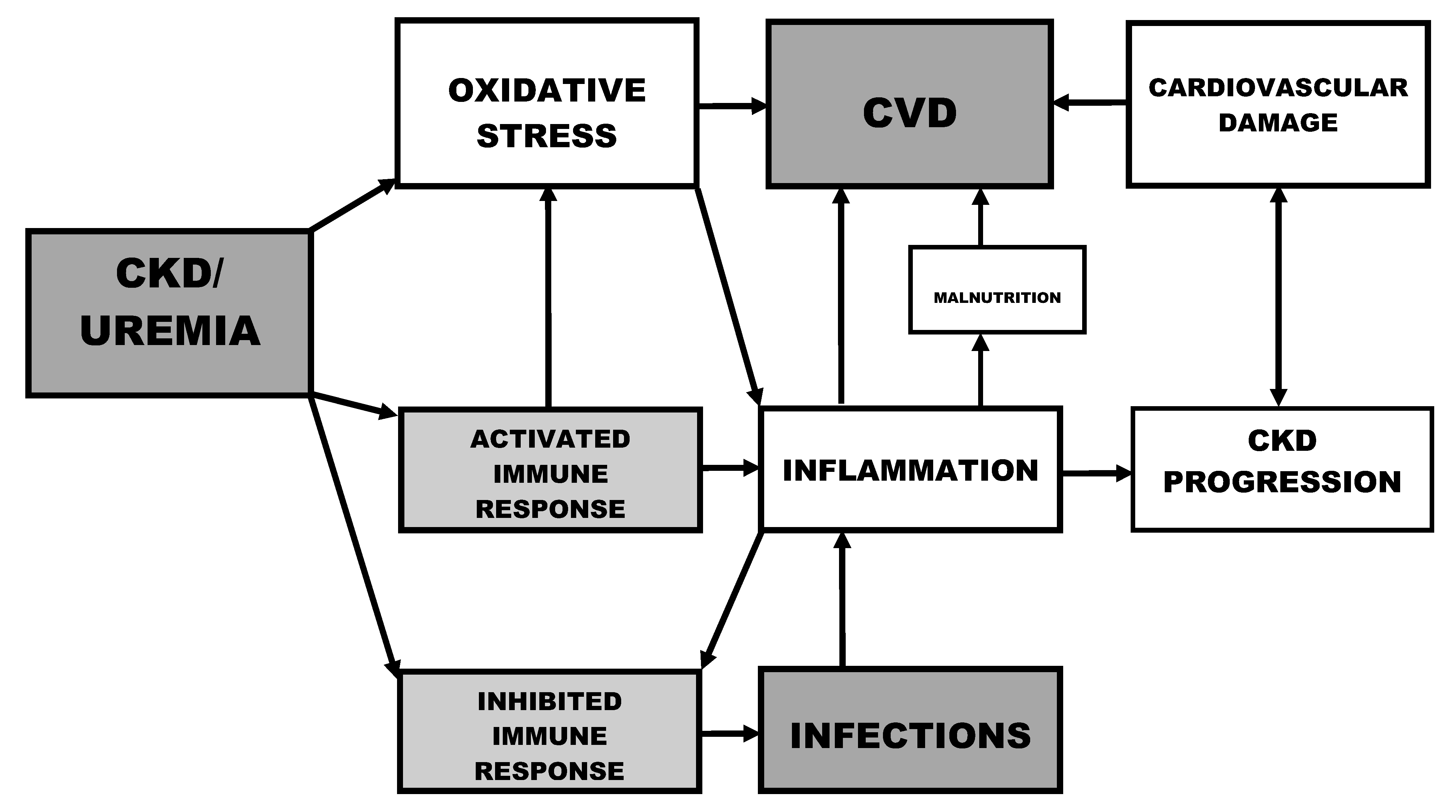
      <p>The development of CKD is associated with a significant increase in all-cause mortality [<xref ref-type="bibr" rid="B1-toxins-04-00962">1</xref>]. As compared to the general population, a 2-fold incidence of mortality of CKD patients over 65 years and a 36-fold increase in mortality of CKD patients aged 16 to 49 years has been reported [<xref ref-type="bibr" rid="B2-toxins-04-00962">2</xref>]. The main factors responsible for the increased risk of morbidity and mortality in patients with CKD are CVD and infections [<xref ref-type="bibr" rid="B3-toxins-04-00962">3</xref>,<xref ref-type="bibr" rid="B4-toxins-04-00962">4</xref>]. Both complications are linked to a disturbed immune response (<xref ref-type="fig" rid="toxins-04-00962-f001">Figure 1</xref>). In uremia, a diminished immune defense contributes to the high prevalence of infections, whereas pre-activation and priming of immune cells lead to inflammation and consequently to CVD. Nowadays, the term “uremia” describes the illness in renal failure, largely due to the retention of substances normally cleared by the kidneys [<xref ref-type="bibr" rid="B5-toxins-04-00962">5</xref>]. </p>
      <fig id="toxins-04-00962-f001" position="anchor">
        <label>Figure 1</label>
        <caption>
          <p>Immune dysfunction and risk factors in chronic kidney disease.</p>
        </caption>
        <graphic xmlns:xlink="http://www.w3.org/1999/xlink" xlink:href="toxins-04-00962-g001.tif"/>
      </fig>
      <p>Deranged functions of PMNLs contribute to the increased risk of bacterial infections and represent a main cause for the enhanced risk of morbidity and mortality among CKD patients [<xref ref-type="bibr" rid="B6-toxins-04-00962">6</xref>]. PMNLs, cells of the first-line nonspecific immune defense, migrate to the site of infection along a chemotactic gradient; they ingest the invading microorganisms by phagocytosis and kill them with proteolytic enzymes and toxic oxygen radicals produced during the oxidative burst. Disturbances of any of those essential PMNL functions give rise to an increased risk for bacterial infections. The susceptibility of CKD patients to infections as a result of defective phagocytosis is caused by a variety of factors, including uremic toxins, iron overload, anemia of renal disease and dialyzer bioincompatibility [<xref ref-type="bibr" rid="B7-toxins-04-00962">7</xref>].</p>
      <p>Patients with CKD not on dialysis have an increased risk of bloodstream infection associated with an estimated glomerular filtration rate (GFR) less than 30 mL/min/1.73 m<sup>2</sup> [<xref ref-type="bibr" rid="B8-toxins-04-00962">8</xref>]. Furthermore, dialysis patients have higher annual mortality rates caused by sepsis compared with the general population, even after stratification for age, race and diabetes mellitus [<xref ref-type="bibr" rid="B9-toxins-04-00962">9</xref>]. Another factor predisposing to infections is an inadequate response to vaccinations as a result of a deficient <italic>T</italic>-lymphocyte-dependent immune response [<xref ref-type="bibr" rid="B10-toxins-04-00962">10</xref>]. </p>
      <p>CVD is the main cause of morbidity and mortality in patients with renal failure [<xref ref-type="bibr" rid="B11-toxins-04-00962">11</xref>]. Cardiac failure is more common in CKD patients than in the general population [<xref ref-type="bibr" rid="B12-toxins-04-00962">12</xref>] and is an independent predictor of death in CKD [<xref ref-type="bibr" rid="B13-toxins-04-00962">13</xref>]. Cardiovascular risk factors and kidney function change concurrently, resulting in an increased risk of CVD as kidney function worsens [<xref ref-type="bibr" rid="B14-toxins-04-00962">14</xref>]. This graded risk of cardiovascular mortality with decreasing GFR increases distinctly at an estimated GFR &lt; 45 mL/min/1.73 m<sup>2</sup> [<xref ref-type="bibr" rid="B15-toxins-04-00962">15</xref>]. </p>
    </sec>
    <sec>
      <title>2. Oxidative Stress and Inflammation</title>
      <p>Oxidative stress and inflammation are crucial for the defense against infections, but they initiate a number of deleterious effects if not properly regulated [<xref ref-type="bibr" rid="B16-toxins-04-00962">16</xref>]. Oxidative stress increases in parallel with the progression of CKD and correlates with the level of renal function [<xref ref-type="bibr" rid="B17-toxins-04-00962">17</xref>] (<xref ref-type="fig" rid="toxins-04-00962-f001">Figure 1</xref>). Furthermore, the antioxidant systems are severely impaired in CKD patients and worsen progressively with the degree of renal failure [<xref ref-type="bibr" rid="B18-toxins-04-00962">18</xref>].</p>
      <p>Biomarkers for oxidative stress, such as advanced oxidation protein products (AOPPs) and myeloperoxidase (MPO)-activity, and for inflammation, such as high sensitivity C reactive protein and interleukin (IL)-6, are interrelated in CKD [<xref ref-type="bibr" rid="B19-toxins-04-00962">19</xref>]. The chronically activated immune system in uremia leads to a chronic low-grade inflammation, and consequently to atherosclerotic CVD [<xref ref-type="bibr" rid="B20-toxins-04-00962">20</xref>]. Activated phagocytes represent a link between oxidative stress and inflammation [<xref ref-type="bibr" rid="B21-toxins-04-00962">21</xref>] (<xref ref-type="fig" rid="toxins-04-00962-f001">Figure 1</xref>). Monocytes and PMNLs recognize pathogens via toll-like receptors (TLRs), inducing cellular activation and secretion of inflammatory cytokines. Monocyte TLR2 and TLR4, PMNL TLR4 expressions and TLR4 activity are elevated in hemodialysis patients, coupled with increased cytokine production in response to TLR4 activation with lipopolysaccharide [<xref ref-type="bibr" rid="B22-toxins-04-00962">22</xref>]. Their scavenger receptor (CD36) processes oxidized lipoproteins and is a key modulator of proinflammatory and oxidative pathways [<xref ref-type="bibr" rid="B23-toxins-04-00962">23</xref>]. Glycation and oxidation markers are simultaneously increased in uremia, e.g., in peritoneal patients where a correlation between markers of oxidative stress and advanced glycation end-products (AGE) concentrations has been reported [<xref ref-type="bibr" rid="B24-toxins-04-00962">24</xref>]. The accumulation of protein damage products and their scavenger receptor-dependent recognition may represent a basic event in the establishment of a vicious and self-propelled “inflammatory loop” [<xref ref-type="bibr" rid="B25-toxins-04-00962">25</xref>].</p>
      <p>Persistent inflammation, <italic>per se</italic>, is a risk factor for the progression of CKD [<xref ref-type="bibr" rid="B26-toxins-04-00962">26</xref>,<xref ref-type="bibr" rid="B27-toxins-04-00962">27</xref>] (<xref ref-type="fig" rid="toxins-04-00962-f001">Figure 1</xref>) and may modulate the impact of other vascular and nutritional risk factors in the toxic uremic milieu [<xref ref-type="bibr" rid="B28-toxins-04-00962">28</xref>]. Therefore, reducing inflammation may provide a novel means for treating kidney disease [<xref ref-type="bibr" rid="B29-toxins-04-00962">29</xref>,<xref ref-type="bibr" rid="B30-toxins-04-00962">30</xref>]. Chronic inflammation may cause malnutrition, itself an important risk factor for the development of CVD [<xref ref-type="bibr" rid="B31-toxins-04-00962">31</xref>] (<xref ref-type="fig" rid="toxins-04-00962-f001">Figure 1</xref>). The tendency of CKD patients to develop CVD is accompanied by particular metabolic changes, e.g., in lipid profile and in homocysteine (Hcy) and C reactive protein serum levels [<xref ref-type="bibr" rid="B32-toxins-04-00962">32</xref>]. The causes of inflammation are multifactorial, including patient-related factors, such as oxidative stress and infections, and hemodialysis (HD)-related factors such as biocompatibility and dialysate quality [<xref ref-type="bibr" rid="B33-toxins-04-00962">33</xref>]. There is a correlation between the presence of bacterial DNA in dialysate and the increase in oxidative stress and serum levels of high sensitivity C reactive protein and IL-6 [<xref ref-type="bibr" rid="B34-toxins-04-00962">34</xref>]. PMNLs of HD patients with a low level of pre-dialysis plasma bicarbonate concentration have a low intracellular pH level that may contribute to increased oxidative burst reactions [<xref ref-type="bibr" rid="B35-toxins-04-00962">35</xref>]. </p>
    </sec>
    <sec>
      <title>3. Priming of Immune Cells</title>
      <p>Priming of leukocytes is an important physiological mechanism controlling host defense responses, leading to a continuum of activation states [<xref ref-type="bibr" rid="B36-toxins-04-00962">36</xref>]. Nevertheless, priming is an often overlooked and misinterpreted feature of immune cells. During priming, the functional response to a stimulus is amplified by previous exposure to a priming agent. PMNL activities can be primed by a transient rise in intracellular calcium concentrations [Ca<sup>2+</sup>]<sub>i</sub> [<xref ref-type="bibr" rid="B37-toxins-04-00962">37</xref>]. Priming of PMNLs influences their survival by attenuating constitutive apoptosis [<xref ref-type="bibr" rid="B38-toxins-04-00962">38</xref>]. The oxidative burst of uremic PMNL can return to a non-primed state in the presence of normal plasma [<xref ref-type="bibr" rid="B39-toxins-04-00962">39</xref>] and spontaneously fully “de-prime” after an initial challenge with platelet-activating factor [<xref ref-type="bibr" rid="B40-toxins-04-00962">40</xref>], thus reversible priming leads to a so-far unrecognized flexibility in the modulation of PMNL function at sites of inflammation.</p>
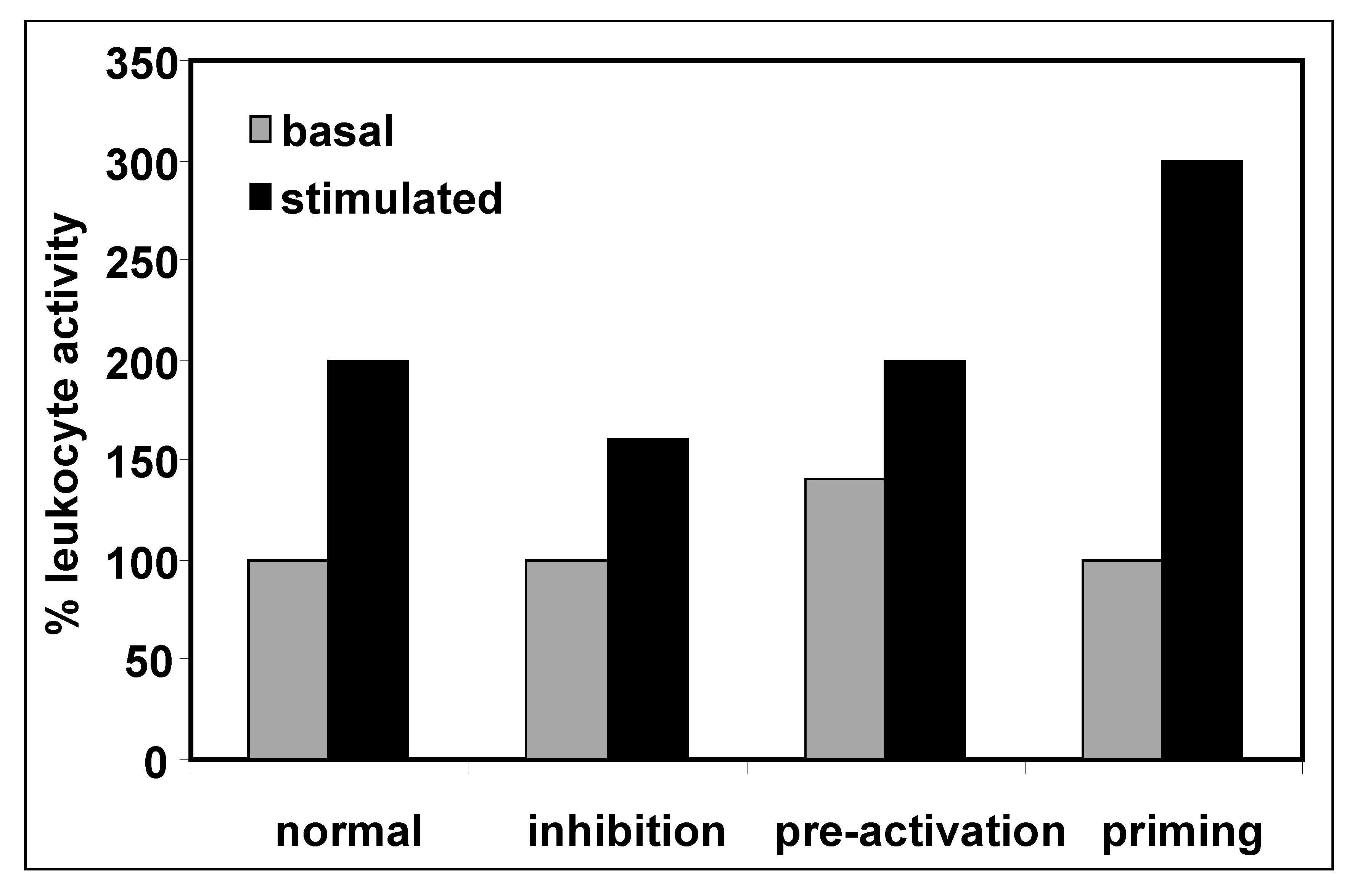
      <p>In diseases with a compromised immune defense such as uremia, the activation of immune cell functions by factors such as invading microorganisms can be inhibited, pre-activated at baseline or primed (<xref ref-type="fig" rid="toxins-04-00962-f002">Figure 2</xref>). An inhibited stimulation reflects a diminished immune response, and potentially leads to infections, whereas pre-activation where the basal activation state is elevated may cause inflammatory complications (<xref ref-type="fig" rid="toxins-04-00962-f001">Figure 1</xref>). </p>
      <fig id="toxins-04-00962-f002" position="anchor">
        <label>Figure 2</label>
        <caption>
          <p>Different activation states and conditions influencing leukocyte function upon stimulation.</p>
        </caption>
        <graphic xmlns:xlink="http://www.w3.org/1999/xlink" xlink:href="toxins-04-00962-g002.tif"/>
      </fig>
      <p>Inappropriate PMNL priming is a key mediator of low-grade inflammation and oxidative stress in CKD patients observed before the onset of renal replacement therapies [<xref ref-type="bibr" rid="B41-toxins-04-00962">41</xref>]. The side effects of dialysis treatment and the accumulating uremic toxins are main players leading to inadequate priming, and thereby to the induction of a vicious circle of oxidative stress and inflammation in CKD [<xref ref-type="bibr" rid="B26-toxins-04-00962">26</xref>]. The incubation of normal PMNLs in plasma from patients with CKD or in peritoneal dialysis (PD) effluent primes and stimulates the production of reactive oxygen species, suggesting that priming involves a factor(s) retained in plasma as a result of renal failure. Hemodiafiltration (HDF) partially normalizes the PMNL oxidative burst, whereas HD does not [<xref ref-type="bibr" rid="B42-toxins-04-00962">42</xref>], suggesting that HDF allows reduction of factors that may impair the oxidative burst.</p>
    </sec>
    <sec>
      <title>4. Apoptosis</title>
      <p>Since the immune deficiency in CKD coexists with the activation of immune cells, contributing to chronic inflammation [<xref ref-type="bibr" rid="B27-toxins-04-00962">27</xref>,<xref ref-type="bibr" rid="B31-toxins-04-00962">31</xref>], the coordinated removal of PMNLs is important for the resolution of inflammation. Enhanced apoptosis causes a diminished immune response, whereas delayed PMNL apoptosis or impaired clearance of apoptotic PMNLs by macrophages leads to an inflammatory state [<xref ref-type="bibr" rid="B43-toxins-04-00962">43</xref>,<xref ref-type="bibr" rid="B44-toxins-04-00962">44</xref>]. Therefore, the maintenance of a balance between anti-apoptotic and pro-apoptotic factors is essential [<xref ref-type="bibr" rid="B45-toxins-04-00962">45</xref>]. The micro-environment and the local concentrations of PMNL modulating substances have to be considered. Extracellular acidosis inhibits PMNL apoptosis [<xref ref-type="bibr" rid="B46-toxins-04-00962">46</xref>]. The intracellular acidification of PMNLs in HD patients with low plasma bicarbonate concentrations may contribute to delayed apoptosis [<xref ref-type="bibr" rid="B35-toxins-04-00962">35</xref>].</p>
      <p>We previously characterized free immunoglobulin light chains (IgLCs) as PMNL apoptosis inhibiting proteins [<xref ref-type="bibr" rid="B47-toxins-04-00962">47</xref>]. Glucose-modified proteins are apoptosis-promoting factors [<xref ref-type="bibr" rid="B48-toxins-04-00962">48</xref>], whereas phenylacetic acid [<xref ref-type="bibr" rid="B49-toxins-04-00962">49</xref>] and <italic>p</italic>-hydroxy-hippuric acid [<xref ref-type="bibr" rid="B50-toxins-04-00962">50</xref>], an erythrocyte plasma membrane Ca<sup>2+</sup>-ATPase inhibitor accumulating in uremic sera [<xref ref-type="bibr" rid="B51-toxins-04-00962">51</xref>], attenuate PMNL apoptosis. The complement factor C5a also delays apoptosis of human PMNLs via phosphoinositide-3 kinase [<xref ref-type="bibr" rid="B52-toxins-04-00962">52</xref>] and the ERK-signaling pathway [<xref ref-type="bibr" rid="B53-toxins-04-00962">53</xref>]. Apoptosis of aging PMNLs depends on a superoxide release-dependent pathway, whereas tumor necrosis factor alpha (TNFα)-induced apoptosis seems to be unrelated to respiratory burst oxidase activity [<xref ref-type="bibr" rid="B54-toxins-04-00962">54</xref>]. A temporary increase in [Ca<sup>2+</sup>]<sub>i </sub>acts as an important second messenger in PMNLs [<xref ref-type="bibr" rid="B55-toxins-04-00962">55</xref>,<xref ref-type="bibr" rid="B56-toxins-04-00962">56</xref>], leading to the modulation of apoptotic cell death [<xref ref-type="bibr" rid="B54-toxins-04-00962">54</xref>,<xref ref-type="bibr" rid="B57-toxins-04-00962">57</xref>,<xref ref-type="bibr" rid="B58-toxins-04-00962">58</xref>].</p>
      <p>Monocytes from dialysis patients exhibit characteristics of senescent cells, related to an increased susceptibility to apoptosis as demonstrated <italic>in vitro</italic> [<xref ref-type="bibr" rid="B59-toxins-04-00962">59</xref>]. In HD patients—but not in continuous ambulatory peritoneal dialysis patients—there is an association between increased monocyte apoptosis and a decreased intracellular pool of thiols [<xref ref-type="bibr" rid="B60-toxins-04-00962">60</xref>]. </p>
      <p>B lymphocytes of pre-dialysis CKD and HD patients have a higher rate of apoptosis than healthy controls. This increased susceptibility to apoptosis may contribute to B lymphopenia in CKD [<xref ref-type="bibr" rid="B61-toxins-04-00962">61</xref>]. T cells from CKD patients have an aberrant state of early activation. Activated T cells may be driven to apoptosis, thereby contributing to T lymphopenia, progressive immunodeficiency and increased infection risk seen in these patients [<xref ref-type="bibr" rid="B62-toxins-04-00962">62</xref>].</p>
      <p>Dialysis normalizes the increased PMNL apoptosis rates observed in CKD patients [<xref ref-type="bibr" rid="B63-toxins-04-00962">63</xref>], and lymphocyte apoptosis was greater in patients on low-flux than on high-flux membranes [<xref ref-type="bibr" rid="B64-toxins-04-00962">64</xref>]. Both findings suggest the existence of dialyzable factors that modulate PMNL apoptosis. Monocyte apoptosis in uremia can be normalized by continuous blood purification methods such as PD, which may have advantages over intermittent therapies in removing uremic apoptotic molecules [<xref ref-type="bibr" rid="B65-toxins-04-00962">65</xref>].</p>
    </sec>
    <sec>
      <title>5. Metabolic Kidney Activities</title>
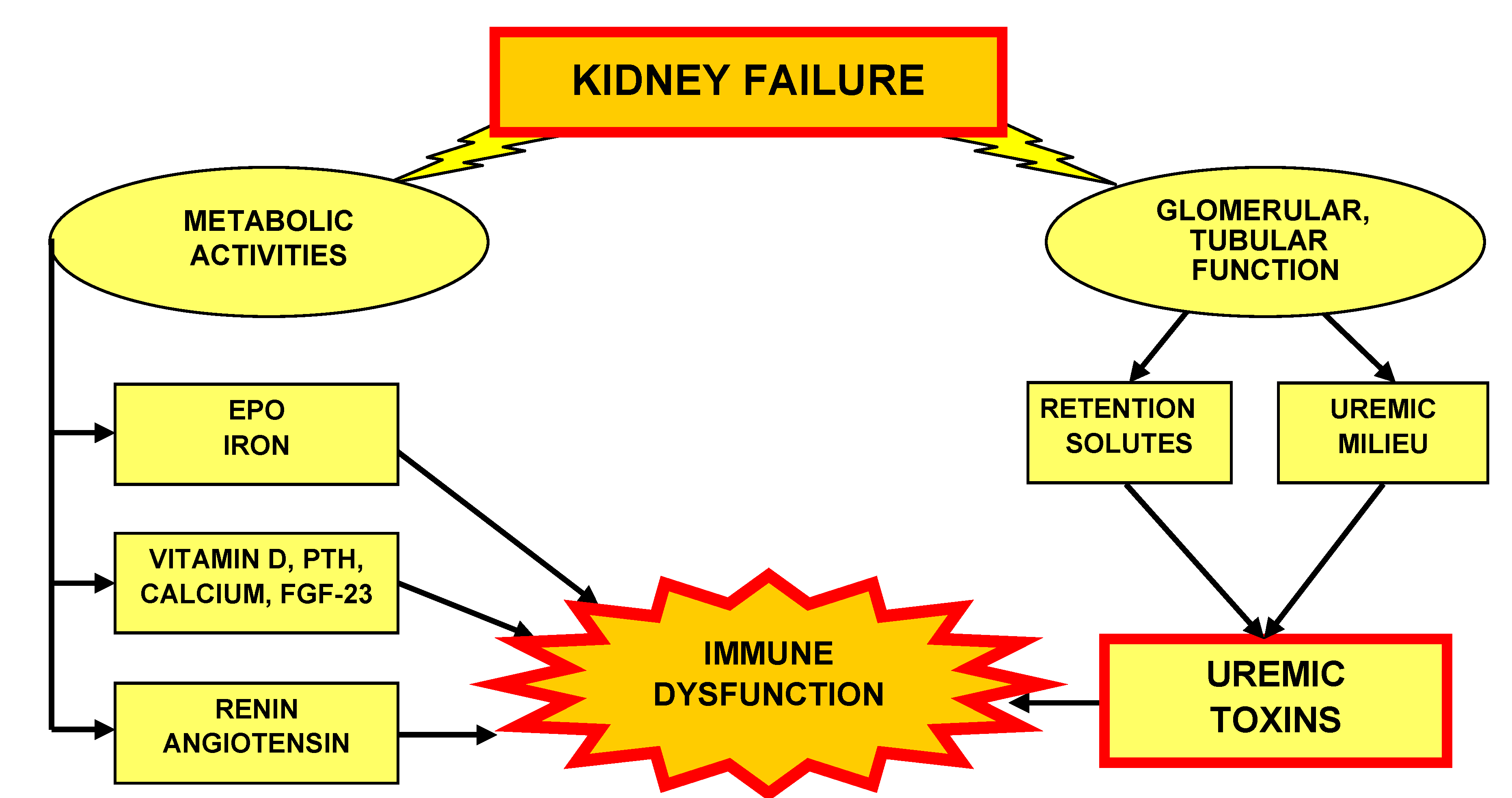
      <p>Some uremia related defects are reversed by transplantation, but not by dialysis treatment. This implies that besides impaired glomerular filtration, disturbed parenchymal metabolic activities of the kidney may be involved [<xref ref-type="bibr" rid="B66-toxins-04-00962">66</xref>]. The hormone erythropoietin (EPO), the vitamin D receptor activator calcitriol (1,25(OH)<sub>2</sub>D<sub>3</sub>) and the enzyme renin are examples for renal produced substances affecting the immune system (<xref ref-type="fig" rid="toxins-04-00962-f003">Figure 3</xref>).</p>
      <fig id="toxins-04-00962-f003" position="anchor">
        <label>Figure 3</label>
        <caption>
          <p>Kidney failure leads to disturbed renal metabolic activities and to impaired glomerular filtration and/or tubular secretion/reabsorption.</p>
        </caption>
        <graphic xmlns:xlink="http://www.w3.org/1999/xlink" xlink:href="toxins-04-00962-g003.tif"/>
      </fig>
      <sec>
        <title>5.1. Erythropoietin and Iron</title>
        <p>EPO is a hormone produced by the kidney and involved in the formation of red blood cells in the bone marrow. Patients with CKD have lower EPO serum levels than subjects with normal kidney function. Not all patients respond adequately to long-term treatment with recombinant human EPO. Resistance to recombinant human EPO can be caused by chronic inflammation, which can modify erythropoiesis via pro-inflammatory cytokines, such as IL-1, TNFα and interferon-γ [<xref ref-type="bibr" rid="B67-toxins-04-00962">67</xref>], and by absolute and functional iron deficiency. Whereas iron is an essential nutrient and necessary for the formation of hemoglobin, iron therapy may affect leukocyte functions and cytokine production, promote oxidative stress and support bacterial growth. The killing capacity of PMNL isolated from CKD patients decreases in response to high-dose parenteral iron sucrose [<xref ref-type="bibr" rid="B68-toxins-04-00962">68</xref>]. Therefore, atherosclerosis and infection may be long-term complications in which intravenous iron therapy in CKD patients plays an important role, especially in case of iron overload [<xref ref-type="bibr" rid="B69-toxins-04-00962">69</xref>]. Moreover, iron therapy may not only adversely affect phagocytes, but also T and B lymphocytes in CKD patients [<xref ref-type="bibr" rid="B70-toxins-04-00962">70</xref>]. </p>
        <p>Hepcidin, a peptide produced by the liver, is a regulator of iron distribution in the human body by affecting the flow of iron via binding to the cellular iron exporter ferroportin. The excessive production of hepcidin may lead to the relative deficiency of iron during inflammatory states causing anemia of inflammation characterized by a functional iron deficiency [<xref ref-type="bibr" rid="B71-toxins-04-00962">71</xref>]. Hence, hepcidin represents a link between inflammation and anemia in CKD [<xref ref-type="bibr" rid="B72-toxins-04-00962">72</xref>]. The elevated hepcidin levels in CKD have recently been suggested to be suppressed by EPO [<xref ref-type="bibr" rid="B73-toxins-04-00962">73</xref>].</p>
        <p>EPO, beyond its erythropoietic and cytoprotective effects, has immuno- modulatory properties [<xref ref-type="bibr" rid="B74-toxins-04-00962">74</xref>]: EPO up-regulates TLR-4 in differentiating dendritic cells (DCs), rendering them more sensitive to stimulation by the TLR-4 ligand lipopolysaccharide.</p>
      </sec>
      <sec>
        <title>5.2. Vitamin D, Calcium, Parathyroid Hormone and Fibroblast Growth Factor 23</title>
        <p>The active vitamin D metabolite 1,25-dihydroxy-vitamin D3 (calcitriol) is not only synthesized in the kidney, but also in extra-renal tissues, e.g., activated monocytes/macrophages [<xref ref-type="bibr" rid="B75-toxins-04-00962">75</xref>], and particularly in endothelial cells. In CKD, the synthesis of calcitriol is reduced. Both parathyroid hormone (PTH), the main stimulus of the rate-limiting enzyme 1alpha-hydroxylase, and hyperphosphatemia, the main inhibitory signal, are modified in CKD [<xref ref-type="bibr" rid="B76-toxins-04-00962">76</xref>]. Uremic retention solutes may be responsible for changes in calcitriol production, resulting in calcitriol deficiency observed in renal failure [<xref ref-type="bibr" rid="B77-toxins-04-00962">77</xref>]. The pleiotropic effects of vitamin D, such as modulation of the immune system, regulation of inflammatory responses and suppression of the renin-angiotensin system (see below <xref ref-type="sec" rid="sec5dot3-toxins-04-00962">Section 5.3</xref>) may slow down the progression of CVD [<xref ref-type="bibr" rid="B78-toxins-04-00962">78</xref>]. Macrophage vitamin D receptor signaling may inhibit atherosclerosis in mice, partially by suppressing the local renin-angiotensin system [<xref ref-type="bibr" rid="B79-toxins-04-00962">79</xref>].</p>
        <p>Fibroblast growth factor 23 (FGF23) is secreted by osteoblasts in bone. FGF23 regulates the renal excretion and reabsorption of phosphate and reduces the production of 1,25-dihydroxy-vitamin D3. Elevated FGF23 concentrations are observed early in CKD and are suggested to be associated with increased mortality and disease progression [<xref ref-type="bibr" rid="B80-toxins-04-00962">80</xref>]. A negative reciprocal relationship between FGF23 concentrations and declining renal function has been found in pediatric patients with pre-dialysis CKD Stages 3–5 [<xref ref-type="bibr" rid="B81-toxins-04-00962">81</xref>]. In advanced CKD, FGF23 is strongly associated with all-cause mortality, cardiovascular events and initiation of chronic dialysis [<xref ref-type="bibr" rid="B82-toxins-04-00962">82</xref>]. Since increased FGF23 plasma concentrations predict cardiovascular events in CKD patients, lowering FGF23 levels could be a target of novel therapeutic interventions in CKD [<xref ref-type="bibr" rid="B83-toxins-04-00962">83</xref>,<xref ref-type="bibr" rid="B84-toxins-04-00962">84</xref>]. An increase in [Ca<sup>2+</sup>]<sub>i </sub>is an important second messenger in PMNLs [<xref ref-type="bibr" rid="B55-toxins-04-00962">55</xref>,<xref ref-type="bibr" rid="B56-toxins-04-00962">56</xref>] involved in functional responses and the modulation of apoptosis [<xref ref-type="bibr" rid="B54-toxins-04-00962">54</xref>,<xref ref-type="bibr" rid="B57-toxins-04-00962">57</xref>,<xref ref-type="bibr" rid="B58-toxins-04-00962">58</xref>]. In agreement with the literature [<xref ref-type="bibr" rid="B56-toxins-04-00962">56</xref>,<xref ref-type="bibr" rid="B85-toxins-04-00962">85</xref>,<xref ref-type="bibr" rid="B86-toxins-04-00962">86</xref>,<xref ref-type="bibr" rid="B87-toxins-04-00962">87</xref>], we observed increased basal levels of [Ca<sup>2+</sup>]<sub>i</sub> in PMNLs from HD patients [<xref ref-type="bibr" rid="B50-toxins-04-00962">50</xref>]. This increased basal [Ca<sup>2+</sup>]<sub>i</sub> is associated with a decreased reactivity upon stimulation [<xref ref-type="bibr" rid="B6-toxins-04-00962">6</xref>,<xref ref-type="bibr" rid="B88-toxins-04-00962">88</xref>]. Bioincompatible membranes cause an increase in [Ca<sup>2+</sup>]<sub>i</sub>, whereas biocompatible membranes do not change [Ca<sup>2+</sup>]<sub>i</sub> [<xref ref-type="bibr" rid="B86-toxins-04-00962">86</xref>,<xref ref-type="bibr" rid="B89-toxins-04-00962">89</xref>]. Dialysis treatment with biocompatible high-flux membranes can revert the increased [Ca<sup>2+</sup>]<sub>i</sub> [<xref ref-type="bibr" rid="B50-toxins-04-00962">50</xref>], suggesting a removal of factors responsible for the increased basal levels of [Ca<sup>2+</sup>]<sub>i</sub>. Differences in [Ca<sup>2+</sup>]<sub>i</sub> have been observed between patients on EPO, and not on EPO [<xref ref-type="bibr" rid="B87-toxins-04-00962">87</xref>]. Therefore, besides uremic retention solutes, EPO therapy may contribute to elevated [Ca<sup>2+</sup>]<sub>i</sub> [<xref ref-type="bibr" rid="B86-toxins-04-00962">86</xref>].</p>
        <p>PTH levels are increased in CKD patients. Chronic excess of PTH in uremia affects PMNL functions via sustained elevation of their [Ca<sup>2+</sup>]<sub>i</sub> [<xref ref-type="bibr" rid="B88-toxins-04-00962">88</xref>]. Parathyroidectomy lowers, but does not normalize, PMNL [Ca<sup>2+</sup>]<sub>i</sub> of CKD patients [<xref ref-type="bibr" rid="B85-toxins-04-00962">85</xref>], further supporting the notion that other factors such as uremic retention solutes affect [Ca<sup>2+</sup>]<sub>i </sub>and functions of PMNLs. High levels of PTH in uremia also affect the metabolism and function of B cells [<xref ref-type="bibr" rid="B90-toxins-04-00962">90</xref>], as well as <italic>T</italic>-lymphocyte functions contributing to changes in cellular immunity [<xref ref-type="bibr" rid="B91-toxins-04-00962">91</xref>]. Furthermore, doses of calcitriol within the therapeutic range are able to induce changes in the secretion of cytokines (IL-1, IL-6 and TNF) of peripheral blood mononuclear cell from uremic patients [<xref ref-type="bibr" rid="B92-toxins-04-00962">92</xref>].</p>
      </sec>
      <sec id="sec5dot3-toxins-04-00962">
        <title>5.3. Renin, Angiotensin</title>
        <p>Renin is a circulating enzyme secreted by the kidney when blood pressure is low. It stimulates the production of angiotensin. The renin-angiotensin system plays a pivotal role in the regulation of blood pressure by modulating the vascular tone. The renin-angiotensin system is also involved in the pathogenesis of inflammation and the progression of CKD. T cells, natural killer cells and monocytes express the angiotensin receptor 1. T and natural killer cells also express angiotensin 2 and contain all renin-angiotensin system elements, suggesting that they are able to produce and deliver angiotensin 2 to sites of inflammation [<xref ref-type="bibr" rid="B93-toxins-04-00962">93</xref>]. Therefore, lymphocyte activating activities of the renin-angiotensin system may lead to inflammation [<xref ref-type="bibr" rid="B94-toxins-04-00962">94</xref>]. Angiotensin 2 also stimulates chemotaxis and may induce an inflammatory amplification system. The role of angiotensin 2 in stimulating phagocytes is further underlined by the evidence that it stimulates PMNL oxidative burst and increases cytosolic Ca<sup>2+</sup> concentrations [<xref ref-type="bibr" rid="B95-toxins-04-00962">95</xref>]. Furthermore, the susceptibility to T cell-mediated injury in anti-glomerular basement membrane antibody-induced glomerulonephritis is increased by local renin-angiotensin system activation, implying that drugs interfering with renin-angiotensin system could be useful in the treatment of immune renal diseases [<xref ref-type="bibr" rid="B96-toxins-04-00962">96</xref>].</p>
      </sec>
    </sec>
    <sec>
      <title>6. Uremic Toxins</title>
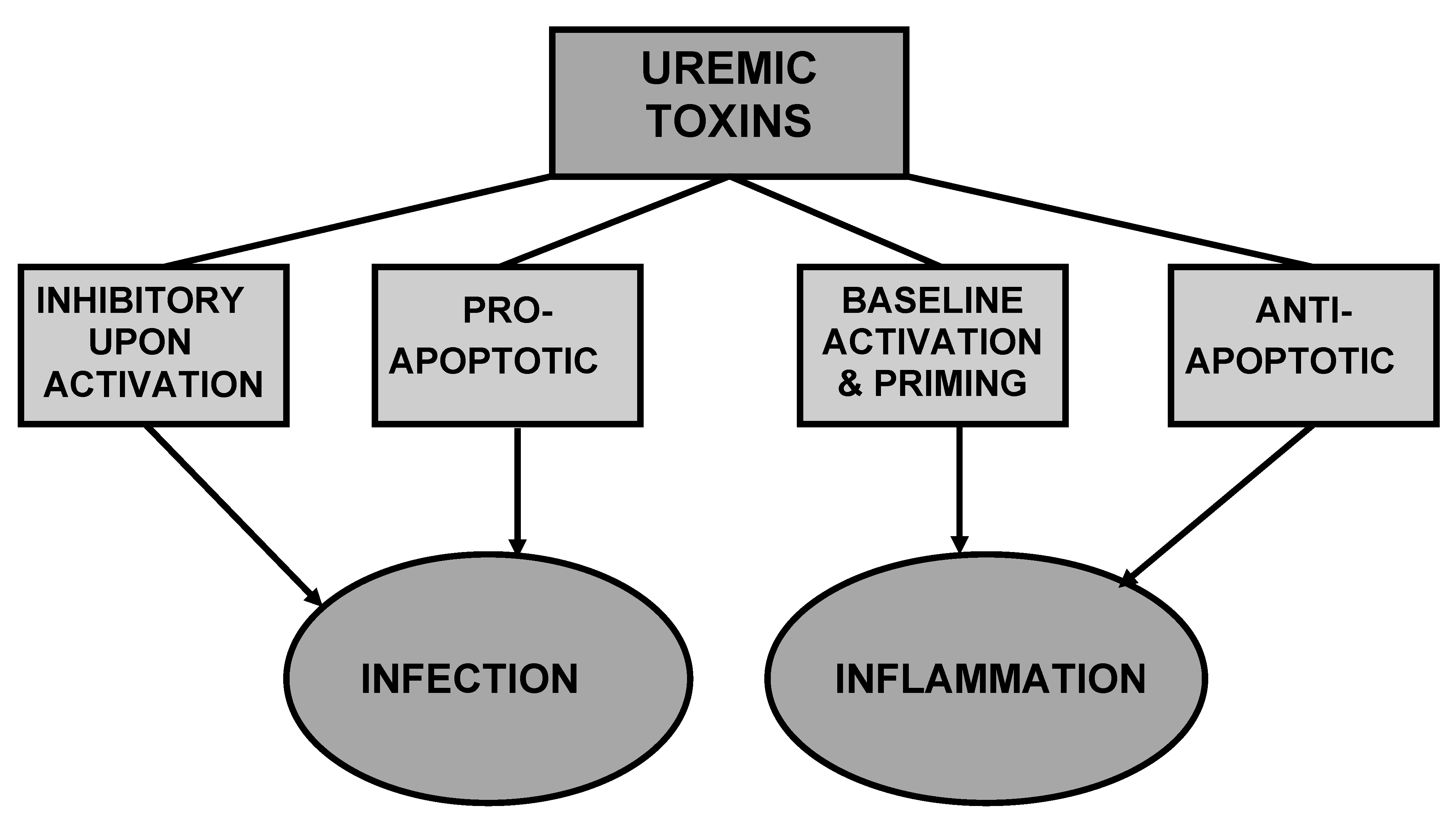
      <p>The retention of many compounds, which under normal conditions are filtered by the healthy kidneys, leads to the development of the uremic syndrome. Those retention solutes that interact negatively with biologic functions are called uremic toxins [<xref ref-type="bibr" rid="B97-toxins-04-00962">97</xref>]. If they exert an inhibitory and/or pro-apoptotic effect on immune cells, these uremic toxins contribute to the susceptibility to infection (<xref ref-type="fig" rid="toxins-04-00962-f004">Figure 4</xref>), while culprits of baseline activation, priming and/or anti-apoptotic features give rise to inflammation. </p>
      
      <p>Uremic toxins playing an active role in vascular damage may also be generated or introduced into the body via the intestine [<xref ref-type="bibr" rid="B98-toxins-04-00962">98</xref>]. In 2003, the European Uremic Toxin Work Group (EUTox; <uri>http://EUTox.info</uri>) composed an encyclopedic list of 90 uremic retention solutes known at that time [<xref ref-type="bibr" rid="B99-toxins-04-00962">99</xref>]. Recently, this classification of normal and pathologic concentrations of uremic toxins has been extended and updated [<xref ref-type="bibr" rid="B100-toxins-04-00962">100</xref>].</p>
      <p>As a result of different hydrophobicity, low molecular weight organic substances may either exist in free water-soluble form or bind reversibly to serum proteins. Many of the currently known biological effects in uremic patients are attributed to protein-bound solutes. Their dialytic removal is largely hampered by their physicochemical properties. Therefore, alternative removal techniques, such as strategies to modify intestinal generation or absorption, are considered [<xref ref-type="bibr" rid="B101-toxins-04-00962">101</xref>]. In CKD, proteins may exist in their native form or, as a result of exposure to the uremic milieu (<xref ref-type="fig" rid="toxins-04-00962-f003">Figure 3</xref>), become irreversibly changed by posttranslational modifications, resulting in altered structure and function. Examples are the heterogeneous groups of AGEs, AOPPs and carbamoylated proteins.</p>
      <fig id="toxins-04-00962-f004" position="anchor">
        <label>Figure 4</label>
        <caption>
          <p>Different uremic toxins may exert antagonistic effects leading to infection and inflammation.</p>
        </caption>
        <graphic xmlns:xlink="http://www.w3.org/1999/xlink" xlink:href="toxins-04-00962-g004.tif"/>
      </fig>
      <p>The identification and characterization of uremic toxins contributing to major uremia-related complications is a prerequisite for the critical evaluation and systematic design of preventive and therapeutic interventions for patients with CKD. Understanding the effects of uremic toxins will help to develop novel therapeutic strategies, such as improved removal of toxins, and the search for pharmacologic strategies blocking responsible pathophysiologic pathways  [<xref ref-type="bibr" rid="B102-toxins-04-00962">102</xref>]. <italic>In vitro</italic>   assays testing the biologic effects of individual solutes represent a straightforward way to select candidates for further in-depth investigation. EUTox published basic protocols for the  <italic>in vitro</italic> screening of uremic retention solutes, providing information about their availability, solubility and the appropriate preparation of stock solutions [<xref ref-type="bibr" rid="B103-toxins-04-00962">103</xref>]. The use of the disease-relevant concentrations of solutes in <italic>in vitro</italic> assays is a precondition to obtaining relevant conclusions [<xref ref-type="bibr" rid="B104-toxins-04-00962">104</xref>,<xref ref-type="bibr" rid="B105-toxins-04-00962">105</xref>]. Functional disturbances caused by selected uremic toxins are summarized in <xref ref-type="table" rid="toxins-04-00962-t001">Table 1</xref>.</p>
      <table-wrap id="toxins-04-00962-t001" position="float">
        <object-id pub-id-type="pii">toxins-04-00962-t001_Table 1</object-id>
        <label>Table 1</label>
        <caption>
          <p>Functional disturbances caused by selected uremic toxins.</p>
        </caption>
        <table rules="cols" style="border: solid thin">
          <thead>
            <tr>
              <th align="center" valign="top">Uremic toxin</th>
              <th align="center" valign="top">Functional disturbance</th>
            </tr>
          </thead>
          <tbody>
            <tr style="border-top: solid thin">
              <td align="center" valign="top">
                <bold>
                  <italic>LMW Solutes</italic>
                </bold>
              </td>
              <td align="center" valign="top"> </td>
            </tr>
            <tr style="border-top: solid thin">
              <td rowspan="2" align="center" valign="top">Phenylacetic acid (PAA)</td>
              <td align="center" valign="top">Macrophages: inducible nitric oxide synthase ↓ [<xref ref-type="bibr" rid="B106-toxins-04-00962">106</xref>];</td>
            </tr>
            <tr>
              <td align="center" valign="top">PMNLs: oxidative burst, phagocytosis and integrin expression ↑; apoptosis ↓ [<xref ref-type="bibr" rid="B49-toxins-04-00962">49</xref>]</td>
            </tr>
            <tr style="border-top: solid thin">
              <td align="center" valign="top">Dinucleoside polyphosphates</td>
              <td align="center" valign="top">Leukocytes: oxidative burst ↑ [<xref ref-type="bibr" rid="B107-toxins-04-00962">107</xref>].</td>
            </tr>
            <tr style="border-top: solid thin">
              <td align="center" valign="top">Guanidino compounds</td>
              <td align="center" valign="top">Monocytes/macrophages: pro- and anti-inflammatory [<xref ref-type="bibr" rid="B108-toxins-04-00962">108</xref>,<xref ref-type="bibr" rid="B109-toxins-04-00962">109</xref>,<xref ref-type="bibr" rid="B110-toxins-04-00962">110</xref>]</td>
            </tr>
            <tr style="border-top: solid thin">
              <td align="center" valign="top">Indoxyl sulfate</td>
              <td align="center" valign="top">Endothel: E-selectin ↑ [<xref ref-type="bibr" rid="B111-toxins-04-00962">111</xref>]</td>
            </tr>
            <tr style="border-top: solid thin">
              <td align="center" valign="top"><italic>P</italic>-cresyl sulfate</td>
              <td align="center" valign="top">Leukocytes: basal oxidative burst ↑ [<xref ref-type="bibr" rid="B112-toxins-04-00962">112</xref>]</td>
            </tr>
            <tr style="border-top: solid thin">
              <td align="center" valign="top">Homocysteine (Hcy)</td>
              <td align="center" valign="top">ICAM-1 ↑ [<xref ref-type="bibr" rid="B113-toxins-04-00962">113</xref>]; damage of DNA [<xref ref-type="bibr" rid="B114-toxins-04-00962">114</xref>] and proteins [<xref ref-type="bibr" rid="B115-toxins-04-00962">115</xref>]</td>
            </tr>
            <tr style="border-top: solid thin">
              <td rowspan="2" align="center" valign="top">Methylglyoxal (MGO)</td>
              <td align="center" valign="top">PMNLs: apoptosis ↑ [<xref ref-type="bibr" rid="B116-toxins-04-00962">116</xref>], oxidative burst ↑ [<xref ref-type="bibr" rid="B117-toxins-04-00962">117</xref>];</td>
            </tr>
            <tr>
              <td align="center" valign="top">Monocytes: apoptosis ↑ [<xref ref-type="bibr" rid="B118-toxins-04-00962">118</xref>]</td>
            </tr>
            <tr style="border-top: solid thin">
              <td align="center" valign="top">
                <bold>
                  <italic>Middle Molecules, Proteins</italic>
                </bold>
              </td>
              <td align="center" valign="top"> </td>
            </tr>
            <tr style="border-top: solid thin">
              <td align="center" valign="top">Immunoglobulin light chains (IgLCs)</td>
              <td align="center" valign="top">PMNLs: chemotaxis ↓, glucose uptake stimulation ↓, glucose uptake basal ↑ [<xref ref-type="bibr" rid="B119-toxins-04-00962">119</xref>]; apoptosis ↓ [<xref ref-type="bibr" rid="B47-toxins-04-00962">47</xref>]</td>
            </tr>
            <tr style="border-top: solid thin">
              <td align="center" valign="top">Retinol binding protein (RBP)</td>
              <td align="center" valign="top">PMNLs: chemotaxis ↓, oxidative burst ↓, apoptosis ↓ [<xref ref-type="bibr" rid="B120-toxins-04-00962">120</xref>]</td>
            </tr>
            <tr style="border-top: solid thin">
              <td align="center" valign="top">Leptin</td>
              <td align="center" valign="top">PMNLs: chemotaxis ↓, oxidative burst ↓ [<xref ref-type="bibr" rid="B121-toxins-04-00962">121</xref>]</td>
            </tr>
            <tr style="border-top: solid thin">
              <td align="center" valign="top">Resistin</td>
              <td align="center" valign="top">PMNLs: chemotaxis ↓, oxidative burst ↓ [<xref ref-type="bibr" rid="B122-toxins-04-00962">122</xref>]</td>
            </tr>
            <tr style="border-top: solid thin">
              <td align="center" valign="top">Tamm-Horsfall protein (THP)</td>
              <td align="center" valign="top">PMNLs: (high concentrations) apoptosis ↓, chemotaxis ↓, phagocytosis ↑; (low concentrations) chemotaxis ↑ [<xref ref-type="bibr" rid="B123-toxins-04-00962">123</xref>]</td>
            </tr>
            <tr style="border-top: solid thin">
              <td align="center" valign="top">High-density lipoprotein (HDL)</td>
              <td align="center" valign="top">Loss of anti-inflammatory properties in uremia [124,125]</td>
            </tr>
            <tr style="border-top: solid thin">
              <td align="center" valign="top">
                <bold>
                  <italic>Protein Modifications</italic>
                </bold>
              </td>
              <td align="center" valign="top"> </td>
            </tr>
            <tr style="border-top: solid thin">
              <td align="center" valign="top">Glucose-modified proteins</td>
              <td align="center" valign="top">PMNLs: chemotaxis ↑, glucose uptake ↑, apoptosis ↑ [<xref ref-type="bibr" rid="B48-toxins-04-00962">48</xref>]</td>
            </tr>
            <tr style="border-top: solid thin">
              <td align="center" valign="top">AGE-modified albumin</td>
              <td align="center" valign="top">Leukocytes: activating, pro- atherogenic [<xref ref-type="bibr" rid="B126-toxins-04-00962">126</xref>]</td>
            </tr>
            <tr style="border-top: solid thin">
              <td rowspan="2" align="center" valign="top">AGEs</td>
              <td align="center" valign="top">Macrophages: TNF and IL-1  secretion ↑ [<xref ref-type="bibr" rid="B127-toxins-04-00962">127</xref>]</td>
            </tr>
            <tr>
              <td align="center" valign="top">Monocytes: Chemotaxis ↑ [<xref ref-type="bibr" rid="B128-toxins-04-00962">128</xref>]</td>
            </tr>
            <tr style="border-top: solid thin">
              <td align="center" valign="top">Glycated collagen</td>
              <td align="center" valign="top">PMNLs: Adhesion ↑ [<xref ref-type="bibr" rid="B129-toxins-04-00962">129</xref>]</td>
            </tr>
            <tr style="border-top: solid thin">
              <td align="center" valign="top">Advanced oxidation protein products (AOPPs)</td>
              <td align="center" valign="top">PMNLs and monocytes: oxidative burst ↑ [<xref ref-type="bibr" rid="B130-toxins-04-00962">130</xref>]</td>
            </tr>
            <tr style="border-top: solid thin">
              <td rowspan="3" align="center" valign="top">Oxidized low-density lipoproteins (oxLDLs)</td>
              <td align="center" valign="top">Macrophage activation [<xref ref-type="bibr" rid="B131-toxins-04-00962">131</xref>];</td>
            </tr>
            <tr>
              <td align="center" valign="top">PMNLs and eosinophils: chemotaxis ↑, degranulation ↑ [<xref ref-type="bibr" rid="B132-toxins-04-00962">132</xref>];</td>
            </tr>
            <tr>
              <td align="center" valign="top">Regulatory T cells: proteasome activity ↓ → cell cycle arrest and apoptosis [<xref ref-type="bibr" rid="B133-toxins-04-00962">133</xref>]</td>
            </tr>
            <tr style="border-top: solid thin">
              <td align="center" valign="top">Homocysteinylated albumin</td>
              <td align="center" valign="top">Monocytes: adhesion ↑[<xref ref-type="bibr" rid="B134-toxins-04-00962">134</xref>] </td>
            </tr>
          </tbody>
        </table>
      </table-wrap>
      <sec>
        <title>6.1. LMW Solutes</title>
        <p>Phenylacetic acid (PAA) was identified as a novel uremic toxin in patients on regular HD [<xref ref-type="bibr" rid="B106-toxins-04-00962">106</xref>]. PAA interferes with the expression of inducible nitric oxide synthase, which generates NO, a mediator of macrophage cytotoxicity [<xref ref-type="bibr" rid="B135-toxins-04-00962">135</xref>]. Therefore, by inhibiting inducible nitric oxide synthase expression and reducing the cytotoxicity against intracellular bacteria, PAA may aggravate the immunodeficiency of CKD patients. PAA increases the activation of several PMNL functions, such as oxidative burst, phagocytosis and integrin expression, while it attenuates PMNL apoptotic cell death [<xref ref-type="bibr" rid="B49-toxins-04-00962">49</xref>]. Hence, it may contribute to the inflammatory state in uremic patients, and consequently to increased cardiovascular risk. </p>
        <p>Dinucleoside polyphosphates are newly detected uremic retention solutes. Their pro-inflammatory properties—stimulation of the oxidative burst of PMNLs, monocytes and lymphocytes—may contribute to the development of atherosclerosis, probably in early CKD stages [<xref ref-type="bibr" rid="B107-toxins-04-00962">107</xref>].</p>
        <p>Guanidino compounds, such as guanidinopropionic acid and guanidinobutyric acid [<xref ref-type="bibr" rid="B108-toxins-04-00962">108</xref>], methylguanidine, guanidine, guanidinosuccinic acid and guanidinoacetic acid [<xref ref-type="bibr" rid="B109-toxins-04-00962">109</xref>] and symmetric dimethylarginine [<xref ref-type="bibr" rid="B110-toxins-04-00962">110</xref>], exert pro-inflammatory, as well as anti-inflammatory, effects on monocyte/macrophage function, and thereby may contribute to the high prevalence of CVD and to the disposition to infection in CKD patients.</p>
        <p>Both indoxyl sulfate and <italic>p</italic>-cresyl sulfate, two of the main protein-bound compounds, have a negative impact on the cardiovascular system and progression of kidney failure [<xref ref-type="bibr" rid="B101-toxins-04-00962">101</xref>]. Indoxyl sulfate induces leukocyte-endothelial interactions through up-regulation of E-selectin [<xref ref-type="bibr" rid="B111-toxins-04-00962">111</xref>]. Serum free <italic>p</italic>-cresyl sulfate levels predict cardiovascular and all-cause mortality in elderly hemodialysis patients [<xref ref-type="bibr" rid="B136-toxins-04-00962">136</xref>]. The free, non-protein bound form of <italic>p</italic>-cresylsulphate predicts survival in CKD patients [<xref ref-type="bibr" rid="B137-toxins-04-00962">137</xref>]. <italic>P</italic>-cresyl sulfate significantly increases the basal level of leukocyte oxidative burst activity, but does not affect the production of reactive oxygen species by stimulated leukocytes [<xref ref-type="bibr" rid="B112-toxins-04-00962">112</xref>]. </p>
        <p><underline>Hyperhomocysteinemia</underline> occurs in the majority of uremic patients undergoing HD treatment [<xref ref-type="bibr" rid="B138-toxins-04-00962">138</xref>]. Hcy stimulates inter-cellular adhesion molecule-1 (ICAM-1) expression, leading to an increase in monocyte adhesion to endothelial cells, and consequently may create a proinflammatory environment in the vessel wall that initiates and promotes atherosclerotic lesion development [<xref ref-type="bibr" rid="B113-toxins-04-00962">113</xref>]. Hcy can directly modify the expression of CD11b/CD18, CD14 and L-selectin on PMNLs, monocytes and lymphocytes, resulting in leukocyte adhesion and migration [<xref ref-type="bibr" rid="B113-toxins-04-00962">113</xref>]. Hcy contributes to the genomic damage in CKD [<xref ref-type="bibr" rid="B114-toxins-04-00962">114</xref>] and to the molecular damage of proteins, leading to clinical complications [<xref ref-type="bibr" rid="B115-toxins-04-00962">115</xref>], such as accelerated atherogenesis [<xref ref-type="bibr" rid="B139-toxins-04-00962">139</xref>].</p>
        <p>Significant increases of plasma methylglyoxal (MGO) levels are a function of CKD stage. MGO accelerates PMNL apoptosis [<xref ref-type="bibr" rid="B116-toxins-04-00962">116</xref>] and enhances the production of reactive oxygen species by PMNL [<xref ref-type="bibr" rid="B117-toxins-04-00962">117</xref>]. MGO also induces monocytic apoptotic cell death, presumably via elevation of intracellular oxidant stress [<xref ref-type="bibr" rid="B118-toxins-04-00962">118</xref>]. </p>
      </sec>
      <sec>
        <title>6.2. Middle Molecules, Proteins</title>
        <p><underline>IgLCs</underline> are synthesized by B cells slightly in excess of Ig heavy chains [<xref ref-type="bibr" rid="B140-toxins-04-00962">140</xref>] in parallel to intact immunoglobulins. Therefore, they are found in the plasma of healthy people at low levels. Serum concentrations of free IgLCs are increased either by a diminished elimination, such as in patients with impaired kidney function, or as a result of an increased production, like in B-cell lymphoproliferative disorders, e.g., multiple myeloma. Polyclonal free IgLCs accumulate in the serum of patients with CKD, and their concentrations progressively increase with CKD stage [<xref ref-type="bibr" rid="B141-toxins-04-00962">141</xref>]. Standard HD and HDF are not able to normalize their serum levels [<xref ref-type="bibr" rid="B142-toxins-04-00962">142</xref>]. Extended HD with a protein-leaking dialyzer for patients with myeloma and renal failure is able to remove large amounts of free IgLCs [<xref ref-type="bibr" rid="B143-toxins-04-00962">143</xref>]. IgLCs can affect PMNL functions. Free polyclonal IgLCs, isolated as monomers or dimers from uremic patients receiving HD treatment or undergoing continuous ambulatory peritoneal dialysis, significantly inhibit PMNL chemotaxis  <italic>in vitro </italic>[<xref ref-type="bibr" rid="B119-toxins-04-00962">119</xref>] and attenuate PMNL apoptosis [<xref ref-type="bibr" rid="B47-toxins-04-00962">47</xref>]. The uptake of glucose is considered as a quantitative measurement of the state of activation of phagocytic cells. IgLCs reduce the stimulation of the PMNL glucose uptake, but stimulate its basal level. Therefore, free IgLCs contribute to pre-activation of PMNLs and interfere with the normal resolution of inflammation.</p>
        <p>Retinol-binding proteins (RBPs) are a family of carrier proteins for retinol (vitamin A). Intracellular RBPs (1, 2, 5, and 7) have been found, e.g. in liver [<xref ref-type="bibr" rid="B144-toxins-04-00962">144</xref>], parathyroid glands [<xref ref-type="bibr" rid="B145-toxins-04-00962">145</xref>], epidermis [<xref ref-type="bibr" rid="B146-toxins-04-00962">146</xref>] and small intestine [<xref ref-type="bibr" rid="B147-toxins-04-00962">147</xref>]. RBP 3 is the interstitial form of this protein. RBP4, synthesized in the liver, is present in human plasma. RBP 4 and creatinine levels correlate in CKD patients [<xref ref-type="bibr" rid="B148-toxins-04-00962">148</xref>]. In acute renal failure, the RBP serum concentration is increased as well [<xref ref-type="bibr" rid="B149-toxins-04-00962">149</xref>]. RBP isolated from the ultrafiltrate of patients with acute renal failure interferes with PMNL chemotaxis, oxidative burst and apoptosis [<xref ref-type="bibr" rid="B120-toxins-04-00962">120</xref>]. RBP4 is elevated in non-diabetic stage 5 CKD and correlates weakly with HbA1c and ApoA1, suggesting a role for RBP in the development of the uremic metabolic syndrome [<xref ref-type="bibr" rid="B150-toxins-04-00962">150</xref>]. </p>
        <p>White adipose tissue is an active player in regulating immunity and inflammation [<xref ref-type="bibr" rid="B151-toxins-04-00962">151</xref>]. Adipocytes have pluripotent signaling effects [<xref ref-type="bibr" rid="B152-toxins-04-00962">152</xref>], and not only play a major role in cytokine, adipokine and chemokine secretion, but also in innate immunity [<xref ref-type="bibr" rid="B153-toxins-04-00962">153</xref>]. The serum levels of adipokines, such as <underline>leptin</underline> and <underline>resistin</underline>, are increased in CKD [<xref ref-type="bibr" rid="B99-toxins-04-00962">99</xref>,<xref ref-type="bibr" rid="B154-toxins-04-00962">154</xref>,<xref ref-type="bibr" rid="B155-toxins-04-00962">155</xref>]. This is not merely a result of decreased renal elimination, but also of increased production by adipocytes stimulated in the uremic milieu, e.g., by TNF-α [<xref ref-type="bibr" rid="B156-toxins-04-00962">156</xref>]. Leptin reduces PMNL chemotaxis in a reversible manner and diminishes the stimulation of PMNL oxidative burst [<xref ref-type="bibr" rid="B121-toxins-04-00962">121</xref>]. In humans, resistin is expressed primarily by macrophages in the visceral white adipose tissue [<xref ref-type="bibr" rid="B157-toxins-04-00962">157</xref>]. It was also detected in PMNLs and monocytes [<xref ref-type="bibr" rid="B158-toxins-04-00962">158</xref>]. Resistin concentrations are increased in sera of CKD patients [<xref ref-type="bibr" rid="B122-toxins-04-00962">122</xref>,<xref ref-type="bibr" rid="B159-toxins-04-00962">159</xref>,<xref ref-type="bibr" rid="B160-toxins-04-00962">160</xref>,<xref ref-type="bibr" rid="B161-toxins-04-00962">161</xref>]. It attenuates PMNL chemotaxis and decreases activation of PMNL oxidative burst [<xref ref-type="bibr" rid="B122-toxins-04-00962">122</xref>]. Resistin is stored in PMNL granules, can be released upon challenge with inflammatory stimuli [<xref ref-type="bibr" rid="B162-toxins-04-00962">162</xref>] and stimulates the chemotaxis of CD4-positve lymphocytes [<xref ref-type="bibr" rid="B163-toxins-04-00962">163</xref>]. Hence, while PMNLs may decrease their own functions via resistin, they attract lymphocytes to the site of inflammation. </p>
        <p>Tamm-Horsfall protein (THP), also known as uromodulin, is a glycoprotein exclusively produced by the kidney in the distal loop of Henle and is a defense molecule against urinary tract infection [<xref ref-type="bibr" rid="B164-toxins-04-00962">164</xref>]. GFR correlates positively with urinary THP, and negatively with serum THP [<xref ref-type="bibr" rid="B165-toxins-04-00962">165</xref>]. In <italic>in vitro</italic> experiments, THP causes a dose-dependent increase in the secretion of pro-inflammatory cytokines from whole blood [<xref ref-type="bibr" rid="B165-toxins-04-00962">165</xref>] and also influences several PMNL functions [<xref ref-type="bibr" rid="B123-toxins-04-00962">123</xref>]. High THP concentrations found in the urine inhibit PMNL apoptosis and chemotaxis and stimulated PMNL phagocytosis, while low THP concentrations, which are observed in plasma increase PMNL chemotaxis [<xref ref-type="bibr" rid="B123-toxins-04-00962">123</xref>]. These findings suggest a crucial immunomodulatory role of THP in host defense mechanisms of the urinary tract. The impact of THP on host immunity in the urinary tract is further highlighted by studies showing that THP activates myeloid dendritic cells via TLR-4 to acquire a fully mature dendritic cell phenotype [<xref ref-type="bibr" rid="B166-toxins-04-00962">166</xref>]. Therefore, THP represents a link between the innate immune response and specific THP-directed cell-mediated immunity [<xref ref-type="bibr" rid="B166-toxins-04-00962">166</xref>].</p>
        <p>High-density lipoprotein (HDL) from healthy persons has anti-inflammatory properties. HDL and Apo A–I, its main protein component, significantly decrease CD11b surface expression on activated PMNLs [<xref ref-type="bibr" rid="B167-toxins-04-00962">167</xref>] and monocytes [<xref ref-type="bibr" rid="B168-toxins-04-00962">168</xref>] and reduce PMNL chemotaxis [<xref ref-type="bibr" rid="B167-toxins-04-00962">167</xref>]. Apo A–I inhibits PMNL adhesion, oxidative burst and degranulation [<xref ref-type="bibr" rid="B169-toxins-04-00962">169</xref>]. HDL from healthy individuals inhibits the production of inflammatory cytokines by peripheral monocytes, whereas HDL isolated from CKD patients did not show this anti-inflammatory feature [<xref ref-type="bibr" rid="B125-toxins-04-00962">125</xref>]. Hence, uremia impairs the atheroprotective properties of HDL. The amount of serum amyloid A in the HDL particle from CKD patients inversely correlates with its anti-inflammatory potency [<xref ref-type="bibr" rid="B125-toxins-04-00962">125</xref>]. HDL from CKD patients has also a reduced potential to inhibit the formation of monocyte chemoattractant protein-1, an important pro-inflammatory cytokine in early atherogenesis, in vascular smooth muscle cells [<xref ref-type="bibr" rid="B124-toxins-04-00962">124</xref>].</p>
      </sec>
      <sec>
        <title>6.3. Protein Modifications</title>
        <p>In CKD, proteins may exist in their native form or, as a result of exposure to the uremic milieu, become irreversibly altered by posttranslational modifications. This leads to a changed structure and function, and consequently to cellular dysfunction and tissue damage. Enzyme activities, cofactors, hormones, low-density lipoproteins, antibodies, receptors and transport proteins may be affected.</p>
        <sec>
          <title>6.3.1. Advanced Glycation End-Products</title>
          <p>In the presence of glucose, proteins are non-enzymatically modified. The resulting AGE formation leads to protein cross-linking [<xref ref-type="bibr" rid="B170-toxins-04-00962">170</xref>]. Glycation is an unavoidable, minor feature of the physiological metabolism: 6% to 15% of human serum albumin is glycated in normal serum [<xref ref-type="bibr" rid="B171-toxins-04-00962">171</xref>]. In CKD and diabetes, AGE levels are elevated as a result of decreased renal clearance and/or increased rate of glycation. In HD patients, AGE formation is enhanced by an increased oxidative stress, rather than by elevated glucose levels [<xref ref-type="bibr" rid="B172-toxins-04-00962">172</xref>]. In uremic patients, the AGE level is even higher than in diabetic patients without renal disease [<xref ref-type="bibr" rid="B173-toxins-04-00962">173</xref>]. </p>
          <p>Compared to unmodified proteins, proteins modified <italic>in vitro</italic> by glucose increase PMNL chemotaxis and the activation of PMNL glucose uptake [<xref ref-type="bibr" rid="B48-toxins-04-00962">48</xref>]. PMNL apoptosis is enhanced in the presence of glucose-modified serum proteins. Albumin modified with specific AGE compounds has an activating, potentially pro- atherogenic effect on leukocyte responses [<xref ref-type="bibr" rid="B126-toxins-04-00962">126</xref>]. AGEs stimulate TNFα and IL-1β secretion by peritoneal macrophages in PD patients, and thereby contribute to the altered permeability of the peritoneal membrane in long-term PD patients [<xref ref-type="bibr" rid="B127-toxins-04-00962">127</xref>]. <italic>In vitro</italic>- and <italic>in vivo</italic>-formed AGEs are chemotactic for human monocytes, and sub-endothelial AGEs can initiate monocyte migration across an intact endothelial cell monolayer [<xref ref-type="bibr" rid="B128-toxins-04-00962">128</xref>]. Glycation of collagen during uremia increases PMNL adhesion via the receptor of AGEs to collagen surfaces, and may thereby contribute to the inhibition of normal host defense in CKD patients [<xref ref-type="bibr" rid="B129-toxins-04-00962">129</xref>].</p>
        </sec>
        <sec>
          <title>6.3.2. Oxidative Modifications</title>
          <p>AOPPs, markers of phagocyte-derived oxidative stress, and uremic toxins with pro-inflammatory effects trigger the oxidative burst in PMNLs and monocytes [<xref ref-type="bibr" rid="B130-toxins-04-00962">130</xref>]. In HD patients, AOPPs mainly result from MPO released by activated PMNLs, whereas the formation of AOPPs in predialysis patients primarily results from MPO-independent oxidation mechanisms [<xref ref-type="bibr" rid="B174-toxins-04-00962">174</xref>]. Activated PMNLs can modify serum proteins via the production of reactive oxygen species. These modified proteins, in turn, bind to and activate PMNLs [<xref ref-type="bibr" rid="B175-toxins-04-00962">175</xref>]. Therefore it has been suggested that local PMNL-initiated oxidative alterations of serum proteins may be a general autocrine and paracrine pro-inflammatory enhancer mechanism for PMNL activation and accumulation at the site of inflammation [<xref ref-type="bibr" rid="B175-toxins-04-00962">175</xref>]. </p>
          <p>Oxidized low-density lipoproteins (oxLDLs) are main participants in the pathogenesis of atherosclerosis via binding and activating macrophages [<xref ref-type="bibr" rid="B131-toxins-04-00962">131</xref>]. The protein moiety in oxLDLs is responsible for this activity [<xref ref-type="bibr" rid="B131-toxins-04-00962">131</xref>]. OxLDLs can also stimulate chemotaxis and degranulation of both PMNLs and eosinophils [<xref ref-type="bibr" rid="B132-toxins-04-00962">132</xref>]. OxLDLs inhibits proteasome activity in regulatory T cells, leading to cell cycle arrest and apoptosis, and as a result, to a dramatically decreased suppressive capacity of these cells [<xref ref-type="bibr" rid="B133-toxins-04-00962">133</xref>].</p>
          <p>Albumin, the most important antioxidant, can be fragmented in nephrotic patients, diabetics and ESRD patients due to a higher susceptibility to proteases induced by oxidative stress [<xref ref-type="bibr" rid="B176-toxins-04-00962">176</xref>]. In turn, oxidation of albumin may contribute to the progression of oxidative stress in HD patients [<xref ref-type="bibr" rid="B177-toxins-04-00962">177</xref>]. </p>
        </sec>
        <sec>
          <title>6.3.3. Carbamoylation, Carbonylation and Homocysteinylation</title>
          <p>A small percentage of urea that accumulates in the sera of uremic patients is converted to cyanate, causing a modification of serum proteins called carbamoylation. Carbamoylated molecules affect metabolic pathways, and may therefore contribute to uremic toxicity [<xref ref-type="bibr" rid="B178-toxins-04-00962">178</xref>]. In CKD patients undergoing PD, carbamoylated proteins have been detected throughout the cytoplasm of PMNLs and monocytes, as well as on their cell surface [<xref ref-type="bibr" rid="B179-toxins-04-00962">179</xref>]. </p>
          <p>Carbonylation is an irreversible modification caused by the introduction of carbonyl derivatives (aldehydes and ketones) into proteins. Chronic uremia is associated with an increased carbonyl overload (“carbonyl stress”) targeting several different plasma proteins. Carbonylated albumin displays biological effects that may be relevant to uremic atherosclerosis [<xref ref-type="bibr" rid="B180-toxins-04-00962">180</xref>].</p>
          <p>Levels of homocysteinylated proteins are elevated in hemodialysis patients. Treatment with homocysteinylated albumin specifically increases monocyte adhesion to endothelial cells [<xref ref-type="bibr" rid="B134-toxins-04-00962">134</xref>].</p>
        </sec>
      </sec>
    </sec>
    <sec>
      <title>7. Further Aspects of Immune Dysfunction in Uremia</title>
      <sec>
        <title>7.1. Antigen-Presenting Cells</title>
        <p>APCs present the antigen together with the major histocompatibility complex II and can be DCs, monocytes, or in special cases, B-cells. Pre-activated APCs contribute to the malnutrition-inflammation-atherosclerosis syndrome and may also affect T-cell functions. This derangement may result from an impaired interaction between the APCs and the <italic>T</italic>-lymphocytes [<xref ref-type="bibr" rid="B10-toxins-04-00962">10</xref>]. </p>
        <p>DCs are essential for innate and adaptive immunity. Monocyte and monocyte-derived DC functions are disturbed in HD patients. In CKD stage IV patients, the terminal differentiation of monocyte-derived DCs is impaired [<xref ref-type="bibr" rid="B181-toxins-04-00962">181</xref>]. DCs from normal persons cultured in uremic sera and DCs of HD patients cultured in normal or uremic sera show decreased endocytosis and impaired maturation, suggesting the involvement of soluble and intrinsic factors [<xref ref-type="bibr" rid="B182-toxins-04-00962">182</xref>]. </p>
        <p>Kidney DCs bind glomerular antigens and present them to infiltrating T cells, leading to the production of proinflammatory cytokines and activation of further immune effector cells, main components of the well-known tubulointerstitial mononuclear infiltrate characteristic of progressive renal disease [<xref ref-type="bibr" rid="B183-toxins-04-00962">183</xref>]. Therefore, effector T cell dysregulation by intra-renal DCs may represent a so-far unknown mechanism by which glomerular damage results in chronic tubulointerstitial inflammation.</p>
        <p>DCs as the most effective APCs are crucial for the initiation of immune responses, including acute and chronic allograft rejection. The compound FK778 is an inhibitor of DNA replication and tyrosine kinases and acts as a strong immunosuppressant preventing chronic allograft rejection by inhibiting the activation and function of DCs [<xref ref-type="bibr" rid="B184-toxins-04-00962">184</xref>]. The immunosuppressive action of FK778 may be mediated by blocking the formation of the immunological synapse [<xref ref-type="bibr" rid="B185-toxins-04-00962">185</xref>].</p>
      </sec>
      <sec>
        <title>7.2. Epigenetics</title>
        <p>Epigenetics is the study of changes in gene expression that occur without changes in DNA sequence. The significance of epigenetics in CKD has been recognized only within the last few years. Complex interactions between aberrant DNA methylation and uremic dysmetabolism contribute to the development of premature uremic vascular disease [<xref ref-type="bibr" rid="B186-toxins-04-00962">186</xref>]. Causes of genomic damage are chronic cell activation related to HD treatment and oxidative stress induced by uremic toxins, such as AGEs, and hyperhomocysteinemia. Inflammation, dyslipidaemia, hyperhomocysteinaema, oxidative stress, as well as vitamin and nutritional deficiencies may affect the epigenome [<xref ref-type="bibr" rid="B187-toxins-04-00962">187</xref>].</p>
        <p>Chronic activation of immunocompetent cells leads to stress-induced premature senescence, which is characterized by a decrease in telomere length. In CKD, immunocompetent cells, such as mononuclear cells and lymphocytes, undergo stress-induced premature senescence associated with chronic cell activation, and thereby may contribute to the chronic inflammatory state of CKD patients [<xref ref-type="bibr" rid="B188-toxins-04-00962">188</xref>].</p>
        <p>The genomic damage of peripheral lymphocytes increases with declining kidney function as a result of uremia and a state of genomic instability, caused by individual genetic factors [<xref ref-type="bibr" rid="B189-toxins-04-00962">189</xref>]. Dialysis treatment, <italic>per se</italic>, is a potential source of damage and may be responsible for the T-cell specific immunodeficiency correlated with uremia [<xref ref-type="bibr" rid="B190-toxins-04-00962">190</xref>]. DNA damage by AGEs may also be important in the development of several forms of cancer, a disease with increased occurrence in CKD patients [<xref ref-type="bibr" rid="B191-toxins-04-00962">191</xref>]. </p>
        <p>There is a correlation between Hcy plasma concentration and genomic damage in lymphocytes. A reduction of Hcy levels by supplementation with folic acid and vitamin B12 in dialysis patients leads to a reduction in genomic damage in peripheral blood leukocytes [<xref ref-type="bibr" rid="B114-toxins-04-00962">114</xref>]. Via the metabolic precursor of homocysteine, <italic>S</italic>-adenosylhomocysteine, a powerful methyltransferase competitive inhibitor, hyperhomocysteinemia leads to DNA hypomethylation [<xref ref-type="bibr" rid="B192-toxins-04-00962">192</xref>]. DNA hypomethylation is found in the mononuclear cell fraction of uremic patients with hyperhomocysteinemia [<xref ref-type="bibr" rid="B115-toxins-04-00962">115</xref>]. However, the genotoxic effect is limited to high Hcy concentrations, suggesting that the DNA-damaging effect of Hcy in CKD patients is only conceivable upon local Hcy accumulation [<xref ref-type="bibr" rid="B193-toxins-04-00962">193</xref>].</p>
      </sec>
      <sec>
        <title>7.3. Antineutrophil Cytoplasmic Autoantibodies</title>
        <p>Antineutrophil cytoplasmic autoantibodies (ANCAs) are autoantibodies against PMNL autoantigens, such as PMNL granule protein proteinase 3 and MPO. Whereas in CKD patients no correlation with primary renal diseases or dialysis membrane materials was found, a higher incidence was detected in patients undergoing HDF. Backfiltration of contaminated dialysate may induce ANCAs via an increased cytokine generation [<xref ref-type="bibr" rid="B194-toxins-04-00962">194</xref>]. Complement participation is required in the pathogenesis of ANCA-induced necrotizing crescentic glomerulonephritis (NCGN). The anaphylatoxin C5a is crucial to disease induction via the PMNL C5a receptor [<xref ref-type="bibr" rid="B195-toxins-04-00962">195</xref>]. Therefore, C5a and the PMNL C5a receptor may compose an amplification loop for ANCA-mediated PMNL activation. Furthermore, the phosphoinositol-3-kinase-gamma isoform plays a pivotal role in ANCA-induced NCGN, and represents a potential novel treatment target [<xref ref-type="bibr" rid="B196-toxins-04-00962">196</xref>]. In patients developing primary small vessel vasculitis, primed circulating PMNLs more readily undergo apoptosis accompanied by the surface expression of protein proteinase 3 and MPO, targets for ANCAs [<xref ref-type="bibr" rid="B197-toxins-04-00962">197</xref>]. <italic>In vitro</italic>, ANCAs stimulate primed PMNLs to degranulate and generate reactive oxygen species, which in turn can trigger apoptosis [<xref ref-type="bibr" rid="B197-toxins-04-00962">197</xref>].</p>
      </sec>
    </sec>
    <sec sec-type="conclusions">
      <title>8. Conclusions</title>
      <p>Cardiovascular disease (CVD) and infections are directly or indirectly associated with a disturbed immune response and account for the high incidence of morbidity and mortality among patients with kidney dysfunction. Besides uremic toxins accumulating in CKD patients as a result of impaired glomerular filtration, deranged renal metabolic activities interfere with the immune defense in uremia.</p>
    </sec>
    
  </body>
  <back>
  <ack>
      <title>Acknowledgments</title>
      <p>The authors acknowledge the European Uraemic Toxin (EUTox) Work Group, a group of European researchers involved in studies and reviews related to uraemic toxicity. EUTox was created under the auspices of the European Society for Artificial Organs and is composed by 20 research groups throughout Europe. </p>
    </ack>
    <notes>
      <title>Conflict of Interest</title>
      <p>The authors declare no conflict of interest. </p>
    </notes>
    <ref-list>
      <title>References</title>
      <ref id="B1-toxins-04-00962">
        <label>1.</label>
        <citation citation-type="journal">
          <person-group person-group-type="author">
            <name>
              <surname>Wen</surname>
              <given-names>C.P.</given-names>
            </name>
            <name>
              <surname>Cheng</surname>
              <given-names>T.Y.</given-names>
            </name>
            <name>
              <surname>Tsai</surname>
              <given-names>M.K.</given-names>
            </name>
            <name>
              <surname>Chang</surname>
              <given-names>Y.C.</given-names>
            </name>
            <name>
              <surname>Chan</surname>
              <given-names>H.T.</given-names>
            </name>
            <name>
              <surname>Tsai</surname>
              <given-names>S.P.</given-names>
            </name>
            <name>
              <surname>Chiang</surname>
              <given-names>P.H.</given-names>
            </name>
            <name>
              <surname>Hsu</surname>
              <given-names>C.C.</given-names>
            </name>
            <name>
              <surname>Sung</surname>
              <given-names>P.K.</given-names>
            </name>
            <name>
              <surname>Hsu</surname>
              <given-names>Y.H.</given-names>
            </name>
            <etal/>
          </person-group>
          <article-title>All-cause mortality attributable to chronic kidney disease: A prospective cohort study based on 462 293 adults in Taiwan</article-title>
          <source>Lancet</source>
          <year>2008</year>
          <volume>371</volume>
          <fpage>2173</fpage>
          <lpage>2182</lpage>
          <pub-id pub-id-type="doi">10.1016/S0140-6736(08)60952-6</pub-id>
        </citation>
      </ref>
      <ref id="B2-toxins-04-00962">
        <label>2.</label>
        <citation citation-type="journal">
          <person-group person-group-type="author">
            <name>
              <surname>Drey</surname>
              <given-names>N.</given-names>
            </name>
            <name>
              <surname>Roderick</surname>
              <given-names>P.</given-names>
            </name>
            <name>
              <surname>Mullee</surname>
              <given-names>M.</given-names>
            </name>
            <name>
              <surname>Rogerson</surname>
              <given-names>M.</given-names>
            </name>
          </person-group>
          <article-title>A population-based study of the incidence and outcomes of diagnosed chronic kidney disease</article-title>
          <source>Am. J. Kidney Dis.</source>
          <year>2003</year>
          <volume>42</volume>
          <fpage>677</fpage>
          <lpage>684</lpage>
          <pub-id pub-id-type="doi">10.1016/S0272-6386(03)00916-8</pub-id>
        </citation>
      </ref>
      <ref id="B3-toxins-04-00962">
        <label>3.</label>
        <citation citation-type="journal">
          <person-group person-group-type="author">
            <name>
              <surname>Kato</surname>
              <given-names>S.</given-names>
            </name>
            <name>
              <surname>Chmielewski</surname>
              <given-names>M.</given-names>
            </name>
            <name>
              <surname>Honda</surname>
              <given-names>H.</given-names>
            </name>
            <name>
              <surname>Pecoits-Filho</surname>
              <given-names>R.</given-names>
            </name>
            <name>
              <surname>Matsuo</surname>
              <given-names>S.</given-names>
            </name>
            <name>
              <surname>Yuzawa</surname>
              <given-names>Y.</given-names>
            </name>
            <name>
              <surname>Tranaeus</surname>
              <given-names>A.</given-names>
            </name>
            <name>
              <surname>Stenvinkel</surname>
              <given-names>P.</given-names>
            </name>
            <name>
              <surname>Lindholm</surname>
              <given-names>B.</given-names>
            </name>
          </person-group>
          <article-title>Aspects of immune dysfunction in end-stage renal disease</article-title>
          <source>Clin. J. Am. Soc. Nephrol.</source>
          <year>2008</year>
          <volume>3</volume>
          <fpage>1526</fpage>
          <lpage>1533</lpage>
        <pub-id pub-id-type="doi">10.2215/CJN.00950208</pub-id><pub-id pub-id-type="pmid">18701615</pub-id></citation>
      </ref>
      <ref id="B4-toxins-04-00962">
        <label>4.</label>
        <citation citation-type="journal">
          <person-group person-group-type="author">
            <name>
              <surname>Tonelli</surname>
              <given-names>M.</given-names>
            </name>
            <name>
              <surname>Wiebe</surname>
              <given-names>N.</given-names>
            </name>
            <name>
              <surname>Culleton</surname>
              <given-names>B.</given-names>
            </name>
            <name>
              <surname>House</surname>
              <given-names>A.</given-names>
            </name>
            <name>
              <surname>Rabbat</surname>
              <given-names>C.</given-names>
            </name>
            <name>
              <surname>Fok</surname>
              <given-names>M.</given-names>
            </name>
            <name>
              <surname>McAlister</surname>
              <given-names>F.</given-names>
            </name>
            <name>
              <surname>Garg</surname>
              <given-names>A.X.</given-names>
            </name>
          </person-group>
          <article-title>Chronic kidney disease and mortality risk: a systematic review</article-title>
          <source>J. Am. Soc. Nephrol.</source>
          <year>2006</year>
          <volume>17</volume>
          <fpage>2034</fpage>
          <lpage>2047</lpage>
          <pub-id pub-id-type="doi">10.1681/ASN.2005101085</pub-id>
        </citation>
      </ref>
      <ref id="B5-toxins-04-00962">
        <label>5.</label>
        <citation citation-type="journal">
          <person-group person-group-type="author">
            <name>
              <surname>Meyer</surname>
              <given-names>T.W.</given-names>
            </name>
            <name>
              <surname>Hostetter</surname>
              <given-names>T.H.</given-names>
            </name>
          </person-group>
          <article-title>Uremia</article-title>
          <source>N. Engl. J. Med.</source>
          <year>2007</year>
          <volume>357</volume>
          <fpage>1316</fpage>
          <lpage>1325</lpage>
        <pub-id pub-id-type="doi">10.1056/NEJMra071313</pub-id><pub-id pub-id-type="pmid">17898101</pub-id></citation>
      </ref>
      <ref id="B6-toxins-04-00962">
        <label>6.</label>
        <citation citation-type="journal">
          <person-group person-group-type="author">
            <name>
              <surname>Haag-Weber</surname>
              <given-names>M.</given-names>
            </name>
            <name>
              <surname>Hörl</surname>
              <given-names>W.H.</given-names>
            </name>
          </person-group>
          <article-title>Dysfunction of polymorphonuclear leukocytes in uremia</article-title>
          <source>Semin. Nephrol.</source>
          <year>1996</year>
          <volume>16</volume>
          <fpage>192</fpage>
          <lpage>201</lpage>
        <pub-id pub-id-type="pmid">8734462</pub-id></citation>
      </ref>
      <ref id="B7-toxins-04-00962">
        <label>7.</label>
        <citation citation-type="journal">
          <person-group person-group-type="author">
            <name>
              <surname>Chonchol</surname>
              <given-names>M.</given-names>
            </name>
          </person-group>
          <article-title>Neutrophil dysfunction and infection risk in end-stage renal disease</article-title>
          <source>Semin. Dial.</source>
          <year>2006</year>
          <volume>19</volume>
          <fpage>291</fpage>
          <lpage>296</lpage>
          <pub-id pub-id-type="doi">10.1111/j.1525-139X.2006.00175.x</pub-id>
        </citation>
      </ref>
      <ref id="B8-toxins-04-00962">
        <label>8.</label>
        <citation citation-type="journal">
          <person-group person-group-type="author">
            <name>
              <surname>James</surname>
              <given-names>M.T.</given-names>
            </name>
            <name>
              <surname>Laupland</surname>
              <given-names>K.B.</given-names>
            </name>
            <name>
              <surname>Tonelli</surname>
              <given-names>M.</given-names>
            </name>
            <name>
              <surname>Manns</surname>
              <given-names>B.J.</given-names>
            </name>
            <name>
              <surname>Culleton</surname>
              <given-names>B.F.</given-names>
            </name>
            <name>
              <surname>Hemmelgarn</surname>
              <given-names>B.R.</given-names>
            </name>
          </person-group>
          <article-title>Risk of bloodstream infection in patients with chronic kidney disease not treated with dialysis</article-title>
          <source>Arch. Intern. Med.</source>
          <year>2008</year>
          <volume>168</volume>
          <fpage>2333</fpage>
          <lpage>2339</lpage>
        <pub-id pub-id-type="doi">10.1001/archinte.168.21.2333</pub-id><pub-id pub-id-type="pmid">19029498</pub-id></citation>
      </ref>
      <ref id="B9-toxins-04-00962">
        <label>9.</label>
        <citation citation-type="journal">
          <person-group person-group-type="author">
            <name>
              <surname>Sarnak</surname>
              <given-names>M.J.</given-names>
            </name>
            <name>
              <surname>Jaber</surname>
              <given-names>B.L.</given-names>
            </name>
          </person-group>
          <article-title>Mortality caused by sepsis in patients with end-stage renal disease compared with the general population</article-title>
          <source>Kidney Int.</source>
          <year>2000</year>
          <volume>58</volume>
          <fpage>1758</fpage>
          <lpage>1764</lpage>
          <pub-id pub-id-type="doi">10.1111/j.1523-1755.2000.00337.x</pub-id>
        </citation>
      </ref>
      <ref id="B10-toxins-04-00962">
        <label>10.</label>
        <citation citation-type="journal">
          <person-group person-group-type="author">
            <name>
              <surname>Eleftheriadis</surname>
              <given-names>T.</given-names>
            </name>
            <name>
              <surname>Antoniadi</surname>
              <given-names>G.</given-names>
            </name>
            <name>
              <surname>Liakopoulos</surname>
              <given-names>V.</given-names>
            </name>
            <name>
              <surname>Kartsios</surname>
              <given-names>C.</given-names>
            </name>
            <name>
              <surname>Stefanidis</surname>
              <given-names>I.</given-names>
            </name>
          </person-group>
          <article-title>Disturbances of acquired immunity in hemodialysis patients</article-title>
          <source>Semin. Dial.</source>
          <year>2007</year>
          <volume>20</volume>
          <fpage>440</fpage>
          <lpage>451</lpage>
        <pub-id pub-id-type="doi">10.1111/j.1525-139X.2007.00283.x</pub-id><pub-id pub-id-type="pmid">17897251</pub-id></citation>
      </ref>
      <ref id="B11-toxins-04-00962">
        <label>11.</label>
        <citation citation-type="journal">
          <person-group person-group-type="author">
            <name>
              <surname>Vanholder</surname>
              <given-names>R.</given-names>
            </name>
            <name>
              <surname>Massy</surname>
              <given-names>Z.</given-names>
            </name>
            <name>
              <surname>Argiles</surname>
              <given-names>A.</given-names>
            </name>
            <name>
              <surname>Spasovski</surname>
              <given-names>G.</given-names>
            </name>
            <name>
              <surname>Verbeke</surname>
              <given-names>F.</given-names>
            </name>
            <name>
              <surname>Lameire</surname>
              <given-names>N.</given-names>
            </name>
          </person-group>
          <article-title>Chronic kidney disease as cause of cardiovascular morbidity and mortality</article-title>
          <source>Nephrol. Dial. Transplant.</source>
          <year>2005</year>
          <volume>20</volume>
          <fpage>1048</fpage>
          <lpage>1056</lpage>
          <pub-id pub-id-type="doi">10.1093/ndt/gfh813</pub-id>
        </citation>
      </ref>
      <ref id="B12-toxins-04-00962">
        <label>12.</label>
        <citation citation-type="journal">
          <person-group person-group-type="author">
            <name>
              <surname>Foley</surname>
              <given-names>R.N.</given-names>
            </name>
            <name>
              <surname>Parfrey</surname>
              <given-names>P.S.</given-names>
            </name>
            <name>
              <surname>Sarnak</surname>
              <given-names>M.J.</given-names>
            </name>
          </person-group>
          <article-title>Epidemiology of cardiovascular disease in chronic renal disease</article-title>
          <source>J. Am. Soc. Nephrol.</source>
          <year>1998</year>
          <volume>9</volume>
          <fpage>S16</fpage>
          <lpage>S23</lpage>
        <pub-id pub-id-type="pmid">11443763</pub-id></citation>
      </ref>
      <ref id="B13-toxins-04-00962">
        <label>13.</label>
        <citation citation-type="journal">
          <person-group person-group-type="author">
            <name>
              <surname>Coresh</surname>
              <given-names>J.</given-names>
            </name>
            <name>
              <surname>Longenecker</surname>
              <given-names>J.C.</given-names>
            </name>
            <name>
              <surname>Miller</surname>
              <given-names>E.R.</given-names>
              <suffix>III</suffix>
            </name>
            <name>
              <surname>Young</surname>
              <given-names>H.J.</given-names>
            </name>
            <name>
              <surname>Klag</surname>
              <given-names>M.J.</given-names>
            </name>
          </person-group>
          <article-title>Epidemiology of cardiovascular risk factors in chronic renal disease</article-title>
          <source>J. Am. Soc. Nephrol.</source>
          <year>1998</year>
          <volume>9</volume>
          <fpage>S24</fpage>
          <lpage>S30</lpage>
        <pub-id pub-id-type="pmid">11443765</pub-id></citation>
      </ref>
      <ref id="B14-toxins-04-00962">
        <label>14.</label>
        <citation citation-type="journal">
          <person-group person-group-type="author">
            <name>
              <surname>Fried</surname>
              <given-names>L.F.</given-names>
            </name>
            <name>
              <surname>Katz</surname>
              <given-names>R.</given-names>
            </name>
            <name>
              <surname>Cushman</surname>
              <given-names>M.</given-names>
            </name>
            <name>
              <surname>Sarnak</surname>
              <given-names>M.</given-names>
            </name>
            <name>
              <surname>Shlipak</surname>
              <given-names>M.G.</given-names>
            </name>
            <name>
              <surname>Kuller</surname>
              <given-names>L.</given-names>
            </name>
            <name>
              <surname>Newman</surname>
              <given-names>A.B.</given-names>
            </name>
          </person-group>
          <article-title>Change in cardiovascular risk factors with progression of kidney disease</article-title>
          <source>Am. J. Nephrol.</source>
          <year>2008</year>
          <volume>29</volume>
          <fpage>334</fpage>
          <lpage>341</lpage>
        <pub-id pub-id-type="pmid">18948687</pub-id></citation>
      </ref>
      <ref id="B15-toxins-04-00962">
        <label>15.</label>
        <citation citation-type="journal">
          <person-group person-group-type="author">
            <name>
              <surname>Ryan</surname>
              <given-names>T.P.</given-names>
            </name>
            <name>
              <surname>Fisher</surname>
              <given-names>S.G.</given-names>
            </name>
            <name>
              <surname>Elder</surname>
              <given-names>J.L.</given-names>
            </name>
            <name>
              <surname>Winters</surname>
              <given-names>P.C.</given-names>
            </name>
            <name>
              <surname>Beckett</surname>
              <given-names>W.</given-names>
            </name>
            <name>
              <surname>Tacci</surname>
              <given-names>J.</given-names>
            </name>
            <name>
              <surname>Sloand</surname>
              <given-names>J.A.</given-names>
            </name>
          </person-group>
          <article-title>Increased cardiovascular risk associated with reduced kidney function</article-title>
          <source>Am. J. Nephrol.</source>
          <year>2009</year>
          <volume>29</volume>
          <fpage>620</fpage>
          <lpage>625</lpage>
          <pub-id pub-id-type="doi">10.1159/000194455</pub-id>
        </citation>
      </ref>
      <ref id="B16-toxins-04-00962">
        <label>16.</label>
        <citation citation-type="journal">
          <person-group person-group-type="author">
            <name>
              <surname>Libetta</surname>
              <given-names>C.</given-names>
            </name>
            <name>
              <surname>Sepe</surname>
              <given-names>V.</given-names>
            </name>
            <name>
              <surname>Esposito</surname>
              <given-names>P.</given-names>
            </name>
            <name>
              <surname>Galli</surname>
              <given-names>F.</given-names>
            </name>
            <name>
              <surname>Dal Canton</surname>
              <given-names>A.</given-names>
            </name>
          </person-group>
          <article-title>Oxidative stress and inflammation: Implications in uremia and hemodialysis</article-title>
          <source>Clin. Biochem.</source>
          <year>2011</year>
          <volume>44</volume>
          <fpage>1189</fpage>
          <lpage>1198</lpage>
        <pub-id pub-id-type="doi">10.1016/j.clinbiochem.2011.06.988</pub-id><pub-id pub-id-type="pmid">21777574</pub-id></citation>
      </ref>
      <ref id="B17-toxins-04-00962">
        <label>17.</label>
        <citation citation-type="journal">
          <person-group person-group-type="author">
            <name>
              <surname>Dounousi</surname>
              <given-names>E.</given-names>
            </name>
            <name>
              <surname>Papavasiliou</surname>
              <given-names>E.</given-names>
            </name>
            <name>
              <surname>Makedou</surname>
              <given-names>A.</given-names>
            </name>
            <name>
              <surname>Ioannou</surname>
              <given-names>K.</given-names>
            </name>
            <name>
              <surname>Katopodis</surname>
              <given-names>K.P.</given-names>
            </name>
            <name>
              <surname>Tselepis</surname>
              <given-names>A.</given-names>
            </name>
            <name>
              <surname>Siamopoulos</surname>
              <given-names>K.C.</given-names>
            </name>
            <name>
              <surname>Tsakiris</surname>
              <given-names>D.</given-names>
            </name>
          </person-group>
          <article-title>Oxidative stress is progressively enhanced with advancing stages of CKD</article-title>
          <source>Am. J. Kidney Dis.</source>
          <year>2006</year>
          <volume>48</volume>
          <fpage>752</fpage>
          <lpage>760</lpage>
          <pub-id pub-id-type="doi">10.1053/j.ajkd.2006.08.015</pub-id>
        </citation>
      </ref>
      <ref id="B18-toxins-04-00962">
        <label>18.</label>
        <citation citation-type="journal">
          <person-group person-group-type="author">
            <name>
              <surname>Morena</surname>
              <given-names>M.</given-names>
            </name>
            <name>
              <surname>Cristol</surname>
              <given-names>J.P.</given-names>
            </name>
            <name>
              <surname>Senecal</surname>
              <given-names>L.</given-names>
            </name>
            <name>
              <surname>Leray-Moragues</surname>
              <given-names>H.</given-names>
            </name>
            <name>
              <surname>Krieter</surname>
              <given-names>D.</given-names>
            </name>
            <name>
              <surname>Canaud</surname>
              <given-names>B.</given-names>
            </name>
          </person-group>
          <article-title>Oxidative stress in hemodialysis patients: is NADPH oxidase complex the culprit?</article-title>
          <source>Kidney Int.</source>
          <year>2002</year>
          <volume>61</volume>
          <fpage>S109</fpage>
          <lpage>S114</lpage>
          <pub-id pub-id-type="doi">10.1046/j.1523-1755.61.s80.20.x</pub-id>
        </citation>
      </ref>
      <ref id="B19-toxins-04-00962">
        <label>19.</label>
        <citation citation-type="journal">
          <person-group person-group-type="author">
            <name>
              <surname>Rodriguez-Ayala</surname>
              <given-names>E.</given-names>
            </name>
            <name>
              <surname>Anderstam</surname>
              <given-names>B.</given-names>
            </name>
            <name>
              <surname>Suliman</surname>
              <given-names>M.E.</given-names>
            </name>
            <name>
              <surname>Seeberger</surname>
              <given-names>A.</given-names>
            </name>
            <name>
              <surname>Heimburger</surname>
              <given-names>O.</given-names>
            </name>
            <name>
              <surname>Lindholm</surname>
              <given-names>B.</given-names>
            </name>
            <name>
              <surname>Stenvinkel</surname>
              <given-names>P.</given-names>
            </name>
          </person-group>
          <article-title>Enhanced RAGE-mediated NFkappaB stimulation in inflamed hemodialysis patients</article-title>
          <source>Atherosclerosis</source>
          <year>2005</year>
          <volume>180</volume>
          <fpage>333</fpage>
          <lpage>340</lpage>
          <pub-id pub-id-type="doi">10.1016/j.atherosclerosis.2004.12.007</pub-id>
        </citation>
      </ref>
      <ref id="B20-toxins-04-00962">
        <label>20.</label>
        <citation citation-type="journal">
          <person-group person-group-type="author">
            <name>
              <surname>Stinghen</surname>
              <given-names>A.E.</given-names>
            </name>
            <name>
              <surname>Bucharles</surname>
              <given-names>S.</given-names>
            </name>
            <name>
              <surname>Riella</surname>
              <given-names>M.C.</given-names>
            </name>
            <name>
              <surname>Pecoits-Filho</surname>
              <given-names>R.</given-names>
            </name>
          </person-group>
          <article-title>Immune mechanisms involved in cardiovascular complications of chronic kidney disease</article-title>
          <source>Blood Purif.</source>
          <year>2010</year>
          <volume>29</volume>
          <fpage>114</fpage>
          <lpage>120</lpage>
        <pub-id pub-id-type="doi">10.1159/000245636</pub-id><pub-id pub-id-type="pmid">20093815</pub-id></citation>
      </ref>
      <ref id="B21-toxins-04-00962">
        <label>21.</label>
        <citation citation-type="journal">
          <person-group person-group-type="author">
            <name>
              <surname>Himmelfarb</surname>
              <given-names>J.</given-names>
            </name>
            <name>
              <surname>Stenvinkel</surname>
              <given-names>P.</given-names>
            </name>
            <name>
              <surname>Ikizler</surname>
              <given-names>T.A.</given-names>
            </name>
            <name>
              <surname>Hakim</surname>
              <given-names>R.M.</given-names>
            </name>
          </person-group>
          <article-title>The elephant in uremia: Oxidant stress as a unifying concept of cardiovascular disease in uremia</article-title>
          <source>Kidney Int.</source>
          <year>2002</year>
          <volume>62</volume>
          <fpage>1524</fpage>
          <lpage>1538</lpage>
          <pub-id pub-id-type="doi">10.1046/j.1523-1755.2002.00600.x</pub-id>
        </citation>
      </ref>
      <ref id="B22-toxins-04-00962">
        <label>22.</label>
        <citation citation-type="journal">
          <person-group person-group-type="author">
            <name>
              <surname>Gollapudi</surname>
              <given-names>P.</given-names>
            </name>
            <name>
              <surname>Yoon</surname>
              <given-names>J.W.</given-names>
            </name>
            <name>
              <surname>Gollapudi</surname>
              <given-names>S.</given-names>
            </name>
            <name>
              <surname>Pahl</surname>
              <given-names>M.V.</given-names>
            </name>
            <name>
              <surname>Vaziri</surname>
              <given-names>N.D.</given-names>
            </name>
          </person-group>
          <article-title>Leukocyte toll-like receptor expression in end-stage kidney disease</article-title>
          <source>Am. J. Nephrol.</source>
          <year>2010</year>
          <volume>31</volume>
          <fpage>247</fpage>
          <lpage>254</lpage>
          <pub-id pub-id-type="doi">10.1159/000276764</pub-id>
        </citation>
      </ref>
      <ref id="B23-toxins-04-00962">
        <label>23.</label>
        <citation citation-type="journal">
          <person-group person-group-type="author">
            <name>
              <surname>Okamura</surname>
              <given-names>D.M.</given-names>
            </name>
            <name>
              <surname>Pennathur</surname>
              <given-names>S.</given-names>
            </name>
            <name>
              <surname>Pasichnyk</surname>
              <given-names>K.</given-names>
            </name>
            <name>
              <surname>Lopez-Guisa</surname>
              <given-names>J.M.</given-names>
            </name>
            <name>
              <surname>Collins</surname>
              <given-names>S.</given-names>
            </name>
            <name>
              <surname>Febbraio</surname>
              <given-names>M.</given-names>
            </name>
            <name>
              <surname>Heinecke</surname>
              <given-names>J.</given-names>
            </name>
            <name>
              <surname>Eddy</surname>
              <given-names>A.A.</given-names>
            </name>
          </person-group>
          <article-title>CD36 regulates oxidative stress and inflammation in hypercholesterolemic CKD</article-title>
          <source>J. Am. Soc. Nephrol.</source>
          <year>2009</year>
          <volume>20</volume>
          <fpage>495</fpage>
          <lpage>505</lpage>
        <pub-id pub-id-type="doi">10.1681/ASN.2008010009</pub-id><pub-id pub-id-type="pmid">19211715</pub-id></citation>
      </ref>
      <ref id="B24-toxins-04-00962">
        <label>24.</label>
        <citation citation-type="journal">
          <person-group person-group-type="author">
            <name>
              <surname>Rutkowski</surname>
              <given-names>P.</given-names>
            </name>
            <name>
              <surname>Malgorzewicz</surname>
              <given-names>S.</given-names>
            </name>
            <name>
              <surname>Slominska</surname>
              <given-names>E.</given-names>
            </name>
            <name>
              <surname>Renke</surname>
              <given-names>M.</given-names>
            </name>
            <name>
              <surname>Lysiak-Szydlowska</surname>
              <given-names>W.</given-names>
            </name>
            <name>
              <surname>Swierczynski</surname>
              <given-names>J.</given-names>
            </name>
            <name>
              <surname>Rutkowski</surname>
              <given-names>B.</given-names>
            </name>
          </person-group>
          <article-title>Interrelationship between uremic toxicity and oxidative stress</article-title>
          <source>J. Ren. Nutr.</source>
          <year>2006</year>
          <volume>16</volume>
          <fpage>190</fpage>
          <lpage>193</lpage>
          <pub-id pub-id-type="doi">10.1053/j.jrn.2006.04.008</pub-id>
        </citation>
      </ref>
      <ref id="B25-toxins-04-00962">
        <label>25.</label>
        <citation citation-type="journal">
          <person-group person-group-type="author">
            <name>
              <surname>Galli</surname>
              <given-names>F.</given-names>
            </name>
          </person-group>
          <article-title>Protein damage and inflammation in uraemia and dialysis patients</article-title>
          <source>Nephrol. Dial. Transplant.</source>
          <year>2007</year>
          <volume>22</volume>
          <fpage>V20</fpage>
          <lpage>V36</lpage>
          <supplement>Suppl. 5</supplement>
          <pub-id pub-id-type="doi">10.1093/ndt/gfm294</pub-id>
        </citation>
      </ref>
      <ref id="B26-toxins-04-00962">
        <label>26.</label>
        <citation citation-type="journal">
          <person-group person-group-type="author">
            <name>
              <surname>Yilmaz</surname>
              <given-names>M.I.</given-names>
            </name>
            <name>
              <surname>Carrero</surname>
              <given-names>J.J.</given-names>
            </name>
            <name>
              <surname>Axelsson</surname>
              <given-names>J.</given-names>
            </name>
            <name>
              <surname>Lindholm</surname>
              <given-names>B.</given-names>
            </name>
            <name>
              <surname>Stenvinkel</surname>
              <given-names>P.</given-names>
            </name>
          </person-group>
          <article-title>Low-grade inflammation in chronic kidney disease patients before the start of renal replacement therapy: Sources and consequences</article-title>
          <source>Clin. Nephrol.</source>
          <year>2007</year>
          <volume>68</volume>
          <fpage>1</fpage>
          <lpage>9</lpage>
        <pub-id pub-id-type="pmid">17703829</pub-id></citation>
      </ref>
      <ref id="B27-toxins-04-00962">
        <label>27.</label>
        <citation citation-type="journal">
          <person-group person-group-type="author">
            <name>
              <surname>Zoccali</surname>
              <given-names>C.</given-names>
            </name>
          </person-group>
          <article-title>Traditional and emerging cardiovascular and renal risk factors: An epidemiologic perspective</article-title>
          <source>Kidney Int.</source>
          <year>2006</year>
          <volume>70</volume>
          <fpage>26</fpage>
          <lpage>33</lpage>
          <pub-id pub-id-type="doi">10.1038/sj.ki.5000417</pub-id>
        </citation>
      </ref>
      <ref id="B28-toxins-04-00962">
        <label>28.</label>
        <citation citation-type="journal">
          <person-group person-group-type="author">
            <name>
              <surname>Carrero</surname>
              <given-names>J.J.</given-names>
            </name>
            <name>
              <surname>Stenvinkel</surname>
              <given-names>P.</given-names>
            </name>
          </person-group>
          <article-title>Persistent inflammation as a catalyst for other risk factors in chronic kidney disease: A hypothesis proposal</article-title>
          <source>Clin. J. Am. Soc. Nephrol.</source>
          <year>2009</year>
          <volume>4</volume>
          <fpage>S49</fpage>
          <lpage>S55</lpage>
          <supplement>Suppl. 1</supplement>
          <pub-id pub-id-type="doi">10.2215/CJN.02720409</pub-id>
        </citation>
      </ref>
      <ref id="B29-toxins-04-00962">
        <label>29.</label>
        <citation citation-type="journal">
          <person-group person-group-type="author">
            <name>
              <surname>Miyamoto</surname>
              <given-names>T.</given-names>
            </name>
            <name>
              <surname>Carrero</surname>
              <given-names>J.J.</given-names>
            </name>
            <name>
              <surname>Stenvinkel</surname>
              <given-names>P.</given-names>
            </name>
          </person-group>
          <article-title>Inflammation as a risk factor and target for therapy in chronic kidney disease</article-title>
          <source>Curr. Opin. Nephrol. Hypertens.</source>
          <year>2011</year>
          <volume>20</volume>
          <fpage>662</fpage>
          <lpage>668</lpage>
        <pub-id pub-id-type="doi">10.1097/MNH.0b013e32834ad504</pub-id><pub-id pub-id-type="pmid">21825982</pub-id></citation>
      </ref>
      <ref id="B30-toxins-04-00962">
        <label>30.</label>
        <citation citation-type="journal">
          <person-group person-group-type="author">
            <name>
              <surname>Cirillo</surname>
              <given-names>P.</given-names>
            </name>
            <name>
              <surname>Sautin</surname>
              <given-names>Y.Y.</given-names>
            </name>
            <name>
              <surname>Kanellis</surname>
              <given-names>J.</given-names>
            </name>
            <name>
              <surname>Kang</surname>
              <given-names>D.H.</given-names>
            </name>
            <name>
              <surname>Gesualdo</surname>
              <given-names>L.</given-names>
            </name>
            <name>
              <surname>Nakagawa</surname>
              <given-names>T.</given-names>
            </name>
            <name>
              <surname>Johnson</surname>
              <given-names>R.J.</given-names>
            </name>
          </person-group>
          <article-title>Systemic inflammation, metabolic syndrome and progressive renal disease</article-title>
          <source>Nephrol. Dial. Transplant.</source>
          <year>2009</year>
          <volume>24</volume>
          <fpage>1384</fpage>
          <lpage>1387</lpage>
          <pub-id pub-id-type="doi">10.1093/ndt/gfp038</pub-id>
        </citation>
      </ref>
      <ref id="B31-toxins-04-00962">
        <label>31.</label>
        <citation citation-type="journal">
          <person-group person-group-type="author">
            <name>
              <surname>Yao</surname>
              <given-names>Q.</given-names>
            </name>
            <name>
              <surname>Axelsson</surname>
              <given-names>J.</given-names>
            </name>
            <name>
              <surname>Stenvinkel</surname>
              <given-names>P.</given-names>
            </name>
            <name>
              <surname>Lindholm</surname>
              <given-names>B.</given-names>
            </name>
          </person-group>
          <article-title>Chronic systemic inflammation in dialysis patients: an update on causes and consequences</article-title>
          <source>ASAIO J.</source>
          <year>2004</year>
          <volume>50</volume>
          <fpage>lii</fpage>
          <lpage>lvii</lpage>
        <pub-id pub-id-type="pmid">15672781</pub-id></citation>
      </ref>
      <ref id="B32-toxins-04-00962">
        <label>32.</label>
        <citation citation-type="journal">
          <person-group person-group-type="author">
            <name>
              <surname>Helal</surname>
              <given-names>I.</given-names>
            </name>
            <name>
              <surname>Smaoui</surname>
              <given-names>W.</given-names>
            </name>
            <name>
              <surname>Hamida</surname>
              <given-names>F.B.</given-names>
            </name>
            <name>
              <surname>Ouniss</surname>
              <given-names>M.</given-names>
            </name>
            <name>
              <surname>Aderrahim</surname>
              <given-names>E.</given-names>
            </name>
            <name>
              <surname>Hedri</surname>
              <given-names>H.</given-names>
            </name>
            <name>
              <surname>Elyounsi</surname>
              <given-names>F.</given-names>
            </name>
            <name>
              <surname>Maiz</surname>
              <given-names>H.B.</given-names>
            </name>
            <name>
              <surname>Abdallah</surname>
              <given-names>T.B.</given-names>
            </name>
            <name>
              <surname>Kheder</surname>
              <given-names>A.</given-names>
            </name>
          </person-group>
          <article-title>Cardiovascular risk factors in hemodialysis and peritoneal dialysis patients</article-title>
          <source>Saudi J. Kidney Dis. Transpl.</source>
          <year>2010</year>
          <volume>21</volume>
          <fpage>59</fpage>
          <lpage>62</lpage>
        <pub-id pub-id-type="pmid">20061694</pub-id></citation>
      </ref>
      <ref id="B33-toxins-04-00962">
        <label>33.</label>
        <citation citation-type="journal">
          <person-group person-group-type="author">
            <name>
              <surname>Jofre</surname>
              <given-names>R.</given-names>
            </name>
            <name>
              <surname>Rodriguez-Benitez</surname>
              <given-names>P.</given-names>
            </name>
            <name>
              <surname>Lopez-Gomez</surname>
              <given-names>J.M.</given-names>
            </name>
            <name>
              <surname>Perez-Garcia</surname>
              <given-names>R.</given-names>
            </name>
          </person-group>
          <article-title>Inflammatory syndrome in patients on hemodialysis</article-title>
          <source>J. Am. Soc. Nephrol.</source>
          <year>2006</year>
          <volume>17</volume>
          <fpage>S274</fpage>
          <lpage>S280</lpage>
          <pub-id pub-id-type="doi">10.1681/ASN.2006080926</pub-id>
        </citation>
      </ref>
      <ref id="B34-toxins-04-00962">
        <label>34.</label>
        <citation citation-type="journal">
          <person-group person-group-type="author">
            <name>
              <surname>Cazzavillan</surname>
              <given-names>S.</given-names>
            </name>
            <name>
              <surname>Ratanarat</surname>
              <given-names>R.</given-names>
            </name>
            <name>
              <surname>Segala</surname>
              <given-names>C.</given-names>
            </name>
            <name>
              <surname>Corradi</surname>
              <given-names>V.</given-names>
            </name>
            <name>
              <surname>de Cal</surname>
              <given-names>M.</given-names>
            </name>
            <name>
              <surname>Cruz</surname>
              <given-names>D.</given-names>
            </name>
            <name>
              <surname>Ocampo</surname>
              <given-names>C.</given-names>
            </name>
            <name>
              <surname>Polanco</surname>
              <given-names>N.</given-names>
            </name>
            <name>
              <surname>Rassu</surname>
              <given-names>M.</given-names>
            </name>
            <name>
              <surname>Levin</surname>
              <given-names>N.</given-names>
            </name>
            <etal/>
          </person-group>
          <article-title>Inflammation and subclinical infection in chronic kidney disease: A molecular approach</article-title>
          <source>Blood Purif.</source>
          <year>2007</year>
          <volume>25</volume>
          <fpage>69</fpage>
          <lpage>76</lpage>
          <pub-id pub-id-type="doi">10.1159/000096401</pub-id>
        </citation>
      </ref>
      <ref id="B35-toxins-04-00962">
        <label>35.</label>
        <citation citation-type="journal">
          <person-group person-group-type="author">
            <name>
              <surname>Wann</surname>
              <given-names>J.G.</given-names>
            </name>
            <name>
              <surname>Hsu</surname>
              <given-names>Y.H.</given-names>
            </name>
            <name>
              <surname>Yang</surname>
              <given-names>C.C.</given-names>
            </name>
            <name>
              <surname>Lin</surname>
              <given-names>C.S.</given-names>
            </name>
            <name>
              <surname>Tai</surname>
              <given-names>D.W.</given-names>
            </name>
            <name>
              <surname>Chen</surname>
              <given-names>J.S.</given-names>
            </name>
            <name>
              <surname>Hsiao</surname>
              <given-names>C.W.</given-names>
            </name>
            <name>
              <surname>Chen</surname>
              <given-names>C.F.</given-names>
            </name>
          </person-group>
          <article-title>Neutrophils in acidotic haemodialysed patients have lower intracellular pH and inflamed state</article-title>
          <source>Nephrol. Dial. Transplant.</source>
          <year>2007</year>
          <volume>22</volume>
          <fpage>2613</fpage>
          <lpage>2622</lpage>
          <pub-id pub-id-type="doi">10.1093/ndt/gfm227</pub-id>
        </citation>
      </ref>
      <ref id="B36-toxins-04-00962">
        <label>36.</label>
        <citation citation-type="journal">
          <person-group person-group-type="author">
            <name>
              <surname>Swain</surname>
              <given-names>S.D.</given-names>
            </name>
            <name>
              <surname>Rohn</surname>
              <given-names>T.T.</given-names>
            </name>
            <name>
              <surname>Quinn</surname>
              <given-names>M.T.</given-names>
            </name>
          </person-group>
          <article-title>Neutrophil priming in host defense: role of oxidants as priming agents</article-title>
          <source>Antioxid. Redox. Signal.</source>
          <year>2002</year>
          <volume>4</volume>
          <fpage>69</fpage>
          <lpage>83</lpage>
        <pub-id pub-id-type="doi">10.1089/152308602753625870</pub-id><pub-id pub-id-type="pmid">11970845</pub-id></citation>
      </ref>
      <ref id="B37-toxins-04-00962">
        <label>37.</label>
        <citation citation-type="journal">
          <person-group person-group-type="author">
            <name>
              <surname>Koenderman</surname>
              <given-names>L.</given-names>
            </name>
            <name>
              <surname>Yazdanbakhsh</surname>
              <given-names>M.</given-names>
            </name>
            <name>
              <surname>Roos</surname>
              <given-names>D.</given-names>
            </name>
            <name>
              <surname>Verhoeven</surname>
              <given-names>A.J.</given-names>
            </name>
          </person-group>
          <article-title>Dual mechanisms in priming of the chemoattractant-induced respiratory burst in human granulocytes. A Ca<sup>2+</sup>-dependent and a Ca<sup>2+</sup>-independent route</article-title>
          <source>J. Immunol.</source>
          <year>1989</year>
          <volume>142</volume>
          <fpage>623</fpage>
          <lpage>628</lpage>
        <pub-id pub-id-type="pmid">2911014</pub-id></citation>
      </ref>
      <ref id="B38-toxins-04-00962">
        <label>38.</label>
        <citation citation-type="journal">
          <person-group person-group-type="author">
            <name>
              <surname>Chilvers</surname>
              <given-names>E.R.</given-names>
            </name>
            <name>
              <surname>Cadwallader</surname>
              <given-names>K.A.</given-names>
            </name>
            <name>
              <surname>Reed</surname>
              <given-names>B.J.</given-names>
            </name>
            <name>
              <surname>White</surname>
              <given-names>J.F.</given-names>
            </name>
            <name>
              <surname>Condliffe</surname>
              <given-names>A.M.</given-names>
            </name>
          </person-group>
          <article-title>The function and fate of neutrophils at the inflamed site: prospects for therapeutic intervention</article-title>
          <source>J. R. Coll. Physicians. Lond.</source>
          <year>2000</year>
          <volume>34</volume>
          <fpage>68</fpage>
          <lpage>74</lpage>
        <pub-id pub-id-type="pmid">10717886</pub-id></citation>
      </ref>
      <ref id="B39-toxins-04-00962">
        <label>39.</label>
        <citation citation-type="journal">
          <person-group person-group-type="author">
            <name>
              <surname>Klein</surname>
              <given-names>J.B.</given-names>
            </name>
            <name>
              <surname>McLeish</surname>
              <given-names>K.R.</given-names>
            </name>
            <name>
              <surname>Ward</surname>
              <given-names>R.A.</given-names>
            </name>
          </person-group>
          <article-title>Transplantation, not dialysis, corrects azotemia-dependent priming of the neutrophil oxidative burst</article-title>
          <source>Am. J. Kidney Dis.</source>
          <year>1999</year>
          <volume>33</volume>
          <fpage>483</fpage>
          <lpage>491</lpage>
          <pub-id pub-id-type="doi">10.1016/S0272-6386(99)70185-X</pub-id>
        </citation>
      </ref>
      <ref id="B40-toxins-04-00962">
        <label>40.</label>
        <citation citation-type="journal">
          <person-group person-group-type="author">
            <name>
              <surname>Condliffe</surname>
              <given-names>A.M.</given-names>
            </name>
            <name>
              <surname>Kitchen</surname>
              <given-names>E.</given-names>
            </name>
            <name>
              <surname>Chilvers</surname>
              <given-names>E.R.</given-names>
            </name>
          </person-group>
          <article-title>Neutrophil priming: Pathophysiological consequences and underlying mechanisms</article-title>
          <source>Clin. Sci. (Lond.)</source>
          <year>1998</year>
          <volume>94</volume>
          <fpage>461</fpage>
          <lpage>471</lpage>
        </citation>
      </ref>
      <ref id="B41-toxins-04-00962">
        <label>41.</label>
        <citation citation-type="journal">
          <person-group person-group-type="author">
            <name>
              <surname>Sela</surname>
              <given-names>S.</given-names>
            </name>
            <name>
              <surname>Shurtz-Swirski</surname>
              <given-names>R.</given-names>
            </name>
            <name>
              <surname>Cohen-Mazor</surname>
              <given-names>M.</given-names>
            </name>
            <name>
              <surname>Mazor</surname>
              <given-names>R.</given-names>
            </name>
            <name>
              <surname>Chezar</surname>
              <given-names>J.</given-names>
            </name>
            <name>
              <surname>Shapiro</surname>
              <given-names>G.</given-names>
            </name>
            <name>
              <surname>Hassan</surname>
              <given-names>K.</given-names>
            </name>
            <name>
              <surname>Shkolnik</surname>
              <given-names>G.</given-names>
            </name>
            <name>
              <surname>Geron</surname>
              <given-names>R.</given-names>
            </name>
            <name>
              <surname>Kristal</surname>
              <given-names>B.</given-names>
            </name>
          </person-group>
          <article-title>Primed peripheral polymorphonuclear leukocyte: A culprit underlying chronic low-grade inflammation and systemic oxidative stress in chronic kidney disease</article-title>
          <source>J. Am. Soc. Nephrol.</source>
          <year>2005</year>
          <volume>16</volume>
          <fpage>2431</fpage>
          <lpage>2438</lpage>
          <pub-id pub-id-type="doi">10.1681/ASN.2004110929</pub-id>
        </citation>
      </ref>
      <ref id="B42-toxins-04-00962">
        <label>42.</label>
        <citation citation-type="journal">
          <person-group person-group-type="author">
            <name>
              <surname>Ward</surname>
              <given-names>R.A.</given-names>
            </name>
            <name>
              <surname>Ouseph</surname>
              <given-names>R.</given-names>
            </name>
            <name>
              <surname>McLeish</surname>
              <given-names>K.R.</given-names>
            </name>
          </person-group>
          <article-title>Effects of high-flux hemodialysis on oxidant stress</article-title>
          <source>Kidney Int.</source>
          <year>2003</year>
          <volume>63</volume>
          <fpage>353</fpage>
          <lpage>359</lpage>
        <pub-id pub-id-type="doi">10.1046/j.1523-1755.2003.00741.x</pub-id><pub-id pub-id-type="pmid">12472803</pub-id></citation>
      </ref>
      <ref id="B43-toxins-04-00962">
        <label>43.</label>
        <citation citation-type="journal">
          <person-group person-group-type="author">
            <name>
              <surname>Filep</surname>
              <given-names>J.G.</given-names>
            </name>
            <name>
              <surname>El Kebir</surname>
              <given-names>D.</given-names>
            </name>
          </person-group>
          <article-title>Neutrophil apoptosis: A target for enhancing the resolution of inflammation</article-title>
          <source>J. Cell. Biochem.</source>
          <year>2009</year>
          <volume>108</volume>
          <fpage>1039</fpage>
          <lpage>1046</lpage>
          <pub-id pub-id-type="doi">10.1002/jcb.22351</pub-id>
        </citation>
      </ref>
      <ref id="B44-toxins-04-00962">
        <label>44.</label>
        <citation citation-type="journal">
          <person-group person-group-type="author">
            <name>
              <surname>Cohen</surname>
              <given-names>G.</given-names>
            </name>
            <name>
              <surname>Rudnicki</surname>
              <given-names>M.</given-names>
            </name>
            <name>
              <surname>Hörl</surname>
              <given-names>W.H.</given-names>
            </name>
          </person-group>
          <article-title>Uremic toxins modulate the spontaneous apoptotic cell death and essential functions of neutrophils</article-title>
          <source>Kidney Int.</source>
          <year>2001</year>
          <volume>78</volume>
          <fpage>S48</fpage>
          <lpage>S52</lpage>
        </citation>
      </ref>
      <ref id="B45-toxins-04-00962">
        <label>45.</label>
        <citation citation-type="journal">
          <person-group person-group-type="author">
            <name>
              <surname>Glorieux</surname>
              <given-names>G.</given-names>
            </name>
            <name>
              <surname>Vanholder</surname>
              <given-names>R.</given-names>
            </name>
            <name>
              <surname>Lameire</surname>
              <given-names>N.</given-names>
            </name>
          </person-group>
          <article-title>Uraemic retention and apoptosis: what is the balance for the inflammatory status in uraemia?</article-title>
          <source>Eur. J. Clin. Invest.</source>
          <year>2003</year>
          <volume>33</volume>
          <fpage>631</fpage>
          <lpage>634</lpage>
          <pub-id pub-id-type="doi">10.1046/j.1365-2362.2003.01204.x</pub-id>
        </citation>
      </ref>
      <ref id="B46-toxins-04-00962">
        <label>46.</label>
        <citation citation-type="journal">
          <person-group person-group-type="author">
            <name>
              <surname>Trevani</surname>
              <given-names>A.S.</given-names>
            </name>
            <name>
              <surname>Andonegui</surname>
              <given-names>G.</given-names>
            </name>
            <name>
              <surname>Giordano</surname>
              <given-names>M.</given-names>
            </name>
            <name>
              <surname>Lopez</surname>
              <given-names>D.H.</given-names>
            </name>
            <name>
              <surname>Gamberale</surname>
              <given-names>R.</given-names>
            </name>
            <name>
              <surname>Minucci</surname>
              <given-names>F.</given-names>
            </name>
            <name>
              <surname>Geffner</surname>
              <given-names>J.R.</given-names>
            </name>
          </person-group>
          <article-title>Extracellular acidification induces human neutrophil activation</article-title>
          <source>J. Immunol.</source>
          <year>1999</year>
          <volume>162</volume>
          <fpage>4849</fpage>
          <lpage>4857</lpage>
        <pub-id pub-id-type="pmid">10202029</pub-id></citation>
      </ref>
      <ref id="B47-toxins-04-00962">
        <label>47.</label>
        <citation citation-type="journal">
          <person-group person-group-type="author">
            <name>
              <surname>Cohen</surname>
              <given-names>G.</given-names>
            </name>
            <name>
              <surname>Rudnicki</surname>
              <given-names>M.</given-names>
            </name>
            <name>
              <surname>Deicher</surname>
              <given-names>R.</given-names>
            </name>
            <name>
              <surname>Hörl</surname>
              <given-names>W.H.</given-names>
            </name>
          </person-group>
          <article-title>Immunoglobulin light chains modulate polymorphonuclear leucocyte apoptosis</article-title>
          <source>Eur. J. Clin. Invest.</source>
          <year>2003</year>
          <volume>33</volume>
          <fpage>669</fpage>
          <lpage>676</lpage>
        <pub-id pub-id-type="doi">10.1046/j.1365-2362.2003.01191.x</pub-id><pub-id pub-id-type="pmid">12864789</pub-id></citation>
      </ref>
      <ref id="B48-toxins-04-00962">
        <label>48.</label>
        <citation citation-type="journal">
          <person-group person-group-type="author">
            <name>
              <surname>Cohen</surname>
              <given-names>G.</given-names>
            </name>
            <name>
              <surname>Rudnicki</surname>
              <given-names>M.</given-names>
            </name>
            <name>
              <surname>Walter</surname>
              <given-names>F.</given-names>
            </name>
            <name>
              <surname>Niwa</surname>
              <given-names>T.</given-names>
            </name>
            <name>
              <surname>Hörl</surname>
              <given-names>W.H.</given-names>
            </name>
          </person-group>
          <article-title>Glucose-modified proteins modulate essential functions and apoptosis of polymorphonuclear leukocytes</article-title>
          <source>J. Am. Soc. Nephrol.</source>
          <year>2001</year>
          <volume>12</volume>
          <fpage>1264</fpage>
          <lpage>1271</lpage>
        <pub-id pub-id-type="pmid">11373351</pub-id></citation>
      </ref>
      <ref id="B49-toxins-04-00962">
        <label>49.</label>
        <citation citation-type="journal">
          <person-group person-group-type="author">
            <name>
              <surname>Cohen</surname>
              <given-names>G.</given-names>
            </name>
            <name>
              <surname>Raupachova</surname>
              <given-names>J.</given-names>
            </name>
            <name>
              <surname>Hörl</surname>
              <given-names>W.H.</given-names>
            </name>
          </person-group>
          <article-title>The uraemic toxin phenylacetic acid contributes to inflammation by priming polymorphonuclear leucocytes</article-title>
          <source>Nephrol. Dial. Transplant.</source>
          <year>2012</year>
        </citation>
      </ref>
      <ref id="B50-toxins-04-00962">
        <label>50.</label>
        <citation citation-type="journal">
          <person-group person-group-type="author">
            <name>
              <surname>Cohen</surname>
              <given-names>G.</given-names>
            </name>
            <name>
              <surname>Raupachova</surname>
              <given-names>J.</given-names>
            </name>
            <name>
              <surname>Wimmer</surname>
              <given-names>T.</given-names>
            </name>
            <name>
              <surname>Deicher</surname>
              <given-names>R.</given-names>
            </name>
            <name>
              <surname>Hörl</surname>
              <given-names>W.H.</given-names>
            </name>
          </person-group>
          <article-title>The uraemic retention solute para-hydroxy-hippuric acid attenuates apoptosis of polymorphonuclear leukocytes from healthy subjects but not from haemodialysis patients</article-title>
          <source>Nephrol. Dial. Transplant.</source>
          <year>2008</year>
          <volume>23</volume>
          <fpage>2512</fpage>
          <lpage>2519</lpage>
          <pub-id pub-id-type="doi">10.1093/ndt/gfn098</pub-id>
        </citation>
      </ref>
      <ref id="B51-toxins-04-00962">
        <label>51.</label>
        <citation citation-type="journal">
          <person-group person-group-type="author">
            <name>
              <surname>Jankowski</surname>
              <given-names>J.</given-names>
            </name>
            <name>
              <surname>Tepel</surname>
              <given-names>M.</given-names>
            </name>
            <name>
              <surname>Stephan</surname>
              <given-names>N.</given-names>
            </name>
            <name>
              <surname>van der Giet</surname>
              <given-names>M.</given-names>
            </name>
            <name>
              <surname>Breden</surname>
              <given-names>V.</given-names>
            </name>
            <name>
              <surname>Zidek</surname>
              <given-names>W.</given-names>
            </name>
            <name>
              <surname>Schluter</surname>
              <given-names>H.</given-names>
            </name>
          </person-group>
          <article-title>Characterization of p-hydroxy-hippuric acid as an inhibitor of Ca<sup>2+</sup>-ATPase in end-stage renal failure</article-title>
          <source>Kidney Int.</source>
          <year>2001</year>
          <volume>78</volume>
          <fpage>S84</fpage>
          <lpage>S88</lpage>
        </citation>
      </ref>
      <ref id="B52-toxins-04-00962">
        <label>52.</label>
        <citation citation-type="journal">
          <person-group person-group-type="author">
            <name>
              <surname>Perianayagam</surname>
              <given-names>M.C.</given-names>
            </name>
            <name>
              <surname>Balakrishnan</surname>
              <given-names>V.S.</given-names>
            </name>
            <name>
              <surname>King</surname>
              <given-names>A.J.</given-names>
            </name>
            <name>
              <surname>Pereira</surname>
              <given-names>B.J.</given-names>
            </name>
            <name>
              <surname>Jaber</surname>
              <given-names>B.L.</given-names>
            </name>
          </person-group>
          <article-title>C5a delays apoptosis of human neutrophils by a phosphatidylinositol 3-kinase-signaling pathway</article-title>
          <source>Kidney Int.</source>
          <year>2002</year>
          <volume>61</volume>
          <fpage>456</fpage>
          <lpage>463</lpage>
          <pub-id pub-id-type="doi">10.1046/j.1523-1755.2002.00139.x</pub-id>
        </citation>
      </ref>
      <ref id="B53-toxins-04-00962">
        <label>53.</label>
        <citation citation-type="journal">
          <person-group person-group-type="author">
            <name>
              <surname>Perianayagam</surname>
              <given-names>M.C.</given-names>
            </name>
            <name>
              <surname>Balakrishnan</surname>
              <given-names>V.S.</given-names>
            </name>
            <name>
              <surname>Pereira</surname>
              <given-names>B.J.</given-names>
            </name>
            <name>
              <surname>Jaber</surname>
              <given-names>B.L.</given-names>
            </name>
          </person-group>
          <article-title>C5a delays apoptosis of human neutrophils via an extracellular signal-regulated kinase and Bad-mediated signalling pathway</article-title>
          <source>Eur. J. Clin. Invest.</source>
          <year>2004</year>
          <volume>34</volume>
          <fpage>50</fpage>
          <lpage>56</lpage>
        <pub-id pub-id-type="doi">10.1111/j.1365-2362.2004.01273.x</pub-id><pub-id pub-id-type="pmid">14984438</pub-id></citation>
      </ref>
      <ref id="B54-toxins-04-00962">
        <label>54.</label>
        <citation citation-type="journal">
          <person-group person-group-type="author">
            <name>
              <surname>Kettritz</surname>
              <given-names>R.</given-names>
            </name>
            <name>
              <surname>Falk</surname>
              <given-names>R.J.</given-names>
            </name>
            <name>
              <surname>Jennette</surname>
              <given-names>J.C.</given-names>
            </name>
            <name>
              <surname>Gaido</surname>
              <given-names>M.L.</given-names>
            </name>
          </person-group>
          <article-title>Neutrophil superoxide release is required for spontaneous and FMLP-mediated but not for TNF alpha-mediated apoptosis</article-title>
          <source>J. Am. Soc. Nephrol.</source>
          <year>1997</year>
          <volume>8</volume>
          <fpage>1091</fpage>
          <lpage>1100</lpage>
        <pub-id pub-id-type="pmid">9219158</pub-id></citation>
      </ref>
      <ref id="B55-toxins-04-00962">
        <label>55.</label>
        <citation citation-type="journal">
          <person-group person-group-type="author">
            <name>
              <surname>Haag-Weber</surname>
              <given-names>M.</given-names>
            </name>
            <name>
              <surname>Hörl</surname>
              <given-names>W.H.</given-names>
            </name>
          </person-group>
          <article-title>Calcium-dependent neutrophil activation</article-title>
          <source>Contrib. Nephrol.</source>
          <year>1992</year>
          <volume>100</volume>
          <fpage>269</fpage>
          <lpage>285</lpage>
        <pub-id pub-id-type="pmid">1458907</pub-id></citation>
      </ref>
      <ref id="B56-toxins-04-00962">
        <label>56.</label>
        <citation citation-type="journal">
          <person-group person-group-type="author">
            <name>
              <surname>Hörl</surname>
              <given-names>W.H.</given-names>
            </name>
            <name>
              <surname>Haag-Weber</surname>
              <given-names>M.</given-names>
            </name>
            <name>
              <surname>Mai</surname>
              <given-names>B.</given-names>
            </name>
            <name>
              <surname>Massry</surname>
              <given-names>S.G.</given-names>
            </name>
          </person-group>
          <article-title>Verapamil reverses abnormal [Ca<sup>2+</sup>]i and carbohydrate metabolism of PMNL of dialysis patients</article-title>
          <source>Kidney Int.</source>
          <year>1995</year>
          <volume>47</volume>
          <fpage>1741</fpage>
          <lpage>1745</lpage>
          <pub-id pub-id-type="doi">10.1038/ki.1995.240</pub-id>
        </citation>
      </ref>
      <ref id="B57-toxins-04-00962">
        <label>57.</label>
        <citation citation-type="journal">
          <person-group person-group-type="author">
            <name>
              <surname>Lucas</surname>
              <given-names>M.</given-names>
            </name>
            <name>
              <surname>Diaz</surname>
              <given-names>P.</given-names>
            </name>
          </person-group>
          <article-title>Thapsigargin-induced calcium entry and apoptotic death of neutrophils are blocked by activation of protein kinase C</article-title>
          <source>Pharmacology</source>
          <year>2001</year>
          <volume>63</volume>
          <fpage>191</fpage>
          <lpage>196</lpage>
        <pub-id pub-id-type="doi">10.1159/000056132</pub-id><pub-id pub-id-type="pmid">11598426</pub-id></citation>
      </ref>
      <ref id="B58-toxins-04-00962">
        <label>58.</label>
        <citation citation-type="journal">
          <person-group person-group-type="author">
            <name>
              <surname>Hu</surname>
              <given-names>T.H.</given-names>
            </name>
            <name>
              <surname>Bei</surname>
              <given-names>L.</given-names>
            </name>
            <name>
              <surname>Huang</surname>
              <given-names>Y.F.</given-names>
            </name>
            <name>
              <surname>Shen</surname>
              <given-names>X.</given-names>
            </name>
          </person-group>
          <article-title>The relationship between fMLP induced neutrophil respiratory burst and the apoptosis of neutrophil</article-title>
          <source>Shi Yan Sheng Wu Xue Bao</source>
          <year>1999</year>
          <volume>32</volume>
          <fpage>359</fpage>
          <lpage>366</lpage>
        <pub-id pub-id-type="pmid">12548863</pub-id></citation>
      </ref>
      <ref id="B59-toxins-04-00962">
        <label>59.</label>
        <citation citation-type="journal">
          <person-group person-group-type="author">
            <name>
              <surname>Carracedo</surname>
              <given-names>J.</given-names>
            </name>
            <name>
              <surname>Ramirez</surname>
              <given-names>R.</given-names>
            </name>
            <name>
              <surname>Soriano</surname>
              <given-names>S.</given-names>
            </name>
            <name>
              <surname>Alvarez de Lara</surname>
              <given-names>M.A.</given-names>
            </name>
            <name>
              <surname>Rodriguez</surname>
              <given-names>M.</given-names>
            </name>
            <name>
              <surname>Martin-Malo</surname>
              <given-names>A.</given-names>
            </name>
            <name>
              <surname>Aljama</surname>
              <given-names>P.</given-names>
            </name>
          </person-group>
          <article-title>Monocytes from dialysis patients exhibit characteristics of senescent cells: Does it really mean inflammation?</article-title>
          <source>Contrib. Nephrol.</source>
          <year>2005</year>
          <volume>149</volume>
          <fpage>208</fpage>
          <lpage>218</lpage>
        <pub-id pub-id-type="pmid">15876845</pub-id></citation>
      </ref>
      <ref id="B60-toxins-04-00962">
        <label>60.</label>
        <citation citation-type="journal">
          <person-group person-group-type="author">
            <name>
              <surname>Galli</surname>
              <given-names>F.</given-names>
            </name>
            <name>
              <surname>Ghibelli</surname>
              <given-names>L.</given-names>
            </name>
            <name>
              <surname>Buoncristiani</surname>
              <given-names>U.</given-names>
            </name>
            <name>
              <surname>Bordoni</surname>
              <given-names>V.</given-names>
            </name>
            <name>
              <surname>D’Intini</surname>
              <given-names>V.</given-names>
            </name>
            <name>
              <surname>Benedetti</surname>
              <given-names>S.</given-names>
            </name>
            <name>
              <surname>Canestrari</surname>
              <given-names>F.</given-names>
            </name>
            <name>
              <surname>Ronco</surname>
              <given-names>C.</given-names>
            </name>
            <name>
              <surname>Floridi</surname>
              <given-names>A.</given-names>
            </name>
          </person-group>
          <article-title>Mononuclear leukocyte apoptosis in haemodialysis patients: The role of cell thiols and vitamin E</article-title>
          <source>Nephrol. Dial. Transplant.</source>
          <year>2003</year>
          <volume>18</volume>
          <fpage>1592</fpage>
          <lpage>1600</lpage>
          <pub-id pub-id-type="doi">10.1093/ndt/gfg210</pub-id>
        </citation>
      </ref>
      <ref id="B61-toxins-04-00962">
        <label>61.</label>
        <citation citation-type="journal">
          <person-group person-group-type="author">
            <name>
              <surname>Fernandez-Fresnedo</surname>
              <given-names>G.</given-names>
            </name>
            <name>
              <surname>Ramos</surname>
              <given-names>M.A.</given-names>
            </name>
            <name>
              <surname>Gonzalez-Pardo</surname>
              <given-names>M.C.</given-names>
            </name>
            <name>
              <surname>de Francisco</surname>
              <given-names>A.L.</given-names>
            </name>
            <name>
              <surname>Lopez-Hoyos</surname>
              <given-names>M.</given-names>
            </name>
            <name>
              <surname>Arias</surname>
              <given-names>M.</given-names>
            </name>
          </person-group>
          <article-title>B lymphopenia in uremia is related to an accelerated in vitro apoptosis and dysregulation of Bcl-2</article-title>
          <source>Nephrol. Dial. Transplant.</source>
          <year>2000</year>
          <volume>15</volume>
          <fpage>502</fpage>
          <lpage>510</lpage>
        <pub-id pub-id-type="doi">10.1093/ndt/15.4.502</pub-id><pub-id pub-id-type="pmid">10727545</pub-id></citation>
      </ref>
      <ref id="B62-toxins-04-00962">
        <label>62.</label>
        <citation citation-type="journal">
          <person-group person-group-type="author">
            <name>
              <surname>Meier</surname>
              <given-names>P.</given-names>
            </name>
            <name>
              <surname>Dayer</surname>
              <given-names>E.</given-names>
            </name>
            <name>
              <surname>Blanc</surname>
              <given-names>E.</given-names>
            </name>
            <name>
              <surname>Wauters</surname>
              <given-names>J.P.</given-names>
            </name>
          </person-group>
          <article-title>Early T cell activation correlates with expression of apoptosis markers in patients with end-stage renal disease</article-title>
          <source>J. Am. Soc. Nephrol.</source>
          <year>2002</year>
          <volume>13</volume>
          <fpage>204</fpage>
          <lpage>212</lpage>
        <pub-id pub-id-type="pmid">11752039</pub-id></citation>
      </ref>
      <ref id="B63-toxins-04-00962">
        <label>63.</label>
        <citation citation-type="journal">
          <person-group person-group-type="author">
            <name>
              <surname>Sardenberg</surname>
              <given-names>C.</given-names>
            </name>
            <name>
              <surname>Suassuna</surname>
              <given-names>P.</given-names>
            </name>
            <name>
              <surname>Andreoli</surname>
              <given-names>M.C.</given-names>
            </name>
            <name>
              <surname>Watanabe</surname>
              <given-names>R.</given-names>
            </name>
            <name>
              <surname>Dalboni</surname>
              <given-names>M.A.</given-names>
            </name>
            <name>
              <surname>Manfredi</surname>
              <given-names>S.R.</given-names>
            </name>
            <name>
              <surname>dos Santos</surname>
              <given-names>O.P.</given-names>
            </name>
            <name>
              <surname>Kallas</surname>
              <given-names>E.G.</given-names>
            </name>
            <name>
              <surname>Draibe</surname>
              <given-names>S.A.</given-names>
            </name>
            <name>
              <surname>Cendoroglo</surname>
              <given-names>M.</given-names>
            </name>
          </person-group>
          <article-title>Effects of uraemia and dialysis modality on polymorphonuclear cell apoptosis and function</article-title>
          <source>Nephrol. Dial. Transplant.</source>
          <year>2006</year>
          <volume>21</volume>
          <fpage>160</fpage>
          <lpage>165</lpage>
        <pub-id pub-id-type="doi">10.1093/ndt/gfi095</pub-id><pub-id pub-id-type="pmid">16155068</pub-id></citation>
      </ref>
      <ref id="B64-toxins-04-00962">
        <label>64.</label>
        <citation citation-type="journal">
          <person-group person-group-type="author">
            <name>
              <surname>Soriano</surname>
              <given-names>S.</given-names>
            </name>
            <name>
              <surname>Martin-Malo</surname>
              <given-names>A.</given-names>
            </name>
            <name>
              <surname>Carracedo</surname>
              <given-names>J.</given-names>
            </name>
            <name>
              <surname>Ramirez</surname>
              <given-names>R.</given-names>
            </name>
            <name>
              <surname>Rodriguez</surname>
              <given-names>M.</given-names>
            </name>
            <name>
              <surname>Aljama</surname>
              <given-names>P.</given-names>
            </name>
          </person-group>
          <article-title>Lymphocyte apoptosis: Role of uremia and permeability of dialysis membrane</article-title>
          <source>Nephron. Clin. Pract.</source>
          <year>2005</year>
          <volume>100</volume>
          <fpage>C71</fpage>
          <lpage>C77</lpage>
        <pub-id pub-id-type="doi">10.1159/000085051</pub-id><pub-id pub-id-type="pmid">15824510</pub-id></citation>
      </ref>
      <ref id="B65-toxins-04-00962">
        <label>65.</label>
        <citation citation-type="journal">
          <person-group person-group-type="author">
            <name>
              <surname>D’Intini</surname>
              <given-names>V.</given-names>
            </name>
            <name>
              <surname>Bordoni</surname>
              <given-names>V.</given-names>
            </name>
            <name>
              <surname>Bolgan</surname>
              <given-names>I.</given-names>
            </name>
            <name>
              <surname>Bonello</surname>
              <given-names>M.</given-names>
            </name>
            <name>
              <surname>Brendolan</surname>
              <given-names>A.</given-names>
            </name>
            <name>
              <surname>Crepaldi</surname>
              <given-names>C.</given-names>
            </name>
            <name>
              <surname>Gastaldon</surname>
              <given-names>F.</given-names>
            </name>
            <name>
              <surname>Levin</surname>
              <given-names>N.W.</given-names>
            </name>
            <name>
              <surname>Bellomo</surname>
              <given-names>R.</given-names>
            </name>
            <name>
              <surname>Ronco</surname>
              <given-names>C.</given-names>
            </name>
          </person-group>
          <article-title>Monocyte apoptosis in uremia is normalized with continuous blood purification modalities</article-title>
          <source>Blood Purif.</source>
          <year>2004</year>
          <volume>22</volume>
          <fpage>9</fpage>
          <lpage>12</lpage>
          <pub-id pub-id-type="doi">10.1159/000074918</pub-id>
        </citation>
      </ref>
      <ref id="B66-toxins-04-00962">
        <label>66.</label>
        <citation citation-type="journal">
          <person-group person-group-type="author">
            <name>
              <surname>Pesanti</surname>
              <given-names>E.L.</given-names>
            </name>
          </person-group>
          <article-title>Immunologic defects and vaccination in patients with chronic renal failure</article-title>
          <source>Infect. Dis. Clin. North. Am.</source>
          <year>2001</year>
          <volume>15</volume>
          <fpage>813</fpage>
          <lpage>832</lpage>
        <pub-id pub-id-type="doi">10.1016/S0891-5520(05)70174-4</pub-id><pub-id pub-id-type="pmid">11570143</pub-id></citation>
      </ref>
      <ref id="B67-toxins-04-00962">
        <label>67.</label>
        <citation citation-type="journal">
          <person-group person-group-type="author">
            <name>
              <surname>Macdougall</surname>
              <given-names>I.C.</given-names>
            </name>
            <name>
              <surname>Cooper</surname>
              <given-names>A.C.</given-names>
            </name>
          </person-group>
          <article-title>Erythropoietin resistance: The role of inflammation and pro-inflammatory cytokines</article-title>
          <source>Nephrol. Dial. Transplant.</source>
          <year>2002</year>
          <volume>17</volume>
          <fpage>39</fpage>
          <lpage>43</lpage>
          <supplement>Suppl. 11</supplement>
          <pub-id pub-id-type="doi">10.1093/ndt/17.suppl_11.39</pub-id>
        </citation>
      </ref>
      <ref id="B68-toxins-04-00962">
        <label>68.</label>
        <citation citation-type="journal">
          <person-group person-group-type="author">
            <name>
              <surname>Deicher</surname>
              <given-names>R.</given-names>
            </name>
            <name>
              <surname>Ziai</surname>
              <given-names>F.</given-names>
            </name>
            <name>
              <surname>Cohen</surname>
              <given-names>G.</given-names>
            </name>
            <name>
              <surname>Mullner</surname>
              <given-names>M.</given-names>
            </name>
            <name>
              <surname>Hörl</surname>
              <given-names>W.H.</given-names>
            </name>
          </person-group>
          <article-title>High-dose parenteral iron sucrose depresses neutrophil intracellular killing capacity</article-title>
          <source>Kidney Int.</source>
          <year>2003</year>
          <volume>64</volume>
          <fpage>728</fpage>
          <lpage>736</lpage>
          <pub-id pub-id-type="doi">10.1046/j.1523-1755.2003.00125.x</pub-id>
        </citation>
      </ref>
      <ref id="B69-toxins-04-00962">
        <label>69.</label>
        <citation citation-type="journal">
          <person-group person-group-type="author">
            <name>
              <surname>Sengoelge</surname>
              <given-names>G.</given-names>
            </name>
            <name>
              <surname>Sunder-Plassmann</surname>
              <given-names>G.</given-names>
            </name>
            <name>
              <surname>Hörl</surname>
              <given-names>W.H.</given-names>
            </name>
          </person-group>
          <article-title>Potential risk for infection and atherosclerosis due to iron therapy</article-title>
          <source>J. Ren. Nutr.</source>
          <year>2005</year>
          <volume>15</volume>
          <fpage>105</fpage>
          <lpage>110</lpage>
        <pub-id pub-id-type="doi">10.1053/j.jrn.2004.09.018</pub-id><pub-id pub-id-type="pmid">15648017</pub-id></citation>
      </ref>
      <ref id="B70-toxins-04-00962">
        <label>70.</label>
        <citation citation-type="journal">
          <person-group person-group-type="author">
            <name>
              <surname>Patruta</surname>
              <given-names>S.I.</given-names>
            </name>
            <name>
              <surname>Hörl</surname>
              <given-names>W.H.</given-names>
            </name>
          </person-group>
          <article-title>Iron and infection</article-title>
          <source>Kidney Int.</source>
          <year>1999</year>
          <volume>69</volume>
          <fpage>S125</fpage>
          <lpage>S130</lpage>
          <pub-id pub-id-type="doi">10.1046/j.1523-1755.1999.055Suppl.69125.x</pub-id>
        </citation>
      </ref>
      <ref id="B71-toxins-04-00962">
        <label>71.</label>
        <citation citation-type="journal">
          <person-group person-group-type="author">
            <name>
              <surname>Deicher</surname>
              <given-names>R.</given-names>
            </name>
            <name>
              <surname>Hörl</surname>
              <given-names>W.H.</given-names>
            </name>
          </person-group>
          <article-title>New insights into the regulation of iron homeostasis</article-title>
          <source>Eur. J. Clin. Invest.</source>
          <year>2006</year>
          <volume>36</volume>
          <fpage>301</fpage>
          <lpage>309</lpage>
        <pub-id pub-id-type="doi">10.1111/j.1365-2362.2006.01633.x</pub-id><pub-id pub-id-type="pmid">16634833</pub-id></citation>
      </ref>
      <ref id="B72-toxins-04-00962">
        <label>72.</label>
        <citation citation-type="journal">
          <person-group person-group-type="author">
            <name>
              <surname>Atanasiu</surname>
              <given-names>V.</given-names>
            </name>
            <name>
              <surname>Manolescu</surname>
              <given-names>B.</given-names>
            </name>
            <name>
              <surname>Stoian</surname>
              <given-names>I.</given-names>
            </name>
          </person-group>
          <article-title>Hepcidin the link between inflammation and anemia in chronic renal failure</article-title>
          <source>Rom. J. Intern. Med.</source>
          <year>2006</year>
          <volume>44</volume>
          <fpage>25</fpage>
          <lpage>33</lpage>
        <pub-id pub-id-type="pmid">17236285</pub-id></citation>
      </ref>
      <ref id="B73-toxins-04-00962">
        <label>73.</label>
        <citation citation-type="journal">
          <person-group person-group-type="author">
            <name>
              <surname>Ashby</surname>
              <given-names>D.R.</given-names>
            </name>
            <name>
              <surname>Gale</surname>
              <given-names>D.P.</given-names>
            </name>
            <name>
              <surname>Busbridge</surname>
              <given-names>M.</given-names>
            </name>
            <name>
              <surname>Murphy</surname>
              <given-names>K.G.</given-names>
            </name>
            <name>
              <surname>Duncan</surname>
              <given-names>N.D.</given-names>
            </name>
            <name>
              <surname>Cairns</surname>
              <given-names>T.D.</given-names>
            </name>
            <name>
              <surname>Taube</surname>
              <given-names>D.H.</given-names>
            </name>
            <name>
              <surname>Bloom</surname>
              <given-names>S.R.</given-names>
            </name>
            <name>
              <surname>Tam</surname>
              <given-names>F.W.</given-names>
            </name>
            <name>
              <surname>Chapman</surname>
              <given-names>R.S.</given-names>
            </name>
            <etal/>
          </person-group>
          <article-title>Plasma hepcidin levels are elevated but responsive to erythropoietin therapy in renal disease</article-title>
          <source>Kidney Int.</source>
          <year>2009</year>
          <volume>75</volume>
          <fpage>976</fpage>
          <lpage>981</lpage>
          <pub-id pub-id-type="doi">10.1038/ki.2009.21</pub-id>
        </citation>
      </ref>
      <ref id="B74-toxins-04-00962">
        <label>74.</label>
        <citation citation-type="journal">
          <person-group person-group-type="author">
            <name>
              <surname>Rocchetta</surname>
              <given-names>F.</given-names>
            </name>
            <name>
              <surname>Solini</surname>
              <given-names>S.</given-names>
            </name>
            <name>
              <surname>Mister</surname>
              <given-names>M.</given-names>
            </name>
            <name>
              <surname>Mele</surname>
              <given-names>C.</given-names>
            </name>
            <name>
              <surname>Cassis</surname>
              <given-names>P.</given-names>
            </name>
            <name>
              <surname>Noris</surname>
              <given-names>M.</given-names>
            </name>
            <name>
              <surname>Remuzzi</surname>
              <given-names>G.</given-names>
            </name>
            <name>
              <surname>Aiello</surname>
              <given-names>S.</given-names>
            </name>
          </person-group>
          <article-title>Erythropoietin enhances immunostimulatory properties of immature dendritic cells</article-title>
          <source>Clin. Exp. Immunol.</source>
          <year>2011</year>
          <volume>165</volume>
          <fpage>202</fpage>
          <lpage>210</lpage>
          <pub-id pub-id-type="doi">10.1111/j.1365-2249.2011.04417.x</pub-id>
        </citation>
      </ref>
      <ref id="B75-toxins-04-00962">
        <label>75.</label>
        <citation citation-type="journal">
          <person-group person-group-type="author">
            <name>
              <surname>Reichel</surname>
              <given-names>H.</given-names>
            </name>
            <name>
              <surname>Recker</surname>
              <given-names>A.</given-names>
            </name>
            <name>
              <surname>Deppisch</surname>
              <given-names>R.</given-names>
            </name>
            <name>
              <surname>Stier</surname>
              <given-names>E.</given-names>
            </name>
            <name>
              <surname>Ritz</surname>
              <given-names>E.</given-names>
            </name>
          </person-group>
          <article-title>25-Hydroxyvitamin D3 metabolism in vitro by mononuclear cells from hemodialysis patients</article-title>
          <source>Nephron</source>
          <year>1992</year>
          <volume>62</volume>
          <fpage>404</fpage>
          <lpage>412</lpage>
        <pub-id pub-id-type="doi">10.1159/000187089</pub-id><pub-id pub-id-type="pmid">1300435</pub-id></citation>
      </ref>
      <ref id="B76-toxins-04-00962">
        <label>76.</label>
        <citation citation-type="journal">
          <person-group person-group-type="author">
            <name>
              <surname>Schomig</surname>
              <given-names>M.</given-names>
            </name>
            <name>
              <surname>Ritz</surname>
              <given-names>E.</given-names>
            </name>
          </person-group>
          <article-title>Management of disturbed calcium metabolism in uraemic patients: 1. Use of vitamin D metabolites</article-title>
          <source>Nephrol. Dial. Transplant.</source>
          <year>2000</year>
          <volume>15</volume>
          <fpage>18</fpage>
          <lpage>24</lpage>
          <supplement>Suppl. 5</supplement>
          <pub-id pub-id-type="doi">10.1093/ndt/15.suppl_5.18</pub-id>
        </citation>
      </ref>
      <ref id="B77-toxins-04-00962">
        <label>77.</label>
        <citation citation-type="journal">
          <person-group person-group-type="author">
            <name>
              <surname>Glorieux</surname>
              <given-names>G.</given-names>
            </name>
            <name>
              <surname>Vanholder</surname>
              <given-names>R.</given-names>
            </name>
          </person-group>
          <article-title>Blunted response to vitamin D in uremia</article-title>
          <source>Kidney Int.</source>
          <year>2001</year>
          <volume>78</volume>
          <fpage>S182</fpage>
          <lpage>S185</lpage>
        </citation>
      </ref>
      <ref id="B78-toxins-04-00962">
        <label>78.</label>
        <citation citation-type="journal">
          <person-group person-group-type="author">
            <name>
              <surname>Shroff</surname>
              <given-names>R.</given-names>
            </name>
            <name>
              <surname>Wan</surname>
              <given-names>M.</given-names>
            </name>
            <name>
              <surname>Rees</surname>
              <given-names>L.</given-names>
            </name>
          </person-group>
          <article-title>Can vitamin D slow down the progression of chronic kidney disease?</article-title>
          <source>Pediatr. Nephrol.</source>
          <year>2011</year>
        </citation>
      </ref>
      <ref id="B79-toxins-04-00962">
        <label>79.</label>
        <citation citation-type="journal">
          <person-group person-group-type="author">
            <name>
              <surname>Szeto</surname>
              <given-names>F.L.</given-names>
            </name>
            <name>
              <surname>Reardon</surname>
              <given-names>C.A.</given-names>
            </name>
            <name>
              <surname>Yoon</surname>
              <given-names>D.</given-names>
            </name>
            <name>
              <surname>Wang</surname>
              <given-names>Y.</given-names>
            </name>
            <name>
              <surname>Wong</surname>
              <given-names>K.E.</given-names>
            </name>
            <name>
              <surname>Chen</surname>
              <given-names>Y.</given-names>
            </name>
            <name>
              <surname>Kong</surname>
              <given-names>J.</given-names>
            </name>
            <name>
              <surname>Liu</surname>
              <given-names>S.Q.</given-names>
            </name>
            <name>
              <surname>Thadhani</surname>
              <given-names>R.</given-names>
            </name>
            <name>
              <surname>Getz</surname>
              <given-names>G.S.</given-names>
            </name>
            <etal/>
          </person-group>
          <article-title>Vitamin d receptor signaling inhibits atherosclerosis in mice</article-title>
          <source>Mol. Endocrinol.</source>
          <year>2012</year>
          <volume>26</volume>
          <fpage>1091</fpage>
          <lpage>1101</lpage>
          <pub-id pub-id-type="doi">10.1210/me.2011-1329</pub-id>
        </citation>
      </ref>
      <ref id="B80-toxins-04-00962">
        <label>80.</label>
        <citation citation-type="journal">
          <person-group person-group-type="author">
            <name>
              <surname>Wahl</surname>
              <given-names>P.</given-names>
            </name>
            <name>
              <surname>Wolf</surname>
              <given-names>M.</given-names>
            </name>
          </person-group>
          <article-title>FGF23 in chronic kidney disease</article-title>
          <source>Adv. Exp. Med. Biol.</source>
          <year>2012</year>
          <volume>728</volume>
          <fpage>107</fpage>
          <lpage>125</lpage>
        <pub-id pub-id-type="pmid">22396166</pub-id></citation>
      </ref>
      <ref id="B81-toxins-04-00962">
        <label>81.</label>
        <citation citation-type="journal">
          <person-group person-group-type="author">
            <name>
              <surname>Sinha</surname>
              <given-names>M.D.</given-names>
            </name>
            <name>
              <surname>Turner</surname>
              <given-names>C.</given-names>
            </name>
            <name>
              <surname>Dalton</surname>
              <given-names>R.N.</given-names>
            </name>
            <name>
              <surname>Rasmussen</surname>
              <given-names>P.</given-names>
            </name>
            <name>
              <surname>Waller</surname>
              <given-names>S.</given-names>
            </name>
            <name>
              <surname>Booth</surname>
              <given-names>C.J.</given-names>
            </name>
            <name>
              <surname>Goldsmith</surname>
              <given-names>D.J.</given-names>
            </name>
          </person-group>
          <article-title>Investigating FGF-23 concentrations and its relationship with declining renal function in paediatric patients with pre-dialysis CKD Stages 3–5</article-title>
          <source>Nephrol. Dial. Transplant.</source>
          <year>2012</year>
        </citation>
      </ref>
      <ref id="B82-toxins-04-00962">
        <label>82.</label>
        <citation citation-type="journal">
          <person-group person-group-type="author">
            <name>
              <surname>Kendrick</surname>
              <given-names>J.</given-names>
            </name>
            <name>
              <surname>Cheung</surname>
              <given-names>A.K.</given-names>
            </name>
            <name>
              <surname>Kaufman</surname>
              <given-names>J.S.</given-names>
            </name>
            <name>
              <surname>Greene</surname>
              <given-names>T.</given-names>
            </name>
            <name>
              <surname>Roberts</surname>
              <given-names>W.L.</given-names>
            </name>
            <name>
              <surname>Smits</surname>
              <given-names>G.</given-names>
            </name>
            <name>
              <surname>Chonchol</surname>
              <given-names>M.</given-names>
            </name>
          </person-group>
          <article-title>FGF-23 associates with death, cardiovascular events, and initiation of chronic dialysis</article-title>
          <source>J. Am. Soc. Nephrol.</source>
          <year>2011</year>
          <volume>22</volume>
          <fpage>1913</fpage>
          <lpage>1922</lpage>
          <pub-id pub-id-type="doi">10.1681/ASN.2010121224</pub-id>
        </citation>
      </ref>
      <ref id="B83-toxins-04-00962">
        <label>83.</label>
        <citation citation-type="journal">
          <person-group person-group-type="author">
            <name>
              <surname>Heine</surname>
              <given-names>G.H.</given-names>
            </name>
            <name>
              <surname>Seiler</surname>
              <given-names>S.</given-names>
            </name>
            <name>
              <surname>Fliser</surname>
              <given-names>D.</given-names>
            </name>
          </person-group>
          <article-title>FGF-23: The rise of a novel cardiovascular risk marker in CKD</article-title>
          <source>Nephrol. Dial. Transplant.</source>
          <year>2012</year>
          <volume>27</volume>
          <fpage>3072</fpage>
          <lpage>3081</lpage>
        <pub-id pub-id-type="doi">10.1093/ndt/gfs259</pub-id><pub-id pub-id-type="pmid">22851630</pub-id></citation>
      </ref>
      <ref id="B84-toxins-04-00962">
        <label>84.</label>
        <citation citation-type="journal">
          <person-group person-group-type="author">
            <name>
              <surname>Seiler</surname>
              <given-names>S.</given-names>
            </name>
            <name>
              <surname>Reichart</surname>
              <given-names>B.</given-names>
            </name>
            <name>
              <surname>Roth</surname>
              <given-names>D.</given-names>
            </name>
            <name>
              <surname>Seibert</surname>
              <given-names>E.</given-names>
            </name>
            <name>
              <surname>Fliser</surname>
              <given-names>D.</given-names>
            </name>
            <name>
              <surname>Heine</surname>
              <given-names>G.H.</given-names>
            </name>
          </person-group>
          <article-title>FGF-23 and future cardiovascular events in patients with chronic kidney disease before initiation of dialysis treatment</article-title>
          <source>Nephrol. Dial. Transplant.</source>
          <year>2010</year>
          <volume>25</volume>
          <fpage>3983</fpage>
          <lpage>3989</lpage>
          <pub-id pub-id-type="doi">10.1093/ndt/gfq309</pub-id>
        </citation>
      </ref>
      <ref id="B85-toxins-04-00962">
        <label>85.</label>
        <citation citation-type="journal">
          <person-group person-group-type="author">
            <name>
              <surname>Deicher</surname>
              <given-names>R.</given-names>
            </name>
            <name>
              <surname>Kirsch</surname>
              <given-names>B.</given-names>
            </name>
            <name>
              <surname>Mullner</surname>
              <given-names>M.</given-names>
            </name>
            <name>
              <surname>Kaczirek</surname>
              <given-names>K.</given-names>
            </name>
            <name>
              <surname>Niederle</surname>
              <given-names>B.</given-names>
            </name>
            <name>
              <surname>Hörl</surname>
              <given-names>W.H.</given-names>
            </name>
          </person-group>
          <article-title>Impact of parathyroidectomy on neutrophil cytosolic calcium in chronic kidney disease patients: A prospective parallel group trial</article-title>
          <source>J. Intern. Med.</source>
          <year>2005</year>
          <volume>258</volume>
          <fpage>67</fpage>
          <lpage>76</lpage>
        <pub-id pub-id-type="doi">10.1111/j.1365-2796.2005.01508.x</pub-id><pub-id pub-id-type="pmid">15953134</pub-id></citation>
      </ref>
      <ref id="B86-toxins-04-00962">
        <label>86.</label>
        <citation citation-type="journal">
          <person-group person-group-type="author">
            <name>
              <surname>Karpati</surname>
              <given-names>I.</given-names>
            </name>
            <name>
              <surname>Seres</surname>
              <given-names>I.</given-names>
            </name>
            <name>
              <surname>Matyus</surname>
              <given-names>J.</given-names>
            </name>
            <name>
              <surname>Ben</surname>
              <given-names>T.</given-names>
            </name>
            <name>
              <surname>Paragh</surname>
              <given-names>G.</given-names>
            </name>
            <name>
              <surname>Varga</surname>
              <given-names>Z.</given-names>
            </name>
            <name>
              <surname>Kakuk</surname>
              <given-names>G.</given-names>
            </name>
          </person-group>
          <article-title>Which parameters affect cytosolic free calcium in polymorphonuclear leukocytes of haemodialysis patients?</article-title>
          <source>Nephrol. Dial. Transplant.</source>
          <year>2001</year>
          <volume>16</volume>
          <fpage>1409</fpage>
          <lpage>1415</lpage>
          <pub-id pub-id-type="doi">10.1093/ndt/16.7.1409</pub-id>
        </citation>
      </ref>
      <ref id="B87-toxins-04-00962">
        <label>87.</label>
        <citation citation-type="journal">
          <person-group person-group-type="author">
            <name>
              <surname>Koorts</surname>
              <given-names>A.M.</given-names>
            </name>
            <name>
              <surname>Kruger</surname>
              <given-names>M.C.</given-names>
            </name>
            <name>
              <surname>Potgieter</surname>
              <given-names>C.D.</given-names>
            </name>
            <name>
              <surname>Viljoen</surname>
              <given-names>M.</given-names>
            </name>
          </person-group>
          <article-title>Intracellular free calcium in the neutrophils of maintenance haemodialysis patients</article-title>
          <source>Clin. Physiol. Funct. Imaging</source>
          <year>2002</year>
          <volume>22</volume>
          <fpage>285</fpage>
          <lpage>294</lpage>
        <pub-id pub-id-type="doi">10.1046/j.1475-097X.2002.00432.x</pub-id><pub-id pub-id-type="pmid">12402452</pub-id></citation>
      </ref>
      <ref id="B88-toxins-04-00962">
        <label>88.</label>
        <citation citation-type="journal">
          <person-group person-group-type="author">
            <name>
              <surname>Massry</surname>
              <given-names>S.</given-names>
            </name>
            <name>
              <surname>Smogorzewski</surname>
              <given-names>M.</given-names>
            </name>
          </person-group>
          <article-title>Dysfunction of polymorphonuclear leukocytes in uremia: Role of parathyroid hormone</article-title>
          <source>Kidney Int.</source>
          <year>2001</year>
          <volume>78</volume>
          <fpage>S195</fpage>
          <lpage>S196</lpage>
        </citation>
      </ref>
      <ref id="B89-toxins-04-00962">
        <label>89.</label>
        <citation citation-type="journal">
          <person-group person-group-type="author">
            <name>
              <surname>Hansch</surname>
              <given-names>G.M.</given-names>
            </name>
            <name>
              <surname>Karnaoukhova</surname>
              <given-names>S.</given-names>
            </name>
            <name>
              <surname>Chang</surname>
              <given-names>S.H.</given-names>
            </name>
            <name>
              <surname>Rus</surname>
              <given-names>H.</given-names>
            </name>
            <name>
              <surname>Nicolescu</surname>
              <given-names>F.</given-names>
            </name>
            <name>
              <surname>Deppisch</surname>
              <given-names>R.</given-names>
            </name>
            <name>
              <surname>Meissner</surname>
              <given-names>C.</given-names>
            </name>
            <name>
              <surname>Ludwig</surname>
              <given-names>H.</given-names>
            </name>
            <name>
              <surname>Ritz</surname>
              <given-names>E.</given-names>
            </name>
          </person-group>
          <article-title>Activation of human neutrophils after contact with cellulose-based haemodialysis membranes: Intracellular calcium signalling in single cells</article-title>
          <source>Nephrol. Dial. Transplant.</source>
          <year>1996</year>
          <volume>11</volume>
          <fpage>2453</fpage>
          <lpage>2460</lpage>
        <pub-id pub-id-type="doi">10.1093/oxfordjournals.ndt.a027214</pub-id><pub-id pub-id-type="pmid">9017622</pub-id></citation>
      </ref>
      <ref id="B90-toxins-04-00962">
        <label>90.</label>
        <citation citation-type="journal">
          <person-group person-group-type="author">
            <name>
              <surname>Smogorzewski</surname>
              <given-names>M.</given-names>
            </name>
            <name>
              <surname>Massry</surname>
              <given-names>S.G.</given-names>
            </name>
          </person-group>
          <article-title>Defects in B-cell function and metabolism in uremia: Role of parathyroid hormone</article-title>
          <source>Kidney Int.</source>
          <year>2001</year>
          <volume>78</volume>
          <fpage>S186</fpage>
          <lpage>S189</lpage>
          <pub-id pub-id-type="doi">10.1046/j.1523-1755.2001.07844.x</pub-id>
        </citation>
      </ref>
      <ref id="B91-toxins-04-00962">
        <label>91.</label>
        <citation citation-type="journal">
          <person-group person-group-type="author">
            <name>
              <surname>Griveas</surname>
              <given-names>I.</given-names>
            </name>
            <name>
              <surname>Visvardis</surname>
              <given-names>G.</given-names>
            </name>
            <name>
              <surname>Papadopoulou</surname>
              <given-names>D.</given-names>
            </name>
            <name>
              <surname>Mitsopoulos</surname>
              <given-names>E.</given-names>
            </name>
            <name>
              <surname>Kyriklidou</surname>
              <given-names>P.</given-names>
            </name>
            <name>
              <surname>Manou</surname>
              <given-names>E.</given-names>
            </name>
            <name>
              <surname>Meimaridou</surname>
              <given-names>D.</given-names>
            </name>
            <name>
              <surname>Ginikopoulou</surname>
              <given-names>E.</given-names>
            </name>
            <name>
              <surname>Sakellariou</surname>
              <given-names>G.</given-names>
            </name>
            <name>
              <surname>Fleva</surname>
              <given-names>A.</given-names>
            </name>
            <etal/>
          </person-group>
          <article-title>Cellular immunity and levels of parathyroid hormone in uremic patients receiving hemodialysis</article-title>
          <source>Ren. Fail.</source>
          <year>2005</year>
          <volume>27</volume>
          <fpage>275</fpage>
          <lpage>278</lpage>
        <pub-id pub-id-type="pmid">15957542</pub-id></citation>
      </ref>
      <ref id="B92-toxins-04-00962">
        <label>92.</label>
        <citation citation-type="journal">
          <person-group person-group-type="author">
            <name>
              <surname>Riancho</surname>
              <given-names>J.A.</given-names>
            </name>
            <name>
              <surname>Zarrabeitia</surname>
              <given-names>M.T.</given-names>
            </name>
            <name>
              <surname>de Francisco</surname>
              <given-names>A.L.</given-names>
            </name>
            <name>
              <surname>Amado</surname>
              <given-names>J.A.</given-names>
            </name>
            <name>
              <surname>Napal</surname>
              <given-names>J.</given-names>
            </name>
            <name>
              <surname>Arias</surname>
              <given-names>M.</given-names>
            </name>
            <name>
              <surname>Gonzalez-Macias</surname>
              <given-names>J.</given-names>
            </name>
          </person-group>
          <article-title>Vitamin D therapy modulates cytokine secretion in patients with renal failure</article-title>
          <source>Nephron</source>
          <year>1993</year>
          <volume>65</volume>
          <fpage>364</fpage>
          <lpage>368</lpage>
        <pub-id pub-id-type="doi">10.1159/000187514</pub-id><pub-id pub-id-type="pmid">8289985</pub-id></citation>
      </ref>
      <ref id="B93-toxins-04-00962">
        <label>93.</label>
        <citation citation-type="journal">
          <person-group person-group-type="author">
            <name>
              <surname>Jurewicz</surname>
              <given-names>M.</given-names>
            </name>
            <name>
              <surname>McDermott</surname>
              <given-names>D.H.</given-names>
            </name>
            <name>
              <surname>Sechler</surname>
              <given-names>J.M.</given-names>
            </name>
            <name>
              <surname>Tinckam</surname>
              <given-names>K.</given-names>
            </name>
            <name>
              <surname>Takakura</surname>
              <given-names>A.</given-names>
            </name>
            <name>
              <surname>Carpenter</surname>
              <given-names>C.B.</given-names>
            </name>
            <name>
              <surname>Milford</surname>
              <given-names>E.</given-names>
            </name>
            <name>
              <surname>Abdi</surname>
              <given-names>R.</given-names>
            </name>
          </person-group>
          <article-title>Human T and natural killer cells possess a functional renin-angiotensin system: Further mechanisms of angiotensin II-induced inflammation</article-title>
          <source>J. Am. Soc. Nephrol.</source>
          <year>2007</year>
          <volume>18</volume>
          <fpage>1093</fpage>
          <lpage>1102</lpage>
          <pub-id pub-id-type="doi">10.1681/ASN.2006070707</pub-id>
        </citation>
      </ref>
      <ref id="B94-toxins-04-00962">
        <label>94.</label>
        <citation citation-type="journal">
          <person-group person-group-type="author">
            <name>
              <surname>Nataraj</surname>
              <given-names>C.</given-names>
            </name>
            <name>
              <surname>Oliverio</surname>
              <given-names>M.I.</given-names>
            </name>
            <name>
              <surname>Mannon</surname>
              <given-names>R.B.</given-names>
            </name>
            <name>
              <surname>Mannon</surname>
              <given-names>P.J.</given-names>
            </name>
            <name>
              <surname>Audoly</surname>
              <given-names>L.P.</given-names>
            </name>
            <name>
              <surname>Amuchastegui</surname>
              <given-names>C.S.</given-names>
            </name>
            <name>
              <surname>Ruiz</surname>
              <given-names>P.</given-names>
            </name>
            <name>
              <surname>Smithies</surname>
              <given-names>O.</given-names>
            </name>
            <name>
              <surname>Coffman</surname>
              <given-names>T.M.</given-names>
            </name>
          </person-group>
          <article-title>Angiotensin II regulates cellular immune responses through a calcineurin-dependent pathway</article-title>
          <source>J. Clin. Invest.</source>
          <year>1999</year>
          <volume>104</volume>
          <fpage>1693</fpage>
          <lpage>1701</lpage>
        <pub-id pub-id-type="doi">10.1172/JCI7451</pub-id><pub-id pub-id-type="pmid">10606623</pub-id></citation>
      </ref>
      <ref id="B95-toxins-04-00962">
        <label>95.</label>
        <citation citation-type="journal">
          <person-group person-group-type="author">
            <name>
              <surname>El Bekay</surname>
              <given-names>R.</given-names>
            </name>
            <name>
              <surname>Alvarez</surname>
              <given-names>M.</given-names>
            </name>
            <name>
              <surname>Monteseirin</surname>
              <given-names>J.</given-names>
            </name>
            <name>
              <surname>Alba</surname>
              <given-names>G.</given-names>
            </name>
            <name>
              <surname>Chacon</surname>
              <given-names>P.</given-names>
            </name>
            <name>
              <surname>Vega</surname>
              <given-names>A.</given-names>
            </name>
            <name>
              <surname>Martin-Nieto</surname>
              <given-names>J.</given-names>
            </name>
            <name>
              <surname>Jimenez</surname>
              <given-names>J.</given-names>
            </name>
            <name>
              <surname>Pintado</surname>
              <given-names>E.</given-names>
            </name>
            <name>
              <surname>Bedoya</surname>
              <given-names>F.J.</given-names>
            </name>
            <etal/>
          </person-group>
          <article-title>Oxidative stress is a critical mediator of the angiotensin II signal in human neutrophils: involvement of mitogen-activated protein kinase, calcineurin, and the transcription factor NF-kappaB</article-title>
          <source>Blood</source>
          <year>2003</year>
          <volume>102</volume>
          <fpage>662</fpage>
          <lpage>671</lpage>
          <pub-id pub-id-type="doi">10.1182/blood-2002-09-2785</pub-id>
        </citation>
      </ref>
      <ref id="B96-toxins-04-00962">
        <label>96.</label>
        <citation citation-type="journal">
          <person-group person-group-type="author">
            <name>
              <surname>Suzuki</surname>
              <given-names>Y.</given-names>
            </name>
            <name>
              <surname>Gomez-Guerrero</surname>
              <given-names>C.</given-names>
            </name>
            <name>
              <surname>Shirato</surname>
              <given-names>I.</given-names>
            </name>
            <name>
              <surname>Lopez-Franco</surname>
              <given-names>O.</given-names>
            </name>
            <name>
              <surname>Hernandez-Vargas</surname>
              <given-names>P.</given-names>
            </name>
            <name>
              <surname>Sanjuan</surname>
              <given-names>G.</given-names>
            </name>
            <name>
              <surname>Ruiz-Ortega</surname>
              <given-names>M.</given-names>
            </name>
            <name>
              <surname>Sugaya</surname>
              <given-names>T.</given-names>
            </name>
            <name>
              <surname>Okumura</surname>
              <given-names>K.</given-names>
            </name>
            <name>
              <surname>Tomino</surname>
              <given-names>Y.</given-names>
            </name>
            <etal/>
          </person-group>
          <article-title>Susceptibility to T cell-mediated injury in immune complex disease is linked to local activation of renin-angiotensin system: The role of NF-AT pathway</article-title>
          <source>J. Immunol.</source>
          <year>2002</year>
          <volume>169</volume>
          <fpage>4136</fpage>
          <lpage>4146</lpage>
        <pub-id pub-id-type="pmid">12370342</pub-id></citation>
      </ref>
      <ref id="B97-toxins-04-00962">
        <label>97.</label>
        <citation citation-type="journal">
          <person-group person-group-type="author">
            <name>
              <surname>Vanholder</surname>
              <given-names>R.</given-names>
            </name>
            <name>
              <surname>Argiles</surname>
              <given-names>A.</given-names>
            </name>
            <name>
              <surname>Baurmeister</surname>
              <given-names>U.</given-names>
            </name>
            <name>
              <surname>Brunet</surname>
              <given-names>P.</given-names>
            </name>
            <name>
              <surname>Clark</surname>
              <given-names>W.</given-names>
            </name>
            <name>
              <surname>Cohen</surname>
              <given-names>G.</given-names>
            </name>
            <name>
              <surname>De Deyn</surname>
              <given-names>P.P.</given-names>
            </name>
            <name>
              <surname>Deppisch</surname>
              <given-names>R.</given-names>
            </name>
            <name>
              <surname>Descamps-Latscha</surname>
              <given-names>B.</given-names>
            </name>
            <name>
              <surname>Henle</surname>
              <given-names>T.</given-names>
            </name>
            <etal/>
          </person-group>
          <article-title>Uremic toxicity: present state of the art</article-title>
          <source>Int. J. Artif. Organs</source>
          <year>2001</year>
          <volume>24</volume>
          <fpage>695</fpage>
          <lpage>725</lpage>
        <pub-id pub-id-type="pmid">11817319</pub-id></citation>
      </ref>
      <ref id="B98-toxins-04-00962">
        <label>98.</label>
        <citation citation-type="journal">
          <person-group person-group-type="author">
            <name>
              <surname>Schepers</surname>
              <given-names>E.</given-names>
            </name>
            <name>
              <surname>Glorieux</surname>
              <given-names>G.</given-names>
            </name>
            <name>
              <surname>Vanholder</surname>
              <given-names>R.</given-names>
            </name>
          </person-group>
          <article-title>The gut: the forgotten organ in uremia?</article-title>
          <source>Blood Purif.</source>
          <year>2010</year>
          <volume>29</volume>
          <fpage>130</fpage>
          <lpage>136</lpage>
          <pub-id pub-id-type="doi">10.1159/000245639</pub-id>
        </citation>
      </ref>
      <ref id="B99-toxins-04-00962">
        <label>99.</label>
        <citation citation-type="journal">
          <person-group person-group-type="author">
            <name>
              <surname>Vanholder</surname>
              <given-names>R.</given-names>
            </name>
            <name>
              <surname>De Smet</surname>
              <given-names>R.</given-names>
            </name>
            <name>
              <surname>Glorieux</surname>
              <given-names>G.</given-names>
            </name>
            <name>
              <surname>Argiles</surname>
              <given-names>A.</given-names>
            </name>
            <name>
              <surname>Baurmeister</surname>
              <given-names>U.</given-names>
            </name>
            <name>
              <surname>Brunet</surname>
              <given-names>P.</given-names>
            </name>
            <name>
              <surname>Clark</surname>
              <given-names>W.</given-names>
            </name>
            <name>
              <surname>Cohen</surname>
              <given-names>G.</given-names>
            </name>
            <name>
              <surname>De Deyn</surname>
              <given-names>P.P.</given-names>
            </name>
            <name>
              <surname>Deppisch</surname>
              <given-names>R.</given-names>
            </name>
            <etal/>
          </person-group>
          <article-title>Review on uremic toxins: Classification, concentration, and interindividual variability</article-title>
          <source>Kidney Int.</source>
          <year>2003</year>
          <volume>63</volume>
          <fpage>1934</fpage>
          <lpage>1943</lpage>
          <pub-id pub-id-type="doi">10.1046/j.1523-1755.2003.00924.x</pub-id>
        </citation>
      </ref>
      <ref id="B100-toxins-04-00962">
        <label>100.</label>
        <citation citation-type="journal">
          <person-group person-group-type="author">
            <name>
              <surname>Duranton</surname>
              <given-names>F.</given-names>
            </name>
            <name>
              <surname>Cohen</surname>
              <given-names>G.</given-names>
            </name>
            <name>
              <surname>De Smet</surname>
              <given-names>R.</given-names>
            </name>
            <name>
              <surname>Rodriguez</surname>
              <given-names>M.</given-names>
            </name>
            <name>
              <surname>Jankowski</surname>
              <given-names>J.</given-names>
            </name>
            <name>
              <surname>Vanholder</surname>
              <given-names>R.</given-names>
            </name>
            <name>
              <surname>Argiles</surname>
              <given-names>A.</given-names>
            </name>
          </person-group>
          <article-title>Normal and Pathologic Concentrations of Uremic Toxins</article-title>
          <source>J. Am. Soc. Nephrol.</source>
          <year>2012</year>
          <volume>23</volume>
          <fpage>1258</fpage>
          <lpage>1270</lpage>
        <pub-id pub-id-type="doi">10.1681/ASN.2011121175</pub-id><pub-id pub-id-type="pmid">22626821</pub-id></citation>
      </ref>
      <ref id="B101-toxins-04-00962">
        <label>101.</label>
        <citation citation-type="journal">
          <person-group person-group-type="author">
            <name>
              <surname>Vanholder</surname>
              <given-names>R.</given-names>
            </name>
            <name>
              <surname>Schepers</surname>
              <given-names>E.</given-names>
            </name>
            <name>
              <surname>Pletinck</surname>
              <given-names>A.</given-names>
            </name>
            <name>
              <surname>Neirynck</surname>
              <given-names>N.</given-names>
            </name>
            <name>
              <surname>Glorieux</surname>
              <given-names>G.</given-names>
            </name>
          </person-group>
          <article-title>An update on protein-bound uremic retention solutes</article-title>
          <source>J. Ren. Nutr.</source>
          <year>2012</year>
          <volume>22</volume>
          <fpage>90</fpage>
          <lpage>94</lpage>
          <pub-id pub-id-type="doi">10.1053/j.jrn.2011.10.026</pub-id>
        </citation>
      </ref>
      <ref id="B102-toxins-04-00962">
        <label>102.</label>
        <citation citation-type="journal">
          <person-group person-group-type="author">
            <name>
              <surname>Vanholder</surname>
              <given-names>R.</given-names>
            </name>
            <name>
              <surname>Baurmeister</surname>
              <given-names>U.</given-names>
            </name>
            <name>
              <surname>Brunet</surname>
              <given-names>P.</given-names>
            </name>
            <name>
              <surname>Cohen</surname>
              <given-names>G.</given-names>
            </name>
            <name>
              <surname>Glorieux</surname>
              <given-names>G.</given-names>
            </name>
            <name>
              <surname>Jankowski</surname>
              <given-names>J.</given-names>
            </name>
          </person-group>
          <article-title>A bench to bedside view of uremic toxins</article-title>
          <source>J. Am. Soc. Nephrol.</source>
          <year>2008</year>
          <volume>19</volume>
          <fpage>863</fpage>
          <lpage>870</lpage>
        <pub-id pub-id-type="doi">10.1681/ASN.2007121377</pub-id><pub-id pub-id-type="pmid">18287557</pub-id></citation>
      </ref>
      <ref id="B103-toxins-04-00962">
        <label>103.</label>
        <citation citation-type="journal">
          <person-group person-group-type="author">
            <name>
              <surname>Cohen</surname>
              <given-names>G.</given-names>
            </name>
            <name>
              <surname>Glorieux</surname>
              <given-names>G.</given-names>
            </name>
            <name>
              <surname>Thornalley</surname>
              <given-names>P.</given-names>
            </name>
            <name>
              <surname>Schepers</surname>
              <given-names>E.</given-names>
            </name>
            <name>
              <surname>Meert</surname>
              <given-names>N.</given-names>
            </name>
            <name>
              <surname>Jankowski</surname>
              <given-names>J.</given-names>
            </name>
            <name>
              <surname>Jankowski</surname>
              <given-names>V.</given-names>
            </name>
            <name>
              <surname>Argiles</surname>
              <given-names>A.</given-names>
            </name>
            <name>
              <surname>Anderstam</surname>
              <given-names>B.</given-names>
            </name>
            <name>
              <surname>Brunet</surname>
              <given-names>P.</given-names>
            </name>
            <etal/>
          </person-group>
          <article-title>Review on uraemic toxins III: Recommendations for handling uraemic retention solutes <italic>in vitro</italic>—towards a standardized approach for research on uraemia</article-title>
          <source>Nephrol. Dial. Transplant.</source>
          <year>2007</year>
          <volume>22</volume>
          <fpage>3381</fpage>
          <lpage>3390</lpage>
          <pub-id pub-id-type="doi">10.1093/ndt/gfm210</pub-id>
        </citation>
      </ref>
      <ref id="B104-toxins-04-00962">
        <label>104.</label>
        <citation citation-type="journal">
          <person-group person-group-type="author">
            <name>
              <surname>Meert</surname>
              <given-names>N.</given-names>
            </name>
            <name>
              <surname>Schepers</surname>
              <given-names>E.</given-names>
            </name>
            <name>
              <surname>De Smet</surname>
              <given-names>R.</given-names>
            </name>
            <name>
              <surname>Argiles</surname>
              <given-names>A.</given-names>
            </name>
            <name>
              <surname>Cohen</surname>
              <given-names>G.</given-names>
            </name>
            <name>
              <surname>Deppisch</surname>
              <given-names>R.</given-names>
            </name>
            <name>
              <surname>Drueke</surname>
              <given-names>T.</given-names>
            </name>
            <name>
              <surname>Massy</surname>
              <given-names>Z.</given-names>
            </name>
            <name>
              <surname>Spasovski</surname>
              <given-names>G.</given-names>
            </name>
            <name>
              <surname>Stegmayr</surname>
              <given-names>B.</given-names>
            </name>
            <etal/>
          </person-group>
          <article-title>Inconsistency of reported uremic toxin concentrations</article-title>
          <source>Artif. Organs</source>
          <year>2007</year>
          <volume>31</volume>
          <fpage>600</fpage>
          <lpage>611</lpage>
          <pub-id pub-id-type="doi">10.1111/j.1525-1594.2007.00434.x</pub-id>
        </citation>
      </ref>
      <ref id="B105-toxins-04-00962">
        <label>105.</label>
        <citation citation-type="journal">
          <person-group person-group-type="author">
            <name>
              <surname>Vanholder</surname>
              <given-names>R.</given-names>
            </name>
            <name>
              <surname>Meert</surname>
              <given-names>N.</given-names>
            </name>
            <name>
              <surname>Schepers</surname>
              <given-names>E.</given-names>
            </name>
            <name>
              <surname>Glorieux</surname>
              <given-names>G.</given-names>
            </name>
            <name>
              <surname>Argiles</surname>
              <given-names>A.</given-names>
            </name>
            <name>
              <surname>Brunet</surname>
              <given-names>P.</given-names>
            </name>
            <name>
              <surname>Cohen</surname>
              <given-names>G.</given-names>
            </name>
            <name>
              <surname>Drueke</surname>
              <given-names>T.</given-names>
            </name>
            <name>
              <surname>Mischak</surname>
              <given-names>H.</given-names>
            </name>
            <name>
              <surname>Spasovski</surname>
              <given-names>G.</given-names>
            </name>
            <etal/>
          </person-group>
          <article-title>Review on uraemic solutes II—variability in reported concentrations: causes and consequences</article-title>
          <source>Nephrol. Dial. Transplant.</source>
          <year>2007</year>
          <volume>22</volume>
          <fpage>3115</fpage>
          <lpage>3121</lpage>
        <pub-id pub-id-type="doi">10.1093/ndt/gfm151</pub-id><pub-id pub-id-type="pmid">17550927</pub-id></citation>
      </ref>
      <ref id="B106-toxins-04-00962">
        <label>106.</label>
        <citation citation-type="journal">
          <person-group person-group-type="author">
            <name>
              <surname>Schmidt</surname>
              <given-names>S.</given-names>
            </name>
            <name>
              <surname>Westhoff</surname>
              <given-names>T.H.</given-names>
            </name>
            <name>
              <surname>Krauser</surname>
              <given-names>P.</given-names>
            </name>
            <name>
              <surname>Ignatius</surname>
              <given-names>R.</given-names>
            </name>
            <name>
              <surname>Jankowski</surname>
              <given-names>J.</given-names>
            </name>
            <name>
              <surname>Jankowski</surname>
              <given-names>V.</given-names>
            </name>
            <name>
              <surname>Zidek</surname>
              <given-names>W.</given-names>
            </name>
            <name>
              <surname>van der Giet</surname>
              <given-names>M.</given-names>
            </name>
          </person-group>
          <article-title>The uraemic toxin phenylacetic acid impairs macrophage function</article-title>
          <source>Nephrol. Dial. Transplant.</source>
          <year>2008</year>
          <volume>23</volume>
          <fpage>3485</fpage>
          <lpage>3493</lpage>
          <pub-id pub-id-type="doi">10.1093/ndt/gfn266</pub-id>
        </citation>
      </ref>
      <ref id="B107-toxins-04-00962">
        <label>107.</label>
        <citation citation-type="journal">
          <person-group person-group-type="author">
            <name>
              <surname>Schepers</surname>
              <given-names>E.</given-names>
            </name>
            <name>
              <surname>Glorieux</surname>
              <given-names>G.</given-names>
            </name>
            <name>
              <surname>Jankowski</surname>
              <given-names>V.</given-names>
            </name>
            <name>
              <surname>Dhondt</surname>
              <given-names>A.</given-names>
            </name>
            <name>
              <surname>Jankowski</surname>
              <given-names>J.</given-names>
            </name>
            <name>
              <surname>Vanholder</surname>
              <given-names>R.</given-names>
            </name>
          </person-group>
          <article-title>Dinucleoside polyphosphates: Newly detected uraemic compounds with an impact on leucocyte oxidative burst</article-title>
          <source>Nephrol. Dial. Transplant.</source>
          <year>2010</year>
          <volume>25</volume>
          <fpage>2636</fpage>
          <lpage>2644</lpage>
        <pub-id pub-id-type="doi">10.1093/ndt/gfq080</pub-id><pub-id pub-id-type="pmid">20190246</pub-id></citation>
      </ref>
      <ref id="B108-toxins-04-00962">
        <label>108.</label>
        <citation citation-type="journal">
          <person-group person-group-type="author">
            <name>
              <surname>Hirayama</surname>
              <given-names>A.</given-names>
            </name>
            <name>
              <surname>Noronha-Dutra</surname>
              <given-names>A.A.</given-names>
            </name>
            <name>
              <surname>Gordge</surname>
              <given-names>M.P.</given-names>
            </name>
            <name>
              <surname>Neild</surname>
              <given-names>G.H.</given-names>
            </name>
            <name>
              <surname>Hothersall</surname>
              <given-names>J.S.</given-names>
            </name>
          </person-group>
          <article-title>Inhibition of neutrophil superoxide production by uremic concentrations of guanidino compounds</article-title>
          <source>J. Am. Soc. Nephrol.</source>
          <year>2000</year>
          <volume>11</volume>
          <fpage>684</fpage>
          <lpage>689</lpage>
        <pub-id pub-id-type="pmid">10752527</pub-id></citation>
      </ref>
      <ref id="B109-toxins-04-00962">
        <label>109.</label>
        <citation citation-type="journal">
          <person-group person-group-type="author">
            <name>
              <surname>Glorieux</surname>
              <given-names>G.L.</given-names>
            </name>
            <name>
              <surname>Dhondt</surname>
              <given-names>A.W.</given-names>
            </name>
            <name>
              <surname>Jacobs</surname>
              <given-names>P.</given-names>
            </name>
            <name>
              <surname>Van Langeraert</surname>
              <given-names>J.</given-names>
            </name>
            <name>
              <surname>Lameire</surname>
              <given-names>N.H.</given-names>
            </name>
            <name>
              <surname>De Deyn</surname>
              <given-names>P.P.</given-names>
            </name>
            <name>
              <surname>Vanholder</surname>
              <given-names>R.C.</given-names>
            </name>
          </person-group>
          <article-title><italic>In vitro</italic> study of the potential role of guanidines in leukocyte functions related to atherogenesis and infection</article-title>
          <source>Kidney Int.</source>
          <year>2004</year>
          <volume>65</volume>
          <fpage>2184</fpage>
          <lpage>2192</lpage>
          <pub-id pub-id-type="doi">10.1111/j.1523-1755.2004.00631.x</pub-id>
        </citation>
      </ref>
      <ref id="B110-toxins-04-00962">
        <label>110.</label>
        <citation citation-type="journal">
          <person-group person-group-type="author">
            <name>
              <surname>Schepers</surname>
              <given-names>E.</given-names>
            </name>
            <name>
              <surname>Glorieux</surname>
              <given-names>G.</given-names>
            </name>
            <name>
              <surname>Dhondt</surname>
              <given-names>A.</given-names>
            </name>
            <name>
              <surname>Leybaert</surname>
              <given-names>L.</given-names>
            </name>
            <name>
              <surname>Vanholder</surname>
              <given-names>R.</given-names>
            </name>
          </person-group>
          <article-title>Role of symmetric dimethylarginine in vascular damage by increasing ROS via store-operated calcium influx in monocytes</article-title>
          <source>Nephrol. Dial. Transplant.</source>
          <year>2009</year>
          <volume>24</volume>
          <fpage>1429</fpage>
          <lpage>1435</lpage>
        <pub-id pub-id-type="doi">10.1093/ndt/gfn670</pub-id><pub-id pub-id-type="pmid">19059932</pub-id></citation>
      </ref>
      <ref id="B111-toxins-04-00962">
        <label>111.</label>
        <citation citation-type="journal">
          <person-group person-group-type="author">
            <name>
              <surname>Ito</surname>
              <given-names>S.</given-names>
            </name>
            <name>
              <surname>Osaka</surname>
              <given-names>M.</given-names>
            </name>
            <name>
              <surname>Higuchi</surname>
              <given-names>Y.</given-names>
            </name>
            <name>
              <surname>Nishijima</surname>
              <given-names>F.</given-names>
            </name>
            <name>
              <surname>Ishii</surname>
              <given-names>H.</given-names>
            </name>
            <name>
              <surname>Yoshida</surname>
              <given-names>M.</given-names>
            </name>
          </person-group>
          <article-title>Indoxyl sulfate induces leukocyte-endothelial interactions through up-regulation of E-selectin</article-title>
          <source>J. Biol. Chem.</source>
          <year>2010</year>
          <volume>285</volume>
          <fpage>38869</fpage>
          <lpage>38875</lpage>
        <pub-id pub-id-type="doi">10.1074/jbc.M110.166686</pub-id><pub-id pub-id-type="pmid">20937831</pub-id></citation>
      </ref>
      <ref id="B112-toxins-04-00962">
        <label>112.</label>
        <citation citation-type="journal">
          <person-group person-group-type="author">
            <name>
              <surname>Schepers</surname>
              <given-names>E.</given-names>
            </name>
            <name>
              <surname>Meert</surname>
              <given-names>N.</given-names>
            </name>
            <name>
              <surname>Glorieux</surname>
              <given-names>G.</given-names>
            </name>
            <name>
              <surname>Goeman</surname>
              <given-names>J.</given-names>
            </name>
            <name>
              <surname>Van der Eycken</surname>
              <given-names>J.</given-names>
            </name>
            <name>
              <surname>Vanholder</surname>
              <given-names>R.</given-names>
            </name>
          </person-group>
          <article-title><italic>P</italic>-cresylsulphate, the main <italic>in vivo</italic> metabolite of <italic>p</italic>-cresol, activates leucocyte free radical production</article-title>
          <source>Nephrol. Dial. Transplant.</source>
          <year>2007</year>
          <volume>22</volume>
          <fpage>592</fpage>
          <lpage>596</lpage>
        <pub-id pub-id-type="pmid">17040995</pub-id></citation>
      </ref>
      <ref id="B113-toxins-04-00962">
        <label>113.</label>
        <citation citation-type="journal">
          <person-group person-group-type="author">
            <name>
              <surname>Postea</surname>
              <given-names>O.</given-names>
            </name>
            <name>
              <surname>Krotz</surname>
              <given-names>F.</given-names>
            </name>
            <name>
              <surname>Henger</surname>
              <given-names>A.</given-names>
            </name>
            <name>
              <surname>Keller</surname>
              <given-names>C.</given-names>
            </name>
            <name>
              <surname>Weiss</surname>
              <given-names>N.</given-names>
            </name>
          </person-group>
          <article-title>Stereospecific and redox-sensitive increase in monocyte adhesion to endothelial cells by homocysteine</article-title>
          <source>Arterioscler. Thromb. Vasc. Biol.</source>
          <year>2006</year>
          <volume>26</volume>
          <fpage>508</fpage>
          <lpage>513</lpage>
        <pub-id pub-id-type="pmid">16373615</pub-id></citation>
      </ref>
      <ref id="B114-toxins-04-00962">
        <label>114.</label>
        <citation citation-type="journal">
          <person-group person-group-type="author">
            <name>
              <surname>Stopper</surname>
              <given-names>H.</given-names>
            </name>
            <name>
              <surname>Treutlein</surname>
              <given-names>A.T.</given-names>
            </name>
            <name>
              <surname>Bahner</surname>
              <given-names>U.</given-names>
            </name>
            <name>
              <surname>Schupp</surname>
              <given-names>N.</given-names>
            </name>
            <name>
              <surname>Schmid</surname>
              <given-names>U.</given-names>
            </name>
            <name>
              <surname>Brink</surname>
              <given-names>A.</given-names>
            </name>
            <name>
              <surname>Perna</surname>
              <given-names>A.</given-names>
            </name>
            <name>
              <surname>Heidland</surname>
              <given-names>A.</given-names>
            </name>
          </person-group>
          <article-title>Reduction of the genomic damage level in haemodialysis patients by folic acid and vitamin B12 supplementation</article-title>
          <source>Nephrol. Dial. Transplant.</source>
          <year>2008</year>
          <volume>23</volume>
          <fpage>3272</fpage>
          <lpage>3279</lpage>
        <pub-id pub-id-type="doi">10.1093/ndt/gfn254</pub-id><pub-id pub-id-type="pmid">18469307</pub-id></citation>
      </ref>
      <ref id="B115-toxins-04-00962">
        <label>115.</label>
        <citation citation-type="journal">
          <person-group person-group-type="author">
            <name>
              <surname>Perna</surname>
              <given-names>A.F.</given-names>
            </name>
            <name>
              <surname>Capasso</surname>
              <given-names>R.</given-names>
            </name>
            <name>
              <surname>Lombardi</surname>
              <given-names>C.</given-names>
            </name>
            <name>
              <surname>Acanfora</surname>
              <given-names>F.</given-names>
            </name>
            <name>
              <surname>Satta</surname>
              <given-names>E.</given-names>
            </name>
            <name>
              <surname>Ingrosso</surname>
              <given-names>D.</given-names>
            </name>
          </person-group>
          <article-title>Hyperhomocysteinemia and macromolecule modifications in uremic patients</article-title>
          <source>Clin. Chem. Lab. Med.</source>
          <year>2005</year>
          <volume>43</volume>
          <fpage>1032</fpage>
          <lpage>1038</lpage>
        <pub-id pub-id-type="pmid">16197294</pub-id></citation>
      </ref>
      <ref id="B116-toxins-04-00962">
        <label>116.</label>
        <citation citation-type="journal">
          <person-group person-group-type="author">
            <name>
              <surname>Nakayama</surname>
              <given-names>M.</given-names>
            </name>
            <name>
              <surname>Nakayama</surname>
              <given-names>K.</given-names>
            </name>
            <name>
              <surname>Zhu</surname>
              <given-names>W.J.</given-names>
            </name>
            <name>
              <surname>Shirota</surname>
              <given-names>Y.</given-names>
            </name>
            <name>
              <surname>Terawaki</surname>
              <given-names>H.</given-names>
            </name>
            <name>
              <surname>Sato</surname>
              <given-names>T.</given-names>
            </name>
            <name>
              <surname>Kohno</surname>
              <given-names>M.</given-names>
            </name>
            <name>
              <surname>Ito</surname>
              <given-names>S.</given-names>
            </name>
          </person-group>
          <article-title>Polymorphonuclear leukocyte injury by methylglyoxal and hydrogen peroxide: A possible pathological role for enhanced oxidative stress in chronic kidney disease</article-title>
          <source>Nephrol. Dial. Transplant.</source>
          <year>2008</year>
          <volume>23</volume>
          <fpage>3096</fpage>
          <lpage>3102</lpage>
        <pub-id pub-id-type="doi">10.1093/ndt/gfn218</pub-id><pub-id pub-id-type="pmid">18443210</pub-id></citation>
      </ref>
      <ref id="B117-toxins-04-00962">
        <label>117.</label>
        <citation citation-type="journal">
          <person-group person-group-type="author">
            <name>
              <surname>Ward</surname>
              <given-names>R.A.</given-names>
            </name>
            <name>
              <surname>McLeish</surname>
              <given-names>K.R.</given-names>
            </name>
          </person-group>
          <article-title>Methylglyoxal: A stimulus to neutrophil oxygen radical production in chronic renal failure?</article-title>
          <source>Nephrol. Dial. Transplant.</source>
          <year>2004</year>
          <volume>19</volume>
          <fpage>1702</fpage>
          <lpage>1707</lpage>
          <pub-id pub-id-type="doi">10.1093/ndt/gfh271</pub-id>
        </citation>
      </ref>
      <ref id="B118-toxins-04-00962">
        <label>118.</label>
        <citation citation-type="journal">
          <person-group person-group-type="author">
            <name>
              <surname>Okado</surname>
              <given-names>A.</given-names>
            </name>
            <name>
              <surname>Kawasaki</surname>
              <given-names>Y.</given-names>
            </name>
            <name>
              <surname>Hasuike</surname>
              <given-names>Y.</given-names>
            </name>
            <name>
              <surname>Takahashi</surname>
              <given-names>M.</given-names>
            </name>
            <name>
              <surname>Teshima</surname>
              <given-names>T.</given-names>
            </name>
            <name>
              <surname>Fujii</surname>
              <given-names>J.</given-names>
            </name>
            <name>
              <surname>Taniguchi</surname>
              <given-names>N.</given-names>
            </name>
          </person-group>
          <article-title>Induction of apoptotic cell death by methylglyoxal and 3-deoxyglucosone in macrophage-derived cell lines</article-title>
          <source>Biochem. Biophys. Res. Commun.</source>
          <year>1996</year>
          <volume>225</volume>
          <fpage>219</fpage>
          <lpage>224</lpage>
        <pub-id pub-id-type="doi">10.1006/bbrc.1996.1157</pub-id><pub-id pub-id-type="pmid">8769121</pub-id></citation>
      </ref>
      <ref id="B119-toxins-04-00962">
        <label>119.</label>
        <citation citation-type="journal">
          <person-group person-group-type="author">
            <name>
              <surname>Cohen</surname>
              <given-names>G.</given-names>
            </name>
            <name>
              <surname>Haag-Weber</surname>
              <given-names>M.</given-names>
            </name>
            <name>
              <surname>Mai</surname>
              <given-names>B.</given-names>
            </name>
            <name>
              <surname>Deicher</surname>
              <given-names>R.</given-names>
            </name>
            <name>
              <surname>Hörl</surname>
              <given-names>W.H.</given-names>
            </name>
          </person-group>
          <article-title>Effect of immunoglobulin light chains from hemodialysis and continuous ambulatory peritoneal dialysis patients on polymorphonuclear leukocyte functions</article-title>
          <source>J. Am. Soc. Nephrol.</source>
          <year>1995</year>
          <volume>6</volume>
          <fpage>1592</fpage>
          <lpage>1599</lpage>
        <pub-id pub-id-type="pmid">8749685</pub-id></citation>
      </ref>
      <ref id="B120-toxins-04-00962">
        <label>120.</label>
        <citation citation-type="journal">
          <person-group person-group-type="author">
            <name>
              <surname>Cohen</surname>
              <given-names>G.</given-names>
            </name>
            <name>
              <surname>Hörl</surname>
              <given-names>W.H.</given-names>
            </name>
          </person-group>
          <article-title>Retinol binding protein isolated from acute renal failure patients inhibits polymorphonuclear leucocyte functions</article-title>
          <source>Eur. J. Clin. Invest.</source>
          <year>2004</year>
          <volume>34</volume>
          <fpage>774</fpage>
          <lpage>781</lpage>
        <pub-id pub-id-type="doi">10.1111/j.1365-2362.2004.01418.x</pub-id><pub-id pub-id-type="pmid">15530151</pub-id></citation>
      </ref>
      <ref id="B121-toxins-04-00962">
        <label>121.</label>
        <citation citation-type="journal">
          <person-group person-group-type="author">
            <name>
              <surname>Cohen</surname>
              <given-names>G.</given-names>
            </name>
            <name>
              <surname>Raupachova</surname>
              <given-names>J.</given-names>
            </name>
            <name>
              <surname>Ilic</surname>
              <given-names>D.</given-names>
            </name>
            <name>
              <surname>Werzowa</surname>
              <given-names>J.</given-names>
            </name>
            <name>
              <surname>Hörl</surname>
              <given-names>W.H.</given-names>
            </name>
          </person-group>
          <article-title>Effect of leptin on polymorphonuclear leucocyte functions in healthy subjects and haemodialysis patients</article-title>
          <source>Nephrol. Dial. Transplant.</source>
          <year>2011</year>
          <volume>26</volume>
          <fpage>2271</fpage>
          <lpage>2281</lpage>
        <pub-id pub-id-type="doi">10.1093/ndt/gfq731</pub-id><pub-id pub-id-type="pmid">21216885</pub-id></citation>
      </ref>
      <ref id="B122-toxins-04-00962">
        <label>122.</label>
        <citation citation-type="journal">
          <person-group person-group-type="author">
            <name>
              <surname>Cohen</surname>
              <given-names>G.</given-names>
            </name>
            <name>
              <surname>Ilic</surname>
              <given-names>D.</given-names>
            </name>
            <name>
              <surname>Raupachova</surname>
              <given-names>J.</given-names>
            </name>
            <name>
              <surname>Hörl</surname>
              <given-names>W.H.</given-names>
            </name>
          </person-group>
          <article-title>Resistin inhibits essential functions of polymorphonuclear leukocytes</article-title>
          <source>J. Immunol.</source>
          <year>2008</year>
          <volume>181</volume>
          <fpage>3761</fpage>
          <lpage>3768</lpage>
        <pub-id pub-id-type="pmid">18768828</pub-id></citation>
      </ref>
      <ref id="B123-toxins-04-00962">
        <label>123.</label>
        <citation citation-type="journal">
          <person-group person-group-type="author">
            <name>
              <surname>Wimmer</surname>
              <given-names>T.</given-names>
            </name>
            <name>
              <surname>Cohen</surname>
              <given-names>G.</given-names>
            </name>
            <name>
              <surname>Säemann</surname>
              <given-names>M.D.</given-names>
            </name>
            <name>
              <surname>Hörl</surname>
              <given-names>W.H.</given-names>
            </name>
          </person-group>
          <article-title>Effects of Tamm-Horsfall protein on polymorphonuclear leukocyte function</article-title>
          <source>Nephrol. Dial. Transplant.</source>
          <year>2004</year>
          <volume>19</volume>
          <fpage>2192</fpage>
          <lpage>2197</lpage>
        <pub-id pub-id-type="doi">10.1093/ndt/gfh206</pub-id><pub-id pub-id-type="pmid">15266028</pub-id></citation>
      </ref>
      <ref id="B124-toxins-04-00962">
        <label>124.</label>
        <citation citation-type="journal">
          <person-group person-group-type="author">
            <name>
              <surname>Tolle</surname>
              <given-names>M.</given-names>
            </name>
            <name>
              <surname>Huang</surname>
              <given-names>T.</given-names>
            </name>
            <name>
              <surname>Schuchardt</surname>
              <given-names>M.</given-names>
            </name>
            <name>
              <surname>Jankowski</surname>
              <given-names>V.</given-names>
            </name>
            <name>
              <surname>Prufer</surname>
              <given-names>N.</given-names>
            </name>
            <name>
              <surname>Jankowski</surname>
              <given-names>J.</given-names>
            </name>
            <name>
              <surname>Tietge</surname>
              <given-names>U.J.</given-names>
            </name>
            <name>
              <surname>Zidek</surname>
              <given-names>W.</given-names>
            </name>
            <name>
              <surname>van der Giet</surname>
              <given-names>M.</given-names>
            </name>
          </person-group>
          <article-title>High-density lipoprotein loses its anti-inflammatory capacity by accumulation of pro-inflammatory-serum amyloid A</article-title>
          <source>Cardiovasc. Res.</source>
          <year>2012</year>
          <volume>94</volume>
          <fpage>154</fpage>
          <lpage>162</lpage>
        <pub-id pub-id-type="doi">10.1093/cvr/cvs089</pub-id><pub-id pub-id-type="pmid">22328092</pub-id></citation>
      </ref>
      <ref id="B125-toxins-04-00962">
        <label>125.</label>
        <citation citation-type="journal">
          <person-group person-group-type="author">
            <name>
              <surname>Weichhart</surname>
              <given-names>T.</given-names>
            </name>
            <name>
              <surname>Kopecky</surname>
              <given-names>C.</given-names>
            </name>
            <name>
              <surname>Kubicek</surname>
              <given-names>M.</given-names>
            </name>
            <name>
              <surname>Haidinger</surname>
              <given-names>M.</given-names>
            </name>
            <name>
              <surname>Doller</surname>
              <given-names>D.</given-names>
            </name>
            <name>
              <surname>Katholnig</surname>
              <given-names>K.</given-names>
            </name>
            <name>
              <surname>Suarna</surname>
              <given-names>C.</given-names>
            </name>
            <name>
              <surname>Eller</surname>
              <given-names>P.</given-names>
            </name>
            <name>
              <surname>Tolle</surname>
              <given-names>M.</given-names>
            </name>
            <name>
              <surname>Gerner</surname>
              <given-names>C.</given-names>
            </name>
            <etal/>
          </person-group>
          <article-title>Serum amyloid A in uremic HDL promotes inflammation</article-title>
          <source>J. Am. Soc. Nephrol.</source>
          <year>2012</year>
          <volume>23</volume>
          <fpage>934</fpage>
          <lpage>947</lpage>
          <pub-id pub-id-type="doi">10.1681/ASN.2011070668</pub-id>
        </citation>
      </ref>
      <ref id="B126-toxins-04-00962">
        <label>126.</label>
        <citation citation-type="journal">
          <person-group person-group-type="author">
            <name>
              <surname>Glorieux</surname>
              <given-names>G.</given-names>
            </name>
            <name>
              <surname>Helling</surname>
              <given-names>R.</given-names>
            </name>
            <name>
              <surname>Henle</surname>
              <given-names>T.</given-names>
            </name>
            <name>
              <surname>Brunet</surname>
              <given-names>P.</given-names>
            </name>
            <name>
              <surname>Deppisch</surname>
              <given-names>R.</given-names>
            </name>
            <name>
              <surname>Lameire</surname>
              <given-names>N.</given-names>
            </name>
            <name>
              <surname>Vanholder</surname>
              <given-names>R.</given-names>
            </name>
          </person-group>
          <article-title><italic>In vitro</italic> evidence for immune activating effect of specific AGE structures retained in uremia</article-title>
          <source>Kidney Int.</source>
          <year>2004</year>
          <volume>66</volume>
          <fpage>1873</fpage>
          <lpage>1880</lpage>
          <pub-id pub-id-type="doi">10.1111/j.1523-1755.2004.00961.x</pub-id>
        </citation>
      </ref>
      <ref id="B127-toxins-04-00962">
        <label>127.</label>
        <citation citation-type="journal">
          <person-group person-group-type="author">
            <name>
              <surname>Rashid</surname>
              <given-names>G.</given-names>
            </name>
            <name>
              <surname>Korzets</surname>
              <given-names>Z.</given-names>
            </name>
            <name>
              <surname>Bernheim</surname>
              <given-names>J.</given-names>
            </name>
          </person-group>
          <article-title>Advanced glycation end products stimulate tumor necrosis factor-alpha and interleukin-1 beta secretion by peritoneal macrophages in patients on continuous ambulatory peritoneal dialysis</article-title>
          <source>Isr. Med. Assoc. J.</source>
          <year>2006</year>
          <volume>8</volume>
          <fpage>36</fpage>
          <lpage>39</lpage>
        <pub-id pub-id-type="pmid">16450750</pub-id></citation>
      </ref>
      <ref id="B128-toxins-04-00962">
        <label>128.</label>
        <citation citation-type="journal">
          <person-group person-group-type="author">
            <name>
              <surname>Kirstein</surname>
              <given-names>M.</given-names>
            </name>
            <name>
              <surname>Brett</surname>
              <given-names>J.</given-names>
            </name>
            <name>
              <surname>Radoff</surname>
              <given-names>S.</given-names>
            </name>
            <name>
              <surname>Ogawa</surname>
              <given-names>S.</given-names>
            </name>
            <name>
              <surname>Stern</surname>
              <given-names>D.</given-names>
            </name>
            <name>
              <surname>Vlassara</surname>
              <given-names>H.</given-names>
            </name>
          </person-group>
          <article-title>Advanced protein glycosylation induces transendothelial human monocyte chemotaxis and secretion of platelet-derived growth factor: Role in vascular disease of diabetes and aging</article-title>
          <source>Proc. Natl. Acad. Sci. USA</source>
          <year>1990</year>
          <volume>87</volume>
          <fpage>9010</fpage>
          <lpage>9014</lpage>
        <pub-id pub-id-type="doi">10.1073/pnas.87.22.9010</pub-id><pub-id pub-id-type="pmid">2247477</pub-id></citation>
      </ref>
      <ref id="B129-toxins-04-00962">
        <label>129.</label>
        <citation citation-type="journal">
          <person-group person-group-type="author">
            <name>
              <surname>Toure</surname>
              <given-names>F.</given-names>
            </name>
            <name>
              <surname>Zahm</surname>
              <given-names>J.M.</given-names>
            </name>
            <name>
              <surname>Garnotel</surname>
              <given-names>R.</given-names>
            </name>
            <name>
              <surname>Lambert</surname>
              <given-names>E.</given-names>
            </name>
            <name>
              <surname>Bonnet</surname>
              <given-names>N.</given-names>
            </name>
            <name>
              <surname>Schmidt</surname>
              <given-names>A.M.</given-names>
            </name>
            <name>
              <surname>Vitry</surname>
              <given-names>F.</given-names>
            </name>
            <name>
              <surname>Chanard</surname>
              <given-names>J.</given-names>
            </name>
            <name>
              <surname>Gillery</surname>
              <given-names>P.</given-names>
            </name>
            <name>
              <surname>Rieu</surname>
              <given-names>P.</given-names>
            </name>
          </person-group>
          <article-title>Receptor for advanced glycation end-products (RAGE) modulates neutrophil adhesion and migration on glycoxidated extracellular matrix</article-title>
          <source>Biochem. J.</source>
          <year>2008</year>
          <volume>416</volume>
          <fpage>255</fpage>
          <lpage>261</lpage>
        <pub-id pub-id-type="doi">10.1042/BJ20080054</pub-id><pub-id pub-id-type="pmid">18643777</pub-id></citation>
      </ref>
      <ref id="B130-toxins-04-00962">
        <label>130.</label>
        <citation citation-type="journal">
          <person-group person-group-type="author">
            <name>
              <surname>Witko-Sarsat</surname>
              <given-names>V.</given-names>
            </name>
            <name>
              <surname>Gausson</surname>
              <given-names>V.</given-names>
            </name>
            <name>
              <surname>Nguyen</surname>
              <given-names>A.T.</given-names>
            </name>
            <name>
              <surname>Touam</surname>
              <given-names>M.</given-names>
            </name>
            <name>
              <surname>Drueke</surname>
              <given-names>T.</given-names>
            </name>
            <name>
              <surname>Santangelo</surname>
              <given-names>F.</given-names>
            </name>
            <name>
              <surname>Descamps-Latscha</surname>
              <given-names>B.</given-names>
            </name>
          </person-group>
          <article-title>AOPP-induced activation of human neutrophil and monocyte oxidative metabolism: A potential target for <italic>N</italic>-acetylcysteine treatment in dialysis patients</article-title>
          <source>Kidney Int.</source>
          <year>2003</year>
          <volume>64</volume>
          <fpage>82</fpage>
          <lpage>91</lpage>
          <pub-id pub-id-type="doi">10.1046/j.1523-1755.2003.00044.x</pub-id>
        </citation>
      </ref>
      <ref id="B131-toxins-04-00962">
        <label>131.</label>
        <citation citation-type="journal">
          <person-group person-group-type="author">
            <name>
              <surname>Nguyen-Khoa</surname>
              <given-names>T.</given-names>
            </name>
            <name>
              <surname>Massy</surname>
              <given-names>Z.A.</given-names>
            </name>
            <name>
              <surname>Witko-Sarsat</surname>
              <given-names>V.</given-names>
            </name>
            <name>
              <surname>Canteloup</surname>
              <given-names>S.</given-names>
            </name>
            <name>
              <surname>Kebede</surname>
              <given-names>M.</given-names>
            </name>
            <name>
              <surname>Lacour</surname>
              <given-names>B.</given-names>
            </name>
            <name>
              <surname>Drueke</surname>
              <given-names>T.</given-names>
            </name>
            <name>
              <surname>Descamps-Latscha</surname>
              <given-names>B.</given-names>
            </name>
          </person-group>
          <article-title>Oxidized low-density lipoprotein induces macrophage respiratory burst via its protein moiety: A novel pathway in atherogenesis?</article-title>
          <source>Biochem. Biophys. Res. Commun.</source>
          <year>1999</year>
          <volume>263</volume>
          <fpage>804</fpage>
          <lpage>809</lpage>
          <pub-id pub-id-type="doi">10.1006/bbrc.1999.1438</pub-id>
        </citation>
      </ref>
      <ref id="B132-toxins-04-00962">
        <label>132.</label>
        <citation citation-type="journal">
          <person-group person-group-type="author">
            <name>
              <surname>Sedgwick</surname>
              <given-names>J.B.</given-names>
            </name>
            <name>
              <surname>Hwang</surname>
              <given-names>Y.S.</given-names>
            </name>
            <name>
              <surname>Gerbyshak</surname>
              <given-names>H.A.</given-names>
            </name>
            <name>
              <surname>Kita</surname>
              <given-names>H.</given-names>
            </name>
            <name>
              <surname>Busse</surname>
              <given-names>W.W.</given-names>
            </name>
          </person-group>
          <article-title>Oxidized low density lipoprotein activates migration and degranulation of human granulocytes</article-title>
          <source>Am. J. Respir. Cell. Mol. Biol.</source>
          <year>2003</year>
          <volume>30</volume>
          <fpage>30</fpage>
        </citation>
      </ref>
      <ref id="B133-toxins-04-00962">
        <label>133.</label>
        <citation citation-type="journal">
          <person-group person-group-type="author">
            <name>
              <surname>Meier</surname>
              <given-names>P.</given-names>
            </name>
            <name>
              <surname>Golshayan</surname>
              <given-names>D.</given-names>
            </name>
            <name>
              <surname>Blanc</surname>
              <given-names>E.</given-names>
            </name>
            <name>
              <surname>Pascual</surname>
              <given-names>M.</given-names>
            </name>
            <name>
              <surname>Burnier</surname>
              <given-names>M.</given-names>
            </name>
          </person-group>
          <article-title>Oxidized LDL modulates apoptosis of regulatory T cells in patients with ESRD</article-title>
          <source>J. Am. Soc. Nephrol.</source>
          <year>2009</year>
          <volume>20</volume>
          <fpage>1368</fpage>
          <lpage>1384</lpage>
        <pub-id pub-id-type="doi">10.1681/ASN.2008070734</pub-id><pub-id pub-id-type="pmid">19406979</pub-id></citation>
      </ref>
      <ref id="B134-toxins-04-00962">
        <label>134.</label>
        <citation citation-type="journal">
          <person-group person-group-type="author">
            <name>
              <surname>Capasso</surname>
              <given-names>R.</given-names>
            </name>
            <name>
              <surname>Sambri</surname>
              <given-names>I.</given-names>
            </name>
            <name>
              <surname>Cimmino</surname>
              <given-names>A.</given-names>
            </name>
            <name>
              <surname>Salemme</surname>
              <given-names>S.</given-names>
            </name>
            <name>
              <surname>Lombardi</surname>
              <given-names>C.</given-names>
            </name>
            <name>
              <surname>Acanfora</surname>
              <given-names>F.</given-names>
            </name>
            <name>
              <surname>Satta</surname>
              <given-names>E.</given-names>
            </name>
            <name>
              <surname>Puppione</surname>
              <given-names>D.L.</given-names>
            </name>
            <name>
              <surname>Perna</surname>
              <given-names>A.F.</given-names>
            </name>
            <name>
              <surname>Ingrosso</surname>
              <given-names>D.</given-names>
            </name>
          </person-group>
          <article-title>Homocysteinylated albumin promotes increased monocyte-endothelial cell adhesion and up-regulation of MCP1, Hsp60 and ADAM17</article-title>
          <source>PLoS One</source>
          <year>2012</year>
          <volume>7</volume>
          <fpage>e31388</fpage>
        <pub-id pub-id-type="doi">10.1371/journal.pone.0031388</pub-id><pub-id pub-id-type="pmid">22319627</pub-id></citation>
      </ref>
      <ref id="B135-toxins-04-00962">
        <label>135.</label>
        <citation citation-type="journal">
          <person-group person-group-type="author">
            <name>
              <surname>Jankowski</surname>
              <given-names>J.</given-names>
            </name>
            <name>
              <surname>van der Giet</surname>
              <given-names>M.</given-names>
            </name>
            <name>
              <surname>Jankowski</surname>
              <given-names>V.</given-names>
            </name>
            <name>
              <surname>Schmidt</surname>
              <given-names>S.</given-names>
            </name>
            <name>
              <surname>Hemeier</surname>
              <given-names>M.</given-names>
            </name>
            <name>
              <surname>Mahn</surname>
              <given-names>B.</given-names>
            </name>
            <name>
              <surname>Giebing</surname>
              <given-names>G.</given-names>
            </name>
            <name>
              <surname>Tolle</surname>
              <given-names>M.</given-names>
            </name>
            <name>
              <surname>Luftmann</surname>
              <given-names>H.</given-names>
            </name>
            <name>
              <surname>Schluter</surname>
              <given-names>H.</given-names>
            </name>
            <etal/>
          </person-group>
          <article-title>Increased plasma phenylacetic acid in patients with end-stage renal failure inhibits iNOS expression</article-title>
          <source>J. Clin. Invest.</source>
          <year>2003</year>
          <volume>112</volume>
          <fpage>256</fpage>
          <lpage>264</lpage>
        <pub-id pub-id-type="pmid">12865413</pub-id></citation>
      </ref>
      <ref id="B136-toxins-04-00962">
        <label>136.</label>
        <citation citation-type="journal">
          <person-group person-group-type="author">
            <name>
              <surname>Wu</surname>
              <given-names>I.W.</given-names>
            </name>
            <name>
              <surname>Hsu</surname>
              <given-names>K.H.</given-names>
            </name>
            <name>
              <surname>Hsu</surname>
              <given-names>H.J.</given-names>
            </name>
            <name>
              <surname>Lee</surname>
              <given-names>C.C.</given-names>
            </name>
            <name>
              <surname>Sun</surname>
              <given-names>C.Y.</given-names>
            </name>
            <name>
              <surname>Tsai</surname>
              <given-names>C.J.</given-names>
            </name>
            <name>
              <surname>Wu</surname>
              <given-names>M.S.</given-names>
            </name>
          </person-group>
          <article-title>Serum free p-cresyl sulfate levels predict cardiovascular and all-cause mortality in elderly hemodialysis patients—a prospective cohort study</article-title>
          <source>Nephrol. Dial. Transplant.</source>
          <year>2011</year>
          <volume>27</volume>
          <fpage>1169</fpage>
          <lpage>1175</lpage>
        <pub-id pub-id-type="pmid">21891772</pub-id></citation>
      </ref>
      <ref id="B137-toxins-04-00962">
        <label>137.</label>
        <citation citation-type="journal">
          <person-group person-group-type="author">
            <name>
              <surname>Liabeuf</surname>
              <given-names>S.</given-names>
            </name>
            <name>
              <surname>Barreto</surname>
              <given-names>D.V.</given-names>
            </name>
            <name>
              <surname>Barreto</surname>
              <given-names>F.C.</given-names>
            </name>
            <name>
              <surname>Meert</surname>
              <given-names>N.</given-names>
            </name>
            <name>
              <surname>Glorieux</surname>
              <given-names>G.</given-names>
            </name>
            <name>
              <surname>Schepers</surname>
              <given-names>E.</given-names>
            </name>
            <name>
              <surname>Temmar</surname>
              <given-names>M.</given-names>
            </name>
            <name>
              <surname>Choukroun</surname>
              <given-names>G.</given-names>
            </name>
            <name>
              <surname>Vanholder</surname>
              <given-names>R.</given-names>
            </name>
            <name>
              <surname>Massy</surname>
              <given-names>Z.A.</given-names>
            </name>
          </person-group>
          <article-title>Free p-cresylsulphate is a predictor of mortality in patients at different stages of chronic kidney disease</article-title>
          <source>Nephrol. Dial. Transpl.</source>
          <year>2009</year>
          <volume>25</volume>
          <fpage>1183</fpage>
          <lpage>1191</lpage>
        </citation>
      </ref>
      <ref id="B138-toxins-04-00962">
        <label>138.</label>
        <citation citation-type="journal">
          <person-group person-group-type="author">
            <name>
              <surname>Chauveau</surname>
              <given-names>P.</given-names>
            </name>
            <name>
              <surname>Chadefaux</surname>
              <given-names>B.</given-names>
            </name>
            <name>
              <surname>Coude</surname>
              <given-names>M.</given-names>
            </name>
            <name>
              <surname>Aupetit</surname>
              <given-names>J.</given-names>
            </name>
            <name>
              <surname>Hannedouche</surname>
              <given-names>T.</given-names>
            </name>
            <name>
              <surname>Kamoun</surname>
              <given-names>P.</given-names>
            </name>
            <name>
              <surname>Jungers</surname>
              <given-names>P.</given-names>
            </name>
          </person-group>
          <article-title>Increased plasma homocysteine concentration in patients with chronic renal failure</article-title>
          <source>Miner. Electrolyte Metab.</source>
          <year>1992</year>
          <volume>18</volume>
          <fpage>196</fpage>
          <lpage>198</lpage>
        <pub-id pub-id-type="pmid">1465057</pub-id></citation>
      </ref>
      <ref id="B139-toxins-04-00962">
        <label>139.</label>
        <citation citation-type="journal">
          <person-group person-group-type="author">
            <name>
              <surname>Beltowski</surname>
              <given-names>J.</given-names>
            </name>
          </person-group>
          <article-title>Protein homocysteinylation: A new mechanism of atherogenesis?</article-title>
          <source>Postep. Hig. Med. Dosw.</source>
          <year>2005</year>
          <volume>59</volume>
          <fpage>392</fpage>
          <lpage>404</lpage>
        </citation>
      </ref>
      <ref id="B140-toxins-04-00962">
        <label>140.</label>
        <citation citation-type="journal">
          <person-group person-group-type="author">
            <name>
              <surname>Hannam-Harris</surname>
              <given-names>A.C.</given-names>
            </name>
            <name>
              <surname>Gordon</surname>
              <given-names>J.</given-names>
            </name>
            <name>
              <surname>Smith</surname>
              <given-names>J.L.</given-names>
            </name>
          </person-group>
          <article-title>Immunoglobulin synthesis by neoplastic B lymphocytes: Free light chain synthesis as a marker of B cell differentiation</article-title>
          <source>J. Immunol.</source>
          <year>1980</year>
          <volume>125</volume>
          <fpage>2177</fpage>
          <lpage>2181</lpage>
        <pub-id pub-id-type="pmid">6776188</pub-id></citation>
      </ref>
      <ref id="B141-toxins-04-00962">
        <label>141.</label>
        <citation citation-type="journal">
          <person-group person-group-type="author">
            <name>
              <surname>Hutchison</surname>
              <given-names>C.A.</given-names>
            </name>
            <name>
              <surname>Harding</surname>
              <given-names>S.</given-names>
            </name>
            <name>
              <surname>Hewins</surname>
              <given-names>P.</given-names>
            </name>
            <name>
              <surname>Mead</surname>
              <given-names>G.P.</given-names>
            </name>
            <name>
              <surname>Townsend</surname>
              <given-names>J.</given-names>
            </name>
            <name>
              <surname>Bradwell</surname>
              <given-names>A.R.</given-names>
            </name>
            <name>
              <surname>Cockwell</surname>
              <given-names>P.</given-names>
            </name>
          </person-group>
          <article-title>Quantitative assessment of serum and urinary polyclonal free light chains in patients with chronic kidney disease</article-title>
          <source>Clin. J. Am. Soc. Nephrol.</source>
          <year>2008</year>
          <volume>3</volume>
          <fpage>1684</fpage>
          <lpage>1690</lpage>
        <pub-id pub-id-type="doi">10.2215/CJN.02290508</pub-id><pub-id pub-id-type="pmid">18945993</pub-id></citation>
      </ref>
      <ref id="B142-toxins-04-00962">
        <label>142.</label>
        <citation citation-type="journal">
          <person-group person-group-type="author">
            <name>
              <surname>Cohen</surname>
              <given-names>G.</given-names>
            </name>
            <name>
              <surname>Rudnicki</surname>
              <given-names>M.</given-names>
            </name>
            <name>
              <surname>Schmaldienst</surname>
              <given-names>S.</given-names>
            </name>
            <name>
              <surname>Hörl</surname>
              <given-names>W.H.</given-names>
            </name>
          </person-group>
          <article-title>Effect of dialysis on serum/plasma levels of free immunoglobulin light chains in end-stage renal disease patients</article-title>
          <source>Nephrol. Dial. Transplant.</source>
          <year>2002</year>
          <volume>17</volume>
          <fpage>879</fpage>
          <lpage>883</lpage>
        <pub-id pub-id-type="doi">10.1093/ndt/17.5.879</pub-id><pub-id pub-id-type="pmid">11981077</pub-id></citation>
      </ref>
      <ref id="B143-toxins-04-00962">
        <label>143.</label>
        <citation citation-type="journal">
          <person-group person-group-type="author">
            <name>
              <surname>Hutchison</surname>
              <given-names>C.A.</given-names>
            </name>
            <name>
              <surname>Cockwell</surname>
              <given-names>P.</given-names>
            </name>
            <name>
              <surname>Reid</surname>
              <given-names>S.</given-names>
            </name>
            <name>
              <surname>Chandler</surname>
              <given-names>K.</given-names>
            </name>
            <name>
              <surname>Mead</surname>
              <given-names>G.P.</given-names>
            </name>
            <name>
              <surname>Harrison</surname>
              <given-names>J.</given-names>
            </name>
            <name>
              <surname>Hattersley</surname>
              <given-names>J.</given-names>
            </name>
            <name>
              <surname>Evans</surname>
              <given-names>N.D.</given-names>
            </name>
            <name>
              <surname>Chappell</surname>
              <given-names>M.J.</given-names>
            </name>
            <name>
              <surname>Cook</surname>
              <given-names>M.</given-names>
            </name>
            <etal/>
          </person-group>
          <article-title>Efficient removal of immunoglobulin free light chains by hemodialysis for multiple myeloma: <italic>In vitro</italic> and <italic>in vivo</italic> studies</article-title>
          <source>J. Am. Soc. Nephrol.</source>
          <year>2007</year>
          <volume>18</volume>
          <fpage>886</fpage>
          <lpage>895</lpage>
          <pub-id pub-id-type="doi">10.1681/ASN.2006080821</pub-id>
        </citation>
      </ref>
      <ref id="B144-toxins-04-00962">
        <label>144.</label>
        <citation citation-type="journal">
          <person-group person-group-type="author">
            <name>
              <surname>Lepreux</surname>
              <given-names>S.</given-names>
            </name>
            <name>
              <surname>Bioulac-Sage</surname>
              <given-names>P.</given-names>
            </name>
            <name>
              <surname>Gabbiani</surname>
              <given-names>G.</given-names>
            </name>
            <name>
              <surname>Sapin</surname>
              <given-names>V.</given-names>
            </name>
            <name>
              <surname>Housset</surname>
              <given-names>C.</given-names>
            </name>
            <name>
              <surname>Rosenbaum</surname>
              <given-names>J.</given-names>
            </name>
            <name>
              <surname>Balabaud</surname>
              <given-names>C.</given-names>
            </name>
            <name>
              <surname>Desmouliere</surname>
              <given-names>A.</given-names>
            </name>
          </person-group>
          <article-title>Cellular retinol-binding protein-1 expression in normal and fibrotic/cirrhotic human liver: Different patterns of expression in hepatic stellate cells and (myo)fibroblast subpopulations</article-title>
          <source>J. Hepatol.</source>
          <year>2004</year>
          <volume>40</volume>
          <fpage>774</fpage>
          <lpage>780</lpage>
        <pub-id pub-id-type="pmid">15094224</pub-id></citation>
      </ref>
      <ref id="B145-toxins-04-00962">
        <label>145.</label>
        <citation citation-type="journal">
          <person-group person-group-type="author">
            <name>
              <surname>Melhus</surname>
              <given-names>H.</given-names>
            </name>
            <name>
              <surname>Li</surname>
              <given-names>Q.</given-names>
            </name>
            <name>
              <surname>Nordlinder</surname>
              <given-names>H.</given-names>
            </name>
            <name>
              <surname>Farnebo</surname>
              <given-names>L.O.</given-names>
            </name>
            <name>
              <surname>Grimelius</surname>
              <given-names>L.</given-names>
            </name>
          </person-group>
          <article-title>Expression of cellular retinol- and retinoic acid-binding proteins in normal and pathologic human parathyroid glands</article-title>
          <source>Endocr. Pathol.</source>
          <year>2001</year>
          <volume>12</volume>
          <fpage>423</fpage>
          <lpage>427</lpage>
        <pub-id pub-id-type="doi">10.1385/EP:12:4:423</pub-id><pub-id pub-id-type="pmid">11914476</pub-id></citation>
      </ref>
      <ref id="B146-toxins-04-00962">
        <label>146.</label>
        <citation citation-type="journal">
          <person-group person-group-type="author">
            <name>
              <surname>Busch</surname>
              <given-names>C.</given-names>
            </name>
            <name>
              <surname>Siegenthaler</surname>
              <given-names>G.</given-names>
            </name>
            <name>
              <surname>Vahlquist</surname>
              <given-names>A.</given-names>
            </name>
            <name>
              <surname>Nordlinder</surname>
              <given-names>H.</given-names>
            </name>
            <name>
              <surname>Sundelin</surname>
              <given-names>J.</given-names>
            </name>
            <name>
              <surname>Saksena</surname>
              <given-names>P.</given-names>
            </name>
            <name>
              <surname>Eriksson</surname>
              <given-names>U.</given-names>
            </name>
          </person-group>
          <article-title>Expression of cellular retinoid-binding proteins during normal and abnormal epidermal differentiation</article-title>
          <source>J. Invest. Dermatol.</source>
          <year>1992</year>
          <volume>99</volume>
          <fpage>795</fpage>
          <lpage>802</lpage>
        <pub-id pub-id-type="doi">10.1111/1523-1747.ep12614757</pub-id><pub-id pub-id-type="pmid">1335015</pub-id></citation>
      </ref>
      <ref id="B147-toxins-04-00962">
        <label>147.</label>
        <citation citation-type="journal">
          <person-group person-group-type="author">
            <name>
              <surname>Ong</surname>
              <given-names>D.E.</given-names>
            </name>
            <name>
              <surname>Page</surname>
              <given-names>D.L.</given-names>
            </name>
          </person-group>
          <article-title>Cellular retinol-binding protein (type two) is abundant in human small intestine</article-title>
          <source>J. Lipid Res.</source>
          <year>1987</year>
          <volume>28</volume>
          <fpage>739</fpage>
          <lpage>745</lpage>
        <pub-id pub-id-type="pmid">3611975</pub-id></citation>
      </ref>
      <ref id="B148-toxins-04-00962">
        <label>148.</label>
        <citation citation-type="journal">
          <person-group person-group-type="author">
            <name>
              <surname>Scarpioni</surname>
              <given-names>L.</given-names>
            </name>
            <name>
              <surname>Dall’aglio</surname>
              <given-names>P.P.</given-names>
            </name>
            <name>
              <surname>Poisetti</surname>
              <given-names>P.G.</given-names>
            </name>
            <name>
              <surname>Buzio</surname>
              <given-names>C.</given-names>
            </name>
          </person-group>
          <article-title>Retinol binding protein in serum and in urine of glomerular and tubular nephropathies</article-title>
          <source>Clin. Chim. Acta</source>
          <year>1976</year>
          <volume>68</volume>
          <fpage>107</fpage>
          <lpage>113</lpage>
        <pub-id pub-id-type="doi">10.1016/0009-8981(76)90409-5</pub-id><pub-id pub-id-type="pmid">944115</pub-id></citation>
      </ref>
      <ref id="B149-toxins-04-00962">
        <label>149.</label>
        <citation citation-type="journal">
          <person-group person-group-type="author">
            <name>
              <surname>Bankson</surname>
              <given-names>D.D.</given-names>
            </name>
            <name>
              <surname>Rifai</surname>
              <given-names>N.</given-names>
            </name>
            <name>
              <surname>Silverman</surname>
              <given-names>L.M.</given-names>
            </name>
          </person-group>
          <article-title>Serum retinol-binding protein and creatinine in onset of and recovery from acute renal failure</article-title>
          <source>Clin. Chem.</source>
          <year>1987</year>
          <volume>33</volume>
          <fpage>1942</fpage>
        <pub-id pub-id-type="pmid">3665064</pub-id></citation>
      </ref>
      <ref id="B150-toxins-04-00962">
        <label>150.</label>
        <citation citation-type="journal">
          <person-group person-group-type="author">
            <name>
              <surname>Axelsson</surname>
              <given-names>J.</given-names>
            </name>
            <name>
              <surname>O’Byrne</surname>
              <given-names>S.M.</given-names>
            </name>
            <name>
              <surname>Blaner</surname>
              <given-names>W.S.</given-names>
            </name>
            <name>
              <surname>Carrero</surname>
              <given-names>J.J.</given-names>
            </name>
            <name>
              <surname>Bruchfeld</surname>
              <given-names>A.</given-names>
            </name>
            <name>
              <surname>Heimburger</surname>
              <given-names>O.</given-names>
            </name>
            <name>
              <surname>Barany</surname>
              <given-names>P.</given-names>
            </name>
            <name>
              <surname>Lindholm</surname>
              <given-names>B.</given-names>
            </name>
            <name>
              <surname>Stenvinkel</surname>
              <given-names>P.</given-names>
            </name>
          </person-group>
          <article-title>Serum retinol-binding protein concentration and its association with components of the uremic metabolic syndrome in nondiabetic patients with chronic kidney disease stage 5</article-title>
          <source>Am. J. Nephrol.</source>
          <year>2008</year>
          <volume>29</volume>
          <fpage>447</fpage>
          <lpage>453</lpage>
        <pub-id pub-id-type="pmid">19023195</pub-id></citation>
      </ref>
      <ref id="B151-toxins-04-00962">
        <label>151.</label>
        <citation citation-type="journal">
          <person-group person-group-type="author">
            <name>
              <surname>DeLany</surname>
              <given-names>J.</given-names>
            </name>
          </person-group>
          <article-title>Leptin hormone and other biochemical influences on systemic inflammation</article-title>
          <source>J. Bodyw. Mov. Ther.</source>
          <year>2008</year>
          <volume>12</volume>
          <fpage>121</fpage>
          <lpage>132</lpage>
        <pub-id pub-id-type="doi">10.1016/j.jbmt.2007.11.006</pub-id><pub-id pub-id-type="pmid">19083664</pub-id></citation>
      </ref>
      <ref id="B152-toxins-04-00962">
        <label>152.</label>
        <citation citation-type="journal">
          <person-group person-group-type="author">
            <name>
              <surname>Teta</surname>
              <given-names>D.</given-names>
            </name>
          </person-group>
          <article-title>Adipokines as uremic toxins</article-title>
          <source>J. Ren. Nutr.</source>
          <year>2012</year>
          <volume>22</volume>
          <fpage>81</fpage>
          <lpage>85</lpage>
        <pub-id pub-id-type="doi">10.1053/j.jrn.2011.10.029</pub-id><pub-id pub-id-type="pmid">22200420</pub-id></citation>
      </ref>
      <ref id="B153-toxins-04-00962">
        <label>153.</label>
        <citation citation-type="journal">
          <person-group person-group-type="author">
            <name>
              <surname>Kopp</surname>
              <given-names>A.</given-names>
            </name>
            <name>
              <surname>Buechler</surname>
              <given-names>C.</given-names>
            </name>
            <name>
              <surname>Neumeier</surname>
              <given-names>M.</given-names>
            </name>
            <name>
              <surname>Weigert</surname>
              <given-names>J.</given-names>
            </name>
            <name>
              <surname>Aslanidis</surname>
              <given-names>C.</given-names>
            </name>
            <name>
              <surname>Scholmerich</surname>
              <given-names>J.</given-names>
            </name>
            <name>
              <surname>Schaffler</surname>
              <given-names>A.</given-names>
            </name>
          </person-group>
          <article-title>Innate immunity and adipocyte function: Ligand-specific activation of multiple Toll-like receptors modulates cytokine, adipokine, and chemokine secretion in adipocytes</article-title>
          <source>Obesity (Silver Spring)</source>
          <year>2009</year>
          <volume>17</volume>
          <fpage>648</fpage>
          <lpage>656</lpage>
          <pub-id pub-id-type="doi">10.1038/oby.2008.607</pub-id>
        </citation>
      </ref>
      <ref id="B154-toxins-04-00962">
        <label>154.</label>
        <citation citation-type="journal">
          <person-group person-group-type="author">
            <name>
              <surname>Diez</surname>
              <given-names>J.J.</given-names>
            </name>
            <name>
              <surname>Iglesias</surname>
              <given-names>P.</given-names>
            </name>
            <name>
              <surname>Fernandez-Reyes</surname>
              <given-names>M.J.</given-names>
            </name>
            <name>
              <surname>Aguilera</surname>
              <given-names>A.</given-names>
            </name>
            <name>
              <surname>Bajo</surname>
              <given-names>M.A.</given-names>
            </name>
            <name>
              <surname>Alvarez-Fidalgo</surname>
              <given-names>P.</given-names>
            </name>
            <name>
              <surname>Codoceo</surname>
              <given-names>R.</given-names>
            </name>
            <name>
              <surname>Selgas</surname>
              <given-names>R.</given-names>
            </name>
          </person-group>
          <article-title>Serum concentrations of leptin, adiponectin and resistin, and their relationship with cardiovascular disease in patients with end-stage renal disease</article-title>
          <source>Clin. Endocrinol. (Oxf.)</source>
          <year>2005</year>
          <volume>62</volume>
          <fpage>242</fpage>
          <lpage>249</lpage>
          <pub-id pub-id-type="doi">10.1111/j.1365-2265.2005.02207.x</pub-id>
        </citation>
      </ref>
      <ref id="B155-toxins-04-00962">
        <label>155.</label>
        <citation citation-type="journal">
          <person-group person-group-type="author">
            <name>
              <surname>Widjaja</surname>
              <given-names>A.</given-names>
            </name>
            <name>
              <surname>Kielstein</surname>
              <given-names>J.T.</given-names>
            </name>
            <name>
              <surname>Horn</surname>
              <given-names>R.</given-names>
            </name>
            <name>
              <surname>von zur Muhlen</surname>
              <given-names>A.</given-names>
            </name>
            <name>
              <surname>Kliem</surname>
              <given-names>V.</given-names>
            </name>
            <name>
              <surname>Brabant</surname>
              <given-names>G.</given-names>
            </name>
          </person-group>
          <article-title>Free serum leptin but not bound leptin concentrations are elevated in patients with end-stage renal disease</article-title>
          <source>Nephrol. Dial. Transplant.</source>
          <year>2000</year>
          <volume>15</volume>
          <fpage>846</fpage>
          <lpage>850</lpage>
        <pub-id pub-id-type="doi">10.1093/ndt/15.6.846</pub-id><pub-id pub-id-type="pmid">10831639</pub-id></citation>
      </ref>
      <ref id="B156-toxins-04-00962">
        <label>156.</label>
        <citation citation-type="journal">
          <person-group person-group-type="author">
            <name>
              <surname>Aminzadeh</surname>
              <given-names>M.A.</given-names>
            </name>
            <name>
              <surname>Pahl</surname>
              <given-names>M.V.</given-names>
            </name>
            <name>
              <surname>Barton</surname>
              <given-names>C.H.</given-names>
            </name>
            <name>
              <surname>Doctor</surname>
              <given-names>N.S.</given-names>
            </name>
            <name>
              <surname>Vaziri</surname>
              <given-names>N.D.</given-names>
            </name>
          </person-group>
          <article-title>Human uraemic plasma stimulates release of leptin and uptake of tumour necrosis factor-alpha in visceral adipocytes</article-title>
          <source>Nephrol. Dial. Transplant.</source>
          <year>2009</year>
          <volume>24</volume>
          <fpage>3626</fpage>
          <lpage>3631</lpage>
        <pub-id pub-id-type="doi">10.1093/ndt/gfp405</pub-id><pub-id pub-id-type="pmid">19666662</pub-id></citation>
      </ref>
      <ref id="B157-toxins-04-00962">
        <label>157.</label>
        <citation citation-type="journal">
          <person-group person-group-type="author">
            <name>
              <surname>Curat</surname>
              <given-names>C.A.</given-names>
            </name>
            <name>
              <surname>Wegner</surname>
              <given-names>V.</given-names>
            </name>
            <name>
              <surname>Sengenes</surname>
              <given-names>C.</given-names>
            </name>
            <name>
              <surname>Miranville</surname>
              <given-names>A.</given-names>
            </name>
            <name>
              <surname>Tonus</surname>
              <given-names>C.</given-names>
            </name>
            <name>
              <surname>Busse</surname>
              <given-names>R.</given-names>
            </name>
            <name>
              <surname>Bouloumie</surname>
              <given-names>A.</given-names>
            </name>
          </person-group>
          <article-title>Macrophages in human visceral adipose tissue: increased accumulation in obesity and a source of resistin and visfatin</article-title>
          <source>Diabetologia</source>
          <year>2006</year>
          <volume>49</volume>
          <fpage>744</fpage>
          <lpage>747</lpage>
        <pub-id pub-id-type="doi">10.1007/s00125-006-0173-z</pub-id><pub-id pub-id-type="pmid">16496121</pub-id></citation>
      </ref>
      <ref id="B158-toxins-04-00962">
        <label>158.</label>
        <citation citation-type="journal">
          <person-group person-group-type="author">
            <name>
              <surname>Kunnari</surname>
              <given-names>A.M.</given-names>
            </name>
            <name>
              <surname>Savolainen</surname>
              <given-names>E.R.</given-names>
            </name>
            <name>
              <surname>Ukkola</surname>
              <given-names>O.H.</given-names>
            </name>
            <name>
              <surname>Kesaniemi</surname>
              <given-names>Y.A.</given-names>
            </name>
            <name>
              <surname>Jokela</surname>
              <given-names>M.A.</given-names>
            </name>
          </person-group>
          <article-title>The expression of human resistin in different leucocyte lineages is modulated by LPS and TNFalpha</article-title>
          <source>Regul. Pept.</source>
          <year>2009</year>
          <volume>157</volume>
          <fpage>57</fpage>
          <lpage>63</lpage>
        <pub-id pub-id-type="doi">10.1016/j.regpep.2009.05.002</pub-id><pub-id pub-id-type="pmid">19445973</pub-id></citation>
      </ref>
      <ref id="B159-toxins-04-00962">
        <label>159.</label>
        <citation citation-type="journal">
          <person-group person-group-type="author">
            <name>
              <surname>Axelsson</surname>
              <given-names>J.</given-names>
            </name>
            <name>
              <surname>Bergsten</surname>
              <given-names>A.</given-names>
            </name>
            <name>
              <surname>Qureshi</surname>
              <given-names>A.R.</given-names>
            </name>
            <name>
              <surname>Heimburger</surname>
              <given-names>O.</given-names>
            </name>
            <name>
              <surname>Barany</surname>
              <given-names>P.</given-names>
            </name>
            <name>
              <surname>Lonnqvist</surname>
              <given-names>F.</given-names>
            </name>
            <name>
              <surname>Lindholm</surname>
              <given-names>B.</given-names>
            </name>
            <name>
              <surname>Nordfors</surname>
              <given-names>L.</given-names>
            </name>
            <name>
              <surname>Alvestrand</surname>
              <given-names>A.</given-names>
            </name>
            <name>
              <surname>Stenvinkel</surname>
              <given-names>P.</given-names>
            </name>
          </person-group>
          <article-title>Elevated resistin levels in chronic kidney disease are associated with decreased glomerular filtration rate and inflammation, but not with insulin resistance</article-title>
          <source>Kidney Int.</source>
          <year>2006</year>
          <volume>69</volume>
          <fpage>596</fpage>
          <lpage>604</lpage>
        <pub-id pub-id-type="doi">10.1038/sj.ki.5000089</pub-id><pub-id pub-id-type="pmid">16395259</pub-id></citation>
      </ref>
      <ref id="B160-toxins-04-00962">
        <label>160.</label>
        <citation citation-type="journal">
          <person-group person-group-type="author">
            <name>
              <surname>Nusken</surname>
              <given-names>K.D.</given-names>
            </name>
            <name>
              <surname>Kratzsch</surname>
              <given-names>J.</given-names>
            </name>
            <name>
              <surname>Wienholz</surname>
              <given-names>V.</given-names>
            </name>
            <name>
              <surname>Stohr</surname>
              <given-names>W.</given-names>
            </name>
            <name>
              <surname>Rascher</surname>
              <given-names>W.</given-names>
            </name>
            <name>
              <surname>Dotsch</surname>
              <given-names>J.</given-names>
            </name>
          </person-group>
          <article-title>Circulating resistin concentrations in children depend on renal function</article-title>
          <source>Nephrol. Dial. Transplant.</source>
          <year>2006</year>
          <volume>21</volume>
          <fpage>107</fpage>
          <lpage>112</lpage>
        <pub-id pub-id-type="doi">10.1093/ndt/gfi084</pub-id><pub-id pub-id-type="pmid">16144855</pub-id></citation>
      </ref>
      <ref id="B161-toxins-04-00962">
        <label>161.</label>
        <citation citation-type="journal">
          <person-group person-group-type="author">
            <name>
              <surname>Palanivel</surname>
              <given-names>R.</given-names>
            </name>
            <name>
              <surname>Maida</surname>
              <given-names>A.</given-names>
            </name>
            <name>
              <surname>Liu</surname>
              <given-names>Y.</given-names>
            </name>
            <name>
              <surname>Sweeney</surname>
              <given-names>G.</given-names>
            </name>
          </person-group>
          <article-title>Regulation of insulin signalling, glucose uptake and metabolism in rat skeletal muscle cells upon prolonged exposure to resistin</article-title>
          <source>Diabetologia</source>
          <year>2006</year>
          <volume>49</volume>
          <fpage>183</fpage>
          <lpage>190</lpage>
        <pub-id pub-id-type="doi">10.1007/s00125-005-0060-z</pub-id><pub-id pub-id-type="pmid">16341686</pub-id></citation>
      </ref>
      <ref id="B162-toxins-04-00962">
        <label>162.</label>
        <citation citation-type="journal">
          <person-group person-group-type="author">
            <name>
              <surname>Bostrom</surname>
              <given-names>E.A.</given-names>
            </name>
            <name>
              <surname>Tarkowski</surname>
              <given-names>A.</given-names>
            </name>
            <name>
              <surname>Bokarewa</surname>
              <given-names>M.</given-names>
            </name>
          </person-group>
          <article-title>Resistin is stored in neutrophil granules being released upon challenge with inflammatory stimuli</article-title>
          <source>Biochim. Biophys. Acta</source>
          <year>2009</year>
          <volume>1793</volume>
          <fpage>1894</fpage>
          <lpage>1900</lpage>
          <pub-id pub-id-type="doi">10.1016/j.bbamcr.2009.09.008</pub-id>
        </citation>
      </ref>
      <ref id="B163-toxins-04-00962">
        <label>163.</label>
        <citation citation-type="journal">
          <person-group person-group-type="author">
            <name>
              <surname>Walcher</surname>
              <given-names>D.</given-names>
            </name>
            <name>
              <surname>Hess</surname>
              <given-names>K.</given-names>
            </name>
            <name>
              <surname>Berger</surname>
              <given-names>R.</given-names>
            </name>
            <name>
              <surname>Aleksic</surname>
              <given-names>M.</given-names>
            </name>
            <name>
              <surname>Heinz</surname>
              <given-names>P.</given-names>
            </name>
            <name>
              <surname>Bach</surname>
              <given-names>H.</given-names>
            </name>
            <name>
              <surname>Durst</surname>
              <given-names>R.</given-names>
            </name>
            <name>
              <surname>Hausauer</surname>
              <given-names>A.</given-names>
            </name>
            <name>
              <surname>Hombach</surname>
              <given-names>V.</given-names>
            </name>
            <name>
              <surname>Marx</surname>
              <given-names>N.</given-names>
            </name>
          </person-group>
          <article-title>Resistin: A newly identified chemokine for human CD4-positive lymphocytes</article-title>
          <source>Cardiovasc. Res.</source>
          <year>2010</year>
          <volume>85</volume>
          <fpage>167</fpage>
          <lpage>174</lpage>
        <pub-id pub-id-type="doi">10.1093/cvr/cvp278</pub-id><pub-id pub-id-type="pmid">19684036</pub-id></citation>
      </ref>
      <ref id="B164-toxins-04-00962">
        <label>164.</label>
        <citation citation-type="journal">
          <person-group person-group-type="author">
            <name>
              <surname>Saemann</surname>
              <given-names>M.D.</given-names>
            </name>
            <name>
              <surname>Weichhart</surname>
              <given-names>T.</given-names>
            </name>
            <name>
              <surname>Hörl</surname>
              <given-names>W.H.</given-names>
            </name>
            <name>
              <surname>Zlabinger</surname>
              <given-names>G.J.</given-names>
            </name>
          </person-group>
          <article-title>Tamm-Horsfall protein: A multilayered defence molecule against urinary tract infection</article-title>
          <source>Eur. J. Clin. Invest.</source>
          <year>2005</year>
          <volume>35</volume>
          <fpage>227</fpage>
          <lpage>235</lpage>
        <pub-id pub-id-type="doi">10.1111/j.1365-2362.2005.01483.x</pub-id><pub-id pub-id-type="pmid">15816991</pub-id></citation>
      </ref>
      <ref id="B165-toxins-04-00962">
        <label>165.</label>
        <citation citation-type="journal">
          <person-group person-group-type="author">
            <name>
              <surname>Prajczer</surname>
              <given-names>S.</given-names>
            </name>
            <name>
              <surname>Heidenreich</surname>
              <given-names>U.</given-names>
            </name>
            <name>
              <surname>Pfaller</surname>
              <given-names>W.</given-names>
            </name>
            <name>
              <surname>Kotanko</surname>
              <given-names>P.</given-names>
            </name>
            <name>
              <surname>Lhotta</surname>
              <given-names>K.</given-names>
            </name>
            <name>
              <surname>Jennings</surname>
              <given-names>P.</given-names>
            </name>
          </person-group>
          <article-title>Evidence for a role of uromodulin in chronic kidney disease progression</article-title>
          <source>Nephrol. Dial. Transplant.</source>
          <year>2010</year>
          <volume>25</volume>
          <fpage>1896</fpage>
          <lpage>1903</lpage>
        <pub-id pub-id-type="doi">10.1093/ndt/gfp748</pub-id><pub-id pub-id-type="pmid">20075439</pub-id></citation>
      </ref>
      <ref id="B166-toxins-04-00962">
        <label>166.</label>
        <citation citation-type="journal">
          <person-group person-group-type="author">
            <name>
              <surname>Saemann</surname>
              <given-names>M.D.</given-names>
            </name>
            <name>
              <surname>Weichhart</surname>
              <given-names>T.</given-names>
            </name>
            <name>
              <surname>Zeyda</surname>
              <given-names>M.</given-names>
            </name>
            <name>
              <surname>Staffler</surname>
              <given-names>G.</given-names>
            </name>
            <name>
              <surname>Schunn</surname>
              <given-names>M.</given-names>
            </name>
            <name>
              <surname>Stuhlmeier</surname>
              <given-names>K.M.</given-names>
            </name>
            <name>
              <surname>Sobanov</surname>
              <given-names>Y.</given-names>
            </name>
            <name>
              <surname>Stulnig</surname>
              <given-names>T.M.</given-names>
            </name>
            <name>
              <surname>Akira</surname>
              <given-names>S.</given-names>
            </name>
            <name>
              <surname>von Gabain</surname>
              <given-names>A.</given-names>
            </name>
            <etal/>
          </person-group>
          <article-title>Tamm-Horsfall glycoprotein links innate immune cell activation with adaptive immunity via a Toll-like receptor-4-dependent mechanism</article-title>
          <source>J. Clin. Invest.</source>
          <year>2005</year>
          <volume>115</volume>
          <fpage>468</fpage>
          <lpage>475</lpage>
        <pub-id pub-id-type="pmid">15650774</pub-id></citation>
      </ref>
      <ref id="B167-toxins-04-00962">
        <label>167.</label>
        <citation citation-type="journal">
          <person-group person-group-type="author">
            <name>
              <surname>Murphy</surname>
              <given-names>A.J.</given-names>
            </name>
            <name>
              <surname>Woollard</surname>
              <given-names>K.J.</given-names>
            </name>
            <name>
              <surname>Suhartoyo</surname>
              <given-names>A.</given-names>
            </name>
            <name>
              <surname>Stirzaker</surname>
              <given-names>R.A.</given-names>
            </name>
            <name>
              <surname>Shaw</surname>
              <given-names>J.</given-names>
            </name>
            <name>
              <surname>Sviridov</surname>
              <given-names>D.</given-names>
            </name>
            <name>
              <surname>Chin-Dusting</surname>
              <given-names>J.P.</given-names>
            </name>
          </person-group>
          <article-title>Neutrophil activation is attenuated by high-density lipoprotein and apolipoprotein A–I in <italic>in vitro</italic> and <italic>in vivo</italic> models of inflammation</article-title>
          <source>Arterioscler. Thromb. Vasc. Biol.</source>
          <year>2011</year>
          <volume>31</volume>
          <fpage>1333</fpage>
          <lpage>1341</lpage>
          <pub-id pub-id-type="doi">10.1161/ATVBAHA.111.226258</pub-id>
        </citation>
      </ref>
      <ref id="B168-toxins-04-00962">
        <label>168.</label>
        <citation citation-type="journal">
          <person-group person-group-type="author">
            <name>
              <surname>Murphy</surname>
              <given-names>A.J.</given-names>
            </name>
            <name>
              <surname>Woollard</surname>
              <given-names>K.J.</given-names>
            </name>
            <name>
              <surname>Hoang</surname>
              <given-names>A.</given-names>
            </name>
            <name>
              <surname>Mukhamedova</surname>
              <given-names>N.</given-names>
            </name>
            <name>
              <surname>Stirzaker</surname>
              <given-names>R.A.</given-names>
            </name>
            <name>
              <surname>McCormick</surname>
              <given-names>S.P.</given-names>
            </name>
            <name>
              <surname>Remaley</surname>
              <given-names>A.T.</given-names>
            </name>
            <name>
              <surname>Sviridov</surname>
              <given-names>D.</given-names>
            </name>
            <name>
              <surname>Chin-Dusting</surname>
              <given-names>J.</given-names>
            </name>
          </person-group>
          <article-title>High-density lipoprotein reduces the human monocyte inflammatory response</article-title>
          <source>Arterioscler. Thromb. Vasc. Biol.</source>
          <year>2008</year>
          <volume>28</volume>
          <fpage>2071</fpage>
          <lpage>2077</lpage>
        <pub-id pub-id-type="doi">10.1161/ATVBAHA.108.168690</pub-id><pub-id pub-id-type="pmid">18617650</pub-id></citation>
      </ref>
      <ref id="B169-toxins-04-00962">
        <label>169.</label>
        <citation citation-type="journal">
          <person-group person-group-type="author">
            <name>
              <surname>Liao</surname>
              <given-names>X.L.</given-names>
            </name>
            <name>
              <surname>Lou</surname>
              <given-names>B.</given-names>
            </name>
            <name>
              <surname>Ma</surname>
              <given-names>J.</given-names>
            </name>
            <name>
              <surname>Wu</surname>
              <given-names>M.P.</given-names>
            </name>
          </person-group>
          <article-title>Neutrophils activation can be diminished by apolipoprotein A–I</article-title>
          <source>Life Sci.</source>
          <year>2005</year>
          <volume>77</volume>
          <fpage>325</fpage>
          <lpage>335</lpage>
        <pub-id pub-id-type="pmid">15878359</pub-id><pub-id pub-id-type="doi">10.1016/j.lfs.2004.10.066</pub-id></citation>
      </ref>
      <ref id="B170-toxins-04-00962">
        <label>170.</label>
        <citation citation-type="journal">
          <person-group person-group-type="author">
            <name>
              <surname>Reiser</surname>
              <given-names>K.M.</given-names>
            </name>
          </person-group>
          <article-title>Nonenzymatic glycation of collagen in aging and diabetes</article-title>
          <source>Proc. Soc. Exp. Biol. Med.</source>
          <year>1998</year>
          <volume>218</volume>
          <fpage>23</fpage>
          <lpage>37</lpage>
        <pub-id pub-id-type="pmid">9572149</pub-id></citation>
      </ref>
      <ref id="B171-toxins-04-00962">
        <label>171.</label>
        <citation citation-type="journal">
          <person-group person-group-type="author">
            <name>
              <surname>Thornalley</surname>
              <given-names>P.</given-names>
            </name>
          </person-group>
          <article-title>The clinical significance of glycation</article-title>
          <source>Clin. Lab.</source>
          <year>1999</year>
          <volume>45</volume>
          <fpage>263</fpage>
          <lpage>273</lpage>
        </citation>
      </ref>
      <ref id="B172-toxins-04-00962">
        <label>172.</label>
        <citation citation-type="journal">
          <person-group person-group-type="author">
            <name>
              <surname>Miyata</surname>
              <given-names>T.</given-names>
            </name>
            <name>
              <surname>Maeda</surname>
              <given-names>K.</given-names>
            </name>
            <name>
              <surname>Kurokawa</surname>
              <given-names>K.</given-names>
            </name>
            <name>
              <surname>van Ypersele de Strihou</surname>
              <given-names>C.</given-names>
            </name>
          </person-group>
          <article-title>Oxidation conspires with glycation to generate noxious advanced glycation end products in renal failure</article-title>
          <source>Nephrol. Dial. Transplant.</source>
          <year>1997</year>
          <volume>12</volume>
          <fpage>255</fpage>
          <lpage>258</lpage>
        <pub-id pub-id-type="doi">10.1093/ndt/12.2.255</pub-id><pub-id pub-id-type="pmid">9132640</pub-id></citation>
      </ref>
      <ref id="B173-toxins-04-00962">
        <label>173.</label>
        <citation citation-type="journal">
          <person-group person-group-type="author">
            <name>
              <surname>Makita</surname>
              <given-names>Z.</given-names>
            </name>
            <name>
              <surname>Radoff</surname>
              <given-names>S.</given-names>
            </name>
            <name>
              <surname>Rayfield</surname>
              <given-names>E.J.</given-names>
            </name>
            <name>
              <surname>Yang</surname>
              <given-names>Z.</given-names>
            </name>
            <name>
              <surname>Skolnik</surname>
              <given-names>E.</given-names>
            </name>
            <name>
              <surname>Delaney</surname>
              <given-names>V.</given-names>
            </name>
            <name>
              <surname>Friedman</surname>
              <given-names>E.A.</given-names>
            </name>
            <name>
              <surname>Cerami</surname>
              <given-names>A.</given-names>
            </name>
            <name>
              <surname>Vlassara</surname>
              <given-names>H.</given-names>
            </name>
          </person-group>
          <article-title>Advanced glycosylation end products in patients with diabetic nephropathy</article-title>
          <source>N. Engl. J. Med.</source>
          <year>1991</year>
          <volume>325</volume>
          <fpage>836</fpage>
          <lpage>842</lpage>
        <pub-id pub-id-type="doi">10.1056/NEJM199109193251202</pub-id><pub-id pub-id-type="pmid">1875967</pub-id></citation>
      </ref>
      <ref id="B174-toxins-04-00962">
        <label>174.</label>
        <citation citation-type="journal">
          <person-group person-group-type="author">
            <name>
              <surname>Capeillere-Blandin</surname>
              <given-names>C.</given-names>
            </name>
            <name>
              <surname>Gausson</surname>
              <given-names>V.</given-names>
            </name>
            <name>
              <surname>Nguyen</surname>
              <given-names>A.T.</given-names>
            </name>
            <name>
              <surname>Descamps-Latscha</surname>
              <given-names>B.</given-names>
            </name>
            <name>
              <surname>Drueke</surname>
              <given-names>T.</given-names>
            </name>
            <name>
              <surname>Witko-Sarsat</surname>
              <given-names>V.</given-names>
            </name>
          </person-group>
          <article-title>Respective role of uraemic toxins and myeloperoxidase in the uraemic state</article-title>
          <source>Nephrol. Dial. Transplant.</source>
          <year>2006</year>
          <volume>21</volume>
          <fpage>1555</fpage>
          <lpage>1563</lpage>
        <pub-id pub-id-type="doi">10.1093/ndt/gfl007</pub-id><pub-id pub-id-type="pmid">16476719</pub-id></citation>
      </ref>
      <ref id="B175-toxins-04-00962">
        <label>175.</label>
        <citation citation-type="journal">
          <person-group person-group-type="author">
            <name>
              <surname>Kormoczi</surname>
              <given-names>G.F.</given-names>
            </name>
            <name>
              <surname>Wolfel</surname>
              <given-names>U.M.</given-names>
            </name>
            <name>
              <surname>Rosenkranz</surname>
              <given-names>A.R.</given-names>
            </name>
            <name>
              <surname>Hörl</surname>
              <given-names>W.H.</given-names>
            </name>
            <name>
              <surname>Oberbauer</surname>
              <given-names>R.</given-names>
            </name>
            <name>
              <surname>Zlabinger</surname>
              <given-names>G.J.</given-names>
            </name>
          </person-group>
          <article-title>Serum proteins modified by neutrophil-derived oxidants as mediators of neutrophil stimulation</article-title>
          <source>J. Immunol.</source>
          <year>2001</year>
          <volume>167</volume>
          <fpage>451</fpage>
          <lpage>460</lpage>
        <pub-id pub-id-type="pmid">11418682</pub-id></citation>
      </ref>
      <ref id="B176-toxins-04-00962">
        <label>176.</label>
        <citation citation-type="journal">
          <person-group person-group-type="author">
            <name>
              <surname>Donadio</surname>
              <given-names>C.</given-names>
            </name>
            <name>
              <surname>Tognotti</surname>
              <given-names>D.</given-names>
            </name>
            <name>
              <surname>Donadio</surname>
              <given-names>E.</given-names>
            </name>
          </person-group>
          <article-title>Albumin modification and fragmentation in renal disease</article-title>
          <source>Clin. Chim. Acta</source>
          <year>2012</year>
          <volume>413</volume>
          <fpage>391</fpage>
          <lpage>395</lpage>
        <pub-id pub-id-type="doi">10.1016/j.cca.2011.11.009</pub-id><pub-id pub-id-type="pmid">22120732</pub-id></citation>
      </ref>
      <ref id="B177-toxins-04-00962">
        <label>177.</label>
        <citation citation-type="journal">
          <person-group person-group-type="author">
            <name>
              <surname>Mera</surname>
              <given-names>K.</given-names>
            </name>
            <name>
              <surname>Anraku</surname>
              <given-names>M.</given-names>
            </name>
            <name>
              <surname>Kitamura</surname>
              <given-names>K.</given-names>
            </name>
            <name>
              <surname>Nakajou</surname>
              <given-names>K.</given-names>
            </name>
            <name>
              <surname>Maruyama</surname>
              <given-names>T.</given-names>
            </name>
            <name>
              <surname>Tomita</surname>
              <given-names>K.</given-names>
            </name>
            <name>
              <surname>Otagiri</surname>
              <given-names>M.</given-names>
            </name>
          </person-group>
          <article-title>Oxidation and carboxy methyl lysine-modification of albumin: Possible involvement in the progression of oxidative stress in hemodialysis patients</article-title>
          <source>Hypertens. Res.</source>
          <year>2005</year>
          <volume>28</volume>
          <fpage>973</fpage>
          <lpage>980</lpage>
        <pub-id pub-id-type="doi">10.1291/hypres.28.973</pub-id><pub-id pub-id-type="pmid">16671336</pub-id></citation>
      </ref>
      <ref id="B178-toxins-04-00962">
        <label>178.</label>
        <citation citation-type="journal">
          <person-group person-group-type="author">
            <name>
              <surname>Kraus</surname>
              <given-names>L.M.</given-names>
            </name>
            <name>
              <surname>Kraus</surname>
              <given-names>A.P.</given-names>
              <suffix>Jr.</suffix>
            </name>
          </person-group>
          <article-title>Carbamoylation of amino acids and proteins in uremia</article-title>
          <source>Kidney Int.</source>
          <year>2001</year>
          <volume>78</volume>
          <fpage>S102</fpage>
          <lpage>S107</lpage>
        </citation>
      </ref>
      <ref id="B179-toxins-04-00962">
        <label>179.</label>
        <citation citation-type="journal">
          <person-group person-group-type="author">
            <name>
              <surname>Kraus</surname>
              <given-names>L.M.</given-names>
            </name>
            <name>
              <surname>Elberger</surname>
              <given-names>A.J.</given-names>
            </name>
            <name>
              <surname>Handorf</surname>
              <given-names>C.R.</given-names>
            </name>
            <name>
              <surname>Pabst</surname>
              <given-names>M.J.</given-names>
            </name>
            <name>
              <surname>Kraus</surname>
              <given-names>A.P.</given-names>
              <suffix>Jr.</suffix>
            </name>
          </person-group>
          <article-title>Urea-derived cyanate forms epsilon-amino-carbamoyl-lysine (homocitrulline) in leukocyte proteins in patients with end-stage renal disease on peritoneal dialysis</article-title>
          <source>J. Lab. Clin. Med.</source>
          <year>1994</year>
          <volume>123</volume>
          <fpage>882</fpage>
          <lpage>891</lpage>
        <pub-id pub-id-type="pmid">8201267</pub-id></citation>
      </ref>
      <ref id="B180-toxins-04-00962">
        <label>180.</label>
        <citation citation-type="journal">
          <person-group person-group-type="author">
            <name>
              <surname>Pavone</surname>
              <given-names>B.</given-names>
            </name>
            <name>
              <surname>Sirolli</surname>
              <given-names>V.</given-names>
            </name>
            <name>
              <surname>Giardinelli</surname>
              <given-names>A.</given-names>
            </name>
            <name>
              <surname>Bucci</surname>
              <given-names>S.</given-names>
            </name>
            <name>
              <surname>Forli</surname>
              <given-names>F.</given-names>
            </name>
            <name>
              <surname>Di Cesare</surname>
              <given-names>M.</given-names>
            </name>
            <name>
              <surname>Sacchetta</surname>
              <given-names>P.</given-names>
            </name>
            <name>
              <surname>Di Pietro</surname>
              <given-names>N.</given-names>
            </name>
            <name>
              <surname>Pandolfi</surname>
              <given-names>A.</given-names>
            </name>
            <name>
              <surname>Urbani</surname>
              <given-names>A.</given-names>
             </name>
             <etal/>
          </person-group>
          <article-title>Plasma protein carbonylation in chronic uremia</article-title>
          <source>J. Nephrol.</source>
          <year>2011</year>
          <volume>24</volume>
          <fpage>453</fpage>
          <lpage>464</lpage>
          <pub-id pub-id-type="doi">10.5301/JN.2011.8342</pub-id>
        </citation>
      </ref>
      <ref id="B181-toxins-04-00962">
        <label>181.</label>
        <citation citation-type="journal">
          <person-group person-group-type="author">
            <name>
              <surname>Verkade</surname>
              <given-names>M.A.</given-names>
            </name>
            <name>
              <surname>van Druningen</surname>
              <given-names>C.J.</given-names>
            </name>
            <name>
              <surname>Vaessen</surname>
              <given-names>L.M.</given-names>
            </name>
            <name>
              <surname>Hesselink</surname>
              <given-names>D.A.</given-names>
            </name>
            <name>
              <surname>Weimar</surname>
              <given-names>W.</given-names>
            </name>
            <name>
              <surname>Betjes</surname>
              <given-names>M.G.</given-names>
            </name>
          </person-group>
          <article-title>Functional impairment of monocyte-derived dendritic cells in patients with severe chronic kidney disease</article-title>
          <source>Nephrol. Dial. Transplant.</source>
          <year>2007</year>
          <volume>22</volume>
          <fpage>128</fpage>
          <lpage>138</lpage>
        <pub-id pub-id-type="pmid">17005525</pub-id></citation>
      </ref>
      <ref id="B182-toxins-04-00962">
        <label>182.</label>
        <citation citation-type="journal">
          <person-group person-group-type="author">
            <name>
              <surname>Lim</surname>
              <given-names>W.H.</given-names>
            </name>
            <name>
              <surname>Kireta</surname>
              <given-names>S.</given-names>
            </name>
            <name>
              <surname>Leedham</surname>
              <given-names>E.</given-names>
            </name>
            <name>
              <surname>Russ</surname>
              <given-names>G.R.</given-names>
            </name>
            <name>
              <surname>Coates</surname>
              <given-names>P.T.</given-names>
            </name>
          </person-group>
          <article-title>Uremia impairs monocyte and monocyte-derived dendritic cell function in hemodialysis patients</article-title>
          <source>Kidney Int.</source>
          <year>2007</year>
          <volume>72</volume>
          <fpage>1138</fpage>
          <lpage>1148</lpage>
        <pub-id pub-id-type="doi">10.1038/sj.ki.5002425</pub-id><pub-id pub-id-type="pmid">17728708</pub-id></citation>
      </ref>
      <ref id="B183-toxins-04-00962">
        <label>183.</label>
        <citation citation-type="journal">
          <person-group person-group-type="author">
            <name>
              <surname>Panzer</surname>
              <given-names>U.</given-names>
            </name>
            <name>
              <surname>Kurts</surname>
              <given-names>C.</given-names>
            </name>
          </person-group>
          <article-title>T cell cross-talk with kidney dendritic cells in glomerulonephritis</article-title>
          <source>J. Mol. Med.</source>
          <year>2010</year>
          <volume>88</volume>
          <fpage>19</fpage>
          <lpage>26</lpage>
        <pub-id pub-id-type="doi">10.1007/s00109-009-0541-5</pub-id><pub-id pub-id-type="pmid">19798477</pub-id></citation>
      </ref>
      <ref id="B184-toxins-04-00962">
        <label>184.</label>
        <citation citation-type="journal">
          <person-group person-group-type="author">
            <name>
              <surname>Zeyda</surname>
              <given-names>M.</given-names>
            </name>
            <name>
              <surname>Kirsch</surname>
              <given-names>B.M.</given-names>
            </name>
            <name>
              <surname>Geyeregger</surname>
              <given-names>R.</given-names>
            </name>
            <name>
              <surname>Stuhlmeier</surname>
              <given-names>K.M.</given-names>
            </name>
            <name>
              <surname>Zlabinger</surname>
              <given-names>G.J.</given-names>
            </name>
            <name>
              <surname>Hörl</surname>
              <given-names>W.H.</given-names>
            </name>
            <name>
              <surname>Saemann</surname>
              <given-names>M.D.</given-names>
            </name>
            <name>
              <surname>Stulnig</surname>
              <given-names>T.M.</given-names>
            </name>
          </person-group>
          <article-title>Inhibition of human dendritic cell maturation and function by the novel immunosuppressant FK778</article-title>
          <source>Transplantation</source>
          <year>2005</year>
          <volume>80</volume>
          <fpage>1105</fpage>
          <lpage>1111</lpage>
          <pub-id pub-id-type="doi">10.1097/01.tp.0000178301.19732.a1</pub-id>
        </citation>
      </ref>
      <ref id="B185-toxins-04-00962">
        <label>185.</label>
        <citation citation-type="journal">
          <person-group person-group-type="author">
            <name>
              <surname>Zeyda</surname>
              <given-names>M.</given-names>
            </name>
            <name>
              <surname>Geyeregger</surname>
              <given-names>R.</given-names>
            </name>
            <name>
              <surname>Poglitsch</surname>
              <given-names>M.</given-names>
            </name>
            <name>
              <surname>Weichhart</surname>
              <given-names>T.</given-names>
            </name>
            <name>
              <surname>Zlabinger</surname>
              <given-names>G.J.</given-names>
            </name>
            <name>
              <surname>Koyasu</surname>
              <given-names>S.</given-names>
            </name>
            <name>
              <surname>Hörl</surname>
              <given-names>W.H.</given-names>
            </name>
            <name>
              <surname>Stulnig</surname>
              <given-names>T.M.</given-names>
            </name>
            <name>
              <surname>Watschinger</surname>
              <given-names>B.</given-names>
            </name>
            <name>
              <surname>Saemann</surname>
              <given-names>M.D.</given-names>
            </name>
          </person-group>
          <article-title>Impairment of T cell interactions with antigen-presenting cells by immunosuppressive drugs reveals involvement of calcineurin and NF-kappaB in immunological synapse formation</article-title>
          <source>J. Leukoc. Biol.</source>
          <year>2007</year>
          <volume>81</volume>
          <fpage>319</fpage>
          <lpage>327</lpage>
        <pub-id pub-id-type="pmid">17038582</pub-id></citation>
      </ref>
      <ref id="B186-toxins-04-00962">
        <label>186.</label>
        <citation citation-type="journal">
          <person-group person-group-type="author">
            <name>
              <surname>Stenvinkel</surname>
              <given-names>P.</given-names>
            </name>
            <name>
              <surname>Ekstrom</surname>
              <given-names>T.J.</given-names>
            </name>
          </person-group>
          <article-title>Does the uremic milieu affect the epigenotype?</article-title>
          <source>J. Ren. Nutr.</source>
          <year>2009</year>
          <volume>19</volume>
          <fpage>82</fpage>
          <lpage>85</lpage>
          <pub-id pub-id-type="doi">10.1053/j.jrn.2008.10.022</pub-id>
        </citation>
      </ref>
      <ref id="B187-toxins-04-00962">
        <label>187.</label>
        <citation citation-type="journal">
          <person-group person-group-type="author">
            <name>
              <surname>Chmielewski</surname>
              <given-names>M.</given-names>
            </name>
            <name>
              <surname>Lindholm</surname>
              <given-names>B.</given-names>
            </name>
            <name>
              <surname>Stenvinkel</surname>
              <given-names>P.</given-names>
            </name>
            <name>
              <surname>Ekstrom</surname>
              <given-names>J.T.</given-names>
            </name>
          </person-group>
          <article-title>The role of epigenetics in kidney diseases</article-title>
          <source>Prilozi</source>
          <year>2011</year>
          <volume>32</volume>
          <fpage>45</fpage>
          <lpage>54</lpage>
        <pub-id pub-id-type="pmid">21822177</pub-id></citation>
      </ref>
      <ref id="B188-toxins-04-00962">
        <label>188.</label>
        <citation citation-type="journal">
          <person-group person-group-type="author">
            <name>
              <surname>Jimenez</surname>
              <given-names>R.</given-names>
            </name>
            <name>
              <surname>Carracedo</surname>
              <given-names>J.</given-names>
            </name>
            <name>
              <surname>Santamaria</surname>
              <given-names>R.</given-names>
            </name>
            <name>
              <surname>Soriano</surname>
              <given-names>S.</given-names>
            </name>
            <name>
              <surname>Madueno</surname>
              <given-names>J.A.</given-names>
            </name>
            <name>
              <surname>Ramirez</surname>
              <given-names>R.</given-names>
            </name>
            <name>
              <surname>Rodriguez</surname>
              <given-names>M.</given-names>
            </name>
            <name>
              <surname>Martin-Malo</surname>
              <given-names>A.</given-names>
            </name>
            <name>
              <surname>Aljama</surname>
              <given-names>P.</given-names>
            </name>
          </person-group>
          <article-title>Replicative senescence in patients with chronic kidney failure</article-title>
          <source>Kidney Int.</source>
          <year>2005</year>
          <volume>99</volume>
          <fpage>S11</fpage>
          <lpage>S15</lpage>
        </citation>
      </ref>
      <ref id="B189-toxins-04-00962">
        <label>189.</label>
        <citation citation-type="journal">
          <person-group person-group-type="author">
            <name>
              <surname>Stoyanova</surname>
              <given-names>E.</given-names>
            </name>
            <name>
              <surname>Sandoval</surname>
              <given-names>S.B.</given-names>
            </name>
            <name>
              <surname>Zuniga</surname>
              <given-names>L.A.</given-names>
            </name>
            <name>
              <surname>El-Yamani</surname>
              <given-names>N.</given-names>
            </name>
            <name>
              <surname>Coll</surname>
              <given-names>E.</given-names>
            </name>
            <name>
              <surname>Pastor</surname>
              <given-names>S.</given-names>
            </name>
            <name>
              <surname>Reyes</surname>
              <given-names>J.</given-names>
            </name>
            <name>
              <surname>Andres</surname>
              <given-names>E.</given-names>
            </name>
            <name>
              <surname>Ballarin</surname>
              <given-names>J.</given-names>
            </name>
            <name>
              <surname>Xamena</surname>
              <given-names>N.</given-names>
            </name>
            <etal/>
          </person-group>
          <article-title>Oxidative DNA damage in chronic renal failure patients</article-title>
          <source>Nephrol. Dial. Transplant.</source>
          <year>2010</year>
          <volume>25</volume>
          <fpage>879</fpage>
          <lpage>885</lpage>
        <pub-id pub-id-type="doi">10.1093/ndt/gfp575</pub-id><pub-id pub-id-type="pmid">19889871</pub-id></citation>
      </ref>
      <ref id="B190-toxins-04-00962">
        <label>190.</label>
        <citation citation-type="journal">
          <person-group person-group-type="author">
            <name>
              <surname>Buemi</surname>
              <given-names>M.</given-names>
            </name>
            <name>
              <surname>Floccari</surname>
              <given-names>F.</given-names>
            </name>
            <name>
              <surname>Costa</surname>
              <given-names>C.</given-names>
            </name>
            <name>
              <surname>Caccamo</surname>
              <given-names>C.</given-names>
            </name>
            <name>
              <surname>Belghity</surname>
              <given-names>N.</given-names>
            </name>
            <name>
              <surname>Campo</surname>
              <given-names>S.</given-names>
            </name>
            <name>
              <surname>Pernice</surname>
              <given-names>F.</given-names>
            </name>
            <name>
              <surname>Bonvissuto</surname>
              <given-names>G.</given-names>
            </name>
            <name>
              <surname>Coppolino</surname>
              <given-names>G.</given-names>
            </name>
            <name>
              <surname>Barilla</surname>
              <given-names>A.</given-names>
            </name>
            <etal/>
          </person-group>
          <article-title>Dialysis-related genotoxicity: Sister chromatid exchanges and DNA lesions in T and B lymphocytes of uremic patients. Genomic damage in patients on hemodiafiltration</article-title>
          <source>Blood Purif.</source>
          <year>2006</year>
          <volume>24</volume>
          <fpage>569</fpage>
          <lpage>574</lpage>
          <pub-id pub-id-type="doi">10.1159/000097080</pub-id>
        </citation>
      </ref>
      <ref id="B191-toxins-04-00962">
        <label>191.</label>
        <citation citation-type="journal">
          <person-group person-group-type="author">
            <name>
              <surname>Sebekova</surname>
              <given-names>K.</given-names>
            </name>
            <name>
              <surname>Wagner</surname>
              <given-names>Z.</given-names>
            </name>
            <name>
              <surname>Schupp</surname>
              <given-names>N.</given-names>
            </name>
            <name>
              <surname>Boor</surname>
              <given-names>P.</given-names>
            </name>
          </person-group>
          <article-title>Genomic damage and malignancy in end-stage renal failure: Do advanced glycation end products contribute?</article-title>
          <source>Kidney Blood Press. Res.</source>
          <year>2007</year>
          <volume>30</volume>
          <fpage>56</fpage>
          <lpage>66</lpage>
          <pub-id pub-id-type="doi">10.1159/000099029</pub-id>
        </citation>
      </ref>
      <ref id="B192-toxins-04-00962">
        <label>192.</label>
        <citation citation-type="journal">
          <person-group person-group-type="author">
            <name>
              <surname>Stenvinkel</surname>
              <given-names>P.</given-names>
            </name>
            <name>
              <surname>Ekstrom</surname>
              <given-names>T.J.</given-names>
            </name>
          </person-group>
          <article-title>Epigenetics and the uremic phenotype: A matter of balance</article-title>
          <source>Contrib. Nephrol.</source>
          <year>2008</year>
          <volume>161</volume>
          <fpage>55</fpage>
          <lpage>62</lpage>
        <pub-id pub-id-type="pmid">18451658</pub-id></citation>
      </ref>
      <ref id="B193-toxins-04-00962">
        <label>193.</label>
        <citation citation-type="journal">
          <person-group person-group-type="author">
            <name>
              <surname>Fink</surname>
              <given-names>K.</given-names>
            </name>
            <name>
              <surname>Brink</surname>
              <given-names>A.</given-names>
            </name>
            <name>
              <surname>Vienken</surname>
              <given-names>J.</given-names>
            </name>
            <name>
              <surname>Heidland</surname>
              <given-names>A.</given-names>
            </name>
            <name>
              <surname>Stopper</surname>
              <given-names>H.</given-names>
            </name>
          </person-group>
          <article-title>Homocysteine exerts genotoxic and antioxidative effects <italic>in vitro</italic></article-title>
          <source>Toxicol In Vitro</source>
          <year>2007</year>
          <volume>21</volume>
          <fpage>1402</fpage>
          <lpage>1408</lpage>
          <pub-id pub-id-type="doi">10.1016/j.tiv.2007.05.005</pub-id>
        </citation>
      </ref>
      <ref id="B194-toxins-04-00962">
        <label>194.</label>
        <citation citation-type="journal">
          <person-group person-group-type="author">
            <name>
              <surname>Andreini</surname>
              <given-names>B.</given-names>
            </name>
            <name>
              <surname>Panichi</surname>
              <given-names>V.</given-names>
            </name>
            <name>
              <surname>Cirami</surname>
              <given-names>C.</given-names>
            </name>
            <name>
              <surname>Migliori</surname>
              <given-names>M.</given-names>
            </name>
            <name>
              <surname>De Pietro</surname>
              <given-names>S.</given-names>
            </name>
            <name>
              <surname>Taccola</surname>
              <given-names>D.</given-names>
            </name>
            <name>
              <surname>Aloisi</surname>
              <given-names>M.</given-names>
            </name>
            <name>
              <surname>Antonelli</surname>
              <given-names>A.</given-names>
            </name>
            <name>
              <surname>Giusti</surname>
              <given-names>R.</given-names>
            </name>
            <name>
              <surname>Rindi</surname>
              <given-names>P.</given-names>
            </name>
            <etal/>
          </person-group>
          <article-title>ANCA in dialysis patients: A role for bioincompatibility?</article-title>
          <source>Int. J. Artif. Organs</source>
          <year>2000</year>
          <volume>23</volume>
          <fpage>97</fpage>
          <lpage>103</lpage>
        <pub-id pub-id-type="pmid">10741804</pub-id></citation>
      </ref>
      <ref id="B195-toxins-04-00962">
        <label>195.</label>
        <citation citation-type="journal">
          <person-group person-group-type="author">
            <name>
              <surname>Schreiber</surname>
              <given-names>A.</given-names>
            </name>
            <name>
              <surname>Xiao</surname>
              <given-names>H.</given-names>
            </name>
            <name>
              <surname>Jennette</surname>
              <given-names>J.C.</given-names>
            </name>
            <name>
              <surname>Schneider</surname>
              <given-names>W.</given-names>
            </name>
            <name>
              <surname>Luft</surname>
              <given-names>F.C.</given-names>
            </name>
            <name>
              <surname>Kettritz</surname>
              <given-names>R.</given-names>
            </name>
          </person-group>
          <article-title>C5a receptor mediates neutrophil activation and ANCA-induced glomerulonephritis</article-title>
          <source>J. Am. Soc. Nephrol.</source>
          <year>2009</year>
          <volume>20</volume>
          <fpage>289</fpage>
          <lpage>298</lpage>
          <pub-id pub-id-type="doi">10.1681/ASN.2008050497</pub-id>
        </citation>
      </ref>
      <ref id="B196-toxins-04-00962">
        <label>196.</label>
        <citation citation-type="journal">
          <person-group person-group-type="author">
            <name>
              <surname>Schreiber</surname>
              <given-names>A.</given-names>
            </name>
            <name>
              <surname>Rolle</surname>
              <given-names>S.</given-names>
            </name>
            <name>
              <surname>Peripelittchenko</surname>
              <given-names>L.</given-names>
            </name>
            <name>
              <surname>Rademann</surname>
              <given-names>J.</given-names>
            </name>
            <name>
              <surname>Schneider</surname>
              <given-names>W.</given-names>
            </name>
            <name>
              <surname>Luft</surname>
              <given-names>F.C.</given-names>
            </name>
            <name>
              <surname>Kettritz</surname>
              <given-names>R.</given-names>
            </name>
          </person-group>
          <article-title>Phosphoinositol 3-kinase-gamma mediates antineutrophil cytoplasmic autoantibody-induced glomerulonephritis</article-title>
          <source>Kidney Int.</source>
          <year>2010</year>
          <volume>77</volume>
          <fpage>118</fpage>
          <lpage>128</lpage>
        <pub-id pub-id-type="doi">10.1038/ki.2009.420</pub-id><pub-id pub-id-type="pmid">19907415</pub-id></citation>
      </ref>
      <ref id="B197-toxins-04-00962">
        <label>197.</label>
        <citation citation-type="journal">
          <person-group person-group-type="author">
            <name>
              <surname>Harper</surname>
              <given-names>L.</given-names>
            </name>
            <name>
              <surname>Cockwell</surname>
              <given-names>P.</given-names>
            </name>
            <name>
              <surname>Adu</surname>
              <given-names>D.</given-names>
            </name>
            <name>
              <surname>Savage</surname>
              <given-names>C.O.</given-names>
            </name>
          </person-group>
          <article-title>Neutrophil priming and apoptosis in anti-neutrophil cytoplasmic autoantibody-associated vasculitis</article-title>
          <source>Kidney Int.</source>
          <year>2001</year>
          <volume>59</volume>
          <fpage>1729</fpage>
          <lpage>1738</lpage>
          <pub-id pub-id-type="doi">10.1046/j.1523-1755.2001.0590051729.x</pub-id>
        </citation>
      </ref>
    </ref-list>
  </back>
</article>