

Both Mother and Infant Require a Vitamin D Supplement to Ensure That Infants’ Vitamin D Status Meets Current Guidelines

 ,
,  ,
,
Abstract
1. Introduction
2. Materials and Methods
2.1. Dietary Data
2.2. Biological Samples
2.3. Statistical Analysis
3. Results
4. Discussion
5. Conclusions
Acknowledgments
Author Contributions
Conflicts of Interest
References
- Mahon, P.; Harvey, N.; Crozier, S.; Inskip, H.; Robinson, S.; Arden, N.; Swaminathan, R.; Cooper, C.; Godfrey, K. SWS Study Group. Low maternal vitamin D status and fetal bone development: Cohort study. J. Bone Miner. Res. 2010, 25, 14–19. [Google Scholar] [CrossRef] [Scilit] [PubMed]
- Weiler, H.; Fitzpatrick-Wong, S.; Veitch, R.; Kovacs, H.; Schellenberg, J.; McCloy, U.; Yuen, C.K. Vitamin D deficiency and whole body and femur bone mass relative to weight in healthy newborns. Can. Med. Assoc. J. 2005, 172, 757–761. [Google Scholar] [CrossRef] [Scilit] [PubMed]
- Viljakainen, H.T.; Saarnio, E.; Hytinantti, T.; Miettinen, M.; Surcel, H.; Mäkitie, O.; Andersson, S.; Laitinen, K.; Lamberg-Allardt, C. Maternal vitamin D status determines bone variables in the newborn. J. Clin. Endocrinol. Metab. 2010, 95, 1749–1757. [Google Scholar] [CrossRef] [Scilit] [PubMed]
- Aghajafari, F.; Nagulesapillai, T.; Ronksley, P.E.; Tough, S.C.; O’Beirne, M.; Rabi, D. Association between maternal serum 25-hydroxyvitamin D level and pregnancy and neonatal outcomes: Systematic review and meta-analysis of observational studies. BMJ 2013, 346, f1169. [Google Scholar] [CrossRef] [Scilit] [PubMed]
- Hyppönen, E.; Läärä, E.; Reunanen, A.; Järvelin, M.R.; Virtanen, S.M. Intake of vitamin D and risk of type 1 diabetes: A birth-cohort study. Lancet 2001, 358, 1500–1503. [Google Scholar] [CrossRef] [Scilit]
- Mohr, S.B.; Garland, C.F.; Gorham, E.D.; Garland, F.C. The association between ultraviolet B irradiance, vitamin D status and incidence rates of type 1 diabetes in 51 regions worldwide. Diabetologia 2008, 51, 1391–1398. [Google Scholar] [CrossRef] [Scilit] [PubMed]
- Hollis, B.W.; Wagner, C.L. Vitamin D requirements during lactation: High-dose maternal supplementation during lactation as therapy to prevent hypovitaminosis D for both the mother and the nursing infant. Am. J. Clin. Nutr. 2004, 80, 1752S–1758S. [Google Scholar] [CrossRef] [Scilit] [PubMed]
- Wagner, C.L.; Hulsey, T.C.; Fanning, D.; Ebeling, M.; Hollis, B.W. High-dose vitamin D3 supplementation in a cohort of breastfeeding mothers and their infants: A 6-month follow-up pilot study. Breastfeed. Med. 2006, 1, 59–70. [Google Scholar] [CrossRef] [Scilit] [PubMed]
- Widdowson, E.M. Food intake and growth in the newly-born. Proc. Nutr. Soc. 1971, 30, 127–135. [Google Scholar] [CrossRef] [Scilit] [PubMed]
- Health Canada. Vitamin D and Calcium: Updated Dietary Reference Intakes. Available online: http://www.hc-sc.gc.ca/fn-an/nutrition/vitamin/vita-d-eng.php (accessed on 23 July 2013).
- Institute of Medicine (US) Committee to Review Dietary Reference Intakes for Calcium and Vitamin D; Ross, A.C.; Taylor, C.L.; Yaktine, A.L.; Del Valle, H.B. Dietary Reference Intakes for Calcium and Vitamin D; National Academies Press: Washington, DC, USA, 2011. [Google Scholar]
- Aghajafari, F.; Field, C.J.; Kaplan, B.J.; Rabi, D.; Maggiore, J.A.; O’Beirne, M.; Hanley, D.A.; Eliasziw, M.; Dewey, D.; Weinberg, A.; et al. The current recommended vitamin D intake guideline for diet and supplements during pregnancy is not adequate to achieve vitamin D sufficiency for most pregnant women. PLoS ONE 2016, 11, e0157262. [Google Scholar] [CrossRef] [Scilit] [PubMed]
- Kramer, C.K.; Ye, C.; Swaminathan, B.; Hanley, A.J.; Connelley, P.W.; Sermer, M.; Zinman, B.; Retnakaran, R. The persistence of maternal vitamin D deficiency and insufficiency during pregnancy and lactation irrespective of season and supplementation. Clin. Endocrinol. 2016, 84, 680–686. [Google Scholar] [CrossRef] [Scilit] [PubMed]
- Wangyang, L.; Green, T.J.; Innis, S.M.; Barr, S.I.; Whiting, S.J.; Shand, A.; von Dadelszen, P. Suboptimal vitamin D levels in pregnant women despite supplemental use. Can. J. Public Health 2011, 102, 308–312. [Google Scholar]
- Gellert, S.; Strohle, A.; Hahn, A. Breastfeeding women are at higher risk of vitamin D deficiency that non-breastfeeding women—Insights from the German VitaMinFemin study. Int. Breastfeed. J. 2017, 12, 19. [Google Scholar] [CrossRef] [Scilit] [PubMed]
- Wheeler, B.J.; Taylor, B.J.; de Lange, M.; Harper, M.J.; Jones, S.; Mekhail, A.; Houghton, L.A. A longitudinal study of 25-hydroxy Vitamin D and parathyroid hormone status throughout pregnancy and exclusive lactation in New Zealand mothers and their infants at 45° S. Nutrients 2018, 10, 86. [Google Scholar] [CrossRef] [Scilit] [PubMed]
- Hanley, D.A.; Cranney, A.; Jones, G.; Whiting, S.J.; Leslie, W.D.; Cole, D.E.C.; Atkinson, S.A.; Josse, R.G.; Feldman, S.; Kline, G.A.; et al. Vitamin D in adult health and disease: A review and guideline statement from Osteoporosis Canada. Can. Med. Assoc. J. 2010, 182, E610–E618. [Google Scholar] [CrossRef] [Scilit] [PubMed]
- Holick, M.F.; Binkley, N.C.; Bischoff-Ferrari, H.A.; Gordon, C.M.; Hanley, D.A.; Heaney, R.P.; Murad, M.H.; Weaver, C.M.; Endocrine Society. Evaluation, treatment, and prevention of vitamin D deficiency: An Endocrine Society clinical practice guideline. J. Clin. Endocrinol. Metab. 2011, 96, 1911–1930. [Google Scholar] [CrossRef] [Scilit] [PubMed]
- Bischoff-Ferrari, H.A.; Dietrich, T.; Orav, E.J.; Hu, F.B.; Zhang, Y.; Karlson, E.W.; Dawson-Hughes, B. Higher 25-hydroxyvitamin D concentrations are associated with better lower-extremity function in both active and inactive persons aged ≥60 years. Am. J. Clin. Nutr. 2004, 80, 752–758. [Google Scholar] [CrossRef] [Scilit] [PubMed]
- Heaney, R.P. Functional indices of vitamin D status and ramifications of vitamin D deficiency. Am. J. Clin. Nutr. 2004, 80, 1706S–1709S. [Google Scholar] [CrossRef] [Scilit] [PubMed]
- Bischoff-Ferrari, H.A.; Willett, W.C.; Wong, J.B.; Giovannucci, E.; Dietrich, T.; Dawson-Hughes, B. Fracture prevention with vitamin D supplementation: A meta-analysis of randomized controlled trials. JAMA 2005, 293, 2257–2264. [Google Scholar] [CrossRef] [Scilit] [PubMed]
- Gaugris, S.; Heaney, R.P.; Boonen, S.; Kurth, H.; Bentkover, J.D.; Sen, S.S. Vitamin D inadequacy among post-menopausal women: A systematic review. QJM 2005, 98, 667–676. [Google Scholar] [CrossRef] [Scilit] [PubMed]
- Ala-Houhala, M.; Koskinen, T.; Parviainen, M.T.; Visakorpi, J.K. 25-25-hydroxyvitamin D and vitamin D in human milk: Effects of supplementation and season. Am. J. Clin. Nutr. 1988, 48, 1057–1060. [Google Scholar] [CrossRef] [Scilit] [PubMed]
- Naik, P.; Faridi, M.M.A.; Batra, P.; Madhu, S.V. Oral supplementation of parturient mothers with vitamin D and its effect on 25OHD status of exclusively breastfed infants at 6 months of age: A double-blind randomized placebo controlled trial. Breastfeed. Med. 2017, 12, 621–628. [Google Scholar] [CrossRef] [Scilit] [PubMed]
- Hollis, B.W.; Wagner, C.L.; Howard, C.R.; Ebeling, M.; Shary, J.R.; Smith, P.G.; Taylor, S.N.; Morella, K.; Lawrence, R.A.; Hulsey, T.C. Maternal versus infant vitamin supplementation during lactation: A randomized controlled trial. Pediatrics 2015, 136, 625–634. [Google Scholar] [CrossRef] [Scilit] [PubMed]
- Galo, S.; Comeau, K.; Vanstone, C.; Agellon, S.; Sharma, A.; Jones, G.; L’Abbé, M.; Khamessan, A.; Rodd, C.; Weiler, H. Effect of different dosages of oral vitamin D supplementation on vitamin D status in healthy, breastfed infants: A randomized trial. JAMA 2013, 309, 1785–1792. [Google Scholar] [CrossRef] [Scilit] [PubMed]
- Kaplan, B.J.; Giesbrecht, G.F.; Leung, B.M.Y.; Field, C.J.; Dewey, D.; Bell, R.C.; Manca, D.P.; O’Beirne, M.; Johnston, D.W.; Pop, V.J.; et al. The Alberta Outcomes and Nutrition (APrON) cohort study: Rationale and methods. Matern. Child Nutr. 2014, 10, 44–60. [Google Scholar] [CrossRef] [Scilit] [PubMed]
- Gomez, F.M.; Field, C.J.; Olstand, D.L.; Loehr, S.; Ramage, S.; McCargar, L.J.; APrON Study Team. Use of micronutrient supplements among pregnant women in Alberta: Results from the Alberta Pregnancy Outcomes and Nutrition (APrON) cohort. Matern. Child Nutr. 2015, 11, 497–510. [Google Scholar] [CrossRef] [Scilit] [PubMed]
- Aghajafari, F.; Field, C.J.; Rabi, D.; Kaplan, B.J.; Maggiore, J.A.; O’Beirne, M.; Hanley, D.A.; Eliasziw, M.; Dewey, D.; Ross, S.J. Plasma 3-epi-25-hydroxycholecalciferol can alter the assessment of vitamin D status using the current reference ranges for pregnant women and their newborns. J. Nutr. 2016, 146, 70–75. [Google Scholar] [CrossRef] [Scilit] [PubMed]
- Mahsa, J.; Farmer, A.P.; Maximova, K.; Willows, N.D.; Bell, R.C.; APrON Study Team. Predictors of exclusive breastfeeding: Observations from the Alberta pregnancy outcomes and nutrition (APrON) study. BMC Pediatr. 2013, 13, 77. [Google Scholar] [CrossRef] [Scilit]
- Terashita, S.; Nakamura, T.; Igarashi, N. Longitudinal study on the effectiveness of vitamin D supplements in exclusively breast-fed infants. Clin. Peditr. Ednocrinol. 2017, 26, 215–222. [Google Scholar] [CrossRef] [Scilit] [PubMed]
- Dawodu, A.; Davisson, B.; Woo, J.; Peng, Y.-M.; Ruiz-Palacios, G.M.; de Lourdes Guerrero, M.; Morrow, A.L. Sun exposure and vitamin D supplementation in relation to vitamin D status of breastfeeding mothers and infants in the global exploration of human milk study. Nutrients 2015, 7, 1081–1093. [Google Scholar] [CrossRef] [Scilit] [PubMed]
- Stoutjesdijk, E.; Schaafsma, A.; Nhien, N.V.; Lin Khor, G.; Kema, I.P.; Janneke Dijck-Brouwer, D.A.; Muskiet, F.A.J. Milk vitamin D in relation to the ‘adequate intake’ for 0–6-month-old infants: A study in lactation women with different cultural backgrounds, living at different latitudes. Br. J. Nutr. 2017, 118, 804–812. [Google Scholar] [CrossRef] [Scilit] [PubMed]
- Darmawikarta, D.; Chen, Y.; Lebovic, G.; Birken, C.S.; Parkin, P.C.; Maguire, J.L. Total duration of breastfeeding, vitamin D supplementation, and serum levels of 25-hydroxyvitamin D. Am. J. Public Health 2016, 106, 714–719. [Google Scholar] [CrossRef] [Scilit] [PubMed]
- Dawodu, A.; Zalla, L.; Woo, J.G.; Herbers, P.M.; Davidson, B.S.; Heubi, J.E.; Morrow, A.L. Heightened attention to supplementation is needed to improve the vitamin D status of breastfeeding mothers and infants when sunshine exposure is restricted. Matern. Child Nutr. 2014, 10, 383–397. [Google Scholar] [CrossRef] [Scilit] [PubMed]
- Weisberg, P.; Scanlon, K.S.; Li, R.; Cogswell, M.E. Nutritional rickets among children in the United States: Review of cases reported between 1986 and 2003. Am. J. Clin. Nutr. 2004, 80, 1697S–1705S. [Google Scholar]
- Gartner, L.M.; Greer, F.R.; Section on Breastfeeding and Committee on Nutrition, American Academy of Pediatrics. Prevention of rickets and vitamin D deficiency: New guidelines for vitamin D intake. Pediatrics 2003, 111, 908–910. [Google Scholar] [CrossRef] [Scilit] [PubMed]
- Godel, J.C.; Canadian Pediatrics Society, First Nations, Inuit and Métis Health Committee. Vitamin D supplementation: Recommendation for Canadian mothers and infants. Pediatr. Child Health 2007, 12, 583–589. [Google Scholar] [CrossRef] [Scilit]
- Taylor, J.A.; Geyer, L.J.; Feldman, K.W. Use of supplemental vitamin D among infants breastfed for prolonged periods. Pediatrics 2010, 125, 105–111. [Google Scholar] [CrossRef] [Scilit] [PubMed]
- Gordon, C.M.; Feldman, H.A.; Sinclair, L.; LeBoff Williams, A.; Kleinman, P.K.; Perez-Rossello, J.; Cox, J.E. Prevalence of vitamin D deficiency among healthy infants and toddlers. Arch. Pediatr. Adolesc. Med. 2008, 162, 505–512. [Google Scholar] [CrossRef] [Scilit] [PubMed]
- Perrine, C.G.; Sharma, A.J.; Jefferds, M.E.; Serdula, M.K.; Scanlon, K.S. Adherence to vitamin D recommendations among US infants. Pediatrics 2010, 125, 627–632. [Google Scholar] [CrossRef] [Scilit] [PubMed]
- Ahrens, K.A.; Rossen, L.M.; Simon, A.E. Adherence to vitamin D recommendations among U.S. infants aged 0 to 11 months, NHANES, 2009 to 2012. Clin. Pediatr. 2015, 55, 555–556. [Google Scholar] [CrossRef] [Scilit]
- Gonet, L.; Health at a Glance. Breastfeeding Trends in Canada. Available online: https://www.statcan.gc.ca/pub/82-624-x/2013001/article/11879-eng.htm (accessed on 27 November 2017).
- Bailey, D.; Veljkovic, K.; Yazdanpanah, M.; Adeli, K. Analytical measurement and clinical relevance of vitamin D (3) C3-epimer. Clin. Biochem. 2013, 46, 190–196. [Google Scholar] [CrossRef] [Scilit] [PubMed]

| Characteristics | All Infants (n = 224) | Exclusively Breastfed Infant (n = 152) |
|---|---|---|
| Male, n (%) | 122 (54.5) | 83 (54.6) |
| Female, n (%) 1 | 102 (44.6) | 69 (45.4) |
| Ethnicity (n = 224) | 204 (91.1) | 144 (94.7) |
| Caucasian, n (%) | 204 (91.1) | 144 (94.7) |
| Other, n (%) | 20 (8.9) | 8 (5.3) |
| Vitamin D intake 2, n (%) | 172 (76) | 139 (91) |
| 25(OH)D (D2 + D3) (Median (25th–75th)) nmol/L | 96.0 (77.6–116.2) | 94.5 (76.9–115.1) |
| 3-epi-25(OH)D3 nmol/L | 15.6 ± 11.2 | 15.7 ± 10.9 |
| Birth Weight (g) (Mean ± SD) | 3377.8 ± 478.3 (n = 212) | 3444.4 ± 444.9 (n = 142) |
| Birth Length (cm) (Mean ± SD) | 50.9 ± 2.7 (n = 209) | 51.2 ± 2.5 (n = 140) |
| Birth Head Circumference (cm) (Mean ± SD) | 34.5 ± 1.6 (n = 211) | 34.6 ± 1.5 (n = 142) |
| Infants (n = 224) | Mean ± SD | Median (25th to 75th) | Range (Min–Max) |
| 25(OH)D3 | 96.1 ± 33.0 | 95.5 (77.6–116.2) | 197.4 (12.5–209.9) |
| 25(OH)D2 | 0.1 ± 0.5 | 0 | 3.5 (0–3.5) |
| 25(OH)D (D2 + D3) | 97.1 ± 33.9 | 96.0 (77.6–116.2) | 197.43 (12.5–209.9) |
| 3-epi-25(OH)D3 | 15.6 ± 11.2 | 11.66 (7.7–21.2) | 54.8 (0.8–55.6) |
| Mothers (n = 224) | |||
| 25(OH)D3 | 73.8 ± 28.6 | 75.5 (49.1–95.1) | 145.3 (17.8–163.1) |
| 25(OH)D2 | 2.2 ± 1.8 | 1.8 (0–3.4) | 14.9 (0–14.9) |
| 25(OH)D (D2 + D3) | 76.0 ± 29.6 | 77.7 (49.1–95.1) | 148.2 (17.8–166.0) |
| 3-epi-25(OH)D3 | 4.3 ± 2.1 | 4.3 (2.5–5.7) | 11.5 (0.4–11.9) |
| Item | 25(OH)D a, β (95% CI) | p |
|---|---|---|
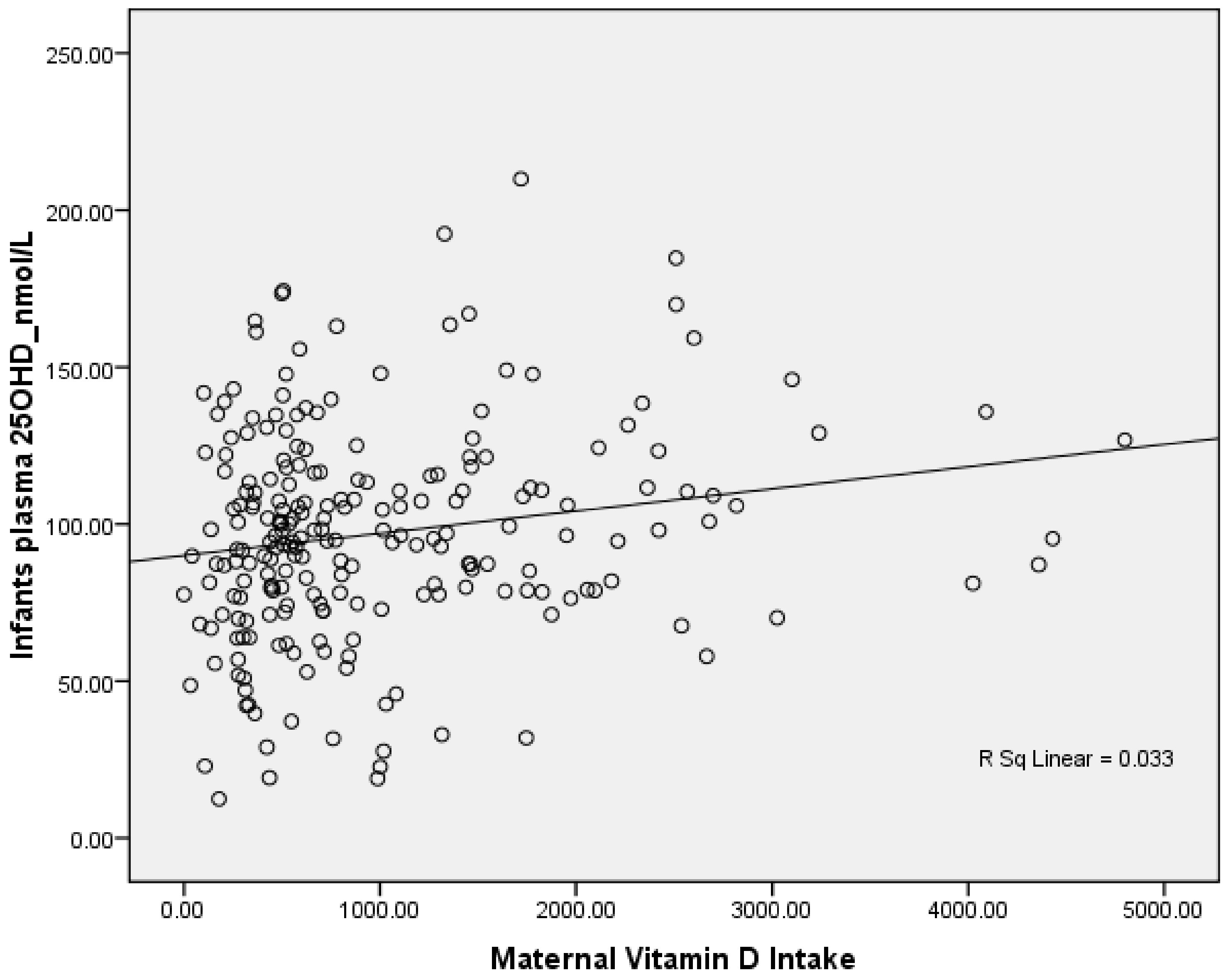
| Maternal vitamin D intake | 0.008 (0.002, 0.13) | 0.010 |
| Infants’ vitamin D intake | 16.31 (2.69, 29.93) | 0.019 |
| Season a | −6.49 (−16.86, 3.88) | 0.219 |
| Birth weight | −0.013 (−0.23, −0.002) | 0.024 |
| Maternal 25(OH)D b | 0.50 (−0.12, 0.22) | 0.564 |
| Race c | −2.93 (−20.01, 14.14) | 0.735 |
© 2018 by the authors. Licensee MDPI, Basel, Switzerland. This article is an open access article distributed under the terms and conditions of the Creative Commons Attribution (CC BY) license (http://creativecommons.org/licenses/by/4.0/).
Share and Cite
Aghajafari, F.; Field, C.J.; Weinberg, A.R.; Letourneau, N.; APrON Study Team. Both Mother and Infant Require a Vitamin D Supplement to Ensure That Infants’ Vitamin D Status Meets Current Guidelines. Nutrients 2018, 10, 429. https://doi.org/10.3390/nu10040429
Aghajafari F, Field CJ, Weinberg AR, Letourneau N, APrON Study Team. Both Mother and Infant Require a Vitamin D Supplement to Ensure That Infants’ Vitamin D Status Meets Current Guidelines. Nutrients. 2018; 10(4):429. https://doi.org/10.3390/nu10040429
Chicago/Turabian StyleAghajafari, Fariba, Catherine J. Field, Amy R. Weinberg, Nicole Letourneau, and APrON Study Team. 2018. "Both Mother and Infant Require a Vitamin D Supplement to Ensure That Infants’ Vitamin D Status Meets Current Guidelines" Nutrients 10, no. 4: 429. https://doi.org/10.3390/nu10040429
APA StyleAghajafari, F., Field, C. J., Weinberg, A. R., Letourneau, N., & APrON Study Team. (2018). Both Mother and Infant Require a Vitamin D Supplement to Ensure That Infants’ Vitamin D Status Meets Current Guidelines. Nutrients, 10(4), 429. https://doi.org/10.3390/nu10040429

