<?xml version="1.0" encoding="UTF-8"?>
<!DOCTYPE article PUBLIC "-//NLM//DTD Journal Publishing DTD v2.3 20070202//EN" "journalpublishing.dtd">
<article xmlns:mml="http://www.w3.org/1998/Math/MathML" xmlns:xlink="http://www.w3.org/1999/xlink" xml:lang="en" article-type="research-article">
  <front>
    <journal-meta>
      <journal-id journal-id-type="publisher-id">nutrients</journal-id>
      <journal-title>Nutrients</journal-title>
      <abbrev-journal-title abbrev-type="publisher">Nutrients</abbrev-journal-title>
      <abbrev-journal-title abbrev-type="pubmed">Nutrients</abbrev-journal-title>
      <issn pub-type="epub">2072-6643</issn>
      <publisher>
      <publisher-name>Molecular Diversity Preservation International</publisher-name>
      </publisher>
    </journal-meta>
    <article-meta>
      <article-id pub-id-type="doi">10.3390/nu1020156</article-id>
      <article-id pub-id-type="publisher-id">nutrients-01-00156</article-id>
      <article-categories>
        <subj-group>
          <subject>Article</subject>
        </subj-group>
      </article-categories>
      <title-group>
        <article-title>Hypocholesterolemic Effects of Nutraceuticals Produced from the Red Microalga <italic>Porphyridium</italic> sp in Rats</article-title>
      </title-group>
      <contrib-group>
        <contrib contrib-type="author">
          <name>
            <surname>Dvir</surname>
            <given-names>Irit</given-names>
          </name>
          <xref rid="af1-nutrients-01-00156" ref-type="aff">1</xref>
          <xref rid="c1-nutrients-01-00156" ref-type="corresp">*</xref>
        </contrib>
        <contrib contrib-type="author">
          <name>
            <surname>Stark</surname>
            <given-names>Aliza Hannah</given-names>
          </name>
          <xref rid="af2-nutrients-01-00156" ref-type="aff">2</xref>
        </contrib>
        <contrib contrib-type="author">
          <name>
            <surname>Chayoth</surname>
            <given-names>Reuven</given-names>
          </name>
          <xref rid="af1-nutrients-01-00156" ref-type="aff">1</xref>
        </contrib>
        <contrib contrib-type="author">
          <name>
            <surname>Madar</surname>
            <given-names>Zecharia</given-names>
          </name>
          <xref rid="af2-nutrients-01-00156" ref-type="aff">2</xref>
        </contrib>
        <contrib contrib-type="author">
          <name>
            <surname>Arad</surname>
            <given-names>Shoshana Malis</given-names>
          </name>
          <xref rid="af3-nutrients-01-00156" ref-type="aff">3</xref>
        </contrib>
      </contrib-group>
            <aff id="af1-nutrients-01-00156"><label>1</label>Department of Life Sciences, Ben-Gurion University of the Negev, Beer-Sheva 84105, Israel; Email: <email>rchayoth@mail.netvision.net.il</email></aff>
      <aff id="af2-nutrients-01-00156"><label>2</label>The Robert H. Smith Faculty of Agriculture, Food and Environment, Institute of Biochemistry, Food Science and Nutrition, The Hebrew University of Jerusalem, Rehovot 76100, Israel; Email: <email>stark@agri.huji.ac.il</email> (A.H.S.); <email>madar@agri.huji.ac.il</email>(Z.M.)</aff>
      <aff id="af3-nutrients-01-00156"><label>3</label>Department of Biotechnology Engineering, Ben-Gurion University of the Negev, Beer-Sheva 84105, Israel; Email: <email>arad@bgu.ac.il</email></aff>
      <author-notes>
        <corresp id="c1-nutrients-01-00156"><label>*</label> Author to whom correspondence should be addressed; Sapir Academic College, D. N. Hof Ashkelon 79165, Israel; Email: <email>iritd@sapir.ac.il</email>; Tel.: +972-54-675-5248; Fax: +972-8-680-1520.</corresp>
      </author-notes>
      <pub-date pub-type="epub">
        <day>23</day>
        <month>11</month>
        <year>2009</year>
      </pub-date>
      <pub-date pub-type="collection">
        <month>02</month><year>2009</year>
      </pub-date>
      <volume>1</volume>
      <issue>2</issue>
      <fpage>156</fpage>
      <lpage>167</lpage>
      <history>
        <date date-type="received">
          <day>08</day>
          <month>09</month>
          <year>2009</year>
        </date>
        <date date-type="accepted">
          <day>18</day>
          <month>11</month>
          <year>2009</year>
        </date>
      </history>
      <permissions>
        <copyright-statement>©  2009 by the authors; licensee Molecular Diversity Preservation International, Basel, Switzerland.</copyright-statement>
        <copyright-year>2009</copyright-year>
        <license xmlns:xlink="http://www.w3.org/1999/xlink" license-type="open-access" xlink:href="http://creativecommons.org/licenses/by/3.0/">
          <p>This article is an open-access article distributed under the terms and conditions of the Creative Commons Attribution license (http://creativecommons.org/licenses/by/3.0/).</p>
        </license>
      </permissions>
      <abstract>
        <p>Red microalgae contain functional sulfated polysaccharides (containing dietary fibers), polyunsaturated fatty acids, zeaxanthin, vitamins, minerals, and proteins. Studies in rat models support the therapeutic properties of algal biomass and isolated polysaccharides. Algal products incorporated into rat diets were found to significantly improve total serum cholesterol, serum triglycerides, hepatic cholesterol levels, HDL/LDL ratios and increased fecal excretion of neutral sterols and bile acids. Morphological and metabolic changes were induced by consumption of algal products. These results suggest that red microalgae can be used as potent hypocholesterolemic agents, and they support the potential use of red microalgae as novel nutraceuticals.</p>
      </abstract>
      <kwd-group>
        <kwd>red microalgae</kwd>
        <kwd>nutraceuticals</kwd>
        <kwd>hypocholesterolemic agents</kwd>
        <kwd>dietary fiber</kwd>
        <kwd>foodomics</kwd>
      </kwd-group>
    </article-meta>
  </front>
  <body>
    <sec>
      <title>Abbreviations Used</title>
      <def-list>
      <def-item><term id="G1">EPA</term><def><p>eicosapentaenoic acid</p></def></def-item>
      <def-item><term id="G2">HDL/LDL</term><def><p>high density lipoproteins/low density lipoproteins</p></def></def-item>
      <def-item><term id="G3">TG</term><def><p>triglyceride</p></def></def-item>
      <def-item><term id="G4">VLDL-C</term><def><p>very low density lipoprotein- cholesterol</p></def></def-item>
  </def-list>
    </sec>
    <sec sec-type="intro">
      <title>1. Introduction</title>
      <p>Algae are rich in natural bioactive compounds that may act as antihypertensive, antioxidant, antimicrobial, antiviral, anti-inflammatory, antitumour, anticoagulant and/or hypocholesterolemic agents [<xref ref-type="bibr" rid="B1-nutrients-01-00156">1</xref>,<xref ref-type="bibr" rid="B2-nutrients-01-00156">2</xref>,<xref ref-type="bibr" rid="B3-nutrients-01-00156">3</xref>,<xref ref-type="bibr" rid="B4-nutrients-01-00156">4</xref>,<xref ref-type="bibr" rid="B5-nutrients-01-00156">5</xref>,<xref ref-type="bibr" rid="B6-nutrients-01-00156">6</xref>,<xref ref-type="bibr" rid="B7-nutrients-01-00156">7</xref>,<xref ref-type="bibr" rid="B8-nutrients-01-00156">8</xref>,<xref ref-type="bibr" rid="B9-nutrients-01-00156">9</xref>]. In addition, many species are potential sources of nutraceuticals, since they have high concentrations of vitamins, minerals, phytochemicals, ω-3 fatty acids and various functional polysaccharides [<xref ref-type="bibr" rid="B1-nutrients-01-00156">1</xref>,<xref ref-type="bibr" rid="B2-nutrients-01-00156">2</xref>,<xref ref-type="bibr" rid="B3-nutrients-01-00156">3</xref>,<xref ref-type="bibr" rid="B10-nutrients-01-00156">10</xref>,<xref ref-type="bibr" rid="B11-nutrients-01-00156">11</xref>]. Algal products are considered safe for use and have been part of the human diet for centuries. </p>
      <p>Marine algae contain large quantities of soluble and insoluble dietary fibers that differ physicochemically from those of land plants [<xref ref-type="bibr" rid="B12-nutrients-01-00156">12</xref>,<xref ref-type="bibr" rid="B13-nutrients-01-00156">13</xref>,<xref ref-type="bibr" rid="B14-nutrients-01-00156">14</xref>]. Dietary fibers from various marine sources are composed of diverse assortments of polysaccharides that confer on each source a unique chemical composition profile and physical structure [<xref ref-type="bibr" rid="B12-nutrients-01-00156">12</xref>,<xref ref-type="bibr" rid="B13-nutrients-01-00156">13</xref>,<xref ref-type="bibr" rid="B14-nutrients-01-00156">14</xref>]. As a result, different species of marine algae, when eaten by man or animals, will have different physiological and metabolic effects [<xref ref-type="bibr" rid="B15-nutrients-01-00156">15</xref>]. The mechanisms by which dietary fibers induce physiological changes are related to their viscosities, fermentabilities, water holding capacities, bile acid binding abilities, cation exchange capacities and fecal bulking properties [<xref ref-type="bibr" rid="B16-nutrients-01-00156">16</xref>]. Animal studies have shown that the consumption of fibers is associated with changes in lipid metabolism, which often include a hypocholesterolemic effect [<xref ref-type="bibr" rid="B17-nutrients-01-00156">17</xref>,<xref ref-type="bibr" rid="B18-nutrients-01-00156">18</xref>,<xref ref-type="bibr" rid="B19-nutrients-01-00156">19</xref>]. It has therefore been hypothesized that the consumption of dietary fibers may decrease the prevalence of diseases associated with low dietary fiber intake, such as obesity, diabetes, heart disease and cancer [<xref ref-type="bibr" rid="B20-nutrients-01-00156">20</xref>]. </p>
      <p>Studies in our laboratory have shown that the marine red microalga <italic>Porphyridium</italic> sp. constitutes a new source of dietary fibers with hypocholesterolemic potential [<xref ref-type="bibr" rid="B3-nutrients-01-00156">3</xref>,<xref ref-type="bibr" rid="B10-nutrients-01-00156">10</xref>]. The cells of this species are encapsulated in a cell wall composed largely of a polysaccharide (about 50‑70% of the biomass) whose external portion dissolves in the culture medium. The cell-wall polysaccharides are heteropolymers (molecular weight of 3–5 × 10<sup>6</sup> Da) with xylose, glucose and galactose as the primary sugars. The presence of sulfate groups and glucuronic acid confer a negative charge on these molecules [<xref ref-type="bibr" rid="B21-nutrients-01-00156">21</xref>,<xref ref-type="bibr" rid="B22-nutrients-01-00156">22</xref>,<xref ref-type="bibr" rid="B23-nutrients-01-00156">23</xref>]. Like other species of red microalga, <italic>Porphyridium</italic> sp. contains significant amounts of eicosapentaenoic acid [EPA; 20:5 (n-3)] [<xref ref-type="bibr" rid="B10-nutrients-01-00156">10</xref>,<xref ref-type="bibr" rid="B24-nutrients-01-00156">24</xref>,<xref ref-type="bibr" rid="B25-nutrients-01-00156">25</xref>]. </p>
      <p>The consumption of red microalgae has been shown to induce physiological effects, including marked changes in rat intestinal morphology [<xref ref-type="bibr" rid="B3-nutrients-01-00156">3</xref>]. Significant increases in small intestine and colon length have been documented. Jejunum mucosa and muscularis cross-sectional areas were enlarged and hypertrophy of the muscularis layer was measured following polysaccharide feeding. Furthermore, addition of algal biomass to the diet significantly reduced intestinal transit time [<xref ref-type="bibr" rid="B3-nutrients-01-00156">3</xref>]. Work in chickens showed that both 5 and 10% levels of algal biomass in the diet were effective in lowering cholesterol levels, and a trend to lower levels of cholesterol in eggs was observed [<xref ref-type="bibr" rid="B26-nutrients-01-00156">26</xref>]. </p>
      <p>In the present study, we investigated the hypocholesterolaemic effects of algal biomass and of the isolated algal polysaccharide (AP) of <italic>Porphyridium</italic> sp. in hypercholesterolemic rats and sought explanations for the observed mechanisms of action of these effects. </p>
    </sec>
    <sec>
      <title>2. Materials and Methods</title>
      <p><italic>Algae and Culture Conditions.</italic> The unicellular red alga <italic>Porphyridium</italic> sp. (UTEX 637) was obtained from the culture collection of the University of Texas, Austin, TX, USA. The algae were cultivated outdoors for 21 days in artificial seawater [<xref ref-type="bibr" rid="B27-nutrients-01-00156">27</xref>] in polyethylene sleeves [<xref ref-type="bibr" rid="B28-nutrients-01-00156">28</xref>].</p>
      <p><italic>Biomass Production.</italic> Algal cultures were grown for 14 days. The entire culture was centrifuged at 17,000 × g for 20 min (Cepa Z-41, Carl Parberg, Lahr/Schwarzwald, Germany) and the pellet collected. In order to remove salts, the pellet was washed (deionized water, pH 4). This procedure was repeated and the pellet obtained was then lyophilized and stored in a desiccator until the start of the experiment (up to 3 months). The dry algal cells were designated biomass.</p>
      <p><italic>Algal Polysaccharide (AP) Preparation.</italic> The growth medium was centrifuged and the transparent supernatant containing soluble polysaccharides was collected. This was followed by cross flow filtration (stainless steel equipment, Bio Nes Ltd; filters, A/G Company Ltd) to remove salts. The concentrated algal polysaccharide was frozen (−20 °C), lyophilized and stored in a desiccator until the start of the experiment (up to three months).</p>
      <p><italic>Dietary Fiber Sources and Analyses.</italic> Four sources of dietary fiber were used: (1) cellulose (Solka-folc, James River Corp., Hackensack, NJ, USA); (2) pure citrus pectin (methoxy concentration 10 g·100 g<sup>-1</sup>; Sigma, St. Louis, MO, USA); (3) <italic>Porphyridium</italic> sp. cells (biomass); and (4) algal polysaccharide (AP) of Porphyridium sp. (prepared as described above). <xref ref-type="table" rid="nutrients-01-00156-t001">Table 1</xref> provides analyses of the dietary fiber sources. Carbohydrate analysis was performed using the phenol-sulfuric method [<xref ref-type="bibr" rid="B29-nutrients-01-00156">29</xref>]. Fat content was measured by the Kates method [<xref ref-type="bibr" rid="B30-nutrients-01-00156">30</xref>] and protein content was determined by the Lowry method [<xref ref-type="bibr" rid="B31-nutrients-01-00156">31</xref>]. Ash content was measured in oven dried samples (70 °C, 24 h). Samples were cooled in a desiccator and weighed. The dried sample was then burned at 600 °C for 24 h. The remaining ash was cooled in a desiccator and weighed. Dietary fiber analysis was carried out by the AOAC standard method [<xref ref-type="bibr" rid="B32-nutrients-01-00156">32</xref>]. </p>
      <p><italic>Animals.</italic> Male Sprague-Dawley rats (Harlan, Jerusalem, Israel), each weighing 130–140 g, were housed in individual stainless-steel cages suspended in a controlled environment (22–24 °C and 12 h light/dark), with free access to food and water. Animals were kept according to the guidelines set forth by the Animal Care Committee of Ben-Gurion University of the Negev.</p>
      <p><italic>Diets</italic>.The composition and dietary fiber content of the four different cholesterol-rich diets fed to the rats is presented in <xref ref-type="table" rid="nutrients-01-00156-t001">Table 1</xref> and <xref ref-type="table" rid="nutrients-01-00156-t002">Table 2</xref>. The algal biomass contained 27% insoluble and 8.5% soluble dietary fibers on a dry weight basis while the AP comprised 37% soluble and 8% insoluble dietary fibers. </p>
            <table-wrap id="nutrients-01-00156-t001" position="anchor">
        <object-id pub-id-type="pii">nutrients-01-00156-t001_Table 1</object-id>
        <label>Table 1</label>
        <caption>
          <p>Composition of the algal polysaccharide (AP), biomass, pectin and cellulose fiber sources. </p>
        </caption>
        <table>
          <thead>
            <tr>
              <th align="left" valign="middle">Ingredient</th>
              <th align="center" valign="middle">AP (% dry weight)</th>
              <th align="center" valign="middle">Biomass ( % dry weight)</th>
              <th align="center" valign="middle">Pectin ( % dry weight)</th>
              <th align="center" valign="middle">Cellulose ( % dry weight)</th>
            </tr>
          </thead>
          <tbody>
            <tr>
              <td align="left" valign="middle">Soluble fibers</td>
              <td align="center" valign="middle">37</td>
              <td align="center" valign="middle">8.5</td>
              <td align="center" valign="middle">89</td>
              <td align="center" valign="middle">-</td>
            </tr>
            <tr>
              <td align="left" valign="middle">Insoluble fibers</td>
              <td align="center" valign="middle">8</td>
              <td align="center" valign="middle">27</td>
              <td align="center" valign="middle">-</td>
              <td align="center" valign="middle">98</td>
            </tr>
            <tr>
              <td align="left" valign="middle">
                <bold>Total dietary fibers</bold>
              </td>
              <td align="center" valign="middle">
                <bold>45</bold>
              </td>
              <td align="center" valign="middle">
                <bold>35.5</bold>
              </td>
              <td align="center" valign="middle">
                <bold>89</bold>
              </td>
              <td align="center" valign="middle">
                <bold>98</bold>
              </td>
            </tr>
            <tr>
              <td align="left" valign="middle">Carbohydrate</td>
              <td align="center" valign="middle">26.5</td>
              <td align="center" valign="middle">27</td>
              <td align="center" valign="middle">-</td>
              <td align="center" valign="middle">-</td>
            </tr>
            <tr>
              <td align="left" valign="middle">Protein</td>
              <td align="center" valign="middle">15</td>
              <td align="center" valign="middle">18</td>
              <td align="center" valign="middle">7</td>
              <td align="center" valign="middle">1.9</td>
            </tr>
            <tr>
              <td align="left" valign="middle">Lipids</td>
              <td align="center" valign="middle">2.5</td>
              <td align="center" valign="middle">6</td>
              <td align="center" valign="middle">-</td>
              <td align="center" valign="middle">-</td>
            </tr>
            <tr>
              <td align="left" valign="middle">Ash</td>
              <td align="center" valign="middle">11</td>
              <td align="center" valign="middle">13.5</td>
              <td align="center" valign="middle">4</td>
              <td align="center" valign="middle">0.1</td>
            </tr>
            <tr>
              <td align="left" valign="middle">Total dietary fibers in diet ( %)</td>
              <td align="center" valign="middle">6.5</td>
              <td align="center" valign="middle">6.5</td>
              <td align="center" valign="middle">6.5</td>
              <td align="center" valign="middle">2</td>
            </tr>
          </tbody>
        </table>
      </table-wrap>
       <table-wrap id="nutrients-01-00156-t002" position="anchor">
        <object-id pub-id-type="pii">nutrients-01-00156-t002_Table 2</object-id>
        <label>Table 2</label>
        <caption>
          <p>Composition of experimental diets.</p>
        </caption>
        <table>
          <thead>
            <tr>
              <th align="left" valign="middle">Ingredient</th>
              <th align="center" valign="middle">AP (g·kg<sup>-1</sup>)</th>
              <th align="center" valign="middle">Biomass (g·kg<sup>-1</sup>)</th>
              <th align="center" valign="middle">Pectin (g·kg<sup>-1</sup>)</th>
              <th align="center" valign="middle">Control (g·kg<sup>-1</sup>)</th>
            </tr>
          </thead>
          <tbody>
            <tr>
              <td align="left" valign="middle">Casein</td>
              <td align="center" valign="middle">178</td>
              <td align="center" valign="middle">171</td>
              <td align="center" valign="middle">196</td>
              <td align="center" valign="middle">200</td>
            </tr>
            <tr>
              <td align="left" valign="middle">Sucrose</td>
              <td align="center" valign="middle">232</td>
              <td align="center" valign="middle">232</td>
              <td align="center" valign="middle">232</td>
              <td align="center" valign="middle">232</td>
            </tr>
            <tr>
              <td align="left" valign="middle">Corn starch</td>
              <td align="center" valign="middle">325</td>
              <td align="center" valign="middle">290</td>
              <td align="center" valign="middle">374</td>
              <td align="center" valign="middle">420</td>
            </tr>
            <tr>
              <td align="left" valign="middle">Corn oil</td>
              <td align="center" valign="middle">67</td>
              <td align="center" valign="middle">59</td>
              <td align="center" valign="middle">70</td>
              <td align="center" valign="middle">70</td>
            </tr>
            <tr>
              <td align="left" valign="middle">Fiber source</td>
              <td align="center" valign="middle">140</td>
              <td align="center" valign="middle">190</td>
              <td align="center" valign="middle">70</td>
              <td align="center" valign="middle">20</td>
            </tr>
            <tr>
              <td align="left" valign="middle">Vitamin mix*</td>
              <td align="center" valign="middle">10</td>
              <td align="center" valign="middle">10</td>
              <td align="center" valign="middle">10</td>
              <td align="center" valign="middle">10</td>
            </tr>
            <tr>
              <td align="left" valign="middle">Salt mix*</td>
              <td align="center" valign="middle">35</td>
              <td align="center" valign="middle">35</td>
              <td align="center" valign="middle">35</td>
              <td align="center" valign="middle">35</td>
            </tr>
            <tr>
              <td align="left" valign="middle">DL-methionine</td>
              <td align="center" valign="middle">3</td>
              <td align="center" valign="middle">3</td>
              <td align="center" valign="middle">3</td>
              <td align="center" valign="middle">3</td>
            </tr>
		    <tr>
              <td align="left" valign="middle">Cholesterol</td>
              <td align="center" valign="middle">10</td>
              <td align="center" valign="middle">10</td>
              <td align="center" valign="middle">10</td>
              <td align="center" valign="middle">10</td>
            </tr>
          </tbody>
        </table>
        <table-wrap-foot><fn><p>*Vitamin Mix and Mineral Mix – Standard AIN recommendations.</p>
      <p>Protein and lipid content was matched for all diets.</p>
      </fn>
      </table-wrap-foot>
      </table-wrap>
      <p><italic>Experimental Procedures.</italic> Twenty-four rats were divided into four groups such that the mean weights of each group were similar. Each group was fed one of the four cholesterol-rich diets (<xref ref-type="table" rid="nutrients-01-00156-t002">Table 2</xref>) for a 15-day period. Every two to three days the animals and feces were weighed, and food intake was assessed. On each of the last four days of the experiment, feces were collected, weighed and frozen at −20 °C. The samples were then dried by lyophilisation and stored in a desiccator for later analysis. On day 14 of the experiment, food was withheld from the rats overnight (12–14 h), and the following morning animals were anesthetized with chloral hydrate 100 g·L<sup>-1</sup>. Blood samples were taken from the heart and placed in tubes with heparin. Samples were then centrifuged for 10 min at 1,000 × g, and plasma was frozen at −20 °C until analysis. The livers were removed, weighed and stored at −20 °C for further analysis. </p>
      <p><italic>Determination of Plasma Lipids.</italic> Total plasma cholesterol and lipoprotein contents were measured by enzymatic colorimetric methods [<xref ref-type="bibr" rid="B33-nutrients-01-00156">33</xref>,<xref ref-type="bibr" rid="B34-nutrients-01-00156">34</xref>]. Plasma triglyceride (TG) levels were determined by the method of Fossati and Prencipe [<xref ref-type="bibr" rid="B35-nutrients-01-00156">35</xref>]. </p>
      <p><italic>Fecal and Hepatic Neutral Sterol Analysis</italic>. Neutral sterols were determined by the method of Searcy and Bergquest [<xref ref-type="bibr" rid="B36-nutrients-01-00156">36</xref>], with the following modifications. Dried fecal or liver samples (50 mg) were saponified with 3 mL of 10% ethanolic KOH for 1 h at 65 °C and then cooled to room temperature. Neutral lipids were extracted as follows: 3 mL of water and 5 mL of petroleum ether (b.p. 40–60 °C) were added to each sample, the contents were mixed for 30 s, and the solvent was removed. The second and third extractions were carried out with 5 mL and 3 mL, respectively, of petroleum ether, and the three extracts were pooled for each sample. The samples were then dried under nitrogen, and 3 mL of acetic acid saturated with FeSO<sub>4</sub> and 1 ml H<sub>2</sub>SO<sub>4</sub> were added. Absorbance was read at 490 nm to determine steroid concentrations. A standard curve was prepared with increasing concentrations of cholesterol.</p>
      <p><italic>Fecal Bile Acid Analysis.</italic> Dried fecal matter (100 mg) was extracted overnight with 10 mL of chloroform-methanol [<xref ref-type="bibr" rid="B37-nutrients-01-00156">37</xref>]. Two milliliters of KCl, 3.7 g·L<sup>-1</sup>, were then added, and the sample was centrifuged at 1,500 × g for 10 min. The upper layer was evaporated to dryness, and the residue was then dissolved in 1 ml of 50% methanol. Total bile acids were determined by enzymatic analysis using a modification of the method of Sheltawy and Losowsky [<xref ref-type="bibr" rid="B38-nutrients-01-00156">38</xref>], as follows: to 100 μL of sample containing 2 mmol·L<sup>−1</sup>NAD, in phosphate buffer, pH 10.5, were added 3α-hydroxysteroid dehydrogenase (0.1 IU) in a final volume of 1.5 mL. After 30 min at room temperature, the absorbance was read at 340 nm to determine the NADH formed. </p>
      <p><italic>Statistical Analysis.</italic> Data were expressed as means and standard error. Group means were compared by one-way analysis of variance (ANOVA). Means were considered significantly different at P ≤ 0.05, as determined by Fisher’s projected least significant difference method. </p>
    </sec>
    <sec sec-type="results">
      <title>3. Results</title>
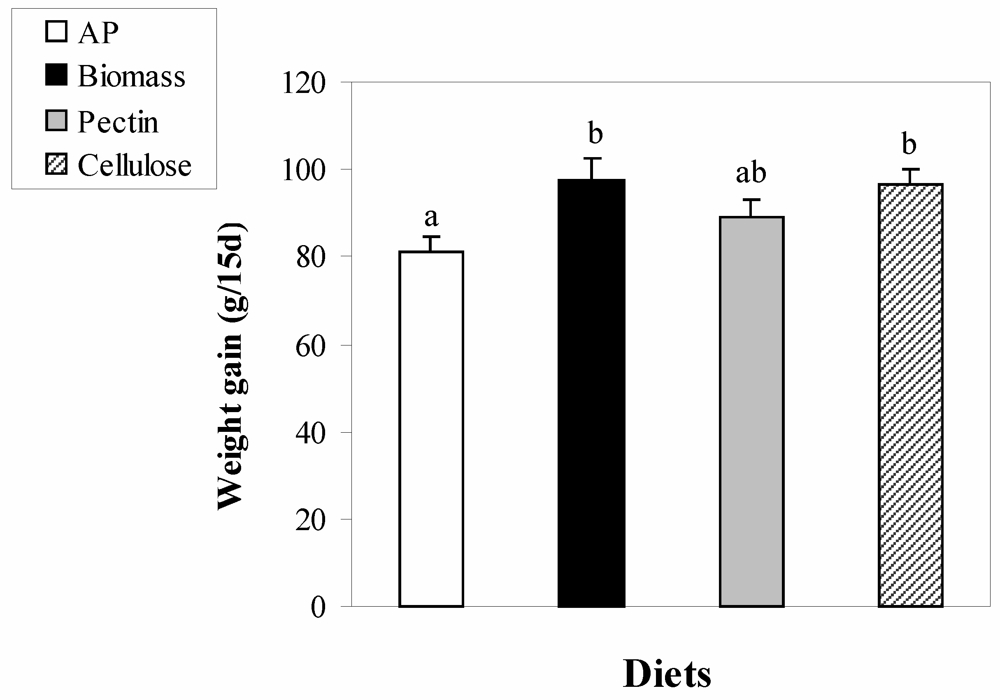
      <p><italic>Body Weight Gain.</italic> Despite similar food intake levels of 6–8 grams per day per rat, significantly lower weight gain (p &lt; 0.03) was observed in AP fed rats (81.3 g) than in the rats fed the control, biomass or pectin diets (97.6 g, 89.1 g, and 96.6 g, respectively, <xref ref-type="fig" rid="nutrients-01-00156-f001">Figure 1</xref>). </p>
      <fig id="nutrients-01-00156-f001" position="anchor">
        <label>Figure 1</label>
        <caption>
          <p>The effect of feeding a hypercholesterolemic diet on weight gain in control rats and rats fed either red microalgal biomass or algal polysaccharide (AP) for 15 days. The isolated fractions contained either soluble polysaccharides found in the growth medium of the algae (AP) or isolated cells (Biomass). Mean values with no common letters were significantly different, p &lt; 0.05. Bars represent SE.</p>
        </caption>
        <graphic xmlns:xlink="http://www.w3.org/1999/xlink" xlink:href="nutrients-01-00156-g001.tif"/>
      </fig>
      <p><italic>Plasma Lipids and Lipoproteins.</italic> Plasma parameters are presented in <xref ref-type="table" rid="nutrients-01-00156-t003">Table 3</xref>. Cholesterol levels were significantly lower (22–34%; p &lt; 0.001) in rats fed the biomass or AP diets than in control or pectin-fed rats. Similarly, plasma TG and very-low-density lipoprotein (VLDL-C) levels were also lower (by 12–39%) in animals fed AP or biomass. Low-density lipoprotein (LDL) levels were significantly decreased (by 32–53%; p &lt; 0.005) in the polysaccharide-fed rats when compared to rats fed the pectin or control diets. The ratio of high- to low-density lipoproteins (HDL/LDL) was higher (by 31–60%; p &lt; 0.001) in the polysaccharide and biomass groups vs. the pectin and control diets. </p>
            <table-wrap id="nutrients-01-00156-t003" position="anchor">
        <object-id pub-id-type="pii">nutrients-01-00156-t003_Table 3</object-id>
        <label>Table 3</label>
        <caption>
          <p>Plasma lipid levels in rats fed with algal biomass or algal polysaccharide (AP) compared to controls for 15 days (n = 6). Values in columns with different letters differ significantly, p &lt; 0.05.</p>
        </caption>
        <table>
          <thead>
            <tr>
              <th rowspan="2" align="left" valign="middle">Study group</th>
              <th colspan="2" align="center" valign="middle">Plasma cholesterol (mg/dL)</th>
              <th colspan="2" align="center" valign="middle">Plasma triglycerides (mg /dL)</th>
              <th colspan="2" align="center" valign="middle">VLDL-C (mg/dL)</th>
              <th colspan="2" align="center" valign="middle">HDL/LDL</th>
            </tr>
            <tr>
              <th valign="middle">Mean</th>
              <th valign="middle">SE</th>
              <th valign="middle">Mean</th>
              <th valign="middle">SE</th>
              <th valign="middle">Mean</th>
              <th valign="middle">SE</th>
              <th valign="middle">Mean</th>
              <th valign="middle">SE</th>
            </tr>
          </thead>
          <tbody>
            <tr>
              <td align="left" valign="middle">Polysaccharide</td>
              <td align="center" valign="middle">103.17</td>
              <td align="center" valign="middle">5.28 <sup>a</sup></td>
              <td align="center" valign="middle">23.17</td>
              <td align="center" valign="middle">1.52 <sup>a</sup></td>
              <td align="center" valign="middle">46.7</td>
              <td align="center" valign="middle">2.9 <sup>a</sup></td>
              <td align="center" valign="middle">0.77</td>
              <td align="center" valign="middle">0.12 <sup>a</sup></td>
            </tr>
            <tr>
              <td align="left" valign="middle">Biomass</td>
              <td align="center" valign="middle">95.67</td>
              <td align="center" valign="middle">4.62 <sup>a</sup></td>
              <td align="center" valign="middle">26.67</td>
              <td align="center" valign="middle">1.71 <sup>a</sup> <sup>b</sup></td>
              <td align="center" valign="middle">53.3</td>
              <td align="center" valign="middle">3.4<sup>ab</sup></td>
              <td align="center" valign="middle">0.83</td>
              <td align="center" valign="middle">0.07 <sup>b</sup></td>
            </tr>
            <tr>
              <td align="left" valign="middle">Pectin</td>
              <td align="center" valign="middle">132.50</td>
              <td align="center" valign="middle">8.62<sup>b</sup></td>
              <td align="center" valign="middle">38.00</td>
              <td align="center" valign="middle">2.31 <sup>c</sup></td>
              <td align="center" valign="middle">76.0</td>
              <td align="center" valign="middle">4.6<sup>c</sup></td>
              <td align="center" valign="middle">0.53</td>
              <td align="center" valign="middle">0.08 <sup>bc</sup></td>
            </tr>
            <tr>
              <td align="left" valign="middle">Control</td>
              <td align="center" valign="middle">144.00</td>
              <td align="center" valign="middle">12.12 <sup>b</sup></td>
              <td align="center" valign="middle">30.17</td>
              <td align="center" valign="middle">3.06 <sup>b</sup></td>
              <td align="center" valign="middle">60.3</td>
              <td align="center" valign="middle">6.1<sup>b</sup></td>
              <td align="center" valign="middle">0.33</td>
              <td align="center" valign="middle">0.05 <sup>c</sup></td>
            </tr>
          </tbody>
        </table>
      </table-wrap>
      <p><italic>Fecal Dry Weight.</italic> Fecal dry weight was greater in the polysaccharide-fed rats (3.17 g·day<sup>−1</sup>; p &lt; 0.0001) than in the pectin and control groups (0.93 and 1.07 g·day<sup>−1</sup>, respectively). Fecal dry weight was also higher (2.46 g·day<sup>−1</sup>) in the biomass-fed animals (<xref ref-type="table" rid="nutrients-01-00156-t004">Table 4</xref>).</p>
      <p><italic>Fecal Excretion of Neutral Sterols and Bile Acid.</italic> The amount of neutral sterols in the feces was dramatically enhanced in rats fed algal polysaccharide (1.93 mg·day<sup>−1</sup>; p &lt; 0.02) in comparison to the other three treatments (1.19, 0.82 and 0.59 mg·day<sup>-1</sup> for the biomass, pectin and control groups, respectively) (<xref ref-type="table" rid="nutrients-01-00156-t004">Table 4</xref>). The fecal bile acid content was lowest in the polysaccharide-fed animals (0.33 mg·day<sup>−1</sup>), higher in the pectin and control groups (0.59 mg·day<sup>−1</sup> and 0.61 mg·day<sup>−1</sup>, respectively) and significantly higher (p &lt; 0.0001) in the biomass group (1.31 mg·day<sup>−1</sup>). Bile acid excretion was more than twofold higher in the biomass-fed rats than in the control animals. </p>
       <table-wrap id="nutrients-01-00156-t004" position="anchor">
        <object-id pub-id-type="pii">nutrients-01-00156-t004_Table 4</object-id>
        <label>Table 4</label>
        <caption>
          <p>Fecal parameters for rats fed experimental diets for 15 days (n = 6). Values in columns with different letters differ significantly, p &lt; 0.05.</p>
        </caption>
        <table>
          <thead>
            <tr>
              <th rowspan="2" align="left" valign="middle">Study group</th>
              <th colspan="2" align="center" valign="middle">Fecal dry weight (g·day<sup>-1</sup>)</th>
              <th colspan="2" align="center" valign="middle">Fecal neutral sterol (g·day<sup>-1</sup>)</th>
              <th colspan="2" align="center" valign="middle">Fecal bile acids (g·day<sup>-1</sup>)</th>
            </tr>
            <tr>
              <th align="center" valign="middle">Mean</th>
              <th align="center" valign="middle">SE</th>
              <th align="center" valign="middle">Mean</th>
              <th align="center" valign="middle">SE</th>
              <th align="center" valign="middle">Mean</th>
              <th align="center" valign="middle">SE</th>
            </tr>
          </thead>
          <tbody>
            <tr>
              <td align="left" valign="middle">Polysaccharide</td>
              <td align="left" valign="middle">3.17</td>
              <td align="left" valign="middle">0.08 <sup>a</sup></td>
              <td align="left" valign="middle">1.93</td>
              <td align="left" valign="middle">0.03 <sup>a</sup></td>
              <td align="left" valign="middle">0.33</td>
              <td align="left" valign="middle">0.07 <sup>a</sup></td>
            </tr>
            <tr>
              <td align="left" valign="middle">Biomass</td>
              <td align="left" valign="middle">2.46</td>
              <td align="left" valign="middle">0.08 <sup>b</sup></td>
              <td align="left" valign="middle">1.19</td>
              <td align="left" valign="middle">0.03 <sup>b</sup></td>
              <td align="left" valign="middle">1.31</td>
              <td align="left" valign="middle">0.18 <sup>b</sup></td>
            </tr>
            <tr>
              <td align="left" valign="middle">Pectin</td>
              <td align="left" valign="middle">0.93 </td>
              <td align="left" valign="middle">0.06 <sup>c</sup></td>
              <td align="left" valign="middle">0.82</td>
              <td align="left" valign="middle">0.04 <sup>bc</sup></td>
              <td align="left" valign="middle">0.59</td>
              <td align="left" valign="middle">0.07 <sup>a</sup></td>
            </tr>
            <tr>
              <td align="left" valign="middle">Control</td>
              <td align="left" valign="middle">1.07</td>
              <td align="left" valign="middle">0.05 <sup>c</sup></td>
              <td align="left" valign="middle">0.59</td>
              <td align="left" valign="middle">0.03 <sup>c</sup></td>
              <td align="left" valign="middle">0.61</td>
              <td align="left" valign="middle">0.08 <sup>a</sup></td>
            </tr>
          </tbody>
        </table>
      </table-wrap>
      <p><italic>Liver Weight and Hepatic Cholesterol.</italic> The weights of the livers removed from rats fed the biomass and pectin diets (37.76 and 38.08 mg·g body weight<sup>−1</sup>, respectively) were significantly lower (p &lt; 0.0003) than the weights of the control livers (42.86 mg·g body weight<sup>-1</sup>) (<xref ref-type="table" rid="nutrients-01-00156-t005">Table 5</xref>). The lowest liver weight was found in the polysaccharide-fed rats (35.39 mg·g body weight<sup>-1</sup>). Hepatic cholesterol was significantly higher in the control rats (3.89 mg·g liver<sup>−1</sup>; p &lt; 0.0001) than in the polysaccharide-, pectin- and biomass-fed rats (1.89, 1.81 and 2.14 mg·g liver<sup>−1</sup>, respectively).</p>
      <table-wrap id="nutrients-01-00156-t005" position="anchor">
        <object-id pub-id-type="pii">nutrients-01-00156-t005_Table 5</object-id>
        <label>Table 5</label>
        <caption>
          <p>Hepatic data for rats (n = 6) fed experimental diets for 15 days. Values in columns with different letters differ significantly, p &lt; 0.05.</p>
        </caption>
           <table>
          <thead>
            <tr>
              <th rowspan="2" align="left" valign="middle">Study group</th>
              <th colspan="2" align="center" valign="middle">Liver weight (g)</th>
              <th colspan="2" align="center" valign="middle">Liver weight (mg·g body weight<sup>-1</sup>)</th>
              <th colspan="2" align="center" valign="middle">Hepatic cholesterol (mg g<sup>-1</sup>)</th>
            </tr>
            <tr>
              <th align="center" valign="middle">Mean</th>
              <th align="center" valign="middle">SE</th>
              <th align="center" valign="middle">Mean</th>
              <th align="center" valign="middle">SE</th>
              <th align="center" valign="middle">Mean</th>
              <th align="center" valign="middle">SE</th>
            </tr>
          </thead>
          <tbody>
            <tr>
              <td align="left" valign="middle">Polysaccharide</td>
              <td align="left" valign="middle">7.65</td>
              <td align="left" valign="middle">0.28 <sup>a</sup></td>
              <td align="left" valign="middle">35.39</td>
              <td align="left" valign="middle">0.81 <sup>a</sup></td>
              <td align="left" valign="middle">1.89</td>
              <td align="left" valign="middle">0.15 <sup>a</sup></td>
            </tr>
            <tr>
              <td align="left" valign="middle">Biomass</td>
              <td align="left" valign="middle">8.90</td>
              <td align="left" valign="middle">0.35 <sup>b</sup></td>
              <td align="left" valign="middle">37.76</td>
              <td align="left" valign="middle">1.28 <sup>a</sup></td>
              <td align="left" valign="middle">2.14</td>
              <td align="left" valign="middle">0.05 <sup>a</sup></td>
            </tr>
            <tr>
              <td align="left" valign="middle">Pectin</td>
              <td align="left" valign="middle">8.69</td>
              <td align="left" valign="middle">0.37 <sup>ab</sup></td>
              <td align="left" valign="middle">38.08</td>
              <td align="left" valign="middle">0.88 <sup>a</sup></td>
              <td align="left" valign="middle">1.81</td>
              <td align="left" valign="middle">0.22 <sup>a</sup></td>
            </tr>
            <tr>
              <td align="left" valign="middle">Control</td>
              <td align="left" valign="middle">10.24</td>
              <td align="left" valign="middle">0.40 <sup>c</sup></td>
              <td align="left" valign="middle">42.86</td>
              <td align="left" valign="middle">0.85 <sup>b</sup></td>
              <td align="left" valign="middle">3.89</td>
              <td align="left" valign="middle">0.5 <sup>b</sup></td>
            </tr>
          </tbody>
        </table>
      </table-wrap>
    </sec>
    <sec sec-type="discussion">
      <title>4. Discussion</title>
      <p>This study examined the therapeutic effects of biomass or algal polysaccharides from the red microalga <italic>Porphyridium</italic> sp. on the lipid metabolism of rats fed diets rich in cholesterol. A significant hypocholesterolemic effect was observed accompanied by a decrease in the accumulation of hepatic cholesterol (<xref ref-type="table" rid="nutrients-01-00156-t005">Table 5</xref>) and by lowered plasma TG and VLDL-C levels (<xref ref-type="table" rid="nutrients-01-00156-t003">Table 3</xref>). These findings are in keeping with a number of recent studies that document the cholesterol- and lipid-lowering ability of algae [<xref ref-type="bibr" rid="B18-nutrients-01-00156">18</xref>,<xref ref-type="bibr" rid="B19-nutrients-01-00156">19</xref>,<xref ref-type="bibr" rid="B39-nutrients-01-00156">39</xref>,<xref ref-type="bibr" rid="B40-nutrients-01-00156">40</xref>] and that demonstrate the potential health benefits of incorporating algae or algal byproducts into the diet. Indeed, in Asia, seaweeds are traditionally consumed as sea vegetables, but in Western countries they are used mainly as gelling or thickening agents and not as part of the daily diet [<xref ref-type="bibr" rid="B11-nutrients-01-00156">11</xref>].</p>
      <p>Soluble dietary fibers, such as pectin, are known to have hypocholesterolemic effects and are therefore considered important factors in reducing the risk of coronary heart disease [<xref ref-type="bibr" rid="B41-nutrients-01-00156">41</xref>]. In this study, algal products were as effective as, or more effective than, pectin in lowering plasma cholesterol levels and preventing the accumulation of cholesterol in the liver. Numerous mechanisms have been proposed to account for the cholesterol-lowering action of soluble dietary fibers. One possible explanation is that they increase the viscosity of the intestinal contents, thereby interfering with nutrient absorption and micelle formation, which, in turn, decreases lipid absorption from the intestine [<xref ref-type="bibr" rid="B42-nutrients-01-00156">42</xref>]. It has also been suggested that soluble fibers act by disrupting the enterohepatic circulation of bile acids, leading to increased bile acid excretion and a subsequent decrease in plasma cholesterol levels [<xref ref-type="bibr" rid="B43-nutrients-01-00156">43</xref>,<xref ref-type="bibr" rid="B44-nutrients-01-00156">44</xref>].</p>
      <p>Liver weight and hepatic cholesterol accumulation was significantly lower in animals that consumed pectin, AP or biomass. This is of physiological importance as fatty liver is a risk factor associated with the development of chronic liver disease [<xref ref-type="bibr" rid="B45-nutrients-01-00156">45</xref>]. Natural compounds that have the ability to prevent accumulation of fats in the liver may be used therapeutically as nutraceuticals. </p>
      <p>In this study, consumption of AP resulted in a significant increase in fecal excretion of neutral sterols, while consumption of biomass had a marked effect on fecal excretion of bile acids and a lower but also significant impact on neutral sterol excretion (<xref ref-type="table" rid="nutrients-01-00156-t004">Table 4</xref>). Pectin consumption had a much lower effect on these parameters. Therefore, it is likely that both the biomass and the AG affect lipid metabolism at the level of absorption from the digestive tract. Although both biomass and AP significantly increased fecal weight and possibly interfered with micelle formation, their mechanisms of action may be quite different, due to their unique physicochemical properties (viscosity, solubility, electrical charge, etc.) [<xref ref-type="bibr" rid="B22-nutrients-01-00156">22</xref>,<xref ref-type="bibr" rid="B23-nutrients-01-00156">23</xref>,<xref ref-type="bibr" rid="B46-nutrients-01-00156">46</xref>,<xref ref-type="bibr" rid="B47-nutrients-01-00156">47</xref>,<xref ref-type="bibr" rid="B48-nutrients-01-00156">48</xref>] and to the fact that biomass contains primarily insoluble dietary fibers, whereas the majority of fibers in the AP are water soluble. The AP appeared to be more effective in enhancing the secretion of neutral sterols, while the biomass interfered with the enterohepatic circulation of bile acids. Consumption of both biomass and AP resulted in a depletion of total cholesterol pools, which was reflected in lowered hepatic and plasma cholesterol levels. These results corroborate the results of previous studies from our laboratory [<xref ref-type="bibr" rid="B3-nutrients-01-00156">3</xref>]. In earlier studies, rats fed algal biomass had elevated plasma cholecystokinin (CCK) levels. This may indicate an increased need for bile acid secretion via the gall bladder in order to enhance cholesterol absorption from the digestive tract to compensate for the hypocholesterolemic effect of the algal product. Similarly, HMG-CoA reductase, a key enzyme in endogenous cholesterol production, was found at increased levels in animals fed soluble fibers to lower cholesterol [<xref ref-type="bibr" rid="B49-nutrients-01-00156">49</xref>]. Feeding AP at levels of 5% or 10% to hypercholesterolemic rats enhanced HMG-CoA reductase in comparison to control animals (unpublished data). </p>
      <p>It is known that fiber-rich diets can inhibit weight gain in rats [<xref ref-type="bibr" rid="B50-nutrients-01-00156">50</xref>,<xref ref-type="bibr" rid="B51-nutrients-01-00156">51</xref>]. In our study, the lowest weight gain and a high dry fecal weight (almost three times higher than that of control animals) were observed in AG-fed rats. These findings may be due to the high viscosity of the intestinal contents following food consumption. Indeed, we have previously shown that the viscosity of the cecal contents of AP-fed rats was much higher than that of control animals or pectin-fed rats [<xref ref-type="bibr" rid="B3-nutrients-01-00156">3</xref>]. Highly viscous chyme may impede nutrient absorption (including cholesterol absorption) along the length of the intestines, leading to lower weight gain [<xref ref-type="bibr" rid="B51-nutrients-01-00156">51</xref>]. Biomass feeding did not affect weight gain. Similarly, in chickens, the addition of 5% or 10% biomass to the diet did not influence weight gain [<xref ref-type="bibr" rid="B26-nutrients-01-00156">26</xref>]. </p>
      <p>In the current study, AP (rich in soluble-fiber) significantly reduced plasma TGs and VLDL-Cs. These findings are in keeping with the generally accepted perception that plasma TG levels are lowered by the consumption of soluble dietary fibers [<xref ref-type="bibr" rid="B52-nutrients-01-00156">52</xref>] and with findings that certain sources of insoluble dietary fibers can lower TG levels, even though most insoluble dietary fibers have little or no impact on lipid metabolism [<xref ref-type="bibr" rid="B53-nutrients-01-00156">53</xref>,<xref ref-type="bibr" rid="B54-nutrients-01-00156">54</xref>]. It is also possible that the high EPA content of the biomass, in addition to the fiber content, contributed to the trend of lowered TG levels. </p>
      <p>Other components present in algae may also play a role in the hypocholesterolemic and triglyceride lowering effects observed in this study. Although little information is available, recent studies suggest that pigments such as <italic>C-phycocyanin</italic> present in algae are bioactive compounds and may affect lipid metabolism [<xref ref-type="bibr" rid="B55-nutrients-01-00156">55</xref>]. </p>
      <p>In conclusion, our work with red microalgae in animal models provides convincing evidence that supports the ability of both biomass and isolated algal polysaccharides (AP) to lower cholesterol levels and positively affect lipid metabolism. Increased fecal bile acid and cholesterol excretion appear to be important mechanisms of action responsible for the overall physiological impact of red microalgae consumption. These results add to the growing body of evidence that the consumption of algal products have health benefits, and as such, algal products can be classified as nutraceuticals.</p>
    </sec>
  </body>
  <back>
    <ack>
      <title>Acknowledgements</title>
      <p>We would like to thank U. Sod-Moriah and S. Shany for their assistance in carrying out this research project. This work was supported by a grant from the Israeli Ministry of Science. </p>
    </ack>
    <ref-list>
      <title>References</title>
      <ref id="B1-nutrients-01-00156">
        <label>1.</label>
        <citation citation-type="journal">
          <person-group person-group-type="author">
            <name>
              <surname>MacArtain</surname>
              <given-names>P.</given-names>
            </name>
            <name>
              <surname>Gill</surname>
              <given-names>C.I.</given-names>
            </name>
            <name>
              <surname>Brooks</surname>
              <given-names>M.</given-names>
            </name>
            <name>
              <surname>Campbell</surname>
              <given-names>R.</given-names>
            </name>
            <name>
              <surname>Rowland</surname>
              <given-names>I.R.</given-names>
            </name>
          </person-group>
          <article-title>Nutritional value of edible seaweeds</article-title>
          <source>Nutr. Rev.</source>
          <year>2007</year>
          <volume>65</volume>
          <fpage>535</fpage>
          <lpage>543</lpage>
        <pub-id pub-id-type="doi">10.1111/j.1753-4887.2007.tb00278.x</pub-id><pub-id pub-id-type="pmid">18236692</pub-id></citation>
      </ref>
      <ref id="B2-nutrients-01-00156">
        <label>2.</label>
        <citation citation-type="journal">
          <person-group person-group-type="author">
            <name>
              <surname>Wu</surname>
              <given-names>S.H.</given-names>
            </name>
            <name>
              <surname>Wen</surname>
              <given-names>T.N.</given-names>
            </name>
            <name>
              <surname>Pan</surname>
              <given-names>C.L.</given-names>
            </name>
          </person-group>
          <article-title>Algal-oligosaccharide-lysates prepared by two bacterial agarases stepwise hydrolyzed and their anti-oxidative properties</article-title>
          <source>Fisheries Sci.</source>
          <year>2005</year>
          <volume>71</volume>
          <fpage>1149</fpage>
          <lpage>1159</lpage>
        <pub-id pub-id-type="doi">10.1111/j.1444-2906.2005.01075.x</pub-id></citation>
      </ref>
      <ref id="B3-nutrients-01-00156">
        <label>3.</label>
        <citation citation-type="journal">
          <person-group person-group-type="author">
            <name>
              <surname>Dvir</surname>
              <given-names>I.</given-names>
            </name>
            <name>
              <surname>Chayoth</surname>
              <given-names>R.</given-names>
            </name>
            <name>
              <surname>Sod-Moriah</surname>
              <given-names>U.</given-names>
            </name>
            <name>
              <surname>Shany</surname>
              <given-names>S.</given-names>
            </name>
            <name>
              <surname>Nyska</surname>
              <given-names>A.</given-names>
            </name>
            <name>
              <surname>Stark</surname>
              <given-names>A.H.</given-names>
            </name>
            <name>
              <surname>Madar</surname>
              <given-names>Z.</given-names>
            </name>
            <name>
              <surname>Arad</surname>
              <given-names>S.M.</given-names>
            </name>
          </person-group>
          <article-title>Soluble polysaccharide and biomass of red microalga <italic>Porphyridium</italic> sp. alter intestinal morphology and reduce serum cholesterol in rats</article-title>
          <source>Br. J. Nutr.</source>
          <year>2000</year>
          <volume>84</volume>
          <fpage>469</fpage>
          <lpage>476</lpage>
          <pub-id pub-id-type="pmid">11103217</pub-id>
        </citation>
      </ref>
      <ref id="B4-nutrients-01-00156">
        <label>4.</label>
        <citation citation-type="journal">
          <person-group person-group-type="author">
            <name>
              <surname>Bocanegra</surname>
              <given-names>A.</given-names>
            </name>
            <name>
              <surname>Nieto</surname>
              <given-names>A.</given-names>
            </name>
            <name>
              <surname>Bastida</surname>
              <given-names>S.</given-names>
            </name>
            <name>
              <surname>Benedi</surname>
              <given-names>J.</given-names>
            </name>
            <name>
              <surname>Sánchez-Muniz</surname>
              <given-names>F.J.A.</given-names>
            </name>
          </person-group>
          <article-title>Nori but not a Konbu, dietary supplement decreases the cholesterolaemia, liver fat infiltration and mineral bioavailability in hypercholesterolaemic growing Wistar rats</article-title>
          <source>Br. J. Nutr.</source>
          <year>2008</year>
          <volume>99</volume>
          <fpage>272</fpage>
          <lpage>280</lpage>
          <pub-id pub-id-type="pmid">17697429</pub-id>
        </citation>
      </ref>
      <ref id="B5-nutrients-01-00156">
        <label>5.</label>
        <citation citation-type="journal">
          <person-group person-group-type="author">
            <name>
              <surname>Frestedt</surname>
              <given-names>J.L.</given-names>
            </name>
            <name>
              <surname>Kuskowski</surname>
              <given-names>M.A.</given-names>
            </name>
            <name>
              <surname>Zenk</surname>
              <given-names>J.L.</given-names>
            </name>
          </person-group>
          <article-title>A natural seaweed derived mineral supplement (Aquamin F) for knee osteoarthritis: a randomised, placebo controlled pilot study</article-title>
          <source>Nutr. J.</source>
          <year>2009</year>
          <volume>2</volume>
          <fpage>7</fpage>
        </citation>
      </ref>
      <ref id="B6-nutrients-01-00156">
        <label>6.</label>
        <citation citation-type="journal">
          <person-group person-group-type="author">
            <name>
              <surname>Michel</surname>
              <given-names>C.</given-names>
            </name>
            <name>
              <surname>Macfarlane</surname>
              <given-names>G.T.</given-names>
            </name>
          </person-group>
          <article-title>Digestive fates of soluble polysaccharide from marine macroalgae: involvement of the colonic microflora and physiological consequences for the host</article-title>
          <source>J. Appl. Bacteriol.</source>
          <year>1996</year>
          <volume>80</volume>
          <fpage>349</fpage>
          <lpage>369</lpage>
        <pub-id pub-id-type="doi">10.1111/j.1365-2672.1996.tb03230.x</pub-id><pub-id pub-id-type="pmid">8849638</pub-id></citation>
      </ref>
      <ref id="B7-nutrients-01-00156">
        <label>7.</label>
        <citation citation-type="journal">
          <person-group person-group-type="author">
            <name>
              <surname>Tannin-Spitz</surname>
              <given-names>T.</given-names>
            </name>
            <name>
              <surname>Bergman</surname>
              <given-names>M.</given-names>
            </name>
            <name>
              <surname>van-Moppes</surname>
              <given-names>D.</given-names>
            </name>
            <name>
              <surname>Grossman</surname>
              <given-names>S.</given-names>
            </name>
            <name>
              <surname>Arad</surname>
              <given-names>M.S.</given-names>
            </name>
          </person-group>
          <article-title>Antioxidant activity of the polysaccharide of the red microalga <italic>Porphyridium</italic> sp.</article-title>
          <source>J. Appl. Phycol.</source>
          <year>2005</year>
          <volume>17</volume>
          <fpage>215</fpage>
          <lpage>222</lpage>
          <pub-id pub-id-type="doi">10.1007/s10811-005-0679-7</pub-id>
        </citation>
      </ref>
      <ref id="B8-nutrients-01-00156">
        <label>8.</label>
        <citation citation-type="journal">
          <person-group person-group-type="author">
            <name>
              <surname>Matsui</surname>
              <given-names>S.M.</given-names>
            </name>
            <name>
              <surname>Muizzudin</surname>
              <given-names>N.</given-names>
            </name>
            <name>
              <surname>Arad</surname>
              <given-names>S.</given-names>
            </name>
            <name>
              <surname>Marenus</surname>
              <given-names>K.</given-names>
            </name>
          </person-group>
          <article-title>Sulfated polysaccharides from red microalgae anti-inflammatory properties <italic>in vitro</italic> and <italic>in vivo</italic></article-title>
          <source>Appl. Biochem. Biotechnol.</source>
          <year>2003</year>
          <volume>104</volume>
          <fpage>13</fpage>
          <lpage>22</lpage>
          <pub-id pub-id-type="pmid">12495202</pub-id>
          <pub-id pub-id-type="doi">10.1385/ABAB:104:1:13</pub-id>
        </citation>
      </ref>
      <ref id="B9-nutrients-01-00156">
        <label>9.</label>
        <citation citation-type="book">
          <person-group person-group-type="author">
            <name>
              <surname>Arad</surname>
              <given-names>M.S.</given-names>
            </name>
            <name>
              <surname>Ginzberg</surname>
              <given-names>A.</given-names>
            </name>
            <name>
              <surname>Huleihel</surname>
              <given-names>M.</given-names>
            </name>
          </person-group>
          <source>Biomaterials from Aquatic and Terrestrial Organisms</source>
          <person-group person-group-type="editor">
            <name>
              <surname>Fingerman</surname>
              <given-names>M.</given-names>
            </name>
            <name>
              <surname>Nagabhushanam</surname>
              <given-names>R.</given-names>
            </name>
          </person-group>
          <publisher-name>Science Publishers Inc</publisher-name>
          <publisher-loc>Enfield, NH, USA</publisher-loc>
          <year>2006</year>
          <fpage>37</fpage>
          <lpage>62</lpage>
        </citation>
      </ref>
      <ref id="B10-nutrients-01-00156">
        <label>10.</label>
        <citation citation-type="book">
          <person-group person-group-type="author">
            <name>
              <surname>Yaron</surname>
              <given-names>A.</given-names>
            </name>
            <name>
              <surname>Dvir</surname>
              <given-names>I.</given-names>
            </name>
            <name>
              <surname>Maislos</surname>
              <given-names>M.</given-names>
            </name>
            <name>
              <surname>Mokady</surname>
              <given-names>S.</given-names>
            </name>
            <name>
              <surname>Arad (Malis)</surname>
              <given-names>S.</given-names>
            </name>
          </person-group>
          <source>Food Flavors: Generation, Analysis and Process Influence</source>
          <person-group person-group-type="editor">
            <name>
              <surname>Charalambous</surname>
              <given-names>G.</given-names>
            </name>
          </person-group>
          <publisher-name>Elsevier</publisher-name>
          <publisher-loc>Amsterdam, The Netherlands</publisher-loc>
          <year>1995</year>
          <fpage>665</fpage>
          <lpage>674</lpage>
        </citation>
      </ref>
      <ref id="B11-nutrients-01-00156">
        <label>11.</label>
        <citation citation-type="journal">
          <person-group person-group-type="author">
            <name>
              <surname>Jimenez-Escrig</surname>
              <given-names>A.</given-names>
            </name>
            <name>
              <surname>Goni Cambrodon</surname>
              <given-names>I.</given-names>
            </name>
          </person-group>
          <article-title>Nutritional evaluation and physiological effects of edible seaweeds</article-title>
          <source>Arch. Latinoam. Nutr.</source>
          <year>1999</year>
          <volume>49</volume>
          <fpage>114</fpage>
          <lpage>120</lpage>
        <pub-id pub-id-type="pmid">10488389</pub-id></citation>
      </ref>
      <ref id="B12-nutrients-01-00156">
        <label>12.</label>
        <citation citation-type="journal">
          <person-group person-group-type="author">
            <name>
              <surname>Lahaye</surname>
              <given-names>M.</given-names>
            </name>
          </person-group>
          <article-title>Marine algae as sources of fibers: Determination of soluble and insoluble dietary fiber contents in some “sea vegetables”</article-title>
          <source>J. Sci. Food Agr.</source>
          <year>1991</year>
          <volume>54</volume>
          <fpage>587</fpage>
          <lpage>594</lpage>
        <pub-id pub-id-type="doi">10.1002/jsfa.2740540410</pub-id></citation>
      </ref>
      <ref id="B13-nutrients-01-00156">
        <label>13.</label>
        <citation citation-type="journal">
          <person-group person-group-type="author">
            <name>
              <surname>Nishimune</surname>
              <given-names>T.</given-names>
            </name>
            <name>
              <surname>Sumimoto</surname>
              <given-names>T.</given-names>
            </name>
            <name>
              <surname>Yakusiji</surname>
              <given-names>T.</given-names>
            </name>
            <name>
              <surname>Kunita</surname>
              <given-names>N.</given-names>
            </name>
            <name>
              <surname>Ichikawa</surname>
              <given-names>T.</given-names>
            </name>
            <name>
              <surname>Doguchi</surname>
              <given-names>M.</given-names>
            </name>
            <name>
              <surname>Nakahara</surname>
              <given-names>S.</given-names>
            </name>
          </person-group>
          <article-title>Determination of total dietary fibers in Japanese foods</article-title>
          <source>J. Assoc. Off. Anal. Chem.</source>
          <year>1991</year>
          <volume>74</volume>
          <fpage>350</fpage>
          <lpage>359</lpage>
        <pub-id pub-id-type="pmid">1646782</pub-id></citation>
      </ref>
      <ref id="B14-nutrients-01-00156">
        <label>14.</label>
        <citation citation-type="journal">
          <person-group person-group-type="author">
            <name>
              <surname>Lahaye</surname>
              <given-names>M.</given-names>
            </name>
            <name>
              <surname>Jegou</surname>
              <given-names>D.</given-names>
            </name>
          </person-group>
          <article-title>Chemical and physical-chemical characteristics of dietary fibers from <italic>Ulva lactuca</italic> (L.)<italic> Thuret</italic> and <italic>Enteromorpha compressa</italic> (L.) Grev</article-title>
          <source>J. Appl. Physiol.</source>
          <year>1993</year>
          <volume>5</volume>
          <fpage>195</fpage>
          <lpage>200</lpage>
        </citation>
      </ref>
      <ref id="B15-nutrients-01-00156">
        <label>15.</label>
        <citation citation-type="journal">
          <person-group person-group-type="author">
            <name>
              <surname>Lairon</surname>
              <given-names>D.</given-names>
            </name>
          </person-group>
          <article-title>Dietary fibres: effects on lipid metabolism and mechanisms of action</article-title>
          <source>Eur. J. Clin. Nutr.</source>
          <year>1996</year>
          <volume>50</volume>
          <fpage>125</fpage>
          <lpage>133</lpage>
        <pub-id pub-id-type="pmid">8654325</pub-id></citation>
      </ref>
      <ref id="B16-nutrients-01-00156">
        <label>16.</label>
        <citation citation-type="journal">
          <person-group person-group-type="author">
            <name>
              <surname>Eastwood</surname>
              <given-names>M.A.</given-names>
            </name>
            <name>
              <surname>Morris</surname>
              <given-names>E.R.</given-names>
            </name>
          </person-group>
          <article-title>Physical properties of dietary fiber that influence physiological function: a model for polymers among the gastrointestinal tract</article-title>
          <source>Am. J. Clin. Nutr.</source>
          <year>1992</year>
          <volume>55</volume>
          <fpage>436</fpage>
          <lpage>442</lpage>
        <pub-id pub-id-type="pmid">1310375</pub-id></citation>
      </ref>
      <ref id="B17-nutrients-01-00156">
        <label>17.</label>
        <citation citation-type="journal">
          <person-group person-group-type="author">
            <name>
              <surname>Anderson</surname>
              <given-names>J.W.</given-names>
            </name>
            <name>
              <surname>Jones</surname>
              <given-names>A.E.</given-names>
            </name>
            <name>
              <surname>Riddell-Mason</surname>
              <given-names>S.</given-names>
            </name>
          </person-group>
          <article-title>Ten different dietary fibers have significantly different effect on serum and liver lipids of cholesterol-fed rats</article-title>
          <source>J. Nutr.</source>
          <year>1994</year>
          <volume>124</volume>
          <fpage>78</fpage>
          <lpage>83</lpage>
        <pub-id pub-id-type="pmid">8283297</pub-id></citation>
      </ref>
      <ref id="B18-nutrients-01-00156">
        <label>18.</label>
        <citation citation-type="journal">
          <person-group person-group-type="author">
            <name>
              <surname>Ara</surname>
              <given-names>J.</given-names>
            </name>
            <name>
              <surname>Sultana</surname>
              <given-names>V.</given-names>
            </name>
            <name>
              <surname>Qasim</surname>
              <given-names>R.</given-names>
            </name>
            <name>
              <surname>Ahmad</surname>
              <given-names>V.U.</given-names>
            </name>
          </person-group>
          <article-title>Hypolipidaemic activity of seaweed from Karachi coast</article-title>
          <source>Phytother. Res.</source>
          <year>2002</year>
          <volume>16</volume>
          <fpage>479</fpage>
          <lpage>483</lpage>
        <pub-id pub-id-type="doi">10.1002/ptr.909</pub-id><pub-id pub-id-type="pmid">12203271</pub-id></citation>
      </ref>
      <ref id="B19-nutrients-01-00156">
        <label>19.</label>
        <citation citation-type="journal">
          <person-group person-group-type="author">
            <name>
              <surname>Werman</surname>
              <given-names>M.J.</given-names>
            </name>
            <name>
              <surname>Sukenik</surname>
              <given-names>A.</given-names>
            </name>
            <name>
              <surname>Mokady</surname>
              <given-names>S.</given-names>
            </name>
          </person-group>
          <article-title>Effects of the marine unicellular alga <italic>Nannochloropsis</italic> sp. to reduce the plasma and liver cholesterol levels in male rats fed on diets with cholesterol</article-title>
          <source>Biosci. Biotech. Bioch.</source>
          <year>2003</year>
          <volume>67</volume>
          <fpage>2266</fpage>
          <lpage>2268</lpage>
          <pub-id pub-id-type="doi">10.1271/bbb.67.2266</pub-id>
        </citation>
      </ref>
      <ref id="B20-nutrients-01-00156">
        <label>20.</label>
        <citation citation-type="book">
          <person-group person-group-type="author">
            <name>
              <surname>Southgate</surname>
              <given-names>D.A.T.</given-names>
            </name>
          </person-group>
          <source>Dietary Fiber: Chemical and Biological Aspects</source>
          <person-group person-group-type="editor">
            <name>
              <surname>Southgate</surname>
              <given-names>D.A.T.</given-names>
            </name>
            <name>
              <surname>Waldron</surname>
              <given-names>K.</given-names>
            </name>
            <name>
              <surname>Johnson</surname>
              <given-names>I.T.</given-names>
            </name>
            <name>
              <surname>Fenwick</surname>
              <given-names>G.R.</given-names>
            </name>
          </person-group>
          <publisher-name>The Royal Society of Chemistry</publisher-name>
          <publisher-loc>Cambridge, UK</publisher-loc>
          <year>1990</year>
          <fpage>10</fpage>
          <lpage>19</lpage>
        </citation>
      </ref>
      <ref id="B21-nutrients-01-00156">
        <label>21.</label>
        <citation citation-type="book">
          <person-group person-group-type="author">
            <name>
              <surname>Arad (Malis)</surname>
              <given-names>S.</given-names>
            </name>
          </person-group>
          <source>Algal Biotechnology</source>
          <person-group person-group-type="editor">
            <name>
              <surname>Stadler</surname>
              <given-names>T.</given-names>
            </name>
            <name>
              <surname>Mollion</surname>
              <given-names>J.</given-names>
            </name>
            <name>
              <surname>Verdus</surname>
              <given-names>M.D.</given-names>
            </name>
            <name>
              <surname>Karamanos</surname>
              <given-names>Y.</given-names>
            </name>
            <name>
              <surname>Morvan</surname>
              <given-names>H.</given-names>
            </name>
            <name>
              <surname>Christiaen</surname>
              <given-names>D.</given-names>
            </name>
          </person-group>
          <publisher-name>Elsevier Applied Science</publisher-name>
          <publisher-loc>London, UK</publisher-loc>
          <year>1988</year>
          <fpage>65</fpage>
          <lpage>87</lpage>
        </citation>
      </ref>
      <ref id="B22-nutrients-01-00156">
        <label>22.</label>
        <citation citation-type="journal">
          <person-group person-group-type="author">
            <name>
              <surname>Geresh</surname>
              <given-names>S.</given-names>
            </name>
            <name>
              <surname>Arad (Malis)</surname>
              <given-names>S.</given-names>
            </name>
          </person-group>
          <article-title>The extracellular polysaccharide of red microalgae: chemistry and rheology</article-title>
          <source>Bioresource Technol.</source>
          <year>1991</year>
          <volume>38</volume>
          <fpage>195</fpage>
          <lpage>201</lpage>
        <pub-id pub-id-type="doi">10.1016/0960-8524(91)90154-C</pub-id></citation>
      </ref>
      <ref id="B23-nutrients-01-00156">
        <label>23.</label>
        <citation citation-type="book">
          <person-group person-group-type="author">
            <name>
              <surname>Arad</surname>
              <given-names>S.</given-names>
            </name>
            <name>
              <surname>Richmond</surname>
              <given-names>A.</given-names>
            </name>
          </person-group>
          <source>Handbook of Microalgal Culture: Biotechnology and Applied Phycology</source>
          <person-group person-group-type="editor">
            <name>
              <surname>Richmond</surname>
              <given-names>A.</given-names>
            </name>
          </person-group>
          <publisher-name>Blackwell Publishing</publisher-name>
          <publisher-loc>Oxford, England</publisher-loc>
          <year>2004</year>
          <fpage>289</fpage>
          <lpage>297</lpage>
        </citation>
      </ref>
      <ref id="B24-nutrients-01-00156">
        <label>24.</label>
        <citation citation-type="journal">
          <person-group person-group-type="author">
            <name>
              <surname>Bajpai</surname>
              <given-names>P.</given-names>
            </name>
            <name>
              <surname>Bajpai</surname>
              <given-names>P.K.</given-names>
            </name>
          </person-group>
          <article-title>Eicosapentaenoic acid (EPA) production from microorganisms: a review</article-title>
          <source>Biotechnology</source>
          <year>1993</year>
          <volume>30</volume>
          <fpage>161</fpage>
          <lpage>183</lpage>
        <pub-id pub-id-type="doi">10.1016/0168-1656(93)90111-Y</pub-id></citation>
      </ref>
      <ref id="B25-nutrients-01-00156">
        <label>25.</label>
        <citation citation-type="journal">
          <person-group person-group-type="author">
            <name>
              <surname>Nuutila</surname>
              <given-names>A.M.</given-names>
            </name>
            <name>
              <surname>Aura</surname>
              <given-names>A.M.</given-names>
            </name>
            <name>
              <surname>Kiesvaara</surname>
              <given-names>M.</given-names>
            </name>
            <name>
              <surname>Kauppienen</surname>
              <given-names>V.</given-names>
            </name>
          </person-group>
          <article-title>The effect of salinity, nitrate concentration, pH and temperature on eicosapentaenoic acid (EPA) production by red unicellular alga <italic>Porphyridium purpureum</italic></article-title>
          <source>Biotechnol.</source>
          <year>1997</year>
          <volume>55</volume>
          <fpage>55</fpage>
          <lpage>63</lpage>
        <pub-id pub-id-type="doi">10.1016/S0168-1656(97)00060-6</pub-id></citation>
      </ref>
      <ref id="B26-nutrients-01-00156">
        <label>26.</label>
        <citation citation-type="journal">
          <person-group person-group-type="author">
            <name>
              <surname>Ginzberg</surname>
              <given-names>A.</given-names>
            </name>
            <name>
              <surname>Cohen</surname>
              <given-names>M.</given-names>
            </name>
            <name>
              <surname>Sod-Moriah</surname>
              <given-names>U.A.</given-names>
            </name>
            <name>
              <surname>Shany</surname>
              <given-names>S.</given-names>
            </name>
            <name>
              <surname>Rosenshtrauch</surname>
              <given-names>A.</given-names>
            </name>
            <name>
              <surname>Arad (Malis)</surname>
              <given-names>S.</given-names>
            </name>
          </person-group>
          <article-title>Chickens fed with biomass of the red microalga <italic>Porphyridium</italic> sp. have reduced blood cholesterol level and modified fatty acid composition in egg yolk</article-title>
          <source>J. Appl. Phycol.</source>
          <year>2000</year>
          <volume>12</volume>
          <fpage>325</fpage>
          <lpage>330</lpage>
          <pub-id pub-id-type="doi">10.1023/A:1008102622276</pub-id>
        </citation>
      </ref>
      <ref id="B27-nutrients-01-00156">
        <label>27.</label>
        <citation citation-type="journal">
          <person-group person-group-type="author">
            <name>
              <surname>Jones</surname>
              <given-names>T.M.</given-names>
            </name>
            <name>
              <surname>Anderson</surname>
              <given-names>A.J.</given-names>
            </name>
            <name>
              <surname>Albersheim</surname>
              <given-names>P.</given-names>
            </name>
          </person-group>
          <article-title>Studies on the growth of the red alga <italic>Porphyridium cruentum</italic></article-title>
          <source>Plant Physiol.</source>
          <year>1963</year>
          <volume>16</volume>
          <fpage>636</fpage>
          <lpage>643</lpage>
          <pub-id pub-id-type="doi">10.1111/j.1399-3054.1963.tb08342.x</pub-id>
        </citation>
      </ref>
      <ref id="B28-nutrients-01-00156">
        <label>28.</label>
        <citation citation-type="journal">
          <person-group person-group-type="author">
            <name>
              <surname>Cohen</surname>
              <given-names>E.</given-names>
            </name>
            <name>
              <surname>Arad (Malis)</surname>
              <given-names>S.</given-names>
            </name>
          </person-group>
          <article-title>A closed system for outdoor cultivation of <italic>Porphyridium</italic></article-title>
          <source>Biomass</source>
          <year>1989</year>
          <volume>18</volume>
          <fpage>59</fpage>
          <lpage>67</lpage>
          <pub-id pub-id-type="doi">10.1016/0144-4565(89)90081-4</pub-id>
        </citation>
      </ref>
      <ref id="B29-nutrients-01-00156">
        <label>29.</label>
        <citation citation-type="journal">
          <person-group person-group-type="author">
            <name>
              <surname>Dubois</surname>
              <given-names>M.</given-names>
            </name>
            <name>
              <surname>Gilles</surname>
              <given-names>K.A.</given-names>
            </name>
            <name>
              <surname>Hamilton</surname>
              <given-names>J.K.</given-names>
            </name>
            <name>
              <surname>Rabers</surname>
              <given-names>P.A.</given-names>
            </name>
            <name>
              <surname>Smith</surname>
              <given-names>F.</given-names>
            </name>
          </person-group>
          <article-title>Colorimetric method for determination of sugar and related substances</article-title>
          <source>Anal. Chem.</source>
          <year>1956</year>
          <volume>28</volume>
          <fpage>350</fpage>
          <lpage>356</lpage>
        <pub-id pub-id-type="doi">10.1021/ac60111a017</pub-id></citation>
      </ref>
      <ref id="B30-nutrients-01-00156">
        <label>30.</label>
        <citation citation-type="book">
          <person-group person-group-type="author">
            <name>
              <surname>Kates</surname>
              <given-names>M.</given-names>
            </name>
          </person-group>
          <source>Techniques of Lipidology</source>
          <person-group person-group-type="editor">
            <name>
              <surname>Burdon</surname>
              <given-names>R.H.</given-names>
            </name>
            <name>
              <surname>Van Knippenberg</surname>
              <given-names>P.H.</given-names>
            </name>
          </person-group>
          <publisher-name>Elsevier</publisher-name>
          <publisher-loc>New York, NY, USA</publisher-loc>
          <year>1986</year>
          <fpage>1</fpage>
        </citation>
      </ref>
      <ref id="B31-nutrients-01-00156">
        <label>31.</label>
        <citation citation-type="journal">
          <person-group person-group-type="author">
            <name>
              <surname>Lowry</surname>
              <given-names>O.H.</given-names>
            </name>
            <name>
              <surname>Rosebrough</surname>
              <given-names>N.T.</given-names>
            </name>
            <name>
              <surname>Farr</surname>
              <given-names>A.I.</given-names>
            </name>
            <name>
              <surname>Randall</surname>
              <given-names>R.J.</given-names>
            </name>
          </person-group>
          <article-title>Protein measurement with the folin phenol reagent</article-title>
          <source>J. Biol. Chem.</source>
          <year>1951</year>
          <volume>193</volume>
          <fpage>275</fpage>
          <lpage>365</lpage>
        </citation>
      </ref>
      <ref id="B32-nutrients-01-00156">
        <label>32.</label>
        <citation citation-type="journal">
          <person-group person-group-type="author">
            <name>
              <surname>Prosky</surname>
              <given-names>L.</given-names>
            </name>
            <name>
              <surname>Asp</surname>
              <given-names>N.</given-names>
            </name>
            <name>
              <surname>Schweizer</surname>
              <given-names>T.F.</given-names>
            </name>
            <name>
              <surname>DeVries</surname>
              <given-names>J.W.</given-names>
            </name>
            <name>
              <surname>Furda</surname>
              <given-names>I.</given-names>
            </name>
          </person-group>
          <article-title>Determination of insoluble, soluble and total dietary fiber in food and food products: Interlaboratory study</article-title>
          <source>J. Assoc. Off. Anal. Chem.</source>
          <year>1988</year>
          <volume>71</volume>
          <fpage>1017</fpage>
          <lpage>1023</lpage>
        <pub-id pub-id-type="pmid">2853153</pub-id></citation>
      </ref>
      <ref id="B33-nutrients-01-00156">
        <label>33.</label>
        <citation citation-type="journal">
          <person-group person-group-type="author">
            <name>
              <surname>Allain</surname>
              <given-names>C.C.</given-names>
            </name>
            <name>
              <surname>Poon</surname>
              <given-names>L.S.</given-names>
            </name>
            <name>
              <surname>Chan</surname>
              <given-names>C.S.G.</given-names>
            </name>
            <name>
              <surname>Richmond</surname>
              <given-names>W.</given-names>
            </name>
            <name>
              <surname>Fu</surname>
              <given-names>P.C.</given-names>
            </name>
          </person-group>
          <article-title>Enzymatic determination of total serum cholesterol</article-title>
          <source>Clin. Chem.</source>
          <year>1974</year>
          <volume>20</volume>
          <fpage>470</fpage>
          <lpage>475</lpage>
        <pub-id pub-id-type="pmid">4818200</pub-id></citation>
      </ref>
      <ref id="B34-nutrients-01-00156">
        <label>34.</label>
        <citation citation-type="journal">
          <person-group person-group-type="author">
            <name>
              <surname>Lopes-Virella</surname>
              <given-names>M.F.</given-names>
            </name>
            <name>
              <surname>Stone</surname>
              <given-names>P.</given-names>
            </name>
            <name>
              <surname>Ellis</surname>
              <given-names>S.</given-names>
            </name>
            <name>
              <surname>Colwella</surname>
              <given-names>J.A.</given-names>
            </name>
          </person-group>
          <article-title>Cholesterol determination in high-density lipoproteins separated by three different methods</article-title>
          <source>Clin. Chem.</source>
          <year>1977</year>
          <volume>23</volume>
          <fpage>882</fpage>
          <lpage>884</lpage>
        <pub-id pub-id-type="pmid">192488</pub-id></citation>
      </ref>
      <ref id="B35-nutrients-01-00156">
        <label>35.</label>
        <citation citation-type="journal">
          <person-group person-group-type="author">
            <name>
              <surname>Fossati</surname>
              <given-names>P.</given-names>
            </name>
            <name>
              <surname>Prencipe</surname>
              <given-names>L.</given-names>
            </name>
          </person-group>
          <article-title>Serum triglycerides determined colorimetrically with an enzyme that produces hydrogen peroxide</article-title>
          <source>Clin. Chem.</source>
          <year>1982</year>
          <volume>28</volume>
          <fpage>2077</fpage>
          <lpage>2080</lpage>
        <pub-id pub-id-type="pmid">6812986</pub-id></citation>
      </ref>
      <ref id="B36-nutrients-01-00156">
        <label>36.</label>
        <citation citation-type="journal">
          <person-group person-group-type="author">
            <name>
              <surname>Searcy</surname>
              <given-names>R.L.</given-names>
            </name>
            <name>
              <surname>Bergquist</surname>
              <given-names>L.M.</given-names>
            </name>
          </person-group>
          <article-title>A new color reaction for quantitation of serum cholesterol</article-title>
          <source>Clin. Chem. Acta</source>
          <year>1960</year>
          <volume>5</volume>
          <fpage>192</fpage>
          <lpage>199</lpage>
        <pub-id pub-id-type="doi">10.1016/0009-8981(60)90035-8</pub-id></citation>
      </ref>
      <ref id="B37-nutrients-01-00156">
        <label>37.</label>
        <citation citation-type="journal">
          <person-group person-group-type="author">
            <name>
              <surname>Folch</surname>
              <given-names>J.</given-names>
            </name>
            <name>
              <surname>Lees</surname>
              <given-names>M.</given-names>
            </name>
            <name>
              <surname>Sloan-Stanley</surname>
              <given-names>G.H.</given-names>
            </name>
          </person-group>
          <article-title>A simple method for the isolation and purification of total lipids from animal tissues</article-title>
          <source>J. Biol. Chem.</source>
          <year>1957</year>
          <volume>226</volume>
          <fpage>497</fpage>
          <lpage>509</lpage>
        <pub-id pub-id-type="pmid">13428781</pub-id></citation>
      </ref>
      <ref id="B38-nutrients-01-00156">
        <label>38.</label>
        <citation citation-type="journal">
          <person-group person-group-type="author">
            <name>
              <surname>Sheltawy</surname>
              <given-names>M.J.</given-names>
            </name>
            <name>
              <surname>Losowsky</surname>
              <given-names>M.S.</given-names>
            </name>
          </person-group>
          <article-title>Determination of feacal bile acids by an enzymatic method</article-title>
          <source>Clin. Chim. Acta</source>
          <year>1975</year>
          <volume>64</volume>
          <fpage>127</fpage>
          <lpage>132</lpage>
        <pub-id pub-id-type="doi">10.1016/0009-8981(75)90194-1</pub-id><pub-id pub-id-type="pmid">241515</pub-id></citation>
      </ref>
      <ref id="B39-nutrients-01-00156">
        <label>39.</label>
        <citation citation-type="journal">
          <person-group person-group-type="author">
            <name>
              <surname>Amano</surname>
              <given-names>H.</given-names>
            </name>
            <name>
              <surname>Kakinuma</surname>
              <given-names>M.</given-names>
            </name>
            <name>
              <surname>Coury</surname>
              <given-names>D.A.</given-names>
            </name>
            <name>
              <surname>Ohno</surname>
              <given-names>H.</given-names>
            </name>
            <name>
              <surname>Hara</surname>
              <given-names>T.</given-names>
            </name>
          </person-group>
          <article-title>Effects of a seaweed mixture on serum lipid level and platelet aggregation in rats</article-title>
          <source>Fisheries Sci.</source>
          <year>2005</year>
          <volume>71</volume>
          <fpage>1160</fpage>
          <lpage>1166</lpage>
        <pub-id pub-id-type="doi">10.1111/j.1444-2906.2005.01076.x</pub-id></citation>
      </ref>
      <ref id="B40-nutrients-01-00156">
        <label>40.</label>
        <citation citation-type="journal">
          <person-group person-group-type="author">
            <name>
              <surname>Pengzhan</surname>
              <given-names>Y.</given-names>
            </name>
            <name>
              <surname>Ning</surname>
              <given-names>L.</given-names>
            </name>
            <name>
              <surname>Xiguang</surname>
              <given-names>L.</given-names>
            </name>
            <name>
              <surname>Gefei</surname>
              <given-names>Z.</given-names>
            </name>
            <name>
              <surname>Quanbin</surname>
              <given-names>Z.</given-names>
            </name>
            <name>
              <surname>Pengcheng</surname>
              <given-names>L.</given-names>
            </name>
          </person-group>
          <article-title>Antihyperlipidemic effects of different molecular weight sulfated polysaccharides from <italic>Ulva Pertusa</italic> (chlorophyta)</article-title>
          <source>Pharmacol. Res.</source>
          <year>2003</year>
          <volume>48</volume>
          <fpage>543</fpage>
          <lpage>549</lpage>
          <pub-id pub-id-type="pmid">14527817</pub-id>
          <pub-id pub-id-type="doi">10.1016/S1043-6618(03)00215-9</pub-id>
        </citation>
      </ref>
      <ref id="B41-nutrients-01-00156">
        <label>41.</label>
        <citation citation-type="journal">
          <person-group person-group-type="author">
            <name>
              <surname>Castro</surname>
              <given-names>I.A.</given-names>
            </name>
            <name>
              <surname>Barroso</surname>
              <given-names>L.P.</given-names>
            </name>
            <name>
              <surname>Sinnecker</surname>
              <given-names>P.</given-names>
            </name>
          </person-group>
          <article-title>Functional foods for coronary heart disease risk reduction: a meta-analysis using a multivariate approach</article-title>
          <source>Am. J. Clin. Nutr.</source>
          <year>2005</year>
          <volume>82</volume>
          <fpage>32</fpage>
          <lpage>40</lpage>
          <pub-id pub-id-type="pmid">16002797</pub-id>
        </citation>
      </ref>
      <ref id="B42-nutrients-01-00156">
        <label>42.</label>
        <citation citation-type="book">
          <person-group person-group-type="author">
            <name>
              <surname>Oakenfull</surname>
              <given-names>D.</given-names>
            </name>
          </person-group>
          <source>Handbook of Dietary Fibers</source>
          <person-group person-group-type="editor">
            <name>
              <surname>Cho</surname>
              <given-names>S.S.</given-names>
            </name>
            <name>
              <surname>Dreher</surname>
              <given-names>M.D.</given-names>
            </name>
          </person-group>
          <publisher-name>Marcel Dekker Inc</publisher-name>
          <publisher-loc>New York, NY, USA</publisher-loc>
          <year>2001</year>
          <fpage>195</fpage>
          <lpage>206</lpage>
        </citation>
      </ref>
      <ref id="B43-nutrients-01-00156">
        <label>43.</label>
        <citation citation-type="book">
          <person-group person-group-type="author">
            <name>
              <surname>Marlett</surname>
              <given-names>J.</given-names>
            </name>
          </person-group>
          <source>Handbook of Dietary Fibers</source>
          <person-group person-group-type="editor">
            <name>
              <surname>Cho</surname>
              <given-names>S.S.</given-names>
            </name>
            <name>
              <surname>Dreher</surname>
              <given-names>M.D.</given-names>
            </name>
          </person-group>
          <publisher-name>Marcel Dekker, Inc</publisher-name>
          <publisher-loc>New York, NY, USA</publisher-loc>
          <year>2001</year>
          <fpage>17</fpage>
          <lpage>30</lpage>
        </citation>
      </ref>
      <ref id="B44-nutrients-01-00156">
        <label>44.</label>
        <citation citation-type="journal">
          <person-group person-group-type="author">
            <name>
              <surname>Glore</surname>
              <given-names>S.R.</given-names>
            </name>
            <name>
              <surname>Van Treeck</surname>
              <given-names>D.</given-names>
            </name>
            <name>
              <surname>Knehans</surname>
              <given-names>A.W.</given-names>
            </name>
            <name>
              <surname>Guild</surname>
              <given-names>M.</given-names>
            </name>
          </person-group>
          <article-title>Soluble fiber and serum lipids: a literature review</article-title>
          <source>J. Am. Diet. Assoc.</source>
          <year>1993</year>
          <volume>94</volume>
          <fpage>425</fpage>
          <lpage>436</lpage>
        </citation>
      </ref>
      <ref id="B45-nutrients-01-00156">
        <label>45.</label>
        <citation citation-type="journal">
          <person-group person-group-type="author">
            <name>
              <surname>Yan</surname>
              <given-names>E.</given-names>
            </name>
            <name>
              <surname>Durazo</surname>
              <given-names>F.</given-names>
            </name>
            <name>
              <surname>Tong</surname>
              <given-names>M.</given-names>
            </name>
            <name>
              <surname>Hong</surname>
              <given-names>K.</given-names>
            </name>
          </person-group>
          <article-title>Nonalcoholic fatty liver disease: pathogenesis, identification, progression, and management</article-title>
          <source>Nutr. Rev.</source>
          <year>2007</year>
          <volume>65</volume>
          <fpage>376</fpage>
          <lpage>384</lpage>
          <pub-id pub-id-type="pmid">17867371</pub-id>
          <pub-id pub-id-type="doi">10.1111/j.1753-4887.2007.tb00315.x</pub-id>
        </citation>
      </ref>
      <ref id="B46-nutrients-01-00156">
        <label>46.</label>
        <citation citation-type="journal">
          <person-group person-group-type="author">
            <name>
              <surname>Eteshola</surname>
              <given-names>E.</given-names>
            </name>
            <name>
              <surname>Karpasas</surname>
              <given-names>M.</given-names>
            </name>
            <name>
              <surname>Arad (Malis)</surname>
              <given-names>S.</given-names>
            </name>
            <name>
              <surname>Gottlieb</surname>
              <given-names>M.</given-names>
            </name>
          </person-group>
          <article-title>Red microalga exopolysaccharides: 2. Study of the rheology, morphology and thermal gelation of aqueous preparations</article-title>
          <source>Acta. Polym.</source>
          <year>1998</year>
          <volume>49</volume>
          <fpage>549</fpage>
          <lpage>556</lpage>
          <pub-id pub-id-type="doi">10.1002/(SICI)1521-4044(199810)49:10/11&lt;549::AID-APOL549&gt;3.0.CO;2-T</pub-id>
        </citation>
      </ref>
      <ref id="B47-nutrients-01-00156">
        <label>47.</label>
        <citation citation-type="journal">
          <person-group person-group-type="author">
            <name>
              <surname>Eteshola</surname>
              <given-names>E.</given-names>
            </name>
            <name>
              <surname>Gottlieb</surname>
              <given-names>M.</given-names>
            </name>
            <name>
              <surname>Arad (Malis)</surname>
              <given-names>S.</given-names>
            </name>
          </person-group>
          <article-title>Dilute solution viscosity of red microalga exopolysaccharide</article-title>
          <source>Chem. Eng. Sci.</source>
          <year>1996</year>
          <volume>51</volume>
          <fpage>1487</fpage>
          <lpage>1494</lpage>
        <pub-id pub-id-type="doi">10.1016/0009-2509(95)00305-3</pub-id></citation>
      </ref>
      <ref id="B48-nutrients-01-00156">
        <label>48.</label>
        <citation citation-type="journal">
          <person-group person-group-type="author">
            <name>
              <surname>Arad (Malis)</surname>
              <given-names>S.</given-names>
            </name>
            <name>
              <surname>Rapoport</surname>
              <given-names>L.</given-names>
            </name>
            <name>
              <surname>Moshkovich</surname>
              <given-names>A.</given-names>
            </name>
            <name>
              <surname>van Moppes</surname>
              <given-names>D.</given-names>
            </name>
            <name>
              <surname>Karpasas</surname>
              <given-names>M.</given-names>
            </name>
            <name>
              <surname>Golan</surname>
              <given-names>R.</given-names>
            </name>
            <name>
              <surname>Golan</surname>
              <given-names>Y.</given-names>
            </name>
          </person-group>
          <article-title>A superior biolubricant froma species of red microalga</article-title>
          <source>Langmuir</source>
          <year>2006</year>
          <volume>15</volume>
          <fpage>7313</fpage>
          <lpage>7317</lpage>
        </citation>
      </ref>
      <ref id="B49-nutrients-01-00156">
        <label>49.</label>
        <citation citation-type="journal">
          <person-group person-group-type="author">
            <name>
              <surname>Stark</surname>
              <given-names>A.</given-names>
            </name>
            <name>
              <surname>Nyska</surname>
              <given-names>A.</given-names>
            </name>
            <name>
              <surname>Madar</surname>
              <given-names>Z.</given-names>
            </name>
          </person-group>
          <article-title>Metabolic and morphometric changes in small and large intestine in rats fed high-fiber diets</article-title>
          <source>Toxicol. Pathol.</source>
          <year>1996</year>
          <volume>24</volume>
          <fpage>166</fpage>
          <lpage>171</lpage>
        <pub-id pub-id-type="doi">10.1177/019262339602400204</pub-id><pub-id pub-id-type="pmid">8992606</pub-id></citation>
      </ref>
      <ref id="B50-nutrients-01-00156">
        <label>50.</label>
        <citation citation-type="journal">
          <person-group person-group-type="author">
            <name>
              <surname>Wang</surname>
              <given-names>C.</given-names>
            </name>
            <name>
              <surname>Yang</surname>
              <given-names>G.</given-names>
            </name>
          </person-group>
          <article-title>Comparison of effects of two kinds of soluble algae polysaccharide on blood lipid, liver lipid, platelet aggregation and growth in rats</article-title>
          <source>Zhonghua Yu Fang Yi Xue Za Zhi</source>
          <year>1997</year>
          <volume>31</volume>
          <fpage>342</fpage>
          <lpage>345</lpage>
          <pub-id pub-id-type="pmid">9863067</pub-id>
        </citation>
      </ref>
      <ref id="B51-nutrients-01-00156">
        <label>51.</label>
        <citation citation-type="journal">
          <person-group person-group-type="author">
            <name>
              <surname>Schneeman</surname>
              <given-names>B.O.</given-names>
            </name>
            <name>
              <surname>Richter</surname>
              <given-names>D.</given-names>
            </name>
          </person-group>
          <article-title>Changes in plasma and hepatic lipids, small intestinal histology and pancreatic enzyme activity due to aging and dietary fibre in rats</article-title>
          <source>J. Nutr.</source>
          <year>1993</year>
          <volume>123</volume>
          <fpage>1328</fpage>
          <lpage>1337</lpage>
        <pub-id pub-id-type="pmid">7686573</pub-id></citation>
      </ref>
      <ref id="B52-nutrients-01-00156">
        <label>52.</label>
        <citation citation-type="journal">
          <person-group person-group-type="author">
            <name>
              <surname>Lupton</surname>
              <given-names>J.R.</given-names>
            </name>
            <name>
              <surname>Turner</surname>
              <given-names>N.D.</given-names>
            </name>
          </person-group>
          <article-title>Dietary fiber and coronary disease: does the evidence support an association?</article-title>
          <source>Curr. Atheroscler. Rep.</source>
          <year>2003</year>
          <volume>5</volume>
          <fpage>500</fpage>
          <lpage>505</lpage>
          <pub-id pub-id-type="pmid">14525684</pub-id>
          <pub-id pub-id-type="doi">10.1007/s11883-003-0041-y</pub-id>
        </citation>
      </ref>
      <ref id="B53-nutrients-01-00156">
        <label>53.</label>
        <citation citation-type="journal">
          <person-group person-group-type="author">
            <name>
              <surname>Chau</surname>
              <given-names>C.F.</given-names>
            </name>
            <name>
              <surname>Huang</surname>
              <given-names>Y.L.</given-names>
            </name>
          </person-group>
          <article-title>Effects of the insoluble fiber derived from <italic>Passiflora edulis</italic> seed on plasma and hepatic lipids and fecal output</article-title>
          <source>Mol. Nutr. Food Res.</source>
          <year>2005</year>
          <volume>49</volume>
          <fpage>786</fpage>
          <lpage>790</lpage>
          <pub-id pub-id-type="pmid">15995986</pub-id>
          <pub-id pub-id-type="doi">10.1002/mnfr.200500060</pub-id>
        </citation>
      </ref>
      <ref id="B54-nutrients-01-00156">
        <label>54.</label>
        <citation citation-type="journal">
          <person-group person-group-type="author">
            <name>
              <surname>Zunft</surname>
              <given-names>H.J.</given-names>
            </name>
            <name>
              <surname>Luder</surname>
              <given-names>W.</given-names>
            </name>
            <name>
              <surname>Harde</surname>
              <given-names>A.</given-names>
            </name>
            <name>
              <surname>Haber</surname>
              <given-names>B.</given-names>
            </name>
            <name>
              <surname>Graubaum</surname>
              <given-names>H.J.</given-names>
            </name>
            <name>
              <surname>Koebnick</surname>
              <given-names>C.</given-names>
            </name>
            <name>
              <surname>Grunwald</surname>
              <given-names>J.</given-names>
            </name>
          </person-group>
          <article-title>Carob pulp preparation rich in insoluble fibre lowers total and LDL cholesterol in hypercholesterolemic patients</article-title>
          <source>Eur. J. Nutr.</source>
          <year>2003</year>
          <volume>24</volume>
          <fpage>235</fpage>
          <lpage>242</lpage>
        </citation>
      </ref>
      <ref id="B55-nutrients-01-00156">
        <label>55.</label>
        <citation citation-type="journal">
          <person-group person-group-type="author">
            <name>
              <surname>Nagaoka</surname>
              <given-names>S.</given-names>
            </name>
            <name>
              <surname>Shimizu</surname>
              <given-names>K.</given-names>
            </name>
            <name>
              <surname>Kaneko</surname>
              <given-names>H.</given-names>
            </name>
            <name>
              <surname>Shibayama</surname>
              <given-names>F.</given-names>
            </name>
            <name>
              <surname>Morikawa</surname>
              <given-names>K.</given-names>
            </name>
            <name>
              <surname>Kanamaru</surname>
              <given-names>Y.</given-names>
            </name>
            <name>
              <surname>Otsuka</surname>
              <given-names>A.</given-names>
            </name>
            <name>
              <surname>Hirahashi</surname>
              <given-names>T.</given-names>
            </name>
            <name>
              <surname>Kato</surname>
              <given-names>T.</given-names>
            </name>
          </person-group>
          <article-title>A novel protein C-phycocyanin plays a crucial role in the hypocholesterolemic action of Spirulina platensis concentrate in rats</article-title>
          <source>J. Nutr.</source>
          <year>2005</year>
          <volume>135</volume>
          <fpage>2425</fpage>
          <lpage>2430</lpage>
        <pub-id pub-id-type="pmid">16177207</pub-id></citation>
      </ref>
    </ref-list>
  </back>
</article>