Satellite-Observed Energy Budget Change of Deforestation in Northeastern China and its Climate Implications



Abstract
1. Introduction
2. Data and Methods
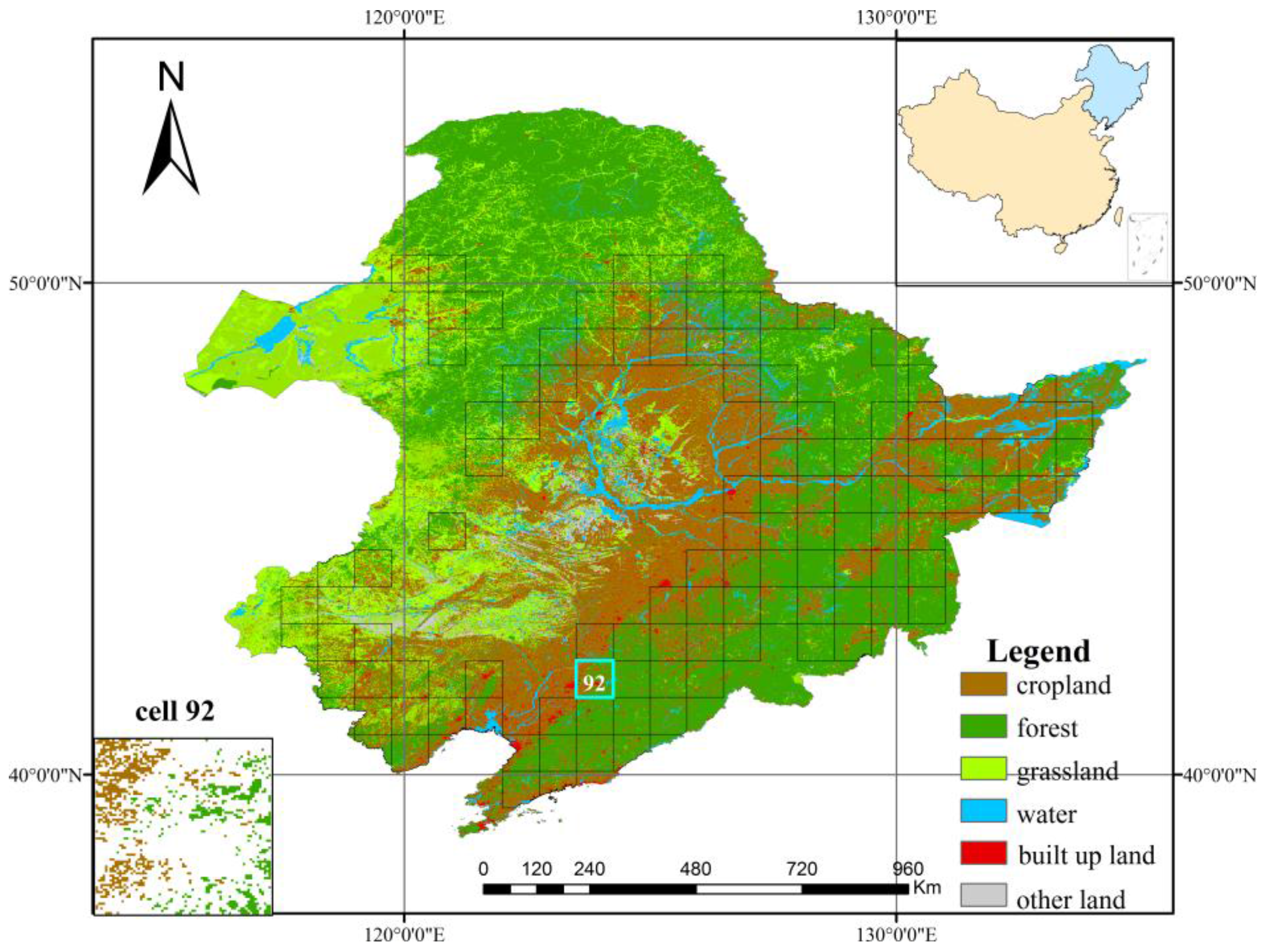
2.1. Study Area
2.2. MODIS Data

| Dataset | Type of Data | Parameter | Spatial Resolution | Use |
|---|---|---|---|---|
| MCD43B3 | MODIS | Albedo | 1000 m | Net shortwave radiation computation |
| MCD43B2 | MODIS | Albedo QC | 1000 m | Albedo QC |
| MYD11A2 | MODIS | Land surface temperature & emissivity | 1000 m | Net longwave radiation computation |
| MOD16A2 | MODIS | Evapotranspiration (ET)/latent heat flux (LE) | 1000 m | Energy balance computation |
| MOD12Q1 | MODIS | Land cover | 1000 m | Land cover mask |
| Land cover | CAS | Land cover | 1000 m | Land cover mask |
| SSRD | ERA-interim | Surface solar (shortwave) radiation downwards | 0.75° | Net shortwave radiation computation |
| STRD | ERA-interim | Surface thermal (longwave) radiation downwards | 0.75° | Net longwave radiation computation |
2.3. Land Cover Data
2.4. Other Data
2.5. Analysis Method
3. Results
3.1. Differences between Cropland and Forest Albedo
3.2. Differences between Cropland and Forest LST
| -- | Annual | Winter | Spring | Summer | Autumn |
|---|---|---|---|---|---|
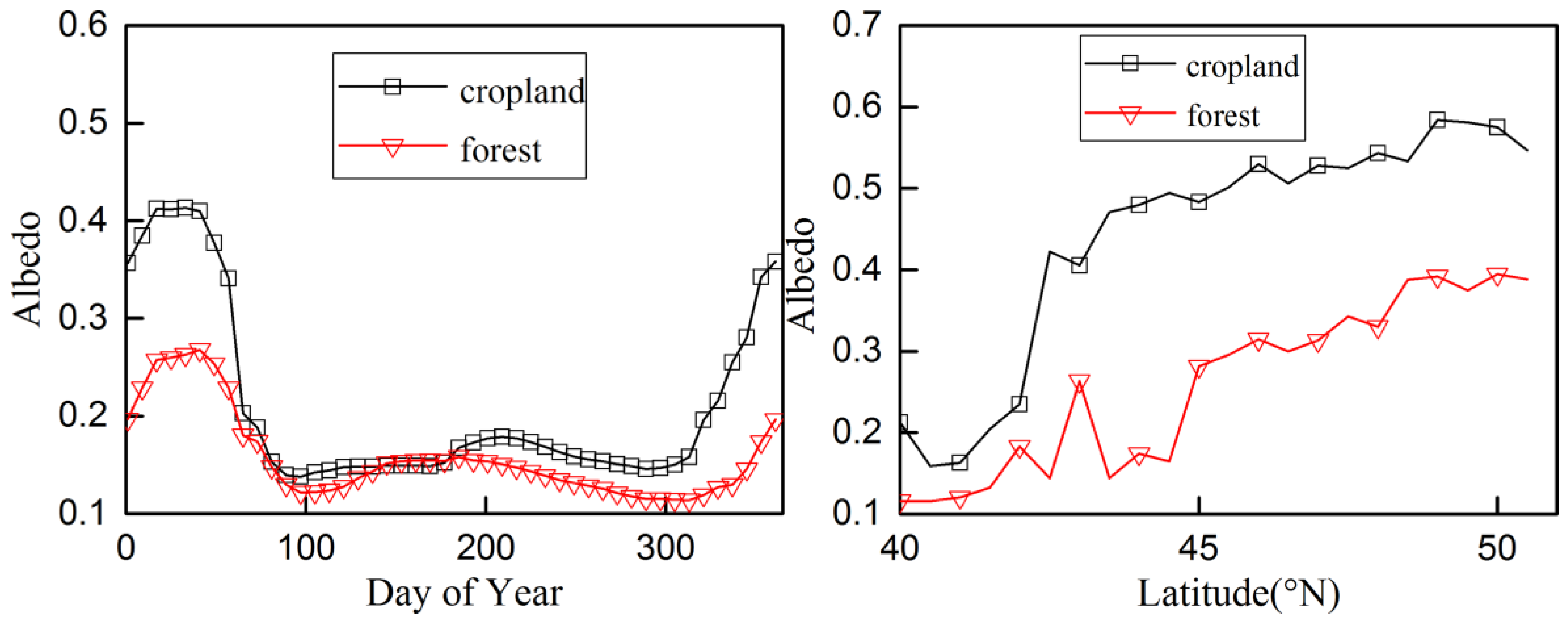
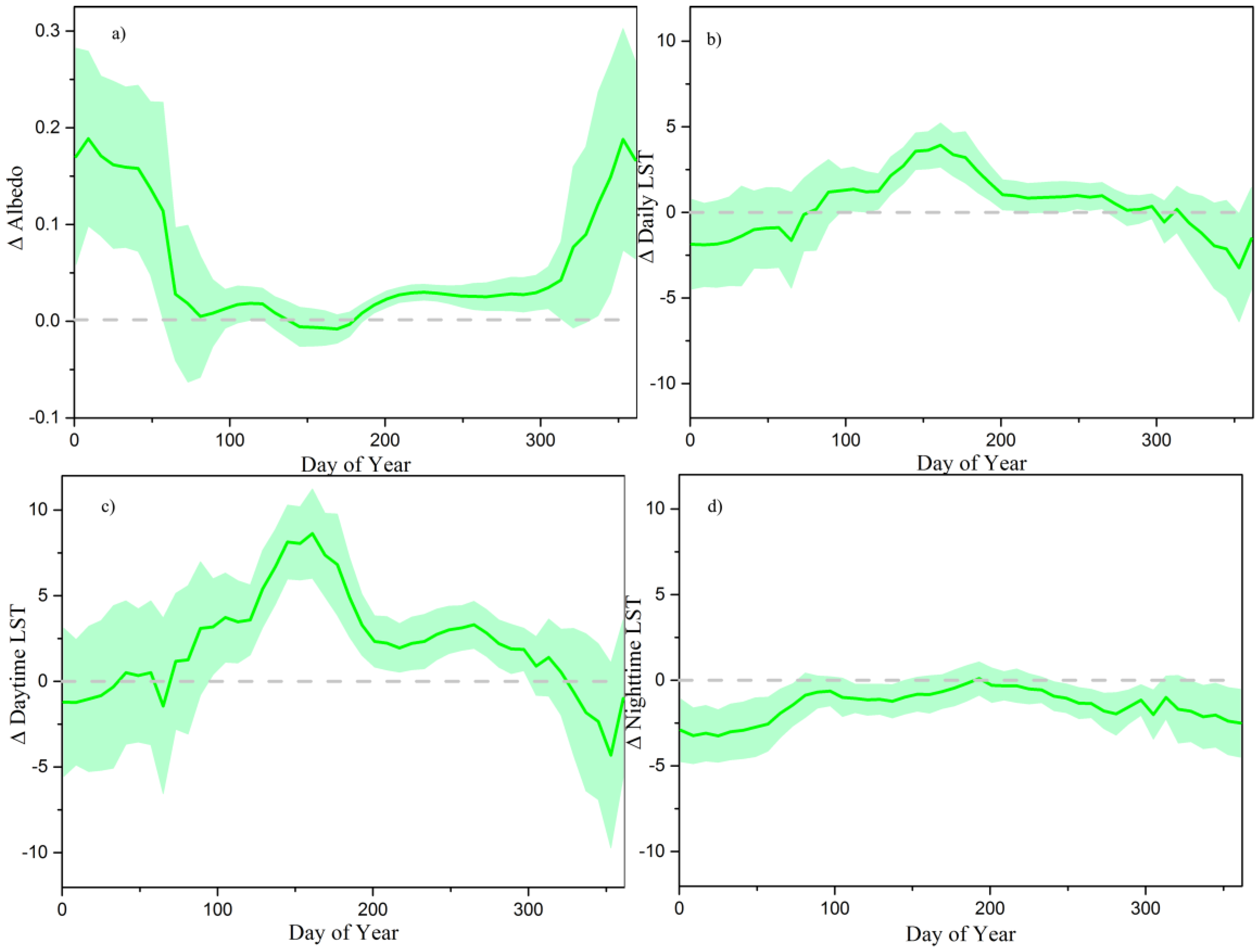
| ΔAlbedo | 0.05 ± 0.06 | 0.15 ± 0.02 | 0.01 ± 0.01 | 0.02 ± 0.02 | 0.04 ± 0.02 |
| ΔLSTdaily | −0.93 ± 1.08 | −1.93 ± 1.33 | 0.08 ± 1.10 | 1.23 ± 0.70 | −0.87 ± 1.04 |
| ΔLSTdaytime | 0.50 ± 1.25 | −1.64 ± 1.91 | 1.91 ± 1.68 | 2.97 ± 1.20 | 0.59 ± 1.19 |
| ΔLSTnighttime | −1.36 ± 0.83 | −2.30 ± 1.23 | −1.13 ± 0.71 | −0.51 ± 0.72 | −1.74 ± 0.93 |
| RFshortwave | −6.37 ± 3.23 | −16.84 ± 11.16 | −2.23 ± 4.91 | −3.08 ± 2.51 | −4.08 ± 2.68 |
| RFlongwave | −0.37 ± 3.34 | 8.79 ± 8.75 | −2.06 ± 5.24 | −8.12 ± 5.58 | −0.38 ± 3.43 |
| ΔRn | −7.31 ± 3.99 | −7.53 ± 9.78 | −4.28 ± 9.01 | −11.20 ± 5.93 | −4.46 ± 3.93 |
| ΔLE | −7.27 ± 4.12 | 0.56 ± 1.33 | −7.30 ± 3.71 | −19.12 ± 8.93 | −3.24 ± 2.66 |
| ΔH | 0.21 ± 3.56 | −8.17 ± 9.63 | 3.01 ± 8.17 | 7.92 ± 6.53 | −1.22 ± 4.15 |
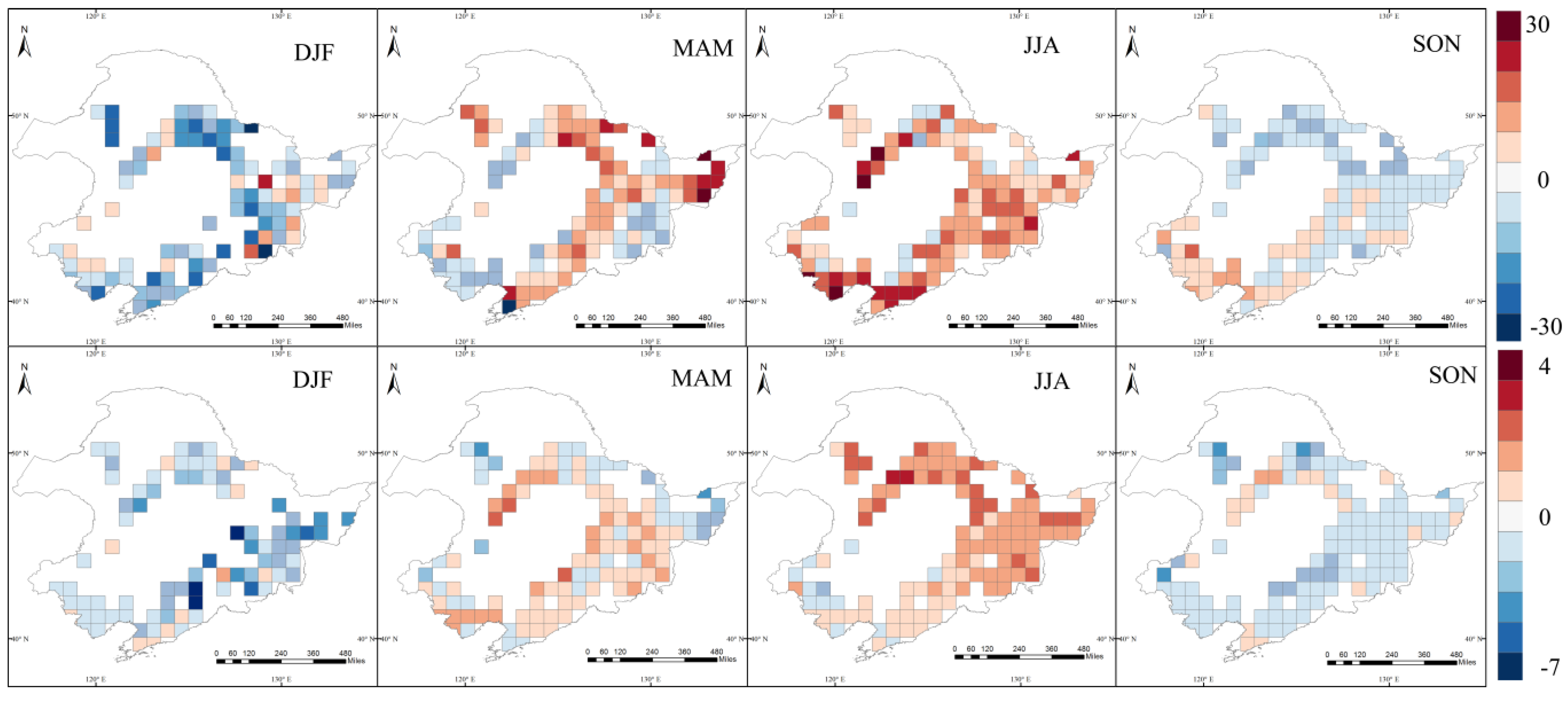
3.3. Shortwave RF and Longwave RF
3.4. Net Radiation Change and Re-Partitioning of Sensible and Latent Heat

4. Discussion
5. Conclusions
Acknowledgments
Author Contributions
Conflicts of Interest
References
- Bonan, G.B. Ecological Climatology: Concepts and Applications, 2nd ed.; Cambridge University Press: New York, NY, USA, 2008. [Google Scholar]
- Goldewijk, K.K. Estimating global land use change over the past 300 years: The HYDE database. Glob. Biogeochem. Cycles 2001, 15, 417–433. [Google Scholar] [CrossRef]
- He, F.; Ge, Q.; Dai, J.; Rao, Y. Forest change of China in recent 300 years. J. Geogr. Sci. 2008, 18, 59–72. [Google Scholar] [CrossRef]
- Liu, J.; Kuang, W.; Zhang, Z.; Xu, X.; Qin, Y.; Ning, J.; Zhou, W.; Zhang, S.; Li, R.; Yan, C.; et al. Spatiotemporal characteristics, patterns, and causes of land-use changes in China since the late 1980s. J. Geogr. Sci. 2014, 24, 195–210. [Google Scholar] [CrossRef]
- Pan, Y.; Birdsey, R.A.; Fang, J.; Houghton, R.; Kauppi, P.E.; Kurz, W.A.; Phillips, O.L.; Shvidenko, A.; Lewis, S.L.; Canadell, J.G.; et al. A large and persistent carbon sink in the world’s forests. Science 2011, 333, 988–993. [Google Scholar] [CrossRef]
- Zhou, F.; Shang, Z.; Ciais, P.; Tao, S.; Piao, S.; Raymond, P.; He, C.; Li, B.; Wang, R.; Wang, X.; et al. A new high-resolution N2O emission inventory for China in 2008. Environ. Sci. Technol. 2014, 48, 8538–8547. [Google Scholar] [CrossRef] [PubMed]
- Zhou, F.; Shang, Z.; Zeng, Z.; Piao, S.; Ciais, P.; Raymond, P.A.; Wang, X.; Wang, R.; Chen, M.; Yang, C.; et al. New model for capturing the variations of fertilizer-induced emission factors of N2O. Glob. Biogeochem. Cycles 2015. [Google Scholar] [CrossRef]
- Betts, R.A. Offset of the potential carbon sink from boreal forestation by decreases in surface albedo. Nature 2000, 408, 187–190. [Google Scholar] [CrossRef] [PubMed]
- Betts, R.A.; Falloon, P.D.; Goldewijk, K.K.; Ramankutty, N. Biogeophysical effects of land use on climate: Model simulations of radiative forcing and large-scale temperature change. Agric. For. Meteorol. 2007, 142, 216–233. [Google Scholar] [CrossRef]
- Bonan, G.B. Forests and climate change: Forcings, feedbacks, and the climate benefits of forests. Science 2008, 320, 1444–1449. [Google Scholar] [CrossRef] [PubMed]
- Li, Y.; Zhao, M.; Motesharrei, S.; Mu, Q.; Kalnay, E.; Li, S. Local cooling and warming effects of forests based on satellite observations. Nat. Commun. 2015, 6. [Google Scholar] [CrossRef] [PubMed]
- Anderson, R.G.; Canadell, J.G.; Randerson, J.T.; Jackson, R.B.; Hungate, B.A.; Baldocchi, D.D.; Ban-Weiss, G.A.; Bonan, G.B.; Caldeira, K.; Cao, L.; et al. Biophysical considerations in forestry for climate protection. Front. Ecol. Environ. 2011, 9, 174–182. [Google Scholar] [CrossRef]
- Houspanossian, J.; Nosetto, M.; Jobbágy, E.G. Radiation budget changes with dry forest clearing in temperate Argentina. Global Change Biol. 2013, 19, 1211–1222. [Google Scholar] [CrossRef] [PubMed]
- Swann, A.L.S.; Fung, I.Y.; Chiang, J.C.H. Mid-latitude afforestation shifts general circulation and tropical precipitation. Proc. Natl. Acad. Sci. USA 2012, 109, 712–716. [Google Scholar] [CrossRef] [PubMed]
- Davin, E.L.; de Noblet-Ducoudré, N. Climatic impact of global-scale deforestation: Radiative versus nonradiative processes. J. Climate 2010, 23, 97–112. [Google Scholar] [CrossRef]
- Arora, V.K.; Montenegro, A. Small temperature benefits provided by realistic afforestation efforts. Nat. Geosci. 2011, 4, 514–518. [Google Scholar] [CrossRef]
- Peng, C.; Ma, Z.; Lei, X.; Zhu, Q.; Chen, H.; Wang, W.; Liu, S.; Li, W.; Fang, X.; Zhou, X. A drought-induced pervasive increase in tree mortality across Canada’s boreal forests. Nat. Clim. Change 2011, 1, 467–471. [Google Scholar] [CrossRef]
- Wickham, J.D.; Wade, T.G.; Riitters, K.H. Empirical analysis of the influence of forest extent on annual and seasonal surface temperatures for the continental United States. Glob. Ecol. Biogeogr. 2013, 22, 620–629. [Google Scholar] [CrossRef]
- Diffenbaugh, N.S. Influence of modern land cover on the climate of the United States. Clim. Dynam. 2009, 33, 945–958. [Google Scholar] [CrossRef]
- Jackson, R.B.; Jobbagy, E.G.; Avissar, R.; Roy, S.B.; Barrett, D.J.; Cook, C.W.; Farley, K.A.; le Maitre, D.C.; McCarl, B.A.; Murray, B.C. Trading water for carbon with biological sequestration. Science 2005, 310, 1944–1947. [Google Scholar] [CrossRef] [PubMed]
- Wickham, J.D.; Wade, T.G.; Riitters, K.H. Comparison of cropland and forest surface temperatures across the conterminous United States. Agric. Forest Meteorol. 2012, 166, 137–143. [Google Scholar] [CrossRef]
- Gao, X.J.; Luo, Y.; Lin, W.T.; Zhao, Z.C.; Giorgi, F. Simulation of effects of land use change on climate in China by a regional climate model. Adv. Atmos. Sci. 2003, 20, 583–592. [Google Scholar]
- Yu, L.; Zhang, S.; Tang, J.; Liu, T.; Bu, K.; Yan, F.; Yang, C.; Yang, J. The effect of deforestation on the regional temperature in Northeastern China. Theor. Appl. Climatol. 2014, 120, 761–771. [Google Scholar] [CrossRef]
- Zhang, X.; Xiong, Z.; Zhang, X.; Shi, Y.; Liu, J.; Shao, Q.; Yan, X. Using multi-model ensembles to improve the simulated effects of land use/cover change on temperature: A case study over northeast China. Clim. Dynam. 2015. [Google Scholar] [CrossRef]
- Peng, S.S.; Piao, S.; Zeng, Z.; Ciais, P.; Zhou, L.; Li, L.Z.X.; Myneni, R.B.; Yin, Y.; Zeng, H. Afforestation in China cools local land surface temperature. Proc. Natl. Acad. Sci. USA 2014, 111, 2915–2919. [Google Scholar] [CrossRef] [PubMed]
- Zhang, X.Z.; Wang, W.C.; Fang, X.Q.; Ye, Y.; Zheng, J.Y. Agriculture development-induced surface albedo changes and climatic implications across Northeastern China. Chin. Geogr. Sci. 2012, 22, 264–277. [Google Scholar] [CrossRef]
- Wang, Z.; Liu, Z.; Song, K.; Zhang, B.; Zhang, S.; Liu, D.; Ren, C.; Yang, F. Land use changes in Northeast China driven by human activities and climatic variation. Chin. Geogr. Sci. 2009, 19, 225–230. [Google Scholar] [CrossRef]
- Zhao, K.; Jackson, R.B. Biophysical forcings of land-use changes from potential forestry activities in North America. Ecol. Monogr. 2014, 84, 329–353. [Google Scholar] [CrossRef]
- Liu, J.; Schaaf, C.; Strahler, A.; Jiao, Z.; Shuai, Y.; Zhang, Q.; Roman, M.; Augustine, J.A.; Dutton, E.G. Validation of moderate resolution imaging spectroradiometer (MODIS) albedo retrieval algorithm: Dependence of albedo on solar zenith angle. J. Geophys. Res. Atmos. 2009, 114. [Google Scholar] [CrossRef]
- Mu, Q.; Zhao, M.; Running, S.W. Improvements to a MODIS global terrestrial evapotranspiration algorithm. Remote Sens. Environ. 2011, 115, 1781–1800. [Google Scholar] [CrossRef]
- Mu, Q.; Heinsch, F.A.; Zhao, M.; Running, S.W. Development of a global evapotranspiration algorithm based on MODIS and global meteorology data. Remote Sens. Environ. 2007, 111, 519–536. [Google Scholar] [CrossRef]
- Zeng, T.; Zhang, Z.; Zhao, X.; Wang, X.; Zuo, L. Evaluation of the 2010 MODIS collection 5.1 land cover type product over China. Remote Sens. 2015, 7, 1981–2006. [Google Scholar] [CrossRef]
- Ran, Y.; Li, X.; Lu, L. Evaluation of four remote sensing based land cover products over China. Int. J. Remote Sens. 2010, 31, 391–401. [Google Scholar] [CrossRef]
- Dee, D.P.; Uppala, S.M.; Simmons, A.J.; Berrisford, P.; Poli, P.; Kobayashi, S.; Andrae, U.; Balmaseda, M.A.; Balsamo, G.; Bauer, P.; et al. The ERA-Interim reanalysis: Configuration and performance of the data assimilation system. Q. J. R. Meteorol. Soc. 2011, 137, 553–597. [Google Scholar] [CrossRef]
- Epule, E.T.; Peng, C.; Lepage, L.; Chen, Z. The causes, effects and challenges of Sahelian droughts: A critical review. Reg. Environ. Change 2014, 14, 145–156. [Google Scholar] [CrossRef]
- Lee, X.; Goulden, M.L.; Hollinger, D.Y.; Barr, A.; Black, T.A.; Bohrer, G.; Bracho, R.; Drake, B.; Goldstein, A.; Gu, L.; et al. Observed increase in local cooling effect of deforestation at higher latitudes. Nature 2011, 479, 384–387. [Google Scholar] [CrossRef] [PubMed]
- Bernier, P.Y.; Desjardins, R.L.; Karimi-Zindashty, Y.; Worth, D.; Beaudoin, A.; Luo, Y.; Wang, S. Boreal lichen woodlands: A possible negative feedback to climate change in eastern North America. Agric. Forest Meteorol. 2011, 151, 521–528. [Google Scholar] [CrossRef]
- Kim, H.W.; Hwang, K.; Mu, Q.; Lee, S.O.; Choi, M. Validation of MODIS 16 global terrestrial evapotranspiration products in various climates and land cover types in Asia. KSCE J. Civ. Eng. 2012, 16, 229–238. [Google Scholar] [CrossRef]
- Yang, Y.; Long, D.; Shang, S. Remote estimation of terrestrial evapotranspiration without using meteorological data. Geophys. Res. Lett. 2013, 40, 3026–3030. [Google Scholar] [CrossRef]
- Liu, Z.; Shao, Q.; Liu, J. The performances of MODIS-GPP and -ET products in China and their sensitivity to input data (FPAR/LAI). Remote Sens. 2015, 7, 135–152. [Google Scholar] [CrossRef]
- De Noblet-Ducoudré, N.; Boisier, J.; Pitman, A.; Bonan, G.B.; Brovkin, V.; Cruz, F.; Delire, C.; Gayler, V.; van den Hurk, B.J.J.M.; Lawrence, P.J.; et al. Determining robust impacts of land-use-induced land cover changes on surface climate over North America and Eurasia: Results from the first set of LUCID experiments. J. Clim. 2012, 25, 3261–3281. [Google Scholar] [CrossRef]
- Boisier, J.P.; de Noblet-Ducoudré, N.; Pitman, A.J.; Cruz, F.T.; Delire, C.; van den Hurk, B.J.J.M.; van der Molen, M.K.; Müller, C.; Voldoire, A. Attributing the impacts of land-cover changes in temperate regions on surface temperature and heat fluxes to specific causes: Results from the first LUCID set of simulations. J. Geophys. Res. Atmos. 2012, 117. [Google Scholar] [CrossRef]
- Mildrexler, D.J.; Zhao, M.; Running, S.W. A global comparison between station air temperatures and MODIS land surface temperatures reveals the cooling role of forests. J. Geophys. Res. 2011. [Google Scholar] [CrossRef]
- Luyssaert, S.; Jammet, M.; Stoy, P.C.; Estel, S.; Pongratz, J.; Ceschia, E.; Churkina, G.; Don, A.; Erb, K.; Ferlicoq, M.; et al. Land management and land-cover change have impacts of similar magnitude on surface temperature. Nat. Clim. Change 2014, 4, 389–393. [Google Scholar] [CrossRef]
- Davies-Barnard, T.; Valdes, P.J.; Singarayer, J.S.; Pacifico, F.M.; Jones, C.D. Full effects of land use change in the representative concentration pathways. Environ. Res. Lett. 2014, 9. [Google Scholar] [CrossRef]
- Liu, J.; Li, S.; Ouyang, Z.; Tam, C.; Chen, X. Ecological and socioeconomic effects of China’s policies for ecosystem services. Proc. Natl. Acad. Sci. USA 2008, 105, 9477–9482. [Google Scholar] [CrossRef] [PubMed]
- Epule, E.T.; Peng, C.; Lepage, L.; Chen, Z. Enabling conditions for successful greening of public spaces: The case of Touroua, Cameroon based on perceptions. Small-Scale For. 2014, 13, 143–161. [Google Scholar] [CrossRef]
© 2015 by the authors; licensee MDPI, Basel, Switzerland. This article is an open access article distributed under the terms and conditions of the Creative Commons Attribution license (http://creativecommons.org/licenses/by/4.0/).
Share and Cite
He, T.; Shao, Q.; Cao, W.; Huang, L.; Liu, L. Satellite-Observed Energy Budget Change of Deforestation in Northeastern China and its Climate Implications. Remote Sens. 2015, 7, 11586-11601. https://doi.org/10.3390/rs70911586
He T, Shao Q, Cao W, Huang L, Liu L. Satellite-Observed Energy Budget Change of Deforestation in Northeastern China and its Climate Implications. Remote Sensing. 2015; 7(9):11586-11601. https://doi.org/10.3390/rs70911586
Chicago/Turabian StyleHe, Tian, Quanqin Shao, Wei Cao, Lin Huang, and Lulu Liu. 2015. "Satellite-Observed Energy Budget Change of Deforestation in Northeastern China and its Climate Implications" Remote Sensing 7, no. 9: 11586-11601. https://doi.org/10.3390/rs70911586
APA StyleHe, T., Shao, Q., Cao, W., Huang, L., & Liu, L. (2015). Satellite-Observed Energy Budget Change of Deforestation in Northeastern China and its Climate Implications. Remote Sensing, 7(9), 11586-11601. https://doi.org/10.3390/rs70911586