


Abstract
Timely and accurate information on the global cropland extent is critical for applications in the fields of food security, agricultural monitoring, water management, land-use change modeling and Earth system modeling. On the one hand, it gives detailed location information on where to analyze satellite image time series to assess crop condition. On the other hand, it isolates the agriculture component to focus food security monitoring on agriculture and to assess the potential impacts of climate change on agricultural lands. The cropland class is often poorly captured in global land cover products due to its dynamic nature and the large variety of agro-systems. The overall objective was to evaluate the current availability of cropland datasets in order to propose a strategic planning and effort distribution for future cropland mapping activities and, therefore, to maximize their impact. Following a very comprehensive identification and collection of national to global land cover maps, a multi-criteria analysis was designed at the country level to identify the priority areas for cropland mapping. As a result, the analysis highlighted priority regions, such as Western Africa, Ethiopia, Madagascar and Southeast Asia, for the remote sensing community to focus its efforts. A Unified Cropland Layer at 250 m for the year 2014 was produced combining the fittest products. It was assessed using global validation datasets and yields an overall accuracy ranging from 82%–94%. Masking cropland areas with a global forest map reduced the commission errors from 46% down to 26%. Compared to the GLC-Share and the International Institute for Applied Systems Analysis-International Food Policy Research Institute (IIASA-IFPRI) cropland maps, significant spatial disagreements were found, which might be attributed to discrepancies in the cropland definition. This advocates for a shared definition of cropland, as well as global validation datasets relevant for the agriculture class in order to systematically assess existing and future cropland maps.
1. Introduction
Mapping the global cropland extent is of paramount importance for food security. Indeed, accurate and reliable information on cropland and the location of major crop types is required to make future policy, investment and logistical decisions [1], as well as production monitoring [2]. Timely cropland information directly feeds early warning systems, such as FAO Global Information and Early Warning System (GIEWS), Global Monitoring for Food Security (GMFS) and Famine Early Warning Systems Network (FEWS NET) [3,4]. In addition, other disciplines benefit from this information, e.g., environmental climate change [5]. In agriculture monitoring, as well as climate modeling, cropland maps serve as a mask to isolate agricultural land for (1) time-series analysis for crop condition monitoring and (2) to investigate how the cropland responds to different climatic projections.
Space-borne Earth observation provides opportunities for global cropland monitoring in a spatially-explicit, economic, efficient and objective fashion [6]. In the last forty years, numerous initiatives aimed at deriving cropland specifically or as land cover classes from satellite images. A large diversity of mapping strategies ranging from the local to the global scale and associated with various degrees of accuracy can be found in the literature. Cropland is often depicted according to a land cover typology that focuses mainly on the natural vegetation types and is often included in mosaic or mixed classes, making it difficult to use for agricultural applications (neither as an agricultural mask, nor as a source of information for cropped area). This is typical for global land cover products, such as GLC2000 [7], GlobCover 2005/2009 [8] and MODIS Land Cover [9], which are not specifically targeting the agriculture component of the landscape. This remains valid for the most recent ESA Climate Change Initiative (CCI) Land Cover products [10]. Recently, the first high-resolution global land cover map was released [11], but the accuracy of the cropland class remains poor (39% producer’s accuracy and 45% user’s accuracy). Several reasons explain the poor accuracy of the cropland class, namely: (1) the heterogeneous and dynamic intrinsic nature of the world’s agro-systems; (2) the spatial structure of the landscape (parcel size) and the crop diversity; (3) differences in crop cycles; (4) differences in cropping practices and calendars within the same class; (5) the spectral similarity with other land cover classes; and (6) the cloud coverage (for optical-derived maps). Moreover, when analyzing the consistency between products, [12] highlighted that the most recent global maps tend to underestimate cropland compared to the official statistics and also disagree with one another. In fact, Ramankutty et al. [13] have attempted to quantify this uncertainty at the global scale, estimating that global cropland extent varies between 1.22 and 1.71 billion hectares, or by more than 40%.
Several specific cropland maps were produced at the global or at the continental scale. Pittman et al. [14] produced the map of global cropland extent at 250-m spatial resolution using multi-year MODIS and thermal data. Two other global maps specifically dedicated to croplands were produced with an emphasis on water management: the global map of rainfed cropland areas (GMRCA) [15] and the global irrigated area map (GIAM) [16]. However, their coarse spatial resolution (10 km) does not meet the needs for operational applications and suffers from large uncertainties [4], especially in complex farming systems in Africa.
At the national or regional scale, the use of imagery at 30 m or the integration of multi-sensor images is more common either for the land cover or just for the cropland. If the reduced spatial extent makes it easier to take the local conditions into account and to tune accordingly, the accuracy of the cropland class does not improve necessarily. Besides national land use/land cover programs, some countries have established dedicated annual national crop type mapping based on satellite remote sensing data, such as the 30-m U.S. Cropland Data Layer or the 30-m Canadian Annual Crop Inventory. As the production of those maps relies on extensive training data [17], they are still limited to countries with advanced remote sensing programs. Other efforts, such as Africover and the Global Land Cover Network (GLCN) program, have realized detailed land cover maps at the country level based on visual interpretation of 30-m spatial resolution images rather than automatic classification. Their update is therefore less frequent. Lastly, several European countries maintain a land parcel identification system for farmer’s declarations to manage the redistribution of subsidies from the common agricultural policy (CAP). Nevertheless, these datasets remain largely unavailable publicly; and their use is restricted to CAP activities.
According to some authors, available maps are not or only marginally validated [18], and when they are validated, a key concern is that their quality is judged insufficient for operational applications [19,20]. Given their large discrepancies in terms of accuracy and spatial agreement, a new trend has emerged: combining existing global and national land cover maps to produce a hybrid map [21] with an increased accuracy. Since, the concept has declined in various approaches, either combining the best products [4,22] or fusing them [23]. Even though the spatial resolution has increased in the 30-m resolution Finer Resolution Observation and Monitoring of Global Land Cover-Cropland (FROM-Cropland) [6], large discrepancies remain between the estimated cropland area and the statistics (e.g., Australia, Africa, Indonesia and Eurasia).
Despite the availability of multiple land cover maps, it is not readily apparent which is most useful for specific applications or how to combine them to provide an improved dataset [24]. The overall objective is to evaluate the current situation to allow strategic planning and mapping effort distribution to maximize the impact of new mapping activities. Prioritizing areas would support rationalizing land cover mapping efforts and focus on countries with actual data gaps. This research proposes to initially assess the best publicly-available cropland information coming from global, regional or national land cover maps. Realizing the richness/importance and range of quality of existing land cover maps, this research capitalizes on previous works to harmonize them. It proposes an analytical framework to quantitatively evaluate these maps using four criteria: (1) the thematic information relevant for the cropland definition; (2) the timeliness; (3) the spatial resolution; and (4) the confidence level. Based on this initial analysis, two main outputs could be derived: the identification of priority areas for cropland mapping and a Unified Cropland Layer at 250 m that combines the fittest products with regards to the criteria selected.
2. Materials
2.1. Land Cover and Cropland Maps
The identification and collection of national, regional and global land cover maps is a long-term enterprise due to the variety of sources and producers involved, as well as different data distribution policies. The elaboration of an exhaustive inventory and spatial database is a continuous effort following product releases, updates or changes in policies on data access. Global, regional and national datasets were identified by means of systematic review during working sessions with key individual experts, literature review and web-based search. While collecting them, it was necessary to distinguish the existing datasets from the publicly freely available data (Table 1); the former having a distribution policy that prevents their use or having issues with respect to access of the actual georeferenced dataset rather than just an image of the maps embedded in a website. Therefore, the general rule was that a dataset that was not available was considered as non-existent and, thus, not considered in the study. In the event of products delivered at multiple epochs (e.g., USDA Cropland Data Layer), the map most contemporaneous with the year 2014 was selected.
Table 1.
Input maps for the analysis. The first and second columns detail the extent and references of the considered product. The last column provides the reference year of the product or its time span.
2.2. Global Validation Datasets
Global reference datasets are mandatory to evaluate the accuracy of land cover maps. Recently, diverse initiatives proposed to share validation datasets (Table 2). The Global Observation Forest and Land Cover Dynamics (GOFC-GOLD) [18] Land Cover Project Office centralizes and provides validation datasets, such as the consolidated GLC2000 dataset, the consolidated GlobCover 2005 dataset, the Visible Infrared Imaging Radiometer Suite (VIIRS) dataset and the System for Terrestrial Ecosystem Parametrization (STEP) dataset.
Table 2.
Validation datasets collected, their geometries and the percentage of cropland samples. VIIRS, Visible Infrared Imaging Radiometer Suite; STEP, System for Terrestrial Ecosystem Parametrization.
The consolidated GLC2000 dataset consist of 1253 samples (70% of the initial dataset randomly selected). The sample’s class was converted to an aggregated generalized legend and reinterpreted with Landsat or Google Earth [7].
The GlobCover 2005 validation dataset was built relying on a network of experts familiar with image interpretation and land cover over large areas [40,41]. The validation samples were interpreted in Google Earth and with NDVI profiles (annual and average profiles) to illustrate the seasonal dynamics. For a given sample, the experts saw not only the sample point, but also a box that coincided with the so-called observational unit corresponding to 5 × 5 MERIS pixels (225 ha). The experts could describe up to 3 land cover types for each observational unit and provided their level of confidence. The consolidated version results from a reinterpretation of 500 samples that are randomly selected and re-interpreted. Only samples with high confidence (186) were kept. The Visible Infrared Imaging Radiometer Suite (VIIRS) Surface Type validation database relies on a a stratified random sample of five hundred 5 × 5-km blocks distributed globally [42,43]. The strata were defined by the intersection of a modified Köppen climate classification with a human population density. The sample allocation and distribution within each stratum targeted heterogeneous and complex land cover types that are more difficult to map. Finally, the samples were interpreted with very high-resolution imagery.
In the STEP database [9], each sample is a polygon of about 4-km2 and is considered a stable example of a specific land cover type. Samples are drawn and labelled in Google Earth. Because the sample distribution does not follow a probability sampling scheme, this dataset is suitable for training, but not for validation [44].
Recognizing the importance of the validated product and their inter-comparison, Zhao et al. [45] have produced an independent set of well-distributed validation samples. They built a global validation point dataset based on interpreting Landsat Thematic Mapper (TM) and Enhanced TM Plus (ETM+) images for a total of 38,664 sample units pre-determined with an equal-area stratified sampling scheme. This was supplemented by MODIS-enhanced vegetation index time series data and other high-resolution imagery on Google Earth. Recently, Fritz et al. [46] proposed a tool, the GeoWiki, to collect volunteered geographic information on land cover from crowd-sourcing. The GeoWiki Project capitalizes on a global network of volunteers who wish to help to improve the quality of global land cover maps. The volunteers are asked to review hot-spot maps of global land cover disagreement and determine, based on what they actually see on Google Earth and their local knowledge, if the land cover maps are correct or incorrect [1]. From those datasets, four have been used for two purposes: (1) one for the assessment of the individual maps Zhao et al. [45]; and (2) three for the assessment of the Unified Cropland Layer (GeoWiki, GlobCover 2005 and VIIRS).
2.3. Ancillary Data
Country-wise cropland percentages were extracted from the FAOSTAT database ( http://data.fao.org/database?entryId=262b79ca-279c-4517-93de-ee3b7c7cb553). The FAOSTAT database records an inventory of land resources per country on a yearly basis. The database is constituted of official reports collected from over 200 countries. FAO defines the arable land as: “the land under temporary agricultural crops (multiple-cropped areas are counted only once), temporary meadows for mowing or pasture, land under market and kitchen gardens and land temporarily fallow (less than five years). The abandoned land resulting from shifting cultivation is not included in this category”.
Field size information was also made available [21]. This dataset was collected through a GeoWiki crowd-sourcing campaign in which users were asked to label the field size using high-resolution imagery, where examples were provided to guide the user. Four categories were proposed: very small, small, medium and large. Note that the result is provided in arbitrary units (very small = 10, small = 20, medium = 30 and large = 40). A validation exercise of the global field size map revealed satisfactory agreement with control data, particularly given the relatively modest size of the field size dataset used to create the map.
3. Method
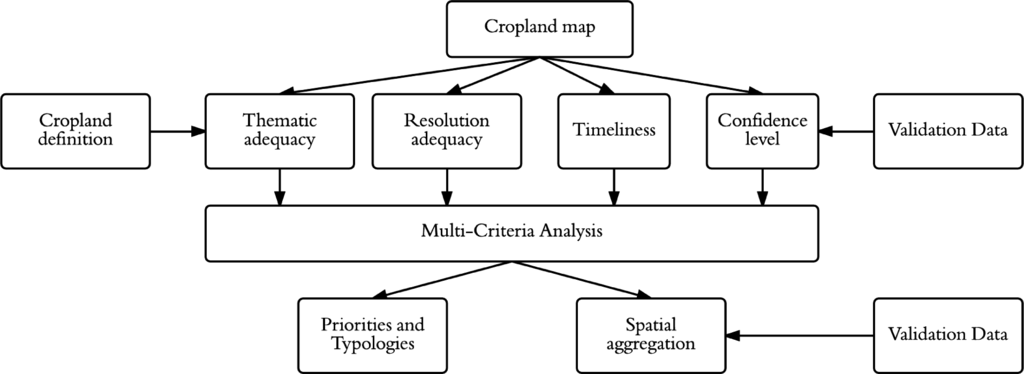
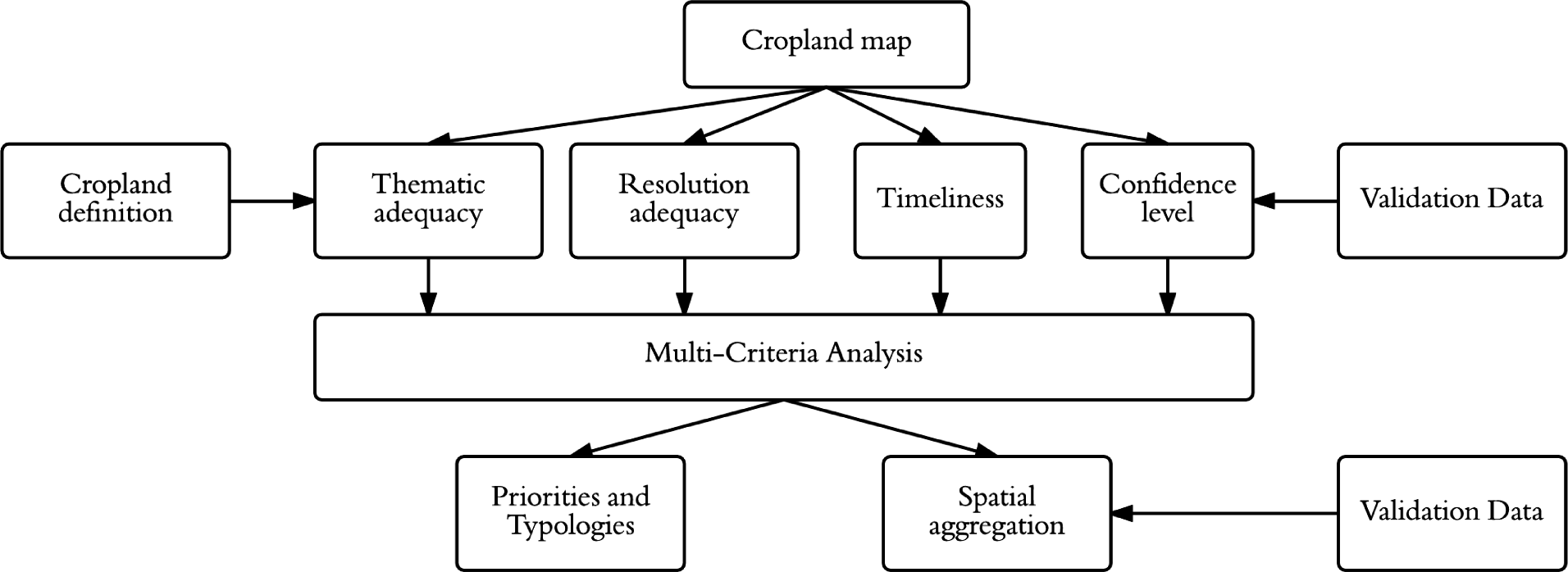
To play its role as a mask, a cropland map should comply to different criteria, such as adequate class definition, accuracy, timeliness and adequate spatial resolution with regards to the area of interest. Areas in which the current maps do not satisfy these criteria are considered as priority areas for cropland mapping. Therefore, the assessment of the cropland products must consider these different criteria. To handle these different dimensions, this study proposed an approach based on a multi-criteria analysis. Four criteria have been selected to evaluate the need for an updated cropland at the national level: The adequacy of the current legend, the adequacy of the spatial resolution, the timeliness and the confidence level with respect to the validation datasets (Figure 1). The rationale behind using a multi-criteria analysis was to combine the conflicting objectives described by different data sources into a single index form for multiple criteria evaluation [47] in order to support decision making and priority analysis [48]. Similarly to other studies (e.g., [49]), the general outline of the methodology included the following steps:
- Constructing a database containing all of the spatial information;
- Transforming the chosen criteria into scores;
- Determining the weight for each criterion;
- Aggregating the data weights, obtaining the scores for each dataset and selecting the best score in overlapping regions.
Figure 1.
The analytical framework of the assessment is a systematic analysis of four criteria that characterize the fitness of a cropland map. The four criteria are the thematic consistency, the timeliness, the resolution adequacy and the confidence level. From this analysis, two outputs were derived: (1) a priority map for global cropland mapping; and (2) a Unified Cropland Layer combining the fittest products.
At each step, scores were attributed to every product by country following a default mathematical rule and were then reinterpreted by experts to ensure more robustness. The four criteria were finally aggregated into a priority indicator following a summation model with equal weights and again reinterpreted by the experts. For example, all maps covering country i were analyzed with respect to the four criteria. Those were then aggregated into a priority index, one per map. The fittest map is the one that minimizes the priority index. Areas with a high priority index characterize priority areas for cropland mapping, whereas areas with low scores correspond to an accurate and precise current mapping. Besides the multi-criteria evaluation of the maps, it was also possible to derive the fittest global cropland map at 250 m thanks to the output of from the multi-criteria analysis.
3.1. Thematic Consistency Criterion
As there was no common agreement on the cropland definition, products often provided their own definition of cropland and might not be compatible with one another, making inter-comparison and legend harmonization problematic [18,50]. The Food and Agriculture Organization (FAO) has been undertaking efforts to establish international standards for land cover since the late 1990s. Its experience in class definition was synthesized in the Land Cover Classification System (LCCS) [51]. The LCCS concept has recently evolved in the Land Cover Meta Language (LCML). LCML is an object-oriented classification system where each land cover feature is characterized by a series of elements that can be further detailed by a set of attributes. The class meaning is no longer related to a simple class name, but to a more exhaustive and modern model populated by the elements and attributes characterizing the land cover features.
Recently, a cropland definition tailored for cropland monitoring and conforming to LCML has been adopted by the Joint Experiment of Crop Assessment and Monitoring (JECAM) network. The general definition of cropland (including the area affected by crop failure) reads as follows: “The annual cropland from a remote sensing perspective is a piece of land of a minimum 0.25 ha (minimum width of 30 m) that is sowed/planted and harvestable at least once within the 12 months after the sowing/planting date. The annual cropland produces an herbaceous cover and is sometimes combined with some tree or woody vegetation”. There are three known exceptions to this definition. The first concerns the sugarcane plantation and cassava crop, which are included in the cropland class, although they have a longer vegetation cycle and are not planted yearly. Second, taken individually, small plots, such as legumes, do not meet the minimum size criteria of the cropland definition. However, when considered as a continuous heterogeneous field, they should be included in the cropland. The third case is the greenhouse crops that cannot be monitored by remote sensing and are thus excluded from the definition. This definition discards perennial crops and fallow, as they are less important to monitor from a food security point of view. In addition, multi-annual crop are less sensitive to climatic conditions and, thus, less interesting for monitoring using remote sensing for food security. If the JECAM definition seems the most appropriate for cropland masking, a more pragmatic definition was adopted, because the major part of the datasets available did not consider the annual herbaceous cropland. The JECAM definition was thus modified as follows: “the cropland is a specific area occupied by an herbaceous crop under permanent or fallow cultivation period (including active shifting cultivation fields)”. Note that this definition is also LCML compatible. To evaluate the thematic distance between maps, the proposed definition was compared to other definitions on the basis of a set of binary criteria, i.e., presence/absence of a given components. The components were the following:
- Absence of woody crops (WC);
- Presence of fallow and bare fields (FB);
- Absence of managed pasture and meadows (MPM);
If for a given product, a criterion is met, this product scores 1 and 0 conversely. The final thematic criterion (ThC) is the sum of the scores:
The scores were then reclassified (Table 3a).
Table 3.
Systematic recoding rules for the four cropland criteria used in the multi-criteria analysis. Each criterion is recoded in a four-level score ranging from 1–4.
3.2. Timeliness Criterion
As reported by numerous studies, the world’s croplands are very dynamic, not only because of crop rotations and practices, but also because of land cover changes, such as land conversion from agriculture to urban [52], from forest to agriculture [53] or even agricultural abandonment [54,55]. To address both of these annual and multi-annual changes, the timeliness criterion (TiC) characterizes the number of years elapsed since the reference year of a map. The timeliness criterion is computed as the difference between the year of interest (2014) and the epoch of the product:
where tp is the epoch of map p as defined in Table 1. The differences are then reclassified into four groups for which a score is assigned (Table 3b).
3.3. Resolution Adequacy Criterion
The spatial resolution required for accurate cropland mapping is a function of the field size, the landscape fragmentation and, to some extent, the crop diversity. Indeed, areas with small parcels, but low crop diversity tend to behave similarly to a large field. Several methods have been developed to evaluate the resolution required for crop mapping in a specific area [56–58]. However, they all require a (very) high spatial resolution cropland/crop type map as the input to diagnose the required resolution, which makes those methods unsuitable for an a priori resolution definition, especially as they are not available globally. In this study, the field size solely was taken as a proxy to derive the spatial resolution requirements for cropland mapping. Capitalizing on the GeoWiki tool [1], volunteers were asked to label the size of the fields based on a very high-resolution image and a reference 1 × 1-km square box. Observations were then interpolated within the cropland (IIASA) using an inverse distance approach. The four observed labels (large, medium, small and very small) can then be related to the Global Agricultural Geo-Monitoring (GEOGLAM) requirements for cropland mapping (Table 4).
Table 4.
Linking the observed field size by crowd-sourcing to the spatial resolution requirements.
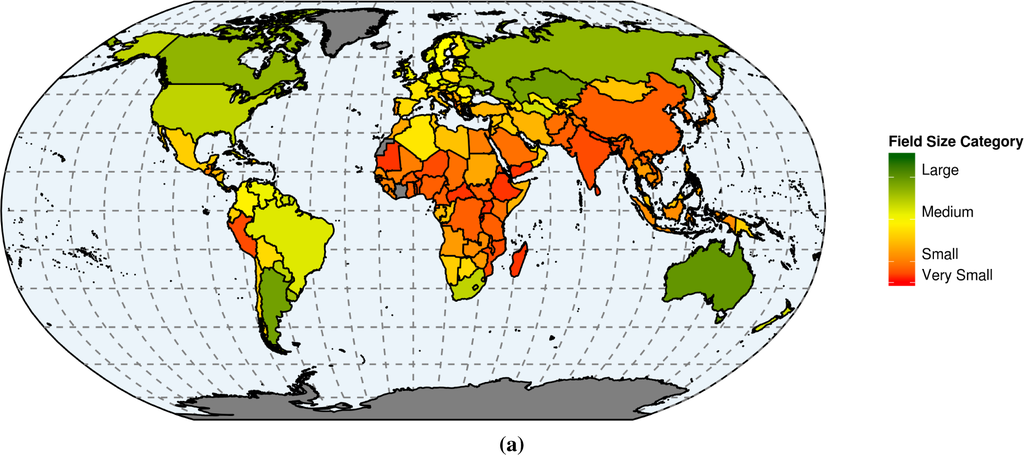
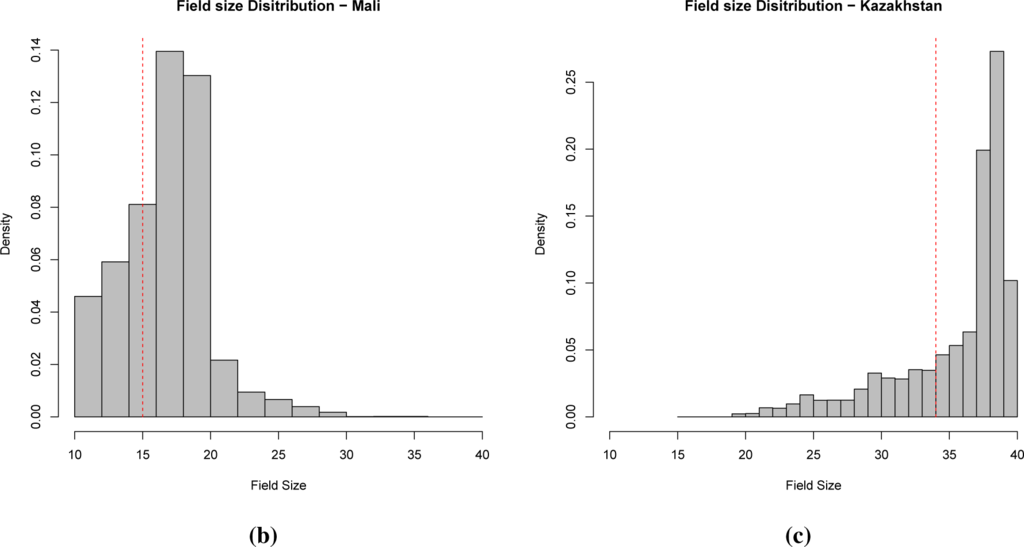
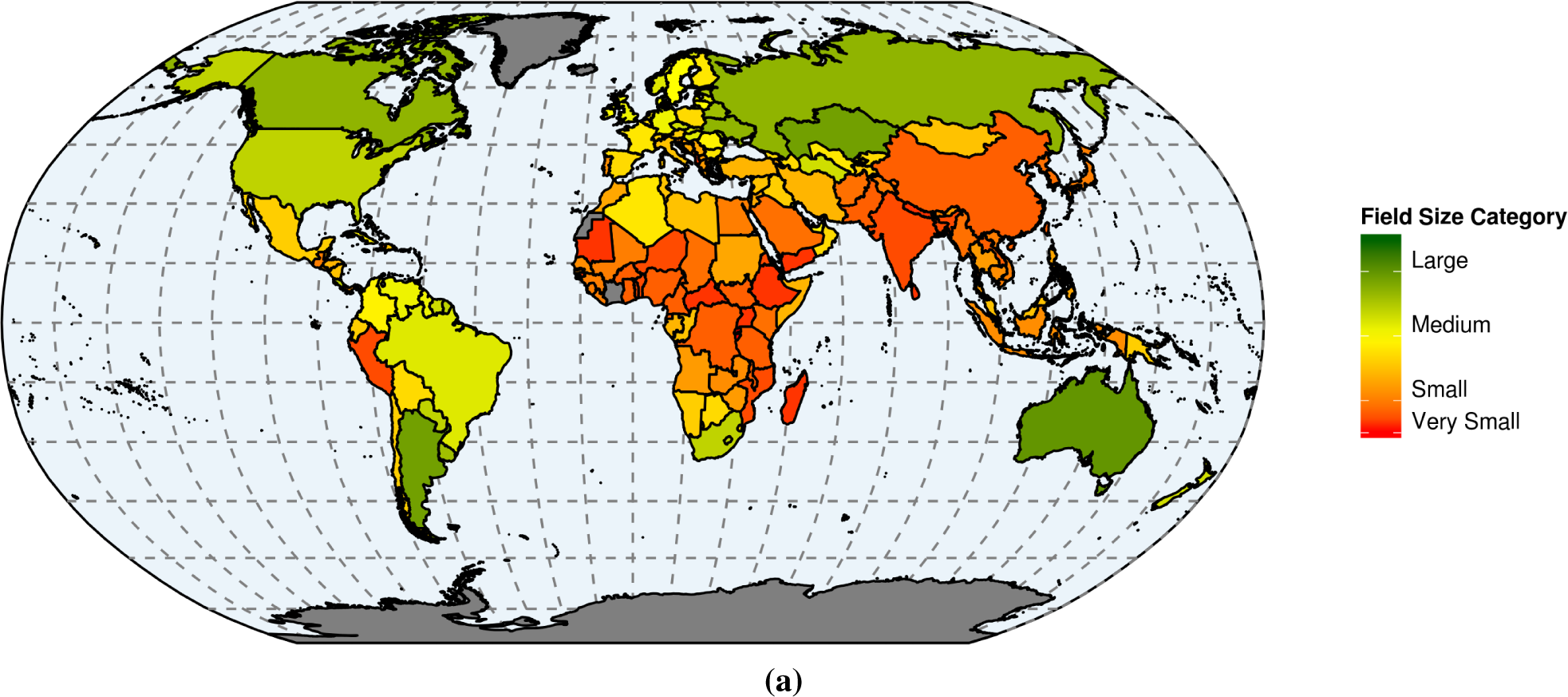
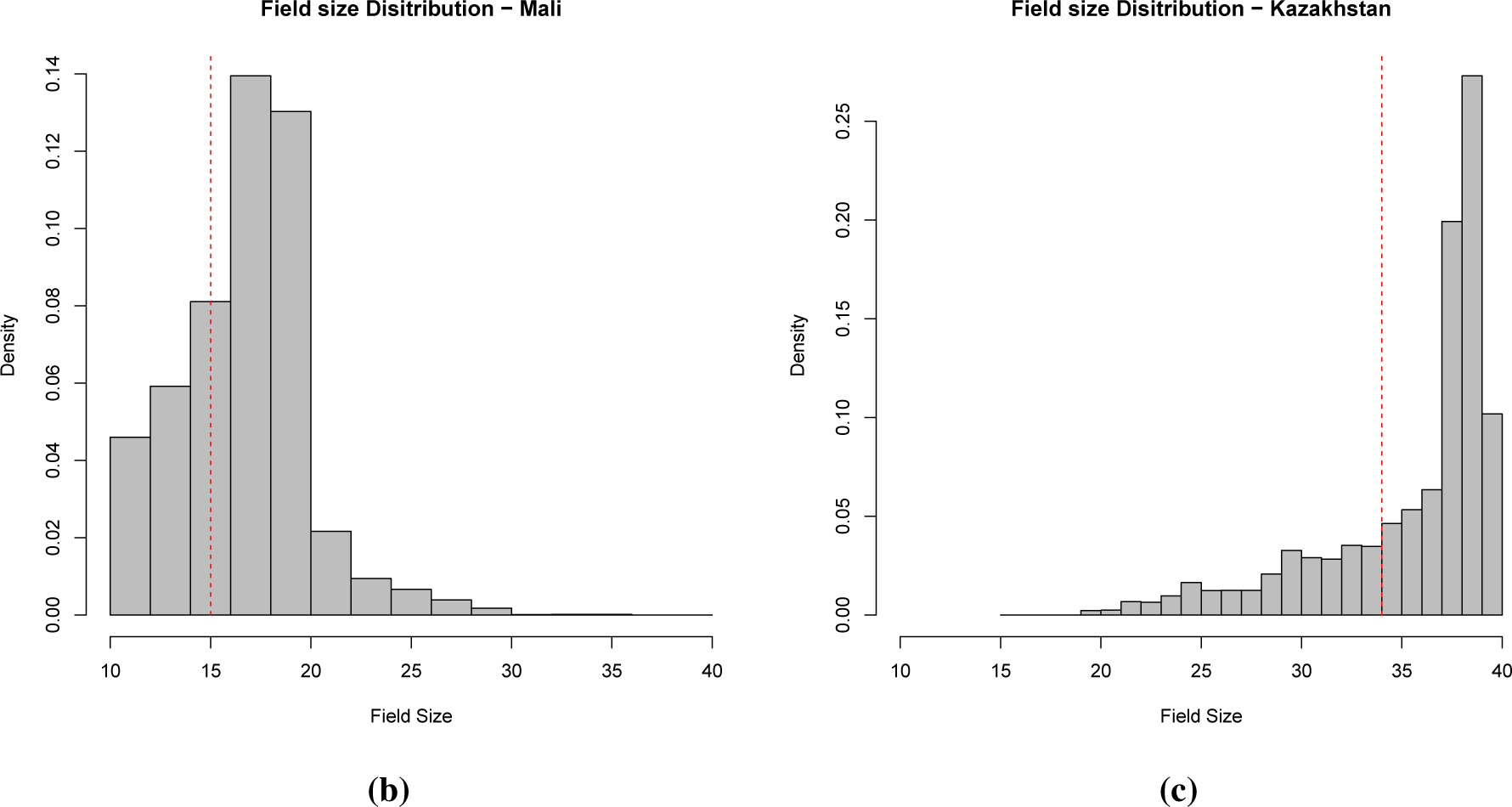
For each country, the histogram of the interpolated observed field size was computed (Figure 2a). To define the spatial resolution required for cropland mapping of a specific country, the assumption was made that the adequate field size was the one allowing one to map 75% of the largest fields (Figure 2b,c). According to the distribution, the crop diversity and the landscape, this resolution would fit in the end more than 75% of the cropland extent. The extracted resolution was then related to the GEOGLAM requirements (as shown in Table 4). The difference in the number of classes between the actual class and the requirement class gave the resolution adequacy criterion score RC (Table 3c).
Figure 2.
Global distribution of field size per country and histograms of the field size distribution for two contrasted countries. Note that the result is provided in arbitrary units (very small = 10, small = 20, medium = 30 and large = 40). (a) First quartile field size category, (b) Field size distribution of a small field size country, (c) Field size distribution of a medium parcel size country.
3.4. Confidence Level Criterion
Prior to the confidence level assessment, it was necessary to harmonize the legend of both the maps and the validation datasets. The legend of each dataset was thus translated into the binary legend that corresponded best to the proposed legend. The confidence level criterion (CC) was assessed by means of confusion matrices from which overall accuracy indicators were derived and then reclassified into four categories (Table 3d). The reference dataset produced by Zhao et al. [45] was utilized to extract the national-level confusion matrices as: (i) it was the most populated and, thus, relevant at the national scale; and (ii) its legend definition is thematically close to the one proposed in this study.
3.5. Criteria Aggregation and Priority Identification
For each product, the scores were reinterpreted by experts to ensure that the mathematical score attribution matched their experience as a user and/or visual analysis. Weighted linear combination of the criteria is the most common approach to aggregate the different dimensions, and different approaches exist to estimate their relative weight [59,60]. Equal weights were assigned to each criterion, as they were considered equally important. Therefore, the priority indicator (PI) for country i is computed as:
where j is the j-th product and 16 is the maximum aggregated score (four criteria of score levels each). The priority indicator was then reclassified into three classes: no priority (0–5), low priority (6–7) and high priority (8–11). The typology of priority was further described by the criterion: if a criterion scored less than 2, it was reported as requiring an update in that criterion. Error typology is motivated to report dilution effect of the aggregation. For example, the confidence level of j map could be very low (e.g., 1), but all three other criteria could be at their maximum level, resulting in a priority index of 3. The analysis of the error typology allows both to have a synoptic view of the dominant type of update required and to report situations where a criterion with a low score is diluted in the priority index. It should be underlined here that the error typology indicates only the dominant error type; yet it does not necessarily imply that the other typologies are necessarily satisfactory.
3.6. Spatial Aggregation and Assessment
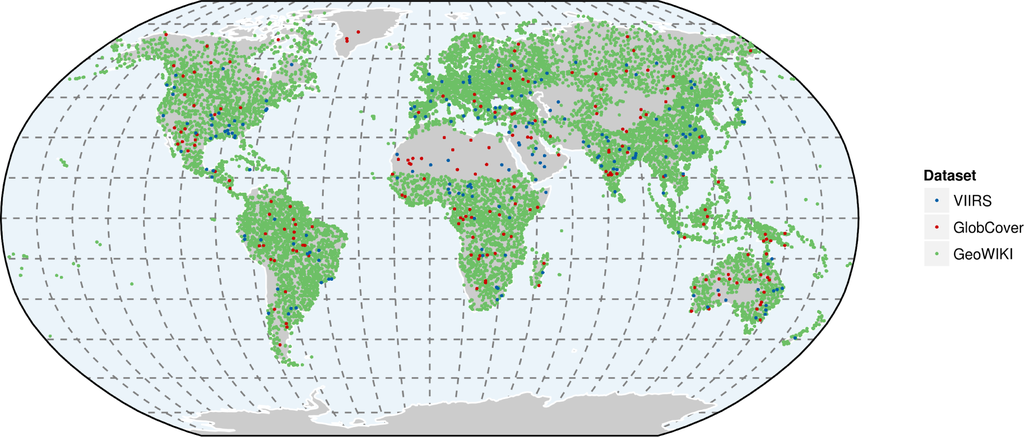
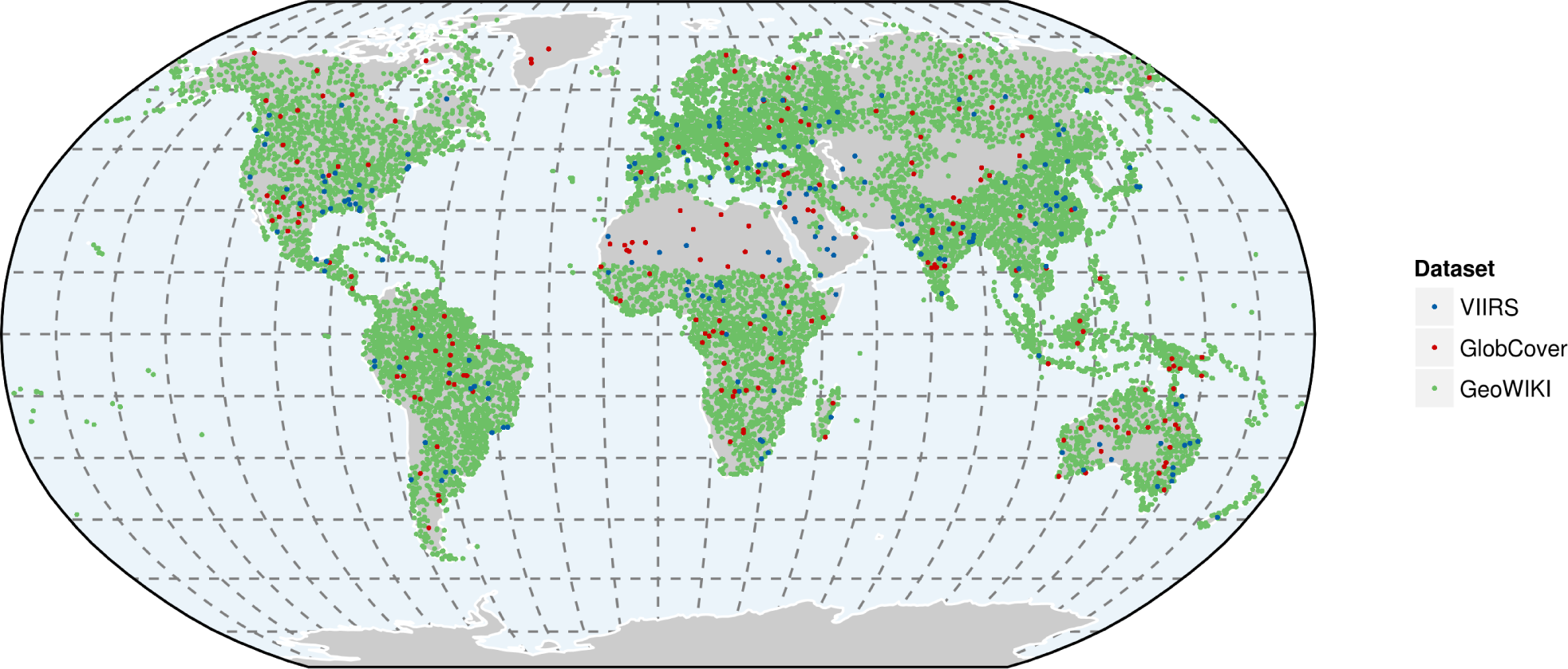
For each specific country, the fittest product corresponded to the one with the lowest priority index. As a result of the analysis, one could produce a cropland for the year 2014 by joining these fittest products in a predefined grid of 250-m cells. This Unified Cropland Layer was assessed by means of confusion matrices derived from the GLC2000, GlobCover and GeoWiki reference datasets (Figure 3), from which accuracy indicators, such as the overall accuracy, producer and user accuracy, were derived. It is assumed that an accuracy assessment with multiple validation datasets would give the most realistic estimation of the Unified Cropland Layer, as none of them match its legend perfectly.
Figure 3.
Distribution of the reference samples used for the validation of the 250-m Unified Cropland Layer. Three global validation datasets are available (VIIRS, GlobCover and GeoWiki) and together account for more than sixteen thousand validation samples distributed over the globe.
With the recent releases of high-resolution global forest cover products [61,62], masking out forested areas from agricultural lands is now possible. This could be particularly valuable in areas where products have a coarse resolution and lack timeliness. In particular, the Advanced Land Observing Satellite (ALOS) Phased Arrayed L-band Synthetic Aperture Radar (PALSAR) forest maps provide global forest maps at 25 m for four epochs. These maps were validated with three types of ground truth data at an accuracy of 90%. The 2010 ALOS-PALSAR forest map was resampled to the grid of the Unified Cropland Layer, and pixels with a majority of forest cover were reclassified as non-cropland. The impact of this mask was assessed with the GeoWiki validation dataset.
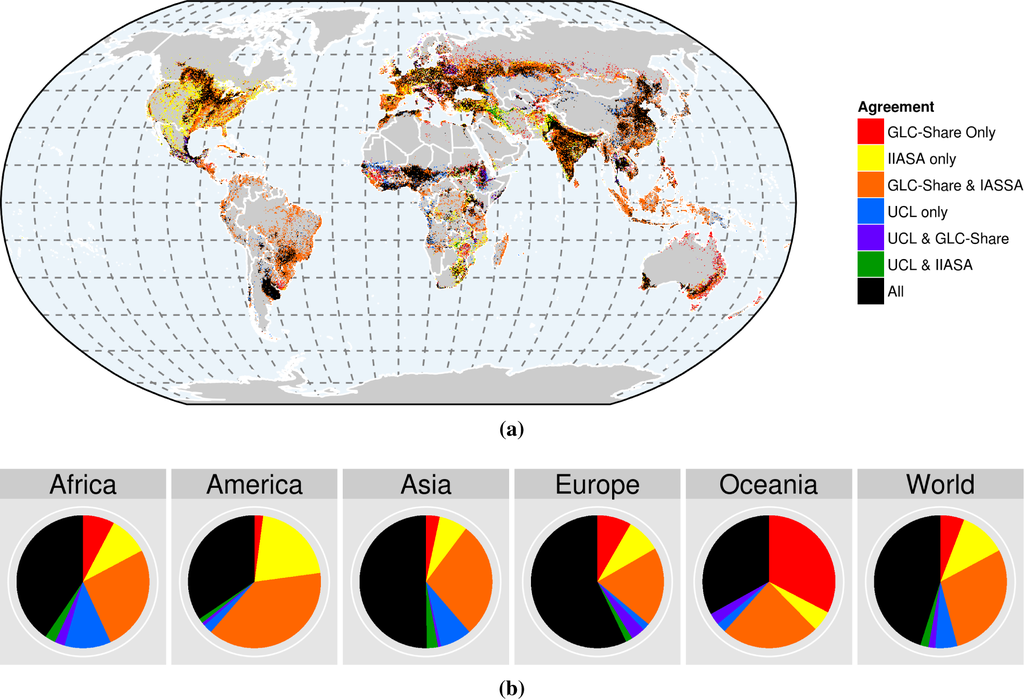
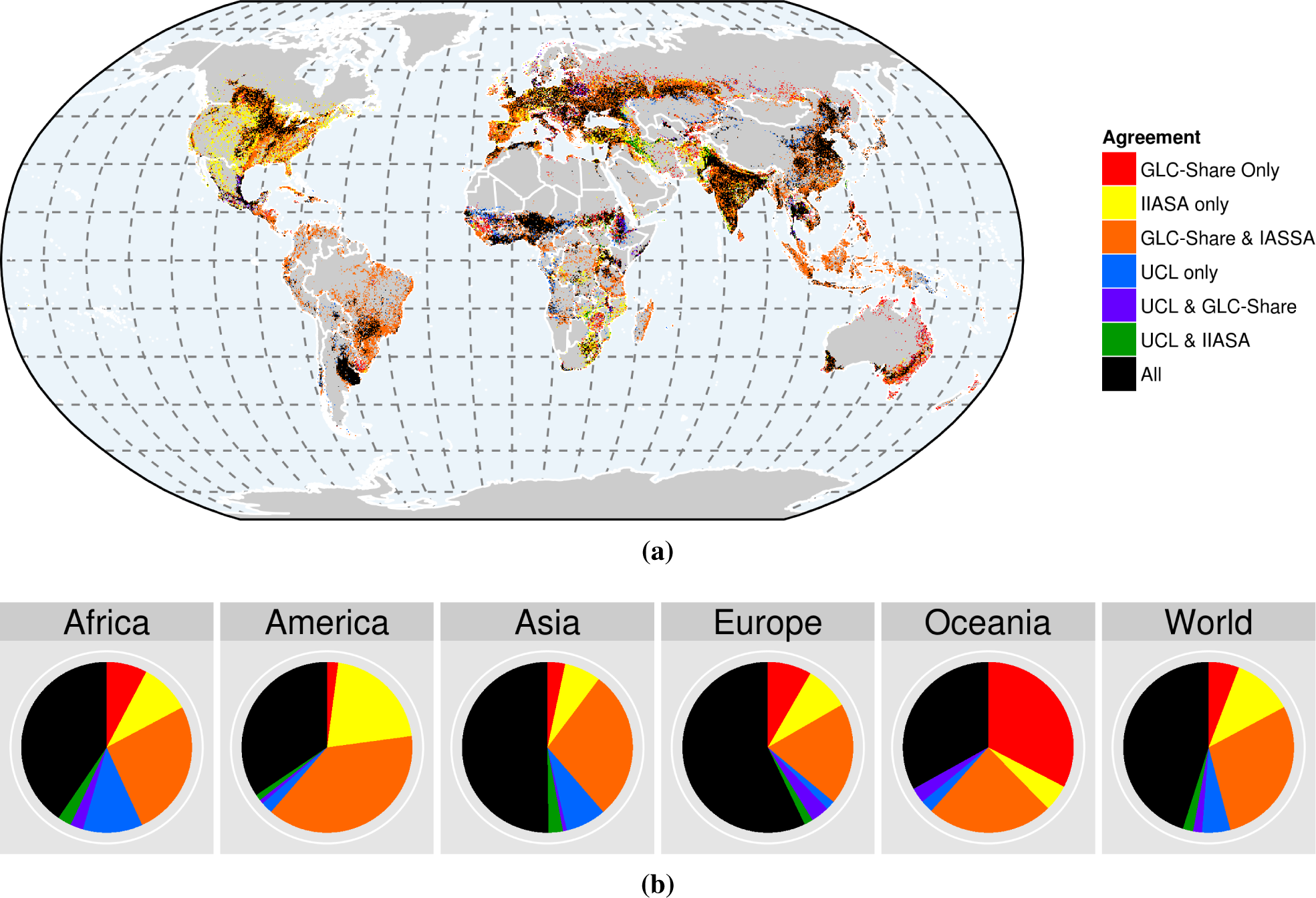
Furthermore, the Unified Cropland Layer was also resampled to 1 km and compared to GLC-Share [22] and the IIASA-IFPRI Cropland [21]. Each product legend was converted to a binary cropland/non-cropland legend: pixels were considered as cropland if the cropland proportion was not null. Spatial disagreement areas and the corresponding percentages of disagreement between products were computed at the continental level.
4. Results and Discussion
4.1. Multi-Criteria Analysis
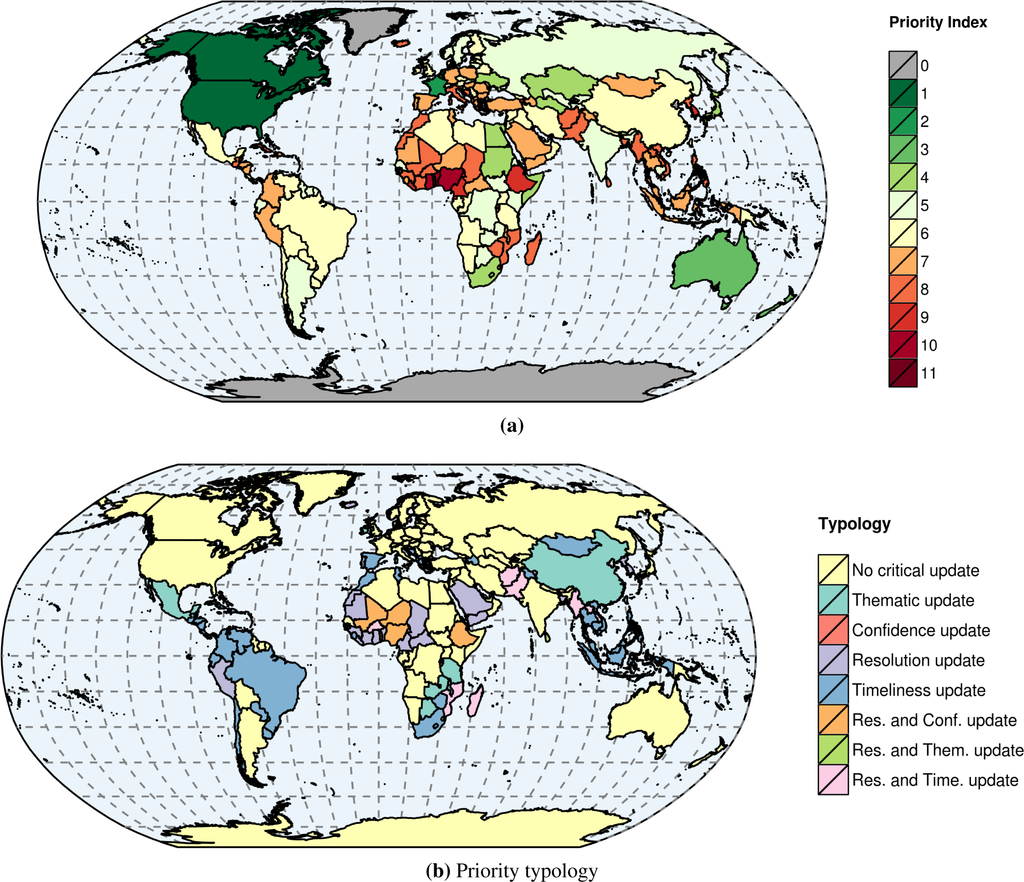
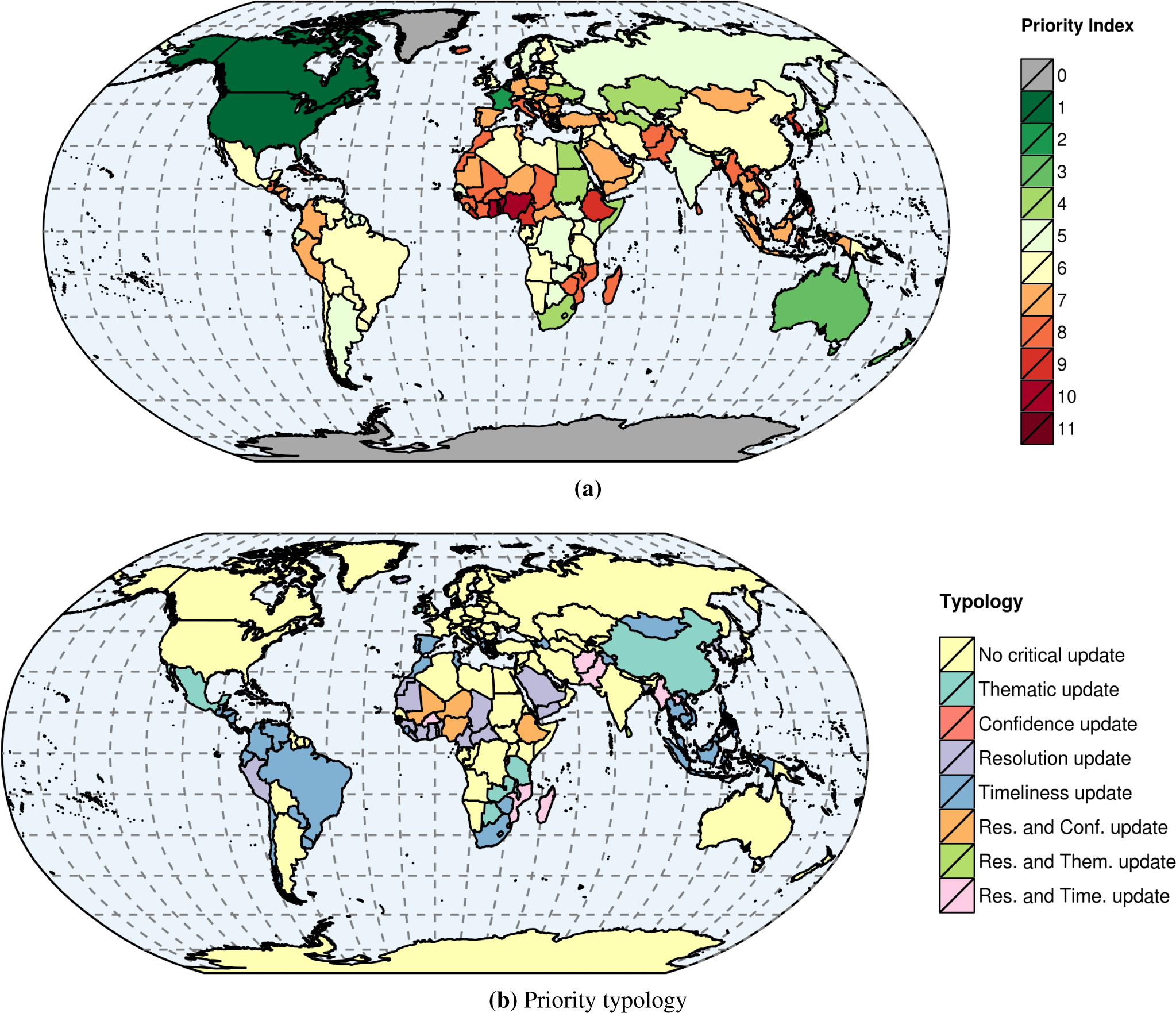
The multi-criteria approach allowed assessing quantitatively four characteristics of a cropland map and summarized it into a single spatialized priority index (Figure 4a), as well as its associated priority typology (Figure 4b). From a general point of view, the high-resolution land cover mapping initiatives in North America (e.g., Cropland Data Layer and Annual Crop Inventory in the U.S. and Canada), Europe (e.g., the Land Parcel Information System in France) and in Africa (Africover) are well captured by the priority index. The current medium spatial resolution maps seem to fit large field areas, such as Russia and Central Asia. The dominant typologies of updates are timeliness (e.g., Brazil, Chile, South Africa), resolution (e.g., West Africa) or both (e.g., Madagascar, Myanmar, Pakistan). To further interpret the result, the priority index can be broken down into three classes: no priority (0–5), low priority (6–7) and high priority (8–11). One can observe that high priority areas are mainly associated with resolution adequacy and/or timeliness improvements. However, these dominant error typologies are tightly tied with other typologies, such as the confidence level.
Figure 4.
(a) Priority indicator map and (b) its update typology. Areas with a high priority index (reddish shades) characterize priority areas for cropland mapping, whereas areas with low scores correspond to an accurate and precise current mapping (greenish shades). West Africa, Ethiopia and Southeast Asia (Indonesia) clearly appear as priority areas for cropland mapping.
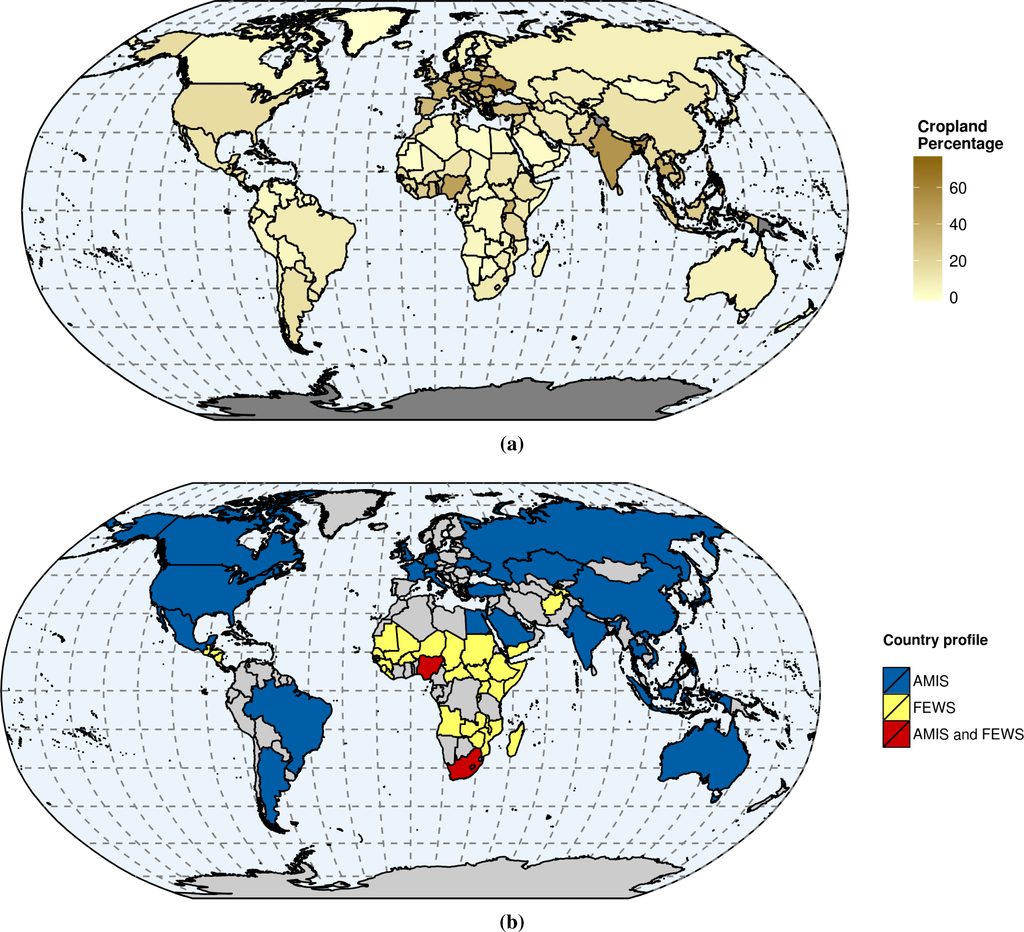
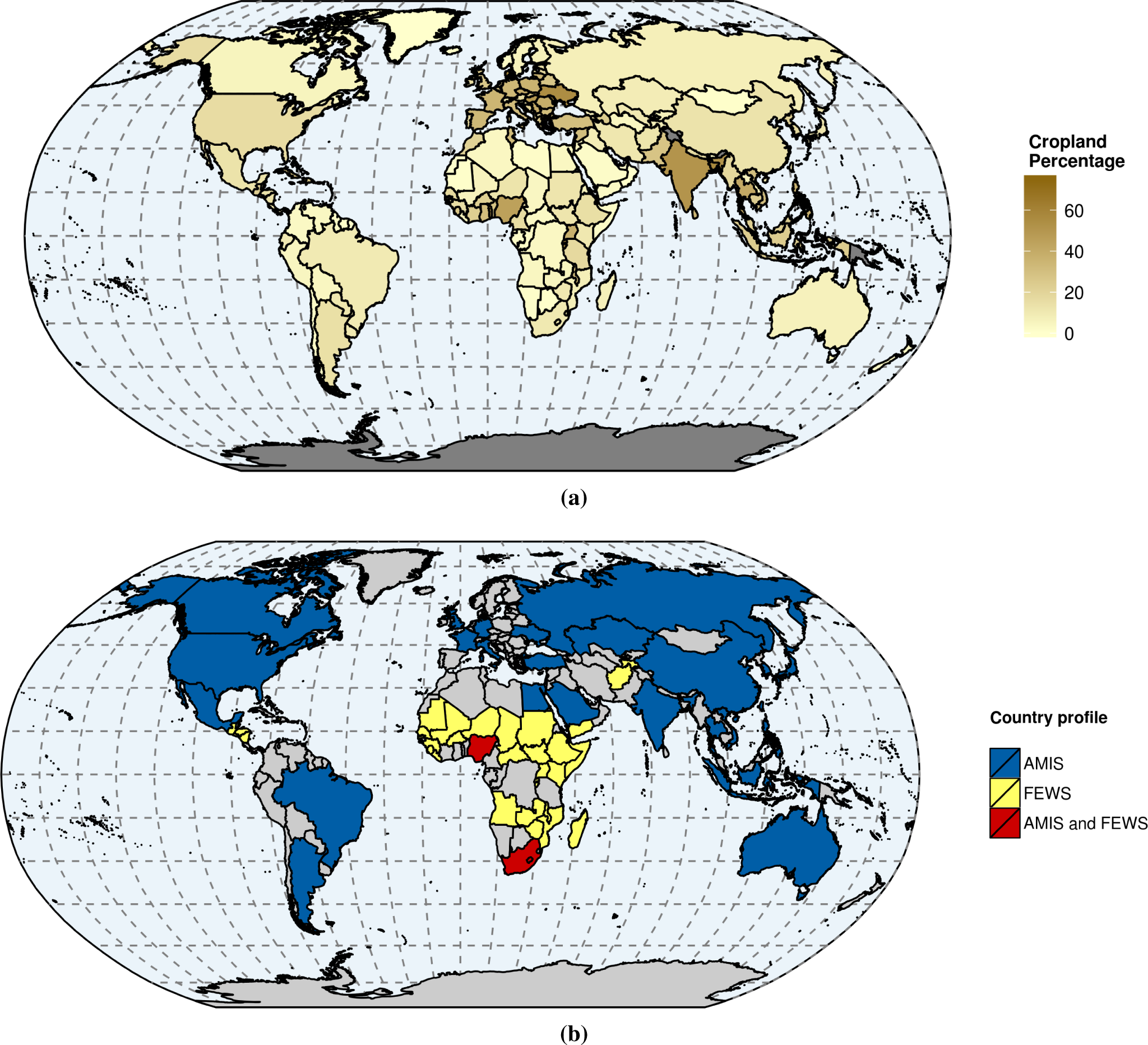
To support the prioritization, the priority index and the associated typology can be related to the proportion of cropland at the national scale (Figure 5a). A way of prioritization would be to ensure that both major agricultural commodity producers, whose production is likely to influence the market prices, and food insecure countries are well mapped (Figure 5b). These are the countries monitored by the Agriculture Market Information System (AMIS) and by the Food Early Warning System Network (FEWSnet).
Figure 5.
National-level agricultural profiles: (a) Percentage of cropland (FAO) and (b) FEWS and AMIS countries’ distribution. The percentage of cropland and belonging to the major agricultural commodity producers (Agriculture Market Information System (AMIS) countries) and/or to the countries at risk from a food security point of view (Food Early Warning System (FEWS)) further support the effort’s prioritization. As an example, Sahelian countries are characterized by a high priority index and considered as countries at risk. Cropland mapping efforts appear critical to update the cropland information in this area.
Mexico and Central American countries would benefit from a thematic update and a temporal update, respectively. Because of the high percentage of cropland in the national landscape, one should also consider Cuba and the Dominican Republic. South America does not appear as a critical area for update. Colombia and Peru scored the highest priority index associated with a temporal and resolution update, respectively. However, one might consider Brazil, an AMIS country, for the large cropped areas and its major role as a soybean producer.
Europe appears as a moderate priority area (orange shades), which might be explained by the fact that Corine Land Cover 2006 was selected and sanctioned for its timeliness, its ambiguous legend and the mismatch of the spatial resolution in certain countries. Greece appears in the typology of the priority map, as it was not included in Corine 2006. In the course of 2015, the Corine Land Cover map for 2012, covering thirty nine European countries, should be released. With its increased spatial resolution (10 m), this new Corine Land Cover map is expected to strongly improve the cropland delineation over Europe.
There are two main areas for improvements in Africa: Western and Southern Africa. In particular, countries, such as Nigeria, Benin, Togo, Ghana and Sahelian countries in the west and Mozambique, Madagascar and Zimbabwe in the south, would really benefit from an update, as cropland has a large proportion of the landscape. In addition, the type of updates required varies from an improvement in the resolution and in the timeliness or both (Figure 4). In the Greater Horn of Africa, Ethiopia (a country at risk) should also be considered as a priority. It is worth noting that the results for Africa corroborate those obtained by other studies that underlined the need for an update in Uganda, Ivory Coast and Nigeria [4], as well as Burkina Faso [1]. Leroux et al. [57] highlighted that the MODIS land cover over Ethiopia had limited accuracy. However, an update does not necessarily mean making a new map, but instead releasing an existing one freely and openly to the public (e.g., Ethiopia, Mali, Algeria).
In the Middle East, the priority index of Saudi Arabia and Yemen yields high values, especially due to the mismatch between the resolution of the current product and the suitable resolution. However, those countries have a particularly low proportion of cropland. Asia, Pakistan, Myanmar and Vietnam appear as high priority and are associated with a lack of spatial resolution and/or timeliness. In addition, those countries are major commodity producers and have therefore a large importance in the agriculture markets.
In Oceania, finally, the large rice growing areas of Southeast Asia, mostly in Indonesia, are a priority, since the high cloud coverage in these areas limits the efficiency of optically-derived land cover maps.
4.2. Spatial Aggregation: Assessment and Comparison
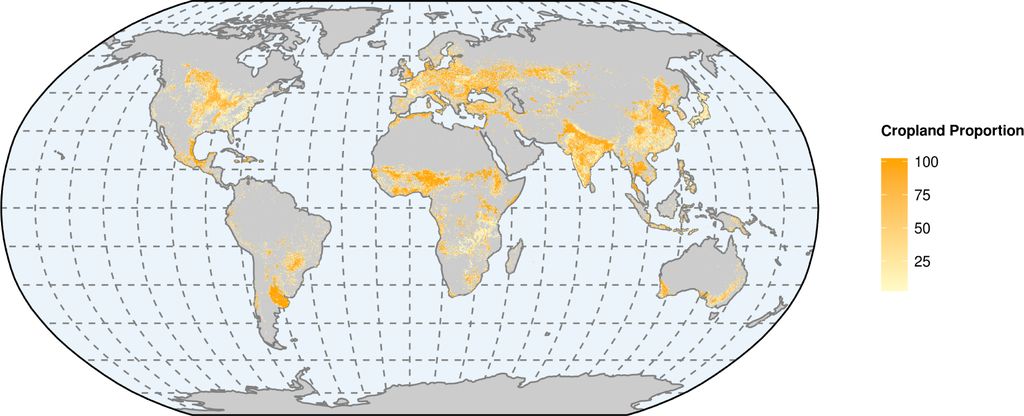
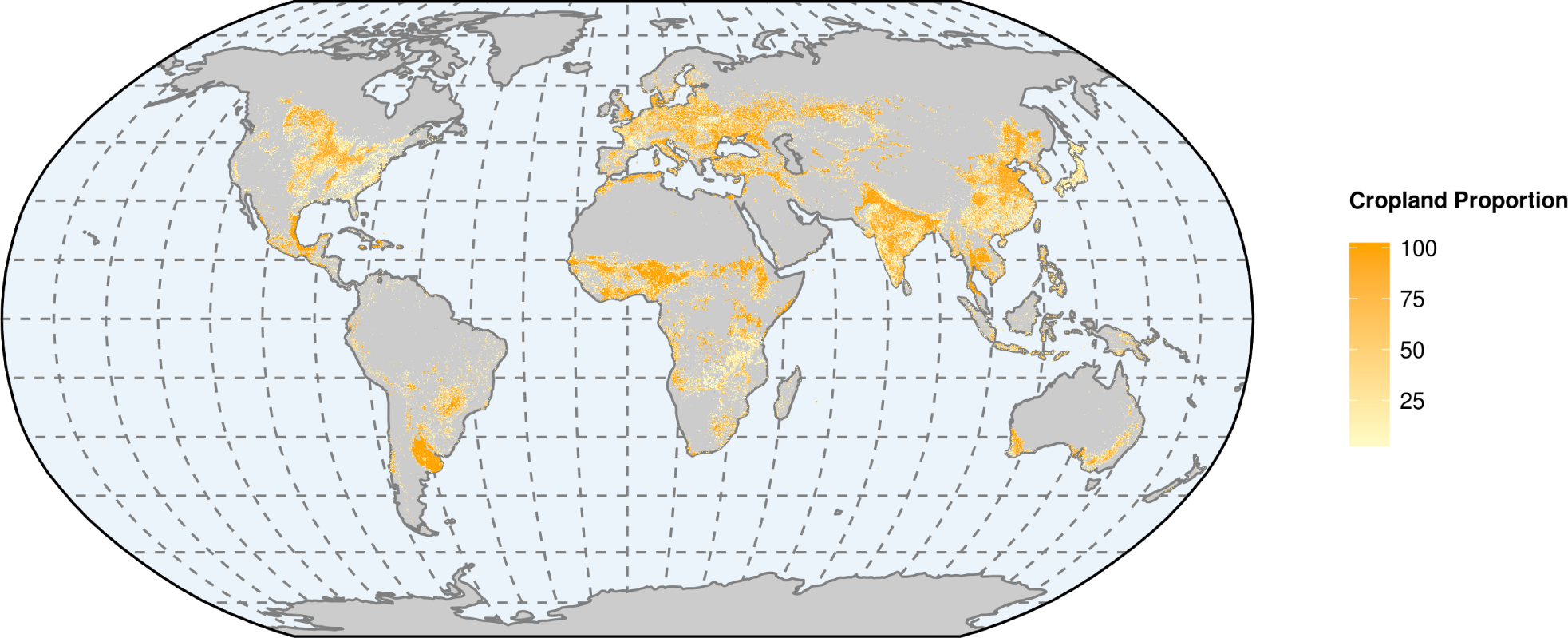
The best performing products, i.e., those minimizing the priority index with respect to the four criteria, were extracted country-wise. They were resampled at 250 m and combined to form the Unified Cropland Layer (Figure 6).
Figure 6.
Cropland proportion from the Unified Cropland Layer at 250-m for the year 2014. The Unified Cropland Layer combines the best performing products with regards to the multi-criteria analysis. It should be noted that cropland proportions are likely to be overestimated in areas where the spatial resolution of the original product is not higher than 250-m.
The Unified Cropland Layer was validated using three different and independent reference datasets: the consolidated GlobCover 2005 (Table 5a), the VIIRS dataset (Table 5b) and the GeoWiki dataset (Table 5c). The overall accuracy figures vary between 82% and 95%. However, it should be noted that 95% might be optimistic, as the consolidated GlobCover dataset would mostly focus on places with an obvious interpretation. While the producer and user accuracies are stable for the non-cropland class, large differences appeared for the cropland class. Besides, as mentioned in [63], attention has to be paid to the definition of cropland and pasture [13,64] when validating maps with global land cover reference datasets, as they might introduce some bias. In this case, the assessment might wrongly penalize fallow areas and permanent crops that were excluded from the Unified Cropland Layer as a result of differences in the legend definition. The best accuracy figures for the cropland class were obtained with the most up-to-date dataset (VIIRS): 72% of producer accuracy and 87% of user accuracy. The additional masking of the forested area displays a positive impact on the overall accuracy (from 82.2%–84.5%) and appears even more beneficial for the user’s accuracy of the cropland class (+20%), i.e., less commission errors (Table 5d). This gain is counterbalanced by a diminution of the user’s accuracy for the non-cropland class and of the producer’s accuracy for the cropland class.
Table 5.
Accuracy assessment of the Unified Cropland Layer. The overall accuracy figures vary between 82% and 95%. However, it should be noted that 95% might be optimistic, as the consolidated GlobCover dataset would mostly focus on places with an obvious interpretation. Masking cropland areas with a forest map reduces the commission errors from 46% down to 26%.
The comparison with two similar products (GLC-Share and the IIASA Cropland) revealed large spatial differences −45% of agreement for all three products globally (Figure 7). It is worth noting that GLC-Share takes the IIASA Cropland directly as input, leading inevitably to inbred agreement. Besides, the IIASA map is actually consistent with FAO statistics, whereas the Unified Cropland Layer is not. Large cropland disagreements are evident in Southeast Asia, North America and South America, as well as some African countries. The interpretation of the disagreement map is not straightforward, as it integrates classification errors when different sources are used, but also demonstrates thematic differences or semantic discrepancies (e.g., permanent crops, pastures, fallows). In addition, areas of agreement do not imply automatically accurate mapping, as the three products may use the same source as input. In West Africa, inter-product disagreement appears as low, as only global land cover maps are available. Disagreements in confusion errors due to the pastures and grasslands contaminate the cropland in the south of Belgium, the Netherlands and northern France. In Spain, the same occurred with olive groves, fruit trees and vineyards or pastures, as well as in the U.S. One of the largest areas of disagreement is certainly Southeast Asia, where the cropland extent appears more restrictive in the Unified Cropland Layer −33% of agreement for the continent. The lack of agreement underlines the poor accuracy of the cropland class in the current product and advocates for the development of new methods and products best suited for this particular land cover class. However, the spatial disagreement analysis supports that the prioritization for new mapping efforts are necessary to clearly identify cropland in disagreement areas. Previous priorities are confirmed: Southeast Asia (Indonesia and Vietnam), South America (Brazil and Colombia) and African countries (e.g., western and southern countries, Ethiopia and Madagascar).
Figure 7.
Agreement map between GLC-Share, the IIASA Cropland and the unified cropland layer (UCL). (a) Spatial agreement and (b) agreement proportions at the continental level. Large cropland disagreements are evident in Southeast Asia, North America and South America, as well as some African countries. A significant part of the disagreements might be due to the different legends chosen. Previous priorities are confirmed: Southeast Asia (Indonesia and Vietnam), South America (Brazil and Colombia) and African countries (e.g., western and southern countries and Madagascar).
5. Discussion
To improve the quality and reliability of global cropland maps as base information for crop condition monitoring and Earth system modeling, four critical issues must be addressed: Identifying priority areas for cropland mapping, adopting a shared cropland definition, open access policies and sharing the maps and setting up validation mechanisms to assess the maps.
This paper tackled in particular the first issue by means of a multi-criteria analysis carried out globally with already existing and available datasets. Existing land cover maps not available at the time of the writing were considered as not existing. The analysis might thus be biased for a country according to the product availability. An underlying hypothesis was that countries were considered as homogeneous ensembles with regards to the field size. This assumption seemed reasonable for most countries, but might not hold for those country presenting a large variety of field sizes and crop diversity. The quality of the confidence level criterion depends on the density of reference dataset and its distribution within each country. Certainly, some drawbacks are (i) the limited number of experts involved in its construction and (ii) that punctual features are more sensitive to geolocation errors. The combination of an expert-based approach with the multi-criteria analysis allowed identifying a set of countries for strategic effort planning, such as: Mexico, Brazil and several Central American countries, Ethiopia, Western and Southern African countries, Myanmar and Indonesia. Overall, this diagnosis is confirmed (e.g., for Mozambique, Indonesia or Ethiopia) by the attempt of [65] to map priority countries for mapping on the basis of an index combining the level of spatial disagreement of global cropland maps with regards to FAO Statistics and the Global Hunger Index. However, it should be noted that for several priority countries, such as Ethiopia and Algeria, the update needed does not necessarily imply making a new map, but rather releasing an existing map openly to the public. It should be noted that the multi-criteria approach remains valid to create national-level and local-level cropland maps for other purposes.
This study would not have been possible if it were not for data sharing and open data policies. This study showed that combining the best-performing cropland maps, the cropland class reached a level of accuracy of 82%–95%, which outperformed the accuracy of single global cropland products. However, these figures might be revised if using a validation dataset more adapted to the legend and better suited for cropland validation. These accuracy figures are close to those obtained by other multi-product global cropland maps, such as the IIASA-IFPRI map (82.4%) [21]. In the mid/long term, the priority map will evolve with future map releases (e.g., Corine Land Cover 2012), changes in data policy and with a new collection from different national and international institutions. As a direct result, the accuracy of the Unified Cropland Layer is expected to increase. The exhaustive identification of land cover products is a tedious task. To facilitate the identification and use of land cover products by the community, this study recommends systematically registering Earth observation resources into the Global Earth Observation System of Systems (GEOSS) Portal ( www.geoportal.org), which is a main entry point to Earth observation data from all over the world, linking a world-wide community of practice in nine societal benefit area among which is agriculture. With the new and upcoming high-resolution optical satellites, such as Landsat-8 and Sentinel-2, the number of high-resolution land cover products is expected to increase, and their accuracy is to improve. However, cloud cover impedes optical satellite remote sensing instruments from obtaining clear views of the Earth’s surface. In some regions, cloud cover impedes passive satellites from imaging the Earth’s surface at key moments of the development cycle for crop recognition and monitoring. Whitcraft et al. [66] studied in depth how cloud cover impacts the probability of securing reasonably clear views of croplands using passive optical Earth observations as the agricultural growing season progresses. They highlighted that in many important agricultural sites, the cloud cover is so persistent and pervasive, that less than half of their eight-day composites would be even 70% clear. This suggests that in those areas, synthetic aperture radar could play a major role in improving the accuracy of land cover maps, especially with the recent systematic acquisition of the Sentinel-1 mission. The potential of radar for cropland mapping has already been demonstrated in several configurations separately [67–70] or combined [71] and together with optical data [72,73]. Radar could be particularly valuable to improve the cropland information in two priority areas, namely Southeast Asia and around the Guinea Gulf (Nigeria). One could also capitalize on the synergies between medium spatial resolution-high temporal frequency sensors and high spatial resolution-low temporal frequency sensors [74,75]. However, these future products have yet to be issued by an open access policy. As stated by See et al. [65], crop and land use maps produced by multilateral organization, such as the United Nations and the World Bank, should be widely shared, for opening up data can lead to increased innovation and entrepreneurship, along with substantial financial gains. The situation seems to move towards more open policies through concerted efforts of the United Nations, the Group on Earth Observations and national governments.
Without legend harmonization, multi-products will remain by definition inconsistent. Additionally, this is not only valid for cropland, but for all land cover classes. The cross-comparison with other equivalent products underlines the limitations of working with different legends. The FAO Land Cover Meta Language provides a robust theoretical framework for legend definition and would certainly play a key role in class definition harmonization. The cropland definition used for the Unified Cropland Layer is a pragmatic one, still constrained by the current and diverse definitions. Principally, a pragmatic approach is to use what is possible with respect to medium to coarse resolution, that is not looking at the annual cropland. The recommendation is to move towards the JECAM definition of cropland, which has already been adopted by several projects and research. This shared definition will facilitate across-site comparisons in benchmarking activities, one of the key objectives of JECAM. A direct implication of this definition is that the cropland becomes dynamic. The class of the same field might change from one year to another according to the fallow cycle or if the field is actually harvested. This implies that efforts should be also directed to develop automated cropland classification methods to be applied every year. For a timely crop status monitoring, this means that those methods need to deliver cropland mask along the season mask, as the mask of one season would not be the mask of the next.
Finally, the collection of a global validation dataset relevant for cropland mapping at the global scale would be a major contribution to the agriculture community in order to assess future cropland maps systematically. Such a mechanism should be coordinated by and set up within the Group on Earth Observations. This will require greater involvement of experts on the ground or by means of image-based visual assessment and the collection of a larger quantity of in situ data [12]. The GeoWiki could be a valuable tool to collect, to cross-validate and update the status of global common validation datasets [65]. It would be also critical that instructions given to the interpreters is provided to the users along with the data itself. Confidence levels associated with the label would also be valuable to inform users on the expected robustness of a specific validation sample.
6. Conclusion
In both domains of food security monitoring and climate modeling, a good cropland mask is critical to isolate the agriculture component for crop condition analysis or the response to climatic simulations. A plethora of initiatives mapped cropland at different scales, but due to its dynamic intrinsic nature and the wide variety of agro-systems, its accuracy is often limited, especially in general global land cover products. The overall objective of this study was to evaluate the current situation in terms of dataset availability to allow strategic planning and mapping effort distribution and, therefore, to maximize the impact of new mapping activities. After an exhaustive identification and collection of land cover maps, a multi-criteria analysis was designed at the country level to highlight those priority areas for cropland mapping. Three critical priority areas were identified: African countries mainly in West Africa, Southeast Asia (Indonesia) and South America (Brazil). Other countries, such as Ethiopia, Madagascar, Mozambique and Pakistan, should also strongly be considered. Moreover, building on the priority analysis, a Unified Cropland Layer was also produced combining the fittest products. It was assessed with available global validation datasets and yields an overall accuracy ranging from 84%–95%, outperforming most global land cover maps. Besides, masking cropland areas with a forest map reduced the commission errors from 46% down to 26%. Compared to other multi-product maps, strong spatial disagreements were found and might be attributed to the differences in the legend definition (consideration of grassland and perennial crops). This encourages the community to adopt a shared definition of cropland, as well as to collect a global validation dataset relevant for the agriculture class to systematically assess future cropland maps.
Acknowledgments
This research was conducted in the framework of the Stimulating Innovation for Global Monitoring of Agriculture (SIGMA) ( http://www.geoglam-sigma.info/Pages/default.aspx) project funded by the European Commission in the Seventh Programme for research, technological development and demonstration under Grant Agreement No. 603719, as well as all of the institutes and people who contributed to this research sharing their datasets.
Author Contributions
All authors contributed to the design of the experiment and to the writing of the manuscript. Furthermore, François Waldner performed the analysis under the supervision of Pierre Defourny. All others actively participated in the identification and collection of the data sets.
Conflicts of Interest
The authors declare no conflict of interest.
References
- Fritz, S.; McCallum, I.; Schill, C.; Perger, C.; See, L.; Schepaschenko, D.; van der Velde, M.; Kraxner, F.; Obersteiner, M. Geo-Wiki: An online platform for improving global land cover. Environ. Model. Softw. 2012, 31, 110–123. [Google Scholar]
- Justice, C.O.; Becker-Reshef, I. Report from the Workshop on Developing a Strategy for Global Agricultural Monitoring in the Framework of Group on Earth Observations (GEO). Avaliable online: http://www.fao.org/gtos/igol/docs/meeting-reports/07-geo-ag0703-workshop-report-nov07.pdf accessed on 11 June 2015.
- Hannerz, F.; Lotsch, A. Assessment of remotely sensed and statistical inventories of African agricultural fields. Int. J. Remote Sens. 2008, 29, 3787–3804. [Google Scholar]
- Vancutsem, C.; Marinho, E.; Kayitakire, F.; See, L.; Fritz, S. Harmonizing and combining existing land cover/land use datasets for cropland area monitoring at the African continental scale. Remote Sens. 2012, 5, 19–41. [Google Scholar]
- Lobell, D.; Bala, G.; Duffy, P. Biogeophysical impacts of cropland management changes on climate. Geophys. Res. Lett. 2006, 33. [Google Scholar] [CrossRef]
- Yu, L.; Wang, J.; Clinton, N.; Xin, Q.; Zhong, L.; Chen, Y.; Gong, P. FROM-GC: 30 m global cropland extent derived through multisource data integration. Int. J. Digit. Earth. 2013, 6, 521–533. [Google Scholar]
- Bartholomé, E.; Belward, A. GLC2000: A new approach to global land cover mapping from Earth observation data. Int. J. Remote Sens. 2005, 26, 1959–1977. [Google Scholar]
- Arino, O.; Bicheron, P.; Achard, F.; Latham, J.; Witt, R.; Weber, J.L. The most detailed portrait of Earth. ESA Bull. 2008, 136, 25–31. [Google Scholar]
- Friedl, M.A.; McIver, D.K.; Hodges, J.C.; Zhang, X.; Muchoney, D.; Strahler, A.H.; Woodcock, C.E.; Gopal, S.; Schneider, A.; Cooper, A.; et al. Global land cover mapping from MODIS: Algorithms and early results. Remote Sens. Environ. 2002, 83, 287–302. [Google Scholar]
- Defourny, P.; Kirches, G.; Brockmann, C.; Boettcher, M.; Peters, M.; Bontemps, S.; Lamarche, C.; Schlerf, M.; Santoro, M. Land Cover CCI: Product User Guide Version 2. Available online: http://maps.elie.ucl.ac.be/CCI/viewer/download/ESACCI-LC-PUG-v2.4.pdf accessed on 11 June 2015.
- Gong, P.; Wang, J.; Yu, L.; Zhao, Y.; Zhao, Y.; Liang, L.; Niu, Z.; Huang, X.; Fu, H.; Liu, S.; et al. Finer resolution observation and monitoring of global land cover: First mapping results with Landsat TM and ETM+ data. Int. J. Remote Sens. 2013, 34, 2607–2654. [Google Scholar]
- Fritz, S.; See, L.; McCallum, I.; Schill, C.; Obersteiner, M.; van der Velde, M.; Boettcher, H.; Havlík, P.; Achard, F. Highlighting continued uncertainty in global land cover maps for the user community. Environ. Res. Lett. 2011, 6. [Google Scholar] [CrossRef]
- Ramankutty, N.; Evan, A.T.; Monfreda, C.; Foley, J.A. Farming the planet: 1. Geographic distribution of global agricultural lands in the year 2000. Glob. Biogeochem. Cycles 2008, 22. [Google Scholar] [CrossRef]
- Pittman, K.; Hansen, M.C.; Becker-Reshef, I.; Potapov, P.V.; Justice, C.O. Estimating global cropland extent with multi-year MODIS data. Remote Sens. 2010, 2, 1844–1863. [Google Scholar]
- Biradar, C.M.; Thenkabail, P.S.; Noojipady, P.; Li, Y.; Dheeravath, V.; Turral, H.; Velpuri, M.; Gumma, M.K.; Gangalakunta, O.R.P.; Cai, X.L.; et al. A global map of rainfed cropland areas (GMRCA) at the end of last millennium using remote sensing. Int. J. Appl. Earth Obs. Geoinf. 2009, 11, 114–129. [Google Scholar]
- Thenkabail, P.S.; Biradar, C.M.; Noojipady, P.; Dheeravath, V.; Li, Y.; Velpuri, M.; Gumma, M.; Gangalakunta, O.R.P.; Turral, H.; Cai, X.; et al. Global irrigated area map (GIAM), derived from remote sensing, for the end of the last millennium. Int. J. Remote Sens. 2009, 30, 3679–3733. [Google Scholar]
- Boryan, C.; Yang, Z.; Mueller, R.; Craig, M. Monitoring US agriculture: the US department of agriculture, national agricultural statistics service, cropland data layer program. Geocarto Int. 2011, 26, 341–358. [Google Scholar]
- Herold, M.; Woodcock, C.E.; Di Gregorio, A.; Mayaux, P.; Belward, A.S.; Latham, J.; Schmullius, C.C. A joint initiative for harmonization and validation of land cover datasets. IEEE Trans. Geosci. Remote Sens. 2006, 44, 1719–1727. [Google Scholar]
- Giri, C.; Zhu, Z.; Reed, B. A comparative analysis of the Global Land Cover 2000 and MODIS land cover data sets. Remote Sens. Environ. 2005, 94, 123–132. [Google Scholar]
- Foody, G.M. Status of land cover classification accuracy assessment. Remote Sens. Environ. 2002, 80, 185–201. [Google Scholar]
- Fritz, S.; See, L.; McCallum, I.; You, L.; Bun, A.; Moltchanova, E.; Duerauer, M.; Albrecht, F.; Schill, C.; Perger, C.; et al. Mapping global cropland and field size. Glob. Chang. Biol. 2015, 21, 1980–1992. [Google Scholar]
- Latham, J.; Cumani, R.; Rosati, I.; Bloise, M. Global Land Cover SHARE (GLC-SHARE) Database Beta-Release Version 1.0-2014. Available online: http://www.fao.org/uploads/media/glc-share-doc.pdf accessed on 11 June 2015.
- Xu, G.; Zhang, H.; Chen, B.; Zhang, H.; Yan, J.; Chen, J.; Che, M.; Lin, X.; Dou, X. A Bayesian based method to generate a synergetic land-cover map from existing land-cover products. Remote Sens. 2014, 6, 5589–5613. [Google Scholar]
- Herold, M.; Mayaux, P.; Woodcock, C.; Baccini, A.; Schmullius, C. Some challenges in global land cover mapping: An assessment of agreement and accuracy in existing 1 km datasets. Remote Sens. Environ. 2008, 112, 2538–2556. [Google Scholar]
- Eidenshink, J.C.; Faundeen, J.L. The 1 km AVHRR global land data set: First stages in implementation. Int. J. Remote Sens. 1994, 15, 3443–3462. [Google Scholar]
- Tateishi, R.; Hoan, N.T.; Kobayashi, T.; Alsaaideh, B.; Tana, G.; Phong, D.X. Production of Global Land Cover Data-GLCNMO2008. J. Geogr. Geol. 2014, 6, 99–122. [Google Scholar]
- Blanco, P.D.; Colditz, R.R.; Saldaña, G.L.; Hardtke, L.A.; Llamas, R.M.; Mari, N.A.; Fischer, A.; Caride, C.; Aceñolaza, P.G.; Del Valle, H.F.; et al. A land cover map of Latin America and the Caribbean in the framework of the SERENA project. Remote Sens. Environ. 2013, 132, 13–31. [Google Scholar]
- Verhegghen, A.; Mayaux, P.; de Wasseige, C.; Defourny, P. Mapping Congo Basin vegetation types from 300 m and 1 km multi-sensor time series for carbon stocks and forest areas estimation. Biogeosciences 2012, 9, 5061–5079. [Google Scholar]
- Miettinen, J.; Shi, C.; Tan, W.J.; Liew, S.C. land cover map of insular Southeast Asia in 250-m spatial resolution. Remote Sens. Lett. 3, 11–20.
- Klein, I.; Gessner, U.; Kuenzer, C. Regional land cover mapping and change detection in central Asia using MODIS time-series. Appl. Geogr. 2012, 35, 219–234. [Google Scholar]
- Chen, J.; Chen, J.; Liao, A.; Cao, X.; Chen, L.; Chen, X.; He, C.; Han, G.; Peng, S.; Lu, M.; et al. Global land cover mapping at 30 m resolution: A POK-based operational approach. ISPRS J. Photogramm. Remote Sens. 2015, 103, 7–27. [Google Scholar]
- Takahashi, M.; Nasahara, K.N.; Tadono, T.; Watanabe, T.; Dotsu, M.; Sugimura, T.; Tomiyama, N. JAXA high resolution land-use and land-cover map of Japan. Proceedings of 2013 IEEE International Geoscience and Remote Sensing Symposium (IGARSS), Melbourne, VIC, Australia, 21–26 July 2013; pp. 2384–2387.
- Thenkabail, P.S.; Wu, Z. An automated cropland classification algorithm (ACCA) for Tajikistan by combining Landsat, MODIS, and secondary data. Remote Sens. 2012, 4, 2890–2918. [Google Scholar]
- Liu, J.; Liu, M.; Tian, H.; Zhuang, D.; Zhang, Z.; Zhang, W.; Tang, X.; Deng, X. Spatial and temporal patterns of China’s cropland during 1990–2000: An analysis based on Landsat TM data. Remote Sens. Environ. 2005, 98, 442–456. [Google Scholar]
- Lymburner, L.; Tan, P.; Mueller, N.; Thackway, R.; Thankappan, M.; Islam, A.; Lewis, A.; Randall, L.; Senarath, U. The National Dynamic Land Cover Dataset; Geoscience Australia: Canberra, NSW, Astralia, 2011. [Google Scholar]
- Sreenivas, K.; Sekhar, N.S.; Saxena, M.; Paliwal, R.; Pathak, S.; Porwal, M.; Fyzee, M.; Rao, S.K.; Wadodkar, M.; Anasuya, T.; et al. Estimating inter-annual diversity of seasonal agricultural area using multi-temporal resourcesat data. J. Environ. Manag. 2014. [Google Scholar] [CrossRef]
- Holecz, F.; Collivignarelli, F.; Barbieri, M.; Gatti, L.; Boschetti, M.; Manfron, G.; Brivio, P.A.; Abukari, M.; Bondo, T. Establishing National Baseline Land Cover Map Including Annual and Seasonal Variations for the Understanding of Current Agricultural Practices in the Gambia; National Agricultural Land and Water Management Development Project (Nema), 2013; unpublished. [Google Scholar]
- Lavreniuk, M.; Kussul, N.; S., S.; Shelestov, A.; Yailymov, B. Regional retrospective high resolution land cover for Ukraine: Methodology and results. Proceedings of IEEE International Geoscience and Remote Sensing Symposium (IGARSS 2015), Milan, Italy, 26–31 July 2015. submitted.
- Bartalev, S.; Egorov, V.; Loupian, E.; Plotnikov, D.; Uvarov, I. Recognition of arable lands using multi-annual satellite data from spectroradiometer MODIS and locally adaptive supervised classification. Comput. Opt. 2011, 35, 103–116, In Russian. [Google Scholar]
- Defourny, P.; Schouten, L.; Bartalev, S.; Bontemps, S.; Cacetta, P.; Gérard, B.; Giri, C.; Gond, V.; Hazeu, G.; Heinimann, A.; et al. Accuracy assessment of a 300 m global land cover map: The GlobCover experience. Proceedings of the 33rd International Symposium on Remote Sensing of Environment, Stresa, Italy, 4–8 May 2009.
- Defourny, P.; Mayaux, P.; Herold, M.; Bontemps, S. Global land-cover map validation experiences: Toward the characterization of quantitative uncertainty. In Remote Sensing of Land Use and Land Cover: Principles and Applications; Giri, C.P., Ed.; CRC Press: London, UK, 2012; pp. 207–223. [Google Scholar]
- Olofsson, P.; Stehman, S.V.; Woodcock, C.E.; Sulla-Menashe, D.; Sibley, A.M.; Newell, J.D.; Friedl, M.A.; Herold, M. A global land-cover validation data set, part I: Fundamental design principles. Int. J. Remote Sens. 2012, 33, 5768–5788. [Google Scholar]
- Stehman, S.V.; Olofsson, P.; Woodcock, C.E.; Herold, M.; Friedl, M.A. A global land-cover validation data set, II: Augmenting a stratified sampling design to estimate accuracy by region and land-cover class. Int. J. Remote Sens. 2012, 33, 6975–6993. [Google Scholar]
- GOFC-GOLD. STEP Reference Dataset. 2011. Available online: http://www.gofcgold.wur.nl/sites/gofcgold_refdataportal-step.php accessed on 11 June 2015.
- Zhao, Y.; Gong, P.; Yu, L.; Hu, L.; Li, X.; Li, C.; Zhang, H.; Zheng, Y.; Wang, J.; Zhao, Y.; et al. Towards a common validation sample set for global land-cover mapping. Int. J. Remote Sens. 2014, 35, 4795–4814. [Google Scholar]
- Fritz, S.; McCallum, I.; Schill, C.; Perger, C.; Grillmayer, R.; Achard, F.; Kraxner, F.; Obersteiner, M. Geo-Wiki. org: The use of crowdsourcing to improve global land cover. Remote Sens. 2009, 1, 345–354. [Google Scholar]
- Setegn, S.G.; Srinivasan, R.; Dargahi, B.; Melesse, A.M. Spatial delineation of soil erosion vulnerability in the Lake Tana Basin, Ethiopia. Hydrol. Process. 2009, 23, 3738–3750. [Google Scholar]
- Mourão, K.R.M.; Sousa Filho, P.W.M.; de Oliveira Alves, P.J.; Frédou, F.L. Priority areas for the conservation of the fish fauna of the Amazon Estuary in Brazil: A multicriteria approach. Ocean Coastal Manag. 2014, 100, 116–127. [Google Scholar]
- Iojă, C.I.; Ni¸tă, M.R.; Vânău, G.O.; Onose, D.A.; Gavrilidis, A.A. Using multi-criteria analysis for the identification of spatial land-use conflicts in the Bucharest Metropolitan Area. Ecol. Indic. 2014, 42, 112–121. [Google Scholar]
- McCallum, I.; Obersteiner, M.; Nilsson, S.; Shvidenko, A. A spatial comparison of four satellite derived 1km global land cover datasets. Int. J. Appl. Earth Obs. Geoinf. 2006, 8, 246–255. [Google Scholar]
- Di Gregorio, A.; Jansen, L.J. Land Cover Classification System (LCCS): Classification Concepts and User Manual, version 1.0; Food and Agriculture Organization of the United Nations: Rome, Italy, 2000. [Google Scholar]
- del Mar López, T.; Aide, T.M.; Thomlinson, J.R. Urban expansion and the loss of prime agricultural lands in Puerto Rico. Ambio 2001, 30, 49–54. [Google Scholar]
- Morton, D.C.; DeFries, R.S.; Shimabukuro, Y.E.; Anderson, L.O.; Arai, E.; del Bon Espirito-Santo, F.; Freitas, R.; Morisette, J. Cropland expansion changes deforestation dynamics in the southern Brazilian Amazon. Proc. Natl. Acad. Sci. USA 2006, 103, 14637–14641. [Google Scholar]
- Benayas, J.R.; Martins, A.; Nicolau, J.M.; Schulz, J.J. Abandonment of agricultural land: an overview of drivers and consequences. CAB Rev. Perspect. Agric. Vet. Sci. Nutr. Nat. Resour. 2007, 2, 1–14. [Google Scholar]
- Baumann, M.; Kuemmerle, T.; Elbakidze, M.; Ozdogan, M.; Radeloff, V.C.; Keuler, N.S.; Prishchepov, A.V.; Kruhlov, I.; Hostert, P. Patterns and drivers of post-socialist farmland abandonment in western Ukraine. Land Use Policy 2011, 28, 552–562. [Google Scholar]
- Löw, F.; Duveiller, G. Defining the spatial resolution requirements for crop identification using optical remote sensing. Remote Sens. 2014, 6, 9034–9063. [Google Scholar]
- Leroux, L.; Jolivot, A.; Bégué, A.; Seen, D.L.; Zoungrana, B. How reliable is the MODIS land cover product for crop mapping sub-saharan agricultural landscapes? Remote Sens. 2014, 6, 8541–8564. [Google Scholar]
- Vintrou, E.; Desbrosse, A.; Bégué, A.; Traoré, S.; Baron, C.; Seen, D.L. Crop area mapping in West Africa using landscape stratification of MODIS time series and comparison with existing global land products. Int. J. Appl. Earth Obs. Geoinf. 2012, 14, 83–93. [Google Scholar]
- Saaty, T.L. How to make a decision: The analytic hierarchy process. Eur. J. Oper. Res. 1990, 48, 9–26. [Google Scholar]
- Mendoza, G.; Prabhu, R. Multiple criteria analysis for assessing criteria and indicators in sustainable forest management: A case study on participatory decision making in a Kalimantan forest. Environ. Manag. 2000, 26, 659–673. [Google Scholar]
- Hansen, M.C.; Potapov, P.V.; Moore, R.; Hancher, M.; Turubanova, S.; Tyukavina, A.; Thau, D.; Stehman, S.; Goetz, S.; Loveland, T.; et al. High-resolution global maps of 21st-century forest cover change. Science 2013, 342, 850–853. [Google Scholar]
- Shimada, M.; Itoh, T.; Motooka, T.; Watanabe, M.; Shiraishi, T.; Thapa, R.; Lucas, R. New global forest/non-forest maps from ALOS PALSAR data 2007–2010. Remote Sens. Environ. 2014, 155, 13–31. [Google Scholar]
- Tsendbazar, N.; de Bruin, S.; Herold, M. Assessing global land cover reference datasets for different user communities. ISPRS J. Photogramm. Remote Sens. 2015, 103, 93–114. [Google Scholar]
- Goldewijk, K.K.; van Drecht, G.; Bouwman, A.F. Mapping contemporary global cropland and grassland distributions on a 5 × 5 minute resolution. J. Land Use Sci. 2007, 2, 167–190. [Google Scholar]
- See, L.; Fritz, S.; You, L.; Ramankutty, N.; Herrero, M.; Justice, C.; Becker-Reshef, I.; Thornton, P.; Erb, K.; Gong, P.; et al. Improved global cropland data as an essential ingredient for food security. Glob. Food Secur. 2014, 4, 37–45. [Google Scholar]
- Whitcraft, A.K.; Vermote, E.F.; Becker-Reshef, I.; Justice, C.O. Cloud cover throughout the agricultural growing season: Impacts on passive optical earth observations. Remote Sens. Environ. 2015, 156, 438–447. [Google Scholar]
- Blaes, X.; Vanhalle, L.; Defourny, P. Efficiency of crop identification based on optical and SAR image time series. Remote Sens. Environ. 2005, 96, 352–365. [Google Scholar]
- McNairn, H.; Shang, J.; Champagne, C.; Jiao, X. TerraSAR-X and RADARSAT-2 for crop classification and acreage estimation. Proceedings of 2009 IEEE International Geoscience and Remote Sensing Symposium, Cape Town, South Africa, 12–17 July 2009; 2, pp. II-898–II-901.
- McNairn, H.; Champagne, C.; Shang, J.; Holmstrom, D.; Reichert, G. Integration of optical and Synthetic Aperture Radar (SAR) imagery for delivering operational annual crop inventories. ISPRS J. Photogramm. Remote Sens. 2009, 64, 434–449. [Google Scholar]
- McNairn, H.; Kross, A.; Lapen, D.; Caves, R.; Shang, J. Early season monitoring of corn and soybeans with TerraSAR-X and RADARSAT-2. Int. J. Appl. Earth Obs. Geoinf. 2014, 28, 252–259. [Google Scholar]
- Jia, K.; Li, Q.; Tian, Y.; Wu, B.; Zhang, F.; Meng, J. Crop classification using multi-configuration SAR data in the North China Plain. Int. J. Remote Sens. 2012, 33, 170–183. [Google Scholar]
- Forkuor, G.; Conrad, C.; Thiel, M.; Ullmann, T.; Zoungrana, E. Integration of optical and Synthetic Aperture Radar imagery for improving crop mapping in northwestern Benin, West Africa. Remote Sens. 2014, 6, 6472–6499. [Google Scholar]
- Kussul, N.; Skakun, S.; Kravchenko, O.; Shelestov, A.; Gallego, J.F.; Kussul, O. Application of satellite optical and SAR images for crop mapping and erea estimation in Ukraine. Int. J. Inf. Model. Anal. 2013, 7, 203–211. [Google Scholar]
- Gao, F.; Masek, J.; Schwaller, M.; Hall, F. On the blending of the Landsat and MODIS surface reflectance: Predicting daily Landsat surface reflectance. IEEE Trans. Geosci. Remote Sens. 2006, 44, 2207–2218. [Google Scholar]
- Bisquert, M.; Bordogna, G.; Bégué, A.; Candiani, G.; Teisseire, M.; Poncelet, P. A simple fusion method for image time series based on the estimation of image temporal validity. Remote Sens. 2015, 7, 704–724. [Google Scholar]

© 2015 by the authors; licensee MDPI, Basel, Switzerland This article is an open access article distributed under the terms and conditions of the Creative Commons Attribution license (http://creativecommons.org/licenses/by/4.0/).