<?xml version="1.0" encoding="UTF-8"?>
<!DOCTYPE article PUBLIC "-//NLM//DTD Journal Publishing DTD v2.3 20070202//EN" "journalpublishing.dtd">
<article xmlns:mml="http://www.w3.org/1998/Math/MathML" xmlns:xlink="http://www.w3.org/1999/xlink" xml:lang="en" article-type="research-article">
<front>
<journal-meta>
<journal-id journal-id-type="publisher-id">REMSE</journal-id>
<journal-title>Remote Sensing</journal-title>
<issn pub-type="epub">2072-4292</issn>
<publisher>
<publisher-name>Molecular Diversity Preservation International (MDPI)</publisher-name></publisher></journal-meta>
<article-meta>
<article-id pub-id-type="doi">10.3390/rs5010202</article-id>
<article-id pub-id-type="publisher-id">remotesensing-05-00202</article-id>
<article-categories>
<subj-group>
<subject>Article</subject></subj-group></article-categories>
<title-group>
<article-title>Allometric Scaling and Resource Limitations Model of Tree Heights: Part 2. Site Based Testing of the Model</article-title></title-group>
<contrib-group>
<contrib contrib-type="author">
<name><surname>Choi</surname><given-names>Sungho</given-names></name><xref ref-type="fn" rid="fn1-remotesensing-05-00202"><sup>†</sup></xref><xref ref-type="aff" rid="af1-remotesensing-05-00202"><sup>1</sup></xref><xref ref-type="corresp" rid="c1-remotesensing-05-00202"><sup>*</sup></xref></contrib>
<contrib contrib-type="author">
<name><surname>Ni</surname><given-names>Xiliang</given-names></name><xref ref-type="aff" rid="af1-remotesensing-05-00202"><sup>1</sup></xref><xref ref-type="aff" rid="af2-remotesensing-05-00202"><sup>2</sup></xref><xref ref-type="fn" rid="fn1-remotesensing-05-00202"><sup>†</sup></xref></contrib>
<contrib contrib-type="author">
<name><surname>Shi</surname><given-names>Yuli</given-names></name><xref ref-type="aff" rid="af1-remotesensing-05-00202"><sup>1</sup></xref><xref ref-type="aff" rid="af3-remotesensing-05-00202"><sup>3</sup></xref></contrib>
<contrib contrib-type="author">
<name><surname>Ganguly</surname><given-names>Sangram</given-names></name><xref ref-type="aff" rid="af4-remotesensing-05-00202"><sup>4</sup></xref></contrib>
<contrib contrib-type="author">
<name><surname>Zhang</surname><given-names>Gong</given-names></name><xref ref-type="aff" rid="af5-remotesensing-05-00202"><sup>5</sup></xref></contrib>
<contrib contrib-type="author">
<name><surname>Duong</surname><given-names>Hieu V.</given-names></name><xref ref-type="aff" rid="af6-remotesensing-05-00202"><sup>6</sup></xref></contrib>
<contrib contrib-type="author">
<name><surname>Lefsky</surname><given-names>Michael A.</given-names></name><xref ref-type="aff" rid="af6-remotesensing-05-00202"><sup>6</sup></xref></contrib>
<contrib contrib-type="author">
<name><surname>Simard</surname><given-names>Marc</given-names></name><xref ref-type="aff" rid="af7-remotesensing-05-00202"><sup>7</sup></xref></contrib>
<contrib contrib-type="author">
<name><surname>Saatchi</surname><given-names>Sassan S.</given-names></name><xref ref-type="aff" rid="af7-remotesensing-05-00202"><sup>7</sup></xref></contrib>
<contrib contrib-type="author">
<name><surname>Lee</surname><given-names>Shihyan</given-names></name><xref ref-type="aff" rid="af8-remotesensing-05-00202"><sup>8</sup></xref></contrib>
<contrib contrib-type="author">
<name><surname>Ni-Meister</surname><given-names>Wenge</given-names></name><xref ref-type="aff" rid="af8-remotesensing-05-00202"><sup>8</sup></xref></contrib>
<contrib contrib-type="author">
<name><surname>Piao</surname><given-names>Shilong</given-names></name><xref ref-type="aff" rid="af9-remotesensing-05-00202"><sup>9</sup></xref></contrib>
<contrib contrib-type="author">
<name><surname>Cao</surname><given-names>Chunxiang</given-names></name><xref ref-type="aff" rid="af2-remotesensing-05-00202"><sup>2</sup></xref></contrib>
<contrib contrib-type="author">
<name><surname>Nemani</surname><given-names>Ramakrishna R.</given-names></name><xref ref-type="aff" rid="af10-remotesensing-05-00202"><sup>10</sup></xref></contrib>
<contrib contrib-type="author">
<name><surname>Myneni</surname><given-names>Ranga B.</given-names></name><xref ref-type="aff" rid="af1-remotesensing-05-00202"><sup>1</sup></xref></contrib></contrib-group>
<aff id="af1-remotesensing-05-00202">
<label>1</label>Department of Earth and Environment, Boston University, 675 Commonwealth Avenue, Boston, MA 02215, USA; E-Mail: <email>ranga.myneni@gmail.com</email></aff>
<aff id="af2-remotesensing-05-00202">
<label>2</label>State Key Laboratory of Remote Sensing Sciences, Institute of Remote Sensing Applications, Chinese Academy of Sciences, Beijing 100101, China; E-Mails: <email>nixl@irsa.ac.cn</email> (X.N.); <email>cao413@irsa.ac.cn</email> (C.C.)</aff>
<aff id="af3-remotesensing-05-00202">
<label>3</label>School of Remote Sensing, Nanjing University of Information Science and Technology, Nanjing 210044, China; E-Mail: <email>ylshi.nuist@gmail.com</email></aff>
<aff id="af4-remotesensing-05-00202">
<label>4</label>Bay Area Environmental Research Institute (BAERI)/NASA Ames Research Center, Moffett Field, CA 94035, USA; E-Mail: <email>sangramganguly@gmail.com</email></aff>
<aff id="af5-remotesensing-05-00202">
<label>5</label>Department of Watershed Science, Utah State University, UT 84322, USA; E-Mail: <email>gongzhang07@gmail.com</email></aff>
<aff id="af6-remotesensing-05-00202">
<label>6</label>Center for Ecological Analysis of Lidar, Natural Resource Ecology Laboratory, Colorado State University, Fort Collins, CO 80523, USA; E-Mails: <email>Hieu.Duong@colostate.edu</email> (H.D.); <email>lefsky@cnr.colostate.edu</email> (M.L.)</aff>
<aff id="af7-remotesensing-05-00202">
<label>7</label>Jet Propulsion Laboratory, California Institute of Technology, 4800 Oak Grove Dr., Pasadena, CA 91109, USA; E-Mails: <email>marc.simard@jpl.nasa.gov</email> (M.S.); <email>saatchi@jpl.nasa.gov</email> (S.S.)</aff>
<aff id="af8-remotesensing-05-00202">
<label>8</label>Department of Geography, Hunter College of CUNY, New York, NY 10065, USA; E-Mails: <email>shihyanlee@yahoo.com</email> (S.L.); <email>Wenge.Ni-Meister@hunter.cuny.edu</email> (W.N.)</aff>
<aff id="af9-remotesensing-05-00202">
<label>9</label>College of Urban and Environmental Sciences and Sino-French Institute for Earth System Science, Peking University, Beijing 100871, China; E-Mail: <email>slpiao@pku.edu.cn</email></aff>
<aff id="af10-remotesensing-05-00202">
<label>10</label>Biospheric Science Branch, NASA Ames Research Center, Moffett Field, CA 94035, USA; E-Mail: <email>rama.nemani@nasa.gov</email></aff>
<author-notes><fn id="fn1-remotesensing-05-00202" fn-type="equal">
<label>†</label>
<p>These authors contributed equally to this work.</p></fn>
<corresp id="c1-remotesensing-05-00202">
<label>*</label>Author to whom correspondence should be addressed; E-Mail: <email>schoi@bu.edu</email>; Tel.: +1-617-353-8846; Fax: +1-617-353-8399.</corresp></author-notes>
<pub-date pub-type="collection">
<year>2013</year></pub-date>
<pub-date pub-type="epub">
<day>10</day>
<month>01</month>
<year>2013</year></pub-date>
<volume>5</volume><issue>1</issue>
<fpage>202</fpage>
<lpage>223</lpage>
<history>
<date date-type="received">
<day>12</day>
<month>11</month>
<year>2012</year></date>
<date date-type="rev-recd">
<day>31</day>
<month>12</month>
<year>2012</year></date>
<date date-type="accepted">
<day>04</day>
<month>01</month>
<year>2013</year></date></history>
<copyright-statement>© 2013 by the authors; licensee MDPI, Basel, Switzerland.</copyright-statement>
<copyright-year>2013</copyright-year>
<license license-type="open-access" xlink:href="http://creativecommons.org/licenses/by/3.0/">
<p>This article is an open access article distributed under the terms and conditions of the Creative Commons Attribution license (<ext-link xlink:href="http://creativecommons.org/licenses/by/3.0/" ext-link-type="uri">http://creativecommons.org/licenses/by/3.0/</ext-link>).</p></license>
<abstract>
<p>The ultimate goal of this multi-article series is to develop a methodology to generate continuous fields of tree height and biomass. The first paper demonstrated the need for Allometric Scaling and Resource Limitation (ASRL) model optimization and its ability to generate spatially continuous fields of tree heights over the continental USA at coarse (1 km) spatial resolution. The objective of this second paper is to provide an assessment of that approach at site scale, specifically at 12 FLUXNET sites where more accurate data are available. Estimates of tree heights from the Geoscience Laser Altimeter System (GLAS) waveform data are used for model optimization. Amongst the five possible GLAS metrics that are representative of tree heights, the best metric is selected based on how closely the metric resembles field-measured and Laser Vegetation Imaging Sensor tree heights. In the optimization process, three parameters of the ASRL model (area of single leaf, α; exponent for canopy radius, η; and root absorption efficiency, γ) are simultaneously adjusted to minimize the difference between model predictions and observations at the study sites (distances to valid GLAS footprints ≤ 10 km). Performance of the optimized ASRL model was evaluated through comparisons to the best GLAS metric of tree height using a two-fold cross validation approach (R<sup>2</sup> = 0.85; RMSE = 1.81 m) and a bootstrapping approach (R<sup>2</sup> = 0.66; RMSE = 2.60 m). The optimized model satisfactorily performed at the site scale, thus corroborating results presented in part one of this series. Future investigations will focus on generalizing these results and extending the model formulation using similar allometric concepts for the estimation of woody biomass.</p></abstract>
<kwd-group>
<kwd>tree height</kwd>
<kwd>allometric scaling law</kwd>
<kwd>resource limitation</kwd>
<kwd>GLAS</kwd>
<kwd>model optimization</kwd></kwd-group></article-meta></front>
<body>
<sec sec-type="intro">
<label>1.</label>
<title>Introduction</title>
<p>Forest height and biomass are important attributes required for quantifying the dynamics of the terrestrial carbon cycle [<xref ref-type="bibr" rid="b1-remotesensing-05-00202">1</xref>–<xref ref-type="bibr" rid="b4-remotesensing-05-00202">4</xref>]. Several recent articles have reported variations in regional and global forest structural attributes [<xref ref-type="bibr" rid="b5-remotesensing-05-00202">5</xref>] (e.g., under decreasing [<xref ref-type="bibr" rid="b6-remotesensing-05-00202">6</xref>], increasing [<xref ref-type="bibr" rid="b7-remotesensing-05-00202">7</xref>–<xref ref-type="bibr" rid="b9-remotesensing-05-00202">9</xref>], or relatively steady-state [<xref ref-type="bibr" rid="b10-remotesensing-05-00202">10</xref>] conditions), but there remains large uncertainty [<xref ref-type="bibr" rid="b11-remotesensing-05-00202">11</xref>–<xref ref-type="bibr" rid="b13-remotesensing-05-00202">13</xref>]. Two conventional methods of mapping tree heights and biomass are the extrapolation methods using field-measured and/or remote sensing altimetry data (e.g., regression tree or random forest algorithms [<xref ref-type="bibr" rid="b14-remotesensing-05-00202">14</xref>–<xref ref-type="bibr" rid="b16-remotesensing-05-00202">16</xref>]) and the physical/physiological model based on allometric scaling laws (e.g., Allometric Scaling and Resource Limitations (ASRL) model [<xref ref-type="bibr" rid="b17-remotesensing-05-00202">17</xref>]).</p>
<p>The extrapolation methods well estimate forest structural attributes by exploiting advancements in remote sensing. Small footprint lidar, Terrestrial Laser Scanners [<xref ref-type="bibr" rid="b18-remotesensing-05-00202">18</xref>,<xref ref-type="bibr" rid="b19-remotesensing-05-00202">19</xref>] and Laser Vegetation Imaging Sensor (LVIS) [<xref ref-type="bibr" rid="b20-remotesensing-05-00202">20</xref>,<xref ref-type="bibr" rid="b21-remotesensing-05-00202">21</xref>] are key to accurate estimation of tree heights and forest biomass. Global and regional maps of tree heights [<xref ref-type="bibr" rid="b14-remotesensing-05-00202">14</xref>,<xref ref-type="bibr" rid="b15-remotesensing-05-00202">15</xref>] and forest biomass [<xref ref-type="bibr" rid="b16-remotesensing-05-00202">16</xref>,<xref ref-type="bibr" rid="b22-remotesensing-05-00202">22</xref>,<xref ref-type="bibr" rid="b23-remotesensing-05-00202">23</xref>] have been generated using lidar waveform data from the Geoscience Laser Altimeter System (GLAS) instrument onboard the Ice, Cloud and land Elevation Satellite (ICESat). The relatively large footprint and wide spatial coverage of the GLAS instrument have made large-scale mapping of forest heights feasible [<xref ref-type="bibr" rid="b24-remotesensing-05-00202">24</xref>,<xref ref-type="bibr" rid="b25-remotesensing-05-00202">25</xref>]. However, the physical/physiological mechanisms governing plant growth are often neglected in the extrapolation approaches. The ASRL model [<xref ref-type="bibr" rid="b17-remotesensing-05-00202">17</xref>] alternatively uses allometric scaling rules, which relate tree heights and local energy budgets in the prediction of potential tree growth. Nevertheless, the premises of the ASRL model have an obvious limitation that the balance of internal flows (metabolic flow requirement, available flow, and evaporative flow) is independent of local landscape variations across different eco-climatic regimes and forest types of varying age classes, unlike a non-allometric scaling model (e.g., [<xref ref-type="bibr" rid="b26-remotesensing-05-00202">26</xref>]). This results in disparities between observations and model predictions.</p>
<p>Therefore, the parametric optimization of the ASRL model possibly brings significant progress in mapping tree heights and biomass by incorporating actual observations (<italic>i.e.</italic>, GLAS waveform data) with the power of physical/physiological laws for scaling purpose. The feasibility of ASRL model optimization with high resolution remotely sensed altimetry data and its ability to predict tree heights are tested in the multi-article series with the ultimate goal of generating accurate spatially continuous fields of tree heights and biomass. Paper one in this series is focused on the application of the optimized ASRL model over the continental USA (CONUS) [<xref ref-type="bibr" rid="b27-remotesensing-05-00202">27</xref>]. The forested lands in the CONUS were delineated into different eco-climatic zones based on dominant forest type, annual total precipitation amount and annual average temperature. The optimization involved finding the appropriate scaling parameters and exponents of the ASRL model in each of the eco-climatic zones using the Powell’s optimization method [<xref ref-type="bibr" rid="b28-remotesensing-05-00202">28</xref>]. A spatially continuous map of tree heights over the CONUS was satisfactorily reproduced in the first paper, but at coarse spatial scales (1 km). The objective of this second article is to test the methodology underlying these large-scale mapping efforts at finer spatial scales, <italic>i.e.</italic>, FLUXNET sites, where more accurate information is available. Future articles in this series will extend the allometric scaling and resource limitation concepts to estimation of woody biomass.</p></sec>
<sec sec-type="methods">
<label>2.</label>
<title>Data</title>
<sec>
<label>2.1.</label>
<title>Field Measurements</title>
<p>In this study, we used four different sources of field-measured tree heights. Data from 82 plots were assembled from seven field sites (<xref ref-type="table" rid="t1-remotesensing-05-00202">Table 1</xref>) [<xref ref-type="bibr" rid="b20-remotesensing-05-00202">20</xref>,<xref ref-type="bibr" rid="b21-remotesensing-05-00202">21</xref>,<xref ref-type="bibr" rid="b29-remotesensing-05-00202">29</xref>–<xref ref-type="bibr" rid="b35-remotesensing-05-00202">35</xref>]. These data came from different measurement campaigns, or census, and are comprised of different acquisition dates with varying sizes and numbers of subplots as shown in <xref ref-type="supplementary-material" rid="SD1">Section S1</xref> and <xref ref-type="supplementary-material" rid="SD1">Figure S1</xref> of the <xref ref-type="supplementary-material" rid="SD1">Supplementary Material</xref>.</p></sec>
<sec sec-type="methods">
<label>2.2.</label>
<title>LVIS Data</title>
<p>LVIS is an airborne laser altimeter sensor that records the intensity of returned signals from a target surface [<xref ref-type="bibr" rid="b36-remotesensing-05-00202">36</xref>]. An LVIS standard data product, <italic>RH100</italic>, was used in this study (<xref ref-type="supplementary-material" rid="SD1">Section S2.1</xref>). Lidar tree heights could be influenced by topography and footprint size. Therefore, topographic effects were corrected from LVIS tree heights taking into account its footprint size (∼20 m) [<xref ref-type="bibr" rid="b37-remotesensing-05-00202">37</xref>].</p>
<p>LVIS datasets used in this study were categorized into two groups. The first dataset was used to compare LVIS heights with concurrent field-measured tree heights in seven different locations (<xref ref-type="table" rid="t1-remotesensing-05-00202">Table 1</xref> and <xref ref-type="supplementary-material" rid="SD1">Figure S1</xref>). In a separate exercise, the second dataset was used for comparisons between LVIS tree heights and GLAS height metrics. Except for the 2008 Sierra Nevada campaign, acquisition dates of the second dataset mostly overlapped with GLAS waveform acquisition dates (from 2003 to 2006; <xref ref-type="table" rid="t2-remotesensing-05-00202">Table 2</xref> and <xref ref-type="supplementary-material" rid="SD1">Figure S2</xref>).</p></sec>
<sec sec-type="methods">
<label>2.3.</label>
<title>GLAS Data</title>
<p>The latest release of GLAS laser altimetry data (Release 33) available from the National Snow and Ice Data Center was used in this study. GLAS waveform data provide information on land elevation and vegetation cover within its ellipsoidal footprints at ∼170 m spaced intervals [<xref ref-type="bibr" rid="b40-remotesensing-05-00202">40</xref>,<xref ref-type="bibr" rid="b41-remotesensing-05-00202">41</xref>]. We used GLAS Level-2 Land Surface Altimetry (GLA14) product, which includes geolocation of footprints and waveform parameters such as signal beginning and echo energy peaks [<xref ref-type="bibr" rid="b40-remotesensing-05-00202">40</xref>]. It is difficult to estimate the dimension and shape of every single GLAS footprint. Therefore, all GLAS footprints were assumed to have a circular diameter of 70 m [<xref ref-type="bibr" rid="b42-remotesensing-05-00202">42</xref>] in this study.</p>
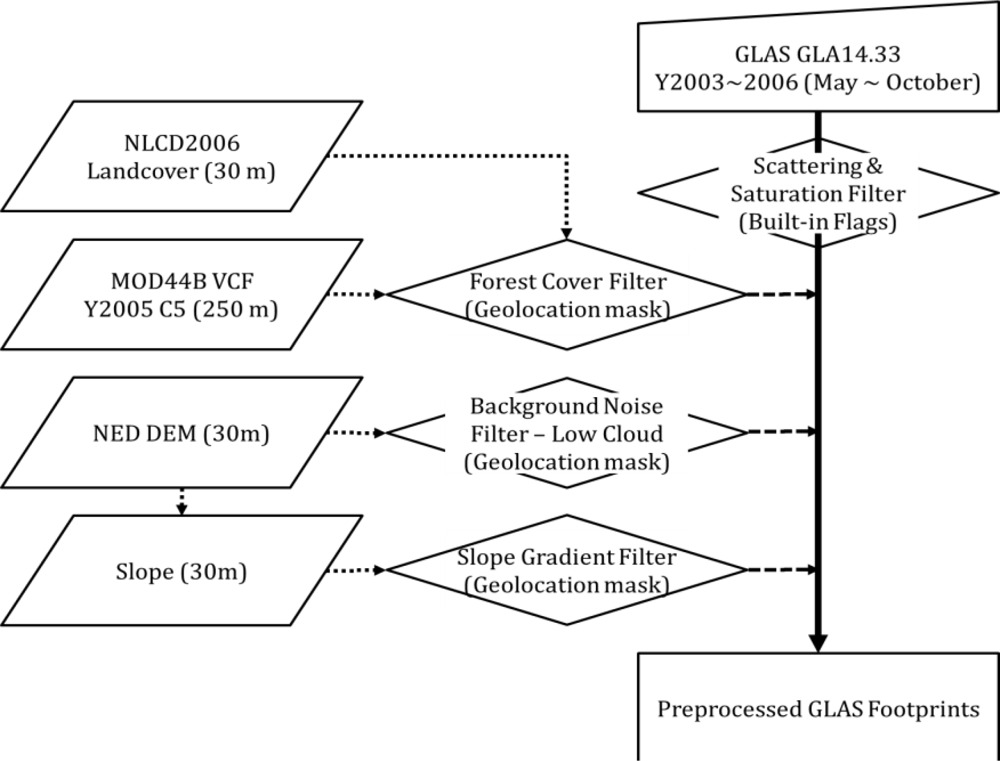
<p><xref ref-type="fig" rid="f1-remotesensing-05-00202">Figure 1</xref> depicts the sequential preprocessing/filtering steps for selecting valid GLAS waveforms. Data from May to October of each year were considered, as this period best approximates the growing season. GLAS data were further screened by applying several preprocessing filters, such as atmospheric forward scattering and signal saturation, background noise level correction and landcover mask conditions (<xref ref-type="supplementary-material" rid="SD1">Section S2.2, S2.3, S3</xref>, and <xref ref-type="supplementary-material" rid="SD1">Figure S3</xref> for preprocessing datasets). GLAS footprints have a coarser spatial resolution (70 m) than some preprocessing datasets (e.g., National Land Cover Database is at 30 m spatial resolution). A GLAS footprint is possibly located over heterogeneous forest types and topographic conditions. This study used preprocessing data values of nearest pixels to the center of a GLAS footprint as the normalized lidar intensity of GLAS data peaks at the center of footprint [<xref ref-type="bibr" rid="b37-remotesensing-05-00202">37</xref>].</p></sec>
<sec sec-type="methods">
<label>2.4.</label>
<title>Input Data for the ASRL Model</title>
<p>The ASRL model predicts potential tree heights. The model combines statistical allometric scaling laws with local energy budgets constrained by resource limitations such as water, radiation, wind and air temperature [<xref ref-type="bibr" rid="b17-remotesensing-05-00202">17</xref>]. The model is driven by input climatic variables and tree trait parameters. Input climatic variables are annual incoming solar radiation, annual total precipitation, annual average temperature, annual average wind speed and annual average relative humidity. Additionally, Leaf Area Index (LAI) and Digital Elevation Model (DEM) are required for initializing the model. <xref ref-type="supplementary-material" rid="SD1">Table S1</xref> lists the input datasets (climatic and ancillary data).</p>
<sec sec-type="methods">
<label>2.4.1.</label>
<title>FLUXNET Data</title>
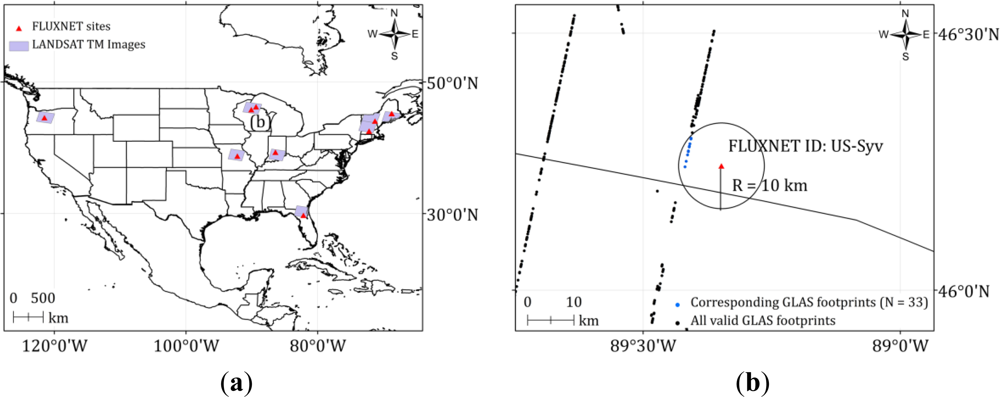
<p>The analysis in this paper is focused on sites from the FLUXNET network [<xref ref-type="bibr" rid="b43-remotesensing-05-00202">43</xref>]. We chose 12 sites, amongst the 71 sites over the CONUS, based on distance between a site and valid GLAS footprints (≤10 km radius; <xref ref-type="fig" rid="f2-remotesensing-05-00202">Figure 2</xref> and <xref ref-type="table" rid="t3-remotesensing-05-00202">Table 3</xref>). Annual total precipitation and annual average temperature data (from 2001 to 2006) were obtained from the selected sites.</p></sec>
<sec sec-type="methods">
<label>2.4.2.</label>
<title>DAYMET Data</title>
<p>The FLUXNET datasets do not contain all the input climatic variables required by the ASRL model. Annual incoming solar radiation, annual average wind speed and annual average vapor pressure were therefore obtained from the DAYMET database [<xref ref-type="bibr" rid="b44-remotesensing-05-00202">44</xref>] at a spatial resolution of 1 km. DAYMET climatic values were extracted from pixels nearest to our study sites. Annual vapor pressure was converted into annual relative humidity using a formula provided by the World Meteorological Organization (WMO) [<xref ref-type="bibr" rid="b45-remotesensing-05-00202">45</xref>].</p></sec>
<sec sec-type="methods">
<label>2.4.3.</label>
<title>Ancillary Data for the ASRL Model (LAI and DEM)</title>
<p>The ASRL model requires two ancillary variables: (a) LAI and (b) DEM. Several Landsat TM scenes (<xref ref-type="fig" rid="f2-remotesensing-05-00202">Figure 2(a)</xref>) were obtained for the period 2003 to 2006 with near-similar acquisition dates (June to September) as the GLAS waveform data. The Landsat Ecosystem Disturbance Adaptive Processing System [<xref ref-type="bibr" rid="b46-remotesensing-05-00202">46</xref>] and a physically-based algorithm [<xref ref-type="bibr" rid="b47-remotesensing-05-00202">47</xref>] were used to retrieve LAI values. As with the DAYMET data, we extracted LAI and DEM values of the pixels nearest to the study sites. Neighboring pixels in a 3 × 3 window showed minimal variability in both LAI and DEM at 30 m spatial resolution (absolute variation coefficients &lt;5%).</p></sec></sec></sec>
<sec sec-type="methods">
<label>3.</label>
<title>Methods</title>
<sec>
<label>3.1.</label>
<title>GLAS Metric Selection</title>
<p>Prior to the optimization of the ASRL model with GLAS tree heights, we perform an exercise finding the best GLAS metric that closely corresponds to field-measured and LVIS derived tree heights. This analysis is based on two premises: (a) canopy height derived from LVIS data is related to field-measured tree height as reported in previous studies [<xref ref-type="bibr" rid="b2-remotesensing-05-00202">2</xref>,<xref ref-type="bibr" rid="b37-remotesensing-05-00202">37</xref>,<xref ref-type="bibr" rid="b48-remotesensing-05-00202">48</xref>–<xref ref-type="bibr" rid="b50-remotesensing-05-00202">50</xref>] and (b) the best GLAS metric, inferred from comparison of five GLAS metrics with LVIS tree heights, improves model optimization. Several recent articles have evaluated GLAS tree heights directly with field data [<xref ref-type="bibr" rid="b14-remotesensing-05-00202">14</xref>,<xref ref-type="bibr" rid="b51-remotesensing-05-00202">51</xref>–<xref ref-type="bibr" rid="b53-remotesensing-05-00202">53</xref>] and/or with airborne lidar data [<xref ref-type="bibr" rid="b37-remotesensing-05-00202">37</xref>,<xref ref-type="bibr" rid="b54-remotesensing-05-00202">54</xref>–<xref ref-type="bibr" rid="b56-remotesensing-05-00202">56</xref>].</p>
<p>The root mean square error (RMSE) and R<sup>2</sup> (from the linear-regression) are used to determine how well tree heights are related to each other in the inter-comparisons among field-measured, LVIS, and GLAS derived tree heights. Systematic errors related to biases in measurements are additionally considered in the interpretation of results.</p>
<sec>
<label>3.1.1.</label>
<title>Comparison between Field-Measured and LVIS Tree Heights</title>
<p>Field-measured datasets used in this study differed in their sampling methodologies and plot designs. Also, the coordinates of individual trees were not recorded in every measurement campaign/census. This precluded a footprint-level comparison between field-measured and LVIS tree heights, unlike in some previous studies [<xref ref-type="bibr" rid="b2-remotesensing-05-00202">2</xref>,<xref ref-type="bibr" rid="b48-remotesensing-05-00202">48</xref>]. Therefore, we performed comparisons at the plot-level by calculating representative tree height values from field measurements and LVIS data, which were defined as the average of the top 25% tree heights in each of the subplots (e.g., <xref ref-type="supplementary-material" rid="SD1">Figure S4</xref>). This approach minimizes overestimations (e.g., using only three highest values [<xref ref-type="bibr" rid="b37-remotesensing-05-00202">37</xref>]) or underestimations (e.g., using all values [<xref ref-type="bibr" rid="b2-remotesensing-05-00202">2</xref>]) if there are large numbers of field-measured trees and LVIS footprints in a subplot. The RMSE is calculated using <xref ref-type="disp-formula" rid="FD1">Equation 1</xref>.
<disp-formula id="FD1">
<label>(1)</label>
<mml:math id="mm1" display="block">
<mml:mrow>
<mml:msub>
<mml:mrow>
<mml:mi mathvariant="italic">RMSE</mml:mi></mml:mrow>
<mml:mrow>
<mml:mi mathvariant="italic">field</mml:mi>
<mml:mi> </mml:mi>
<mml:mi mathvariant="italic">vs</mml:mi>
<mml:mo>.</mml:mo>
<mml:mi> </mml:mi>
<mml:mi mathvariant="italic">LVIS</mml:mi></mml:mrow></mml:msub>
<mml:mo>=</mml:mo>
<mml:msqrt>
<mml:mrow>
<mml:mfrac>
<mml:mrow>
<mml:munderover>
<mml:mo>∑</mml:mo>
<mml:mrow>
<mml:mi>i</mml:mi>
<mml:mo>=</mml:mo>
<mml:mn>1</mml:mn></mml:mrow>
<mml:mi>n</mml:mi></mml:munderover>
<mml:mrow>
<mml:msup>
<mml:mrow>
<mml:mo>(</mml:mo>
<mml:mrow>
<mml:msub>
<mml:mrow>
<mml:mover accent="true">
<mml:mi>H</mml:mi>
<mml:mo>¯</mml:mo></mml:mover></mml:mrow>
<mml:mrow>
<mml:mi mathvariant="italic">field</mml:mi>
<mml:mi> </mml:mi>
<mml:mi mathvariant="italic">measured</mml:mi>
<mml:mo>,</mml:mo>
<mml:mi> </mml:mi>
<mml:mi>i</mml:mi></mml:mrow></mml:msub>
<mml:mo>−</mml:mo>
<mml:msub>
<mml:mrow>
<mml:mover accent="true">
<mml:mi>H</mml:mi>
<mml:mo>¯</mml:mo></mml:mover></mml:mrow>
<mml:mrow>
<mml:mi mathvariant="italic">LVIS</mml:mi>
<mml:mo>,</mml:mo>
<mml:mi> </mml:mi>
<mml:mi>i</mml:mi></mml:mrow></mml:msub></mml:mrow>
<mml:mo>)</mml:mo></mml:mrow>
<mml:mn>2</mml:mn></mml:msup></mml:mrow></mml:mrow>
<mml:mi>n</mml:mi></mml:mfrac></mml:mrow></mml:msqrt></mml:mrow></mml:math></disp-formula>here <italic>H̄<sub>field-measured</sub></italic> is the mean height of top 25% of field-measured trees in a subplot, <italic>H̄<sub>LVIS</sub></italic> refers to the mean value of top 25% LVIS tree heights in the same subplot and <italic>i</italic> corresponds to the sample subplot (<italic>n</italic> = 82) as shown in <xref ref-type="table" rid="t1-remotesensing-05-00202">Table 1</xref>.</p></sec>
<sec>
<label>3.1.2.</label>
<title>Comparison between LVIS Tree Heights and GLAS Height Metrics</title>
<p>Three standard altimetry variables are available from the GLA14 product based on the Gaussian decomposition approach [<xref ref-type="bibr" rid="b57-remotesensing-05-00202">57</xref>]: (a) signal begin range increment, <italic>SigBegOff</italic>, (b) signal end range increment, <italic>SigEndOff</italic> and (c) centroid range increment for the last Gaussian Peak, <italic>gpCntRngOff 1</italic>. Theoretically, <italic>gpCntRngOff 1</italic> and <italic>SigEndOff</italic> are assumed to represent the ground level elevation within a GLAS field-of-view, while <italic>SigBegOff</italic> refers to the highest point of a surface. In practice, <italic>(SigBegOff</italic> − <italic>SigEndOff)</italic> and <italic>(SigBegOff</italic> − <italic>gpCntRngOff 1)</italic> may not be identical due to topographic and roughness effects [<xref ref-type="bibr" rid="b37-remotesensing-05-00202">37</xref>]. There are five possible GLAS metrics representative of tree heights based on the Gaussian decomposition approach and topographic effect correction (<italic>H<sub>A–E</sub></italic> in <xref ref-type="table" rid="t4-remotesensing-05-00202">Table 4</xref> and <xref ref-type="supplementary-material" rid="SD1">Section S4</xref>).</p>
<p>The spatial correspondence between LVIS and GLAS footprints was determined using the maximum distance from the center of a GLAS footprint to any LVIS footprint (within ∼45 m; <xref ref-type="supplementary-material" rid="SD1">Figure S5</xref>). The RMSEs between LVIS heights and five possible GLAS height metrics were obtained from <xref ref-type="disp-formula" rid="FD2">Equation (2)</xref>:
<disp-formula id="FD2">
<label>(2)</label>
<mml:math id="mm2" display="block">
<mml:mrow>
<mml:msub>
<mml:mrow>
<mml:mi mathvariant="italic">RMSE</mml:mi></mml:mrow>
<mml:mrow>
<mml:mi>A</mml:mi>
<mml:mo>−</mml:mo>
<mml:mi>E</mml:mi></mml:mrow></mml:msub>
<mml:mo>=</mml:mo>
<mml:msqrt>
<mml:mrow>
<mml:mfrac>
<mml:mrow>
<mml:munderover>
<mml:mo>∑</mml:mo>
<mml:mrow>
<mml:mi>i</mml:mi>
<mml:mo>=</mml:mo>
<mml:mn>1</mml:mn></mml:mrow>
<mml:mrow>
<mml:msub>
<mml:mrow>
<mml:mi>n</mml:mi></mml:mrow>
<mml:mrow>
<mml:mi>A</mml:mi>
<mml:mo>−</mml:mo>
<mml:mi>E</mml:mi></mml:mrow></mml:msub></mml:mrow></mml:munderover>
<mml:mrow>
<mml:msup>
<mml:mrow>
<mml:mo>(</mml:mo>
<mml:mrow>
<mml:msub>
<mml:mrow>
<mml:mi>H</mml:mi>
<mml:mo>¯</mml:mo></mml:mrow>
<mml:mrow>
<mml:mi mathvariant="italic">GLAS</mml:mi>
<mml:mo>:</mml:mo>
<mml:mi>A</mml:mi>
<mml:mo>−</mml:mo>
<mml:mi>E</mml:mi>
<mml:mo>,</mml:mo>
<mml:mi> </mml:mi>
<mml:mi>i</mml:mi></mml:mrow></mml:msub>
<mml:mo>−</mml:mo>
<mml:msub>
<mml:mrow>
<mml:mover accent="true">
<mml:mi>H</mml:mi>
<mml:mo>¯</mml:mo></mml:mover></mml:mrow>
<mml:mrow>
<mml:mi mathvariant="italic">LVIS</mml:mi>
<mml:mo>,</mml:mo>
<mml:mi> </mml:mi>
<mml:mi>i</mml:mi></mml:mrow></mml:msub></mml:mrow>
<mml:mo>)</mml:mo></mml:mrow>
<mml:mn>2</mml:mn></mml:msup></mml:mrow></mml:mrow>
<mml:mrow>
<mml:msub>
<mml:mrow>
<mml:mi>n</mml:mi></mml:mrow>
<mml:mrow>
<mml:mi>A</mml:mi>
<mml:mo>−</mml:mo>
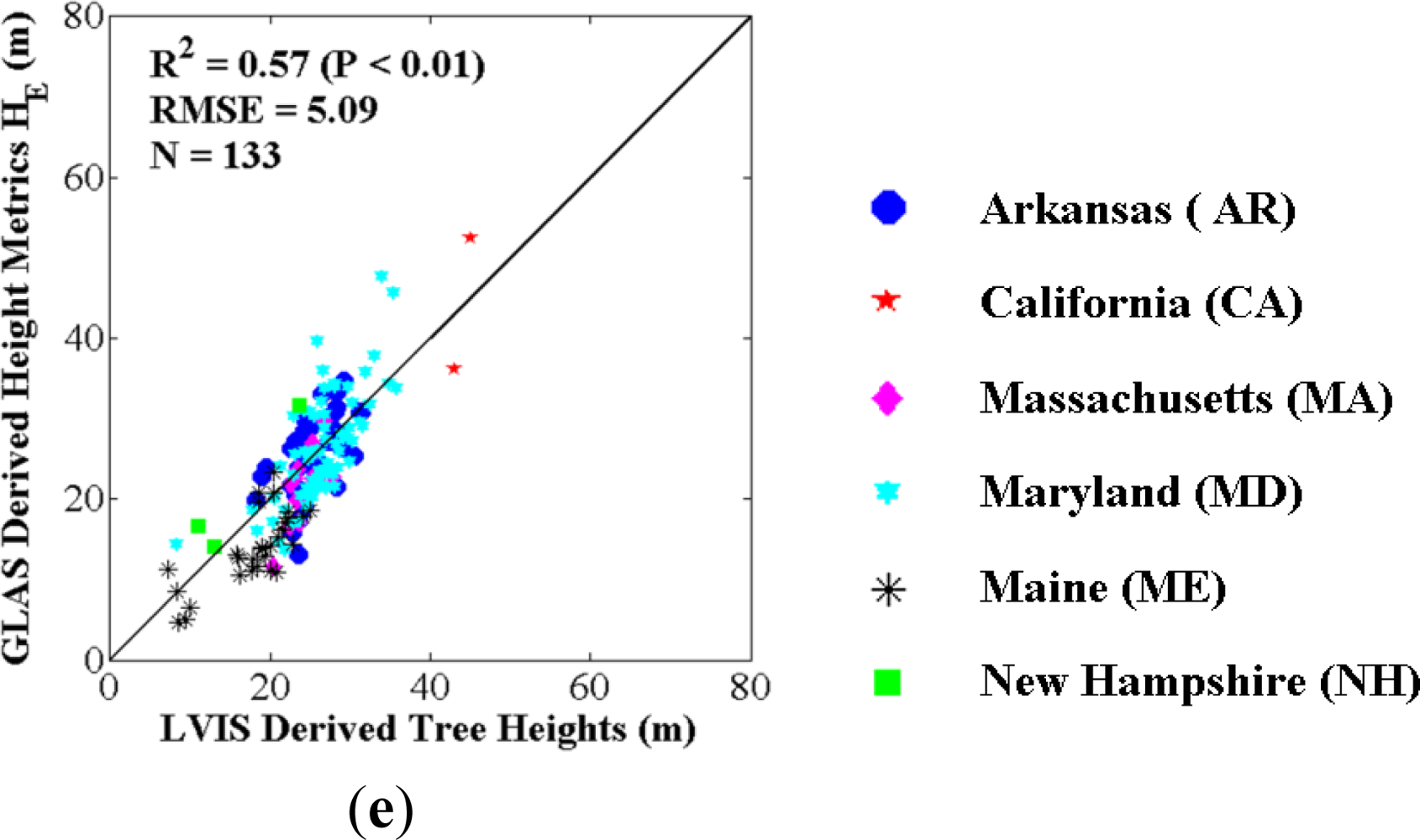
<mml:mi>E</mml:mi></mml:mrow></mml:msub></mml:mrow></mml:mfrac></mml:mrow></mml:msqrt></mml:mrow></mml:math></disp-formula>here <italic>H̄<sub>LVIS</sub></italic> is the mean value of top 25% of LVIS heights within a GLAS footprint, <italic>H<sub>GLAS</sub></italic> is GLAS tree heights, <italic>A–E</italic> refers to the five possible GLAS height metrics (<xref ref-type="table" rid="t4-remotesensing-05-00202">Table 4</xref>), and <italic>i</italic> represents the sample GLAS footprint (<italic>n</italic> = 133).</p>
<p>The result analyses were stratified into three groups, based on topographic conditions over the GLAS footprint, as low (slope ≤ 5°), intermediate (5° &lt; slope ≤ 10°) and high (10° &lt; slope ≤ 20°). All outliers were removed in this comparison exercise, <italic>i.e.</italic>, only GLAS tree heights within two standard deviations from the mean height were considered (∼95%; 5 m &lt; <italic>H<sub>A–E</sub></italic> ≤ 100 m).</p></sec></sec>
<sec>
<label>3.2.</label>
<title>ASRL Model Optimization</title>
<sec>
<label>3.2.1.</label>
<title>Initial ASRL Model Predictions (Potential Tree Heights)</title>
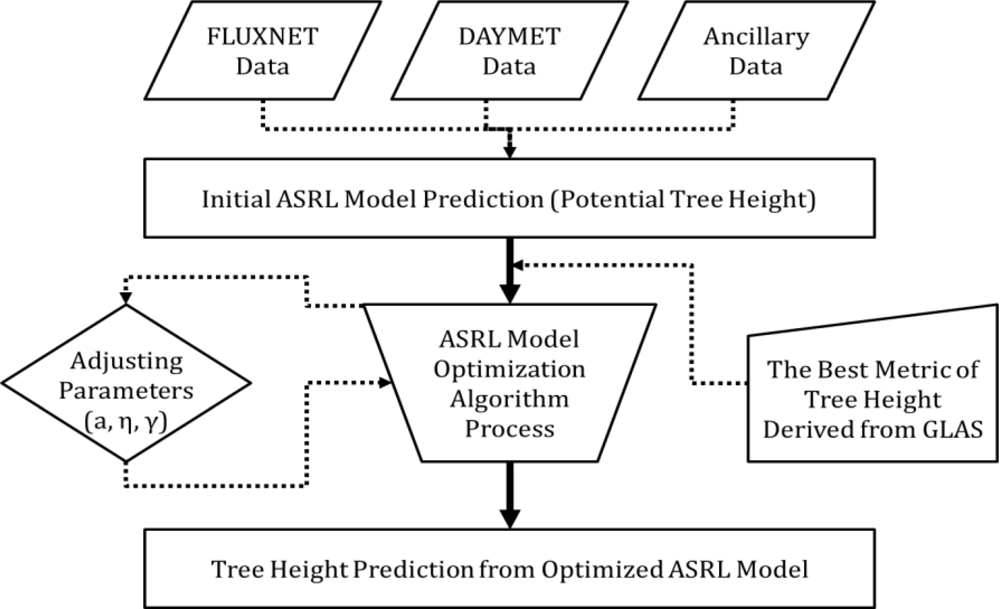
<p>The initial model runs are driven by input datasets and result in potential tree heights at each study site. Key climate input data (temperature and precipitation) are derived from FLUXNET sites. DAYMET, LAI, and DEM grids nearest to the study sites provide other climatic variables and ancillary data for the model runs. The unoptimized ASRL model predicts only potential tree heights considering hydraulic limits to tree growth. These differ from observations due to the fact that the unoptimized model applies homogeneous steady-state allometric scaling laws across different environmental conditions and forest types with varying age classes [<xref ref-type="bibr" rid="b27-remotesensing-05-00202">27</xref>].</p></sec>
<sec>
<label>3.2.2.</label>
<title>Optimized ASRL Model Predictions</title>
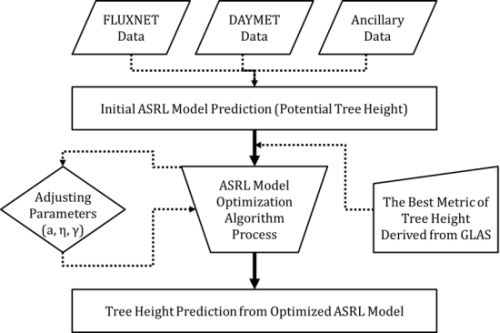
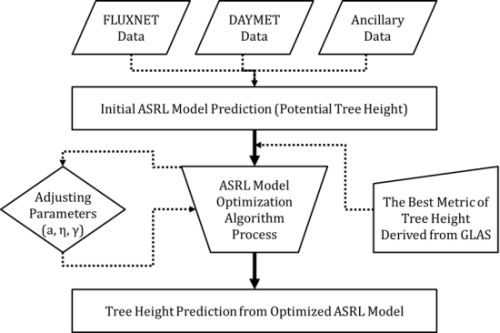
<p>Remote sensing based altimetry data, which provide actual tree heights, can alleviate the limitation of the unoptimized ASRL model related to different growing conditions and forest types with varying age classes. The model optimization is detailed in the first paper of this series [<xref ref-type="bibr" rid="b27-remotesensing-05-00202">27</xref>]. Model optimization is aimed at minimizing the difference between GLAS tree heights and model predictions (<xref ref-type="fig" rid="f3-remotesensing-05-00202">Figure 3</xref>) based on the Powell’s optimization methodology [<xref ref-type="bibr" rid="b28-remotesensing-05-00202">28</xref>]. A merit function was formulated and implemented from Press <italic>et al.</italic>[<xref ref-type="bibr" rid="b61-remotesensing-05-00202">61</xref>] and Kuusk and Nilson [<xref ref-type="bibr" rid="b62-remotesensing-05-00202">62</xref>]. It finds the maximum likelihood estimates of each parameter that result in minimizing the merit function. Amongst the five GLAS height metrics, the model optimization uses the best GLAS metric that is closest to the field-measured and LVIS tree heights.</p>
<p>Three model parameters are iteratively adjusted during optimization: (a) area of single leaf, α, (b) exponent for canopy radius, η, and (c) root absorption efficiency, γ. The respective initial values are 13 cm<sup>2</sup>, 1.14, and 0.33 [<xref ref-type="bibr" rid="b17-remotesensing-05-00202">17</xref>]. α is related to the collection of solar radiation for plant growth, and it is used to calculate the coefficients for canopy transmissions. In the ASRL model, energy budget in a single leaf is accumulated to a canopy-level budget [<xref ref-type="bibr" rid="b17-remotesensing-05-00202">17</xref>]. The geometry of canopy is associated with η controlling the scaling of canopy radius with tree height. This derives the rate of absorbed solar radiation in the ASRL model [<xref ref-type="bibr" rid="b17-remotesensing-05-00202">17</xref>]. γ determines the available flow rate given the incoming rate of precipitation within the root capture area. Local γ varies depending on soil type and hydrology [<xref ref-type="bibr" rid="b17-remotesensing-05-00202">17</xref>]. To achieve convergence, the following ranges were used: 1 cm<sup>2</sup> ≤ α &lt; 100 cm<sup>2</sup>, 0.8 ≤ η &lt; 1.5, and 0.1 ≤ γ &lt; 0.8 (as in the TRY database [<xref ref-type="bibr" rid="b63-remotesensing-05-00202">63</xref>]). Kempes <italic>et al.</italic>[<xref ref-type="bibr" rid="b17-remotesensing-05-00202">17</xref>] tested η and γ individually in a sensitivity analysis. This study added α to the optimization scheme because the area of a leaf significantly varies across different eco-climatic regimes and forest types [<xref ref-type="bibr" rid="b64-remotesensing-05-00202">64</xref>,<xref ref-type="bibr" rid="b65-remotesensing-05-00202">65</xref>]. Also, α is an important parameter determining net radiation and fluxes of sensible and latent heat (e.g., [<xref ref-type="bibr" rid="b66-remotesensing-05-00202">66</xref>]).</p>
<p>Our approach has constraints due to a limited number of scaling parameters (α, η, and γ) explored in the model optimization and an assumption that allometric scaling laws at individual tree level are applicable at larger scales. In addition, a limitation of this study is that the model does not directly account for variation in forest stand age in the optimization process. Tree heights and growth rates are clearly related to forest stand ages [<xref ref-type="bibr" rid="b67-remotesensing-05-00202">67</xref>,<xref ref-type="bibr" rid="b68-remotesensing-05-00202">68</xref>], varying across different forest types and growing conditions. However, it does not necessarily mean that our methodology neglects forest stand ages in the estimation of tree heights. GLAS waveform data indirectly brings age information of forests into the ASRL model for the parametric optimization, as actual heights are associated with forest stand ages.</p></sec></sec>
<sec>
<label>3.3.</label>
<title>Evaluation of the Optimized ASRL Model Predictions</title>
<sec>
<label>3.3.1.</label>
<title>Two-Fold Cross Validation Approach</title>
<p>The performance of the optimized ASRL model is evaluated through comparisons against GLAS tree heights in this study. The two-fold cross validation technique is a common statistical approach that randomly divides original samples into two equal sets of training and test data. The first half of GLAS tree heights was used as a training dataset to optimize the model at a site. The test dataset was prepared by averaging the remaining half of GLAS tree heights at the same site. Training and test GLAS data are completely separated in the cross validation (<italic>i.e.</italic>, no overlapping each other). The RMSE is estimated to interpret the relationship between GLAS tree heights and optimized model predictions (<xref ref-type="disp-formula" rid="FD3">Equation (3)</xref>) along with R<sup>2</sup> from the linear regression.
<disp-formula id="FD3">
<label>(3)</label>
<mml:math id="mm3" display="block">
<mml:mrow>
<mml:msub>
<mml:mrow>
<mml:mi mathvariant="italic">RMSE</mml:mi></mml:mrow>
<mml:mrow>
<mml:mi mathvariant="italic">ASRL</mml:mi>
<mml:mi> </mml:mi>
<mml:mi>I</mml:mi></mml:mrow></mml:msub>
<mml:mo>=</mml:mo>
<mml:msqrt>
<mml:mrow>
<mml:mfrac>
<mml:mrow>
<mml:munderover>
<mml:mo>∑</mml:mo>
<mml:mrow>
<mml:mi>i</mml:mi>
<mml:mo>=</mml:mo>
<mml:mn>1</mml:mn></mml:mrow>
<mml:mi>n</mml:mi></mml:munderover>
<mml:mrow>
<mml:msup>
<mml:mrow>
<mml:mo>(</mml:mo>
<mml:mrow>
<mml:msub>
<mml:mrow>
<mml:mover accent="true">
<mml:mi>H</mml:mi>
<mml:mo>¯</mml:mo></mml:mover></mml:mrow>
<mml:mrow>
<mml:mi mathvariant="italic">GLAS</mml:mi>
<mml:mi> </mml:mi>
<mml:mi mathvariant="italic">test</mml:mi>
<mml:mo>,</mml:mo>
<mml:mi> </mml:mi>
<mml:mi>i</mml:mi></mml:mrow></mml:msub>
<mml:mo>−</mml:mo>
<mml:msub>
<mml:mrow>
<mml:mover accent="true">
<mml:mi>H</mml:mi>
<mml:mo>¯</mml:mo></mml:mover></mml:mrow>
<mml:mrow>
<mml:mi mathvariant="italic">opt</mml:mi>
<mml:mi> </mml:mi>
<mml:mi mathvariant="italic">ASRL</mml:mi>
<mml:mi> </mml:mi>
<mml:mi mathvariant="italic">training</mml:mi>
<mml:mo>,</mml:mo>
<mml:mi> </mml:mi>
<mml:mi>i</mml:mi></mml:mrow></mml:msub></mml:mrow>
<mml:mo>)</mml:mo></mml:mrow>
<mml:mn>2</mml:mn></mml:msup></mml:mrow></mml:mrow>
<mml:mi>n</mml:mi></mml:mfrac></mml:mrow></mml:msqrt></mml:mrow></mml:math></disp-formula>here <italic>H<sub>opt ASRL training</sub></italic> is the optimized model prediction using the GLAS training data at a site, <italic>H̄<sub>GLAS test</sub></italic> represents the mean of tree heights computed from the GLAS test data at the same site, and <italic>i</italic> refers to the site (<italic>n</italic> = 12).</p></sec>
<sec>
<label>3.3.2.</label>
<title>Bootstrapping Approach</title>
<p>A second evaluation of the optimized ASRL model was performed at the eco-climatic zone scale [<xref ref-type="bibr" rid="b27-remotesensing-05-00202">27</xref>]. Individual FLUXNET sites were grouped into eco-climatic zones (<xref ref-type="supplementary-material" rid="SD1">Figure S6</xref>). Each zone consisted of 1 to 2 FLUXNET sites at the most. We neglected zones where GLAS footprints were less than 50 based on the need for model optimization. Selected sites include Harvard Forest EMS Tower (US-Ha1), Howland Forest Main Tower (US-Ho1), Howland Forest West Tower (US-Ho2), Harvard Forest Hemlock Site (US-Ha2), Missouri Ozark Site (US-MOz), and Little Prospect Hill (US-LPH) within a total of five eco-climatic zones (<xref ref-type="supplementary-material" rid="SD1">Table S2</xref>).</p>
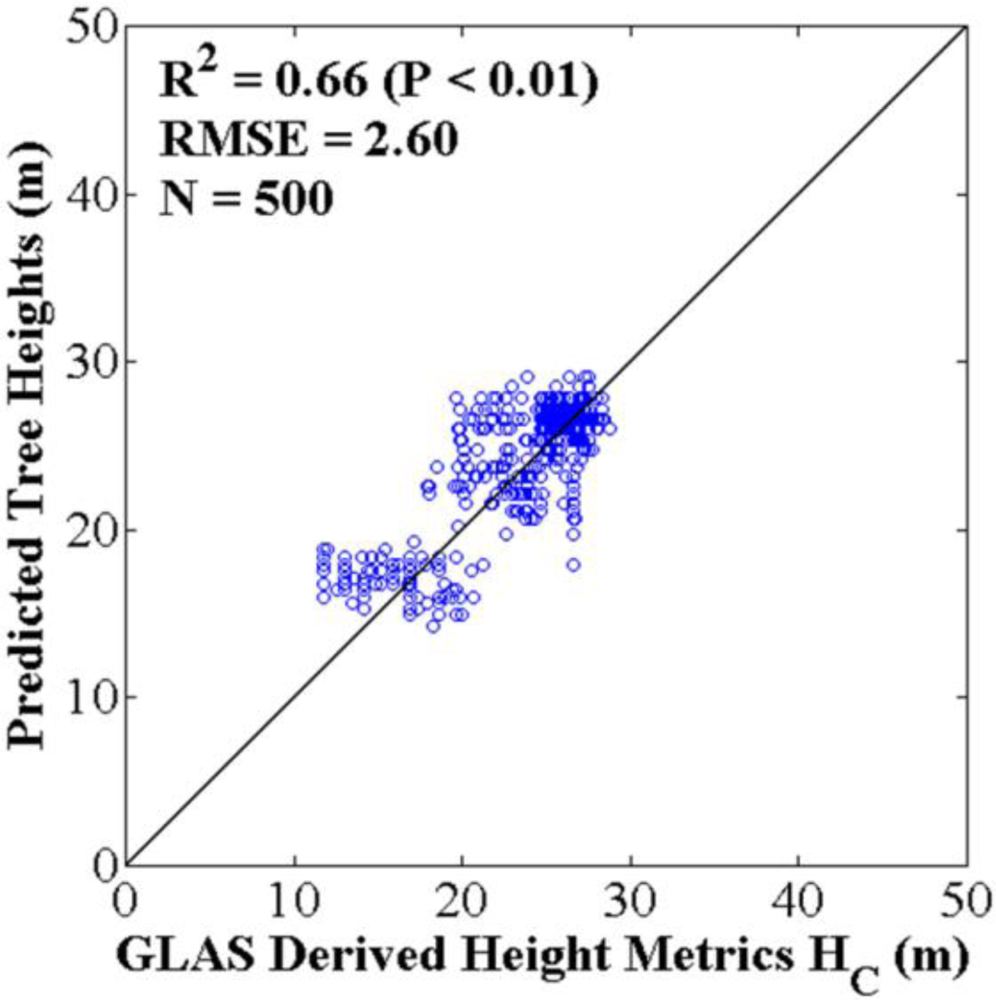
<p>A bootstrapping approach [<xref ref-type="bibr" rid="b69-remotesensing-05-00202">69</xref>] was applied to evaluate the optimized model predictions for the five zones. Corresponding GLAS footprints were randomly divided into two groups (training and test datasets). The bootstrapping generated extra comparison sets (subsamples, N = 100) to examine the stability of the results. Training subsamples of the GLAS tree heights were used for model optimization. The optimized ASRL model predictions were then compared to the average of tree heights derived from test subsamples by calculating the RMSE (<xref ref-type="disp-formula" rid="FD4">Equation 4</xref>). R<sup>2</sup> from the linear regression is additionally provided for the interpretation. Two groups of subsamples (training and test) also have no overlaps in each other.
<disp-formula id="FD4">
<label>(4)</label>
<mml:math id="mm4" display="block">
<mml:mrow>
<mml:msub>
<mml:mrow>
<mml:mi mathvariant="italic">RMSE</mml:mi></mml:mrow>
<mml:mrow>
<mml:mi mathvariant="italic">ASRL</mml:mi>
<mml:mi> </mml:mi>
<mml:mi mathvariant="italic">II</mml:mi></mml:mrow></mml:msub>
<mml:mo>=</mml:mo>
<mml:msqrt>
<mml:mrow>
<mml:mfrac>
<mml:mrow>
<mml:munderover>
<mml:mo>∑</mml:mo>
<mml:mrow>
<mml:mi>i</mml:mi>
<mml:mo>=</mml:mo>
<mml:mn>1</mml:mn></mml:mrow>
<mml:mi>n</mml:mi></mml:munderover>
<mml:mrow>
<mml:munderover>
<mml:mo>∑</mml:mo>
<mml:mrow>
<mml:mi>j</mml:mi>
<mml:mo>=</mml:mo>
<mml:mn>1</mml:mn></mml:mrow>
<mml:mrow>
<mml:mn>100</mml:mn></mml:mrow></mml:munderover>
<mml:mrow>
<mml:msup>
<mml:mrow>
<mml:mo>(</mml:mo>
<mml:mrow>
<mml:msub>
<mml:mrow>
<mml:mover accent="true">
<mml:mi>H</mml:mi>
<mml:mo>¯</mml:mo></mml:mover></mml:mrow>
<mml:mrow>
<mml:mi mathvariant="italic">GLAS</mml:mi>
<mml:mi> </mml:mi>
<mml:mi mathvariant="italic">test</mml:mi>
<mml:mo>,</mml:mo>
<mml:mi> </mml:mi>
<mml:mi>i</mml:mi>
<mml:mo>,</mml:mo>
<mml:mi>j</mml:mi></mml:mrow></mml:msub>
<mml:mo>−</mml:mo>
<mml:msub>
<mml:mrow>
<mml:mi>H</mml:mi></mml:mrow>
<mml:mrow>
<mml:mi mathvariant="italic">opt</mml:mi>
<mml:mi> </mml:mi>
<mml:mi mathvariant="italic">ASRL</mml:mi>
<mml:mi> </mml:mi>
<mml:mi mathvariant="italic">training</mml:mi>
<mml:mo>,</mml:mo>
<mml:mi> </mml:mi>
<mml:mi>i</mml:mi>
<mml:mo>,</mml:mo>
<mml:mi>j</mml:mi></mml:mrow></mml:msub></mml:mrow>
<mml:mo>)</mml:mo></mml:mrow>
<mml:mn>2</mml:mn></mml:msup></mml:mrow></mml:mrow></mml:mrow>
<mml:mi>n</mml:mi></mml:mfrac></mml:mrow></mml:msqrt></mml:mrow></mml:math></disp-formula>here <italic>H<sub>opt ASRL training</sub></italic> is the optimized model prediction using bootstrapping subsamples of training GLAS waveform data for a zone, <italic>H̄<sub>GLAS test</sub></italic> represents the mean of tree heights derived from test GLAS subsamples within the same zone, <italic>i</italic> refers to the sample eco-climatic zone (<italic>n</italic> = 5)<italic>,</italic> and <italic>j</italic> corresponds to the bootstrapping subsample (a total of 100 sets for a climatic zone).</p></sec></sec></sec>
<sec sec-type="results|discussion">
<label>4.</label>
<title>Results and Discussion</title>
<sec>
<label>4.1.</label>
<title>Best GLAS Height Metric from Inter-Comparisons with Field-Measured and LVIS Tree Heights</title>
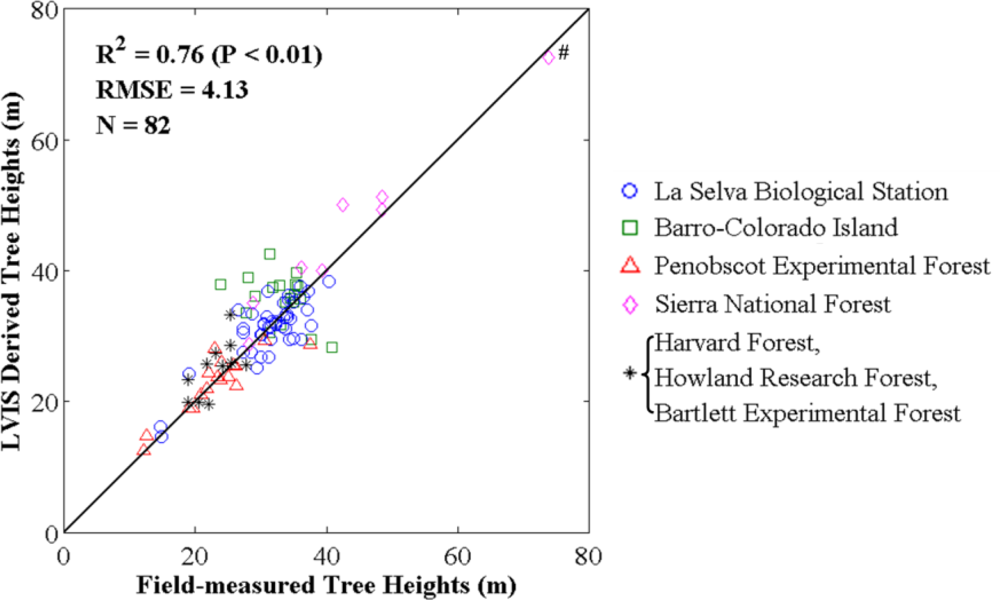
<p>We first performed a plot-level comparison between LVIS tree heights and field measurements (<xref ref-type="fig" rid="f4-remotesensing-05-00202">Figure 4</xref>). The statistical significance of this relationship (R<sup>2</sup> = 0.76 and RMSE = 4.13 m) is comparable to previous reports (footprint-level comparison [<xref ref-type="bibr" rid="b50-remotesensing-05-00202">50</xref>] and plot-level comparison [<xref ref-type="bibr" rid="b37-remotesensing-05-00202">37</xref>]). Some disagreements are due to differences in data acquisition times. For example, field measurements for the Penobscot Experimental Forest (Maine, USA) were conducted in 2009, while the LVIS data were acquired in 2003. Similarly, the LVIS acquisition date is six years prior to field measurements of the 2009 New England Campaign (<xref ref-type="table" rid="t1-remotesensing-05-00202">Table 1</xref>).</p>
<p>The average tree growth rates in study regions can be approximated using an equation of Shugart <italic>et al.</italic>[<xref ref-type="bibr" rid="b67-remotesensing-05-00202">67</xref>]. The map of forest age distribution in North America [<xref ref-type="bibr" rid="b70-remotesensing-05-00202">70</xref>] shows that forest stands are aged from 41 to 80 in New England (Maine, Massachusetts, and New Hampshire). We expect that tree growths in New England can be made roughly up to 1.3 m for 6 years.</p>
<p>Relatively large deviation is found in the results of Barro-Colorado Island. Two plausible reasons are associated with (a) tree growth rates of tropical forest and (b) terrain features and densely vegetated environment of the study area. Tropical forests increase more in size [<xref ref-type="bibr" rid="b71-remotesensing-05-00202">71</xref>] compared to USA forests for a similar period. This explains that field measured tree heights (year 2000) are larger than LVIS tree heights (year 1998). Another plausible reason for disagreements is that the LVIS is a large-footprint lidar (20 m), which is significantly affected by the topography and denseness of vegetation over the ground [<xref ref-type="bibr" rid="b72-remotesensing-05-00202">72</xref>]. Especially, Barro Colorado Island consists of dense tropical forest and some plots are located over steep terrains. This possibly decreases the measurement accuracy of LVIS data, inflating deviations.</p>
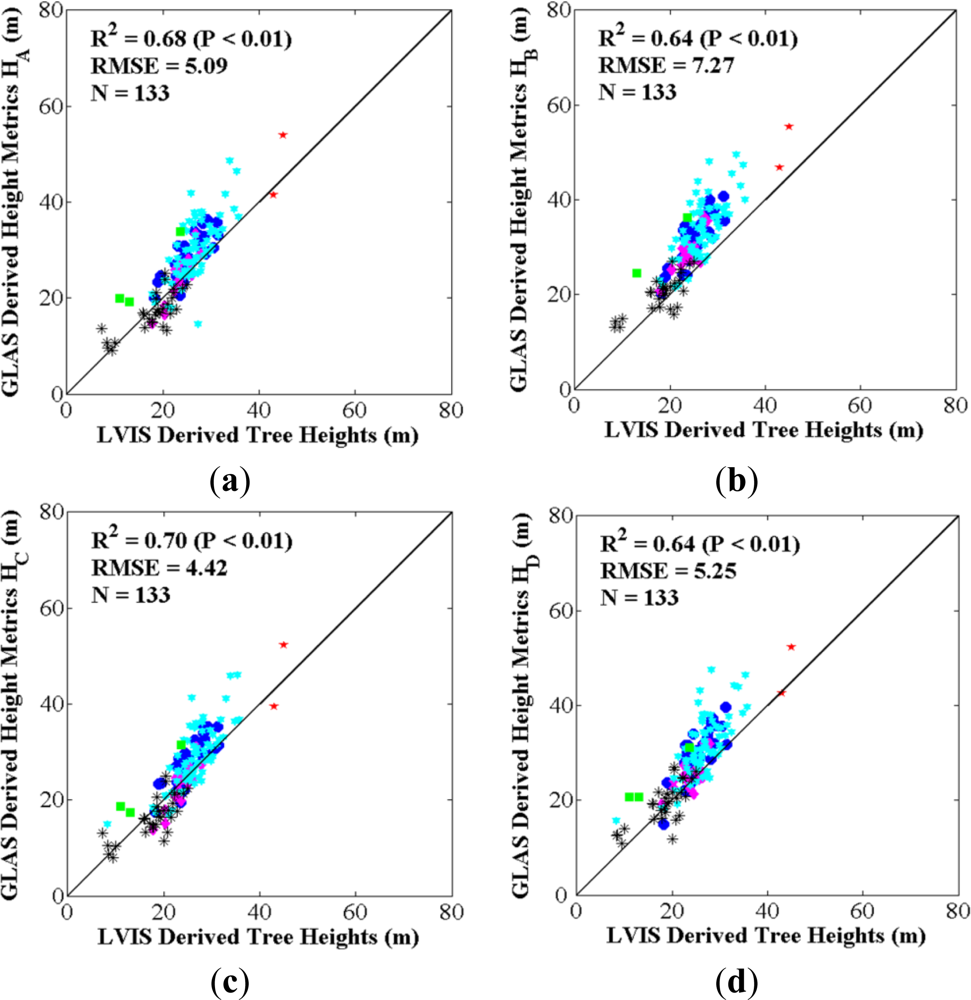
<p>Subsequent analysis was focused on comparison of five metrics derived from GLAS waveform data (<italic>H<sub>A–E</sub></italic>; <xref ref-type="table" rid="t4-remotesensing-05-00202">Table 4</xref>) with LVIS tree heights, at six sites with terrain slope condition ≤5°(<xref ref-type="fig" rid="f5-remotesensing-05-00202">Figure 5</xref>). Results for other slope categories are shown in <xref ref-type="supplementary-material" rid="SD1">Figure S7 and S8</xref>. We observed an overestimation of GLAS tree heights relative to LVIS tree heights, similar to previous studies [<xref ref-type="bibr" rid="b37-remotesensing-05-00202">37</xref>,<xref ref-type="bibr" rid="b56-remotesensing-05-00202">56</xref>]. Among the five GLAS height metrics, <italic>H<sub>C</sub></italic> was best correlated to LVIS tree heights (R<sup>2</sup> of 0.70 and RMSE of 4.42 m (P &lt; 0.01)). This metric was derived from the distance between the last Gaussian peak and signal beginning of the GLAS waveform and incorporated topographic effect correction. Overestimations are related to both topographic gradient effects and GLAS waveform parameters. The bias increased with increasing tree heights (<italic>H<sub>A</sub></italic> and <italic>H<sub>B</sub></italic>; <xref ref-type="fig" rid="f5-remotesensing-05-00202">Figure 5(a,b)</xref>), as previously noted in Lee <italic>et al.</italic>[<xref ref-type="bibr" rid="b37-remotesensing-05-00202">37</xref>]. Also, significant biases were generated for taller trees from use of the full GLAS waveform extents (<italic>H<sub>B</sub></italic> and <italic>H<sub>D</sub></italic>; <xref ref-type="fig" rid="f5-remotesensing-05-00202">Figure 5(b,d)</xref>). As shown in <xref ref-type="fig" rid="f5-remotesensing-05-00202">Figures 5e</xref>, a relatively low correlation with LVIS tree heights was obtained from the metric using all three GLAS waveform parameters (<italic>i.e.</italic>, signal begin, end, and the last Gaussian peak).</p>
<p>Similarly, for regions with intermediate slope condition (<xref ref-type="supplementary-material" rid="SD1">Figure S7</xref>) <italic>H<sub>C</sub></italic> was best correlated with LVIS tree height but with a lower R<sup>2</sup> and larger RMSE as compared to the low slope condition. In the case of high topographic gradients (<xref ref-type="supplementary-material" rid="SD1">Figure S8</xref>), <italic>H<sub>D</sub></italic> showed better correspondence with LVIS heights, however, the correlations were significantly lower for all five metrics.</p></sec>
<sec>
<label>4.2.</label>
<title>Optimized ASRL Model Predictions and Evaluations</title>
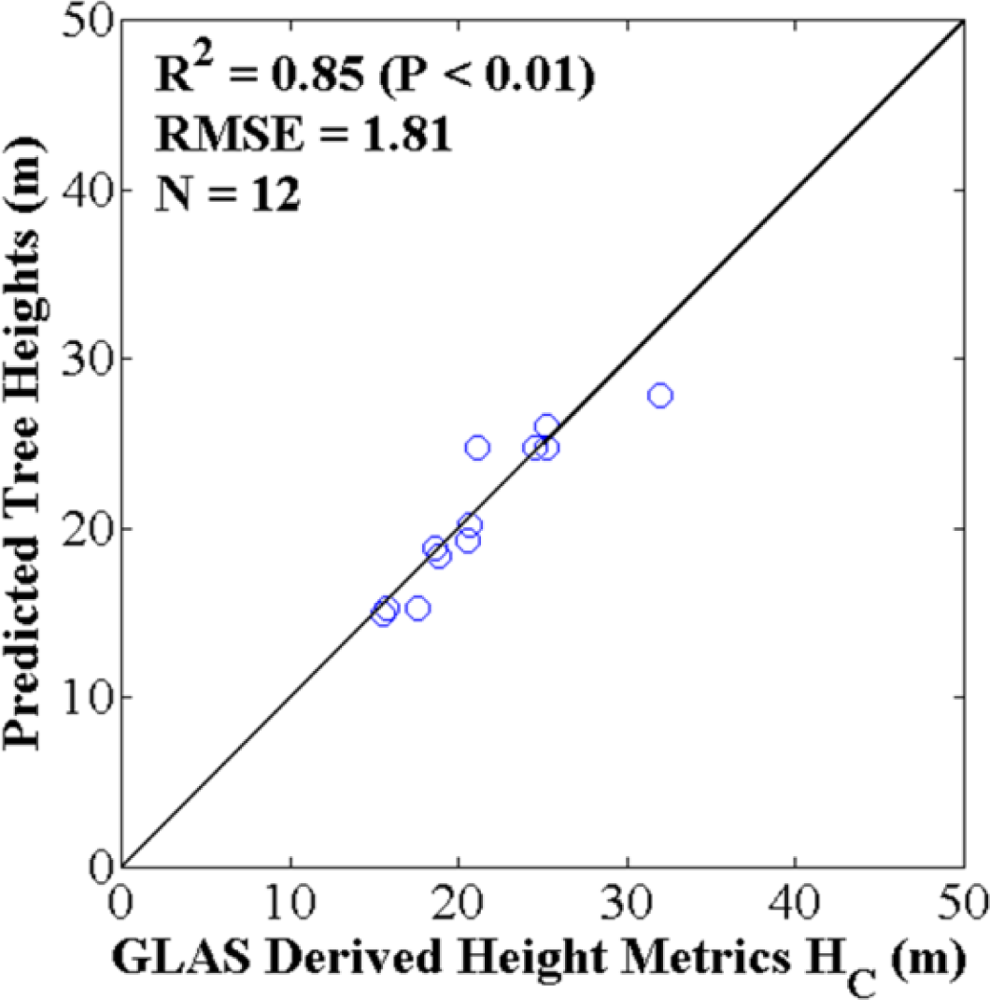
<p>The ASRL model was optimized using tree heights derived from the best GLAS height metric (<italic>i.e.</italic>, <italic>H<sub>C</sub></italic>; Section 4.1) for all the 12 FLUXNET sites. The number of sample GLAS tree heights in the two-fold cross validation varied from 5 to 34 depending on the site (<xref ref-type="supplementary-material" rid="SD1">Table S3</xref>). A statistically significant relationship (R<sup>2</sup> = 0.85; RMSE = 1.81 m; P &lt; 0.01) was obtained when comparing the optimized model predictions with the average of test GLAS tree heights (<xref ref-type="fig" rid="f6-remotesensing-05-00202">Figure 6</xref>). Kempes <italic>et al.</italic>[<xref ref-type="bibr" rid="b17-remotesensing-05-00202">17</xref>] similarly tested the adjustment of individual allometric parameters of the ASRL model (e.g., stomatal density and root absorption efficiency) but reported less variation in model errors from the sensitivity analysis.</p>
<p>The optimized values of allometric parameters for the study sites are listed in <xref ref-type="supplementary-material" rid="SD1">Table S3</xref>. There were notable adjustments in the optimized values of leaf size, α (initial value: 13.0 cm<sup>2</sup>). It varied from 14.0 cm<sup>2</sup> for the US-MMS site to 56.0 cm<sup>2</sup> for the US-Ha2 site. This supports the relative significance of selecting α as an additional allometric parameter in model optimization. The other two allometric parameters, exponent for canopy radius, η (initial value: 1.14) and root absorption efficiency, γ (initial value: 0.33), were also adjusted in the optimization with η values ranging from 0.94 for the US-MOz site to 1.24 for the US-Ha1 site and γ ranging from 0.19 for the US-Ho1 site to 0.38 for the US-SP3 site. These parameters were relatively stable compared to α, as previously reported by Kempes <italic>et al.</italic>[<xref ref-type="bibr" rid="b17-remotesensing-05-00202">17</xref>].</p>
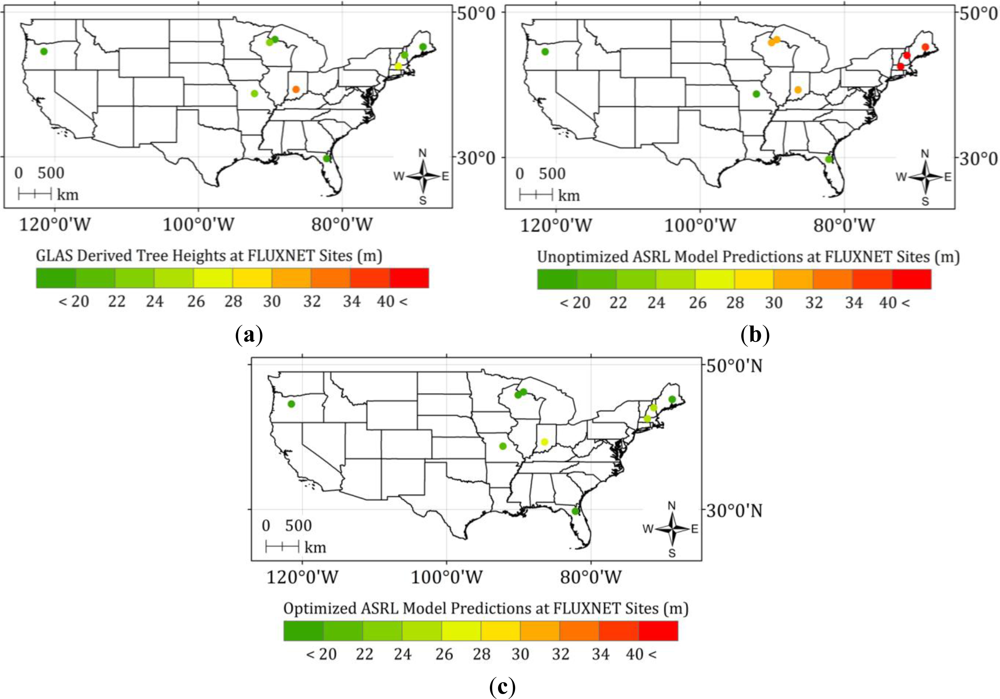
<p>Optimizing three parameters clearly improved model performance. <xref ref-type="fig" rid="f7-remotesensing-05-00202">Figure 7</xref> shows the distribution of tree heights over 12 FLUXNET sites. Compared to the unoptimized ASRL model predictions (<xref ref-type="fig" rid="f7-remotesensing-05-00202">Figure 7(b)</xref>), tree heights from the optimized ASRL model (<xref ref-type="fig" rid="f7-remotesensing-05-00202">Figure 7(c)</xref>) better resemble GLAS tree heights (<xref ref-type="fig" rid="f7-remotesensing-05-00202">Figure 7(a)</xref>). As shown in <xref ref-type="supplementary-material" rid="SD1">Figure S9</xref>, the variance of model errors to the actual observation, “(<italic>GLAS tree heights</italic>—<italic>Predicted tree heights</italic>)/<italic>GLAS tree heights</italic>” [<xref ref-type="bibr" rid="b17-remotesensing-05-00202">17</xref>], decreased from 0.53 (without optimization) to 0.01 (after optimization).</p>
<p>We performed a second evaluation of the optimized ASRL model at the eco-climatic zone scale (<xref ref-type="supplementary-material" rid="SD1">Table S2</xref>). Cold and drier regions are characterized by the zone ID 2, while zone ID 1, 3 and 5 represent cold and wetter regions. Zone ID 4 is located in the relatively warm and dry region. This definition of eco-climatic zones is comparable to the traditional eco-climatic zones (e.g., Holdridge life zones [<xref ref-type="bibr" rid="b73-remotesensing-05-00202">73</xref>])—zone ID 1, 3 and 5 are related to the <italic>Cool Temperate Wet Forest</italic>, while ID 2 and 4 represent the <italic>Cool Temperate Moist Forest</italic> and <italic>Warm Temperate Dry Forest</italic>, respectively.</p>
<p>As shown by the bootstrapping evaluation approach (<xref ref-type="fig" rid="f8-remotesensing-05-00202">Figure 8</xref>), the optimized model satisfactorily predicted tree heights (R<sup>2</sup> = 0.66; RMSE = 2.60 m; P &lt; 0.01). The model’s error variance decreased from 0.60 to 0.02 after optimization (<xref ref-type="supplementary-material" rid="SD1">Figure S10</xref>). Overall, the optimization successfully alleviated the effect of different environmental conditions and forest types and thus generated a more robust prediction of tree heights at a local scale, as indicated by the results of the two evaluation approaches. However, our approach did not consider the error propagation related to uncertainties in such input climatic variables and the GLAS waveform data, which are critical inputs to the optimized ASRL model. Input climate data may have produced large uncertainties due to the interpolation of climatic variables that are sensitive to terrain conditions (e.g., [<xref ref-type="bibr" rid="b74-remotesensing-05-00202">74</xref>,<xref ref-type="bibr" rid="b75-remotesensing-05-00202">75</xref>]). Model predictions and evaluations carry certain constraints that GLAS tree heights are taken as true values of tree heights in spite of inherent uncertainties in GLAS waveform data: topographic effects [<xref ref-type="bibr" rid="b55-remotesensing-05-00202">55</xref>] might not be completely corrected from GLAS data. In addition, GLAS undersampling for some of the climatic zones results in fewer comparison sets in the optimization process, that is, increasing uncertainties.</p></sec></sec>
<sec>
<label>5.</label>
<title>Concluding Remarks</title>
<p>The Allometric Scaling and Resource Limitations (ASRL) model optimized with the Geoscience Laser Altimeter System (GLAS) waveform data was tested at site scale (12 FLUXNET sites over the continental USA) in this second of a multi-article series. The model predicts potential tree heights based on local energy budgets limited by water, radiation, wind and air temperature. Predicted potential tree heights differ from observations due to homogeneous scaling parameters and exponents across different eco-climatic zones and forest types with varying age classes. Model optimization in this study is aimed at minimizing the difference between model predictions and observations (<italic>i.e.</italic>, GLAS tree heights). This study considered three allometric parameters (area of single leaf, α; exponent for canopy radius, η; and root absorption efficiency, γ) for model optimization.</p>
<p>Amongst the five GLAS metrics (<italic>H<sub>A–E</sub></italic>) indicative of tree heights, the best GLAS metric (<italic>H<sub>C</sub></italic>) was used in model optimization. We conducted comparisons showing the closeness between: (a) Laser Vegetation Imaging Sensor (LVIS) tree heights and field measurements (R<sup>2</sup> = 0.76; RMSE = 4.13 m) and (b) the five GLAS metrics of tree heights and LVIS tree heights (R<sup>2</sup> = 0.70; RMSE = 4.42 m for <italic>H<sub>C</sub></italic>). This best GLAS metric (<italic>H<sub>C</sub></italic>) was retrieved from the distance between the last Gaussian peak and signal beginning of the GLAS waveform and incorporated topographic effect correction.</p>
<p>The optimized model prediction was evaluated using two-fold cross validation and bootstrapping exercises. Predicted tree heights explained 85% of the variability in GLAS tree heights and on average showed an estimation error of 1.81 units of height from the two-fold cross validation approach at the studied sites. The variance of model errors to observation decreased from 0.53 to 0.01 after model optimization. In the case of bootstrapping, the study sites were stratified into five eco-climatic zones based on dominant forest type, annual total precipitation and annual average temperature. This exercise also resulted in a satisfactory prediction of GLAS tree heights by the optimized model (R<sup>2</sup> = 0.66; RMSE = 2.60 m) and a decrease in model error variance from 0.60 to 0.02 after optimization.</p>
<p>This investigation at site scale provides evidence corroborating our initial study [<xref ref-type="bibr" rid="b27-remotesensing-05-00202">27</xref>] to the need for optimization and utility of the ASRL model with the ultimate goal of generating spatially continuous maps of tree heights and biomass. Optimization with remote sensing altimetry data successfully takes into account the external effect imposed by different eco-climatic regimes and forest types. The ASRL model was clearly improved by the parametric optimization showing the potential of the model in mapping tree heights. Nevertheless, the results from this site-specific analysis cannot be generalized due to the limited number of study sites and available GLAS waveform data. The studied sites did not cover the full range of precipitation, temperature and forest types prevalent across the continental USA. The optimized ASRL model has certain limitations due to (a) uncertainties of input climate and GLAS data and (b) a limited number of parameters explored in the optimization. Also, forest stand ages were not directly involved in the model optimization.</p>
<p>Forthcoming investigations will focus on extending the model formulation using similar concepts for the estimation of woody biomass (next two articles in preparation). Also, our approach will be tested over different study locations (e.g., China and Amazon Basin) to generalize the results for mapping global tree heights and biomass. A future research will be conducted over Amazon Basin where eco-climatic regimes and forest types are quite different from the CONUS. The availability of input climate data with good quality is certainly a challenge in this study region. Additionally, eco-climatic regimes and forest types of some regions in China may resemble those of the CONUS, but scaling parameters of the ASRL model are not necessarily identical. Hence, we will investigate the feasibility of the ASRL model in various regions by obtaining the appropriate scaling parameters.</p></sec>
<sec sec-type="supplementary-material">
<title>Supplementary Information</title>
<supplementary-material id="SD1" content-type="local-data">
<media mimetype="image" mime-subtype="pdf" xlink:href="remotesensing-05-00202-s001.pdf"/></supplementary-material></sec></body>
<back>
<ack>
<p>This study was partially funded by the National Natural Science Foundation of China (grants no. 40801139 and 41175077), China Scholarship Council and the Fulbright Foundation.</p></ack>
<ref-list>
<title>References</title>
<ref id="b1-remotesensing-05-00202"><label>1.</label><citation citation-type="journal"><person-group person-group-type="author"><name><surname>Clark</surname><given-names>D.B.</given-names></name><name><surname>Clark</surname><given-names>D.A.</given-names></name></person-group><article-title>Landscape-scale variation in forest structure and biomass in a tropical rain forest</article-title><source>Forest Ecol. Manage</source><year>2000</year><volume>137</volume><fpage>185</fpage><lpage>198</lpage><pub-id pub-id-type="doi">10.1016/S0378-1127(99)00327-8</pub-id></citation></ref>
<ref id="b2-remotesensing-05-00202"><label>2.</label><citation citation-type="journal"><person-group person-group-type="author"><name><surname>Drake</surname><given-names>J.B.</given-names></name><name><surname>Dubayah</surname><given-names>R.O.</given-names></name><name><surname>Clark</surname><given-names>D.B.</given-names></name><name><surname>Knox</surname><given-names>R.G.</given-names></name><name><surname>Blair</surname><given-names>J.B.</given-names></name><name><surname>Hofton</surname><given-names>M.A.</given-names></name><name><surname>Chazdon</surname><given-names>R.L.</given-names></name><name><surname>Weishampel</surname><given-names>J.F.</given-names></name><name><surname>Prince</surname><given-names>S.D.</given-names></name></person-group><article-title>Estimation of tropical forest structural characteristics using large-footprint lidar</article-title><source>Remote Sens. Environ</source><year>2002</year><volume>79</volume><fpage>305</fpage><lpage>319</lpage><pub-id pub-id-type="doi">10.1016/S0034-4257(01)00281-4</pub-id></citation></ref>
<ref id="b3-remotesensing-05-00202"><label>3.</label><citation citation-type="journal"><person-group person-group-type="author"><name><surname>Muraoka</surname><given-names>H.</given-names></name><name><surname>Koizumi</surname><given-names>H.</given-names></name></person-group><article-title>Satellite Ecology (SATECO)-linking ecology, remote sensing and micrometeorology, from plot to regional scale, for the study of ecosystem structure and function</article-title><source>J. Plant Res</source><year>2009</year><volume>122</volume><fpage>3</fpage><lpage>20</lpage><pub-id pub-id-type="doi">10.1007/s10265-008-0188-2</pub-id><pub-id pub-id-type="pmid">18958540</pub-id></citation></ref>
<ref id="b4-remotesensing-05-00202"><label>4.</label><citation citation-type="journal"><person-group person-group-type="author"><name><surname>Laumonier</surname><given-names>Y.</given-names></name><name><surname>Edin</surname><given-names>A.</given-names></name><name><surname>Kanninen</surname><given-names>M.</given-names></name><name><surname>Munandar</surname><given-names>A.W.</given-names></name></person-group><article-title>Landscape-scale variation in the structure and biomass of the hill dipterocarp forest of Sumatra: Implications for carbon stock assessments</article-title><source>Forest Ecol. Manage</source><year>2010</year><volume>259</volume><fpage>505</fpage><lpage>513</lpage><pub-id pub-id-type="doi">10.1016/j.foreco.2009.11.007</pub-id></citation></ref>
<ref id="b5-remotesensing-05-00202"><label>5.</label><citation citation-type="journal"><person-group person-group-type="author"><name><surname>Rautiainen</surname><given-names>A.</given-names></name><name><surname>Wernick</surname><given-names>I.</given-names></name><name><surname>Waggoner</surname><given-names>P.E.</given-names></name><name><surname>Ausubel</surname><given-names>J.H.</given-names></name><name><surname>Kauppi</surname><given-names>P.E.</given-names></name></person-group><article-title>A National and international analysis of changing forest density</article-title><source>Plos One</source><year>2011</year><volume>6</volume><pub-id pub-id-type="doi">10.1371/journal.pone.0019577</pub-id></citation></ref>
<ref id="b6-remotesensing-05-00202"><label>6.</label><citation citation-type="journal"><person-group person-group-type="author"><name><surname>Gonzalez</surname><given-names>P.</given-names></name><name><surname>Tucker</surname><given-names>C.J.</given-names></name><name><surname>Sy</surname><given-names>H.</given-names></name></person-group><article-title>Tree density and species decline in the African Sahel attributable to climate</article-title><source>J. Arid Environ</source><year>2012</year><volume>78</volume><fpage>55</fpage><lpage>64</lpage><pub-id pub-id-type="doi">10.1016/j.jaridenv.2011.11.001</pub-id></citation></ref>
<ref id="b7-remotesensing-05-00202"><label>7.</label><citation citation-type="journal"><person-group person-group-type="author"><name><surname>Liski</surname><given-names>J.</given-names></name><name><surname>Korotkov</surname><given-names>A.V.</given-names></name><name><surname>Prins</surname><given-names>C.F.L.</given-names></name><name><surname>Karjalainen</surname><given-names>T.</given-names></name><name><surname>Victor</surname><given-names>D.G.</given-names></name><name><surname>Kauppi</surname><given-names>P.E.</given-names></name></person-group><article-title>Increased carbon sink in temperate and boreal forests</article-title><source>Climatic Change</source><year>2003</year><volume>61</volume><fpage>89</fpage><lpage>99</lpage><pub-id pub-id-type="doi">10.1023/A:1026365005696</pub-id></citation></ref>
<ref id="b8-remotesensing-05-00202"><label>8.</label><citation citation-type="journal"><person-group person-group-type="author"><name><surname>Kauppi</surname><given-names>P.E.</given-names></name><name><surname>Rautiainen</surname><given-names>A.</given-names></name><name><surname>Korhonen</surname><given-names>K.T.</given-names></name><name><surname>Lehtonen</surname><given-names>A.</given-names></name><name><surname>Liski</surname><given-names>J.</given-names></name><name><surname>Nojd</surname><given-names>P.</given-names></name><name><surname>Tuominen</surname><given-names>S.</given-names></name><name><surname>Haakana</surname><given-names>M.</given-names></name><name><surname>Virtanen</surname><given-names>T.</given-names></name></person-group><article-title>Changing stock of biomass carbon in a boreal forest over 93 years</article-title><source>Forest Ecol. Manage</source><year>2010</year><volume>259</volume><fpage>1239</fpage><lpage>1244</lpage><pub-id pub-id-type="doi">10.1016/j.foreco.2009.07.044</pub-id></citation></ref>
<ref id="b9-remotesensing-05-00202"><label>9.</label><citation citation-type="journal"><person-group person-group-type="author"><name><surname>Rautiainen</surname><given-names>A.</given-names></name><name><surname>Saikku</surname><given-names>L.</given-names></name><name><surname>Kauppi</surname><given-names>P.E.</given-names></name></person-group><article-title>Carbon gains and recovery from degradation of forest biomass in European Union during 1990–2005</article-title><source>Forest Ecol. Manage</source><year>2010</year><volume>259</volume><fpage>1232</fpage><lpage>1238</lpage><pub-id pub-id-type="doi">10.1016/j.foreco.2009.07.043</pub-id></citation></ref>
<ref id="b10-remotesensing-05-00202"><label>10.</label><citation citation-type="journal"><person-group person-group-type="author"><name><surname>Pan</surname><given-names>Y.D.</given-names></name><name><surname>Birdsey</surname><given-names>R.A.</given-names></name><name><surname>Fang</surname><given-names>J.Y.</given-names></name><name><surname>Houghton</surname><given-names>R.</given-names></name><name><surname>Kauppi</surname><given-names>P.E.</given-names></name><name><surname>Kurz</surname><given-names>W.A.</given-names></name><name><surname>Phillips</surname><given-names>O.L.</given-names></name><name><surname>Shvidenko</surname><given-names>A.</given-names></name><name><surname>Lewis</surname><given-names>S.L.</given-names></name><name><surname>Canadell</surname><given-names>J.G.</given-names></name><etal/></person-group><article-title>A large and persistent carbon sink in the world's forests</article-title><source>Science</source><year>2011</year><volume>333</volume><fpage>988</fpage><lpage>993</lpage><pub-id pub-id-type="doi">10.1126/science.1201609</pub-id><pub-id pub-id-type="pmid">21764754</pub-id></citation></ref>
<ref id="b11-remotesensing-05-00202"><label>11.</label><citation citation-type="journal"><person-group person-group-type="author"><name><surname>Goetz</surname><given-names>S.</given-names></name><name><surname>Dubayah</surname><given-names>R.</given-names></name></person-group><article-title>Advances in remote sensing technology and implications for measuring and monitoring forest carbon stocks and change</article-title><source>Carbon Manage</source><year>2011</year><volume>2</volume><fpage>231</fpage><lpage>244</lpage><pub-id pub-id-type="doi">10.4155/cmt.11.18</pub-id></citation></ref>
<ref id="b12-remotesensing-05-00202"><label>12.</label><citation citation-type="journal"><person-group person-group-type="author"><name><surname>Kauppi</surname><given-names>P.E.</given-names></name></person-group><article-title>New, low estimate for carbon stock in global forest vegetation based on inventory data</article-title><source>Silva Fenn</source><year>2003</year><volume>37</volume><fpage>451</fpage><lpage>457</lpage></citation></ref>
<ref id="b13-remotesensing-05-00202"><label>13.</label><citation citation-type="journal"><person-group person-group-type="author"><name><surname>Kauppi</surname><given-names>P.E.</given-names></name><name><surname>Ausubel</surname><given-names>J.H.</given-names></name><name><surname>Fang</surname><given-names>J.Y.</given-names></name><name><surname>Mather</surname><given-names>A.S.</given-names></name><name><surname>Sedjo</surname><given-names>R.A.</given-names></name><name><surname>Waggoner</surname><given-names>P.E.</given-names></name></person-group><article-title>Returning forests analyzed with the forest identity</article-title><source>Proc. Natl. Acad. Sci. USA</source><year>2006</year><volume>103</volume><fpage>17574</fpage><lpage>17579</lpage><pub-id pub-id-type="doi">10.1073/pnas.0608343103</pub-id><pub-id pub-id-type="pmid">17101996</pub-id></citation></ref>
<ref id="b14-remotesensing-05-00202"><label>14.</label><citation citation-type="journal"><person-group person-group-type="author"><name><surname>Lefsky</surname><given-names>M.A.</given-names></name></person-group><article-title>A global forest canopy height map from the Moderate Resolution Imaging Spectroradiometer and the Geoscience Laser Altimeter System</article-title><source>Geophys. Res. Lett.</source><year>2010</year><volume>37</volume><pub-id pub-id-type="doi">10.1029/2010gl043622</pub-id></citation></ref>
<ref id="b15-remotesensing-05-00202"><label>15.</label><citation citation-type="journal"><person-group person-group-type="author"><name><surname>Simard</surname><given-names>M.</given-names></name><name><surname>Pinto</surname><given-names>N.</given-names></name><name><surname>Fisher</surname><given-names>J.B.</given-names></name><name><surname>Baccini</surname><given-names>A</given-names></name></person-group><article-title>Mapping forest canopy height globally with spaceborne lidar</article-title><source>J. Geophys. Res-Biogeosci.</source><year>2011</year><volume>116</volume><pub-id pub-id-type="doi">10.1029/2011jg001708</pub-id></citation></ref>
<ref id="b16-remotesensing-05-00202"><label>16.</label><citation citation-type="journal"><person-group person-group-type="author"><name><surname>Saatchi</surname><given-names>S.S.</given-names></name><name><surname>Harris</surname><given-names>N.L.</given-names></name><name><surname>Brown</surname><given-names>S.</given-names></name><name><surname>Lefsky</surname><given-names>M.</given-names></name><name><surname>Mitchard</surname><given-names>E.T.A.</given-names></name><name><surname>Salas</surname><given-names>W.</given-names></name><name><surname>Zutta</surname><given-names>B.R.</given-names></name><name><surname>Buermann</surname><given-names>W.</given-names></name><name><surname>Lewis</surname><given-names>S.L.</given-names></name><name><surname>Hagen</surname><given-names>S.</given-names></name><etal/></person-group><article-title>Benchmark map of forest carbon stocks in tropical regions across three continents</article-title><source>Proc. Natl. Acad. Sci. USA</source><year>2011</year><volume>108</volume><fpage>9899</fpage><lpage>9904</lpage><pub-id pub-id-type="doi">10.1073/pnas.1019576108</pub-id><pub-id pub-id-type="pmid">21628575</pub-id></citation></ref>
<ref id="b17-remotesensing-05-00202"><label>17.</label><citation citation-type="journal"><person-group person-group-type="author"><name><surname>Kempes</surname><given-names>C.P.</given-names></name><name><surname>West</surname><given-names>G.B.</given-names></name><name><surname>Crowell</surname><given-names>K.</given-names></name><name><surname>Girvan</surname><given-names>M</given-names></name></person-group><article-title>Predicting maximum tree heights and other traits from allometric scaling and resource limitations</article-title><source>Plos One</source><year>2011</year><volume>6</volume><pub-id pub-id-type="doi">10.1371/journal.pone.0020551</pub-id></citation></ref>
<ref id="b18-remotesensing-05-00202"><label>18.</label><citation citation-type="journal"><person-group person-group-type="author"><name><surname>Jung</surname><given-names>S.-E.</given-names></name><name><surname>Kwak</surname><given-names>D.-A.</given-names></name><name><surname>Park</surname><given-names>T.</given-names></name><name><surname>Lee</surname><given-names>W.-K.</given-names></name><name><surname>Yoo</surname><given-names>S.</given-names></name></person-group><article-title>Estimating crown variables of individual trees using airborne and terrestrial laser scanners</article-title><source>Remote Sens</source><year>2011</year><volume>3</volume><fpage>2346</fpage><lpage>2363</lpage><pub-id pub-id-type="doi">10.3390/rs3112346</pub-id></citation></ref>
<ref id="b19-remotesensing-05-00202"><label>19.</label><citation citation-type="journal"><person-group person-group-type="author"><name><surname>Straub</surname><given-names>C.</given-names></name><name><surname>Koch</surname><given-names>B.</given-names></name></person-group><article-title>Estimating single tree stem volume of <italic>Pinus sylvestris</italic> using airborne laser scanner and multispectral line scanner data</article-title><source>Remote Sens</source><year>2011</year><volume>3</volume><fpage>929</fpage><lpage>944</lpage><pub-id pub-id-type="doi">10.3390/rs3050929</pub-id></citation></ref>
<ref id="b20-remotesensing-05-00202"><label>20.</label><citation citation-type="journal"><person-group person-group-type="author"><name><surname>Treuhaft</surname><given-names>R.N.</given-names></name><name><surname>Chapman</surname><given-names>B.D.</given-names></name><name><surname>dos Santos</surname><given-names>J.R.</given-names></name><name><surname>Goncalves</surname><given-names>F.G.</given-names></name><name><surname>Dutra</surname><given-names>L.V.</given-names></name><name><surname>Graca</surname><given-names>P.M.L.A.</given-names></name><name><surname>Drake</surname><given-names>J.B.</given-names></name></person-group><article-title>Vegetation profiles in tropical forests from multibaseline interferometric synthetic aperture radar, field, and lidar measurements</article-title><source>J. Geophys. Res-Atmos.</source><year>2009</year><volume>114</volume><pub-id pub-id-type="doi">10.1029/2008jd011674</pub-id></citation></ref>
<ref id="b21-remotesensing-05-00202"><label>21.</label><citation citation-type="journal"><person-group person-group-type="author"><name><surname>Treuhaft</surname><given-names>R.N.</given-names></name><name><surname>Goncalves</surname><given-names>F.G.</given-names></name><name><surname>Drake</surname><given-names>J.B.</given-names></name><name><surname>Chapman</surname><given-names>B.D.</given-names></name><name><surname>dos Santos</surname><given-names>J.R.</given-names></name><name><surname>Dutra</surname><given-names>L.V.</given-names></name><name><surname>Graca</surname><given-names>P.M.L.A.</given-names></name><name><surname>Purcell</surname><given-names>G.H.</given-names></name></person-group><article-title>Biomass estimation in a tropical wet forest using Fourier transforms of profiles from lidar or interferometric SAR</article-title><source>Geophys. Res. Lett.</source><year>2010</year><volume>37</volume><pub-id pub-id-type="doi">10.1029/2010gl045608</pub-id></citation></ref>
<ref id="b22-remotesensing-05-00202"><label>22.</label><citation citation-type="journal"><person-group person-group-type="author"><name><surname>Baccini</surname><given-names>A.</given-names></name><name><surname>Goetz</surname><given-names>S.J.</given-names></name><name><surname>Walker</surname><given-names>W.S.</given-names></name><name><surname>Laporte</surname><given-names>N.T.</given-names></name><name><surname>Sun</surname><given-names>M.</given-names></name><name><surname>Sulla-Menashe</surname><given-names>D.</given-names></name><name><surname>Hackler</surname><given-names>J.</given-names></name><name><surname>Beck</surname><given-names>P.S.A.</given-names></name><name><surname>Dubayah</surname><given-names>R.</given-names></name><name><surname>Friedl</surname><given-names>M.A.</given-names></name><etal/></person-group><article-title>Estimated carbon dioxide emissions from tropical deforestation improved by carbon-density maps</article-title><source>Nature Clim. Change</source><year>2012</year><volume>2</volume><fpage>182</fpage><lpage>185</lpage><pub-id pub-id-type="doi">10.1038/nclimate1354</pub-id></citation></ref>
<ref id="b23-remotesensing-05-00202"><label>23.</label><citation citation-type="journal"><person-group person-group-type="author"><name><surname>Zhang</surname><given-names>G.</given-names></name><name><surname>Ganguly</surname><given-names>S.</given-names></name><name><surname>Nemani</surname><given-names>R.</given-names></name><name><surname>White</surname><given-names>M.</given-names></name><name><surname>Milesi</surname><given-names>C.</given-names></name><name><surname>Wang</surname><given-names>W.</given-names></name><name><surname>Saatchi</surname><given-names>S.</given-names></name><name><surname>Yu</surname><given-names>Y.</given-names></name><name><surname>Myneni</surname><given-names>R.B.</given-names></name></person-group><article-title>A simple parametric estimation of live forest aboveground biomass in California using satellite derived metrics of canopy height and Leaf Area Index</article-title><source>Geophys. Res. Lett.</source><year>2013</year><comment>under review.</comment></citation></ref>
<ref id="b24-remotesensing-05-00202"><label>24.</label><citation citation-type="journal"><person-group person-group-type="author"><name><surname>Lefsky</surname><given-names>M.A.</given-names></name><name><surname>Harding</surname><given-names>D.J.</given-names></name><name><surname>Keller</surname><given-names>M.</given-names></name><name><surname>Cohen</surname><given-names>W.B.</given-names></name><name><surname>Carabajal</surname><given-names>C.C.</given-names></name><name><surname>Espirito-Santo</surname><given-names>F.D.</given-names></name><name><surname>Hunter</surname><given-names>M.O.</given-names></name><name><surname>de Oliveira</surname><given-names>R</given-names></name></person-group><article-title>Estimates of forest canopy height and aboveground biomass using ICESat</article-title><source>Geophys. Res. Lett.</source><year>2005</year><volume>32</volume><pub-id pub-id-type="doi">10.1029/2005gl023971</pub-id></citation></ref>
<ref id="b25-remotesensing-05-00202"><label>25.</label><citation citation-type="journal"><person-group person-group-type="author"><name><surname>Lefsky</surname><given-names>M.A.</given-names></name><name><surname>Keller</surname><given-names>M.</given-names></name><name><surname>Pang</surname><given-names>Y.</given-names></name><name><surname>de Camargo</surname><given-names>P.B.</given-names></name><name><surname>Hunter</surname><given-names>M.O.</given-names></name></person-group><article-title>Revised method for forest canopy height estimation from Geoscience Laser Altimeter System waveforms</article-title><source>J. Appl. Remote Sens.</source><year>2007</year><volume>1</volume><pub-id pub-id-type="doi">10.1117/1.2795724</pub-id></citation></ref>
<ref id="b26-remotesensing-05-00202"><label>26.</label><citation citation-type="journal"><person-group person-group-type="author"><name><surname>Moorcroft</surname><given-names>P.R.</given-names></name><name><surname>Hurtt</surname><given-names>G.C.</given-names></name><name><surname>Pacala</surname><given-names>S.W.</given-names></name></person-group><article-title>A method for scaling vegetation dynamics: The ecosystem demography model (ED)</article-title><source>Ecol. Monogr</source><year>2001</year><volume>71</volume><fpage>557</fpage><lpage>585</lpage><pub-id pub-id-type="doi">10.1890/0012-9615(2001)071[0557:AMFSVD]2.0.CO;2</pub-id></citation></ref>
<ref id="b27-remotesensing-05-00202"><label>27.</label><citation citation-type="journal"><person-group person-group-type="author"><name><surname>Shi</surname><given-names>Y.</given-names></name><name><surname>Choi</surname><given-names>S.</given-names></name><name><surname>Ni</surname><given-names>S.</given-names></name><name><surname>Ganguly</surname><given-names>S.</given-names></name><name><surname>Zhang</surname><given-names>G.</given-names></name><name><surname>Duong</surname><given-names>H.V.</given-names></name><name><surname>Lefsky</surname><given-names>M.A.</given-names></name><name><surname>Simard</surname><given-names>M.</given-names></name><name><surname>Saatchi</surname><given-names>S.S.</given-names></name><name><surname>Lee</surname><given-names>S.</given-names></name><etal/></person-group><article-title>Allometric scaling and resource limitations model of tree heights: Part 1. Model optimization and testing over continental USA</article-title><source>Remote Sens.</source><year>2013</year><comment>under review.</comment></citation></ref>
<ref id="b28-remotesensing-05-00202"><label>28.</label><citation citation-type="journal"><person-group person-group-type="author"><name><surname>Powell</surname><given-names>M.J.D.</given-names></name></person-group><article-title>An efficient method for finding the minimum of a function of several variables without calculating derivatives</article-title><source>Computer J</source><year>1964</year><volume>7</volume><fpage>155</fpage><lpage>162</lpage><pub-id pub-id-type="doi">10.1093/comjnl/7.2.155</pub-id></citation></ref>
<ref id="b29-remotesensing-05-00202"><label>29.</label><citation citation-type="book"><person-group person-group-type="author"><name><surname>Condit</surname><given-names>R</given-names></name></person-group><article-title>The CTFS and the Standardization of Methodology</article-title><source>Tropical Forest Census Plots: Methods and Results from Barro Colorado Island, Panama, and a Comparison with Other Plots</source><comment>Chapter 1.1;</comment><publisher-name>Springer</publisher-name><publisher-loc>Berlin/Germany; New York, NY, USA</publisher-loc><year>1998</year><fpage>3</fpage><lpage>8</lpage></citation></ref>
<ref id="b30-remotesensing-05-00202"><label>30.</label><citation citation-type="journal"><person-group person-group-type="author"><name><surname>Hubbell</surname><given-names>S.P.</given-names></name><name><surname>Foster</surname><given-names>R.B.</given-names></name><name><surname>O’Brien</surname><given-names>S.T.</given-names></name><name><surname>Harms</surname><given-names>K.E.</given-names></name><name><surname>Condit</surname><given-names>R.</given-names></name><name><surname>Wechsler</surname><given-names>B.</given-names></name><name><surname>Wright</surname><given-names>S.J.</given-names></name><name><surname>de Lao</surname><given-names>S.L.</given-names></name></person-group><article-title>Light-gap disturbances, recruitment limitation, and tree diversity in a neotropical forest</article-title><source>Science</source><year>1999</year><volume>283</volume><fpage>554</fpage><lpage>557</lpage><pub-id pub-id-type="doi">10.1126/science.283.5401.554</pub-id><pub-id pub-id-type="pmid">9915706</pub-id></citation></ref>
<ref id="b31-remotesensing-05-00202"><label>31.</label><citation citation-type="book"><person-group person-group-type="author"><name><surname>Hubbell</surname><given-names>S.P.</given-names></name><name><surname>Condit</surname><given-names>R.</given-names></name><name><surname>Foster</surname><given-names>R.B.</given-names></name></person-group><source>Barro Colorado Forest Census Plot Data</source><publisher-name>Center for Tropical Forest Science of Smithsonian Tropical Research Institute</publisher-name><publisher-loc>Panama, Republic of Panama</publisher-loc><year>2005</year><comment>Available online: <ext-link xlink:href="https://ctfs.arnarb.harvard.edu/webatlas/datasets/bci" ext-link-type="uri">https://ctfs.arnarb.harvard.edu/webatlas/datasets/bci</ext-link> (accessed on 15 April 2012).</comment></citation></ref>
<ref id="b32-remotesensing-05-00202"><label>32.</label><citation citation-type="web"><source>Penobscot Experimental Forest</source><comment>Available online: <ext-link xlink:href="http://www.fs.fed.us/ne/durham/4155/penobsco.htm" ext-link-type="uri">http://www.fs.fed.us/ne/durham/4155/penobsco.htm</ext-link> (accessed on 15 April 2012).</comment></citation></ref>
<ref id="b33-remotesensing-05-00202"><label>33.</label><citation citation-type="book"><person-group person-group-type="author"><name><surname>Cook</surname><given-names>B.</given-names></name><name><surname>Dubayah</surname><given-names>R.</given-names></name><name><surname>Hall</surname><given-names>F.</given-names></name><name><surname>Nelson</surname><given-names>R.</given-names></name><name><surname>Ranson</surname><given-names>J.</given-names></name><name><surname>Strahler</surname><given-names>A.</given-names></name><name><surname>Siqueira</surname><given-names>P.</given-names></name><name><surname>Simard</surname><given-names>M.</given-names></name><name><surname>Griffith</surname><given-names>P</given-names></name></person-group><source>NACP New England and Sierra National Forests Biophysical Measurements: 2008–2010</source><publisher-name>Oak Ridge National Laboratory Distributed Active Archive Center</publisher-name><publisher-loc>Oak Ridge, TN, USA</publisher-loc><year>2011</year><comment>Available online: <ext-link xlink:href="http://dx.doi.org/10.3334/ORNLDAAC/1046" ext-link-type="uri">http://dx.doi.org/10.3334/ORNLDAAC/1046</ext-link> (accessed on 15 April 2012).</comment></citation></ref>
<ref id="b34-remotesensing-05-00202"><label>34.</label><citation citation-type="book"><person-group person-group-type="author"><name><surname>Strahler</surname><given-names>A.H.</given-names></name><name><surname>Schaaf</surname><given-names>C.</given-names></name><name><surname>Woodcock</surname><given-names>C.</given-names></name><name><surname>Jupp</surname><given-names>D.</given-names></name><name><surname>Culvenor</surname><given-names>D.</given-names></name><name><surname>Newnham</surname><given-names>G.</given-names></name><name><surname>Dubayah</surname><given-names>R.</given-names></name><name><surname>Yao</surname><given-names>T.</given-names></name><name><surname>Zhao</surname><given-names>F.</given-names></name><name><surname>Yang</surname><given-names>X</given-names></name></person-group><source>ECHIDNA Lidar Campaigns: Forest Canopy Imagery and Field Data, U.S.A., 2007–2009</source><publisher-name>Oak Ridge National Laboratory Distributed Active Archive Center</publisher-name><publisher-loc>Oak Ridge, TN, USA</publisher-loc><year>2011</year><comment>Available online: <ext-link xlink:href="http://dx.doi.org/10.3334/ORNLDAAC/1045" ext-link-type="uri">http://dx.doi.org/10.3334/ORNLDAAC/1045</ext-link> (accessed on 15 April 2012).</comment></citation></ref>
<ref id="b35-remotesensing-05-00202"><label>35.</label><citation citation-type="web"><source>ECHIDNA Lidar Campaigns: Forest Canopy Imagery and Field Data, USA, 2007–2009</source><comment>Available online: <ext-link xlink:href="http://daac.ornl.gov//NACP/guides/ECHIDNA.html" ext-link-type="uri">http://daac.ornl.gov//NACP/guides/ECHIDNA.html</ext-link> (accessed on 15 April 2012).</comment></citation></ref>
<ref id="b36-remotesensing-05-00202"><label>36.</label><citation citation-type="journal"><person-group person-group-type="author"><name><surname>Blair</surname><given-names>J.B.</given-names></name><name><surname>Rabine</surname><given-names>D.L.</given-names></name><name><surname>Hofton</surname><given-names>M.A.</given-names></name></person-group><article-title>The Laser vegetation imaging sensor: A medium-altitude, digitisation-only, airborne laser altimeter for mapping vegetation and topography</article-title><source>ISPRS J. Photogramm</source><year>1999</year><volume>54</volume><fpage>115</fpage><lpage>122</lpage><pub-id pub-id-type="doi">10.1016/S0924-2716(99)00002-7</pub-id></citation></ref>
<ref id="b37-remotesensing-05-00202"><label>37.</label><citation citation-type="journal"><person-group person-group-type="author"><name><surname>Lee</surname><given-names>S.</given-names></name><name><surname>Ni-Meister</surname><given-names>W.</given-names></name><name><surname>Yang</surname><given-names>W.Z.</given-names></name><name><surname>Chen</surname><given-names>Q.</given-names></name></person-group><article-title>Physically based vertical vegetation structure retrieval from ICESat data: Validation using LVIS in White Mountain National Forest, New Hampshire, USA</article-title><source>Remote Sens. Environ</source><year>2011</year><volume>115</volume><fpage>2776</fpage><lpage>2785</lpage><pub-id pub-id-type="doi">10.1016/j.rse.2010.08.026</pub-id></citation></ref>
<ref id="b38-remotesensing-05-00202"><label>38.</label><citation citation-type="book"><source>Laser Vegetation Imaging Sensor</source><comment>Available online: <ext-link xlink:href="https://lvis.gsfc.nasa.gov/index.php" ext-link-type="uri">https://lvis.gsfc.nasa.gov/index.php</ext-link> (accessed on 15 April 2012).</comment></citation></ref>
<ref id="b39-remotesensing-05-00202"><label>39.</label><citation citation-type="web"><comment>Geoscience Laser Altimeter System. Available online: <ext-link xlink:href="http://nsidc.org/daac/projects/lidar/glas.html" ext-link-type="uri">http://nsidc.org/daac/projects/lidar/glas.html</ext-link> (accessed on 15 April 2012).</comment></citation></ref>
<ref id="b40-remotesensing-05-00202"><label>40.</label><citation citation-type="journal"><person-group person-group-type="author"><name><surname>Zwally</surname><given-names>H.J.</given-names></name><name><surname>Schutz</surname><given-names>B.</given-names></name><name><surname>Abdalati</surname><given-names>W.</given-names></name><name><surname>Abshire</surname><given-names>J.</given-names></name><name><surname>Bentley</surname><given-names>C.</given-names></name><name><surname>Brenner</surname><given-names>A.</given-names></name><name><surname>Bufton</surname><given-names>J.</given-names></name><name><surname>Dezio</surname><given-names>J.</given-names></name><name><surname>Hancock</surname><given-names>D.</given-names></name><name><surname>Harding</surname><given-names>D.</given-names></name><etal/></person-group><article-title>ICESat’s laser measurements of polar ice, atmosphere, ocean, and land</article-title><source>J. Geodyn</source><year>2002</year><volume>34</volume><fpage>405</fpage><lpage>445</lpage><pub-id pub-id-type="doi">10.1016/S0264-3707(02)00042-X</pub-id></citation></ref>
<ref id="b41-remotesensing-05-00202"><label>41.</label><citation citation-type="journal"><person-group person-group-type="author"><name><surname>Abshire</surname><given-names>J.B.</given-names></name><name><surname>Sun</surname><given-names>X.L.</given-names></name><name><surname>Riris</surname><given-names>H.</given-names></name><name><surname>Sirota</surname><given-names>J.M.</given-names></name><name><surname>McGarry</surname><given-names>J.F.</given-names></name><name><surname>Palm</surname><given-names>S.</given-names></name><name><surname>Yi</surname><given-names>D.H.</given-names></name><name><surname>Liiva</surname><given-names>P</given-names></name></person-group><article-title>Geoscience Laser Altimeter System (GLAS) on the ICESat mission: On-orbit measurement performance</article-title><source>Geophys. Res. Lett.</source><year>2005</year><volume>32</volume><pub-id pub-id-type="doi">10.1029/2005gl024028</pub-id></citation></ref>
<ref id="b42-remotesensing-05-00202"><label>42.</label><citation citation-type="journal"><person-group person-group-type="author"><name><surname>Gong</surname><given-names>P.</given-names></name><name><surname>Li</surname><given-names>Z.</given-names></name><name><surname>Huang</surname><given-names>H.B.</given-names></name><name><surname>Sun</surname><given-names>G.Q.</given-names></name><name><surname>Wang</surname><given-names>L.</given-names></name></person-group><article-title>ICESat GLAS data for urban environment monitoring</article-title><source>IEEE Trans. Geosci. Remote Sens</source><year>2011</year><volume>49</volume><fpage>1158</fpage><lpage>1172</lpage><pub-id pub-id-type="doi">10.1109/TGRS.2010.2070514</pub-id></citation></ref>
<ref id="b43-remotesensing-05-00202"><label>43.</label><citation citation-type="journal"><person-group person-group-type="author"><name><surname>Baldocchi</surname><given-names>D.</given-names></name><name><surname>Falge</surname><given-names>E.</given-names></name><name><surname>Gu</surname><given-names>L.H.</given-names></name><name><surname>Olson</surname><given-names>R.</given-names></name><name><surname>Hollinger</surname><given-names>D.</given-names></name><name><surname>Running</surname><given-names>S.</given-names></name><name><surname>Anthoni</surname><given-names>P.</given-names></name><name><surname>Bernhofer</surname><given-names>C.</given-names></name><name><surname>Davis</surname><given-names>K.</given-names></name><name><surname>Evans</surname><given-names>R.</given-names></name><etal/></person-group><article-title>FLUXNET: A new tool to study the temporal and spatial variability of ecosystem-scale carbon dioxide, water vapor, and energy flux densities</article-title><source>Bull. Amer. Meteor. Soc</source><year>2001</year><volume>82</volume><fpage>2415</fpage><lpage>2434</lpage><pub-id pub-id-type="doi">10.1175/1520-0477(2001)082&lt;2415:FANTTS&gt;2.3.CO;2</pub-id></citation></ref>
<ref id="b44-remotesensing-05-00202"><label>44.</label><citation citation-type="web"><source>DAYMET</source><comment>Available online: <ext-link xlink:href="http://www.daymet.org/" ext-link-type="uri">http://www.daymet.org/</ext-link> (accessed on 15 April 2012).</comment></citation></ref>
<ref id="b45-remotesensing-05-00202"><label>45.</label><citation citation-type="book"><source>Guide to Meteorological Instruments and Methods of Observation, Appendix 4B, WMO-No. 8 (CIMO Guide)</source><edition>7th ed.</edition><publisher-name>World Meteorological Organization (WMO)</publisher-name><publisher-loc>Geneva, Switzerland</publisher-loc><year>2008</year></citation></ref>
<ref id="b46-remotesensing-05-00202"><label>46.</label><citation citation-type="journal"><person-group person-group-type="author"><name><surname>Masek</surname><given-names>J.G.</given-names></name><name><surname>Vermote</surname><given-names>E.F.</given-names></name><name><surname>Saleous</surname><given-names>N.E.</given-names></name><name><surname>Wolfe</surname><given-names>R.</given-names></name><name><surname>Hall</surname><given-names>F.G.</given-names></name><name><surname>Huemmrich</surname><given-names>K.F.</given-names></name><name><surname>Gao</surname><given-names>F.</given-names></name><name><surname>Kutler</surname><given-names>J.</given-names></name><name><surname>Lim</surname><given-names>T.K.</given-names></name></person-group><article-title>A Landsat surface reflectance dataset for North America, 1990–2000</article-title><source>IEEE Geosci. Remote Sens</source><year>2006</year><volume>3</volume><fpage>68</fpage><lpage>72</lpage><pub-id pub-id-type="doi">10.1109/LGRS.2005.857030</pub-id></citation></ref>
<ref id="b47-remotesensing-05-00202"><label>47.</label><citation citation-type="journal"><person-group person-group-type="author"><name><surname>Ganguly</surname><given-names>S.</given-names></name><name><surname>Nemani</surname><given-names>R.R.</given-names></name><name><surname>Zhang</surname><given-names>G.</given-names></name><name><surname>Hashimoto</surname><given-names>H.</given-names></name><name><surname>Milesi</surname><given-names>C.</given-names></name><name><surname>Michaelis</surname><given-names>A.</given-names></name><name><surname>Wang</surname><given-names>W.</given-names></name><name><surname>Votava</surname><given-names>P.</given-names></name><name><surname>Samanta</surname><given-names>A.</given-names></name><name><surname>Melton</surname><given-names>F.</given-names></name><etal/></person-group><article-title>Generating global Leaf Area Index from Landsat: Algorithm formulation and demonstration</article-title><source>Remote Sens. Environ</source><year>2012</year><volume>122</volume><fpage>185</fpage><lpage>202</lpage><pub-id pub-id-type="doi">10.1016/j.rse.2011.10.032</pub-id></citation></ref>
<ref id="b48-remotesensing-05-00202"><label>48.</label><citation citation-type="journal"><person-group person-group-type="author"><name><surname>Lovell</surname><given-names>J.L.</given-names></name><name><surname>Jupp</surname><given-names>D.L.B.</given-names></name><name><surname>Culvenor</surname><given-names>D.S.</given-names></name><name><surname>Coops</surname><given-names>N.C.</given-names></name></person-group><article-title>Using airborne and ground-based ranging lidar to measure canopy structure in Australian forests</article-title><source>Can. J. Remote Sens</source><year>2003</year><volume>29</volume><fpage>607</fpage><lpage>622</lpage><pub-id pub-id-type="doi">10.5589/m03-026</pub-id></citation></ref>
<ref id="b49-remotesensing-05-00202"><label>49.</label><citation citation-type="journal"><person-group person-group-type="author"><name><surname>Anderson</surname><given-names>J.</given-names></name><name><surname>Martin</surname><given-names>M.E.</given-names></name><name><surname>Smith</surname><given-names>M.L.</given-names></name><name><surname>Dubayah</surname><given-names>R.O.</given-names></name><name><surname>Hofton</surname><given-names>M.A.</given-names></name><name><surname>Hyde</surname><given-names>P.</given-names></name><name><surname>Peterson</surname><given-names>B.E.</given-names></name><name><surname>Blair</surname><given-names>J.B.</given-names></name><name><surname>Knox</surname><given-names>R.G.</given-names></name></person-group><article-title>The use of waveform lidar to measure northern temperate mixed conifer and deciduous forest structure in New Hampshire</article-title><source>Remote Sens. Environ</source><year>2006</year><volume>105</volume><fpage>248</fpage><lpage>261</lpage><pub-id pub-id-type="doi">10.1016/j.rse.2006.07.001</pub-id></citation></ref>
<ref id="b50-remotesensing-05-00202"><label>50.</label><citation citation-type="journal"><person-group person-group-type="author"><name><surname>Anderson</surname><given-names>J.E.</given-names></name><name><surname>Plourde</surname><given-names>L.C.</given-names></name><name><surname>Martin</surname><given-names>M.E.</given-names></name><name><surname>Braswell</surname><given-names>B.H.</given-names></name><name><surname>Smith</surname><given-names>M.L.</given-names></name><name><surname>Dubayah</surname><given-names>R.O.</given-names></name><name><surname>Hofton</surname><given-names>M.A.</given-names></name><name><surname>Blair</surname><given-names>J.B.</given-names></name></person-group><article-title>Integrating waveform lidar with hyperspectral imagery for inventory of a northern temperate forest</article-title><source>Remote Sens. Environ</source><year>2008</year><volume>112</volume><fpage>1856</fpage><lpage>1870</lpage><pub-id pub-id-type="doi">10.1016/j.rse.2007.09.009</pub-id></citation></ref>
<ref id="b51-remotesensing-05-00202"><label>51.</label><citation citation-type="journal"><person-group person-group-type="author"><name><surname>Ballhorn</surname><given-names>U.</given-names></name><name><surname>Jubanski</surname><given-names>J.</given-names></name><name><surname>Siegert</surname><given-names>F.</given-names></name></person-group><article-title>ICESat/GLAS data as a measurement tool for peatland topography and peat swamp forest biomass in Kalimantan, Indonesia</article-title><source>Remote Sens</source><year>2011</year><volume>3</volume><fpage>1957</fpage><lpage>1982</lpage><pub-id pub-id-type="doi">10.3390/rs3091957</pub-id></citation></ref>
<ref id="b52-remotesensing-05-00202"><label>52.</label><citation citation-type="journal"><person-group person-group-type="author"><name><surname>Rosette</surname><given-names>J.A.B.</given-names></name><name><surname>North</surname><given-names>P.R.J.</given-names></name><name><surname>Suarez</surname><given-names>J.C.</given-names></name><name><surname>Los</surname><given-names>S.O.</given-names></name></person-group><article-title>Uncertainty within satellite LiDAR estimations of vegetation and topography</article-title><source>Int. J. Remote Sens</source><year>2010</year><volume>31</volume><fpage>1325</fpage><lpage>1342</lpage><pub-id pub-id-type="doi">10.1080/01431160903380631</pub-id></citation></ref>
<ref id="b53-remotesensing-05-00202"><label>53.</label><citation citation-type="journal"><person-group person-group-type="author"><name><surname>Pflugmacher</surname><given-names>D.</given-names></name><name><surname>Cohen</surname><given-names>W.</given-names></name><name><surname>Kennedy</surname><given-names>R.</given-names></name><name><surname>Lefsky</surname><given-names>M.</given-names></name></person-group><article-title>Regional applicability of forest height and aboveground biomass models for the Geoscience Laser Altimeter System</article-title><source>Forest Sci</source><year>2008</year><volume>54</volume><fpage>647</fpage><lpage>657</lpage></citation></ref>
<ref id="b54-remotesensing-05-00202"><label>54.</label><citation citation-type="journal"><person-group person-group-type="author"><name><surname>Neuenschwander</surname><given-names>A.L.</given-names></name></person-group><article-title>Evaluation of waveform deconvolution and decomposition retrieval algorithms for ICESat/GLAS data</article-title><source>Can. J. Remote Sens</source><year>2008</year><volume>34</volume><fpage>S240</fpage><lpage>S246</lpage><pub-id pub-id-type="doi">10.5589/m08-044</pub-id></citation></ref>
<ref id="b55-remotesensing-05-00202"><label>55.</label><citation citation-type="journal"><person-group person-group-type="author"><name><surname>Chen</surname><given-names>Q.</given-names></name></person-group><article-title>Retrieving vegetation height of forests and woodlands over mountainous areas in the Pacific Coast region using satellite laser altimetry</article-title><source>Remote Sens. Environ</source><year>2010</year><volume>114</volume><fpage>1610</fpage><lpage>1627</lpage><pub-id pub-id-type="doi">10.1016/j.rse.2010.02.016</pub-id></citation></ref>
<ref id="b56-remotesensing-05-00202"><label>56.</label><citation citation-type="journal"><person-group person-group-type="author"><name><surname>Sun</surname><given-names>G.</given-names></name><name><surname>Ranson</surname><given-names>K.J.</given-names></name><name><surname>Kimes</surname><given-names>D.S.</given-names></name><name><surname>Blair</surname><given-names>J.B.</given-names></name><name><surname>Kovacs</surname><given-names>K.</given-names></name></person-group><article-title>Forest vertical structure from GLAS: An evaluation using LVIS and SRTM data</article-title><source>Remote Sens. Environ</source><year>2008</year><volume>112</volume><fpage>107</fpage><lpage>117</lpage><pub-id pub-id-type="doi">10.1016/j.rse.2006.09.036</pub-id></citation></ref>
<ref id="b57-remotesensing-05-00202"><label>57.</label><citation citation-type="journal"><person-group person-group-type="author"><name><surname>Harding</surname><given-names>D.J.</given-names></name><name><surname>Carabajal</surname><given-names>C.C.</given-names></name></person-group><article-title>ICESat waveform measurements of within-footprint topographic relief and vegetation vertical structure</article-title><source>Geophys. Res. Lett.</source><year>2005</year><volume>32</volume><pub-id pub-id-type="doi">10.1029/2005gl023471</pub-id></citation></ref>
<ref id="b58-remotesensing-05-00202"><label>58.</label><citation citation-type="journal"><person-group person-group-type="author"><name><surname>Pang</surname><given-names>Y.</given-names></name><name><surname>Lefsky</surname><given-names>M.</given-names></name><name><surname>Sun</surname><given-names>G.Q.</given-names></name><name><surname>Ranson</surname><given-names>J.</given-names></name></person-group><article-title>Impact of footprint diameter and off-nadir pointing on the precision of canopy height estimates from spaceborne lidar</article-title><source>Remote Sens. Environ</source><year>2011</year><volume>115</volume><fpage>2798</fpage><lpage>2809</lpage><pub-id pub-id-type="doi">10.1016/j.rse.2010.08.025</pub-id></citation></ref>
<ref id="b59-remotesensing-05-00202"><label>59.</label><citation citation-type="journal"><person-group person-group-type="author"><name><surname>Duncanson</surname><given-names>L.I.</given-names></name><name><surname>Niemann</surname><given-names>K.O.</given-names></name><name><surname>Wulder</surname><given-names>M.A.</given-names></name></person-group><article-title>Estimating forest canopy height and terrain relief from GLAS waveform metrics</article-title><source>Remote Sens. Environ</source><year>2010</year><volume>114</volume><fpage>138</fpage><lpage>154</lpage><pub-id pub-id-type="doi">10.1016/j.rse.2009.08.018</pub-id></citation></ref>
<ref id="b60-remotesensing-05-00202"><label>60.</label><citation citation-type="journal"><person-group person-group-type="author"><name><surname>Wang</surname><given-names>K.</given-names></name><name><surname>Franklin</surname><given-names>S.E.</given-names></name><name><surname>Guo</surname><given-names>X.L.</given-names></name><name><surname>Cattet</surname><given-names>M.</given-names></name></person-group><article-title>Remote sensing of ecology, biodiversity and conservation: A review from the perspective of remote sensing specialists</article-title><source>Sensors</source><year>2010</year><volume>10</volume><fpage>9647</fpage><lpage>9667</lpage><pub-id pub-id-type="doi">10.3390/s101109647</pub-id><pub-id pub-id-type="pmid">22163432</pub-id></citation></ref>
<ref id="b61-remotesensing-05-00202"><label>61.</label><citation citation-type="book"><person-group person-group-type="author"><name><surname>Press</surname><given-names>W.H.</given-names></name><name><surname>Teukolsky</surname><given-names>S.A.</given-names></name><name><surname>Vetterling</surname><given-names>W.T.</given-names></name><name><surname>Flannery</surname><given-names>B.P.</given-names></name></person-group><article-title>Minimization or Maximization of Functions</article-title><source>Numerical Recipes in FORTRAN: The Art of Scientific Computing</source><edition>2nd ed.</edition><comment>Chapter 10</comment><publisher-name>Cambridge University Press</publisher-name><publisher-loc>Cambridge, NY, USA</publisher-loc><year>1992</year><fpage>394</fpage><lpage>455</lpage></citation></ref>
<ref id="b62-remotesensing-05-00202"><label>62.</label><citation citation-type="journal"><person-group person-group-type="author"><name><surname>Kuusk</surname><given-names>A.</given-names></name><name><surname>Nilson</surname><given-names>T.</given-names></name></person-group><article-title>A directional multispectral forest reflectance model</article-title><source>Remote Sens. Environ</source><year>2000</year><volume>72</volume><fpage>244</fpage><lpage>252</lpage><pub-id pub-id-type="doi">10.1016/S0034-4257(99)00111-X</pub-id></citation></ref>
<ref id="b63-remotesensing-05-00202"><label>63.</label><citation citation-type="web"><person-group person-group-type="author"><collab>TRY</collab></person-group><source>Plant Trait Database</source><comment>Available online: <ext-link xlink:href="http://www.try-db.org/TryWeb/Home.php" ext-link-type="uri">http://www.try-db.org/TryWeb/Home.php</ext-link> (accessed on 12 July 2012).</comment></citation></ref>
<ref id="b64-remotesensing-05-00202"><label>64.</label><citation citation-type="journal"><person-group person-group-type="author"><name><surname>Gholz</surname><given-names>H.L.</given-names></name></person-group><article-title>Environmental limits on aboveground net primary production, leaf area, and biomass in vegetation zones of the Pacific Northwest</article-title><source>Ecology</source><year>1982</year><volume>63</volume><fpage>469</fpage><lpage>481</lpage><pub-id pub-id-type="doi">10.2307/1938964</pub-id></citation></ref>
<ref id="b65-remotesensing-05-00202"><label>65.</label><citation citation-type="journal"><person-group person-group-type="author"><name><surname>Smith</surname><given-names>T.M.</given-names></name><name><surname>Shugart</surname><given-names>H.H.</given-names></name><name><surname>Bonan</surname><given-names>G.B.</given-names></name><name><surname>Smith</surname><given-names>J.B.</given-names></name></person-group><article-title>Modeling the potential response of vegetation to global climate change</article-title><source>Adv. Ecol. Res</source><year>1992</year><volume>22</volume><fpage>93</fpage><lpage>116</lpage></citation></ref>
<ref id="b66-remotesensing-05-00202"><label>66.</label><citation citation-type="journal"><person-group person-group-type="author"><name><surname>Ridler</surname><given-names>M.E.</given-names></name><name><surname>Sandholt</surname><given-names>I.</given-names></name><name><surname>Butts</surname><given-names>M.</given-names></name><name><surname>Lerer</surname><given-names>S.</given-names></name><name><surname>Mougin</surname><given-names>E.</given-names></name><name><surname>Timouk</surname><given-names>F.</given-names></name><name><surname>Kergoat</surname><given-names>L.</given-names></name><name><surname>Madsen</surname><given-names>H</given-names></name></person-group><article-title>Calibrating a soil–vegetation–atmosphere transfer model with remote sensing estimates of surface temperature and soil surface moisture in a semi arid environment</article-title><source>J. Hydrol.</source><year>2012</year><volume>436–437</volume><fpage>1</fpage><lpage>12</lpage></citation></ref>
<ref id="b67-remotesensing-05-00202"><label>67.</label><citation citation-type="journal"><person-group person-group-type="author"><name><surname>Shugart</surname><given-names>H.H.</given-names></name><name><surname>Saatchi</surname><given-names>S.</given-names></name><name><surname>Hall</surname><given-names>F.G.</given-names></name></person-group><article-title>Importance of structure and its measurement in quantifying function of forest ecosystems</article-title><source>J. Geophys. Res-Biogeosci</source><year>2010</year><volume>115</volume><pub-id pub-id-type="doi">10.1029/2009jg000993</pub-id></citation></ref>
<ref id="b68-remotesensing-05-00202"><label>68.</label><citation citation-type="journal"><person-group person-group-type="author"><name><surname>Obrien</surname><given-names>S.T.</given-names></name><name><surname>Hubbell</surname><given-names>S.P.</given-names></name><name><surname>Spiro</surname><given-names>P.</given-names></name><name><surname>Condit</surname><given-names>R.</given-names></name><name><surname>Foster</surname><given-names>R.B.</given-names></name></person-group><article-title>Diameter, height, crown, and age relationships in 8 neotropical tree species</article-title><source>Ecology</source><year>1995</year><volume>76</volume><fpage>1926</fpage><lpage>1939</lpage><pub-id pub-id-type="doi">10.2307/1940724</pub-id></citation></ref>
<ref id="b69-remotesensing-05-00202"><label>69.</label><citation citation-type="journal"><person-group person-group-type="author"><name><surname>Halfon</surname><given-names>E.</given-names></name></person-group><article-title>Probabilistic validation of computer-simulations using the bootstrap</article-title><source>Ecol. Model</source><year>1989</year><volume>46</volume><fpage>213</fpage><lpage>219</lpage><pub-id pub-id-type="doi">10.1016/0304-3800(89)90018-5</pub-id></citation></ref>
<ref id="b70-remotesensing-05-00202"><label>70.</label><citation citation-type="journal"><person-group person-group-type="author"><name><surname>Pan</surname><given-names>Y.</given-names></name><name><surname>Chen</surname><given-names>J.M.</given-names></name><name><surname>Birdsey</surname><given-names>R.</given-names></name><name><surname>McCullough</surname><given-names>K.</given-names></name><name><surname>He</surname><given-names>L.</given-names></name><name><surname>Deng</surname><given-names>F.</given-names></name></person-group><article-title>Age structure and disturbance legacy of North American forests</article-title><source>Biogeosciences</source><year>2011</year><volume>8</volume><fpage>715</fpage><lpage>732</lpage><pub-id pub-id-type="doi">10.5194/bg-8-715-2011</pub-id></citation></ref>
<ref id="b71-remotesensing-05-00202"><label>71.</label><citation citation-type="journal"><person-group person-group-type="author"><name><surname>Dubayah</surname><given-names>R.O.</given-names></name><name><surname>Sheldon</surname><given-names>S.L.</given-names></name><name><surname>Clark</surname><given-names>D.B.</given-names></name><name><surname>Hofton</surname><given-names>M.A.</given-names></name><name><surname>Blair</surname><given-names>J.B.</given-names></name><name><surname>Hurtt</surname><given-names>G.C.</given-names></name><name><surname>Chazdon</surname><given-names>R.L.</given-names></name></person-group><article-title>Estimation of tropical forest height and biomass dynamics using lidar remote sensing at La Selva, Costa Rica</article-title><source>J. Geophys. Res-Biogeosci</source><year>2010</year><volume>115</volume><pub-id pub-id-type="doi">10.1029/2009jg000933</pub-id></citation></ref>
<ref id="b72-remotesensing-05-00202"><label>72.</label><citation citation-type="journal"><person-group person-group-type="author"><name><surname>Fricker</surname><given-names>G.A.</given-names></name><name><surname>Saatchi</surname><given-names>S.S.</given-names></name><name><surname>Meyer</surname><given-names>V.</given-names></name><name><surname>Gillespie</surname><given-names>T.W.</given-names></name><name><surname>Sheng</surname><given-names>Y.W.</given-names></name></person-group><article-title>Application of semi-automated filter to improve waveform Lidar sub-canopy elevation model</article-title><source>Remote Sens</source><year>2012</year><volume>4</volume><fpage>1494</fpage><lpage>1518</lpage><pub-id pub-id-type="doi">10.3390/rs4061494</pub-id></citation></ref>
<ref id="b73-remotesensing-05-00202"><label>73.</label><citation citation-type="book"><person-group person-group-type="author"><name><surname>Holdridge</surname><given-names>L.R.</given-names></name><name><surname>Tosi</surname><given-names>J.A.</given-names></name></person-group><article-title>The Life Zone</article-title><source>Life Zone Ecology</source><comment>Chapter 2</comment><publisher-name>Tropical Science Center</publisher-name><publisher-loc>San Jose, Costa Rica</publisher-loc><year>1967</year><fpage>7</fpage><lpage>18</lpage></citation></ref>
<ref id="b74-remotesensing-05-00202"><label>74.</label><citation citation-type="journal"><person-group person-group-type="author"><name><surname>Pandey</surname><given-names>G.R.</given-names></name><name><surname>Cayan</surname><given-names>D.R.</given-names></name><name><surname>Dettinger</surname><given-names>M.D.</given-names></name><name><surname>Georgakakos</surname><given-names>K.P.</given-names></name></person-group><article-title>A hybrid orographic plus statistical model for downscaling daily precipitation in northern California</article-title><source>J. Hydrometeorol</source><year>2000</year><volume>1</volume><fpage>491</fpage><lpage>506</lpage><pub-id pub-id-type="doi">10.1175/1525-7541(2000)001&lt;0491:AHOPSM&gt;2.0.CO;2</pub-id></citation></ref>
<ref id="b75-remotesensing-05-00202"><label>75.</label><citation citation-type="journal"><person-group person-group-type="author"><name><surname>Lundquist</surname><given-names>J.D.</given-names></name><name><surname>Cayan</surname><given-names>D.R.</given-names></name></person-group><article-title>Surface temperature patterns in complex terrain: Daily variations and long-term change in the central Sierra Nevada, California</article-title><source>J. Geophys. Res-Atmos</source><year>2007</year><volume>112</volume><pub-id pub-id-type="doi">10.1029/2006jd007561</pub-id></citation></ref></ref-list>
<sec sec-type="display-objects">
<title>Figures and Tables</title>
<fig id="f1-remotesensing-05-00202" position="float">
<label>Figure 1.</label>
<caption>
<p>Preprocessing/filtering steps for determining valid GLAS waveform data. Ancillary datasets required include National Land Cover Database (NLCD) Landcover, Moderate Resolution Imaging Spectroradiometer (MODIS) Vegetation Continuous Fields (VCF) and National Elevation Dataset (NED)-derived Digital Elevation Model (DEM).</p></caption>
<graphic xlink:href="remotesensing-05-00202f1.tif"/></fig>
<fig id="f2-remotesensing-05-00202" position="float">
<label>Figure 2.</label>
<caption>
<p>(<bold>a</bold>) The 12 selected FLUXNET sites (red triangles) based on the distance from valid GLAS footprints (≤ 10 km radius). (<bold>b</bold>) An example site (ID: US-Syv) located at the Sylvania Wilderness Area of Michigan. Purple polygons represent Landsat TM imagery for the retrieval of Leaf Area Index (LAI). Blue dots refer to valid GLAS footprints corresponding to the FLUXNET site.</p></caption>
<graphic xlink:href="remotesensing-05-00202f2.tif"/></fig>
<fig id="f3-remotesensing-05-00202" position="float">
<label>Figure 3.</label>
<caption>
<p>Diagram showing ASRL model optimization. The model predicts potential tree heights (initial prediction) using climatic and ancillary data. Three allometric scaling parameters of the model (area of single leaf, α; exponent for canopy radius, η; and root absorption efficiency, γ) are simultaneously adjusted to find the minimum of the difference between GLAS tree heights and model predictions. GLAS tree heights are estimated using the best GLAS metric that closely resembles field-measured and LVIS tree heights amongst five GLAS height metrics (<xref ref-type="table" rid="t4-remotesensing-05-00202">Table 4</xref>).</p></caption>
<graphic xlink:href="remotesensing-05-00202f3.tif"/></fig>
<fig id="f4-remotesensing-05-00202" position="float">
<label>Figure 4.</label>
<caption>
<p>Comparison of LVIS tree heights with field measurements. A total of 82 plots from seven different sites are considered in this analysis. Regression analysis indicates a statistically significant relationship between LVIS tree heights and field measurements (p &lt; 0.01). <sup>#</sup> In Sierra National Forest, there is one extremely influential observation due to old growth forests (ages &gt; 150; [<xref ref-type="bibr" rid="b70-remotesensing-05-00202">70</xref>]).</p></caption>
<graphic xlink:href="remotesensing-05-00202f4.tif"/></fig>
<fig id="f5-remotesensing-05-00202" position="float">
<label>Figure 5.</label>
<caption>
<p>Comparison of five GLAS-derived metrics (<bold>a</bold>–<bold>e</bold>, <italic>H<sub>A–E</sub></italic>; <xref ref-type="table" rid="t4-remotesensing-05-00202">Table 4</xref>) with LVIS tree heights. The slope of the terrain in all cases is less than or equal to 5°. Comparisons for other topographic conditions (slope &gt; 5°) are shown in <xref ref-type="supplementary-material" rid="SD1">Figure S7 and S8</xref>.</p></caption>
<graphic xlink:href="remotesensing-05-00202f5a.tif"/>
<graphic xlink:href="remotesensing-05-00202f5b.tif"/></fig>
<fig id="f6-remotesensing-05-00202" position="float">
<label>Figure 6.</label>
<caption>
<p>Comparison of the optimized ASRL model predictions with the best GLAS metric of tree height (<italic>H<sub>C</sub></italic> in <xref ref-type="fig" rid="f5-remotesensing-05-00202">Figure 5(c)</xref>) at the FLUXNET sites (N = 12). We used a two-fold cross validation approach that randomly divides GLAS tree heights into two equal sets of training and test data.</p></caption>
<graphic xlink:href="remotesensing-05-00202f6.tif"/></fig>
<fig id="f7-remotesensing-05-00202" position="float">
<label>Figure 7.</label>
<caption>
<p>Distributions of tree heights over 12 FLUXNET sites: (<bold>a</bold>) GLAS tree heights, (<bold>b</bold>) unoptimized ASRL model predictions, and (<bold>c</bold>) optimized ASRL model predictions using training GLAS tree heights (two-fold cross validation).</p></caption>
<graphic xlink:href="remotesensing-05-00202f7.tif"/></fig>
<fig id="f8-remotesensing-05-00202" position="float">
<label>Figure 8.</label>
<caption>
<p>Bootstrapping evaluation of the optimized ASRL model. The optimized model used the best GLAS tree height metric (<italic>H<sub>C</sub></italic> in <xref ref-type="fig" rid="f5-remotesensing-05-00202">Figure 5(c)</xref>). 100 sets of bootstrapping subsamples were generated for five eco-climatic zones.</p></caption>
<graphic xlink:href="remotesensing-05-00202f8.tif"/></fig>
<table-wrap id="t1-remotesensing-05-00202" position="float">
<label>Table 1.</label>
<caption>
<p>Datasets for inter-comparisons between field measured and Laser Vegetation Imaging Sensor (LVIS) waveform derived heights. There are 82 measurement plots spanning seven field sites in this study.</p></caption>
<table frame="hsides" rules="rows">
<thead>
<tr>
<th align="center" valign="middle" rowspan="3"><bold>Sites</bold></th>
<th colspan="4" align="center" valign="middle"><bold>Field Measured Data</bold></th>
<th align="center" valign="middle"><bold>LVIS Data</bold>[<xref ref-type="bibr" rid="b38-remotesensing-05-00202">38</xref>]</th></tr>
<tr>
<th align="center" valign="middle"><bold>Subplots</bold></th>
<th align="center" valign="middle"><bold>Acquisition Year</bold></th>
<th align="center" valign="middle"><bold>Plot Size (m)</bold></th>
<th align="center" valign="middle"><bold>References</bold></th>
<th align="center" valign="middle"><bold>Acquisition Year</bold></th></tr></thead>
<tbody>
<tr>
<td align="center" valign="middle">La Selva Biological Station, Costa Rica</td>
<td align="center" valign="middle">30</td>
<td align="center" valign="middle">2006</td>
<td align="center" valign="middle">10 × 100</td>
<td align="center" valign="middle">[<xref ref-type="bibr" rid="b20-remotesensing-05-00202">20</xref>,<xref ref-type="bibr" rid="b21-remotesensing-05-00202">21</xref>]</td>
<td align="center" valign="middle">2005</td></tr>
<tr>
<td align="center" valign="middle">Barro Colorado Island, Panama</td>
<td align="center" valign="middle">20</td>
<td align="center" valign="middle">2000</td>
<td align="center" valign="middle">100 × 100</td>
<td align="center" valign="middle">[<xref ref-type="bibr" rid="b29-remotesensing-05-00202">29</xref>–<xref ref-type="bibr" rid="b31-remotesensing-05-00202">31</xref>]</td>
<td align="center" valign="middle">1998</td></tr>
<tr>
<td align="center" valign="middle">Penobscot Experimental Forest, Maine, USA</td>
<td align="center" valign="middle">12</td>
<td align="center" valign="middle">2009</td>
<td align="center" valign="middle">50 × 200</td>
<td align="center" valign="middle">[<xref ref-type="bibr" rid="b32-remotesensing-05-00202">32</xref>,<xref ref-type="bibr" rid="b33-remotesensing-05-00202">33</xref>]</td>
<td align="center" valign="middle">2003</td></tr>
<tr>
<td align="center" valign="middle">Sierra National Forest, California, USA</td>
<td align="center" valign="middle">8</td>
<td align="center" valign="middle">2008</td>
<td align="center" valign="middle">100 × 100</td>
<td align="center" valign="middle" rowspan="10">[<xref ref-type="bibr" rid="b34-remotesensing-05-00202">34</xref>,<xref ref-type="bibr" rid="b35-remotesensing-05-00202">35</xref>]</td>
<td align="center" valign="middle">2008</td></tr>
<tr>
<td align="center" valign="middle" rowspan="2">Harvard Forest, Massachusetts, USA</td>
<td align="center" valign="middle">2</td>
<td align="center" valign="middle">2007</td>
<td align="center" valign="middle">100 × 100</td>
<td align="center" valign="middle" rowspan="2">2003</td></tr>
<tr>
<td align="center" valign="middle">2</td>
<td align="center" valign="middle">2009</td>
<td align="center" valign="middle">50 × 50</td></tr>
<tr>
<td align="center" valign="middle" rowspan="2">Howland Research Forest, Maine, USA</td>
<td align="center" valign="middle">2</td>
<td align="center" valign="middle">2007</td>
<td align="center" valign="middle">100 × 100</td>
<td align="center" valign="middle" rowspan="2">2003</td></tr>
<tr>
<td align="center" valign="middle">2</td>
<td align="center" valign="middle">2009</td>
<td align="center" valign="middle">50 × 50</td></tr>
<tr>
<td align="center" valign="middle" rowspan="2">Bartlett Experimental Forest, New Hampshire, USA</td>
<td align="center" valign="middle">2</td>
<td align="center" valign="middle">2007</td>
<td align="center" valign="middle">100 × 100</td>
<td align="center" valign="middle" rowspan="2">2003</td></tr>
<tr>
<td align="center" valign="middle">2</td>
<td align="center" valign="middle">2009</td>
<td align="center" valign="middle">50 × 50</td></tr></tbody></table></table-wrap>
<table-wrap id="t2-remotesensing-05-00202" position="float">
<label>Table 2.</label>
<caption>
<p>Datasets for inter-comparisons between LVIS derived heights and Geoscience Laser Altimeter System (GLAS) height metrics (six different sites used in this study).</p></caption>
<table frame="hsides" rules="groups">
<thead>
<tr>
<th align="center" valign="middle" rowspan="3"><bold>Sites</bold></th>
<th align="center" valign="middle"><bold>LVIS Data</bold>[<xref ref-type="bibr" rid="b38-remotesensing-05-00202">38</xref>]</th>
<th align="center" valign="middle"><bold>GLAS Data</bold>[<xref ref-type="bibr" rid="b39-remotesensing-05-00202">39</xref>]</th></tr>
<tr>
<th colspan="2" align="center" valign="middle">
<hr/></th></tr>
<tr>
<th colspan="2" align="center" valign="middle"><bold>Acquisition Year</bold></th></tr></thead>
<tbody>
<tr>
<td align="center" valign="top">White River Wildlife Refuge, AR, USA</td>
<td align="center" valign="top">2006</td>
<td align="center" valign="top">2003–2006</td></tr>
<tr>
<td align="center" valign="top">Sierra Nevada, CA, USA</td>
<td align="center" valign="top">2008</td>
<td align="center" valign="top">2003–2006</td></tr>
<tr>
<td align="center" valign="top">Harvard Forest, MA, USA</td>
<td align="center" valign="top">2003</td>
<td align="center" valign="top">2003–2006</td></tr>
<tr>
<td align="center" valign="top">Patapsco Forest, MD, USA</td>
<td align="center" valign="top">2003</td>
<td align="center" valign="top">2003–2006</td></tr>
<tr>
<td align="center" valign="top">Howland Research Forest and Penobscot Experimental Forest, ME, USA</td>
<td align="center" valign="top">2003</td>
<td align="center" valign="top">2003–2006</td></tr>
<tr>
<td align="center" valign="top">Bartlett Experimental Forest, NH, USA</td>
<td align="center" valign="top">2003</td>
<td align="center" valign="top">2003–2006</td></tr></tbody></table></table-wrap>
<table-wrap id="t3-remotesensing-05-00202" position="float">
<label>Table 3.</label>
<caption>
<p>The 12 FLUXNET sites selected for analysis in this study based on the distance between a site and valid GLAS footprints (≤10 km radius). The three dominant forest types at these sites are Evergreen Needleleaf Forest (ENF), Deciduous Broadleaf Forest (DBF), and Mixed Forests (MF). Percent tree cover values were derived from the MODIS VCF product.</p></caption>
<table frame="hsides" rules="groups">
<thead>
<tr>
<th align="center" valign="middle"><bold>FLUXNET SITE ID</bold></th>
<th align="center" valign="middle"><bold>Site Name</bold></th>
<th align="center" valign="middle"><bold>Location</bold></th>
<th align="center" valign="middle"><bold>Temporal Range of Data</bold></th>
<th align="center" valign="middle"><bold>Forest Types</bold></th>
<th align="center" valign="middle"><bold>% Tree Cover</bold></th>
<th align="center" valign="middle"><bold>Valid GLAS Footprints</bold></th></tr></thead>
<tbody>
<tr>
<td align="center" valign="top">US-Me1</td>
<td align="center" valign="top">Metolius Eyerly Burn</td>
<td align="center" valign="top">OR, USA</td>
<td align="center" valign="top">2004–2005</td>
<td align="center" valign="top">ENF</td>
<td align="center" valign="top">63</td>
<td align="center" valign="top">29</td></tr>
<tr>
<td align="center" valign="top">US-Syv</td>
<td align="center" valign="top">Sylvania Wilderness Area</td>
<td align="center" valign="top">MI, USA</td>
<td align="center" valign="top">2001–2006</td>
<td align="center" valign="top">MF</td>
<td align="center" valign="top">52</td>
<td align="center" valign="top">33</td></tr>
<tr>
<td align="center" valign="top">US-Ha1</td>
<td align="center" valign="top">Harvard Forest EMS Tower</td>
<td align="center" valign="top">MA, USA</td>
<td align="center" valign="top">1992–2006</td>
<td align="center" valign="top">DBF</td>
<td align="center" valign="top">74</td>
<td align="center" valign="top">68</td></tr>
<tr>
<td align="center" valign="top">US-Ho1</td>
<td align="center" valign="top">Howland Forest (main tower)</td>
<td align="center" valign="top">ME, USA</td>
<td align="center" valign="top">1996–2004</td>
<td align="center" valign="top">ENF</td>
<td align="center" valign="top">73</td>
<td align="center" valign="top">33</td></tr>
<tr>
<td align="center" valign="top">US-MMS</td>
<td align="center" valign="top">Morgan Monroe State Forest</td>
<td align="center" valign="top">IN, USA</td>
<td align="center" valign="top">1999–2006</td>
<td align="center" valign="top">DBF</td>
<td align="center" valign="top">70</td>
<td align="center" valign="top">18</td></tr>
<tr>
<td align="center" valign="top">US-Bar</td>
<td align="center" valign="top">Bartlett Experimental Forest</td>
<td align="center" valign="top">NH, USA</td>
<td align="center" valign="top">2004–2006</td>
<td align="center" valign="top">DBF</td>
<td align="center" valign="top">93</td>
<td align="center" valign="top">12</td></tr>
<tr>
<td align="center" valign="top">US-Ha2</td>
<td align="center" valign="top">Harvard Forest Hemlock Site</td>
<td align="center" valign="top">MA, USA</td>
<td align="center" valign="top">2004</td>
<td align="center" valign="top">ENF</td>
<td align="center" valign="top">74</td>
<td align="center" valign="top">67</td></tr>
<tr>
<td align="center" valign="top">US-MOz</td>
<td align="center" valign="top">Missouri Ozark Site</td>
<td align="center" valign="top">MO, USA</td>
<td align="center" valign="top">2004–2007</td>
<td align="center" valign="top">DBF</td>
<td align="center" valign="top">51</td>
<td align="center" valign="top">64</td></tr>
<tr>
<td align="center" valign="top">US-Ho2</td>
<td align="center" valign="top">Howland Forest (west tower)</td>
<td align="center" valign="top">ME, USA</td>
<td align="center" valign="top">1999–2004</td>
<td align="center" valign="top">ENF</td>
<td align="center" valign="top">74</td>
<td align="center" valign="top">31</td></tr>
<tr>
<td align="center" valign="top">US-LPH</td>
<td align="center" valign="top">Little Prospect Hill</td>
<td align="center" valign="top">MA, USA</td>
<td align="center" valign="top">2003–2005</td>
<td align="center" valign="top">DBF</td>
<td align="center" valign="top">73</td>
<td align="center" valign="top">68</td></tr>
<tr>
<td align="center" valign="top">US-SP3</td>
<td align="center" valign="top">Slashpine-Donaldson-mid-rot-12yrs</td>
<td align="center" valign="top">FL, USA</td>
<td align="center" valign="top">2008</td>
<td align="center" valign="top">ENF</td>
<td align="center" valign="top">51</td>
<td align="center" valign="top">30</td></tr>
<tr>
<td align="center" valign="top">US-WCr</td>
<td align="center" valign="top">Willow Creek</td>
<td align="center" valign="top">WI, USA</td>
<td align="center" valign="top">1999–2006</td>
<td align="center" valign="top">DBF</td>
<td align="center" valign="top">51</td>
<td align="center" valign="top">9</td></tr></tbody></table></table-wrap>
<table-wrap id="t4-remotesensing-05-00202" position="float">
<label>Table 4.</label>
<caption>
<p>Five possible GLAS height metrics based on Gaussian decomposition approach and topographic effect correction. Statistical analysis examining the full GLAS waveform extents [<xref ref-type="bibr" rid="b24-remotesensing-05-00202">24</xref>,<xref ref-type="bibr" rid="b55-remotesensing-05-00202">55</xref>,<xref ref-type="bibr" rid="b58-remotesensing-05-00202">58</xref>,<xref ref-type="bibr" rid="b59-remotesensing-05-00202">59</xref>] is beyond the scope of this study.</p></caption>
<table frame="hsides" rules="groups">
<thead>
<tr>
<th align="center" valign="middle"><bold>GLAS Height Metrics</bold></th>
<th align="center" valign="middle"><bold>Applied GLAS Waveform Parameters</bold></th>
<th align="center" valign="middle"><bold>Topographic Effect Correction</bold></th>
<th align="center" valign="middle"><bold>References</bold></th></tr></thead>
<tbody>
<tr>
<td align="center" valign="top"><italic>H<sub>A</sub></italic></td>
<td align="center" valign="top"><italic>SigBegOff</italic> − <italic>gpCntRngOff 1</italic></td>
<td align="center" valign="top">No</td>
<td align="center" valign="top">[<xref ref-type="bibr" rid="b22-remotesensing-05-00202">22</xref>,<xref ref-type="bibr" rid="b51-remotesensing-05-00202">51</xref>,<xref ref-type="bibr" rid="b60-remotesensing-05-00202">60</xref>]</td></tr>
<tr>
<td align="center" valign="top"><italic>H<sub>B</sub></italic></td>
<td align="center" valign="top">SigBegOff − <italic>SigEndOff</italic></td>
<td align="center" valign="top">No</td>
<td align="center" valign="top">[<xref ref-type="bibr" rid="b52-remotesensing-05-00202">52</xref>]</td></tr>
<tr>
<td align="center" valign="top"><italic>H<sub>C</sub></italic></td>
<td align="center" valign="top"><italic>SigBegOff</italic> − <italic>gpCntRngOff 1</italic></td>
<td align="center" valign="top">Yes</td>
<td align="center" valign="top">[<xref ref-type="bibr" rid="b14-remotesensing-05-00202">14</xref>,<xref ref-type="bibr" rid="b37-remotesensing-05-00202">37</xref>,<xref ref-type="bibr" rid="b56-remotesensing-05-00202">56</xref>]</td></tr>
<tr>
<td align="center" valign="top"><italic>H<sub>D</sub></italic></td>
<td align="center" valign="top"><italic>SigBegOff</italic> − <italic>SigEndOff</italic></td>
<td align="center" valign="top">Yes</td>
<td align="center" valign="top">-</td></tr>
<tr>
<td align="center" valign="top"><italic>H<sub>E</sub></italic></td>
<td align="center" valign="top"><italic>SigBegOff</italic> − 2 × <italic>gpCntRngOff 1</italic> + <italic>SigEndOff</italic></td>
<td align="center" valign="top">No</td>
<td align="center" valign="top">-</td></tr></tbody></table></table-wrap></sec></back></article>