


Network Analysis for a Better Water Use Configuration in the Baiyangdian Basin, China

Abstract
1. Introduction
2. Methodology
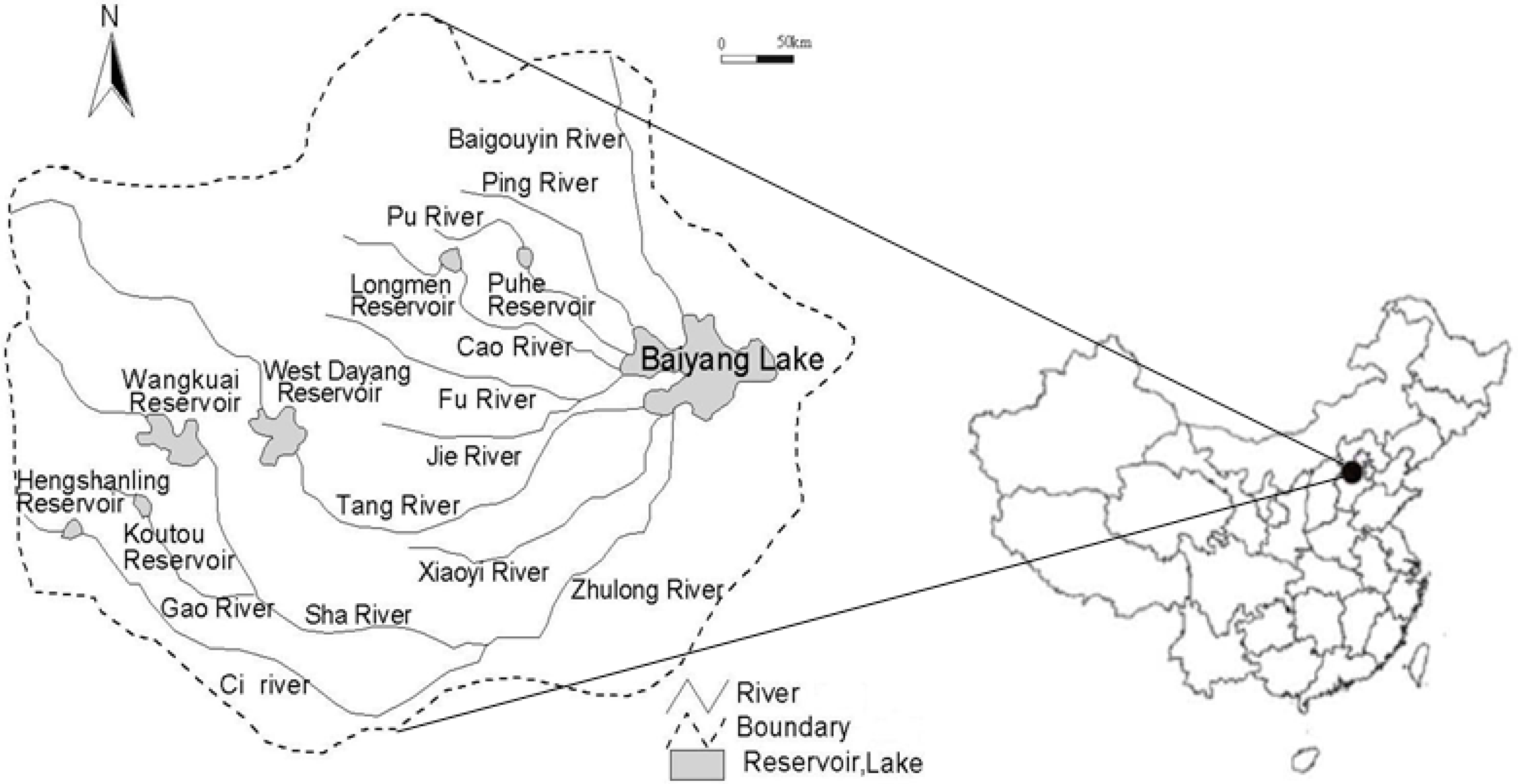
2.1. Study Area
2.2. Network Analysis for the Water Use System
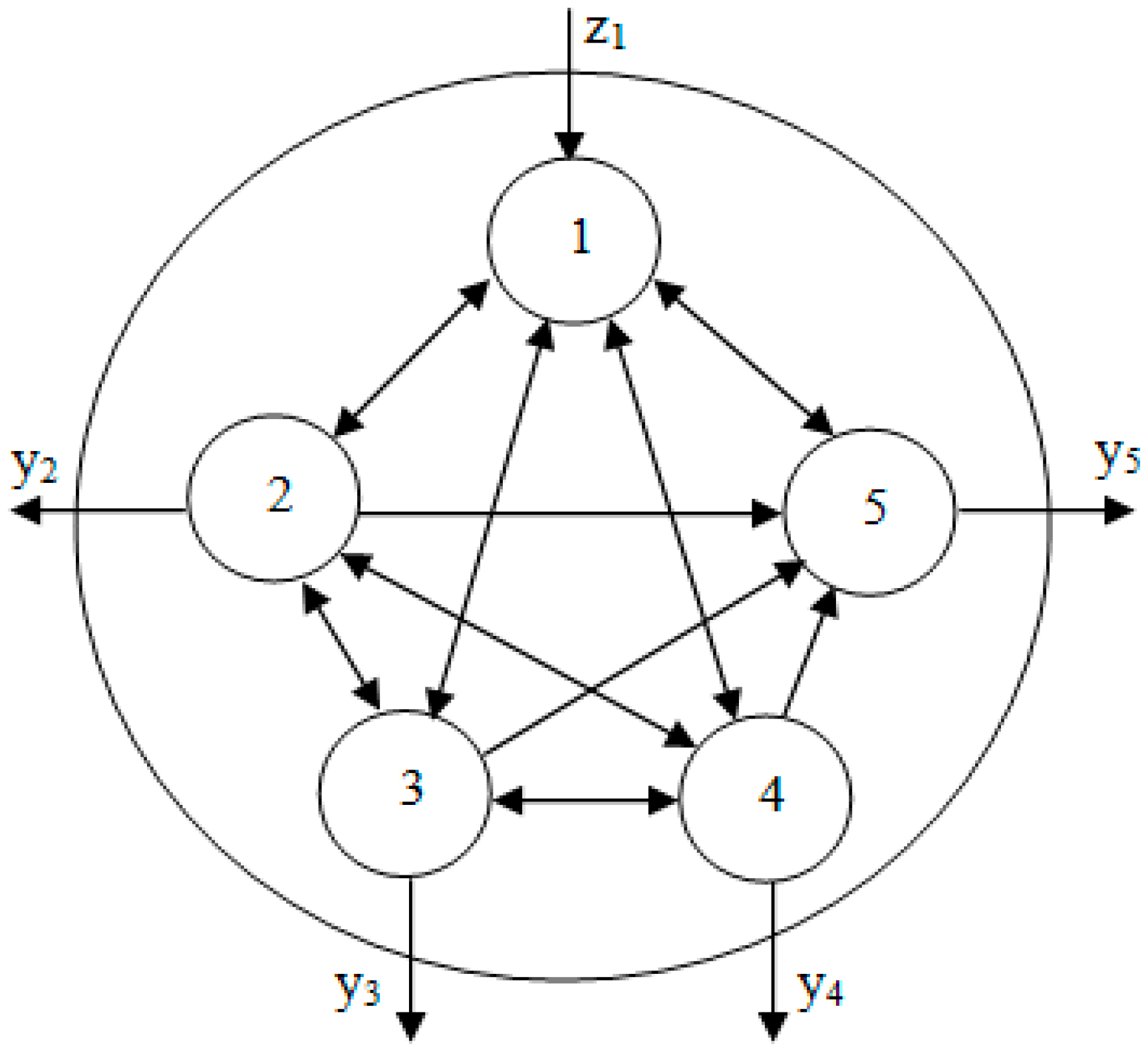
2.2.1. Network Model Description
2.2.2. Network Analysis Methods

| No. | Name | Symbol | Algorithms |
|---|---|---|---|
| 1 | Total System Throughput | TSTP | |
| 2 | Average Mutual Information | AMI | |
| 3 | Ascendency | A | |
| 4 | Import Ascendency | A0 | |
| 5 | Internal Ascendency | Ai | |
| 6 | Export Ascendency | Ae | |
| 7 | Development Capacity | C | |
| 8 | Ratio ascendency | A/C, A0/A, Ai/A, Ae/A | |
2.3. Scenarios Analysis
| No. | WS | Modification | Scenario |
|---|---|---|---|
| 1 | WS1 | Increasing boundary input by 10% | Precipitation increase |
| 2 | WS2 | Decreasing boundary input by 10% | Precipitation decrease |
| 3 | WS3 | Increasing boundary output by 10% | Lower water use efficient |
| 4 | WS4 | Decreasing boundary output by 10% | Higher water use efficient |
| 5 | WS5 | Increasing interflows among component 2–5 by 10% | More water exchanges |
| 6 | WS6 | Decreasing interflows among component 2–5 by 10% | Less water exchanges |
| 7 | WS7 | Adding new pathways from 5–2, 5–3 and 5–4 | New water exchange mode |
| 8 | WS8 | Reducing pathways among component 2, 3 and 4 | Less water exchanges |
2.4. Data Sources
3. Results and Discussion
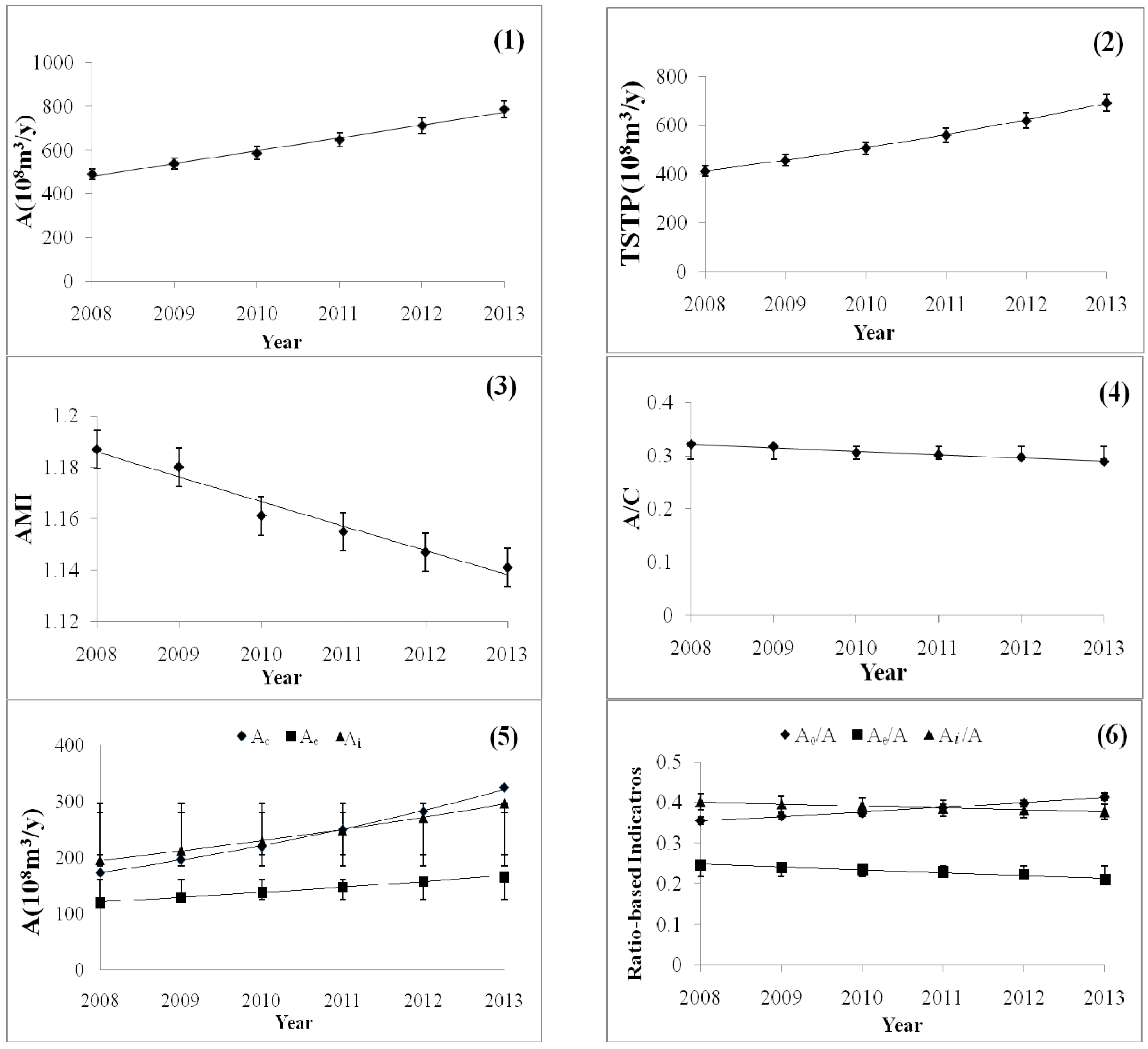
3.1. Fluctuations of Network Indicators from 2008–2013
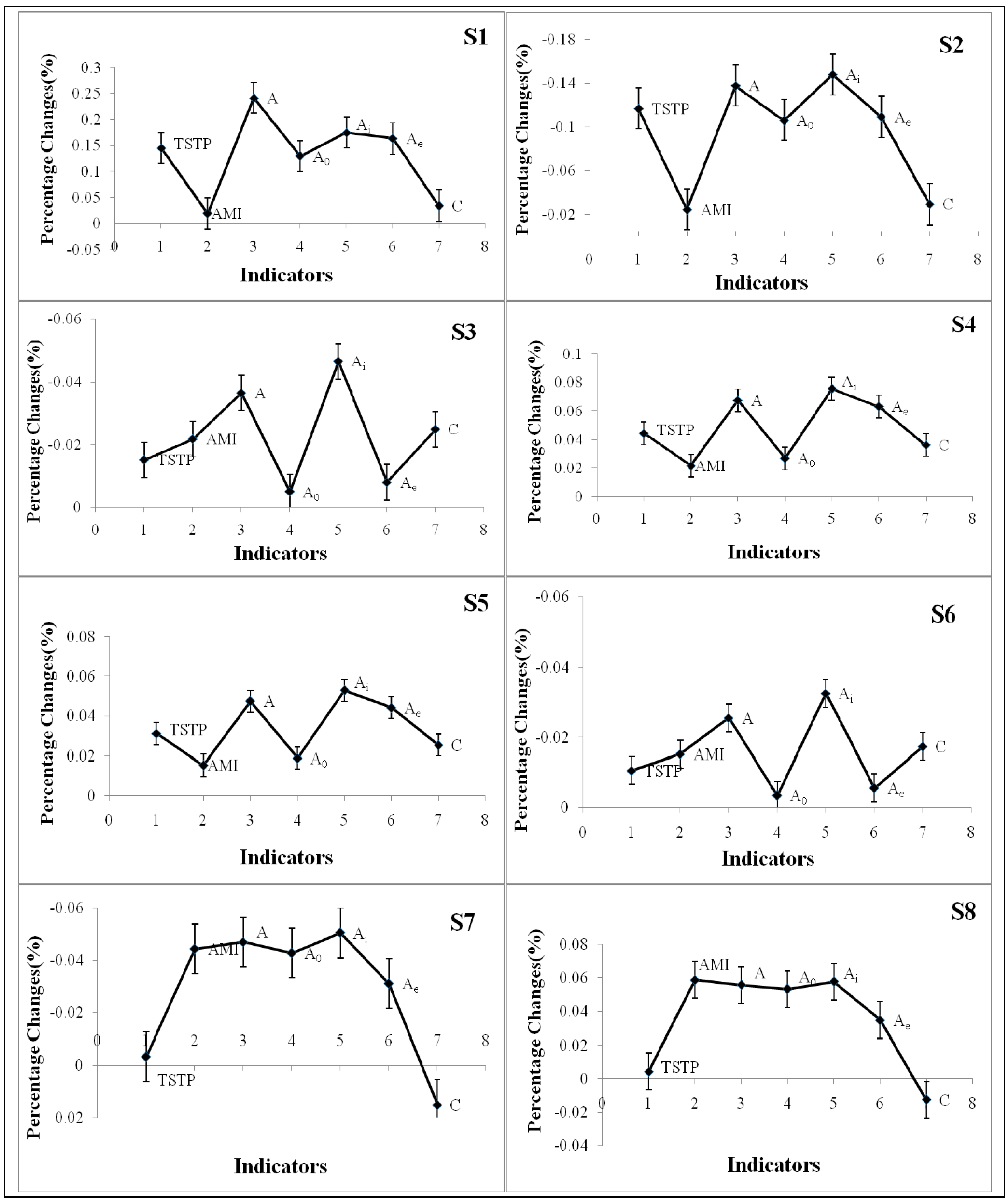
3.2. Results of Scenario Analysis
3.3. Suggested Water Use Strategies for the WUS
| Industry | Measures | Goal Function |
|---|---|---|
| Aquatic systems | Environmental and ecological restoration | Higher TSTP, less damage to Aquatic systems |
| Primary Industry | Using water-saving technology, reducing evapotranspiration and infiltration, planting low-water-consumption crop | Lower Ae and higher Ai |
| Secondary Industry | Increasing water recycling rate both inside and outside the industry | Lower Ae and higher Ai and A/C |
| Tertiary Industry | Water Saving and reclaimed water using | Lower A0 and Ae |
3.4. Discussion
4. Conclusions
Acknowledgments
Author Contributions
Conflicts of Interest
References
- Cai, X.M. Water stress, water transfer and social equity in Northern China—Implications for policy reforms. J. Environ. Manag. 2008, 87, 14–25. [Google Scholar] [CrossRef]
- Chen, B. Integration of Energy, Ecology and Environment. Front. Earth Sci. 2014, 8, 1–2. [Google Scholar] [CrossRef]
- Yin, X.A.; Yang, Z.F. Development of a coupled reservoir operation and water diversion model: Balancing human and environmental flow requirements. Ecol. Model. 2011, 222, 224–231. [Google Scholar] [CrossRef]
- Zeng, Y.; Zhao, J.; Chen, B.; Ji, P.; Wu, Y.H.; Feng, L. Longitudinal spread of bicomponent contaminant in wetland flow dominated by bank-wall effect. J. Hydrol. 2014, 509, 179–187. [Google Scholar] [CrossRef]
- Zeng, Y.; Wu, H.; Ji, P.; Chen, B.; Zhao, Y.J.; Chen, Q.; Wu, Z. Effect of wind on contaminant dispersion in a wetland flow dominated by free-surface effect. Ecol. Model. 2014, 237–238, 101–108. [Google Scholar]
- Radif, A.A. Integrated water resources management (IWRM): An approach to face the challenges of the next century and to avert future crises. Desalination 1999, 124, 145–153. [Google Scholar] [CrossRef]
- Cohen, M.J.; Brown, M.T. A model examining hierarchical wetland networks for watershed storm water management. Ecol. Model. 1997, 201, 179–193. [Google Scholar] [CrossRef]
- Medema, W.; McIntosh, B.S.; Jeffrey, P.J. From premise to practice: A critical assessment of integrated water resources management and adaptive management approaches in the water sector. Ecol. Soc. 2008, 13, 29–34. [Google Scholar]
- Nikolic, V.V.; Simonovic, S.P.; Milicevic, D.B. Analytical Support for Integrated Water Resources Management: A New Method for Addressing Spatial and Temporal Variability. Water Resour. Manag. 2013, 27, 401–417. [Google Scholar] [CrossRef]
- Kramer, A.; Pahl-Wostl, C. The global policy network behind integrated water resources management: Is it an effective norm diffusor? Ecol. Soc. 2014, 19, 11–24. [Google Scholar]
- Chen, B. Ecosystem metabolism framework, metrics and indicators towards sustainable society design and management. Ecol. Inform. 2015. [Google Scholar] [CrossRef]
- Chen, S.Q.; Chen, B. Urban Metabolism and Nexus. Ecol. Inform. 2015. [Google Scholar] [CrossRef]
- Serageldin, I. Water resources management: A new policy for a sustainable future. Water Int. 1995, 20, 15–21. [Google Scholar] [CrossRef]
- Fang, L.; Fath, B.D.; Chen, B.; Ursula, S. Network Environ Analysis for a socio-economic water system. Ecol. Indic. 2014, 47, 80–88. [Google Scholar] [CrossRef]
- Li, Y.; Chen, B. Study on sustainable water use of the Haihe River Basin using ecological network analysis. Front. Earth Sci. China 2009, 3, 419–430. [Google Scholar] [CrossRef]
- Mao, X.F.; Yang, Z.F. Ecological network analysis for virtual water trade systems: A case study for the Baiyangdian Basin in Northern China. Ecol. Inform. 2012, 10, 17–24. [Google Scholar] [CrossRef]
- Zhao, C.F.; Chen, B. Driving force analysis of the agricultural water footprint in China based on the LMDI method. Environ. Sci. Technol. 2014, 48, 12723–12731. [Google Scholar] [CrossRef] [PubMed]
- Zhao, F.; Chen, B.; Hayat, T.; Alsaedi, A.; Ahmad, B. Driving force analysis of water footprint change based on extended STIRPAT model: Evidence from the Chinese agricultural sector. Ecol. Indic. 2014, 47, 43–49. [Google Scholar] [CrossRef]
- Fath, B.D.; Patten, B.C. Review of the foundations of network environ analysis. Ecosystems 1999, 2, 167–179. [Google Scholar] [CrossRef]
- Ulanowicz, R.E.; Tuttle, J.H. The trophic consequences of oyster stock rehabilitation in Chesapeake Bay. Estuar 1992, 15, 298–306. [Google Scholar] [CrossRef]
- Patten, B.C.; Matis, J.H. The water envions of Okefenokee Swamp: Applications of static liner environ analysis. Ecol. Model. 1982, 16, 1–50. [Google Scholar] [CrossRef]
- Bodini, A.; Bondavalli, C. Towards a sustainable use of water resources. Int. J. Environ. Pollut. 2002, 18, 463–485. [Google Scholar] [CrossRef]
- Li, Y.; Chen, B.; Yang, Z.F. Ecological network analysis for water use systems—A case study of the Yellow River Basin. Ecol. Model. 2009, 220, 3167–3173. [Google Scholar]
- Zhang, Y.; Yang, Z.F.; Fath, B.D. Ecological network analysis of an urban water metabolic system: Model development, and a case study for Beijing. Sci. Total Environ. 2010, 408, 4702–4711. [Google Scholar] [CrossRef] [PubMed]
- Mao, X.F.; Cui, L.J.; Wang, C.H. Exploring the hydrologic relationships in a swamp-dominated watershed—A network-environ-analysis based approach. Ecol. Model. 2013, 252, 273–279. [Google Scholar] [CrossRef]
- Li, Y.H.; Cui, B.S.; Yang, Z.F. Influence of hydrological characteristic change of Baiyangdian on the ecological environment in wetland. J. Nat. Sci. 2004, 19, 63–69. (In Chinese) [Google Scholar]
- Zhong, P.; Yang, Z.F.; Cui, B.S.; Liu, J.L. Eco-environmental water demands for the Baiyangdian Wetland. Front. Environ. Sci. Eng. China 2008, 2, 73–80. [Google Scholar] [CrossRef]
- Ulanowicz, R.E. A hypothesis on the development of natural communities. J. Theor. Biol. 1980, 85, 223–245. [Google Scholar] [CrossRef] [PubMed]
- Ulanowicz, R.E. Growth and Development: Ecosystems Phenomenology; Springer-Verlag: New York, NY, USA, 1986; p. 203. [Google Scholar]
- Shannon, C.E. A mathematical theory of communication. Bell Syst. Tech. J. 1948, 27, 379–423. [Google Scholar] [CrossRef]
- Rutledge, R.W.; Basore, B.L.; Mulholland, R.J. Ecological stability: An information theory viewpoint. J. Theor. Biol. 1976, 57, 223–254. [Google Scholar] [CrossRef]
- Ulanowicz, R.E. Ecology, the Ascendency Perspective; Columbia University Press: New York, NY, USA, 1997; p. 201. [Google Scholar]
- Chapagain, A.K.; Hoekstra, A.Y. Virtual Water Flows between Nations in Relation to Trade in Livestock and Livestock Products; Value of Water Research Report Series No. 13; UNESCO-IHE: Delft, The Netherlands, 2003. [Google Scholar]
- Chapagain, A.K.; Hoekstra, A.Y. Water Footprints of Nations; Value of Water Research Report Series No. 16; UNESCO-IHE: Delft, The Netherlands, 2004. [Google Scholar]
- Zhao, X.; Yang, H.; Yang, Z.F.; Chen, B.; Qin, Y. Applying the input-output method to account for water footprint and virtual water trade in the Haihe River basin in China. Environ. Sci. Technol. 2010, 44, 9150–9156. [Google Scholar] [CrossRef] [PubMed]
- Yang, Z.F.; Mao, X.F. Wetland system network analysis for environmental flow allocations in the Baiyangdian Basin, China. Ecol. Model. 2011, 222, 3785–3794. [Google Scholar] [CrossRef]
- Li, Y.; Yang, Z.F. Quantifying the sustainability of water use systems: Calculating the balance between network efficiency and resilience. Ecol. Model. 2011, 222, 1771–1780. [Google Scholar] [CrossRef]
- Zorach, A.C.; Ulanowicz, R.E. Quantifying the complexity of flow networks: How many roles are there? Complexity 2003, 8, 68–76. [Google Scholar] [CrossRef]
© 2015 by the authors; licensee MDPI, Basel, Switzerland. This article is an open access article distributed under the terms and conditions of the Creative Commons Attribution license (http://creativecommons.org/licenses/by/4.0/).
Share and Cite
Mao, X.; Yuan, D.; Wei, X.; Chen, Q.; Yan, C.; He, L. Network Analysis for a Better Water Use Configuration in the Baiyangdian Basin, China. Sustainability 2015, 7, 1730-1741. https://doi.org/10.3390/su7021730
Mao X, Yuan D, Wei X, Chen Q, Yan C, He L. Network Analysis for a Better Water Use Configuration in the Baiyangdian Basin, China. Sustainability. 2015; 7(2):1730-1741. https://doi.org/10.3390/su7021730
Chicago/Turabian StyleMao, Xufeng, Donghai Yuan, Xiaoyan Wei, Qiong Chen, Chenling Yan, and Liansheng He. 2015. "Network Analysis for a Better Water Use Configuration in the Baiyangdian Basin, China" Sustainability 7, no. 2: 1730-1741. https://doi.org/10.3390/su7021730
APA StyleMao, X., Yuan, D., Wei, X., Chen, Q., Yan, C., & He, L. (2015). Network Analysis for a Better Water Use Configuration in the Baiyangdian Basin, China. Sustainability, 7(2), 1730-1741. https://doi.org/10.3390/su7021730

